Data report · Updated October 2026
Is there a veterinarian shortage? Vet school debt, starting pay, rural shortage areas and what the forecasts disagree on
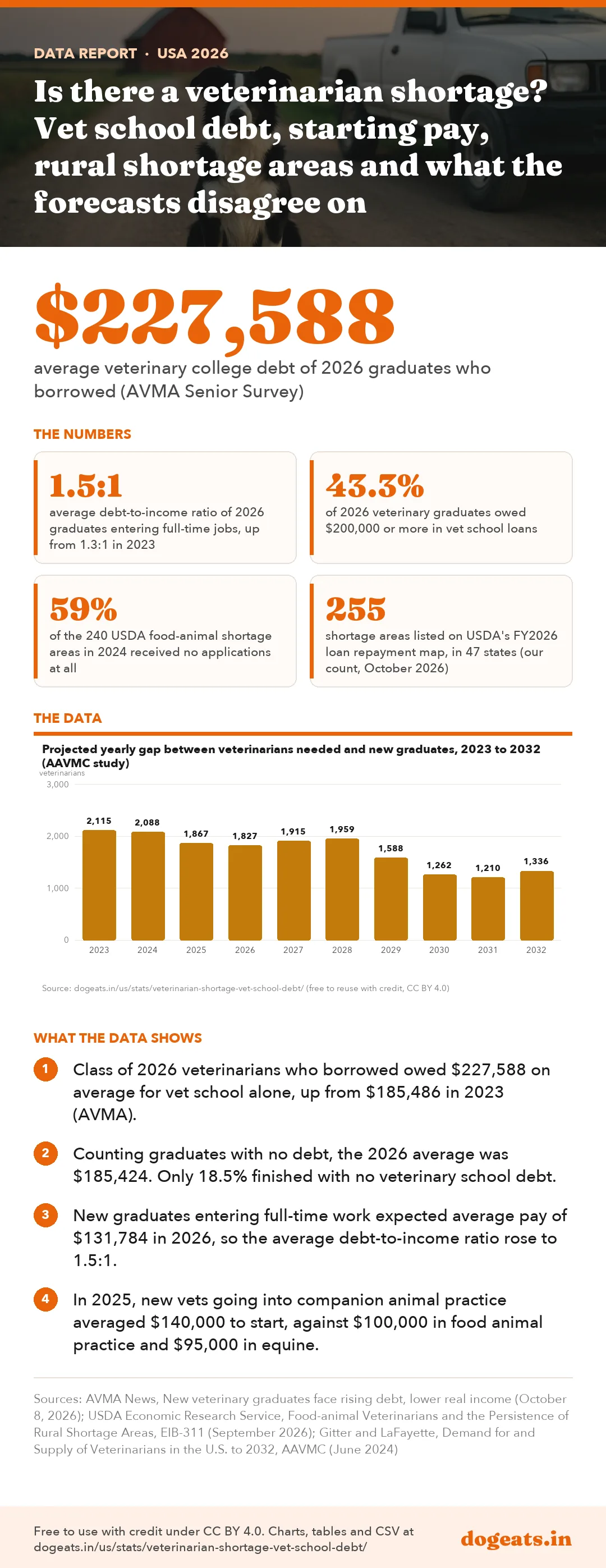
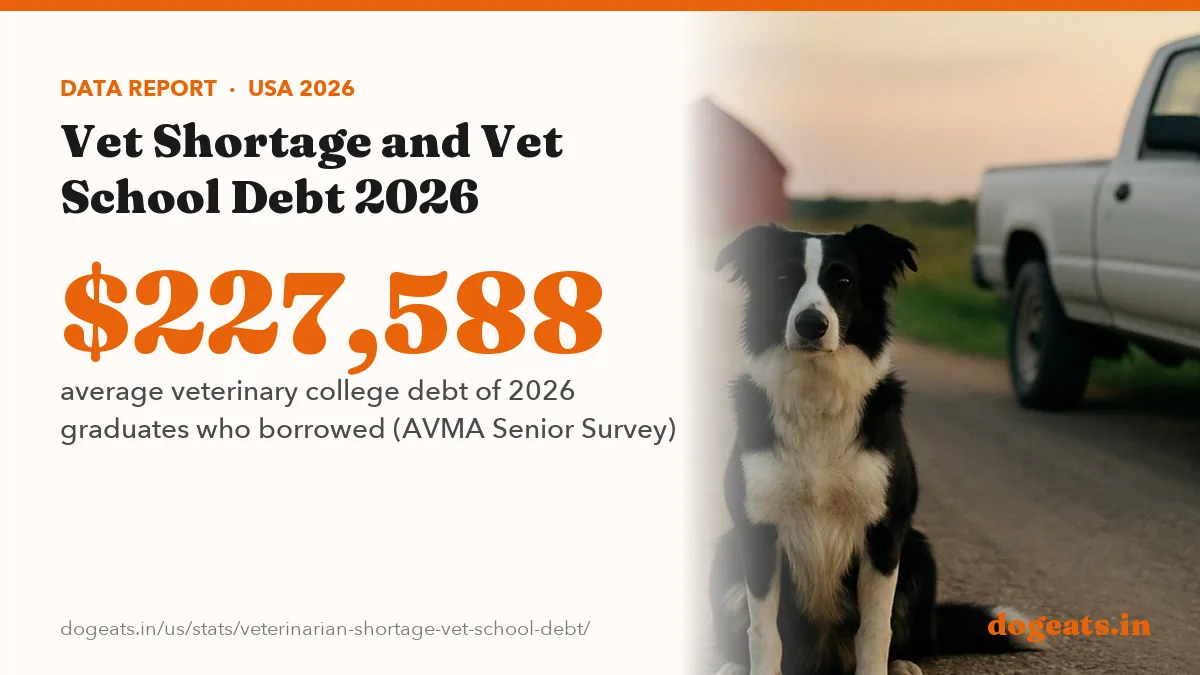
Veterinary graduates with student loans owed an average of $227,588 in 2026, a record, against average full-time starting pay of $131,784. Forecasts of a national vet shortage disagree. A study published by the veterinary colleges' association says graduates will cover only 76% of need through 2032. An analysis for the AVMA finds no overall shortage to 2035. The clearest gap is rural food-animal practice, where 59% of USDA shortage areas drew no applicants in 2024.
Key findings
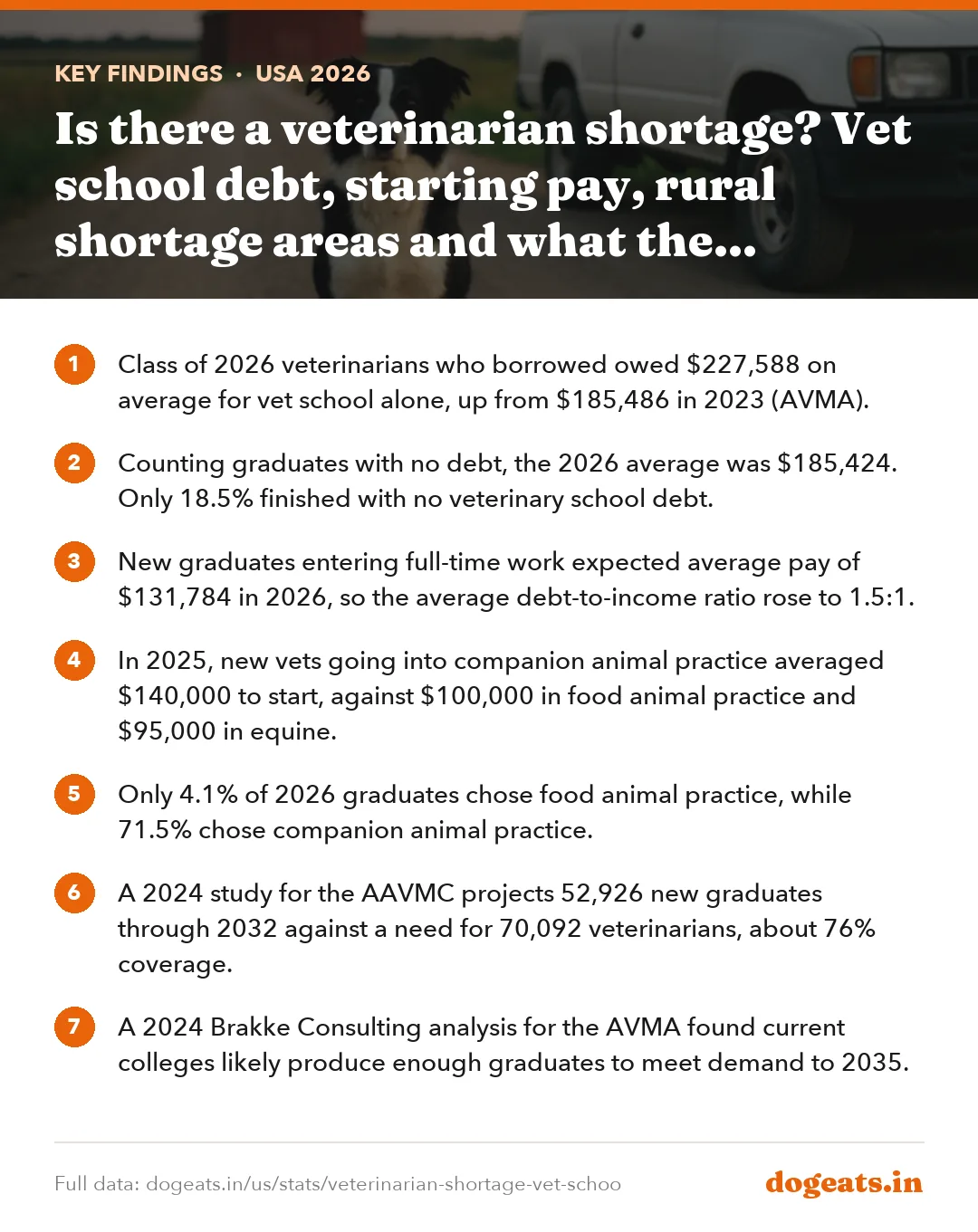
- Class of 2026 veterinarians who borrowed owed $227,588 on average for vet school alone, up from $185,486 in 2023 (AVMA).
- Counting graduates with no debt, the 2026 average was $185,424. Only 18.5% finished with no veterinary school debt.
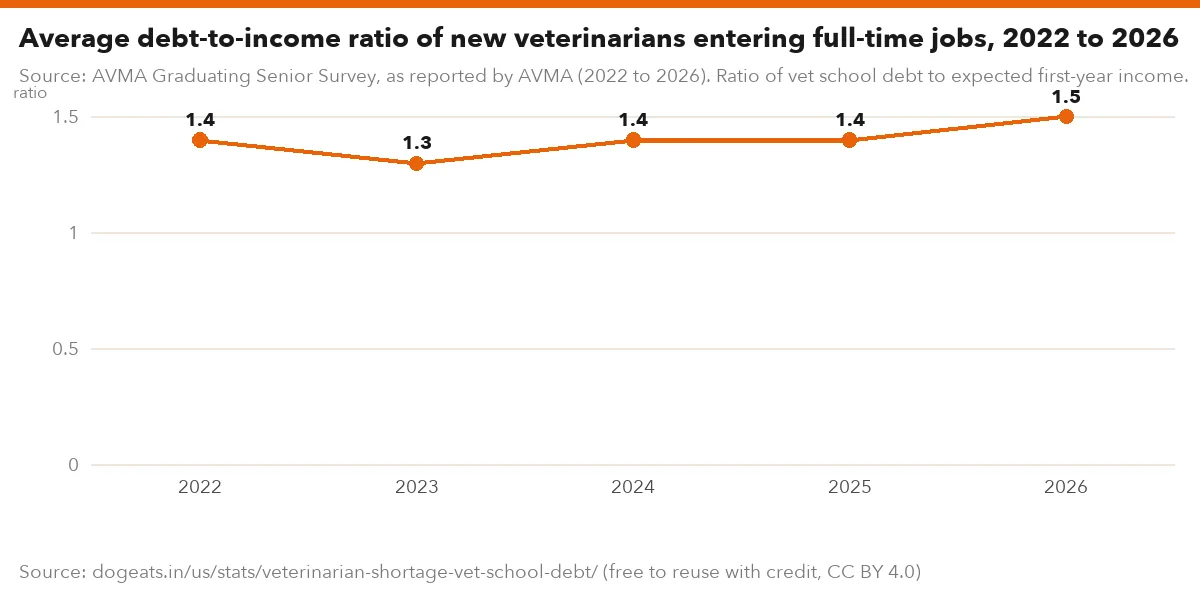
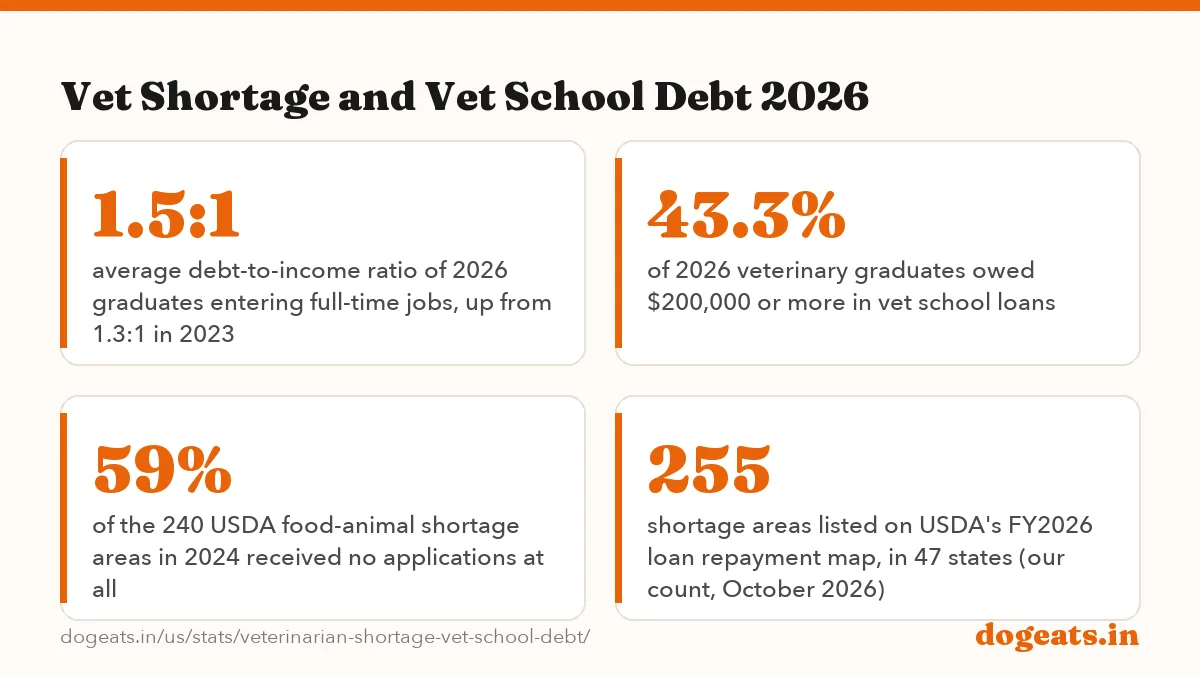
- New graduates entering full-time work expected average pay of $131,784 in 2026, so the average debt-to-income ratio rose to 1.5:1.
- In 2025, new vets going into companion animal practice averaged $140,000 to start, against $100,000 in food animal practice and $95,000 in equine.
- Only 4.1% of 2026 graduates chose food animal practice, while 71.5% chose companion animal practice.
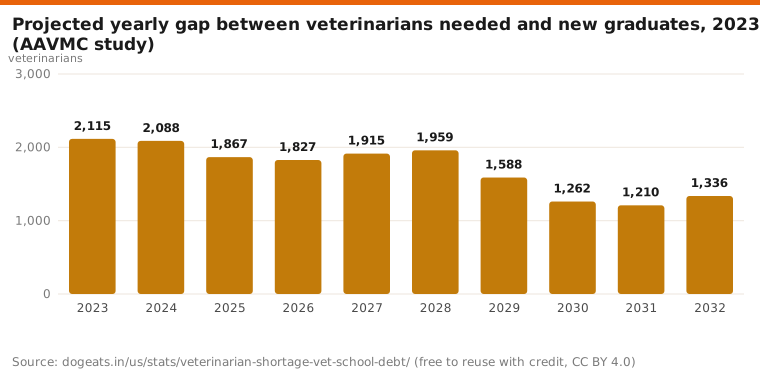
- A 2024 study for the AAVMC projects 52,926 new graduates through 2032 against a need for 70,092 veterinarians, about 76% coverage.
- A 2024 Brakke Consulting analysis for the AVMA found current colleges likely produce enough graduates to meet demand to 2035.
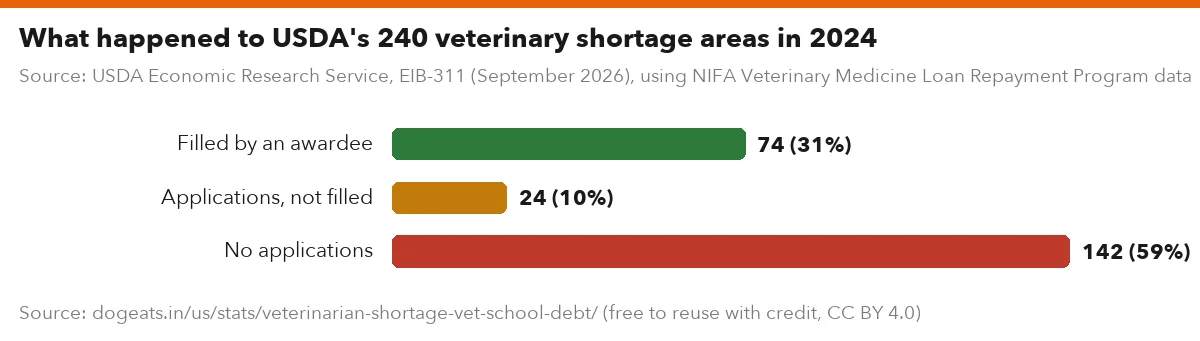
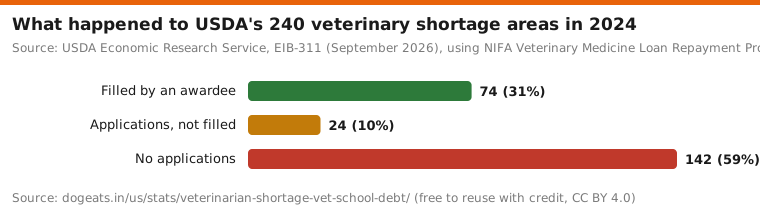
- USDA designated 240 food-animal shortage areas in 2024; 31% were filled and 59% drew no applicants.
- Three quarters of US counties were in a USDA veterinary shortage nomination at least once from 2010 to 2026, and 453 counties were nominated 9 or more times (USDA ERS).
- From FY2026, USDA's loan repayment program pays up to $40,000 a year for three years of rural food-animal service, up from $25,000.
Is there a veterinarian shortage in the US?
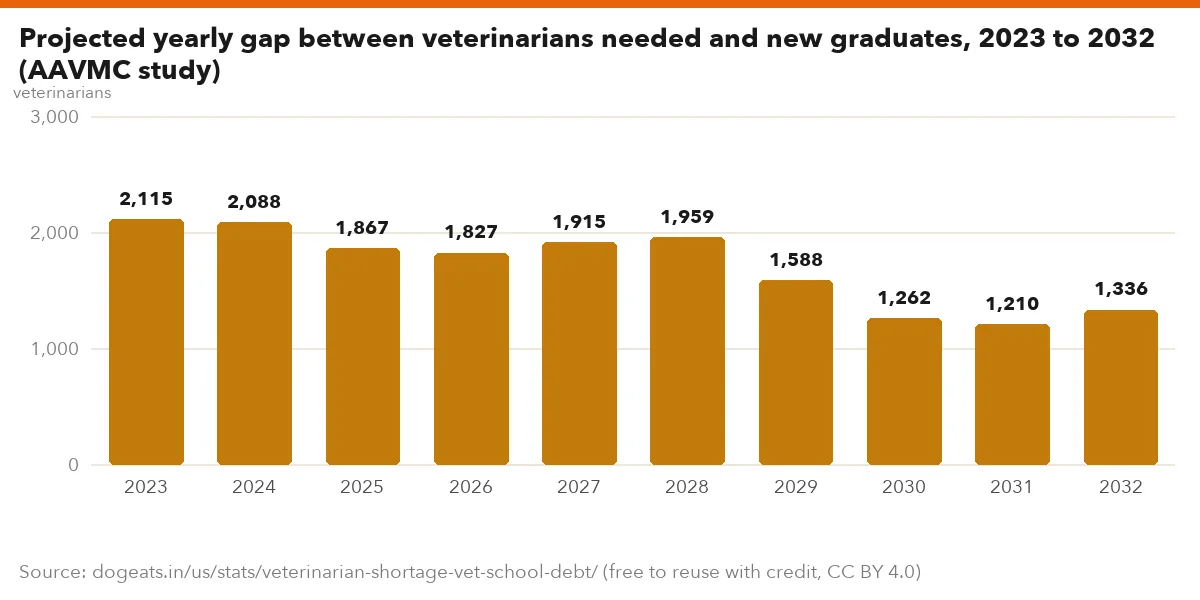
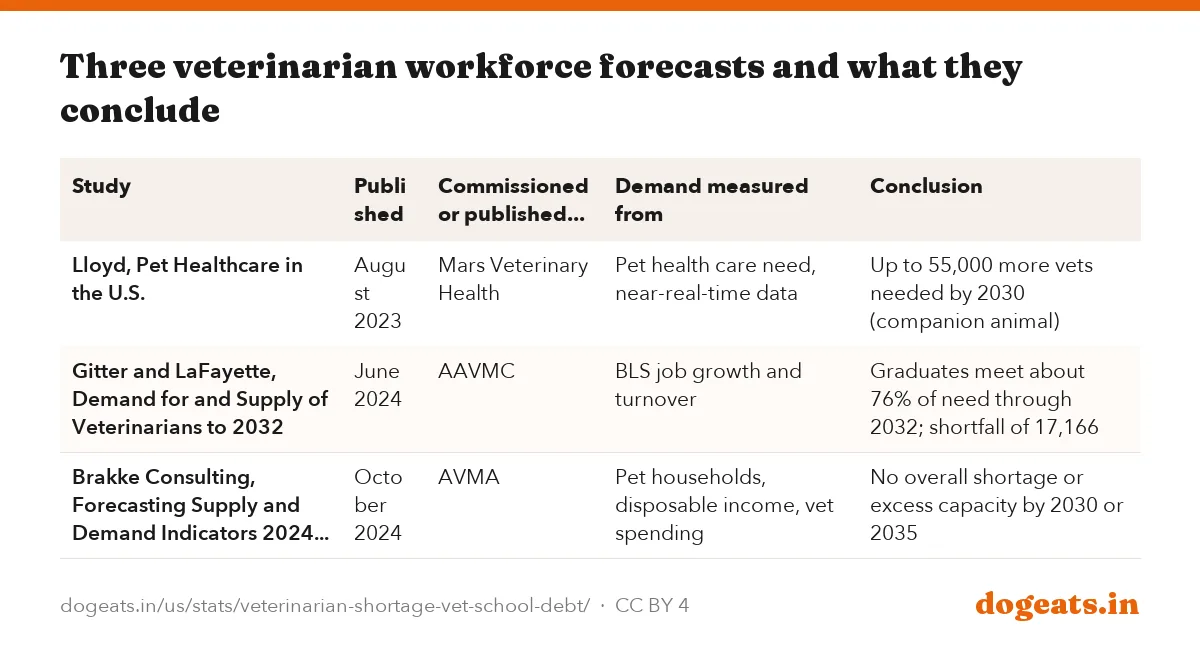
It depends on which forecast you trust. A June 2024 study published by the American Association of Veterinary Medical Colleges (AAVMC) projects 52,926 new graduates through 2032 against a need for 70,092 veterinarians, a shortfall of 17,166. An October 2024 analysis by Brakke Consulting for the American Veterinary Medical Association (AVMA) found graduates of existing colleges are likely enough to meet demand to 2035.
The two sides measure demand differently. The AAVMC study, by economists Robert Gitter and Bill LaFayette, starts from Bureau of Labor Statistics (BLS) job growth and turnover. It assumed 19.8% growth in vet jobs from 2022 to 2032 and a 33% ten-year turnover rate. The Brakke study starts from pet-owning households, which it expects to grow about 2% a year, and household spending on vet care. Its author said the data "do not justify a conclusion of overall excess capacity or capacity shortage by 2030 or 2035."
The shortage claim most often repeated in the news came from an August 2023 report commissioned by Mars Veterinary Health, which has a network of 3,000 clinics worldwide. AVMA News reported that it said the US could need as many as 55,000 more veterinarians by 2030. The AAVMC study summarizes the same author's 2023 projection as a shortfall of 14,000 to 24,000 companion animal vets by 2030. Brakke's analyst criticized it for leaving out supply and demand.
Source: Gitter and LaFayette, Demand for and Supply of Veterinarians in the U.S. to 2032, AAVMC, June 2024, Table 6. Need = BLS-based job growth plus turnover; graduates from AAVMC projections. A projection, not a count.
Show the numbers
| Label | veterinarians |
|---|---|
| 2023 | 2,115 |
| 2024 | 2,088 |
| 2025 | 1,867 |
| 2026 | 1,827 |
| 2027 | 1,915 |
| 2028 | 1,959 |
| 2029 | 1,588 |
| 2030 | 1,262 |
| 2031 | 1,210 |
| 2032 | 1,336 |
Embed this chart
| Study | Published | Commissioned or published by | Demand measured from | Conclusion |
|---|---|---|---|---|
| Lloyd, Pet Healthcare in the U.S. | August 2023 | Mars Veterinary Health | Pet health care need, near-real-time data | Up to 55,000 more vets needed by 2030 (companion animal) |
| Gitter and LaFayette, Demand for and Supply of Veterinarians to 2032 | June 2024 | AAVMC | BLS job growth and turnover | Graduates meet about 76% of need through 2032; shortfall of 17,166 |
| Brakke Consulting, Forecasting Supply and Demand Indicators 2024 to 2035 | October 2024 | AVMA | Pet households, disposable income, vet spending | No overall shortage or excess capacity by 2030 or 2035 |
Both camps agree on one point: shortages can be local. Matthew MacLachlan, a co-author of the Brakke report, said he did not rule out "regional or practice type-specific frictions" in the market. For how many vets work in each state today, see our veterinarians by state report.
Where is the veterinarian shortage worst?
In rural food-animal practice. A September 2026 USDA Economic Research Service (ERS) report found three quarters of US counties were in a state's veterinary shortage nomination at least once from 2010 to 2026. That includes about 81% of rural counties and 62% of urban ones.
Some gaps never close. ERS counted 453 counties, 14% of the total, nominated 9 or more times, which it calls persistent shortage counties. In 2026, 70% of counties in shortage areas were rural, and most needs centered on beef cattle.
The money explains part of it. ERS found real income for rural food-animal veterinarians fell 19% from 2017 to 2024, while urban food-animal pay rose almost 30% to $174,000. Average revenue at rural food- and mixed-animal practices fell 22% from 2021 to 2025, to $1.54 million.
Source: USDA Economic Research Service, EIB-311 (September 2026), using NIFA Veterinary Medicine Loan Repayment Program data for the 2024 cycle.
Show the numbers
| Label | shortage areas |
|---|---|
| Filled by an awardee | 74 (31%) |
| Applications, not filled | 24 (10%) |
| No applications | 142 (59%) |
Embed this chart
ERS cautions that unfilled does not always mean no vet wanted the job. The program can fund only a fraction of designated areas, so some go unfilled for lack of money. Shortages of food-animal vets also matter for disease control; the New World screwworm outbreak is one recent example of a livestock threat that reached dogs.
New graduates are not moving toward this work. In the AVMA's 2026 senior survey, 71.5% of new vets chose companion animal practice, 10.1% mixed animal, 7.5% equine and 4.1% food animal.
How many veterinary shortage areas does USDA designate each year?
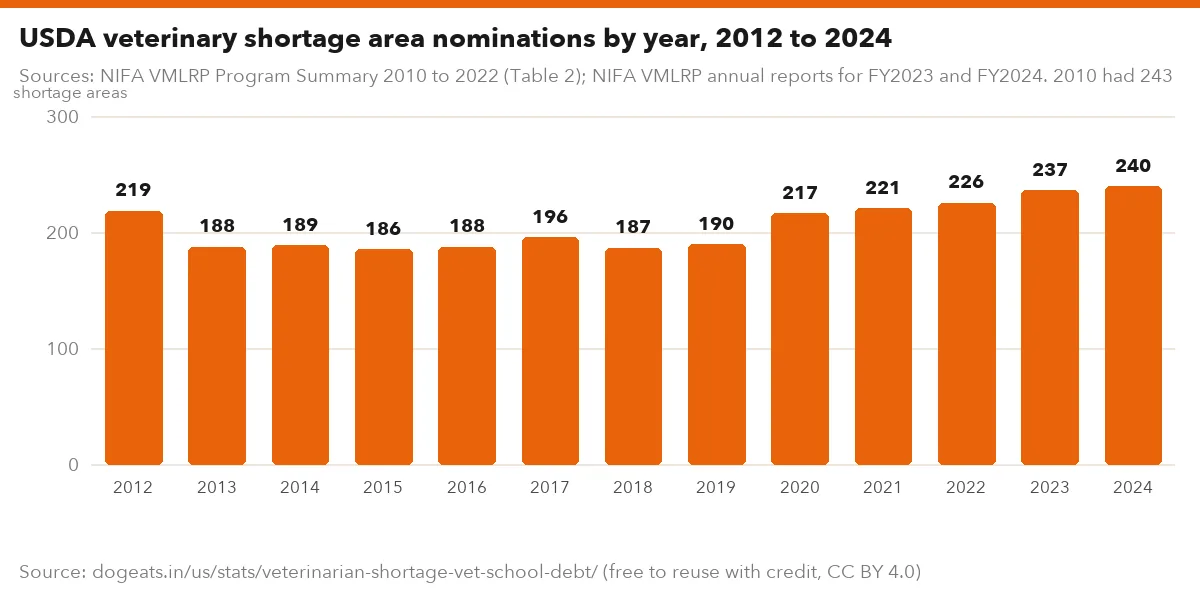
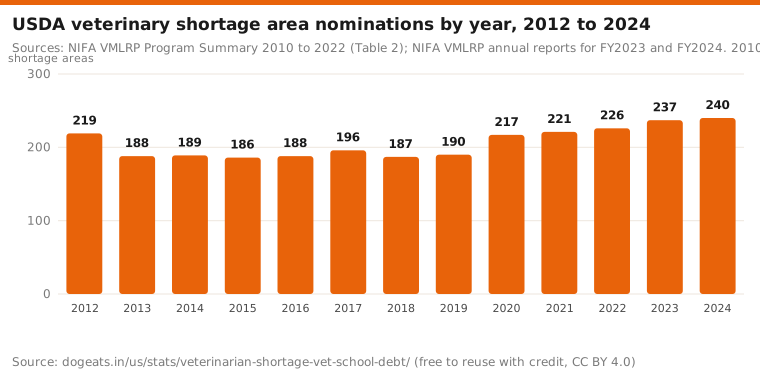
About 240 a year recently. State animal health officials nominated 237 shortage areas for the FY2023 cycle and 240 for FY2024, up from a low of 186 in 2015. The figures come from the National Institute of Food and Agriculture (NIFA), which runs the Veterinary Medicine Loan Repayment Program (VMLRP).
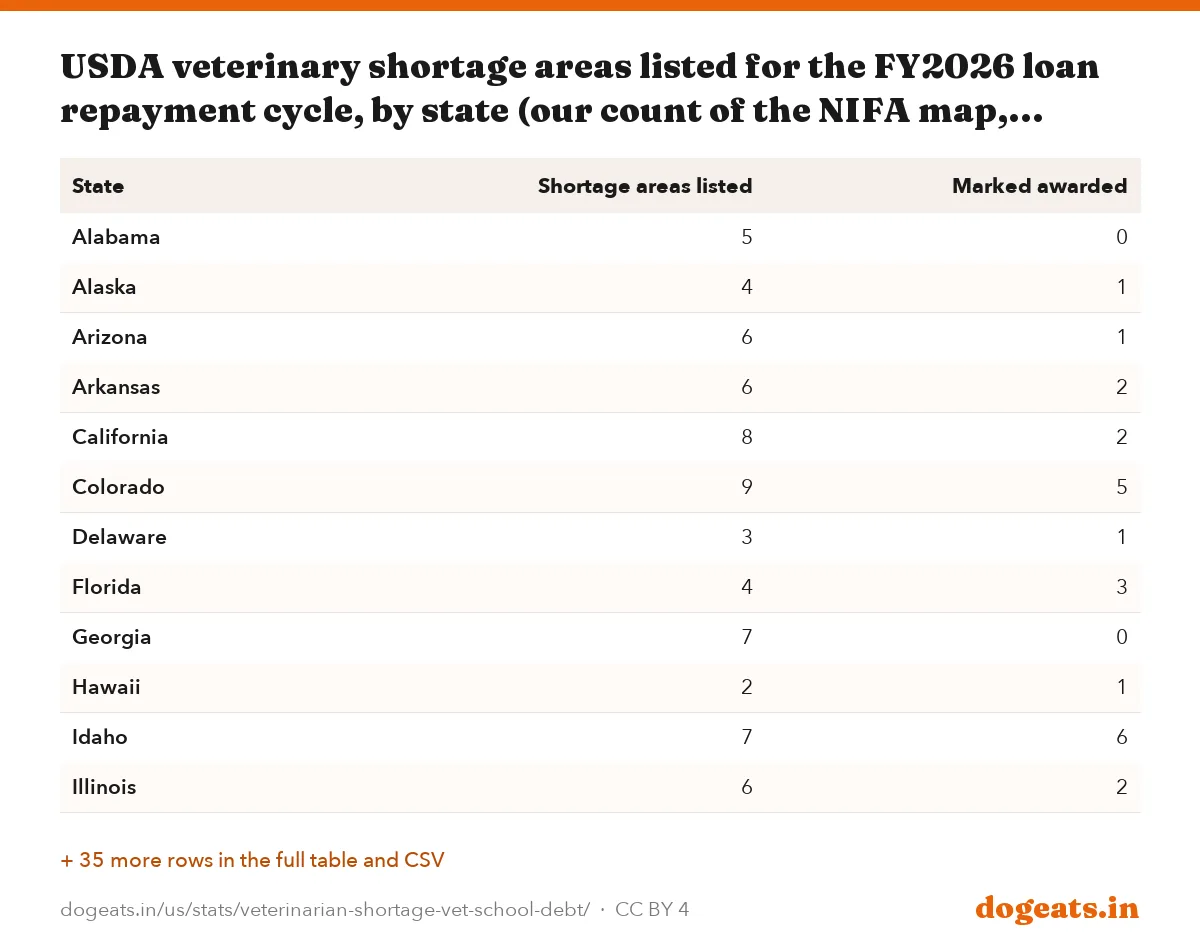
For the FY2026 cycle, we counted 255 shortage areas on NIFA's shortage map in October 2026: 251 in 47 states plus 4 on federal lands. ERS reports that in 2026, 79% of shortage areas were rural Type II, 10% Type I private food-animal practice and 11% Type III public practice. NIFA's map marked 106 of them as awarded.
Each state's nominations are capped by an allocation based on land area and food animal sales, so these counts measure program slots, not the full size of the shortage. Most states nominate their maximum, NIFA says.
Sources: NIFA VMLRP Program Summary 2010 to 2022 (Table 2); NIFA VMLRP annual reports for FY2023 and FY2024. 2010 had 243 nominations.
Show the numbers
| Label | shortage areas |
|---|---|
| 2012 | 219 |
| 2013 | 188 |
| 2014 | 189 |
| 2015 | 186 |
| 2016 | 188 |
| 2017 | 196 |
| 2018 | 187 |
| 2019 | 190 |
| 2020 | 217 |
| 2021 | 221 |
| 2022 | 226 |
| 2023 | 237 |
| 2024 | 240 |
Embed this chart
| State | Shortage areas listed | Marked awarded |
|---|---|---|
| Alabama | 5 | 0 |
| Alaska | 4 | 1 |
| Arizona | 6 | 1 |
| Arkansas | 6 | 2 |
| California | 8 | 2 |
| Colorado | 9 | 5 |
| Delaware | 3 | 1 |
| Florida | 4 | 3 |
| Georgia | 7 | 0 |
| Hawaii | 2 | 1 |
| Idaho | 7 | 6 |
| Illinois | 6 | 2 |
| Indiana | 5 | 2 |
| Iowa | 7 | 5 |
| Kansas | 7 | 6 |
| Kentucky | 5 | 0 |
| Louisiana | 4 | 2 |
| Maine | 2 | 1 |
| Maryland | 3 | 0 |
| Michigan | 6 | 0 |
| Minnesota | 7 | 0 |
| Mississippi | 5 | 2 |
| Missouri | 7 | 5 |
| Montana | 6 | 5 |
| Nebraska | 7 | 3 |
| Nevada | 2 | 0 |
| New Hampshire | 2 | 2 |
| New Jersey | 2 | 0 |
| New Mexico | 6 | 2 |
| New York | 7 | 2 |
| North Carolina | 6 | 2 |
| North Dakota | 5 | 2 |
| Ohio | 5 | 4 |
| Oklahoma | 7 | 3 |
| Oregon | 6 | 1 |
| Pennsylvania | 5 | 4 |
| South Carolina | 3 | 2 |
| South Dakota | 6 | 4 |
| Tennessee | 4 | 2 |
| Texas | 8 | 4 |
| Utah | 8 | 2 |
| Vermont | 4 | 2 |
| Virginia | 5 | 2 |
| Washington | 6 | 3 |
| West Virginia | 2 | 1 |
| Wisconsin | 7 | 2 |
| Wyoming | 7 | 5 |
Joint shortage areas that span two states appear once on NIFA's map, under one state. Federal-land areas listed under Nebraska, North Dakota, Washington and Wisconsin are left out of the table. Colorado listed the most (9). Eight states had no area marked awarded.
How much debt do veterinary students graduate with?
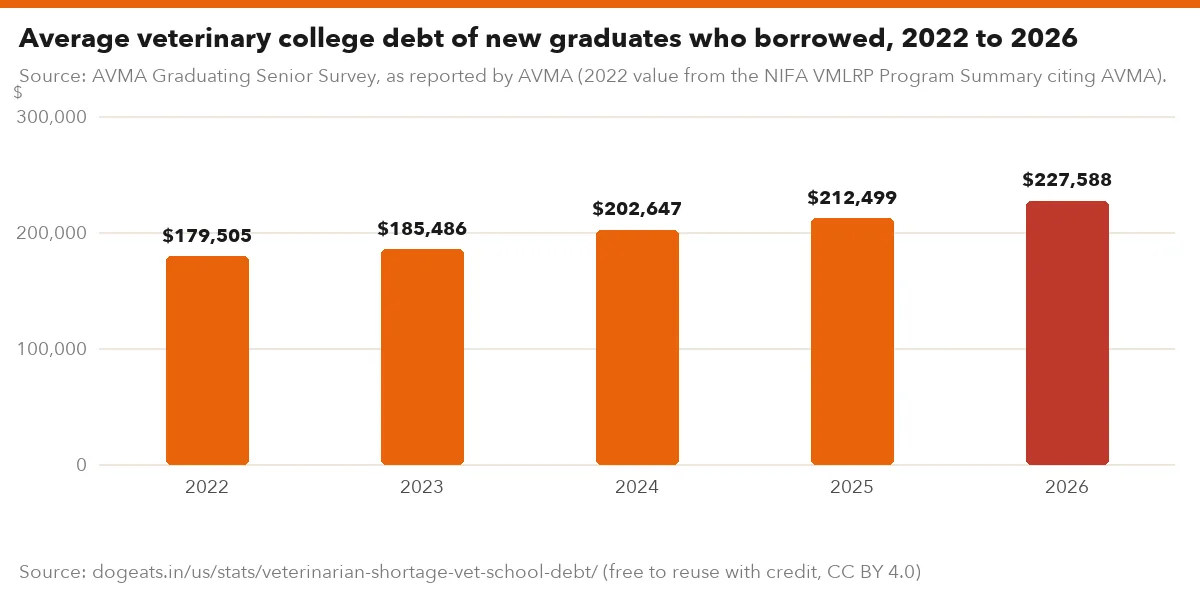
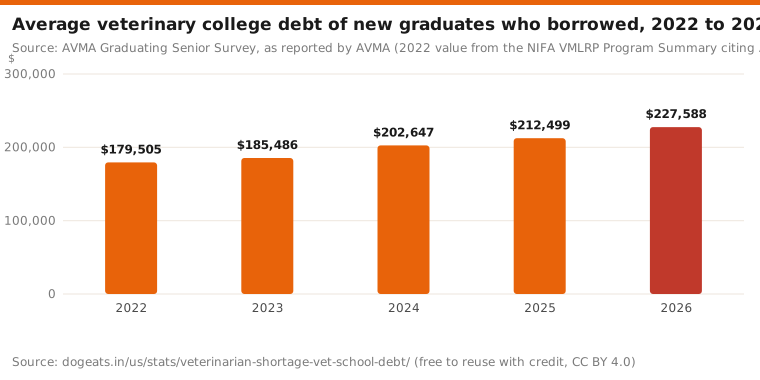
Graduates with debt owed an average of $227,588 for veterinary college in 2026, the highest on record, according to the AVMA Senior Survey. Across all graduates, including the 18.5% with none, the average was $185,424.
Debt fell during the COVID-19 years, from 2020 to 2023, the AVMA reports. It has risen every year since 2023. In 2026, 43.3% of new vets owed $200,000 or more and 7.9% owed $400,000 or more. These figures cover vet school debt only, not undergraduate loans.
Source: AVMA Graduating Senior Survey, as reported by AVMA (2022 value from the NIFA VMLRP Program Summary citing AVMA). Vet school debt only; excludes graduates with no debt.
Show the numbers
| Label | $ |
|---|---|
| 2022 | $179,505 |
| 2023 | $185,486 |
| 2024 | $202,647 |
| 2025 | $212,499 |
| 2026 | $227,588 |
Embed this chart
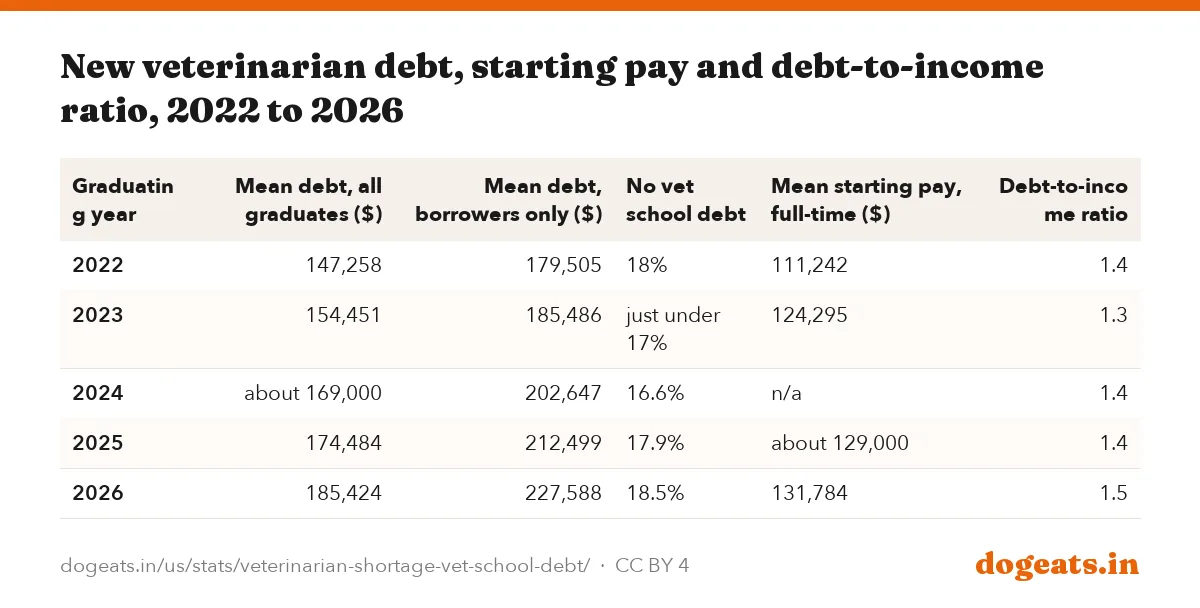
| Graduating year | Mean debt, all graduates ($) | Mean debt, borrowers only ($) | No vet school debt | Mean starting pay, full-time ($) | Debt-to-income ratio |
|---|---|---|---|---|---|
| 2022 | 147,258 | 179,505 | 18% | 111,242 | 1.4 |
| 2023 | 154,451 | 185,486 | just under 17% | 124,295 | 1.3 |
| 2024 | about 169,000 | 202,647 | 16.6% | n/a | 1.4 |
| 2025 | 174,484 | 212,499 | 17.9% | about 129,000 | 1.4 |
| 2026 | 185,424 | 227,588 | 18.5% | 131,784 | 1.5 |
The 2022 figures cover graduates of US colleges; later years include two Caribbean colleges. The 2025 starting pay is the AVMA's inflation-adjusted figure. AVMA did not publish a 2024 starting pay figure in the articles we used, so that cell reads n/a.
How much do new veterinarians make compared with their debt?
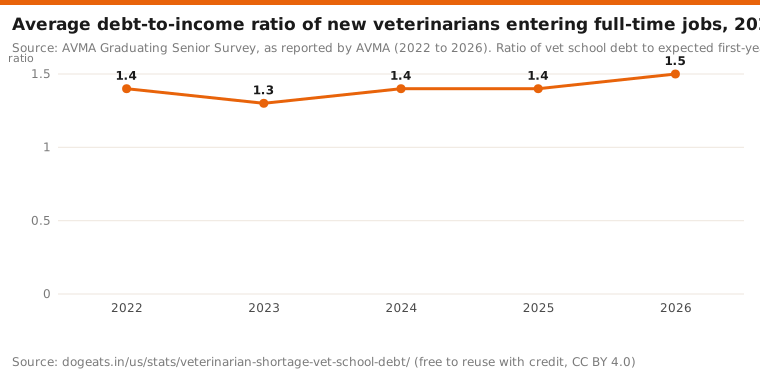
Graduates entering full-time jobs in 2026 expected average pay of $131,784, or $127,046 in 2025 dollars, so the average debt-to-income ratio rose to 1.5:1. The AVMA calls a ratio of about 1.4 manageable, and in much of the 2010s the average often exceeded 2.0.
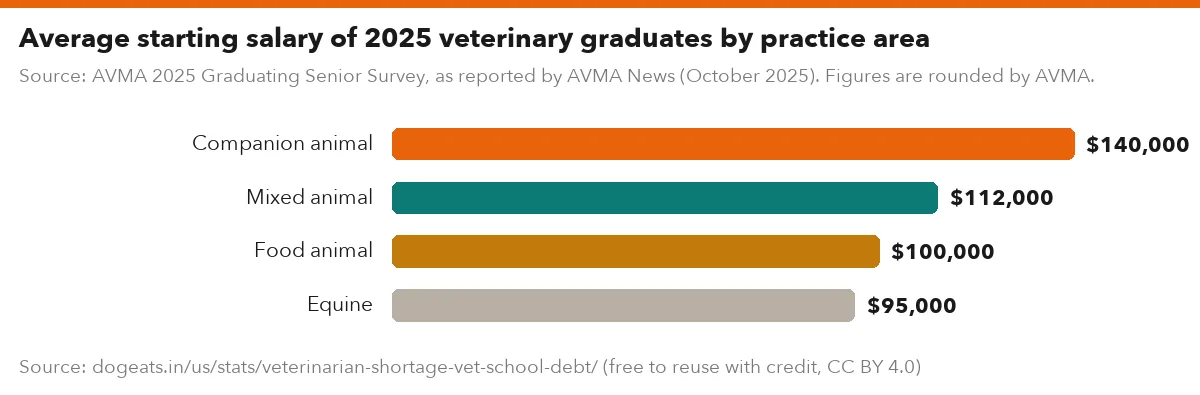
Pay depends heavily on the field. In 2026, private practice paid new graduates $133,056 on average and public practice $101,234. Internships paid $59,436 and residencies $54,988. In 2025, companion animal practice started at about $140,000, mixed practice $112,000, food animal $100,000 and equine $95,000.
The job market has cooled from its pandemic peak. In 2026, 58.0% of seniors had a full-time job lined up before graduation, 28.2% were headed to internships or residencies and 7.4% had no offer, up from 2.1% in 2022. 18.1% of 2026 graduates had a debt-to-income ratio of 2.5:1 or higher.
Source: AVMA 2025 Graduating Senior Survey, as reported by AVMA News (October 2025). Figures are rounded by AVMA.
Show the numbers
| Label | $ |
|---|---|
| Companion animal | $140,000 |
| Mixed animal | $112,000 |
| Food animal | $100,000 |
| Equine | $95,000 |
Embed this chart
Source: AVMA Graduating Senior Survey, as reported by AVMA (2022 to 2026). Ratio of vet school debt to expected first-year income.
Show the numbers
| Label | ratio |
|---|---|
| 2022 | 1.4 |
| 2023 | 1.3 |
| 2024 | 1.4 |
| 2025 | 1.4 |
| 2026 | 1.5 |
Embed this chart
New graduates had been closing the pay gap with older vets since 2001, but that trend reversed in 2026. The AVMA reported the gap in average real income between new graduates and all veterinarians widened from 19% in 2025 to 28% in 2026. All veterinarians averaged $163,014 in professional income for 2025.
Vet pay feeds into what owners pay. Our report on vet costs and pet food inflation tracks how fast vet bills have risen, and pet industry spending shows how much Americans spend on their pets each year.
How many vet schools are there, and is it hard to get in?
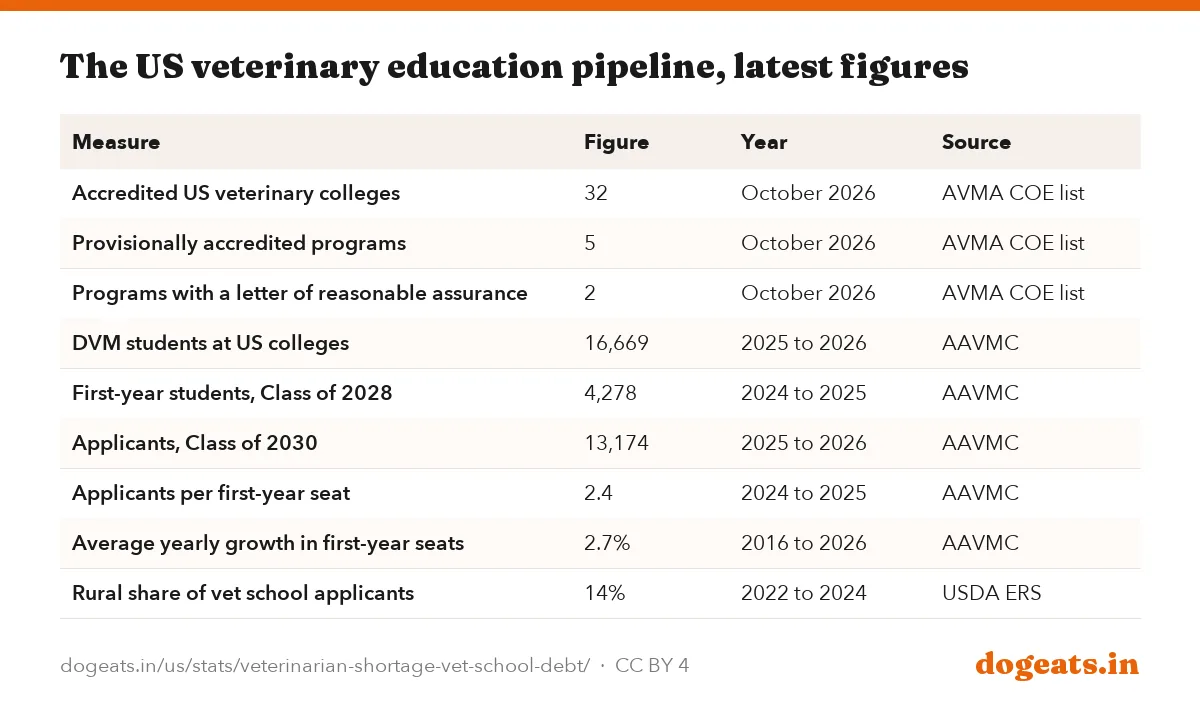
As of October 2026, the AVMA Council on Education lists 32 accredited veterinary colleges in the US. Another 5 programs, one of them in Puerto Rico, hold provisional accreditation, and 2 hold a letter of reasonable assurance. Two of the 32 were on probationary accreditation.
US colleges enrolled 16,669 veterinary students in 2025 to 2026, the AAVMC reports, and first-year seats have grown an average of 2.7% a year from 2016 to 2026. In the 2024 to 2025 report, there were 2.4 applicants for every first-year seat. The Class of 2030 drew 13,174 applicants, up from 10,880 for the Class of 2028.
Expansion is raising costs as well as seats. The two priciest programs for nonresidents in the Class of 2024 were Midwestern University ($480,571 total) and Long Island University ($450,143), AVMA News reported. Median resident tuition and fees rose 51% from 2013 to 2023, according to a VIN Foundation analysis cited by the AVMA.
| Measure | Figure | Year | Source |
|---|---|---|---|
| Accredited US veterinary colleges | 32 | October 2026 | AVMA COE list |
| Provisionally accredited programs | 5 | October 2026 | AVMA COE list |
| Programs with a letter of reasonable assurance | 2 | October 2026 | AVMA COE list |
| DVM students at US colleges | 16,669 | 2025 to 2026 | AAVMC |
| First-year students, Class of 2028 | 4,278 | 2024 to 2025 | AAVMC |
| Applicants, Class of 2030 | 13,174 | 2025 to 2026 | AAVMC |
| Applicants per first-year seat | 2.4 | 2024 to 2025 | AAVMC |
| Average yearly growth in first-year seats | 2.7% | 2016 to 2026 | AAVMC |
| Rural share of vet school applicants | 14% | 2022 to 2024 | USDA ERS |
Rural students are not the missing link. ERS found 14% of vet school applicants are rural residents, close to the 13.6% rural share of the US population. The problem, it concluded, is that rural food-animal work pays less than the alternatives.
Can a veterinarian get student loans forgiven for rural work?
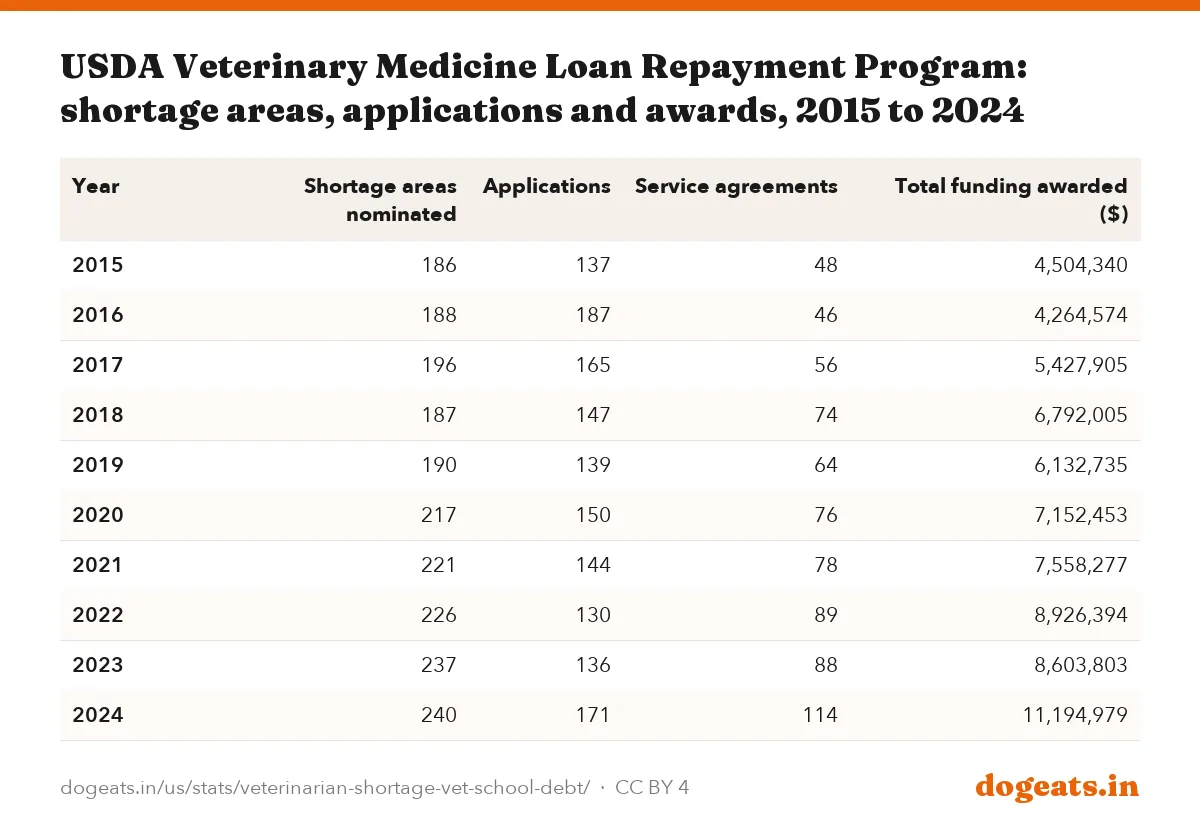
Yes, through USDA's Veterinary Medicine Loan Repayment Program. From FY2026 it pays up to $40,000 a year toward vet school loans for three years of service in a designated shortage area. NIFA adds $15,600 a year for taxes, for a maximum award of $166,800. Until FY2025 the cap was $25,000 a year.
The program is small next to the debt. Since 2010 it has made 997 awards, and in FY2024 it funded 114 vets with $11.2 million. Its FY2026 budget is about $25.5 million. NIFA says the program can fund roughly 80 to 120 awards a year against more than 220 shortage situations.
Federal borrowing rules are also changing. The One Big Beautiful Bill Act of July 2025 eliminates the Grad PLUS program and caps federal borrowing for professional students at $200,000, the AVMA reported. In 2026, 43.3% of new vets already owed at least that much.

| Year | Shortage areas nominated | Applications | Service agreements | Total funding awarded ($) |
|---|---|---|---|---|
| 2015 | 186 | 137 | 48 | 4,504,340 |
| 2016 | 188 | 187 | 46 | 4,264,574 |
| 2017 | 196 | 165 | 56 | 5,427,905 |
| 2018 | 187 | 147 | 74 | 6,792,005 |
| 2019 | 190 | 139 | 64 | 6,132,735 |
| 2020 | 217 | 150 | 76 | 7,152,453 |
| 2021 | 221 | 144 | 78 | 7,558,277 |
| 2022 | 226 | 130 | 89 | 8,926,394 |
| 2023 | 237 | 136 | 88 | 8,603,803 |
| 2024 | 240 | 171 | 114 | 11,194,979 |
- Award cap: $40,000 a year for 3 years from FY2026, plus $15,600 a year for taxes (was $25,000 a year).
- Service: at least 3 years in a designated shortage area; Type II rural areas need at least 30% of a full-time week in food-animal practice.
- FY2024 applicants had average eligible vet school debt of $170,645.
- Average awardee debt rose 35%, from $109,000 in 2011 to $147,000 in 2022, while the award stayed at $25,000 a year.
Applications include new and renewal applicants. 2015 to 2022 figures come from the NIFA Program Summary; 2023 and 2024 from NIFA's annual reports, which count agreements executed by January 1 of the following year.
What does a vet shortage mean for dog owners?
For most city and suburban dog owners, the data do not point to a lack of pet vets. Companion animal practice drew 71.5% of 2026 graduates, and the Brakke analysis expects companion animal vets to grow faster than pet-owning households. Price is the bigger pressure: vet prices rose faster than prices overall, a Brakke co-author told AVMA News in 2024.
Rural owners face a different picture. Many rural shortage areas need a vet who also sees cattle, and 59% of the 2024 USDA shortage areas drew no applicants. Mixed-animal practices in those areas often treat dogs too, so a vacancy can leave pet owners with a longer drive.
- Keep your regular vet's number and the nearest 24-hour emergency hospital saved before you need them.
- Know which foods need an urgent call, such as chocolate like Hershey's. Our top pet toxins report ranks the most common poisoning cases.
- Keep rabies shots current; our rabies statistics show that most rabid animals found in the US are wildlife.
- Price out care in advance with our cost of owning a dog and pet insurance statistics reports.
For how pet spending differs by age, see pet spending by generation. For the size of the dog population vets serve, see our dog ownership statistics, and for more US data reports, visit dogeats.in US.
Frequently asked questions
Is there really a veterinarian shortage?
Forecasts disagree. A 2024 AAVMC study projects graduates will meet about 76% of need through 2032, while a 2024 Brakke analysis for the AVMA found no overall shortage to 2035. USDA data show the clearest gap is in rural food-animal practice, where 59% of 2024 shortage areas got no applicants.
How much debt do vet students graduate with?
In 2026, graduates who borrowed owed an average of $227,588 for veterinary college alone, according to the AVMA. Across all graduates, including the 18.5% with no debt, the average was $185,424. 43.3% owed $200,000 or more.
How much do new veterinarians make?
Graduates entering full-time jobs in 2026 expected average pay of $131,784. Private practice averaged $133,056 and public practice $101,234. In 2025, companion animal practice started at about $140,000 and food animal practice at about $100,000.
What is a good debt-to-income ratio for a new vet?
The AVMA calls a ratio around 1.4 manageable. The average for 2026 graduates entering full-time work was 1.5:1, and 18.1% had a ratio of 2.5:1 or higher.
Why is there a shortage of rural and large-animal vets?
Pay and practice economics. USDA ERS found real income for rural food-animal vets fell 19% from 2017 to 2024, and rural food- and mixed-animal practice revenue fell 22% from 2021 to 2025. Only 4.1% of 2026 graduates chose food animal practice.
How many veterinary schools are in the US?
As of October 2026, the AVMA Council on Education listed 32 accredited US veterinary colleges, 5 provisionally accredited programs and 2 with a letter of reasonable assurance. US colleges enrolled 16,669 students in 2025 to 2026.
How hard is it to get into vet school?
In the AAVMC's 2024 to 2025 data there were 2.4 applicants per first-year seat. The Class of 2030 drew 13,174 applicants. ERS found about 45% of rural applicants and 49% of urban applicants got at least one acceptance in 2025.
Does USDA pay off vet school loans?
Yes. From FY2026, USDA's Veterinary Medicine Loan Repayment Program pays up to $40,000 a year for three years of service in a designated shortage area. It adds $15,600 a year for taxes. It made 114 awards in FY2024.
How many veterinarian shortage areas are there?
State officials nominated 240 USDA shortage areas for FY2024. For the FY2026 cycle we counted 255 on NIFA's shortage map in 47 states and on federal lands; ERS puts 79% of 2026 areas in the rural Type II group.
Methodology and limitations
Graduate debt, starting pay, employment outcomes and debt-to-income ratios come from the AVMA Graduating Senior Survey. We used its results as published in AVMA News and the AVMA@Work blog from October 2022 to October 2026. The 2026 figures are a preview of the 2027 AVMA Report on the Economic State of the Veterinary Profession. The 2022 borrower-only debt figure comes from NIFA's VMLRP Program Summary, which cites the AVMA.
The workforce forecasts come from Gitter and LaFayette (AAVMC, June 2024) and from AVMA News coverage of the Brakke Consulting analysis (October 2024). The Mars Veterinary Health figures are as described by AVMA News and the AAVMC study; we did not rely on the Mars report directly.
Shortage area counts for 2010 to 2022 come from NIFA's VMLRP Program Summary 2010 to 2022 (Table 2), and for 2023 and 2024 from NIFA's VMLRP annual reports. The FY2026 state table is our count of every row on NIFA's Veterinary Services Shortage Situations map, filtered by state and fiscal year 2026, on October 17, 2026. County persistence, rural income and practice revenue figures come from USDA ERS EIB-311 (September 2026).
College counts come from the AVMA Council on Education list of accredited colleges, read October 2026. Enrollment, applicant and seat figures come from the AAVMC Annual Data Reports for 2024 to 2025 and 2025 to 2026. Program terms come from NIFA's VMLRP pages and the FY2026 Notice of Funding Opportunity (modification 1).
Sources
- AVMA News, New veterinary graduates face rising debt, lower real income (October 8, 2026), 2026 Senior Survey: debt, starting pay, debt-to-income ratio, practice choices, offers
- USDA Economic Research Service, Food-animal Veterinarians and the Persistence of Rural Shortage Areas, EIB-311 (September 2026), County shortage persistence, 2024 shortage area outcomes, rural income and revenue
- Gitter and LaFayette, Demand for and Supply of Veterinarians in the U.S. to 2032, AAVMC (June 2024), Projected need of 70,092 vets against 52,926 graduates through 2032
- Also consulted: AVMA News, No dire shortage of veterinarians anticipated in coming years (October 2024), USDA NIFA, FY2024 VMLRP Annual Report (April 2025), USDA NIFA, VMLRP Program Summary 2010 to 2022, USDA NIFA, FY2023 VMLRP Annual Report, USDA NIFA, FY2026 VMLRP Notice of Funding Opportunity (modification 1), USDA NIFA, Veterinary Services Shortage Situations Map, AVMA News, Inflation continues to dampen gains in veterinarian salaries (October 2025), AVMA News, Congress overhauls federal student loan program (July 2025), AVMA@Work, Chart of the month: New insights on student debt (January 2025), AVMA News, Veterinary starting salaries rise in 2023 (November 2023), AVMA News, Starting salaries up, debt down for new veterinarians (October 2022), AVMA Council on Education, Accredited veterinary colleges, AAVMC Annual Data Report 2025 to 2026, AAVMC Annual Data Report 2024 to 2025, BLS Occupational Outlook Handbook, Veterinarians, Lloyd J, Pet Healthcare in the U.S.: Another Look at the Veterinarian Workforce, Mars Veterinary Health (August 2023), as described by AVMA News and the AAVMC study, Texas Animal Health Commission, VMLRP and VSGP applications notice (February 2026).
Cite, embed and download
This report, its data and its images are free to reuse under a Creative Commons Attribution 4.0 licence. Credit dogeats.in with a link to this page. Every chart has its own embed code, every table has a CSV and an image download, and the images below are ready for social posts, slides and articles.
Cite this report
Link to this report

Every chart and table as an image