Ranking · Updated October 2026
Top pet toxins in the US: how the ASPCA Animal Poison Control top 10 has changed from 2015 to 2025
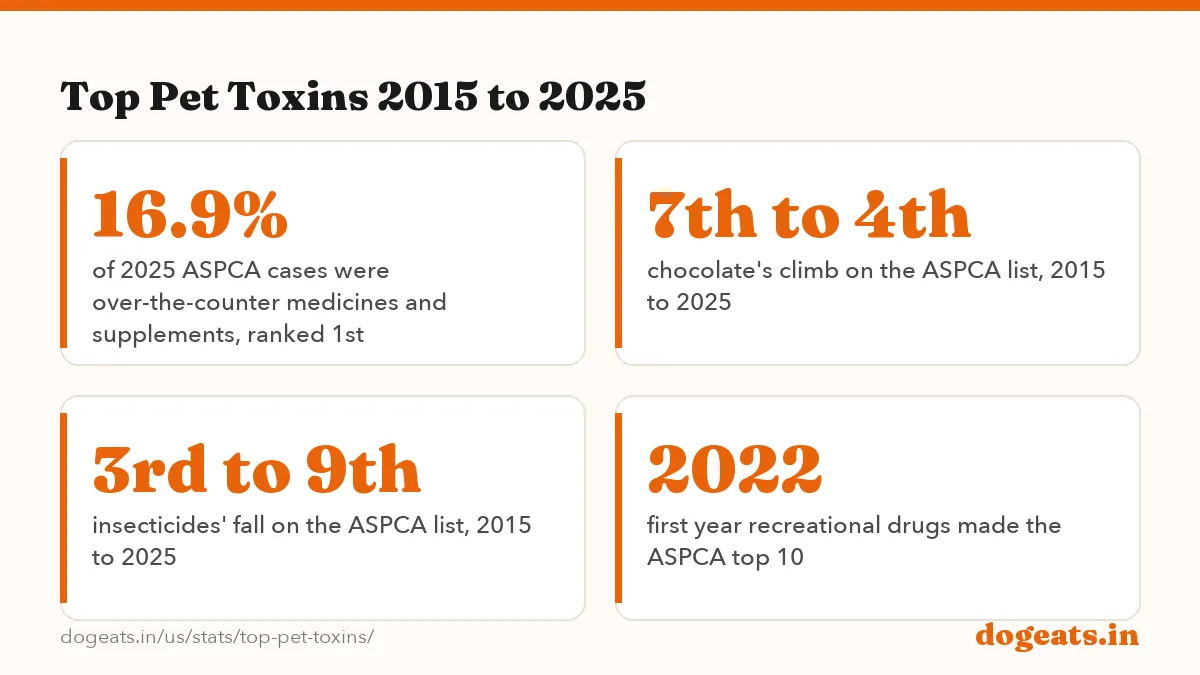
Human medicines have topped the ASPCA Animal Poison Control Center list every year from 2015 to 2025, with over-the-counter drugs first in 9 of those 11 years. Food and drink rose from 10.9% of cases in 2017 to 16.4% in 2025, and chocolate climbed from 7th to 4th. Insecticides fell from 3rd to 9th, and recreational drugs entered the top 10 in 2022.
Key findings
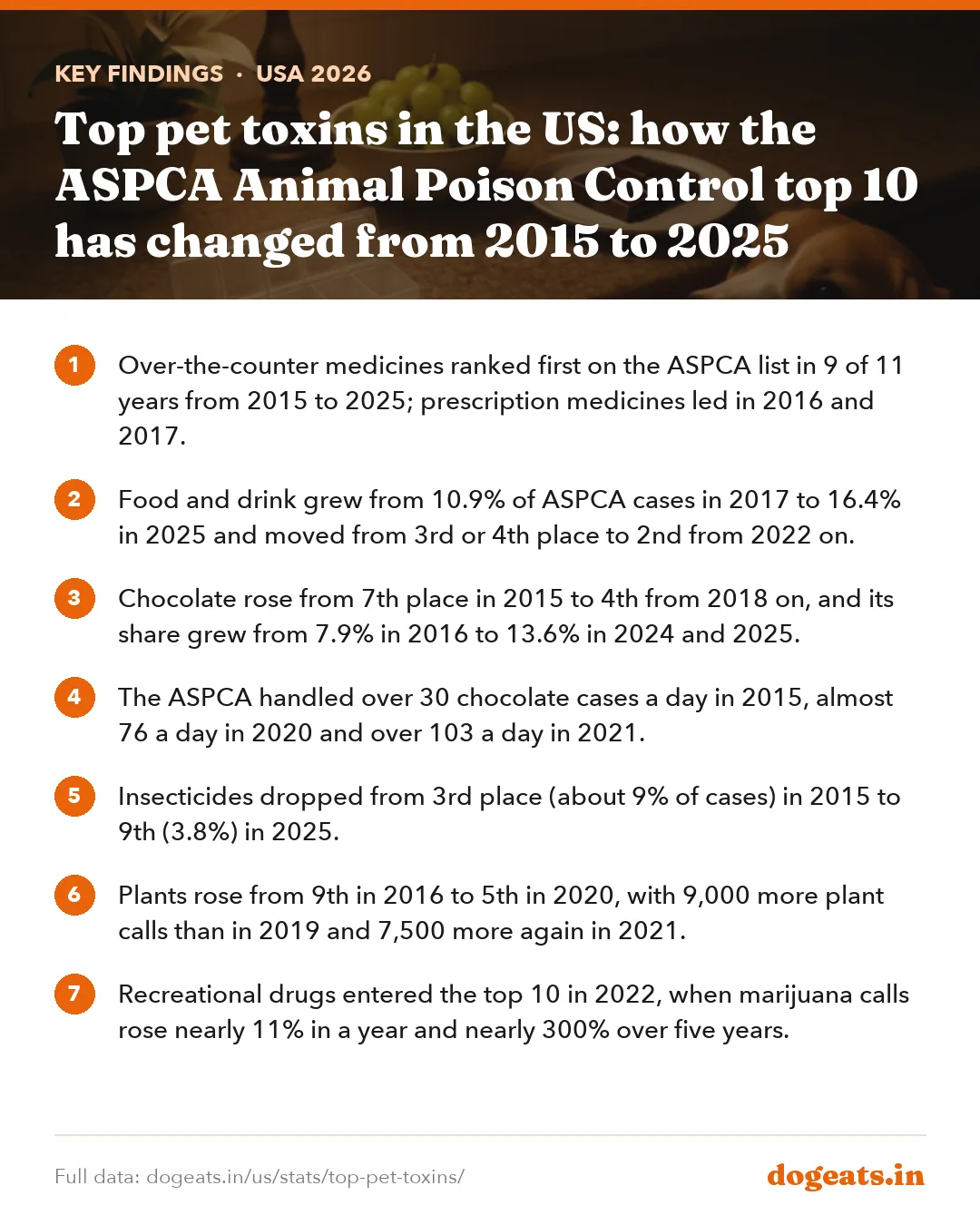
- Over-the-counter medicines ranked first on the ASPCA list in 9 of 11 years from 2015 to 2025; prescription medicines led in 2016 and 2017.
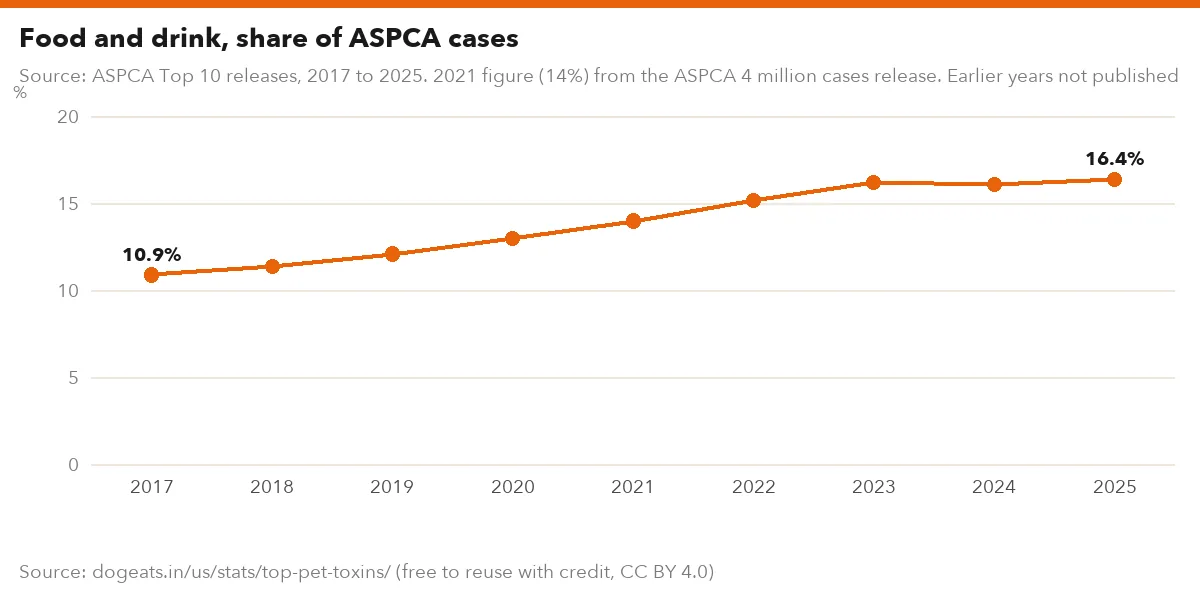
- Food and drink grew from 10.9% of ASPCA cases in 2017 to 16.4% in 2025 and moved from 3rd or 4th place to 2nd from 2022 on.
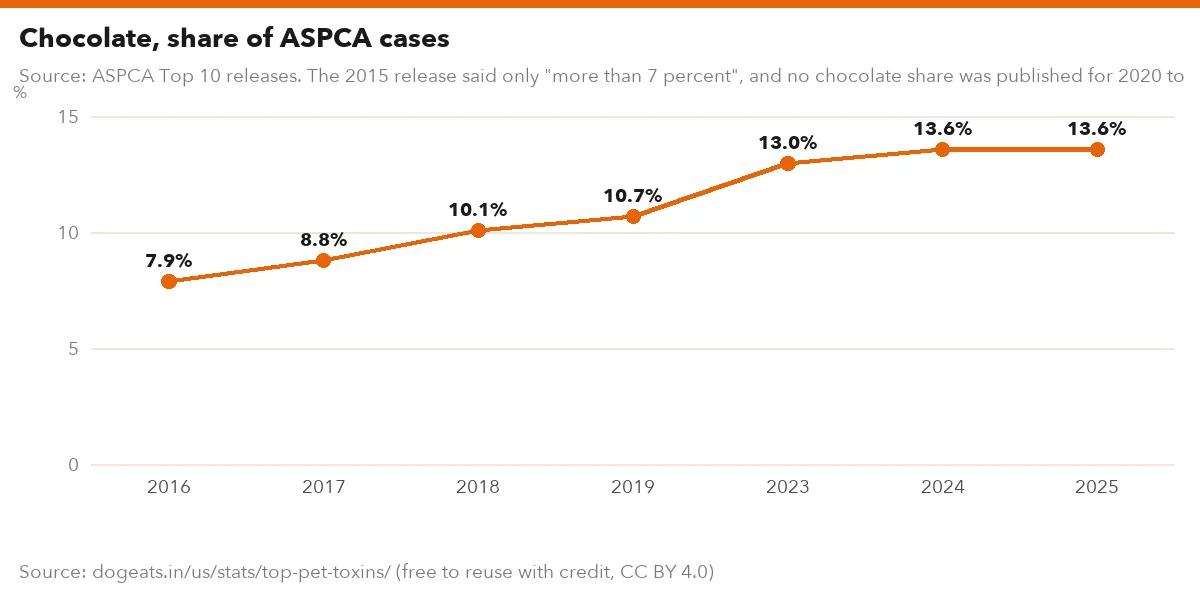
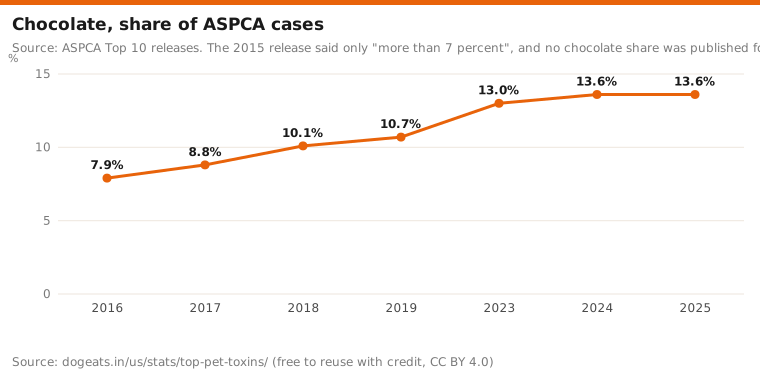
- Chocolate rose from 7th place in 2015 to 4th from 2018 on, and its share grew from 7.9% in 2016 to 13.6% in 2024 and 2025.
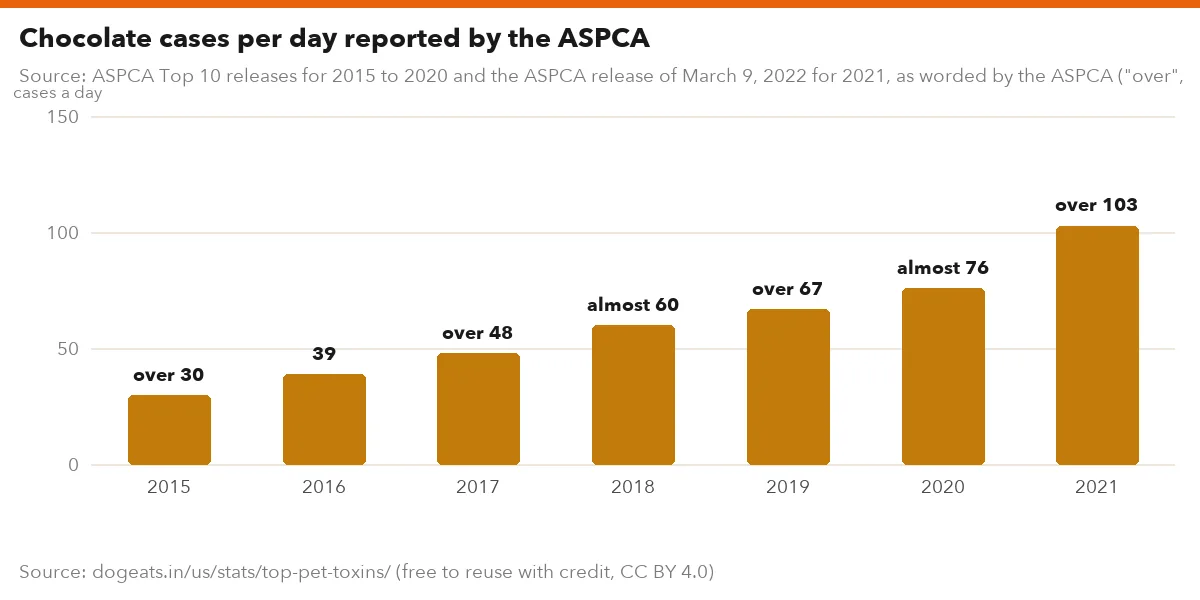
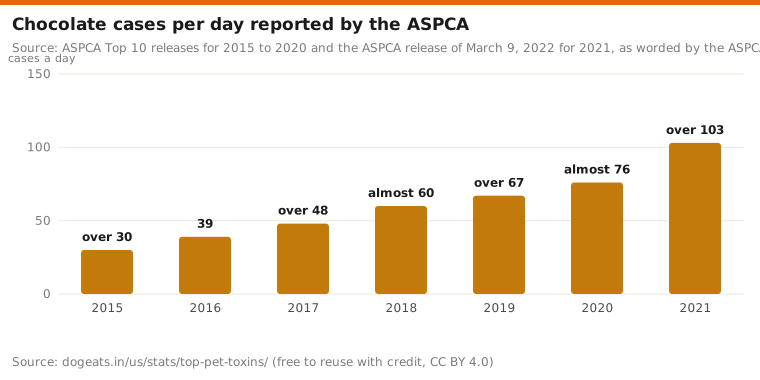
- The ASPCA handled over 30 chocolate cases a day in 2015, almost 76 a day in 2020 and over 103 a day in 2021.
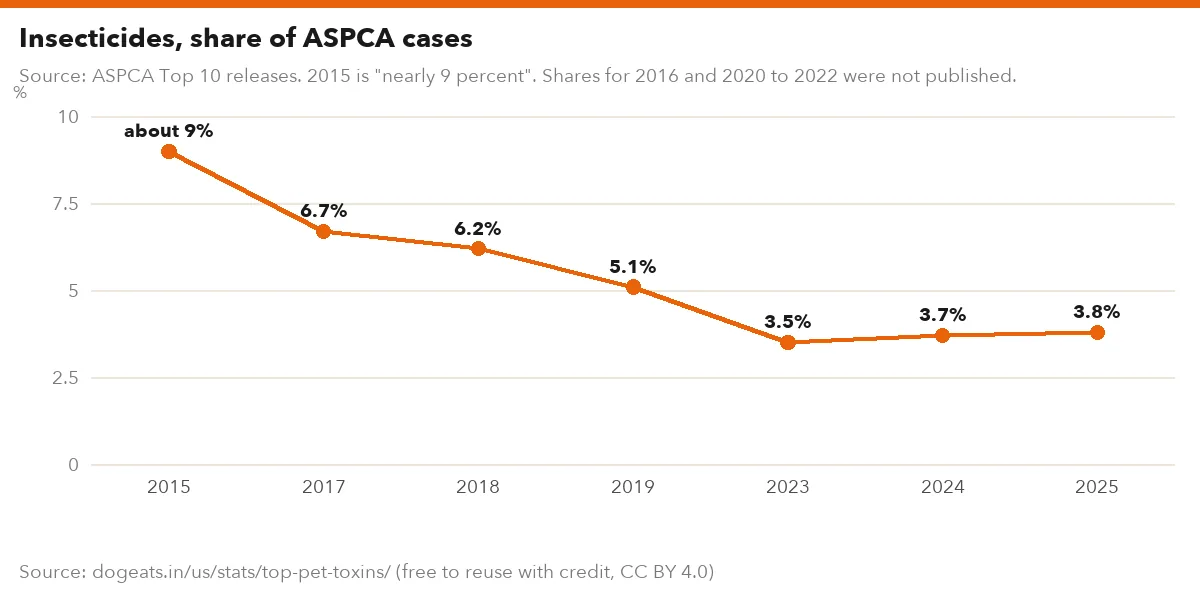
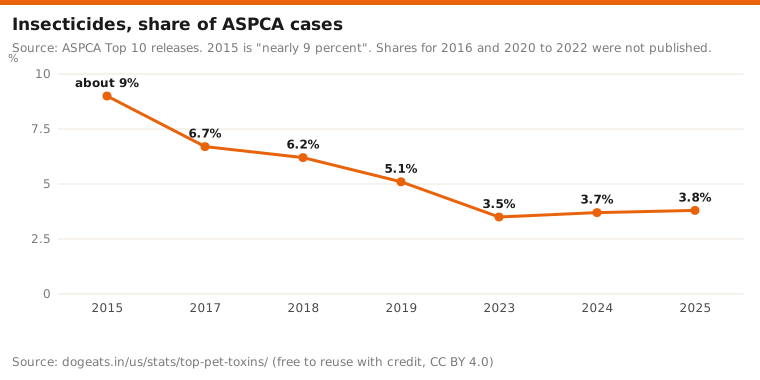
- Insecticides dropped from 3rd place (about 9% of cases) in 2015 to 9th (3.8%) in 2025.
- Plants rose from 9th in 2016 to 5th in 2020, with 9,000 more plant calls than in 2019 and 7,500 more again in 2021.
- Recreational drugs entered the top 10 in 2022, when marijuana calls rose nearly 11% in a year and nearly 300% over five years.
- Calls about hallucinogenic mushrooms rose 74% in 2023, while THC exposures were falling by 2024.
- Pet Poison Helpline ranked chocolate, grapes and raisins and bromethalin rat poison as the top 3 dog poisons in both 2024 and 2025.
What are the most common pet poisons in the US?
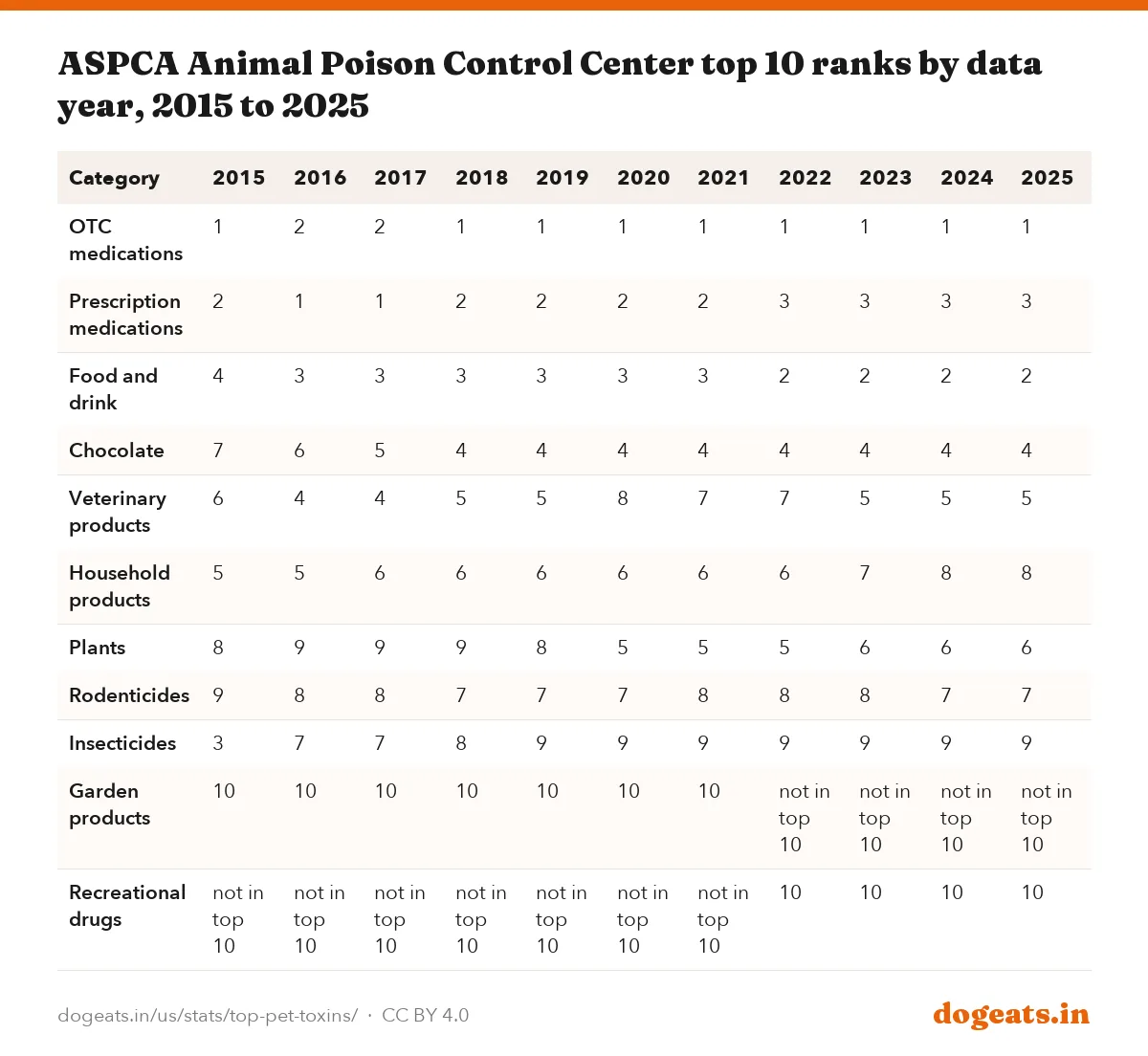
Human medicines. Over-the-counter drugs and supplements ranked first on the ASPCA Animal Poison Control Center list in 9 of the 11 years from 2015 to 2025. Prescription medicines took first place in the other two, 2016 and 2017.
In 2025 the order was over-the-counter medicines (16.9% of cases), food and drink (16.4%), prescription medicines, chocolate (13.6%) and veterinary products (9.1%). Plants, rat poison, household products, bug killers and recreational drugs filled the rest.
The ASPCA list counts how often people call about a substance, not how deadly it is. Chocolate is common but often mild; a single lily or a few xylitol pieces can be far worse.
| Category | 2015 | 2016 | 2017 | 2018 | 2019 | 2020 | 2021 | 2022 | 2023 | 2024 | 2025 |
|---|---|---|---|---|---|---|---|---|---|---|---|
| OTC medications | 1 | 2 | 2 | 1 | 1 | 1 | 1 | 1 | 1 | 1 | 1 |
| Prescription medications | 2 | 1 | 1 | 2 | 2 | 2 | 2 | 3 | 3 | 3 | 3 |
| Food and drink | 4 | 3 | 3 | 3 | 3 | 3 | 3 | 2 | 2 | 2 | 2 |
| Chocolate | 7 | 6 | 5 | 4 | 4 | 4 | 4 | 4 | 4 | 4 | 4 |
| Veterinary products | 6 | 4 | 4 | 5 | 5 | 8 | 7 | 7 | 5 | 5 | 5 |
| Household products | 5 | 5 | 6 | 6 | 6 | 6 | 6 | 6 | 7 | 8 | 8 |
| Plants | 8 | 9 | 9 | 9 | 8 | 5 | 5 | 5 | 6 | 6 | 6 |
| Rodenticides | 9 | 8 | 8 | 7 | 7 | 7 | 8 | 8 | 8 | 7 | 7 |
| Insecticides | 3 | 7 | 7 | 8 | 9 | 9 | 9 | 9 | 9 | 9 | 9 |
| Garden products | 10 | 10 | 10 | 10 | 10 | 10 | 10 | not in top 10 | not in top 10 | not in top 10 | not in top 10 |
| Recreational drugs | not in top 10 | not in top 10 | not in top 10 | not in top 10 | not in top 10 | not in top 10 | not in top 10 | 10 | 10 | 10 | 10 |
We grouped the ASPCA's wording into stable categories. "Human food", "food products" and "food and drink" are one row, and "household items" and "household toxicants" are another. Garden products dropped out when recreational drugs entered in 2022.
Human medicines also led in 2010. The ASPCA said they were involved in almost 25% of its more than 167,000 calls that year.
Food and chocolate keep climbing
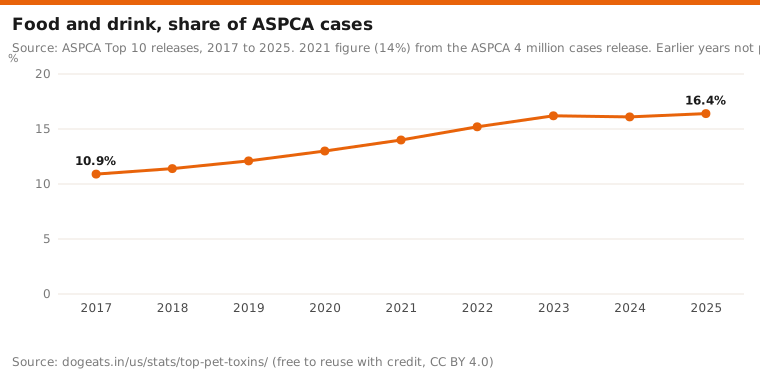
Food and drink made up 10.9% of ASPCA cases in 2017. By 2025 it was 16.4%, and it has held 2nd place since 2022. Grapes, raisins, xylitol gum, onions, garlic and protein bars are the items the ASPCA names most.
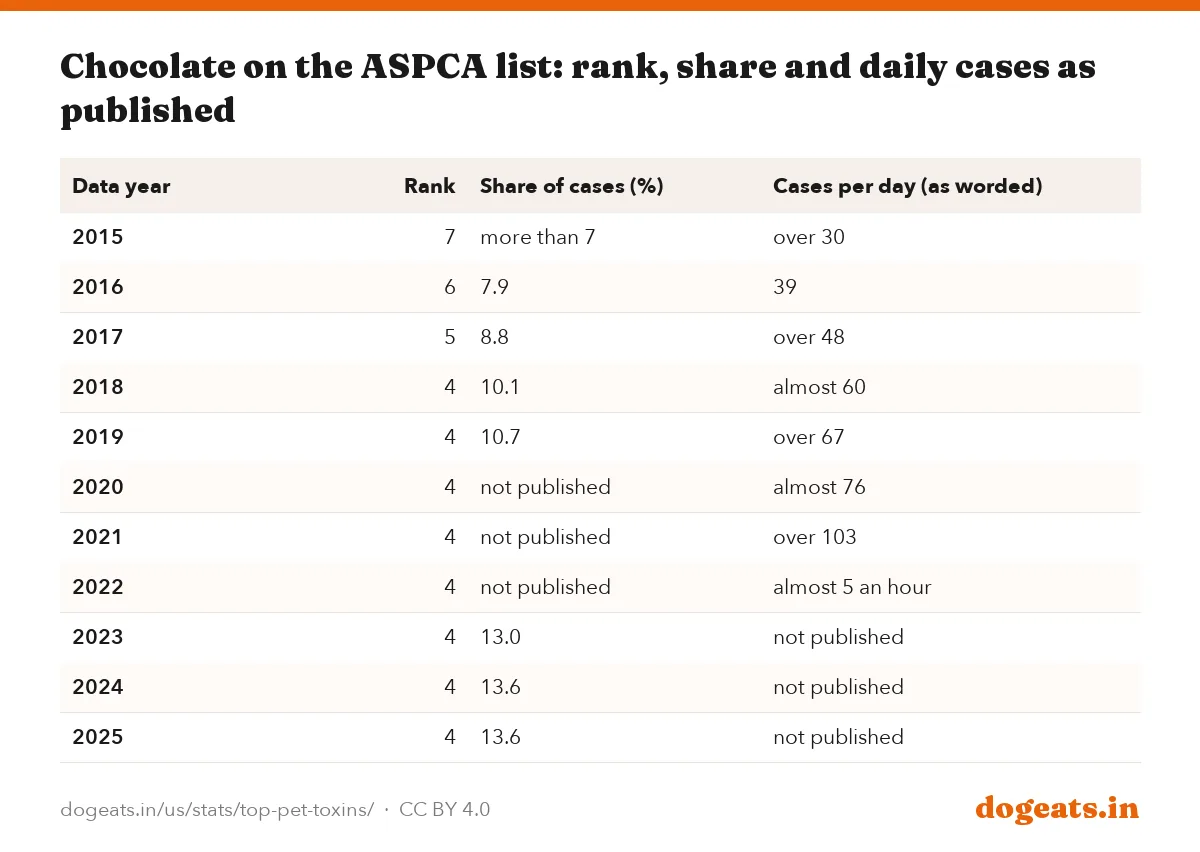
Chocolate is counted on its own and climbed even faster. It ranked 7th in 2015 and has been 4th every year since 2018. Its published share rose from 7.9% in 2016 to 13.6% in 2024 and 2025.
Put the two together and food-related calls reached 30.0% of 2025 cases. Our dog food safety statistics break that down by American food, and holiday food dangers shows when the spikes come.
Read the rise with care. Call volume and how the ASPCA counts cases both changed over the decade, so a higher share does not prove more dogs ate chocolate. The direction holds across the decade, though food dipped from 16.2% to 16.1% in 2024 and chocolate held at 13.6% in 2025.
How many chocolate poisoning calls does the ASPCA get?
The ASPCA reported over 30 chocolate cases a day in 2015 and almost 76 a day in 2020. In 2021 it averaged over 103 a day, more than one case every 15 minutes and about three times the 2015 rate. In 2022 it described the rate as almost 5 cases an hour.
Dogs make up most chocolate cases. Dark and baking chocolate are the riskiest kinds, so a small piece of a dark bar can matter more than a milk chocolate candy. See our guide to Hershey's chocolate for how the risk differs across its products.

Source: ASPCA Top 10 releases for 2015 to 2020 and the ASPCA release of March 9, 2022 for 2021, as worded by the ASPCA ("over", "almost"). For 2022 the ASPCA gave "almost 5 cases per hour"; later releases gave no daily figure.
Show the numbers
| Label | cases a day |
|---|---|
| 2015 | over 30 |
| 2016 | 39 |
| 2017 | over 48 |
| 2018 | almost 60 |
| 2019 | over 67 |
| 2020 | almost 76 |
| 2021 | over 103 |
Embed this chart
| Data year | Rank | Share of cases (%) | Cases per day (as worded) |
|---|---|---|---|
| 2015 | 7 | more than 7 | over 30 |
| 2016 | 6 | 7.9 | 39 |
| 2017 | 5 | 8.8 | over 48 |
| 2018 | 4 | 10.1 | almost 60 |
| 2019 | 4 | 10.7 | over 67 |
| 2020 | 4 | not published | almost 76 |
| 2021 | 4 | not published | over 103 |
| 2022 | 4 | not published | almost 5 an hour |
| 2023 | 4 | 13.0 | not published |
| 2024 | 4 | 13.6 | not published |
| 2025 | 4 | 13.6 | not published |
Bug killers fell from 3rd place to 9th
Insecticides were the 3rd most common category in 2015, at about 9% of cases. By 2025 they sat 9th, at 3.8%. The low point was 3.5% in 2023, and the share edged up to 3.7% and 3.8% after. In 2010 the ASPCA put insecticides 2nd, at about 20% of calls.
The ASPCA tied the fall to safer pest control products. Its 2010 release singled out flea products used on cats when the label was not meant for cats.
Rat and mouse poison moved the other way. Rodenticides ranked 9th in 2015 and 7th in 2024 and 2025, at 6.5% to 7.0% of cases.
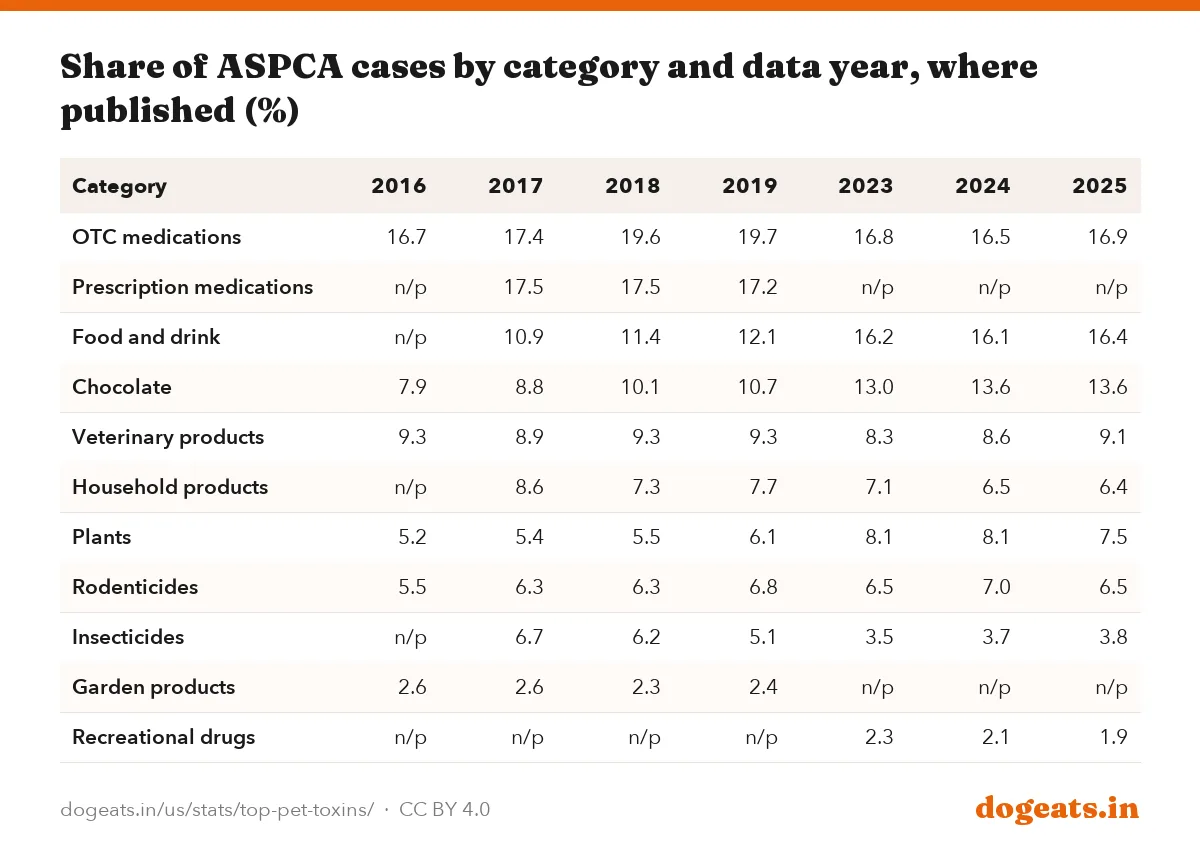
"n/p" means the ASPCA did not publish a share for that category and year. The 2015 and 2020 to 2022 releases gave ranks with only a few shares, so they are left out of this table.
Plants jumped during the pandemic
Plants ranked 8th or 9th from 2015 to 2019. In 2020 they jumped to 5th, with 9,000 more plant calls than the year before. They stayed 5th in 2021, with 7,500 more plant calls again, and in 2022 at 8.6% of cases.
The ASPCA linked 2020 changes to people spending more time at home. Household products such as paint and spackle stayed 6th as home projects rose.
Plants have since eased to 6th, at 7.5% of 2025 cases. For cats, lilies remain the plant that matters most. Pet Poison Helpline ranked lilies the number one cat poison in 2024 and 2025.
Marijuana and mushrooms reach the top 10
Recreational drugs entered the ASPCA top 10 for the first time in 2022, at 10th place. Marijuana calls had risen nearly 11% in a year and nearly 300% over five years.
Edibles drive the risk. The ASPCA says marijuana-laced baked goods are more dangerous to pets than plant material. Signs include stumbling, urine dribbling and stomach upset.
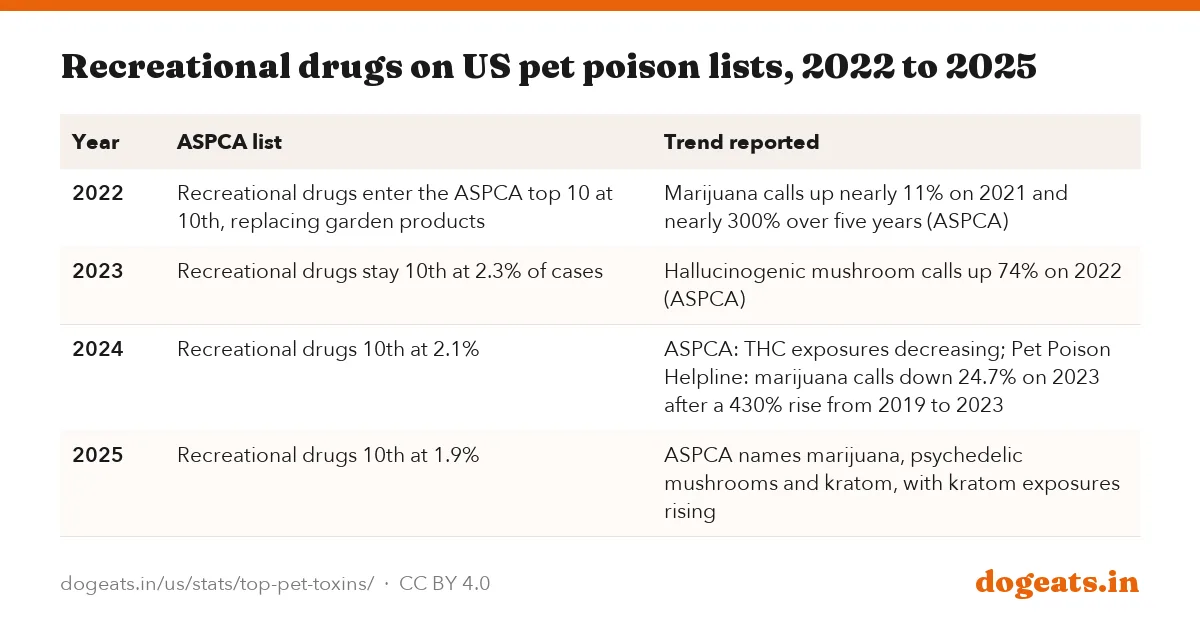
The mix is shifting. Mushroom calls rose 74% in 2023, while the ASPCA said THC exposures were falling by 2024. Pet Poison Helpline reported marijuana calls down 24.7% in 2024, after a 430% rise from 2019 to 2023.
| Year | ASPCA list | Trend reported |
|---|---|---|
| 2022 | Recreational drugs enter the ASPCA top 10 at 10th, replacing garden products | Marijuana calls up nearly 11% on 2021 and nearly 300% over five years (ASPCA) |
| 2023 | Recreational drugs stay 10th at 2.3% of cases | Hallucinogenic mushroom calls up 74% on 2022 (ASPCA) |
| 2024 | Recreational drugs 10th at 2.1% | ASPCA: THC exposures decreasing; Pet Poison Helpline: marijuana calls down 24.7% on 2023 after a 430% rise from 2019 to 2023 |
| 2025 | Recreational drugs 10th at 1.9% | ASPCA names marijuana, psychedelic mushrooms and kratom, with kratom exposures rising |
Pet Poison Helpline ranks single substances for dogs and cats
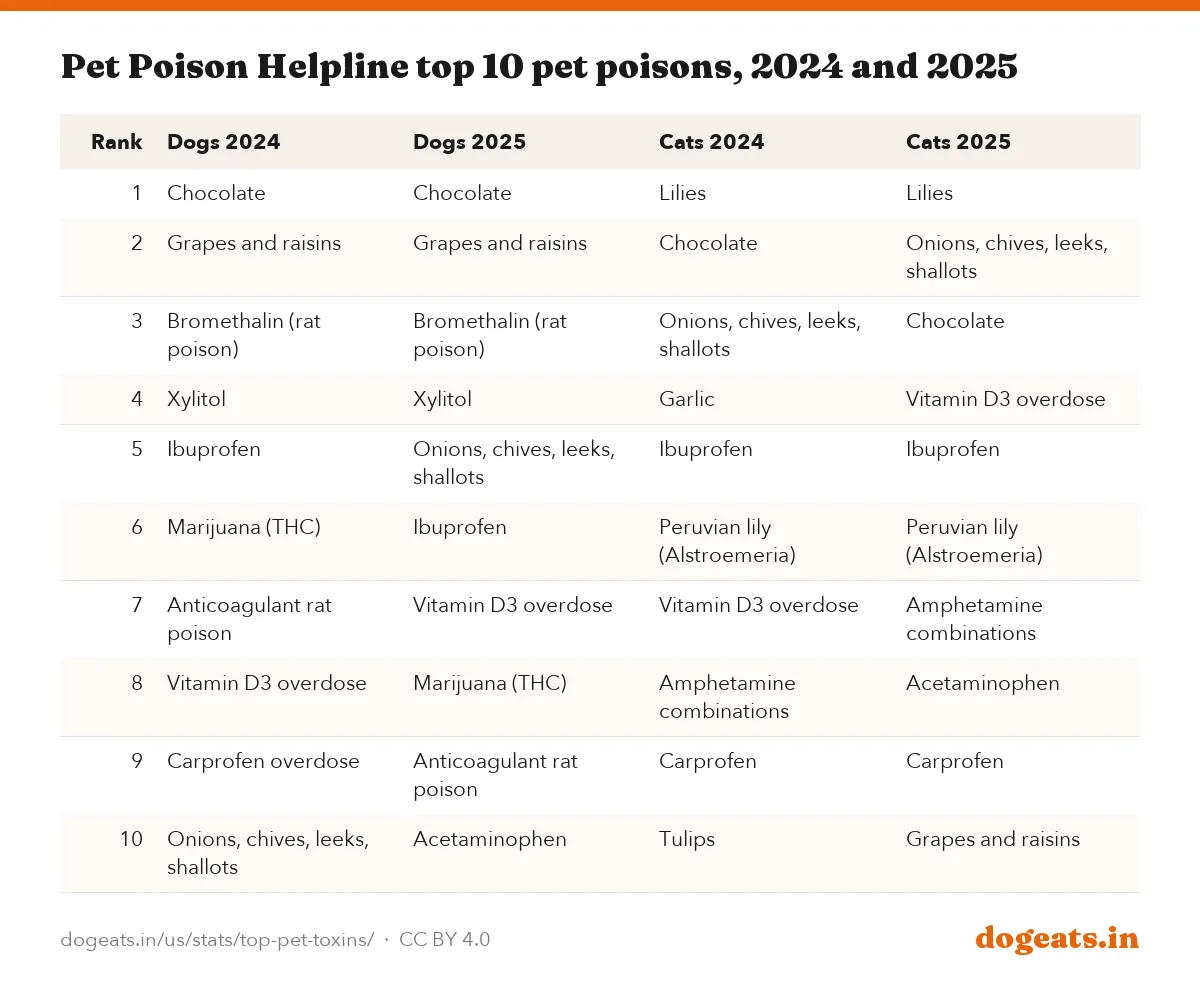
Pet Poison Helpline, a second 24-hour US service, ranks specific substances rather than categories. Chocolate, grapes and raisins, and bromethalin rat poison were its top 3 dog poisons in both 2024 and 2025.
Onions and their relatives made the biggest move, from 10th for dogs in 2024 to 5th in 2025. For cats, lilies ranked 1st both years, and onions rose from 3rd in 2024 to 2nd in 2025, swapping places with chocolate.
Other shifts were smaller. Bromethalin rat poison rose from 5th to 3rd for dogs in 2024. Carprofen, a pet pain drug, rose from 10th to 9th that year, then left the dog list in 2025. For cats, garlic dropped off in 2025 after ranking 4th, and grapes and acetaminophen joined.
Both services point to the same kitchen and medicine-cabinet hazards. Grapes, xylitol and onions each have their own guide on our site.
| Rank | Dogs 2024 | Dogs 2025 | Cats 2024 | Cats 2025 |
|---|---|---|---|---|
| 1 | Chocolate | Chocolate | Lilies | Lilies |
| 2 | Grapes and raisins | Grapes and raisins | Chocolate | Onions, chives, leeks, shallots |
| 3 | Bromethalin (rat poison) | Bromethalin (rat poison) | Onions, chives, leeks, shallots | Chocolate |
| 4 | Xylitol | Xylitol | Garlic | Vitamin D3 overdose |
| 5 | Ibuprofen | Onions, chives, leeks, shallots | Ibuprofen | Ibuprofen |
| 6 | Marijuana (THC) | Ibuprofen | Peruvian lily (Alstroemeria) | Peruvian lily (Alstroemeria) |
| 7 | Anticoagulant rat poison | Vitamin D3 overdose | Vitamin D3 overdose | Amphetamine combinations |
| 8 | Vitamin D3 overdose | Marijuana (THC) | Amphetamine combinations | Acetaminophen |
| 9 | Carprofen overdose | Anticoagulant rat poison | Carprofen | Carprofen |
| 10 | Onions, chives, leeks, shallots | Acetaminophen | Tulips | Grapes and raisins |
Pet Poison Helpline says its lists show the most frequent reasons people call, not the most toxic substances. It does not publish shares, so the two services cannot be compared number for number.
Its yearly report cards add context. Chocolate was its most common call in 2022, 2023 and 2024. About 99% of its calls in 2023 and 2024 concerned cats and dogs, with many from Texas, California, New York and Florida.
How busy is ASPCA Poison Control?
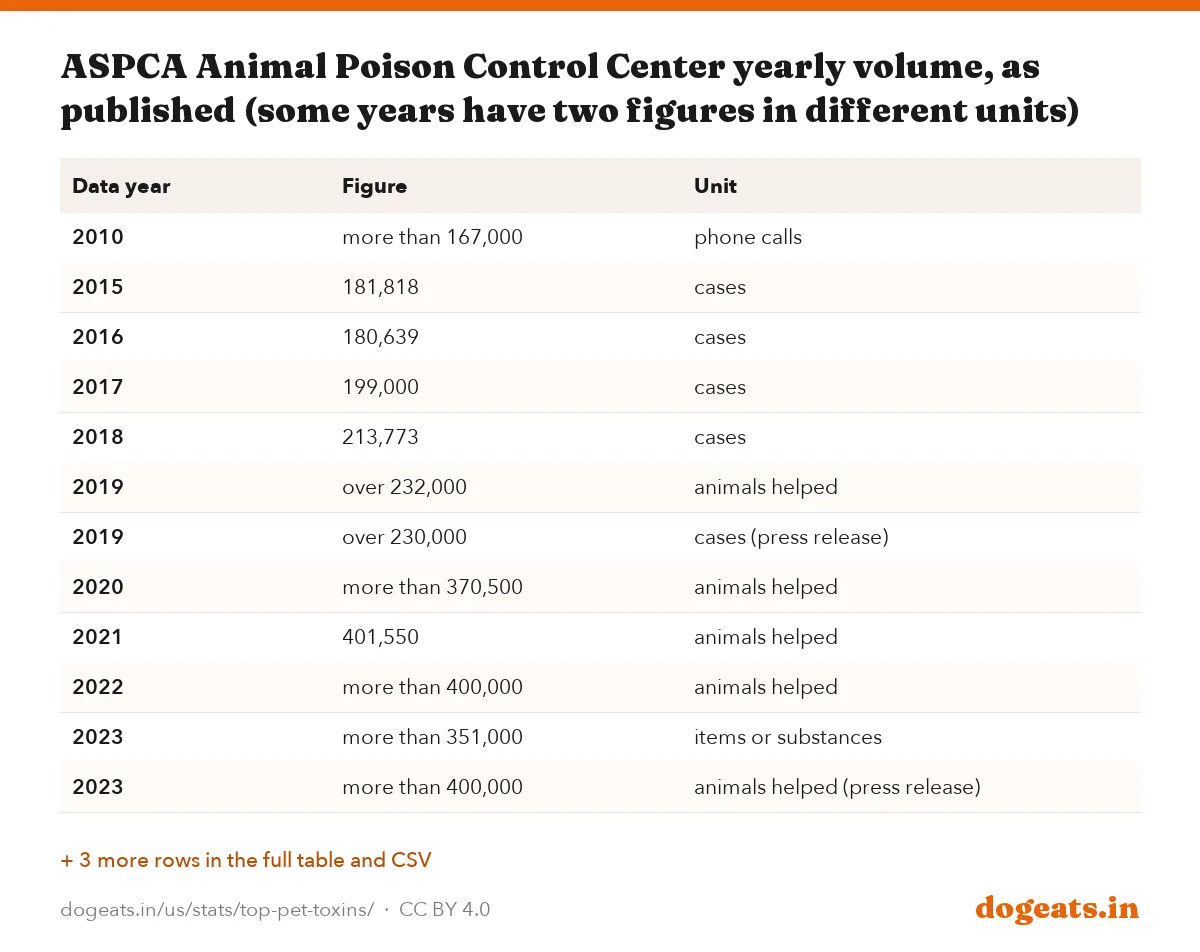
The ASPCA has published a yearly total since at least 2010, but the unit keeps changing. It has reported phone calls, cases, animals helped, items and calls again. We list each figure in its own unit and do not draw a trend line through them.
Within a single unit the growth is clear. Cases rose from 181,818 in 2015 to 213,773 in 2018. Animals helped rose from over 232,000 in 2019 to 401,550 in 2021, a year when call volume grew more than 22%.
In March 2022 the ASPCA said it had handled more than 4 million cases since the center opened in 1978. Its March 2016 release had put the running total at more than 2.5 million.
Staffing grew with the calls. The March 2022 release listed 11 board-certified veterinary toxicologists. The March 2024 release listed 22 among 163 veterinary professionals, and the March 2025 release listed 25.
| Data year | Figure | Unit |
|---|---|---|
| 2010 | more than 167,000 | phone calls |
| 2015 | 181,818 | cases |
| 2016 | 180,639 | cases |
| 2017 | 199,000 | cases |
| 2018 | 213,773 | cases |
| 2019 | over 232,000 | animals helped |
| 2019 | over 230,000 | cases (press release) |
| 2020 | more than 370,500 | animals helped |
| 2021 | 401,550 | animals helped |
| 2022 | more than 400,000 | animals helped |
| 2023 | more than 351,000 | items or substances |
| 2023 | more than 400,000 | animals helped (press release) |
| 2024 | more than 451,000 | calls |
| 2024 | over 322,000 | animals helped |
| 2025 | more than 376,000 | items |
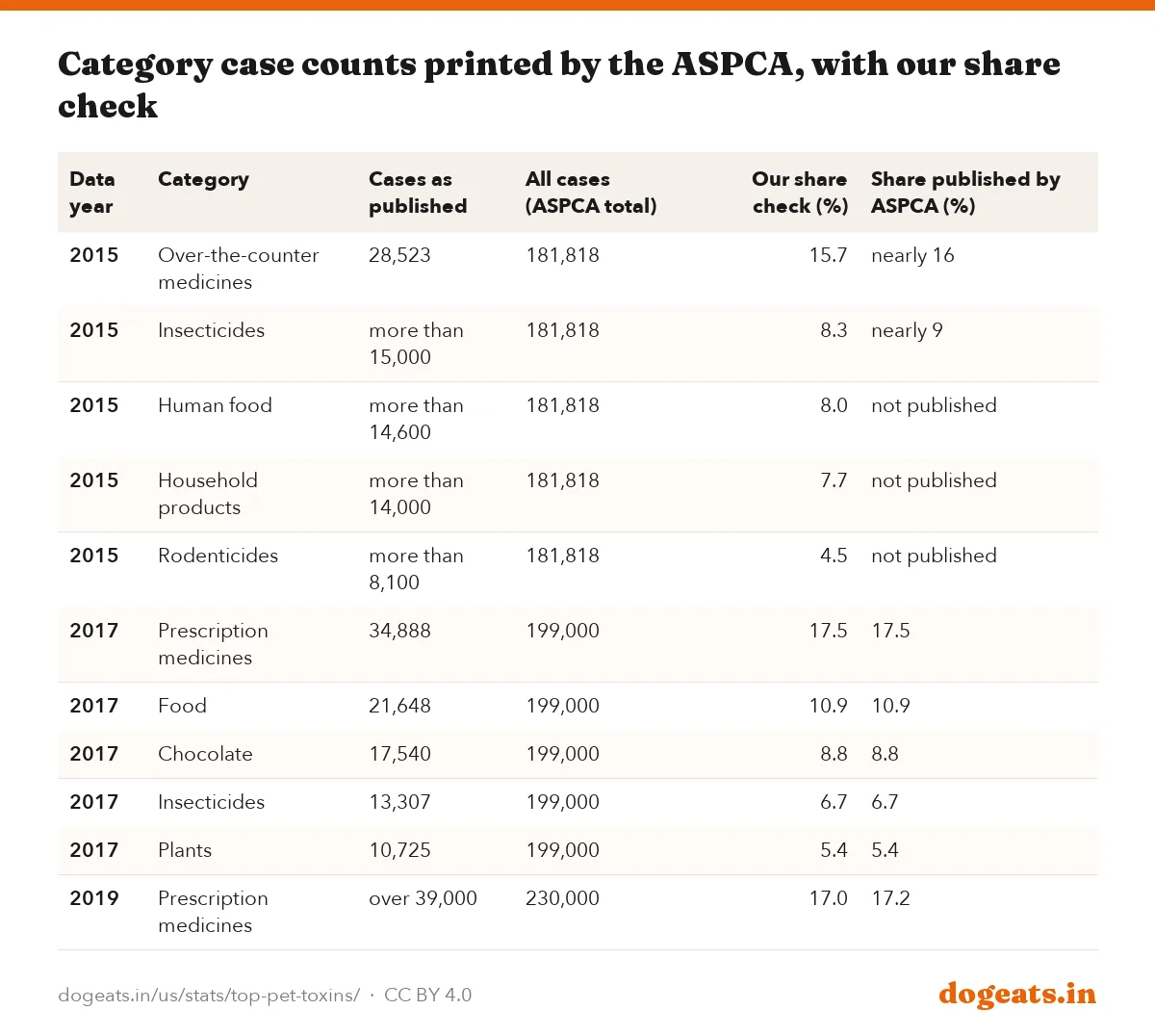
| Data year | Category | Cases as published | All cases (ASPCA total) | Our share check (%) | Share published by ASPCA (%) |
|---|---|---|---|---|---|
| 2015 | Over-the-counter medicines | 28,523 | 181,818 | 15.7 | nearly 16 |
| 2015 | Insecticides | more than 15,000 | 181,818 | 8.3 | nearly 9 |
| 2015 | Human food | more than 14,600 | 181,818 | 8.0 | not published |
| 2015 | Household products | more than 14,000 | 181,818 | 7.7 | not published |
| 2015 | Rodenticides | more than 8,100 | 181,818 | 4.5 | not published |
| 2017 | Prescription medicines | 34,888 | 199,000 | 17.5 | 17.5 |
| 2017 | Food | 21,648 | 199,000 | 10.9 | 10.9 |
| 2017 | Chocolate | 17,540 | 199,000 | 8.8 | 8.8 |
| 2017 | Insecticides | 13,307 | 199,000 | 6.7 | 6.7 |
| 2017 | Plants | 10,725 | 199,000 | 5.4 | 5.4 |
| 2019 | Prescription medicines | over 39,000 | 230,000 | 17.0 | 17.2 |
The 2024 release reported more than 451,000 calls, up nearly 4% on 2023, and over 322,000 animals helped in the same year. That gap shows why units matter. The 2022 release reported case volume up nearly 5% on 2021.
Only three releases printed category case counts. In 2015, over-the-counter products made up 28,523 of 181,818 cases, or 15.7%. In 2017, prescription medicines made up 34,888 of 199,000 cases, or 17.5%, matching the published share. Where the ASPCA wrote "more than" or "over", our share is a minimum.
The top 10 categories covered more than 96% of all cases in 2019, 2022 and 2023, according to the ASPCA.
What to do if your pet eats something toxic
Call a vet or a poison line at once, even if your pet seems fine. Some poisons cause no signs for hours.
Have the package, the amount eaten and your pet's weight ready. Do not make your pet vomit unless a vet tells you to. Some substances cause more harm coming back up.
- ASPCA Animal Poison Control Center: (888) 426-4435, 24 hours a day. A consultation fee may apply.
- Pet Poison Helpline: (855) 764-7661, 24 hours a day. The fee is $89 per incident, with follow-up calls included.
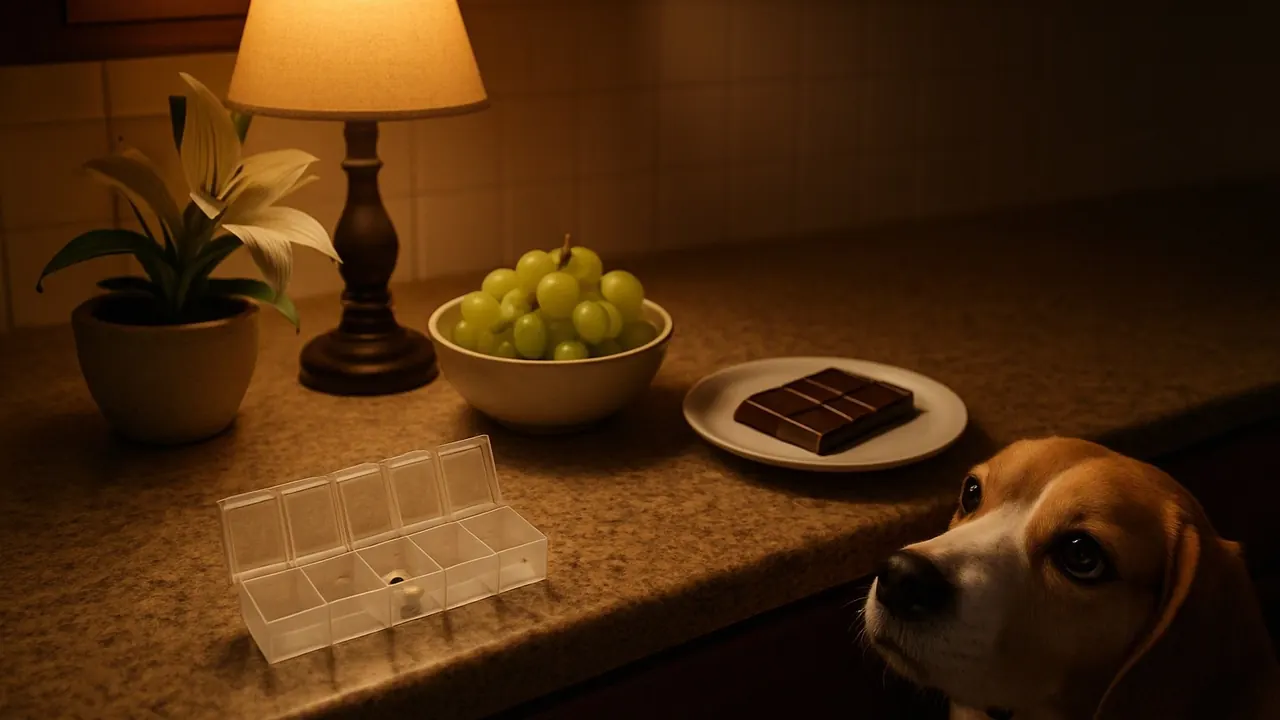
- Keep pill organizers, gum and purses off low tables and out of reach.
- Keep lilies out of homes with cats, including cut flowers.
Product recalls are a separate risk from household poisons. See our pet food recall data for FDA recalls since 2017.
Frequently asked questions
What is the most common pet poison in the US?
Over-the-counter human medicines and supplements. They ranked first on the ASPCA Animal Poison Control list in 9 of 11 years from 2015 to 2025, with 16.9% of 2025 cases.
Where does chocolate rank among pet poisons?
4th on the ASPCA list every year from 2018 to 2025, at 13.6% of cases in 2025. Pet Poison Helpline ranked chocolate the number one dog poison in 2024 and 2025.
How many chocolate poisoning calls does the ASPCA get a day?
The ASPCA reported over 103 chocolate cases a day in 2021, up from almost 76 in 2020 and over 30 in 2015. For 2022 it described almost 5 cases an hour. Most chocolate cases involve dogs.
Is marijuana poisoning in pets rising?
It rose fast, then eased. Marijuana calls to the ASPCA grew nearly 300% over five years to 2022. By 2024 the ASPCA said THC exposures were falling, and Pet Poison Helpline reported a 24.7% drop.
What is the most dangerous plant for cats?
Lilies. Pet Poison Helpline ranked true lilies the number one cat poison in 2024 and 2025. Treat any lily exposure in a cat as an emergency and call a vet at once.
Why did insecticide poisonings drop?
Insecticides fell from 3rd place on the ASPCA list in 2015 to 9th in 2025, and from about 9% to 3.8% of cases. The ASPCA credits safer pest control products.
How many calls does ASPCA Poison Control get each year?
The ASPCA reported more than 451,000 calls in 2024 and more than 376,000 items in 2025. Its units change from year to year, so the totals are not directly comparable.
What number do I call if my dog eats something poisonous?
ASPCA Animal Poison Control at (888) 426-4435 or Pet Poison Helpline at (855) 764-7661. Both answer 24 hours a day; the ASPCA may charge a consultation fee and Pet Poison Helpline charges $89 per incident. Your own vet or an emergency clinic is also a first call.
Methodology and limitations
We opened the ASPCA Animal Poison Control Center top 10 release for every data year from 2015 to 2025, plus the 2010 release for context. We recorded each category's rank and every share, case count or daily figure the ASPCA published.
We merged the ASPCA's changing labels into 11 stable categories. Food, food products, human food and food and drink are one category; household items and household toxicants are another; bouquets and plants, and plants and fungi, are plants.
Where two ASPCA pages for the same year differ, we used the full ranked list. We list Pet Poison Helpline rankings exactly as published for 2024 and 2025. Rank changes such as "7th to 4th" are our own comparisons of the published lists.
Sources
- ASPCA: The Top 10 Toxins of 2025 (March 15, 2026), 2025 ranks and shares; more than 376,000 items; kratom
- ASPCA: The Official Top 10 Pet Toxins of 2023 (March 21, 2024), 2023 ranks and shares
- Pet Poison Helpline: Top 10 Pet Poisons of 2025, Dog and cat rankings for 2025
- Also consulted: ASPCA: The Official Top 10 Toxins of 2024 (March 13, 2025), ASPCA press release, March 12, 2025, ASPCA press release, March 5, 2024, ASPCA Pro: Top 10 Pet Toxins of 2022, ASPCA press release, March 15, 2023, ASPCA press release, March 9, 2022, ASPCA: The Top 10 Pet Toxins of 2021 (March 22, 2022), ASPCA: The Official Top 10 Pet Toxins of 2020 (March 25, 2021), ASPCA: Announcing the Top 10 Pet Toxins (March 13, 2020), ASPCA press release, March 16, 2020, ASPCA: Top 10 Toxins of 2018 (March 18, 2019), ASPCA: Top Pet Toxins of 2017 (March 15, 2018), ASPCA: Top Pet Toxins of 2016 (March 1, 2017), ASPCA press release, March 1, 2016, ASPCA press release, January 28, 2011, ASPCA Animal Poison Control Center, Pet Poison Helpline, Pet Poison Helpline: Top 10 Pet Poisons of 2024, Pet Poison Helpline: 2024 Annual Report Card, Pet Poison Helpline: 2023 Annual Report Card.
Cite, embed and download
This report, its data and its images are free to reuse under a Creative Commons Attribution 4.0 licence. Credit dogeats.in with a link to this page. Every chart has its own embed code, every table has a CSV and an image download, and the images below are ready for social posts, slides and articles.
Cite this report
Link to this report
Every chart and table as an image