Data report · Updated October 2026
Rabies statistics for the United States: animal cases by species, rabid dogs, human deaths and post-exposure shots, 2012 to 2024
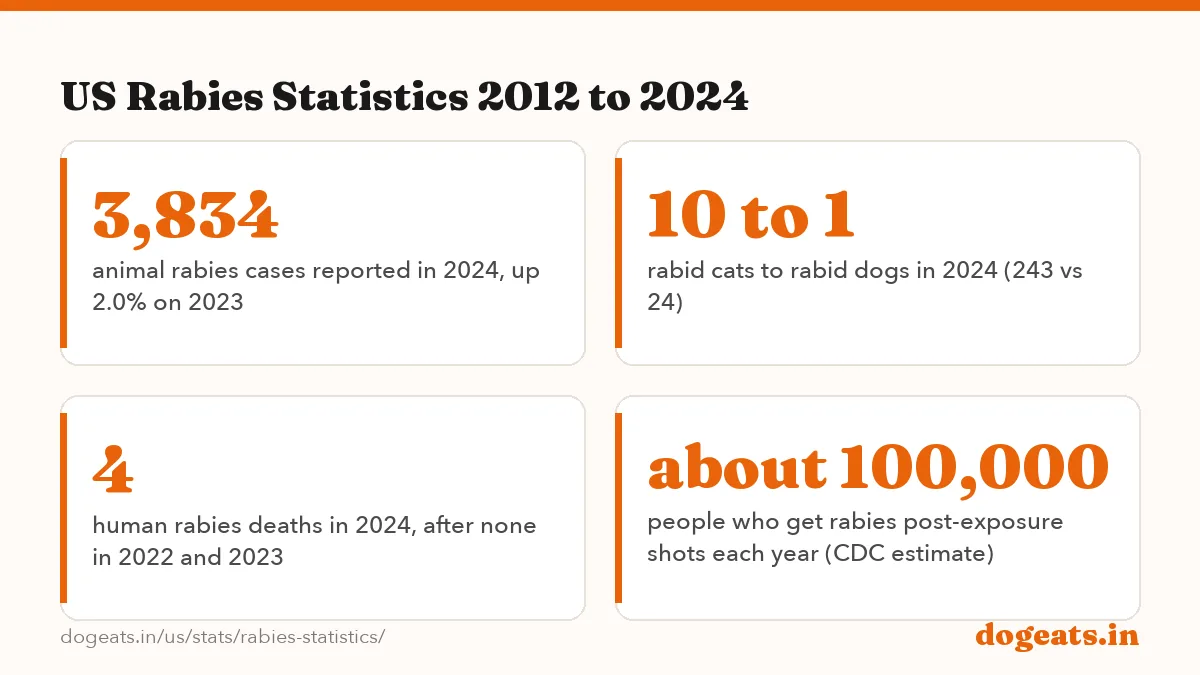
Labs reported 3,834 rabid animals in the US in 2024, and 91.4% were wildlife. Only 24 were dogs, down from 84 in 2012, while cats numbered 243. Four people died of rabies in 2024, but about 100,000 people a year get post-exposure shots, according to CDC.
Key findings
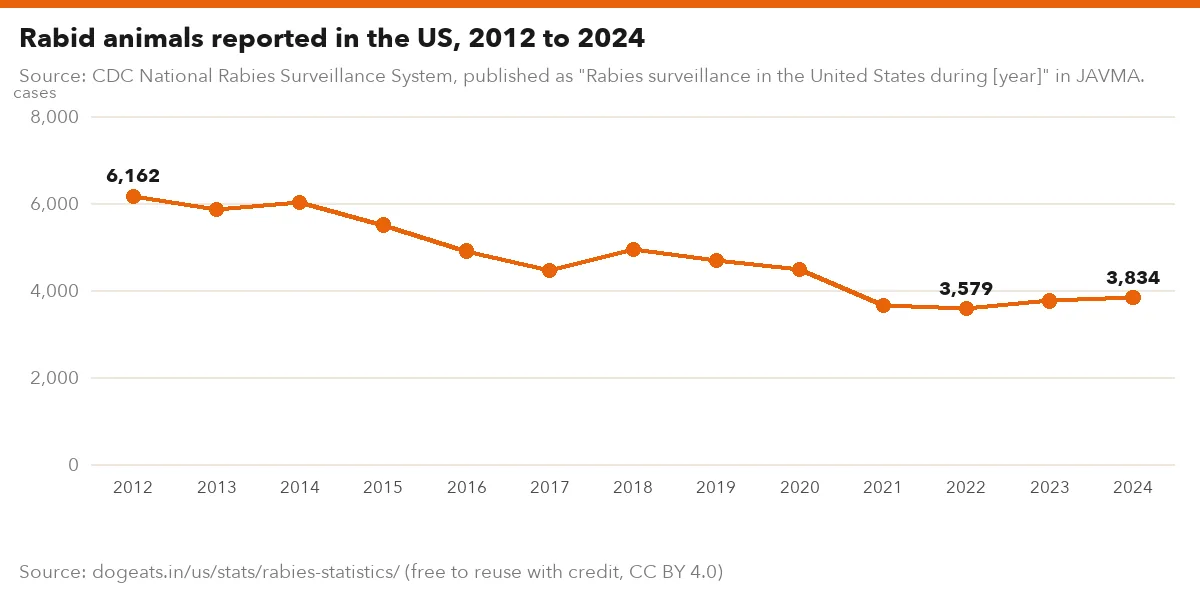
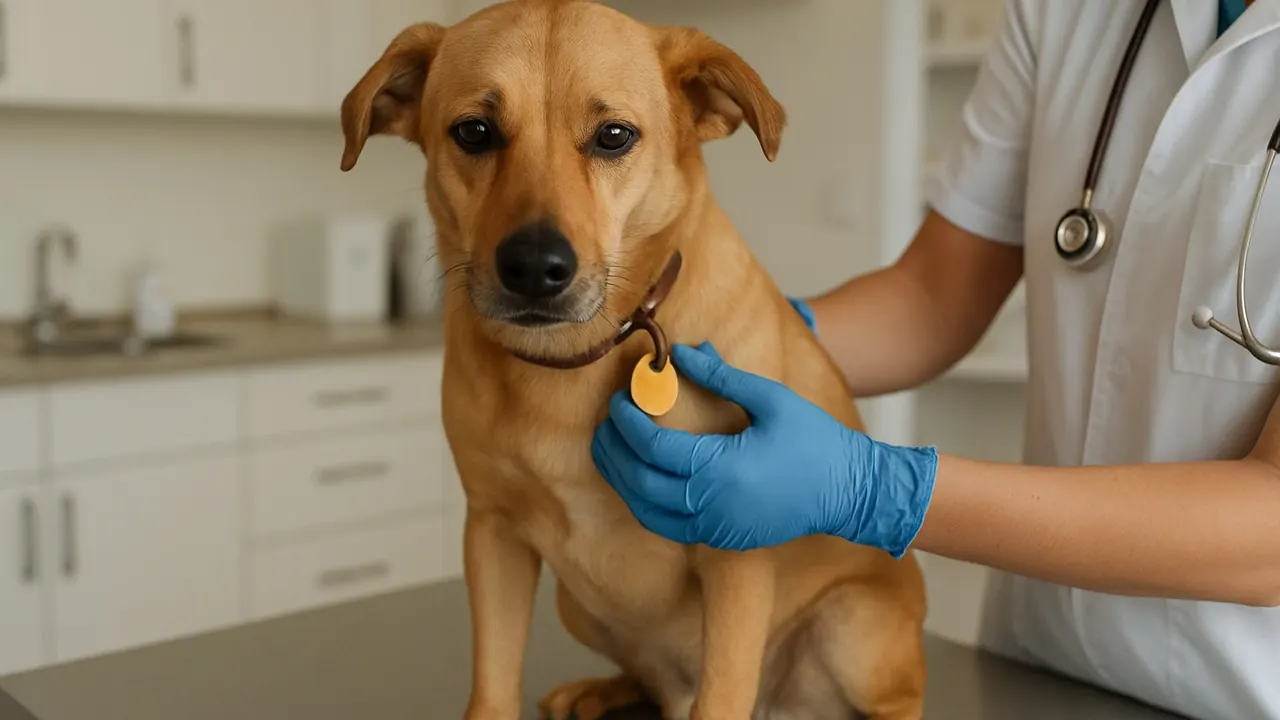
- US labs reported 3,834 rabid animals in 2024, down 37.8% from 6,162 in 2012 but up for the second year running.
- Wildlife made up 91.4% of 2024 cases: 1,376 bats, 1,080 raccoons, 647 skunks and 283 foxes.
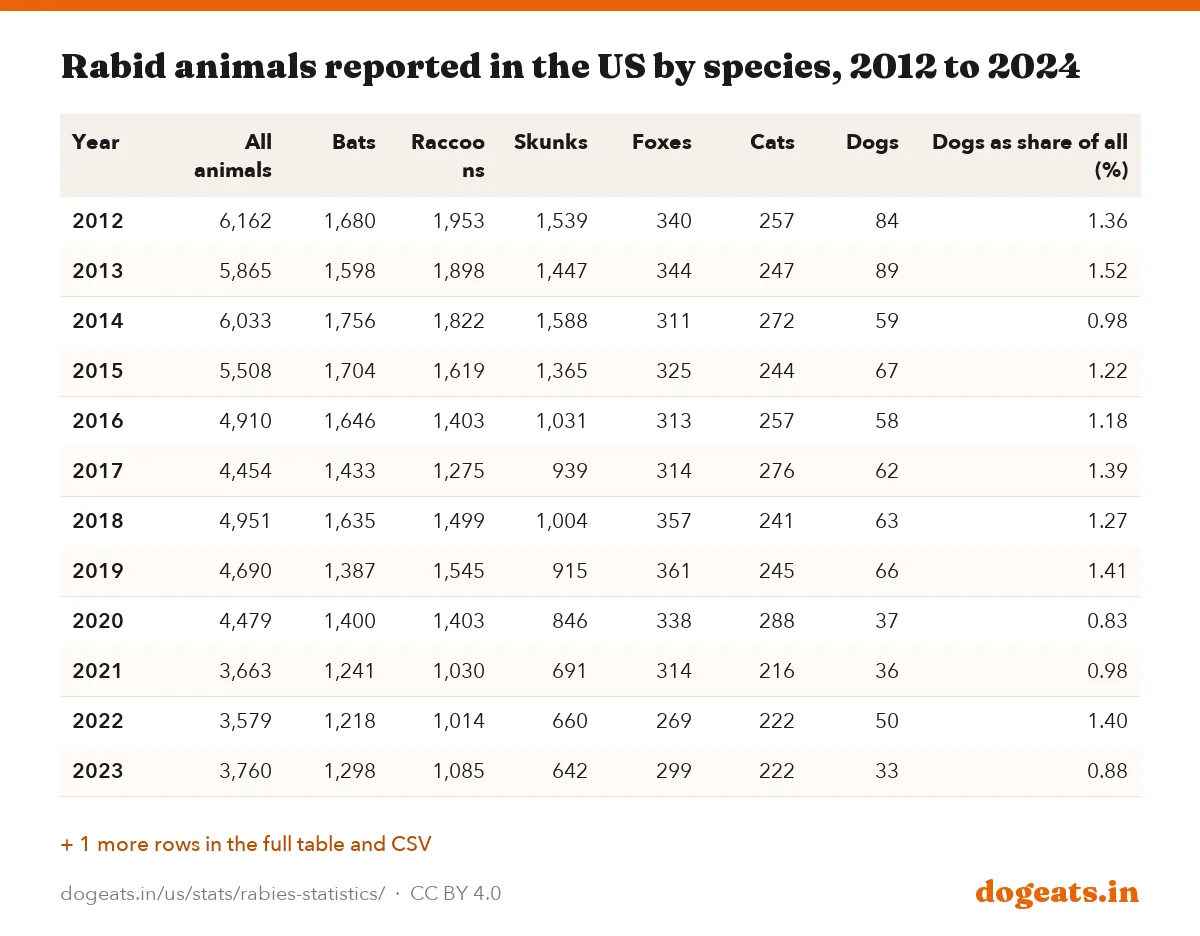
- Only 24 dogs tested positive in 2024, down 71.4% from 84 in 2012, even though more dogs were tested (24,727) than any other species.
- Cats were the most common rabid domestic animal every year from 2012 to 2024, with 243 in 2024, about 10 times the dog count.
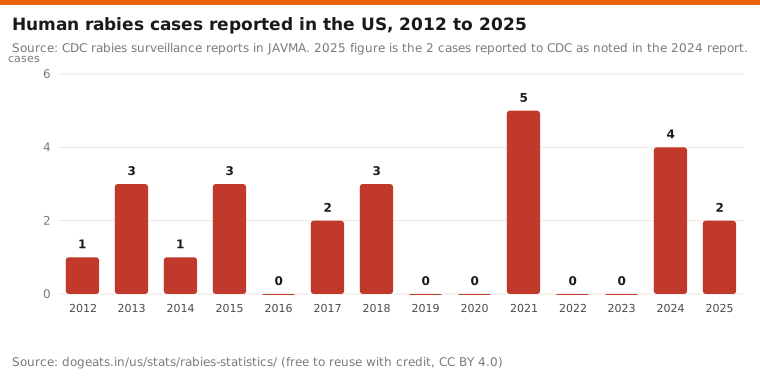
- The US recorded 24 human rabies cases from 2012 to 2025, with 5 years at zero; 2023 had no cases anywhere in North America.
- Of 89 US-acquired human cases from 1960 to 2018, 62 (70%) were traced to bats, according to CDC.
- CDC now estimates about 100,000 people get rabies post-exposure shots each year, up from an estimated 55,000 in 2017 and 2018.
- Since August 1, 2024, every dog entering the US must be at least 6 months old, microchipped and accompanied by a CDC Dog Import Form receipt.
- CDC estimates about 1 million dogs enter the US each year, about 100,000 of them from countries at high risk for dog rabies.
How many rabies cases are there in the US each year?
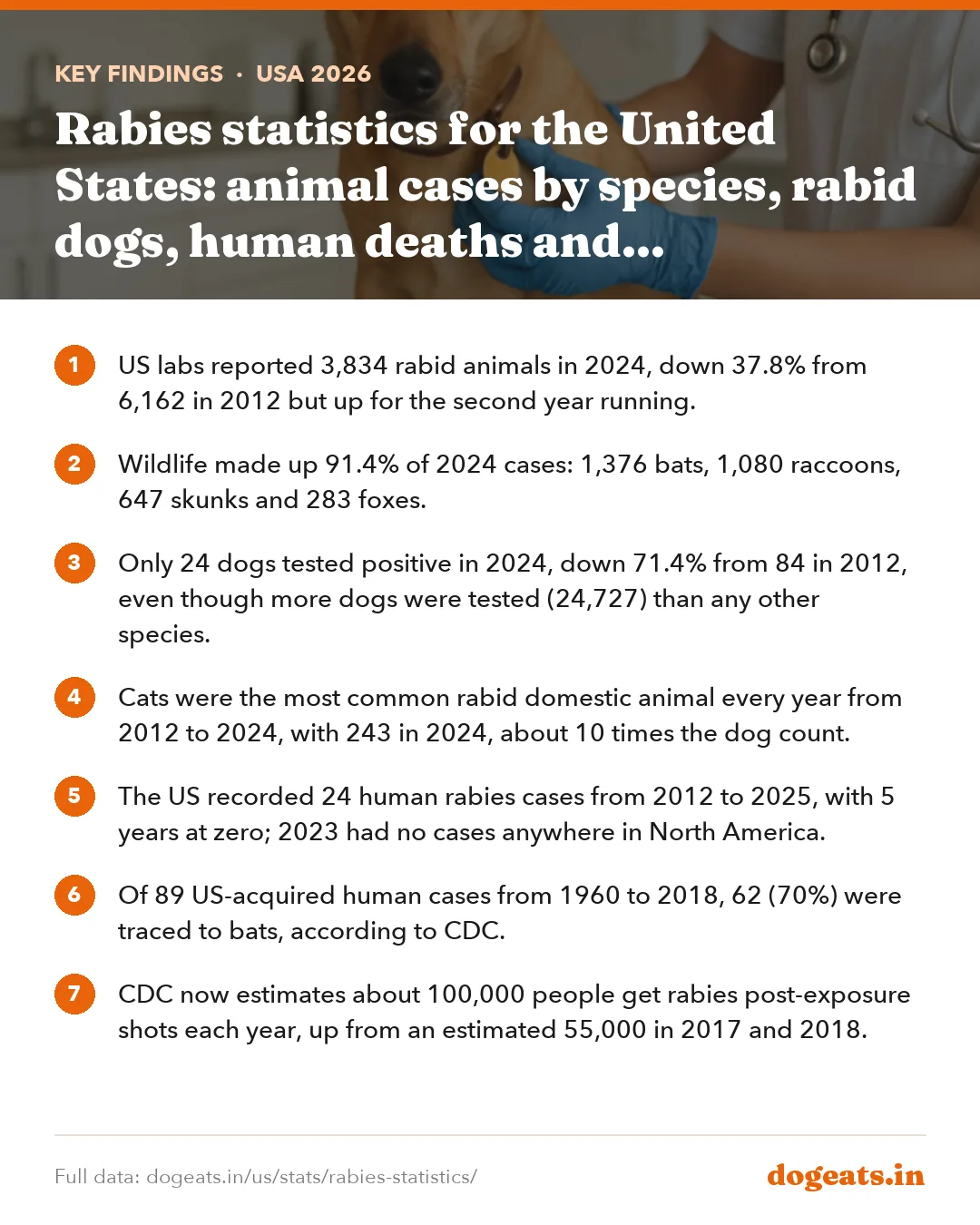
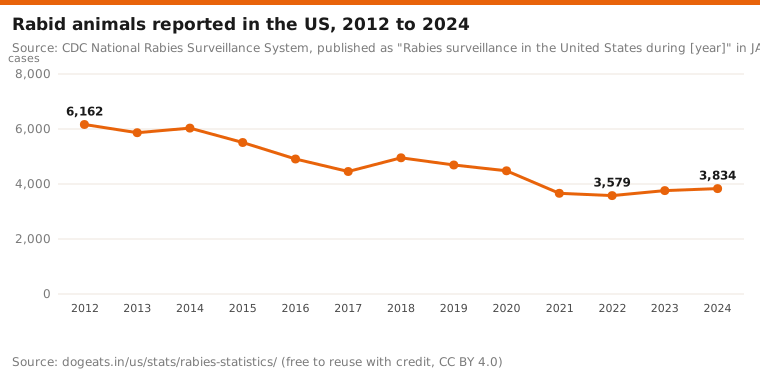
US labs reported 3,834 rabid animals in 2024, from 90,343 samples sent for testing. That was 2.0% more than in 2023. CDC describes the usual level as around 4,000 animal cases a year.
The long trend is down. Cases fell from 6,162 in 2012 to a low of 3,579 in 2022, a drop of 41.9%. The 2024 count is still 37.8% below 2012.
Some of the 2020 and 2021 drop was about testing, not rabies. CDC authors said fewer samples were sent during the COVID-19 pandemic, and 2020 was the first year since 2006 with under 90,000 samples. Labs received 97,523 samples in 2019 and 87,895 in 2020. Submissions were back to 89,530 in 2023 and 90,343 in 2024, or 26.6 per 100,000 people.
Source: CDC National Rabies Surveillance System, published as "Rabies surveillance in the United States during [year]" in JAVMA.
Show the numbers
| Label | cases |
|---|---|
| 2012 | 6,162 |
| 2013 | 5,865 |
| 2014 | 6,033 |
| 2015 | 5,508 |
| 2016 | 4,910 |
| 2017 | 4,454 |
| 2018 | 4,951 |
| 2019 | 4,690 |
| 2020 | 4,479 |
| 2021 | 3,663 |
| 2022 | 3,579 |
| 2023 | 3,760 |
| 2024 | 3,834 |
Embed this chart
| Year | All animals | Bats | Raccoons | Skunks | Foxes | Cats | Dogs | Dogs as share of all (%) |
|---|---|---|---|---|---|---|---|---|
| 2012 | 6,162 | 1,680 | 1,953 | 1,539 | 340 | 257 | 84 | 1.36 |
| 2013 | 5,865 | 1,598 | 1,898 | 1,447 | 344 | 247 | 89 | 1.52 |
| 2014 | 6,033 | 1,756 | 1,822 | 1,588 | 311 | 272 | 59 | 0.98 |
| 2015 | 5,508 | 1,704 | 1,619 | 1,365 | 325 | 244 | 67 | 1.22 |
| 2016 | 4,910 | 1,646 | 1,403 | 1,031 | 313 | 257 | 58 | 1.18 |
| 2017 | 4,454 | 1,433 | 1,275 | 939 | 314 | 276 | 62 | 1.39 |
| 2018 | 4,951 | 1,635 | 1,499 | 1,004 | 357 | 241 | 63 | 1.27 |
| 2019 | 4,690 | 1,387 | 1,545 | 915 | 361 | 245 | 66 | 1.41 |
| 2020 | 4,479 | 1,400 | 1,403 | 846 | 338 | 288 | 37 | 0.83 |
| 2021 | 3,663 | 1,241 | 1,030 | 691 | 314 | 216 | 36 | 0.98 |
| 2022 | 3,579 | 1,218 | 1,014 | 660 | 269 | 222 | 50 | 1.40 |
| 2023 | 3,760 | 1,298 | 1,085 | 642 | 299 | 222 | 33 | 0.88 |
| 2024 | 3,834 | 1,376 | 1,080 | 647 | 283 | 243 | 24 | 0.63 |
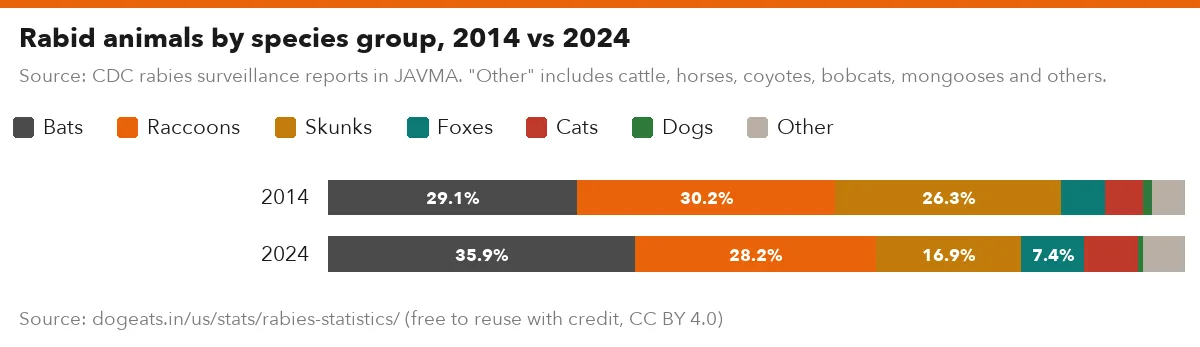
Bats, raccoons and skunks carry most US rabies
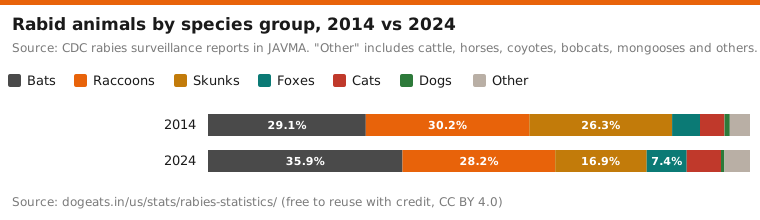
Wildlife made up 3,503 of the 3,834 cases in 2024, or 91.4%. Bats led with 1,376, followed by raccoons (1,080), skunks (647) and foxes (283).
The order has shifted. Raccoons led in 2012, 2013, 2014, 2019 and 2020. Bats have led every other year since 2015 and every year since 2021.
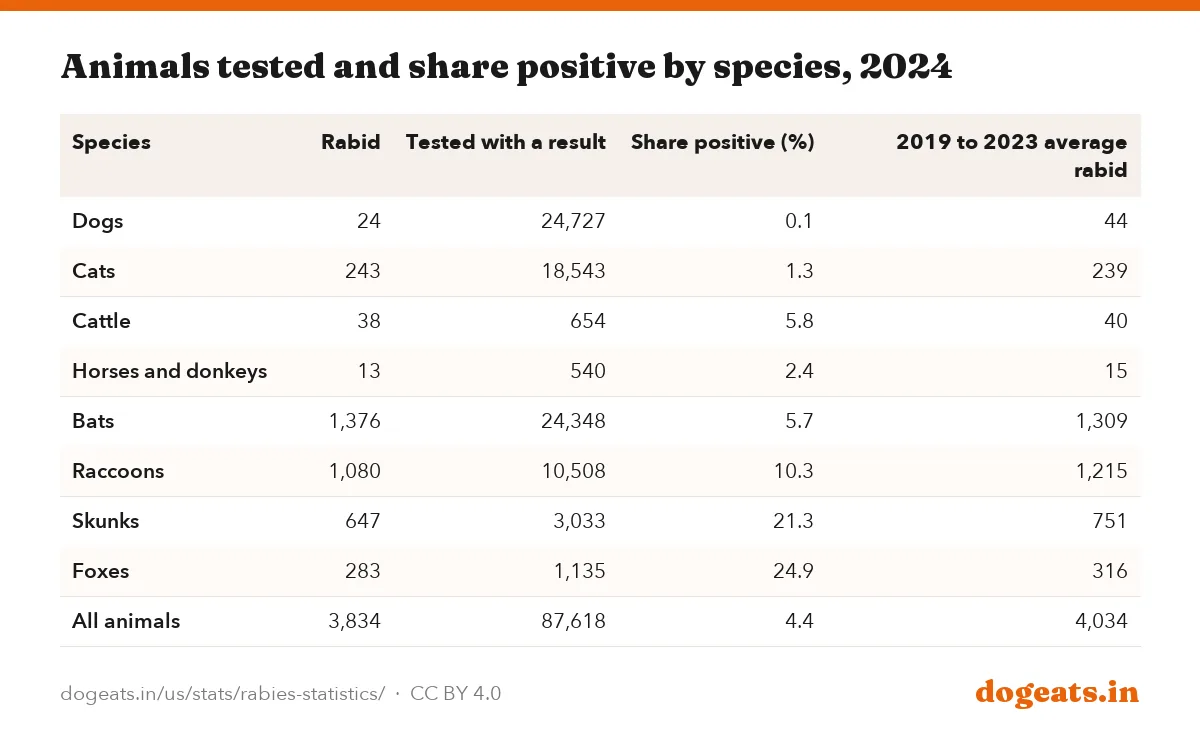
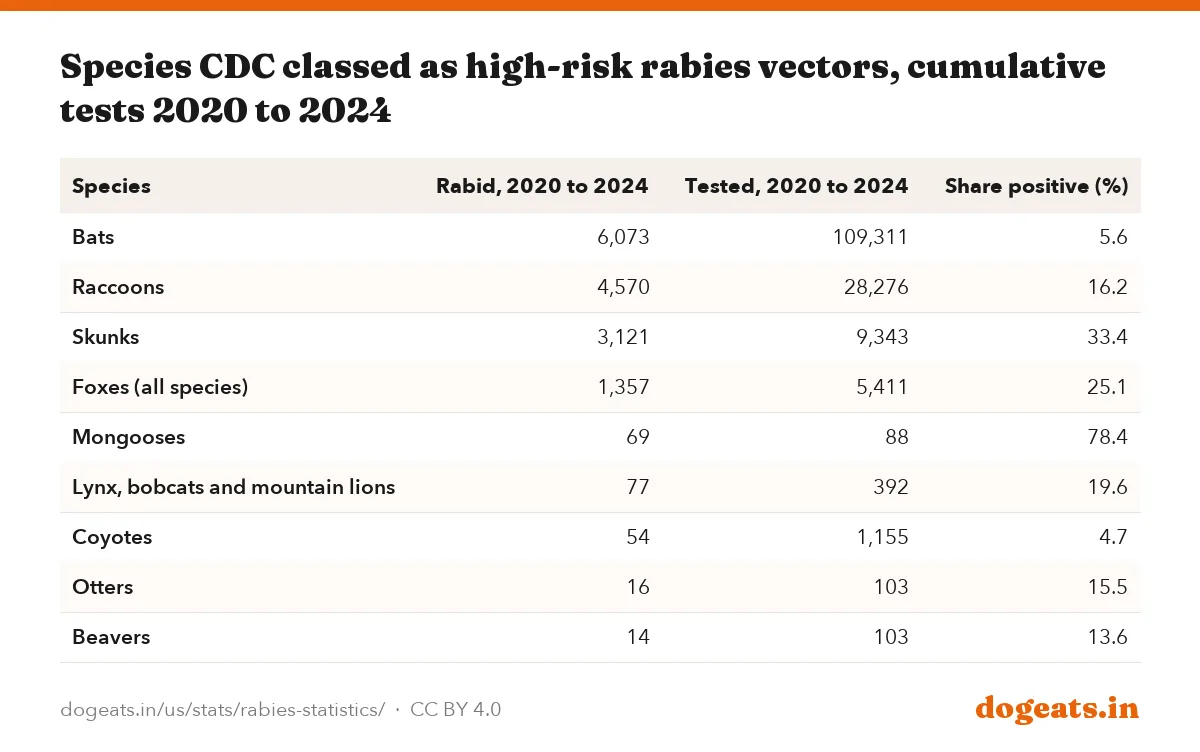
Testing explains part of that. Most samples are sent because a person may have been exposed, and 86.3% of 2024 samples were submitted for that reason. Labs tested 24,348 bats in 2024, more than any wild species, but only 5.7% were positive.
Positivity shows which animals are riskiest after a bite. In 2024, 24.9% of foxes and 21.3% of skunks tested were rabid, against 10.3% of raccoons. CDC says about 3 in 4 Americans live where raccoons, skunks or foxes carry rabies.
Source: CDC rabies surveillance reports in JAVMA. "Other" includes cattle, horses, coyotes, bobcats, mongooses and others.
Show the numbers
| Label | Bats | Raccoons | Skunks | Foxes | Cats | Dogs | Other |
|---|---|---|---|---|---|---|---|
| 2014 | 1756 | 1822 | 1588 | 311 | 272 | 59 | 225 |
| 2024 | 1376 | 1080 | 647 | 283 | 243 | 24 | 181 |
Embed this chart
| Species | Rabid | Tested with a result | Share positive (%) | 2019 to 2023 average rabid |
|---|---|---|---|---|
| Dogs | 24 | 24,727 | 0.1 | 44 |
| Cats | 243 | 18,543 | 1.3 | 239 |
| Cattle | 38 | 654 | 5.8 | 40 |
| Horses and donkeys | 13 | 540 | 2.4 | 15 |
| Bats | 1,376 | 24,348 | 5.7 | 1,309 |
| Raccoons | 1,080 | 10,508 | 10.3 | 1,215 |
| Skunks | 647 | 3,033 | 21.3 | 751 |
| Foxes | 283 | 1,135 | 24.9 | 316 |
| All animals | 3,834 | 87,618 | 4.4 | 4,034 |
| Species | Rabid, 2020 to 2024 | Tested, 2020 to 2024 | Share positive (%) |
|---|---|---|---|
| Bats | 6,073 | 109,311 | 5.6 |
| Raccoons | 4,570 | 28,276 | 16.2 |
| Skunks | 3,121 | 9,343 | 33.4 |
| Foxes (all species) | 1,357 | 5,411 | 25.1 |
| Mongooses | 69 | 88 | 78.4 |
| Lynx, bobcats and mountain lions | 77 | 392 | 19.6 |
| Coyotes | 54 | 1,155 | 4.7 |
| Otters | 16 | 103 | 15.5 |
| Beavers | 14 | 103 | 13.6 |
Mongooses had the highest positivity of all: 69 of 88 tested from 2020 to 2024, or 78.4%. They carry rabies in Puerto Rico, where 6 of the 24 rabid dogs of 2024 were found.
Wildlife vaccination holds the line. In 2024, USDA and partners dropped 5,856,000 oral rabies vaccine baits over 88,258 square kilometers in 9 eastern states to contain raccoon rabies.
Hurricane Helene forced the cancellation of 2024 baiting in Georgia, North Carolina, Tennessee and Virginia. Texas dropped 820,200 baits along the Mexican border to keep out the dog-coyote variant, last found in the US in 2004.
Texas, Virginia and New York report the most rabid animals
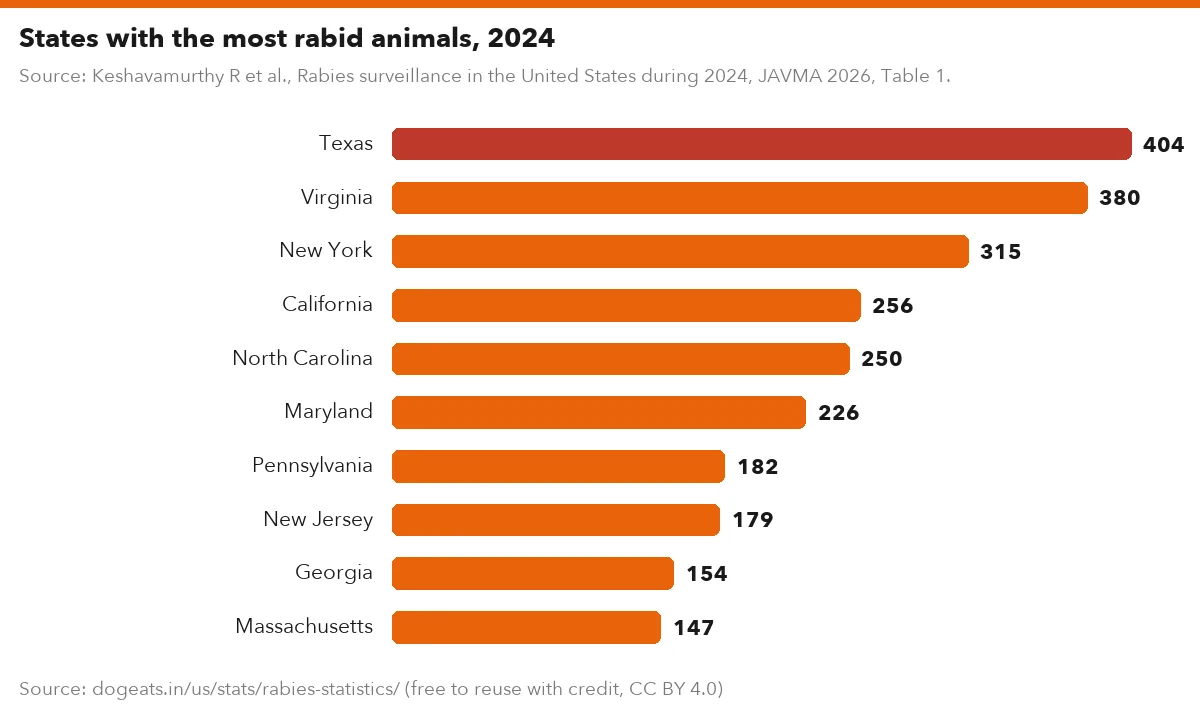
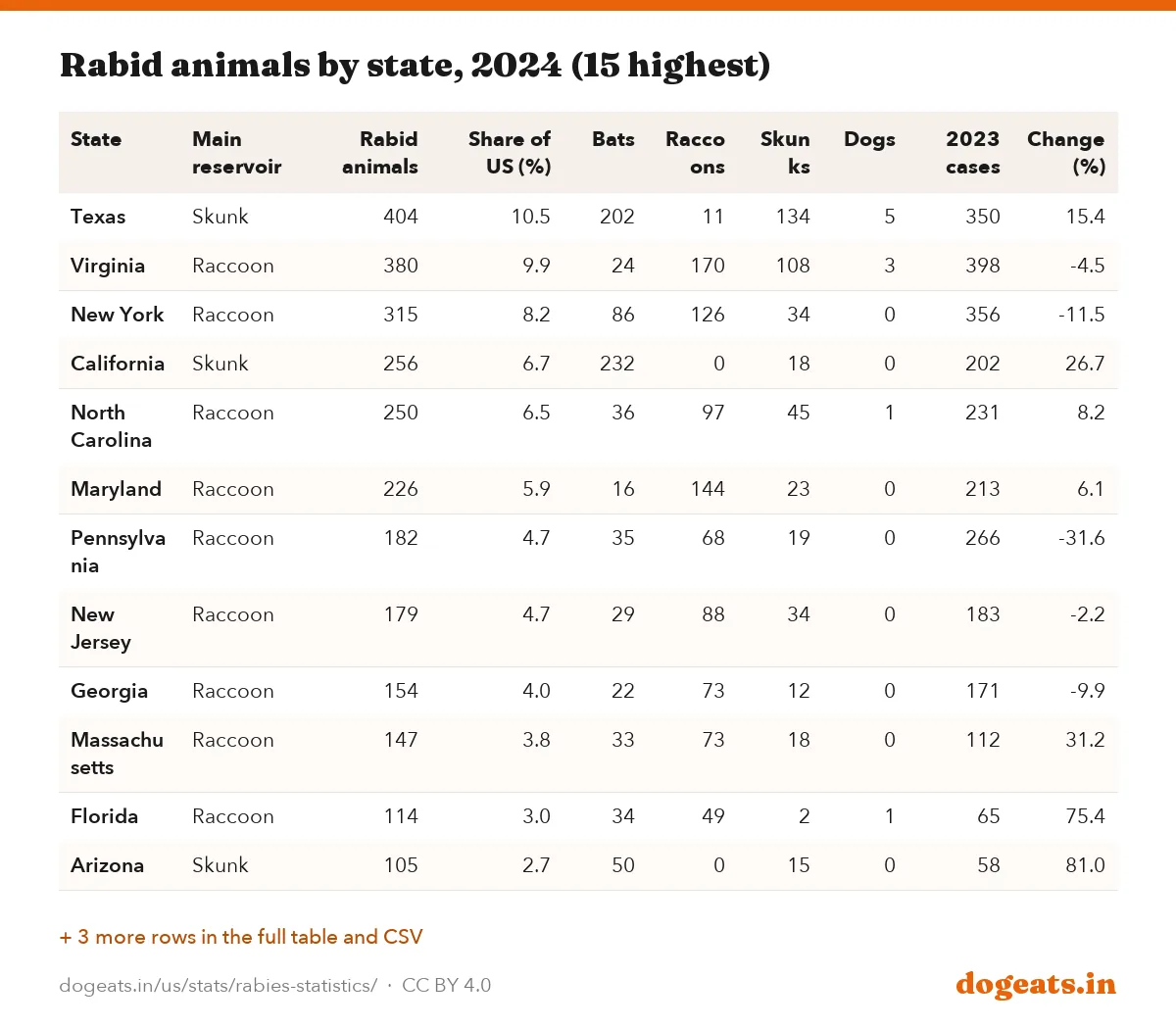
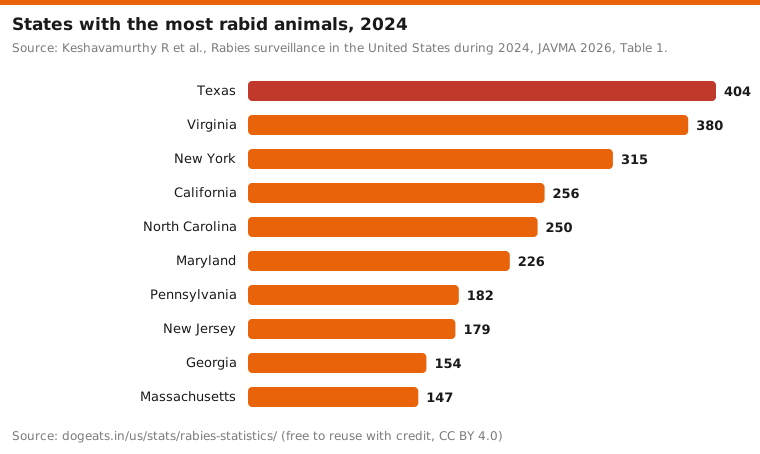
Texas reported 404 rabid animals in 2024, or 10.5% of the national total. Virginia (380), New York (315), California (256), North Carolina (250) and Maryland (226) followed.
Those 6 states made up 47.8% of all cases, and the top 10 made up 65.0%. Mississippi reported none. Hawaii, the only state without wildlife rabies, is not in the table.
The mix differs by region. In California, 232 of 256 cases were bats. In Virginia and Maryland, raccoons led, and Texas had 134 rabid skunks.
Source: Keshavamurthy R et al., Rabies surveillance in the United States during 2024, JAVMA 2026, Table 1.
Show the numbers
| Label | cases |
|---|---|
| Texas | 404 |
| Virginia | 380 |
| New York | 315 |
| California | 256 |
| North Carolina | 250 |
| Maryland | 226 |
| Pennsylvania | 182 |
| New Jersey | 179 |
| Georgia | 154 |
| Massachusetts | 147 |
Embed this chart
| State | Main reservoir | Rabid animals | Share of US (%) | Bats | Raccoons | Skunks | Dogs | 2023 cases | Change (%) |
|---|---|---|---|---|---|---|---|---|---|
| Texas | Skunk | 404 | 10.5 | 202 | 11 | 134 | 5 | 350 | 15.4 |
| Virginia | Raccoon | 380 | 9.9 | 24 | 170 | 108 | 3 | 398 | -4.5 |
| New York | Raccoon | 315 | 8.2 | 86 | 126 | 34 | 0 | 356 | -11.5 |
| California | Skunk | 256 | 6.7 | 232 | 0 | 18 | 0 | 202 | 26.7 |
| North Carolina | Raccoon | 250 | 6.5 | 36 | 97 | 45 | 1 | 231 | 8.2 |
| Maryland | Raccoon | 226 | 5.9 | 16 | 144 | 23 | 0 | 213 | 6.1 |
| Pennsylvania | Raccoon | 182 | 4.7 | 35 | 68 | 19 | 0 | 266 | -31.6 |
| New Jersey | Raccoon | 179 | 4.7 | 29 | 88 | 34 | 0 | 183 | -2.2 |
| Georgia | Raccoon | 154 | 4.0 | 22 | 73 | 12 | 0 | 171 | -9.9 |
| Massachusetts | Raccoon | 147 | 3.8 | 33 | 73 | 18 | 0 | 112 | 31.2 |
| Florida | Raccoon | 114 | 3.0 | 34 | 49 | 2 | 1 | 65 | 75.4 |
| Arizona | Skunk | 105 | 2.7 | 50 | 0 | 15 | 0 | 58 | 81.0 |
| South Carolina | Raccoon | 81 | 2.1 | 8 | 33 | 19 | 1 | 78 | 3.8 |
| Minnesota | Skunk | 69 | 1.8 | 43 | 0 | 15 | 0 | 48 | 43.8 |
| Maine | Raccoon | 68 | 1.8 | 10 | 36 | 14 | 0 | 75 | -9.3 |
Counts swing year to year. Arizona rose 81.0% to 105 cases and Florida rose 75.4% to 114. Pennsylvania fell 31.6%, from 266 to 182.
Puerto Rico had the highest positivity of any jurisdiction, 33.3%, with 26 cases. Arizona was next, at 11.5%.
Dogs are now a tiny share of rabies cases
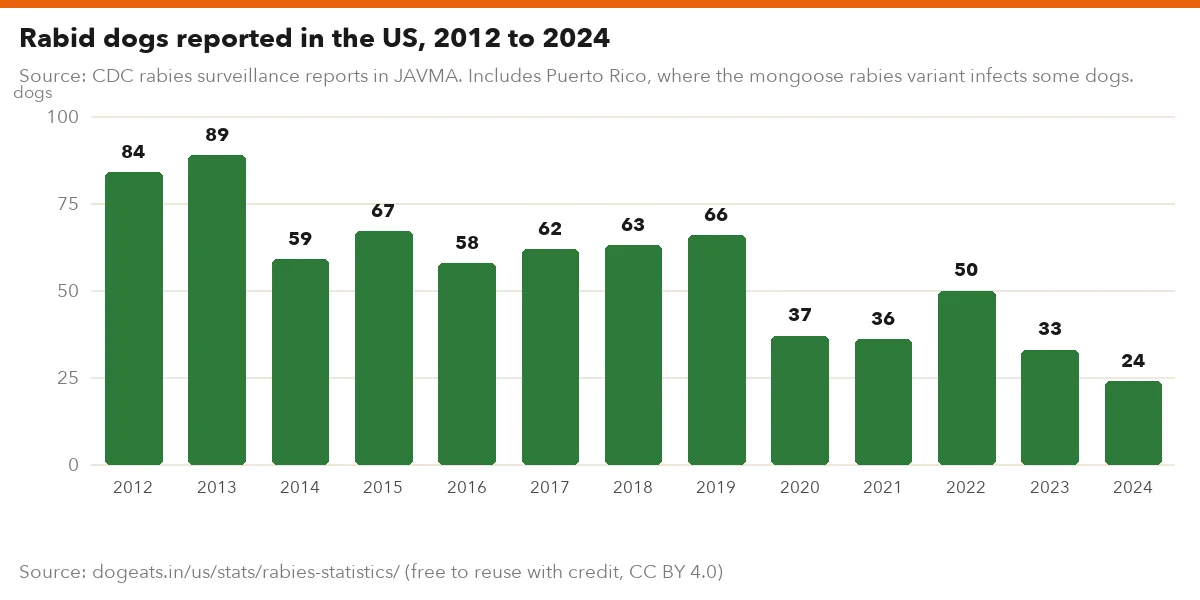
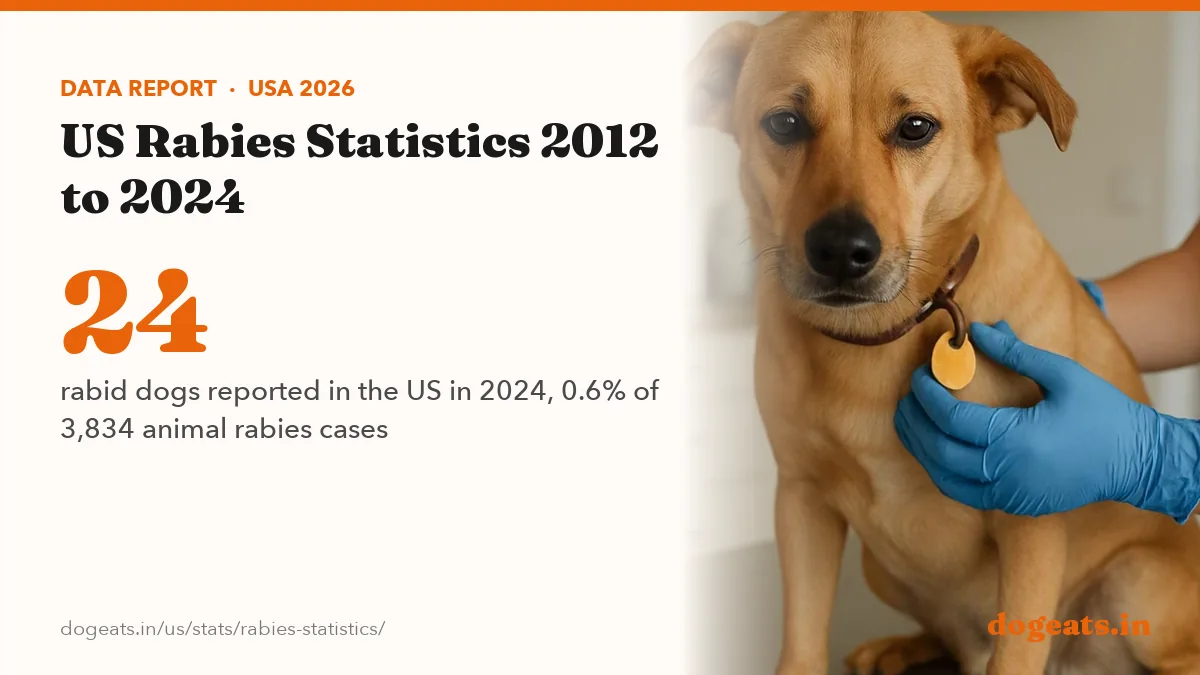
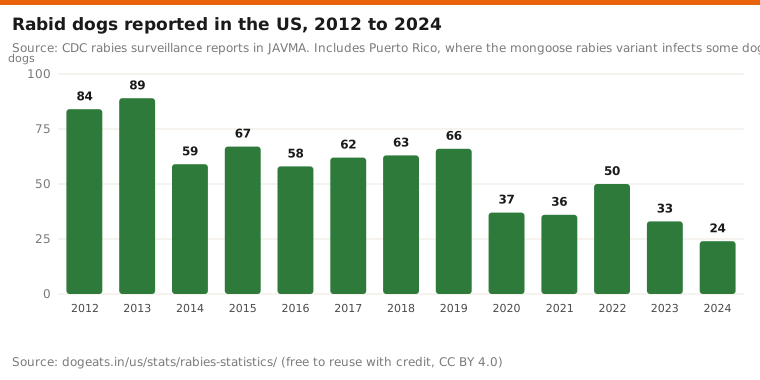
Only 24 dogs tested positive for rabies in 2024, or 0.6% of all animal cases, and the lowest count in the 13 years we tracked. In 2012 there were 84 rabid dogs.
Dogs are not tested less. In 2024 labs tested 24,727 dogs, more than any other species, and only 0.1% were positive. Across all species, 86.3% of 2024 samples were sent because a person may have been exposed.
The change goes back decades. CDC says the US had fewer than 500 rabid dogs a year in the late 1960s, after vaccination and leash laws began in 1947. The dog-maintained rabies virus was eliminated, and the US was declared free of it in 2007.

Source: CDC rabies surveillance reports in JAVMA. Includes Puerto Rico, where the mongoose rabies variant infects some dogs.
Show the numbers
| Label | dogs |
|---|---|
| 2012 | 84 |
| 2013 | 89 |
| 2014 | 59 |
| 2015 | 67 |
| 2016 | 58 |
| 2017 | 62 |
| 2018 | 63 |
| 2019 | 66 |
| 2020 | 37 |
| 2021 | 36 |
| 2022 | 50 |
| 2023 | 33 |
| 2024 | 24 |
Embed this chart
Rabid dogs today catch wildlife strains. In 2024, labs typed the virus in 19 of the 24 rabid dogs. Seven had the south central skunk variant, 6 the Puerto Rico mongoose variant, 5 the eastern raccoon variant and 1 the north central skunk variant. None had a dog-maintained strain.
Vaccination records are often missing. The 2014 report had vaccination records for only 33 of 272 rabid cats. It had records for 44 of 59 rabid dogs, and 43 of those 44 had no record of vaccination.
How many people die from rabies in the US?
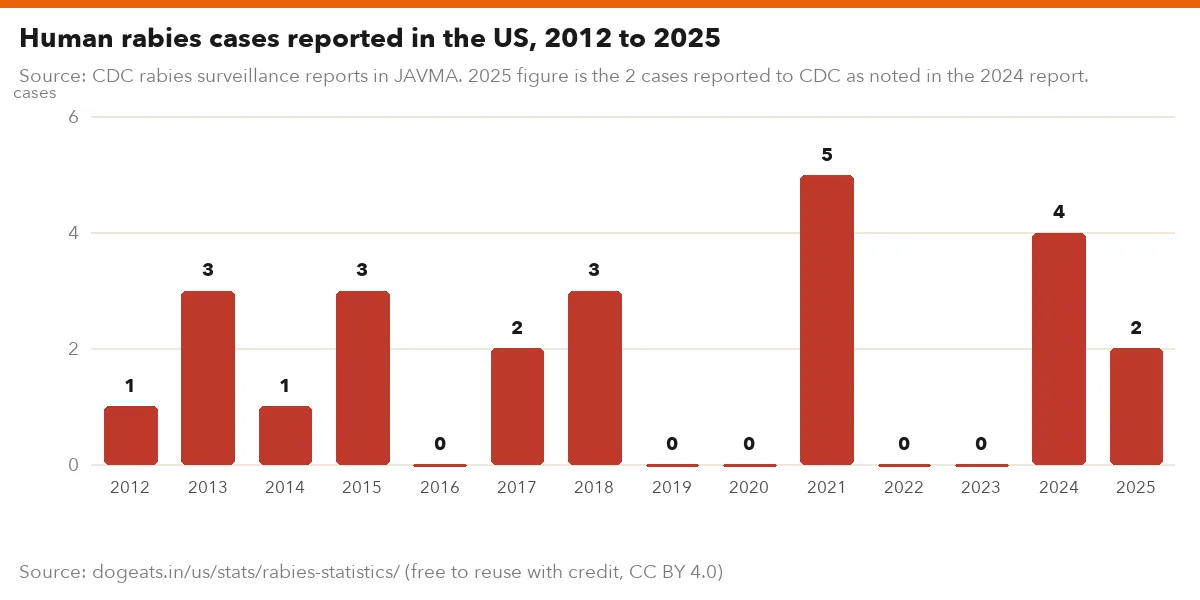
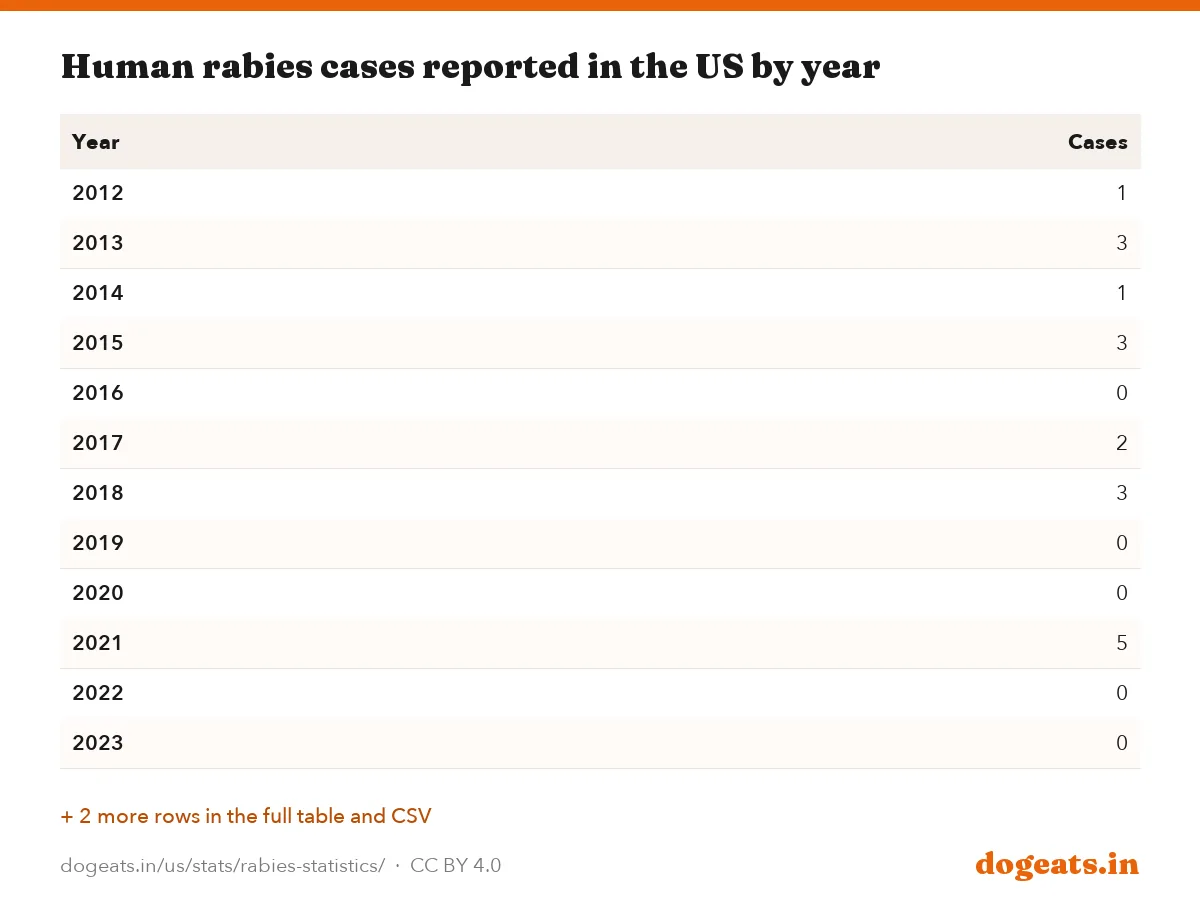
Very few. The US recorded 24 human rabies cases from 2012 to 2025, between 0 and 5 a year. 2016, 2019, 2020, 2022 and 2023 had none, and 2023 had no cases in the US, Canada or Mexico. CDC counts 17 cases from 2015 to 2024, which matches the yearly reports.
Four people died in 2024. Two in Minnesota and California had untreated bat contact. One in Kentucky had a dog strain from Haiti, and one in Idaho was likely exposed through a skunk scratch. His virus was a bat variant, and he passed rabies on through a donated kidney.
Bats are the main domestic risk. CDC found that 62 of 89 US-acquired human cases from 1960 to 2018 came from bats. Another 36 of the 125 cases in that period followed dog bites abroad.
Source: CDC rabies surveillance reports in JAVMA. 2025 figure is the 2 cases reported to CDC as noted in the 2024 report.
Show the numbers
| Label | cases |
|---|---|
| 2012 | 1 |
| 2013 | 3 |
| 2014 | 1 |
| 2015 | 3 |
| 2016 | 0 |
| 2017 | 2 |
| 2018 | 3 |
| 2019 | 0 |
| 2020 | 0 |
| 2021 | 5 |
| 2022 | 0 |
| 2023 | 0 |
| 2024 | 4 |
| 2025 | 2 |
Embed this chart
| Year | Cases |
|---|---|
| 2012 | 1 |
| 2013 | 3 |
| 2014 | 1 |
| 2015 | 3 |
| 2016 | 0 |
| 2017 | 2 |
| 2018 | 3 |
| 2019 | 0 |
| 2020 | 0 |
| 2021 | 5 |
| 2022 | 0 |
| 2023 | 0 |
| 2024 | 4 |
| 2025 | 2 |
Since 2000, 14 human rabies deaths in the US were caused by exposures in other countries, CDC authors reported. A child in New York died in 2025 after a dog bite in India.
Post-exposure shots: about 100,000 people a year
Rabies kills few Americans because exposed people get treated. Post-exposure prophylaxis, or PEP, means wound cleaning, rabies immune globulin and a series of vaccine doses.
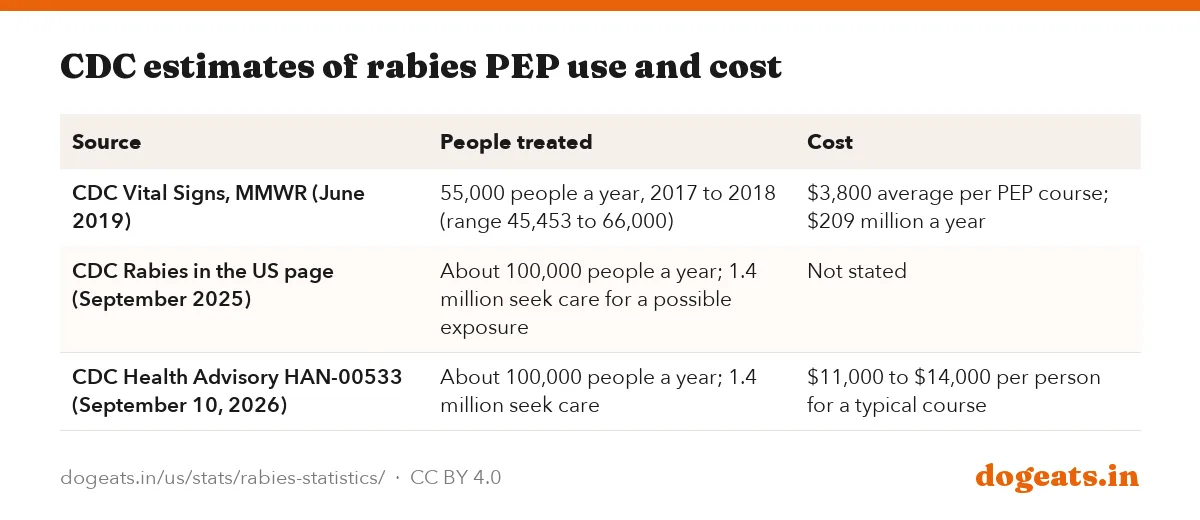
CDC's estimates have grown. Its 2019 Vital Signs report put PEP at about 55,000 people a year. CDC pages in 2025 and 2026 say about 100,000, out of 1.4 million who seek care after animal contact.
Cost estimates differ just as much. CDC put the average course at $3,800 in 2019, not counting hospital or wound care, or about $209 million a year nationally. Its September 2026 health advisory said a typical course costs $11,000 to $14,000 per person.
| Source | People treated | Cost |
|---|---|---|
| CDC Vital Signs, MMWR (June 2019) | 55,000 people a year, 2017 to 2018 (range 45,453 to 66,000) | $3,800 average per PEP course; $209 million a year |
| CDC Rabies in the US page (September 2025) | About 100,000 people a year; 1.4 million seek care for a possible exposure | Not stated |
| CDC Health Advisory HAN-00533 (September 10, 2026) | About 100,000 people a year; 1.4 million seek care | $11,000 to $14,000 per person for a typical course |
The 2026 advisory also reported about 33% higher use of rabies vaccine and said there was no national shortage. At least eight state health departments reported more PEP use, PEP errors or both.
Public health responses cost money too. The 2019 report counted about 175 mass bat exposure events a year, each involving more than 10 people. It put total emergency response costs at about $7.6 million a year.
The 2024 dog import rule
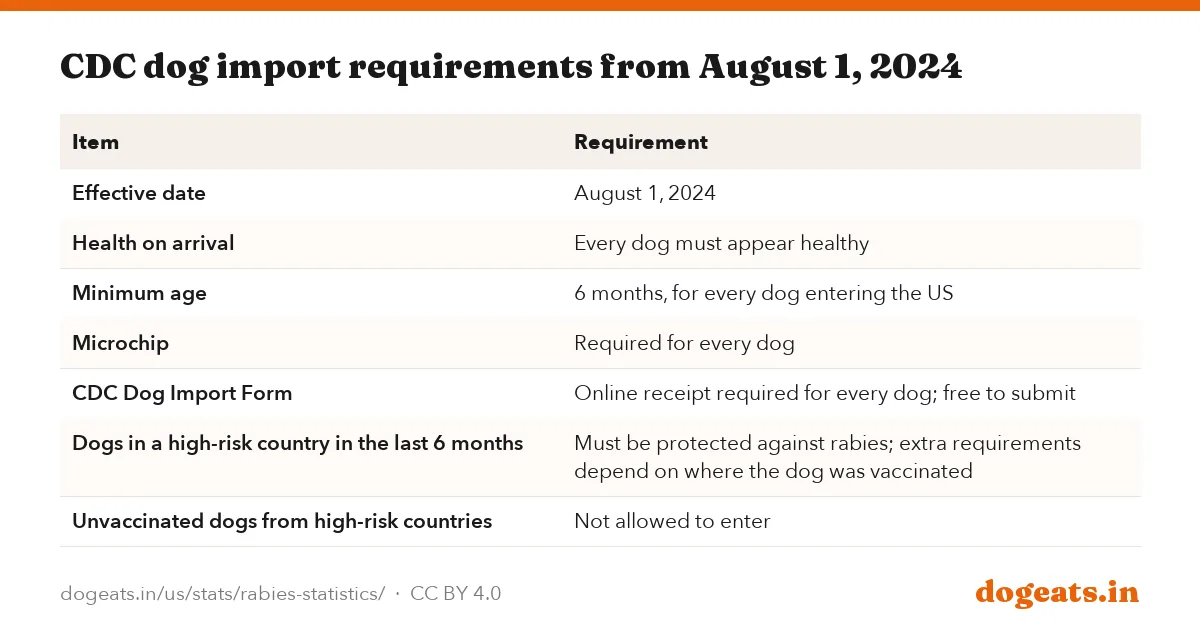
CDC tightened its dog import rules on August 1, 2024. Every dog must now be at least 6 months old, microchipped and backed by a CDC Dog Import Form receipt.
The goal is to keep dog rabies out. CDC estimates about 1 million dogs enter the US each year, about 100,000 from countries at high risk for dog rabies. Its 2019 report put the figures at 1.06 million and 107,000.
The rule compares the two risks directly. From 2015 to 2022, dogs from high-risk countries had about 16 times the rabies rate of dogs in the US.
| Item | Requirement |
|---|---|
| Effective date | August 1, 2024 |
| Health on arrival | Every dog must appear healthy |
| Minimum age | 6 months, for every dog entering the US |
| Microchip | Required for every dog |
| CDC Dog Import Form | Online receipt required for every dog; free to submit |
| Dogs in a high-risk country in the last 6 months | Must be protected against rabies; extra requirements depend on where the dog was vaccinated |
| Unvaccinated dogs from high-risk countries | Not allowed to enter |
One imported rabid dog is costly. The rule puts the cost at about $270,000 per event, within a range of $210,000 to $510,000. The figure covers investigation and care of exposed people, not animal costs. CDC's 2019 report put it at about $213,833.
Owners bringing a dog home from abroad should check CDC's dog travel tool before booking. Rules depend on where the dog has been in the last 6 months.
What dog and cat owners can do
Keep dogs, cats and ferrets current on rabies shots. Rabid cats outnumbered rabid dogs about 10 to 1 in 2024, so indoor-outdoor cats need shots too. CDC says vets vaccinate more than 91 million US cats and dogs each year.
Did a bat turn up in a room where someone slept? Did a pet fight a raccoon, skunk or fox? Call your doctor, vet or health department the same day. Do not release a bat that may have touched a person, since it may need testing.
For bite numbers and the breeds involved, see our dog bite statistics. Our dog ownership statistics show how many US homes have a dog.
Frequently asked questions
How many rabies cases are there in the US each year?
US labs reported 3,834 rabid animals in 2024 and 3,760 in 2023. CDC describes the usual level as around 4,000 a year. More than 90% are wild animals.
How many dogs get rabies in the US?
Very few. 24 dogs tested positive in 2024 and 33 in 2023, and 24,727 dogs were tested in 2024. In 2012 the count was 84.
What animal carries rabies most in the US?
Bats, with 1,376 rabid bats in 2024, followed by raccoons (1,080), skunks (647) and foxes (283). Among pets, cats lead, with 243 rabid cats in 2024.
How many people die of rabies in the US each year?
Usually 0 to 5. There were 4 deaths in 2024, none in 2022 or 2023, and 2 cases reported in 2025. CDC says fewer than 10 human deaths are reported in a typical year.
How many people get rabies shots after a bite?
CDC estimates about 100,000 people a year get post-exposure prophylaxis, out of 1.4 million who seek care after animal contact. Its 2019 estimate was 55,000.
How much does rabies treatment cost?
CDC's September 2026 health advisory put a typical post-exposure course at $11,000 to $14,000 per person. A 2019 CDC report gave an average of $3,800, so estimates vary widely.
Is dog rabies still in the US?
No. The dog-maintained rabies virus is gone from the US, which was declared free of it in 2007. Dogs can still catch rabies from wildlife or arrive infected from abroad.
What are the new rules for bringing a dog into the US?
Since August 1, 2024, every dog must be at least 6 months old, microchipped and have a CDC Dog Import Form receipt. Dogs from high-risk countries face extra rabies requirements.
Methodology and limitations
Animal and human case counts come from CDC's annual "Rabies surveillance in the United States" reports in JAVMA for 2012 to 2024. We used the counts in each report's abstract or tables and did not adjust them.
Counts include Puerto Rico. Year-on-year changes and shares are our own calculations from the published counts. The 2025 human figure is the 2 cases the 2024 report said were reported to CDC in 2025.
PEP, cost and dog import figures come from CDC sources. These are the 2019 MMWR Vital Signs report, CDC web pages from 2024 and 2025, the September 2026 health advisory and the 2024 final rule.
Sources
- Keshavamurthy R et al. Rabies surveillance in the United States during 2024. JAVMA, 2026, 2024 animal cases by species and state, testing, positivity, high-risk species, vaccine baits, 4 human deaths, 2 cases in 2025
- CDC MMWR Vital Signs: Trends in Human Rabies Deaths and Exposures, United States, 1938 to 2018, Bats 70% of US-acquired cases; 55,000 PEP a year; dog imports; late 1960s rabid dogs
- CDC Health Advisory HAN-00533, September 10, 2026, About 100,000 PEP a year; $11,000 to $14,000 per course; 2026 rise in exposures
- Also consulted: Boutelle C et al. Rabies surveillance in the United States during 2023. JAVMA, 2025, Ma X et al. Rabies surveillance in the United States during 2022. JAVMA, 2024, Ma X et al. Rabies surveillance in the United States during 2021. JAVMA, 2023, Ma X et al. Rabies surveillance in the United States during 2020. JAVMA, 2022, Ma X et al. Rabies surveillance in the United States during 2019. JAVMA, 2021, Ma X et al. Rabies surveillance in the United States during 2018. JAVMA, 2020, Ma X et al. Rabies surveillance in the United States during 2017. JAVMA, 2018, Ma X et al. Rabies surveillance in the United States during 2016. JAVMA, 2018, Birhane MG et al. Rabies surveillance in the United States during 2015. JAVMA, 2017, Monroe BP et al. Rabies surveillance in the United States during 2014. JAVMA, 2016, Dyer JL et al. Rabies surveillance in the United States during 2013. JAVMA, 2014, Dyer JL et al. Rabies surveillance in the United States during 2012. JAVMA, 2013, CDC: Rabies in the United States, Protecting Public Health (September 30, 2025), CDC press release, May 8, 2024: dog importation regulation, Federal Register, May 13, 2024: Importation of Dogs and Cats, final rule, CDC: Bringing a Dog into the United States, US National Library of Medicine PubMed records for the JAVMA rabies surveillance series.
Cite, embed and download
This report, its data and its images are free to reuse under a Creative Commons Attribution 4.0 licence. Credit dogeats.in with a link to this page. Every chart has its own embed code, every table has a CSV and an image download, and the images below are ready for social posts, slides and articles.
Cite this report
Link to this report
Every chart and table as an image