Data report · Updated October 2026
Dog obesity rate and dog cancer rates by breed: US statistics for 2026
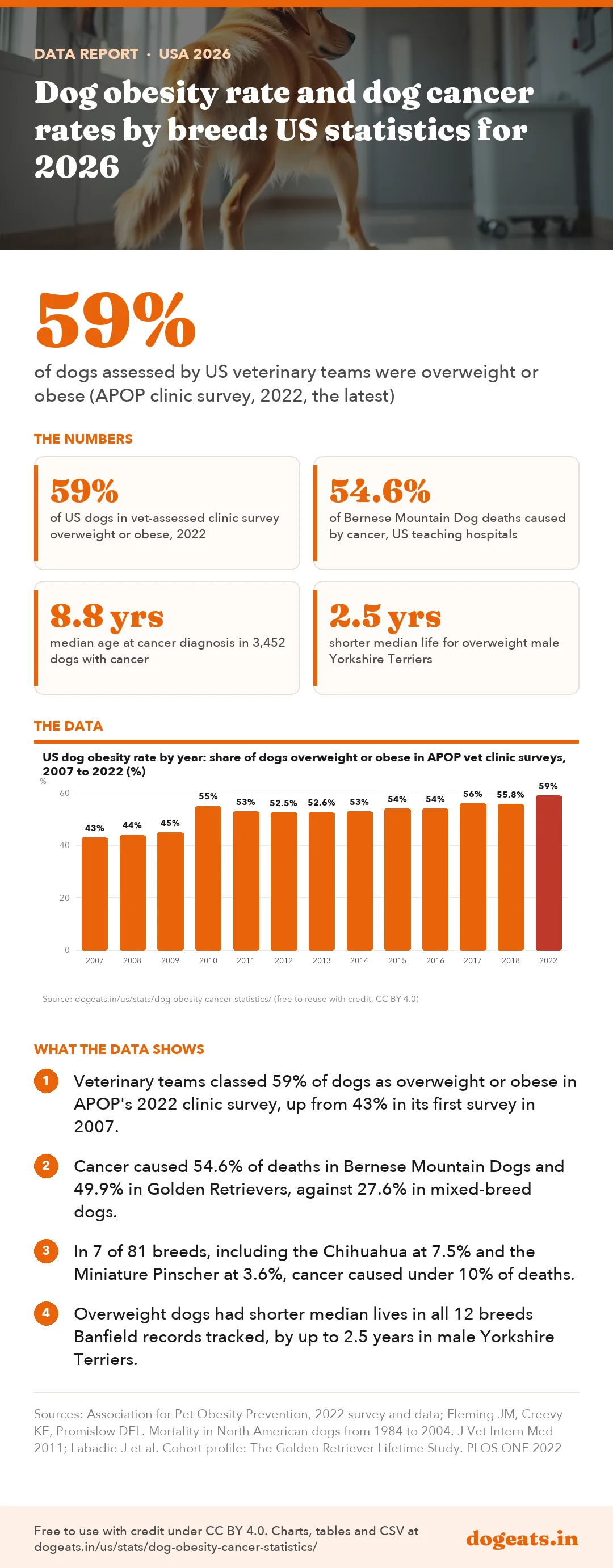
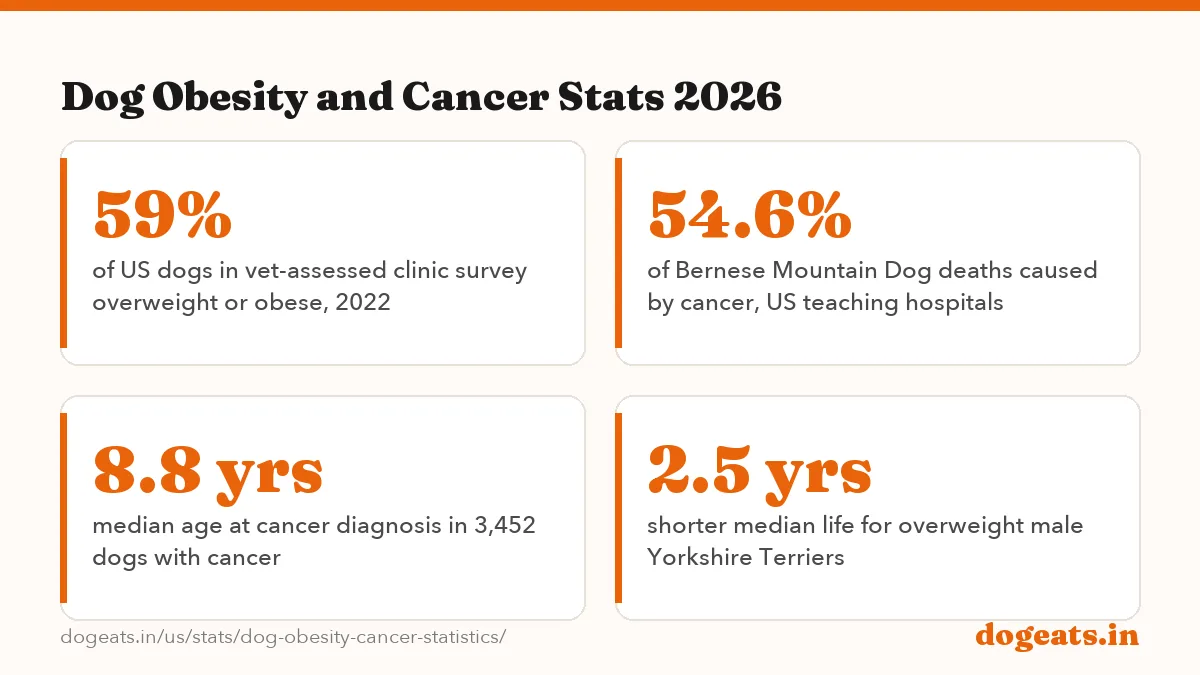
About 59% of dogs examined by US veterinary teams were overweight or obese in the latest clinic survey from the Association for Pet Obesity Prevention (2022). Cancer rates differ sharply by breed: it caused 54.6% of Bernese Mountain Dog deaths and 49.9% of Golden Retriever deaths in a study of 74,556 dogs. In some toy breeds it was under 10%.

Key findings
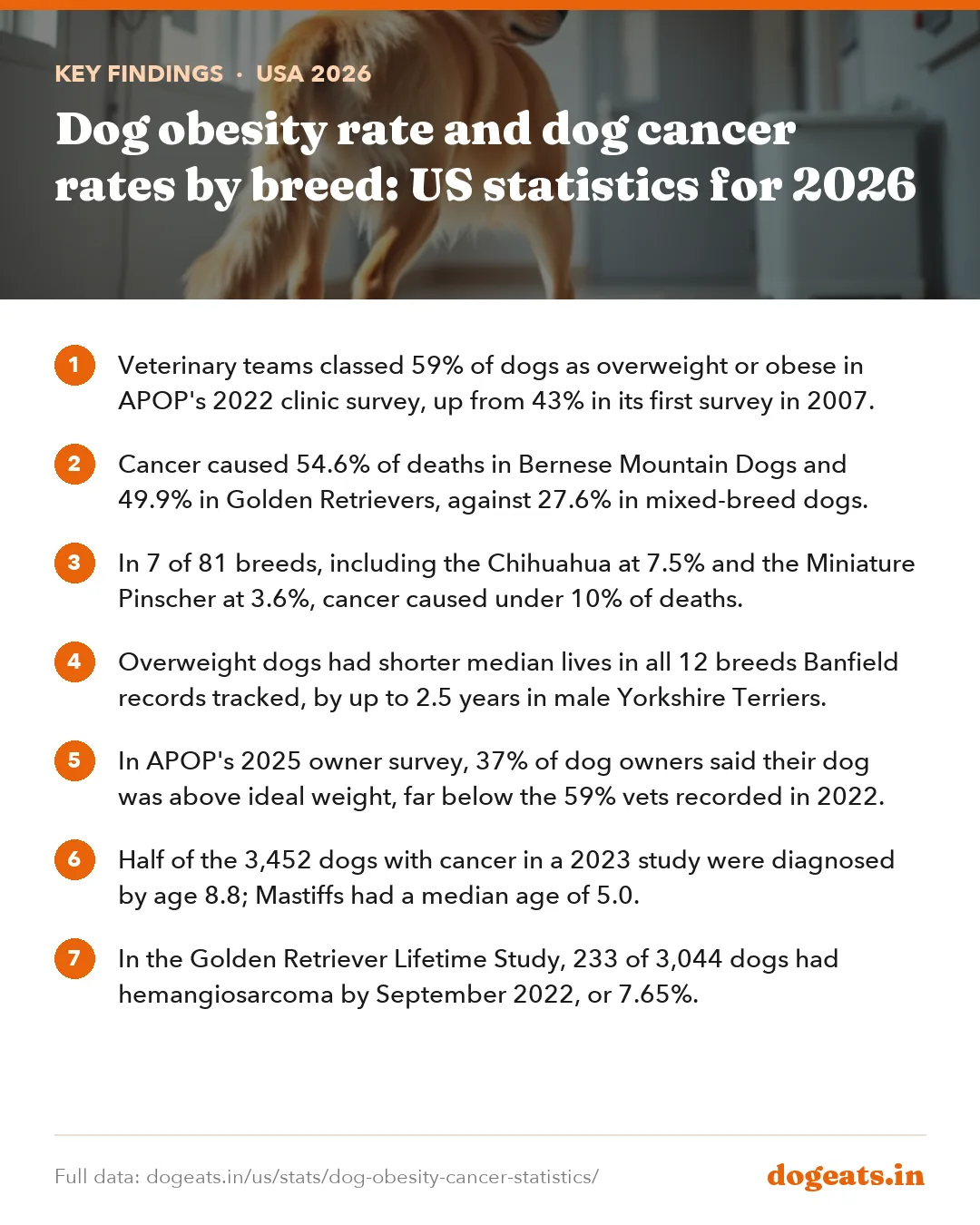
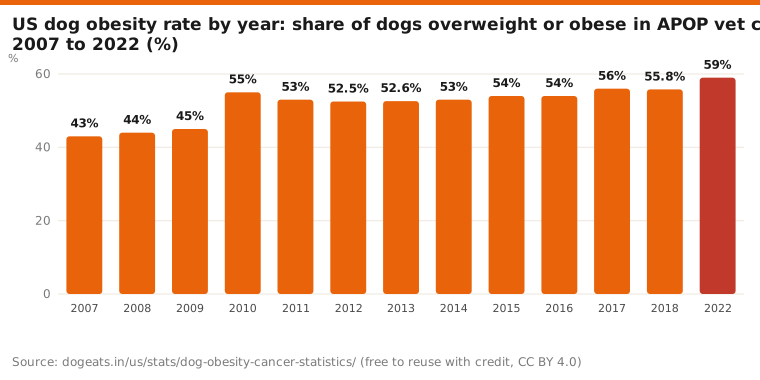
- Veterinary teams classed 59% of dogs as overweight or obese in APOP's 2022 clinic survey, up from 43% in its first survey in 2007.
- Cancer caused 54.6% of deaths in Bernese Mountain Dogs and 49.9% in Golden Retrievers, against 27.6% in mixed-breed dogs.
- In 7 of 81 breeds, including the Chihuahua at 7.5% and the Miniature Pinscher at 3.6%, cancer caused under 10% of deaths.
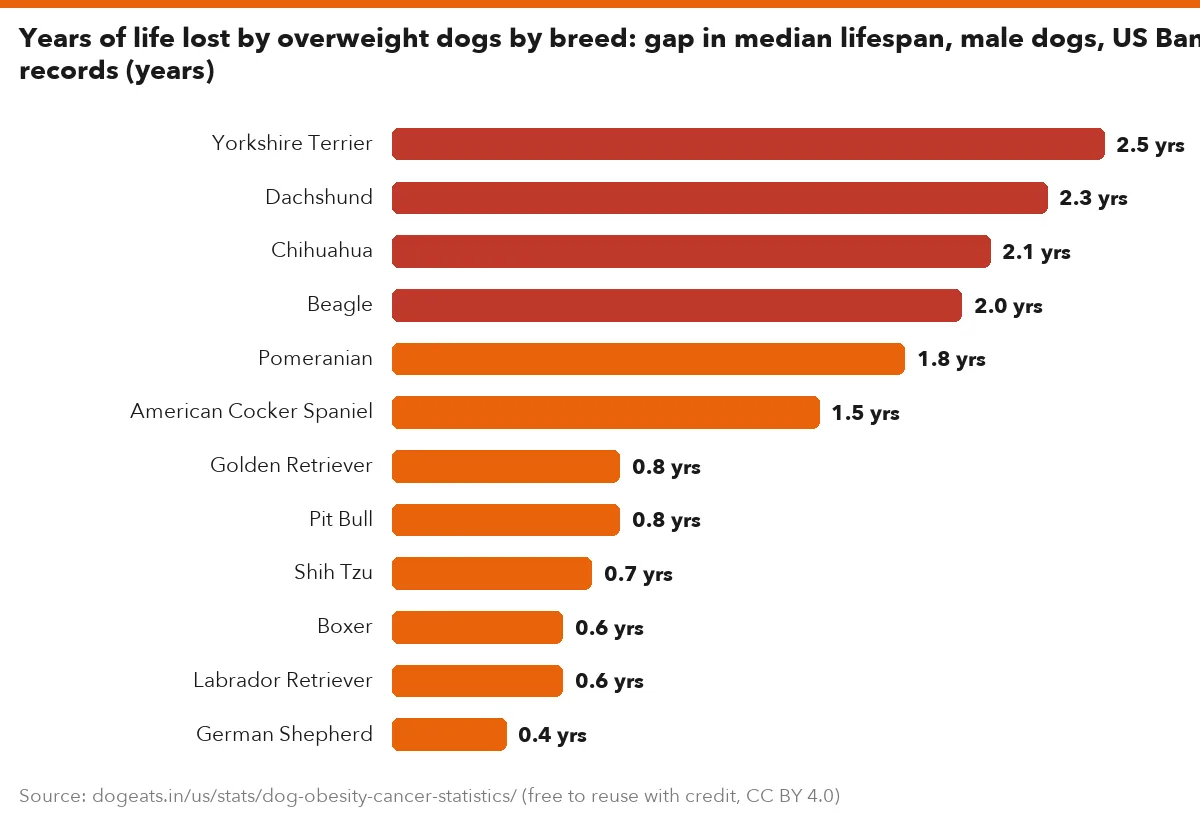
- Overweight dogs had shorter median lives in all 12 breeds Banfield records tracked, by up to 2.5 years in male Yorkshire Terriers.
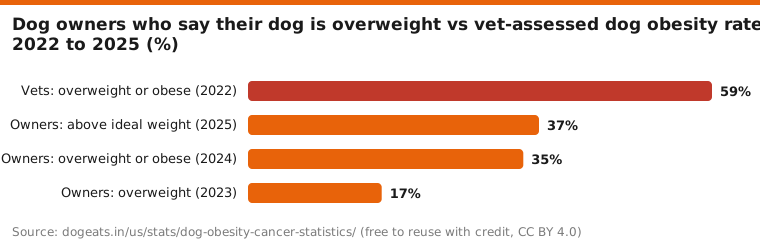
- In APOP's 2025 owner survey, 37% of dog owners said their dog was above ideal weight, far below the 59% vets recorded in 2022.
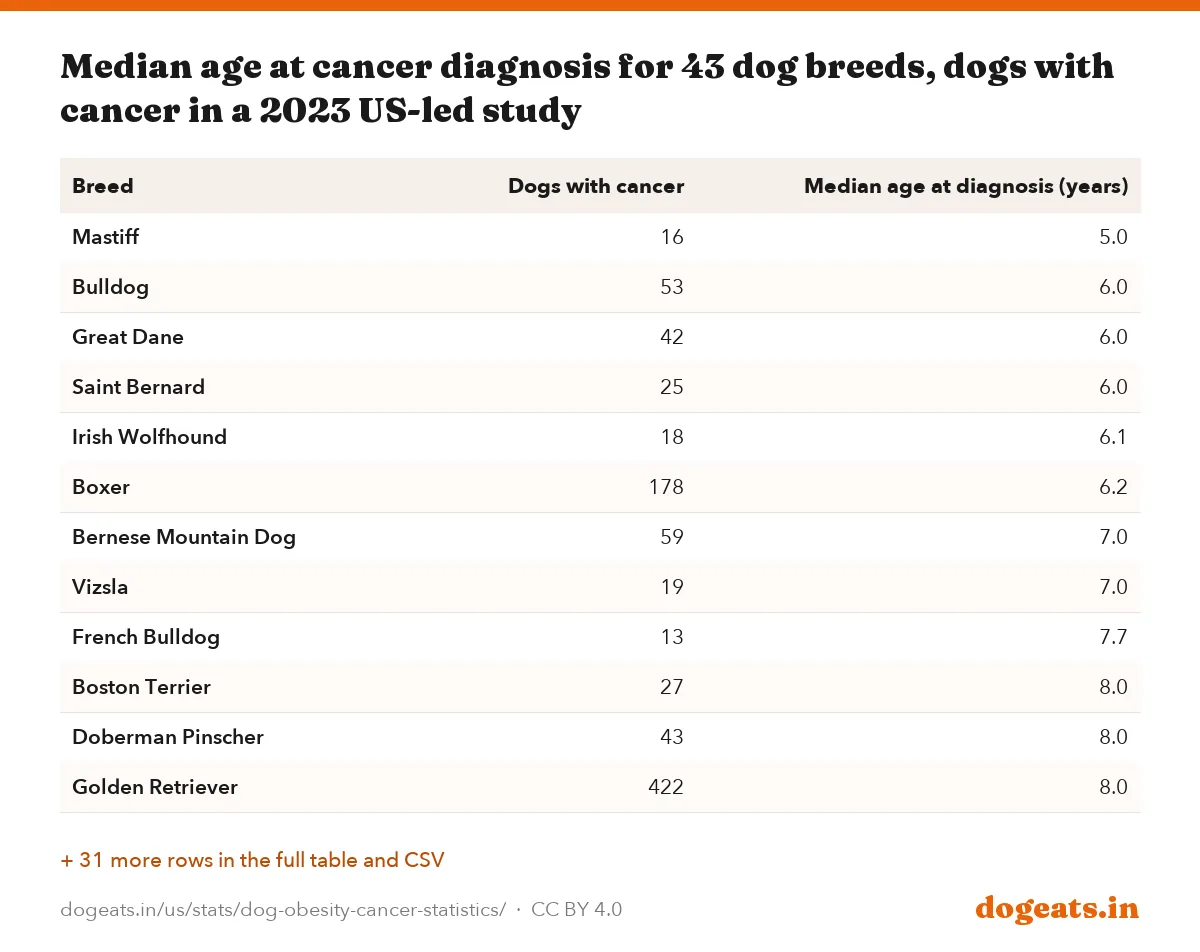
- Half of the 3,452 dogs with cancer in a 2023 study were diagnosed by age 8.8; Mastiffs had a median age of 5.0.
- In the Golden Retriever Lifetime Study, 233 of 3,044 dogs had hemangiosarcoma by September 2022, or 7.65%.
- Cancer was the most common cause of death named by owners in a 2026 Dog Aging Project study, at 29.7% of 646 dogs.
What is the dog obesity rate in the US?
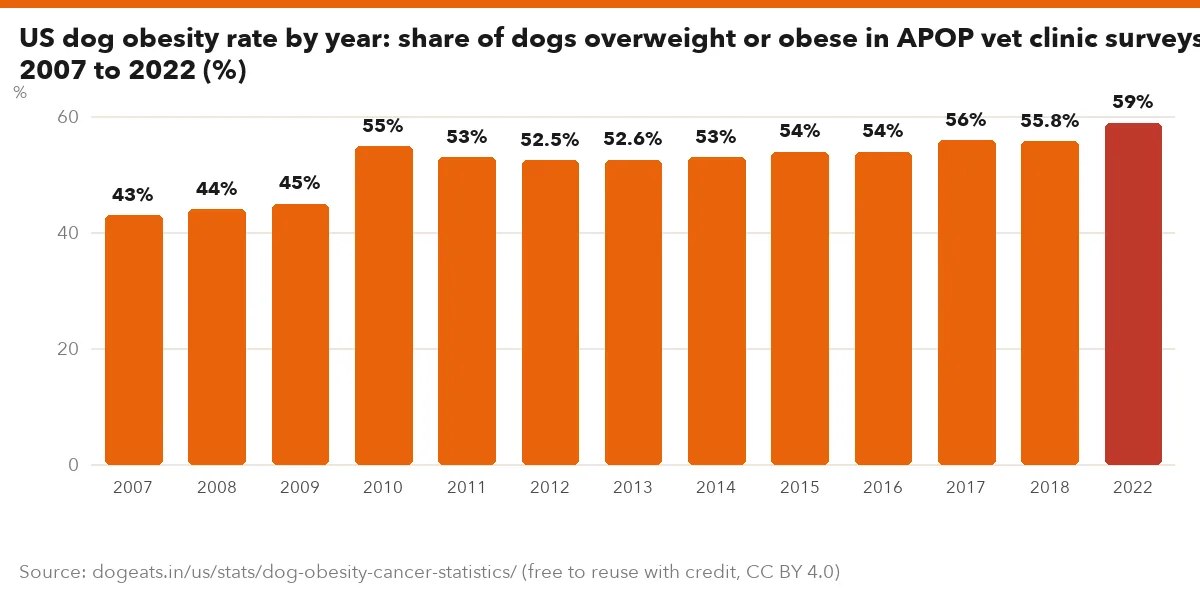
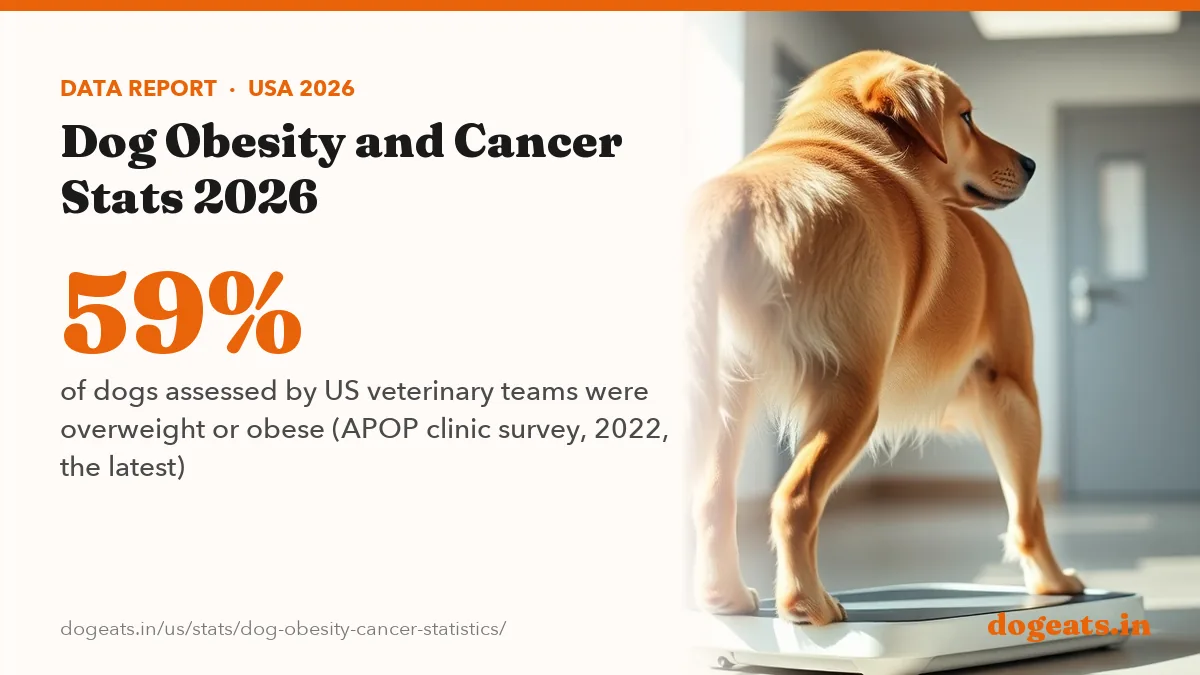
The latest vet-assessed figure is 59%. In 2022, veterinary teams in the Association for Pet Obesity Prevention (APOP) clinic survey classed 59% of 880 dogs as overweight or obese.
It is the highest share in the survey's history. APOP's first survey, in 2007, put the figure at 43%. It passed 50% in 2010 and has stayed above it since.
APOP is a US nonprofit that runs the survey through volunteer clinics. It says the results are clinic-based estimates, not a nationally representative sample. No clinic survey has been published since 2022. APOP's October 1, 2026 release still cites the 2022 figures and invites clinics to a 2026 survey.
Source: Association for Pet Obesity Prevention clinic prevalence surveys. 2007 to 2016 used a 5-point body condition scale, 2017 onward a 9-point scale. No surveys in 2019 to 2021.
Show the numbers
| Label | % |
|---|---|
| 2007 | 43% |
| 2008 | 44% |
| 2009 | 45% |
| 2010 | 55% |
| 2011 | 53% |
| 2012 | 52.5% |
| 2013 | 52.6% |
| 2014 | 53% |
| 2015 | 54% |
| 2016 | 54% |
| 2017 | 56% |
| 2018 | 55.8% |
| 2022 | 59% |
Embed this chart
| Survey year | Dogs overweight or obese (%) | Body condition scale | Dogs assessed |
|---|---|---|---|
| 2007 | 43 | 5-point | not stated for dogs |
| 2008 | 44 | 5-point | not published |
| 2009 | 45 | 5-point | not published |
| 2010 | 55 | 5-point | not stated for dogs |
| 2011 | 53 | 5-point | not stated for dogs |
| 2012 | 52.5 | 5-point | not stated for dogs |
| 2013 | 52.6 | 5-point | not stated for dogs |
| 2014 | 53 | 5-point | not stated for dogs |
| 2015 | 54 | 5-point | not stated for dogs |
| 2016 | 54 | 5-point | 1,224 |
| 2017 | 56 | 9-point | 1,610 |
| 2018 | 55.8 | 9-point | 1,560 |
| 2022 | 59 | 9-point | 880 |
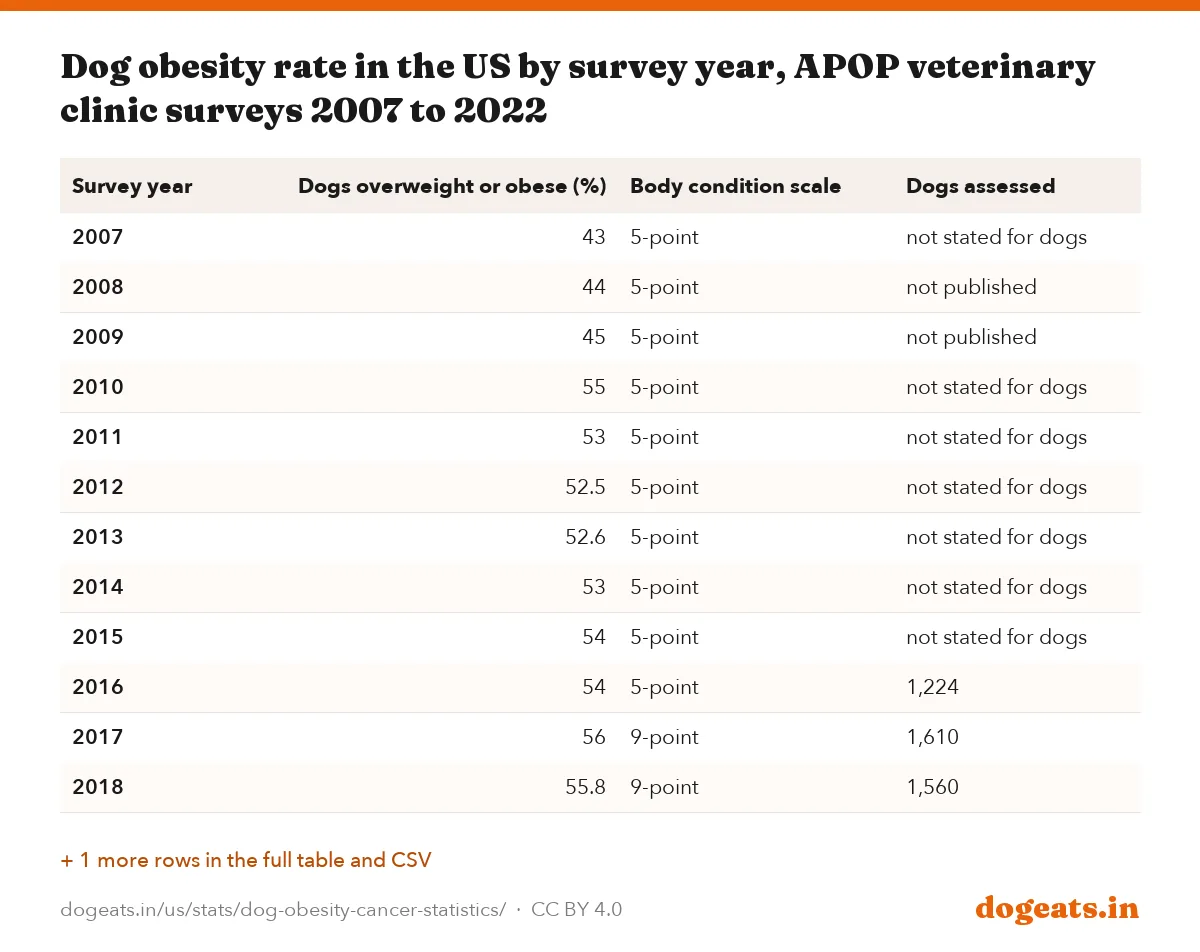
Compare years with care. The scale changed in 2017, and APOP says the 2022 survey had lower clinic participation than earlier years. Its 2022 sample of 880 dogs is smaller than the 1,560 dogs assessed in 2018.
Overweight vs obese: how the 2022 numbers split
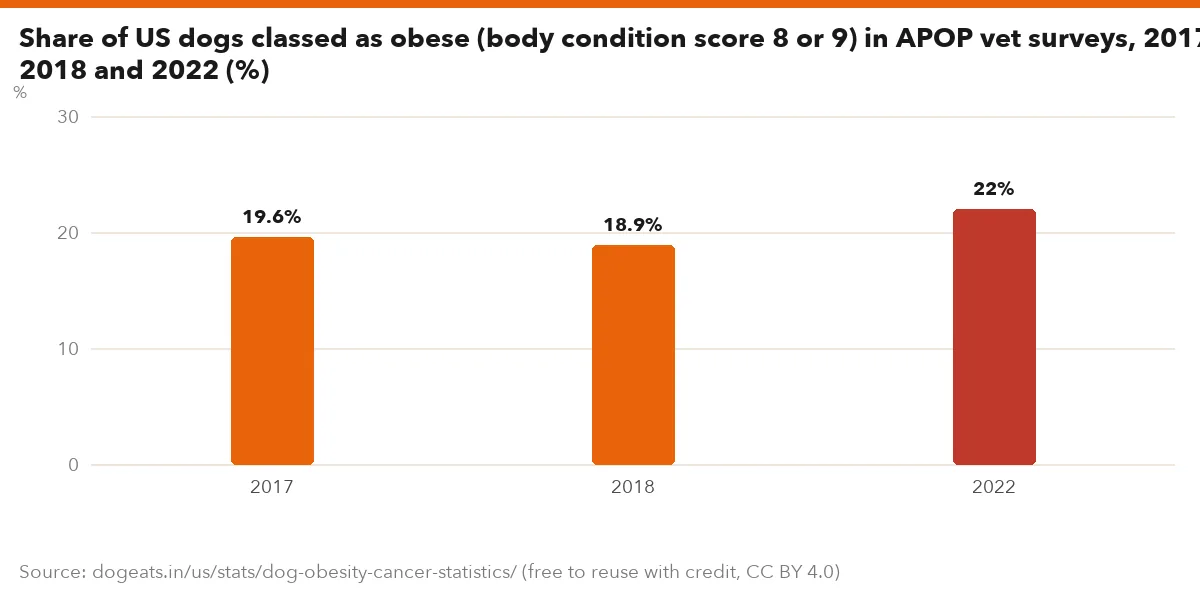
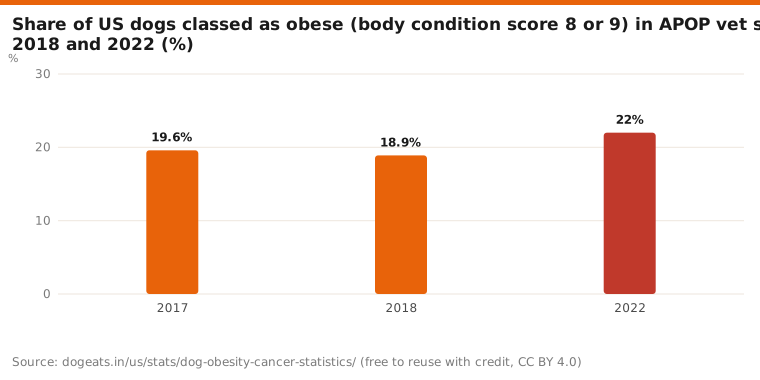
APOP splits excess weight into two bands on a 9-point body condition score. A score of 6 or 7 is overweight. A score of 8 or 9 is obese, which APOP defines as about 30% above ideal weight.
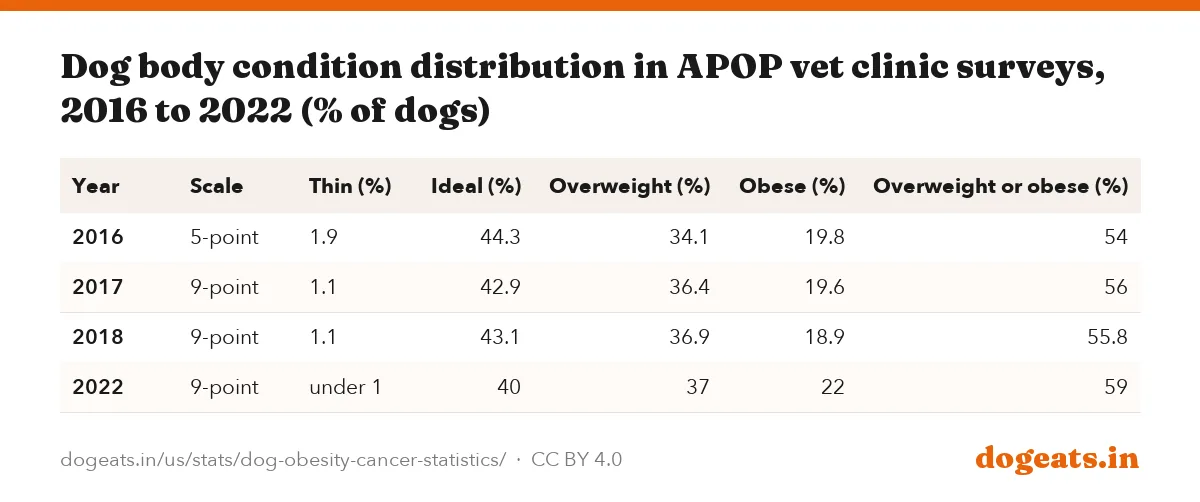
In 2022, 37% of dogs were overweight and 22% were obese. The overweight share matched 2018. The obese share rose from 19% in 2018, so the whole increase came from the heaviest dogs.
Fewer than 1% of dogs were thin in 2022. Ideal weight dogs made up 40%, down from 43.1% in 2018.
| Year | Scale | Thin (%) | Ideal (%) | Overweight (%) | Obese (%) | Overweight or obese (%) |
|---|---|---|---|---|---|---|
| 2016 | 5-point | 1.9 | 44.3 | 34.1 | 19.8 | 54 |
| 2017 | 9-point | 1.1 | 42.9 | 36.4 | 19.6 | 56 |
| 2018 | 9-point | 1.1 | 43.1 | 36.9 | 18.9 | 55.8 |
| 2022 | 9-point | under 1 | 40 | 37 | 22 | 59 |
Cats fared worse in the same 2022 survey. Vets classed 61% of 272 cats as overweight or obese, and 33% as obese.
Clinic records show a lower but rising rate
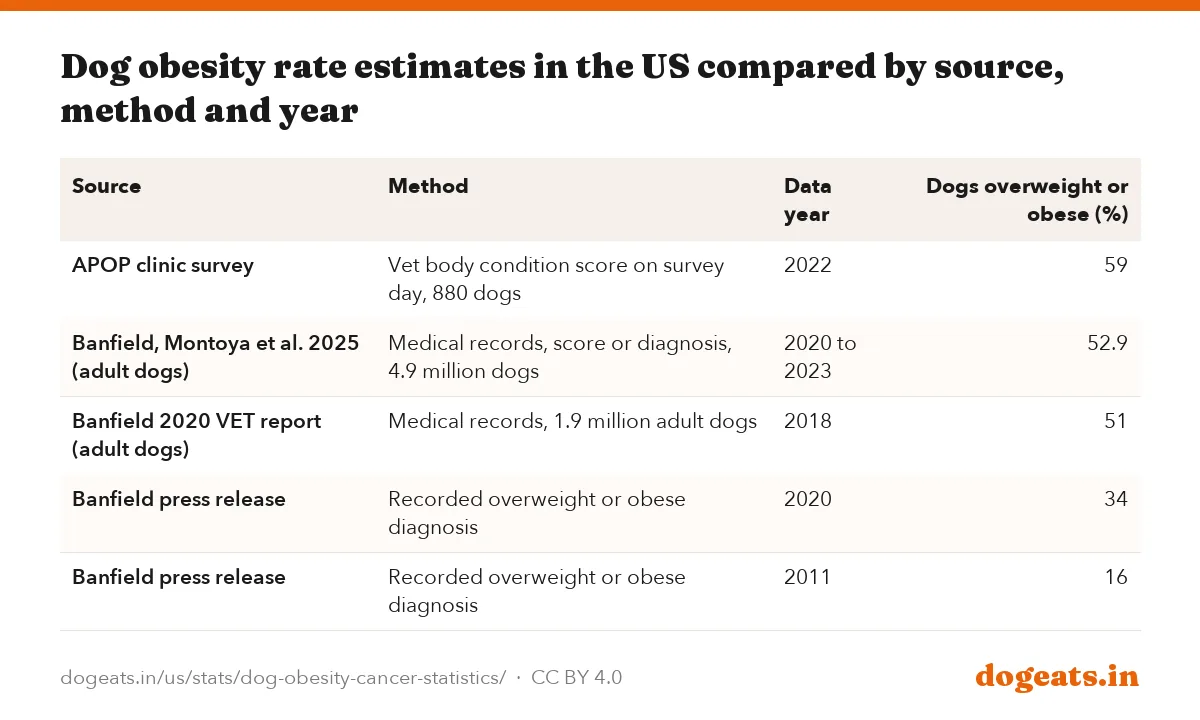
Banfield Pet Hospital, which calls itself the largest general veterinary practice in the world, reports from its medical records. Its figures differ from APOP's because they count recorded diagnoses or scores, not a single survey day.
Banfield said the share of dogs diagnosed as overweight or obese rose from 16% in 2011 to 34% in 2020. It called that a 108% increase. Its 2020 report said 51% of 1.9 million adult dogs seen in 2018 were overweight.
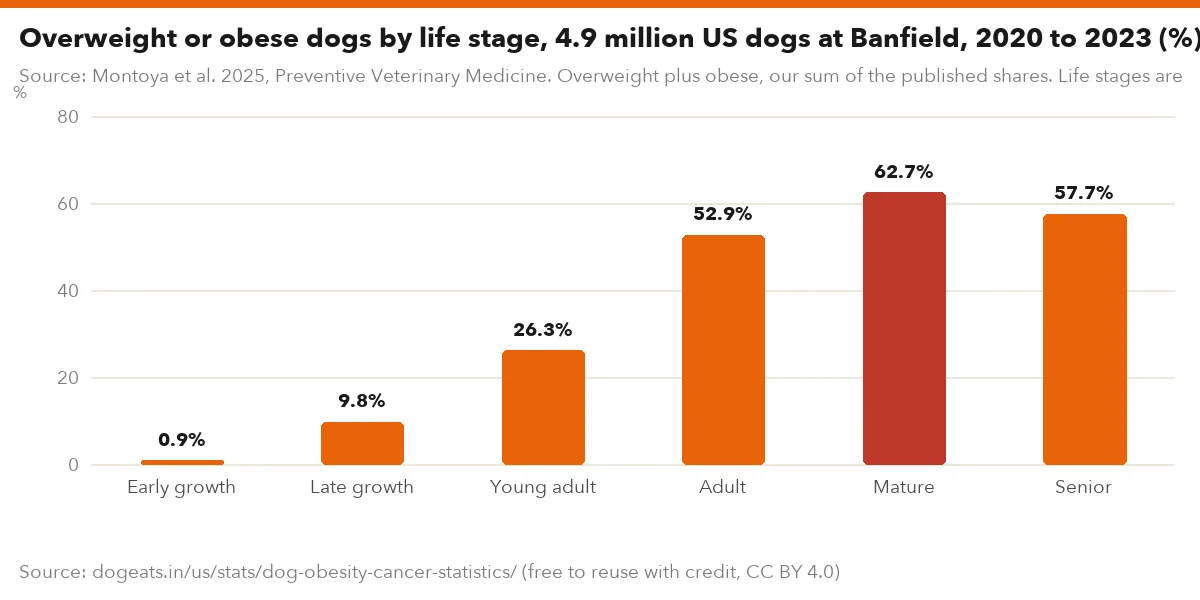
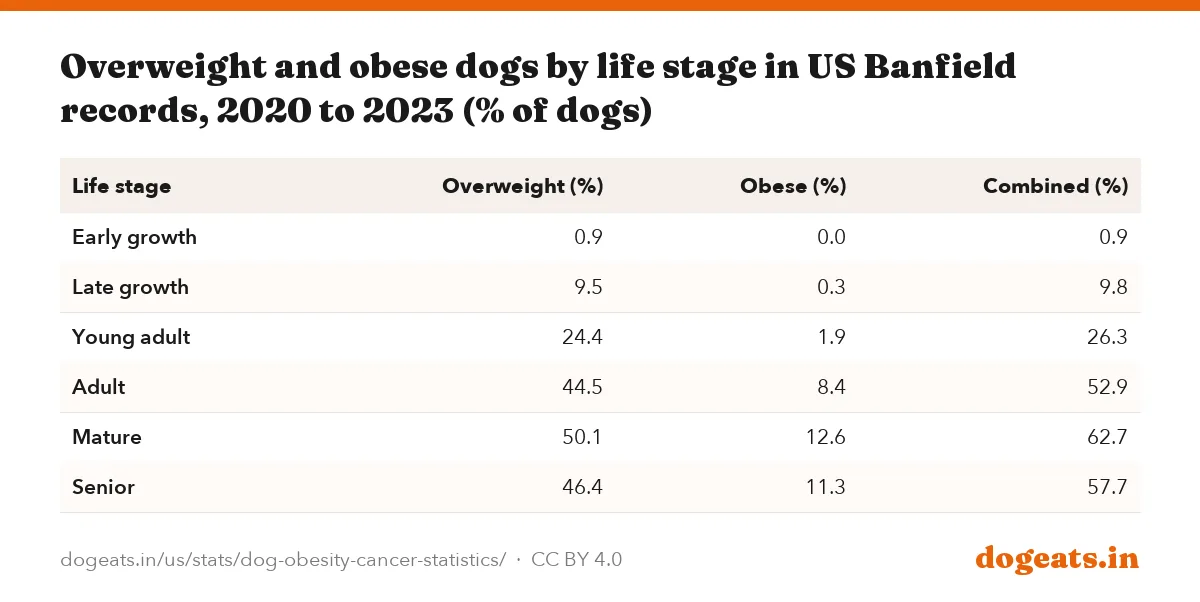
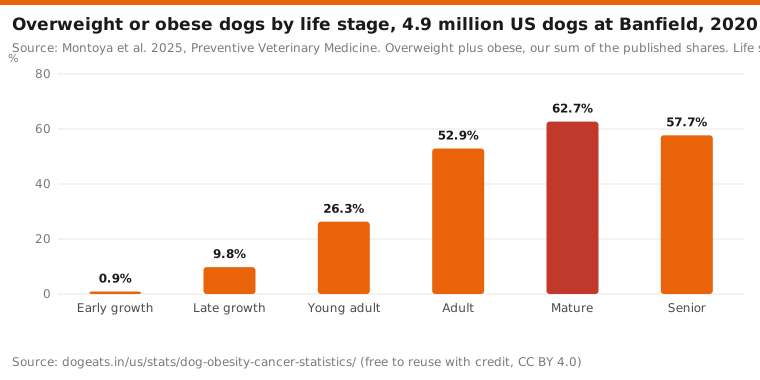
A 2025 peer-reviewed study used Banfield records for 4,933,916 dogs seen from 2020 to 2023. It found excess weight peaks in middle age. In mature dogs, 50.1% were overweight and 12.6% obese, a combined 62.7%.
Source: Montoya et al. 2025, Preventive Veterinary Medicine. Overweight plus obese, our sum of the published shares. Life stages are adjusted for breed size.
Show the numbers
| Label | % |
|---|---|
| Early growth | 0.9% |
| Late growth | 9.8% |
| Young adult | 26.3% |
| Adult | 52.9% |
| Mature | 62.7% |
| Senior | 57.7% |
Embed this chart
| Life stage | Overweight (%) | Obese (%) | Combined (%) |
|---|---|---|---|
| Early growth | 0.9 | 0.0 | 0.9 |
| Late growth | 9.5 | 0.3 | 9.8 |
| Young adult | 24.4 | 1.9 | 26.3 |
| Adult | 44.5 | 8.4 | 52.9 |
| Mature | 50.1 | 12.6 | 62.7 |
| Senior | 46.4 | 11.3 | 57.7 |
| Source | Method | Data year | Dogs overweight or obese (%) |
|---|---|---|---|
| APOP clinic survey | Vet body condition score on survey day, 880 dogs | 2022 | 59 |
| Banfield, Montoya et al. 2025 (adult dogs) | Medical records, score or diagnosis, 4.9 million dogs | 2020 to 2023 | 52.9 |
| Banfield 2020 VET report (adult dogs) | Medical records, 1.9 million adult dogs | 2018 | 51 |
| Banfield press release | Recorded overweight or obese diagnosis | 2020 | 34 |
| Banfield press release | Recorded overweight or obese diagnosis | 2011 | 16 |
The study also found that dogs overweight during growth had 1.85 times the odds of being overweight as adults. Banfield's 2020 report said fewer than 10% of overweight pets lost weight after diagnosis, and about 40% of those regained it within 12 months.
Owners still underestimate their dog's weight
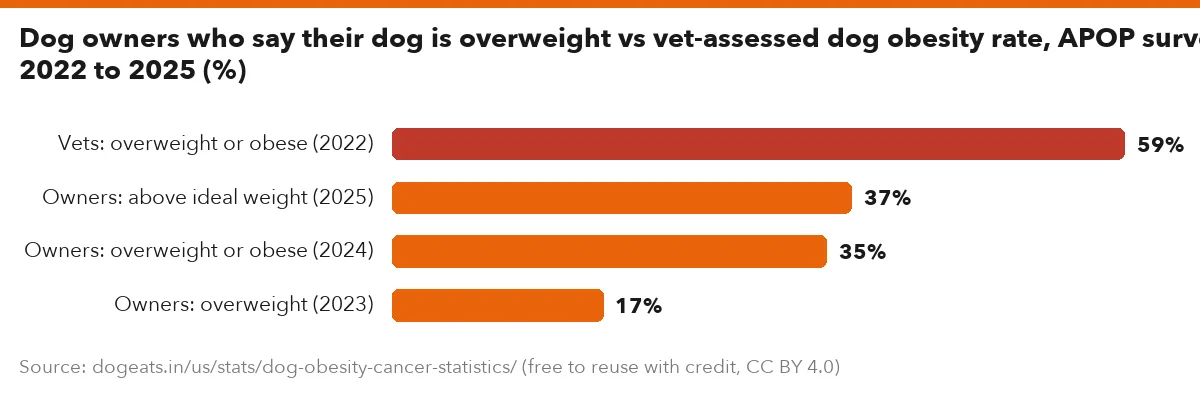
Owners see a slimmer dog than vets do. In APOP's 2022 clinic survey, 36% of owners whose dog scored 6 to 9 described its body condition as normal. Among owners of obese dogs, 9% said normal.
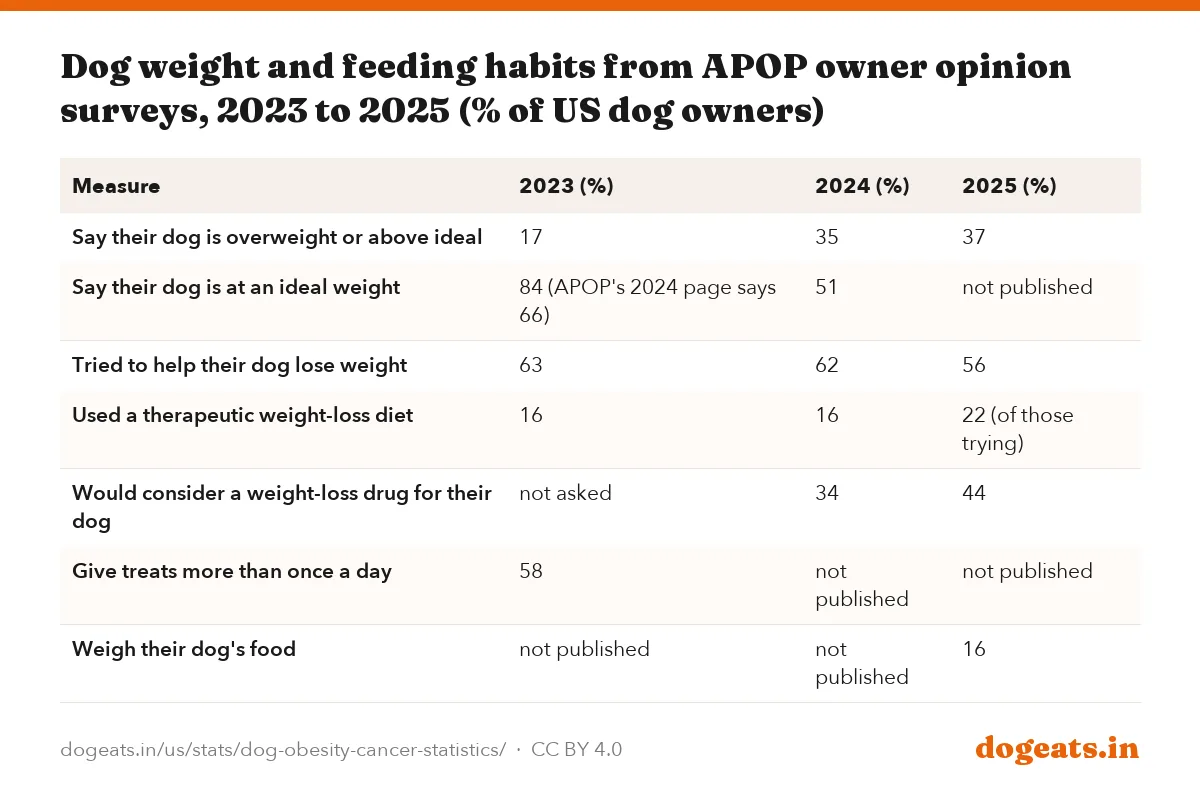
APOP's separate opinion surveys ask owners directly. In 2023, only 17% of dog owners said their dog was overweight, and 84% called it ideal or healthy. That share rose to 35% in 2024 and 37% in 2025.
These opinion surveys recruit owners online and through clinics. APOP says they show perceptions, not prevalence, so they cannot be set against the clinic figure as a measured gap.

Source: APOP. Vet figure from the 2022 clinic survey; owner figures from annual opinion surveys of US dog owners.
Show the numbers
| Label | % |
|---|---|
| Vets: overweight or obese (2022) | 59% |
| Owners: above ideal weight (2025) | 37% |
| Owners: overweight or obese (2024) | 35% |
| Owners: overweight (2023) | 17% |
Embed this chart
| Measure | 2023 (%) | 2024 (%) | 2025 (%) |
|---|---|---|---|
| Say their dog is overweight or above ideal | 17 | 35 | 37 |
| Say their dog is at an ideal weight | 84 (APOP's 2024 page says 66) | 51 | not published |
| Tried to help their dog lose weight | 63 | 62 | 56 |
| Used a therapeutic weight-loss diet | 16 | 16 | 22 (of those trying) |
| Would consider a weight-loss drug for their dog | not asked | 34 | 44 |
| Give treats more than once a day | 58 | not published | not published |
| Weigh their dog's food | not published | not published | 16 |
Treats are a large part of the picture. In 2023, 58% of dog owners gave treats more than once a day and another 24% once a day. That means 82% of dogs got at least one treat daily.
Vets in the 2025 survey were more open to drug treatment too. Willingness to use a weight-loss drug for dogs rose to 49%, from 43% in 2024. Among owners trying to slim a dog, 28% said it reached a healthy weight.
Table food adds up too. Our guides on hamburgers and McDonald's cover the fat and calories in common table scraps.
Extra weight shortens a dog's life
Overweight dogs die younger. A 2019 study of 50,787 neutered dogs in Banfield records compared dogs that stayed at a normal weight in middle age with dogs recorded as heavy.
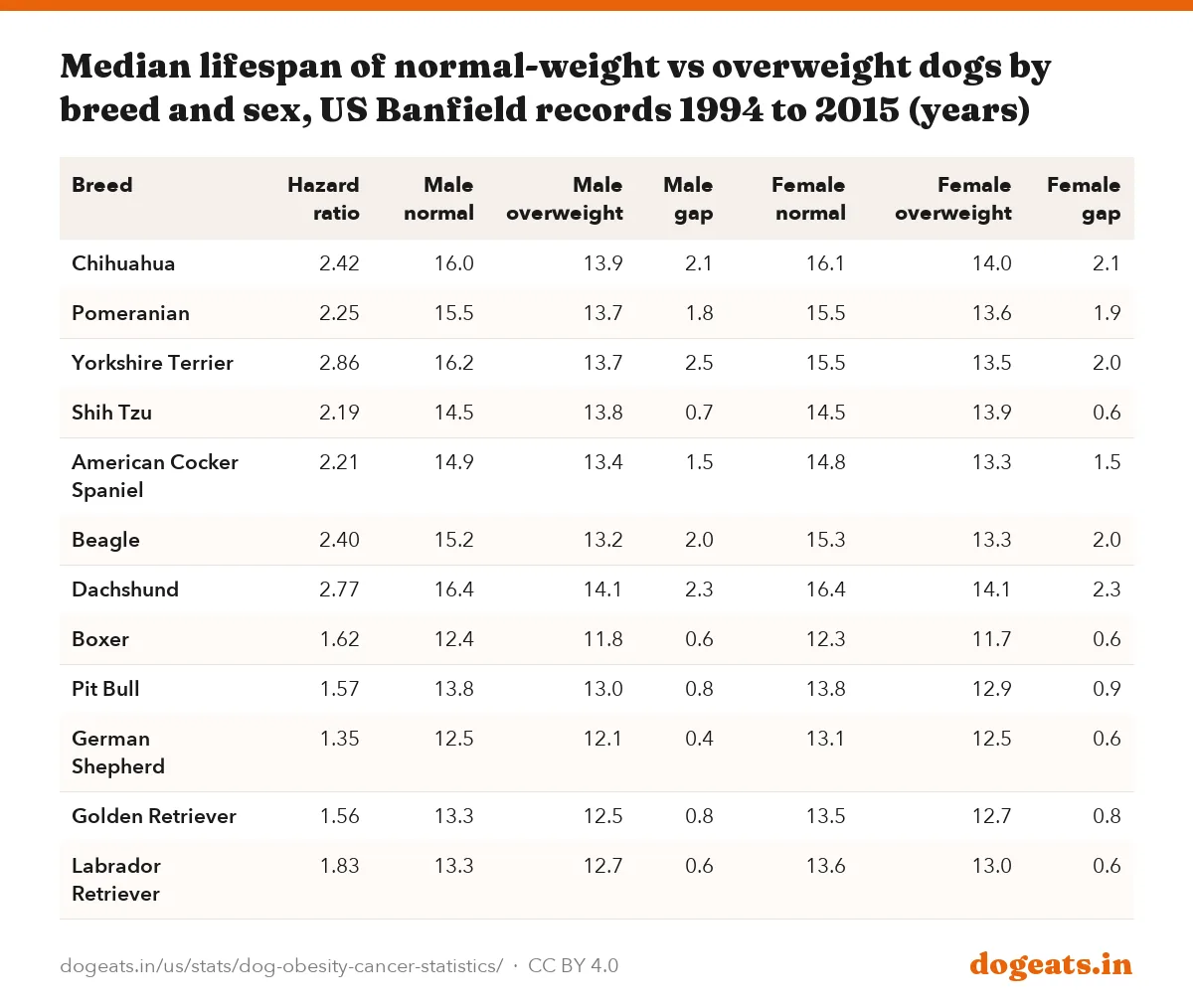
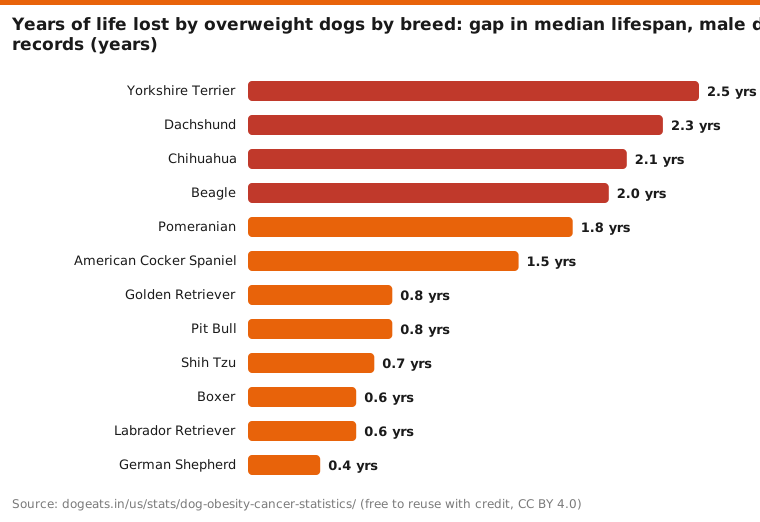
In all 12 breeds studied, the overweight dogs had a higher risk of death at every age. The hazard ratio ranged from 1.35 in German Shepherds to 2.86 in Yorkshire Terriers.
Small breeds lost the most time. Male Yorkshire Terriers had a median life of 16.2 years at normal weight and 13.7 years when overweight. Male Dachshunds fell from 16.4 to 14.1 years.
Source: Salt et al. 2019, Journal of Veterinary Internal Medicine. Our subtraction of the published medians, which are rounded to 0.1 year.
Show the numbers
| Label | years |
|---|---|
| Yorkshire Terrier | 2.5 yrs |
| Dachshund | 2.3 yrs |
| Chihuahua | 2.1 yrs |
| Beagle | 2.0 yrs |
| Pomeranian | 1.8 yrs |
| American Cocker Spaniel | 1.5 yrs |
| Golden Retriever | 0.8 yrs |
| Pit Bull | 0.8 yrs |
| Shih Tzu | 0.7 yrs |
| Boxer | 0.6 yrs |
| Labrador Retriever | 0.6 yrs |
| German Shepherd | 0.4 yrs |
Embed this chart
| Breed | Hazard ratio | Male normal | Male overweight | Male gap | Female normal | Female overweight | Female gap |
|---|---|---|---|---|---|---|---|
| Chihuahua | 2.42 | 16.0 | 13.9 | 2.1 | 16.1 | 14.0 | 2.1 |
| Pomeranian | 2.25 | 15.5 | 13.7 | 1.8 | 15.5 | 13.6 | 1.9 |
| Yorkshire Terrier | 2.86 | 16.2 | 13.7 | 2.5 | 15.5 | 13.5 | 2.0 |
| Shih Tzu | 2.19 | 14.5 | 13.8 | 0.7 | 14.5 | 13.9 | 0.6 |
| American Cocker Spaniel | 2.21 | 14.9 | 13.4 | 1.5 | 14.8 | 13.3 | 1.5 |
| Beagle | 2.40 | 15.2 | 13.2 | 2.0 | 15.3 | 13.3 | 2.0 |
| Dachshund | 2.77 | 16.4 | 14.1 | 2.3 | 16.4 | 14.1 | 2.3 |
| Boxer | 1.62 | 12.4 | 11.8 | 0.6 | 12.3 | 11.7 | 0.6 |
| Pit Bull | 1.57 | 13.8 | 13.0 | 0.8 | 13.8 | 12.9 | 0.9 |
| German Shepherd | 1.35 | 12.5 | 12.1 | 0.4 | 13.1 | 12.5 | 0.6 |
| Golden Retriever | 1.56 | 13.3 | 12.5 | 0.8 | 13.5 | 12.7 | 0.8 |
| Labrador Retriever | 1.83 | 13.3 | 12.7 | 0.6 | 13.6 | 13.0 | 0.6 |
A larger Banfield analysis points the same way. Across 13,292,929 US dogs seen from 2013 to 2019, obese dogs had a life expectancy at birth of 11.71 years. Dogs at an ideal weight had 13.18 years, a gap of 1.47 years.
Four of the 2019 study's five authors worked for Waltham or Banfield, both owned by Mars. The fifth holds a university post funded by Royal Canin, also a Mars company. Our dog lifespan by breed report covers the breed figures in more detail.
How common is cancer in dogs?
The American Veterinary Medical Association (AVMA) estimates that about 1 in 4 dogs will develop cancer. It puts the risk at 1 in 2 for dogs aged 10 or older. The AVMA presents these as general estimates.
We found no national US registry of cancer in dogs, so incidence figures come from studies of specific groups. Cancer tops the cause-of-death lists in most of them.
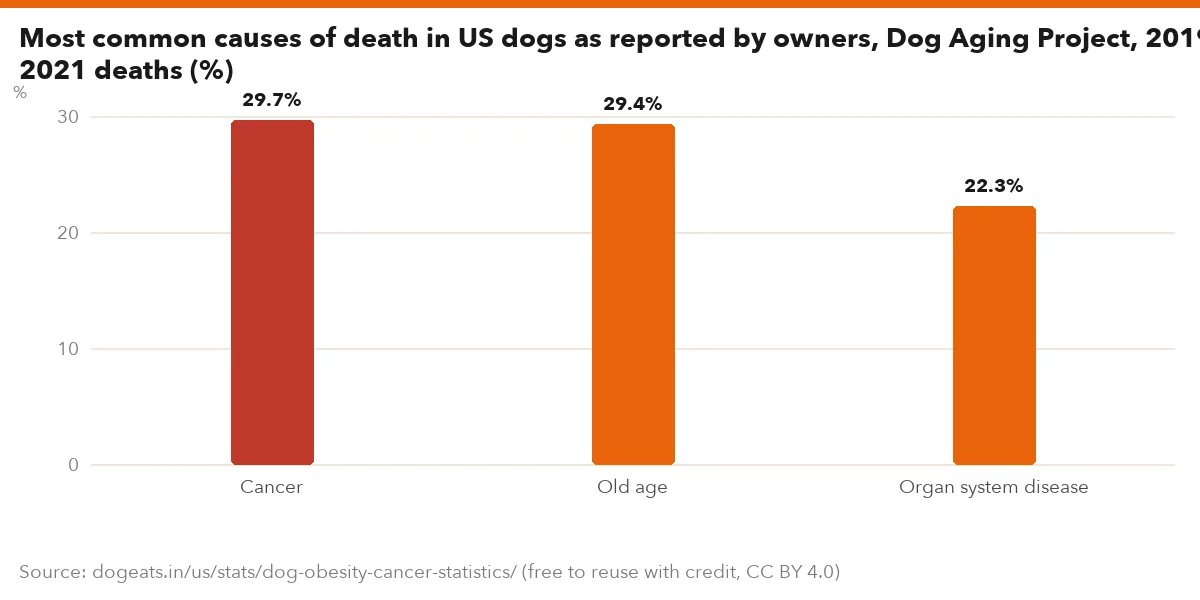
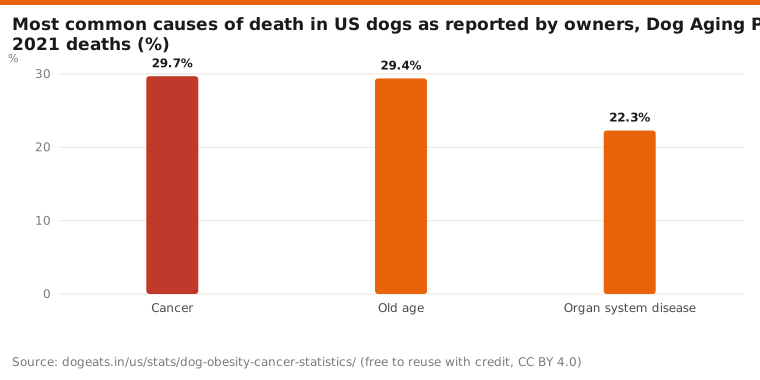
In a 2026 Dog Aging Project study, owners of 646 dogs that died named cancer most often, at 29.7%. Old age followed at 29.4% and organ disease at 22.3%. Mean age at death was 13.0 years.
Source: McNulty et al. 2026, JAVMA. 646 dogs that died between December 2019 and March 2021. Owner-perceived causes.
Show the numbers
| Label | % |
|---|---|
| Cancer | 29.7% |
| Old age | 29.4% |
| Organ system disease | 22.3% |
Embed this chart
Most of those dogs, 83.0%, were euthanized rather than dying unassisted.
Dog cancer rates by breed
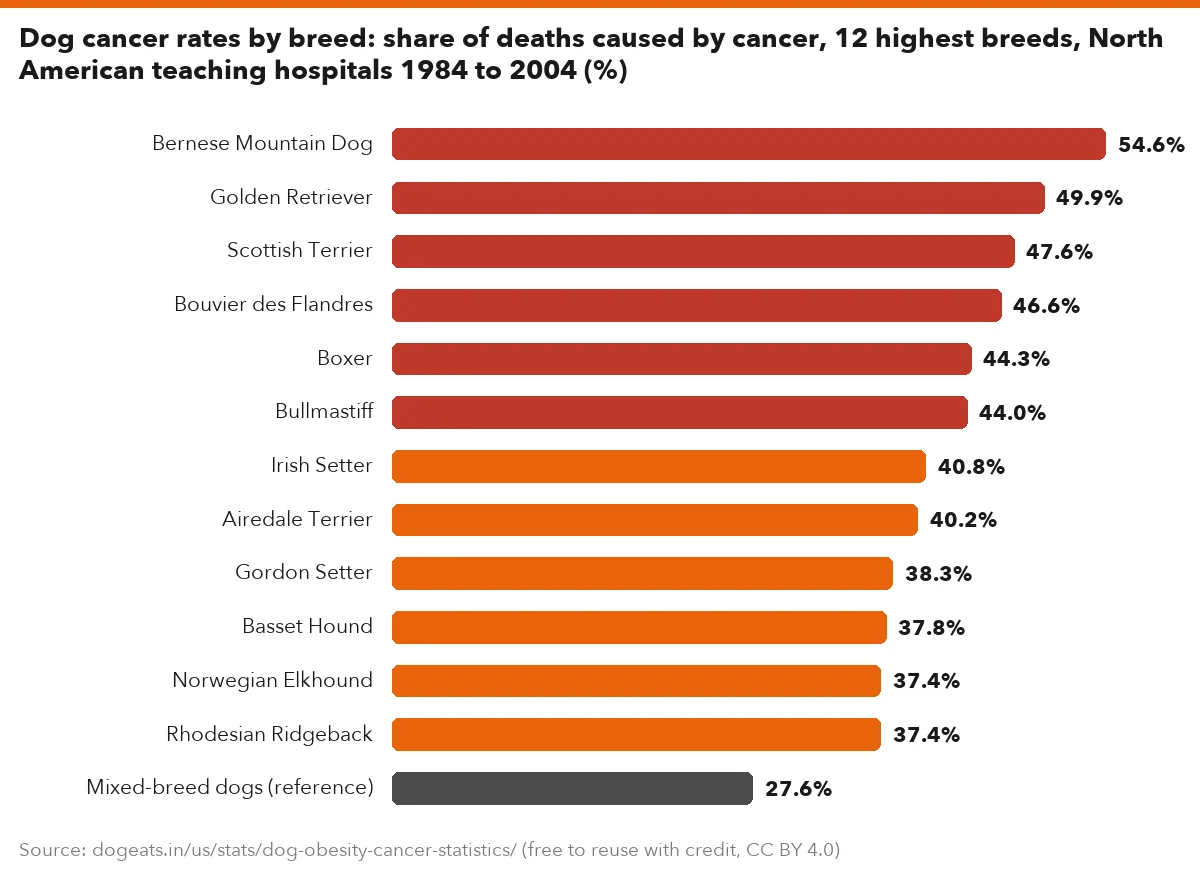
The largest US breed comparison is a 2011 study of 74,556 dogs that died at North American veterinary teaching hospitals from 1984 to 2004. It sorted each death by cause.
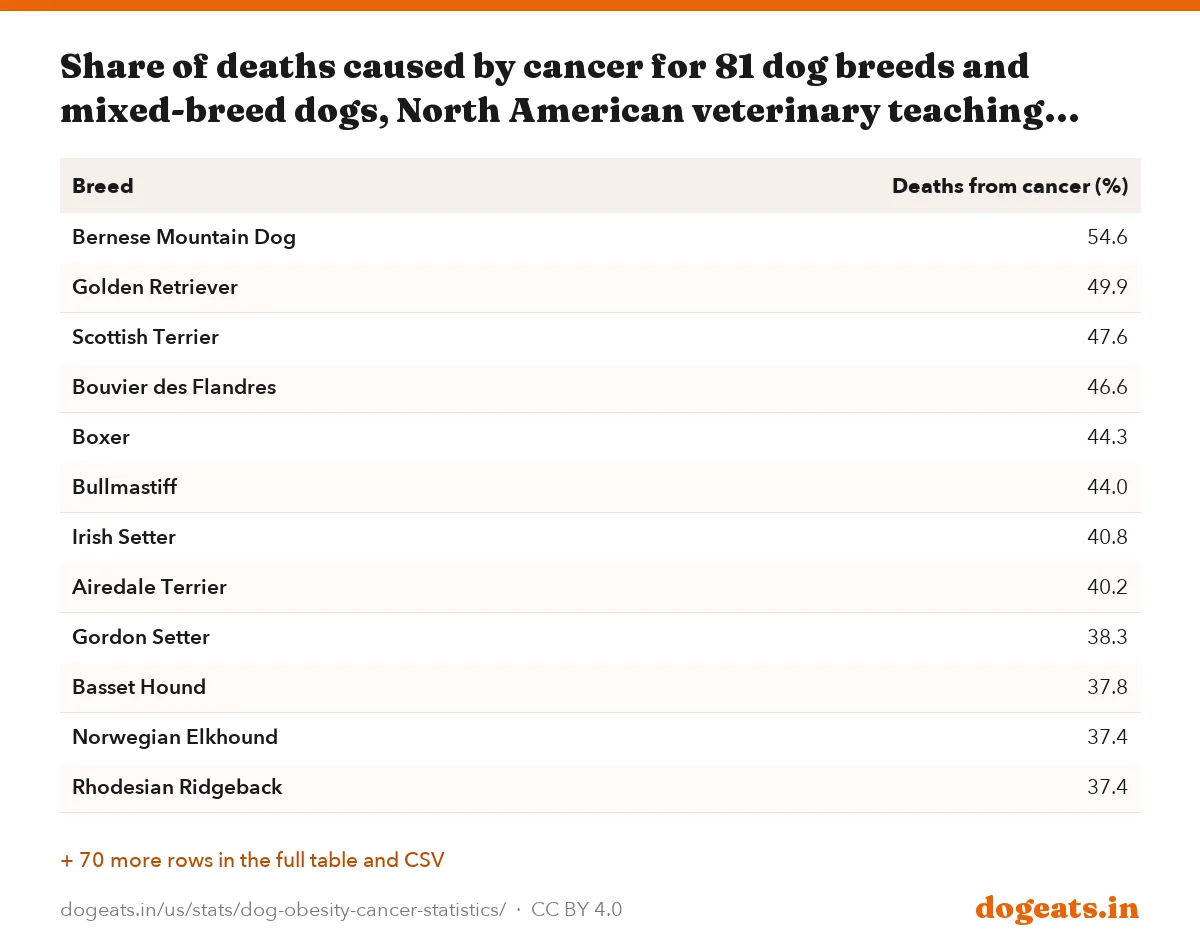
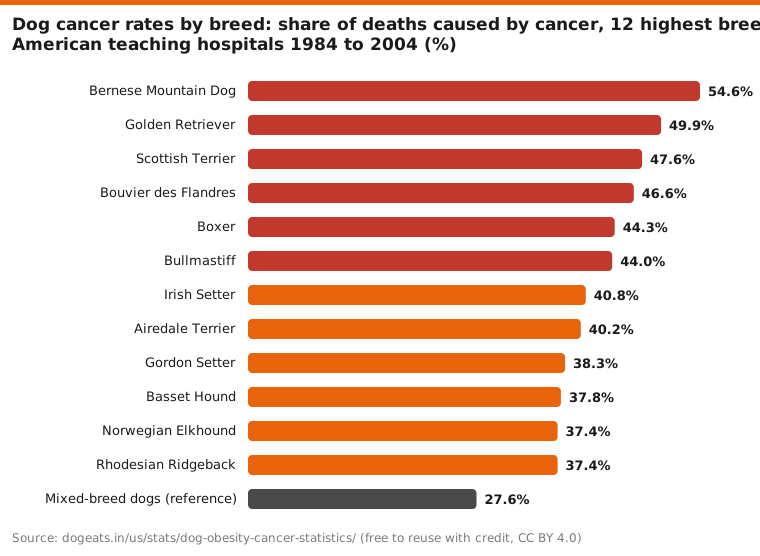
Cancer caused 54.6% of deaths in Bernese Mountain Dogs, the highest share of 81 breeds. Golden Retrievers followed at 49.9%, then Scottish Terriers at 47.6% and the Bouvier des Flandres at 46.6%.
Eight breeds had a cancer share of 40% or more. The mixed-breed dogs in the study sat at 27.6%, close to the median breed figure of 26.1%.

Source: Fleming et al. 2011, Journal of Veterinary Internal Medicine, Table 2 (neoplastic causes). Breeds with at least 100 deaths. Shares include deaths of unclassified cause in the total.
Show the numbers
| Label | % |
|---|---|
| Bernese Mountain Dog | 54.6% |
| Golden Retriever | 49.9% |
| Scottish Terrier | 47.6% |
| Bouvier des Flandres | 46.6% |
| Boxer | 44.3% |
| Bullmastiff | 44.0% |
| Irish Setter | 40.8% |
| Airedale Terrier | 40.2% |
| Gordon Setter | 38.3% |
| Basset Hound | 37.8% |
| Norwegian Elkhound | 37.4% |
| Rhodesian Ridgeback | 37.4% |
| Mixed-breed dogs (reference) | 27.6% |
Embed this chart
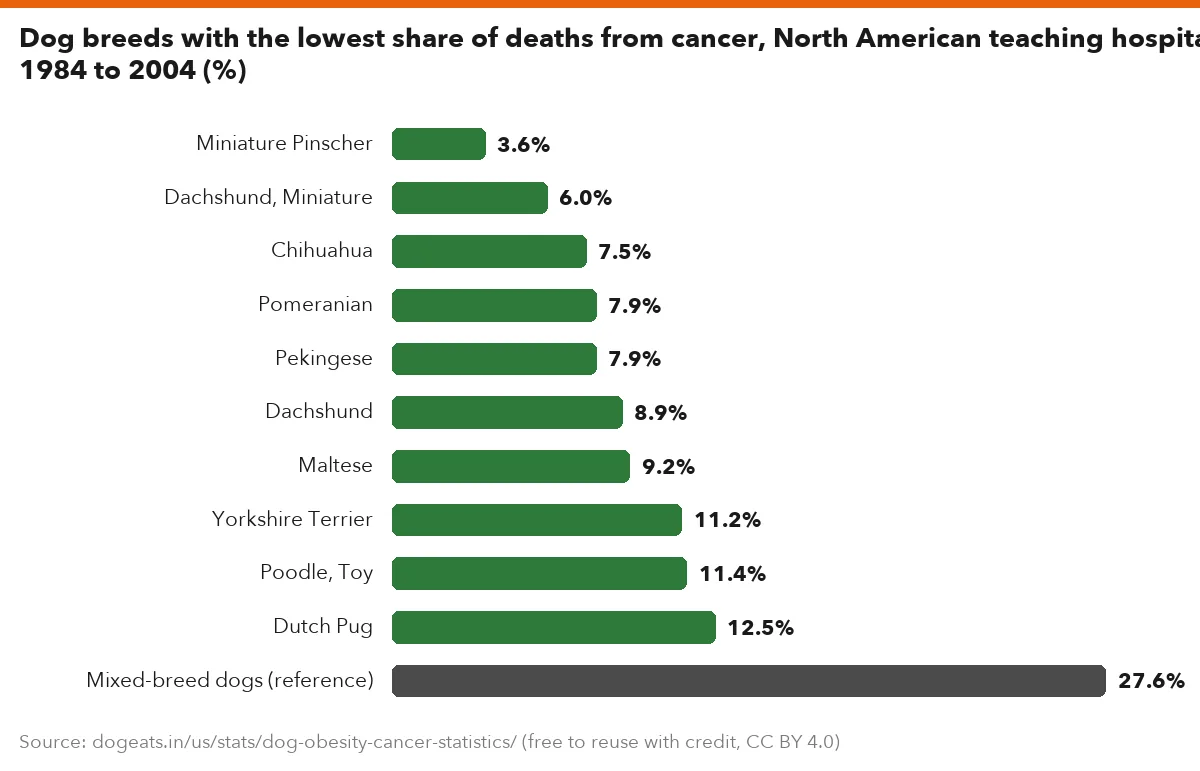
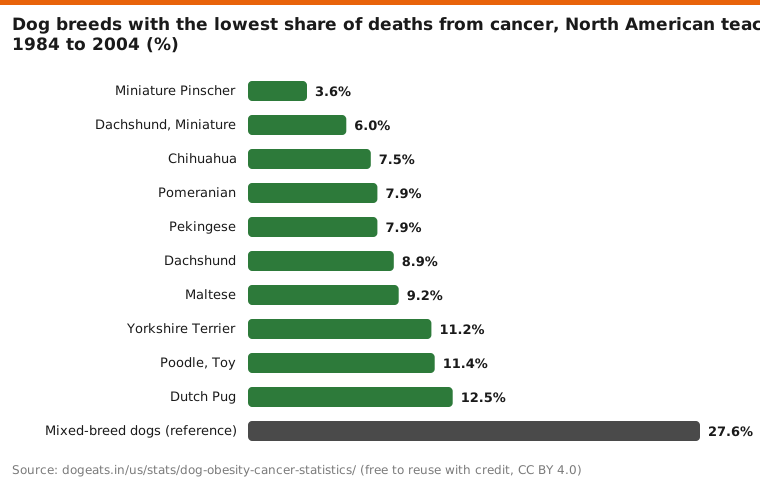
Small breeds sit at the other end. Cancer caused 3.6% of deaths in Miniature Pinschers, 6.0% in Miniature Dachshunds and 7.5% in Chihuahuas. In several toy breeds, trauma was the leading cause instead.
The top breed's share is about 15 times the lowest. These are shares of deaths in referral hospitals, which see sicker dogs than a local clinic. They are not the share of living dogs that get cancer.
At what age do dogs get cancer?
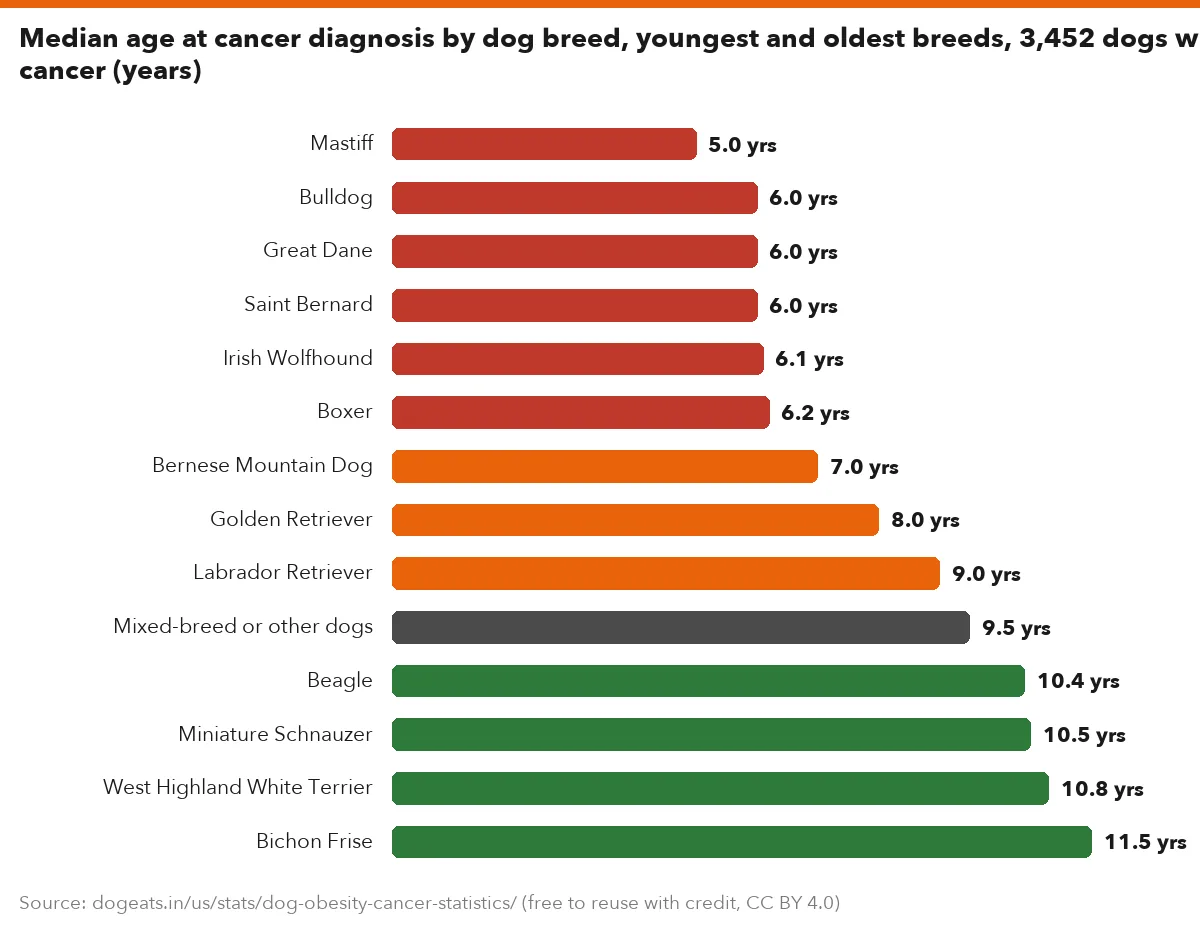
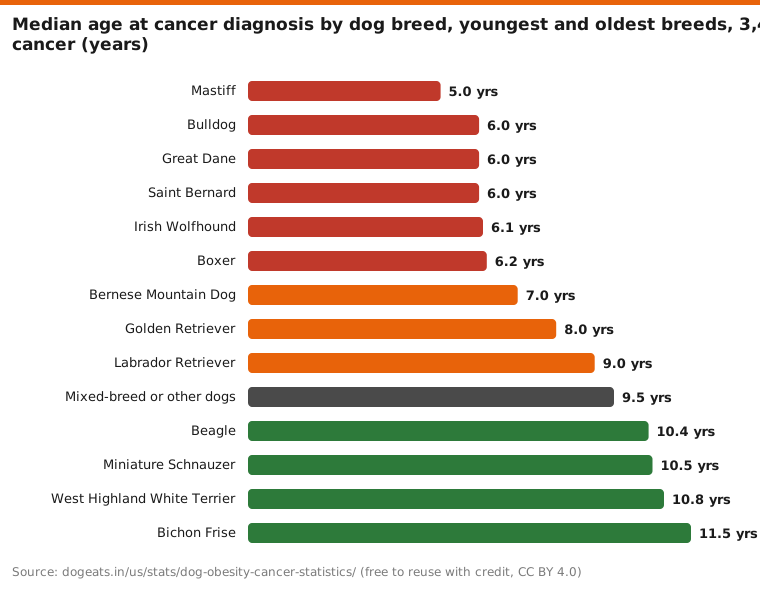
Half of dogs with cancer are diagnosed by about age 9. A 2023 study of 3,452 dogs with cancer, most from the US, found a median age at diagnosis of 8.8 years.
Big dogs are diagnosed younger. Mastiffs had a median age of 5.0 years and Boxers 6.2. Bichon Frises had the oldest median, at 11.5 years.
Mixed-breed or other dogs had a median of 9.5 years. Purebred dogs were diagnosed at a mean of 8.2 years, against 9.2 for mixed breeds.
Source: Rafalko et al. 2023, PLOS ONE, subject-level data in S3 Table; medians calculated by dogeats.in and checked against the paper. Study funded by PetDx, a cancer test maker.
Show the numbers
| Label | years |
|---|---|
| Mastiff | 5.0 yrs |
| Bulldog | 6.0 yrs |
| Great Dane | 6.0 yrs |
| Saint Bernard | 6.0 yrs |
| Irish Wolfhound | 6.1 yrs |
| Boxer | 6.2 yrs |
| Bernese Mountain Dog | 7.0 yrs |
| Golden Retriever | 8.0 yrs |
| Labrador Retriever | 9.0 yrs |
| Mixed-breed or other dogs | 9.5 yrs |
| Beagle | 10.4 yrs |
| Miniature Schnauzer | 10.5 yrs |
| West Highland White Terrier | 10.8 yrs |
| Bichon Frise | 11.5 yrs |
Embed this chart
| Breed | Dogs with cancer | Median age at diagnosis (years) |
|---|---|---|
| Mastiff | 16 | 5.0 |
| Bulldog | 53 | 6.0 |
| Great Dane | 42 | 6.0 |
| Saint Bernard | 25 | 6.0 |
| Irish Wolfhound | 18 | 6.1 |
| Boxer | 178 | 6.2 |
| Bernese Mountain Dog | 59 | 7.0 |
| Vizsla | 19 | 7.0 |
| French Bulldog | 13 | 7.7 |
| Boston Terrier | 27 | 8.0 |
| Doberman Pinscher | 43 | 8.0 |
| Golden Retriever | 422 | 8.0 |
| Great Pyrenees | 15 | 8.0 |
| Rhodesian Ridgeback | 13 | 8.0 |
| Rottweiler | 168 | 8.0 |
| Staffordshire Bull Terrier | 24 | 8.0 |
| Jack Russell Terrier | 13 | 8.1 |
| Chihuahua | 19 | 8.2 |
| Greyhound | 82 | 8.5 |
| Pug | 33 | 8.6 |
| Yorkshire Terrier | 11 | 8.7 |
| Corgi | 29 | 8.8 |
| Poodle, Standard | 33 | 8.8 |
| Scottish Terrier | 17 | 8.8 |
| Shetland Sheepdog | 26 | 8.9 |
| Basset Hound | 18 | 9.0 |
| Collie | 16 | 9.0 |
| German Shepherd | 102 | 9.0 |
| Labrador Retriever | 397 | 9.0 |
| Siberian Husky | 28 | 9.3 |
| Dachshund | 16 | 9.4 |
| Australian Cattle Dog | 16 | 9.5 |
| Shih Tzu | 18 | 9.8 |
| Australian Shepherd | 52 | 10.0 |
| Border Collie | 44 | 10.0 |
| Cocker Spaniel | 51 | 10.0 |
| English Springer Spaniel | 22 | 10.0 |
| German Shorthaired Pointer | 11 | 10.0 |
| Beagle | 38 | 10.4 |
| American Staffordshire Terrier | 16 | 10.5 |
| Miniature Schnauzer | 22 | 10.5 |
| West Highland White Terrier | 14 | 10.8 |
| Bichon Frise | 14 | 11.5 |
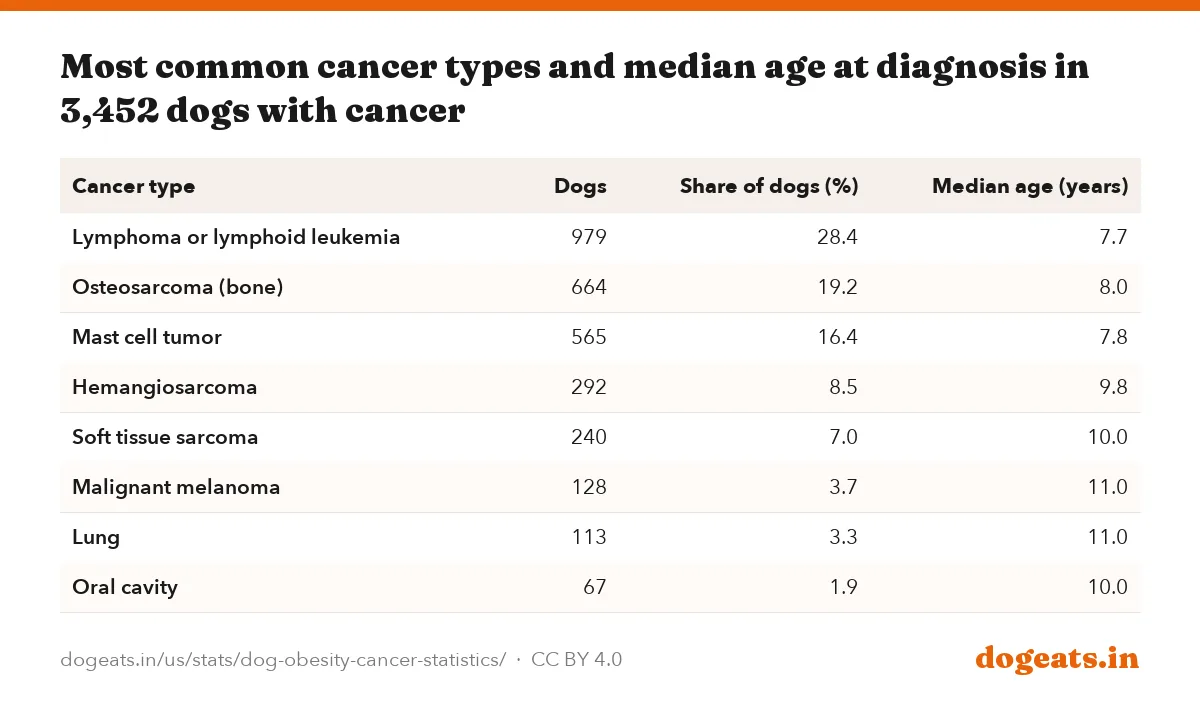
| Cancer type | Dogs | Share of dogs (%) | Median age (years) |
|---|---|---|---|
| Lymphoma or lymphoid leukemia | 979 | 28.4 | 7.7 |
| Osteosarcoma (bone) | 664 | 19.2 | 8.0 |
| Mast cell tumor | 565 | 16.4 | 7.8 |
| Hemangiosarcoma | 292 | 8.5 | 9.8 |
| Soft tissue sarcoma | 240 | 7.0 | 10.0 |
| Malignant melanoma | 128 | 3.7 | 11.0 |
| Lung | 113 | 3.3 | 11.0 |
| Oral cavity | 67 | 1.9 | 10.0 |
Weight drove much of the pattern. Dogs of 2.5 to 5 kilograms had a median age at diagnosis of 11 years, against 5 years for dogs of 75 kilograms or more.
Lymphoma was the most common cancer in the study, with 979 dogs, followed by osteosarcoma with 664. The mix reflects the cancers the source studies collected, so it is not a national ranking.
Golden Retrievers and cancer: what the lifetime study shows
Golden Retrievers are the most studied breed for cancer in the US. The Morris Animal Foundation's Golden Retriever Lifetime Study enrolled 3,044 young dogs from June 2012 to April 2015.
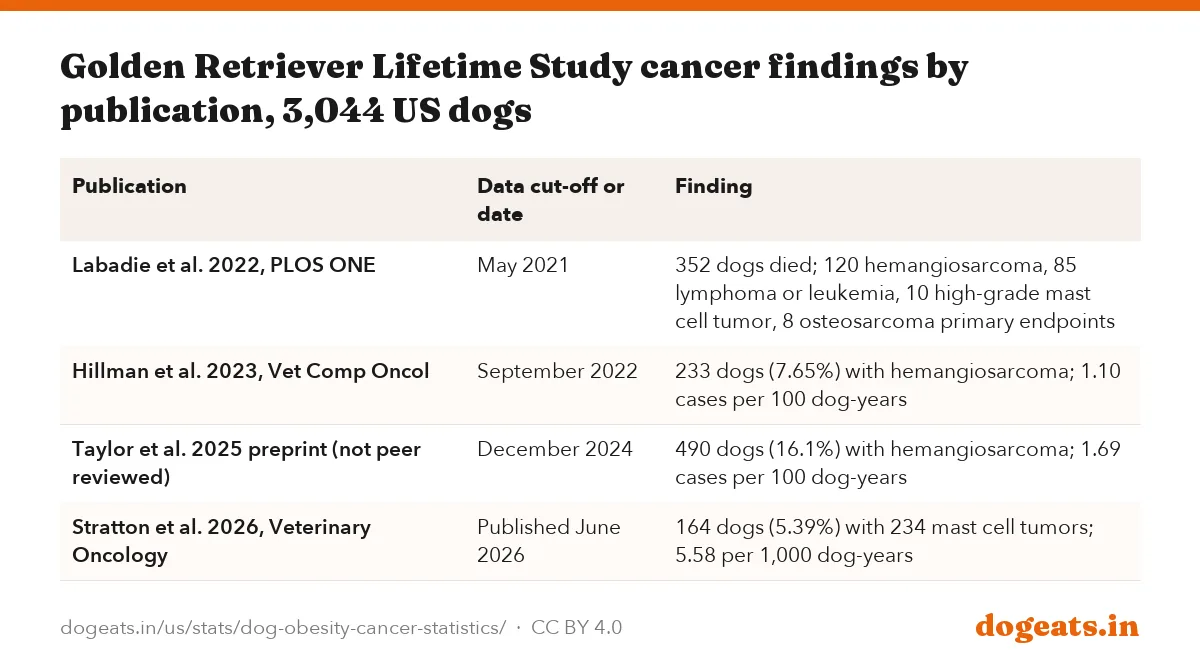
Hemangiosarcoma, a blood vessel cancer, is the most common of the study's four target cancers. By September 2022, 233 dogs had it, or 7.65%, at 1.10 cases per 100 dog-years.
Survival is poor. For the internal form, the 1-year survival probability was 1.42%. A 2025 preprint, not yet peer reviewed, counts 490 cases, or 16.1% of the cohort, by the end of 2024.

| Publication | Data cut-off or date | Finding |
|---|---|---|
| Labadie et al. 2022, PLOS ONE | May 2021 | 352 dogs died; 120 hemangiosarcoma, 85 lymphoma or leukemia, 10 high-grade mast cell tumor, 8 osteosarcoma primary endpoints |
| Hillman et al. 2023, Vet Comp Oncol | September 2022 | 233 dogs (7.65%) with hemangiosarcoma; 1.10 cases per 100 dog-years |
| Taylor et al. 2025 preprint (not peer reviewed) | December 2024 | 490 dogs (16.1%) with hemangiosarcoma; 1.69 cases per 100 dog-years |
| Stratton et al. 2026, Veterinary Oncology | Published June 2026 | 164 dogs (5.39%) with 234 mast cell tumors; 5.58 per 1,000 dog-years |
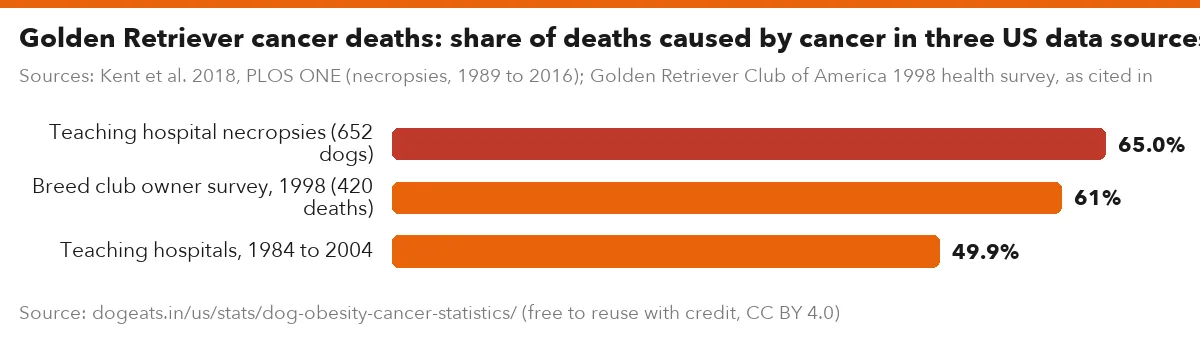
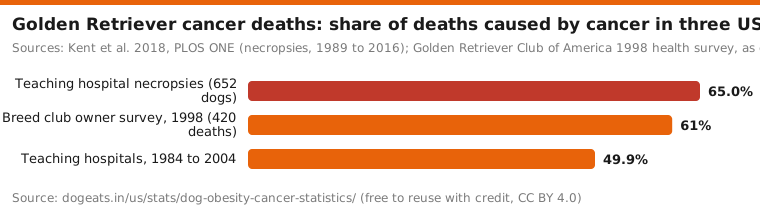
Sources disagree on how often goldens die of cancer. Necropsies of 652 goldens at a US teaching hospital found 65.0% died of cancer. Studies in the UK and Scandinavia reported 20% to 39%, as summarized in the study's cohort profile.
Mast cell tumors were common but often not fatal. Dogs with them had a median lifespan of 11.68 years, against 11.75 years for the rest of the cohort. Only 11.59% of those dogs had the tumor recorded as their cause of death.
What these numbers cannot tell you
The US has no national dog health registry. Every figure here comes from a survey, a clinic chain's records or a research cohort, and each sees a different slice of dogs.
APOP's clinic survey relies on volunteer clinics and 880 dogs in 2022. Banfield's records cover millions of dogs but only those taken to its hospitals. Teaching hospital data skew toward serious cases.
Cancer shares by breed come from deaths recorded from 1984 to 2004, the newest US breed comparison of its size we could find. Breed popularity and care have changed since. No source we found gives obesity or cancer rates by state.
- Obesity: the latest vet-assessed national figure is from 2022; APOP's 2023 to 2025 surveys measure owner opinion only.
- Cancer by breed: shares of deaths, not lifetime risk, in referral hospitals.
- Age at diagnosis: dogs with cancer only, partly from a company-funded study.
- Golden Retrievers: one breed, followed from youth, with some results still in preprint.
None of this replaces a vet's advice. If a dog's weight or a new lump worries you, ask your vet. For costs, see our reports on vet price inflation and pet insurance.
Frequently asked questions
What is the dog obesity rate in the US?
The latest vet-assessed figure is 59%. In APOP's 2022 clinic survey, veterinary teams classed 59% of dogs as overweight or obese, with 22% obese. Banfield records put adult dogs at 52.9% for 2020 to 2023.
Is dog obesity getting worse?
Yes, on most measures. APOP's figure rose from 43% in 2007 to 59% in 2022. Banfield said dogs diagnosed as overweight or obese rose from 16% in 2011 to 34% in 2020.
Which dog breeds have the highest cancer rates?
In a study of 74,556 deaths at North American teaching hospitals, cancer caused 54.6% of Bernese Mountain Dog deaths. Golden Retrievers followed at 49.9%, Scottish Terriers at 47.6% and the Bouvier des Flandres at 46.6%.
Which dog breeds get cancer the least?
Toy breeds had the lowest shares in the same study. Cancer caused 3.6% of Miniature Pinscher deaths, 6.0% of Miniature Dachshund deaths and 7.5% of Chihuahua deaths.
What percentage of dogs get cancer?
The AVMA estimates about 1 in 4 dogs develop cancer, rising to 1 in 2 for dogs aged 10 or older. It presents this as a general estimate. In the Dog Aging Project, owners named cancer for 29.7% of 646 deaths.
At what age do dogs usually get cancer?
A 2023 study of 3,452 dogs with cancer found a median age at diagnosis of 8.8 years. Large breeds were younger: Mastiffs 5.0 and Boxers 6.2. Mixed-breed or other dogs had a median of 9.5 years.
Does being overweight shorten a dog's life?
Yes. In Banfield records, overweight dogs had shorter median lives in all 12 breeds studied, by up to 2.5 years. Obese dogs had a life expectancy at birth of 11.71 years, against 13.18 at ideal weight.
How many Golden Retrievers die of cancer?
Estimates range widely. US figures run from 49.9% of deaths in teaching hospital records to 65.0% in a necropsy study. Studies in the UK and Scandinavia reported 20% to 39%.
Do owners know when their dog is overweight?
Often not. In APOP's 2022 clinic survey, 36% of owners of overweight or obese dogs called the dog's condition normal. In 2025, 37% of owners said their dog was above ideal weight.
Methodology and limitations
Obesity figures come from the Association for Pet Obesity Prevention's survey pages and its 2022 State of Pet Obesity report. Others come from Banfield press releases from 2017, 2020 and 2021 and peer-reviewed Banfield studies (Salt et al. 2019; Montoya et al. 2023 and 2025). We opened each source on October 11, 2026.
Breed cancer shares are read from Table 2 of Fleming et al. 2011, the neoplastic column, for the 81 breeds and the mixed-breed group with at least 100 deaths. We ranked them and computed the median of the 81 breed shares, 26.1%.
Median ages at cancer diagnosis by breed were computed by dogeats.in from the subject-level data published with Rafalko et al. 2023 (S3 Table, 3,452 dogs). Breeds needed at least 10 dogs, as in the paper. Three ages listed as under 1 year were set to 0.5. Our medians match the figures quoted in the paper.
Golden Retriever figures come from the Golden Retriever Lifetime Study cohort profile and later papers, plus a 2025 preprint we label as such. Combined overweight and obese shares and life-stage sums are our additions of published figures.
Sources
- Association for Pet Obesity Prevention, 2022 survey and data, 59% of dogs overweight or obese; 2022 body condition split; owner perception gap
- Fleming JM, Creevy KE, Promislow DEL. Mortality in North American dogs from 1984 to 2004. J Vet Intern Med 2011, Share of deaths caused by cancer for 81 breeds and mixed-breed dogs
- Labadie J et al. Cohort profile: The Golden Retriever Lifetime Study. PLOS ONE 2022, GRLS enrollment, deaths and cancer endpoints to May 2021; earlier golden cancer mortality estimates
- Also consulted: APOP clinical prevalence survey series 2007 to 2015, APOP press release, October 1, 2026, APOP 2018 prevalence survey, APOP 2017 prevalence survey, APOP 2016 prevalence survey, APOP 2023 opinion survey, APOP 2024 opinion survey, APOP 2025 opinion survey, Montoya M et al. Overweight and obese body condition in about 4.9 million dogs and 1.3 million cats. Prev Vet Med 2025, Banfield Pet Hospital press release, June 21, 2021, Banfield 2020 Veterinary Emerging Topics report release, Salt C et al. Association between life span and body condition in neutered client-owned dogs. J Vet Intern Med 2019, Montoya M et al. Life expectancy tables for dogs and cats derived from clinical data. Front Vet Sci 2023, American Veterinary Medical Association, Cancer in pets, McNulty KE et al. Dog Aging Project End of Life Survey. JAVMA 2026, Rafalko JM et al. Age at cancer diagnosis by breed, weight, sex, and cancer type. PLOS ONE 2023, Hillman A et al. Haemangiosarcoma in the Golden Retriever Lifetime Study. Vet Comp Oncol 2023, Taylor C et al. Haemangiosarcoma in the Golden Retriever Lifetime Study, preprint, Research Square 2025, Stratton et al. Mast cell tumours in the Golden Retriever Lifetime Study. Veterinary Oncology 2026, Kent MS et al. Cancer-related mortality, age and gonadectomy in golden retrievers. PLOS ONE 2018, Banfield Pet Hospital 2017 State of Pet Health press release, Pearson et al. 2024, Dog Aging Project End of Life Survey, JAVMA, Nam et al. 2024, Dog size and disease history, Dog Aging Project, PLOS ONE.
Cite, embed and download
This report, its data and its images are free to reuse under a Creative Commons Attribution 4.0 licence. Credit dogeats.in with a link to this page. Every chart has its own embed code, every table has a CSV and an image download, and the images below are ready for social posts, slides and articles.
Cite this report
Link to this report
Every chart and table as an image