Explainer · Updated October 2026
Do microchips get lost dogs home? Return-to-owner rates from shelter studies, and why chipped dogs still go unclaimed
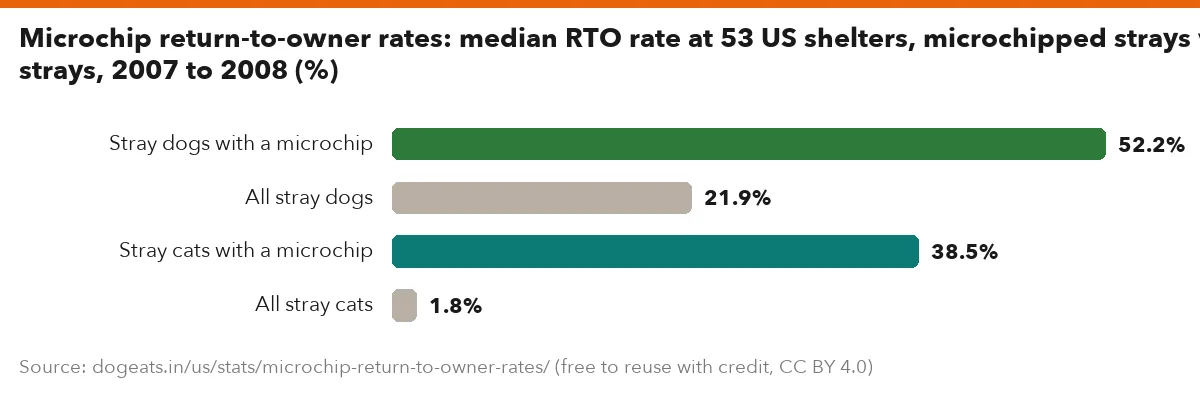
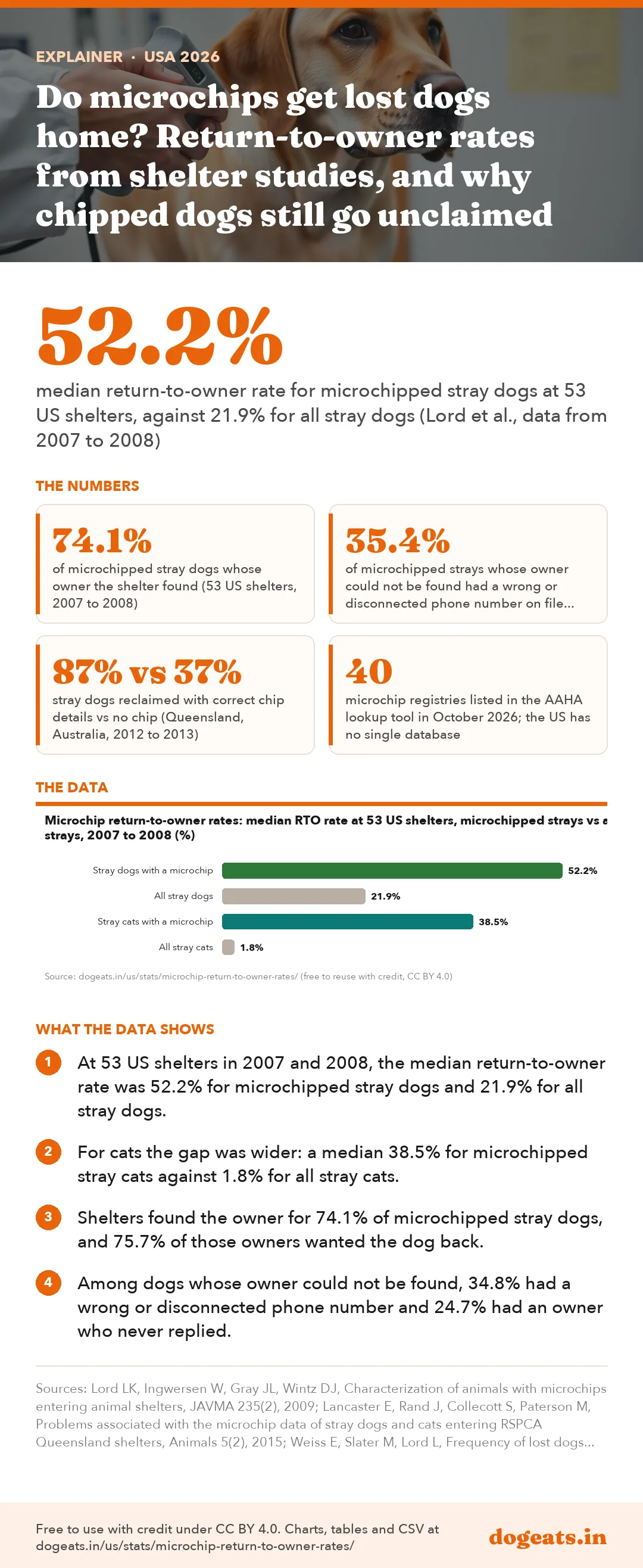
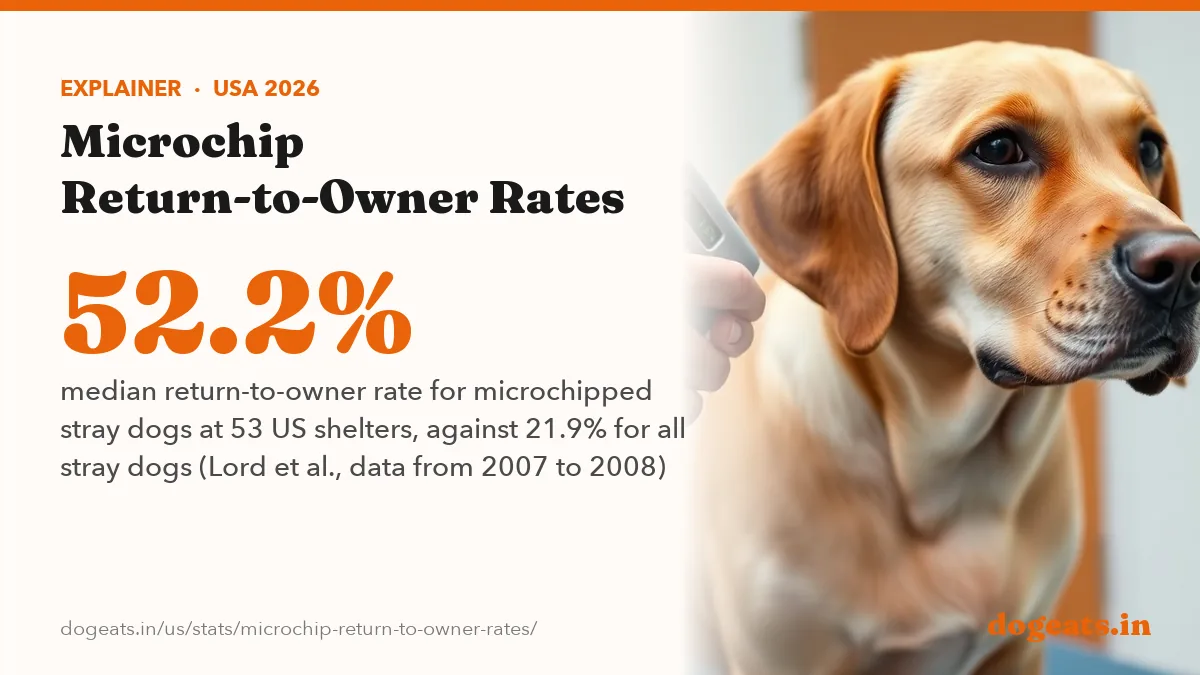
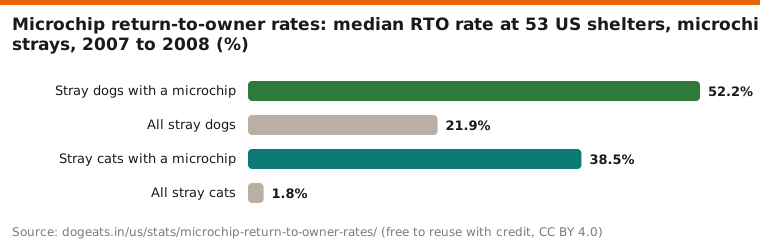
A US study tracked microchipped animals at 53 shelters in 2007 and 2008. The median return-to-owner rate for stray dogs with a microchip was 52.2%, against 21.9% for all stray dogs. Shelters found the owner of 74.1% of microchipped stray dogs. When they failed, the usual cause was the registration: a wrong or disconnected phone number, an owner who never answered, or a chip still registered to someone else.
Key findings
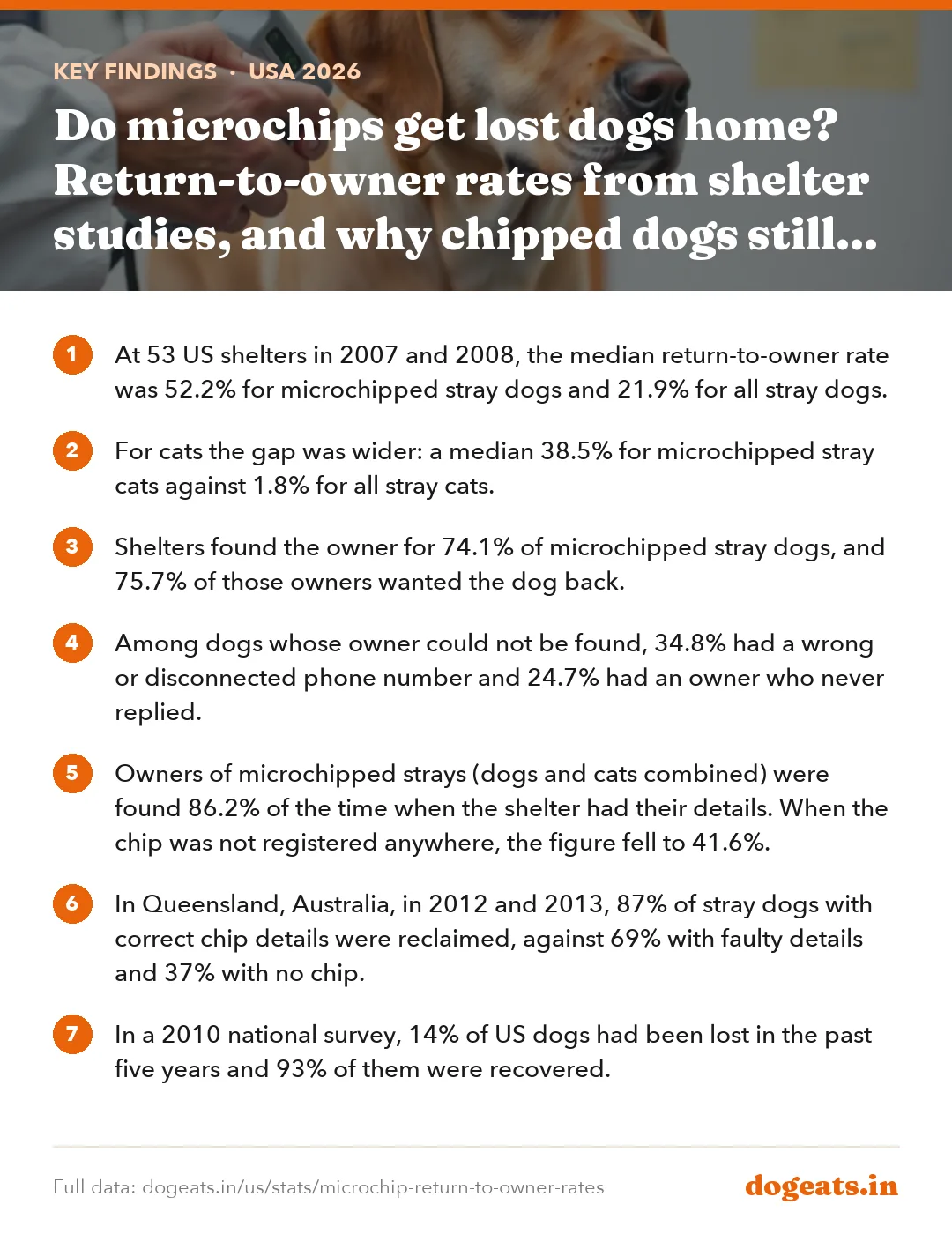
- At 53 US shelters in 2007 and 2008, the median return-to-owner rate was 52.2% for microchipped stray dogs and 21.9% for all stray dogs.
- For cats the gap was wider: a median 38.5% for microchipped stray cats against 1.8% for all stray cats.
- Shelters found the owner for 74.1% of microchipped stray dogs, and 75.7% of those owners wanted the dog back.
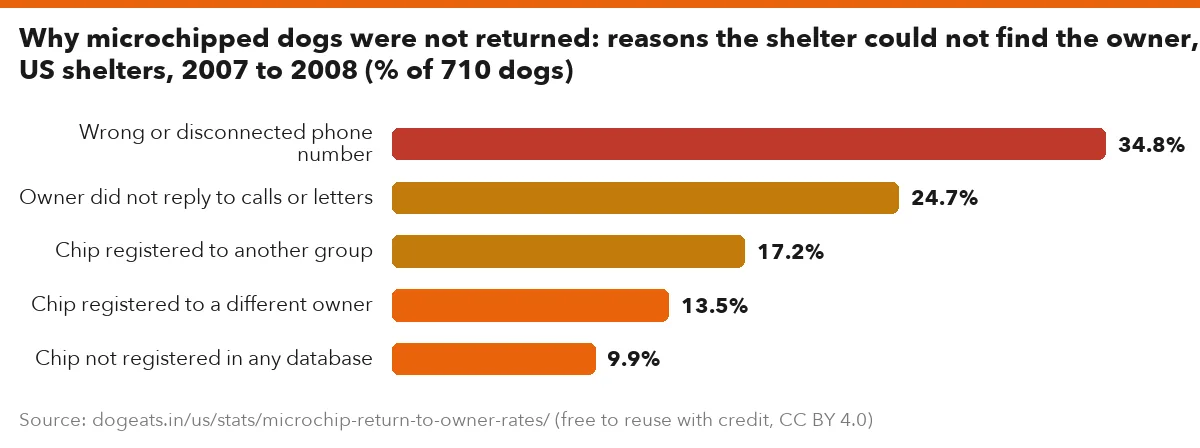
- Among dogs whose owner could not be found, 34.8% had a wrong or disconnected phone number and 24.7% had an owner who never replied.
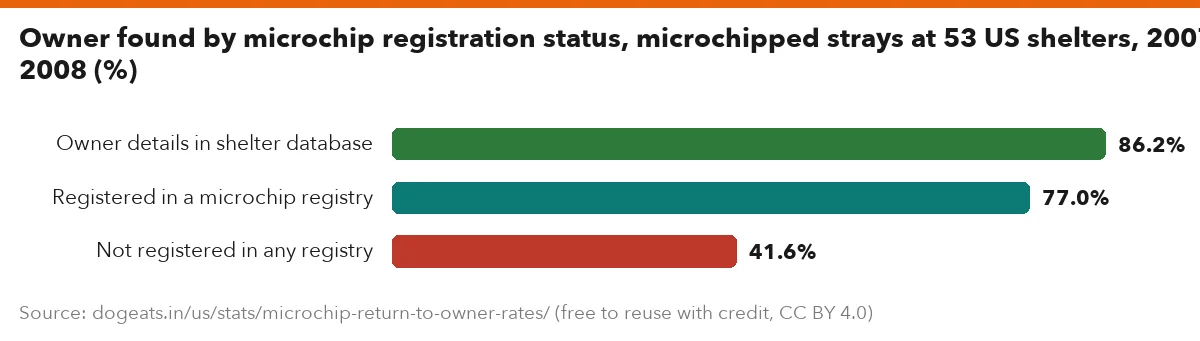
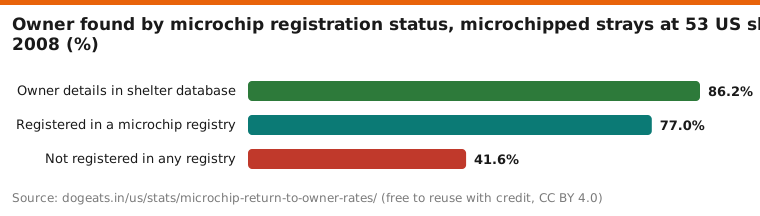
- Owners of microchipped strays (dogs and cats combined) were found 86.2% of the time when the shelter had their details. When the chip was not registered anywhere, the figure fell to 41.6%.
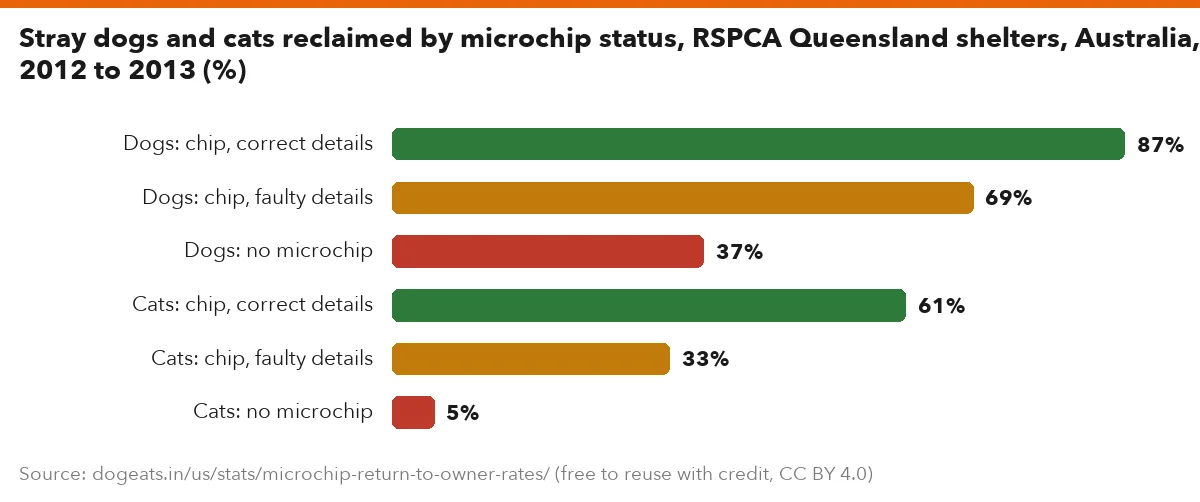
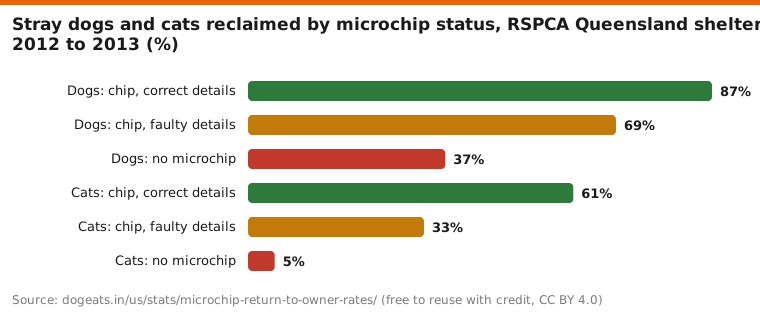
- In Queensland, Australia, in 2012 and 2013, 87% of stray dogs with correct chip details were reclaimed, against 69% with faulty details and 37% with no chip.
- In a 2010 national survey, 14% of US dogs had been lost in the past five years and 93% of them were recovered.
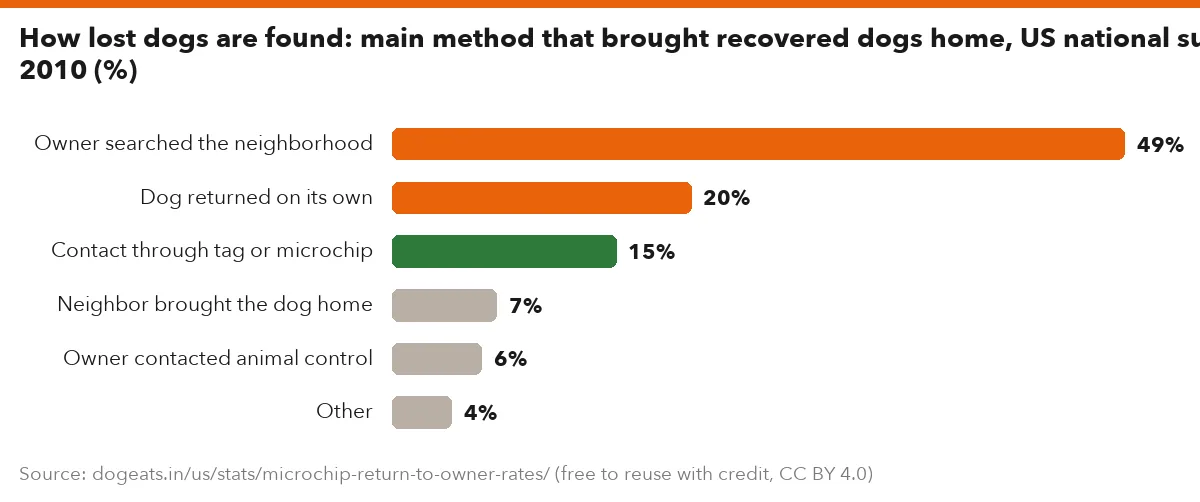
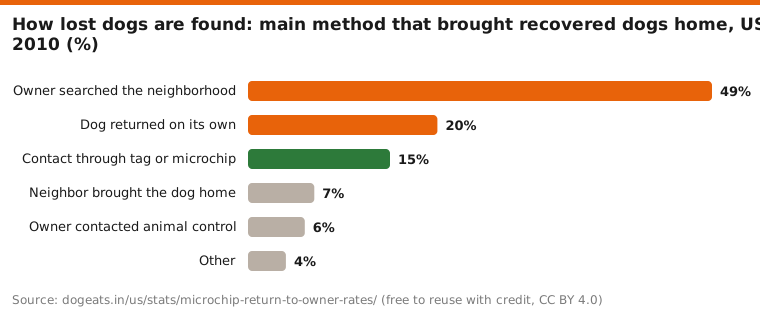
- Only 15% of recovered lost dogs in that survey came home through a tag or microchip; 49% were found by searching the neighborhood.
- Shelter Animals Count reports that 34% of stray dogs entering US shelters and rescues were returned to their owners in 2025.
Do microchips help lost dogs get home?
Yes. In a study of 53 US shelters in 23 states, stray dogs with a microchip had a median return-to-owner rate of 52.2%. All stray dogs at the same shelters had a median of 21.9%.
The study, by Linda Lord and colleagues at Ohio State University, tracked 7,704 microchipped animals that entered shelters between August 2007 and March 2008. It was published in the Journal of the American Veterinary Medical Association in 2009.
The gap was larger for cats. Microchipped stray cats went home at a median rate of 38.5%, against 1.8% for all stray cats. Note that the comparison group is all strays, which includes the chipped ones, so the gap between chipped and unchipped animals is likely somewhat wider.
Source: Lord LK, Ingwersen W, Gray JL, Wintz DJ, JAVMA 2009; data August 2007 to March 2008. Medians across shelters. 'All stray dogs' and 'all stray cats' include microchipped animals.
Show the numbers
| Label | % |
|---|---|
| Stray dogs with a microchip | 52.2% |
| All stray dogs | 21.9% |
| Stray cats with a microchip | 38.5% |
| All stray cats | 1.8% |
Embed this chart
Microchipped animals were still rare among strays. At the median shelter, only 3.9% of incoming stray dogs had a chip. For overall shelter outcomes, see our dog shelter and adoption statistics.
What percentage of microchipped dogs are returned to their owners?
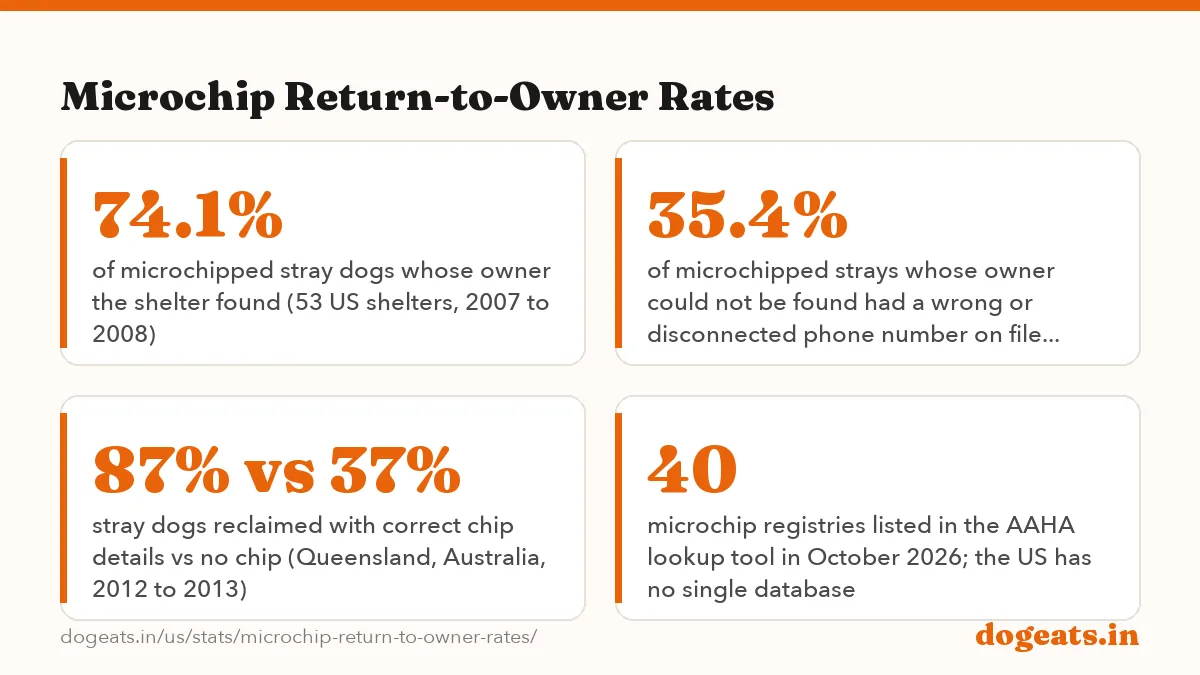
In the 53-shelter US study, shelters found the owner of 74.1% of microchipped stray dogs (2,191 of 2,956) and 63.5% of microchipped stray cats.
Finding the owner did not always mean the dog went home. Of the dog owners who were found, 75.7% wanted the dog returned and 19.3% did not.
A study from Queensland, Australia, a country where microchipping is compulsory in most states, compared chipped and unchipped dogs directly. Of 7,258 stray adult dogs entering RSPCA Queensland shelters in 2012 and 2013, 80% of microchipped dogs were reclaimed against 37% of dogs with no chip.
Source: Lancaster E, Rand J, Collecott S, Paterson M, Animals 2015. 7,258 stray adult dogs and 6,950 stray adult cats. Data problems include chips registered to a previous owner, wrong phone numbers and unregistered chips.
Show the numbers
| Label | % |
|---|---|
| Dogs: chip, correct details | 87% |
| Dogs: chip, faulty details | 69% |
| Dogs: no microchip | 37% |
| Cats: chip, correct details | 61% |
| Cats: chip, faulty details | 33% |
| Cats: no microchip | 5% |
Embed this chart
Only 28% of the Queensland stray dogs had a microchip on arrival. Dogs with correct chip details had 11.5 times the odds of being reclaimed compared with unchipped dogs; with faulty details, the advantage fell to 3.8 times.
Why are microchipped dogs not returned to their owners?
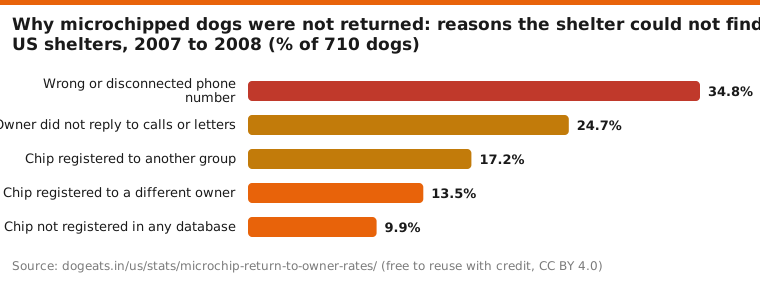
Mostly because of the registration, not the chip. In the US study, 710 microchipped stray dogs had an owner who could not be found. Of these, 34.8% had a wrong or disconnected phone number and 24.7% had an owner who did not return calls or answer a letter.
Another 17.2% of those dogs had a chip registered to a group such as a shelter, rescue, breeder, veterinarian or pet store, and 13.5% were registered to another owner. In 9.9% of cases the chip was not registered in any database.
Strays that go unclaimed are at higher risk of euthanasia, as a 2018 study of Australia's largest microchip database notes in its background; see shelter euthanasia rates by state.
Source: Lord LK et al., JAVMA 2009, Table 3, dog column; data August 2007 to March 2008. 'Different owner' means the chip was registered to another owner; 'another group' means a shelter, rescue group, breeder, veterinarian or pet store.
Show the numbers
| Label | % |
|---|---|
| Wrong or disconnected phone number | 34.8% |
| Owner did not reply to calls or letters | 24.7% |
| Chip registered to another group | 17.2% |
| Chip registered to a different owner | 13.5% |
| Chip not registered in any database | 9.9% |
Embed this chart
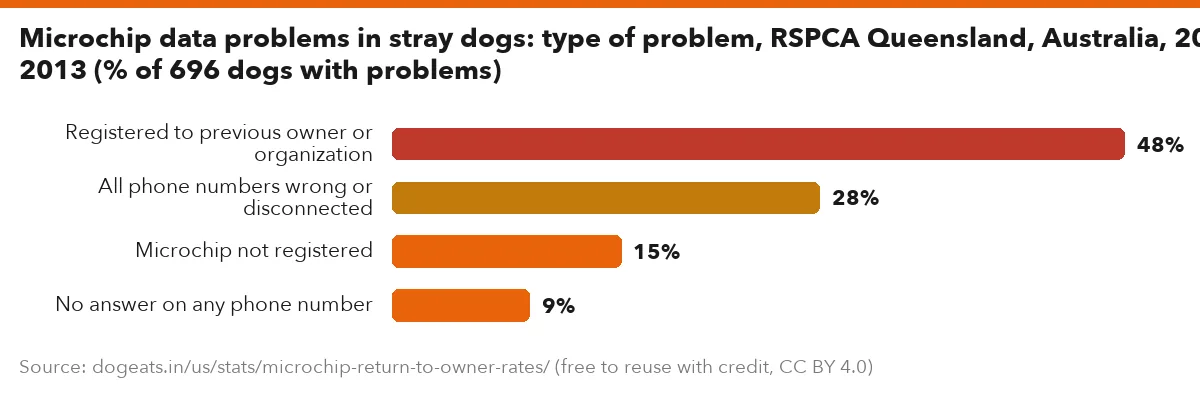
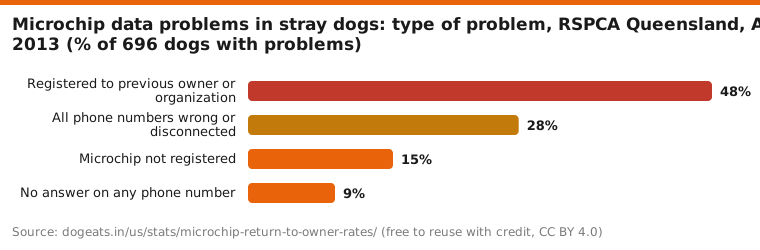
Source: Lancaster E et al., Animals 2015, Table 4. 37% of 1,892 microchipped stray dogs had a data problem. Fewer than 1% were registered to a different animal (not shown).
Show the numbers
| Label | % |
|---|---|
| Registered to previous owner or organization | 48% |
| All phone numbers wrong or disconnected | 28% |
| Microchip not registered | 15% |
| No answer on any phone number | 9% |
Embed this chart
The two studies, on two continents, point to the same fix. Owners need to register the chip in their own name, and update it when they move or change numbers. An Australian study of 904,909 dogs on the country's largest chip database found owners updated their details more often soon after a reminder email.
Does registering a dog's microchip make a difference?
Yes, by a wide margin. In the US study, shelters found the owner 77.0% of the time when the chip was registered in a microchip registry. When it was not registered anywhere, they found the owner 41.6% of the time.
When the owner's details were already in the shelter's own database, the owner was found 86.2% of the time. After adjusting for other factors, an owner in a microchip registry was 4.9 times as likely to be found as an owner with no registration. An owner in the shelter database was 8.7 times as likely.
Registration was the weak link. Of 1,943 animals for which shelters contacted a registry, only 1,129 (58.1%) were registered. Shelter staff had implanted 80.3% of the chips whose implanter was known, and 17.2% of untraced owners had a chip still registered to a group. If you bought a puppy from a breeder or pet store, ask whether the chip is in your name. See our report on puppy mill and pet store bans by state.
Source: Lord LK et al., JAVMA 2009; data August 2007 to March 2008. Dogs and cats combined.
Show the numbers
| Label | % |
|---|---|
| Owner details in shelter database | 86.2% |
| Registered in a microchip registry | 77.0% |
| Not registered in any registry | 41.6% |
Embed this chart
Other factors also mattered. Dog owners were 1.7 times as likely to be found as cat owners. Owners of purebred animals were 1.5 times as likely as owners of mixed breeds, and owners of spayed or neutered animals 1.8 times as likely as owners of intact animals. Purebreds are common among the most popular US dog breeds.
Can a shelter scanner miss a dog's microchip?
Sometimes. In the 53-shelter study, 87.1% of chips were found at the first scan on entry, and 12.9% were found only later, during an exam or at another time. Of those later finds, 97.9% had been missed by an earlier scan.
Eighty-two chips, 1.1%, were detected only at the time of euthanasia. Most shelters in the study, 78.8%, scanned animals more than once.
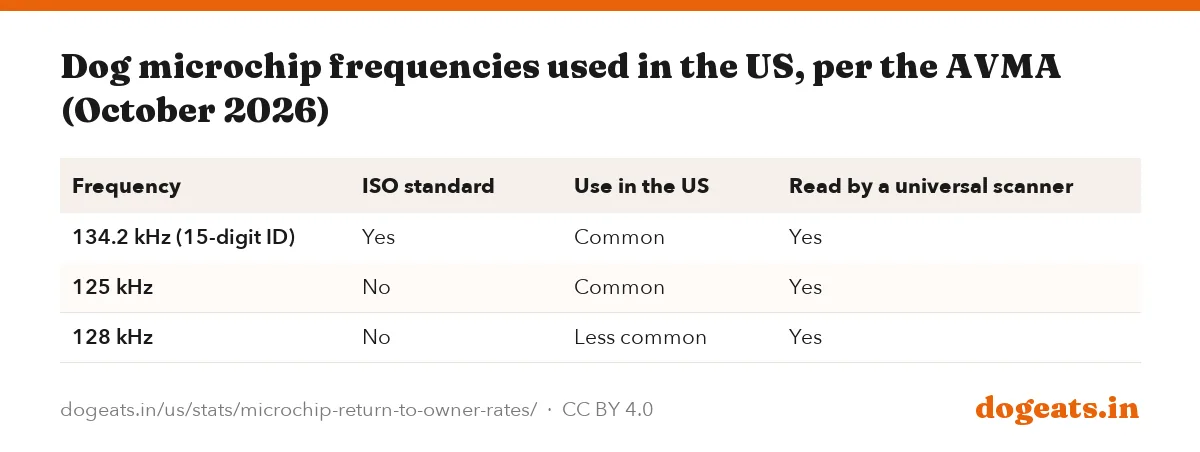
Scanners differ too. A 2008 JAVMA study of 3,949 dogs and cats at 6 shelters found no scanner with 100% sensitivity. Universal scanners read 128 kHz and 134.2 kHz chips at least 94.8% of the time, but one universal scanner caught 125 kHz chips only 66.4% to 75.0% of the time.
| Frequency | ISO standard | Use in the US | Read by a universal scanner |
|---|---|---|---|
| 134.2 kHz (15-digit ID) | Yes | Common | Yes |
| 125 kHz | No | Common | Yes |
| 128 kHz | No | Less common | Yes |
The AVMA says there is no federal or state requirement that US pet chips follow one standard. Many countries require a 15-digit ISO chip for entry, which matters if you fly with your dog; see airline pet incidents. Every dog returning to the US also needs a microchip, the AVMA notes, though it need not be 15 digits if a universal scanner can read it. Ask your vet to scan the chip at least once a year to make sure it still reads; our veterinarians by state report shows how many vets serve each state.
How do most lost dogs get found?
Mostly by searching nearby. In a 2010 national phone survey of 1,015 US pet-owning households, 49% of recovered lost dogs were found by searching the neighborhood and 20% came home on their own. Only 15% came home because someone contacted the owner through a tag or microchip.
The same survey found that 14% of dogs had been lost at least once in the previous five years, and 93% of those lost dogs were recovered. Only 24% of the lost dogs had a microchip, while 61% wore an ID tag with a phone number.
Finders often skip the scan. In a 2006 survey of 156 people in Dayton, Ohio, who found a lost pet, 94% knew microchips existed but only 50% of them had the animal scanned. Just 11% of collared dogs wore any tag, which is one reason a rabies tag or ID tag still matters.

Source: Weiss E, Slater M, Lord L, Animals 2012; national random-digit-dial phone survey, September to November 2010, 101 recovered dogs.
Show the numbers
| Label | % |
|---|---|
| Owner searched the neighborhood | 49% |
| Dog returned on its own | 20% |
| Contact through tag or microchip | 15% |
| Neighbor brought the dog home | 7% |
| Owner contacted animal control | 6% |
| Other | 4% |
Embed this chart
Lost dog intake spikes around some holidays; our report on July 4 fireworks and lost dogs has the shelter data. For how many US homes have dogs, see dog ownership statistics.
How many stray dogs are returned to their owners in the US today?
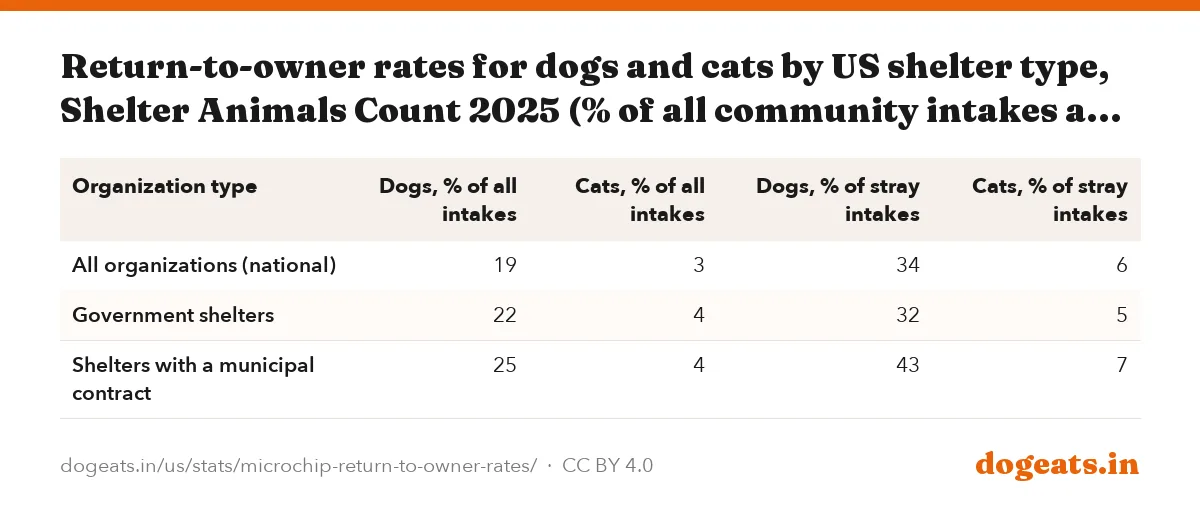
About a third. Shelter Animals Count reports that 34% of stray dogs entering US shelters and rescues in 2025 were returned to their owners, against 6% of stray cats.
Shelters with municipal contracts returned 43% of stray dogs and government shelters 32%. In all, 638,000 dogs and cats went home to their owners in 2025, 3% fewer than in 2024. Across all intake types, 17% of large dogs went home, against 9% of medium dogs and 7% of small dogs.
Age matters. Government and contracted shelters report return rates of 50% to 60% or higher for senior dogs, about 25% to 35% for adult dogs and about 5% to 9% for juveniles. Shelter Animals Count links the high senior rate partly to microchips and established owners; our dog lifespan by breed report covers when dogs become seniors.
| Organization type | Dogs, % of all intakes | Cats, % of all intakes | Dogs, % of stray intakes | Cats, % of stray intakes |
|---|---|---|---|---|
| All organizations (national) | 19 | 3 | 34 | 6 |
| Government shelters | 22 | 4 | 32 | 5 |
| Shelters with a municipal contract | 25 | 4 | 43 | 7 |
Is there a national microchip database for dogs in the US?
No. The AVMA says the US has no single, central database for pet microchips; each registry keeps its own records. A free AAHA lookup listed 40 registries in October 2026.
The American Animal Hospital Association's free Pet Microchip Registry Lookup searches participating registries by chip number and tells the finder which company to call. In October 2026 it listed 40 microchip registries. It does not show owner details.
When the tool launched in 2009, three of the six major US registries took part. The lookup now notes that one registry, Save This Life, has ceased operations and was disconnected, so owners with that chip need to register with another company.
- Register the chip in your own name, even if a shelter or breeder implanted it.
- Use the AAHA lookup to see which registry holds your chip number.
- Update the phone number and address whenever they change. August 15 is Check the Chip Day, a yearly reminder from the AVMA.
- Keep a collar and ID tag on as well. A finder can call the number on a tag without a scanner.
The cost of a chip is small next to other dog costs. In 2009, Ohio State put the cost to implant and register a chip at about $25 to $75; see our cost of owning a dog report for current yearly costs.
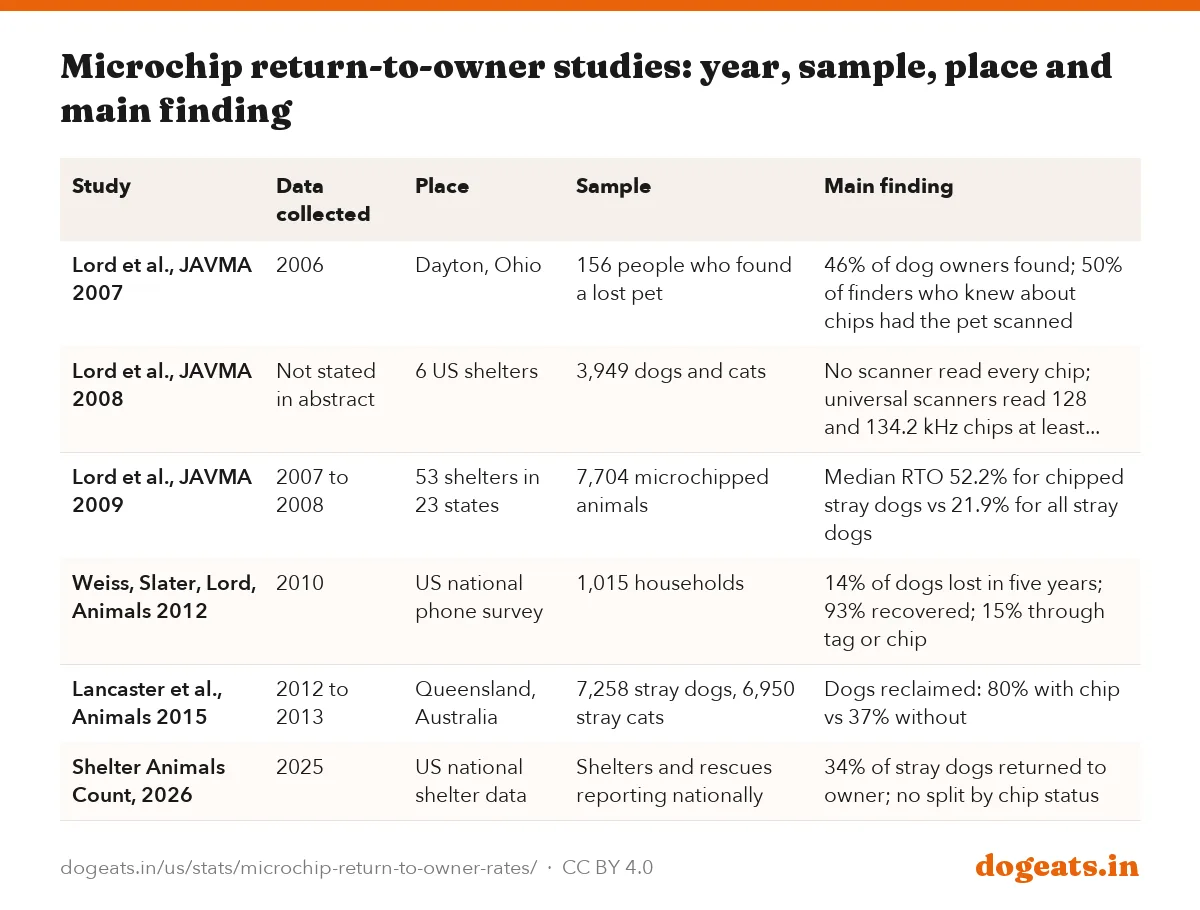
Which studies have measured microchip return-to-owner rates?
Five peer-reviewed studies form the core evidence, four from the US and one from Australia. All of them are more than 10 years old, so treat their rates as benchmarks rather than current figures.
No newer US study tracks microchip status and outcome across many shelters. National shelter data from Shelter Animals Count give current return rates but not by microchip status.
| Study | Data collected | Place | Sample | Main finding |
|---|---|---|---|---|
| Lord et al., JAVMA 2007 | 2006 | Dayton, Ohio | 156 people who found a lost pet | 46% of dog owners found; 50% of finders who knew about chips had the pet scanned |
| Lord et al., JAVMA 2008 | Not stated in abstract | 6 US shelters | 3,949 dogs and cats | No scanner read every chip; universal scanners read 128 and 134.2 kHz chips at least 94.8% of the time |
| Lord et al., JAVMA 2009 | 2007 to 2008 | 53 shelters in 23 states | 7,704 microchipped animals | Median RTO 52.2% for chipped stray dogs vs 21.9% for all stray dogs |
| Weiss, Slater, Lord, Animals 2012 | 2010 | US national phone survey | 1,015 households | 14% of dogs lost in five years; 93% recovered; 15% through tag or chip |
| Lancaster et al., Animals 2015 | 2012 to 2013 | Queensland, Australia | 7,258 stray dogs, 6,950 stray cats | Dogs reclaimed: 80% with chip vs 37% without |
| Shelter Animals Count, 2026 | 2025 | US national shelter data | Shelters and rescues reporting nationally | 34% of stray dogs returned to owner; no split by chip status |
More US data reports are listed on the dogeats.in US home page.
Frequently asked questions
Do microchips increase the chance of getting a lost dog back?
Yes. At 53 US shelters in 2007 and 2008, the median return-to-owner rate was 52.2% for microchipped stray dogs against 21.9% for all stray dogs.
What percentage of microchipped dogs are returned to their owners?
Shelters found the owner for 74.1% of microchipped stray dogs in a 53-shelter US study (2007 to 2008). In Queensland, Australia, 80% of microchipped stray dogs were reclaimed in 2012 and 2013, against 37% of unchipped dogs.
Why would a microchipped dog not be returned?
Usually because of the registration. In the US study, 710 microchipped stray dogs had an owner who could not be found. Of these, 34.8% had a wrong or disconnected phone number, 24.7% had an owner who never replied and 9.9% had an unregistered chip.
Is there one national pet microchip database in the US?
No. Each registry keeps its own records. The AAHA Pet Microchip Registry Lookup searches participating registries by chip number and listed 40 registries in October 2026.
Can a microchip scanner miss a chip?
Yes. In a 2009 study, 12.9% of chips were found only after the first intake scan. A 2008 study found no scanner with 100% sensitivity, so shelters often scan more than once.
What frequency do dog microchips use?
The ISO standard is 134.2 kHz with a 15-digit number. US dogs may also carry older 125 kHz or 128 kHz chips; universal scanners read all three, the AVMA says.
Is a microchip a GPS tracker?
No. A pet microchip usually holds only a 9, 10 or 15 digit ID number and has no power source. It cannot track your dog; it works only when someone scans it and calls the registry.
How often do dogs get lost?
In a 2010 US survey, 14% of dogs had been lost at least once in the previous five years, and 93% of those dogs were recovered.
How much does it cost to microchip a dog?
In 2009, Ohio State estimated about $25 to $75 to implant and register a chip, depending on where it is done. Many shelters implant a chip in animals they adopt out, the AVMA notes.
Methodology and limitations
We opened the full text of each peer-reviewed study we cite, or its published abstract where noted, in October 2026, and took every figure from the paper itself. Return-to-owner (RTO) rates from Lord et al. 2009 are medians across the 53 shelters, as published.
The dog-specific reasons in our chart come from the dog column of Table 3 in Lord et al. 2009; the 710 total is the sum of those rows. The Queensland figures come from Lancaster et al. 2015, Tables 4 and 5 and the abstract.
Current national return rates come from the Shelter Animals Count 2025 Annual Data Report and its June 2026 data drop on age. The registry count is our count of names listed under Microchip Registries on the AAHA lookup page on October 16, 2026.
Sources
- Lord LK, Ingwersen W, Gray JL, Wintz DJ, Characterization of animals with microchips entering animal shelters, JAVMA 235(2), 2009, RTO rates for microchipped strays, reasons owners were not found, registration and scanning data
- Lancaster E, Rand J, Collecott S, Paterson M, Problems associated with the microchip data of stray dogs and cats entering RSPCA Queensland shelters, Animals 5(2), 2015, Reclaim rates by microchip status and data problems, Queensland, 2012 to 2013
- Weiss E, Slater M, Lord L, Frequency of lost dogs and cats in the United States and the methods used to locate them, Animals 2(2), 2012, 2010 national survey of lost pets and how they were found
- Also consulted: Lord LK, Wittum TE, Ferketich AK, Funk JA, Rajala-Schultz PJ, Search methods that people use to find owners of lost pets, JAVMA 230(12), 2007, Lord LK, Pennell ML, Ingwersen W, Fisher RA, Sensitivity of commercial scanners to microchips of various frequencies implanted in dogs and cats, JAVMA 233(11), 2008 (abstract), Shelter Animals Count, 2025 Annual Data Report (PDF), Shelter Animals Count, Data Drop: Age and Reunification Trends for Lost and Found Pets, June 3, 2026, American Veterinary Medical Association, Microchipping: FAQs for pet owners, American Animal Hospital Association, Pet Microchip Registry Lookup, Ohio State University press release, Microchips result in high rate of return of shelter animals to owners, October 13, 2009, AVMA, Microchips reunite pets with families (ISO 134.2 kHz, 15-digit standard), Goodwin K, Rand J, Morton J, Uthappa V, Walduck R, Email reminders increase the frequency that pet owners update their microchip information, Animals 2018 (abstract).
Cite, embed and download
This report, its data and its images are free to reuse under a Creative Commons Attribution 4.0 licence. Credit dogeats.in with a link to this page. Every chart has its own embed code, every table has a CSV and an image download, and the images below are ready for social posts, slides and articles.
Cite this report
Link to this report
Every chart and table as an image