Tracker · Updated October 2026
Puppy mill laws by state: which states ban pet store puppy sales, and where USDA-licensed breeders are
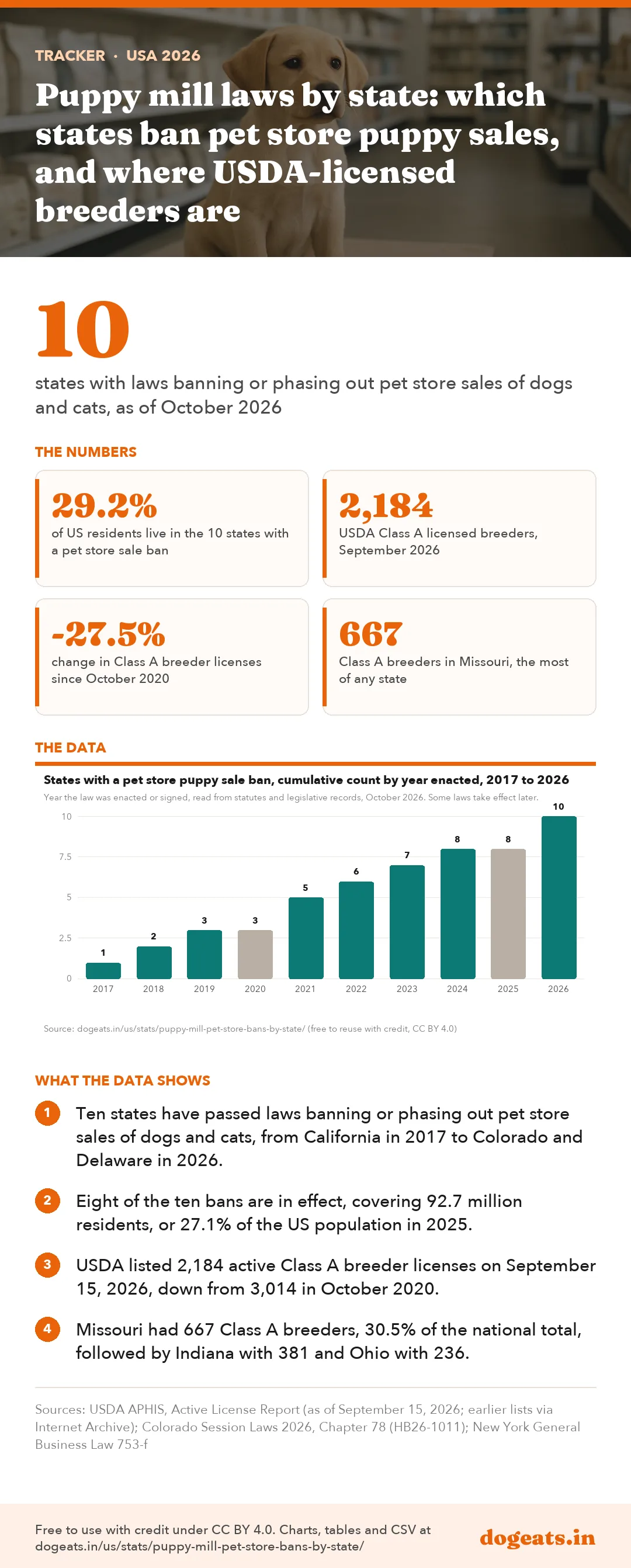
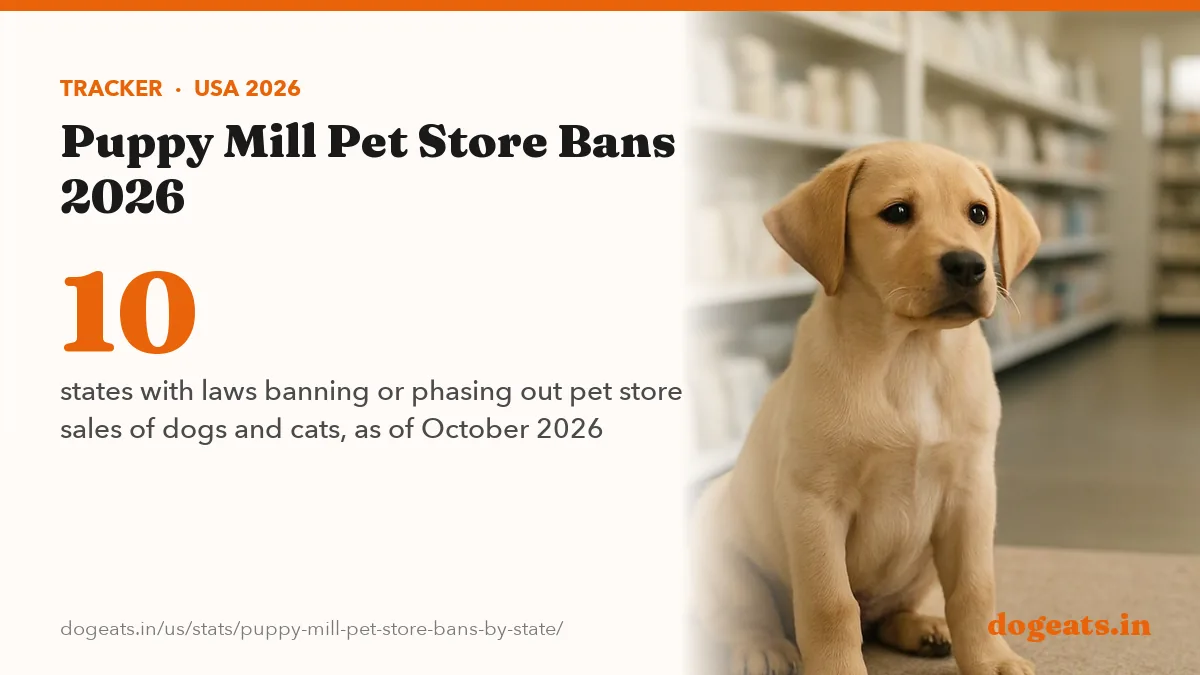
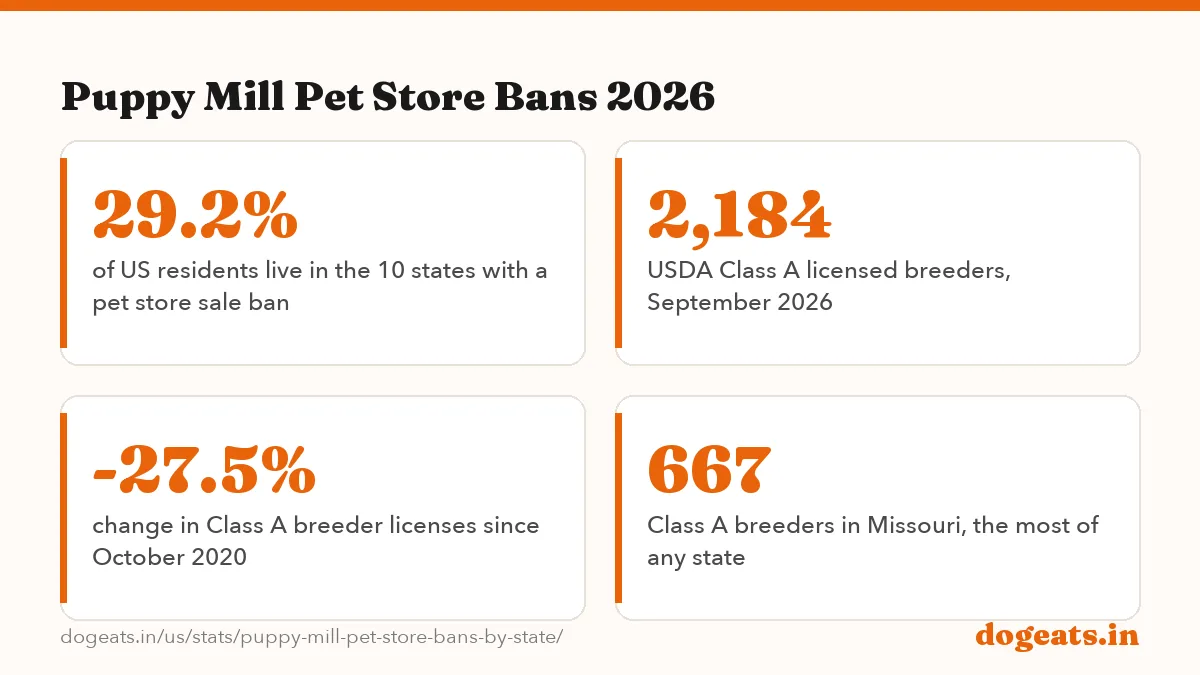
Ten states have passed laws that ban or phase out pet store sales of dogs and cats, most recently Colorado and Delaware in 2026. Eight of the bans are in effect, covering 92.7 million people. USDA licensed 2,184 Class A breeders on September 15, 2026, down 27.5% from October 2020, and 30.5% were in Missouri.
Key findings
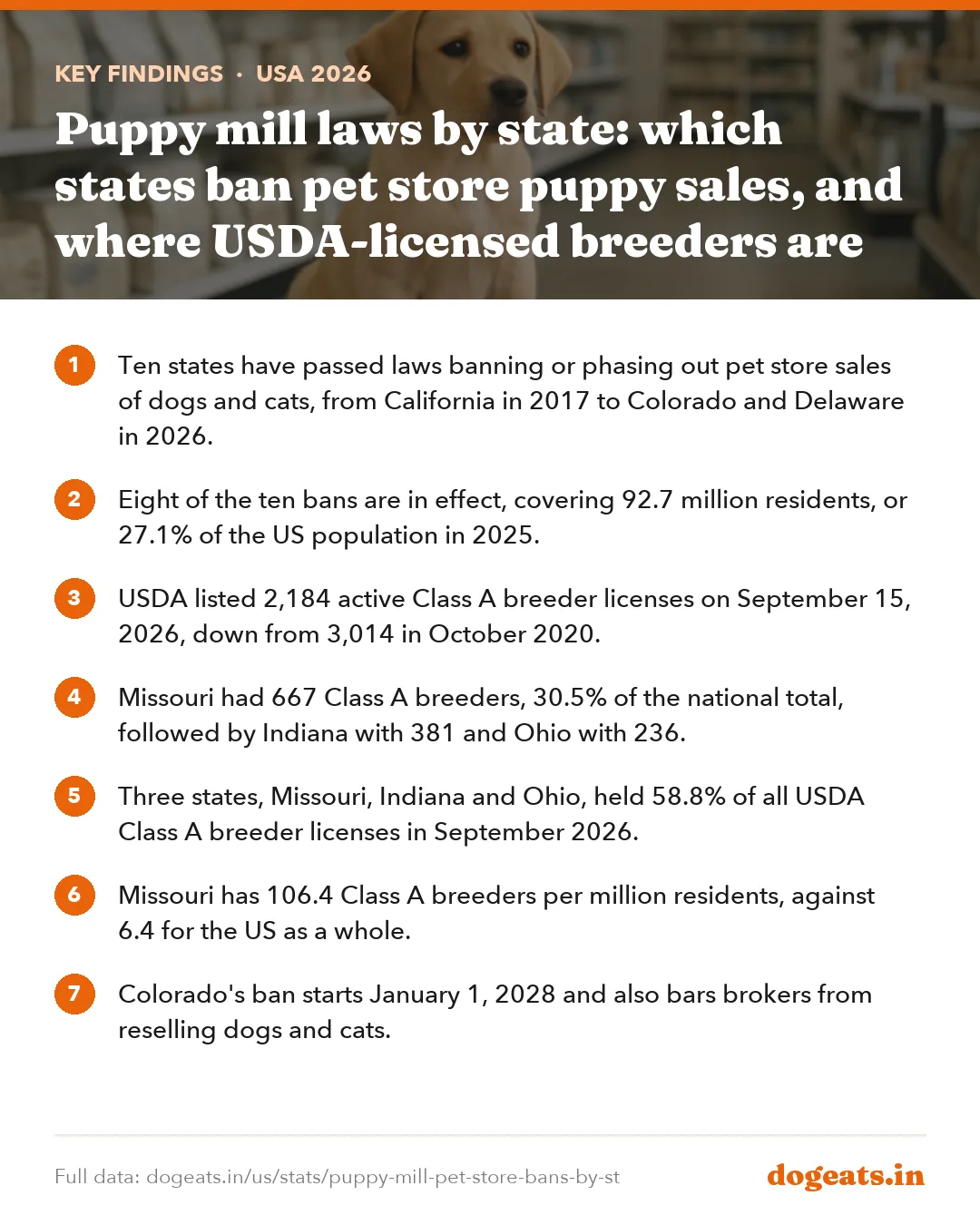
- Ten states have passed laws banning or phasing out pet store sales of dogs and cats, from California in 2017 to Colorado and Delaware in 2026.
- Eight of the ten bans are in effect, covering 92.7 million residents, or 27.1% of the US population in 2025.
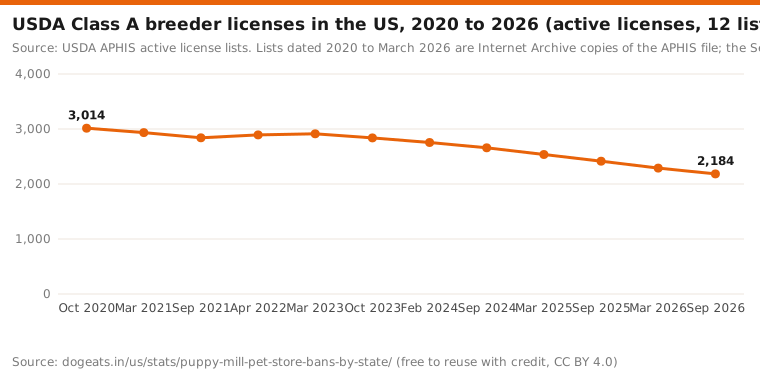
- USDA listed 2,184 active Class A breeder licenses on September 15, 2026, down from 3,014 in October 2020.
- Missouri had 667 Class A breeders, 30.5% of the national total, followed by Indiana with 381 and Ohio with 236.
- Three states, Missouri, Indiana and Ohio, held 58.8% of all USDA Class A breeder licenses in September 2026.
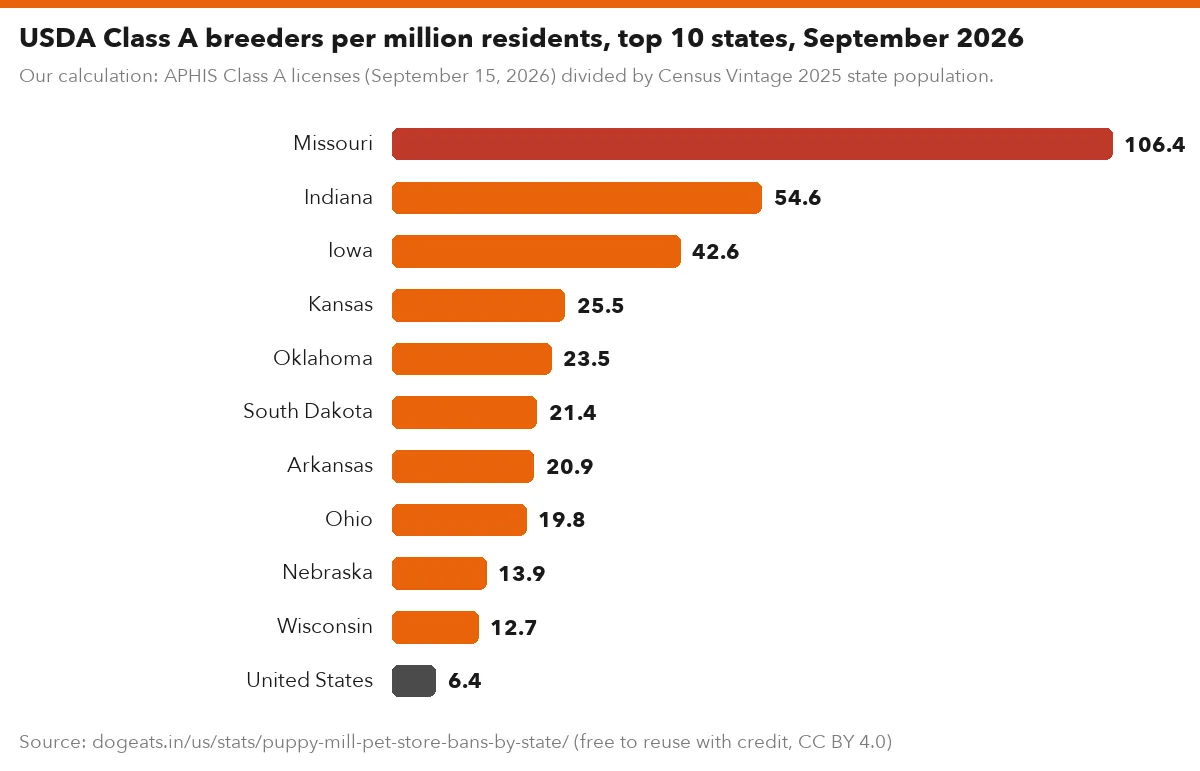
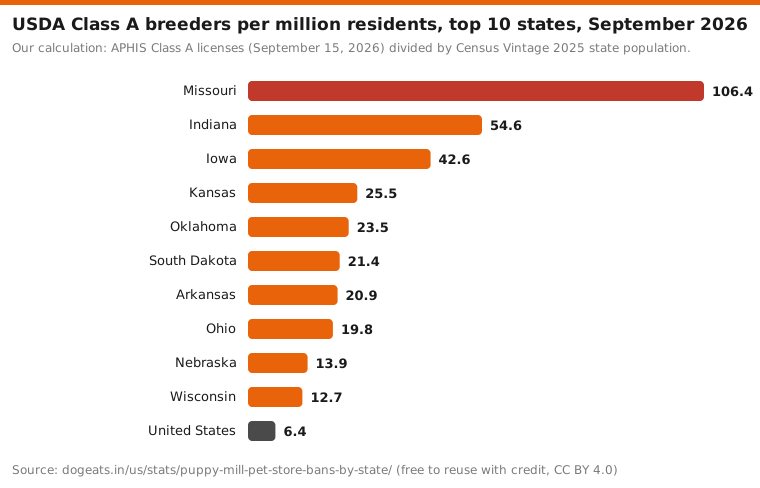
- Missouri has 106.4 Class A breeders per million residents, against 6.4 for the US as a whole.
- Colorado's ban starts January 1, 2028 and also bars brokers from reselling dogs and cats.
- Oregon, Vermont, Maine, Washington and Delaware let some existing pet stores keep selling under grandfather rules.
- The 10 ban states held 111 Class A breeder licenses in September 2026, 5.1% of the national total.
What states have banned puppy mill sales in pet stores?
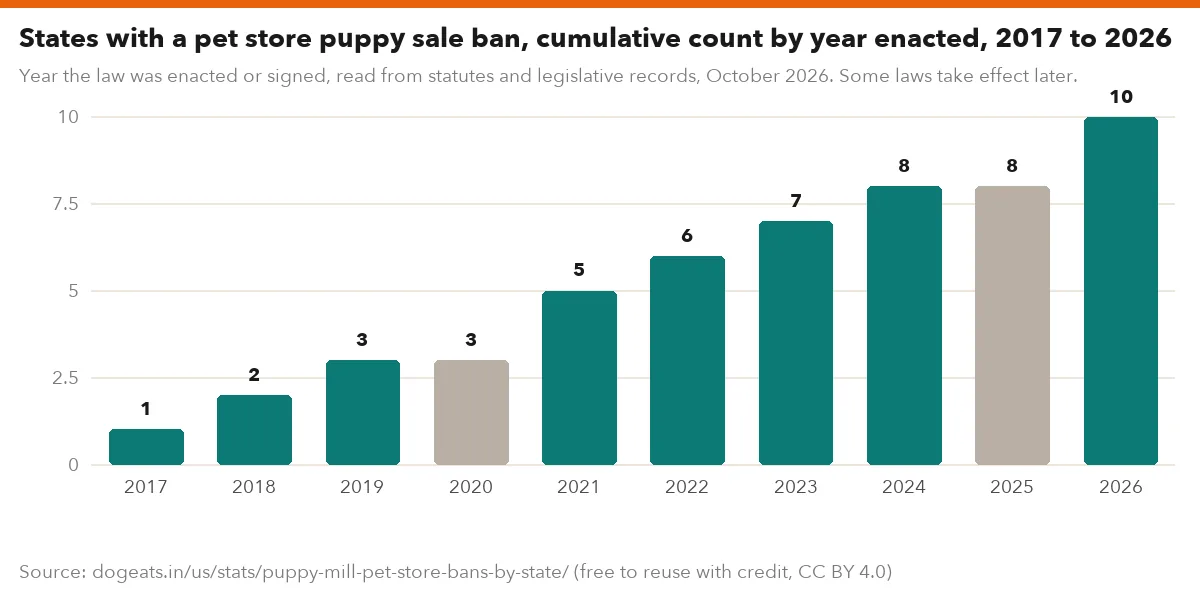
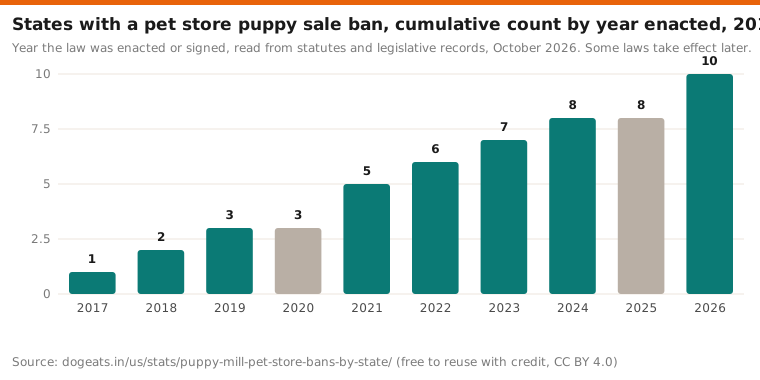
Ten states have passed laws that ban or phase out pet store sales of dogs and cats. They are California, Maryland, Maine, Washington, Illinois, New York, Oregon, Vermont, Colorado and Delaware.
California was first, in 2017, and its ban took effect on January 1, 2019. Maryland followed in 2018, Maine in 2019 and Washington and Illinois in 2021.
New York passed its law in 2022, Oregon in 2023 and Vermont in 2024. Colorado and Delaware both enacted bans in 2026, matching 2021 as the year with the most new state bans.
Year the law was enacted or signed, read from statutes and legislative records, October 2026. Some laws take effect later.
Show the numbers
| Label | Value |
|---|---|
| 2017 | 1 |
| 2018 | 2 |
| 2019 | 3 |
| 2020 | 3 |
| 2021 | 5 |
| 2022 | 6 |
| 2023 | 7 |
| 2024 | 8 |
| 2025 | 8 |
| 2026 | 10 |
Embed this chart
| State | Enacted | In effect from | Animals covered | Exceptions and grandfather rules | Penalty | Statute |
|---|---|---|---|---|---|---|
| California | 2017 (AB 485) | January 1, 2019; current text from AB 2152, effective January 1, 2021 | Dogs, cats, rabbits | None; stores may host shelter or rescue adoptions, fees capped at $500 | $1,000, $2,500, then $5,000 per animal if a notice to correct is ignored | Health and Safety Code 122354.5 |
| Maryland | 2018 (HB 1662, Chapter 237) | January 1, 2020 | Dogs, cats | None; stores may offer space for shelter adoptions | Not in section read | Business Regulation 19-703 |
| Maine | 2019 (LD 1311, Public Law chapter 544) | December 2019 (180 days after the session adjourned on June 20, 2019) | Dogs, cats | Shops selling on the effective date, same owner as May 1, 2019 (family transfers allowed), no more animals than in 2018 | Civil fine of $500 per violation; license can be suspended or revoked | 7 M.R.S. 4153(3) |
| Washington | 2021 (Chapter 76) | July 25, 2021 | Dogs, cats | Stores that sold dogs before July 25, 2021 may keep selling dogs under sourcing and disclosure rules | Civil infraction up to $250; banned after 3 violations in a year | RCW 16.52.360 |
| Illinois | 2021 (Public Act 102-0586, approved August 27, 2021) | February 23, 2022 | Dogs, cats | Pet shops may sell only dogs and cats from animal control facilities or shelters | Not in section read | 225 ILCS 605/3.8 |
| New York | 2022 (S1130, Chapter 681, signed December 15, 2022) | December 15, 2024 | Dogs, cats, rabbits | None; stores may host adoptions by qualifying rescue groups | Up to $1,000 per violation (Attorney General) | General Business Law 753-f |
| Oregon | 2023 (HB 2915, Chapter 420) | 2023 for new sellers; full ban September 1, 2028 | Dogs, cats | Existing sellers at the same address with no change of owner until September 1, 2028 | Up to $500 per violation | ORS 646A.075 |
| Vermont | 2024 (Act 141) | July 1, 2024 | Dogs, cats, wolf-hybrids | Shops selling before July 1, 2024, same owner, no more animals than in 2023 | Up to $1,000 per violation | 20 V.S.A. 3931 |
| Colorado | 2026 (HB26-1011, Chapter 78, approved April 29, 2026) | January 1, 2028 | Dogs, cats; brokers also barred | Broker exceptions for service dogs, hunting dogs, shelters, original breeders | Not in section read | C.R.S. 35-80-108.5 |
| Delaware | 2026 (HB 131, 85 Del. Laws c. 369, signed July 23, 2026) | January 23, 2027 | Dogs, cats | Dog retailers licensed a year or more, same owner, buying only from Class A breeders without recent serious USDA violations | Up to $500 per prohibited sale (bill synopsis) | 6 Del. C. ch. 40A (new) |
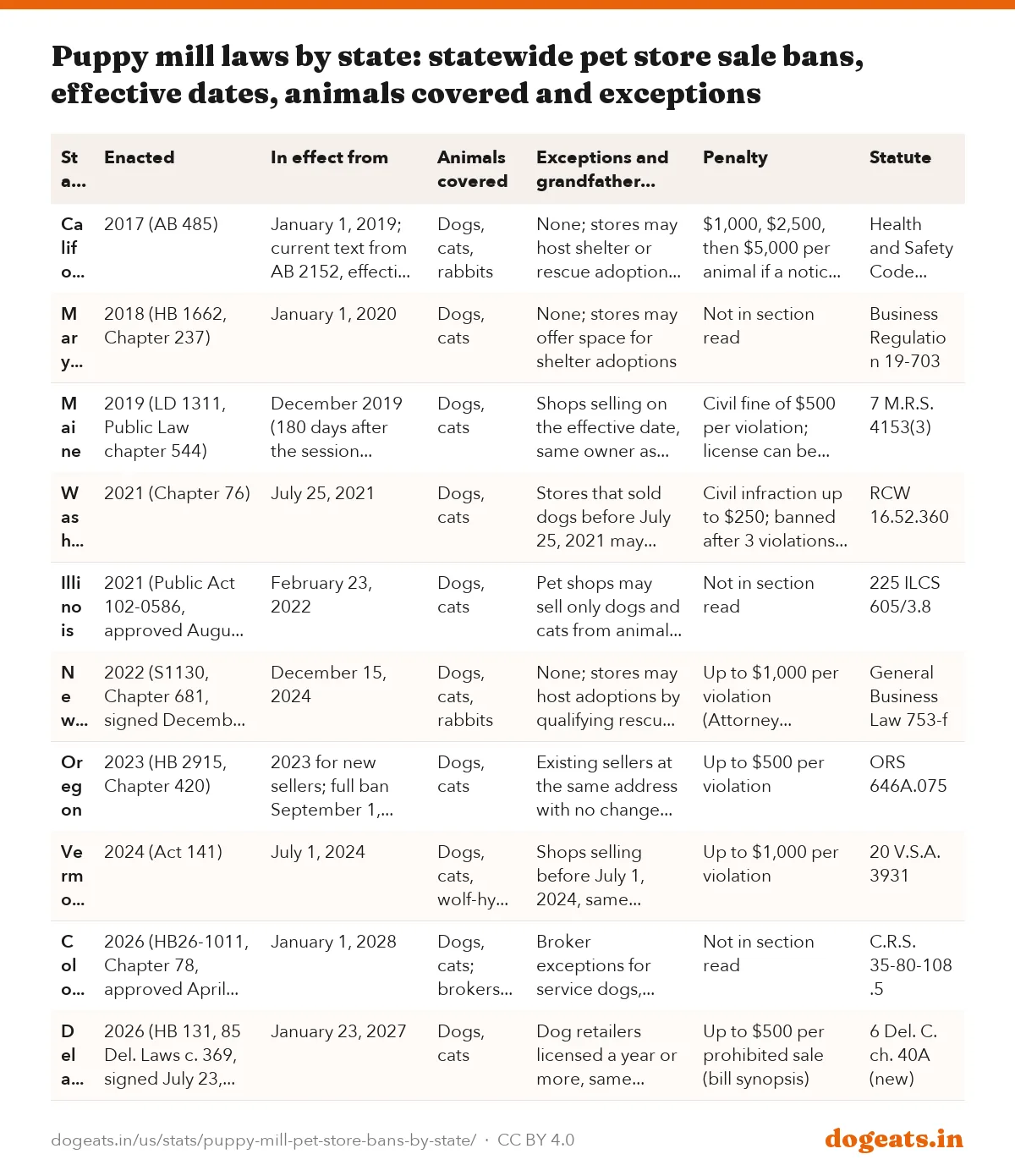
These laws stop pet stores from selling dogs and cats. They do not stop breeders from selling directly to buyers, including online, in any of these states.
Most of the laws let stores host adoptions for shelters and rescue groups instead. California caps the total adoption fee for animals shown in stores at $500.
Penalties vary widely. California fines start at $1,000 and reach $5,000 for later violations, while Washington sets a $250 civil infraction and bars sales after three violations in a year.
Eight bans are in force, two start in 2027 and 2028
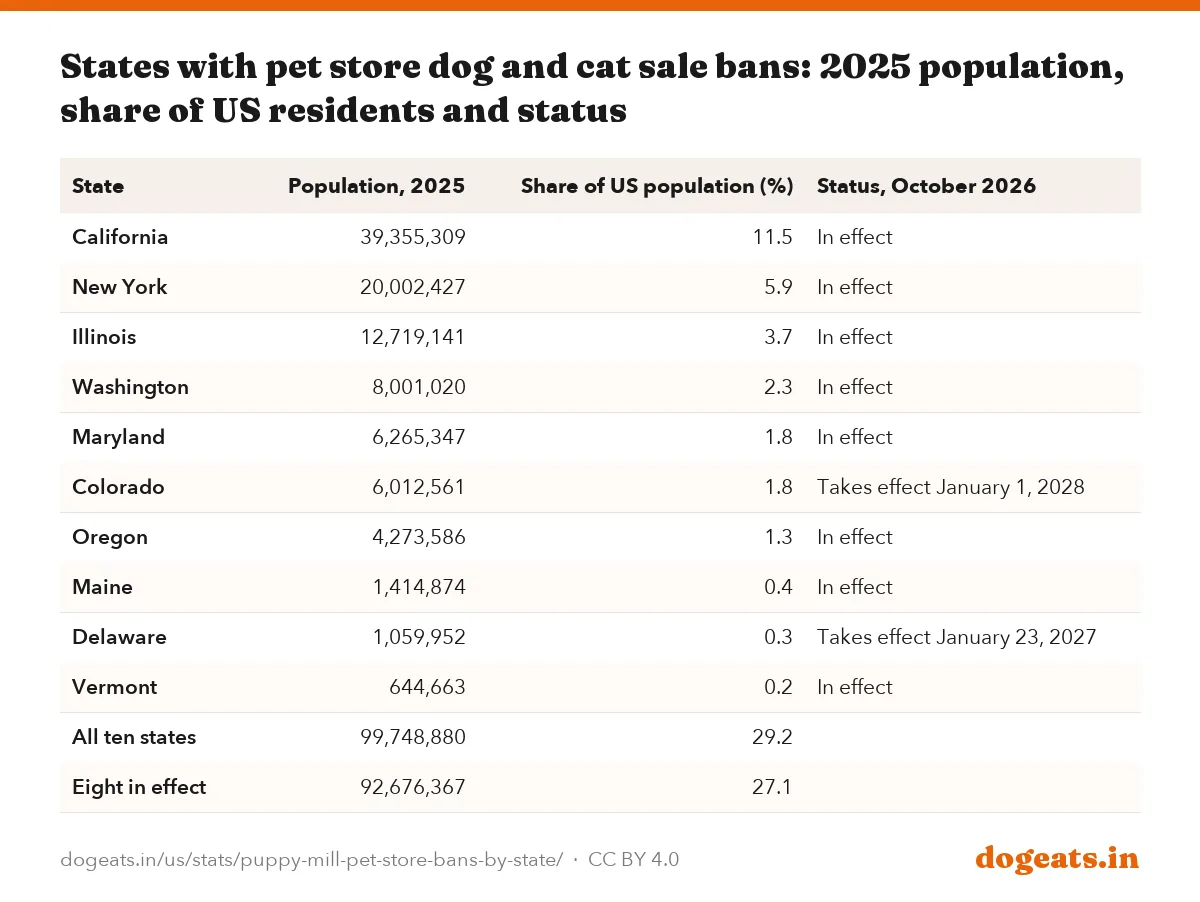
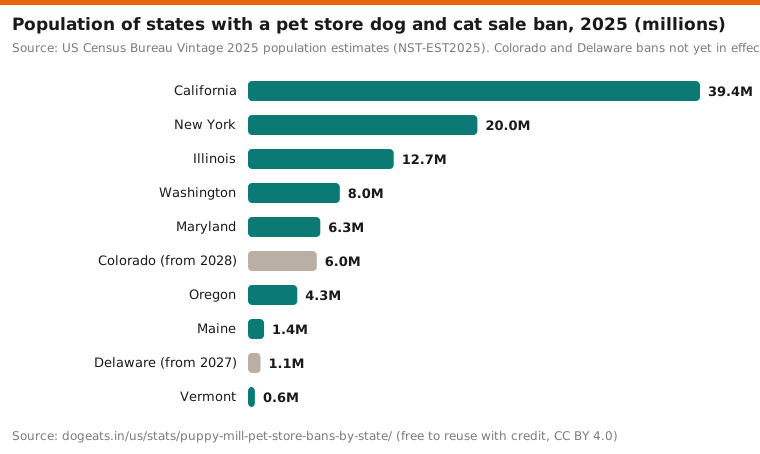
Eight state bans are in effect as of October 2026. They cover 92.7 million residents, or 27.1% of the US population in the Census Bureau's 2025 estimates.
Delaware's law takes effect on January 23, 2027, six months after it was signed on July 23, 2026. Colorado's starts on January 1, 2028.
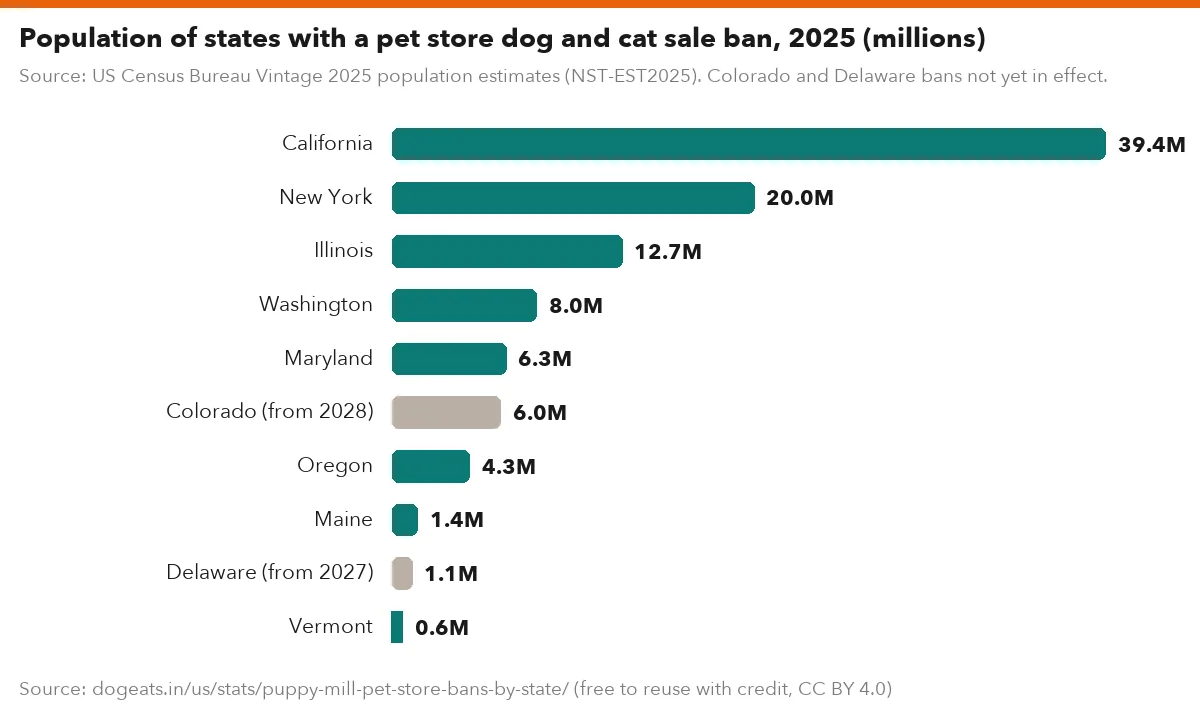
Once both are in force, the ten states will cover 99.7 million people, or 29.2% of US residents. California alone accounts for 39.4 million of them, New York for 20.0 million and Illinois for 12.7 million.
| State | Population, 2025 | Share of US population (%) | Status, October 2026 |
|---|---|---|---|
| California | 39,355,309 | 11.5 | In effect |
| New York | 20,002,427 | 5.9 | In effect |
| Illinois | 12,719,141 | 3.7 | In effect |
| Washington | 8,001,020 | 2.3 | In effect |
| Maryland | 6,265,347 | 1.8 | In effect |
| Colorado | 6,012,561 | 1.8 | Takes effect January 1, 2028 |
| Oregon | 4,273,586 | 1.3 | In effect |
| Maine | 1,414,874 | 0.4 | In effect |
| Delaware | 1,059,952 | 0.3 | Takes effect January 23, 2027 |
| Vermont | 644,663 | 0.2 | In effect |
| All ten states | 99,748,880 | 29.2 | |
| Eight in effect | 92,676,367 | 27.1 |
Source: US Census Bureau Vintage 2025 population estimates (NST-EST2025). Colorado and Delaware bans not yet in effect.
Show the numbers
| Label | M |
|---|---|
| California | 39.4M |
| New York | 20.0M |
| Illinois | 12.7M |
| Washington | 8.0M |
| Maryland | 6.3M |
| Colorado (from 2028) | 6.0M |
| Oregon | 4.3M |
| Maine | 1.4M |
| Delaware (from 2027) | 1.1M |
| Vermont | 0.6M |
Embed this chart
Several laws protect stores that already sold animals. Oregon's grandfather rule ends on September 1, 2028, when its full ban applies.
Vermont and Maine let existing shops continue only under the same owner and at or below their 2023 and 2018 sales levels. Washington lets stores that sold dogs before July 25, 2021 keep selling dogs.
USDA-licensed breeders by state: Missouri leads
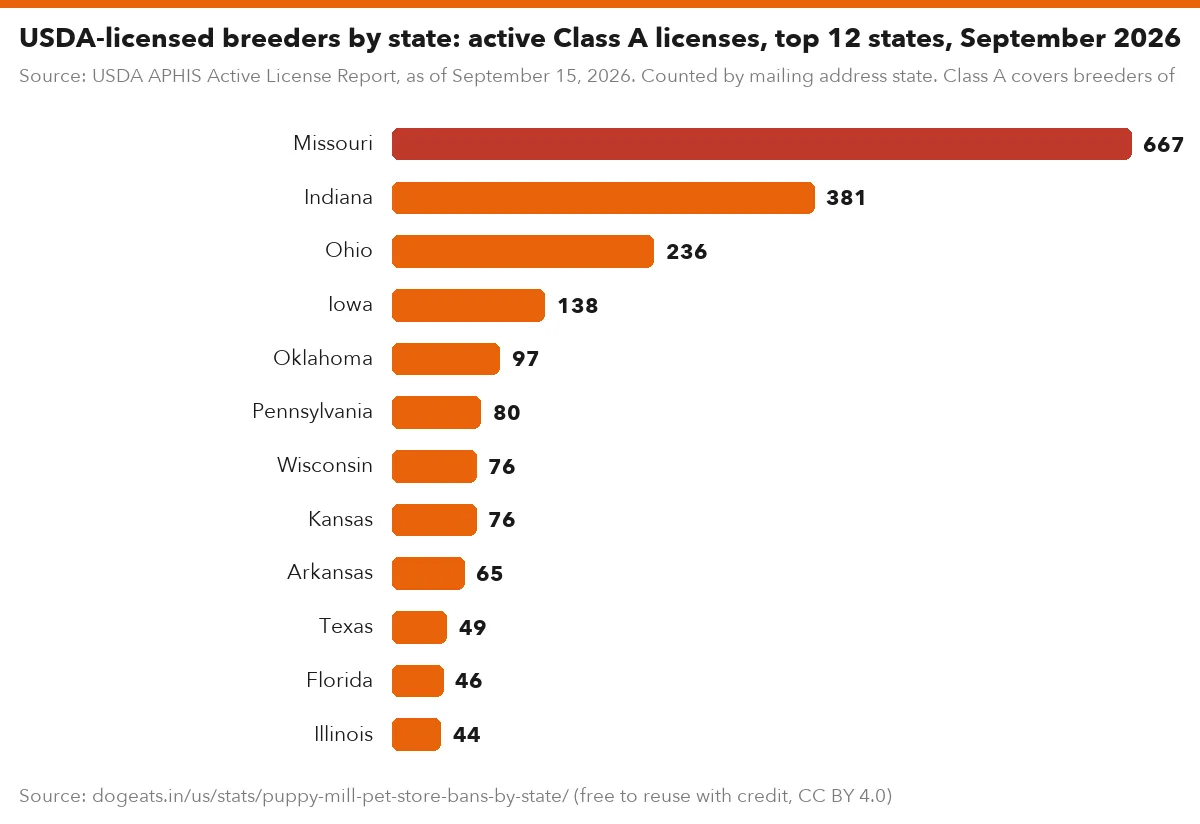
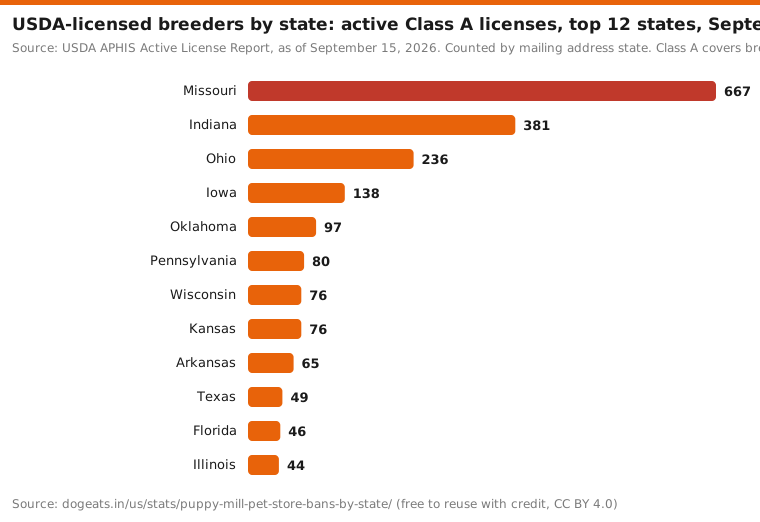
The USDA listed 2,184 active Class A breeder licenses on September 15, 2026. Missouri had 667, or 30.5% of the total.
Indiana had 381 and Ohio 236. Together the three states held 58.8% of all Class A licenses, and the top 12 states held 89.5%.
Class A licenses cover breeders of any animal regulated under the Animal Welfare Act, not only dogs. The list does not show how many dogs each breeder keeps.
Source: USDA APHIS Active License Report, as of September 15, 2026. Counted by mailing address state. Class A covers breeders of all regulated species.
Show the numbers
| Label | Value |
|---|---|
| Missouri | 667 |
| Indiana | 381 |
| Ohio | 236 |
| Iowa | 138 |
| Oklahoma | 97 |
| Pennsylvania | 80 |
| Wisconsin | 76 |
| Kansas | 76 |
| Arkansas | 65 |
| Texas | 49 |
| Florida | 46 |
| Illinois | 44 |
Embed this chart
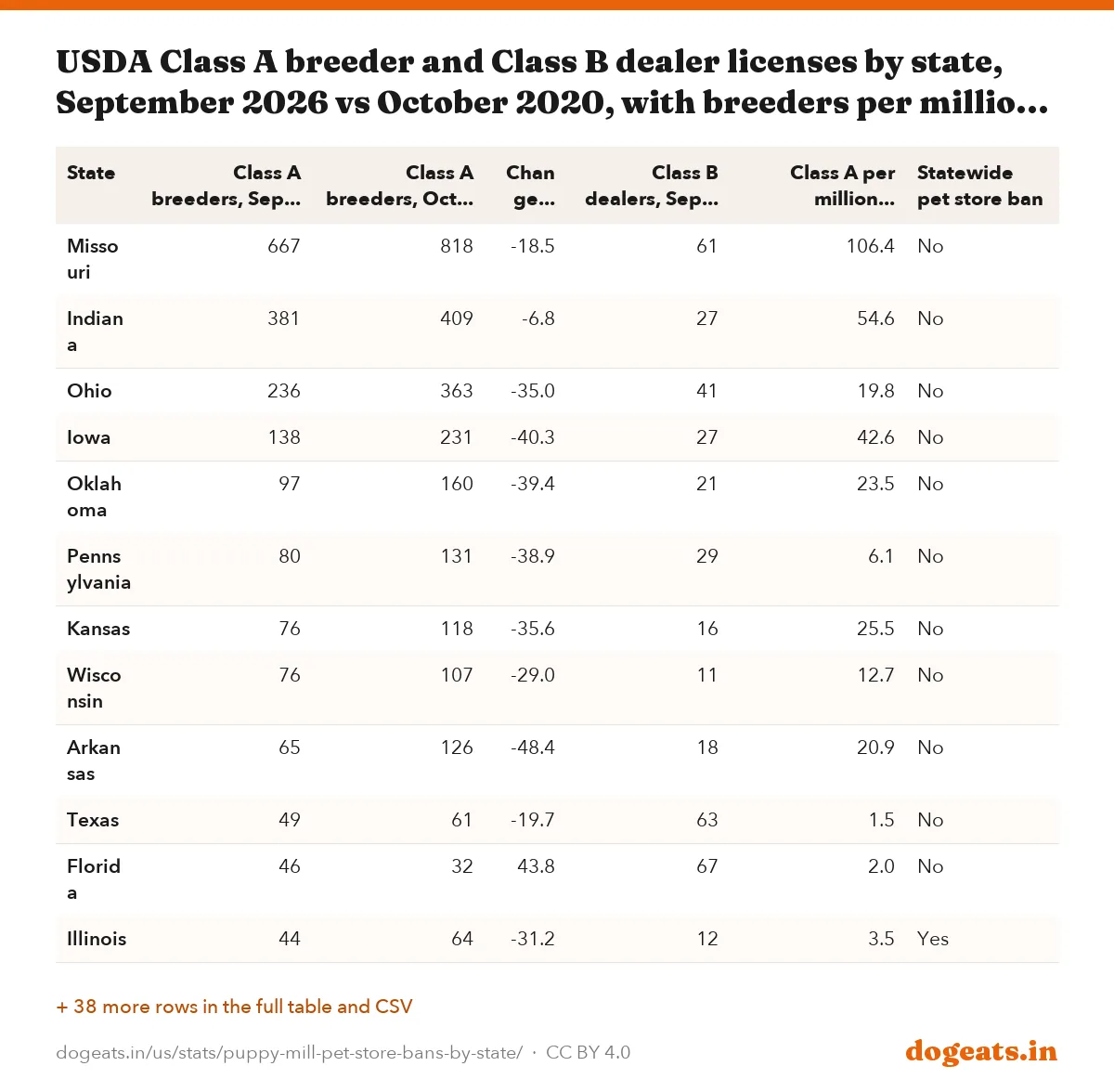
| State | Class A breeders, Sep 2026 | Class A breeders, Oct 2020 | Change (%) | Class B dealers, Sep 2026 | Class A per million residents | Statewide pet store ban |
|---|---|---|---|---|---|---|
| Missouri | 667 | 818 | -18.5 | 61 | 106.4 | No |
| Indiana | 381 | 409 | -6.8 | 27 | 54.6 | No |
| Ohio | 236 | 363 | -35.0 | 41 | 19.8 | No |
| Iowa | 138 | 231 | -40.3 | 27 | 42.6 | No |
| Oklahoma | 97 | 160 | -39.4 | 21 | 23.5 | No |
| Pennsylvania | 80 | 131 | -38.9 | 29 | 6.1 | No |
| Kansas | 76 | 118 | -35.6 | 16 | 25.5 | No |
| Wisconsin | 76 | 107 | -29.0 | 11 | 12.7 | No |
| Arkansas | 65 | 126 | -48.4 | 18 | 20.9 | No |
| Texas | 49 | 61 | -19.7 | 63 | 1.5 | No |
| Florida | 46 | 32 | 43.8 | 67 | 2.0 | No |
| Illinois | 44 | 64 | -31.2 | 12 | 3.5 | Yes |
| Nebraska | 28 | 44 | -36.4 | 5 | 13.9 | No |
| New York | 28 | 50 | -44.0 | 24 | 1.4 | Yes |
| Michigan | 22 | 31 | -29.0 | 17 | 2.2 | No |
| South Dakota | 20 | 38 | -47.4 | 6 | 21.4 | No |
| Minnesota | 18 | 28 | -35.7 | 14 | 3.1 | No |
| California | 13 | 7 | 85.7 | 19 | 0.3 | Yes |
| Washington | 11 | 14 | -21.4 | 4 | 1.4 | Yes |
| Georgia | 9 | 17 | -47.1 | 9 | 0.8 | No |
| Kentucky | 9 | 5 | 80.0 | 3 | 2.0 | No |
| Tennessee | 8 | 10 | -20.0 | 14 | 1.1 | No |
| Oregon | 7 | 12 | -41.7 | 4 | 1.6 | Yes |
| Maryland | 5 | 9 | -44.4 | 8 | 0.8 | Yes |
| Massachusetts | 5 | 7 | -28.6 | 7 | 0.7 | No |
| Virginia | 5 | 16 | -68.8 | 7 | 0.6 | No |
| Montana | 4 | 4 | 0.0 | 4 | 3.5 | No |
| South Carolina | 4 | 8 | -50.0 | 8 | 0.7 | No |
| Utah | 4 | 7 | -42.9 | 3 | 1.1 | No |
| Colorado | 3 | 15 | -80.0 | 7 | 0.5 | Yes |
| Louisiana | 3 | 16 | -81.2 | 5 | 0.6 | No |
| Nevada | 3 | 4 | -25.0 | 3 | 0.9 | No |
| New Hampshire | 3 | 2 | 50.0 | 3 | 2.1 | No |
| North Carolina | 3 | 7 | -57.1 | 16 | 0.3 | No |
| Arizona | 2 | 6 | -66.7 | 1 | 0.3 | No |
| Connecticut | 2 | 6 | -66.7 | 3 | 0.5 | No |
| Mississippi | 2 | 7 | -71.4 | 5 | 0.7 | No |
| West Virginia | 2 | 1 | 100.0 | 2 | 1.1 | No |
| Alabama | 1 | 4 | -75.0 | 7 | 0.2 | No |
| Alaska | 1 | 1 | 0.0 | 0 | 1.4 | No |
| Idaho | 1 | 2 | -50.0 | 0 | 0.5 | No |
| New Jersey | 1 | 3 | -66.7 | 11 | 0.1 | No |
| New Mexico | 1 | 2 | -50.0 | 2 | 0.5 | No |
| North Dakota | 1 | 5 | -80.0 | 2 | 1.3 | No |
| Delaware | 0 | 0 | 1 | 0.0 | Yes | |
| Maine | 0 | 2 | -100.0 | 3 | 0.0 | Yes |
| Puerto Rico | 0 | 0 | 0 | 0.0 | No | |
| Rhode Island | 0 | 1 | -100.0 | 0 | 0.0 | No |
| Vermont | 0 | 0 | 0 | 0.0 | Yes | |
| Wyoming | 0 | 3 | -100.0 | 0 | 0.0 | No |
States with pet store bans hold few licensed breeders. The ten ban states had 111 Class A licenses in September 2026, 5.1% of the total, led by Illinois with 44 and New York with 28.
Federal rules exempt retail pet stores, where buyers see the animal in person, from USDA licensing. Breeders with four or fewer breeding females who sell only offspring born on site are also exempt (9 CFR 2.1).
Licensed breeder numbers have fallen 27.5% since 2020
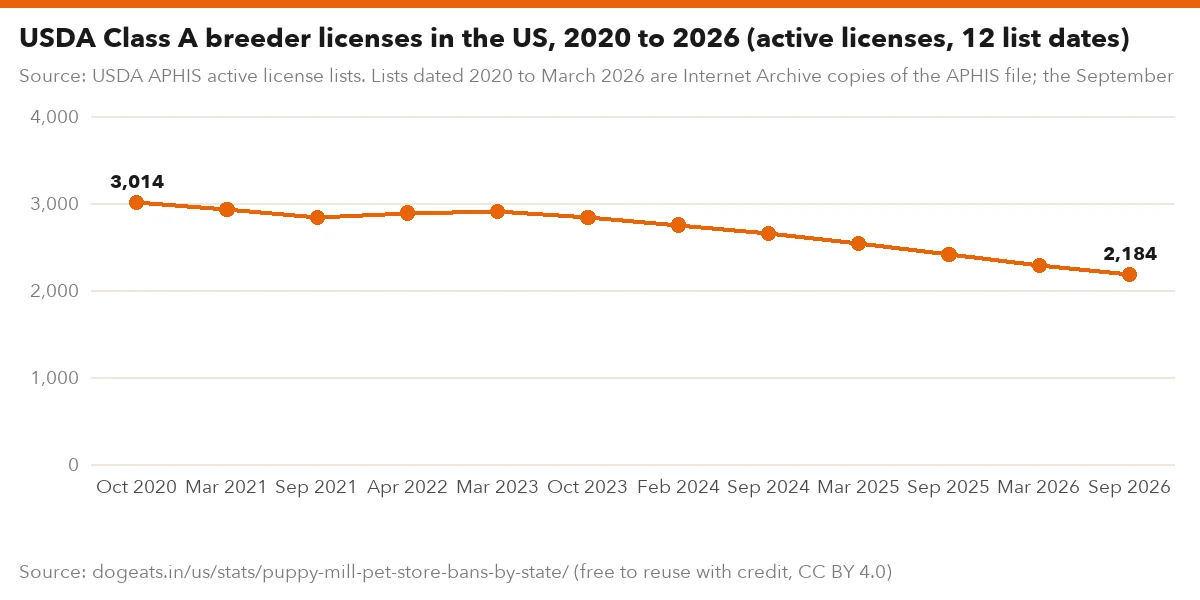
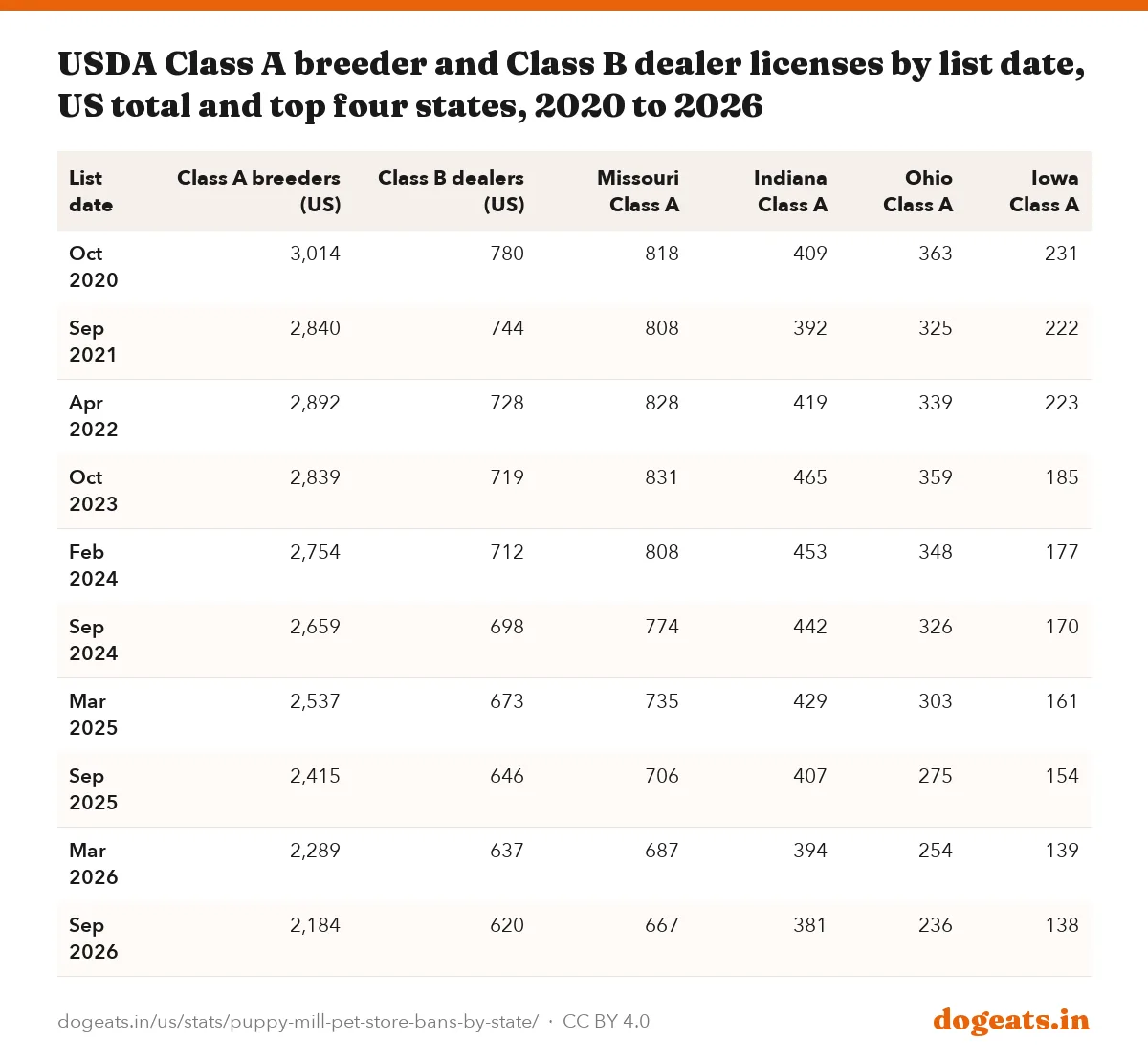
Active Class A licenses fell from 3,014 in October 2020 to 2,184 in September 2026. Class B dealer licenses, which include brokers, fell from 780 to 620.
Most of the decline came after early 2024. The count was 2,754 in February 2024, so 570 licenses dropped off in the following two and a half years.
The fall was steady. Class A licenses dropped by 244 between September 2024 and September 2025, then by 231 more to 2,184 in September 2026.
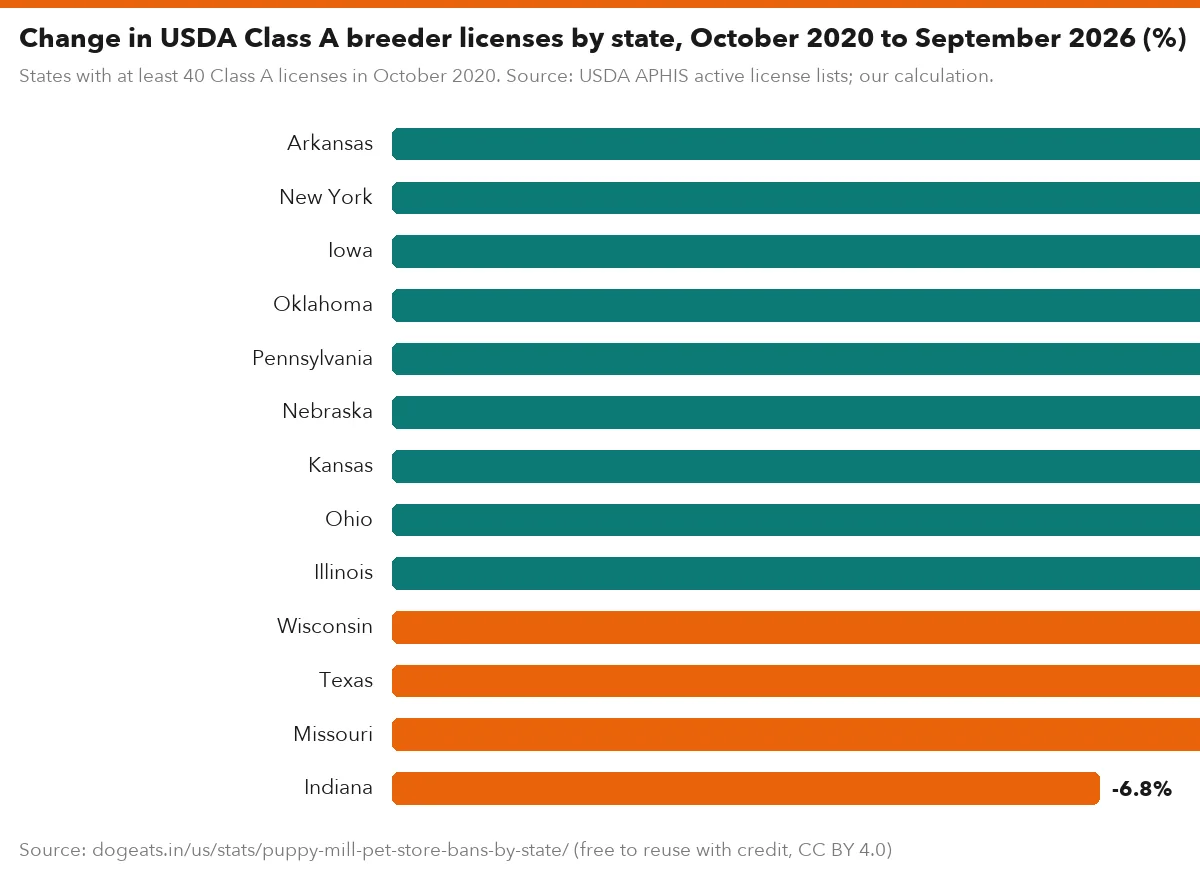
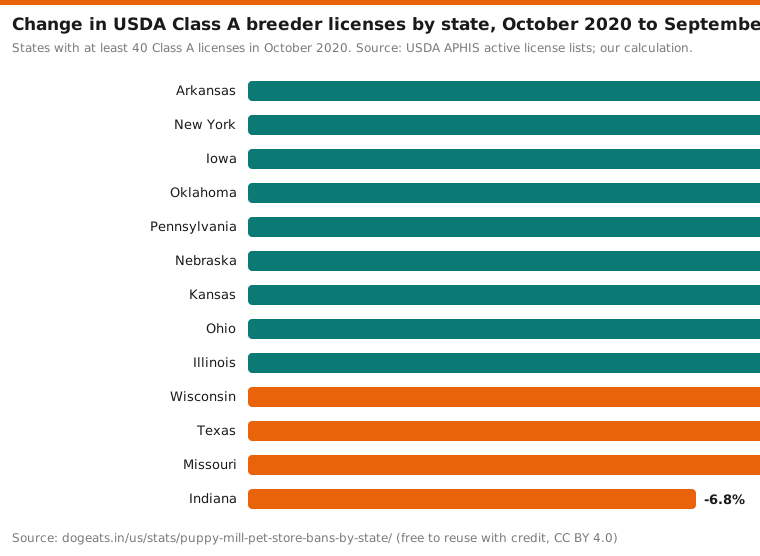
Missouri fell from 818 to 667 and Ohio from 363 to 236. Arkansas fell 48.4%, the steepest drop among states with at least 40 licenses in 2020.

Source: USDA APHIS active license lists. Lists dated 2020 to March 2026 are Internet Archive copies of the APHIS file; the September 15, 2026 list is the current file.
Show the numbers
| Label | Value |
|---|---|
| Oct 2020 | 3,014 |
| Mar 2021 | 2,935 |
| Sep 2021 | 2,840 |
| Apr 2022 | 2,892 |
| Mar 2023 | 2,912 |
| Oct 2023 | 2,839 |
| Feb 2024 | 2,754 |
| Sep 2024 | 2,659 |
| Mar 2025 | 2,537 |
| Sep 2025 | 2,415 |
| Mar 2026 | 2,289 |
| Sep 2026 | 2,184 |
Embed this chart
States with at least 40 Class A licenses in October 2020. Source: USDA APHIS active license lists; our calculation.
Show the numbers
| Label | % |
|---|---|
| Arkansas | -48.4% |
| New York | -44.0% |
| Iowa | -40.3% |
| Oklahoma | -39.4% |
| Pennsylvania | -38.9% |
| Nebraska | -36.4% |
| Kansas | -35.6% |
| Ohio | -35.0% |
| Illinois | -31.2% |
| Wisconsin | -29.0% |
| Texas | -19.7% |
| Missouri | -18.5% |
| Indiana | -6.8% |
Embed this chart
| List date | Class A breeders (US) | Class B dealers (US) | Missouri Class A | Indiana Class A | Ohio Class A | Iowa Class A |
|---|---|---|---|---|---|---|
| Oct 2020 | 3,014 | 780 | 818 | 409 | 363 | 231 |
| Sep 2021 | 2,840 | 744 | 808 | 392 | 325 | 222 |
| Apr 2022 | 2,892 | 728 | 828 | 419 | 339 | 223 |
| Oct 2023 | 2,839 | 719 | 831 | 465 | 359 | 185 |
| Feb 2024 | 2,754 | 712 | 808 | 453 | 348 | 177 |
| Sep 2024 | 2,659 | 698 | 774 | 442 | 326 | 170 |
| Mar 2025 | 2,537 | 673 | 735 | 429 | 303 | 161 |
| Sep 2025 | 2,415 | 646 | 706 | 407 | 275 | 154 |
| Mar 2026 | 2,289 | 637 | 687 | 394 | 254 | 139 |
| Sep 2026 | 2,184 | 620 | 667 | 381 | 236 | 138 |
Florida was an exception among the larger states, rising from 32 to 46 Class A licenses. Indiana fell only 6.8%, from 409 to 381.
A falling license count does not prove fewer dogs are bred. Breeders can drop below the federal licensing threshold, sell only directly to the public, or close.
Breeders per capita: Missouri has 17 times the national rate
Missouri had 106.4 Class A breeders per million residents in September 2026. The national rate was 6.4, so Missouri's rate was about 17 times higher.
Indiana had 54.6 per million and Iowa 42.6. Kansas, Oklahoma, South Dakota and Arkansas each had more than 20.
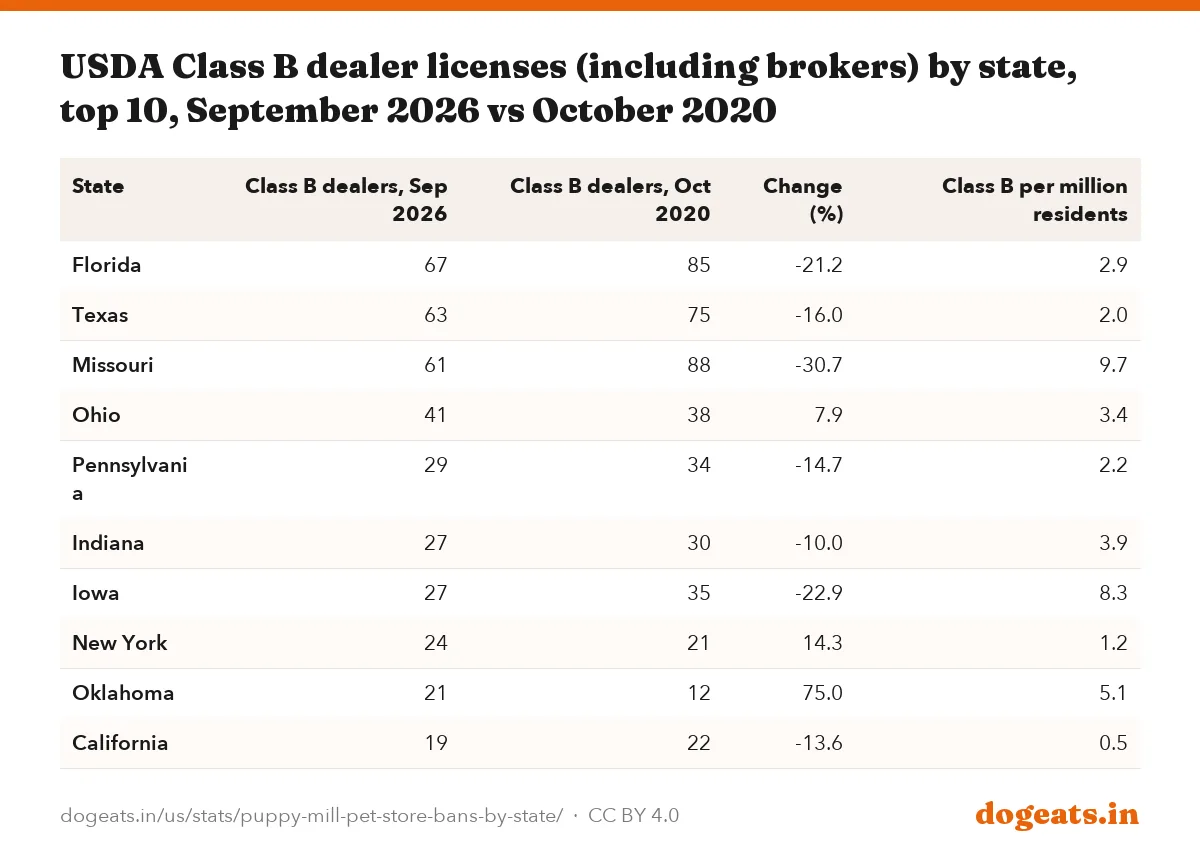
Florida, Texas and Missouri had the most Class B dealer licenses, with 67, 63 and 61. Dealers buy and resell animals, and brokers are counted in this class.
Our calculation: APHIS Class A licenses (September 15, 2026) divided by Census Vintage 2025 state population.
Show the numbers
| Label | Value |
|---|---|
| Missouri | 106.4 |
| Indiana | 54.6 |
| Iowa | 42.6 |
| Kansas | 25.5 |
| Oklahoma | 23.5 |
| South Dakota | 21.4 |
| Arkansas | 20.9 |
| Ohio | 19.8 |
| Nebraska | 13.9 |
| Wisconsin | 12.7 |
| United States | 6.4 |
Embed this chart
| State | Class B dealers, Sep 2026 | Class B dealers, Oct 2020 | Change (%) | Class B per million residents |
|---|---|---|---|---|
| Florida | 67 | 85 | -21.2 | 2.9 |
| Texas | 63 | 75 | -16.0 | 2.0 |
| Missouri | 61 | 88 | -30.7 | 9.7 |
| Ohio | 41 | 38 | 7.9 | 3.4 |
| Pennsylvania | 29 | 34 | -14.7 | 2.2 |
| Indiana | 27 | 30 | -10.0 | 3.9 |
| Iowa | 27 | 35 | -22.9 | 8.3 |
| New York | 24 | 21 | 14.3 | 1.2 |
| Oklahoma | 21 | 12 | 75.0 | 5.1 |
| California | 19 | 22 | -13.6 | 0.5 |
Class B dealer licenses totaled 620 in September 2026. The top ten dealer states were Florida (67), Texas (63), Missouri (61), Ohio (41), Pennsylvania (29) and five others with 19 to 27 each.
Missouri's dealer count fell from 88 in 2020 to 61, while Oklahoma's rose from 12 to 21.
What the Horrible Hundred report says
The Horrible Hundred is an annual list of problem dog breeders and sellers published by Humane World for Animals, formerly the Humane Society of the United States. It is advocacy research built from state, federal and court records.
In the 2026 report, released April 27, 2026, Missouri had the most breeders on the list for the 14th year in a row. Wisconsin, New York, Pennsylvania, Kansas and Ohio followed.
Ohio had 8 of the 100 breeders, according to NBC4 Columbus. The group says states with stronger kennel inspection programs produce more records, which can raise their counts.
Local laws go further than state laws. The ASPCA counts close to 300 US cities and counties with retail pet sale bans, while Humane World for Animals counts 530 localities in 31 states. Both are advocacy tallies and use different methods.
What these laws and data do not cover
State bans apply to pet stores, not to breeders selling directly or online. A buyer in a ban state can still buy a puppy from a breeder in another state.
The USDA license list counts businesses by mailing address and covers all regulated species. It is a snapshot of active licenses on the list date, not of animals.
For more on dog data, see our most popular dog breeds report and the shelter adoption statistics.
Frequently asked questions
What states have banned puppy mills?
Ten states ban or phase out pet store sales of dogs and cats. They are California, Maryland, Maine, Washington, Illinois, New York, Oregon, Vermont, Colorado and Delaware. Eight of the bans are in effect as of October 2026.
When does Colorado's pet store ban take effect?
Colorado's HB26-1011, approved April 29, 2026, bars pet stores from selling dogs and cats from January 1, 2028. It also bars brokers from reselling dogs and cats, with some exceptions.
When did New York ban pet store puppy sales?
New York's law was signed on December 15, 2022 and took effect on December 15, 2024. It covers dogs, cats and rabbits, and the Attorney General says violations can bring penalties of up to $1,000 each.
Which state has the most puppy mills?
We found no official count of puppy mills. Missouri has the most USDA-licensed Class A breeders, 667 in September 2026, and has topped the advocacy Horrible Hundred list for 14 years in a row.
How many USDA-licensed breeders are there?
The USDA listed 2,184 active Class A breeder licenses on September 15, 2026, down from 3,014 in October 2020. Class A covers breeders of any regulated animal, not only dogs.
Can pet stores still sell puppies in states with bans?
Some can. Washington, Maine, Vermont and Delaware let certain existing stores continue under grandfather rules, and Oregon allows existing sellers until September 1, 2028.
Does a pet store ban stop online puppy sales?
No. The state laws apply to pet stores. Breeders can still sell directly to buyers, including online, and a few laws, such as Colorado's, also restrict brokers.
How many cities ban pet store puppy sales?
Advocacy groups count hundreds. The ASPCA says close to 300 cities and counties, while Humane World for Animals counts 530 localities in 31 states.
Methodology and limitations
We read the current statute or enrolled bill for each of the ten states between October 9 and 11, 2026. Where a legislature site blocked access, we used an Internet Archive copy. Enactment and effective dates come from that text or from official bill histories.
License counts come from the USDA APHIS Active License Report dated September 15, 2026 and five earlier versions from 2020 to 2024 saved by the Internet Archive. We counted Class A and Class B licenses by mailing address state.
Per-capita rates and population shares use Census Bureau Vintage 2025 state population estimates. All percentages are our calculations.
Horrible Hundred and local ordinance counts come from advocacy groups and news coverage and are labeled as such.
Sources
- USDA APHIS, Active License Report (as of September 15, 2026; earlier lists via Internet Archive), Class A and Class B licenses by state
- Colorado Session Laws 2026, Chapter 78 (HB26-1011), Colorado ban from January 1, 2028 and broker ban
- New York General Business Law 753-f, New York ban on dog, cat and rabbit sales
- Also consulted: California Health and Safety Code 122354.5 (Internet Archive copy, January 2026), Maryland Business Regulation 19-703 and HB 1662 (2018), Maine Public Law chapter 544, 129th Legislature (LD 1311), Revised Code of Washington 16.52.360, Illinois 225 ILCS 605/3.8 and HB 1711 bill status (Internet Archive copies), Oregon HB 2915 (2023) enrolled text (Internet Archive copy), Vermont 20 V.S.A. 3931 (Internet Archive copy, November 2025), Delaware HB 131, 153rd General Assembly, California AB 485 (2017), Chapter 740 (Internet Archive copy), New York S1130 (2021 to 2022) bill actions (Internet Archive copy), New York Attorney General press release, November 22, 2024, eCFR, 9 CFR 1.1 definitions, eCFR, 9 CFR 2.1, US Census Bureau, Vintage 2025 state population estimates, Humane World Action Fund, Horrible Hundred 2026 (advocacy, April 27, 2026), Humane World Action Fund blog, August 3, 2026 (advocacy), ASPCA, retail pet sale bans page (advocacy), NBC4 Columbus, 2026 Horrible Hundred coverage.
Cite, embed and download
This report, its data and its images are free to reuse under a Creative Commons Attribution 4.0 licence. Credit dogeats.in with a link to this page. Every chart has its own embed code, every table has a CSV and an image download, and the images below are ready for social posts, slides and articles.
Cite this report
Link to this report
Every chart and table as an image