Explainer · Updated October 2026
Are dog owners healthier? What the studies show about dogs, heart health and mental health
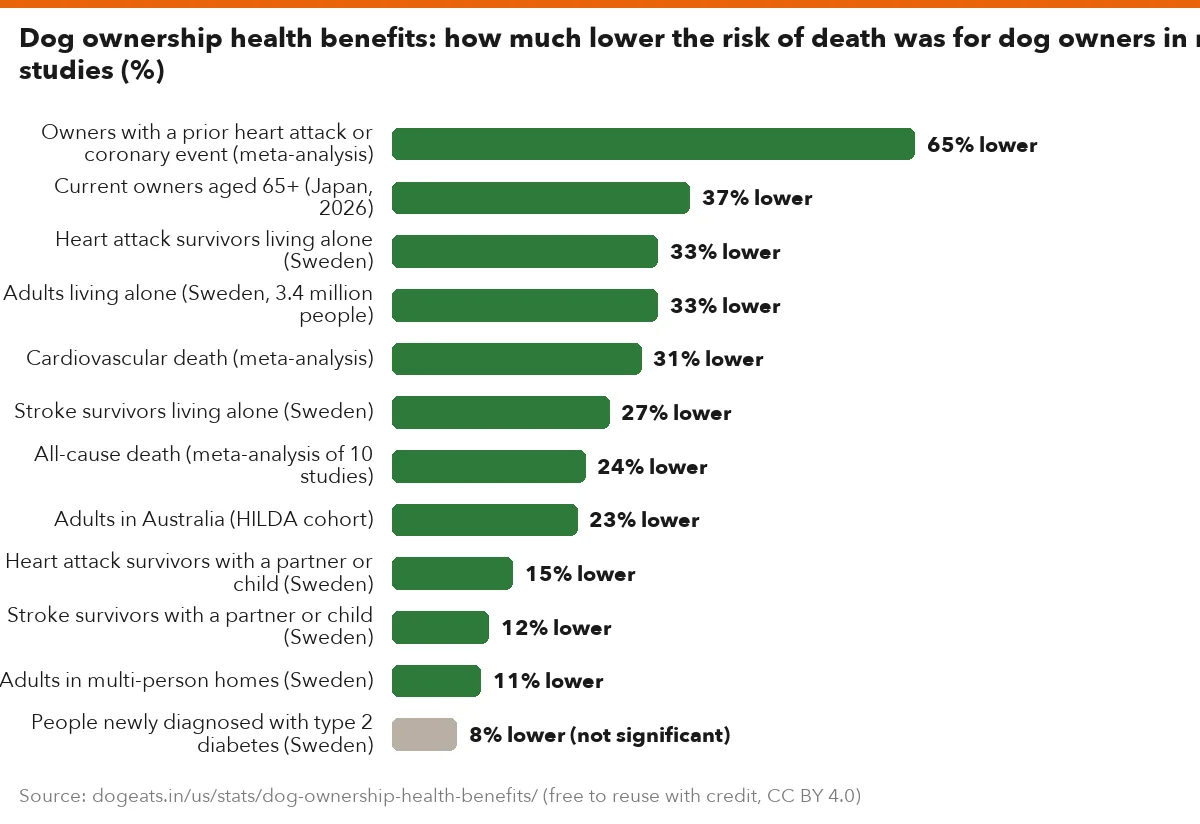
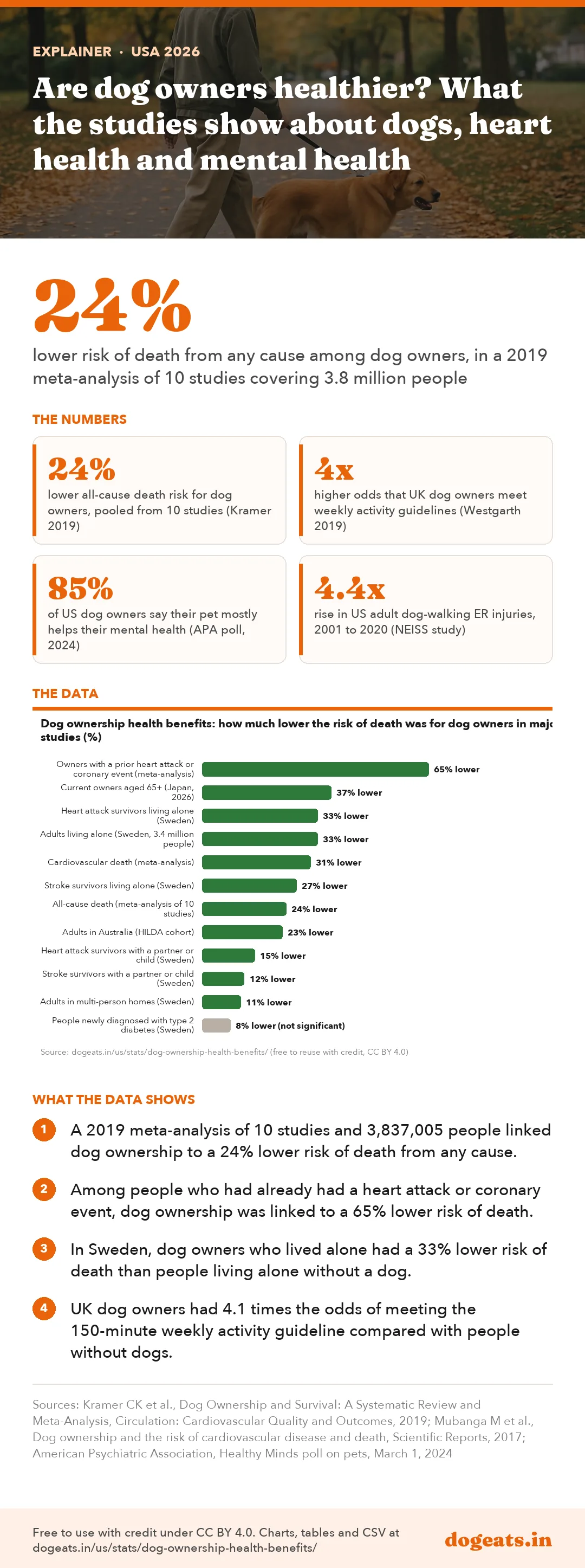
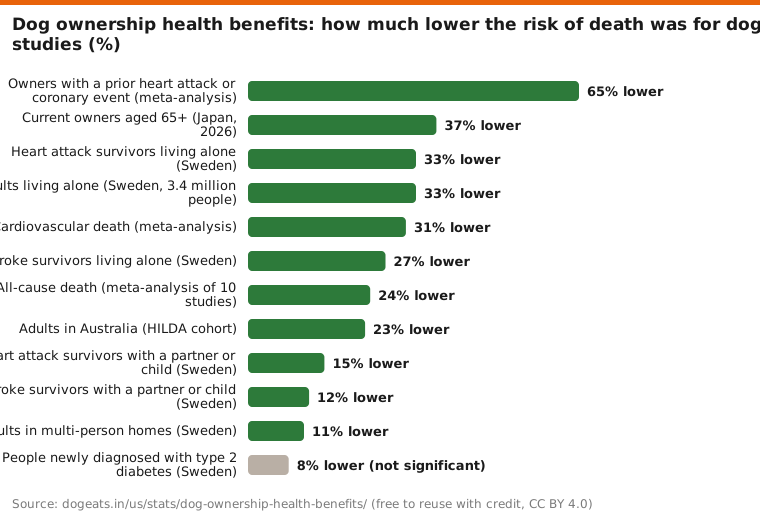
Dog owners live longer on average in large observational studies, but that does not prove dogs cause the difference. A 2019 meta-analysis of 10 studies and 3.8 million people found a 24% lower risk of death among dog owners. Evidence for mental health is weaker and mixed, and dog walking sends tens of thousands of Americans to emergency rooms each year.

Key findings
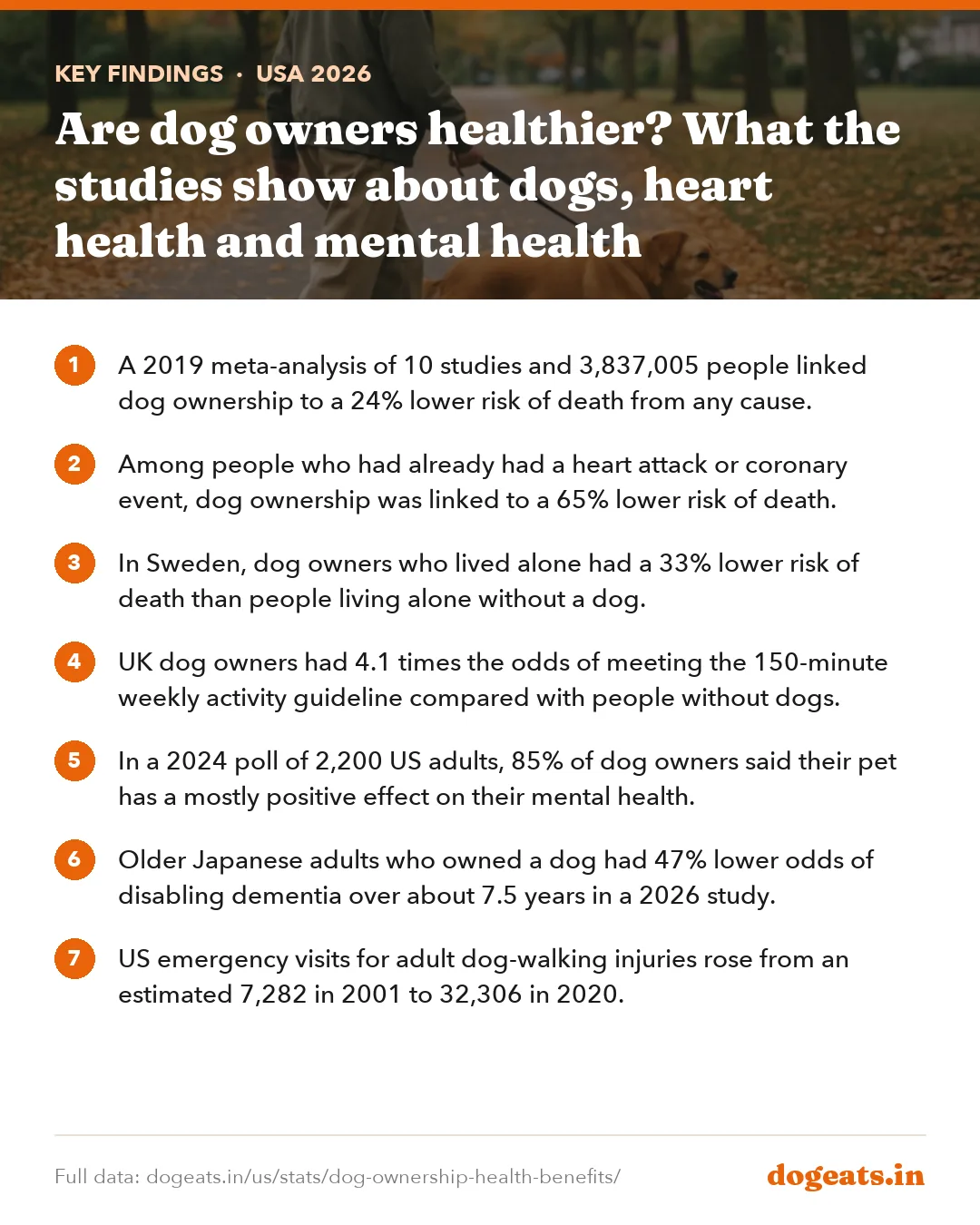
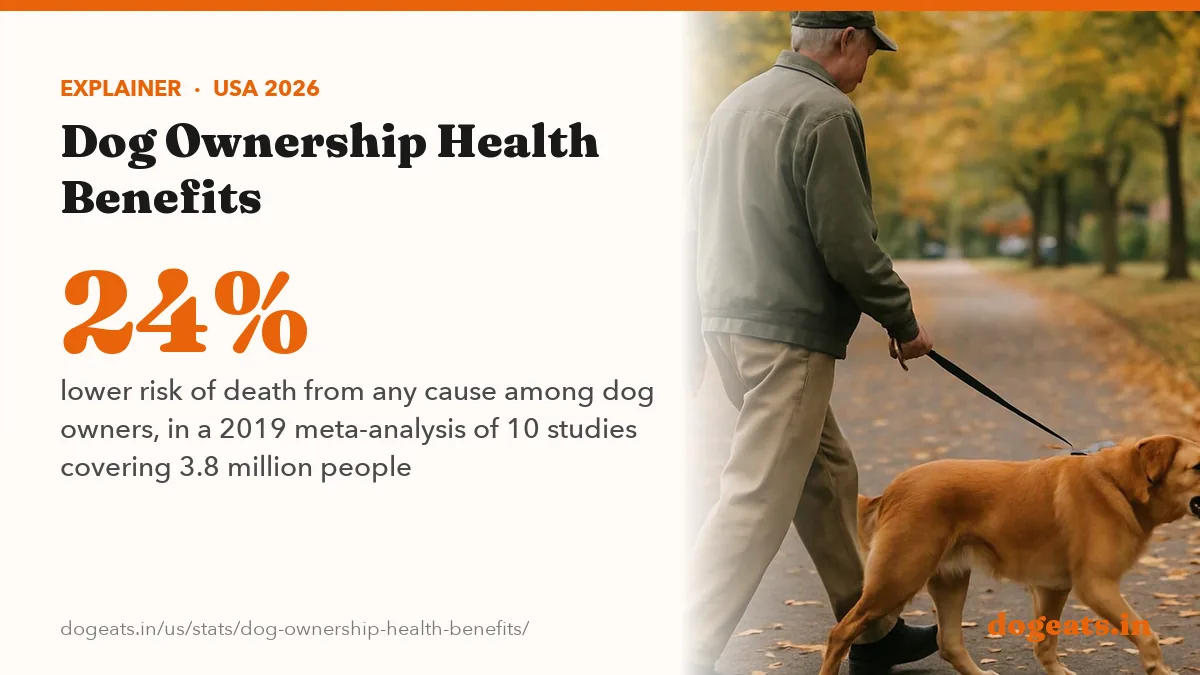
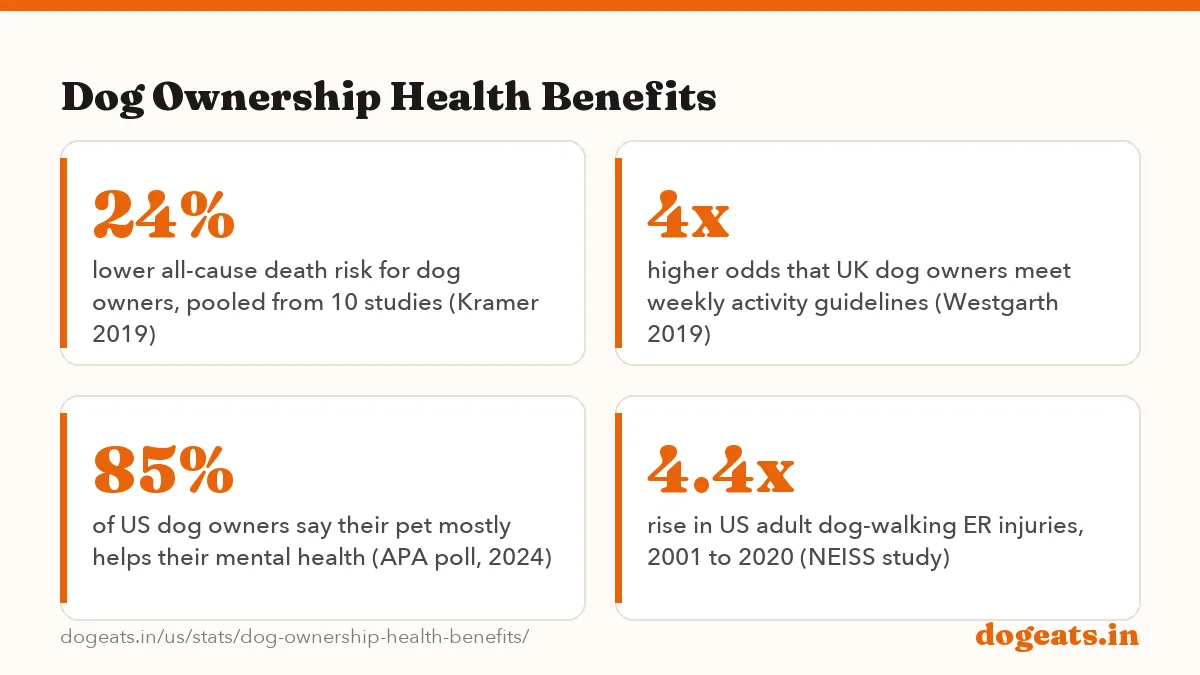
- A 2019 meta-analysis of 10 studies and 3,837,005 people linked dog ownership to a 24% lower risk of death from any cause.
- Among people who had already had a heart attack or coronary event, dog ownership was linked to a 65% lower risk of death.
- In Sweden, dog owners who lived alone had a 33% lower risk of death than people living alone without a dog.
- UK dog owners had 4.1 times the odds of meeting the 150-minute weekly activity guideline compared with people without dogs.
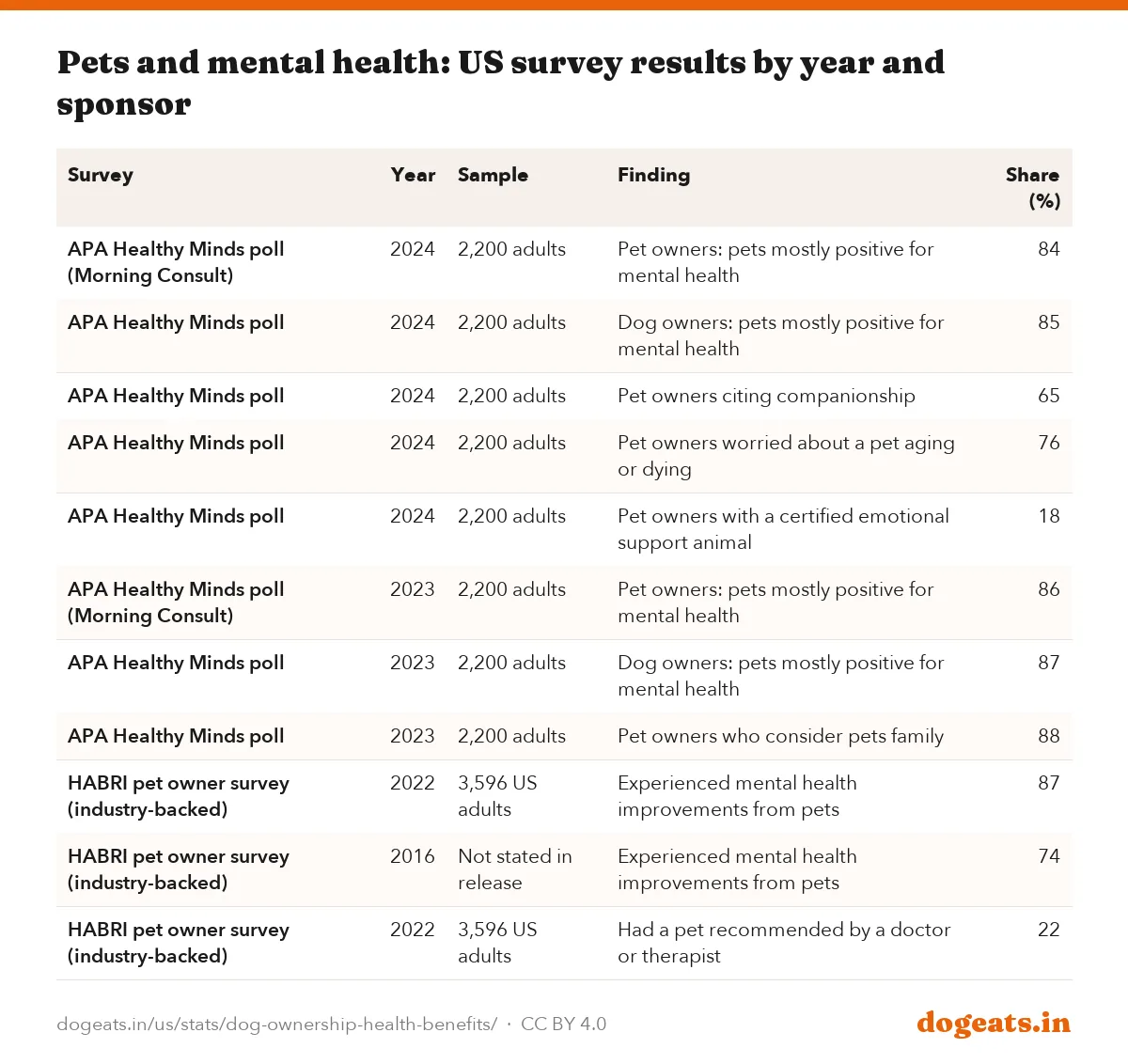
- In a 2024 poll of 2,200 US adults, 85% of dog owners said their pet has a mostly positive effect on their mental health.
- Older Japanese adults who owned a dog had 47% lower odds of disabling dementia over about 7.5 years in a 2026 study.
- US emergency visits for adult dog-walking injuries rose from an estimated 7,282 in 2001 to 32,306 in 2020.
- Not every study finds a benefit: Swedish dog owners with new type 2 diabetes had no lower risk of death.
Are dog owners healthier?
On average, yes, in most large studies. Dog owners die at lower rates than non-owners, especially after a heart attack or when they live alone. These studies observe people over time; they cannot prove that the dog causes the difference.
The strongest summary is a 2019 meta-analysis by Kramer and colleagues in Circulation: Cardiovascular Quality and Outcomes. It pooled 10 studies with 3,837,005 participants and 530,515 recorded events over a mean follow-up of 10.1 years.
Dog ownership was linked to a 24% lower risk of death from any cause, a relative risk of 0.76. Six of the 10 studies showed a significant reduction on their own. The authors noted that the pooled analysis was not adjusted for confounders.
Sources: Kramer 2019 meta-analysis; Mubanga 2017 and 2019 (Sweden); Taniguchi 2024 (Australia) and 2026 (Japan); Rådholm 2023 (Sweden). Percent lower = 1 minus the reported risk, hazard or odds ratio. Observational studies; association, not proof of cause.
Show the numbers
| Label | % |
|---|---|
| Owners with a prior heart attack or coronary event (meta-analysis) | 65% lower |
| Current owners aged 65+ (Japan, 2026) | 37% lower |
| Heart attack survivors living alone (Sweden) | 33% lower |
| Adults living alone (Sweden, 3.4 million people) | 33% lower |
| Cardiovascular death (meta-analysis) | 31% lower |
| Stroke survivors living alone (Sweden) | 27% lower |
| All-cause death (meta-analysis of 10 studies) | 24% lower |
| Adults in Australia (HILDA cohort) | 23% lower |
| Heart attack survivors with a partner or child (Sweden) | 15% lower |
| Stroke survivors with a partner or child (Sweden) | 12% lower |
| Adults in multi-person homes (Sweden) | 11% lower |
| People newly diagnosed with type 2 diabetes (Sweden) | 8% lower (not significant) |
Embed this chart
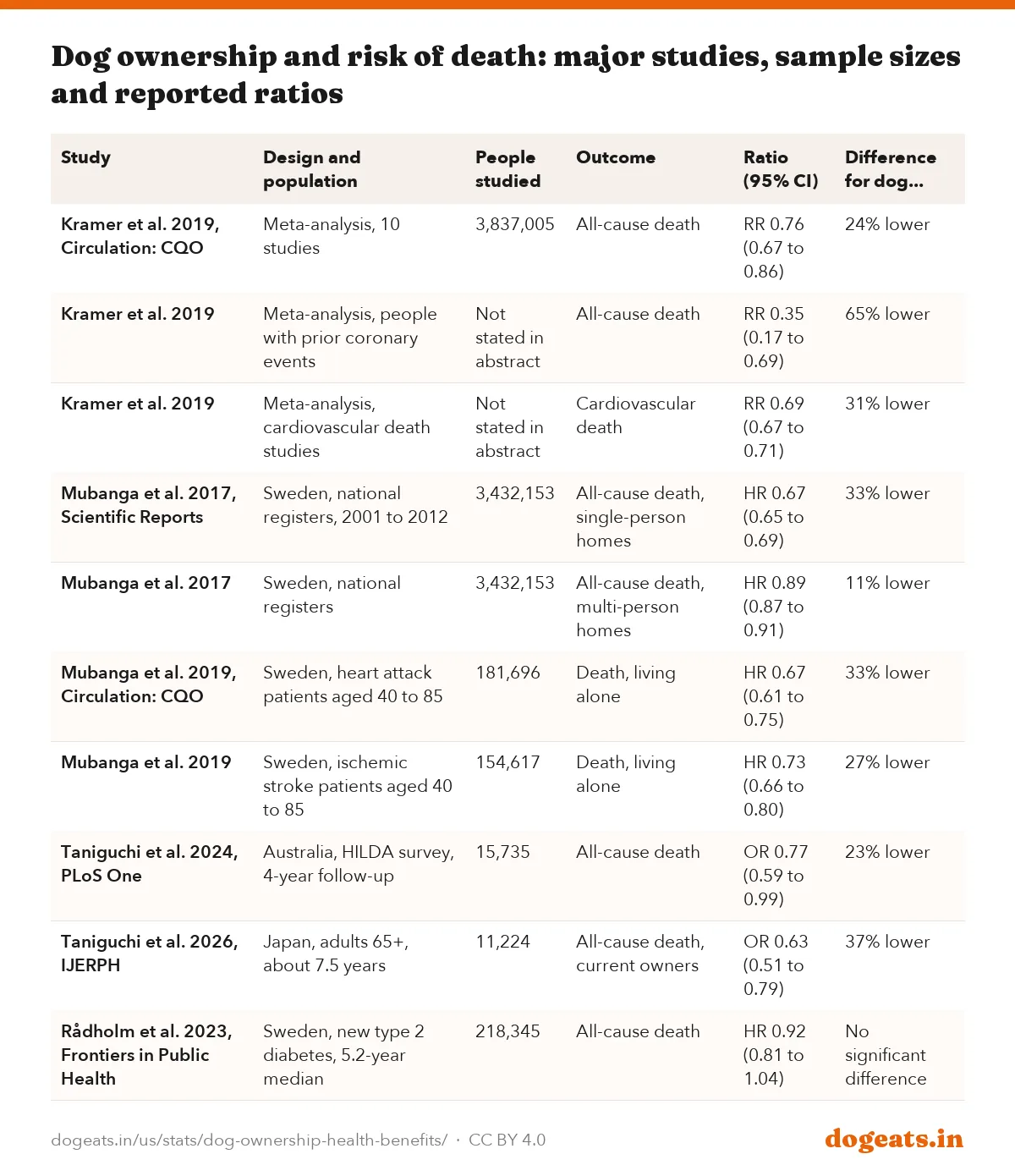
| Study | Design and population | People studied | Outcome | Ratio (95% CI) | Difference for dog owners |
|---|---|---|---|---|---|
| Kramer et al. 2019, Circulation: CQO | Meta-analysis, 10 studies | 3,837,005 | All-cause death | RR 0.76 (0.67 to 0.86) | 24% lower |
| Kramer et al. 2019 | Meta-analysis, people with prior coronary events | Not stated in abstract | All-cause death | RR 0.35 (0.17 to 0.69) | 65% lower |
| Kramer et al. 2019 | Meta-analysis, cardiovascular death studies | Not stated in abstract | Cardiovascular death | RR 0.69 (0.67 to 0.71) | 31% lower |
| Mubanga et al. 2017, Scientific Reports | Sweden, national registers, 2001 to 2012 | 3,432,153 | All-cause death, single-person homes | HR 0.67 (0.65 to 0.69) | 33% lower |
| Mubanga et al. 2017 | Sweden, national registers | 3,432,153 | All-cause death, multi-person homes | HR 0.89 (0.87 to 0.91) | 11% lower |
| Mubanga et al. 2019, Circulation: CQO | Sweden, heart attack patients aged 40 to 85 | 181,696 | Death, living alone | HR 0.67 (0.61 to 0.75) | 33% lower |
| Mubanga et al. 2019 | Sweden, ischemic stroke patients aged 40 to 85 | 154,617 | Death, living alone | HR 0.73 (0.66 to 0.80) | 27% lower |
| Taniguchi et al. 2024, PLoS One | Australia, HILDA survey, 4-year follow-up | 15,735 | All-cause death | OR 0.77 (0.59 to 0.99) | 23% lower |
| Taniguchi et al. 2026, IJERPH | Japan, adults 65+, about 7.5 years | 11,224 | All-cause death, current owners | OR 0.63 (0.51 to 0.79) | 37% lower |
| Rådholm et al. 2023, Frontiers in Public Health | Sweden, new type 2 diabetes, 5.2-year median | 218,345 | All-cause death | HR 0.92 (0.81 to 1.04) | No significant difference |
Dog owners differ from non-owners in ways that also affect health. In the Swedish national cohort, dog owners were younger at the start, with a mean age of 52 against 58. Studies adjust for such differences, but they cannot rule out every one.
Dog ownership and heart health
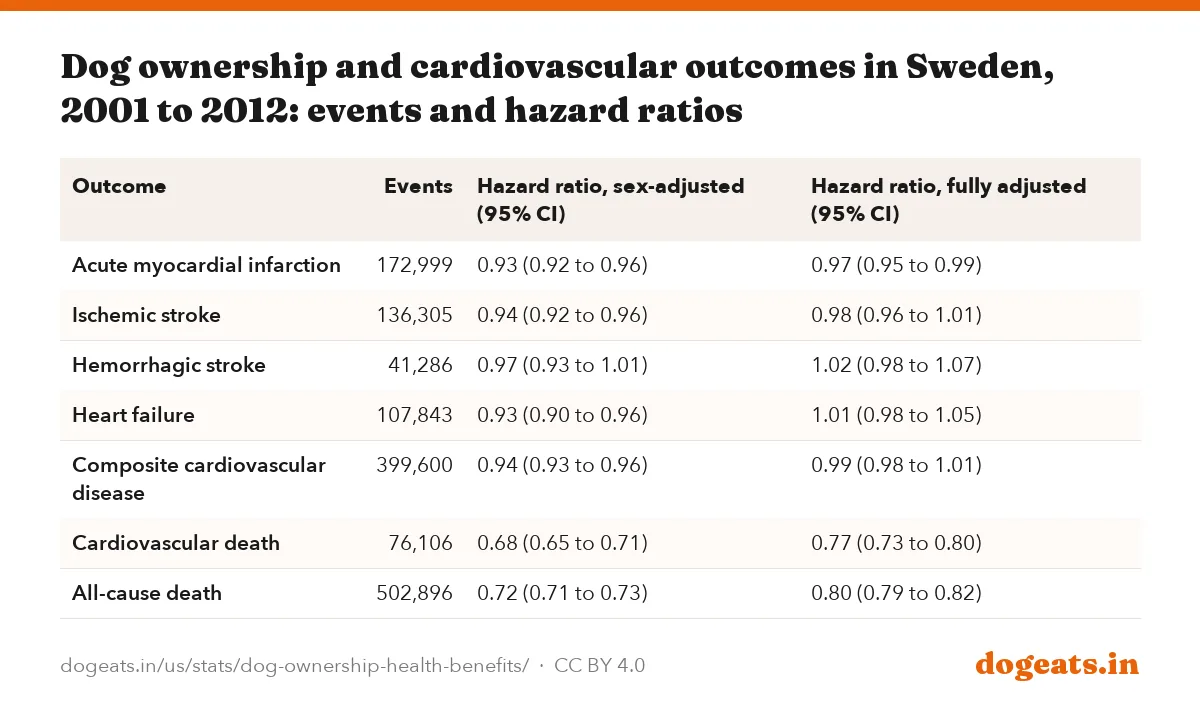
The largest single study comes from Sweden. Mubanga and colleagues followed 3,432,153 adults aged 40 to 80 for up to 12 years, from 2001 to 2012. About 13.1% of them owned a dog at some point.
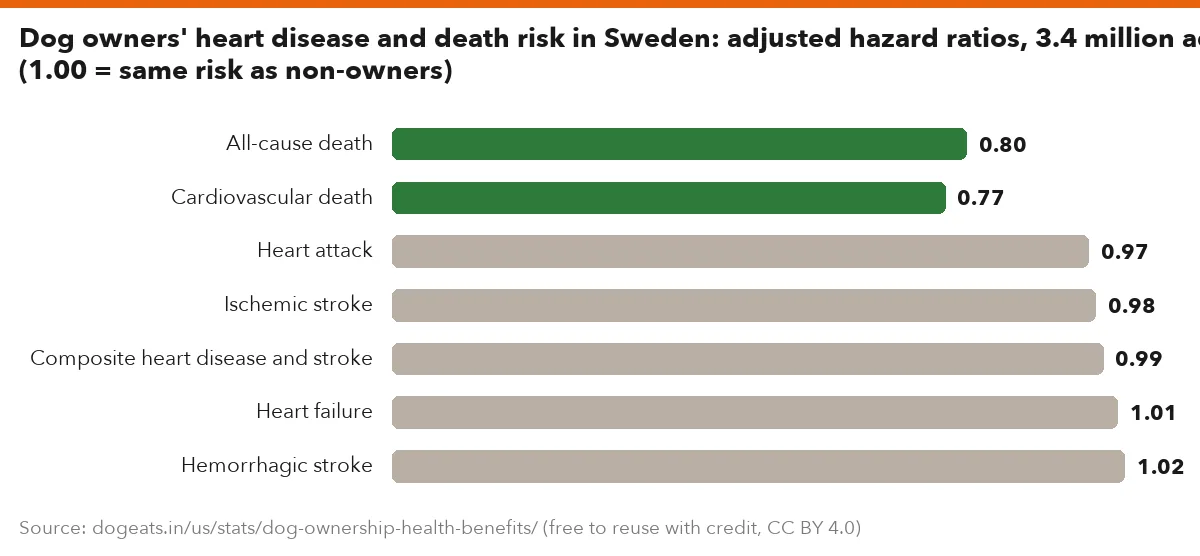
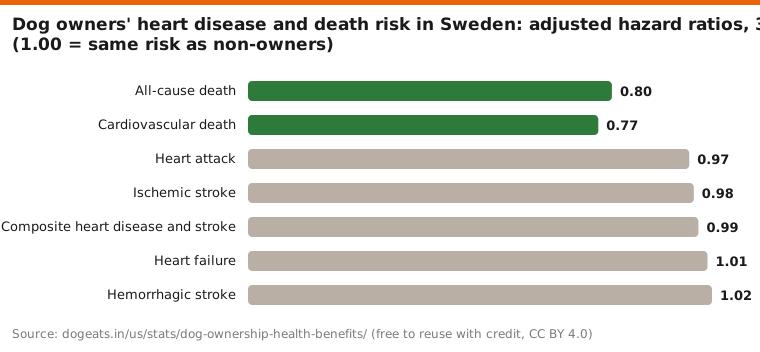
After adjustment, dog owners had a 20% lower risk of death from any cause and a 23% lower risk of cardiovascular death. Their risk of getting heart disease or stroke barely differed: the adjusted ratio for the composite outcome was 0.99.
So dog owners were about as likely to have a heart attack or stroke, but less likely to die. A follow-up study of 181,696 heart attack patients found owners living alone had a 33% lower risk of death afterward.
Source: Mubanga et al. 2017, Scientific Reports, Table 2. Adjusted for sex, marital status, children, population density, area, region of birth, income and latitude. Below 1.00 means lower risk.
Show the numbers
| Label | ratio |
|---|---|
| All-cause death | 0.80 |
| Cardiovascular death | 0.77 |
| Heart attack | 0.97 |
| Ischemic stroke | 0.98 |
| Composite heart disease and stroke | 0.99 |
| Heart failure | 1.01 |
| Hemorrhagic stroke | 1.02 |
Embed this chart
| Outcome | Events | Hazard ratio, sex-adjusted (95% CI) | Hazard ratio, fully adjusted (95% CI) |
|---|---|---|---|
| Acute myocardial infarction | 172,999 | 0.93 (0.92 to 0.96) | 0.97 (0.95 to 0.99) |
| Ischemic stroke | 136,305 | 0.94 (0.92 to 0.96) | 0.98 (0.96 to 1.01) |
| Hemorrhagic stroke | 41,286 | 0.97 (0.93 to 1.01) | 1.02 (0.98 to 1.07) |
| Heart failure | 107,843 | 0.93 (0.90 to 0.96) | 1.01 (0.98 to 1.05) |
| Composite cardiovascular disease | 399,600 | 0.94 (0.93 to 0.96) | 0.99 (0.98 to 1.01) |
| Cardiovascular death | 76,106 | 0.68 (0.65 to 0.71) | 0.77 (0.73 to 0.80) |
| All-cause death | 502,896 | 0.72 (0.71 to 0.73) | 0.80 (0.79 to 0.82) |
US data are thinner. A 2020 study of NHANES survey data, 1999 to 2016, had pet ownership answers for 10,905 of 42,038 participants. Pet owners had 0.67 times the odds of high blood pressure, but no difference in heart failure, coronary disease, diabetes or stroke.
A 2019 to 2020 survey of 3,078 US military veterans found dog owners had lower odds of high blood pressure and high cholesterol after adjustment. Older veterans with dogs, though, had higher odds of diabetes and stroke.
Does the type of dog matter?
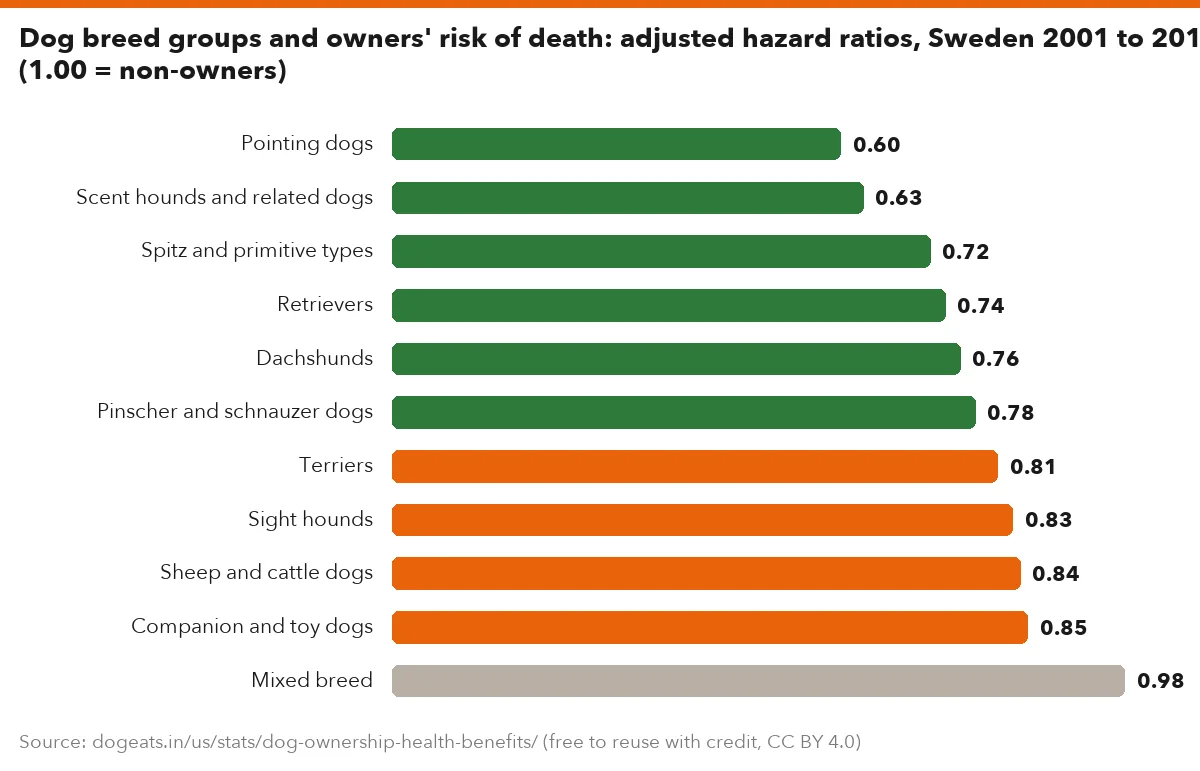
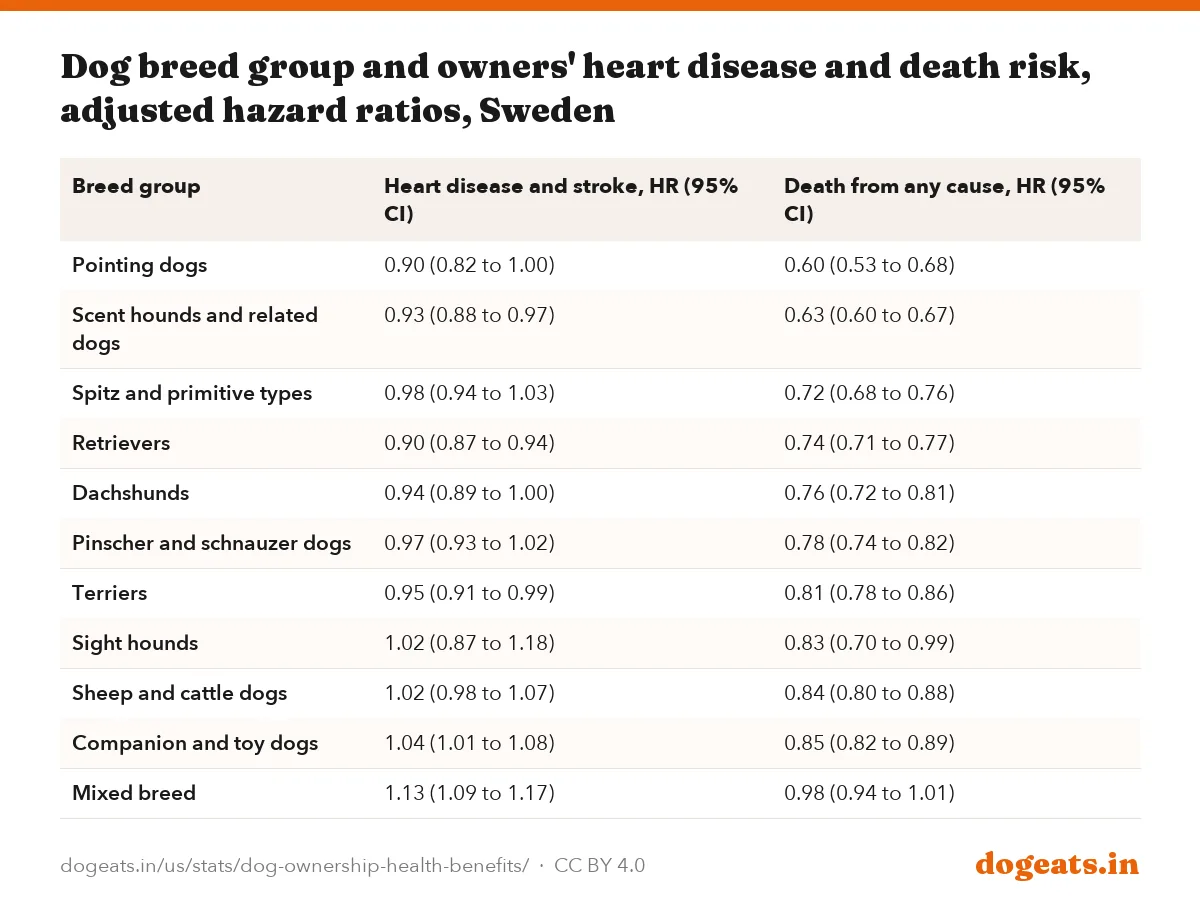
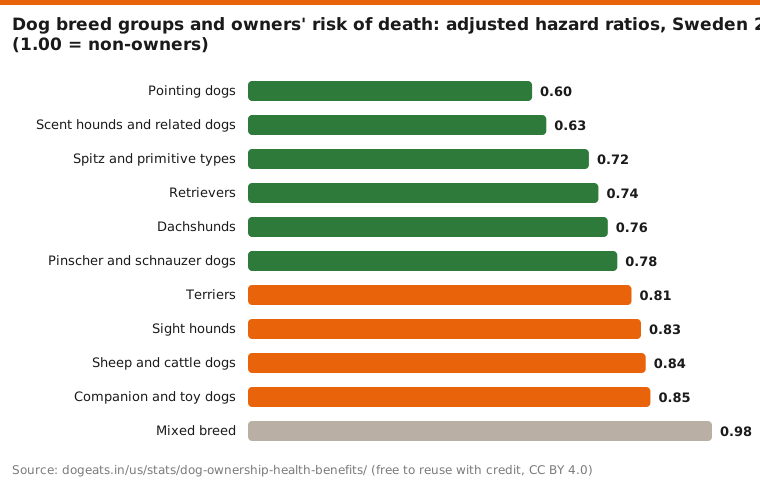
In the Swedish data, every breed group was linked to lower all-cause mortality, but by different amounts. Owners of pointing dogs had the lowest adjusted ratio, 0.60. Owners of mixed-breed dogs had the highest, 0.98, close to no difference.
Hunting breeds stood out for heart disease too. Retriever owners had a 10% lower adjusted risk of cardiovascular disease and scent hound owners 7%. Mixed-breed owners had a 13% higher risk.
The authors caution that unmeasured traits may shape both the choice of breed and heart risk. They say the higher risk among mixed-breed owners may be a sign of such confounding.

Source: Mubanga et al. 2017, Scientific Reports, Table 3. Breed groups as defined by the Swedish Kennel Club. Lower is lower risk.
Show the numbers
| Label | ratio |
|---|---|
| Pointing dogs | 0.60 |
| Scent hounds and related dogs | 0.63 |
| Spitz and primitive types | 0.72 |
| Retrievers | 0.74 |
| Dachshunds | 0.76 |
| Pinscher and schnauzer dogs | 0.78 |
| Terriers | 0.81 |
| Sight hounds | 0.83 |
| Sheep and cattle dogs | 0.84 |
| Companion and toy dogs | 0.85 |
| Mixed breed | 0.98 |
Embed this chart
| Breed group | Heart disease and stroke, HR (95% CI) | Death from any cause, HR (95% CI) |
|---|---|---|
| Pointing dogs | 0.90 (0.82 to 1.00) | 0.60 (0.53 to 0.68) |
| Scent hounds and related dogs | 0.93 (0.88 to 0.97) | 0.63 (0.60 to 0.67) |
| Spitz and primitive types | 0.98 (0.94 to 1.03) | 0.72 (0.68 to 0.76) |
| Retrievers | 0.90 (0.87 to 0.94) | 0.74 (0.71 to 0.77) |
| Dachshunds | 0.94 (0.89 to 1.00) | 0.76 (0.72 to 0.81) |
| Pinscher and schnauzer dogs | 0.97 (0.93 to 1.02) | 0.78 (0.74 to 0.82) |
| Terriers | 0.95 (0.91 to 0.99) | 0.81 (0.78 to 0.86) |
| Sight hounds | 1.02 (0.87 to 1.18) | 0.83 (0.70 to 0.99) |
| Sheep and cattle dogs | 1.02 (0.98 to 1.07) | 0.84 (0.80 to 0.88) |
| Companion and toy dogs | 1.04 (1.01 to 1.08) | 0.85 (0.82 to 0.89) |
| Mixed breed | 1.13 (1.09 to 1.17) | 0.98 (0.94 to 1.01) |
Dog owners walk more
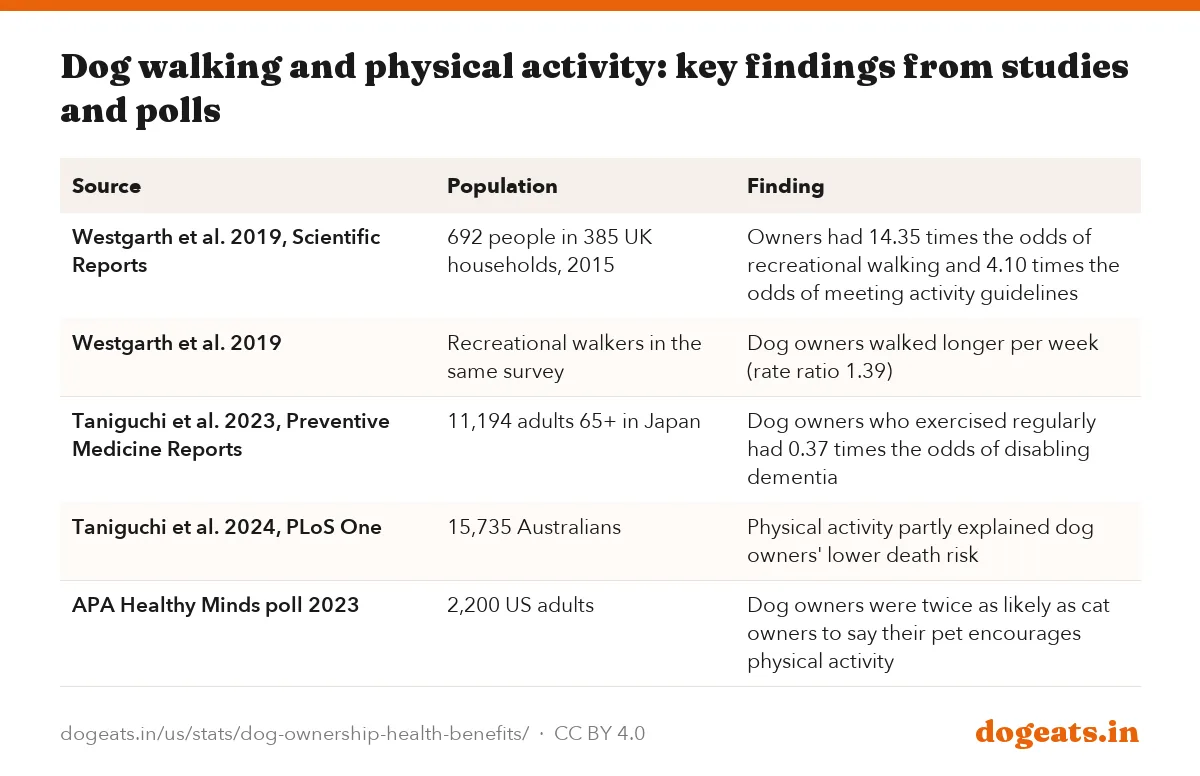
Exercise is the most consistent link between dogs and health. A 2019 UK study surveyed 191 dog owners, 455 adults without dogs and 46 children in 385 households in West Cheshire.
Dog owners had 14.35 times the odds of walking for recreation. They had 4.10 times the odds of meeting the guideline of 150 minutes of activity a week. Other exercise did not differ, so dog walking added to activity rather than replacing it.
A 2026 umbrella review of reviews on adults aged 60 and over reached a similar view. Its main finding for owners was higher walking activity, plus less loneliness among people in care facilities who took part in dog visits.
| Source | Population | Finding |
|---|---|---|
| Westgarth et al. 2019, Scientific Reports | 692 people in 385 UK households, 2015 | Owners had 14.35 times the odds of recreational walking and 4.10 times the odds of meeting activity guidelines |
| Westgarth et al. 2019 | Recreational walkers in the same survey | Dog owners walked longer per week (rate ratio 1.39) |
| Taniguchi et al. 2023, Preventive Medicine Reports | 11,194 adults 65+ in Japan | Dog owners who exercised regularly had 0.37 times the odds of disabling dementia |
| Taniguchi et al. 2024, PLoS One | 15,735 Australians | Physical activity partly explained dog owners' lower death risk |
| APA Healthy Minds poll 2023 | 2,200 US adults | Dog owners were twice as likely as cat owners to say their pet encourages physical activity |
Activity is also how the Japanese and Australian researchers explain their results. In the Australian HILDA study, physical activity partly mediated the link between dog ownership and lower mortality.
Pets and mental health statistics
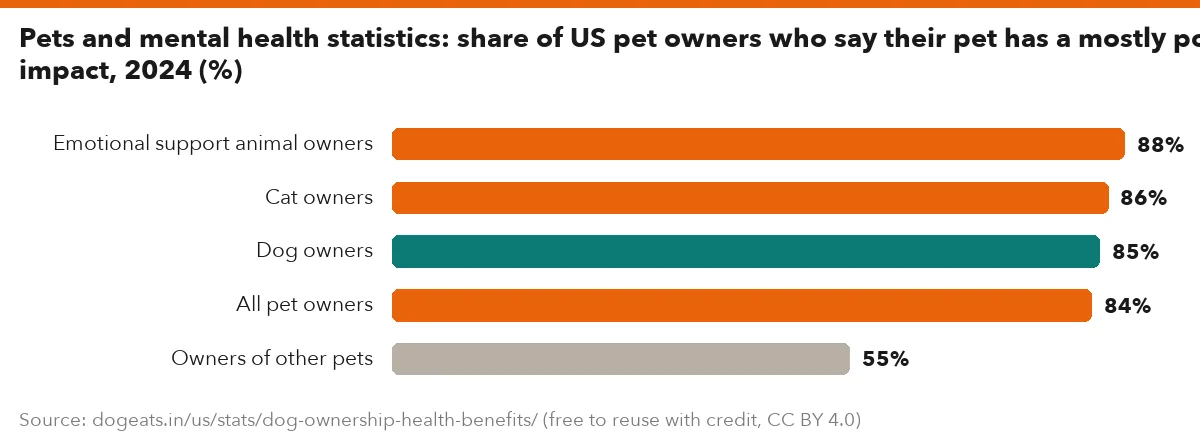
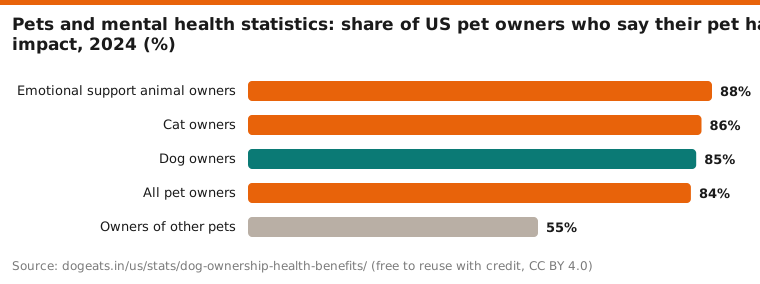
Polls show most US owners believe their pets help their mental health. Our dog ownership statistics report covers how many homes have dogs. In the American Psychiatric Association's 2024 Healthy Minds poll of 2,200 adults, 84% of pet owners said their pets have a mostly positive impact.
The share was 85% for dog owners, 86% for cat owners and 88% for owners of emotional support animals. Only 55% of people with other pets said the same.
Peer-reviewed studies are less clear. A 2022 systematic review of 24 studies found pet ownership linked to lower social isolation in adults, but found no consistent link with loneliness before COVID-19.
Source: American Psychiatric Association Healthy Minds poll, fielded by Morning Consult, February 6 to 9, 2024, 2,200 US adults. Self-reported opinion, not a clinical measure.
Show the numbers
| Label | % |
|---|---|
| Emotional support animal owners | 88% |
| Cat owners | 86% |
| Dog owners | 85% |
| All pet owners | 84% |
| Owners of other pets | 55% |
Embed this chart
| Survey | Year | Sample | Finding | Share (%) |
|---|---|---|---|---|
| APA Healthy Minds poll (Morning Consult) | 2024 | 2,200 adults | Pet owners: pets mostly positive for mental health | 84 |
| APA Healthy Minds poll | 2024 | 2,200 adults | Dog owners: pets mostly positive for mental health | 85 |
| APA Healthy Minds poll | 2024 | 2,200 adults | Pet owners citing companionship | 65 |
| APA Healthy Minds poll | 2024 | 2,200 adults | Pet owners worried about a pet aging or dying | 76 |
| APA Healthy Minds poll | 2024 | 2,200 adults | Pet owners with a certified emotional support animal | 18 |
| APA Healthy Minds poll (Morning Consult) | 2023 | 2,200 adults | Pet owners: pets mostly positive for mental health | 86 |
| APA Healthy Minds poll | 2023 | 2,200 adults | Dog owners: pets mostly positive for mental health | 87 |
| APA Healthy Minds poll | 2023 | 2,200 adults | Pet owners who consider pets family | 88 |
| HABRI pet owner survey (industry-backed) | 2022 | 3,596 US adults | Experienced mental health improvements from pets | 87 |
| HABRI pet owner survey (industry-backed) | 2016 | Not stated in release | Experienced mental health improvements from pets | 74 |
| HABRI pet owner survey (industry-backed) | 2022 | 3,596 US adults | Had a pet recommended by a doctor or therapist | 22 |
HABRI, the Human Animal Bond Research Institute, works with pet industry partners such as Hill's Pet Nutrition and Trupanion, its press releases show. Its 2022 survey found 87% of pet owners reported mental health improvements, up from 74% in 2016.
A 2022 review of 6 studies covering 25,138 adults aged 70 and over found no clear link between dog ownership and depressive symptoms. It found a possible benefit for anxiety. A 2025 pilot trial found therapy dog visits cut loneliness among psychiatric inpatients.
Dogs, dementia and disability in older adults
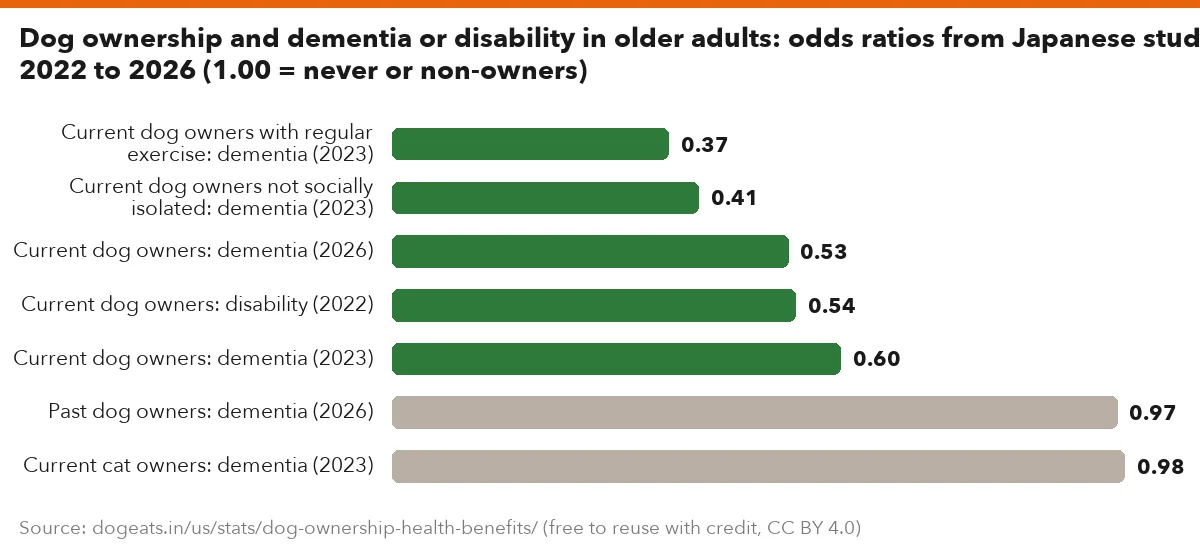
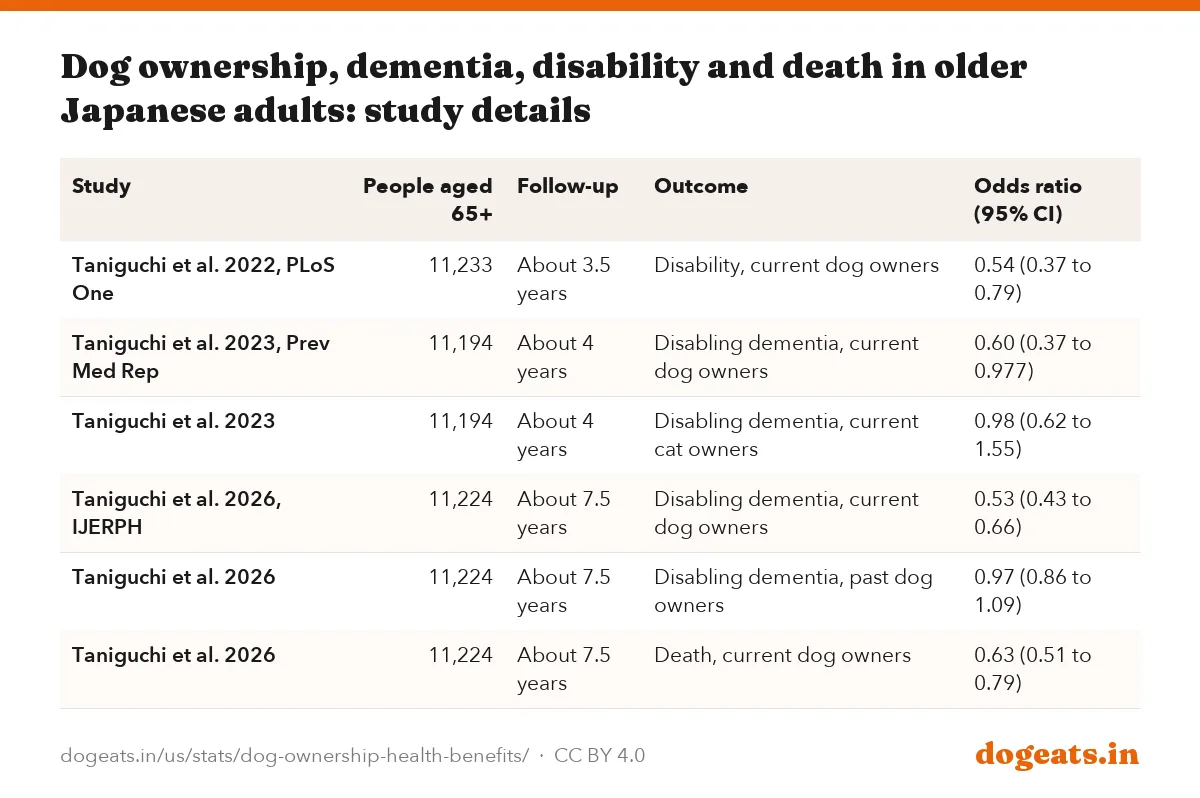
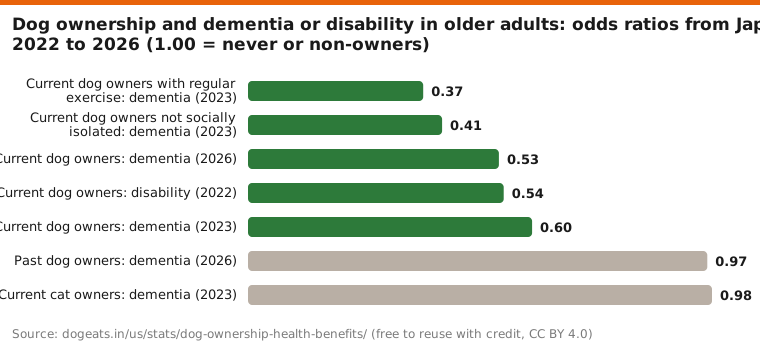
Three studies of older adults in Japan point the same way. In a 2022 study of 11,233 people aged 65 and over, current dog owners had 0.54 times the odds of developing a disability over about 3.5 years.
In a 2023 study of 11,194 older adults, current dog owners had 0.60 times the odds of disabling dementia over about 4 years. Cat owners showed no difference, with an odds ratio of 0.98.
A 2026 study followed 11,224 older adults for about 7.5 years. Current dog owners had 0.53 times the odds of disabling dementia and 0.63 times the odds of death. Past owners showed no clear dementia difference.
Sources: Taniguchi et al. 2022 (PLoS One), 2023 (Preventive Medicine Reports), 2026 (IJERPH). Comparison groups differ by study. Lower is lower odds.
Show the numbers
| Label | ratio |
|---|---|
| Current dog owners with regular exercise: dementia (2023) | 0.37 |
| Current dog owners not socially isolated: dementia (2023) | 0.41 |
| Current dog owners: dementia (2026) | 0.53 |
| Current dog owners: disability (2022) | 0.54 |
| Current dog owners: dementia (2023) | 0.60 |
| Past dog owners: dementia (2026) | 0.97 |
| Current cat owners: dementia (2023) | 0.98 |
Embed this chart
| Study | People aged 65+ | Follow-up | Outcome | Odds ratio (95% CI) |
|---|---|---|---|---|
| Taniguchi et al. 2022, PLoS One | 11,233 | About 3.5 years | Disability, current dog owners | 0.54 (0.37 to 0.79) |
| Taniguchi et al. 2023, Prev Med Rep | 11,194 | About 4 years | Disabling dementia, current dog owners | 0.60 (0.37 to 0.977) |
| Taniguchi et al. 2023 | 11,194 | About 4 years | Disabling dementia, current cat owners | 0.98 (0.62 to 1.55) |
| Taniguchi et al. 2026, IJERPH | 11,224 | About 7.5 years | Disabling dementia, current dog owners | 0.53 (0.43 to 0.66) |
| Taniguchi et al. 2026 | 11,224 | About 7.5 years | Disabling dementia, past dog owners | 0.97 (0.86 to 1.09) |
| Taniguchi et al. 2026 | 11,224 | About 7.5 years | Death, current dog owners | 0.63 (0.51 to 0.79) |
In the 2022 study, 17.1% of the sample developed a disability and 5.2% died. The link between pet ownership and death was not significant in that shorter follow-up.
The 2026 study also ran a causal-inference model. It still found lower dementia odds for current owners, 0.52, but the mortality result was no longer significant.
Children, dogs and asthma
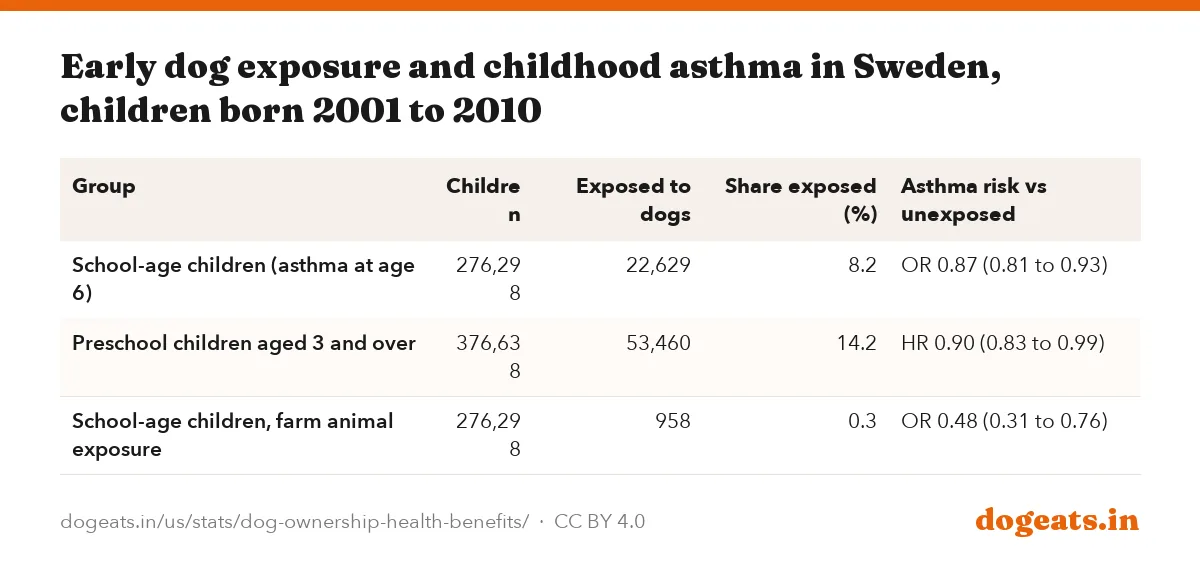
Growing up with a dog was linked to slightly less childhood asthma in a Swedish study of all 1,011,051 children born from 2001 to 2010. It was published in JAMA Pediatrics in 2015.
Among 276,298 school-age children, 8.2% lived with a dog in their first year. Those children had 0.87 times the odds of asthma at age 6, or 13% lower.
Among 376,638 preschool children, 14.2% had early dog exposure. It was linked to 10% lower asthma risk from age 3, but not in younger children. Farm animal exposure showed a bigger effect, with 0.48 times the odds.
| Group | Children | Exposed to dogs | Share exposed (%) | Asthma risk vs unexposed |
|---|---|---|---|---|
| School-age children (asthma at age 6) | 276,298 | 22,629 | 8.2 | OR 0.87 (0.81 to 0.93) |
| Preschool children aged 3 and over | 376,638 | 53,460 | 14.2 | HR 0.90 (0.83 to 0.99) |
| School-age children, farm animal exposure | 276,298 | 958 | 0.3 | OR 0.48 (0.31 to 0.76) |
The study measured registered dog ownership and asthma medicine use. It does not tell a family with an allergic child what to do, and a pediatrician should guide that choice.
The health risks: falls and dog walking injuries
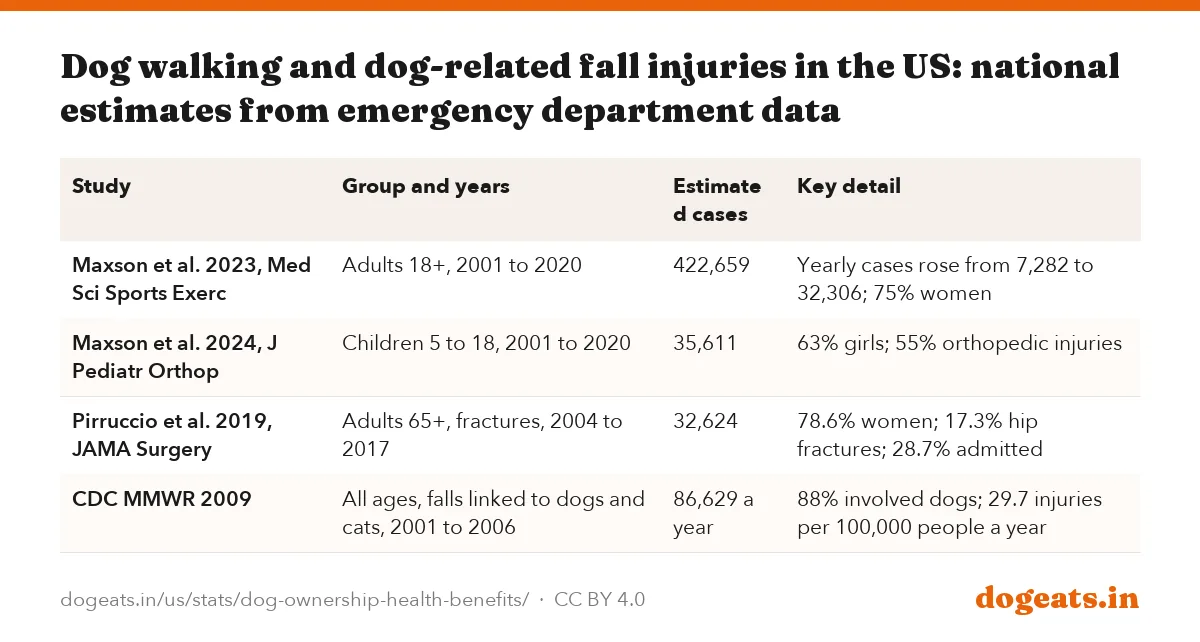
Dogs also cause injuries, mostly through falls. Our dog-related injuries report covers the wider picture. A 2023 study of US emergency department data estimated 422,659 adults were treated for injuries from leash dog walking between 2001 and 2020.
Yearly cases rose more than fourfold, from about 7,282 in 2001 to 32,306 in 2020. Women made up 75% of patients, and 55% were hurt when pulled or tripped by the leash.
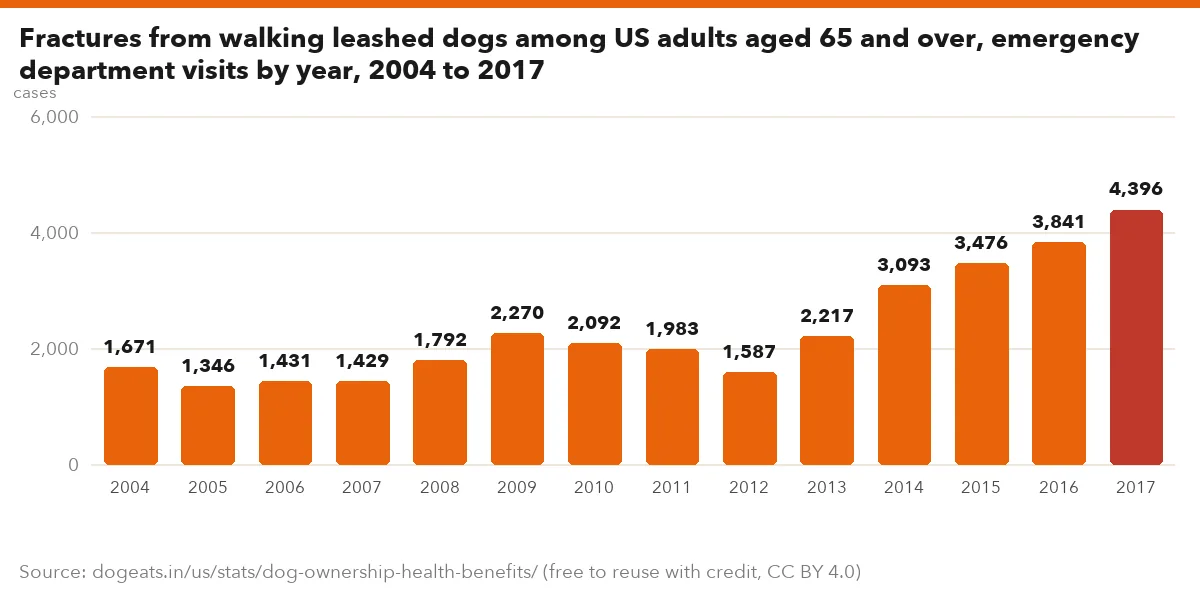
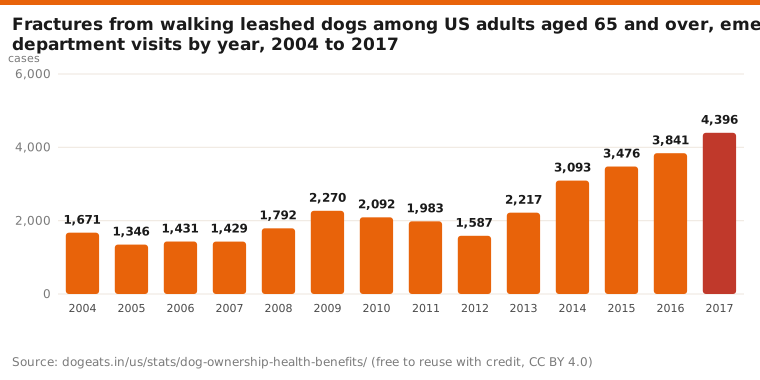
Older adults face the worst outcomes. Fractures from walking leashed dogs among Americans aged 65 and over rose from about 1,671 in 2004 to 4,396 in 2017, a 163% increase.

Source: Pirruccio, Yoon and Ahn, JAMA Surgery 2019, Table 1. National estimates from the CPSC National Electronic Injury Surveillance System (NEISS); each year has wide confidence intervals.
Show the numbers
| Label | cases |
|---|---|
| 2004 | 1,671 |
| 2005 | 1,346 |
| 2006 | 1,431 |
| 2007 | 1,429 |
| 2008 | 1,792 |
| 2009 | 2,270 |
| 2010 | 2,092 |
| 2011 | 1,983 |
| 2012 | 1,587 |
| 2013 | 2,217 |
| 2014 | 3,093 |
| 2015 | 3,476 |
| 2016 | 3,841 |
| 2017 | 4,396 |
Embed this chart
| Study | Group and years | Estimated cases | Key detail |
|---|---|---|---|
| Maxson et al. 2023, Med Sci Sports Exerc | Adults 18+, 2001 to 2020 | 422,659 | Yearly cases rose from 7,282 to 32,306; 75% women |
| Maxson et al. 2024, J Pediatr Orthop | Children 5 to 18, 2001 to 2020 | 35,611 | 63% girls; 55% orthopedic injuries |
| Pirruccio et al. 2019, JAMA Surgery | Adults 65+, fractures, 2004 to 2017 | 32,624 | 78.6% women; 17.3% hip fractures; 28.7% admitted |
| CDC MMWR 2009 | All ages, falls linked to dogs and cats, 2001 to 2006 | 86,629 a year | 88% involved dogs; 29.7 injuries per 100,000 people a year |
The adult study's most common injuries were finger fractures at 6.9%, traumatic brain injury at 5.6% and shoulder sprains at 5.1%. Adults aged 65 and over had 2.1 times the odds of a fracture.
The CDC's national estimate of pet-related falls, published in a 2009 MMWR report, covers 2001 to 2006. It found 86,629 fall injuries a year linked to dogs and cats, 88% of them involving dogs. For bites, see our dog bite statistics report.
Where the evidence is weak or negative
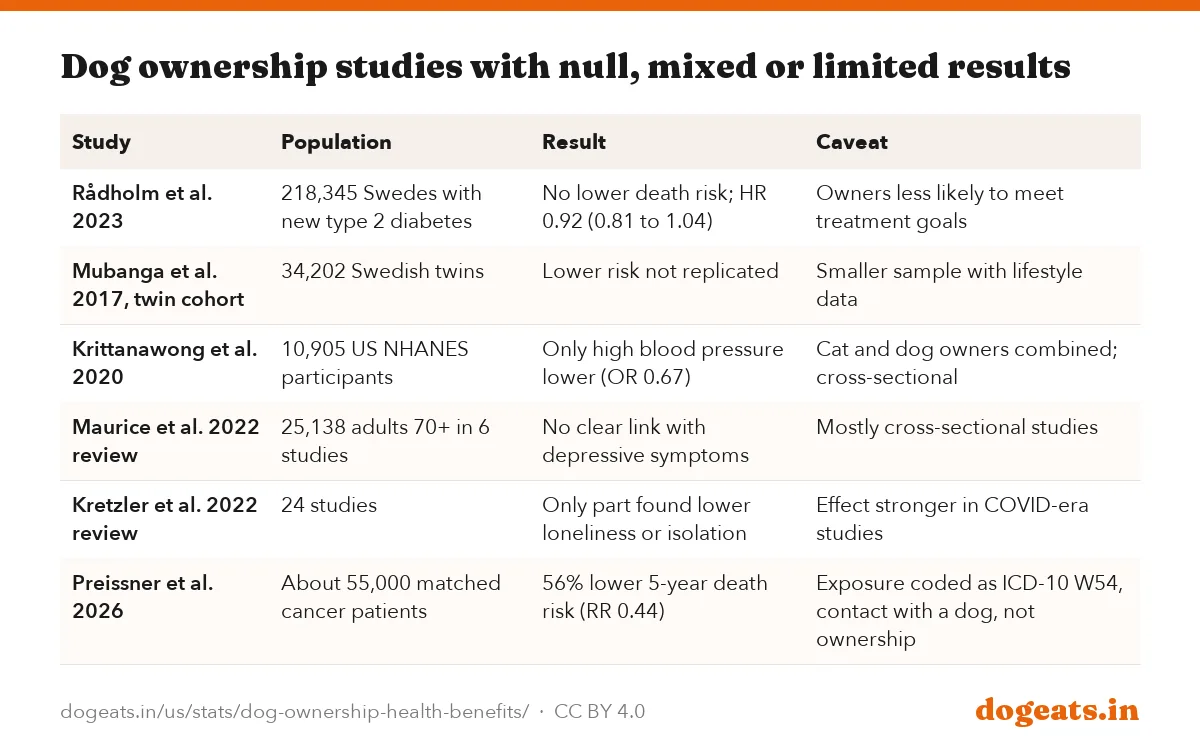
Several large studies find no benefit, or the opposite. In a 2023 Swedish study of 218,345 people newly diagnosed with type 2 diabetes, 3.8% owned dogs. They had no lower risk of death, with a hazard ratio of 0.92 that was not significant.
The same dog owners were less likely to reach blood sugar, LDL cholesterol and blood pressure goals. Their odds ratios were 0.93, 0.91 and 0.95.
In the Swedish Twin Register, a subsample of 34,202 people with lifestyle data, researchers could not replicate the lower risk of heart disease or death.
| Study | Population | Result | Caveat |
|---|---|---|---|
| Rådholm et al. 2023 | 218,345 Swedes with new type 2 diabetes | No lower death risk; HR 0.92 (0.81 to 1.04) | Owners less likely to meet treatment goals |
| Mubanga et al. 2017, twin cohort | 34,202 Swedish twins | Lower risk not replicated | Smaller sample with lifestyle data |
| Krittanawong et al. 2020 | 10,905 US NHANES participants | Only high blood pressure lower (OR 0.67) | Cat and dog owners combined; cross-sectional |
| Maurice et al. 2022 review | 25,138 adults 70+ in 6 studies | No clear link with depressive symptoms | Mostly cross-sectional studies |
| Kretzler et al. 2022 review | 24 studies | Only part found lower loneliness or isolation | Effect stronger in COVID-era studies |
| Preissner et al. 2026 | About 55,000 matched cancer patients | 56% lower 5-year death risk (RR 0.44) | Exposure coded as ICD-10 W54, contact with a dog, not ownership |
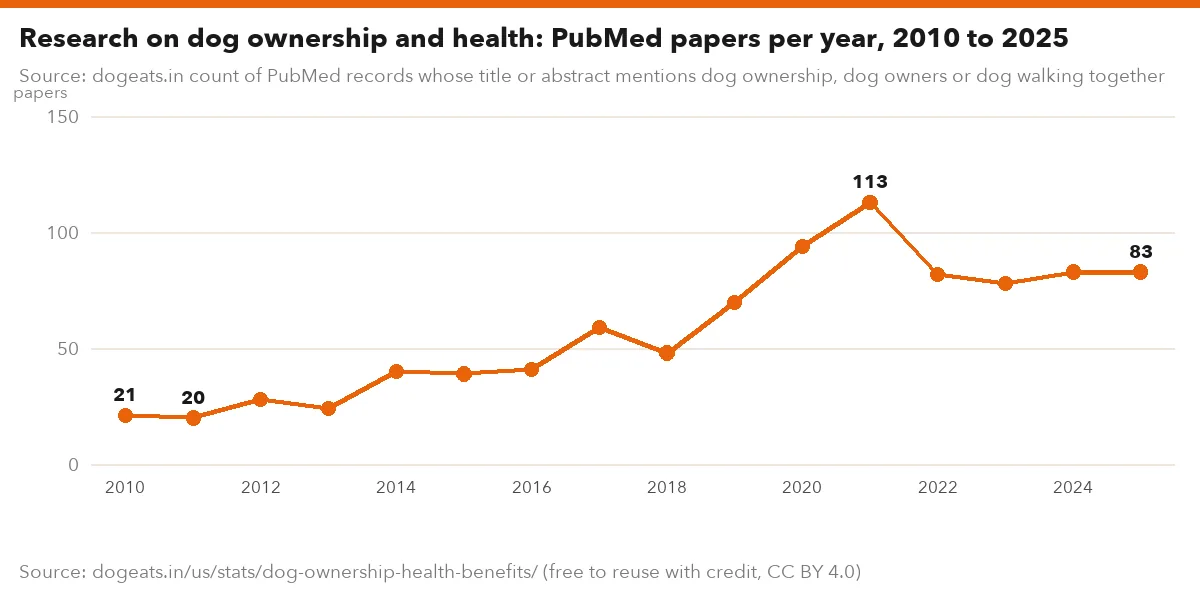
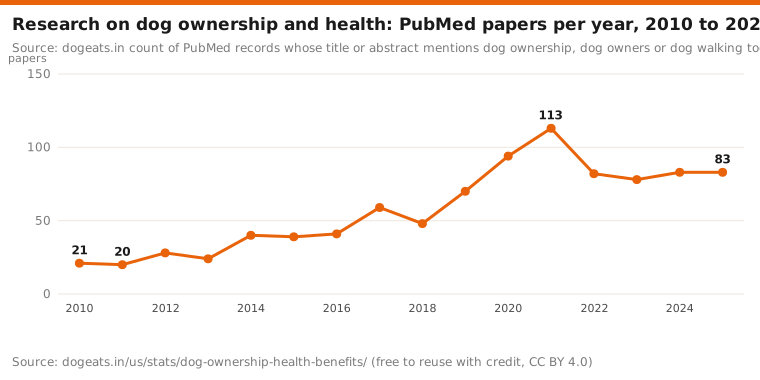
Source: dogeats.in count of PubMed records whose title or abstract mentions dog ownership, dog owners or dog walking together with a health term. Query run October 11, 2026; counts depend on the search terms.
Show the numbers
| Label | papers |
|---|---|
| 2010 | 21 |
| 2011 | 20 |
| 2012 | 28 |
| 2013 | 24 |
| 2014 | 40 |
| 2015 | 39 |
| 2016 | 41 |
| 2017 | 59 |
| 2018 | 48 |
| 2019 | 70 |
| 2020 | 94 |
| 2021 | 113 |
| 2022 | 82 |
| 2023 | 78 |
| 2024 | 83 |
| 2025 | 83 |
Embed this chart
A 2026 cancer study is a warning about headlines. Cancer patients with recorded dog contact had a 56% lower 5-year risk of death, a risk ratio of 0.44, and a hazard ratio of 0.36. But the study defined contact by ICD-10 code W54. That code covers being bitten, struck or otherwise in contact with a dog, not ownership.
Research volume has grown fast. Our PubMed count found 21 papers on dog ownership and health in 2010, a peak of 113 in 2021 and 83 in 2025.
Frequently asked questions
Are dog owners healthier than people without dogs?
On average, dog owners have lower death rates in large observational studies. A 2019 meta-analysis of 10 studies found a 24% lower risk of death. These studies show an association and cannot prove that owning a dog causes better health.
Does owning a dog lower blood pressure?
Some studies link pet ownership to lower blood pressure. In US NHANES data, pet owners had 0.67 times the odds of high blood pressure. The CDC lists lower blood pressure among possible benefits of pets.
Do dogs help with depression and anxiety?
The evidence is mixed. A 2022 review of 6 studies in adults over 70 found no clear link with depressive symptoms but a possible benefit for anxiety. In a 2024 APA poll, 85% of dog owners said their pet mostly helps their mental health.
Do dog owners live longer after a heart attack?
In Sweden, heart attack survivors who owned a dog and lived alone had a 33% lower risk of death. Those living with a partner or child had a 15% lower risk. The study covered 181,696 patients from 2001 to 2012.
How much more do dog owners exercise?
In a UK study, dog owners had 4.10 times the odds of meeting the guideline of 150 minutes of activity a week. They had 14.35 times the odds of walking for recreation.
Can dog walking be dangerous?
Yes, mainly through falls. An estimated 422,659 US adults went to emergency departments with dog-walking injuries from 2001 to 2020. Yearly cases rose from 7,282 to 32,306.
Does having a dog prevent asthma in children?
A Swedish study of over 1 million children found that dog exposure in the first year was linked to 13% lower odds of asthma at age 6. It is an association, so ask a pediatrician about your own child.
Should I get a dog for my health?
The studies cannot promise any one person a health benefit. They report averages from observational data. A dog is a long commitment with real costs, so the choice should rest on more than health. See our cost of owning a dog report.
Methodology and limitations
We read each study's abstract on PubMed and, where open access, the full text, on October 11, 2026. Every ratio in this report is copied from the paper. Percent lower risk is our calculation, 1 minus the ratio, rounded to a whole number.
Hazard ratios, relative risks and odds ratios are different measures, so the first chart compares them only roughly. We label each study's measure in the tables.
Poll results come from the American Psychiatric Association's releases and HABRI's release. We label HABRI as industry-backed. The PubMed count uses a fixed search run on October 11, 2026, and is reproducible.
Sources
- Kramer CK et al., Dog Ownership and Survival: A Systematic Review and Meta-Analysis, Circulation: Cardiovascular Quality and Outcomes, 2019, 24% lower all-cause mortality, 65% after coronary events, 31% cardiovascular mortality
- Mubanga M et al., Dog ownership and the risk of cardiovascular disease and death, Scientific Reports, 2017, Swedish national cohort, outcomes and breed groups
- American Psychiatric Association, Healthy Minds poll on pets, March 1, 2024, 84% and 85% mental health figures, pet types, worries
- Also consulted: Mubanga M et al., Dog Ownership and Survival After a Major Cardiovascular Event, Circulation: CQO, 2019, Westgarth C et al., Dog owners are more likely to meet physical activity guidelines, Scientific Reports, 2019, Taniguchi Y et al., dog ownership and disabling dementia, IJERPH, 2026, Taniguchi Y et al., Preventive Medicine Reports, 2023, Taniguchi Y et al., PLoS One, 2022, Taniguchi Y et al., HILDA cohort, PLoS One, 2024, Rådholm K et al., Frontiers in Public Health, 2023, Krittanawong C et al., American Journal of Cardiology, 2020, Woodward SH et al., Scientific Reports, 2023, Fall T et al., JAMA Pediatrics, 2015, Maxson R et al., Medicine and Science in Sports and Exercise, 2023, Maxson R et al., Journal of Pediatric Orthopaedics, 2024, Pirruccio K et al., JAMA Surgery, 2019, CDC MMWR, Nonfatal fall-related injuries associated with dogs and cats, 2009, CDC, Healthy Pets, Healthy People, Levine GN et al., AHA scientific statement on pet ownership and cardiovascular risk, Circulation, 2013, Kretzler B et al., Pet ownership, loneliness and social isolation: a systematic review, 2022, Maurice C et al., Dog ownership and mental health among older adults: systematic review, 2022, Grotto G and Buja A, umbrella review, BMC Geriatrics, 2026, Preissner R et al., Scientific Reports, 2026, HABRI (industry-backed), 2022 pet owner survey release, HABRI press release, Hill's Pet Nutrition and HABRI partner, August 2026, HABRI press release, HABRI and Trupanion partnership, March 2026, American Psychiatric Association, Healthy Minds poll on pets, March 1, 2023, Gee NR et al., therapy dog pilot trial, Frontiers in Psychiatry, 2025 (PMID 41450829), PubMed E-utilities search counts, October 11, 2026.
Cite, embed and download
This report, its data and its images are free to reuse under a Creative Commons Attribution 4.0 licence. Credit dogeats.in with a link to this page. Every chart has its own embed code, every table has a CSV and an image download, and the images below are ready for social posts, slides and articles.
Cite this report
Link to this report
Every chart and table as an image