Explainer · Updated October 2026
Puppy teething timeline: when milk teeth come in, when they fall out, and when all 42 adult teeth arrive
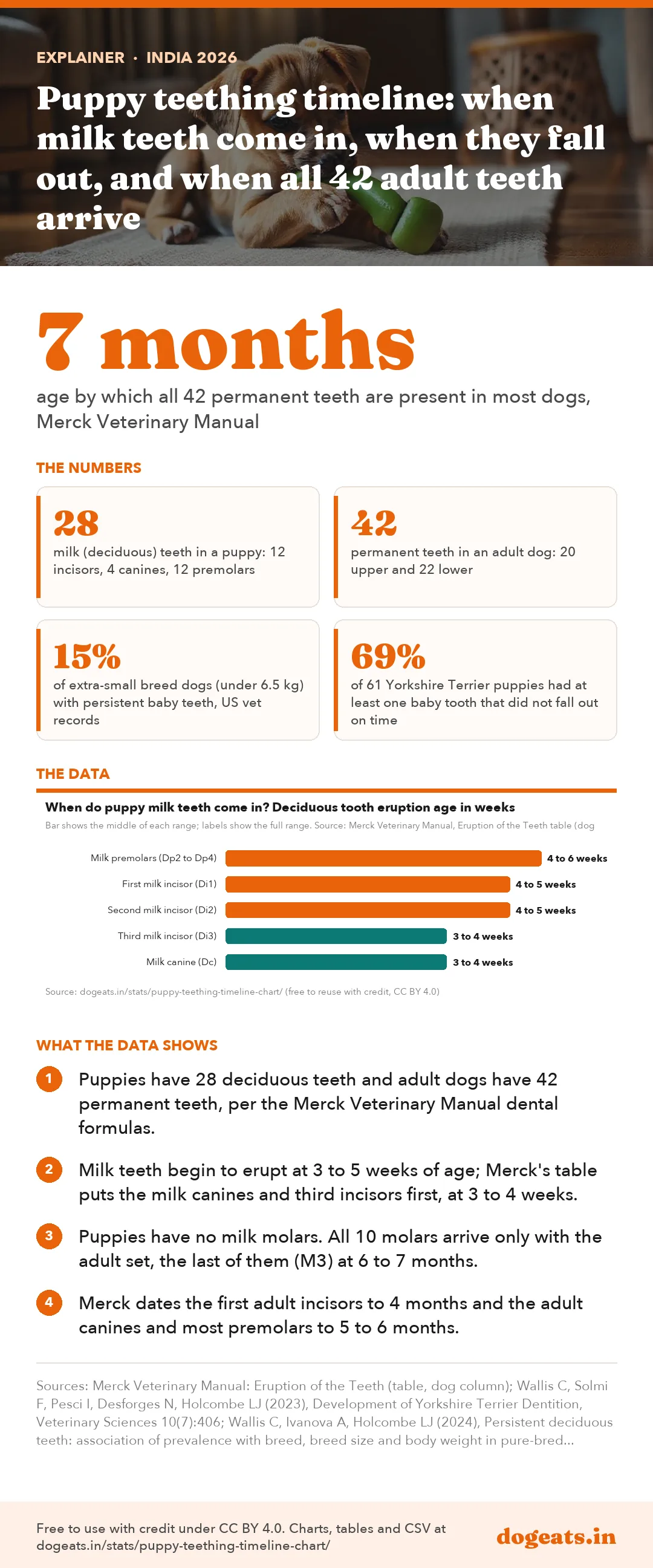
A puppy's 28 milk teeth start to come in at 3 to 5 weeks of age, the Merck Veterinary Manual says. VCA puts the last of them in by about 6 weeks. Adult teeth start to appear at around 4 to 5 months, and all 42 are present by 7 months. Baby teeth that do not fall out on time are common in small dogs. In vet records, 7% of almost 3 million US dogs had them, against 15% in breeds under 6.5 kg.

Key findings
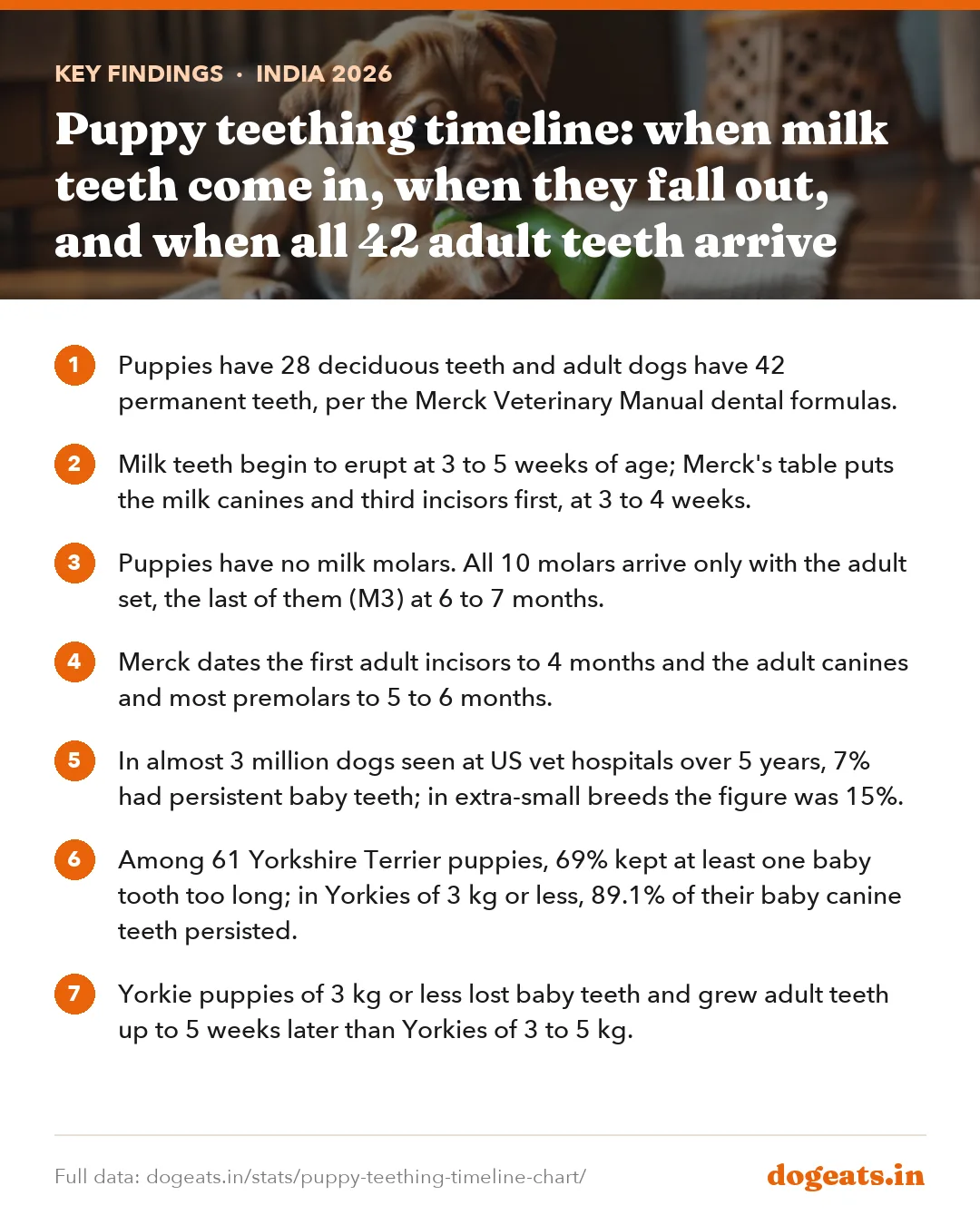
- Puppies have 28 deciduous teeth and adult dogs have 42 permanent teeth, per the Merck Veterinary Manual dental formulas.
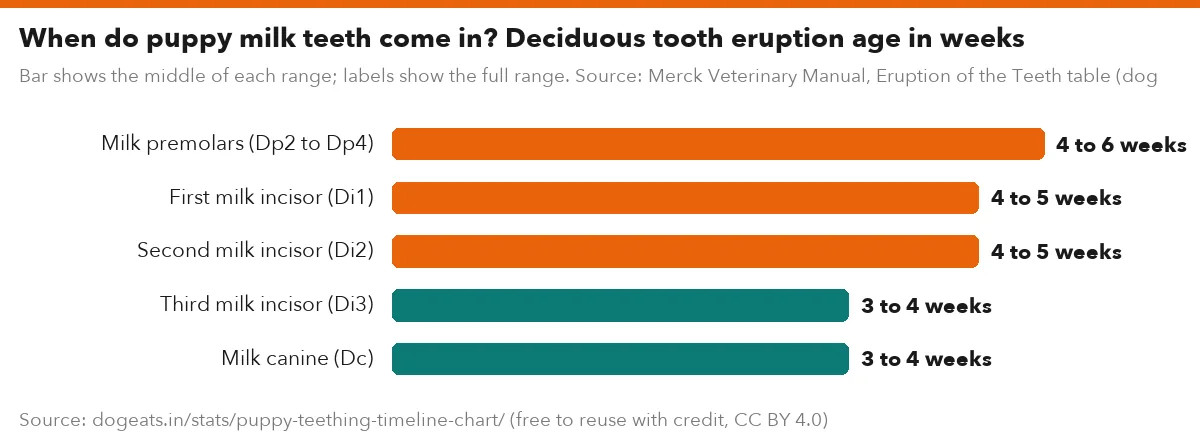
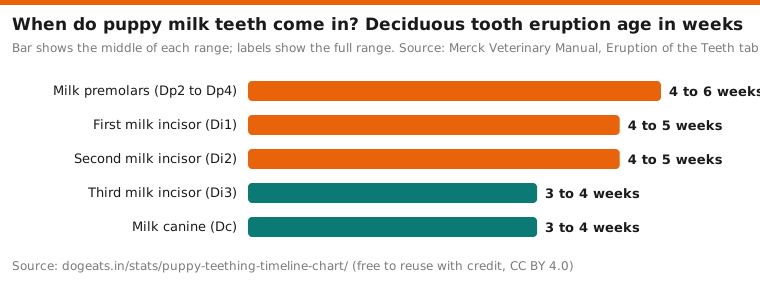
- Milk teeth begin to erupt at 3 to 5 weeks of age; Merck's table puts the milk canines and third incisors first, at 3 to 4 weeks.
- Puppies have no milk molars. All 10 molars arrive only with the adult set, the last of them (M3) at 6 to 7 months.
- Merck dates the first adult incisors to 4 months and the adult canines and most premolars to 5 to 6 months.
- In almost 3 million dogs seen at US vet hospitals over 5 years, 7% had persistent baby teeth; in extra-small breeds the figure was 15%.
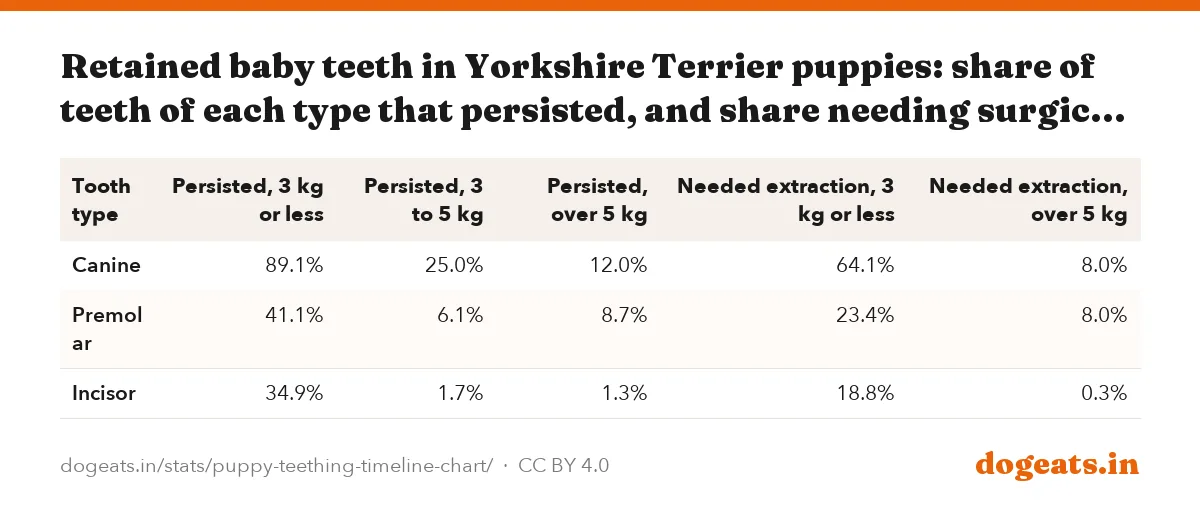
- Among 61 Yorkshire Terrier puppies, 69% kept at least one baby tooth too long; in Yorkies of 3 kg or less, 89.1% of their baby canine teeth persisted.
- Yorkie puppies of 3 kg or less lost baby teeth and grew adult teeth up to 5 weeks later than Yorkies of 3 to 5 kg.
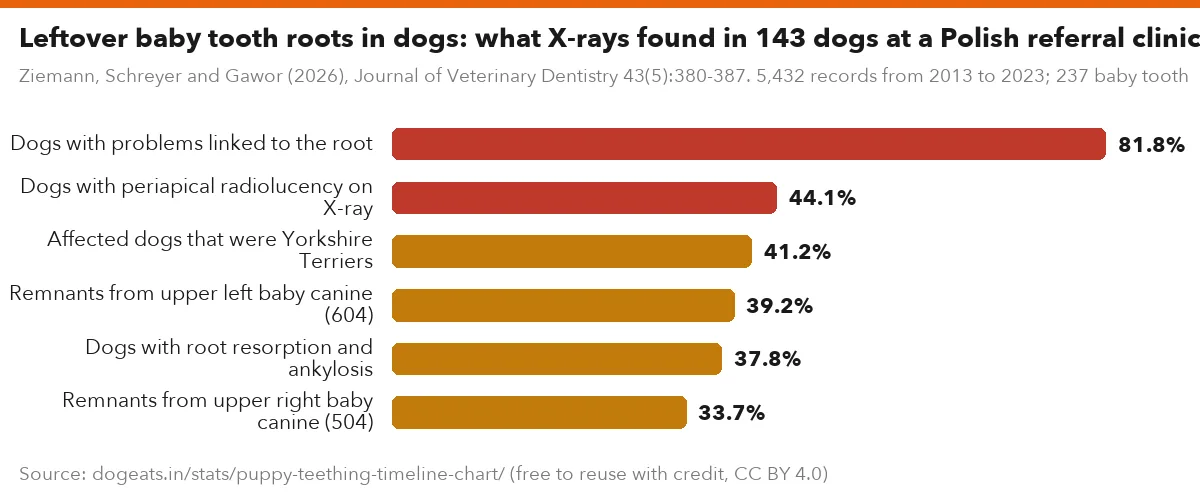
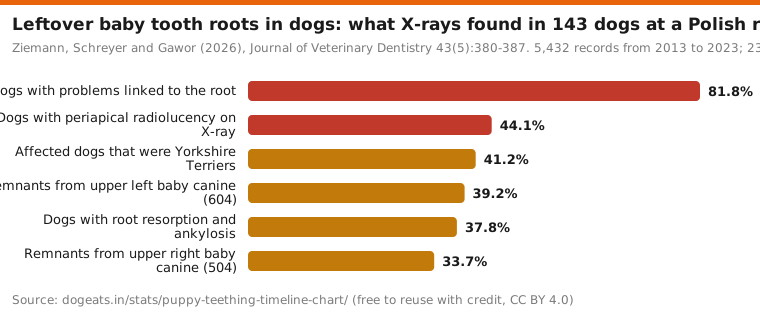
- In a 10-year Polish referral clinic review, 117 of 143 dogs (81.8%) with leftover baby tooth roots had problems linked to them.
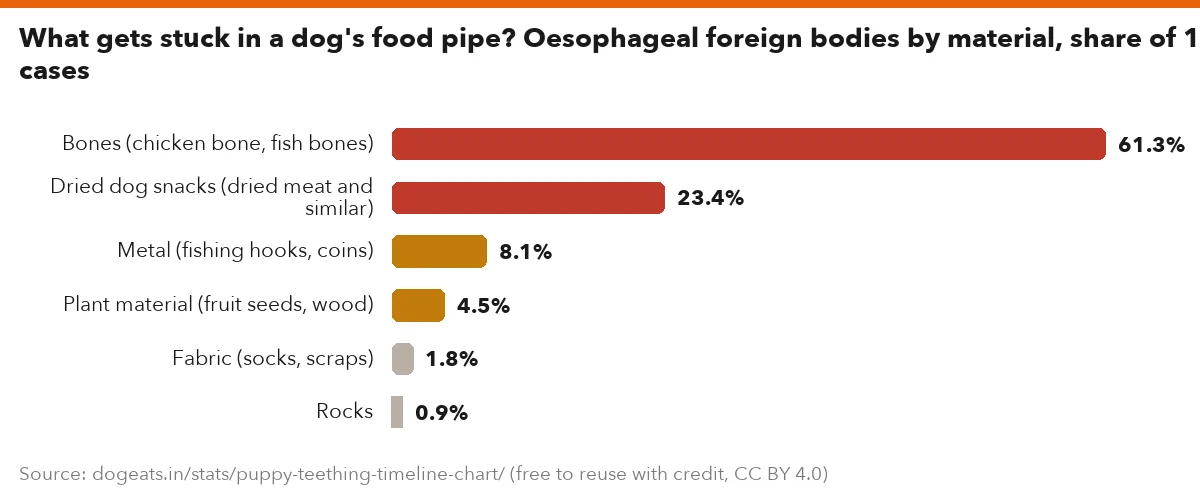
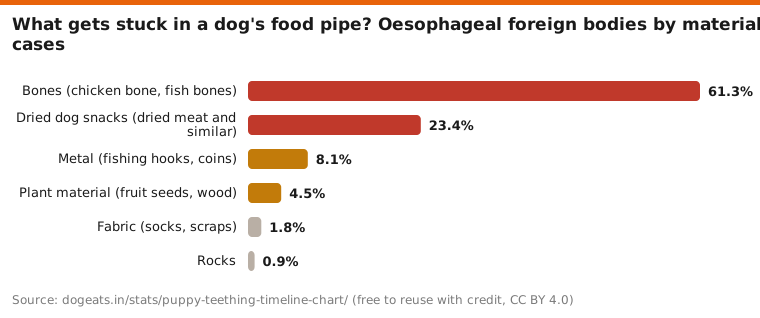
- In a Bangkok study of 111 dogs with something stuck in the food pipe, chicken or fish bones were the object in 61.26% of cases.
When do puppies start teething, and when does it stop?
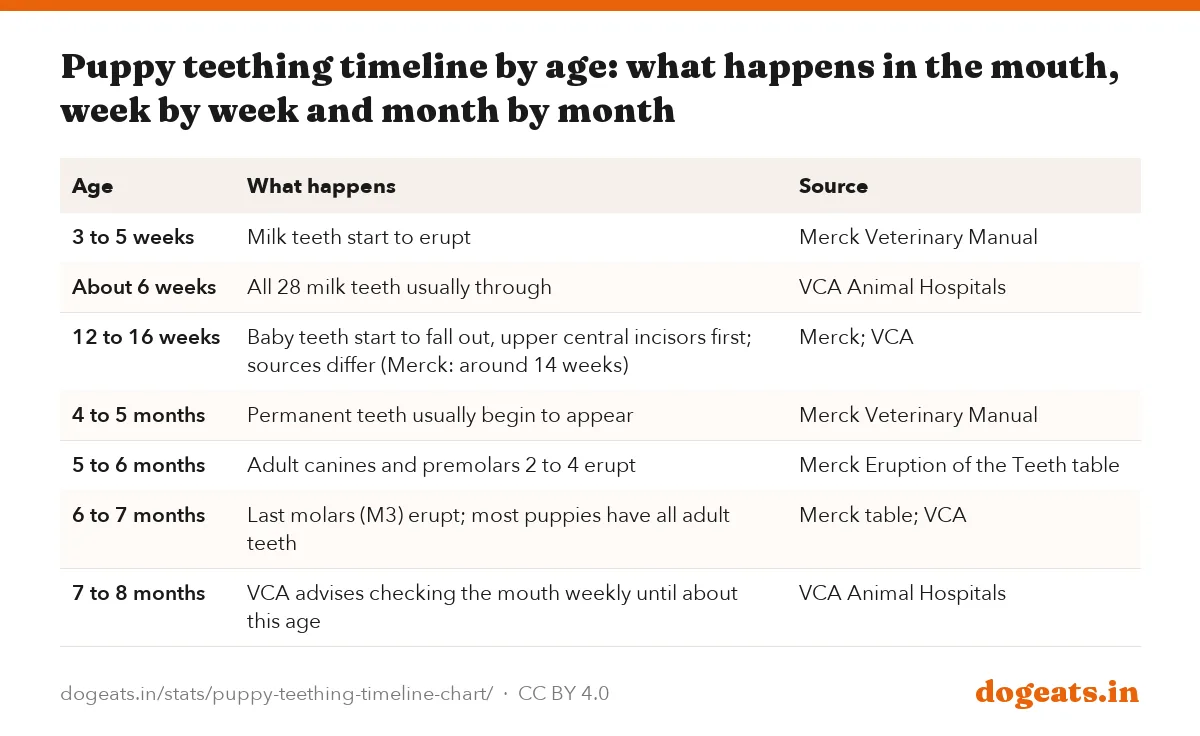
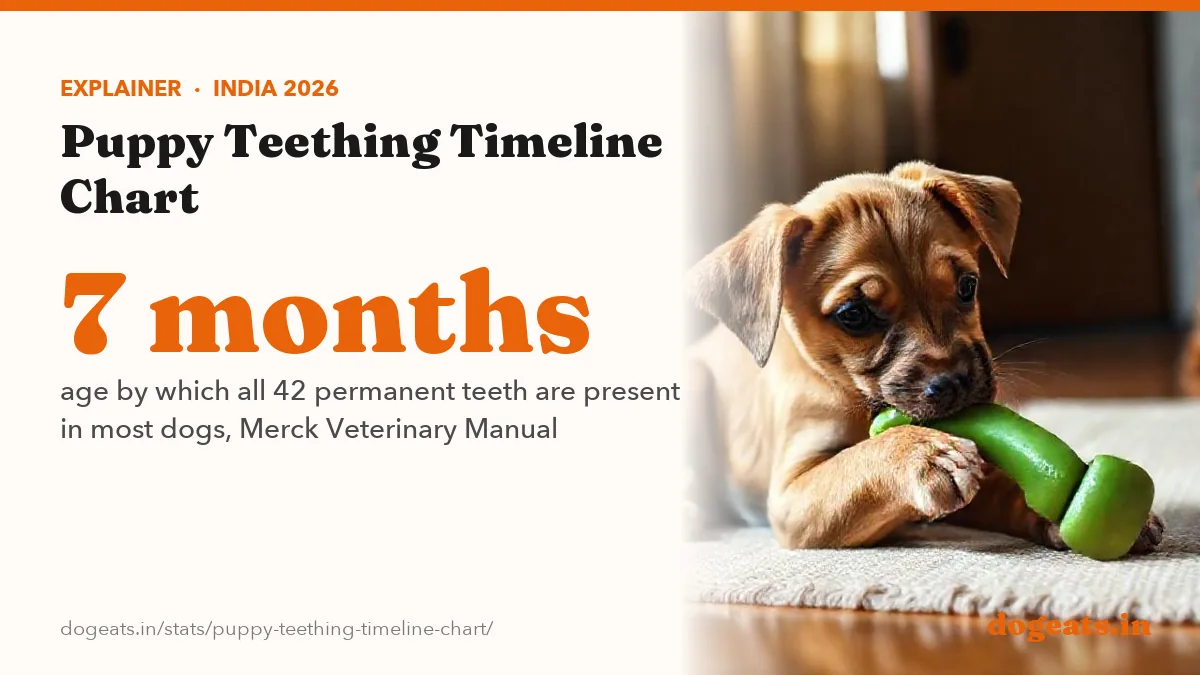
A puppy's milk teeth start to come through the gums at 3 to 5 weeks of age, and its adult teeth begin to appear at around 4 to 5 months. All 42 permanent teeth are present by 7 months, the Merck Veterinary Manual says.
So there are two teething phases. The first, from about 3 to 6 weeks, mostly happens while the puppy is still with its mother. VCA Animal Hospitals says all the milk teeth are usually through by about 6 weeks. The second is the one owners notice: baby teeth loosen and fall out while adult teeth push through, from roughly 3 to 4 months until 6 to 7 months.
Sources differ by a few weeks on when the second phase starts. Merck's owner guide says shedding normally begins around 14 weeks with the upper central incisors. One VCA article says around 12 weeks, and another puts it at 3.5 to 4 months.
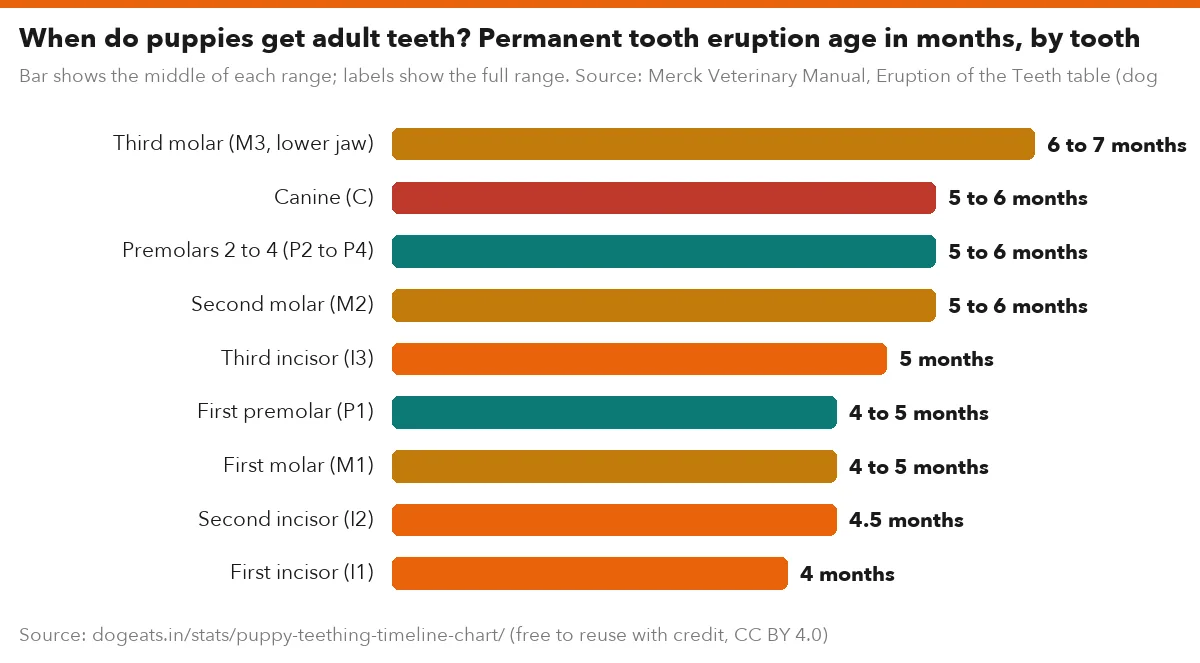
Bar shows the middle of each range; labels show the full range. Source: Merck Veterinary Manual, Eruption of the Teeth table (dog column), read October 2026. Merck notes the ages are averages subject to considerable variation.
Show the numbers
| Label | weeks |
|---|---|
| Milk premolars (Dp2 to Dp4) | 4 to 6 weeks |
| First milk incisor (Di1) | 4 to 5 weeks |
| Second milk incisor (Di2) | 4 to 5 weeks |
| Third milk incisor (Di3) | 3 to 4 weeks |
| Milk canine (Dc) | 3 to 4 weeks |
Embed this chart
| Age | What happens | Source |
|---|---|---|
| 3 to 5 weeks | Milk teeth start to erupt | Merck Veterinary Manual |
| About 6 weeks | All 28 milk teeth usually through | VCA Animal Hospitals |
| 12 to 16 weeks | Baby teeth start to fall out, upper central incisors first; sources differ (Merck: around 14 weeks) | Merck; VCA |
| 4 to 5 months | Permanent teeth usually begin to appear | Merck Veterinary Manual |
| 5 to 6 months | Adult canines and premolars 2 to 4 erupt | Merck Eruption of the Teeth table |
| 6 to 7 months | Last molars (M3) erupt; most puppies have all adult teeth | Merck table; VCA |
| 7 to 8 months | VCA advises checking the mouth weekly until about this age | VCA Animal Hospitals |
Teething is the same months in which a puppy grows fastest. For weight by month, see our puppy growth chart by breed. For how much to feed through these months, see the puppy feeding chart for India.
Teeth also help a vet guess a young dog's age, but only roughly. Merck says age estimates from teeth are only somewhat accurate in dogs and harder still in small and toy breeds. For converting age, see our dog years to human years chart.
How many teeth does a puppy have, and how many does an adult dog have?
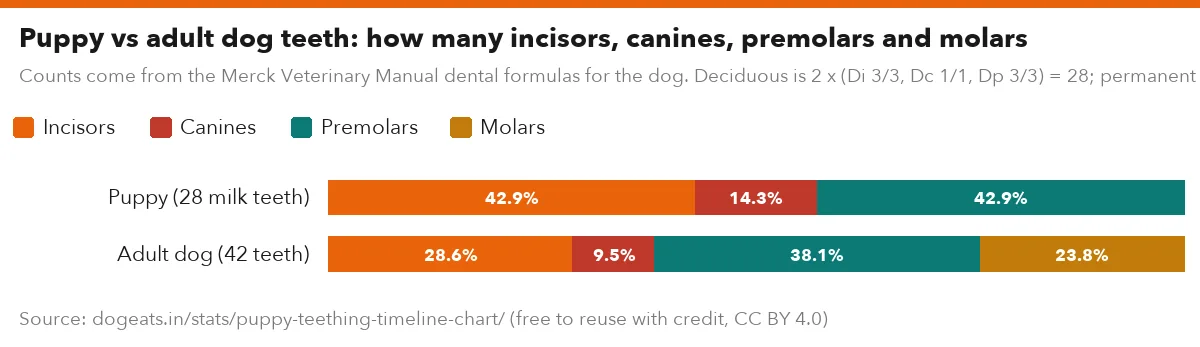
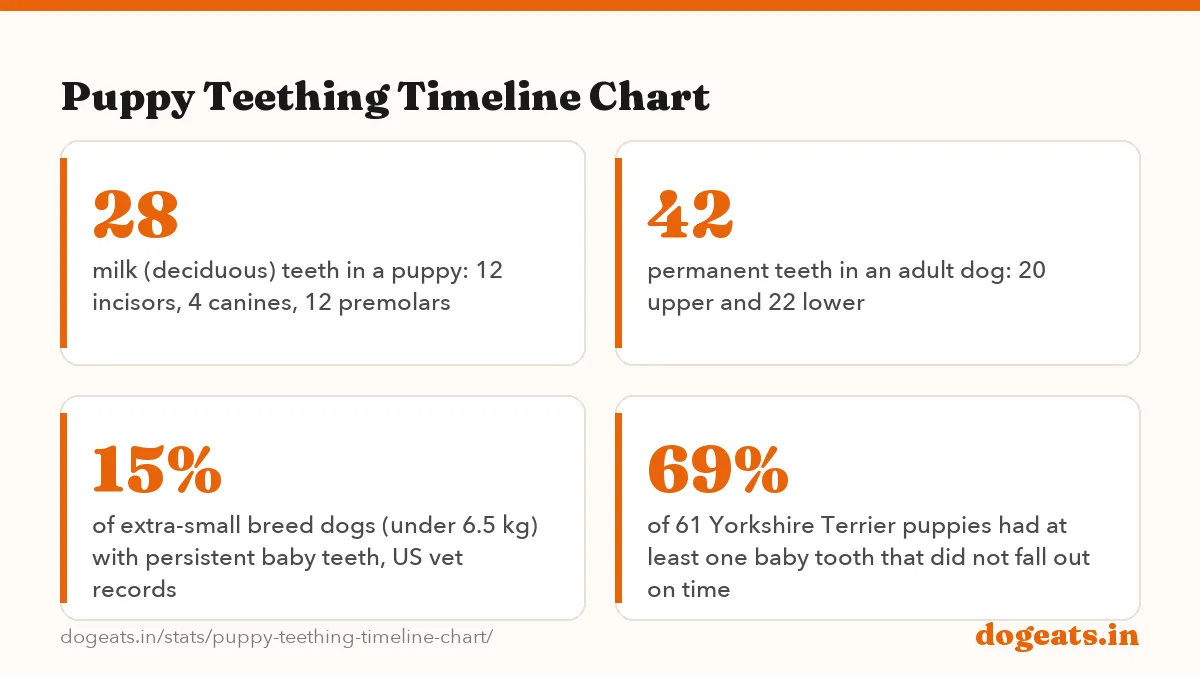
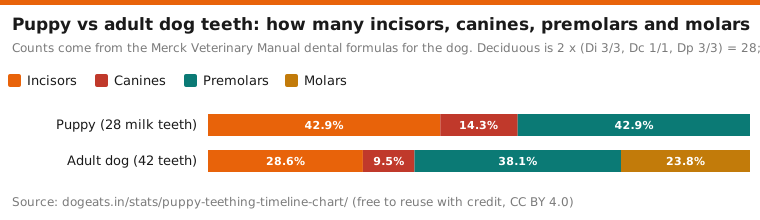
A puppy has 28 milk teeth and an adult dog has 42 permanent teeth. The Merck Veterinary Manual writes the dog's deciduous formula as 2 x (Di 3/3, Dc 1/1, Dp 3/3) = 28. It writes the permanent formula as 2 x (I 3/3, C 1/1, P 4/4, M 2/3) = 42.
The 14 extra teeth are the four first premolars and all ten molars, which have no milk versions. Merck's eruption table lists milk premolars 2 to 4 only and no milk molars. The lower jaw carries one more molar on each side, so an adult dog has 20 upper teeth and 22 lower teeth.
Vets number each tooth with the modified Triadan system. The American Veterinary Dental College calls it the numbering system of choice. Adult teeth run from 101 to 411, and milk teeth use the quadrants 500 to 800.
Counts come from the Merck Veterinary Manual dental formulas for the dog. Deciduous is 2 x (Di 3/3, Dc 1/1, Dp 3/3) = 28; permanent is 2 x (I 3/3, C 1/1, P 4/4, M 2/3) = 42.
Show the numbers
| Label | Incisors | Canines | Premolars | Molars |
|---|---|---|---|---|
| Puppy (28 milk teeth) | 12 | 4 | 12 | 0 |
| Adult dog (42 teeth) | 12 | 4 | 16 | 10 |
Embed this chart
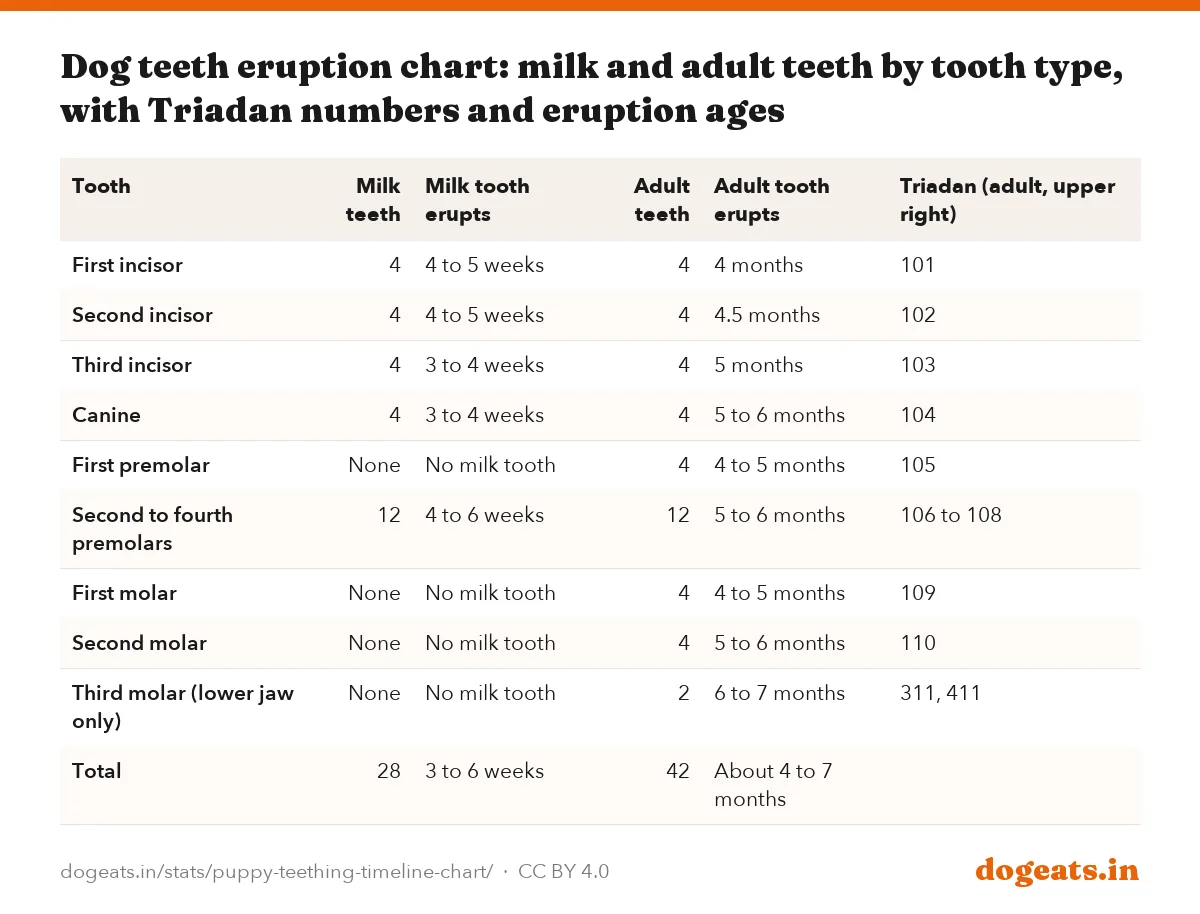
| Tooth | Milk teeth | Milk tooth erupts | Adult teeth | Adult tooth erupts | Triadan (adult, upper right) |
|---|---|---|---|---|---|
| First incisor | 4 | 4 to 5 weeks | 4 | 4 months | 101 |
| Second incisor | 4 | 4 to 5 weeks | 4 | 4.5 months | 102 |
| Third incisor | 4 | 3 to 4 weeks | 4 | 5 months | 103 |
| Canine | 4 | 3 to 4 weeks | 4 | 5 to 6 months | 104 |
| First premolar | None | No milk tooth | 4 | 4 to 5 months | 105 |
| Second to fourth premolars | 12 | 4 to 6 weeks | 12 | 5 to 6 months | 106 to 108 |
| First molar | None | No milk tooth | 4 | 4 to 5 months | 109 |
| Second molar | None | No milk tooth | 4 | 5 to 6 months | 110 |
| Third molar (lower jaw only) | None | No milk tooth | 2 | 6 to 7 months | 311, 411 |
| Total | 28 | 3 to 6 weeks | 42 | About 4 to 7 months |
Merck's eruption ages are averages and, in its own words, subject to considerable variation. A puppy that is a few weeks either side is usually within the normal spread.
Small and toy breeds have the same 42 teeth in a much smaller jaw, and persistent baby teeth are more common in them, as the studies below show.
When do puppies get their adult teeth, tooth by tooth?
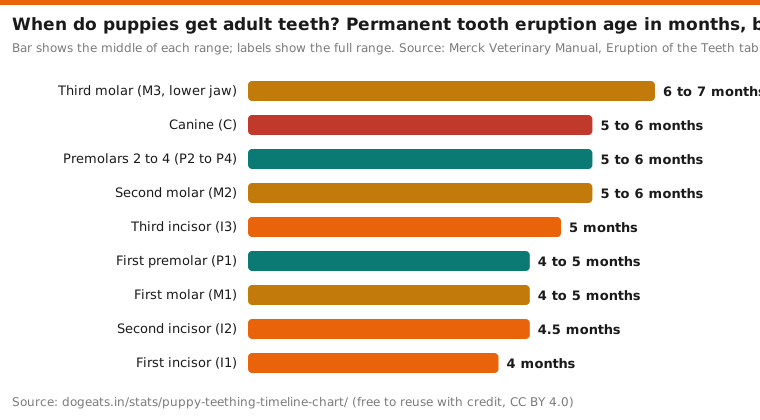
The first adult incisors arrive at about 4 months and the last molars at 6 to 7 months, by Merck's table. The adult canines, the long fangs, come in at 5 to 6 months.
The first molar (M1) and the small first premolar (P1) arrive early, at 4 to 5 months. The second to fourth premolars and the second molar follow at 5 to 6 months. The lower third molar, a small tooth at the back of the lower jaw, is the last at 6 to 7 months.

Bar shows the middle of each range; labels show the full range. Source: Merck Veterinary Manual, Eruption of the Teeth table (dog column), read October 2026; averages subject to considerable variation.
Show the numbers
| Label | months |
|---|---|
| Third molar (M3, lower jaw) | 6 to 7 months |
| Canine (C) | 5 to 6 months |
| Premolars 2 to 4 (P2 to P4) | 5 to 6 months |
| Second molar (M2) | 5 to 6 months |
| Third incisor (I3) | 5 months |
| First premolar (P1) | 4 to 5 months |
| First molar (M1) | 4 to 5 months |
| Second incisor (I2) | 4.5 months |
| First incisor (I1) | 4 months |
Embed this chart
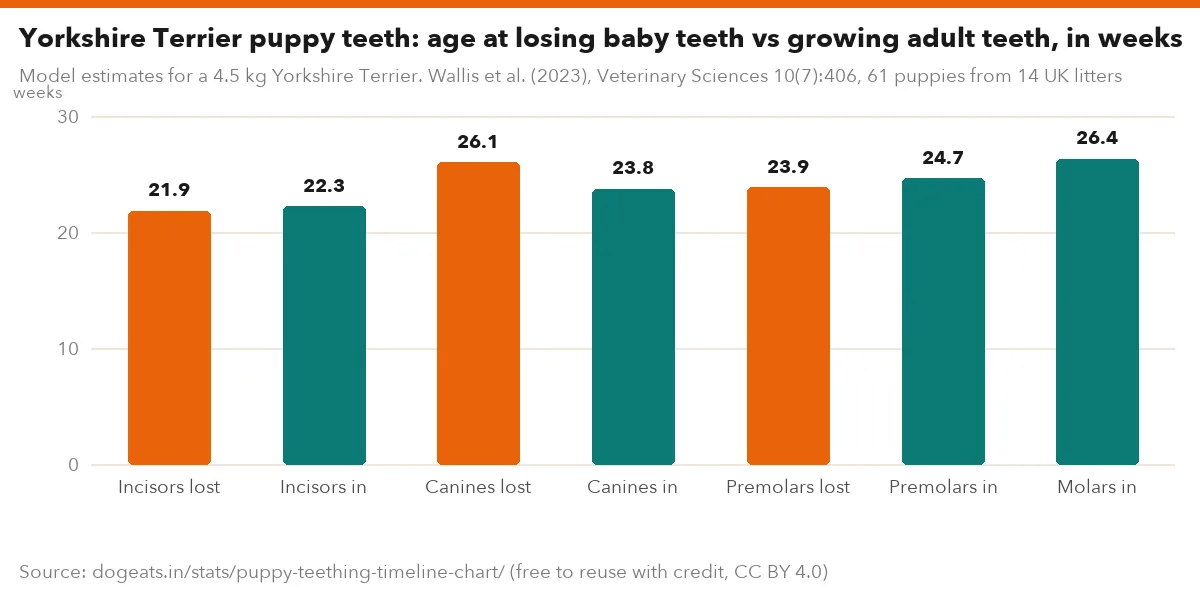
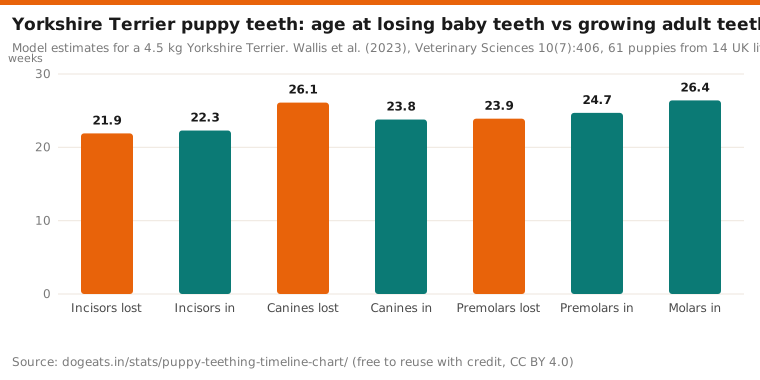
Model estimates for a 4.5 kg Yorkshire Terrier. Wallis et al. (2023), Veterinary Sciences 10(7):406, 61 puppies from 14 UK litters examined every 4 weeks from 12 to 28 weeks of age. Puppies have no milk molars.
Show the numbers
| Label | weeks |
|---|---|
| Incisors lost | 21.9 |
| Incisors in | 22.3 |
| Canines lost | 26.1 |
| Canines in | 23.8 |
| Premolars lost | 23.9 |
| Premolars in | 24.7 |
| Molars in | 26.4 |
Embed this chart
The only tooth-by-tooth measurements we found in a real group of puppies come from a 2023 Waltham study of 61 Yorkshire Terriers. At 4.5 kg, adult incisors came in at about 22.3 weeks, canines at 23.8, premolars at 24.7 and molars at 26.4.
In that study the adult canine came in about 2 weeks before the baby canine fell out, so for a short time both sit side by side. Canines were also the teeth most likely to persist.
The Yorkie ages run later than Merck's general table, so treat them as a guide for small breeds rather than for every dog.
Do small and toy breed puppies teethe later?
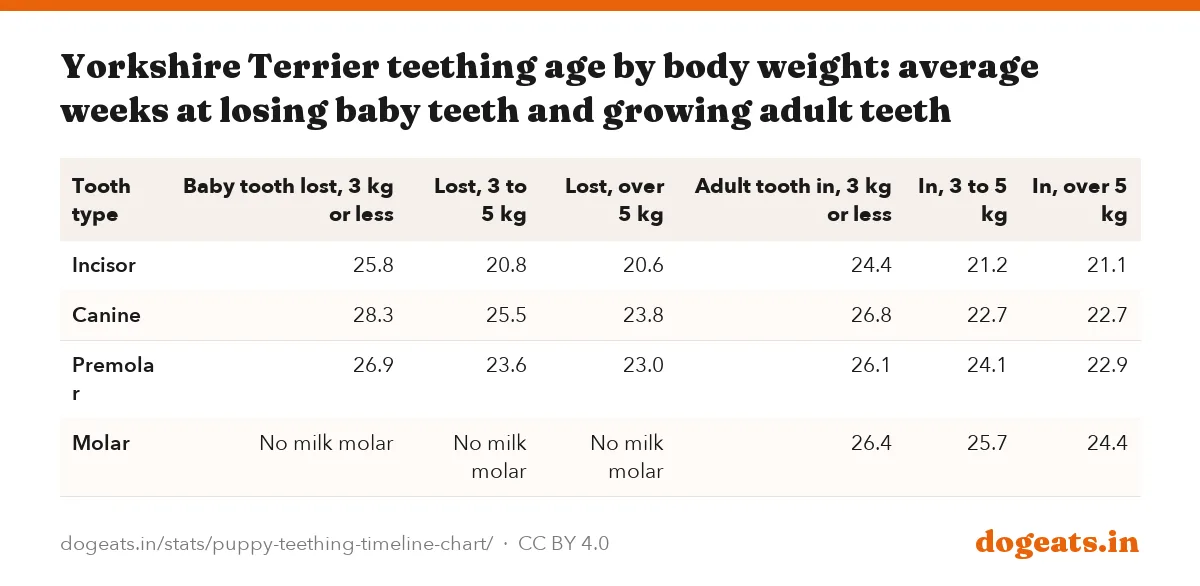
Yes, in the one study that measured it. Yorkshire Terriers weighing 3 kg or less at 28 weeks lost their baby incisors at an average of 25.8 weeks, against 20.8 weeks in Yorkies of 3 to 5 kg.
The tiny dogs were later at every step. Their adult canines came in at 26.8 weeks on average, against 22.7 weeks in heavier Yorkies. In dogs of 3 kg or less the order also changed: incisors, then premolars, then molars, and the canines last.

| Tooth type | Baby tooth lost, 3 kg or less | Lost, 3 to 5 kg | Lost, over 5 kg | Adult tooth in, 3 kg or less | In, 3 to 5 kg | In, over 5 kg |
|---|---|---|---|---|---|---|
| Incisor | 25.8 | 20.8 | 20.6 | 24.4 | 21.2 | 21.1 |
| Canine | 28.3 | 25.5 | 23.8 | 26.8 | 22.7 | 22.7 |
| Premolar | 26.9 | 23.6 | 23.0 | 26.1 | 24.1 | 22.9 |
| Molar | No milk molar | No milk molar | No milk molar | 26.4 | 25.7 | 24.4 |
Body weight here is the weight at 28 weeks. The study had 21 dogs of 3 kg or less, 24 of 3 to 5 kg and 16 over 5 kg. All were pure-bred Yorkies from UK breeders, fed commercial puppy food.
The authors advise watching this breed closely between 2 and 7 months of age. Owners of other tiny breeds popular in Indian cities, such as the Chihuahua and the Pomeranian, have no breed study of teething ages to go on. The same habit of checking the mouth is the safe one.
How common are retained baby teeth in puppies?
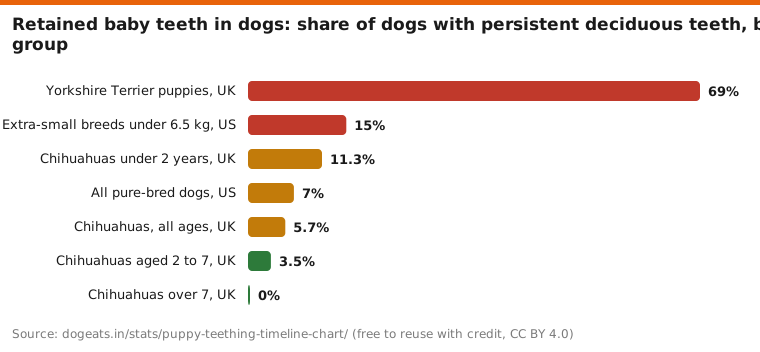
About 7% of dogs, and 15% of extra-small breeds. Those are the figures from medical records of almost 3 million dogs seen over 5 years at a chain of US veterinary hospitals, published in 2024.
Vets call a baby tooth that is still there when it should have fallen out a persistent deciduous tooth. The American Veterinary Dental College calls that term etymologically correct and notes that retained can be confused with a baby tooth that never came through.
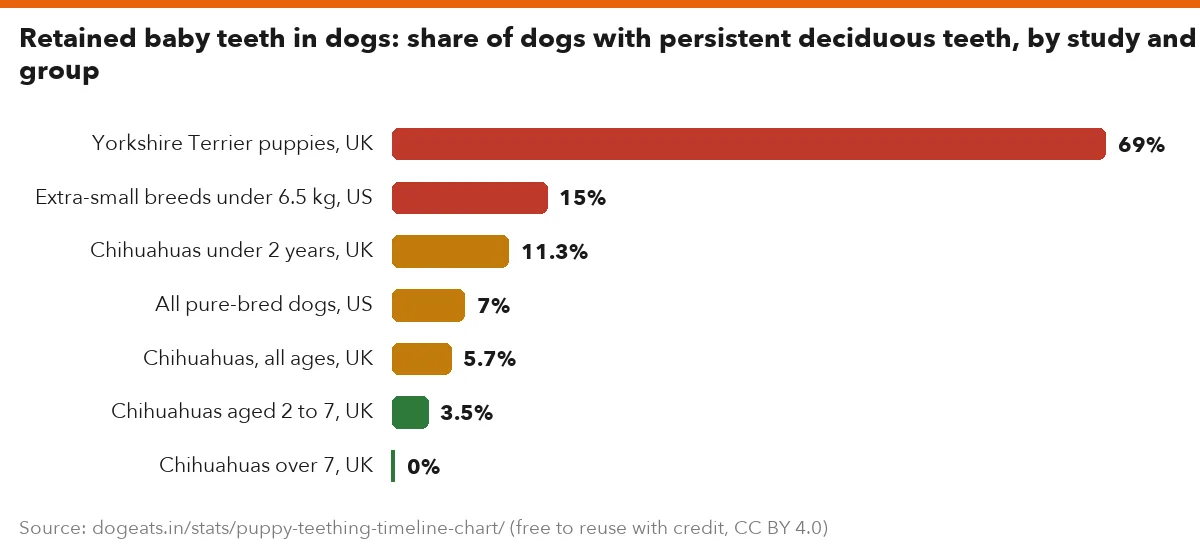
Toy breeds sit at the top. In the UK, 5.7% of Chihuahuas sampled from vet records in 2016 had retained baby teeth, rising to 11.3% of those under 2 years old. Among 61 Yorkshire Terrier puppies examined from 12 to 28 weeks, 69% had at least one.
Yorkies: Wallis et al. (2023), 61 UK puppies examined every 4 weeks; 69% is the share of puppies with one or more persistent baby teeth. US: Wallis, Ivanova and Holcombe (2024), records of almost 3 million dogs over 5 years. Chihuahuas: O'Neill et al. (2020), 5,660 UK Chihuahuas in VetCompass records, 2016. Puppy exams find more cases than routine records, so groups are not directly comparable.
Show the numbers
| Label | % |
|---|---|
| Yorkshire Terrier puppies, UK | 69% |
| Extra-small breeds under 6.5 kg, US | 15% |
| Chihuahuas under 2 years, UK | 11.3% |
| All pure-bred dogs, US | 7% |
| Chihuahuas, all ages, UK | 5.7% |
| Chihuahuas aged 2 to 7, UK | 3.5% |
| Chihuahuas over 7, UK | 0% |
Embed this chart
| Tooth type | Persisted, 3 kg or less | Persisted, 3 to 5 kg | Persisted, over 5 kg | Needed extraction, 3 kg or less | Needed extraction, over 5 kg |
|---|---|---|---|---|---|
| Canine | 89.1% | 25.0% | 12.0% | 64.1% | 8.0% |
| Premolar | 41.1% | 6.1% | 8.7% | 23.4% | 8.0% |
| Incisor | 34.9% | 1.7% | 1.3% | 18.8% | 0.3% |
Canines are the usual problem. In the Yorkie study, the odds of a baby canine persisting were 21.3 times those of an incisor. VCA lists the upper canines as the most common persistent teeth, then the lower canines, then the incisors.
VCA also names flat-faced breeds such as pugs, bulldogs, Boston terriers and boxers, and notes that the problem often runs in families. If you are buying a Pug or a toy breed, ask whether the parents needed baby teeth removed.
The US study found that dogs above ideal body condition had higher odds of retained baby teeth (odds ratio 1.11 to 1.60), and thin dogs lower odds. Two of the authors work for Mars Petcare, a pet food maker and veterinary services provider, and declare this in the paper.
What should you do if a puppy's baby tooth has not fallen out?
Show it to a vet as soon as the adult tooth starts coming in beside it. Merck says a baby tooth should be extracted once its permanent successor has begun to erupt, because no two teeth should occupy the same space at the same time.
VCA says persistent baby teeth usually need prompt removal under general anaesthesia, and that in most cases it is not wise to wait for spaying or neutering. Left too long, the adult tooth may not move into its proper place without orthodontic treatment.
A stuck lower baby canine can push the adult canine inward so its tip presses into the roof of the mouth, VCA warns. Crowded teeth also trap food, which leads to tartar and gum disease.
Ziemann, Schreyer and Gawor (2026), Journal of Veterinary Dentistry 43(5):380-387. 5,432 records from 2013 to 2023; 237 baby tooth root remnants in 143 dogs. Tooth shares are of root remnants; problem shares are of dogs.
Show the numbers
| Label | % |
|---|---|
| Dogs with problems linked to the root | 81.8% |
| Dogs with periapical radiolucency on X-ray | 44.1% |
| Affected dogs that were Yorkshire Terriers | 41.2% |
| Remnants from upper left baby canine (604) | 39.2% |
| Dogs with root resorption and ankylosis | 37.8% |
| Remnants from upper right baby canine (504) | 33.7% |
Embed this chart
The Polish study shows why leftover roots matter. Of 5,432 dog records reviewed, 143 dogs had leftover baby tooth roots, mostly from the upper canines. The authors found the roots do not resorb on their own.
Puppy vaccine visits fall in the same months as teething. Ask the vet to look at the teeth at each one; our report on vet and vaccination costs in India shows what those visits cost.
Merck's owner guide also lists retained baby teeth among the causes of a bad bite, and advises removal as soon as they are noticed.
What can a teething puppy safely chew, and are bones safe?
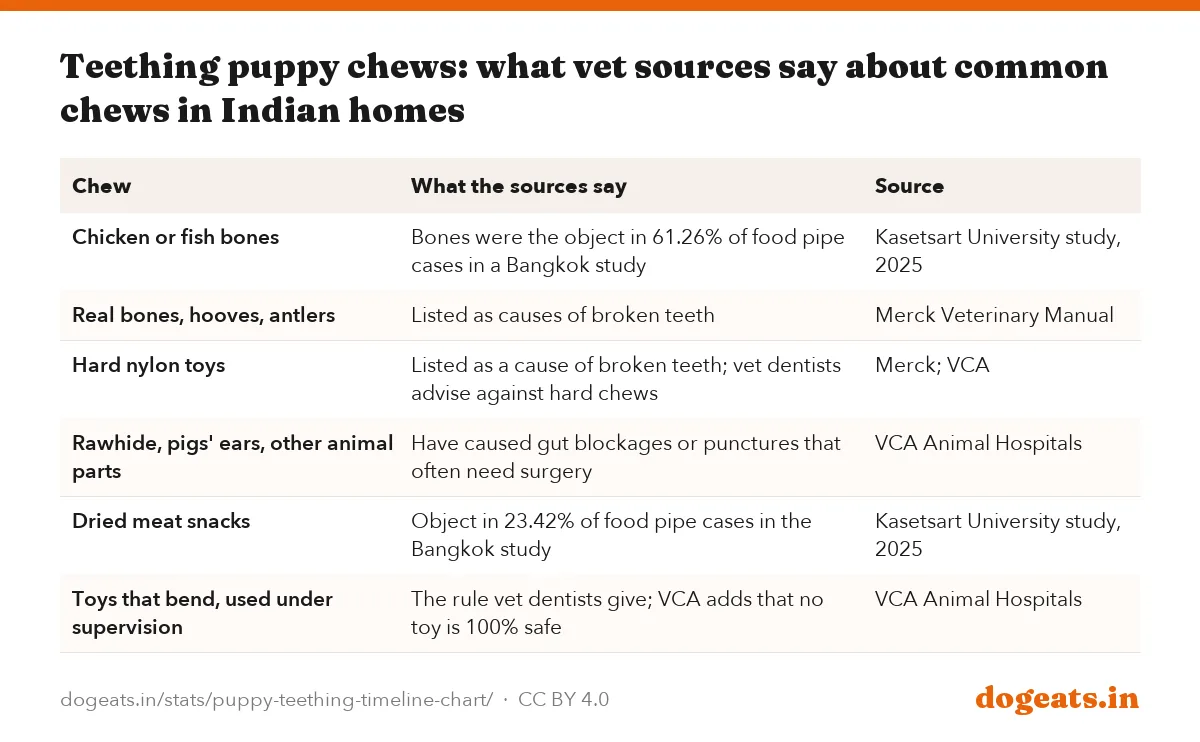
Give chews that bend, and skip bones. VCA notes that veterinary dentists advise against letting dogs chew anything hard, and sums it up as: do not let your dog chew anything that won't bend.
Merck lists real bones, hooves, antlers and hard nylon toys among the causes of broken teeth in dogs. VCA adds that rawhide, pigs' ears, other animal parts and bones have caused gut blockages or punctures that often need surgery.
Chicken and fish bones from the family plate deserve special care in Indian homes. A 2025 study from Kasetsart University in Bangkok looked at 111 dogs with something stuck in the food pipe. Bones (chicken and fish) were the object in 61.26%, and 92.79% of those dogs weighed under 12 kg.

Kasetsart University Veterinary Teaching Hospital, Bangkok: retrospective study of 261 dogs with upper gut foreign bodies, 2018 to 2022, 111 in the oesophagus (J Adv Vet Anim Res, 2025). Shares are of the 111 oesophageal cases. Dogs of all ages; mean age of the oesophagus group 4.9 years.
Show the numbers
| Label | % |
|---|---|
| Bones (chicken bone, fish bones) | 61.3% |
| Dried dog snacks (dried meat and similar) | 23.4% |
| Metal (fishing hooks, coins) | 8.1% |
| Plant material (fruit seeds, wood) | 4.5% |
| Fabric (socks, scraps) | 1.8% |
| Rocks | 0.9% |
Embed this chart
| Chew | What the sources say | Source |
|---|---|---|
| Chicken or fish bones | Bones were the object in 61.26% of food pipe cases in a Bangkok study | Kasetsart University study, 2025 |
| Real bones, hooves, antlers | Listed as causes of broken teeth | Merck Veterinary Manual |
| Hard nylon toys | Listed as a cause of broken teeth; vet dentists advise against hard chews | Merck; VCA |
| Rawhide, pigs' ears, other animal parts | Have caused gut blockages or punctures that often need surgery | VCA Animal Hospitals |
| Dried meat snacks | Object in 23.42% of food pipe cases in the Bangkok study | Kasetsart University study, 2025 |
| Toys that bend, used under supervision | The rule vet dentists give; VCA adds that no toy is 100% safe | VCA Animal Hospitals |
The Bangkok study covered dogs of all ages, and the oesophagus group had a mean age of 4.9 years, so it is not a puppy-only figure. It is useful because the bones were chicken and fish bones, which are common in Indian kitchens. Read our page on chicken bones before you hand one over.
VCA also says puppies chew partly to ease what is assumed to be teething discomfort, so give them something allowed rather than nothing. Rotate a few toys and supervise every chew.
Teething puppies still need their full meals. If chewing makes kibble hard going, see the puppy feeding guide for India, and count chews and treats in the day's calories with our Indian dog treats calorie report.
When should you start brushing a puppy's teeth?
Start full brushing at 6 to 7 months, once the adult teeth are in, but start handling the mouth from day one. That is the advice in the toothbrushing guide from WSAVA's Global Dental Committee.
The guide says daily brushing takes less than 2 minutes. It suggests building up in steps: stroke the face, lift the lip, touch the teeth, then massage the gums before the brush comes in.
The reason is gum disease later in life. WSAVA calls periodontal disease the most common medical problem in cats and dogs, with studies showing up to 90% of pets affected. Merck says gingivitis is often first noticed at about 2 years.
Indian data on puppy teeth is thin. A 2018 MVSc thesis at CSK HPKV, Palampur, was based on 120 patients seen at its surgery department over 20 months. It reported a regional incidence of oral problems in dogs of 8.32%, and listed persistent baby teeth among them without a separate rate.
The same thesis found dogs fed only vegetarian home-made food more prone to oral problems. For what a balanced home diet looks like, see our Indian dog diet chart. Dental disease also tops the list in our report on the most common dog health problems.
Frequently asked questions
At what age do puppies start teething?
Milk teeth start to come through at 3 to 5 weeks of age, the Merck Veterinary Manual says. The teething owners notice, when baby teeth fall out and adult teeth come in, runs from about 3 to 4 months to 6 to 7 months.
When do puppies stop teething?
Most puppies have all 42 adult teeth by 7 months, according to Merck. VCA says most have them by 6 to 7 months. The last teeth in are the lower third molars, at 6 to 7 months.
How many teeth does a puppy have?
A puppy has 28 milk teeth: 12 incisors, 4 canines and 12 premolars. It has no milk molars. An adult dog has 42 teeth.
How many teeth does an adult dog have?
An adult dog has 42 permanent teeth: 12 incisors, 4 canines, 16 premolars and 10 molars. There are 20 in the upper jaw and 22 in the lower jaw.
Should I wait until my puppy is spayed or neutered to remove a retained baby tooth?
Usually not. VCA says persistent baby teeth need prompt removal and that in most cases waiting for spay or neuter surgery is not recommended. Merck says to extract once the adult tooth has begun to erupt.
Is it normal for a puppy to have two canine teeth side by side?
Briefly, yes. In a Yorkshire Terrier study the adult canine came in about 2 weeks before the baby one fell out. If both are still there once the adult tooth is through, Merck says the baby tooth should be removed.
Which breeds get retained baby teeth?
Small and toy breeds most often. In US vet records 15% of extra-small breed dogs had them, against 7% overall. VCA also names flat-faced breeds such as pugs and bulldogs.
Can I give my teething puppy a bone?
Vet sources advise against it. Merck lists real bones and antlers among causes of broken teeth. In a Bangkok study, bones were the object in 61.26% of 111 cases of something stuck in a dog's food pipe. Give chews that bend.
When should I start brushing my puppy's teeth?
WSAVA's dental committee suggests full daily brushing from 6 to 7 months, once adult teeth are in, with mouth handling from day one. Brushing takes less than 2 minutes a day.
Methodology and limitations
Tooth counts and dental formulas come from the Merck Veterinary Manual topic Dentition and Dental Nomenclature of Animals. Eruption ages come from Merck's table Eruption of the Teeth (dog column), read in October 2026. Merck's footnote describes the ages as average data subject to considerable variation.
Where a chart shows one bar for a range, the bar is the middle of the range and the label shows the full range. Counts by tooth type and the upper and lower totals are worked out from Merck's formulas.
Yorkshire Terrier ages and persistence rates are taken from the full text of Wallis et al. (2023), Veterinary Sciences 10(7):406, including Tables 2 to 5. Percentages in our tables are the paper's proportions multiplied by 100. Prevalence figures come from the PubMed abstract of Wallis, Ivanova and Holcombe (2024) and the full text of O'Neill et al. (2020). The Chihuahua rate for ages 2 to 7 is 105 of 2,988 dogs as published (3.51%), rounded.
Root remnant figures come from the PubMed abstract of Ziemann, Schreyer and Gawor (2026). Foreign body figures come from Table 2 of the 2025 Kasetsart University study in the Journal of Advanced Veterinary and Animal Research.
Advice on chews, extraction and brushing is quoted from Merck, VCA Animal Hospitals and the WSAVA Global Dental Committee toothbrushing toolkit. Indian context comes from a 2018 MVSc thesis abstract on Krishikosh. We found no published Indian study of puppy teething ages.
Sources
- Merck Veterinary Manual: Eruption of the Teeth (table, dog column), Milk and adult tooth eruption ages by tooth
- Wallis C, Solmi F, Pesci I, Desforges N, Holcombe LJ (2023), Development of Yorkshire Terrier Dentition, Veterinary Sciences 10(7):406, 61 puppies; ages of tooth loss and eruption by weight; 69% with persistent teeth
- Wallis C, Ivanova A, Holcombe LJ (2024), Persistent deciduous teeth: association of prevalence with breed, breed size and body weight in pure-bred client-owned dogs in the United States, Research in Veterinary Science 169:105161, Almost 3 million dogs; 7% overall, 15% in extra-small breeds
- Also consulted: Merck Veterinary Manual: Dentition and Dental Nomenclature of Animals, Merck Veterinary Manual (owner version): Dental Development of Dogs, Merck Veterinary Manual (owner version): Dental Disorders of Dogs (Reiter AM), Merck Veterinary Manual: Developmental Abnormalities of the Mouth and Dentition in Small Animals (Mulherin BL), O'Neill DG et al. (2020), Demography and commonly recorded clinical conditions of Chihuahuas under primary veterinary care in the UK in 2016, BMC Veterinary Research 16:42, Ziemann D, Schreyer J, Gawor J (2026), Retained Deciduous Tooth Root Remnants in Dogs: A Ten-Year Retrospective Study, Journal of Veterinary Dentistry 43(5):380-387, Kasetsart University (2025), Prevalence and characteristics of foreign body-induced upper gastrointestinal obstruction in dogs, Journal of Advanced Veterinary and Animal Research 12(2):601-609, VCA Animal Hospitals: Persistent Deciduous Teeth (Baby Teeth) in Dogs (Hunter, Hiscox, Bellows; updated April 2024), VCA Animal Hospitals: Teeth, Teething and Chewing in Puppies (updated February 2024), WSAVA Global Dental Committee: Introducing Toothbrushing, American Veterinary Dental College: Nomenclature, Thakur M (2018), Clinical studies on management of oral affections in dogs, MVSc thesis, CSK HPKV Palampur.
Cite, embed and download
This report, its data and its images are free to reuse under a Creative Commons Attribution 4.0 licence. Credit dogeats.in with a link to this page. Every chart has its own embed code, every table has a CSV and an image download, and the images below are ready for social posts, slides and articles.
Cite this report
Link to this report
Every chart and table as an image