Explainer · Updated October 2026
Dog years to human years chart: how old your dog is in human years, by size and by the DNA formula
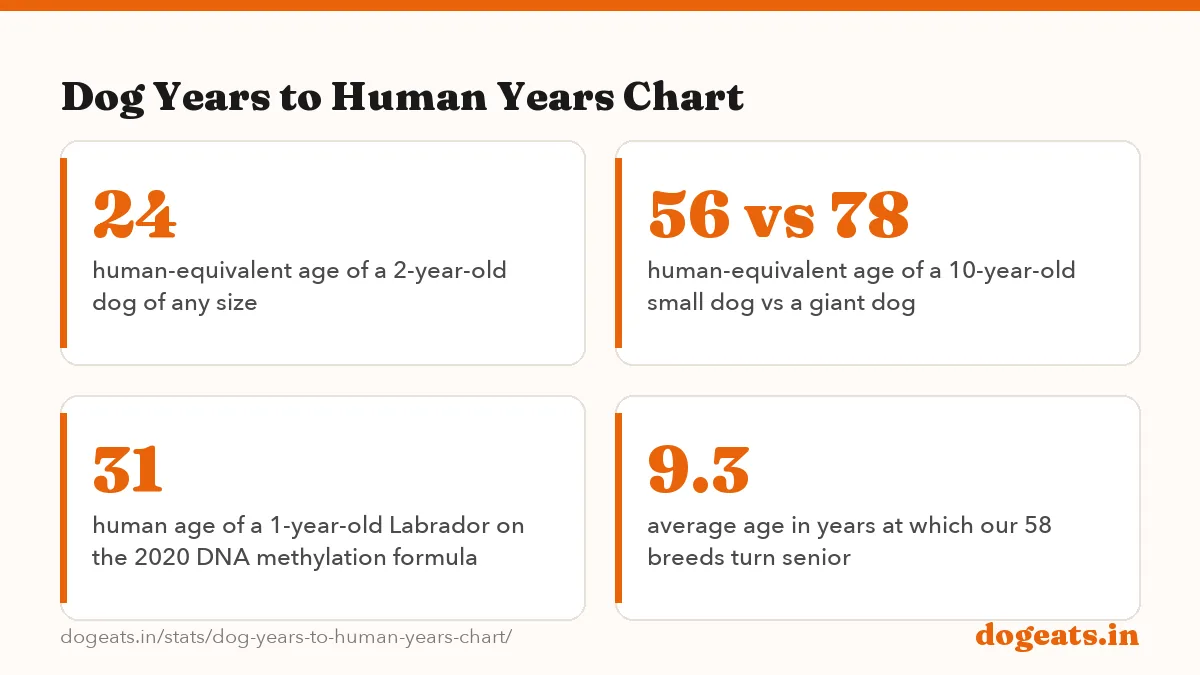
A 1-year-old dog is about 15 in human years and a 2-year-old about 24, whatever its size. After that size takes over: at 10, a small dog is about 56 and a giant dog about 78. The old rule of 7 human years per dog year is wrong, the American Veterinary Medical Association says.
Key findings
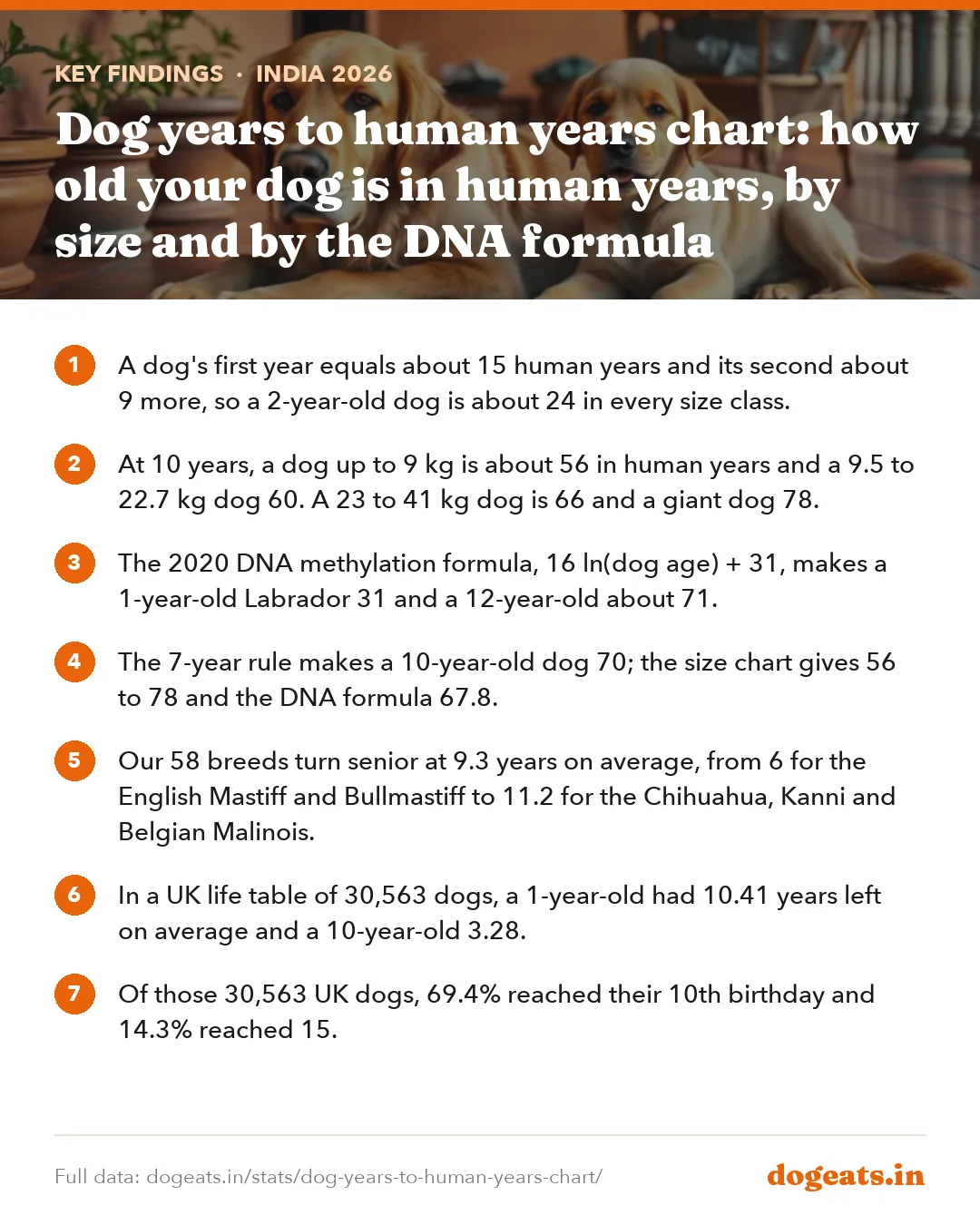
- A dog's first year equals about 15 human years and its second about 9 more, so a 2-year-old dog is about 24 in every size class.
- At 10 years, a dog up to 9 kg is about 56 in human years and a 9.5 to 22.7 kg dog 60. A 23 to 41 kg dog is 66 and a giant dog 78.
- The 2020 DNA methylation formula, 16 ln(dog age) + 31, makes a 1-year-old Labrador 31 and a 12-year-old about 71.
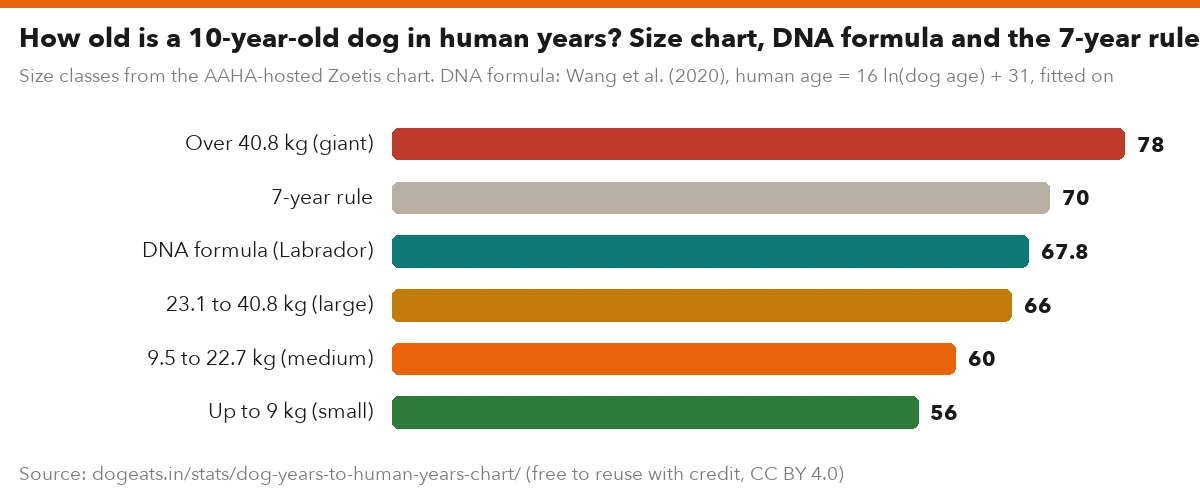
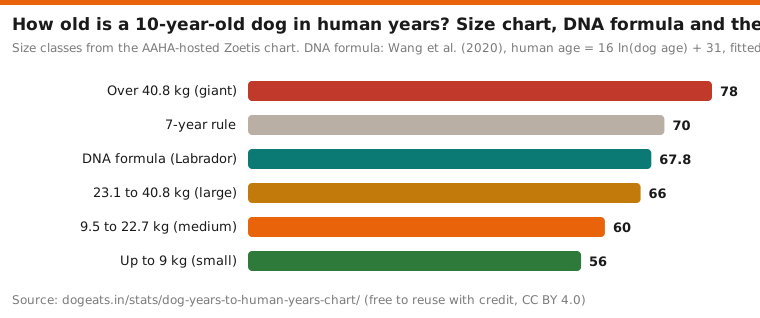
- The 7-year rule makes a 10-year-old dog 70; the size chart gives 56 to 78 and the DNA formula 67.8.
- Our 58 breeds turn senior at 9.3 years on average, from 6 for the English Mastiff and Bullmastiff to 11.2 for the Chihuahua, Kanni and Belgian Malinois.
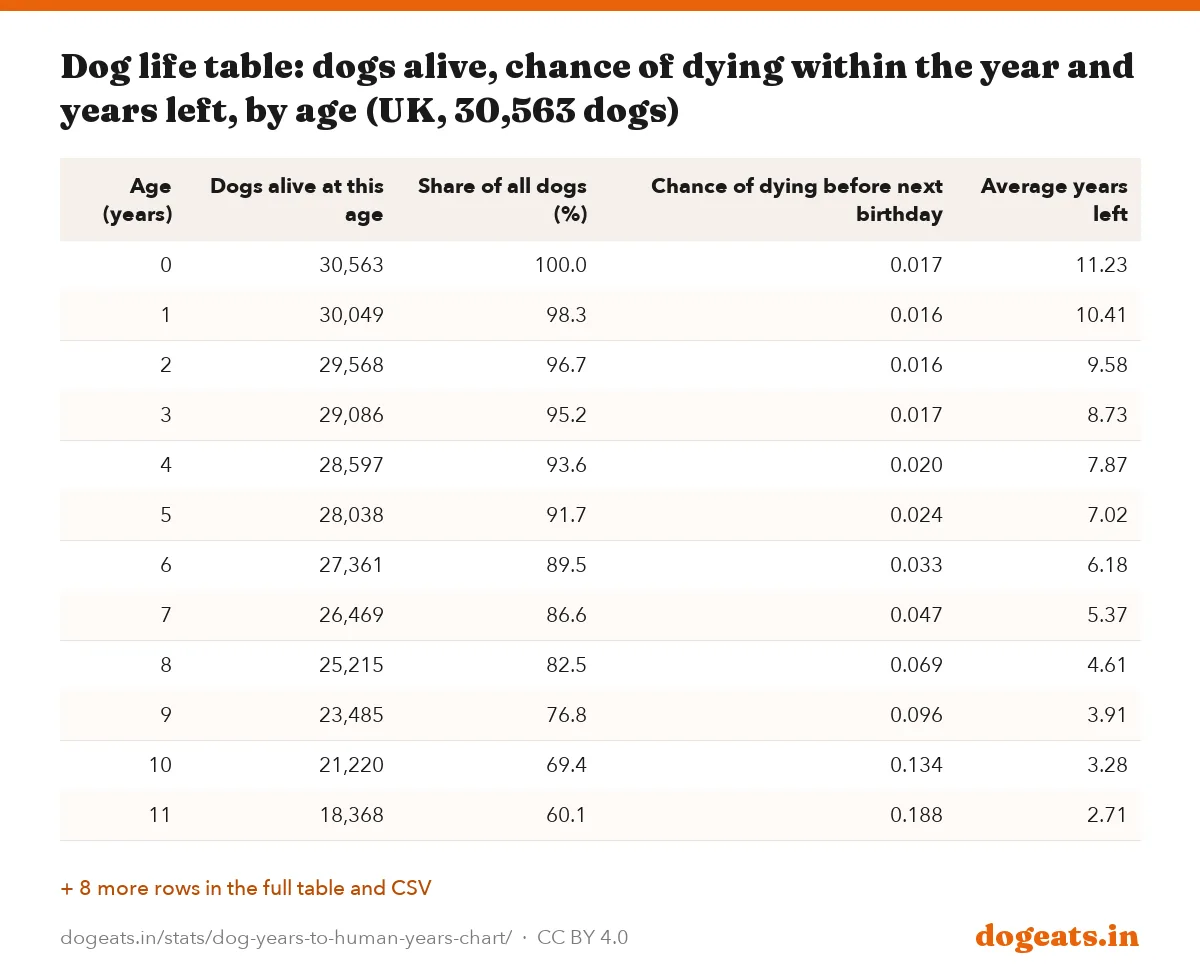
- In a UK life table of 30,563 dogs, a 1-year-old had 10.41 years left on average and a 10-year-old 3.28.
- Of those 30,563 UK dogs, 69.4% reached their 10th birthday and 14.3% reached 15.
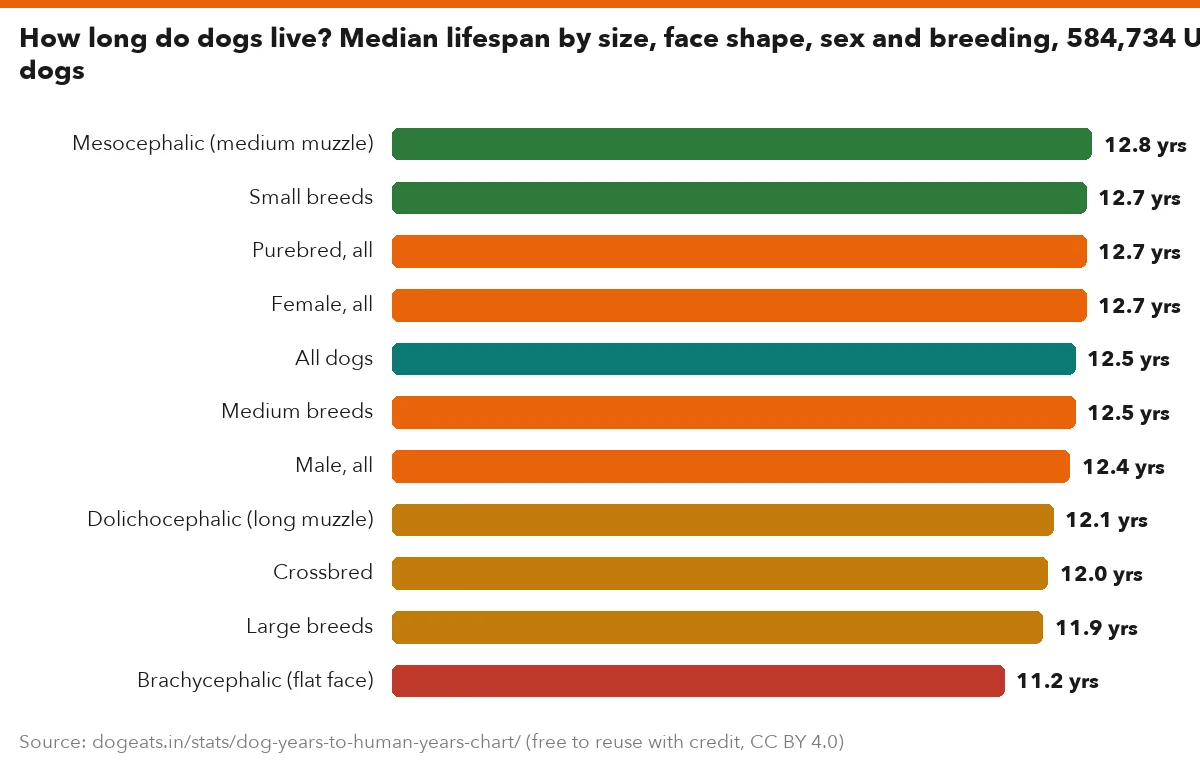
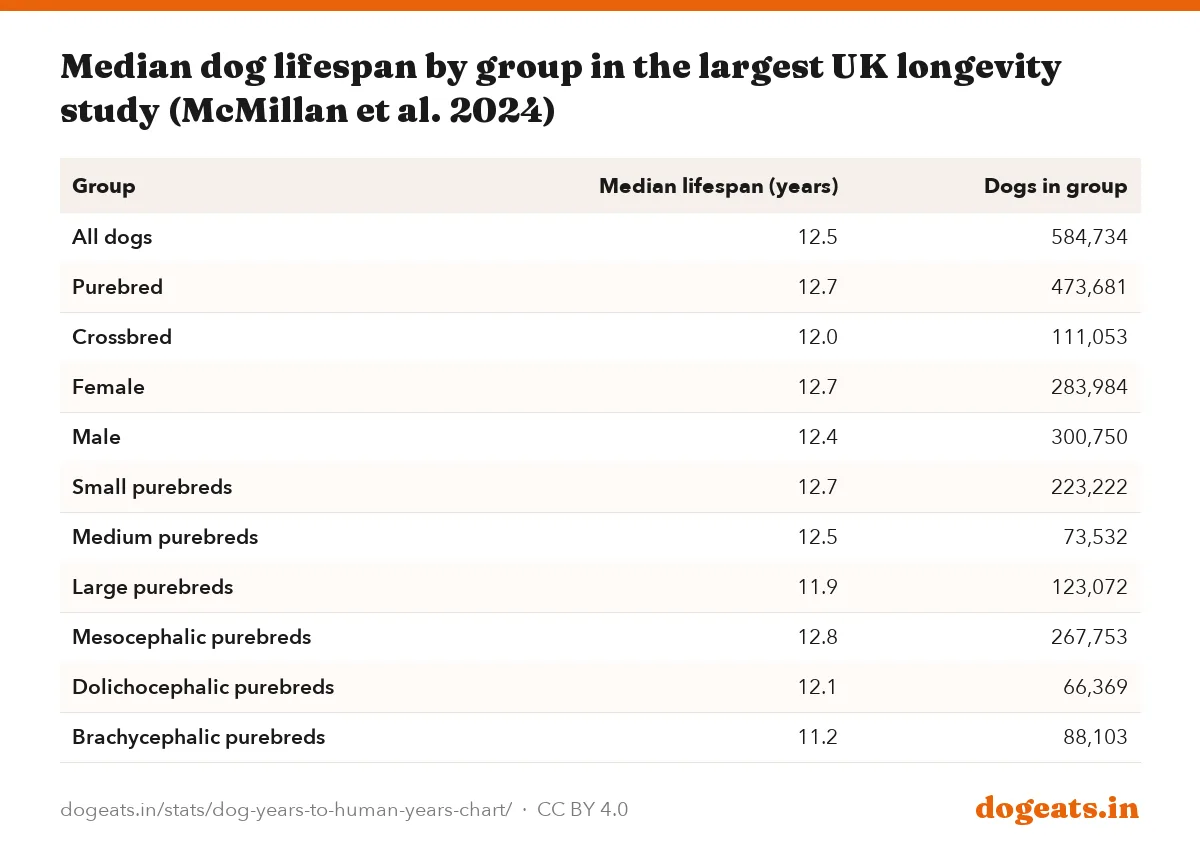
- A UK study of 584,734 dogs found a median lifespan of 12.5 years: 12.7 for small breeds and 11.9 for large ones.
- India's life expectancy of 70.6 years divided by a 12.5-year dog lifespan gives 5.6, not 7.
Dog years to human years chart: how old is my dog in human years?
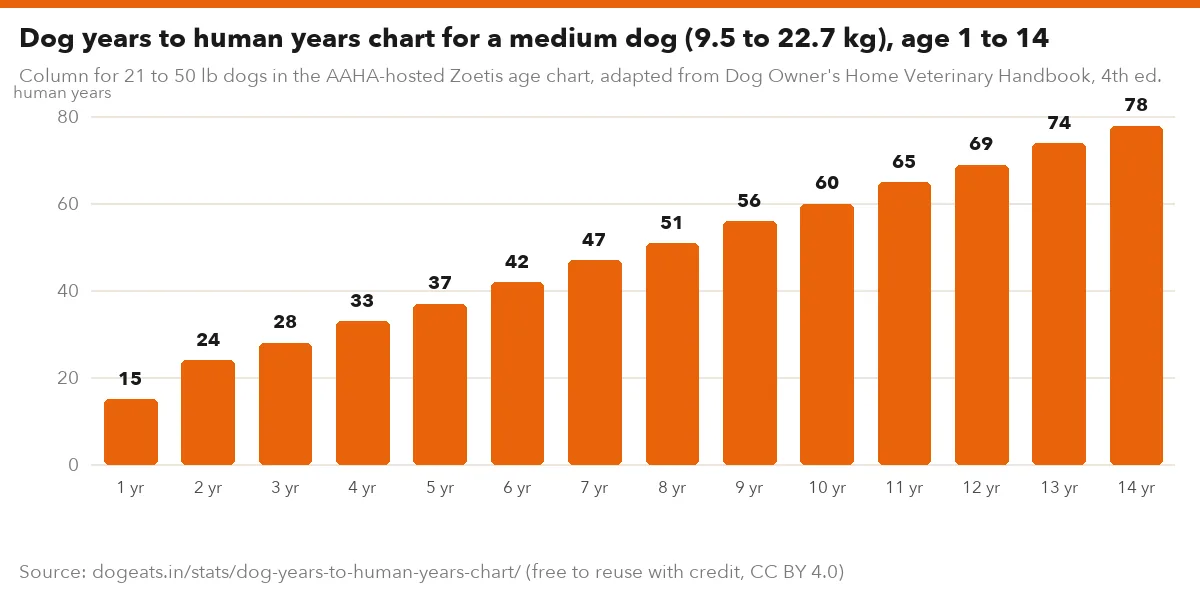
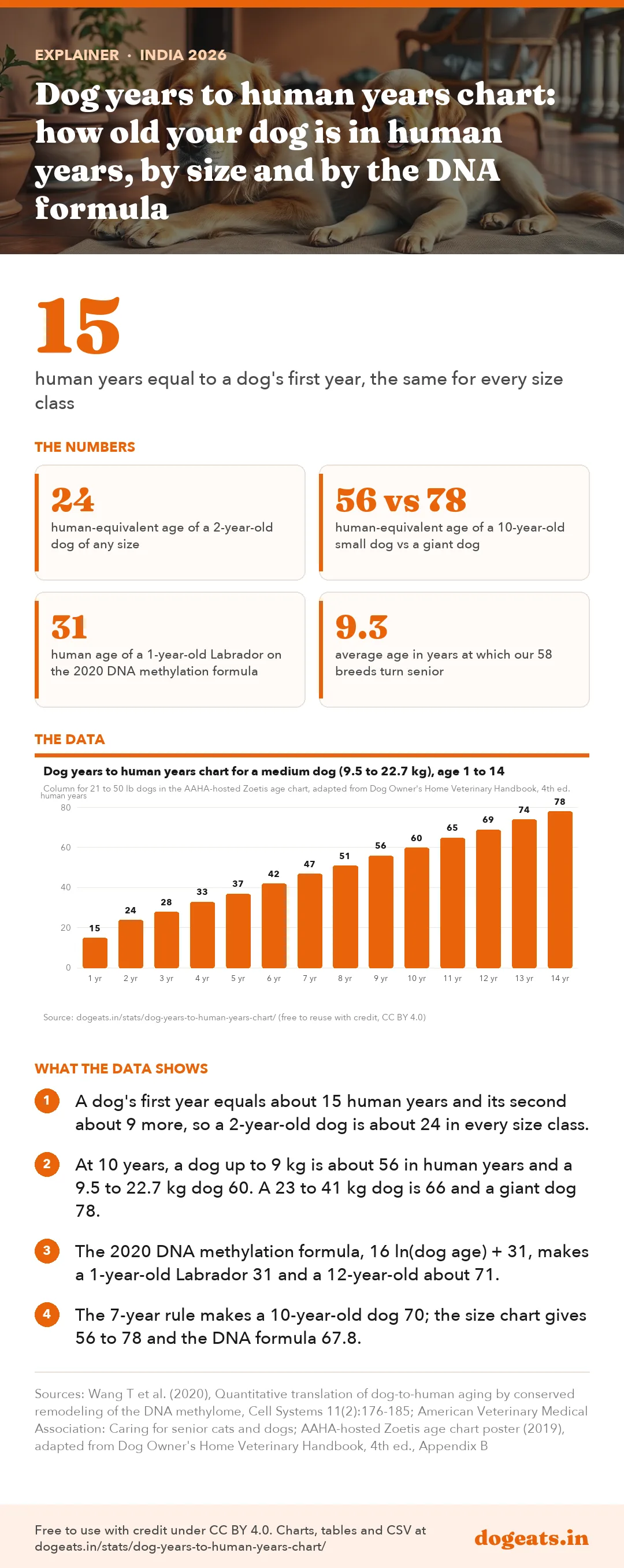
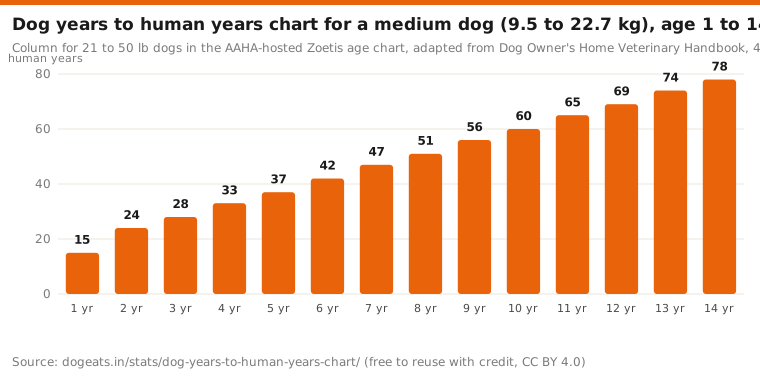
A dog's first year equals about 15 human years and its second year about 9 more. From year 3 the count depends on size. A medium dog of 9.5 to 22.7 kg (21 to 50 lb) adds 4 to 5 human years for each dog year.
The chart below gives the medium-dog column of a widely shared size chart. The American Animal Hospital Association (AAHA) hosts it as a poster made by Zoetis. It is adapted from Appendix B of the Dog Owner's Home Veterinary Handbook (2007).
So a 5-year-old medium dog is about 37 in human years, a 10-year-old about 60 and a 14-year-old about 78.
Column for 21 to 50 lb dogs in the AAHA-hosted Zoetis age chart, adapted from Dog Owner's Home Veterinary Handbook, 4th ed. (2007), Appendix B.
Show the numbers
| Label | human years |
|---|---|
| 1 yr | 15 |
| 2 yr | 24 |
| 3 yr | 28 |
| 4 yr | 33 |
| 5 yr | 37 |
| 6 yr | 42 |
| 7 yr | 47 |
| 8 yr | 51 |
| 9 yr | 56 |
| 10 yr | 60 |
| 11 yr | 65 |
| 12 yr | 69 |
| 13 yr | 74 |
| 14 yr | 78 |
Embed this chart
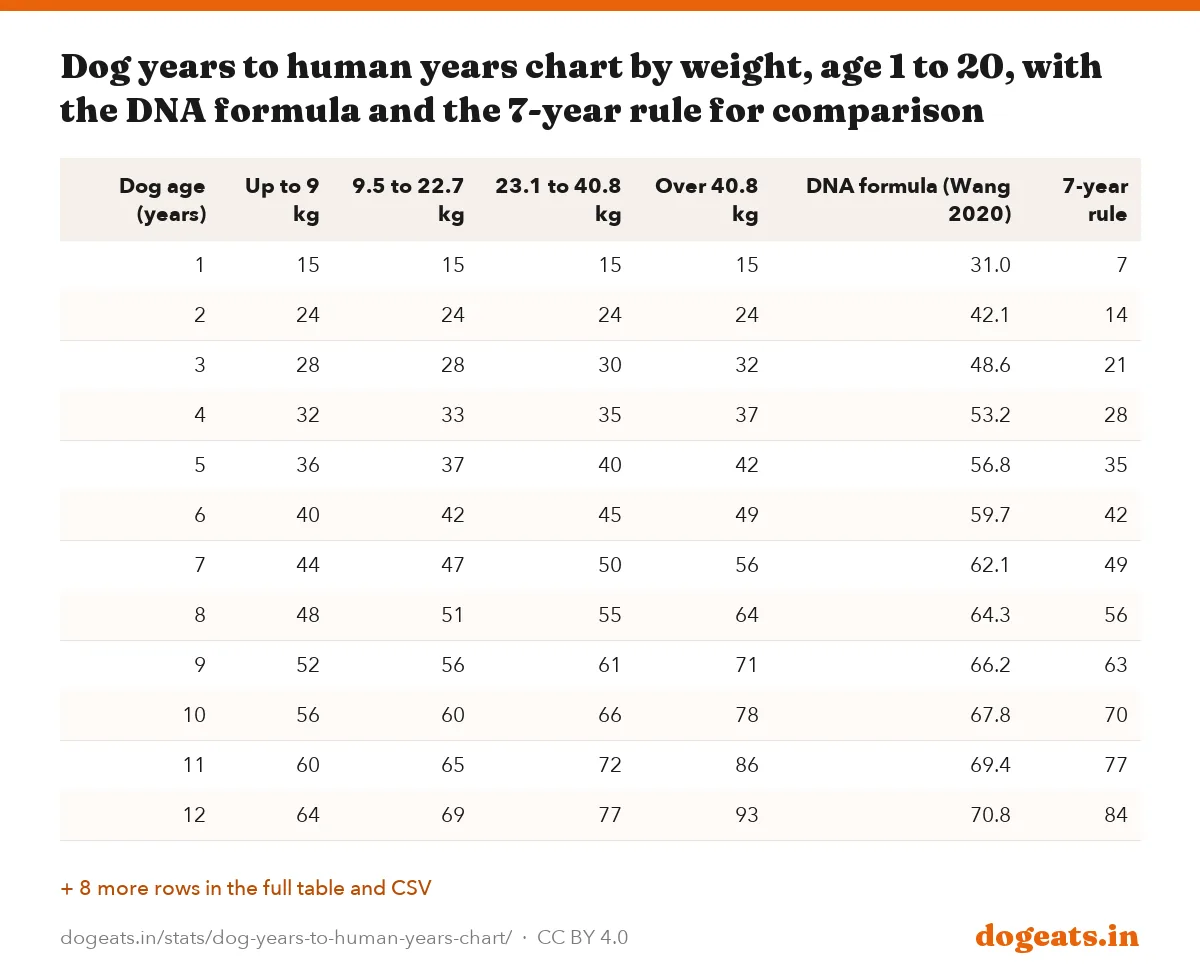
| Dog age (years) | Up to 9 kg | 9.5 to 22.7 kg | 23.1 to 40.8 kg | Over 40.8 kg | DNA formula (Wang 2020) | 7-year rule |
|---|---|---|---|---|---|---|
| 1 | 15 | 15 | 15 | 15 | 31.0 | 7 |
| 2 | 24 | 24 | 24 | 24 | 42.1 | 14 |
| 3 | 28 | 28 | 30 | 32 | 48.6 | 21 |
| 4 | 32 | 33 | 35 | 37 | 53.2 | 28 |
| 5 | 36 | 37 | 40 | 42 | 56.8 | 35 |
| 6 | 40 | 42 | 45 | 49 | 59.7 | 42 |
| 7 | 44 | 47 | 50 | 56 | 62.1 | 49 |
| 8 | 48 | 51 | 55 | 64 | 64.3 | 56 |
| 9 | 52 | 56 | 61 | 71 | 66.2 | 63 |
| 10 | 56 | 60 | 66 | 78 | 67.8 | 70 |
| 11 | 60 | 65 | 72 | 86 | 69.4 | 77 |
| 12 | 64 | 69 | 77 | 93 | 70.8 | 84 |
| 13 | 68 | 74 | 82 | 101 | 72.0 | 91 |
| 14 | 72 | 78 | 88 | 108 | 73.2 | 98 |
| 15 | 76 | 83 | 93 | 115 | 74.3 | 105 |
| 16 | 80 | 87 | 99 | 123 | 75.4 | 112 |
| 17 | 84 | 92 | 104 | not listed | 76.3 | 119 |
| 18 | 88 | 96 | 109 | not listed | 77.2 | 126 |
| 19 | 92 | 101 | 115 | not listed | 78.1 | 133 |
| 20 | 96 | 105 | 120 | not listed | 78.9 | 140 |
The four size columns match for the first 2 years. A dog up to 9 kg then adds 4 human years each year, so it reaches 56 at 10 and 76 at 15.
A giant dog over 40.8 kg (90 lb) ages fastest. It reaches 78 at 10, 101 at 13 and 115 at 15. The chart stops listing giants after 16, at 123.
To see how long each breed usually lives, read our dog breed lifespan report.
Is 1 dog year equal to 7 human years?
No. The American Veterinary Medical Association (AVMA) says dogs do not age at a rate of 7 human years per dog year. The American Kennel Club calls the rule outdated.
The AKC suggests the ratio came from people living to about 70 and dogs to about 10. Multiply 10 by 7 and you get 70.
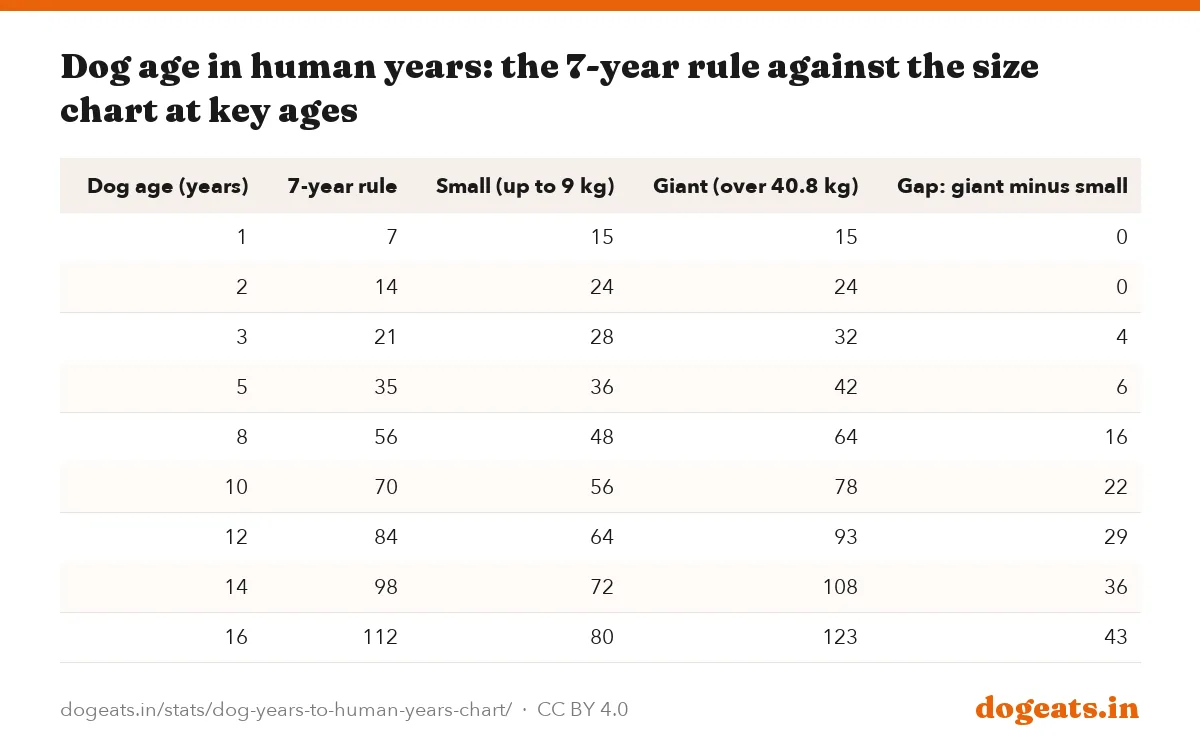
The 7-year rule badly understates the early years. It makes a 1-year-old dog 7, yet the DNA study places puberty in dogs at about 6 months. The size chart says 15 and the DNA formula says 31.
Size classes from the AAHA-hosted Zoetis chart. DNA formula: Wang et al. (2020), human age = 16 ln(dog age) + 31, fitted on Labrador Retrievers.
Show the numbers
| Label | human years |
|---|---|
| Over 40.8 kg (giant) | 78 |
| 7-year rule | 70 |
| DNA formula (Labrador) | 67.8 |
| 23.1 to 40.8 kg (large) | 66 |
| 9.5 to 22.7 kg (medium) | 60 |
| Up to 9 kg (small) | 56 |
Embed this chart
| Dog age (years) | 7-year rule | Small (up to 9 kg) | Giant (over 40.8 kg) | Gap: giant minus small |
|---|---|---|---|---|
| 1 | 7 | 15 | 15 | 0 |
| 2 | 14 | 24 | 24 | 0 |
| 3 | 21 | 28 | 32 | 4 |
| 5 | 35 | 36 | 42 | 6 |
| 8 | 56 | 48 | 64 | 16 |
| 10 | 70 | 56 | 78 | 22 |
| 12 | 84 | 64 | 93 | 29 |
| 14 | 98 | 72 | 108 | 36 |
| 16 | 112 | 80 | 123 | 43 |
The ratio also depends on which human and which dog you pick. India's life expectancy at birth was 70.6 years for 2020 to 2024, according to the Sample Registration System.
Divide 70.6 by the 12.5-year median dog lifespan from a UK study of 584,734 dogs and you get 5.6. Divide it by the 11.23-year UK dog life expectancy at birth and you get 6.3.
Within India the figure moves too. Life expectancy runs from 64.7 years in Chhattisgarh to 75.6 in Kerala, and from 69.4 in rural areas to 73.2 in towns.
Dog age calculator: what does the DNA formula say?
In 2020 a University of California San Diego team led by Tina Wang compared DNA methylation in dogs and people. Methylation marks build up on DNA with age, like a molecular clock.
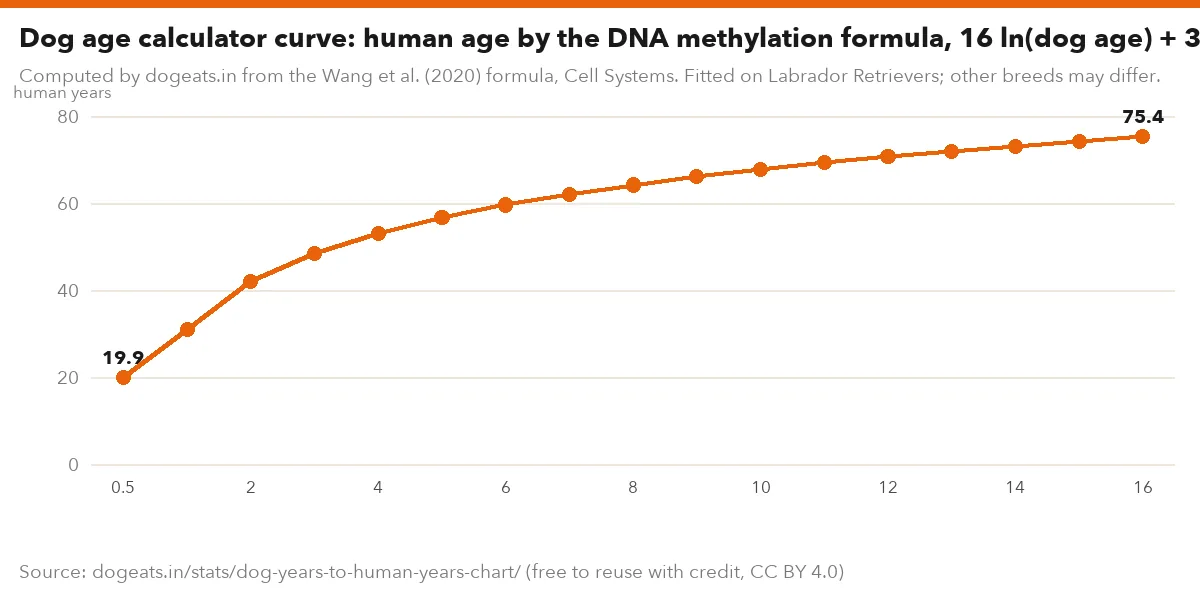
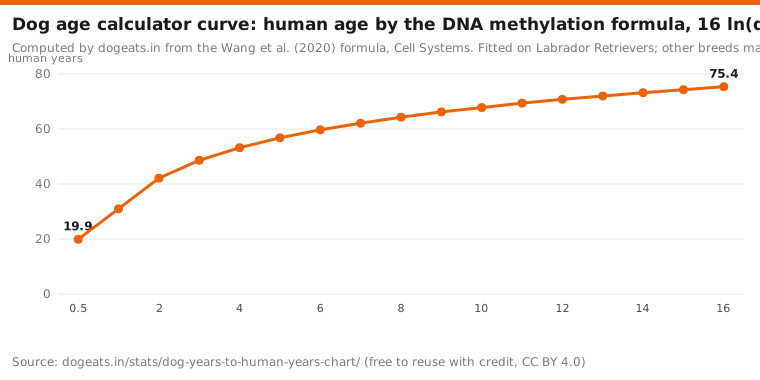
They profiled 104 dogs, mostly Labrador Retrievers, aged 0.1 to 16 years, against 320 people aged 1 to 103. The result was a logarithmic formula: human age = 16 ln(dog age) + 31.
The formula makes puppies age very fast. A 6-month-old Labrador comes out at 19.9 human years, a 1-year-old at 31 and a 2-year-old at 42.1. After that each dog year adds less: 6.5 human years from age 2 to 3, and under 2 a year from age 8.
Computed by dogeats.in from the Wang et al. (2020) formula, Cell Systems. Fitted on Labrador Retrievers; other breeds may differ.
Show the numbers
| Label | human years |
|---|---|
| 0.5 | 19.9 |
| 1 | 31.0 |
| 2 | 42.1 |
| 3 | 48.6 |
| 4 | 53.2 |
| 5 | 56.8 |
| 6 | 59.7 |
| 7 | 62.1 |
| 8 | 64.3 |
| 9 | 66.2 |
| 10 | 67.8 |
| 11 | 69.4 |
| 12 | 70.8 |
| 13 | 72.0 |
| 14 | 73.2 |
| 15 | 74.3 |
| 16 | 75.4 |
Embed this chart
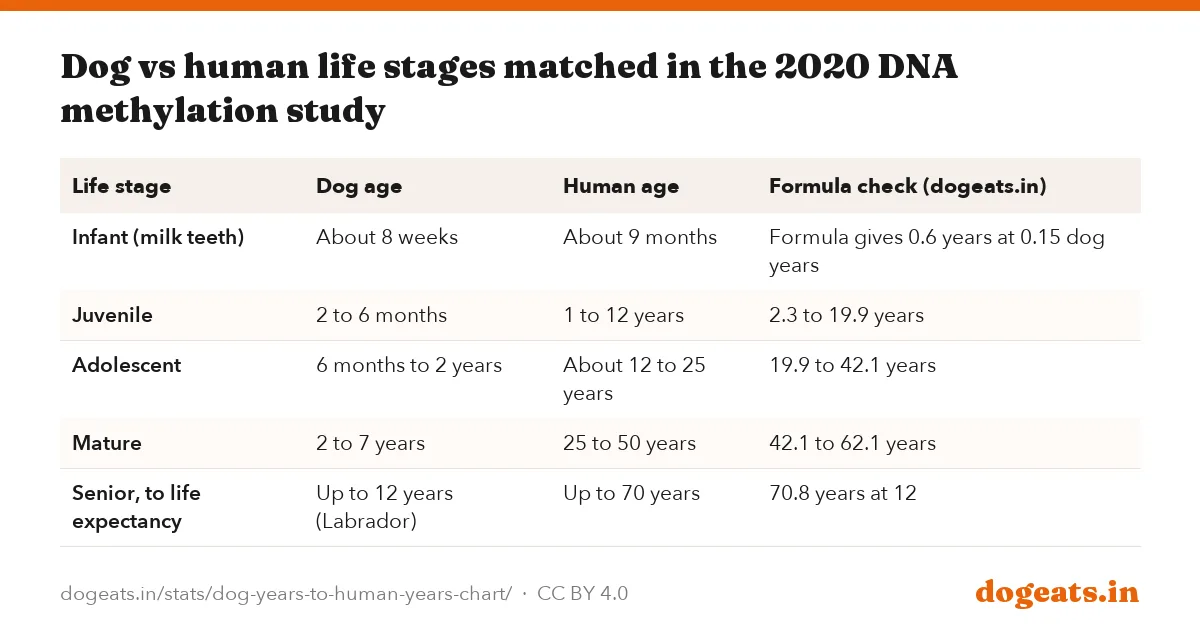
| Life stage | Dog age | Human age | Formula check (dogeats.in) |
|---|---|---|---|
| Infant (milk teeth) | About 8 weeks | About 9 months | Formula gives 0.6 years at 0.15 dog years |
| Juvenile | 2 to 6 months | 1 to 12 years | 2.3 to 19.9 years |
| Adolescent | 6 months to 2 years | About 12 to 25 years | 19.9 to 42.1 years |
| Mature | 2 to 7 years | 25 to 50 years | 42.1 to 62.1 years |
| Senior, to life expectancy | Up to 12 years (Labrador) | Up to 70 years | 70.8 years at 12 |
The authors say the fit was close for infants and seniors. It was looser for adolescent and mature dogs, whose DNA changed faster than physiology tables predict.
The match at the end of life lines up neatly with India. The study mapped a Labrador's 12-year lifespan to a human life expectancy of 70. India's latest figure, for 2020 to 2024, is 70.6.
The formula was built on one breed. The authors note that breeds with different lifespans could need different formulas, so a Chihuahua or a Great Dane may not fit it.
At what age is a dog considered a senior?
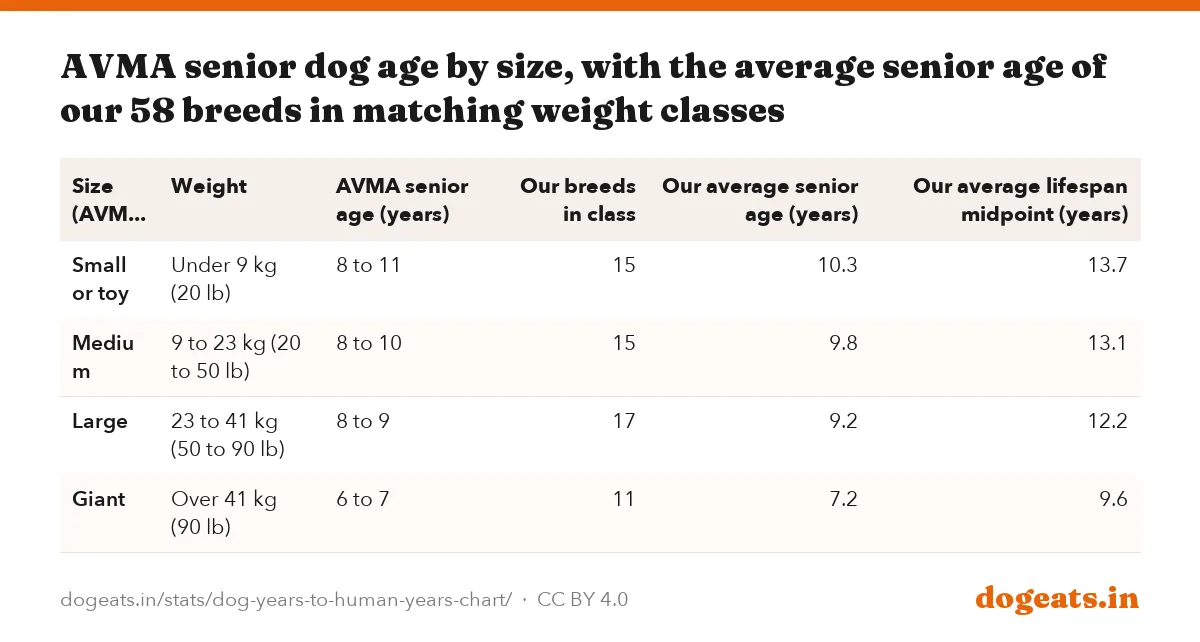
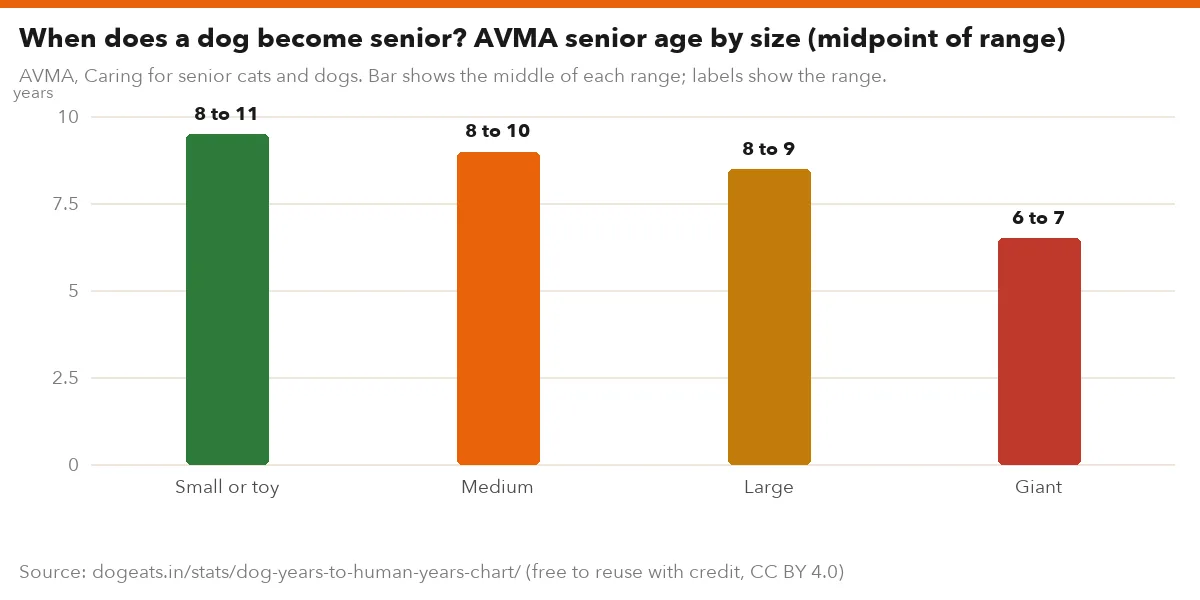
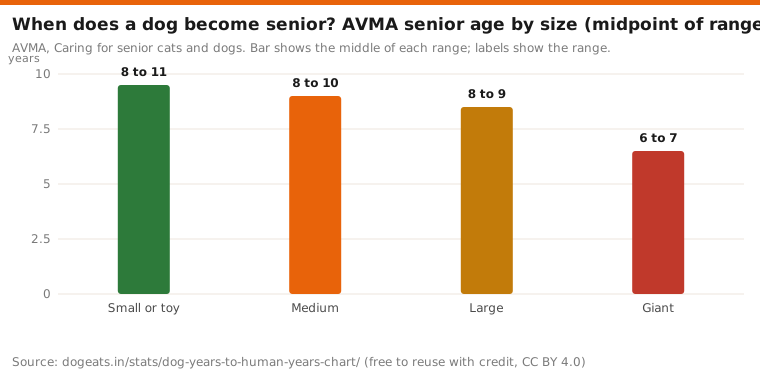
The AVMA says experts count a dog as senior once it reaches the last 25% of the expected lifespan for its breed. Using American Kennel Club data, it gives typical ages by size.
Small and toy dogs under 9 kg (20 lb) turn senior at 8 to 11. Medium dogs of 9 to 23 kg (20 to 50 lb) do so at 8 to 10, and large dogs of 23 to 41 kg at 8 to 9. Giant dogs over 41 kg (90 lb) are senior at 6 to 7.
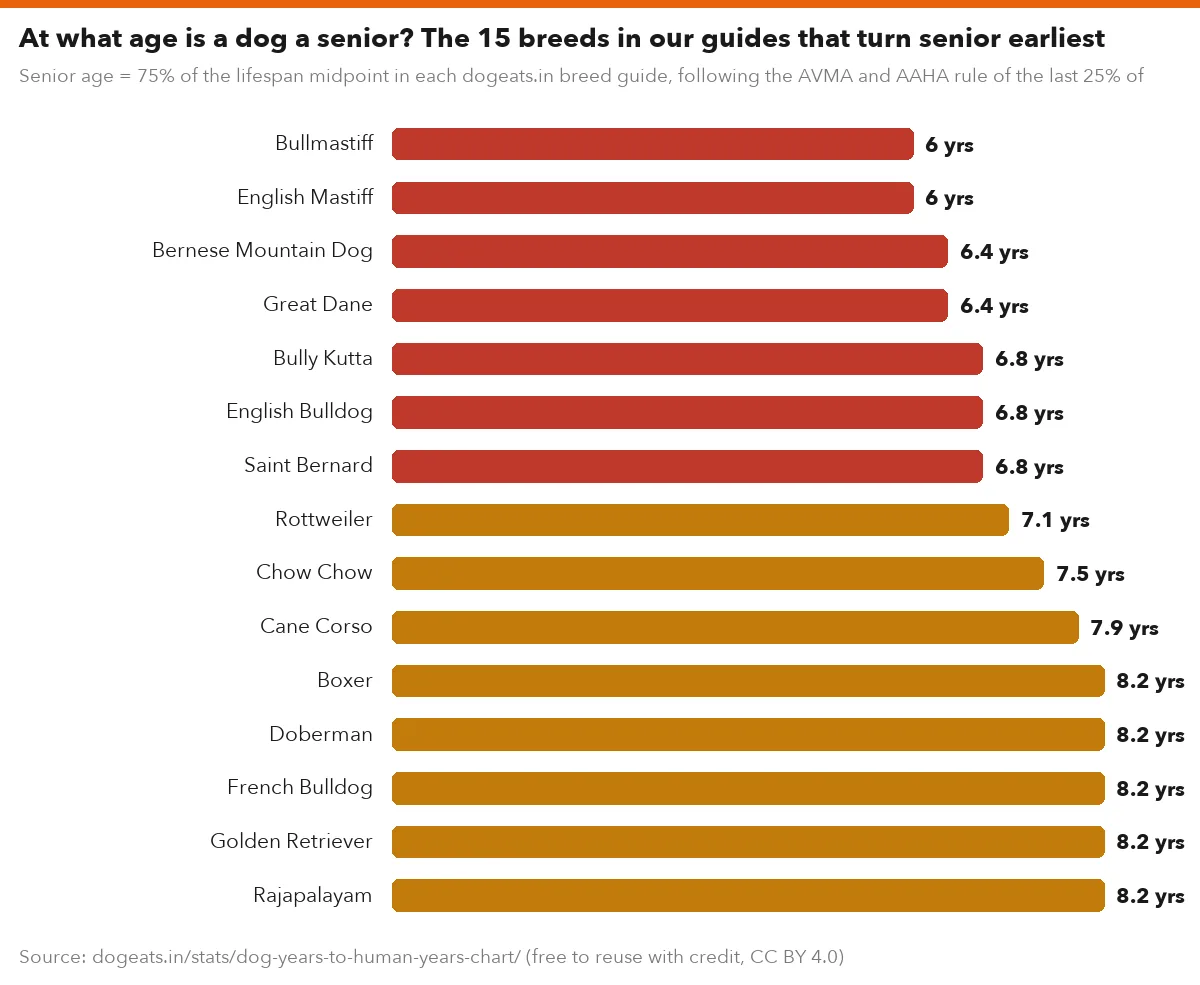
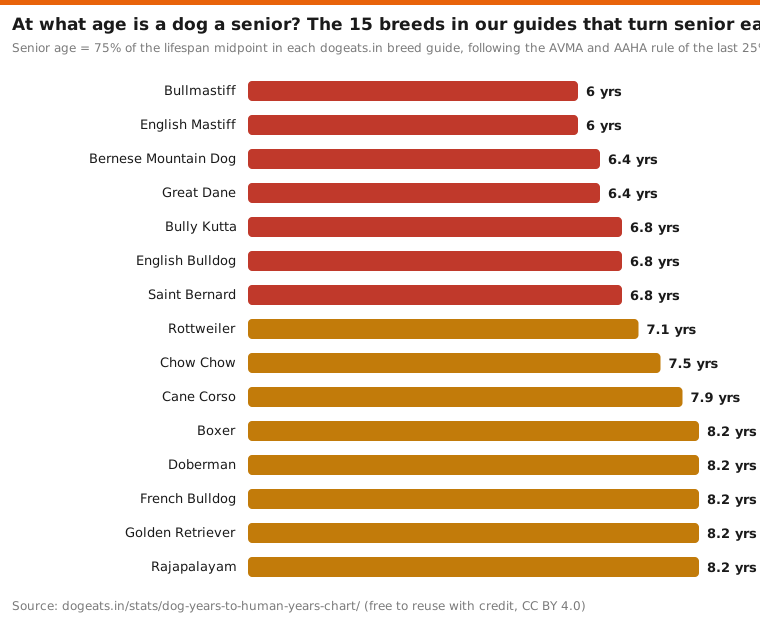
We applied the same 25% rule to the lifespan midpoints in our 58 breed guides. The average breed turns senior at 9.3 years. The giant breeds in our list average 7.2.
Senior age = 75% of the lifespan midpoint in each dogeats.in breed guide, following the AVMA and AAHA rule of the last 25% of lifespan. dogeats.in editorial data, October 2026.
Show the numbers
| Label | years |
|---|---|
| Bullmastiff | 6 yrs |
| English Mastiff | 6 yrs |
| Bernese Mountain Dog | 6.4 yrs |
| Great Dane | 6.4 yrs |
| Bully Kutta | 6.8 yrs |
| English Bulldog | 6.8 yrs |
| Saint Bernard | 6.8 yrs |
| Rottweiler | 7.1 yrs |
| Chow Chow | 7.5 yrs |
| Cane Corso | 7.9 yrs |
| Boxer | 8.2 yrs |
| Doberman | 8.2 yrs |
| French Bulldog | 8.2 yrs |
| Golden Retriever | 8.2 yrs |
| Rajapalayam | 8.2 yrs |
Embed this chart
| Size (AVMA) | Weight | AVMA senior age (years) | Our breeds in class | Our average senior age (years) | Our average lifespan midpoint (years) |
|---|---|---|---|---|---|
| Small or toy | Under 9 kg (20 lb) | 8 to 11 | 15 | 10.3 | 13.7 |
| Medium | 9 to 23 kg (20 to 50 lb) | 8 to 10 | 15 | 9.8 | 13.1 |
| Large | 23 to 41 kg (50 to 90 lb) | 8 to 9 | 17 | 9.2 | 12.2 |
| Giant | Over 41 kg (90 lb) | 6 to 7 | 11 | 7.2 | 9.6 |
Seven breeds in our list reach senior age before 7. The English Mastiff and Bullmastiff get there at 6, the Great Dane and Bernese Mountain Dog at 6.4. The Saint Bernard, Bully Kutta and English Bulldog follow at 6.8.
At the other end, the Chihuahua, Kanni and Belgian Malinois turn senior at 11.2 years. The Indian Pariah Dog and Shiba Inu follow at 10.9.
The AVMA advises a vet visit twice a year or more for senior pets. Our senior dog feeding guide covers diet changes at this stage.
What are the life stages of a dog?
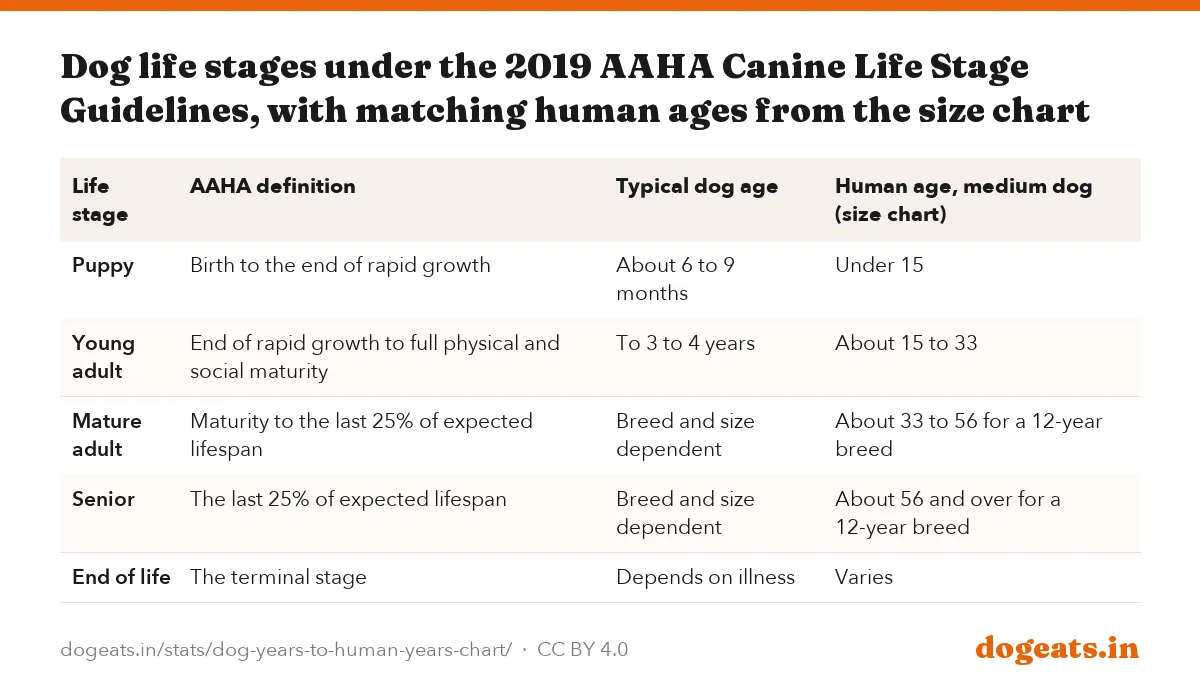
AAHA's 2019 Canine Life Stage Guidelines define five stages in their table, from puppy to end of life. The task force chose stages over human age equivalents on purpose.
A puppy runs from birth to the end of rapid growth, at about 6 to 9 months. A young adult runs to full physical and social maturity, reached by most dogs at 3 to 4 years.
A mature adult runs to the last 25% of the expected lifespan. A senior covers that last 25%, and end of life is the final stage.
| Life stage | AAHA definition | Typical dog age | Human age, medium dog (size chart) |
|---|---|---|---|
| Puppy | Birth to the end of rapid growth | About 6 to 9 months | Under 15 |
| Young adult | End of rapid growth to full physical and social maturity | To 3 to 4 years | About 15 to 33 |
| Mature adult | Maturity to the last 25% of expected lifespan | Breed and size dependent | About 33 to 56 for a 12-year breed |
| Senior | The last 25% of expected lifespan | Breed and size dependent | About 56 and over for a 12-year breed |
| End of life | The terminal stage | Depends on illness | Varies |
AVMA, Caring for senior cats and dogs. Bar shows the middle of each range; labels show the range.
Show the numbers
| Label | years |
|---|---|
| Small or toy | 8 to 11 |
| Medium | 8 to 10 |
| Large | 8 to 9 |
| Giant | 6 to 7 |
Embed this chart
The human ages in the last column come from the medium column of the size chart. For a breed that lives 12 years, the last 25% starts at 9, which the chart puts at 56 human years.
How many years does a dog have left at each age?
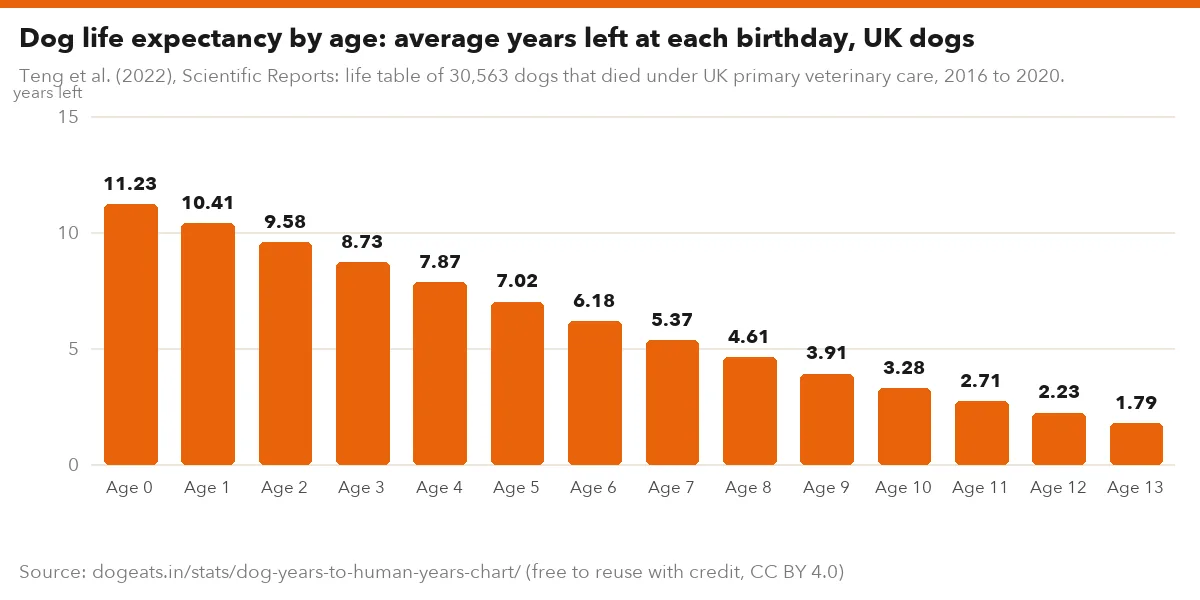
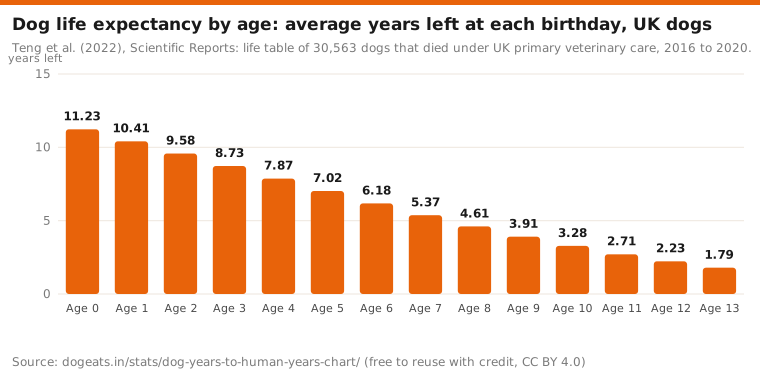
A UK life table answers the question directly. Teng and colleagues studied 30,563 dogs that died under veterinary care between 2016 and 2020.
At birth, the average dog in the study could expect 11.23 years. A 1-year-old had 10.41 years left, a 5-year-old 7.02 and a 10-year-old 3.28.
Females lived a little longer, at 11.41 years from birth against 11.07 for males. Neutered females could expect 11.98 years from birth, against 10.50 for entire females.
Teng et al. (2022), Scientific Reports: life table of 30,563 dogs that died under UK primary veterinary care, 2016 to 2020.
Show the numbers
| Label | years left |
|---|---|
| Age 0 | 11.23 |
| Age 1 | 10.41 |
| Age 2 | 9.58 |
| Age 3 | 8.73 |
| Age 4 | 7.87 |
| Age 5 | 7.02 |
| Age 6 | 6.18 |
| Age 7 | 5.37 |
| Age 8 | 4.61 |
| Age 9 | 3.91 |
| Age 10 | 3.28 |
| Age 11 | 2.71 |
| Age 12 | 2.23 |
| Age 13 | 1.79 |
Embed this chart
| Age (years) | Dogs alive at this age | Share of all dogs (%) | Chance of dying before next birthday | Average years left |
|---|---|---|---|---|
| 0 | 30,563 | 100.0 | 0.017 | 11.23 |
| 1 | 30,049 | 98.3 | 0.016 | 10.41 |
| 2 | 29,568 | 96.7 | 0.016 | 9.58 |
| 3 | 29,086 | 95.2 | 0.017 | 8.73 |
| 4 | 28,597 | 93.6 | 0.020 | 7.87 |
| 5 | 28,038 | 91.7 | 0.024 | 7.02 |
| 6 | 27,361 | 89.5 | 0.033 | 6.18 |
| 7 | 26,469 | 86.6 | 0.047 | 5.37 |
| 8 | 25,215 | 82.5 | 0.069 | 4.61 |
| 9 | 23,485 | 76.8 | 0.096 | 3.91 |
| 10 | 21,220 | 69.4 | 0.134 | 3.28 |
| 11 | 18,368 | 60.1 | 0.188 | 2.71 |
| 12 | 14,919 | 48.8 | 0.244 | 2.23 |
| 13 | 11,274 | 36.9 | 0.336 | 1.79 |
| 14 | 7,489 | 24.5 | 0.417 | 1.46 |
| 15 | 4,363 | 14.3 | 0.515 | 1.19 |
| 16 | 2,114 | 6.9 | 0.593 | 0.99 |
| 17 | 861 | 2.8 | 0.630 | 0.87 |
| 18 | 319 | 1.0 | 0.683 | 0.72 |
| 19 | 101 | 0.3 | 0.772 | 0.59 |
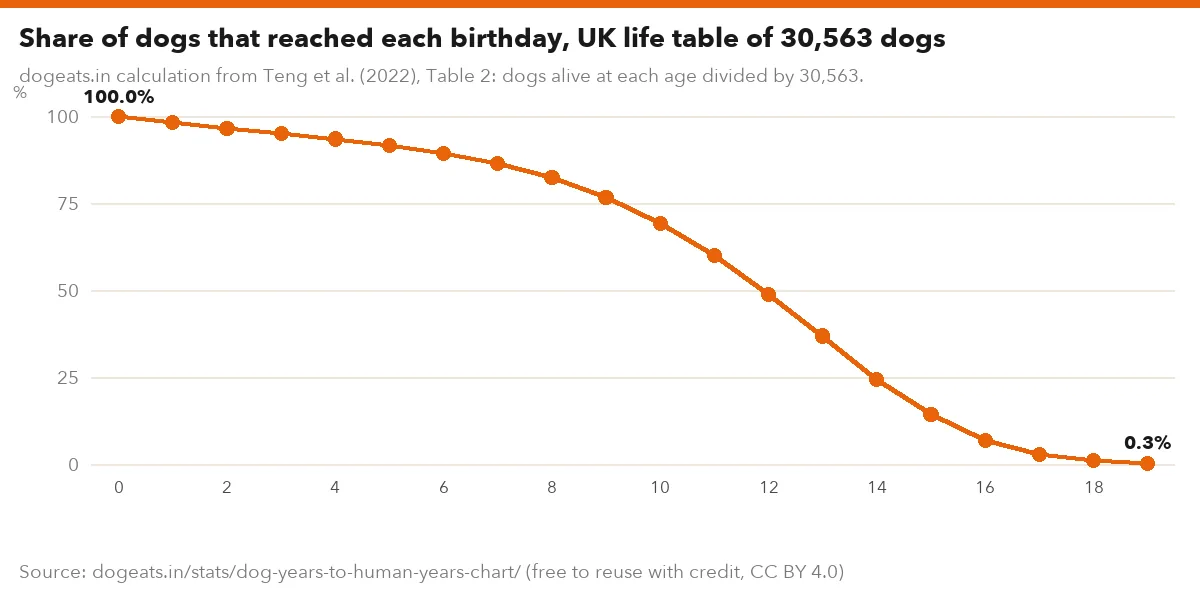
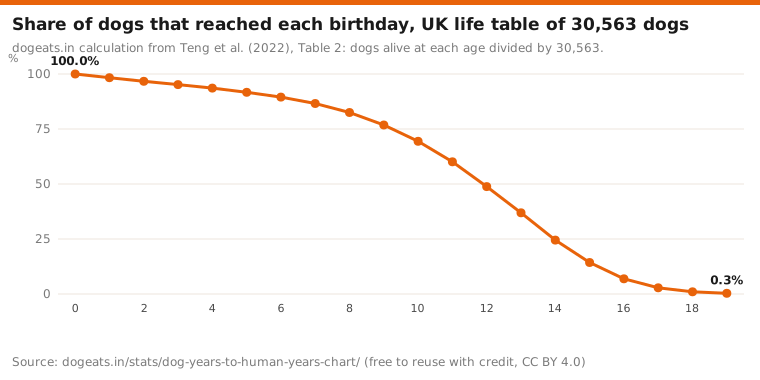
The chance of dying in any one year stayed at or below 0.02 until age 5. It climbed to 0.134 between 10 and 11 and 0.244 between 12 and 13.
Of the 30,563 dogs, 69.4% reached their 10th birthday, 36.9% reached 13 and 14.3% reached 15. Only 101 dogs, 0.3%, reached 19.
These are UK figures for dogs under regular vet care. Indian pet dogs face more heat, ticks and infectious disease, and no Indian life table for dogs exists that we could find.
How long do dogs live, and does size change the human-age maths?
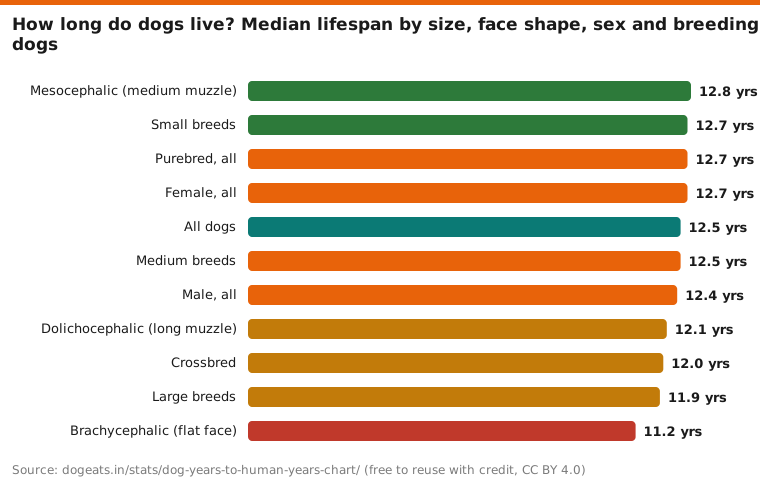
The biggest study so far, by Kirsten McMillan and colleagues in 2024, followed 584,734 UK dogs, 284,734 of which had died. Median lifespan was 12.5 years.
Small purebreds lived longest at a median of 12.7 years, then medium breeds at 12.5 and large breeds at 11.9. Flat-faced breeds had the shortest median, at 11.2 years.
Size explains why one dog year cannot have one human value. The giant breeds in our guides have an average lifespan midpoint of 9.6 years, so each of their later years counts for more.
McMillan et al. (2024), Scientific Reports. Size and face-shape figures are for purebreds.
Show the numbers
| Label | years |
|---|---|
| Mesocephalic (medium muzzle) | 12.8 yrs |
| Small breeds | 12.7 yrs |
| Purebred, all | 12.7 yrs |
| Female, all | 12.7 yrs |
| All dogs | 12.5 yrs |
| Medium breeds | 12.5 yrs |
| Male, all | 12.4 yrs |
| Dolichocephalic (long muzzle) | 12.1 yrs |
| Crossbred | 12.0 yrs |
| Large breeds | 11.9 yrs |
| Brachycephalic (flat face) | 11.2 yrs |
Embed this chart
| Group | Median lifespan (years) | Dogs in group |
|---|---|---|
| All dogs | 12.5 | 584,734 |
| Purebred | 12.7 | 473,681 |
| Crossbred | 12.0 | 111,053 |
| Female | 12.7 | 283,984 |
| Male | 12.4 | 300,750 |
| Small purebreds | 12.7 | 223,222 |
| Medium purebreds | 12.5 | 73,532 |
| Large purebreds | 11.9 | 123,072 |
| Mesocephalic purebreds | 12.8 | 267,753 |
| Dolichocephalic purebreds | 12.1 | 66,369 |
| Brachycephalic purebreds | 11.2 | 88,103 |
The longest-lived breed was the Lancashire Heeler at 15.4 years, then the Tibetan Spaniel at 15.2. The Caucasian Shepherd Dog had the shortest median, at 5.4 years.
In the study, 95% of purebreds had died by 18.3 years and 95% of crossbreds by 18.2. A 20-year-old dog is very rare, whatever the age chart says it would be in human years.
How old is my dog in human years by breed?
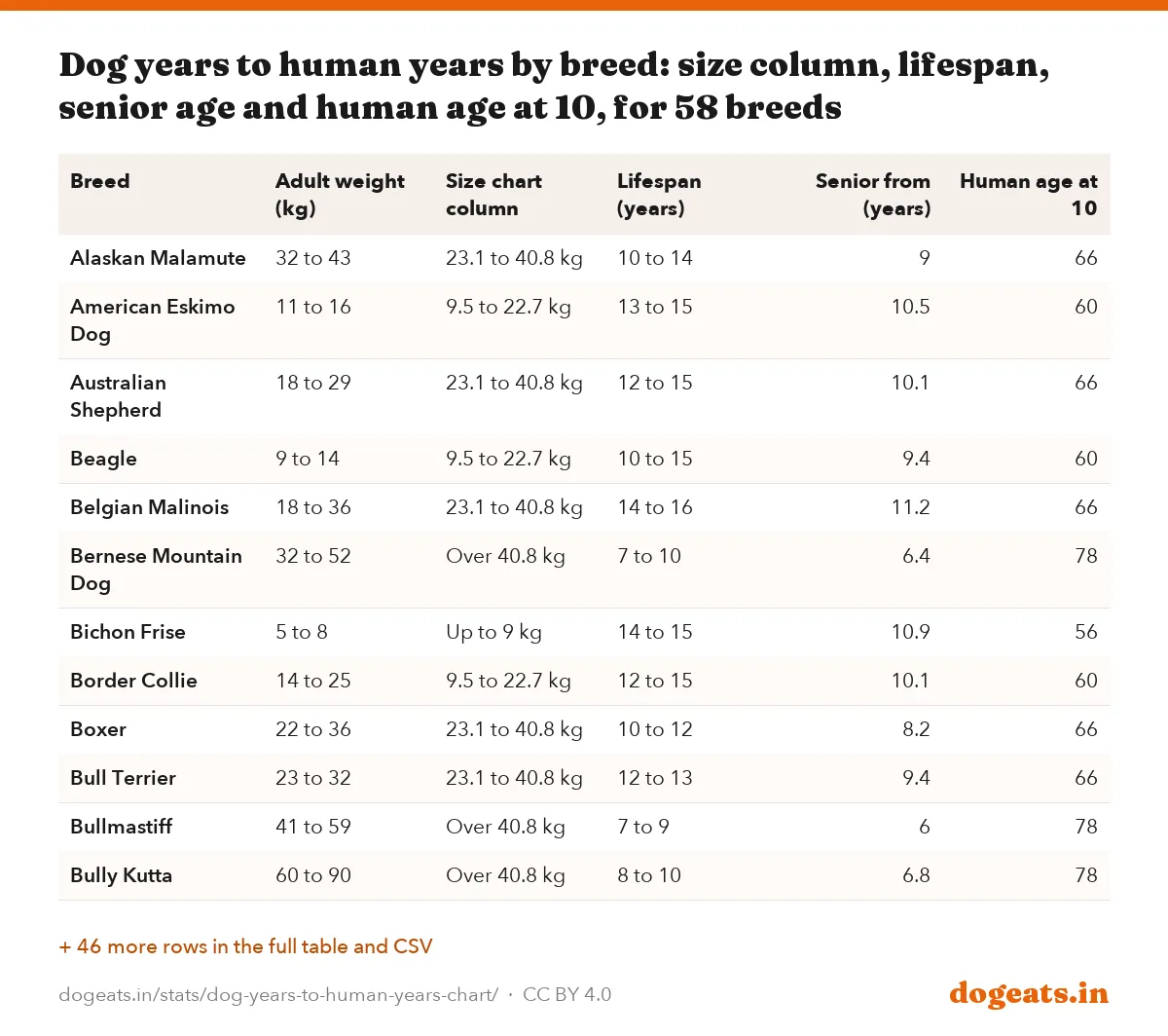
We matched each of our 58 breed guides to a weight column in the size chart, using the midpoint of adult weight. 15 breeds fall in the up-to-9 kg column, 15 in the 9.5 to 22.7 kg column, 17 in the 23.1 to 40.8 kg column and 11 are giants.
A 10-year-old Labrador, at 25 to 36 kg, sits in the large column and comes out at 66 human years. A 10-year-old Great Dane is about 78 and a 10-year-old Chihuahua about 56.
The table also gives each breed's senior age under the last-25% rule. Use the weight column that matches your own dog if it is much bigger or smaller than the breed range.
| Breed | Adult weight (kg) | Size chart column | Lifespan (years) | Senior from (years) | Human age at 10 |
|---|---|---|---|---|---|
| Alaskan Malamute | 32 to 43 | 23.1 to 40.8 kg | 10 to 14 | 9 | 66 |
| American Eskimo Dog | 11 to 16 | 9.5 to 22.7 kg | 13 to 15 | 10.5 | 60 |
| Australian Shepherd | 18 to 29 | 23.1 to 40.8 kg | 12 to 15 | 10.1 | 66 |
| Beagle | 9 to 14 | 9.5 to 22.7 kg | 10 to 15 | 9.4 | 60 |
| Belgian Malinois | 18 to 36 | 23.1 to 40.8 kg | 14 to 16 | 11.2 | 66 |
| Bernese Mountain Dog | 32 to 52 | Over 40.8 kg | 7 to 10 | 6.4 | 78 |
| Bichon Frise | 5 to 8 | Up to 9 kg | 14 to 15 | 10.9 | 56 |
| Border Collie | 14 to 25 | 9.5 to 22.7 kg | 12 to 15 | 10.1 | 60 |
| Boxer | 22 to 36 | 23.1 to 40.8 kg | 10 to 12 | 8.2 | 66 |
| Bull Terrier | 23 to 32 | 23.1 to 40.8 kg | 12 to 13 | 9.4 | 66 |
| Bullmastiff | 41 to 59 | Over 40.8 kg | 7 to 9 | 6 | 78 |
| Bully Kutta | 60 to 90 | Over 40.8 kg | 8 to 10 | 6.8 | 78 |
| Cane Corso | 40 to 50 | Over 40.8 kg | 9 to 12 | 7.9 | 78 |
| Cavalier King Charles Spaniel | 5.9 to 8.2 | Up to 9 kg | 12 to 15 | 10.1 | 56 |
| Chihuahua | 1.5 to 2.7 | Up to 9 kg | 14 to 16 | 11.2 | 56 |
| Chippiparai | 15 to 22 | 9.5 to 22.7 kg | 12 to 15 | 10.1 | 60 |
| Chow Chow | 20 to 32 | 23.1 to 40.8 kg | 8 to 12 | 7.5 | 66 |
| Cocker Spaniel | 12 to 15 | 9.5 to 22.7 kg | 12 to 14 | 9.8 | 60 |
| Dachshund | 7 to 15 | 9.5 to 22.7 kg | 12 to 16 | 10.5 | 60 |
| Dalmatian | 20 to 32 | 23.1 to 40.8 kg | 11 to 13 | 9 | 66 |
| Doberman | 27 to 45 | 23.1 to 40.8 kg | 10 to 12 | 8.2 | 66 |
| Dogo Argentino | 40 to 45 | Over 40.8 kg | 9 to 15 | 9 | 78 |
| English Bulldog | 18 to 23 | 9.5 to 22.7 kg | 8 to 10 | 6.8 | 60 |
| English Mastiff | 54 to 104 | Over 40.8 kg | 6 to 10 | 6 | 78 |
| French Bulldog | 8 to 12 | 9.5 to 22.7 kg | 10 to 12 | 8.2 | 60 |
| German Shepherd | 23 to 41 | 23.1 to 40.8 kg | 12 to 14 | 9.8 | 66 |
| German Spitz | 5 to 11 | Up to 9 kg | 13 to 15 | 10.5 | 56 |
| Golden Retriever | 25 to 34 | 23.1 to 40.8 kg | 10 to 12 | 8.2 | 66 |
| Great Dane | 50 to 79 | Over 40.8 kg | 7 to 10 | 6.4 | 78 |
| Indian Pariah Dog | 15 to 30 | 9.5 to 22.7 kg | 13 to 16 | 10.9 | 60 |
| Indian Spitz | 12 to 20 | 9.5 to 22.7 kg | 12 to 16 | 10.5 | 60 |
| Jack Russell Terrier | 4 to 7 | Up to 9 kg | 12 to 14 | 9.8 | 56 |
| Japanese Spitz | 5 to 11 | Up to 9 kg | 10 to 14 | 9 | 56 |
| Kangal | 40 to 60 | Over 40.8 kg | 11 to 13 | 9 | 78 |
| Kanni | 16 to 22 | 9.5 to 22.7 kg | 14 to 16 | 11.2 | 60 |
| Kombai | 23 to 35 | 23.1 to 40.8 kg | 12 to 15 | 10.1 | 66 |
| Labrador Retriever | 25 to 36 | 23.1 to 40.8 kg | 11 to 13 | 9 | 66 |
| Lhasa Apso | 5.5 to 8 | Up to 9 kg | 12 to 15 | 10.1 | 56 |
| Maltese | 2 to 3 | Up to 9 kg | 12 to 15 | 10.1 | 56 |
| Miniature Pinscher | 3.5 to 5 | Up to 9 kg | 12 to 16 | 10.5 | 56 |
| Mudhol Hound | 20 to 30 | 23.1 to 40.8 kg | 12 to 15 | 10.1 | 66 |
| Pekingese | 3 to 6 | Up to 9 kg | 12 to 14 | 9.8 | 56 |
| Pembroke Welsh Corgi | 9 to 12 | 9.5 to 22.7 kg | 12 to 13 | 9.4 | 60 |
| Pit Bull | 14 to 27 | 9.5 to 22.7 kg | 12 to 16 | 10.5 | 60 |
| Pomeranian | 1.4 to 3.2 | Up to 9 kg | 12 to 16 | 10.5 | 56 |
| Poodle | 18 to 32 | 23.1 to 40.8 kg | 10 to 18 | 10.5 | 66 |
| Pug | 6 to 8 | Up to 9 kg | 13 to 15 | 10.5 | 56 |
| Rajapalayam | 20 to 40 | 23.1 to 40.8 kg | 10 to 12 | 8.2 | 66 |
| Rampur Greyhound | 23 to 32 | 23.1 to 40.8 kg | 10 to 14 | 9 | 66 |
| Rhodesian Ridgeback | 29 to 41 | 23.1 to 40.8 kg | 10 to 12 | 8.2 | 66 |
| Rottweiler | 36 to 61 | Over 40.8 kg | 9 to 10 | 7.1 | 78 |
| Saint Bernard | 54 to 82 | Over 40.8 kg | 8 to 10 | 6.8 | 78 |
| Samoyed | 16 to 29 | 9.5 to 22.7 kg | 12 to 14 | 9.8 | 60 |
| Shiba Inu | 7 to 11 | Up to 9 kg | 13 to 16 | 10.9 | 56 |
| Shih Tzu | 4 to 7.5 | Up to 9 kg | 10 to 18 | 10.5 | 56 |
| Siberian Husky | 16 to 27 | 9.5 to 22.7 kg | 12 to 14 | 9.8 | 60 |
| Tibetan Mastiff | 32 to 68 | Over 40.8 kg | 10 to 12 | 8.2 | 78 |
| Yorkshire Terrier | 2 to 3 | Up to 9 kg | 11 to 15 | 9.8 | 56 |
For puppies still growing into their adult weight, our puppy growth chart by breed shows expected weight by age. Our dog vital signs chart covers normal temperature and heart rate at each age.
Frequently asked questions
How old is a 1-year-old dog in human years?
About 15 human years, in every size class of the standard size chart. The 2020 DNA methylation formula puts a 1-year-old Labrador higher, at about 31.
How old is a 10-year-old dog in human years?
Between 56 and 78, depending on size. A dog up to 9 kg is about 56, a medium dog 60, a large dog 66 and a giant dog over 40.8 kg about 78.
Is 1 dog year equal to 7 human years?
No. The AVMA says dogs do not age at 7 human years per dog year. The first year alone equals about 15 human years, The second adds 9, and each later year adds 4 to 8 depending on size.
How do you calculate dog years with the DNA formula?
Take the natural log of the dog's age in years, multiply by 16 and add 31. A 4-year-old comes out at 53.2 and an 8-year-old at 64.3. The formula was built on Labradors.
At what age is a dog a senior?
When it reaches the last 25% of its breed's expected lifespan. The AVMA puts that at 8 to 11 for small dogs, 8 to 10 for medium, 8 to 9 for large and 6 to 7 for giant dogs.
How old is a 14-year-old dog in human years?
About 72 for a dog up to 9 kg, 78 for a medium dog and 88 for a large dog. A giant dog of 14 is about 108, and few reach that age.
What is the average lifespan of a dog?
A UK study of 584,734 dogs found a median of 12.5 years. Small breeds lived a median 12.7 years, large breeds 11.9 and flat-faced breeds 11.2.
How many years does a 10-year-old dog have left?
On average 3.28 years, in a UK life table of 30,563 dogs. A 12-year-old had 2.23 years left and a 15-year-old 1.19.
Methodology and limitations
The size chart is the dog age chart in the AAHA-hosted Zoetis poster (2019), adapted from Appendix B of the Dog Owner's Home Veterinary Handbook, 4th edition (Wiley, 2007). We transcribed all four weight columns for ages 1 to 20. Kilogram limits are those printed on the poster.
DNA formula values are computed by dogeats.in from human age = 16 ln(dog age) + 31 (Wang et al., Cell Systems, 2020), rounded to one decimal. The 7-year rule is shown only for comparison.
Senior ages for our breeds apply the AVMA and AAHA rule of the last 25% of expected lifespan to the lifespan midpoint in each dogeats.in breed guide. Breeds are placed in a size-chart column by the midpoint of adult weight; breeds with several varieties use the largest standard variety. dogeats.in editorial data compiled from our breed guides, October 2026.
Life table figures are from Teng et al. (2022), Table 2; the share reaching each age is dogs alive at that age divided by 30,563. Lifespan medians are from McMillan et al. (2024). Indian life expectancy is from the SRS Abridged Life Tables 2020 to 2024 (Registrar General of India, May 2026).
Sources
- Wang T et al. (2020), Quantitative translation of dog-to-human aging by conserved remodeling of the DNA methylome, Cell Systems 11(2):176-185, Formula 16 ln(dog age) + 31; 104 dogs; life stage matches
- American Veterinary Medical Association: Caring for senior cats and dogs, Senior at last 25% of lifespan; senior ages by size; not 7 years per dog year
- AAHA-hosted Zoetis age chart poster (2019), adapted from Dog Owner's Home Veterinary Handbook, 4th ed., Appendix B, Human-equivalent ages by weight class, dog ages 1 to 20
- Also consulted: AAHA: 2019 Canine Life Stage Guidelines, life stage definitions (Creevy et al., JAAHA 55(6):267-290), McMillan KM et al. (2024), Longevity of companion dog breeds: those at risk from early death, Scientific Reports 14:531, Teng KT et al. (2022), Life tables of annual life expectancy and mortality for companion dogs in the United Kingdom, Scientific Reports, Office of the Registrar General of India: SRS Abridged Life Tables 2020-2024 (May 2026), American Kennel Club: How to calculate dog years to human years (updated 14 September 2026).
Cite, embed and download
This report, its data and its images are free to reuse under a Creative Commons Attribution 4.0 licence. Credit dogeats.in with a link to this page. Every chart has its own embed code, every table has a CSV and an image download, and the images below are ready for social posts, slides and articles.
Cite this report
Link to this report
Every chart and table as an image