Data report · Updated October 2026
Puppy Feeding Chart for India: How Much Food a Puppy Needs by Age and Expected Adult Size, and How Many Meals a Day
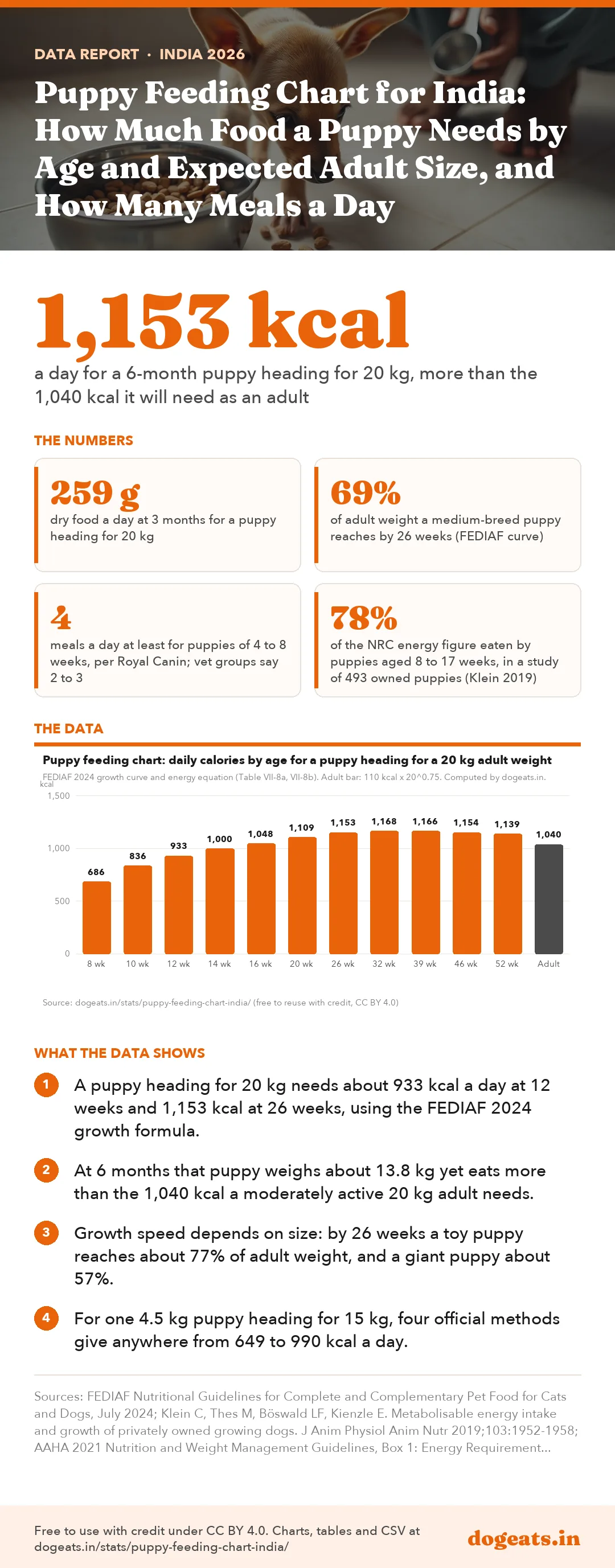
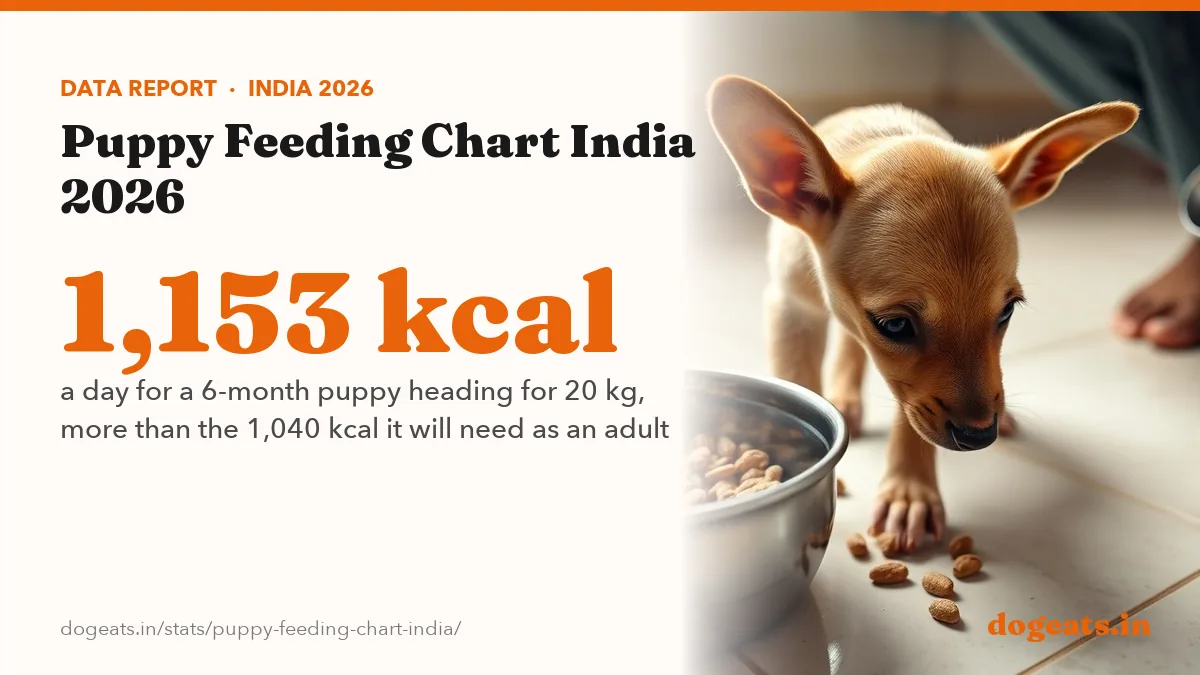
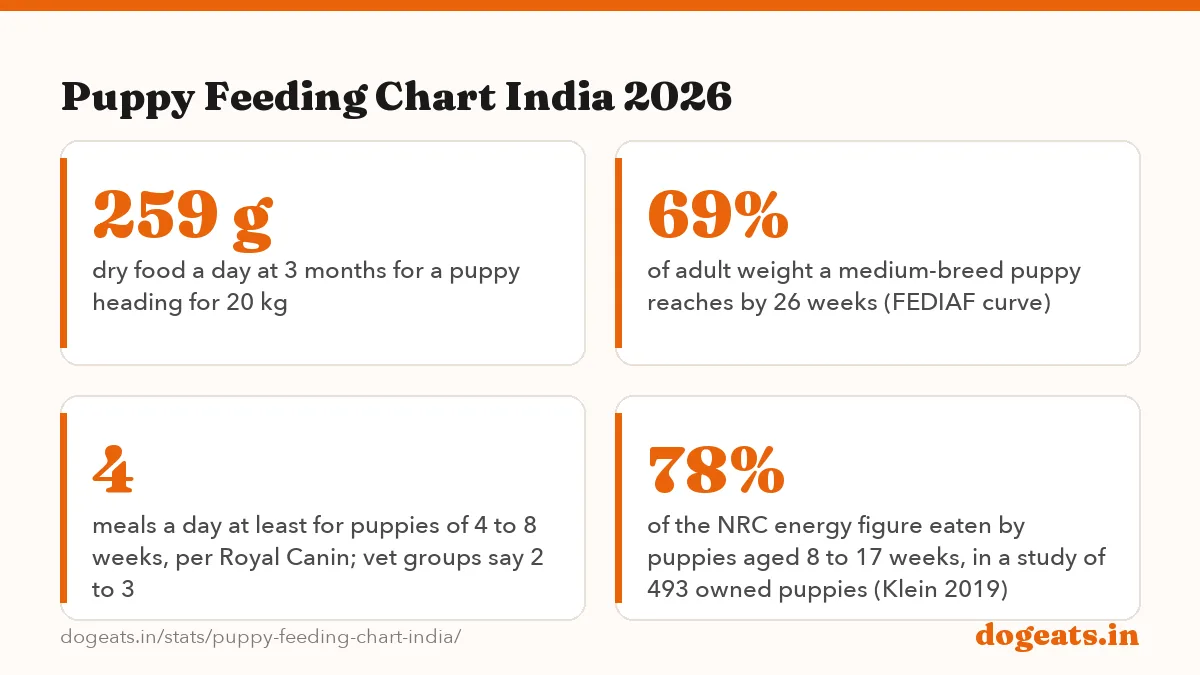
A puppy heading for an adult weight of 20 kg needs about 933 kcal a day at 3 months and 1,153 kcal at 6 months, by the FEDIAF 2024 formula. In grams, that is roughly 259 g and 320 g of a dry food with 3,600 kcal per kg. Royal Canin advises at least four meals a day up to 8 weeks, three from 3 to 6 months in its breed list, and two after that. The NRC and VCA say two to three meals a day.
Key findings
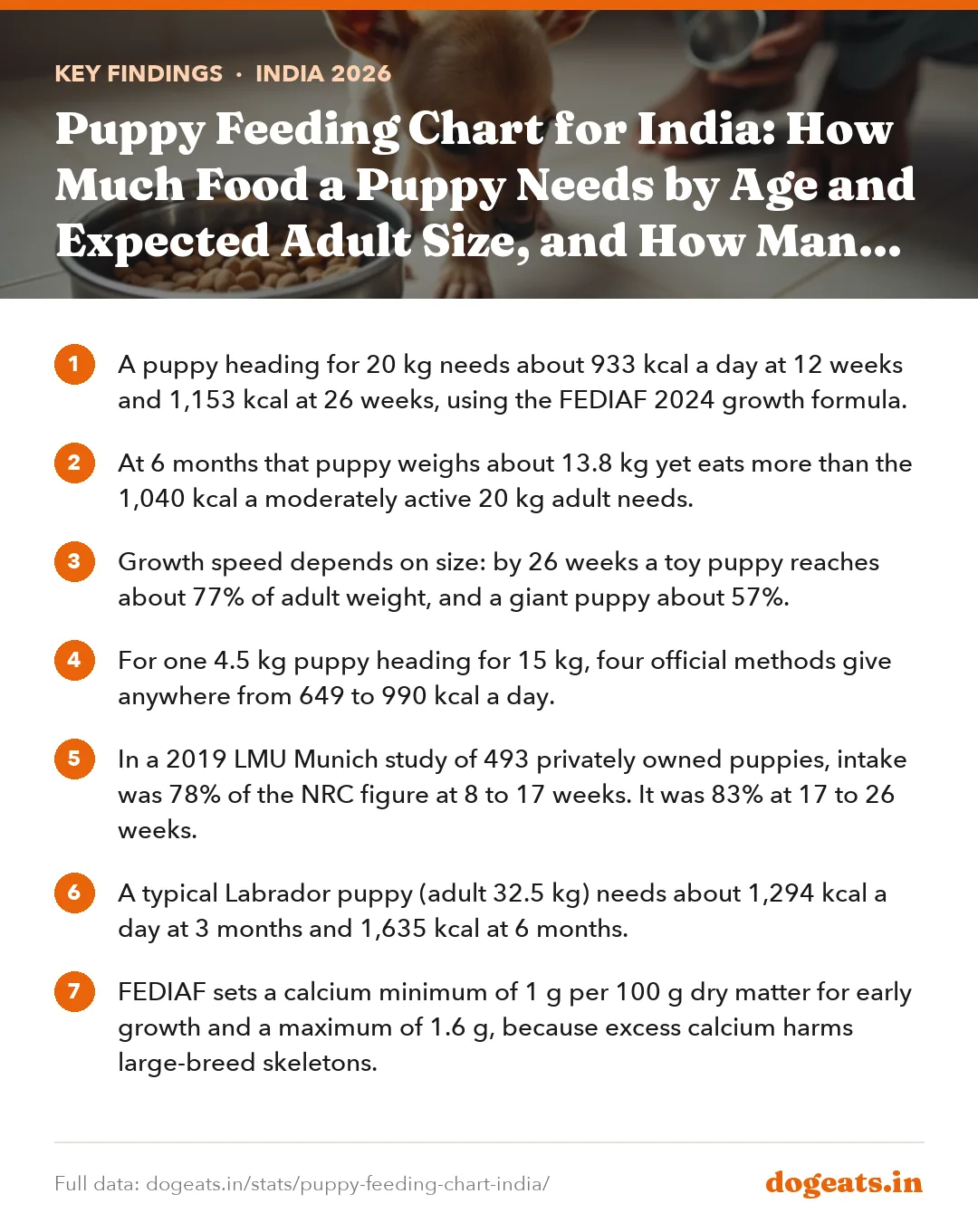
- A puppy heading for 20 kg needs about 933 kcal a day at 12 weeks and 1,153 kcal at 26 weeks, using the FEDIAF 2024 growth formula.
- At 6 months that puppy weighs about 13.8 kg yet eats more than the 1,040 kcal a moderately active 20 kg adult needs.
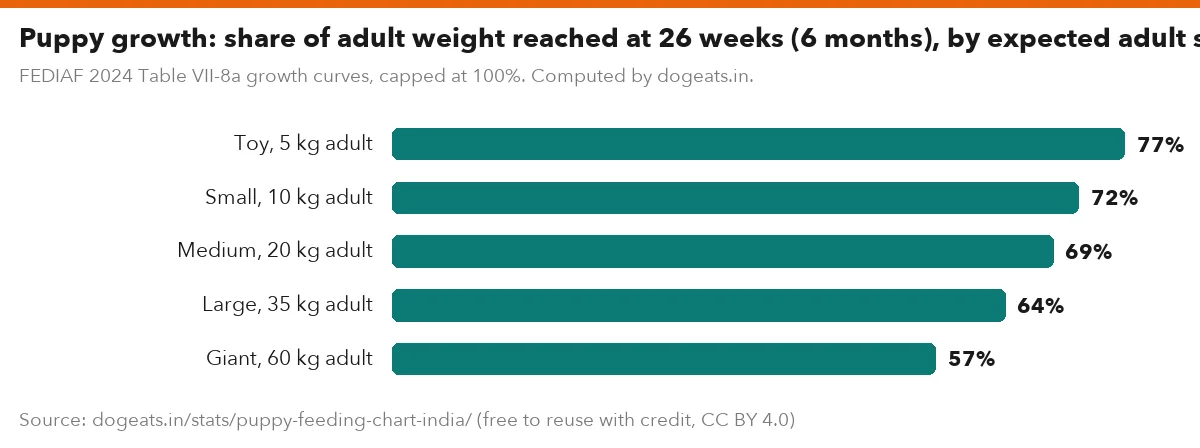
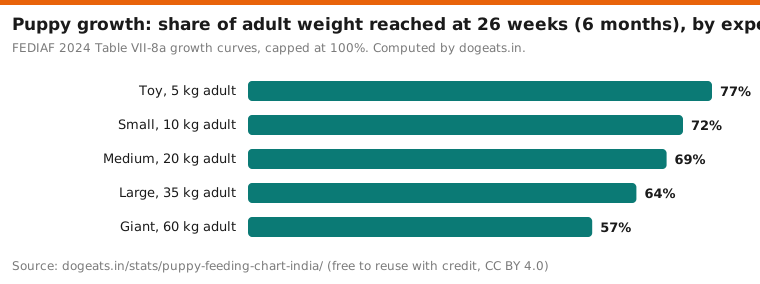
- Growth speed depends on size: by 26 weeks a toy puppy reaches about 77% of adult weight, and a giant puppy about 57%.
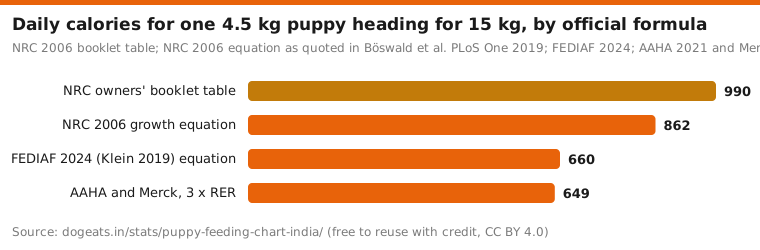
- For one 4.5 kg puppy heading for 15 kg, four official methods give anywhere from 649 to 990 kcal a day.
- In a 2019 LMU Munich study of 493 privately owned puppies, intake was 78% of the NRC figure at 8 to 17 weeks. It was 83% at 17 to 26 weeks.
- A typical Labrador puppy (adult 32.5 kg) needs about 1,294 kcal a day at 3 months and 1,635 kcal at 6 months.
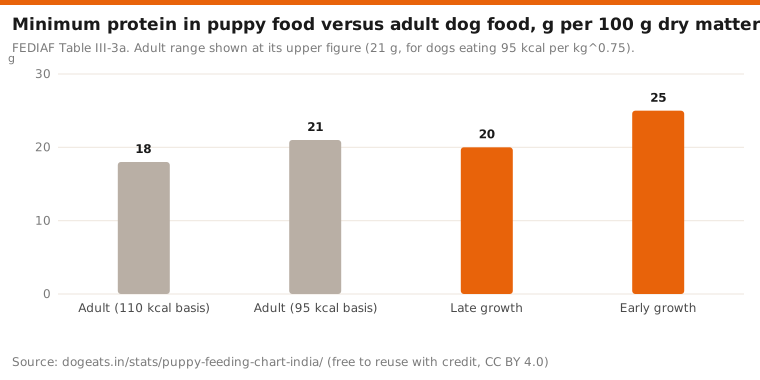
- FEDIAF sets a calcium minimum of 1 g per 100 g dry matter for early growth and a maximum of 1.6 g, because excess calcium harms large-breed skeletons.
- Royal Canin advises two meals a day from 6 months, kept until 10 months for small breeds and up to 24 months for extra-large breeds.
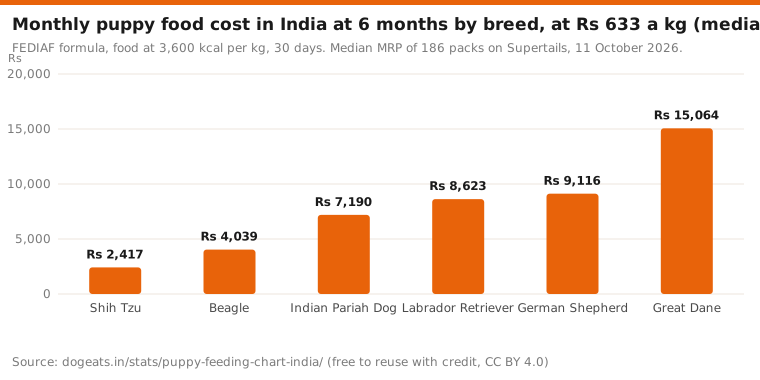
- At the Pedigree puppy price of Rs 249 a kg, feeding a Labrador puppy at 6 months costs about Rs 3,392 a month.
How much food does a puppy need per day?
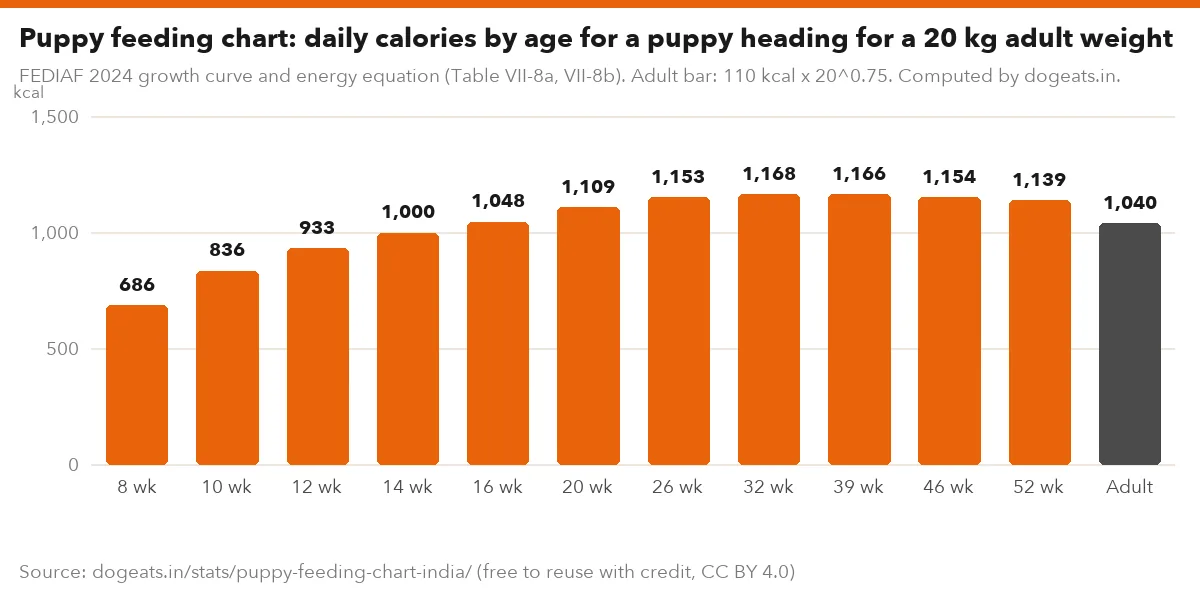
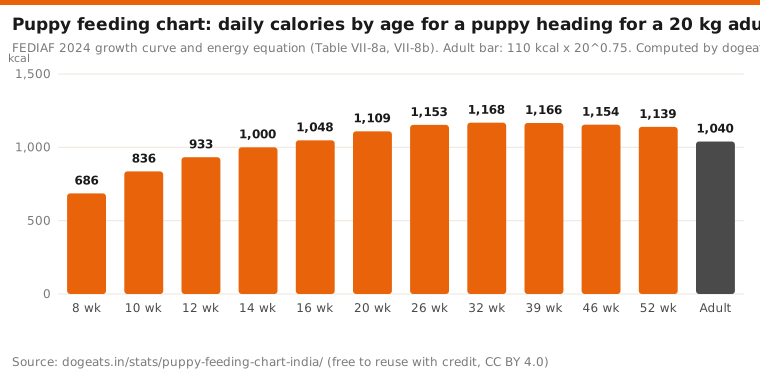
A puppy's needs depend on two numbers: its weight today and its expected adult weight. FEDIAF's 2024 formula combines both. For a puppy heading for 20 kg, it gives 686 kcal a day at 8 weeks and 933 kcal at 12 weeks.
Needs rise fast and then level off. The same puppy needs 1,153 kcal at 26 weeks and 1,139 kcal at a year. Its adult need at moderate activity will be about 1,040 kcal.
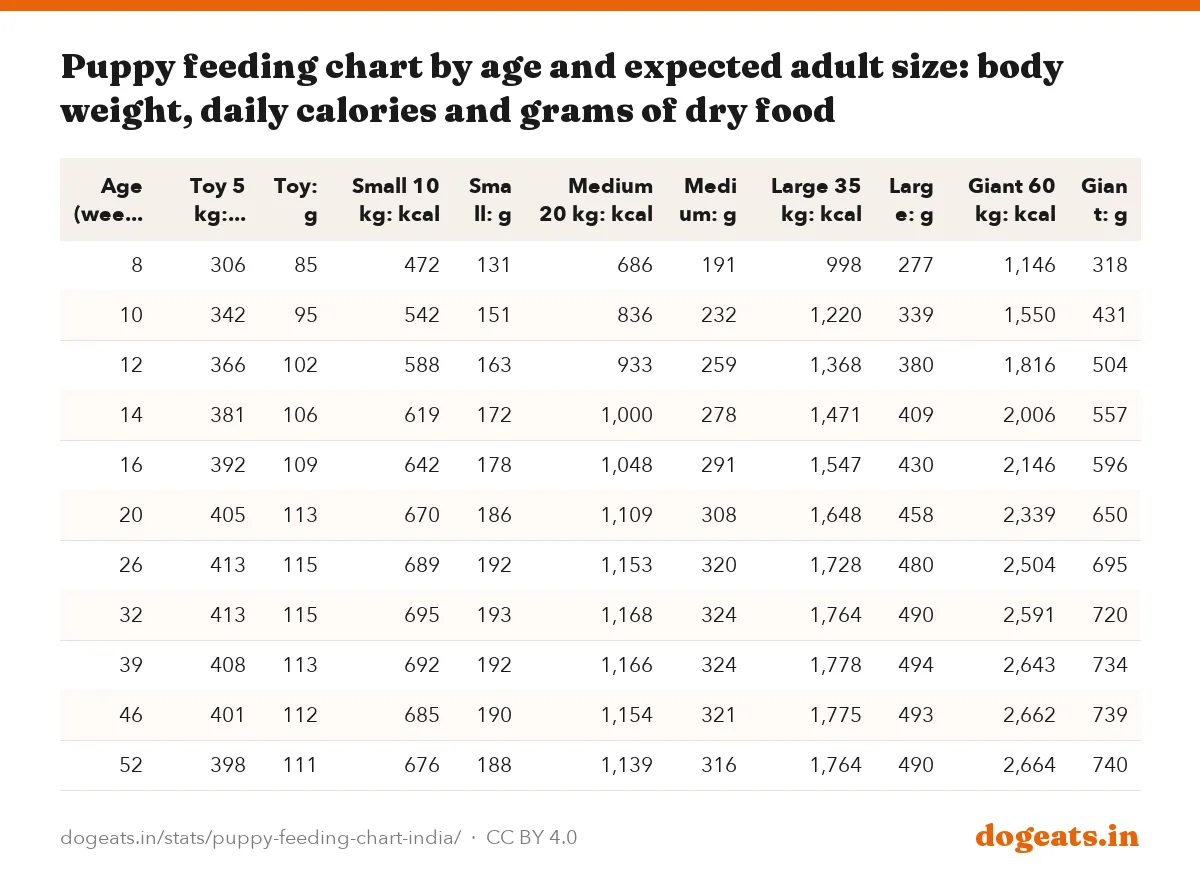
In grams of a dry food at 3,600 kcal per kg, that is about 191 g at 8 weeks, 259 g at 12 weeks and 320 g at 26 weeks. Split it across the day's meals.
FEDIAF 2024 growth curve and energy equation (Table VII-8a, VII-8b). Adult bar: 110 kcal x 20^0.75. Computed by dogeats.in.
Show the numbers
| Label | kcal |
|---|---|
| 8 wk | 686 |
| 10 wk | 836 |
| 12 wk | 933 |
| 14 wk | 1,000 |
| 16 wk | 1,048 |
| 20 wk | 1,109 |
| 26 wk | 1,153 |
| 32 wk | 1,168 |
| 39 wk | 1,166 |
| 46 wk | 1,154 |
| 52 wk | 1,139 |
| Adult | 1,040 |
Embed this chart
| Age (weeks) | Toy 5 kg: kcal | Toy: g | Small 10 kg: kcal | Small: g | Medium 20 kg: kcal | Medium: g | Large 35 kg: kcal | Large: g | Giant 60 kg: kcal | Giant: g |
|---|---|---|---|---|---|---|---|---|---|---|
| 8 | 306 | 85 | 472 | 131 | 686 | 191 | 998 | 277 | 1,146 | 318 |
| 10 | 342 | 95 | 542 | 151 | 836 | 232 | 1,220 | 339 | 1,550 | 431 |
| 12 | 366 | 102 | 588 | 163 | 933 | 259 | 1,368 | 380 | 1,816 | 504 |
| 14 | 381 | 106 | 619 | 172 | 1,000 | 278 | 1,471 | 409 | 2,006 | 557 |
| 16 | 392 | 109 | 642 | 178 | 1,048 | 291 | 1,547 | 430 | 2,146 | 596 |
| 20 | 405 | 113 | 670 | 186 | 1,109 | 308 | 1,648 | 458 | 2,339 | 650 |
| 26 | 413 | 115 | 689 | 192 | 1,153 | 320 | 1,728 | 480 | 2,504 | 695 |
| 32 | 413 | 115 | 695 | 193 | 1,168 | 324 | 1,764 | 490 | 2,591 | 720 |
| 39 | 408 | 113 | 692 | 192 | 1,166 | 324 | 1,778 | 494 | 2,643 | 734 |
| 46 | 401 | 112 | 685 | 190 | 1,154 | 321 | 1,775 | 493 | 2,662 | 739 |
| 52 | 398 | 111 | 676 | 188 | 1,139 | 316 | 1,764 | 490 | 2,664 | 740 |
Grams assume 3,600 kcal per kg of food, FEDIAF's reference of 4.0 kcal per g dry matter at an assumed 10% moisture. Many puppy packs print their own kcal per kg; use that figure if you have it.
Our puppy feeding guide covers what to feed. The adult feeding chart takes over once growth ends.
How fast do puppies grow, and when do they reach adult weight?
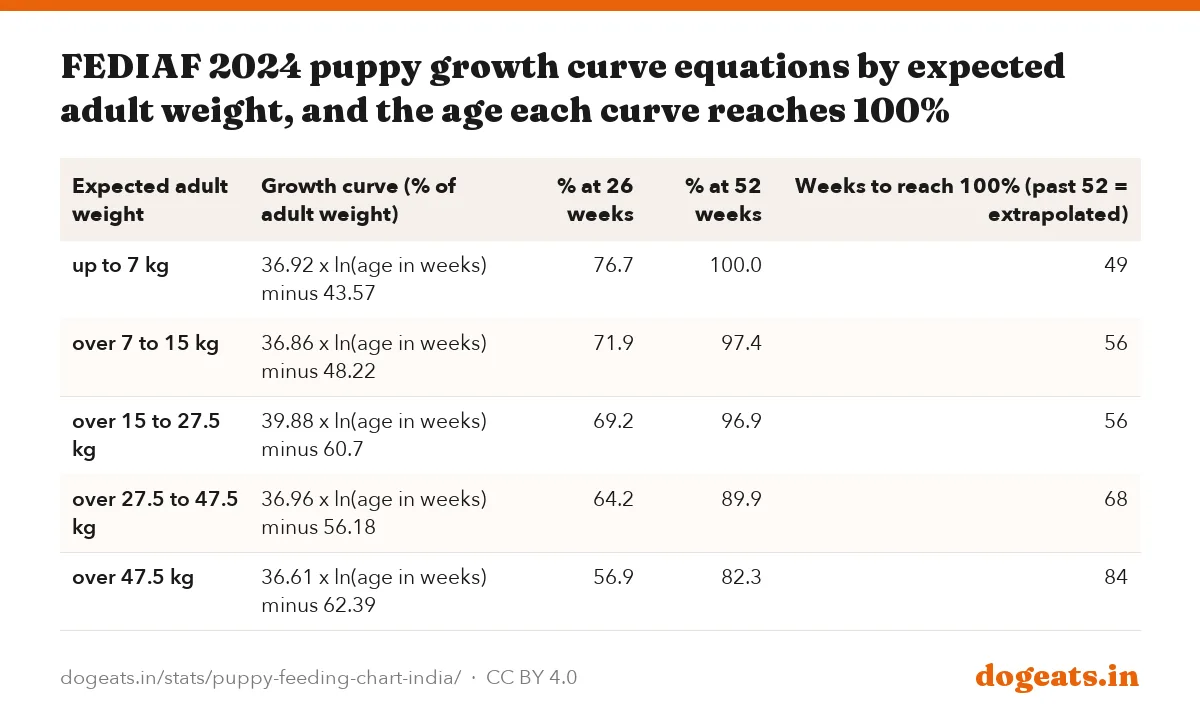
FEDIAF publishes growth curves for five size bands, valid from 8 weeks to a year. A toy puppy heading for 5 kg is at 33% of adult weight at 8 weeks and reaches 100% at about 49 weeks.
Giant puppies grow for much longer. A puppy heading for 60 kg is at 14% of adult weight at 8 weeks and only 82% at a year. Extended past its one-year range, the FEDIAF curve reaches full weight at about 84 weeks.
VCA Animal Hospitals, writing with the Canadian Academy of Veterinary Nutrition, puts adulthood at 10 to 12 months for small and medium breeds. Large and giant breeds mature at 18 to 24 months.
FEDIAF 2024 Table VII-8a growth curves, capped at 100%. Computed by dogeats.in.
Show the numbers
| Label | % |
|---|---|
| Toy, 5 kg adult | 77% |
| Small, 10 kg adult | 72% |
| Medium, 20 kg adult | 69% |
| Large, 35 kg adult | 64% |
| Giant, 60 kg adult | 57% |
Embed this chart
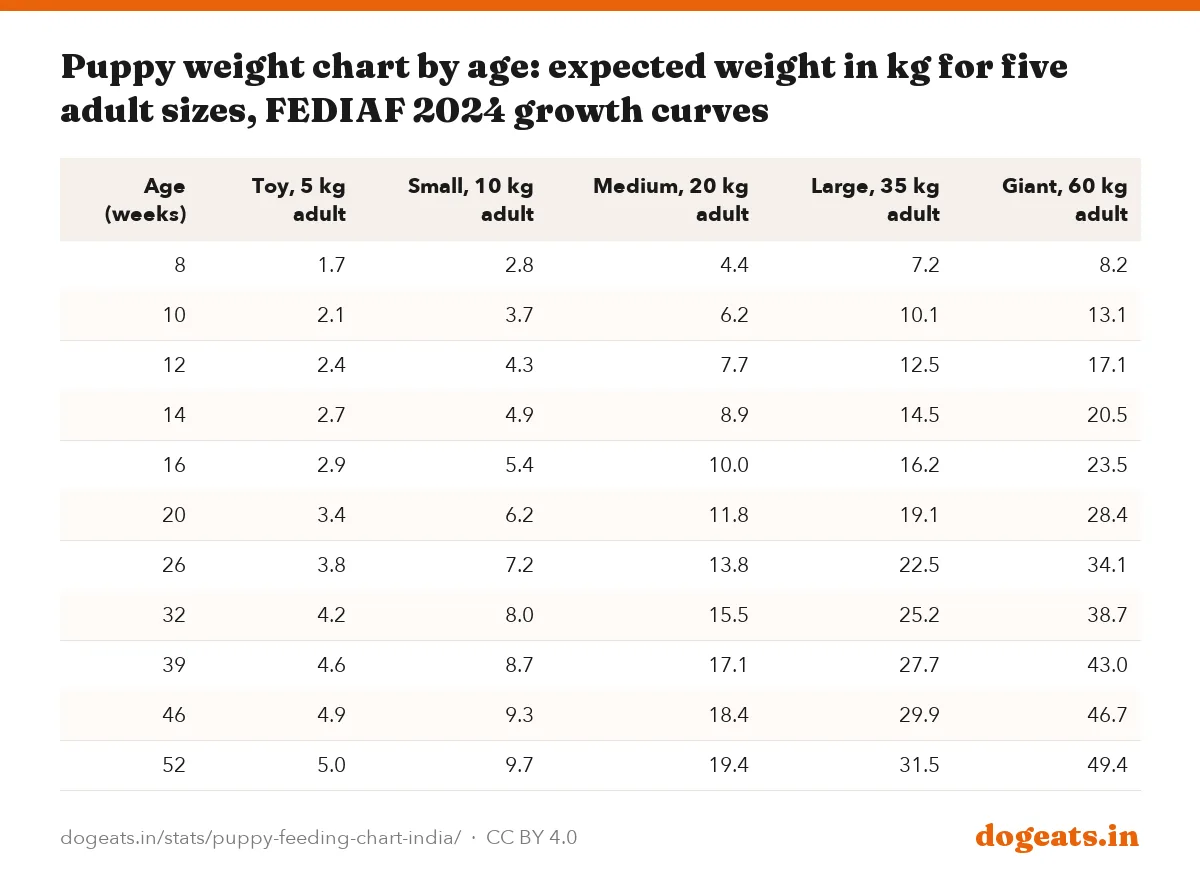
| Age (weeks) | Toy, 5 kg adult | Small, 10 kg adult | Medium, 20 kg adult | Large, 35 kg adult | Giant, 60 kg adult |
|---|---|---|---|---|---|
| 8 | 1.7 | 2.8 | 4.4 | 7.2 | 8.2 |
| 10 | 2.1 | 3.7 | 6.2 | 10.1 | 13.1 |
| 12 | 2.4 | 4.3 | 7.7 | 12.5 | 17.1 |
| 14 | 2.7 | 4.9 | 8.9 | 14.5 | 20.5 |
| 16 | 2.9 | 5.4 | 10.0 | 16.2 | 23.5 |
| 20 | 3.4 | 6.2 | 11.8 | 19.1 | 28.4 |
| 26 | 3.8 | 7.2 | 13.8 | 22.5 | 34.1 |
| 32 | 4.2 | 8.0 | 15.5 | 25.2 | 38.7 |
| 39 | 4.6 | 8.7 | 17.1 | 27.7 | 43.0 |
| 46 | 4.9 | 9.3 | 18.4 | 29.9 | 46.7 |
| 52 | 5.0 | 9.7 | 19.4 | 31.5 | 49.4 |
| Expected adult weight | Growth curve (% of adult weight) | % at 26 weeks | % at 52 weeks | Weeks to reach 100% (past 52 = extrapolated) |
|---|---|---|---|---|
| up to 7 kg | 36.92 x ln(age in weeks) minus 43.57 | 76.7 | 100.0 | 49 |
| over 7 to 15 kg | 36.86 x ln(age in weeks) minus 48.22 | 71.9 | 97.4 | 56 |
| over 15 to 27.5 kg | 39.88 x ln(age in weeks) minus 60.7 | 69.2 | 96.9 | 56 |
| over 27.5 to 47.5 kg | 36.96 x ln(age in weeks) minus 56.18 | 64.2 | 89.9 | 68 |
| over 47.5 kg | 36.61 x ln(age in weeks) minus 62.39 | 56.9 | 82.3 | 84 |
Use the curve as a check, not a target to hit at any cost. FEDIAF says overfeeding puppies speeds growth, which can cause skeletal deformities, especially in large and giant breeds. It says puppies should never be fed free-choice.
How many times a day should I feed a puppy?
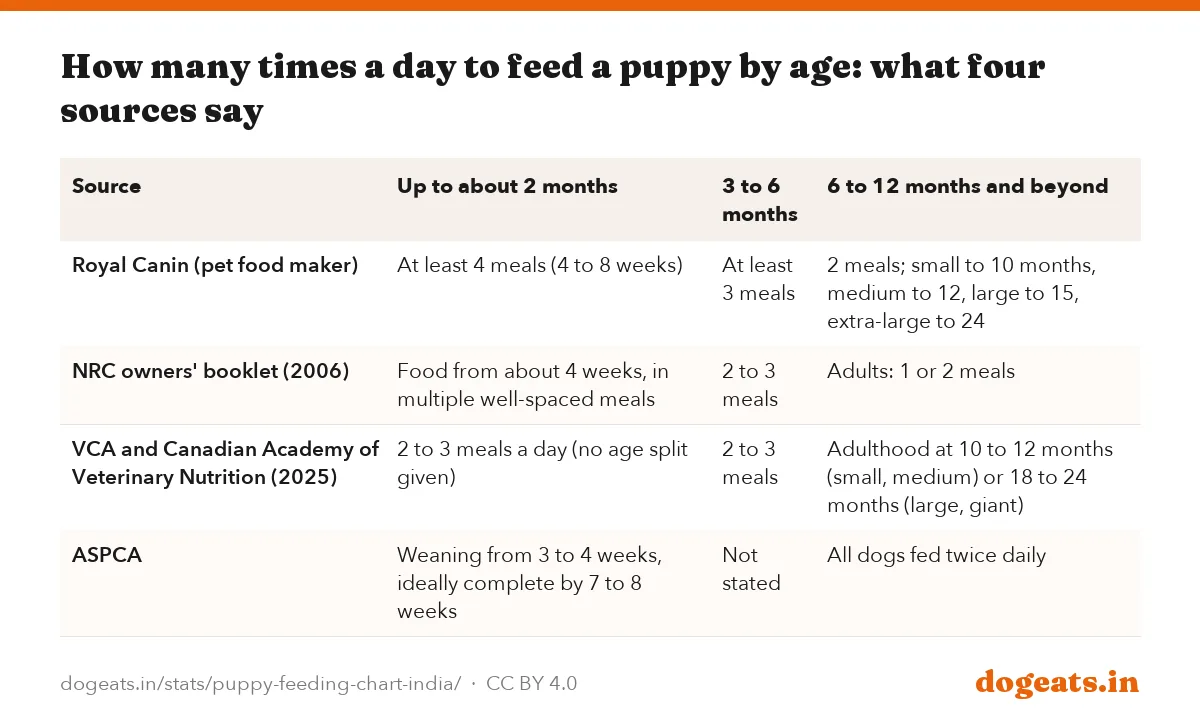
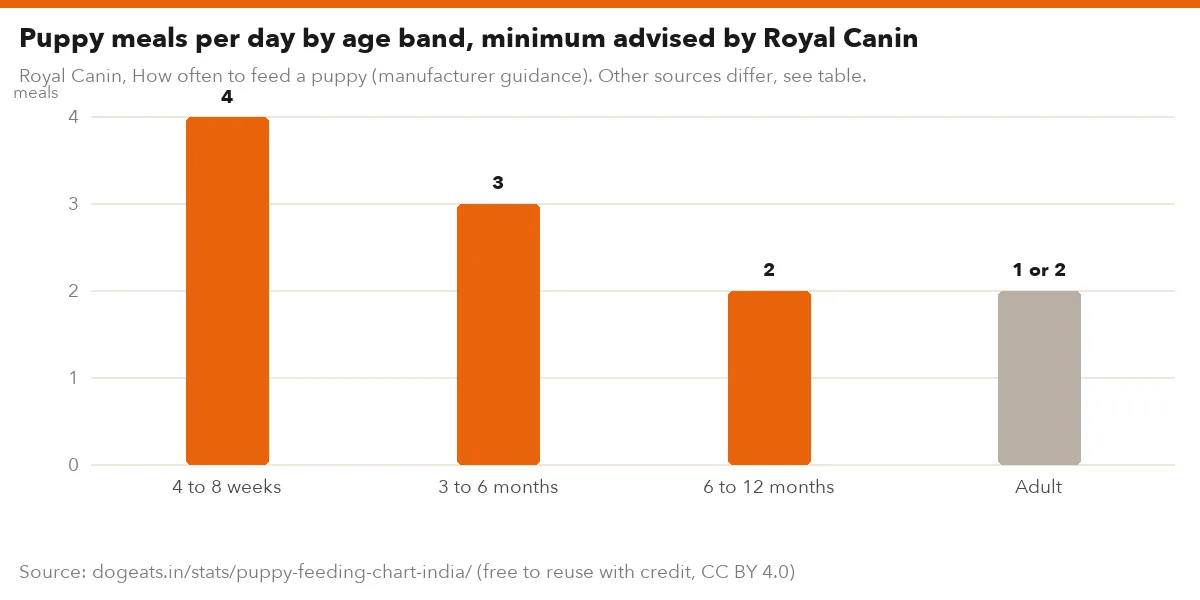
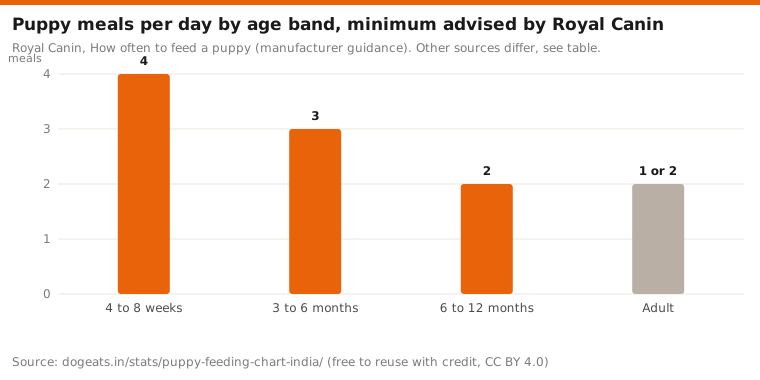
Sources broadly agree on the pattern but not the exact ages. Royal Canin advises at least four meals a day from 4 to 8 weeks, three from 3 to 6 months and two from 6 months. Its general text allows at least two meals at 3 to 6 months, but its breed list says three.
The NRC owners' booklet says puppies need two to three daily meals, well spaced. VCA and the Canadian Academy of Veterinary Nutrition say two to three a day, based on body condition and age.
Big breeds stay on puppy routines longer. Royal Canin keeps its two-meal puppy stage until 10 months for small breeds, 12 for medium, 15 for large and 24 for extra-large breeds, which it lists from 7 months.
| Source | Up to about 2 months | 3 to 6 months | 6 to 12 months and beyond |
|---|---|---|---|
| Royal Canin (pet food maker) | At least 4 meals (4 to 8 weeks) | At least 3 meals | 2 meals; small to 10 months, medium to 12, large to 15, extra-large to 24 |
| NRC owners' booklet (2006) | Food from about 4 weeks, in multiple well-spaced meals | 2 to 3 meals | Adults: 1 or 2 meals |
| VCA and Canadian Academy of Veterinary Nutrition (2025) | 2 to 3 meals a day (no age split given) | 2 to 3 meals | Adulthood at 10 to 12 months (small, medium) or 18 to 24 months (large, giant) |
| ASPCA | Weaning from 3 to 4 weeks, ideally complete by 7 to 8 weeks | Not stated | All dogs fed twice daily |
Royal Canin, How often to feed a puppy (manufacturer guidance). Other sources differ, see table.
Show the numbers
| Label | meals |
|---|---|
| 4 to 8 weeks | 4 |
| 3 to 6 months | 3 |
| 6 to 12 months | 2 |
| Adult | 1 or 2 |
Embed this chart
Whatever the count, divide the same daily total among the meals. A puppy heading for 10 kg needs about 588 kcal at 12 weeks, or about 54 g of food in each of three meals.
VCA warns that free-choice feeding raises the risk of puppies gaining too much body fat. A measured amount in set meals makes growth easier to track.
Why do puppy feeding charts give different amounts?
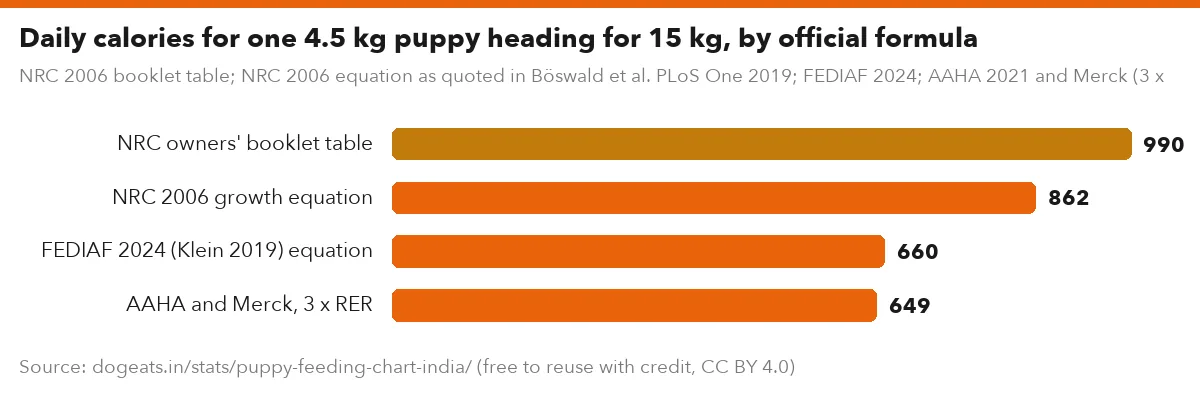
Because the official formulas differ. Take the NRC booklet's own example, a 10 lb (4.5 kg) puppy growing to 33 lb (15 kg). The booklet lists 990 kcal a day.
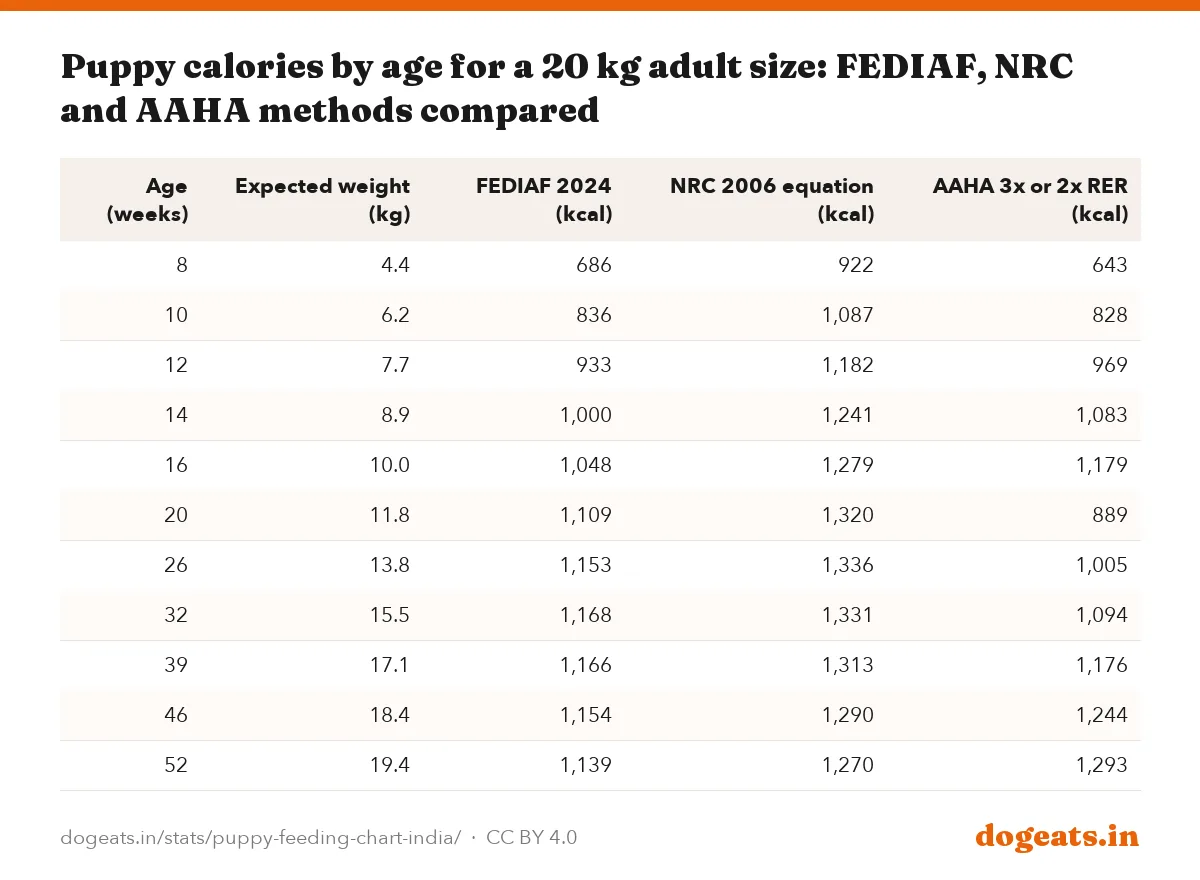
The full NRC 2006 growth equation gives 862 kcal for the same puppy. FEDIAF's 2024 equation gives 660 kcal, and the AAHA rule of three times resting energy gives 649 kcal.
The booklet figure matches the NRC equation only if its final "minus 0.1" term is dropped, by our calculation. We could not find an explanation, so we show both.
NRC 2006 booklet table; NRC 2006 equation as quoted in Böswald et al. PLoS One 2019; FEDIAF 2024; AAHA 2021 and Merck (3 x RER under 4 months). Computed by dogeats.in.
Show the numbers
| Label | kcal |
|---|---|
| NRC owners' booklet table | 990 |
| NRC 2006 growth equation | 862 |
| FEDIAF 2024 (Klein 2019) equation | 660 |
| AAHA and Merck, 3 x RER | 649 |
Embed this chart
| Age (weeks) | Expected weight (kg) | FEDIAF 2024 (kcal) | NRC 2006 equation (kcal) | AAHA 3x or 2x RER (kcal) |
|---|---|---|---|---|
| 8 | 4.4 | 686 | 922 | 643 |
| 10 | 6.2 | 836 | 1,087 | 828 |
| 12 | 7.7 | 933 | 1,182 | 969 |
| 14 | 8.9 | 1,000 | 1,241 | 1,083 |
| 16 | 10.0 | 1,048 | 1,279 | 1,179 |
| 20 | 11.8 | 1,109 | 1,320 | 889 |
| 26 | 13.8 | 1,153 | 1,336 | 1,005 |
| 32 | 15.5 | 1,168 | 1,331 | 1,094 |
| 39 | 17.1 | 1,166 | 1,313 | 1,176 |
| 46 | 18.4 | 1,154 | 1,290 | 1,244 |
| 52 | 19.4 | 1,139 | 1,270 | 1,293 |
Real puppies tend to eat less than the NRC figure. Klein and colleagues at LMU Munich studied 493 privately owned puppies in 2019. Intake was 78% of NRC at 8 to 17 weeks and 83% at 17 to 26 weeks. The puppies' weights tracked the expected curve.
FEDIAF's 2024 guidelines use their equation. A 2017 study of 22 Yorkshire Terriers found the NRC equation overestimated energy needs at 10 to 20 weeks by up to 324 kJ (about 78 kcal) per kg^0.75.
The AAHA factor jumps from 3.0 to 2.0 at 4 months, so its line drops suddenly. FEDIAF's formula changes smoothly with growth, which is why we use it for the main chart.
How much should a Labrador, Indie or German Shepherd puppy eat?
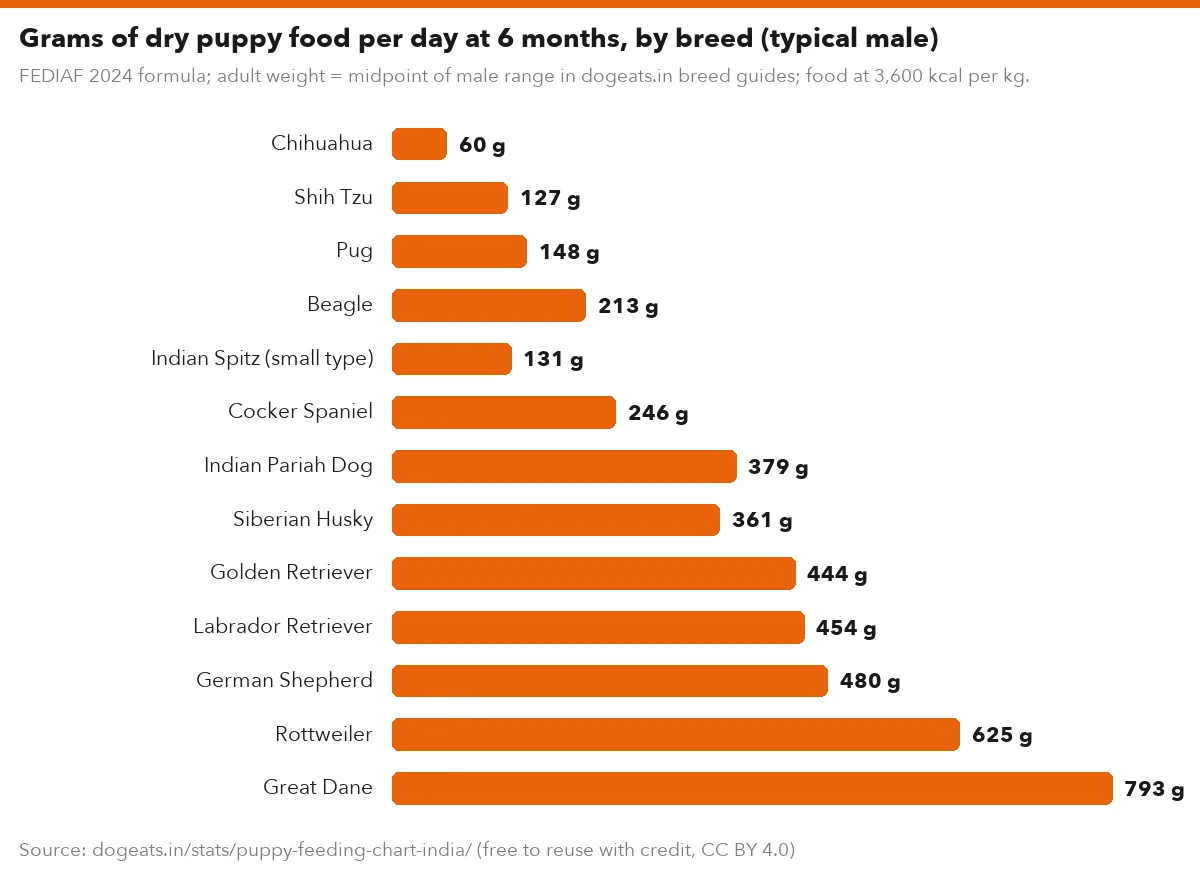
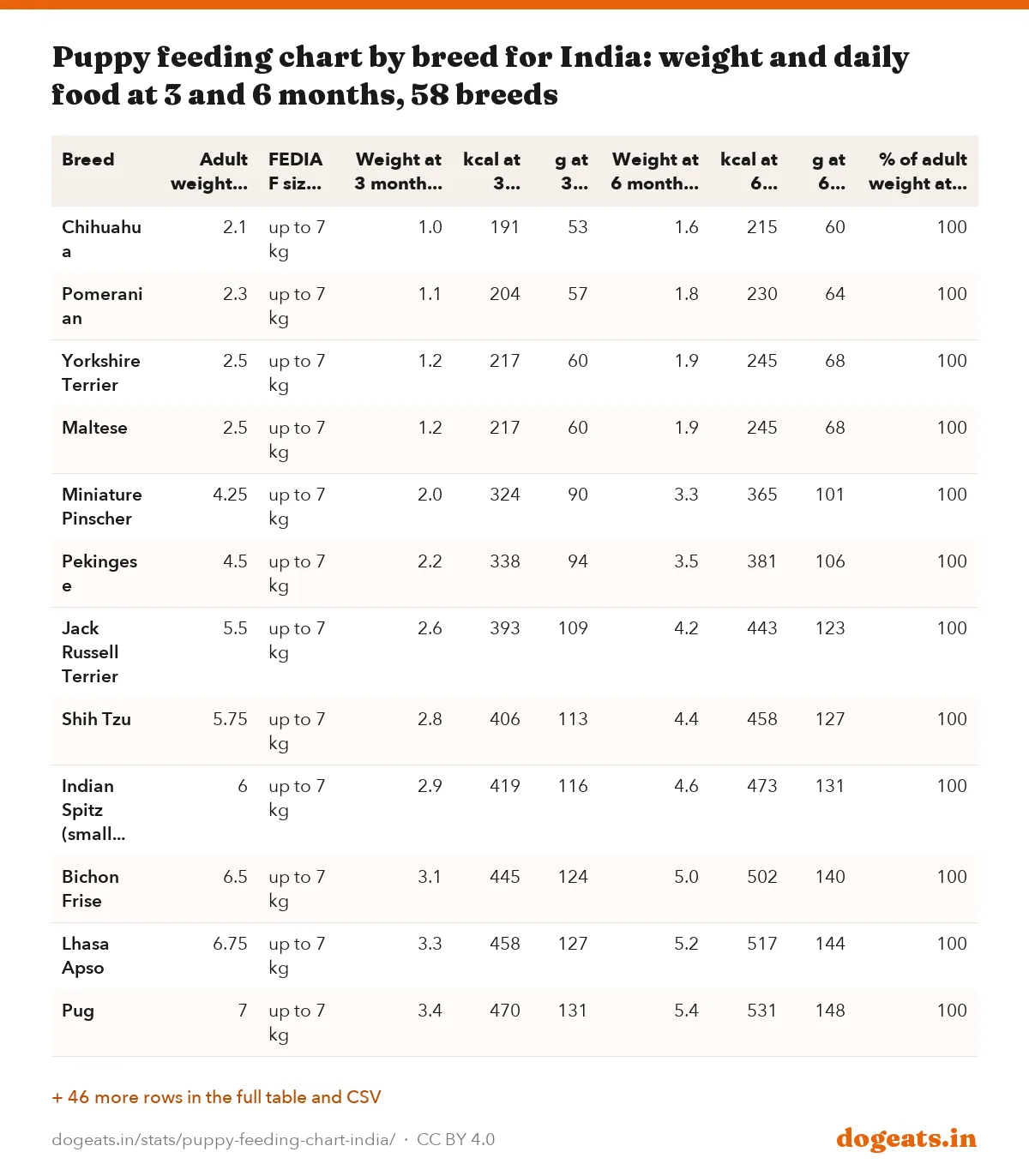
We applied the FEDIAF formula to the adult male weights in our 58 breed guides. A Labrador Retriever puppy heading for 32.5 kg weighs about 11.6 kg at 3 months and needs about 1,294 kcal a day.
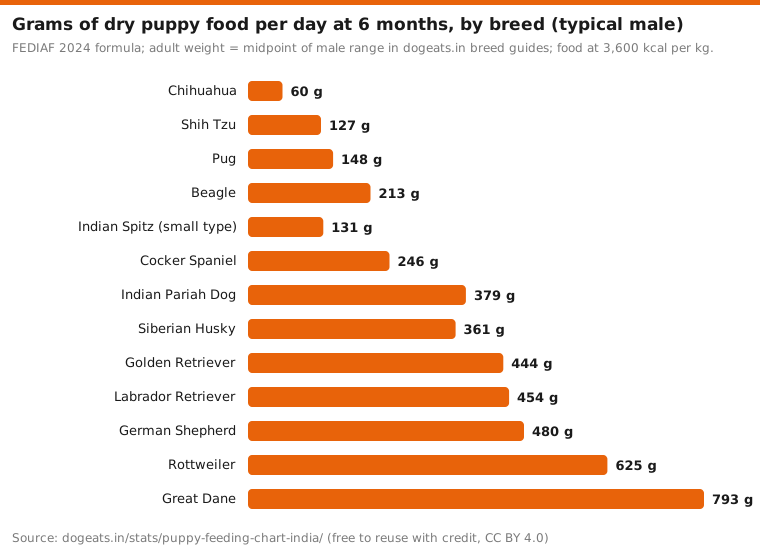
At 6 months the Labrador weighs about 20.9 kg and needs 1,635 kcal, roughly 454 g of dry food. An Indian Pariah Dog puppy heading for 25 kg needs 1,103 kcal at 3 months and 1,363 kcal at 6 months.
A German Shepherd puppy needs about 1,728 kcal at 6 months. A Shih Tzu puppy needs only about 458 kcal, about 127 g of food.
FEDIAF 2024 formula; adult weight = midpoint of male range in dogeats.in breed guides; food at 3,600 kcal per kg.
Show the numbers
| Label | g |
|---|---|
| Chihuahua | 60 g |
| Shih Tzu | 127 g |
| Pug | 148 g |
| Beagle | 213 g |
| Indian Spitz (small type) | 131 g |
| Cocker Spaniel | 246 g |
| Indian Pariah Dog | 379 g |
| Siberian Husky | 361 g |
| Golden Retriever | 444 g |
| Labrador Retriever | 454 g |
| German Shepherd | 480 g |
| Rottweiler | 625 g |
| Great Dane | 793 g |
Embed this chart
| Breed | Adult weight used (kg) | FEDIAF size band | Weight at 3 months (kg) | kcal at 3 months | g at 3 months | Weight at 6 months (kg) | kcal at 6 months | g at 6 months | % of adult weight at 1 year |
|---|---|---|---|---|---|---|---|---|---|
| Chihuahua | 2.1 | up to 7 kg | 1.0 | 191 | 53 | 1.6 | 215 | 60 | 100 |
| Pomeranian | 2.3 | up to 7 kg | 1.1 | 204 | 57 | 1.8 | 230 | 64 | 100 |
| Yorkshire Terrier | 2.5 | up to 7 kg | 1.2 | 217 | 60 | 1.9 | 245 | 68 | 100 |
| Maltese | 2.5 | up to 7 kg | 1.2 | 217 | 60 | 1.9 | 245 | 68 | 100 |
| Miniature Pinscher | 4.25 | up to 7 kg | 2.0 | 324 | 90 | 3.3 | 365 | 101 | 100 |
| Pekingese | 4.5 | up to 7 kg | 2.2 | 338 | 94 | 3.5 | 381 | 106 | 100 |
| Jack Russell Terrier | 5.5 | up to 7 kg | 2.6 | 393 | 109 | 4.2 | 443 | 123 | 100 |
| Shih Tzu | 5.75 | up to 7 kg | 2.8 | 406 | 113 | 4.4 | 458 | 127 | 100 |
| Indian Spitz (small type) | 6 | up to 7 kg | 2.9 | 419 | 116 | 4.6 | 473 | 131 | 100 |
| Bichon Frise | 6.5 | up to 7 kg | 3.1 | 445 | 124 | 5.0 | 502 | 140 | 100 |
| Lhasa Apso | 6.75 | up to 7 kg | 3.3 | 458 | 127 | 5.2 | 517 | 144 | 100 |
| Pug | 7 | up to 7 kg | 3.4 | 470 | 131 | 5.4 | 531 | 148 | 100 |
| Cavalier King Charles Spaniel | 7.05 | over 7 to 15 kg | 3.1 | 452 | 126 | 5.1 | 530 | 147 | 97 |
| German Spitz | 8 | over 7 to 15 kg | 3.5 | 497 | 138 | 5.7 | 583 | 162 | 97 |
| Japanese Spitz | 8 | over 7 to 15 kg | 3.5 | 497 | 138 | 5.7 | 583 | 162 | 97 |
| Shiba Inu | 9.5 | over 7 to 15 kg | 4.1 | 566 | 157 | 6.8 | 663 | 184 | 97 |
| French Bulldog | 10 | over 7 to 15 kg | 4.3 | 588 | 163 | 7.2 | 689 | 192 | 97 |
| Pembroke Welsh Corgi | 11 | over 7 to 15 kg | 4.8 | 631 | 175 | 7.9 | 741 | 206 | 97 |
| Dachshund (standard) | 11 | over 7 to 15 kg | 4.8 | 631 | 175 | 7.9 | 741 | 206 | 97 |
| Beagle | 11.5 | over 7 to 15 kg | 5.0 | 653 | 181 | 8.3 | 766 | 213 | 97 |
| American Eskimo Dog (standard) | 13.5 | over 7 to 15 kg | 5.9 | 736 | 204 | 9.7 | 864 | 240 | 97 |
| Cocker Spaniel | 14 | over 7 to 15 kg | 6.1 | 756 | 210 | 10.1 | 887 | 246 | 97 |
| Kanni | 19 | over 15 to 27.5 kg | 7.3 | 898 | 249 | 13.2 | 1,110 | 308 | 97 |
| Chippiparai | 19.5 | over 15 to 27.5 kg | 7.5 | 916 | 254 | 13.5 | 1,131 | 314 | 97 |
| Border Collie | 19.5 | over 15 to 27.5 kg | 7.5 | 916 | 254 | 13.5 | 1,131 | 314 | 97 |
| Pit Bull | 21.5 | over 15 to 27.5 kg | 8.3 | 985 | 274 | 14.9 | 1,217 | 338 | 97 |
| English Bulldog | 23 | over 15 to 27.5 kg | 8.8 | 1,036 | 288 | 15.9 | 1,280 | 356 | 97 |
| Siberian Husky | 23.5 | over 15 to 27.5 kg | 9.0 | 1,053 | 293 | 16.3 | 1,301 | 361 | 97 |
| Samoyed | 24.5 | over 15 to 27.5 kg | 9.4 | 1,086 | 302 | 17.0 | 1,343 | 373 | 97 |
| Indian Pariah Dog | 25 | over 15 to 27.5 kg | 9.6 | 1,103 | 306 | 17.3 | 1,363 | 379 | 97 |
| Poodle (Standard) | 25 | over 15 to 27.5 kg | 9.6 | 1,103 | 306 | 17.3 | 1,363 | 379 | 97 |
| Dalmatian | 26 | over 15 to 27.5 kg | 10.0 | 1,136 | 316 | 18.0 | 1,404 | 390 | 97 |
| Mudhol Hound | 26 | over 15 to 27.5 kg | 10.0 | 1,136 | 316 | 18.0 | 1,404 | 390 | 97 |
| Australian Shepherd | 26 | over 15 to 27.5 kg | 10.0 | 1,136 | 316 | 18.0 | 1,404 | 390 | 97 |
| Chow Chow | 26 | over 15 to 27.5 kg | 10.0 | 1,136 | 316 | 18.0 | 1,404 | 390 | 97 |
| Bull Terrier | 27.5 | over 15 to 27.5 kg | 10.6 | 1,185 | 329 | 19.0 | 1,464 | 407 | 97 |
| Rampur Greyhound | 29.5 | over 27.5 to 47.5 kg | 10.5 | 1,203 | 334 | 19.0 | 1,520 | 422 | 90 |
| Kombai | 30 | over 27.5 to 47.5 kg | 10.7 | 1,218 | 338 | 19.3 | 1,540 | 428 | 90 |
| Golden Retriever | 31.5 | over 27.5 to 47.5 kg | 11.2 | 1,264 | 351 | 20.2 | 1,597 | 444 | 90 |
| Belgian Malinois | 31.5 | over 27.5 to 47.5 kg | 11.2 | 1,264 | 351 | 20.2 | 1,597 | 444 | 90 |
| Labrador Retriever | 32.5 | over 27.5 to 47.5 kg | 11.6 | 1,294 | 359 | 20.9 | 1,635 | 454 | 90 |
| Boxer | 32.5 | over 27.5 to 47.5 kg | 11.6 | 1,294 | 359 | 20.9 | 1,635 | 454 | 90 |
| Rajapalayam | 32.5 | over 27.5 to 47.5 kg | 11.6 | 1,294 | 359 | 20.9 | 1,635 | 454 | 90 |
| German Shepherd | 35 | over 27.5 to 47.5 kg | 12.5 | 1,368 | 380 | 22.5 | 1,728 | 480 | 90 |
| Rhodesian Ridgeback | 38.5 | over 27.5 to 47.5 kg | 13.7 | 1,469 | 408 | 24.7 | 1,856 | 516 | 90 |
| Doberman | 39.5 | over 27.5 to 47.5 kg | 14.1 | 1,498 | 416 | 25.4 | 1,892 | 526 | 90 |
| Alaskan Malamute | 39.5 | over 27.5 to 47.5 kg | 14.1 | 1,498 | 416 | 25.4 | 1,892 | 526 | 90 |
| Dogo Argentino | 42.5 | over 27.5 to 47.5 kg | 15.2 | 1,582 | 439 | 27.3 | 1,999 | 555 | 90 |
| Bernese Mountain Dog | 44 | over 27.5 to 47.5 kg | 15.7 | 1,624 | 451 | 28.3 | 2,052 | 570 | 90 |
| Cane Corso | 47.5 | over 27.5 to 47.5 kg | 16.9 | 1,720 | 478 | 30.5 | 2,173 | 604 | 90 |
| Rottweiler | 52 | over 47.5 kg | 14.9 | 1,631 | 453 | 29.6 | 2,249 | 625 | 82 |
| Kangal | 54 | over 47.5 kg | 15.4 | 1,678 | 466 | 30.7 | 2,314 | 643 | 82 |
| Tibetan Mastiff | 54.5 | over 47.5 kg | 15.6 | 1,690 | 469 | 31.0 | 2,330 | 647 | 82 |
| Bullmastiff | 54.5 | over 47.5 kg | 15.6 | 1,690 | 469 | 31.0 | 2,330 | 647 | 82 |
| Great Dane | 71.5 | over 47.5 kg | 20.4 | 2,071 | 575 | 40.7 | 2,856 | 793 | 82 |
| Saint Bernard | 73 | over 47.5 kg | 20.9 | 2,104 | 584 | 41.5 | 2,900 | 806 | 82 |
| Bully Kutta | 80 | over 47.5 kg | 22.9 | 2,254 | 626 | 45.5 | 3,107 | 863 | 82 |
| English Mastiff | 88.5 | over 47.5 kg | 25.3 | 2,431 | 675 | 50.3 | 3,351 | 931 | 82 |
Big native breeds need watching too. A Rajapalayam puppy heading for 32.5 kg needs about 1,635 kcal at 6 months. A Great Dane puppy is only 82% of adult weight at a year, so it stays on growth food longer.
Breed weights vary a lot between lines, and females are often lighter. Use your vet's estimate of adult size, or the parents' weights, rather than our midpoint when you can.
Do large-breed puppies need special puppy food?
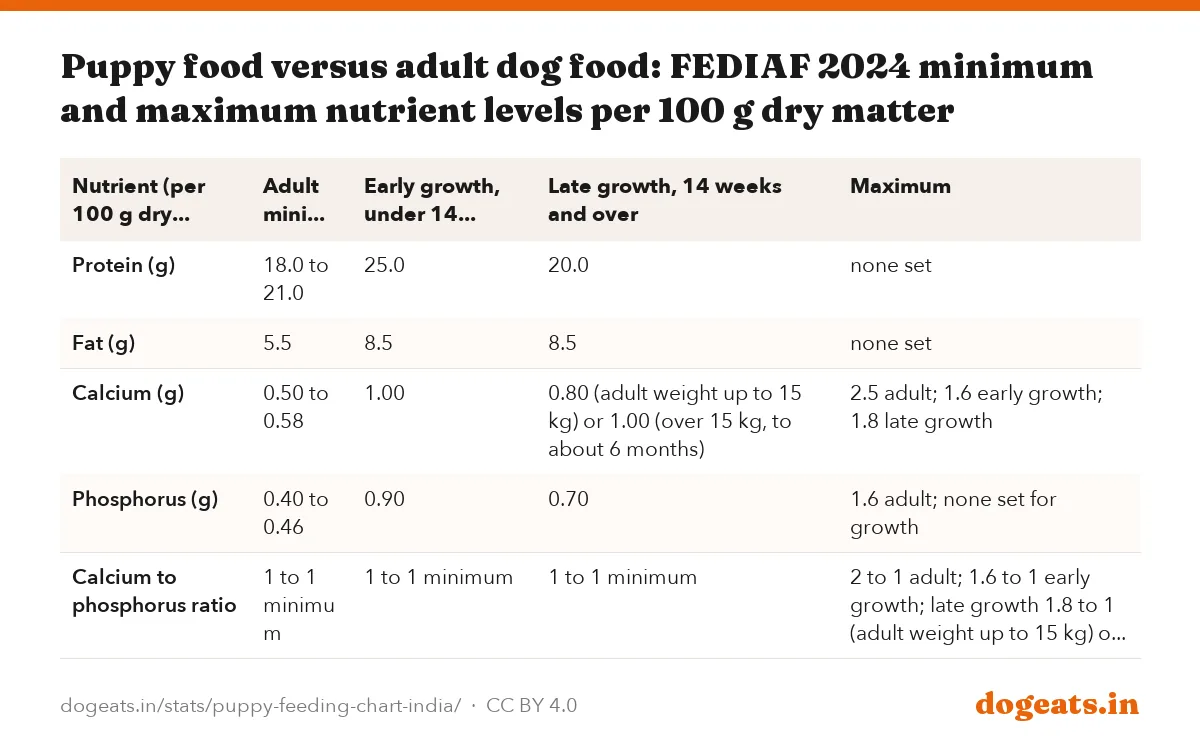
Large and giant breeds are the most sensitive to diet during growth. The Merck Veterinary Manual says excess calcium is more of a problem for growing large and giant dogs, from weaning to a year.
FEDIAF sets a strict calcium ceiling for that reason: 1.6 g per 100 g of dry matter in early growth and 1.8 g in late growth. It advises Great Danes stay at 1.6 g.
For puppies of breeds over 15 kg, FEDIAF keeps the calcium minimum at 1 g per 100 g of dry matter until about 6 months. After that it can drop to 0.8 g.
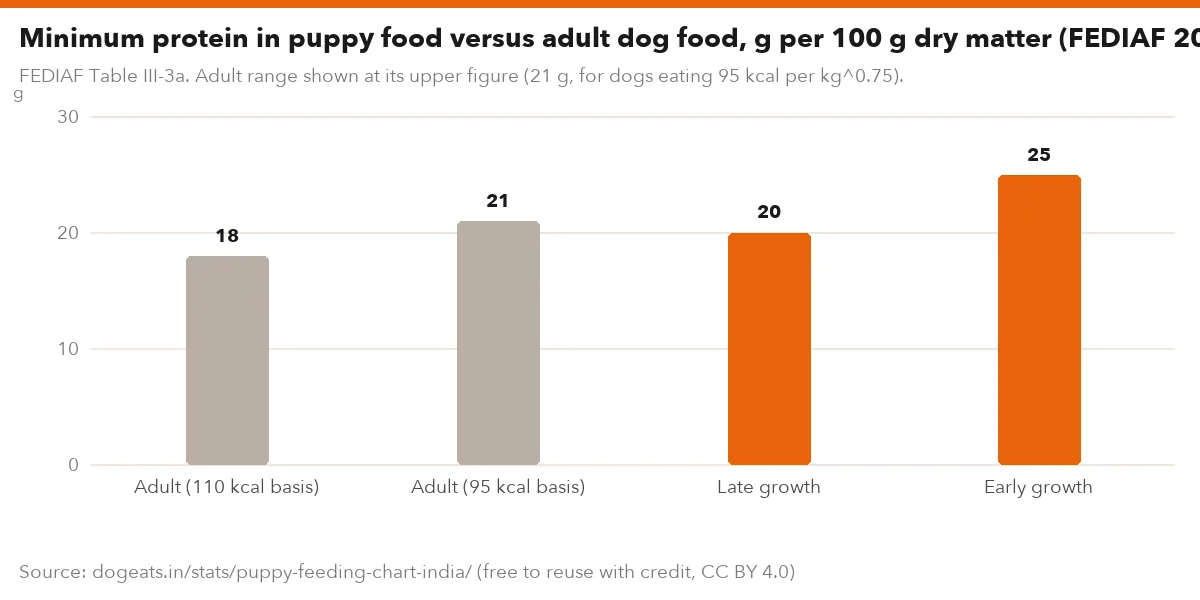
| Nutrient (per 100 g dry matter) | Adult minimum | Early growth, under 14 weeks | Late growth, 14 weeks and over | Maximum |
|---|---|---|---|---|
| Protein (g) | 18.0 to 21.0 | 25.0 | 20.0 | none set |
| Fat (g) | 5.5 | 8.5 | 8.5 | none set |
| Calcium (g) | 0.50 to 0.58 | 1.00 | 0.80 (adult weight up to 15 kg) or 1.00 (over 15 kg, to about 6 months) | 2.5 adult; 1.6 early growth; 1.8 late growth |
| Phosphorus (g) | 0.40 to 0.46 | 0.90 | 0.70 | 1.6 adult; none set for growth |
| Calcium to phosphorus ratio | 1 to 1 minimum | 1 to 1 minimum | 1 to 1 minimum | 2 to 1 adult; 1.6 to 1 early growth; late growth 1.8 to 1 (adult weight up to 15 kg) or 1.6 to 1 (over 15 kg, to about 6 months) |
FEDIAF Table III-3a. Adult range shown at its upper figure (21 g, for dogs eating 95 kcal per kg^0.75).
Show the numbers
| Label | g |
|---|---|
| Adult (110 kcal basis) | 18 |
| Adult (95 kcal basis) | 21 |
| Late growth | 20 |
| Early growth | 25 |
Embed this chart
Merck adds that diets above 3% calcium on a dry matter basis caused more severe signs of osteochondrosis than diets of 1% to 3%. Ask a vet before adding any calcium supplement to a complete puppy food.
VCA notes that moderate limits on energy and food during growth in large-breed dogs can lower the risk of hip dysplasia. Lean, steady growth is the aim.
When should puppies start eating solid food?
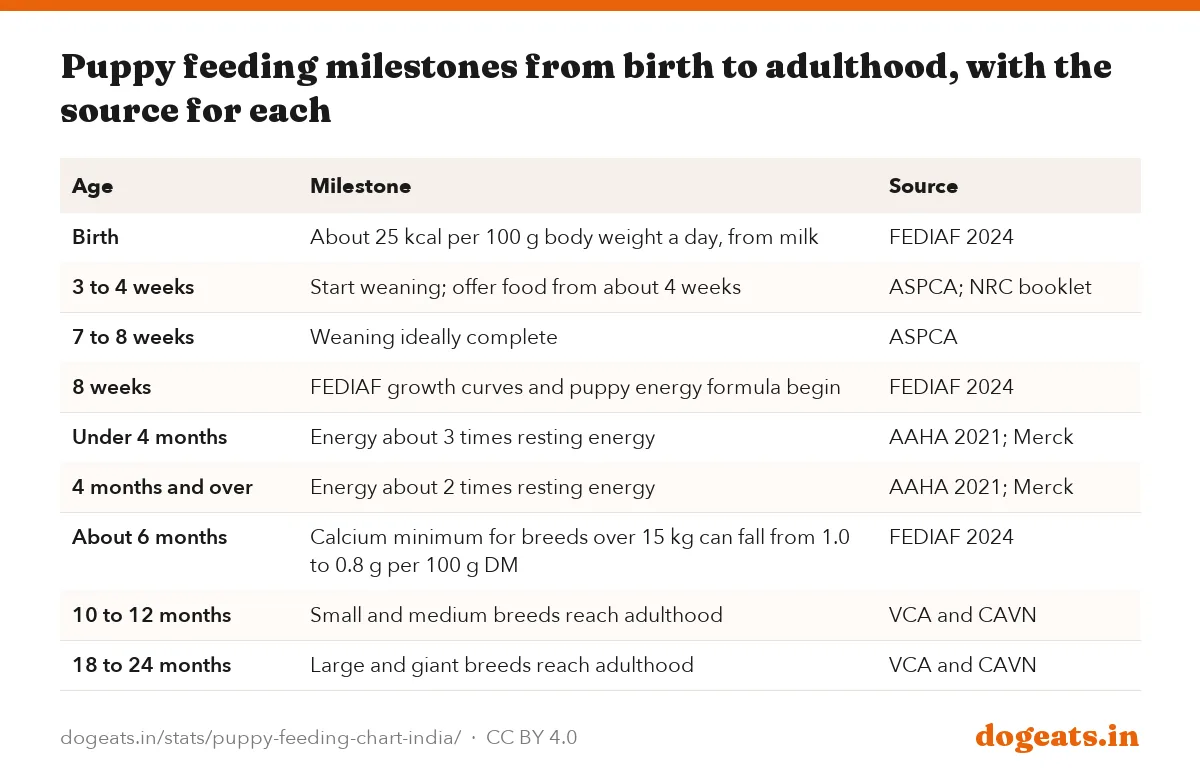
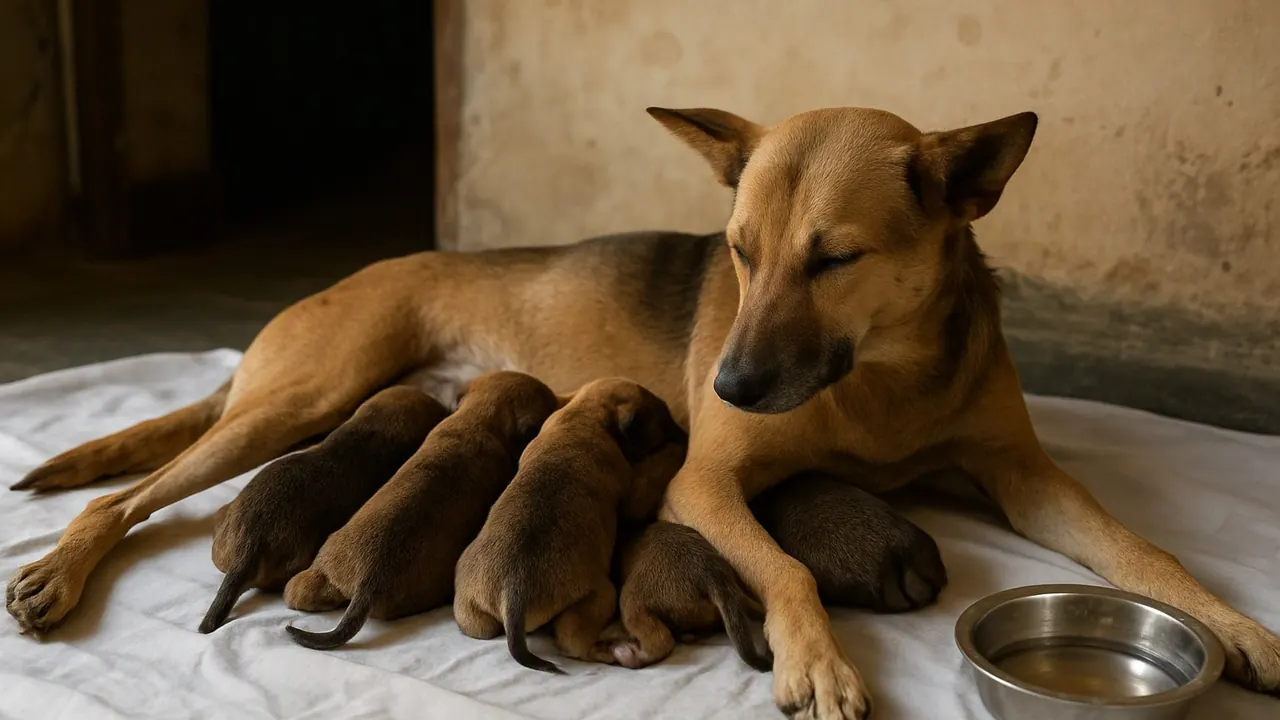
The ASPCA says weaning should start at three to four weeks and ideally be complete by seven to eight weeks. The NRC booklet says owners should start offering food at about 4 weeks, because the mother's milk is no longer enough.
Newborn puppies need about 25 kcal per 100 g of body weight a day, FEDIAF says. A 400 g newborn would need about 100 kcal, almost all from milk.
| Age | Milestone | Source |
|---|---|---|
| Birth | About 25 kcal per 100 g body weight a day, from milk | FEDIAF 2024 |
| 3 to 4 weeks | Start weaning; offer food from about 4 weeks | ASPCA; NRC booklet |
| 7 to 8 weeks | Weaning ideally complete | ASPCA |
| 8 weeks | FEDIAF growth curves and puppy energy formula begin | FEDIAF 2024 |
| Under 4 months | Energy about 3 times resting energy | AAHA 2021; Merck |
| 4 months and over | Energy about 2 times resting energy | AAHA 2021; Merck |
| About 6 months | Calcium minimum for breeds over 15 kg can fall from 1.0 to 0.8 g per 100 g DM | FEDIAF 2024 |
| 10 to 12 months | Small and medium breeds reach adulthood | VCA and CAVN |
| 18 to 24 months | Large and giant breeds reach adulthood | VCA and CAVN |
Orphaned or very small puppies need a vet's plan. Our can dogs have milk page covers cow's and buffalo milk for dogs.
How much does it cost to feed a puppy in India?
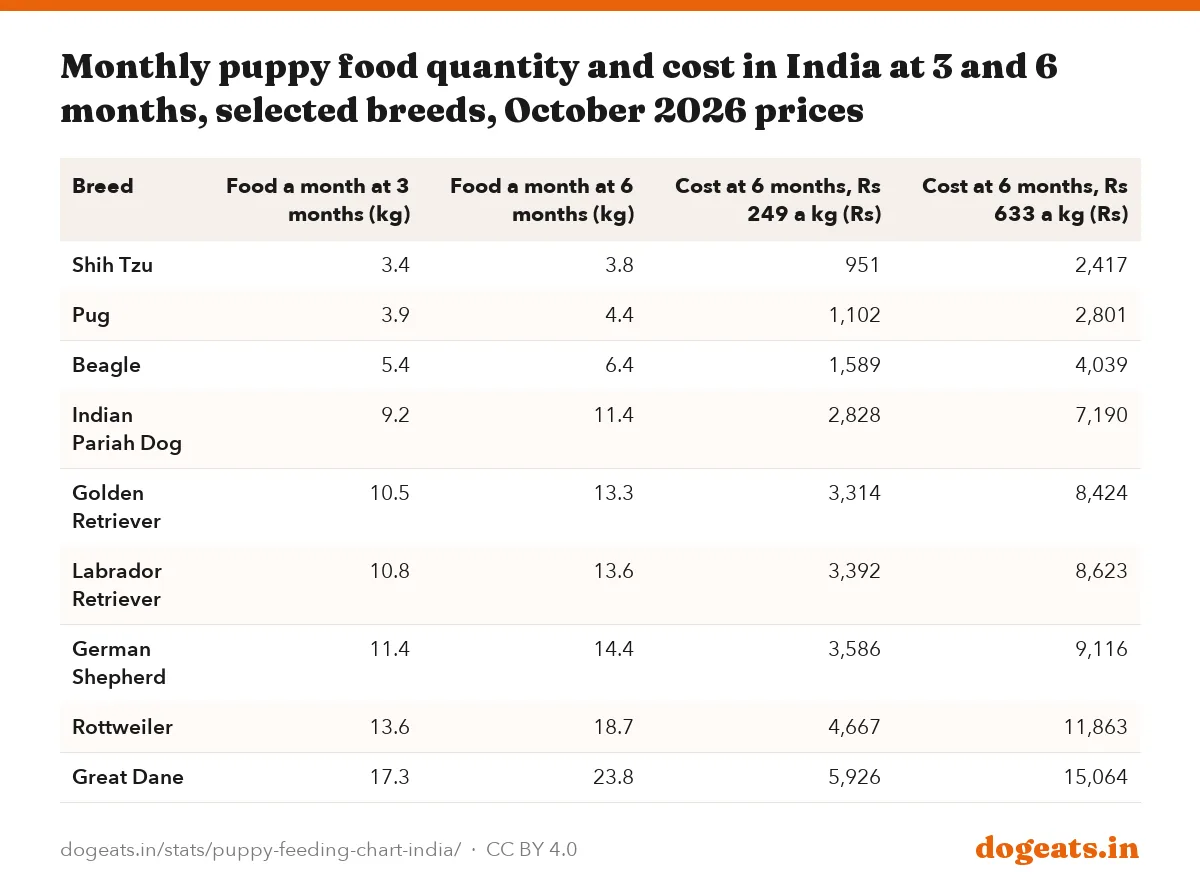
At 3 months a Labrador puppy eats about 359 g a day of a 3,600 kcal per kg food, or 10.8 kg a month. At 6 months that rises to about 13.6 kg a month.
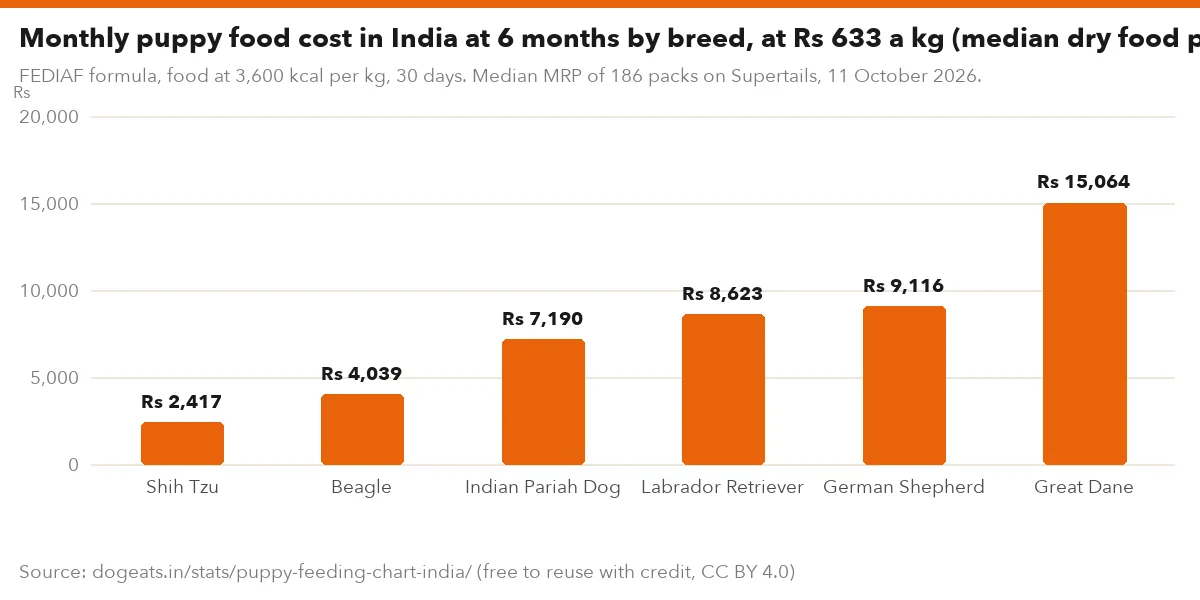
In our dog food price check on 11 October 2026, Pedigree Chicken and Milk Puppy listed at Rs 2,490 for 10 kg, or Rs 249 a kg. The median dry food across 186 packs was Rs 633 a kg.
At Rs 249 a kg, the Labrador puppy's food costs about Rs 2,684 a month at 3 months and Rs 3,392 at 6 months. At Rs 633 a kg it is Rs 6,824 and Rs 8,623.
FEDIAF formula, food at 3,600 kcal per kg, 30 days. Median MRP of 186 packs on Supertails, 11 October 2026.
Show the numbers
| Label | Rs |
|---|---|
| Shih Tzu | Rs 2,417 |
| Beagle | Rs 4,039 |
| Indian Pariah Dog | Rs 7,190 |
| Labrador Retriever | Rs 8,623 |
| German Shepherd | Rs 9,116 |
| Great Dane | Rs 15,064 |
Embed this chart
| Breed | Food a month at 3 months (kg) | Food a month at 6 months (kg) | Cost at 6 months, Rs 249 a kg (Rs) | Cost at 6 months, Rs 633 a kg (Rs) |
|---|---|---|---|---|
| Shih Tzu | 3.4 | 3.8 | 951 | 2,417 |
| Pug | 3.9 | 4.4 | 1,102 | 2,801 |
| Beagle | 5.4 | 6.4 | 1,589 | 4,039 |
| Indian Pariah Dog | 9.2 | 11.4 | 2,828 | 7,190 |
| Golden Retriever | 10.5 | 13.3 | 3,314 | 8,424 |
| Labrador Retriever | 10.8 | 13.6 | 3,392 | 8,623 |
| German Shepherd | 11.4 | 14.4 | 3,586 | 9,116 |
| Rottweiler | 13.6 | 18.7 | 4,667 | 11,863 |
| Great Dane | 17.3 | 23.8 | 5,926 | 15,064 |
Puppy foods differ in energy, so check the pack and recalculate. For the full first-year bill, see our cost of owning a dog by size report.
Frequently asked questions
How much should a 2-month-old puppy eat?
At 8 weeks, a puppy heading for 10 kg needs about 472 kcal a day and one heading for 30 kg about 889 kcal, by the FEDIAF 2024 formula. In dry food, that comes to roughly 131 g and 247 g of a 3,600 kcal per kg dry food.
How much should a 3-month-old puppy eat?
A puppy heading for 20 kg needs about 933 kcal a day at 12 weeks, or about 259 g of dry food. A Labrador puppy needs about 1,294 kcal.
How many times a day should I feed a puppy?
Royal Canin advises at least four meals a day at 4 to 8 weeks, three at 3 to 6 months and two from 6 months. The NRC booklet and VCA say two to three meals a day.
How much should a 6-month-old Labrador eat?
About 1,635 kcal a day, or roughly 454 g of a 3,600 kcal per kg dry food, for a puppy heading for 32.5 kg. Check its waist and weight every week or two.
When should I switch my puppy to adult food?
VCA puts adulthood at 10 to 12 months for small and medium breeds and 18 to 24 months for large and giant breeds. Switch around then, after checking with your vet.
Do puppies need more food than adult dogs?
Yes, per kg. A 6-month puppy heading for 20 kg needs about 1,153 kcal a day while weighing about 13.8 kg. A moderately active 20 kg adult needs about 1,040 kcal.
Can I free-feed my puppy?
FEDIAF says puppies should never be fed free-choice, and VCA says free feeding raises the risk of excess body fat. Measured meals help control growth, especially in large breeds.
When do puppies start eating solid food?
Weaning usually starts at three to four weeks and should be complete by seven to eight weeks, the ASPCA says. The NRC booklet advises offering food from about 4 weeks.
Methodology and limitations
Puppy weights by age use the FEDIAF July 2024 growth curves (Table VII-8a), which apply from 8 weeks to a year, capped at 100%. Daily energy uses the FEDIAF equation (254.1 minus 135.0 x current weight / adult weight) x current weight^0.75 in kcal (Table VII-8b), taken from Klein et al. 2019.
For comparison we computed the NRC 2006 growth equation, 130 x weight^0.75 x 3.2 x (e^(-0.87p) minus 0.1), as quoted in Böswald et al., PLoS One 2019. We also applied the AAHA 2021 factors of 3.0 under 4 months (taken as under 17.4 weeks) and 2.0 after, times resting energy of 70 x weight^0.75.
Grams assume 3,600 kcal per kg as fed, from FEDIAF's reference of 4.0 kcal per g dry matter at an assumed 10% moisture. Adult comparison figures use FEDIAF's 110 kcal per kg^0.75.
Breed adult weights are the midpoints of the male (or both-sexes) ranges in our 58 breed guides: dogeats.in editorial data compiled from our breed guides, October 2026. Size bands follow FEDIAF.
Meal frequency, weaning and maturity ages are quoted from Royal Canin, the NRC owners' booklet, VCA with the Canadian Academy of Veterinary Nutrition, and the ASPCA. All were opened on 15 October 2026. Prices come from our dog food price check of Supertails listings on 11 October 2026.
In our tables, 3 months means 12 weeks and 6 months means 26 weeks. FEDIAF growth curves are valid from 8 weeks to 1 year, so weeks to full weight beyond 52 are extrapolations.
Sources
- FEDIAF Nutritional Guidelines for Complete and Complementary Pet Food for Cats and Dogs, July 2024, Puppy growth curves and energy equation (Tables VII-8a, VII-8b), newborn energy, nutrient minimums and maximums for growth, no free-choice feeding
- Klein C, Thes M, Böswald LF, Kienzle E. Metabolisable energy intake and growth of privately owned growing dogs. J Anim Physiol Anim Nutr 2019;103:1952-1958, 493 puppies ate 78% and 83% of NRC energy; source of the FEDIAF equation
- AAHA 2021 Nutrition and Weight Management Guidelines, Box 1: Energy Requirement Calculations, Growth factors 3.0 under 4 months and 2.0 from 4 months
- Also consulted: National Research Council, Your Dog's Nutritional Needs (2006), Böswald LF, Klein C, Dobenecker B, Kienzle E. Factorial calculation of calcium and phosphorus requirements of growing dogs. PLoS One 2019, Alexander JE, Colyer A, Morris PJ. Energy requirements for growth in the Yorkshire terrier. J Nutr Sci 2017, VCA Animal Hospitals and Canadian Academy of Veterinary Nutrition, Feeding Growing Puppies (updated 4 February 2025), Royal Canin, How often to feed a puppy, ASPCA, Dog Nutrition Tips, Merck Veterinary Manual, Nutritional Requirements and Related Diseases of Small Animals (updated September 2024), Supertails product listings, checked 11 October 2026.
Cite, embed and download
This report, its data and its images are free to reuse under a Creative Commons Attribution 4.0 licence. Credit dogeats.in with a link to this page. Every chart has its own embed code, every table has a CSV and an image download, and the images below are ready for social posts, slides and articles.
Cite this report
Link to this report
Every chart and table as an image