Data report · Updated October 2026
Dog weight chart by age and breed in kg: how big your puppy will get, and when it stops growing
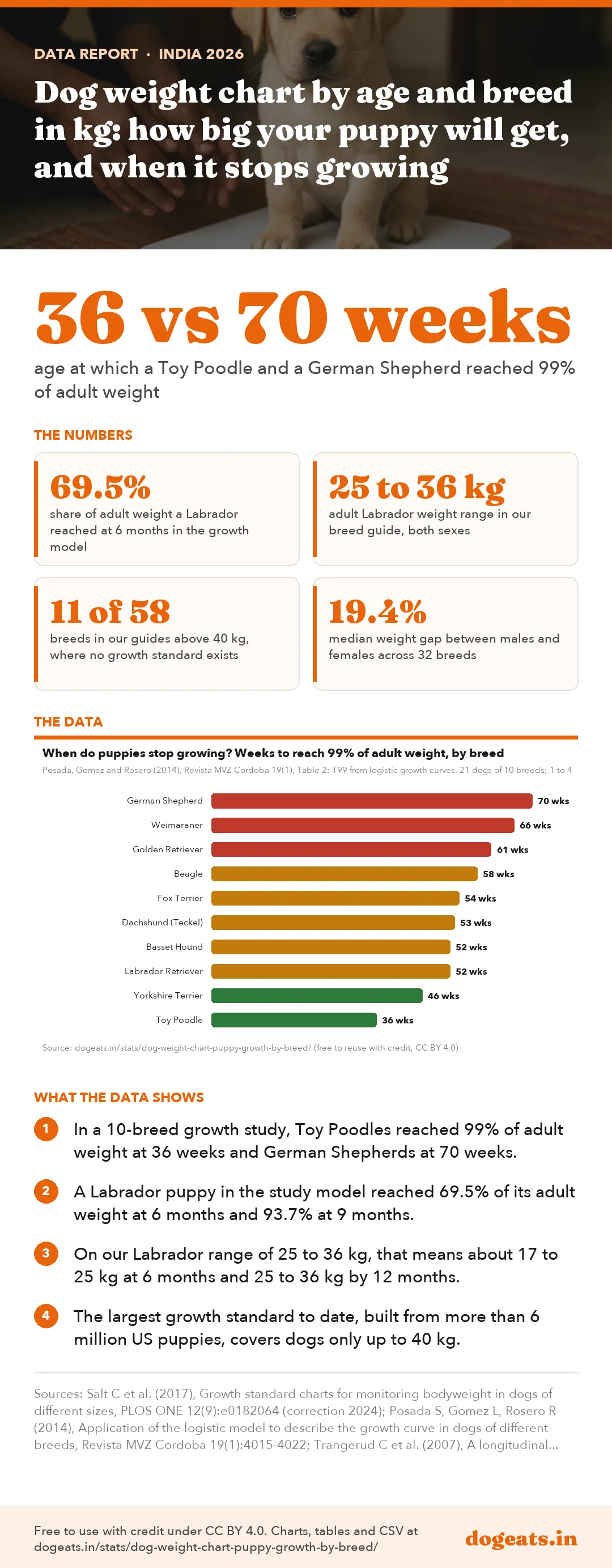
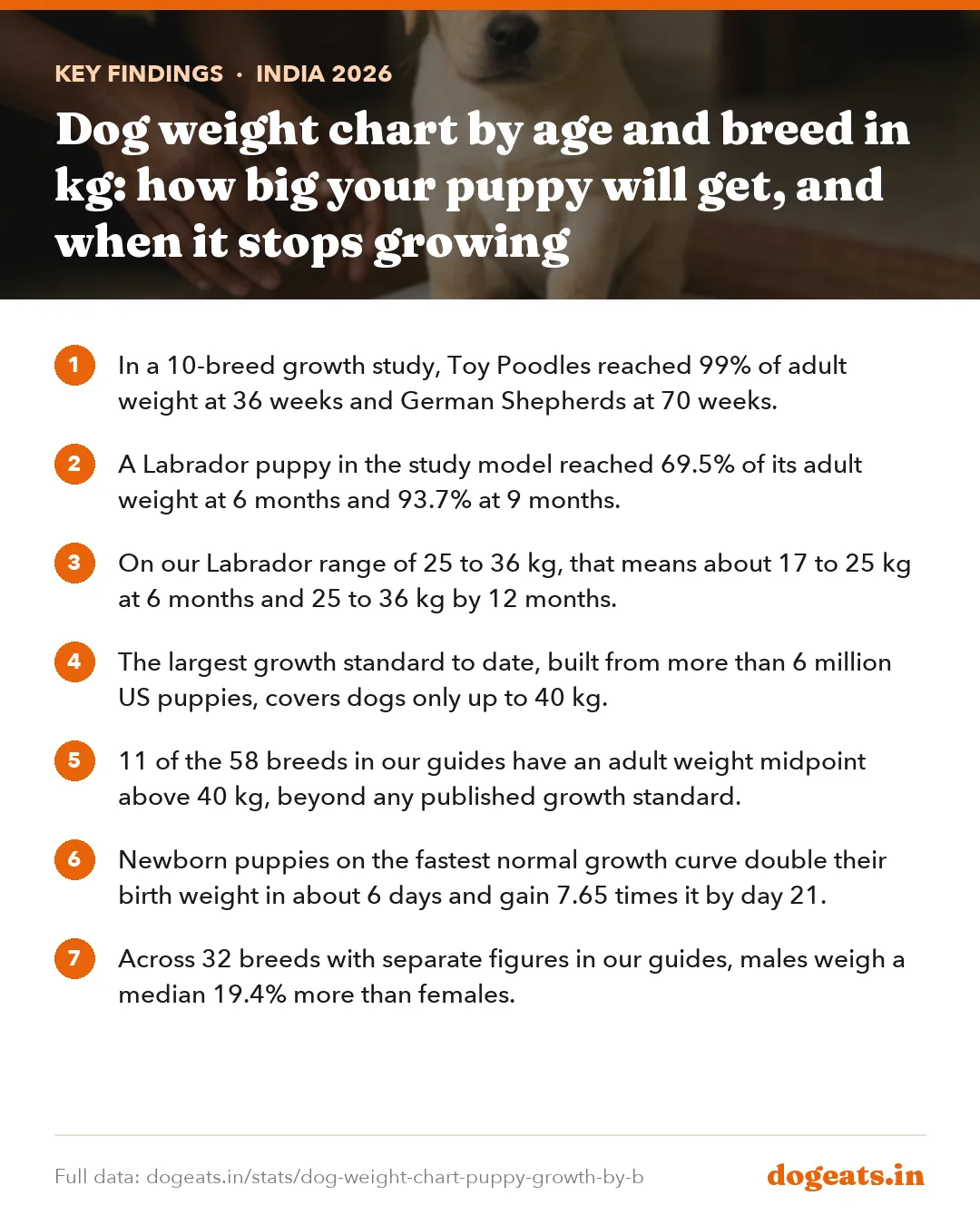
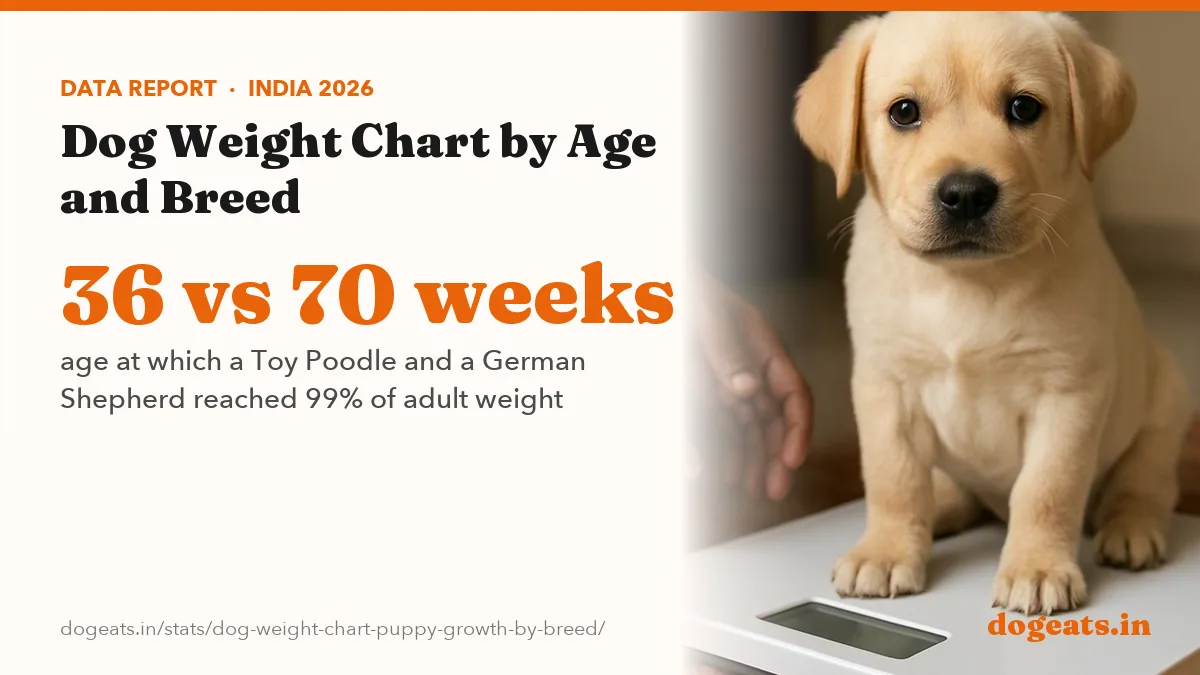
Small dogs reach full adult weight first. In a 10-breed growth study, a Toy Poodle hit 99% of adult weight at 36 weeks (about 8 months). A German Shepherd took 70 weeks (about 16 months). A Labrador puppy is typically about two-thirds of its adult weight at 6 months, around 17 to 25 kg for an adult range of 25 to 36 kg.
Key findings
- In a 10-breed growth study, Toy Poodles reached 99% of adult weight at 36 weeks and German Shepherds at 70 weeks.
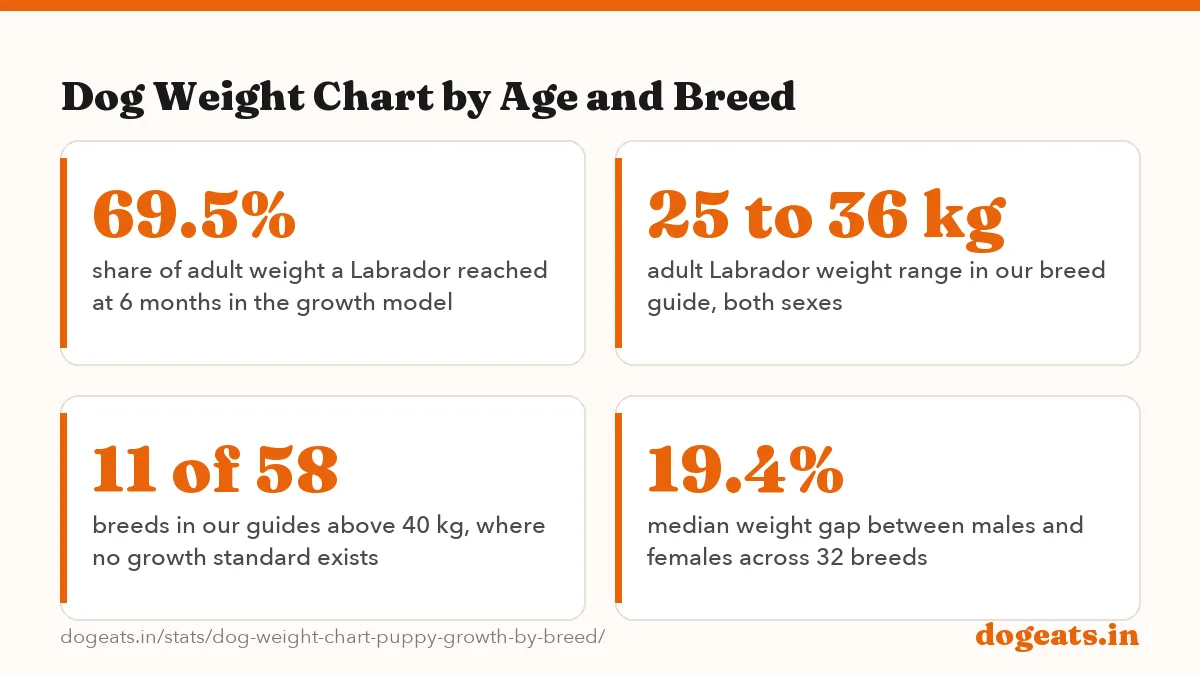
- A Labrador puppy in the study model reached 69.5% of its adult weight at 6 months and 93.7% at 9 months.
- On our Labrador range of 25 to 36 kg, that means about 17 to 25 kg at 6 months and 25 to 36 kg by 12 months.
- The largest growth standard to date, built from more than 6 million US puppies, covers dogs only up to 40 kg.
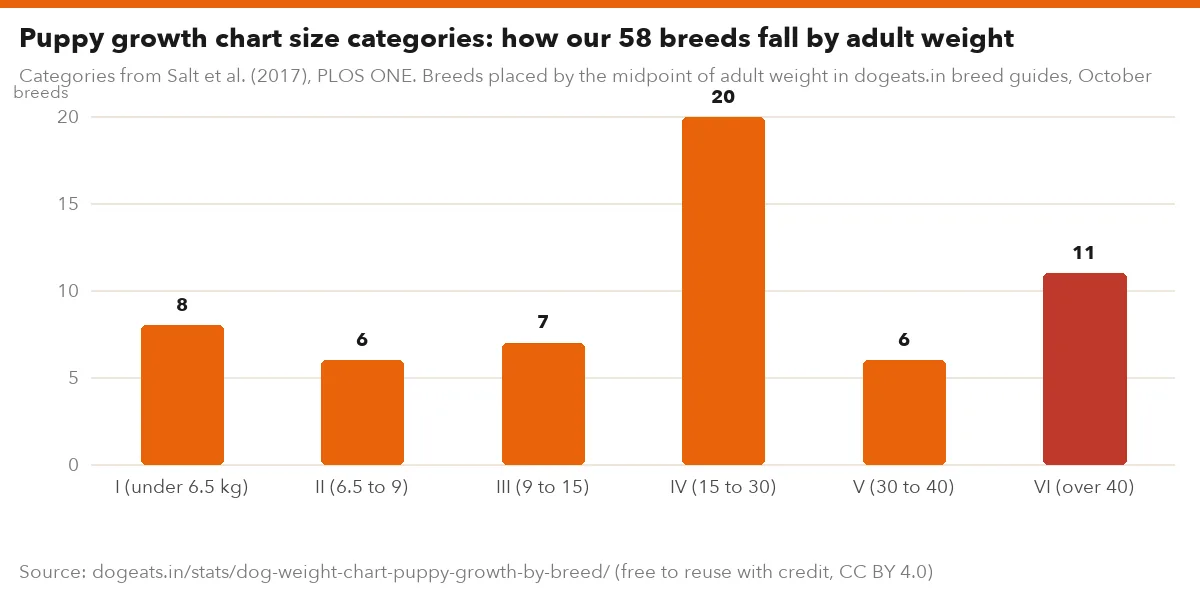
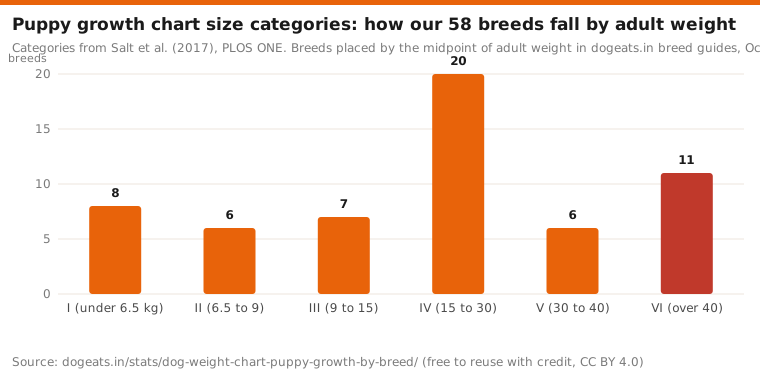
- 11 of the 58 breeds in our guides have an adult weight midpoint above 40 kg, beyond any published growth standard.
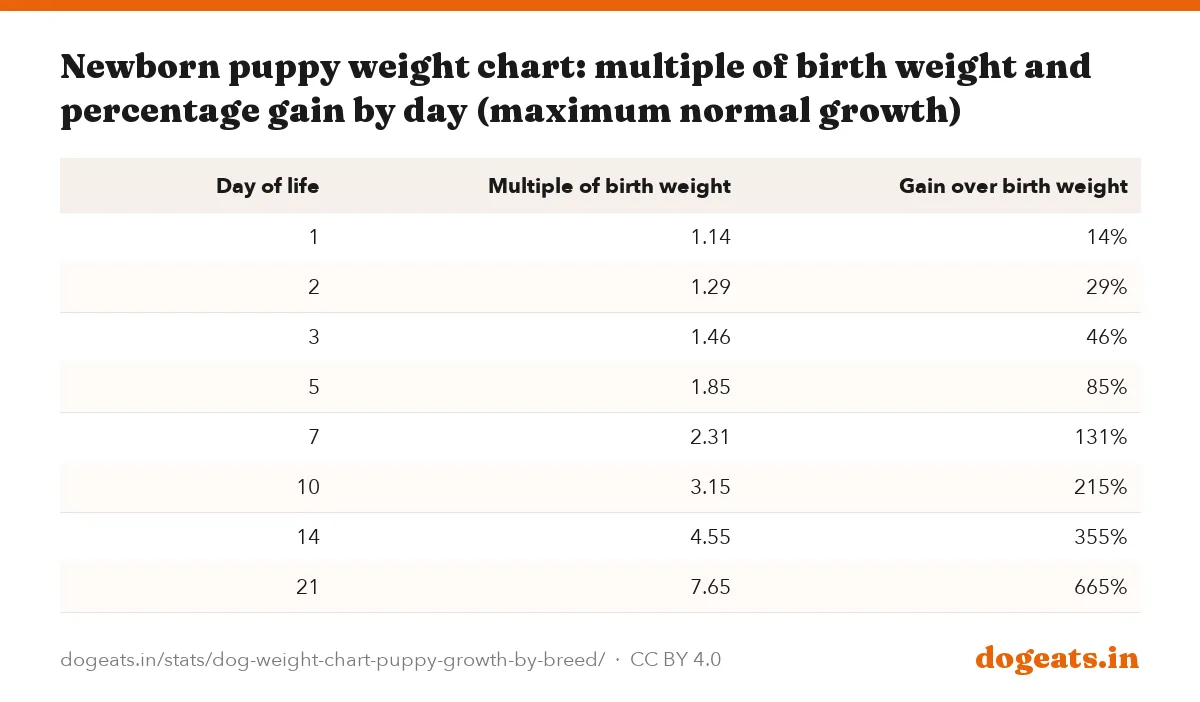
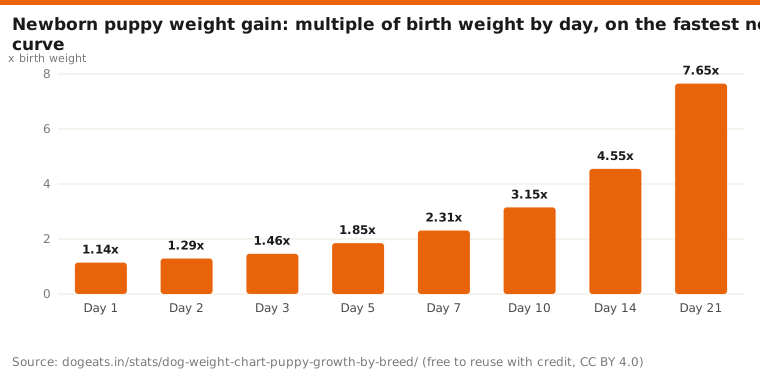
- Newborn puppies on the fastest normal growth curve double their birth weight in about 6 days and gain 7.65 times it by day 21.
- Across 32 breeds with separate figures in our guides, males weigh a median 19.4% more than females.
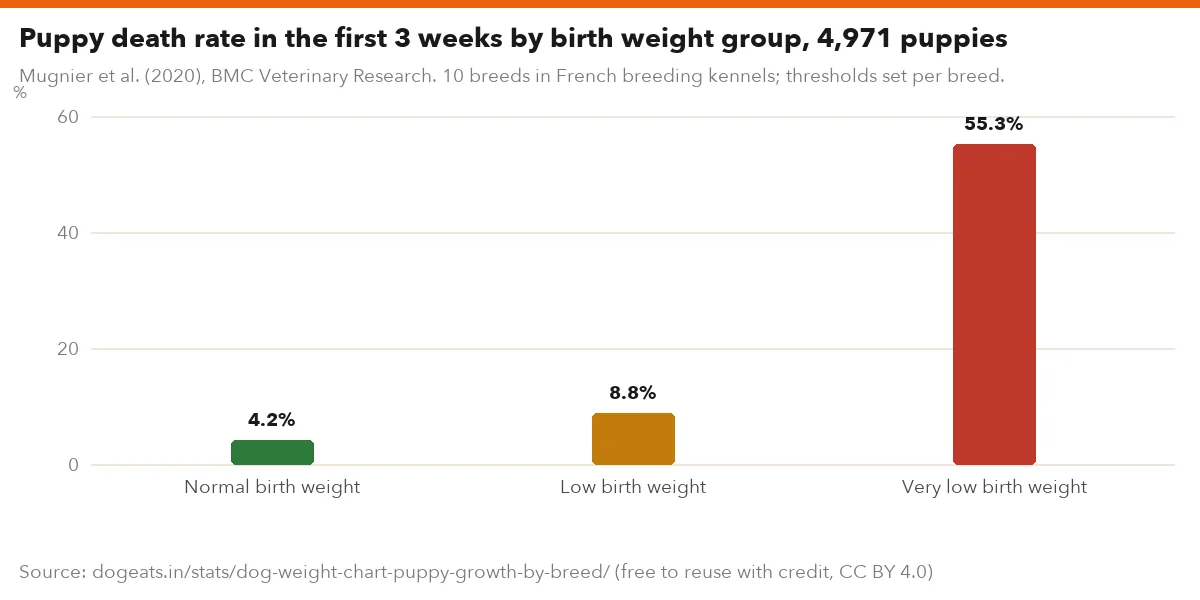
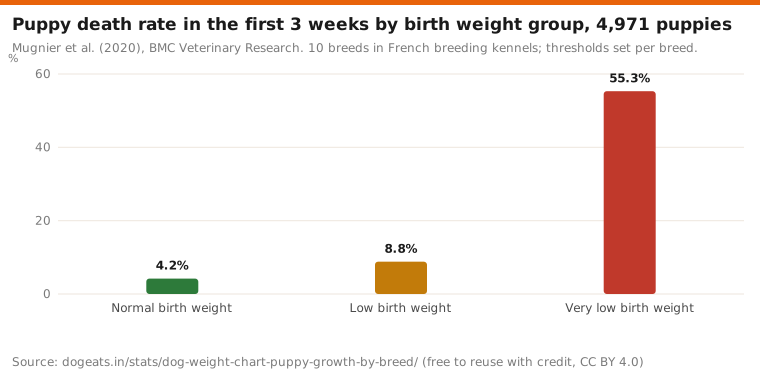
- In 4,971 French puppies, those with very low birth weight had a 55.3% death rate in the first 3 weeks, against 4.2% for normal weights.
- Four large breeds in a Norwegian study of 700 dogs reached mature weight between 351 and 413 days of age.
When do puppies stop growing?
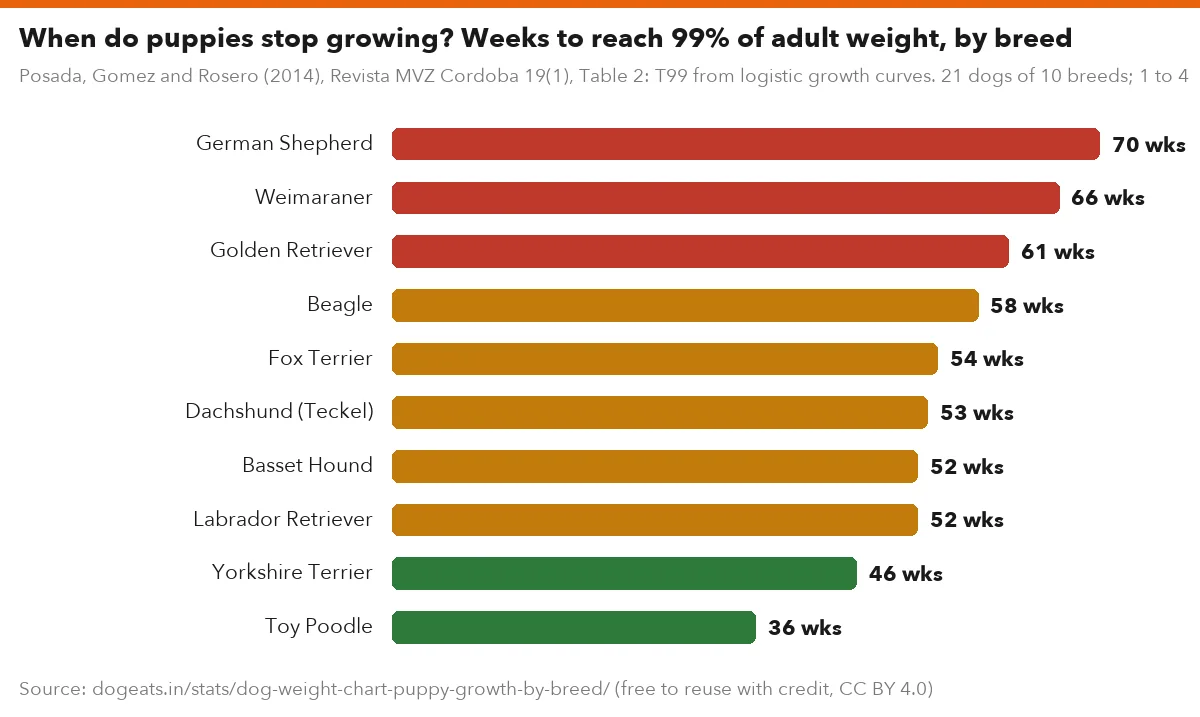
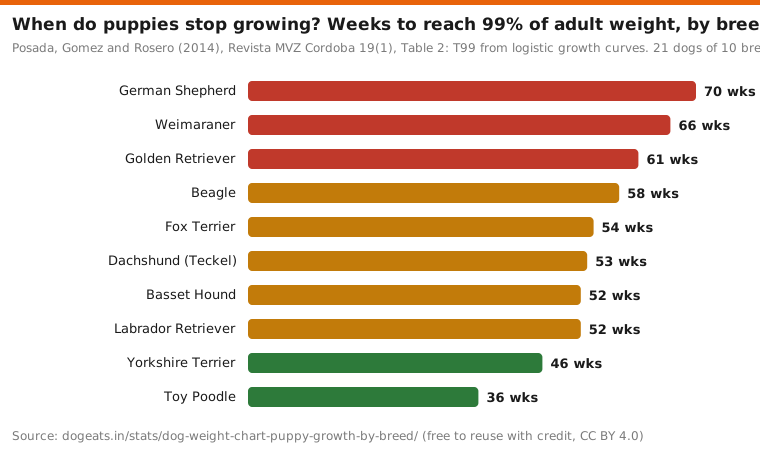
Small breeds stop growing first. A 2014 study in Colombia weighed puppies of 10 breeds through growth and fitted a curve to each. It then estimated the age at which each breed reached 99% of adult weight.
The Toy Poodle got there at 36 weeks, about 8.3 months, and the Yorkshire Terrier at 46 weeks. The Labrador took 52 weeks, the Golden Retriever 61, the Weimaraner 66 and the German Shepherd 70.
Averaged by group, large breeds reached maturity at 14.37 months and small breeds at 9.46 months. The Waltham growth-standard paper, citing earlier work, notes that larger breeds can need up to 24 months.
Posada, Gomez and Rosero (2014), Revista MVZ Cordoba 19(1), Table 2: T99 from logistic growth curves. 21 dogs of 10 breeds; 1 to 4 dogs per breed.
Show the numbers
| Label | weeks |
|---|---|
| German Shepherd | 70 wks |
| Weimaraner | 66 wks |
| Golden Retriever | 61 wks |
| Beagle | 58 wks |
| Fox Terrier | 54 wks |
| Dachshund (Teckel) | 53 wks |
| Basset Hound | 52 wks |
| Labrador Retriever | 52 wks |
| Yorkshire Terrier | 46 wks |
| Toy Poodle | 36 wks |
Embed this chart
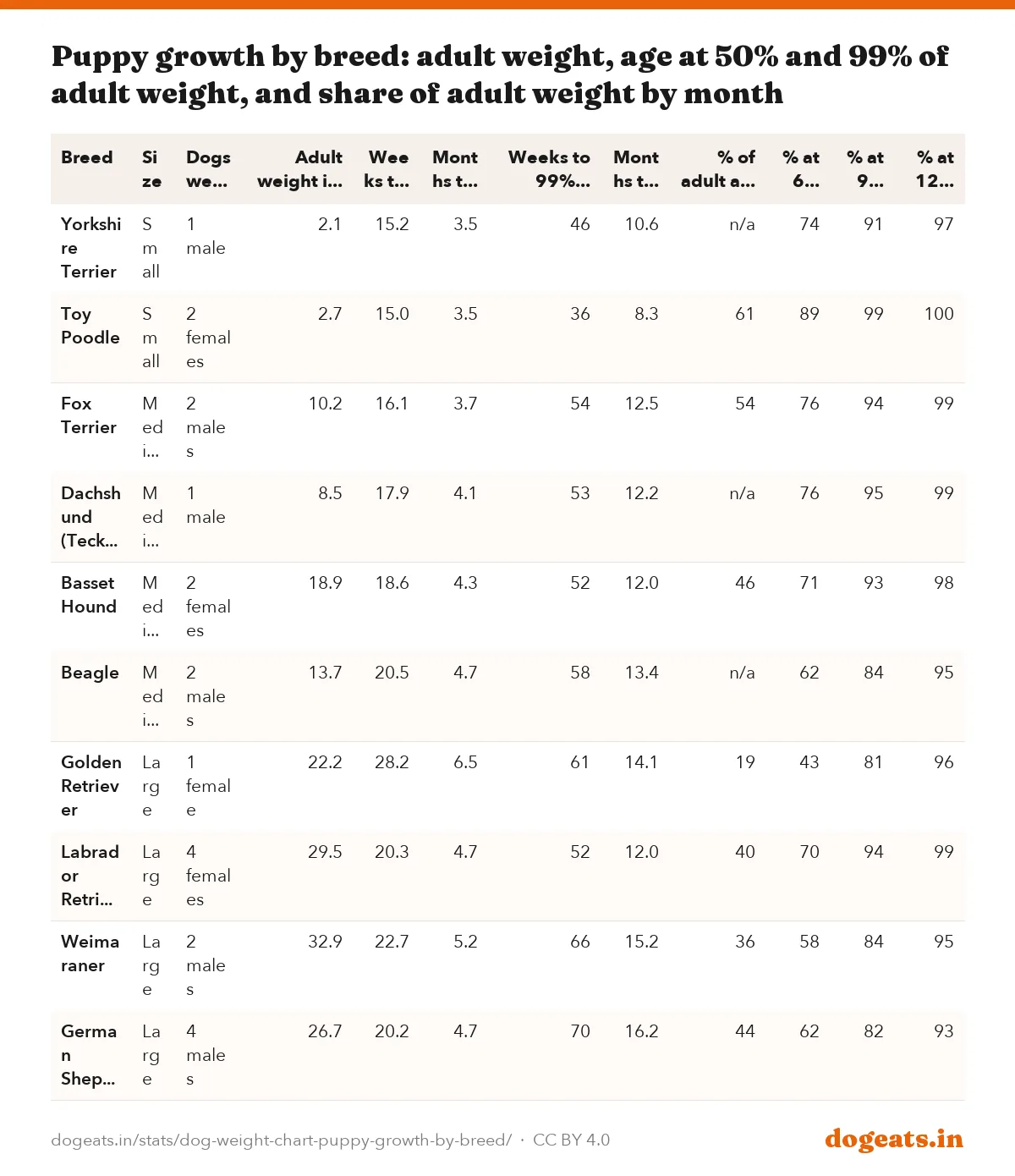
| Breed | Size | Dogs weighed | Adult weight in study (kg) | Weeks to 50% | Months to 50% | Weeks to 99% (published) | Months to 99% | % of adult at 4 months | % at 6 months | % at 9 months | % at 12 months |
|---|---|---|---|---|---|---|---|---|---|---|---|
| Yorkshire Terrier | Small | 1 male | 2.1 | 15.2 | 3.5 | 46 | 10.6 | n/a | 74 | 91 | 97 |
| Toy Poodle | Small | 2 females | 2.7 | 15.0 | 3.5 | 36 | 8.3 | 61 | 89 | 99 | 100 |
| Fox Terrier | Medium | 2 males | 10.2 | 16.1 | 3.7 | 54 | 12.5 | 54 | 76 | 94 | 99 |
| Dachshund (Teckel) | Medium | 1 male | 8.5 | 17.9 | 4.1 | 53 | 12.2 | n/a | 76 | 95 | 99 |
| Basset Hound | Medium | 2 females | 18.9 | 18.6 | 4.3 | 52 | 12.0 | 46 | 71 | 93 | 98 |
| Beagle | Medium | 2 males | 13.7 | 20.5 | 4.7 | 58 | 13.4 | n/a | 62 | 84 | 95 |
| Golden Retriever | Large | 1 female | 22.2 | 28.2 | 6.5 | 61 | 14.1 | 19 | 43 | 81 | 96 |
| Labrador Retriever | Large | 4 females | 29.5 | 20.3 | 4.7 | 52 | 12.0 | 40 | 70 | 94 | 99 |
| Weimaraner | Large | 2 males | 32.9 | 22.7 | 5.2 | 66 | 15.2 | 36 | 58 | 84 | 95 |
| German Shepherd | Large | 4 males | 26.7 | 20.2 | 4.7 | 70 | 16.2 | 44 | 62 | 82 | 93 |
The half-way point came early. Small breeds reached 50% of adult weight at an average 3.49 months, medium breeds at 4.21 and large breeds at 5.27.
The study was small, with 1 to 4 dogs per breed at one research kennel in Rionegro, Antioquia. Treat its breed figures as examples of each pattern, not as breed standards.
The monthly percentages are our calculation from the published curve for each breed. Where the study did not weigh dogs that young, we show n/a.
How much should a Labrador puppy weigh by month?
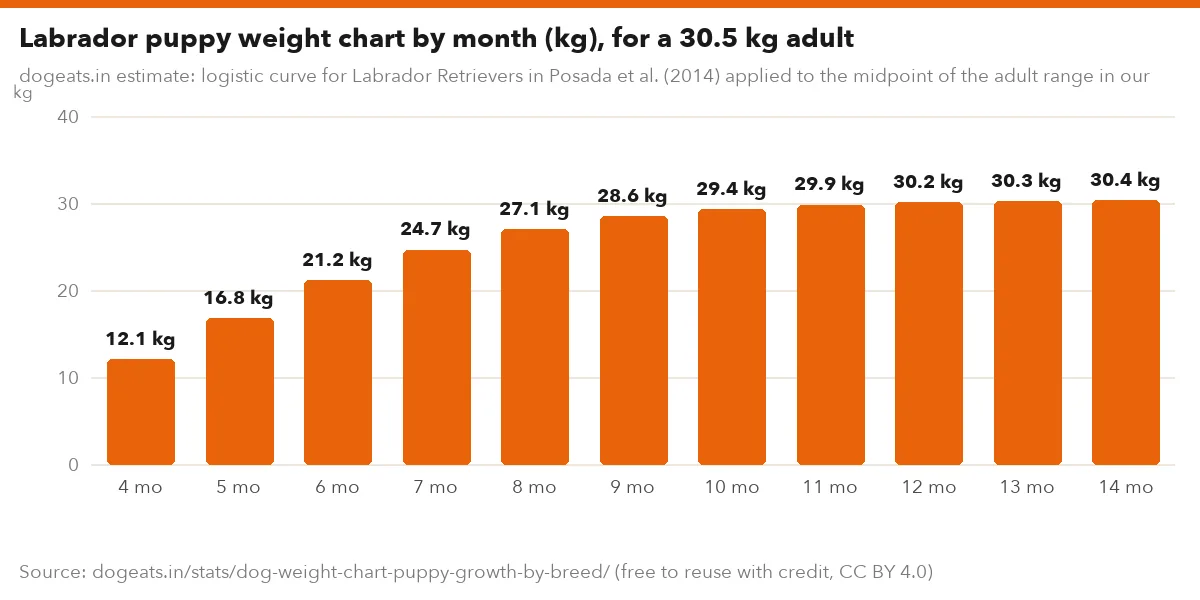
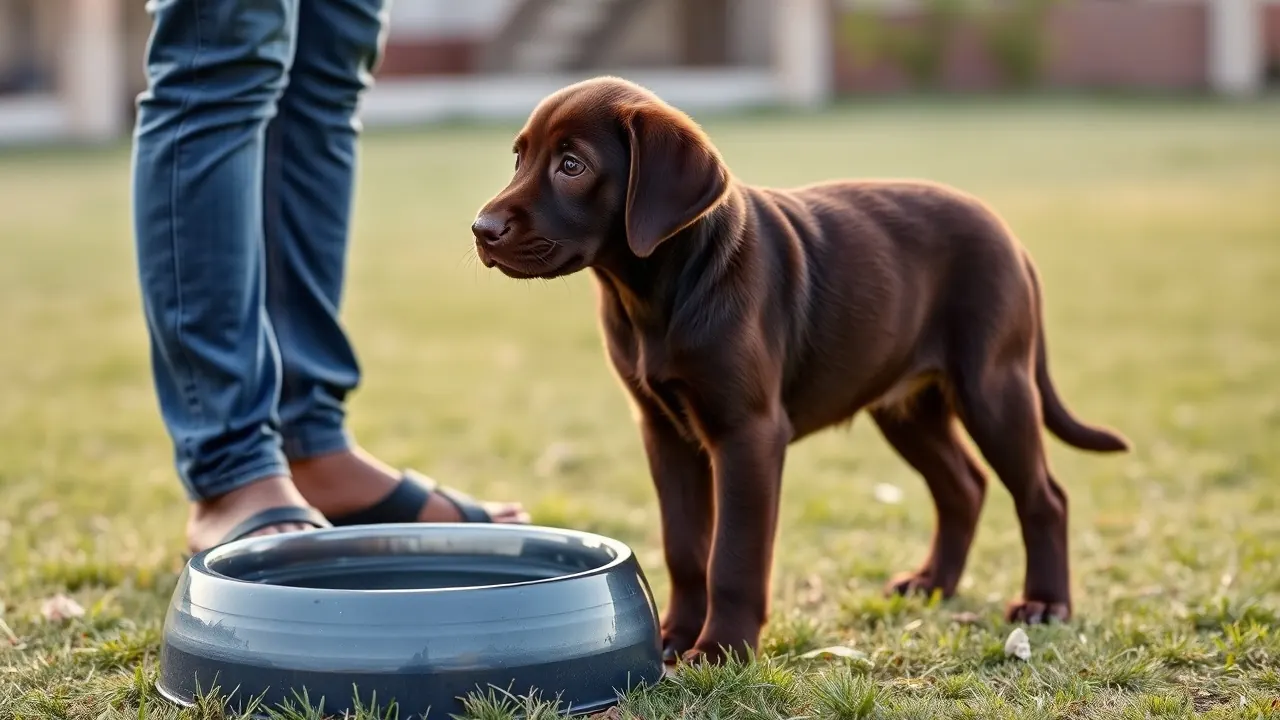
A Labrador puppy is roughly 40% of its adult weight at 4 months, 70% at 6 months and 94% at 9 months on the study curve. It is close to full weight by its first birthday.
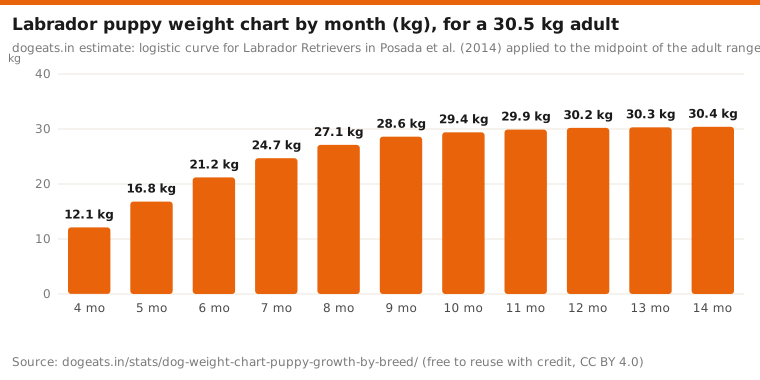
Our Labrador guide gives adult weights of 29 to 36 kg for males and 25 to 32 kg for females. Applied to the middle of that range, 30.5 kg, a typical Lab weighs about 12.1 kg at 4 months and 21.2 kg at 6 months.
Weight alone does not tell you if a puppy is lean. Labradors gain weight easily, and our guide calls obesity the most common welfare problem in Indian Labs.
dogeats.in estimate: logistic curve for Labrador Retrievers in Posada et al. (2014) applied to the midpoint of the adult range in our Labrador guide (25 to 36 kg). Individual puppies vary.
Show the numbers
| Label | kg |
|---|---|
| 4 mo | 12.1 kg |
| 5 mo | 16.8 kg |
| 6 mo | 21.2 kg |
| 7 mo | 24.7 kg |
| 8 mo | 27.1 kg |
| 9 mo | 28.6 kg |
| 10 mo | 29.4 kg |
| 11 mo | 29.9 kg |
| 12 mo | 30.2 kg |
| 13 mo | 30.3 kg |
| 14 mo | 30.4 kg |
Embed this chart
The curve flattens fast after 9 months. Between 10 and 14 months the estimate rises only from 29.4 to 30.4 kg.
A Norwegian study of 700 large-breed dogs found Labrador puppies gained weight fastest at 89 days for females and 95 days for males. Female Labs reached mature weight at about 351 days, and an estimated 30.8 kg.
For how much to feed a growing Lab at each stage, see our puppy feeding guide.
Puppy weight chart by breed in kg: Golden Retriever, German Shepherd, Beagle and more
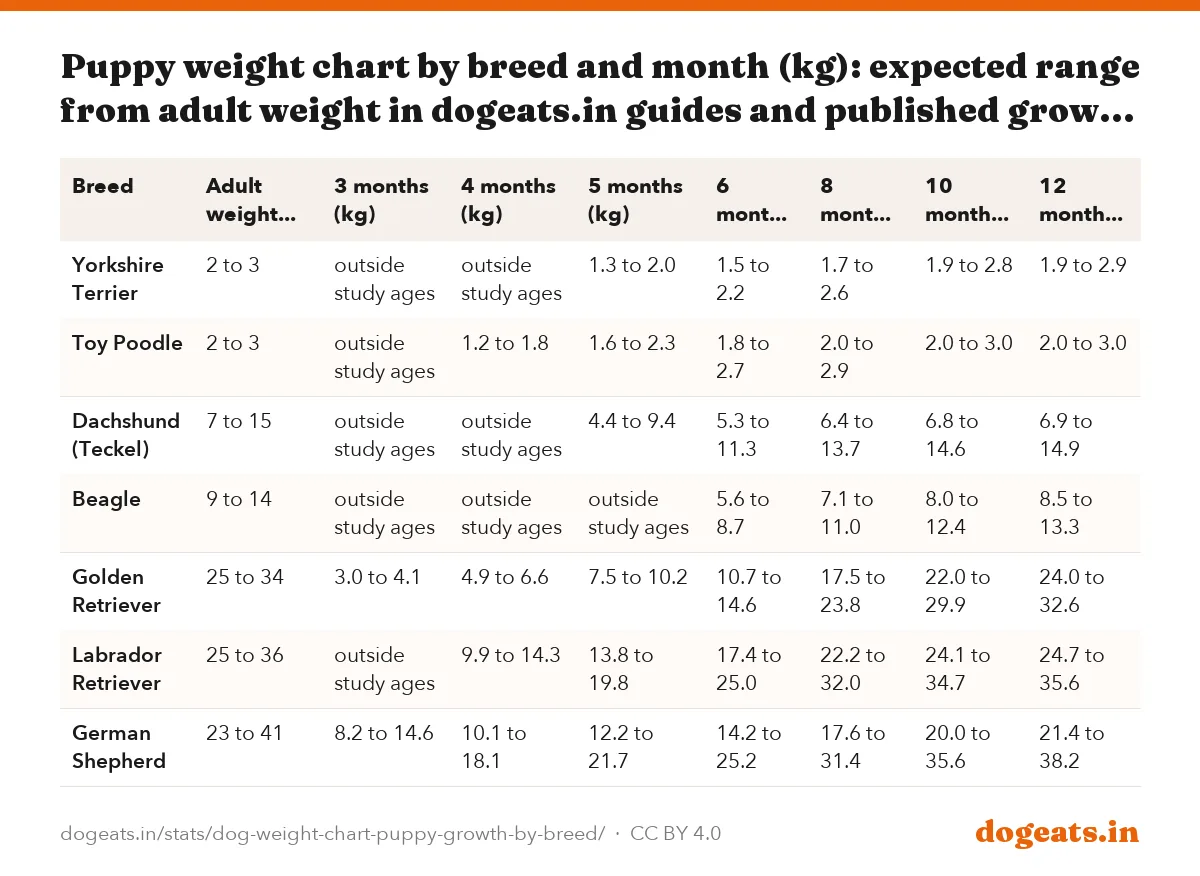
For 7 breeds we can match the study's growth curve to the adult weight range in our own breed guides. The table gives an expected weight range at each month from 3 to 12.
A German Shepherd puppy, with an adult range of 23 to 41 kg, works out at 14.2 to 25.2 kg at 6 months. A Golden Retriever puppy comes out lighter at 6 months, 10.7 to 14.6 kg, because the study's single Golden grew late.
A Beagle of the larger variety weighs 9 to 14 kg as an adult. It comes out at 5.6 to 8.7 kg at 6 months and 8.5 to 13.3 kg at 12 months.
| Breed | Adult weight (kg) | 3 months (kg) | 4 months (kg) | 5 months (kg) | 6 months (kg) | 8 months (kg) | 10 months (kg) | 12 months (kg) |
|---|---|---|---|---|---|---|---|---|
| Yorkshire Terrier | 2 to 3 | outside study ages | outside study ages | 1.3 to 2.0 | 1.5 to 2.2 | 1.7 to 2.6 | 1.9 to 2.8 | 1.9 to 2.9 |
| Toy Poodle | 2 to 3 | outside study ages | 1.2 to 1.8 | 1.6 to 2.3 | 1.8 to 2.7 | 2.0 to 2.9 | 2.0 to 3.0 | 2.0 to 3.0 |
| Dachshund (Teckel) | 7 to 15 | outside study ages | outside study ages | 4.4 to 9.4 | 5.3 to 11.3 | 6.4 to 13.7 | 6.8 to 14.6 | 6.9 to 14.9 |
| Beagle | 9 to 14 | outside study ages | outside study ages | outside study ages | 5.6 to 8.7 | 7.1 to 11.0 | 8.0 to 12.4 | 8.5 to 13.3 |
| Golden Retriever | 25 to 34 | 3.0 to 4.1 | 4.9 to 6.6 | 7.5 to 10.2 | 10.7 to 14.6 | 17.5 to 23.8 | 22.0 to 29.9 | 24.0 to 32.6 |
| Labrador Retriever | 25 to 36 | outside study ages | 9.9 to 14.3 | 13.8 to 19.8 | 17.4 to 25.0 | 22.2 to 32.0 | 24.1 to 34.7 | 24.7 to 35.6 |
| German Shepherd | 23 to 41 | 8.2 to 14.6 | 10.1 to 18.1 | 12.2 to 21.7 | 14.2 to 25.2 | 17.6 to 31.4 | 20.0 to 35.6 | 21.4 to 38.2 |
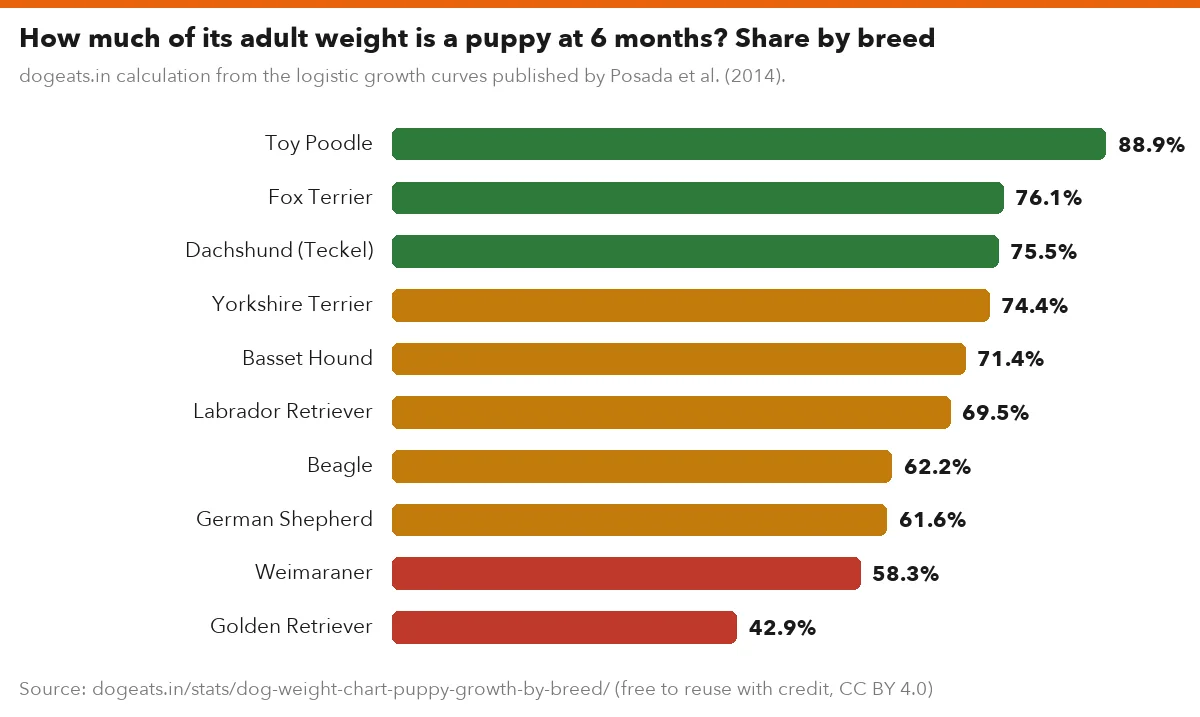
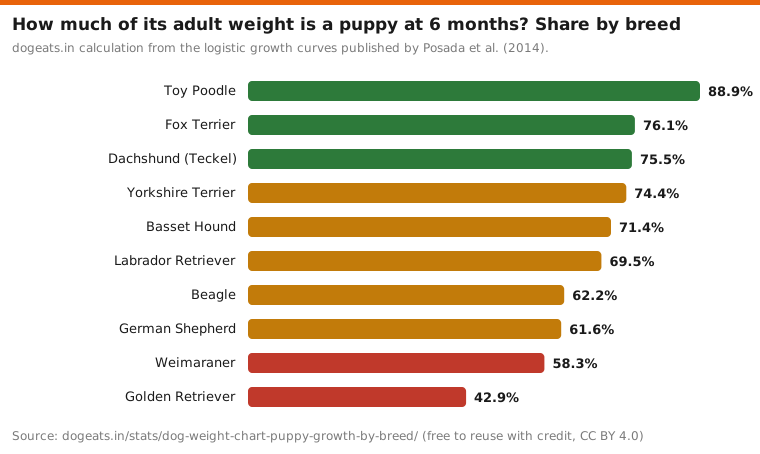
At 6 months, the Toy Poodle was at 88.9% of adult weight, the Fox Terrier at 76.1% and the Yorkshire Terrier at 74.4%. The Weimaraner was at 58.3% and the Golden Retriever at 42.9%.
The Dachshund row uses the standard variety, 7 to 15 kg. The Yorkshire Terrier and Toy Poodle rows use 2 to 3 kg adults.
What does the largest puppy growth chart study show?
The biggest study of puppy growth comes from the Waltham Petcare Science Institute and Banfield Pet Hospitals in the US. Carina Salt and colleagues used records from more than 6 million young dogs at US Banfield hospitals.
At extraction the database held 5.5 million dogs aged 10.4 weeks to 2.25 years. Of those, 3.1 million were of the breeds selected. Only dogs in ideal body condition through their first 3 years built the curves.
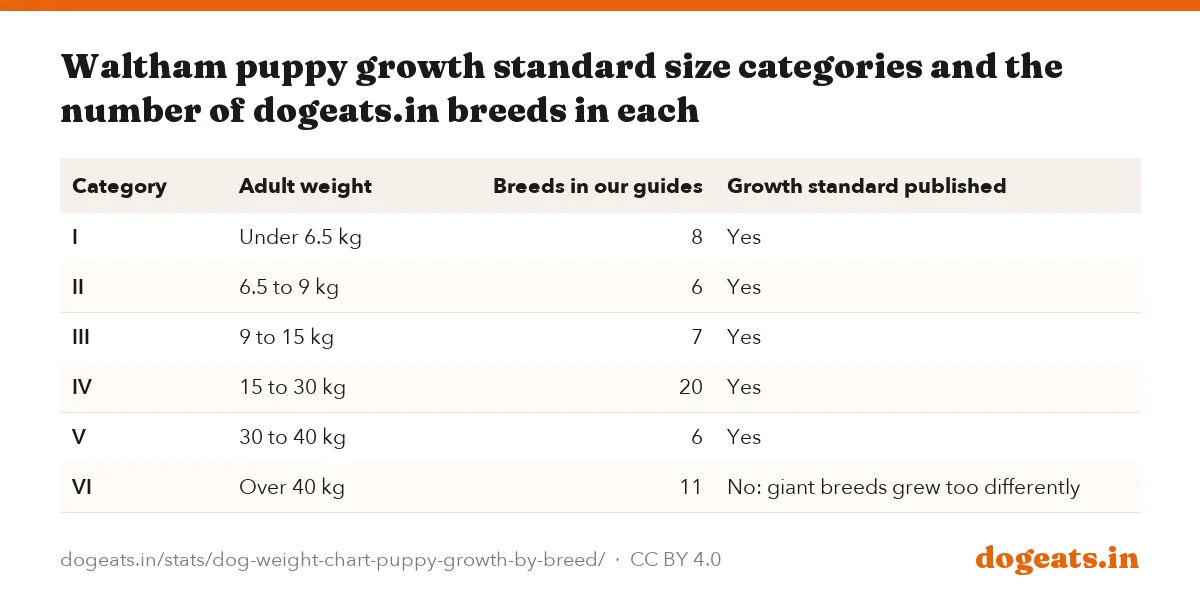
The team made centile growth charts for five size groups, from under 6.5 kg to 30 to 40 kg adult weight. For 20 of 24 breed curves (12 breeds, each sex), the curve agreed with its size group.
Categories from Salt et al. (2017), PLOS ONE. Breeds placed by the midpoint of adult weight in dogeats.in breed guides, October 2026.
Show the numbers
| Label | breeds |
|---|---|
| I (under 6.5 kg) | 8 |
| II (6.5 to 9) | 6 |
| III (9 to 15) | 7 |
| IV (15 to 30) | 20 |
| V (30 to 40) | 6 |
| VI (over 40) | 11 |
Embed this chart
| Category | Adult weight | Breeds in our guides | Growth standard published |
|---|---|---|---|
| I | Under 6.5 kg | 8 | Yes |
| II | 6.5 to 9 kg | 6 | Yes |
| III | 9 to 15 kg | 7 | Yes |
| IV | 15 to 30 kg | 20 | Yes |
| V | 30 to 40 kg | 6 | Yes |
| VI | Over 40 kg | 11 | No: giant breeds grew too differently |
Giant breeds had no chart. The most common breeds in the over-40 kg group, such as the Great Dane, Mastiff and Rottweiler, grew along such different paths that one curve could not fit them.
Neutering made little difference. Neutering before 37 weeks shifted growth slightly upward and neutering later shifted it slightly downward.
In our guides, 11 breeds sit above 40 kg, from the Bernese Mountain Dog and Dogo Argentino to the Great Dane and English Mastiff. Ask your vet to track these puppies against their own earlier weights.
Dog weight chart by breed: how heavy is an adult dog in kg?
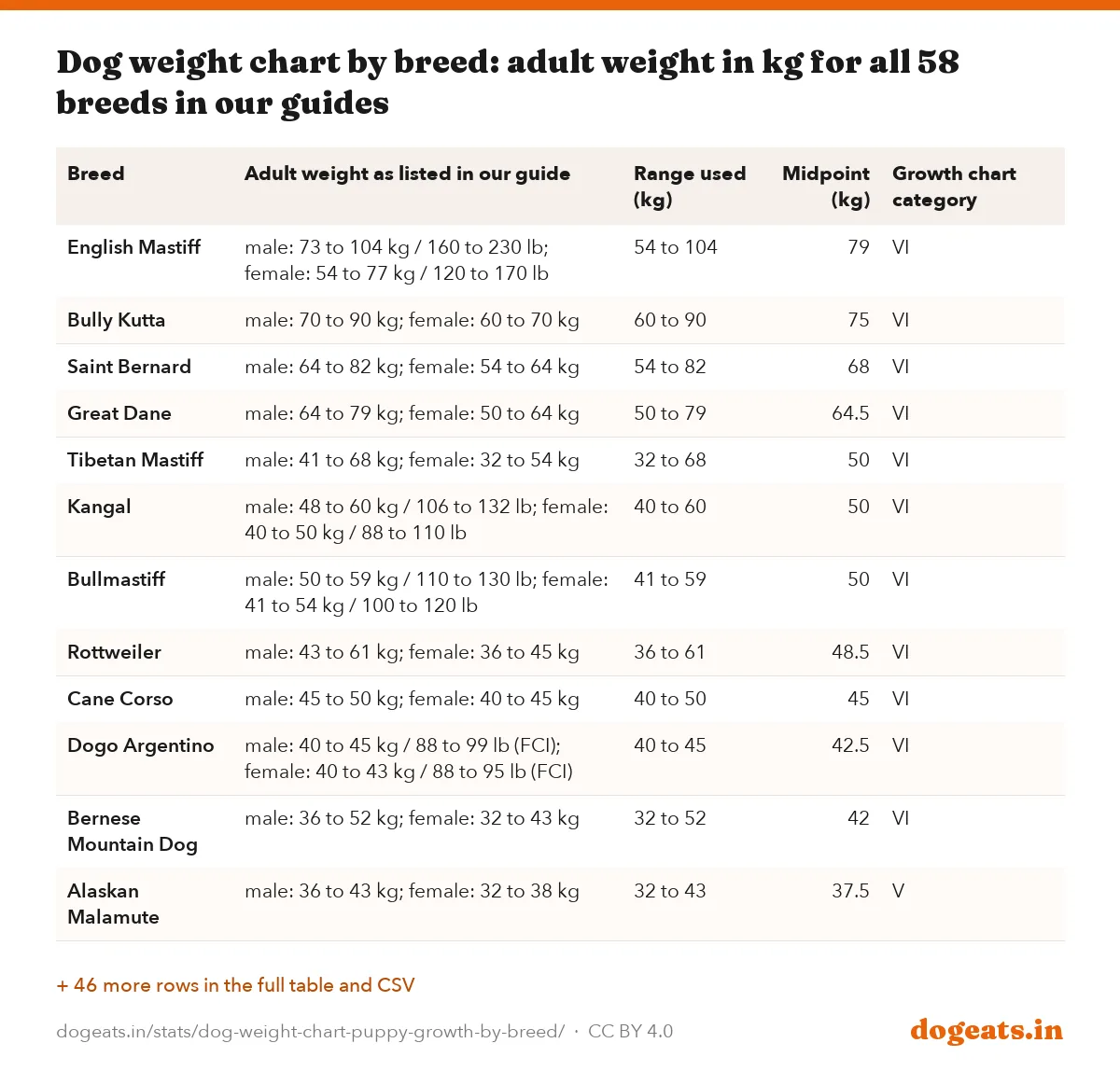
Adult weights in our 58 breed guides run from 1.4 kg for the smallest Pomeranian to 104 kg for the largest English Mastiff. By midpoint, the three heaviest are the English Mastiff, Bully Kutta and Saint Bernard.
The lightest by midpoint are the Chihuahua, Pomeranian, Yorkshire Terrier and Maltese, at 2.1 to 2.5 kg. The median midpoint is 22.5 kg, with 28 breeds above it and 28 below.
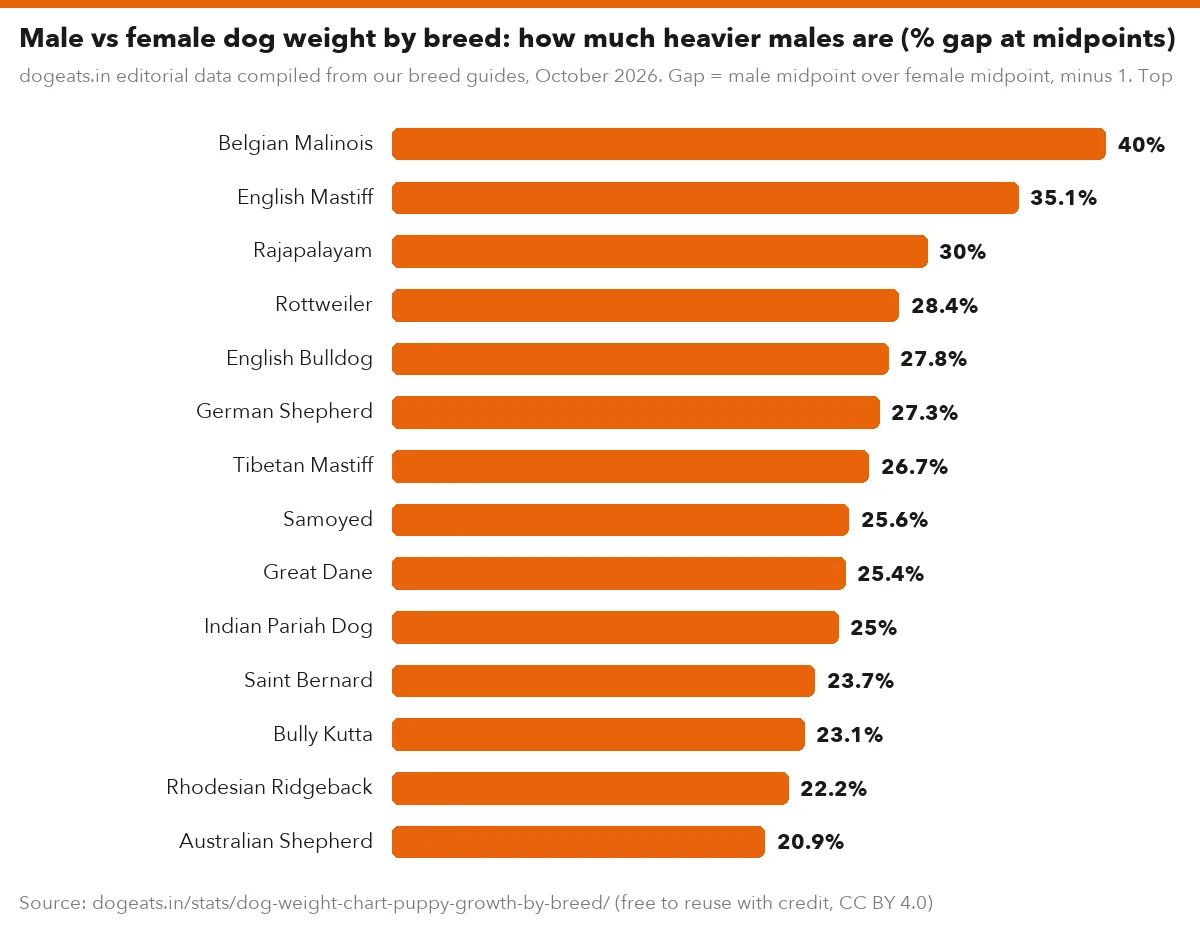
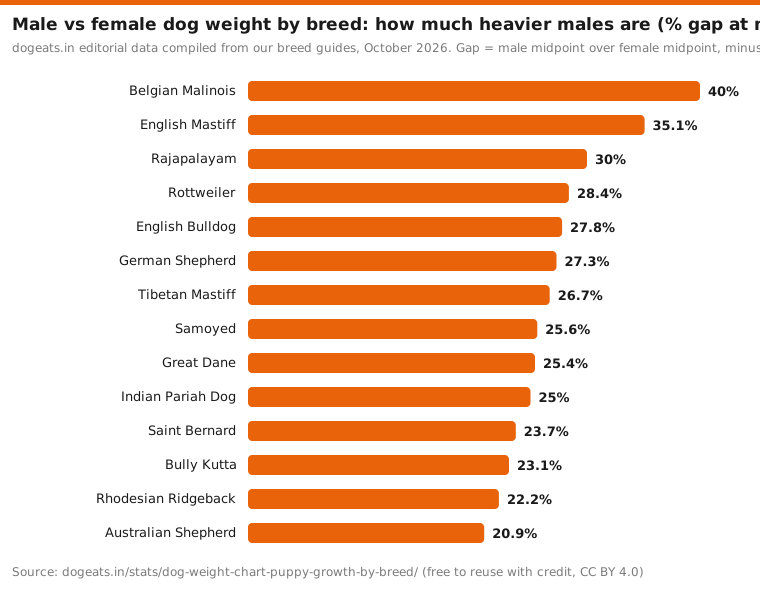
Males are heavier in almost every breed. Across 32 breeds with separate figures for each sex, the median gap is 19.4%. The biggest gaps are in the Belgian Malinois at 40% and the English Mastiff at 35.1%.
dogeats.in editorial data compiled from our breed guides, October 2026. Gap = male midpoint over female midpoint, minus 1. Top 14 of 32 breeds.
Show the numbers
| Label | % |
|---|---|
| Belgian Malinois | 40% |
| English Mastiff | 35.1% |
| Rajapalayam | 30% |
| Rottweiler | 28.4% |
| English Bulldog | 27.8% |
| German Shepherd | 27.3% |
| Tibetan Mastiff | 26.7% |
| Samoyed | 25.6% |
| Great Dane | 25.4% |
| Indian Pariah Dog | 25% |
| Saint Bernard | 23.7% |
| Bully Kutta | 23.1% |
| Rhodesian Ridgeback | 22.2% |
| Australian Shepherd | 20.9% |
Embed this chart
| Breed | Adult weight as listed in our guide | Range used (kg) | Midpoint (kg) | Growth chart category |
|---|---|---|---|---|
| English Mastiff | male: 73 to 104 kg / 160 to 230 lb; female: 54 to 77 kg / 120 to 170 lb | 54 to 104 | 79 | VI |
| Bully Kutta | male: 70 to 90 kg; female: 60 to 70 kg | 60 to 90 | 75 | VI |
| Saint Bernard | male: 64 to 82 kg; female: 54 to 64 kg | 54 to 82 | 68 | VI |
| Great Dane | male: 64 to 79 kg; female: 50 to 64 kg | 50 to 79 | 64.5 | VI |
| Tibetan Mastiff | male: 41 to 68 kg; female: 32 to 54 kg | 32 to 68 | 50 | VI |
| Kangal | male: 48 to 60 kg / 106 to 132 lb; female: 40 to 50 kg / 88 to 110 lb | 40 to 60 | 50 | VI |
| Bullmastiff | male: 50 to 59 kg / 110 to 130 lb; female: 41 to 54 kg / 100 to 120 lb | 41 to 59 | 50 | VI |
| Rottweiler | male: 43 to 61 kg; female: 36 to 45 kg | 36 to 61 | 48.5 | VI |
| Cane Corso | male: 45 to 50 kg; female: 40 to 45 kg | 40 to 50 | 45 | VI |
| Dogo Argentino | male: 40 to 45 kg / 88 to 99 lb (FCI); female: 40 to 43 kg / 88 to 95 lb (FCI) | 40 to 45 | 42.5 | VI |
| Bernese Mountain Dog | male: 36 to 52 kg; female: 32 to 43 kg | 32 to 52 | 42 | VI |
| Alaskan Malamute | male: 36 to 43 kg; female: 32 to 38 kg | 32 to 43 | 37.5 | V |
| Doberman | male: 34 to 45 kg; female: 27 to 41 kg | 27 to 45 | 36 | V |
| Rhodesian Ridgeback | male: 36 to 41 kg; female: 29 to 34 kg | 29 to 41 | 35 | V |
| German Shepherd | male: 29 to 41 kg; female: 23 to 32 kg | 23 to 41 | 32 | V |
| Labrador Retriever | male: 29 to 36 kg / 65 to 80 lb; female: 25 to 32 kg / 55 to 70 lb | 25 to 36 | 30.5 | V |
| Rajapalayam | male: 25 to 40 kg; female: 20 to 30 kg | 20 to 40 | 30 | V |
| Golden Retriever | male: 29 to 34 kg; female: 25 to 29 kg | 25 to 34 | 29.5 | IV |
| Boxer | male: 29 to 36 kg; female: About 7 kg less than males | 22 to 36 | 29 | IV |
| Kombai | male: 25 to 35 kg; female: 23 to 32 kg | 23 to 35 | 29 | IV |
| Rampur Greyhound | male: 27 to 32 kg; female: 23 to 28 kg | 23 to 32 | 27.5 | IV |
| Bull Terrier | male: About 23 to 32 kg / 50 to 70 lb; female: Usually toward the lower end | 23 to 32 | 27.5 | IV |
| Belgian Malinois | male: 27 to 36 kg; female: 18 to 27 kg | 18 to 36 | 27 | IV |
| Dalmatian | Both sexes: 20 to 32 kg | 20 to 32 | 26 | IV |
| Chow Chow | Both sexes: 20 to 32 kg | 20 to 32 | 26 | IV |
| Mudhol Hound | male: 22 to 30 kg; female: 20 to 27 kg | 20 to 30 | 25 | IV |
| Poodle | Both sexes: 18 to 32 kg / 5 to 9 kg / 2 to 3 kg | 18 to 32 | 25 | IV |
| Australian Shepherd | male: 23 to 29 kg; female: 18 to 25 kg | 18 to 29 | 23.5 | IV |
| Indian Pariah Dog | male: 20 to 30 kg; female: 15 to 25 kg | 15 to 30 | 22.5 | IV |
| Samoyed | male: 20 to 29 kg; female: 16 to 23 kg | 16 to 29 | 22.5 | IV |
| Siberian Husky | male: 20 to 27 kg; female: 16 to 23 kg | 16 to 27 | 21.5 | IV |
| Pit Bull | male: 16 to 27 kg / 35 to 60 lb (UKC APBT); female: 14 to 23 kg / 30 to 50 lb (UKC APBT) | 14 to 27 | 20.5 | IV |
| English Bulldog | male: About 23 kg; female: About 18 kg | 18 to 23 | 20.5 | IV |
| Border Collie | Both sexes: 14 to 25 kg | 14 to 25 | 19.5 | IV |
| Kanni | Both sexes: 16 to 22 kg | 16 to 22 | 19 | IV |
| Chippiparai | male: 17 to 22 kg; female: 15 to 20 kg | 15 to 22 | 18.5 | IV |
| Indian Spitz | Both sexes: 5 to 7 kg or 12 to 20 kg by type | 12 to 20 | 16 | IV |
| American Eskimo Dog | Both sexes: Toy 2.7 to 4.5 kg; miniature 4.5 to 9 kg; standard 11 to 16 kg | 11 to 16 | 13.5 | III |
| Cocker Spaniel | male: 13 to 15 kg; female: 12 to 15 kg | 12 to 15 | 13.5 | III |
| Beagle | larger variety: 9 to 14 kg; smaller variety: Under 9 kg | 9 to 14 | 11.5 | III |
| Dachshund | standard: 7 to 15 kg; miniature: Under 5 kg | 7 to 15 | 11 | III |
| Pembroke Welsh Corgi | male: 10 to 12 kg (FCI); AKC maximum 13.6 kg / 30 lb; female: 9 to 11 kg (FCI); AKC maximum 12.7 kg / 28 lb | 9 to 12 | 10.5 | III |
| French Bulldog | Both sexes: Under 13 kg, usually 8 to 12 kg | 8 to 12 | 10 | III |
| Shiba Inu | male: 8 to 11 kg; female: 7 to 9 kg | 7 to 11 | 9 | III |
| German Spitz | Both sexes: 5 to 11 kg depending on type | 5 to 11 | 8 | II |
| Japanese Spitz | Both sexes: 5 to 11 kg | 5 to 11 | 8 | II |
| Cavalier King Charles Spaniel | Both sexes: 5.9 to 8.2 kg | 5.9 to 8.2 | 7.05 | II |
| Pug | Both sexes: 6 to 8 kg (both sexes) | 6 to 8 | 7 | II |
| Lhasa Apso | Both sexes: 5.5 to 8 kg (both sexes) | 5.5 to 8 | 6.75 | II |
| Bichon Frise | Both sexes: 5 to 8 kg | 5 to 8 | 6.5 | II |
| Shih Tzu | Both sexes: 4 to 7.5 kg (both sexes) | 4 to 7.5 | 5.75 | I |
| Jack Russell Terrier | Both sexes: 4 to 7 kg | 4 to 7 | 5.5 | I |
| Pekingese | Both sexes: Up to 6.4 kg, typically 3 to 6 kg | 3 to 6 | 4.5 | I |
| Miniature Pinscher | Both sexes: 3.5 to 5 kg | 3.5 to 5 | 4.25 | I |
| Yorkshire Terrier | Both sexes: Under 3.2 kg, typically 2 to 3 kg | 2 to 3 | 2.5 | I |
| Maltese | Both sexes: Under 3.2 kg, usually 2 to 3 kg | 2 to 3 | 2.5 | I |
| Pomeranian | Both sexes: 1.4 to 3.2 kg (both sexes) | 1.4 to 3.2 | 2.3 | I |
| Chihuahua | Both sexes: 1.5 to 2.7 kg (both sexes) | 1.5 to 2.7 | 2.1 | I |
The Cocker Spaniel and Dogo Argentino show the smallest gaps between the sexes in our data, at 3.7% and 2.4%. In the Labrador the gap is 14%.
Use the adult range for your puppy's sex, not the breed's full range. A female Labrador of 25 to 32 kg will track the lower half of any puppy chart.
How heavy do Indian dog breeds get?
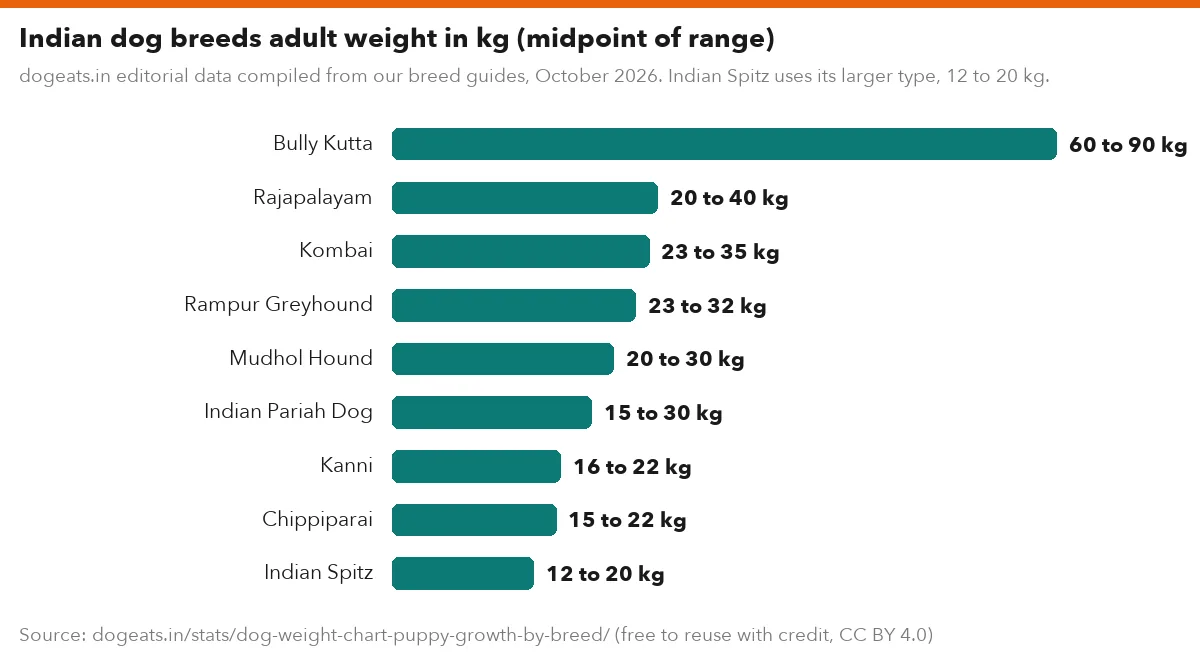
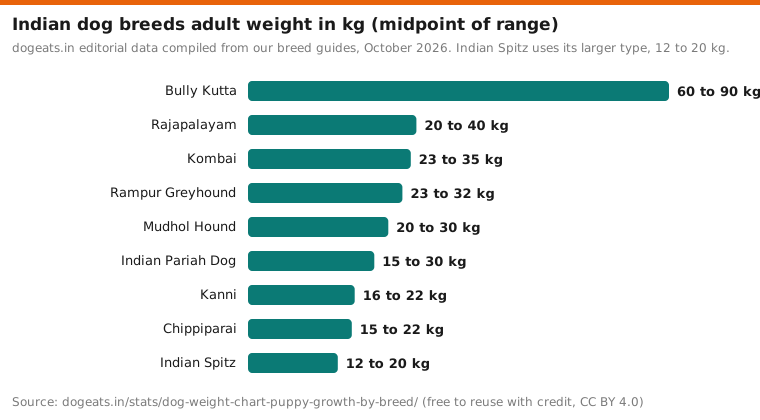
Indian breeds cover almost the full size range. The Bully Kutta is the heaviest in our guides, at 60 to 90 kg. The Indian Spitz is the lightest, with a small type of 5 to 7 kg.
Most Indian sighthounds and hounds sit between 15 and 40 kg. The Indian Pariah Dog weighs 15 to 30 kg, the Kanni 16 to 22 kg and the Chippiparai 15 to 22 kg.
No published growth curve exists for any Indian breed that we could find. Owners of Indian breed puppies have to track weight against the dog's own earlier readings, with the size category as a rough guide.
dogeats.in editorial data compiled from our breed guides, October 2026. Indian Spitz uses its larger type, 12 to 20 kg.
Show the numbers
| Label | kg |
|---|---|
| Bully Kutta | 60 to 90 kg |
| Rajapalayam | 20 to 40 kg |
| Kombai | 23 to 35 kg |
| Rampur Greyhound | 23 to 32 kg |
| Mudhol Hound | 20 to 30 kg |
| Indian Pariah Dog | 15 to 30 kg |
| Kanni | 16 to 22 kg |
| Chippiparai | 15 to 22 kg |
| Indian Spitz | 12 to 20 kg |
Embed this chart
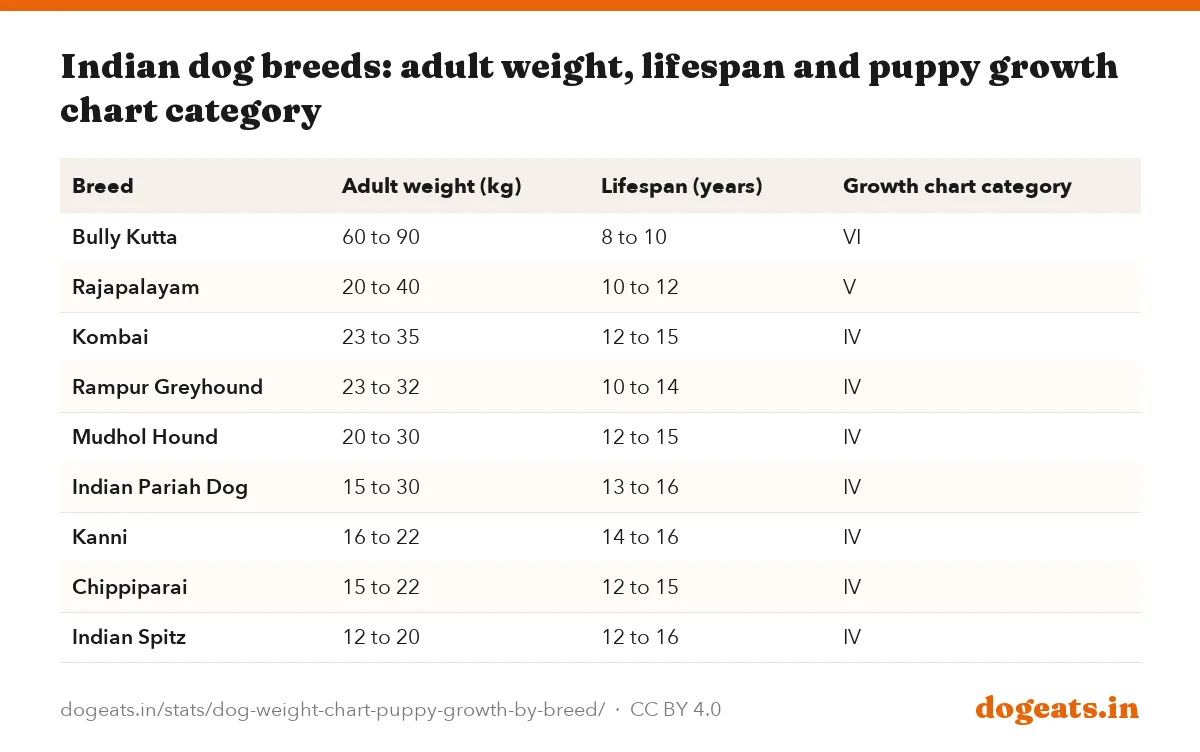
| Breed | Adult weight (kg) | Lifespan (years) | Growth chart category |
|---|---|---|---|
| Bully Kutta | 60 to 90 | 8 to 10 | VI |
| Rajapalayam | 20 to 40 | 10 to 12 | V |
| Kombai | 23 to 35 | 12 to 15 | IV |
| Rampur Greyhound | 23 to 32 | 10 to 14 | IV |
| Mudhol Hound | 20 to 30 | 12 to 15 | IV |
| Indian Pariah Dog | 15 to 30 | 13 to 16 | IV |
| Kanni | 16 to 22 | 14 to 16 | IV |
| Chippiparai | 15 to 22 | 12 to 15 | IV |
| Indian Spitz | 12 to 20 | 12 to 16 | IV |
Eight of the nine Indian breeds fall in growth chart category IV or V, 15 to 40 kg. The Bully Kutta falls in category VI, which has no standard.
For which of these breeds suit Indian heat and flats, see our native vs foreign breeds report.
How much weight should a newborn puppy gain?
A 2020 study by Alves tested a growth formula on 345 puppies from 60 litters of 19 breeds, toy to giant. It describes the maximum normal growth rate in the first 3 weeks.
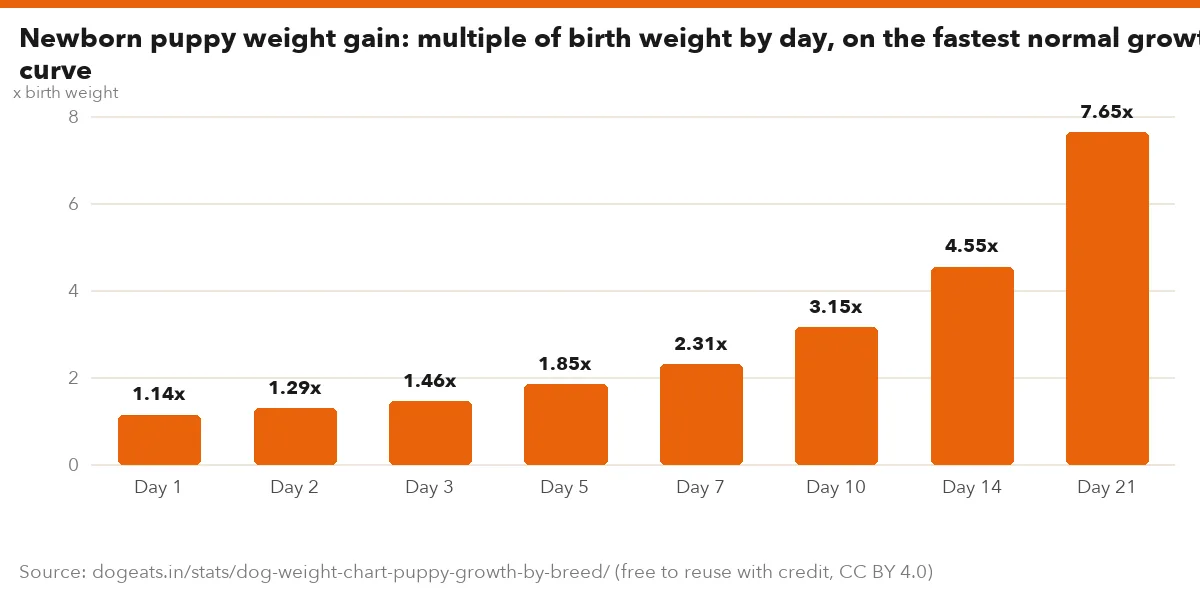
On that curve a puppy weighs 1.14 times its birth weight on day 1 and 2.31 times by day 7. It reaches 4.55 times by day 14 and 7.65 times by day 21.
Royal Canin Academy's guide is more cautious. It allows a loss of up to 10% on day 1, then gains of 5 to 10% of birth weight a day, doubling by about day 15.
Computed by dogeats.in from P = P0 exp(0.13084x minus 0.001616x squared), Alves (2020), Veterinary Medicine and Science; 345 puppies, 19 breeds.
Show the numbers
| Label | x birth weight |
|---|---|
| Day 1 | 1.14x |
| Day 2 | 1.29x |
| Day 3 | 1.46x |
| Day 5 | 1.85x |
| Day 7 | 2.31x |
| Day 10 | 3.15x |
| Day 14 | 4.55x |
| Day 21 | 7.65x |
Embed this chart
| Day of life | Multiple of birth weight | Gain over birth weight |
|---|---|---|
| 1 | 1.14 | 14% |
| 2 | 1.29 | 29% |
| 3 | 1.46 | 46% |
| 5 | 1.85 | 85% |
| 7 | 2.31 | 131% |
| 10 | 3.15 | 215% |
| 14 | 4.55 | 355% |
| 21 | 7.65 | 665% |
Mugnier et al. (2020), BMC Veterinary Research. 10 breeds in French breeding kennels; thresholds set per breed.
Show the numbers
| Label | % |
|---|---|
| Normal birth weight | 4.2% |
| Low birth weight | 8.8% |
| Very low birth weight | 55.3% |
Embed this chart
Birth weight matters. In a 2020 French study of 4,971 puppies from 10 breeds, 48.7% had normal birth weight, 47.9% low and 3.4% very low. Their death rates were 4.2%, 8.8% and 55.3%.
A 2019 study of 6,694 puppies from 27 breeds set breed-specific danger lines for 22 of them. The lowest was 105 g for the Maltese and the highest 436 g for the Boxer.
A newborn that loses weight after day 1, or does not gain day by day, needs a vet. Our dog vital signs chart lists normal puppy temperatures by week.
Frequently asked questions
When do puppies stop growing?
Small breeds reach adult weight first. In a 10-breed study, Toy Poodles reached 99% of adult weight at 36 weeks and German Shepherds at 70 weeks. Larger breeds can take up to 24 months.
How much should a 6-month-old Labrador weigh?
About 17 to 25 kg, or roughly 70% of adult weight. That uses our Labrador adult range of 25 to 36 kg and a published Labrador growth curve. A female will sit in the lower half.
How much should a 3-month-old German Shepherd weigh?
About 8.2 to 14.6 kg, using our adult range of 23 to 41 kg and a published German Shepherd growth curve. The curve puts a 3-month-old GSD at 35.6% of adult weight.
How do I know how big my puppy will get?
Check the adult weight range for its breed and sex, then compare its weight with a growth curve. At 6 months, small breeds in one study were at 74 to 89% of adult weight and large breeds at 43 to 70%.
What is the normal weight of a Labrador in kg?
Our Labrador guide gives 29 to 36 kg for males and 25 to 32 kg for females. A Norwegian study estimated mature weight in female Labs at 30.8 kg.
How fast should a newborn puppy gain weight?
Royal Canin Academy expects gains of 5 to 10% of birth weight a day and double the birth weight by about day 15. The fastest normal curve in a 2020 study doubles it in about 6 days.
Which is the heaviest dog breed in India?
Among our 58 breed guides, the English Mastiff is heaviest at 54 to 104 kg. The heaviest Indian breed is the Bully Kutta at 60 to 90 kg.
Is there a puppy growth chart for giant breeds?
No published standard covers dogs above 40 kg. The largest study, built from more than 6 million US puppies, found giant breeds grew too differently for one curve.
Methodology and limitations
Breed growth curves are the logistic models published by Posada, Gomez and Rosero (2014) for 10 breeds: weight = a / (1 + exp((x0 minus age) / b)). We computed the share of adult weight at each month, using 52/12 weeks per month. We show weeks to 99% (T99) as published; in some breeds it differs from the value the model implies.
Puppy weight ranges by month multiply that share by the adult weight range in our breed guides (dogeats.in editorial data compiled from our breed guides, October 2026). We only show months inside the age range the study weighed for that breed. These are estimates, not standards.
Adult weights are transcribed from the weight rows in our 58 breed guides. Both sexes are combined into one range; breeds with several sizes use the largest standard variety. Male and female gaps use the 32 breeds that give numeric figures for each sex (the English Bulldog gives single figures).
Size categories follow Salt et al. (2017). Newborn growth uses the formula in Alves (2020), and birth weight figures come from Mugnier et al. (2019, 2020). The large-breed maturity figures are from Trangerud et al. (2007).
Sources
- Salt C et al. (2017), Growth standard charts for monitoring bodyweight in dogs of different sizes, PLOS ONE 12(9):e0182064 (correction 2024), Over 6 million US puppies; five size categories up to 40 kg; no giant chart
- Posada S, Gomez L, Rosero R (2014), Application of the logistic model to describe the growth curve in dogs of different breeds, Revista MVZ Cordoba 19(1):4015-4022, Growth parameters and T99 for 10 breeds
- Trangerud C et al. (2007), A longitudinal study on growth and growth variables in dogs of four large breeds, Journal of Animal Science 85(1):76-83, 700 dogs; maturity at 351 to 413 days; Labrador peak gain at 89 to 95 days
- Also consulted: Alves I (2020), A model of puppy growth during the first three weeks, Veterinary Medicine and Science 6(4):946-957, Mugnier A et al. (2020), Low and very low birth weight in puppies, BMC Veterinary Research 16:354, Mugnier A et al. (2019), Birth weight as a risk factor for neonatal mortality, Preventive Veterinary Medicine 171:104746, Royal Canin Academy: A quick guide to intensive care of newborn puppies (Abreu and Vannucchi), Hawthorne AJ et al. (2004), Body-weight changes during growth in puppies of different breeds, Journal of Nutrition 134(8 Suppl):2027S-2030S.
Cite, embed and download
This report, its data and its images are free to reuse under a Creative Commons Attribution 4.0 licence. Credit dogeats.in with a link to this page. Every chart has its own embed code, every table has a CSV and an image download, and the images below are ready for social posts, slides and articles.
Cite this report
Link to this report
Every chart and table as an image