Data report · Updated October 2026
Indian Dog Diet Chart: What Rice, Roti, Dal, Curd, Egg and Chicken Supply, Measured Against a Dog's Daily Needs
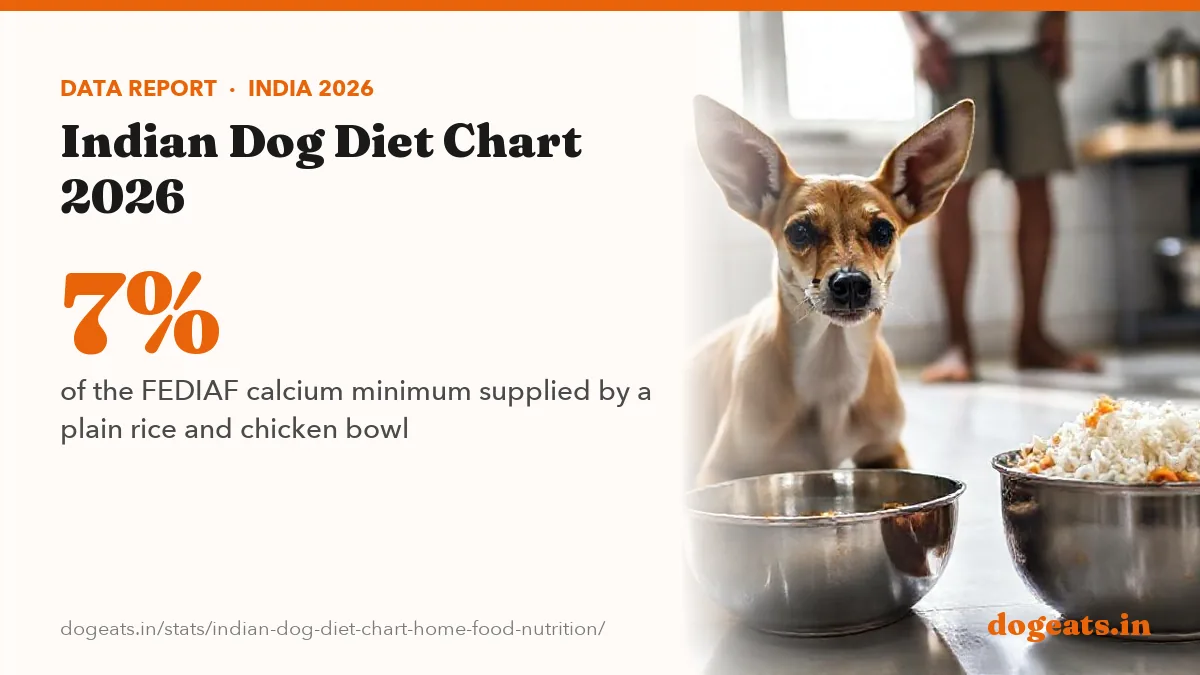
Typical Indian home food for dogs runs short of calcium, zinc and linoleic acid. Of 7 common bowls we tested, rice and chicken met just 7% of a dog's calcium minimum, and none met all 13 nutrients we checked. A balanced home diet is possible, but it needs a vet-planned recipe with a calcium source and supplement.
Key findings
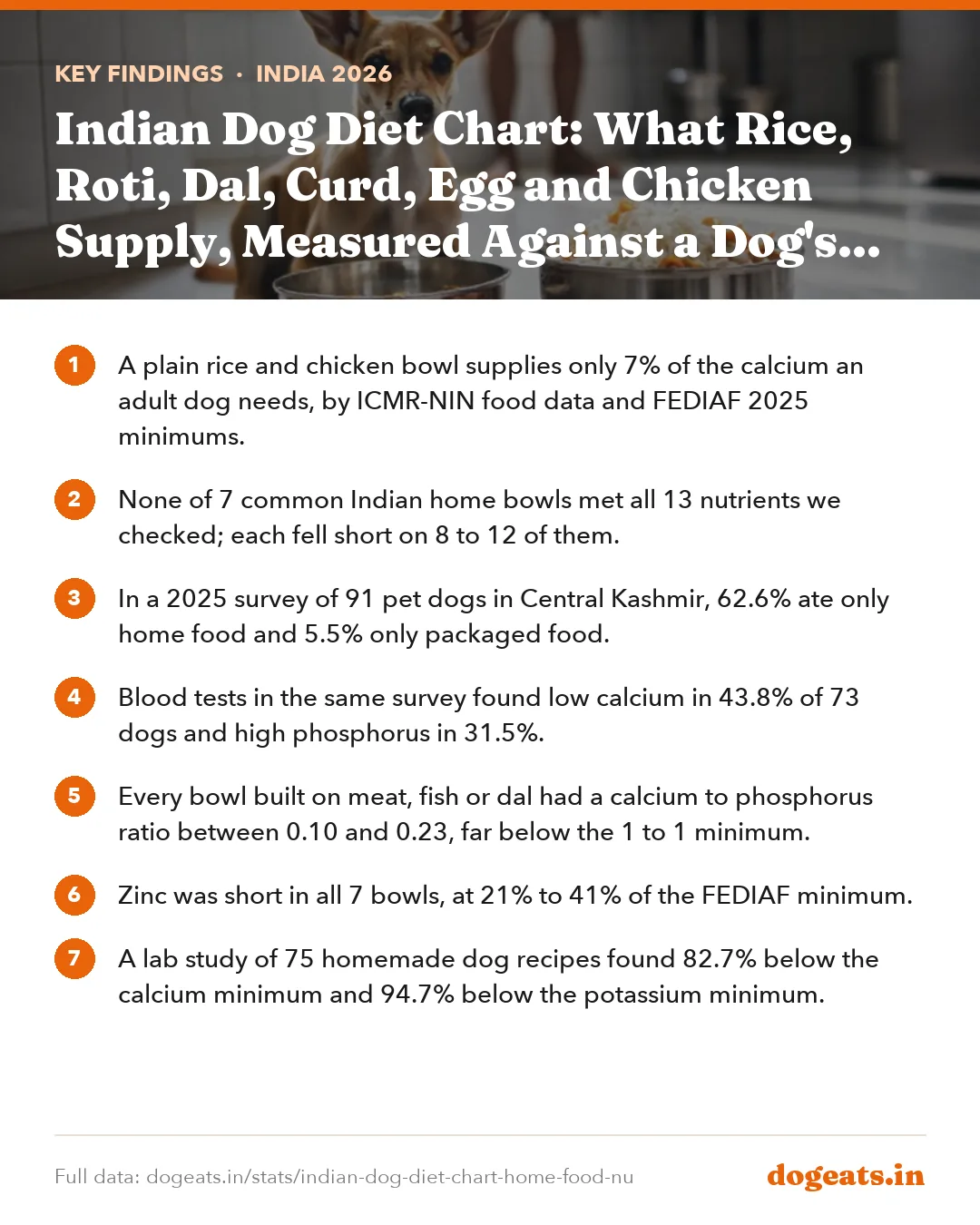
- A plain rice and chicken bowl supplies only 7% of the calcium an adult dog needs, by ICMR-NIN food data and FEDIAF 2025 minimums.
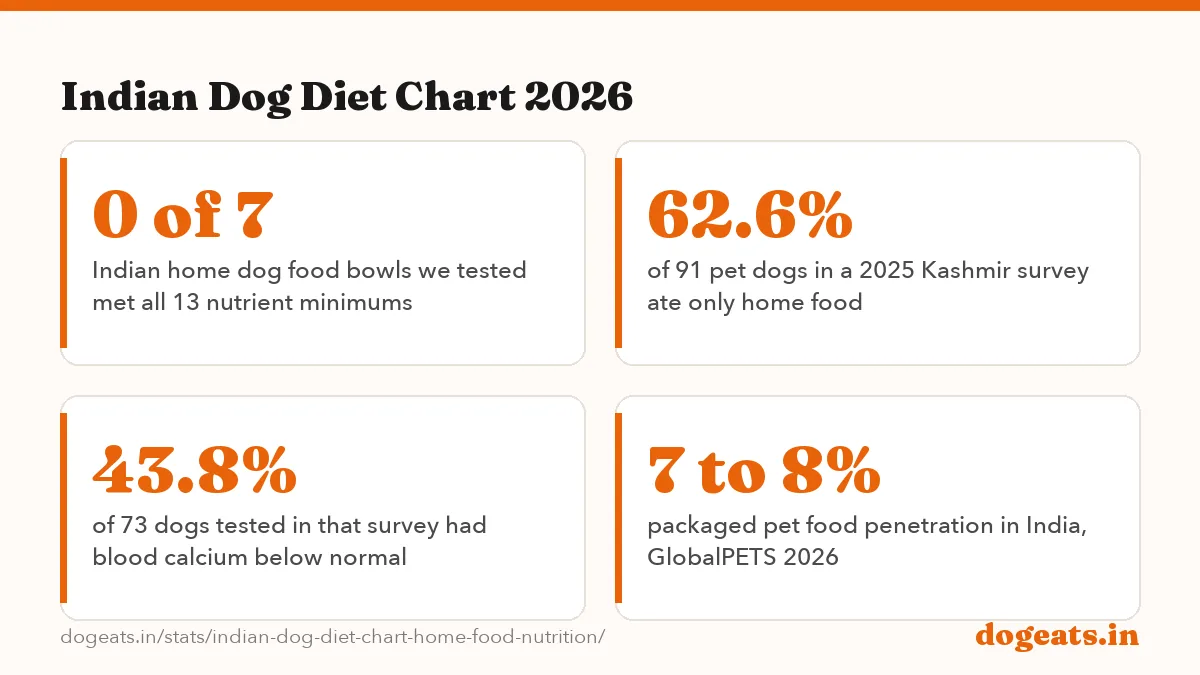
- None of 7 common Indian home bowls met all 13 nutrients we checked; each fell short on 8 to 12 of them.
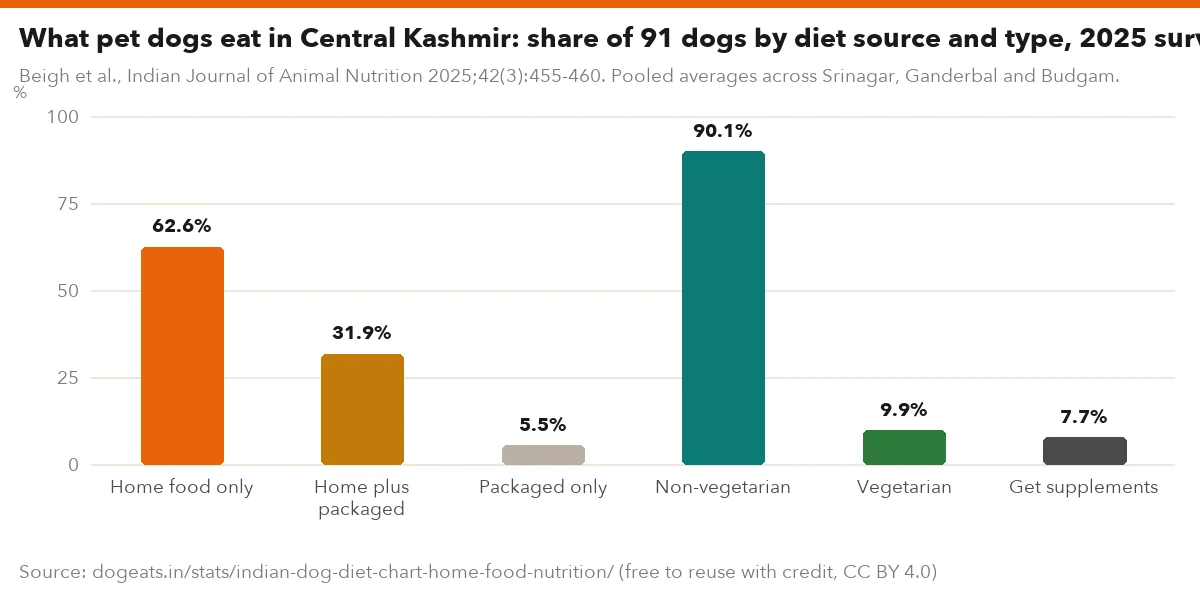
- In a 2025 survey of 91 pet dogs in Central Kashmir, 62.6% ate only home food and 5.5% only packaged food.
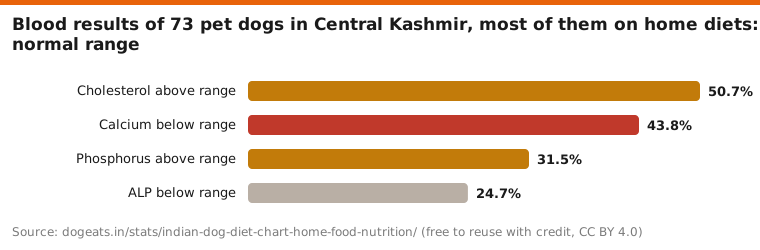
- Blood tests in the same survey found low calcium in 43.8% of 73 dogs and high phosphorus in 31.5%.
- Every bowl built on meat, fish or dal had a calcium to phosphorus ratio between 0.10 and 0.23, far below the 1 to 1 minimum.
- Zinc was short in all 7 bowls, at 21% to 41% of the FEDIAF minimum.
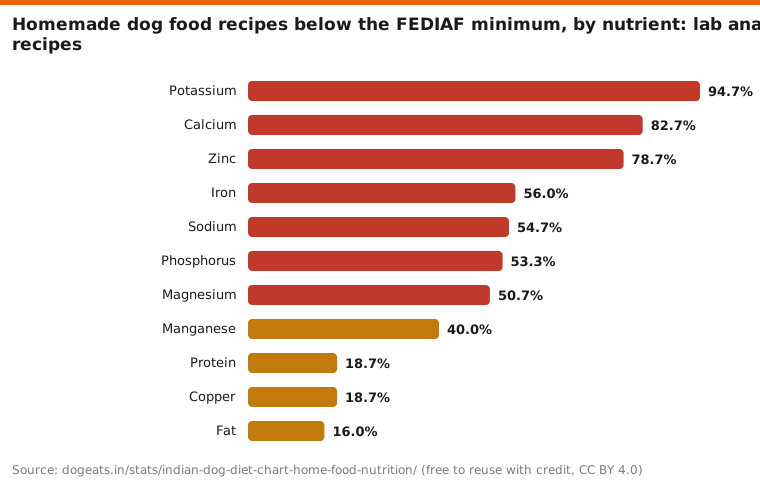
- A lab study of 75 homemade dog recipes found 82.7% below the calcium minimum and 94.7% below the potassium minimum.
- Of 200 published homemade dog recipes, only 9 met AAFCO adult standards, a UC Davis team found in 2013.
- Packaged food reaches only 7 to 8% of India's 3.2 crore pets, so most Indian dogs eat from the family kitchen.
Is home-cooked Indian food enough for a dog?
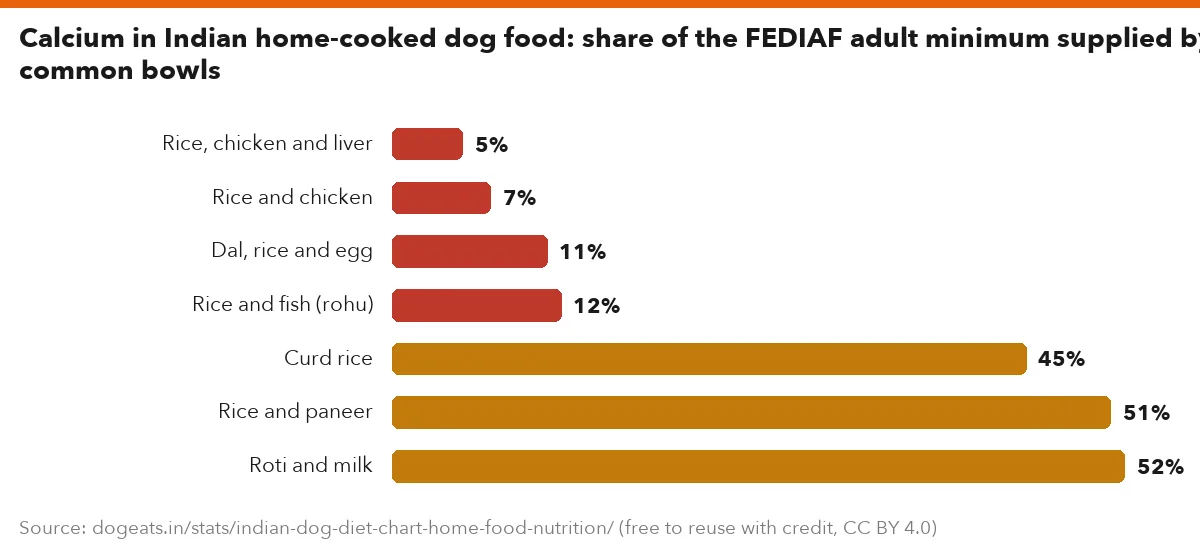
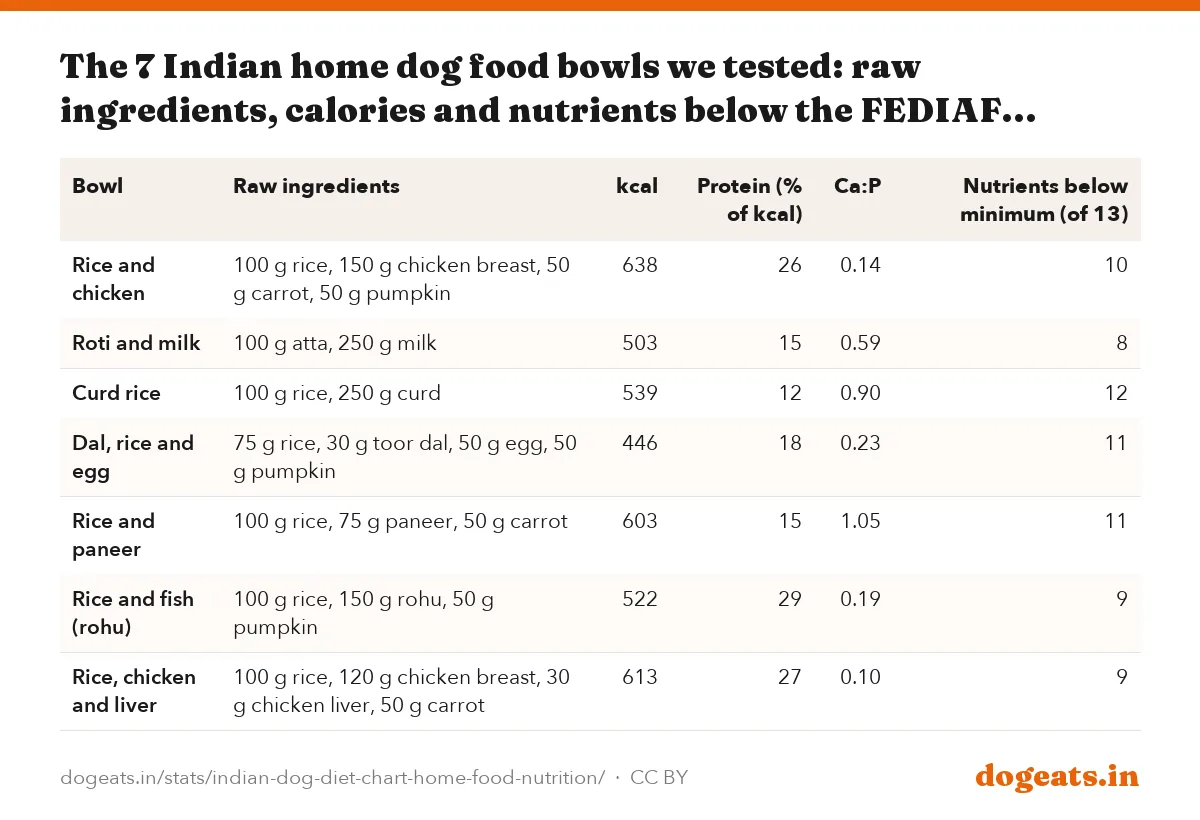
Not on its own. We built 7 bowls that Indian owners often cook and checked 13 nutrients against the FEDIAF 2025 minimums for adult dogs. None passed on all 13, and calcium was the worst gap.
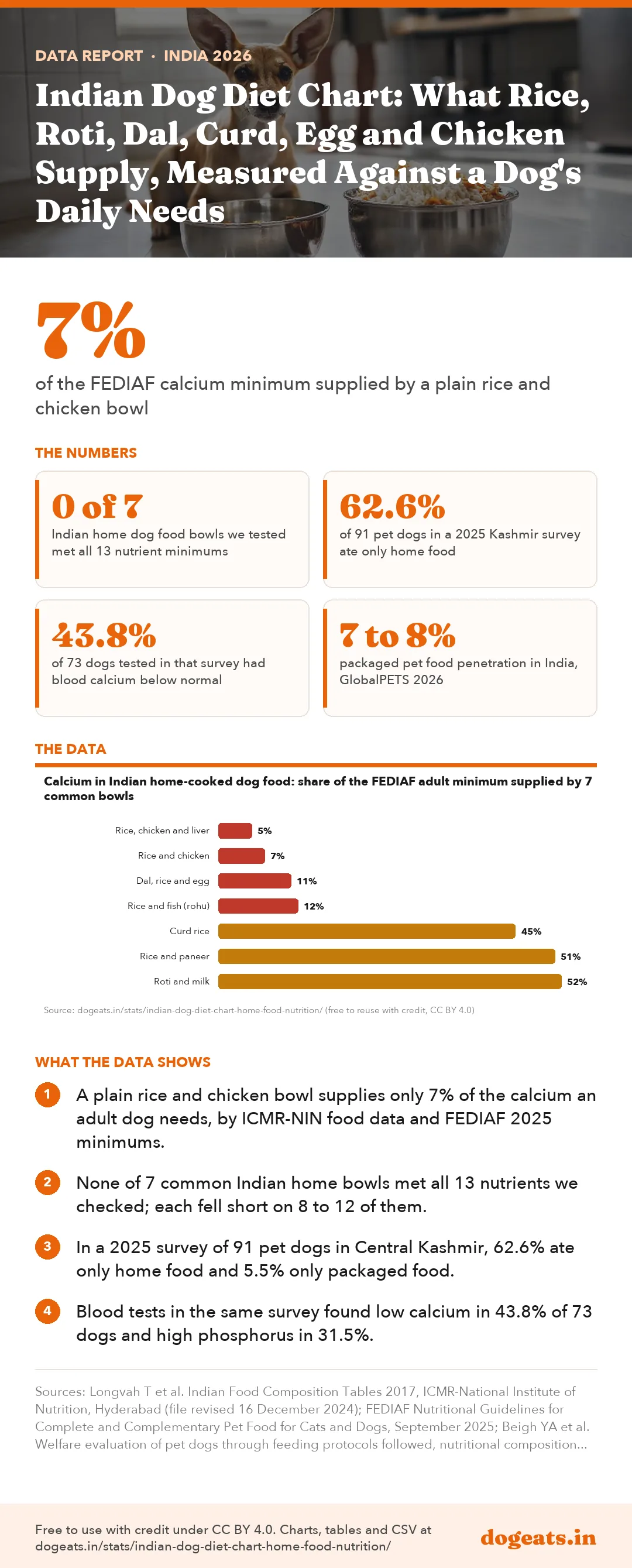
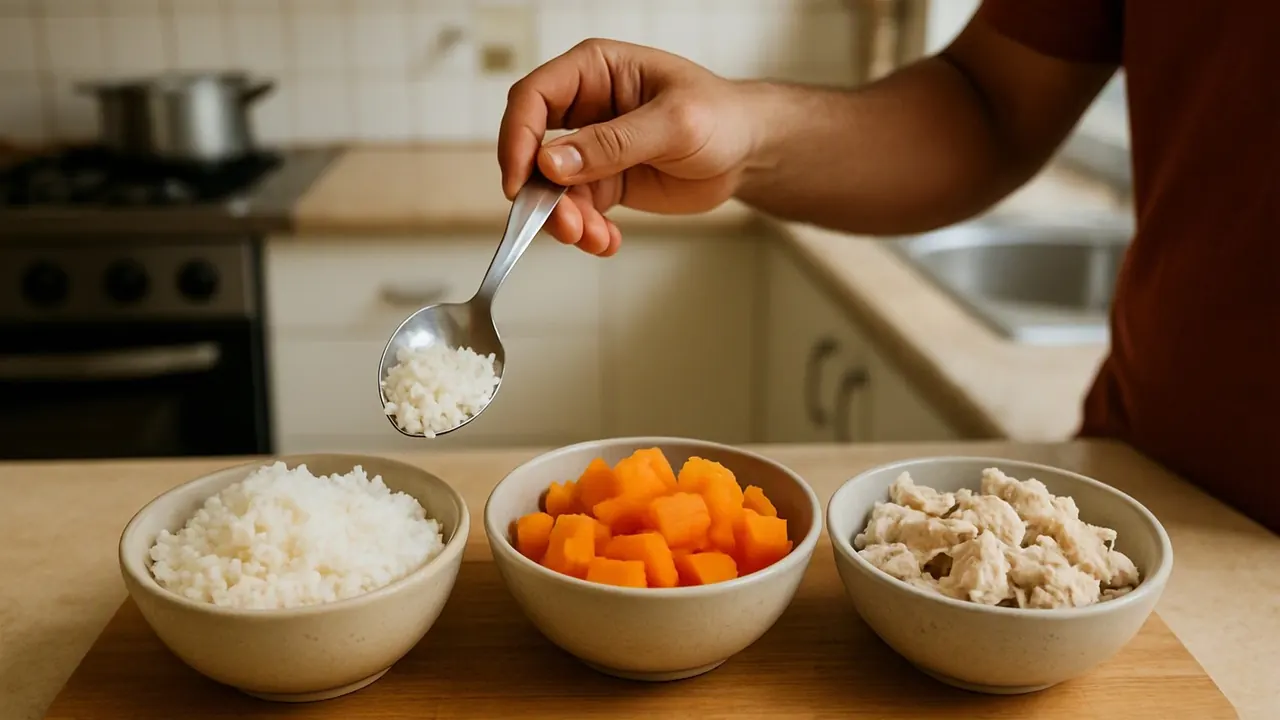
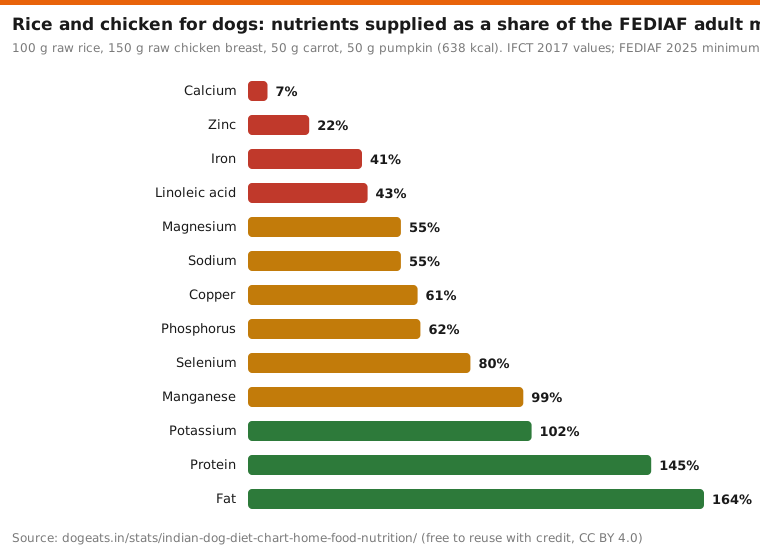
A bowl of 100 g raw rice, 150 g chicken breast and 100 g of carrot and pumpkin holds about 638 kcal. It gives 145% of the protein minimum but only 7% of the calcium. Rice, chicken and a little liver falls to 5%.
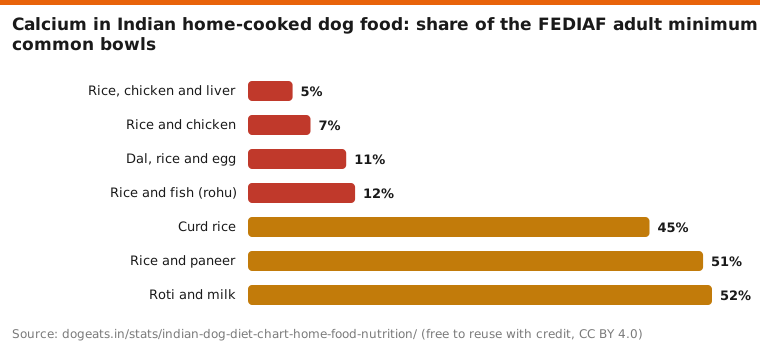
Dairy helps. Roti with milk reached 52% of the calcium minimum, rice with paneer 51% and curd rice 45%. Even these came up short on zinc, copper and linoleic acid.
Bowls built by dogeats.in from raw ingredient weights. Nutrients from ICMR-NIN IFCT 2017; minimum from FEDIAF 2025 Table III-3b (1.25 g per 1,000 kcal).
Show the numbers
| Label | % |
|---|---|
| Rice, chicken and liver | 5% |
| Rice and chicken | 7% |
| Dal, rice and egg | 11% |
| Rice and fish (rohu) | 12% |
| Curd rice | 45% |
| Rice and paneer | 51% |
| Roti and milk | 52% |
Embed this chart
| Bowl | Raw ingredients | kcal | Protein (% of kcal) | Ca:P | Nutrients below minimum (of 13) |
|---|---|---|---|---|---|
| Rice and chicken | 100 g rice, 150 g chicken breast, 50 g carrot, 50 g pumpkin | 638 | 26 | 0.14 | 10 |
| Roti and milk | 100 g atta, 250 g milk | 503 | 15 | 0.59 | 8 |
| Curd rice | 100 g rice, 250 g curd | 539 | 12 | 0.90 | 12 |
| Dal, rice and egg | 75 g rice, 30 g toor dal, 50 g egg, 50 g pumpkin | 446 | 18 | 0.23 | 11 |
| Rice and paneer | 100 g rice, 75 g paneer, 50 g carrot | 603 | 15 | 1.05 | 11 |
| Rice and fish (rohu) | 100 g rice, 150 g rohu, 50 g pumpkin | 522 | 29 | 0.19 | 9 |
| Rice, chicken and liver | 100 g rice, 120 g chicken breast, 30 g chicken liver, 50 g carrot | 613 | 27 | 0.10 | 9 |
Our bowls are examples, not recipes to copy. Real kitchens differ in amounts, cooking water and added ghee or salt.
Is rice and chicken a complete diet for dogs?
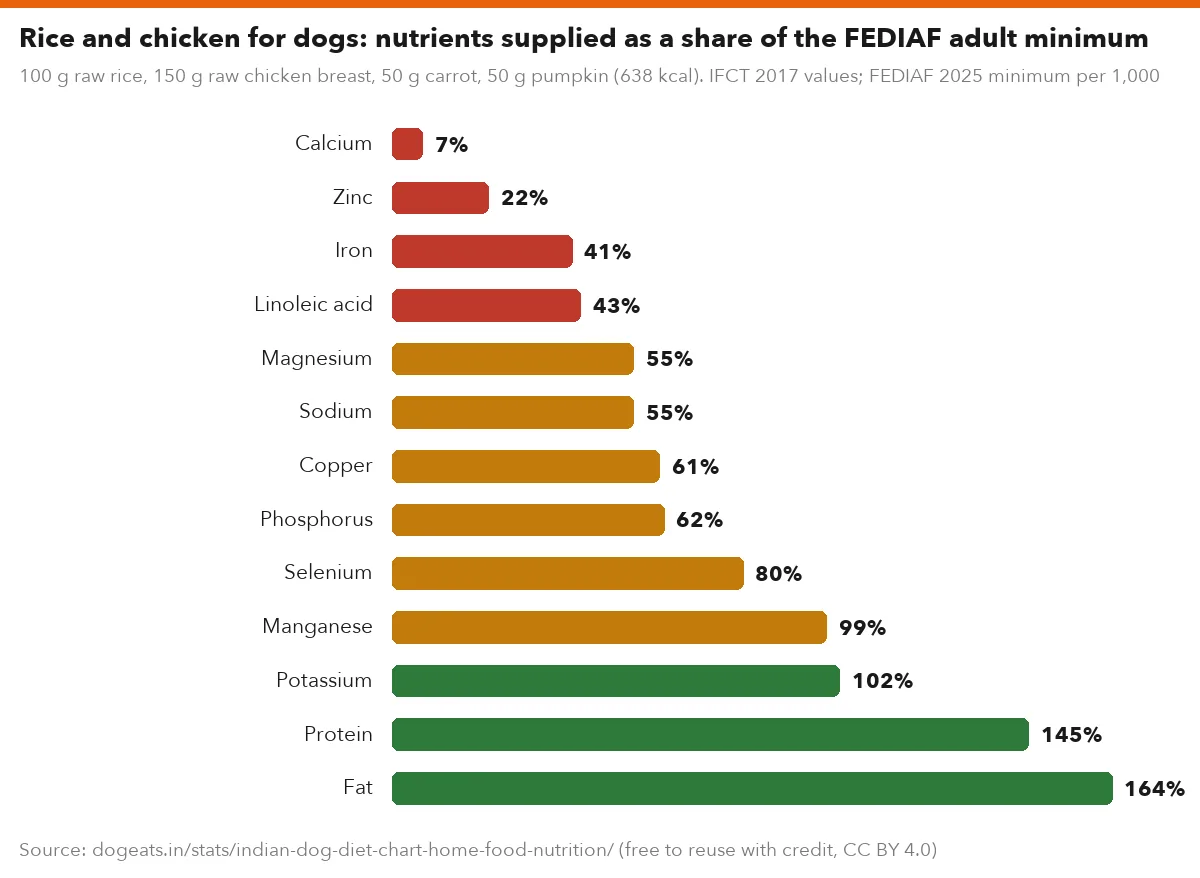
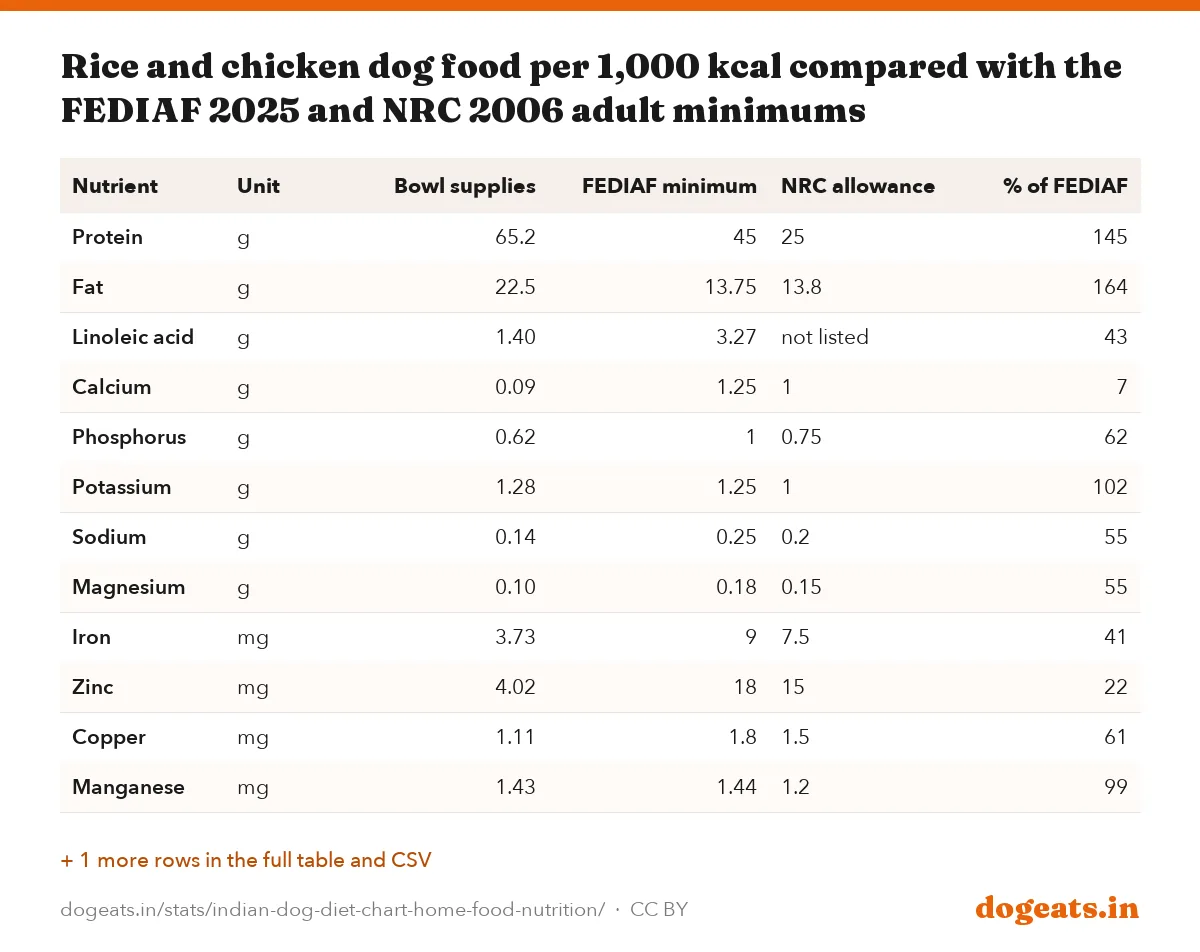
No. Rice and chicken is a common home meal for Indian dogs, and it covers energy, protein and fat well. It supplies 145% of the FEDIAF protein minimum and 164% of the fat minimum.
Minerals and fats tell a different story. The same bowl gives 22% of the zinc minimum, 41% of the iron, 43% of the linoleic acid and 7% of the calcium. It fell short on 10 of 13 nutrients.
For a 10 kg dog eating about 619 kcal a day, the bowl provides around 54 mg of calcium. FEDIAF's minimum works out at 773 mg for that dog. Plain white rice and chicken are safe foods, but together they are not a full diet.
100 g raw rice, 150 g raw chicken breast, 50 g carrot, 50 g pumpkin (638 kcal). IFCT 2017 values; FEDIAF 2025 minimum per 1,000 kcal. Bars are capped at 200% for display.
Show the numbers
| Label | % |
|---|---|
| Calcium | 7% |
| Zinc | 22% |
| Iron | 41% |
| Linoleic acid | 43% |
| Magnesium | 55% |
| Sodium | 55% |
| Copper | 61% |
| Phosphorus | 62% |
| Selenium | 80% |
| Manganese | 99% |
| Potassium | 102% |
| Protein | 145% |
| Fat | 164% |
Embed this chart
| Nutrient | Unit | Bowl supplies | FEDIAF minimum | NRC allowance | % of FEDIAF |
|---|---|---|---|---|---|
| Protein | g | 65.2 | 45 | 25 | 145 |
| Fat | g | 22.5 | 13.75 | 13.8 | 164 |
| Linoleic acid | g | 1.40 | 3.27 | not listed | 43 |
| Calcium | g | 0.09 | 1.25 | 1 | 7 |
| Phosphorus | g | 0.62 | 1 | 0.75 | 62 |
| Potassium | g | 1.28 | 1.25 | 1 | 102 |
| Sodium | g | 0.14 | 0.25 | 0.2 | 55 |
| Magnesium | g | 0.10 | 0.18 | 0.15 | 55 |
| Iron | mg | 3.73 | 9 | 7.5 | 41 |
| Zinc | mg | 4.02 | 18 | 15 | 22 |
| Copper | mg | 1.11 | 1.8 | 1.5 | 61 |
| Manganese | mg | 1.43 | 1.44 | 1.2 | 99 |
| Selenium | microgram | 45.7 | 57.5 | 90 | 80 |
What do Indian pet dogs actually eat?
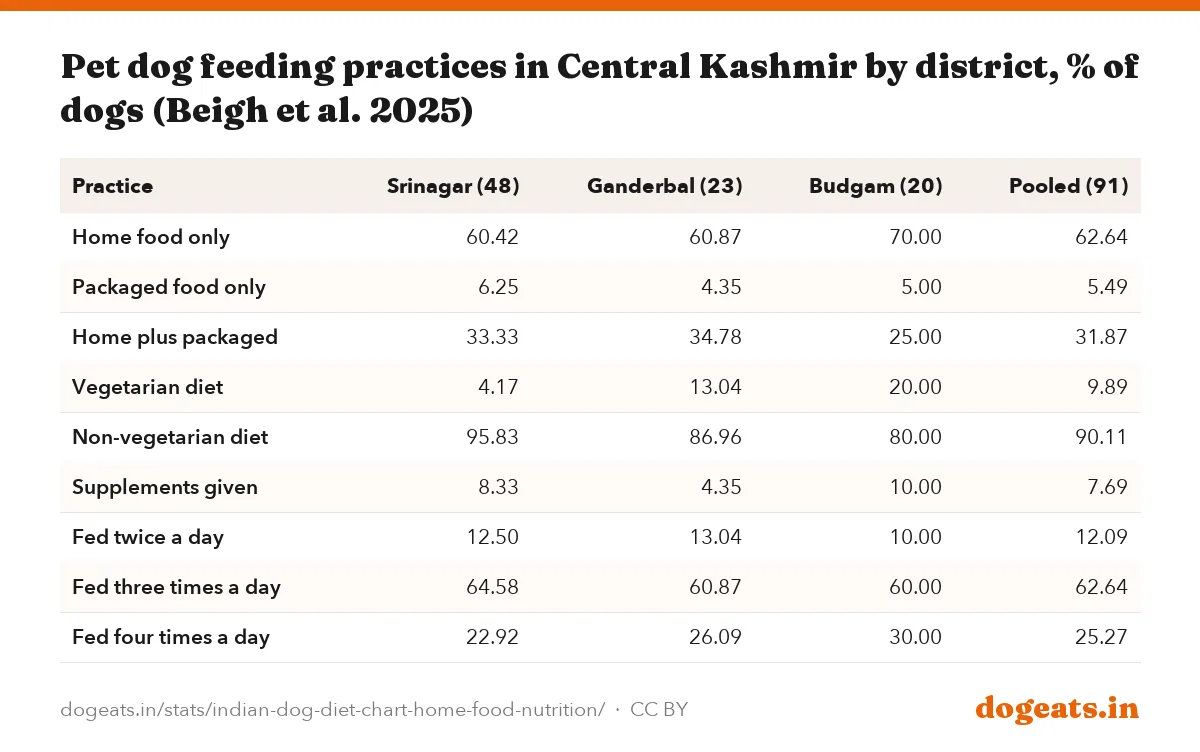
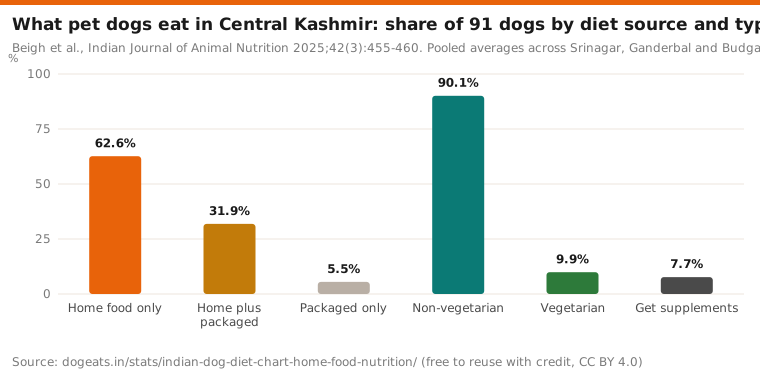
Mostly family food. A 2025 survey of 91 adult pet dogs in Srinagar, Ganderbal and Budgam found 62.6% ate only home food. Another 31.9% got home food plus packaged food, and 5.5% ate packaged food alone.
Kashmir is a meat-eating region, and 90.1% of the surveyed dogs got non-vegetarian meals. Only 7.7% received any dietary supplement, such as a mineral mix or vitamins. The authors, from SKUAST-Kashmir, called the home diets "generally imbalanced".
National figures point the same way. A July 2026 GlobalPETS feature put packaged pet food penetration in India at 7 to 8% of about 3.2 crore pets. Most Indian dogs, then, eat what the household cooks.
Beigh et al., Indian Journal of Animal Nutrition 2025;42(3):455-460. Pooled averages across Srinagar, Ganderbal and Budgam.
Show the numbers
| Label | % |
|---|---|
| Home food only | 62.6% |
| Home plus packaged | 31.9% |
| Packaged only | 5.5% |
| Non-vegetarian | 90.1% |
| Vegetarian | 9.9% |
| Get supplements | 7.7% |
Embed this chart
| Practice | Srinagar (48) | Ganderbal (23) | Budgam (20) | Pooled (91) |
|---|---|---|---|---|
| Home food only | 60.42 | 60.87 | 70.00 | 62.64 |
| Packaged food only | 6.25 | 4.35 | 5.00 | 5.49 |
| Home plus packaged | 33.33 | 34.78 | 25.00 | 31.87 |
| Vegetarian diet | 4.17 | 13.04 | 20.00 | 9.89 |
| Non-vegetarian diet | 95.83 | 86.96 | 80.00 | 90.11 |
| Supplements given | 8.33 | 4.35 | 10.00 | 7.69 |
| Fed twice a day | 12.50 | 13.04 | 10.00 | 12.09 |
| Fed three times a day | 64.58 | 60.87 | 60.00 | 62.64 |
| Fed four times a day | 22.92 | 26.09 | 30.00 | 25.27 |
Dog diet chart for India: how much home food by weight?
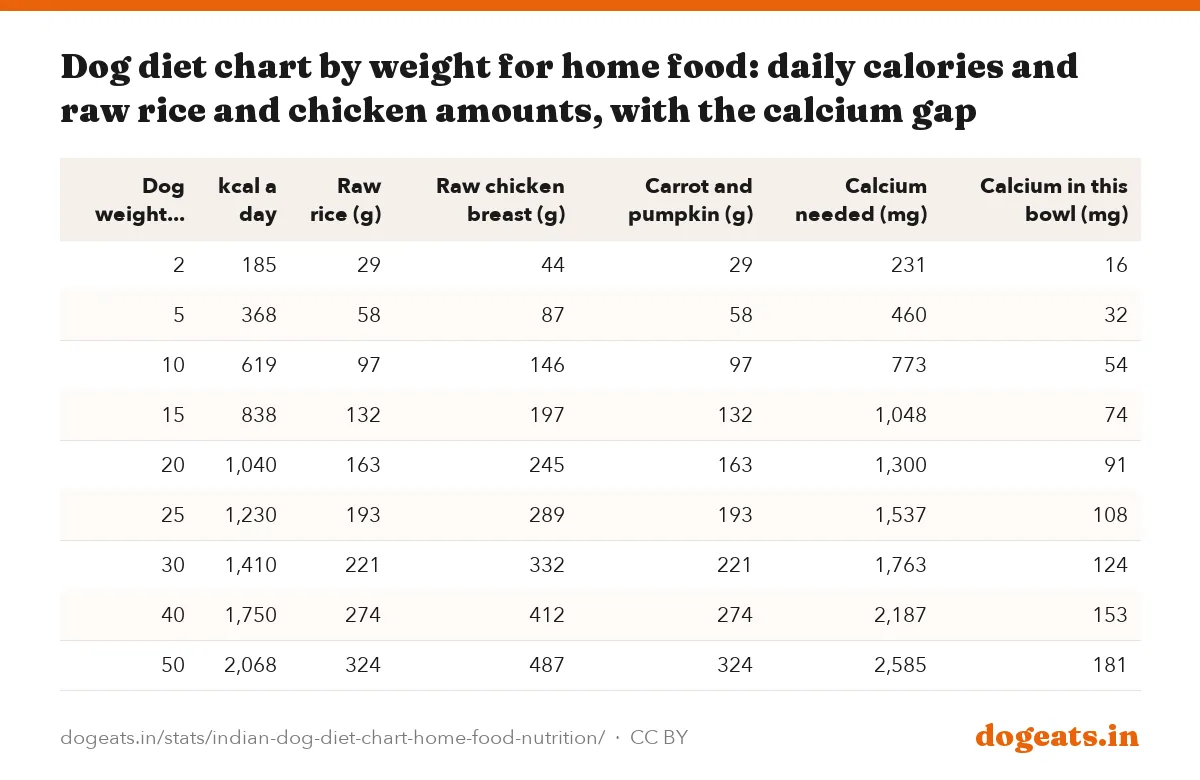
Start from calories. A moderately active adult dog needs about 110 kcal per kg of body weight raised to the power 0.75, the FEDIAF 2025 guideline says. Our dog feeding chart by weight uses the same formula.
On that basis a 10 kg dog needs about 619 kcal a day. In our rice and chicken bowl that equals roughly 97 g raw rice and 146 g raw chicken breast. A 30 kg dog needs about 1,410 kcal, or 221 g rice and 332 g chicken.
The last two columns show the catch. At every weight the bowl gives about 7% of the calcium the dog needs. Use this table to judge portion size only, and ask a vet to balance the recipe.
| Dog weight (kg) | kcal a day | Raw rice (g) | Raw chicken breast (g) | Carrot and pumpkin (g) | Calcium needed (mg) | Calcium in this bowl (mg) |
|---|---|---|---|---|---|---|
| 2 | 185 | 29 | 44 | 29 | 231 | 16 |
| 5 | 368 | 58 | 87 | 58 | 460 | 32 |
| 10 | 619 | 97 | 146 | 97 | 773 | 54 |
| 15 | 838 | 132 | 197 | 132 | 1,048 | 74 |
| 20 | 1,040 | 163 | 245 | 163 | 1,300 | 91 |
| 25 | 1,230 | 193 | 289 | 193 | 1,537 | 108 |
| 30 | 1,410 | 221 | 332 | 221 | 1,763 | 124 |
| 40 | 1,750 | 274 | 412 | 274 | 2,187 | 153 |
| 50 | 2,068 | 324 | 487 | 324 | 2,585 | 181 |
Puppies need more energy than adults, and FEDIAF sets their calcium minimum at twice the adult level per 1,000 kcal. Our puppy feeding chart covers them separately.
Which Indian foods give dogs the most protein?
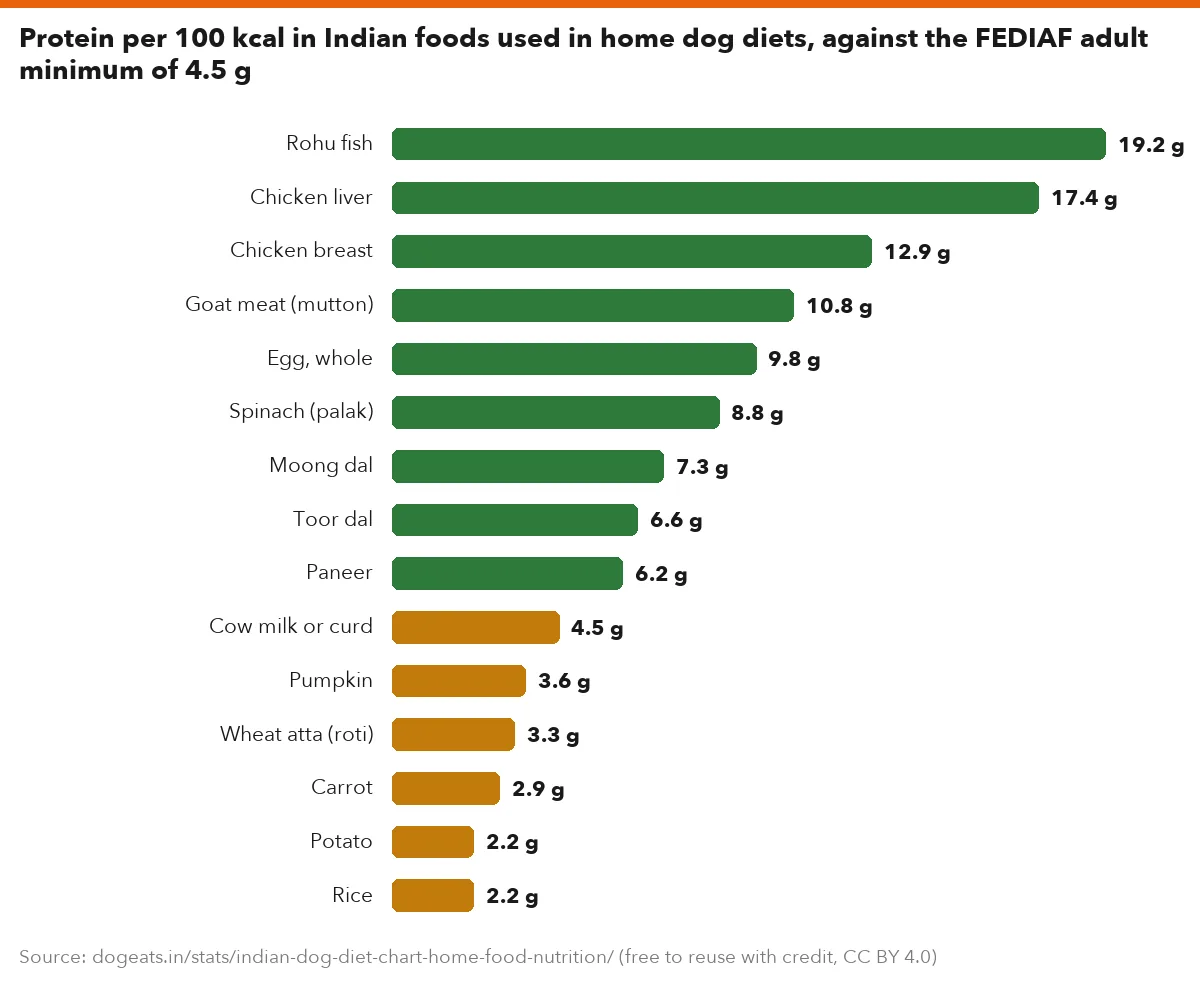
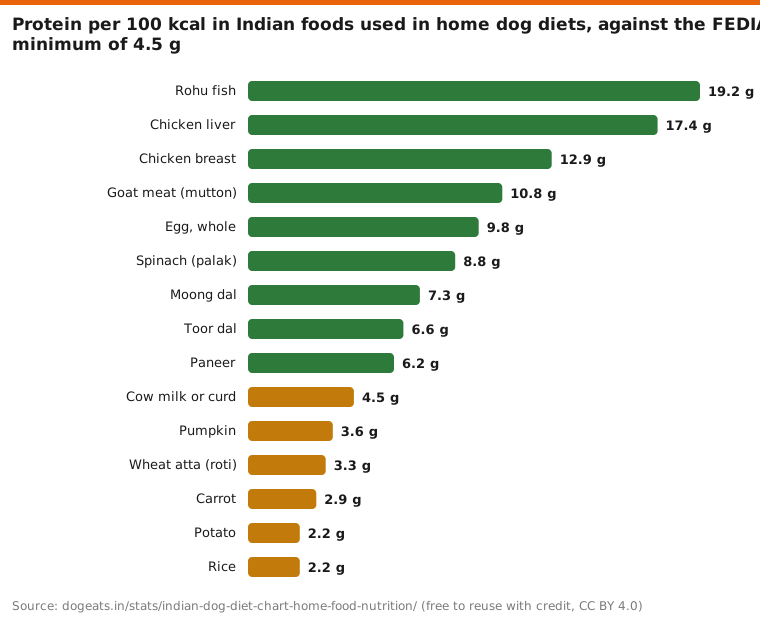
Fish, liver and lean meat lead. Per 100 kcal, rohu has 19.2 g of protein and chicken liver 17.4 g, by IFCT 2017. Chicken breast has 12.9 g and a whole egg 9.8 g.
Dal and paneer sit in the middle at 6.2 to 7.3 g. Rice has only 2.2 g and wheat atta 3.3 g, below the FEDIAF adult minimum of 4.5 g per 100 kcal.
Calcium is another matter. Only milk, curd, paneer, pumpkin and spinach have at least as much calcium as phosphorus. Rice has a Ca:P ratio of 0.08 and chicken breast 0.07.
ICMR-NIN IFCT 2017, raw edible portion. FEDIAF 2025 minimum of 45 g per 1,000 kcal for adult dogs (110 kcal per kg^0.75).
Show the numbers
| Label | g |
|---|---|
| Rohu fish | 19.2 g |
| Chicken liver | 17.4 g |
| Chicken breast | 12.9 g |
| Goat meat (mutton) | 10.8 g |
| Egg, whole | 9.8 g |
| Spinach (palak) | 8.8 g |
| Moong dal | 7.3 g |
| Toor dal | 6.6 g |
| Paneer | 6.2 g |
| Cow milk or curd | 4.5 g |
| Pumpkin | 3.6 g |
| Wheat atta (roti) | 3.3 g |
| Carrot | 2.9 g |
| Potato | 2.2 g |
| Rice | 2.2 g |
Embed this chart
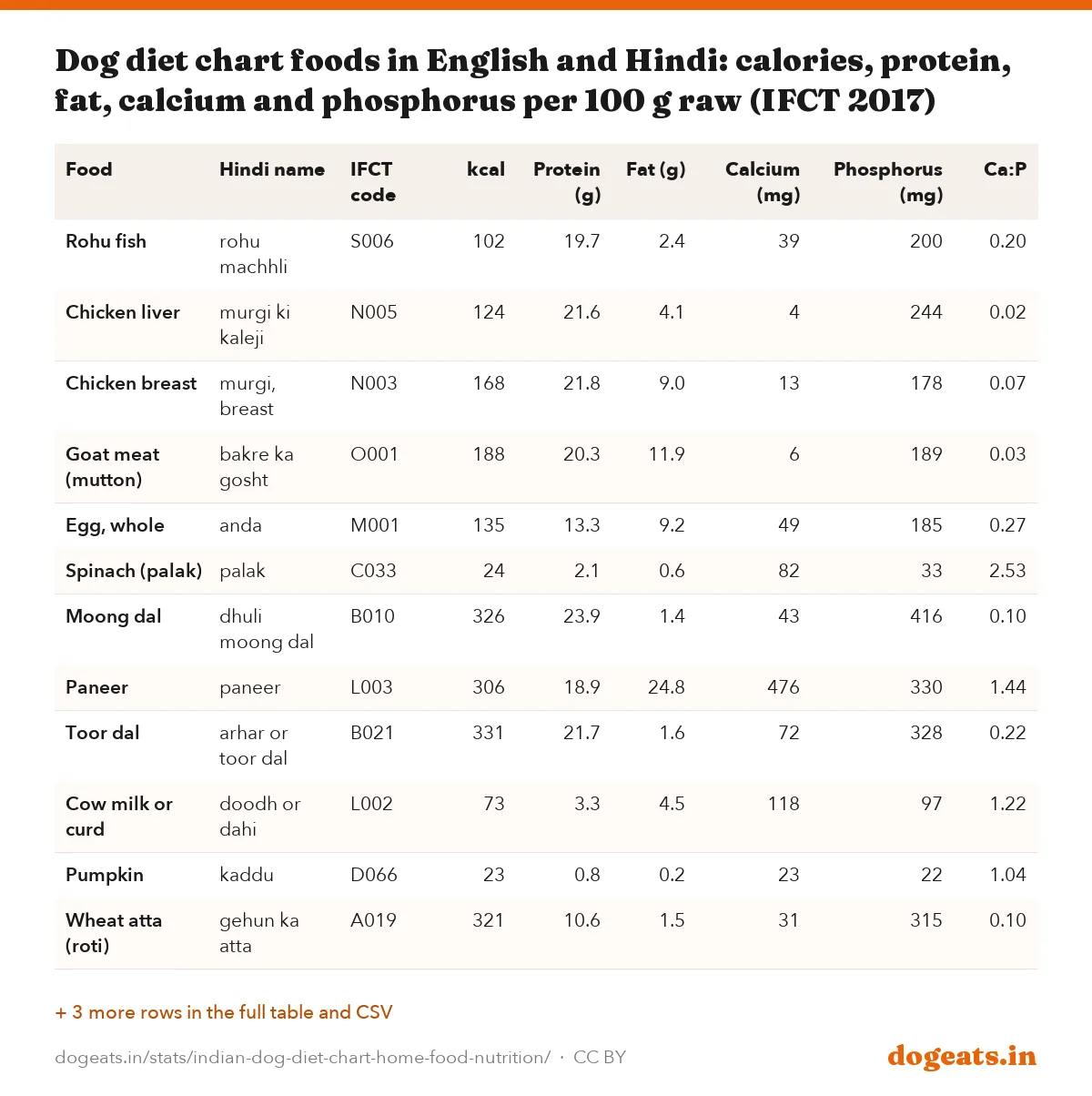
| Food | Hindi name | IFCT code | kcal | Protein (g) | Fat (g) | Calcium (mg) | Phosphorus (mg) | Ca:P |
|---|---|---|---|---|---|---|---|---|
| Rohu fish | rohu machhli | S006 | 102 | 19.7 | 2.4 | 39 | 200 | 0.20 |
| Chicken liver | murgi ki kaleji | N005 | 124 | 21.6 | 4.1 | 4 | 244 | 0.02 |
| Chicken breast | murgi, breast | N003 | 168 | 21.8 | 9.0 | 13 | 178 | 0.07 |
| Goat meat (mutton) | bakre ka gosht | O001 | 188 | 20.3 | 11.9 | 6 | 189 | 0.03 |
| Egg, whole | anda | M001 | 135 | 13.3 | 9.2 | 49 | 185 | 0.27 |
| Spinach (palak) | palak | C033 | 24 | 2.1 | 0.6 | 82 | 33 | 2.53 |
| Moong dal | dhuli moong dal | B010 | 326 | 23.9 | 1.4 | 43 | 416 | 0.10 |
| Paneer | paneer | L003 | 306 | 18.9 | 24.8 | 476 | 330 | 1.44 |
| Toor dal | arhar or toor dal | B021 | 331 | 21.7 | 1.6 | 72 | 328 | 0.22 |
| Cow milk or curd | doodh or dahi | L002 | 73 | 3.3 | 4.5 | 118 | 97 | 1.22 |
| Pumpkin | kaddu | D066 | 23 | 0.8 | 0.2 | 23 | 22 | 1.04 |
| Wheat atta (roti) | gehun ka atta | A019 | 321 | 10.6 | 1.5 | 31 | 315 | 0.10 |
| Carrot | gajar | F002 | 33 | 1.0 | 0.5 | 35 | 43 | 0.81 |
| Potato | aloo | F006 | 70 | 1.5 | 0.2 | 10 | 43 | 0.22 |
| Rice | chawal | A015 | 357 | 7.9 | 0.5 | 7 | 96 | 0.08 |
Hindi names are added for readers searching for a dog diet chart in Hindi. Values are per 100 g of raw edible food; cooking adds water but does not add minerals.
Why is calcium the biggest gap in Indian home dog food?
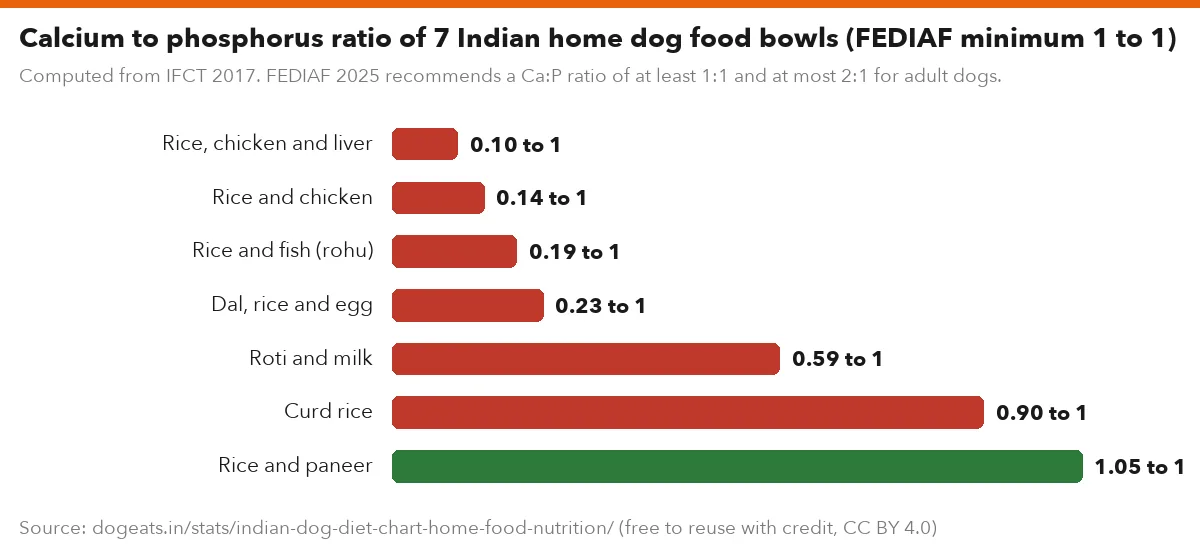
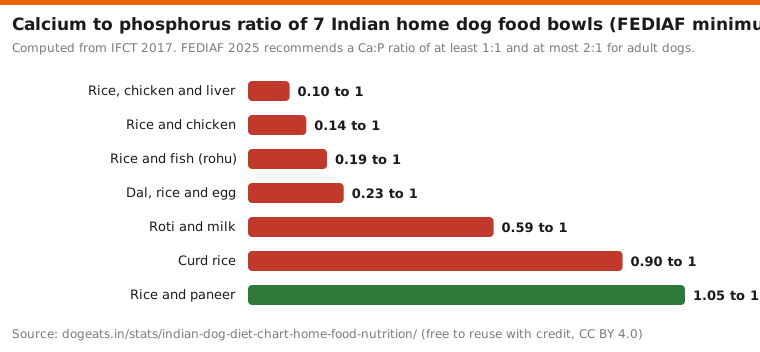
Because the staples carry phosphorus, not calcium. In our 7 bowls the Ca:P ratio ran from 0.10 to 1.05. FEDIAF sets an adult range of 1 to 1 up to 2 to 1.
Only rice with paneer cleared 1 to 1. The meat, fish and dal bowls ranged from 0.10 to 0.23, so they carried four to ten times more phosphorus than calcium.
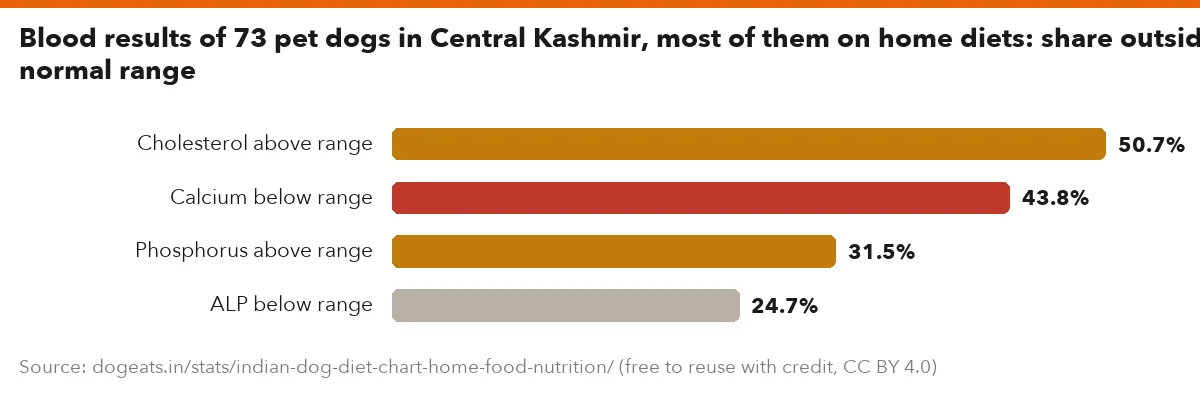
The Kashmir survey saw the same pattern in blood. Of 73 dogs tested, 43.8% had calcium below the normal range and 31.5% had phosphorus above it. A quarter had low ALP, a marker the authors linked to bone problems. Half had high cholesterol.
Packaged food was not flawless either. Of 26 dry food samples from seven brands collected in the survey, 30.8% held less than 0.5% calcium, the AAFCO adult minimum the authors used.
Computed from IFCT 2017. FEDIAF 2025 recommends a Ca:P ratio of at least 1:1 and at most 2:1 for adult dogs.
Show the numbers
| Label | ratio |
|---|---|
| Rice, chicken and liver | 0.10 to 1 |
| Rice and chicken | 0.14 to 1 |
| Rice and fish (rohu) | 0.19 to 1 |
| Dal, rice and egg | 0.23 to 1 |
| Roti and milk | 0.59 to 1 |
| Curd rice | 0.90 to 1 |
| Rice and paneer | 1.05 to 1 |
Embed this chart
Beigh et al. 2025, reference ranges from Kaneko et al. 1997. Low calcium and high phosphorus point to a calcium-poor, phosphorus-rich diet.
Show the numbers
| Label | % |
|---|---|
| Cholesterol above range | 50.7% |
| Calcium below range | 43.8% |
| Phosphorus above range | 31.5% |
| ALP below range | 24.7% |
Embed this chart
How often are homemade dog diets balanced?
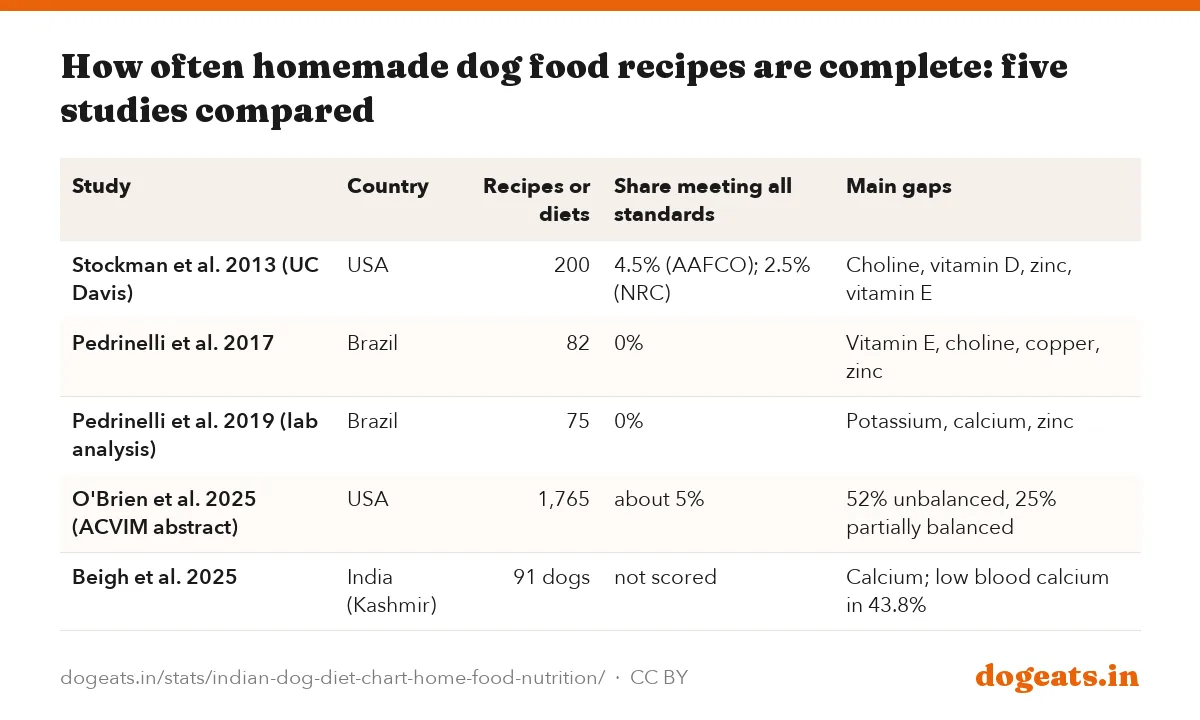
Rarely, in every study we found. A UC Davis team checked 200 published homemade dog recipes from 34 sources in 2013. Only 9 met AAFCO adult standards and 5 met NRC minimums.
The same team found 95% of the recipes short of at least one essential nutrient. More than 83% were short of several.
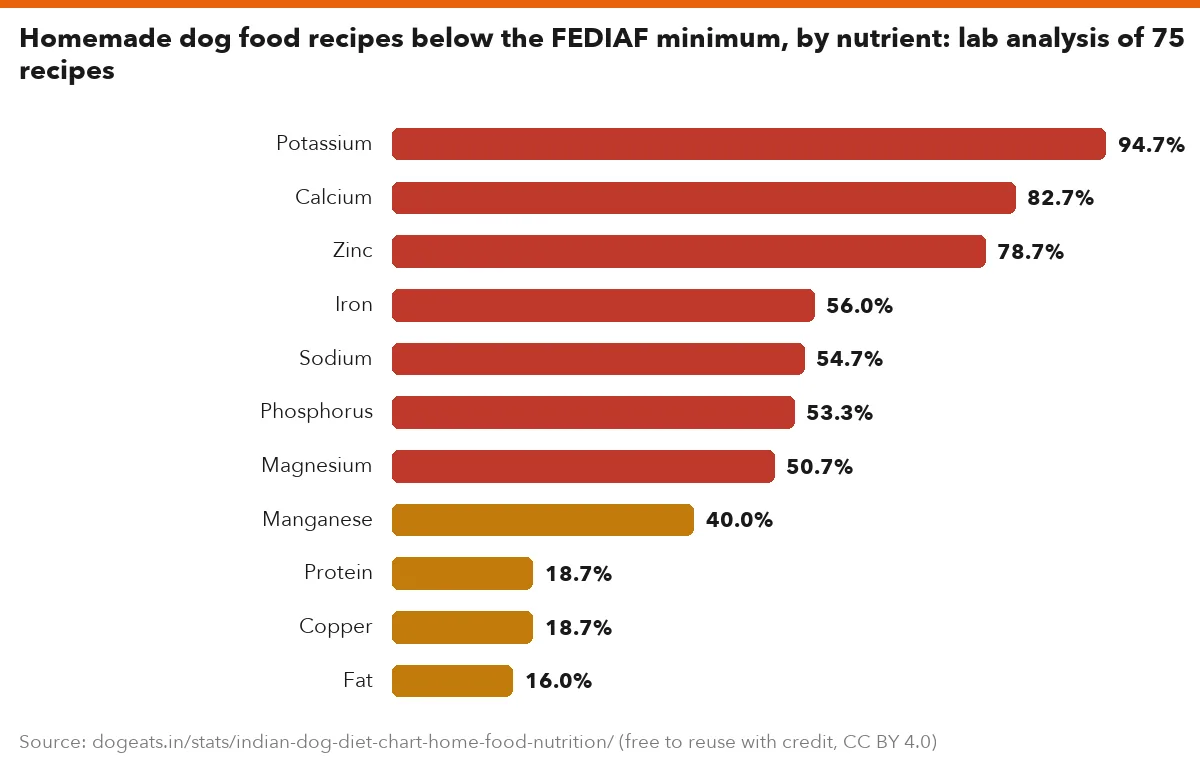
Brazilian researchers cooked 75 online recipes and analysed them in a lab in 2019. None met every minimum. 94.7% were low in potassium, 82.7% in calcium and 78.7% in zinc.
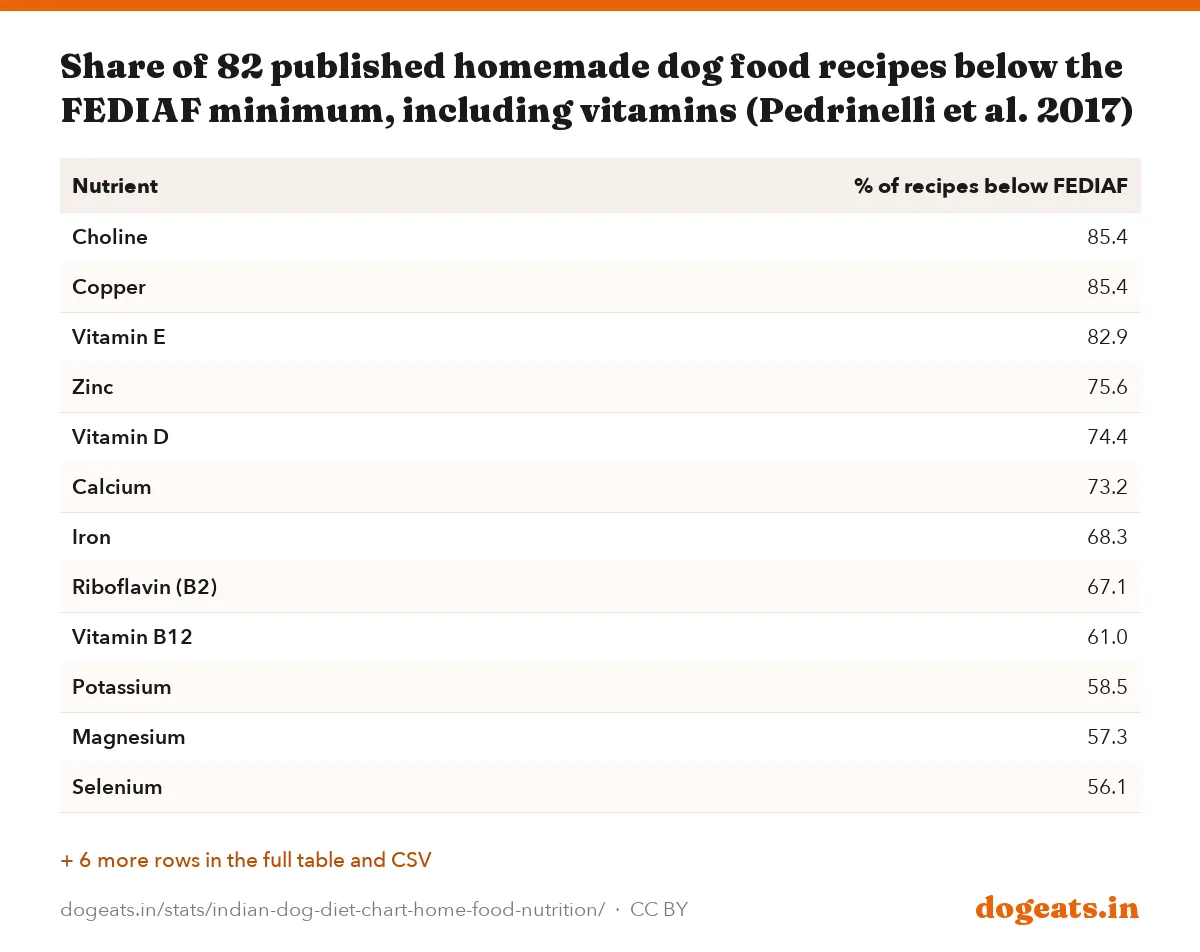
An earlier review of 82 recipes, led by the same first author, found choline and copper short in 85.4% and vitamin E in 82.9%. A 2025 US conference abstract looked at 1,765 home-prepared diets reported by owners.
It rated only about 5% as potentially balanced, about 25% as partially balanced and 52% as unbalanced. About 17% could not be classed.
Pedrinelli et al., Scientific Reports 2019. The 75 dog recipes came from Brazilian websites (100 recipes from 35 sources in all) and were prepared and analysed in a laboratory.
Show the numbers
| Label | % |
|---|---|
| Potassium | 94.7% |
| Calcium | 82.7% |
| Zinc | 78.7% |
| Iron | 56.0% |
| Sodium | 54.7% |
| Phosphorus | 53.3% |
| Magnesium | 50.7% |
| Manganese | 40.0% |
| Protein | 18.7% |
| Copper | 18.7% |
| Fat | 16.0% |
Embed this chart
| Study | Country | Recipes or diets | Share meeting all standards | Main gaps |
|---|---|---|---|---|
| Stockman et al. 2013 (UC Davis) | USA | 200 | 4.5% (AAFCO); 2.5% (NRC) | Choline, vitamin D, zinc, vitamin E |
| Pedrinelli et al. 2017 | Brazil | 82 | 0% | Vitamin E, choline, copper, zinc |
| Pedrinelli et al. 2019 (lab analysis) | Brazil | 75 | 0% | Potassium, calcium, zinc |
| O'Brien et al. 2025 (ACVIM abstract) | USA | 1,765 | about 5% | 52% unbalanced, 25% partially balanced |
| Beigh et al. 2025 | India (Kashmir) | 91 dogs | not scored | Calcium; low blood calcium in 43.8% |
| Nutrient | % of recipes below FEDIAF |
|---|---|
| Choline | 85.4 |
| Copper | 85.4 |
| Vitamin E | 82.9 |
| Zinc | 75.6 |
| Vitamin D | 74.4 |
| Calcium | 73.2 |
| Iron | 68.3 |
| Riboflavin (B2) | 67.1 |
| Vitamin B12 | 61.0 |
| Potassium | 58.5 |
| Magnesium | 57.3 |
| Selenium | 56.1 |
| Pantothenic acid | 48.8 |
| Thiamine (B1) | 39.0 |
| Phosphorus | 32.9 |
| Vitamin A | 23.2 |
| Protein | 20.7 |
| Fat | 11.0 |
Our IFCT check could not cover vitamins D and B12, choline or iodine, because the Indian tables do not list them fully. The foreign studies suggest those gaps are common too.
How many times a day should I feed my dog in India?
Two meals suit most adult dogs. The NRC owners' booklet says adults can eat once or twice a day, while puppies need two to three meals.
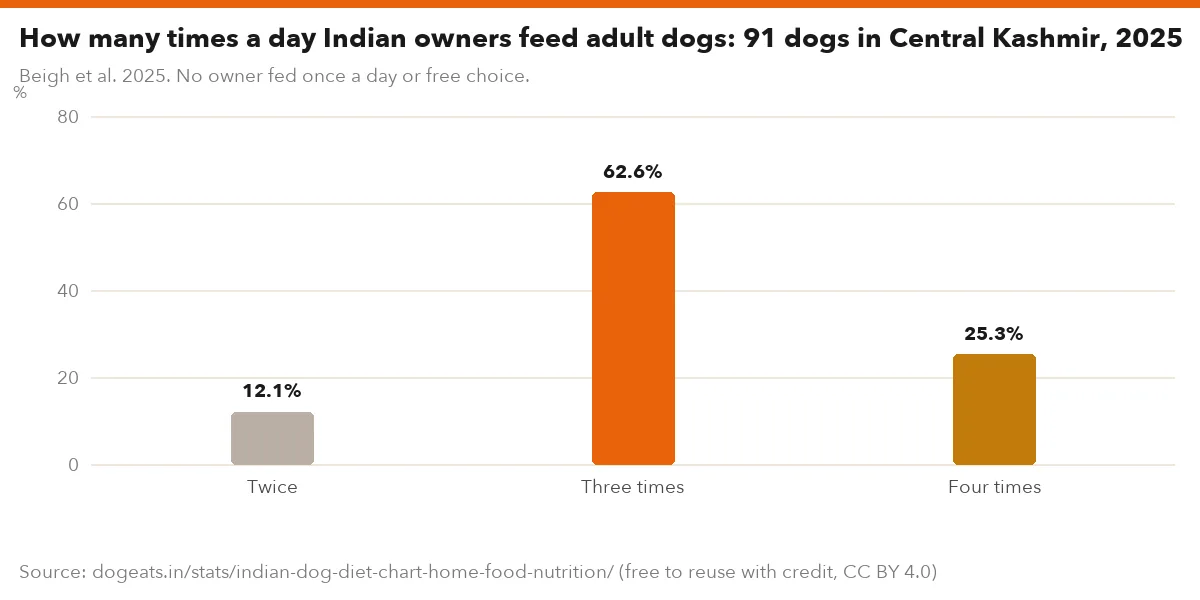
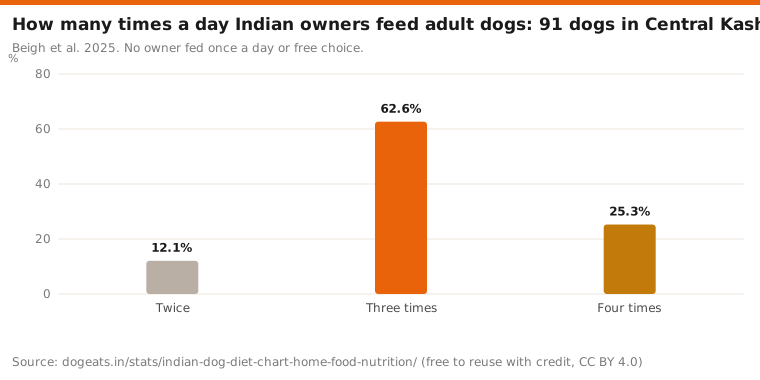
Indian owners tend to feed more often. In the Kashmir survey 62.6% of dogs ate three times a day and 25.3% four times. No owner fed once a day.
More meals are fine if the day's total stays the same. The risk is extra roti, biscuits and leftovers on top of full meals. Keep treats to 10% of daily calories, as our treats and Indian snacks report explains.
Beigh et al. 2025. No owner fed once a day or free choice.
Show the numbers
| Label | % |
|---|---|
| Twice | 12.1% |
| Three times | 62.6% |
| Four times | 25.3% |
Embed this chart
What nutrients does an adult dog need per day?
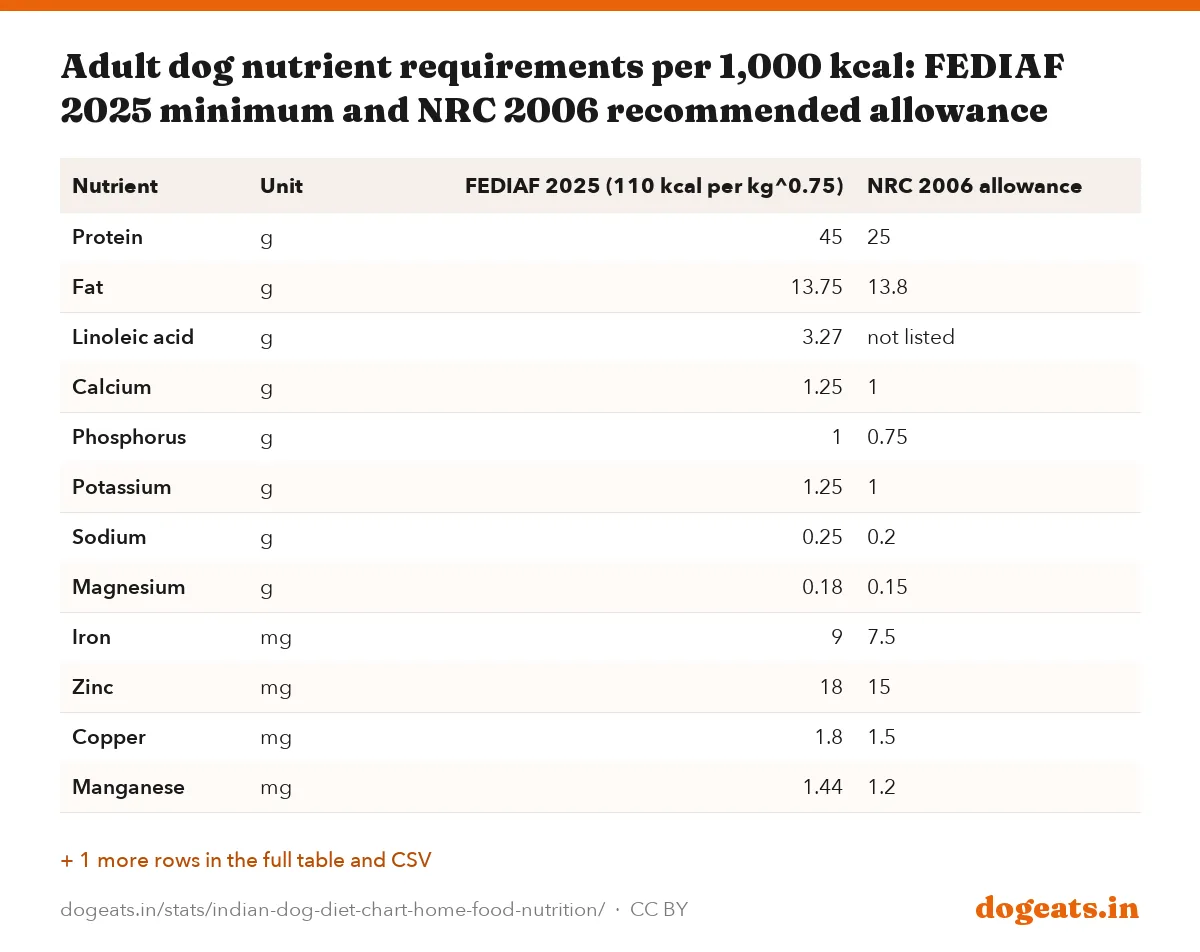
FEDIAF and the US National Research Council both set minimums per 1,000 kcal of food. FEDIAF's figures for a typical pet dog include 45 g protein, 13.75 g fat, 1.25 g calcium and 18 mg zinc.
The NRC allowances are lower for some nutrients, such as 25 g protein and 1.0 g calcium per 1,000 kcal. FEDIAF raises the NRC figures for pet dogs, which eat fewer calories.
A home diet that meets these numbers is possible. It usually needs meat or fish, a starch, a measured oil, a calcium source and a canine vitamin and mineral mix, all weighed in grams.
| Nutrient | Unit | FEDIAF 2025 (110 kcal per kg^0.75) | NRC 2006 allowance |
|---|---|---|---|
| Protein | g | 45 | 25 |
| Fat | g | 13.75 | 13.8 |
| Linoleic acid | g | 3.27 | not listed |
| Calcium | g | 1.25 | 1 |
| Phosphorus | g | 1 | 0.75 |
| Potassium | g | 1.25 | 1 |
| Sodium | g | 0.25 | 0.2 |
| Magnesium | g | 0.18 | 0.15 |
| Iron | mg | 9 | 7.5 |
| Zinc | mg | 18 | 15 |
| Copper | mg | 1.8 | 1.5 |
| Manganese | mg | 1.44 | 1.2 |
| Selenium | microgram | 57.5 | 90 |
- Never add onion, garlic, grapes, raisins or chocolate. See our onion and garlic pages.
- Cook without salt, masala or tadka. Plain curd rice and paneer suit many dogs in small amounts.
- Ask a vet before adding bones, eggshell powder or any mineral supplement.
Frequently asked questions
What is the best diet chart for dogs in India?
A vet-planned recipe sized to the dog's calories, such as about 619 kcal a day for a 10 kg adult. Plain rice and chicken covers protein but gives only 7% of the calcium minimum, so it needs a calcium source and supplement.
Is rice and chicken enough for dogs every day?
No. In our check it met protein and fat but fell short on 10 of 13 nutrients, including calcium, zinc and linoleic acid. It works as part of a balanced plan, not alone.
Can dogs eat roti every day?
Plain roti is safe in small amounts, but wheat atta has 3.3 g protein per 100 kcal, below the 4.5 g dogs need. Roti with milk met only 83% of the protein minimum in our test.
Is curd rice good for dogs?
Plain curd rice is gentle and safe for most dogs, but as a full diet it fell short on 12 of 13 nutrients in our check. It gave 66% of the protein minimum.
How much home food should I give my dog?
Match calories to weight: about 368 kcal for 5 kg, 619 kcal for 10 kg, 1,040 kcal for 20 kg and 1,410 kcal for 30 kg. Adjust every few weeks by body shape.
Do most Indian dogs eat home food?
Yes. Packaged food reaches about 7 to 8% of pets in India, says a 2026 GlobalPETS feature. In a Kashmir survey, 62.6% of dogs ate only home food.
Why do home-fed dogs lack calcium?
Rice, dal, roti and meat hold far more phosphorus than calcium. In a Kashmir study, 43.8% of 73 dogs tested had low blood calcium.
Is a vegetarian home diet safe for dogs?
Studies show dogs can stay healthy on carefully formulated vegetarian diets, but plain dal, rice and paneer leave gaps. Our vegetarian and vegan dogs report covers the studies.
Methodology and limitations
We built 7 example bowls from raw ingredient weights. They reflect meals Indian owners often cook, from rice and chicken to curd rice, dal with egg and roti with milk. They are illustrations, not survey averages.
Nutrients per 100 g come from the Indian Food Composition Tables 2017 (ICMR-National Institute of Nutrition). We used the open ifct2017 dataset and checked every value against the revised NIN PDF (December 2024). For paneer the PDF gives 24.78 g fat and 1,278 kJ, which we used in place of the older dataset values. Energy is IFCT energy in kJ divided by 4.18. Curd is modelled as whole cow milk, since IFCT 2017 has no curd entry.
Each bowl's nutrients were scaled to 1,000 kcal and compared with the FEDIAF September 2025 minimums for adult dogs at 110 kcal per kg^0.75 (Table III-3b). The adult minimums in this table are identical in the July 2024 edition. NRC 2006 allowances are taken from Pedrinelli et al. 2019, Table 2, and selenium from the NRC owners' booklet.
We checked 13 nutrients that IFCT reports fully. Vitamins A, D, E and B12, choline and iodine were left out because IFCT values are missing or incomplete for key foods such as milk.
Daily calories use the FEDIAF factor of 110 kcal per kg^0.75, the same method as our dog feeding chart by weight. Survey and study figures are taken exactly from the papers cited, opened on 15 October 2026.
Sources
- Longvah T et al. Indian Food Composition Tables 2017, ICMR-National Institute of Nutrition, Hyderabad (file revised 16 December 2024), Protein, fat, minerals and energy of 15 Indian foods
- FEDIAF Nutritional Guidelines for Complete and Complementary Pet Food for Cats and Dogs, September 2025, Adult dog minimums per 1,000 kcal (Table III-3b), Ca:P range, 110 kcal per kg^0.75
- Beigh YA et al. Welfare evaluation of pet dogs through feeding protocols followed, nutritional composition of available feeds and blood metabolic profile. Indian J Anim Nutr 2025;42(3):455-460, Feeding practices of 91 dogs in Central Kashmir; blood calcium, phosphorus, ALP and cholesterol
- Also consulted: Pedrinelli V et al. Concentrations of macronutrients, minerals and heavy metals in home-prepared diets for adult dogs and cats. Scientific Reports 2019;9:13058, Pedrinelli V, Gomes MOS, Carciofi AC. Analysis of recipes of home-prepared diets for dogs and cats published in Portuguese. Journal of Nutritional Science 2017;6:e33, UC Davis news release on Stockman J et al., J Am Vet Med Assoc 2013;242(11):1500-1505 (15 July 2013), dvm360 report on O'Brien J, Ruple A, Tolbert K, ACVIM Forum 2025 abstract NM04, GlobalPETS, interview feature on Drools (9 July 2026), ifct2017 open dataset (machine-readable IFCT 2017 tables), National Research Council, Your Dog's Nutritional Needs (2006).
Cite, embed and download
This report, its data and its images are free to reuse under a Creative Commons Attribution 4.0 licence. Credit dogeats.in with a link to this page. Every chart has its own embed code, every table has a CSV and an image download, and the images below are ready for social posts, slides and articles.
Cite this report
Link to this report
Every chart and table as an image