Statistics hub · Updated October 2026
Dog Statistics 2026: 140+ cited facts on how many dogs are in the world, breeds, lifespan, senses, bites and cost
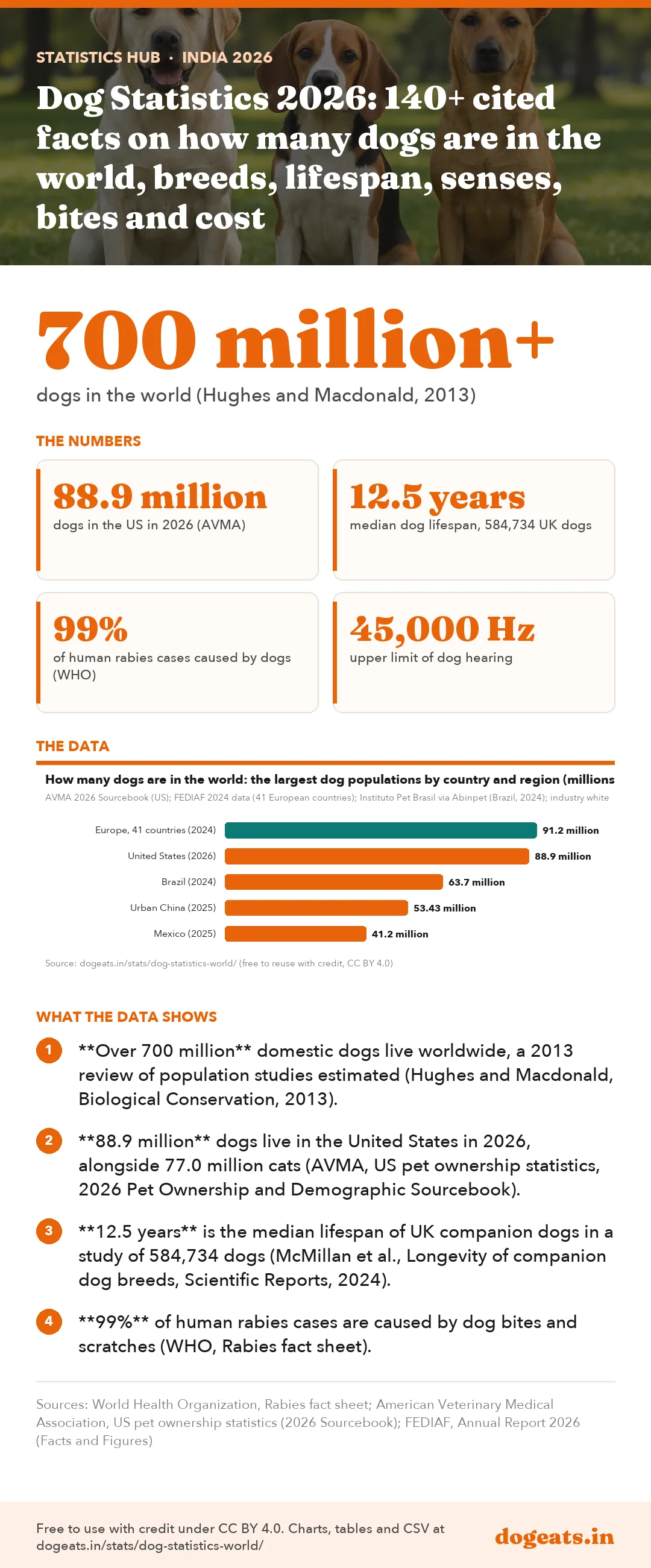
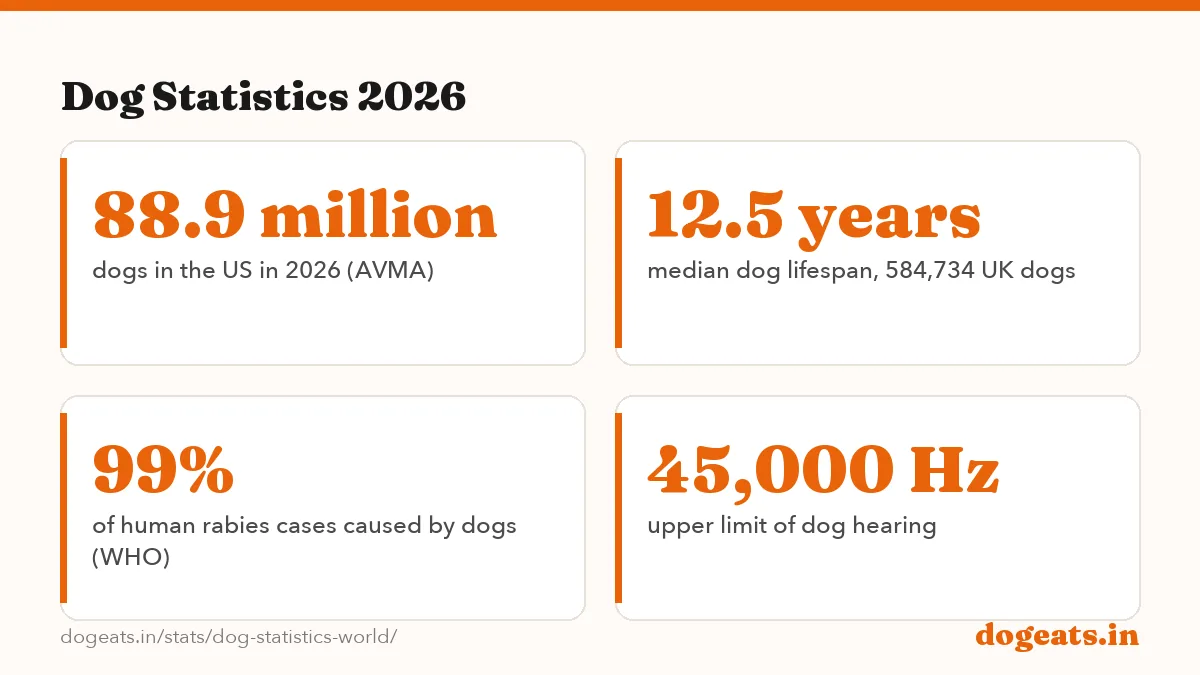
There are more than 700 million dogs in the world, and the US alone has 88.9 million. A typical dog lives about 12.5 years, hears up to 45,000 Hz and costs USD 1,930 to 5,305 a year in the US. This hub collects 140+ dated figures, each linked to its original source.

Key findings
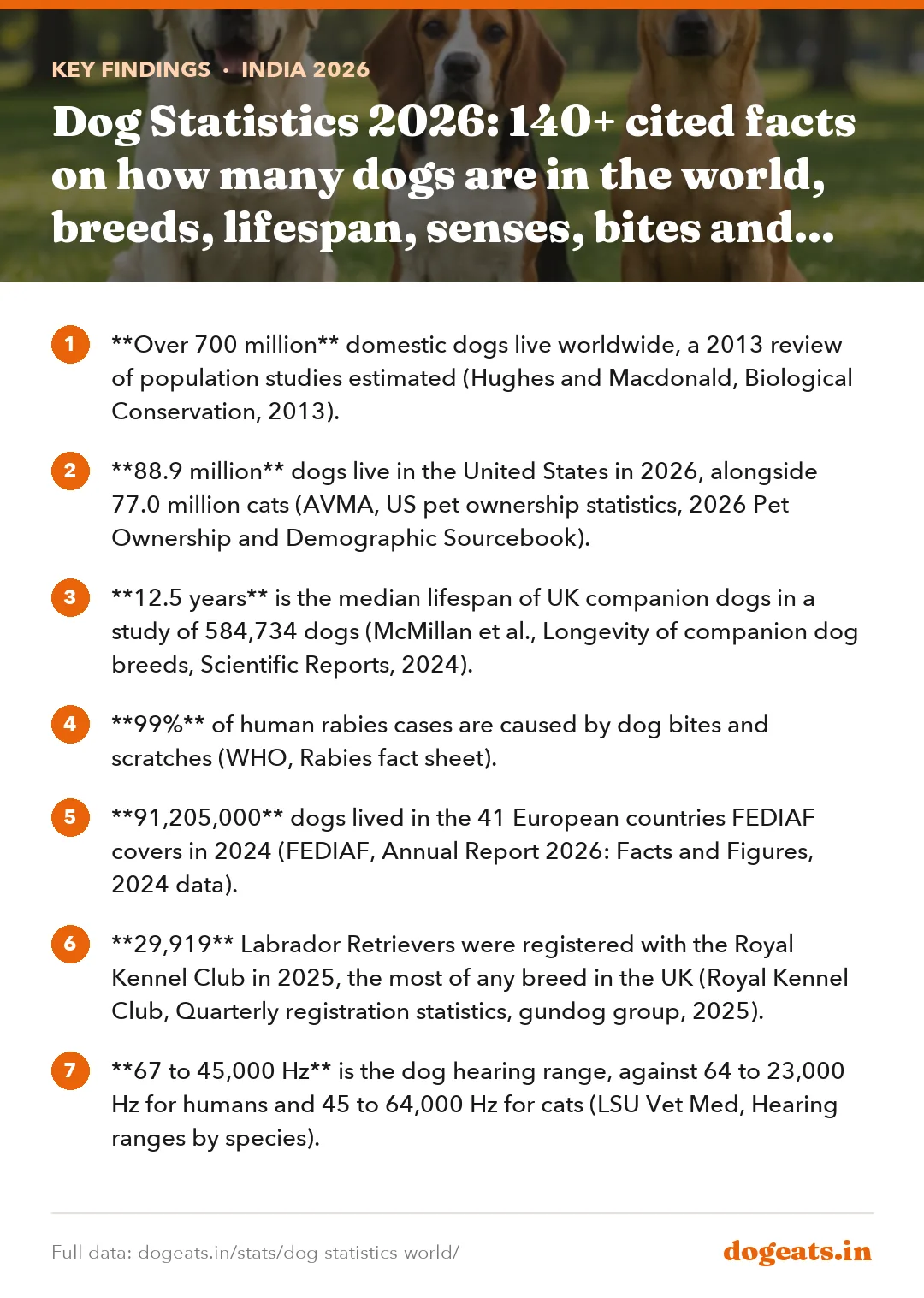
- Over 700 million domestic dogs live worldwide, a 2013 review of population studies estimated (Hughes and Macdonald, Biological Conservation, 2013).
- 88.9 million dogs live in the United States in 2026, alongside 77.0 million cats (AVMA, US pet ownership statistics, 2026 Pet Ownership and Demographic Sourcebook).
- 12.5 years is the median lifespan of UK companion dogs in a study of 584,734 dogs (McMillan et al., Longevity of companion dog breeds, Scientific Reports, 2024).
- 99% of human rabies cases are caused by dog bites and scratches (WHO, Rabies fact sheet).
- 91,205,000 dogs lived in the 41 European countries FEDIAF covers in 2024 (FEDIAF, Annual Report 2026: Facts and Figures, 2024 data).
- 29,919 Labrador Retrievers were registered with the Royal Kennel Club in 2025, the most of any breed in the UK (Royal Kennel Club, Quarterly registration statistics, gundog group, 2025).
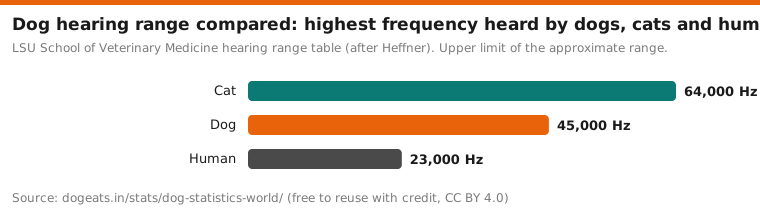
- 67 to 45,000 Hz is the dog hearing range, against 64 to 23,000 Hz for humans and 45 to 64,000 Hz for cats (LSU Vet Med, Hearing ranges by species).
- 2.8 million dogs entered US shelters and rescues in 2025, out of 5.8 million dogs and cats (Shelter Animals Count, 2025 Annual Data Report).
- USD 1,930 to 5,305 a year is what caring for a dog costs in the US in 2026, by Rover's company estimate (Rover, The cost of dog parenthood in 2026).
- 1,022 object names were learned by Chaser, a border collie, over three years of training (2011 study) (Pilley and Reid, Border collie comprehends object names, Behavioural Processes, 2011).
How many dogs are there in the world?
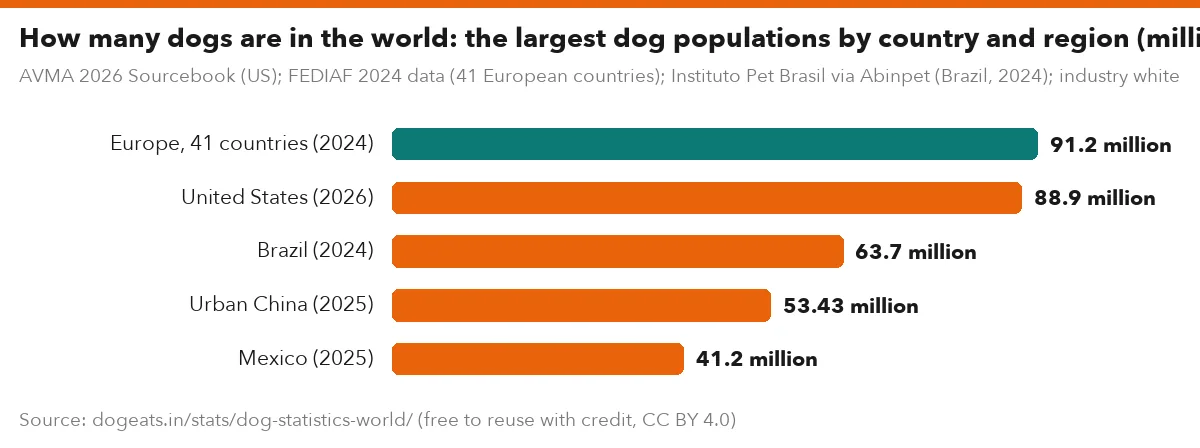
There are more than 700 million dogs in the world by the most cited scientific estimate, and no global census exists. The largest national counts come from the US, Brazil, China and Mexico, compared in our dog population by country report.
- 91,205,000 dogs lived in the 41 European countries FEDIAF covers in 2024 (FEDIAF, Annual Report 2026: Facts and Figures, 2024 data).
- 11,000 years ago, dogs had already split into at least five ancestry lineages, 27 ancient genomes show (Bergstrom et al., Origins of prehistoric dogs, Science, 2020).
- 63.7 million dogs lived in Brazil in 2024, from 62.2 million in 2023, in Instituto Pet Brasil estimates shown by Abinpet (Abinpet presentation to the Brazilian Chamber of Deputies, 2025).
- 53.43 million pet dogs lived in urban China in 2025, up 1.6% on 2024, against 72.89 million cats (As reported by Guangming Online, China Pet Industry White Paper 2026).
- 88.9 million dogs live in the United States in 2026, alongside 77.0 million cats (AVMA, US pet ownership statistics, 2026 Pet Ownership and Demographic Sourcebook).
- Over 700 million domestic dogs live worldwide, a 2013 review of population studies estimated (Hughes and Macdonald, Biological Conservation, 2013).
- Over a billion pets are likely kept worldwide, by the animal health industry body HealthforAnimals (HealthforAnimals, Global State of Pet Care report).
- Over half a billion dogs and cats live with families in just the US, Brazil, the EU and China (HealthforAnimals, Global State of Pet Care report).
- 41.2 million dogs lived in Mexican homes in 2025, by INEGI's national household survey (INEGI, ENBIARE 2025 results report, July 2026).
- 52.9 million dogs lived in the US in 1996, rising to 87.3 million by 2025 on the AVMA series (AVMA, Chart of the month: pet population trends, December 2025).
- About 340 dog breeds are recognised internationally by the FCI, the world kennel federation, LSU's deafness project notes (LSU Vet Med, Breeds with congenital deafness).
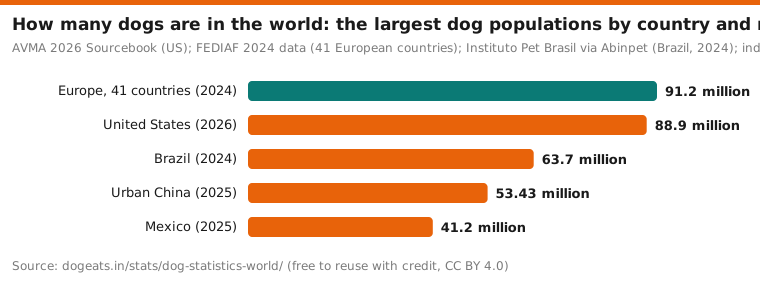
AVMA 2026 Sourcebook (US); FEDIAF 2024 data (41 European countries); Instituto Pet Brasil via Abinpet (Brazil, 2024); industry white paper via Guangming Online (urban China, 2025); INEGI ENBIARE 2025 (Mexico). Survey estimates, not censuses.
Show the numbers
| Label | million |
|---|---|
| Europe, 41 countries (2024) | 91.2 million |
| United States (2026) | 88.9 million |
| Brazil (2024) | 63.7 million |
| Urban China (2025) | 53.43 million |
| Mexico (2025) | 41.2 million |
Embed this chart
Dog population by country: national counts and estimates
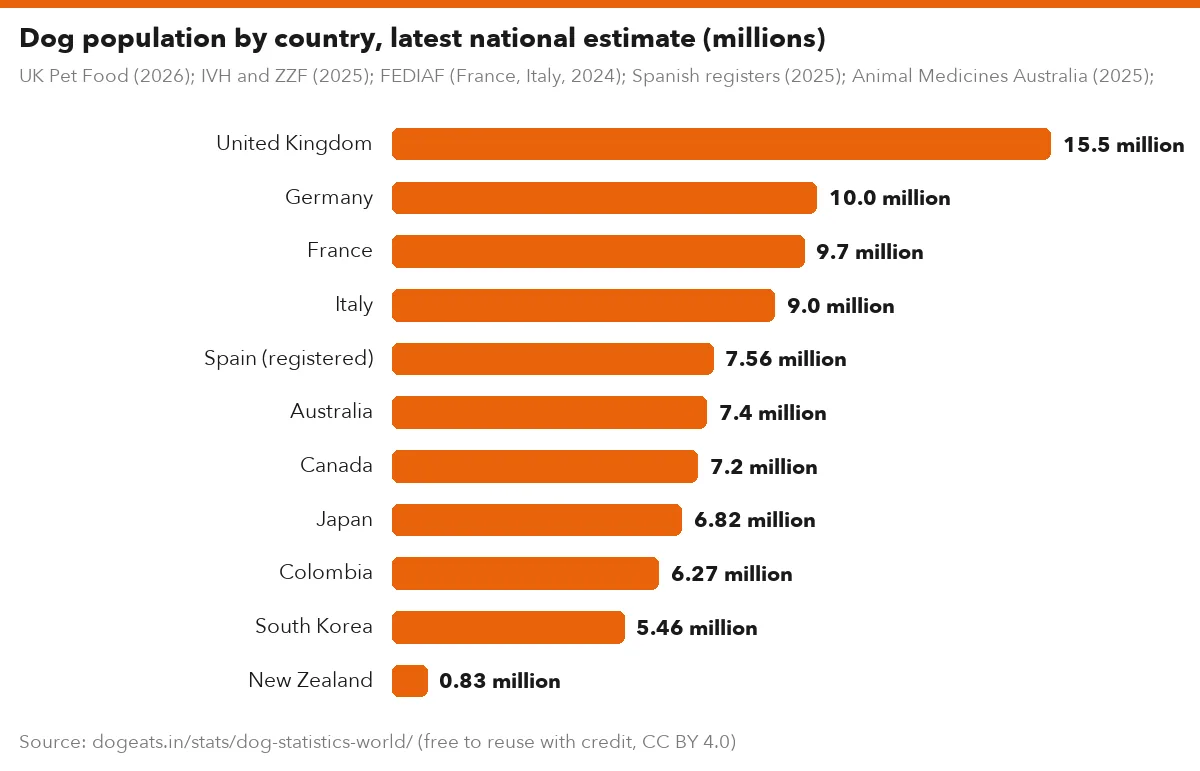
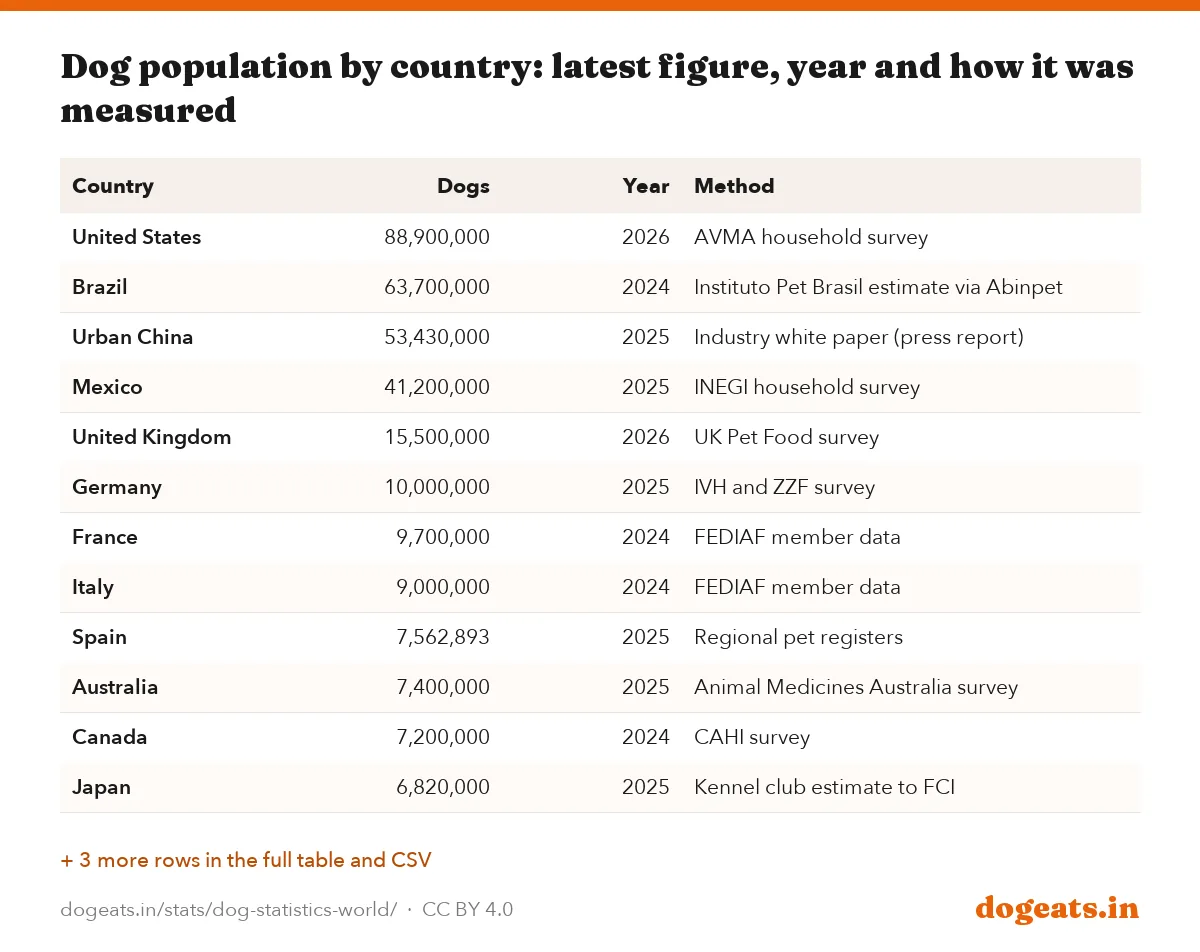
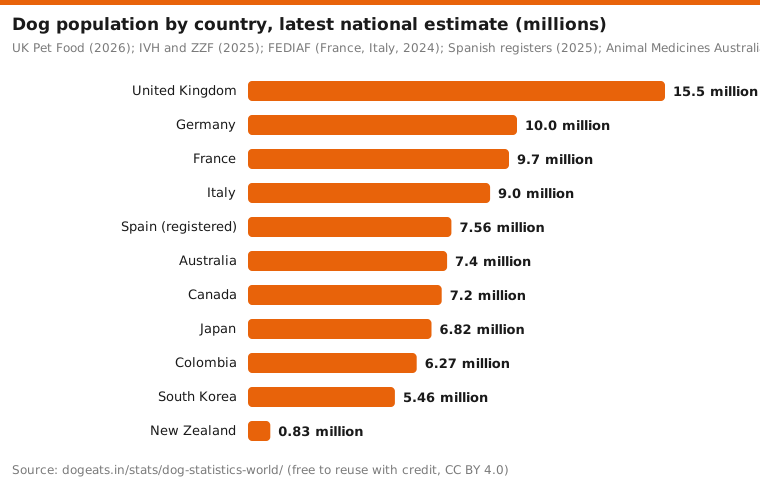
National dog counts come from household surveys, pet registers and industry estimates, so methods differ from one country to the next. The UK, Germany and France each have between 9.7 million and 15.5 million dogs, and smaller nations range down to 830,000 in New Zealand.
- 15.5 million pet dogs live in the UK, and 41% of households own one, by the industry body UK Pet Food (UK Pet Food, UK Pet Population 2026).
- 10.2 million pet dogs live in the UK by the PDSA 2026 estimate, down from a peak of 11.1 million in 2025 (PDSA, PAW Report 2026).
- 9,700,000 dogs lived in France and 9,000,000 in Italy in 2024, by FEDIAF national association data (FEDIAF, European dog population by country, 2024 data).
- 7.2 million dogs lived in Canada in 2024, against 8.2 million cats (Canadian Animal Health Institute, Canadian Pet Population Survey release, March 2025).
- 7,562,893 dogs were on Spain's regional pet registers in 2025, half of all registered companion animals (Government of Spain, Ministry of Social Rights, pet registry study, June 2026).
- 5.46 million dogs lived in South Korea at the end of 2024, the first fall in five years of KB estimates (As reported by DailyVet, KB Korea Pet Report 2025).
- 6,820,000 dogs live in Japan by its kennel club's estimate to the FCI, and 25.5 million in Russia (FCI, member statistics, 2025).
- 7.4 million dogs live in Australia in 2025, the country's most popular pet (Animal Medicines Australia, Pets in Australia 2025 release, September 2025).
- 830,000 dogs live in New Zealand, by the Companion Animals New Zealand 2024 pet data report (Companion Animals New Zealand, 2024 NZ Pet Data Report release, March 2025).
- 6,273,015 dogs were estimated in Colombia in 2024 by its health ministry's rabies vaccination programme (Ministry of Health Colombia, dog and cat rabies vaccination coverage 2024).
- 13.5 million dogs lived in the UK in 2024 by UK Pet Food, so its 2026 estimate is 2 million higher (UK Pet Food, pet population data release, March 2024).
- 10.0 million dogs lived in German households in 2025, by the pet trade associations IVH and ZZF (IVH and ZZF, Der deutsche Heimtiermarkt 2025, pet population).
UK Pet Food (2026); IVH and ZZF (2025); FEDIAF (France, Italy, 2024); Spanish registers (2025); Animal Medicines Australia (2025); CAHI (2024). FCI member estimate (Japan); Colombia health ministry (2024); KB report via DailyVet (2024); CANZ (2024).
Show the numbers
| Label | million |
|---|---|
| United Kingdom | 15.5 million |
| Germany | 10.0 million |
| France | 9.7 million |
| Italy | 9.0 million |
| Spain (registered) | 7.56 million |
| Australia | 7.4 million |
| Canada | 7.2 million |
| Japan | 6.82 million |
| Colombia | 6.27 million |
| South Korea | 5.46 million |
| New Zealand | 0.83 million |
Embed this chart
| Country | Dogs | Year | Method |
|---|---|---|---|
| United States | 88,900,000 | 2026 | AVMA household survey |
| Brazil | 63,700,000 | 2024 | Instituto Pet Brasil estimate via Abinpet |
| Urban China | 53,430,000 | 2025 | Industry white paper (press report) |
| Mexico | 41,200,000 | 2025 | INEGI household survey |
| United Kingdom | 15,500,000 | 2026 | UK Pet Food survey |
| Germany | 10,000,000 | 2025 | IVH and ZZF survey |
| France | 9,700,000 | 2024 | FEDIAF member data |
| Italy | 9,000,000 | 2024 | FEDIAF member data |
| Spain | 7,562,893 | 2025 | Regional pet registers |
| Australia | 7,400,000 | 2025 | Animal Medicines Australia survey |
| Canada | 7,200,000 | 2024 | CAHI survey |
| Japan | 6,820,000 | 2025 | Kennel club estimate to FCI |
| Colombia | 6,273,015 | 2024 | Health ministry estimate |
| South Korea | 5,460,000 | 2024 | KB Korea Pet Report |
| New Zealand | 830,000 | 2024 | CANZ survey |
Dog ownership statistics: what share of households own a dog?
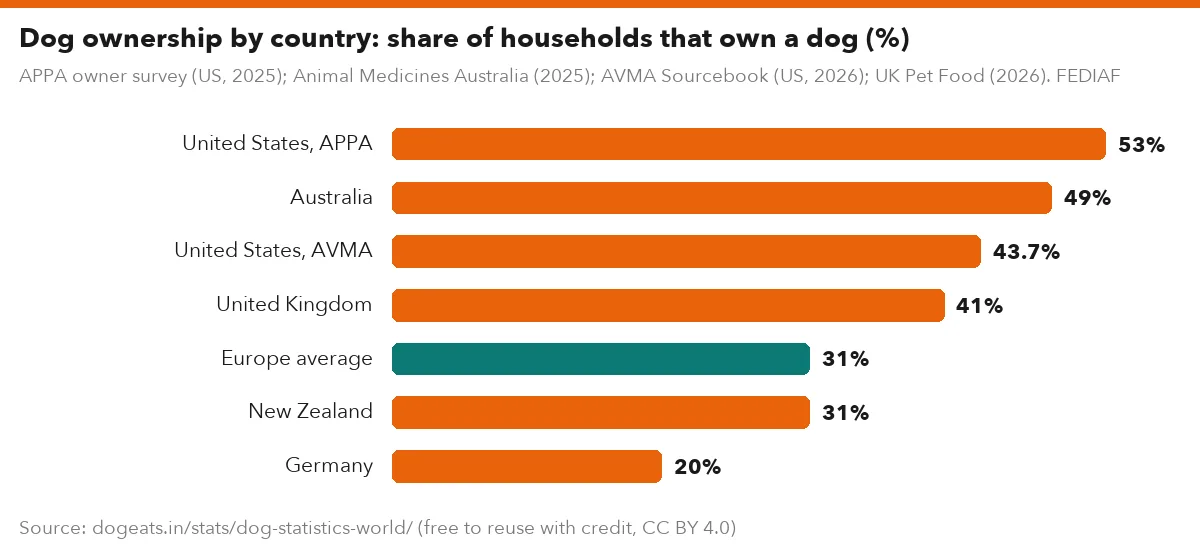
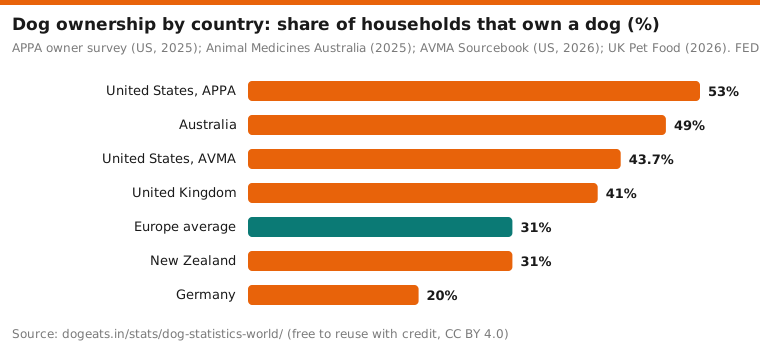
Between a fifth and just over half of households own a dog in the countries that publish figures. Australia and the US sit near the top, and the European average is 31%. Two US surveys disagree by almost ten points, which shows how much survey method matters.
- 31% of European households owned at least one dog in 2024, against 29% that owned a cat (FEDIAF, Annual Report 2026, households owning a dog or cat).
- 66.4% of Mexican homes had at least one pet in 2025, by the national ENBIARE survey (INEGI, ENBIARE 2025 results report).
- 20% of German households kept a dog in 2025, home to 10.0 million dogs, against 24% with a cat (IVH and ZZF, Der deutsche Heimtiermarkt 2025).
- 62% of UK households own a pet, and 41% own a dog (UK Pet Food, UK Pet Population 2026).
- 43.7% of US households own a dog, 58.9 million homes, against 34.1% that own a cat (AVMA, US pet ownership statistics, 2026).
- More than half the world's people are estimated to have a pet at home, says HealthforAnimals (HealthforAnimals, Global State of Pet Care report).
- 49% of Australian households have at least one dog, up from 40% in 2019 (Animal Medicines Australia, Pets in Australia 2025).
- 31% of New Zealand households owned a dog in 2024, down from 34% in 2020 (Companion Animals New Zealand, 2024 NZ Pet Data Report release).
- 53% of US households, 71 million, owned a dog in 2025 by the APPA industry survey, above the AVMA estimate (APPA, 2026 Dog Report release, July 2026).
- About 44% of EU households have a pet, the European Commission said in 2023 (European Commission, Animal welfare proposal, December 2023).
APPA owner survey (US, 2025); Animal Medicines Australia (2025); AVMA Sourcebook (US, 2026); UK Pet Food (2026). FEDIAF (Europe average, 2024); Companion Animals New Zealand (2024); IVH and ZZF (Germany, 2025).
Show the numbers
| Label | % |
|---|---|
| United States, APPA | 53% |
| Australia | 49% |
| United States, AVMA | 43.7% |
| United Kingdom | 41% |
| Europe average | 31% |
| New Zealand | 31% |
| Germany | 20% |
Embed this chart
Most popular dog breeds and kennel club registrations
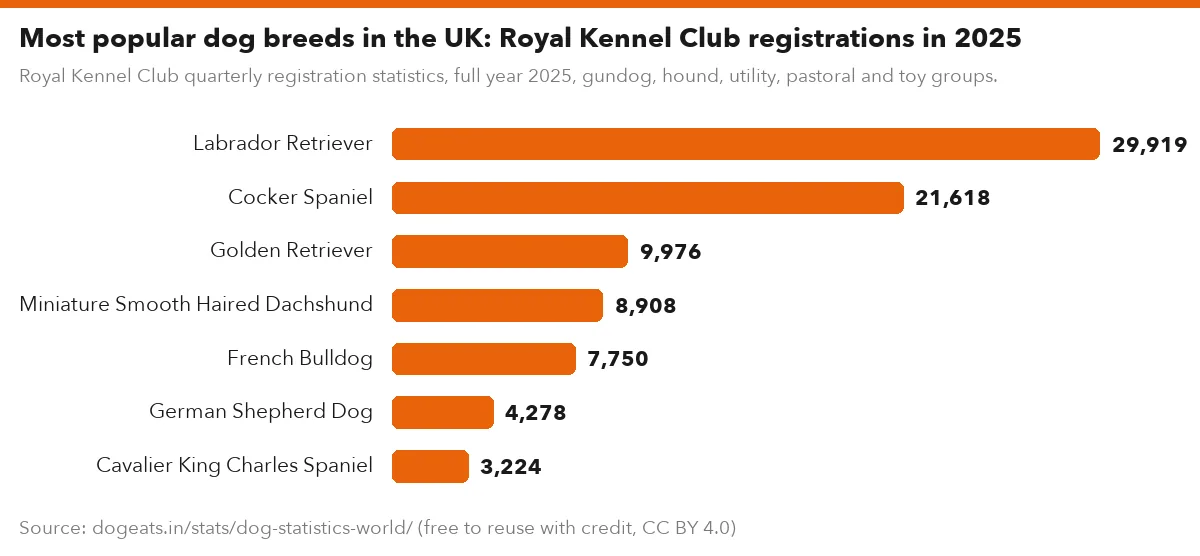
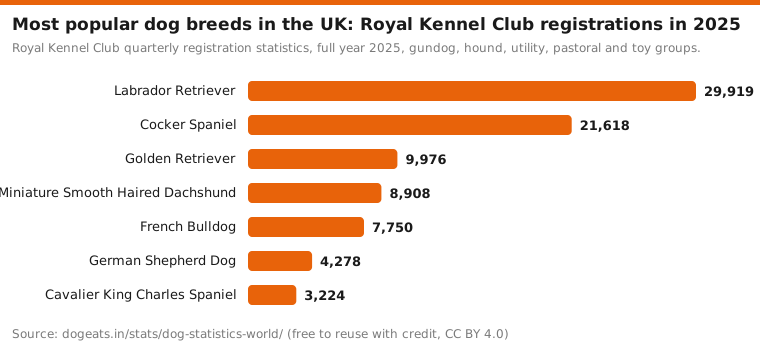
The French Bulldog has topped US registrations since 2022, while the Labrador Retriever still leads the UK by a wide margin. Kennel club data cover pedigree dogs only, so they show fashion among registered breeds rather than all dogs. India figures are in our Kennel Club of India registrations report.
- Nearly 400 modern domestic dog breeds exist, each with its own history and genetic profile (2017 study) (Parker et al., Genomic analyses of modern dog breed development, Cell Reports, 2017).
- 29,919 Labrador Retrievers were registered with the Royal Kennel Club in 2025, the most of any breed in the UK (Royal Kennel Club, Quarterly registration statistics, gundog group, 2025).
- 21,618 Cocker Spaniels were registered in the UK in 2025, second only to Labradors and ahead of 9,976 Golden Retrievers (Royal Kennel Club, Quarterly registration statistics, gundog group, 2025).
- 7,750 French Bulldogs were registered with the Royal Kennel Club in 2025 (Royal Kennel Club, Quarterly registration statistics, utility group, 2025).
- 4,278 German Shepherd Dogs were registered in the UK in 2025, the top pastoral breed (Royal Kennel Club, Quarterly registration statistics, pastoral group, 2025).
- 4th year in a row: the French Bulldog was the most registered breed in the US in 2025, and the Dachshund rose to fifth (AKC, 2025 breed rankings, March 2026).
- 200 breeds are recognised by the American Kennel Club, out of over 340 breeds known worldwide, its breed directory states (American Kennel Club, Dog breeds directory).
- 301,790 pedigree puppies were registered in Japan in 2025, the most of any reporting FCI member country (FCI, Statistics of the FCI members and partners, 2025).
- 256,837 puppies were registered in Russia and 196,958 in France in 2025, the next largest FCI registries (FCI, Statistics of the FCI members and partners, 2025).
- 5 breeds led US registrations in 2025: French Bulldog, Labrador Retriever, Golden Retriever, German Shepherd Dog and Dachshund (American Kennel Club, Most popular dog breeds of 2025).
- 15 Westminster Best in Show wins have gone to the Wire Fox Terrier, the most of any breed, 1907 to 2025 (Westminster Kennel Club, Best in Show records).
- 8,908 Miniature Smooth Haired Dachshunds were registered in the UK in 2025, out of 161,901 registrations in all (Royal Kennel Club, hound registrations, 2025).
- 3,224 Cavalier King Charles Spaniels were registered in the UK in 2025, the top toy breed (Royal Kennel Club, Quarterly registration statistics, toy group, 2025).
- 212,303 puppies were registered in France in 2015, against 196,958 in 2025 (FCI, Statistics of the FCI members and partners, 2015).
- 31 years at number one in the US ended for the Labrador when the French Bulldog overtook it in 2022 (AKC, 2022 breed rankings, March 2023).
Royal Kennel Club quarterly registration statistics, full year 2025, gundog, hound, utility, pastoral and toy groups.
Show the numbers
| Label | registrations |
|---|---|
| Labrador Retriever | 29,919 |
| Cocker Spaniel | 21,618 |
| Golden Retriever | 9,976 |
| Miniature Smooth Haired Dachshund | 8,908 |
| French Bulldog | 7,750 |
| German Shepherd Dog | 4,278 |
| Cavalier King Charles Spaniel | 3,224 |
Embed this chart
How long do dogs live? Dog lifespan statistics
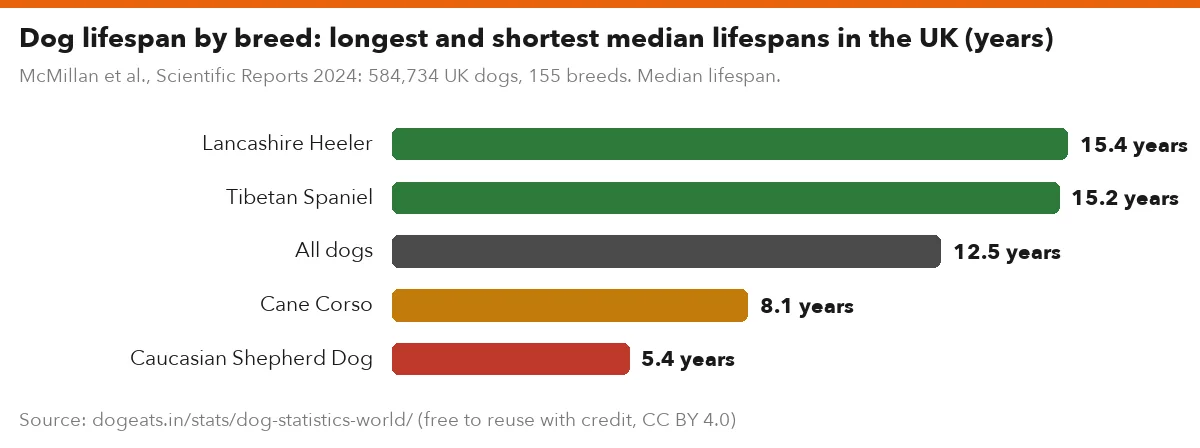
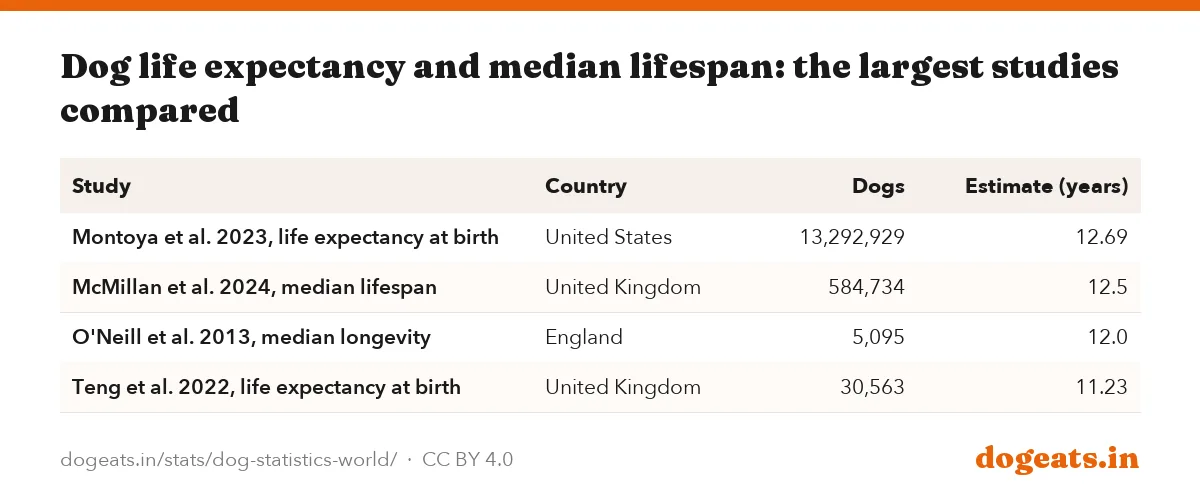
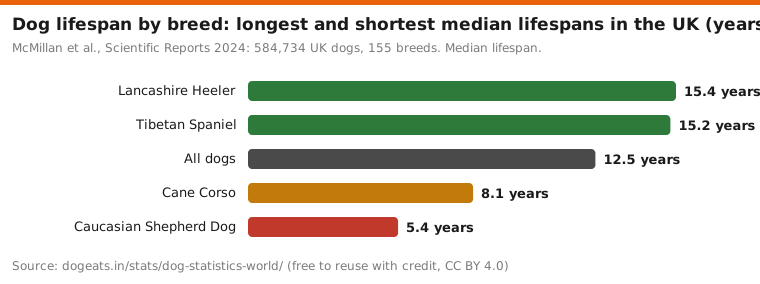
The typical dog lives about 11 to 13 years. The largest studies put the median at 12.5 years in the UK and life expectancy at 12.69 years in the US. Small breeds outlive giant and flat-faced breeds by several years, as our dog lifespan by breed chart shows for 155 breeds.
- 12.5 years is the median lifespan of UK companion dogs in a study of 584,734 dogs (McMillan et al., Longevity of companion dog breeds, Scientific Reports, 2024).
- 15.4 years is the median lifespan of the Lancashire Heeler, the longest of 155 breeds, ahead of the Tibetan Spaniel at 15.2 (McMillan et al., Scientific Reports, 2024, breed medians).
- 5.4 years is the median lifespan of the Caucasian Shepherd Dog, the shortest in the study; the Cane Corso reached 8.1 (McMillan et al., Scientific Reports, 2024, shortest-lived breeds).
- 11.23 years was the life expectancy at birth of 30,563 UK dogs that died in 2016 to 2020 (Teng et al., Dog life tables, Scientific Reports, 2022).
- 4.53 years was the life expectancy at birth of French Bulldogs, against 12.72 years for Jack Russell Terriers (Teng et al., Scientific Reports, 2022, breed life tables).
- 1.2 years longer: crossbreds outlived purebred dogs in a 2013 UK study, with an overall median of 12.0 years (O'Neill et al., Dog longevity in England, Veterinary Journal, 2013).
- 12.69 years was the life expectancy at birth of 13,292,929 US dogs, against 11.18 years for cats (Montoya et al., Frontiers in Veterinary Science, 2023).
- 16 ln(dog age) + 31 converts dog years into human years, by DNA methylation in 104 Labradors (Wang et al., Cell Systems, 2020).
- The last 25% of a dog's estimated lifespan is its senior stage, under the AAHA life stage guidelines, which depend on breed and size (AAHA, 2019 Canine Life Stage Guidelines).
McMillan et al., Scientific Reports 2024: 584,734 UK dogs, 155 breeds. Median lifespan.
Show the numbers
| Label | years |
|---|---|
| Lancashire Heeler | 15.4 years |
| Tibetan Spaniel | 15.2 years |
| All dogs | 12.5 years |
| Cane Corso | 8.1 years |
| Caucasian Shepherd Dog | 5.4 years |
Embed this chart
| Study | Country | Dogs | Estimate (years) |
|---|---|---|---|
| Montoya et al. 2023, life expectancy at birth | United States | 13,292,929 | 12.69 |
| McMillan et al. 2024, median lifespan | United Kingdom | 584,734 | 12.5 |
| O'Neill et al. 2013, median longevity | England | 5,095 | 12.0 |
| Teng et al. 2022, life expectancy at birth | United Kingdom | 30,563 | 11.23 |
Dog senses statistics: smell, hearing and vision
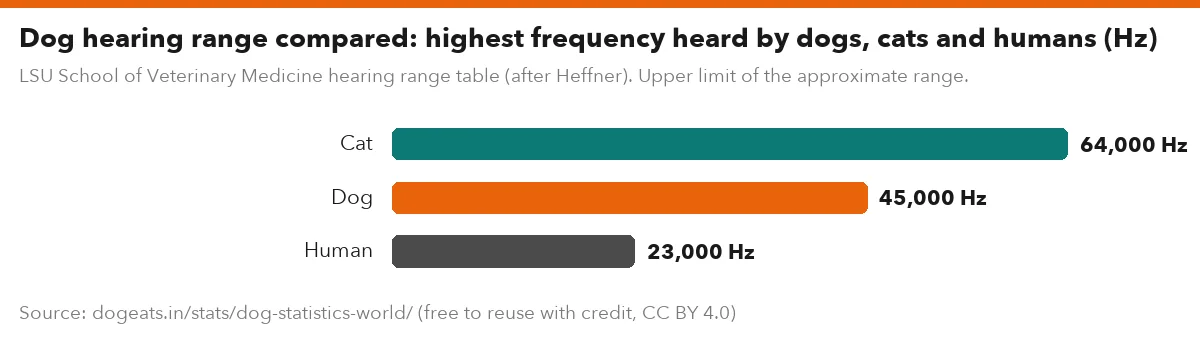
Dogs hear sounds up to about 45,000 Hz and carry roughly twice as many working smell receptor genes as people. Their eyesight is less sharp than ours and sees two main colours, as our dog senses statistics report explains.

- 67 to 45,000 Hz is the dog hearing range, against 64 to 23,000 Hz for humans and 45 to 64,000 Hz for cats (LSU Vet Med, Hearing ranges by species).
- 627 million cortical neurons were counted in a golden retriever, the most of any animal studied, against 250 million in a cat (Jardim-Messeder et al., Frontiers in Neuroanatomy, 2017).
- 811 working smell receptor genes were found in the dog genome, against 387 in humans (2007) (Niimura and Nei, Olfactory receptor genes, PLOS ONE, 2007).
- 1,094 odorant receptor genes were listed in a near-complete map of the dog repertoire (2005 study) (Quignon et al., The dog and rat olfactory receptor repertoires, Genome Biology, 2005).
- 1.5 parts per trillion was the lowest odour level trained dogs detected in a 2019 threshold test (Concha et al., Canine olfactory thresholds, Frontiers, 2019).
- 5.5 to 19.5 cycles per degree was dog visual acuity in bright light, against 32.1 to 44.2 for humans (Lind et al., Visual acuity in dogs, PLOS ONE, 2017).
- 2 cone types give dogs two-colour vision, with peaks near 429 nm and 555 nm (1989 study) (Neitz, Geist and Jacobs, Color vision in the dog, Visual Neuroscience, 1989).
- 70 dogs of 37 breeds preferred a north to south body alignment when relieving themselves in calm magnetic conditions (Hart et al., Frontiers in Zoology, 2013).
- 28.0% of 6,249 Dalmatians tested were deaf in one or both ears, the largest breed sample in the LSU table (LSU Vet Med, Deafness prevalence by breed).
LSU School of Veterinary Medicine hearing range table (after Heffner). Upper limit of the approximate range.
Show the numbers
| Label | Hz |
|---|---|
| Cat | 64,000 Hz |
| Dog | 45,000 Hz |
| Human | 23,000 Hz |
Embed this chart
Dog body facts: temperature, heart rate, teeth, pregnancy and litter size
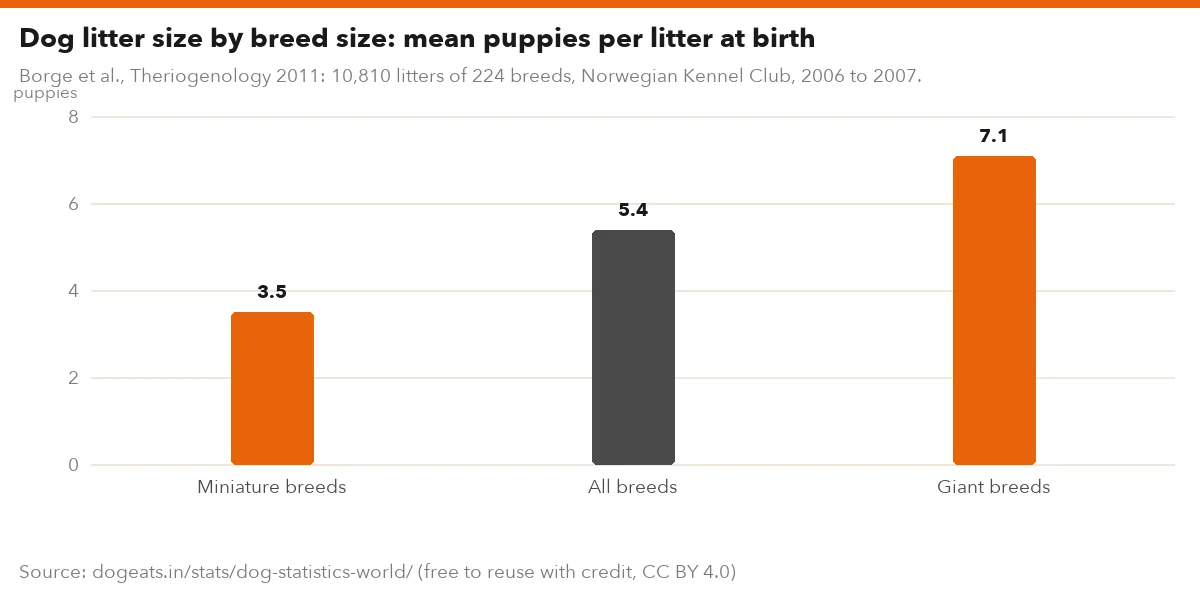
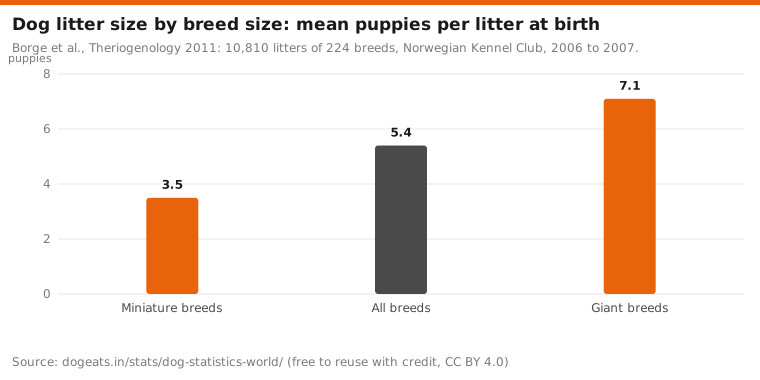
A healthy dog has a temperature of 37.5 to 39.2 C, a resting heart rate of 70 to 120 beats a minute and 42 adult teeth. Pregnancy lasts about 62 to 64 days, and litter size rises with breed size, as our litter size by breed report details.
- 37.5 to 39.2 C (99.5 to 102.5 F) is the normal rectal temperature range for dogs (Merck Veterinary Manual, Normal rectal temperature ranges).
- 70 to 120 beats a minute is the resting heart rate of dogs, against 120 to 140 for cats (Merck Veterinary Manual, Resting heart rates).
- 18 to 34 breaths a minute is the resting breathing rate of dogs (Merck Veterinary Manual, Resting respiratory rates).
- 42 permanent teeth replace 28 puppy teeth in most dogs (Merck Veterinary Manual, Dental development of dogs).
- 62 to 64 days is the usual length of a dog pregnancy (Merck Veterinary Manual, Management of reproduction in dogs).
- 5.4 puppies is the mean litter size across 224 breeds, from 3.5 in miniature to 7.1 in giant breeds (Borge et al., Theriogenology, 2011).
- Over 80% of Boston terrier, bulldog and French bulldog litters were born by caesarean (2010 study) (Evans and Adams, Journal of Small Animal Practice, 2010).
- 2005 was the year a high-quality draft genome of the domestic dog, sequenced from a female boxer, was published (Lindblad-Toh et al., Genome sequence of the domestic dog, Nature, 2005).
- 1.118 m (44 in) was the height of Zeus, a Great Dane and the tallest dog ever recorded (2011) (Guinness World Records, Tallest dog ever (male)).
- 9.14 cm (3.59 in) is the height of Pearl, a Chihuahua and the shortest living dog, measured in 2022 (Guinness World Records, Shortest dog living).
Borge et al., Theriogenology 2011: 10,810 litters of 224 breeds, Norwegian Kennel Club, 2006 to 2007.
Show the numbers
| Label | puppies |
|---|---|
| Miniature breeds | 3.5 |
| All breeds | 5.4 |
| Giant breeds | 7.1 |
Embed this chart
Dog intelligence and behaviour statistics
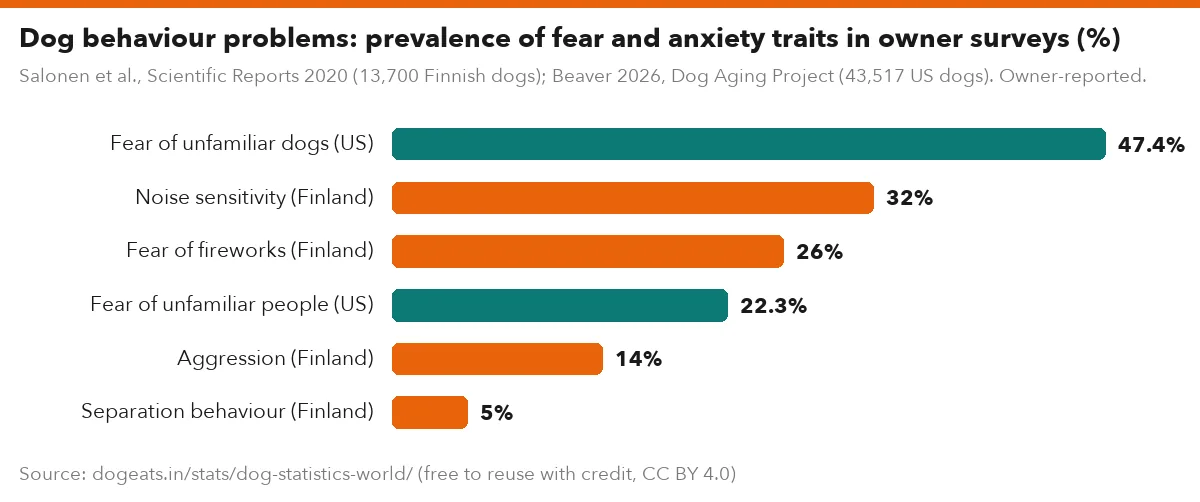
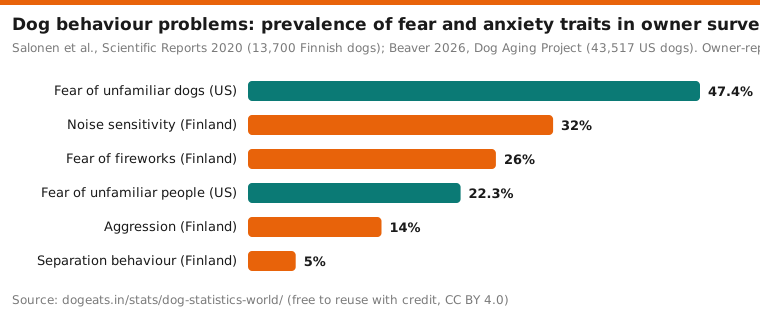
The average dog learns about 165 words and signals, and exceptional dogs have learned more than 1,000 object names. Noise sensitivity was the most common anxiety trait in a survey of 13,700 Finnish dogs. Breed rankings are compared in our smartest dog breeds report.
- Over 200 object names were known by Rico, a border collie, who learned new words by exclusion (Kaminski et al., Word learning in a dog, Science, 2004).
- 1,022 object names were learned by Chaser, a border collie, over three years of training (2011 study) (Pilley and Reid, Border collie comprehends object names, Behavioural Processes, 2011).
- 165 words, including signals, can be learned by the average dog, Stanley Coren said in 2009 (American Psychological Association via ScienceDaily, 2009).
- 2 to 2.5 years: the mental abilities of dogs are close to those of a human child of that age, by Coren's 2009 review (American Psychological Association via ScienceDaily, 2009).
- 9% of the variation in a dog's behaviour is explained by breed, a study of 18,385 dogs and 2,155 genomes found (Morrill et al., Ancestry-inclusive dog genomics, Science, 2022).
- 74 breeds and over 7,000 dogs were tested: larger-brained breeds scored better on short-term memory and self-control (Horschler et al., Animal Cognition, 2019).
- 32% of 13,700 Finnish pet dogs showed noise sensitivity, the most common anxiety trait (2020 study) (Salonen et al., Prevalence of canine anxieties, Scientific Reports, 2020).
- 26% of the Finnish dogs were afraid of fireworks, while aggression (14%) and separation behaviour (5%) were least common (Salonen et al., Scientific Reports, 2020, trait prevalences).
- 47.4% of 43,517 US dogs showed fear or anxiety toward unfamiliar dogs, and 22.3% toward unfamiliar people, by owner reports (Beaver, Veterinary Research Communications, 2026, Dog Aging Project data).
Salonen et al., Scientific Reports 2020 (13,700 Finnish dogs); Beaver 2026, Dog Aging Project (43,517 US dogs). Owner-reported.
Show the numbers
| Label | % |
|---|---|
| Fear of unfamiliar dogs (US) | 47.4% |
| Noise sensitivity (Finland) | 32% |
| Fear of fireworks (Finland) | 26% |
| Fear of unfamiliar people (US) | 22.3% |
| Aggression (Finland) | 14% |
| Separation behaviour (Finland) | 5% |
Embed this chart
Dog bite and rabies statistics worldwide
Dogs cause up to 99% of human rabies cases, which kill tens of thousands of people a year, mostly in Asia and Africa. Dog bites run into tens of millions a year worldwide. US surveillance data are in our rabies statistics report.
- 99% of human rabies cases are caused by dog bites and scratches (WHO, Rabies fact sheet).
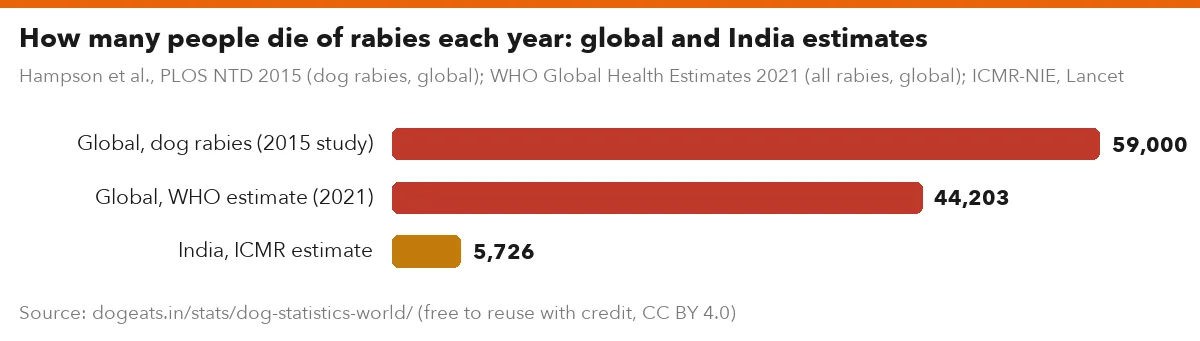
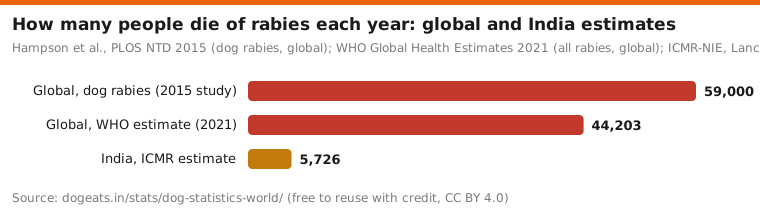
- 44,203 rabies deaths a year is the 2021 Global Health Estimates figure, and 40% of rabies deaths are children under 15 (WHO, Rabies fact sheet, 2021 Global Health Estimates).
- 59,000 human deaths a year and USD 8.6 billion in losses come from dog rabies, a 2015 study estimated (Hampson et al., Global burden of canine rabies, PLOS NTD, 2015).
- 98% fewer dog-transmitted human rabies cases in the Americas: from about 300 in 1983 to 11 in 2025 and 2026 (to July) (PAHO, Rabies topic page).
- Over 95% of rabies deaths occur in Africa and Asia (WOAH, World Organisation for Animal Health, Rabies disease page).
- 4.5 million people are bitten by dogs in the United States every year, WHO estimates (WHO, Animal bites fact sheet).
- 76 to 94% of animal bite injuries in low- and middle-income countries are caused by dogs, by WHO-cited studies (WHO, Animal bites fact sheet, low- and middle-income countries).
- 58.7% of Colombia's dogs were vaccinated against rabies in 2024, below the 70% WOAH benchmark (Ministry of Health Colombia, rabies vaccination coverage 2024).
- 70% or more of dogs in at-risk areas need vaccinating, WOAH says, to cut human rabies cases to zero (WOAH, World Organisation for Animal Health, Rabies disease page).
- 5,726 human rabies deaths a year occur in India by an ICMR estimate from a national survey (Thangaraj et al. (ICMR), Burden of rabies in India, Lancet Infectious Diseases, 2025).
- 24 rabid dogs were found among 24,727 dogs tested in the US in 2024 (Keshavamurthy et al., US rabies surveillance 2024, JAVMA, 2026).
- 28,450 dog bite and injury claims were paid by US home insurers in 2025, worth USD 1.86 billion (Triple-I, Dog-related injury claims on the rise in 2025, April 2026).
- 2030 is the target year to end human deaths from dog-transmitted rabies under the WHO-led Zero by 30 plan (WHO, FAO, WOAH and GARC, Zero by 30 global strategic plan).
- 37,15,713 dog bite cases, about 3.7 million, were reported in India in 2024 under national disease surveillance, up from 21,89,909 in 2022 (DAHD, Lok Sabha unstarred question 4870, April 2025).
- More than 5,200 dog attacks on US Postal Service employees were reported in 2025 (USPS Link, Dog attacks in 2025, June 2026).
Hampson et al., PLOS NTD 2015 (dog rabies, global); WHO Global Health Estimates 2021 (all rabies, global); ICMR-NIE, Lancet Infectious Diseases 2025 (India).
Show the numbers
| Label | deaths |
|---|---|
| Global, dog rabies (2015 study) | 59,000 |
| Global, WHO estimate (2021) | 44,203 |
| India, ICMR estimate | 5,726 |
Embed this chart
Dogs vs cats statistics: which pet is more popular?
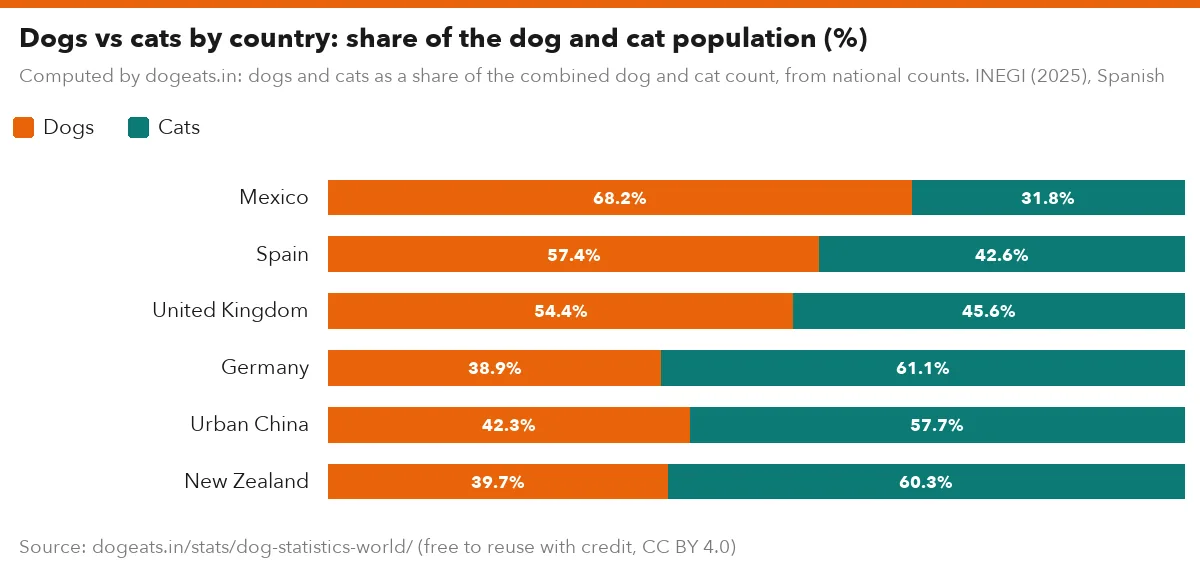
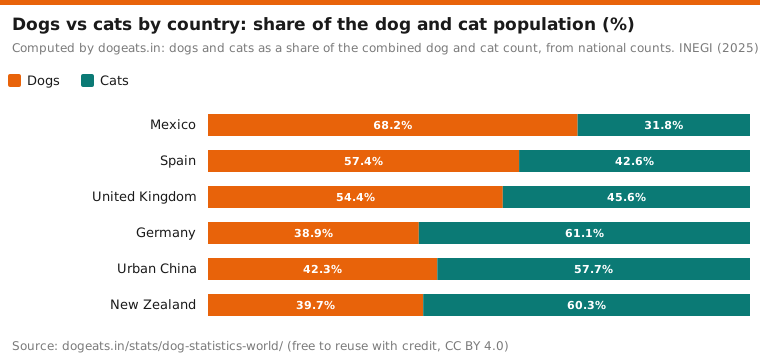
Dogs outnumber cats in Mexico, Spain and the UK (by UK Pet Food; PDSA finds more cats), while cats lead in Germany, urban China and New Zealand. UK studies find cats live about two years longer, while a large US dataset finds the reverse. Brains, lifespans and India data are compared in our dogs vs cats statistics report.
- 13 million pet cats live in the UK, against 15.5 million dogs (UK Pet Food, UK Pet Population 2026).
- 429 million cortical neurons were counted in a smaller dog, still above the cat's 250 million (Jardim-Messeder et al., Frontiers in Neuroanatomy, 2017).
- 2 vet visits a year is the average for a Canadian dog, against 1 for a cat (Canadian Animal Health Institute, Canadian Pet Population Survey release, 2025).
- 63% was the adoption rate for cats in US shelters in 2025, against 57% for dogs, as adoptions per intake (Shelter Animals Count, 2025 Annual Data Report, adoption rates).
- 1.26 million cats live in New Zealand, against 830,000 dogs, and 40% of homes have a cat (Companion Animals New Zealand, 2024 NZ Pet Data Report release).
- 66,000 emergency department visits a year in the US follow cat bites, while 4.5 million people are bitten by dogs (WHO, Animal bites fact sheet, cat bites).
- 14.0 years was the median longevity of 4,009 UK cats in vet records, in a study published in 2015 (O'Neill et al., Cat longevity in England, JFMS, 2015).
- 72.89 million pet cats lived in urban China in 2025, outnumbering the 53.43 million pet dogs (Guangming Online on the China Pet Industry White Paper, January 2026).
- 15.7 million cats live in Germany, against 10.0 million dogs (2025) (IVH and ZZF, Der deutsche Heimtiermarkt 2025).
- 5,619,967 cats were on Spain's regional pet registers in 2025, 37% of registered companion animals, against 7,562,893 dogs (Government of Spain, Ministry of Social Rights, pet registry study, June 2026).
- USD 1,030 in first-time costs for a dog, against USD 455 for a cat, by the ASPCA's 2021 estimate (ASPCA, Cutting pet care costs, 2021 update, initial costs).
- 19.2 million cats live in Mexican homes, less than half the 41.2 million dogs (2025) (INEGI, ENBIARE 2025 results report).
Computed by dogeats.in: dogs and cats as a share of the combined dog and cat count, from national counts. INEGI (2025), Spanish registers (2025), UK Pet Food (2026), IVH and ZZF (2025), China Pet Industry White Paper as reported by Guangming Online (2025), CANZ (2024).
Show the numbers
| Label | Dogs | Cats |
|---|---|---|
| Mexico | 68.2 | 31.8 |
| Spain | 57.4 | 42.6 |
| United Kingdom | 54.4 | 45.6 |
| Germany | 38.9 | 61.1 |
| Urban China | 42.3 | 57.7 |
| New Zealand | 39.7 | 60.3 |
Embed this chart
How much does a dog cost? Pet spending statistics
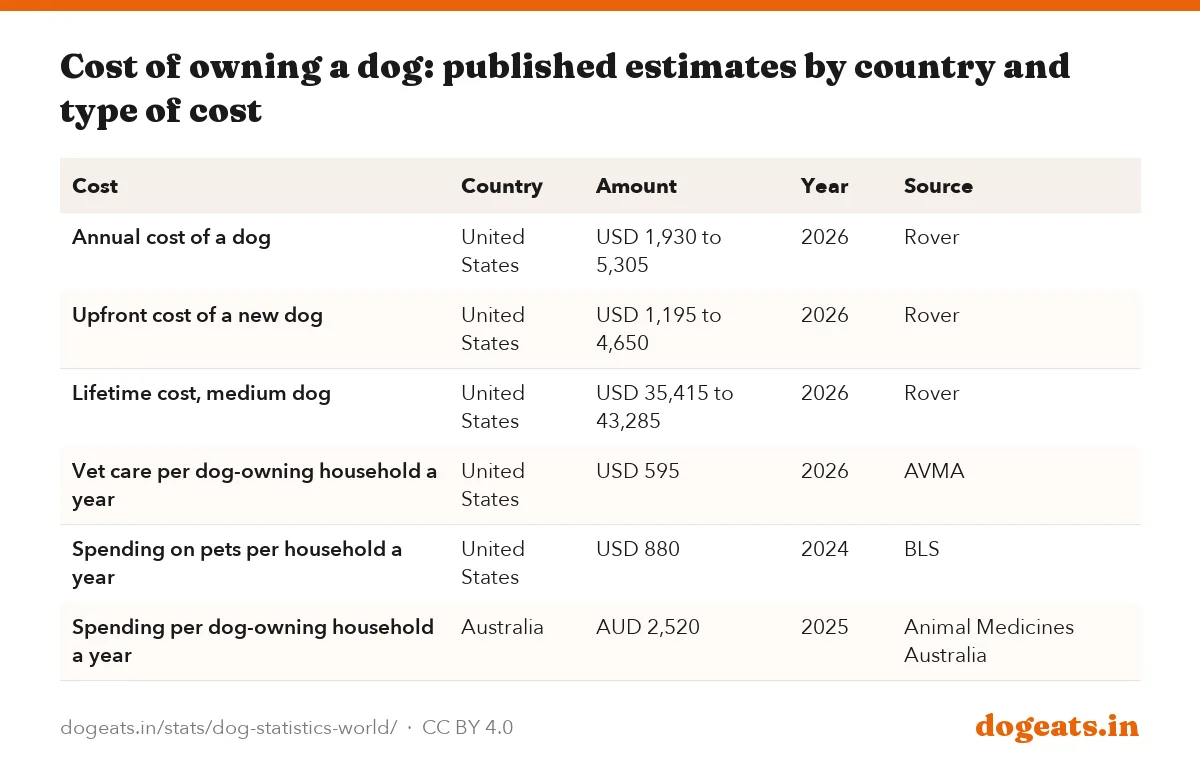
A dog costs about USD 1,930 to 5,305 a year in the US in 2026, and Australian dog households spend about AUD 2,520. Americans spent USD 158 billion on pets in 2025. Indian costs by dog size are in our cost of owning a dog report.
- USD 158 billion was spent on US pets in 2025, up 3.7%, with USD 165 billion projected for 2026 (APPA release, March 2026).
- 51% of UK pet owners are worried about being able to afford vet care for their pet (PDSA, PAW Mini Report 2025).
- USD 1,930 to 5,305 a year is what caring for a dog costs in the US in 2026, by Rover's company estimate (Rover, The cost of dog parenthood in 2026).
- USD 1,195 to 4,650 is the upfront cost of a new dog in the US in 2026, 4.9% more than in 2025, Rover estimates (Rover, Cost of dog parenthood, 2026).
- 7.6 million pets were insured in North America at the end of 2025, up 8.5% on 2024 (NAPHIA, State of the Industry report 2026).
- 160.6 billion yuan was spent on pet dogs in urban China in 2025, up 3.2% on 2024 (Guangming Online on the China Pet Industry White Paper, January 2026).
- USD 595 a year is what a US dog-owning household spends on vet care on average, against USD 426 for cats (AVMA, US pet ownership statistics, 2026).
- AUD 2,520 a year is spent by the average dog-owning household in Australia, the most of any pet owners (Animal Medicines Australia, Pets in Australia 2025).
- USD 35,415 to 43,285 is the lifetime cost of a medium-sized dog in the US, by Rover's 2026 estimate (Rover, The cost of dog parenthood in 2026, lifetime costs).
- USD 880 was spent on pets by the average US household in 2024, up from USD 507 in 2014 (US Bureau of Labor Statistics, Consumer Expenditure Survey, pets series).
- USD 12.6 billion in net sales was reported by the online pet retailer Chewy for fiscal 2025, up 6.2% (Chewy, Annual report on Form 10-K for fiscal 2025, SEC filing).
- 5.99% of US dogs were insured in 2025, against 2.29% of cats (NAPHIA, State of the Industry 2026 highlights).
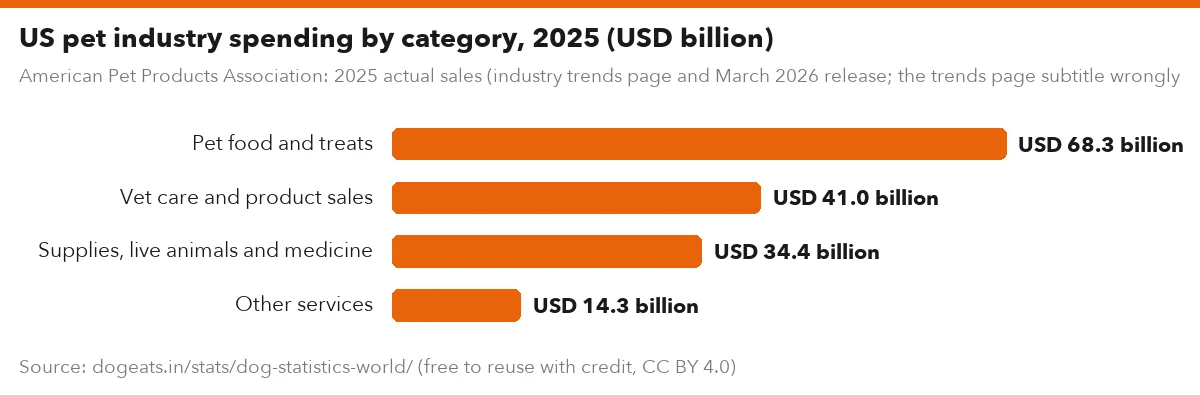
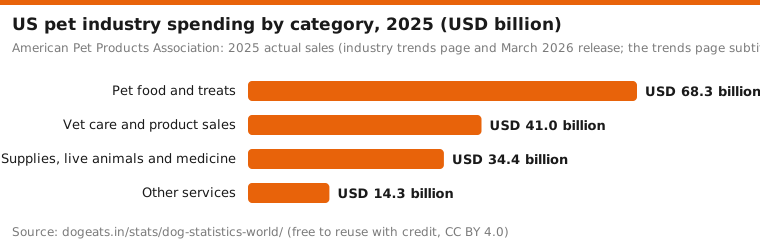
- USD 68.3 billion went on US pet food and treats in 2025, and USD 41.0 billion on vet care (APPA, Industry trends and stats, 2025 sales).
- 67% of household dogs and cats are insured in Sweden and about 28% in the UK, Trupanion's annual report notes (Trupanion, Annual report on Form 10-K for 2025, SEC filing).
- 1,096,173 pets were enrolled in Trupanion's subscription insurance business at the end of 2025, up from 31,200 at the start of 2010 (Trupanion, Form 10-K for 2025, SEC filing).
American Pet Products Association: 2025 actual sales (industry trends page and March 2026 release; the trends page subtitle wrongly says 2024). All pets, not only dogs.
Show the numbers
| Label | USD billion |
|---|---|
| Pet food and treats | USD 68.3 billion |
| Vet care and product sales | USD 41.0 billion |
| Supplies, live animals and medicine | USD 34.4 billion |
| Other services | USD 14.3 billion |
Embed this chart
| Cost | Country | Amount | Year | Source |
|---|---|---|---|---|
| Annual cost of a dog | United States | USD 1,930 to 5,305 | 2026 | Rover |
| Upfront cost of a new dog | United States | USD 1,195 to 4,650 | 2026 | Rover |
| Lifetime cost, medium dog | United States | USD 35,415 to 43,285 | 2026 | Rover |
| Vet care per dog-owning household a year | United States | USD 595 | 2026 | AVMA |
| Spending on pets per household a year | United States | USD 880 | 2024 | BLS |
| Spending per dog-owning household a year | Australia | AUD 2,520 | 2025 | Animal Medicines Australia |
Working dogs statistics: guide, detection, military and sled dogs
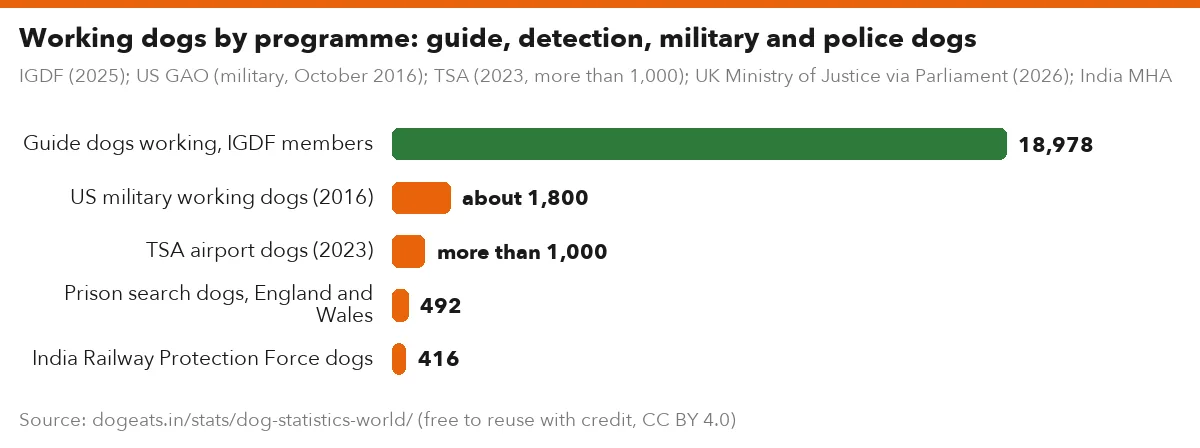
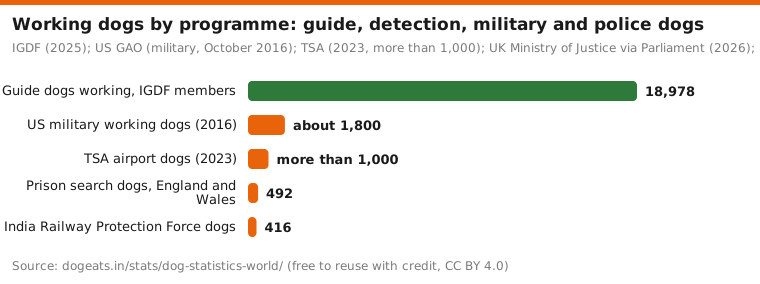
Close to 19,000 guide dogs were working at IGDF member schools at the end of 2025, and governments employ thousands more dogs for detection and security. Scent dogs have also been tested on medical screening with high hit rates.

- 94% was the average hit rate of 8 scent dogs screening 1,012 samples for COVID-19 (2020) (Jendrny et al., BMC Infectious Diseases, 2020).
- 18,978 guide dogs were working across 100 IGDF member schools in 34 countries at the end of 2025 (IGDF, Facts and figures, 2025).
- 2,600 new guide dogs were trained by IGDF members during 2025 (International Guide Dog Federation, Facts and figures, 2025).
- More than 1,000 dogs protect US airports for the Transportation Security Administration, which trains about 300 detection dogs a year (2023) (TSA, 2024 canine calendar press release, November 2023).
- About 1,800 military working dogs were in service with the US Department of Defense in October 2016 (US GAO, Medical care for end-of-service military working dogs, GAO-17-358, 2017).
- 416 trained dogs serve India's Railway Protection Force across the railway zones (Ministry of Home Affairs India, National Police K9 Journal, February 2025).
- 492 licensed search dogs work in prisons in England and Wales to find drugs and phones (UK Parliament, written answer HL16629, Ministry of Justice, April 2026).
- 16 dogs is the most a musher may start the Iditarod sled dog race with, and at least 12 are required (Iditarod Trail Committee, Race Rules 2027, Rule 17).
- 1929 is when The Seeing Eye was founded in the US, the world's oldest existing guide dog school (The Seeing Eye, About us).
IGDF (2025); US GAO (military, October 2016); TSA (2023, more than 1,000); UK Ministry of Justice via Parliament (2026); India MHA K9 Journal (RPF, 2025).
Show the numbers
| Label | dogs |
|---|---|
| Guide dogs working, IGDF members | 18,978 |
| US military working dogs (2016) | about 1,800 |
| TSA airport dogs (2023) | more than 1,000 |
| Prison search dogs, England and Wales | 492 |
| India Railway Protection Force dogs | 416 |
Embed this chart
Dog shelter and stray dog statistics
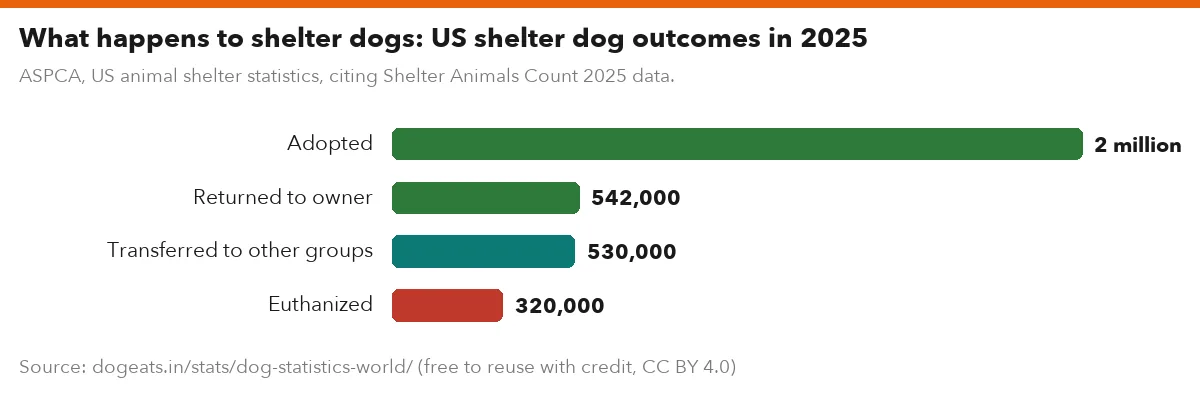
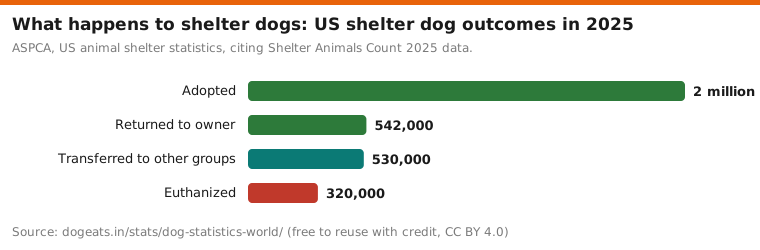
About 2.8 million dogs entered US shelters and rescues in 2025, and most left alive. Australia's RSPCA and Japan's environment ministry publish smaller national counts. Street dog numbers for India are in our street dog population report.
- 2.8 million dogs entered US shelters and rescues in 2025, out of 5.8 million dogs and cats (Shelter Animals Count, 2025 Annual Data Report).
- 57% was the US shelter dog adoption rate in 2025, adoptions as a share of intakes, up from 55% in 2024 (Shelter Animals Count, 2025 Annual Data Report).
- 2 million US shelter dogs were adopted in 2025, 542,000 went back to owners and 320,000 were euthanized (ASPCA, US animal shelter statistics, 2025).
- 17,399 dogs were taken in by Japanese local authorities in the year to March 2025, and 8,797 were rehomed (Ministry of the Environment Japan, dog and cat intake statistics, FY2024).
- 1,964 dogs were counted as killed in Japanese public custody in FY2024, a total that includes 393 dogs that died after intake (Japan Ministry of the Environment, FY2024 statistics).
- 15,852 dogs were taken in by RSPCA shelters across Australia in 2024 to 2025 (RSPCA Australia, National Statistics 2024-2025).
- 6,839 RSPCA dogs in Australia were rehomed and 3,203 reclaimed by owners in 2024 to 2025, while 2,768 were euthanased (RSPCA Australia, National Statistics 2024-2025, Table 1).
- 396,000 dogs and cats were killed in US shelters in 2025, down from around 1 million in 2016 (Best Friends Animal Society, Animal shelter statistics, 2025 data).
- More than 2 in 3 US shelters reached no-kill status (a 90% save rate) in 2025 (Best Friends Animal Society, Animal shelter statistics).
- 9% was the euthanasia rate for US shelter dogs in 2024, up from 7% in 2019, while cats fell from 13% to 8% (Shelter Animals Count, 2024 Year-End Report).
- 79.87% of dogs received by the RSPCA in Australia left alive in 2024 to 2025, the live release rate, down 1.37 points (RSPCA Australia, Report on Animal Outcomes 2024-2025).
- 457 MEPs backed the first EU-wide welfare and traceability rules for dogs and cats in June 2025, with 17 against (European Parliament, Legislative Observatory).
- 2026/1818 is the number of the final EU regulation on dog and cat welfare and traceability, which Parliament approved on 28 April 2026 (European Parliament, Texts adopted P10_TA(2026)0115).
ASPCA, US animal shelter statistics, citing Shelter Animals Count 2025 data.
Show the numbers
| Label | dogs |
|---|---|
| Adopted | 2 million |
| Returned to owner | 542,000 |
| Transferred to other groups | 530,000 |
| Euthanized | 320,000 |
Embed this chart
Frequently asked questions
How many dogs are there in the world?
More than 700 million, by the most cited scientific estimate from 2013. No global census exists, and HealthforAnimals puts all pets worldwide at over a billion.
Which country has the most dogs?
The US has the largest counted dog population, about 88.9 million in 2026. Brazil follows with about 63.7 million, then urban China with 53.43 million and Mexico with 41.2 million.
What percentage of households own a dog?
In the US, 43.7% of households own a dog by the AVMA survey and 53% by the APPA survey. The figure is 49% in Australia, 41% in the UK and 31% across Europe.
How long do dogs live on average?
The median dog lifespan is 12.5 years in a UK study of 584,734 dogs, and US life expectancy at birth is 12.69 years. Small breeds such as the Lancashire Heeler live past 15, while UK giant breed dogs died at a median age of 8.94 years.
What is the most popular dog breed in the world?
It depends on the country. The French Bulldog has been the top US breed for four years running, while the Labrador Retriever leads the UK with 29,919 registrations in 2025.
How many people die from rabies each year?
WHO puts the toll at 44,203 deaths a year (2021 estimate), and a 2015 study estimated 59,000 deaths from dog rabies. Dogs cause up to 99% of human cases.
How much does it cost to own a dog per year?
In the US a dog costs about USD 1,930 to 5,305 a year in 2026, by Rover estimates. Australian dog-owning households spend about AUD 2,520 a year.
Are there more dogs or cats in the world?
It varies by country. Europe has about 111 million cats and 91 million dogs (FEDIAF, 2024), while the US and Mexico have more dogs than cats.
Methodology and limitations
Every figure on this page comes from a page or document we opened while compiling the hub on 16 and 17 October 2026. Each bullet links its source and states the year of the data. Figures older than three years carry the year in the bullet.
We used primary sources first: WHO, PAHO and WOAH, government ministries, kennel clubs, peer-reviewed papers, industry associations that run their own surveys, and SEC company filings. Press reports appear only where the original is not public, and are labelled with the outlet.
Some servers blocked automated requests or did not respond from our location. For those pages we confirmed the text in a browser or in the Internet Archive copy of the same document, and we cite the original URL.
We rejected any figure we could not find on the page, any page behind a login, and any number traced only to a blog or roundup. Survey estimates are labelled with the publisher. A research log with a proof quote for each figure is kept for audit.
Charts use the numbers in their section. The dogs vs cats shares are computed by dogeats.in from national counts in millions. We update this page monthly.
An independent fact-check on 17 October 2026 re-opened every cited URL and confirmed each figure, year and unit. It swapped in newer primary releases (PDSA 2026, APPA 2025 sales, India 2024 bites, EU regulation 2026/1818). It also recomputed the dogs vs cats shares from exact counts.
Sources
- World Health Organization, Rabies fact sheet, % of human rabies cases (2026)
- American Veterinary Medical Association, US pet ownership statistics (2026 Sourcebook), million dogs (2026)
- FEDIAF, Annual Report 2026 (Facts and Figures), dogs (2024)
- Also consulted: Bergstrom et al. (Science), Origins and genetic legacy of prehistoric dogs, Parker et al. (Cell Reports), Genomic analyses reveal the influence of geographic origin, migration, and hybridization on modern dog breed development, UK Pet Food, UK Pet Population 2026, PDSA, PAW Mini Report 2025, Royal Kennel Club, Quarterly registration statistics: gundog group, Royal Kennel Club, Quarterly registration statistics: utility group, Royal Kennel Club, Quarterly registration statistics: pastoral group, American Kennel Club, French Bulldog remains most popular for the fourth year, American Kennel Club, Dog breeds directory, FCI, Statistics of the FCI members and partners 2025, McMillan et al. (Scientific Reports), Longevity of companion dog breeds, Teng et al. (Scientific Reports), Life tables of annual life expectancy and mortality for companion dogs in the UK, O'Neill et al. (Veterinary Journal), Longevity and mortality of owned dogs in England, LSU School of Veterinary Medicine (Heffner), How well do dogs and other animals hear?, Jardim-Messeder et al. (Frontiers in Neuroanatomy), Dogs Have the Most Neurons, Though Not the Largest Brain, Kaminski et al. (Science), Word learning in a domestic dog: evidence for fast mapping, Hampson et al. (PLOS Neglected Tropical Diseases), Estimating the global burden of endemic canine rabies, Pan American Health Organization, Rabies, WOAH, Rabies, Shelter Animals Count, 2025 Annual Data Report, ASPCA, US Animal Shelter Statistics, American Pet Products Association, Industry trends and stats, INEGI, ENBIARE 2025 results report, Abinpet (Euromonitor) via Camara dos Deputados, Abinpet presentation, Chamber of Deputies, Guangming Online (China Pet Industry White Paper), China Pet Industry White Paper 2026 data, Canadian Animal Health Institute, Canadian Pet Population Survey Highlights the Importance of Access to Veterinary Care, Ministry of Social Rights, Consumption and Agenda 2030 (Spain), Government study: more than 15 million companion animals, DailyVet (KB Financial Group), KB Korea Pet Report 2025 coverage, IVH and ZZF, Der deutsche Heimtiermarkt 2025, Pilley and Reid (Behavioural Processes), Border collie comprehends object names as verbal referents, American Psychological Association (Coren), Dogs' intelligence on par with two-year-old human, Morrill et al. (Science), Ancestry-inclusive dog genomics challenges popular breed stereotypes, Horschler et al. (Animal Cognition), Absolute brain size predicts dog breed differences in executive function, Salonen et al. (Scientific Reports), Prevalence, comorbidity, and breed differences in canine anxiety in 13,700 Finnish pet dogs, Beaver (Veterinary Research Communications), Owner-reported prevalence and severity of fear and anxiety in dogs, Niimura and Nei (PLOS ONE), Extensive gains and losses of olfactory receptor genes in mammalian evolution, Quignon et al. (Genome Biology), The dog and rat olfactory receptor repertoires, Concha et al. (Frontiers in Veterinary Science), Canine olfactory thresholds to amyl acetate in a biomedical detection scenario, Lind et al. (PLOS ONE), High visual acuity revealed in dogs, Neitz et al. (Visual Neuroscience), Color vision in the dog, Hart et al. (Frontiers in Zoology), Dogs are sensitive to small variations of the Earth's magnetic field, Jendrny et al. (BMC Infectious Diseases), Scent dog identification of samples from COVID-19 patients, Merck Veterinary Manual, Normal Rectal Temperature Ranges, Merck Veterinary Manual, Resting Heart Rates, Merck Veterinary Manual, Resting Respiratory Rates, Merck Veterinary Manual, Dental Development of Dogs, Merck Veterinary Manual, Management of Reproduction in Dogs, Borge et al. (Theriogenology), Litter size at birth in purebred dogs: a retrospective study of 224 breeds, Evans and Adams (JSAP), Proportion of litters of purebred dogs born by caesarean section, Lindblad-Toh et al. (Nature), Genome sequence, comparative analysis and haplotype structure of the domestic dog, World Health Organization, Animal bites fact sheet, Ministry of the Environment, Japan, Statistics on the intake and disposal of dogs and cats, RSPCA Australia, RSPCA National Statistics 2024-2025, International Guide Dog Federation, Facts and figures, Transportation Security Administration, TSA releases its 2024 canine calendar, US Government Accountability Office, GAO-17-358 highlights, Rover, The Cost of Dog Parenthood in 2026, North American Pet Health Insurance Association, State of the Industry 2026, Hughes and Macdonald (Biological Conservation), A review of the interactions between free-roaming domestic dogs and wildlife, HealthforAnimals, Global State of Pet Care, Animal Medicines Australia, Pets in Australia 2025, Companion Animals New Zealand, 2024 NZ Pet Data Report, Ministerio de Salud y Proteccion Social (Colombia), Coberturas de vacunacion antirrabica en perros y gatos 2024, ICMR-NIE (Lancet Infectious Diseases), Estimating the burden of rabies in India, Montoya et al. (Frontiers in Veterinary Science), Life expectancy tables for dogs and cats derived from clinical data, Wang et al. (Cell Systems), Quantitative Translation of Dog-to-Human Aging by Conserved Remodeling of the DNA Methylome, O'Neill et al. (Journal of Feline Medicine and Surgery), Longevity and mortality of cats attending primary care veterinary practices in England, ASPCA, Cutting Pet Care Costs, Best Friends Animal Society, Animal shelter statistics, Ministry of Home Affairs, India, National Police K9 Journal, Vol V Issue II, UK Parliament (Ministry of Justice), Written question HL16629: Prisons: Dogs, Iditarod Trail Committee, Iditarod Race Rules 2027, Guinness World Records, Tallest dog ever (male), Guinness World Records, Shortest dog living, American Kennel Club, Most Popular Dog Breeds of 2025, Westminster Kennel Club, Best in Show records by breed, Royal Kennel Club, Quarterly registration statistics: hound group, UK Pet Food, Paw-some new pet population data released by UK Pet Food, Shelter Animals Count, 2024 Year-End Report, American Animal Hospital Association, 2019 AAHA Canine Life Stage Guidelines, US Bureau of Labor Statistics, Consumer Expenditure Survey: Pets (CXUPETSLB0101M), Chewy Inc (SEC filing), Form 10-K, fiscal year ended 1 February 2026, North American Pet Health Insurance Association, State of the Industry 2026 highlights, American Pet Products Association, America's Dog Owners Are Becoming Smarter Spenders, JAVMA (CDC rabies surveillance), Rabies surveillance in the United States during 2024, Insurance Information Institute (Triple-I), Dog-related injury claims on the rise in 2025, World Health Organization, Zero by 30: the global strategic plan, The Seeing Eye, About us, American Veterinary Medical Association, Chart of the month: Pet population trends and what they mean, Royal Kennel Club, Quarterly registration statistics: toy group, FCI, Statistics of the FCI members and partners 2015, LSU School of Veterinary Medicine, Dog breeds with reported congenital deafness, LSU School of Veterinary Medicine, Breed-Specific Deafness Prevalence In Dogs, European Commission, Commission proposes new rules to improve animal welfare, Department of Animal Husbandry and Dairying, Lok Sabha unstarred question 4870 (IDSP dog bites 2022 to 2025), United States Postal Service, USPS reports more than 5,200 dog attacks in 2025, Trupanion Inc (SEC filing), Form 10-K for the year ended 31 December 2025, RSPCA Australia, Report on Animal Outcomes 2024-2025, American Kennel Club, French Bulldog knocks Labrador Retriever out of number one spot, European Parliament Legislative Observatory, Welfare of dogs and cats and their traceability, 2023/0447(COD), PDSA, PAW Report 2026, American Pet Products Association, US pet industry reaches USD 158 billion in 2025 (March 2026), European Parliament, Texts adopted P10_TA(2026)0115, Welfare of dogs and cats and their traceability.
Cite, embed and download
This report, its data and its images are free to reuse under a Creative Commons Attribution 4.0 licence. Credit dogeats.in with a link to this page. Every chart has its own embed code, every table has a CSV and an image download, and the images below are ready for social posts, slides and articles.
Cite this report
Link to this report

Every chart and table as an image