Explainer · Updated October 2026
Dog Senses in Numbers: Hearing Range in Hz, Smell Power and Colour Vision, from the Research
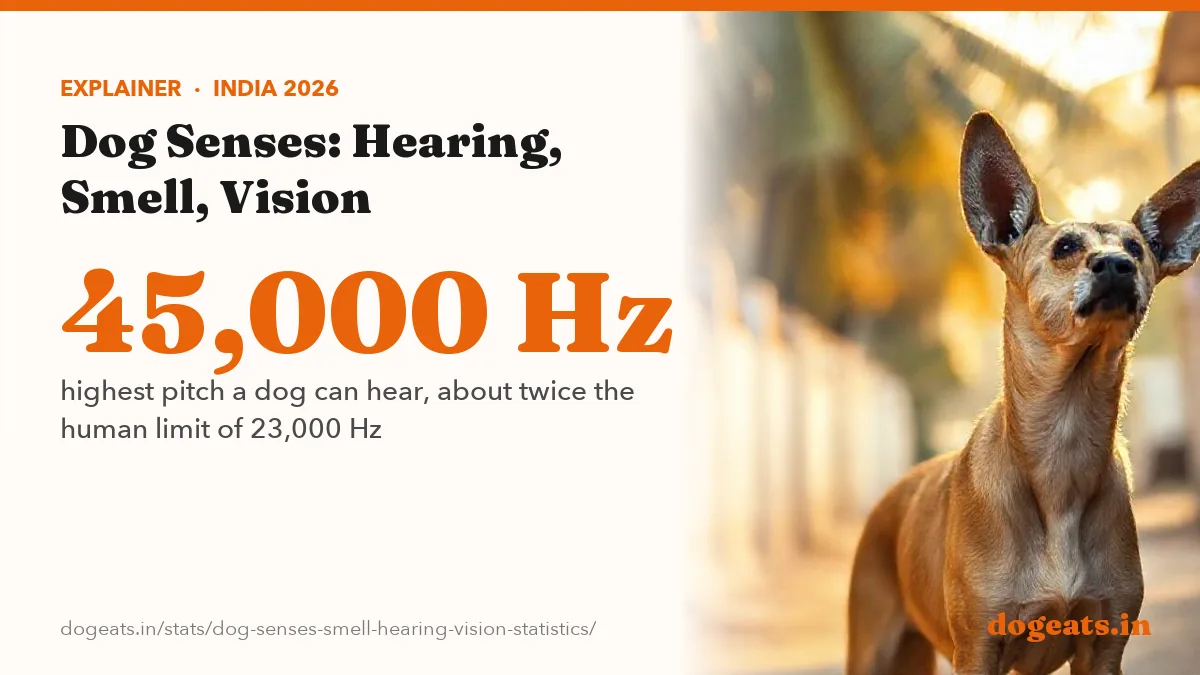
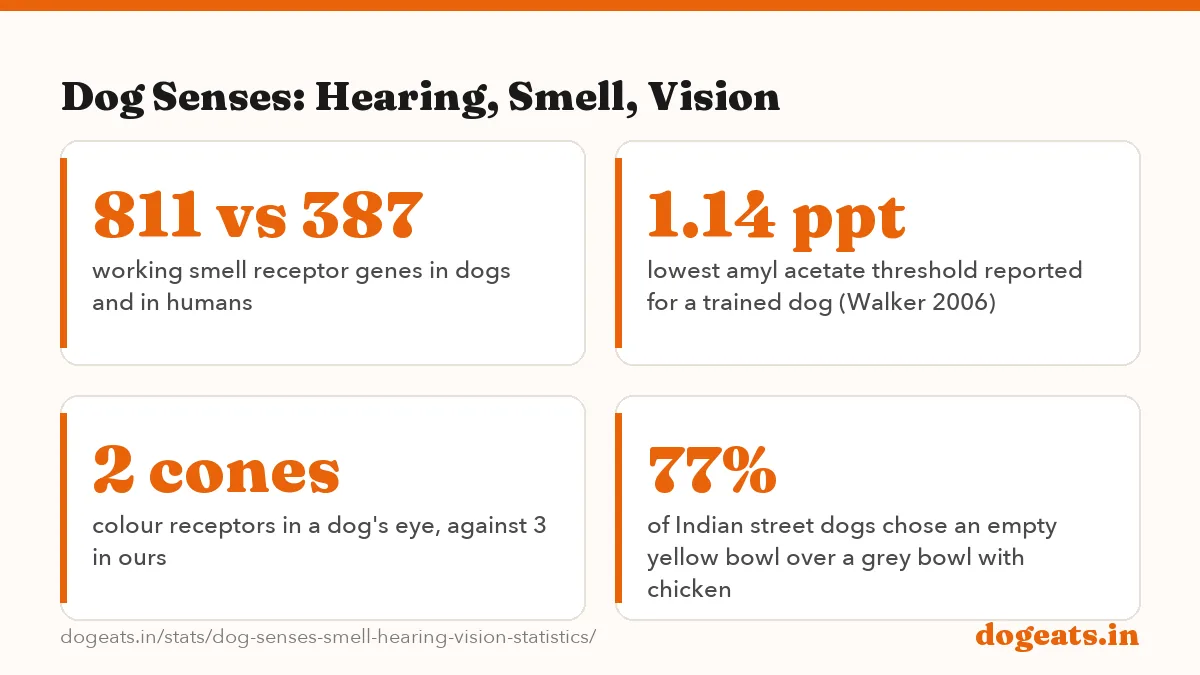
A dog's hearing range is about 67 to 45,000 Hz, roughly twice the top pitch people hear, which tops out near 23,000 Hz. Dogs carry 811 working smell receptor genes against 387 in humans, and trained dogs have detected odours at about 1 part per trillion. They see colour with two cone types, mainly blues and yellows, but their sharpest vision is about a third of ours.
Key findings
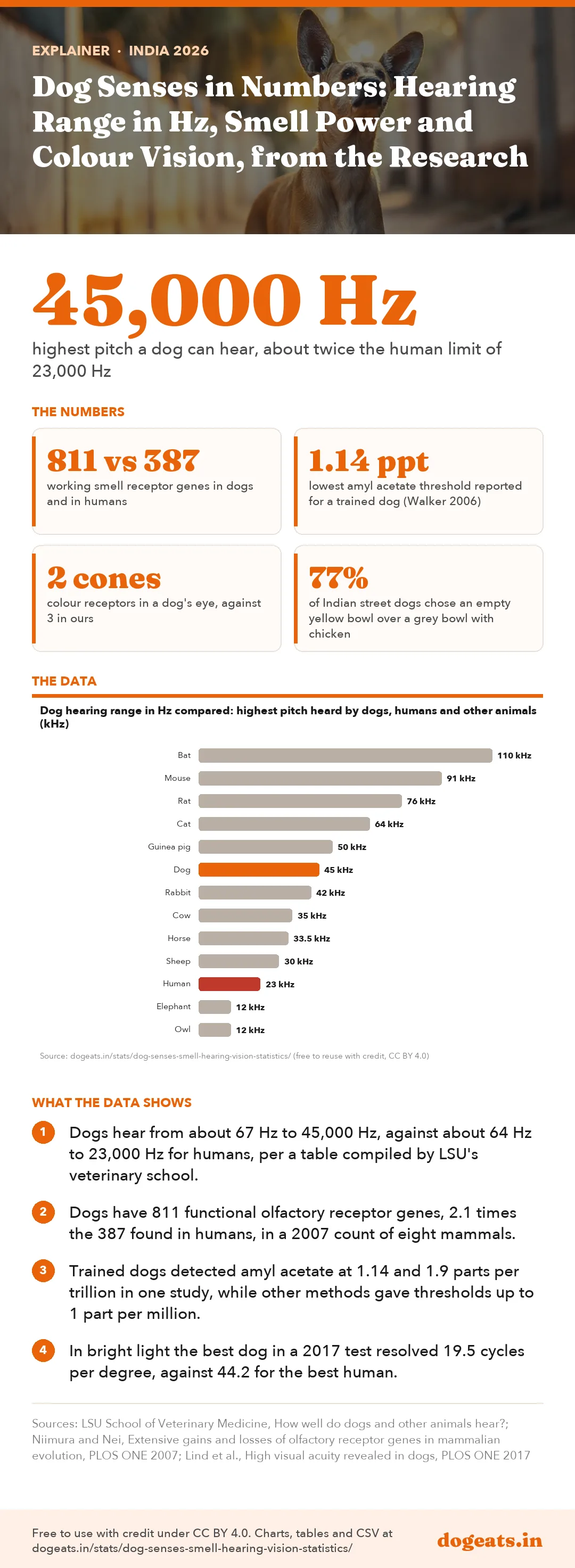
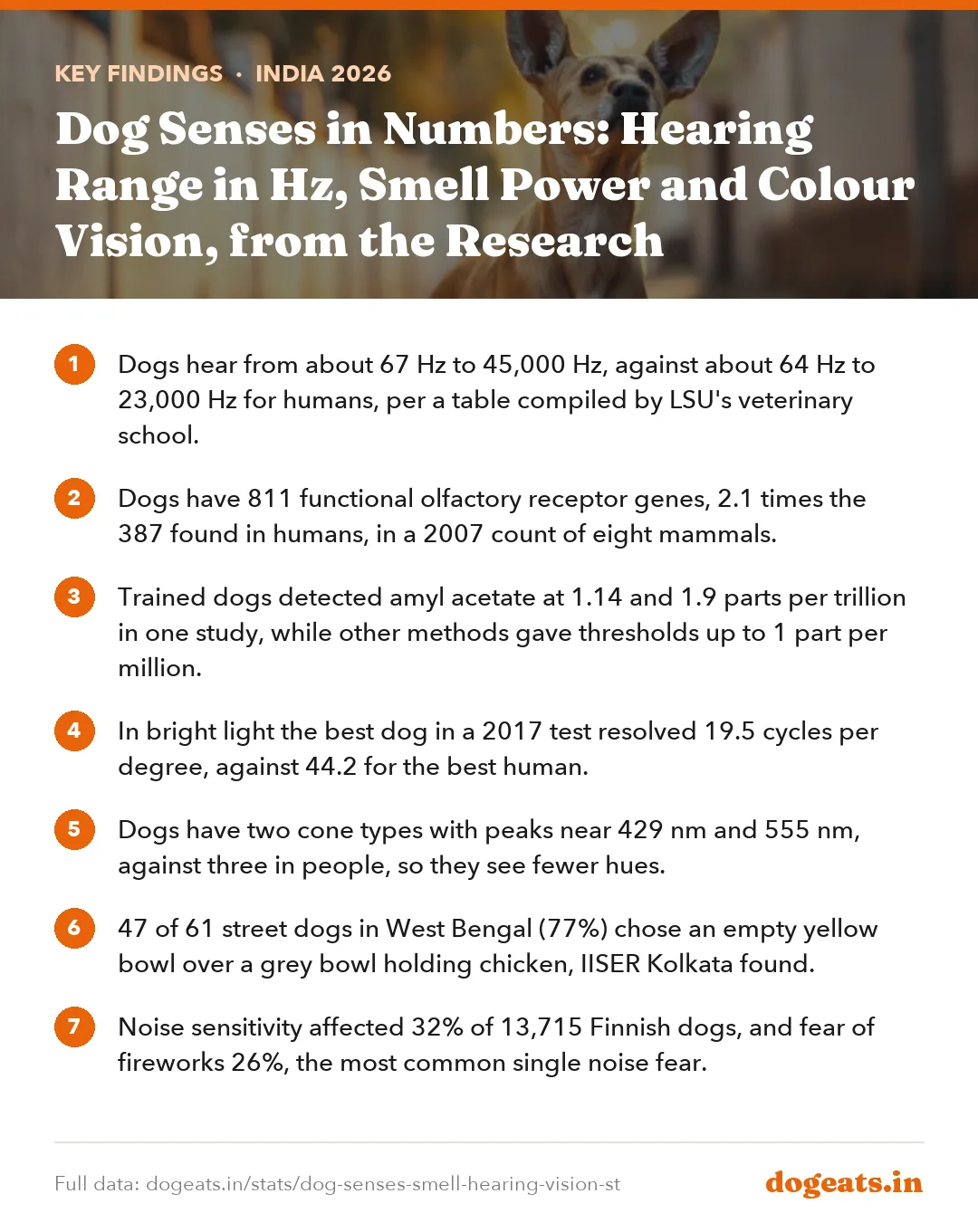
- Dogs hear from about 67 Hz to 45,000 Hz, against about 64 Hz to 23,000 Hz for humans, per a table compiled by LSU's veterinary school.
- Dogs have 811 functional olfactory receptor genes, 2.1 times the 387 found in humans, in a 2007 count of eight mammals.
- Trained dogs detected amyl acetate at 1.14 and 1.9 parts per trillion in one study, while other methods gave thresholds up to 1 part per million.
- In bright light the best dog in a 2017 test resolved 19.5 cycles per degree, against 44.2 for the best human.
- Dogs have two cone types with peaks near 429 nm and 555 nm, against three in people, so they see fewer hues.
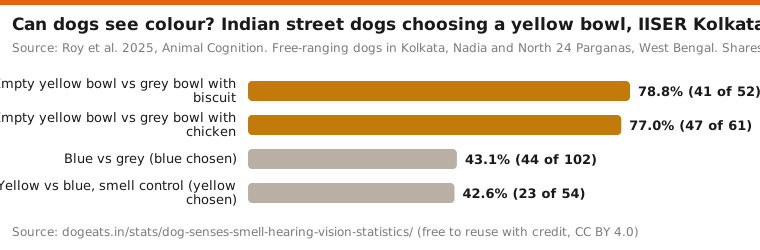
- 47 of 61 street dogs in West Bengal (77%) chose an empty yellow bowl over a grey bowl holding chicken, IISER Kolkata found.
- Noise sensitivity affected 32% of 13,715 Finnish dogs, and fear of fireworks 26%, the most common single noise fear.
- Explosives, tracking and narcotics roles, all scent work, take 411 of the Railway Protection Force's 416 dogs.
What is a dog's hearing range in Hz?
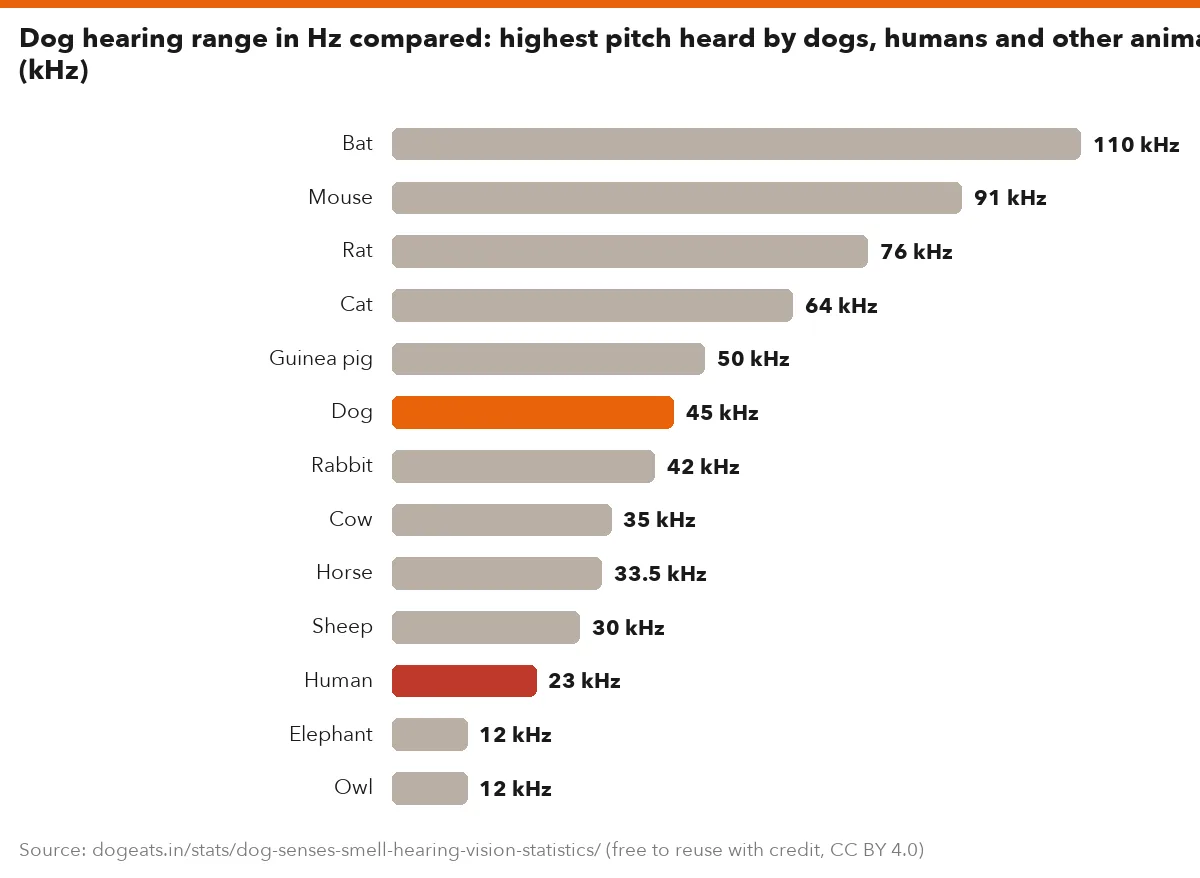
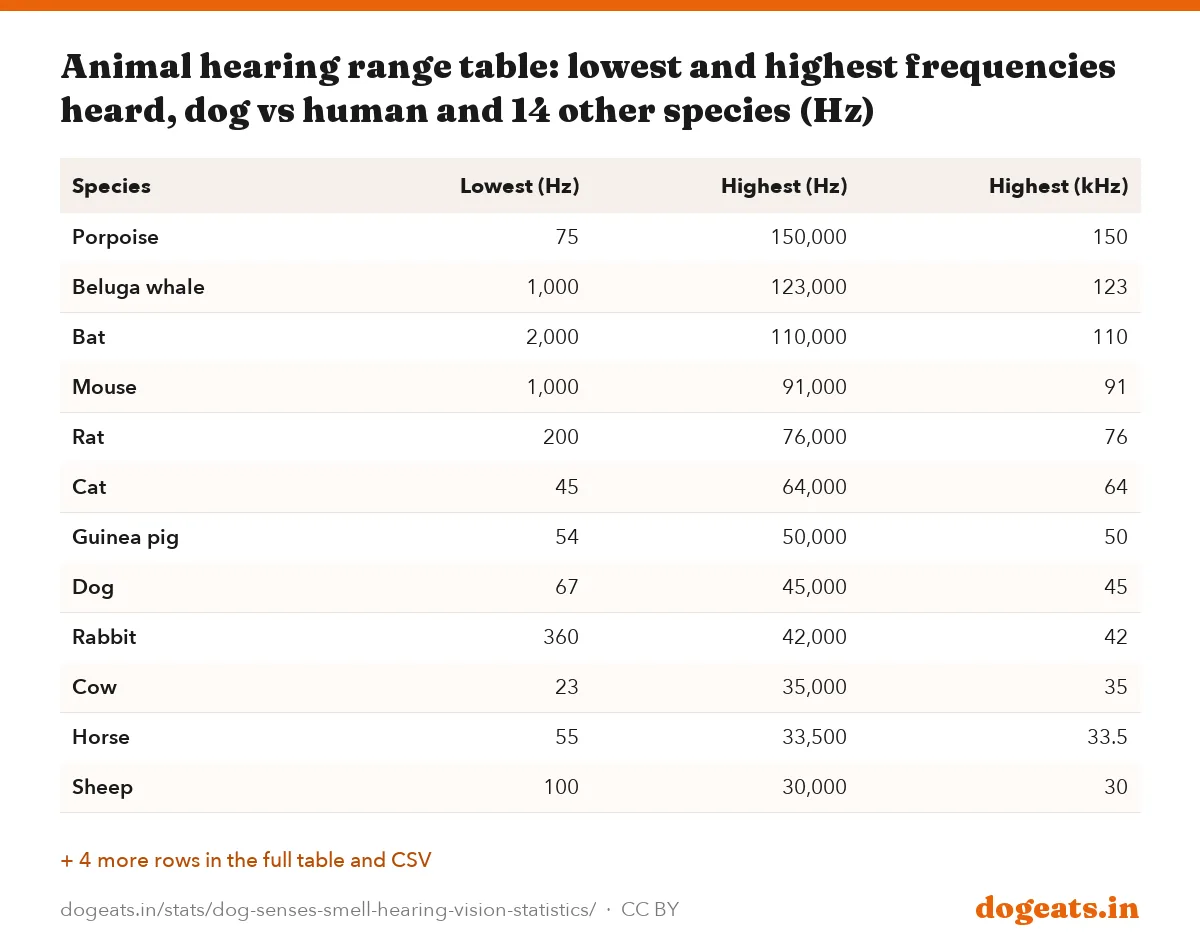
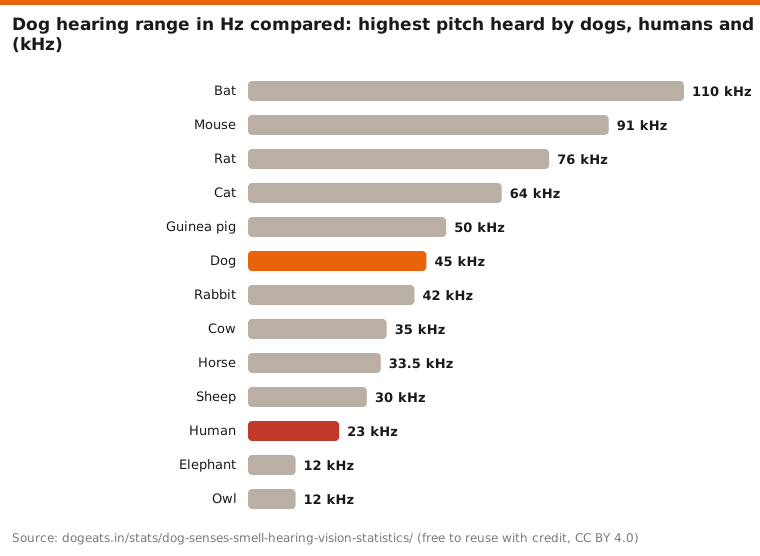
Dogs hear from about 67 Hz to 45,000 Hz. People hear from about 64 Hz to 23,000 Hz, so the top of a dog's range is roughly twice ours. Those figures come from a table kept by the Louisiana State University School of Veterinary Medicine, built from older reference books.
Dogs are not the champions. Cats reach about 64,000 Hz, rats 76,000 Hz and mice 91,000 Hz. Bats reach about 110,000 Hz, and porpoises 150,000 Hz.
At the low end, dogs and humans are close. Elephants and cows hear lower, at about 16 Hz and 23 Hz.
Source: LSU School of Veterinary Medicine, compiled from reference works including Fay (1988) and Warfield (1973). Approximate upper limits; methods differ between studies.
Show the numbers
| Label | kHz |
|---|---|
| Bat | 110 kHz |
| Mouse | 91 kHz |
| Rat | 76 kHz |
| Cat | 64 kHz |
| Guinea pig | 50 kHz |
| Dog | 45 kHz |
| Rabbit | 42 kHz |
| Cow | 35 kHz |
| Horse | 33.5 kHz |
| Sheep | 30 kHz |
| Human | 23 kHz |
| Elephant | 12 kHz |
| Owl | 12 kHz |
Embed this chart
| Species | Lowest (Hz) | Highest (Hz) | Highest (kHz) |
|---|---|---|---|
| Porpoise | 75 | 150,000 | 150 |
| Beluga whale | 1,000 | 123,000 | 123 |
| Bat | 2,000 | 110,000 | 110 |
| Mouse | 1,000 | 91,000 | 91 |
| Rat | 200 | 76,000 | 76 |
| Cat | 45 | 64,000 | 64 |
| Guinea pig | 54 | 50,000 | 50 |
| Dog | 67 | 45,000 | 45 |
| Rabbit | 360 | 42,000 | 42 |
| Cow | 23 | 35,000 | 35 |
| Horse | 55 | 33,500 | 33.5 |
| Sheep | 100 | 30,000 | 30 |
| Human | 64 | 23,000 | 23 |
| Elephant | 16 | 12,000 | 12 |
| Owl | 200 | 12,000 | 12 |
| Chicken | 125 | 2,000 | 2 |
The best detailed test is Henry Heffner's 1983 study of a Poodle, Dachshund, Saint Bernard and Chihuahua. Three of them heard a 46 kHz tone, but only at 64 to 73 dB. The Poodle heard 40 Hz at 59 dB, while most dogs needed 62.5 Hz before they responded.
Dogs are most sensitive between about 4 and 10 kHz. The Poodle detected a 4 kHz tone at minus 4 dB and an 8 kHz tone at minus 3.5 dB. Overall the dogs were slightly more sensitive than people, and cats more sensitive than dogs.
Size barely changes hearing. A 2024 scan of 17 breeds found the Saint Bernard's middle ear cavity was 14 times the Chihuahua's, yet their audiograms are similar.
How powerful is a dog's sense of smell?
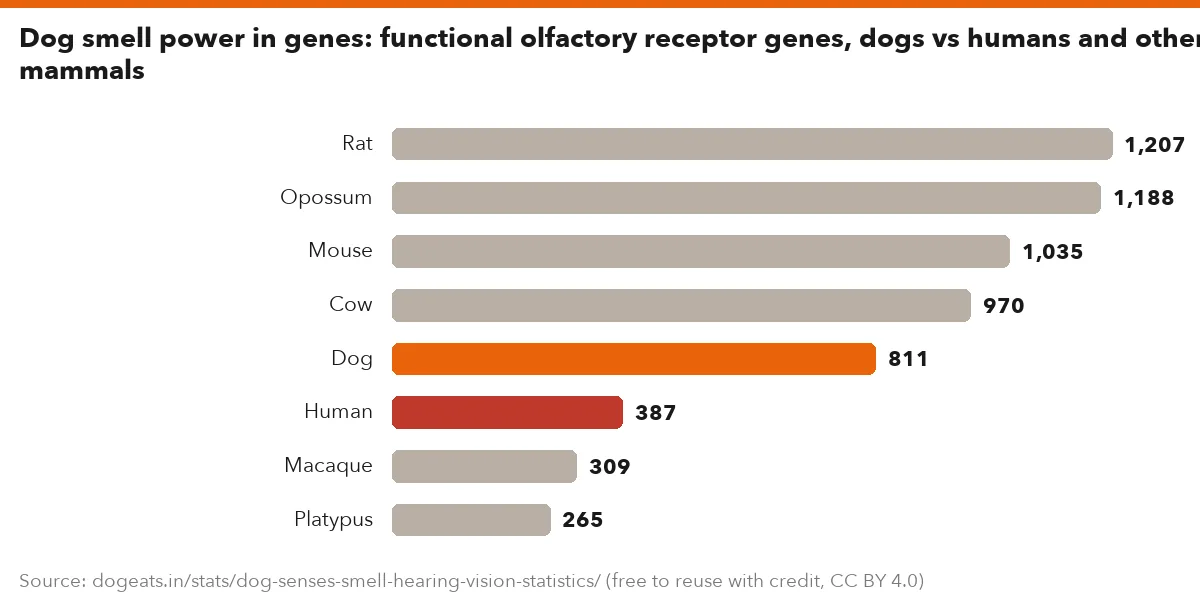
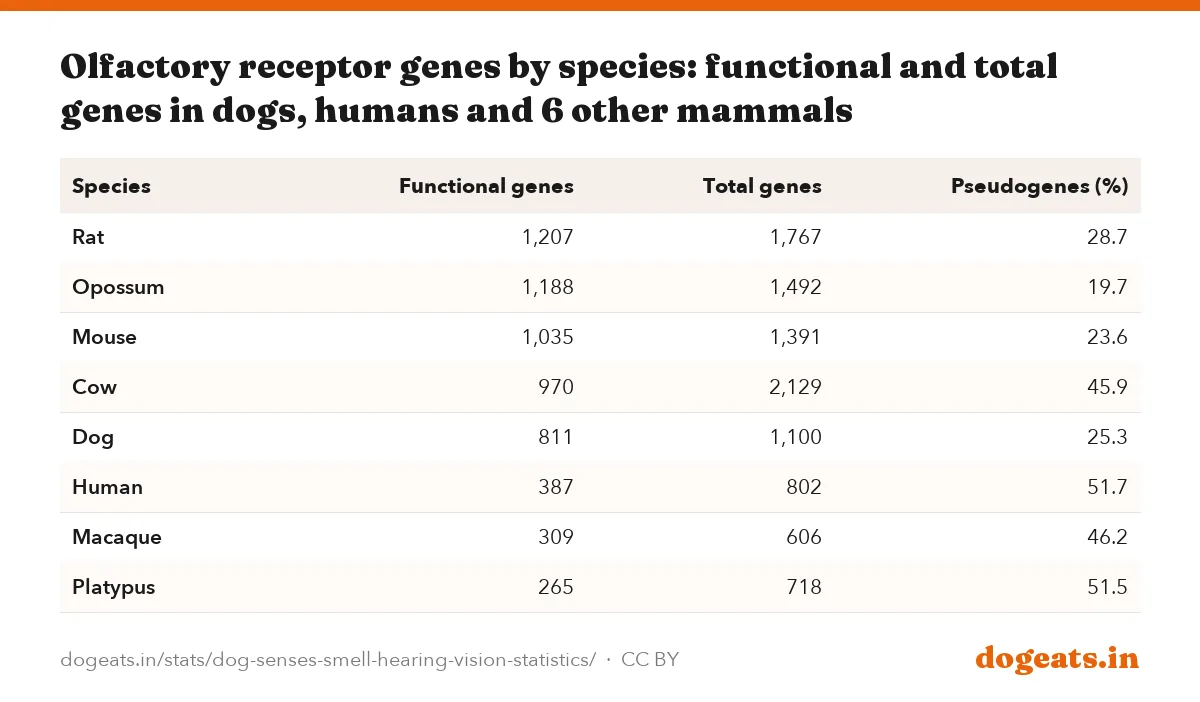
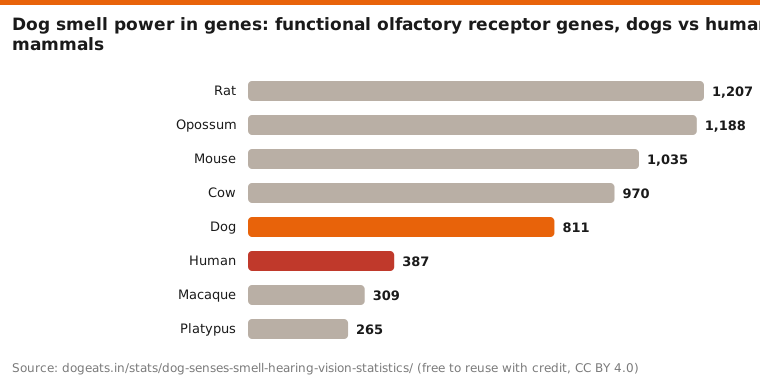
Far beyond ours, and the genes show it. A 2007 study by Niimura and Nei counted 811 functional olfactory receptor genes in the dog against 387 in humans. Each gene builds one type of smell receptor, so dogs have about 2.1 times as many receptor types.
Rats (1,207), opossums (1,188), mice (1,035) and cows (970) have even more. Primates have fewer than 400: the macaque has 309. An earlier 2005 study of a Boxer's genome found 1,094 dog receptor genes, of which 20.3% were broken pseudogenes, leaving about 872 intact.
Source: Niimura and Nei 2007, PLOS ONE, Table 1. Functional genes only; pseudogenes and truncated genes excluded.
Show the numbers
| Label | genes |
|---|---|
| Rat | 1,207 |
| Opossum | 1,188 |
| Mouse | 1,035 |
| Cow | 970 |
| Dog | 811 |
| Human | 387 |
| Macaque | 309 |
| Platypus | 265 |
Embed this chart
| Species | Functional genes | Total genes | Pseudogenes (%) |
|---|---|---|---|
| Rat | 1,207 | 1,767 | 28.7 |
| Opossum | 1,188 | 1,492 | 19.7 |
| Mouse | 1,035 | 1,391 | 23.6 |
| Cow | 970 | 2,129 | 45.9 |
| Dog | 811 | 1,100 | 25.3 |
| Human | 387 | 802 | 51.7 |
| Macaque | 309 | 606 | 46.2 |
| Platypus | 265 | 718 | 51.5 |
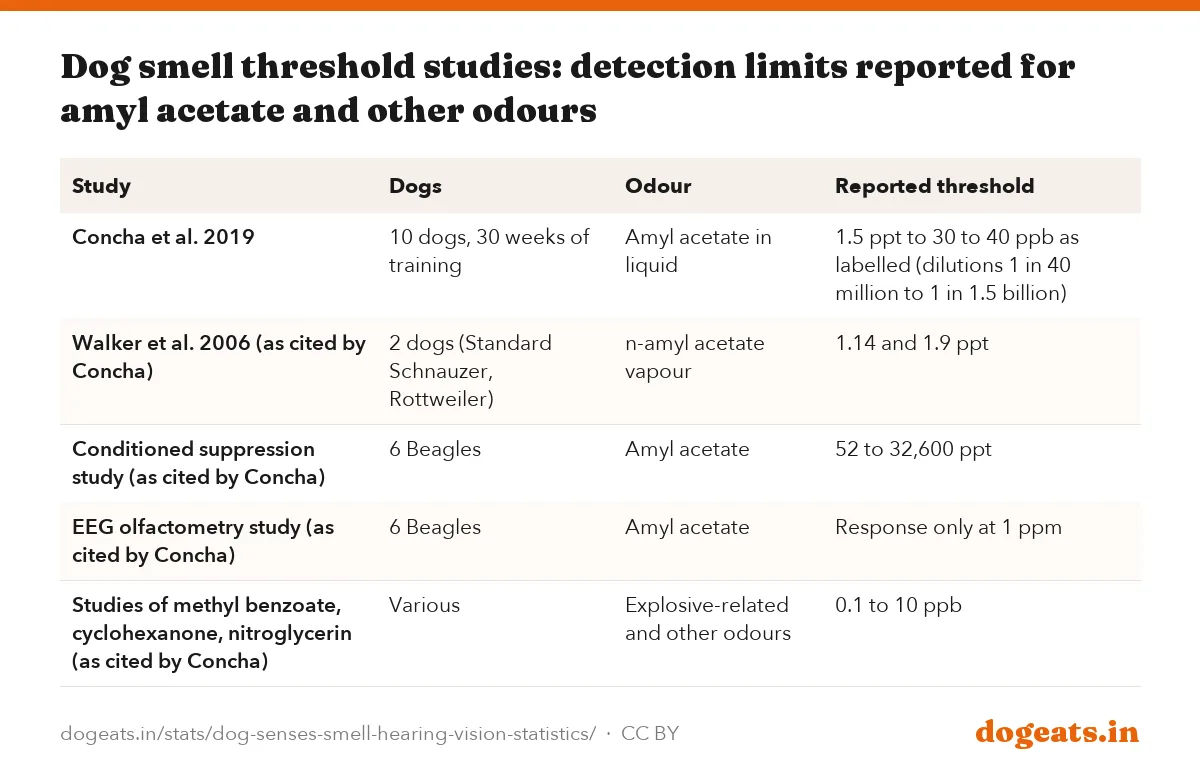
Threshold tests give a wide spread. Walker and colleagues trained a Standard Schnauzer and a Rottweiler and recorded amyl acetate thresholds of 1.9 and 1.14 parts per trillion (ppt). One ppt is one part in a million million.
A 2019 study by Concha and colleagues trained 10 dogs for 30 weeks and found thresholds from 1.5 ppt to tens of parts per billion. Other methods put the threshold for six Beagles at 52 to 32,600 ppt, and a brain-wave test found a response only at 1 part per million. Method, training and the dog all change the answer. Its own dilution ratios, 1 in 40 million to 1 in 1.5 billion, do not match those unit labels, so treat its lowest figure with care.
What can a dog's nose detect?
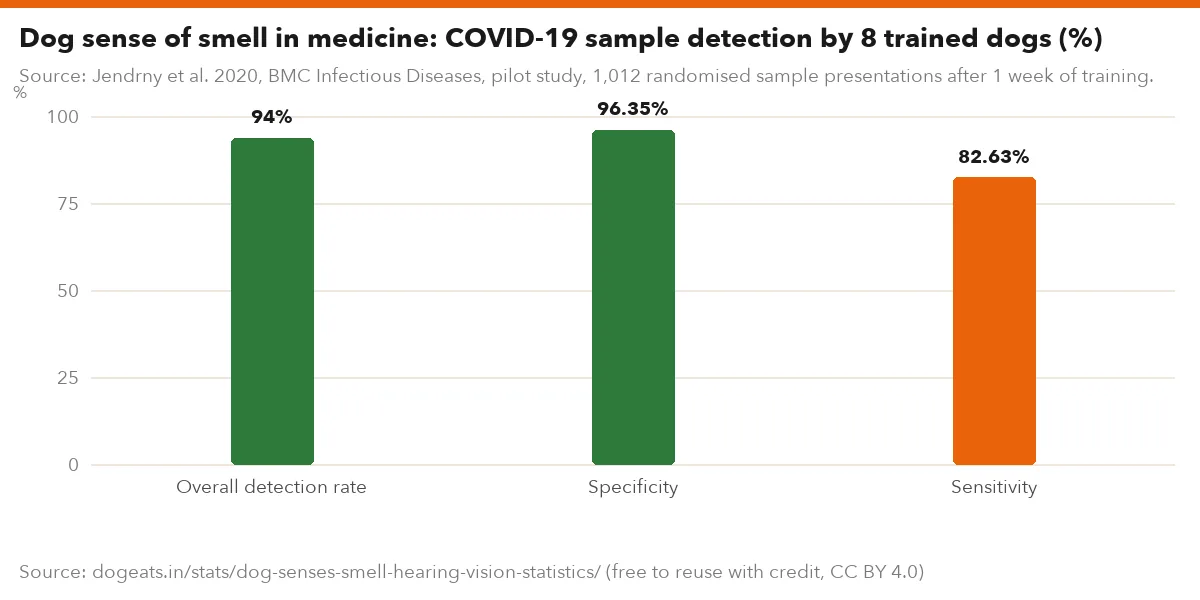
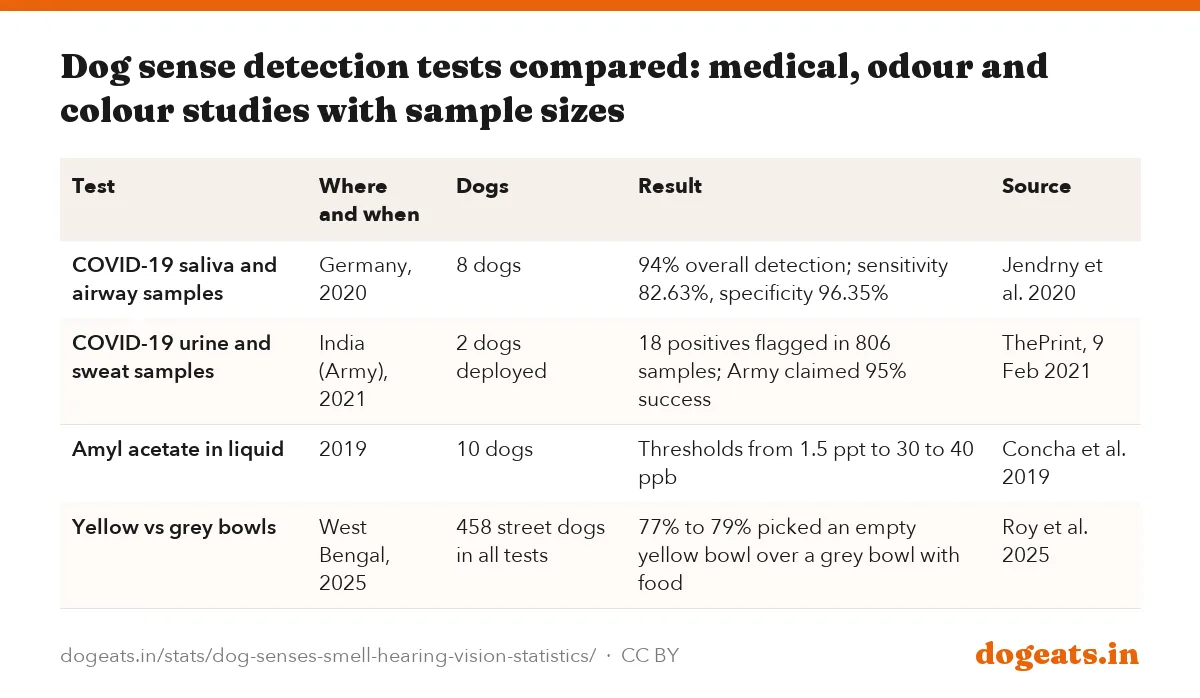
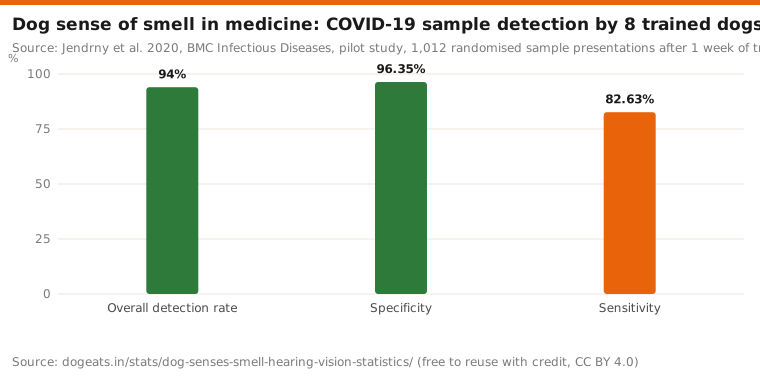
Trained dogs can pick out disease and explosives by smell. In a 2020 German pilot study, eight dogs trained for one week sorted saliva and airway samples from COVID-19 patients. Across 1,012 randomised presentations they averaged a 94% detection rate.
Their sensitivity, the share of positive samples they flagged, was 82.63%. Their specificity, the share of negative samples they correctly passed, was 96.35%. They made 157 correct positive calls and 792 correct rejections.
Source: Jendrny et al. 2020, BMC Infectious Diseases, pilot study, 1,012 randomised sample presentations after 1 week of training.
Show the numbers
| Label | % |
|---|---|
| Overall detection rate | 94% |
| Specificity | 96.35% |
| Sensitivity | 82.63% |
Embed this chart
| Study | Dogs | Odour | Reported threshold |
|---|---|---|---|
| Concha et al. 2019 | 10 dogs, 30 weeks of training | Amyl acetate in liquid | 1.5 ppt to 30 to 40 ppb as labelled (dilutions 1 in 40 million to 1 in 1.5 billion) |
| Walker et al. 2006 (as cited by Concha) | 2 dogs (Standard Schnauzer, Rottweiler) | n-amyl acetate vapour | 1.14 and 1.9 ppt |
| Conditioned suppression study (as cited by Concha) | 6 Beagles | Amyl acetate | 52 to 32,600 ppt |
| EEG olfactometry study (as cited by Concha) | 6 Beagles | Amyl acetate | Response only at 1 ppm |
| Studies of methyl benzoate, cyclohexanone, nitroglycerin (as cited by Concha) | Various | Explosive-related and other odours | 0.1 to 10 ppb |
| Test | Where and when | Dogs | Result | Source |
|---|---|---|---|---|
| COVID-19 saliva and airway samples | Germany, 2020 | 8 dogs | 94% overall detection; sensitivity 82.63%, specificity 96.35% | Jendrny et al. 2020 |
| COVID-19 urine and sweat samples | India (Army), 2021 | 2 dogs deployed | 18 positives flagged in 806 samples; Army claimed 95% success | ThePrint, 9 Feb 2021 |
| Amyl acetate in liquid | 2019 | 10 dogs | Thresholds from 1.5 ppt to 30 to 40 ppb | Concha et al. 2019 |
| Yellow vs grey bowls | West Bengal, 2025 | 458 street dogs in all tests | 77% to 79% picked an empty yellow bowl over a grey bowl with food | Roy et al. 2025 |
The Indian Army tried the same idea in 2021. ThePrint reported on 9 February 2021 that a Cocker Spaniel named Casper and a Chippiparai named Jaya screened 806 samples and flagged 18 as positive. The Army put their success rate at 95%, a claim that has not been published as a study. The first trial used 279 urine and 267 sweat samples, and seven more dogs were in training.
Can dogs see colour?
Yes, but fewer colours than people. In 1989 Neitz, Geist and Jacobs tested three dogs and found two classes of cone in the retina, with peaks near 429 nm and 555 nm. Dogs are dichromats, so they see a narrower range of hues than people, with peaks in the violet-blue and yellow-green parts of the spectrum.
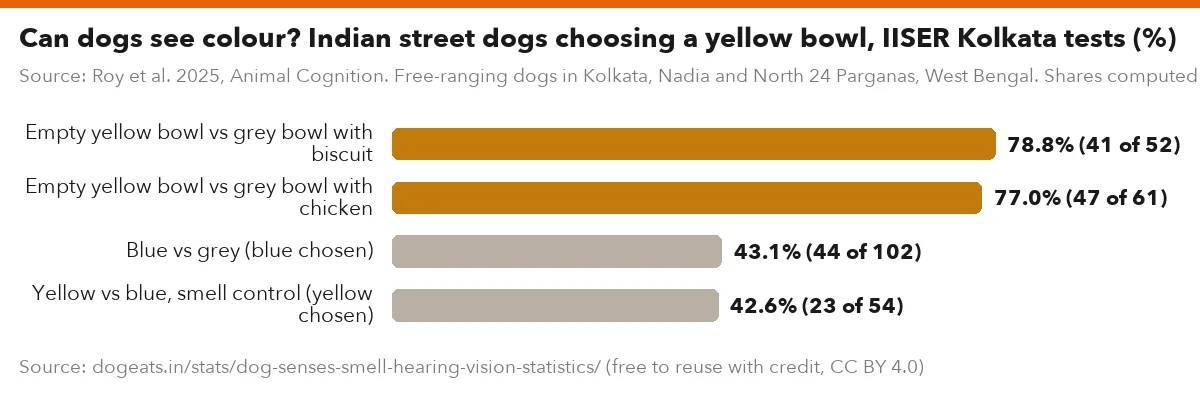
Indian research adds a twist. A 2025 IISER Kolkata study tested 458 free-ranging dogs across Kolkata, Nadia and North 24 Parganas. In the first test, 134 dogs preferred yellow objects over blue or grey ones.

Source: Roy et al. 2025, Animal Cognition. Free-ranging dogs in Kolkata, Nadia and North 24 Parganas, West Bengal. Shares computed by dogeats.in from counts. In the smell control the yellow and blue bowls were covered and dogs chose at chance.
Show the numbers
| Label | % of dogs |
|---|---|
| Empty yellow bowl vs grey bowl with biscuit | 78.8% (41 of 52) |
| Empty yellow bowl vs grey bowl with chicken | 77.0% (47 of 61) |
| Blue vs grey (blue chosen) | 43.1% (44 of 102) |
| Yellow vs blue, smell control (yellow chosen) | 42.6% (23 of 54) |
Embed this chart
When the bowls were covered so only smell was left, dogs chose yellow and blue at chance, 23 against 31. Blue and grey drew no clear preference either, 44 against 58. The authors note a mid-2010s fad in India of keeping bottles of indigo-dyed water to scare dogs away. An unpublished study they cite found Kolkata street dogs did not react to the bottles.
How good is dog eyesight compared with ours?
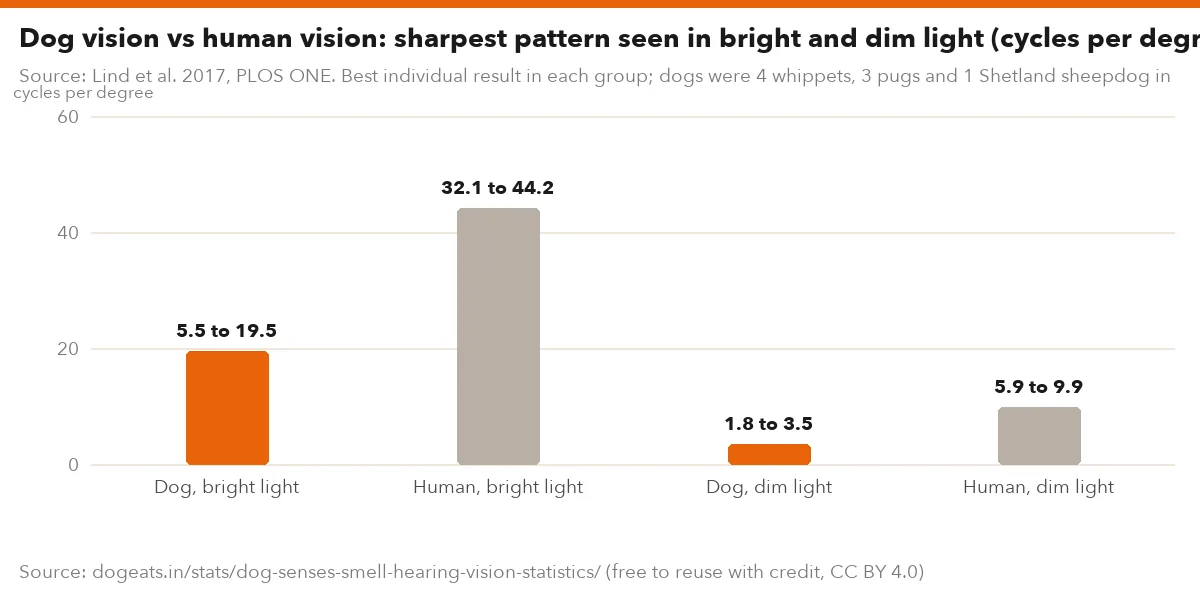
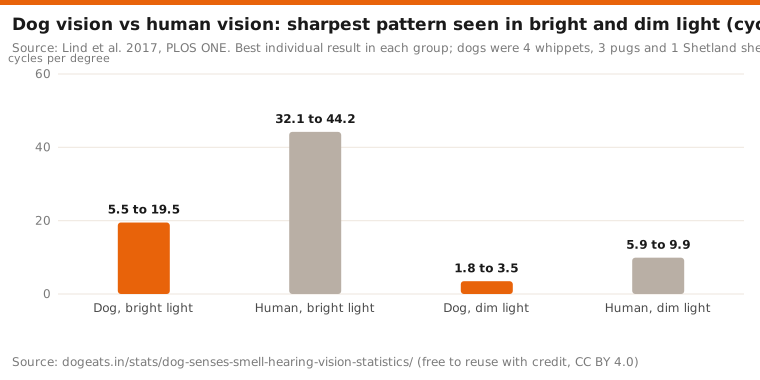
Dogs see less sharply than people but cope better in some ways. A 2017 Swedish study trained four whippets, three pugs and a Shetland sheepdog. In bright light the dogs resolved stripes of 5.5 to 19.5 cycles per degree; people managed 32.1 to 44.2.
In dim light the dogs managed 1.8 to 3.5 cycles per degree and people 5.9 to 9.9. The authors conclude that people can tell objects apart from roughly three times the distance a dog can.
Source: Lind et al. 2017, PLOS ONE. Best individual result in each group; dogs were 4 whippets, 3 pugs and 1 Shetland sheepdog in bright light; the Shetland sheepdog missed the dim-light tests.
Show the numbers
| Label | cycles per degree |
|---|---|
| Dog, bright light | 5.5 to 19.5 |
| Human, bright light | 32.1 to 44.2 |
| Dog, dim light | 1.8 to 3.5 |
| Human, dim light | 5.9 to 9.9 |
Embed this chart
A 1995 review in the Journal of the American Veterinary Medical Association weighed both sides. Dogs fall short of people in binocular overlap, colour vision, focusing range and sharpness. They probably do better in dim light, in flicker fusion, in field of view, in telling shades of grey apart and perhaps in spotting motion.
Head shape may matter. The 2017 paper notes that short-nosed breeds such as pugs are thought to have a central high-density spot in the retina. Long-nosed breeds such as greyhounds have a horizontal streak suited to scanning the horizon.
Why are dogs scared of loud noises like firecrackers?
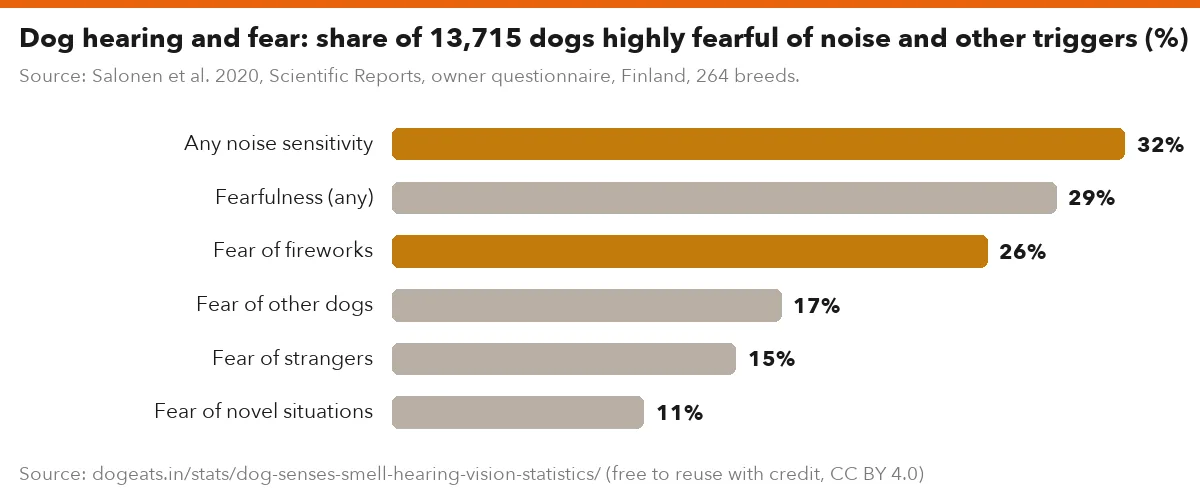
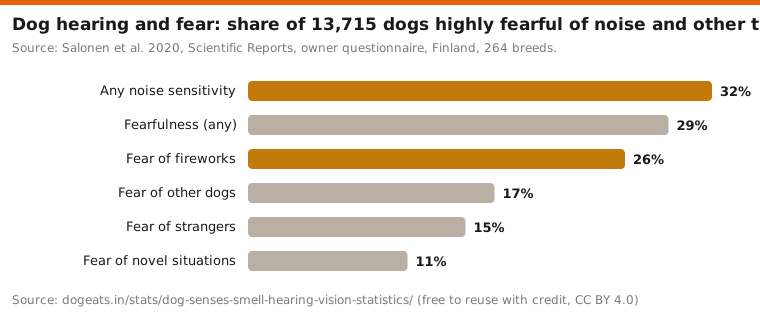
Noise fear is the most common anxiety in dogs. A 2020 Finnish study of 13,715 dogs from 264 breeds found 32% were highly fearful of at least one noise. Fear of fireworks was the most common single noise fear, at 26%.
Earlier studies put noise sensitivity anywhere from 20% to 50%. In the same Finnish data, 29% showed fearfulness of some kind, 17% feared other dogs and 15% feared strangers. Separation-related behaviour was the rarest trait at 5%, and aggression reached 14%. Of the highly noise-sensitive dogs, 53% feared more than one kind of noise.
Source: Salonen et al. 2020, Scientific Reports, owner questionnaire, Finland, 264 breeds.
Show the numbers
| Label | % of dogs |
|---|---|
| Any noise sensitivity | 32% |
| Fearfulness (any) | 29% |
| Fear of fireworks | 26% |
| Fear of other dogs | 17% |
| Fear of strangers | 15% |
| Fear of novel situations | 11% |
Embed this chart
Noise sensitivity rose with age in the Finnish dogs, especially fear of thunder. Lagotto Romagnolo, Wheaten Terriers and mixed-breed dogs were the most noise sensitive. A 2026 report on 43,517 US dogs in the Dog Aging Project found 25.5% showed fear or anxiety towards unfamiliar situations, objects or noise. The same owners reported fear of unfamiliar dogs in 47.4%, grooming fear in 33.0% and fear of unfamiliar people in 22.3%.
Indian festival noise is covered city by city in our Diwali firecracker noise report. Ask your vet early if your dog panics at loud sounds.
How does India use dogs' noses?
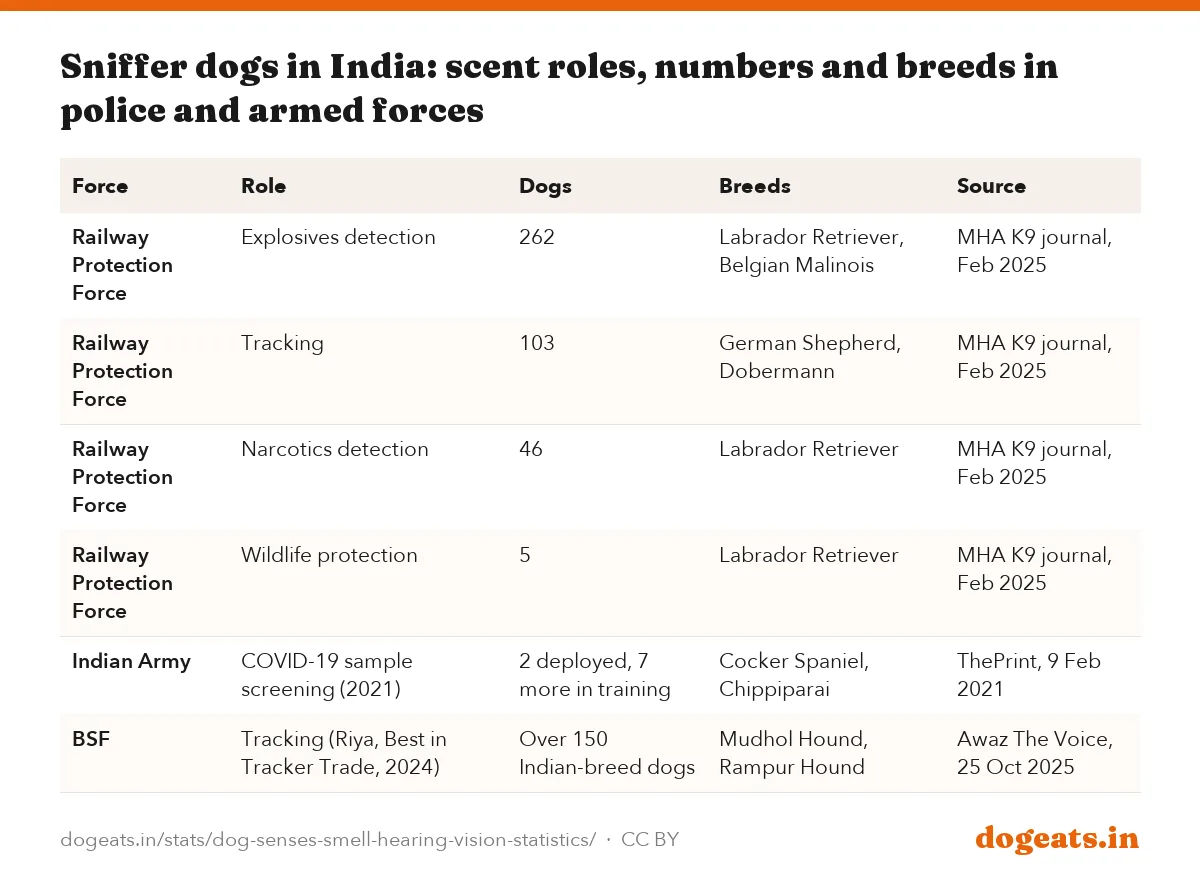
In the Railway Protection Force, almost every dog works by scent. The force listed 416 dogs in a Home Ministry journal in February 2025. Explosives detection took 262, tracking 103 and narcotics 46, so 411 of 416 do scent work; the other 5 do wildlife protection.
Indian breeds are gaining ground. Riya, a BSF Mudhol Hound, won Best in Tracker Trade at the All India Police Duty Meet 2024, and the BSF had over 150 Indian-breed dogs deployed by October 2025.
| Force | Role | Dogs | Breeds | Source |
|---|---|---|---|---|
| Railway Protection Force | Explosives detection | 262 | Labrador Retriever, Belgian Malinois | MHA K9 journal, Feb 2025 |
| Railway Protection Force | Tracking | 103 | German Shepherd, Dobermann | MHA K9 journal, Feb 2025 |
| Railway Protection Force | Narcotics detection | 46 | Labrador Retriever | MHA K9 journal, Feb 2025 |
| Railway Protection Force | Wildlife protection | 5 | Labrador Retriever | MHA K9 journal, Feb 2025 |
| Indian Army | COVID-19 sample screening (2021) | 2 deployed, 7 more in training | Cocker Spaniel, Chippiparai | ThePrint, 9 Feb 2021 |
| BSF | Tracking (Riya, Best in Tracker Trade, 2024) | Over 150 Indian-breed dogs | Mudhol Hound, Rampur Hound | Awaz The Voice, 25 Oct 2025 |
Labradors and Belgian Malinois led explosives work in the RPF, and German Shepherds and Dobermanns tracked. Read more in our army and police dogs report and our Mudhol Hound guide.
Do dogs have a sixth sense?
Dogs appear to sense the Earth's magnetic field. A 2013 study in Frontiers in Zoology logged 70 dogs of 37 breeds over two years, with 1,893 observations of defecation and 5,582 of urination. When the magnetic field was calm, dogs tended to line up along the north-south axis.
The pattern vanished when the field was unsettled. The authors say the field is calm in only about 20% of daylight hours, which may explain why such results are hard to repeat. A 2025 follow-up on 36 dogs found alignment shifted under high-voltage power lines.
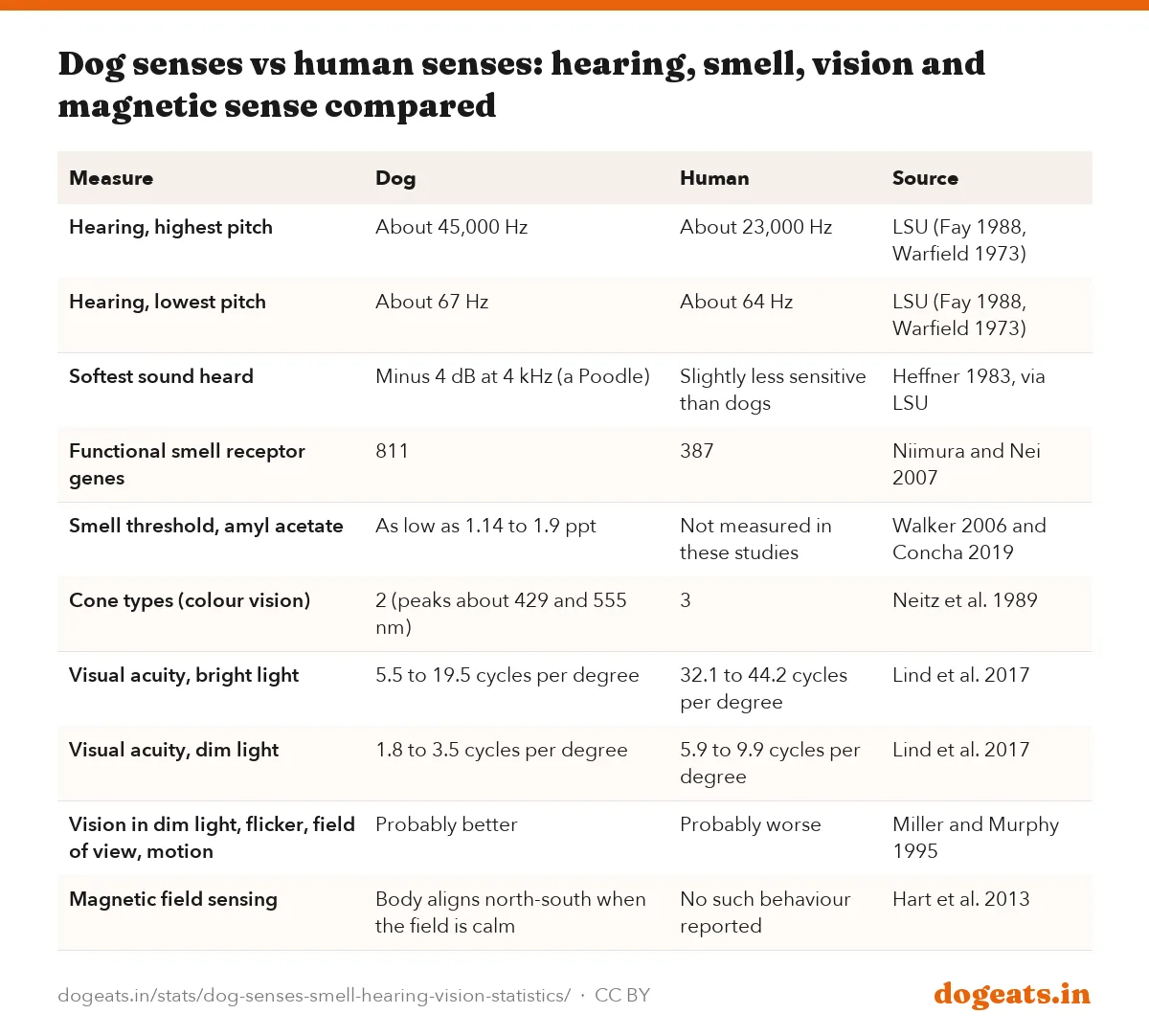
| Measure | Dog | Human | Source |
|---|---|---|---|
| Hearing, highest pitch | About 45,000 Hz | About 23,000 Hz | LSU (Fay 1988, Warfield 1973) |
| Hearing, lowest pitch | About 67 Hz | About 64 Hz | LSU (Fay 1988, Warfield 1973) |
| Softest sound heard | Minus 4 dB at 4 kHz (a Poodle) | Slightly less sensitive than dogs | Heffner 1983, via LSU |
| Functional smell receptor genes | 811 | 387 | Niimura and Nei 2007 |
| Smell threshold, amyl acetate | As low as 1.14 to 1.9 ppt | Not measured in these studies | Walker 2006 and Concha 2019 |
| Cone types (colour vision) | 2 (peaks about 429 and 555 nm) | 3 | Neitz et al. 1989 |
| Visual acuity, bright light | 5.5 to 19.5 cycles per degree | 32.1 to 44.2 cycles per degree | Lind et al. 2017 |
| Visual acuity, dim light | 1.8 to 3.5 cycles per degree | 5.9 to 9.9 cycles per degree | Lind et al. 2017 |
| Vision in dim light, flicker, field of view, motion | Probably better | Probably worse | Miller and Murphy 1995 |
| Magnetic field sensing | Body aligns north-south when the field is calm | No such behaviour reported | Hart et al. 2013 |
Taste and touch have far less published dog data, so we leave them out rather than repeat unsourced figures. For how senses tie into training and learning, see our smartest dog breeds ranking.
Frequently asked questions
What is the hearing range of a dog in Hz?
About 67 Hz to 45,000 Hz, per LSU's veterinary school. Humans hear about 64 Hz to 23,000 Hz, so dogs hear roughly twice as high. In Heffner's 1983 tests, three dogs heard 46 kHz at 64 to 73 dB.
Can dogs hear sounds humans cannot?
Yes, above about 23,000 Hz. Dogs hear up to about 45,000 Hz, which is why a dog whistle seems silent to people. Cats go higher still, to about 64,000 Hz.
How much better is a dog's sense of smell than a human's?
Dogs have 811 working smell receptor genes against 387 in humans, about 2.1 times as many. Trained dogs have detected amyl acetate at 1.14 to 1.9 parts per trillion, though results vary widely by method.
Can dogs see colour?
Yes, in a limited way. Dogs have two cone types, peaking near 429 nm and 555 nm, against three in people, so they see fewer hues. Indian street dogs in a 2025 study preferred yellow objects over blue or grey.
Do dogs see in black and white?
No. A 1989 study of three dogs showed they have two working cone types and true colour vision, though with fewer hues than people. Grey shades and dim light are where dogs do comparatively well.
How good is dog eyesight compared to humans?
Less sharp. In a 2017 test dogs resolved 5.5 to 19.5 cycles per degree in bright light against 32.1 to 44.2 for people. People can tell objects apart from about three times the distance.
Why are dogs scared of firecrackers?
Loud bangs are the most common fear trigger. In a study of 13,715 dogs, 32% were highly sensitive to noise and 26% feared fireworks. Ask your vet before Diwali if your dog panics.
Can dogs smell COVID or disease?
Trained dogs can pick out some disease samples. In a 2020 pilot study, eight dogs detected COVID-19 samples with a 94% overall detection rate across 1,012 presentations. India's Army trialled two dogs in 2021.
Do dogs sense the Earth's magnetic field?
A 2013 study of 70 dogs suggests so: they aligned north-south while relieving themselves when the field was calm. The calm conditions occur in only about 20% of daylight hours.
Methodology and limitations
We took each figure from the paper or page named in the sources, opened on 15 October 2026. Full texts were read through Europe PMC where open; for the others we used abstracts. Hearing ranges come from the LSU School of Veterinary Medicine table, which compiles older reference works, and Heffner's 1983 results as summarised there.
Percentages for the IISER Kolkata colour tests and the share of RPF dogs in scent roles were computed by dogeats.in from the counts in the sources. Gene ratios (811 against 387) were computed from Niimura and Nei's Table 1. Hertz are given first, with kilohertz for large values.
Sources
- LSU School of Veterinary Medicine, How well do dogs and other animals hear?, Hearing ranges by species; Heffner 1983 results
- Niimura and Nei, Extensive gains and losses of olfactory receptor genes in mammalian evolution, PLOS ONE 2007, Functional and total olfactory receptor genes in 8 mammals
- Lind et al., High visual acuity revealed in dogs, PLOS ONE 2017, Dog and human acuity in bright and dim light
- Also consulted: Neitz, Geist and Jacobs, Color vision in the dog, Visual Neuroscience 1989, Roy et al., Ready, set, yellow! Color preference of Indian free-ranging dogs, Animal Cognition 2025, Concha et al., Canine olfactory thresholds to amyl acetate in a biomedical detection scenario, Frontiers in Veterinary Science 2019, Quignon et al., The dog and rat olfactory receptor repertoires, Genome Biology 2005, Jendrny et al., Scent dog identification of samples from COVID-19 patients, BMC Infectious Diseases 2020, Salonen et al., Prevalence, comorbidity, and breed differences in canine anxiety in 13,700 Finnish pet dogs, Scientific Reports 2020, Miller and Murphy, Vision in dogs, JAVMA 1995, Mason and Lewis, Structure and scaling of the middle ear in domestic dog breeds, Journal of Anatomy 2024, Hart et al., Dogs are sensitive to small variations of the Earth's magnetic field, Frontiers in Zoology 2013, Iakovenko et al., The effect of high-voltage power lines on magnetic orientation of domestic dogs, Animals 2025, Beaver, Owner-reported prevalence and severity of fear and anxiety in dogs, Veterinary Research Communications 2026, ThePrint (9 February 2021), Ministry of Home Affairs, National Police K9 Journal, Vol V Issue II (February 2025), Awaz The Voice (25 October 2025).
Cite, embed and download
This report, its data and its images are free to reuse under a Creative Commons Attribution 4.0 licence. Credit dogeats.in with a link to this page. Every chart has its own embed code, every table has a CSV and an image download, and the images below are ready for social posts, slides and articles.
Cite this report
Link to this report
Every chart and table as an image