Data report · Updated October 2026
How Many Puppies Do Dogs Have? Litter Size by Breed, Pregnancy Length and Birth Data
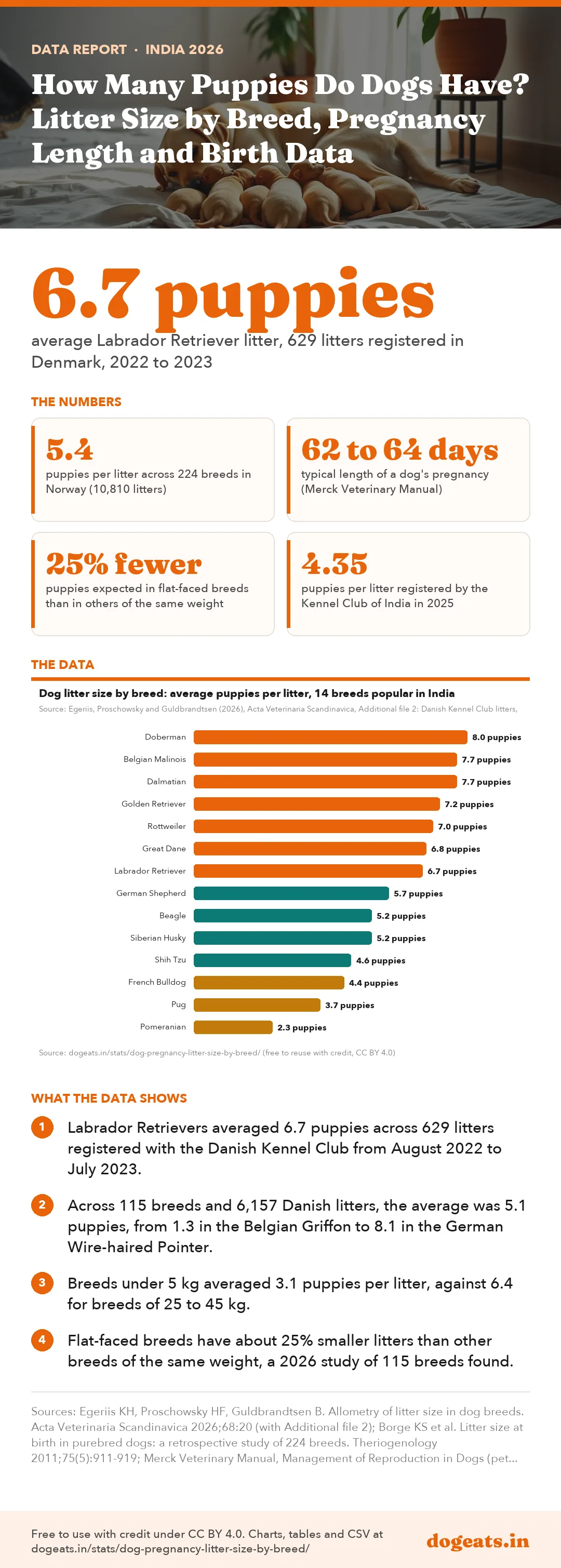
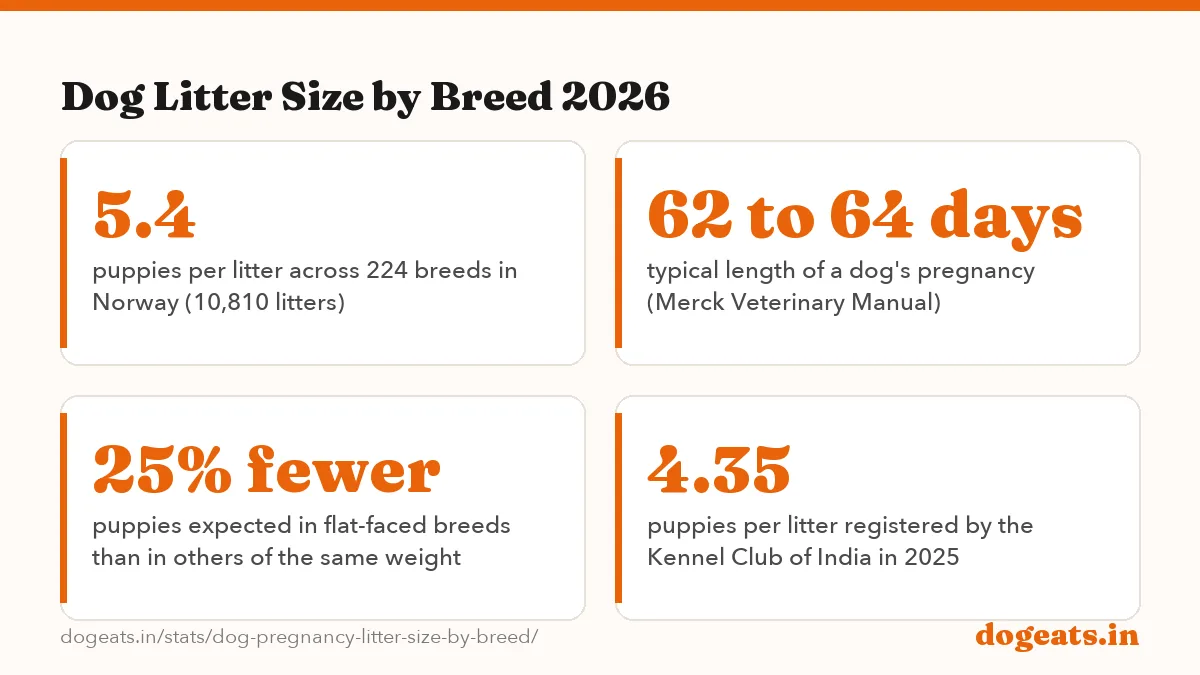
A dog has about 5 puppies per litter on average: 5.1 across 6,157 Danish litters of 115 breeds in 2022 to 2023, and 5.4 across 10,810 Norwegian litters. A Labrador averaged 6.7 puppies, a Golden Retriever 7.2 and a Pomeranian 2.3. Pregnancy lasts about 62 to 64 days, and Indian street dogs carried 4.4 to 5.6 puppies in studies from Jodhpur and Jaipur.

Key findings
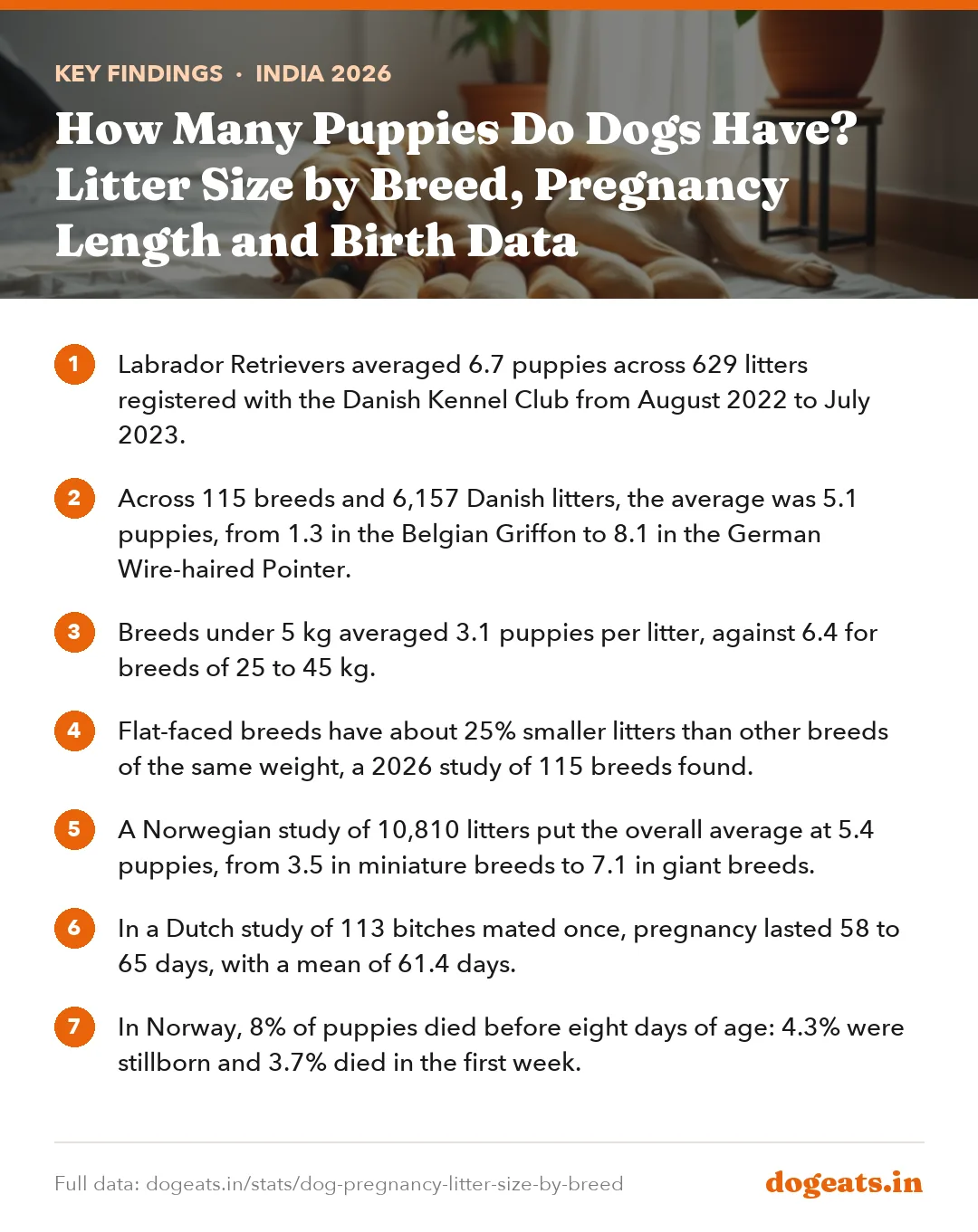
- Labrador Retrievers averaged 6.7 puppies across 629 litters registered with the Danish Kennel Club from August 2022 to July 2023.
- Across 115 breeds and 6,157 Danish litters, the average was 5.1 puppies, from 1.3 in the Belgian Griffon to 8.1 in the German Wire-haired Pointer.
- Breeds under 5 kg averaged 3.1 puppies per litter, against 6.4 for breeds of 25 to 45 kg.
- Flat-faced breeds have about 25% smaller litters than other breeds of the same weight, a 2026 study of 115 breeds found.
- A Norwegian study of 10,810 litters put the overall average at 5.4 puppies, from 3.5 in miniature breeds to 7.1 in giant breeds.
- In a Dutch study of 113 bitches mated once, pregnancy lasted 58 to 65 days, with a mean of 61.4 days.
- In Norway, 8% of puppies died before eight days of age: 4.3% were stillborn and 3.7% died in the first week.
- Free-roaming bitches in Jodhpur carried 4.4 to 4.6 puppies on average, and 32.6% of pregnancies showed fetal resorption.
- Kennel clubs in 65 countries registered 1,700,468 puppies from 405,246 litters in 2025, or 4.2 puppies per litter, per FCI data.
- India's 2017 breeding rules cap a female dog at five litters in her life, one a year, starting at 18 months and stopping at eight years.
How many puppies do dogs have, by breed?
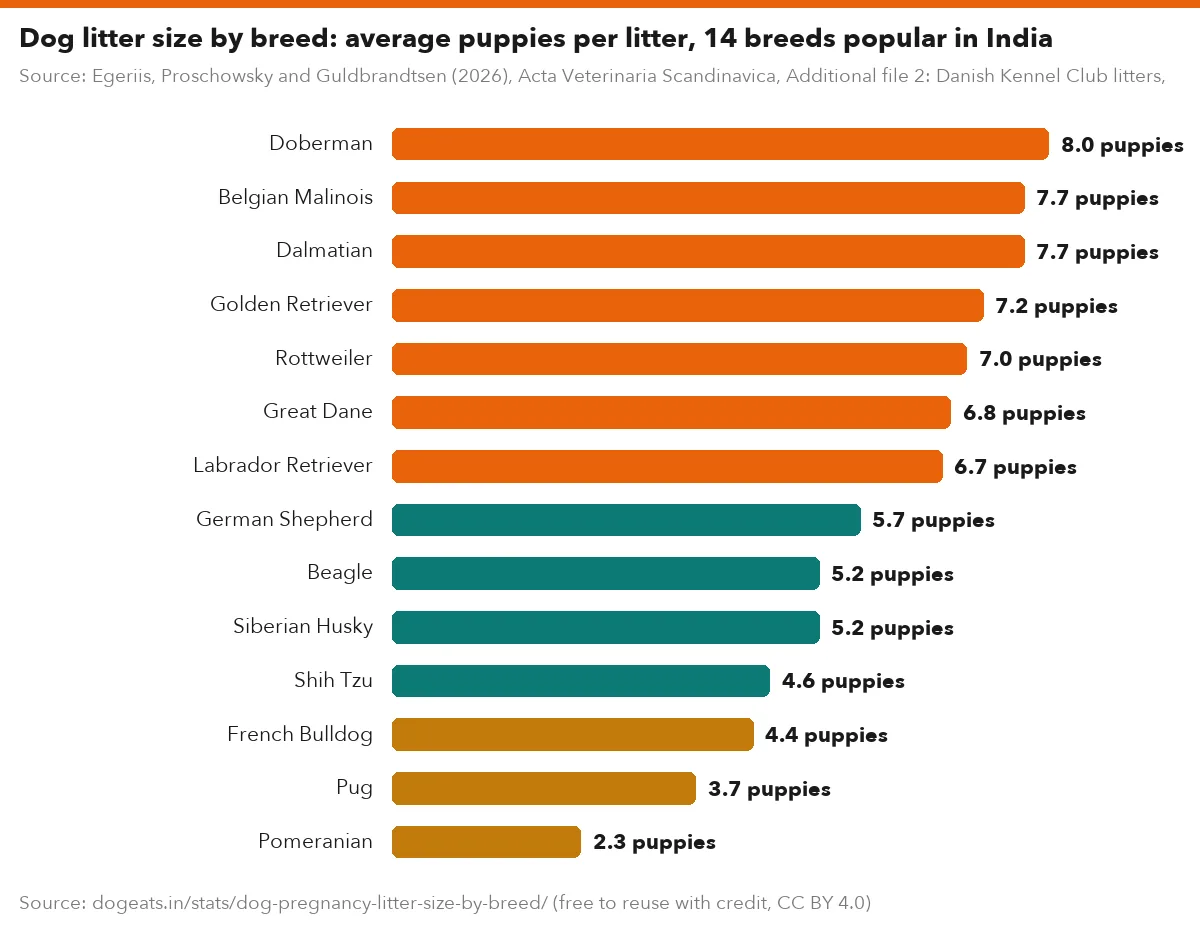
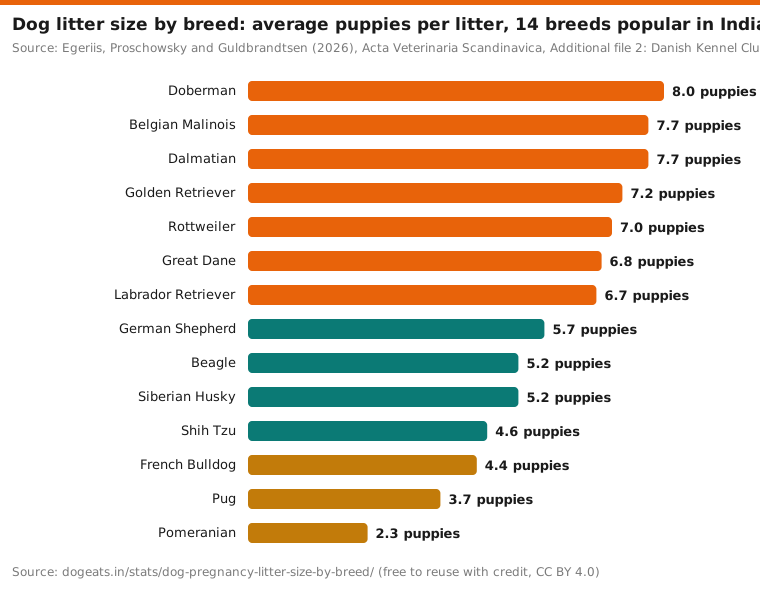
Most dogs have 4 to 7 puppies, and breed size decides much of the gap. The newest open breed table comes from the Danish Kennel Club. It covers 6,157 litters of 115 breeds registered from August 2022 to July 2023.
Across those litters the average was 5.1 puppies. The median breed averaged 4.9. Only breeds with at least 10 registered litters made the list, out of 258 breeds in the full data.
The Doberman averaged 8.0 puppies, the Belgian Malinois and Dalmatian 7.7, and the Golden Retriever 7.2. At the small end, the Pomeranian averaged 2.3 and the smooth-coated Chihuahua 2.0. The Labrador Retriever, with 629 litters, averaged 6.7.
Source: Egeriis, Proschowsky and Guldbrandtsen (2026), Acta Veterinaria Scandinavica, Additional file 2: Danish Kennel Club litters, August 2022 to July 2023. Breed averages; individual litters vary widely.
Show the numbers
| Label | puppies |
|---|---|
| Doberman | 8.0 puppies |
| Belgian Malinois | 7.7 puppies |
| Dalmatian | 7.7 puppies |
| Golden Retriever | 7.2 puppies |
| Rottweiler | 7.0 puppies |
| Great Dane | 6.8 puppies |
| Labrador Retriever | 6.7 puppies |
| German Shepherd | 5.7 puppies |
| Beagle | 5.2 puppies |
| Siberian Husky | 5.2 puppies |
| Shih Tzu | 4.6 puppies |
| French Bulldog | 4.4 puppies |
| Pug | 3.7 puppies |
| Pomeranian | 2.3 puppies |
Embed this chart
| Breed | Average puppies per litter | Litters recorded | Median breed weight (kg) | Flat-faced (FCI) | Puppies from 5 litters at this average |
|---|---|---|---|---|---|
| Doberman | 8.0 | 18 | 38.5 | No | 40 |
| Dalmatian | 7.7 | 11 | 29.5 | No | 38.5 |
| Belgian Malinois | 7.7 | 14 | 28 | No | 38.5 |
| Poodle (standard) | 7.5 | 39 | 22.5 | No | 37.5 |
| Golden Retriever | 7.2 | 312 | 31.5 | No | 36 |
| Australian Shepherd | 7.2 | 64 | 24 | No | 36 |
| Rhodesian Ridgeback | 7.1 | 18 | 34 | No | 35.5 |
| Rottweiler | 7.0 | 50 | 45.5 | No | 35 |
| Great Dane | 6.8 | 22 | 62.5 | No | 34 |
| Labrador Retriever | 6.7 | 629 | 30 | No | 33.5 |
| Bullmastiff | 6.2 | 14 | 50 | No | 31 |
| Border Collie | 5.9 | 101 | 18 | No | 29.5 |
| German Shepherd (short coat) | 5.7 | 325 | 32.5 | No | 28.5 |
| Samoyed | 5.7 | 15 | 26.5 | No | 28.5 |
| Dachshund (standard, smooth) | 5.6 | 19 | 9 | No | 28 |
| English Mastiff | 5.3 | 13 | 82.5 | No | 26.5 |
| Beagle | 5.2 | 38 | 11 | No | 26 |
| Boxer | 5.2 | 47 | 27.5 | Yes | 26 |
| Siberian Husky | 5.2 | 10 | 21.8 | No | 26 |
| Saint Bernard (long coat) | 5.0 | 23 | 70 | No | 25 |
| German Spitz (medium) | 4.9 | 25 | 8.5 | No | 24.5 |
| Alaskan Malamute | 4.9 | 10 | 36.5 | No | 24.5 |
| Cocker Spaniel (English) | 4.8 | 120 | 13 | No | 24 |
| Shih Tzu | 4.6 | 80 | 6.3 | Yes | 23 |
| Bernese Mountain Dog | 4.6 | 118 | 42 | No | 23 |
| Pembroke Welsh Corgi | 4.5 | 22 | 11 | No | 22.5 |
| French Bulldog | 4.4 | 58 | 11 | Yes | 22 |
| English Bulldog | 4.4 | 34 | 23.9 | Yes | 22 |
| Lhasa Apso | 4.3 | 32 | 6.5 | No | 21.5 |
| Bichon Frise | 4.3 | 31 | 4.5 | No | 21.5 |
| Bull Terrier | 4.2 | 13 | 29 | No | 21 |
| Cavalier King Charles Spaniel | 4.1 | 237 | 6.7 | No | 20.5 |
| Jack Russell Terrier | 4.0 | 144 | 6.5 | No | 20 |
| Chow Chow | 4.0 | 27 | 25 | No | 20 |
| Dachshund (miniature, smooth) | 3.8 | 11 | 4.5 | No | 19 |
| German Shepherd (long coat) | 3.7 | 48 | 32.5 | No | 18.5 |
| Pug | 3.7 | 43 | 7 | Yes | 18.5 |
| Yorkshire Terrier | 3.6 | 33 | 3.1 | No | 18 |
| Saint Bernard (short coat) | 3.5 | 17 | 70 | No | 17.5 |
| Poodle (miniature) | 3.1 | 95 | 6.5 | No | 15.5 |
| Shiba Inu | 3.0 | 32 | 10.5 | No | 15 |
| Japanese Spitz | 3.0 | 23 | 8.5 | No | 15 |
| Maltese | 2.9 | 27 | 3.5 | No | 14.5 |
| Chihuahua (long coat) | 2.5 | 65 | 2.3 | No | 12.5 |
| Poodle (toy) | 2.5 | 46 | 4.5 | No | 12.5 |
| Pekingese | 2.5 | 10 | 5.5 | Yes | 12.5 |
| Pomeranian | 2.3 | 41 | 2.5 | No | 11.5 |
| Chihuahua (smooth coat) | 2.0 | 49 | 2.3 | No | 10 |
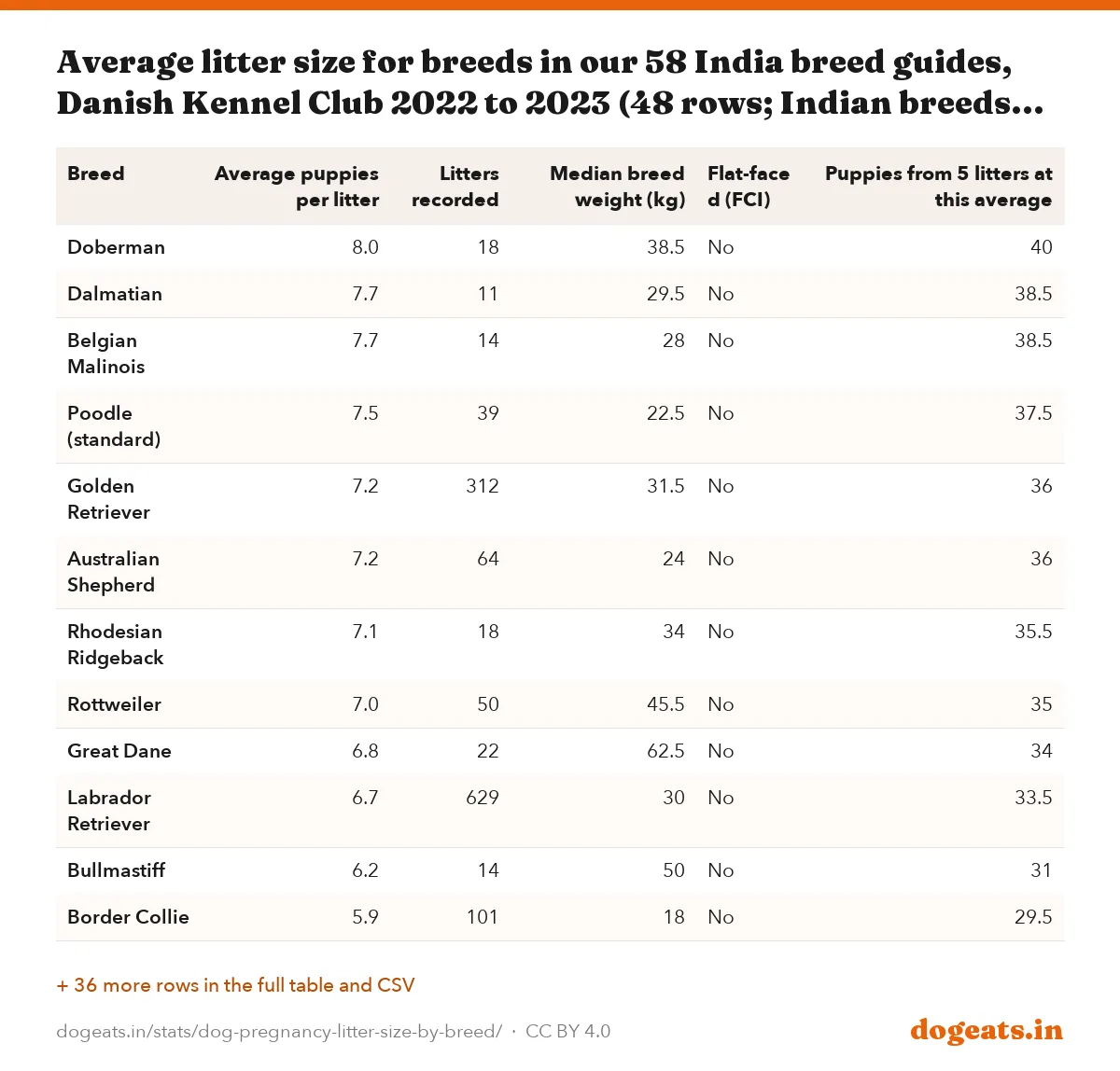
Read the small breed samples with care. The Dalmatian figure rests on 11 litters and the Doberman on 18. The Labrador, Golden Retriever and short-coated German Shepherd each have more than 300.
Coat type splits some breeds. Short-coated German Shepherds averaged 5.7 puppies across 325 litters, long-coated ones 3.7 across 48. Long-coated Saint Bernards averaged 5.0 and short-coated ones 3.5.
How many puppies can a Labrador have?
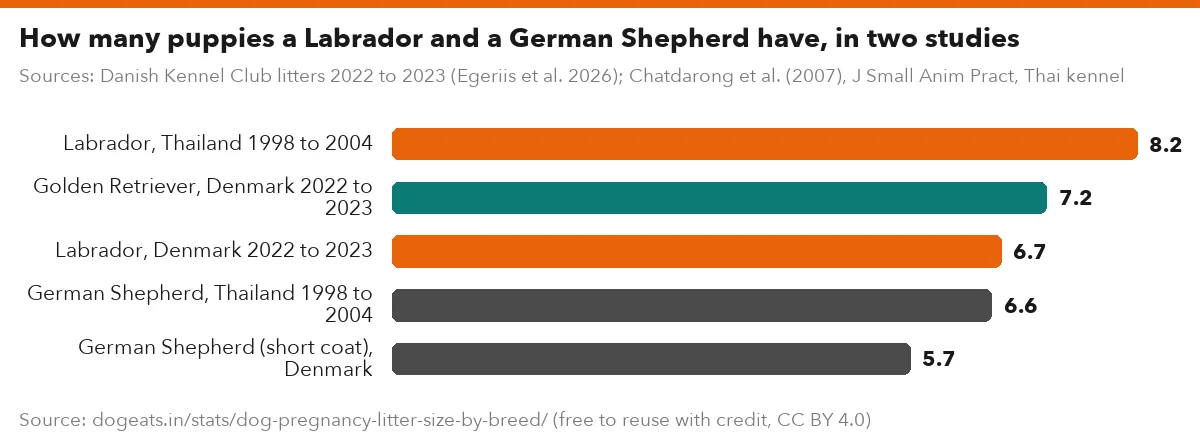
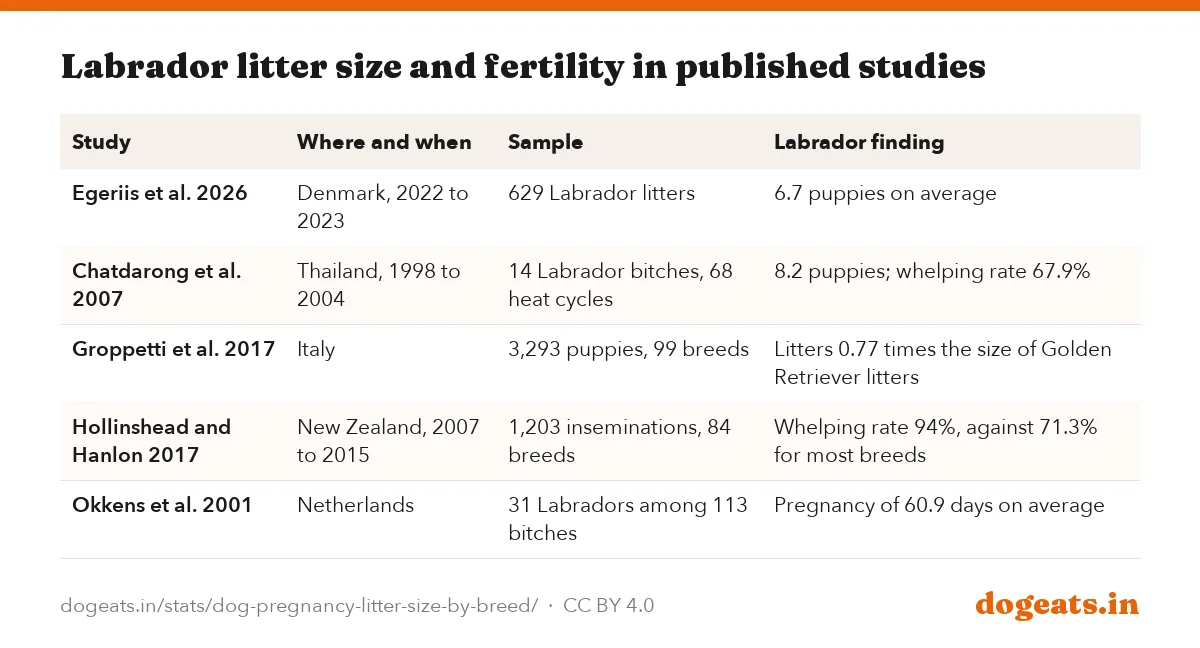
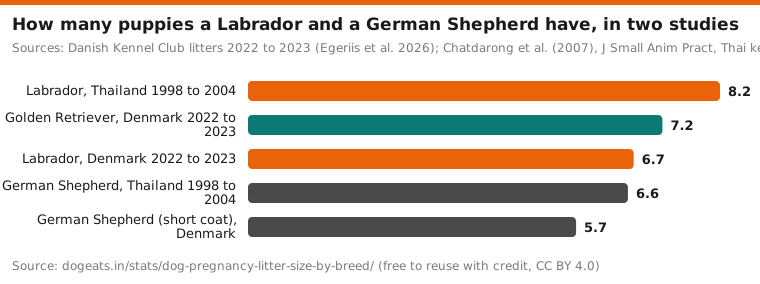
A Labrador usually has 6 to 8 puppies. The Danish data puts the average at 6.7 across 629 litters. A Thai study of 53 kennel bitches found 8.2 puppies per Labrador litter, against 6.6 for German Shepherds.
Studies disagree on how Labradors compare with Golden Retrievers. In Denmark the Golden averaged 7.2, so the Labrador litter was 7% smaller. An Italian census of 588 bitches found Labrador litters 23% smaller than Golden litters.
Single litters can run much larger. A Dutch study of six breeds, including 31 Labradors, recorded litters of 1 to 15 puppies, with a median of 8. An Italian census of 99 breeds found litters of 1 to 14 puppies.
Sources: Danish Kennel Club litters 2022 to 2023 (Egeriis et al. 2026); Chatdarong et al. (2007), J Small Anim Pract, Thai kennel records 1998 to 2004.
Show the numbers
| Label | puppies |
|---|---|
| Labrador, Thailand 1998 to 2004 | 8.2 |
| Golden Retriever, Denmark 2022 to 2023 | 7.2 |
| Labrador, Denmark 2022 to 2023 | 6.7 |
| German Shepherd, Thailand 1998 to 2004 | 6.6 |
| German Shepherd (short coat), Denmark | 5.7 |
Embed this chart
| Study | Where and when | Sample | Labrador finding |
|---|---|---|---|
| Egeriis et al. 2026 | Denmark, 2022 to 2023 | 629 Labrador litters | 6.7 puppies on average |
| Chatdarong et al. 2007 | Thailand, 1998 to 2004 | 14 Labrador bitches, 68 heat cycles | 8.2 puppies; whelping rate 67.9% |
| Groppetti et al. 2017 | Italy | 3,293 puppies, 99 breeds | Litters 0.77 times the size of Golden Retriever litters |
| Hollinshead and Hanlon 2017 | New Zealand, 2007 to 2015 | 1,203 inseminations, 84 breeds | Whelping rate 94%, against 71.3% for most breeds |
| Okkens et al. 2001 | Netherlands | 31 Labradors among 113 bitches | Pregnancy of 60.9 days on average |
Read the Thai and New Zealand figures as data from planned matings in kennels and clinics. They may not match litters from typical pet dogs.
Do bigger dogs have more puppies?
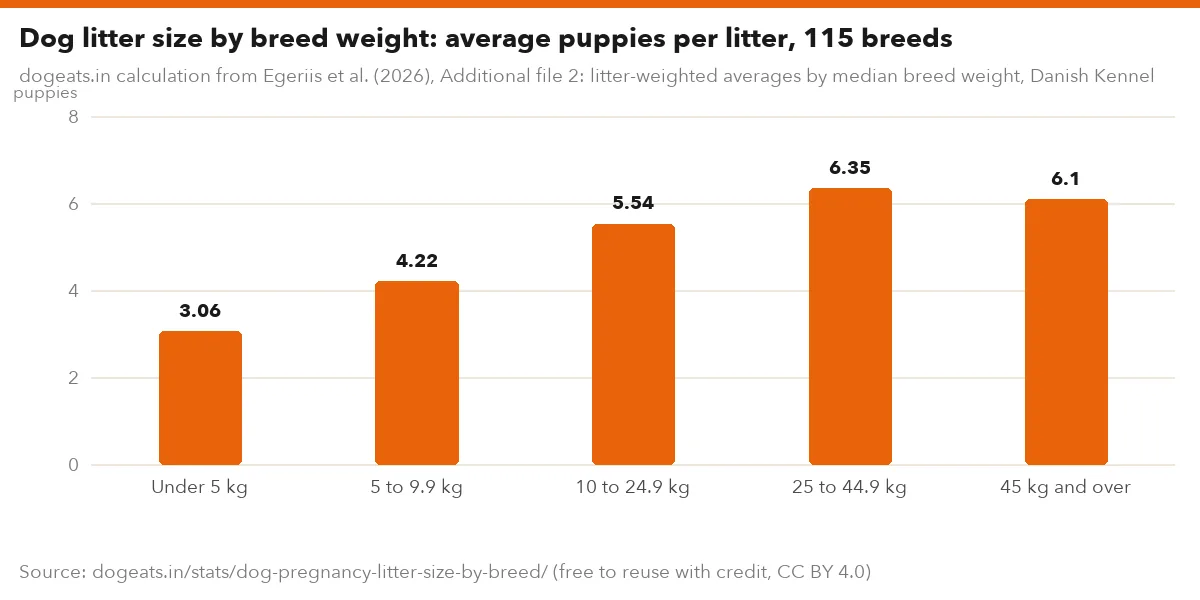
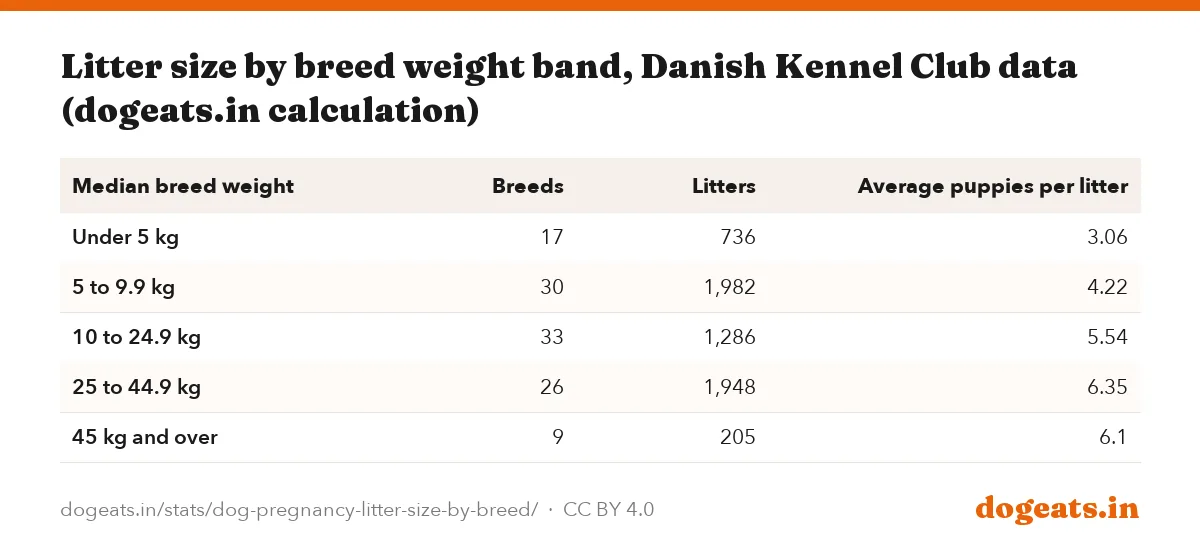
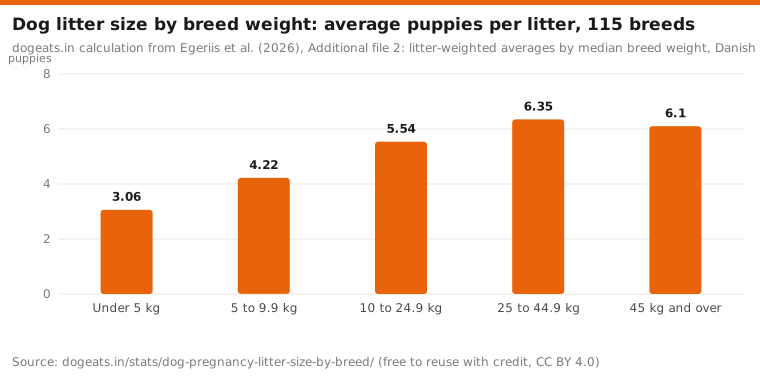
Yes, up to a point. In the Danish data, breeds under 5 kg averaged 3.1 puppies per litter, and breeds of 25 to 45 kg averaged 6.4. Above 45 kg the average dipped to 6.1.
The 2026 study behind that data found the link was curved, not straight. The smallest and largest breeds had smaller litters than a simple size rule predicts. For breeds under 40 kg, each doubling of body weight added about 29% to expected litter size.
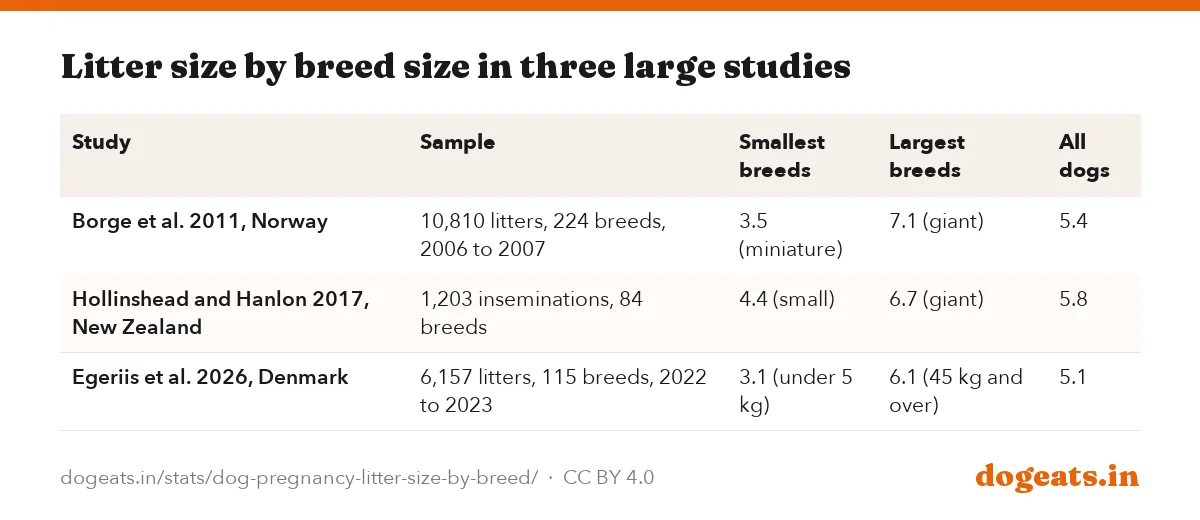
Older studies agree on the pattern. The Norwegian study of 10,810 litters found 3.5 puppies in miniature breeds and 7.1 in giant breeds. A New Zealand clinic study found 4.4 in small breeds, 5.2 in medium, 5.9 in large and 6.7 in giant breeds.
dogeats.in calculation from Egeriis et al. (2026), Additional file 2: litter-weighted averages by median breed weight, Danish Kennel Club, August 2022 to July 2023.
Show the numbers
| Label | puppies |
|---|---|
| Under 5 kg | 3.06 |
| 5 to 9.9 kg | 4.22 |
| 10 to 24.9 kg | 5.54 |
| 25 to 44.9 kg | 6.35 |
| 45 kg and over | 6.1 |
Embed this chart
| Median breed weight | Breeds | Litters | Average puppies per litter |
|---|---|---|---|
| Under 5 kg | 17 | 736 | 3.06 |
| 5 to 9.9 kg | 30 | 1,982 | 4.22 |
| 10 to 24.9 kg | 33 | 1,286 | 5.54 |
| 25 to 44.9 kg | 26 | 1,948 | 6.35 |
| 45 kg and over | 9 | 205 | 6.1 |
| Study | Sample | Smallest breeds | Largest breeds | All dogs |
|---|---|---|---|---|
| Borge et al. 2011, Norway | 10,810 litters, 224 breeds, 2006 to 2007 | 3.5 (miniature) | 7.1 (giant) | 5.4 |
| Hollinshead and Hanlon 2017, New Zealand | 1,203 inseminations, 84 breeds | 4.4 (small) | 6.7 (giant) | 5.8 |
| Egeriis et al. 2026, Denmark | 6,157 litters, 115 breeds, 2022 to 2023 | 3.1 (under 5 kg) | 6.1 (45 kg and over) | 5.1 |
Age matters too. In New Zealand, litter size fell by 0.13 puppies for each year of the mother's age. The Norwegian study found litters shrank faster with age in large breeds.
How the bitch is mated also counts. Frozen semen gave 5.4 puppies per litter on average in New Zealand, against 6.2 with fresh semen. Whelping rates were 71% and 80%.
Why do flat-faced breeds have fewer puppies?
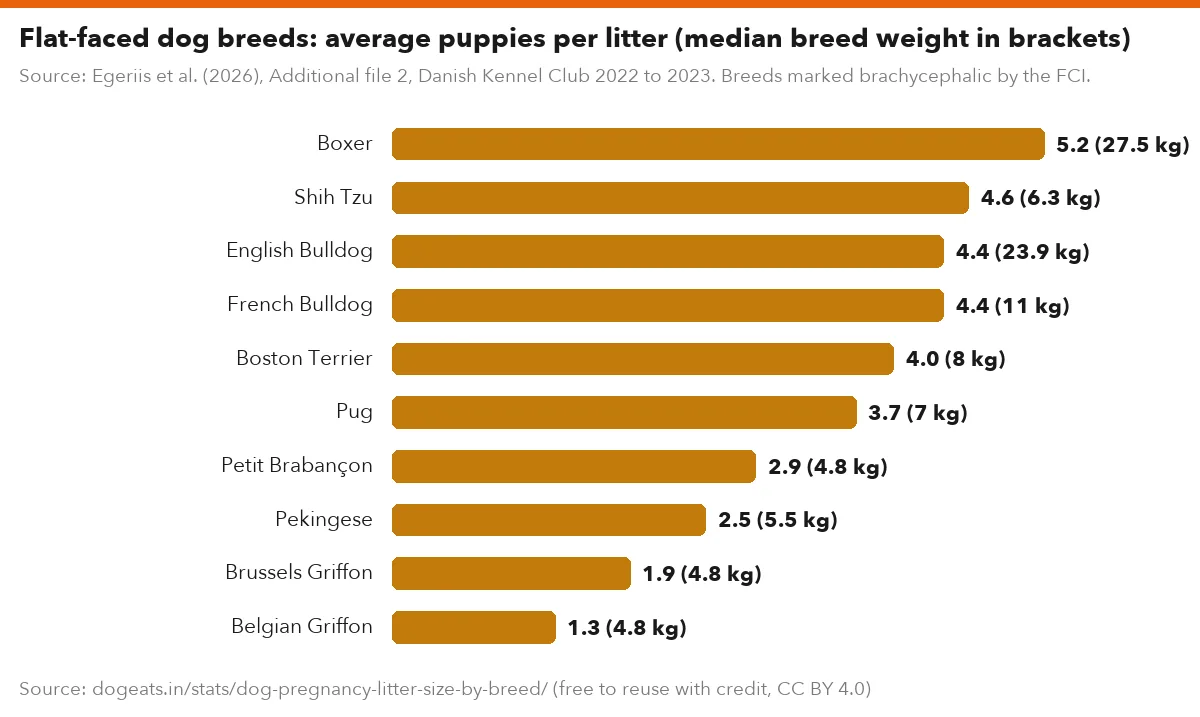
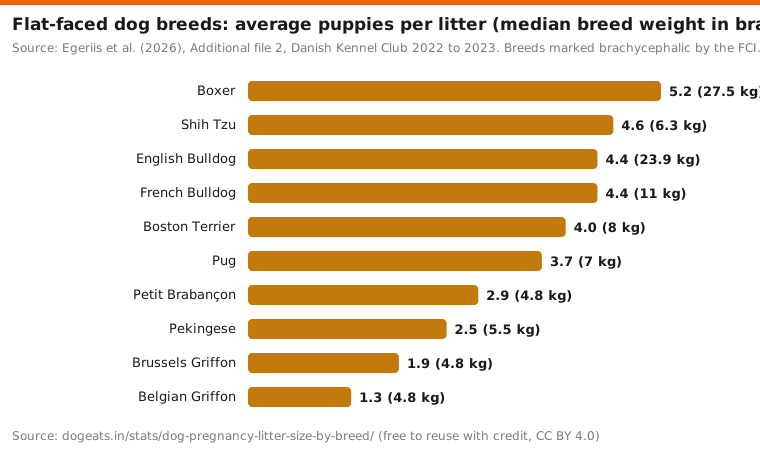
Flat-faced (brachycephalic) breeds have smaller litters than their weight predicts. The 2026 Danish analysis put the gap at about 25%. Short legs, as in Dachshunds and Corgis, made no difference once weight was counted.
Across 10 flat-faced breeds and 355 litters, the average was 4.1 puppies, against 5.2 for 105 other breeds. The Pug averaged 3.7 and the French Bulldog 4.4, while the Boxer managed 5.2.
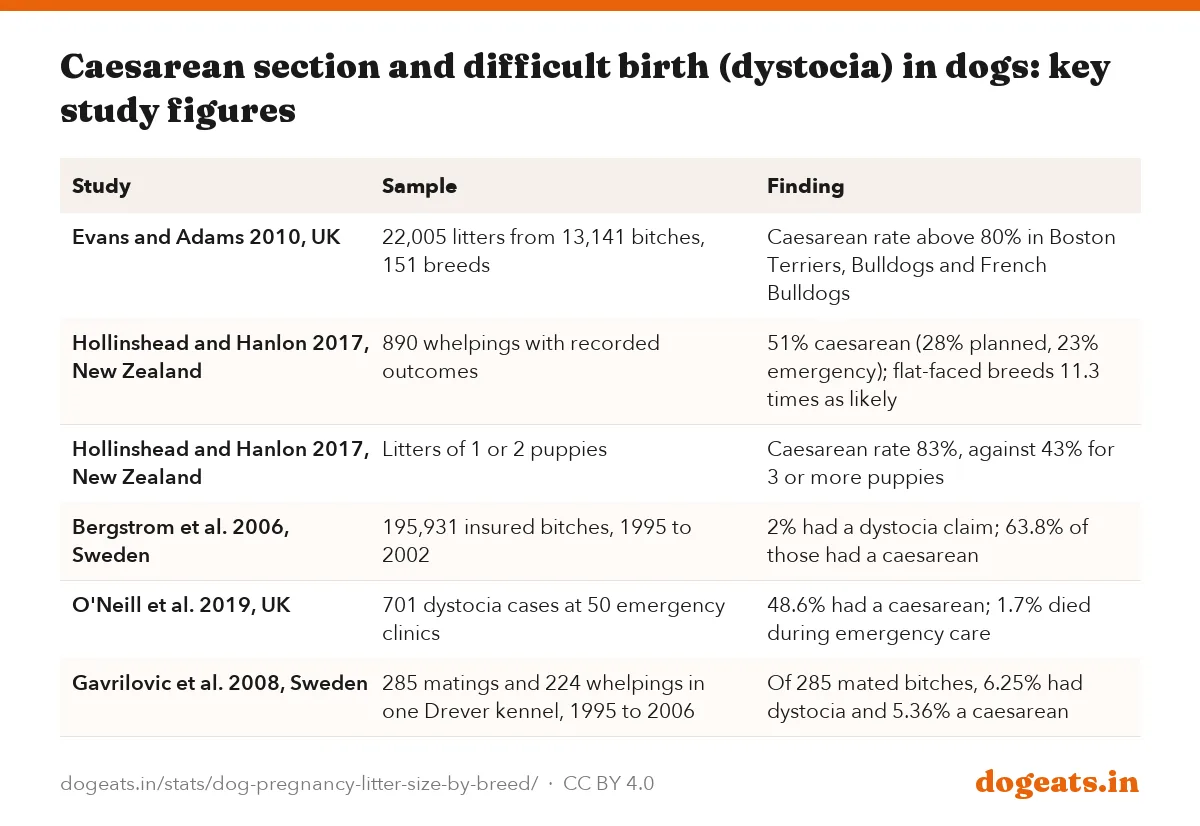
These breeds also need surgery to give birth more often. A UK survey of 22,005 litters found more than 80% of Boston Terrier, Bulldog and French Bulldog litters were born by caesarean section.
Source: Egeriis et al. (2026), Additional file 2, Danish Kennel Club 2022 to 2023. Breeds marked brachycephalic by the FCI.
Show the numbers
| Label | puppies |
|---|---|
| Boxer | 5.2 (27.5 kg) |
| Shih Tzu | 4.6 (6.3 kg) |
| English Bulldog | 4.4 (23.9 kg) |
| French Bulldog | 4.4 (11 kg) |
| Boston Terrier | 4.0 (8 kg) |
| Pug | 3.7 (7 kg) |
| Petit Brabançon | 2.9 (4.8 kg) |
| Pekingese | 2.5 (5.5 kg) |
| Brussels Griffon | 1.9 (4.8 kg) |
| Belgian Griffon | 1.3 (4.8 kg) |
Embed this chart
| Study | Sample | Finding |
|---|---|---|
| Evans and Adams 2010, UK | 22,005 litters from 13,141 bitches, 151 breeds | Caesarean rate above 80% in Boston Terriers, Bulldogs and French Bulldogs |
| Hollinshead and Hanlon 2017, New Zealand | 890 whelpings with recorded outcomes | 51% caesarean (28% planned, 23% emergency); flat-faced breeds 11.3 times as likely |
| Hollinshead and Hanlon 2017, New Zealand | Litters of 1 or 2 puppies | Caesarean rate 83%, against 43% for 3 or more puppies |
| Bergstrom et al. 2006, Sweden | 195,931 insured bitches, 1995 to 2002 | 2% had a dystocia claim; 63.8% of those had a caesarean |
| O'Neill et al. 2019, UK | 701 dystocia cases at 50 emergency clinics | 48.6% had a caesarean; 1.7% died during emergency care |
| Gavrilovic et al. 2008, Sweden | 285 matings and 224 whelpings in one Drever kennel, 1995 to 2006 | Of 285 mated bitches, 6.25% had dystocia and 5.36% a caesarean |
The New Zealand clinic saw many breeding referrals, so its 51% caesarean rate is far above what a general practice sees. The Swedish insurance data, at 5.7 dystocia cases per 1,000 dog-years, gives a wider population view.
How long is a dog pregnant?
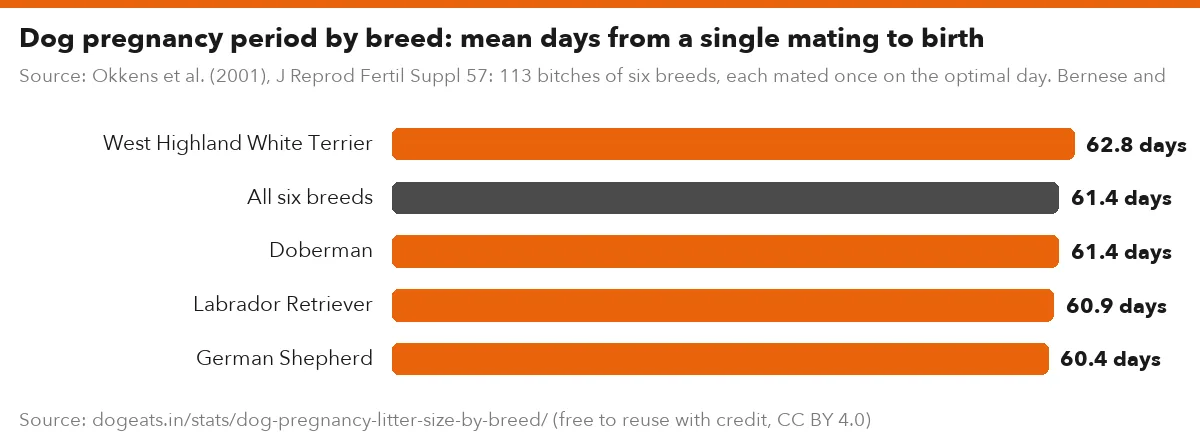
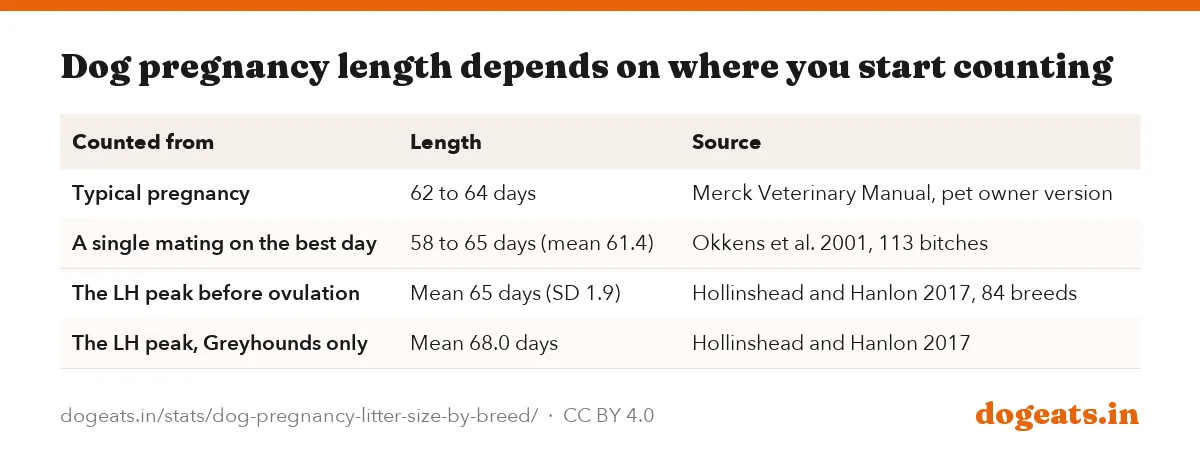
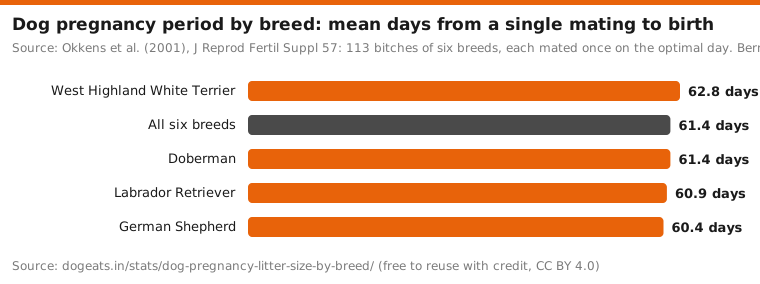
A dog is pregnant for about 62 to 64 days, says the Merck Veterinary Manual. Counted from a single mating, the range is wider. A Dutch study of 113 bitches mated once on the best day found 58 to 65 days, with a mean of 61.4.
The start point changes the count. Measured from the hormone surge that comes before ovulation (the LH peak), pregnancy averaged 65 days in a New Zealand study of 84 breeds. Greyhounds there averaged 68.0 days.
Bigger litters arrive a little sooner. Across all six Dutch breeds, gestation shortened as litter size rose. In Swedish Drevers, each puppy above the average cut pregnancy by about 0.25 days.
Source: Okkens et al. (2001), J Reprod Fertil Suppl 57: 113 bitches of six breeds, each mated once on the optimal day. Bernese and Golden Retriever means were not given in the abstract.
Show the numbers
| Label | days |
|---|---|
| West Highland White Terrier | 62.8 days |
| All six breeds | 61.4 days |
| Doberman | 61.4 days |
| Labrador Retriever | 60.9 days |
| German Shepherd | 60.4 days |
Embed this chart
| Counted from | Length | Source |
|---|---|---|
| Typical pregnancy | 62 to 64 days | Merck Veterinary Manual, pet owner version |
| A single mating on the best day | 58 to 65 days (mean 61.4) | Okkens et al. 2001, 113 bitches |
| The LH peak before ovulation | Mean 65 days (SD 1.9) | Hollinshead and Hanlon 2017, 84 breeds |
| The LH peak, Greyhounds only | Mean 68.0 days | Hollinshead and Hanlon 2017 |
| Day or time | What happens | Source |
|---|---|---|
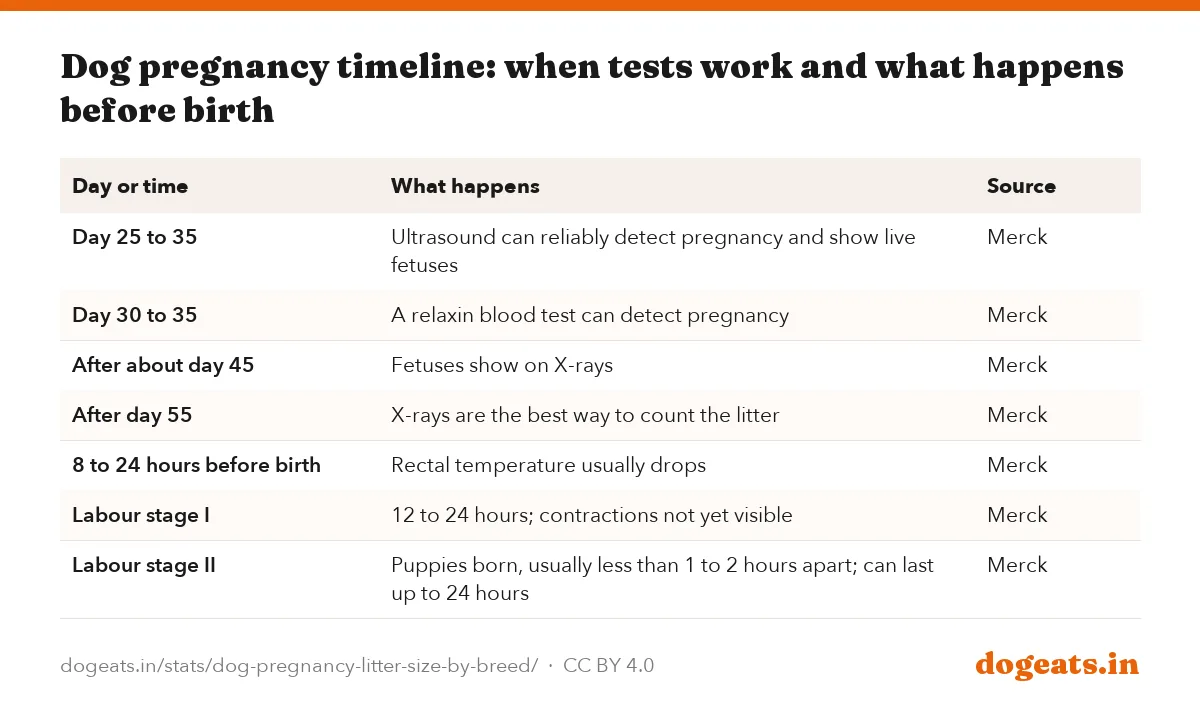
| Day 25 to 35 | Ultrasound can reliably detect pregnancy and show live fetuses | Merck |
| Day 30 to 35 | A relaxin blood test can detect pregnancy | Merck |
| After about day 45 | Fetuses show on X-rays | Merck |
| After day 55 | X-rays are the best way to count the litter | Merck |
| 8 to 24 hours before birth | Rectal temperature usually drops | Merck |
| Labour stage I | 12 to 24 hours; contractions not yet visible | Merck |
| Labour stage II | Puppies born, usually less than 1 to 2 hours apart; can last up to 24 hours | Merck |
Merck lists when labour is too slow. Warning times are more than 24 hours in stage I, more than 12 to 24 hours in stage II, or 1 to 4 hours between puppies. Puppies born dead or a mother in clear distress are also warning signs. Call a vet in any of these cases.
Food needs change in late pregnancy and while nursing. Our pregnant and lactating dog diet guide covers what to feed, and your vet can set amounts.
How many puppies survive after birth?
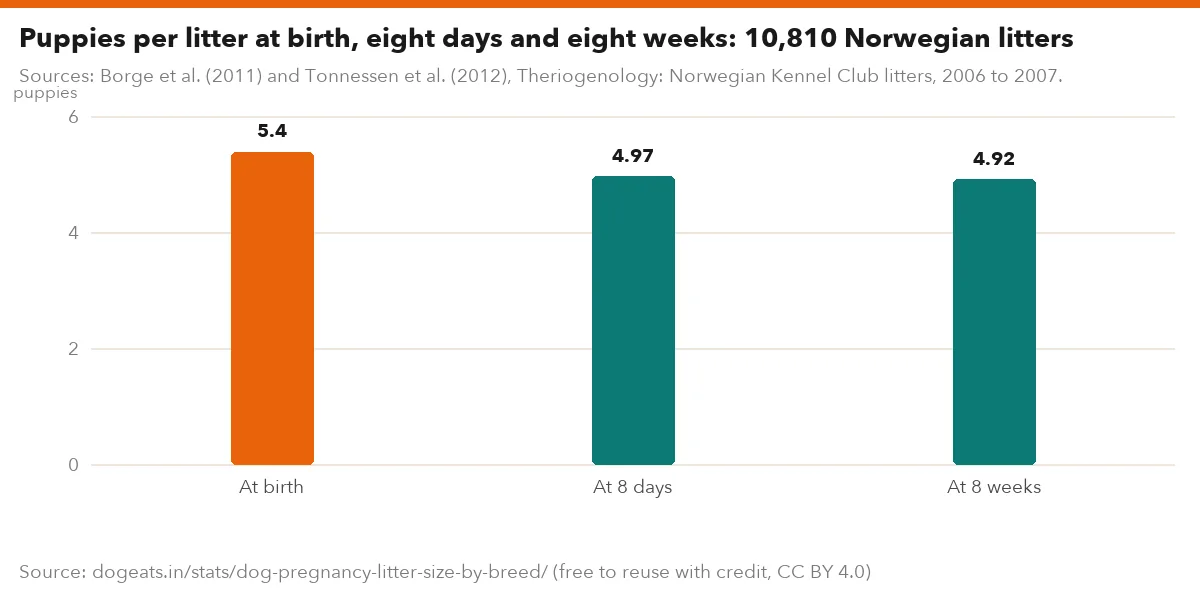
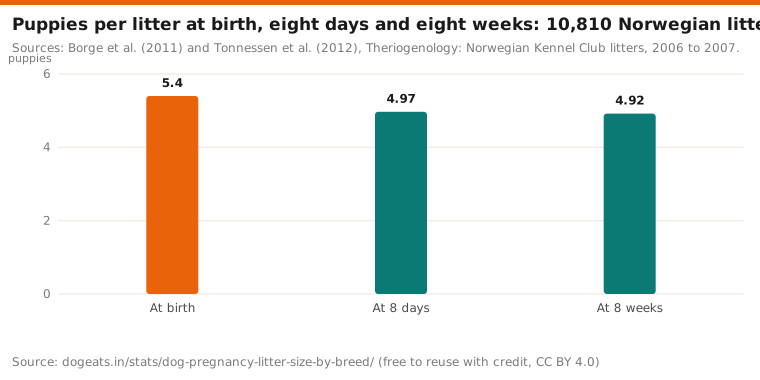
About 92% of puppies are alive at eight days old in kennel club data. The Norwegian study of 10,810 litters found 8% of puppies died before eight days old. Of these, 4.3% were stillborn and 3.7% died in the first week.
Deaths touched one litter in four: 24.6% lost at least one puppy around birth. Only 1% of puppies died between eight days and eight weeks. Average litter size fell from 5.4 at birth to 4.97 at eight days and 4.92 at eight weeks.
Larger litters and older mothers carried more risk. A first litter after age six tripled the odds of a stillbirth. Over 90% of the variation in these deaths lay between individual litters, not breeds.
Sources: Borge et al. (2011) and Tonnessen et al. (2012), Theriogenology: Norwegian Kennel Club litters, 2006 to 2007.
Show the numbers
| Label | puppies |
|---|---|
| At birth | 5.4 |
| At 8 days | 4.97 |
| At 8 weeks | 4.92 |
Embed this chart
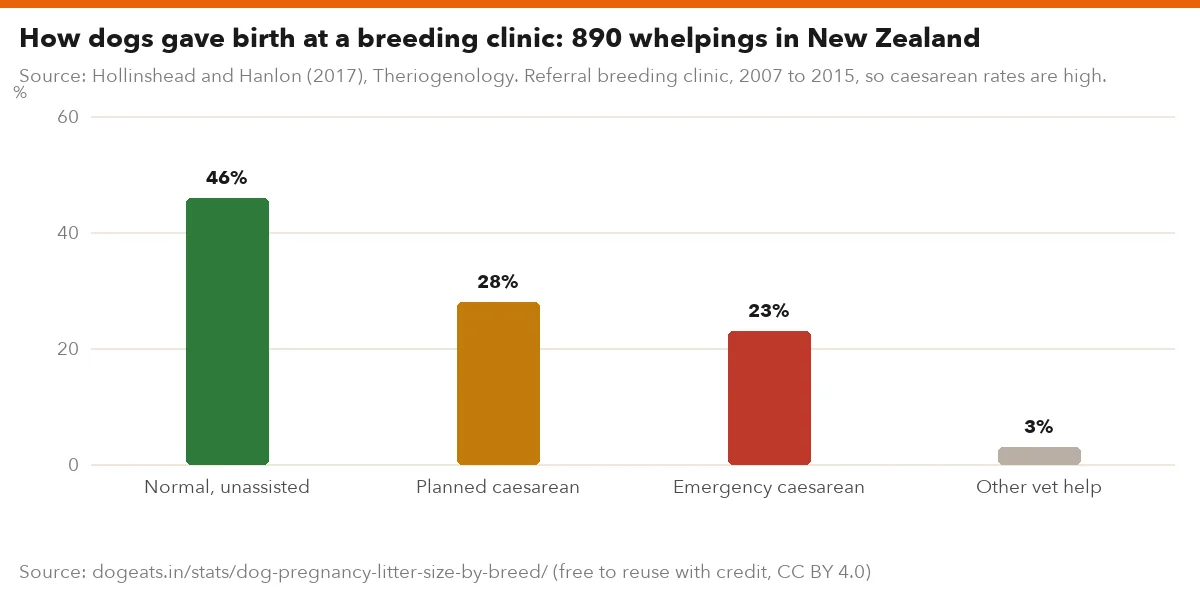
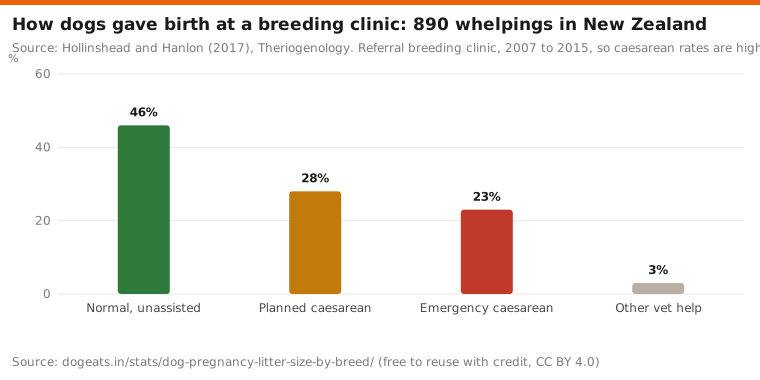
Source: Hollinshead and Hanlon (2017), Theriogenology. Referral breeding clinic, 2007 to 2015, so caesarean rates are high.
Show the numbers
| Label | % |
|---|---|
| Normal, unassisted | 46% |
| Planned caesarean | 28% |
| Emergency caesarean | 23% |
| Other vet help | 3% |
Embed this chart
Merck says newborn puppies should gain about 10% of their body weight each day. Any loss after the first 24 hours needs prompt attention from you and your vet. Our puppy feeding guide covers weaning and portions.
How many puppies do Indian street dogs have?
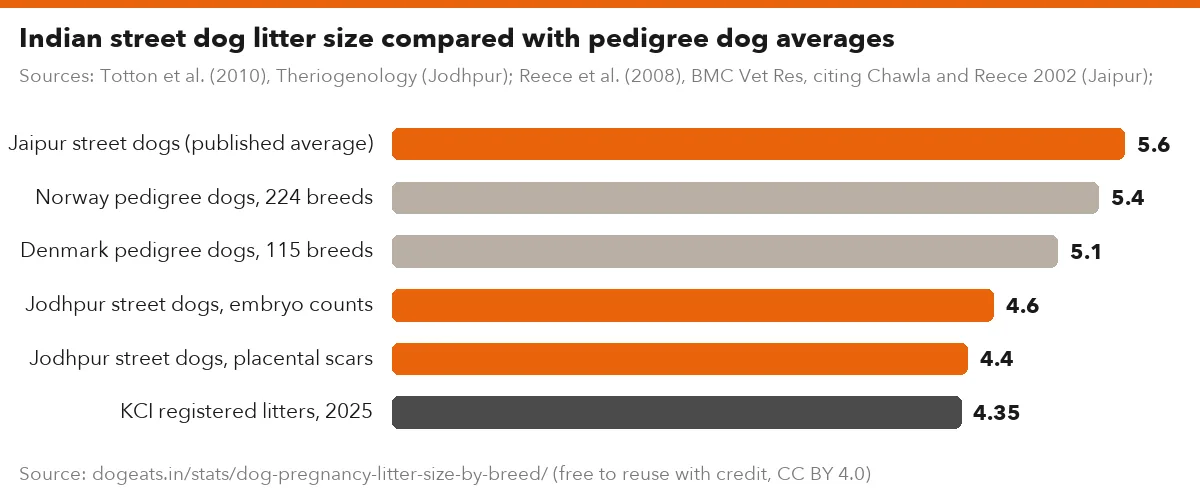
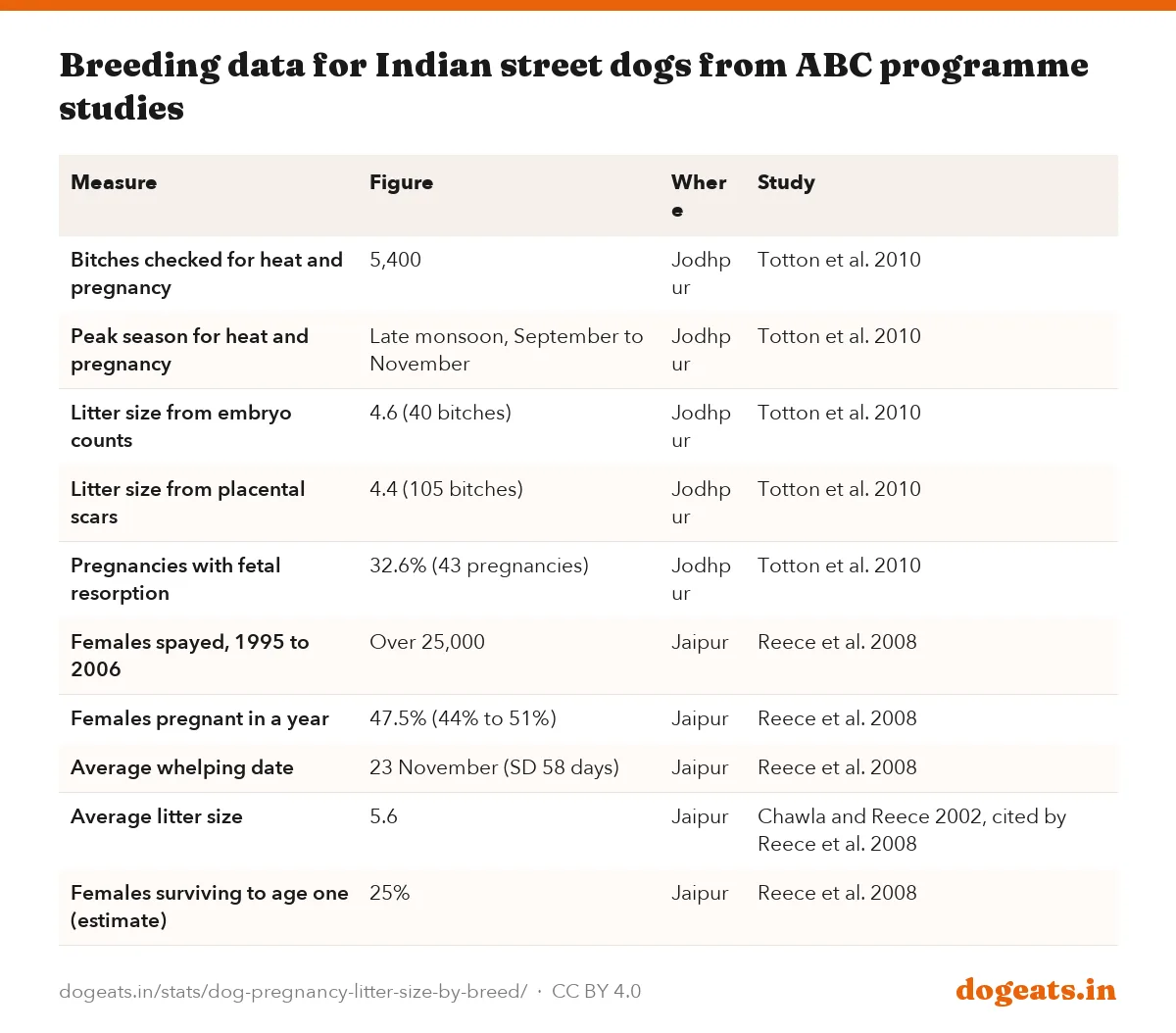
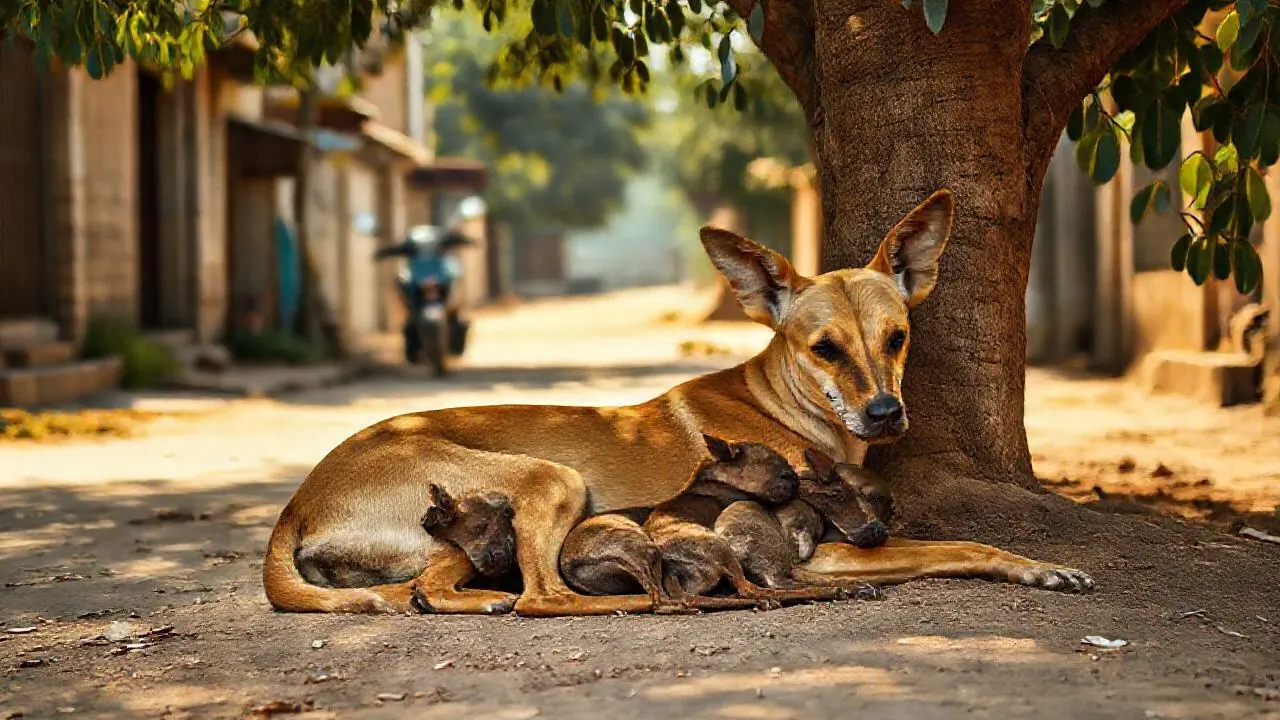
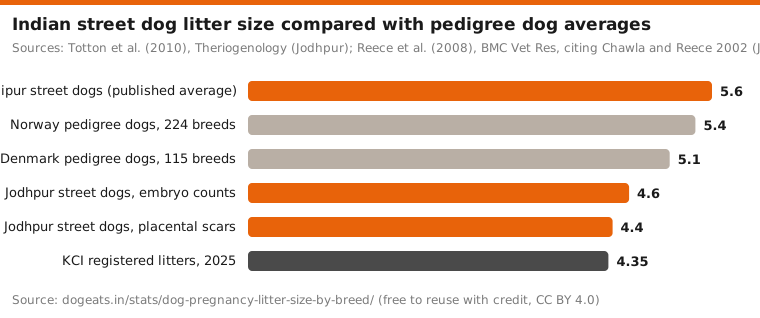
Indian free-roaming dogs have litters of about 4 to 6 puppies. In Jodhpur, researchers examined the uteri of bitches spayed under the Animal Birth Control (ABC) programme. Counts of embryos and fetuses gave 4.6 puppies per litter across 40 pregnant bitches.
Placental scars from earlier litters gave 4.4 across 105 bitches. Fetal resorption, where an embryo is lost and absorbed, showed in 32.6% of 43 pregnancies. Affected litters lost 2.8 embryos on average.
A Jaipur study used an average litter of 5.6 from earlier local work. It estimated that 47.5% of roaming females became pregnant each year, from over 25,000 spayed between 1995 and 2006.
Sources: Totton et al. (2010), Theriogenology (Jodhpur); Reece et al. (2008), BMC Vet Res, citing Chawla and Reece 2002 (Jaipur); Borge et al. (2011); Egeriis et al. (2026); FCI statistics 2025 (KCI).
Show the numbers
| Label | puppies |
|---|---|
| Jaipur street dogs (published average) | 5.6 |
| Norway pedigree dogs, 224 breeds | 5.4 |
| Denmark pedigree dogs, 115 breeds | 5.1 |
| Jodhpur street dogs, embryo counts | 4.6 |
| Jodhpur street dogs, placental scars | 4.4 |
| KCI registered litters, 2025 | 4.35 |
Embed this chart
| Measure | Figure | Where | Study |
|---|---|---|---|
| Bitches checked for heat and pregnancy | 5,400 | Jodhpur | Totton et al. 2010 |
| Peak season for heat and pregnancy | Late monsoon, September to November | Jodhpur | Totton et al. 2010 |
| Litter size from embryo counts | 4.6 (40 bitches) | Jodhpur | Totton et al. 2010 |
| Litter size from placental scars | 4.4 (105 bitches) | Jodhpur | Totton et al. 2010 |
| Pregnancies with fetal resorption | 32.6% (43 pregnancies) | Jodhpur | Totton et al. 2010 |
| Females spayed, 1995 to 2006 | Over 25,000 | Jaipur | Reece et al. 2008 |
| Females pregnant in a year | 47.5% (44% to 51%) | Jaipur | Reece et al. 2008 |
| Average whelping date | 23 November (SD 58 days) | Jaipur | Reece et al. 2008 |
| Average litter size | 5.6 | Jaipur | Chawla and Reece 2002, cited by Reece et al. 2008 |
| Females surviving to age one (estimate) | 25% | Jaipur | Reece et al. 2008 |
Street dog breeding follows the seasons. Jaipur's estimated average whelping date was 23 November, and Jodhpur's peak for heat and pregnancy was September to November. ABC teams use this to time sterilisation drives; see our ABC sterilisation report.
Survival is low. The Jaipur team estimated that only 25% of females survive their first year, and that a spayed female who reaches age one has an expected lifespan of 3.8 years.
How do Indian kennel club litters compare with other countries?
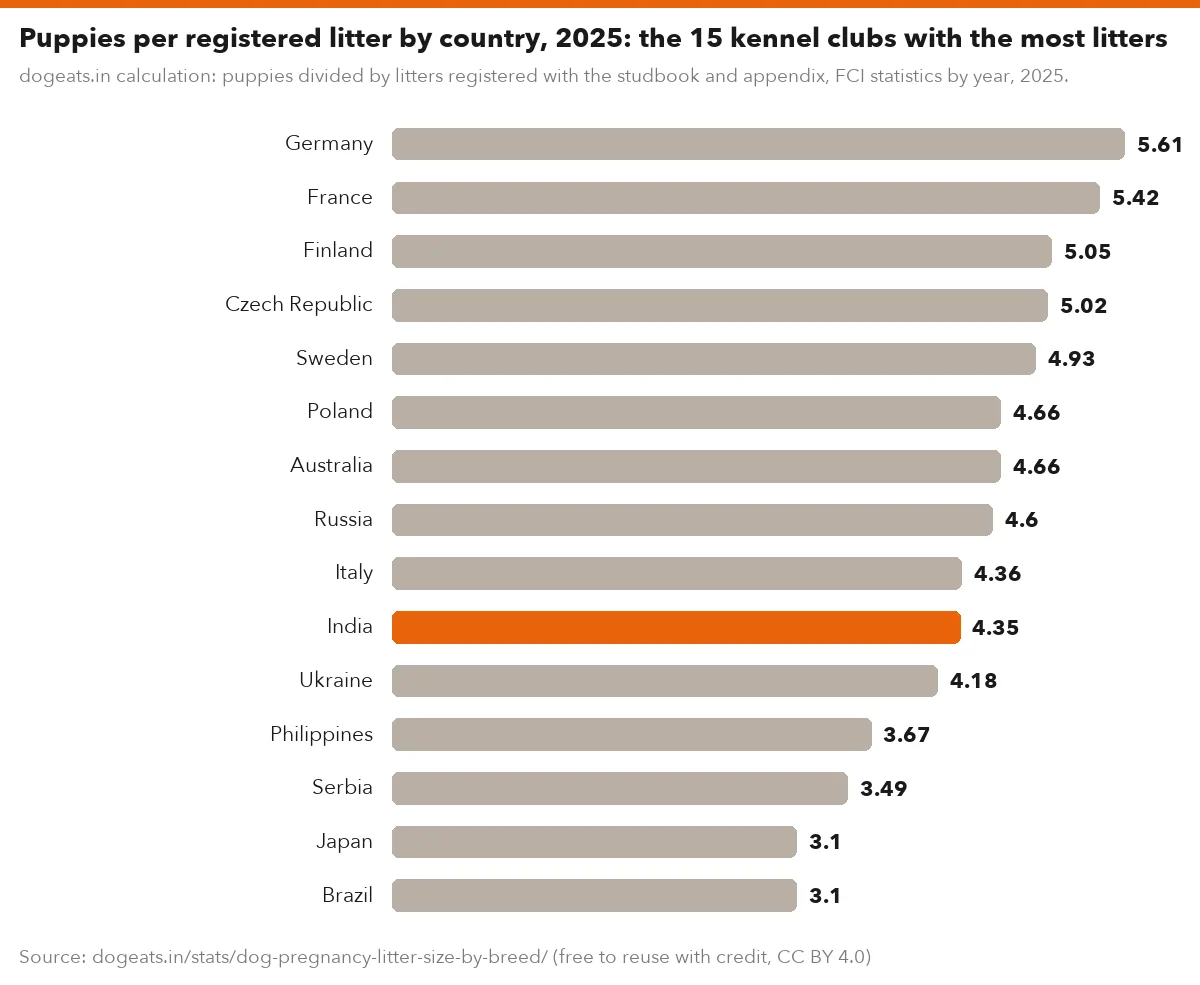
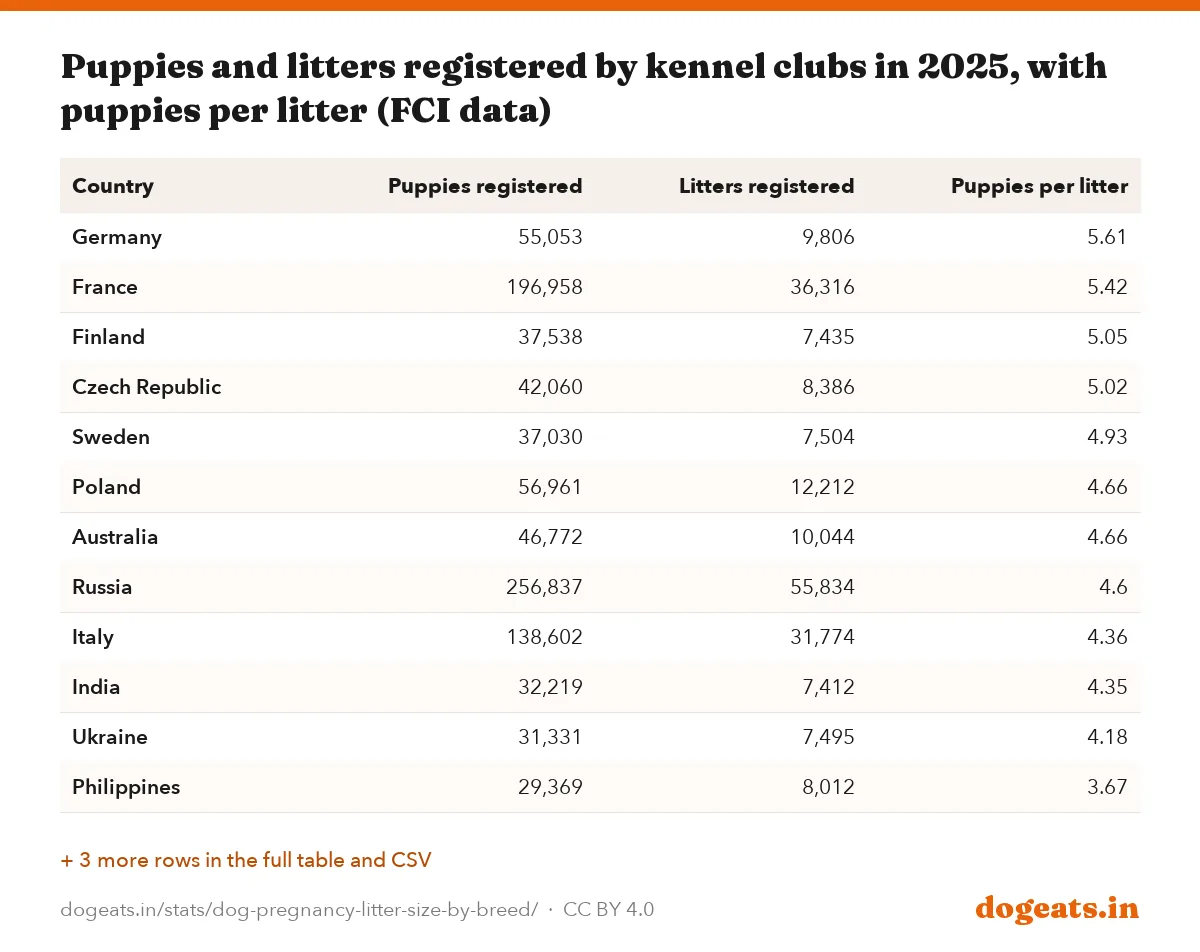
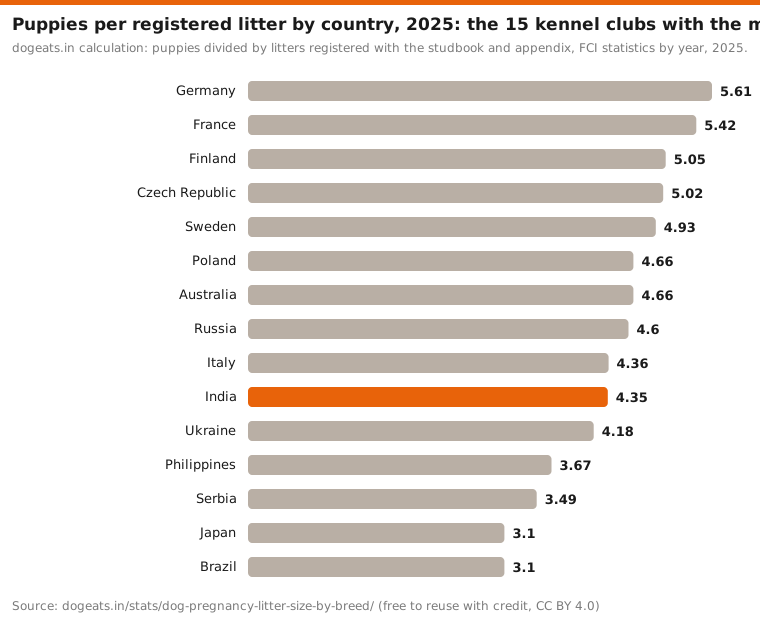
The Kennel Club of India (KCI) registered 32,219 puppies from 7,412 litters in 2025, per FCI statistics. That works out to 4.35 puppies per registered litter. Across 65 FCI countries reporting both figures, the average was 4.2.
India ranked 43rd highest of those 65 countries. Germany, at 5.61, and France, at 5.42, led the larger clubs. Japan and Brazil, at 3.1 each, were lowest among the 15 clubs with the most litters.
These are registered puppies, not puppies born. Puppies that die early or are never registered drop out. India's own ratio swung from 5.71 in 2014 to 10.38 in 2021 and 4.35 in 2025, which points to registration practice more than biology.
dogeats.in calculation: puppies divided by litters registered with the studbook and appendix, FCI statistics by year, 2025.
Show the numbers
| Label | puppies |
|---|---|
| Germany | 5.61 |
| France | 5.42 |
| Finland | 5.05 |
| Czech Republic | 5.02 |
| Sweden | 4.93 |
| Poland | 4.66 |
| Australia | 4.66 |
| Russia | 4.6 |
| Italy | 4.36 |
| India | 4.35 |
| Ukraine | 4.18 |
| Philippines | 3.67 |
| Serbia | 3.49 |
| Japan | 3.1 |
| Brazil | 3.1 |
Embed this chart
| Country | Puppies registered | Litters registered | Puppies per litter |
|---|---|---|---|
| Germany | 55,053 | 9,806 | 5.61 |
| France | 196,958 | 36,316 | 5.42 |
| Finland | 37,538 | 7,435 | 5.05 |
| Czech Republic | 42,060 | 8,386 | 5.02 |
| Sweden | 37,030 | 7,504 | 4.93 |
| Poland | 56,961 | 12,212 | 4.66 |
| Australia | 46,772 | 10,044 | 4.66 |
| Russia | 256,837 | 55,834 | 4.6 |
| Italy | 138,602 | 31,774 | 4.36 |
| India | 32,219 | 7,412 | 4.35 |
| Ukraine | 31,331 | 7,495 | 4.18 |
| Philippines | 29,369 | 8,012 | 3.67 |
| Serbia | 28,504 | 8,176 | 3.49 |
| Japan | 301,790 | 97,395 | 3.1 |
| Brazil | 79,755 | 25,691 | 3.1 |
Breed mix shapes these figures. A club whose registrations lean towards toy breeds will show small litters even if every dog is healthy. More on India's pedigree numbers is in our Kennel Club of India registrations report.
How often can a dog have puppies in India?
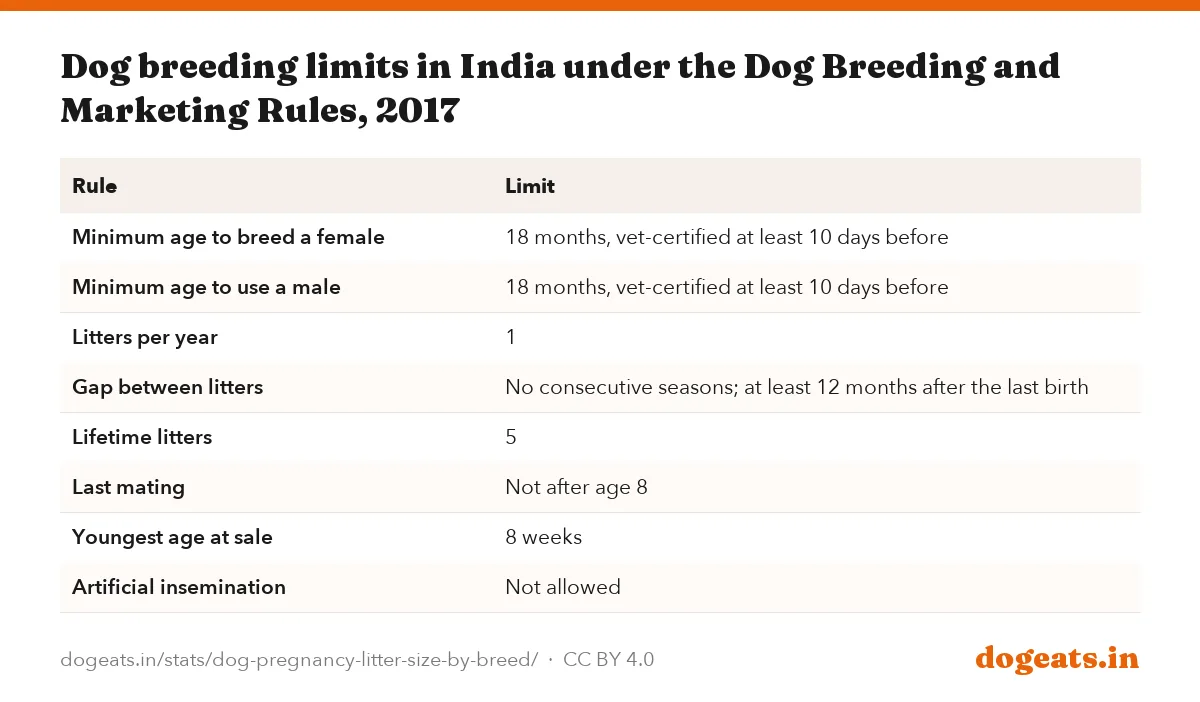
Under India's Prevention of Cruelty to Animals (Dog Breeding and Marketing) Rules, 2017, a female dog may have one litter a year at most. She must be at least 18 months old and certified healthy by a vet at least 10 days before mating.
She cannot be bred in two consecutive seasons, or within 12 months of her last litter. She can have no more than five litters in her life, and cannot be mated after age eight. Puppies under eight weeks cannot be sold.
Biology allows more. Merck puts the average gap between heat cycles at 7 months, with a range of 4 to 13 months. Some large breeds, such as Great Danes, cycle every 9 to 12 months.
| Rule | Limit |
|---|---|
| Minimum age to breed a female | 18 months, vet-certified at least 10 days before |
| Minimum age to use a male | 18 months, vet-certified at least 10 days before |
| Litters per year | 1 |
| Gap between litters | No consecutive seasons; at least 12 months after the last birth |
| Lifetime litters | 5 |
| Last mating | Not after age 8 |
| Youngest age at sale | 8 weeks |
| Artificial insemination | Not allowed |
- Heat cycle: about every 7 months on average, range 4 to 13 months (Merck).
- Proestrus: about 9 days, range 2 days to 3 weeks (Merck).
- Estrus, when a female accepts mating: about 9 days, range 3 days to 3 weeks (Merck).
- Ovulation: about 2 to 3 days after the LH peak (Merck).
- Heat in the tropics: a Thai study of 310 heat cycles found fewer cycles and lower whelping rates in summer.
At the breed averages above, five lawful litters would mean about 33 or 34 puppies from a Labrador and 36 from a Golden Retriever. A Pomeranian would have about 11 or 12. These are illustrations, not targets.
Breeders must register with their State Animal Welfare Board. Our dog breeding licence report tracks fees, registered breeders and enforcement.
Frequently asked questions
How many puppies can a Labrador have?
A Labrador averages about 6 to 8 puppies. Danish Kennel Club data for 629 litters in 2022 to 2023 gives 6.7, and a Thai kennel study found 8.2. Single litters of up to 15 have been recorded in research.
How long is a dog pregnant?
About 62 to 64 days, per the Merck Veterinary Manual. Counted from one mating on the best day, a Dutch study found 58 to 65 days, with a mean of 61.4.
How many puppies does a dog have the first time?
Studies do not give one figure for first litters. The Norwegian study of 10,810 litters found parity had no effect on litter size, but the bitch's age did, with litters shrinking as mothers aged.
Which dog breed has the most puppies?
In 2022 to 2023 Danish data, the German Wire-haired Pointer averaged 8.1 puppies and the Doberman 8.0. Among breeds common in India, the Belgian Malinois and Dalmatian averaged 7.7 and the Golden Retriever 7.2.
How many puppies do small dogs have?
Breeds under 5 kg averaged 3.1 puppies per litter in Danish data. The Pomeranian averaged 2.3, the smooth Chihuahua 2.0 and the toy Poodle 2.5.
How many puppies do street dogs in India have?
Studies put Indian street dog litters at about 4 to 6 puppies. Jodhpur bitches carried 4.4 to 4.6, and Jaipur's published average is 5.6.
How often can a dog get pregnant?
A dog comes into heat about every 7 months on average, per Merck. In India, the 2017 breeding rules allow a female one litter a year and five in her life, from 18 months to 8 years.
What percentage of puppies die at birth?
In Norwegian kennel club data, 4.3% of puppies were stillborn and 3.7% died in the first week. In all, 24.6% of litters lost at least one puppy around birth.
Do Pugs and French Bulldogs need a C-section?
Often. A UK survey found more than 80% of French Bulldog, Bulldog and Boston Terrier litters were born by caesarean. Flat-faced breeds were 11.3 times as likely to have one in a New Zealand clinic study.
Methodology and limitations
Breed litter sizes come from Additional file 2 of Egeriis, Proschowsky and Guldbrandtsen (2026). It lists 115 breeds with at least 10 litters registered with the Danish Kennel Club from August 2022 to July 2023. We downloaded the file from Europe PMC on 15 October 2026 and parsed all 115 rows. The breed count of litters sums to 6,157.
We computed the overall average weighting each breed by its litters. Weight bands use each breed's median weight from the same file. Flat-faced breeds are those the file marks as brachycephalic, following the FCI.
We matched 48 rows to breeds in our 58 India breed guides by name, keeping coat and size varieties separate. The 'puppies from 5 litters' column multiplies the breed average by the legal lifetime limit of five litters under India's 2017 rules. It is an illustration, not a forecast.
Country figures divide puppies by litters registered with the studbook and appendix. They come from FCI statistics by year for 2025 and the FCI page for India, both read on 15 October 2026. We used the 65 countries that reported both numbers.
Study figures come from abstracts or open full texts we read on 15 October 2026. PubMed abstracts cover Borge 2011, Tonnessen 2012, Okkens 2001, Chatdarong 2007, Hollinshead 2017, Bergstrom 2006, Gavrilovic 2008, Evans 2010, O'Neill 2019 and Totton 2010. Reece 2008 and Groppetti 2017 were read in full on Europe PMC. Pregnancy timings come from the Merck Veterinary Manual pet owner page, last fully reviewed in June 2018 and updated in June 2026. The breeding rules come from the Gazette text of G.S.R. 496(E).
Sources
- Egeriis KH, Proschowsky HF, Guldbrandtsen B. Allometry of litter size in dog breeds. Acta Veterinaria Scandinavica 2026;68:20 (with Additional file 2), Average litter size for 115 breeds, Danish Kennel Club 2022 to 2023; 25% smaller litters in flat-faced breeds
- Borge KS et al. Litter size at birth in purebred dogs: a retrospective study of 224 breeds. Theriogenology 2011;75(5):911-919, Mean litter size 5.4; 3.5 in miniature and 7.1 in giant breeds
- Merck Veterinary Manual, Management of Reproduction in Dogs (pet owner version), Davidson AP, Pregnancy length, heat cycle, pregnancy tests, labour stages and warning signs
- Also consulted: Tonnessen R et al. Canine perinatal mortality: a cohort study of 224 breeds. Theriogenology 2012;77:1788-1801, Okkens AC et al. Influence of litter size and breed on the duration of gestation in dogs. J Reprod Fertil Suppl 2001;57:193-197, Hollinshead FK, Hanlon DW. Factors affecting the reproductive performance of bitches. Theriogenology 2017, Totton SC et al. Assessing reproductive patterns and disorders in free-ranging dogs in Jodhpur, India. Theriogenology 2010;74(7):1115-1120, Reece JF, Chawla SK, Hiby EF, Hiby LR. Fecundity and longevity of roaming dogs in Jaipur, India. BMC Veterinary Research 2008;4:6, Chatdarong K et al. Seasonal and breed effects on reproductive parameters in bitches in the tropics. J Small Anim Pract 2007;48(8):444-448, Groppetti D et al. A National Census of Birth Weight in Purebred Dogs in Italy. Animals 2017;7(6):43, Evans KM, Adams VJ. Proportion of litters of purebred dogs born by caesarean section. J Small Anim Pract 2010, Bergstrom A et al. Incidence and breed predilection for dystocia and risk factors for cesarean section in a Swedish population of insured dogs. Vet Surg 2006, O'Neill DG et al. Canine dystocia in 50 UK first-opinion emergency care veterinary practices: clinical management and outcomes. Vet Rec 2019, Gavrilovic BB et al. Reproductive patterns in the domestic dog: a retrospective study of the Drever breed. Theriogenology 2008, FCI, Statistics of the FCI members and partners, 2025, FCI, Statistics: Kennel Club of India, 2014 to 2025, Prevention of Cruelty to Animals (Dog Breeding and Marketing) Rules, 2017, G.S.R. 496(E), AWBI copy.
Cite, embed and download
This report, its data and its images are free to reuse under a Creative Commons Attribution 4.0 licence. Credit dogeats.in with a link to this page. Every chart has its own embed code, every table has a CSV and an image download, and the images below are ready for social posts, slides and articles.
Cite this report
Link to this report

Every chart and table as an image