Health data · Updated October 2026
Dog obesity in India: how many pet dogs are overweight, why, and what the extra kilos cost them
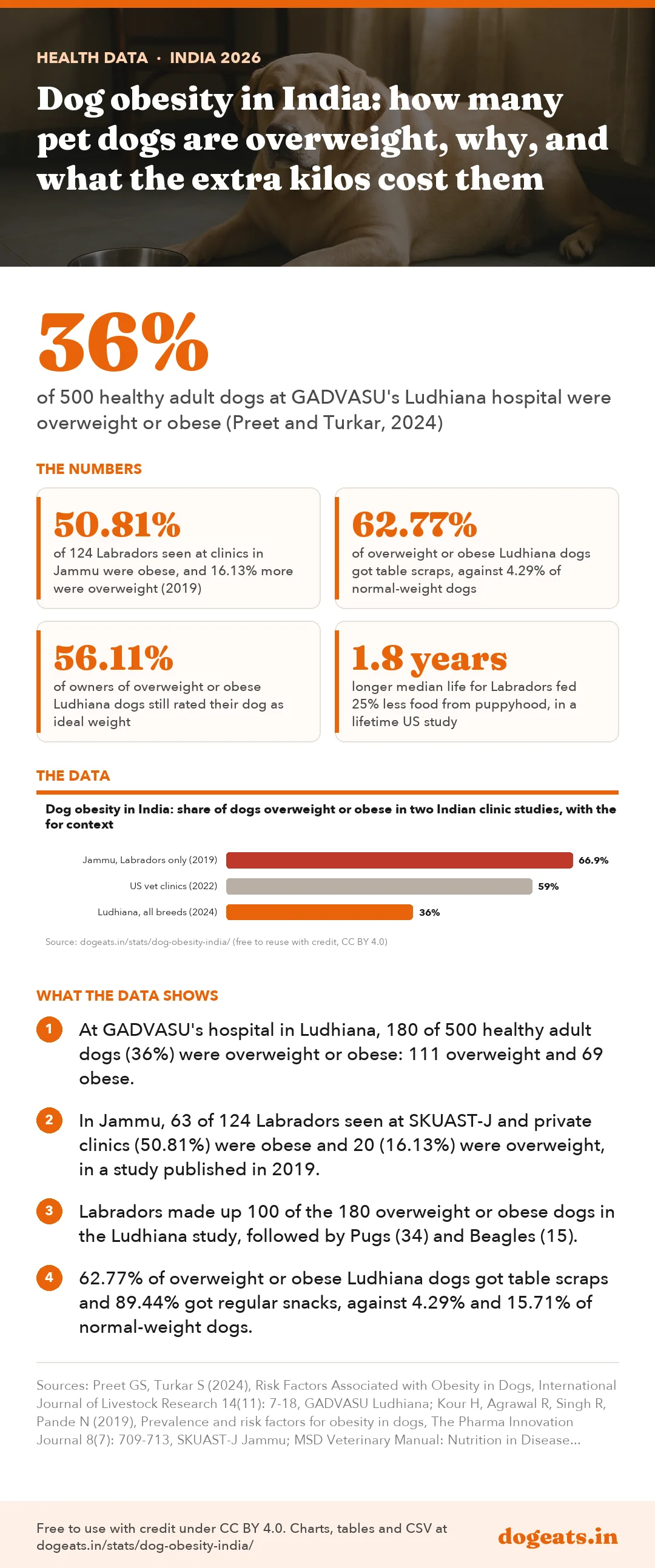
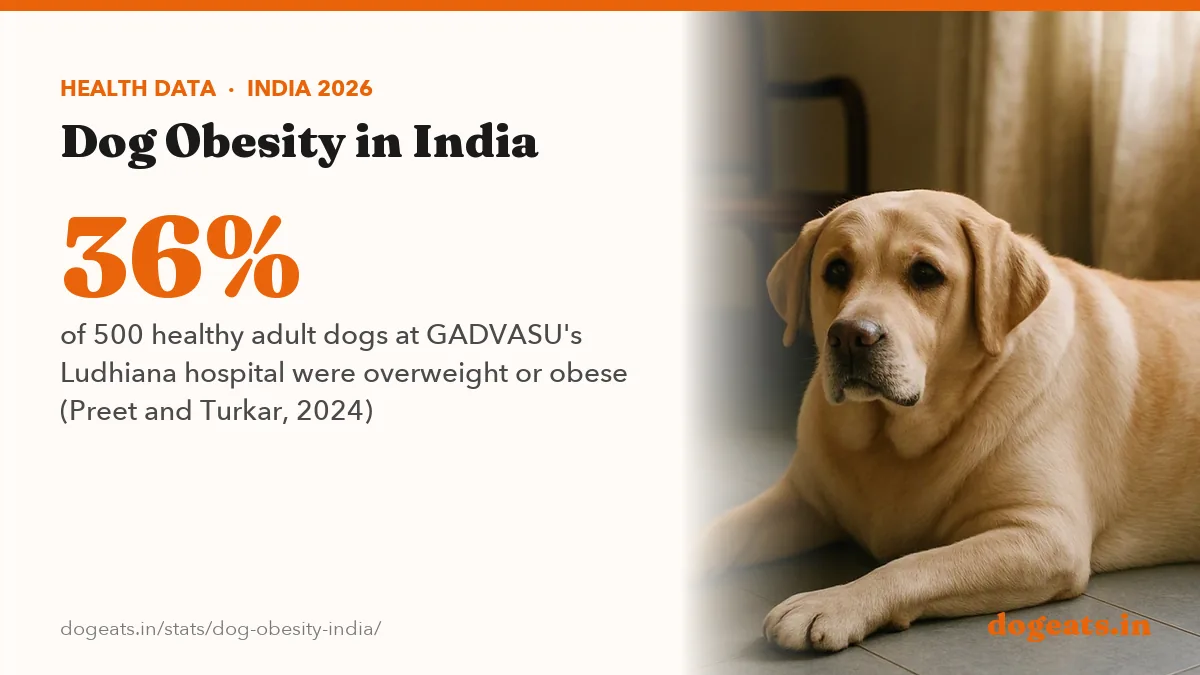
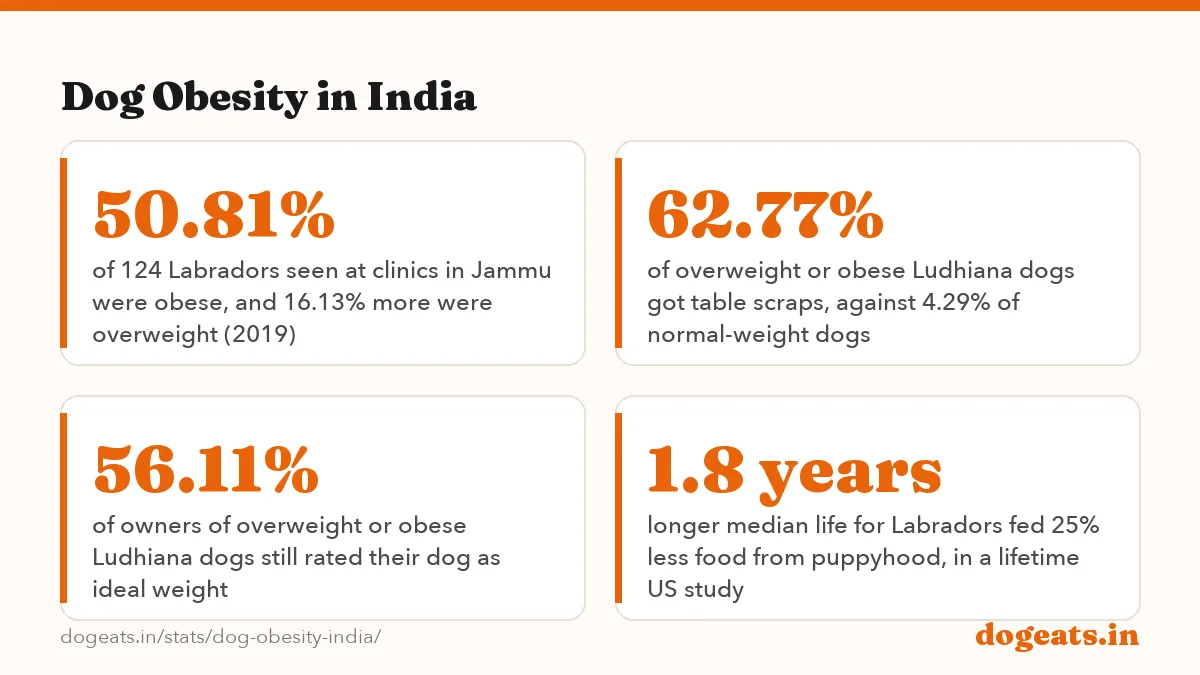
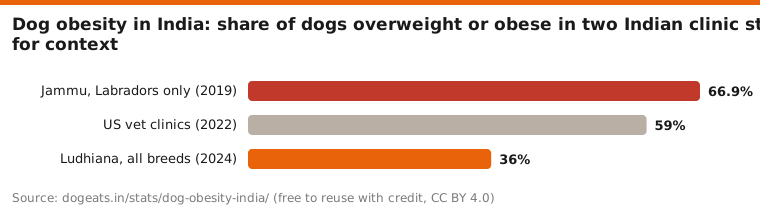
India has no national count of overweight dogs, but clinic studies point the same way. At GADVASU's hospital in Ludhiana, 180 of 500 healthy adult dogs (36%) were overweight or obese. In Jammu, 50.81% of 124 Labradors were obese. In both studies the fat dogs ate table scraps and snacks far more often and walked far less. Over a lifetime, Labradors fed 25% less food lived a median 1.8 years longer.
Key findings
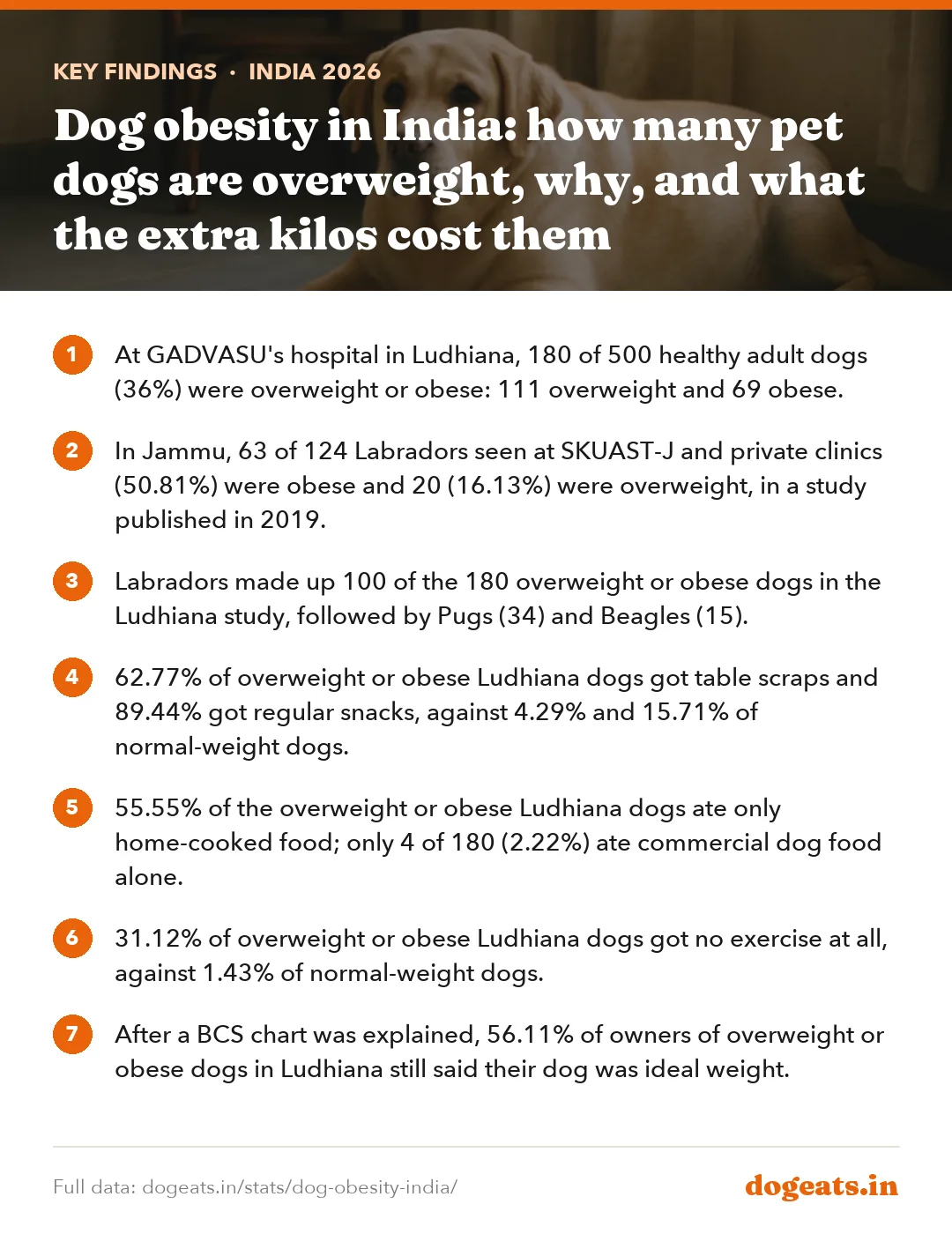
- At GADVASU's hospital in Ludhiana, 180 of 500 healthy adult dogs (36%) were overweight or obese: 111 overweight and 69 obese.
- In Jammu, 63 of 124 Labradors seen at SKUAST-J and private clinics (50.81%) were obese and 20 (16.13%) were overweight, in a study published in 2019.
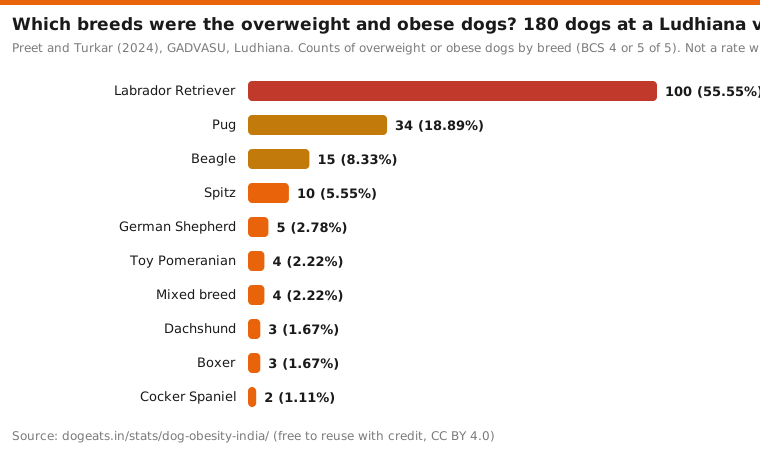
- Labradors made up 100 of the 180 overweight or obese dogs in the Ludhiana study, followed by Pugs (34) and Beagles (15).
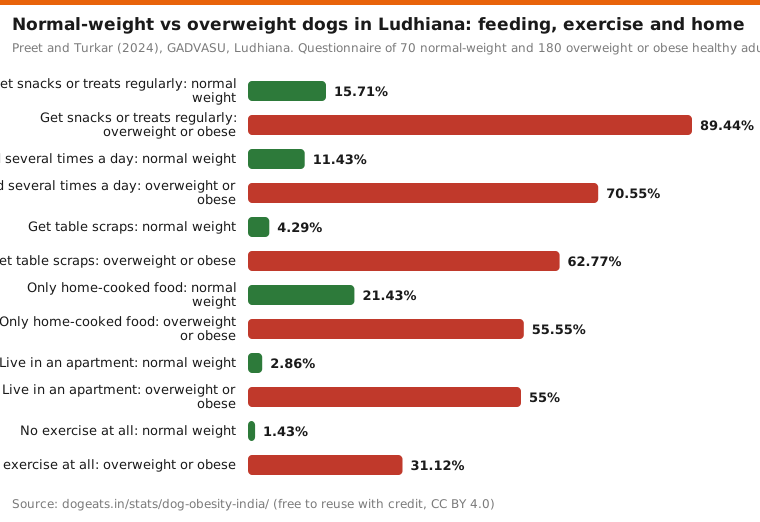
- 62.77% of overweight or obese Ludhiana dogs got table scraps and 89.44% got regular snacks, against 4.29% and 15.71% of normal-weight dogs.
- 55.55% of the overweight or obese Ludhiana dogs ate only home-cooked food; only 4 of 180 (2.22%) ate commercial dog food alone.
- 31.12% of overweight or obese Ludhiana dogs got no exercise at all, against 1.43% of normal-weight dogs.
- After a BCS chart was explained, 56.11% of owners of overweight or obese dogs in Ludhiana still said their dog was ideal weight.
- In a lifetime study of 48 Labradors, dogs fed 25% less food lived a median 1.8 years longer. Their hip arthritis first showed at a median 12 years instead of 6.
- The MSD Veterinary Manual calls a dog obese above 20% over ideal weight; a 2019 global position statement backed by WSAVA sets the line at 30%.
How common is obesity in dogs in India?
In the largest Indian clinic screening we found, 36% of dogs were overweight or obese. Vets at Guru Angad Dev Veterinary and Animal Sciences University (GADVASU) in Ludhiana scored 500 healthy adult dogs brought in for check-ups or vaccination, and 180 were above ideal weight. The results were published in 2024.
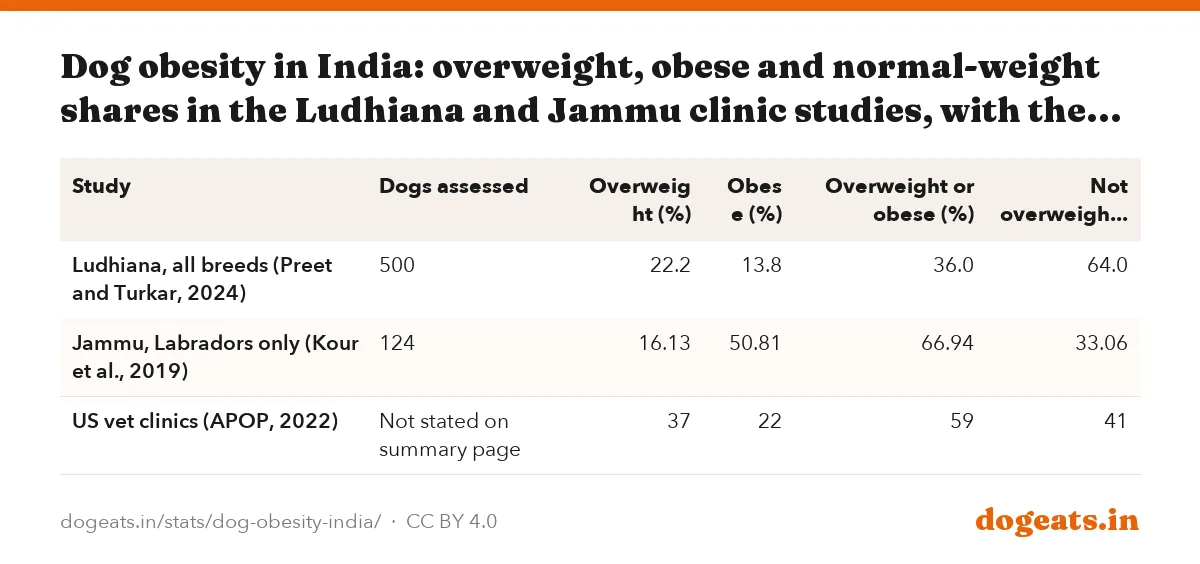
Of those 180 dogs, 111 were overweight and 69 obese on a 5-point body condition scale. By our calculation (111 and 69 out of 500), that is 22.2% overweight and 13.8% obese among all 500 dogs screened. The paper itself gives only the 36% total and the two counts.
A Labrador-only study from Jammu found much more. Of 124 Labradors seen at SKUAST-J and private clinics, 63 (50.81%) were obese and 20 (16.13%) overweight, leaving only 41 (33.06%) at normal weight. That study was published in 2019, and its authors said they found no similar Indian work to compare it with.
India has no national survey of dog weight. Both studies count dogs brought to vets in one city, so they are not a census of Indian pet dogs, and neither includes street dogs.
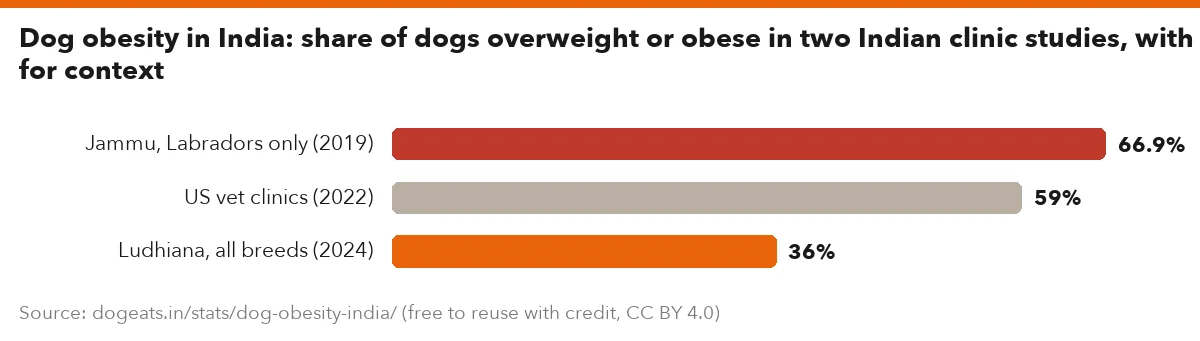
Ludhiana: Preet and Turkar (2024), 180 of 500 healthy adult dogs, all breeds, 5-point BCS. Jammu: Kour et al. (2019), 83 of 124 Labradors (63 obese, 20 overweight; 66.9% is our sum of the paper's 50.81% and 16.13%), body fat and BCS. US: Association for Pet Obesity Prevention 2022 clinic survey, 9-point BCS. Definitions differ, so compare with care.
Show the numbers
| Label | % |
|---|---|
| Jammu, Labradors only (2019) | 66.9% |
| US vet clinics (2022) | 59% |
| Ludhiana, all breeds (2024) | 36% |
Embed this chart
| Study | Dogs assessed | Overweight (%) | Obese (%) | Overweight or obese (%) | Not overweight (%) |
|---|---|---|---|---|---|
| Ludhiana, all breeds (Preet and Turkar, 2024) | 500 | 22.2 | 13.8 | 36.0 | 64.0 |
| Jammu, Labradors only (Kour et al., 2019) | 124 | 16.13 | 50.81 | 66.94 | 33.06 |
| US vet clinics (APOP, 2022) | Not stated on summary page | 37 | 22 | 59 | 41 |
The US figure is there for scale, not as a match. US vet teams classed 59% of dogs as overweight or obese in 2022, using a 9-point scale. Our US dog obesity report covers that survey in detail.
UK clinic records find a far lower diagnosed rate, because vets record obesity only when they treat it. Our report on common dog health problems explains that gap.
How do I know if my dog is overweight?
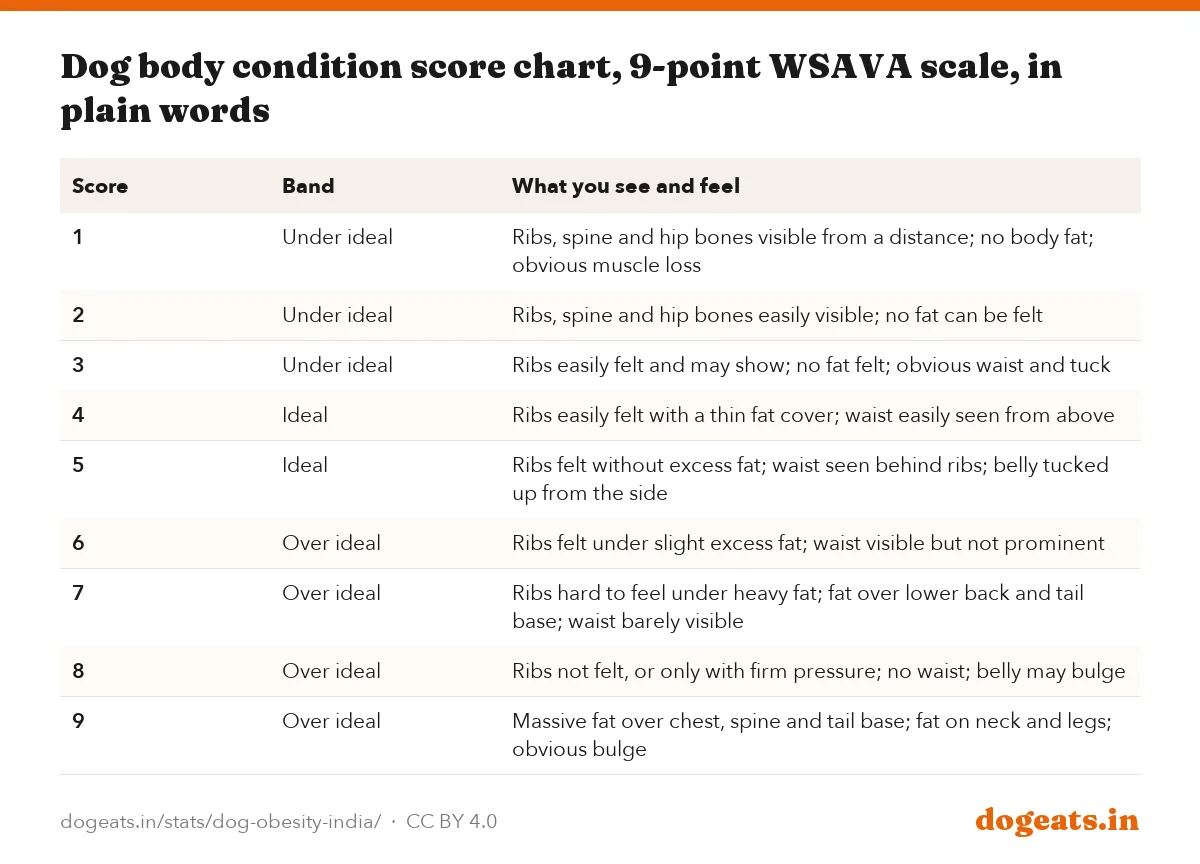
Use a body condition score (BCS). On the 9-point WSAVA chart, a score of 4 or 5 is ideal, and 6 to 9 is over ideal. At 5, you can feel the ribs without excess fat and see a waist behind them from above.
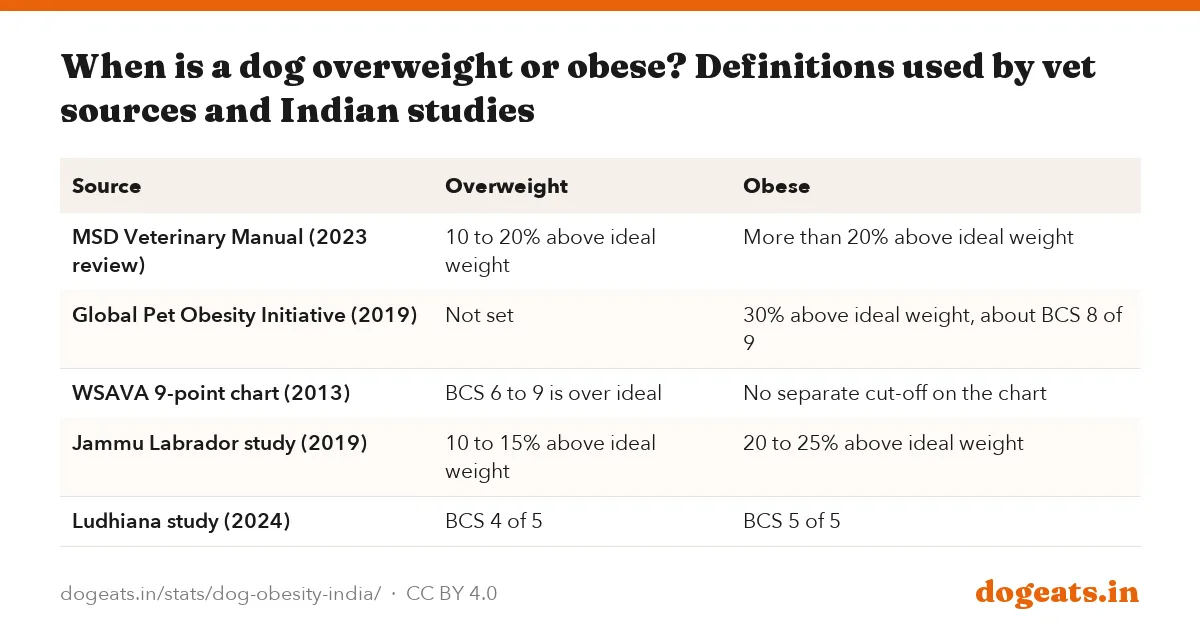
The MSD Veterinary Manual calls a dog overweight at 10 to 20% above ideal body weight and obese above 20%. A 2019 position statement from the Global Pet Obesity Initiative, backed by WSAVA and other vet bodies, sets obesity at 30% above ideal. It equates that to 8 on the 9-point scale. The Indian studies here use neither line exactly: Jammu counted 20 to 25% above ideal as obese and Ludhiana used a 5-point score, so their rates are not always comparable.
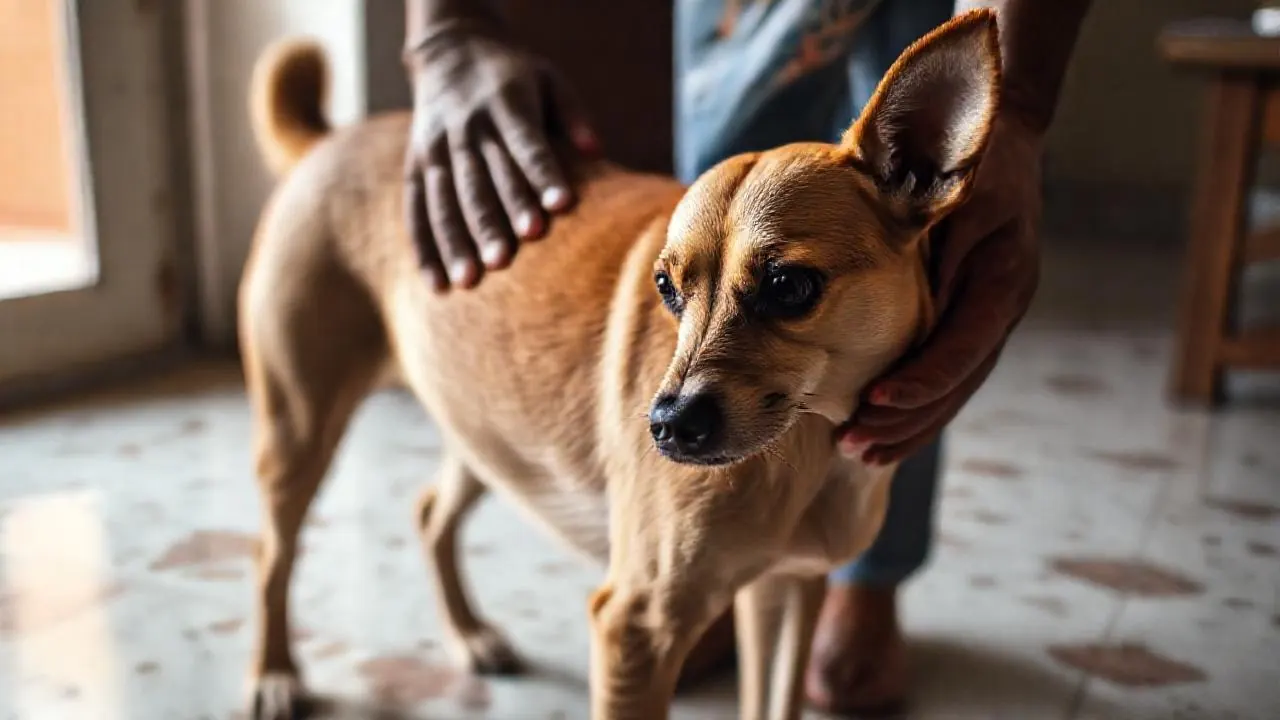
Press your fingertips along your dog's side. If you have to push to find the ribs, or the waist has gone when you look down from above, the score is probably 7 or higher.
| Score | Band | What you see and feel |
|---|---|---|
| 1 | Under ideal | Ribs, spine and hip bones visible from a distance; no body fat; obvious muscle loss |
| 2 | Under ideal | Ribs, spine and hip bones easily visible; no fat can be felt |
| 3 | Under ideal | Ribs easily felt and may show; no fat felt; obvious waist and tuck |
| 4 | Ideal | Ribs easily felt with a thin fat cover; waist easily seen from above |
| 5 | Ideal | Ribs felt without excess fat; waist seen behind ribs; belly tucked up from the side |
| 6 | Over ideal | Ribs felt under slight excess fat; waist visible but not prominent |
| 7 | Over ideal | Ribs hard to feel under heavy fat; fat over lower back and tail base; waist barely visible |
| 8 | Over ideal | Ribs not felt, or only with firm pressure; no waist; belly may bulge |
| 9 | Over ideal | Massive fat over chest, spine and tail base; fat on neck and legs; obvious bulge |
| Source | Overweight | Obese |
|---|---|---|
| MSD Veterinary Manual (2023 review) | 10 to 20% above ideal weight | More than 20% above ideal weight |
| Global Pet Obesity Initiative (2019) | Not set | 30% above ideal weight, about BCS 8 of 9 |
| WSAVA 9-point chart (2013) | BCS 6 to 9 is over ideal | No separate cut-off on the chart |
| Jammu Labrador study (2019) | 10 to 15% above ideal weight | 20 to 25% above ideal weight |
| Ludhiana study (2024) | BCS 4 of 5 | BCS 5 of 5 |
Weigh your dog every month on the same scale and write it down. A dog that has crept up 10% from its lean adult weight is already in the MSD overweight band.
Which dog breeds are prone to obesity in India?
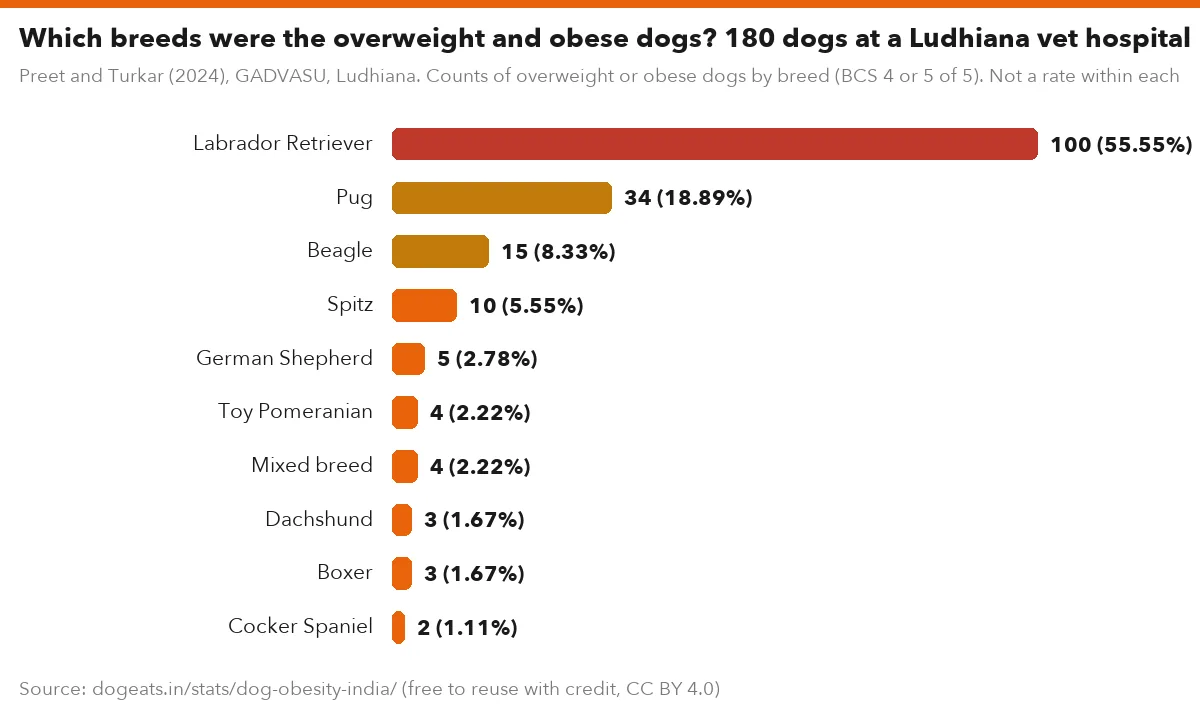
Labradors lead the only Indian breed count we found. In the Ludhiana study, 100 of the 180 overweight or obese dogs (55.55%) were Labradors, followed by 34 Pugs (18.89%) and 15 Beagles (8.33%).
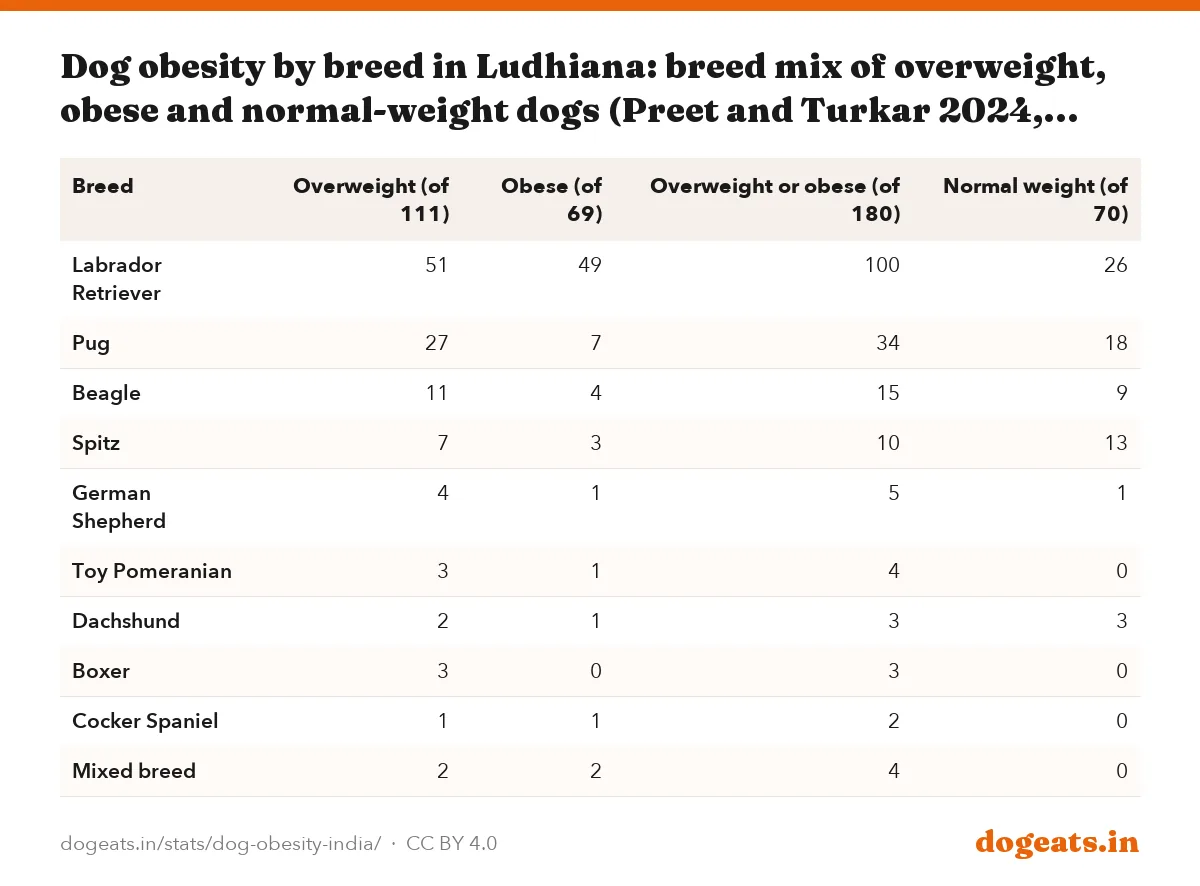
Read that as a share of the fat dogs, not a rate within each breed. The study did not report how many of each breed it screened, and Labradors were also the largest breed in the normal-weight comparison group: 26 of 70, with 18 Pugs. So these numbers do not show what share of Labradors is obese.
The MSD Veterinary Manual also names Labrador Retrievers, Beagles and Dachshunds among breeds with a higher risk of obesity. Our Labrador breed guide, Pug guide and Beagle guide carry feeding notes for each.
Preet and Turkar (2024), GADVASU, Ludhiana. Counts of overweight or obese dogs by breed (BCS 4 or 5 of 5). Not a rate within each breed.
Show the numbers
| Label | dogs |
|---|---|
| Labrador Retriever | 100 (55.55%) |
| Pug | 34 (18.89%) |
| Beagle | 15 (8.33%) |
| Spitz | 10 (5.55%) |
| German Shepherd | 5 (2.78%) |
| Toy Pomeranian | 4 (2.22%) |
| Mixed breed | 4 (2.22%) |
| Dachshund | 3 (1.67%) |
| Boxer | 3 (1.67%) |
| Cocker Spaniel | 2 (1.11%) |
Embed this chart
| Breed | Overweight (of 111) | Obese (of 69) | Overweight or obese (of 180) | Normal weight (of 70) |
|---|---|---|---|---|
| Labrador Retriever | 51 | 49 | 100 | 26 |
| Pug | 27 | 7 | 34 | 18 |
| Beagle | 11 | 4 | 15 | 9 |
| Spitz | 7 | 3 | 10 | 13 |
| German Shepherd | 4 | 1 | 5 | 1 |
| Toy Pomeranian | 3 | 1 | 4 | 0 |
| Dachshund | 2 | 1 | 3 | 3 |
| Boxer | 3 | 0 | 3 | 0 |
| Cocker Spaniel | 1 | 1 | 2 | 0 |
| Mixed breed | 2 | 2 | 4 | 0 |
Pedigree alone did not decide it. In Ludhiana, 85.56% of the heavy dogs and 87.14% of the normal-weight dogs were purebred, a difference the authors found not significant. Feeding and exercise habits differed far more between the two groups than pedigree did.
The breed mix of the two groups is the telling part. Labradors were 71.01% of the obese dogs (49 of 69) but 37.14% of the normal-weight group. Spitz went the other way: 13 of 70 normal-weight dogs (18.57%) against 10 of 180 heavy ones (5.55%).
Why do pet dogs in India get fat?
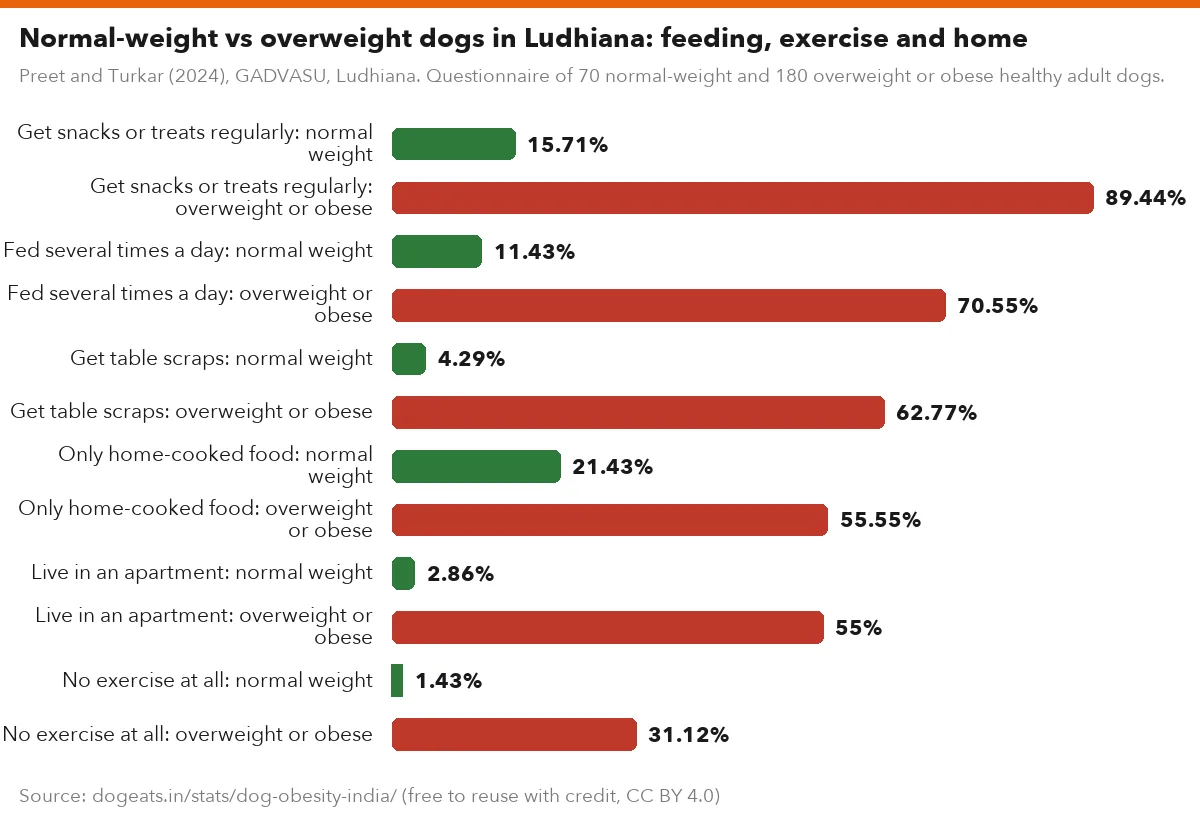
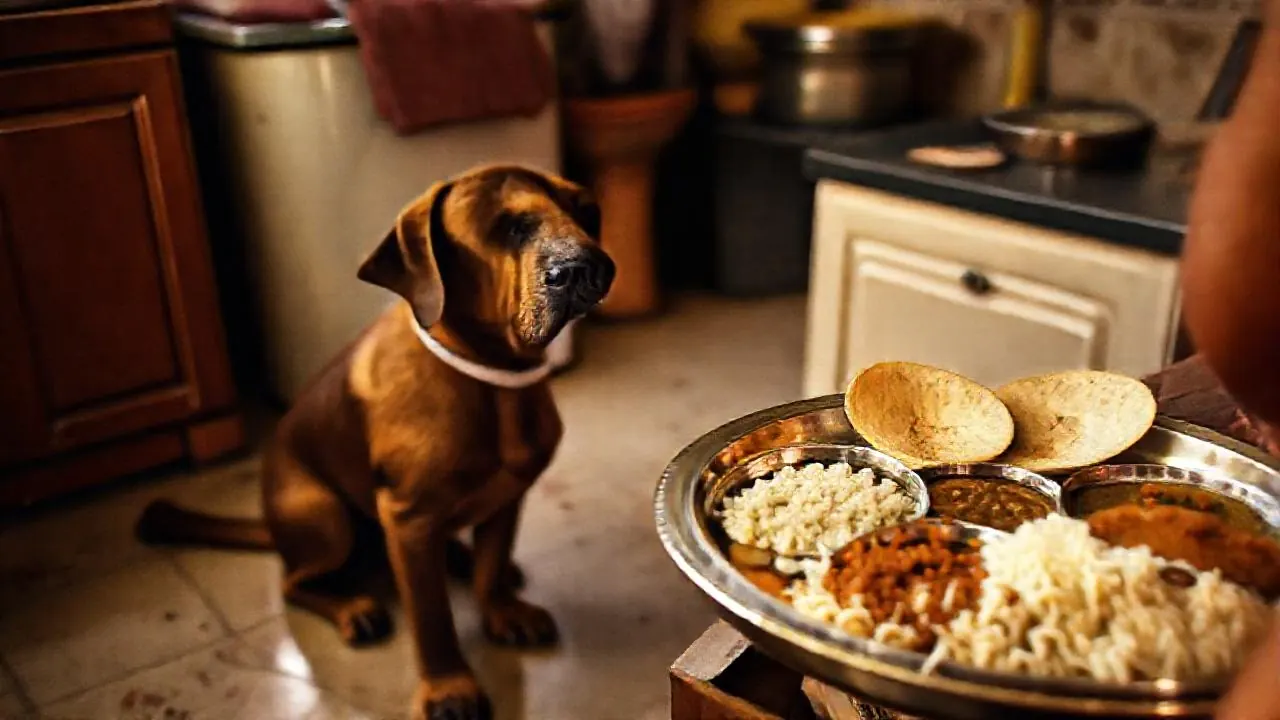
Extra food from the family table is the clearest pattern. In Ludhiana, 62.77% of overweight or obese dogs got table scraps or leftovers, against 4.29% of normal-weight dogs. 89.44% got snacks or treats regularly, against 15.71%.
How often they ate mattered too. 70.55% of the heavy dogs were fed several times a day, against 11.43% of normal-weight dogs, 87.14% of which ate twice a day. Only 11.11% of heavy dogs had free access to food, so it was the extra meals and handouts, not an always-full bowl, that marked them out.
Home cooking was common in both groups but more so among heavy dogs. 55.55% of overweight or obese dogs ate only home-cooked food, against 21.43% of normal-weight dogs. Most normal-weight dogs (75.71%) ate a mix of home food and commercial food.
Preet and Turkar (2024), GADVASU, Ludhiana. Questionnaire of 70 normal-weight and 180 overweight or obese healthy adult dogs. Shares of each group.
Show the numbers
| Label | % |
|---|---|
| Get snacks or treats regularly: normal weight | 15.71% |
| Get snacks or treats regularly: overweight or obese | 89.44% |
| Fed several times a day: normal weight | 11.43% |
| Fed several times a day: overweight or obese | 70.55% |
| Get table scraps: normal weight | 4.29% |
| Get table scraps: overweight or obese | 62.77% |
| Only home-cooked food: normal weight | 21.43% |
| Only home-cooked food: overweight or obese | 55.55% |
| Live in an apartment: normal weight | 2.86% |
| Live in an apartment: overweight or obese | 55% |
| No exercise at all: normal weight | 1.43% |
| No exercise at all: overweight or obese | 31.12% |
Embed this chart
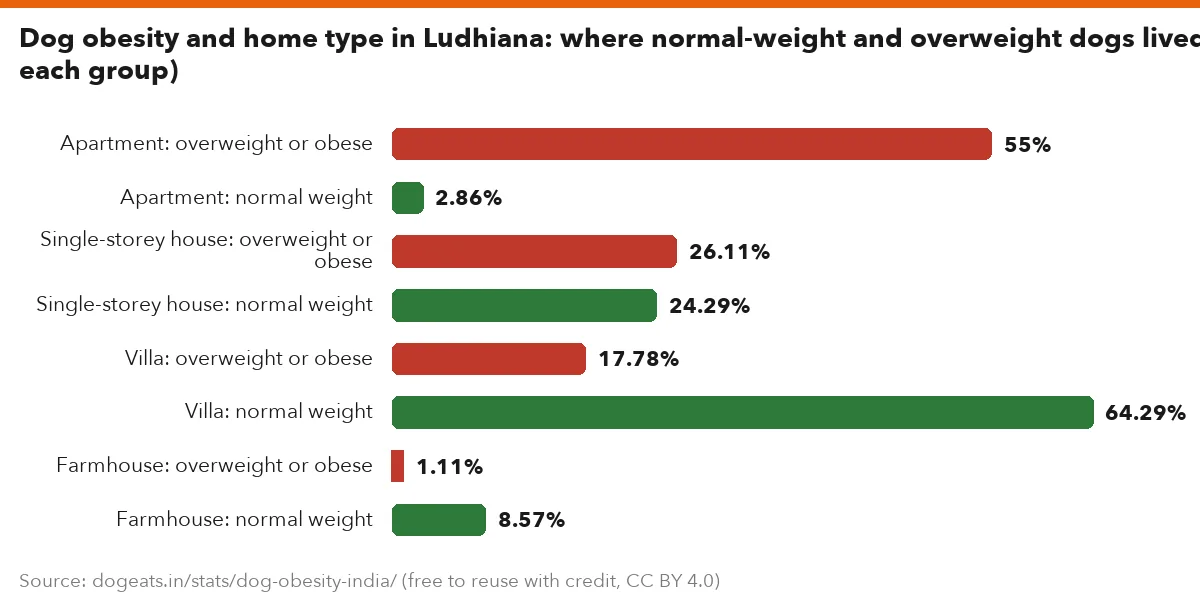
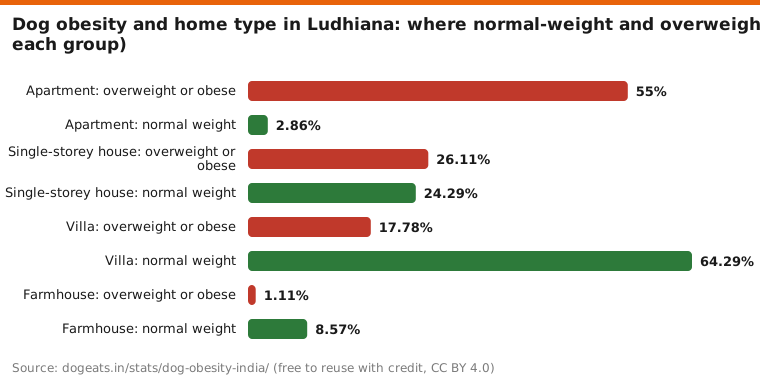
Preet and Turkar (2024), GADVASU, Ludhiana, Table 1. 70 normal-weight and 180 overweight or obese dogs. Shares of each group.
Show the numbers
| Label | % |
|---|---|
| Apartment: overweight or obese | 55% |
| Apartment: normal weight | 2.86% |
| Single-storey house: overweight or obese | 26.11% |
| Single-storey house: normal weight | 24.29% |
| Villa: overweight or obese | 17.78% |
| Villa: normal weight | 64.29% |
| Farmhouse: overweight or obese | 1.11% |
| Farmhouse: normal weight | 8.57% |
Embed this chart
A 2025 Kerala study of 22 dogs at the Pookode veterinary college clinic found the same habit. Obese dogs were significantly more likely to get treats, and the treats owners named were rice, curry leftovers, biscuits and peanut brittle.
None of these foods is poisonous for most dogs. Plain roti and white rice are fine in measured amounts, but Parle-G and chikki are sugary snacks. Our treat calories report shows how fast a few pieces use up a dog's daily allowance.
The Jammu study found the same direction. The paper reports that 85.71% of its obese Labradors got scraps and snacks, and that about 54% were fed whenever they wanted.
Space at home lined up with weight. In Ludhiana, 99 of the 180 heavy dogs (55%) lived in apartments, against 2 of 70 normal-weight dogs (2.86%). Most normal-weight dogs (45 of 70, or 64.29%) lived in villas.
Does neutering or age make a dog fat?
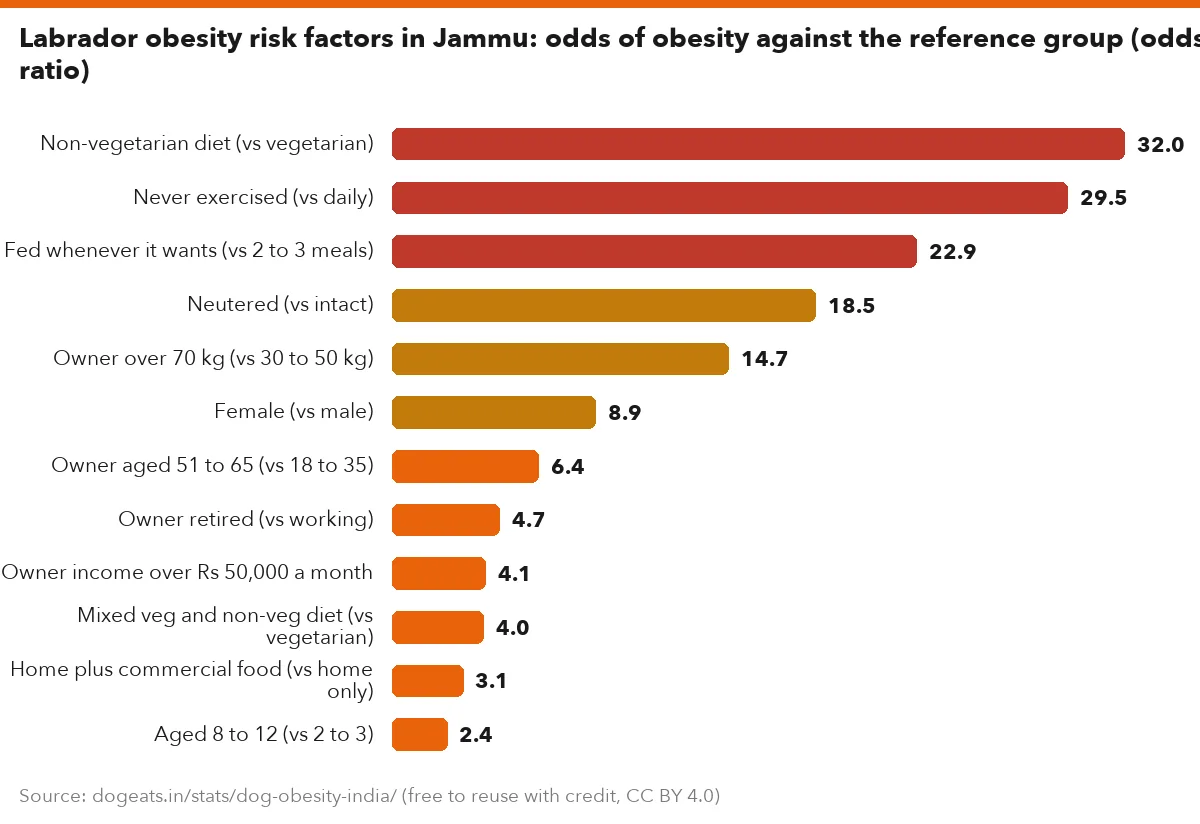
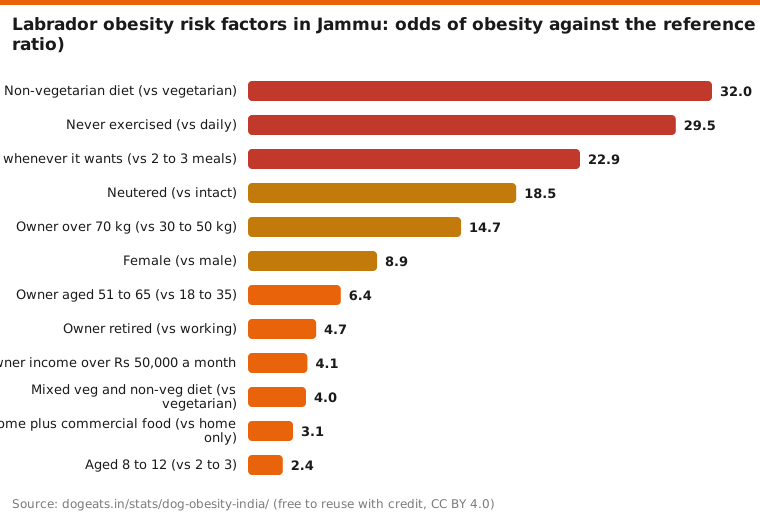
Neutered dogs were heavier in both Indian studies. In Ludhiana, 12.22% of overweight or obese dogs were neutered, against 1.43% (1 of 70) of normal-weight dogs. In Jammu, neutered Labradors had 18.5 times the odds of obesity of intact ones.
The two studies disagree on sex. In Jammu, female Labradors had 8.9 times the odds of obesity of males. In Ludhiana, 70% of heavy dogs were male, but so were 72.8% of the 250 dogs in the questionnaire, and the difference was not significant.
The MSD Veterinary Manual lists neutering among the risk factors for obesity, with lack of exercise, breed, age, some hormone disorders and some drugs. Neutering does not make weight gain certain. It lowers energy needs, so the food portion usually has to come down.
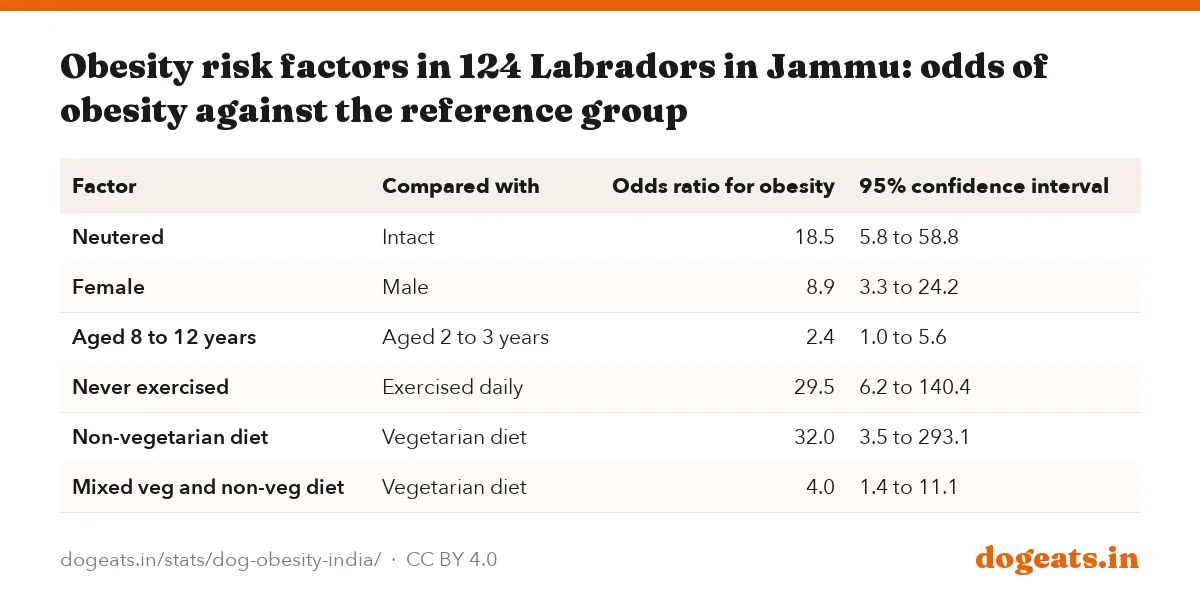
Kour et al. (2019), Tables 2 and 3. 124 Labradors, one factor at a time; reference groups in brackets. Confidence intervals are very wide, see the table below.
Show the numbers
| Label | x |
|---|---|
| Non-vegetarian diet (vs vegetarian) | 32.0 |
| Never exercised (vs daily) | 29.5 |
| Fed whenever it wants (vs 2 to 3 meals) | 22.9 |
| Neutered (vs intact) | 18.5 |
| Owner over 70 kg (vs 30 to 50 kg) | 14.7 |
| Female (vs male) | 8.9 |
| Owner aged 51 to 65 (vs 18 to 35) | 6.4 |
| Owner retired (vs working) | 4.7 |
| Owner income over Rs 50,000 a month | 4.1 |
| Mixed veg and non-veg diet (vs vegetarian) | 4.0 |
| Home plus commercial food (vs home only) | 3.1 |
| Aged 8 to 12 (vs 2 to 3) | 2.4 |
Embed this chart
| Factor | Compared with | Odds ratio for obesity | 95% confidence interval |
|---|---|---|---|
| Neutered | Intact | 18.5 | 5.8 to 58.8 |
| Female | Male | 8.9 | 3.3 to 24.2 |
| Aged 8 to 12 years | Aged 2 to 3 years | 2.4 | 1.0 to 5.6 |
| Never exercised | Exercised daily | 29.5 | 6.2 to 140.4 |
| Non-vegetarian diet | Vegetarian diet | 32.0 | 3.5 to 293.1 |
| Mixed veg and non-veg diet | Vegetarian diet | 4.0 | 1.4 to 11.1 |
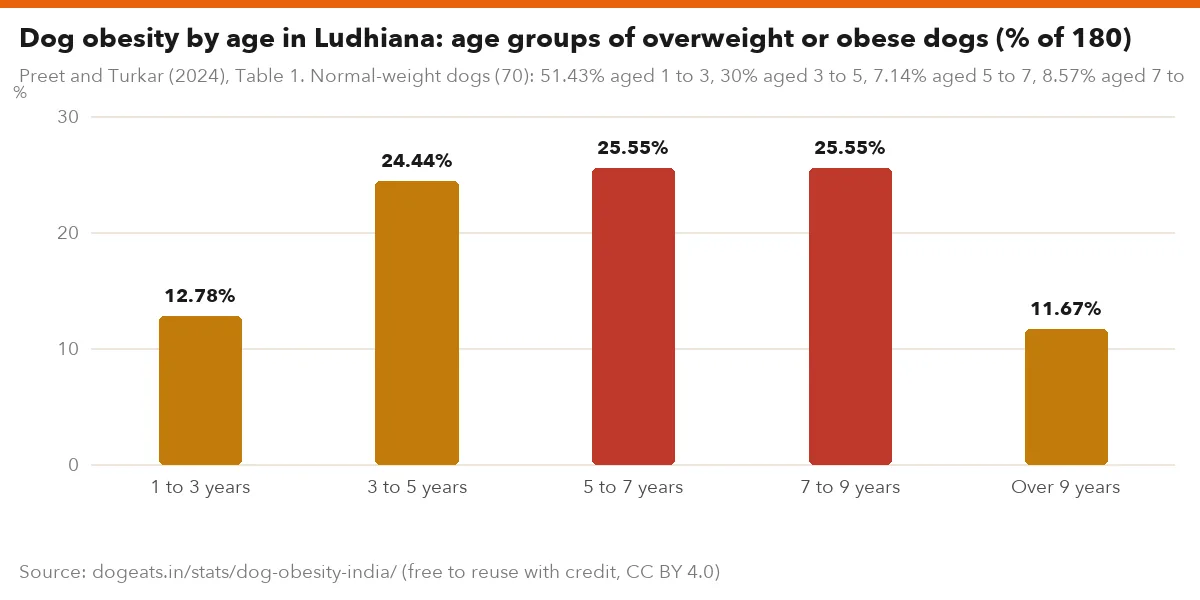
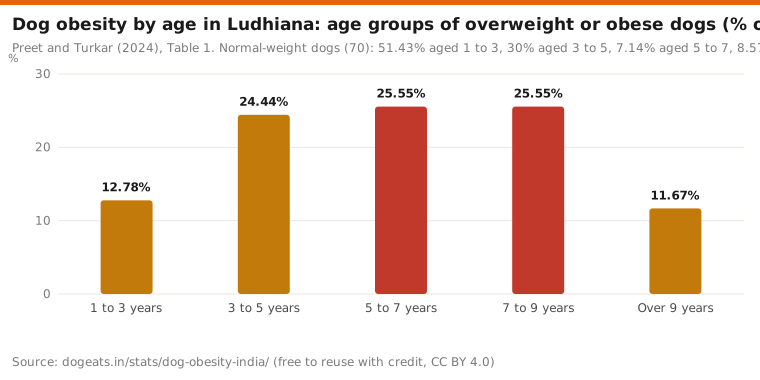
Preet and Turkar (2024), Table 1. Normal-weight dogs (70): 51.43% aged 1 to 3, 30% aged 3 to 5, 7.14% aged 5 to 7, 8.57% aged 7 to 9, 2.86% over 9.
Show the numbers
| Label | % |
|---|---|
| 1 to 3 years | 12.78% |
| 3 to 5 years | 24.44% |
| 5 to 7 years | 25.55% |
| 7 to 9 years | 25.55% |
| Over 9 years | 11.67% |
Embed this chart
Treat those odds ratios as signs of direction, not precise sizes. The confidence intervals are very wide because only 124 dogs were studied, and the paper looked at one factor at a time rather than all together. The age group labels and intervals above are as printed in the paper's table, rounded to one decimal.
If your dog has just been neutered, weigh it regularly and ask your vet whether the portion should change. Our feeding chart by weight shows how energy needs change after neutering.
Age showed the same pattern in Ludhiana. Over half of the normal-weight dogs (51.43%) were 1 to 3 years old, against 12.78% of the heavy dogs. Dogs aged 5 to 9 made up 51.1% of the heavy group but 15.71% of the normal one.
How much exercise keeps a dog from getting fat?
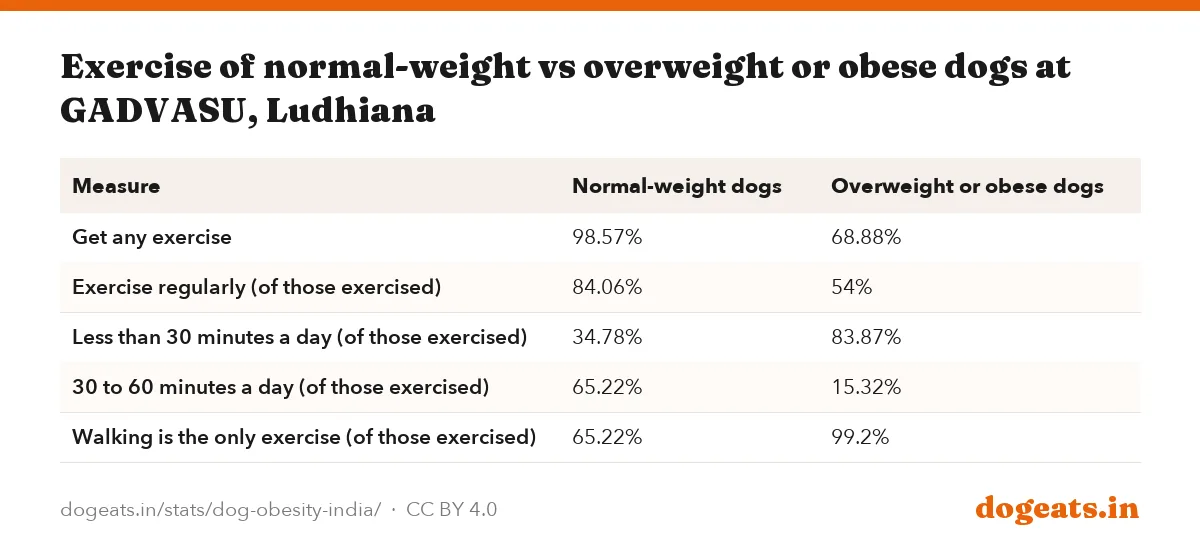
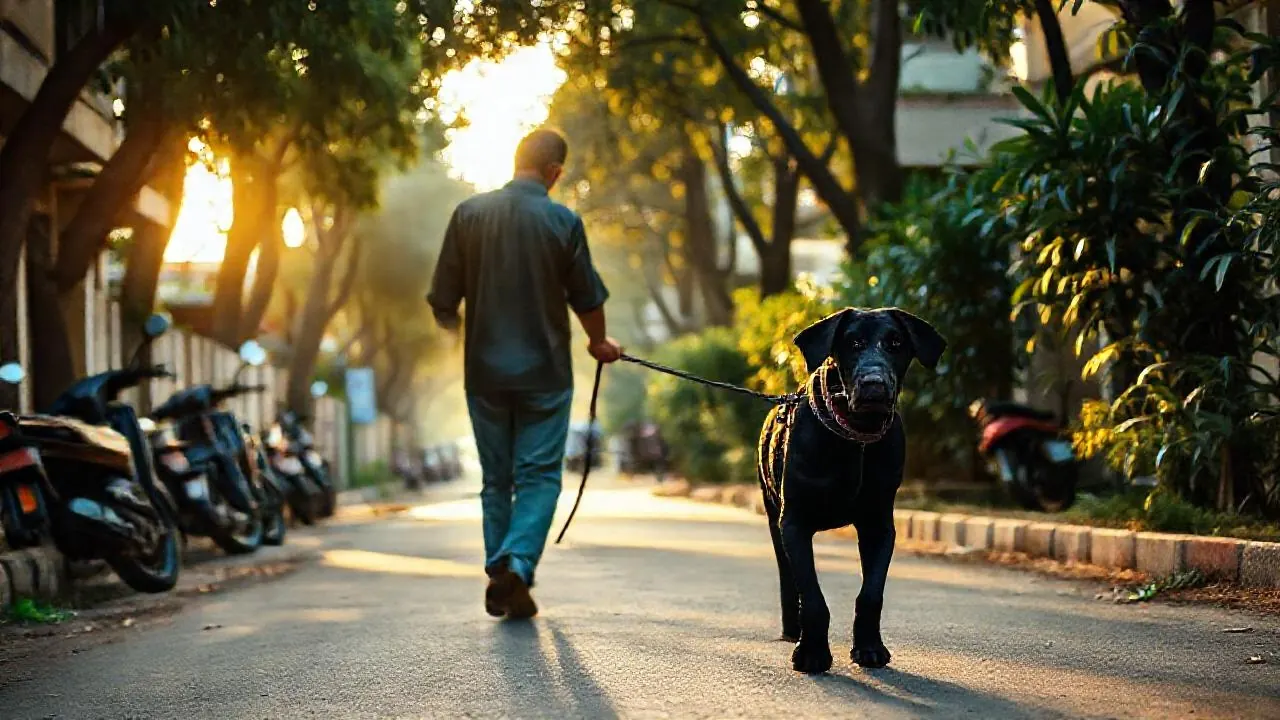
Normal-weight dogs in Ludhiana mostly got 30 minutes to an hour of exercise a day. Of the exercised normal-weight dogs, 65.22% got 30 to 60 minutes, while 83.87% of the exercised overweight or obese dogs got less than 30 minutes.
Regularity counted as well. 84.06% of exercised normal-weight dogs went out regularly, against 54% of the heavy dogs. And 99.2% of the heavy dogs that exercised only walked, while 34.78% of normal-weight dogs also got some other kind of exercise.
In Jammu, 57.14% of obese Labradors were never exercised, and never-exercised Labradors had 29.5 times the odds of obesity of those walked daily.
| Measure | Normal-weight dogs | Overweight or obese dogs |
|---|---|---|
| Get any exercise | 98.57% | 68.88% |
| Exercise regularly (of those exercised) | 84.06% | 54% |
| Less than 30 minutes a day (of those exercised) | 34.78% | 83.87% |
| 30 to 60 minutes a day (of those exercised) | 65.22% | 15.32% |
| Walking is the only exercise (of those exercised) | 65.22% | 99.2% |
In Indian summers, add walking time in the early morning and late evening, not at midday. Heat itself is a risk for heavy dogs, which the MSD Veterinary Manual lists as prone to heat intolerance.
Do Indian owners notice when their dog is overweight?
Most do not. In Ludhiana, 56.11% of owners of overweight or obese dogs still rated their dog as ideal weight after a vet explained the body condition chart. Only 4 of 250 owners questioned (1.6%) knew what a body condition score was beforehand.
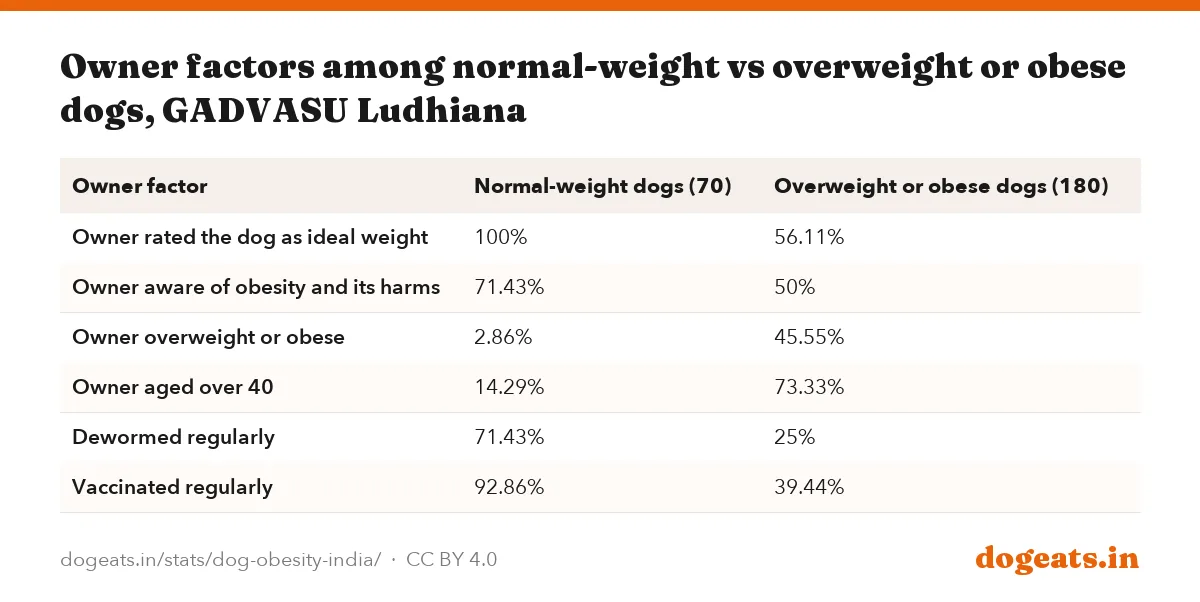
Half of the owners of heavy dogs (50%) understood obesity and its harms, against 71.43% of owners of normal-weight dogs.
Owners' own habits followed their dogs. 45.55% of owners of heavy dogs were overweight or obese themselves, against 2.86% of owners of normal-weight dogs. 73.33% of heavy dogs lived with owners over 40, against 14.29% of normal-weight dogs.
| Owner factor | Normal-weight dogs (70) | Overweight or obese dogs (180) |
|---|---|---|
| Owner rated the dog as ideal weight | 100% | 56.11% |
| Owner aware of obesity and its harms | 71.43% | 50% |
| Owner overweight or obese | 2.86% | 45.55% |
| Owner aged over 40 | 14.29% | 73.33% |
| Dewormed regularly | 71.43% | 25% |
| Vaccinated regularly | 92.86% | 39.44% |
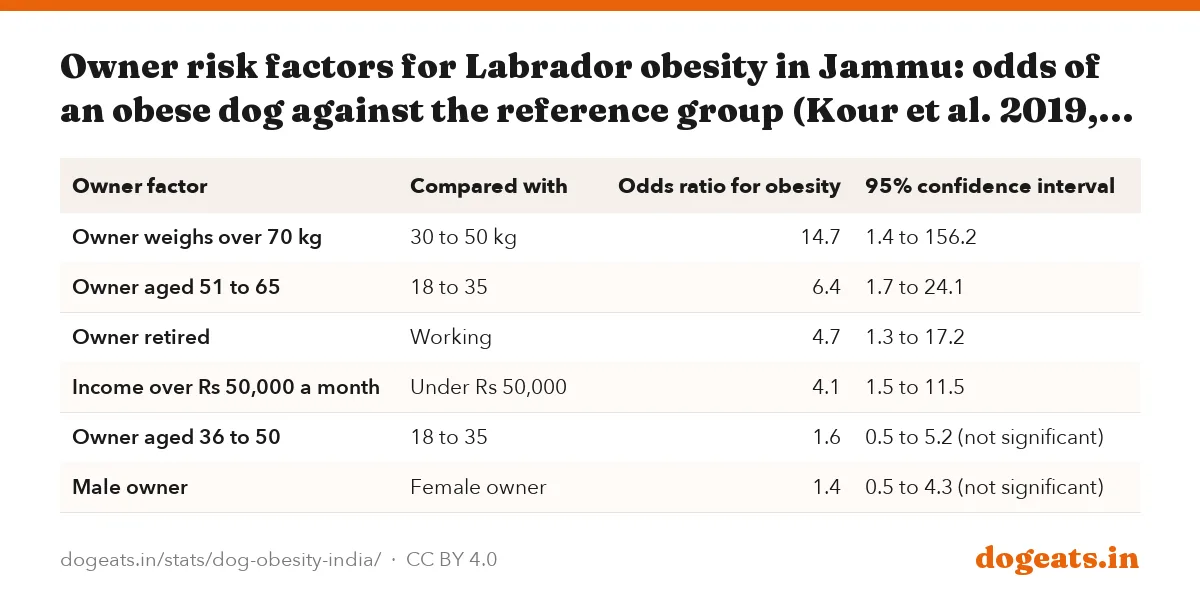
| Owner factor | Compared with | Odds ratio for obesity | 95% confidence interval |
|---|---|---|---|
| Owner weighs over 70 kg | 30 to 50 kg | 14.7 | 1.4 to 156.2 |
| Owner aged 51 to 65 | 18 to 35 | 6.4 | 1.7 to 24.1 |
| Owner retired | Working | 4.7 | 1.3 to 17.2 |
| Income over Rs 50,000 a month | Under Rs 50,000 | 4.1 | 1.5 to 11.5 |
| Owner aged 36 to 50 | 18 to 35 | 1.6 | 0.5 to 5.2 (not significant) |
| Male owner | Female owner | 1.4 | 0.5 to 4.3 (not significant) |
The Kerala study saw the same blind spot. Owners of obese dogs judged their dog's weight significantly differently from owners of ideal-weight dogs. And 6 of 28 owners approached refused to take part, saying they liked their dog round.
It is not only an Indian habit. In the US 2022 survey, 36% of owners of dogs scored 6 to 9 on the 9-point scale called their dog's condition normal.
Jammu found the same link with owners. Labradors whose owners weighed over 70 kg had 14.7 times the odds of obesity, and dogs of retired owners 4.7 times, though both intervals are very wide.
Does obesity shorten a dog's life?
Yes. In a lifetime study of 48 Labradors, dogs fed 25% less than their littermates from 8 weeks of age lived a median 1.8 years longer. The restricted dogs also weighed less, carried less body fat and showed signs of chronic disease later.
Joints show it first. In the same Labradors, hip arthritis first appeared on X-rays at a median age of 6 years in the fully fed dogs, against 12 years in the restricted dogs. Across both groups, hip arthritis rose from 15% of dogs at 2 years to 67% by 14 years.
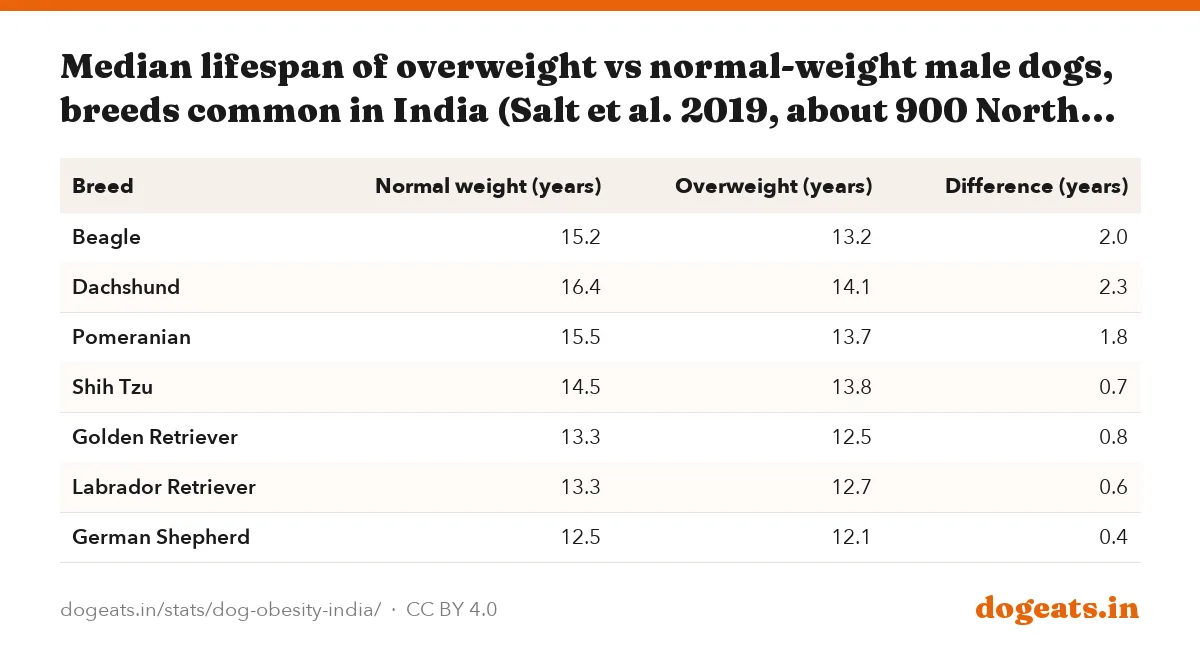
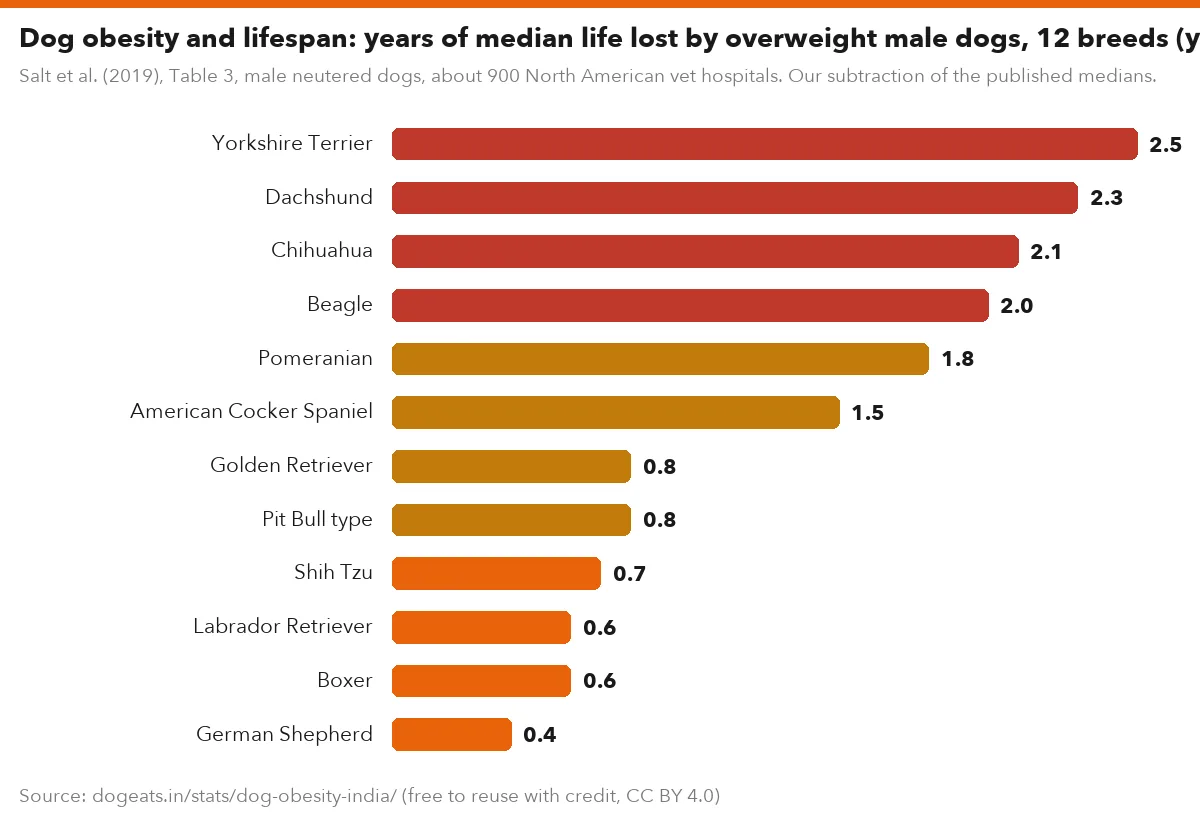
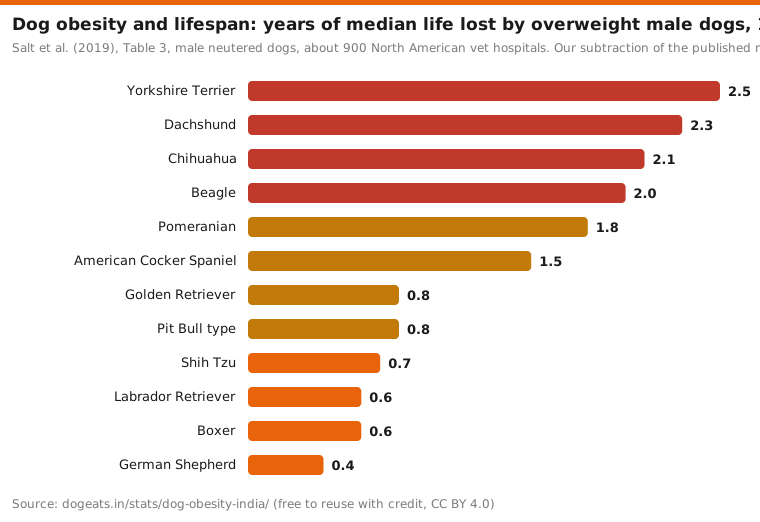
Pet dogs show the same gap. In records of 50,787 neutered dogs from about 900 vet hospitals across North America, overweight dogs in all 12 breeds studied had shorter median lives. Male Labradors that were overweight in middle age (6.5 to 8.5 years) lived a median 12.7 years, against 13.3 for those at normal weight.
| Breed | Normal weight (years) | Overweight (years) | Difference (years) |
|---|---|---|---|
| Beagle | 15.2 | 13.2 | 2.0 |
| Dachshund | 16.4 | 14.1 | 2.3 |
| Pomeranian | 15.5 | 13.7 | 1.8 |
| Shih Tzu | 14.5 | 13.8 | 0.7 |
| Golden Retriever | 13.3 | 12.5 | 0.8 |
| Labrador Retriever | 13.3 | 12.7 | 0.6 |
| German Shepherd | 12.5 | 12.1 | 0.4 |
Salt et al. (2019), Table 3, male neutered dogs, about 900 North American vet hospitals. Our subtraction of the published medians.
Show the numbers
| Label | years |
|---|---|
| Yorkshire Terrier | 2.5 |
| Dachshund | 2.3 |
| Chihuahua | 2.1 |
| Beagle | 2.0 |
| Pomeranian | 1.8 |
| American Cocker Spaniel | 1.5 |
| Golden Retriever | 0.8 |
| Pit Bull type | 0.8 |
| Shih Tzu | 0.7 |
| Labrador Retriever | 0.6 |
| Boxer | 0.6 |
| German Shepherd | 0.4 |
Embed this chart
The MSD Veterinary Manual links obesity in dogs with shorter life, poorer quality of life, arthritis, breathing and heart problems, pancreatitis, weaker immunity and higher risk under anaesthesia. It notes that fat tissue acts as a hormone-making organ that drives low-grade inflammation.
The 2025 Kerala study also found that pain scores rose and vitality scores fell as body fat rose, in a small group of 22 dogs. For how long each breed usually lives in India, see our dog breed lifespan report.
How fast should an overweight dog lose weight?
The MSD Veterinary Manual sets a reasonable target of about 1% of body weight a week, with weigh-ins every 2 weeks. A 30 kg Labrador would lose about 300 g a week on that plan.
Indian results show how hard that is at home. At GADVASU in 2018 to 2019, 13 overweight or obese Labradors went on a high-protein, low-fat diet with more exercise. They lost an average of 9% of body weight in 12 weeks, or 0.75% a week. The authors noted that AAHA guidelines target 1 to 2% a week. They blamed the slower pace on a small, uncontrolled study and owners not sticking to the diet.
MSD says a dog's daily food is better split into several meals than one big one. The 2021 AAHA weight management guidelines keep treats and other extras to no more than 10% of a dog's daily intake, with complete food making up at least 90%. Your vet sets the calorie target for a weight-loss plan.
In an Indian home, that means measuring the dog's food with the same katori every day. The roti, rice and biscuits from the family plate count as part of it.
Older dogs need extra care because they lose muscle while gaining fat. Ask your vet to set a target weight before cutting food.
Frequently asked questions
How many pet dogs in India are overweight?
No national figure exists. At GADVASU's hospital in Ludhiana, 36% of 500 healthy adult dogs were overweight or obese (published 2024). In Jammu, 50.81% of 124 Labradors were obese and 16.13% overweight (published 2019).
Which dog breeds are prone to obesity in India?
Labradors lead the Indian data. They made up 100 of the 180 overweight or obese dogs in the Ludhiana study, ahead of Pugs (34) and Beagles (15). That is a share of the heavy dogs, not an obesity rate for each breed. The MSD Veterinary Manual also lists Labradors among higher-risk breeds.
What is the ideal body condition score for a dog?
4 or 5 on the 9-point WSAVA scale. At 5 you can feel the ribs without excess fat and see a waist from above. A score of 6 to 9 is over ideal.
When is a dog called obese?
The MSD Veterinary Manual says more than 20% above ideal body weight, with 10 to 20% counted as overweight. A 2019 global position statement backed by WSAVA prefers 30% above ideal, about BCS 8 of 9.
Do roti and rice make dogs fat?
They add calories like any food. In Ludhiana, 62.77% of overweight or obese dogs got table scraps, against 4.29% of normal-weight dogs. In a Kerala study, owners of obese dogs named rice, curry leftovers, biscuits and peanut brittle as treats.
Does neutering make dogs fat?
It raises the risk. In Ludhiana, 12.22% of overweight or obese dogs were neutered against 1.43% of normal-weight dogs. In Jammu, neutered Labradors had 18.5 times the odds of obesity, with a very wide confidence interval.
How much does obesity shorten a dog's life?
In a lifetime study of 48 Labradors, dogs fed 25% less lived a median 1.8 years longer. In North American clinic records, overweight male Labradors lived a median 12.7 years, against 13.3 at normal weight.
How fast should my dog lose weight?
About 1% of body weight a week, per the MSD Veterinary Manual, checked every 2 weeks. In a Ludhiana trial, 13 Labradors lost 9% in 12 weeks, or 0.75% a week.
How much exercise does a dog need to avoid obesity?
In Ludhiana, 65.22% of exercised normal-weight dogs got 30 to 60 minutes of exercise a day, while 83.87% of exercised overweight dogs got under 30 minutes. Ask your vet for a plan that suits your dog's age and joints.
Methodology and limitations
Indian prevalence and risk-factor figures come from the full texts of two papers. They are Preet and Turkar (2024), International Journal of Livestock Research 14(11): 7 to 18, and Kour et al. (2019), The Pharma Innovation Journal 8(7): 709 to 713. Kerala figures come from Sreehari et al. (2025), International Journal of Veterinary Sciences and Animal Husbandry 10(9): 103 to 107. Weight-loss figures come from Marcelo, Turkar and Sethi (2025), Indian Journal of Animal Research 59(9): 1505 to 1510.
The Ludhiana overweight (22.2%) and obese (13.8%) shares of all 500 dogs are our arithmetic from the paper's counts of 111 and 69. The Ludhiana risk-factor shares are percentages within each weight group of the 250-dog questionnaire sample (70 normal, 180 overweight or obese) as printed in the paper's Table 1.
Jammu odds ratios and confidence intervals are taken from the paper's Tables 2 and 3 and rounded to one decimal. The US comparison uses the Association for Pet Obesity Prevention 2022 clinic survey. Lifespan figures come from Huck et al. (2009) and Smith et al. (2006), both from the Purina lifetime Labrador study first reported by Kealy et al. (2002), and from Salt et al. (2019), Table 3, male dogs; differences are our subtraction.
Definitions come from the MSD Veterinary Manual chapter Nutrition in Disease Management in Small Animals (full review November 2023, updated June 2025). The WSAVA body condition score chart (2013) and the Global Pet Obesity Initiative position statement (2019) supply the rest. The BCS table paraphrases the WSAVA chart.
The Ludhiana breed, home-type and age figures come from the paper's Tables 1 and 2. The 51.1% and 15.71% shares of dogs aged 5 to 9 are our sums of its published age groups. The treat limit comes from the 2021 AAHA guidelines, as the MSD text we read gives no figure.
Sources
- Preet GS, Turkar S (2024), Risk Factors Associated with Obesity in Dogs, International Journal of Livestock Research 14(11): 7-18, GADVASU Ludhiana, 500 dogs screened, 36% overweight or obese; questionnaire of 70 normal and 180 overweight or obese dogs; breeds, feeding, exercise, owners
- Kour H, Agrawal R, Singh R, Pande N (2019), Prevalence and risk factors for obesity in dogs, The Pharma Innovation Journal 8(7): 709-713, SKUAST-J Jammu, 124 Labradors: 50.81% obese, 16.13% overweight; odds ratios for neutering, sex, age, exercise, diet, feeding and owner factors (Tables 2 and 3)
- MSD Veterinary Manual: Nutrition in Disease Management in Small Animals, Obesity section (Sanderson, full review November 2023), Overweight 10 to 20% and obese over 20% above ideal; breed and other risk factors; health effects; about 1% weight loss a week, checked every 2 weeks; several meals a day
- Also consulted: WSAVA Body Condition Score chart for dogs and cats (2013), Ward E, German AJ, Churchill JA, Global Pet Obesity Initiative Position Statement (2019), Huck JL et al. (2009), A longitudinal study of the influence of lifetime food restriction on development of osteoarthritis in the canine elbow, Veterinary Surgery 38(2): 192-8, Smith GK et al. (2006), Lifelong diet restriction and radiographic evidence of osteoarthritis of the hip joint in dogs, JAVMA 229(5): 690-3, Kealy RD et al. (2002), Effects of diet restriction on life span and age-related changes in dogs, JAVMA 220(9): 1315-20, Salt C et al. (2019), Association between life span and body condition in neutered client-owned dogs, Journal of Veterinary Internal Medicine 33(1): 89-99, Cline MG et al. (2021), AAHA Nutrition and Weight Management Guidelines for Dogs and Cats, J Am Anim Hosp Assoc 57:153-178, Marcelo Z, Turkar S, Sethi APS (2025), Clinical Evaluation of Weight Loss Diet on Adiposity Markers and Subcutaneous Fat in Obese Dogs, Indian Journal of Animal Research 59(9): 1505-1510, Sreehari S et al. (2025), The effect of obesity on health-related quality of life in dogs, International Journal of Veterinary Sciences and Animal Husbandry 10(9): 103-107, KVASU Pookode, Association for Pet Obesity Prevention, 2022 pet obesity prevalence survey (US), Meena YK et al. (2022), Canine obesity: prevalence, risk factors and management, The Pharma Innovation Journal 11(7S): 662-667 (review; figures traced to their original studies), Preet GS, Turkar S et al. (2021), Dog obesity: epidemiology, risk factors, diagnosis and management, The Pharma Innovation Journal 10(5S) (review).
Cite, embed and download
This report, its data and its images are free to reuse under a Creative Commons Attribution 4.0 licence. Credit dogeats.in with a link to this page. Every chart has its own embed code, every table has a CSV and an image download, and the images below are ready for social posts, slides and articles.
Cite this report
Link to this report
Every chart and table as an image