Data report · Updated October 2026
Dog Feeding Chart by Weight: How Much a Dog Should Eat a Day, in Calories and Grams, From 2 kg to 70 kg
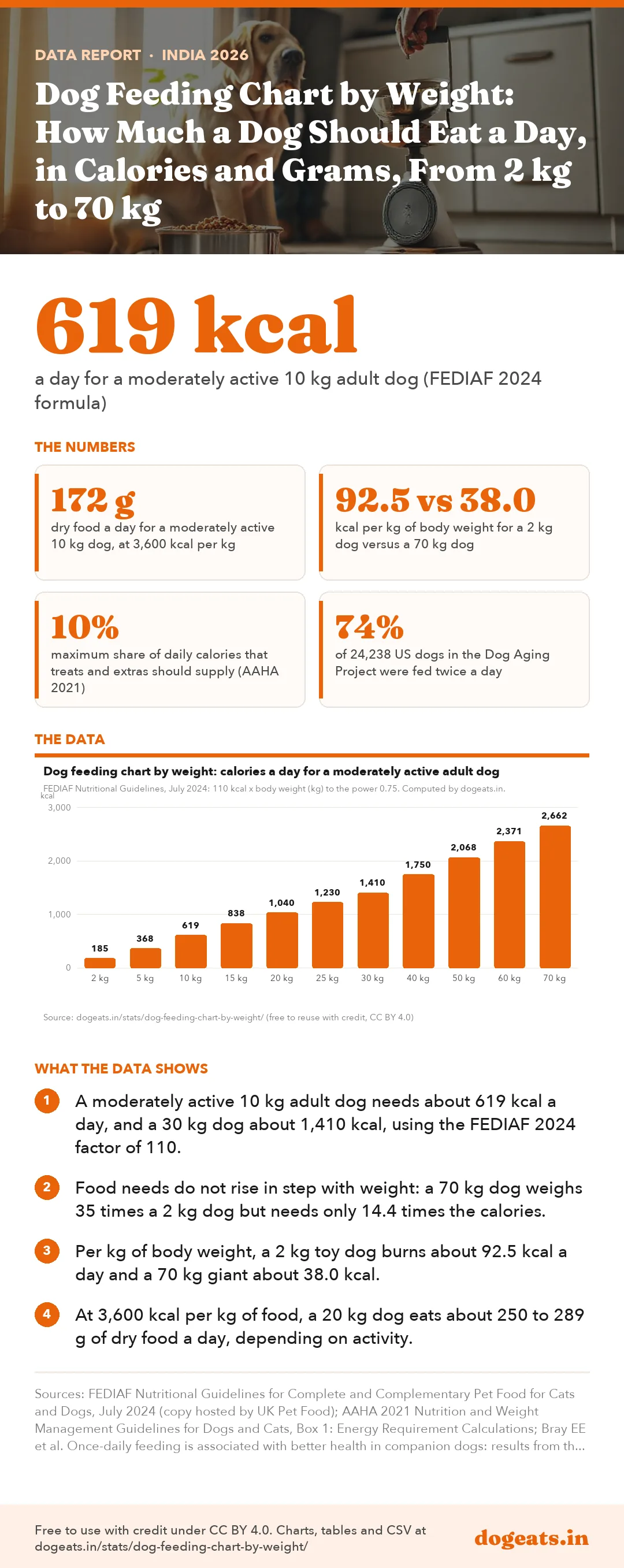
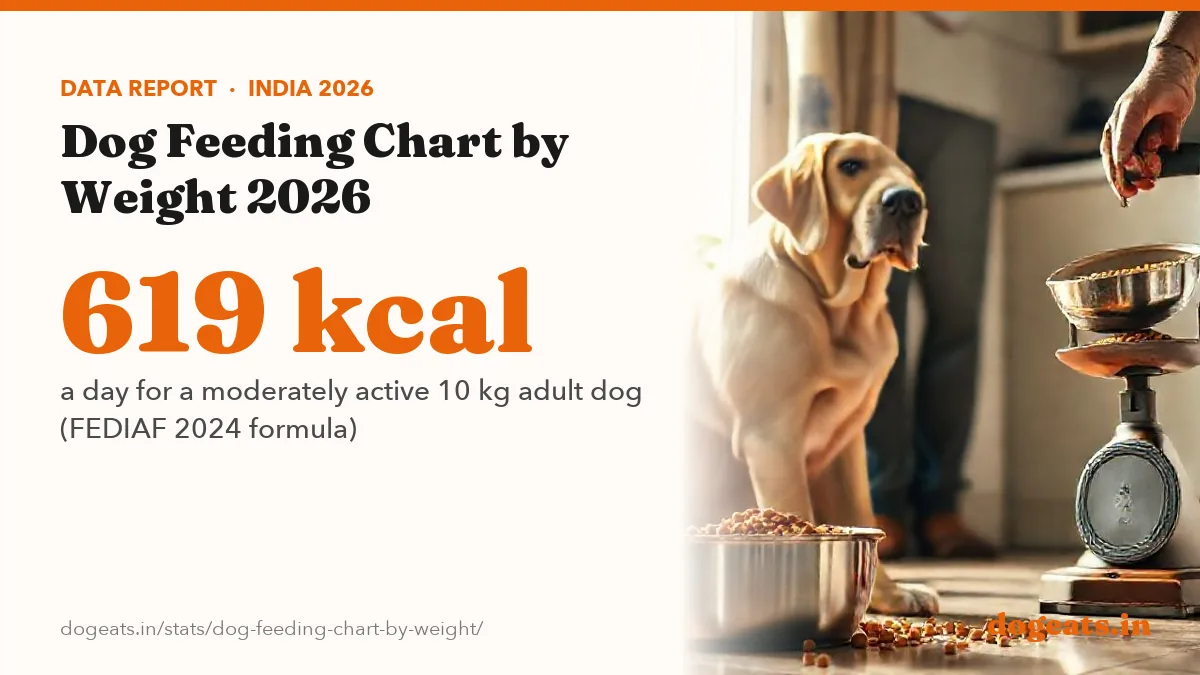
A healthy adult dog of 10 kg needs about 534 to 619 kcal a day, which is roughly 148 to 172 g of a typical dry food. A 30 kg dog needs 1,218 to 1,410 kcal, or about 338 to 392 g. These are starting points from the FEDIAF 2024 guidelines, so weigh your dog every few weeks and adjust by its body shape.
Key findings
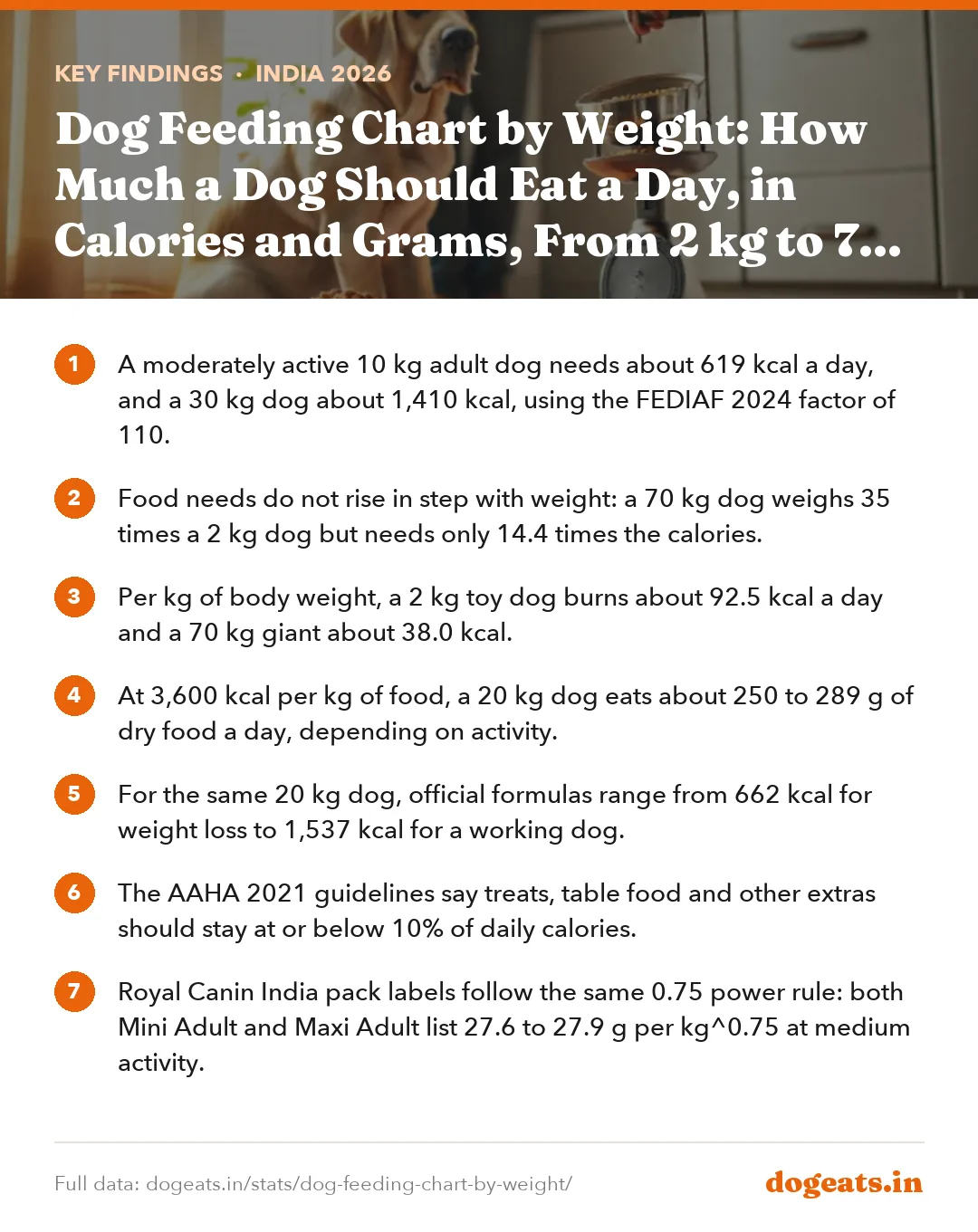
- A moderately active 10 kg adult dog needs about 619 kcal a day, and a 30 kg dog about 1,410 kcal, using the FEDIAF 2024 factor of 110.
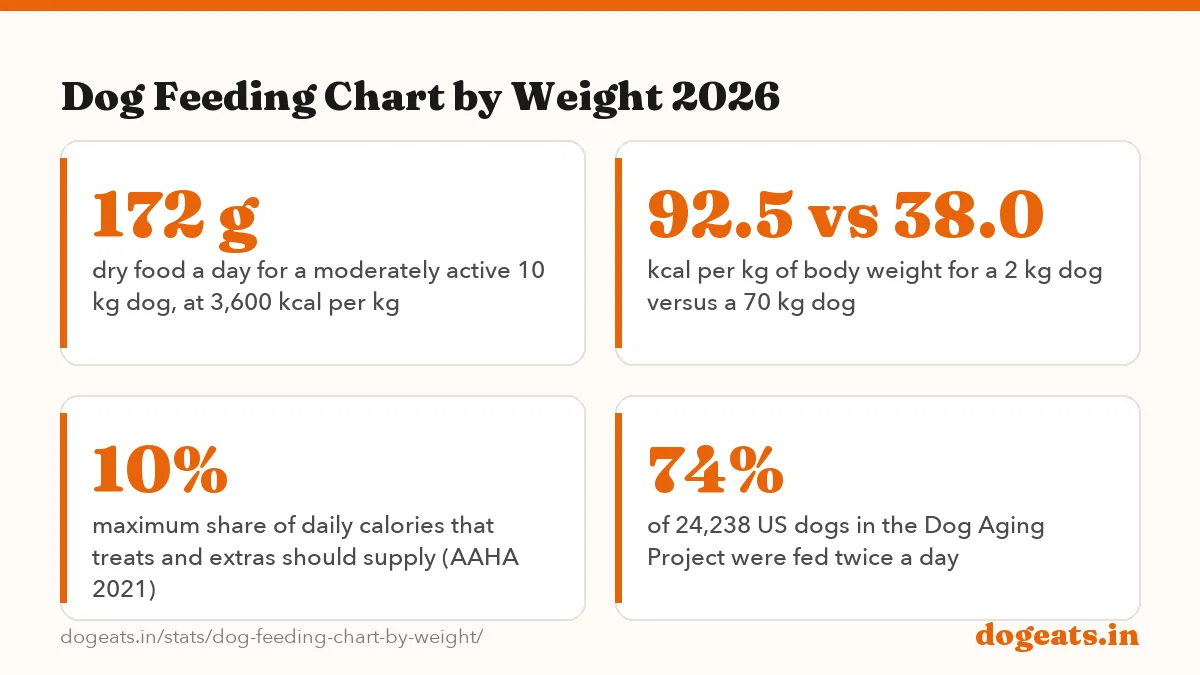
- Food needs do not rise in step with weight: a 70 kg dog weighs 35 times a 2 kg dog but needs only 14.4 times the calories.
- Per kg of body weight, a 2 kg toy dog burns about 92.5 kcal a day and a 70 kg giant about 38.0 kcal.
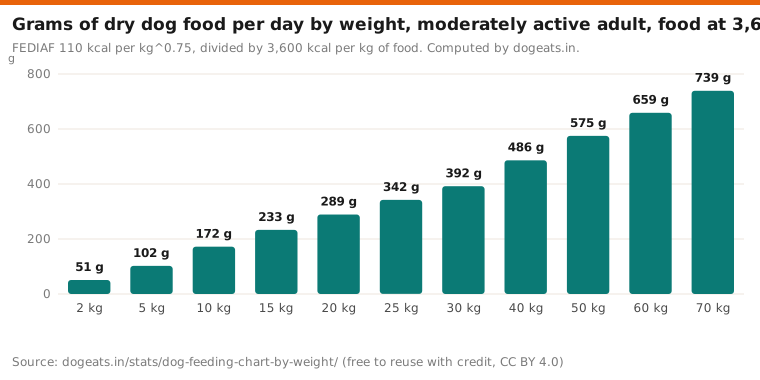
- At 3,600 kcal per kg of food, a 20 kg dog eats about 250 to 289 g of dry food a day, depending on activity.
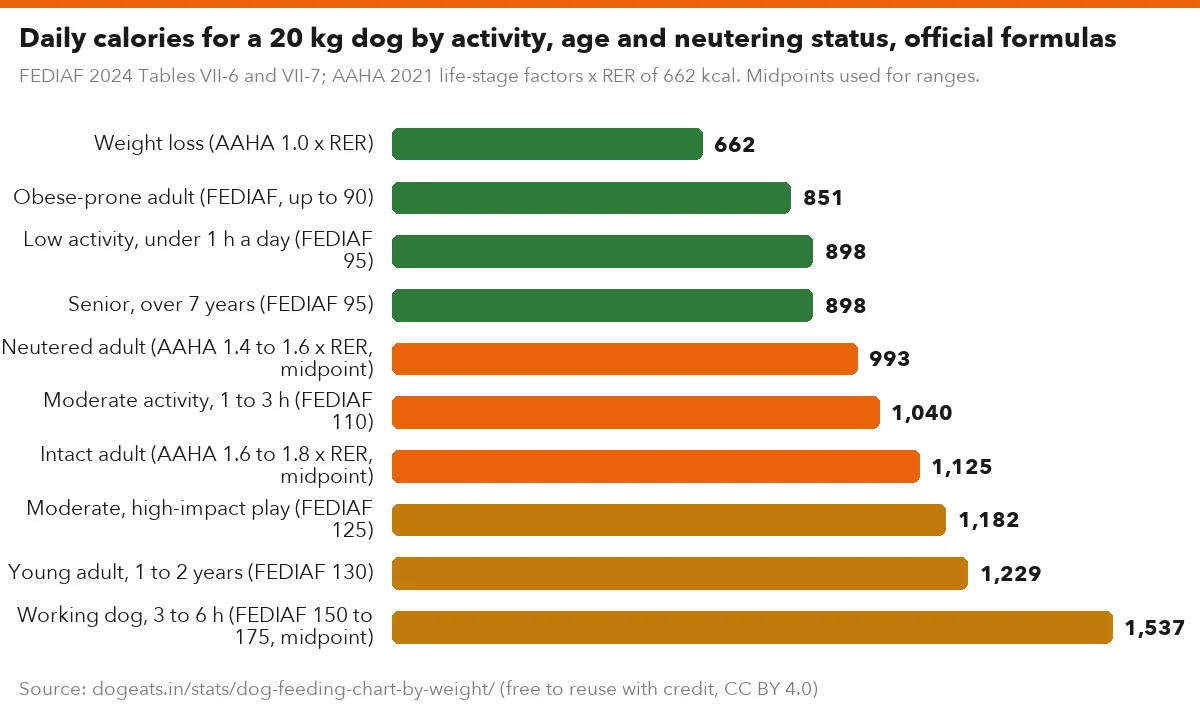
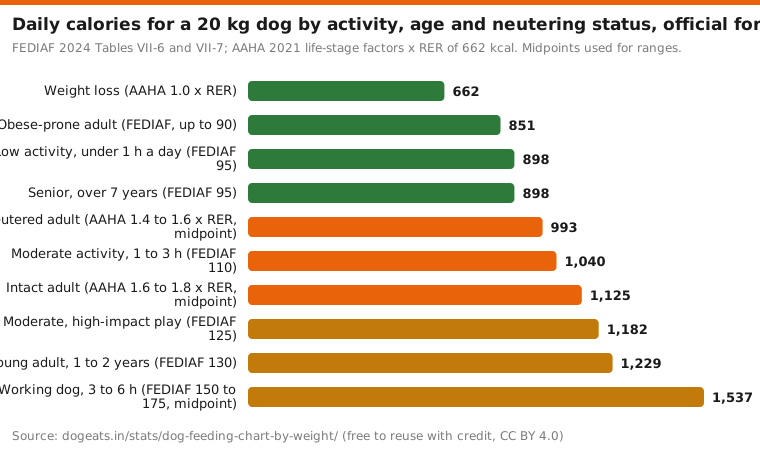
- For the same 20 kg dog, official formulas range from 662 kcal for weight loss to 1,537 kcal for a working dog.
- The AAHA 2021 guidelines say treats, table food and other extras should stay at or below 10% of daily calories.
- Royal Canin India pack labels follow the same 0.75 power rule: both Mini Adult and Maxi Adult list 27.6 to 27.9 g per kg^0.75 at medium activity.
- In the Dog Aging Project, dogs fed once a day had lower odds of five disease groups, but the study cannot show cause and effect.
- Among our 58 breed guides, a typical adult Labrador of 32.5 kg needs about 1,293 to 1,497 kcal a day.
- FEDIAF notes that energy formulas can overestimate a pet dog's needs by 10 to 60%, so body condition beats any chart.
How much should I feed my dog by weight in kg?
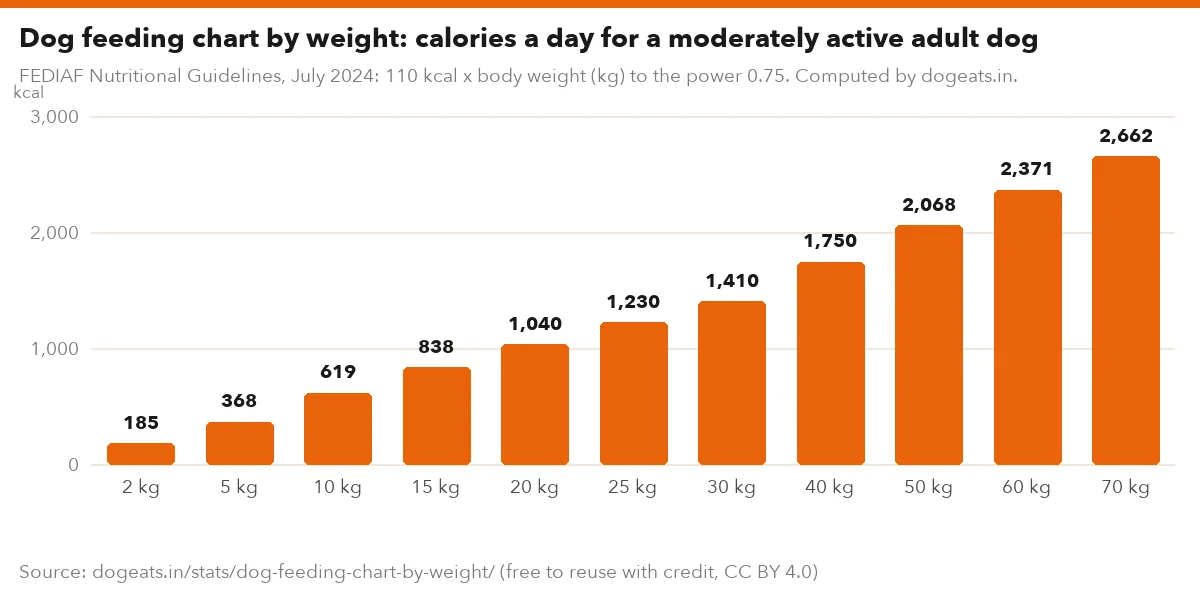
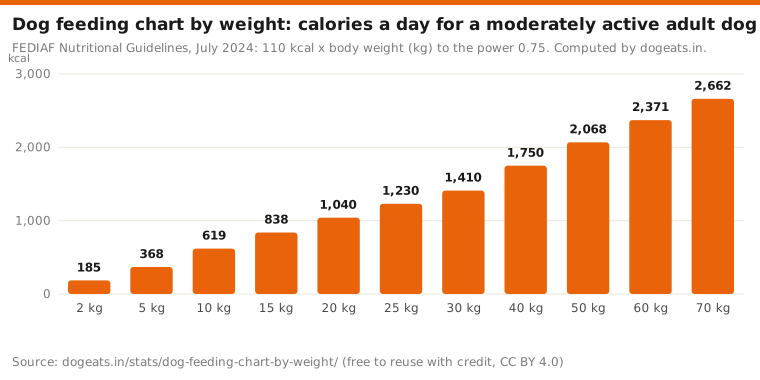
Start with calories, not cups. A healthy adult dog at moderate activity needs about 110 kcal for every kg of body weight raised to the power 0.75, says the FEDIAF 2024 guideline. For a 10 kg dog that works out to 619 kcal a day.
A low-activity dog that gets under an hour of lead walking needs closer to 95 kcal per kg^0.75. That puts the same 10 kg dog at 534 kcal. A flat dog with two short walks a day fits this group.
Many packs print calories per kg or per 100 g. Divide the daily calories by that figure to get grams. At 3,600 kcal per kg, a 10 kg dog eats about 148 to 172 g a day.
FEDIAF Nutritional Guidelines, July 2024: 110 kcal x body weight (kg) to the power 0.75. Computed by dogeats.in.
Show the numbers
| Label | kcal |
|---|---|
| 2 kg | 185 |
| 5 kg | 368 |
| 10 kg | 619 |
| 15 kg | 838 |
| 20 kg | 1,040 |
| 25 kg | 1,230 |
| 30 kg | 1,410 |
| 40 kg | 1,750 |
| 50 kg | 2,068 |
| 60 kg | 2,371 |
| 70 kg | 2,662 |
Embed this chart
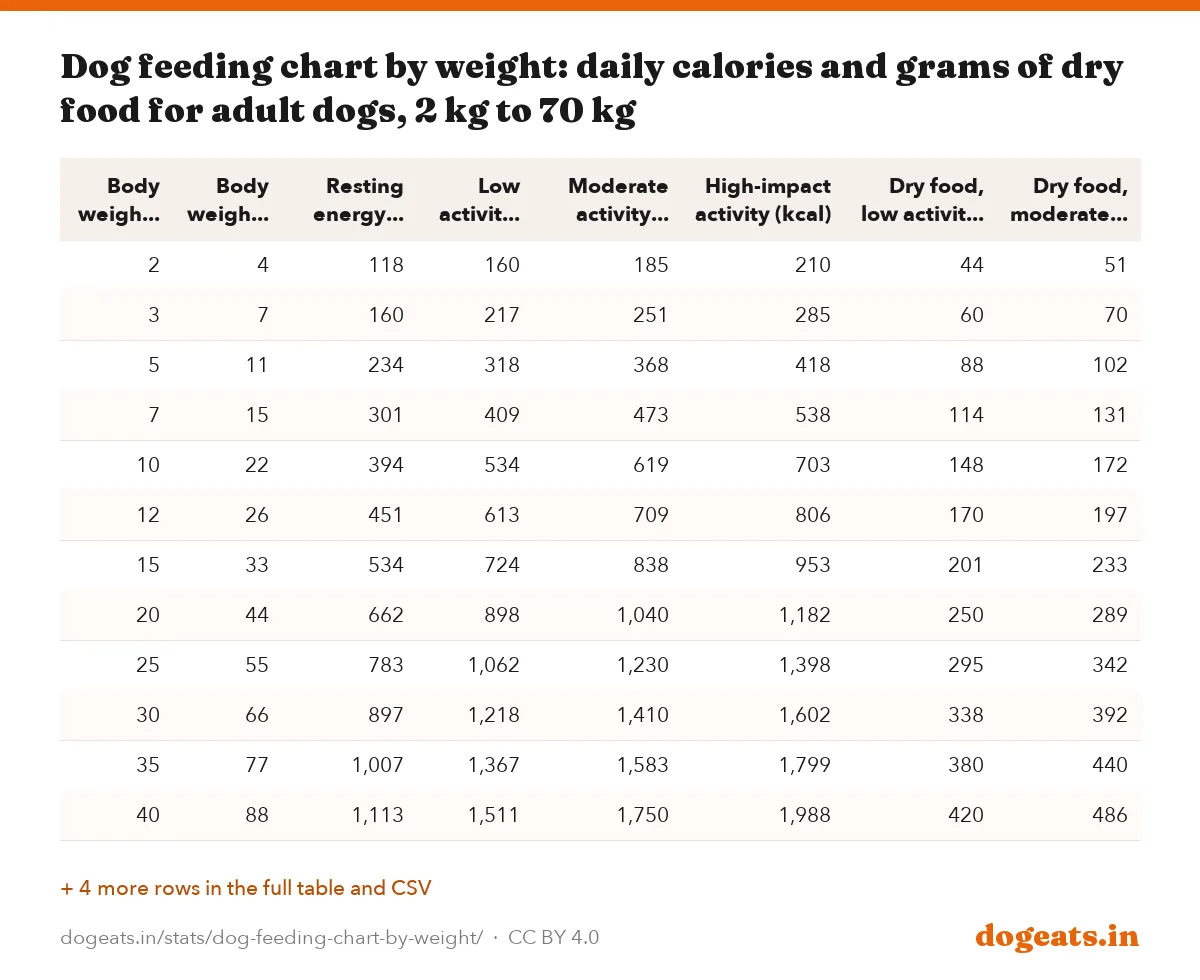
| Body weight (kg) | Body weight (lb) | Resting energy (kcal) | Low activity (kcal) | Moderate activity (kcal) | High-impact activity (kcal) | Dry food, low activity (g) | Dry food, moderate (g) |
|---|---|---|---|---|---|---|---|
| 2 | 4 | 118 | 160 | 185 | 210 | 44 | 51 |
| 3 | 7 | 160 | 217 | 251 | 285 | 60 | 70 |
| 5 | 11 | 234 | 318 | 368 | 418 | 88 | 102 |
| 7 | 15 | 301 | 409 | 473 | 538 | 114 | 131 |
| 10 | 22 | 394 | 534 | 619 | 703 | 148 | 172 |
| 12 | 26 | 451 | 613 | 709 | 806 | 170 | 197 |
| 15 | 33 | 534 | 724 | 838 | 953 | 201 | 233 |
| 20 | 44 | 662 | 898 | 1,040 | 1,182 | 250 | 289 |
| 25 | 55 | 783 | 1,062 | 1,230 | 1,398 | 295 | 342 |
| 30 | 66 | 897 | 1,218 | 1,410 | 1,602 | 338 | 392 |
| 35 | 77 | 1,007 | 1,367 | 1,583 | 1,799 | 380 | 440 |
| 40 | 88 | 1,113 | 1,511 | 1,750 | 1,988 | 420 | 486 |
| 45 | 99 | 1,216 | 1,651 | 1,911 | 2,172 | 458 | 531 |
| 50 | 110 | 1,316 | 1,786 | 2,068 | 2,350 | 496 | 575 |
| 60 | 132 | 1,509 | 2,048 | 2,371 | 2,695 | 569 | 659 |
| 70 | 154 | 1,694 | 2,299 | 2,662 | 3,025 | 639 | 739 |
Resting energy is the AAHA formula of 70 x kg^0.75. It is what a dog burns lying still, 394 kcal for a 10 kg dog. Daily needs are a multiple of it.
Grams assume 3,600 kcal per kg of dry food. FEDIAF sets its nutrient tables for a food of 4.0 kcal per g of dry matter. At 10% moisture that equals 3,600 kcal per kg, and FEDIAF counts any food with 14% moisture or less as dry. Your pack may differ, so use its own figure. Our adult dog feeding guide covers what to put in the bowl.
Why do small dogs need more food per kg than big dogs?
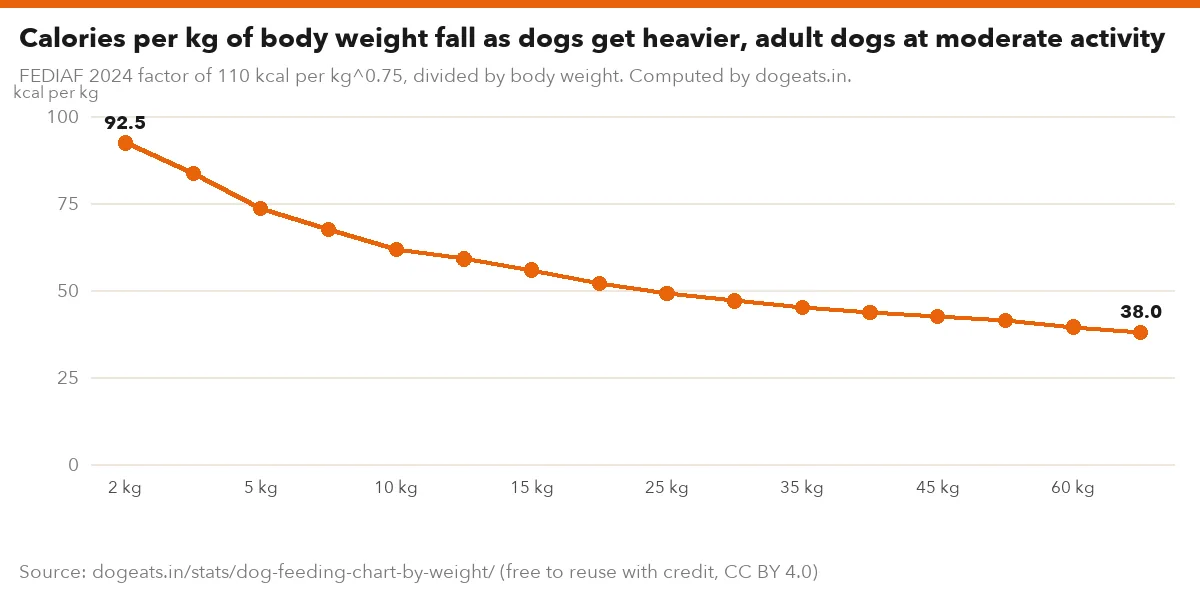
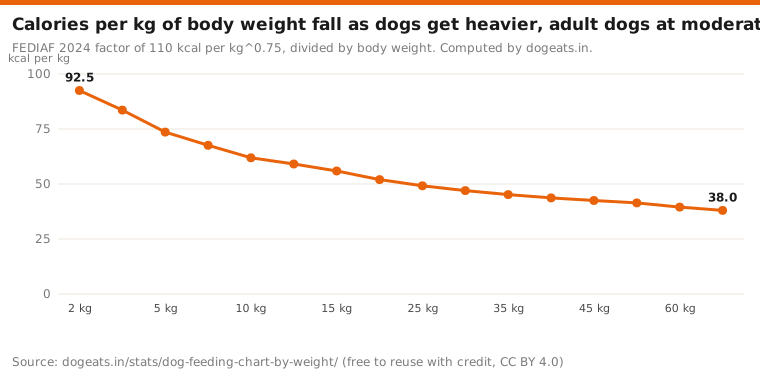
Energy needs do not rise in a straight line with body weight, FEDIAF explains. They track metabolic weight, kg^0.75. So a 2 kg Chihuahua burns about 92.5 kcal per kg a day, and a 70 kg giant about 38.0 kcal per kg.
A 70 kg dog is 35 times heavier than a 2 kg dog. It needs only 14.4 times the calories: 2,662 kcal against 185 kcal a day.
The same rule explains why a flat "2% of body weight" shortcut misleads. At 2%, a 50 kg dog would get 1,000 g of dry food a day. The formula at moderate activity gives about 575 g.
FEDIAF 2024 factor of 110 kcal per kg^0.75, divided by body weight. Computed by dogeats.in.
Show the numbers
| Label | kcal per kg |
|---|---|
| 2 kg | 92.5 |
| 3 kg | 83.6 |
| 5 kg | 73.6 |
| 7 kg | 67.6 |
| 10 kg | 61.9 |
| 12 kg | 59.1 |
| 15 kg | 55.9 |
| 20 kg | 52.0 |
| 25 kg | 49.2 |
| 30 kg | 47.0 |
| 35 kg | 45.2 |
| 40 kg | 43.7 |
| 45 kg | 42.5 |
| 50 kg | 41.4 |
| 60 kg | 39.5 |
| 70 kg | 38.0 |
Embed this chart
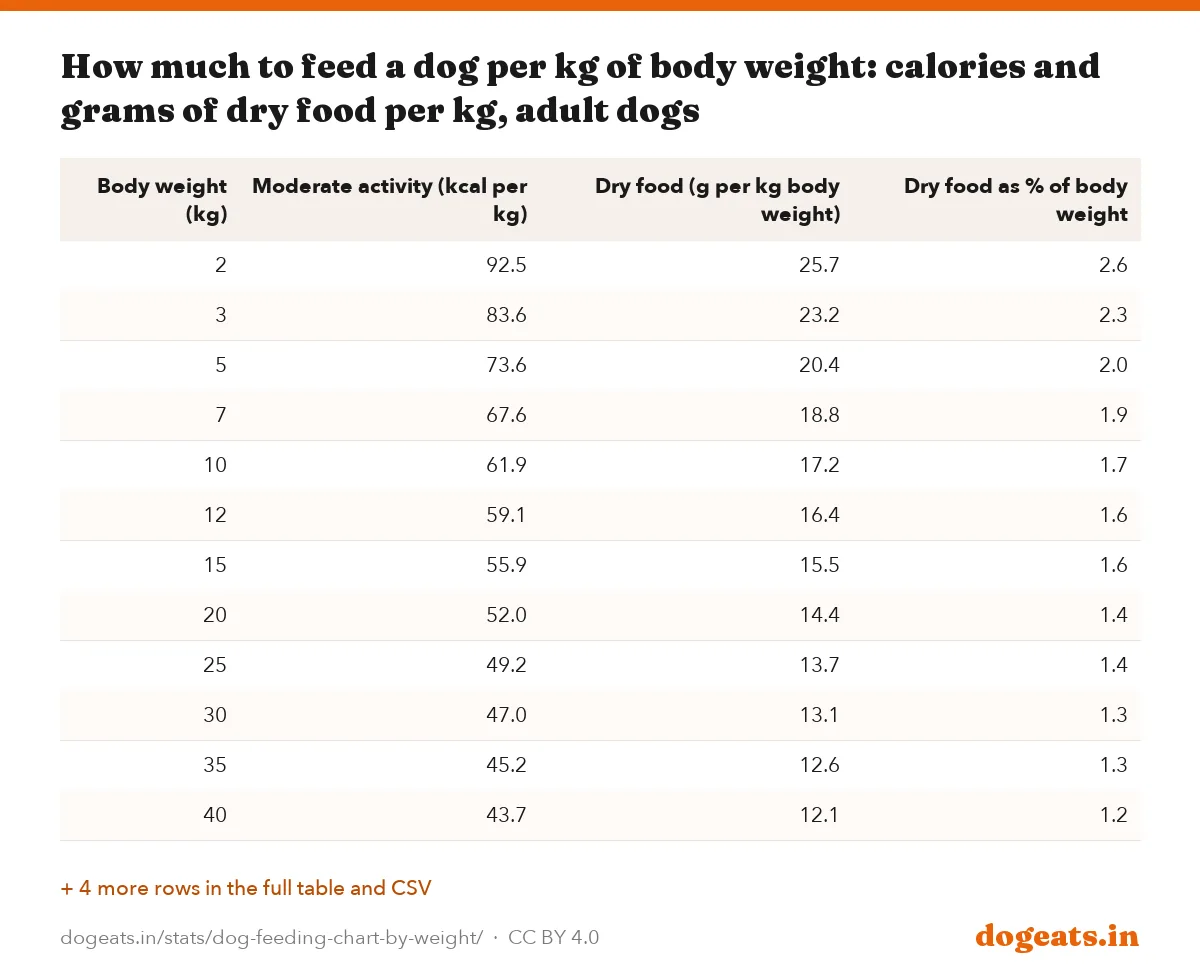
| Body weight (kg) | Moderate activity (kcal per kg) | Dry food (g per kg body weight) | Dry food as % of body weight |
|---|---|---|---|
| 2 | 92.5 | 25.7 | 2.6 |
| 3 | 83.6 | 23.2 | 2.3 |
| 5 | 73.6 | 20.4 | 2.0 |
| 7 | 67.6 | 18.8 | 1.9 |
| 10 | 61.9 | 17.2 | 1.7 |
| 12 | 59.1 | 16.4 | 1.6 |
| 15 | 55.9 | 15.5 | 1.6 |
| 20 | 52.0 | 14.4 | 1.4 |
| 25 | 49.2 | 13.7 | 1.4 |
| 30 | 47.0 | 13.1 | 1.3 |
| 35 | 45.2 | 12.6 | 1.3 |
| 40 | 43.7 | 12.1 | 1.2 |
| 45 | 42.5 | 11.8 | 1.2 |
| 50 | 41.4 | 11.5 | 1.1 |
| 60 | 39.5 | 11.0 | 1.1 |
| 70 | 38.0 | 10.6 | 1.1 |
In practice, a 5 kg dog eats about 2.0% of its body weight in dry food each day. A 50 kg dog eats about 1.1%. Both figures come from the same formula at 3,600 kcal per kg.
How do activity, age and neutering change how much a dog eats?
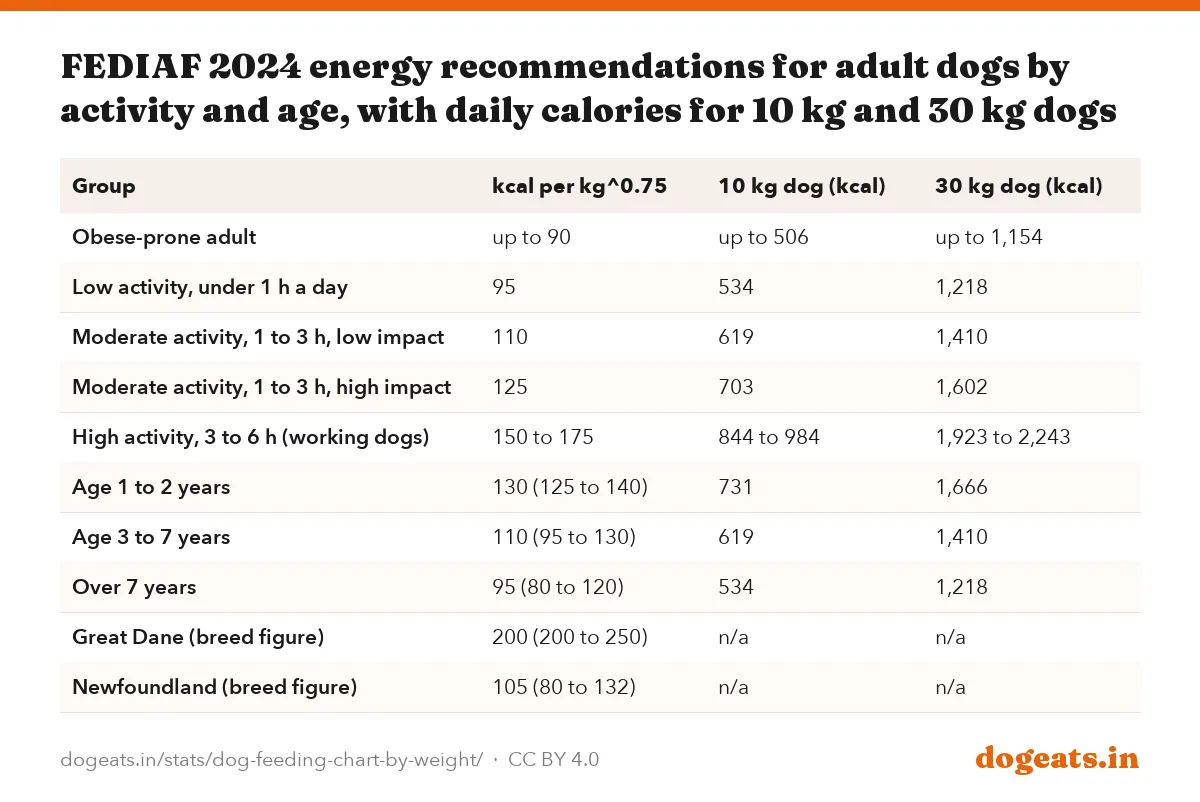
Activity moves the number most. FEDIAF puts a low-activity dog at 95 kcal per kg^0.75 and a working sheepdog at 150 to 175. For a 20 kg dog that spans 898 to 1,655 kcal a day.
Age matters next. FEDIAF lists 130 kcal per kg^0.75 for dogs of one to two years, 110 for three to seven years and 95 for dogs over seven. Older dogs move less, and the NRC booklet says they need about 20% fewer calories than middle-aged adults. Our senior dog feeding guide has more.
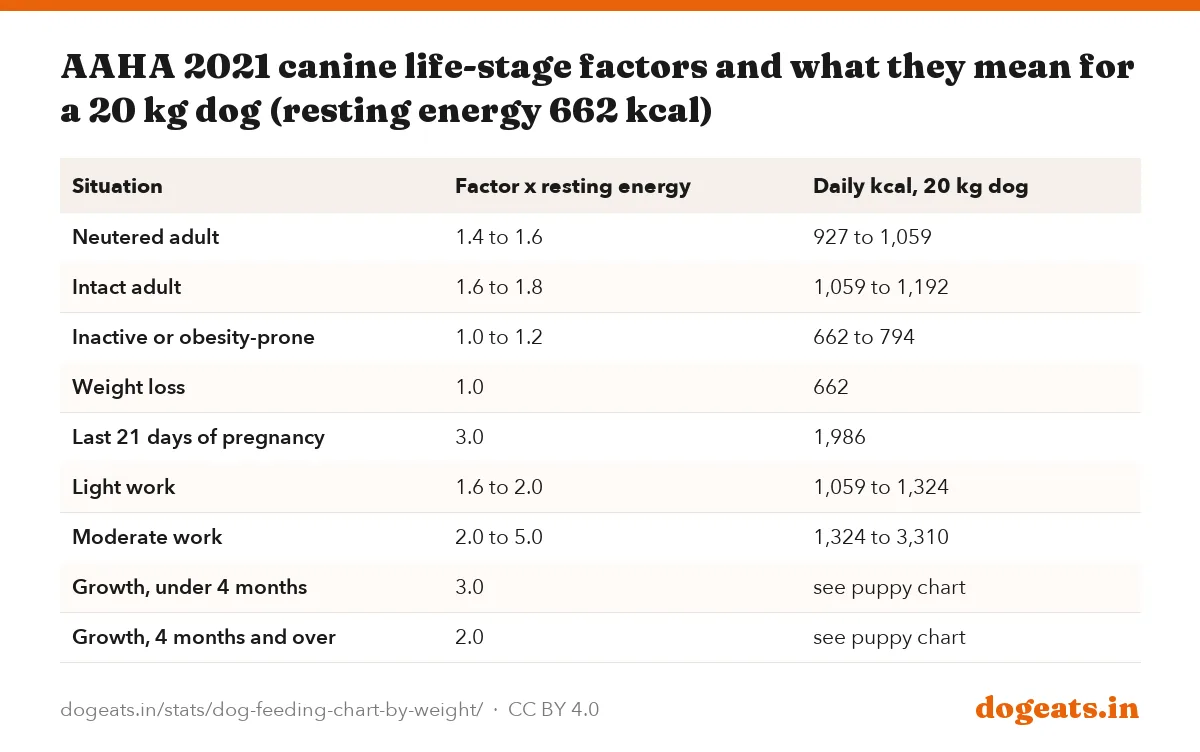
Neutering lowers needs too. The AAHA 2021 guidelines give neutered adults 1.4 to 1.6 times resting energy and intact adults 1.6 to 1.8 times. Inactive or obesity-prone dogs get 1.0 to 1.2 times.
FEDIAF 2024 Tables VII-6 and VII-7; AAHA 2021 life-stage factors x RER of 662 kcal. Midpoints used for ranges.
Show the numbers
| Label | kcal |
|---|---|
| Weight loss (AAHA 1.0 x RER) | 662 |
| Obese-prone adult (FEDIAF, up to 90) | 851 |
| Low activity, under 1 h a day (FEDIAF 95) | 898 |
| Senior, over 7 years (FEDIAF 95) | 898 |
| Neutered adult (AAHA 1.4 to 1.6 x RER, midpoint) | 993 |
| Moderate activity, 1 to 3 h (FEDIAF 110) | 1,040 |
| Intact adult (AAHA 1.6 to 1.8 x RER, midpoint) | 1,125 |
| Moderate, high-impact play (FEDIAF 125) | 1,182 |
| Young adult, 1 to 2 years (FEDIAF 130) | 1,229 |
| Working dog, 3 to 6 h (FEDIAF 150 to 175, midpoint) | 1,537 |
Embed this chart
| Situation | Factor x resting energy | Daily kcal, 20 kg dog |
|---|---|---|
| Neutered adult | 1.4 to 1.6 | 927 to 1,059 |
| Intact adult | 1.6 to 1.8 | 1,059 to 1,192 |
| Inactive or obesity-prone | 1.0 to 1.2 | 662 to 794 |
| Weight loss | 1.0 | 662 |
| Last 21 days of pregnancy | 3.0 | 1,986 |
| Light work | 1.6 to 2.0 | 1,059 to 1,324 |
| Moderate work | 2.0 to 5.0 | 1,324 to 3,310 |
| Growth, under 4 months | 3.0 | see puppy chart |
| Growth, 4 months and over | 2.0 | see puppy chart |
| Group | kcal per kg^0.75 | 10 kg dog (kcal) | 30 kg dog (kcal) |
|---|---|---|---|
| Obese-prone adult | up to 90 | up to 506 | up to 1,154 |
| Low activity, under 1 h a day | 95 | 534 | 1,218 |
| Moderate activity, 1 to 3 h, low impact | 110 | 619 | 1,410 |
| Moderate activity, 1 to 3 h, high impact | 125 | 703 | 1,602 |
| High activity, 3 to 6 h (working dogs) | 150 to 175 | 844 to 984 | 1,923 to 2,243 |
| Age 1 to 2 years | 130 (125 to 140) | 731 | 1,666 |
| Age 3 to 7 years | 110 (95 to 130) | 619 | 1,410 |
| Over 7 years | 95 (80 to 120) | 534 | 1,218 |
| Great Dane (breed figure) | 200 (200 to 250) | n/a | n/a |
| Newfoundland (breed figure) | 105 (80 to 132) | n/a | n/a |
Climate counts as well. FEDIAF says dogs kept outdoors in winter may need 10 to 90% more calories than in summer. It puts the upper critical temperature for adult dogs at 30 to 35 C (86 to 95 F). See our heatwave days report for how often Indian cities pass that.
FEDIAF also notes that basal metabolism cannot be lowered in heat, and panting itself costs energy. The NRC booklet says water needs may more than double in warm conditions, so keep a full bowl out.
How many grams of dry dog food per day?
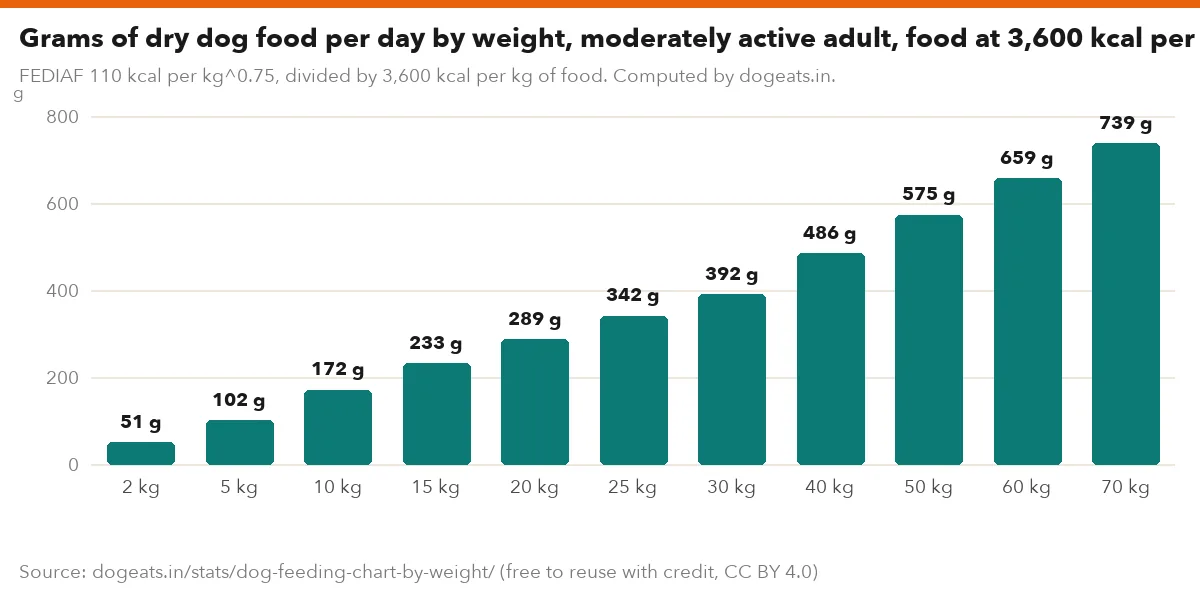
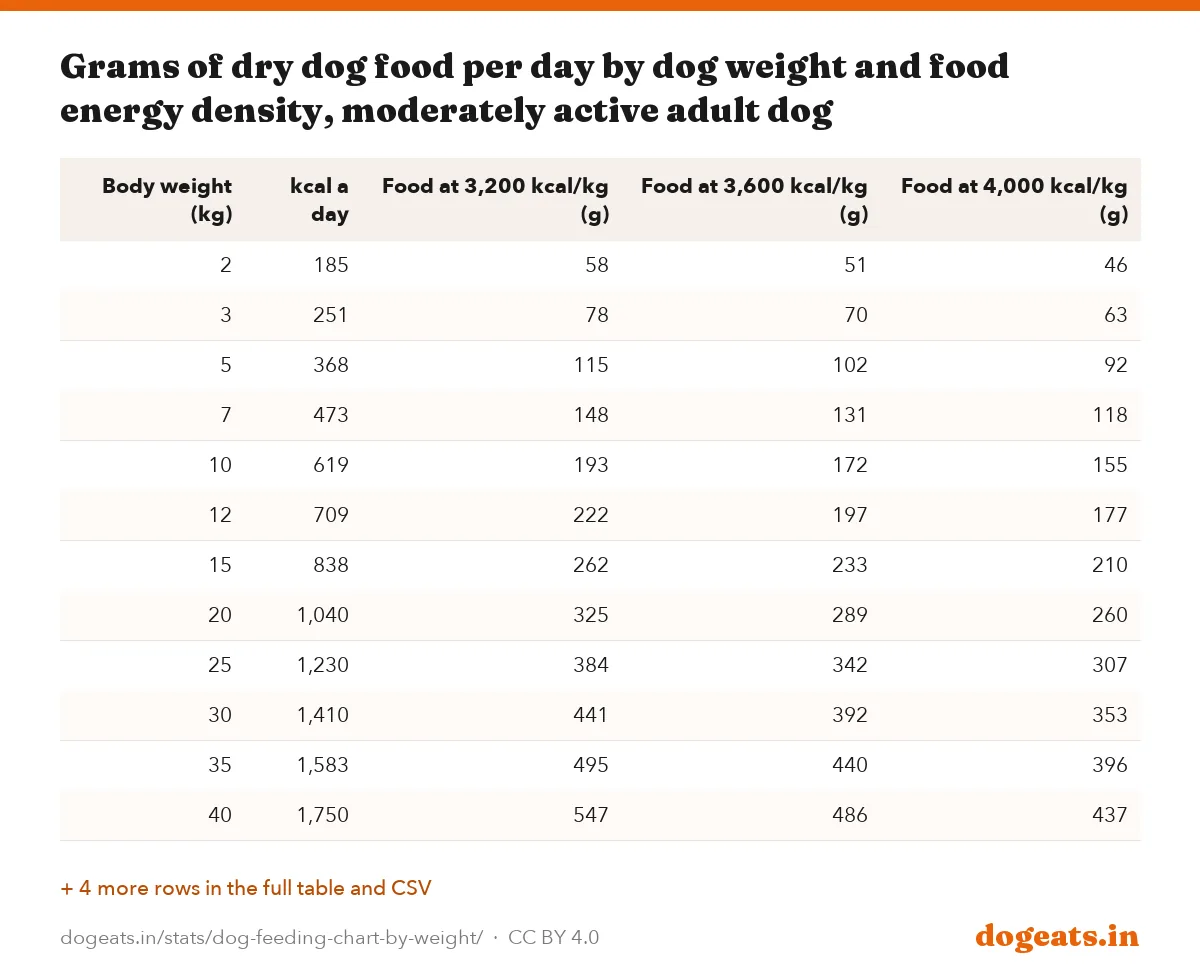
Grams depend on the food as much as the dog. A 20 kg dog that needs 1,040 kcal eats 325 g of a 3,200 kcal per kg food but only 260 g of a 4,000 kcal per kg food.
So two brands can print very different feeding guides for the same dog. Check the kcal per kg or per 100 g on the pack. If it lists only protein and fat, ask the maker.
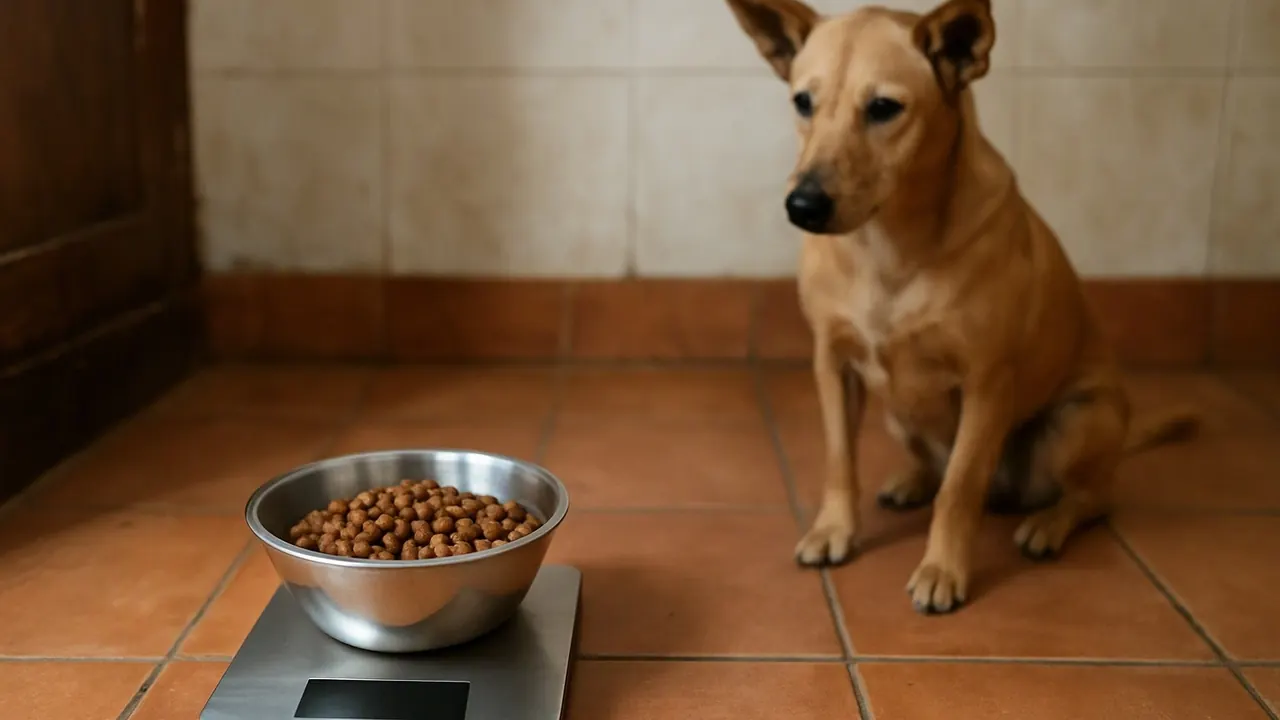
FEDIAF 110 kcal per kg^0.75, divided by 3,600 kcal per kg of food. Computed by dogeats.in.
Show the numbers
| Label | g |
|---|---|
| 2 kg | 51 g |
| 5 kg | 102 g |
| 10 kg | 172 g |
| 15 kg | 233 g |
| 20 kg | 289 g |
| 25 kg | 342 g |
| 30 kg | 392 g |
| 40 kg | 486 g |
| 50 kg | 575 g |
| 60 kg | 659 g |
| 70 kg | 739 g |
Embed this chart
| Body weight (kg) | kcal a day | Food at 3,200 kcal/kg (g) | Food at 3,600 kcal/kg (g) | Food at 4,000 kcal/kg (g) |
|---|---|---|---|---|
| 2 | 185 | 58 | 51 | 46 |
| 3 | 251 | 78 | 70 | 63 |
| 5 | 368 | 115 | 102 | 92 |
| 7 | 473 | 148 | 131 | 118 |
| 10 | 619 | 193 | 172 | 155 |
| 12 | 709 | 222 | 197 | 177 |
| 15 | 838 | 262 | 233 | 210 |
| 20 | 1,040 | 325 | 289 | 260 |
| 25 | 1,230 | 384 | 342 | 307 |
| 30 | 1,410 | 441 | 392 | 353 |
| 35 | 1,583 | 495 | 440 | 396 |
| 40 | 1,750 | 547 | 486 | 437 |
| 45 | 1,911 | 597 | 531 | 478 |
| 50 | 2,068 | 646 | 575 | 517 |
| 60 | 2,371 | 741 | 659 | 593 |
| 70 | 2,662 | 832 | 739 | 666 |
Wet food is mostly water, so it carries fewer calories per gram. Use its pack figure in the same way, and count both foods if you mix wet and dry.
Do dog food pack feeding guides match the formulas?
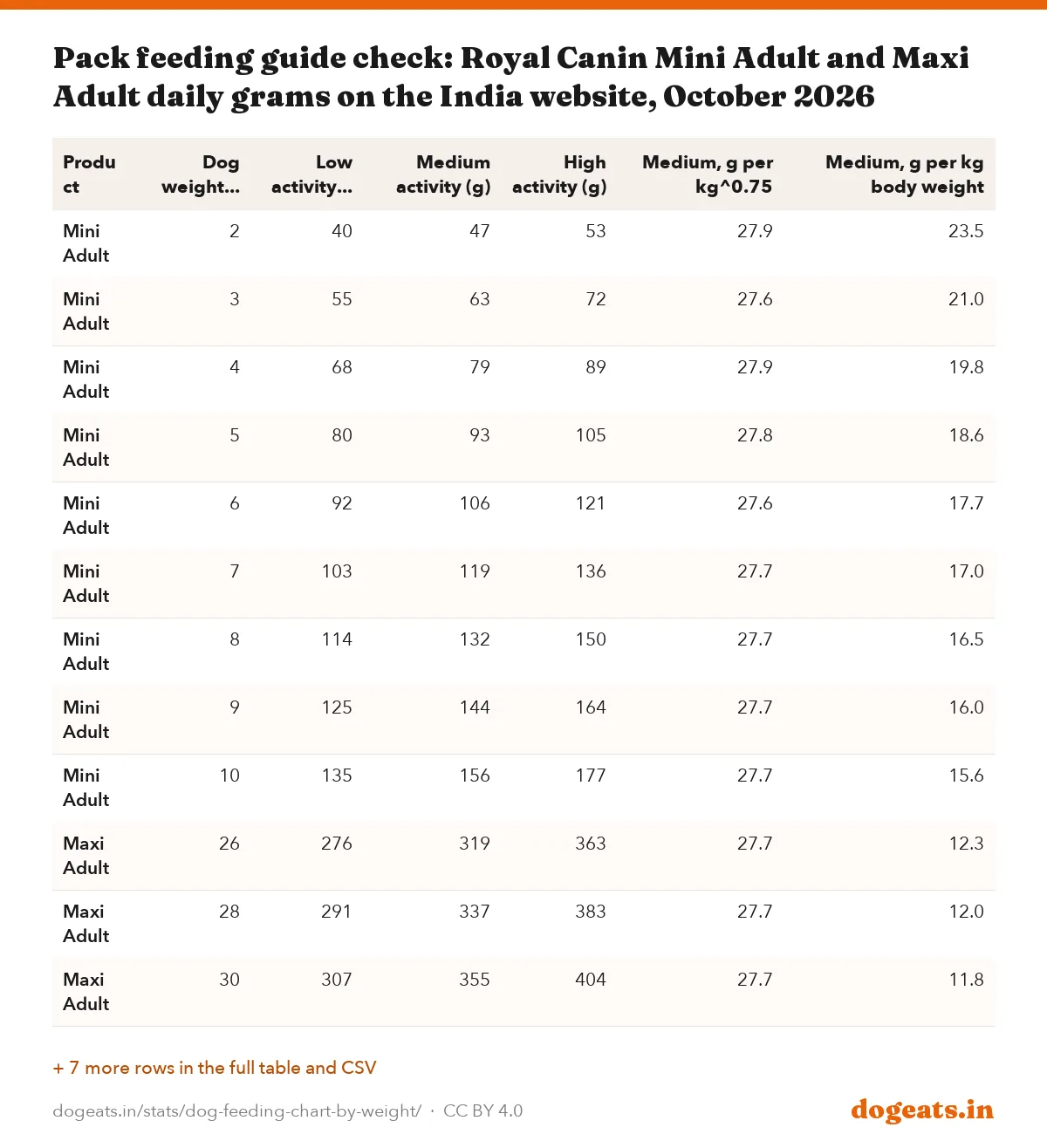
We checked the feeding tables of two Royal Canin products on the brand's India website on 15 October 2026. Mini Adult covers dogs of 2 to 10 kg and Maxi Adult covers 26 to 44 kg.
Both tables follow the 0.75 power rule almost exactly. At medium activity each lists 27.6 to 27.9 g of food per kg^0.75 at every weight. A 2 kg dog gets 47 g and a 44 kg dog gets 473 g.
Low activity is about 14% below medium on both labels, and high activity about 14% above. That matches the gap between the FEDIAF factors of 95, 110 and 125.
| Product | Dog weight (kg) | Low activity (g) | Medium activity (g) | High activity (g) | Medium, g per kg^0.75 | Medium, g per kg body weight |
|---|---|---|---|---|---|---|
| Mini Adult | 2 | 40 | 47 | 53 | 27.9 | 23.5 |
| Mini Adult | 3 | 55 | 63 | 72 | 27.6 | 21.0 |
| Mini Adult | 4 | 68 | 79 | 89 | 27.9 | 19.8 |
| Mini Adult | 5 | 80 | 93 | 105 | 27.8 | 18.6 |
| Mini Adult | 6 | 92 | 106 | 121 | 27.6 | 17.7 |
| Mini Adult | 7 | 103 | 119 | 136 | 27.7 | 17.0 |
| Mini Adult | 8 | 114 | 132 | 150 | 27.7 | 16.5 |
| Mini Adult | 9 | 125 | 144 | 164 | 27.7 | 16.0 |
| Mini Adult | 10 | 135 | 156 | 177 | 27.7 | 15.6 |
| Maxi Adult | 26 | 276 | 319 | 363 | 27.7 | 12.3 |
| Maxi Adult | 28 | 291 | 337 | 383 | 27.7 | 12.0 |
| Maxi Adult | 30 | 307 | 355 | 404 | 27.7 | 11.8 |
| Maxi Adult | 32 | 322 | 373 | 424 | 27.7 | 11.7 |
| Maxi Adult | 34 | 337 | 390 | 443 | 27.7 | 11.5 |
| Maxi Adult | 36 | 352 | 407 | 463 | 27.7 | 11.3 |
| Maxi Adult | 38 | 366 | 424 | 482 | 27.7 | 11.2 |
| Maxi Adult | 40 | 381 | 441 | 501 | 27.7 | 11.0 |
| Maxi Adult | 42 | 395 | 457 | 519 | 27.7 | 10.9 |
| Maxi Adult | 44 | 405 | 473 | 538 | 27.7 | 10.8 |
Per kg of body weight, the label falls from 23.5 g at 2 kg to 10.8 g at 44 kg. Our chart shows the same pattern, where moderate needs fall from 25.7 g to 11.8 g per kg between 2 and 45 kg.
How much should a Labrador, German Shepherd or Indie dog eat?
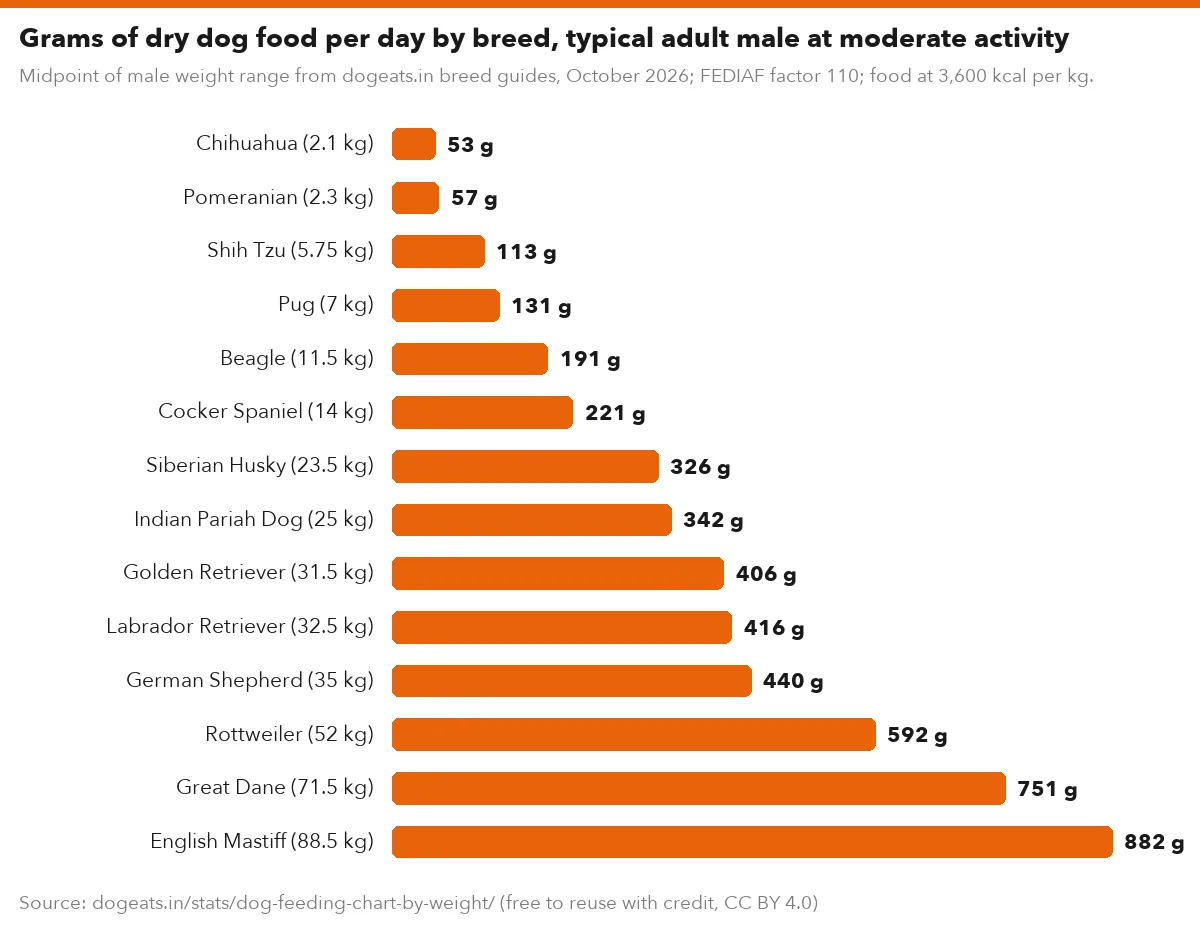
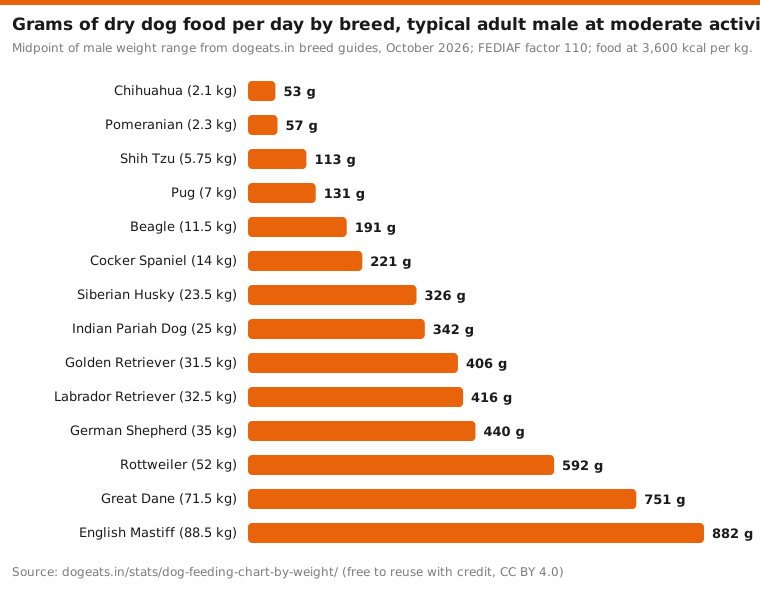
Using the male weight ranges in our 58 breed guides, a typical Labrador Retriever of 32.5 kg needs about 1,293 to 1,497 kcal a day. It comes to roughly 359 to 416 g of a 3,600 kcal per kg food.
A German Shepherd of 35 kg needs 1,367 to 1,583 kcal. An Indian Pariah Dog of 25 kg needs 1,062 to 1,230 kcal, about 295 to 342 g of dry food.
Small companion breeds need far less. A 5.75 kg Shih Tzu needs 353 to 408 kcal and a 7 kg Pug 409 to 473 kcal. For a dog that walks little, the lower figure is the safer start.
Midpoint of male weight range from dogeats.in breed guides, October 2026; FEDIAF factor 110; food at 3,600 kcal per kg.
Show the numbers
| Label | g |
|---|---|
| Chihuahua (2.1 kg) | 53 g |
| Pomeranian (2.3 kg) | 57 g |
| Shih Tzu (5.75 kg) | 113 g |
| Pug (7 kg) | 131 g |
| Beagle (11.5 kg) | 191 g |
| Cocker Spaniel (14 kg) | 221 g |
| Siberian Husky (23.5 kg) | 326 g |
| Indian Pariah Dog (25 kg) | 342 g |
| Golden Retriever (31.5 kg) | 406 g |
| Labrador Retriever (32.5 kg) | 416 g |
| German Shepherd (35 kg) | 440 g |
| Rottweiler (52 kg) | 592 g |
| Great Dane (71.5 kg) | 751 g |
| English Mastiff (88.5 kg) | 882 g |
Embed this chart
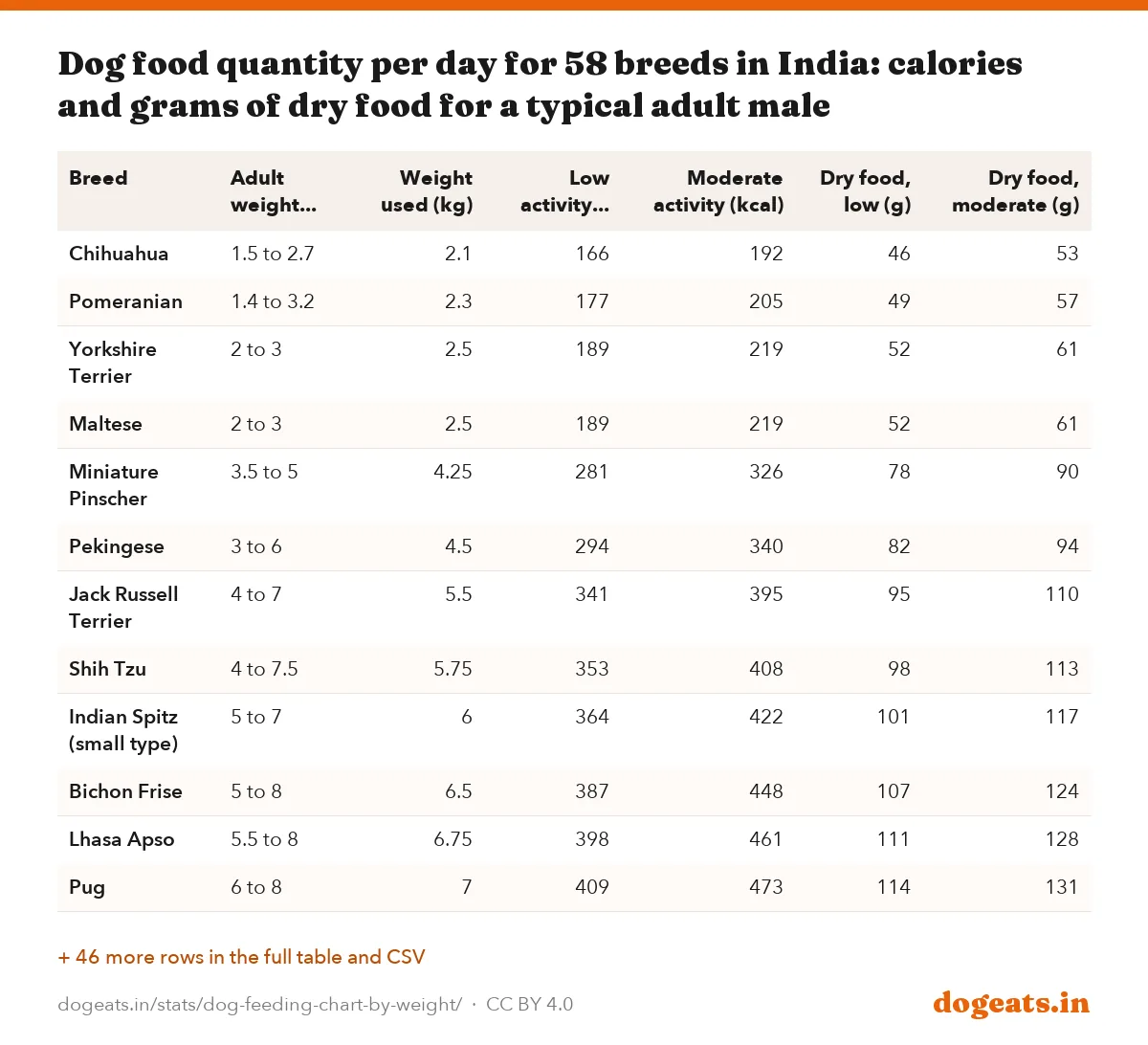
| Breed | Adult weight (kg) | Weight used (kg) | Low activity (kcal) | Moderate activity (kcal) | Dry food, low (g) | Dry food, moderate (g) |
|---|---|---|---|---|---|---|
| Chihuahua | 1.5 to 2.7 | 2.1 | 166 | 192 | 46 | 53 |
| Pomeranian | 1.4 to 3.2 | 2.3 | 177 | 205 | 49 | 57 |
| Yorkshire Terrier | 2 to 3 | 2.5 | 189 | 219 | 52 | 61 |
| Maltese | 2 to 3 | 2.5 | 189 | 219 | 52 | 61 |
| Miniature Pinscher | 3.5 to 5 | 4.25 | 281 | 326 | 78 | 90 |
| Pekingese | 3 to 6 | 4.5 | 294 | 340 | 82 | 94 |
| Jack Russell Terrier | 4 to 7 | 5.5 | 341 | 395 | 95 | 110 |
| Shih Tzu | 4 to 7.5 | 5.75 | 353 | 408 | 98 | 113 |
| Indian Spitz (small type) | 5 to 7 | 6 | 364 | 422 | 101 | 117 |
| Bichon Frise | 5 to 8 | 6.5 | 387 | 448 | 107 | 124 |
| Lhasa Apso | 5.5 to 8 | 6.75 | 398 | 461 | 111 | 128 |
| Pug | 6 to 8 | 7 | 409 | 473 | 114 | 131 |
| Cavalier King Charles Spaniel | 5.9 to 8.2 | 7.05 | 411 | 476 | 114 | 132 |
| German Spitz | 5 to 11 | 8 | 452 | 523 | 126 | 145 |
| Japanese Spitz | 5 to 11 | 8 | 452 | 523 | 126 | 145 |
| Shiba Inu | 8 to 11 | 9.5 | 514 | 595 | 143 | 165 |
| French Bulldog | 8 to 12 | 10 | 534 | 619 | 148 | 172 |
| Pembroke Welsh Corgi | 10 to 12 | 11 | 574 | 664 | 159 | 185 |
| Dachshund (standard) | 7 to 15 | 11 | 574 | 664 | 159 | 185 |
| Beagle | 9 to 14 | 11.5 | 593 | 687 | 165 | 191 |
| American Eskimo Dog (standard) | 11 to 16 | 13.5 | 669 | 775 | 186 | 215 |
| Cocker Spaniel | 13 to 15 | 14 | 688 | 796 | 191 | 221 |
| Kanni | 16 to 22 | 19 | 865 | 1,001 | 240 | 278 |
| Chippiparai | 17 to 22 | 19.5 | 882 | 1,021 | 245 | 284 |
| Border Collie | 14 to 25 | 19.5 | 882 | 1,021 | 245 | 284 |
| Pit Bull | 16 to 27 | 21.5 | 949 | 1,098 | 263 | 305 |
| English Bulldog | about 23 | 23 | 998 | 1,155 | 277 | 321 |
| Siberian Husky | 20 to 27 | 23.5 | 1,014 | 1,174 | 282 | 326 |
| Samoyed | 20 to 29 | 24.5 | 1,046 | 1,211 | 291 | 336 |
| Indian Pariah Dog | 20 to 30 | 25 | 1,062 | 1,230 | 295 | 342 |
| Poodle (Standard) | 18 to 32 | 25 | 1,062 | 1,230 | 295 | 342 |
| Dalmatian | 20 to 32 | 26 | 1,094 | 1,267 | 304 | 352 |
| Mudhol Hound | 22 to 30 | 26 | 1,094 | 1,267 | 304 | 352 |
| Australian Shepherd | 23 to 29 | 26 | 1,094 | 1,267 | 304 | 352 |
| Chow Chow | 20 to 32 | 26 | 1,094 | 1,267 | 304 | 352 |
| Bull Terrier | 23 to 32 | 27.5 | 1,141 | 1,321 | 317 | 367 |
| Rampur Greyhound | 27 to 32 | 29.5 | 1,203 | 1,392 | 334 | 387 |
| Kombai | 25 to 35 | 30 | 1,218 | 1,410 | 338 | 392 |
| Golden Retriever | 29 to 34 | 31.5 | 1,263 | 1,463 | 351 | 406 |
| Belgian Malinois | 27 to 36 | 31.5 | 1,263 | 1,463 | 351 | 406 |
| Labrador Retriever | 29 to 36 | 32.5 | 1,293 | 1,497 | 359 | 416 |
| Boxer | 29 to 36 | 32.5 | 1,293 | 1,497 | 359 | 416 |
| Rajapalayam | 25 to 40 | 32.5 | 1,293 | 1,497 | 359 | 416 |
| German Shepherd | 29 to 41 | 35 | 1,367 | 1,583 | 380 | 440 |
| Rhodesian Ridgeback | 36 to 41 | 38.5 | 1,468 | 1,700 | 408 | 472 |
| Doberman | 34 to 45 | 39.5 | 1,497 | 1,733 | 416 | 481 |
| Alaskan Malamute | 36 to 43 | 39.5 | 1,497 | 1,733 | 416 | 481 |
| Dogo Argentino | 40 to 45 | 42.5 | 1,581 | 1,831 | 439 | 509 |
| Bernese Mountain Dog | 36 to 52 | 44 | 1,623 | 1,879 | 451 | 522 |
| Cane Corso | 45 to 50 | 47.5 | 1,719 | 1,990 | 477 | 553 |
| Rottweiler | 43 to 61 | 52 | 1,840 | 2,130 | 511 | 592 |
| Kangal | 48 to 60 | 54 | 1,892 | 2,191 | 526 | 609 |
| Tibetan Mastiff | 41 to 68 | 54.5 | 1,906 | 2,206 | 529 | 613 |
| Bullmastiff | 50 to 59 | 54.5 | 1,906 | 2,206 | 529 | 613 |
| Great Dane | 64 to 79 | 71.5 | 2,336 | 2,705 | 649 | 751 |
| Saint Bernard | 64 to 82 | 73 | 2,373 | 2,747 | 659 | 763 |
| Bully Kutta | 70 to 90 | 80 | 2,541 | 2,942 | 706 | 817 |
| English Mastiff | 73 to 104 | 88.5 | 2,741 | 3,174 | 761 | 882 |
The 58 breeds span a wide range. A 2.1 kg Chihuahua needs about 192 kcal a day at moderate activity, and an 88.5 kg English Mastiff about 3,174 kcal. Giant breeds such as the Great Dane can run higher; FEDIAF gives Great Danes 200 kcal per kg^0.75.
Feed for the weight your dog should be, not the weight it is. If your Labrador weighs 38 kg but should weigh 32 kg, use the 32 kg row and ask your vet about a weight plan.
How do I know if I am feeding my dog the right amount?
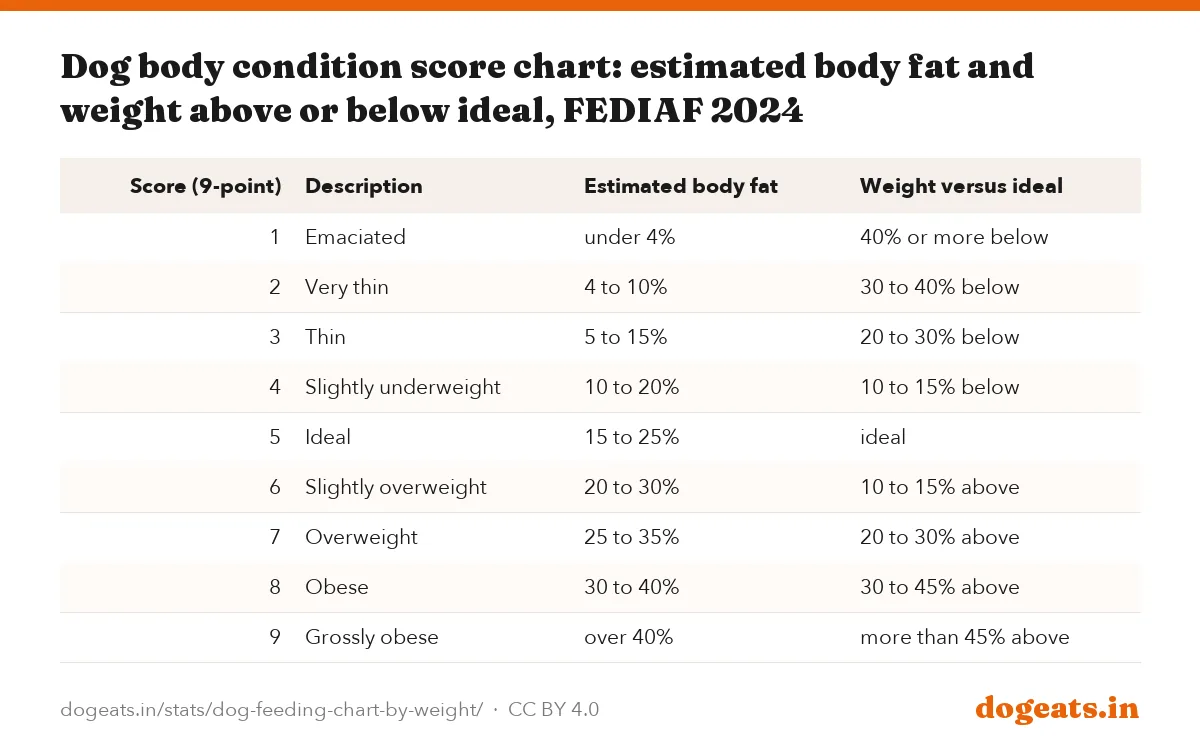
Use body condition, not the bowl. FEDIAF and AAHA both use a 9-point body condition score, where 5 is ideal. At 5 you can feel the ribs under a thin layer of fat and see a waist from above.
Each point above 5 means roughly 10% more body weight than ideal, the AAHA 2021 guidelines say. A dog at 7 is about 20 to 30% heavy on the FEDIAF chart, and a dog at 8 about 30 to 45%.
| Score (9-point) | Description | Estimated body fat | Weight versus ideal |
|---|---|---|---|
| 1 | Emaciated | under 4% | 40% or more below |
| 2 | Very thin | 4 to 10% | 30 to 40% below |
| 3 | Thin | 5 to 15% | 20 to 30% below |
| 4 | Slightly underweight | 10 to 20% | 10 to 15% below |
| 5 | Ideal | 15 to 25% | ideal |
| 6 | Slightly overweight | 20 to 30% | 10 to 15% above |
| 7 | Overweight | 25 to 35% | 20 to 30% above |
| 8 | Obese | 30 to 40% | 30 to 45% above |
| 9 | Grossly obese | over 40% | more than 45% above |
FEDIAF cites a survey in which about 19% of owners never played with their dogs. About 22% exercised them for less than three hours a week. For dogs like these, standard factors can be too high.
For weight loss, AAHA sets 1.0 times resting energy as the starting factor, worked out on the target weight. A vet should set and supervise that plan.
How many times a day should I feed my dog?
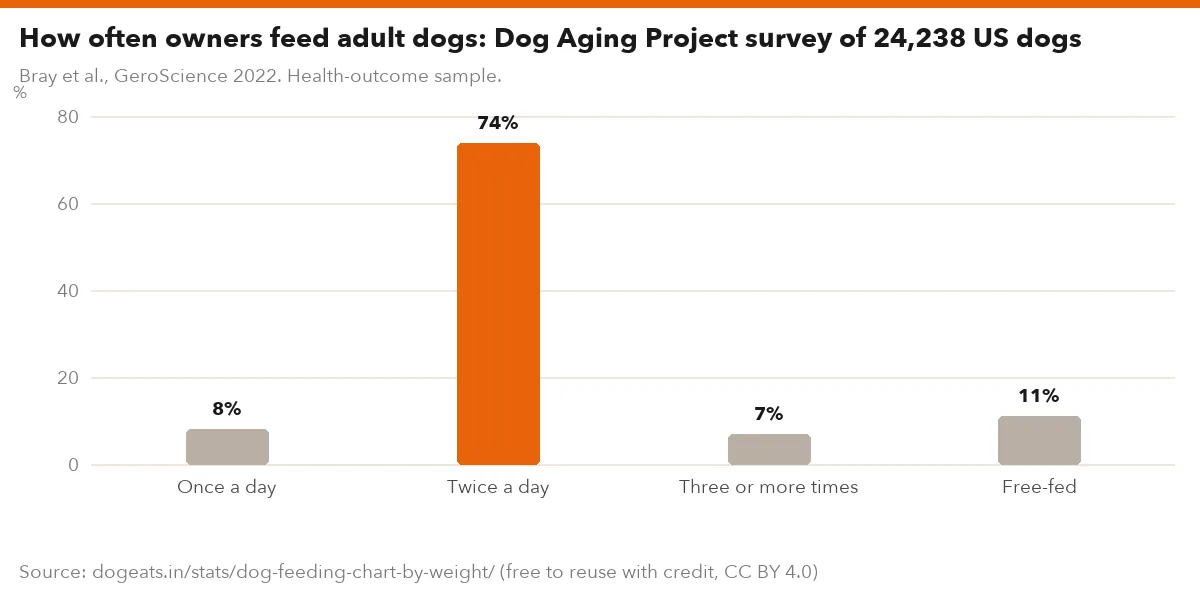
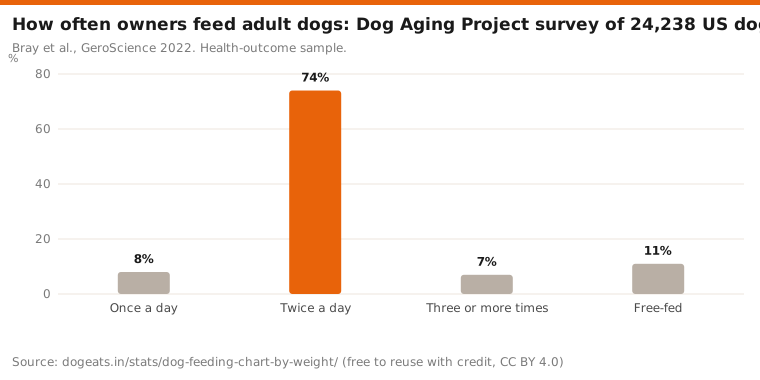
The NRC owners' booklet says it is fine to feed an adult dog once or twice a day, while puppies need two to three meals. Most owners choose twice. In the US Dog Aging Project, 74% of 24,238 dogs were fed twice a day.
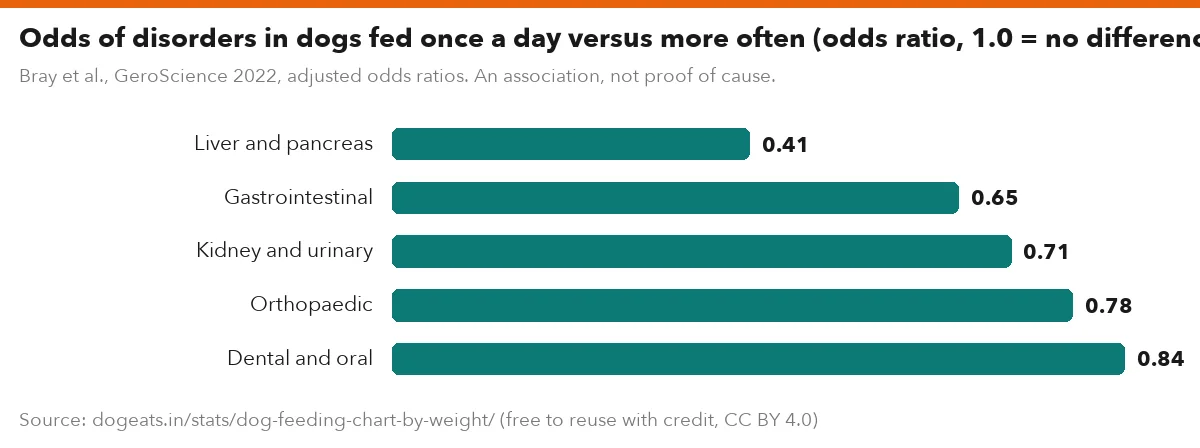
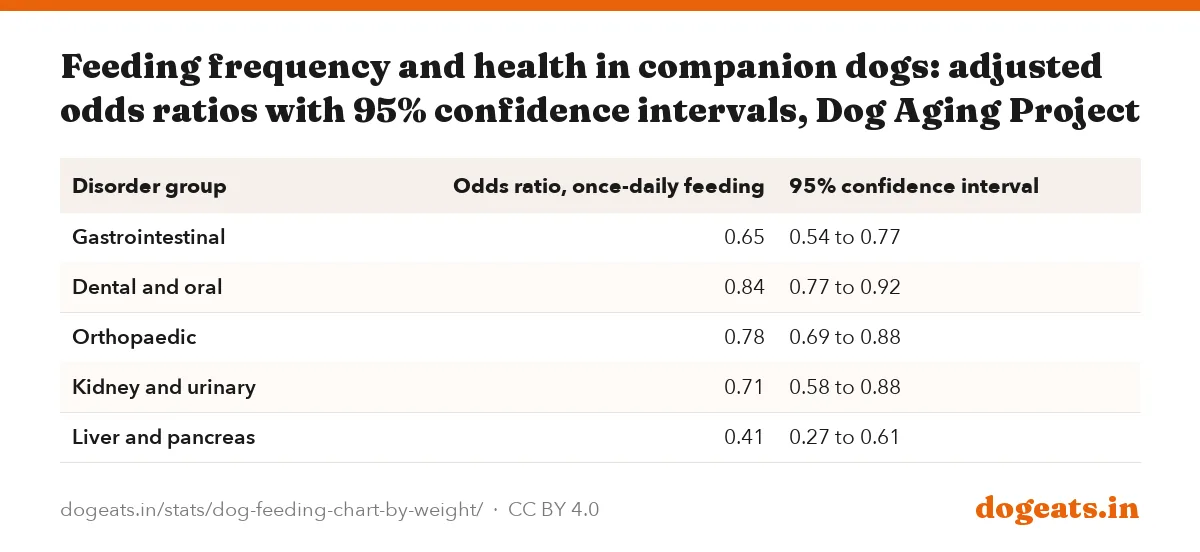
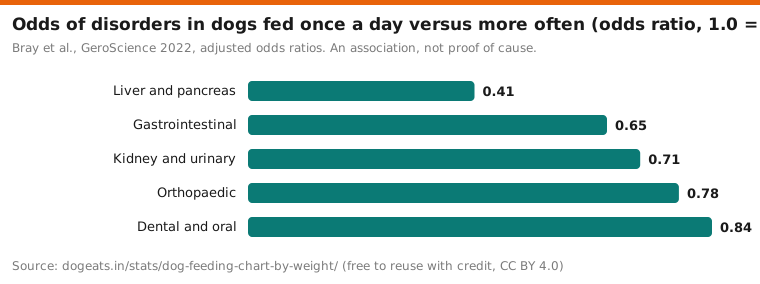
The same study, by Bray and colleagues in GeroScience in 2022, found that dogs fed once a day had lower odds of several disease groups. The odds were 59% lower for liver and pancreas disorders and 35% lower for gut disorders.
The authors stress that the study was cross-sectional and does not prove cause. Owners may feed sick dogs more often, for medicines. Ask your vet before you change a routine, and see the puppy feeding chart for young dogs.
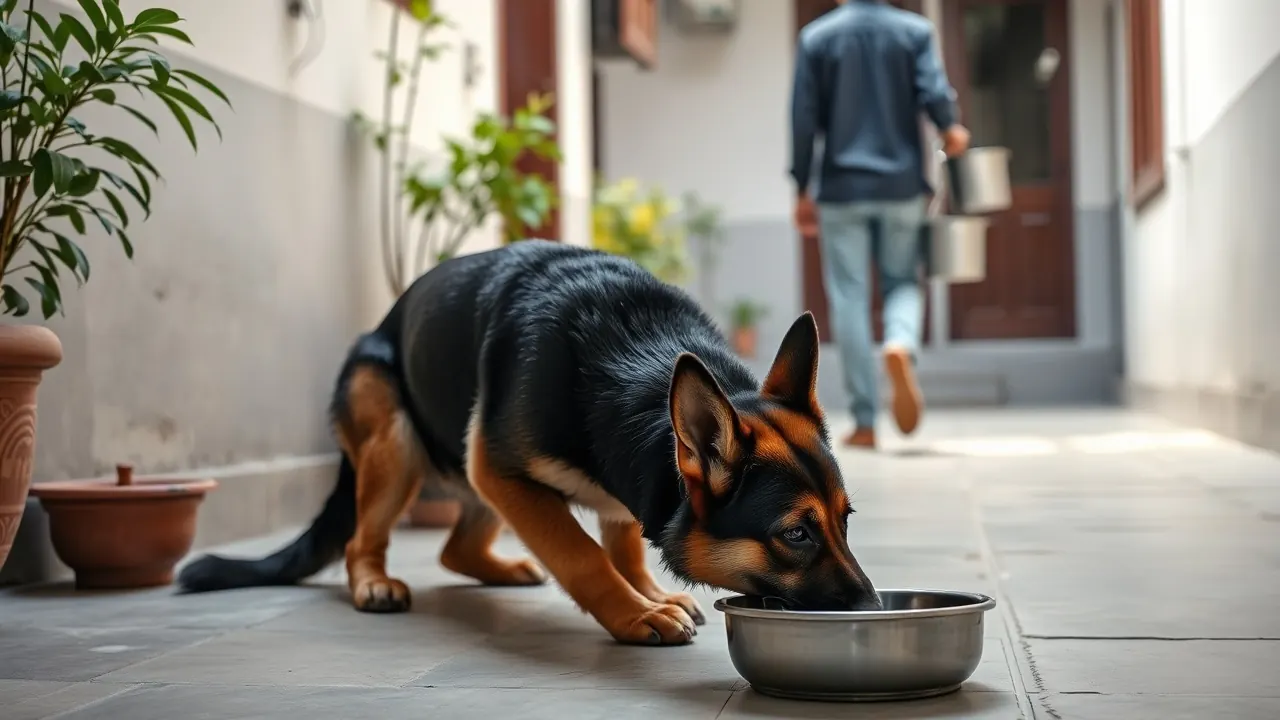
Bray et al., GeroScience 2022. Health-outcome sample.
Show the numbers
| Label | % |
|---|---|
| Once a day | 8% |
| Twice a day | 74% |
| Three or more times | 7% |
| Free-fed | 11% |
Embed this chart
Bray et al., GeroScience 2022, adjusted odds ratios. An association, not proof of cause.
Show the numbers
| Label | odds ratio |
|---|---|
| Liver and pancreas | 0.41 |
| Gastrointestinal | 0.65 |
| Kidney and urinary | 0.71 |
| Orthopaedic | 0.78 |
| Dental and oral | 0.84 |
Embed this chart
| Disorder group | Odds ratio, once-daily feeding | 95% confidence interval |
|---|---|---|
| Gastrointestinal | 0.65 | 0.54 to 0.77 |
| Dental and oral | 0.84 | 0.77 to 0.92 |
| Orthopaedic | 0.78 | 0.69 to 0.88 |
| Kidney and urinary | 0.71 | 0.58 to 0.88 |
| Liver and pancreas | 0.41 | 0.27 to 0.61 |
Dogs fed once a day also scored 0.62 points lower, on average, on a canine cognitive dysfunction scale. Lower scores mean fewer signs of cognitive decline.
How much dry food does a dog eat in a month, and what does it cost in India?
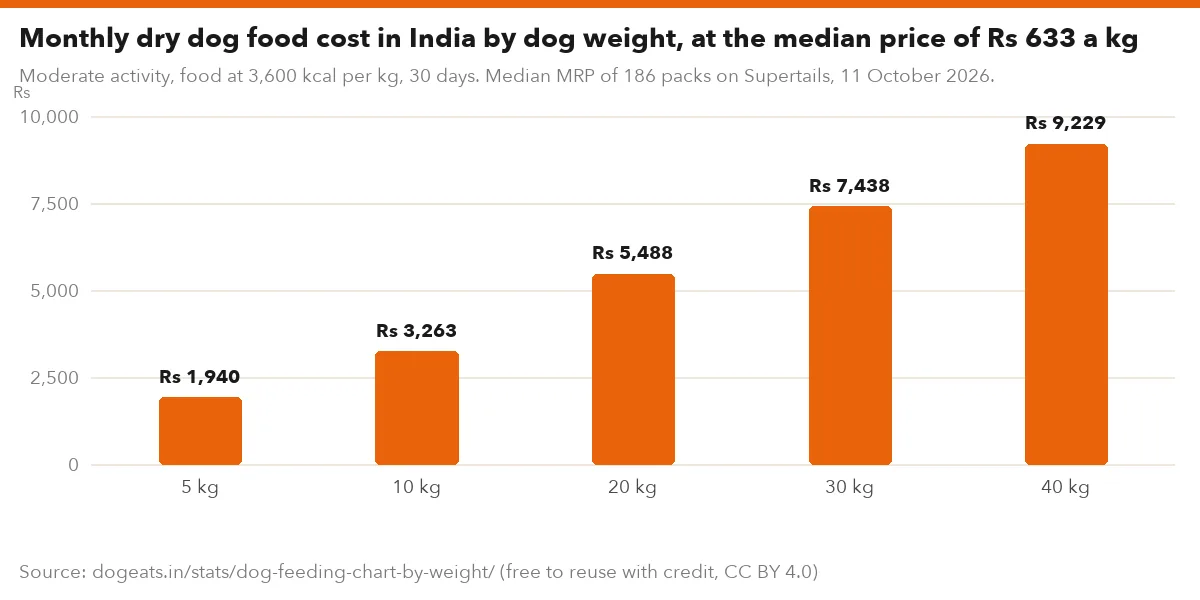
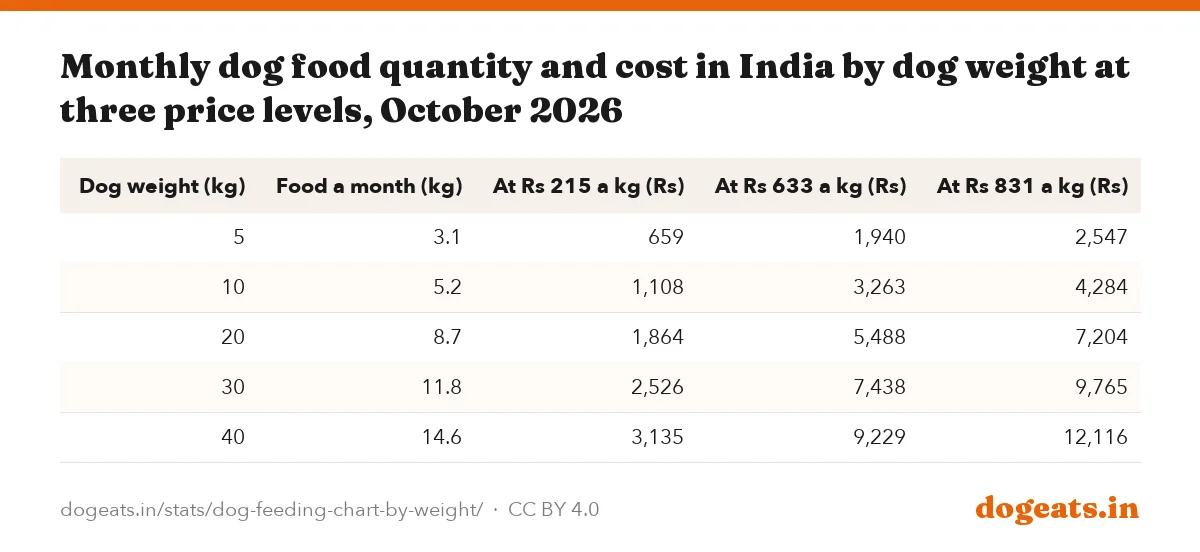
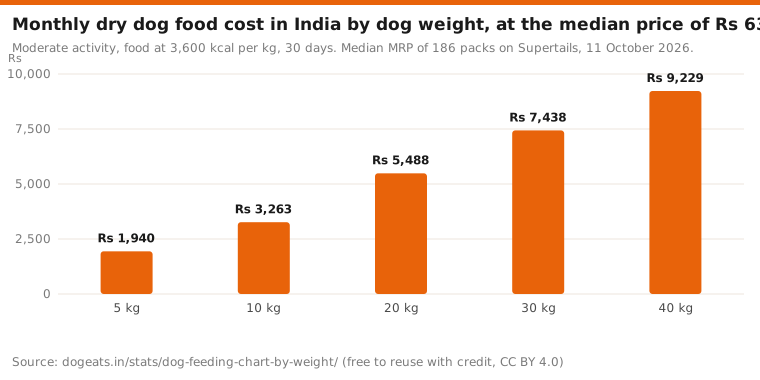
A moderately active 10 kg dog eats about 172 g a day of a 3,600 kcal per kg food, or 5.2 kg a month. A 30 kg dog eats about 11.8 kg a month.
In our dog food price check of 186 packs on 11 October 2026, the median MRP was Rs 633 a kg. At that price the 10 kg dog's food costs about Rs 3,263 a month and the 30 kg dog's about Rs 7,438.
Budget and premium packs change the bill sharply. Drools Chicken and Egg Adult lists at Rs 215 a kg in a 10 kg bag. Royal Canin Maxi Adult lists at Rs 831 a kg in a 15 kg bag on PharmEasy, and Rs 733 a kg on Supertails.
Moderate activity, food at 3,600 kcal per kg, 30 days. Median MRP of 186 packs on Supertails, 11 October 2026.
Show the numbers
| Label | Rs |
|---|---|
| 5 kg | Rs 1,940 |
| 10 kg | Rs 3,263 |
| 20 kg | Rs 5,488 |
| 30 kg | Rs 7,438 |
| 40 kg | Rs 9,229 |
Embed this chart
| Dog weight (kg) | Food a month (kg) | At Rs 215 a kg (Rs) | At Rs 633 a kg (Rs) | At Rs 831 a kg (Rs) |
|---|---|---|---|---|
| 5 | 3.1 | 659 | 1,940 | 2,547 |
| 10 | 5.2 | 1,108 | 3,263 | 4,284 |
| 20 | 8.7 | 1,864 | 5,488 | 7,204 |
| 30 | 11.8 | 2,526 | 7,438 | 9,765 |
| 40 | 14.6 | 3,135 | 9,229 | 12,116 |
Treats come out of the same budget. AAHA says extras should stay at or below 10% of daily calories, about 62 kcal for a 10 kg dog. Our treat calorie report shows what that means in roti, banana or paneer.
Real energy density varies by brand, so these costs are estimates. For the full running cost of a dog, see our cost of owning a dog by size report.
What does the NRC say about dog calories per day?
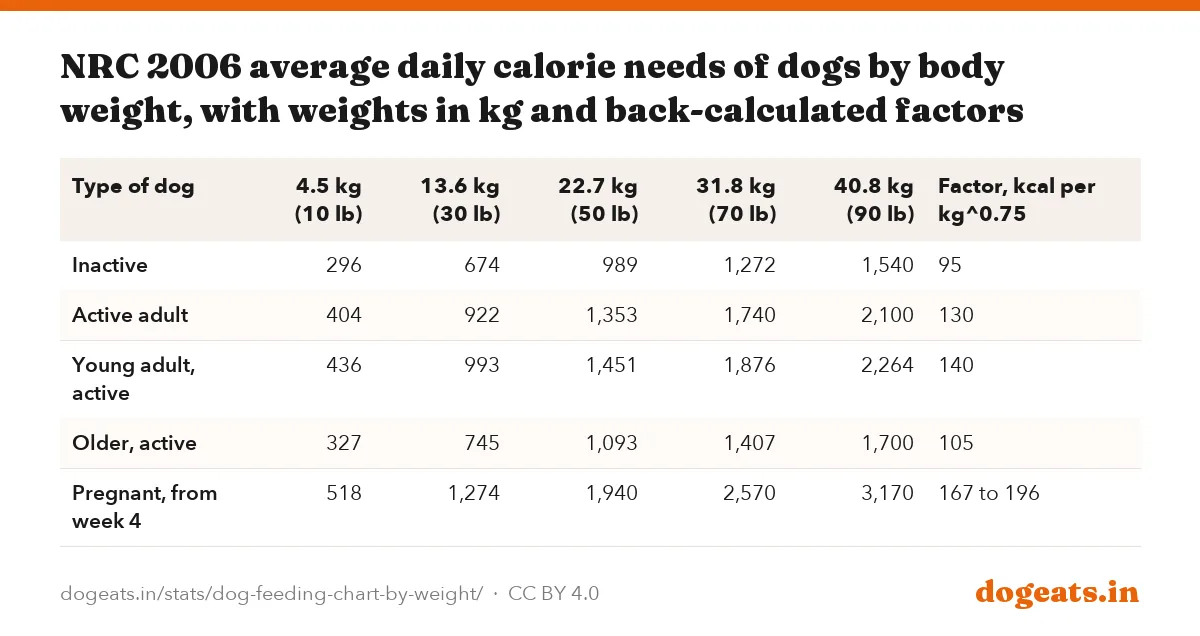
The US National Research Council published the reference text on dog nutrition in 2006. Its free owners' booklet lists daily calories for dogs of 10 to 90 lb (4.5 to 40.8 kg).
We back-calculated the factors behind that table. Inactive dogs work out at 95 kcal per kg^0.75 at every weight, active adults at 130, young active adults at 140 and older active dogs at 105.
The inactive figure matches the FEDIAF low-activity factor exactly. The NRC active figure of 130 is higher than FEDIAF's 110. It describes dogs with "ample opportunity to exercise", such as dogs in the country or with a large yard.
| Type of dog | 4.5 kg (10 lb) | 13.6 kg (30 lb) | 22.7 kg (50 lb) | 31.8 kg (70 lb) | 40.8 kg (90 lb) | Factor, kcal per kg^0.75 |
|---|---|---|---|---|---|---|
| Inactive | 296 | 674 | 989 | 1,272 | 1,540 | 95 |
| Active adult | 404 | 922 | 1,353 | 1,740 | 2,100 | 130 |
| Young adult, active | 436 | 993 | 1,451 | 1,876 | 2,264 | 140 |
| Older, active | 327 | 745 | 1,093 | 1,407 | 1,700 | 105 |
| Pregnant, from week 4 | 518 | 1,274 | 1,940 | 2,570 | 3,170 | 167 to 196 |
A heavier formula does not mean a hungrier dog. Pick the row that matches how your dog lives, then let its waistline decide.
Frequently asked questions
How much should I feed my dog by weight?
A moderately active adult dog needs about 110 kcal x kg^0.75 a day. It comes to 368 kcal for 5 kg, 619 kcal for 10 kg, 1,040 kcal for 20 kg and 1,410 kcal for 30 kg. Low-activity dogs need about 14% less.
How many grams of dry food should a 10 kg dog eat?
About 148 to 172 g a day of a food with 3,600 kcal per kg. Check the kcal on your pack, because a richer food means fewer grams.
How much should a 20 kg dog eat per day?
About 898 to 1,040 kcal, or 250 to 289 g of a 3,600 kcal per kg dry food. A working dog of 20 kg can need 1,419 kcal or more.
How much should a 30 kg dog eat a day?
About 1,218 to 1,410 kcal, or roughly 338 to 392 g of dry food at 3,600 kcal per kg. A typical male Labrador falls in this range.
Is 2% of body weight the right amount to feed a dog?
Not for every size. At moderate activity a 5 kg dog eats about 2.0% of its body weight in dry food, while a 50 kg dog eats about 1.1%. Calories scaled to kg^0.75 are more accurate.
How many times a day should an adult dog eat?
Once or twice a day is fine for adults, per the NRC owners' booklet. In a survey of 24,238 US dogs, 74% were fed twice a day and 8% once a day.
Do neutered dogs need less food?
Yes, usually. AAHA gives neutered adults 1.4 to 1.6 times resting energy against 1.6 to 1.8 times for intact dogs, so at the midpoints a neutered dog needs about 12% less.
How many calories can come from treats?
AAHA 2021 says treats and other extras should supply 10% or less of daily calories. The other 90% or more should be a complete and balanced food.
Methodology and limitations
All calorie figures are computed by dogeats.in from published formulas. Resting energy requirement (RER) is 70 x body weight in kg to the power 0.75 (AAHA 2021). Daily needs use the FEDIAF July 2024 factors of 95 (low activity), 110 (moderate) and 125 (high-impact) kcal per kg^0.75.
AAHA 2021 life-stage factors were taken from its Box 1 table (opened 15 October 2026). The Merck Veterinary Manual chapter on small animal nutrition (updated September 2024) gives similar factors: 1.6 for neutered, 1.8 for intact and 1.4 for obesity-prone adults.
Grams of dry food assume 3,600 kcal per kg as fed, FEDIAF's reference density of 4.0 kcal per g of dry matter at an assumed 10% moisture; real packs vary. We also show 3,200 and 4,000 kcal per kg.
NRC factors were back-calculated from the table in the National Academies booklet Your Dog's Nutritional Needs (2006), converting pounds at 0.4536 kg. Royal Canin feeding tables were read from the brand's India product pages on 15 October 2026.
Breed weights are the male (or both-sexes) ranges in our 58 breed guides, labelled dogeats.in editorial data compiled from our breed guides, October 2026. We used the midpoint; for Poodle, American Eskimo Dog, Dachshund and Indian Spitz we used the size named in the table.
Monthly costs use MRP per kg from our dog food price check of Supertails and PharmEasy listings on 11 October 2026, at 30 days a month. Feeding frequency data come from Bray et al., GeroScience 2022.
Calories are rounded once from the exact formula. Grams, per-kg figures and monthly costs use the unrounded calories, so dividing a rounded table value can differ by 1.
Sources
- FEDIAF Nutritional Guidelines for Complete and Complementary Pet Food for Cats and Dogs, July 2024 (copy hosted by UK Pet Food), MER factors by activity and age (Tables VII-6, VII-7), body condition chart, reference energy density, climate effects
- AAHA 2021 Nutrition and Weight Management Guidelines for Dogs and Cats, Box 1: Energy Requirement Calculations, RER formula and canine life-stage factors
- Bray EE et al. Once-daily feeding is associated with better health in companion dogs: results from the Dog Aging Project. GeroScience 2022;44(3):1779-1790, Feeding frequency shares and adjusted odds ratios
- Also consulted: National Research Council, Your Dog's Nutritional Needs: A Science-Based Guide for Pet Owners (2006), Cline MG et al. 2021 AAHA Nutrition and Weight Management Guidelines for Dogs and Cats. J Am Anim Hosp Assoc 2021;57:153-178, Merck Veterinary Manual, Nutritional Requirements and Related Diseases of Small Animals (S. L. Sanderson; updated September 2024), Royal Canin India, Mini Adult product page, checked 15 October 2026, Royal Canin India, Maxi Adult product page, checked 15 October 2026, Supertails product listings, checked 11 October 2026 (186 dry dog food packs), PharmEasy: Royal Canin Maxi Adult 15 kg, checked 11 October 2026, Klein C et al. 2019, J Anim Physiol Anim Nutr 103:1952-1958, VCA Animal Hospitals, Feeding Growing Puppies (updated February 2025).
Cite, embed and download
This report, its data and its images are free to reuse under a Creative Commons Attribution 4.0 licence. Credit dogeats.in with a link to this page. Every chart has its own embed code, every table has a CSV and an image download, and the images below are ready for social posts, slides and articles.
Cite this report
Link to this report
Every chart and table as an image