Data report · Updated October 2026
Which Dog Breeds Bark the Most? What Vet Ratings and Owner Surveys Show
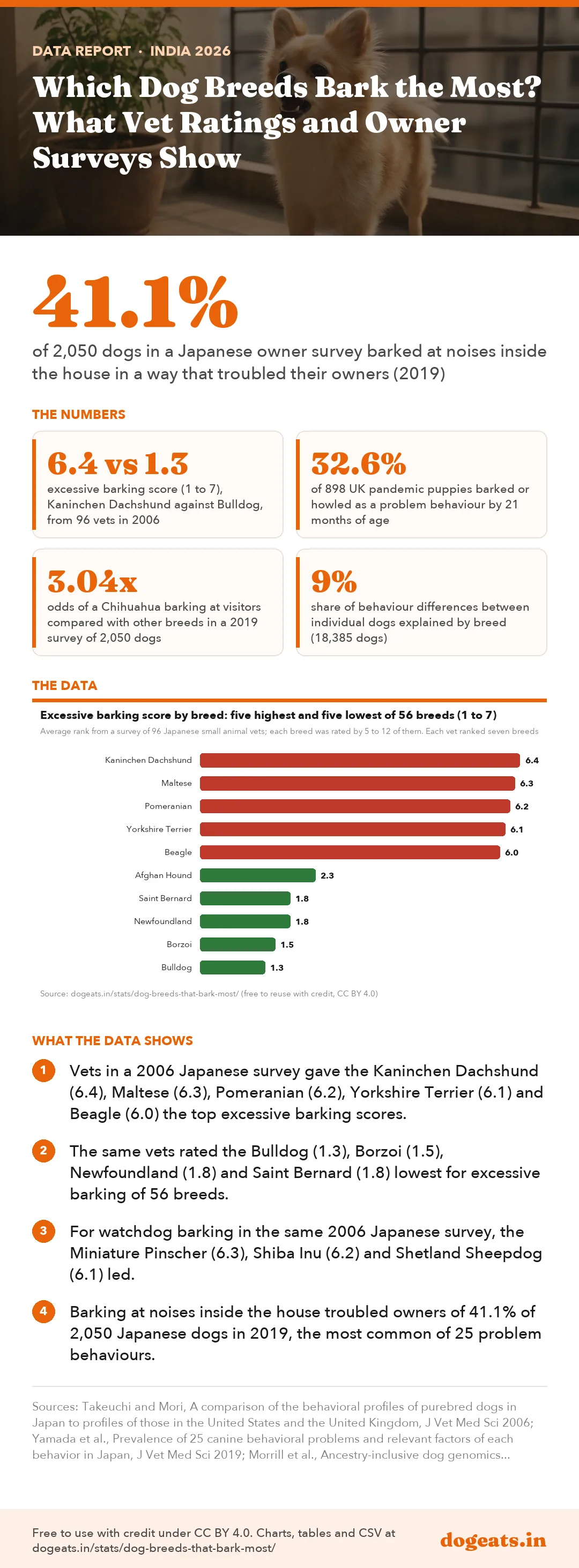
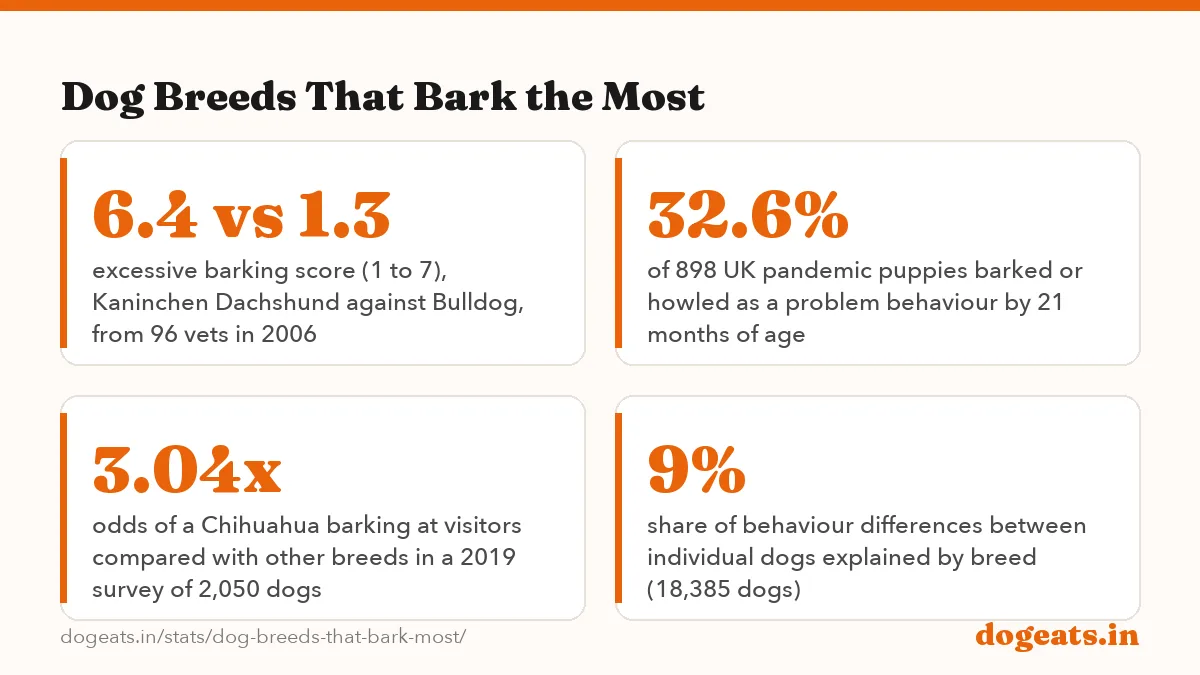
Vets in a 2006 Japanese survey rated the Kaninchen Dachshund, Maltese, Pomeranian, Yorkshire Terrier and Beagle highest for excessive barking, and the Bulldog lowest. Barking at household noises troubled owners of 41.1% of 2,050 Japanese dogs. Owners of 22% of 52,599 dogs in a US research cohort said their dog usually or always barks persistently when alarmed. Breed explains only about 9% of behaviour in individual dogs, and we found no study that has measured barking in Indian breeds.

Key findings
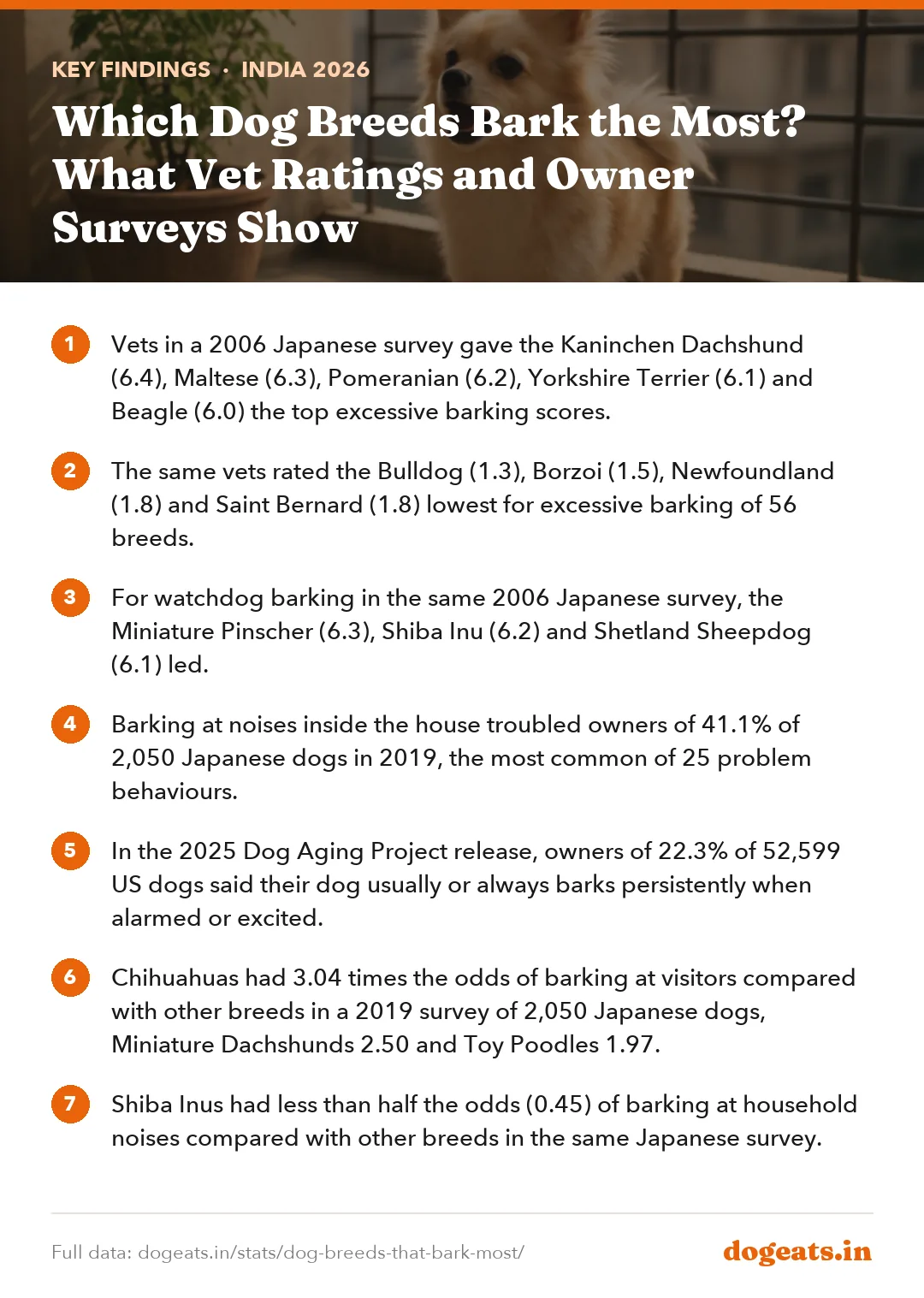
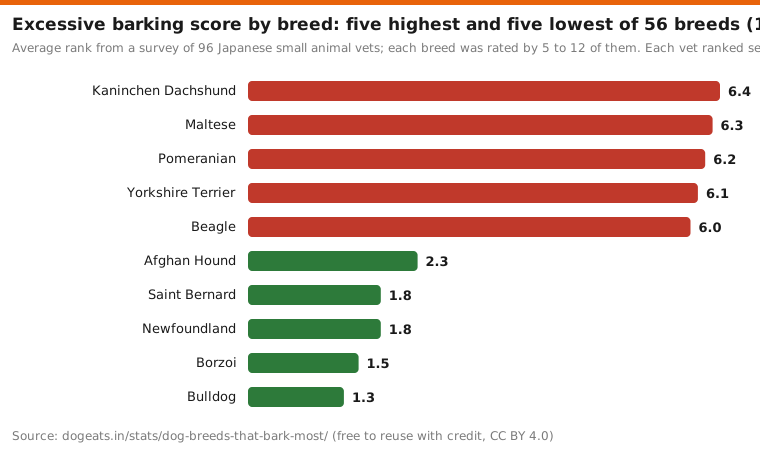
- Vets in a 2006 Japanese survey gave the Kaninchen Dachshund (6.4), Maltese (6.3), Pomeranian (6.2), Yorkshire Terrier (6.1) and Beagle (6.0) the top excessive barking scores.
- The same vets rated the Bulldog (1.3), Borzoi (1.5), Newfoundland (1.8) and Saint Bernard (1.8) lowest for excessive barking of 56 breeds.
- For watchdog barking in the same 2006 Japanese survey, the Miniature Pinscher (6.3), Shiba Inu (6.2) and Shetland Sheepdog (6.1) led.
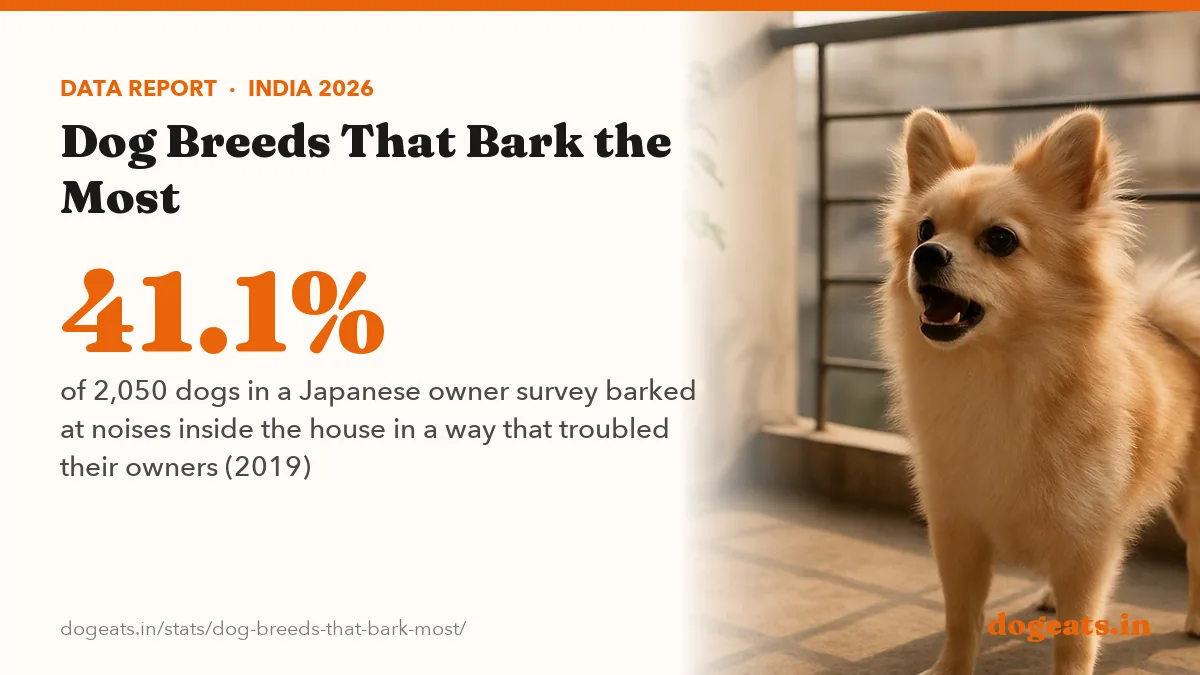
- Barking at noises inside the house troubled owners of 41.1% of 2,050 Japanese dogs in 2019, the most common of 25 problem behaviours.
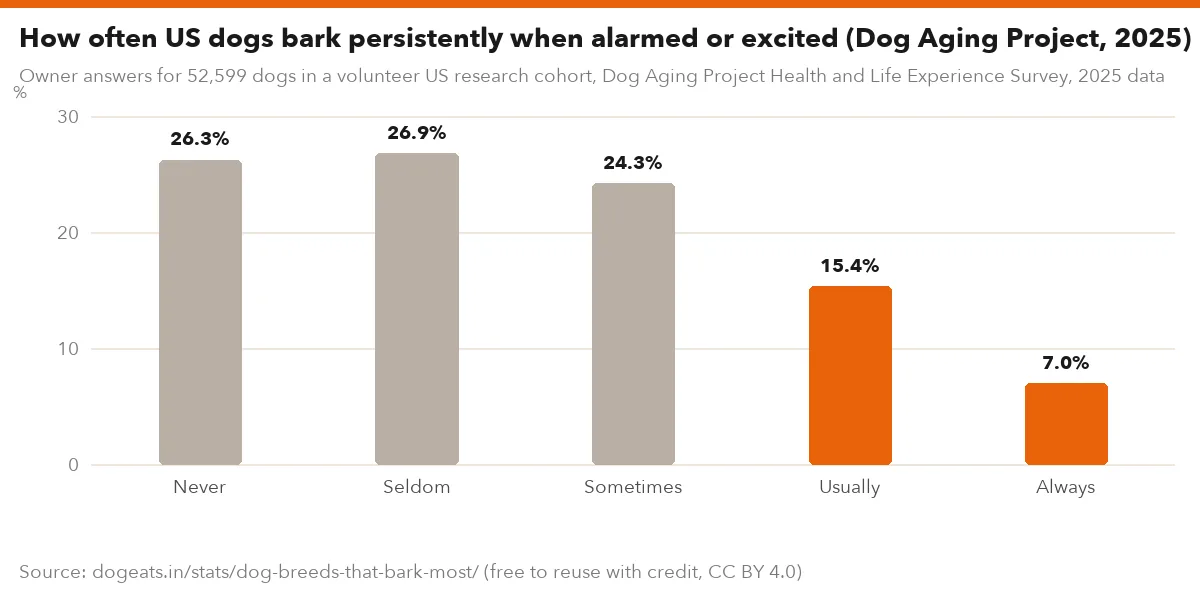
- In the 2025 Dog Aging Project release, owners of 22.3% of 52,599 US dogs said their dog usually or always barks persistently when alarmed or excited.
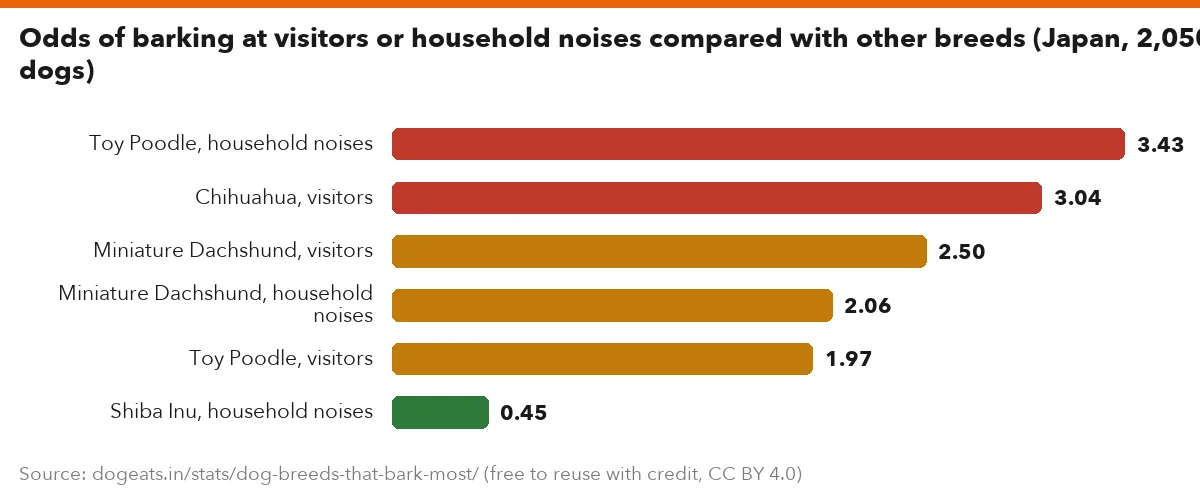
- Chihuahuas had 3.04 times the odds of barking at visitors compared with other breeds in a 2019 survey of 2,050 Japanese dogs, Miniature Dachshunds 2.50 and Toy Poodles 1.97.
- Shiba Inus had less than half the odds (0.45) of barking at household noises compared with other breeds in the same Japanese survey.
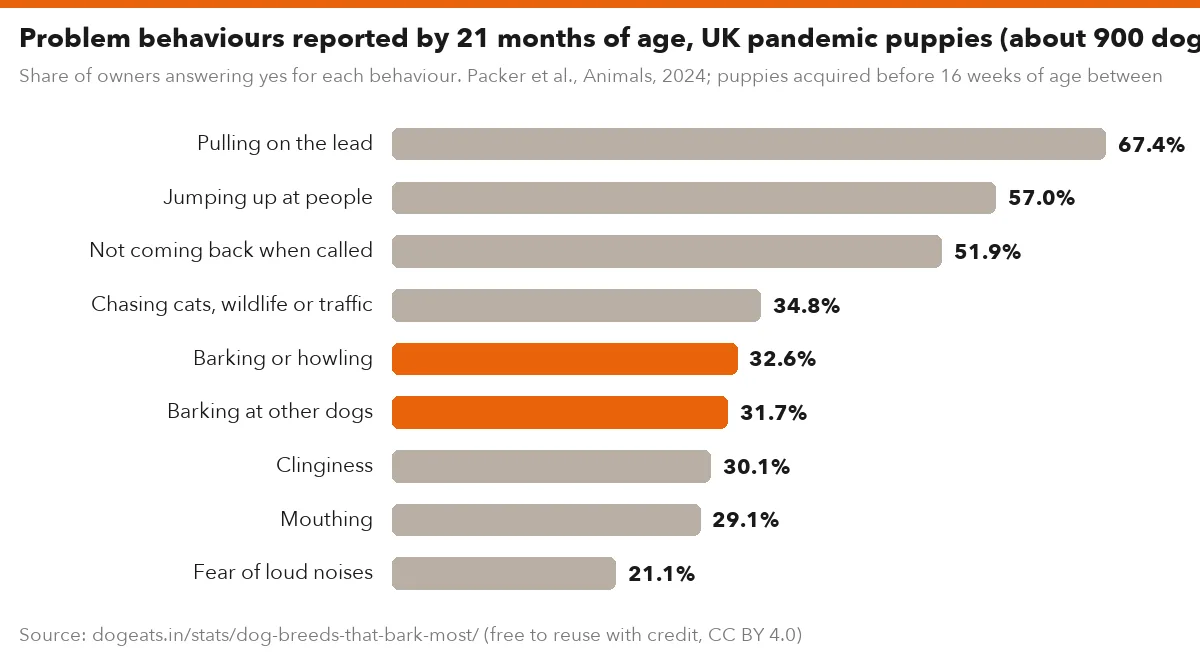
- By 21 months, 32.6% of 898 UK pandemic puppies barked or howled as a problem and 31.7% barked at other dogs.
- In Brisbane, young dogs had 11.2 times the odds and herding types 3.2 times the odds of nuisance barking (2009).
- Breed explains only about 9% of behaviour differences between individual dogs, and 8% of owners said their Labrador howls sometimes or more.
Which dog breeds bark the most?
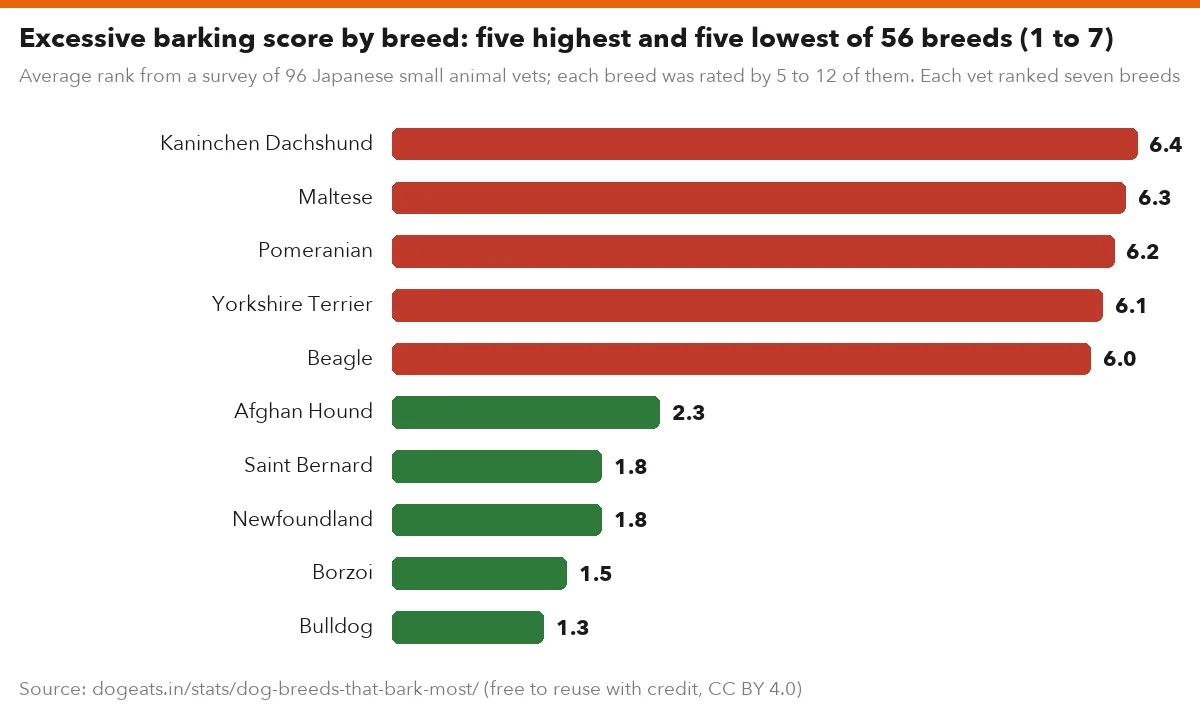
In a 2006 survey of small animal vets in Japan, vets scored the Kaninchen Dachshund (6.4 out of 7) highest for excessive barking. The Maltese (6.3), Pomeranian (6.2), Yorkshire Terrier (6.1) and Beagle (6.0) followed. The survey covered 56 breeds and 96 vets. Only the five highest and five lowest breeds for each trait were published.
Each vet ranked a set of seven breeds from lowest to highest for 13 behaviours, so every score is an average rank between 1 and 7. Each breed was rated by 5 to 12 vets, who had 14.5 years of clinical experience on average.
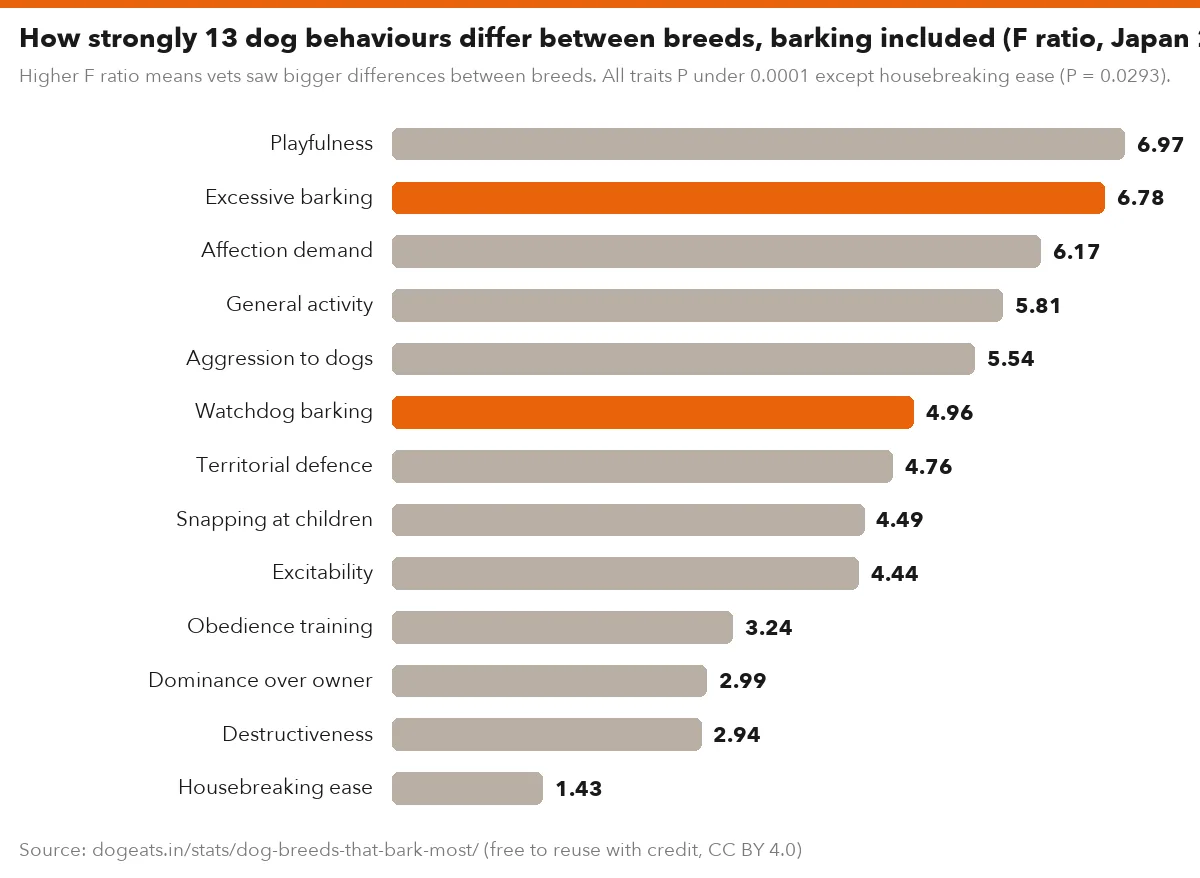
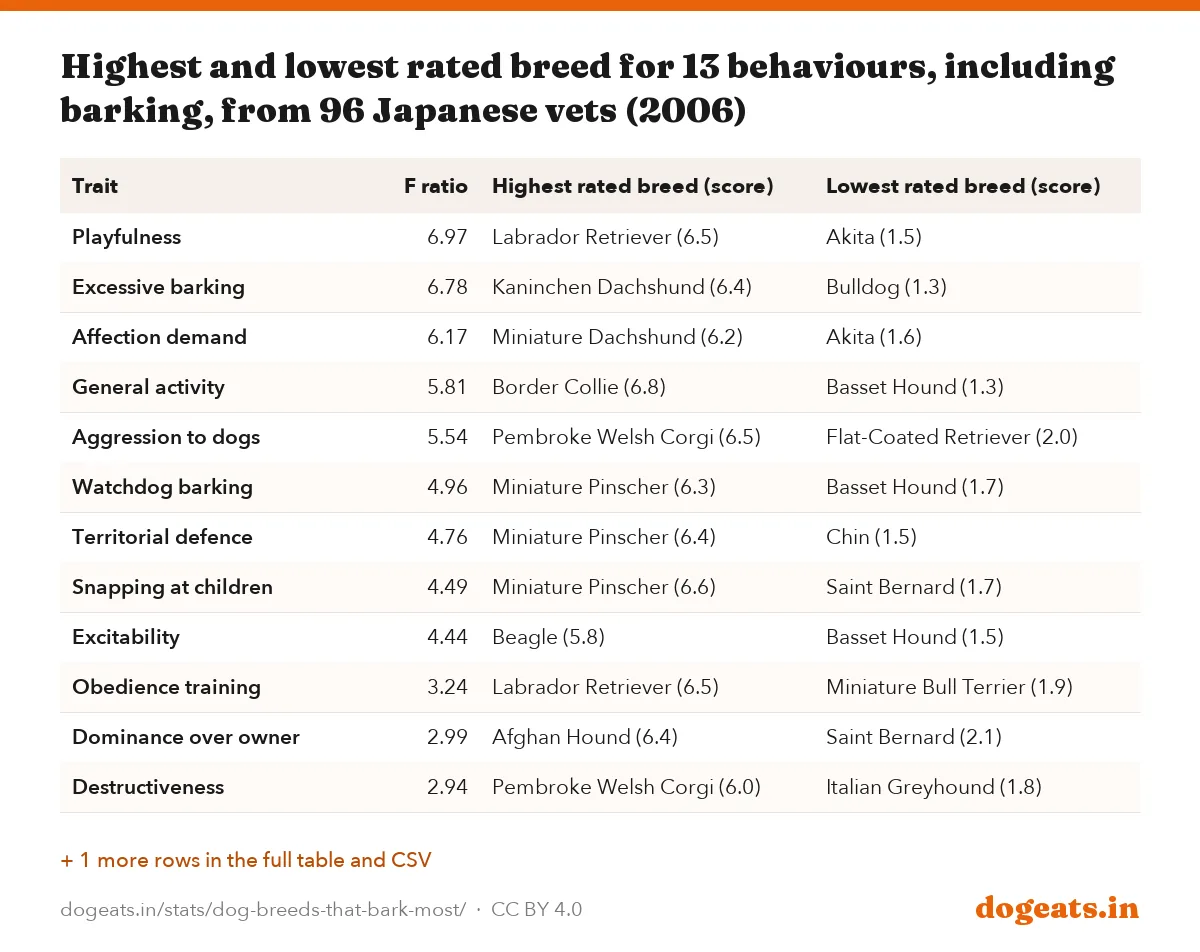
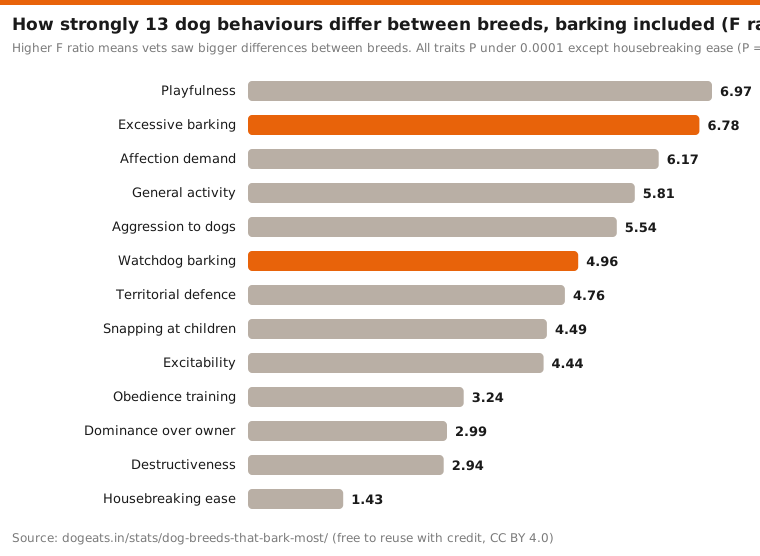
Excessive barking was one of the clearest ways to tell breeds apart. Its F ratio of 6.78 was second only to playfulness (6.97) among the 13 traits. Small companion breeds such as the Pomeranian, Yorkshire Terrier and Kaninchen Dachshund sat at the top, along with the scent hound Beagle.
Average rank from a survey of 96 Japanese small animal vets; each breed was rated by 5 to 12 of them. Each vet ranked seven breeds from lowest (1) to highest (7). Takeuchi and Mori, Journal of Veterinary Medical Science, 2006.
Show the numbers
| Label | score |
|---|---|
| Kaninchen Dachshund | 6.4 |
| Maltese | 6.3 |
| Pomeranian | 6.2 |
| Yorkshire Terrier | 6.1 |
| Beagle | 6.0 |
| Afghan Hound | 2.3 |
| Saint Bernard | 1.8 |
| Newfoundland | 1.8 |
| Borzoi | 1.5 |
| Bulldog | 1.3 |
Embed this chart
Higher F ratio means vets saw bigger differences between breeds. All traits P under 0.0001 except housebreaking ease (P = 0.0293). Takeuchi and Mori, J Vet Med Sci 2006, Table 1.
Show the numbers
| Label | F ratio |
|---|---|
| Playfulness | 6.97 |
| Excessive barking | 6.78 |
| Affection demand | 6.17 |
| General activity | 5.81 |
| Aggression to dogs | 5.54 |
| Watchdog barking | 4.96 |
| Territorial defence | 4.76 |
| Snapping at children | 4.49 |
| Excitability | 4.44 |
| Obedience training | 3.24 |
| Dominance over owner | 2.99 |
| Destructiveness | 2.94 |
| Housebreaking ease | 1.43 |
Embed this chart
| Trait | F ratio | Highest rated breed (score) | Lowest rated breed (score) |
|---|---|---|---|
| Playfulness | 6.97 | Labrador Retriever (6.5) | Akita (1.5) |
| Excessive barking | 6.78 | Kaninchen Dachshund (6.4) | Bulldog (1.3) |
| Affection demand | 6.17 | Miniature Dachshund (6.2) | Akita (1.6) |
| General activity | 5.81 | Border Collie (6.8) | Basset Hound (1.3) |
| Aggression to dogs | 5.54 | Pembroke Welsh Corgi (6.5) | Flat-Coated Retriever (2.0) |
| Watchdog barking | 4.96 | Miniature Pinscher (6.3) | Basset Hound (1.7) |
| Territorial defence | 4.76 | Miniature Pinscher (6.4) | Chin (1.5) |
| Snapping at children | 4.49 | Miniature Pinscher (6.6) | Saint Bernard (1.7) |
| Excitability | 4.44 | Beagle (5.8) | Basset Hound (1.5) |
| Obedience training | 3.24 | Labrador Retriever (6.5) | Miniature Bull Terrier (1.9) |
| Dominance over owner | 2.99 | Afghan Hound (6.4) | Saint Bernard (2.1) |
| Destructiveness | 2.94 | Pembroke Welsh Corgi (6.0) | Italian Greyhound (1.8) |
| Housebreaking ease | 1.43 | Golden Retriever (6.3) | Bulldog (2.3) |
The vets saw no difference between males and females in excessive barking, although they rated males higher for watchdog barking.
Which dog breeds bark the most at strangers?
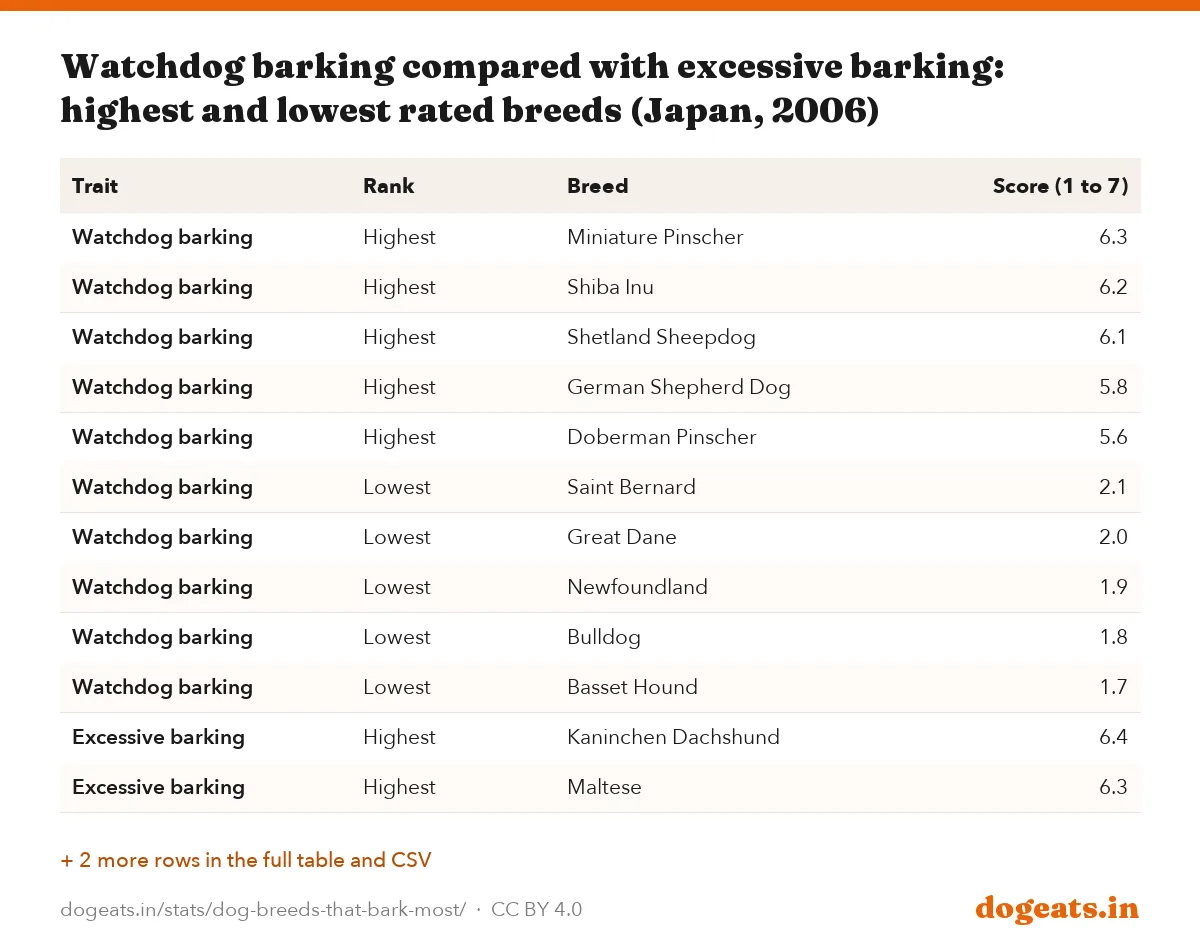
For watchdog barking, the warning bark at strangers or noises outside, the same 2006 survey put the Miniature Pinscher (6.3), Shiba Inu (6.2) and Shetland Sheepdog (6.1) at the top. The German Shepherd Dog (5.8) and Doberman Pinscher (5.6) followed.
This list differs from the excessive barking list. Guarding breeds such as the German Shepherd scored high for watchdog barking but were not among the five highest for excessive barking. Watchdog barking grouped with territorial defence and aggression in the factor analysis. Excessive barking loaded almost equally on that group and on a second group made up of playfulness, affection demand, activity and destructiveness. The overlap with aggression is covered in our report on dog aggression by breed.
| Trait | Rank | Breed | Score (1 to 7) |
|---|---|---|---|
| Watchdog barking | Highest | Miniature Pinscher | 6.3 |
| Watchdog barking | Highest | Shiba Inu | 6.2 |
| Watchdog barking | Highest | Shetland Sheepdog | 6.1 |
| Watchdog barking | Highest | German Shepherd Dog | 5.8 |
| Watchdog barking | Highest | Doberman Pinscher | 5.6 |
| Watchdog barking | Lowest | Saint Bernard | 2.1 |
| Watchdog barking | Lowest | Great Dane | 2.0 |
| Watchdog barking | Lowest | Newfoundland | 1.9 |
| Watchdog barking | Lowest | Bulldog | 1.8 |
| Watchdog barking | Lowest | Basset Hound | 1.7 |
| Excessive barking | Highest | Kaninchen Dachshund | 6.4 |
| Excessive barking | Highest | Maltese | 6.3 |
| Excessive barking | Lowest | Borzoi | 1.5 |
| Excessive barking | Lowest | Bulldog | 1.3 |
Giant breeds such as the Saint Bernard and Newfoundland sat at the quiet end of both lists.
How common is problem barking in dogs?
Barking topped the list of problem behaviours in one large Japanese survey. Owners of 41.1% of 2,050 dogs said barking at noises inside the house troubled them, and 38.4% said the same of barking at visitors. These were the top two of 25 behaviours in the 2019 study, ahead of pica (34.9%).
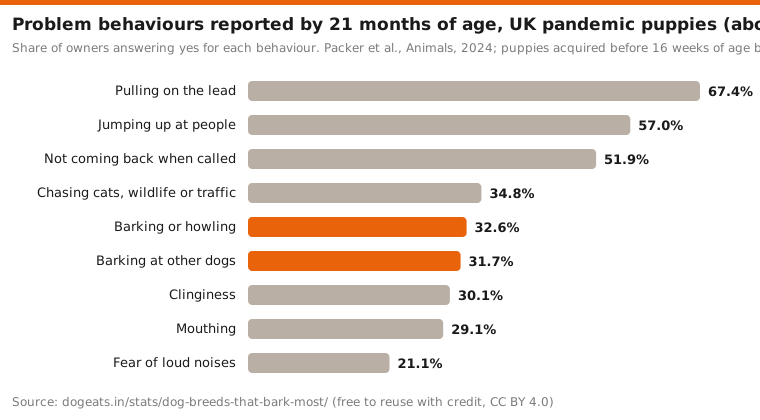
In the UK, 32.6% of 898 pandemic puppies had barked or howled as a problem by 21 months of age, and 31.7% barked at other dogs. Pulling on the lead (67.4%) and jumping up (57.0%) were more common.
The surveys asked different questions, so the figures are not directly comparable. In these samples, between about a fifth and two fifths of dogs barked often or in ways their owners found a problem.
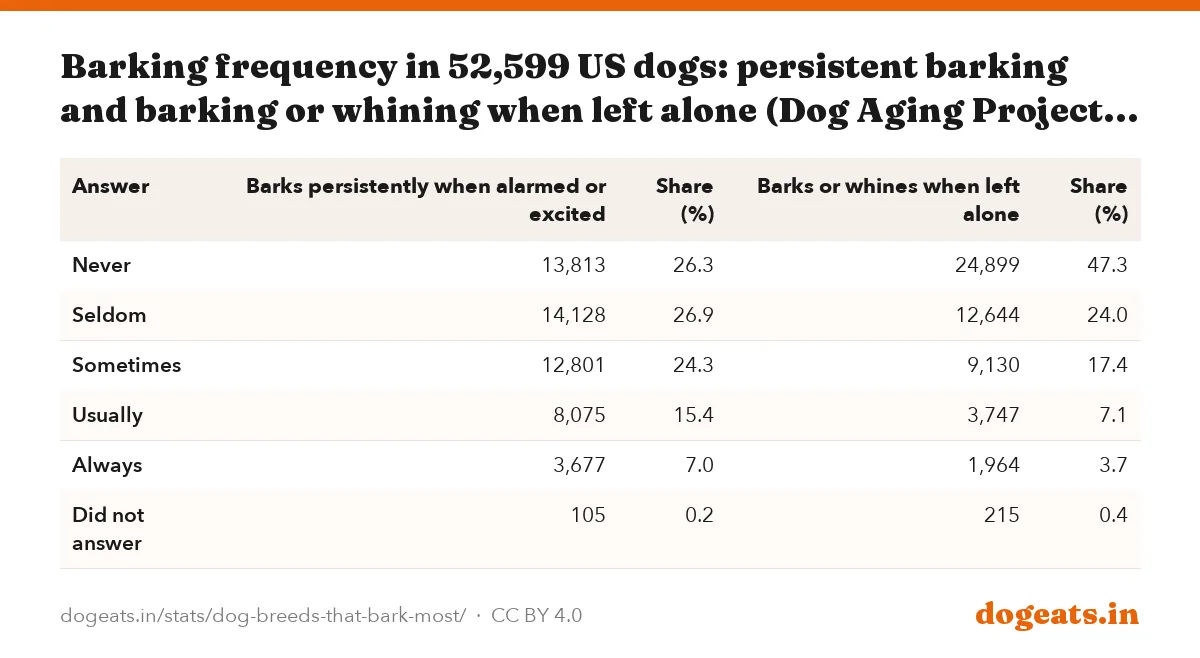
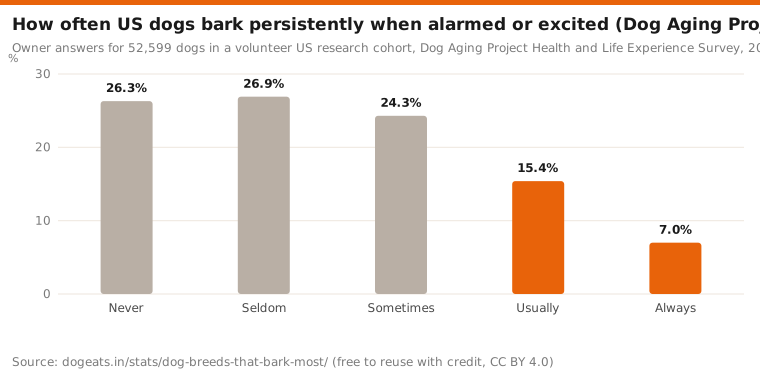
The largest dataset in this report comes from the US Dog Aging Project, a volunteer research cohort. In its 2025 data release, owners of 52,599 dogs rated how often their dog barks persistently when alarmed or excited. 3,677 (7.0%) said always and 8,075 (15.4%) said usually, so 22.3% in all.
Share of owners answering yes for each behaviour. Packer et al., Animals, 2024; puppies acquired before 16 weeks of age between July and December 2020.
Show the numbers
| Label | % |
|---|---|
| Pulling on the lead | 67.4% |
| Jumping up at people | 57.0% |
| Not coming back when called | 51.9% |
| Chasing cats, wildlife or traffic | 34.8% |
| Barking or howling | 32.6% |
| Barking at other dogs | 31.7% |
| Clinginess | 30.1% |
| Mouthing | 29.1% |
| Fear of loud noises | 21.1% |
Embed this chart
Owner answers for 52,599 dogs in a volunteer US research cohort, Dog Aging Project Health and Life Experience Survey, 2025 data release. Share of all respondents; 105 did not answer.
Show the numbers
| Label | % |
|---|---|
| Never | 26.3% |
| Seldom | 26.9% |
| Sometimes | 24.3% |
| Usually | 15.4% |
| Always | 7.0% |
Embed this chart
| Answer | Barks persistently when alarmed or excited | Share (%) | Barks or whines when left alone | Share (%) |
|---|---|---|---|---|
| Never | 13,813 | 26.3 | 24,899 | 47.3 |
| Seldom | 14,128 | 26.9 | 12,644 | 24.0 |
| Sometimes | 12,801 | 24.3 | 9,130 | 17.4 |
| Usually | 8,075 | 15.4 | 3,747 | 7.1 |
| Always | 3,677 | 7.0 | 1,964 | 3.7 |
| Did not answer | 105 | 0.2 | 215 | 0.4 |
- Japan, 2019: barking at household noises 41.1% (843 of 2,050 dogs).
- Japan, 2019: barking at unfamiliar visitors 38.4% (787 dogs).
- UK, 2024: barking or howling 32.6% (293 of 898 dogs).
- UK, 2024: barking at other dogs 31.7% (285 of 899 dogs).
- US, 2025: barks persistently when alarmed or excited, usually or always 22.3% (11,752 of 52,599 dogs).
- US, 2025: barks or whines when left alone, usually or always 10.9% (5,711 of 52,599 dogs).
Do small dogs bark more than big dogs?
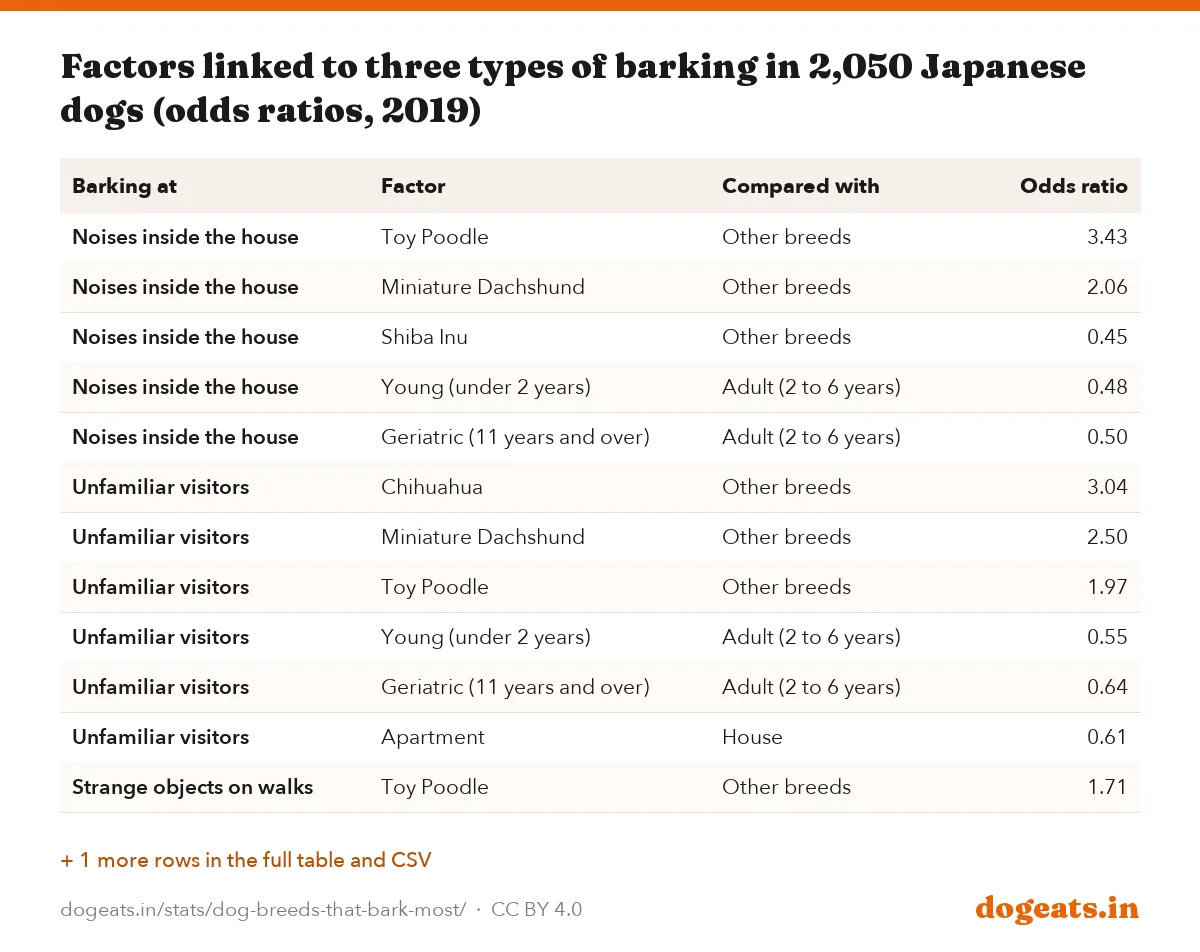
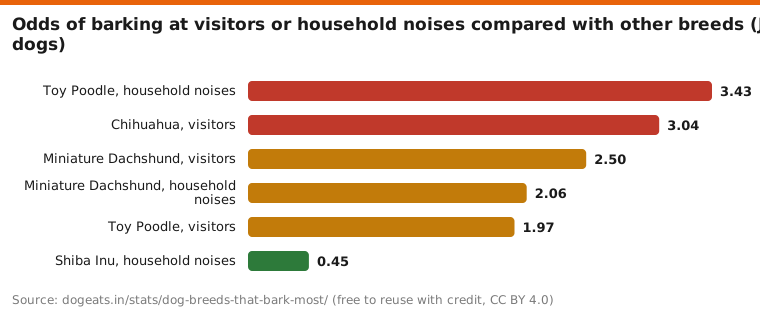
In a 2019 owner survey of 2,050 dogs in Japan, three small breeds stood out for barking at visitors. Chihuahuas had 3.04 times the odds, Miniature Dachshunds 2.50 times and Toy Poodles 1.97 times, compared with all other breeds combined. Toy Poodles also had 3.43 times the odds of barking at household noises.
The Shiba Inu, a medium-sized spitz, went the other way, with 0.45 times the odds of barking at noises inside the house. The study could only test the four breeds with more than 100 dogs each: Shiba Inu (297), Toy Poodle (250), Miniature Dachshund (177) and Chihuahua (142). It did not compare dogs by body size, so these results describe four breeds, not small dogs in general.
Age mattered as well. Dogs under 2 years old and dogs aged 11 and over were less likely than adult dogs to bark at visitors or household noises. Dogs in apartments had 0.61 times the odds of barking at visitors compared with dogs in houses. Our ranking of breeds for flats weighs barking alongside size, heat and exercise.

Odds ratios from multiple logistic regression, reference: all other breeds; only significant results (P under 0.002) shown. Yamada et al., Journal of Veterinary Medical Science, 2019.
Show the numbers
| Label | odds ratio |
|---|---|
| Toy Poodle, household noises | 3.43 |
| Chihuahua, visitors | 3.04 |
| Miniature Dachshund, visitors | 2.50 |
| Miniature Dachshund, household noises | 2.06 |
| Toy Poodle, visitors | 1.97 |
| Shiba Inu, household noises | 0.45 |
Embed this chart
| Barking at | Factor | Compared with | Odds ratio |
|---|---|---|---|
| Noises inside the house | Toy Poodle | Other breeds | 3.43 |
| Noises inside the house | Miniature Dachshund | Other breeds | 2.06 |
| Noises inside the house | Shiba Inu | Other breeds | 0.45 |
| Noises inside the house | Young (under 2 years) | Adult (2 to 6 years) | 0.48 |
| Noises inside the house | Geriatric (11 years and over) | Adult (2 to 6 years) | 0.50 |
| Unfamiliar visitors | Chihuahua | Other breeds | 3.04 |
| Unfamiliar visitors | Miniature Dachshund | Other breeds | 2.50 |
| Unfamiliar visitors | Toy Poodle | Other breeds | 1.97 |
| Unfamiliar visitors | Young (under 2 years) | Adult (2 to 6 years) | 0.55 |
| Unfamiliar visitors | Geriatric (11 years and over) | Adult (2 to 6 years) | 0.64 |
| Unfamiliar visitors | Apartment | House | 0.61 |
| Strange objects on walks | Toy Poodle | Other breeds | 1.71 |
| Strange objects on walks | Geriatric (11 years and over) | Adult (2 to 6 years) | 0.65 |
Is barking genetic or learned?
Partly genetic. Most dog behaviour traits are more than 25% heritable, but breed explains only about 9% of behaviour differences between individual dogs, according to a 2022 Science study of 18,385 dogs.
The study looked at howling, not barking. It linked howling frequency to two regions of the genome, and ancestry from Siberian Huskies and Beagles influenced howling in mixed-breed dogs. Even so, 8% of owners said their Labrador howls sometimes, often or always. Labradors were the breed least likely to howl (78.4% of 241 never howled).
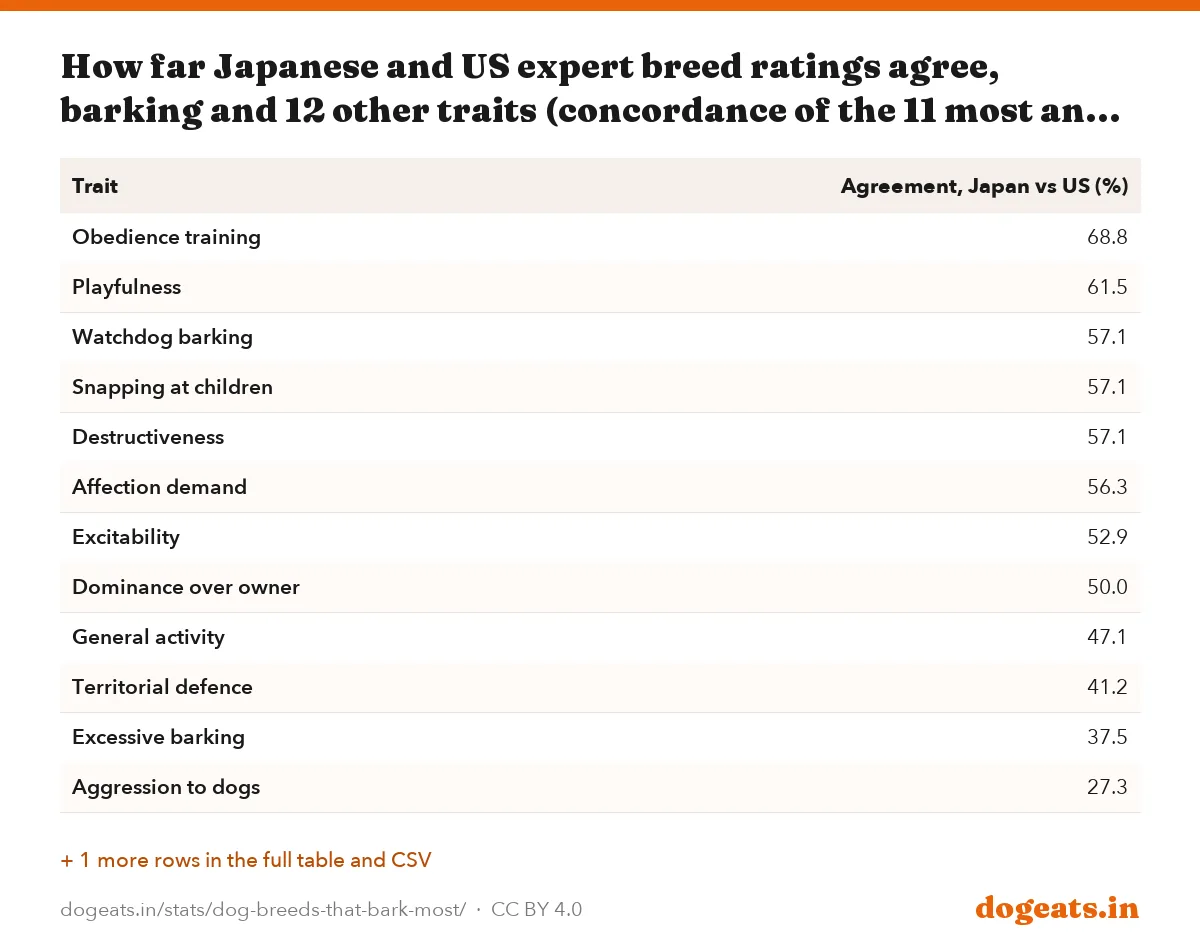
Breed ratings also shift by country. When the Japanese vet survey was compared with an earlier US survey, the two agreed on only 37.5% of the most and least barky breeds. They agreed on the Beagle, Cairn Terrier and Yorkshire Terrier as barkers and the Old English Sheepdog, Great Dane and Newfoundland as quiet. For how owners train dogs, see our report on dog training methods.
| Trait | Agreement, Japan vs US (%) |
|---|---|
| Obedience training | 68.8 |
| Playfulness | 61.5 |
| Watchdog barking | 57.1 |
| Snapping at children | 57.1 |
| Destructiveness | 57.1 |
| Affection demand | 56.3 |
| Excitability | 52.9 |
| Dominance over owner | 50.0 |
| General activity | 47.1 |
| Territorial defence | 41.2 |
| Excessive barking | 37.5 |
| Aggression to dogs | 27.3 |
| Housebreaking ease | 26.7 |
Across all 13 traits the two countries agreed on 49.3% of extreme breeds on average. Excessive barking (37.5%) was the third lowest, while watchdog barking (57.1%) sat above the average.
Why does my dog bark so much, and when is it nuisance barking?
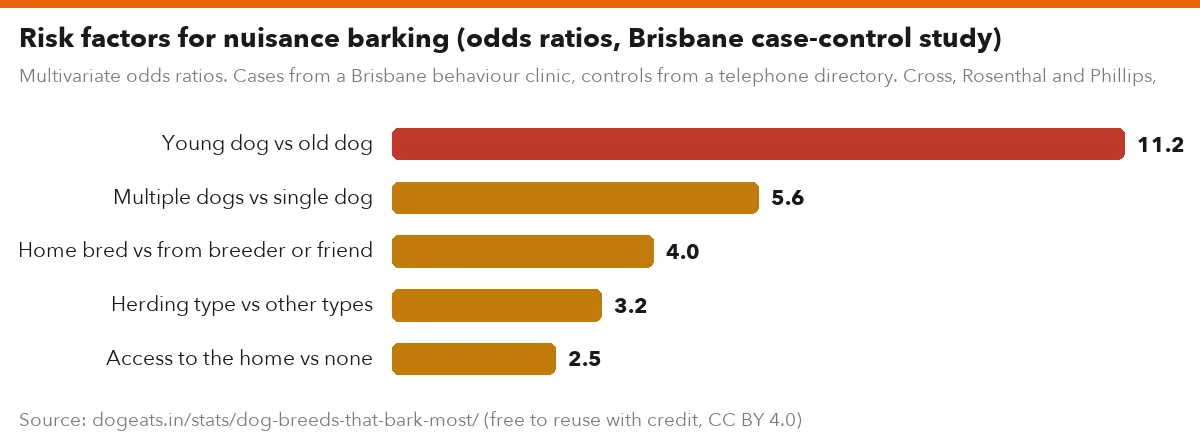
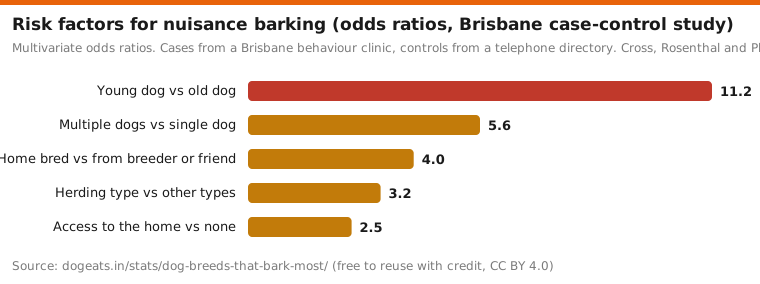
In a 2009 Brisbane study, young dogs had 11.2 times the odds of nuisance barking compared with older dogs. Dogs in multi-dog homes had 5.6 times the odds of dogs in single-dog homes, and herding types 3.2 times the odds of other types.
Home-bred dogs had 4.0 times the odds of dogs from a breeder or friend. Dogs with access to the house had 2.5 times the odds of dogs without it. Cases came from a behaviour clinic and controls from a telephone directory.
Barking when left alone is not always separation distress. In a Hungarian test of 45 dogs, those with owner-reported separation problems were marked out by early and frequent whining. Barking depended mainly on age, and purebred dogs barked sooner. Read more in our report on separation anxiety and fear.
Multivariate odds ratios. Cases from a Brisbane behaviour clinic, controls from a telephone directory. Cross, Rosenthal and Phillips, Australian Veterinary Journal, 2009.
Show the numbers
| Label | odds ratio |
|---|---|
| Young dog vs old dog | 11.2 |
| Multiple dogs vs single dog | 5.6 |
| Home bred vs from breeder or friend | 4.0 |
| Herding type vs other types | 3.2 |
| Access to the home vs none | 2.5 |
Embed this chart
Noise fear is common too: 21.1% of the UK puppies above were reported to fear loud noises such as fireworks. Firecracker season in India is covered in our Diwali noise report.
Can a housing society in India ban a dog for barking?
Not in Mumbai, under current civic guidance. Mumbai's municipal corporation issued pet dog guidelines in 2025, in line with the Animal Welfare Board of India circular of 26 February 2015. They say associations cannot cite dog barking as a reason for any ban or restriction. A ban cannot be introduced even if a majority of residents want it.
The same guidelines say barking is a natural form of expression that must be tolerated. They add that incessant barking can disturb neighbours, so owners should try to keep dogs quiet, especially at night. The wider rules for residents' associations are in our report on dog laws in housing societies.
We found no Indian study that has measured barking by breed, including for the Indian Pariah Dog or other native breeds. We found no official count of barking complaints in Indian cities either; US cities do log them, as our report on barking complaints shows.
- Barking cannot be cited as a valid reason for a ban or restriction.
- A majority vote of residents cannot legally ban pet dogs.
- Owners should make every effort to keep dogs quiet, particularly at night.
Frequently asked questions
Which dog breed barks the most?
In a 2006 survey of 96 vets in Japan rating 56 breeds, the Kaninchen Dachshund scored highest for excessive barking (6.4 out of 7). The Maltese (6.3), Pomeranian (6.2), Yorkshire Terrier (6.1) and Beagle (6.0) followed.
Which dog breeds bark the least?
The same vets rated the Bulldog (1.3), Borzoi (1.5), Newfoundland (1.8), Saint Bernard (1.8) and Afghan Hound (2.3) as the least prone to excessive barking.
Do small dogs bark more?
The data covers only a few breeds. In a 2019 Japanese survey, Chihuahuas had 3.04 times the odds of barking at visitors and Toy Poodles 3.43 times the odds of barking at household noises. The Shiba Inu barked less (0.45).
How many dogs have a barking problem?
Between about a fifth and two fifths in large owner surveys. Barking at household noises troubled owners of 41.1% of 2,050 Japanese dogs. Owners of 22.3% of 52,599 US dogs in a research cohort said their dog usually or always barks persistently when alarmed.
Which dog breeds bark the most at strangers?
In a 2006 survey in Japan, vets rated the Miniature Pinscher (6.3), Shiba Inu (6.2), Shetland Sheepdog (6.1), German Shepherd Dog (5.8) and Doberman Pinscher (5.6) highest for watchdog barking.
Is barking genetic?
Partly. Most behaviour traits are more than 25% heritable, but breed explains only about 9% of behaviour differences between individual dogs in a study of 18,385 dogs.
Why does my young dog bark so much?
Young dogs are a known risk group: in a 2009 Brisbane study they had 11.2 times the odds of nuisance barking compared with older dogs. Multi-dog homes (5.6) and herding types (3.2) also raised the odds.
Can my society ban my dog for barking in India?
Not in Mumbai. Its civic guidelines of 2025, following the AWBI circular of 26 February 2015, say barking cannot justify a ban, though owners should keep dogs quiet, especially at night.
Methodology and limitations
Breed scores come from Takeuchi and Mori (2006). 96 Japanese small animal vets each ranked sets of seven breeds from lowest to highest on 13 behaviours, giving average ranks from 1 to 7 for 56 breeds. The paper publishes only the five highest and five lowest breeds per trait, which is what we show.
Prevalence and odds ratios for barking come from Yamada et al. (2019), an online survey of 2,050 dogs in Japan, and Packer et al. (2024), a cohort of UK puppies acquired in 2020 and followed to 21 months. US frequencies come from the Dog Aging Project's 2025 data release summary tables (52,599 dogs); we computed shares from the published counts. Odds ratios are those printed in the papers; we did not recompute them.
Genetic figures come from Morrill et al. (Science, 2022). Nuisance barking risk factors come from the abstract of Cross, Rosenthal and Phillips (2009). Separation findings come from the accepted manuscript of Pongracz et al. (2017). India guidance is quoted from the Brihanmumbai Municipal Corporation guidelines signed in March 2025.
Sources
- Takeuchi and Mori, A comparison of the behavioral profiles of purebred dogs in Japan to profiles of those in the United States and the United Kingdom, J Vet Med Sci 2006, 96 vets, 56 breeds; excessive and watchdog barking scores
- Yamada et al., Prevalence of 25 canine behavioral problems and relevant factors of each behavior in Japan, J Vet Med Sci 2019, 2,050 dogs; barking prevalence and breed odds ratios
- Morrill et al., Ancestry-inclusive dog genomics challenges popular breed stereotypes, Science 2022, 18,385 dogs; breed explains about 9% of behaviour; howling
- Also consulted: Dog Aging Project, Health and Life Experience Survey, Behavior summary tables, 2025 data release, Packer et al., Impacts of puppy early life experiences ... owner-reported problem behaviours in a UK Pandemic Puppies cohort at 21 months, Animals 2024, Cross, Rosenthal and Phillips, Risk factors for nuisance barking in dogs, Australian Veterinary Journal 2009, Pongracz, Lenkei, Marx and Farago, Should I whine or should I bark?, Applied Animal Behaviour Science 2017 (author manuscript, real.mtak.hu/73331), Brihanmumbai Municipal Corporation, Veterinary Health Department, Guidelines with respect to pet and street dogs, RWAs and AOAs (signed 20 March 2025), Hart and Hart (1985), US breed behaviour profiles, cited via Takeuchi and Mori, NYC 311 open data on barking dog complaints (covered in our US report).
Cite, embed and download
This report, its data and its images are free to reuse under a Creative Commons Attribution 4.0 licence. Credit dogeats.in with a link to this page. Every chart has its own embed code, every table has a CSV and an image download, and the images below are ready for social posts, slides and articles.
Cite this report
Link to this report
Every chart and table as an image