Data report · Updated October 2026
Dog Training Methods Statistics: What Studies Show About Positive Reinforcement vs Punishment
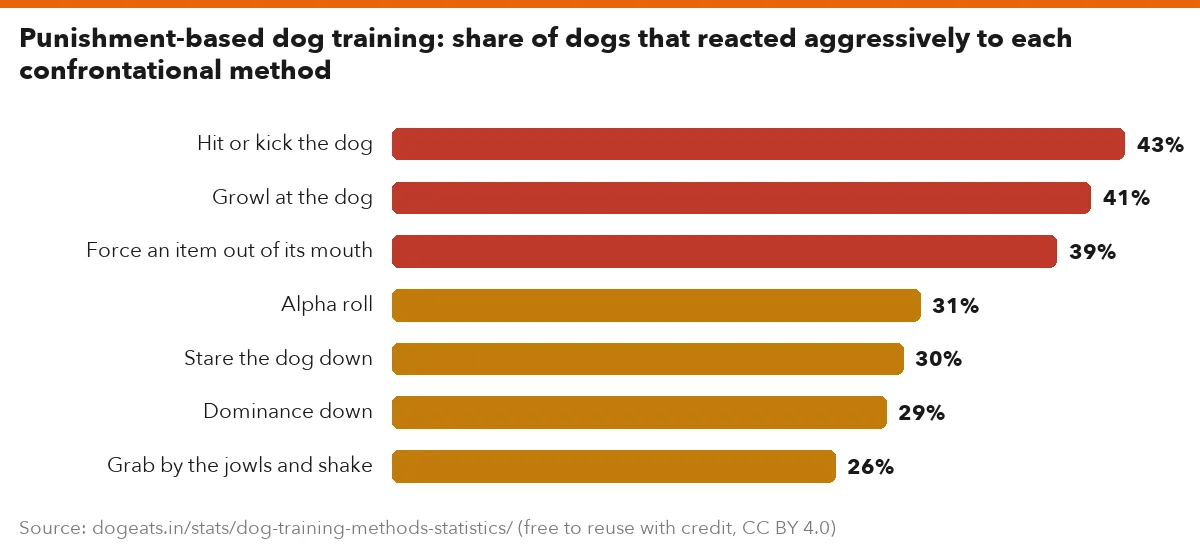
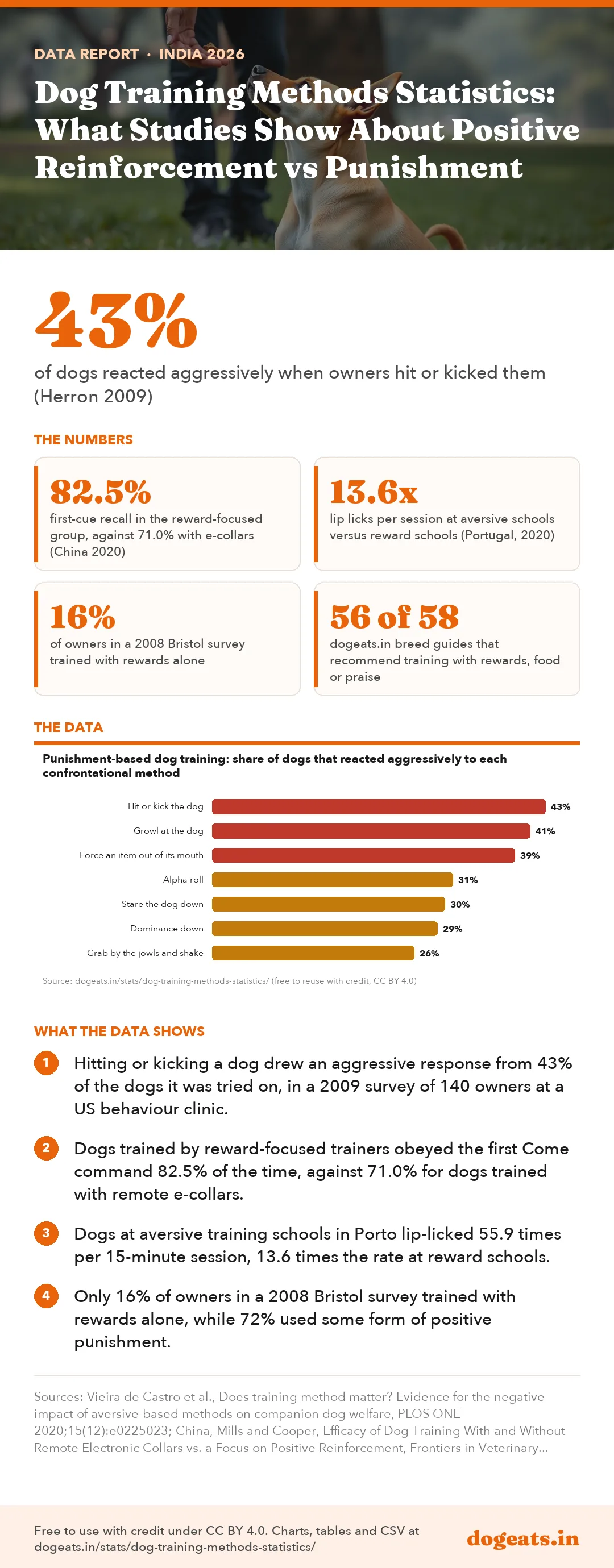
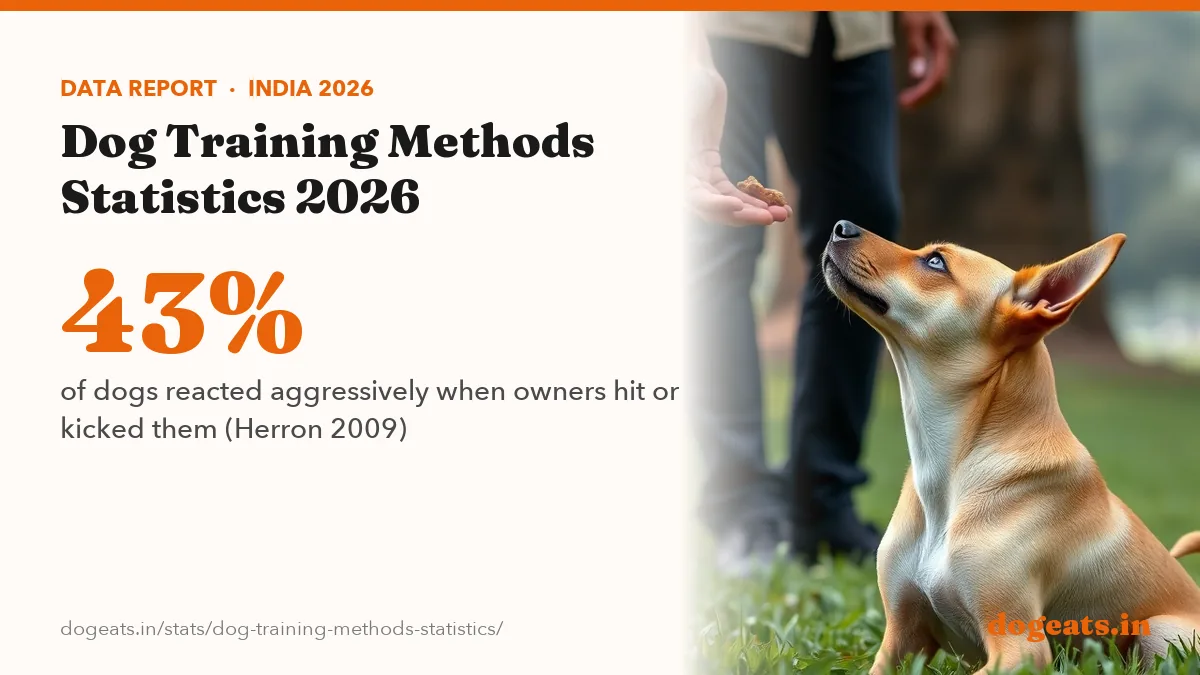
Reward-based dog training works at least as well as punishment, and it carries far less risk. In a 2020 UK trial, dogs trained mainly with rewards obeyed the first Come command 82.5% of the time, against 71.0% for dogs trained with e-collars. In a 2009 US survey, hitting or kicking a dog drew an aggressive response in 43% of the dogs it was tried on.
Key findings
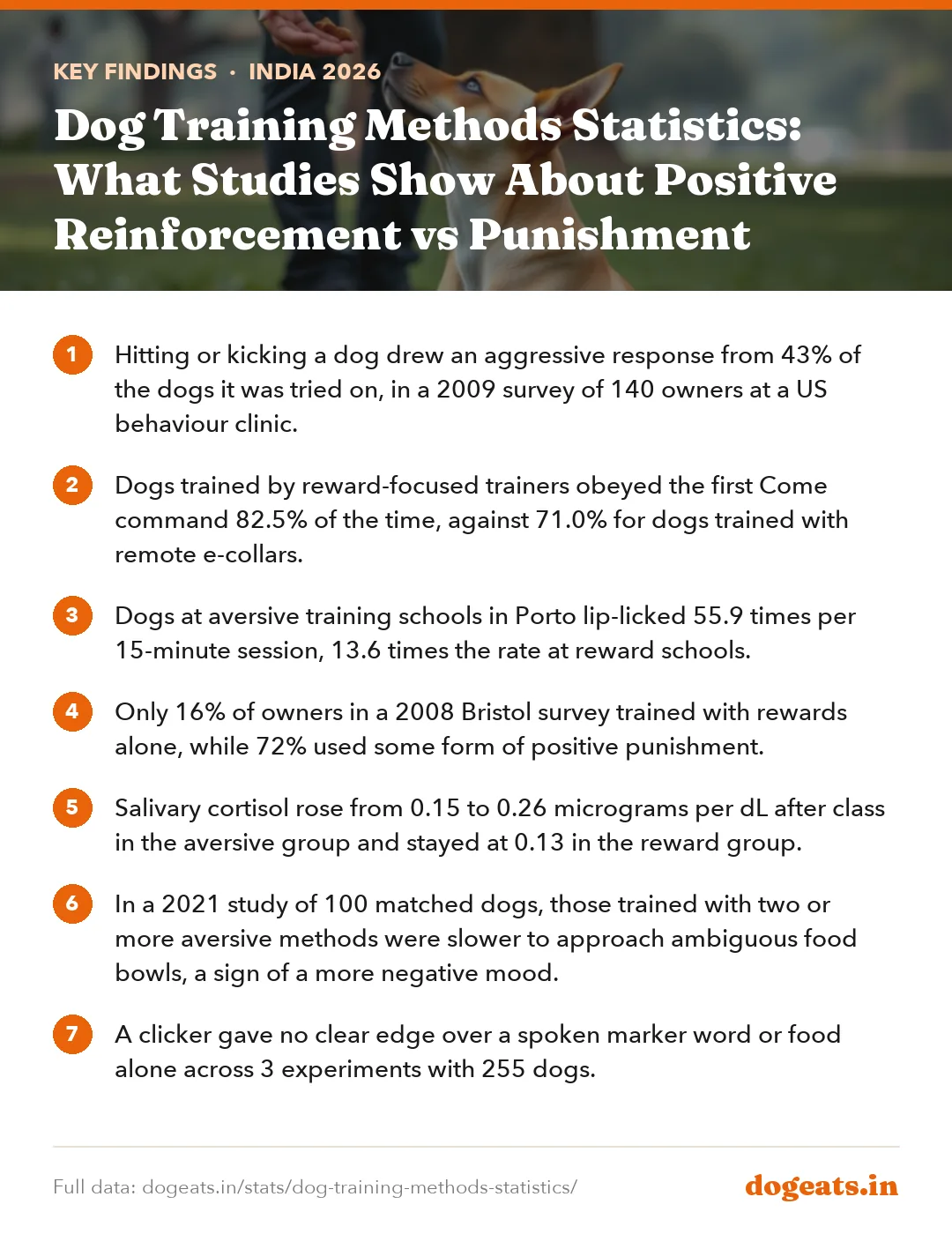
- Hitting or kicking a dog drew an aggressive response from 43% of the dogs it was tried on, in a 2009 survey of 140 owners at a US behaviour clinic.
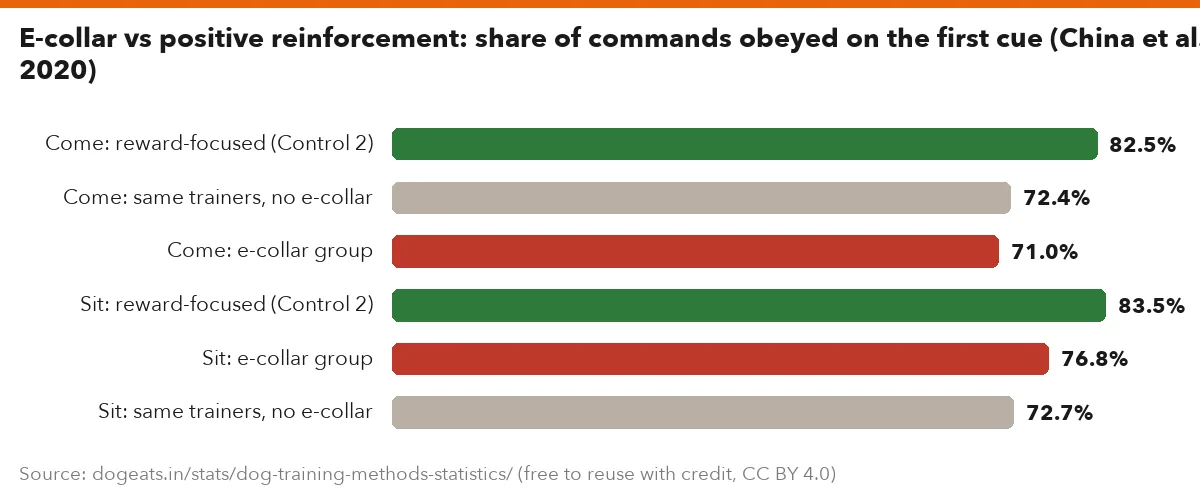
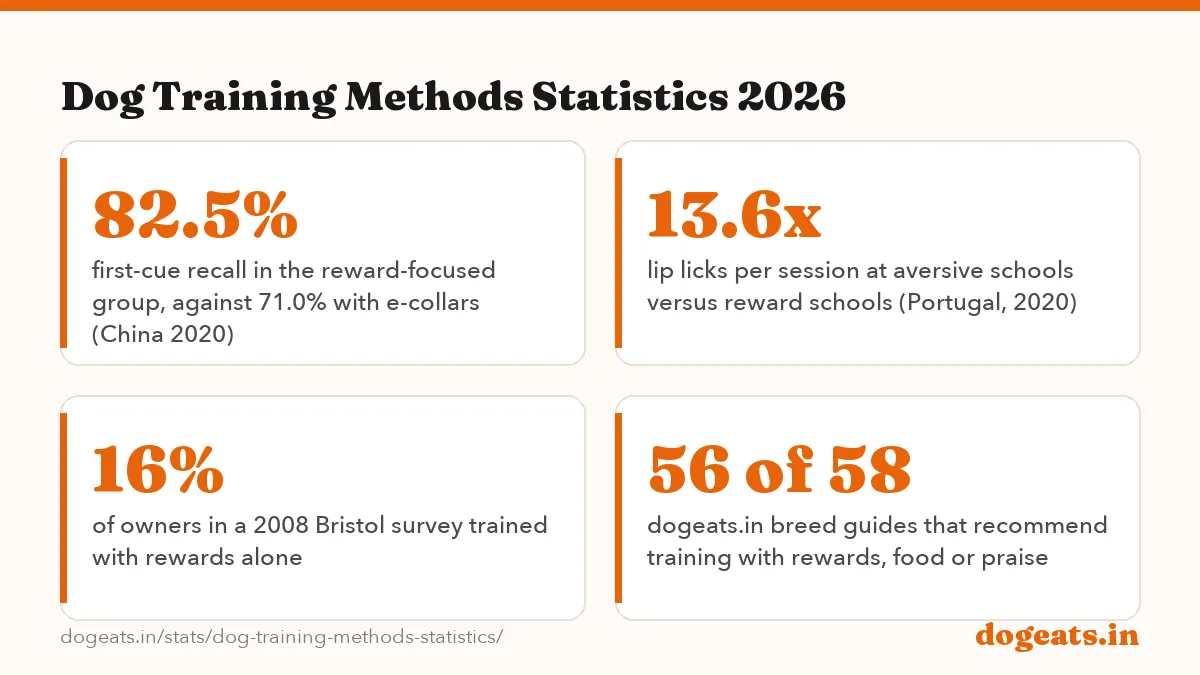
- Dogs trained by reward-focused trainers obeyed the first Come command 82.5% of the time, against 71.0% for dogs trained with remote e-collars.
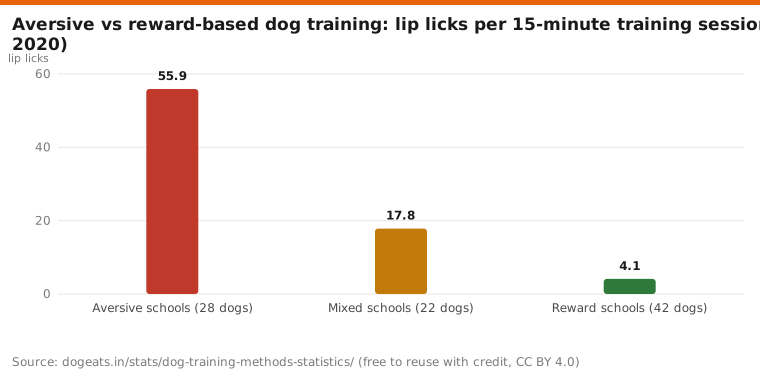
- Dogs at aversive training schools in Porto lip-licked 55.9 times per 15-minute session, 13.6 times the rate at reward schools.
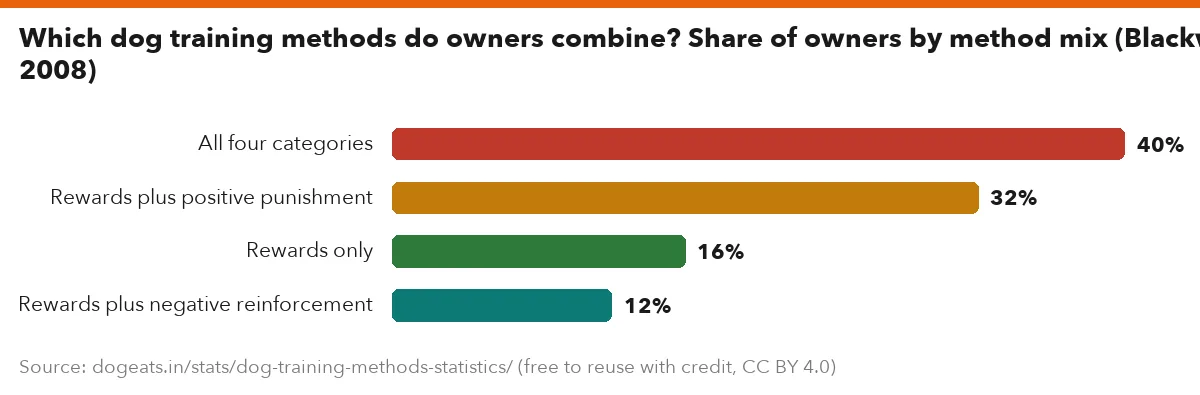
- Only 16% of owners in a 2008 Bristol survey trained with rewards alone, while 72% used some form of positive punishment.
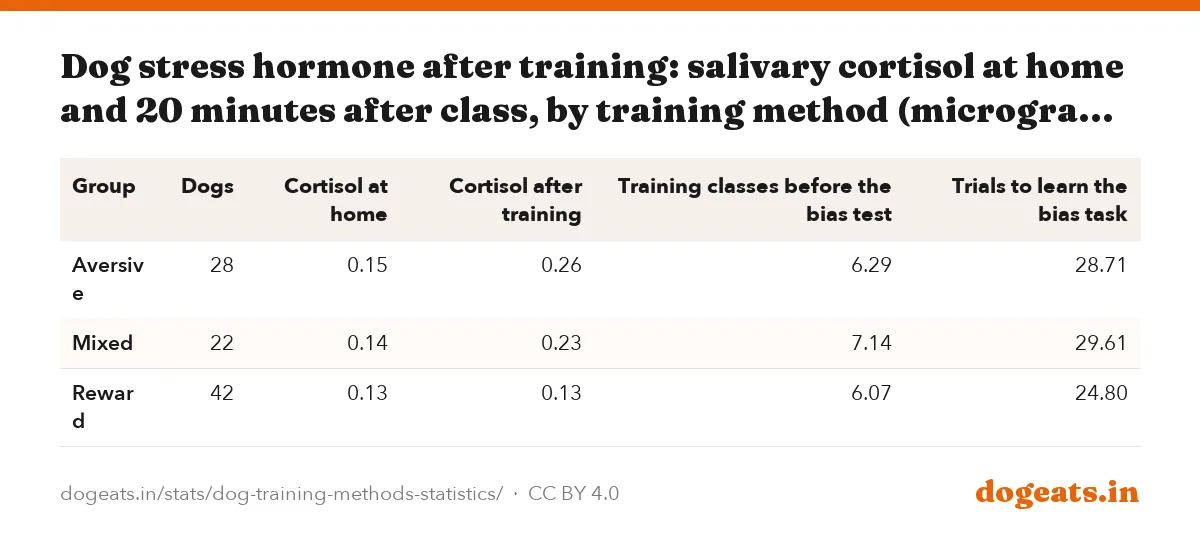
- Salivary cortisol rose from 0.15 to 0.26 micrograms per dL after class in the aversive group and stayed at 0.13 in the reward group.
- In a 2021 study of 100 matched dogs, those trained with two or more aversive methods were slower to approach ambiguous food bowls, a sign of a more negative mood.
- A clicker gave no clear edge over a spoken marker word or food alone across 3 experiments with 255 dogs.
- 56 of our 58 breed guides recommend training with rewards, food or praise, and 27 warn that harsh handling backfires; 30 breeds score 1 or 2 of 5 for beginners.
Positive reinforcement vs punishment: what do dog training studies find?
Reward-based training gets the same or better obedience, with fewer side effects. No study we found showed punishment beating rewards on obedience in pet dogs. Several found punishment linked to more fear, stress and aggression.
Trainers sort methods into four groups. Positive reinforcement adds something good, such as a treat or praise. Positive punishment adds something unpleasant, such as a leash jerk, a shock or a slap.
Negative reinforcement removes pressure once the dog complies, such as easing a pulled collar when the dog sits. Negative punishment takes away something good, such as turning your back on a dog that jumps. Studies call the first and fourth reward-based and the second and third aversive.
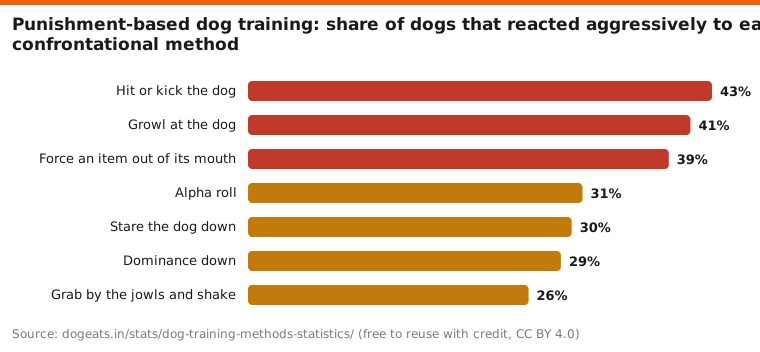
The starkest numbers come from a 2009 University of Pennsylvania survey, as reported in the university's press release. Herron, Shofer and Reisner asked 140 owners who booked a behaviour appointment which methods they had tried. Seven confrontational methods each provoked aggression in at least a quarter of the dogs they were used on.
Source: Herron, Shofer and Reisner 2009, Applied Animal Behaviour Science, survey of 140 owners at a referral behaviour clinic (University of Pennsylvania). Figures from the university's press release, not the full paper. Share of dogs on which the owner had tried the method.
Show the numbers
| Label | % |
|---|---|
| Hit or kick the dog | 43% |
| Growl at the dog | 41% |
| Force an item out of its mouth | 39% |
| Alpha roll | 31% |
| Stare the dog down | 30% |
| Dominance down | 29% |
| Grab by the jowls and shake | 26% |
Embed this chart
| Study | Where | Dogs or owners | Design | Main finding |
|---|---|---|---|---|
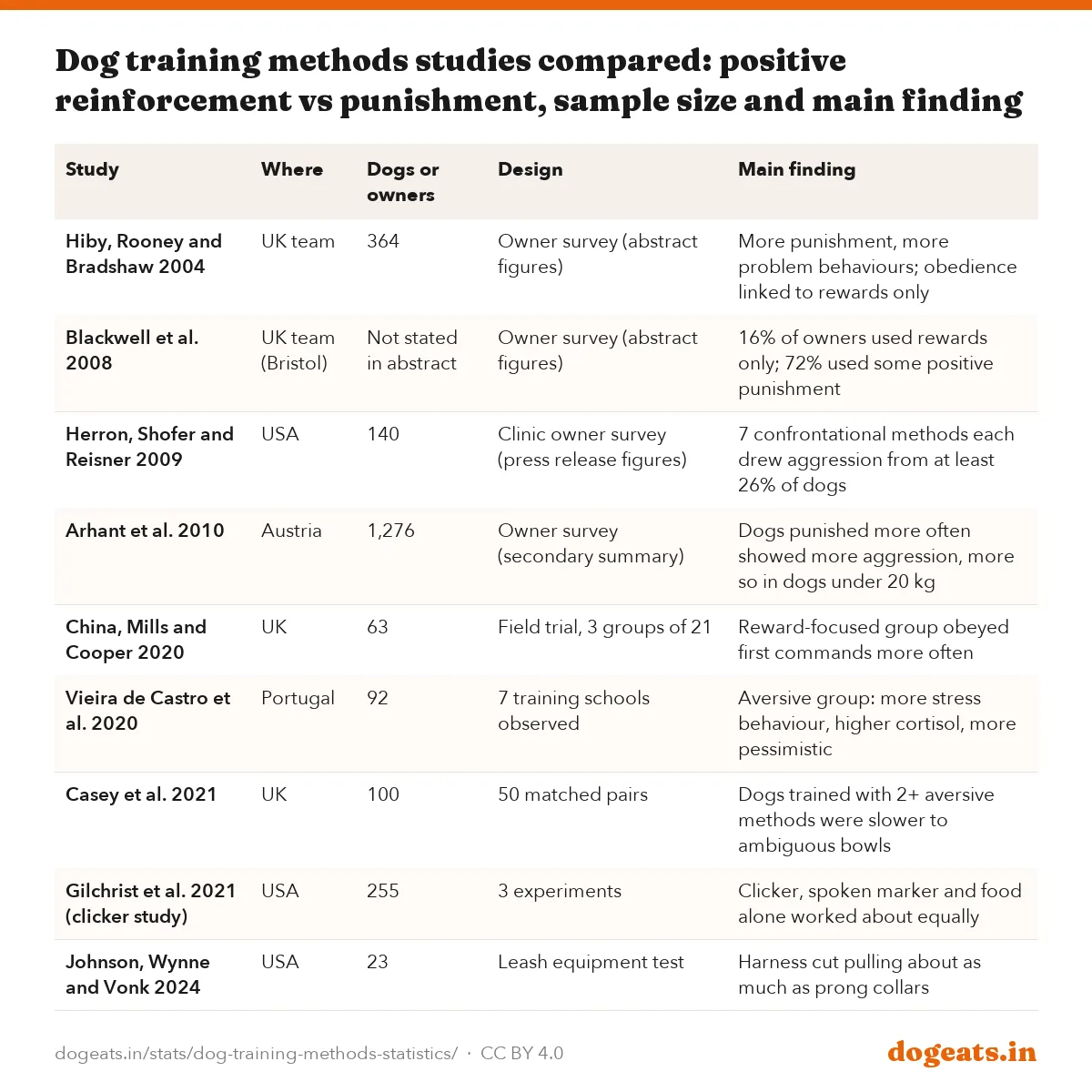
| Hiby, Rooney and Bradshaw 2004 | UK team | 364 | Owner survey (abstract figures) | More punishment, more problem behaviours; obedience linked to rewards only |
| Blackwell et al. 2008 | UK team (Bristol) | Not stated in abstract | Owner survey (abstract figures) | 16% of owners used rewards only; 72% used some positive punishment |
| Herron, Shofer and Reisner 2009 | USA | 140 | Clinic owner survey (press release figures) | 7 confrontational methods each drew aggression from at least 26% of dogs |
| Arhant et al. 2010 | Austria | 1,276 | Owner survey (secondary summary) | Dogs punished more often showed more aggression, more so in dogs under 20 kg |
| China, Mills and Cooper 2020 | UK | 63 | Field trial, 3 groups of 21 | Reward-focused group obeyed first commands more often |
| Vieira de Castro et al. 2020 | Portugal | 92 | 7 training schools observed | Aversive group: more stress behaviour, higher cortisol, more pessimistic |
| Casey et al. 2021 | UK | 100 | 50 matched pairs | Dogs trained with 2+ aversive methods were slower to ambiguous bowls |
| Gilchrist et al. 2021 (clicker study) | USA | 255 | 3 experiments | Clicker, spoken marker and food alone worked about equally |
| Johnson, Wynne and Vonk 2024 | USA | 23 | Leash equipment test | Harness cut pulling about as much as prong collars |
Dogs seen for aggression towards familiar people were more likely to react aggressively to these methods, the Penn team found. These were clinic cases, so the rates are higher than in an average pet dog. They show the risk, not how often it happens at home.
Does positive reinforcement work better than an e-collar?
In the only controlled field trial we found, yes. China, Mills and Cooper tested 63 UK dogs with poor recall in 2020. Each of 3 groups of 21 dogs got up to 150 minutes of training over 5 days.
One group was trained by trainers nominated by e-collar makers, using the collar. A second group had the same trainers without the collar. A third group had independent trainers who relied mainly on rewards.
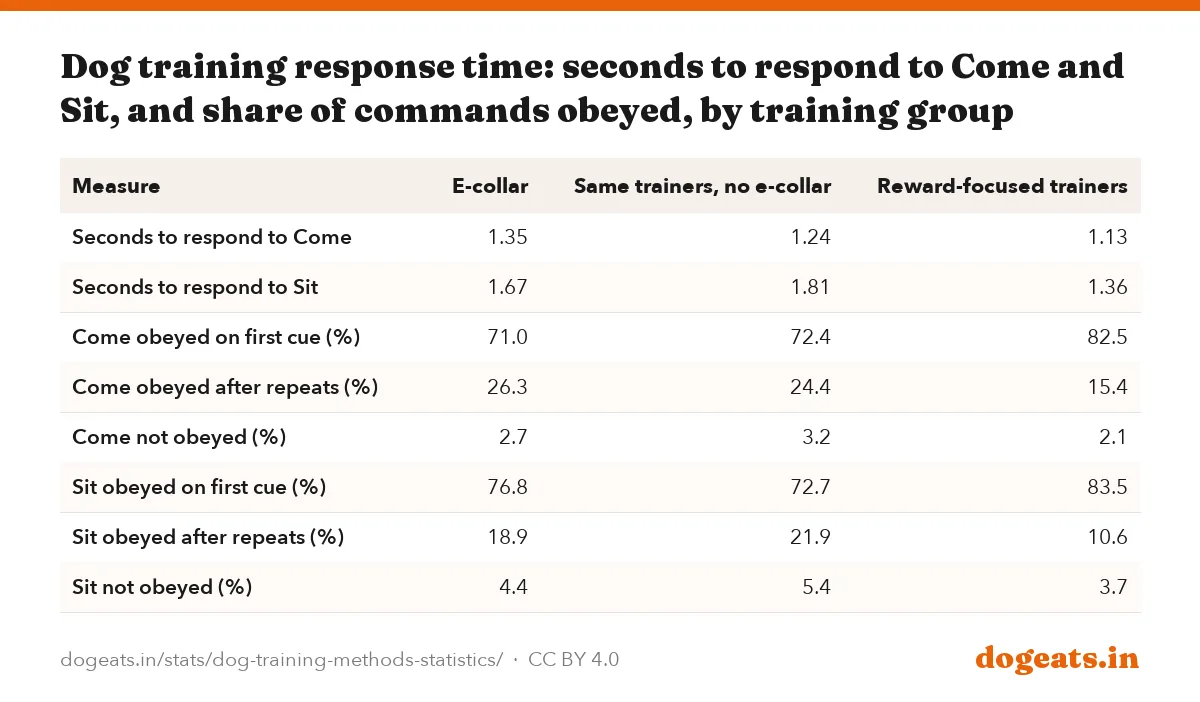
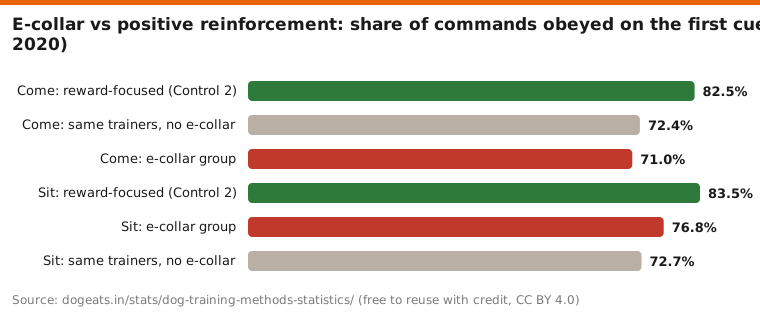
The reward group obeyed the first Come command 82.5% of the time, 11.5 points ahead of the e-collar group. On Sit, it obeyed the first cue 83.5% of the time against 76.8%. All 3 groups disobeyed rarely, between 2.1% and 5.4% of commands.
Source: China, Mills and Cooper 2020, Frontiers in Veterinary Science. 63 dogs with recall problems, 21 per group, up to 150 minutes of training over 5 days. Control 1 = e-collar trainers without the collar; Control 2 = reward-focused trainers.
Show the numbers
| Label | % |
|---|---|
| Come: reward-focused (Control 2) | 82.5% |
| Come: same trainers, no e-collar | 72.4% |
| Come: e-collar group | 71.0% |
| Sit: reward-focused (Control 2) | 83.5% |
| Sit: e-collar group | 76.8% |
| Sit: same trainers, no e-collar | 72.7% |
Embed this chart
| Measure (mean per session) | E-collar | Same trainers, no e-collar | Reward-focused trainers |
|---|---|---|---|
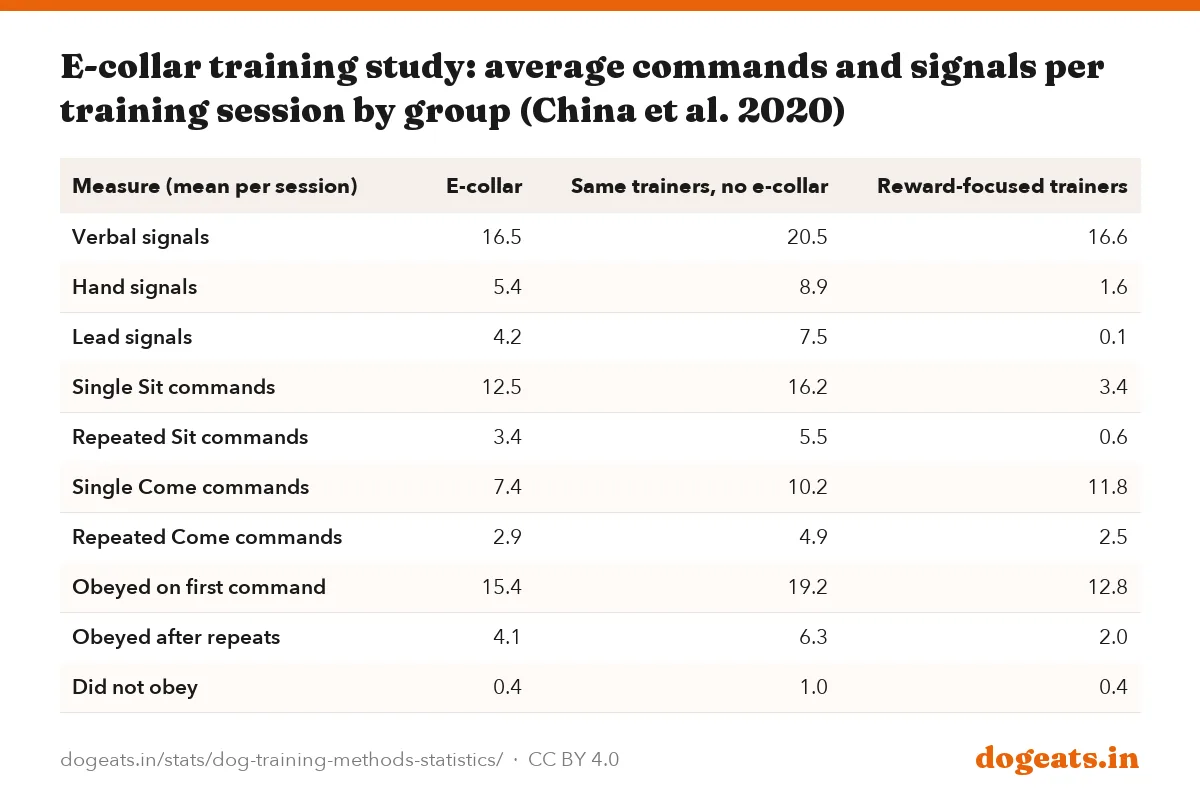
| Verbal signals | 16.5 | 20.5 | 16.6 |
| Hand signals | 5.4 | 8.9 | 1.6 |
| Lead signals | 4.2 | 7.5 | 0.1 |
| Single Sit commands | 12.5 | 16.2 | 3.4 |
| Repeated Sit commands | 3.4 | 5.5 | 0.6 |
| Single Come commands | 7.4 | 10.2 | 11.8 |
| Repeated Come commands | 2.9 | 4.9 | 2.5 |
| Obeyed on first command | 15.4 | 19.2 | 12.8 |
| Obeyed after repeats | 4.1 | 6.3 | 2.0 |
| Did not obey | 0.4 | 1.0 | 0.4 |
| Measure | E-collar | Same trainers, no e-collar | Reward-focused trainers |
|---|---|---|---|
| Seconds to respond to Come | 1.35 | 1.24 | 1.13 |
| Seconds to respond to Sit | 1.67 | 1.81 | 1.36 |
| Come obeyed on first cue (%) | 71.0 | 72.4 | 82.5 |
| Come obeyed after repeats (%) | 26.3 | 24.4 | 15.4 |
| Come not obeyed (%) | 2.7 | 3.2 | 2.1 |
| Sit obeyed on first cue (%) | 76.8 | 72.7 | 83.5 |
| Sit obeyed after repeats (%) | 18.9 | 21.9 | 10.6 |
| Sit not obeyed (%) | 4.4 | 5.4 | 3.7 |
The reward trainers also needed far fewer commands. They gave a single Sit cue 3.4 times per session, against 12.5 times in the e-collar group, about 3.7 times fewer. They used 1.6 hand signals and 0.1 lead signals per session.
Across all groups, trainers gave 20.3 commands per session on average. 77% were obeyed first time, 20% after repeats and 3% not at all.
The study has critics. A 2021 commentary by Sargisson and McLean noted that the reward group trained at a different time and place, with different trainers. Two dogs were also swapped between groups at their owners' request.
How stressful is aversive dog training for the dog?
Measurably more stressful, on every scale used in the largest observational study. Vieira de Castro and colleagues filmed 92 dogs at 7 training schools in Porto, Portugal, published in PLOS ONE in 2020. They took six saliva samples per dog to measure the stress hormone cortisol.
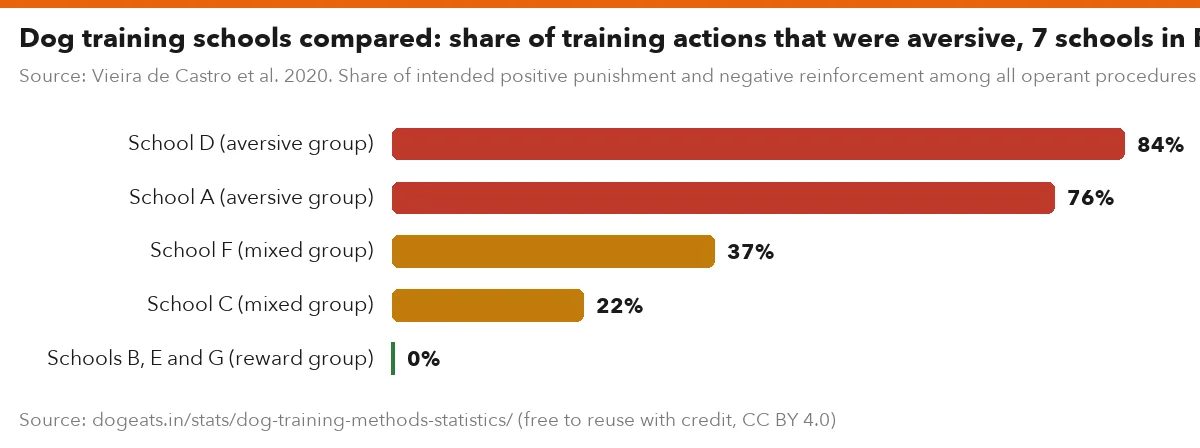
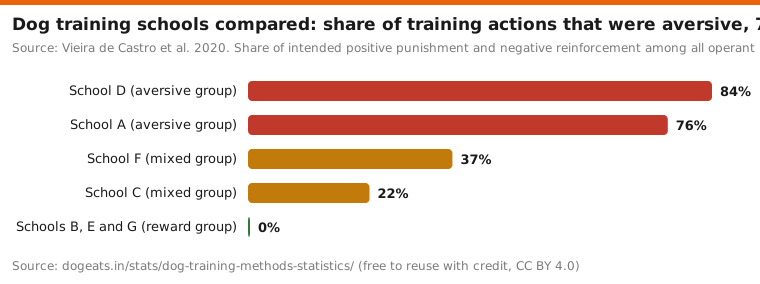
The schools were grouped by what the researchers saw, not by what they advertised. In two aversive schools, 76% and 84% of training actions were punishments or negative reinforcement. Two mixed schools used 22% and 37%, and three reward schools used none.
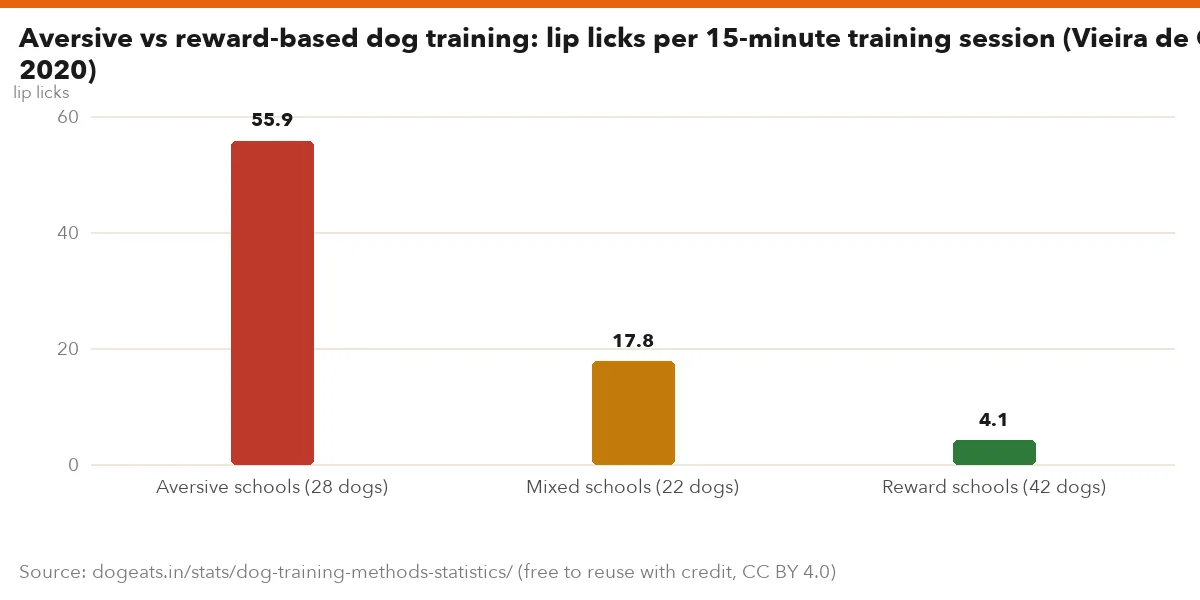
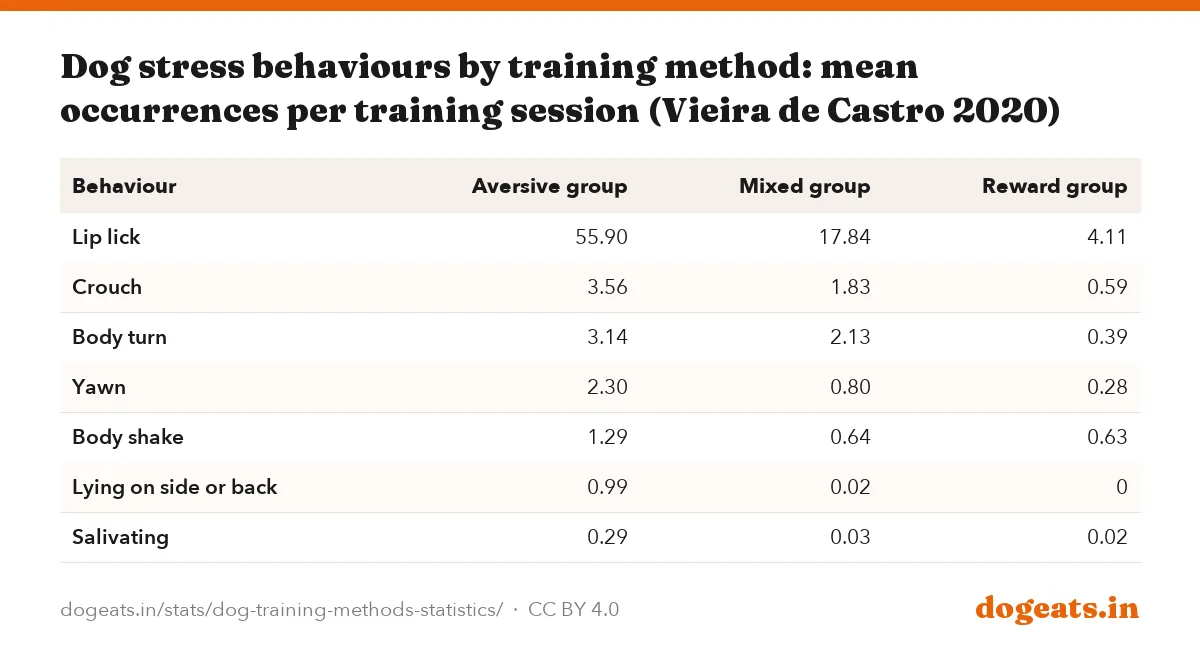
Dogs from aversive schools lip-licked 55.9 times per 15-minute session, against 17.8 in the mixed group and 4.1 in the reward group. They yawned 8.2 times as often as reward-trained dogs.
Source: Vieira de Castro et al. 2020, PLOS ONE. 92 dogs at 7 training schools in Porto, Portugal, filmed for the first 15 minutes of 3 sessions; mean occurrences per session.
Show the numbers
| Label | lip licks |
|---|---|
| Aversive schools (28 dogs) | 55.9 |
| Mixed schools (22 dogs) | 17.8 |
| Reward schools (42 dogs) | 4.1 |
Embed this chart
| Behaviour | Aversive group | Mixed group | Reward group |
|---|---|---|---|
| Lip lick | 55.90 | 17.84 | 4.11 |
| Crouch | 3.56 | 1.83 | 0.59 |
| Body turn | 3.14 | 2.13 | 0.39 |
| Yawn | 2.30 | 0.80 | 0.28 |
| Body shake | 1.29 | 0.64 | 0.63 |
| Lying on side or back | 0.99 | 0.02 | 0 |
| Salivating | 0.29 | 0.03 | 0.02 |
| Group | Dogs | Cortisol at home | Cortisol after training | Training classes before the bias test | Trials to learn the bias task |
|---|---|---|---|---|---|
| Aversive | 28 | 0.15 | 0.26 | 6.29 | 28.71 |
| Mixed | 22 | 0.14 | 0.23 | 7.14 | 29.61 |
| Reward | 42 | 0.13 | 0.13 | 6.07 | 24.80 |
Cortisol at home was similar across groups, between 0.13 and 0.15 micrograms per dL. After class it rose to 0.26 in the aversive group and 0.23 in the mixed group. It stayed at 0.13 in the reward group.
Lying on the side or back, a sign of trying to avoid handling, appeared only at the aversive and mixed schools. Dogs at the aversive schools were also in tense or low body states more often and panted more.
Do punishment-based methods change a dog's mood outside training?
Two studies suggest they do. Both used a cognitive bias test, in which a dog learns that a bowl on one side holds food and a bowl on the other side does not. Researchers then time how fast the dog runs to bowls placed in between.
A slower run to an ambiguous bowl is read as a more pessimistic mood. In the Porto study, aversive-trained dogs were slower to every bowl position than reward-trained dogs. The mixed group did not differ clearly from either.
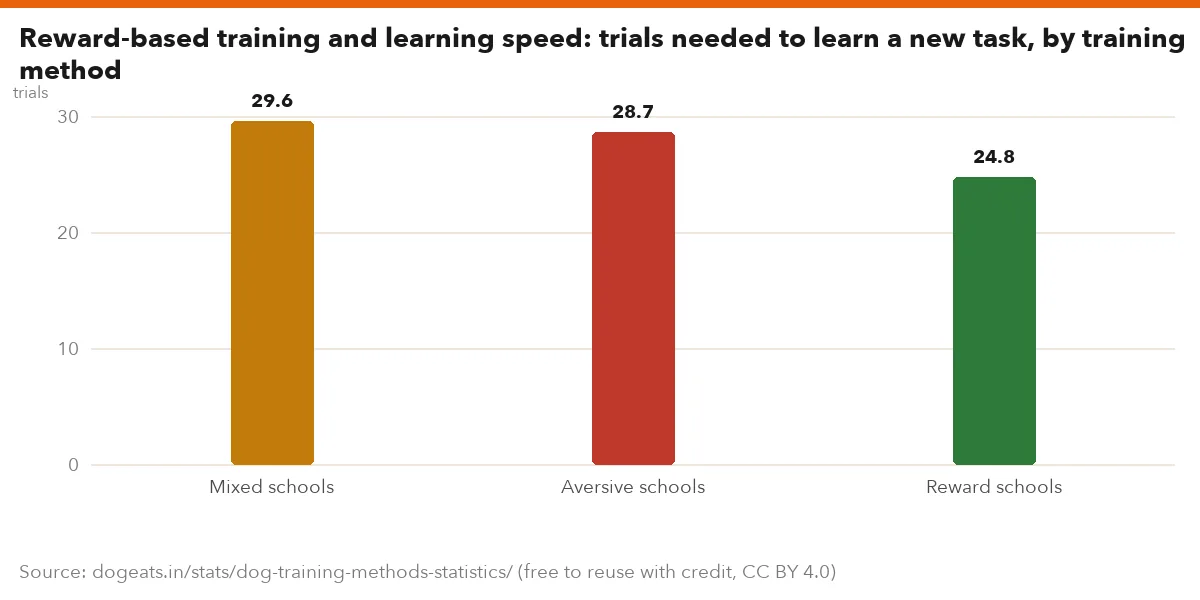
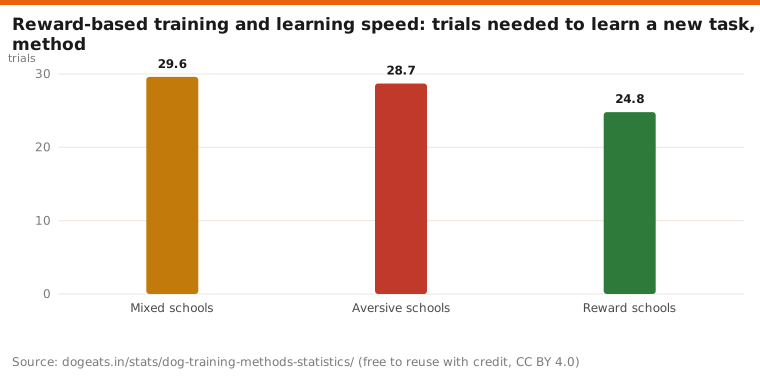
Reward-trained dogs needed 24.8 trials on average to learn the task, against 28.7 for the aversive group and 29.6 for the mixed group. The overall gap was significant, but no pair of groups differed clearly. The dogs had attended about 6 to 7 classes before the test.
Source: Vieira de Castro et al. 2020. Mean trials to reach the learning criterion in a food-bowl location task done away from the school. 79 dogs took this test. Overall group difference p = 0.037; no pairwise difference was significant.
Show the numbers
| Label | trials |
|---|---|
| Mixed schools | 29.6 |
| Aversive schools | 28.7 |
| Reward schools | 24.8 |
Embed this chart
Casey and colleagues repeated the idea in south-west England, reported in Scientific Reports in 2021. 113 dogs completed the task, and 100 were kept as 50 matched pairs by breed, age, sex and neuter status.
Dogs whose owners used two or more aversive methods were slower to the middle bowl (p = 0.017) and the near-positive bowl (p = 0.014). Methods counted as aversive included check or choke chains, rattle cans and other noise-based distractions.
These tests measure mood indirectly. They cannot prove that the training caused the mood, since owners chose their methods. Matching pairs by breed and age rules out some, not all, other explanations.
How many dog owners use punishment?
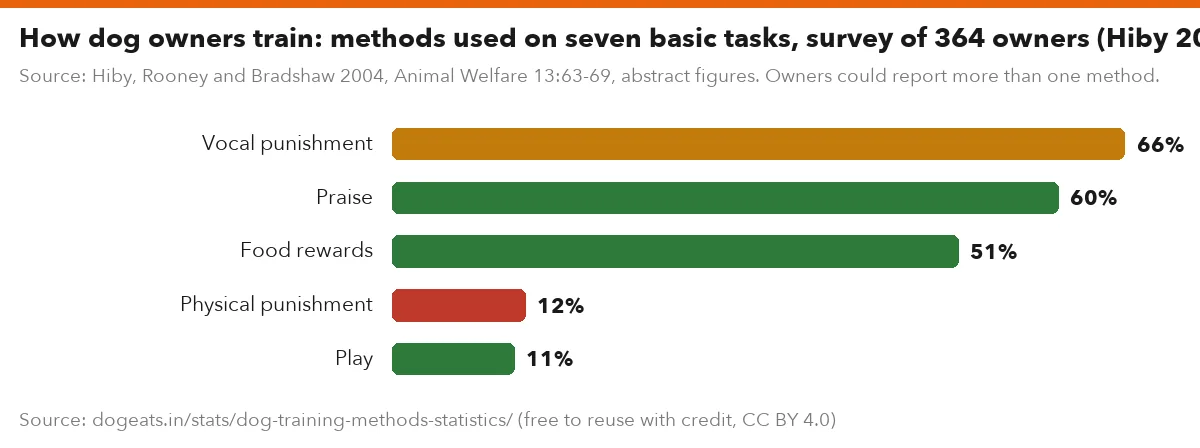
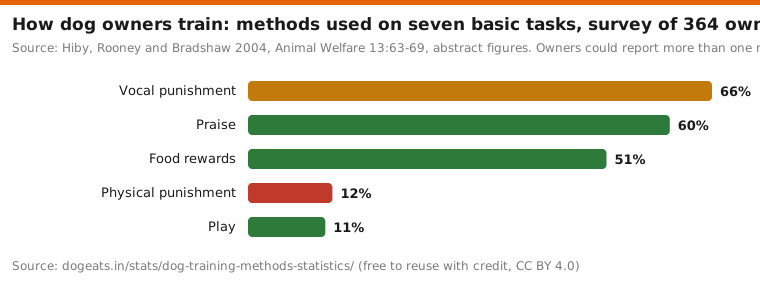
Most owners mix methods, and many use some punishment. Hiby, Rooney and Bradshaw surveyed 364 dog owners for a 2004 paper in Animal Welfare. On seven basic tasks, 66% reported vocal punishment and 12% physical punishment.
Rewards were common too: 60% used praise, 51% food and 11% play. Owners' obedience ratings rose with the number of tasks trained with rewards (P < 0.01) but not with punishment (P = 0.5). The number of problem behaviours, out of 16 asked about, rose with punishment (P < 0.001).
Source: Hiby, Rooney and Bradshaw 2004, Animal Welfare 13:63-69, abstract figures. Owners could report more than one method.
Show the numbers
| Label | % of owners |
|---|---|
| Vocal punishment | 66% |
| Praise | 60% |
| Food rewards | 51% |
| Physical punishment | 12% |
| Play | 11% |
Embed this chart
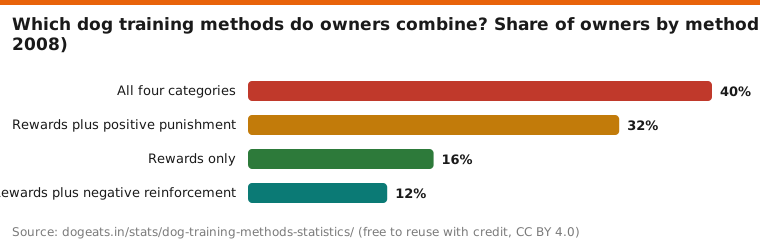
Source: Blackwell, Twells, Seawright and Casey 2008, Journal of Veterinary Behavior 3(5):207-217, owner survey by a University of Bristol team. Abstract figures.
Show the numbers
| Label | % of owners |
|---|---|
| All four categories | 40% |
| Rewards plus positive punishment | 32% |
| Rewards only | 16% |
| Rewards plus negative reinforcement | 12% |
Embed this chart
The abstract of a 2008 survey by Blackwell and colleagues reports that 88% of dogs had received some training. Only 16% of owners used rewards alone, and 72% used some positive punishment. Owners reported 11.3 potentially undesirable behaviours per dog on average.
In that survey, the training method had a statistically significant link with attention-seeking, fear and aggression scores. Owners who trained only at home, without classes, were more likely to report aggression. Dogs that went to puppy socialisation classes were less likely to react badly to dogs outside the home.
A Vienna survey of 1,276 owners by Arhant and colleagues in 2010 split dogs at 20 kg, according to a 2015 summary by psychologist Stanley Coren. Dogs punished more often showed more aggression, and the effect was stronger in the smaller dogs. Owners who were more consistent had more obedient dogs at any size.
Do clickers, harnesses or prong collars make a difference?
A clicker is a tool, not a method. Gilchrist and colleagues at Arizona State University ran 3 experiments on 255 dogs new to training, reported in PeerJ in 2021. They used 90, then 75, then 90 dogs, in 3 equal groups. Each group got food alone, a spoken marker word plus food, or a clicker plus food.
No method beat the others on all tasks. In the first experiment, food alone reached a higher level of success than the spoken marker, with the clicker in between. The other two experiments found no clear difference.
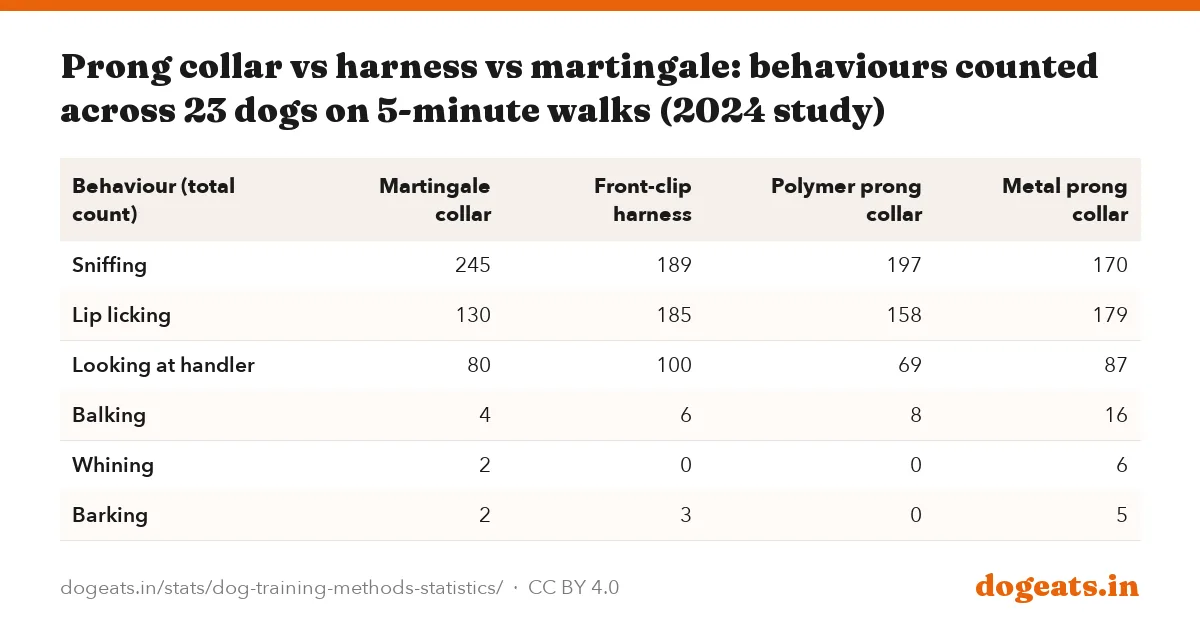
Equipment for leash pulling was tested on 23 shelter dogs by Johnson, Wynne and Vonk in a 2024 PeerJ study. Each dog walked 5 minutes on a martingale collar, a front-clip harness, a polymer prong collar and a metal prong collar.
| Behaviour (total count) | Martingale collar | Front-clip harness | Polymer prong collar | Metal prong collar |
|---|---|---|---|---|
| Sniffing | 245 | 189 | 197 | 170 |
| Lip licking | 130 | 185 | 158 | 179 |
| Looking at handler | 80 | 100 | 69 | 87 |
| Balking | 4 | 6 | 8 | 16 |
| Whining | 2 | 0 | 0 | 6 |
| Barking | 2 | 3 | 0 | 5 |
The harness and both prong collars cut pulling force by a similar amount compared with the martingale collar, and did not differ from each other. Balking rose from 4 times on the martingale to 16 on the metal prong collar. Whining was counted 6 times on the metal prong and twice on the martingale.
The authors found no clear welfare difference over 5 minutes and warned against reading too much into a short test. For owners, the harness matched the prong collar on pulling without the aversive design.
Dog training in India: what breed guides advise and what it costs
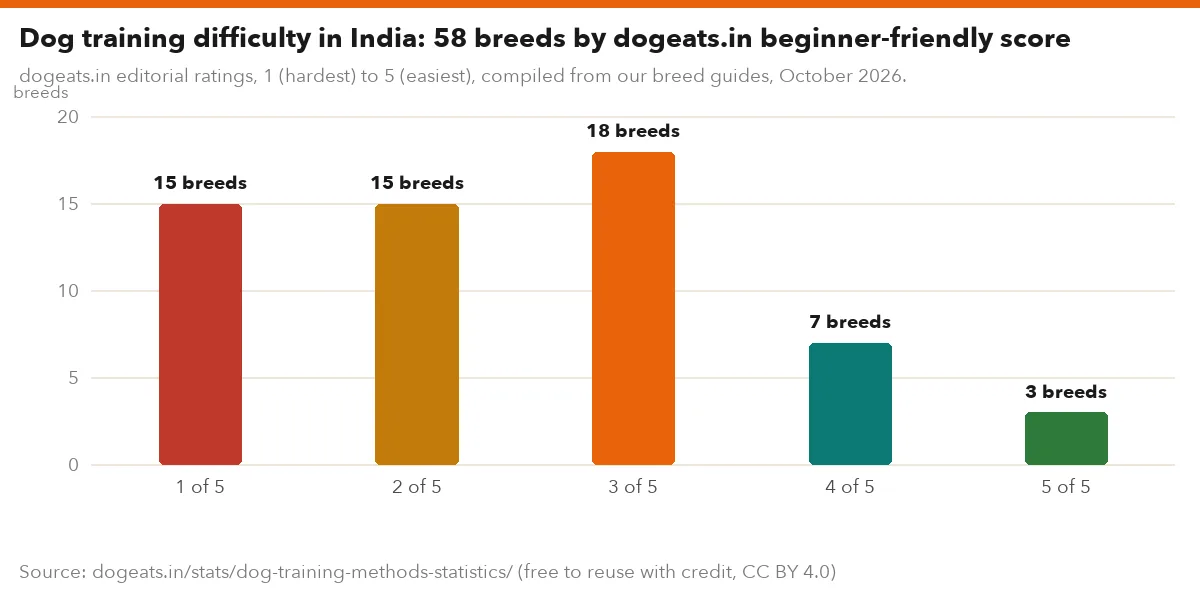
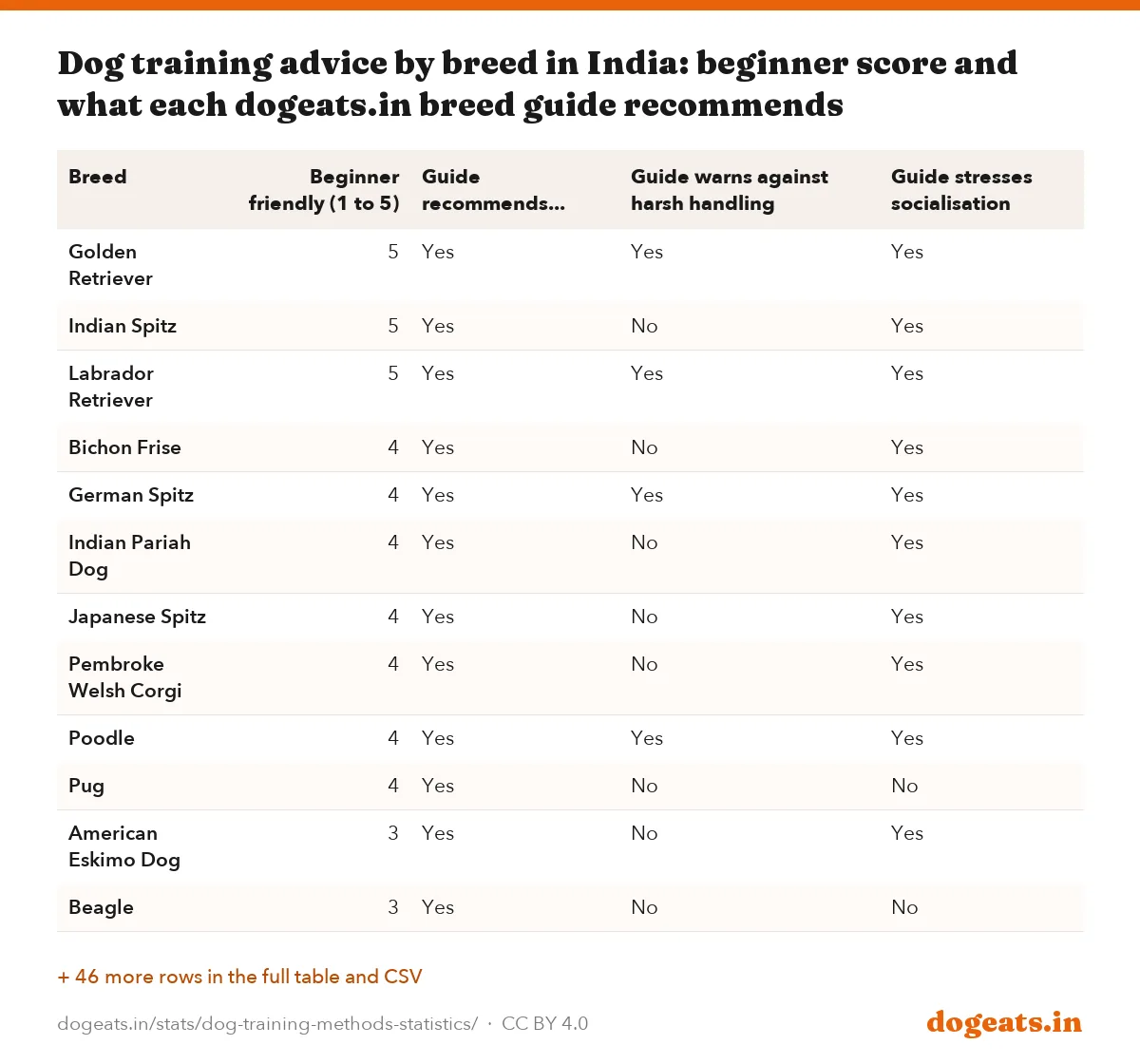
No Indian study has measured which training methods owners use. Our own breed guides give a consistent message. 56 of the 58 recommend training with rewards, treats, food or praise, 27 warn that harsh handling backfires and 50 discuss socialisation.
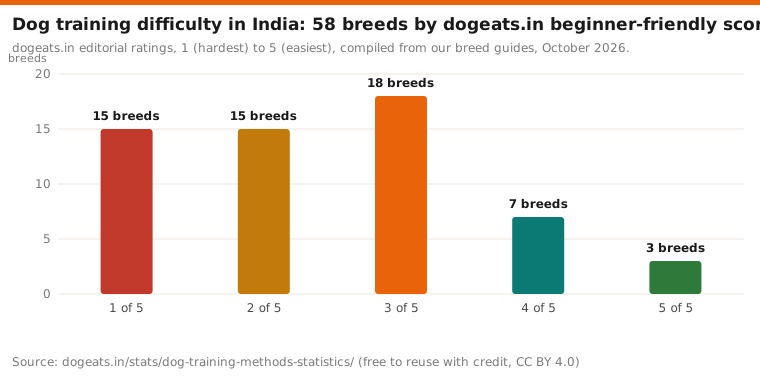
Breed matters for how hard training will be. On our beginner-friendly score, 30 of the 58 breeds score 1 or 2 of 5, and only 3 score 5. The Labrador Retriever scores 5, while the Belgian Malinois scores 1.
Our Indian Pariah Dog guide calls Indies independent thinkers that respond to rewards, and warns that heavy-handed correction makes a reserved dog more reserved. The Rottweiler guide warns that harsh handling of a guarding breed produces defensive aggression.
dogeats.in editorial ratings, 1 (hardest) to 5 (easiest), compiled from our breed guides, October 2026.
Show the numbers
| Label | breeds |
|---|---|
| 1 of 5 | 15 breeds |
| 2 of 5 | 15 breeds |
| 3 of 5 | 18 breeds |
| 4 of 5 | 7 breeds |
| 5 of 5 | 3 breeds |
Embed this chart
| Breed | Beginner friendly (1 to 5) | Guide recommends rewards | Guide warns against harsh handling | Guide stresses socialisation |
|---|---|---|---|---|
| Golden Retriever | 5 | Yes | Yes | Yes |
| Indian Spitz | 5 | Yes | No | Yes |
| Labrador Retriever | 5 | Yes | Yes | Yes |
| Bichon Frise | 4 | Yes | No | Yes |
| German Spitz | 4 | Yes | Yes | Yes |
| Indian Pariah Dog | 4 | Yes | No | Yes |
| Japanese Spitz | 4 | Yes | No | Yes |
| Pembroke Welsh Corgi | 4 | Yes | No | Yes |
| Poodle | 4 | Yes | Yes | Yes |
| Pug | 4 | Yes | No | No |
| American Eskimo Dog | 3 | Yes | No | Yes |
| Beagle | 3 | Yes | No | No |
| Boxer | 3 | Yes | Yes | Yes |
| Cavalier King Charles Spaniel | 3 | Yes | No | No |
| Chihuahua | 3 | Yes | No | Yes |
| Chippiparai | 3 | Yes | Yes | Yes |
| Cocker Spaniel | 3 | Yes | Yes | Yes |
| Dachshund | 3 | Yes | No | No |
| French Bulldog | 3 | Yes | No | Yes |
| Kanni | 3 | Yes | Yes | Yes |
| Lhasa Apso | 3 | Yes | No | Yes |
| Maltese | 3 | Yes | No | Yes |
| Miniature Pinscher | 3 | Yes | No | Yes |
| Mudhol Hound | 3 | Yes | No | Yes |
| Pomeranian | 3 | Yes | No | Yes |
| Rampur Greyhound | 3 | Yes | No | Yes |
| Shih Tzu | 3 | Yes | No | Yes |
| Yorkshire Terrier | 3 | Yes | No | Yes |
| Australian Shepherd | 2 | Yes | Yes | Yes |
| Bernese Mountain Dog | 2 | Yes | Yes | Yes |
| Bull Terrier | 2 | Yes | No | Yes |
| Bullmastiff | 2 | Yes | No | Yes |
| Dalmatian | 2 | No | Yes | Yes |
| Doberman | 2 | Yes | Yes | Yes |
| English Bulldog | 2 | Yes | No | Yes |
| English Mastiff | 2 | Yes | No | Yes |
| German Shepherd | 2 | Yes | No | No |
| Jack Russell Terrier | 2 | Yes | Yes | Yes |
| Pekingese | 2 | Yes | No | No |
| Rajapalayam | 2 | Yes | Yes | Yes |
| Rhodesian Ridgeback | 2 | Yes | Yes | Yes |
| Samoyed | 2 | Yes | Yes | Yes |
| Shiba Inu | 2 | Yes | No | Yes |
| Alaskan Malamute | 1 | Yes | No | Yes |
| Belgian Malinois | 1 | Yes | Yes | No |
| Border Collie | 1 | Yes | Yes | No |
| Bully Kutta | 1 | Yes | Yes | Yes |
| Cane Corso | 1 | Yes | Yes | Yes |
| Chow Chow | 1 | No | Yes | Yes |
| Dogo Argentino | 1 | Yes | Yes | Yes |
| Great Dane | 1 | Yes | Yes | Yes |
| Kangal | 1 | Yes | No | Yes |
| Kombai | 1 | Yes | Yes | Yes |
| Pit Bull | 1 | Yes | Yes | Yes |
| Rottweiler | 1 | Yes | Yes | Yes |
| Saint Bernard | 1 | Yes | Yes | Yes |
| Siberian Husky | 1 | Yes | No | Yes |
| Tibetan Mastiff | 1 | Yes | No | Yes |
Professional help has a price. On lists checked in October 2026, an 8-session basic obedience plan from Pawspace cost Rs 12,000 in Bengaluru and Rs 9,999 in Hyderabad. Our dog training and grooming cost report has the full price lists.
When choosing a trainer, ask what happens when the dog gets it wrong. A trainer who answers with leash jerks, shock or alpha rolls is using the methods the studies above link to fear and aggression. For breed-by-breed learning speed, see our smartest dog breeds ranking.
How strong is the evidence on dog training methods?
Strong in direction, limited in size. Most studies are owner surveys, which show links rather than causes. Owners who punish may also differ in other ways, such as how much time they spend with the dog.
- Only one controlled field trial, with 63 dogs, compared e-collars with reward training head to head.
- The two mood studies covered 92 dogs in Portugal and 100 dogs in England.
- The Herron survey drew on 140 clinic cases, so its 26% to 43% aggression rates are not population rates.
- Researchers in several studies note that owners may under-report punishment.
- No study has tested training methods on Indian breeds or in Indian homes.
Even so, the findings point one way. Across surveys, trials and hormone tests, rewards matched or beat punishment on obedience. Punishment came with more signs of stress, fear and aggression. For dogs that already show fear, our separation anxiety and fear report has the prevalence data.
Frequently asked questions
What is the best dog training method?
Reward-based training, also called positive reinforcement. In a 2020 UK trial, reward-trained dogs obeyed the first Come command 82.5% of the time, against 71.0% with an e-collar, and studies link punishment to more stress and aggression.
Is positive reinforcement better than punishment for dogs?
Yes, on the evidence available. A 2004 survey of 364 owners linked obedience to rewards (P < 0.01) but not punishment, and linked punishment to more problem behaviours (P < 0.001).
Does hitting a dog work as training?
No. In a 2009 survey of 140 owners at a US behaviour clinic, hitting or kicking drew an aggressive response from 43% of the dogs it was tried on.
Do shock collars work for dog training?
They worked no better than rewards in the one controlled trial. Reward-trained dogs obeyed the first Sit cue 83.5% of the time against 76.8% with e-collars, and needed far fewer commands.
How long does it take to train a dog?
Basic commands often take weeks of short daily sessions. In the 2020 UK trial, dogs improved recall with up to 150 minutes of training over 5 days. Indian home training plans we found run from 2 to 16 sessions.
Do I need a clicker to train my dog?
No. A 2021 study of 255 dogs found a clicker, a spoken marker word and food alone all worked, with no method clearly better across 3 experiments.
Is a harness or a prong collar better for a dog that pulls?
In a 2024 test on 23 dogs, a front-clip harness cut pulling force about as much as a prong collar compared with a plain collar. Balking was counted 16 times on the metal prong collar against 6 on the harness.
How much does dog training cost in India?
On lists checked in October 2026, an 8-session basic obedience plan cost Rs 12,000 in Bengaluru and Rs 9,999 in Hyderabad from one provider. Longer plans ran up to Rs 20,000.
Which dog breeds are hardest to train for beginners?
On dogeats.in's beginner score, 15 of 58 breeds score 1 of 5, among them the Belgian Malinois and Border Collie. Only 3 breeds score 5 of 5, led by the Labrador and Golden Retriever.
Methodology and limitations
We read the full texts of six open-access papers through Europe PMC on 16 October 2026. They are Vieira de Castro 2020, China 2020, Casey 2021, Gilchrist 2021, Johnson 2024 and the 2021 commentary. Figures are copied from their tables and results. Ratios such as lip licks per session were computed in Python from the published means.
For papers behind paywalls we used published abstracts. Hiby 2004 came from Cambridge Core and Blackwell 2008 from the University of Bristol research portal. Herron 2009 figures come from the University of Pennsylvania press release, republished by ScienceDaily in February 2009. Arhant 2010 figures come from Stanley Coren's 2015 Psychology Today column summarising it.
Breed figures are dogeats.in editorial data compiled from our 58 breed guides, October 2026. A guide counts as recommending rewards if its training section tells owners to train with rewards, treats, food or praise. It counts as warning against harsh handling if it uses the word harsh. Beginner scores are our editorial ratings from 1 to 5. Indian training prices come from Pawspace's Bengaluru and Hyderabad price lists, rechecked on 16 October 2026.
Sources
- Vieira de Castro et al., Does training method matter? Evidence for the negative impact of aversive-based methods on companion dog welfare, PLOS ONE 2020;15(12):e0225023, 92 dogs, 7 schools, stress behaviours, cortisol, cognitive bias, school aversive shares
- China, Mills and Cooper, Efficacy of Dog Training With and Without Remote Electronic Collars vs. a Focus on Positive Reinforcement, Frontiers in Veterinary Science 2020;7:508, 63 dogs, obey rates, commands per session, latencies
- University of Pennsylvania via ScienceDaily, If you're aggressive, your dog will be too (18 February 2009), on Herron, Shofer and Reisner 2009, Applied Animal Behaviour Science 117:47-54, 140 owners, aggression rates for 7 confrontational methods
- Also consulted: Casey et al., Dogs are more pessimistic if their owners use two or more aversive training methods, Scientific Reports 2021;11:19023, Hiby, Rooney and Bradshaw, Dog training methods: their use, effectiveness and interaction with behaviour and welfare, Animal Welfare 2004;13:63-69, Blackwell, Twells, Seawright and Casey, The relationship between training methods and the occurrence of behavior problems, Journal of Veterinary Behavior 2008;3(5):207-217, Sargisson and McLean, Commentary on China et al. 2020, Frontiers in Veterinary Science 2021, Gilchrist, Gunter, Anderson and Wynne, The click is not the trick: the efficacy of clickers and other reinforcement methods in training naive dogs to perform new tasks, PeerJ 2021;9:e10881, Johnson, Wynne and Vonk, Comparing efficacy in reducing pulling and welfare impacts of four types of leash walking equipment, PeerJ 2024;12:e18131, Stanley Coren, Behavior differences between smaller and larger dogs, Psychology Today (July 2015), on Arhant et al. 2010, Pawspace: dog training at home, Bengaluru, checked 11 October 2026, Pawspace: dog training, Hyderabad, checked 11 October 2026, Arhant et al., Behaviour of smaller and larger dogs: effects of training methods, inconsistency of owner behaviour and level of engagement in activities with the dog, Applied Animal Behaviour Science 2010 (abstract via secondary summaries).
Cite, embed and download
This report, its data and its images are free to reuse under a Creative Commons Attribution 4.0 licence. Credit dogeats.in with a link to this page. Every chart has its own embed code, every table has a CSV and an image download, and the images below are ready for social posts, slides and articles.
Cite this report
Link to this report
Every chart and table as an image