Data report · Updated October 2026
Dog Separation Anxiety and Fear Statistics: How Common They Are, Which Breeds and What Raises the Risk
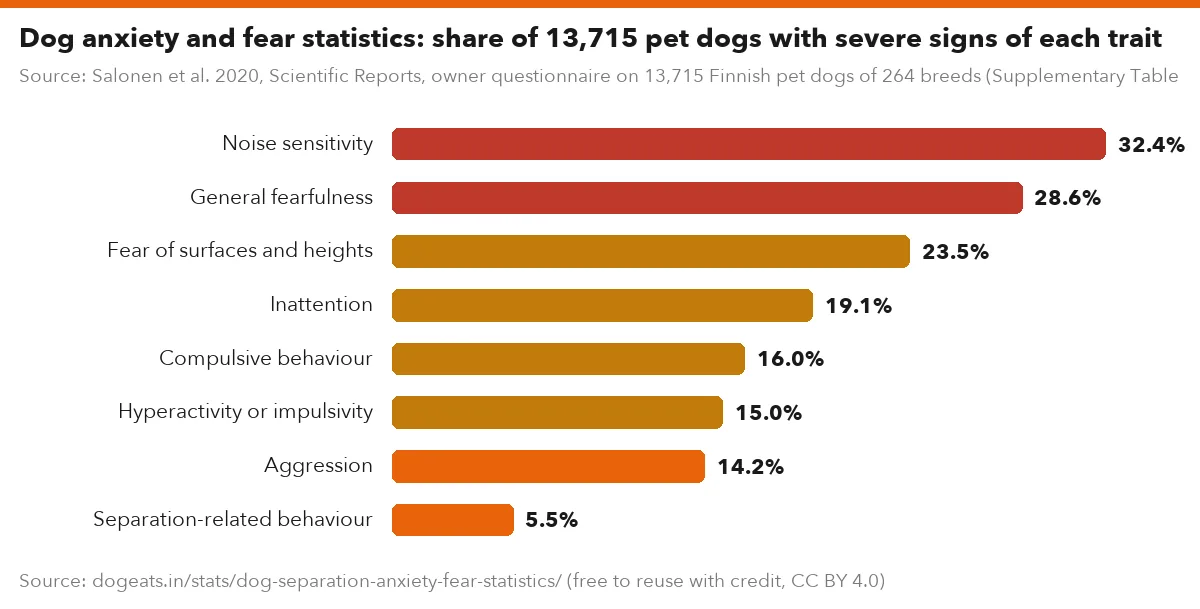
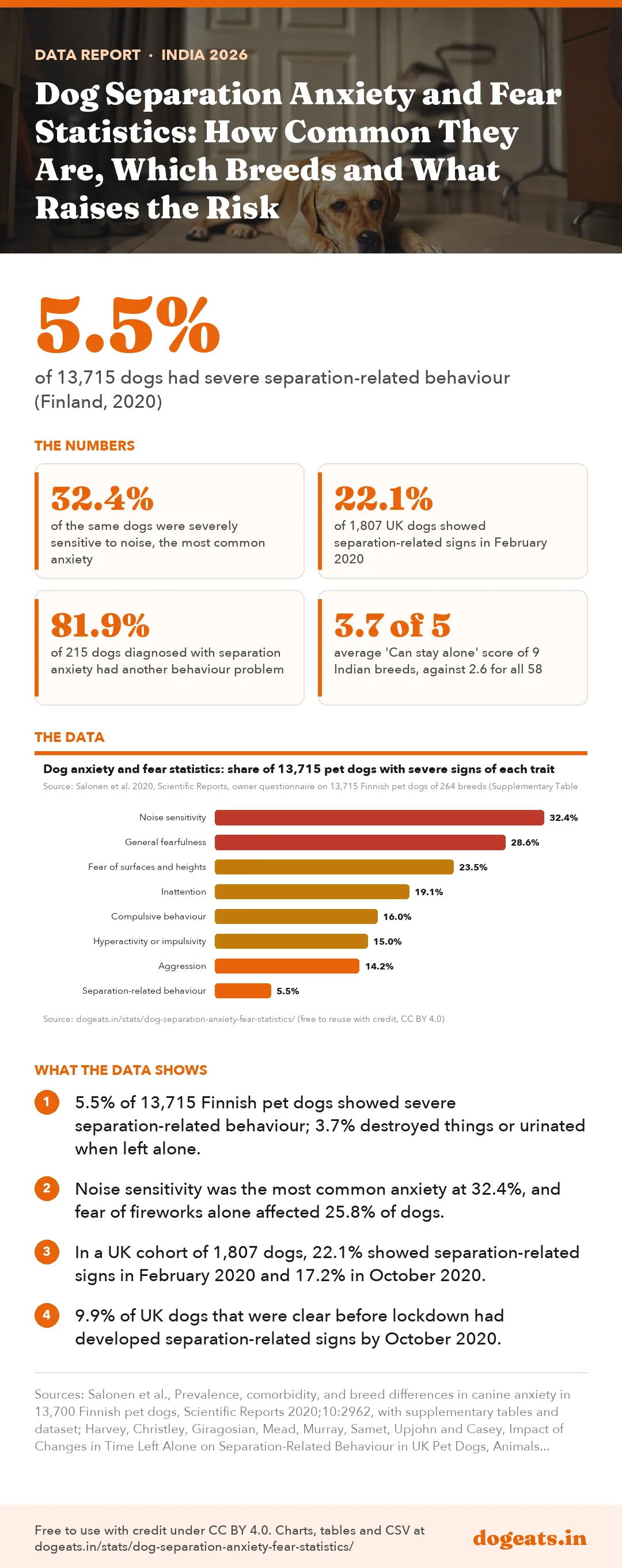
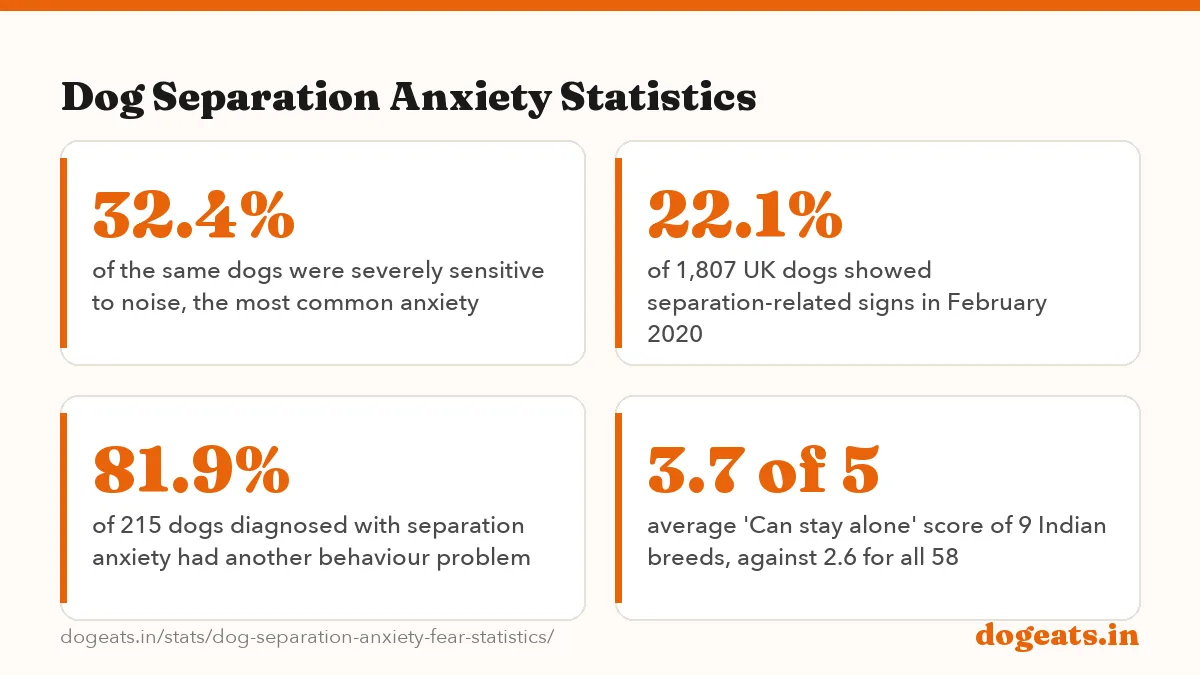
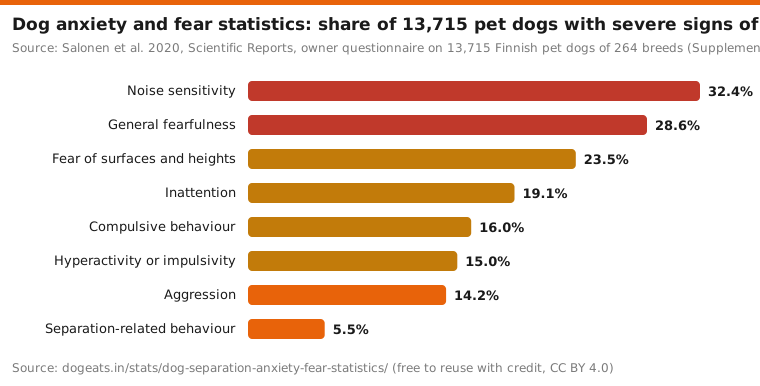
Severe separation anxiety affects about 1 in 18 dogs: 5.5% of 13,715 pet dogs in a 2020 Finnish study. Fear is far more common, with 32.4% of dogs severely sensitive to noise and 25.8% afraid of fireworks. Estimates vary with the definition: a UK survey found signs of separation-related behaviour in 22.1% of 1,807 dogs before the 2020 lockdown.
Key findings
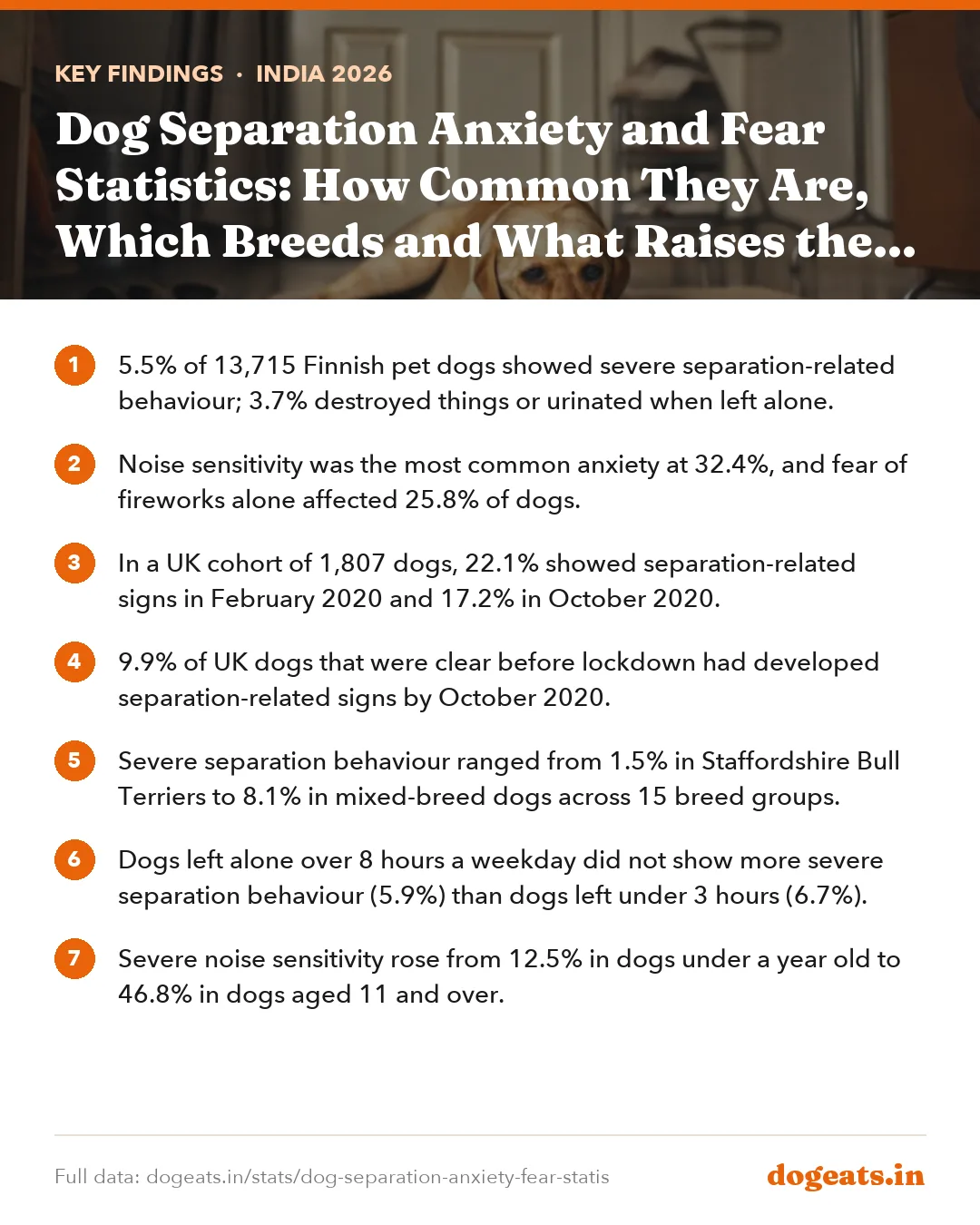
- 5.5% of 13,715 Finnish pet dogs showed severe separation-related behaviour; 3.7% destroyed things or urinated when left alone.
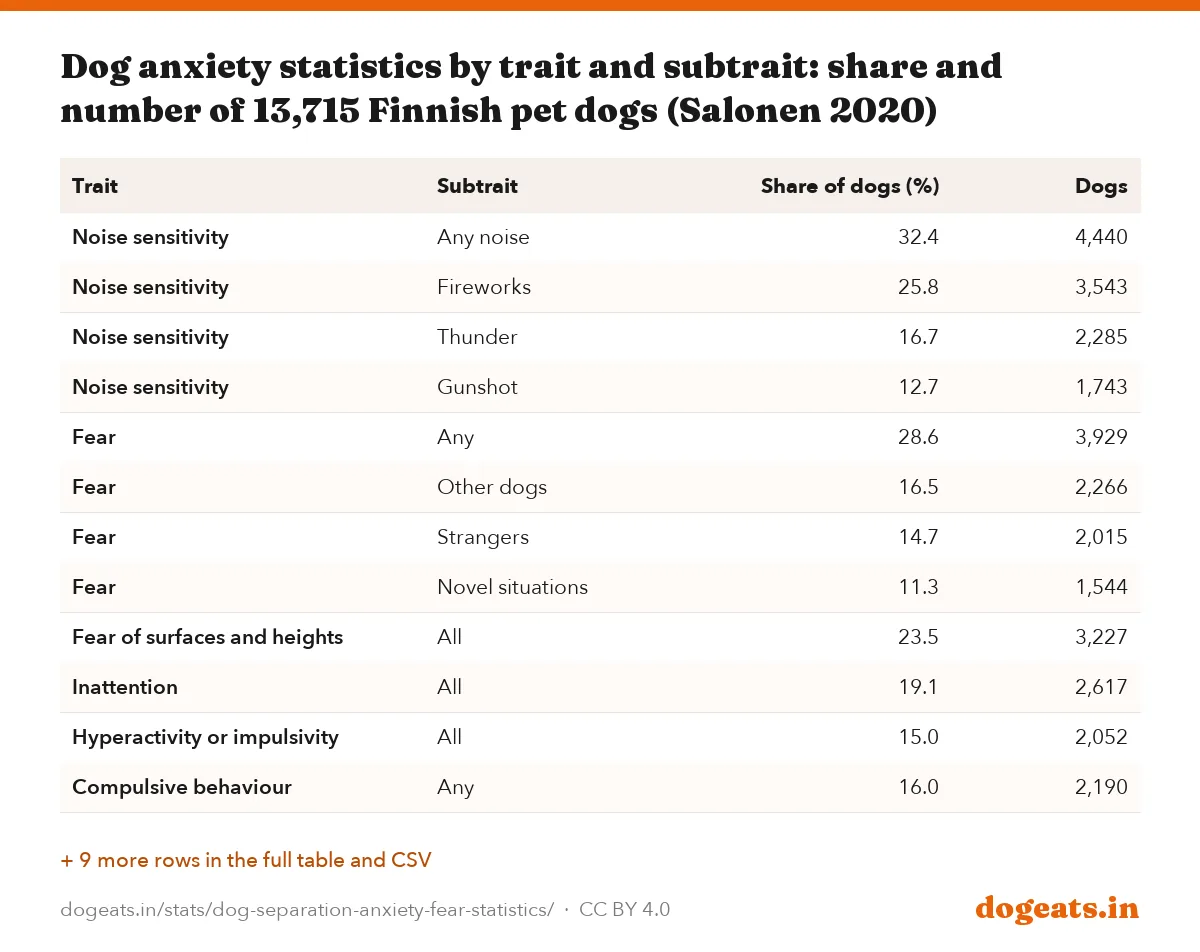
- Noise sensitivity was the most common anxiety at 32.4%, and fear of fireworks alone affected 25.8% of dogs.
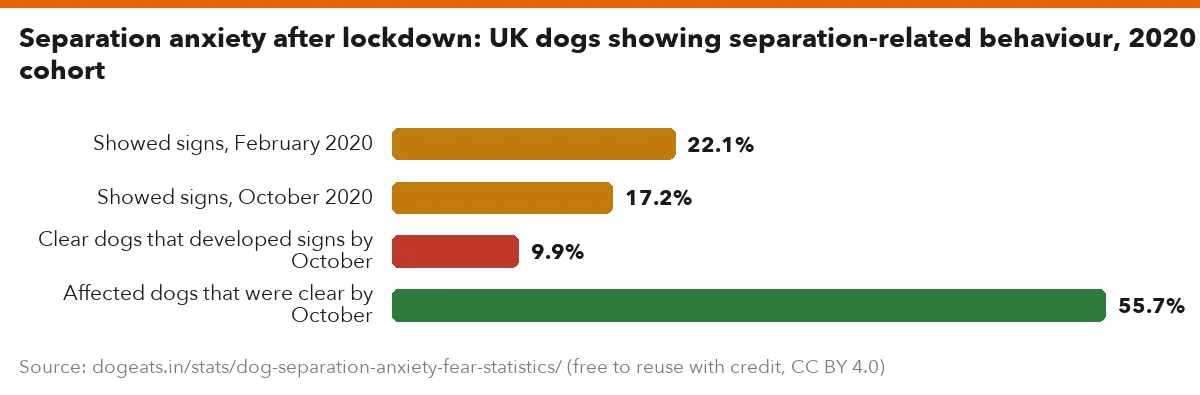
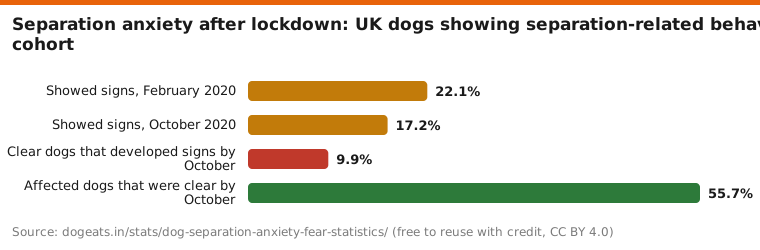
- In a UK cohort of 1,807 dogs, 22.1% showed separation-related signs in February 2020 and 17.2% in October 2020.
- 9.9% of UK dogs that were clear before lockdown had developed separation-related signs by October 2020.
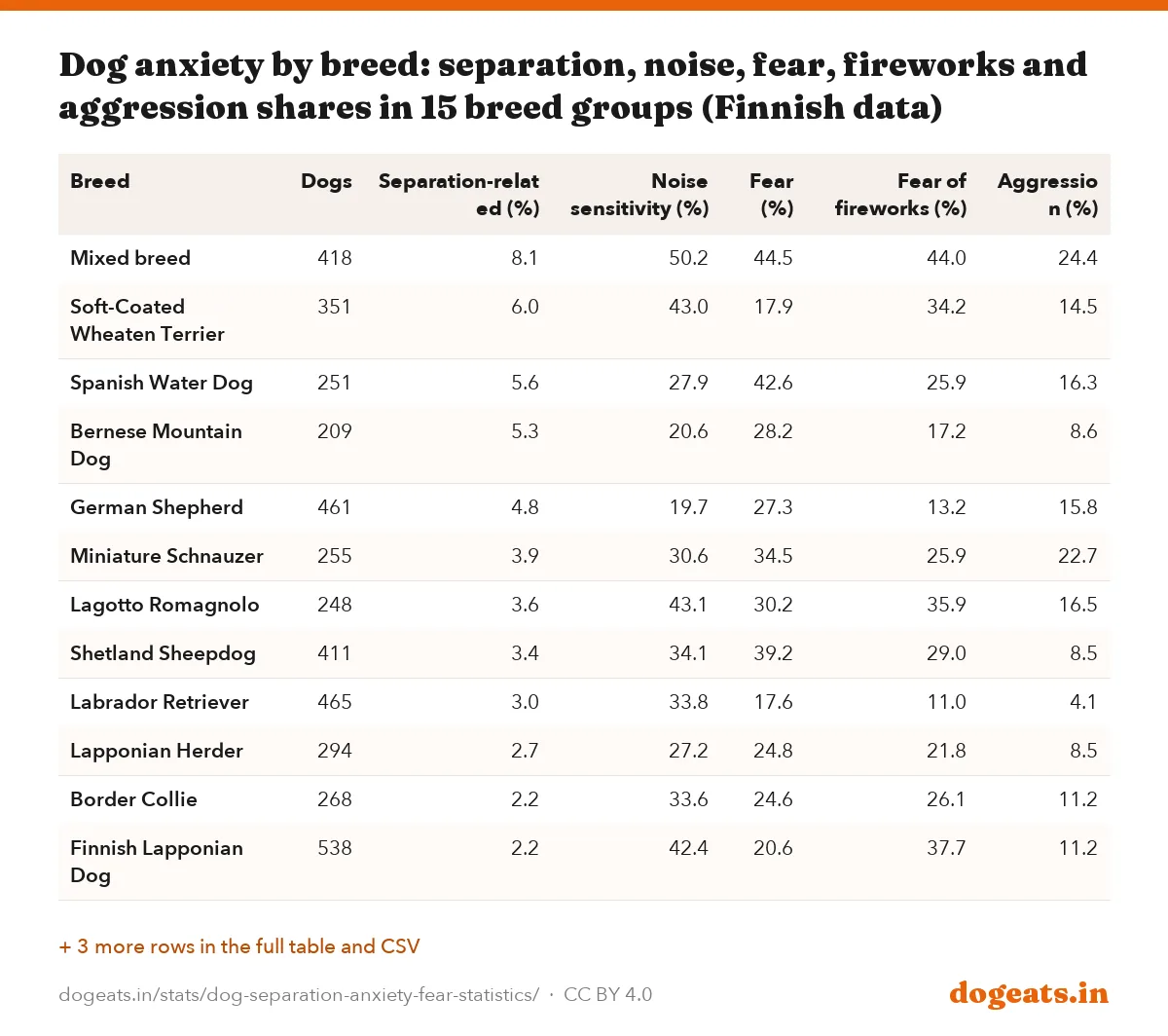
- Severe separation behaviour ranged from 1.5% in Staffordshire Bull Terriers to 8.1% in mixed-breed dogs across 15 breed groups.
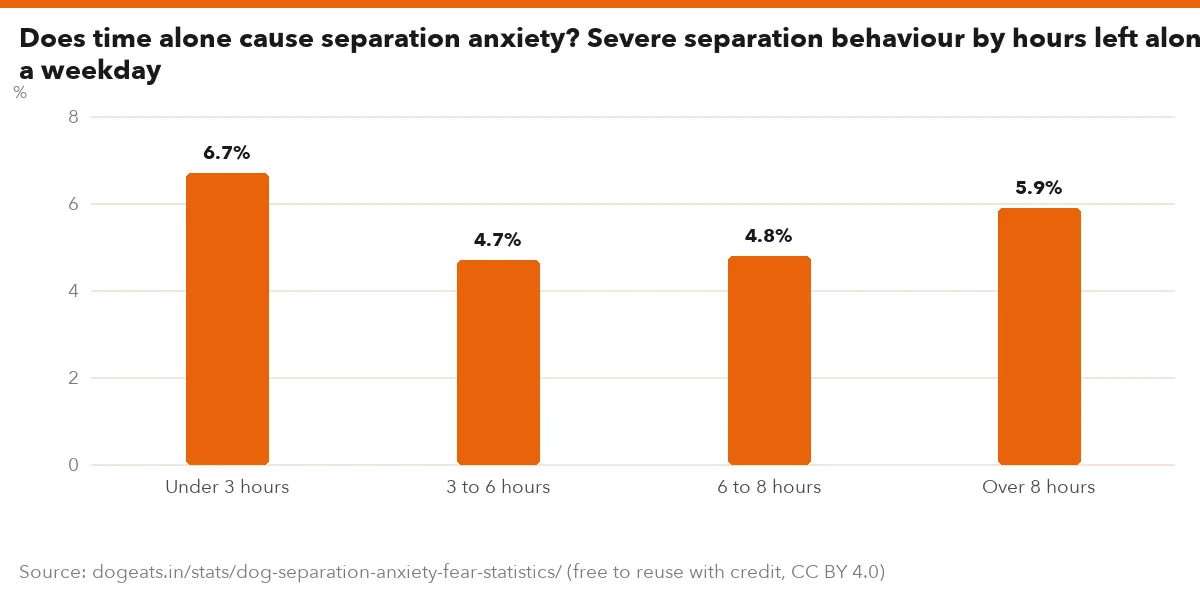
- Dogs left alone over 8 hours a weekday did not show more severe separation behaviour (5.9%) than dogs left under 3 hours (6.7%).
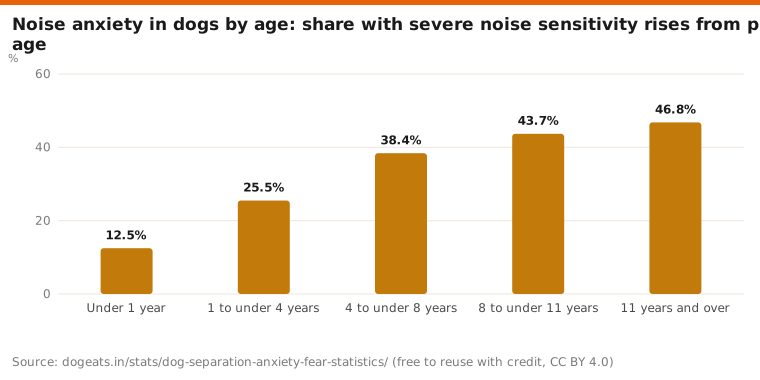
- Severe noise sensitivity rose from 12.5% in dogs under a year old to 46.8% in dogs aged 11 and over.
- Of 215 Norwegian dogs diagnosed with separation anxiety, 81.9% had another behaviour problem, 34% noise phobia.
- 28 of our 58 breed guides score a breed 1 or 2 of 5 for staying alone; 6 of 9 Indian breeds score 4.
How common is separation anxiety in dogs?
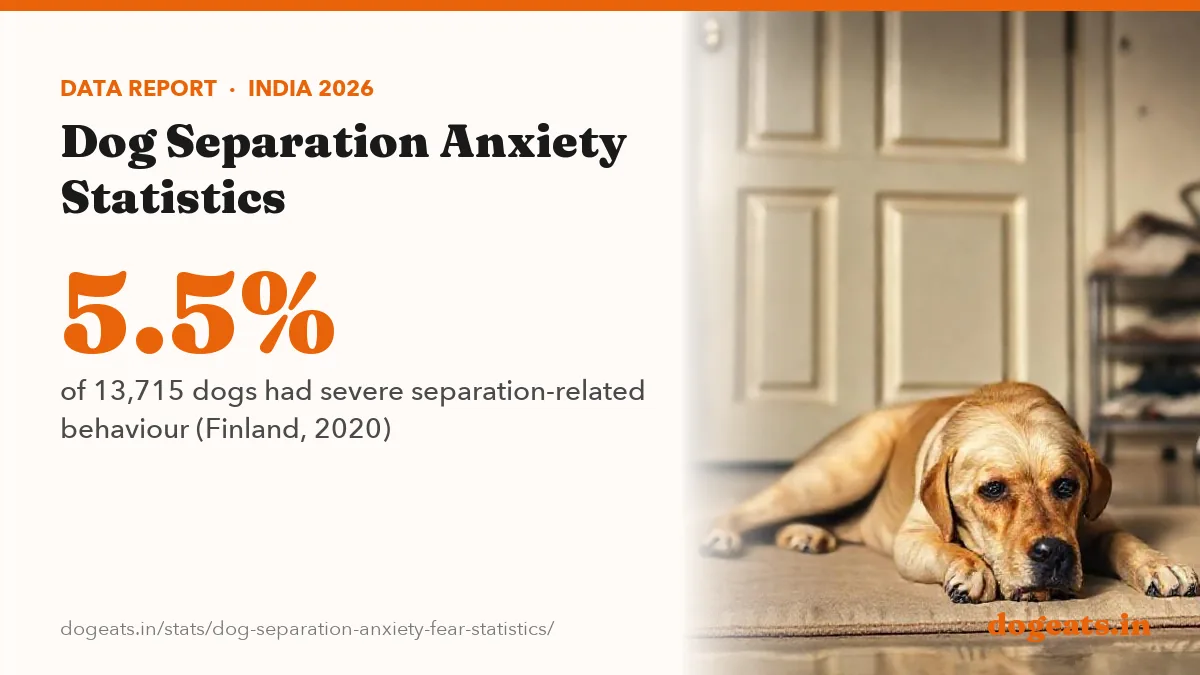
Severe separation anxiety is less common than most owners think, but milder signs are common. The largest study, of 13,715 Finnish pet dogs published in Scientific Reports in 2020, found severe separation-related behaviour in 5.5%. Those were 748 dogs.
Milder estimates run much higher. A UK survey by the charity Dogs Trust found signs of separation-related behaviour in 22.1% of 1,807 dogs in February 2020, as recalled by owners that spring. A 2024 paper by Dale and colleagues notes published estimates anywhere from 6% to 55%.
The gap comes from definitions. The Finnish team counted only severe cases, while the UK survey counted any sign, such as barking, pacing or chewing when left. In the Finnish data, 72.5% of dogs had at least one highly problematic behaviour of some kind.
Source: Salonen et al. 2020, Scientific Reports, owner questionnaire on 13,715 Finnish pet dogs of 264 breeds (Supplementary Table S1). Severe = rated 'high' by the authors' scoring.
Show the numbers
| Label | % |
|---|---|
| Noise sensitivity | 32.4% |
| General fearfulness | 28.6% |
| Fear of surfaces and heights | 23.5% |
| Inattention | 19.1% |
| Compulsive behaviour | 16.0% |
| Hyperactivity or impulsivity | 15.0% |
| Aggression | 14.2% |
| Separation-related behaviour | 5.5% |
Embed this chart
| Trait | Subtrait | Share of dogs (%) | Dogs |
|---|---|---|---|
| Noise sensitivity | Any noise | 32.4 | 4,440 |
| Noise sensitivity | Fireworks | 25.8 | 3,543 |
| Noise sensitivity | Thunder | 16.7 | 2,285 |
| Noise sensitivity | Gunshot | 12.7 | 1,743 |
| Fear | Any | 28.6 | 3,929 |
| Fear | Other dogs | 16.5 | 2,266 |
| Fear | Strangers | 14.7 | 2,015 |
| Fear | Novel situations | 11.3 | 1,544 |
| Fear of surfaces and heights | All | 23.5 | 3,227 |
| Inattention | All | 19.1 | 2,617 |
| Hyperactivity or impulsivity | All | 15.0 | 2,052 |
| Compulsive behaviour | Any | 16.0 | 2,190 |
| Compulsive behaviour | Self-biting | 6.3 | 863 |
| Compulsive behaviour | Surface licking | 4.6 | 632 |
| Compulsive behaviour | Tail chasing | 2.4 | 324 |
| Aggression | Any | 14.2 | 1,946 |
| Aggression | Towards family members | 6.4 | 883 |
| Aggression | Towards strangers | 5.9 | 815 |
| Separation-related behaviour | Any | 5.5 | 748 |
| Separation-related behaviour | Destroys or urinates when alone | 3.7 | 508 |
| Separation-related behaviour | Vocalises, salivates or pants when alone | 2.5 | 340 |
An online owner survey of 5,018 dogs by Dinwoodie and colleagues at Tufts University put the share of dogs with any behaviour problem at 85% in its filtered results. Different questions give different answers, so compare like with like.
What are dogs most afraid of?
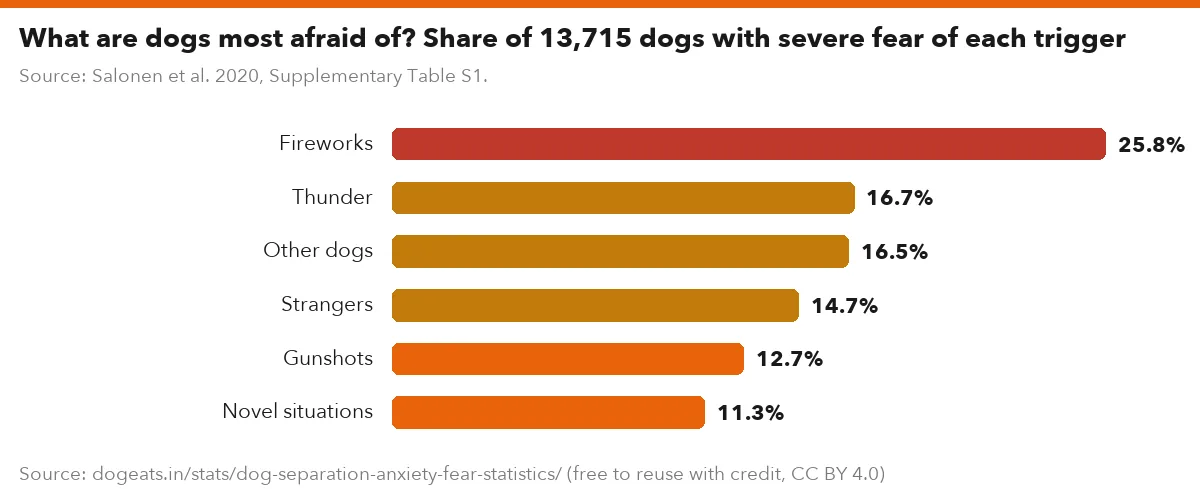
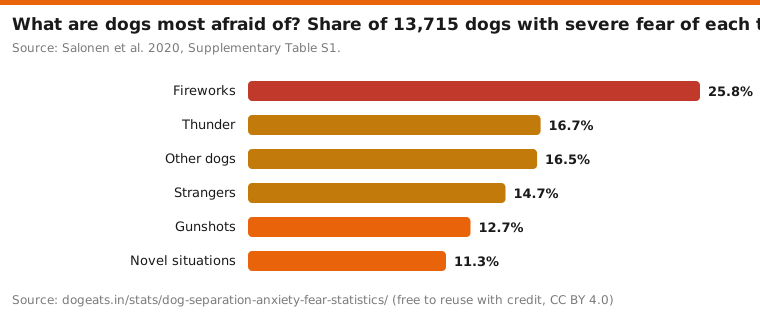
Fireworks top the list. In the Finnish data, 25.8% of dogs were severely afraid of fireworks, 16.7% of thunder and 12.7% of gunshots. Over half of noise-sensitive dogs, 52.5%, feared more than one kind of noise.
Social fears came next. 16.5% of dogs were severely afraid of other dogs, 14.7% of strangers and 11.3% of new situations. Female dogs were more often fearful than males, 30.1% against 27.1%.

Source: Salonen et al. 2020, Supplementary Table S1.
Show the numbers
| Label | % |
|---|---|
| Fireworks | 25.8% |
| Thunder | 16.7% |
| Other dogs | 16.5% |
| Strangers | 14.7% |
| Gunshots | 12.7% |
| Novel situations | 11.3% |
Embed this chart
For Indian owners, this makes Diwali and wedding season the main stress test. Our Diwali firecracker noise report shows evening noise in 17 Tamil Nadu cities averaging 77.0 dB(A) on Deepavali 2025. If a dog shakes, hides or tries to escape during fireworks, see a vet.
Which dog breeds are most prone to separation anxiety?
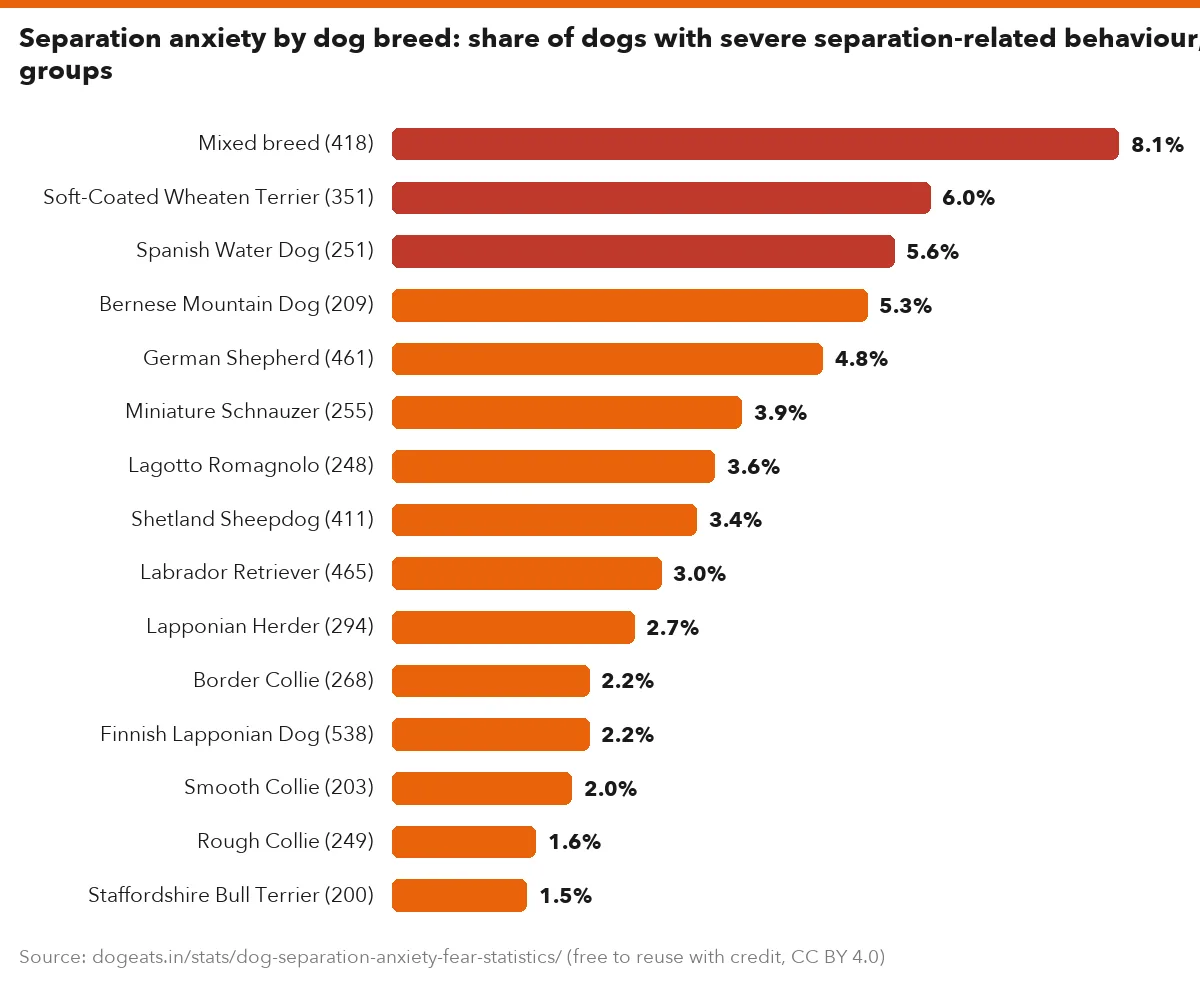
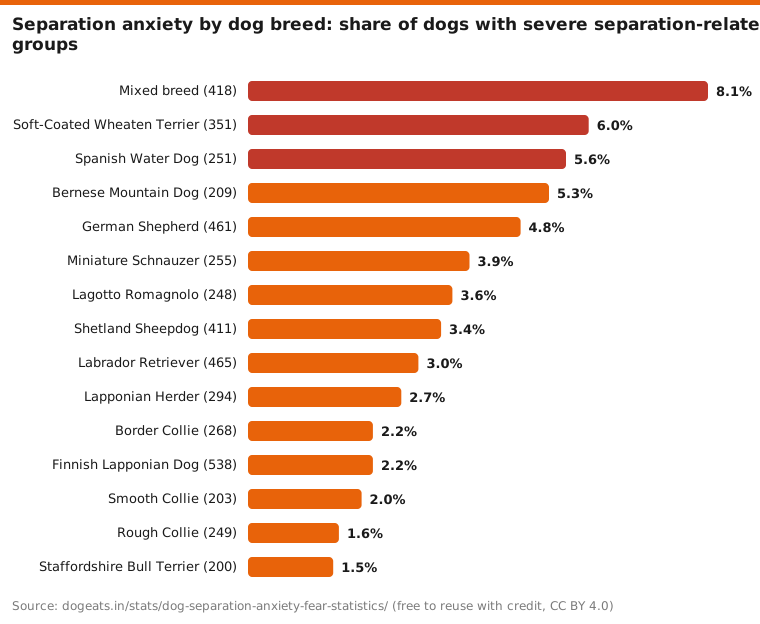
Mixed-breed dogs topped the Finnish data at 8.1%, followed by the Soft-Coated Wheaten Terrier and the Spanish Water Dog. Staffordshire Bull Terriers were lowest at 1.5%. We computed these shares from the study's public dataset for the 15 breed groups with at least 200 dogs each.
Labradors scored low on most anxieties. Only 3.0% showed severe separation behaviour and 11.0% feared fireworks, the lowest fireworks share of any breed group. German Shepherds had the lowest noise sensitivity, at 19.7%.
Breed differences were significant for every trait, the authors report, which points to genes. Mixed-breed dogs were also highest for noise sensitivity, fear and aggression.
dogeats.in analysis of the public Salonen et al. 2020 dataset (Finland), groups the authors analysed (each at least 200 dogs). Severe = 'high' rating; denominator is all dogs of the breed, as in the paper.
Show the numbers
| Label | % |
|---|---|
| Mixed breed (418) | 8.1% |
| Soft-Coated Wheaten Terrier (351) | 6.0% |
| Spanish Water Dog (251) | 5.6% |
| Bernese Mountain Dog (209) | 5.3% |
| German Shepherd (461) | 4.8% |
| Miniature Schnauzer (255) | 3.9% |
| Lagotto Romagnolo (248) | 3.6% |
| Shetland Sheepdog (411) | 3.4% |
| Labrador Retriever (465) | 3.0% |
| Lapponian Herder (294) | 2.7% |
| Border Collie (268) | 2.2% |
| Finnish Lapponian Dog (538) | 2.2% |
| Smooth Collie (203) | 2.0% |
| Rough Collie (249) | 1.6% |
| Staffordshire Bull Terrier (200) | 1.5% |
Embed this chart
| Breed | Dogs | Separation-related (%) | Noise sensitivity (%) | Fear (%) | Fear of fireworks (%) | Aggression (%) |
|---|---|---|---|---|---|---|
| Mixed breed | 418 | 8.1 | 50.2 | 44.5 | 44.0 | 24.4 |
| Soft-Coated Wheaten Terrier | 351 | 6.0 | 43.0 | 17.9 | 34.2 | 14.5 |
| Spanish Water Dog | 251 | 5.6 | 27.9 | 42.6 | 25.9 | 16.3 |
| Bernese Mountain Dog | 209 | 5.3 | 20.6 | 28.2 | 17.2 | 8.6 |
| German Shepherd | 461 | 4.8 | 19.7 | 27.3 | 13.2 | 15.8 |
| Miniature Schnauzer | 255 | 3.9 | 30.6 | 34.5 | 25.9 | 22.7 |
| Lagotto Romagnolo | 248 | 3.6 | 43.1 | 30.2 | 35.9 | 16.5 |
| Shetland Sheepdog | 411 | 3.4 | 34.1 | 39.2 | 29.0 | 8.5 |
| Labrador Retriever | 465 | 3.0 | 33.8 | 17.6 | 11.0 | 4.1 |
| Lapponian Herder | 294 | 2.7 | 27.2 | 24.8 | 21.8 | 8.5 |
| Border Collie | 268 | 2.2 | 33.6 | 24.6 | 26.1 | 11.2 |
| Finnish Lapponian Dog | 538 | 2.2 | 42.4 | 20.6 | 37.7 | 11.2 |
| Smooth Collie | 203 | 2.0 | 31.5 | 22.7 | 27.6 | 8.4 |
| Rough Collie | 249 | 1.6 | 35.7 | 25.3 | 31.7 | 18.1 |
| Staffordshire Bull Terrier | 200 | 1.5 | 30.0 | 21.0 | 25.5 | 9.5 |
Our own ratings disagree in places. Our guides score the Border Collie 1 of 5 for staying alone because idle working dogs get destructive, yet only 2.2% of Finnish Border Collies showed severe separation behaviour. Our scores are editorial judgements for Indian flats and work hours, not measured prevalence.
Does leaving a dog alone for long hours cause separation anxiety?
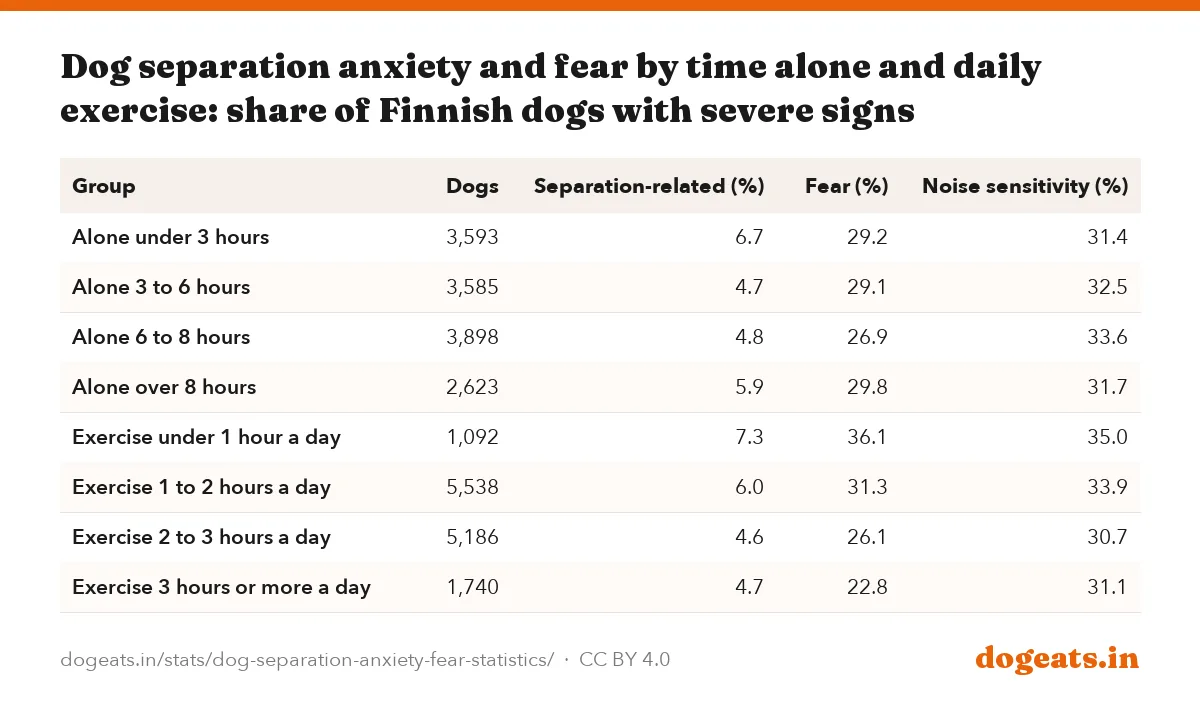
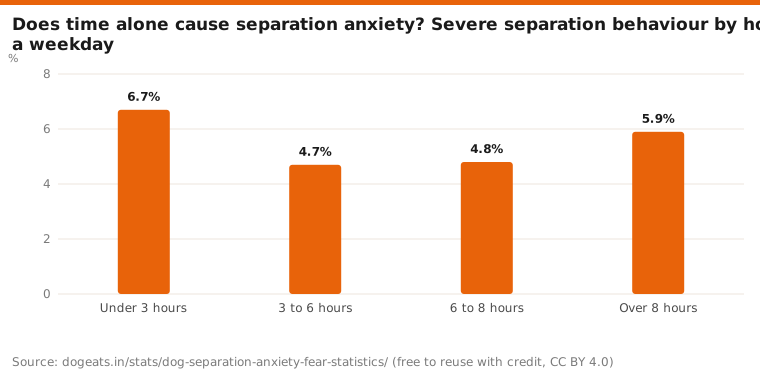
Not in a simple way. In the Finnish data, dogs left alone under 3 hours on a weekday had the highest share of severe separation behaviour, 6.7%. Dogs left over 8 hours had 5.9%, and those left 3 to 8 hours under 5%.
One reason may be that owners of anxious dogs avoid leaving them. These are raw shares we computed, not adjusted for age, breed or anything else. They show that hours alone do not predict which dog will struggle.
dogeats.in analysis of the Salonen et al. 2020 dataset, 13,699 dogs with an answer. Raw shares, not adjusted for other factors. Owners of anxious dogs may already leave them less.
Show the numbers
| Label | % |
|---|---|
| Under 3 hours | 6.7% |
| 3 to 6 hours | 4.7% |
| 6 to 8 hours | 4.8% |
| Over 8 hours | 5.9% |
Embed this chart
| Group | Dogs | Separation-related (%) | Fear (%) | Noise sensitivity (%) |
|---|---|---|---|---|
| Alone under 3 hours | 3,593 | 6.7 | 29.2 | 31.4 |
| Alone 3 to 6 hours | 3,585 | 4.7 | 29.1 | 32.5 |
| Alone 6 to 8 hours | 3,898 | 4.8 | 26.9 | 33.6 |
| Alone over 8 hours | 2,623 | 5.9 | 29.8 | 31.7 |
| Exercise under 1 hour a day | 1,092 | 7.3 | 36.1 | 35.0 |
| Exercise 1 to 2 hours a day | 5,538 | 6.0 | 31.3 | 33.9 |
| Exercise 2 to 3 hours a day | 5,186 | 4.6 | 26.1 | 30.7 |
| Exercise 3 hours or more a day | 1,740 | 4.7 | 22.8 | 31.1 |
Change matters more than hours. In the UK cohort, 9.9% of dogs that were clear in February 2020 showed new signs by October. Dogs whose days alone fell most during lockdown were most at risk when owners went back out.
Exercise tracked fear more clearly than separation. Severe fear fell from 36.1% in dogs exercised under an hour a day to 22.8% in dogs exercised 3 hours or more. Severe separation behaviour fell from 7.3% to 4.7%.
What happened to dogs' separation anxiety after lockdown?
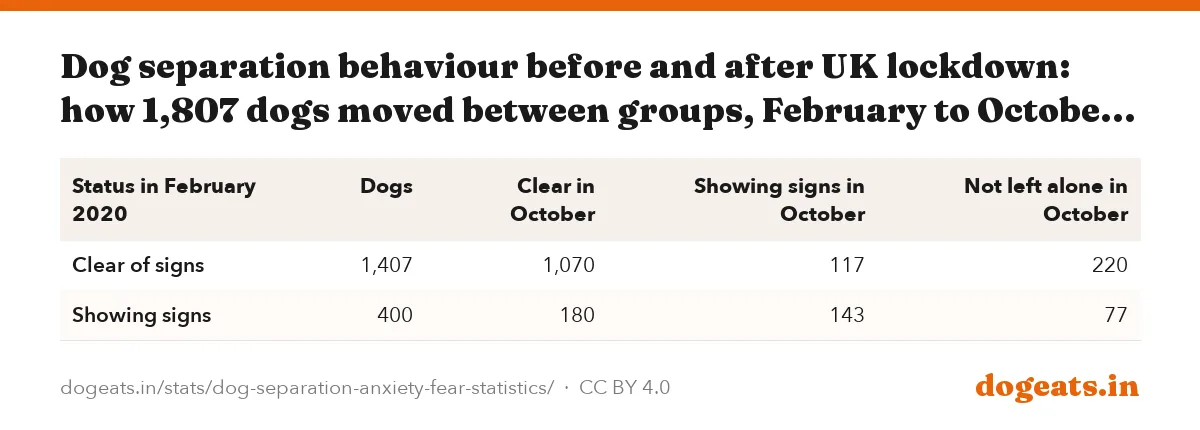
It moved in both directions. Harvey and colleagues at Dogs Trust followed 1,807 UK dogs from the first 2020 lockdown to October 2020. Overall prevalence fell from 22.1% to 17.2% as owners stayed home more.
But individual dogs changed a lot. Of 400 dogs with signs in February, 180 were clear by October, 55.7% of those with a known status. Of 1,407 clear dogs, 117 developed signs, 9.9% of the 1,187 still left alone in October.
Source: Harvey et al. 2022, Animals 12(4):482, 1,807 UK dogs surveyed in May to July and October 2020 (Dogs Trust). Shares of dogs with a known status.
Show the numbers
| Label | % |
|---|---|
| Showed signs, February 2020 | 22.1% |
| Showed signs, October 2020 | 17.2% |
| Clear dogs that developed signs by October | 9.9% |
| Affected dogs that were clear by October | 55.7% |
Embed this chart
| Status in February 2020 | Dogs | Clear in October | Showing signs in October | Not left alone in October |
|---|---|---|---|---|
| Clear of signs | 1,407 | 1,070 | 117 | 220 |
| Showing signs | 400 | 180 | 143 | 77 |
Dogs showing signs during lockdown had about 5 times the odds of showing them in October. The lesson for any household is that a sudden change in routine carries risk.
What raises the risk of separation anxiety in dogs?
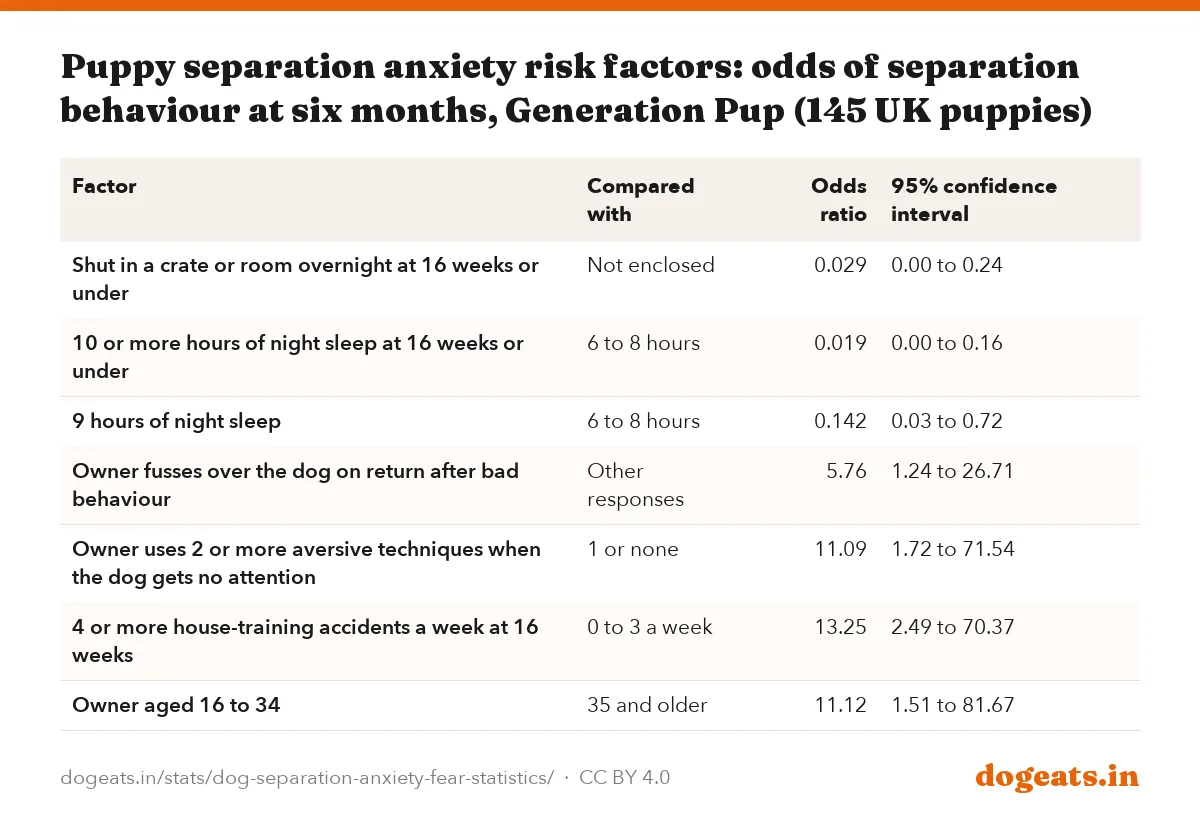
Early life, owner habits and age all show links. Generation Pup followed 145 UK and Irish puppies, reported in Animal Welfare in 2024. Puppies shut in a crate or room overnight at 16 weeks or under had much lower odds of separation behaviour at six months.
Puppies that slept 9 hours or more a night also had lower odds. Puppies whose owners fussed over them on return after bad behaviour were about 6 times as likely to show separation behaviour. So were puppies whose owners used two or more aversive techniques, at about 11 times the odds.
The confidence intervals are wide, and the authors call the results correlational. Breed, sex and where the puppy came from showed no significant link in that sample.
| Factor | Compared with | Odds ratio | 95% confidence interval |
|---|---|---|---|
| Shut in a crate or room overnight at 16 weeks or under | Not enclosed | 0.029 | 0.00 to 0.24 |
| 10 or more hours of night sleep at 16 weeks or under | 6 to 8 hours | 0.019 | 0.00 to 0.16 |
| 9 hours of night sleep | 6 to 8 hours | 0.142 | 0.03 to 0.72 |
| Owner fusses over the dog on return after bad behaviour | Other responses | 5.76 | 1.24 to 26.71 |
| Owner uses 2 or more aversive techniques when the dog gets no attention | 1 or none | 11.09 | 1.72 to 71.54 |
| 4 or more house-training accidents a week at 16 weeks | 0 to 3 a week | 13.25 | 2.49 to 70.37 |
| Owner aged 16 to 34 | 35 and older | 11.12 | 1.51 to 81.67 |
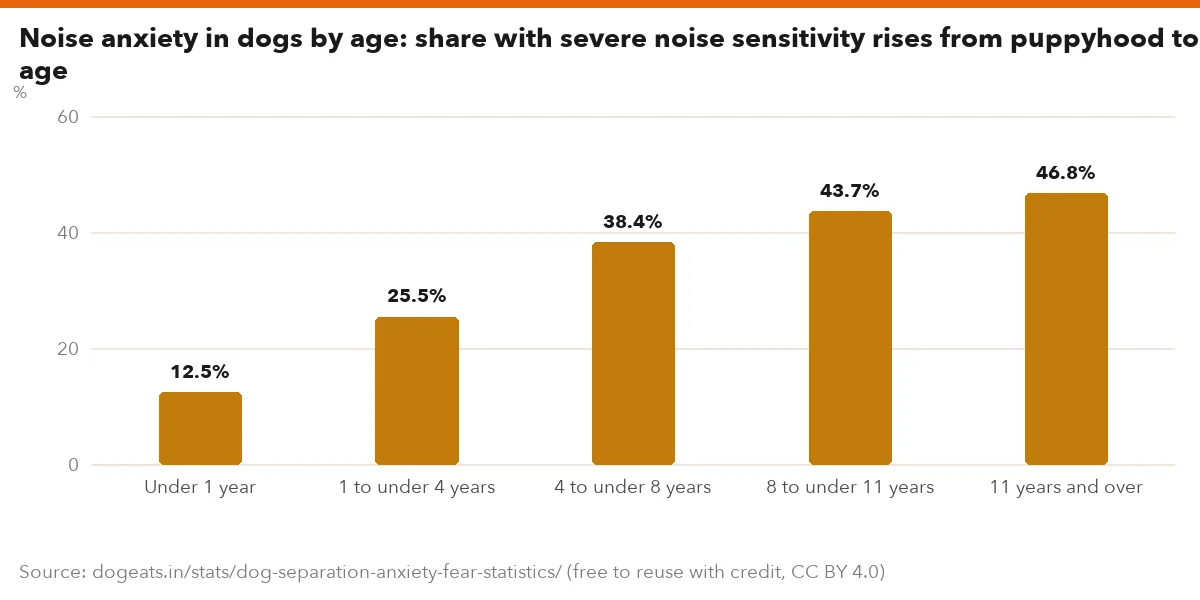
dogeats.in analysis of the Salonen et al. 2020 dataset. The authors report noise sensitivity, especially fear of thunder, increases with age.
Show the numbers
| Label | % |
|---|---|
| Under 1 year | 12.5% |
| 1 to under 4 years | 25.5% |
| 4 to under 8 years | 38.4% |
| 8 to under 11 years | 43.7% |
| 11 years and over | 46.8% |
Embed this chart
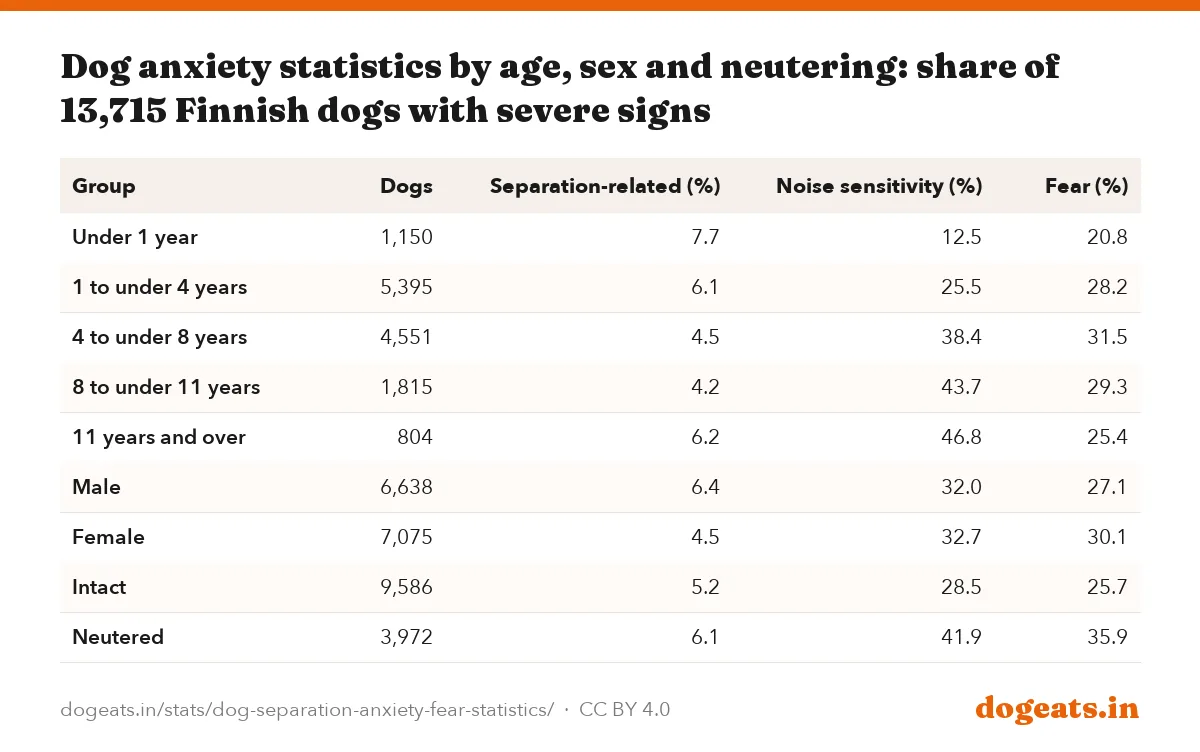
| Group | Dogs | Separation-related (%) | Noise sensitivity (%) | Fear (%) |
|---|---|---|---|---|
| Under 1 year | 1,150 | 7.7 | 12.5 | 20.8 |
| 1 to under 4 years | 5,395 | 6.1 | 25.5 | 28.2 |
| 4 to under 8 years | 4,551 | 4.5 | 38.4 | 31.5 |
| 8 to under 11 years | 1,815 | 4.2 | 43.7 | 29.3 |
| 11 years and over | 804 | 6.2 | 46.8 | 25.4 |
| Male | 6,638 | 6.4 | 32.0 | 27.1 |
| Female | 7,075 | 4.5 | 32.7 | 30.1 |
| Intact | 9,586 | 5.2 | 28.5 | 25.7 |
| Neutered | 3,972 | 6.1 | 41.9 | 35.9 |
Sex and age matter in the Finnish data. Severe separation behaviour was more common in males, 6.4% against 4.5% in females, and highest in dogs under a year, at 7.7%. Noise sensitivity climbed steadily with age.
Older work points the same way. A study cited by dvm360 found dogs in single-adult homes more than twice as likely to have separation anxiety. In the Finnish data, dogs with separation behaviour were 4.1 times as often hyperactive and 2.8 times as often fearful.
Do dogs with separation anxiety have other problems too?
Usually. Storengen and colleagues reviewed 215 dogs diagnosed with separation anxiety at a Norwegian behaviour clinic, reported in 2014. 81.9% had at least one other behaviour problem, and only 18.1% had none.
Of the dogs with other problems, 34% were diagnosed with noise phobia and 32% with fear-related aggression. Male dogs made up 60% of the cases, more than the roughly 50% in the general dog population.
In the Finnish data, 13.4% of dogs with severe separation behaviour showed both destruction or soiling and vocalising when alone. Separation behaviour was most strongly linked with hyperactivity, inattention and compulsive behaviour.
- Separation-related behaviour with hyperactivity or impulsivity: 4.1 times the rate (Salonen 2020).
- Separation-related behaviour with inattention: 3.4 times (Salonen 2020).
- Aggression with fearfulness: 3.2 times (Salonen 2020).
- Separation-related behaviour with fearfulness: 2.8 times (Salonen 2020).
- Separation anxiety with noise phobia: 34% of 215 clinic cases (Storengen 2014).
Because problems cluster, a dog that destroys the door when left may also be reacting to noise or to fear. A vet can check for pain or illness first. Our dog training methods report shows how punishment links to more fear.
Which dog breeds can be left alone in India?
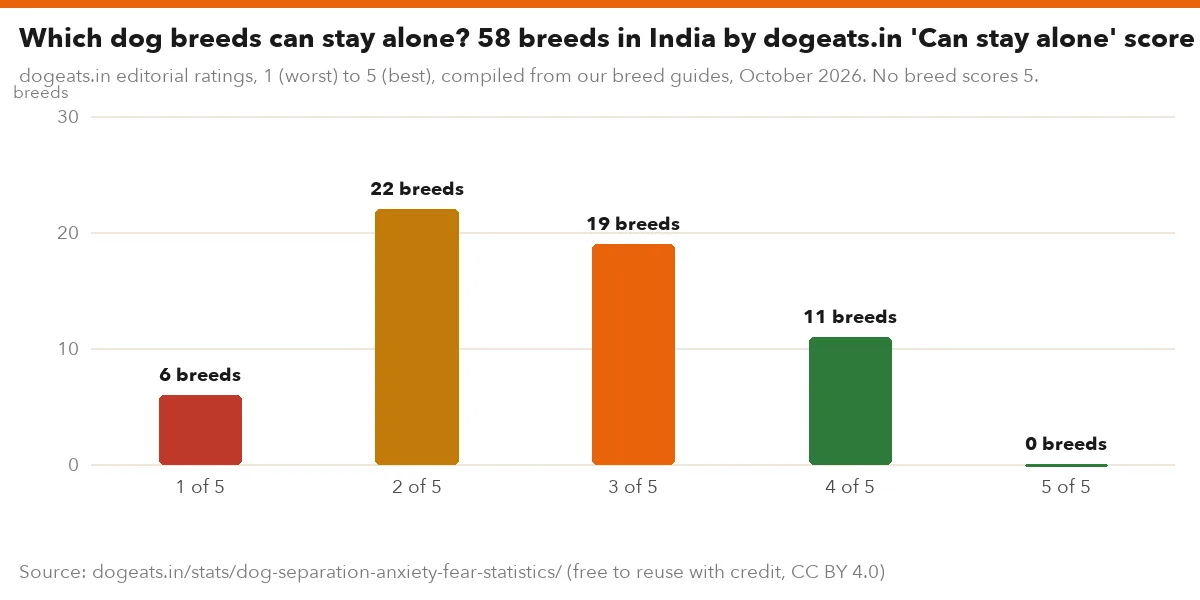
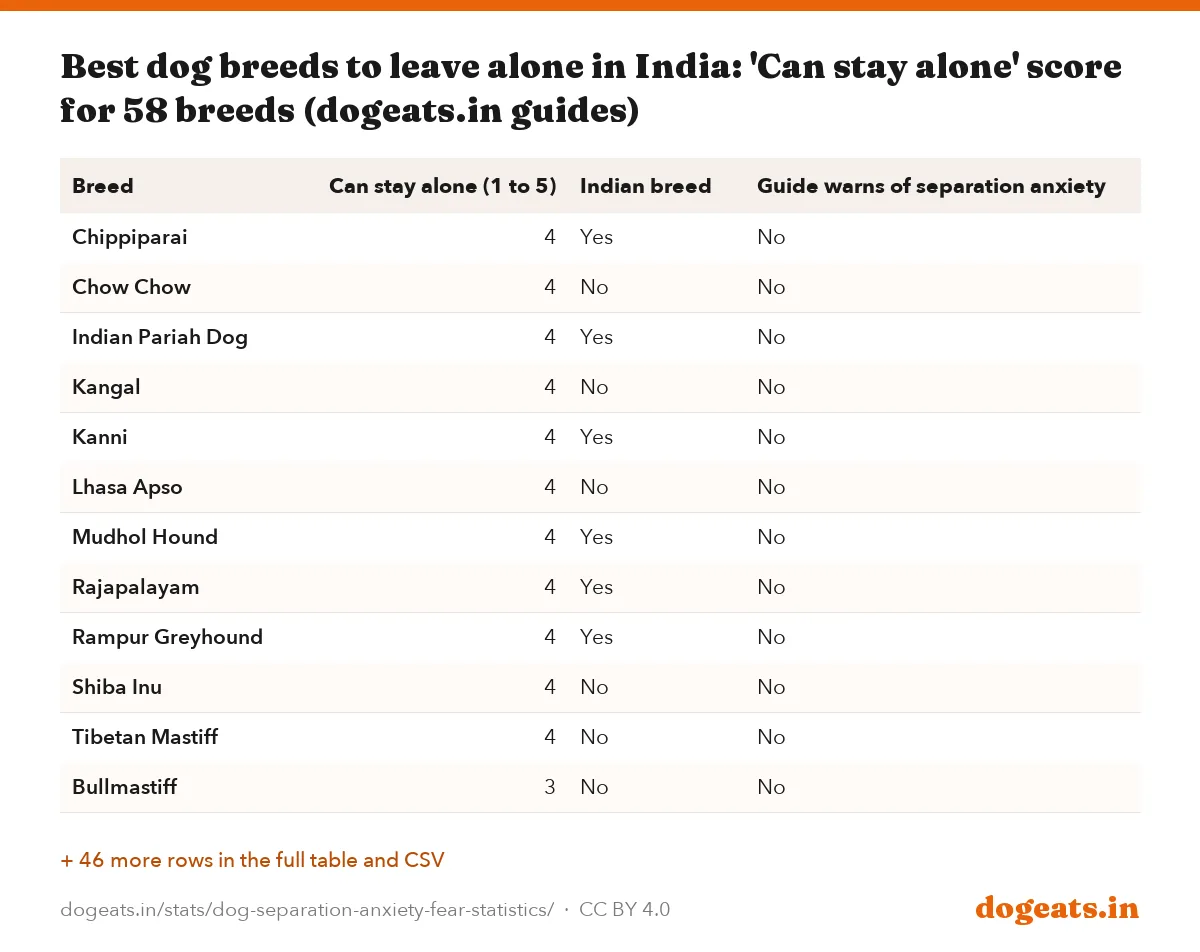
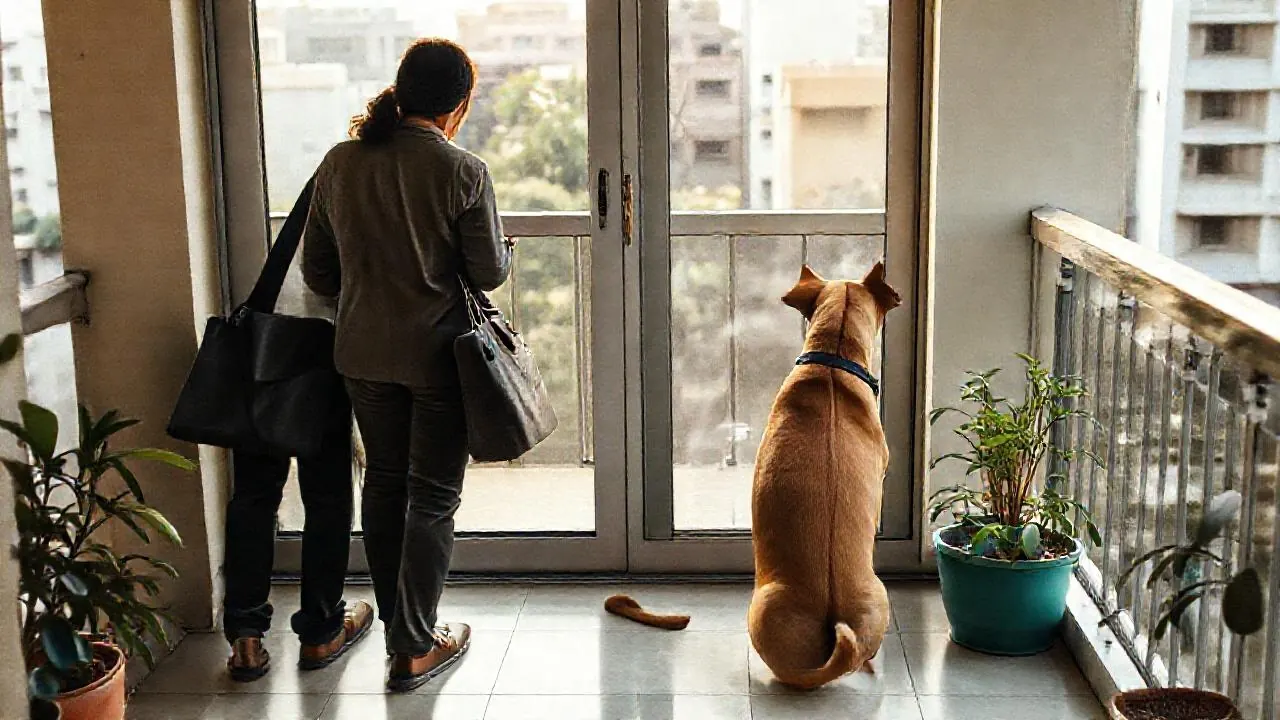
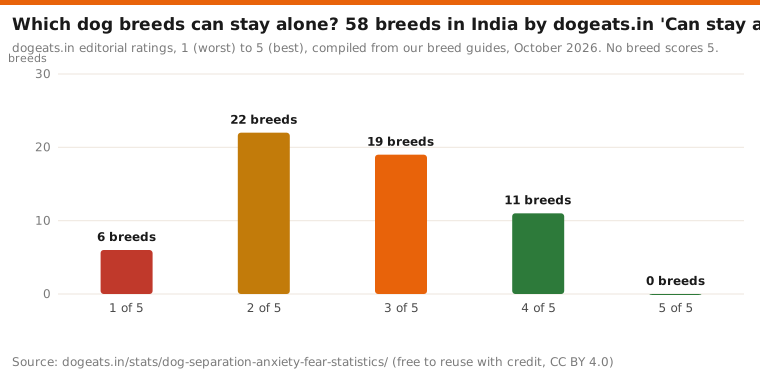
Indian breeds do best on our ratings. The 9 Indian breeds in our guides average 3.7 of 5 on our 'Can stay alone' score, against 2.4 for the other 49. 6 of them, including the Indian Pariah Dog, Mudhol Hound and Rajapalayam, score 4.
No breed scores 5, and 28 of the 58 score 1 or 2. 8 of our guides warn of separation anxiety by name, among them the Labrador Retriever, Cocker Spaniel and Bernese Mountain Dog.
dogeats.in editorial ratings, 1 (worst) to 5 (best), compiled from our breed guides, October 2026. No breed scores 5.
Show the numbers
| Label | breeds |
|---|---|
| 1 of 5 | 6 breeds |
| 2 of 5 | 22 breeds |
| 3 of 5 | 19 breeds |
| 4 of 5 | 11 breeds |
| 5 of 5 | 0 breeds |
Embed this chart
| Breed | Can stay alone (1 to 5) | Indian breed | Guide warns of separation anxiety |
|---|---|---|---|
| Chippiparai | 4 | Yes | No |
| Chow Chow | 4 | No | No |
| Indian Pariah Dog | 4 | Yes | No |
| Kangal | 4 | No | No |
| Kanni | 4 | Yes | No |
| Lhasa Apso | 4 | No | No |
| Mudhol Hound | 4 | Yes | No |
| Rajapalayam | 4 | Yes | No |
| Rampur Greyhound | 4 | Yes | No |
| Shiba Inu | 4 | No | No |
| Tibetan Mastiff | 4 | No | No |
| Bullmastiff | 3 | No | No |
| Bully Kutta | 3 | Yes | No |
| Cane Corso | 3 | No | No |
| Dachshund | 3 | No | No |
| English Bulldog | 3 | No | No |
| English Mastiff | 3 | No | No |
| German Spitz | 3 | No | No |
| Great Dane | 3 | No | Yes |
| Indian Spitz | 3 | Yes | No |
| Japanese Spitz | 3 | No | No |
| Kombai | 3 | Yes | No |
| Pekingese | 3 | No | No |
| Pembroke Welsh Corgi | 3 | No | No |
| Poodle | 3 | No | No |
| Pug | 3 | No | No |
| Rhodesian Ridgeback | 3 | No | No |
| Rottweiler | 3 | No | No |
| Saint Bernard | 3 | No | No |
| Shih Tzu | 3 | No | No |
| American Eskimo Dog | 2 | No | No |
| Australian Shepherd | 2 | No | No |
| Beagle | 2 | No | No |
| Bernese Mountain Dog | 2 | No | Yes |
| Boxer | 2 | No | No |
| Bull Terrier | 2 | No | No |
| Cavalier King Charles Spaniel | 2 | No | Yes |
| Chihuahua | 2 | No | No |
| Cocker Spaniel | 2 | No | Yes |
| Dalmatian | 2 | No | No |
| Doberman | 2 | No | No |
| Dogo Argentino | 2 | No | No |
| French Bulldog | 2 | No | Yes |
| German Shepherd | 2 | No | No |
| Golden Retriever | 2 | No | No |
| Labrador Retriever | 2 | No | Yes |
| Maltese | 2 | No | Yes |
| Miniature Pinscher | 2 | No | No |
| Pit Bull | 2 | No | No |
| Pomeranian | 2 | No | No |
| Samoyed | 2 | No | No |
| Yorkshire Terrier | 2 | No | No |
| Alaskan Malamute | 1 | No | No |
| Belgian Malinois | 1 | No | No |
| Bichon Frise | 1 | No | Yes |
| Border Collie | 1 | No | No |
| Jack Russell Terrier | 1 | No | No |
| Siberian Husky | 1 | No | No |
Indian working days are long. In the MoSPI Time Use Survey 2024, urban residents who did paid work spent 490 minutes a day, about 8 hours 10 minutes, on employment and related activities. Rural workers spent 417 minutes, men 473 and women 341.
More Indians now work outside the home. In 2024, 75% of men and 25% of women aged 15 to 59 took part in employment on the survey day. In 2019 the shares were 70.9% and 21.8%.
For a couple who both work, that can put a dog in the Finnish study's over-8-hours group, which held 19.1% of its dogs. For more on matching a breed to a flat, see our best and worst breeds for flats.
Frequently asked questions
How common is separation anxiety in dogs?
Severe separation-related behaviour affected 5.5% of 13,715 dogs in a 2020 Finnish study. Broader definitions give higher figures: 22.1% of 1,807 UK dogs showed some signs in February 2020, and published estimates range from 6% to 55%.
What are the signs of separation anxiety in dogs?
Studies count barking, howling or whining, pacing, chewing or destroying things, scratching at doors and toileting indoors, but only when the dog is alone. In the Finnish data, 3.7% of dogs destroyed things or urinated when alone and 2.5% vocalised, salivated or panted.
Which dog breeds have the most separation anxiety?
In the Finnish dataset, mixed-breed dogs had the highest share at 8.1%, then the Soft-Coated Wheaten Terrier and Spanish Water Dog. Staffordshire Bull Terriers were lowest at 1.5%.
Which dogs can be left alone during office hours in India?
On dogeats.in ratings, 11 of 58 breeds score 4 of 5 for staying alone, including the Indian Pariah Dog, Mudhol Hound, Rajapalayam and Shiba Inu. No breed scores 5, and 28 score 1 or 2.
How long can a dog be left alone?
Studies do not give a safe number. In Finnish data, dogs left over 8 hours had severe separation behaviour at 5.9%, no higher than dogs left under 3 hours. Sudden changes in routine raised the risk in a UK study.
What is the most common fear in dogs?
Noise. 32.4% of 13,715 Finnish dogs were severely sensitive to at least one noise, and fear of fireworks alone affected 25.8%.
Did lockdown cause separation anxiety in dogs?
Partly. In a UK cohort of 1,807 dogs, 9.9% of dogs that were clear before lockdown showed new signs by October 2020, especially dogs whose time alone fell the most.
Do male dogs get separation anxiety more than females?
Slightly. In the Finnish data, 6.4% of males and 4.5% of females showed severe separation behaviour, and 60% of 215 Norwegian clinic cases were male.
When should I see a vet about my dog's anxiety?
See a vet if your dog destroys things, soils the house, howls or hurts itself when alone, or panics at noise. Problems often cluster: 81.9% of 215 dogs diagnosed with separation anxiety had another behaviour problem.
Methodology and limitations
We read the full text and supplementary tables of Salonen et al. 2020 through Europe PMC on 16 October 2026 and downloaded its public dataset of 13,715 dogs. Breed, age, sex, neutering, time-alone and exercise shares were computed in Python. As in the paper, a dog counts as affected if its trait was rated high, and the denominator is all dogs in the group.
Our computed totals match the paper's: 748 dogs with separation behaviour, 4,440 with noise sensitivity and 3,929 with fear. Breed groups are the 14 breeds the authors analysed separately, plus mixed breeds, each with at least 200 dogs.
UK figures come from the full texts of Harvey et al. 2022 and Dale et al. 2024. Storengen 2014 figures come from summaries by dvm360 and Faunalytics, and Dinwoodie 2019 from its Mendeley dataset page. Indian work-time figures come from the MoSPI Time Use Survey 2024 press note of 25 February 2025. Breed scores are dogeats.in editorial ratings from 1 to 5, compiled from our breed guides, October 2026.
Sources
- Salonen et al., Prevalence, comorbidity, and breed differences in canine anxiety in 13,700 Finnish pet dogs, Scientific Reports 2020;10:2962, with supplementary tables and dataset, Trait and subtrait prevalence, comorbidity, public dataset used for breed, age, sex and time-alone shares
- Harvey, Christley, Giragosian, Mead, Murray, Samet, Upjohn and Casey, Impact of Changes in Time Left Alone on Separation-Related Behaviour in UK Pet Dogs, Animals 2022;12(4):482, 1,807 dogs, 22.1% to 17.2%, 9.9% new cases, transitions
- Dale, Burn, Murray and Casey, Canine separation-related behaviour at six months of age, Animal Welfare 2024;33, 145 puppies, odds ratios, 6% to 55% range of estimates
- Also consulted: dvm360, Are you home yet? Diagnosing separation anxiety in dogs (28 August 2020), on Storengen et al. 2014 and earlier studies, Faunalytics summary of Storengen et al., A descriptive study of 215 dogs diagnosed with separation anxiety, Applied Animal Behaviour Science 2014;159:82-89, MoSPI, Time Use Survey 2024 press note (25 February 2025), Dinwoodie et al., Data for: Demographics and Comorbidity of Behavior Problems in Dogs, Mendeley Data (Journal of Veterinary Behavior 2019;32:62-71), Salonen et al. 2020 supplementary files via Europe PMC, Mills et al., Changes in Dog Behaviour Associated with the COVID-19 Lockdown, Pre-Existing Separation-Related Problems and Alterations in Routine, Veterinary Sciences 2023.
Cite, embed and download
This report, its data and its images are free to reuse under a Creative Commons Attribution 4.0 licence. Credit dogeats.in with a link to this page. Every chart has its own embed code, every table has a CSV and an image download, and the images below are ready for social posts, slides and articles.
Cite this report
Link to this report
Every chart and table as an image