Data report · Updated October 2026
Dog Aggression by Breed: What Large Studies Actually Show, and What They Cannot Tell You
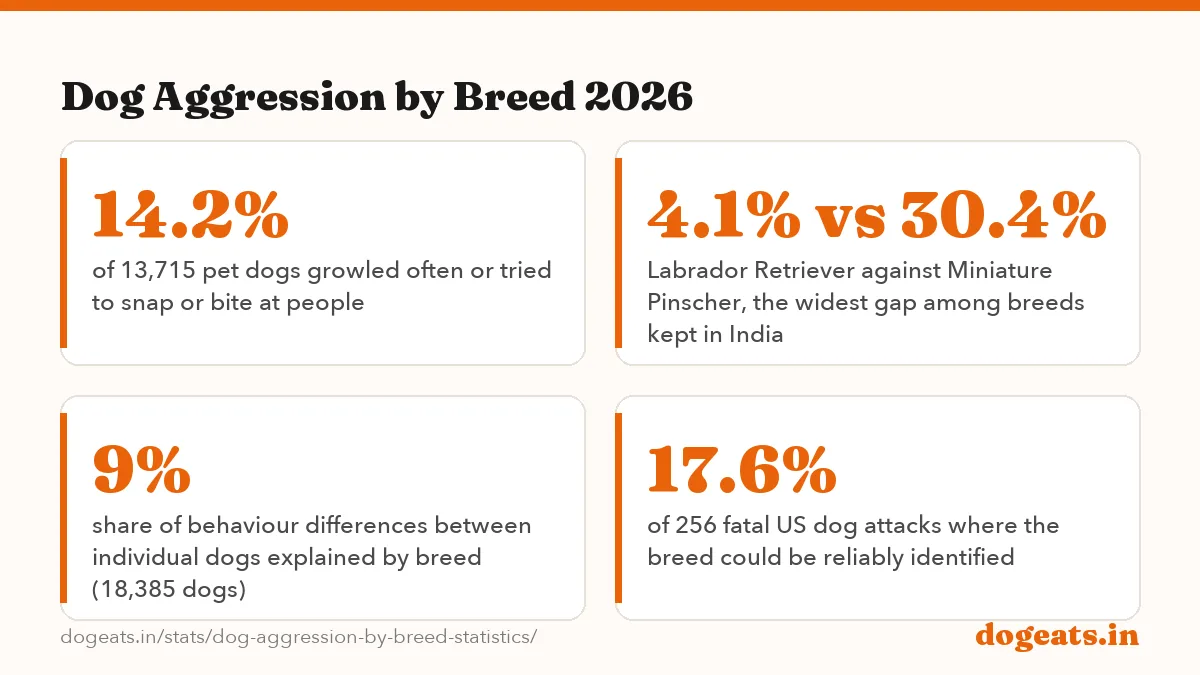
In the largest open dataset, owners reported frequent aggression toward people in 14.2% of 13,715 Finnish pet dogs, from 4.1% of Labradors to 30.4% of Miniature Pinschers. Breed explains only about 9% of behaviour in individual dogs, while fearful dogs were 3.2 times as likely to be aggressive. No study ranks Indian breeds or street dogs, and bite counts cannot rank breeds.
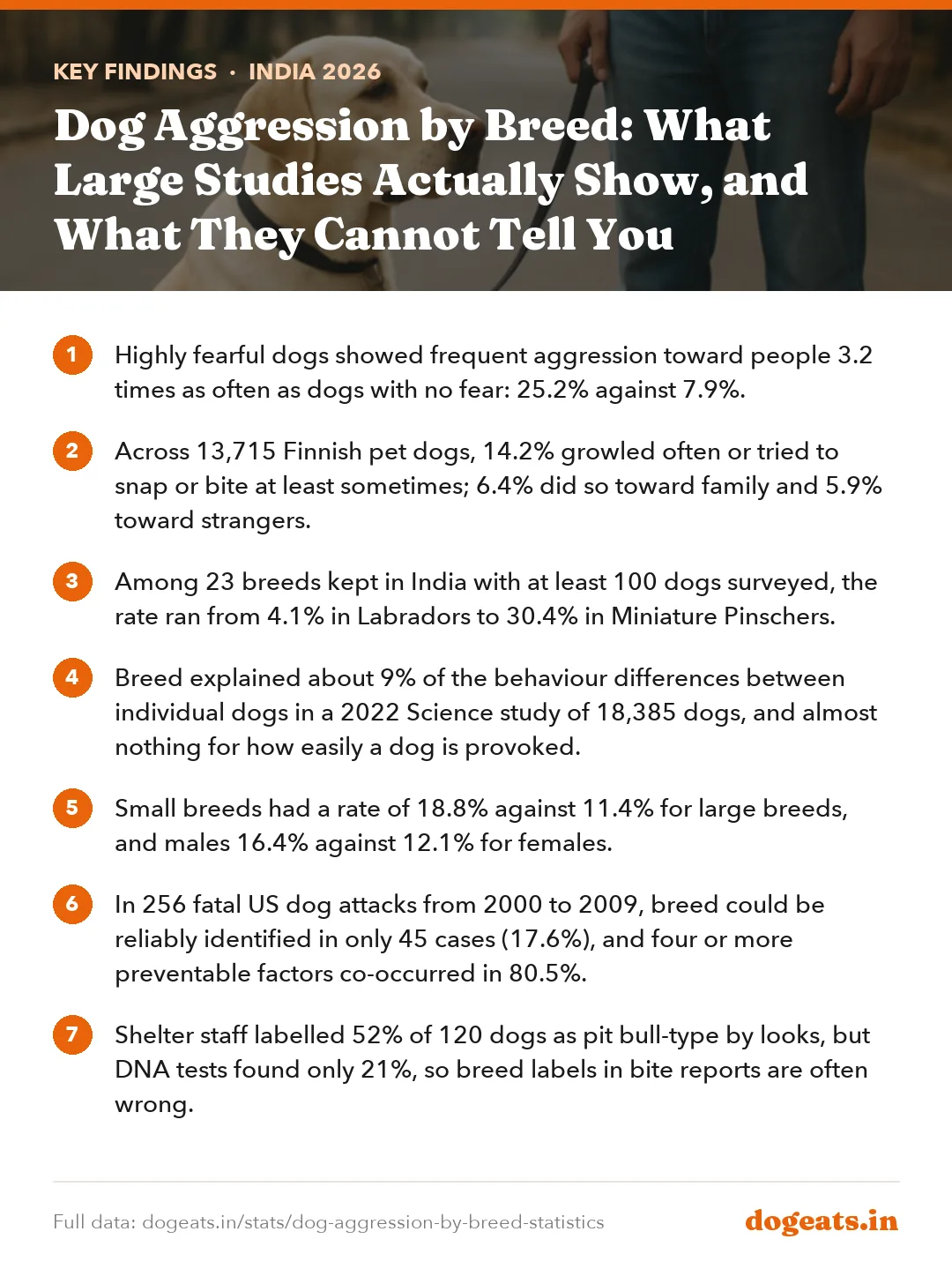
Key findings
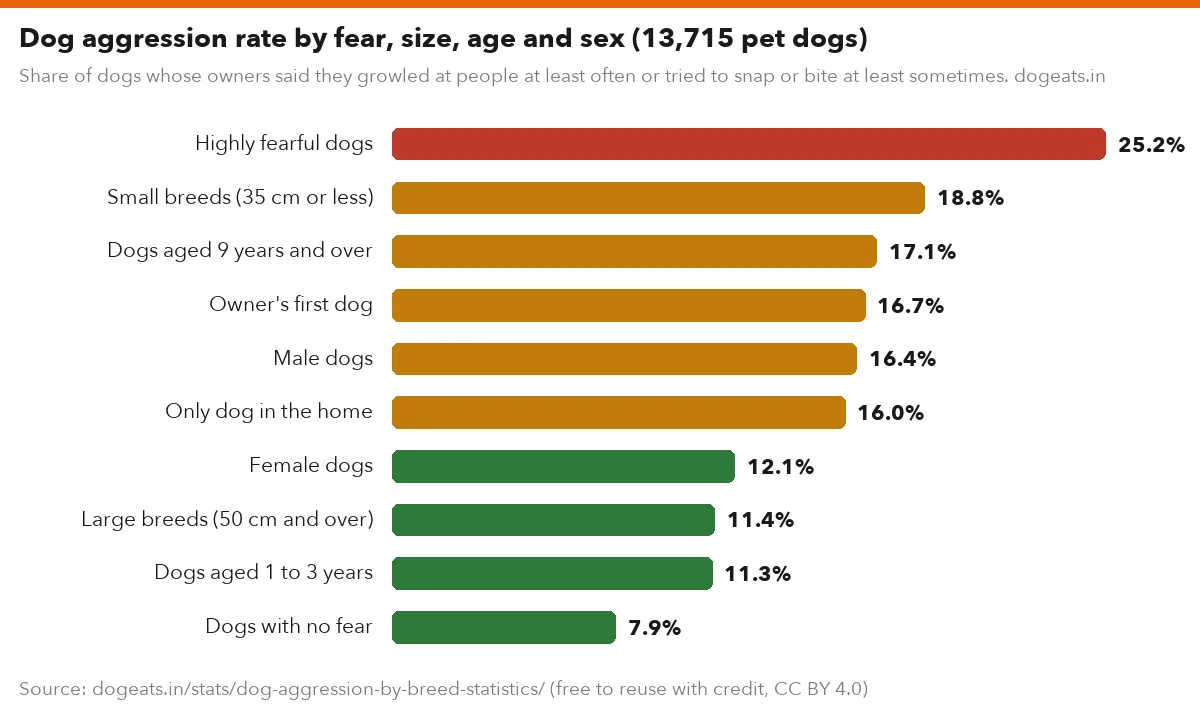
- Highly fearful dogs showed frequent aggression toward people 3.2 times as often as dogs with no fear: 25.2% against 7.9%.
- Across 13,715 Finnish pet dogs, 14.2% growled often or tried to snap or bite at least sometimes; 6.4% did so toward family and 5.9% toward strangers.
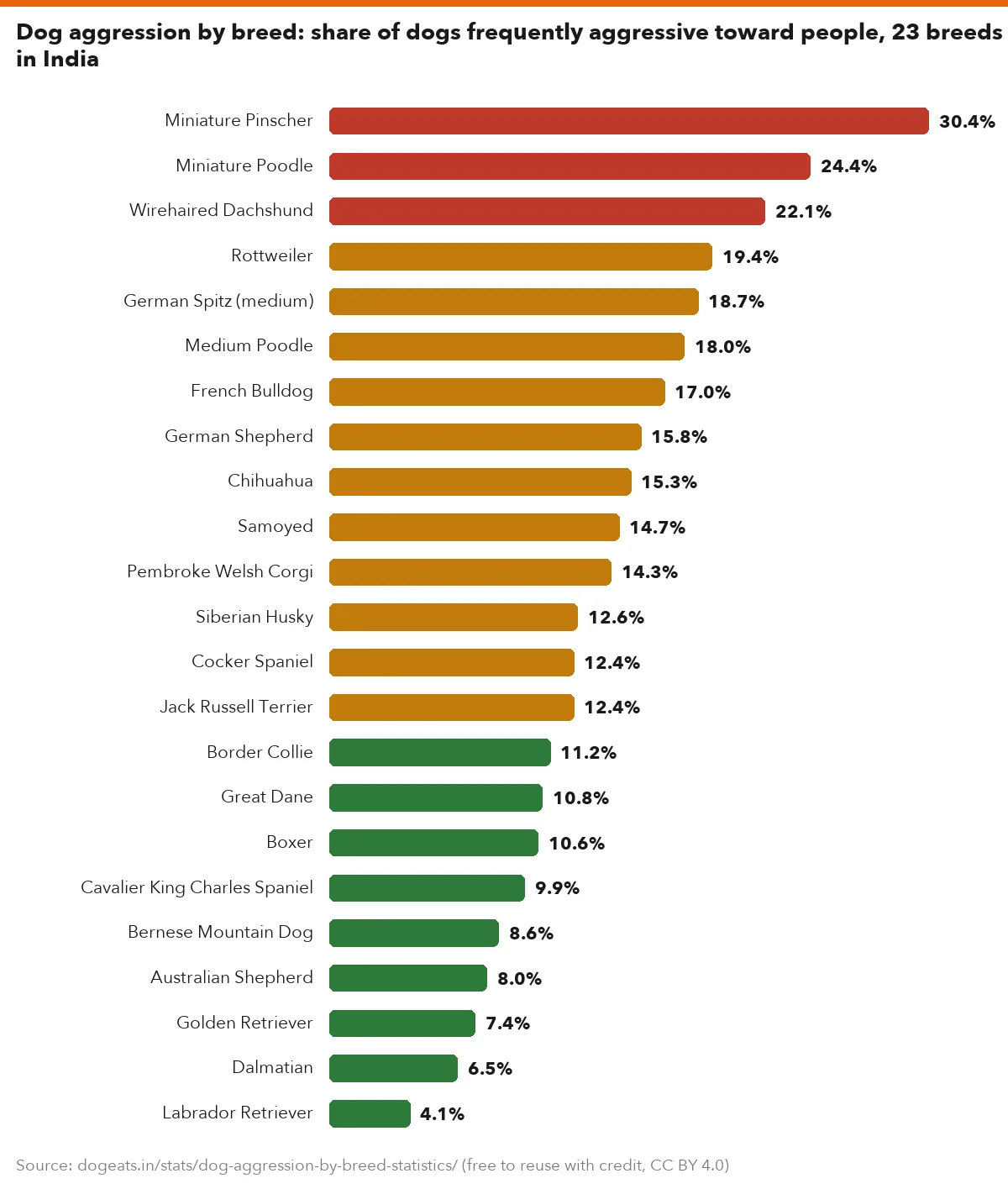
- Among 23 breeds kept in India with at least 100 dogs surveyed, the rate ran from 4.1% in Labradors to 30.4% in Miniature Pinschers.
- Breed explained about 9% of the behaviour differences between individual dogs in a 2022 Science study of 18,385 dogs, and almost nothing for how easily a dog is provoked.
- Small breeds had a rate of 18.8% against 11.4% for large breeds, and males 16.4% against 12.1% for females.
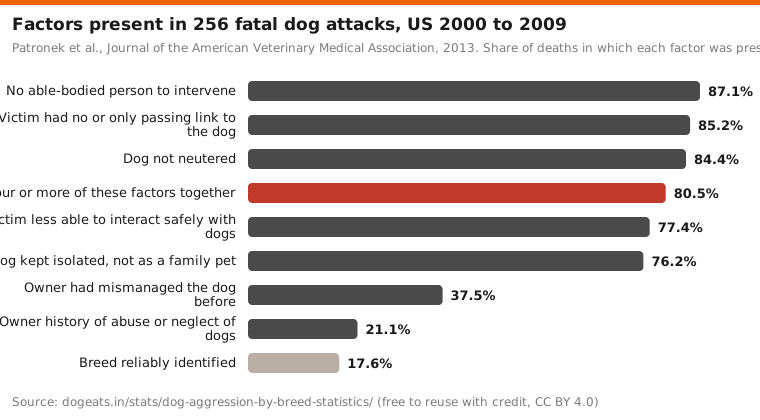
- In 256 fatal US dog attacks from 2000 to 2009, breed could be reliably identified in only 45 cases (17.6%), and four or more preventable factors co-occurred in 80.5%.
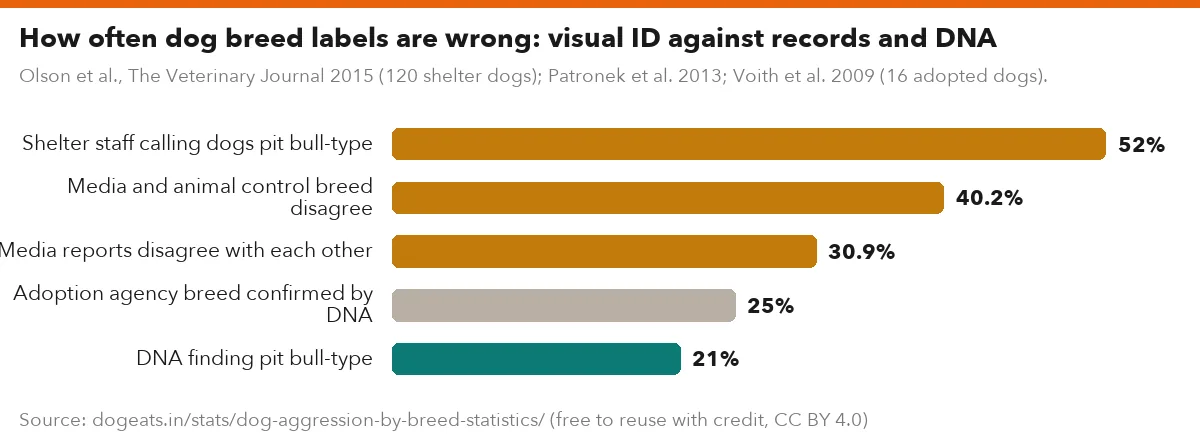
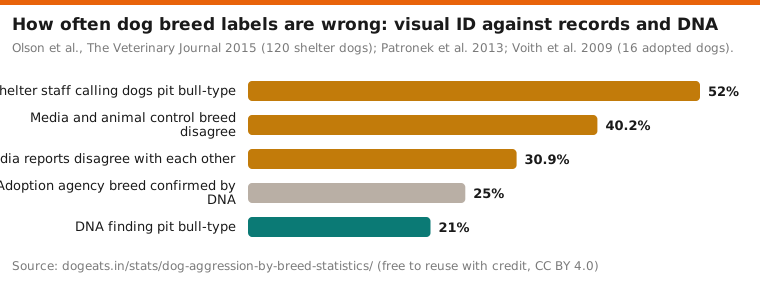
- Shelter staff labelled 52% of 120 dogs as pit bull-type by looks, but DNA tests found only 21%, so breed labels in bite reports are often wrong.
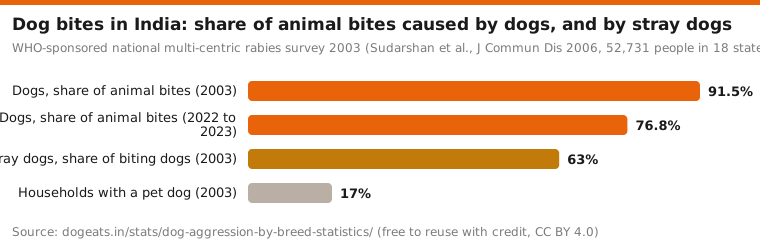
- India logged 37,15,713 dog bite cases in 2024 on the IDSP portal, or about 10,150 a day, and a 2003 WHO-backed survey found 63% of biting dogs were strays.
What makes a dog aggressive? Fear, size and sex beat breed
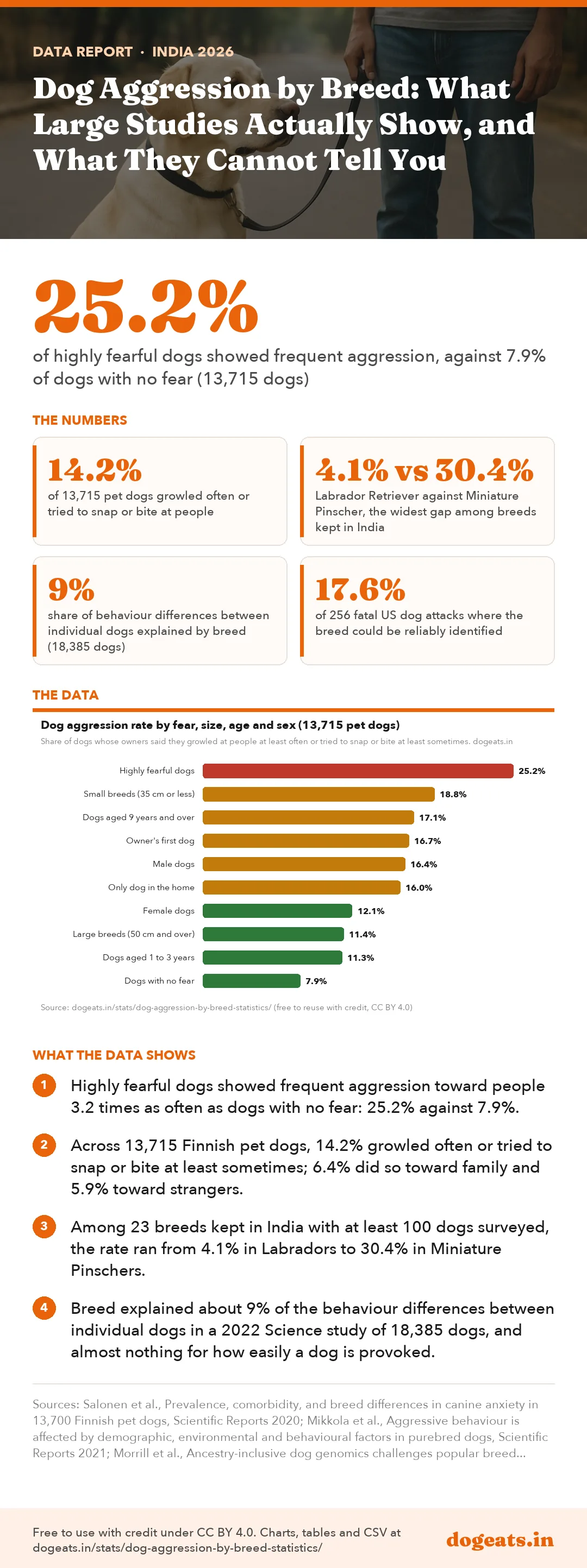
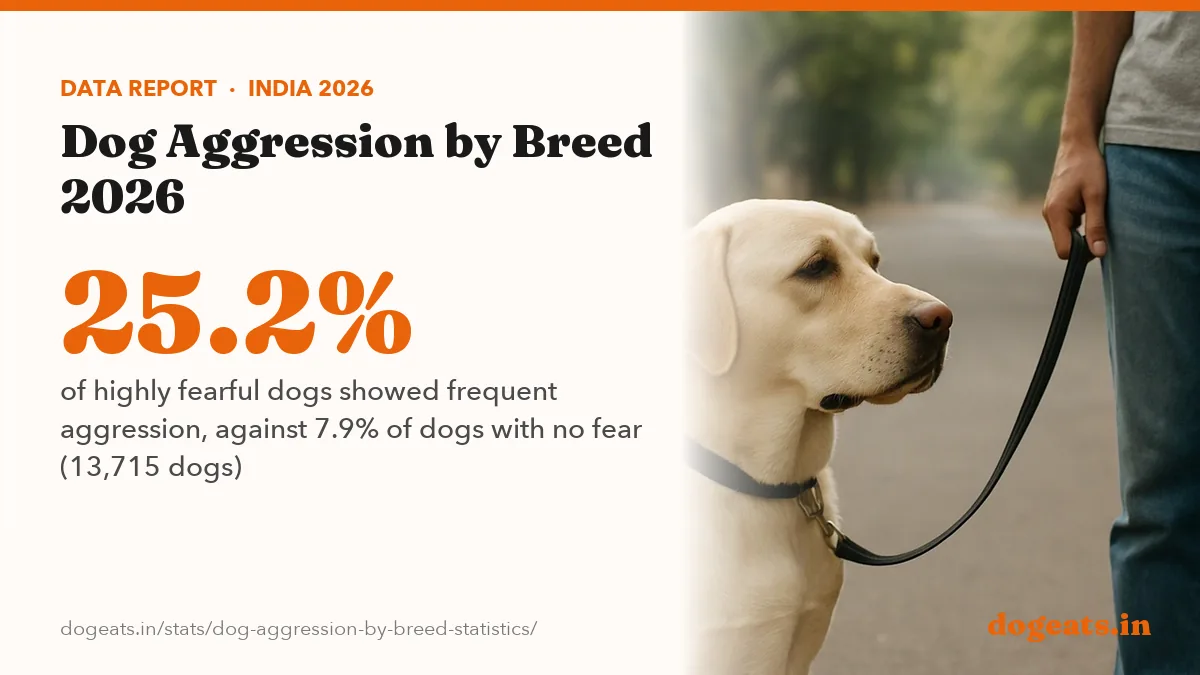
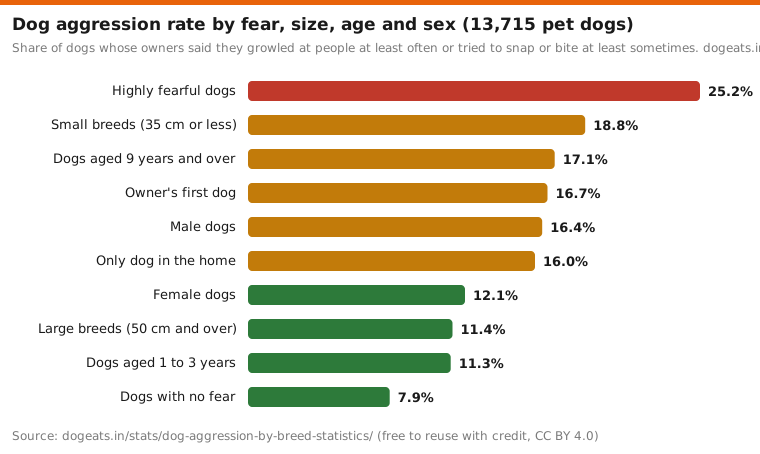
Fear is the strongest single marker of aggression in the large studies. In the Finnish dataset of 13,715 pet dogs, 25.2% of highly fearful dogs showed frequent aggression toward people. Among dogs with no fear the figure was 7.9%.
Size and sex follow. Small breeds had a rate of 18.8% against 11.4% in large breeds, or 1.65 times as high. Males came in at 16.4% and females at 12.1%.
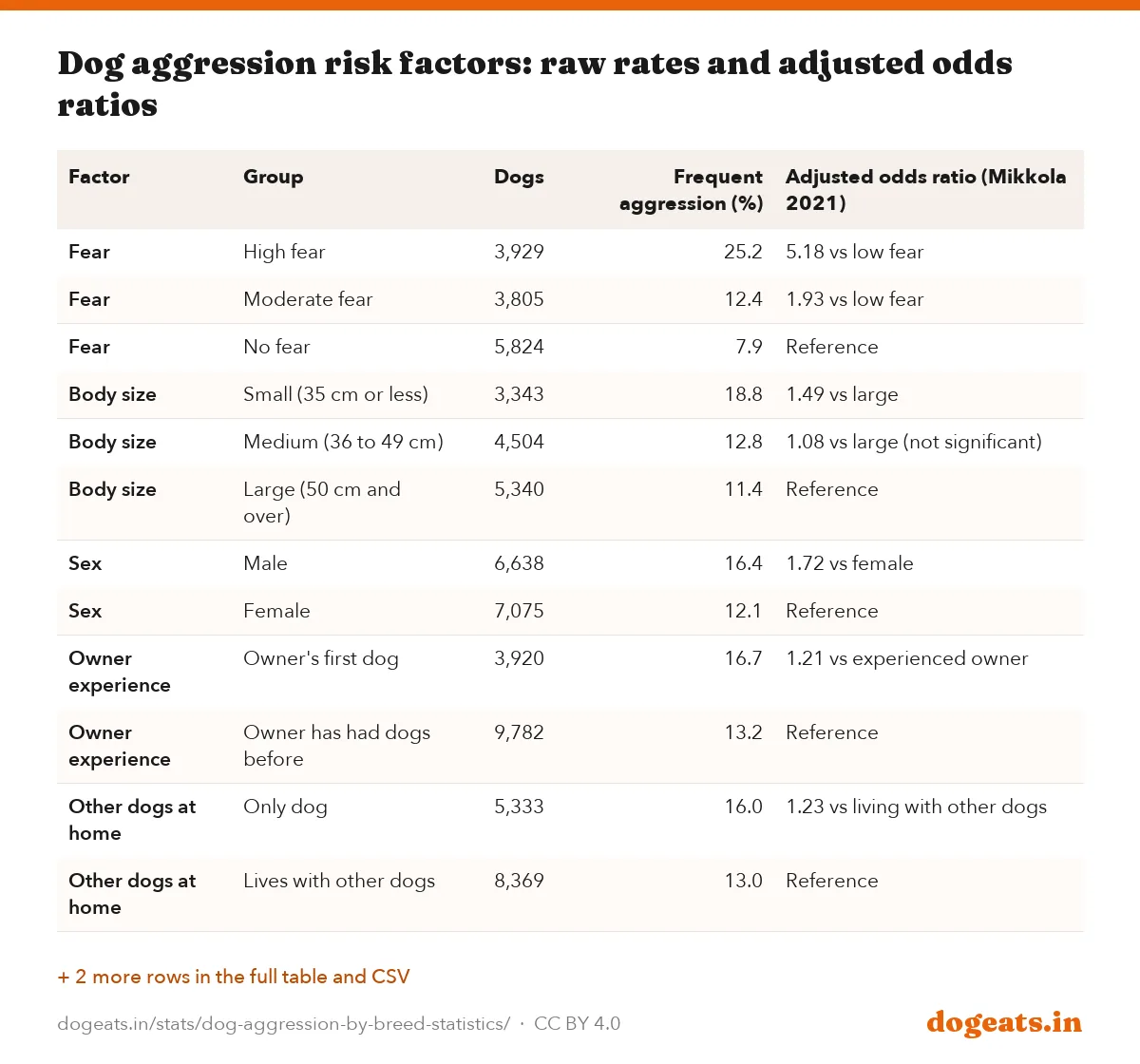
The same team modelled 9,270 of these dogs in 2021 and held each factor constant in turn. Highly fearful dogs had 5.18 times the odds of aggression of non-fearful dogs. Males had 1.72 times the odds of females.
Share of dogs whose owners said they growled at people at least often or tried to snap or bite at least sometimes. dogeats.in calculation from the open dataset of Salonen et al., Scientific Reports 2020.
Show the numbers
| Label | % |
|---|---|
| Highly fearful dogs | 25.2% |
| Small breeds (35 cm or less) | 18.8% |
| Dogs aged 9 years and over | 17.1% |
| Owner's first dog | 16.7% |
| Male dogs | 16.4% |
| Only dog in the home | 16.0% |
| Female dogs | 12.1% |
| Large breeds (50 cm and over) | 11.4% |
| Dogs aged 1 to 3 years | 11.3% |
| Dogs with no fear | 7.9% |
Embed this chart
| Factor | Group | Dogs | Frequent aggression (%) | Adjusted odds ratio (Mikkola 2021) |
|---|---|---|---|---|
| Fear | High fear | 3,929 | 25.2 | 5.18 vs low fear |
| Fear | Moderate fear | 3,805 | 12.4 | 1.93 vs low fear |
| Fear | No fear | 5,824 | 7.9 | Reference |
| Body size | Small (35 cm or less) | 3,343 | 18.8 | 1.49 vs large |
| Body size | Medium (36 to 49 cm) | 4,504 | 12.8 | 1.08 vs large (not significant) |
| Body size | Large (50 cm and over) | 5,340 | 11.4 | Reference |
| Sex | Male | 6,638 | 16.4 | 1.72 vs female |
| Sex | Female | 7,075 | 12.1 | Reference |
| Owner experience | Owner's first dog | 3,920 | 16.7 | 1.21 vs experienced owner |
| Owner experience | Owner has had dogs before | 9,782 | 13.2 | Reference |
| Other dogs at home | Only dog | 5,333 | 16.0 | 1.23 vs living with other dogs |
| Other dogs at home | Lives with other dogs | 8,369 | 13.0 | Reference |
| Neutering | Neutered or spayed | 3,972 | 18.4 | Dropped from final model |
| Neutering | Intact | 9,586 | 12.5 | Dropped from final model |
The neutering gap needs care. Owners often neuter a dog because it is already difficult, so the raw rate cannot show cause. Neutering status did not make it into the 2021 model.
Which dog breeds are the most aggressive?
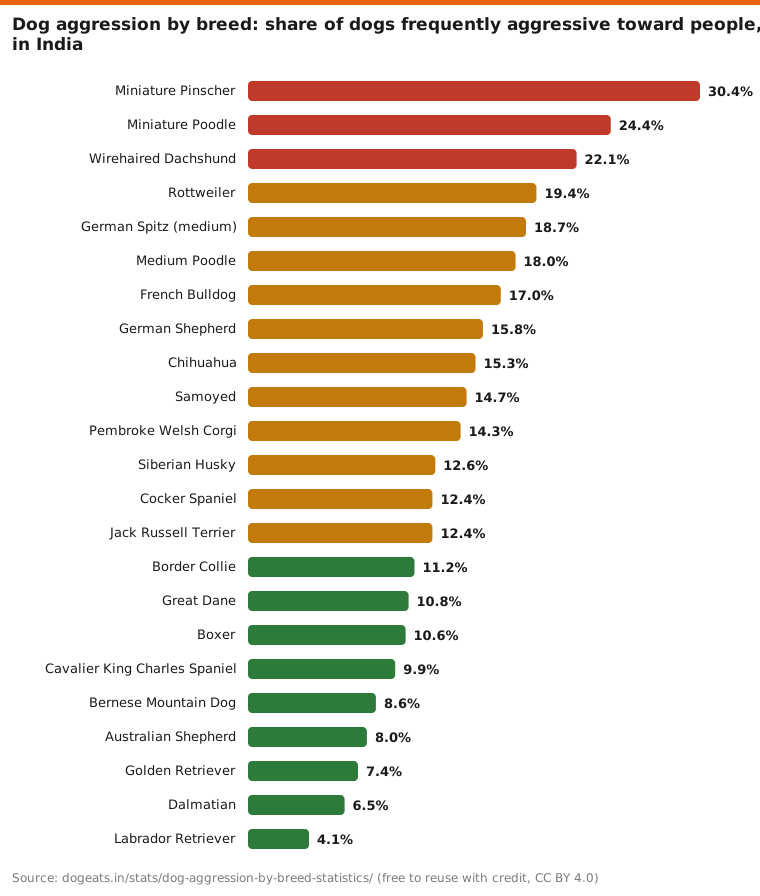
On owner reports, small terriers and toy breeds sit near the top, and retrievers sit at the bottom. Among 23 breeds kept in India with at least 100 dogs in the Finnish data, the Miniature Pinscher had the highest rate at 30.4%. The Labrador Retriever had the lowest at 4.1%.
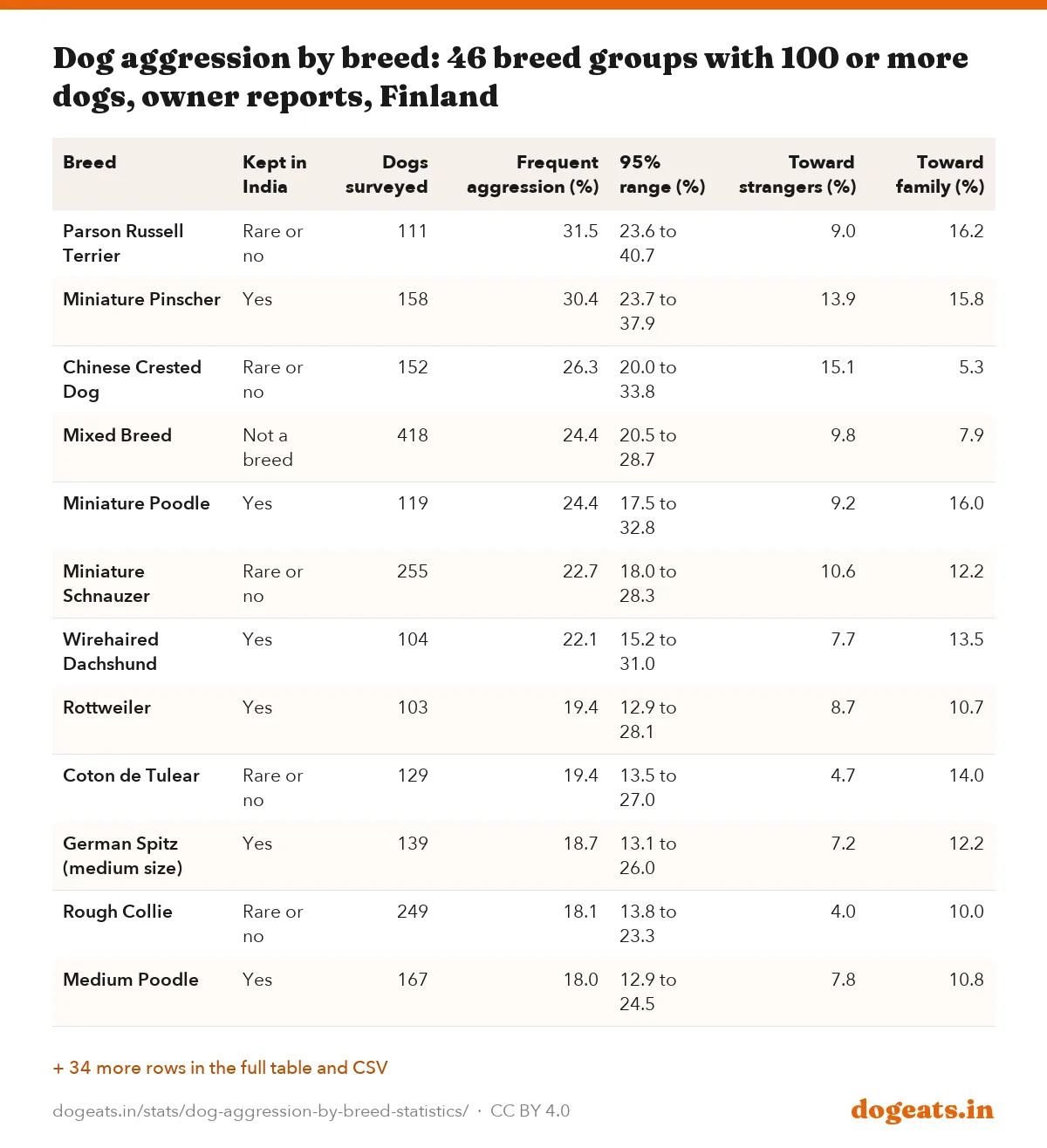
Across all 46 breed groups with 100 or more dogs, the Parson Russell Terrier topped the list at 31.5%. Mixed-breed dogs came in at 24.4%, above most pure breeds. Many of them were rescues with unknown early lives.
The guarding breeds people fear most did not lead. The Rottweiler came in at 19.4% and the German Shepherd at 15.8%. The American Staffordshire Terrier, a pit bull-type breed, came in at 9.9%.
Owner reports for Finnish pet dogs, breeds with 100 or more dogs. dogeats.in calculation from the open dataset of Salonen et al. 2020. Wirehaired Dachshund stands in for Dachshund; German Spitz is the FCI Medium Size Spitz; poodle sizes are shown separately.
Show the numbers
| Label | % |
|---|---|
| Miniature Pinscher | 30.4% |
| Miniature Poodle | 24.4% |
| Wirehaired Dachshund | 22.1% |
| Rottweiler | 19.4% |
| German Spitz (medium) | 18.7% |
| Medium Poodle | 18.0% |
| French Bulldog | 17.0% |
| German Shepherd | 15.8% |
| Chihuahua | 15.3% |
| Samoyed | 14.7% |
| Pembroke Welsh Corgi | 14.3% |
| Siberian Husky | 12.6% |
| Cocker Spaniel | 12.4% |
| Jack Russell Terrier | 12.4% |
| Border Collie | 11.2% |
| Great Dane | 10.8% |
| Boxer | 10.6% |
| Cavalier King Charles Spaniel | 9.9% |
| Bernese Mountain Dog | 8.6% |
| Australian Shepherd | 8.0% |
| Golden Retriever | 7.4% |
| Dalmatian | 6.5% |
| Labrador Retriever | 4.1% |
Embed this chart
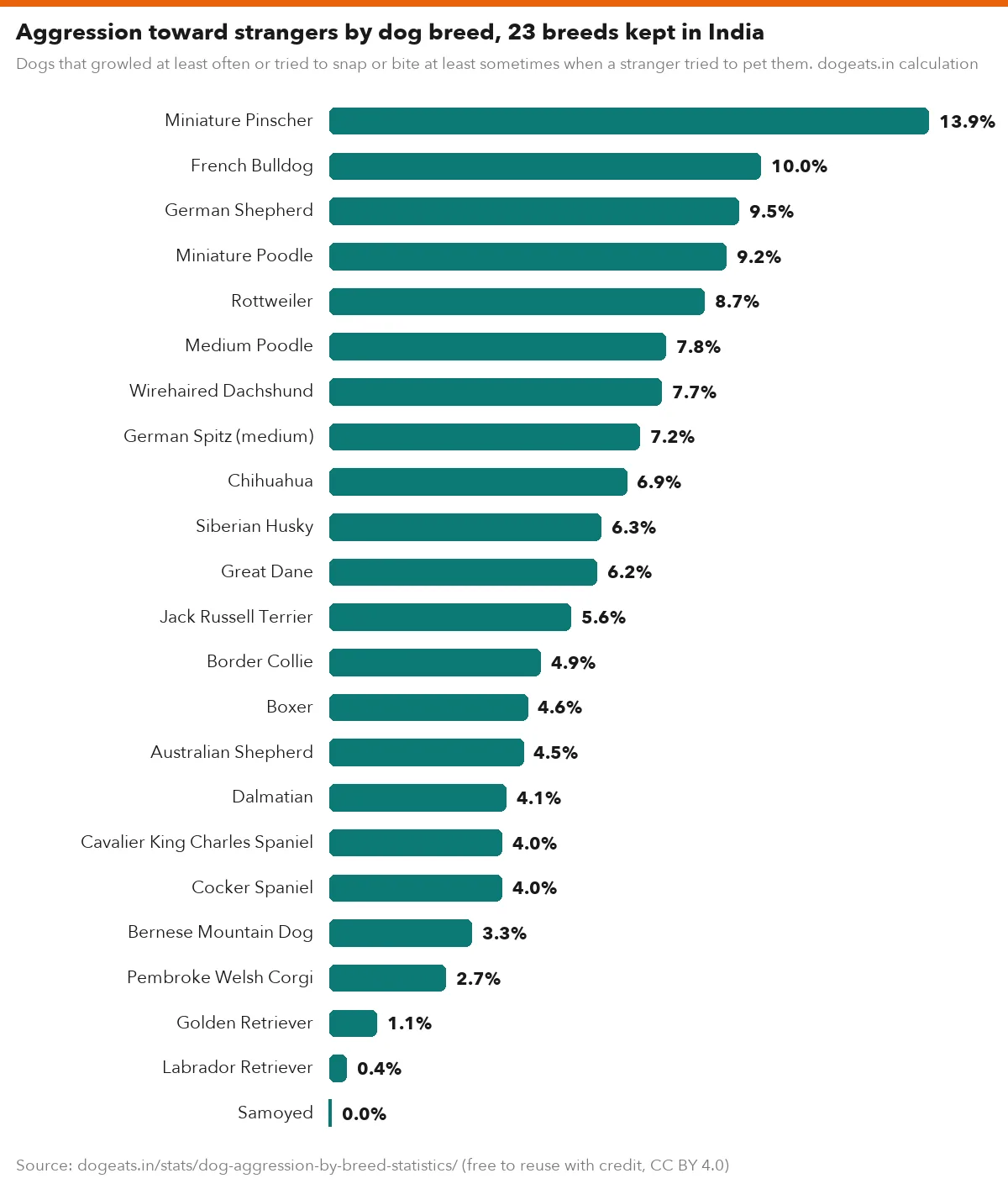
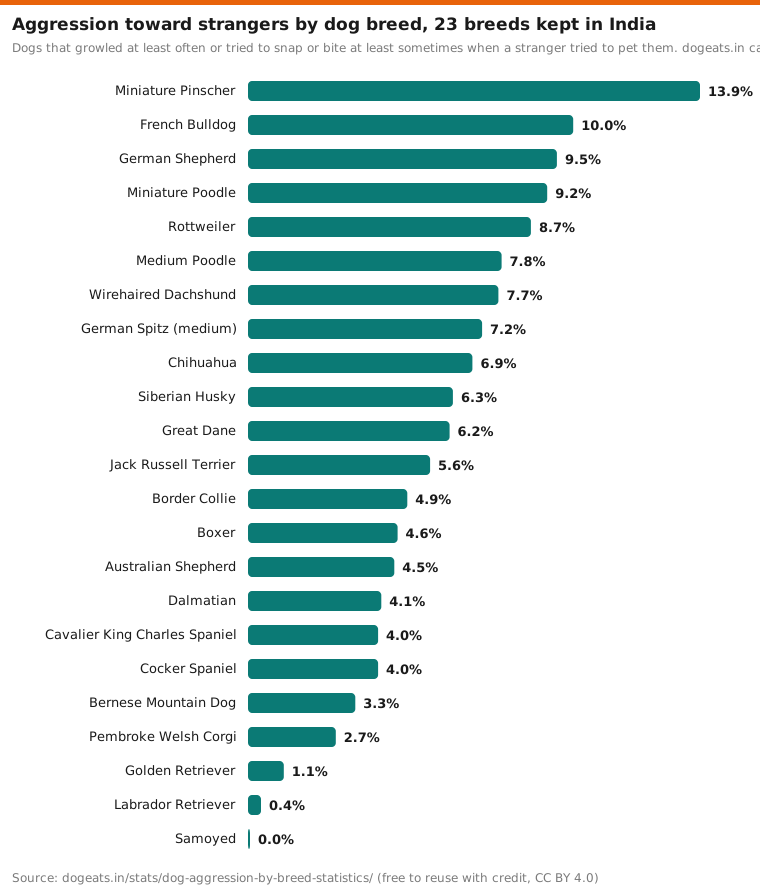
Dogs that growled at least often or tried to snap or bite at least sometimes when a stranger tried to pet them. dogeats.in calculation from Salonen et al. 2020 data.
Show the numbers
| Label | % |
|---|---|
| Miniature Pinscher | 13.9% |
| French Bulldog | 10.0% |
| German Shepherd | 9.5% |
| Miniature Poodle | 9.2% |
| Rottweiler | 8.7% |
| Medium Poodle | 7.8% |
| Wirehaired Dachshund | 7.7% |
| German Spitz (medium) | 7.2% |
| Chihuahua | 6.9% |
| Siberian Husky | 6.3% |
| Great Dane | 6.2% |
| Jack Russell Terrier | 5.6% |
| Border Collie | 4.9% |
| Boxer | 4.6% |
| Australian Shepherd | 4.5% |
| Dalmatian | 4.1% |
| Cavalier King Charles Spaniel | 4.0% |
| Cocker Spaniel | 4.0% |
| Bernese Mountain Dog | 3.3% |
| Pembroke Welsh Corgi | 2.7% |
| Golden Retriever | 1.1% |
| Labrador Retriever | 0.4% |
| Samoyed | 0.0% |
Embed this chart
Stranger-directed and family-directed aggression rank breeds differently. The German Shepherd had 9.5% toward strangers but only 3.5% toward family. The Miniature Poodle showed the reverse, with 16.0% toward family.
Only 169 dogs, or 8.7% of the aggressive ones, were aggressive toward both groups. Treat stranger aggression and family aggression as two separate problems.
Dog aggression statistics by breed: the full table with error ranges
The table lists every breed group with 100 or more dogs, 46 rows in all. The 95% range shows how far each rate could move by chance alone. Small samples give wide ranges.
Many neighbouring breeds overlap. The Chihuahua (15.3%) and German Shepherd (15.8%) have ranges that cross, so the data cannot separate them. Only big gaps, such as Labrador against Miniature Pinscher, stand up.
| Breed | Kept in India | Dogs surveyed | Frequent aggression (%) | 95% range (%) | Toward strangers (%) | Toward family (%) |
|---|---|---|---|---|---|---|
| Parson Russell Terrier | Rare or no | 111 | 31.5 | 23.6 to 40.7 | 9.0 | 16.2 |
| Miniature Pinscher | Yes | 158 | 30.4 | 23.7 to 37.9 | 13.9 | 15.8 |
| Chinese Crested Dog | Rare or no | 152 | 26.3 | 20.0 to 33.8 | 15.1 | 5.3 |
| Mixed Breed | Not a breed | 418 | 24.4 | 20.5 to 28.7 | 9.8 | 7.9 |
| Miniature Poodle | Yes | 119 | 24.4 | 17.5 to 32.8 | 9.2 | 16.0 |
| Miniature Schnauzer | Rare or no | 255 | 22.7 | 18.0 to 28.3 | 10.6 | 12.2 |
| Wirehaired Dachshund | Yes | 104 | 22.1 | 15.2 to 31.0 | 7.7 | 13.5 |
| Rottweiler | Yes | 103 | 19.4 | 12.9 to 28.1 | 8.7 | 10.7 |
| Coton de Tulear | Rare or no | 129 | 19.4 | 13.5 to 27.0 | 4.7 | 14.0 |
| German Spitz (medium size) | Yes | 139 | 18.7 | 13.1 to 26.0 | 7.2 | 12.2 |
| Rough Collie | Rare or no | 249 | 18.1 | 13.8 to 23.3 | 4.0 | 10.0 |
| Medium Poodle | Yes | 167 | 18.0 | 12.9 to 24.5 | 7.8 | 10.8 |
| French Bulldog | Yes | 100 | 17.0 | 10.9 to 25.5 | 10.0 | 7.0 |
| Lagotto Romagnolo | Rare or no | 248 | 16.5 | 12.4 to 21.7 | 4.4 | 12.1 |
| Other Breed | Not a breed | 1,685 | 16.4 | 14.7 to 18.2 | 7.8 | 5.8 |
| Spanish Water Dog | Rare or no | 251 | 16.3 | 12.3 to 21.4 | 8.4 | 4.4 |
| Hovawart | Rare or no | 117 | 16.2 | 10.6 to 24.0 | 7.7 | 6.0 |
| Cairn Terrier | Rare or no | 105 | 16.2 | 10.4 to 24.4 | 3.8 | 12.4 |
| German Shepherd | Yes | 461 | 15.8 | 12.8 to 19.4 | 9.5 | 3.5 |
| Chihuahua | Yes | 131 | 15.3 | 10.1 to 22.4 | 6.9 | 9.2 |
| Samoyed | Yes | 109 | 14.7 | 9.2 to 22.5 | 0.0 | 10.1 |
| Wheaten Terrier | Rare or no | 351 | 14.5 | 11.2 to 18.6 | 4.3 | 8.3 |
| Pembroke Welsh Corgi | Yes | 112 | 14.3 | 9.0 to 22.0 | 2.7 | 10.7 |
| Tibetan Terrier | Rare or no | 104 | 13.5 | 8.2 to 21.3 | 3.8 | 9.6 |
| Nova Scotia Duck Tolling Retriever | Rare or no | 149 | 12.8 | 8.3 to 19.1 | 1.3 | 6.7 |
| Siberian Husky | Yes | 111 | 12.6 | 7.7 to 20.1 | 6.3 | 6.3 |
| Cocker Spaniel | Yes | 177 | 12.4 | 8.4 to 18.1 | 4.0 | 7.9 |
| Jack Russell Terrier | Yes | 177 | 12.4 | 8.4 to 18.1 | 5.6 | 4.0 |
| Border Terrier | Rare or no | 123 | 11.4 | 6.9 to 18.2 | 4.1 | 3.3 |
| Border Collie | Yes | 268 | 11.2 | 8.0 to 15.5 | 4.9 | 5.2 |
| Finnish Lapponian Dog | Rare or no | 538 | 11.2 | 8.8 to 14.1 | 3.5 | 7.4 |
| Great Dane | Yes | 130 | 10.8 | 6.5 to 17.3 | 6.2 | 2.3 |
| Boxer | Yes | 151 | 10.6 | 6.6 to 16.5 | 4.6 | 4.6 |
| White Swiss Shepherd | Rare or no | 148 | 10.1 | 6.2 to 16.0 | 6.1 | 2.0 |
| American Staffordshire Terrier | Rare or no | 141 | 9.9 | 6.0 to 16.0 | 5.0 | 0.7 |
| Cavalier King Charles Spaniel | Yes | 101 | 9.9 | 5.5 to 17.3 | 4.0 | 4.0 |
| Staffordshire Bull Terrier | Rare or no | 200 | 9.5 | 6.2 to 14.4 | 2.5 | 2.5 |
| Bernese Mountain Dog | Yes | 209 | 8.6 | 5.5 to 13.2 | 3.3 | 5.7 |
| Shetland Sheepdog | Rare or no | 411 | 8.5 | 6.2 to 11.6 | 2.9 | 4.4 |
| Lapponian Herder | Rare or no | 294 | 8.5 | 5.8 to 12.3 | 4.1 | 1.0 |
| Smooth Collie | Rare or no | 203 | 8.4 | 5.3 to 13.0 | 2.5 | 3.0 |
| Australian Shepherd | Yes | 176 | 8.0 | 4.8 to 12.9 | 4.5 | 1.7 |
| Golden Retriever | Yes | 176 | 7.4 | 4.4 to 12.2 | 1.1 | 4.5 |
| Dalmatian | Yes | 123 | 6.5 | 3.3 to 12.3 | 4.1 | 1.6 |
| Whippet | Rare or no | 169 | 5.9 | 3.2 to 10.5 | 2.4 | 0.6 |
| Labrador Retriever | Yes | 465 | 4.1 | 2.6 to 6.3 | 0.4 | 3.2 |
Does breed still matter once fear and size are counted?
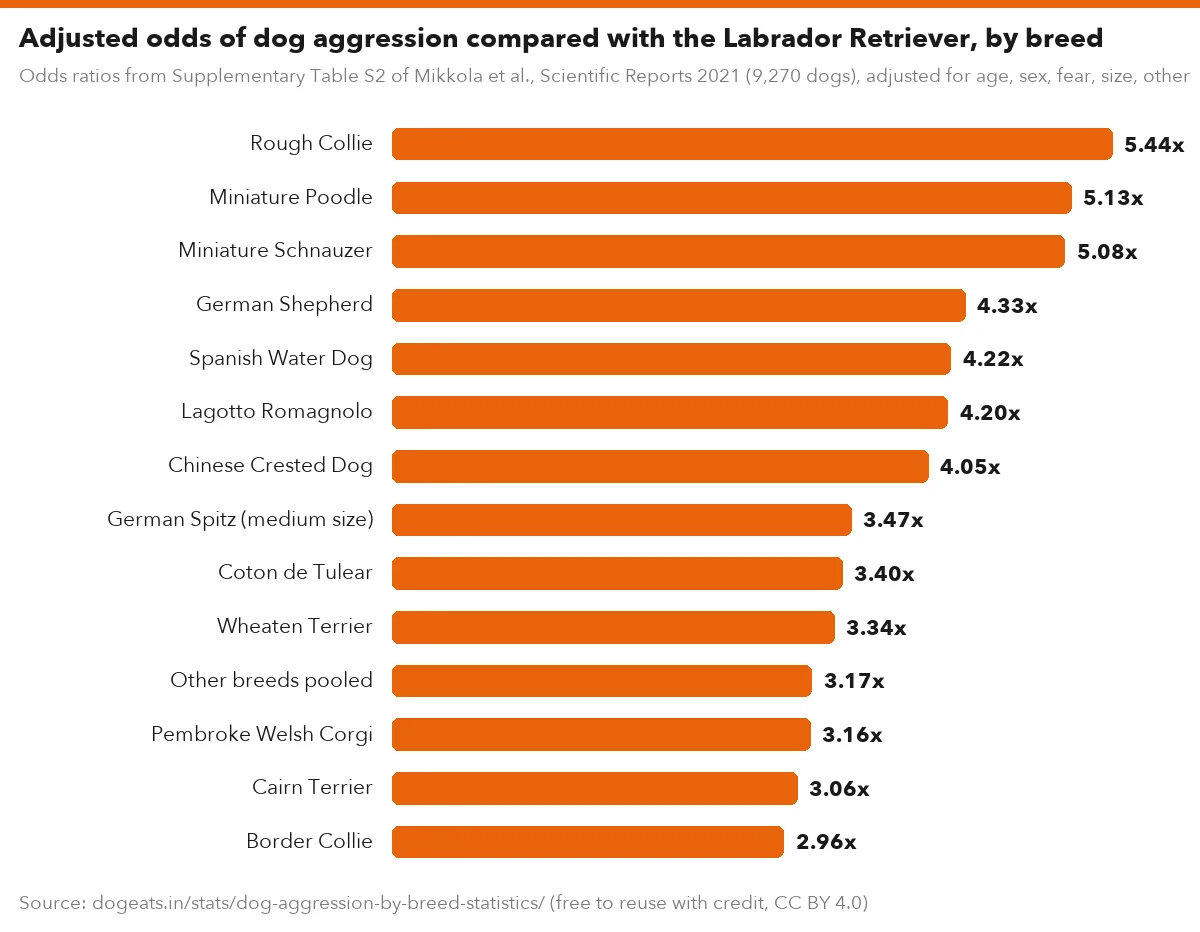
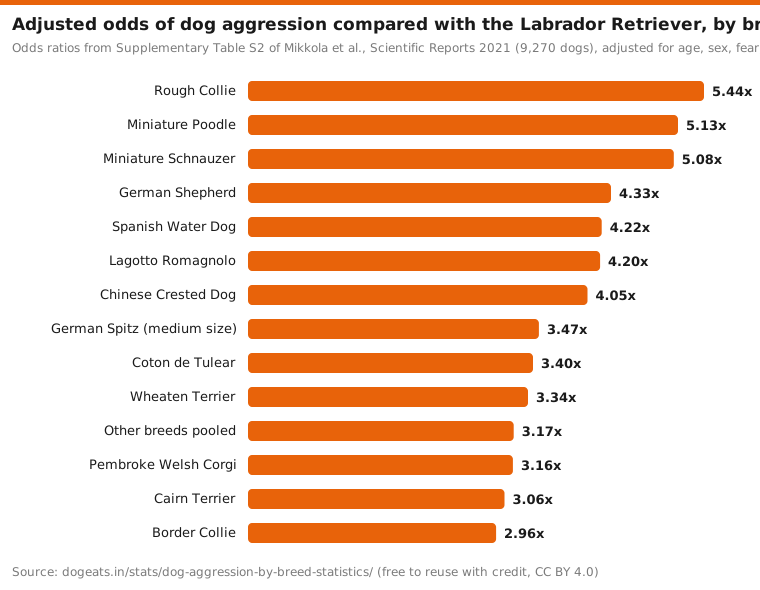
Yes, but the order shifts. The 2021 model of 9,270 Finnish purebreds compared dogs of the same age, sex, fear level, size and household. Rough Collies, Miniature Poodles and Miniature Schnauzers then had the highest odds of aggression.
Labradors, Golden Retrievers and Lapponian Herders had the lowest. A Rough Collie had 5.44 times the odds of a Labrador, the widest gap in the study.
The whole model, with breed included, predicted aggression only moderately well. Its accuracy score (AUC) was 0.74, where 0.5 is a coin toss and 1.0 is perfect.
Odds ratios from Supplementary Table S2 of Mikkola et al., Scientific Reports 2021 (9,270 dogs), adjusted for age, sex, fear, size, other dogs and owner experience. Where the paper lists the Labrador first, dogeats.in took the reciprocal.
Show the numbers
| Label | x |
|---|---|
| Rough Collie | 5.44x |
| Miniature Poodle | 5.13x |
| Miniature Schnauzer | 5.08x |
| German Shepherd | 4.33x |
| Spanish Water Dog | 4.22x |
| Lagotto Romagnolo | 4.20x |
| Chinese Crested Dog | 4.05x |
| German Spitz (medium size) | 3.47x |
| Coton de Tulear | 3.40x |
| Wheaten Terrier | 3.34x |
| Other breeds pooled | 3.17x |
| Pembroke Welsh Corgi | 3.16x |
| Cairn Terrier | 3.06x |
| Border Collie | 2.96x |
Embed this chart
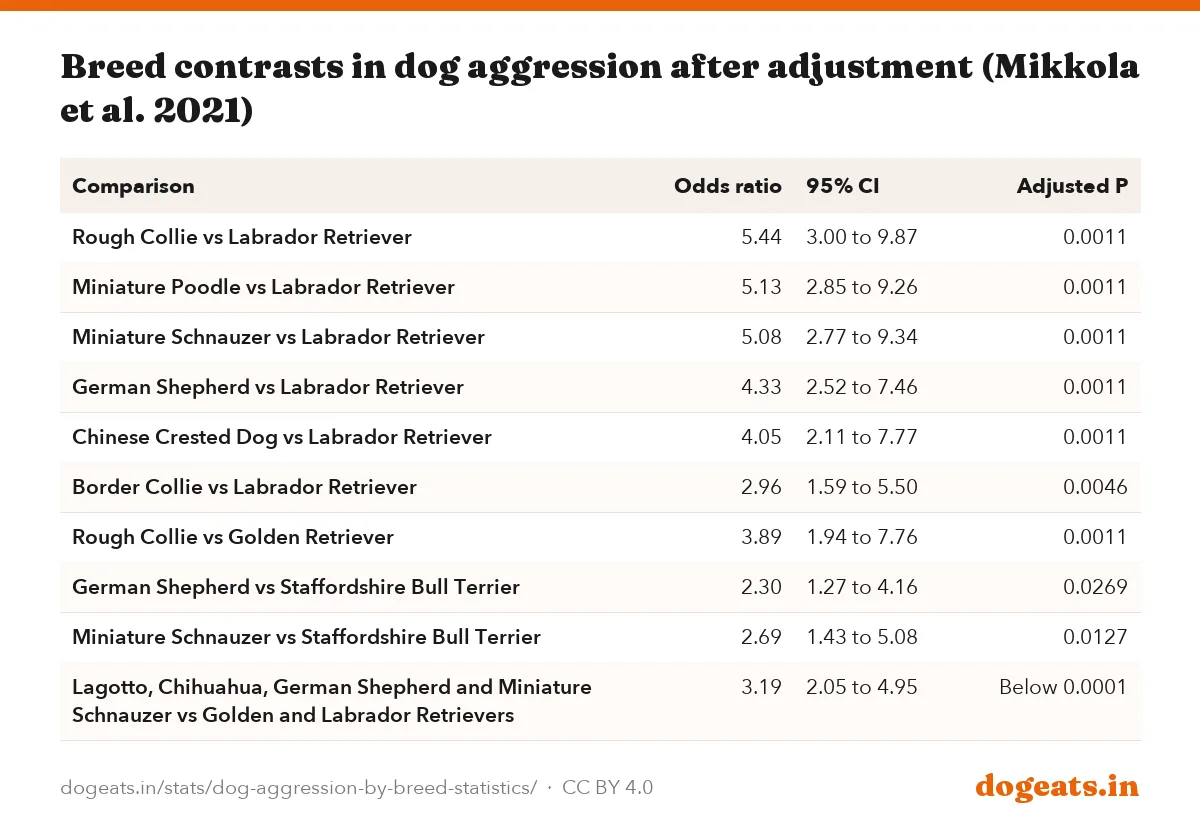
| Comparison | Odds ratio | 95% CI | Adjusted P |
|---|---|---|---|
| Rough Collie vs Labrador Retriever | 5.44 | 3.00 to 9.87 | 0.0011 |
| Miniature Poodle vs Labrador Retriever | 5.13 | 2.85 to 9.26 | 0.0011 |
| Miniature Schnauzer vs Labrador Retriever | 5.08 | 2.77 to 9.34 | 0.0011 |
| German Shepherd vs Labrador Retriever | 4.33 | 2.52 to 7.46 | 0.0011 |
| Chinese Crested Dog vs Labrador Retriever | 4.05 | 2.11 to 7.77 | 0.0011 |
| Border Collie vs Labrador Retriever | 2.96 | 1.59 to 5.50 | 0.0046 |
| Rough Collie vs Golden Retriever | 3.89 | 1.94 to 7.76 | 0.0011 |
| German Shepherd vs Staffordshire Bull Terrier | 2.30 | 1.27 to 4.16 | 0.0269 |
| Miniature Schnauzer vs Staffordshire Bull Terrier | 2.69 | 1.43 to 5.08 | 0.0127 |
| Lagotto, Chihuahua, German Shepherd and Miniature Schnauzer vs Golden and Labrador Retrievers | 3.19 | 2.05 to 4.95 | Below 0.0001 |
Reciprocals in the table use the exact ratios printed in the paper, so 1 divided by 0.195 gives 5.13 for the Miniature Poodle. The confidence limits are converted the same way.
Is dog aggression genetic or learned?
Both. Most dog behaviour traits are more than 25% heritable, according to a 2022 study in Science that surveyed owners of 18,385 dogs and genotyped 2,155. Yet breed explained only about 9% of behaviour differences between individual dogs.
Aggression-type traits were the weakest link to breed. The trait the authors call agonistic threshold measures how easily a dog is provoked by frightening or uncomfortable things. For that trait, they found breed almost uninformative.
A 2019 study of more than 14,000 dogs from 101 breeds found that breed averages for 14 behaviour traits are highly heritable. It linked 131 DNA variants to breed differences. Breed averages can differ while individual dogs vary widely.
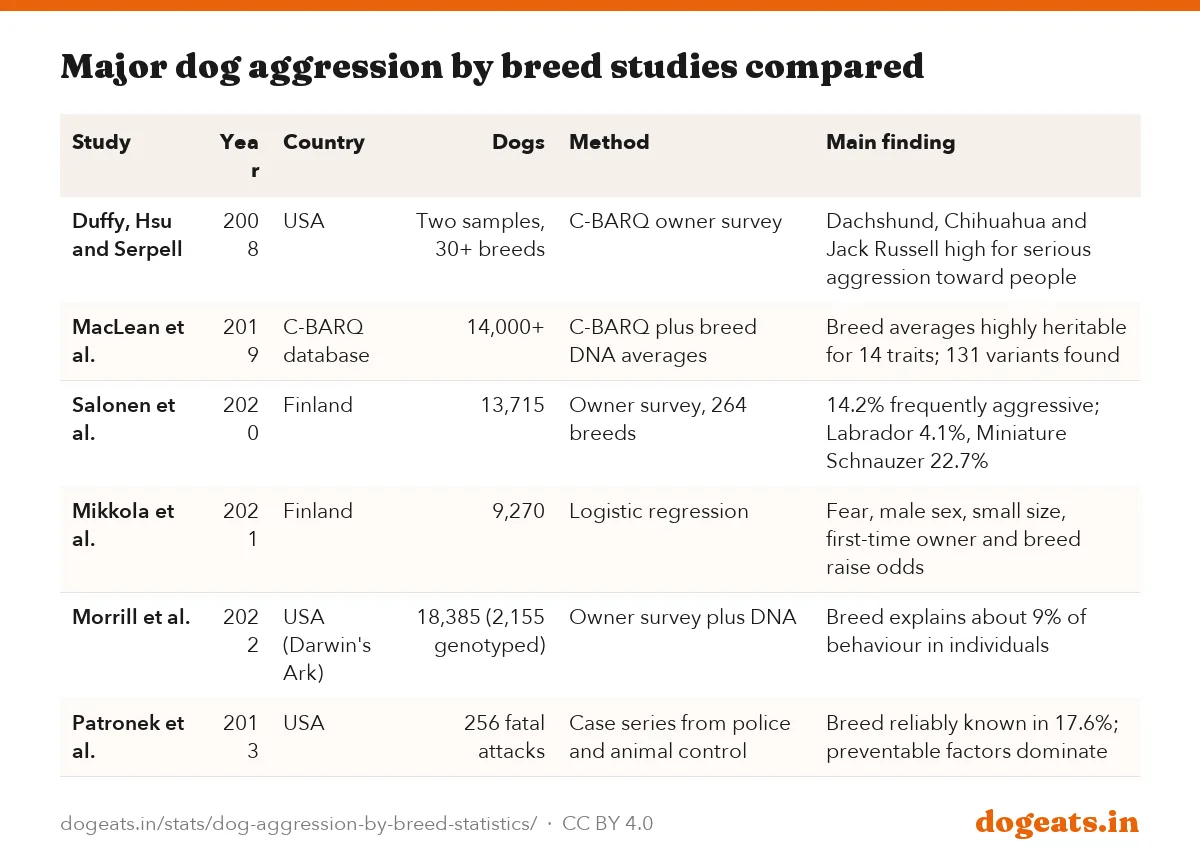
| Study | Year | Country | Dogs | Method | Main finding |
|---|---|---|---|---|---|
| Duffy, Hsu and Serpell | 2008 | USA | Two samples, 30+ breeds | C-BARQ owner survey | Dachshund, Chihuahua and Jack Russell high for serious aggression toward people |
| MacLean et al. | 2019 | C-BARQ database | 14,000+ | C-BARQ plus breed DNA averages | Breed averages highly heritable for 14 traits; 131 variants found |
| Salonen et al. | 2020 | Finland | 13,715 | Owner survey, 264 breeds | 14.2% frequently aggressive; Labrador 4.1%, Miniature Schnauzer 22.7% |
| Mikkola et al. | 2021 | Finland | 9,270 | Logistic regression | Fear, male sex, small size, first-time owner and breed raise odds |
| Morrill et al. | 2022 | USA (Darwin's Ark) | 18,385 (2,155 genotyped) | Owner survey plus DNA | Breed explains about 9% of behaviour in individuals |
| Patronek et al. | 2013 | USA | 256 fatal attacks | Case series from police and animal control | Breed reliably known in 17.6%; preventable factors dominate |
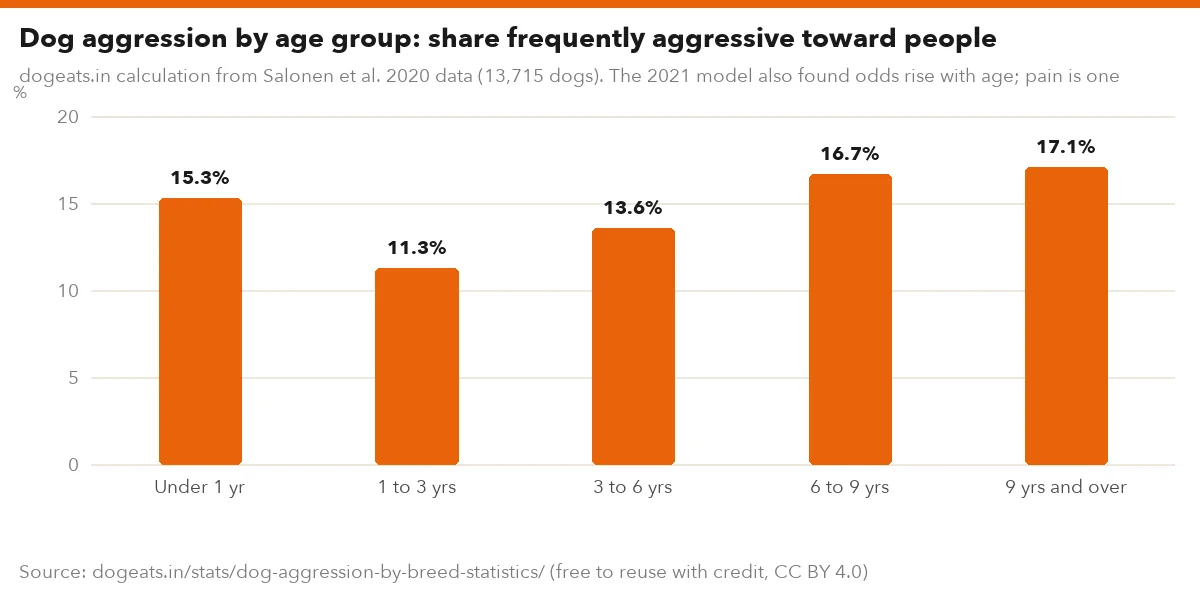
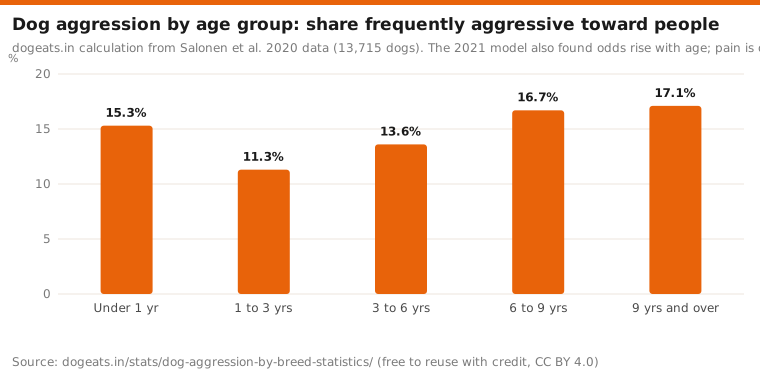
dogeats.in calculation from Salonen et al. 2020 data (13,715 dogs). The 2021 model also found odds rise with age; pain is one suspected reason.
Show the numbers
| Label | % |
|---|---|
| Under 1 yr | 15.3% |
| 1 to 3 yrs | 11.3% |
| 3 to 6 yrs | 13.6% |
| 6 to 9 yrs | 16.7% |
| 9 yrs and over | 17.1% |
Embed this chart
Age shows a dip and a climb. Puppies under a year had a rate of 15.3%, young adults 11.3% and dogs aged 9 and over 17.1%. The 2021 authors say pain, such as from hip dysplasia, may explain part of the rise in older dogs.
What did the C-BARQ breed aggression study find?
A widely cited study is Duffy, Hsu and Serpell, published in 2008 in Applied Animal Behaviour Science. It surveyed owners of more than 30 breeds with the C-BARQ questionnaire, in a breed club sample and an online sample.
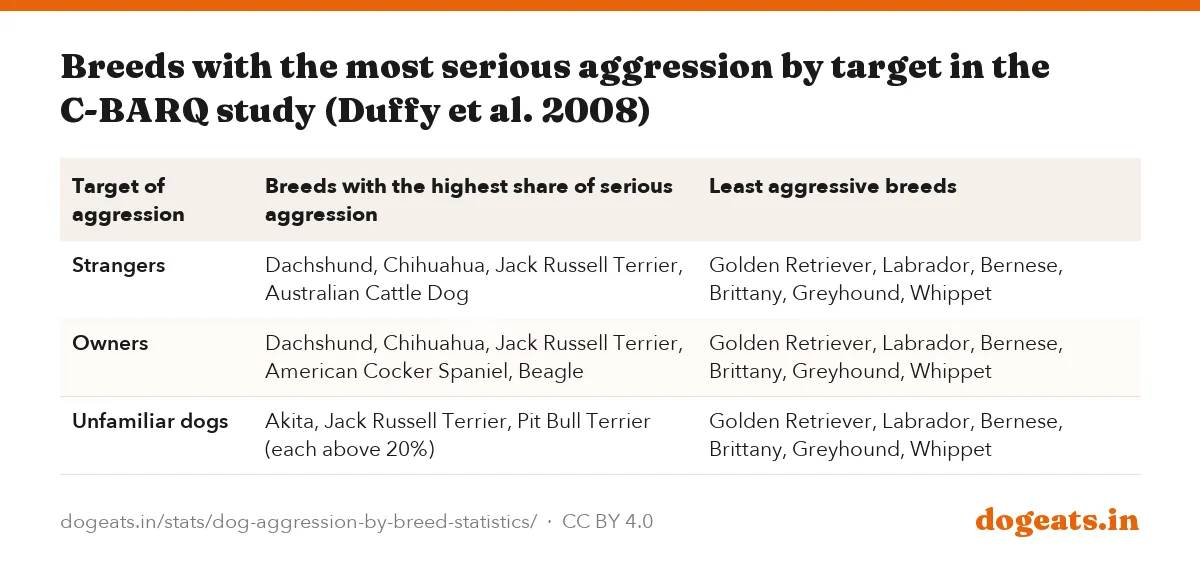
Dachshunds, Chihuahuas and Jack Russell Terriers had the largest shares of dogs with serious aggression, meaning bites or bite attempts, toward strangers and owners. More than 20% of Akitas, Jack Russell Terriers and Pit Bull Terriers showed serious aggression toward unfamiliar dogs.
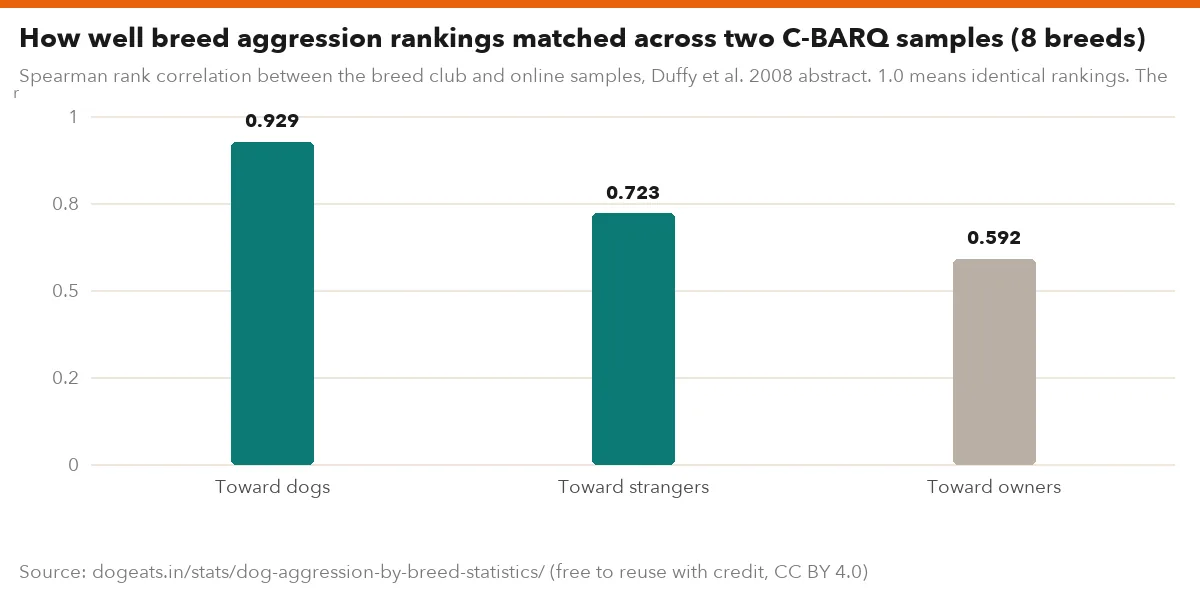
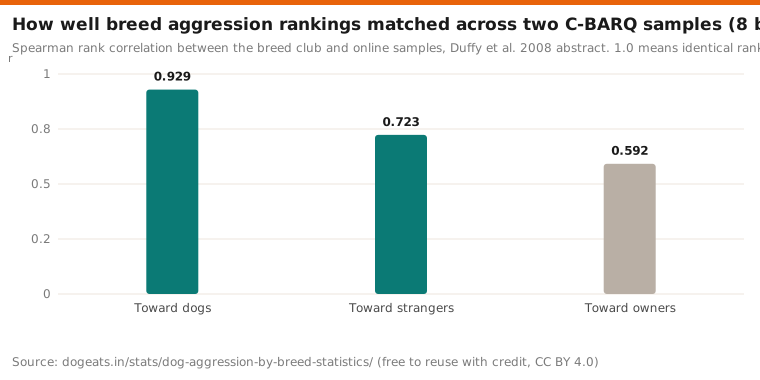
Golden Retrievers, Labradors, Bernese Mountain Dogs, Brittany Spaniels, Greyhounds and Whippets were the least aggressive toward people and dogs. Eight breeds appeared in both samples, and their rankings matched well for stranger and dog aggression.
| Target of aggression | Breeds with the highest share of serious aggression | Least aggressive breeds |
|---|---|---|
| Strangers | Dachshund, Chihuahua, Jack Russell Terrier, Australian Cattle Dog | Golden Retriever, Labrador, Bernese, Brittany, Greyhound, Whippet |
| Owners | Dachshund, Chihuahua, Jack Russell Terrier, American Cocker Spaniel, Beagle | Golden Retriever, Labrador, Bernese, Brittany, Greyhound, Whippet |
| Unfamiliar dogs | Akita, Jack Russell Terrier, Pit Bull Terrier (each above 20%) | Golden Retriever, Labrador, Bernese, Brittany, Greyhound, Whippet |
Spearman rank correlation between the breed club and online samples, Duffy et al. 2008 abstract. 1.0 means identical rankings. The owner figure was not statistically significant (P = 0.123).
Show the numbers
| Label | r |
|---|---|
| Toward dogs | 0.929 |
| Toward strangers | 0.723 |
| Toward owners | 0.592 |
Embed this chart
The same study found that show-bred English Springer Spaniels were more aggressive than field-bred ones. The authors read that as a sign of genetic influence within a single breed.
Can dog bite statistics show which breed is most dangerous?
No. Bite records rarely identify breed correctly, and they cannot say how many dogs of each breed live in an area. Without that denominator, a count of bites by breed measures popularity as much as risk.
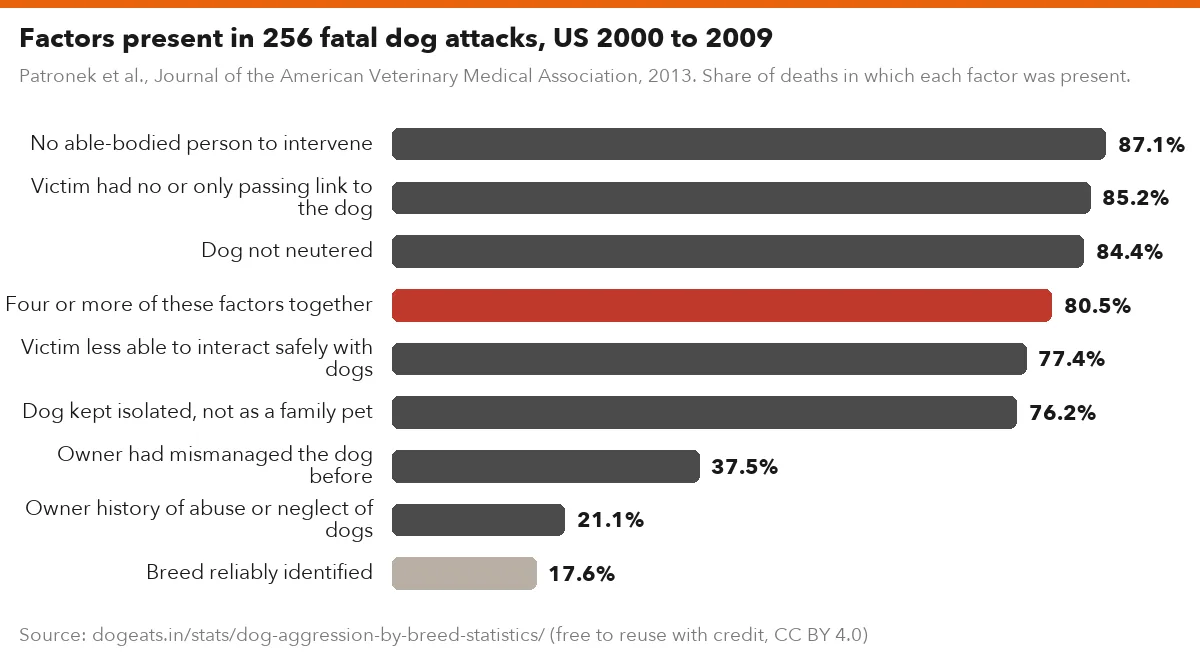
The best evidence comes from a study of 256 deaths from dog attacks in the US from 2000 to 2009. Investigators used police and animal control files, not news reports. Breed could be reliably identified in only 45 cases, or 17.6%.
Media and official records often disagreed. For 346 dogs with both kinds of report, the stated breed differed for 139, or 40.2%. Four or more preventable factors were present in 206 of the deaths, or 80.5%.

Patronek et al., Journal of the American Veterinary Medical Association, 2013. Share of deaths in which each factor was present.
Show the numbers
| Label | % |
|---|---|
| No able-bodied person to intervene | 87.1% |
| Victim had no or only passing link to the dog | 85.2% |
| Dog not neutered | 84.4% |
| Four or more of these factors together | 80.5% |
| Victim less able to interact safely with dogs | 77.4% |
| Dog kept isolated, not as a family pet | 76.2% |
| Owner had mismanaged the dog before | 37.5% |
| Owner history of abuse or neglect of dogs | 21.1% |
| Breed reliably identified | 17.6% |
Embed this chart
Olson et al., The Veterinary Journal 2015 (120 shelter dogs); Patronek et al. 2013; Voith et al. 2009 (16 adopted dogs).
Show the numbers
| Label | % |
|---|---|
| Shelter staff calling dogs pit bull-type | 52% |
| Media and animal control breed disagree | 40.2% |
| Media reports disagree with each other | 30.9% |
| Adoption agency breed confirmed by DNA | 25% |
| DNA finding pit bull-type | 21% |
Embed this chart
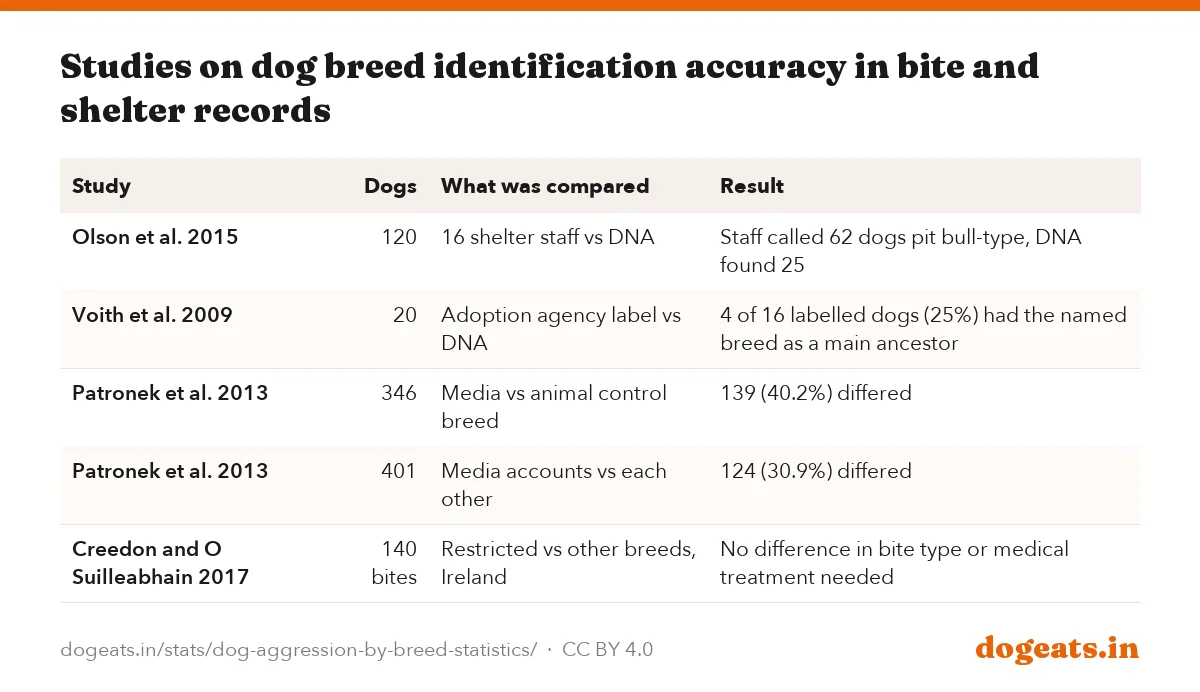
| Study | Dogs | What was compared | Result |
|---|---|---|---|
| Olson et al. 2015 | 120 | 16 shelter staff vs DNA | Staff called 62 dogs pit bull-type, DNA found 25 |
| Voith et al. 2009 | 20 | Adoption agency label vs DNA | 4 of 16 labelled dogs (25%) had the named breed as a main ancestor |
| Patronek et al. 2013 | 346 | Media vs animal control breed | 139 (40.2%) differed |
| Patronek et al. 2013 | 401 | Media accounts vs each other | 124 (30.9%) differed |
| Creedon and O Suilleabhain 2017 | 140 bites | Restricted vs other breeds, Ireland | No difference in bite type or medical treatment needed |
The Irish study looked at 140 bite incidents, 100 from unrestricted breeds and 40 from breeds on Ireland's restricted list. It found no difference in the type of bite or the medical treatment victims needed.
What does the data say about dog aggression in India?
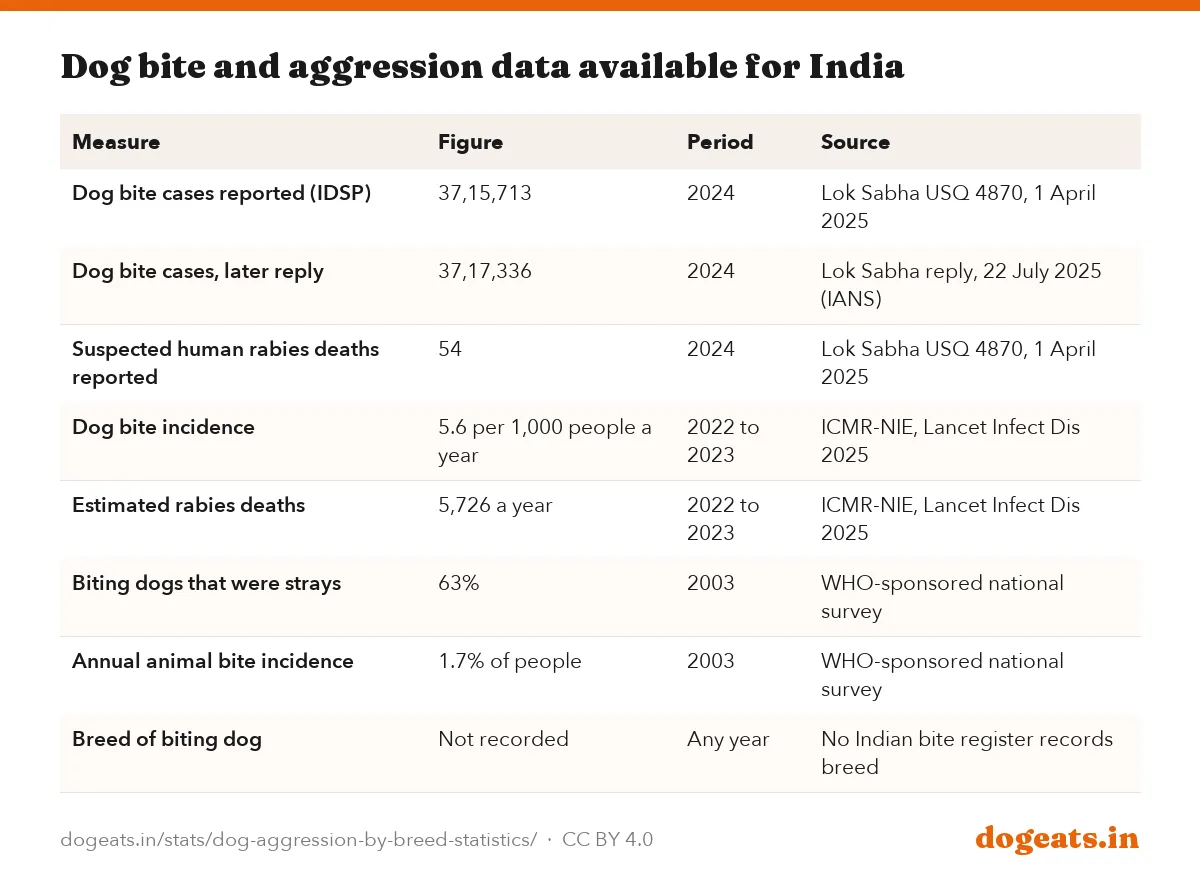
India has no breed-level study of dog aggression. What it has is bite surveillance. States reported 37,15,713 dog bite cases in 2024 to the IDSP portal, according to a Lok Sabha reply of 1 April 2025. A later reply, on 22 July 2025, gave 37,17,336. Either way it is about 10,150 a day, with 54 suspected human rabies deaths.
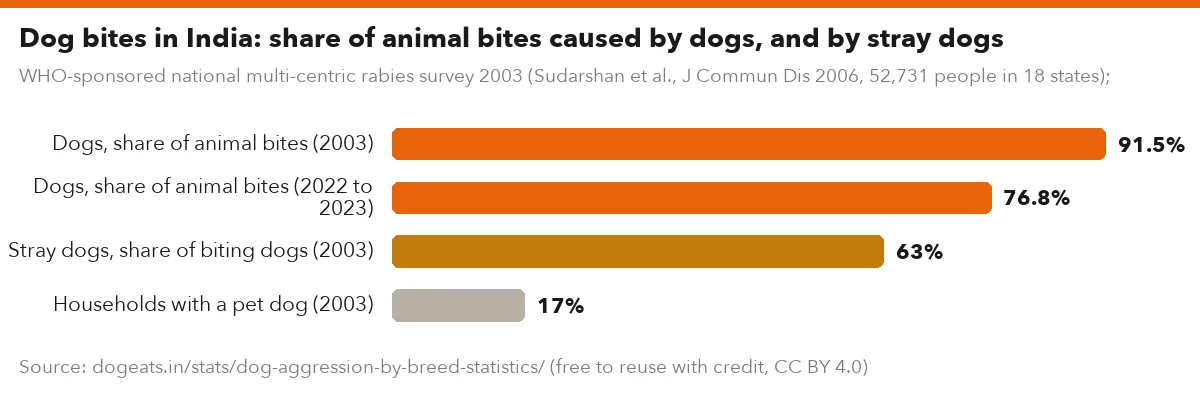
Those records do not capture breed. An ICMR survey of 78,807 households in 2022 and 2023 found 1,576 of 2,052 animal bites (76.8%) were from dogs. It put the dog bite rate at 5.6 per 1,000 people a year.
The last national survey to ask who owned the biting dog was a WHO-backed study in 2003. Dogs caused 91.5% of animal bites, and 63% of the biting dogs were strays. See our dog bite and rabies statistics for state data.
WHO-sponsored national multi-centric rabies survey 2003 (Sudarshan et al., J Commun Dis 2006, 52,731 people in 18 states); ICMR-NIE survey 2022 to 2023 (Thangaraj et al., Lancet Infect Dis 2025).
Show the numbers
| Label | % |
|---|---|
| Dogs, share of animal bites (2003) | 91.5% |
| Dogs, share of animal bites (2022 to 2023) | 76.8% |
| Stray dogs, share of biting dogs (2003) | 63% |
| Households with a pet dog (2003) | 17% |
Embed this chart
| Measure | Figure | Period | Source |
|---|---|---|---|
| Dog bite cases reported (IDSP) | 37,15,713 | 2024 | Lok Sabha USQ 4870, 1 April 2025 |
| Dog bite cases, later reply | 37,17,336 | 2024 | Lok Sabha reply, 22 July 2025 (IANS) |
| Suspected human rabies deaths reported | 54 | 2024 | Lok Sabha USQ 4870, 1 April 2025 |
| Dog bite incidence | 5.6 per 1,000 people a year | 2022 to 2023 | ICMR-NIE, Lancet Infect Dis 2025 |
| Estimated rabies deaths | 5,726 a year | 2022 to 2023 | ICMR-NIE, Lancet Infect Dis 2025 |
| Biting dogs that were strays | 63% | 2003 | WHO-sponsored national survey |
| Annual animal bite incidence | 1.7% of people | 2003 | WHO-sponsored national survey |
| Breed of biting dog | Not recorded | Any year | No Indian bite register records breed |
The Centre's 12 March 2024 letter asked states to stop licensing 23 breeds it called ferocious. The Karnataka High Court quashed it on 10 April 2024, and the Delhi High Court set it aside on 16 April 2024. Our banned dog breeds tracker follows the cases and local rules on the Pitbull and Rottweiler.
How should you read a list of the most aggressive dog breeds?
Every breed ranking in this report comes from owner questionnaires. Use these checks before trusting any list you see online or in a news story.

- Ask what was measured. Growling, snapping and biting are different, and studies set different cut-offs. Reported rates range from 2% to 30% across studies for that reason.
- Ask who answered. Owners who join online surveys are not typical, and they may under-report problems in their own dog.
- Ask how many dogs of each breed were in the sample. With about 100 dogs, the 95% range for the Rottweiler spans 15 points.
- Ask whether fear, size, sex and age were held constant. Raw breed rates mix these together.
- Ask whether it uses bite counts. Bite counts lack a population base and often get the breed wrong.
- Ask where the dogs live. Finnish, American and British pet dogs live very differently from Indian pets and street dogs.
For training and fear, see our reports on dog training methods and separation anxiety and fear. If your dog growls, snaps or bites, or changes behaviour suddenly, see a vet first to rule out pain.
Frequently asked questions
Which dog breed is the most aggressive?
No single breed is. In the largest open dataset, the Parson Russell Terrier (31.5%) and Miniature Pinscher (30.4%) had the highest owner-reported rates. Breed explains only about 9% of behaviour in individual dogs.
What is the least aggressive dog breed?
The Labrador Retriever had the lowest rate in Finland, at 4.1% of 465 dogs. Golden Retrievers (7.4%) were also near the bottom, matching the 2008 US C-BARQ study.
Are pit bulls more aggressive than other dogs?
Owner surveys do not put them at the top for aggression toward people. The American Staffordshire Terrier came in at 9.9% in Finland. A 2008 US study found more than 20% of Pit Bull Terriers were seriously aggressive toward unfamiliar dogs.
Are small dogs more aggressive than big dogs?
Yes, on owner reports. Small breeds had a rate of 18.8% against 11.4% for large breeds in 13,715 dogs. The 2008 C-BARQ authors note that larger, more powerful breeds carry a higher risk of injury.
Are male dogs more aggressive than female dogs?
In the Finnish data, 16.4% of males and 12.1% of females were frequently aggressive. After adjustment, males had 1.72 times the odds of females.
Is dog aggression genetic?
Partly. Most behaviour traits are more than 25% heritable, but breed explains only about 9% of behaviour in individual dogs. For how easily a dog is provoked, breed was almost uninformative.
Why do dogs become aggressive?
Fear is the strongest marker. Highly fearful dogs were frequently aggressive in 25.2% of cases, against 7.9% of dogs showing no fear. Older age, being an only dog and having a first-time owner also raised the odds; pain is a suspected cause.
Which breed bites the most in India?
Nobody knows. Indian bite records, 37,15,713 cases in 2024 on the IDSP portal, do not record breed. A 2003 WHO-backed survey found 63% of biting dogs were strays.
Is the Rottweiler or German Shepherd banned in India?
No breed is banned across India. The Centre's March 2024 letter on 23 breeds was quashed in Karnataka and set aside in Delhi, though some cities restrict certain breeds.
Methodology and limitations
Breed rates are dogeats.in calculations from the open dataset published with Salonen et al. (Scientific Reports, 2020). It covers 13,715 Finnish pet dogs. We counted a dog as frequently aggressive when the authors scored its aggression as high. Such a dog growled at people at least often, or tried to snap or bite at least sometimes.
Our totals match the paper: 1,946 dogs (14.2%) overall, 4.1% of Labradors and 24.4% of mixed breeds. We show breed groups with 100 or more dogs and give Wilson 95% ranges. All shares are computed from raw counts and rounded once.
Adjusted odds ratios come from Mikkola et al. (Scientific Reports, 2021), Tables 2 and S2. Where the paper lists the Labrador first, we took the reciprocal of the printed ratio. Study figures for Duffy et al. 2008, MacLean et al. 2019, Patronek et al. 2013, Olson et al. 2015 and Voith et al. 2009 come from their published abstracts.
India bite counts come from Lok Sabha Unstarred Question 4870 of 1 April 2025, with IDSP data as on 27 February 2025. A later reply of 22 July 2025, reported by IANS, gave a slightly higher 2024 total. Other India figures come from the ICMR-NIE survey in The Lancet Infectious Diseases (2025) and the 2003 WHO-sponsored national survey. Daily bite averages divide the 2024 IDSP total by 366 days.
Sources
- Salonen et al., Prevalence, comorbidity, and breed differences in canine anxiety in 13,700 Finnish pet dogs, Scientific Reports 2020, 13,715 dogs; open dataset used for breed and factor rates
- Mikkola et al., Aggressive behaviour is affected by demographic, environmental and behavioural factors in purebred dogs, Scientific Reports 2021, 9,270 dogs; adjusted odds ratios by breed, fear, sex, size
- Morrill et al., Ancestry-inclusive dog genomics challenges popular breed stereotypes, Science 2022, 18,385 dogs; breed explains about 9% of behaviour
- Also consulted: Duffy, Hsu and Serpell, Breed differences in canine aggression, Applied Animal Behaviour Science 2008, Patronek et al., Co-occurrence of potentially preventable factors in 256 dog bite-related fatalities in the United States (2000 to 2009), JAVMA 2013, Olson et al., Inconsistent identification of pit bull-type dogs by shelter staff, The Veterinary Journal 2015, Voith et al., Comparison of adoption agency breed identification and DNA breed identification of dogs, J Appl Anim Welf Sci 2009, MacLean et al., Highly heritable and functionally relevant breed differences in dog behaviour, Proc R Soc B 2019, Creedon and O Suilleabhain, Dog bite injuries to humans and the use of breed-specific legislation, Irish Veterinary Journal 2017, Thangaraj et al., Estimates of the burden of human rabies deaths and animal bites in India, 2022 to 2023, Lancet Infectious Diseases 2025, Sudarshan et al., An epidemiological study of animal bites in India: WHO-sponsored national multi-centric rabies survey, J Commun Dis 2006, Lok Sabha Unstarred Question 4870, DAHD, 1 April 2025, IANS, Over 37 lakh dog bite cases in 2024, 22 July 2025, LiveLaw, Karnataka High Court quashes central breed circular, April 2024.
Cite, embed and download
This report, its data and its images are free to reuse under a Creative Commons Attribution 4.0 licence. Credit dogeats.in with a link to this page. Every chart has its own embed code, every table has a CSV and an image download, and the images below are ready for social posts, slides and articles.
Cite this report
Link to this report
Every chart and table as an image