Data explainer · Updated October 2026
Dog Breed Size Chart: Height at the Withers and Weight of 35 Breeds, from AKC and FCI Standards
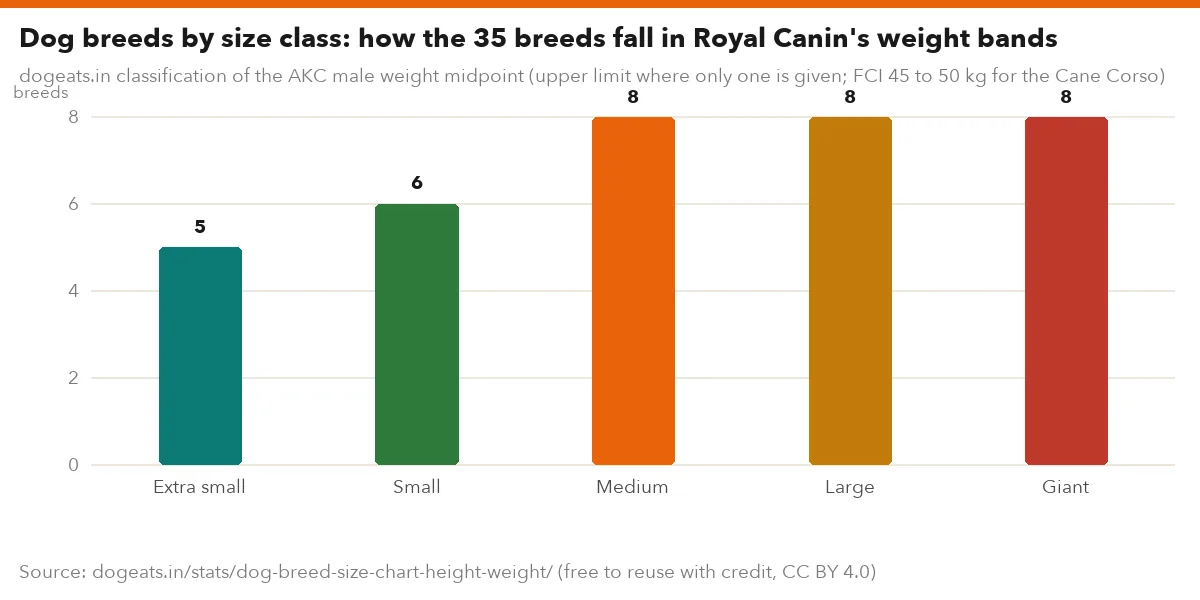
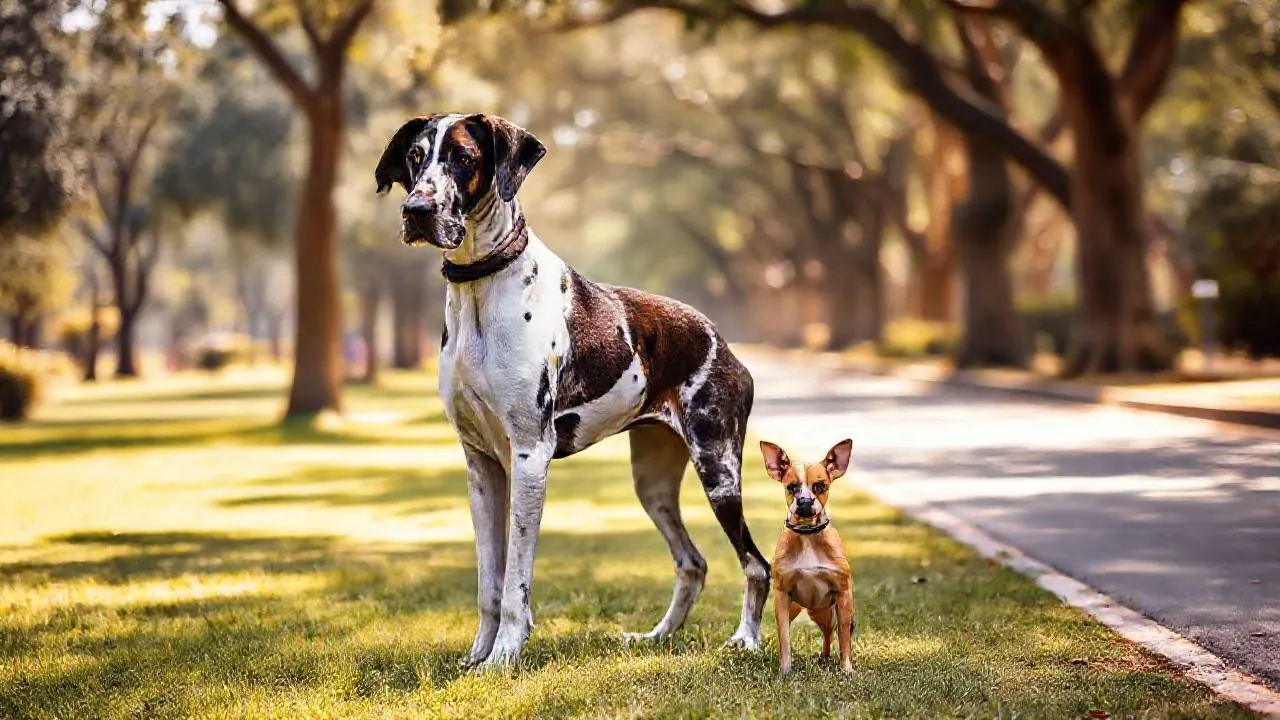
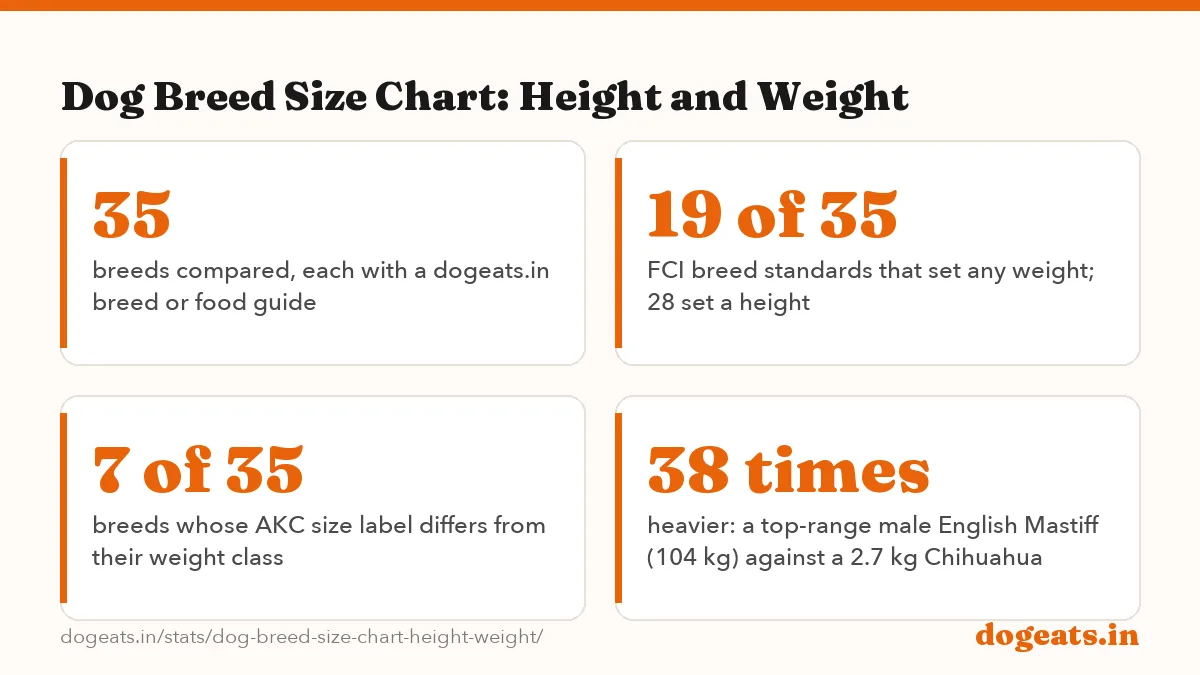
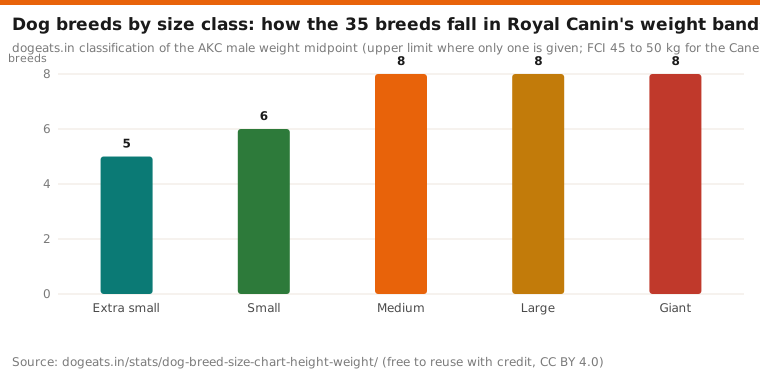
Breed standards put a Chihuahua at 13 to 20 cm (5 to 8 in) at the withers and no more than 2.7 kg (6 lb). They put a male Irish Wolfhound at 81 cm (32 in) minimum. Across 35 breeds, the American Kennel Club gives a weight for 34, but the FCI standards give one for only 19. By weight, the 35 breeds split into 5 extra small, 6 small, 8 medium, 8 large and 8 giant, using Royal Canin's size bands.
Key findings
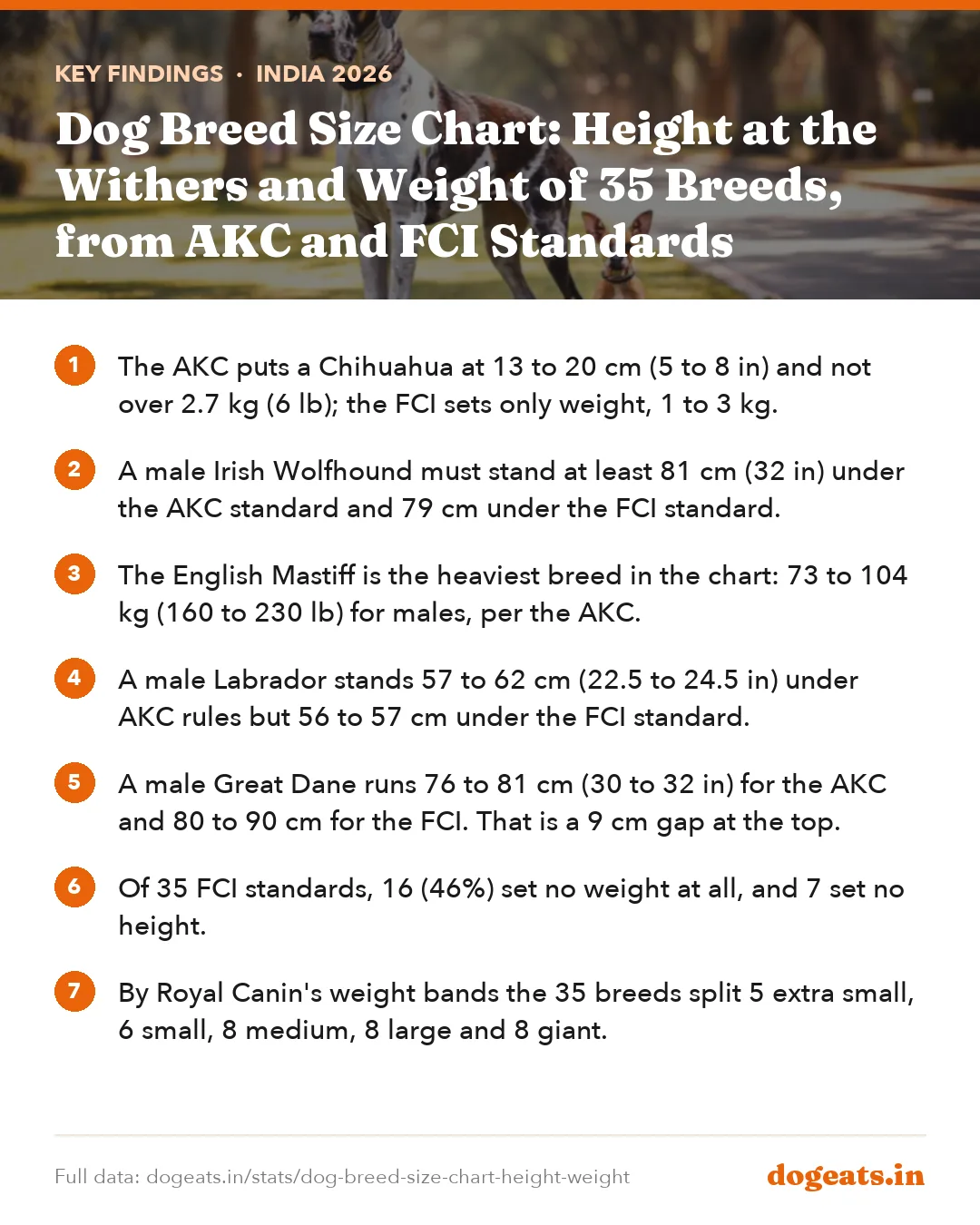
- The AKC puts a Chihuahua at 13 to 20 cm (5 to 8 in) and not over 2.7 kg (6 lb); the FCI sets only weight, 1 to 3 kg.
- A male Irish Wolfhound must stand at least 81 cm (32 in) under the AKC standard and 79 cm under the FCI standard.
- The English Mastiff is the heaviest breed in the chart: 73 to 104 kg (160 to 230 lb) for males, per the AKC.
- A male Labrador stands 57 to 62 cm (22.5 to 24.5 in) under AKC rules but 56 to 57 cm under the FCI standard.
- A male Great Dane runs 76 to 81 cm (30 to 32 in) for the AKC and 80 to 90 cm for the FCI. That is a 9 cm gap at the top.
- Of 35 FCI standards, 16 (46%) set no weight at all, and 7 set no height.
- By Royal Canin's weight bands the 35 breeds split 5 extra small, 6 small, 8 medium, 8 large and 8 giant.
- The AKC labels the Rottweiler large, but its male weight of 43 to 61 kg (95 to 135 lb) sits in the giant band.
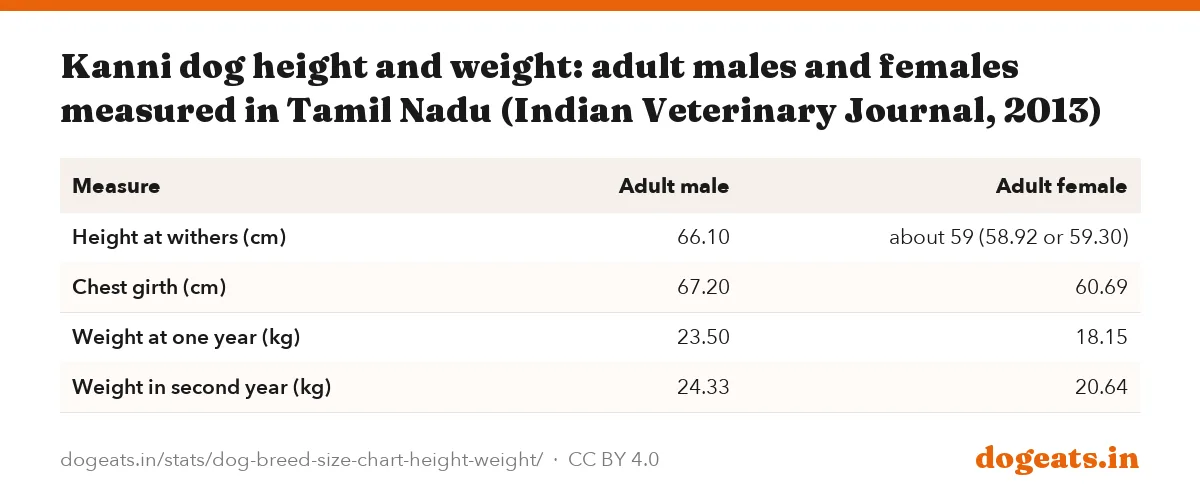
- Kanni dogs measured in Tamil Nadu averaged 66.10 cm at the withers for adult males and about 59 cm for females (2013 study).
What is the height and weight of each dog breed?
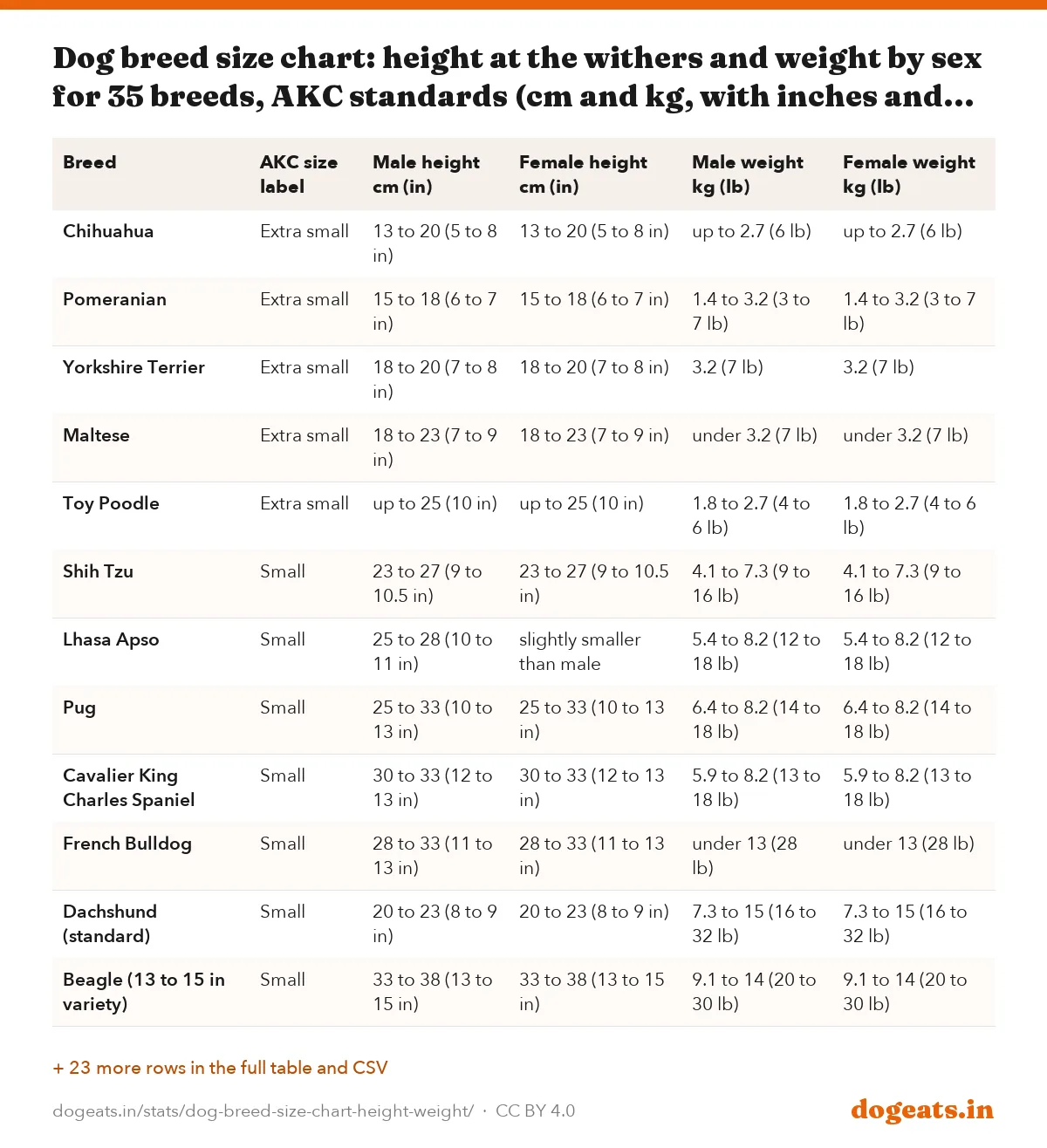
Adult breed standards run from 13 to 20 cm (5 to 8 in) and under 2.7 kg (6 lb) for the Chihuahua. At the top, a male Irish Wolfhound stands at least 81 cm (32 in). A male English Mastiff weighs up to 104 kg (230 lb). The table below gives height at the withers and weight for 35 breeds, as the American Kennel Club (AKC) lists them on its breed pages.
We give centimetres and kilograms first and the AKC's inches and pounds in brackets. Each figure is a breed standard, the size judges reward in the show ring, not an average of pet dogs. Many healthy pets sit outside these ranges.
| Breed | AKC size label | Male height cm (in) | Female height cm (in) | Male weight kg (lb) | Female weight kg (lb) |
|---|---|---|---|---|---|
| Chihuahua | Extra small | 13 to 20 (5 to 8 in) | 13 to 20 (5 to 8 in) | up to 2.7 (6 lb) | up to 2.7 (6 lb) |
| Pomeranian | Extra small | 15 to 18 (6 to 7 in) | 15 to 18 (6 to 7 in) | 1.4 to 3.2 (3 to 7 lb) | 1.4 to 3.2 (3 to 7 lb) |
| Yorkshire Terrier | Extra small | 18 to 20 (7 to 8 in) | 18 to 20 (7 to 8 in) | 3.2 (7 lb) | 3.2 (7 lb) |
| Maltese | Extra small | 18 to 23 (7 to 9 in) | 18 to 23 (7 to 9 in) | under 3.2 (7 lb) | under 3.2 (7 lb) |
| Toy Poodle | Extra small | up to 25 (10 in) | up to 25 (10 in) | 1.8 to 2.7 (4 to 6 lb) | 1.8 to 2.7 (4 to 6 lb) |
| Shih Tzu | Small | 23 to 27 (9 to 10.5 in) | 23 to 27 (9 to 10.5 in) | 4.1 to 7.3 (9 to 16 lb) | 4.1 to 7.3 (9 to 16 lb) |
| Lhasa Apso | Small | 25 to 28 (10 to 11 in) | slightly smaller than male | 5.4 to 8.2 (12 to 18 lb) | 5.4 to 8.2 (12 to 18 lb) |
| Pug | Small | 25 to 33 (10 to 13 in) | 25 to 33 (10 to 13 in) | 6.4 to 8.2 (14 to 18 lb) | 6.4 to 8.2 (14 to 18 lb) |
| Cavalier King Charles Spaniel | Small | 30 to 33 (12 to 13 in) | 30 to 33 (12 to 13 in) | 5.9 to 8.2 (13 to 18 lb) | 5.9 to 8.2 (13 to 18 lb) |
| French Bulldog | Small | 28 to 33 (11 to 13 in) | 28 to 33 (11 to 13 in) | under 13 (28 lb) | under 13 (28 lb) |
| Dachshund (standard) | Small | 20 to 23 (8 to 9 in) | 20 to 23 (8 to 9 in) | 7.3 to 15 (16 to 32 lb) | 7.3 to 15 (16 to 32 lb) |
| Beagle (13 to 15 in variety) | Small | 33 to 38 (13 to 15 in) | 33 to 38 (13 to 15 in) | 9.1 to 14 (20 to 30 lb) | 9.1 to 14 (20 to 30 lb) |
| Pembroke Welsh Corgi | Small | 25 to 30 (10 to 12 in) | 25 to 30 (10 to 12 in) | up to 14 (30 lb) | up to 13 (28 lb) |
| Shiba Inu | Small | 37 to 42 (14.5 to 16.5 in) | 34 to 39 (13.5 to 15.5 in) | 10 (23 lb) | 7.7 (17 lb) |
| English Cocker Spaniel | Medium | 41 to 43 (16 to 17 in) | 38 to 41 (15 to 16 in) | 13 to 15 (28 to 34 lb) | 12 to 15 (26 to 32 lb) |
| Bulldog (English) | Medium | 36 to 38 (14 to 15 in) | 36 to 38 (14 to 15 in) | 23 (50 lb) | 18 (40 lb) |
| Border Collie | Medium | 48 to 56 (19 to 22 in) | 46 to 53 (18 to 21 in) | 14 to 25 (30 to 55 lb) | 14 to 25 (30 to 55 lb) |
| Siberian Husky | Medium | 53 to 60 (21 to 23.5 in) | 51 to 56 (20 to 22 in) | 20 to 27 (45 to 60 lb) | 16 to 23 (35 to 50 lb) |
| Samoyed | Medium | 53 to 60 (21 to 23.5 in) | 48 to 53 (19 to 21 in) | 20 to 29 (45 to 65 lb) | 16 to 23 (35 to 50 lb) |
| Chow Chow | Medium | 43 to 51 (17 to 20 in) | 43 to 51 (17 to 20 in) | 20 to 32 (45 to 70 lb) | 20 to 32 (45 to 70 lb) |
| Dalmatian | Medium | 48 to 61 (19 to 24 in) | 48 to 61 (19 to 24 in) | 20 to 32 (45 to 70 lb) | 20 to 32 (45 to 70 lb) |
| Golden Retriever | Large | 58 to 61 (23 to 24 in) | 55 to 57 (21.5 to 22.5 in) | 29 to 34 (65 to 75 lb) | 25 to 29 (55 to 65 lb) |
| Labrador Retriever | Large | 57 to 62 (22.5 to 24.5 in) | 55 to 60 (21.5 to 23.5 in) | 29 to 36 (65 to 80 lb) | 25 to 32 (55 to 70 lb) |
| Boxer | Large | 58 to 64 (23 to 25 in) | 55 to 60 (21.5 to 23.5 in) | 29 to 36 (65 to 80 lb) | about 7 kg (15 lb) less than males |
| Belgian Malinois | Large | 61 to 66 (24 to 26 in) | 56 to 61 (22 to 24 in) | 27 to 36 (60 to 80 lb) | 18 to 27 (40 to 60 lb) |
| German Shepherd | Large | 61 to 66 (24 to 26 in) | 56 to 61 (22 to 24 in) | 29 to 41 (65 to 90 lb) | 23 to 32 (50 to 70 lb) |
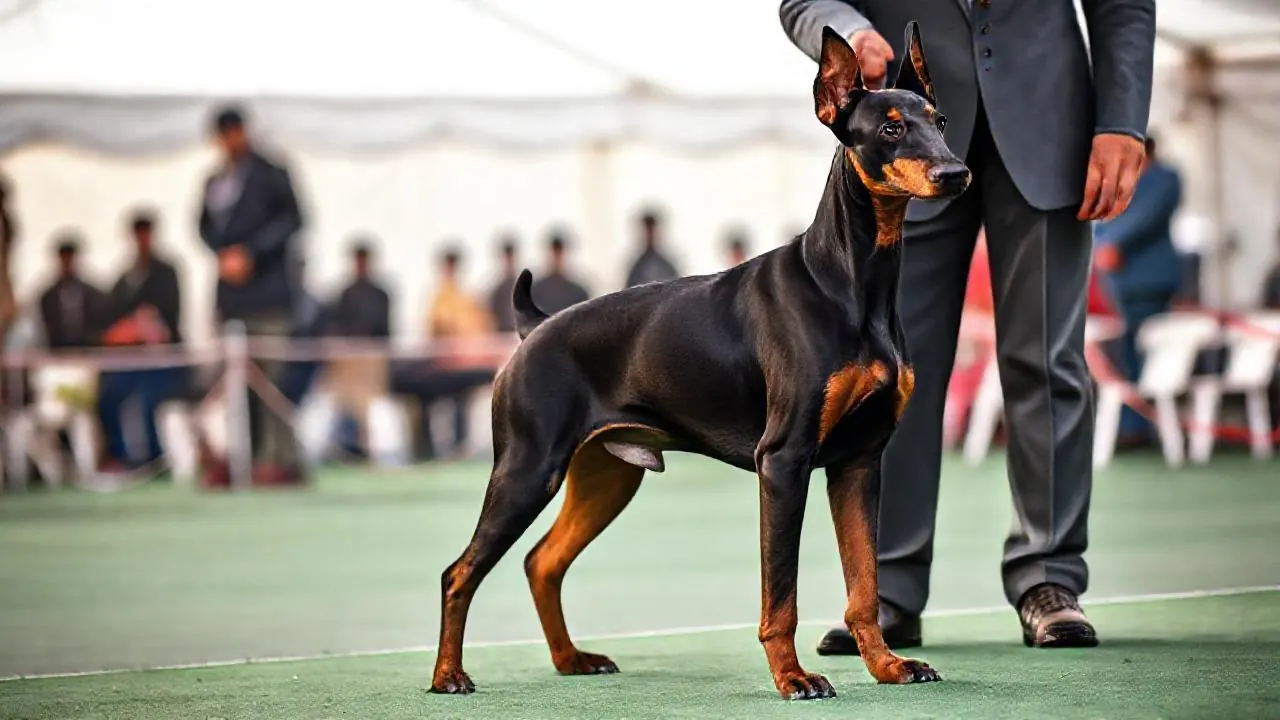
| Dobermann | Large | 66 to 71 (26 to 28 in) | 61 to 66 (24 to 26 in) | 34 to 45 (75 to 100 lb) | 27 to 41 (60 to 90 lb) |
| Rottweiler | Large | 61 to 69 (24 to 27 in) | 56 to 64 (22 to 25 in) | 43 to 61 (95 to 135 lb) | 36 to 45 (80 to 100 lb) |
| Cane Corso | Large | 64 to 70 (25 to 27.5 in) | 60 to 66 (23.5 to 26 in) | not set (in proportion to height) | not set (in proportion to height) |
| Bullmastiff | Extra large | 64 to 69 (25 to 27 in) | 61 to 66 (24 to 26 in) | 50 to 59 (110 to 130 lb) | 45 to 54 (100 to 120 lb) |
| Tibetan Mastiff | Extra large | 66 minimum (26 in) | 61 minimum (24 in) | 41 to 68 (90 to 150 lb) | 32 to 54 (70 to 120 lb) |
| Saint Bernard | Extra large | 71 to 76 (28 to 30 in) | 66 to 71 (26 to 28 in) | 64 to 82 (140 to 180 lb) | 54 to 64 (120 to 140 lb) |
| Great Dane | Extra large | 76 to 81 (30 to 32 in) | 71 to 76 (28 to 30 in) | 64 to 79 (140 to 175 lb) | 50 to 64 (110 to 140 lb) |
| English Mastiff | Extra large | 76 minimum (30 in) | 70 minimum (27.5 in) | 73 to 104 (160 to 230 lb) | 54 to 77 (120 to 170 lb) |
| Irish Wolfhound | Extra large | 81 minimum (32 in) | 76 minimum (30 in) | 54 minimum (120 lb) | 48 minimum (105 lb) |
For how fast puppies of these breeds reach that adult weight, see our dog weight chart by age and puppy growth. For daily food by body weight, see the dog feeding chart by weight.
How tall is a dog at the withers, by breed?
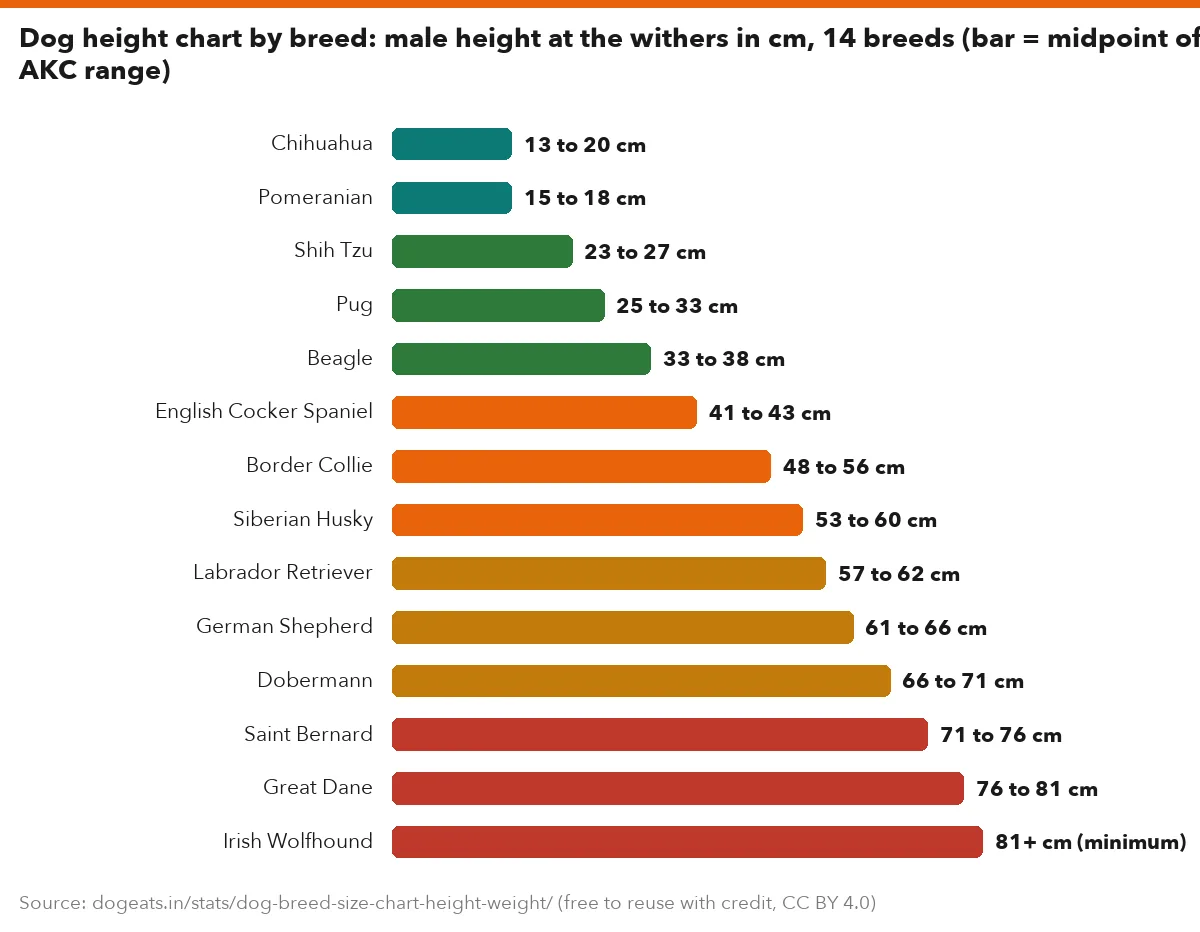
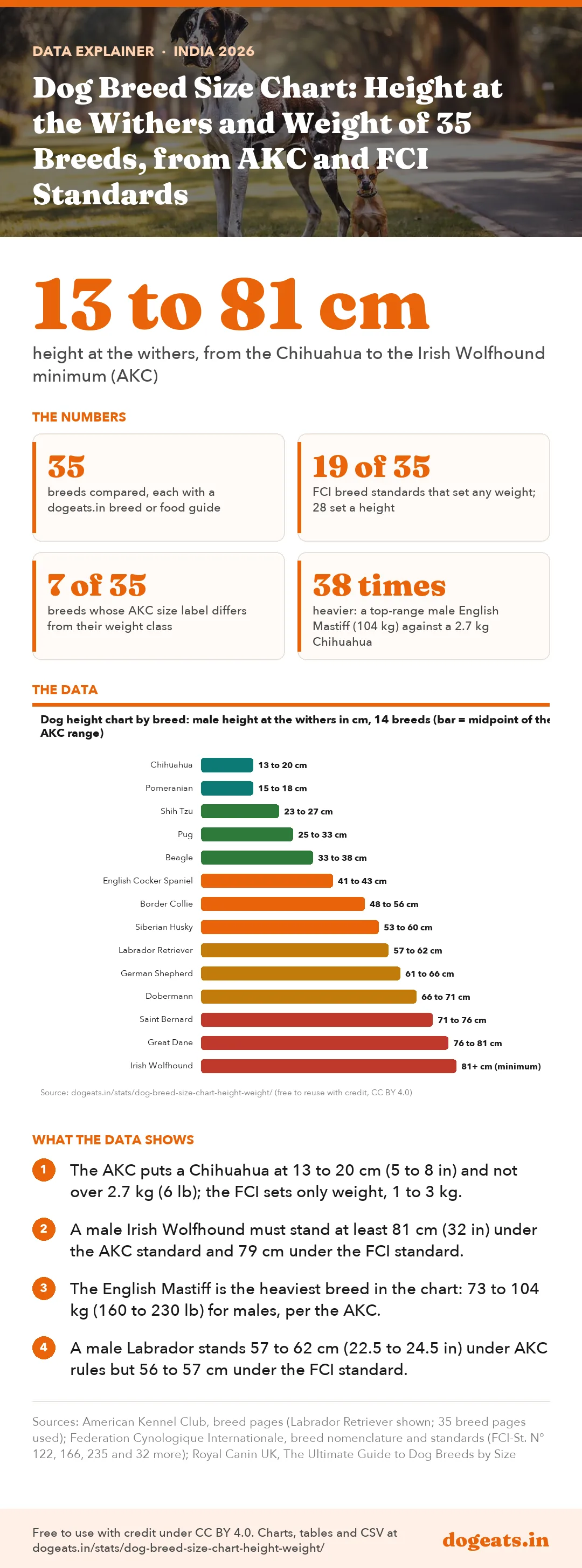
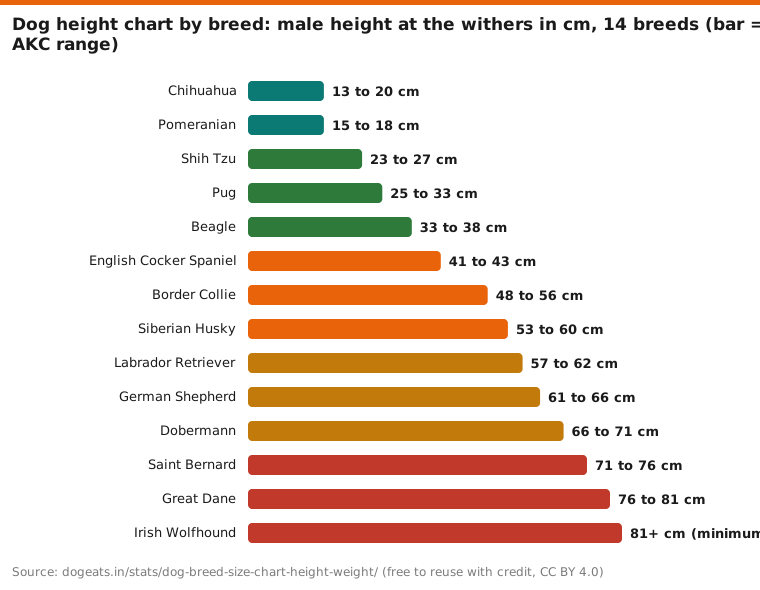
Male dogs in this chart stand 13 to 20 cm (5 to 8 in) at the withers for a Chihuahua. At the other end, an Irish Wolfhound stands 81 cm (32 in) or more. The Wolfhound is about 4 times taller. A male Labrador Retriever stands 57 to 62 cm (22.5 to 24.5 in), and a male German Shepherd 61 to 66 cm (24 to 26 in).
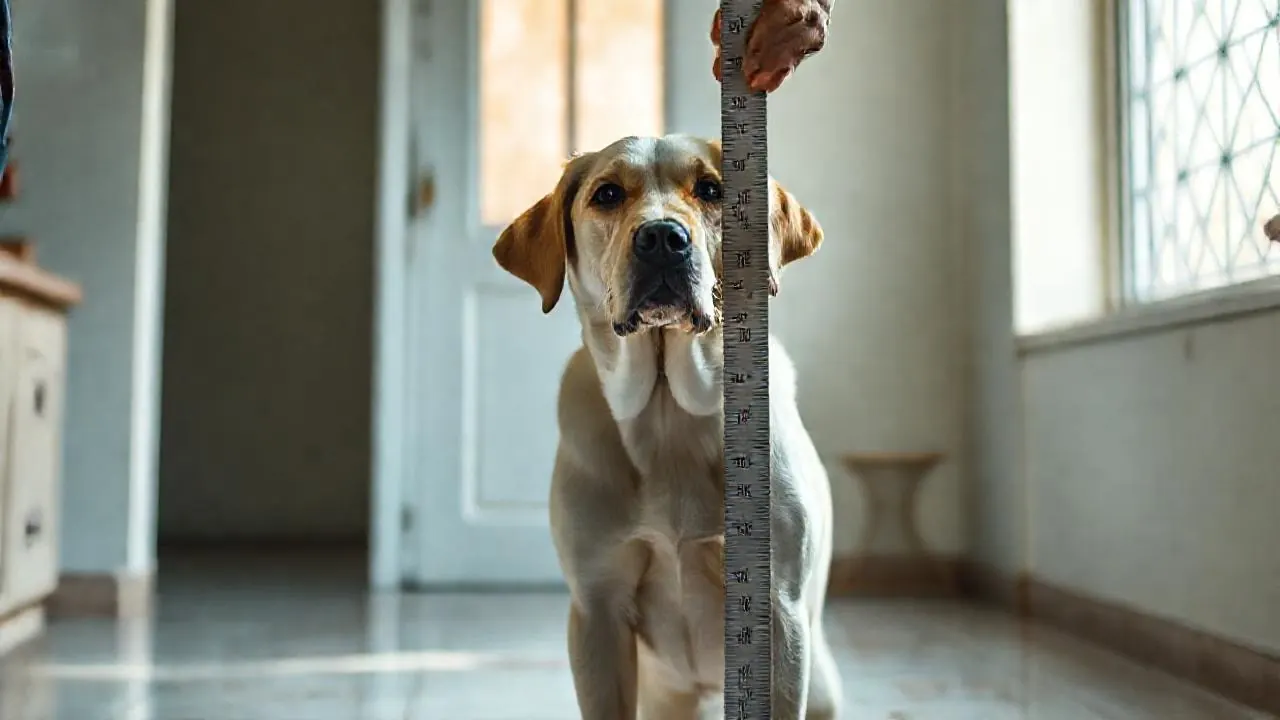
The withers are the top of the shoulder blades. The FCI standard for the American Cocker Spaniel describes the method. Height is a line straight down to the ground from the top of the shoulder blades, with the dog standing naturally. Height is not measured to the top of the head.
Source: American Kennel Club breed pages, opened October 2026. Inches converted to cm by dogeats.in (x 2.54). Tibetan Mastiff, English Mastiff and Irish Wolfhound standards give minimums only; the bar shows the minimum.
Show the numbers
| Label | cm |
|---|---|
| Chihuahua | 13 to 20 cm |
| Pomeranian | 15 to 18 cm |
| Shih Tzu | 23 to 27 cm |
| Pug | 25 to 33 cm |
| Beagle | 33 to 38 cm |
| English Cocker Spaniel | 41 to 43 cm |
| Border Collie | 48 to 56 cm |
| Siberian Husky | 53 to 60 cm |
| Labrador Retriever | 57 to 62 cm |
| German Shepherd | 61 to 66 cm |
| Dobermann | 66 to 71 cm |
| Saint Bernard | 71 to 76 cm |
| Great Dane | 76 to 81 cm |
| Irish Wolfhound | 81+ cm (minimum) |
Embed this chart
Females are usually shorter. A female Great Dane stands 71 to 76 cm (28 to 30 in) against 76 to 81 cm for a male, about 5 cm lower at each end. Small companion breeds such as the Shih Tzu (23 to 27 cm) and Pug (25 to 33 cm) get one range for both sexes.
How much does a dog weigh by breed in kg?
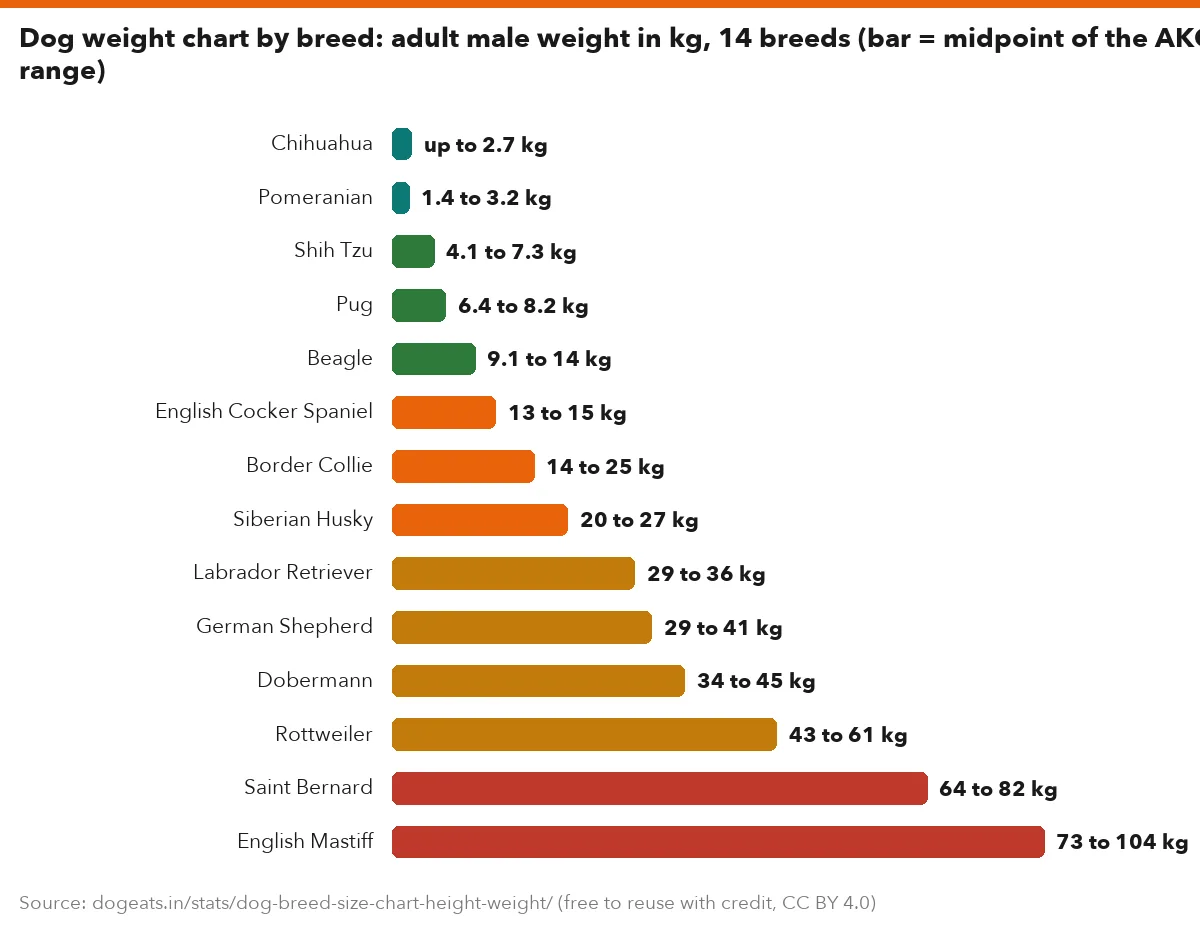
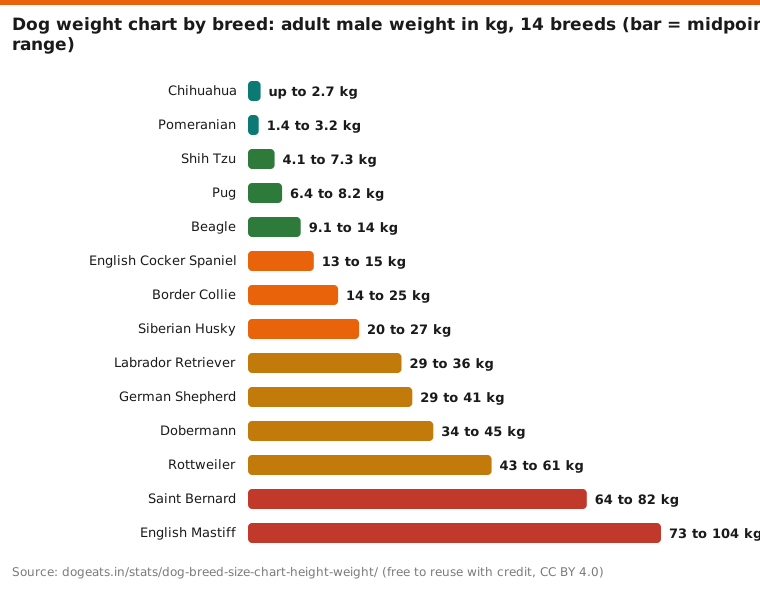
Adult male weights in the breed standards run from under 2.7 kg (6 lb) for a Chihuahua to 73 to 104 kg (160 to 230 lb) for an English Mastiff. In between, a male Labrador should weigh 29 to 36 kg (65 to 80 lb). A Beagle of the 13 to 15 inch variety should weigh 9.1 to 14 kg (20 to 30 lb).
The top of the Mastiff range is about 38 times the Chihuahua's limit. Weight ranges are wider than height ranges because build, bone and condition vary at the same height.
Source: American Kennel Club breed pages, opened October 2026. Pounds converted to kg by dogeats.in (x 0.4536). Chihuahua bar shows the AKC upper limit of 6 lb.
Show the numbers
| Label | kg |
|---|---|
| Chihuahua | up to 2.7 kg |
| Pomeranian | 1.4 to 3.2 kg |
| Shih Tzu | 4.1 to 7.3 kg |
| Pug | 6.4 to 8.2 kg |
| Beagle | 9.1 to 14 kg |
| English Cocker Spaniel | 13 to 15 kg |
| Border Collie | 14 to 25 kg |
| Siberian Husky | 20 to 27 kg |
| Labrador Retriever | 29 to 36 kg |
| German Shepherd | 29 to 41 kg |
| Dobermann | 34 to 45 kg |
| Rottweiler | 43 to 61 kg |
| Saint Bernard | 64 to 82 kg |
| English Mastiff | 73 to 104 kg |
Embed this chart
Breed weight is a target for a lean adult, not a rule for every dog. Our cost of owning a dog by size report shows how size changes food and vet bills in India.
What weight counts as a small, medium, large or giant dog?
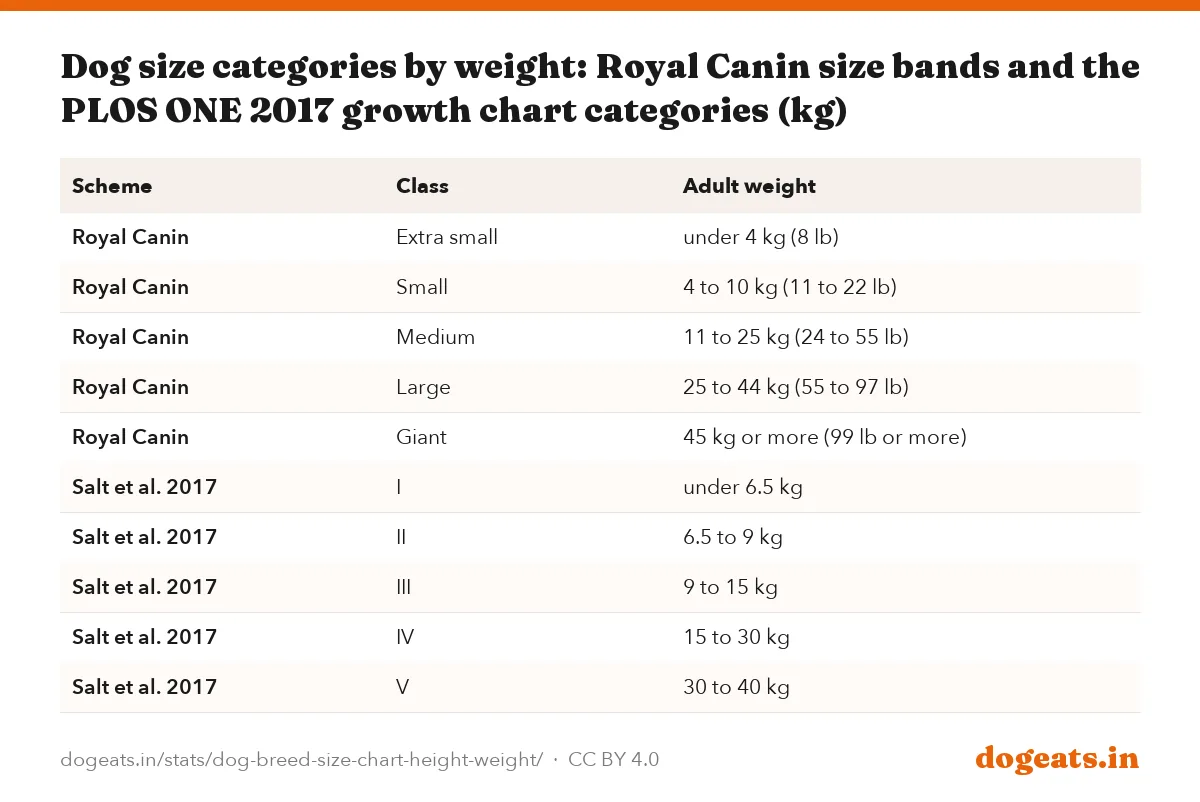
Royal Canin defines extra small dogs as under 4 kg (8 lb), small as 4 to 10 kg and medium as 11 to 25 kg. Large dogs are as 25 to 44 kg and giant as 45 kg (99 lb) or more. Neither the AKC nor the FCI publishes weight cut-offs for its size words, so we use these bands, from a pet food maker's breed guide, and say so.
Other bands exist. A 2017 growth study in PLOS ONE used five categories up to 40 kg (under 6.5, 6.5 to 9, 9 to 15, 15 to 30 and 30 to 40 kg). It made no chart for dogs over 40 kg.
| Scheme | Class | Adult weight |
|---|---|---|
| Royal Canin | Extra small | under 4 kg (8 lb) |
| Royal Canin | Small | 4 to 10 kg (11 to 22 lb) |
| Royal Canin | Medium | 11 to 25 kg (24 to 55 lb) |
| Royal Canin | Large | 25 to 44 kg (55 to 97 lb) |
| Royal Canin | Giant | 45 kg or more (99 lb or more) |
| Salt et al. 2017 | I | under 6.5 kg |
| Salt et al. 2017 | II | 6.5 to 9 kg |
| Salt et al. 2017 | III | 9 to 15 kg |
| Salt et al. 2017 | IV | 15 to 30 kg |
| Salt et al. 2017 | V | 30 to 40 kg |
dogeats.in classification of the AKC male weight midpoint (upper limit where only one is given; FCI 45 to 50 kg for the Cane Corso) using Royal Canin size bands. Gaps between bands closed at the next band's lower bound.
Show the numbers
| Label | breeds |
|---|---|
| Extra small | 5 |
| Small | 6 |
| Medium | 8 |
| Large | 8 |
| Giant | 8 |
Embed this chart
Several breeds sit close to a line. The Samoyed's male midpoint is 24.9 kg, just under the large band, and the Shiba Inu's 10.4 kg is just under medium. Our best and worst dog breeds for flats report looks at size alongside barking and exercise.
Is a Rottweiler, Beagle or French Bulldog small, medium or large?
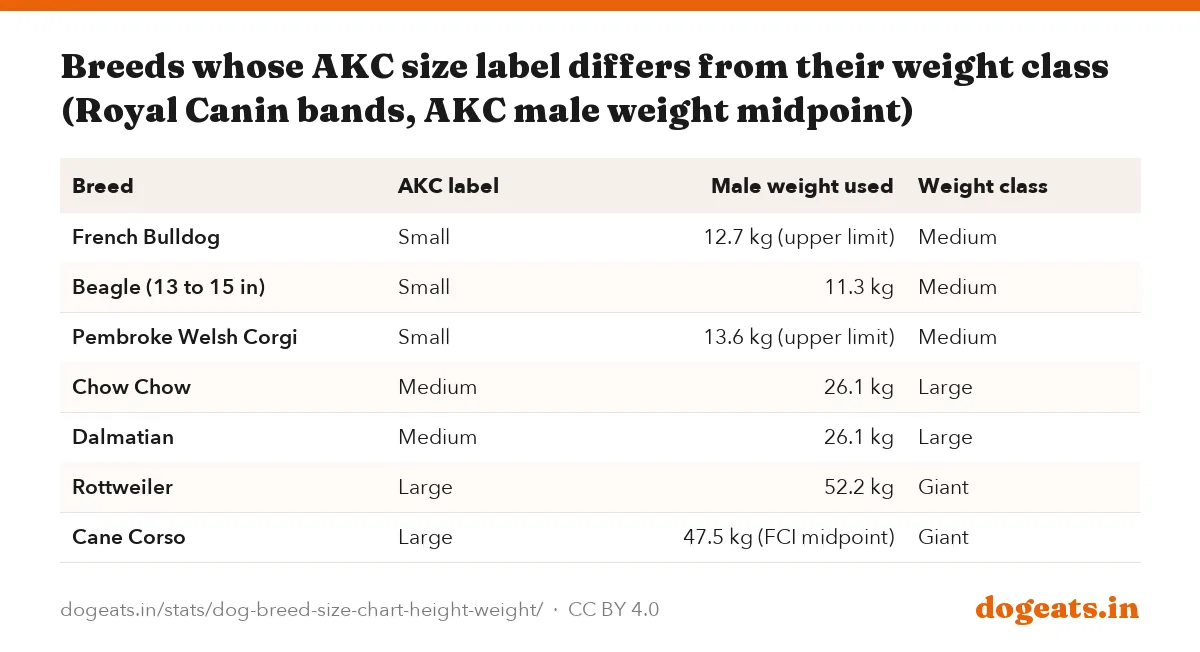
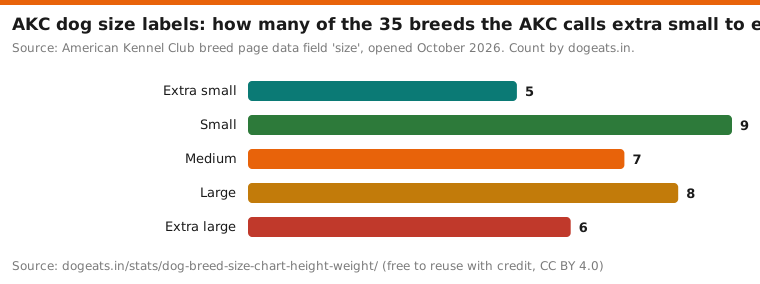
It depends on whose label you use: 7 of our 35 breeds get a different size from the AKC than from their weight. The AKC calls the Rottweiler large, yet a male's 43 to 61 kg (95 to 135 lb) is giant by weight. It also calls the Beagle, French Bulldog and Pembroke Welsh Corgi small. Yet the Beagle's weight midpoint and the upper weight limits of the other two fall in the medium band.
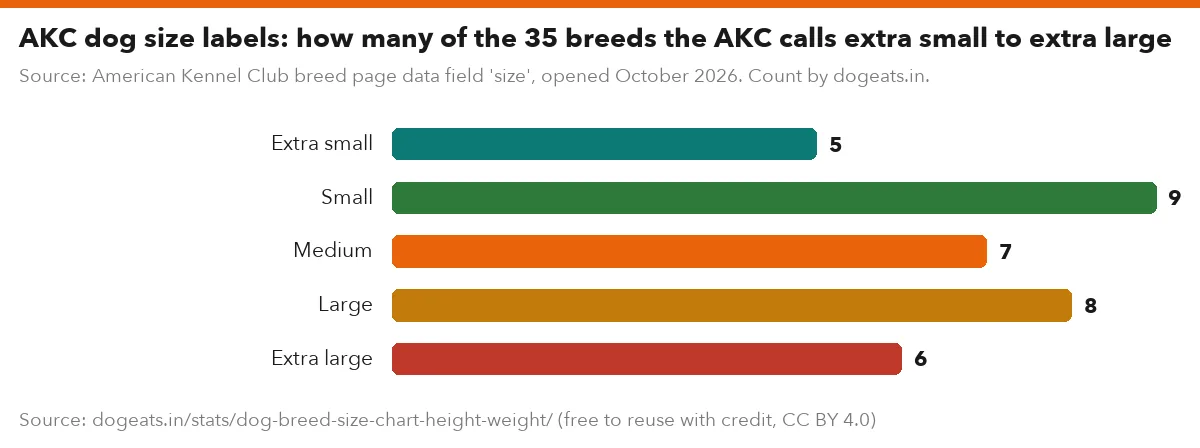
The AKC tags every breed page with one of five size words, from extra small to extra large, but does not publish the cut-offs behind them. Its labels seem to weigh height and build as well as weight, so a low, heavy dog can be called small.
Source: American Kennel Club breed page data field 'size', opened October 2026. Count by dogeats.in.
Show the numbers
| Label | breeds |
|---|---|
| Extra small | 5 |
| Small | 9 |
| Medium | 7 |
| Large | 8 |
| Extra large | 6 |
Embed this chart
| Breed | AKC label | Male weight used | Weight class |
|---|---|---|---|
| French Bulldog | Small | 12.7 kg (upper limit) | Medium |
| Beagle (13 to 15 in) | Small | 11.3 kg | Medium |
| Pembroke Welsh Corgi | Small | 13.6 kg (upper limit) | Medium |
| Chow Chow | Medium | 26.1 kg | Large |
| Dalmatian | Medium | 26.1 kg | Large |
| Rottweiler | Large | 52.2 kg | Giant |
| Cane Corso | Large | 47.5 kg (FCI midpoint) | Giant |
The Dachshund is the clearest case of height and weight pulling apart. The standard size is 20 to 23 cm (8 to 9 in) tall but 7.3 to 15 kg (16 to 32 lb), and the AKC calls it small.
Why do AKC and FCI give different sizes for the same breed?
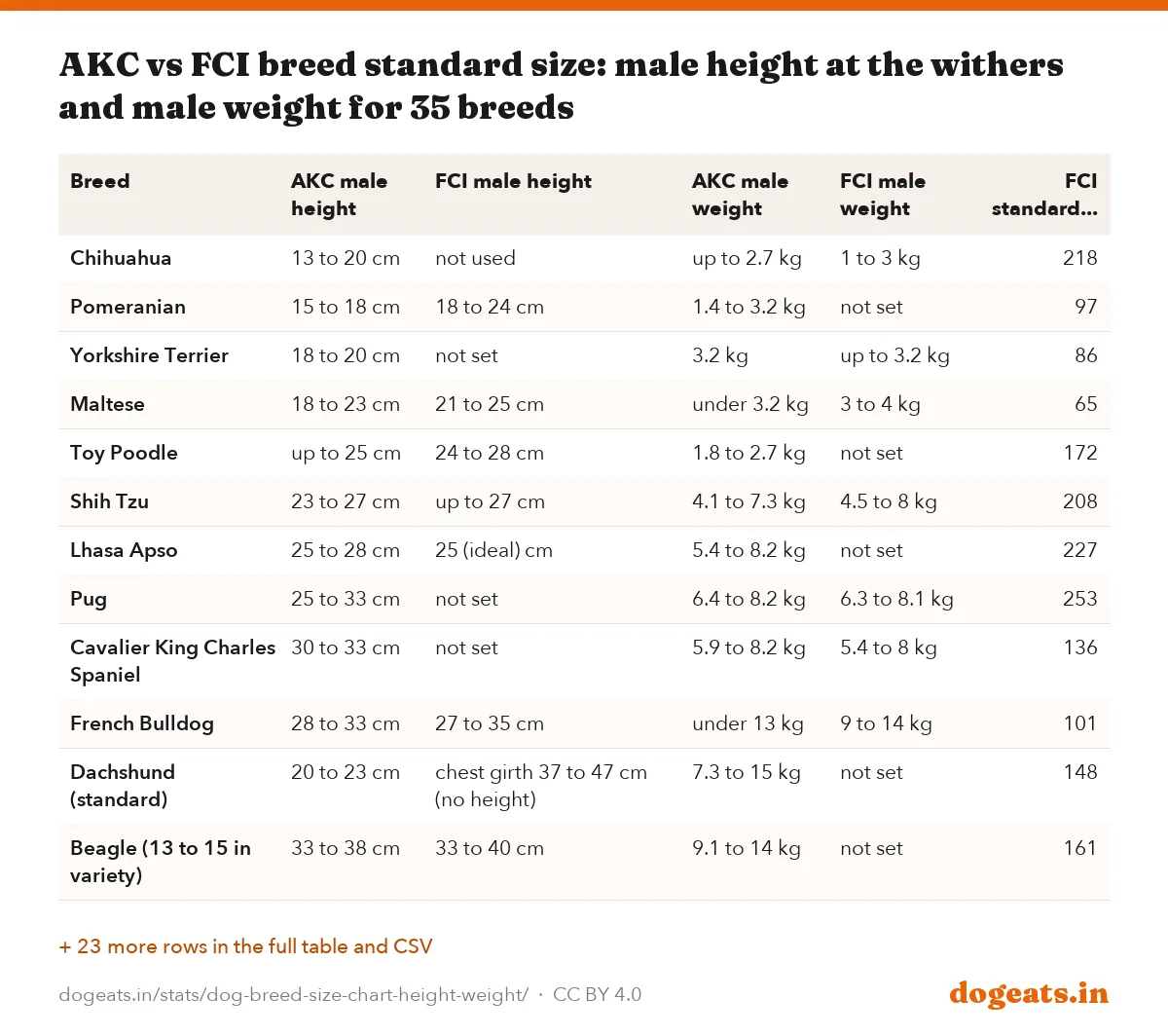
The two bodies write separate standards, and the gaps can reach 9 cm. A male Great Dane is 76 to 81 cm (30 to 32 in) for the AKC but 80 to 90 cm for the FCI. The FCI also leaves out weight far more often, with 16 of its 35 standards here (46%) setting none.
Some FCI standards measure something else. The Dachshund standard sizes dogs by chest girth, over 37 up to 47 cm for a standard male, not by height. The Chihuahua standard ignores height and sets weight only, 1 to 3 kg with 1.5 to 2.5 kg ideal.
| Breed | AKC male height | FCI male height | AKC male weight | FCI male weight | FCI standard no. |
|---|---|---|---|---|---|
| Chihuahua | 13 to 20 cm | not used | up to 2.7 kg | 1 to 3 kg | 218 |
| Pomeranian | 15 to 18 cm | 18 to 24 cm | 1.4 to 3.2 kg | not set | 97 |
| Yorkshire Terrier | 18 to 20 cm | not set | 3.2 kg | up to 3.2 kg | 86 |
| Maltese | 18 to 23 cm | 21 to 25 cm | under 3.2 kg | 3 to 4 kg | 65 |
| Toy Poodle | up to 25 cm | 24 to 28 cm | 1.8 to 2.7 kg | not set | 172 |
| Shih Tzu | 23 to 27 cm | up to 27 cm | 4.1 to 7.3 kg | 4.5 to 8 kg | 208 |
| Lhasa Apso | 25 to 28 cm | 25 (ideal) cm | 5.4 to 8.2 kg | not set | 227 |
| Pug | 25 to 33 cm | not set | 6.4 to 8.2 kg | 6.3 to 8.1 kg | 253 |
| Cavalier King Charles Spaniel | 30 to 33 cm | not set | 5.9 to 8.2 kg | 5.4 to 8 kg | 136 |
| French Bulldog | 28 to 33 cm | 27 to 35 cm | under 13 kg | 9 to 14 kg | 101 |
| Dachshund (standard) | 20 to 23 cm | chest girth 37 to 47 cm (no height) | 7.3 to 15 kg | not set | 148 |
| Beagle (13 to 15 in variety) | 33 to 38 cm | 33 to 40 cm | 9.1 to 14 kg | not set | 161 |
| Pembroke Welsh Corgi | 25 to 30 cm | 25 to 30 cm | up to 14 kg | 10 to 12 kg | 39 |
| Shiba Inu | 37 to 42 cm | 38 to 41 cm | 10 kg | not set | 257 |
| English Cocker Spaniel | 41 to 43 cm | 39 to 41 cm | 13 to 15 kg | 13 to 14.5 kg | 5 |
| Bulldog (English) | 36 to 38 cm | not set | 23 kg | 25 kg | 149 |
| Border Collie | 48 to 56 cm | 53 (ideal) cm | 14 to 25 kg | not set | 297 |
| Siberian Husky | 53 to 60 cm | 53.5 to 60 cm | 20 to 27 kg | 20.5 to 28 kg | 270 |
| Samoyed | 53 to 60 cm | 54 to 60 cm | 20 to 29 kg | not set | 212 |
| Chow Chow | 43 to 51 cm | 48 to 56 cm | 20 to 32 kg | not set | 205 |
| Dalmatian | 48 to 61 cm | 56 to 62 cm | 20 to 32 kg | not set | 153 |
| Golden Retriever | 58 to 61 cm | 56 to 61 cm | 29 to 34 kg | not set | 111 |
| Labrador Retriever | 57 to 62 cm | 56 to 57 cm | 29 to 36 kg | not set | 122 |
| Boxer | 58 to 64 cm | 57 to 63 cm | 29 to 36 kg | over 30 kg | 144 |
| Belgian Malinois | 61 to 66 cm | 60 to 66 cm | 27 to 36 kg | 25 to 30 kg | 15 |
| German Shepherd | 61 to 66 cm | 60 to 65 cm | 29 to 41 kg | 30 to 40 kg | 166 |
| Dobermann | 66 to 71 cm | 68 to 72 cm | 34 to 45 kg | 40 to 45 kg | 143 |
| Rottweiler | 61 to 69 cm | 61 to 68 cm | 43 to 61 kg | 50 kg | 147 |
| Cane Corso | 64 to 70 cm | 64 to 68 cm | not set | 45 to 50 kg | 343 |
| Bullmastiff | 64 to 69 cm | 64 to 69 cm | 50 to 59 kg | 50 to 59 kg | 157 |
| Tibetan Mastiff | 66+ cm (minimum) | 66 minimum cm | 41 to 68 kg | not set | 230 |
| Saint Bernard | 71 to 76 cm | 70 to 90 cm | 64 to 82 kg | not set | 61 |
| Great Dane | 76 to 81 cm | 80 to 90 cm | 64 to 79 kg | not set | 235 |
| English Mastiff | 76+ cm (minimum) | not set | 73 to 104 kg | not set | 264 |
| Irish Wolfhound | 81+ cm (minimum) | 79 minimum cm | 54 minimum kg | 54.5 minimum kg | 160 |
A male Rottweiler shows how far the two can differ on weight. It is 43 to 61 kg (95 to 135 lb) for the AKC against one figure, 50 kg, for the FCI. The FCI standard grades male height inside 61 to 68 cm and names 65 to 66 cm as the correct height.
The FCI Labrador standard sets an ideal male height of 56 to 57 cm. The AKC allows 57 to 62 cm (22.5 to 24.5 in), about 5 cm more at the top. The FCI Saint Bernard runs to 90 cm for males and does not penalise taller dogs if they move well.
How big are Indian dog breeds like the Kanni?
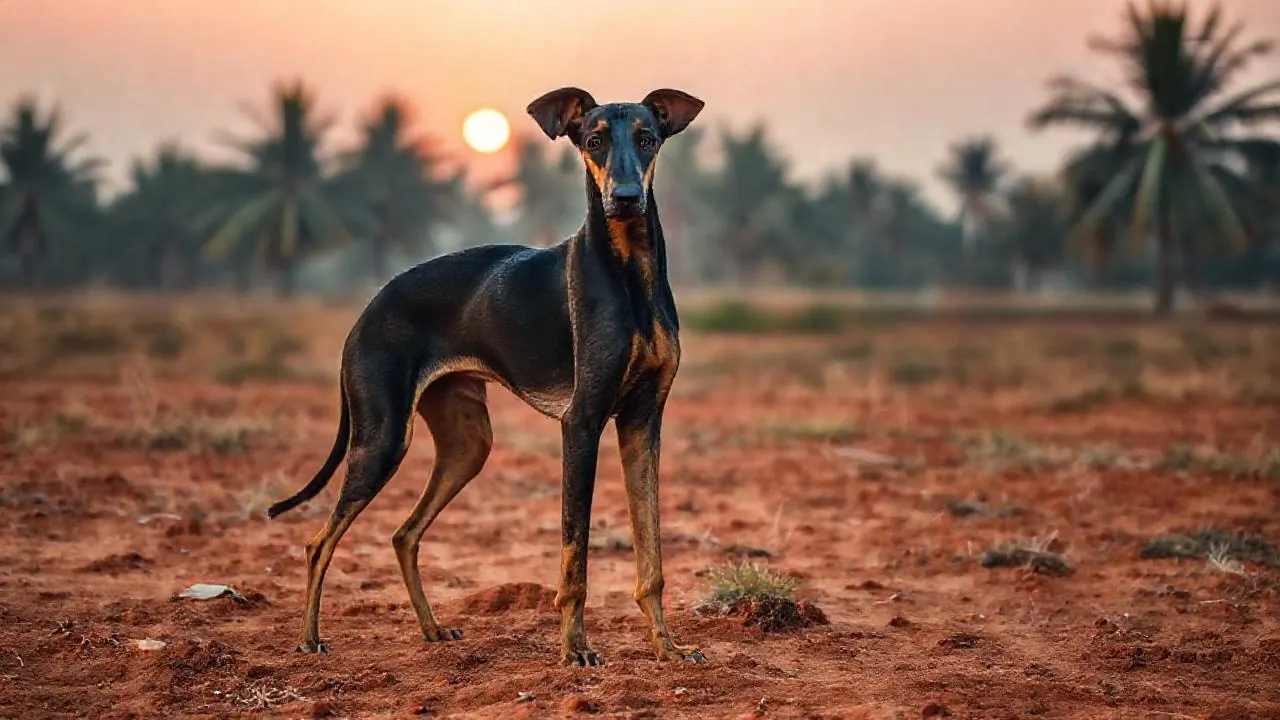
In a study of 81 Kanni dogs in Tamil Nadu, adult males averaged 66.10 cm (26.0 in) at the withers and females about 59 cm (23 in). At one year, males weighed 23.50 kg (51.8 lb) and females 18.15 kg (40.0 lb), published in the Indian Veterinary Journal in 2013 from a 2011 survey.
That puts the Kanni close to a male German Shepherd in height but far lighter, in the medium band by weight. Neither the AKC nor the FCI has a standard for Indian breeds. We could not open an official Kennel Club of India standard with figures, so other Indian breeds are left out of the chart.
| Measure | Adult male | Adult female |
|---|---|---|
| Height at withers (cm) | 66.10 | about 59 (58.92 or 59.30) |
| Chest girth (cm) | 67.20 | 60.69 |
| Weight at one year (kg) | 23.50 | 18.15 |
| Weight in second year (kg) | 24.33 | 20.64 |
The authors note that by 9 months a Kanni weighs 85 to 90% of its adult weight. Measured village dogs are a different kind of figure from a show standard, so read this as a real-world average, not a target. The paper's sentence on height is compressed and can be read two ways, giving adult females 58.92 or 59.30 cm; males are 66.10 cm on either reading. See our Kanni food guide for feeding.
Which dog breed is the smallest and which is the tallest?
The Chihuahua is the smallest breed in the chart at 13 to 20 cm (5 to 8 in) and no more than 2.7 kg (6 lb) under the AKC standard. The Irish Wolfhound, which the AKC calls the tallest of breeds, is the tallest here. The male minimum is 81 cm (32 in) for the AKC and 79 cm for the FCI, which also asks breeders for a minimum average of 86 cm in males.
The Great Dane's FCI range reaches 90 cm for males, so a tall Dane can match a Wolfhound. For weight, the English Mastiff leads at up to 104 kg (230 lb).
- Smallest by weight: Chihuahua, FCI 1 to 3 kg, AKC up to 2.7 kg (6 lb).
- Lightest toy breeds after it: Pomeranian 1.4 to 3.2 kg (3 to 7 lb) and Toy Poodle 1.8 to 2.7 kg (4 to 6 lb), AKC.
- Tallest: Irish Wolfhound, male minimum 81 cm (32 in) AKC; FCI minimum weight 54.5 kg at 79 cm.
- Heaviest: English Mastiff, male 73 to 104 kg (160 to 230 lb) AKC.
- Tallest FCI maximum: Great Dane and Saint Bernard males, up to 90 cm.
Giant breeds have shorter lives on average; our dog breed lifespan report has the figures. For an Irish Wolfhound food guide or a Pomeranian at the other end, see the breed pages.
Frequently asked questions
How tall is a Labrador in cm?
A male Labrador Retriever stands 57 to 62 cm (22.5 to 24.5 in) at the withers and a female 55 to 60 cm (21.5 to 23.5 in), per the AKC. The FCI standard sets a narrower ideal of 56 to 57 cm for males and 54 to 56 cm for females.
How much does a German Shepherd weigh in kg?
A male German Shepherd weighs 30 to 40 kg and a female 22 to 32 kg under the FCI standard. The AKC gives 29 to 41 kg (65 to 90 lb) for males and 23 to 32 kg (50 to 70 lb) for females.
What weight is a medium-sized dog?
Royal Canin defines a medium dog as 11 to 25 kg (24 to 55 lb). Small is 4 to 10 kg, large 25 to 44 kg and giant 45 kg or more. The AKC and FCI publish no weight cut-offs for their size words.
What is the smallest dog breed?
The Chihuahua. The AKC sets 13 to 20 cm (5 to 8 in) and no more than 2.7 kg (6 lb). The FCI sets weight only, 1 to 3 kg, with dogs under 1 kg or over 3 kg disqualified.
What is the tallest dog breed?
The Irish Wolfhound, which the AKC calls the tallest of breeds, with a male minimum of 81 cm (32 in) under the AKC standard and 79 cm under the FCI. Great Dane and Saint Bernard males can reach 90 cm under FCI standards.
How do you measure a dog's height?
Measure from the ground straight up to the withers, the top of the shoulder blades, with the dog standing naturally on a flat floor. It is not measured to the head. A male Labrador should measure 57 to 62 cm this way (AKC).
Is a Beagle a small or medium dog?
The AKC labels the Beagle small. By weight, its 13 to 15 inch variety (33 to 38 cm, 9.1 to 14 kg) falls in Royal Canin's medium band of 11 to 25 kg. The 13 inch and under variety (under 9.1 kg) is small.
How big is a Great Dane in cm?
A male Great Dane stands 76 to 81 cm (30 to 32 in) and weighs 64 to 79 kg (140 to 175 lb), per the AKC. The FCI standard asks for 80 to 90 cm in males and 72 to 84 cm in females.
How big does a Kanni dog get?
Adult Kanni males measured in Tamil Nadu averaged 66.10 cm at the withers and 23.50 kg at one year. Females averaged about 59 cm and 18.15 kg, in a 2013 study of 81 dogs.
Methodology and limitations
We opened the AKC breed page for each of 35 breeds on 16 October 2026 and copied the height, weight and size label it shows. We downloaded each matching FCI standard PDF from fci.be the same day and copied its size and weight section. The 35 breeds are those with a dogeats.in breed guide or food guide; Beagle and Dachshund use the 13 to 15 inch and standard varieties.
AKC inches were multiplied by 2.54 and pounds by 0.4536, then rounded to whole centimetres and kilograms (one decimal under 10 kg). FCI ranges written as a value plus or minus a tolerance were turned into ranges (for example 21 plus or minus 3 cm became 18 to 24 cm). Size classes apply Royal Canin's weight bands to the midpoint of the AKC male weight range, or its upper limit where only one figure is given. Gaps between bands were closed at the next band's lower bound.
The Kanni figures come from the Indian Veterinary Journal (2013). Chart midpoints and counts are dogeats.in calculations; every input is in our proof log.
Sources
- American Kennel Club, breed pages (Labrador Retriever shown; 35 breed pages used), Height, weight and size label for each breed
- Federation Cynologique Internationale, breed nomenclature and standards (FCI-St. N° 122, 166, 235 and 32 more), Height at the withers and weight in each FCI standard PDF
- Royal Canin UK, The Ultimate Guide to Dog Breeds by Size, Weight bands for extra small, small, medium, large and giant dogs
- Also consulted: Salt C et al. (2017), Growth standard charts for monitoring bodyweight in dogs of different sizes, PLOS ONE 12(9):e0182064, Selvakkumar R, Murugan M, Sivakumar T (2013), Morphometric Characterization of Kanni Dog, Indian Veterinary Journal 90(8):32-33, FCI-Standard N° 148, Dachshund, FCI-Standard N° 167 (American Cocker Spaniel), for how height at the withers is measured, FCI-Standard N° 97 (German Spitz), for the Pomeranian height, FCI-Standard N° 172 (Poodle), for Toy Poodle height.
Cite, embed and download
This report, its data and its images are free to reuse under a Creative Commons Attribution 4.0 licence. Credit dogeats.in with a link to this page. Every chart has its own embed code, every table has a CSV and an image download, and the images below are ready for social posts, slides and articles.
Cite this report
Link to this report
Every chart and table as an image