Ranking · Updated October 2026
How Much Exercise Does a Dog Need a Day? Minutes for 58 Breeds, With Indian Heat in Mind
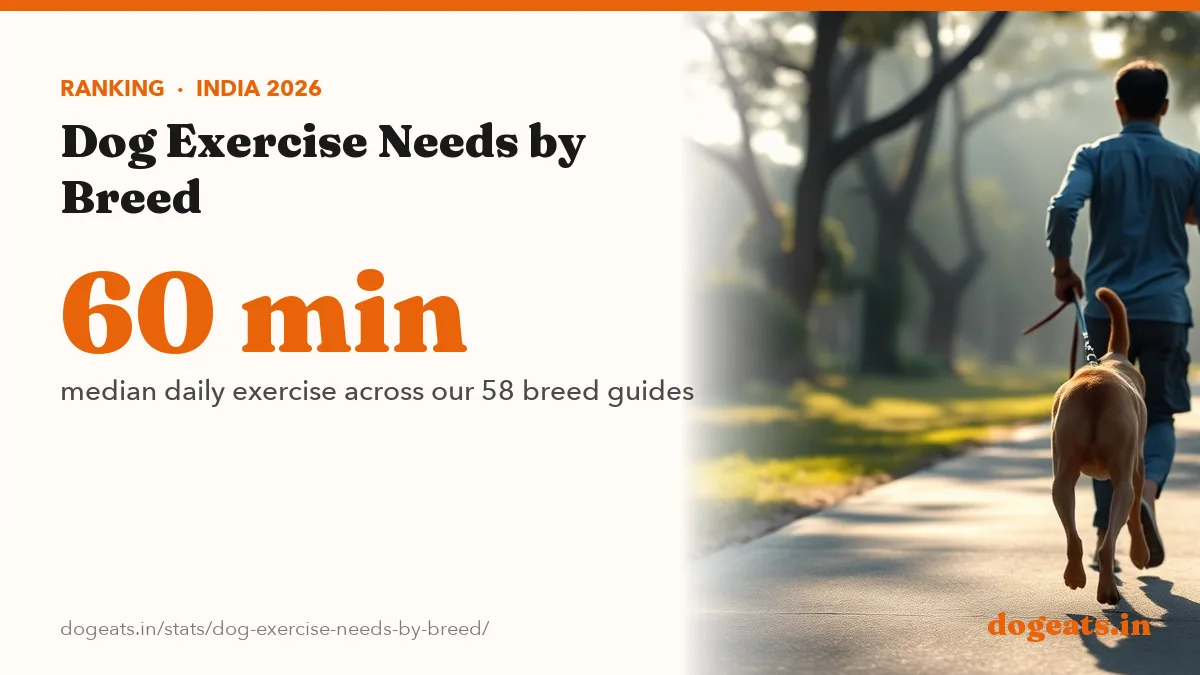
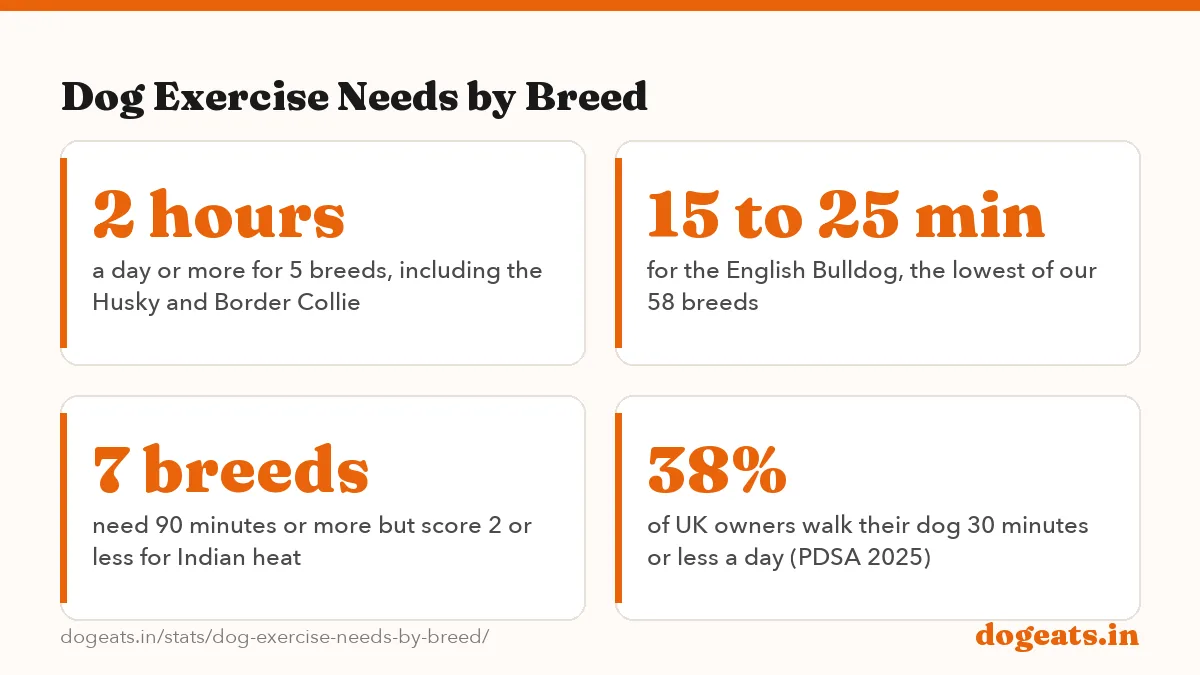
Most dogs need 30 minutes to 2 hours of exercise a day, and the median across our 58 breed guides is 60 minutes. Five breeds, including the Siberian Husky and Border Collie, need 2 hours or more, while the English Bulldog needs only 15 to 25 minutes. In India the harder question is when: several high-energy breeds also cope worst with heat.
Key findings
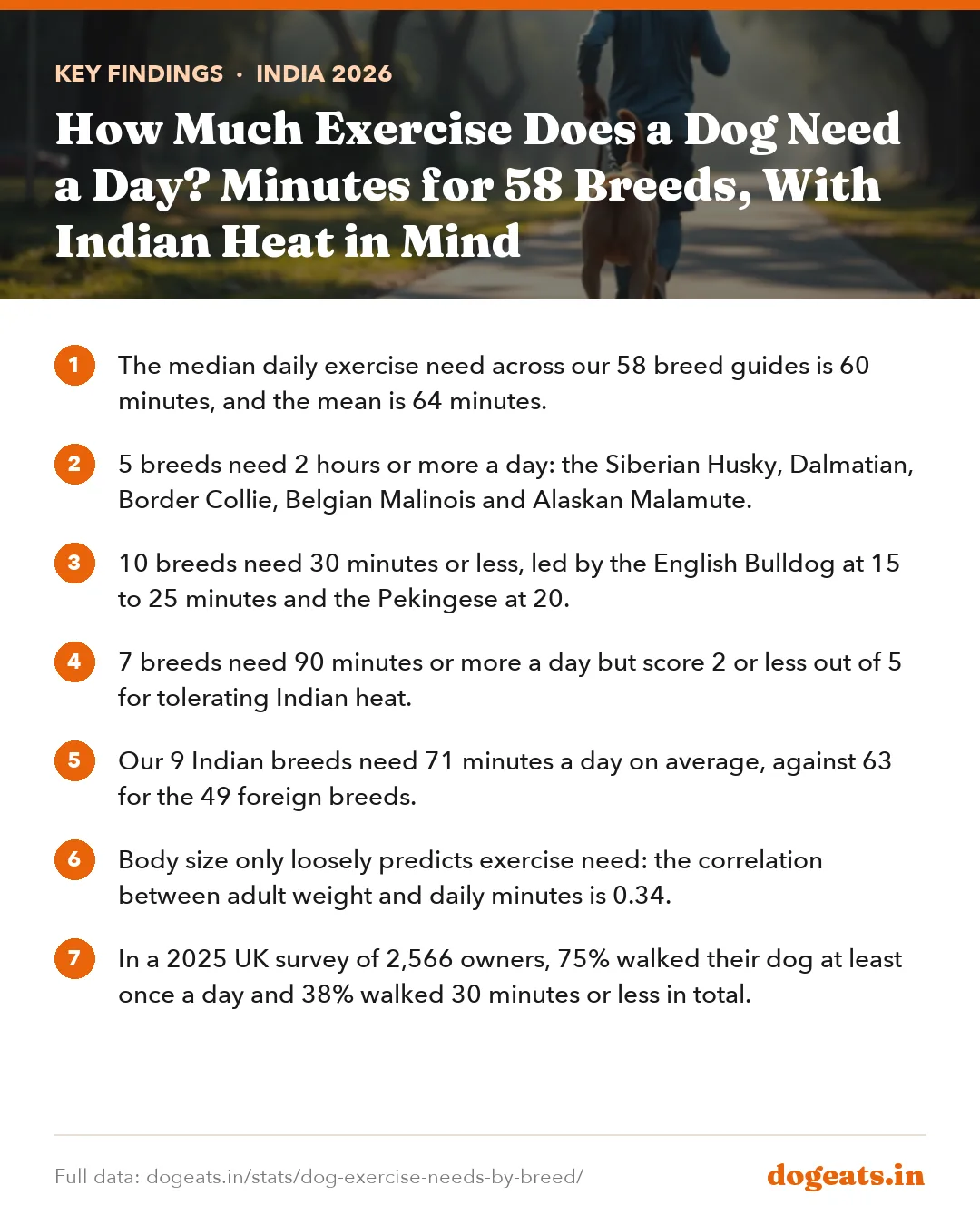
- The median daily exercise need across our 58 breed guides is 60 minutes, and the mean is 64 minutes.
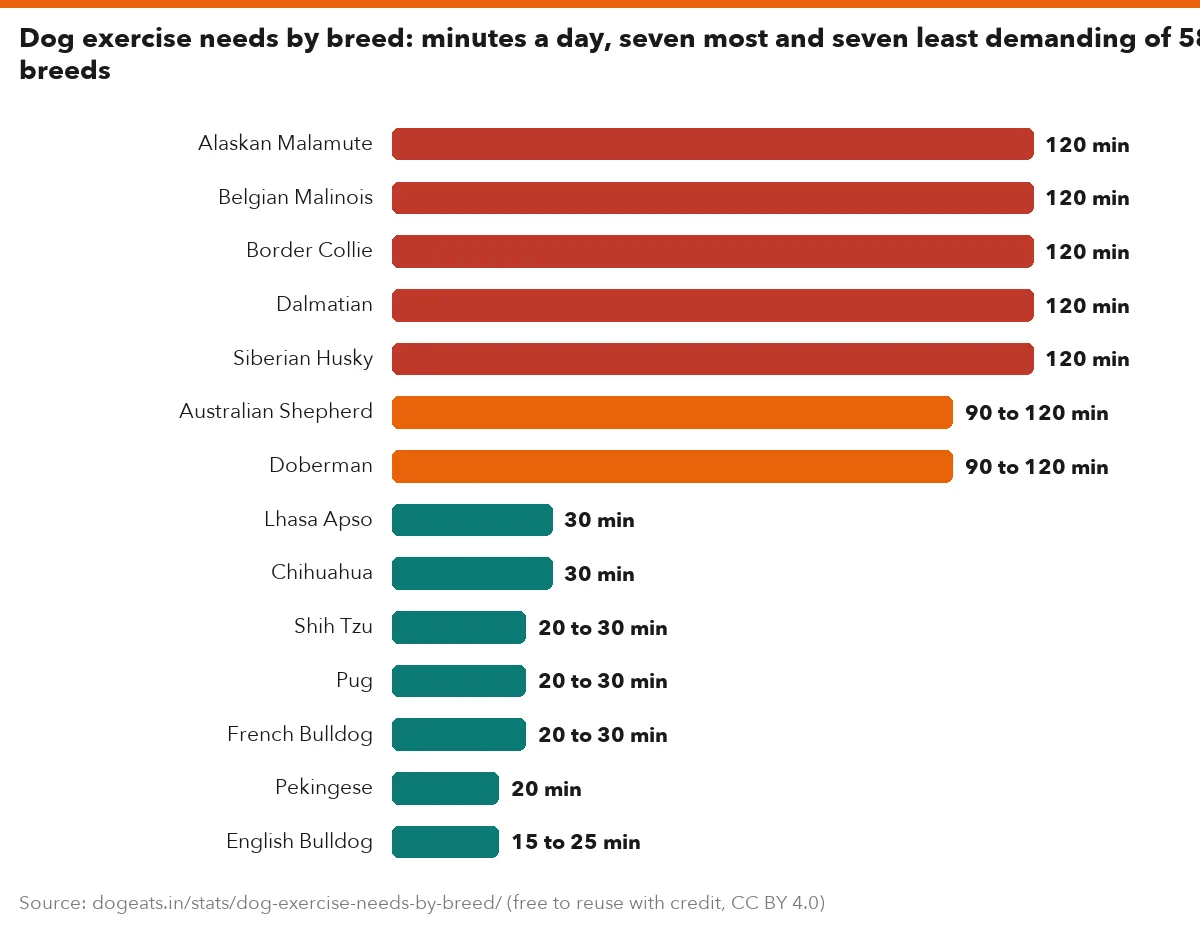
- 5 breeds need 2 hours or more a day: the Siberian Husky, Dalmatian, Border Collie, Belgian Malinois and Alaskan Malamute.
- 10 breeds need 30 minutes or less, led by the English Bulldog at 15 to 25 minutes and the Pekingese at 20.
- 7 breeds need 90 minutes or more a day but score 2 or less out of 5 for tolerating Indian heat.
- Our 9 Indian breeds need 71 minutes a day on average, against 63 for the 49 foreign breeds.
- Body size only loosely predicts exercise need: the correlation between adult weight and daily minutes is 0.34.
- In a 2025 UK survey of 2,566 owners, 75% walked their dog at least once a day and 38% walked 30 minutes or less in total.
- At GADVASU in Ludhiana, 31.12% of 180 overweight or obese dogs got no exercise at all, against 1.43% of 70 normal-weight dogs.
- UK vet records found exercise triggered 74.2% of heat-related illness events in dogs, against 5.2% for hot cars.
How much exercise does a dog need a day?
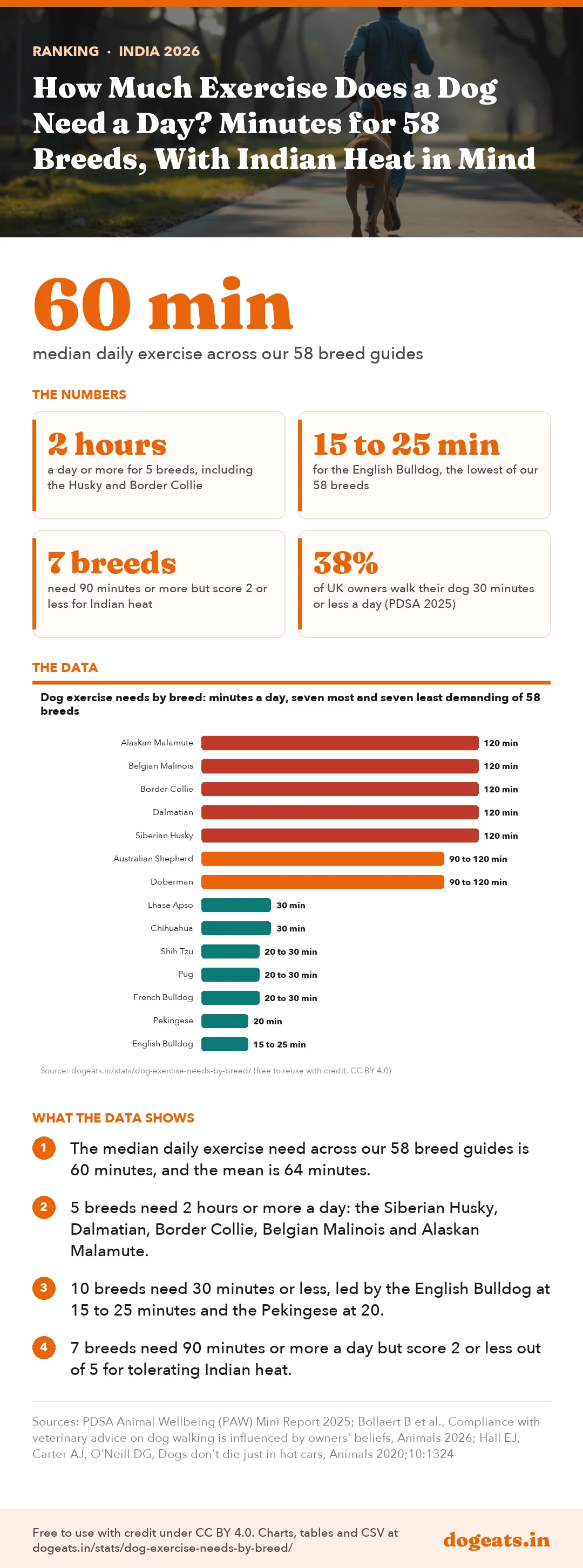
Between 15 minutes and 2 hours, depending mostly on breed. Across our 58 breed guides the median is 60 minutes a day and the mean 64 minutes.
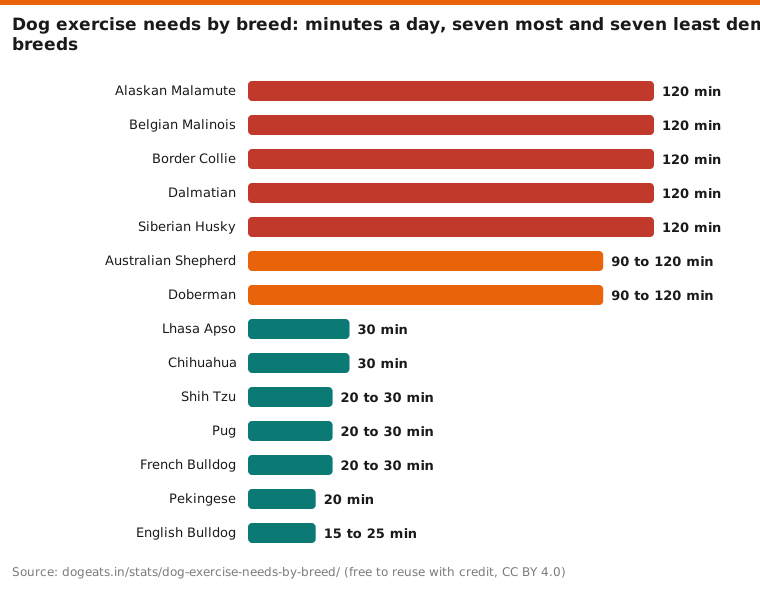
At the top, 5 breeds need 2 hours or more: the Siberian Husky, Dalmatian, Alaskan Malamute, Border Collie and Belgian Malinois among them. The Doberman and Australian Shepherd need 90 minutes to 2 hours.
At the bottom, 10 breeds need 30 minutes or less. The English Bulldog needs 15 to 25 minutes of slow walking, and the Pekingese about 20.
dogeats.in editorial data from our 58 breed guides, October 2026. Bars show the midpoint of each guide's daily range for a healthy adult.
Show the numbers
| Label | minutes a day |
|---|---|
| Alaskan Malamute | 120 min |
| Belgian Malinois | 120 min |
| Border Collie | 120 min |
| Dalmatian | 120 min |
| Siberian Husky | 120 min |
| Australian Shepherd | 90 to 120 min |
| Doberman | 90 to 120 min |
| Lhasa Apso | 30 min |
| Chihuahua | 30 min |
| Shih Tzu | 20 to 30 min |
| Pug | 20 to 30 min |
| French Bulldog | 20 to 30 min |
| Pekingese | 20 min |
| English Bulldog | 15 to 25 min |
Embed this chart
That study is Bollaert et al. (2026), a survey of 1,098 owners. Breed guides, ours included, therefore rely on breed history, kennel club guidance and vet experience. Treat every figure here as a starting range for a healthy adult, and adjust it with your vet for age, weight and health.
Dog exercise chart: how many minutes for each breed?
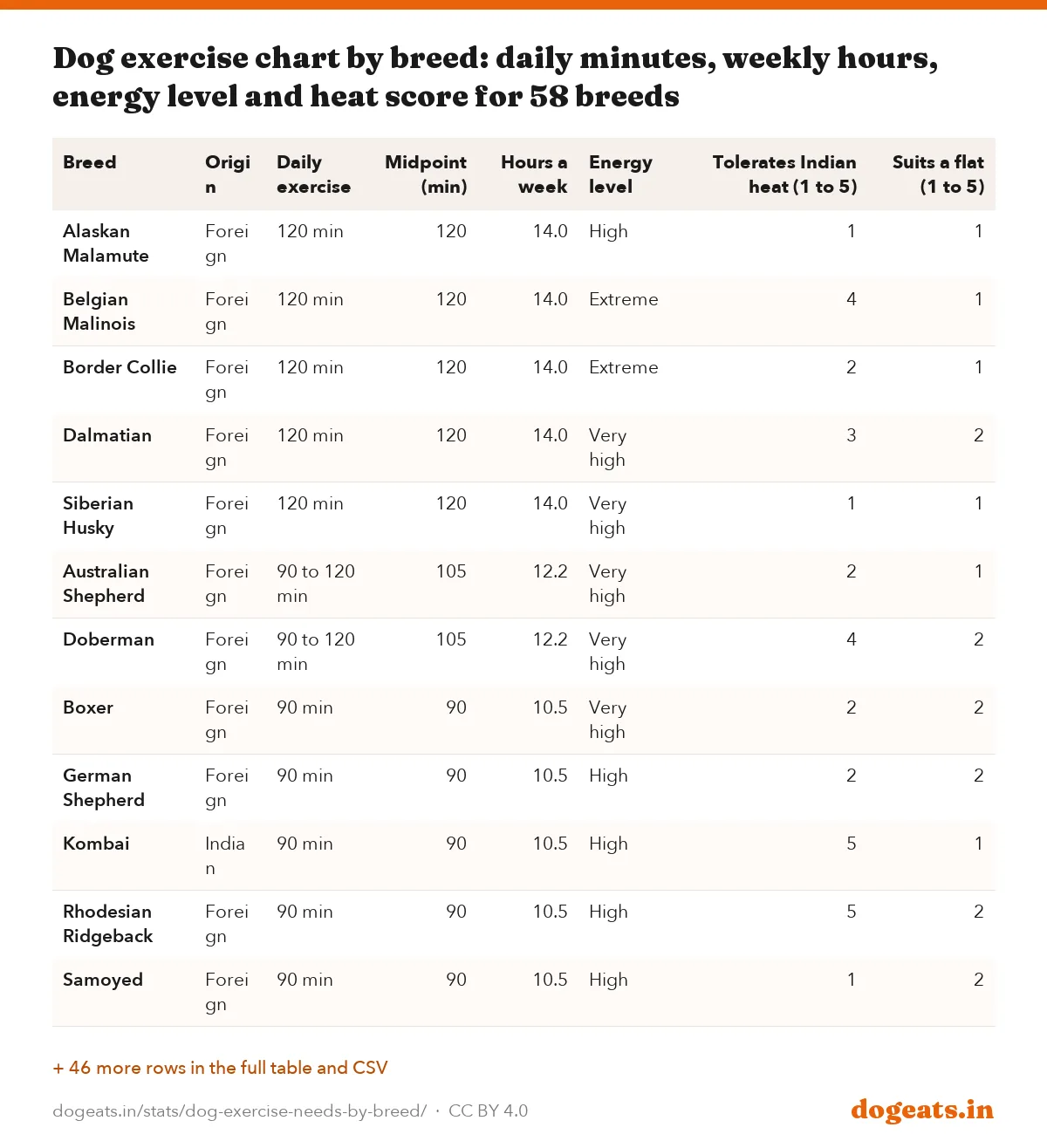
The full table lists all 58 breeds from most to least demanding. A breed at the median 60 minutes a day needs about 7.0 hours a week.
The 2-hour breeds need 14 hours a week, close to a part-time job for the owner. 34 of the 58 breeds need an hour a day or more.
The heat and flat columns are our 1 to 5 editorial scores. They show which active breeds are also hard to keep in Indian summers or apartments.
| Breed | Origin | Daily exercise | Midpoint (min) | Hours a week | Energy level | Tolerates Indian heat (1 to 5) | Suits a flat (1 to 5) |
|---|---|---|---|---|---|---|---|
| Alaskan Malamute | Foreign | 120 min | 120 | 14.0 | High | 1 | 1 |
| Belgian Malinois | Foreign | 120 min | 120 | 14.0 | Extreme | 4 | 1 |
| Border Collie | Foreign | 120 min | 120 | 14.0 | Extreme | 2 | 1 |
| Dalmatian | Foreign | 120 min | 120 | 14.0 | Very high | 3 | 2 |
| Siberian Husky | Foreign | 120 min | 120 | 14.0 | Very high | 1 | 1 |
| Australian Shepherd | Foreign | 90 to 120 min | 105 | 12.2 | Very high | 2 | 1 |
| Doberman | Foreign | 90 to 120 min | 105 | 12.2 | Very high | 4 | 2 |
| Boxer | Foreign | 90 min | 90 | 10.5 | Very high | 2 | 2 |
| German Shepherd | Foreign | 90 min | 90 | 10.5 | High | 2 | 2 |
| Kombai | Indian | 90 min | 90 | 10.5 | High | 5 | 1 |
| Rhodesian Ridgeback | Foreign | 90 min | 90 | 10.5 | High | 5 | 2 |
| Samoyed | Foreign | 90 min | 90 | 10.5 | High | 1 | 2 |
| Bully Kutta | Indian | 60 to 90 min | 75 | 8.8 | Moderate | 3 | 1 |
| Cane Corso | Foreign | 60 to 90 min | 75 | 8.8 | Moderate to high | 3 | 1 |
| Chippiparai | Indian | 60 to 90 min | 75 | 8.8 | High in bursts | 5 | 2 |
| Dogo Argentino | Foreign | 60 to 90 min | 75 | 8.8 | High | 2 | 1 |
| Jack Russell Terrier | Foreign | 60 to 90 min | 75 | 8.8 | Very high | 4 | 2 |
| Kangal | Foreign | 60 to 90 min | 75 | 8.8 | Moderate | 3 | 1 |
| Kanni | Indian | 60 to 90 min | 75 | 8.8 | Sprints | 5 | 2 |
| Labrador Retriever | Foreign | 60 to 90 min | 75 | 8.8 | High | 2 | 3 |
| Mudhol Hound | Indian | 60 to 90 min | 75 | 8.8 | Short hard runs | 5 | 2 |
| Pit Bull | Foreign | 60 to 90 min | 75 | 8.8 | High | 3 | 2 |
| Rajapalayam | Indian | 60 to 90 min | 75 | 8.8 | Explosive in bursts | 5 | 1 |
| Rampur Greyhound | Indian | 60 to 90 min | 75 | 8.8 | Bursts of speed | 5 | 2 |
| Rottweiler | Foreign | 60 to 90 min | 75 | 8.8 | Moderate to high | 2 | 2 |
| Golden Retriever | Foreign | 60 to 80 min | 70 | 8.2 | Moderate to high | 2 | 3 |
| Poodle (Standard) | Foreign | 60 to 80 min | 70 | 8.2 | Moderate to high (Standard) | 4 | 5 |
| Beagle | Foreign | 60 min | 60 | 7.0 | High | 4 | 3 |
| Bull Terrier | Foreign | 60 min or more | 60 | 7.0 | High | 3 | 3 |
| Cocker Spaniel | Foreign | 60 min | 60 | 7.0 | Moderate to high | 3 | 4 |
| Great Dane | Foreign | 60 min | 60 | 7.0 | Moderate | 2 | 2 |
| Pembroke Welsh Corgi | Foreign | 60 min | 60 | 7.0 | Moderate to high | 2 | 4 |
| Shiba Inu | Foreign | 60 min | 60 | 7.0 | Moderate to high | 2 | 4 |
| Tibetan Mastiff | Foreign | 60 min | 60 | 7.0 | Moderate | 1 | 1 |
| American Eskimo Dog (standard) | Foreign | 45 to 60 min | 52.5 | 6.1 | Moderate to high | 2 | 4 |
| Bernese Mountain Dog | Foreign | 45 to 60 min | 52.5 | 6.1 | Moderate | 1 | 1 |
| Indian Pariah Dog | Indian | 45 to 60 min | 52.5 | 6.1 | Moderate | 5 | 4 |
| Saint Bernard | Foreign | 45 to 60 min | 52.5 | 6.1 | Low to moderate | 1 | 1 |
| Bullmastiff | Foreign | 40 to 60 min | 50 | 5.8 | Low to moderate | 1 | 2 |
| Chow Chow | Foreign | 45 min | 45 | 5.2 | Low to moderate | 1 | 3 |
| Dachshund (standard) | Foreign | 45 min | 45 | 5.2 | Moderate | 4 | 4 |
| English Mastiff | Foreign | 30 to 60 min | 45 | 5.2 | Low to moderate | 1 | 2 |
| German Spitz | Foreign | 45 min | 45 | 5.2 | Moderate | 2 | 4 |
| Indian Spitz (small type) | Indian | 45 min | 45 | 5.2 | Moderate | 4 | 4 |
| Japanese Spitz | Foreign | 45 min | 45 | 5.2 | Moderate | 2 | 4 |
| Miniature Pinscher | Foreign | 45 min | 45 | 5.2 | High | 4 | 4 |
| Bichon Frise | Foreign | 40 min | 40 | 4.7 | Moderate | 3 | 5 |
| Cavalier King Charles Spaniel | Foreign | 40 min | 40 | 4.7 | Moderate | 3 | 5 |
| Chihuahua | Foreign | 30 min | 30 | 3.5 | Moderate | 4 | 5 |
| Lhasa Apso | Foreign | 30 min | 30 | 3.5 | Low to moderate | 3 | 5 |
| Maltese | Foreign | 30 min | 30 | 3.5 | Low to moderate | 3 | 5 |
| Pomeranian | Foreign | 30 min | 30 | 3.5 | Moderate | 2 | 3 |
| Yorkshire Terrier | Foreign | 30 min | 30 | 3.5 | Moderate | 3 | 5 |
| French Bulldog | Foreign | 20 to 30 min | 25 | 2.9 | Low | 1 | 5 |
| Pug | Foreign | 20 to 30 min | 25 | 2.9 | Low | 1 | 5 |
| Shih Tzu | Foreign | 20 to 30 min | 25 | 2.9 | Low | 2 | 5 |
| English Bulldog | Foreign | 15 to 25 min | 20 | 2.3 | Very low | 1 | 4 |
| Pekingese | Foreign | 20 min | 20 | 2.3 | Low | 1 | 5 |
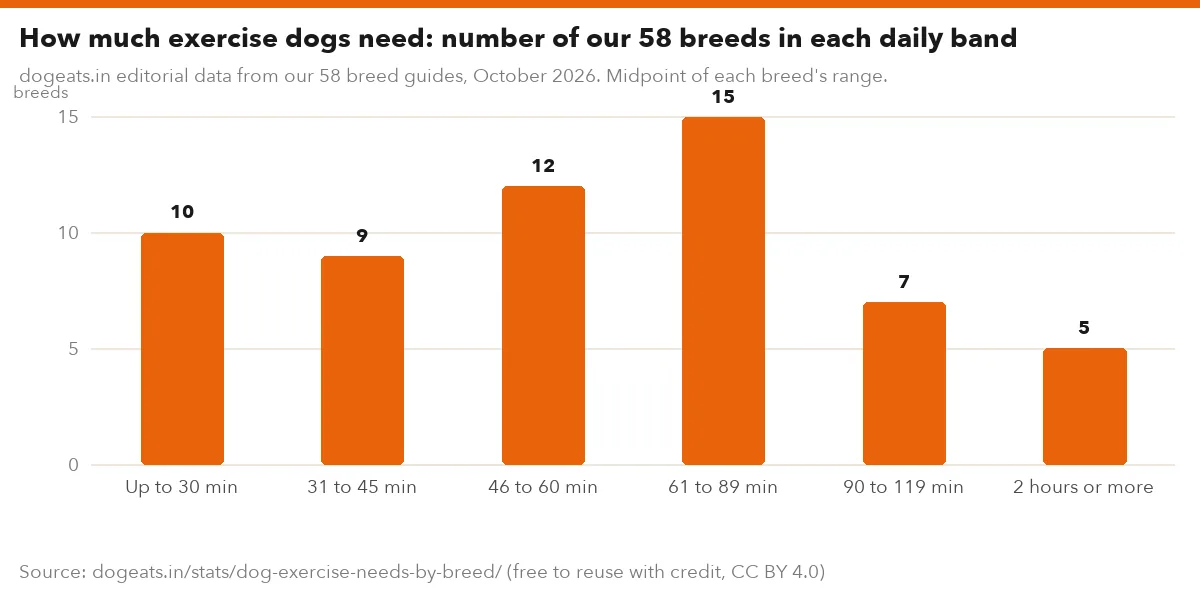
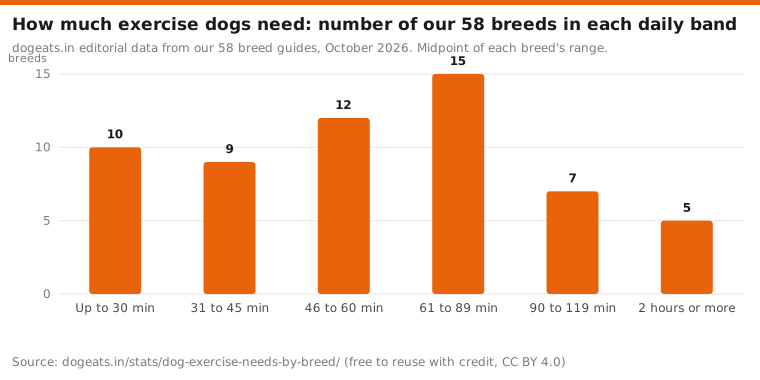
dogeats.in editorial data from our 58 breed guides, October 2026. Midpoint of each breed's range.
Show the numbers
| Label | breeds |
|---|---|
| Up to 30 min | 10 |
| 31 to 45 min | 9 |
| 46 to 60 min | 12 |
| 61 to 89 min | 15 |
| 90 to 119 min | 7 |
| 2 hours or more | 5 |
Embed this chart
The busiest band is 61 to 89 minutes, with 15 breeds. Most of them sit at 60 to 90 minutes, the range for the Labrador, Rottweiler and the Indian sighthounds.
How much exercise can a dog get in Indian summer?
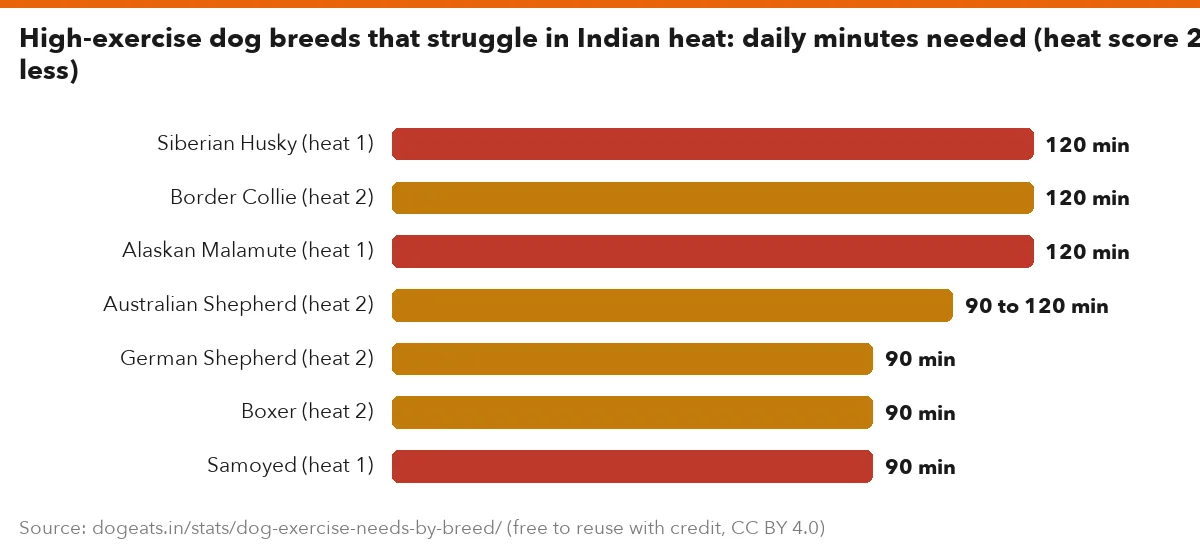
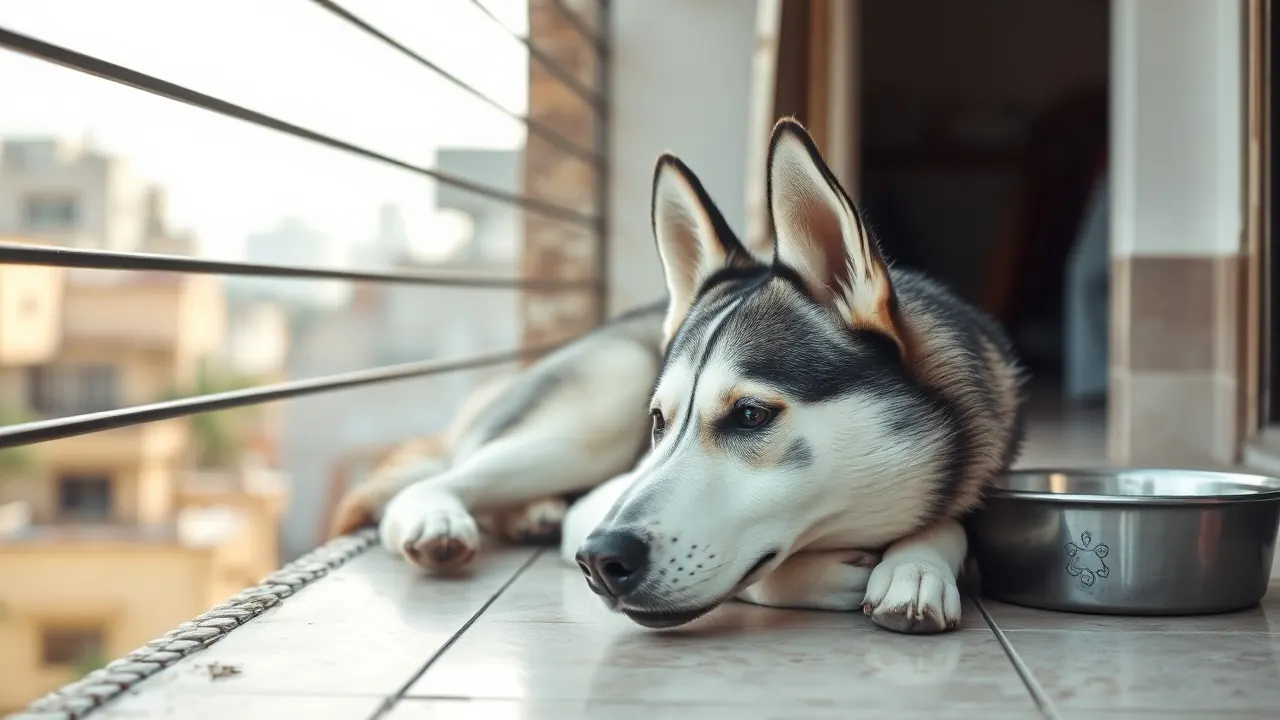
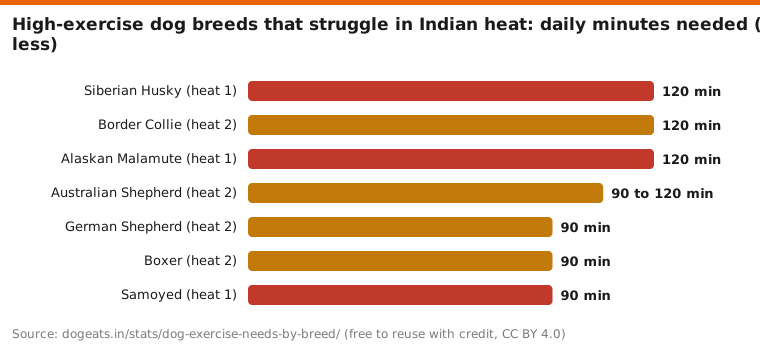
Less than the breed needs, for many active dogs. 7 breeds in our guides need 90 minutes or more a day but score 2 or less out of 5 for tolerating Indian heat.
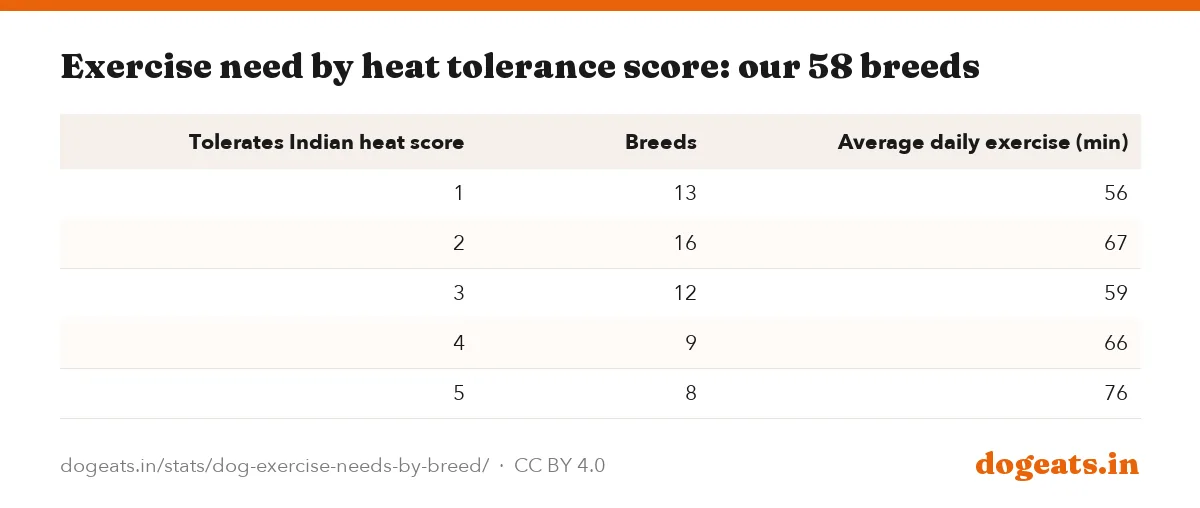
They include the Siberian Husky, Alaskan Malamute, Border Collie and Samoyed, all thick-coated breeds. Across all 58 breeds, heat tolerance and exercise need are almost unrelated, with a correlation of 0.18.
Exercise is the main heat danger. In UK vet records for 2016, exercise triggered 74.2% of heat-related illness events, environmental heat 12.9% and hot cars 5.2%.
dogeats.in editorial data from our 58 breed guides, October 2026. Heat score is our 1 to 5 rating for tolerating Indian heat.
Show the numbers
| Label | minutes a day |
|---|---|
| Siberian Husky (heat 1) | 120 min |
| Border Collie (heat 2) | 120 min |
| Alaskan Malamute (heat 1) | 120 min |
| Australian Shepherd (heat 2) | 90 to 120 min |
| German Shepherd (heat 2) | 90 min |
| Boxer (heat 2) | 90 min |
| Samoyed (heat 1) | 90 min |
Embed this chart
| Tolerates Indian heat score | Breeds | Average daily exercise (min) |
|---|---|---|
| 1 | 13 | 56 |
| 2 | 16 | 67 |
| 3 | 12 | 59 |
| 4 | 9 | 66 |
| 5 | 8 | 76 |
A small study of walks in a hot, sunny region tracked five dogs. Their breathing rose from about 47 to 374 breaths a minute when walked above a black globe temperature of 35 C. Our guides advise early-morning and late-evening walks in hot weather for 40 of 58 breeds. Our report on how hot is too hot for dogs covers pavement temperatures, and the heatstroke report the risk.
Do Indian dog breeds need more exercise?
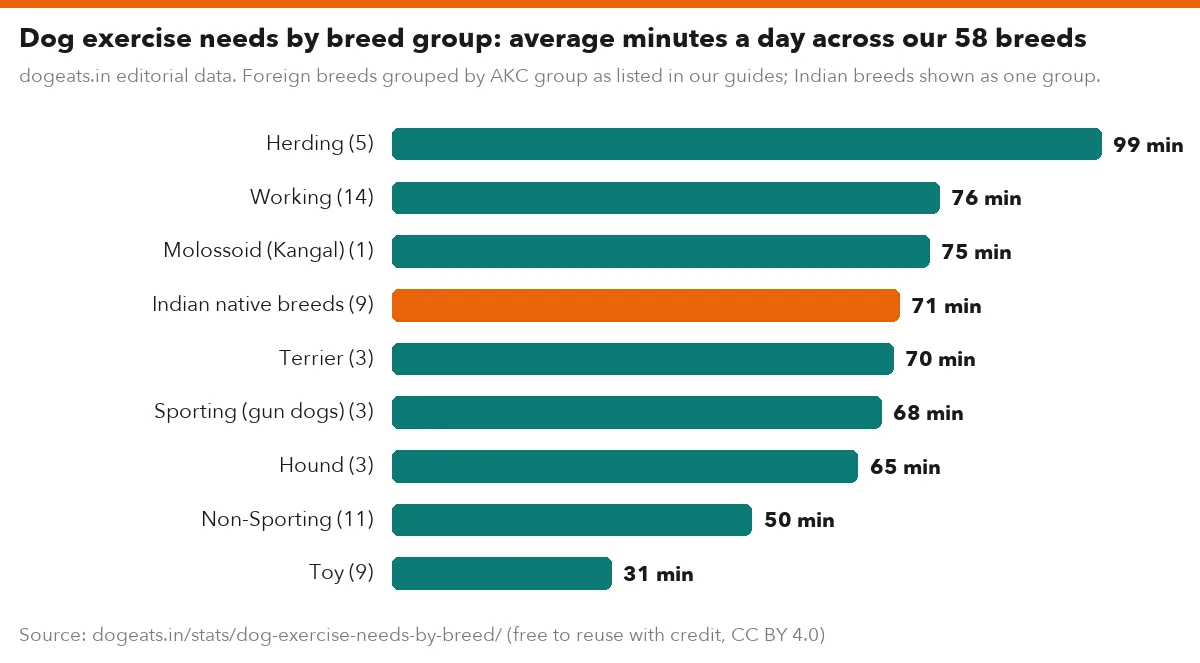
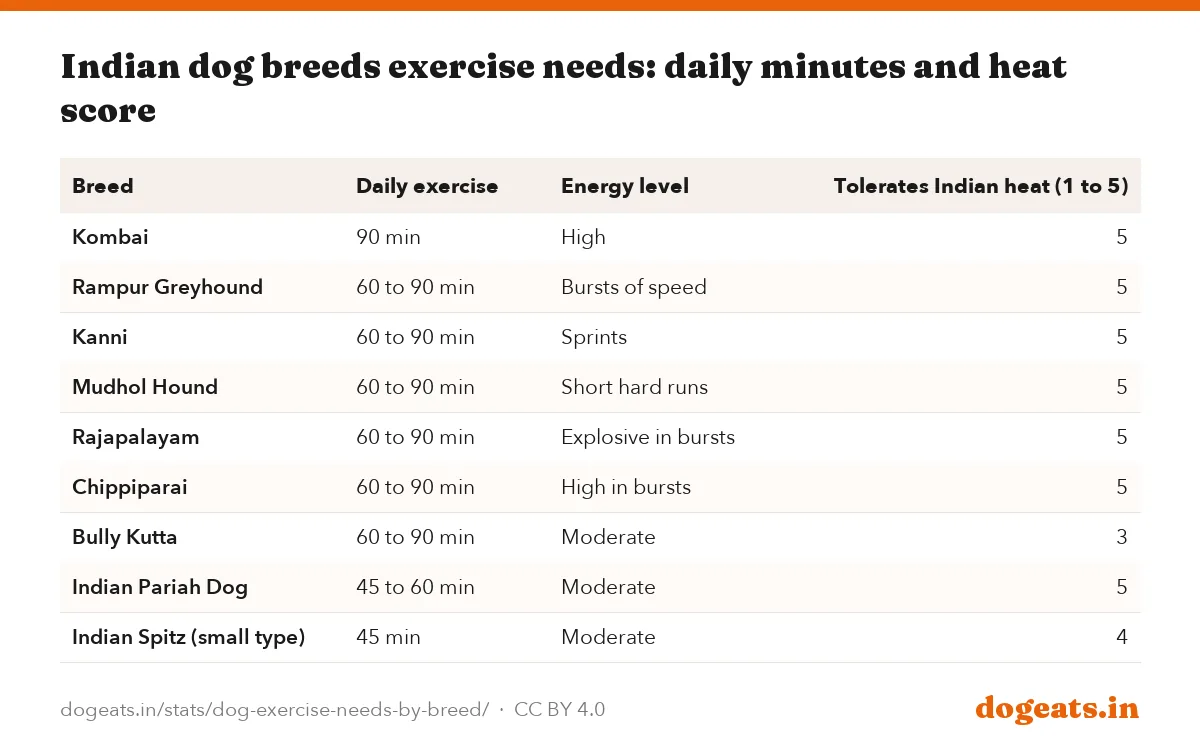
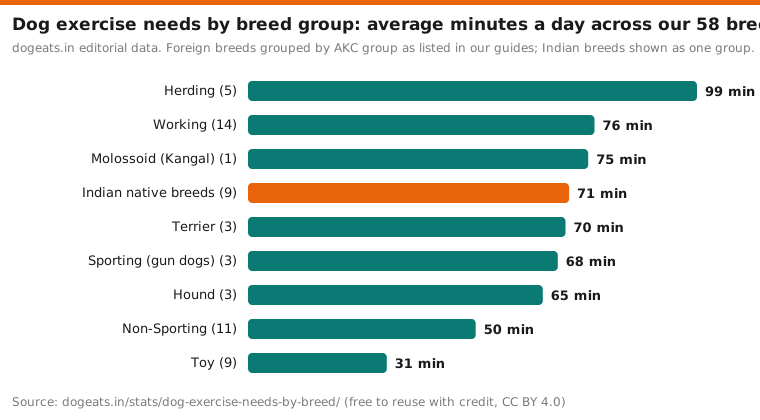
Yes, on average. Our 9 Indian breeds need 71 minutes a day, against 63 minutes for the 49 foreign breeds. Five of the nine are sighthounds bred to sprint.
The Kanni, Chippiparai, Rajapalayam, Mudhol Hound and Rampur Greyhound each need 60 to 90 minutes, with a chance to run flat out. The Kombai needs 90 minutes.
The Indian Pariah dog is the moderate exception at 45 to 60 minutes. The guide calls Indies satisfied by less exercise than a working breed needs.
dogeats.in editorial data. Foreign breeds grouped by AKC group as listed in our guides; Indian breeds shown as one group.
Show the numbers
| Label | minutes a day |
|---|---|
| Herding (5) | 99 min |
| Working (14) | 76 min |
| Molossoid (Kangal) (1) | 75 min |
| Indian native breeds (9) | 71 min |
| Terrier (3) | 70 min |
| Sporting (gun dogs) (3) | 68 min |
| Hound (3) | 65 min |
| Non-Sporting (11) | 50 min |
| Toy (9) | 31 min |
Embed this chart
| Breed | Daily exercise | Energy level | Tolerates Indian heat (1 to 5) |
|---|---|---|---|
| Kombai | 90 min | High | 5 |
| Rampur Greyhound | 60 to 90 min | Bursts of speed | 5 |
| Kanni | 60 to 90 min | Sprints | 5 |
| Mudhol Hound | 60 to 90 min | Short hard runs | 5 |
| Rajapalayam | 60 to 90 min | Explosive in bursts | 5 |
| Chippiparai | 60 to 90 min | High in bursts | 5 |
| Bully Kutta | 60 to 90 min | Moderate | 3 |
| Indian Pariah Dog | 45 to 60 min | Moderate | 5 |
| Indian Spitz (small type) | 45 min | Moderate | 4 |
Herding breeds are the most demanding group in our guides, and toy breeds the least. Indian breeds also score far better on heat, which makes their higher needs easier to meet.
Do bigger dogs need more exercise?
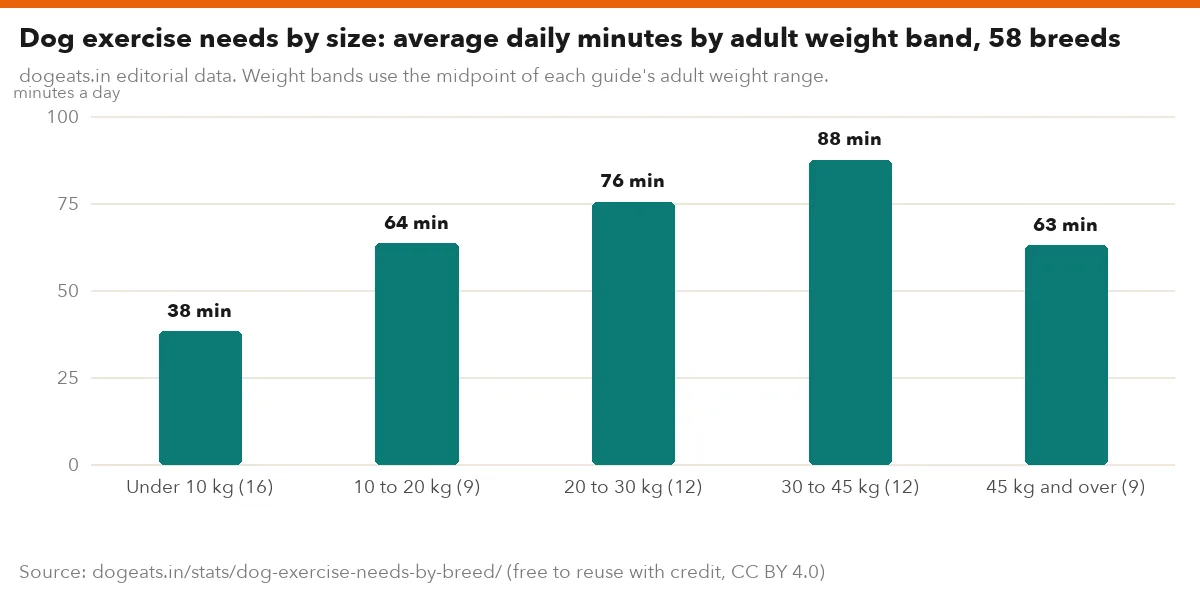
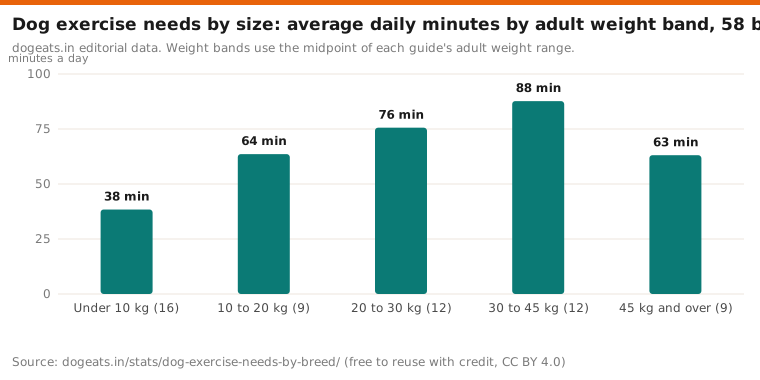
Only a little. The correlation between adult weight and daily exercise need across our 58 breeds is 0.34, a weak link.
The giant guardians need little for their size. The English Mastiff needs 30 to 60 minutes and the Saint Bernard 45 to 60, while the 4 to 7 kg Jack Russell Terrier needs 60 to 90.
Type of work matters more than size. Herding, sledding and carriage breeds sit at the top, and flat-faced companion breeds at the bottom.
dogeats.in editorial data. Weight bands use the midpoint of each guide's adult weight range.
Show the numbers
| Label | minutes a day |
|---|---|
| Under 10 kg (16) | 38 min |
| 10 to 20 kg (9) | 64 min |
| 20 to 30 kg (12) | 76 min |
| 30 to 45 kg (12) | 88 min |
| 45 kg and over (9) | 63 min |
Embed this chart
Flat-faced breeds are a special case. The Pug, French Bulldog and English Bulldog need 15 to 30 minutes, and their guides advise little or no outdoor walking in peak Indian summer.
How long do owners actually walk their dogs?
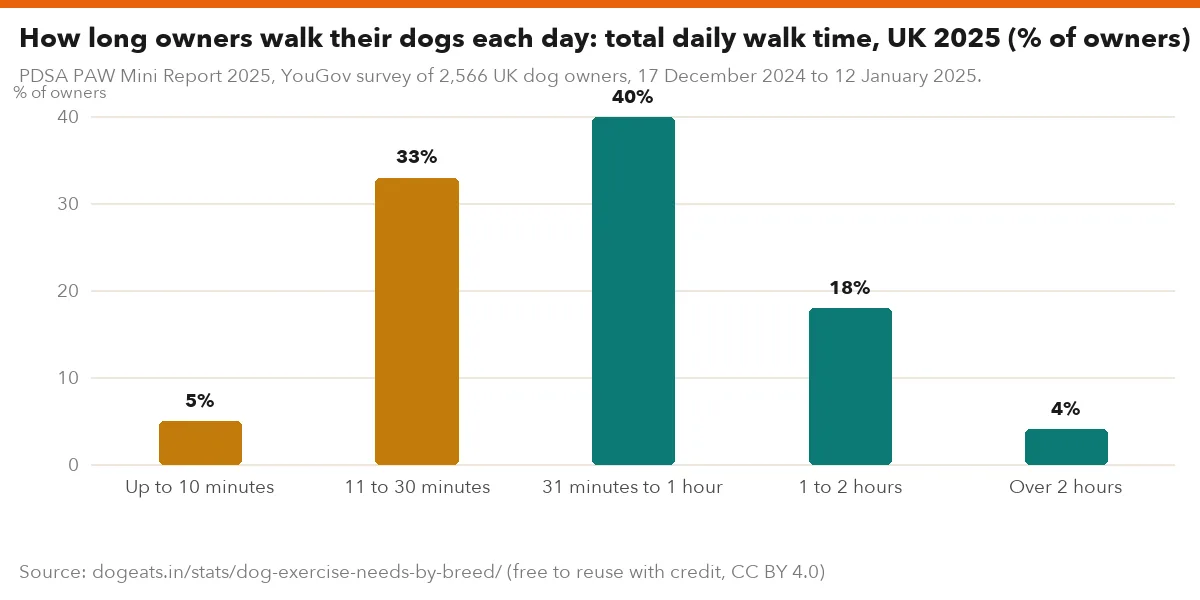
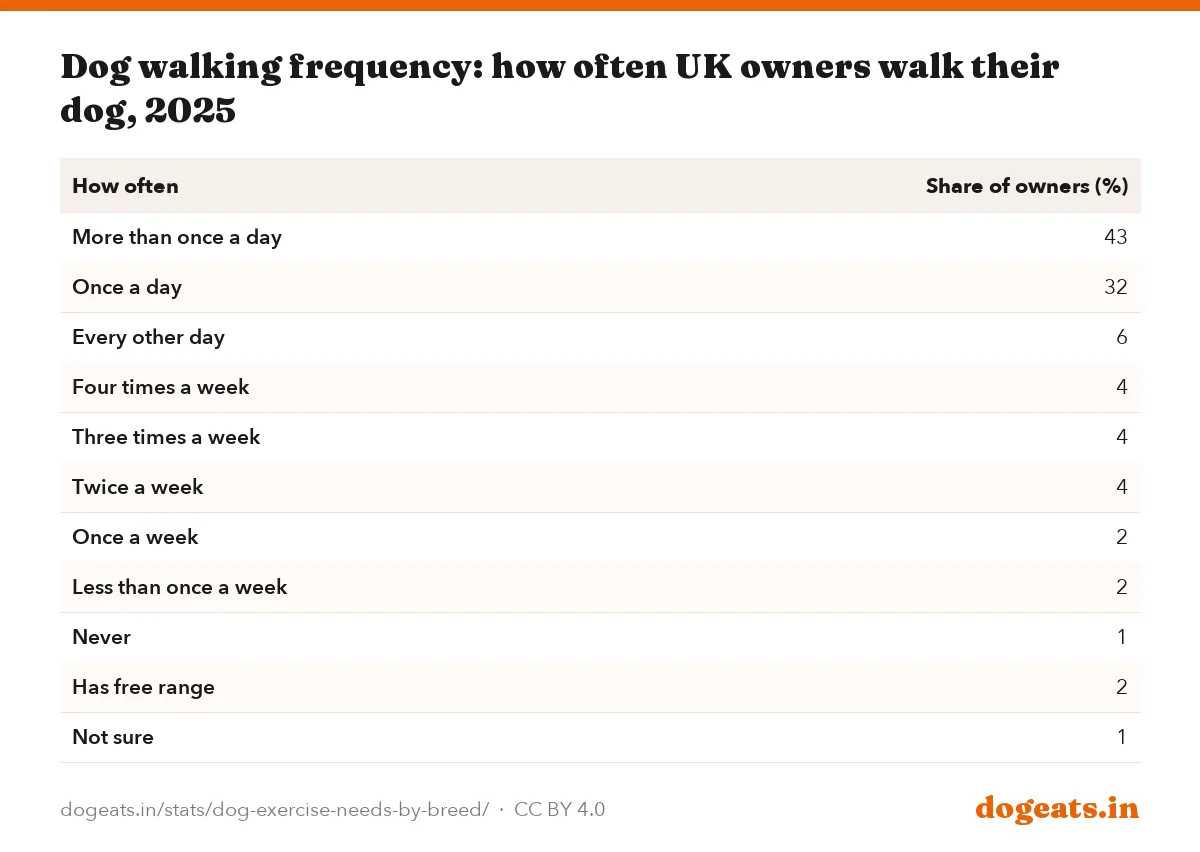
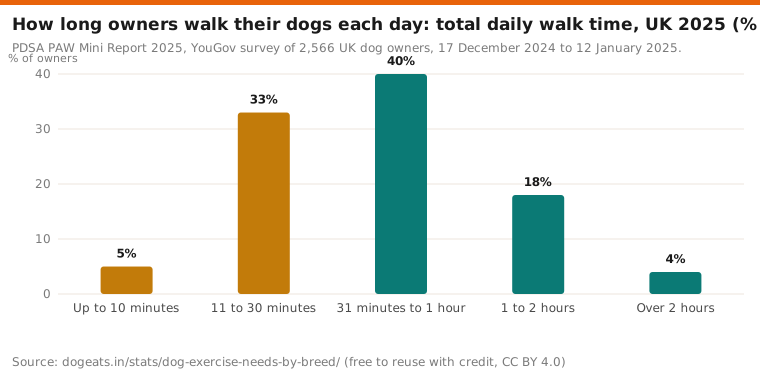
Often less than the breed needs. In PDSA's 2025 survey of 2,566 UK dog owners, 75% walked their dog once a day or more, and 43% more than once.
But 38% walked for 30 minutes or less in total each day. 40% walked for 31 minutes to an hour, 18% for 1 to 2 hours and 4% for over 2 hours.
Set against our guides, 48 of 58 breeds need more than 30 minutes a day. Short walkers most often said their garden was big enough (30%) or the dog needed no more (28%).
PDSA PAW Mini Report 2025, YouGov survey of 2,566 UK dog owners, 17 December 2024 to 12 January 2025.
Show the numbers
| Label | % of owners |
|---|---|
| Up to 10 minutes | 5% |
| 11 to 30 minutes | 33% |
| 31 minutes to 1 hour | 40% |
| 1 to 2 hours | 18% |
| Over 2 hours | 4% |
Embed this chart
| How often | Share of owners (%) |
|---|---|
| More than once a day | 43 |
| Once a day | 32 |
| Every other day | 6 |
| Four times a week | 4 |
| Three times a week | 4 |
| Twice a week | 4 |
| Once a week | 2 |
| Less than once a week | 2 |
| Never | 1 |
| Has free range | 2 |
| Not sure | 1 |
A Cheshire study by Westgarth et al. (2022) found owners walked with their dogs a median 7 times and 230 minutes a week. Regular walkers managed 400 minutes a week, against 45 for irregular walkers. No comparable Indian survey of walking time exists that we could find.
Does lack of exercise make Indian dogs overweight?
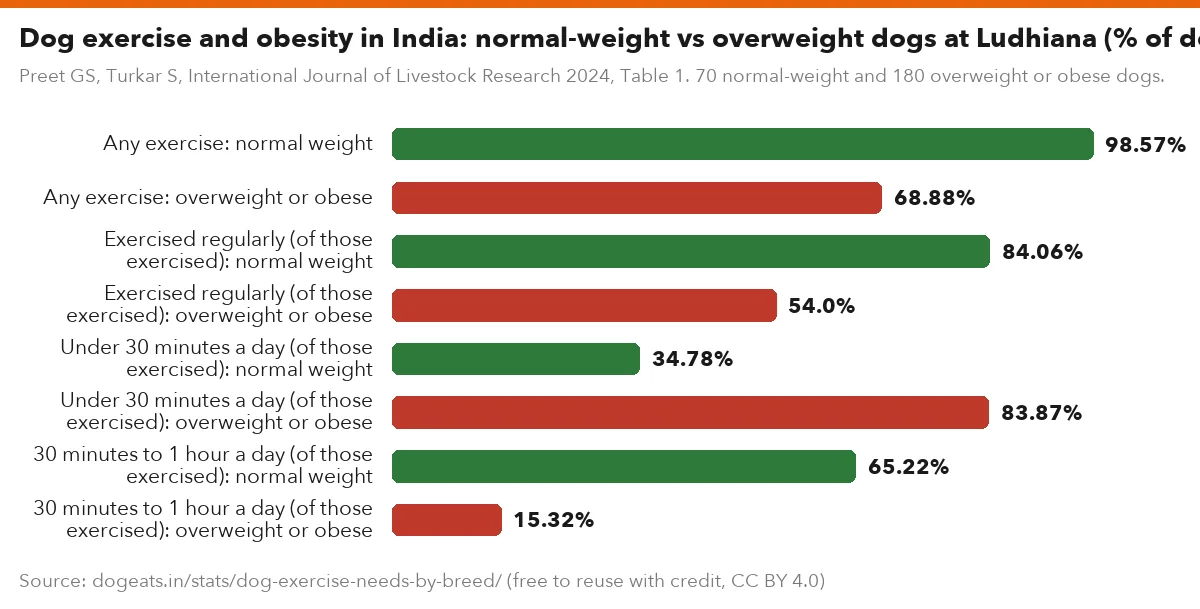
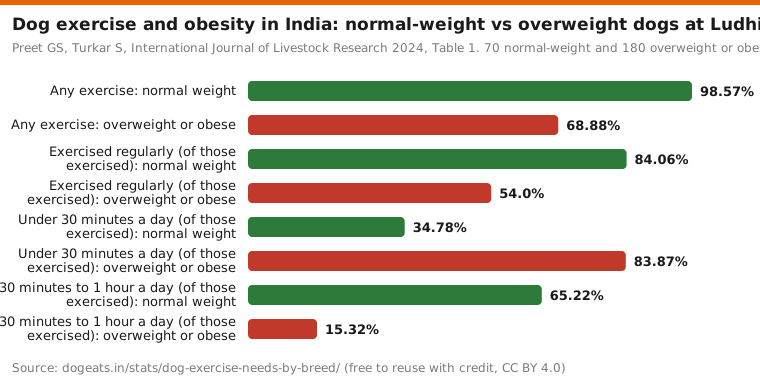
In the one Indian study we found that measured it, yes. At GADVASU's clinics in Ludhiana, Preet and Turkar (2024) compared 70 normal-weight and 180 overweight or obese adult dogs.
Of the overweight or obese dogs, 56 (31.12%) got no exercise at all, against 1 of 70 normal-weight dogs (1.43%). Among dogs that were exercised, 83.87% of the heavy dogs got under 30 minutes a day, against 34.78% of normal-weight dogs.
Regularity differed too: 84.06% of exercised normal-weight dogs went out regularly, against 54% of the overweight group. The study shows association, not cause.
Preet GS, Turkar S, International Journal of Livestock Research 2024, Table 1. 70 normal-weight and 180 overweight or obese dogs.
Show the numbers
| Label | % of dogs |
|---|---|
| Any exercise: normal weight | 98.57% |
| Any exercise: overweight or obese | 68.88% |
| Exercised regularly (of those exercised): normal weight | 84.06% |
| Exercised regularly (of those exercised): overweight or obese | 54.0% |
| Under 30 minutes a day (of those exercised): normal weight | 34.78% |
| Under 30 minutes a day (of those exercised): overweight or obese | 83.87% |
| 30 minutes to 1 hour a day (of those exercised): normal weight | 65.22% |
| 30 minutes to 1 hour a day (of those exercised): overweight or obese | 15.32% |
Embed this chart
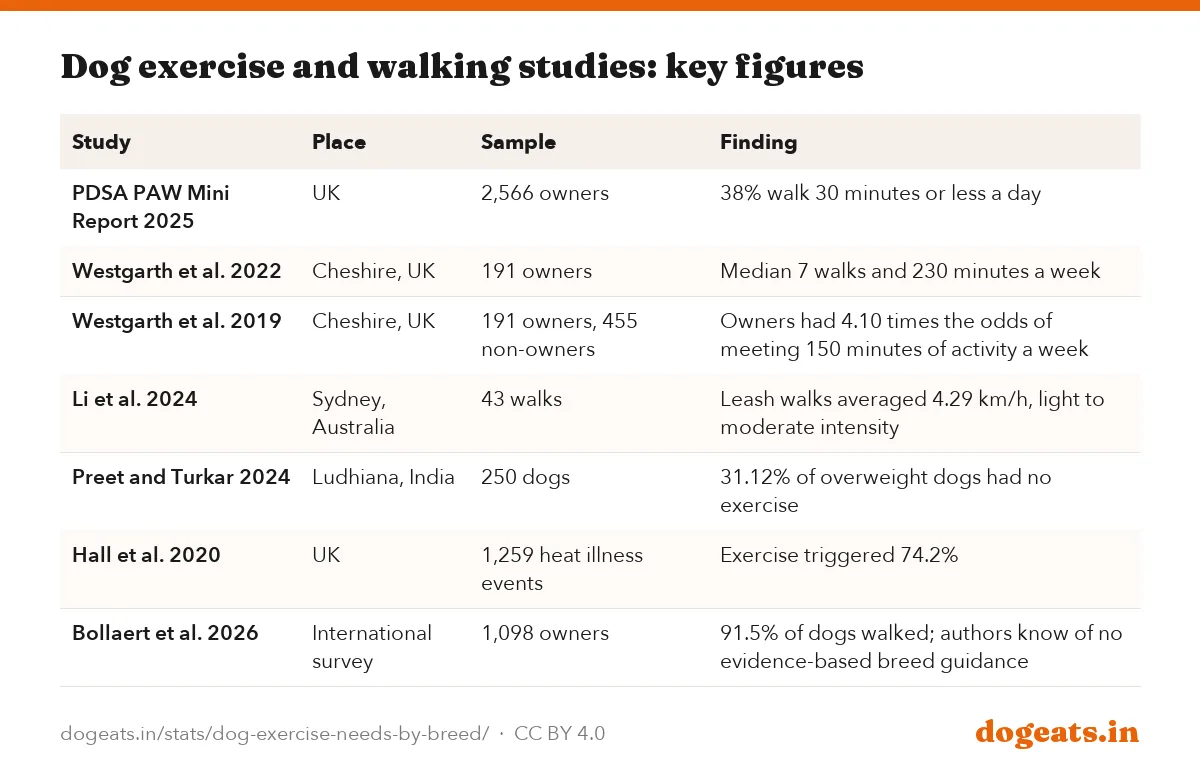
| Study | Place | Sample | Finding |
|---|---|---|---|
| PDSA PAW Mini Report 2025 | UK | 2,566 owners | 38% walk 30 minutes or less a day |
| Westgarth et al. 2022 | Cheshire, UK | 191 owners | Median 7 walks and 230 minutes a week |
| Westgarth et al. 2019 | Cheshire, UK | 191 owners, 455 non-owners | Owners had 4.10 times the odds of meeting 150 minutes of activity a week |
| Li et al. 2024 | Sydney, Australia | 43 walks | Leash walks averaged 4.29 km/h, light to moderate intensity |
| Preet and Turkar 2024 | Ludhiana, India | 250 dogs | 31.12% of overweight dogs had no exercise |
| Hall et al. 2020 | UK | 1,259 heat illness events | Exercise triggered 74.2% |
| Bollaert et al. 2026 | International survey | 1,098 owners | 91.5% of dogs walked; authors know of no evidence-based breed guidance |
Our dog health statistics bring together obesity rates from studies around the world. Our feeding chart by weight shows how energy needs change with activity.
Does walking a dog count as exercise for the owner?
Partly. Westgarth et al. (2019) surveyed 191 dog owners and 455 non-owners in Cheshire, UK. Owners had 14.35 times the odds of walking for recreation.
They also had 4.10 times the odds of meeting the guideline of 150 minutes of activity a week. Other exercise did not differ between owners and non-owners.
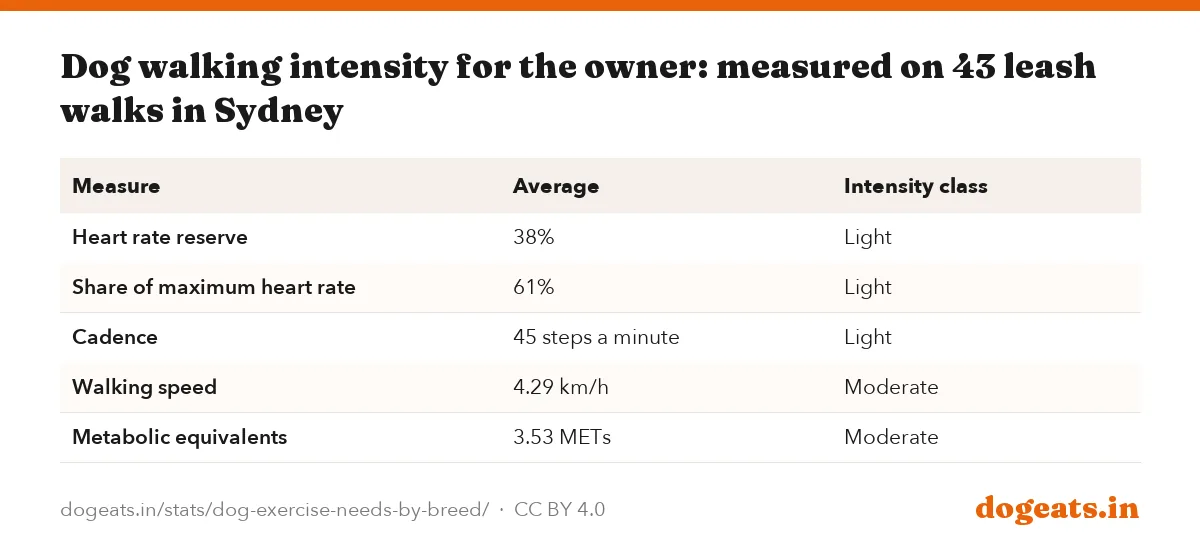
Intensity is modest. In Sydney, Li et al. (2024) tracked 43 leash walks: average speed was 4.29 km/h and 3.53 METs, the border of light and moderate activity.
| Measure | Average | Intensity class |
|---|---|---|
| Heart rate reserve | 38% | Light |
| Share of maximum heart rate | 61% | Light |
| Cadence | 45 steps a minute | Light |
| Walking speed | 4.29 km/h | Moderate |
| Metabolic equivalents | 3.53 METs | Moderate |
In US Dog Aging Project data on 19,732 dogs, owners in poorer neighbourhoods reported less on-leash walking. Where and when people can walk shapes how much exercise dogs get, in India as anywhere.
Frequently asked questions
How much exercise does a dog need a day?
Most dogs need 30 minutes to 2 hours a day. The median across our 58 breed guides is 60 minutes, ranging from 15 to 25 minutes for an English Bulldog to 2 hours or more for a Husky.
Which dog breeds need the most exercise?
The Siberian Husky, Dalmatian, Border Collie, Belgian Malinois and Alaskan Malamute need 2 hours or more a day in our guides. The Doberman and Australian Shepherd need 90 minutes to 2 hours.
Which dog breeds need the least exercise?
The English Bulldog (15 to 25 minutes), Pekingese (20), Pug, French Bulldog and Shih Tzu (20 to 30) need the least. Flat-faced breeds should not be walked in peak heat.
How long should I walk my Labrador?
Our Labrador guide suggests 60 to 90 minutes a day, split into two sessions. In Indian summers, walk before 8 am and after 7 pm.
Is 30 minutes of exercise enough for a dog?
For 10 of our 58 breeds, yes, mostly toy and flat-faced breeds. The other 48 need more, and a 2025 UK survey found 38% of owners walk 30 minutes or less.
How much exercise does an Indian Pariah dog need?
Our guide suggests 45 to 60 minutes a day of walking and sniffing. Indies need less than most working breeds and cope far better with heat.
Can I exercise my dog in Indian summer afternoons?
Avoid it. UK records show exercise caused 74.2% of heat illness events in dogs, and a hot-climate study saw breathing jump to 374 breaths a minute above 35 C black globe temperature.
Is there a scientific rule for how much to walk a dog?
No. The authors of a 2026 study say they know of no published evidence-based exercise recommendation for any breed or age group, so ranges are expert guidance. Ask your vet.
Methodology and limitations
Daily exercise ranges are dogeats.in editorial data compiled from our 58 breed guides, October 2026. We took the range in each guide's Energy entry and converted hours to minutes. For the Poodle we used the Standard size.
We ranked breeds by the midpoint of each range. Weekly hours are the midpoint times seven. Heat and flat scores are our 1 to 5 editorial ratings from the same guides.
Correlations are Pearson coefficients across the 58 breeds, computed in Python. Weight uses the midpoint of each guide's adult male (or both-sexes) weight range.
External figures come from the PDSA PAW Mini Report 2025 PDF and the full texts or abstracts of the studies listed. Indian figures are from Table 1 of Preet and Turkar (2024). All were opened on 17 October 2026.
Sources
- PDSA Animal Wellbeing (PAW) Mini Report 2025, Walk frequency and daily duration, 2,566 UK dog owners
- Bollaert B et al., Compliance with veterinary advice on dog walking is influenced by owners' beliefs, Animals 2026, No evidence-based exercise guidance exists; 1,098 owners
- Hall EJ, Carter AJ, O'Neill DG, Dogs don't die just in hot cars, Animals 2020;10:1324, Exercise triggered 74.2% of heat illness events
- Also consulted: Preet GS, Turkar S, Risk factors associated with obesity in dogs, International Journal of Livestock Research 2024;14(11), Westgarth C et al., Factors associated with regular dog walking, BMC Public Health 2022, Westgarth C et al., Dog owners are more likely to meet physical activity guidelines, Scientific Reports 2019, Li C et al., Exercise intensity of on-leash dog walking, Preventive Medicine Reports 2024, do Nascimento PV et al., Cool and safe walks: heat stress threshold for domestic dogs, Int J Biometeorol 2026, Collins D et al., Neighborhood disadvantage and dog walking, Dog Aging Project, IJERPH 2022.
Cite, embed and download
This report, its data and its images are free to reuse under a Creative Commons Attribution 4.0 licence. Credit dogeats.in with a link to this page. Every chart has its own embed code, every table has a CSV and an image download, and the images below are ready for social posts, slides and articles.
Cite this report
Link to this report
Every chart and table as an image