Data report · Updated October 2026
Why dogs are surrendered to shelters: the reasons owners give, from behavior and housing to cost, in 30 years of US data
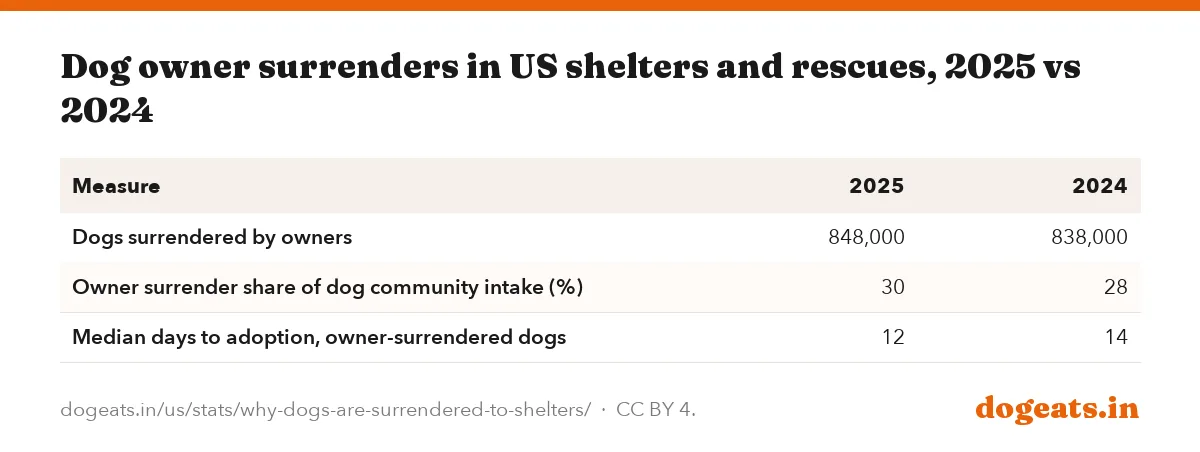
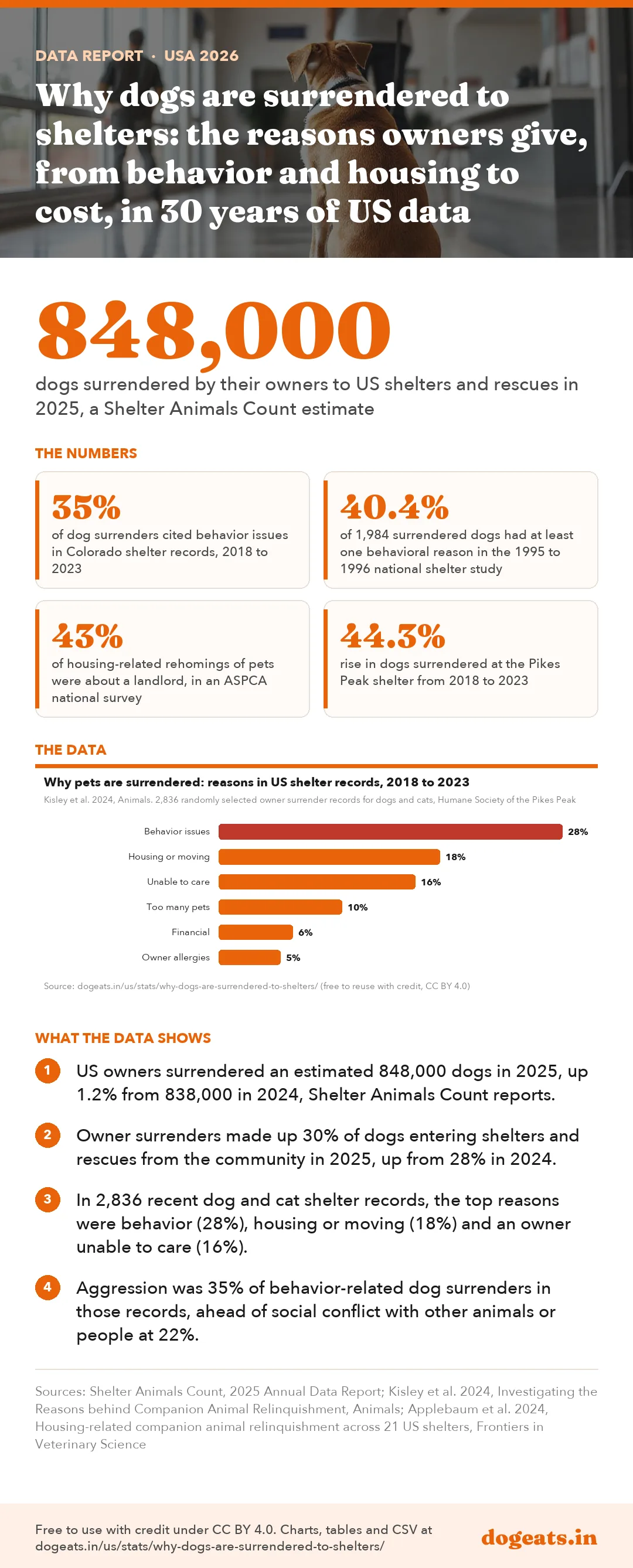
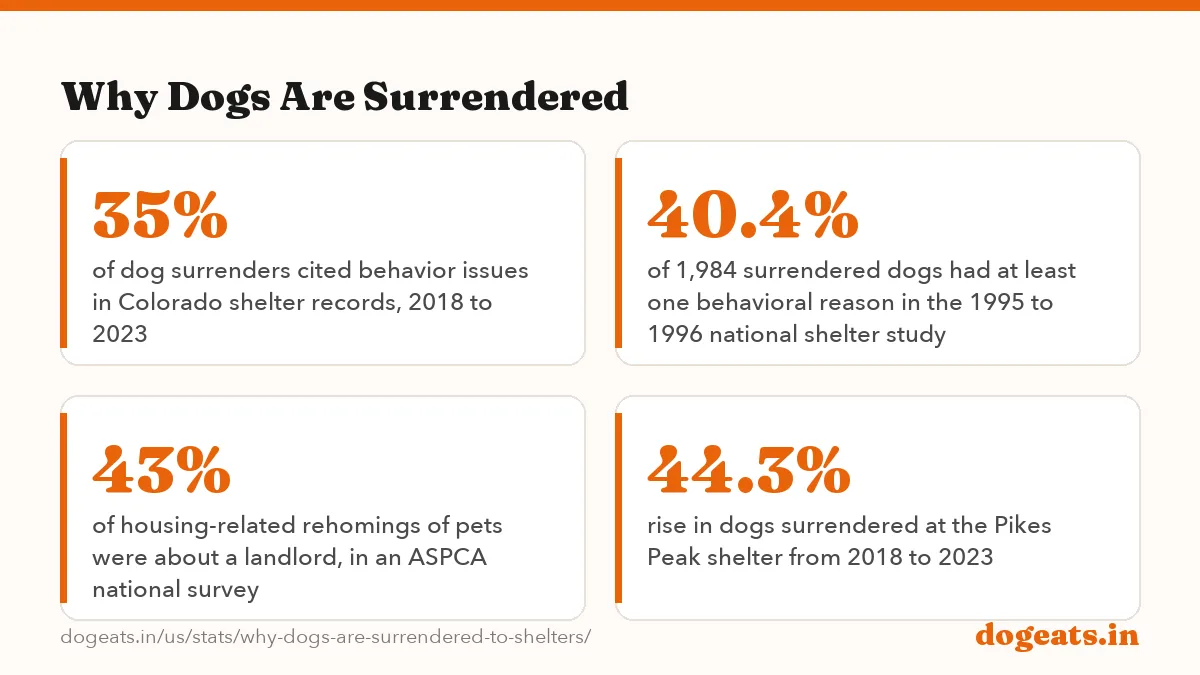
Behavior problems are the most common single reason dogs are surrendered, cited in 35% of dog relinquishments at a large Colorado shelter from 2018 to 2023. Housing and moving, an owner unable to care for the dog, and cost follow. Shelter Animals Count estimates owners surrendered 848,000 dogs in 2025, 30% of dogs entering shelters and rescues from the community.

Key findings
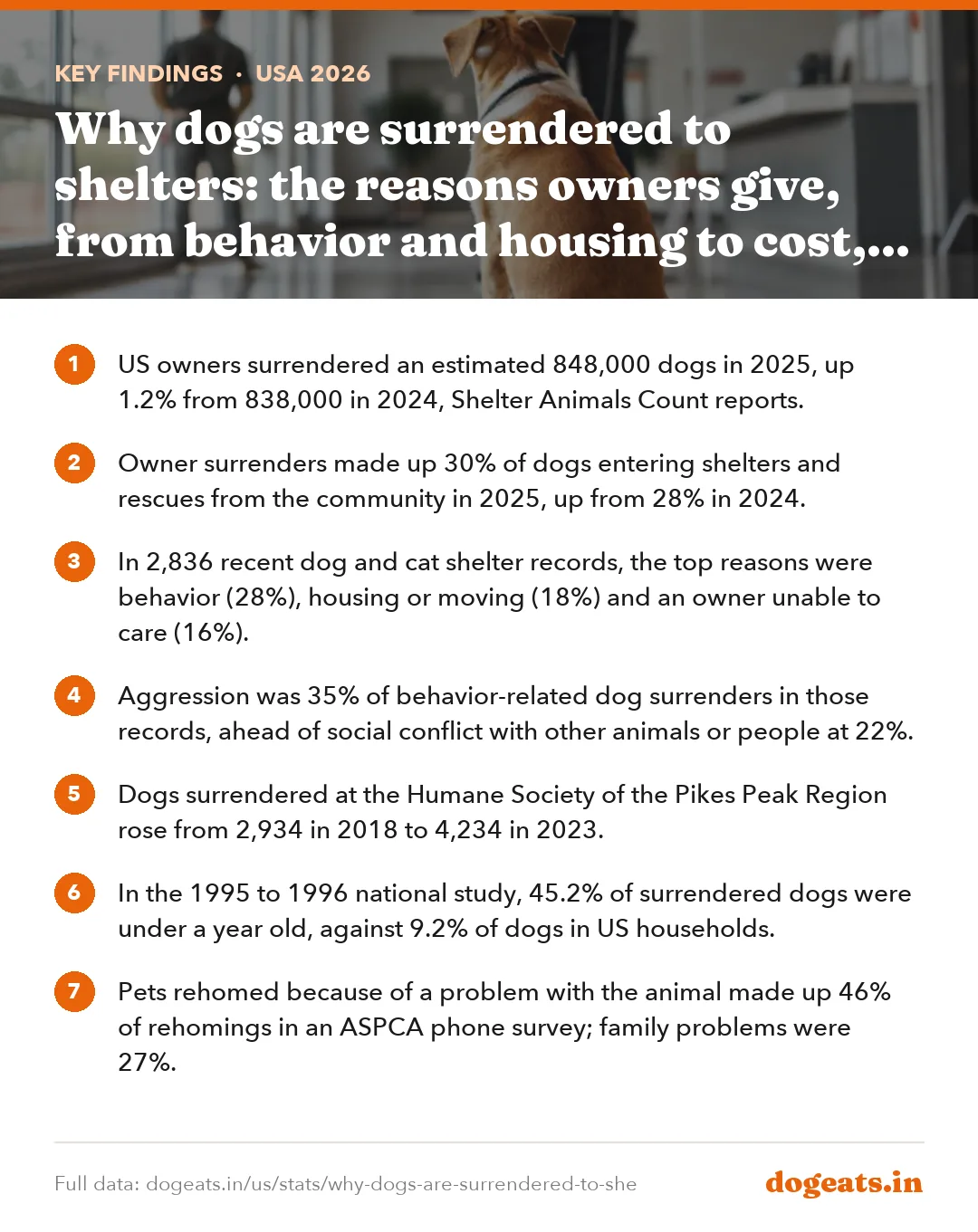
- US owners surrendered an estimated 848,000 dogs in 2025, up 1.2% from 838,000 in 2024, Shelter Animals Count reports.
- Owner surrenders made up 30% of dogs entering shelters and rescues from the community in 2025, up from 28% in 2024.
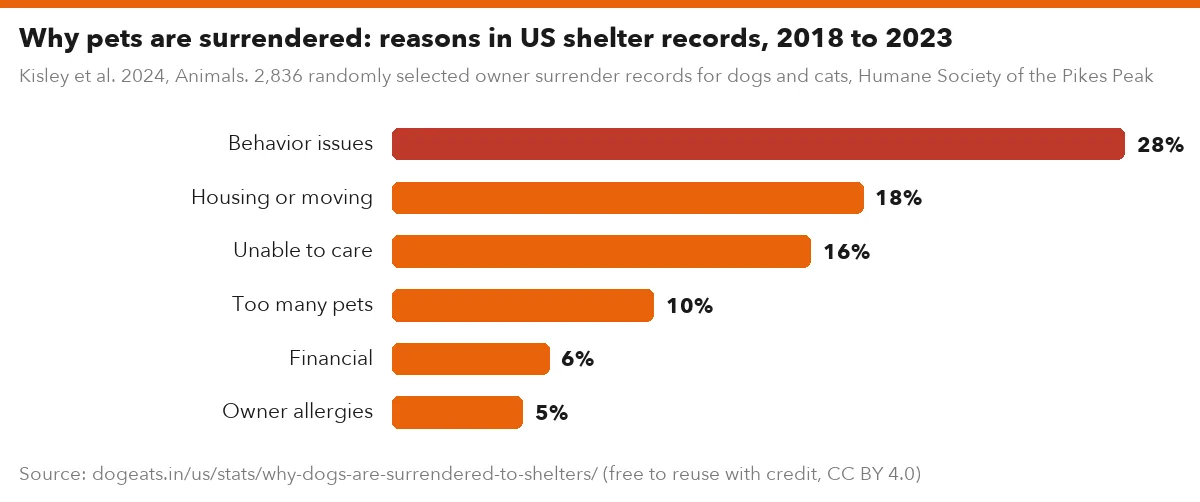
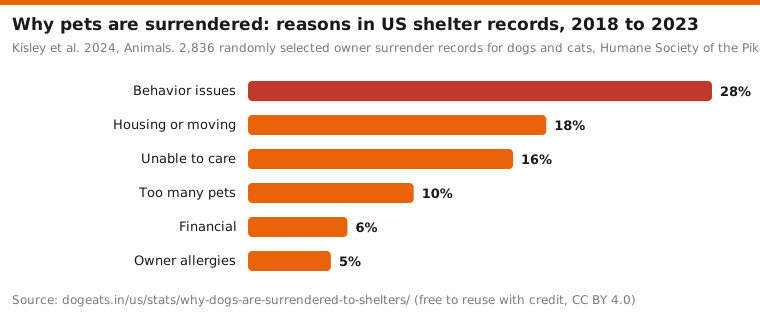
- In 2,836 recent dog and cat shelter records, the top reasons were behavior (28%), housing or moving (18%) and an owner unable to care (16%).
- Aggression was 35% of behavior-related dog surrenders in those records, ahead of social conflict with other animals or people at 22%.
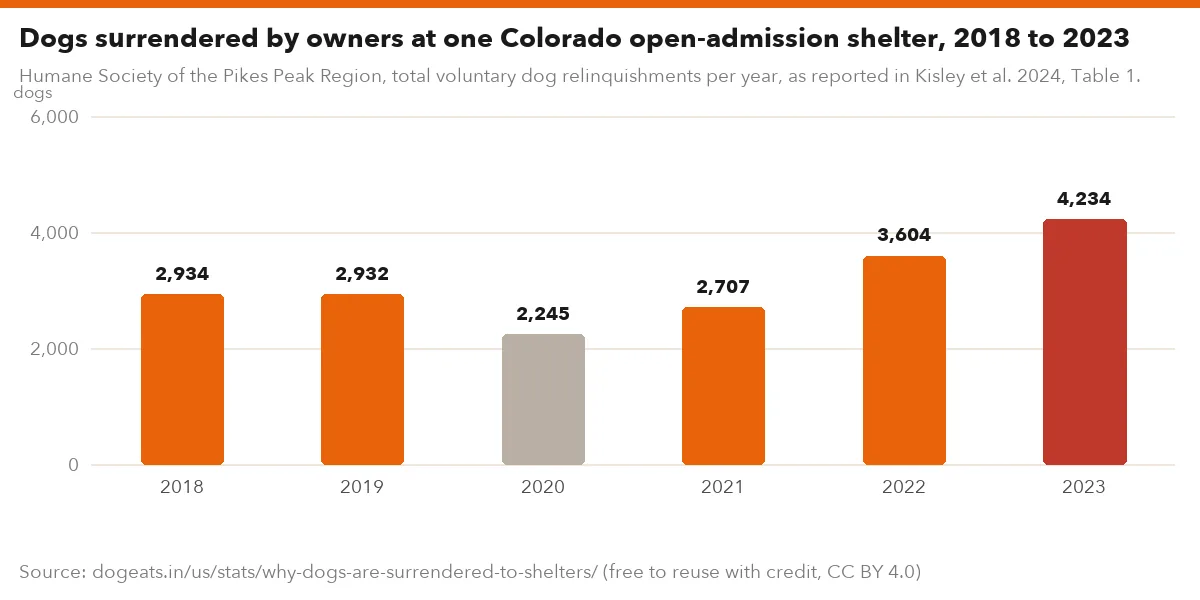
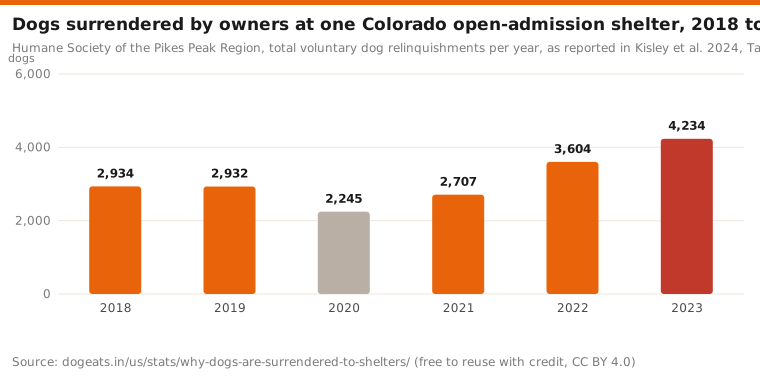
- Dogs surrendered at the Humane Society of the Pikes Peak Region rose from 2,934 in 2018 to 4,234 in 2023.
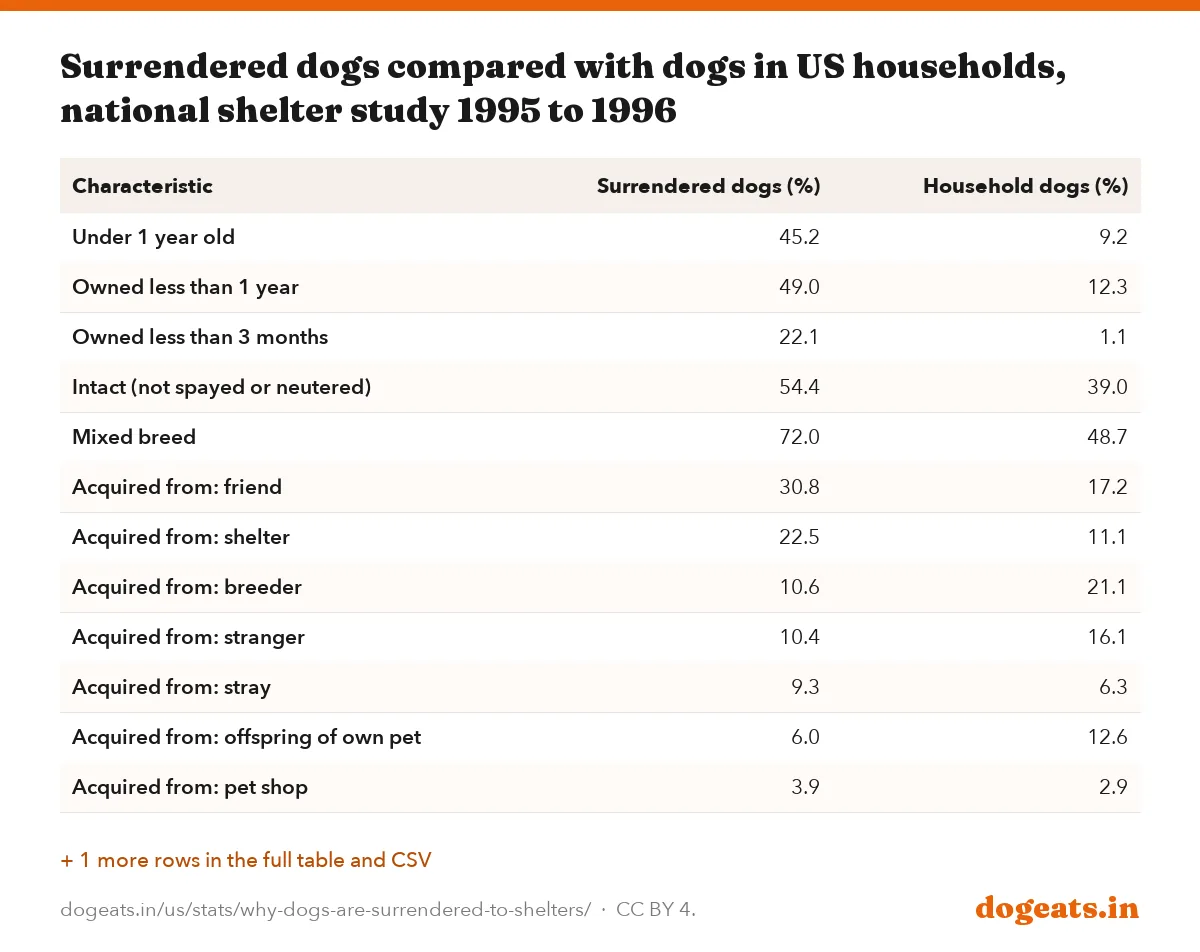
- In the 1995 to 1996 national study, 45.2% of surrendered dogs were under a year old, against 9.2% of dogs in US households.
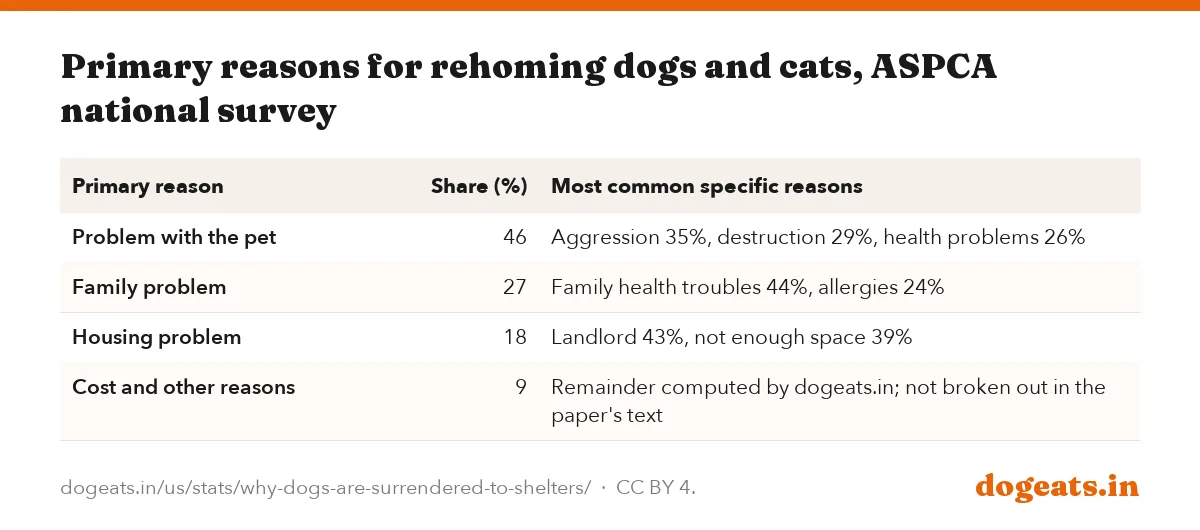
- Pets rehomed because of a problem with the animal made up 46% of rehomings in an ASPCA phone survey; family problems were 27%.
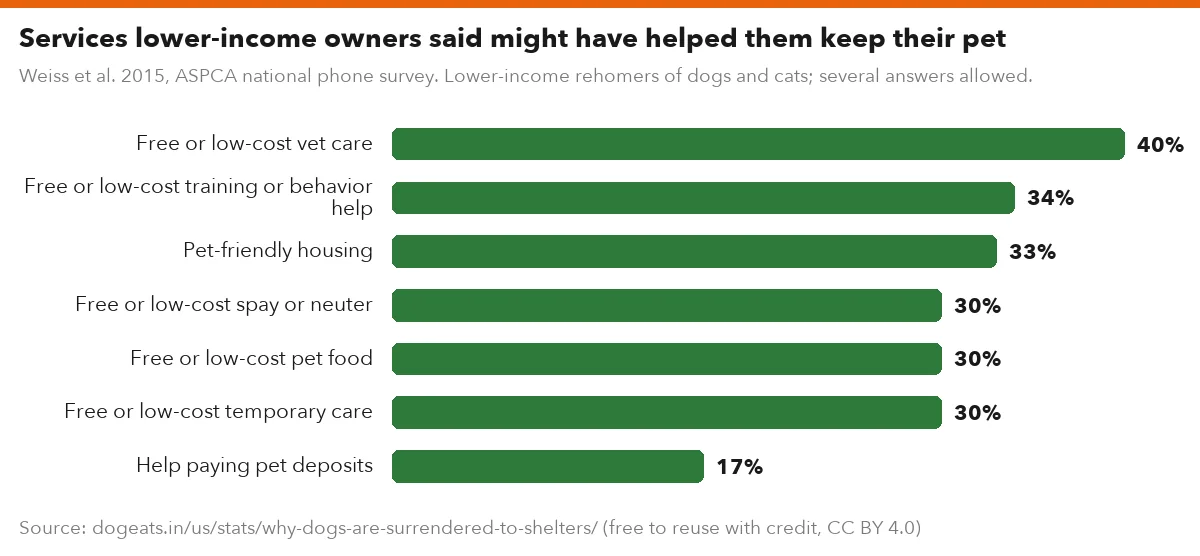
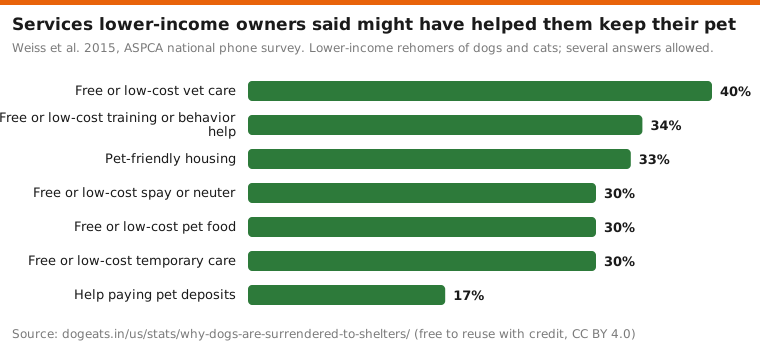
- Low-cost vet care was the service most often named as one that might have kept the pet, by 40% of lower-income rehomers.
Why are dogs surrendered to shelters?
Behavior problems, housing and an owner's changed circumstances explain most dog surrenders. The most recent detailed US records come from the Humane Society of the Pikes Peak Region in Colorado, which researchers coded for 2018 to 2023.
Across 2,836 randomly chosen dog and cat surrenders, behavior issues led at 28%. Housing or moving followed at 18%, and an owner unable to care for the animal at 16%.
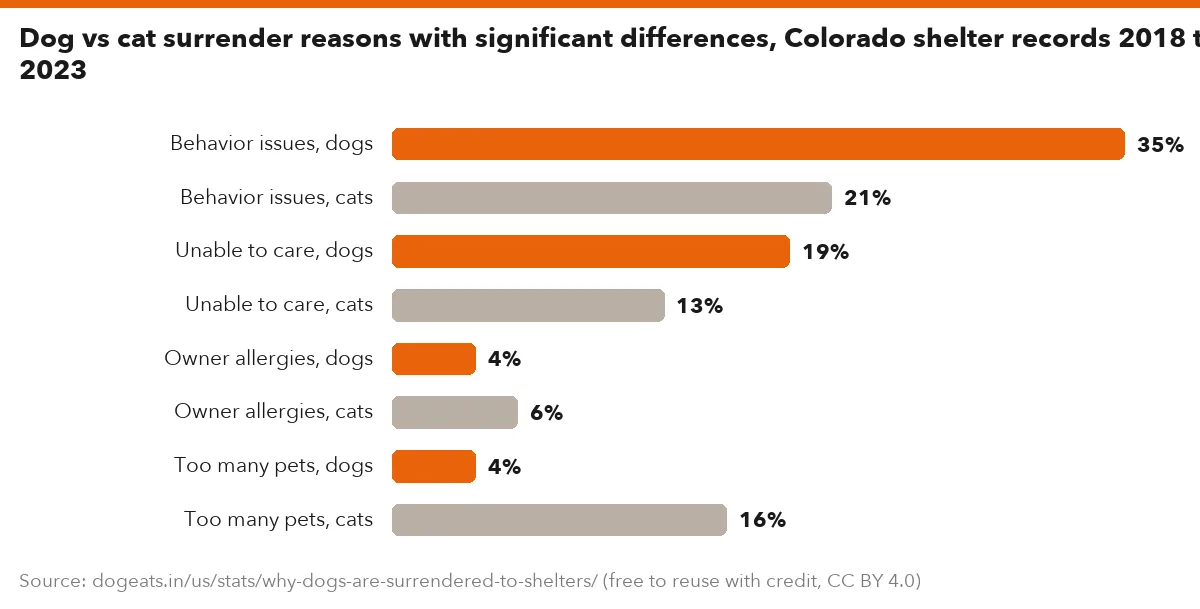
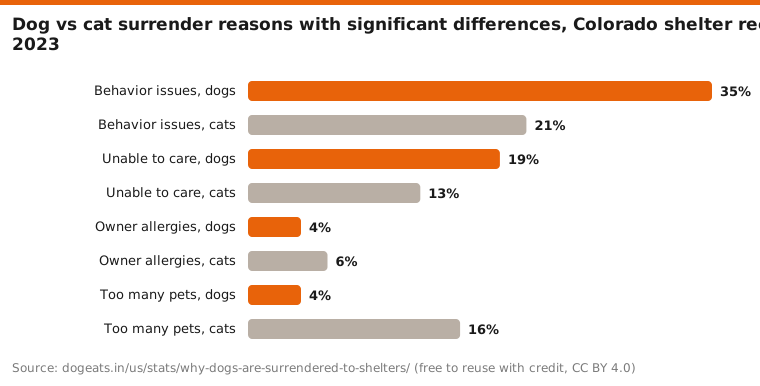
Dogs differ from cats. Behavior issues were cited for 35% of dogs and 21% of cats, and inability to care for 19% of dogs. Too many pets mattered far more for cats.
Kisley et al. 2024, Animals. 2,836 randomly selected owner surrender records for dogs and cats, Humane Society of the Pikes Peak Region, Colorado. Reasons cited at least 5% of the time.
Show the numbers
| Label | % |
|---|---|
| Behavior issues | 28% |
| Housing or moving | 18% |
| Unable to care | 16% |
| Too many pets | 10% |
| Financial | 6% |
| Owner allergies | 5% |
Embed this chart
Kisley et al. 2024. Share of each species' surrenders citing the reason. Housing or moving was common for both species, with no significant difference.
Show the numbers
| Label | % |
|---|---|
| Behavior issues, dogs | 35% |
| Behavior issues, cats | 21% |
| Unable to care, dogs | 19% |
| Unable to care, cats | 13% |
| Owner allergies, dogs | 4% |
| Owner allergies, cats | 6% |
| Too many pets, dogs | 4% |
| Too many pets, cats | 16% |
Embed this chart
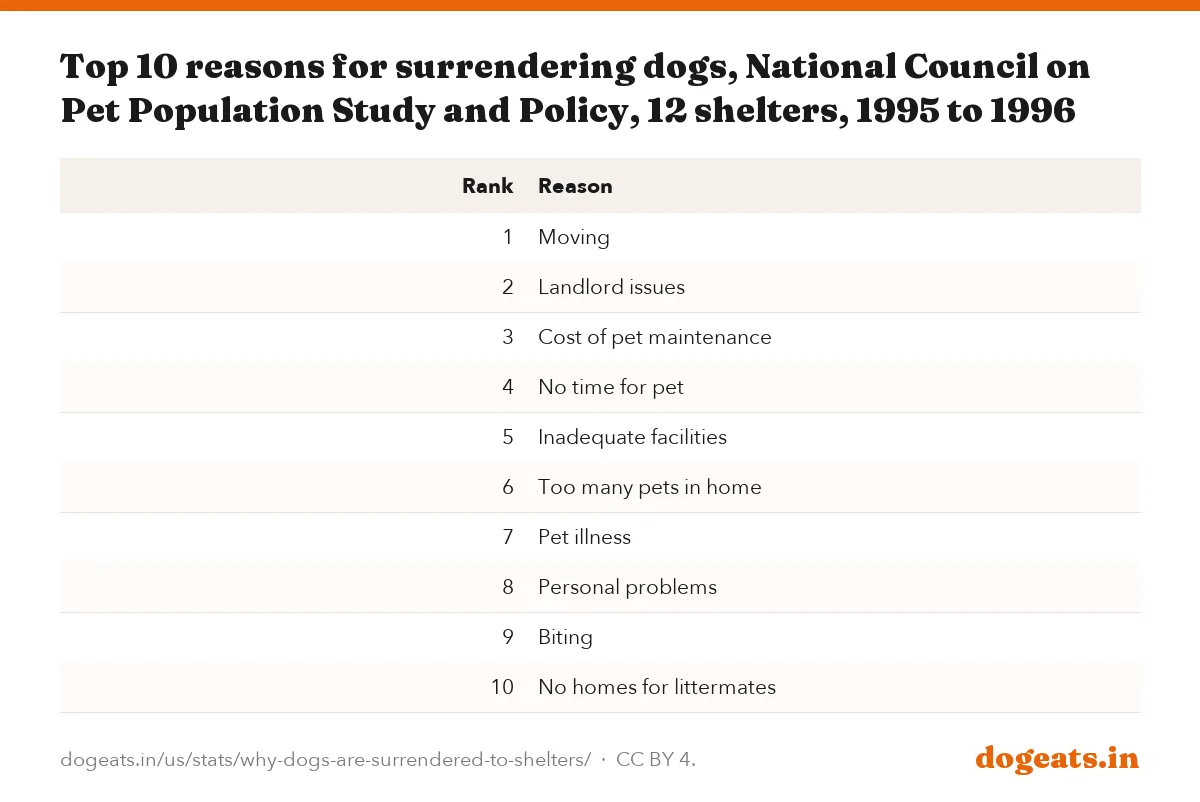
Earlier national work points the same way. A 1995 to 1996 study at 12 shelters was run for the National Council on Pet Population Study and Policy. It logged 71 different reasons people gave for giving up dogs and cats.
Ranked one by one, moving and landlord issues topped its list for dogs. Grouped together, behavior problems were the largest category, the same study team reported.
Where those dogs end up is tracked in our dog shelter adoption statistics.
How many dogs are surrendered each year in the US?
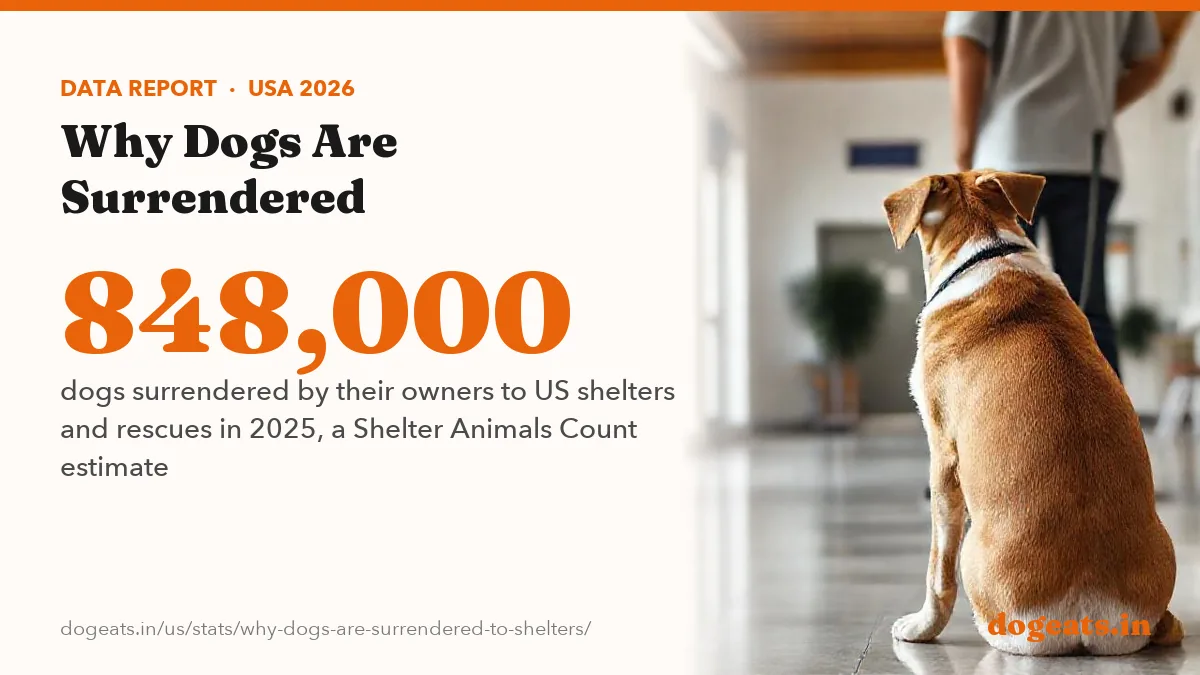
About 848,000 in 2025, according to Shelter Animals Count, the national shelter database. That works out to roughly 2,323 dogs a day handed over by their owners.
The 2025 figure was 1.2% above the 838,000 owner-surrendered dogs in 2024. Owner surrenders made up 30% of the 2.8 million dogs that entered shelters and rescues from the community, with strays making up most of the rest.
Surrendered dogs leave faster than strays. Their median stay before adoption fell from 14 days in 2024 to 12 days in 2025.
Humane Society of the Pikes Peak Region, total voluntary dog relinquishments per year, as reported in Kisley et al. 2024, Table 1.
Show the numbers
| Label | dogs |
|---|---|
| 2018 | 2,934 |
| 2019 | 2,932 |
| 2020 | 2,245 |
| 2021 | 2,707 |
| 2022 | 3,604 |
| 2023 | 4,234 |
Embed this chart
| Measure | 2025 | 2024 |
|---|---|---|
| Dogs surrendered by owners | 848,000 | 838,000 |
| Owner surrender share of dog community intake (%) | 30 | 28 |
| Median days to adoption, owner-surrendered dogs | 12 | 14 |
Local data show sharper swings than the national total. Dog surrenders at the Pikes Peak shelter fell to 2,245 in 2020, then rose 88.6% to 4,234 in 2023.
Shelter Animals Count's figures are national estimates rounded to the nearest thousand. Its counts of dogs euthanized are in our shelter euthanasia by state report.
Behavior problems behind dog surrenders
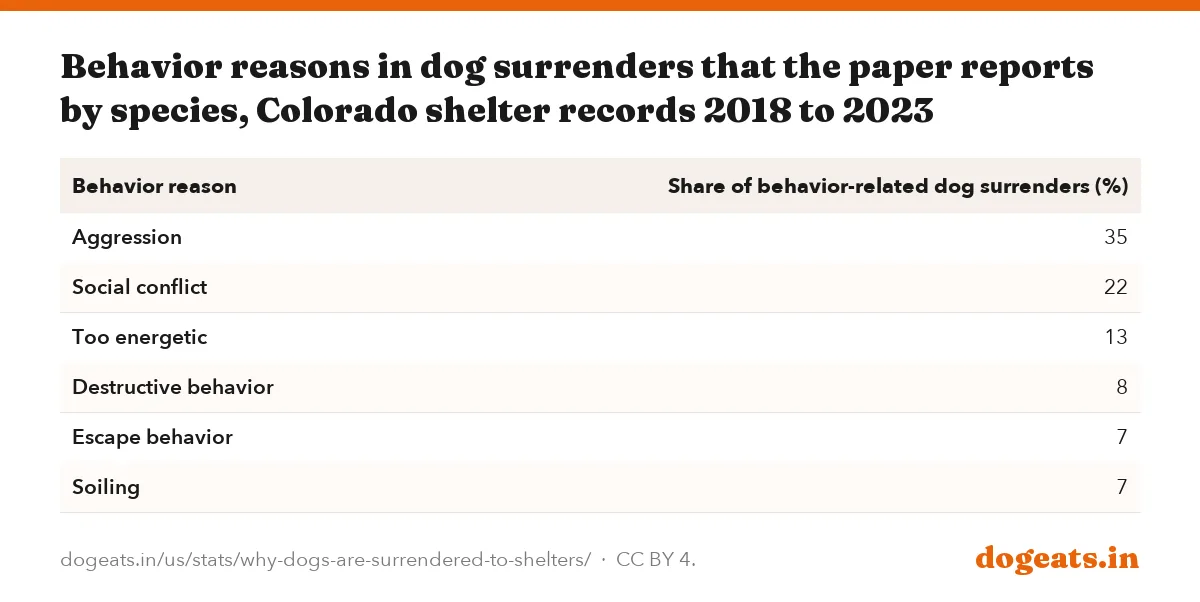
Aggression is the leading behavior reason. In the Colorado records, it accounted for 35% of behavior-related dog surrenders, followed by social conflict with other animals or people (22%) and being too energetic (13%).
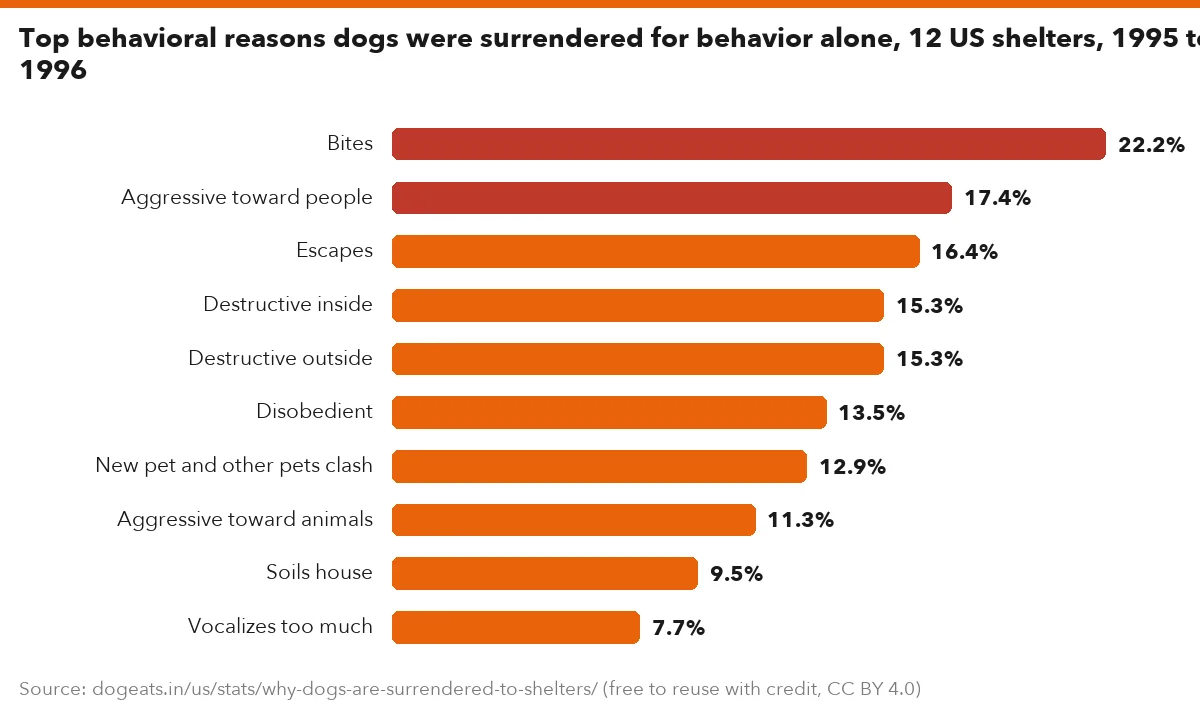
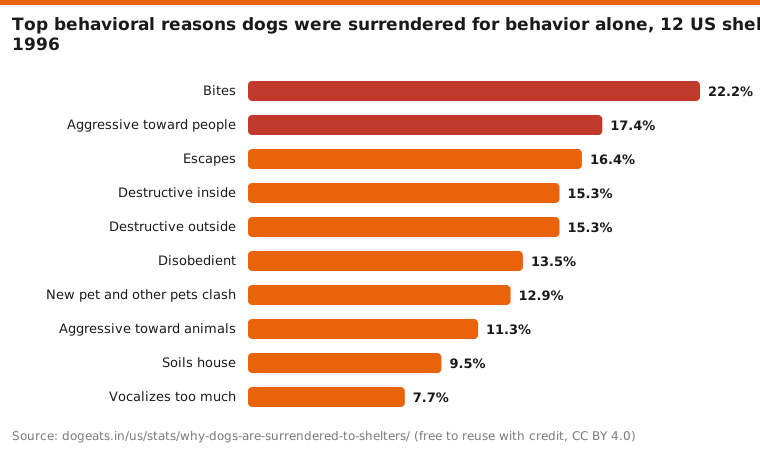
The national 1995 to 1996 study found the same pattern. 40.4% of 1,984 surrendered dogs had at least one behavioral reason. Among dogs given up for behavior alone, 22.2% were surrendered for biting.
Training was rare. Only 4.2% of those 1,984 dogs had been to obedience classes, and owners said 23.4% had never been taught basic commands.
Salman et al. 2000. 379 dogs surrendered only for behavioral reasons; owners could give several reasons.
Show the numbers
| Label | % |
|---|---|
| Bites | 22.2% |
| Aggressive toward people | 17.4% |
| Escapes | 16.4% |
| Destructive inside | 15.3% |
| Destructive outside | 15.3% |
| Disobedient | 13.5% |
| New pet and other pets clash | 12.9% |
| Aggressive toward animals | 11.3% |
| Soils house | 9.5% |
| Vocalizes too much | 7.7% |
Embed this chart
| Behavior reason | Share of behavior-related dog surrenders (%) |
|---|---|
| Aggression | 35 |
| Social conflict | 22 |
| Too energetic | 13 |
| Destructive behavior | 8 |
| Escape behavior | 7 |
| Soiling | 7 |
Returns are even more about behavior. Dogs and cats returned after being adopted from the shelter were given up for behavior issues 59% of the time, against 22% for first-time surrenders.
Owners who gave up a dog for behavior alone were more likely to have adopted it from a shelter: 50%, against 19% for dogs given up for other reasons. Bite risk data are in our dog bite statistics.
Housing, landlords and pet restrictions
Housing is the most common reason that is not about the dog. In the ASPCA national survey, 18% of rehomings were for housing problems. Within those, 43% involved a landlord and 39% not enough space.
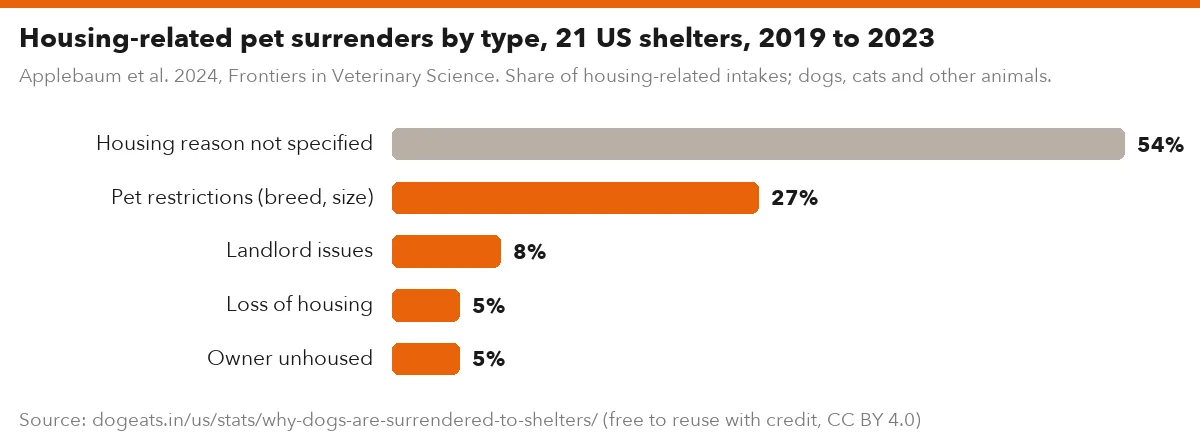
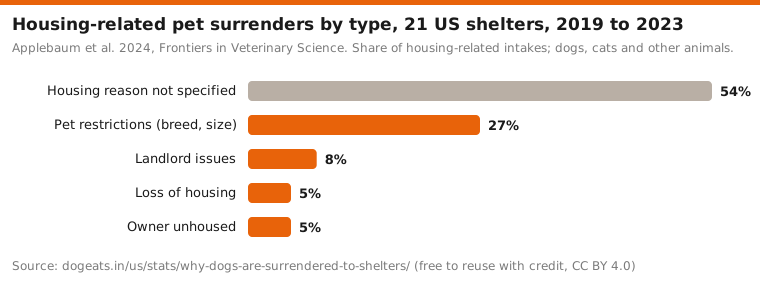
A 2024 study of 21 shelters in 15 states found 28,424 housing-related intake records from 2019 to 2023. Where a cause was recorded, pet restrictions such as breed and size limits were the largest group, at 27% of all housing intakes.
Loss of housing grew over the period while pet restriction cases fell, the authors found. They cite research that only 7 to 9% of US rental housing is free of major pet restrictions.
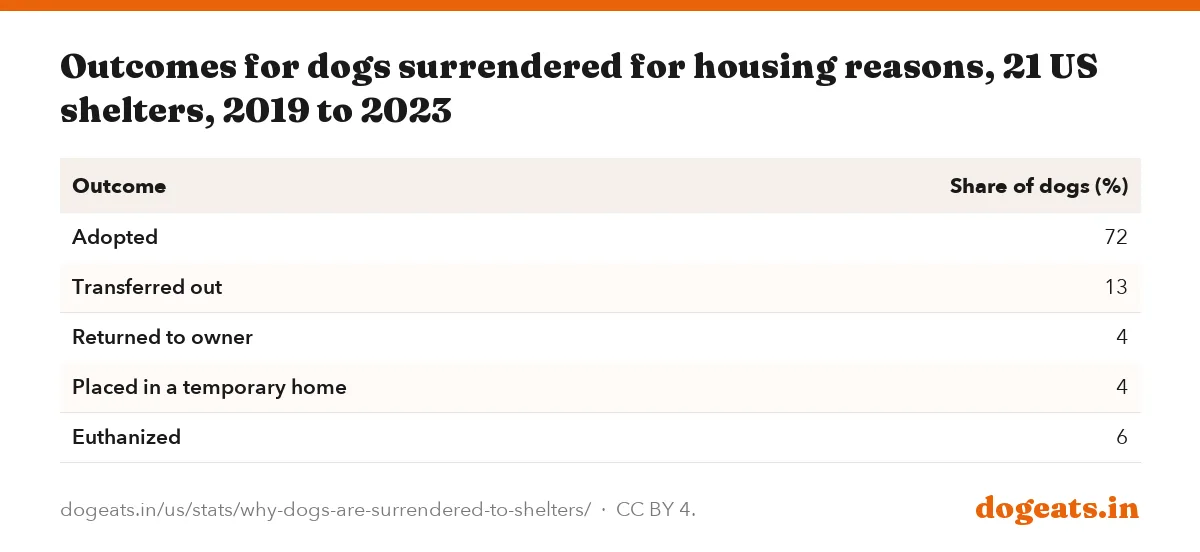
| Outcome | Share of dogs (%) |
|---|---|
| Adopted | 72 |
| Transferred out | 13 |
| Returned to owner | 4 |
| Placed in a temporary home | 4 |
| Euthanized | 6 |
Pit bull-type dogs carry much of the housing burden. They were 16% of dogs surrendered for housing reasons and 27% of landlord-related surrenders. 13% had a non-live outcome, against 5% for other breeds.
Renters in the ASPCA survey were more likely to give up all their dogs at once: 45%, against 18% overall among rehomers with more than one pet. State limits on pet deposits are in our pet rent and deposit laws by state, and breed rules in our breed-specific laws by state.
Cost, family problems and time
Family problems were behind 27% of rehomings in the ASPCA survey. Family health troubles made up 44% of those and allergies 24%.
Money shapes the decision. Respondents with household income of $50,000 or less were more likely to rehome for cost or housing than for a problem with the pet. Among dog owners with several dogs, 18% of lower-income owners gave up all of them, against 6% of higher-income owners.
In the Colorado records, the share of surrenders where the owner was unable to care for the animal rose from 11% in 2019 to 20% in 2023. Financial reasons stayed at about 6%, with no significant change.
Weiss et al. 2015, ASPCA national phone survey. Lower-income rehomers of dogs and cats; several answers allowed.
Show the numbers
| Label | % |
|---|---|
| Free or low-cost vet care | 40% |
| Free or low-cost training or behavior help | 34% |
| Pet-friendly housing | 33% |
| Free or low-cost spay or neuter | 30% |
| Free or low-cost pet food | 30% |
| Free or low-cost temporary care | 30% |
| Help paying pet deposits | 17% |
Embed this chart
| Rank | Reason |
|---|---|
| 1 | Moving |
| 2 | Landlord issues |
| 3 | Cost of pet maintenance |
| 4 | No time for pet |
| 5 | Inadequate facilities |
| 6 | Too many pets in home |
| 7 | Pet illness |
| 8 | Personal problems |
| 9 | Biting |
| 10 | No homes for littermates |
A meta-analysis of nine shelter studies put owner health or illness at 4.6% of dog surrenders (95% confidence interval 4.1% to 5.2%). Other reasons varied too much between studies to pool.
Rising vet bills add pressure. Our vet cost and pet food inflation report tracks those prices, and our cost of owning a dog report totals a year of spending.
Which dogs are most likely to be surrendered?
Young dogs and dogs owned only briefly. In the national 1995 to 1996 comparison, 45.2% of surrendered dogs were under a year old, against 9.2% of dogs in a sample of US pet-owning households.
Dogs under 3 months had 36.9 times the odds of being surrendered compared with dogs aged 15 and over. 49.0% of surrendered dogs had been owned for less than a year, against 12.3% of household dogs.
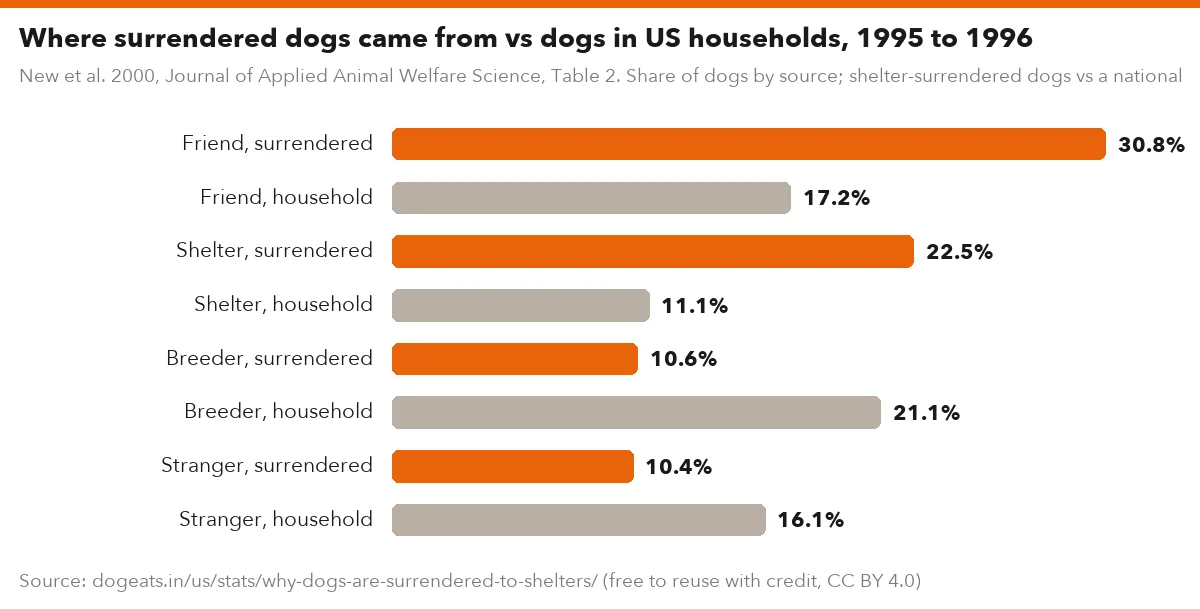
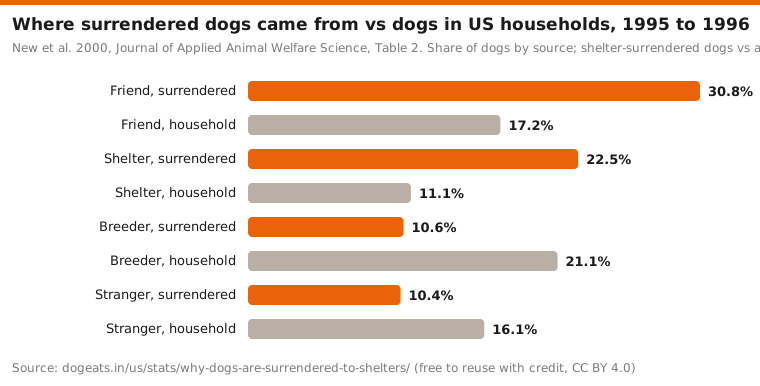
Surrendered dogs over 6 months old were more often intact (54.4% against 39.0%). Surrendered dogs were also more often mixed breed (72.0% against 48.7%). Many came from friends or from shelters rather than breeders.

New et al. 2000, Journal of Applied Animal Welfare Science, Table 2. Share of dogs by source; shelter-surrendered dogs vs a national household sample.
Show the numbers
| Label | % |
|---|---|
| Friend, surrendered | 30.8% |
| Friend, household | 17.2% |
| Shelter, surrendered | 22.5% |
| Shelter, household | 11.1% |
| Breeder, surrendered | 10.6% |
| Breeder, household | 21.1% |
| Stranger, surrendered | 10.4% |
| Stranger, household | 16.1% |
Embed this chart
| Characteristic | Surrendered dogs (%) | Household dogs (%) |
|---|---|---|
| Under 1 year old | 45.2 | 9.2 |
| Owned less than 1 year | 49.0 | 12.3 |
| Owned less than 3 months | 22.1 | 1.1 |
| Intact (not spayed or neutered) | 54.4 | 39.0 |
| Mixed breed | 72.0 | 48.7 |
| Acquired from: friend | 30.8 | 17.2 |
| Acquired from: shelter | 22.5 | 11.1 |
| Acquired from: breeder | 10.6 | 21.1 |
| Acquired from: stranger | 10.4 | 16.1 |
| Acquired from: stray | 9.3 | 6.3 |
| Acquired from: offspring of own pet | 6.0 | 12.6 |
| Acquired from: pet shop | 3.9 | 2.9 |
| Acquired from: gift | 2.9 | 4.5 |
Dogs in newer housing data were older. In the 21-shelter housing study, the median dog surrendered for housing was 749 days old, about 2 years. Mixed breeds were 35% and American Pit Bull Terriers 12%.
Pet shop dogs were slightly overrepresented in 1995 to 1996: 3.9% of surrendered dogs against 2.9% of household dogs. State pet store sale bans are in our puppy mill and pet store bans report.
Not every rehomed dog goes to a shelter
About 6% of US pet-owning households rehomed a dog or cat over five years, the ASPCA survey estimated, or 6.12 million households. It interviewed 590 rehomers: 391 who rehomed a dog and 199 a cat.
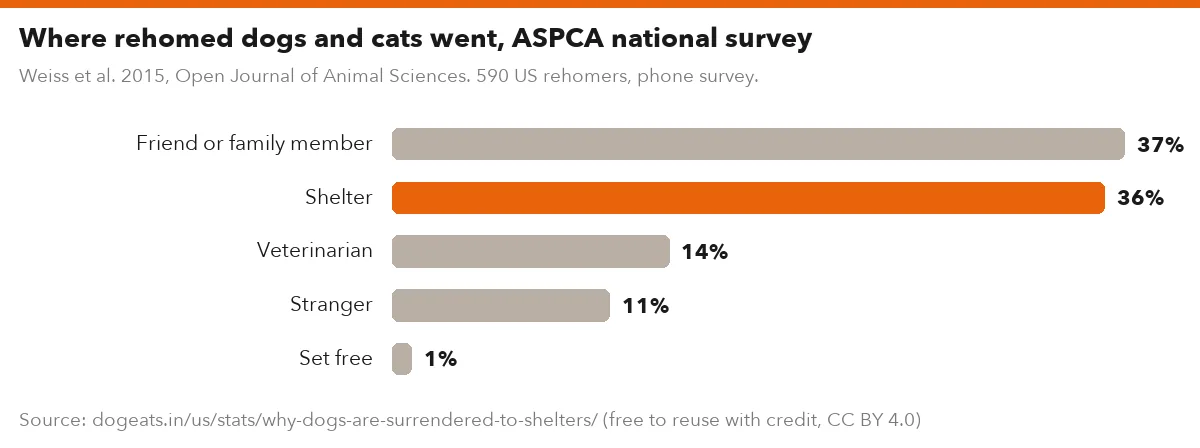
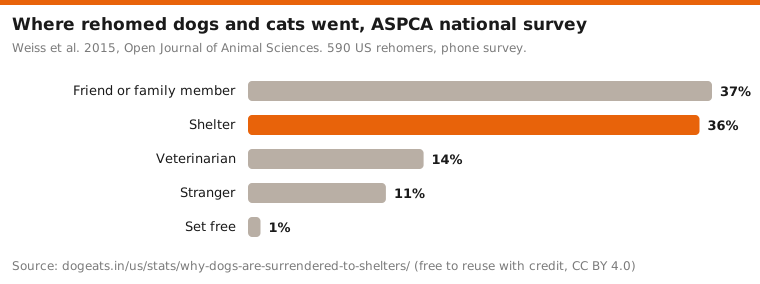
Friends and family took 37% of rehomed pets and shelters 36%. Only 36 dog owners who rehomed elsewhere (14%) had contacted a shelter first.
The reason predicts the route. Pets given up over cost or a problem with the pet more often went to a shelter. Family and housing cases more often went to friends or relatives.
Weiss et al. 2015, Open Journal of Animal Sciences. 590 US rehomers, phone survey.
Show the numbers
| Label | % |
|---|---|
| Friend or family member | 37% |
| Shelter | 36% |
| Veterinarian | 14% |
| Stranger | 11% |
| Set free | 1% |
Embed this chart
| Primary reason | Share (%) | Most common specific reasons |
|---|---|---|
| Problem with the pet | 46 | Aggression 35%, destruction 29%, health problems 26% |
| Family problem | 27 | Family health troubles 44%, allergies 24% |
| Housing problem | 18 | Landlord 43%, not enough space 39% |
| Cost and other reasons | 9 | Remainder computed by dogeats.in; not broken out in the paper's text |
Self-rehoming websites now divert many dogs. On Adopt-a-Pet's Rehome platform, 87.1% of 100,342 dogs listed were kept out of shelters, a 2023 study found. In 37.8% of those cases the owner kept the dog.
Why surrender reasons are hard to measure
Shelters record reasons in different ways, and many records give none. In the 21-shelter study, more than half of housing-related intakes had no specific housing cause recorded.
Owners also give more than one reason, and the stated reason may not be the main one. People surrendering for behavior may stress the dog's problems, while others may name moving to avoid judgment.
The national 1995 to 1996 study is old but remains the largest US interview study. Newer work comes from single shelters or groups of shelters and may not represent the country.
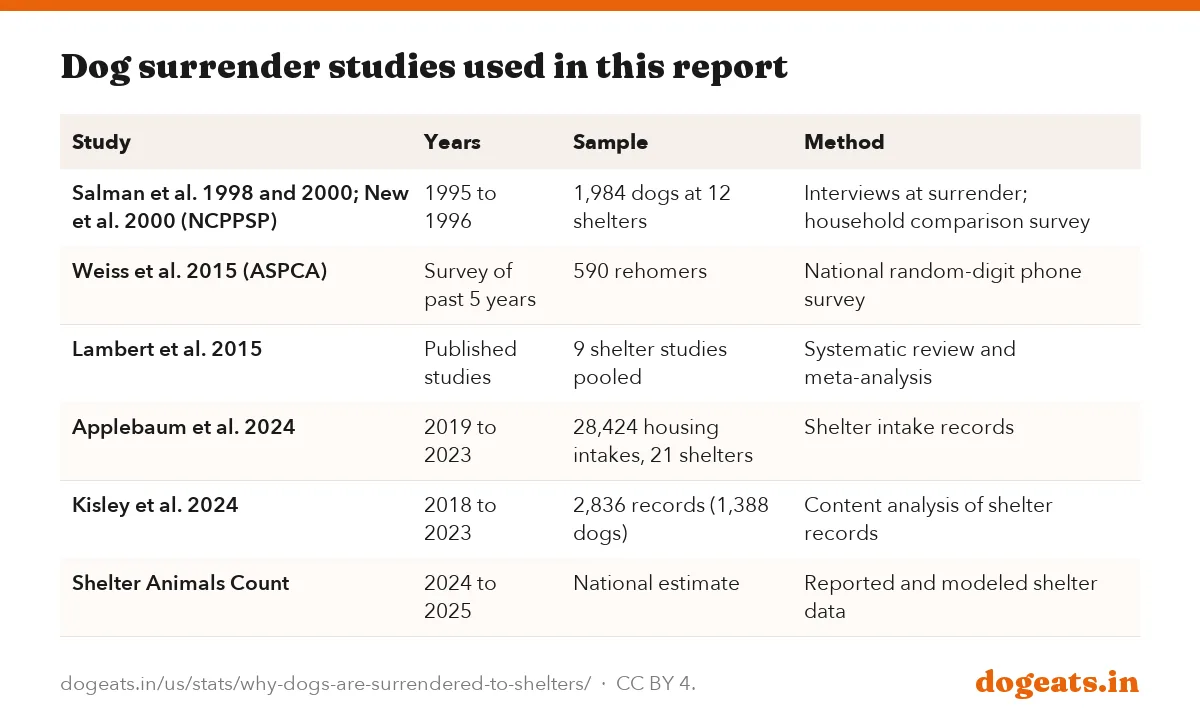
| Study | Years | Sample | Method |
|---|---|---|---|
| Salman et al. 1998 and 2000; New et al. 2000 (NCPPSP) | 1995 to 1996 | 1,984 dogs at 12 shelters | Interviews at surrender; household comparison survey |
| Weiss et al. 2015 (ASPCA) | Survey of past 5 years | 590 rehomers | National random-digit phone survey |
| Lambert et al. 2015 | Published studies | 9 shelter studies pooled | Systematic review and meta-analysis |
| Applebaum et al. 2024 | 2019 to 2023 | 28,424 housing intakes, 21 shelters | Shelter intake records |
| Kisley et al. 2024 | 2018 to 2023 | 2,836 records (1,388 dogs) | Content analysis of shelter records |
| Shelter Animals Count | 2024 to 2025 | National estimate | Reported and modeled shelter data |
Nuisance complaints can also push owners toward surrender. Our dog barking complaints statistics show how New York handles those.
Frequently asked questions
What is the number one reason dogs are surrendered to shelters?
Behavior problems, in most recent data. They were cited for 35% of dog surrenders at a Colorado shelter from 2018 to 2023, with aggression the most common behavior.
How many dogs are surrendered to shelters each year?
Shelter Animals Count estimates owners surrendered 848,000 dogs to US shelters and rescues in 2025, up from 838,000 in 2024. Surrenders were 30% of dogs entering from the community.
Do people surrender dogs because of housing?
Often. Housing or moving was 18% of surrender reasons in recent Colorado records. In an ASPCA survey, 43% of housing-related rehomings involved a landlord.
What age are most surrendered dogs?
Young. In the national 1995 to 1996 study, 45.2% of surrendered dogs were under a year old. In a 2019 to 2023 housing study, the median surrendered dog was about 2 years old.
Are dogs surrendered for cost?
Yes, but less often than for behavior or housing. Financial reasons were about 6% of surrenders in Colorado records, and lower-income owners most often said low-cost vet care might have helped (40%).
Where do people rehome dogs instead of shelters?
Mostly with friends or family. In the ASPCA survey, 37% of rehomed pets went to friends or family and 36% to a shelter.
Are pit bulls surrendered more often for housing?
In a 21-shelter study, pit bull-type dogs were 16% of dogs surrendered for housing and 27% of landlord-related surrenders.
Are returned shelter dogs surrendered for behavior?
More often than first-time surrenders. Behavior was cited for 59% of dogs and cats returned after adoption and 22% of first surrenders in Colorado records.
Methodology and limitations
National counts come from Shelter Animals Count's 2025 Annual Data Report, opened October 17, 2026. They are rounded estimates that combine reported and modeled data.
Reason shares come from the peer-reviewed papers listed below, read in full on PubMed Central or from the authors' archived copies. Where papers gave counts, we computed percentages from them; otherwise we used the published percentages.
The 1995 to 1996 top 10 ranking is from the National Council on Pet Population Study and Policy's own page. We read it through the Internet Archive, because the council's old domain now hosts an unrelated site.
Dogs under 1 year and dogs owned under 1 year were computed by dogeats.in from the counts in New et al. 2000, Tables 1 and 2.
Sources
- Shelter Animals Count, 2025 Annual Data Report, Dog owner surrenders 2025 and 2024, share of intake, length of stay
- Kisley et al. 2024, Investigating the Reasons behind Companion Animal Relinquishment, Animals, Reasons in 2,836 shelter records, 2018 to 2023
- Applebaum et al. 2024, Housing-related companion animal relinquishment across 21 US shelters, Frontiers in Veterinary Science, Housing intakes, subtypes and dog outcomes
- Also consulted: Weiss et al. 2015, Goodbye to a Good Friend: rehoming of cats and dogs in the US (ASPCA), Open Journal of Animal Sciences, Salman et al. 2000, Behavioral reasons for relinquishment of dogs and cats to 12 shelters, JAAWS (NCPPSP archived copy), New et al. 2000, Characteristics of shelter-relinquished animals and their owners, JAAWS (NCPPSP archived copy), National Council on Pet Population Study and Policy, top 10 reasons for relinquishment (archived), Salman et al. 1998, Human and animal factors related to relinquishment, JAAWS, Scarlett et al. 1999, Reasons for relinquishment: selected health and personal issues, JAAWS, New et al. 1999, Moving: characteristics of dogs and cats relinquished, JAAWS, Lambert et al. 2015, Systematic review and meta-analysis of reasons dogs are surrendered, Preventive Veterinary Medicine, Ly and Protopopova 2023, Predictors of successful diversion from shelter intake, Animal Welfare, ASPCA, US animal shelter statistics.
Cite, embed and download
This report, its data and its images are free to reuse under a Creative Commons Attribution 4.0 licence. Credit dogeats.in with a link to this page. Every chart has its own embed code, every table has a CSV and an image download, and the images below are ready for social posts, slides and articles.
Cite this report
Link to this report
Every chart and table as an image