Health data · Updated October 2026
Snake bite in dogs in India: signs, antivenom and survival, from 259 dogs treated in Sri Lanka and Indian human snakebite data
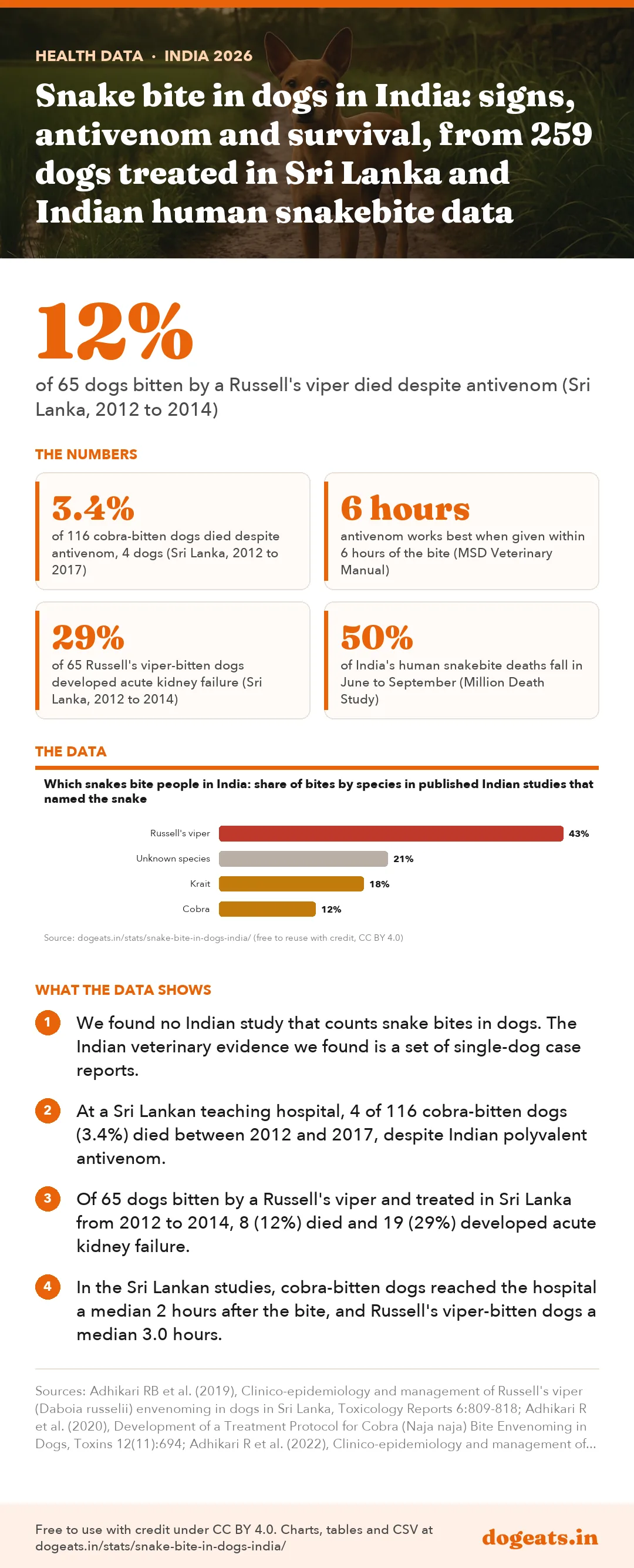
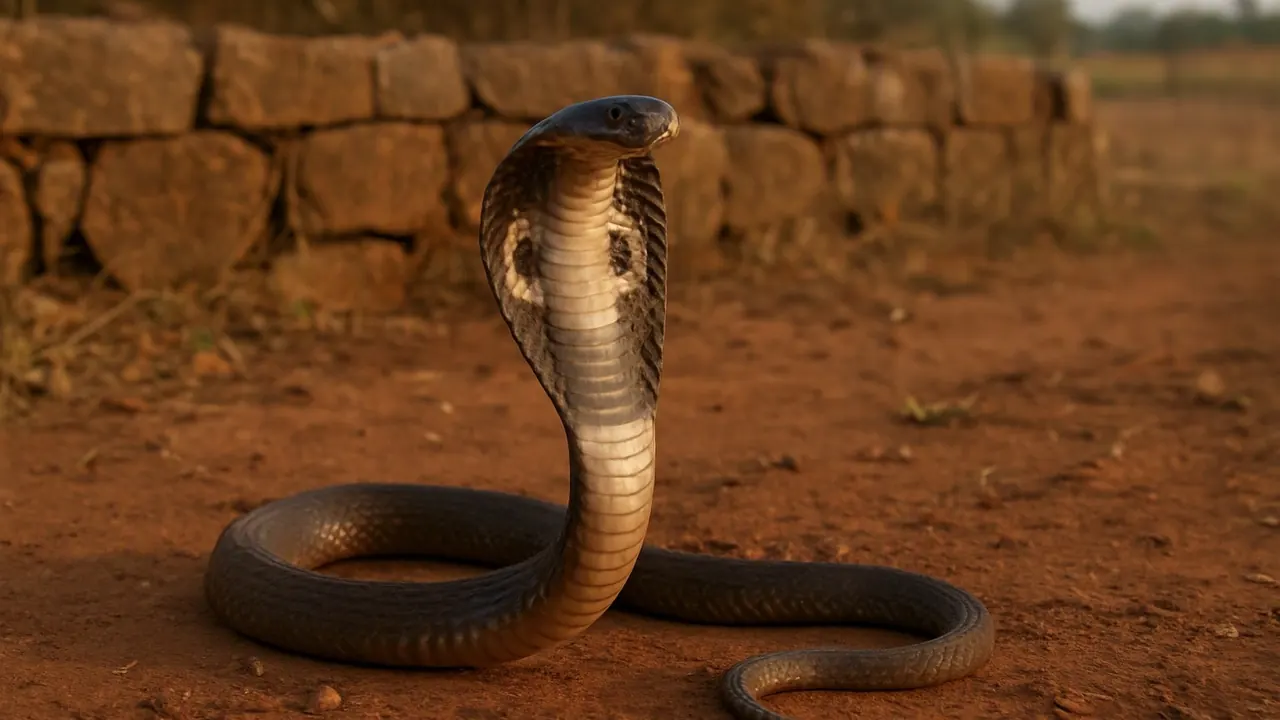
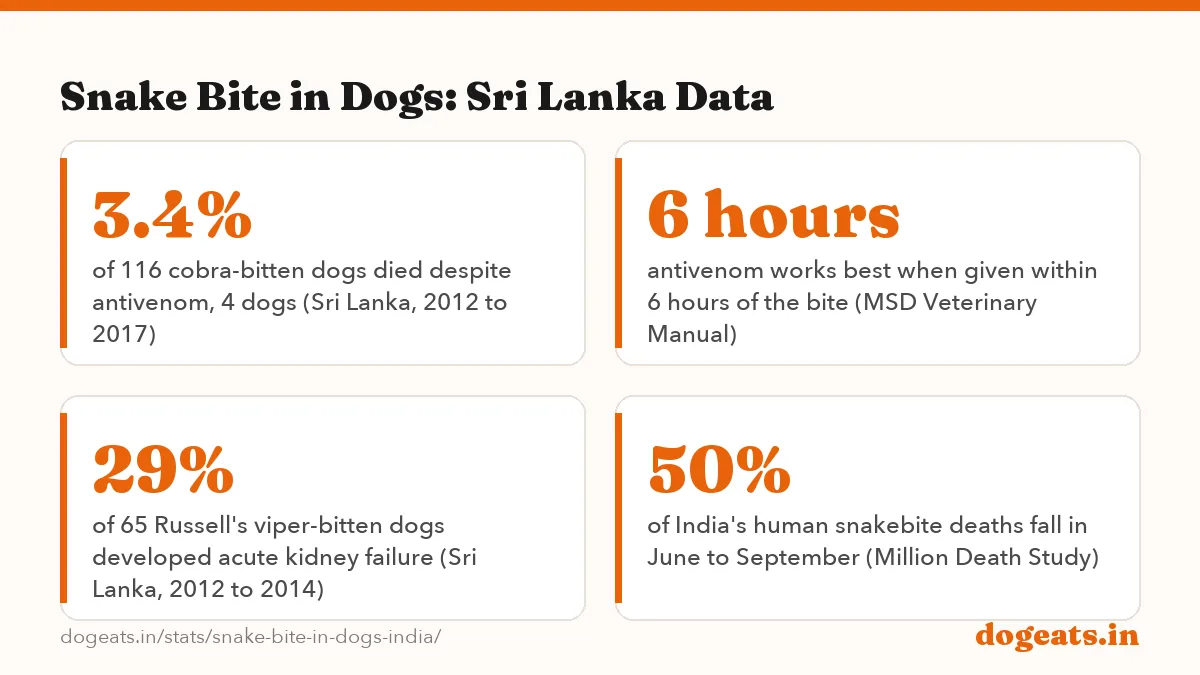
We found no Indian count of snake bites in dogs. The main clinical data come from a Sri Lankan teaching hospital that treated 259 bitten dogs. The snakes were the same spectacled cobra and Russell's viper found in India, and the vets used Indian polyvalent anti snake venom made for people. With treatment, 4 of 116 cobra-bitten dogs (3.4%) and 8 of 65 Russell's viper-bitten dogs (12%) died. In people, half of India's snakebite deaths fall in the June to September monsoon.

Key findings
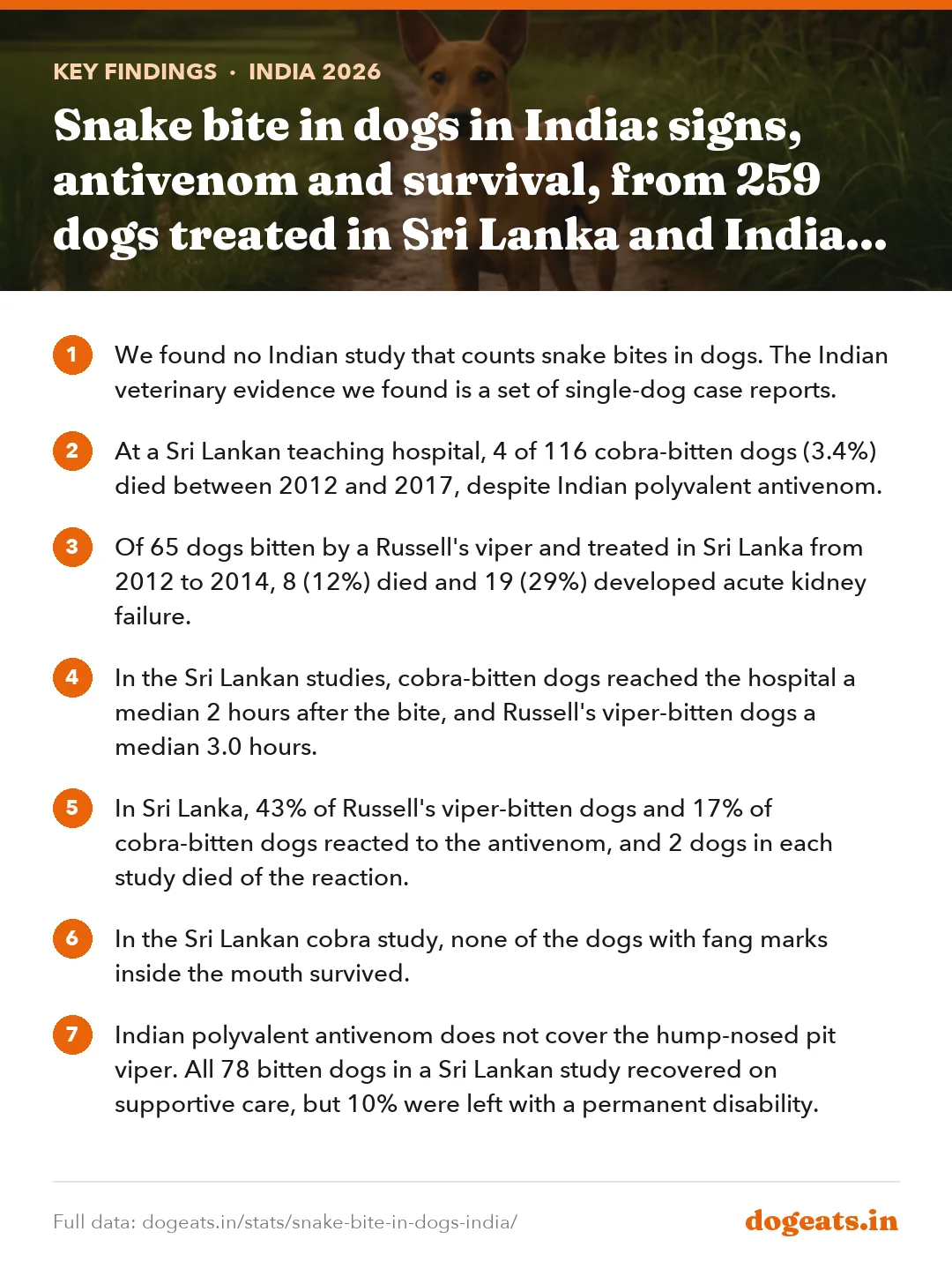
- We found no Indian study that counts snake bites in dogs. The Indian veterinary evidence we found is a set of single-dog case reports.
- At a Sri Lankan teaching hospital, 4 of 116 cobra-bitten dogs (3.4%) died between 2012 and 2017, despite Indian polyvalent antivenom.
- Of 65 dogs bitten by a Russell's viper and treated in Sri Lanka from 2012 to 2014, 8 (12%) died and 19 (29%) developed acute kidney failure.
- In the Sri Lankan studies, cobra-bitten dogs reached the hospital a median 2 hours after the bite, and Russell's viper-bitten dogs a median 3.0 hours.
- In Sri Lanka, 43% of Russell's viper-bitten dogs and 17% of cobra-bitten dogs reacted to the antivenom, and 2 dogs in each study died of the reaction.
- In the Sri Lankan cobra study, none of the dogs with fang marks inside the mouth survived.
- Indian polyvalent antivenom does not cover the hump-nosed pit viper. All 78 bitten dogs in a Sri Lankan study recovered on supportive care, but 10% were left with a permanent disability.
- In people, India averaged 58,000 snakebite deaths a year from 2000 to 2019, and half fell in the June to September monsoon.
- The MSD Veterinary Manual says antivenom works best within 6 hours, and calls ice, tourniquets and cutting the wound ineffective and potentially harmful.
How common is snake bite in dogs in India?
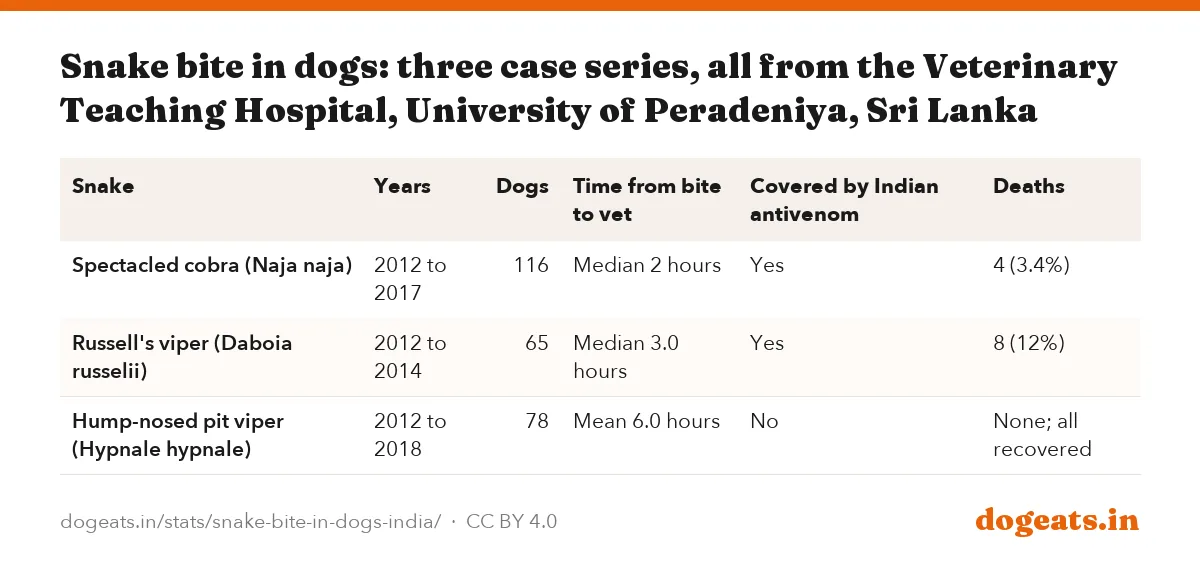
We found no national count of snake bites in dogs in India. The main clinical record we found is from a Sri Lankan teaching hospital at Peradeniya, which studied 259 bitten dogs between 2012 and 2018. There were 116 cobra bites, 65 Russell's viper bites and 78 hump-nosed pit viper bites.
The Indian veterinary record we found is a set of single-dog case reports from veterinary colleges and district hospitals. A 2025 case report in the Indian Journal of Veterinary Medicine, from Telangana, calls snakebite a frequently encountered emergency in small animal practice in India. It sits alongside the other monsoon emergencies in our dog diseases report.
The human toll shows how close the snakes live. The Million Death Study estimated 1.2 million snakebite deaths in India from 2000 to 2019, an average of 58,000 a year. In its sample, 94% of snakebite deaths were in rural areas, where most dogs, from village Indian Pariah dogs to farm guard dogs, roam outdoors.
We use the Sri Lankan studies for Indian dogs for three reasons. The cobra there is the spectacled cobra, Naja naja. The viper is Daboia russelii, a species Indian antivenom is made against. And Sri Lankan vets treat dogs with Indian polyvalent antivenom. Every Sri Lankan figure on this page is labelled as such.
| Snake | Years | Dogs | Time from bite to vet | Covered by Indian antivenom | Deaths |
|---|---|---|---|---|---|
| Spectacled cobra (Naja naja) | 2012 to 2017 | 116 | Median 2 hours | Yes | 4 (3.4%) |
| Russell's viper (Daboia russelii) | 2012 to 2014 | 65 | Median 3.0 hours | Yes | 8 (12%) |
| Hump-nosed pit viper (Hypnale hypnale) | 2012 to 2018 | 78 | Mean 6.0 hours | No | None; all recovered |
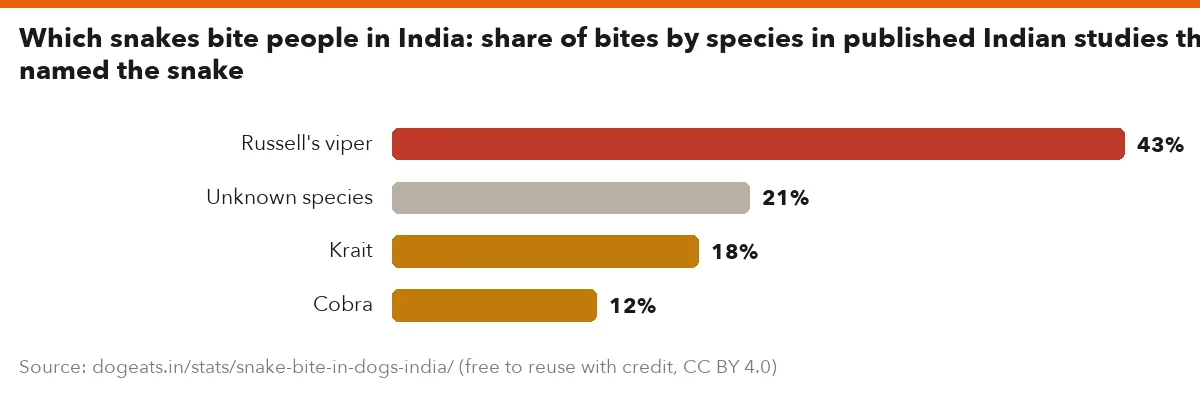
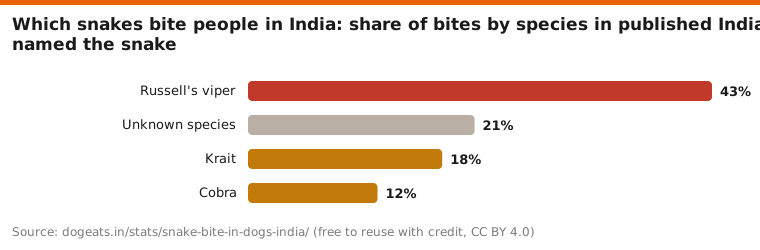
People, not dogs. Source: Suraweera et al., eLife 2020, systematic review of Indian studies published 2000 to 2019 (87,590 snakebites in all; species shares from the fewer studies that identified the snake).
Show the numbers
| Label | % |
|---|---|
| Russell's viper | 43% |
| Unknown species | 21% |
| Krait | 18% |
| Cobra | 12% |
Embed this chart
These human shares come from published Indian studies, mostly of treated patients, so they may lean towards bites serious enough to reach a hospital. They tell you which snakes are common around Indian homes and fields, not which snakes bite dogs most.
Which snakes are most dangerous to dogs in India?
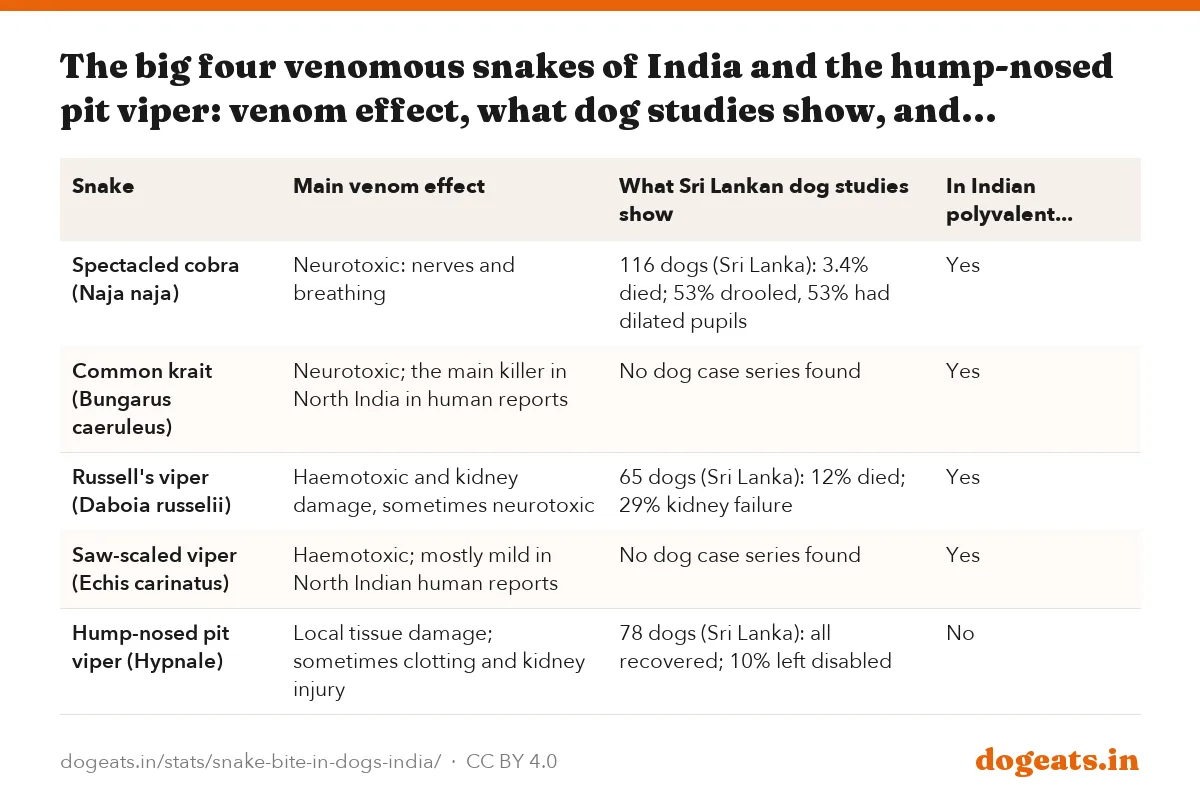
India's traditional big four venomous snakes are the spectacled cobra, common krait, Russell's viper and saw-scaled viper. Indian polyvalent antivenom is made against these four, and in Indian hospital studies of people that named the snake, Russell's viper caused 43% of bites.
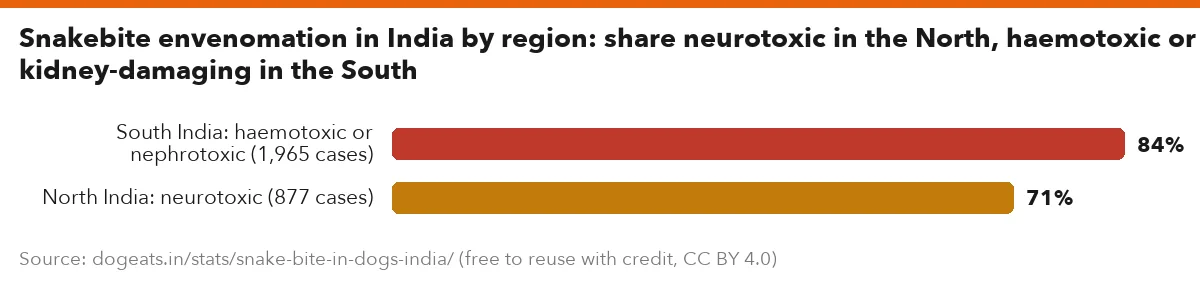
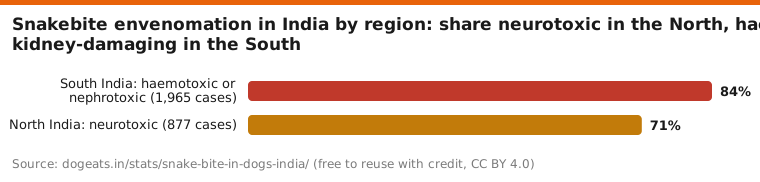
Which of the four matters most depends on where you live. A review of published human case series found 71% of 877 envenomations in North India were neurotoxic, mostly from kraits. In South India, 84% of 1,965 envenomations were haemotoxic or damaged the kidneys, mostly from Russell's and saw-scaled vipers.
For dogs, only the cobra and Russell's viper have proper case series. We found no published series of krait or saw-scaled viper bites in dogs, so the table describes those two snakes' venom, not dog outcomes. The same Sri Lankan team also studied the hump-nosed pit viper, which lives in south-western India and is not covered by Indian antivenom.
| Snake | Main venom effect | What Sri Lankan dog studies show | In Indian polyvalent antivenom |
|---|---|---|---|
| Spectacled cobra (Naja naja) | Neurotoxic: nerves and breathing | 116 dogs (Sri Lanka): 3.4% died; 53% drooled, 53% had dilated pupils | Yes |
| Common krait (Bungarus caeruleus) | Neurotoxic; the main killer in North India in human reports | No dog case series found | Yes |
| Russell's viper (Daboia russelii) | Haemotoxic and kidney damage, sometimes neurotoxic | 65 dogs (Sri Lanka): 12% died; 29% kidney failure | Yes |
| Saw-scaled viper (Echis carinatus) | Haemotoxic; mostly mild in North Indian human reports | No dog case series found | Yes |
| Hump-nosed pit viper (Hypnale) | Local tissue damage; sometimes clotting and kidney injury | 78 dogs (Sri Lanka): all recovered; 10% left disabled | No |
People, not dogs. Source: Chauhan and Thakur, Journal of Emergencies, Trauma, and Shock 2016, pooling published case series (877 envenomations in North India, 1,965 in South India).
Show the numbers
| Label | % |
|---|---|
| South India: haemotoxic or nephrotoxic (1,965 cases) | 84% |
| North India: neurotoxic (877 cases) | 71% |
Embed this chart
In people, 94% of snakebite deaths are rural, and village dogs share that ground. If you are choosing a dog for a farmhouse, our village and farm dog report covers breeds that cope with rural life.
What are the signs of a snake bite in a dog?
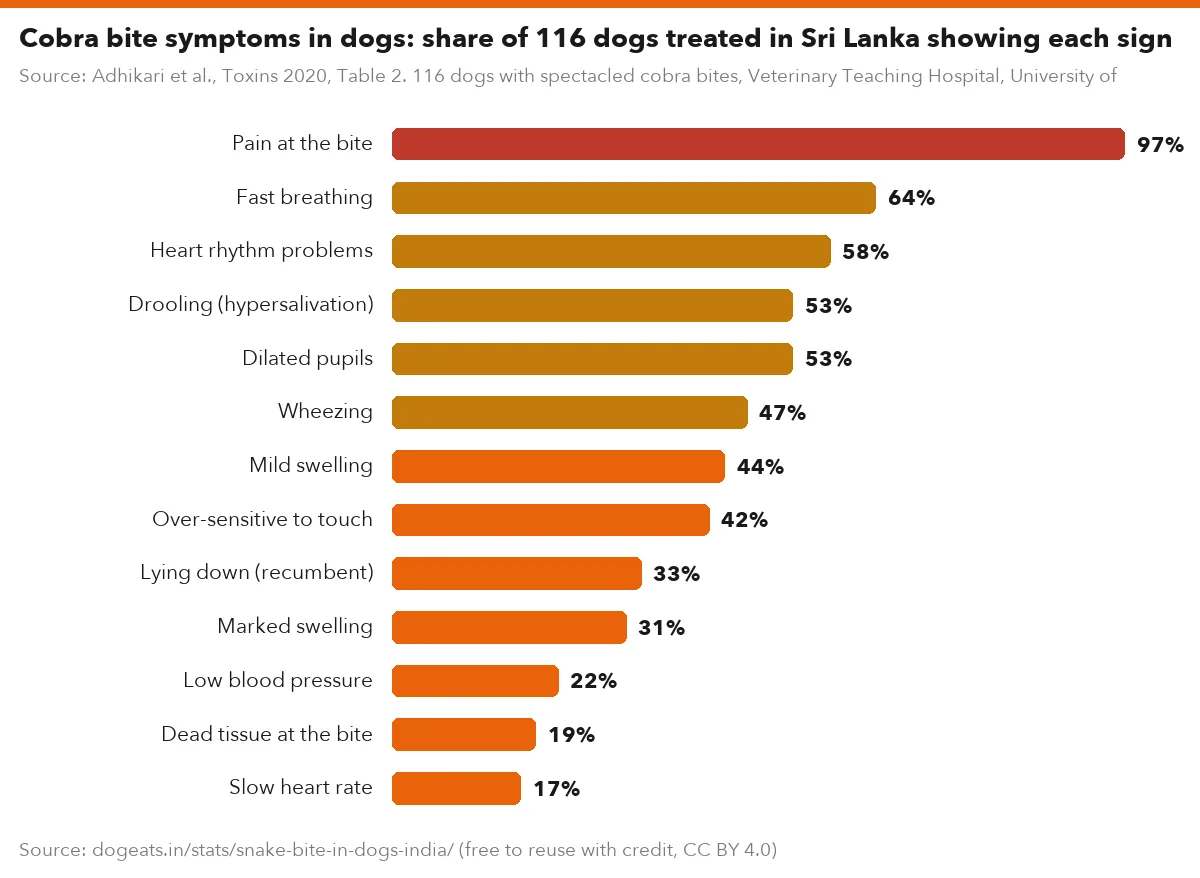
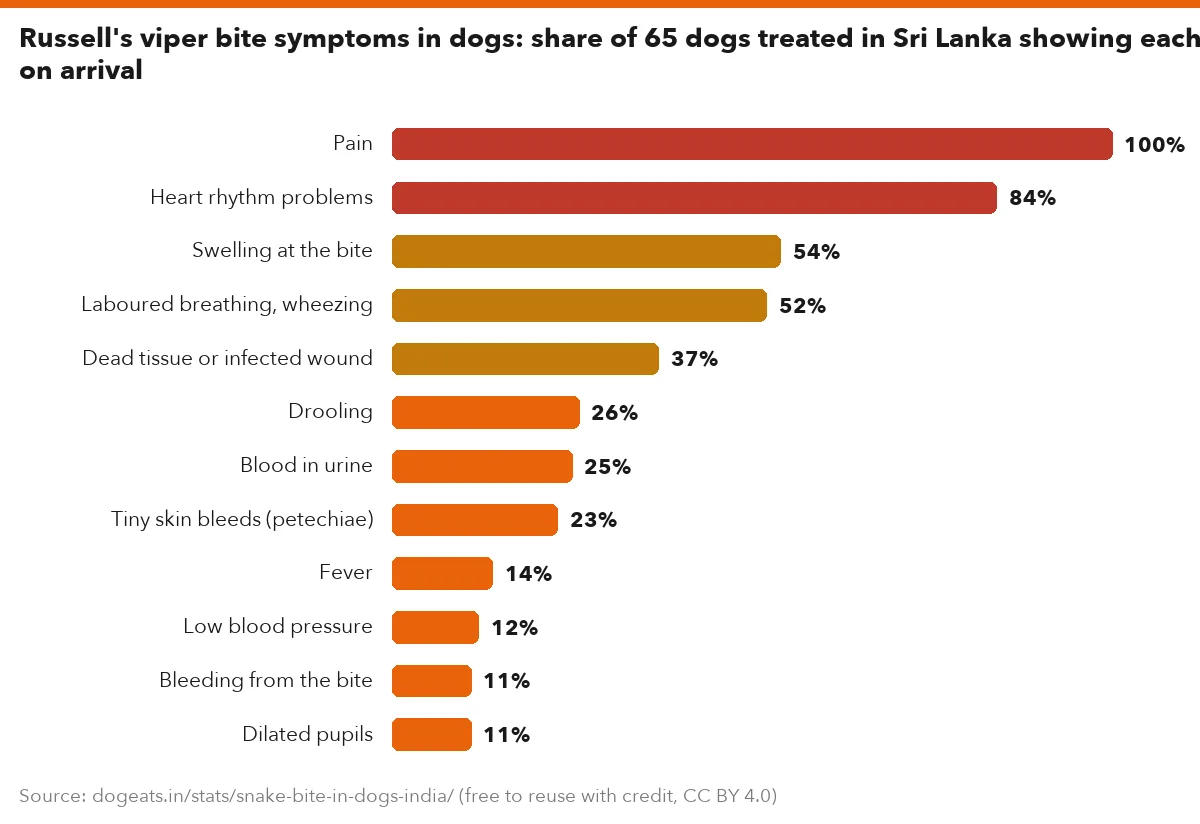
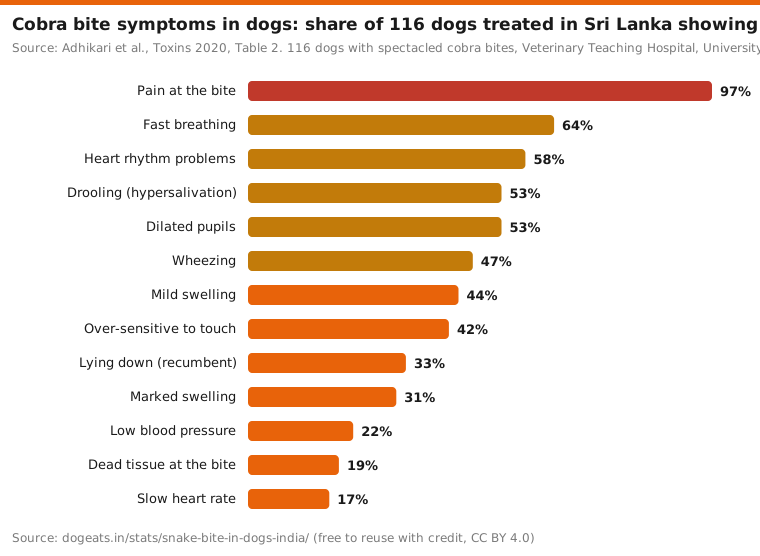
Pain at the bite is the most common sign: in the Sri Lankan studies, 97% of 116 cobra-bitten dogs and all 65 Russell's viper-bitten dogs showed it. After that the signs split by venom. Cobra venom mostly hits the nerves and breathing; Russell's viper venom mostly hits blood clotting and the kidneys.
In the Sri Lankan cobra study, 64% of dogs breathed fast, 53% drooled and 53% had dilated pupils, and 33% were recumbent, lying down and not getting up. Fang marks inside the mouth were the worst sign: none of the dogs bitten there survived.
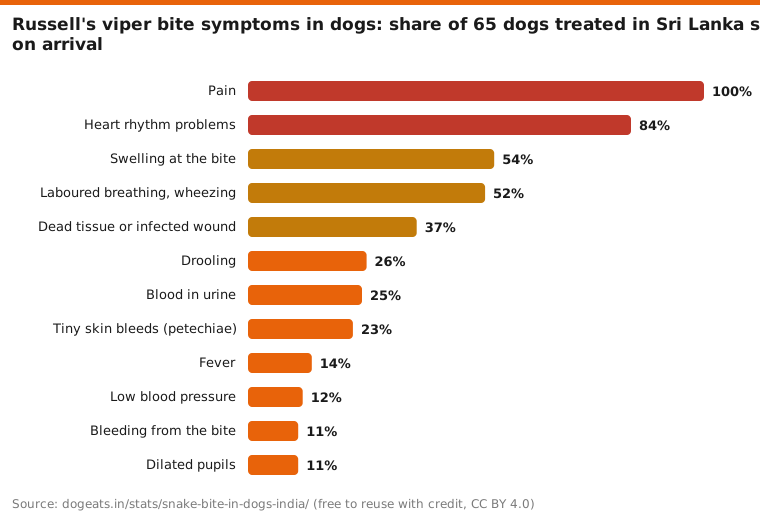
In the Sri Lankan Russell's viper study, 84% of dogs had heart rhythm problems and 84% had bleeding signs. These included bleeding from the bite or injection sites, blood in the urine (25%) or tiny skin bleeds (23%). Every dog's blood was slow to clot on arrival. A normal resting dog's heart beats 70 to 120 times a minute, as our dog vital signs chart shows.
Fang marks are hard to find under fur. Among the Sri Lankan Russell's viper dogs, 48% were bitten on the head and 45% had multiple fang marks.
Sources differ on cobra pain. The MSD Veterinary Manual says elapid bites, the family that includes cobras and kraits, cause minimal pain and swelling, with nerve signs dominating. The Sri Lankan cobra study recorded pain in 97% of dogs, mild swelling in 44% and marked swelling in 31%. Do not rule out a cobra because the bite looks small.
Source: Adhikari et al., Toxins 2020, Table 2. 116 dogs with spectacled cobra bites, Veterinary Teaching Hospital, University of Peradeniya, Sri Lanka, 2012 to 2017. Swelling uses the Table 2 counts (51 and 36 dogs); the paper's text gives 51% and 36% instead.
Show the numbers
| Label | % |
|---|---|
| Pain at the bite | 97% |
| Fast breathing | 64% |
| Heart rhythm problems | 58% |
| Drooling (hypersalivation) | 53% |
| Dilated pupils | 53% |
| Wheezing | 47% |
| Mild swelling | 44% |
| Over-sensitive to touch | 42% |
| Lying down (recumbent) | 33% |
| Marked swelling | 31% |
| Low blood pressure | 22% |
| Dead tissue at the bite | 19% |
| Slow heart rate | 17% |
Embed this chart
Source: Adhikari et al., Toxicology Reports 2019, Table 1. 65 dogs with Russell's viper bites, Veterinary Teaching Hospital, University of Peradeniya, Sri Lanka, 2012 to 2014.
Show the numbers
| Label | % |
|---|---|
| Pain | 100% |
| Heart rhythm problems | 84% |
| Swelling at the bite | 54% |
| Laboured breathing, wheezing | 52% |
| Dead tissue or infected wound | 37% |
| Drooling | 26% |
| Blood in urine | 25% |
| Tiny skin bleeds (petechiae) | 23% |
| Fever | 14% |
| Low blood pressure | 12% |
| Bleeding from the bite | 11% |
| Dilated pupils | 11% |
Embed this chart
Any of these after time outdoors, especially at dawn or dusk in the rains, is a reason to go to a vet at once. Watch for sudden pain or limping, a swollen face or leg, drooling, dilated pupils, lying down and not getting up, laboured breathing, or bleeding that will not stop.
What happens when a Russell's viper bites a dog?
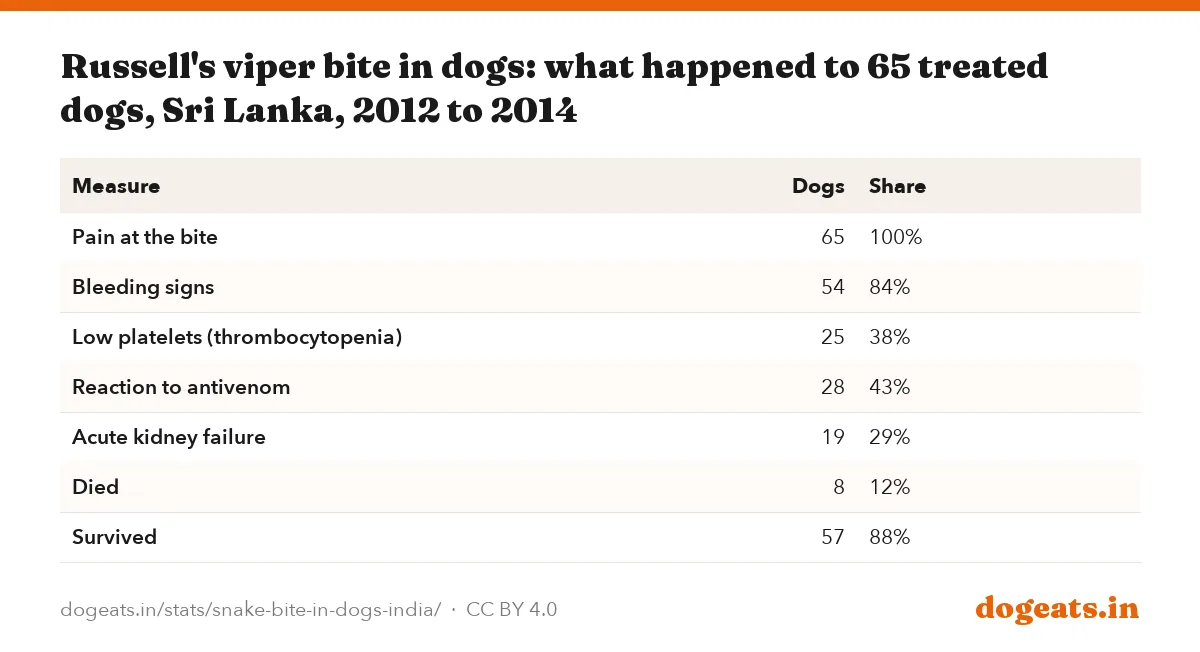
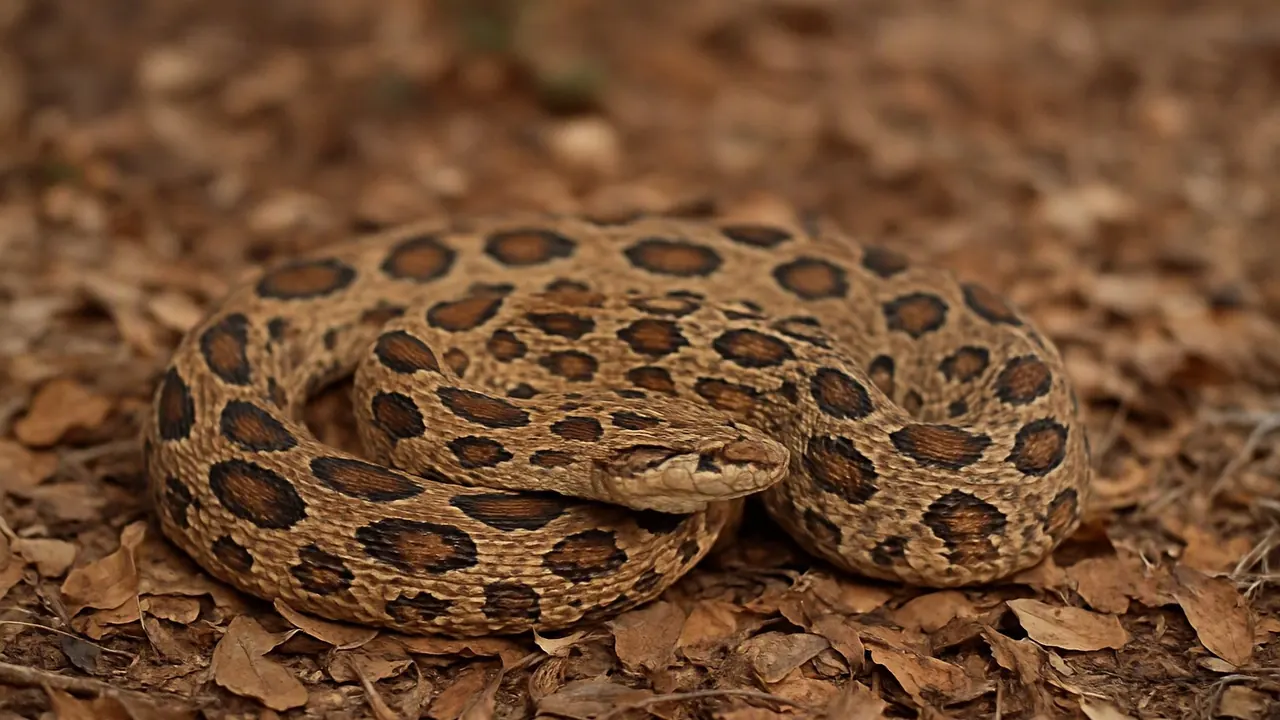
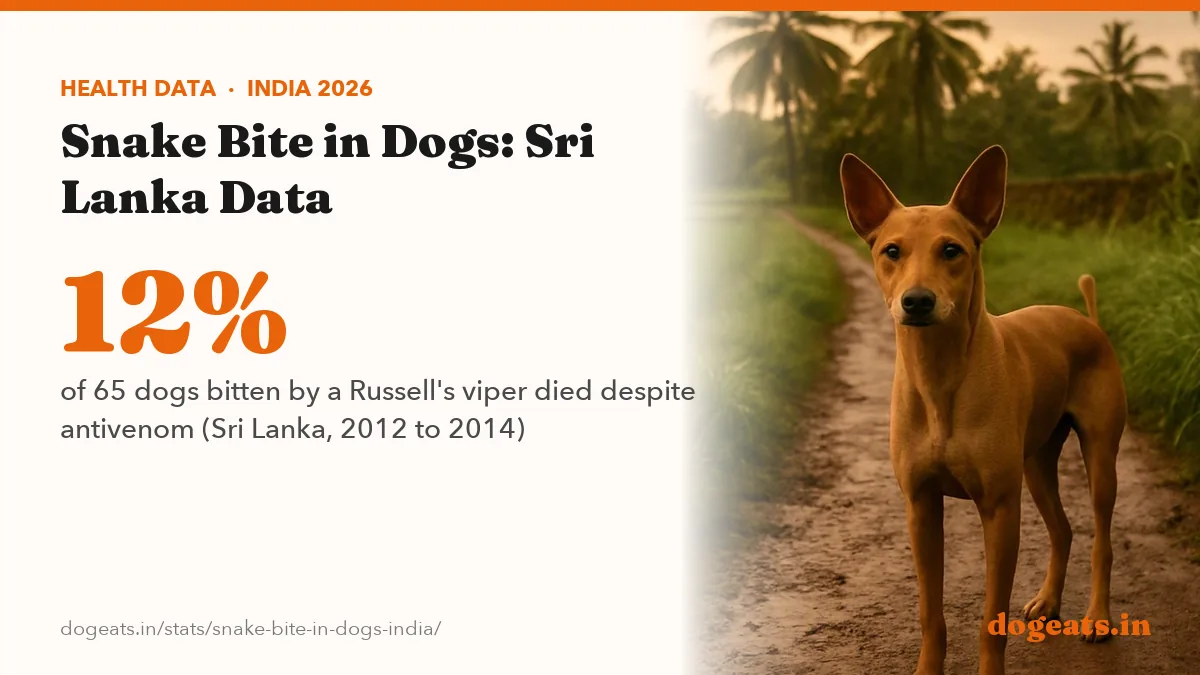
A Russell's viper bite stops a dog's blood from clotting and can shut down its kidneys. In the Sri Lankan study, 19 of 65 dogs (29%) developed acute kidney failure, and 8 (12%) died despite antivenom.
Kidney failure came late. In that study, blood urea and creatinine were normal in every dog on arrival. Kidney failure then developed a median 23.7 hours after admission, within a range of 8 to 72 hours. A dog that seems better on the first evening can still be in danger.
Of the 8 deaths, 4 dogs had kidney failure and 2 died of reactions to the antivenom. The other 2 died of the venom itself, in the 5th and 12th hours after admission. Antivenom put clotting right within 2 hours in this study, but it could not undo all the damage.
In the same Sri Lankan study, bites clustered in two windows: 34% between 6 am and noon and 29% between 6 pm and midnight. Males and females were bitten about equally, 34 and 31 dogs, and the median age was 3.5 years.
Indian case reports follow the same pattern. A 10 kg Dachshund in Hassan, Karnataka, arrived 10 hours after a Russell's viper bite with a swollen face and a platelet count of 24,000. It recovered after 5 days of treatment. A 16 kg German Shepherd cross in Erode, Tamil Nadu, also recovered after 5 days.
| Measure | Dogs | Share |
|---|---|---|
| Pain at the bite | 65 | 100% |
| Bleeding signs | 54 | 84% |
| Low platelets (thrombocytopenia) | 25 | 38% |
| Reaction to antivenom | 28 | 43% |
| Acute kidney failure | 19 | 29% |
| Died | 8 | 12% |
| Survived | 57 | 88% |
Source: Adhikari et al., Toxicology Reports 2019. The survival row is 65 dogs minus the 8 deaths.
What should I do if a snake bites my dog?
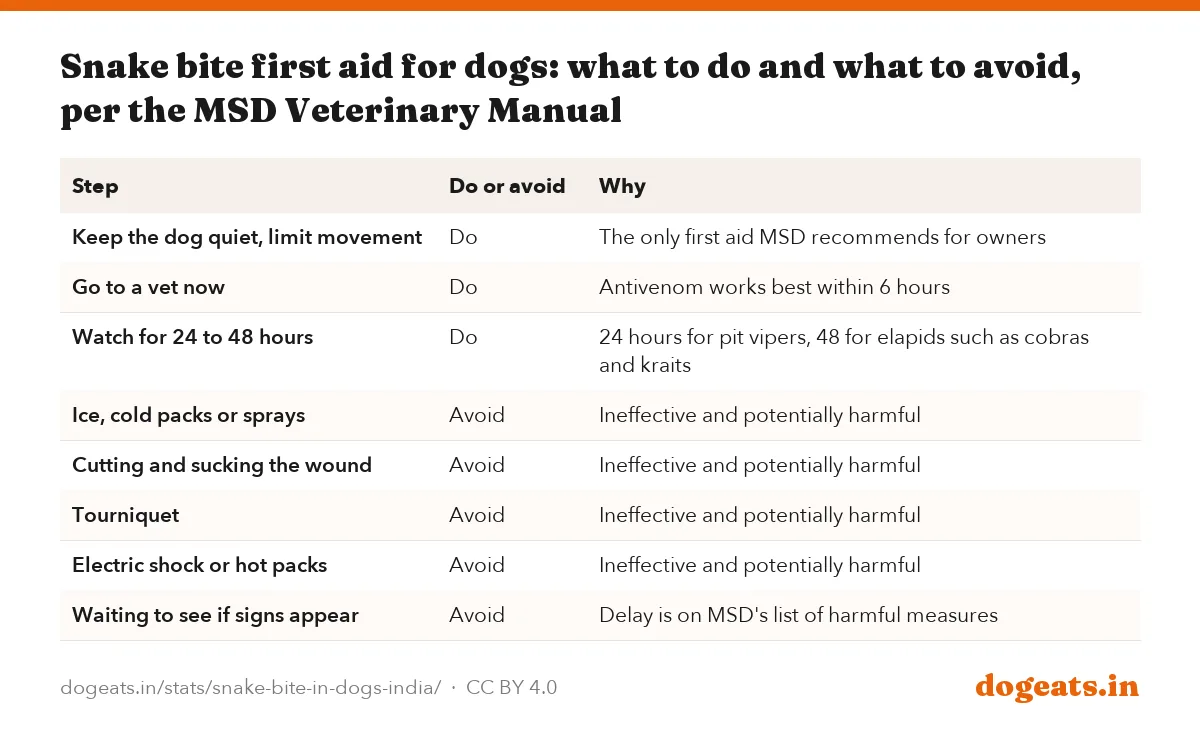
Keep the dog still and quiet and get it to a vet at once. The MSD Veterinary Manual says antivenom works best when given within 6 hours of the bite. Owners should not spend time on first aid beyond keeping the animal quiet.
Skip the old remedies. MSD lists ice, cold packs or sprays, cutting and sucking the wound, tourniquets, electric shock and hot packs as ineffective and potentially harmful. Waiting for problems to develop before going to the vet is on the same list.
Call ahead and ask whether the clinic has anti snake venom (ASV) and can keep a dog in for observation. Do not count on the 1962 helpline. As our 1962 mobile vet unit report shows, it is built for livestock. Our vets per lakh report shows most government vets serve farm animals.
If it is safe, take a photo of the snake from a distance. The Sri Lankan vets identified snakes from dead specimens and owners' mobile phone photos, and the species decides whether antivenom will help. Do not try to catch or kill it.
A dog that looks fine still needs watching. MSD advises monitoring every bitten animal for at least 24 hours after a pit viper bite and 48 hours after an elapid bite, such as a cobra or krait.
| Step | Do or avoid | Why |
|---|---|---|
| Keep the dog quiet, limit movement | Do | The only first aid MSD recommends for owners |
| Go to a vet now | Do | Antivenom works best within 6 hours |
| Watch for 24 to 48 hours | Do | 24 hours for pit vipers, 48 for elapids such as cobras and kraits |
| Ice, cold packs or sprays | Avoid | Ineffective and potentially harmful |
| Cutting and sucking the wound | Avoid | Ineffective and potentially harmful |
| Tourniquet | Avoid | Ineffective and potentially harmful |
| Electric shock or hot packs | Avoid | Ineffective and potentially harmful |
| Waiting to see if signs appear | Avoid | Delay is on MSD's list of harmful measures |
Can a dog be given human anti snake venom?
Yes, under a vet's care. Indian polyvalent anti snake venom is the antivenom used for people. Sri Lankan vets used it for cobra and Russell's viper bites in dogs. Only a vet can decide whether a dog needs it.
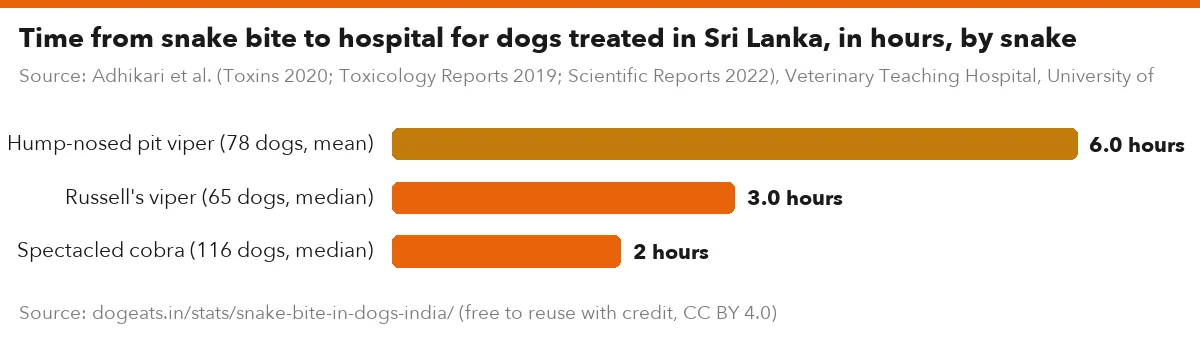
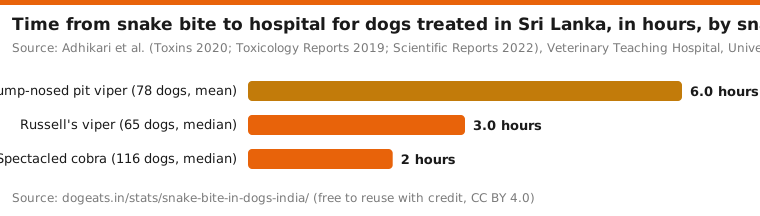
Speed matters. The MSD Veterinary Manual says antivenom works best within 6 hours of the bite. In the Sri Lankan studies, cobra-bitten dogs reached the hospital a median 2 hours after the bite. Russell's viper-bitten dogs took a median 3.0 hours, and hump-nosed pit viper-bitten dogs a mean 6.0 hours.
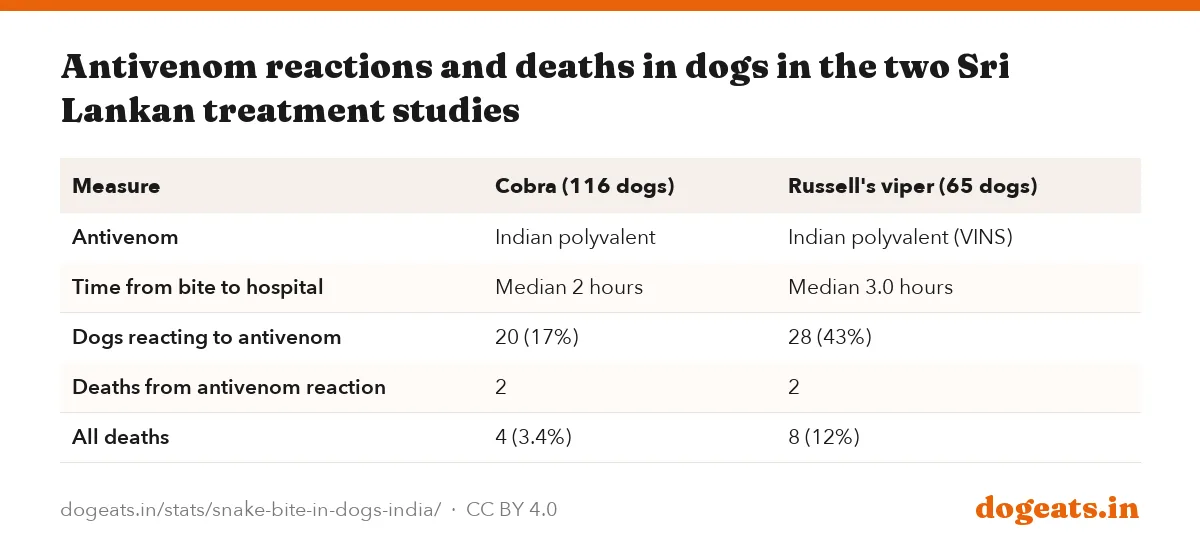
Reactions to this horse-derived antivenom were common. In the Sri Lankan Russell's viper study 43% of dogs reacted, and in the cobra study 17%, with wheezing, drooling, restlessness or a drop in blood pressure. Two dogs in each study died of a reaction.
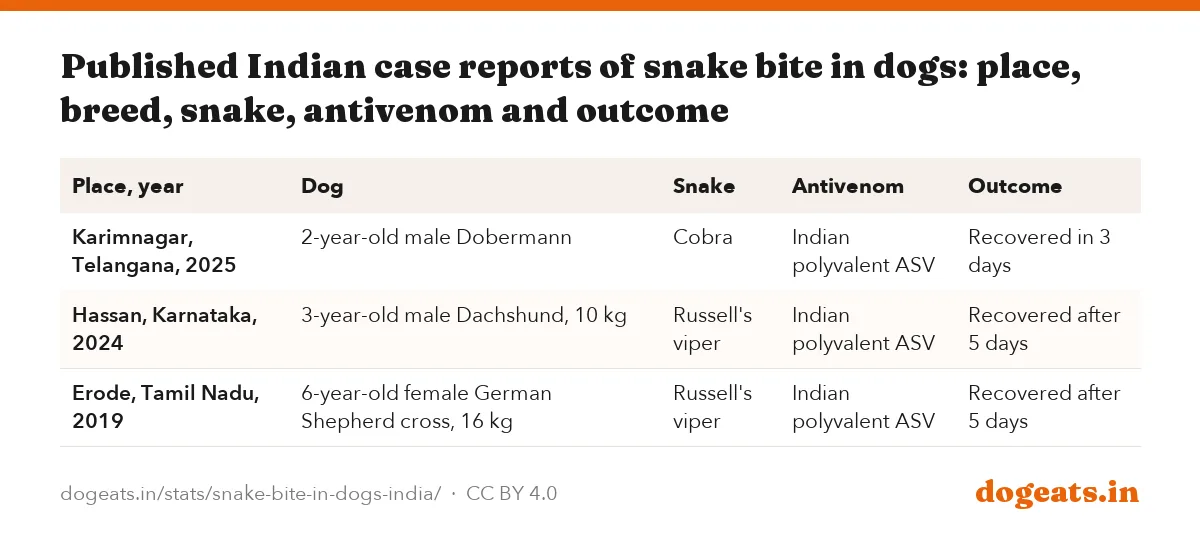
Indian case reports describe the same antivenom in a Dobermann in Karimnagar, a Dachshund in Hassan and a German Shepherd cross in Erode. All three dogs recovered. Antivenom is never a home remedy: it is given in a clinic, with the dog watched closely.
Source: Adhikari et al. (Toxins 2020; Toxicology Reports 2019; Scientific Reports 2022), Veterinary Teaching Hospital, University of Peradeniya, Sri Lanka. Cobra and Russell's viper are medians; hump-nosed pit viper is a mean.
Show the numbers
| Label | hours |
|---|---|
| Hump-nosed pit viper (78 dogs, mean) | 6.0 hours |
| Russell's viper (65 dogs, median) | 3.0 hours |
| Spectacled cobra (116 dogs, median) | 2 hours |
Embed this chart
| Measure | Cobra (116 dogs) | Russell's viper (65 dogs) |
|---|---|---|
| Antivenom | Indian polyvalent | Indian polyvalent (VINS) |
| Time from bite to hospital | Median 2 hours | Median 3.0 hours |
| Dogs reacting to antivenom | 20 (17%) | 28 (43%) |
| Deaths from antivenom reaction | 2 | 2 |
| All deaths | 4 (3.4%) | 8 (12%) |
The cobra paper gives its death rate three ways: 3% in the abstract, 4.6% in the results and 3.4% in the discussion. We use 4 of 116 dogs, which is 3.4%.
Can a dog survive a snake bite?
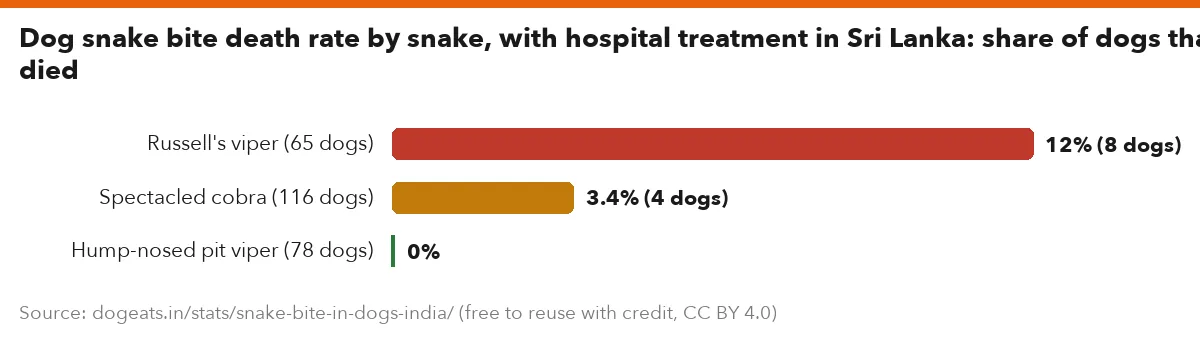
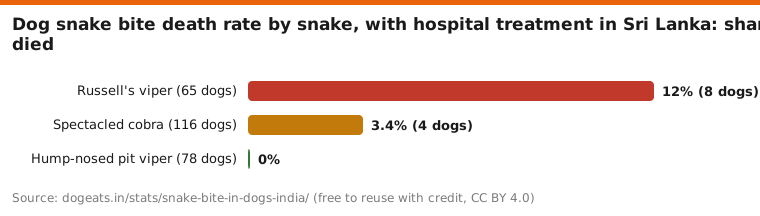
Most treated dogs survive: 112 of 116 cobra-bitten dogs, 57 of 65 Russell's viper-bitten dogs and all 78 hump-nosed pit viper-bitten dogs left the Sri Lankan hospital alive.
Where the bite lands matters. All 4 deaths in the Sri Lankan cobra study were dogs bitten in the mouth, on the lips, tongue or gums. The MSD Veterinary Manual, writing mostly about American snakes, says bites to the chest or belly kill dogs and cats more often than bites to the head or legs. Small dogs are at more risk because the venom dose is large for their size, MSD adds.
Recovery takes time. In Sri Lanka, cobra-bitten dogs stayed a median 7 days in hospital. MSD says animals that survive elapid bites generally recover fully, while pit viper bites can leave lasting damage from dead tissue. Dead tissue developed at the bite in 19% of the Sri Lankan cobra dogs, and dead tissue or an infected wound in 37% of the Russell's viper dogs.
These are hospital figures for dogs that reached an intensive care unit with antivenom. Dogs that die at home or never reach a vet are not counted, and no study we found measures survival without treatment.
All three Indian case reports we found ended in recovery within 3 to 5 days. Single good-news cases are more likely to be published, so they do not show a survival rate. For everyday health risks, see our most common dog health problems report.
Source: Adhikari et al. (Toxicology Reports 2019; Toxins 2020; Scientific Reports 2022), Veterinary Teaching Hospital, University of Peradeniya, Sri Lanka, 2012 to 2018. All dogs treated in hospital.
Show the numbers
| Label | % |
|---|---|
| Russell's viper (65 dogs) | 12% (8 dogs) |
| Spectacled cobra (116 dogs) | 3.4% (4 dogs) |
| Hump-nosed pit viper (78 dogs) | 0% |
Embed this chart
| Place, year | Dog | Snake | Antivenom | Outcome |
|---|---|---|---|---|
| Karimnagar, Telangana, 2025 | 2-year-old male Dobermann | Cobra | Indian polyvalent ASV | Recovered in 3 days |
| Hassan, Karnataka, 2024 | 3-year-old male Dachshund, 10 kg | Russell's viper | Indian polyvalent ASV | Recovered after 5 days |
| Erode, Tamil Nadu, 2019 | 6-year-old female German Shepherd cross, 16 kg | Russell's viper | Indian polyvalent ASV | Recovered after 5 days |
When are snake bites most common in India?
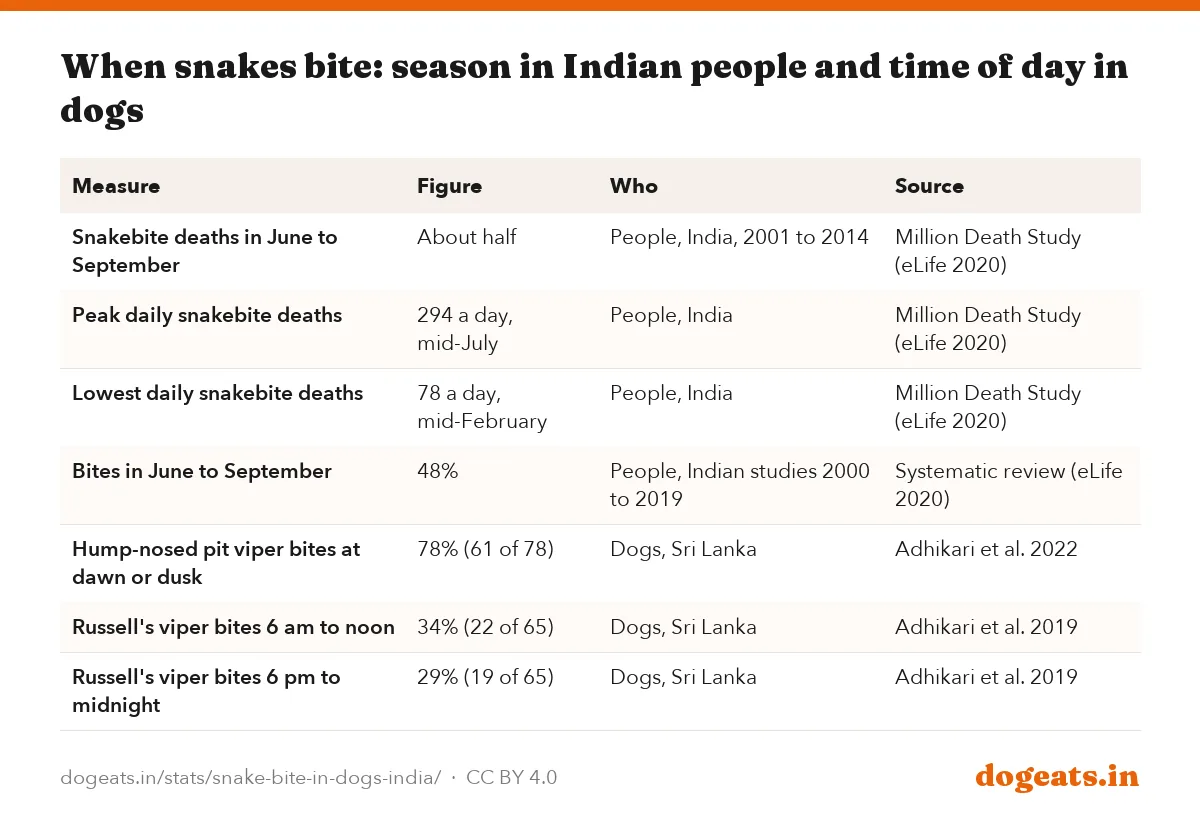
In people, half of all snakebite deaths in India happen in the four monsoon months, June to September. Deaths peak at about 294 a day in mid-July against 78 a day in mid-February. No Indian data give the same calendar for dogs, but dogs share the same fields, lanes and compounds.
Indian hospital studies of people found 48% of bites happened from June to September. The Million Death Study found the seasonal pattern was similar every year from 2001 to 2014.
Time of day matters for dogs. In Sri Lanka, 78% of hump-nosed pit viper bites on dogs came at dawn (5 to 7 am) or dusk (5 to 8 pm). Russell's viper bites clustered from 6 am to noon (34%) and from 6 pm to midnight (29%).
Putting the human season and the dog bite times together, take extra care on rainy-season walks at first light and after dark, along grass edges and paddy bunds. Our monsoon dog care guide covers walks in the rains, and our monsoon breed ranking rates 58 breeds.
| Measure | Figure | Who | Source |
|---|---|---|---|
| Snakebite deaths in June to September | About half | People, India, 2001 to 2014 | Million Death Study (eLife 2020) |
| Peak daily snakebite deaths | 294 a day, mid-July | People, India | Million Death Study (eLife 2020) |
| Lowest daily snakebite deaths | 78 a day, mid-February | People, India | Million Death Study (eLife 2020) |
| Bites in June to September | 48% | People, Indian studies 2000 to 2019 | Systematic review (eLife 2020) |
| Hump-nosed pit viper bites at dawn or dusk | 78% (61 of 78) | Dogs, Sri Lanka | Adhikari et al. 2022 |
| Russell's viper bites 6 am to noon | 34% (22 of 65) | Dogs, Sri Lanka | Adhikari et al. 2019 |
| Russell's viper bites 6 pm to midnight | 29% (19 of 65) | Dogs, Sri Lanka | Adhikari et al. 2019 |
Does antivenom work for a hump-nosed pit viper bite?
No. Indian polyvalent antivenom does not cover the hump-nosed pit viper, found in Sri Lanka and south-western India. The 78 bitten dogs in the Sri Lankan study got supportive care only, and all of them recovered.
In that study, young male dogs were the usual victims: 85% were under one year old, with a median age of 6.5 months, and 87% were male. Most were bitten on the face or neck (87%).
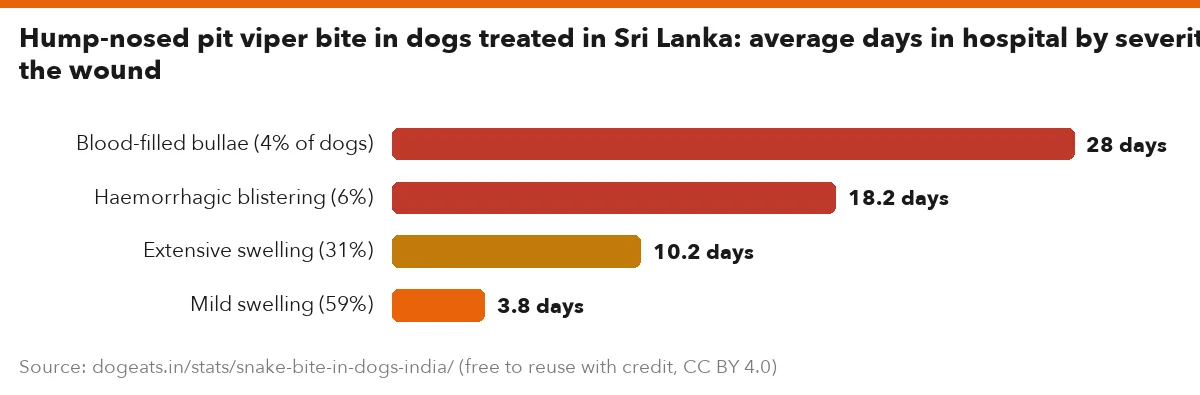
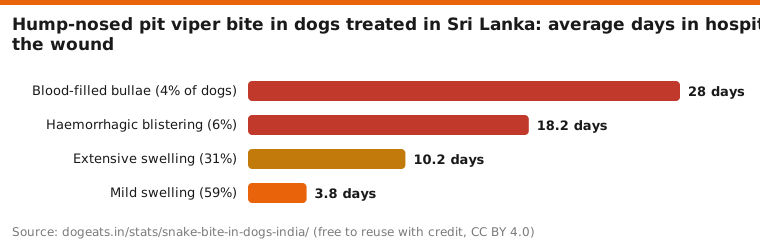
Hospital stays grew with the wound: 3.8 days on average for mild swelling, 10.2 for extensive swelling, 18.2 for blistering and 28 for blood-filled bullae. 16 dogs (21%) developed clotting problems, 11 (14%) had kidney injury and 10% were left with a permanent disability; one dog lost a hind leg.
A 2025 panel of Indian snakebite clinicians, writing in The Lancet Regional Health Southeast Asia, says physicians' experience suggests Indian polyvalent antivenom is ineffective against this snake's venom.
Source: Adhikari et al., Scientific Reports 2022, Table 1. 78 dogs, Veterinary Teaching Hospital, University of Peradeniya, Sri Lanka, January 2012 to March 2018. Share of dogs in each group: 59%, 31%, 6%, 4%.
Show the numbers
| Label | days |
|---|---|
| Blood-filled bullae (4% of dogs) | 28 days |
| Haemorrhagic blistering (6%) | 18.2 days |
| Extensive swelling (31%) | 10.2 days |
| Mild swelling (59%) | 3.8 days |
Embed this chart
Snake bites are not the only outdoor poison risk. Our dog food toxicity chart lists the household foods that harm dogs.
Frequently asked questions
Can a dog survive a snake bite?
Yes, most treated dogs do. At a Sri Lankan teaching hospital, 112 of 116 cobra-bitten dogs (96.6%) and 57 of 65 Russell's viper-bitten dogs (88%) survived with antivenom. All 78 hump-nosed pit viper-bitten dogs recovered. Survival without treatment has not been measured.
How long after a snake bite will a dog show symptoms?
Pain usually shows at once; every Russell's viper-bitten dog in the Sri Lankan study had it. Serious problems can come later. In the same study, kidney failure appeared 8 to 72 hours after admission in Russell's viper bites. In another Sri Lankan study, clotting problems appeared a mean 21.3 hours after hump-nosed pit viper bites. MSD advises watching for 24 hours after pit viper bites and 48 hours after cobra or krait bites.
How fast should a snake-bitten dog get to a vet?
As fast as you can. The MSD Veterinary Manual says antivenom works best within 6 hours of the bite. In the Sri Lankan studies, cobra-bitten dogs reached the hospital a median 2 hours after the bite. Only a vet can decide treatment.
Can a dog be given human anti snake venom?
Yes, vets use the Indian polyvalent antivenom made for people, and only a vet can decide whether a dog needs it. Reactions are common: in Sri Lankan studies, 43% of Russell's viper-bitten dogs and 17% of cobra-bitten dogs reacted. That is why it is given only in a clinic.
What is the first aid for a snake bite in a dog?
Keep the dog quiet, limit its movement and get to a vet at once; the MSD Veterinary Manual says antivenom works best within 6 hours. Do not use ice, a tourniquet, or cut and suck the wound: MSD calls these ineffective and potentially harmful.
Which snake bites are most dangerous for dogs in India?
Among dogs treated at a Sri Lankan hospital, Russell's viper bites were the deadliest, with 12% of 65 dogs dying, against 3.4% of 116 cobra-bitten dogs. Cobra bites inside the mouth were the most dangerous single type: none of those dogs survived. We found no dog case series for krait or saw-scaled viper bites.
When is snake bite season in India?
The monsoon. Half of India's human snakebite deaths happen from June to September, peaking at about 294 a day in mid-July. In dogs, bites cluster at dawn and dusk: 78% of hump-nosed pit viper bites in a Sri Lankan study came then.
Are small dogs more at risk from snake bites?
Yes. The MSD Veterinary Manual says many dogs are small relative to the amount of venom injected, so even a bite from a small snake can kill a dog. It also says fatal snakebites are more common in dogs than in other domestic animals.
Methodology and limitations
Dog figures come from the three prospective case series published by Adhikari and colleagues at the Veterinary Teaching Hospital, University of Peradeniya, Sri Lanka. They cover Russell's viper (65 dogs, 2012 to 2014, Toxicology Reports 2019) and spectacled cobra (116 dogs, 2012 to 2017, Toxins 2020). The third is hump-nosed pit viper (78 dogs, January 2012 to March 2018, Scientific Reports 2022). We read the full texts on PubMed Central.
Indian dog evidence comes from three case reports we read in full. The first is Kandula et al., Indian Journal of Veterinary Medicine 2025 (Karimnagar). The others are Bhagya et al., Indian Journal of Veterinary and Animal Sciences Research 2024 (Hassan), and Vijayakumar et al., International Journal of Current Microbiology and Applied Sciences 2019 (Erode).
Human figures are used only as labelled context. They come from Suraweera et al., eLife 2020 (Million Death Study and a systematic review of Indian studies) and Chauhan and Thakur, Journal of Emergencies, Trauma, and Shock 2016.
First aid, monitoring and prognosis statements come from the MSD (Merck) Veterinary Manual professional chapter on snakebites in animals (last updated September 2024) and its pet owner page.
Survival counts (112 of 116, 57 of 65) are the published death counts subtracted from the number of dogs. Percentages are as published unless stated.
Sources
- Adhikari RB et al. (2019), Clinico-epidemiology and management of Russell's viper (Daboia russelii) envenoming in dogs in Sri Lanka, Toxicology Reports 6:809-818, 65 dogs, 2012 to 2014: signs, median 3.0 hours to hospital, 29% kidney failure, 43% antivenom reactions, 12% deaths
- Adhikari R et al. (2020), Development of a Treatment Protocol for Cobra (Naja naja) Bite Envenoming in Dogs, Toxins 12(11):694, 116 dogs, 2012 to 2017: signs, median 2 hours to hospital, 17% antivenom reactions, 4 deaths, all with mouth bites
- Adhikari R et al. (2022), Clinico-epidemiology and management of hump-nosed pit viper (Hypnale spp.) bites in dogs, Scientific Reports 12:8232, 78 dogs, 2012 to 2018: no antivenom cover, all recovered, 10% disabled, hospital days by wound
- Also consulted: Suraweera W et al. (2020), Trends in snakebite deaths in India from 2000 to 2019 in a nationally representative mortality study, eLife 9:e54076, MSD (Merck) Veterinary Manual, Snakebites in Animals, professional version (S. Gwaltney-Brant, updated September 2024), MSD (Merck) Veterinary Manual, Snakebite, pet owner version (updated September 2024), Chauhan V, Thakur S (2016), The North-South divide in snake bite envenomation in India, Journal of Emergencies, Trauma, and Shock 9(4):151-154, Abraham SV et al. (2025), Clinical challenges, controversies, and regional strategies in snakebite care in India, Lancet Regional Health Southeast Asia, Kandula S et al. (2025), Cobra Envenomation in a Doberman Dog: A Case Report, Indian Journal of Veterinary Medicine 45(2):44-45, Bhagya BK et al. (2024), Russell's viper snake envenomation in a dog: a case report, Indian Journal of Veterinary and Animal Sciences Research 53(2):90-93, Vijayakumar S et al. (2019), Successful Management of Russel's Viper Snake Envenomation in a Female Dog, International Journal of Current Microbiology and Applied Sciences 8(6):39-41.
Cite, embed and download
This report, its data and its images are free to reuse under a Creative Commons Attribution 4.0 licence. Credit dogeats.in with a link to this page. Every chart has its own embed code, every table has a CSV and an image download, and the images below are ready for social posts, slides and articles.
Cite this report
Link to this report
Every chart and table as an image