Data report · Updated October 2026
Dog Diseases in India: What Studies Show About Parvo, Tick Fever, Distemper and Leptospirosis, State by State
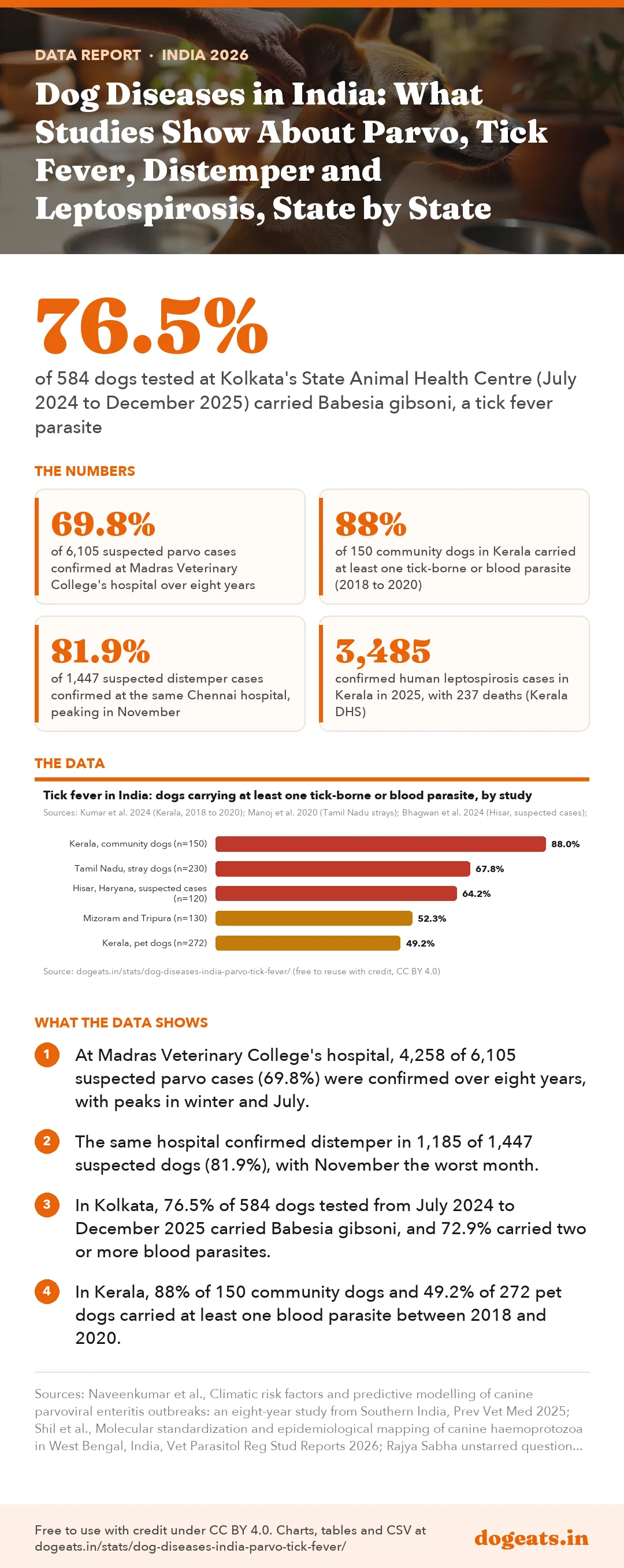
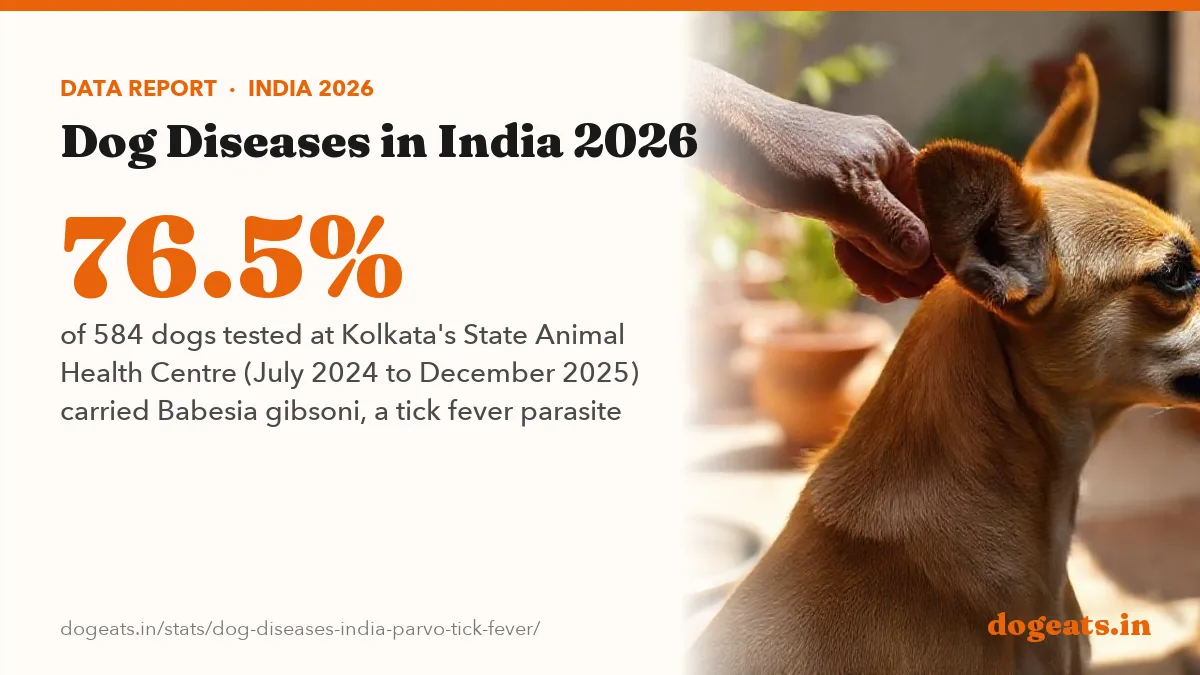
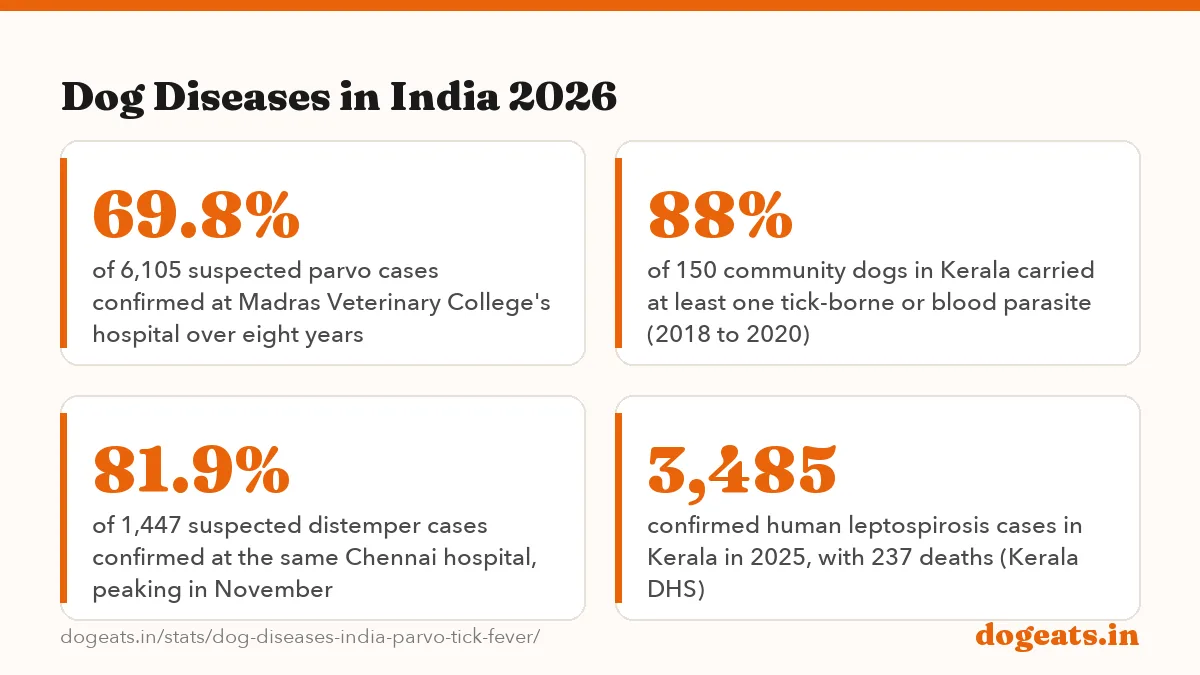
Parvo, tick fever and distemper are the dog diseases Indian vet studies find most often. At Madras Veterinary College, 69.8% of 6,105 dogs brought in with suspected parvo and 81.9% of 1,447 suspected distemper cases were confirmed. In Kolkata, 76.5% of 584 dogs tested from July 2024 to December 2025 carried Babesia gibsoni, a tick fever parasite. Leptospirosis, which dogs and people both catch, infected 3,485 people in Kerala in 2025.
Key findings
- At Madras Veterinary College's hospital, 4,258 of 6,105 suspected parvo cases (69.8%) were confirmed over eight years, with peaks in winter and July.
- The same hospital confirmed distemper in 1,185 of 1,447 suspected dogs (81.9%), with November the worst month.
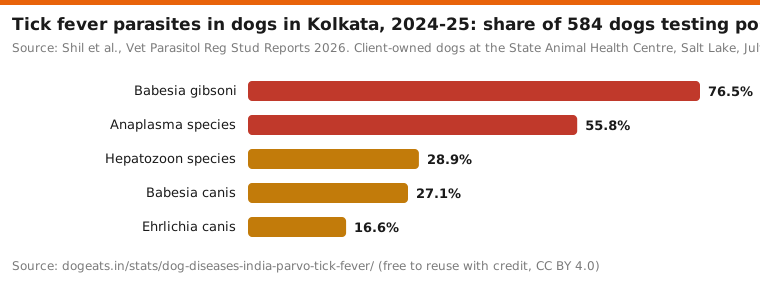
- In Kolkata, 76.5% of 584 dogs tested from July 2024 to December 2025 carried Babesia gibsoni, and 72.9% carried two or more blood parasites.
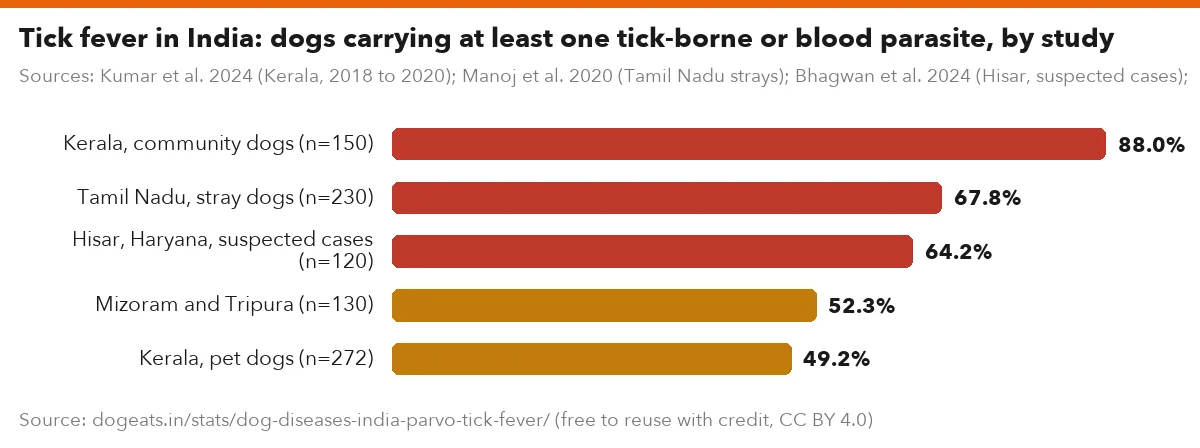
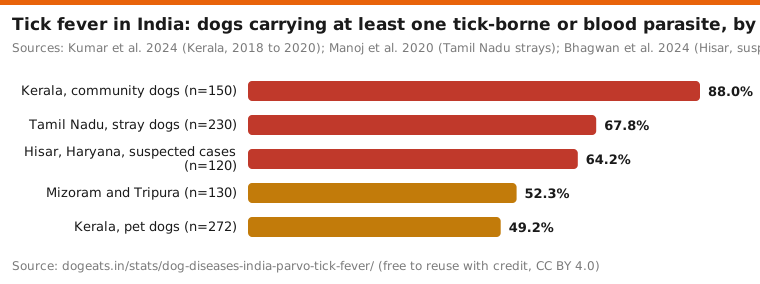
- In Kerala, 88% of 150 community dogs and 49.2% of 272 pet dogs carried at least one blood parasite between 2018 and 2020.
- Among 230 stray dogs sampled in Tamil Nadu, 229 had ticks and 67.8% carried at least one tick-borne pathogen.
- In Hyderabad, 70.3% of dogs with gastroenteritis that had been vaccinated with DHPPiL still tested positive for at least one virus.
- A pan-India study of 2023 samples found the CPV-2c parvo strain had almost completely replaced the older CPV-2a strain.
- Kerala's confirmed human leptospirosis cases rose from 1,098 in 2015 to 3,485 in 2025, and 48% of 2025 cases came from June to September.
- In Chennai, 58.6% of 210 dogs suspected of leptospirosis had antibodies, and 23.3% had acute infection.
What are the most common dog diseases in India?
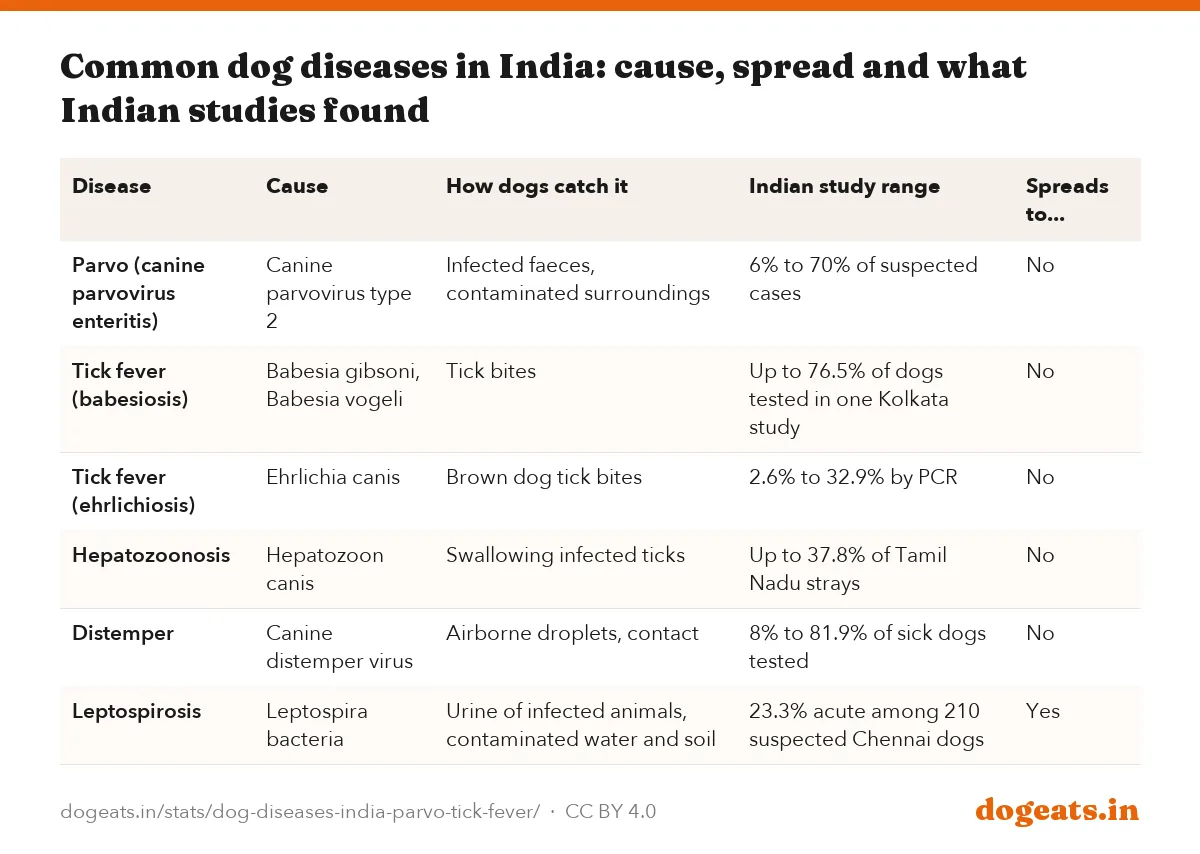
Parvovirus, tick-borne blood infections (often called tick fever) and distemper are the dog diseases Indian vet studies report most often. Leptospirosis matters too, because people can catch it.
There is no national register of dog diseases in India. What exists are studies by veterinary universities, each testing a few dozen to a few thousand dogs in one city or state. We read the abstracts of 35 such studies published from 2013 to 2026.
Most tested dogs that were already sick and brought to a hospital. So their positive rates show how often a suspected case turns out to be the disease, not how many of India's dogs have it.
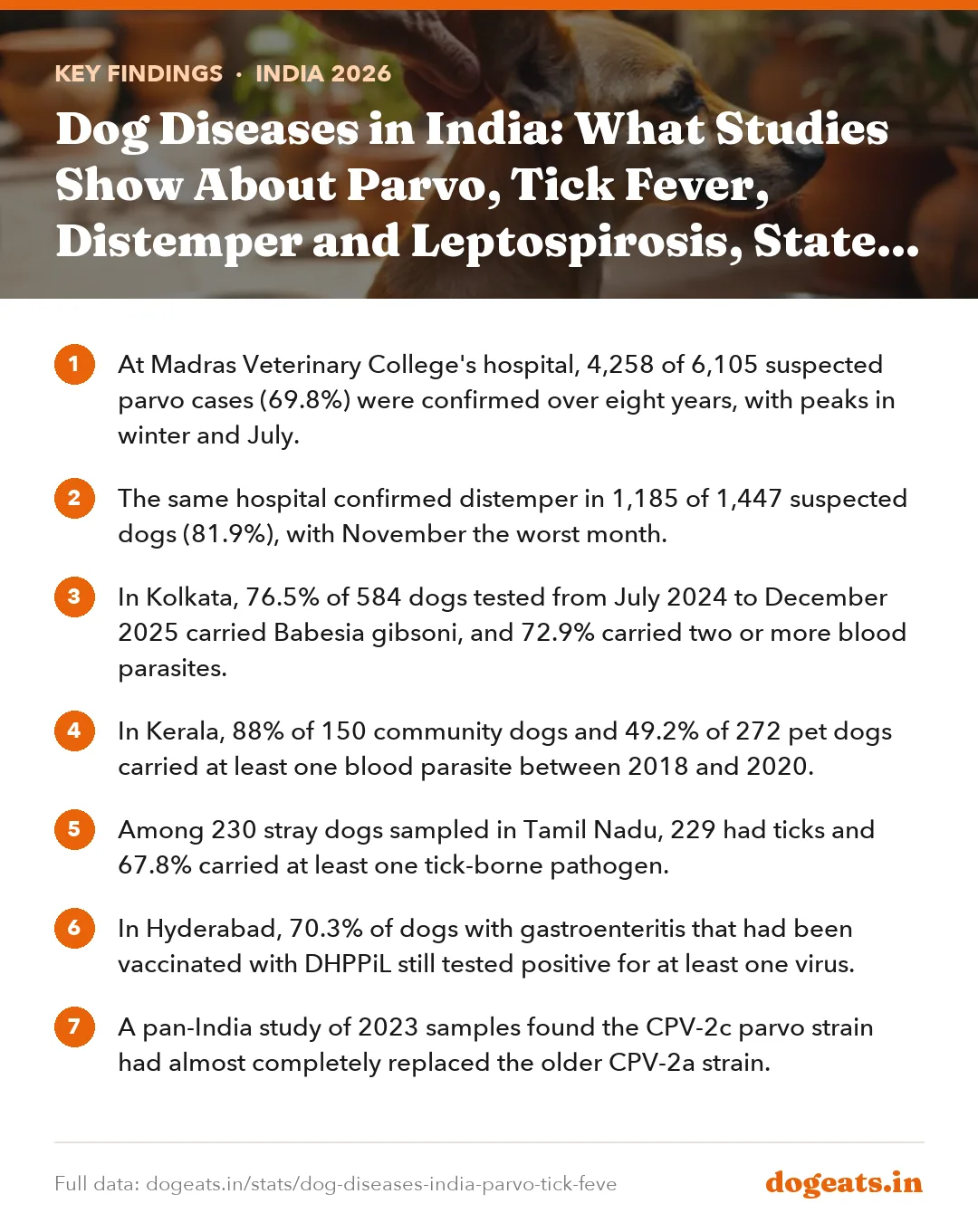
Sources: Kumar et al. 2024 (Kerala, 2018 to 2020); Manoj et al. 2020 (Tamil Nadu strays); Bhagwan et al. 2024 (Hisar, suspected cases); Sarma et al. 2019 (Mizoram and Tripura). PCR tests.
Show the numbers
| Label | % |
|---|---|
| Kerala, community dogs (n=150) | 88.0% |
| Tamil Nadu, stray dogs (n=230) | 67.8% |
| Hisar, Haryana, suspected cases (n=120) | 64.2% |
| Mizoram and Tripura (n=130) | 52.3% |
| Kerala, pet dogs (n=272) | 49.2% |
Embed this chart
| Disease | Cause | How dogs catch it | Indian study range | Spreads to people? |
|---|---|---|---|---|
| Parvo (canine parvovirus enteritis) | Canine parvovirus type 2 | Infected faeces, contaminated surroundings | 6% to 70% of suspected cases | No |
| Tick fever (babesiosis) | Babesia gibsoni, Babesia vogeli | Tick bites | Up to 76.5% of dogs tested in one Kolkata study | No |
| Tick fever (ehrlichiosis) | Ehrlichia canis | Brown dog tick bites | 2.6% to 32.9% by PCR | No |
| Hepatozoonosis | Hepatozoon canis | Swallowing infected ticks | Up to 37.8% of Tamil Nadu strays | No |
| Distemper | Canine distemper virus | Airborne droplets, contact | 8% to 81.9% of sick dogs tested | No |
| Leptospirosis | Leptospira bacteria | Urine of infected animals, contaminated water and soil | 23.3% acute among 210 suspected Chennai dogs | Yes |
The spread of results is wide because the studies differ. Some test only sick dogs, some test strays, and some test healthy pets. PCR finds far more infections than a blood smear under a microscope.
For rabies, the deadliest disease dogs pass to people, see our dog bite and rabies statistics.
How common is parvo in dogs in India?
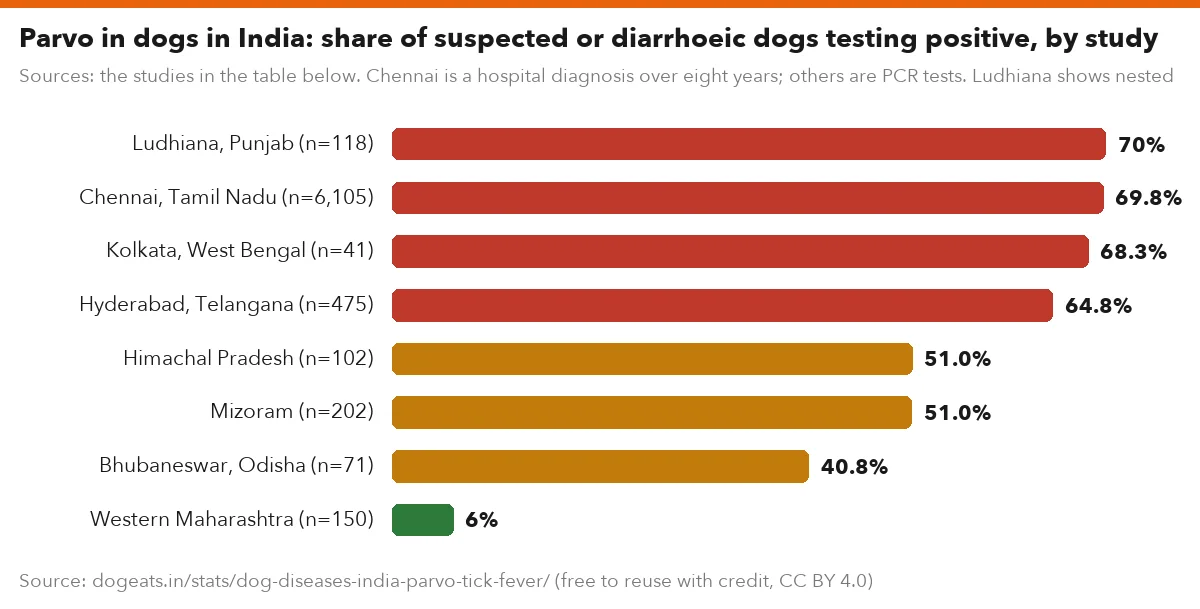
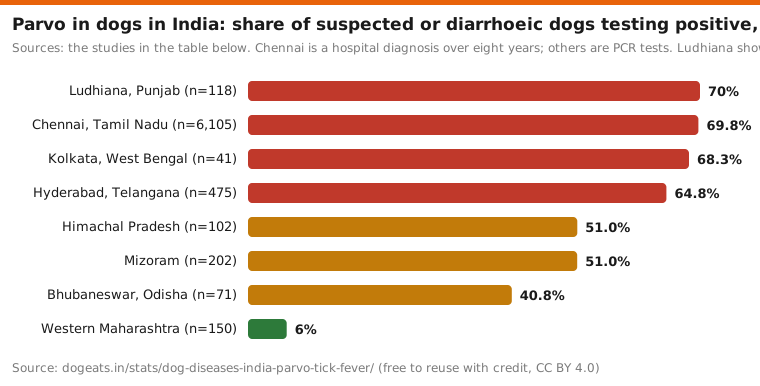
Parvo is the most common viral cause of diarrhoea in Indian dog studies. At Madras Veterinary College's teaching hospital in Chennai, 4,258 of 6,105 dogs brought in with suspected parvo over eight years were diagnosed with it, a rate of 69.8%.
A Hyderabad study of 475 rectal swabs from dogs with gastroenteritis, collected from 2018 to 2021, found parvovirus in 64.8%. In Kolkata, 28 of 41 diarrhoeic dogs (68.3%) tested positive by PCR.
Young, unvaccinated dogs are hit hardest. In Kolkata, pups aged 1 to 6 months had the highest occurrence, 80.6%. In Bhubaneswar, 69% of positive dogs were under six months and only 3.4% were over a year old.

Sources: the studies in the table below. Chennai is a hospital diagnosis over eight years; others are PCR tests. Ludhiana shows nested PCR (simple PCR found 28%).
Show the numbers
| Label | % |
|---|---|
| Ludhiana, Punjab (n=118) | 70% |
| Chennai, Tamil Nadu (n=6,105) | 69.8% |
| Kolkata, West Bengal (n=41) | 68.3% |
| Hyderabad, Telangana (n=475) | 64.8% |
| Himachal Pradesh (n=102) | 51.0% |
| Mizoram (n=202) | 51.0% |
| Bhubaneswar, Odisha (n=71) | 40.8% |
| Western Maharashtra (n=150) | 6% |
Embed this chart
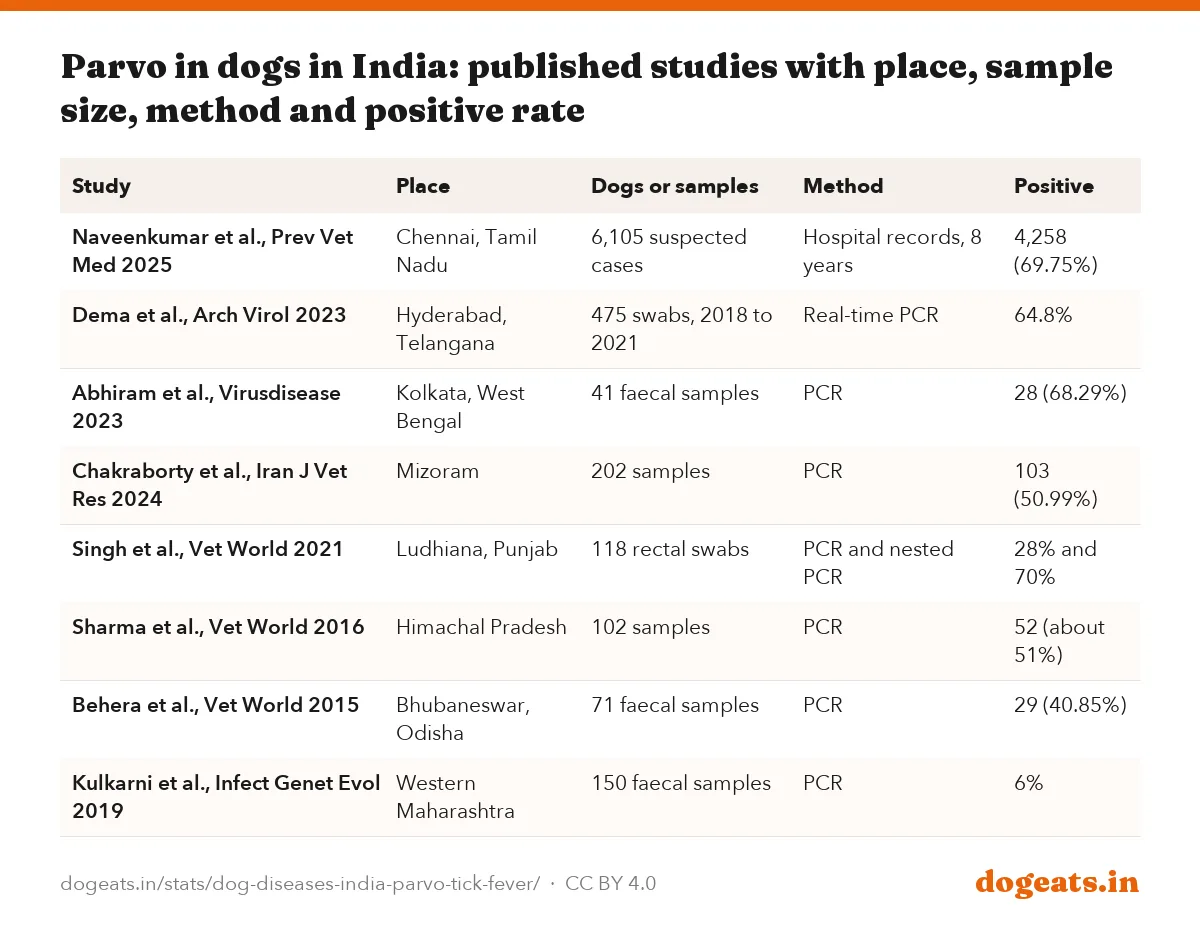
| Study | Place | Dogs or samples | Method | Positive |
|---|---|---|---|---|
| Naveenkumar et al., Prev Vet Med 2025 | Chennai, Tamil Nadu | 6,105 suspected cases | Hospital records, 8 years | 4,258 (69.75%) |
| Dema et al., Arch Virol 2023 | Hyderabad, Telangana | 475 swabs, 2018 to 2021 | Real-time PCR | 64.8% |
| Abhiram et al., Virusdisease 2023 | Kolkata, West Bengal | 41 faecal samples | PCR | 28 (68.29%) |
| Chakraborty et al., Iran J Vet Res 2024 | Mizoram | 202 samples | PCR | 103 (50.99%) |
| Singh et al., Vet World 2021 | Ludhiana, Punjab | 118 rectal swabs | PCR and nested PCR | 28% and 70% |
| Sharma et al., Vet World 2016 | Himachal Pradesh | 102 samples | PCR | 52 (about 51%) |
| Behera et al., Vet World 2015 | Bhubaneswar, Odisha | 71 faecal samples | PCR | 29 (40.85%) |
| Kulkarni et al., Infect Genet Evol 2019 | Western Maharashtra | 150 faecal samples | PCR | 6% |
Vaccination history does not rule it out. In Ludhiana, 24.1% of dogs with a parvo vaccination history still tested positive. In Hyderabad, 70.3% of DHPPiL-vaccinated dogs with gastroenteritis had at least one virus.
The virus is changing. A study of samples collected across India in 2023 found the CPV-2c strain had almost completely replaced CPV-2a. In Mizoram, 63.9% of 83 sequenced samples were CPV-2c. Ask your vet about your puppy's vaccine schedule; our vaccination cost report lists prices.
How common is tick fever in dogs in India?
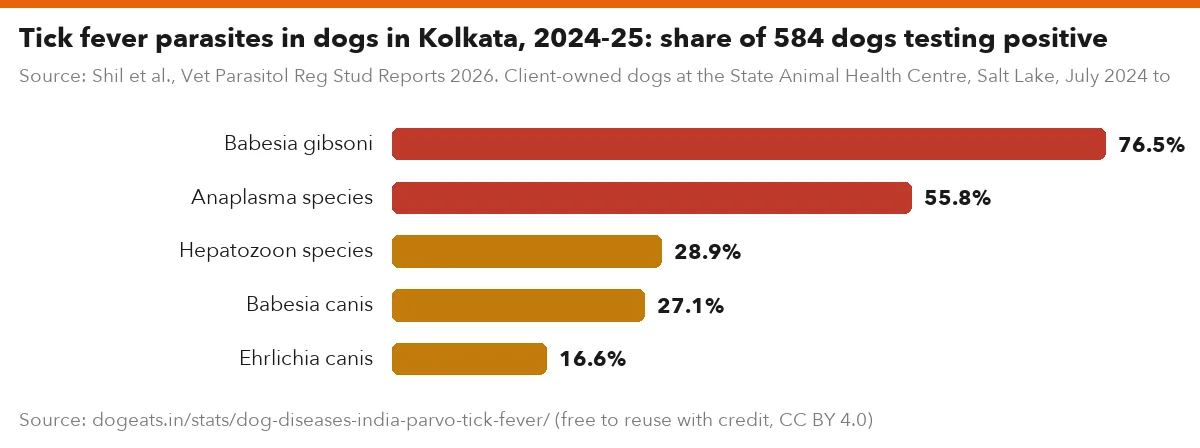
Tick fever is very common, especially in the south and east. In Kolkata, 584 client-owned dogs tested from July 2024 to December 2025 showed Babesia gibsoni in 76.5%, Anaplasma in 55.8% and Ehrlichia canis in 16.6%.
Most of those dogs carried more than one parasite. In the Kolkata study, 72.9% had two or more and 34.9% had three or more. Microscopy missed 130 of 158 Babesia canis infections that PCR found.
Strays and community dogs carry more. In Kerala, 88% of 150 community-owned dogs carried at least one blood parasite, against 49.2% of 272 pets. In Tamil Nadu, 229 of 230 stray dogs had ticks.
Source: Shil et al., Vet Parasitol Reg Stud Reports 2026. Client-owned dogs at the State Animal Health Centre, Salt Lake, July 2024 to December 2025. Real-time PCR.
Show the numbers
| Label | % |
|---|---|
| Babesia gibsoni | 76.5% |
| Anaplasma species | 55.8% |
| Hepatozoon species | 28.9% |
| Babesia canis | 27.1% |
| Ehrlichia canis | 16.6% |
Embed this chart
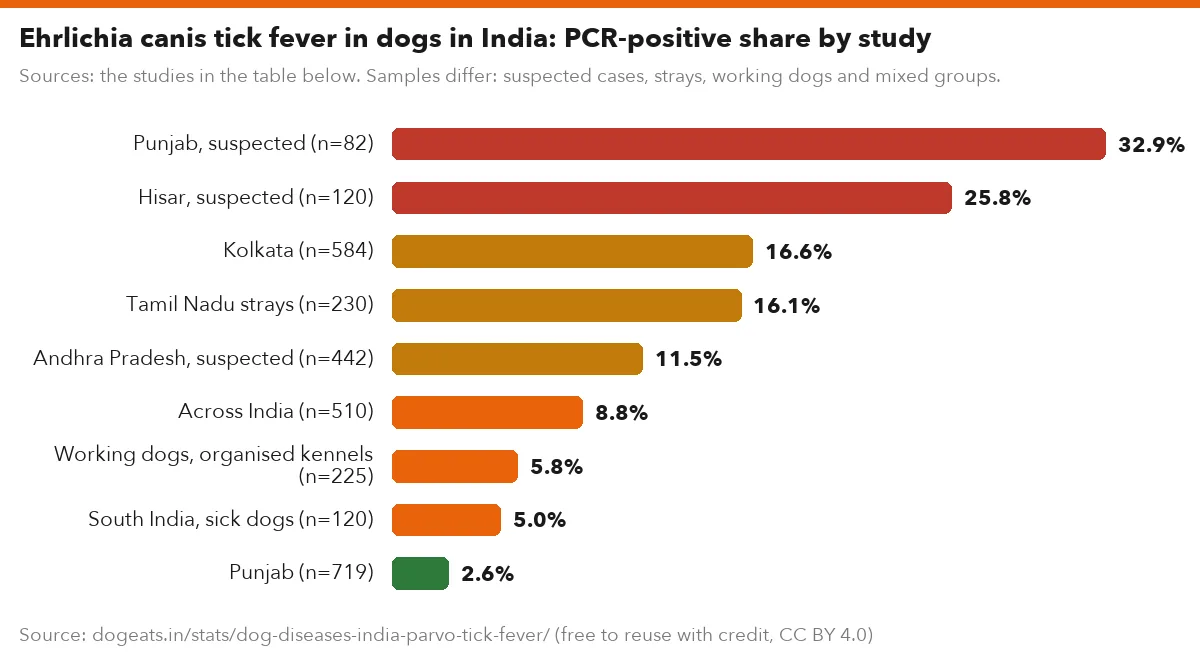
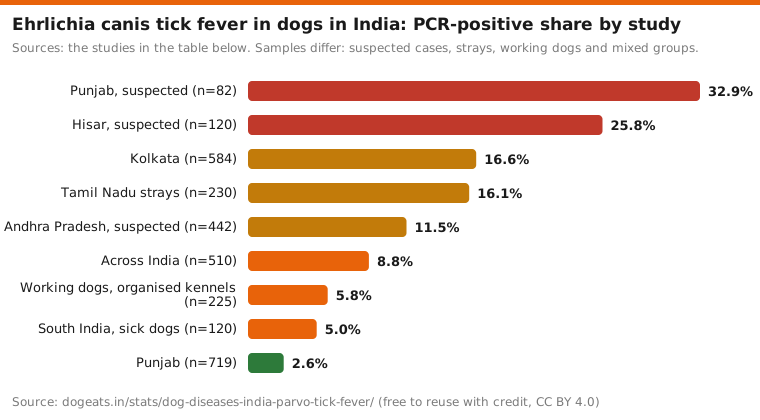
Sources: the studies in the table below. Samples differ: suspected cases, strays, working dogs and mixed groups.
Show the numbers
| Label | % |
|---|---|
| Punjab, suspected (n=82) | 32.9% |
| Hisar, suspected (n=120) | 25.8% |
| Kolkata (n=584) | 16.6% |
| Tamil Nadu strays (n=230) | 16.1% |
| Andhra Pradesh, suspected (n=442) | 11.5% |
| Across India (n=510) | 8.8% |
| Working dogs, organised kennels (n=225) | 5.8% |
| South India, sick dogs (n=120) | 5.0% |
| Punjab (n=719) | 2.6% |
Embed this chart
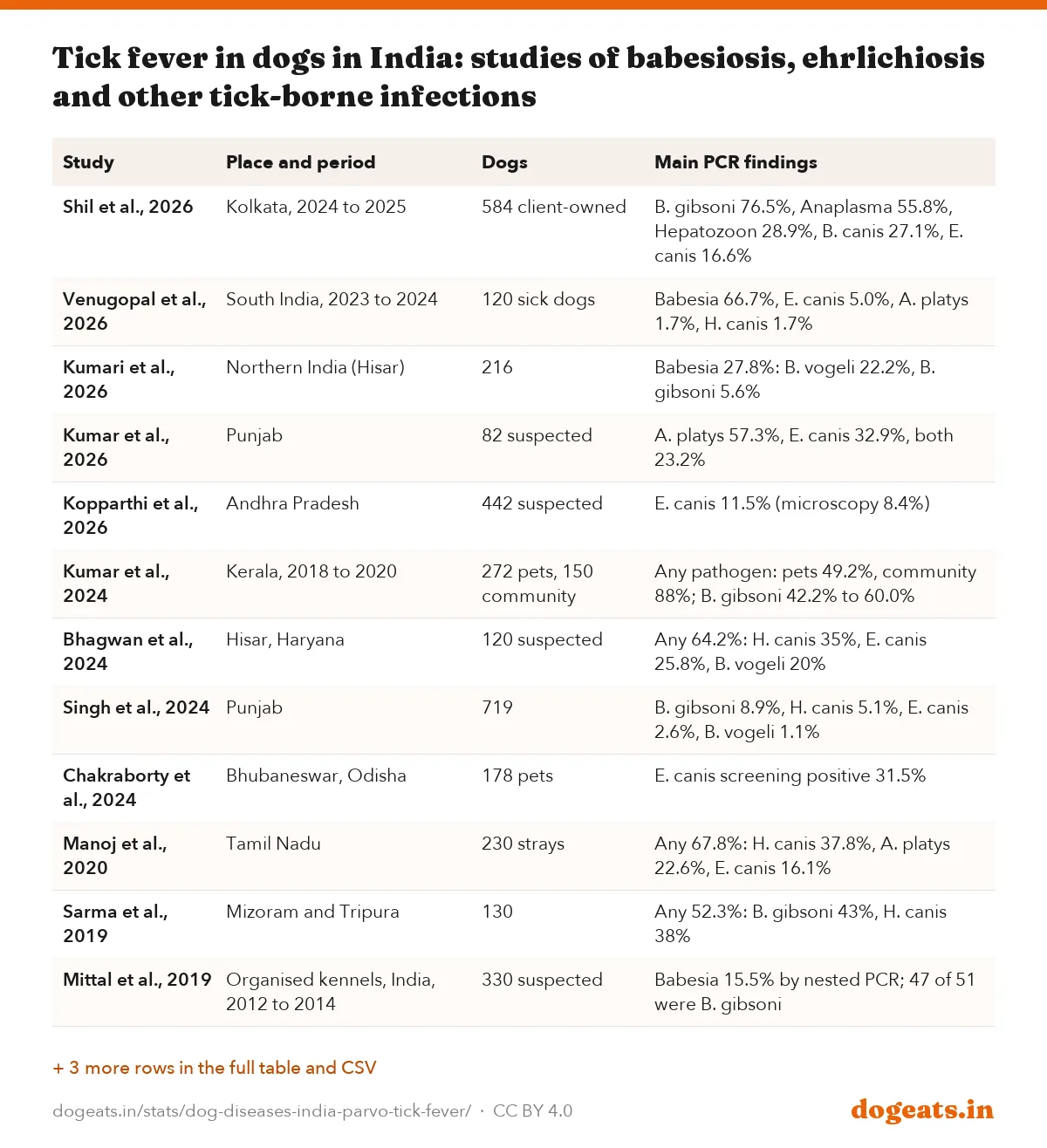
| Study | Place and period | Dogs | Main PCR findings |
|---|---|---|---|
| Shil et al., 2026 | Kolkata, 2024 to 2025 | 584 client-owned | B. gibsoni 76.5%, Anaplasma 55.8%, Hepatozoon 28.9%, B. canis 27.1%, E. canis 16.6% |
| Venugopal et al., 2026 | South India, 2023 to 2024 | 120 sick dogs | Babesia 66.7%, E. canis 5.0%, A. platys 1.7%, H. canis 1.7% |
| Kumari et al., 2026 | Northern India (Hisar) | 216 | Babesia 27.8%: B. vogeli 22.2%, B. gibsoni 5.6% |
| Kumar et al., 2026 | Punjab | 82 suspected | A. platys 57.3%, E. canis 32.9%, both 23.2% |
| Kopparthi et al., 2026 | Andhra Pradesh | 442 suspected | E. canis 11.5% (microscopy 8.4%) |
| Kumar et al., 2024 | Kerala, 2018 to 2020 | 272 pets, 150 community | Any pathogen: pets 49.2%, community 88%; B. gibsoni 42.2% to 60.0% |
| Bhagwan et al., 2024 | Hisar, Haryana | 120 suspected | Any 64.2%: H. canis 35%, E. canis 25.8%, B. vogeli 20% |
| Singh et al., 2024 | Punjab | 719 | B. gibsoni 8.9%, H. canis 5.1%, E. canis 2.6%, B. vogeli 1.1% |
| Chakraborty et al., 2024 | Bhubaneswar, Odisha | 178 pets | E. canis screening positive 31.5% |
| Manoj et al., 2020 | Tamil Nadu | 230 strays | Any 67.8%: H. canis 37.8%, A. platys 22.6%, E. canis 16.1% |
| Sarma et al., 2019 | Mizoram and Tripura | 130 | Any 52.3%: B. gibsoni 43%, H. canis 38% |
| Mittal et al., 2019 | Organised kennels, India, 2012 to 2014 | 330 suspected | Babesia 15.5% by nested PCR; 47 of 51 were B. gibsoni |
| Kukreti et al., 2018 | Across India | 510 | E. canis antibodies 57.5%; PCR 8.8% |
| Mittal et al., 2017 | Organised kennels, India | 225 suspected | E. canis 5.8% by nested PCR |
| Singh et al., 2014 | Ludhiana, Punjab | 214 suspected | B. gibsoni 15.4%; higher in summer |
Rates differ by region. Babesia gibsoni dominates in Kerala, Kolkata and the North East. In Haryana and Tamil Nadu strays, Hepatozoon canis was the most common find.
Ticks are the common thread. In Bhubaneswar, 79% of dogs with ehrlichiosis had a history of ticks. In Andhra Pradesh, dogs with past tick control had lower odds of infection. Ask your vet which tick control suits your dog.
How common is distemper in dogs in India?
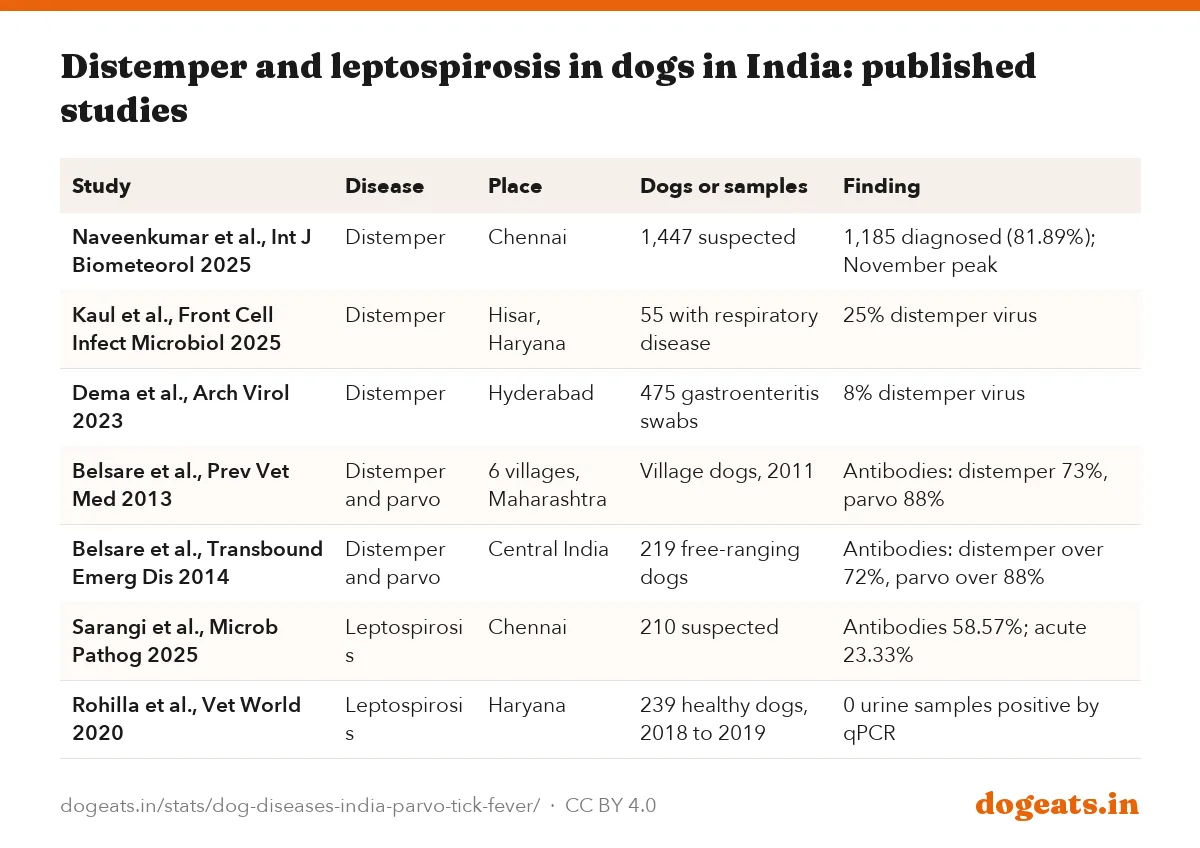
Distemper is less studied than parvo but often fatal. At Madras Veterinary College, 1,185 of 1,447 dogs brought in with suspected distemper over eight years were diagnosed with it, or 81.9%.
In other settings it shows up less often. In a Hisar study of 55 dogs with respiratory disease, distemper virus was the most common pathogen, at 25%. The Hyderabad gastroenteritis study found it in 8% of 475 samples.
Many street and village dogs have already met the virus. In six Maharashtra villages in 2011, 73% of dogs had distemper antibodies and 88% had parvo antibodies. Near a wildlife sanctuary in Maharashtra, over 72% of 219 free-ranging dogs had distemper antibodies.
| Study | Disease | Place | Dogs or samples | Finding |
|---|---|---|---|---|
| Naveenkumar et al., Int J Biometeorol 2025 | Distemper | Chennai | 1,447 suspected | 1,185 diagnosed (81.89%); November peak |
| Kaul et al., Front Cell Infect Microbiol 2025 | Distemper | Hisar, Haryana | 55 with respiratory disease | 25% distemper virus |
| Dema et al., Arch Virol 2023 | Distemper | Hyderabad | 475 gastroenteritis swabs | 8% distemper virus |
| Belsare et al., Prev Vet Med 2013 | Distemper and parvo | 6 villages, Maharashtra | Village dogs, 2011 | Antibodies: distemper 73%, parvo 88% |
| Belsare et al., Transbound Emerg Dis 2014 | Distemper and parvo | Central India | 219 free-ranging dogs | Antibodies: distemper over 72%, parvo over 88% |
| Sarangi et al., Microb Pathog 2025 | Leptospirosis | Chennai | 210 suspected | Antibodies 58.57%; acute 23.33% |
| Rohilla et al., Vet World 2020 | Leptospirosis | Haryana | 239 healthy dogs, 2018 to 2019 | 0 urine samples positive by qPCR |
Distemper also reaches wild animals. A 2025 study in North East India found Asia-1 and Asia-5 distemper lineages circulating, and one Asia-5 isolate came from a wild jackal. Studies in Gujarat and central India have recorded it in Asiatic lions and other big cats.
When are dog diseases worst in India?
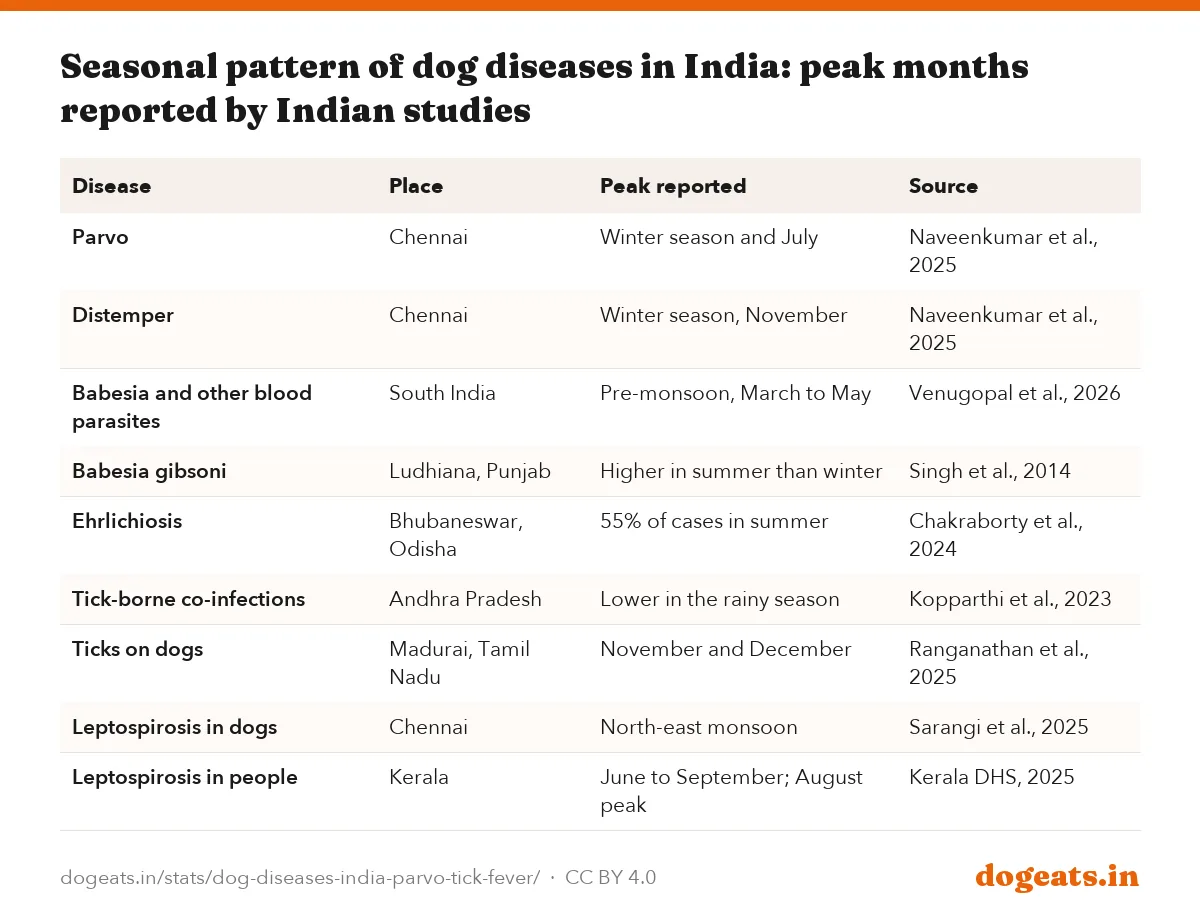
Each disease has its own season. In Chennai, parvo peaked in winter and in July, and distemper peaked in November, according to eight years of Madras Veterinary College records.
Tick-borne infections tend to rise in the hot months. A south India study by a Kerala team saw most cases in the pre-monsoon months of March to May. In Ludhiana, Babesia gibsoni was more common in summer than winter, and in Bhubaneswar 55% of ehrlichiosis cases came in summer.
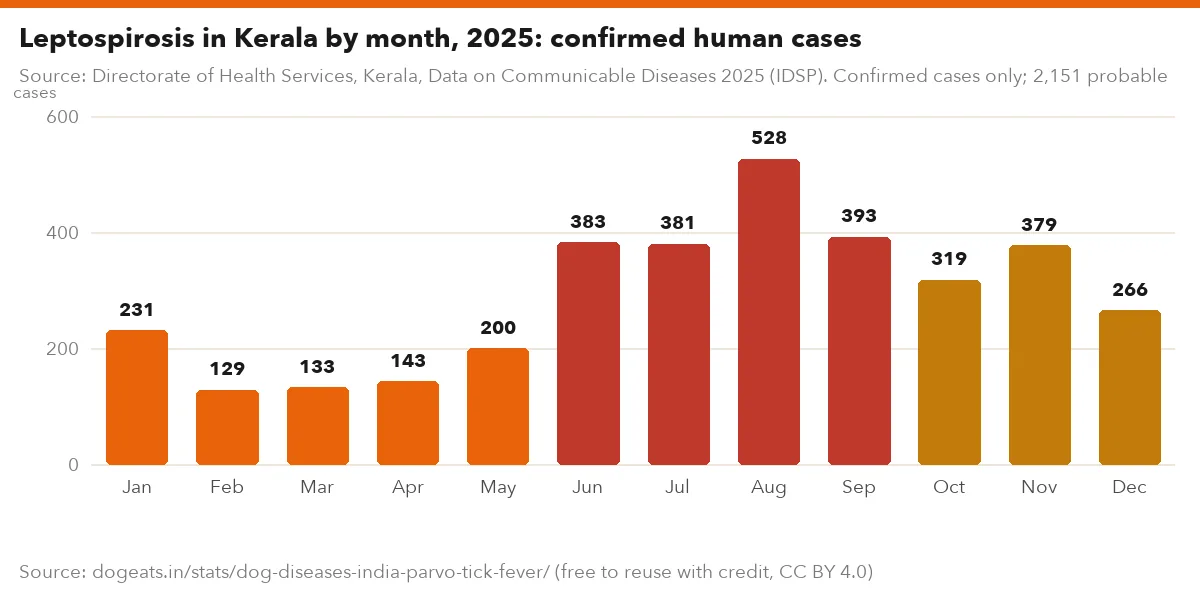
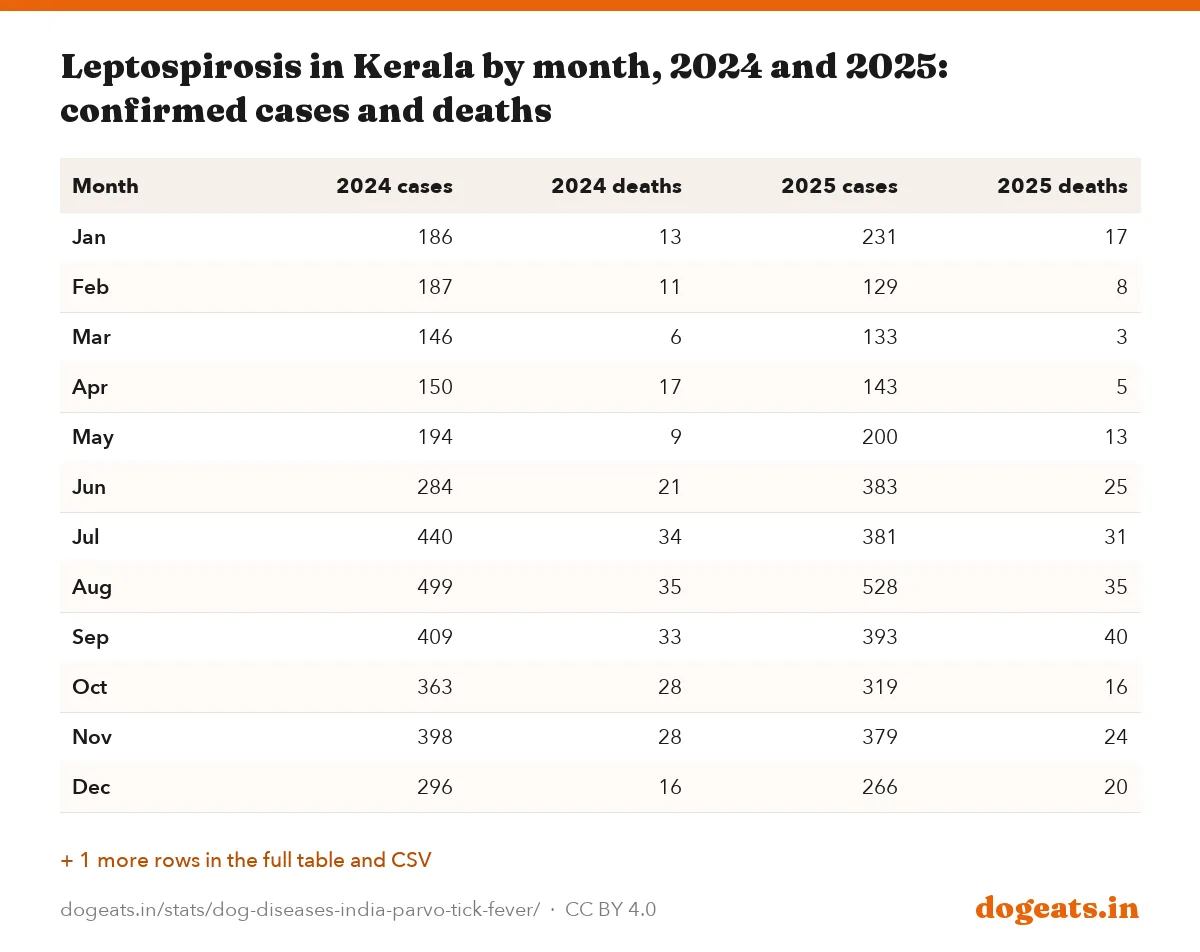
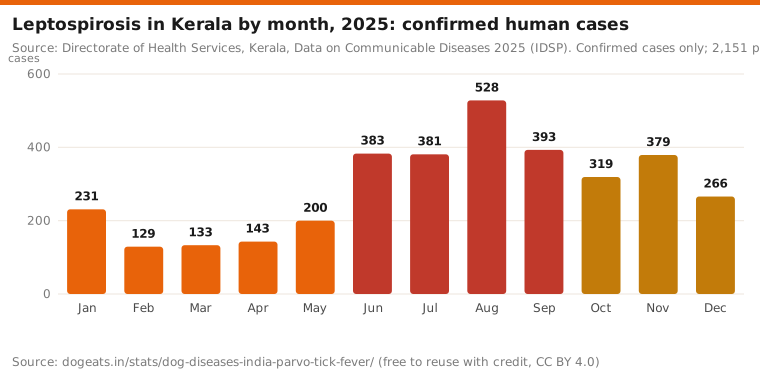
Leptospirosis follows the rain. In Kerala, 48.4% of 2025's confirmed human cases came between June and September, and August alone had 528. In Chennai dogs, the north-east monsoon was a risk factor for acute leptospirosis.

| Disease | Place | Peak reported | Source |
|---|---|---|---|
| Parvo | Chennai | Winter season and July | Naveenkumar et al., 2025 |
| Distemper | Chennai | Winter season, November | Naveenkumar et al., 2025 |
| Babesia and other blood parasites | South India | Pre-monsoon, March to May | Venugopal et al., 2026 |
| Babesia gibsoni | Ludhiana, Punjab | Higher in summer than winter | Singh et al., 2014 |
| Ehrlichiosis | Bhubaneswar, Odisha | 55% of cases in summer | Chakraborty et al., 2024 |
| Tick-borne co-infections | Andhra Pradesh | Lower in the rainy season | Kopparthi et al., 2023 |
| Ticks on dogs | Madurai, Tamil Nadu | November and December | Ranganathan et al., 2025 |
| Leptospirosis in dogs | Chennai | North-east monsoon | Sarangi et al., 2025 |
| Leptospirosis in people | Kerala | June to September; August peak | Kerala DHS, 2025 |
These are single-city findings, not national patterns. For breeds that struggle in wet weather, see our monsoon risk ranking.
Can leptospirosis spread from dogs to humans?
Yes, leptospirosis can pass from animals to people through urine and water or soil it contaminates. Dogs are one possible source; rats are the classic carrier. Indian studies show dogs do get infected.
In Chennai, 123 of 210 dogs suspected of leptospirosis (58.6%) had antibodies, and 49 (23.3%) had acute infection. Fourteen of those 49 tested positive by PCR. Adult dogs, outdoor dogs and dogs exposed to rodents or stagnant water faced higher risk.
Healthy dogs may shed little. A Haryana study tested urine from 239 healthy dogs in 2018 and 2019 and found no Leptospira DNA. The authors judged the risk from dog urine there to be low.
Source: Directorate of Health Services, Kerala, Data on Communicable Diseases 2025 (IDSP). Confirmed cases only; 2,151 probable cases are excluded.
Show the numbers
| Label | cases |
|---|---|
| Jan | 231 |
| Feb | 129 |
| Mar | 133 |
| Apr | 143 |
| May | 200 |
| Jun | 383 |
| Jul | 381 |
| Aug | 528 |
| Sep | 393 |
| Oct | 319 |
| Nov | 379 |
| Dec | 266 |
Embed this chart
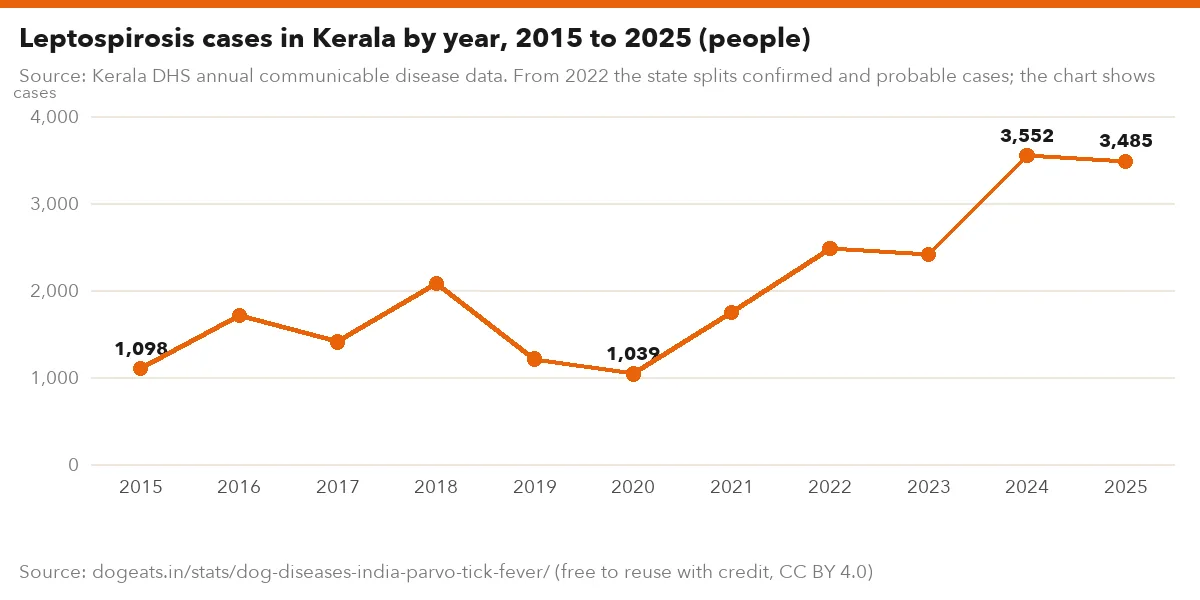
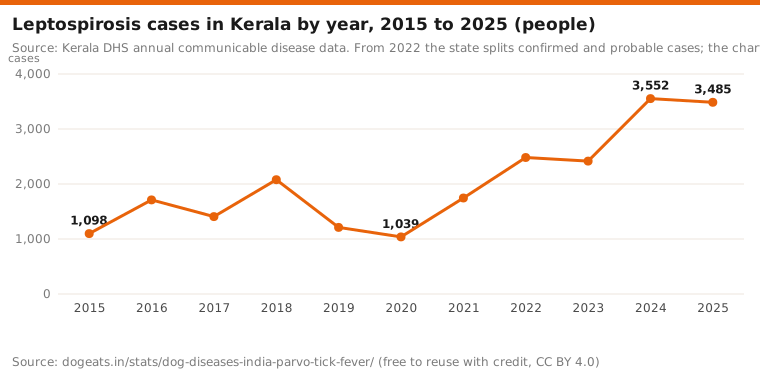
Source: Kerala DHS annual communicable disease data. From 2022 the state splits confirmed and probable cases; the chart shows confirmed cases from 2022.
Show the numbers
| Label | cases |
|---|---|
| 2015 | 1,098 |
| 2016 | 1,710 |
| 2017 | 1,408 |
| 2018 | 2,079 |
| 2019 | 1,211 |
| 2020 | 1,039 |
| 2021 | 1,745 |
| 2022 | 2,482 |
| 2023 | 2,417 |
| 2024 | 3,552 |
| 2025 | 3,485 |
Embed this chart
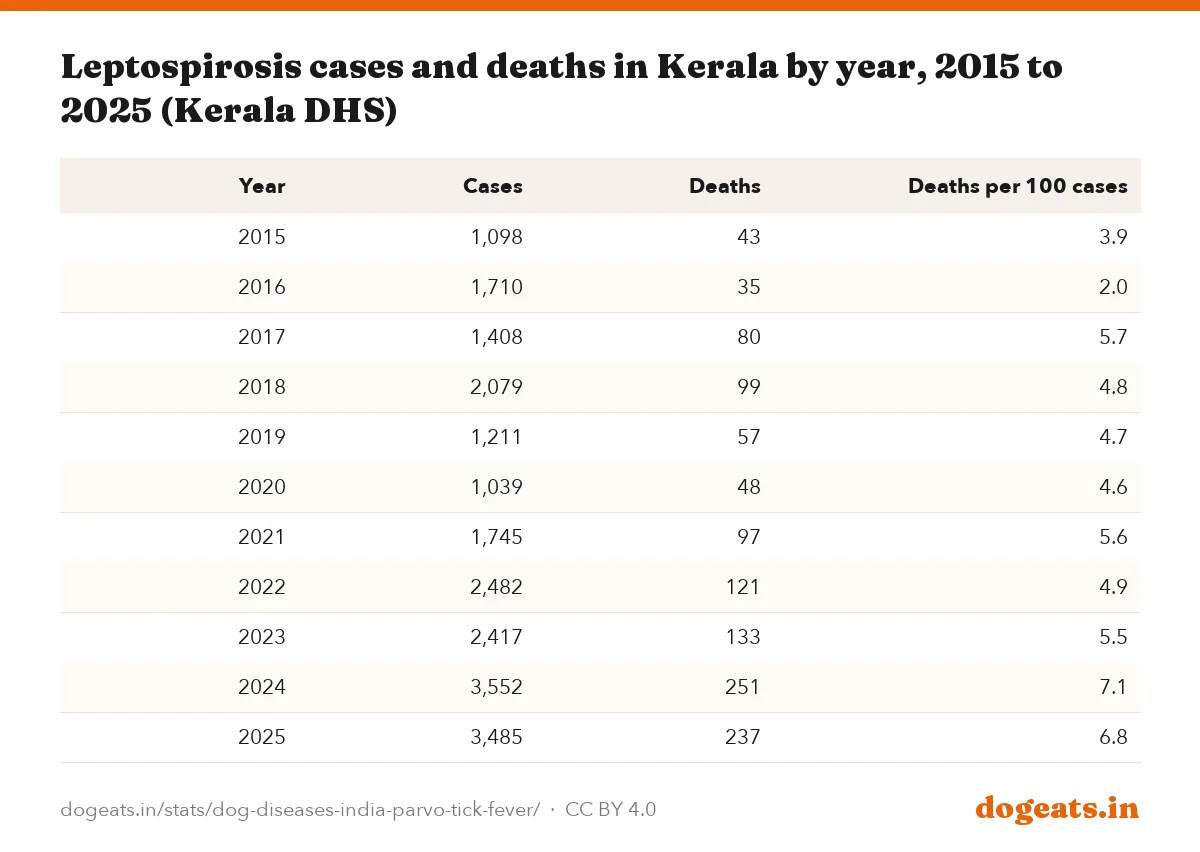
| Year | Cases | Deaths | Deaths per 100 cases |
|---|---|---|---|
| 2015 | 1,098 | 43 | 3.9 |
| 2016 | 1,710 | 35 | 2.0 |
| 2017 | 1,408 | 80 | 5.7 |
| 2018 | 2,079 | 99 | 4.8 |
| 2019 | 1,211 | 57 | 4.7 |
| 2020 | 1,039 | 48 | 4.6 |
| 2021 | 1,745 | 97 | 5.6 |
| 2022 | 2,482 | 121 | 4.9 |
| 2023 | 2,417 | 133 | 5.5 |
| 2024 | 3,552 | 251 | 7.1 |
| 2025 | 3,485 | 237 | 6.8 |
| Month | 2024 cases | 2024 deaths | 2025 cases | 2025 deaths |
|---|---|---|---|---|
| Jan | 186 | 13 | 231 | 17 |
| Feb | 187 | 11 | 129 | 8 |
| Mar | 146 | 6 | 133 | 3 |
| Apr | 150 | 17 | 143 | 5 |
| May | 194 | 9 | 200 | 13 |
| Jun | 284 | 21 | 383 | 25 |
| Jul | 440 | 34 | 381 | 31 |
| Aug | 499 | 35 | 528 | 35 |
| Sep | 409 | 33 | 393 | 40 |
| Oct | 363 | 28 | 319 | 16 |
| Nov | 398 | 28 | 379 | 24 |
| Dec | 296 | 16 | 266 | 20 |
| Total | 3,552 | 251 | 3,485 | 237 |
Kerala's confirmed cases rose from 1,098 in 2015 to 3,552 in 2024 and 3,485 in 2025. Deaths rose from 43 to 237. Some of the rise may reflect more testing and reporting rather than more infection.
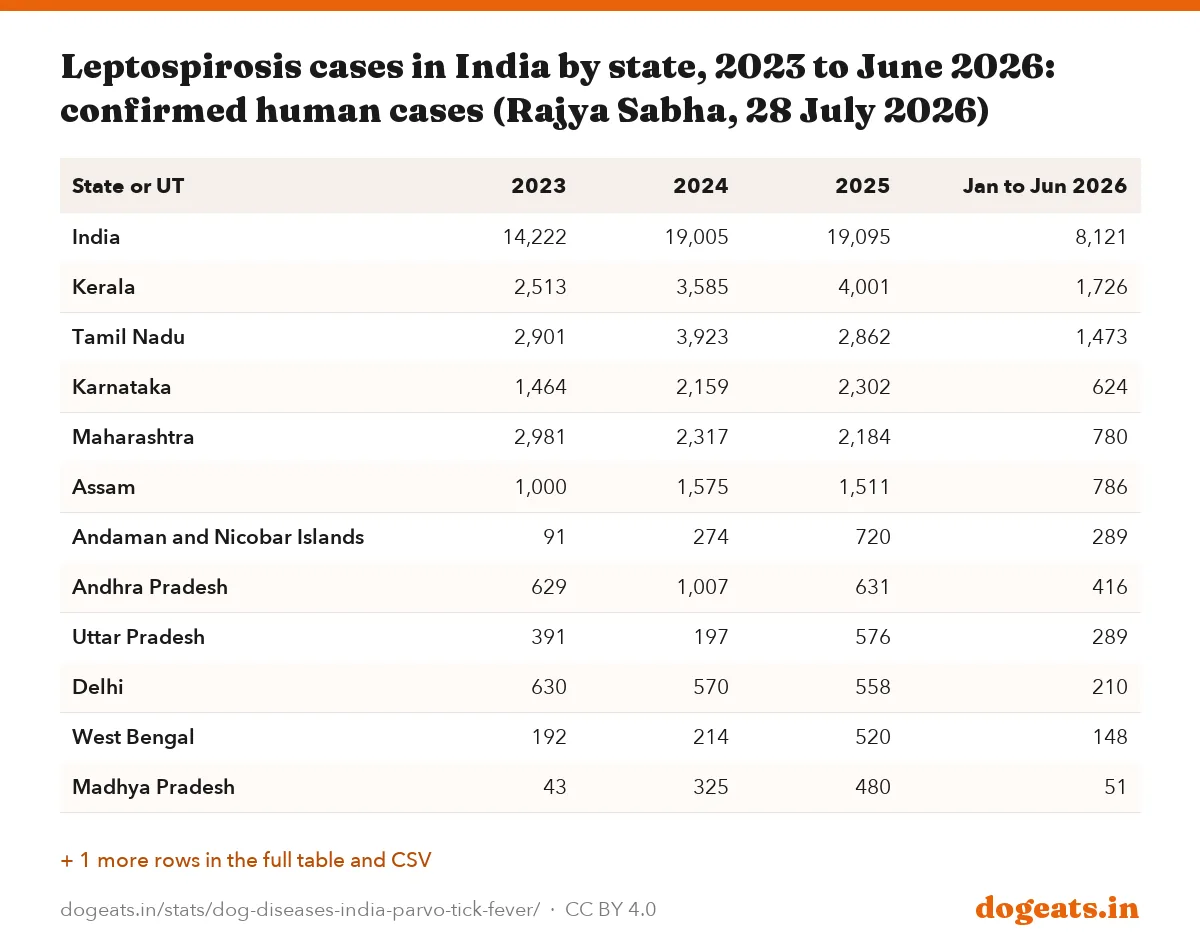
Sources give different Kerala totals. The health ministry told the Rajya Sabha in July 2026 that Kerala had 3,585 confirmed cases in 2024 and 4,001 in 2025. The state's own annual data shows 3,552 and 3,485 confirmed cases.
Which districts have the most leptospirosis?
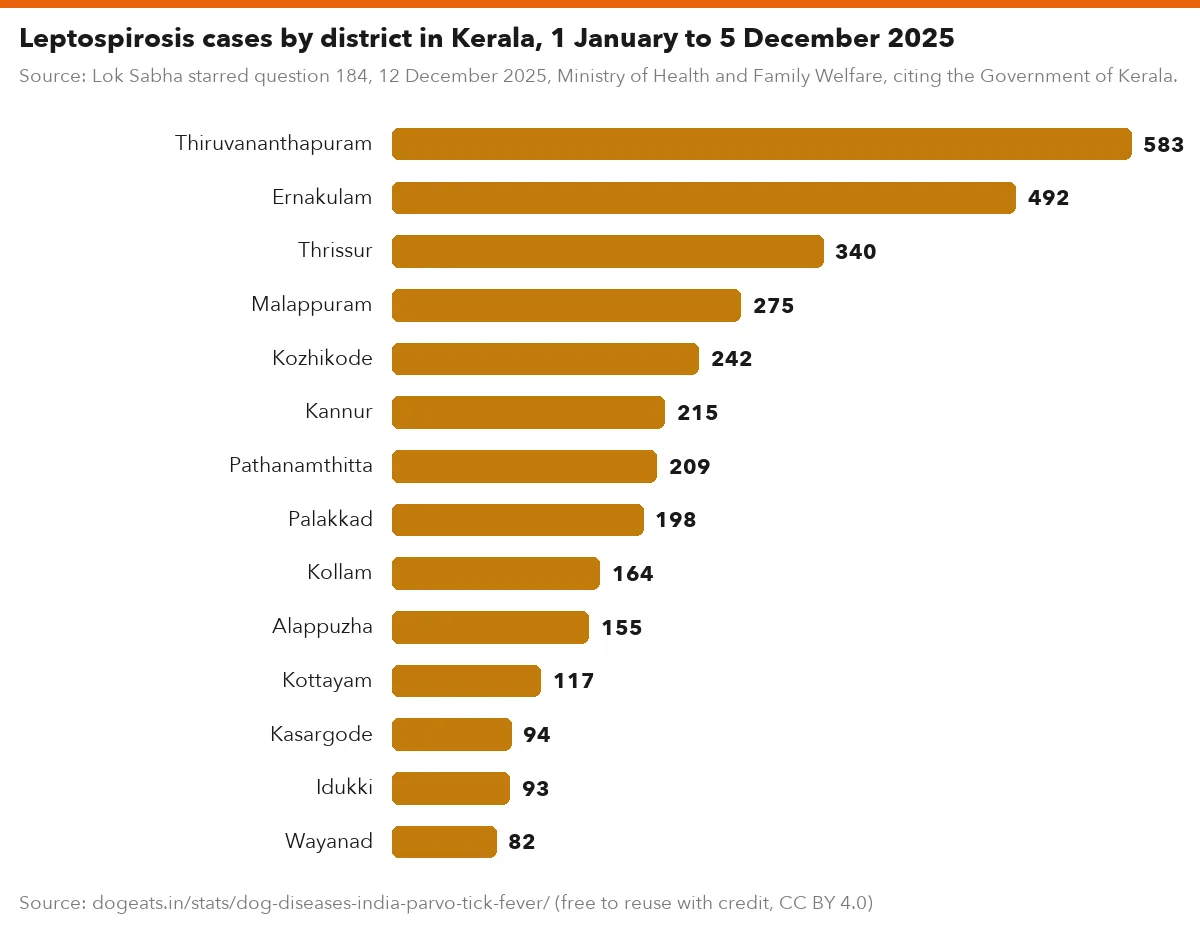
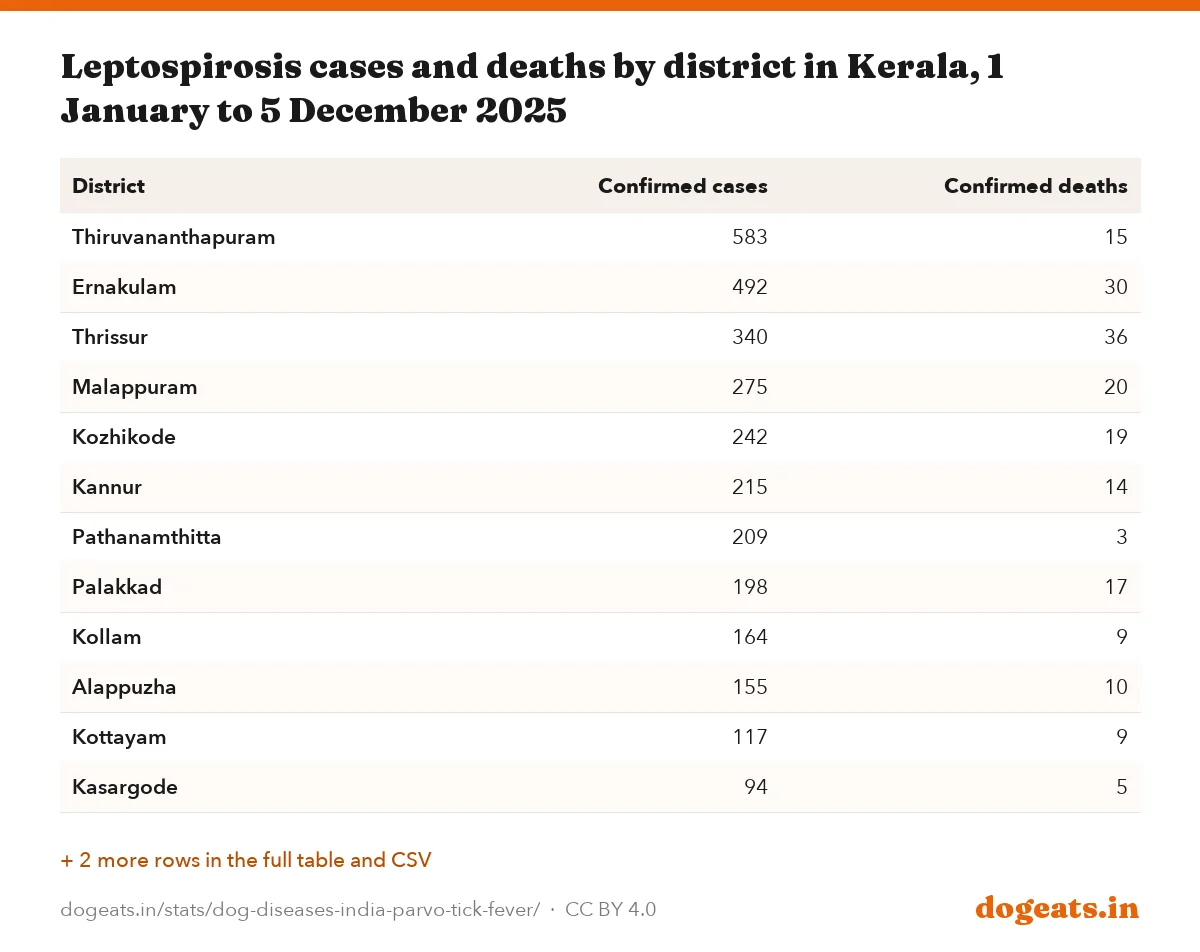
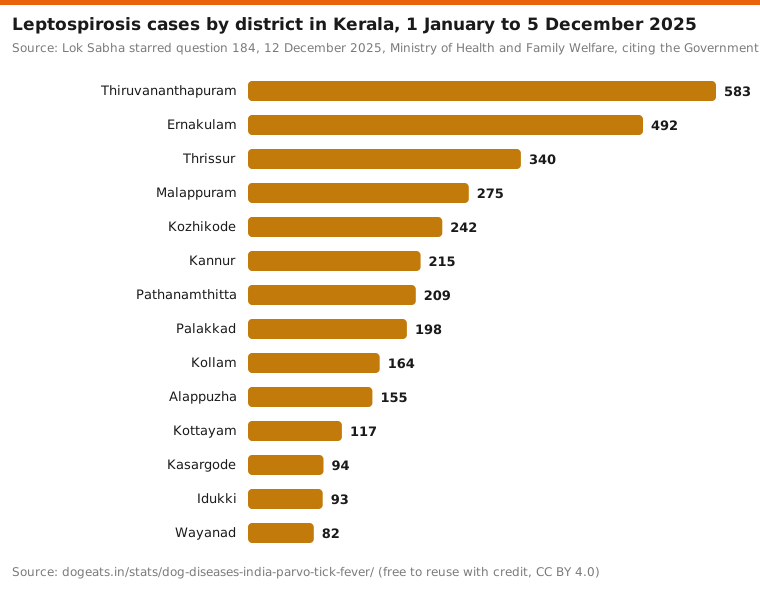
Thiruvananthapuram had the most confirmed leptospirosis cases in Kerala in 2025, with 583 from 1 January to 5 December. Ernakulam had 492 and Thrissur 340, the government told the Lok Sabha on 12 December 2025.
Thrissur had the most deaths, 36, followed by Ernakulam with 30. Across Kerala, that answer counted 3,259 confirmed cases and 209 deaths up to 5 December.
Nationally, India recorded 14,222 confirmed cases in 2023, 19,005 in 2024 and 19,095 in 2025, the health ministry told the Rajya Sabha on 28 July 2026. Another 8,121 were confirmed from January to June 2026.
Kerala had the most cases in 2025, 4,001, or 21% of the national total. Tamil Nadu had 2,862, Karnataka 2,302 and Maharashtra 2,184. In the first half of 2026, the five southern states reported 4,340 of the 8,121 cases, or 53.4%.
Source: Lok Sabha starred question 184, 12 December 2025, Ministry of Health and Family Welfare, citing the Government of Kerala.
Show the numbers
| Label | cases |
|---|---|
| Thiruvananthapuram | 583 |
| Ernakulam | 492 |
| Thrissur | 340 |
| Malappuram | 275 |
| Kozhikode | 242 |
| Kannur | 215 |
| Pathanamthitta | 209 |
| Palakkad | 198 |
| Kollam | 164 |
| Alappuzha | 155 |
| Kottayam | 117 |
| Kasargode | 94 |
| Idukki | 93 |
| Wayanad | 82 |
Embed this chart
| District | Confirmed cases | Confirmed deaths |
|---|---|---|
| Thiruvananthapuram | 583 | 15 |
| Ernakulam | 492 | 30 |
| Thrissur | 340 | 36 |
| Malappuram | 275 | 20 |
| Kozhikode | 242 | 19 |
| Kannur | 215 | 14 |
| Pathanamthitta | 209 | 3 |
| Palakkad | 198 | 17 |
| Kollam | 164 | 9 |
| Alappuzha | 155 | 10 |
| Kottayam | 117 | 9 |
| Kasargode | 94 | 5 |
| Idukki | 93 | 10 |
| Wayanad | 82 | 12 |
| State or UT | 2023 | 2024 | 2025 | Jan to Jun 2026 |
|---|---|---|---|---|
| India | 14,222 | 19,005 | 19,095 | 8,121 |
| Kerala | 2,513 | 3,585 | 4,001 | 1,726 |
| Tamil Nadu | 2,901 | 3,923 | 2,862 | 1,473 |
| Karnataka | 1,464 | 2,159 | 2,302 | 624 |
| Maharashtra | 2,981 | 2,317 | 2,184 | 780 |
| Assam | 1,000 | 1,575 | 1,511 | 786 |
| Andaman and Nicobar Islands | 91 | 274 | 720 | 289 |
| Andhra Pradesh | 629 | 1,007 | 631 | 416 |
| Uttar Pradesh | 391 | 197 | 576 | 289 |
| Delhi | 630 | 570 | 558 | 210 |
| West Bengal | 192 | 214 | 520 | 148 |
| Madhya Pradesh | 43 | 325 | 480 | 51 |
| Rajasthan | 184 | 514 | 313 | 23 |
The health ministry runs a leptospirosis control programme in 12 endemic states and 2 union territories, its December 2025 answer said. Those include Kerala, Tamil Nadu, Karnataka, Maharashtra, Gujarat and Uttar Pradesh.
How can you protect your dog from these diseases?
Talk to your vet about vaccines and tick control early in a puppy's life. The studies above found the worst parvo burden in pups under six months, and lower tick-borne infection where owners used tick control.
Watch for warning signs and see a vet quickly. The studies list vomiting and bloody diarrhoea for parvo, and fever, pale gums, weakness and bleeding for tick fever. This report is not medical advice and gives no treatment or dose.
- Ask your vet about a vaccine schedule; the Hyderabad study names DHPPiL, a combined vaccine that includes parvo, distemper and leptospirosis.
- Check your dog's coat, ears and paws for ticks after walks, more often in tick season.
- Keep puppies away from unknown dogs and their faeces until your vet says they are protected.
- Avoid letting dogs drink from or wade in flood water and stagnant puddles in the monsoon.
- Take a dog with fever, vomiting, bloody stools, pale gums or bleeding to a vet the same day.
Street dogs carry these infections at high rates, as the Kerala and Tamil Nadu studies show. Our stray dogs by city report and Indian pariah dog guide cover street dogs in more detail. India's vet workforce is covered in our veterinary doctor report.
Frequently asked questions
How common is parvo in dogs in India?
Very common among sick puppies. At Madras Veterinary College, 69.8% of 6,105 suspected cases over eight years were confirmed. In Hyderabad, 64.8% of 475 dogs with gastroenteritis tested positive. Most positive dogs are under six months old.
What is tick fever in dogs?
Tick fever is a common name for blood infections spread by ticks, such as babesiosis and ehrlichiosis. In Kolkata, 76.5% of 584 dogs tested in 2024 and 2025 carried Babesia gibsoni. See a vet if your dog has fever, pale gums or weakness.
Is distemper common in dogs in India?
At Madras Veterinary College, 81.9% of 1,447 suspected distemper cases were confirmed over eight years, with a peak in November. In rural Maharashtra, 73% of village dogs had distemper antibodies in 2011.
Can leptospirosis spread from dogs to humans?
Yes, leptospirosis spreads through the urine of infected animals, including dogs and rats, and contaminated water or soil. In Chennai, 23.3% of 210 suspected dogs had acute leptospirosis. Kerala recorded 3,485 confirmed human cases in 2025.
Which season is worst for dog diseases in India?
In Chennai, parvo peaked in winter and July and distemper in November. Tick-borne infections rose in summer or pre-monsoon months in Kerala, Punjab and Odisha. Leptospirosis peaks in the monsoon; in Kerala, August 2025 had 528 human cases.
Can a vaccinated dog get parvo?
Yes, Indian studies report it. In Ludhiana, 24.1% of dogs with a parvo vaccination history tested positive. The CPV-2c strain has now replaced older strains across India, so ask your vet about your dog's vaccine schedule.
Do street dogs in India carry tick fever?
Many do. In Tamil Nadu, 229 of 230 stray dogs had ticks and 67.8% carried at least one tick-borne pathogen. In Kerala, 88% of community-owned dogs carried at least one blood parasite.
How many people get leptospirosis in India?
India recorded 19,095 confirmed leptospirosis cases in 2025, the health ministry told the Rajya Sabha in July 2026. Kerala's health department counted 3,485 confirmed cases and 237 deaths in the state in 2025.
Methodology and limitations
We searched PubMed on 11 October 2026 for Indian studies of canine parvovirus, canine distemper, tick-borne pathogens (Babesia, Ehrlichia, Anaplasma, Hepatozoon) and leptospirosis in dogs. We read the abstracts of 35 studies and took every number from them as published.
We report each study's place, sample size, sample type and test, because rates from sick dogs, strays and healthy pets are not comparable. Where a study used both microscopy and PCR, we report PCR unless stated.
Human leptospirosis figures come from the Kerala Directorate of Health Services' annual communicable disease data, 2015 to 2025, and a Lok Sabha answer of 12 December 2025. National and state totals for 2023 to June 2026 come from Rajya Sabha unstarred question 1055, answered on 28 July 2026. Its 36 state rows add up to the national totals.
We checked that Kerala's monthly figures add up to the annual totals: 3,552 cases and 251 deaths in 2024, and 3,485 cases and 237 deaths in 2025.
Sources
- Naveenkumar et al., Climatic risk factors and predictive modelling of canine parvoviral enteritis outbreaks: an eight-year study from Southern India, Prev Vet Med 2025, Chennai parvo cases and seasons
- Shil et al., Molecular standardization and epidemiological mapping of canine haemoprotozoa in West Bengal, India, Vet Parasitol Reg Stud Reports 2026, Kolkata tick-borne pathogens
- Rajya Sabha unstarred question 1055 (28 July 2026), Ministry of Health and Family Welfare, State-wise confirmed leptospirosis cases, 2023 to June 2026 (Annexure IV)
- Also consulted: Directorate of Health Services, Kerala, Data on Communicable Diseases 2025, Naveenkumar et al., Canine distemper epidemiology in Chennai, Int J Biometeorol 2025, Dema et al., Viral pathogens associated with canine gastroenteritis, Arch Virol 2023, Abhiram et al., Canine parvovirus type 2c in Kolkata, Virusdisease 2023, Chakraborty et al., Canine parvoviruses in Mizoram, Iran J Vet Res 2024, Singh et al., Prevalence and molecular characterization of canine parvovirus, Vet World 2021, Sharma et al., Canine parvovirus type 2b in Himachal Pradesh, Vet World 2016, Behera et al., Canine parvovirus in Bhubaneswar, Vet World 2015, Kulkarni et al., Canine parvovirus in western India, Infect Genet Evol 2019, Reddy et al., CPV-2c replacement throughout India, Arch Virol 2024, Kumar et al., Haemoprotozoan carrier status in pet and community dogs of south India, Vet Parasitol Reg Stud Reports 2024, Manoj et al., Canine vector-borne pathogens from dogs and ticks from Tamil Nadu, Acta Trop 2020, Bhagwan et al., Haemoprotozoan diseases in dogs from Haryana, Parasitol Res 2024, Sarma et al., Vector-borne parasitic infections in dogs in Northeast India, Parasit Vectors 2019, Venugopal et al., Canine haemoprotozoan and rickettsial infections in southern India, Vet Parasitol Reg Stud Reports 2026, Kumari et al., Canine babesiosis in northern India, BMC Vet Res 2026, Kumar et al., Anaplasma platys and Ehrlichia canis in dogs from Punjab, Mol Biol Rep 2026, Singh et al., Tick-borne haemoparasites of dogs, Punjab, Acta Parasitol 2024, Kopparthi et al., Ehrlichia canis in Andhra Pradesh, Vet Sci 2026, Kopparthi et al., Co-infections of tick-borne pathogens, Andhra Pradesh, Vet Res Forum 2023, Chakraborty et al., Ehrlichia canis in eastern India, Pathogens 2024, Kukreti et al., Canine monocytic ehrlichiosis across India, Arch Razi Inst 2018, Mittal et al., Ehrlichiosis among working dogs, Prev Vet Med 2017, Mittal et al., Babesiosis among working dogs, Prev Vet Med 2019, Singh et al., Canine babesiosis in northwestern India, Biomed Res Int 2014, Ranganathan et al., Ticks in a district in Tamil Nadu, Vet Parasitol Reg Stud Reports 2025, Kaul et al., Multiplex PCR for CIRDC pathogens, Front Cell Infect Microbiol 2025, Belsare et al., Rural dog populations in India, Prev Vet Med 2013, Belsare et al., Viral pathogens of free-ranging dogs and Indian foxes, Transbound Emerg Dis 2014, Jayappa et al., Canine distemper virus in Northeast India, Vet J 2025, Canine Distemper Virus in Asiatic Lions of Gujarat State, India, Emerg Infect Dis 2019, Molecular and immunohistochemical analysis of canine distemper virus infection in big cats in central India, J Zoo Wildl Med 2025, Sarangi et al., Acute canine leptospirosis in Chennai, Microb Pathog 2025, Rohilla et al., Leptospira in urine of healthy dogs in Haryana, Vet World 2020, Lok Sabha starred question 184 (12 December 2025), Ministry of Health and Family Welfare, Kerala DHS, IDSP annual data 2024 (and annual data files for 2015 to 2023).
Cite, embed and download
This report, its data and its images are free to reuse under a Creative Commons Attribution 4.0 licence. Credit dogeats.in with a link to this page. Every chart has its own embed code, every table has a CSV and an image download, and the images below are ready for social posts, slides and articles.
Cite this report
Link to this report
Every chart and table as an image