Explainer · Updated October 2026
Normal temperature of a dog in Celsius, heart rate and breathing rate: the reference chart, by age
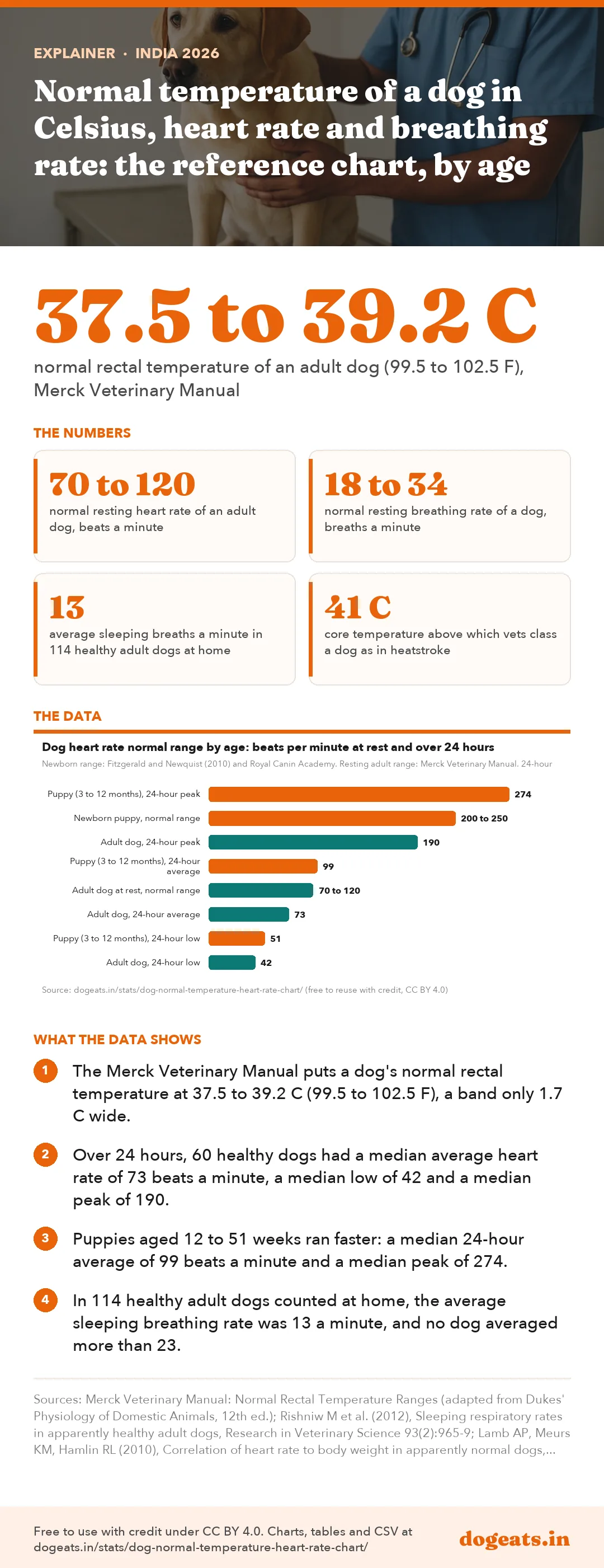
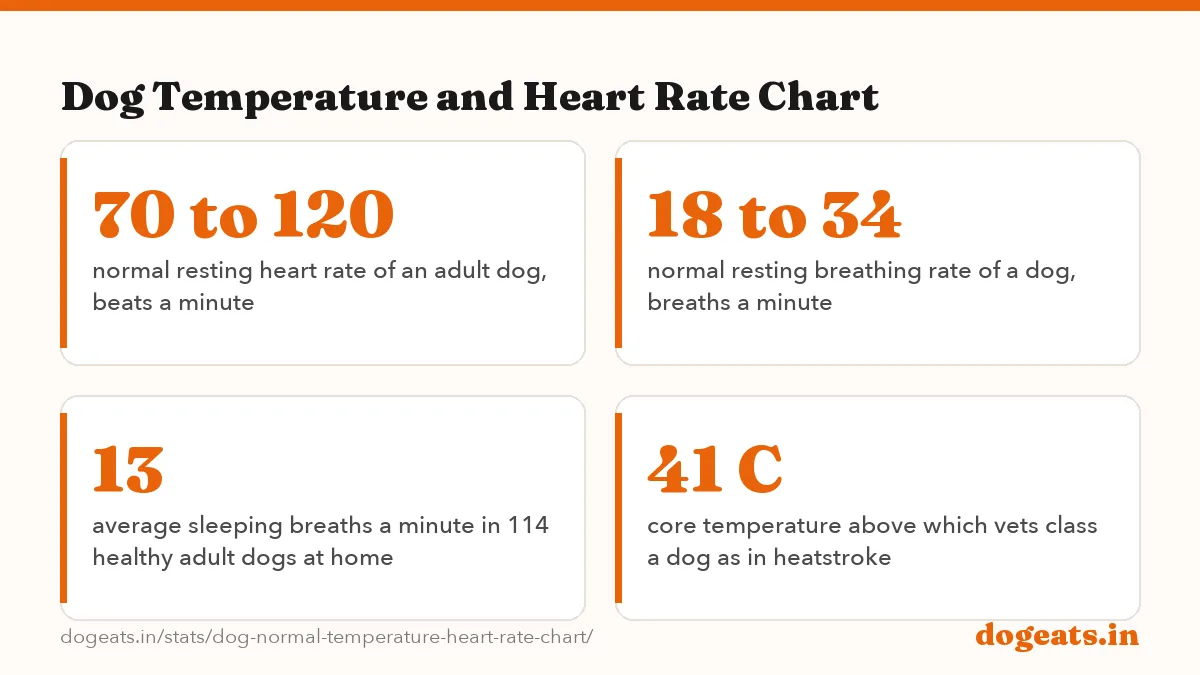
A healthy adult dog's normal rectal temperature is 37.5 to 39.2 C (99.5 to 102.5 F). Its resting heart rate is 70 to 120 beats a minute, and it breathes 18 to 34 times a minute at rest. Asleep at home, healthy dogs average about 13 breaths a minute. Newborn puppies run cooler at 35 to 37.2 C and faster, at 200 to 250 heartbeats a minute.
Key findings
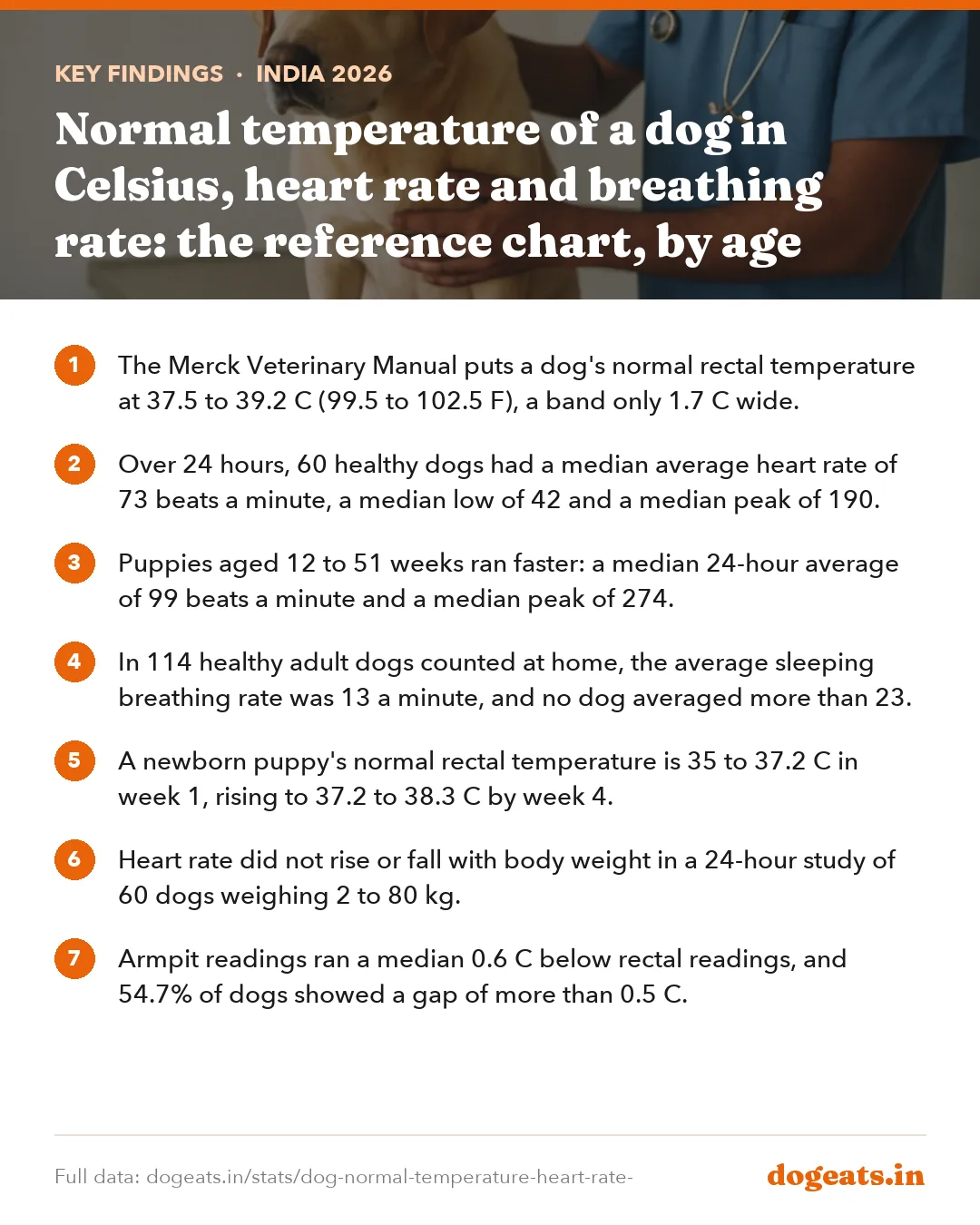
- The Merck Veterinary Manual puts a dog's normal rectal temperature at 37.5 to 39.2 C (99.5 to 102.5 F), a band only 1.7 C wide.
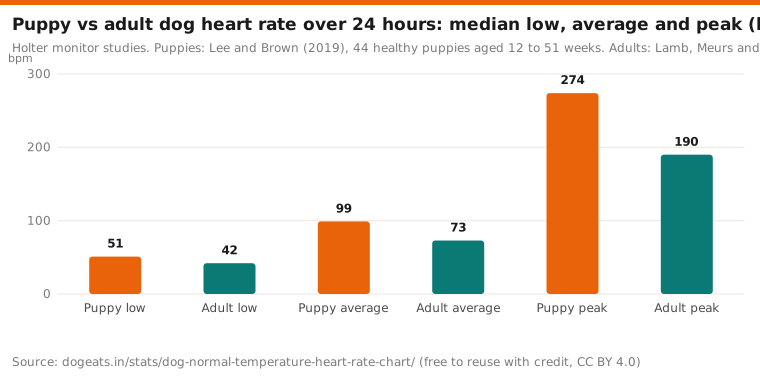
- Over 24 hours, 60 healthy dogs had a median average heart rate of 73 beats a minute, a median low of 42 and a median peak of 190.
- Puppies aged 12 to 51 weeks ran faster: a median 24-hour average of 99 beats a minute and a median peak of 274.
- In 114 healthy adult dogs counted at home, the average sleeping breathing rate was 13 a minute, and no dog averaged more than 23.
- A newborn puppy's normal rectal temperature is 35 to 37.2 C in week 1, rising to 37.2 to 38.3 C by week 4.
- Heart rate did not rise or fall with body weight in a 24-hour study of 60 dogs weighing 2 to 80 kg.
- Armpit readings ran a median 0.6 C below rectal readings, and 54.7% of dogs showed a gap of more than 0.5 C.
- IMD's heatwave line for the plains is a maximum of 40 C, already above the top of a dog's normal temperature of 39.2 C.
- 37 of the 58 breeds in our guides have a typical adult weight above 15 kg, a heatstroke risk factor named in veterinary research.
What is the normal temperature of a dog in Celsius?
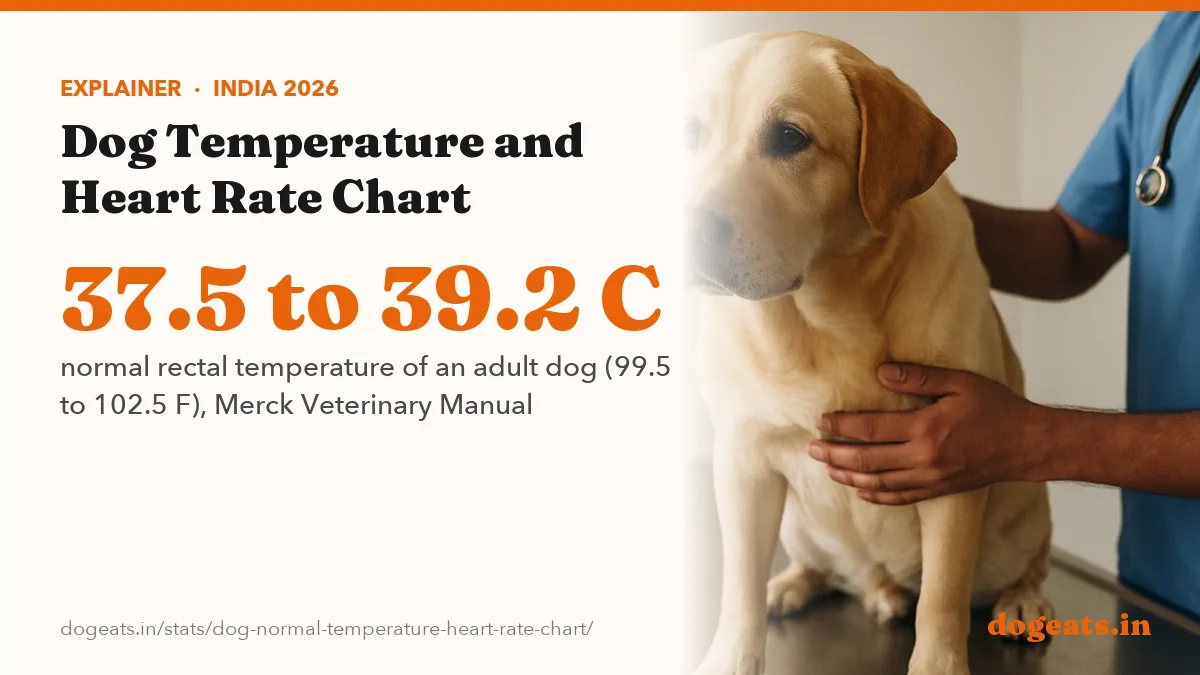
The normal rectal temperature of a healthy adult dog is 37.5 to 39.2 C, or 99.5 to 102.5 F. The figure comes from the Merck Veterinary Manual, which takes it from Dukes' Physiology of Domestic Animals.
The American Kennel Club gives the same band of 99.5 to 102.5 F. It counts 103 F (39.4 C) or higher as a fever. It warns that 106 F (41.1 C) or higher can damage organs and kill.
A dog's normal band sits 0.5 to 2.2 C above the 37 C most people think of as normal for themselves. So a dog that feels warm to your hand is not necessarily ill. Only a thermometer tells you.
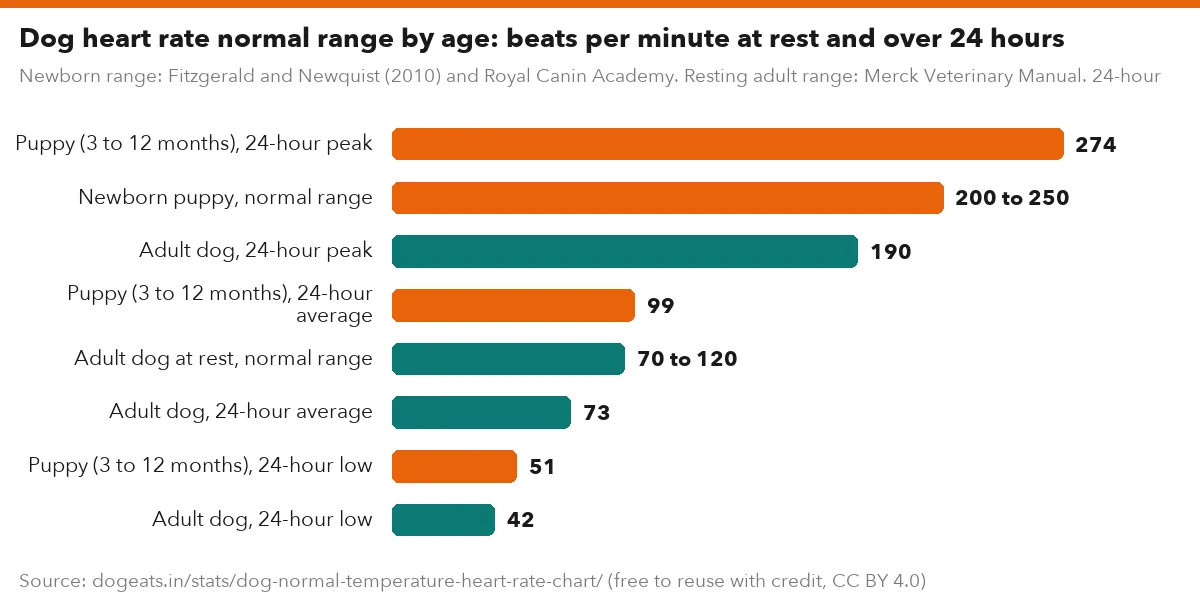
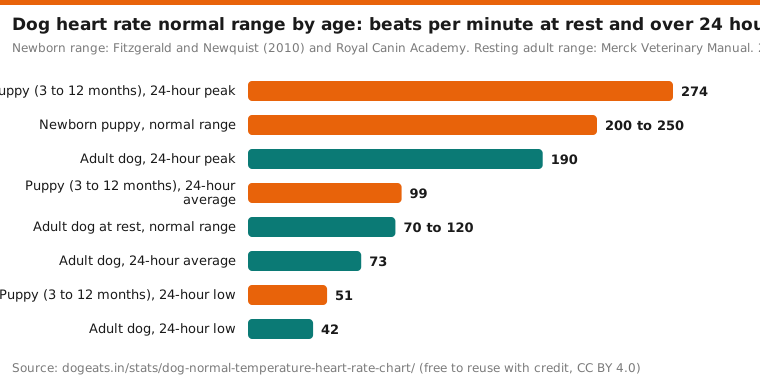
Newborn range: Fitzgerald and Newquist (2010) and Royal Canin Academy. Resting adult range: Merck Veterinary Manual. 24-hour Holter medians: Lee and Brown (2019), 44 puppies aged 12 to 51 weeks; Lamb, Meurs and Hamlin (2010), 60 adult dogs.
Show the numbers
| Label | bpm |
|---|---|
| Puppy (3 to 12 months), 24-hour peak | 274 |
| Newborn puppy, normal range | 200 to 250 |
| Adult dog, 24-hour peak | 190 |
| Puppy (3 to 12 months), 24-hour average | 99 |
| Adult dog at rest, normal range | 70 to 120 |
| Adult dog, 24-hour average | 73 |
| Puppy (3 to 12 months), 24-hour low | 51 |
| Adult dog, 24-hour low | 42 |
Embed this chart
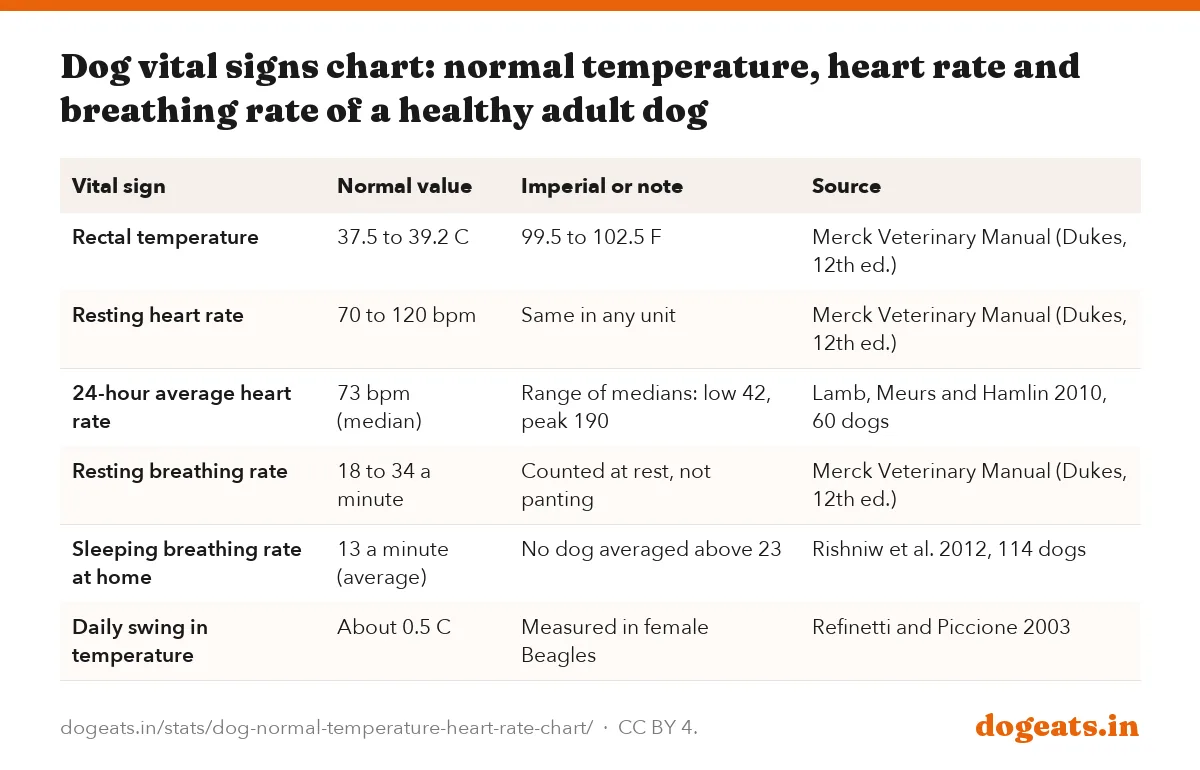
| Vital sign | Normal value | Imperial or note | Source |
|---|---|---|---|
| Rectal temperature | 37.5 to 39.2 C | 99.5 to 102.5 F | Merck Veterinary Manual (Dukes, 12th ed.) |
| Resting heart rate | 70 to 120 bpm | Same in any unit | Merck Veterinary Manual (Dukes, 12th ed.) |
| 24-hour average heart rate | 73 bpm (median) | Range of medians: low 42, peak 190 | Lamb, Meurs and Hamlin 2010, 60 dogs |
| Resting breathing rate | 18 to 34 a minute | Counted at rest, not panting | Merck Veterinary Manual (Dukes, 12th ed.) |
| Sleeping breathing rate at home | 13 a minute (average) | No dog averaged above 23 | Rishniw et al. 2012, 114 dogs |
| Daily swing in temperature | About 0.5 C | Measured in female Beagles | Refinetti and Piccione 2003 |
Temperature also moves through the day. A study of female Beagles found a daily rhythm with a swing of only about 0.5 C. Earlier studies missed it because the change is so small.
Body size matters a little. A study of 287 dogs found that larger dogs had lower rectal temperatures than smaller dogs. Obese dogs read lower than lean dogs of the same weight.
What is a normal heart rate for a dog?
A healthy adult dog's resting heart rate is 70 to 120 beats a minute, according to the Merck Veterinary Manual. A cat's is faster, at 120 to 140.
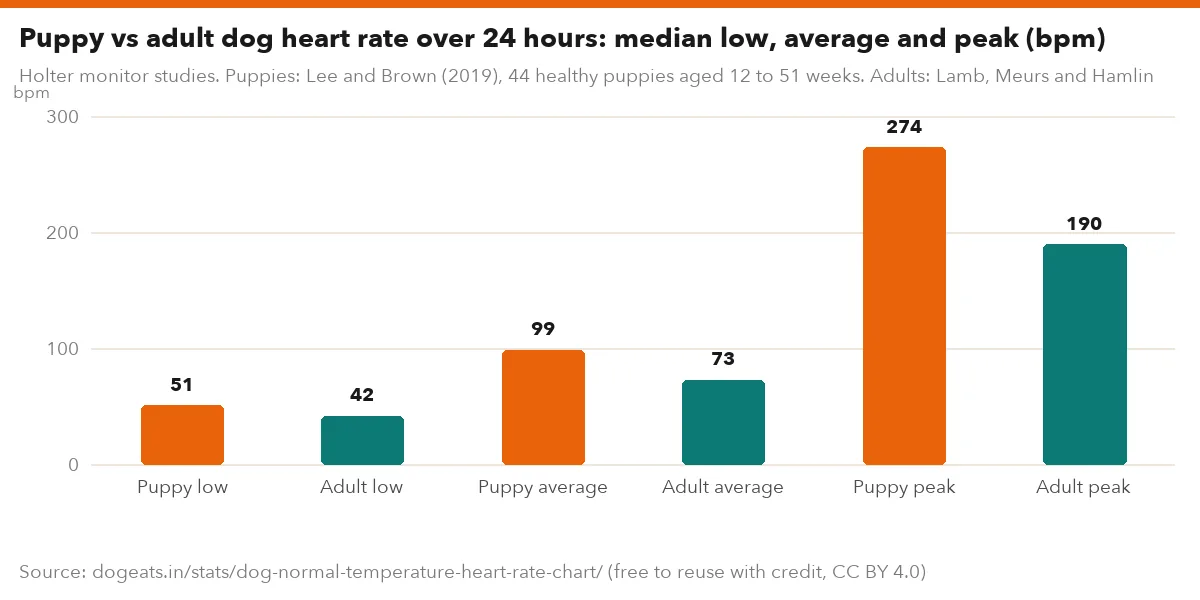
Resting is the key word. Over a full day a dog's heart rate swings widely. In a 2010 study, 60 healthy dogs wore 24-hour heart monitors. Their median low was 42 beats a minute and their median peak was 190.
The same study weighed dogs from 2 to 80 kg. Minimum, average and peak heart rates did not track body weight. The common claim that small dogs always have faster hearts did not hold in that group.
Holter monitor studies. Puppies: Lee and Brown (2019), 44 healthy puppies aged 12 to 51 weeks. Adults: Lamb, Meurs and Hamlin (2010), 60 healthy dogs of 2 to 80 kg.
Show the numbers
| Label | bpm |
|---|---|
| Puppy low | 51 |
| Adult low | 42 |
| Puppy average | 99 |
| Adult average | 73 |
| Puppy peak | 274 |
| Adult peak | 190 |
Embed this chart
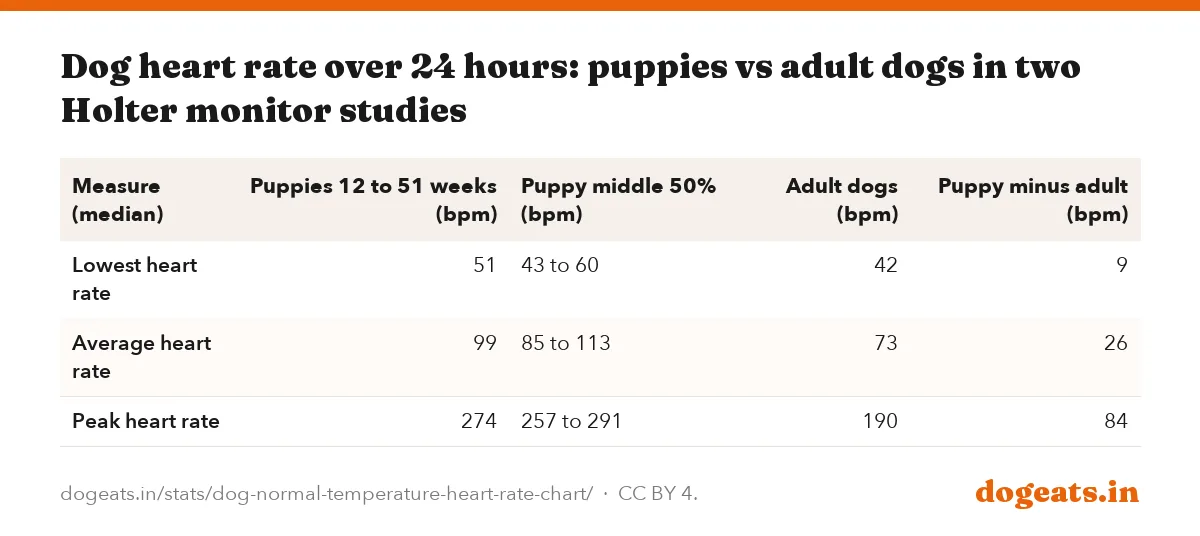
| Measure (median) | Puppies 12 to 51 weeks (bpm) | Puppy middle 50% (bpm) | Adult dogs (bpm) | Puppy minus adult (bpm) |
|---|---|---|---|---|
| Lowest heart rate | 51 | 43 to 60 | 42 | 9 |
| Average heart rate | 99 | 85 to 113 | 73 | 26 |
| Peak heart rate | 274 | 257 to 291 | 190 | 84 |
Puppies run faster. In a 2019 Washington State University study of 44 healthy puppies, the median 24-hour average was 99 beats a minute, 26 above the adult median of 73.
Extra beats were not rare in either group. Among the 44 puppies, 4 (9%) had premature beats from the ventricles and 6 (13%) from the upper chambers. Two puppies (5%) had a second-degree heart block.
Count a resting rate when your dog has been lying quietly for a few minutes. Press two fingers inside the thigh, count beats for 15 seconds and multiply by 4. A rate that sits outside 70 to 120 at rest is a reason to ask your vet.
What is a normal dog breathing rate per minute?
A resting dog normally breathes 18 to 34 times a minute, the Merck Veterinary Manual says. Asleep, the rate falls. Count breaths only when your dog is not panting.
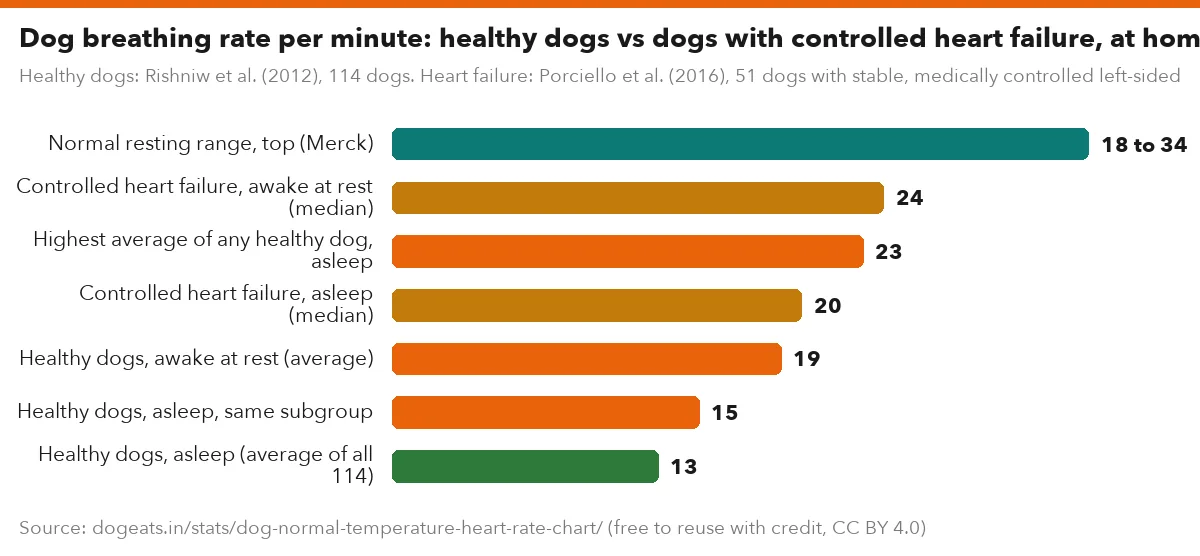
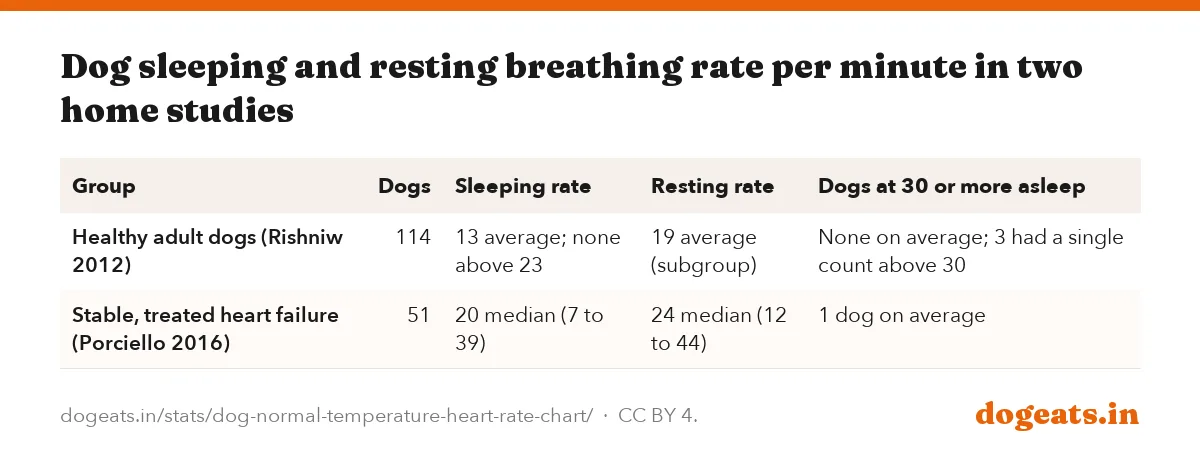
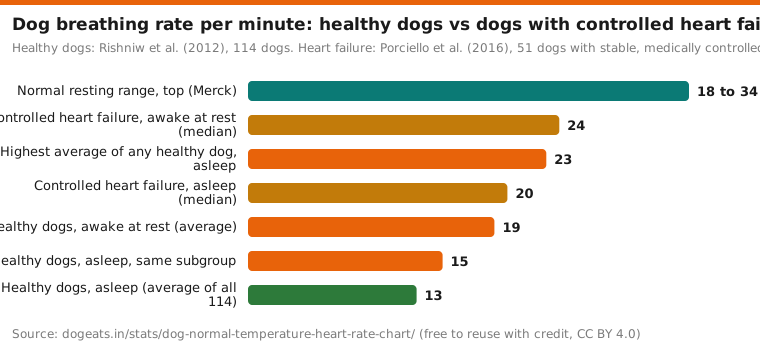
The best home data comes from a 2012 study led by Mark Rishniw. Owners of 114 healthy adult dogs counted sleeping breaths for one minute, 12 to 14 times each, over 1 week to 2 months. The average was 13 breaths a minute.
No dog averaged more than 23 breaths a minute asleep. Only 3 dogs had any single count above 30. Age, body weight and geographic location made no difference to the sleeping rate.
Healthy dogs: Rishniw et al. (2012), 114 dogs. Heart failure: Porciello et al. (2016), 51 dogs with stable, medically controlled left-sided congestive heart failure. Resting range: Merck Veterinary Manual.
Show the numbers
| Label | breaths a minute |
|---|---|
| Normal resting range, top (Merck) | 18 to 34 |
| Controlled heart failure, awake at rest (median) | 24 |
| Highest average of any healthy dog, asleep | 23 |
| Controlled heart failure, asleep (median) | 20 |
| Healthy dogs, awake at rest (average) | 19 |
| Healthy dogs, asleep, same subgroup | 15 |
| Healthy dogs, asleep (average of all 114) | 13 |
Embed this chart
| Group | Dogs | Sleeping rate | Resting rate | Dogs at 30 or more asleep |
|---|---|---|---|---|
| Healthy adult dogs (Rishniw 2012) | 114 | 13 average; none above 23 | 19 average (subgroup) | None on average; 3 had a single count above 30 |
| Stable, treated heart failure (Porciello 2016) | 51 | 20 median (7 to 39) | 24 median (12 to 44) | 1 dog on average |
The study also had some owners count both resting and sleeping breaths. In that group, dogs breathed 19 times a minute awake at rest and 15 times asleep.
Textbooks differ a little on the resting range. Small Animal Pediatrics gives 16 to 32 breaths a minute for adult dogs, against 18 to 34 in Merck.
Dogs with heart failure breathe faster even when treated. In a 2016 follow-up, 51 dogs with stable, medically controlled heart failure had a median sleeping rate of 20. Eight were at 25 or more and one was at 30 or more.
Healthy dogs in the 2012 study averaged under 30 breaths a minute asleep and rarely went above it. So a sleeping rate that stays above 30 a minute is worth showing to a vet.
What is a normal temperature and heart rate for a puppy?
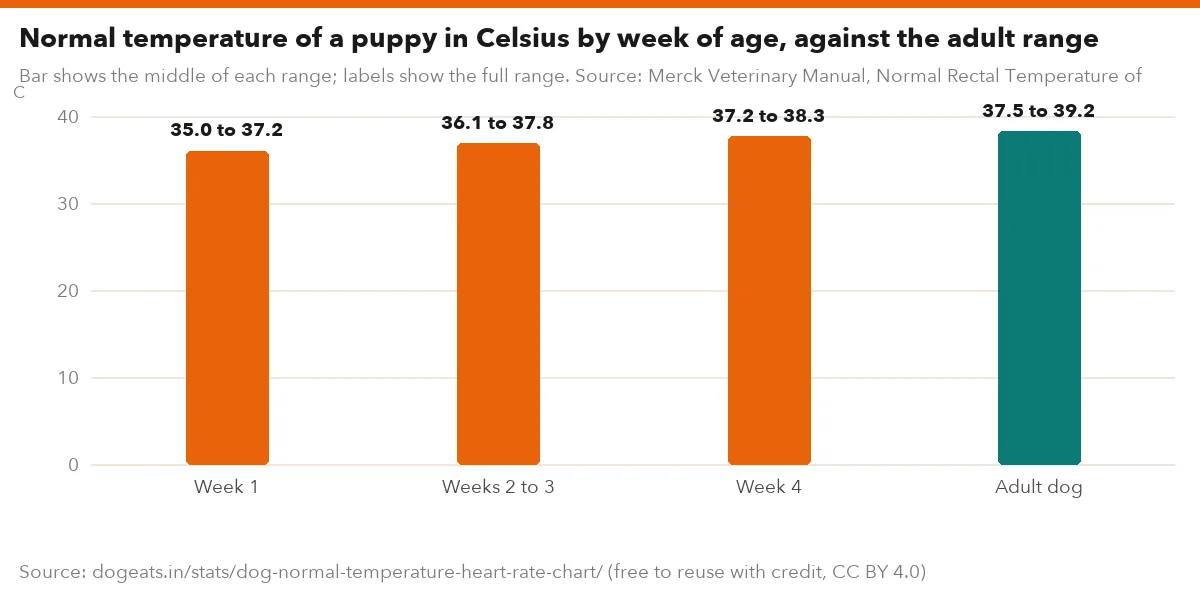
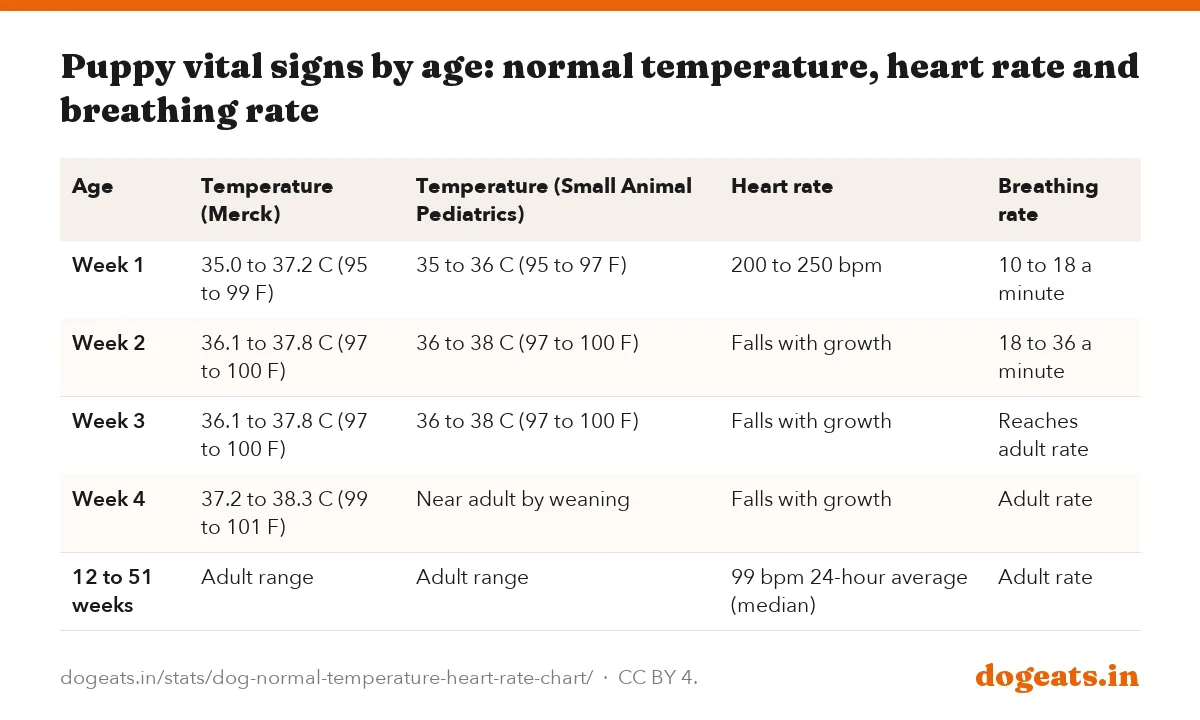
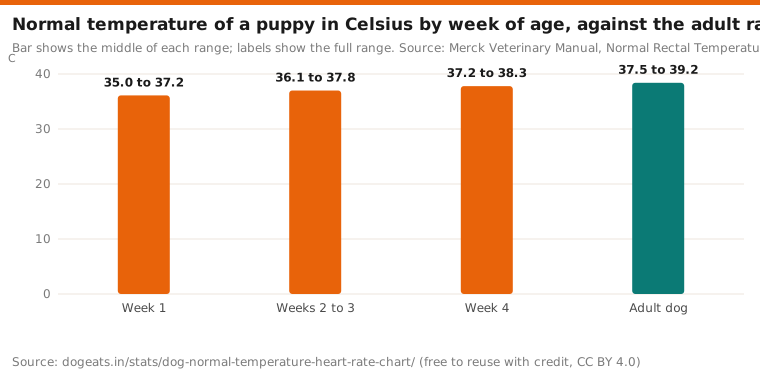
Newborn puppies run cooler than adults. Merck gives a normal rectal temperature of 35 to 37.2 C (95 to 99 F) in week 1. It rises to 36.1 to 37.8 C (97 to 100 F) in weeks 2 and 3, and 37.2 to 38.3 C (99 to 101 F) in week 4.
Puppies cannot control their own body heat until about 4 weeks of age, Merck says. Until then the room has to be warm enough to hold their body temperature at 36 C (97 F) or more.
A newborn's heart is fast. Small Animal Pediatrics gives 200 to 250 beats a minute for a newborn with a rectal temperature of 35.6 C (96 F). Royal Canin Academy's guide uses the same band and treats below 200 as too slow.

Bar shows the middle of each range; labels show the full range. Source: Merck Veterinary Manual, Normal Rectal Temperature of Neonatal Dogs and Cats; adult range from the same manual.
Show the numbers
| Label | C |
|---|---|
| Week 1 | 35.0 to 37.2 |
| Weeks 2 to 3 | 36.1 to 37.8 |
| Week 4 | 37.2 to 38.3 |
| Adult dog | 37.5 to 39.2 |
Embed this chart
| Age | Temperature (Merck) | Temperature (Small Animal Pediatrics) | Heart rate | Breathing rate |
|---|---|---|---|---|
| Week 1 | 35.0 to 37.2 C (95 to 99 F) | 35 to 36 C (95 to 97 F) | 200 to 250 bpm | 10 to 18 a minute |
| Week 2 | 36.1 to 37.8 C (97 to 100 F) | 36 to 38 C (97 to 100 F) | Falls with growth | 18 to 36 a minute |
| Week 3 | 36.1 to 37.8 C (97 to 100 F) | 36 to 38 C (97 to 100 F) | Falls with growth | Reaches adult rate |
| Week 4 | 37.2 to 38.3 C (99 to 101 F) | Near adult by weaning | Falls with growth | Adult rate |
| 12 to 51 weeks | Adult range | Adult range | 99 bpm 24-hour average (median) | Adult rate |
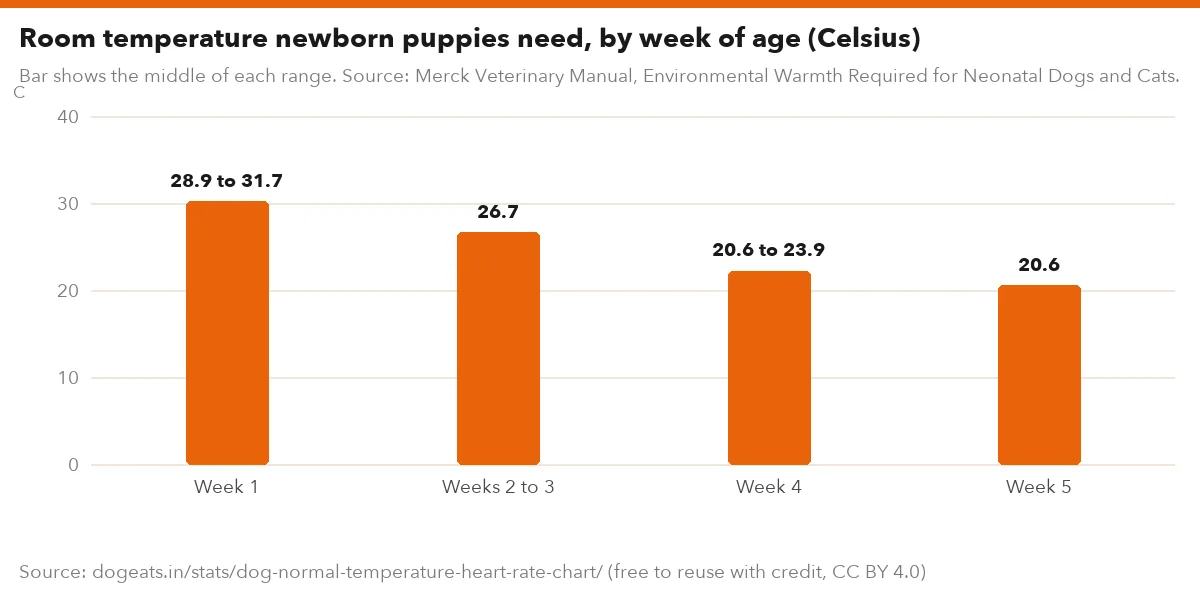
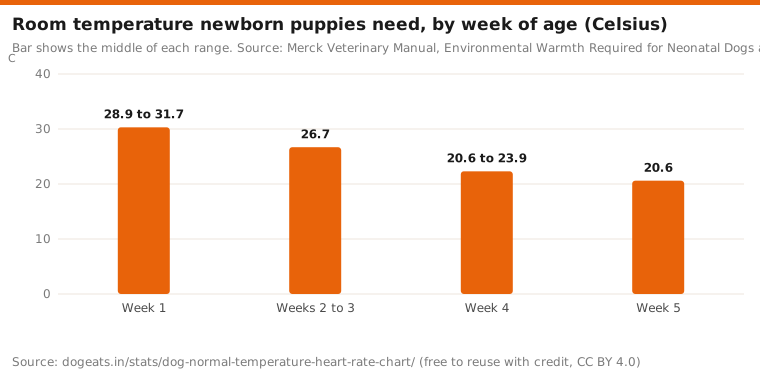
Bar shows the middle of each range. Source: Merck Veterinary Manual, Environmental Warmth Required for Neonatal Dogs and Cats.
Show the numbers
| Label | C |
|---|---|
| Week 1 | 28.9 to 31.7 |
| Weeks 2 to 3 | 26.7 |
| Week 4 | 20.6 to 23.9 |
| Week 5 | 20.6 |
Embed this chart
Sources differ on the newborn range. Merck lets week 1 go up to 37.2 C, while Small Animal Pediatrics stops at 36 C. Royal Canin Academy gives 37 to 38 C for weeks 2 and 3, a narrower band than either.
Breathing also changes quickly. Small Animal Pediatrics gives 10 to 18 breaths a minute in week 1 and 18 to 36 in week 2. By week 3 the rate matches an adult dog's.
Merck wants the room at 28.9 to 31.7 C in week 1, falling to 20.6 C by week 5. In much of India, a summer room already sits above that. North Indian winter nights can fall well below it.
A 2010 study followed Rottweiler, Cocker Spaniel and Pug puppies for their first two months. Average body temperature rose and heart and breathing rates fell as they grew. A daily temperature rhythm appeared by 4 weeks.
How do you check a dog's temperature, and are ear thermometers accurate?
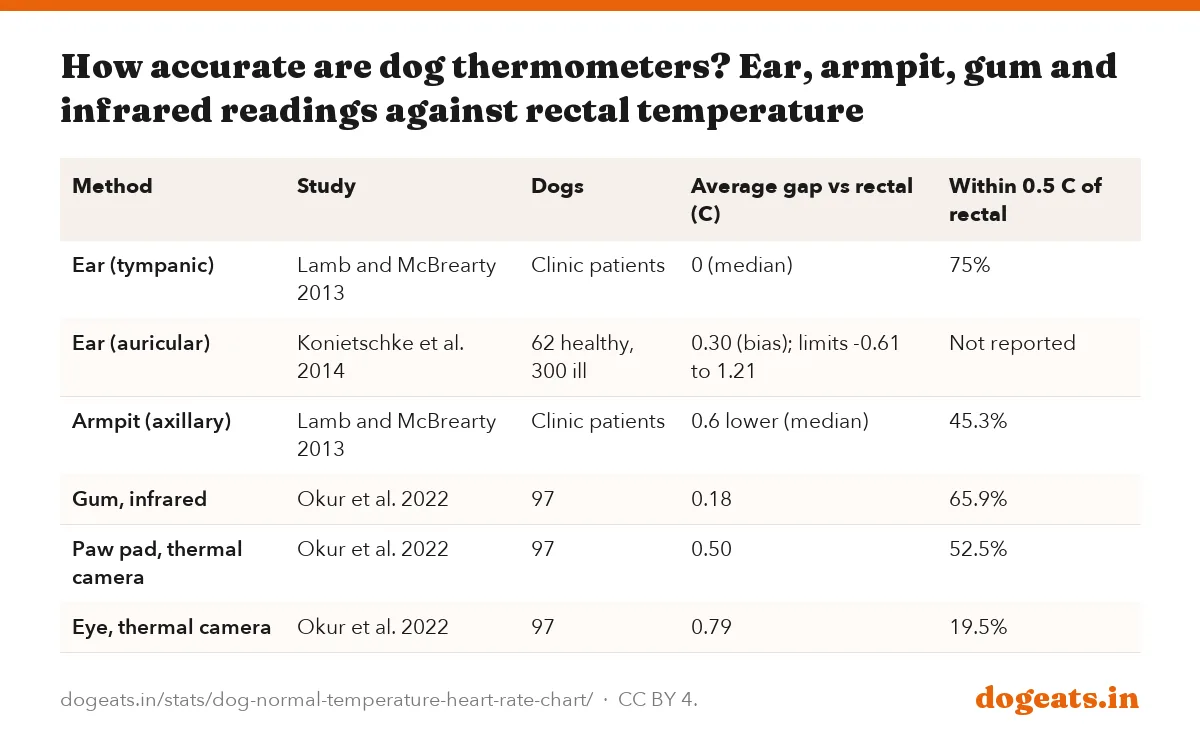
A rectal reading is the reference method in every study we found. Other sites are quicker but miss by more. For a 2014 German study, 16 experts set 0.3 C as the largest gap they would accept.
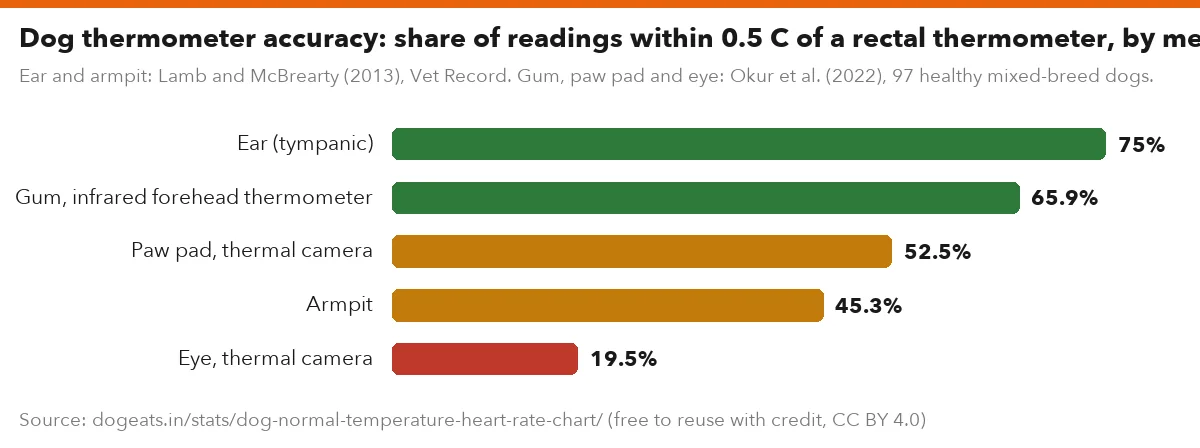
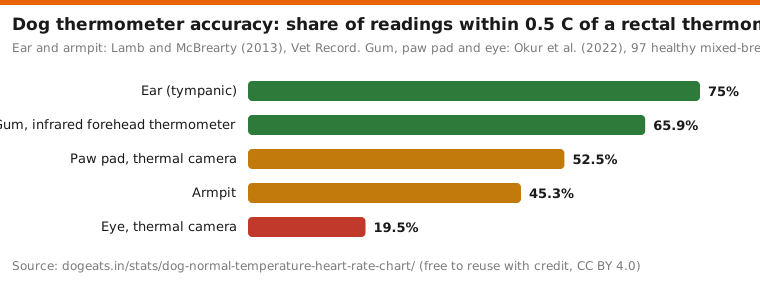
Ear thermometers come closest. A UK study found a median gap of 0 C between ear and rectal readings. Even so, 25% of dogs differed by more than 0.5 C.
Armpit readings were easy but low. They ran a median 0.6 C below the rectal reading, and 54.7% of dogs showed a gap above 0.5 C. Weight, coat length, body condition and breed size all widened the gap.
Ear and armpit: Lamb and McBrearty (2013), Vet Record. Gum, paw pad and eye: Okur et al. (2022), 97 healthy mixed-breed dogs. Armpit share computed as 100 minus 54.7.
Show the numbers
| Label | % |
|---|---|
| Ear (tympanic) | 75% |
| Gum, infrared forehead thermometer | 65.9% |
| Paw pad, thermal camera | 52.5% |
| Armpit | 45.3% |
| Eye, thermal camera | 19.5% |
Embed this chart
| Method | Study | Dogs | Average gap vs rectal (C) | Within 0.5 C of rectal |
|---|---|---|---|---|
| Ear (tympanic) | Lamb and McBrearty 2013 | Clinic patients | 0 (median) | 75% |
| Ear (auricular) | Konietschke et al. 2014 | 62 healthy, 300 ill | 0.30 (bias); limits -0.61 to 1.21 | Not reported |
| Armpit (axillary) | Lamb and McBrearty 2013 | Clinic patients | 0.6 lower (median) | 45.3% |
| Gum, infrared | Okur et al. 2022 | 97 | 0.18 | 65.9% |
| Paw pad, thermal camera | Okur et al. 2022 | 97 | 0.50 | 52.5% |
| Eye, thermal camera | Okur et al. 2022 | 97 | 0.79 | 19.5% |
The German study compared ear and rectal readings in 362 dogs. The readings tracked each other closely, with a correlation of 0.892. But the ear ran 0.3 C off on average, and the limits of agreement stretched to 1.2 C.
A 2022 Turkish study tested infrared tools on 97 healthy mixed-breed dogs over 382 readings. A human forehead thermometer pointed at the gum did best, within 0.5 C of rectal in 65.9% of dogs. The eye was within 0.5 C in only 19.5%.
Humidity mattered in the German study, but room temperature did not. In a humid Mumbai or Kolkata monsoon, an ear reading may drift more. A digital rectal thermometer remains the tool to trust.
What dog temperature is too high, and when is it heatstroke?
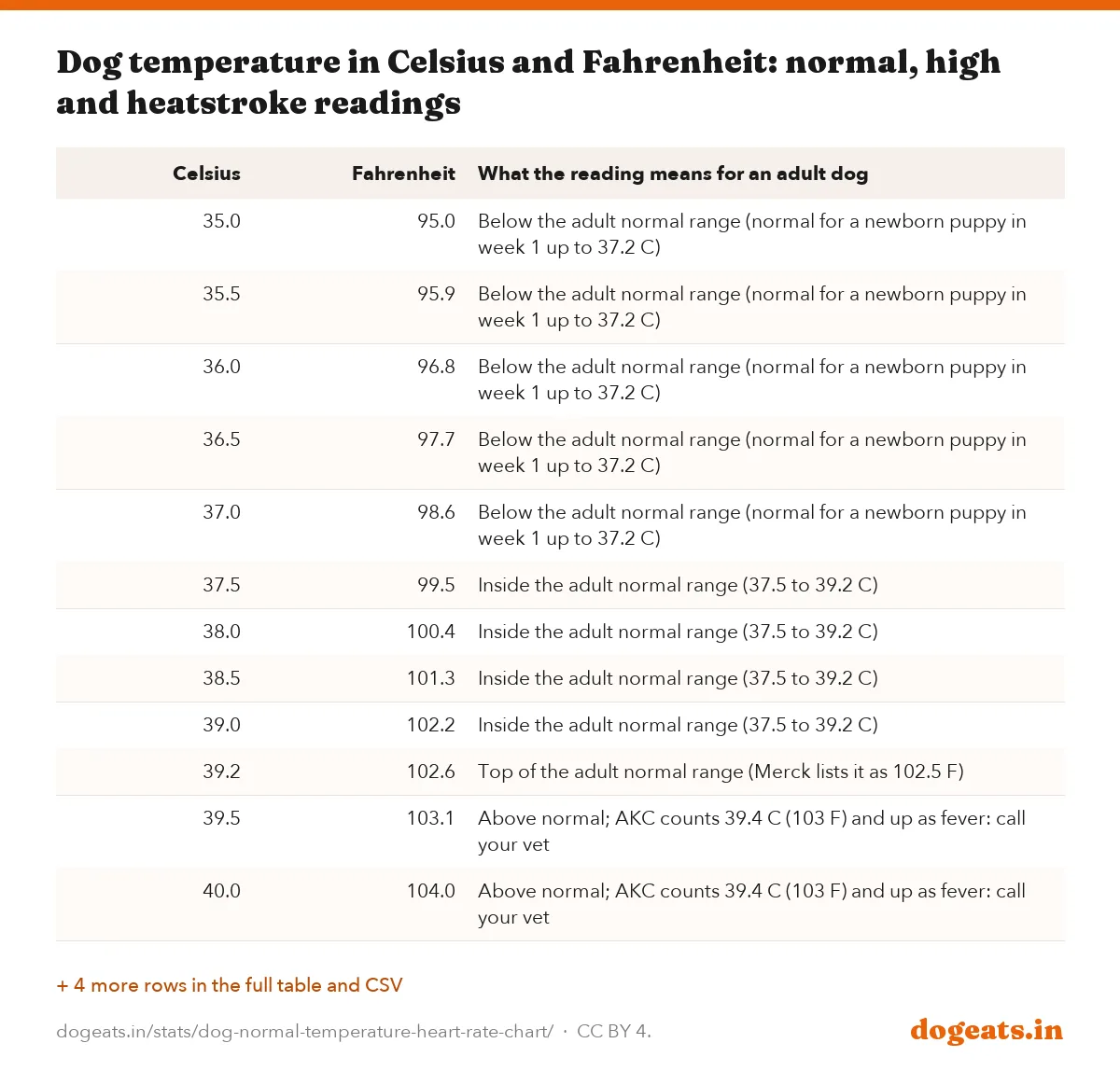
Anything above 39.2 C (102.5 F) is above the normal adult range, and worth a call to your vet. Veterinary research defines heatstroke as a core temperature above 41 C (105.8 F) with signs of brain dysfunction.
A 2017 review by Yaron Bruchim and colleagues put heatstroke mortality in dogs at around 50%, even with prompt care. Risk factors included humid heat, hard exercise, obesity, body weight above 15 kg and flat faces.
Exercise keeps heating a dog after it stops. In a 2024 UK study of canicross races, temperature kept rising in the first 5 minutes after the run in 28 of 115 cooling records (24.4%).
| Celsius | Fahrenheit | What the reading means for an adult dog |
|---|---|---|
| 35.0 | 95.0 | Below the adult normal range (normal for a newborn puppy in week 1 up to 37.2 C) |
| 35.5 | 95.9 | Below the adult normal range (normal for a newborn puppy in week 1 up to 37.2 C) |
| 36.0 | 96.8 | Below the adult normal range (normal for a newborn puppy in week 1 up to 37.2 C) |
| 36.5 | 97.7 | Below the adult normal range (normal for a newborn puppy in week 1 up to 37.2 C) |
| 37.0 | 98.6 | Below the adult normal range (normal for a newborn puppy in week 1 up to 37.2 C) |
| 37.5 | 99.5 | Inside the adult normal range (37.5 to 39.2 C) |
| 38.0 | 100.4 | Inside the adult normal range (37.5 to 39.2 C) |
| 38.5 | 101.3 | Inside the adult normal range (37.5 to 39.2 C) |
| 39.0 | 102.2 | Inside the adult normal range (37.5 to 39.2 C) |
| 39.2 | 102.6 | Top of the adult normal range (Merck lists it as 102.5 F) |
| 39.5 | 103.1 | Above normal; AKC counts 39.4 C (103 F) and up as fever: call your vet |
| 40.0 | 104.0 | Above normal; AKC counts 39.4 C (103 F) and up as fever: call your vet |
| 40.5 | 104.9 | Above normal; AKC counts 39.4 C (103 F) and up as fever: call your vet |
| 41.0 | 105.8 | Above normal; AKC counts 39.4 C (103 F) and up as fever: call your vet |
| 41.5 | 106.7 | Above 41 C, the heatstroke level in vet studies: emergency |
| 42.0 | 107.6 | Above 41 C, the heatstroke level in vet studies: emergency |
An older US study of 42 dogs with heat illness found 27 survived and 15 died. Thirty-one of the 40 dated cases came before July, early in the American summer. Dogs that arrived cold or in a coma did worst.
For the full numbers on survival and triggers, read our report on dog heatstroke statistics. For prevention at home, see the summer heatstroke guide.
How does Indian summer heat compare with a dog's body temperature?
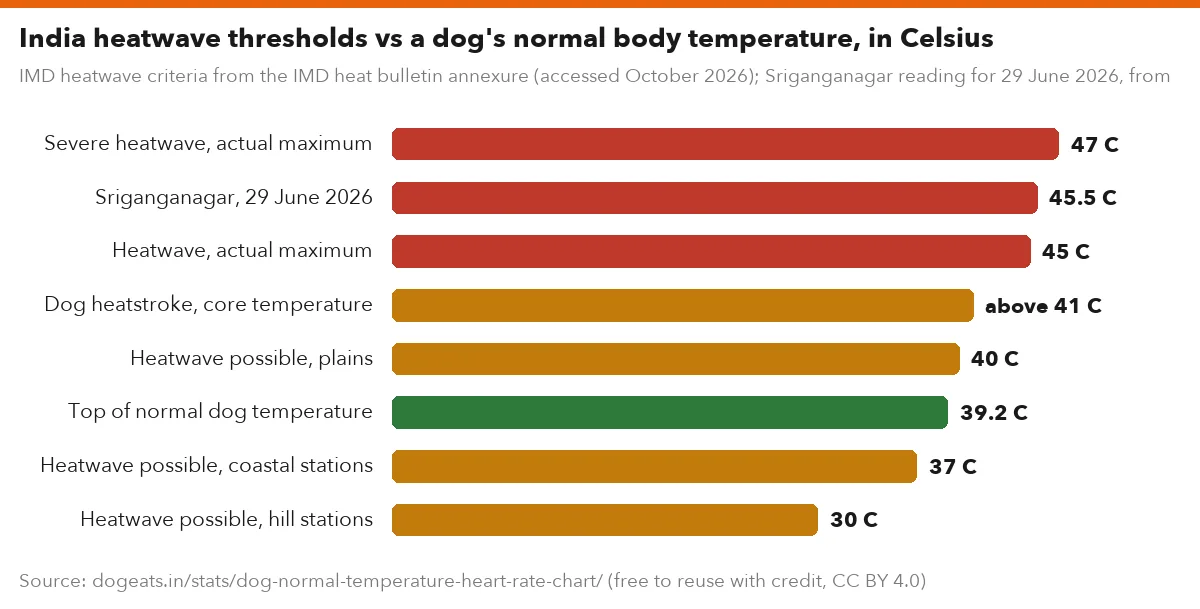
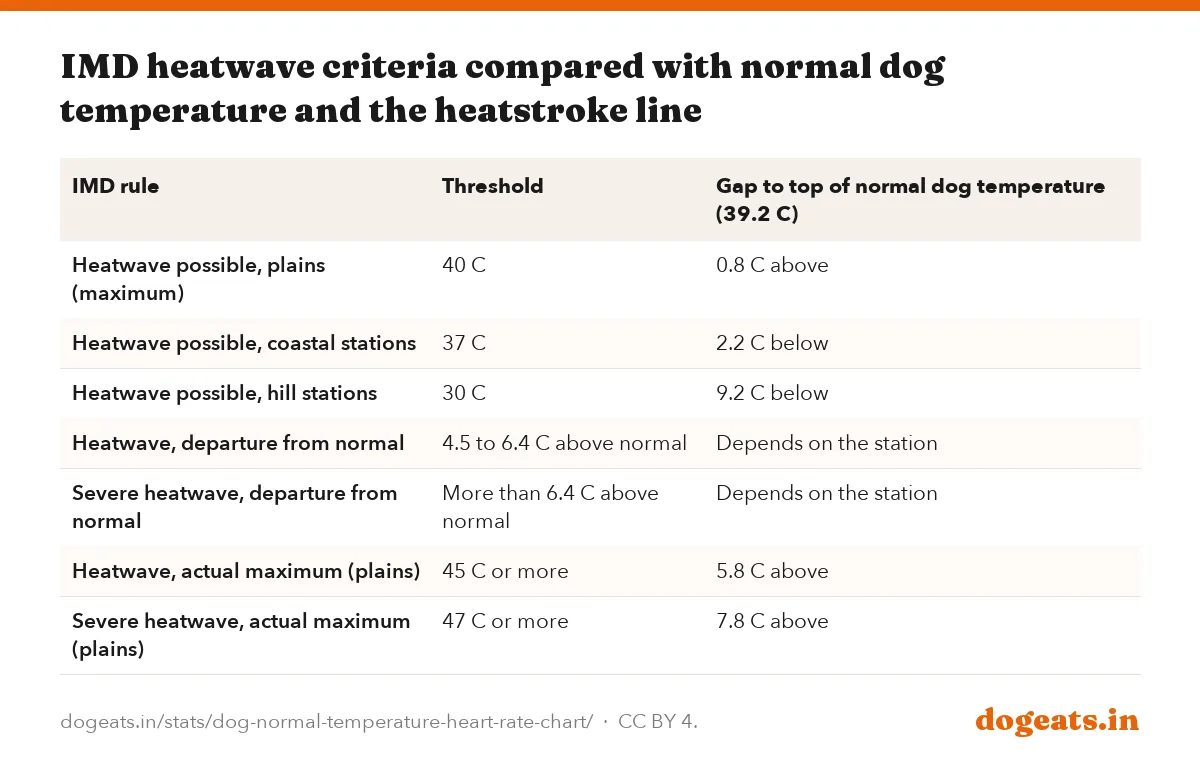
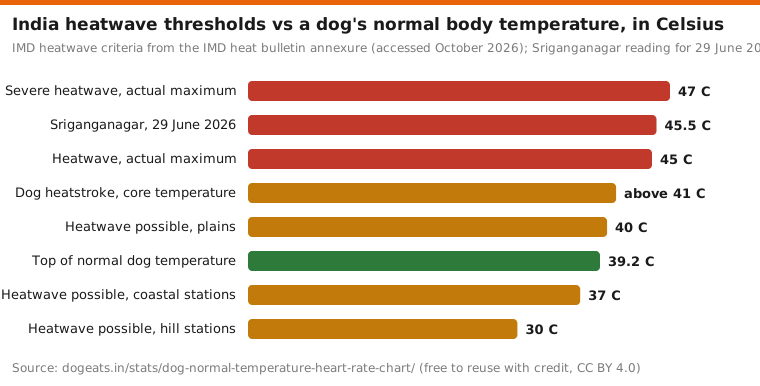
India Meteorological Department (IMD) considers a heatwave on the plains only once a station's maximum reaches 40 C. The line sits 0.8 C above the top of a dog's normal temperature. Air hotter than the dog cannot carry heat away from its skin, so panting must do the work.
IMD declares a heatwave on actual temperature alone at 45 C, and a severe heatwave at 47 C. Coastal stations qualify from 37 C and hill stations from 30 C, when the departure from normal is large enough.
IMD's heat bulletin of 30 June 2026 reported maximums of 40 to 44 C on 29 June over many parts of the north-west plains outside Punjab. The highest was 45.5 C at Sriganganagar in Rajasthan.

IMD heatwave criteria from the IMD heat bulletin annexure (accessed October 2026); Sriganganagar reading for 29 June 2026, from the bulletin dated 30 June 2026. Dog values: Merck Veterinary Manual; Bruchim et al. (2017).
Show the numbers
| Label | C |
|---|---|
| Severe heatwave, actual maximum | 47 C |
| Sriganganagar, 29 June 2026 | 45.5 C |
| Heatwave, actual maximum | 45 C |
| Dog heatstroke, core temperature | above 41 C |
| Heatwave possible, plains | 40 C |
| Top of normal dog temperature | 39.2 C |
| Heatwave possible, coastal stations | 37 C |
| Heatwave possible, hill stations | 30 C |
Embed this chart
| IMD rule | Threshold | Gap to top of normal dog temperature (39.2 C) |
|---|---|---|
| Heatwave possible, plains (maximum) | 40 C | 0.8 C above |
| Heatwave possible, coastal stations | 37 C | 2.2 C below |
| Heatwave possible, hill stations | 30 C | 9.2 C below |
| Heatwave, departure from normal | 4.5 to 6.4 C above normal | Depends on the station |
| Severe heatwave, departure from normal | More than 6.4 C above normal | Depends on the station |
| Heatwave, actual maximum (plains) | 45 C or more | 5.8 C above |
| Severe heatwave, actual maximum (plains) | 47 C or more | 7.8 C above |
For state-by-state heatwave days, see our report on heatwave days and dog heatstroke risk. For pavement and walk timings, read how hot is too hot for dogs.
Which dogs are most at risk when their temperature climbs?
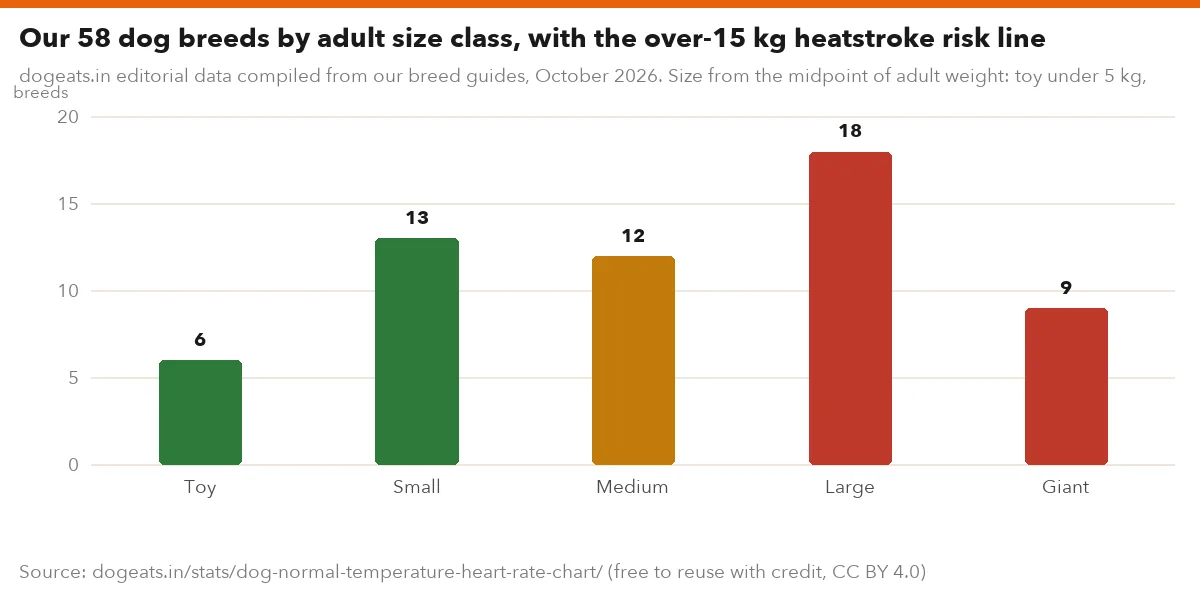
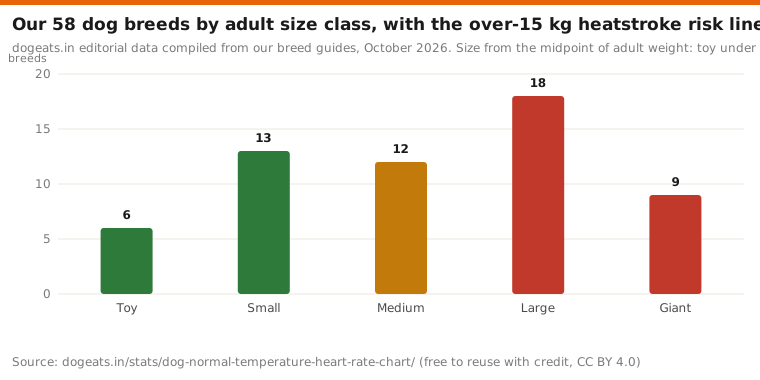
Weight above 15 kg is a heatstroke risk factor in the Bruchim review. By that test, 37 of the 58 breeds in our guides are at risk, judged on the middle of their adult weight range. They run from Indian sighthounds such as the Chippiparai and Kanni to the English Mastiff.
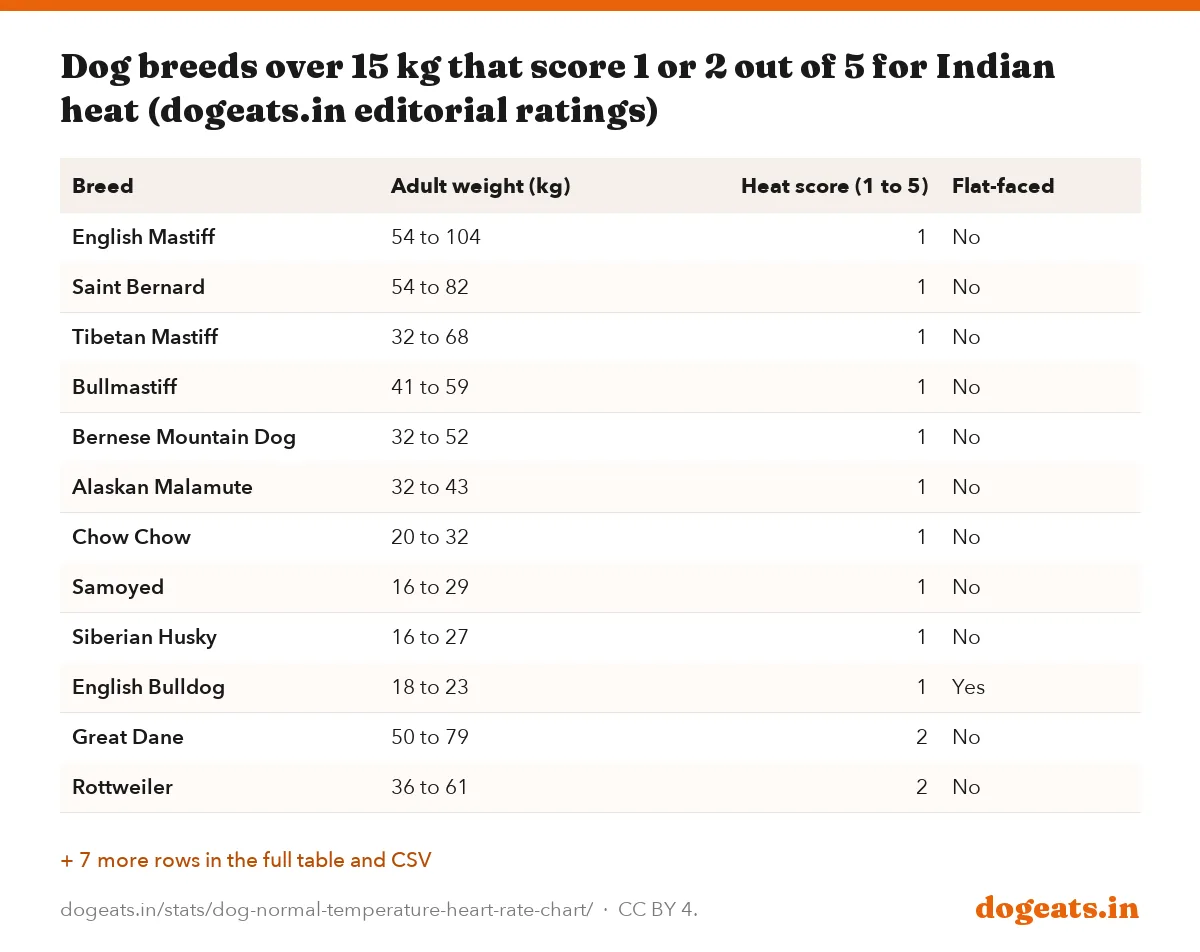
Of those 37 heavier breeds, 19 score only 1 or 2 out of 5 on our editorial rating for tolerating Indian heat. Across all 58 breeds, 29 score 1 or 2.
Flat faces add risk. Five of our breeds have guides that list brachycephalic airway disease: the Pug, Shih Tzu, Pekingese, French Bulldog and English Bulldog. Counting both factors, 41 of 58 breeds carry at least one.
dogeats.in editorial data compiled from our breed guides, October 2026. Size from the midpoint of adult weight: toy under 5 kg, small 5 to 12, medium 12 to 25, large 25 to 45, giant 45 and over.
Show the numbers
| Label | breeds |
|---|---|
| Toy | 6 |
| Small | 13 |
| Medium | 12 |
| Large | 18 |
| Giant | 9 |
Embed this chart
| Breed | Adult weight (kg) | Heat score (1 to 5) | Flat-faced |
|---|---|---|---|
| English Mastiff | 54 to 104 | 1 | No |
| Saint Bernard | 54 to 82 | 1 | No |
| Tibetan Mastiff | 32 to 68 | 1 | No |
| Bullmastiff | 41 to 59 | 1 | No |
| Bernese Mountain Dog | 32 to 52 | 1 | No |
| Alaskan Malamute | 32 to 43 | 1 | No |
| Chow Chow | 20 to 32 | 1 | No |
| Samoyed | 16 to 29 | 1 | No |
| Siberian Husky | 16 to 27 | 1 | No |
| English Bulldog | 18 to 23 | 1 | Yes |
| Great Dane | 50 to 79 | 2 | No |
| Rottweiler | 36 to 61 | 2 | No |
| Dogo Argentino | 40 to 45 | 2 | No |
| German Shepherd | 23 to 41 | 2 | No |
| Labrador Retriever | 25 to 36 | 2 | No |
| Golden Retriever | 25 to 34 | 2 | No |
| Boxer | 22 to 36 | 2 | No |
| Australian Shepherd | 18 to 29 | 2 | No |
| Border Collie | 14 to 25 | 2 | No |
The Labrador sits on that list at 25 to 36 kg with a heat score of 2. Bruchim's review names Labradors as a breed at risk. See our Labrador guide for summer routines.
Medium dogs straddle the line, since our medium class runs from 12 to 25 kg. Which breeds sit where is in our dog breeds heat risk ranking.
How does a dog's heart rate compare with other animals?
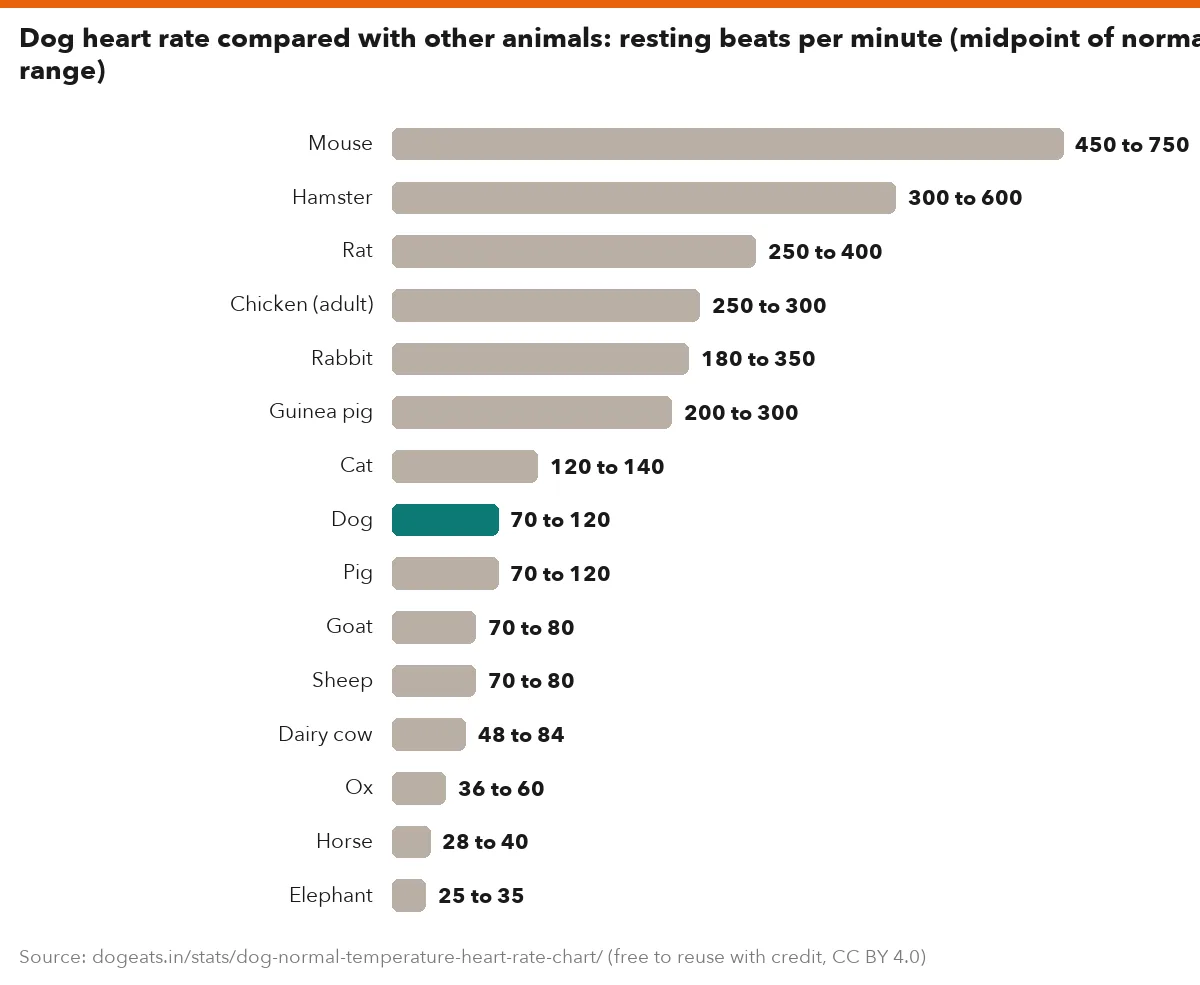
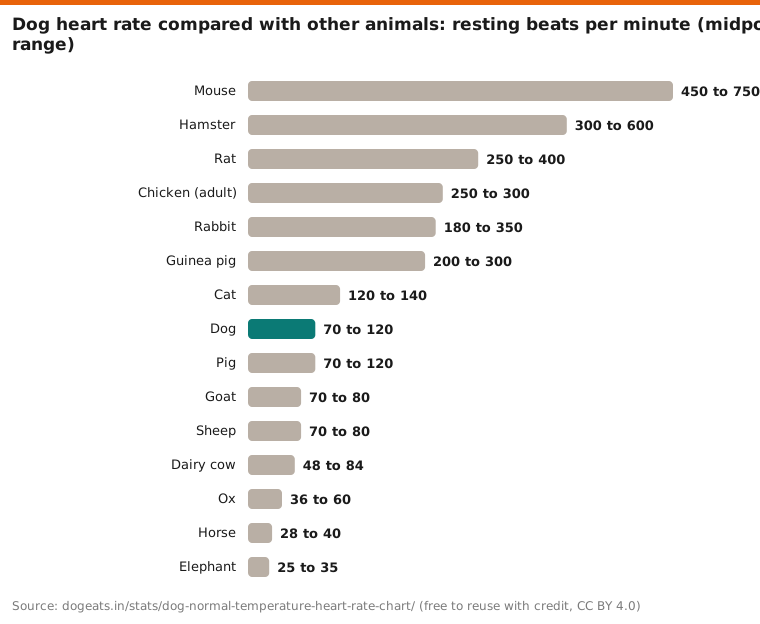
A dog's resting heart rate of 70 to 120 matches a pig's exactly in the Merck tables. A cat's heart beats faster, at 120 to 140, and a horse's far slower, at 28 to 40.
Small mammals run fastest. A mouse's heart beats 450 to 750 times a minute and a hamster's 300 to 600. An elephant's beats 25 to 35 times.
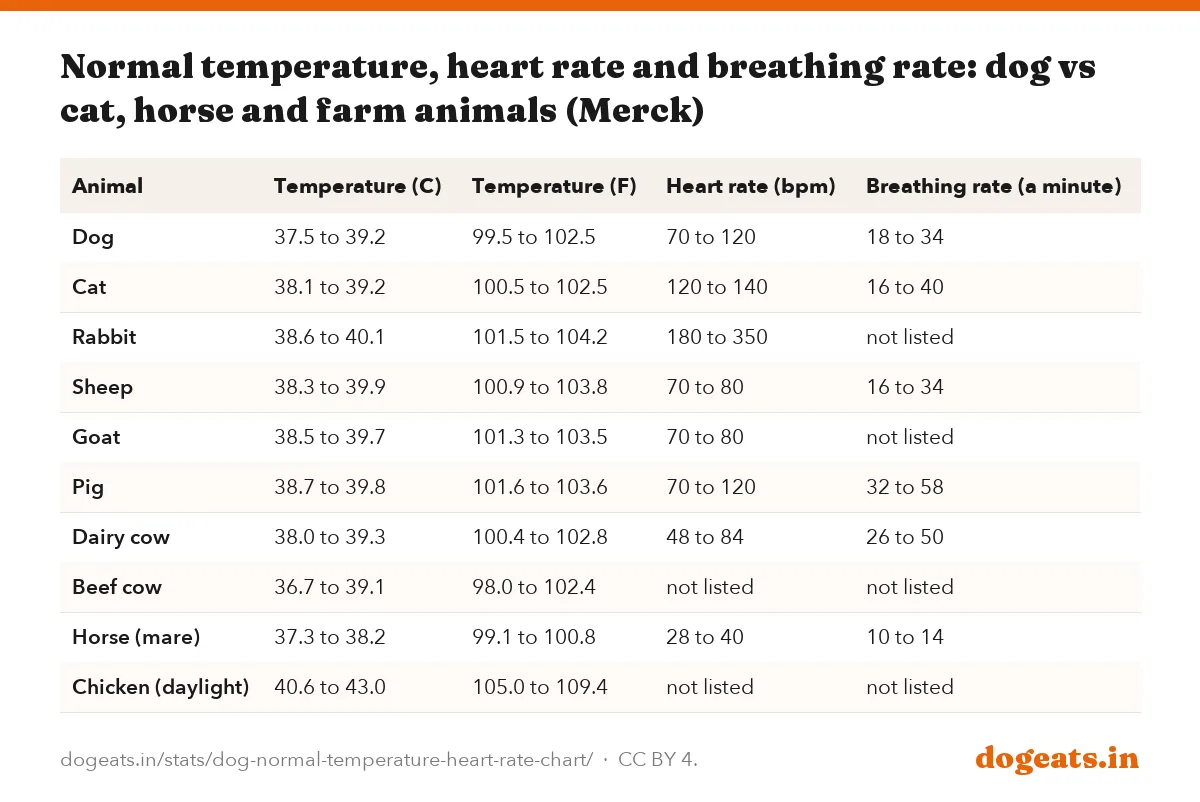
Temperature varies less. The mammals in the Merck table all sit between 36.7 and 40.1 C. A chicken runs much hotter, at 40.6 to 43 C in daylight.
Merck Veterinary Manual, Resting Heart Rates, adapted from Dukes' Physiology of Domestic Animals, 12th ed. Bar shows the middle of the range.
Show the numbers
| Label | bpm |
|---|---|
| Mouse | 450 to 750 |
| Hamster | 300 to 600 |
| Rat | 250 to 400 |
| Chicken (adult) | 250 to 300 |
| Rabbit | 180 to 350 |
| Guinea pig | 200 to 300 |
| Cat | 120 to 140 |
| Dog | 70 to 120 |
| Pig | 70 to 120 |
| Goat | 70 to 80 |
| Sheep | 70 to 80 |
| Dairy cow | 48 to 84 |
| Ox | 36 to 60 |
| Horse | 28 to 40 |
| Elephant | 25 to 35 |
Embed this chart
| Animal | Temperature (C) | Temperature (F) | Heart rate (bpm) | Breathing rate (a minute) |
|---|---|---|---|---|
| Dog | 37.5 to 39.2 | 99.5 to 102.5 | 70 to 120 | 18 to 34 |
| Cat | 38.1 to 39.2 | 100.5 to 102.5 | 120 to 140 | 16 to 40 |
| Rabbit | 38.6 to 40.1 | 101.5 to 104.2 | 180 to 350 | not listed |
| Sheep | 38.3 to 39.9 | 100.9 to 103.8 | 70 to 80 | 16 to 34 |
| Goat | 38.5 to 39.7 | 101.3 to 103.5 | 70 to 80 | not listed |
| Pig | 38.7 to 39.8 | 101.6 to 103.6 | 70 to 120 | 32 to 58 |
| Dairy cow | 38.0 to 39.3 | 100.4 to 102.8 | 48 to 84 | 26 to 50 |
| Beef cow | 36.7 to 39.1 | 98.0 to 102.4 | not listed | not listed |
| Horse (mare) | 37.3 to 38.2 | 99.1 to 100.8 | 28 to 40 | 10 to 14 |
| Chicken (daylight) | 40.6 to 43.0 | 105.0 to 109.4 | not listed | not listed |
These are textbook ranges for animals at rest. They come from Dukes' Physiology of Domestic Animals, 12th edition, as reproduced in the Merck Veterinary Manual.
Frequently asked questions
What is the normal temperature of a dog in Celsius?
The normal rectal temperature of an adult dog is 37.5 to 39.2 C (99.5 to 102.5 F), according to the Merck Veterinary Manual and the American Kennel Club. The AKC counts 39.4 C (103 F) or higher as a fever.
What is a dog's normal heart rate?
A resting adult dog's heart beats 70 to 120 times a minute. Over a full day, 60 healthy dogs in a 2010 study had a median low of 42 and a median peak of 190.
How many breaths per minute is normal for a dog?
A resting dog normally breathes 18 to 34 times a minute. Asleep at home, 114 healthy dogs averaged 13 breaths a minute, and none averaged more than 23.
Is a dog breathing 40 times a minute while sleeping normal?
No. Healthy adult dogs in a 2012 study averaged under 30 breaths a minute asleep and rarely exceeded it. A dog that keeps breathing faster than 30 in sleep should see a vet.
What is a normal temperature for a newborn puppy?
Merck gives 35 to 37.2 C (95 to 99 F) in week 1, 36.1 to 37.8 C in weeks 2 and 3, and 37.2 to 38.3 C in week 4. Puppies cannot control their own body heat until about 4 weeks old.
What is a puppy's normal heart rate?
Newborn puppies normally have 200 to 250 beats a minute. Puppies aged 12 to 51 weeks averaged 99 beats a minute over 24 hours in a 2019 study, against 73 for adult dogs.
What dog temperature is an emergency?
Vets define heatstroke as a core temperature above 41 C (105.8 F) with brain signs, and mortality is around 50%. Any reading above 39.2 C is above normal and worth a call to your vet.
Is 39.5 C a fever in a dog?
A reading of 39.5 C (103.1 F) is above the normal adult range of 37.5 to 39.2 C. It may be fever, exercise or heat. Recheck after rest and call your vet if it stays high.
Are ear thermometers accurate for dogs?
They come close but not close enough for vets. In a UK study, ear and rectal readings had a median gap of 0 C, yet 25% of dogs differed by more than 0.5 C.
Methodology and limitations
Adult reference ranges for temperature, heart rate and breathing rate come from the Merck Veterinary Manual's reference guides, which reproduce tables from Dukes' Physiology of Domestic Animals, 12th edition (2004). Puppy ranges come from Merck's neonatal tables and from Small Animal Pediatrics (Fitzgerald and Newquist, 2010).
Study figures are taken as published in the abstracts or full texts of Lamb, Meurs and Hamlin (2010), Lee and Brown (2019), Rishniw et al. (2012), Porciello et al. (2016), Lamb and McBrearty (2013), Konietschke et al. (2014), Okur et al. (2022), Refinetti and Piccione (2003), Piccione et al. (2010, 2011), Drobatz and Macintire (1996), Bruchim et al. (2017) and Carter et al. (2024).
Where we show a single bar for a range, the bar is the midpoint and the label shows the full range. Fahrenheit values are converted from Celsius with F = C x 9/5 + 32 and rounded to one decimal.
Breed counts use the 58 dogeats.in breed guides (dogeats.in editorial data compiled from our breed guides, October 2026). Size class uses the midpoint of the adult weight range; for breeds with several sizes we use the largest standard variety. The over-15 kg count uses the same midpoint. Heat scores are dogeats.in editorial ratings from 1 to 5.
Indian heat thresholds come from the criteria annexure of the IMD all-India heat bulletin, read in October 2026. The station reading comes from the bulletin dated 30 June 2026, which reports maximums for 29 June.
Sources
- Merck Veterinary Manual: Normal Rectal Temperature Ranges (adapted from Dukes' Physiology of Domestic Animals, 12th ed.), Dog 37.5 to 39.2 C (99.5 to 102.5 F) and other species
- Rishniw M et al. (2012), Sleeping respiratory rates in apparently healthy adult dogs, Research in Veterinary Science 93(2):965-9, 114 dogs, sleeping rate average 13, none above 23, resting 19 vs sleeping 15
- Lamb AP, Meurs KM, Hamlin RL (2010), Correlation of heart rate to body weight in apparently normal dogs, Journal of Veterinary Cardiology 12(2):107-10, 60 dogs, 24-hour median low 42, average 73, peak 190; no link with weight
- Also consulted: American Kennel Club: Dog Fever and Temperature (updated 28 October 2025), Merck Veterinary Manual: Resting Heart Rates, Merck Veterinary Manual: Resting Respiratory Rates, Merck Veterinary Manual: Normal Rectal Temperature of Neonatal Dogs and Cats, Merck Veterinary Manual: Management of the Neonate in Dogs and Cats (Davidson AP), Lee PM, Brown RHT (2019), Establishing 24-hour Holter reference intervals for clinically healthy puppies, Research in Veterinary Science 125:253-255, Fitzgerald KT, Newquist KL (2010), Husbandry of the Neonate, in Small Animal Pediatrics (Peterson and Kutzler, eds), Porciello F et al. (2016), Sleeping and resting respiratory rates in dogs and cats with medically-controlled left-sided congestive heart failure, The Veterinary Journal 207:164-168, Lamb V, McBrearty AR (2013), Comparison of rectal, tympanic membrane and axillary temperature measurement methods in dogs, Veterinary Record 173(21):524, Konietschke U et al. (2014), Comparison of auricular and rectal temperature measurement in dogs, Tierarztliche Praxis K 42(1):13-9, Okur S et al. (2022), Agreement of rectal temperature with gingival, ocular and metacarpal pad temperatures in healthy dogs, New Zealand Veterinary Journal 70(3):159-164, Bruchim Y, Horowitz M, Aroch I (2017), Pathophysiology of heatstroke in dogs, revisited, Temperature 4(4):356-370, Carter AJ et al. (2024), Post-exercise management of exertional hyperthermia in dogs at canicross events, Journal of Thermal Biology 121:103827, Drobatz KJ, Macintire DK (1996), Heat-induced illness in dogs: 42 cases, JAVMA 209(11):1894-9, Refinetti R, Piccione G (2003), Daily rhythmicity of body temperature in the dog, Journal of Veterinary Medical Science 65(8):935-7, Piccione G et al. (2011), Association between obesity and reduced body temperature in dogs, International Journal of Obesity 35(8):1011-8, Piccione G et al. (2010), The daily rhythm of body temperature, heart and respiratory rate in newborn dogs, Journal of Comparative Physiology B 180(6):895-904, India Meteorological Department: all-India heat bulletin and heatwave criteria annexure, Royal Canin Academy: A quick guide to intensive care of newborn puppies (Abreu and Vannucchi).
Cite, embed and download
This report, its data and its images are free to reuse under a Creative Commons Attribution 4.0 licence. Credit dogeats.in with a link to this page. Every chart has its own embed code, every table has a CSV and an image download, and the images below are ready for social posts, slides and articles.
Cite this report
Link to this report
Every chart and table as an image