Ranking · Updated October 2026
Which dog breeds struggle most in the Indian monsoon? 58 breeds ranked
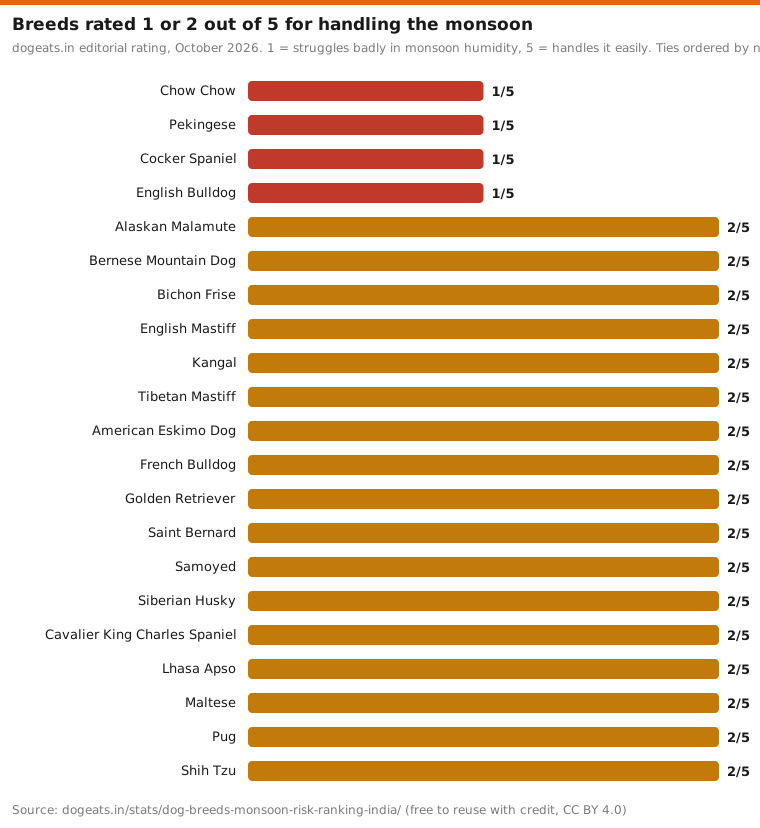
The Cocker Spaniel, English Bulldog, Pekingese and Chow Chow struggle most in the Indian monsoon, each scoring 1 out of 5 in our ratings of 58 breeds. Only the Indian Pariah Dog scores 5. 21 breeds (36%) score 2 or lower, mostly because of thick undercoats, long coats, drop ears or skin folds that stay damp.
Key findings
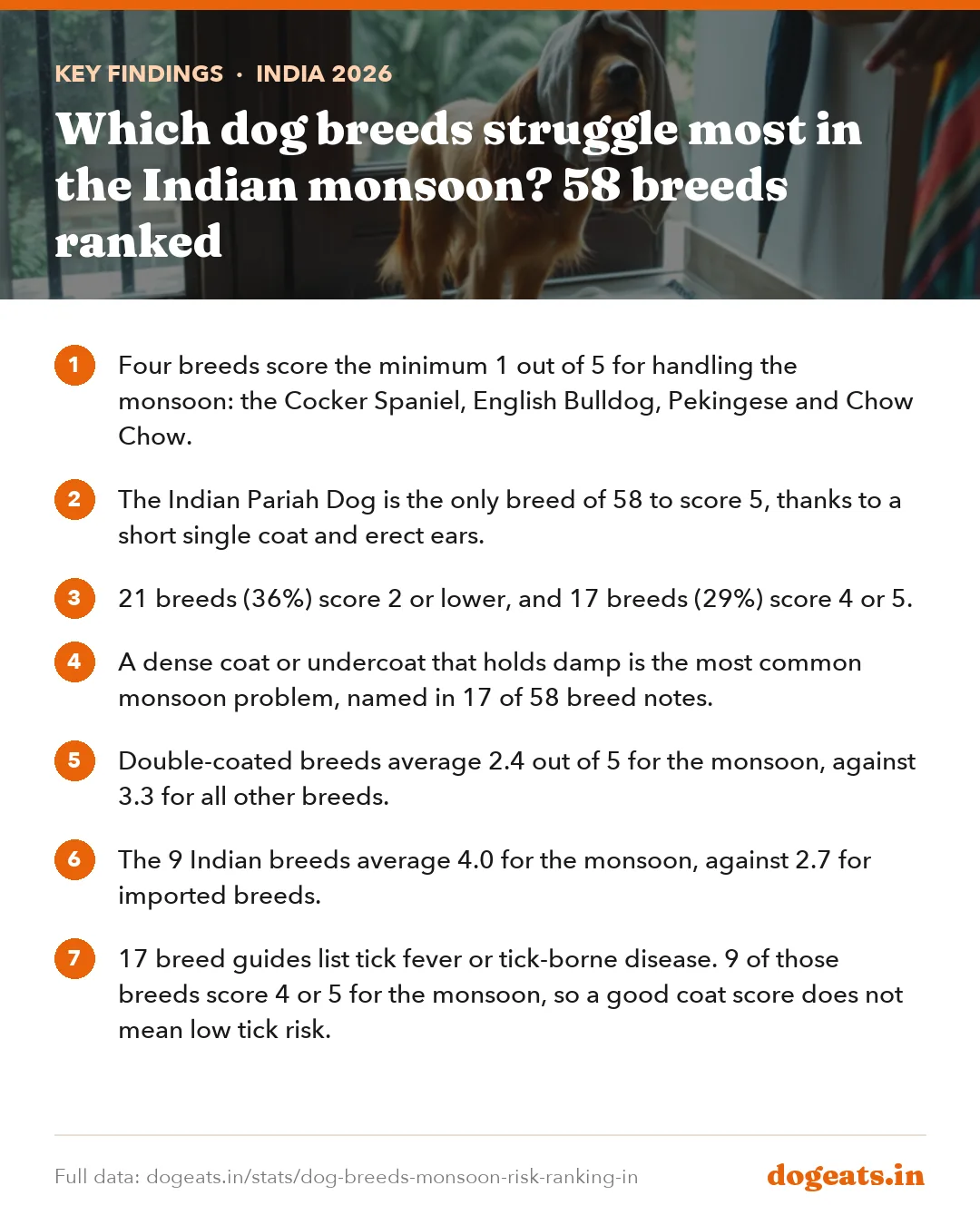
- Four breeds score the minimum 1 out of 5 for handling the monsoon: the Cocker Spaniel, English Bulldog, Pekingese and Chow Chow.
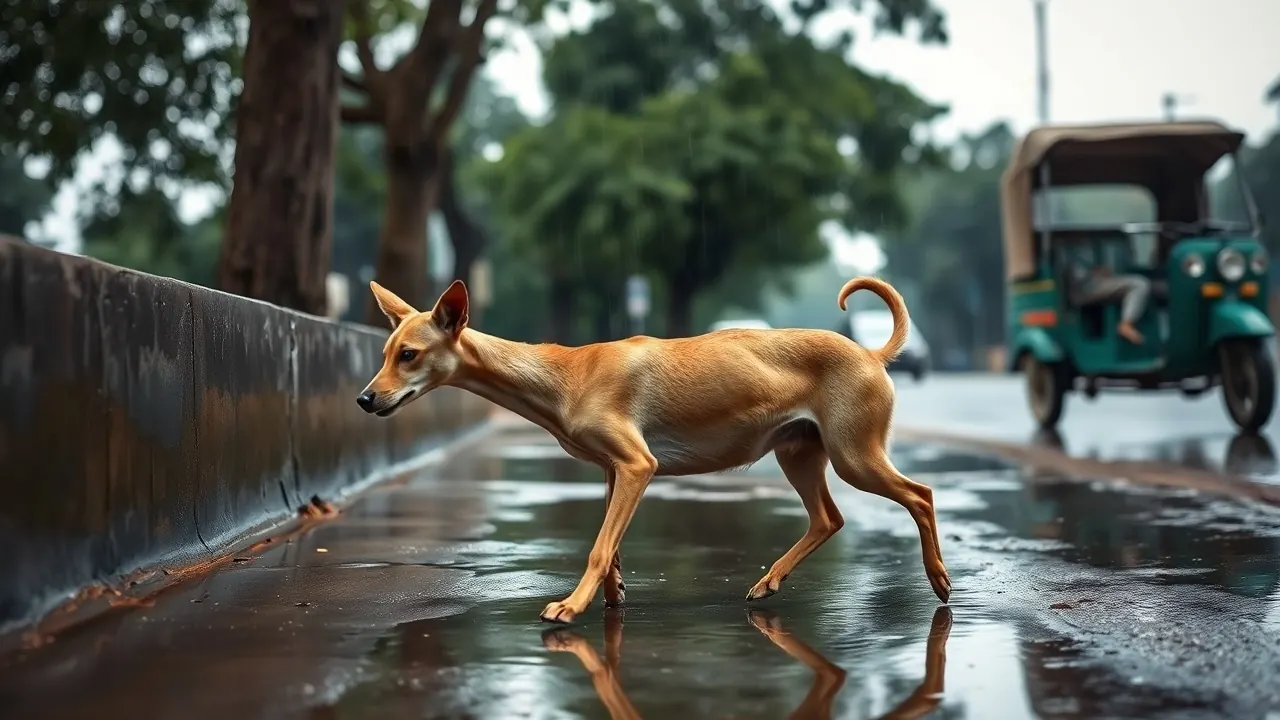
- The Indian Pariah Dog is the only breed of 58 to score 5, thanks to a short single coat and erect ears.
- 21 breeds (36%) score 2 or lower, and 17 breeds (29%) score 4 or 5.
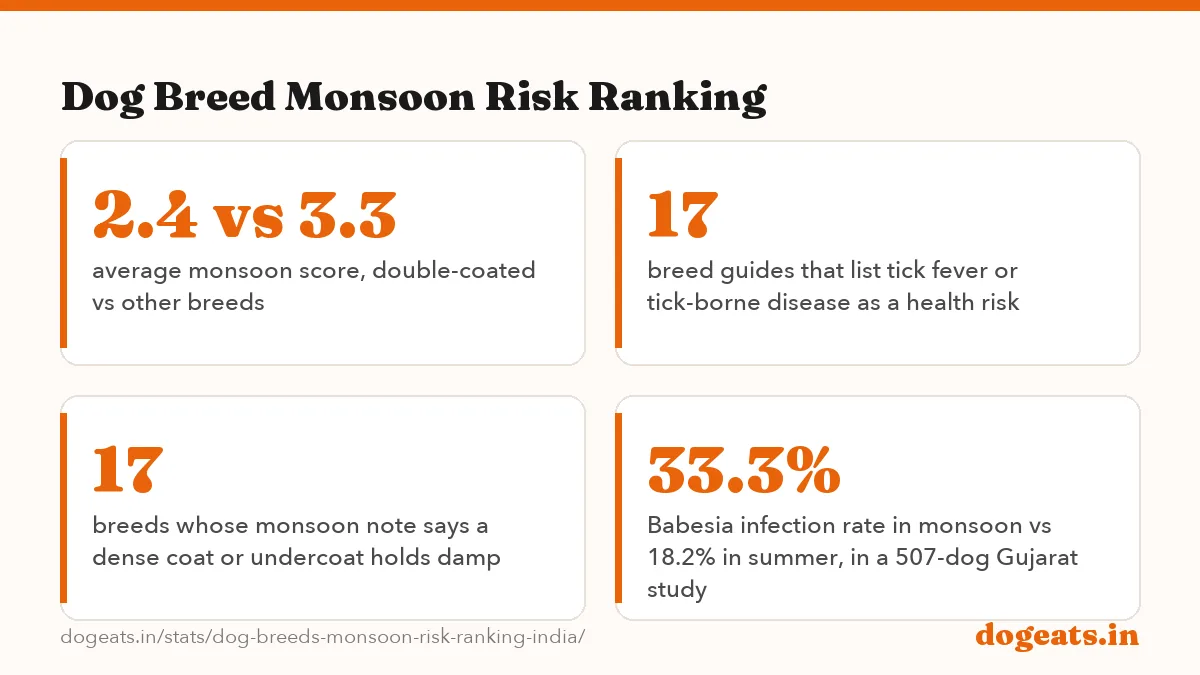
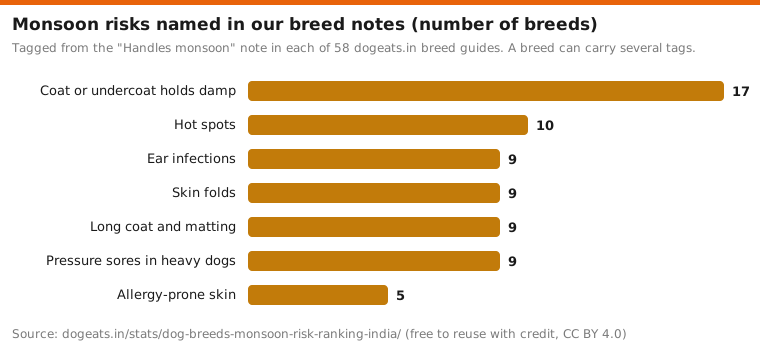
- A dense coat or undercoat that holds damp is the most common monsoon problem, named in 17 of 58 breed notes.
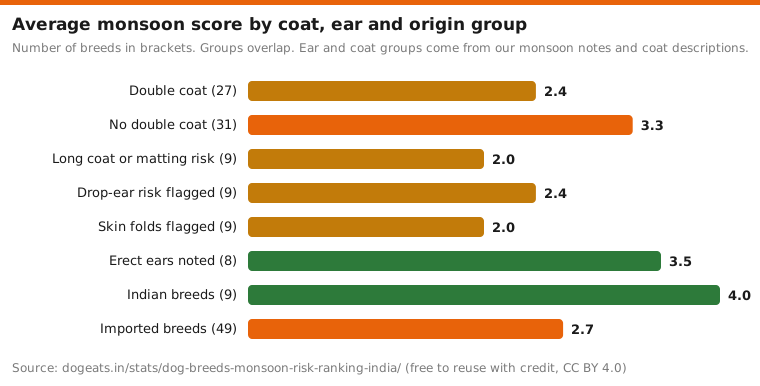
- Double-coated breeds average 2.4 out of 5 for the monsoon, against 3.3 for all other breeds.
- The 9 Indian breeds average 4.0 for the monsoon, against 2.7 for imported breeds.
- 17 breed guides list tick fever or tick-borne disease. 9 of those breeds score 4 or 5 for the monsoon, so a good coat score does not mean low tick risk.
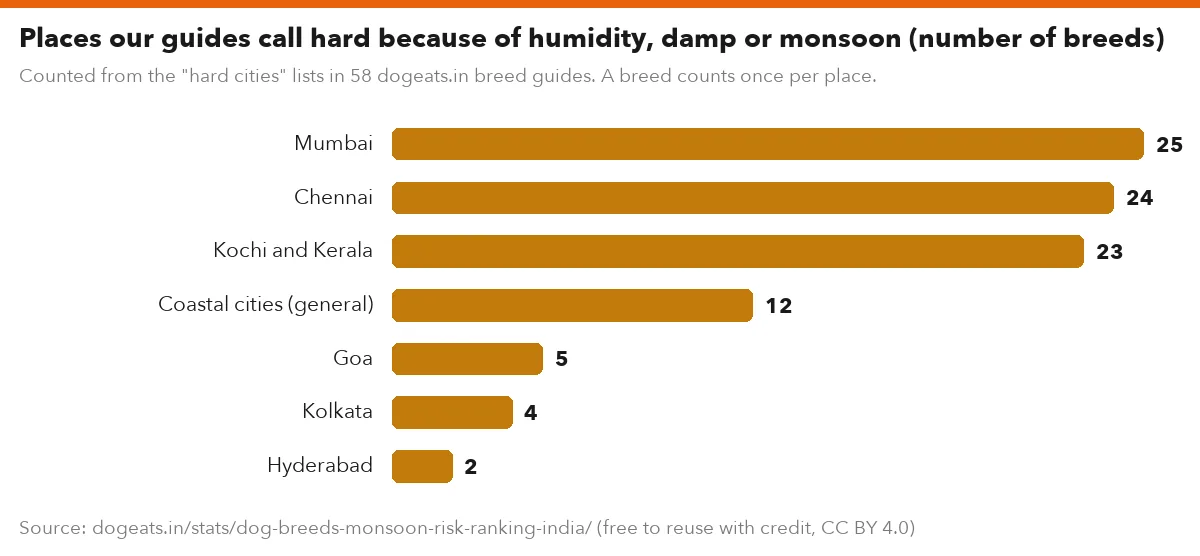
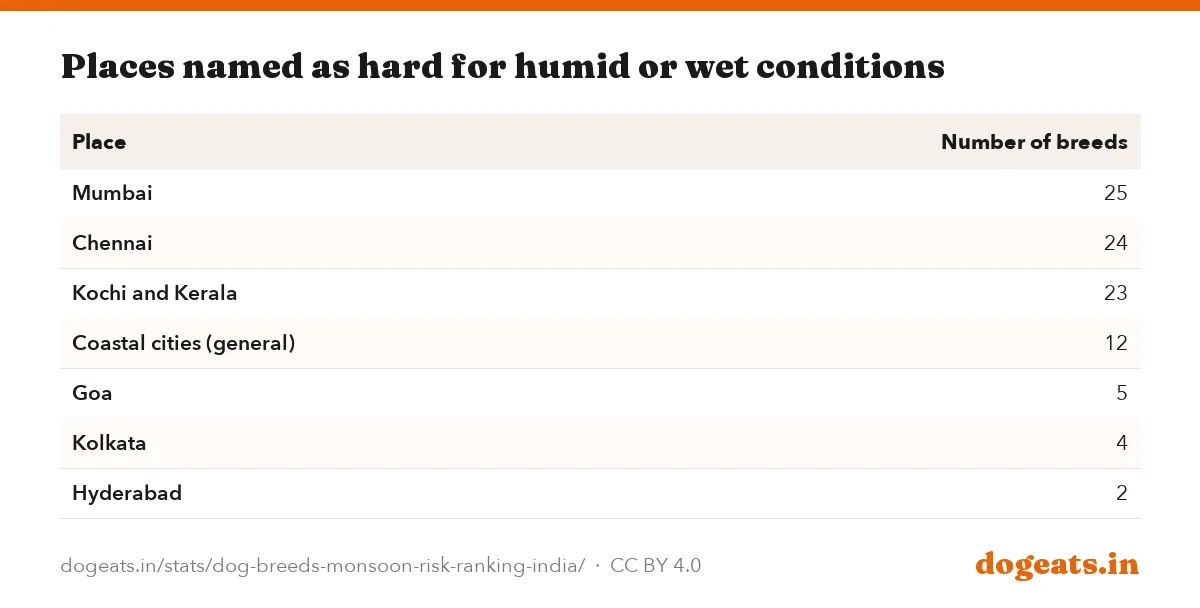
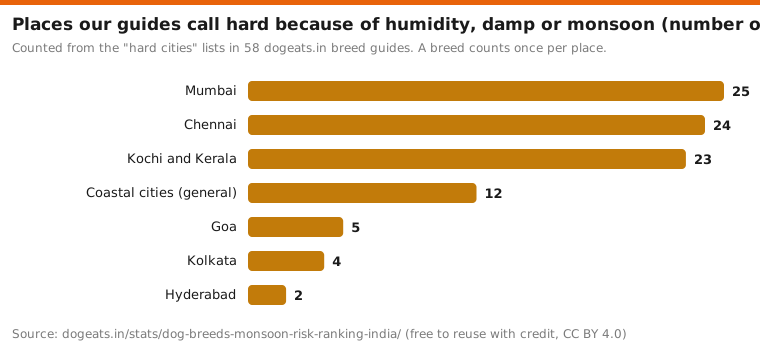
- Mumbai, Chennai and Kerala are the places our guides most often call hard for humidity or damp, named for 25, 24 and 23 breeds.
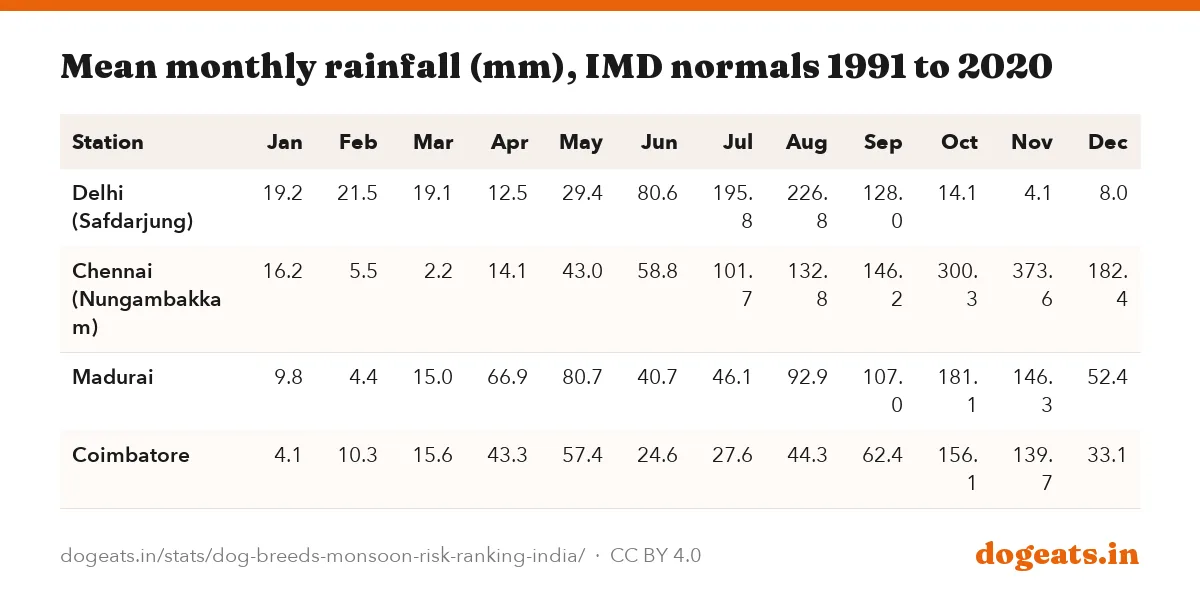
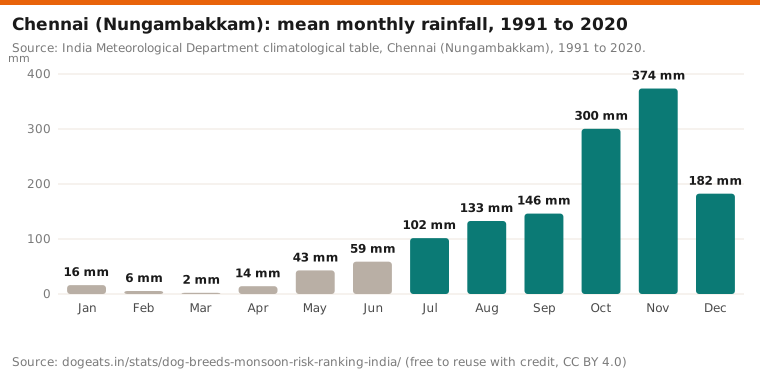
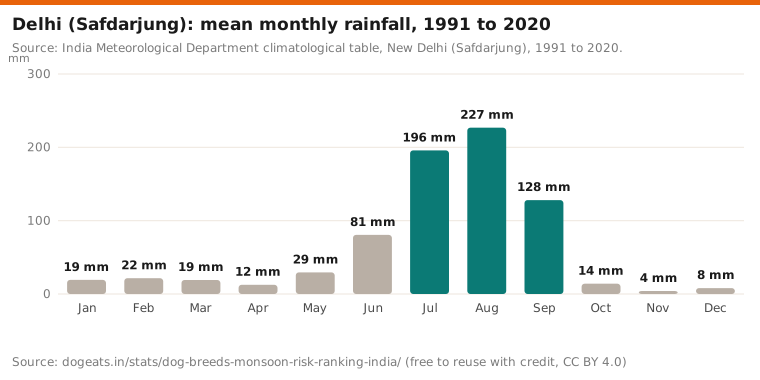
- IMD normals show Chennai gets 62% of its yearly rain in October to December, while Delhi gets 83% in June to September.
Which dog breeds struggle most in the monsoon?
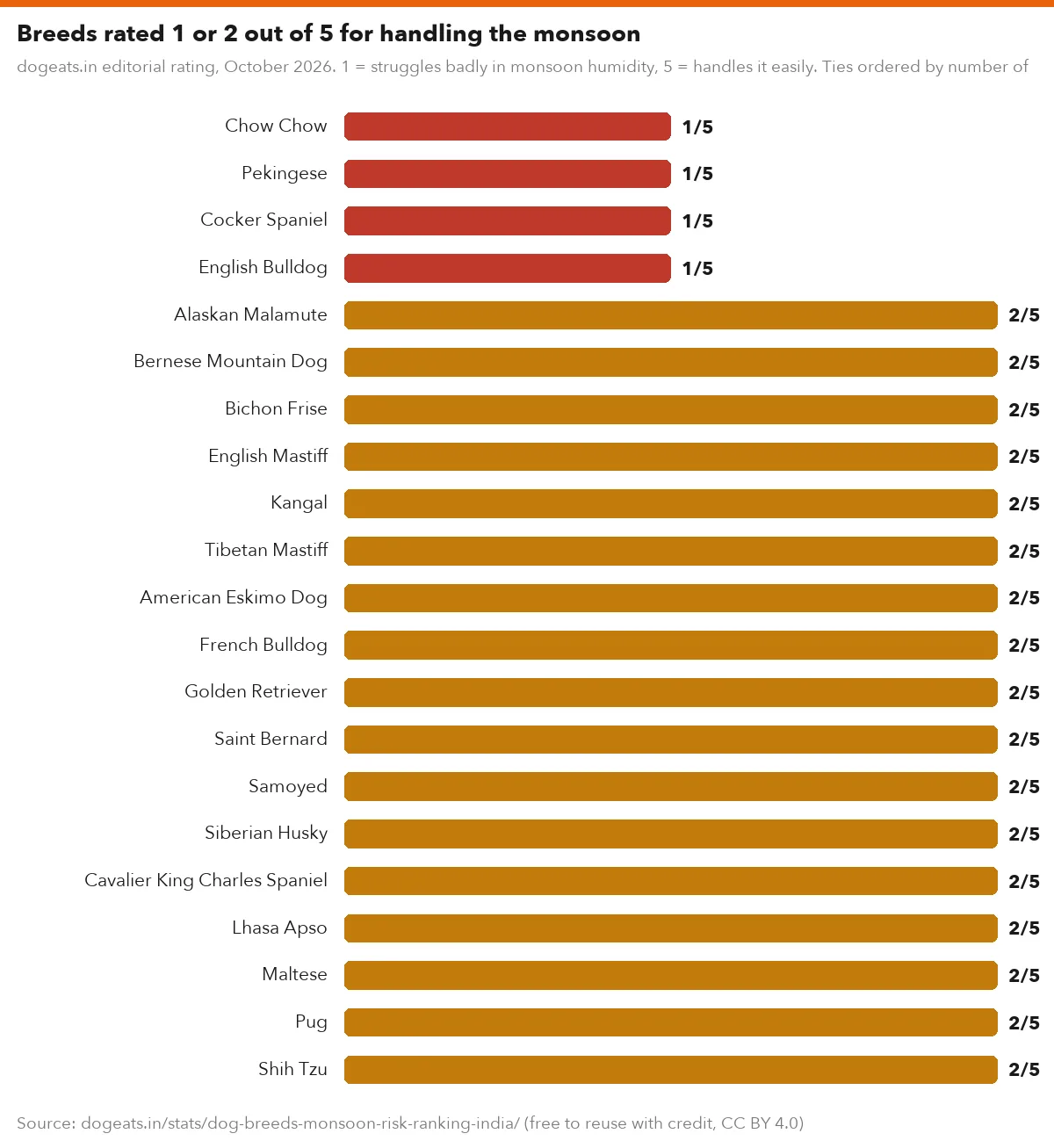
Four breeds score the minimum of 1 out of 5 for handling the Indian monsoon: the Cocker Spaniel, English Bulldog, Pekingese and Chow Chow. Our guide calls the Cocker Spaniel the worst monsoon breed on the list, because long hair-filled drop ears and a trailing coat meet constant humidity.
A further 17 breeds score 2. They include the Golden Retriever, Pug, Shih Tzu, Siberian Husky and Saint Bernard. At the other end, 17 breeds score 4 or 5, and only the Indian Pariah Dog scores the full 5.
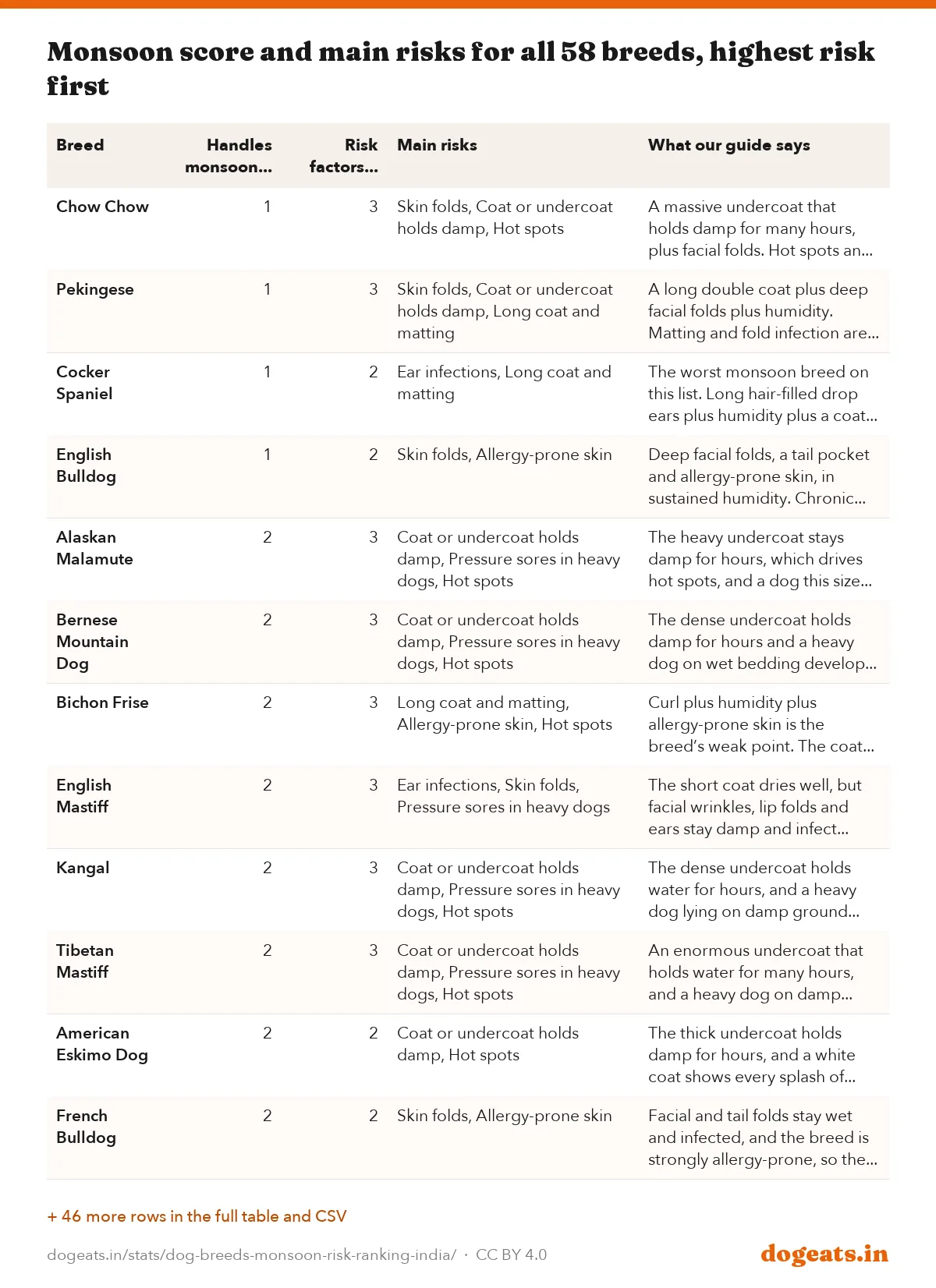
The chart shows every breed scored 1 or 2. The full table lists all 58 breeds with the main monsoon risks named in our guide for each one.
dogeats.in editorial rating, October 2026. 1 = struggles badly in monsoon humidity, 5 = handles it easily. Ties ordered by number of risk factors.
Show the numbers
| Label | score |
|---|---|
| Chow Chow | 1/5 |
| Pekingese | 1/5 |
| Cocker Spaniel | 1/5 |
| English Bulldog | 1/5 |
| Alaskan Malamute | 2/5 |
| Bernese Mountain Dog | 2/5 |
| Bichon Frise | 2/5 |
| English Mastiff | 2/5 |
| Kangal | 2/5 |
| Tibetan Mastiff | 2/5 |
| American Eskimo Dog | 2/5 |
| French Bulldog | 2/5 |
| Golden Retriever | 2/5 |
| Saint Bernard | 2/5 |
| Samoyed | 2/5 |
| Siberian Husky | 2/5 |
| Cavalier King Charles Spaniel | 2/5 |
| Lhasa Apso | 2/5 |
| Maltese | 2/5 |
| Pug | 2/5 |
| Shih Tzu | 2/5 |
Embed this chart
| Breed | Handles monsoon (1-5) | Risk factors flagged | Main risks | What our guide says |
|---|---|---|---|---|
| Chow Chow | 1 | 3 | Skin folds, Coat or undercoat holds damp, Hot spots | A massive undercoat that holds damp for many hours, plus facial folds. Hot spots and skin infection are the routine monsoon outcome. |
| Pekingese | 1 | 3 | Skin folds, Coat or undercoat holds damp, Long coat and matting | A long double coat plus deep facial folds plus humidity. Matting and fold infection are near-constant without daily work. |
| Cocker Spaniel | 1 | 2 | Ear infections, Long coat and matting | The worst monsoon breed on this list. Long hair-filled drop ears plus humidity plus a coat that drags through wet ground equals near-constant ear and skin problems. |
| English Bulldog | 1 | 2 | Skin folds, Allergy-prone skin | Deep facial folds, a tail pocket and allergy-prone skin, in sustained humidity. Chronic infection is the norm rather than the exception. |
| Alaskan Malamute | 2 | 3 | Coat or undercoat holds damp, Pressure sores in heavy dogs, Hot spots | The heavy undercoat stays damp for hours, which drives hot spots, and a dog this size on wet bedding develops sores. |
| Bernese Mountain Dog | 2 | 3 | Coat or undercoat holds damp, Pressure sores in heavy dogs, Hot spots | The dense undercoat holds damp for hours and a heavy dog on wet bedding develops sores and hot spots quickly. |
| Bichon Frise | 2 | 3 | Long coat and matting, Allergy-prone skin, Hot spots | Curl plus humidity plus allergy-prone skin is the breed’s weak point. The coat mats fast when damp and hot spots follow. |
| English Mastiff | 2 | 3 | Ear infections, Skin folds, Pressure sores in heavy dogs | The short coat dries well, but facial wrinkles, lip folds and ears stay damp and infect easily, and a heavy dog slips on wet floors. |
| Kangal | 2 | 3 | Coat or undercoat holds damp, Pressure sores in heavy dogs, Hot spots | The dense undercoat holds water for hours, and a heavy dog lying on damp ground gets hot spots and skin infections quickly. |
| Tibetan Mastiff | 2 | 3 | Coat or undercoat holds damp, Pressure sores in heavy dogs, Hot spots | An enormous undercoat that holds water for many hours, and a heavy dog on damp ground develops sores and hot spots. |
| American Eskimo Dog | 2 | 2 | Coat or undercoat holds damp, Hot spots | The thick undercoat holds damp for hours, and a white coat shows every splash of mud. Hot spots are a monsoon risk. |
| French Bulldog | 2 | 2 | Skin folds, Allergy-prone skin | Facial and tail folds stay wet and infected, and the breed is strongly allergy-prone, so the damp months are a constant skin battle. |
| Golden Retriever | 2 | 2 | Ear infections, Long coat and matting | A long coat plus drop ears is the worst monsoon combination. Ear infections and damp-coat skin trouble are near-universal without active drying. |
| Saint Bernard | 2 | 2 | Coat or undercoat holds damp, Pressure sores in heavy dogs | A dense coat on a giant dog holds damp for hours, and damp bedding under that weight causes sores and infections. |
| Samoyed | 2 | 2 | Coat or undercoat holds damp, Hot spots | The dense undercoat holds water for hours and a white coat shows every street mark, so hot spots and staining are both constant battles. |
| Siberian Husky | 2 | 2 | Coat or undercoat holds damp, Hot spots | The dense undercoat holds damp for a very long time, which drives hot spots and skin infections through the wet months. |
| Cavalier King Charles Spaniel | 2 | 1 | Ear infections | Long drop ears with heavy feathering, in humidity. Ear infections are the routine monsoon complaint from Indian Cavalier owners. |
| Lhasa Apso | 2 | 1 | Long coat and matting | A floor-length double coat in Indian monsoon mats and holds damp. A clipped coat is close to essential through the rains. |
| Maltese | 2 | 1 | Long coat and matting | A floor-length white coat and Indian streets are a poor combination. The hair wicks up dirty water and mats, so a clip is close to essential. |
| Pug | 2 | 1 | Skin folds | Facial folds stay damp and infected, and the skin between wrinkles needs daily attention through the wet months. |
| Shih Tzu | 2 | 1 | Long coat and matting | A floor-length coat in Indian monsoon is a constant battle with damp, matting and skin infection. A short cut is close to essential. |
| Rottweiler | 3 | 3 | Ear infections, Skin folds, Pressure sores in heavy dogs | The short coat dries reasonably, but skin fold and ear checks still matter and damp bedding causes problems fast in a heavy dog. |
| Bullmastiff | 3 | 2 | Ear infections, Skin folds | The short coat dries quickly, but facial wrinkles, lips and ears trap damp and need drying after every wet walk. |
| German Shepherd | 3 | 2 | Coat or undercoat holds damp, Hot spots | The thick undercoat holds damp for hours, which feeds hot spots and skin infections if the dog is not dried properly. |
| Australian Shepherd | 3 | 1 | Coat or undercoat holds damp | The coat is weather-resistant and dries reasonably, though the undercoat holds damp and the ruff and feathering need attention. |
| Beagle | 3 | 1 | Ear infections | Low-maintenance coat, but long drop ears trap moisture and ear infections are the breed's most common monsoon complaint. |
| Border Collie | 3 | 1 | Coat or undercoat holds damp | The rough coat holds damp and needs drying, though the smooth variety manages better and skin trouble is less common than in heavier coats. |
| Bull Terrier | 3 | 1 | Allergy-prone skin | The coat dries fast. Damp weather can flare the skin allergies the breed is prone to, so dry the belly and feet after walks. |
| Bully Kutta | 3 | 1 | Pressure sores in heavy dogs | A minimal coat dries fast, though a dog this heavy on damp ground develops pressure sores and skin infections. |
| Dachshund | 3 | 1 | Ear infections | Low-slung bodies get soaked and muddy on wet walks, and drop ears need checking, but the coat dries quickly in smooths. |
| Dogo Argentino | 3 | 1 | Skin folds | The short coat dries fast, but damp skin folds on the neck and itchy, sensitive skin need checking after wet walks. |
| German Spitz | 3 | 1 | Coat or undercoat holds damp | The coat holds damp and the ruff dries slowly, though erect ears ventilate well so ear infections are uncommon. |
| Great Dane | 3 | 1 | Pressure sores in heavy dogs | The short coat dries fast, but a 60 kg dog on damp bedding develops pressure sores and hygromas on the elbows. |
| Labrador Retriever | 3 | 1 | Ear infections | Drop ears trap moisture, so ear infections and damp skin are the monsoon pattern. Dry the ears and coat fully after every wet walk. |
| Pembroke Welsh Corgi | 3 | 1 | Coat or undercoat holds damp | The outer coat is weather-resistant, but the low belly gets soaked on every wet walk and the undercoat must be dried to the skin. |
| Pomeranian | 3 | 1 | Coat or undercoat holds damp | The coat holds damp and the ruff takes hours to dry, but erect ears ventilate well so ear infections are rarer than in drop-eared breeds. |
| Poodle | 3 | 1 | Long coat and matting | The curl holds water and mats fast when damp, so a short clip and thorough drying are needed, but there is no undercoat to stay wet for hours. |
| Shiba Inu | 3 | 1 | Coat or undercoat holds damp | The harsh outer coat sheds water reasonably and erect ears ventilate well, though the undercoat holds damp. |
| Yorkshire Terrier | 3 | 1 | Long coat and matting | The silky coat dries quickly and erect ears ventilate, though a long coat drags through wet streets and mats. |
| Chihuahua | 3 | 0 | None flagged | The tiny body loses heat fast when wet and they get cold, so a jacket and quick drying matter, but there is no heavy coat to hold damp. |
| Japanese Spitz | 3 | 0 | None flagged | The coat has an unusually non-stick texture that sheds mud and dries better than most double coats, and erect ears ventilate well. |
| Pit Bull | 4 | 1 | Allergy-prone skin | Almost nothing holds water and the coat dries in minutes. Watch for skin infections in dogs that already have allergies. |
| Belgian Malinois | 4 | 0 | None flagged | Minimal coat that dries quickly with little undercoat to hold damp. Skin trouble is uncommon. |
| Boxer | 4 | 0 | None flagged | The short tight coat dries fast and there is no undercoat to hold damp. Monsoon is the easy season for a Boxer. |
| Cane Corso | 4 | 0 | None flagged | The short stiff coat dries quickly and there is little undercoat to hold damp, so monsoon is comparatively easy. |
| Chippiparai | 4 | 0 | None flagged | The very short fine coat dries almost instantly and there is nothing to hold damp, so monsoon skin problems are rare. |
| Dalmatian | 4 | 0 | None flagged | The short hard coat dries quickly with no undercoat to hold damp, so monsoon is the easier season. |
| Doberman | 4 | 0 | None flagged | Almost nothing to hold damp. The coat dries in minutes and skin trouble is uncommon compared with double-coated guarding breeds. |
| Indian Spitz | 4 | 0 | None flagged | Erect ears ventilate well and the coat is less dense than a Pomeranian, so ear and skin problems are far less common. |
| Jack Russell Terrier | 4 | 0 | None flagged | Minimal coat that dries fast, no undercoat to stay damp and erect-set ears that ventilate. Monsoon is an easy season here. |
| Kanni | 4 | 0 | None flagged | The very short fine coat dries almost instantly and there is no undercoat to hold damp, so skin problems are rare. |
| Kombai | 4 | 0 | None flagged | The minimal coat dries almost instantly, and there is no undercoat or drop ear to cause the usual monsoon problems. |
| Miniature Pinscher | 4 | 0 | None flagged | Nothing to hold damp, and the coat dries almost instantly. Monsoon skin and ear problems are uncommon. |
| Mudhol Hound | 4 | 0 | None flagged | A short coat dries almost instantly and there is no undercoat to hold damp, so monsoon skin problems are rare. |
| Rajapalayam | 4 | 0 | None flagged | A fine short coat dries almost immediately with no undercoat to hold damp. |
| Rampur Greyhound | 4 | 0 | None flagged | A very short fine coat that dries almost instantly, with nothing to hold damp. |
| Rhodesian Ridgeback | 4 | 0 | None flagged | Minimal coat that dries in minutes with no undercoat to hold damp. Skin trouble is uncommon. |
| Indian Pariah Dog | 5 | 0 | None flagged | A short single coat dries fast and erect ears stay ventilated. Monsoon skin and ear problems are far rarer than in imported breeds. |
The ranking is not the same as our heat ranking. The Boxer scores 2 for heat but 4 for the monsoon, because a short tight coat dries fast. The Cocker Spaniel scores 3 for heat but 1 for the monsoon. Read our heat risk ranking alongside this one.
The health problems damp causes
Damp that does not dry is the root of most monsoon trouble. We read the monsoon note in each of our 58 breed guides and tagged the risks each one names.
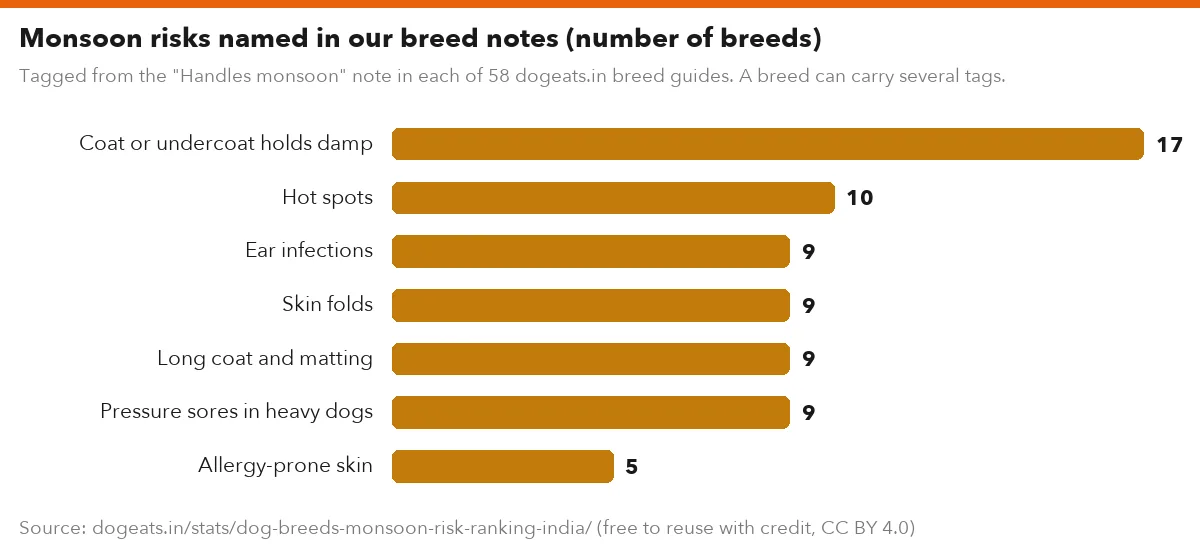
A dense coat or undercoat that holds damp leads the list, named for 17 breeds. Hot spots follow at 10. Ear infections, skin folds, pressure sores and long-coat matting are named for 9 breeds each.
18 breeds have no risk flagged in their monsoon note. Almost all are short-coated dogs whose notes say the coat dries in minutes.
Tagged from the "Handles monsoon" note in each of 58 dogeats.in breed guides. A breed can carry several tags.
Show the numbers
| Label | breeds |
|---|---|
| Coat or undercoat holds damp | 17 |
| Hot spots | 10 |
| Ear infections | 9 |
| Skin folds | 9 |
| Long coat and matting | 9 |
| Pressure sores in heavy dogs | 9 |
| Allergy-prone skin | 5 |
Embed this chart
- Coat or undercoat holds damp: the hair next to the skin stays wet for hours after a walk, and bacteria and yeast multiply in it.
- Hot spots: red, weeping patches of skin that can spread fast under a damp coat.
- Ear infections: drop ears trap warm, wet air. Erect ears ventilate.
- Skin folds: facial, lip and tail folds stay moist and infect, as in the Pug, French Bulldog and English Bulldog.
- Pressure sores: heavy dogs lying on damp bedding or floors develop sores and elbow hygromas.
- Matting: long or curly coats mat when wet, and the skin under a mat cannot dry.
The breeds with three flags are the Chow Chow, Pekingese, Alaskan Malamute, Bernese Mountain Dog, Bichon Frise, English Mastiff, Kangal, Tibetan Mastiff and Rottweiler. Their monsoon care is daily work rather than an occasional towel.
Coat type decides most scores
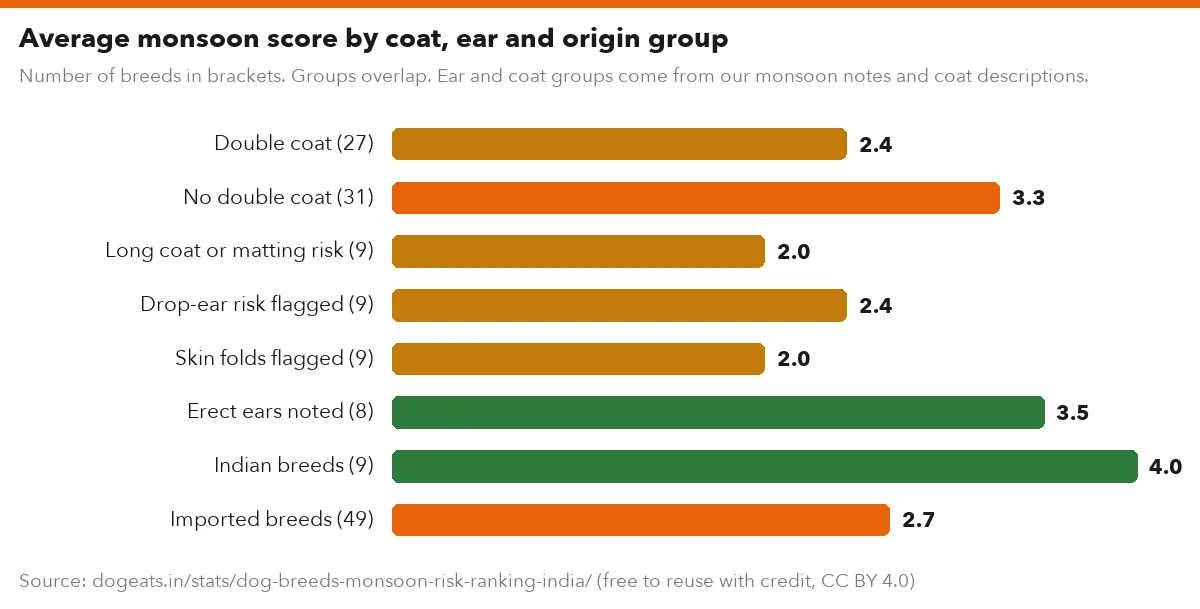
The 27 double-coated breeds average 2.4 out of 5. The other 31 average 3.3.
Ears matter too. The 9 breeds whose notes flag drop-ear infections average 2.4. The 8 breeds whose notes mention erect, ventilated ears average 3.5.
Indian breeds do best as a group, averaging 4.0 against 2.7 for imported breeds. Eight of the nine score 4 or 5. The Bully Kutta scores 3, because our guide warns that a dog that heavy gets pressure sores on damp ground.
Number of breeds in brackets. Groups overlap. Ear and coat groups come from our monsoon notes and coat descriptions.
Show the numbers
| Label | score |
|---|---|
| Double coat (27) | 2.4 |
| No double coat (31) | 3.3 |
| Long coat or matting risk (9) | 2.0 |
| Drop-ear risk flagged (9) | 2.4 |
| Skin folds flagged (9) | 2.0 |
| Erect ears noted (8) | 3.5 |
| Indian breeds (9) | 4.0 |
| Imported breeds (49) | 2.7 |
Embed this chart
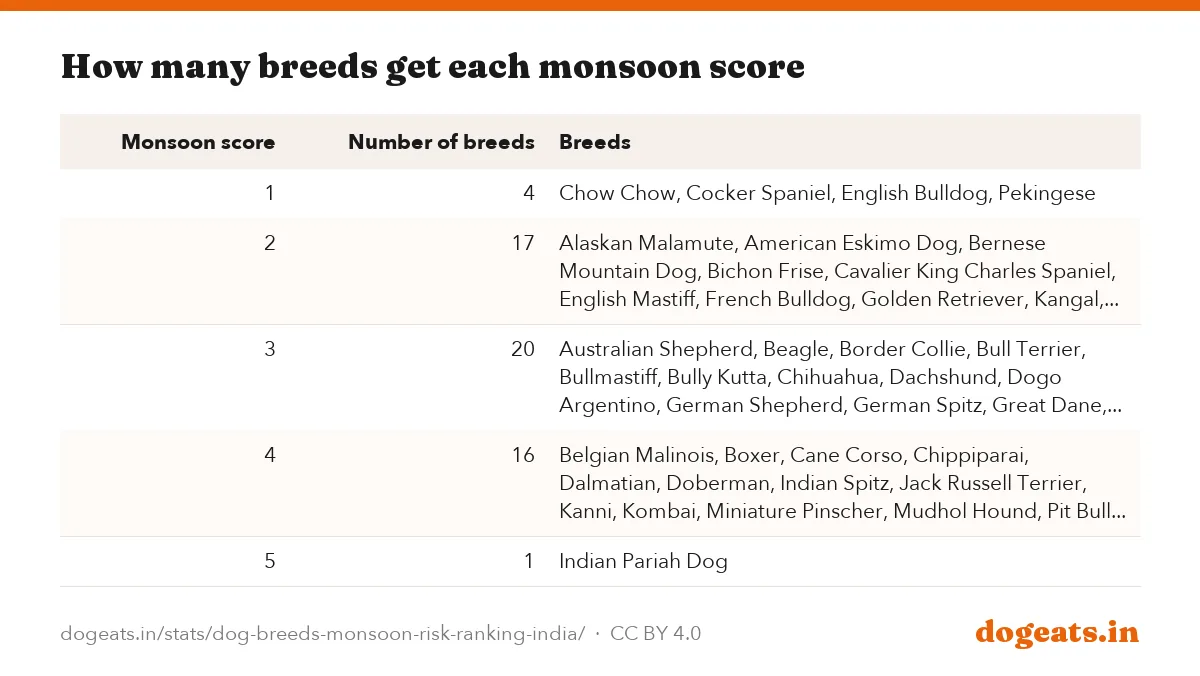
| Monsoon score | Number of breeds | Breeds |
|---|---|---|
| 1 | 4 | Chow Chow, Cocker Spaniel, English Bulldog, Pekingese |
| 2 | 17 | Alaskan Malamute, American Eskimo Dog, Bernese Mountain Dog, Bichon Frise, Cavalier King Charles Spaniel, English Mastiff, French Bulldog, Golden Retriever, Kangal, Lhasa Apso, Maltese, Pug, Saint Bernard, Samoyed, Shih Tzu, Siberian Husky, Tibetan Mastiff |
| 3 | 20 | Australian Shepherd, Beagle, Border Collie, Bull Terrier, Bullmastiff, Bully Kutta, Chihuahua, Dachshund, Dogo Argentino, German Shepherd, German Spitz, Great Dane, Japanese Spitz, Labrador Retriever, Pembroke Welsh Corgi, Pomeranian, Poodle, Rottweiler, Shiba Inu, Yorkshire Terrier |
| 4 | 16 | Belgian Malinois, Boxer, Cane Corso, Chippiparai, Dalmatian, Doberman, Indian Spitz, Jack Russell Terrier, Kanni, Kombai, Miniature Pinscher, Mudhol Hound, Pit Bull, Rajapalayam, Rampur Greyhound, Rhodesian Ridgeback |
| 5 | 1 | Indian Pariah Dog |
Some double coats do better than others. The Japanese Spitz scores 3 because our guide describes an unusually non-stick coat that sheds mud. The Indian Spitz scores 4, against 3 for the Pomeranian, because its coat is less dense.
Long single coats are a separate case. The Maltese, Shih Tzu and Lhasa Apso all score 2, and our guides call a short clip close to essential through the rains.
Are ticks worse for dogs in the monsoon?
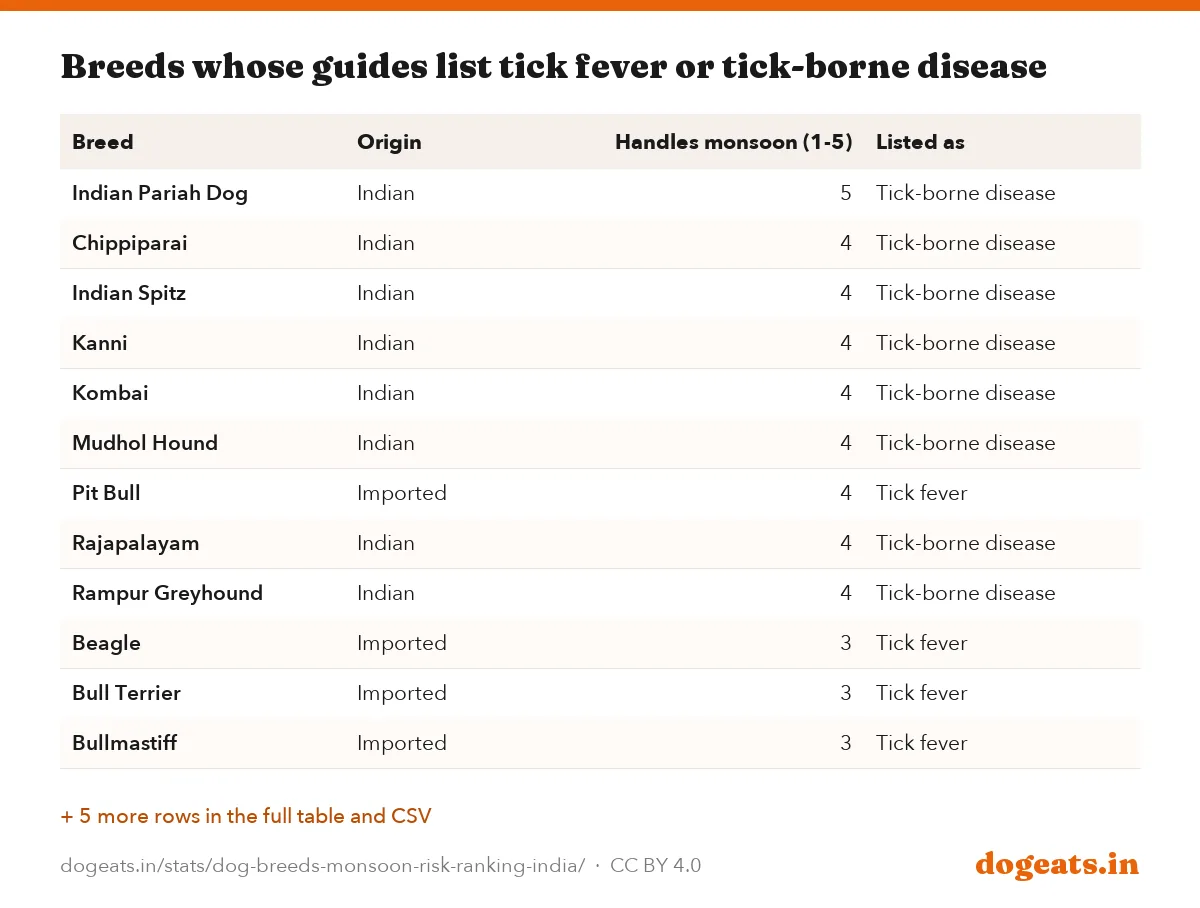
Tick-borne disease is the risk a good monsoon score does not cover. 17 of our 58 breed guides list tick fever or tick-borne disease as a breed health risk. 9 of those breeds score 4 or 5 for handling the monsoon.
Tick exposure depends on where a dog walks and lies, not on how fast its coat dries. Short-coated Indian breeds that spend time outdoors and on open ground are exposed too.
Indian research supports a monsoon rise. A study of 507 dogs in Ahmedabad and Gandhinagar, published in The Indian Veterinary Journal in 2023, found Babesia in 21.89% of dogs tested. Infection was highest in the monsoon at 33.33% and lowest in summer at 18.21%.
| Breed | Origin | Handles monsoon (1-5) | Listed as |
|---|---|---|---|
| Indian Pariah Dog | Indian | 5 | Tick-borne disease |
| Chippiparai | Indian | 4 | Tick-borne disease |
| Indian Spitz | Indian | 4 | Tick-borne disease |
| Kanni | Indian | 4 | Tick-borne disease |
| Kombai | Indian | 4 | Tick-borne disease |
| Mudhol Hound | Indian | 4 | Tick-borne disease |
| Pit Bull | Imported | 4 | Tick fever |
| Rajapalayam | Indian | 4 | Tick-borne disease |
| Rampur Greyhound | Indian | 4 | Tick-borne disease |
| Beagle | Imported | 3 | Tick fever |
| Bull Terrier | Imported | 3 | Tick fever |
| Bullmastiff | Imported | 3 | Tick fever |
| Dogo Argentino | Imported | 3 | Tick fever |
| German Shepherd | Imported | 3 | Tick fever (ehrlichiosis, babesiosis) |
| Labrador Retriever | Imported | 3 | Tick fever (ehrlichiosis, babesiosis) |
| Rottweiler | Imported | 3 | Tick fever |
| Kangal | Imported | 2 | Tick fever |
Seasonal patterns differ between studies and regions, so treat the Gujarat figures as one local measure, not a national rate. Tick fever (ehrlichiosis and babesiosis) needs a vet and a blood test. Ask your vet which tick prevention suits your dog before the rains start.
The wet months differ by region
For most of India the southwest monsoon runs from June to September. IMD gives 1 June as the normal date of onset over Kerala.
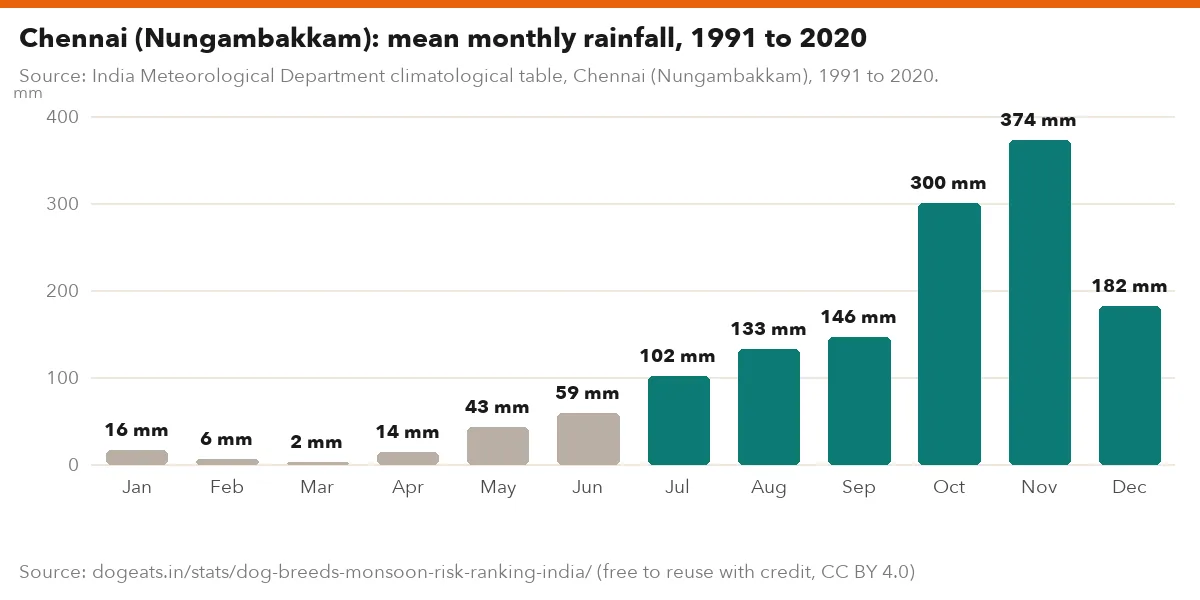
Tamil Nadu is different. IMD normals for Chennai (Nungambakkam) show 62% of the city's yearly rain falls in October, November and December. November is the wettest month, at 373.6 mm over 11.3 rainy days on average.
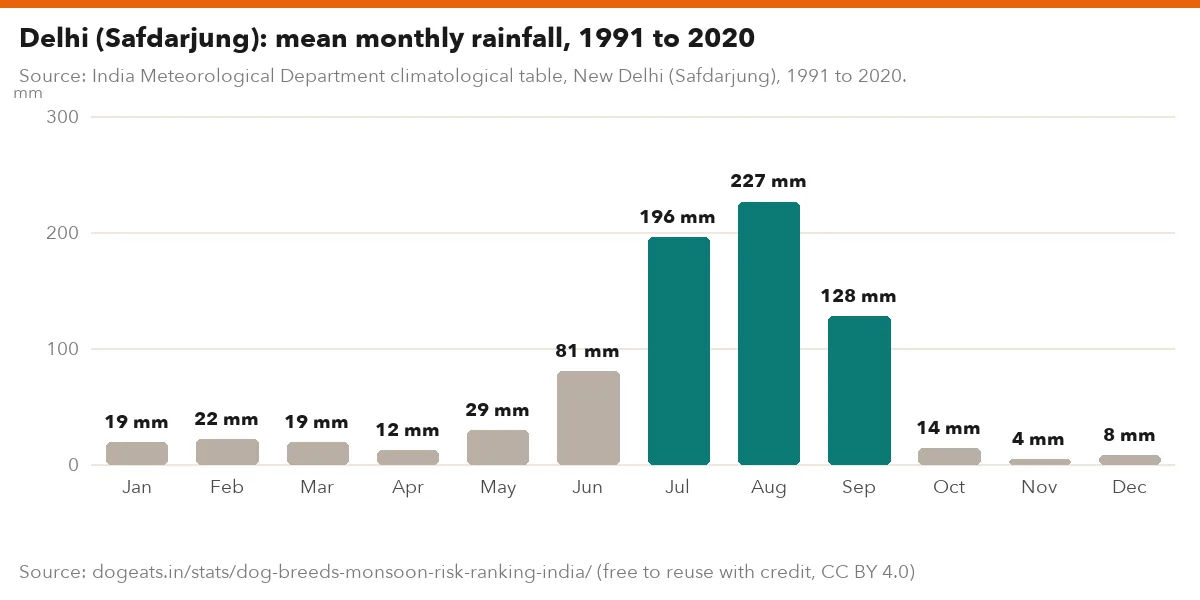
Delhi follows the classic pattern. It gets 83% of its rain from June to September, with August the wettest at 226.8 mm.
Source: India Meteorological Department climatological table, Chennai (Nungambakkam), 1991 to 2020.
Show the numbers
| Label | mm |
|---|---|
| Jan | 16 mm |
| Feb | 6 mm |
| Mar | 2 mm |
| Apr | 14 mm |
| May | 43 mm |
| Jun | 59 mm |
| Jul | 102 mm |
| Aug | 133 mm |
| Sep | 146 mm |
| Oct | 300 mm |
| Nov | 374 mm |
| Dec | 182 mm |
Embed this chart
Source: India Meteorological Department climatological table, New Delhi (Safdarjung), 1991 to 2020.
Show the numbers
| Label | mm |
|---|---|
| Jan | 19 mm |
| Feb | 22 mm |
| Mar | 19 mm |
| Apr | 12 mm |
| May | 29 mm |
| Jun | 81 mm |
| Jul | 196 mm |
| Aug | 227 mm |
| Sep | 128 mm |
| Oct | 14 mm |
| Nov | 4 mm |
| Dec | 8 mm |
Embed this chart
| Station | Jan | Feb | Mar | Apr | May | Jun | Jul | Aug | Sep | Oct | Nov | Dec |
|---|---|---|---|---|---|---|---|---|---|---|---|---|
| Delhi (Safdarjung) | 19.2 | 21.5 | 19.1 | 12.5 | 29.4 | 80.6 | 195.8 | 226.8 | 128.0 | 14.1 | 4.1 | 8.0 |
| Chennai (Nungambakkam) | 16.2 | 5.5 | 2.2 | 14.1 | 43.0 | 58.8 | 101.7 | 132.8 | 146.2 | 300.3 | 373.6 | 182.4 |
| Madurai | 9.8 | 4.4 | 15.0 | 66.9 | 80.7 | 40.7 | 46.1 | 92.9 | 107.0 | 181.1 | 146.3 | 52.4 |
| Coimbatore | 4.1 | 10.3 | 15.6 | 43.3 | 57.4 | 24.6 | 27.6 | 44.3 | 62.4 | 156.1 | 139.7 | 33.1 |
So the wet-coat season for a Chennai or Madurai dog peaks in October and November, when much of the north has dried out. Plan grooming clips and tick checks around your own city's calendar.
Humid cities that are hard on dogs
We searched the "hard cities" lines in all 58 breed guides for humidity, damp, wet and monsoon. 48 lines matched.
Mumbai appears for 25 breeds, Chennai for 24 and Kochi or Kerala for 23. Our guides also name coastal cities in general for 12 breeds.
Many of these lines pair heat with humidity, so Chennai's count reflects its sticky summers as much as its rains. Lines that name Mumbai, Kerala or Goa without Chennai mostly describe damp coats, ears and skin.
Counted from the "hard cities" lists in 58 dogeats.in breed guides. A breed counts once per place.
Show the numbers
| Label | breeds |
|---|---|
| Mumbai | 25 |
| Chennai | 24 |
| Kochi and Kerala | 23 |
| Coastal cities (general) | 12 |
| Goa | 5 |
| Kolkata | 4 |
| Hyderabad | 2 |
Embed this chart
| Place | Number of breeds |
|---|---|
| Mumbai | 25 |
| Chennai | 24 |
| Kochi and Kerala | 23 |
| Coastal cities (general) | 12 |
| Goa | 5 |
| Kolkata | 4 |
| Hyderabad | 2 |
For city-by-city breed advice across the whole year, see our best dog breeds by Indian city report.
Protecting a high-risk breed through the rains
The fix is the same for nearly every low-scoring breed: get the dog dry to the skin after every wet walk. Our monsoon dog care guide covers feeding, paws and hygiene in detail.
- Dry ears inside and out after every walk for drop-eared breeds such as the Cocker Spaniel, Beagle, Labrador and Cavalier.
- Wipe and dry skin folds daily for the Pug, French Bulldog, English Bulldog, Pekingese and mastiffs.
- Use a dryer on low heat, or towel in sections, until the undercoat is dry at the skin for double-coated breeds.
- Keep long coats in a short clip through the rains: Shih Tzu, Lhasa Apso, Maltese, Poodle and Bichon Frise.
- Give giant breeds raised or thick dry bedding, and change damp bedding the same day.
- Check every dog for ticks after every walk, including short-coated Indian breeds.
- See a vet for a red, weeping patch, a smelly ear, head shaking or a fever. Do not treat hot spots or ear infections at home without advice.
Frequently asked questions
Which dog breed is worst for the Indian monsoon?
Four breeds score 1 out of 5 in our ratings: the Cocker Spaniel, English Bulldog, Pekingese and Chow Chow. Our guide calls the Cocker Spaniel the worst monsoon breed on the list because its long drop ears and trailing coat stay damp. Ear and skin infections are close to constant without daily drying.
Which dog breed is best for the monsoon in India?
The Indian Pariah Dog is the only breed of 58 we rate 5 out of 5. A short single coat dries fast and erect ears stay ventilated. Seven other Indian breeds score 4, as do imported short-coated breeds such as the Doberman, Boxer, Dalmatian and Jack Russell Terrier.
Do Labradors get ear infections in the monsoon?
Often, yes. The Labrador scores 3 out of 5 for the monsoon, and our guide says drop ears trap moisture, so ear infections and damp skin are the monsoon pattern. Dry the ears and coat fully after every wet walk, and see a vet for any smell or head shaking.
Should I shave my dog for the monsoon?
A short clip helps long single-coated breeds such as the Shih Tzu, Lhasa Apso, Maltese and Poodle, and our guides call it close to essential. Double-coated breeds need thorough drying and brushing rather than a shave. Ask your groomer or vet first.
Why do dogs get hot spots in the rainy season?
A coat that stays damp against the skin lets bacteria multiply, which causes red, weeping patches called hot spots. Our breed notes name hot spots for 10 of 58 breeds, mostly heavy double-coated ones such as the Husky, Samoyed and Bernese. Get them checked by a vet, since they spread quickly.
Is tick fever more common in the monsoon?
Some Indian data says so. A 2023 study of 507 dogs in Ahmedabad and Gandhinagar found Babesia infection at 33.33% in the monsoon against 18.21% in summer. Seventeen of our 58 breed guides list tick fever or tick-borne disease, so check every dog after walks.
When does the monsoon start for dog owners in Chennai?
Later than the rest of India. IMD normals for 1991 to 2020 show Chennai gets 62% of its yearly rain in October to December, with November the wettest month at 373.6 mm. Plan clips and tick checks for those months.
Are Indian dog breeds better in the monsoon?
On our ratings, yes. The nine Indian breeds average 4.0 out of 5 for the monsoon against 2.7 for imported breeds. Eight of the nine score 4 or 5, and only the giant Bully Kutta scores 3.
Methodology and limitations
The ranking covers the 58 breeds with full guides on dogeats.in. "Handles monsoon" is a dogeats.in editorial rating from 1 to 5, set from coat type, ear shape, skin folds, size and known breed health problems.
Breeds are ranked by that score, lowest first. Ties are ordered by how many monsoon risks the breed's note names. We tagged seven risks: a coat or undercoat that holds damp, hot spots, ear infections, skin folds, pressure sores in heavy dogs, long coats and matting, and allergy-prone skin.
Tick risk comes from the health list in each guide. The city count searches each guide's "hard cities" list for humidity, damp, wet or monsoon, and counts each breed once per place.
Rainfall normals come from India Meteorological Department climatological tables for 1991 to 2020. The Kerala onset date comes from IMD's May 2020 press release on monsoon onset and new normal dates.
Sources
- Singh et al., The Indian Veterinary Journal (2023): Prevalence and risk factors of canine babesiosis in Ahmadabad and Gandhinagar, Babesia in 21.89% of 507 dogs; 33.33% in monsoon vs 18.21% in summer
- India Meteorological Department, Chennai (Nungambakkam) climatological table 1991 to 2020, Chennai monthly rainfall and rainy days
- India Meteorological Department, New Delhi (Safdarjung) climatological table 1991 to 2020, Delhi monthly rainfall and rainy days
- Also consulted: India Meteorological Department press release, 15 May 2020, India Meteorological Department, Madurai climatological table 1991 to 2020, India Meteorological Department, Coimbatore climatological table 1991 to 2020, dogeats.in breed guides (58 breeds), October 2026.
Cite, embed and download
This report, its data and its images are free to reuse under a Creative Commons Attribution 4.0 licence. Credit dogeats.in with a link to this page. Every chart has its own embed code, every table has a CSV and an image download, and the images below are ready for social posts, slides and articles.
Cite this report
Link to this report
Every chart and table as an image