Data report · Updated October 2026
Vegetarian and Vegan Diets for Dogs: What the Studies Show, and What Indian Veg Dog Food Really Supplies
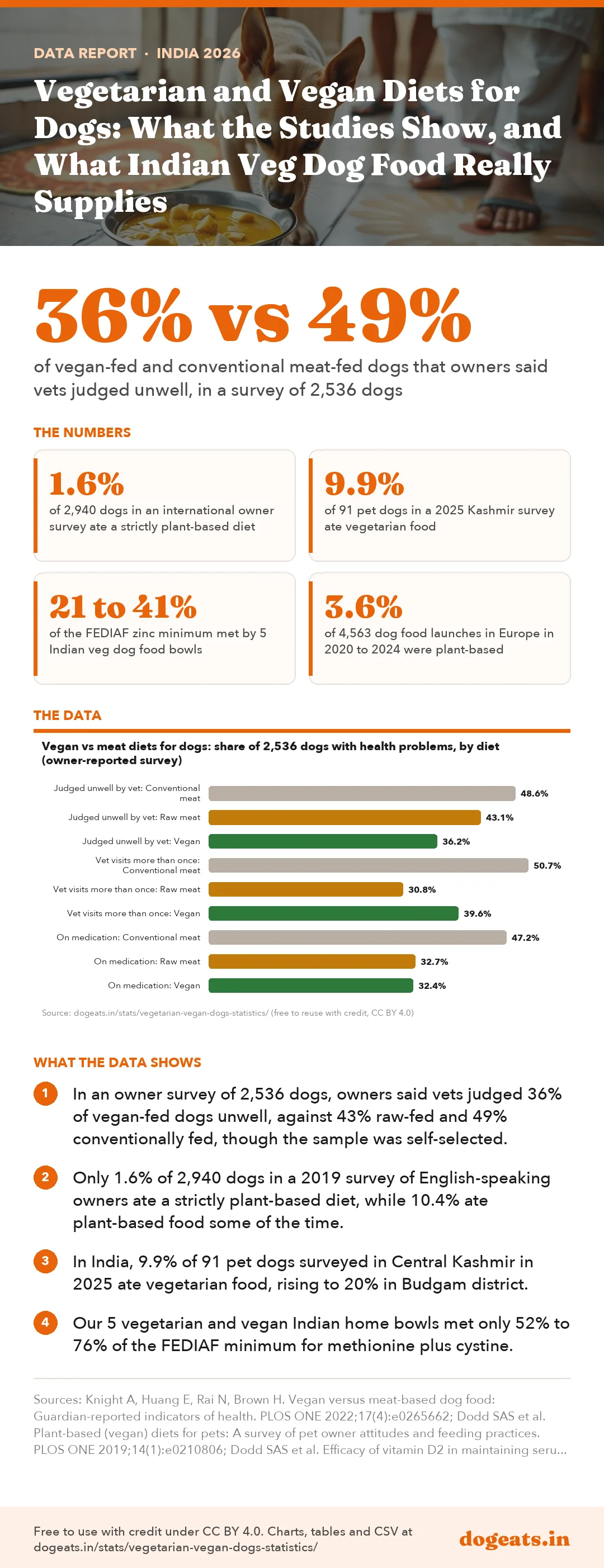
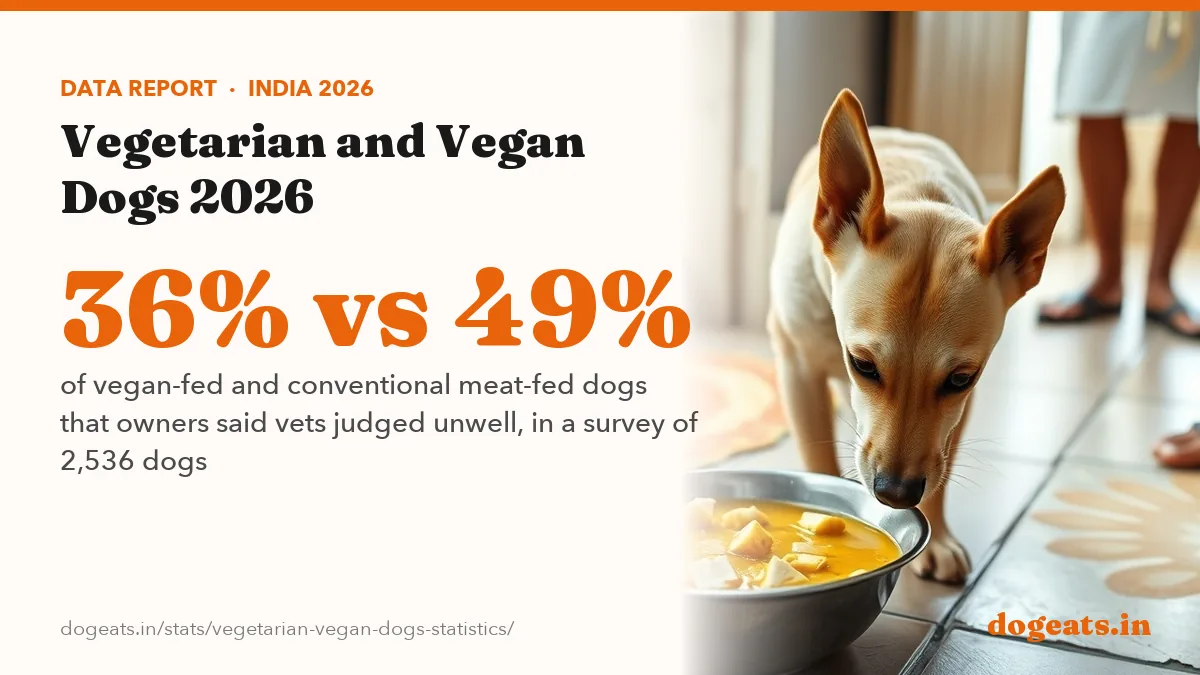
Dogs can stay healthy on a complete, well-formulated vegetarian or vegan food. In one owner survey of 2,536 dogs, owners said vets judged 36% of vegan-fed dogs unwell against 49% of meat-fed dogs. Home-cooked Indian veg food is weaker: our 5 veg and vegan bowls met only 52% to 76% of the sulfur amino acid minimum and fell short on zinc.
Key findings
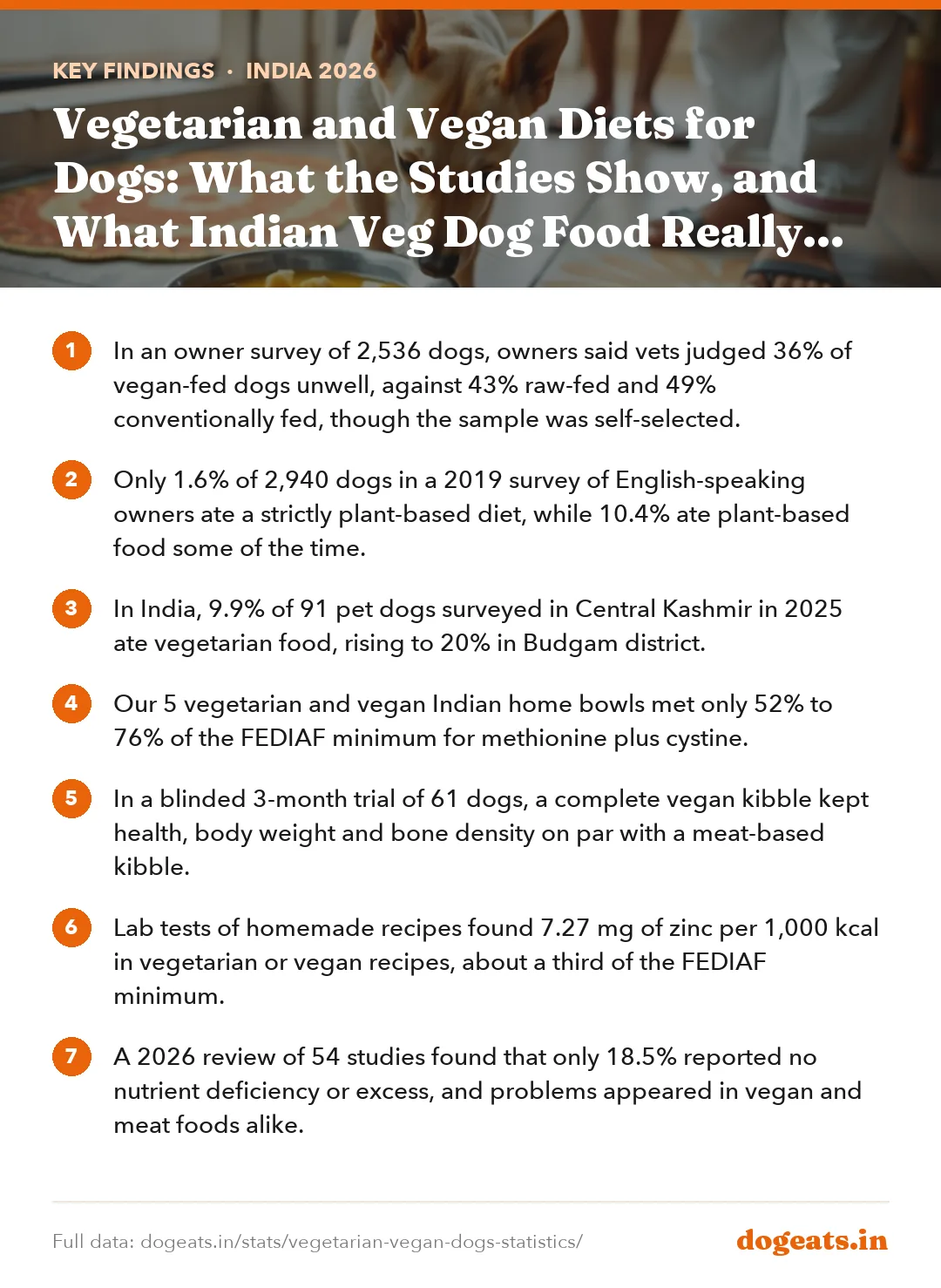
- In an owner survey of 2,536 dogs, owners said vets judged 36% of vegan-fed dogs unwell, against 43% raw-fed and 49% conventionally fed, though the sample was self-selected.
- Only 1.6% of 2,940 dogs in a 2019 survey of English-speaking owners ate a strictly plant-based diet, while 10.4% ate plant-based food some of the time.
- In India, 9.9% of 91 pet dogs surveyed in Central Kashmir in 2025 ate vegetarian food, rising to 20% in Budgam district.
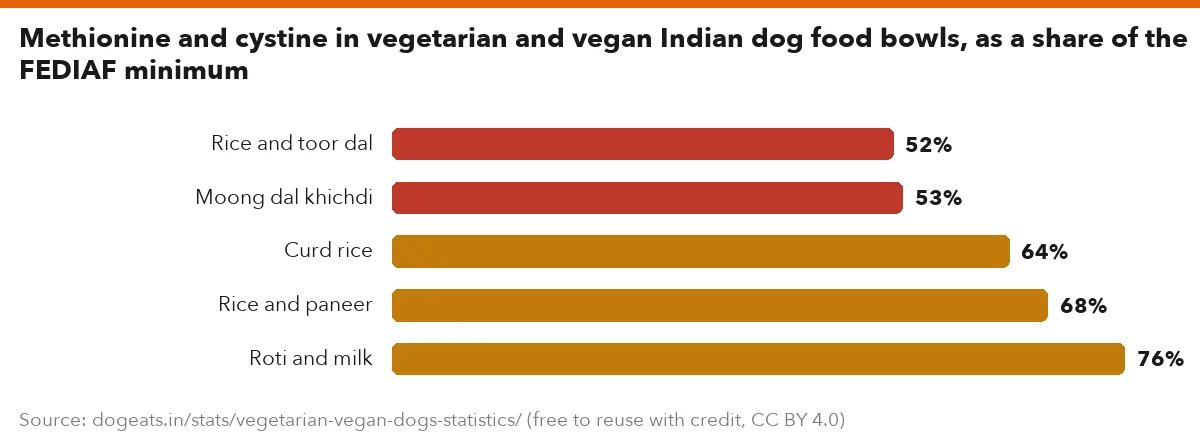
- Our 5 vegetarian and vegan Indian home bowls met only 52% to 76% of the FEDIAF minimum for methionine plus cystine.
- In a blinded 3-month trial of 61 dogs, a complete vegan kibble kept health, body weight and bone density on par with a meat-based kibble.
- Lab tests of homemade recipes found 7.27 mg of zinc per 1,000 kcal in vegetarian or vegan recipes, about a third of the FEDIAF minimum.
- A 2026 review of 54 studies found that only 18.5% reported no nutrient deficiency or excess, and problems appeared in vegan and meat foods alike.
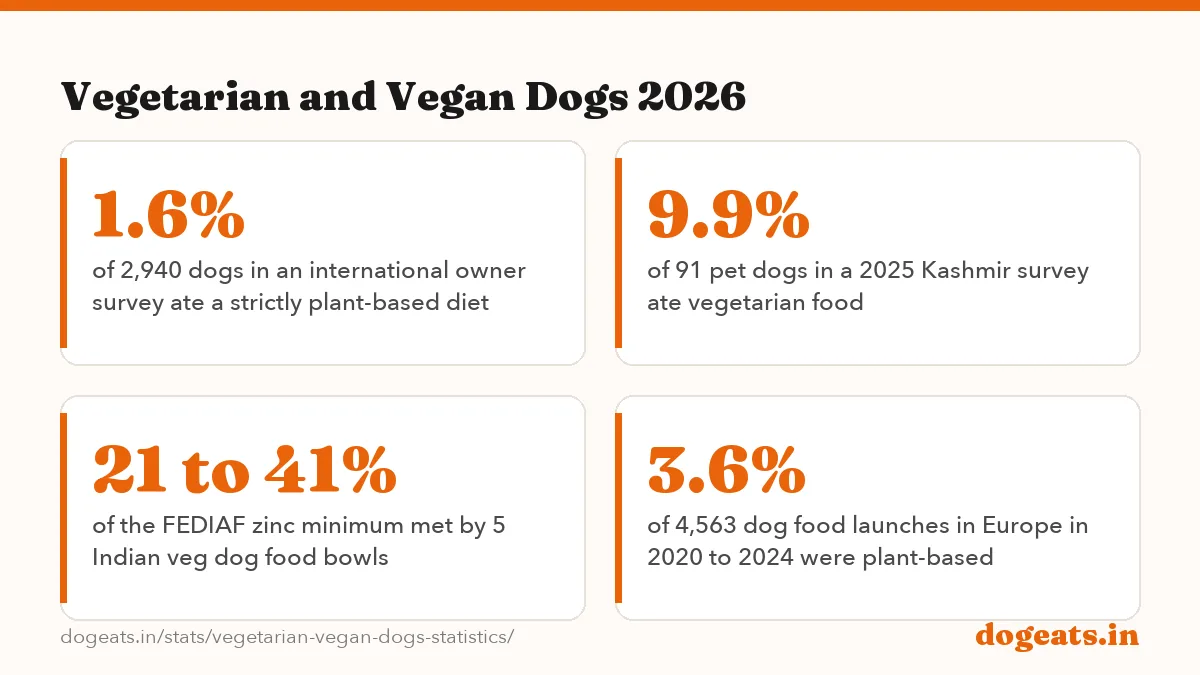
- Plant-based products made up 3.6% of 4,563 dog food launches in Europe from 2020 to 2024.
- A 2023 systematic review of 16 studies found no overwhelming evidence of harm from vegan diets but rated most evidence low or very low in certainty.
Can dogs be vegetarian or vegan?
Yes, if the food is complete and balanced. Dogs are omnivores and need nutrients, not meat as such. Short feeding trials and large owner surveys have found no clear harm from well-formulated vegan foods.
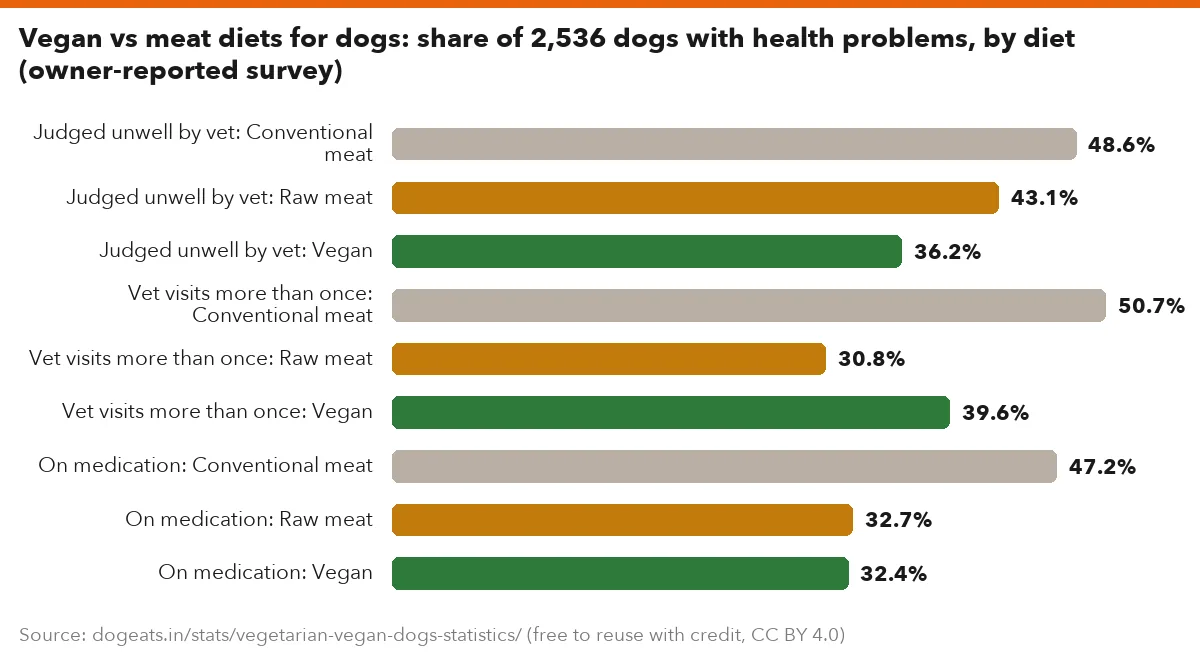
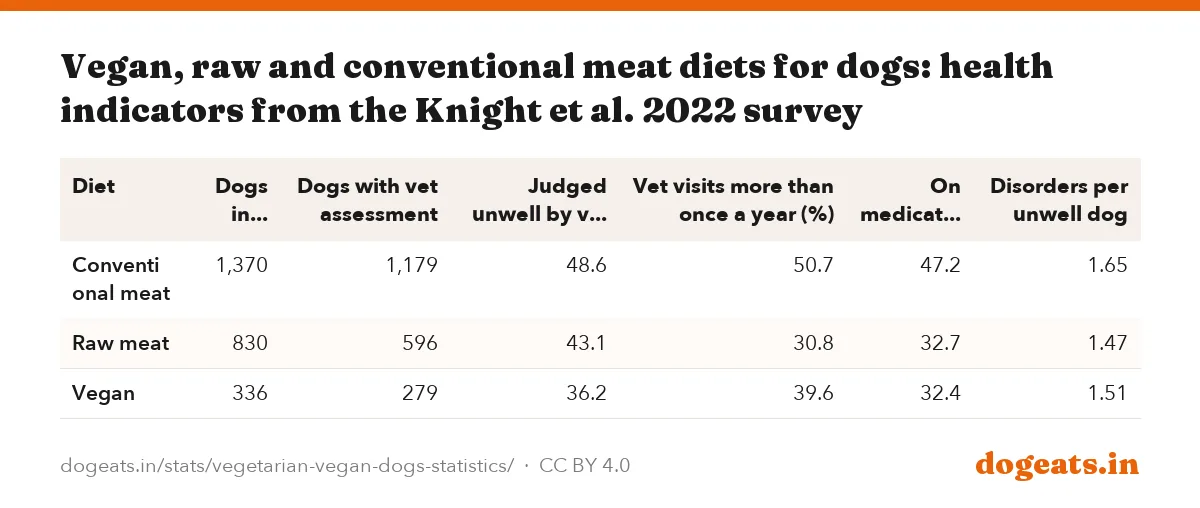
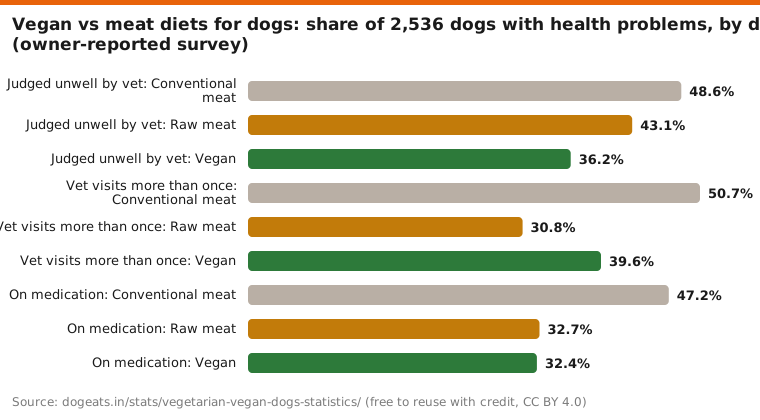
The best-known survey, by Andrew Knight and colleagues in PLOS ONE in 2022, covered 2,536 dogs. Owners said vets judged 36.2% of vegan-fed dogs unwell, against 43.1% of raw-fed and 48.6% of conventionally fed dogs. Those shares cover the 2,054 dogs that had seen a vet in the past year.
Read those numbers with care. Owners chose to take part, and 22% of respondents were vegan themselves. Vegan-fed dogs averaged 7.3 years against 5.5 for raw-fed dogs. ProVeg International, a plant-based advocacy group, funded the work, a fact added to the competing interests statement in a 2023 correction.
Knight et al., PLOS ONE 2022, Tables 4, 6 and 16. Unwell shares use the 2,054 dogs with a recent vet visit. Owner-reported, self-selected online sample; vegan dogs were older; funded by ProVeg International.
Show the numbers
| Label | % |
|---|---|
| Judged unwell by vet: Conventional meat | 48.6% |
| Judged unwell by vet: Raw meat | 43.1% |
| Judged unwell by vet: Vegan | 36.2% |
| Vet visits more than once: Conventional meat | 50.7% |
| Vet visits more than once: Raw meat | 30.8% |
| Vet visits more than once: Vegan | 39.6% |
| On medication: Conventional meat | 47.2% |
| On medication: Raw meat | 32.7% |
| On medication: Vegan | 32.4% |
Embed this chart
| Diet | Dogs in study | Dogs with vet assessment | Judged unwell by vet (%) | Vet visits more than once a year (%) | On medication (%) | Disorders per unwell dog |
|---|---|---|---|---|---|---|
| Conventional meat | 1,370 | 1,179 | 48.6 | 50.7 | 47.2 | 1.65 |
| Raw meat | 830 | 596 | 43.1 | 30.8 | 32.7 | 1.47 |
| Vegan | 336 | 279 | 36.2 | 39.6 | 32.4 | 1.51 |
How many dogs are vegetarian?
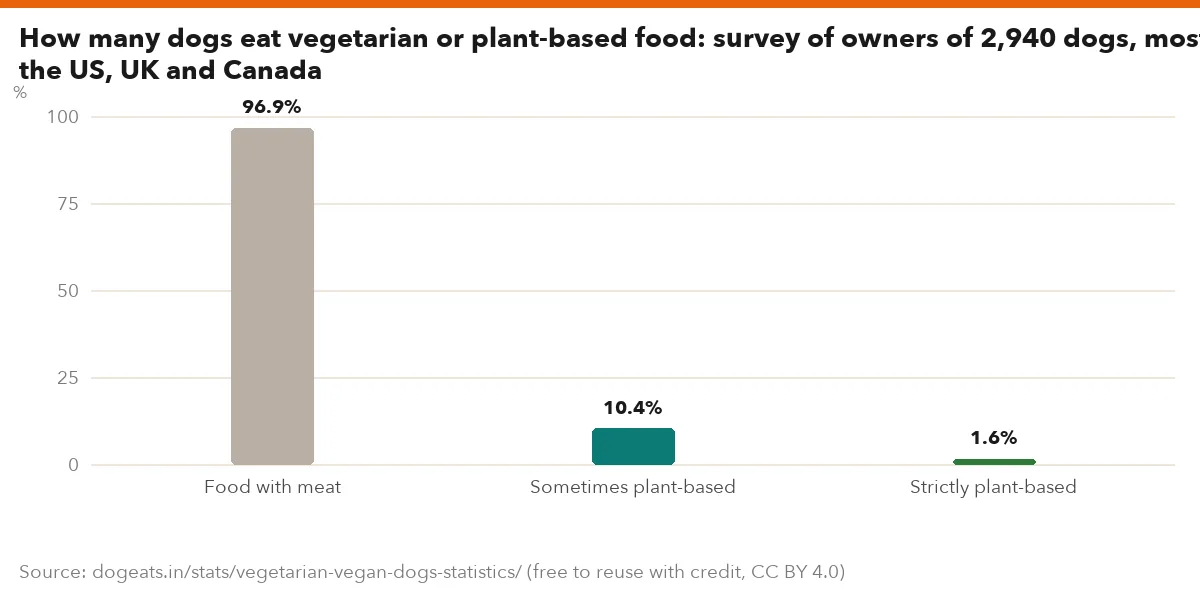
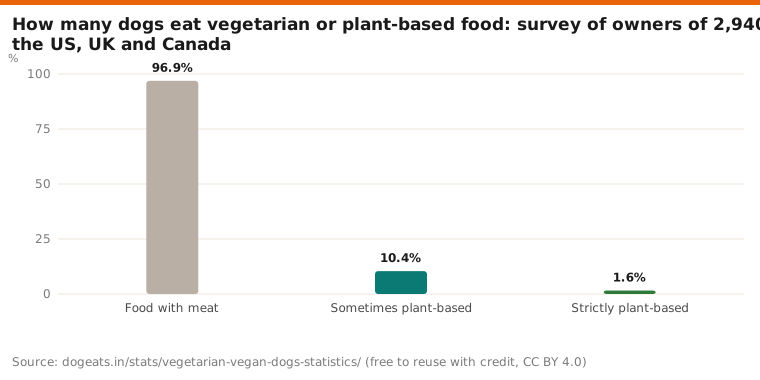
Very few eat a fully plant-based diet. A 2019 survey of owners of 2,940 dogs, led by Sarah Dodd at the University of Guelph, found 1.6% fed strictly plant-based food. Another 10.4% got plant-based food some of the time.
Almost all owners who fed plant-based diets were vegans themselves. Even among vegans, only 27% fed their pets plant-based food, though 78% said they would if a food met their standards.
Worry is common. Of 3,318 owners who answered, 74% said they were concerned that plant-based pet food might not be nutritionally complete.
Dodd et al., PLOS ONE 2019. Online survey of English-speaking pet owners, mostly in the US, UK and Canada.
Show the numbers
| Label | % |
|---|---|
| Food with meat | 96.9% |
| Sometimes plant-based | 10.4% |
| Strictly plant-based | 1.6% |
Embed this chart
How many dogs in India eat vegetarian food?
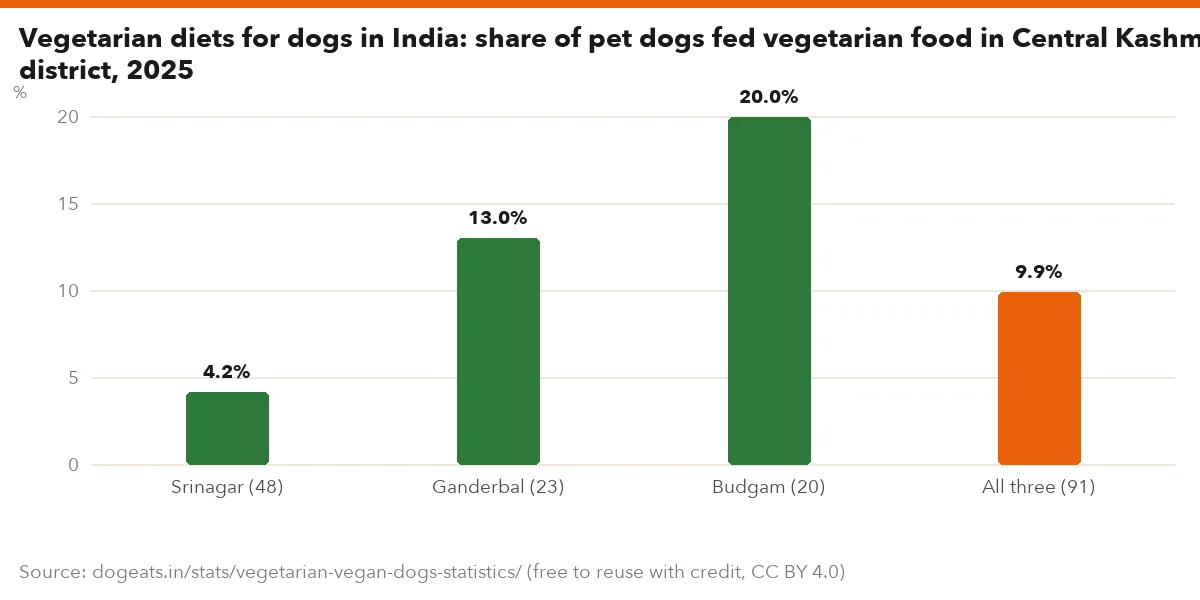
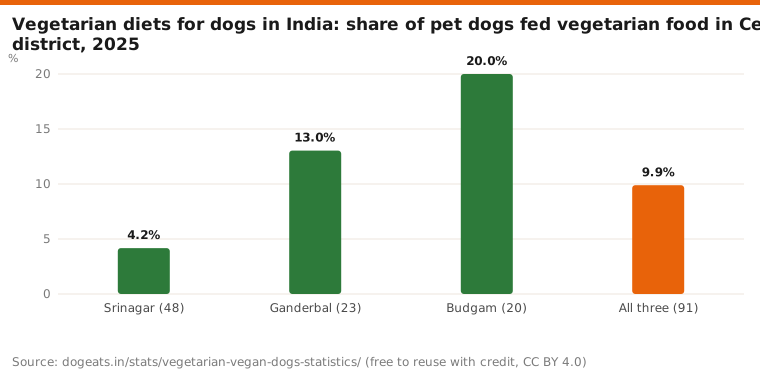
India has no national count. The only survey we found is from Central Kashmir in 2025, where 9.9% of 91 pet dogs ate vegetarian diets. The share was 4.2% in Srinagar, 13.0% in Ganderbal and 20.0% in Budgam.
The authors describe Kashmir as a mainly meat-eating region, so vegetarian shares elsewhere may be higher. Most Indian dogs eat home food, and packaged food reaches only 7 to 8% of pets, a July 2026 GlobalPETS feature says.
Complete vegetarian kibble is on sale in India. On 15 October 2026 Heads Up For Tails listed Pedigree Adult 100% Vegetarian at Rs 2,604 for 10 kg, about Rs 260 a kg. Its ingredients are cereals and soya with added vitamins and minerals, including vitamin B12.

Beigh et al., Indian Journal of Animal Nutrition 2025. 91 adult pet dogs; most diets were home-cooked.
Show the numbers
| Label | % |
|---|---|
| Srinagar (48) | 4.2% |
| Ganderbal (23) | 13.0% |
| Budgam (20) | 20.0% |
| All three (91) | 9.9% |
Embed this chart
Our vegetarian dog diet guide covers day-to-day feeding. Our Indian dog diet chart report tests meat-based home bowls with the same method.
Is a home-cooked Indian vegetarian diet enough for a dog?
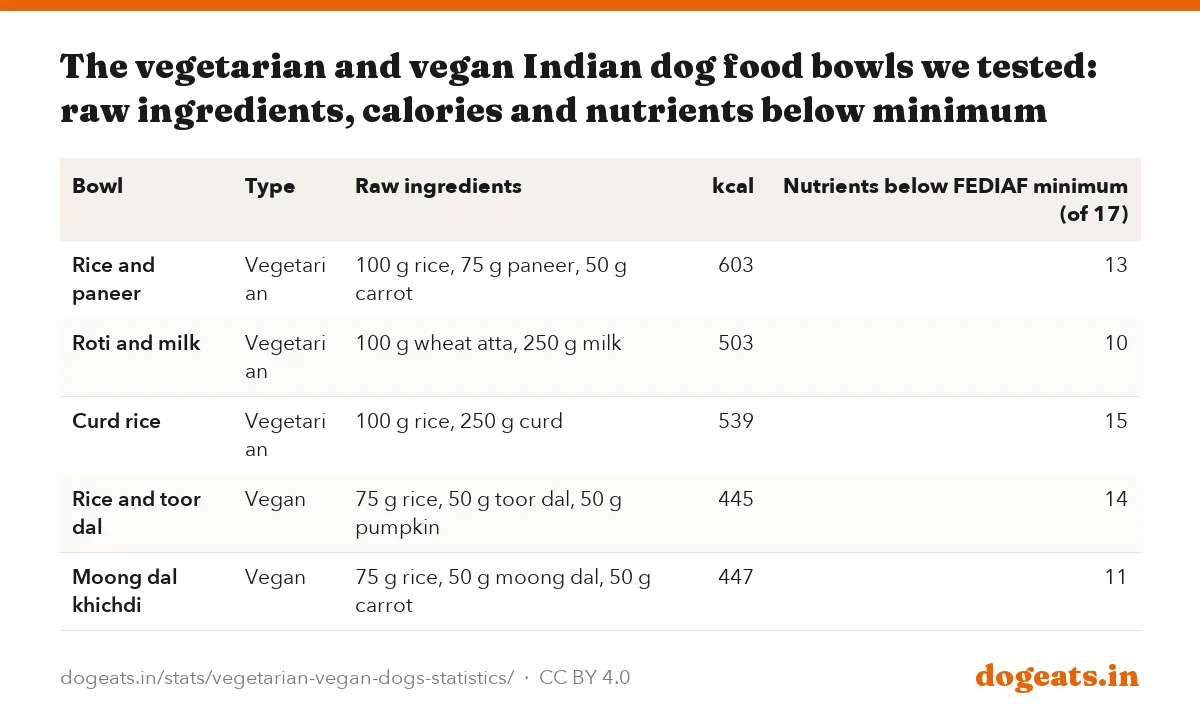
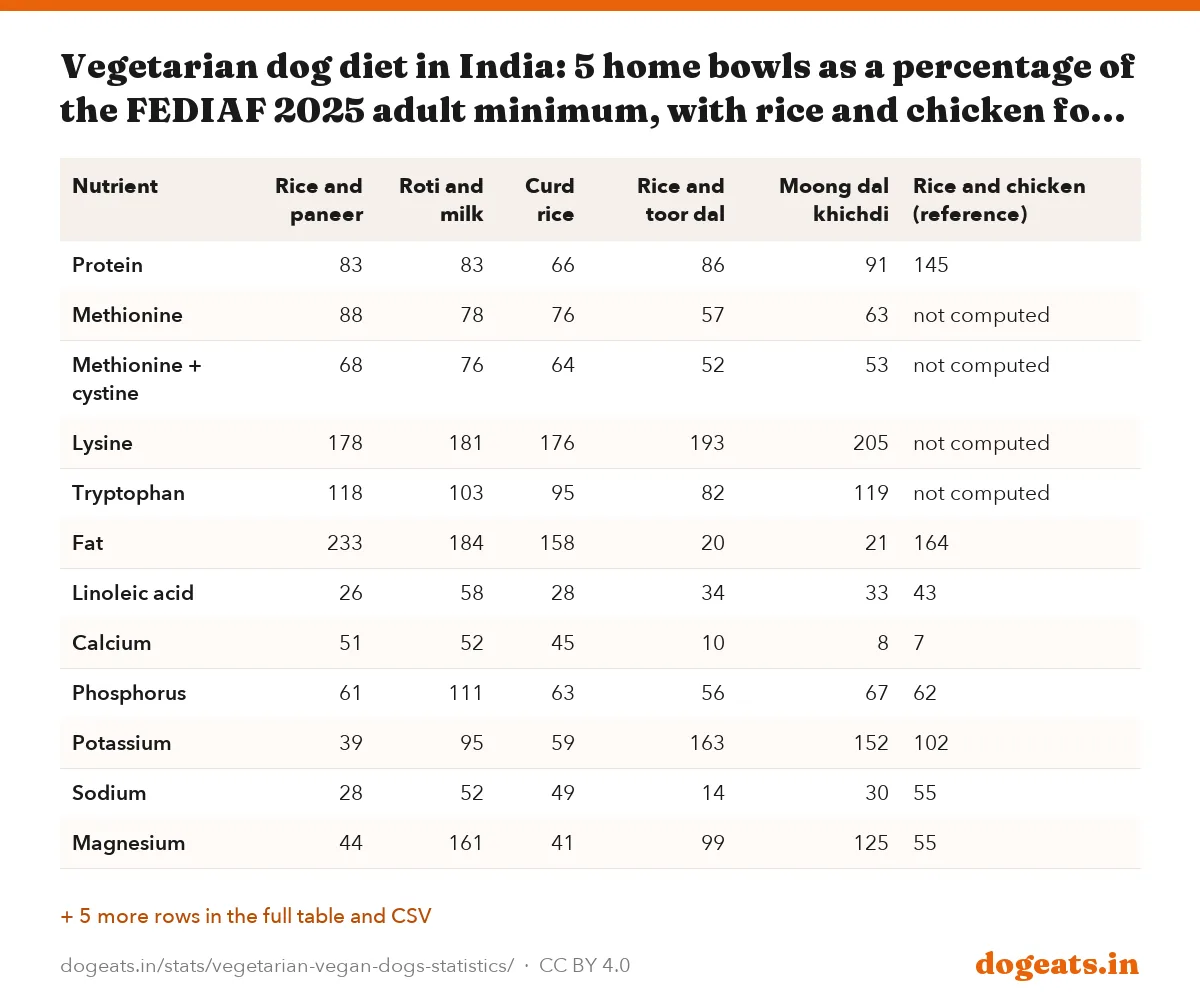
Not without help. We built 5 common Indian bowls without meat and checked 17 nutrients against the FEDIAF 2025 adult minimums, using ICMR-NIN food data. Each bowl fell short on 10 to 15 of them.
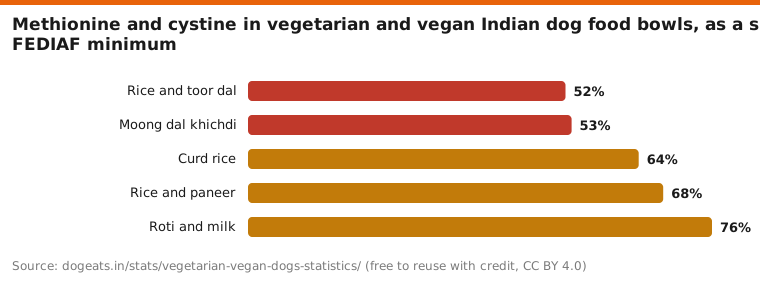
Protein in the bowls ranged from 66% to 91% of the minimum, so none quite reached it. The sulfur amino acids, methionine and cystine, were weaker still, at 52% to 76%. Rice with toor dal came lowest.
Dairy carried the calcium. Roti with milk met 52% of the calcium minimum and rice with paneer 51%, while the vegan dal bowls met only 10% and 8%.
Computed by dogeats.in from IFCT 2017 amino acid profiles. FEDIAF 2025 adult minimum 1.91 g methionine plus cystine per 1,000 kcal.
Show the numbers
| Label | % |
|---|---|
| Rice and toor dal | 52% |
| Moong dal khichdi | 53% |
| Curd rice | 64% |
| Rice and paneer | 68% |
| Roti and milk | 76% |
Embed this chart
| Bowl | Type | Raw ingredients | kcal | Nutrients below FEDIAF minimum (of 17) |
|---|---|---|---|---|
| Rice and paneer | Vegetarian | 100 g rice, 75 g paneer, 50 g carrot | 603 | 13 |
| Roti and milk | Vegetarian | 100 g wheat atta, 250 g milk | 503 | 10 |
| Curd rice | Vegetarian | 100 g rice, 250 g curd | 539 | 15 |
| Rice and toor dal | Vegan | 75 g rice, 50 g toor dal, 50 g pumpkin | 445 | 14 |
| Moong dal khichdi | Vegan | 75 g rice, 50 g moong dal, 50 g carrot | 447 | 11 |
| Nutrient | Rice and paneer | Roti and milk | Curd rice | Rice and toor dal | Moong dal khichdi | Rice and chicken (reference) |
|---|---|---|---|---|---|---|
| Protein | 83 | 83 | 66 | 86 | 91 | 145 |
| Methionine | 88 | 78 | 76 | 57 | 63 | not computed |
| Methionine + cystine | 68 | 76 | 64 | 52 | 53 | not computed |
| Lysine | 178 | 181 | 176 | 193 | 205 | not computed |
| Tryptophan | 118 | 103 | 95 | 82 | 119 | not computed |
| Fat | 233 | 184 | 158 | 20 | 21 | 164 |
| Linoleic acid | 26 | 58 | 28 | 34 | 33 | 43 |
| Calcium | 51 | 52 | 45 | 10 | 8 | 7 |
| Phosphorus | 61 | 111 | 63 | 56 | 67 | 62 |
| Potassium | 39 | 95 | 59 | 163 | 152 | 102 |
| Sodium | 28 | 52 | 49 | 14 | 30 | 55 |
| Magnesium | 44 | 161 | 41 | 99 | 125 | 55 |
| Iron | 30 | 99 | 21 | 65 | 68 | 41 |
| Zinc | 31 | 41 | 21 | 28 | 28 | 22 |
| Copper | 32 | 61 | 31 | 97 | 87 | 61 |
| Manganese | 109 | 415 | 97 | 178 | 179 | 99 |
| Selenium | 53 | 192 | 11 | 32 | 101 | 80 |
Do dogs get enough protein from dal and paneer?
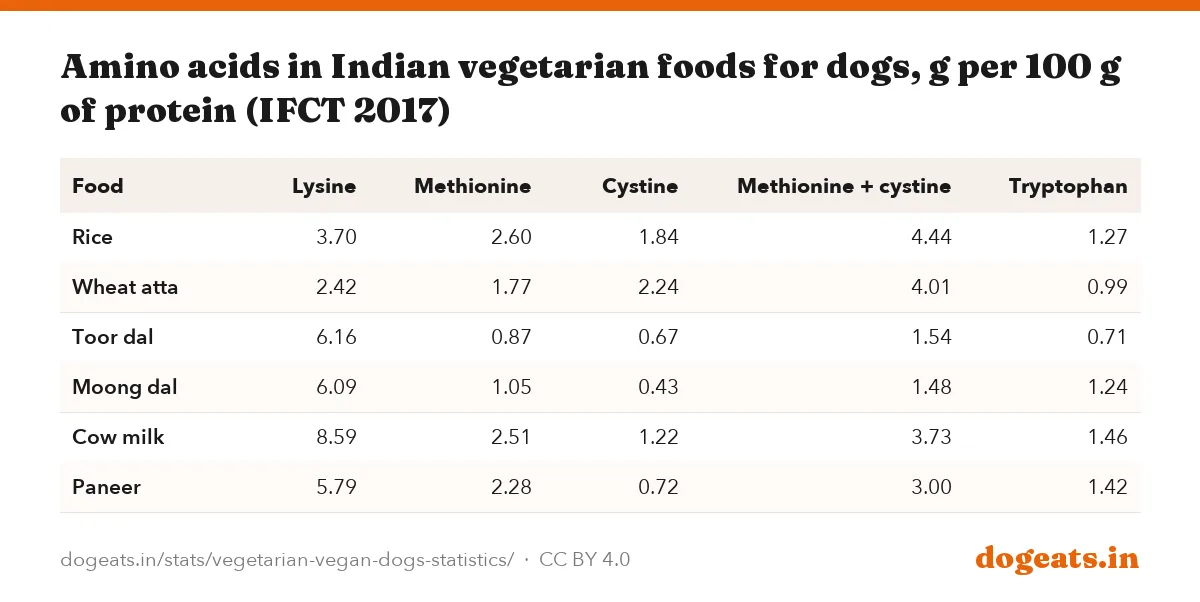
Enough total protein is possible, but its quality differs. Per 100 g of protein, toor dal carries 0.87 g of methionine and moong dal 1.05 g, by IFCT 2017. Milk has 2.51 g and paneer 2.28 g.
Pulses are rich in lysine, the amino acid cereals lack. Rice and dal together balance lysine, but both stay low in methionine and cystine.
Dogs make taurine from these sulfur amino acids. In US FDA reports of heart disease (DCM) in dogs from 2014 to April 2019, 93% of the reported foods contained peas or lentils. The FDA has not shown that these foods cause DCM.
| Food | Lysine | Methionine | Cystine | Methionine + cystine | Tryptophan |
|---|---|---|---|---|---|
| Rice | 3.70 | 2.60 | 1.84 | 4.44 | 1.27 |
| Wheat atta | 2.42 | 1.77 | 2.24 | 4.01 | 0.99 |
| Toor dal | 6.16 | 0.87 | 0.67 | 1.54 | 0.71 |
| Moong dal | 6.09 | 1.05 | 0.43 | 1.48 | 1.24 |
| Cow milk | 8.59 | 2.51 | 1.22 | 3.73 | 1.46 |
| Paneer | 5.79 | 2.28 | 0.72 | 3.00 | 1.42 |
- Plain cooked moong dal and other lentils are safe in moderation, without tadka, onion or garlic.
- Small amounts of paneer and milk suit many dogs, but some get loose stools from lactose.
- Plain soya chunks add protein but should be cooked and unspiced.
Which nutrients are hardest to get on a vegetarian dog diet?
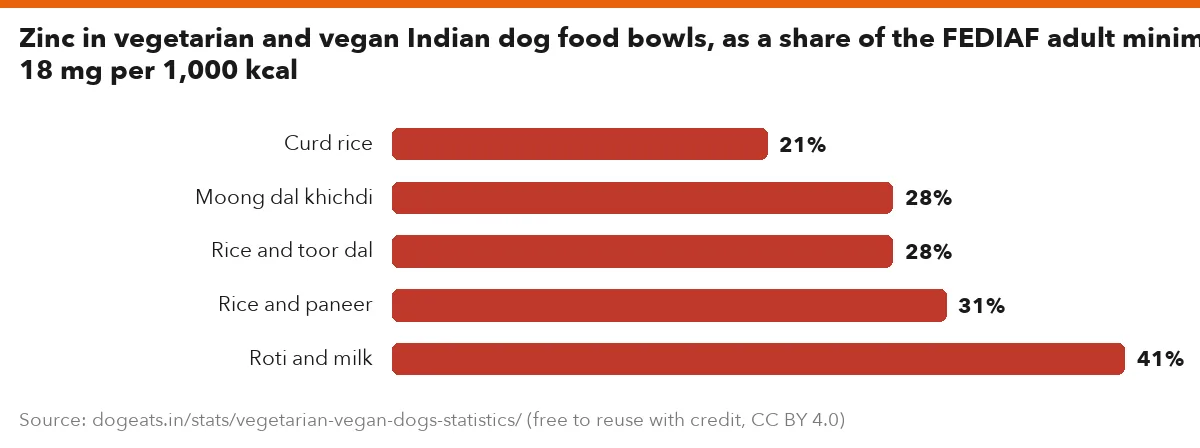
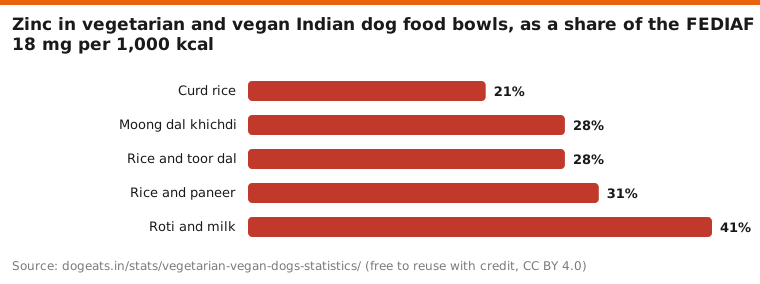
Zinc tops the list. Our 5 veg bowls met 21% to 41% of the FEDIAF zinc minimum. Phytate in cereals and pulses can lower absorption further.
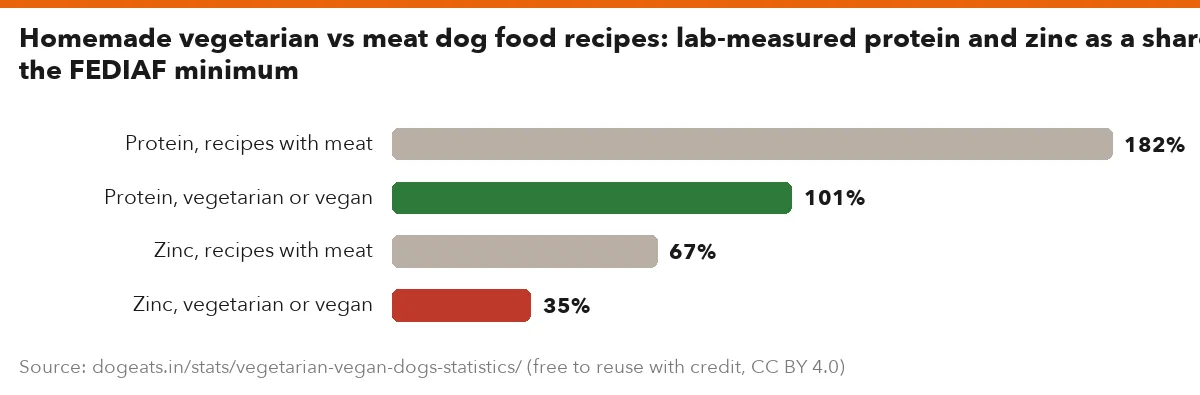
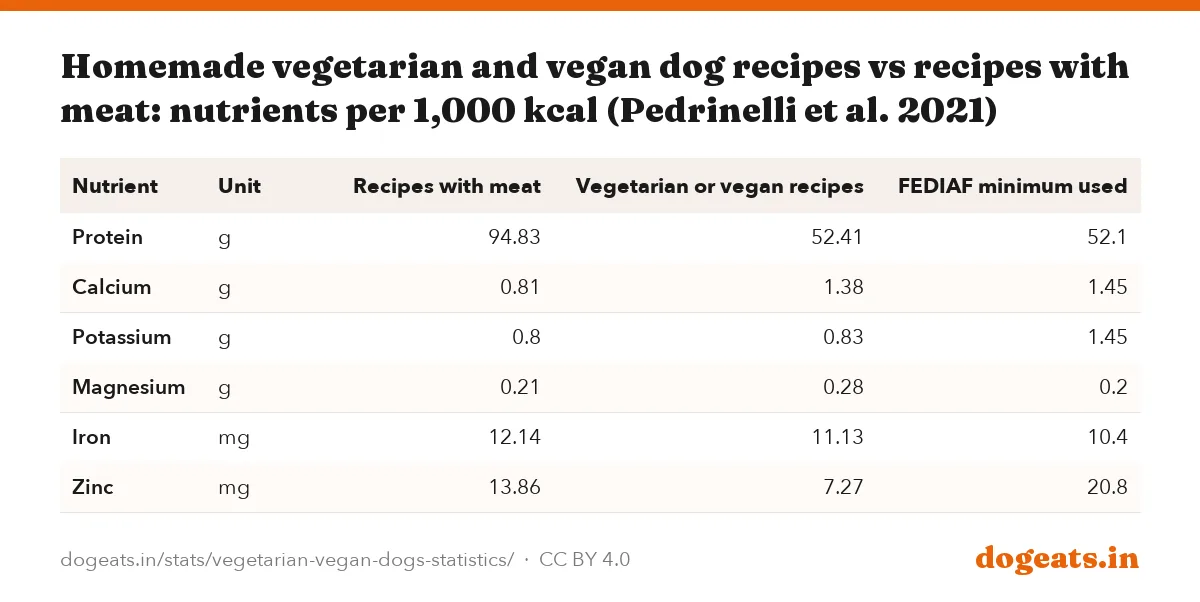
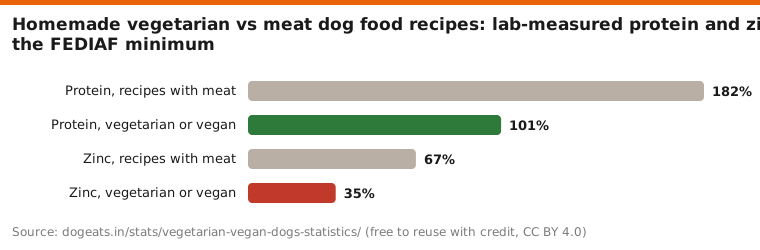
Lab tests agree. Pedrinelli and colleagues cooked 75 online dog recipes in Brazil and measured them. The 14 vegetarian or vegan recipes held 7.27 mg of zinc per 1,000 kcal, against 13.86 mg in recipes with meat.
The same veg recipes had 52.41 g of protein per 1,000 kcal against 94.83 g with meat. They held more magnesium and manganese. Calcium was higher too, at 1.38 g against 0.81 g, though that gap was not statistically significant.
IFCT 2017 values computed by dogeats.in. Plant phytate can lower zinc absorption further.
Show the numbers
| Label | % |
|---|---|
| Curd rice | 21% |
| Moong dal khichdi | 28% |
| Rice and toor dal | 28% |
| Rice and paneer | 31% |
| Roti and milk | 41% |
Embed this chart
Pedrinelli et al., BMC Veterinary Research 2021, Table 5: 75 cooked online recipes, 14 of them vegetarian or vegan. FEDIAF minimums used by the authors.
Show the numbers
| Label | % |
|---|---|
| Protein, recipes with meat | 182% |
| Protein, vegetarian or vegan | 101% |
| Zinc, recipes with meat | 67% |
| Zinc, vegetarian or vegan | 35% |
Embed this chart
| Nutrient | Unit | Recipes with meat | Vegetarian or vegan recipes | FEDIAF minimum used |
|---|---|---|---|---|
| Protein | g | 94.83 | 52.41 | 52.1 |
| Calcium | g | 0.81 | 1.38 | 1.45 |
| Potassium | g | 0.8 | 0.83 | 1.45 |
| Magnesium | g | 0.21 | 0.28 | 0.2 |
| Iron | mg | 12.14 | 11.13 | 10.4 |
| Zinc | mg | 13.86 | 7.27 | 20.8 |
Is commercial vegan dog food complete?
Sometimes not, and the same is true of meat foods. A 2026 systematic review by Mace, Nicholles and Knight covered 54 studies of pet food. Only 10, or 18.5%, found no deficiency or excess in the foods they tested.
Calcium, phosphorus and zinc were the commonest problems across all food types. Vegan foods did well on fatty acids and selenium but some fell short on B vitamins.
Smaller tests show the risk. Zafalon and colleagues analysed all three vegan dog foods then sold in Brazil, in a study published in 2020. None met the Ca:P minimum, and copper was above the EU legal limit in all of them.
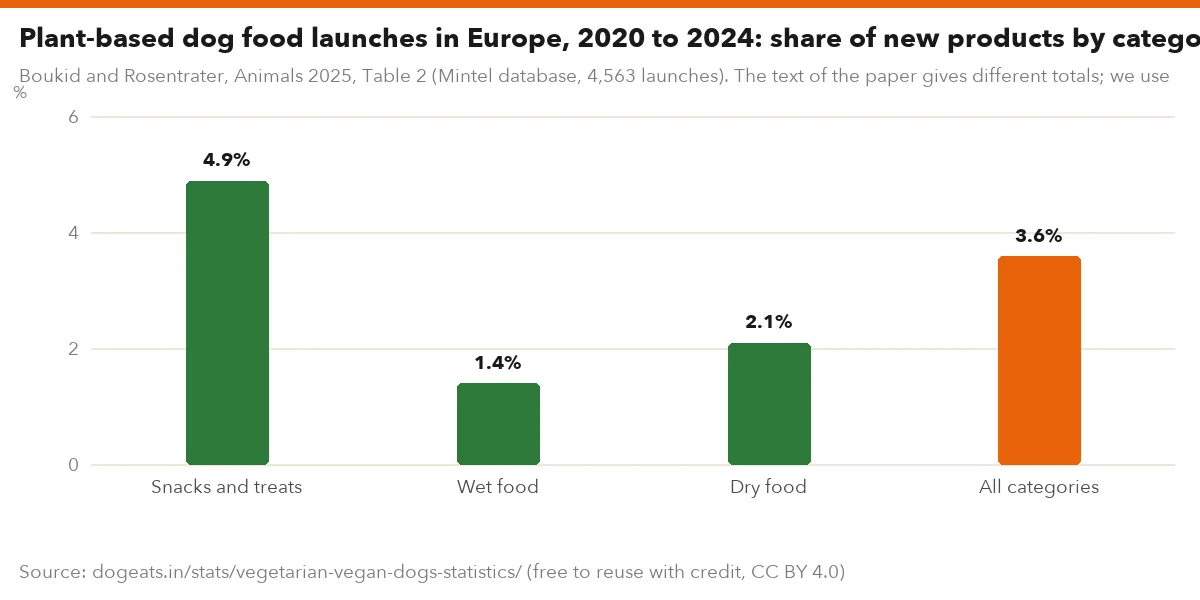
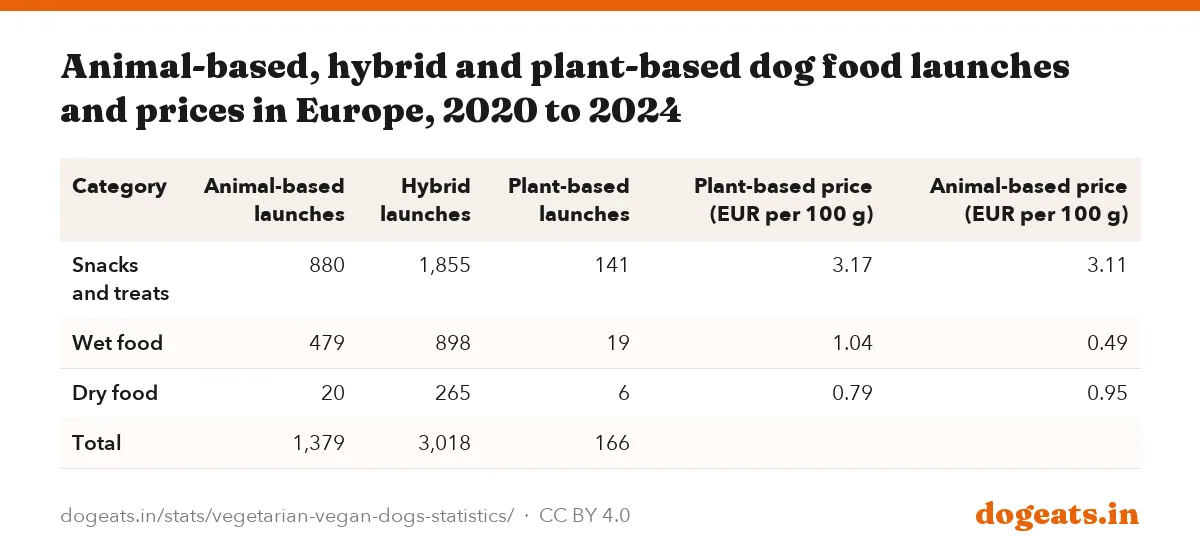
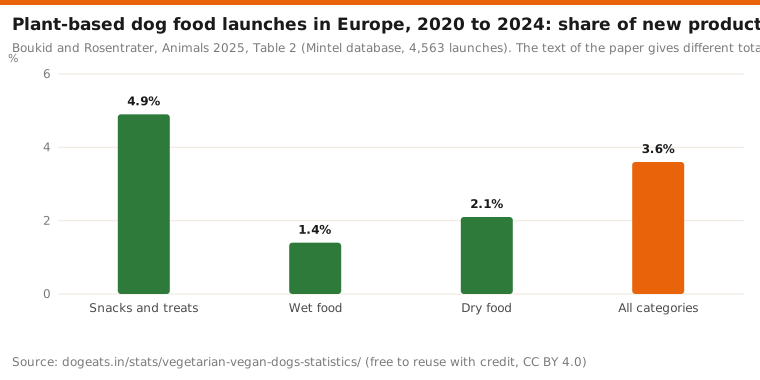
Boukid and Rosentrater, Animals 2025, Table 2 (Mintel database, 4,563 launches). The text of the paper gives different totals; we use the table.
Show the numbers
| Label | % |
|---|---|
| Snacks and treats | 4.9% |
| Wet food | 1.4% |
| Dry food | 2.1% |
| All categories | 3.6% |
Embed this chart
| Category | Animal-based launches | Hybrid launches | Plant-based launches | Plant-based price (EUR per 100 g) | Animal-based price (EUR per 100 g) |
|---|---|---|---|---|---|
| Snacks and treats | 880 | 1,855 | 141 | 3.17 | 3.11 |
| Wet food | 479 | 898 | 19 | 1.04 | 0.49 |
| Dry food | 20 | 265 | 6 | 0.79 | 0.95 |
| Total | 1,379 | 3,018 | 166 |
What do feeding trials say about vegan diets for dogs?
The strongest evidence so far is a blinded trial at the University of Guelph in Canada. It fed 31 dogs a complete vegan kibble and 30 dogs a meat kibble for 3 months.
All 61 dogs kept their health, weight and body composition, Dodd and colleagues reported in 2024. Bone density did not change. Vegan-fed dogs shifted from vitamin D3 to D2 in blood, with total vitamin D steady.
A 2025 follow-up found few metabolic differences between the groups. Three months is short, so long-term effects remain unknown.
A 2026 review by Andrew Knight reviewed 31 digestibility studies. In five studies of whole veg diets, dry matter digestibility topped 80% and protein digestibility 80%.

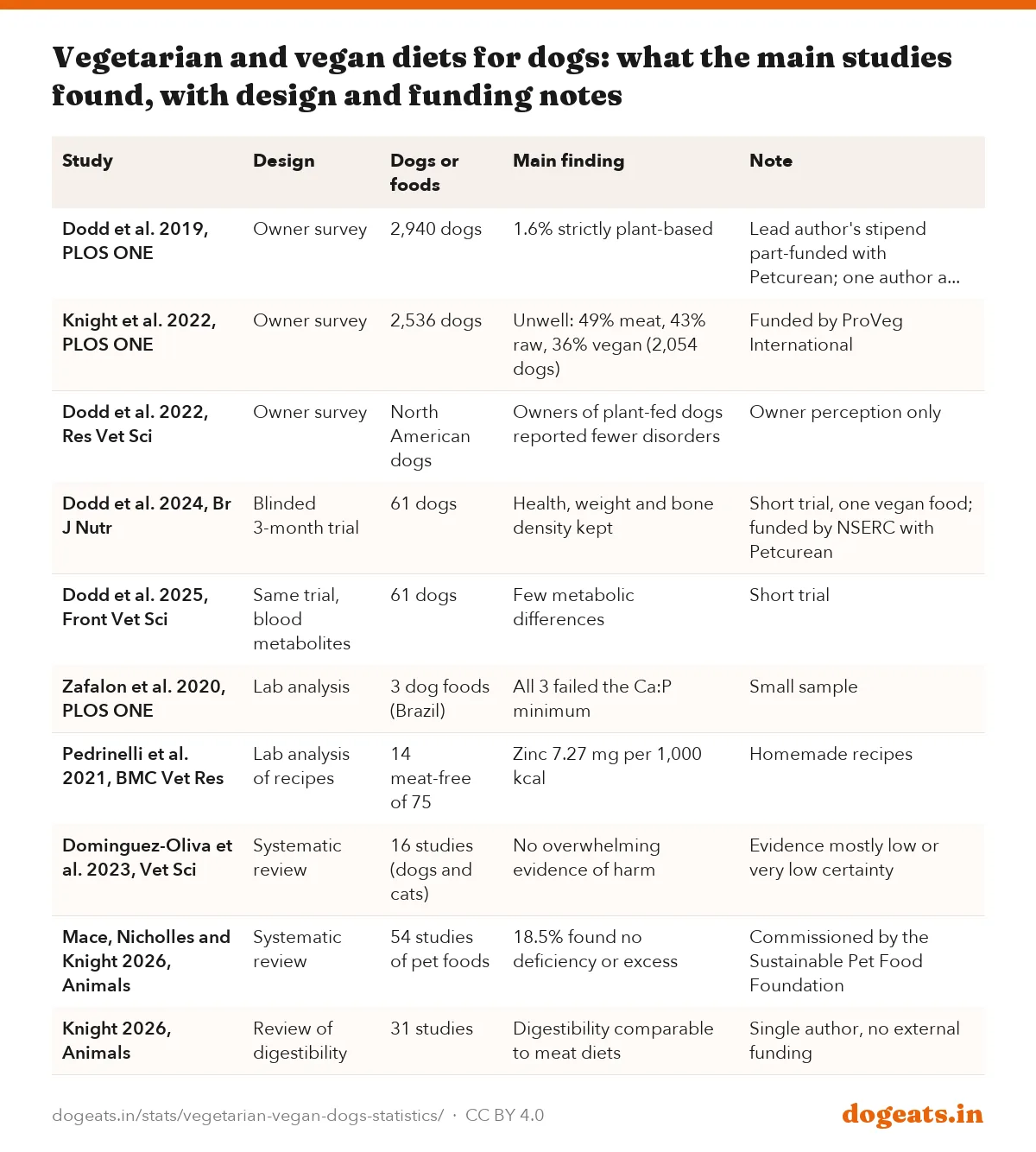
| Study | Design | Dogs or foods | Main finding | Note |
|---|---|---|---|---|
| Dodd et al. 2019, PLOS ONE | Owner survey | 2,940 dogs | 1.6% strictly plant-based | Lead author's stipend part-funded with Petcurean; one author a Petcurean employee |
| Knight et al. 2022, PLOS ONE | Owner survey | 2,536 dogs | Unwell: 49% meat, 43% raw, 36% vegan (2,054 dogs) | Funded by ProVeg International |
| Dodd et al. 2022, Res Vet Sci | Owner survey | North American dogs | Owners of plant-fed dogs reported fewer disorders | Owner perception only |
| Dodd et al. 2024, Br J Nutr | Blinded 3-month trial | 61 dogs | Health, weight and bone density kept | Short trial, one vegan food; funded by NSERC with Petcurean |
| Dodd et al. 2025, Front Vet Sci | Same trial, blood metabolites | 61 dogs | Few metabolic differences | Short trial |
| Zafalon et al. 2020, PLOS ONE | Lab analysis | 3 dog foods (Brazil) | All 3 failed the Ca:P minimum | Small sample |
| Pedrinelli et al. 2021, BMC Vet Res | Lab analysis of recipes | 14 meat-free of 75 | Zinc 7.27 mg per 1,000 kcal | Homemade recipes |
| Dominguez-Oliva et al. 2023, Vet Sci | Systematic review | 16 studies (dogs and cats) | No overwhelming evidence of harm | Evidence mostly low or very low certainty |
| Mace, Nicholles and Knight 2026, Animals | Systematic review | 54 studies of pet foods | 18.5% found no deficiency or excess | Commissioned by the Sustainable Pet Food Foundation |
| Knight 2026, Animals | Review of digestibility | 31 studies | Digestibility comparable to meat diets | Single author, no external funding |
Frequently asked questions
Can dogs survive on a vegetarian diet?
Yes, on a complete and balanced vegetarian food. A blinded trial of 61 dogs found a vegan kibble kept health and bone density for 3 months, but long-term trials are lacking.
Is vegetarian food good for dogs in India?
Complete veg kibble can work. Plain home bowls such as dal rice or curd rice fell short on 10 to 15 of 17 nutrients in our test, so they need a vet-planned recipe and supplement.
How many dogs are vegetarian?
Few. In a survey of 2,940 dogs, 1.6% ate a strictly plant-based diet. In a 2025 Kashmir survey, 9.9% of 91 pet dogs ate vegetarian food.
Are vegan dogs healthier?
One survey of 2,536 dogs found owners reported vets judged 36% of vegan-fed dogs unwell against 49% of meat-fed dogs. The sample was self-selected and owner-reported, so it shows association, not cause.
What nutrients do vegetarian dogs lack?
Zinc and the sulfur amino acids methionine and cystine are the main gaps in home-cooked veg food. Our Indian veg bowls met 21% to 41% of the zinc minimum.
Can dogs eat dal every day?
Plain cooked dal is safe in moderation, but rice and toor dal alone met only 52% of the methionine plus cystine minimum in our check. It needs other protein sources and a supplement.
Is paneer good for vegetarian dogs?
In small amounts. Rice with paneer met 51% of the calcium minimum, close to the best veg bowl, roti with milk at 52%. It gave 233% of the fat minimum but only 31% of the zinc.
How much does vegetarian dog food cost in India?
Pedigree Adult 100% Vegetarian was listed at Rs 2,604 for 10 kg on Heads Up For Tails on 15 October 2026, about Rs 260 a kg.
Methodology and limitations
Survey, trial and review figures are taken exactly from the papers listed, opened on 15 October 2026. Percentages for the Knight survey were computed from its Tables 4, 6 and 16. Where a paper's text and table disagree, as in Boukid and Rosentrater 2025, we used the table.
We built 5 vegetarian and vegan bowls from raw weights of common Indian foods. They are examples, not survey averages. Nutrients come from the Indian Food Composition Tables 2017 (ICMR-NIN), read from the open ifct2017 dataset and checked against the revised NIN PDF (December 2024). Paneer uses the PDF values of 24.78 g fat and 1,278 kJ per 100 g.
Amino acids were computed from IFCT 2017 Table 8 (g per 100 g protein) for rice, atta, dal, milk, paneer, carrot and pumpkin. We did not compute them for chicken, because the machine-readable copy misaligns that row.
Each bowl was scaled to 1,000 kcal and compared with FEDIAF September 2025 adult minimums at 110 kcal per kg^0.75 (Table III-3b, unchanged from the July 2024 edition). Curd is modelled as whole cow milk, since IFCT has no curd entry. The method matches our Indian dog diet chart report.
Sources
- Knight A, Huang E, Rai N, Brown H. Vegan versus meat-based dog food: Guardian-reported indicators of health. PLOS ONE 2022;17(4):e0265662, 2,536 dogs; unwell, vet visits, medication by diet; ProVeg funding
- Dodd SAS et al. Plant-based (vegan) diets for pets: A survey of pet owner attitudes and feeding practices. PLOS ONE 2019;14(1):e0210806, Share of dogs fed plant-based diets; owner concerns
- Dodd SAS et al. Efficacy of vitamin D2 in maintaining serum total vitamin D concentrations and bone mineralisation in adult dogs fed a plant-based (vegan) diet in a 3-month randomised trial. Br J Nutr 2024, Blinded trial of 61 dogs
- Also consulted: Beigh YA et al. Indian J Anim Nutr 2025;42(3):455-460, Longvah T et al. Indian Food Composition Tables 2017, ICMR-National Institute of Nutrition, FEDIAF Nutritional Guidelines, September 2025, Pedrinelli V et al. Influence of number of ingredients, use of supplement and vegetarian or vegan preparation on the composition of homemade diets for dogs and cats. BMC Vet Res 2021;17:358, Zafalon RVA et al. Nutritional inadequacies in commercial vegan foods for dogs and cats. PLOS ONE 2020;15(1):e0227046, Mace JL, Nicholles B, Knight A. How nutritionally sound is commercially available vegan pet food relative to meat-based pet food? A systematic review. Animals 2026, Dominguez-Oliva A et al. The impact of vegan diets on indicators of health in dogs and cats: a systematic review. Vet Sci 2023;10(1):52, Knight A. The digestibility of vegan and vegetarian diets for dogs and cats. Animals 2026, Boukid F, Rosentrater KA. Nutritional profiling and labeling practices of plant-based, hybrid, and animal-based dog foods. Animals 2025, US FDA, Investigation into potential link between certain diets and canine DCM (page updated December 2022), Heads Up For Tails listing, Pedigree Adult 100% Vegetarian, checked 15 October 2026, GlobalPETS, interview feature on Drools (9 July 2026), Dodd S et al. Owner perception of health of North American dogs fed meat- or plant-based diets. Res Vet Sci 2022, Knight A, Bauer A, Brown HJ. Heliyon 2024;10:e35578, Dodd SAS et al. Front Vet Sci 2025 (serum metabolomics).
Cite, embed and download
This report, its data and its images are free to reuse under a Creative Commons Attribution 4.0 licence. Credit dogeats.in with a link to this page. Every chart has its own embed code, every table has a CSV and an image download, and the images below are ready for social posts, slides and articles.
Cite this report
Link to this report
Every chart and table as an image