Data report · Updated October 2026
Fat in Indian foods for dogs: 30 foods ranked by fat per 100 g and per 1,000 kcal, with the pancreatitis limit
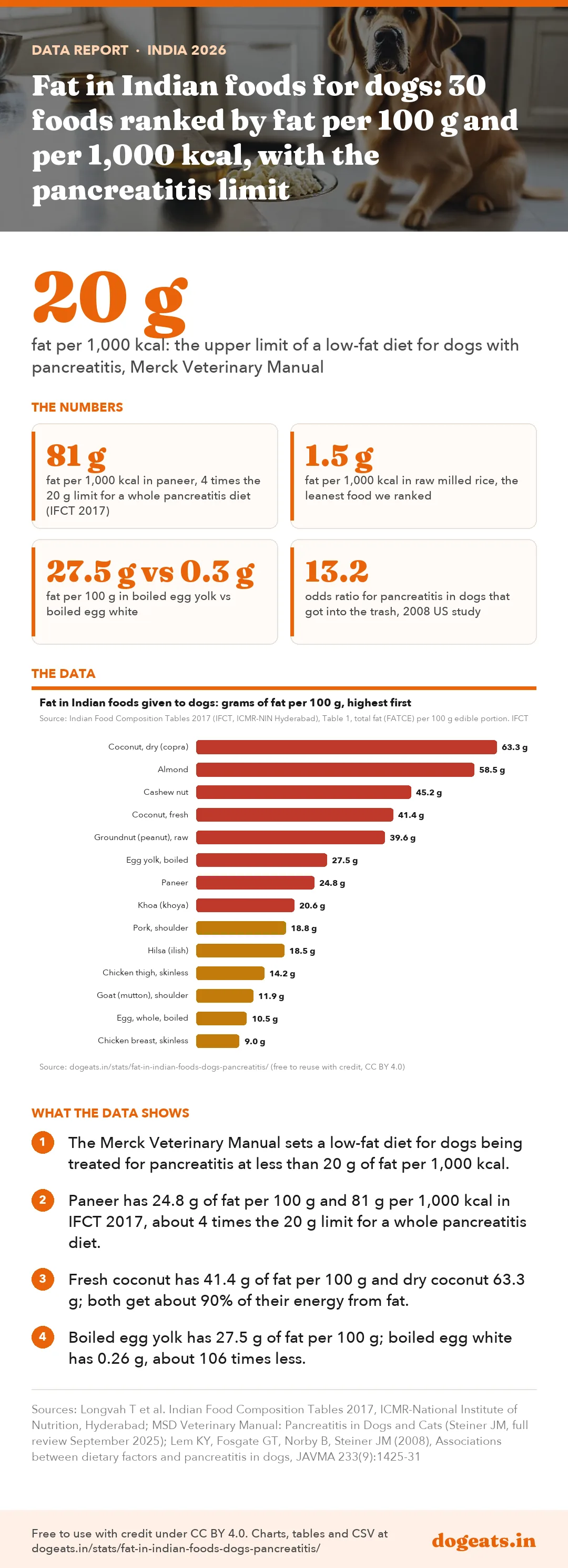
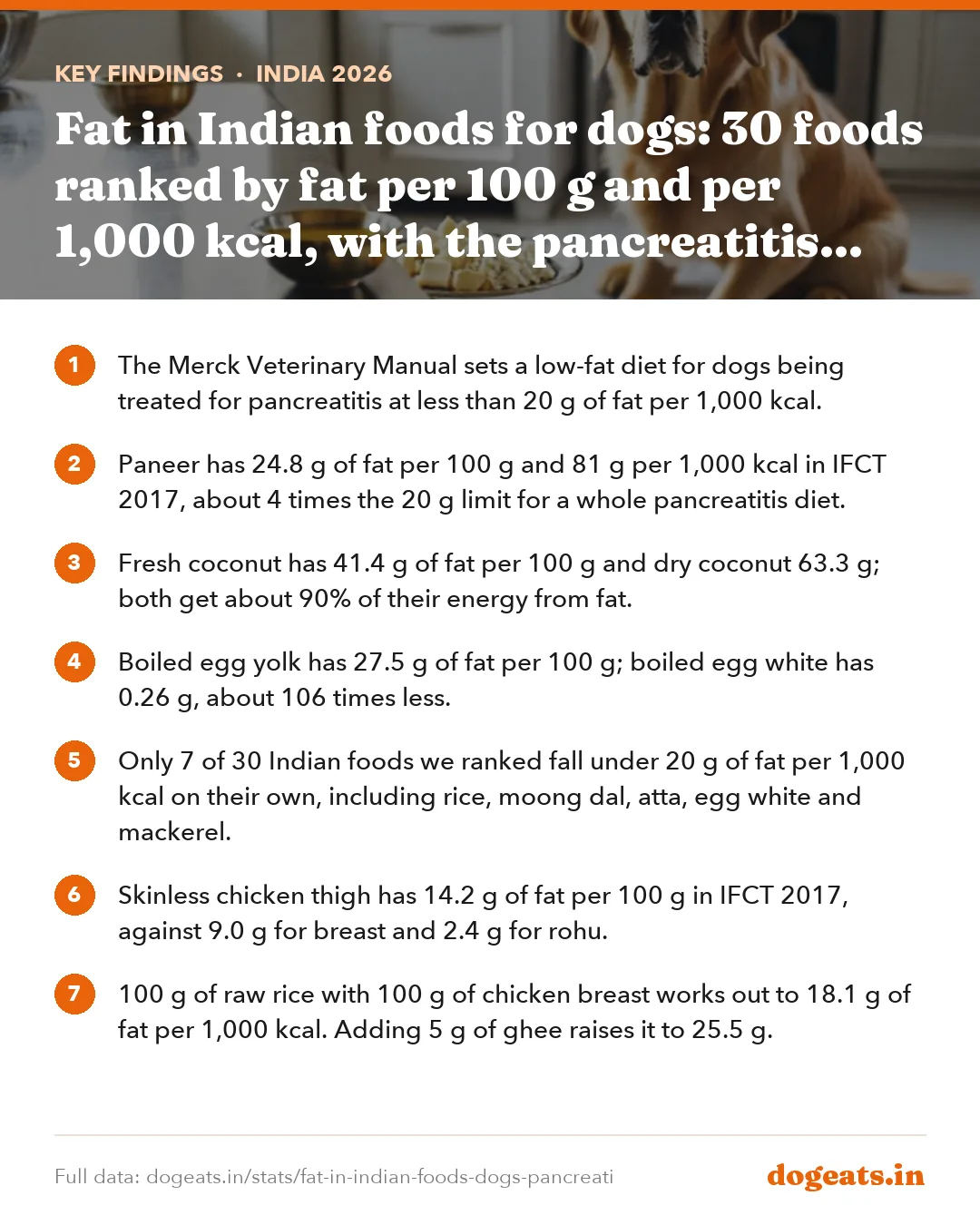
Paneer has 24.8 g of fat per 100 g, fresh coconut 41.4 g and ghee at least 99.5 g, while rice has 0.5 g and rohu 2.4 g. Per 1,000 kcal, paneer carries 81 g of fat, about 4 times the Merck Veterinary Manual's limit of 20 g for dogs being treated for pancreatitis. A bowl of rice and skinless chicken breast sits just under that line at 18.1 g; 5 g of ghee pushes it to 25.5 g.
Key findings
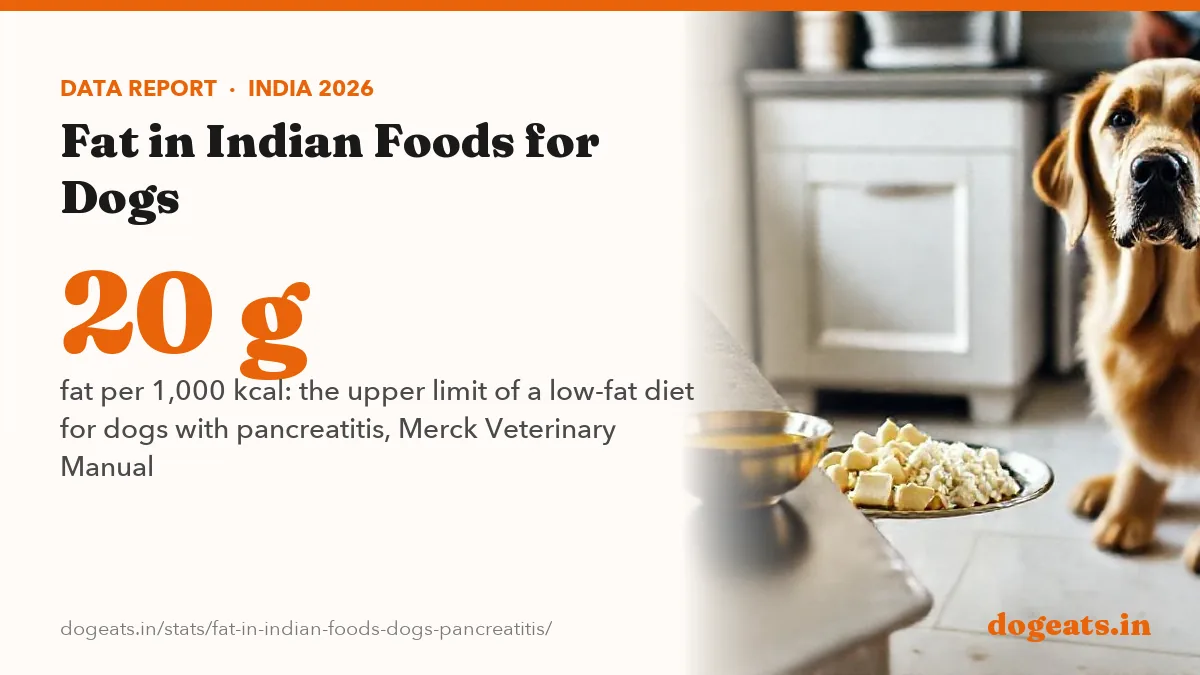
- The Merck Veterinary Manual sets a low-fat diet for dogs being treated for pancreatitis at less than 20 g of fat per 1,000 kcal.
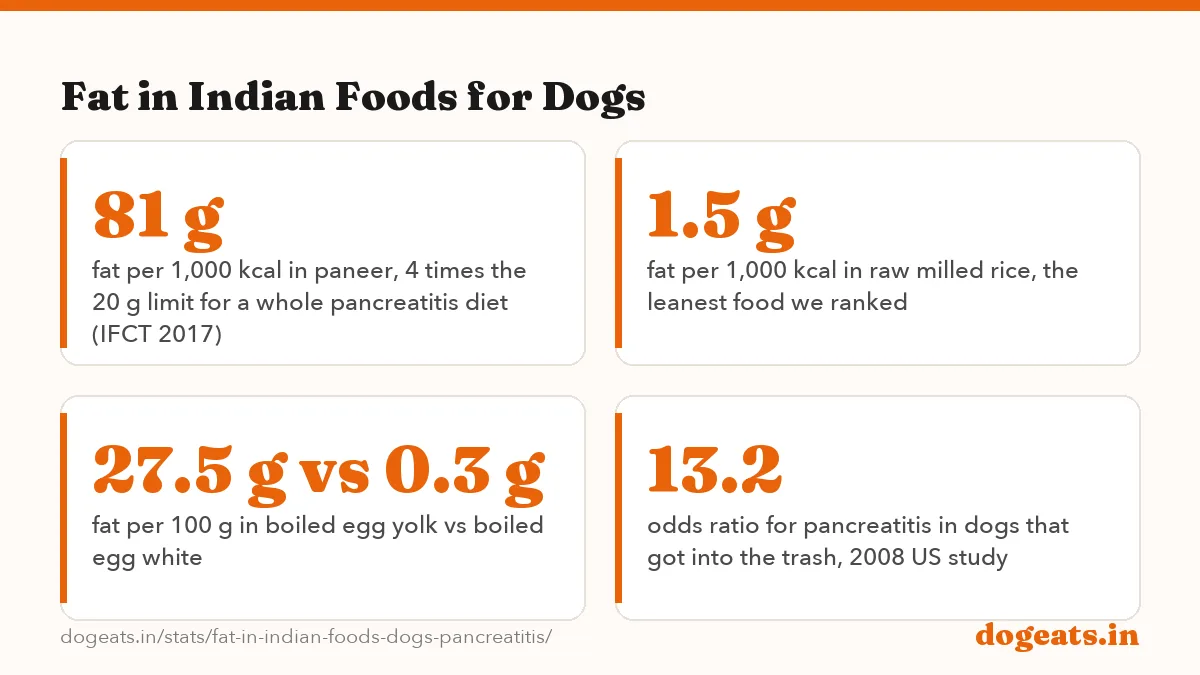
- Paneer has 24.8 g of fat per 100 g and 81 g per 1,000 kcal in IFCT 2017, about 4 times the 20 g limit for a whole pancreatitis diet.
- Fresh coconut has 41.4 g of fat per 100 g and dry coconut 63.3 g; both get about 90% of their energy from fat.
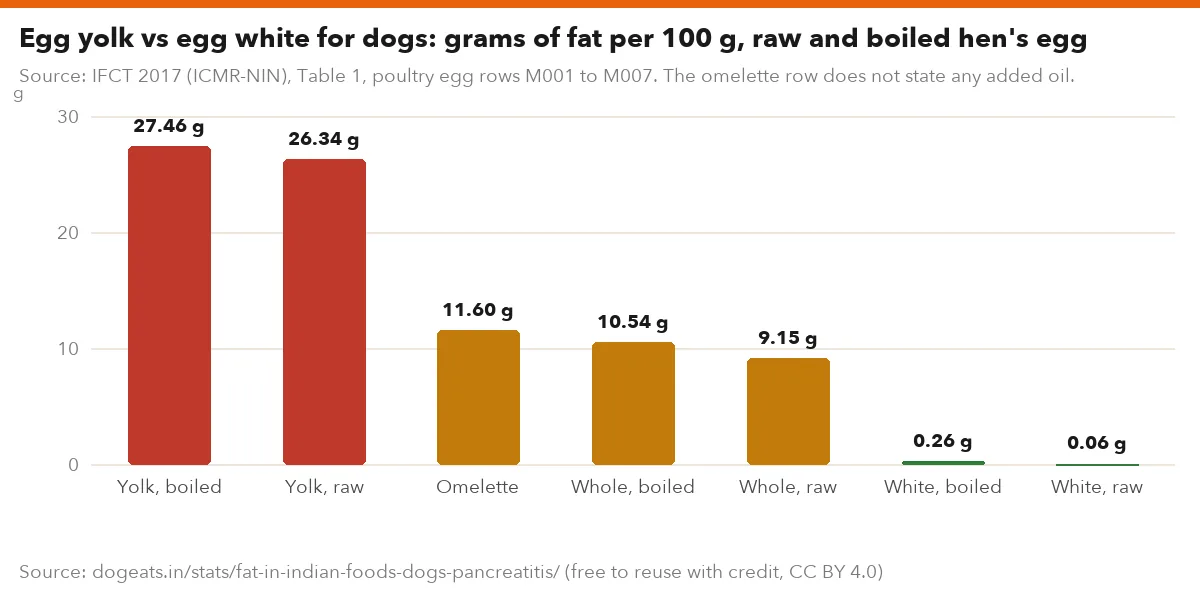
- Boiled egg yolk has 27.5 g of fat per 100 g; boiled egg white has 0.26 g, about 106 times less.
- Only 7 of 30 Indian foods we ranked fall under 20 g of fat per 1,000 kcal on their own, including rice, moong dal, atta, egg white and mackerel.
- Skinless chicken thigh has 14.2 g of fat per 100 g in IFCT 2017, against 9.0 g for breast and 2.4 g for rohu.
- 100 g of raw rice with 100 g of chicken breast works out to 18.1 g of fat per 1,000 kcal. Adding 5 g of ghee raises it to 25.5 g.
- FSSAI requires ghee to be at least 99.5% milk fat and table butter at least 80%; double toned milk needs only 1.5%.
- In a 2008 US study of 198 dogs with pancreatitis, getting into the trash raised the odds 13.2 times and table scraps 2.2 times.
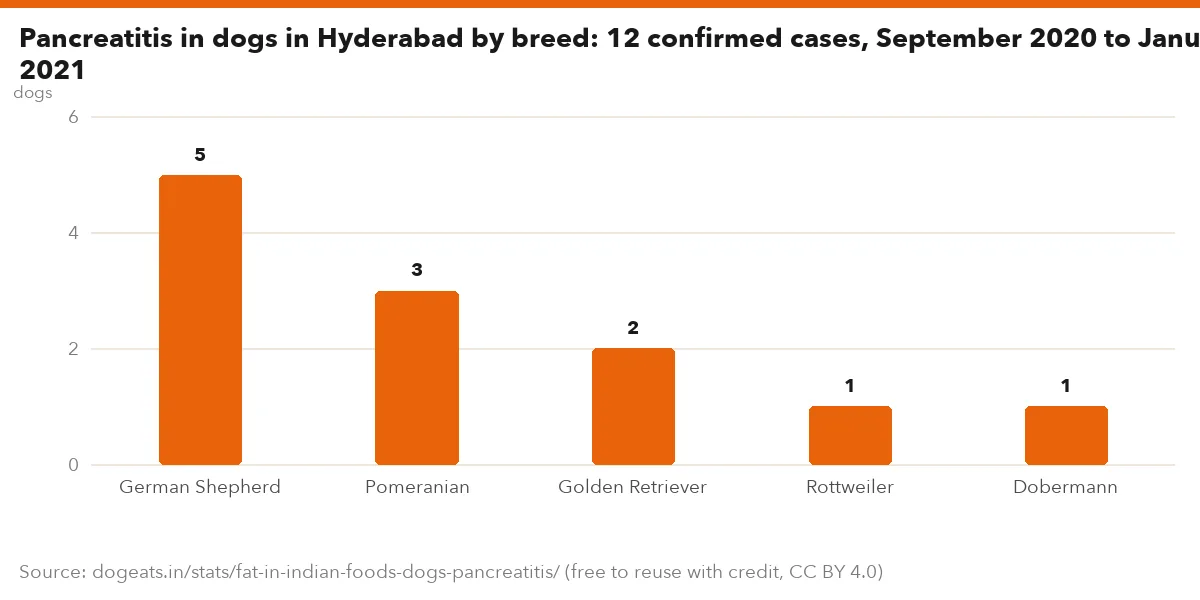
- In a Hyderabad study from 2020 to 2021, 12 of 36 dogs suspected of pancreatitis were confirmed; 5 were German Shepherds and 7 were over 7 years old.
Which Indian foods are highest in fat for dogs?
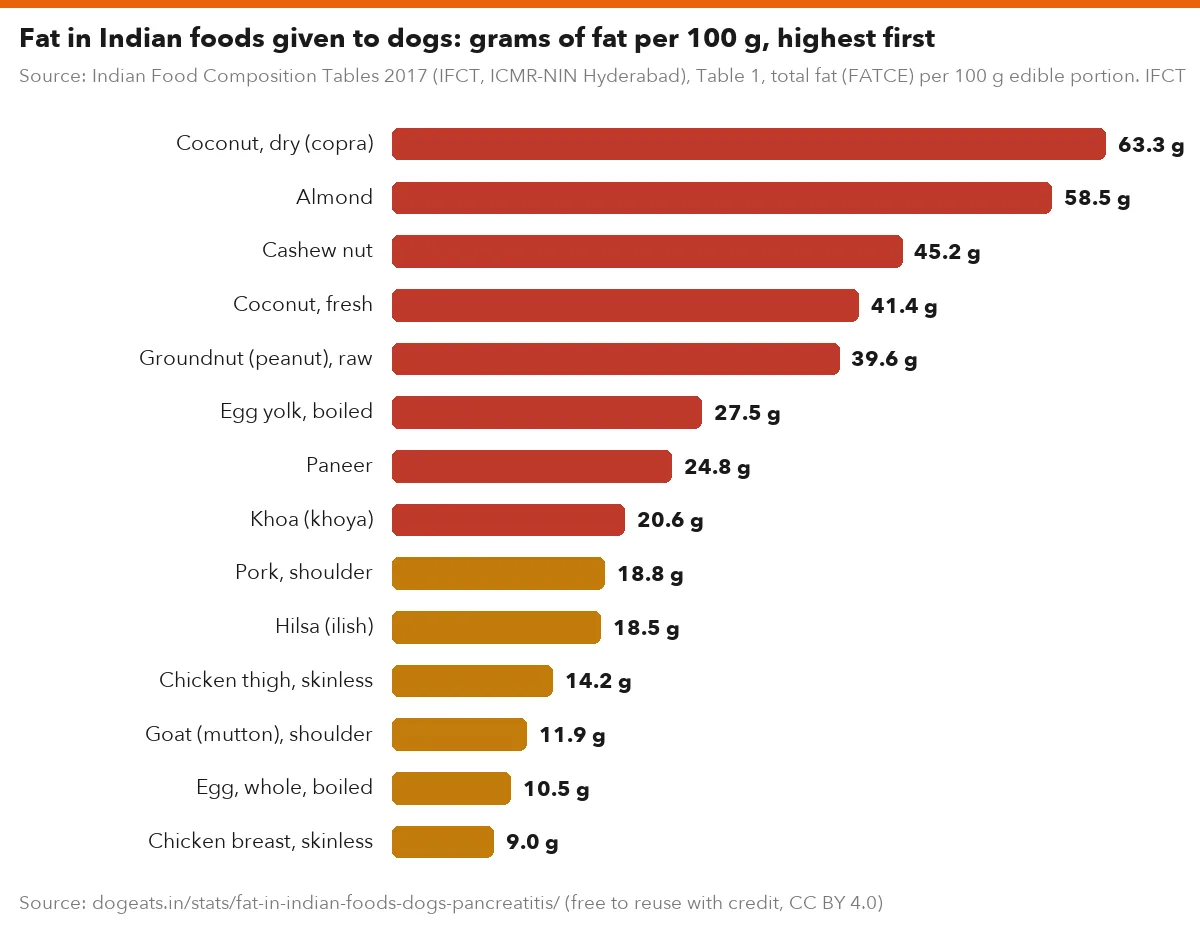
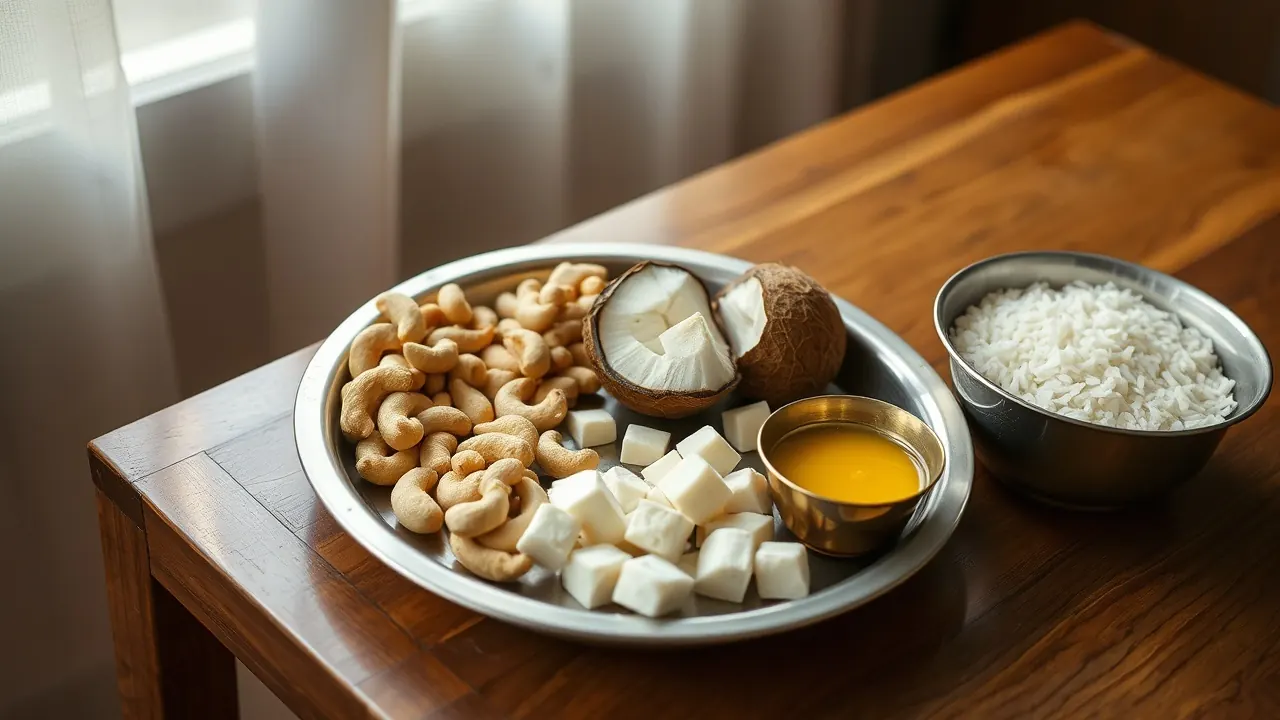
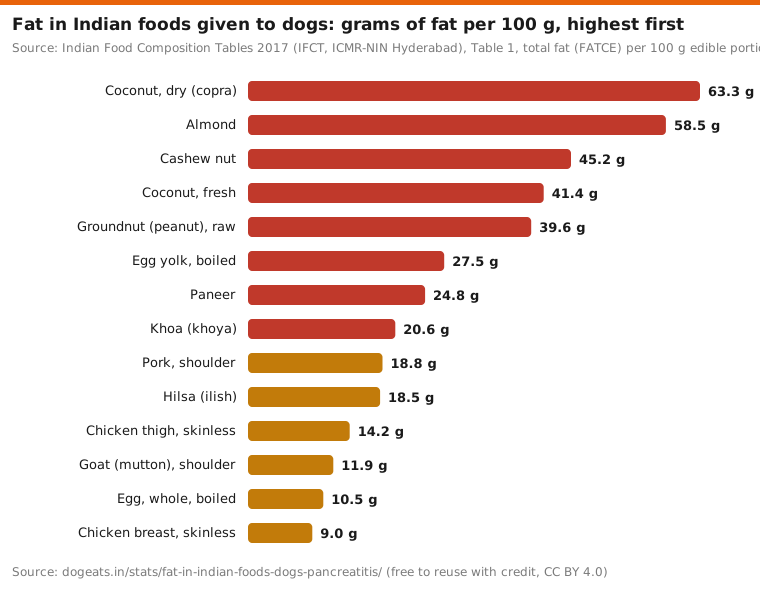
Dry coconut tops India's food tables at 63.3 g of fat per 100 g, per IFCT 2017 from ICMR-NIN Hyderabad. It is followed by almond (58.5 g), cashew (45.2 g), fresh coconut (41.4 g) and raw groundnut (39.6 g). Ghee, not listed in IFCT, must be at least 99.5% fat under FSSAI rules.
Among foods many Indian owners share every day, paneer has 24.8 g of fat per 100 g, boiled egg yolk 27.5 g and khoa 20.6 g. Pork shoulder has 18.8 g and hilsa 18.5 g.
At the lean end, raw milled rice has 0.5 g, moong dal 1.4 g, wheat atta 1.5 g and orange pumpkin 0.2 g. Most of these figures are for raw ingredients; IFCT does not say how its chicken was prepared, and eggs are boiled as listed. Oil, ghee or butter added in cooking comes on top.
Source: Indian Food Composition Tables 2017 (IFCT, ICMR-NIN Hyderabad), Table 1, total fat (FATCE) per 100 g edible portion. IFCT data are for raw food except poultry and egg; IFCT does not say how chicken was prepared. Eggs are boiled as listed.
Show the numbers
| Label | g |
|---|---|
| Coconut, dry (copra) | 63.3 g |
| Almond | 58.5 g |
| Cashew nut | 45.2 g |
| Coconut, fresh | 41.4 g |
| Groundnut (peanut), raw | 39.6 g |
| Egg yolk, boiled | 27.5 g |
| Paneer | 24.8 g |
| Khoa (khoya) | 20.6 g |
| Pork, shoulder | 18.8 g |
| Hilsa (ilish) | 18.5 g |
| Chicken thigh, skinless | 14.2 g |
| Goat (mutton), shoulder | 11.9 g |
| Egg, whole, boiled | 10.5 g |
| Chicken breast, skinless | 9.0 g |
Embed this chart
| Food | IFCT code | Fat (g per 100 g) | Energy (kcal per 100 g) | Fat (g per 1,000 kcal) | Energy from fat (%) |
|---|---|---|---|---|---|
| Coconut, dry (copra) | H006 | 63.26 | 624 | 101.4 | 90 |
| Almond | H001 | 58.49 | 609 | 96.0 | 85 |
| Cashew nut | H005 | 45.20 | 583 | 77.6 | 69 |
| Coconut, fresh | H007 | 41.38 | 409 | 101.2 | 89 |
| Groundnut (peanut), raw | H012 | 39.63 | 520 | 76.2 | 67 |
| Egg yolk, boiled | M006 | 27.46 | 308 | 89.1 | 79 |
| Paneer | L003 | 24.78 | 305 | 81.1 | 72 |
| Khoa (khoya) | L004 | 20.62 | 316 | 65.3 | 58 |
| Pork, shoulder | O048 | 18.83 | 237 | 79.3 | 70 |
| Hilsa (ilish) | P017 | 18.49 | 259 | 71.4 | 63 |
| Chicken thigh, skinless | N002 | 14.23 | 200 | 71.2 | 63 |
| Chicken wing, skinless | N004 | 13.81 | 193 | 71.6 | 63 |
| Goat (mutton), shoulder | O001 | 11.94 | 188 | 63.5 | 56 |
| Egg, whole, boiled | M004 | 10.54 | 148 | 71.4 | 63 |
| Chicken breast, skinless | N003 | 9.00 | 168 | 53.5 | 47 |
| Sardine (mathi) | P071 | 8.99 | 152 | 59.0 | 52 |
| Goat (mutton), leg | O003 | 7.94 | 160 | 49.7 | 44 |
| Buffalo milk, whole | L001 | 6.58 | 107 | 61.3 | 54 |
| Pomfret, white | P057 | 5.12 | 123 | 41.8 | 37 |
| Cow milk, whole | L002 | 4.48 | 73 | 61.5 | 54 |
| Chicken liver | N005 | 4.08 | 124 | 33.0 | 29 |
| Rohu | S006 | 2.39 | 102 | 23.4 | 21 |
| Chicken gizzard | N006 | 2.07 | 92 | 22.4 | 20 |
| Toor (arhar) dal | B021 | 1.56 | 331 | 4.7 | 4 |
| Wheat atta | A019 | 1.53 | 320 | 4.8 | 4 |
| Mackerel (bangda) | P034 | 1.53 | 101 | 15.1 | 13 |
| Moong dal | B010 | 1.35 | 326 | 4.1 | 4 |
| Rice, raw, milled | A015 | 0.52 | 356 | 1.5 | 1 |
| Egg white, boiled | M005 | 0.26 | 53 | 4.9 | 4 |
| Pumpkin, orange | D066 | 0.16 | 23 | 6.9 | 6 |
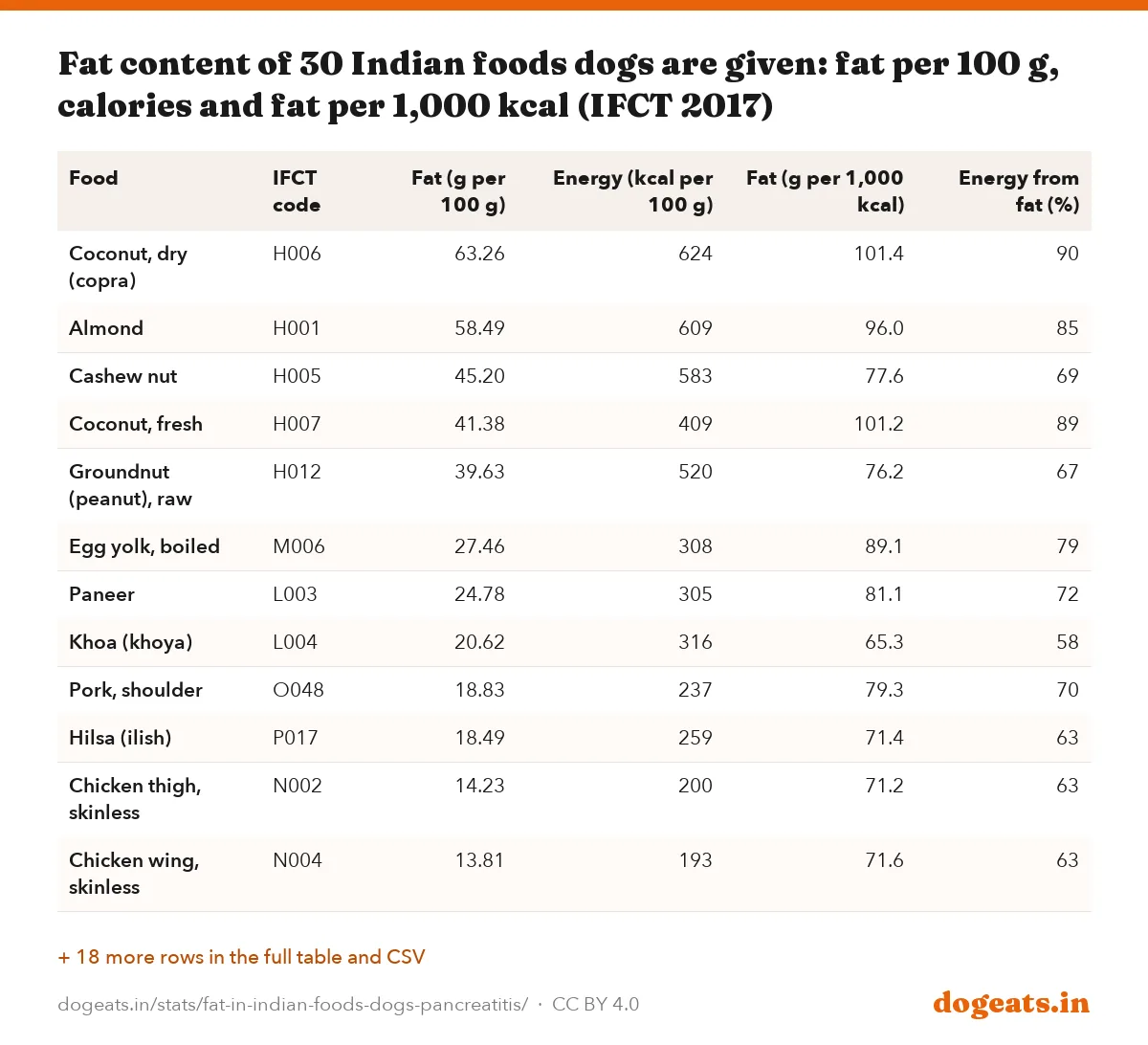
Fat per 100 g is only half the story. A food can be low in fat by weight and still get most of its calories from fat. Cow milk has just 4.5 g of fat per 100 g, yet fat supplies 54% of its energy.
That is why the table also gives fat per 1,000 kcal, the unit vets use for a dog's diet. Our paneer, coconut, cashew and peanut pages cover safe portions for each.
How much fat can a dog with pancreatitis eat?
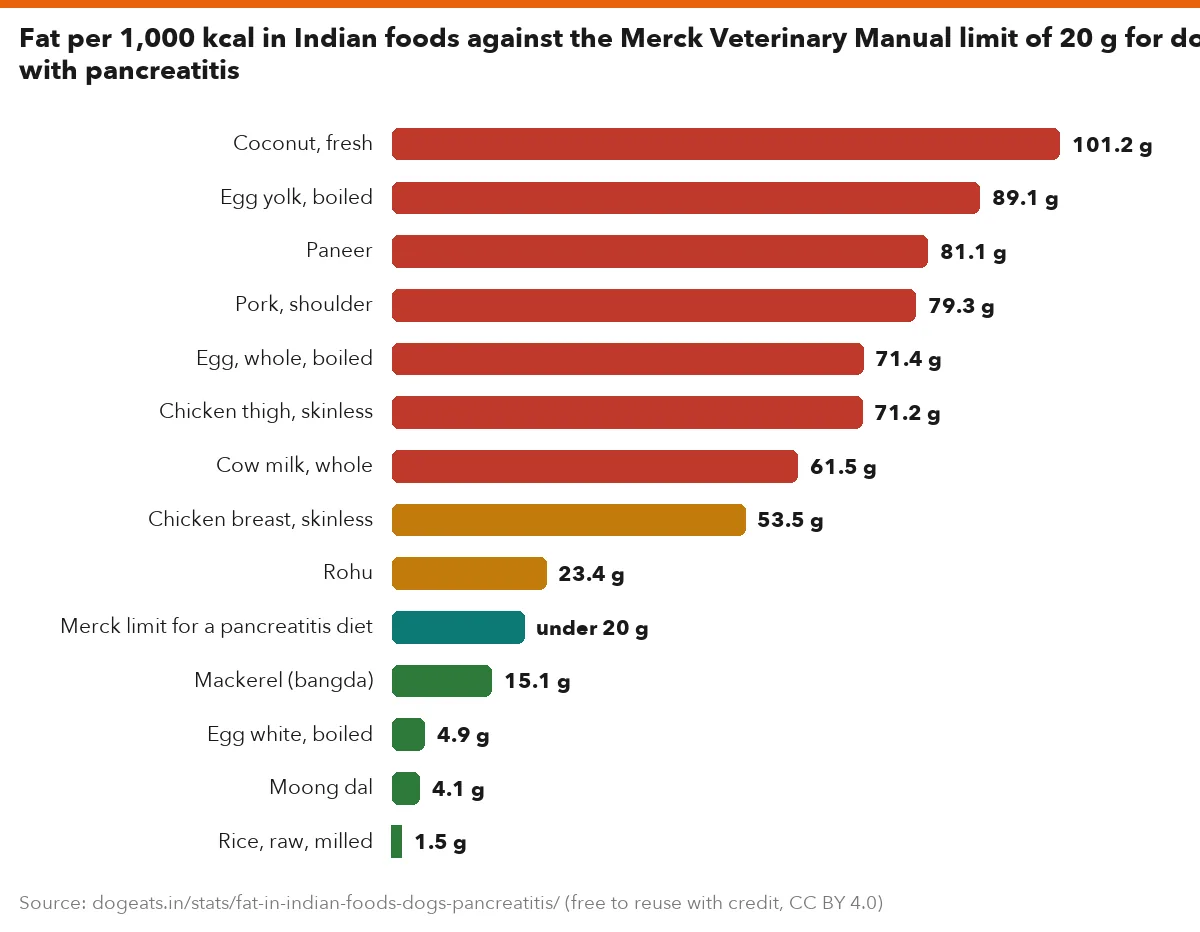
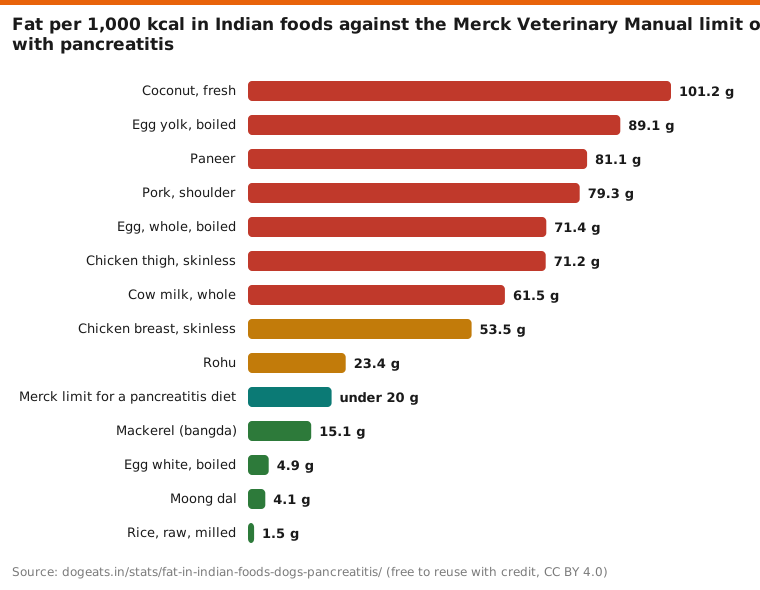
For a dog being treated for pancreatitis, the Merck Veterinary Manual says a low-fat diet, less than 20 g of fat per 1,000 kcal, is key to successful treatment. Merck applies it to the whole ration, so treats count too.
On their own, most rich Indian foods sit far above that line. Paneer has 81 g of fat per 1,000 kcal, boiled egg yolk 89 g and fresh coconut 101 g. Even skinless chicken breast in IFCT 2017 comes to 53.5 g.
Of the 30 foods we ranked, only 7 fall under 20 g per 1,000 kcal. They are rice (1.5 g), moong dal, toor dal, atta, boiled egg white, pumpkin and mackerel (15.1 g). Rohu (23.4 g) and chicken gizzard (22.4 g) sit just above.
dogeats.in calculation: IFCT 2017 fat divided by energy (kJ / 4.184 = kcal), times 1,000. Limit: MSD/Merck Veterinary Manual, Pancreatitis in Dogs and Cats (full review September 2025). The limit applies to the whole diet, not one food.
Show the numbers
| Label | g per 1,000 kcal |
|---|---|
| Coconut, fresh | 101.2 g |
| Egg yolk, boiled | 89.1 g |
| Paneer | 81.1 g |
| Pork, shoulder | 79.3 g |
| Egg, whole, boiled | 71.4 g |
| Chicken thigh, skinless | 71.2 g |
| Cow milk, whole | 61.5 g |
| Chicken breast, skinless | 53.5 g |
| Rohu | 23.4 g |
| Merck limit for a pancreatitis diet | under 20 g |
| Mackerel (bangda) | 15.1 g |
| Egg white, boiled | 4.9 g |
| Moong dal | 4.1 g |
| Rice, raw, milled | 1.5 g |
Embed this chart
Merck adds that food should be withheld only if a dog vomits uncontrollably, and that feeding through the gut is better than feeding into a vein. So the question for most dogs is what to feed, not whether to feed. Your vet sets the plan.
A dog that has never had pancreatitis does not need such a strict diet. The 20 g figure is a treatment target, not a rule for healthy dogs.
Which chicken, mutton or fish has the least fat for dogs?
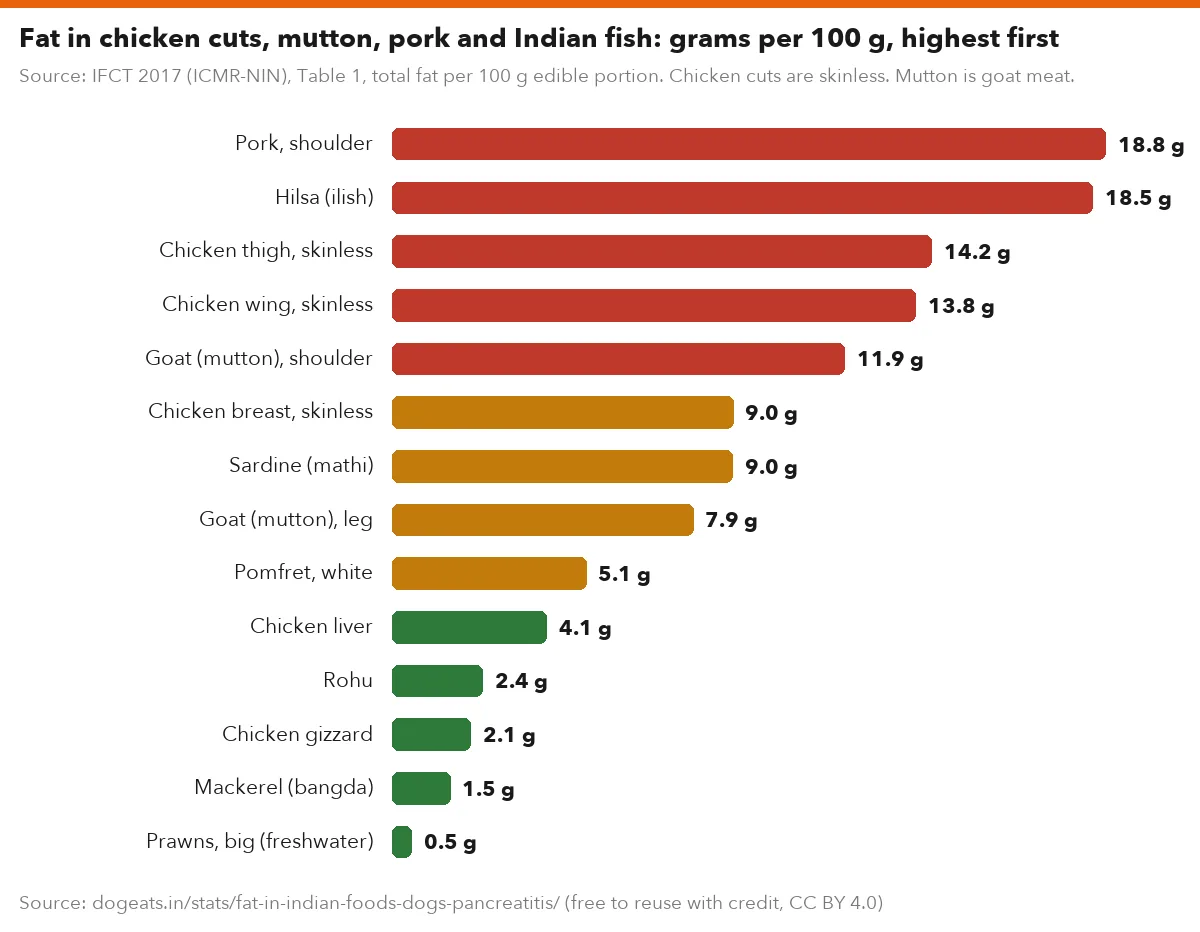
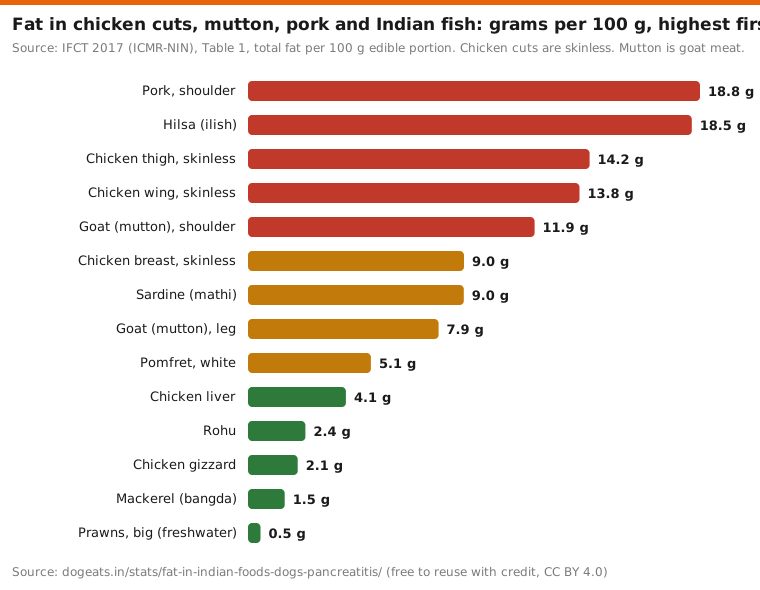
Among common meats in IFCT 2017, rohu has 2.4 g of fat per 100 g, mackerel (bangda) 1.5 g and chicken gizzard 2.1 g. Compare that with 14.2 g for skinless chicken thigh and 18.8 g for pork shoulder. Big freshwater prawns have just 0.5 g.
The cut matters as much as the animal. Goat leg has 7.9 g of fat per 100 g, goat shoulder 11.9 g. Skinless chicken breast has 9.0 g, the wing 13.8 g and the thigh 14.2 g.
Oily fish run high. Hilsa has 18.5 g of fat per 100 g and sardine 9.0 g, while white pomfret has 5.1 g.
Source: IFCT 2017 (ICMR-NIN), Table 1, total fat per 100 g edible portion. Chicken cuts are skinless. Mutton is goat meat.
Show the numbers
| Label | g |
|---|---|
| Pork, shoulder | 18.8 g |
| Hilsa (ilish) | 18.5 g |
| Chicken thigh, skinless | 14.2 g |
| Chicken wing, skinless | 13.8 g |
| Goat (mutton), shoulder | 11.9 g |
| Chicken breast, skinless | 9.0 g |
| Sardine (mathi) | 9.0 g |
| Goat (mutton), leg | 7.9 g |
| Pomfret, white | 5.1 g |
| Chicken liver | 4.1 g |
| Rohu | 2.4 g |
| Chicken gizzard | 2.1 g |
| Mackerel (bangda) | 1.5 g |
| Prawns, big (freshwater) | 0.5 g |
Embed this chart
IFCT does not say whether its chicken rows were raw or cooked, so check pack labels or ask your vet if your dog needs a strict diet. Bones are a separate hazard; see our chicken page.
For low-fat fish, plain boiled rohu and mackerel with every bone removed are among the leanest proteins in an Indian kitchen.
Is egg yolk or egg white better for a dog with pancreatitis?
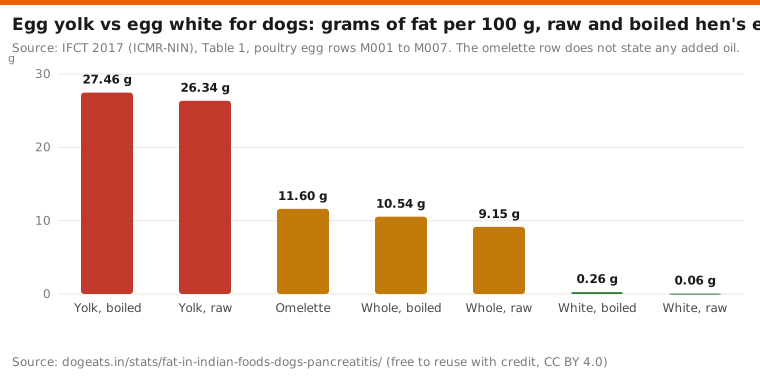
Egg white: a boiled hen's egg white has 0.26 g of fat per 100 g, against 27.5 g in the boiled yolk, per IFCT 2017. Nearly all the fat in an egg sits in the yolk.
A whole boiled egg has 10.5 g of fat per 100 g and 71 g per 1,000 kcal, well above the 20 g low-fat limit. Boiled egg white has 4.9 g per 1,000 kcal.
Source: IFCT 2017 (ICMR-NIN), Table 1, poultry egg rows M001 to M007. The omelette row does not state any added oil.
Show the numbers
| Label | g |
|---|---|
| Yolk, boiled | 27.46 g |
| Yolk, raw | 26.34 g |
| Omelette | 11.60 g |
| Whole, boiled | 10.54 g |
| Whole, raw | 9.15 g |
| White, boiled | 0.26 g |
| White, raw | 0.06 g |
Embed this chart
IFCT lists an omelette at 11.6 g of fat per 100 g without stating any oil, so a home omelette fried in oil or butter will carry more. Our egg page explains why eggs should be cooked for dogs.
How much fat is in ghee, butter, paneer, milk and curd?
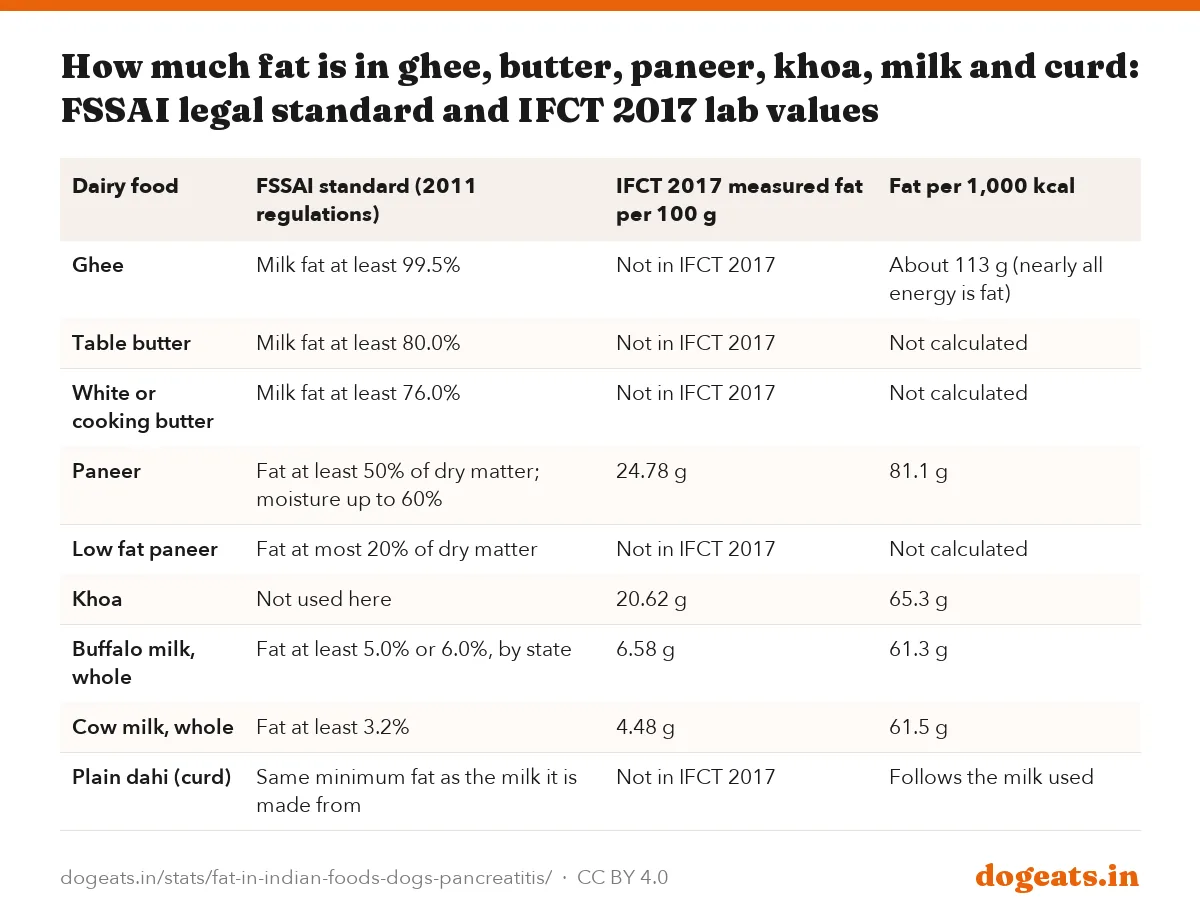
By law, ghee sold in India must be at least 99.5% milk fat and table butter at least 80%, under FSSAI's food product standards. So 5 g of ghee adds about 5 g of fat and 44 kcal to a dog's bowl.
Paneer has 24.8 g of fat per 100 g in IFCT 2017. FSSAI requires regular paneer to have at least 50% fat in its dry matter, and allows a low fat paneer with no more than 20%.
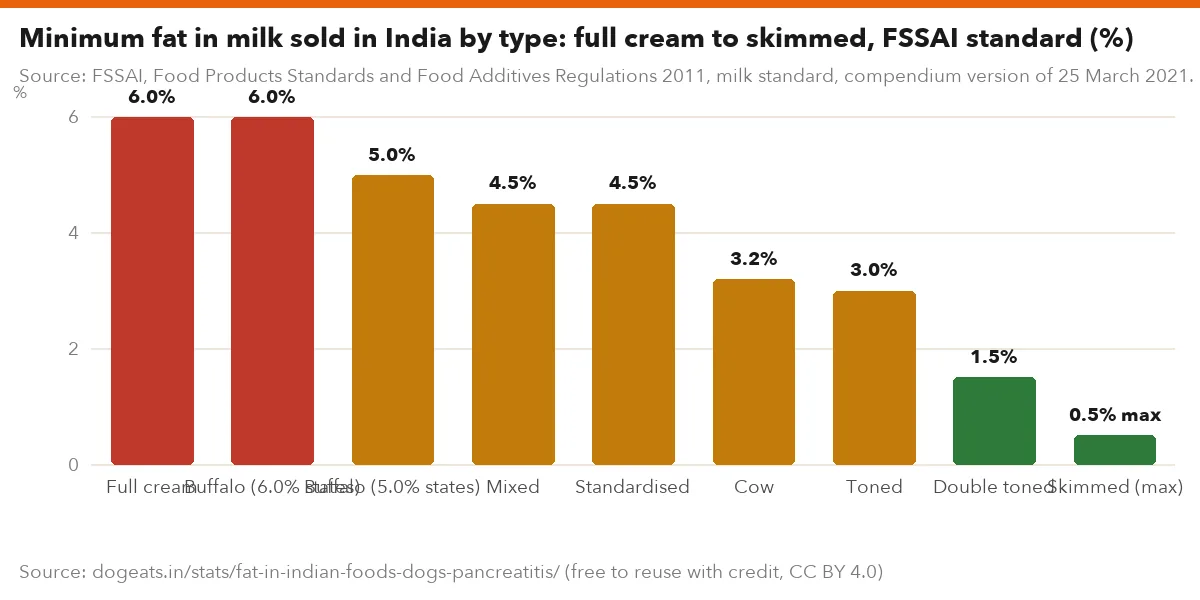
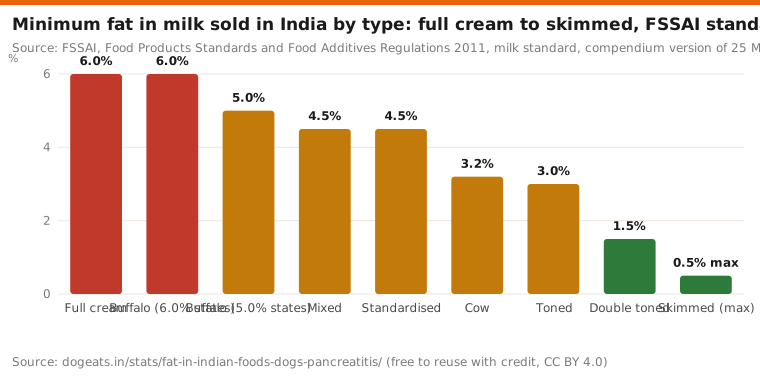
Packet milk varies by type. FSSAI sets a minimum of 6.0% fat for full cream milk, 3.0% for toned milk and 1.5% for double toned milk, and a maximum of 0.5% for skimmed milk. Plain dahi must keep the fat level of the milk it is made from.
Source: FSSAI, Food Products Standards and Food Additives Regulations 2011, milk standard, compendium version of 25 March 2021. Values are legal minimums at the point of sale; skimmed milk is a maximum. Buffalo milk is 6.0% in states including Delhi, Maharashtra, Punjab, Uttar Pradesh and West Bengal, and 5.0% in the rest, including Karnataka, Kerala, Tamil Nadu, Madhya Pradesh and Odisha.
Show the numbers
| Label | % |
|---|---|
| Full cream | 6.0% |
| Buffalo (6.0% states) | 6.0% |
| Buffalo (5.0% states) | 5.0% |
| Mixed | 4.5% |
| Standardised | 4.5% |
| Cow | 3.2% |
| Toned | 3.0% |
| Double toned | 1.5% |
| Skimmed (max) | 0.5% max |
Embed this chart
| Dairy food | FSSAI standard (2011 regulations) | IFCT 2017 measured fat per 100 g | Fat per 1,000 kcal |
|---|---|---|---|
| Ghee | Milk fat at least 99.5% | Not in IFCT 2017 | About 113 g (nearly all energy is fat) |
| Table butter | Milk fat at least 80.0% | Not in IFCT 2017 | Not calculated |
| White or cooking butter | Milk fat at least 76.0% | Not in IFCT 2017 | Not calculated |
| Paneer | Fat at least 50% of dry matter; moisture up to 60% | 24.78 g | 81.1 g |
| Low fat paneer | Fat at most 20% of dry matter | Not in IFCT 2017 | Not calculated |
| Khoa | Not used here | 20.62 g | 65.3 g |
| Buffalo milk, whole | Fat at least 5.0% or 6.0%, by state | 6.58 g | 61.3 g |
| Cow milk, whole | Fat at least 3.2% | 4.48 g | 61.5 g |
| Plain dahi (curd) | Same minimum fat as the milk it is made from | Not in IFCT 2017 | Follows the milk used |
IFCT 2017 measured whole buffalo milk at 6.6 g of fat per 100 g and whole cow milk at 4.5 g. Curd set from double toned or skimmed milk is the lowest-fat way to give dahi, if your dog tolerates lactose.
Read our ghee and butter pages before adding either to food. For calories in dairy treats, see our dog treat calories report.
Is rice and chicken low fat enough for a dog with pancreatitis?
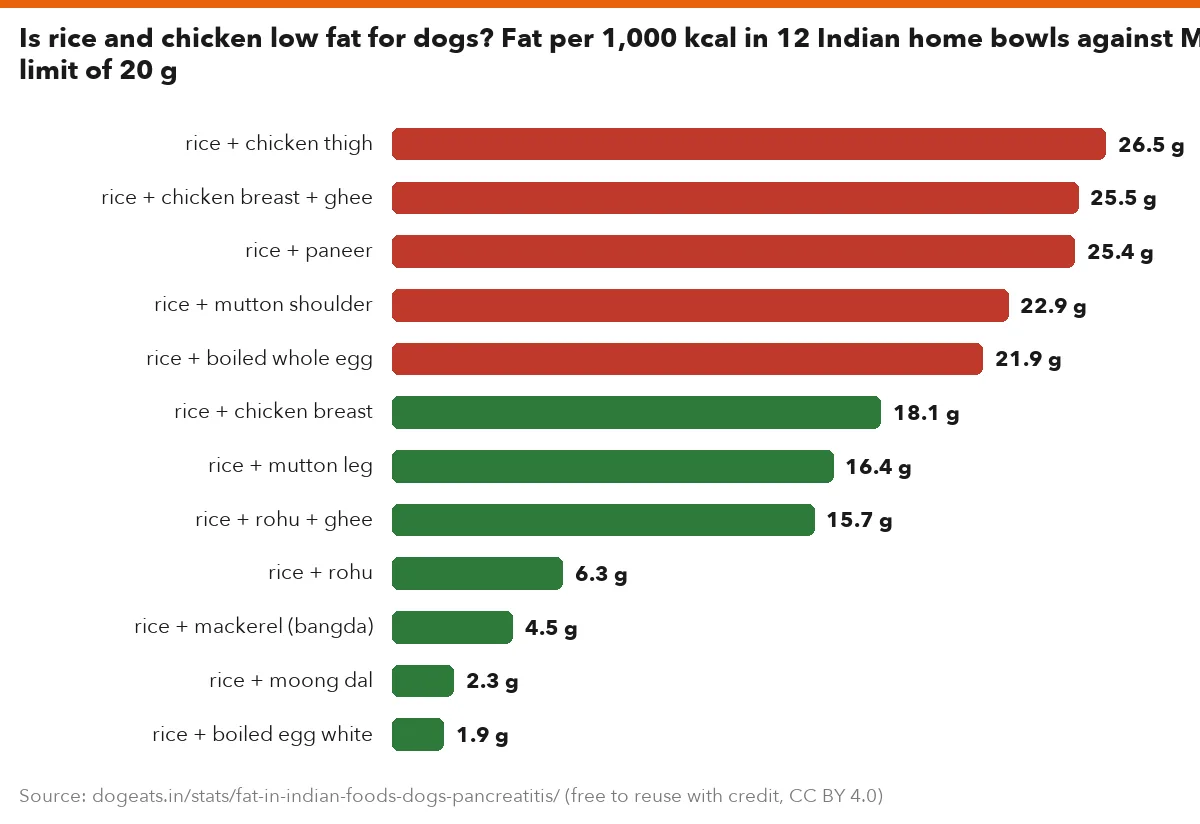
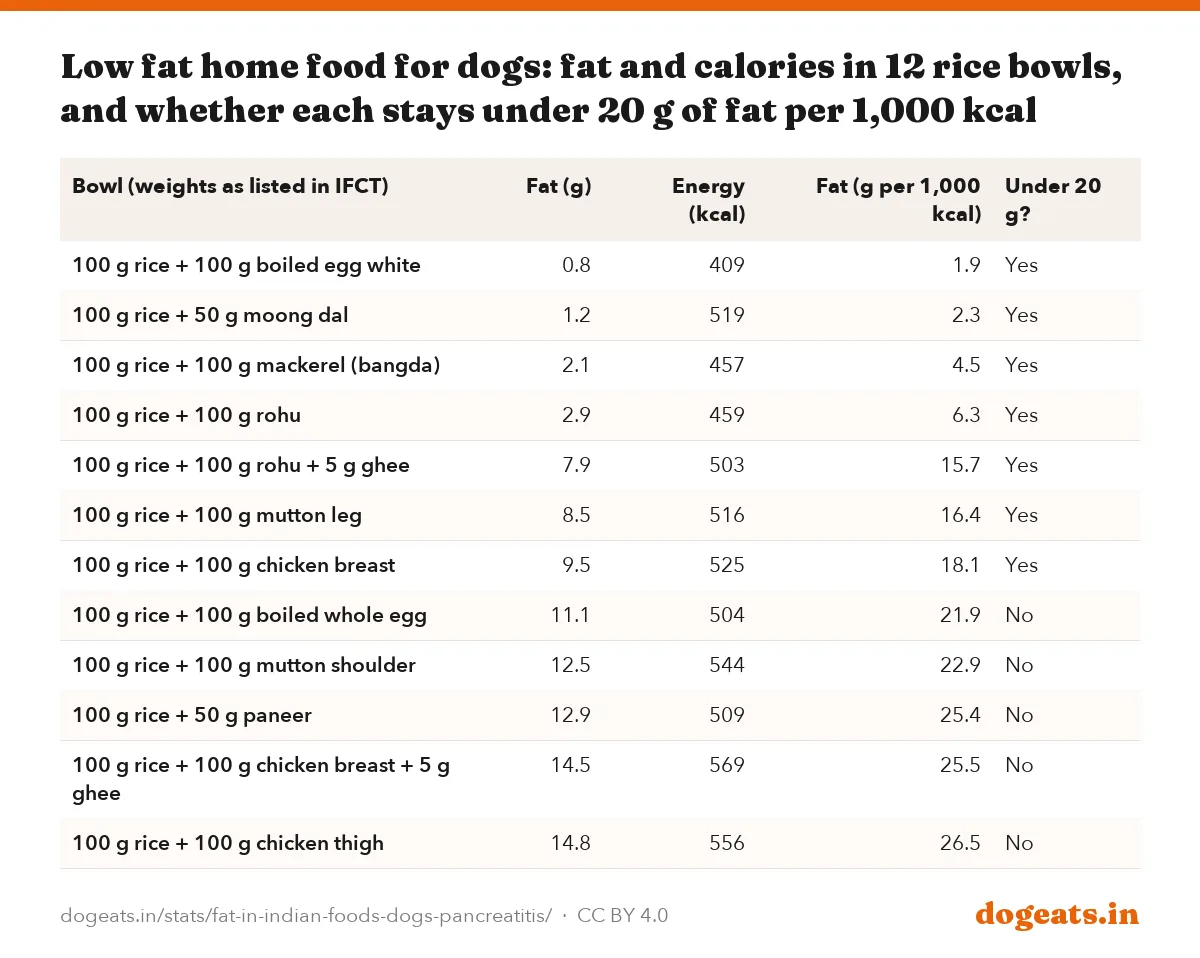
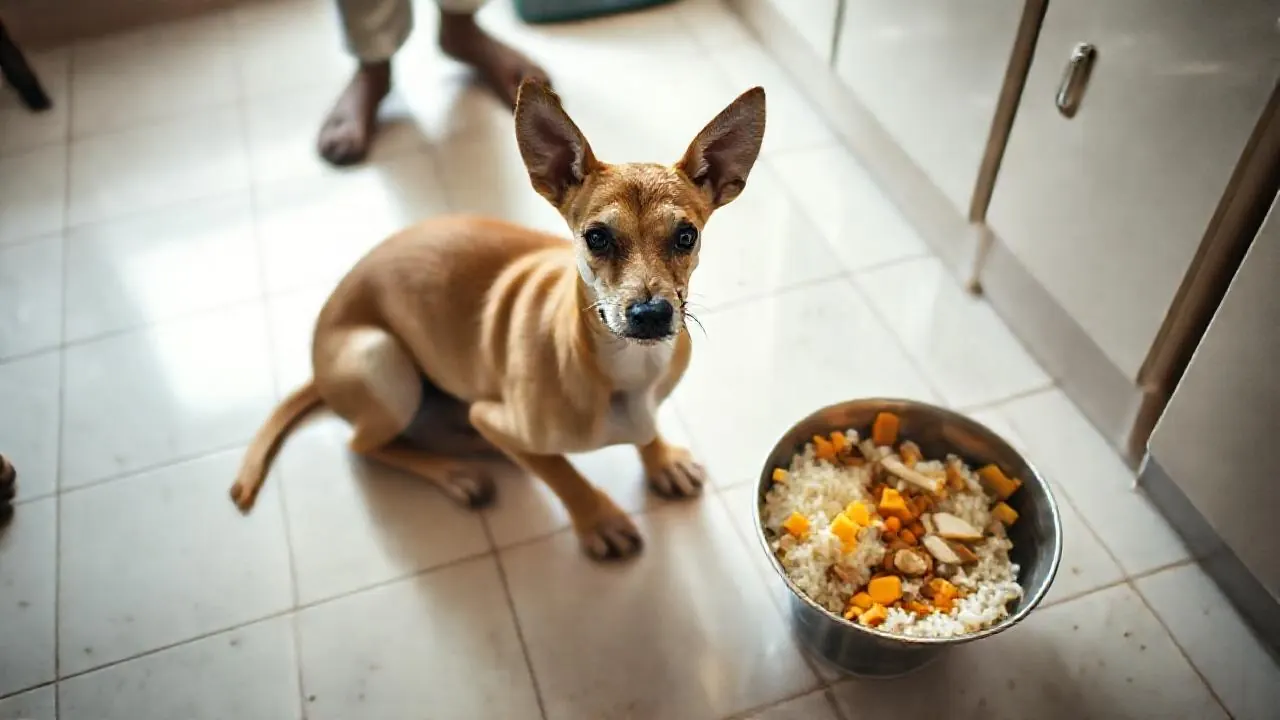
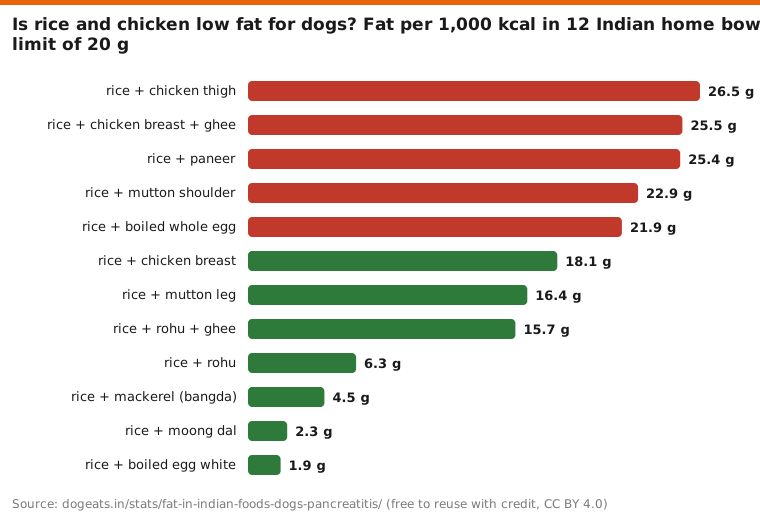
Only just. 100 g of raw rice with 100 g of skinless chicken breast works out to 18.1 g of fat per 1,000 kcal from IFCT 2017 values. That is under the Merck limit of 20 g. Swap breast for thigh and it rises to 26.5 g.
Small additions tip the balance. Adding 5 g of ghee to the rice and chicken bowl lifts it to 25.5 g of fat per 1,000 kcal. Rice with 50 g of paneer comes to 25.4 g.
Rice with rohu stays at 6.3 g per 1,000 kcal, and 15.7 g even with 5 g of ghee. Rice with boiled egg white is the leanest bowl at 1.9 g.
dogeats.in calculation from ingredient weights as listed in IFCT 2017 (ICMR-NIN): raw rice, dal, fish and mutton, boiled egg, and chicken whose preparation IFCT does not state. Ghee counted at the FSSAI minimum of 99.5% fat and 37 kJ per g of fat. Limit: MSD/Merck Veterinary Manual, for a whole diet. Illustrations only, not complete diets.
Show the numbers
| Label | g per 1,000 kcal |
|---|---|
| rice + chicken thigh | 26.5 g |
| rice + chicken breast + ghee | 25.5 g |
| rice + paneer | 25.4 g |
| rice + mutton shoulder | 22.9 g |
| rice + boiled whole egg | 21.9 g |
| rice + chicken breast | 18.1 g |
| rice + mutton leg | 16.4 g |
| rice + rohu + ghee | 15.7 g |
| rice + rohu | 6.3 g |
| rice + mackerel (bangda) | 4.5 g |
| rice + moong dal | 2.3 g |
| rice + boiled egg white | 1.9 g |
Embed this chart
| Bowl (weights as listed in IFCT) | Fat (g) | Energy (kcal) | Fat (g per 1,000 kcal) | Under 20 g? |
|---|---|---|---|---|
| 100 g rice + 100 g boiled egg white | 0.8 | 409 | 1.9 | Yes |
| 100 g rice + 50 g moong dal | 1.2 | 519 | 2.3 | Yes |
| 100 g rice + 100 g mackerel (bangda) | 2.1 | 457 | 4.5 | Yes |
| 100 g rice + 100 g rohu | 2.9 | 459 | 6.3 | Yes |
| 100 g rice + 100 g rohu + 5 g ghee | 7.9 | 503 | 15.7 | Yes |
| 100 g rice + 100 g mutton leg | 8.5 | 516 | 16.4 | Yes |
| 100 g rice + 100 g chicken breast | 9.5 | 525 | 18.1 | Yes |
| 100 g rice + 100 g boiled whole egg | 11.1 | 504 | 21.9 | No |
| 100 g rice + 100 g mutton shoulder | 12.5 | 544 | 22.9 | No |
| 100 g rice + 50 g paneer | 12.9 | 509 | 25.4 | No |
| 100 g rice + 100 g chicken breast + 5 g ghee | 14.5 | 569 | 25.5 | No |
| 100 g rice + 100 g chicken thigh | 14.8 | 556 | 26.5 | No |
These bowls are not complete diets. Rice with chicken or fish lacks calcium and other nutrients, as our Indian dog diet chart report shows. A dog recovering from pancreatitis needs a diet planned with a vet.
Cooking adds fat the tables cannot show. Fry the fish, use chicken with skin, or pour dal tadka over the rice and the numbers above no longer hold.
What causes pancreatitis in dogs?
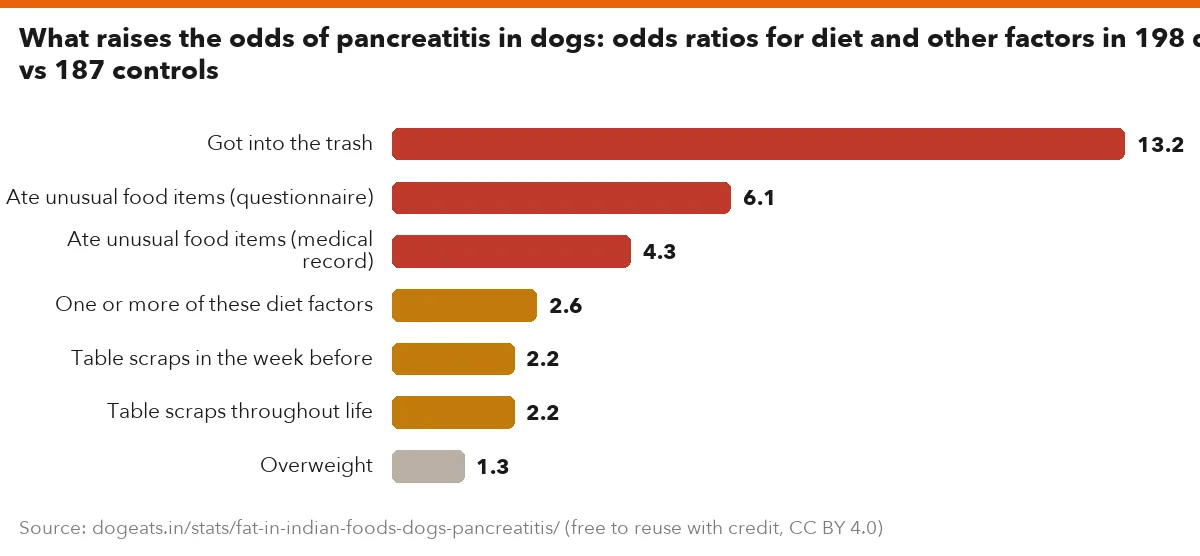
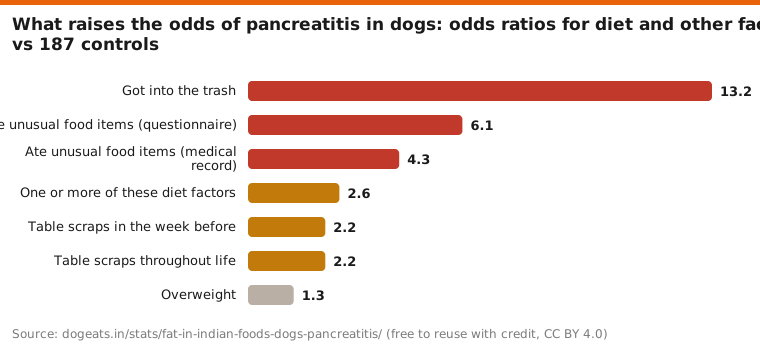
Eating things they should not is the clearest food link. A 2008 Texas A&M study compared 198 dogs with pancreatitis and 187 controls. Getting into the trash raised the odds 13.2 times and eating unusual food items 4.3 to 6.1 times.
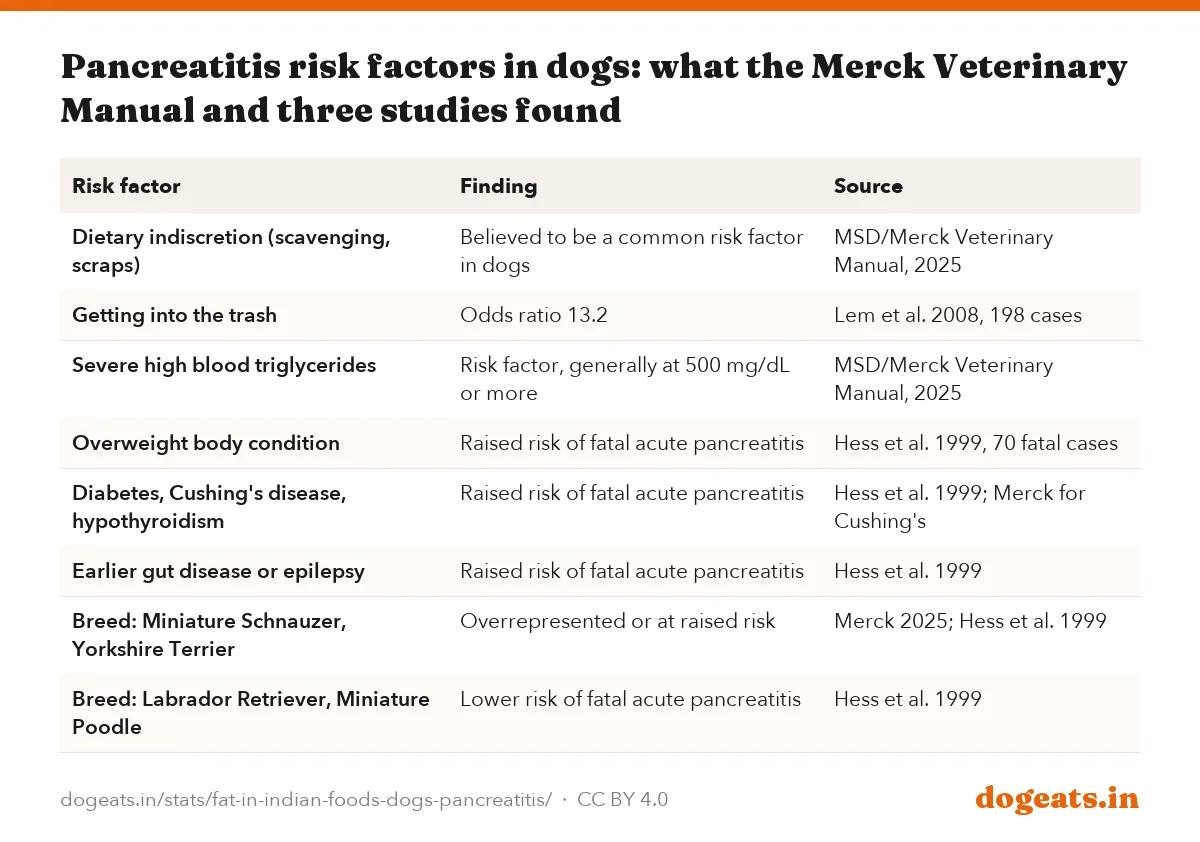
Table scraps mattered too. Dogs given scraps in the week before diagnosis, or throughout life, had 2.2 times the odds. The Merck Veterinary Manual calls dietary indiscretion a common risk factor in dogs.
Other factors sit outside the food bowl. Merck names severe high blood triglycerides, generally 500 mg/dL or more, and Cushing's disease. A 1999 study of 70 fatal cases added overweight body condition, diabetes, hypothyroidism, earlier gut disease and epilepsy.
Source: Lem KY et al. (2008), JAVMA 233(9):1425-31, Texas A&M case-control study; controls were dogs with kidney failure. An odds ratio of 1 means no difference. Diet answers came from a telephone questionnaire unless marked as medical record. One or more diet factors and overweight are from the multivariable model.
Show the numbers
| Label | odds ratio |
|---|---|
| Got into the trash | 13.2 |
| Ate unusual food items (questionnaire) | 6.1 |
| Ate unusual food items (medical record) | 4.3 |
| One or more of these diet factors | 2.6 |
| Table scraps in the week before | 2.2 |
| Table scraps throughout life | 2.2 |
| Overweight | 1.3 |
Embed this chart
| Risk factor | Finding | Source |
|---|---|---|
| Dietary indiscretion (scavenging, scraps) | Believed to be a common risk factor in dogs | MSD/Merck Veterinary Manual, 2025 |
| Getting into the trash | Odds ratio 13.2 | Lem et al. 2008, 198 cases |
| Severe high blood triglycerides | Risk factor, generally at 500 mg/dL or more | MSD/Merck Veterinary Manual, 2025 |
| Overweight body condition | Raised risk of fatal acute pancreatitis | Hess et al. 1999, 70 fatal cases |
| Diabetes, Cushing's disease, hypothyroidism | Raised risk of fatal acute pancreatitis | Hess et al. 1999; Merck for Cushing's |
| Earlier gut disease or epilepsy | Raised risk of fatal acute pancreatitis | Hess et al. 1999 |
| Breed: Miniature Schnauzer, Yorkshire Terrier | Overrepresented or at raised risk | Merck 2025; Hess et al. 1999 |
| Breed: Labrador Retriever, Miniature Poodle | Lower risk of fatal acute pancreatitis | Hess et al. 1999 |
The same 2008 study found an odds ratio of 21.1 for previous surgery other than neutering. Its effect depended on whether the dog was neutered, so we left surgery and neutering out of the chart.
Being overweight carried an odds ratio of 1.3 in that study, and a 1999 study of 70 fatal cases also linked overweight body condition to higher risk. In a 1998 study, 43% of dogs that died of acute pancreatitis were overweight or obese.
In India, festival leftovers, mithai and fried snacks are the usual high-fat scraps. Our most toxic foods report covers the dishes that are poisonous, not just fatty.
What are the symptoms of pancreatitis in dogs?
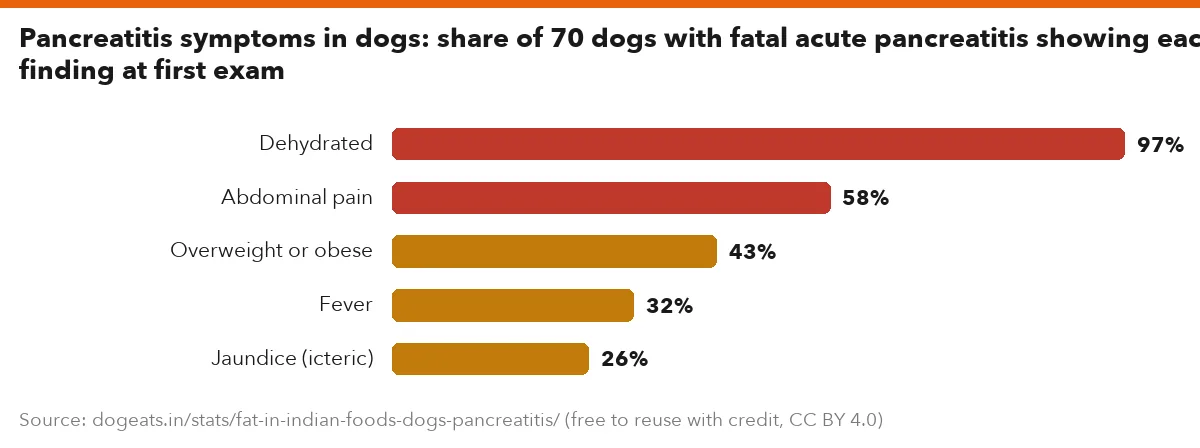
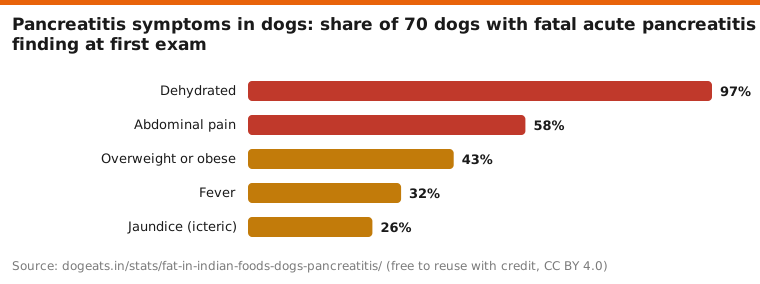
In severe cases, the Merck Veterinary Manual lists loss of appetite, vomiting, weakness, abdominal pain, dehydration and diarrhoea. In a 1998 study of 70 dogs that died of acute pancreatitis, 97% were dehydrated and 58% showed abdominal pain at first exam.
Mild cases can be vague, with a poor appetite, tiredness or loose stools. Merck notes that some dogs in pain stand in a prayer position, front legs down and rear end up.
Scans help. In the 1998 study, ultrasound matched the diagnosis in 68% of dogs scanned (23 of 34) and X-rays in only 24% (10 of 41).
Source: Hess RS et al. (1998), JAVMA 213(5):665-70, 70 dogs seen at the University of Pennsylvania from 1986 to 1995. These were the most severe, fatal cases.
Show the numbers
| Label | % |
|---|---|
| Dehydrated | 97% |
| Abdominal pain | 58% |
| Overweight or obese | 43% |
| Fever | 32% |
| Jaundice (icteric) | 26% |
Embed this chart
Merck calls the outlook good for mild cases and guarded for severe ones. A dog that vomits repeatedly, will not eat or seems in pain after a rich meal should see a vet the same day.
Which dog breeds are prone to pancreatitis?
Miniature Schnauzers stand out: the Merck Veterinary Manual says they are dramatically overrepresented. A 1999 US study also found raised risk in Yorkshire Terriers and lower risk in Labradors and Miniature Poodles.
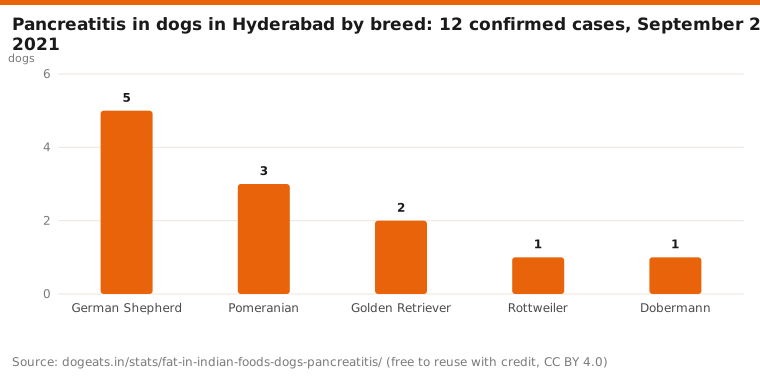
In Hyderabad, a study of 36 dogs suspected of pancreatitis from September 2020 to January 2021 confirmed 12 cases. Five were German Shepherds, three Pomeranians and two Golden Retrievers. Seven were over 7 years old, eight were male, and no puppy under a year was affected.
The Hyderabad figures show which dogs came to that clinic, not which breeds are most at risk in India. With 12 cases, one dog moves a breed's share by more than 8 points.
Source: Sandepogu RK et al. (2026), Incidence of Pancreatitis Among Dogs in Hyderabad, International Journal of Bio-resource and Stress Management 17(3). 36 suspected cases screened with SNAP cPL.
Show the numbers
| Label | dogs |
|---|---|
| German Shepherd | 5 |
| Pomeranian | 3 |
| Golden Retriever | 2 |
| Rottweiler | 1 |
| Dobermann | 1 |
Embed this chart
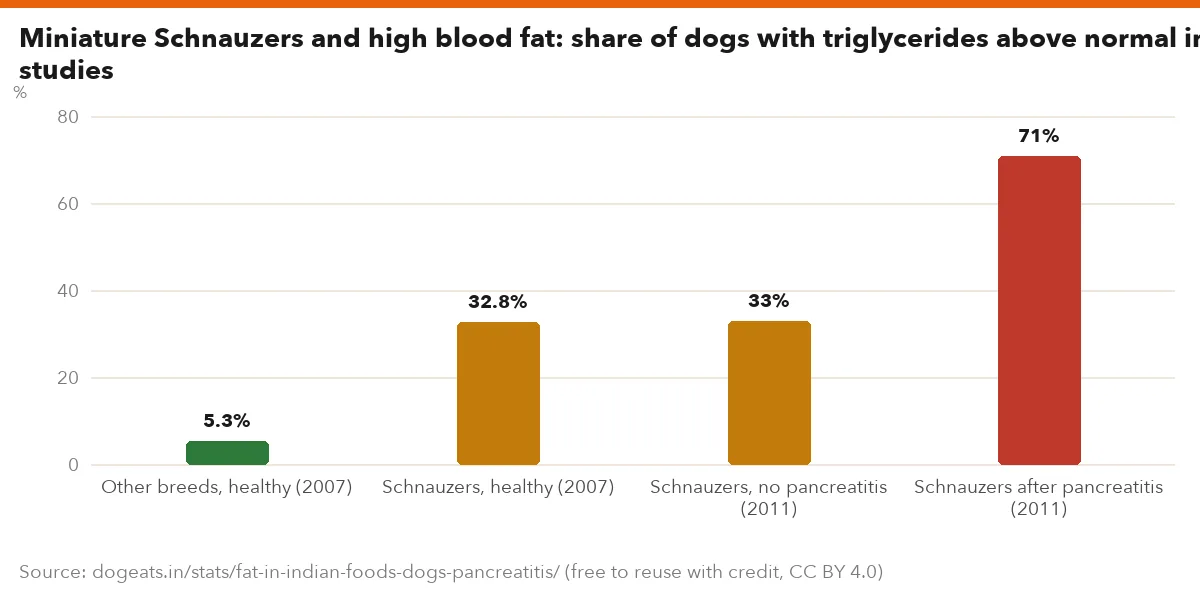
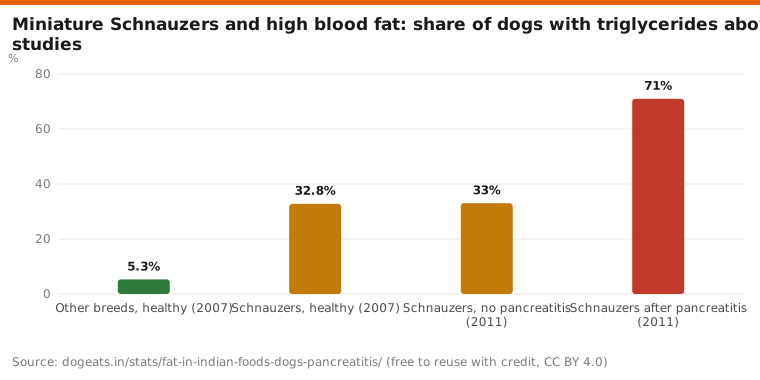
Sources: Xenoulis PG et al. (2007), JVIM 21(6), 192 healthy Schnauzers vs 38 other dogs; Xenoulis PG et al. (2011), JVIM 25(1), 17 Schnauzers after pancreatitis vs 34 without. The 2011 study used a cut-off of 108 mg/dL.
Show the numbers
| Label | % |
|---|---|
| Other breeds, healthy (2007) | 5.3% |
| Schnauzers, healthy (2007) | 32.8% |
| Schnauzers, no pancreatitis (2011) | 33% |
| Schnauzers after pancreatitis (2011) | 71% |
Embed this chart
Schnauzers often carry high blood fats. In a 2007 study, 32.8% of 192 healthy Miniature Schnauzers had triglycerides above normal, against 5.3% of 38 other dogs. In 2011, 71% of Schnauzers that had recovered from pancreatitis had high triglycerides, against 33% of Schnauzers with no history of it.
Diet helped. In a 2020 trial of 16 Schnauzers with high triglycerides, median levels fell from 480 mg/dL to 177 mg/dL two months after a switch to a low-fat commercial diet. Our Miniature Schnauzer food guide covers feeding the breed in India.
Frequently asked questions
Which Indian food has the most fat for dogs?
Ghee, at no less than 99.5% fat under FSSAI rules. Among foods in IFCT 2017, dry coconut has 63.3 g of fat per 100 g, almond 58.5 g, cashew 45.2 g and fresh coconut 41.4 g.
How much fat is in paneer?
Paneer has 24.8 g of fat per 100 g and about 305 kcal in IFCT 2017. That is 81 g of fat per 1,000 kcal, about 4 times the 20 g limit the Merck Veterinary Manual sets for the whole diet of a dog with pancreatitis.
What is a low fat diet for a dog with pancreatitis?
The Merck Veterinary Manual defines it as less than 20 g of fat per 1,000 kcal for the whole diet. Your vet can choose a commercial low-fat food or plan a home diet.
Can a dog with pancreatitis eat rice and chicken?
Only as a short-term bland meal your vet approves. 100 g of rice with 100 g of skinless chicken breast works out to 18.1 g of fat per 1,000 kcal from IFCT values, just under the limit. It is not a complete diet.
Can dogs with pancreatitis eat ghee?
Ghee is at least 99.5% fat. Just 5 g of ghee lifts a rice and chicken bowl from 18.1 g to 25.5 g of fat per 1,000 kcal, over the low-fat limit. Ask your vet before adding any.
Is egg good for a dog with pancreatitis?
Egg white is very low in fat at 0.26 g per 100 g boiled. The yolk has 27.5 g. A whole boiled egg comes to about 71 g of fat per 1,000 kcal, so ask your vet before giving whole eggs.
Which fish is low fat for dogs?
Rohu (2.4 g of fat per 100 g) and mackerel or bangda (1.5 g) are among the leanest in IFCT 2017. Hilsa (18.5 g) and sardine (9.0 g) are much richer.
What triggers pancreatitis in dogs?
In a 2008 study of 198 dogs, getting into the trash raised the odds 13.2 times, unusual food items 4.3 to 6.1 times and table scraps 2.2 times. Merck also names high triglycerides and Cushing's disease.
Which milk has the least fat for dogs?
Skimmed milk, with no more than 0.5% fat under FSSAI rules, then double toned milk at a 1.5% minimum. Full cream milk must have at least 6.0%. Many dogs also struggle with lactose.
Methodology and limitations
Fat and energy for 30 foods come from Table 1 (Proximate Principles and Dietary Fibre) of the Indian Food Composition Tables 2017, published by ICMR-National Institute of Nutrition, Hyderabad. Foods are raw except the eggs, which are boiled, and the chicken, whose preparation IFCT does not state. We used the total fat column (FATCE) and the energy column (ENERC), one IFCT row per food, named by code in the main table.
IFCT gives energy in kilojoules. We divided by 4.184 to get kcal. IFCT's own note uses 4.18, which changes no figure by more than 0.1%. Fat per 1,000 kcal is fat in grams divided by kcal, times 1,000. Share of energy from fat uses IFCT's factor of 37 kJ per gram of fat.
IFCT 2017 has no rows for ghee, butter, curd or cheese. For ghee, butter, paneer, dahi and packet milk we used the legal composition standards in the FSSAI Food Products Standards and Food Additives Regulations 2011. We used the text as printed in the compendium version of 25 March 2021. For ghee we used the 99.5% minimum milk fat and IFCT's 37 kJ per gram.
The 12 example bowls add ingredient weights as IFCT lists them (raw rice, dal, fish and mutton; boiled egg; chicken of unstated preparation). They show how one rich ingredient moves a whole bowl across the 20 g per 1,000 kcal line. They are not recipes and not complete diets.
Pancreatitis facts come from the MSD Veterinary Manual chapter on pancreatitis in dogs and cats (full review September 2025). They also come from peer-reviewed studies read in their PubMed abstracts or full text: Lem et al. 2008, Hess et al. 1998 and 1999, Xenoulis et al. 2007, 2011 and 2020, and Sandepogu et al. 2026 from Hyderabad.
Sources
- Longvah T et al. Indian Food Composition Tables 2017, ICMR-National Institute of Nutrition, Hyderabad, Table 1: total fat (FATCE) and energy (ENERC, kJ) per 100 g edible portion for all 30 foods
- MSD Veterinary Manual: Pancreatitis in Dogs and Cats (Steiner JM, full review September 2025), Low-fat diet under 20 g fat per 1,000 kcal; dietary indiscretion, triglycerides, Cushing's and Schnauzers as risk factors; signs
- Lem KY, Fosgate GT, Norby B, Steiner JM (2008), Associations between dietary factors and pancreatitis in dogs, JAVMA 233(9):1425-31, 198 cases, 187 controls; odds ratios for trash, unusual food, table scraps, overweight
- Also consulted: FSSAI, Food Safety and Standards (Food Products Standards and Food Additives) Regulations 2011, compendium Version-XIV (25 March 2021), Hess RS et al. (1998), Clinical, clinicopathologic, radiographic, and ultrasonographic abnormalities in dogs with fatal acute pancreatitis: 70 cases (1986-1995), JAVMA 213(5):665-70, Hess RS et al. (1999), Evaluation of risk factors for fatal acute pancreatitis in dogs, JAVMA 214(1):46-51, Xenoulis PG et al. (2007), Investigation of hypertriglyceridemia in healthy Miniature Schnauzers, J Vet Intern Med 21(6):1224-30, Xenoulis PG et al. (2011), Serum triglyceride concentrations in Miniature Schnauzers with and without a history of probable pancreatitis, J Vet Intern Med 25(1):20-5, Xenoulis PG et al. (2020), Effect of a low-fat diet on serum triglyceride and cholesterol in Miniature Schnauzers with hypertriglyceridemia, J Vet Intern Med 34(6):2605-16, Sandepogu RK et al. (2026), Incidence of Pancreatitis Among Dogs in Hyderabad, International Journal of Bio-resource and Stress Management 17(3), dogeats.in reports on treat calories and home diets, which already list IFCT calories and protein for many of these foods; this report adds fat per 1,000 kcal and pancreatitis data only.
Cite, embed and download
This report, its data and its images are free to reuse under a Creative Commons Attribution 4.0 licence. Credit dogeats.in with a link to this page. Every chart has its own embed code, every table has a CSV and an image download, and the images below are ready for social posts, slides and articles.
Cite this report
Link to this report
Every chart and table as an image