Ranking · Updated October 2026
Which dog breeds are most at risk in Indian heat? All 58 breeds ranked by heat risk
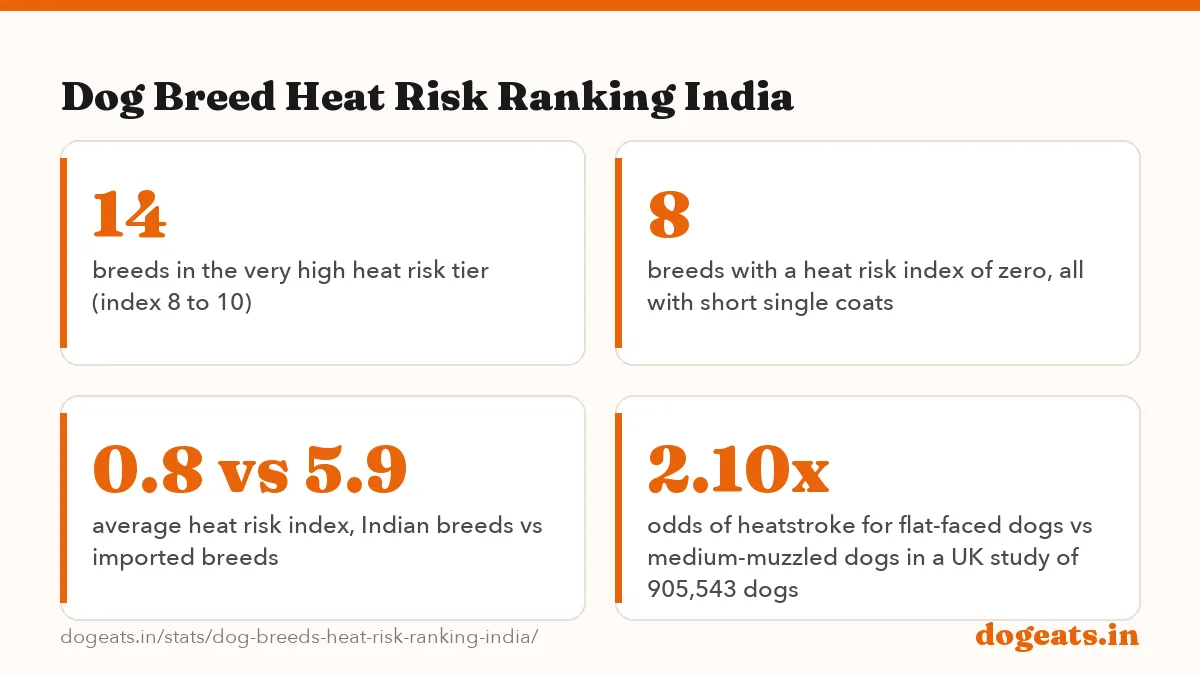
Pug and Pekingese carry the highest heat risk of 58 breeds we rate for India, scoring 10 out of 10 on our heat risk index. Eight breeds score zero, and seven of them are Indian breeds such as the Indian Pariah Dog and Chippiparai. 24 of 58 breeds (41%) score 2 or lower for coping without AC, so most imported breeds need cooling from March to June.
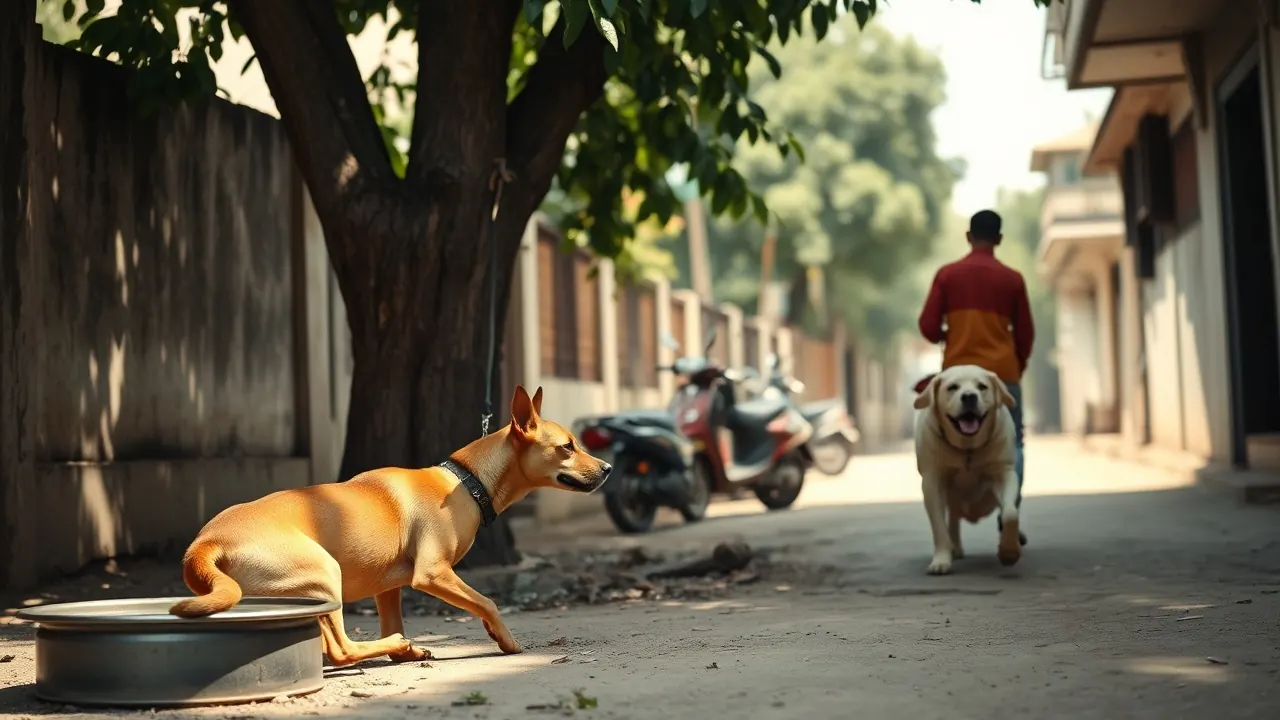
Key findings
- Pug and Pekingese top the ranking with a heat risk index of 10 out of 10. Both score 1 for heat and 1 for coping without AC, and both have flat faces and double coats.
- 14 of 58 breeds (24%) fall in the very high risk tier, including the Siberian Husky, Saint Bernard, Chow Chow and French Bulldog.
- All 8 breeds with an index of zero have short coats with no undercoat, and 7 of the 8 are Indian breeds.
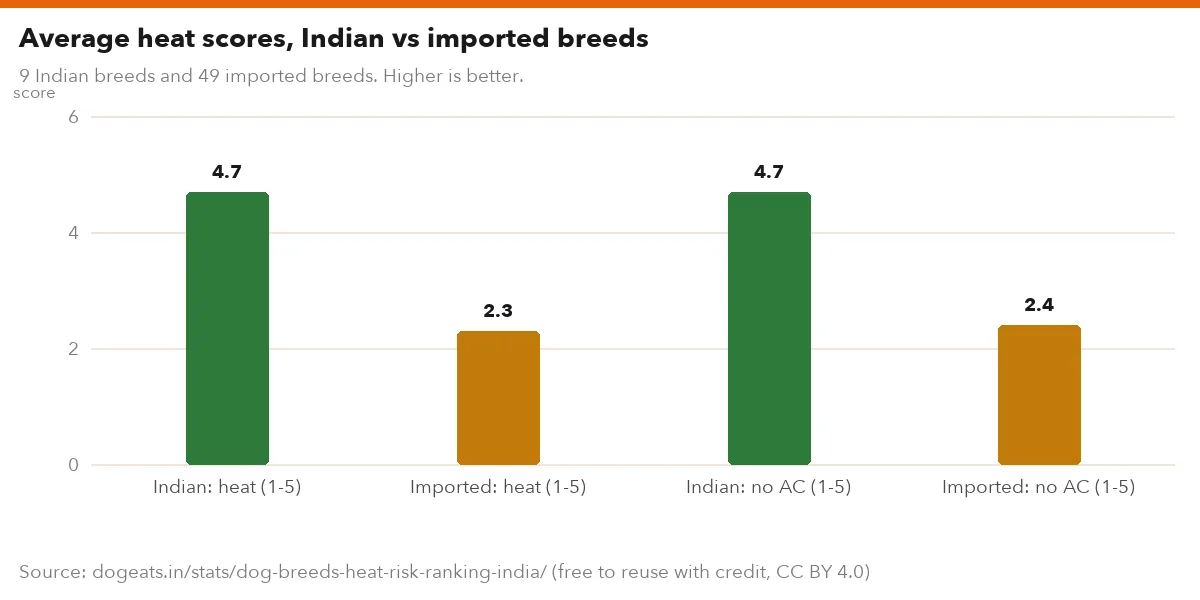
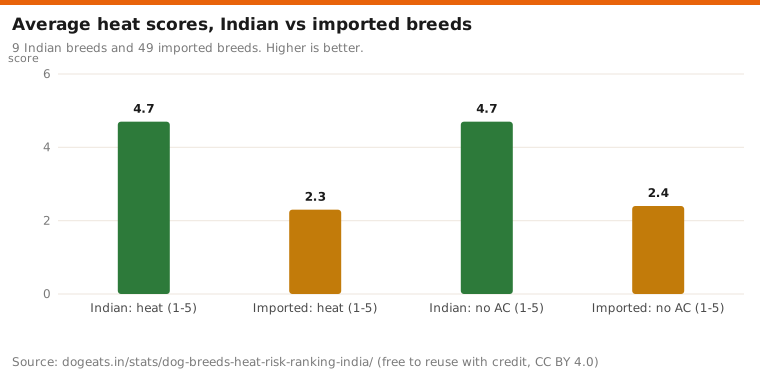
- Indian breeds average 0.8 on the index against 5.9 for the 49 imported breeds we rate.
- 29 breeds (50%) score 2 or lower out of 5 for tolerating Indian heat, and 13 score the minimum of 1.
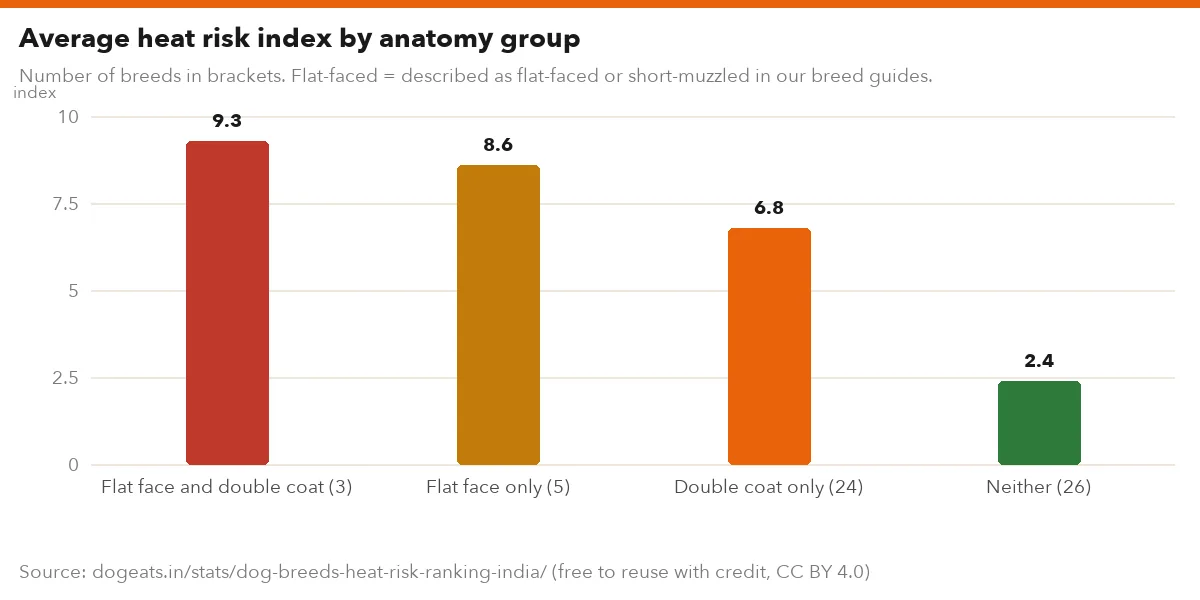
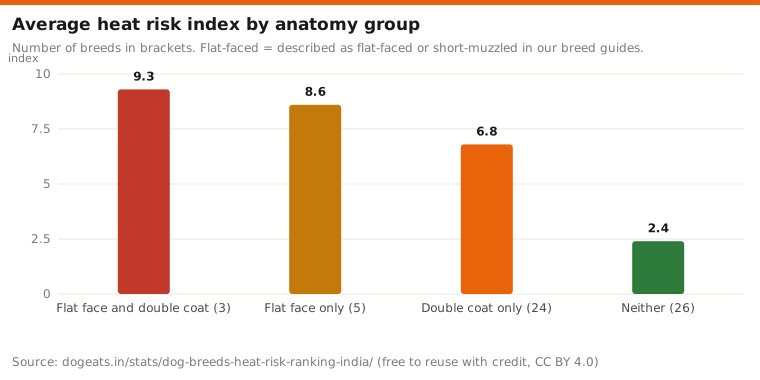
- 27 of 58 breeds have a double coat, and they average 7.1 on the index against 2.4 for breeds with neither a double coat nor a flat face.
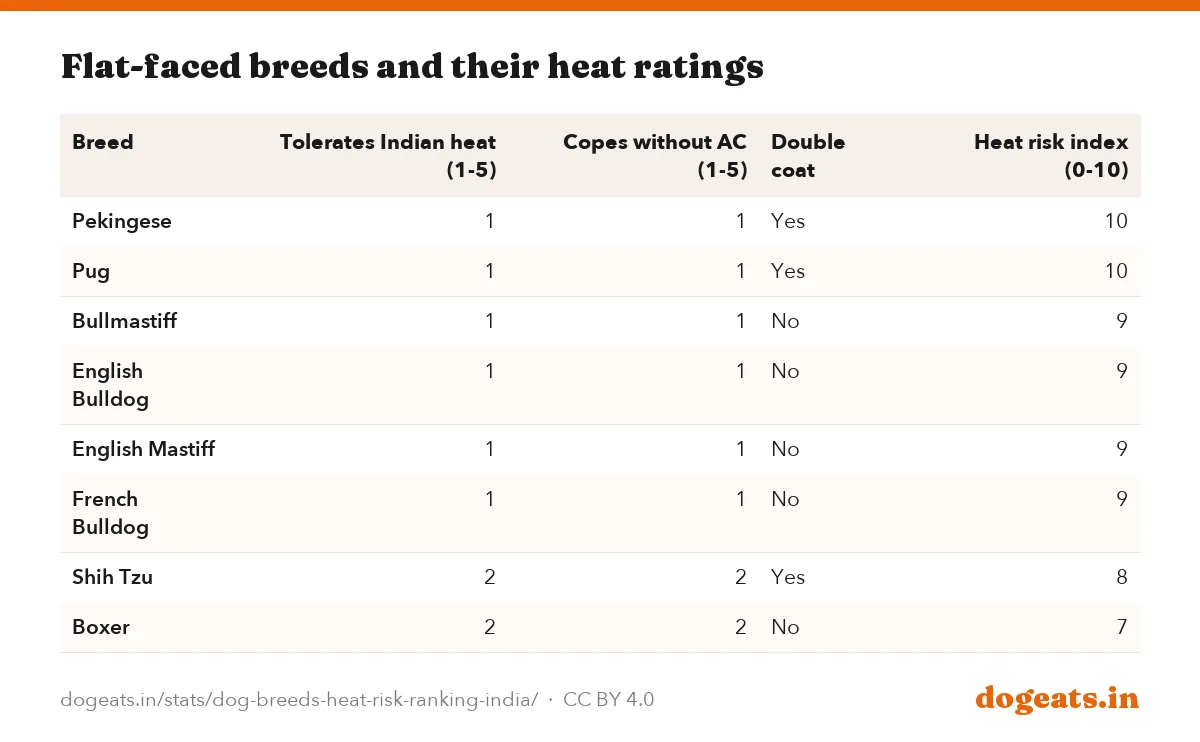
- The 8 flat-faced breeds in our list average 8.9, and none scores above 2 for tolerating heat.
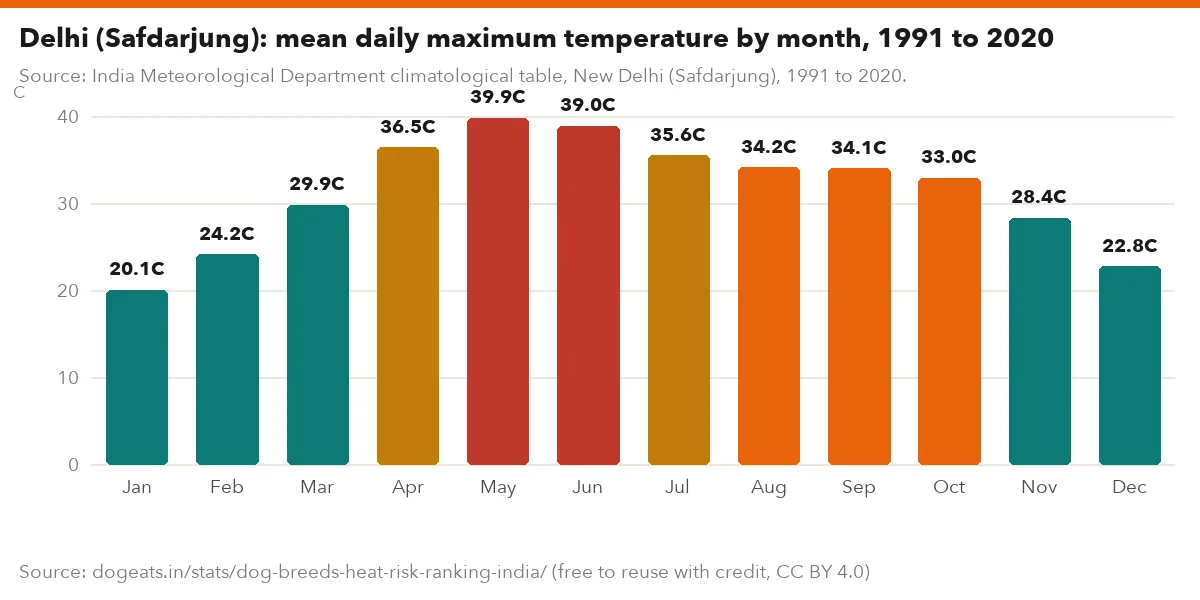
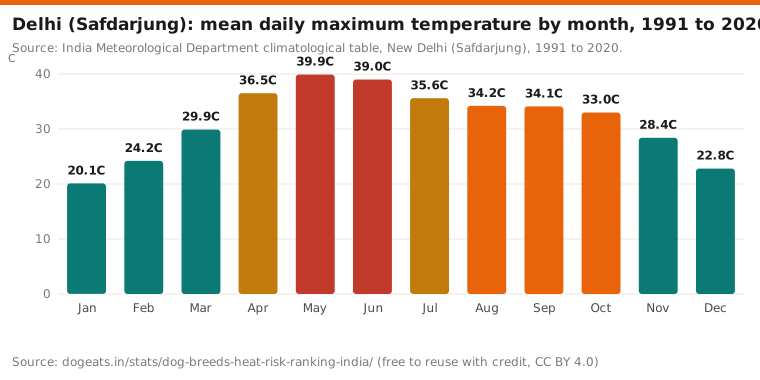
- IMD normals for 1991 to 2020 put Delhi's mean daily maximum at 39.9C in May and 39.0C in June, the hottest two months of the year at that station.
- India's two most popular imported breeds, the Labrador Retriever and the German Shepherd, both score 7 out of 10, in the high risk tier.
Which dog breeds are most at risk from Indian heat?
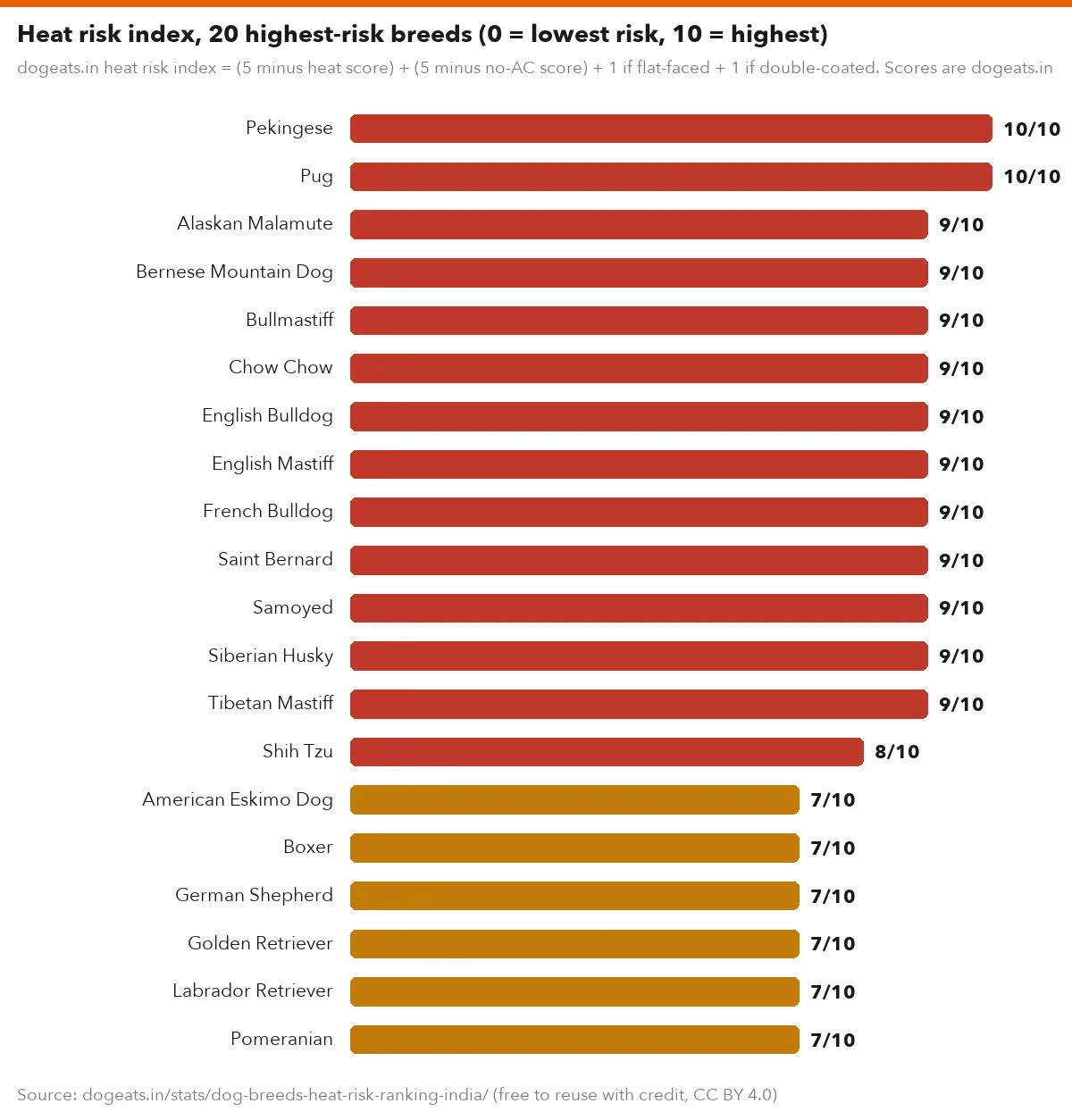
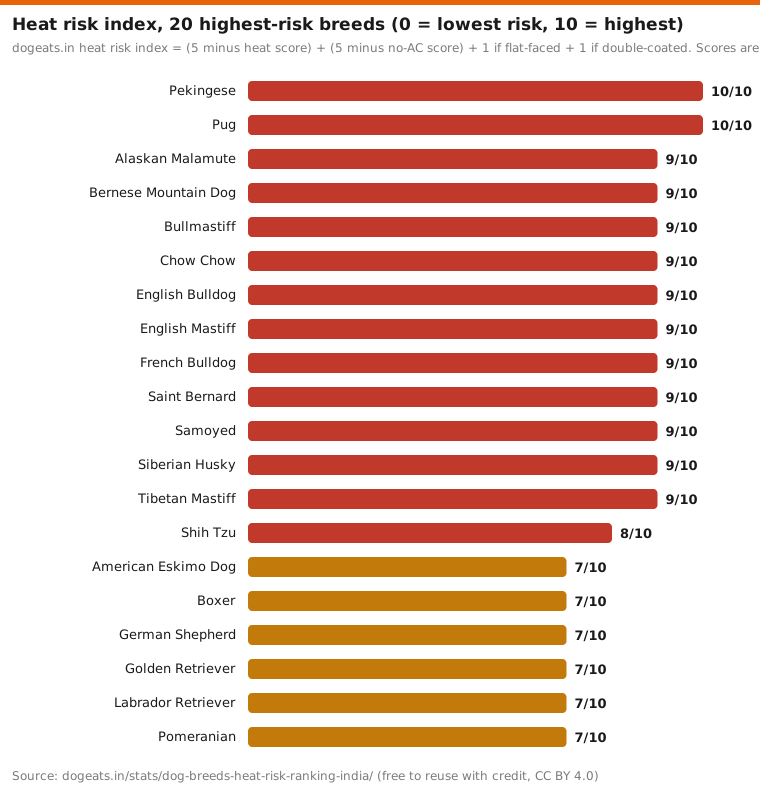
The Pug and the Pekingese carry the highest heat risk of the 58 breeds in our guides. Both score 10 out of 10 on our heat risk index. Close behind, on 9, are Alaskan Malamute, Bernese Mountain Dog, Bullmastiff, Chow Chow, English Bulldog, English Mastiff, French Bulldog, Saint Bernard, Samoyed, Siberian Husky and Tibetan Mastiff.
These dogs share one of two problems, and often both. Either the airway is too short to cool the dog by panting, or a thick undercoat traps heat against the skin. Dogs cool themselves mainly by panting, so a dog that cannot pant well has very little in reserve on a 40C afternoon.
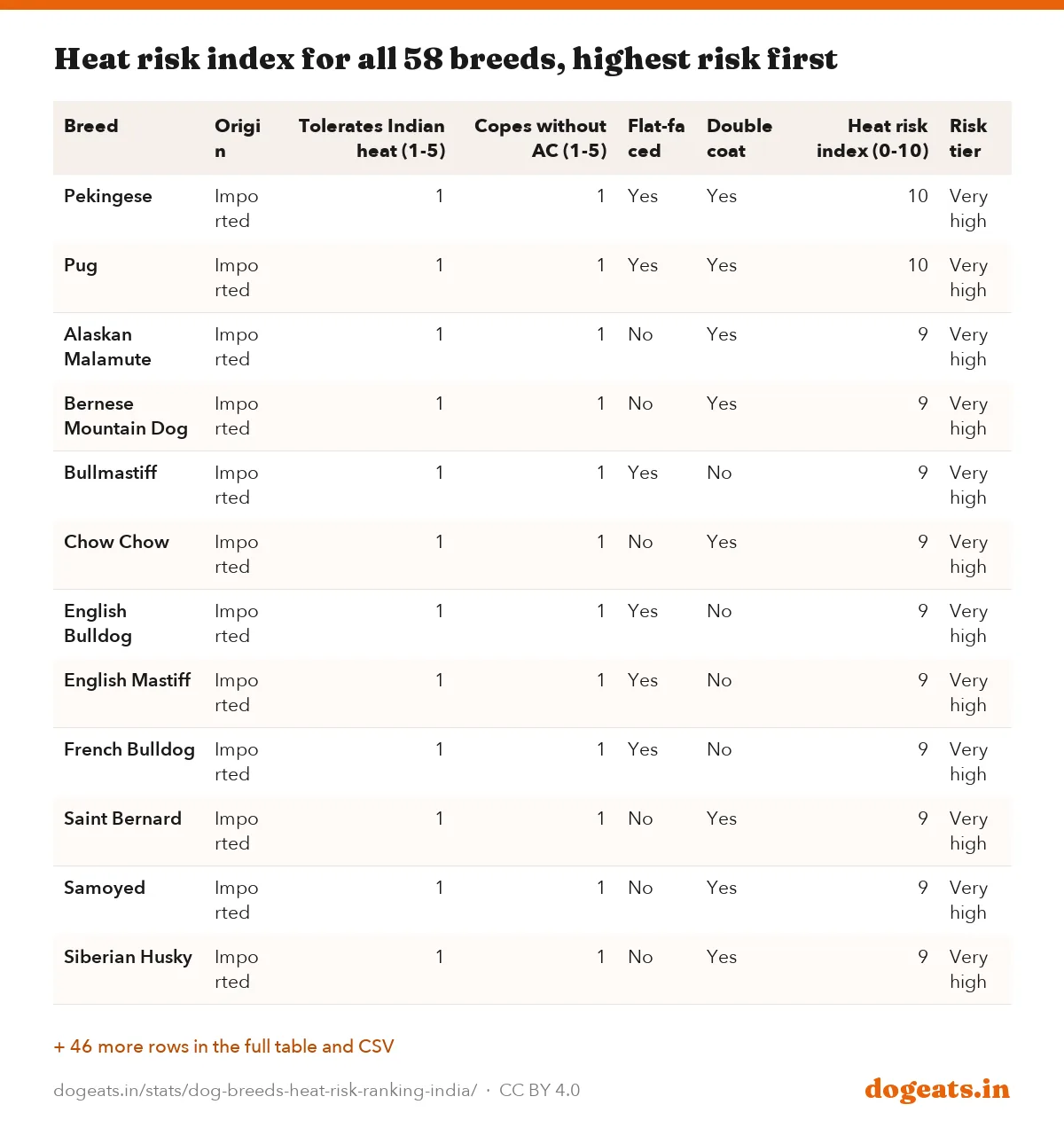
The ranking below combines our two climate ratings with those two physical traits. The full table of all 58 breeds sits below the chart and can be sorted by any column.
dogeats.in heat risk index = (5 minus heat score) + (5 minus no-AC score) + 1 if flat-faced + 1 if double-coated. Scores are dogeats.in editorial ratings, October 2026.
Show the numbers
| Label | index |
|---|---|
| Pekingese | 10/10 |
| Pug | 10/10 |
| Alaskan Malamute | 9/10 |
| Bernese Mountain Dog | 9/10 |
| Bullmastiff | 9/10 |
| Chow Chow | 9/10 |
| English Bulldog | 9/10 |
| English Mastiff | 9/10 |
| French Bulldog | 9/10 |
| Saint Bernard | 9/10 |
| Samoyed | 9/10 |
| Siberian Husky | 9/10 |
| Tibetan Mastiff | 9/10 |
| Shih Tzu | 8/10 |
| American Eskimo Dog | 7/10 |
| Boxer | 7/10 |
| German Shepherd | 7/10 |
| Golden Retriever | 7/10 |
| Labrador Retriever | 7/10 |
| Pomeranian | 7/10 |
Embed this chart
| Breed | Origin | Tolerates Indian heat (1-5) | Copes without AC (1-5) | Flat-faced | Double coat | Heat risk index (0-10) | Risk tier |
|---|---|---|---|---|---|---|---|
| Pekingese | Imported | 1 | 1 | Yes | Yes | 10 | Very high |
| Pug | Imported | 1 | 1 | Yes | Yes | 10 | Very high |
| Alaskan Malamute | Imported | 1 | 1 | No | Yes | 9 | Very high |
| Bernese Mountain Dog | Imported | 1 | 1 | No | Yes | 9 | Very high |
| Bullmastiff | Imported | 1 | 1 | Yes | No | 9 | Very high |
| Chow Chow | Imported | 1 | 1 | No | Yes | 9 | Very high |
| English Bulldog | Imported | 1 | 1 | Yes | No | 9 | Very high |
| English Mastiff | Imported | 1 | 1 | Yes | No | 9 | Very high |
| French Bulldog | Imported | 1 | 1 | Yes | No | 9 | Very high |
| Saint Bernard | Imported | 1 | 1 | No | Yes | 9 | Very high |
| Samoyed | Imported | 1 | 1 | No | Yes | 9 | Very high |
| Siberian Husky | Imported | 1 | 1 | No | Yes | 9 | Very high |
| Tibetan Mastiff | Imported | 1 | 1 | No | Yes | 9 | Very high |
| Shih Tzu | Imported | 2 | 2 | Yes | Yes | 8 | Very high |
| American Eskimo Dog | Imported | 2 | 2 | No | Yes | 7 | High |
| Boxer | Imported | 2 | 2 | Yes | No | 7 | High |
| German Shepherd | Imported | 2 | 2 | No | Yes | 7 | High |
| Golden Retriever | Imported | 2 | 2 | No | Yes | 7 | High |
| Labrador Retriever | Imported | 2 | 2 | No | Yes | 7 | High |
| Pomeranian | Imported | 2 | 2 | No | Yes | 7 | High |
| Rottweiler | Imported | 2 | 2 | No | Yes | 7 | High |
| Dogo Argentino | Imported | 2 | 2 | No | No | 6 | High |
| Great Dane | Imported | 2 | 2 | No | No | 6 | High |
| Australian Shepherd | Imported | 2 | 3 | No | Yes | 6 | High |
| Border Collie | Imported | 2 | 3 | No | Yes | 6 | High |
| German Spitz | Imported | 2 | 3 | No | Yes | 6 | High |
| Japanese Spitz | Imported | 2 | 3 | No | Yes | 6 | High |
| Kangal | Imported | 3 | 2 | No | Yes | 6 | High |
| Pembroke Welsh Corgi | Imported | 2 | 3 | No | Yes | 6 | High |
| Shiba Inu | Imported | 2 | 3 | No | Yes | 6 | High |
| Bichon Frise | Imported | 3 | 3 | No | Yes | 5 | Moderate |
| Lhasa Apso | Imported | 3 | 3 | No | Yes | 5 | Moderate |
| Bull Terrier | Imported | 3 | 3 | No | No | 4 | Moderate |
| Bully Kutta | Indian | 3 | 3 | No | No | 4 | Moderate |
| Cane Corso | Imported | 3 | 3 | No | No | 4 | Moderate |
| Cavalier King Charles Spaniel | Imported | 3 | 3 | No | No | 4 | Moderate |
| Cocker Spaniel | Imported | 3 | 3 | No | No | 4 | Moderate |
| Dalmatian | Imported | 3 | 3 | No | No | 4 | Moderate |
| Maltese | Imported | 3 | 3 | No | No | 4 | Moderate |
| Pit Bull | Imported | 3 | 3 | No | No | 4 | Moderate |
| Yorkshire Terrier | Imported | 3 | 3 | No | No | 4 | Moderate |
| Belgian Malinois | Imported | 4 | 4 | No | Yes | 3 | Low |
| Indian Spitz | Indian | 4 | 4 | No | Yes | 3 | Low |
| Beagle | Imported | 4 | 4 | No | No | 2 | Low |
| Chihuahua | Imported | 4 | 4 | No | No | 2 | Low |
| Dachshund | Imported | 4 | 4 | No | No | 2 | Low |
| Doberman | Imported | 4 | 4 | No | No | 2 | Low |
| Jack Russell Terrier | Imported | 4 | 4 | No | No | 2 | Low |
| Miniature Pinscher | Imported | 4 | 4 | No | No | 2 | Low |
| Poodle | Imported | 4 | 4 | No | No | 2 | Low |
| Chippiparai | Indian | 5 | 5 | No | No | 0 | Very low |
| Indian Pariah Dog | Indian | 5 | 5 | No | No | 0 | Very low |
| Kanni | Indian | 5 | 5 | No | No | 0 | Very low |
| Kombai | Indian | 5 | 5 | No | No | 0 | Very low |
| Mudhol Hound | Indian | 5 | 5 | No | No | 0 | Very low |
| Rajapalayam | Indian | 5 | 5 | No | No | 0 | Very low |
| Rampur Greyhound | Indian | 5 | 5 | No | No | 0 | Very low |
| Rhodesian Ridgeback | Imported | 5 | 5 | No | No | 0 | Very low |
Two popular family breeds sit higher than many buyers expect. The Labrador Retriever and the Golden Retriever both score 7. Our Labrador guide notes the breed struggles above 32C and needs walks shifted to early morning and late evening from March to June.
For the wet season that follows, see our monsoon risk ranking, and for where each breed lives most comfortably, our city-by-city breed report.
How the heat risk index works
The index runs from 0 to 10. It adds four parts, and every part comes straight from our breed guides.
- Heat gap: 5 minus the breed's "Tolerates Indian heat" score. A breed rated 1 adds 4 points, a breed rated 5 adds nothing.
- Cooling gap: 5 minus the "Copes without AC" score, on the same 0 to 4 scale.
- Flat face: 1 extra point for the 8 breeds our guides describe as flat-faced or short-muzzled.
- Double coat: 1 extra point for the 27 breeds whose coat our guides describe as a double coat.
So a Pug scores 4 + 4 + 1 + 1 = 10. A Labrador scores 3 + 3 + 0 + 1 = 7. An Indian Pariah Dog scores 0 + 0 + 0 + 0 = 0.
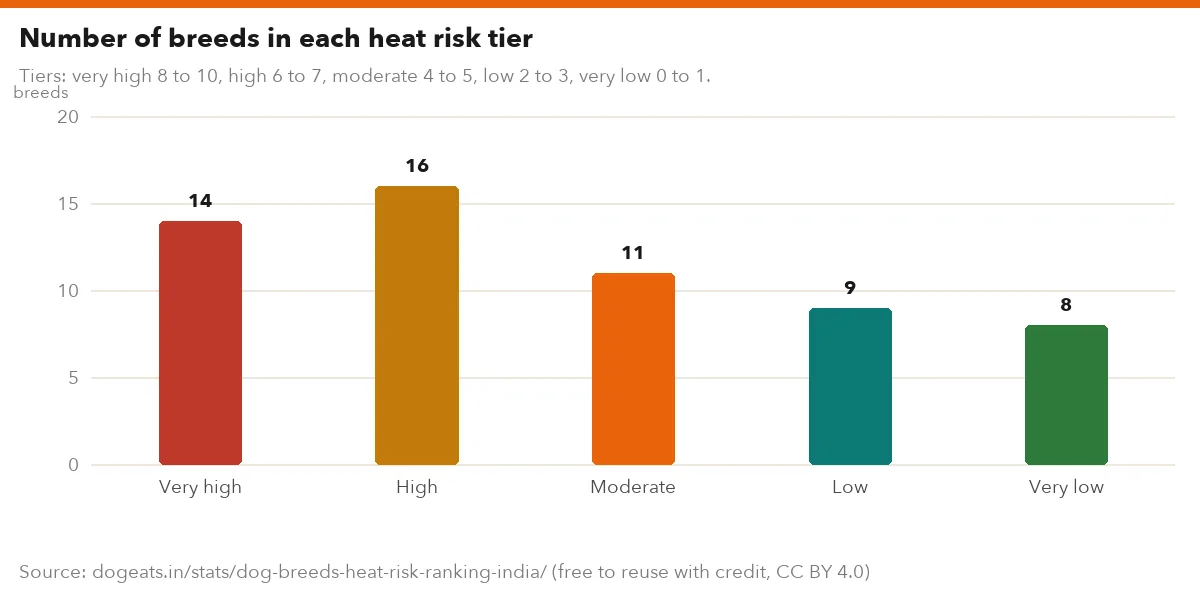
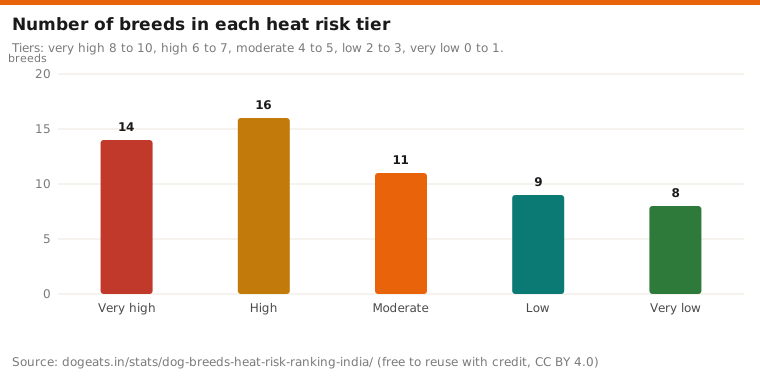
Tiers: very high 8 to 10, high 6 to 7, moderate 4 to 5, low 2 to 3, very low 0 to 1.
Show the numbers
| Label | breeds |
|---|---|
| Very high | 14 |
| High | 16 |
| Moderate | 11 |
| Low | 9 |
| Very low | 8 |
Embed this chart
The two extra points are deliberate. Our 1 to 5 scores already reflect coat and muzzle, so the extra points act as tie-breakers that push the riskiest anatomy to the top. We kept them to one point each so that no single trait can outweigh the editorial scores.
The tiers are wide on purpose. A breed on 7 is not meaningfully safer than one on 8. Treat the tier as the signal and the exact number as a guide to order.
The breeds that handle Indian heat best
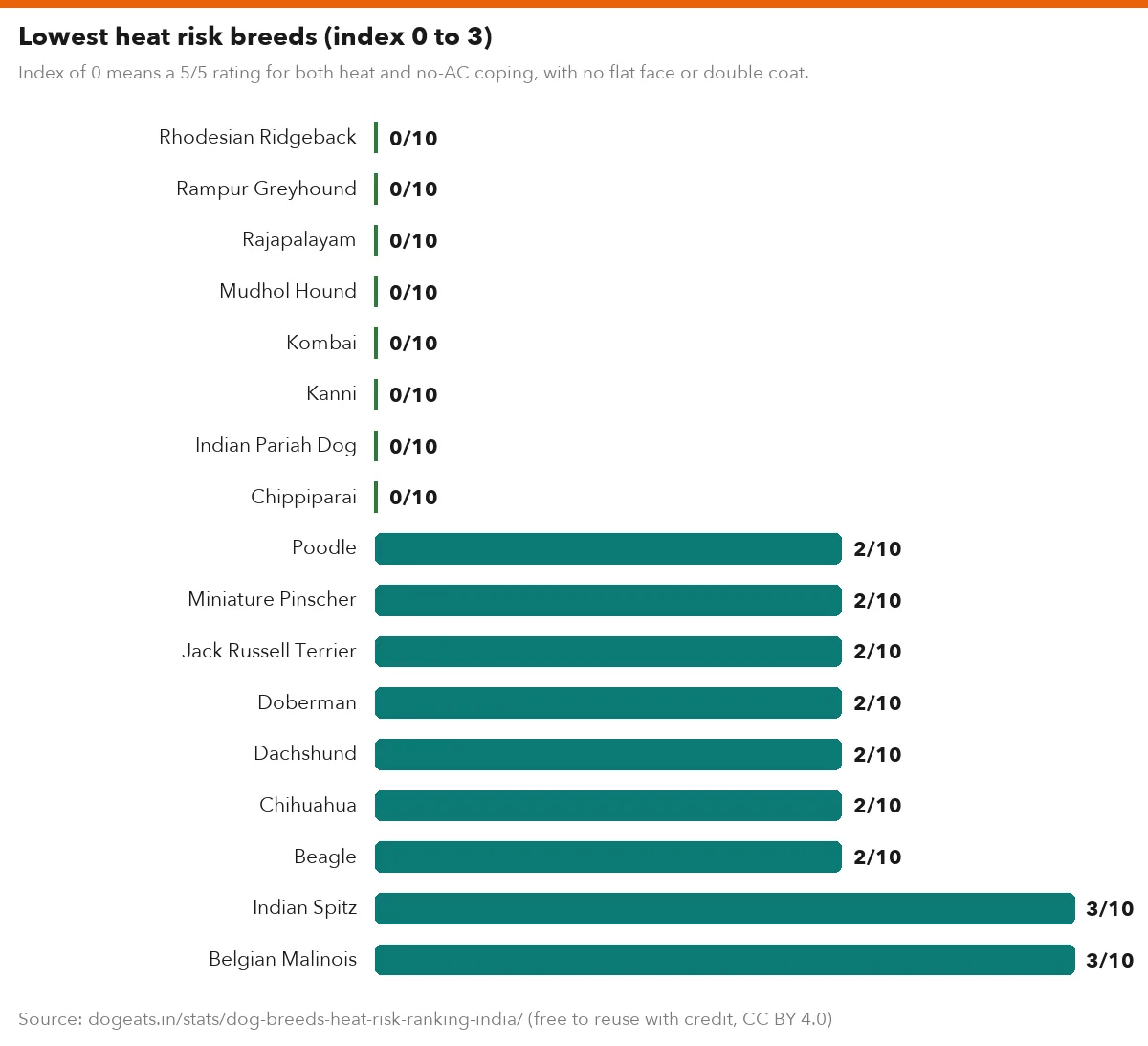
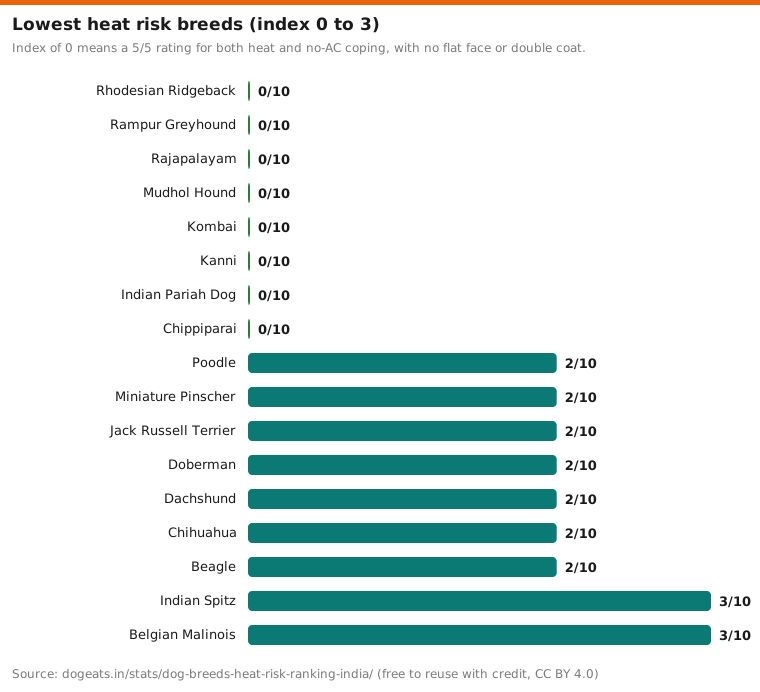
Eight breeds score zero: Chippiparai, Indian Pariah Dog, Kanni, Kombai, Mudhol Hound, Rajapalayam, Rampur Greyhound and Rhodesian Ridgeback. Every one has a short coat with no insulating undercoat. Seven of the eight are Indian breeds.
The Indian Pariah Dog is the clearest case. Our guide calls it the product of thousands of years of natural selection in this exact climate. The southern sighthounds, the Kanni, Chippiparai and Rajapalayam, were kept in the hot plains of Tamil Nadu for generations.
The only imported breed on zero is the Rhodesian Ridgeback, developed to hunt in southern African heat. Among imported small breeds, Beagle, Chihuahua, Dachshund, Jack Russell Terrier and Miniature Pinscher all score 2, the low risk tier.
Index of 0 means a 5/5 rating for both heat and no-AC coping, with no flat face or double coat.
Show the numbers
| Label | index |
|---|---|
| Rhodesian Ridgeback | 0/10 |
| Rampur Greyhound | 0/10 |
| Rajapalayam | 0/10 |
| Mudhol Hound | 0/10 |
| Kombai | 0/10 |
| Kanni | 0/10 |
| Indian Pariah Dog | 0/10 |
| Chippiparai | 0/10 |
| Poodle | 2/10 |
| Miniature Pinscher | 2/10 |
| Jack Russell Terrier | 2/10 |
| Doberman | 2/10 |
| Dachshund | 2/10 |
| Chihuahua | 2/10 |
| Beagle | 2/10 |
| Indian Spitz | 3/10 |
| Belgian Malinois | 3/10 |
Embed this chart
9 Indian breeds and 49 imported breeds. Higher is better.
Show the numbers
| Label | score |
|---|---|
| Indian: heat (1-5) | 4.7 |
| Imported: heat (1-5) | 2.3 |
| Indian: no AC (1-5) | 4.7 |
| Imported: no AC (1-5) | 2.4 |
Embed this chart
One Indian breed breaks the pattern. The Bully Kutta scores 4, because our guide notes that a mastiff of up to 90 kg sheds heat slowly despite a short coat. The Indian Spitz scores 3, against 7 for the Pomeranian it resembles. That gap is the reason the breed was developed.
A caution on sighthounds. A UK study found pet Greyhounds had 4.26 times the odds of heat-related illness compared with Labradors, which the authors linked to muscle heat after exercise. Our high ratings for Indian sighthounds describe coping with the climate at rest. Sprinting a Kanni or Rampur Hound at noon in May is still dangerous.
Flat faces and double coats raise the risk
The 8 flat-faced breeds in our list average 8.9 on the index. None of them scores higher than 2 out of 5 for tolerating heat.
The veterinary evidence points the same way. A 2020 study of 905,543 dogs under UK veterinary care found flat-faced (brachycephalic) dogs had 2.10 times the odds of heat-related illness. That was compared with dogs of medium muzzle length. About 14% of the heat-related illness cases in that study were fatal.
Double coats are the second problem. 27 of our 58 breeds have one, and they average 7.1 on the index. The undercoat traps a layer of warm air against the skin, which helps in Ladakh and works against the dog in Nagpur.
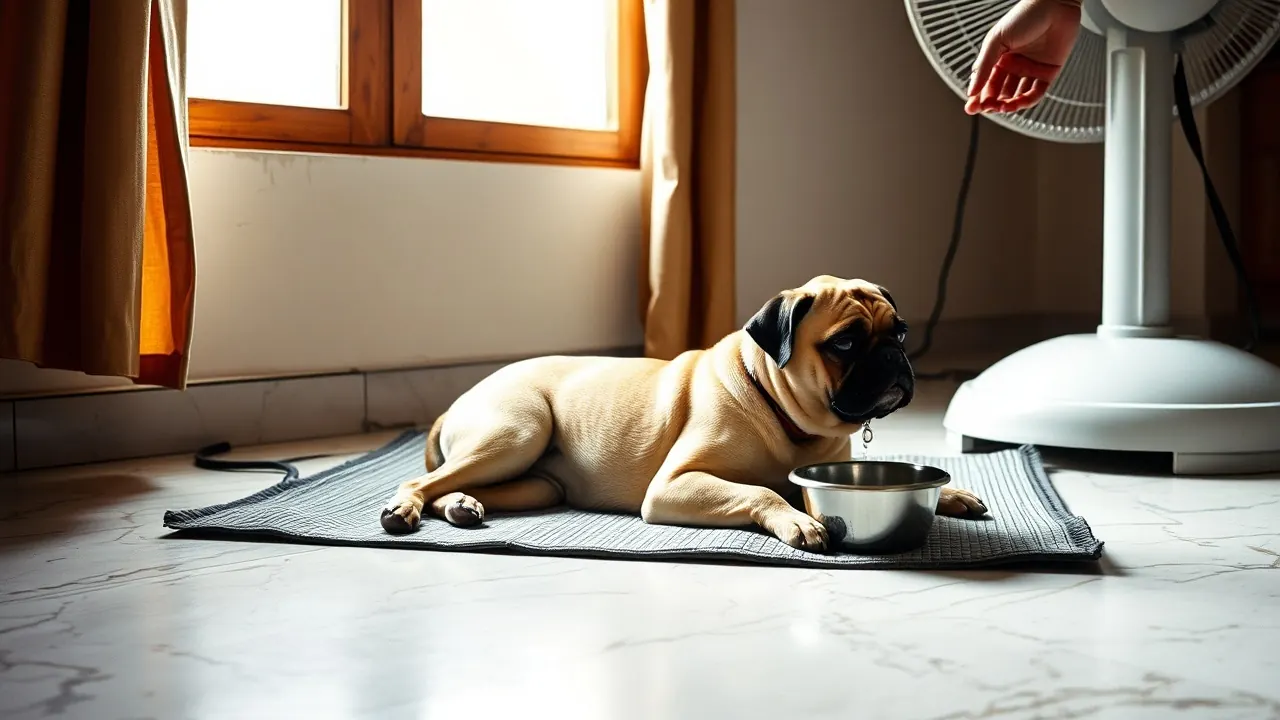
Number of breeds in brackets. Flat-faced = described as flat-faced or short-muzzled in our breed guides.
Show the numbers
| Label | index |
|---|---|
| Flat face and double coat (3) | 9.3 |
| Flat face only (5) | 8.6 |
| Double coat only (24) | 6.8 |
| Neither (26) | 2.4 |
Embed this chart
| Breed | Tolerates Indian heat (1-5) | Copes without AC (1-5) | Double coat | Heat risk index (0-10) |
|---|---|---|---|---|
| Pekingese | 1 | 1 | Yes | 10 |
| Pug | 1 | 1 | Yes | 10 |
| Bullmastiff | 1 | 1 | No | 9 |
| English Bulldog | 1 | 1 | No | 9 |
| English Mastiff | 1 | 1 | No | 9 |
| French Bulldog | 1 | 1 | No | 9 |
| Shih Tzu | 2 | 2 | Yes | 8 |
| Boxer | 2 | 2 | No | 7 |
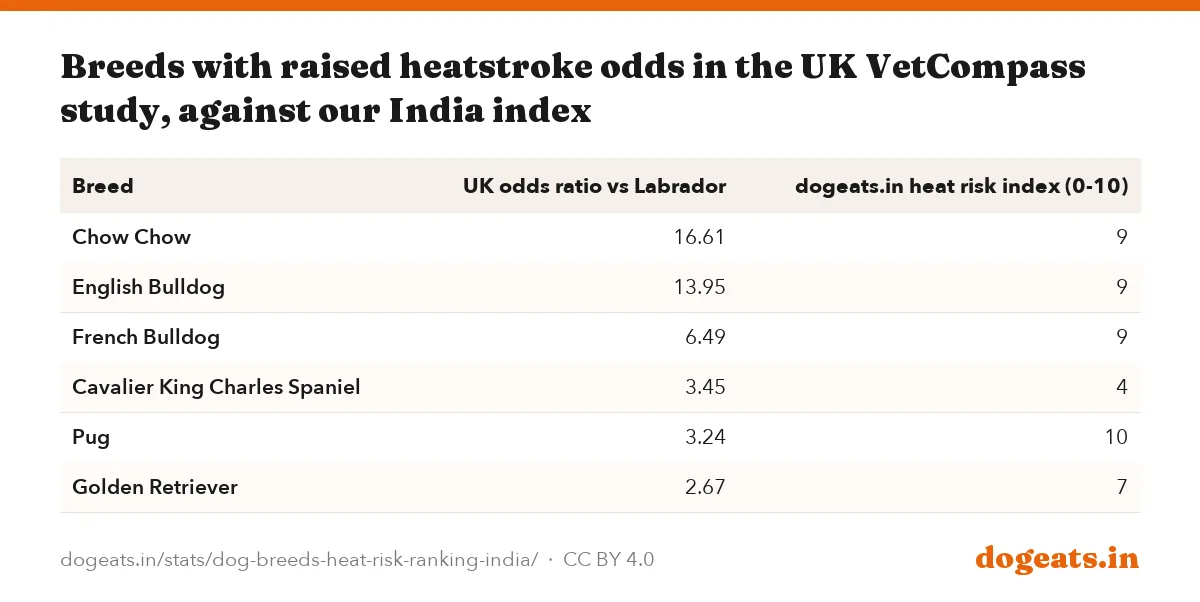
| Breed | UK odds ratio vs Labrador | dogeats.in heat risk index (0-10) |
|---|---|---|
| Chow Chow | 16.61 | 9 |
| English Bulldog | 13.95 | 9 |
| French Bulldog | 6.49 | 9 |
| Cavalier King Charles Spaniel | 3.45 | 4 |
| Pug | 3.24 | 10 |
| Golden Retriever | 2.67 | 7 |
Our index agrees with the UK study on most of these breeds. Chow Chow, Bulldog, French Bulldog and Pug all score 9 or 10. The Golden Retriever, which the UK study linked to its thicker coat, scores 7 on our index, the same as the Labrador. Our heat scores for the two breeds are identical, so treat the UK finding as a reason for extra care with Goldens.
The clear disagreement is the Cavalier King Charles Spaniel. The UK study classed it as brachycephalic, but our guide rates its muzzle as normal and gives it 4. If you own a Cavalier, use the UK finding as a reason for extra summer caution.
Owners of double-coated dogs often ask whether to shave. Our guides say clipping is not a safe option for four breeds, including the Shiba Inu, Japanese Spitz and Samoyed. The undercoat also shields the skin from sun. Brushing out loose undercoat helps more than a shave.
The danger months, by city
March to June is the danger window across most of the plains. IMD climate normals for 1991 to 2020 show Delhi's mean daily maximum rising from 29.9C in March to 39.9C in May.
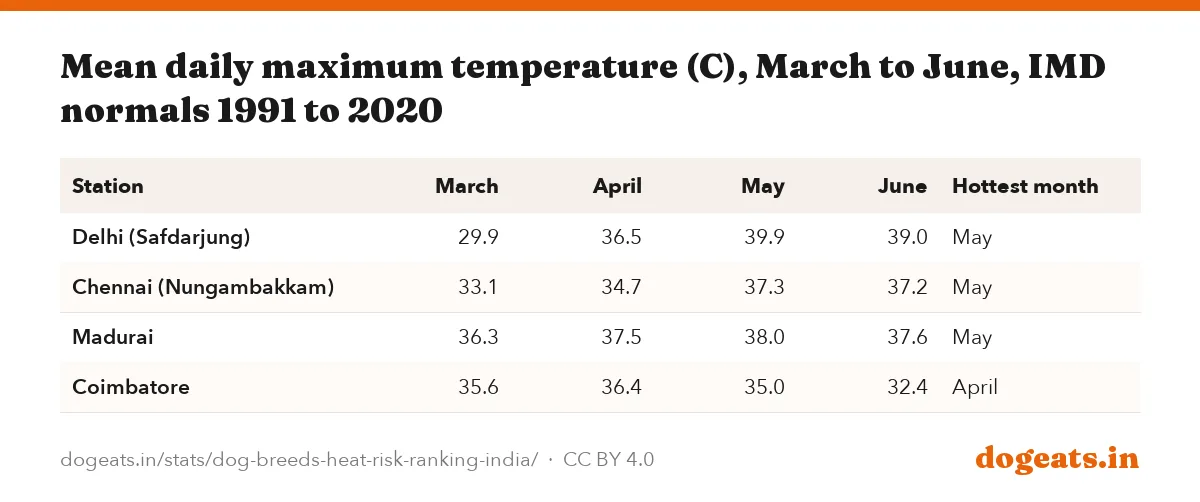
Delhi's average maximum stays at or above 35C in 4 months, from April to July. Chennai crosses 35C in 3 months, from May to July, with added coastal humidity.
The monsoon brings slight relief in the north, but humidity rises. High humidity makes panting less effective, which is why our guides rate Chennai and Mumbai as hard cities for heavy-coated dogs.
Source: India Meteorological Department climatological table, New Delhi (Safdarjung), 1991 to 2020.
Show the numbers
| Label | C |
|---|---|
| Jan | 20.1C |
| Feb | 24.2C |
| Mar | 29.9C |
| Apr | 36.5C |
| May | 39.9C |
| Jun | 39.0C |
| Jul | 35.6C |
| Aug | 34.2C |
| Sep | 34.1C |
| Oct | 33.0C |
| Nov | 28.4C |
| Dec | 22.8C |
Embed this chart
| Station | March | April | May | June | Hottest month |
|---|---|---|---|---|---|
| Delhi (Safdarjung) | 29.9 | 36.5 | 39.9 | 39.0 | May |
| Chennai (Nungambakkam) | 33.1 | 34.7 | 37.3 | 37.2 | May |
| Madurai | 36.3 | 37.5 | 38.0 | 37.6 | May |
| Coimbatore | 35.6 | 36.4 | 35.0 | 32.4 | April |
Those thresholds are set for people, but they are a useful alarm for dog owners. On any IMD heat wave day, a high or very high risk breed should stay indoors through the afternoon.
Late heat also happens. IMD's heat bulletin for 29 June 2026 reported maximums of 40C to 44C over many parts of the northwest plains, and 45.5C at Sri Ganganagar in Rajasthan.
Which dog breeds need air conditioning in India?
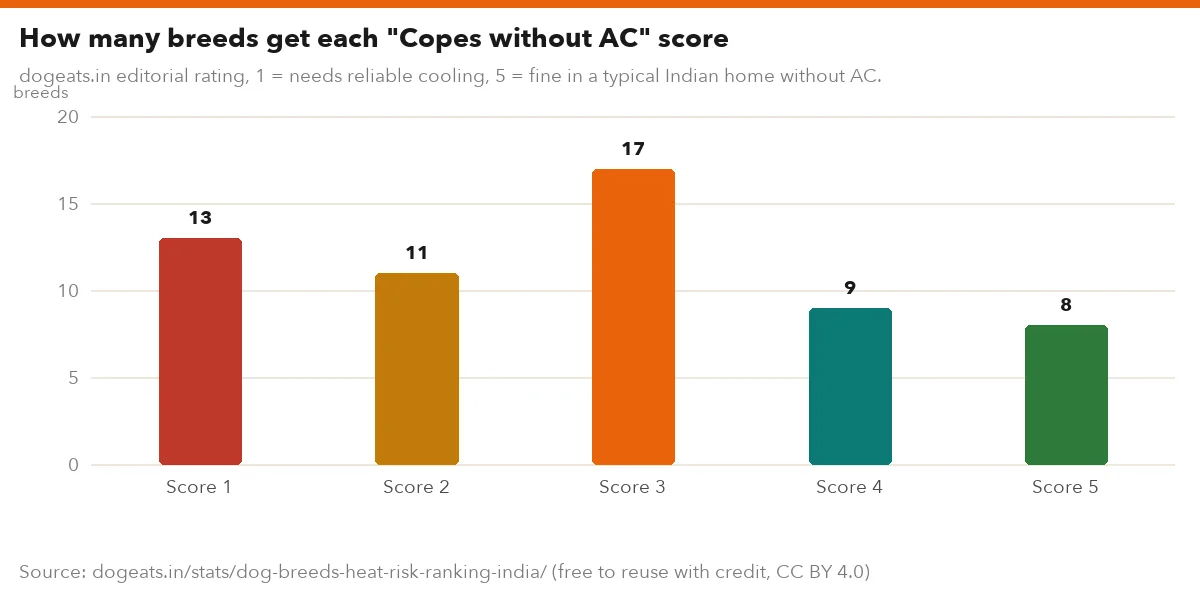
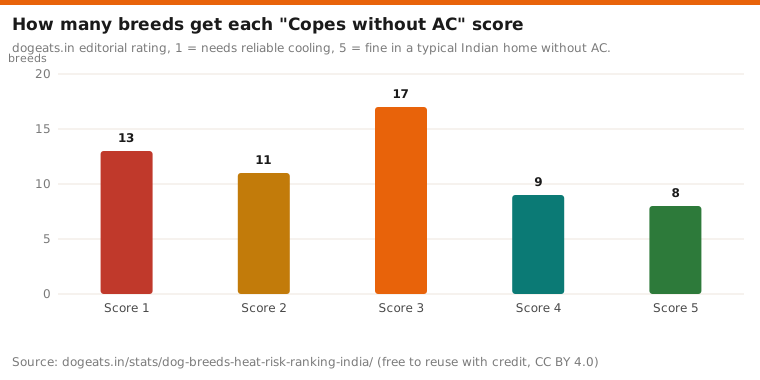
24 of 58 breeds (41%) score 2 or lower for coping without AC. 13 score the minimum of 1, which in our guides means cooling is a welfare requirement rather than a luxury.
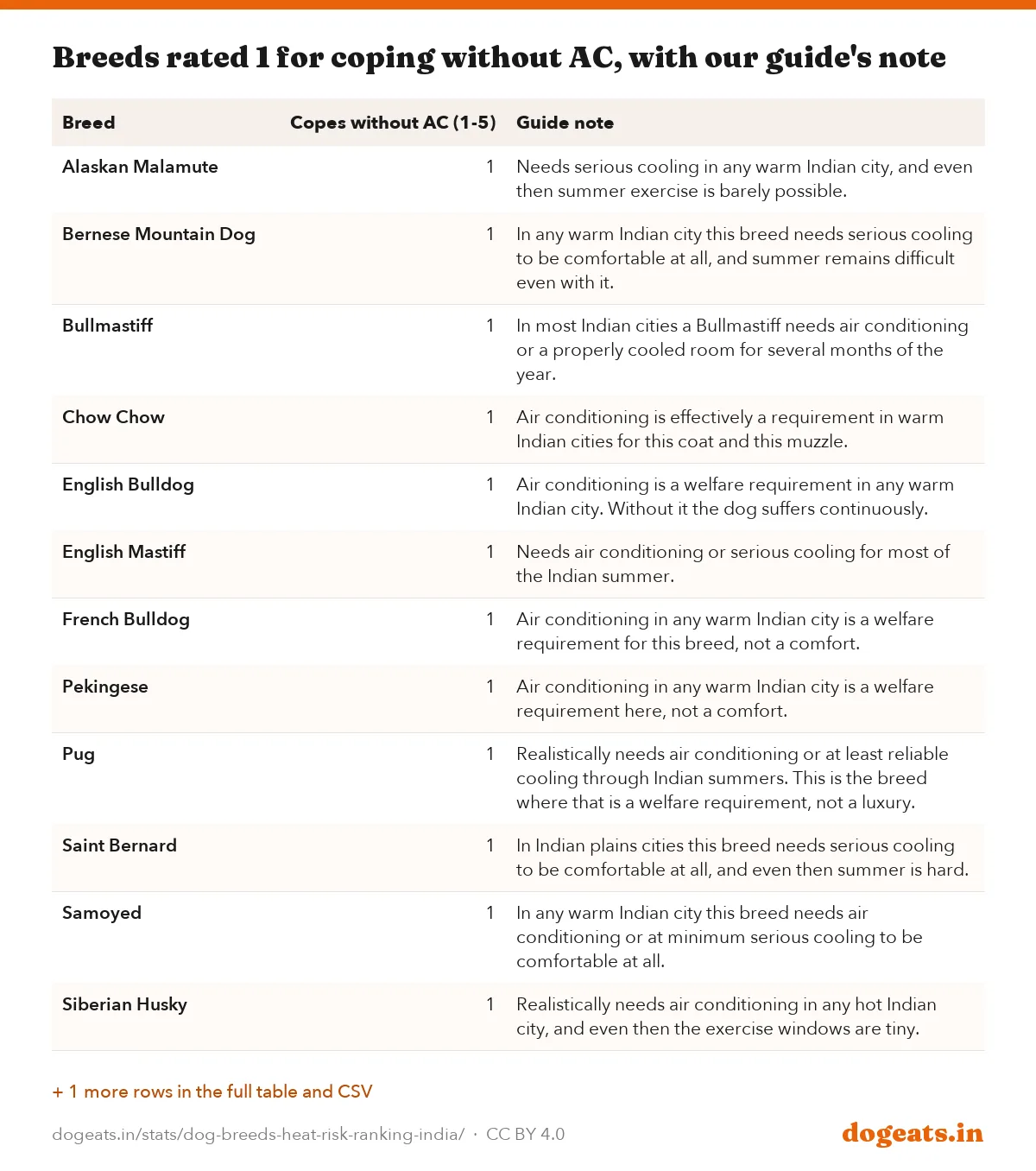
The thirteen breeds on 1 are Alaskan Malamute, Bernese Mountain Dog, Bullmastiff, Chow Chow, English Bulldog, English Mastiff, French Bulldog, Pekingese, Pug, Saint Bernard, Samoyed, Siberian Husky and Tibetan Mastiff.
A score of 2 usually means a fan, cool flooring, a cooling mat and strict walk timing can work in milder cities. It does not mean the breed is comfortable in a Delhi May without help.
dogeats.in editorial rating, 1 = needs reliable cooling, 5 = fine in a typical Indian home without AC.
Show the numbers
| Label | breeds |
|---|---|
| Score 1 | 13 |
| Score 2 | 11 |
| Score 3 | 17 |
| Score 4 | 9 |
| Score 5 | 8 |
Embed this chart
| Breed | Copes without AC (1-5) | Guide note |
|---|---|---|
| Alaskan Malamute | 1 | Needs serious cooling in any warm Indian city, and even then summer exercise is barely possible. |
| Bernese Mountain Dog | 1 | In any warm Indian city this breed needs serious cooling to be comfortable at all, and summer remains difficult even with it. |
| Bullmastiff | 1 | In most Indian cities a Bullmastiff needs air conditioning or a properly cooled room for several months of the year. |
| Chow Chow | 1 | Air conditioning is effectively a requirement in warm Indian cities for this coat and this muzzle. |
| English Bulldog | 1 | Air conditioning is a welfare requirement in any warm Indian city. Without it the dog suffers continuously. |
| English Mastiff | 1 | Needs air conditioning or serious cooling for most of the Indian summer. |
| French Bulldog | 1 | Air conditioning in any warm Indian city is a welfare requirement for this breed, not a comfort. |
| Pekingese | 1 | Air conditioning in any warm Indian city is a welfare requirement here, not a comfort. |
| Pug | 1 | Realistically needs air conditioning or at least reliable cooling through Indian summers. This is the breed where that is a welfare requirement, not a luxury. |
| Saint Bernard | 1 | In Indian plains cities this breed needs serious cooling to be comfortable at all, and even then summer is hard. |
| Samoyed | 1 | In any warm Indian city this breed needs air conditioning or at minimum serious cooling to be comfortable at all. |
| Siberian Husky | 1 | Realistically needs air conditioning in any hot Indian city, and even then the exercise windows are tiny. |
| Tibetan Mastiff | 1 | In any warm part of India this breed needs serious cooling, and even then summer is difficult. |
Heavy dogs need extra care. The UK study found dogs over 50 kg had 3.42 times the odds of heat-related illness compared with dogs under 10 kg. 9 of our breeds can exceed 50 kg as adults, including the English Mastiff, Saint Bernard, Tibetan Mastiff and Great Dane.
Power cuts matter for the top tier. Our guides for the English Bulldog and Pekingese list homes with frequent power cuts as a hard setting, since cooling cannot be intermittent for them.
Keeping a high-risk breed safe through summer
The basics are the same for every dog, but the margin for error shrinks as the index rises. Our summer heatstroke prevention guide covers hydration and warning signs in detail.
Our breed guides repeat these steps most often for high and very high risk breeds.
- Walk in the early morning and after sunset from March to June. Test the road surface with the back of your hand before you set out.
- Keep a cool room. For breeds rated 1 for coping without AC, that means air conditioning or reliable cooling, not a fan alone.
- Use a cooling mat and a stone or tiled floor. Our guides recommend both for Labradors, Golden Retrievers and German Shepherds.
- Brush out undercoat weekly through summer. Do not shave double-coated breeds unless your vet advises it.
- Keep fresh water in more than one room and refresh it through the day. Plain coconut water and watermelon without seeds are safe small treats.
- Never leave any dog in a parked car, on a terrace or on a balcony in the afternoon.
- Know the signs: heavy panting at rest, a dark red tongue, drooling, wobbling or vomiting. These need a vet immediately.
If your dog is in the very high tier and shows any of those signs, cool it with room-temperature water and get to a vet. Do not use ice-cold water. Ask your vet for a summer plan before March each year.
Frequently asked questions
Which dog breed is most at risk from heat in India?
The Pug and the Pekingese share the top heat risk index of 10 out of 10 in our ranking of 58 breeds. Both have flat faces and double coats, and both score 1 out of 5 for heat and for coping without AC. Eleven more breeds score 9, including the Siberian Husky and French Bulldog.
Which dog breed is best for Indian summers?
Eight breeds score zero on our heat risk index: the Indian Pariah Dog, Chippiparai, Kanni, Kombai, Mudhol Hound, Rajapalayam, Rampur Greyhound and Rhodesian Ridgeback. All have short single coats. Among small imported breeds, the Beagle, Chihuahua, Dachshund, Jack Russell Terrier and Miniature Pinscher score 2.
Can a Labrador live in India without AC?
It can in milder cities with a fan, shade and a cooling mat, but it is hard going in Chennai, Mumbai or Delhi summers. The Labrador scores 2 out of 5 for coping without AC and 7 out of 10 on our heat risk index. Our guide says it struggles above 32C.
Can a Siberian Husky survive in India?
Only with serious care. The Husky scores 1 out of 5 for heat and 1 for coping without AC, and 9 out of 10 on our index. Our guide lists hill stations and Ladakh as the only suitable Indian locations, and workable in Bengaluru or Pune only with AC.
Which months are most dangerous for dogs in India?
March to June across most of the plains. IMD normals for 1991 to 2020 put Delhi's mean daily maximum at 36.5C in April, 39.9C in May and 39.0C in June. Chennai peaks at 37.3C in May, with higher humidity.
Should I shave my double-coated dog in summer?
Usually no. Our guides say clipping is not a safe option for breeds such as the Shiba Inu, Japanese Spitz and Samoyed, because the coat also shields skin from sun. Weekly brushing to remove loose undercoat helps more. Ask your vet or groomer before any clip.
Are flat-faced dogs more likely to get heatstroke?
Yes. A UK study of 905,543 dogs found flat-faced breeds had 2.10 times the odds of heat-related illness. The Bulldog had 13.95 times and the French Bulldog 6.49 times the odds of a Labrador. All eight flat-faced breeds in our list score 2 or lower out of 5 for heat.
Are Indian dog breeds better in hot weather?
On our ratings, yes. The nine Indian breeds average 0.8 on our heat risk index against 5.9 for imported breeds. Seven of the eight breeds that score zero are Indian. The Bully Kutta is the exception, at 4, because of its size.
Methodology and limitations
The ranking covers the 58 breeds with full guides on dogeats.in. Each breed has six editorial scores from 1 to 5, set by dogeats.in from our breed research. This report uses two of them: "Tolerates Indian heat" and "Copes without AC".
The heat risk index adds (5 minus the heat score) and (5 minus the no-AC score). It then adds 1 point if our guide describes the breed as flat-faced or short-muzzled, and 1 point for a double coat. The range is 0 to 10. Tiers: very high 8 to 10, high 6 to 7, moderate 4 to 5, low 2 to 3, very low 0 to 1.
The flat-faced group is the eight breeds our guides describe that way: Pug, Pekingese, Shih Tzu, French Bulldog, English Bulldog, Boxer, Bullmastiff and English Mastiff. Double coat is taken from the coat description in each guide. Weight uses the top of each breed's adult range.
Temperature normals come from India Meteorological Department climatological tables for 1991 to 2020, for Delhi (Safdarjung), Chennai (Nungambakkam), Madurai and Coimbatore. Heat wave criteria come from IMD's heat bulletin. Veterinary risk figures come from the peer-reviewed UK VetCompass study by Hall, Carter and O'Neill (2020).
Sources
- Hall, Carter and O'Neill, Scientific Reports (2020): Incidence and risk factors for heat-related illness in UK dogs, Brachycephalic odds ratio 2.10, breed odds ratios, over-50 kg odds ratio 3.42, 14% fatality rate
- India Meteorological Department, New Delhi (Safdarjung) climatological table 1991 to 2020, Delhi monthly mean maximum temperatures
- India Meteorological Department, morning heat bulletin, 30 June 2026, Heat wave criteria (40C plains, 37C coastal, 30C hills) and late-June temperatures
- Also consulted: India Meteorological Department, Chennai (Nungambakkam) climatological table 1991 to 2020, India Meteorological Department, Madurai climatological table 1991 to 2020, India Meteorological Department, Coimbatore climatological table 1991 to 2020, dogeats.in breed guides (58 breeds), October 2026.
Cite, embed and download
This report, its data and its images are free to reuse under a Creative Commons Attribution 4.0 licence. Credit dogeats.in with a link to this page. Every chart has its own embed code, every table has a CSV and an image download, and the images below are ready for social posts, slides and articles.
Cite this report
Link to this report
Every chart and table as an image