Explainer · Updated October 2026
Dogs in Winter in India: How Cold Is Too Cold, Which Cities Get Cold Waves and Which Breeds Need a Coat
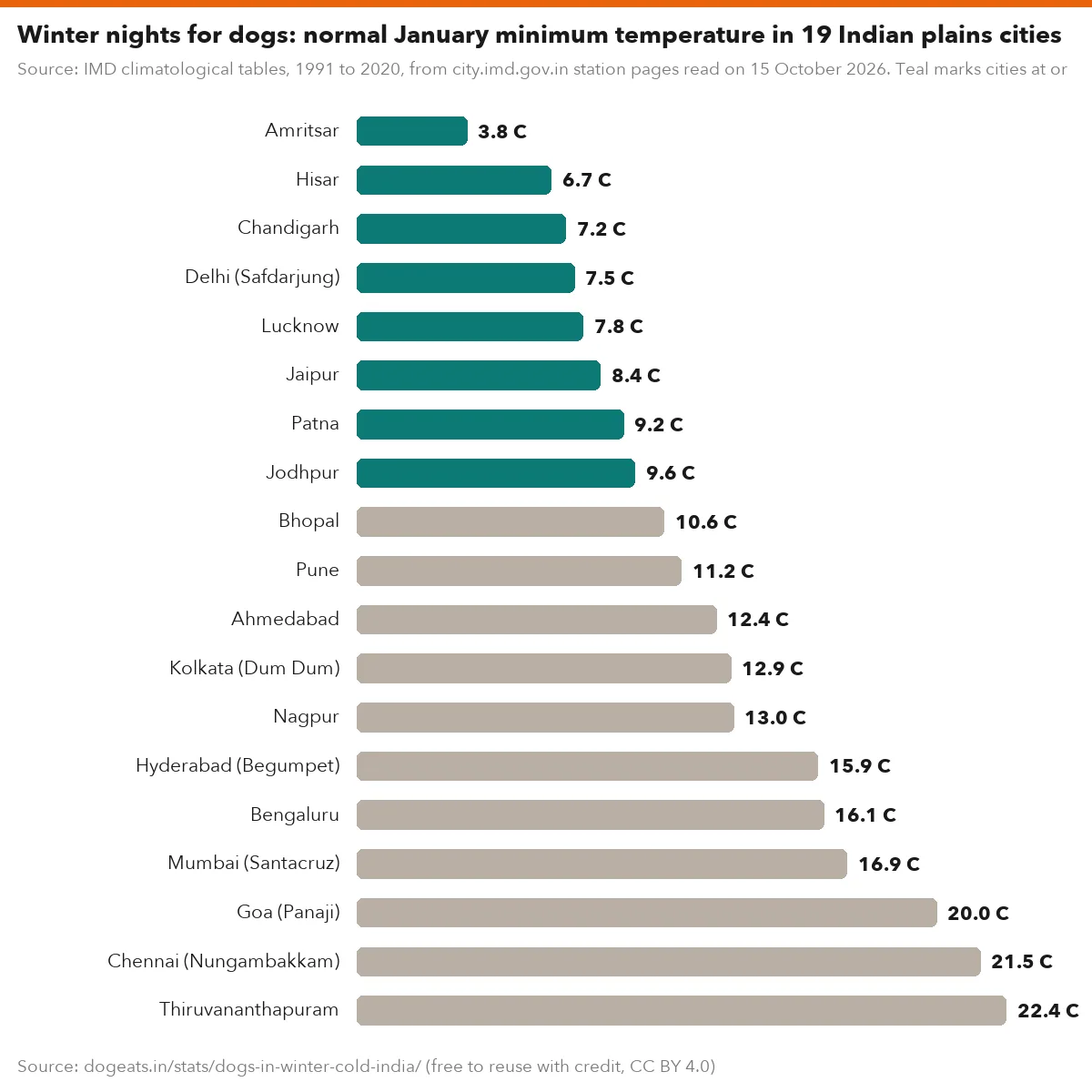
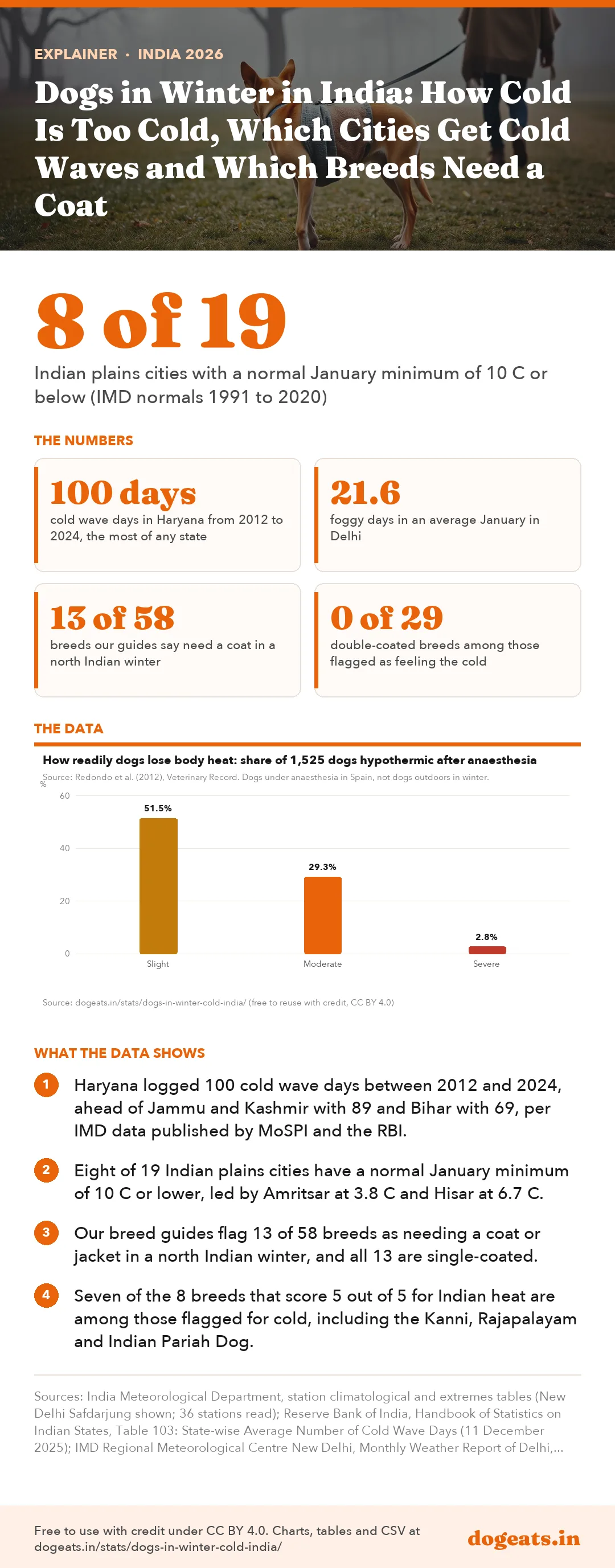
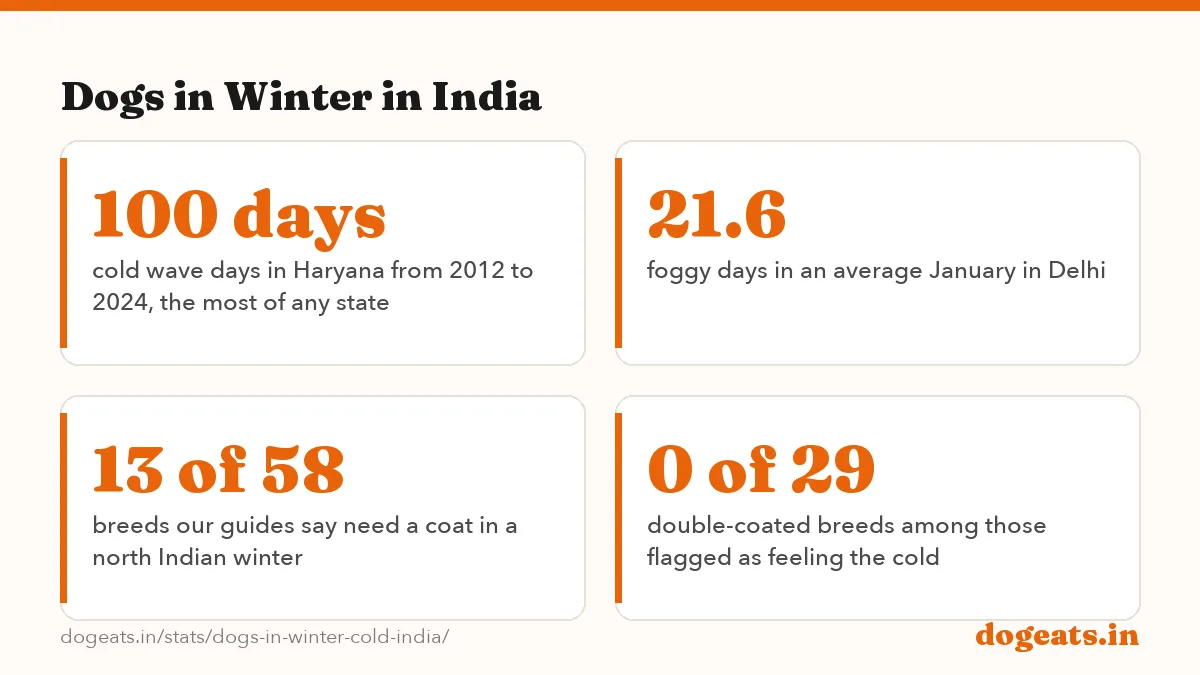
For most healthy dogs in India, winter cold is a smaller risk than summer heat, but north Indian nights do get cold enough to matter. Eight of 19 plains cities we checked have a normal January minimum of 10 C or lower, the level at which IMD starts counting cold waves. Our breed guides flag 13 of 58 breeds, all single-coated, as needing a coat in a north Indian winter.
Key findings
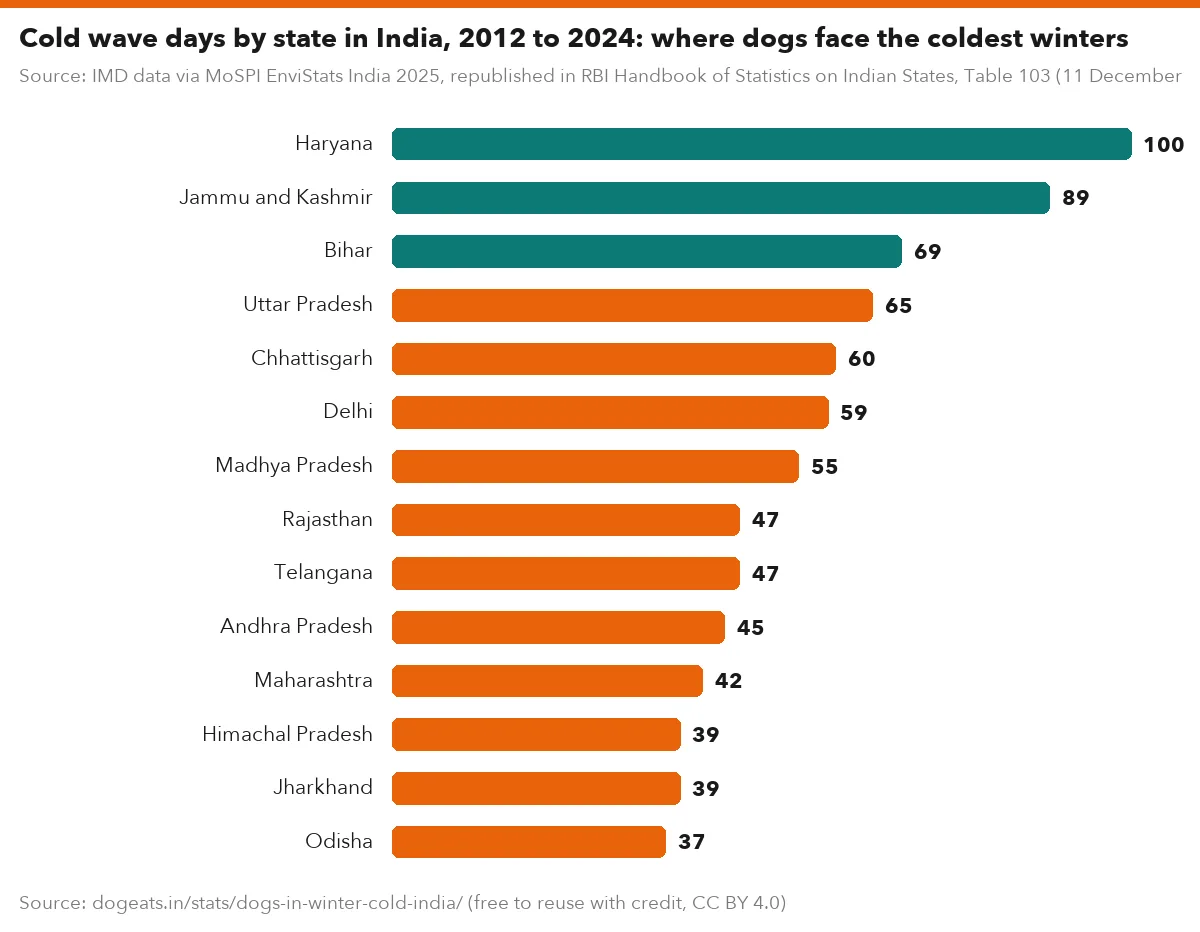
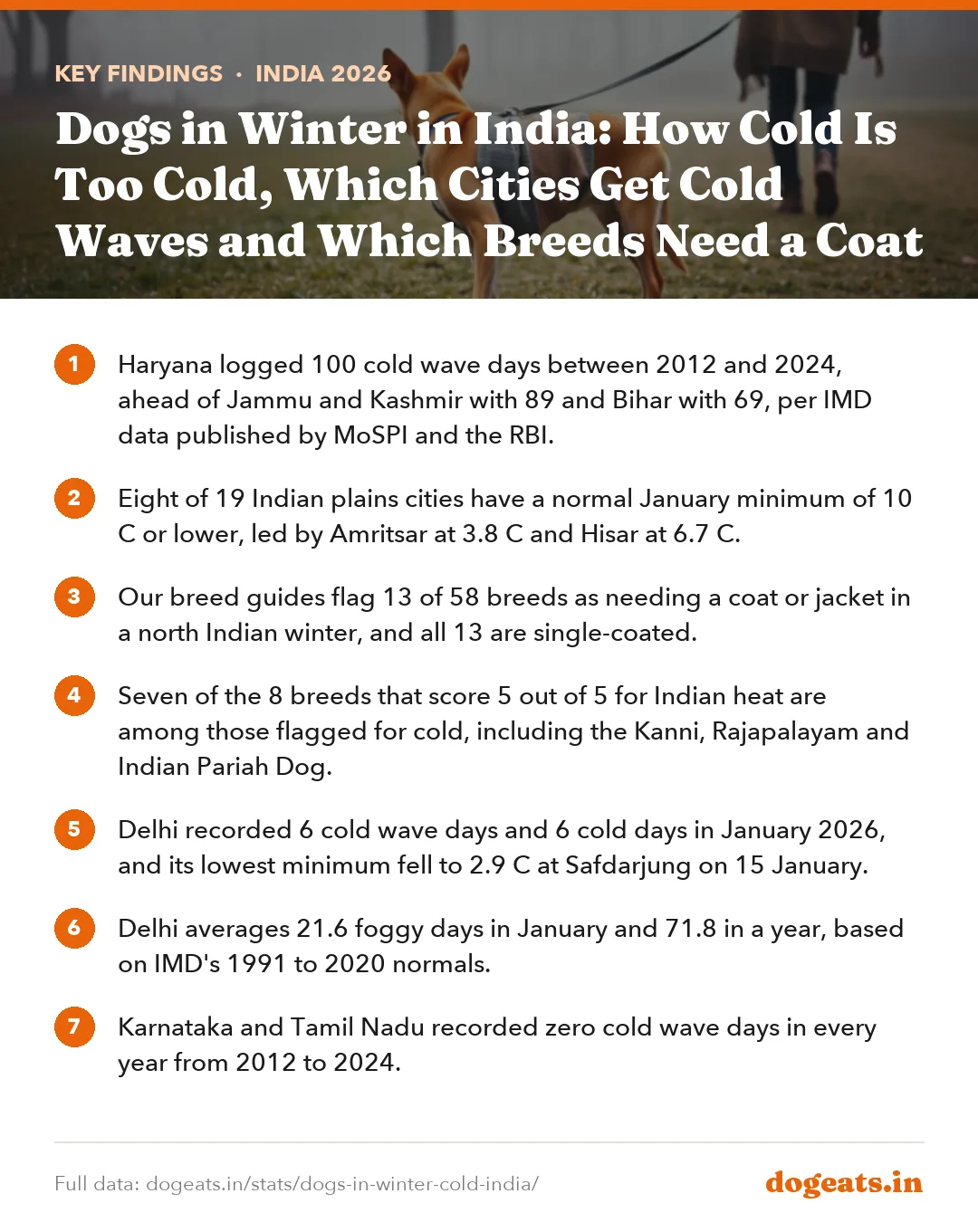
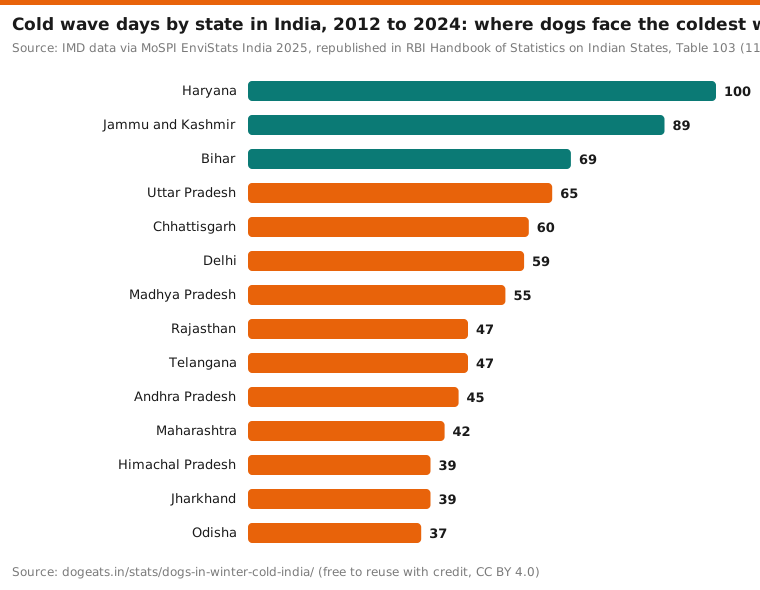
- Haryana logged 100 cold wave days between 2012 and 2024, ahead of Jammu and Kashmir with 89 and Bihar with 69, per IMD data published by MoSPI and the RBI.
- Eight of 19 Indian plains cities have a normal January minimum of 10 C or lower, led by Amritsar at 3.8 C and Hisar at 6.7 C.
- Our breed guides flag 13 of 58 breeds as needing a coat or jacket in a north Indian winter, and all 13 are single-coated.
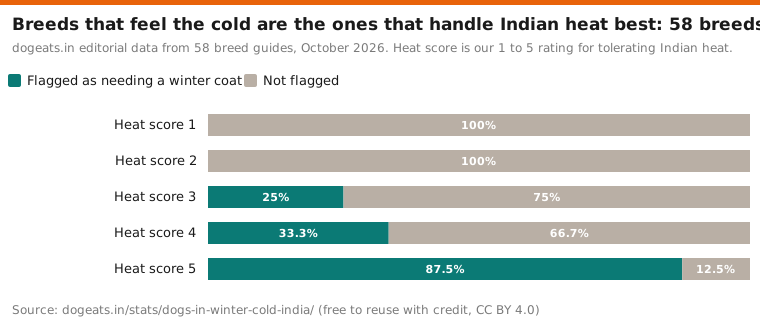
- Seven of the 8 breeds that score 5 out of 5 for Indian heat are among those flagged for cold, including the Kanni, Rajapalayam and Indian Pariah Dog.
- Delhi recorded 6 cold wave days and 6 cold days in January 2026, and its lowest minimum fell to 2.9 C at Safdarjung on 15 January.
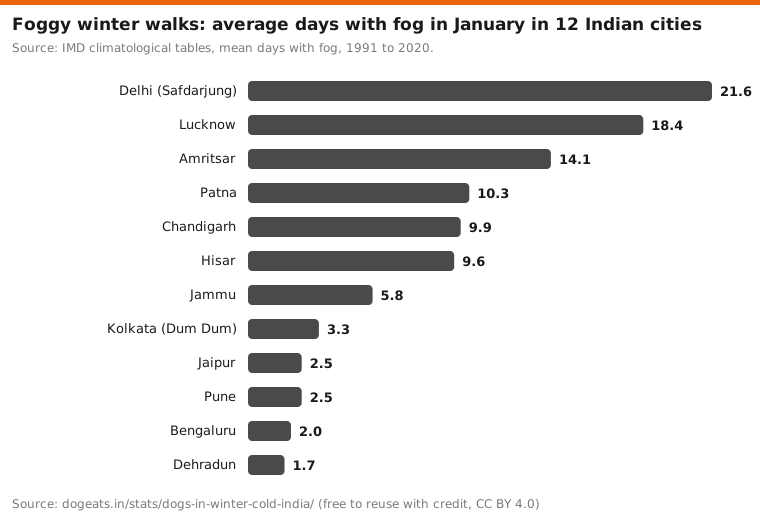
- Delhi averages 21.6 foggy days in January and 71.8 in a year, based on IMD's 1991 to 2020 normals.
- Karnataka and Tamil Nadu recorded zero cold wave days in every year from 2012 to 2024.
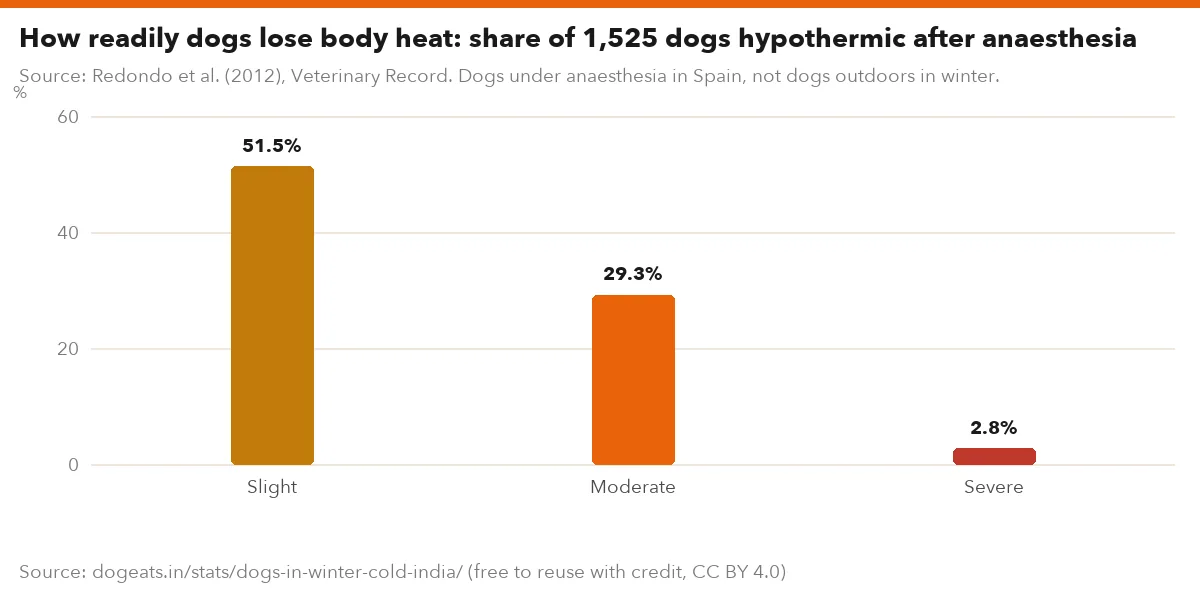
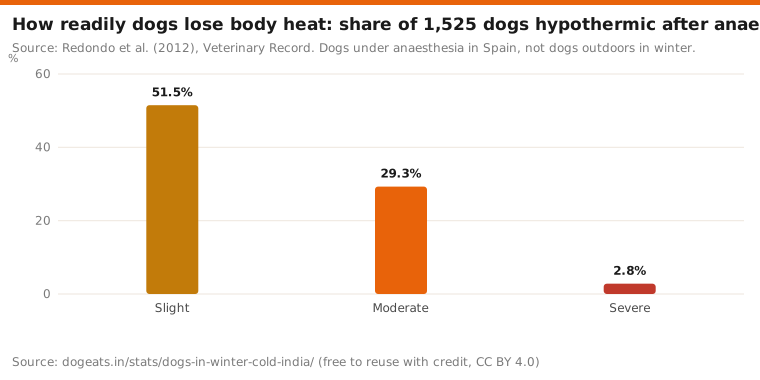
- In a Spanish study of 1,525 dogs under anaesthesia, 51.5% ended with slight, 29.3% with moderate and 2.8% with severe hypothermia.
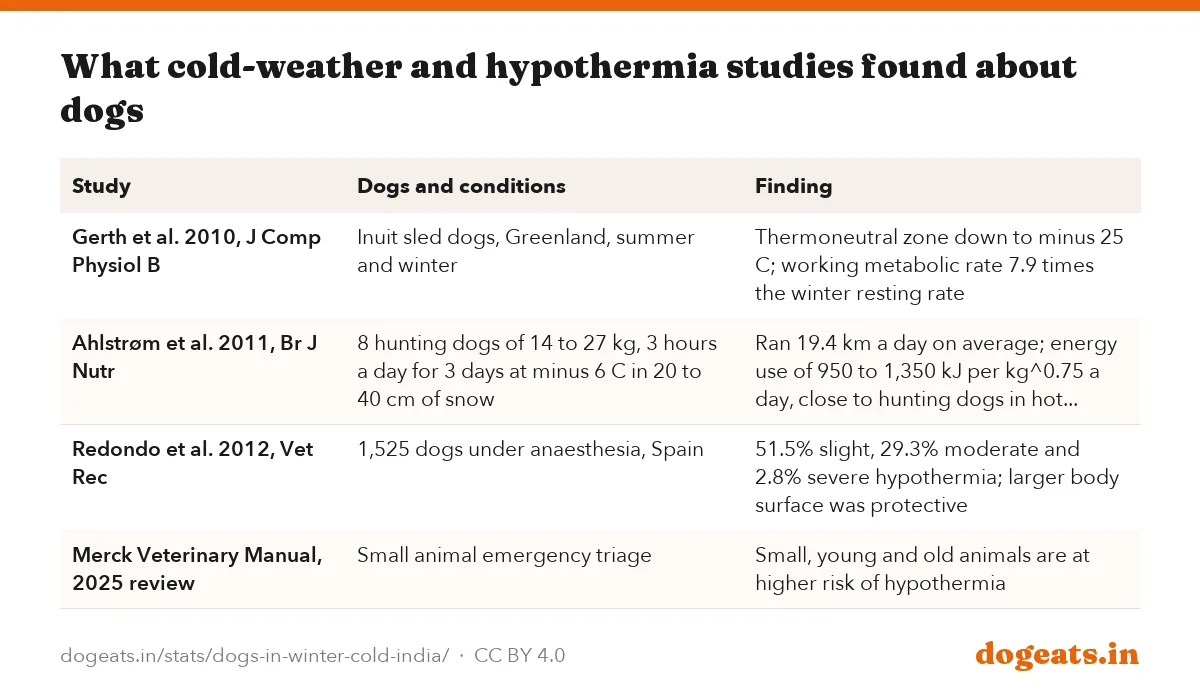
- Inuit sled dogs in Greenland had a thermoneutral zone reaching down to minus 25 C, far colder than any Indian plains city.
How cold is too cold for dogs?
No single air temperature is too cold for every dog. Size, coat, age and wetness change the answer. The Merck Veterinary Manual says small, young and old animals are at higher risk of hypothermia, and lists hypothermia among the conditions that can need rapid intervention.
Cold-built dogs tolerate far more than Indian plains ever deliver. A study of Inuit sled dogs in Greenland found their thermoneutral zone reached down to minus 25 C. Below that zone a dog must burn extra energy to stay warm.
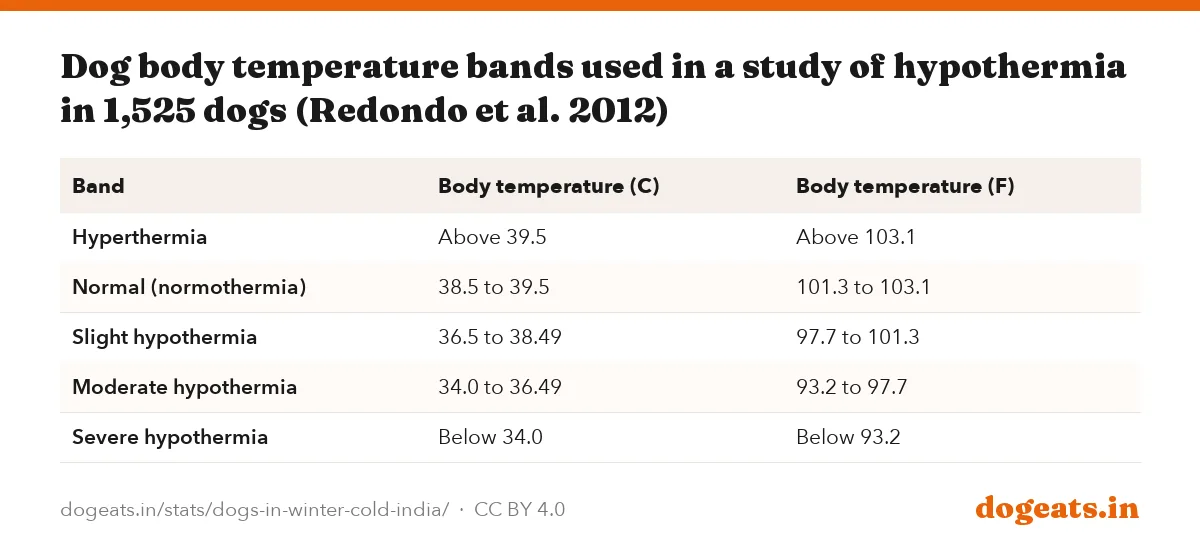
The lower limit for a thin-coated toy dog sits much higher, though no study we found puts a number on it. What researchers do measure is body temperature. Our dog temperature and heart rate chart gives the normal ranges.
| Band | Body temperature (C) | Body temperature (F) |
|---|---|---|
| Hyperthermia | Above 39.5 | Above 103.1 |
| Normal (normothermia) | 38.5 to 39.5 | 101.3 to 103.1 |
| Slight hypothermia | 36.5 to 38.49 | 97.7 to 101.3 |
| Moderate hypothermia | 34.0 to 36.49 | 93.2 to 97.7 |
| Severe hypothermia | Below 34.0 | Below 93.2 |
Source: Redondo et al. (2012), Veterinary Record. Dogs under anaesthesia in Spain, not dogs outdoors in winter.
Show the numbers
| Label | % |
|---|---|
| Slight | 51.5% |
| Moderate | 29.3% |
| Severe | 2.8% |
Embed this chart
The anaesthesia study shows how fast body heat goes once a dog cannot move or shiver. Mean temperature fell from 38.7 C before premedication to 36.7 C after 60 minutes, 36.1 C after 120 and 35.8 C after 180. Dogs with a larger body surface ended warmer.
| Study | Dogs and conditions | Finding |
|---|---|---|
| Gerth et al. 2010, J Comp Physiol B | Inuit sled dogs, Greenland, summer and winter | Thermoneutral zone down to minus 25 C; working metabolic rate 7.9 times the winter resting rate |
| Ahlstrøm et al. 2011, Br J Nutr | 8 hunting dogs of 14 to 27 kg, 3 hours a day for 3 days at minus 6 C in 20 to 40 cm of snow | Ran 19.4 km a day on average; energy use of 950 to 1,350 kJ per kg^0.75 a day, close to hunting dogs in hot climates |
| Redondo et al. 2012, Vet Rec | 1,525 dogs under anaesthesia, Spain | 51.5% slight, 29.3% moderate and 2.8% severe hypothermia; larger body surface was protective |
| Merck Veterinary Manual, 2025 review | Small animal emergency triage | Small, young and old animals are at higher risk of hypothermia |
So the practical risk in India is narrow. It is a short-coated, small, old or wet dog left out on a north Indian night. A Husky in Delhi in January is in its element.
How cold do Indian cities get in winter for dogs?
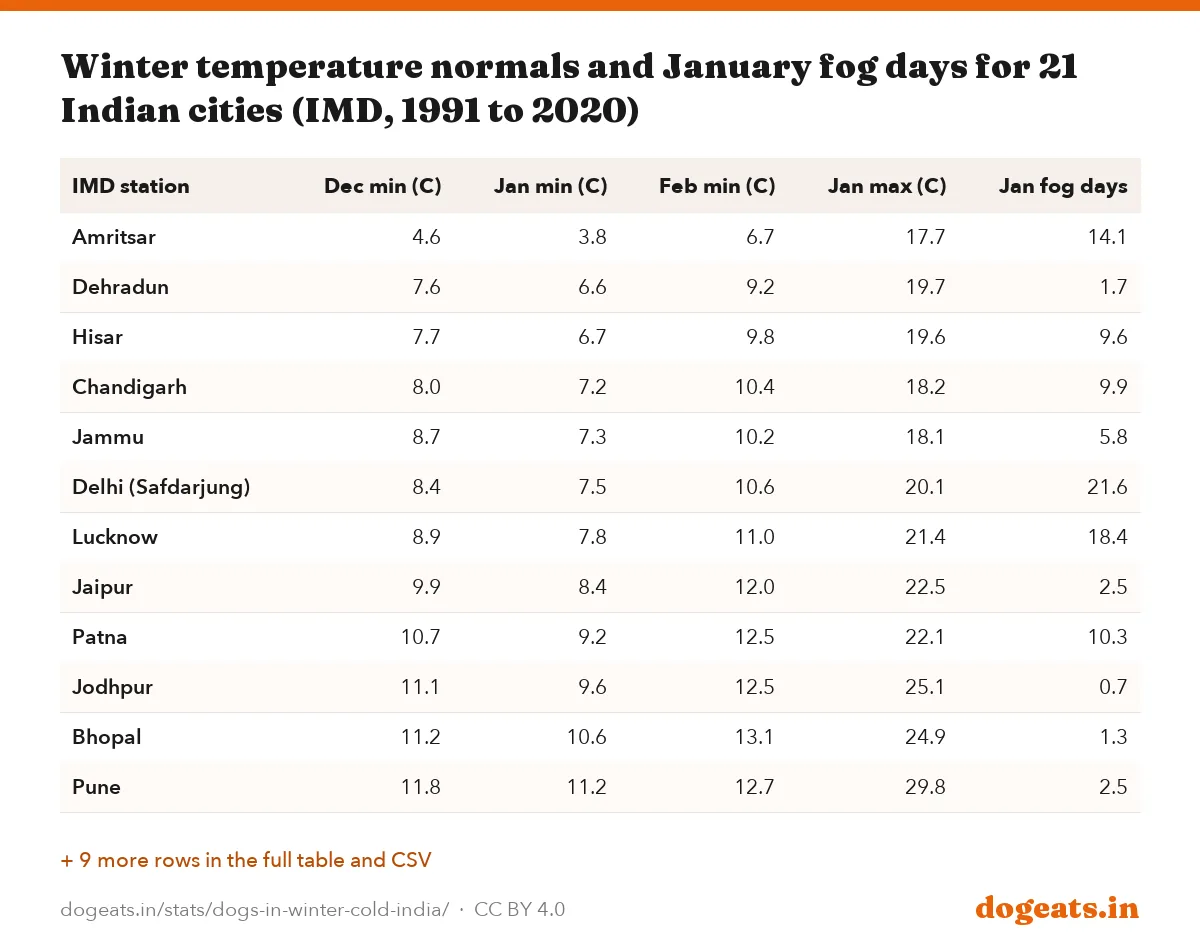
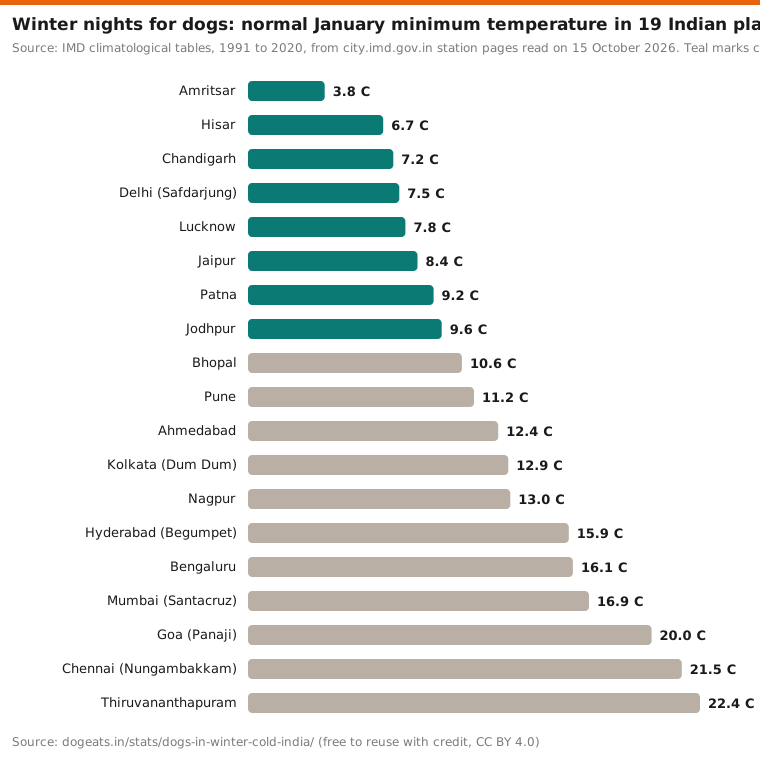
North Indian plains get properly cold at night, and the south barely does. Of 19 plains city stations, 8 have a normal January minimum of 10 C or lower, per IMD normals for 1991 to 2020. Amritsar is coldest at 3.8 C, then Hisar at 6.7 C and Chandigarh at 7.2 C.
Delhi's Safdarjung station averages 7.5 C on January nights and 20.1 C by day. Lucknow averages 7.8 C and Jaipur 8.4 C. Bhopal sits just above the line at 10.6 C.
South and coastal cities stay mild. Bengaluru's January minimum is 16.1 C, Mumbai's 16.9 C and Chennai's 21.5 C. A dog in Thiruvananthapuram, at 22.4 C, never meets winter in the northern sense.
Source: IMD climatological tables, 1991 to 2020, from city.imd.gov.in station pages read on 15 October 2026. Teal marks cities at or below 10 C, IMD's threshold for counting a cold wave in the plains.
Show the numbers
| Label | C |
|---|---|
| Amritsar | 3.8 C |
| Hisar | 6.7 C |
| Chandigarh | 7.2 C |
| Delhi (Safdarjung) | 7.5 C |
| Lucknow | 7.8 C |
| Jaipur | 8.4 C |
| Patna | 9.2 C |
| Jodhpur | 9.6 C |
| Bhopal | 10.6 C |
| Pune | 11.2 C |
| Ahmedabad | 12.4 C |
| Kolkata (Dum Dum) | 12.9 C |
| Nagpur | 13.0 C |
| Hyderabad (Begumpet) | 15.9 C |
| Bengaluru | 16.1 C |
| Mumbai (Santacruz) | 16.9 C |
| Goa (Panaji) | 20.0 C |
| Chennai (Nungambakkam) | 21.5 C |
| Thiruvananthapuram | 22.4 C |
Embed this chart
| IMD station | Dec min (C) | Jan min (C) | Feb min (C) | Jan max (C) | Jan fog days |
|---|---|---|---|---|---|
| Amritsar | 4.6 | 3.8 | 6.7 | 17.7 | 14.1 |
| Dehradun | 7.6 | 6.6 | 9.2 | 19.7 | 1.7 |
| Hisar | 7.7 | 6.7 | 9.8 | 19.6 | 9.6 |
| Chandigarh | 8.0 | 7.2 | 10.4 | 18.2 | 9.9 |
| Jammu | 8.7 | 7.3 | 10.2 | 18.1 | 5.8 |
| Delhi (Safdarjung) | 8.4 | 7.5 | 10.6 | 20.1 | 21.6 |
| Lucknow | 8.9 | 7.8 | 11.0 | 21.4 | 18.4 |
| Jaipur | 9.9 | 8.4 | 12.0 | 22.5 | 2.5 |
| Patna | 10.7 | 9.2 | 12.5 | 22.1 | 10.3 |
| Jodhpur | 11.1 | 9.6 | 12.5 | 25.1 | 0.7 |
| Bhopal | 11.2 | 10.6 | 13.1 | 24.9 | 1.3 |
| Pune | 11.8 | 11.2 | 12.7 | 29.8 | 2.5 |
| Ahmedabad | 13.6 | 12.4 | 14.6 | 27.9 | 0.7 |
| Kolkata (Dum Dum) | 14.3 | 12.9 | 16.9 | 25.3 | 3.3 |
| Nagpur | 12.8 | 13.0 | 15.6 | 28.9 | 0.3 |
| Hyderabad (Begumpet) | 15.3 | 15.9 | 18.3 | 29.7 | 0.5 |
| Bengaluru | 16.4 | 16.1 | 17.6 | 28.4 | 2.0 |
| Mumbai (Santacruz) | 18.4 | 16.9 | 18.1 | 31.2 | 0.0 |
| Goa (Panaji) | 20.9 | 20.0 | 20.6 | 32.5 | 0.5 |
| Chennai (Nungambakkam) | 22.2 | 21.5 | 22.4 | 29.7 | 0.1 |
| Thiruvananthapuram | 22.9 | 22.4 | 23.1 | 32.7 | 0.0 |
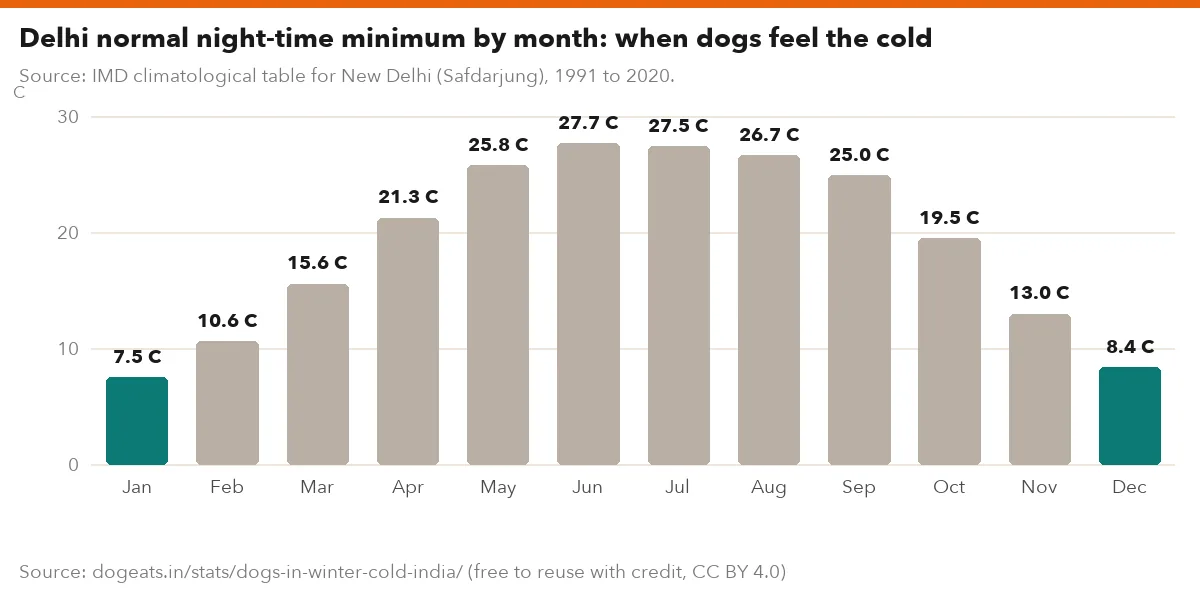
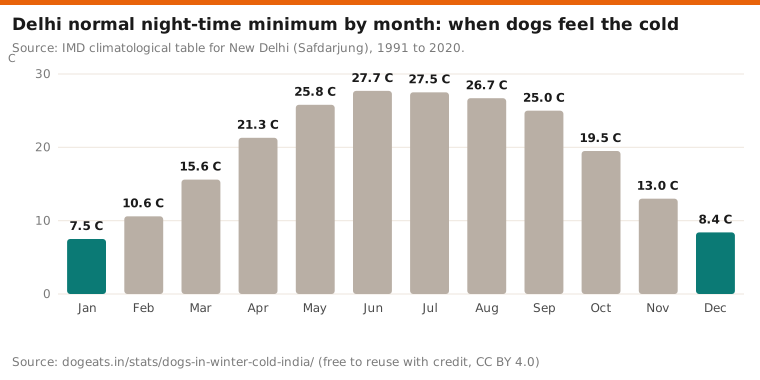
Source: IMD climatological table for New Delhi (Safdarjung), 1991 to 2020.
Show the numbers
| Label | C |
|---|---|
| Jan | 7.5 C |
| Feb | 10.6 C |
| Mar | 15.6 C |
| Apr | 21.3 C |
| May | 25.8 C |
| Jun | 27.7 C |
| Jul | 27.5 C |
| Aug | 26.7 C |
| Sep | 25.0 C |
| Oct | 19.5 C |
| Nov | 13.0 C |
| Dec | 8.4 C |
Embed this chart
Delhi has two months with a mean minimum at or below 10 C: December at 8.4 C and January at 7.5 C. February averages 10.6 C. So the cold stretch that matters for a thin-coated dog lasts roughly 8 to 10 weeks.
How low have winter nights gone in Indian cities since 2011?
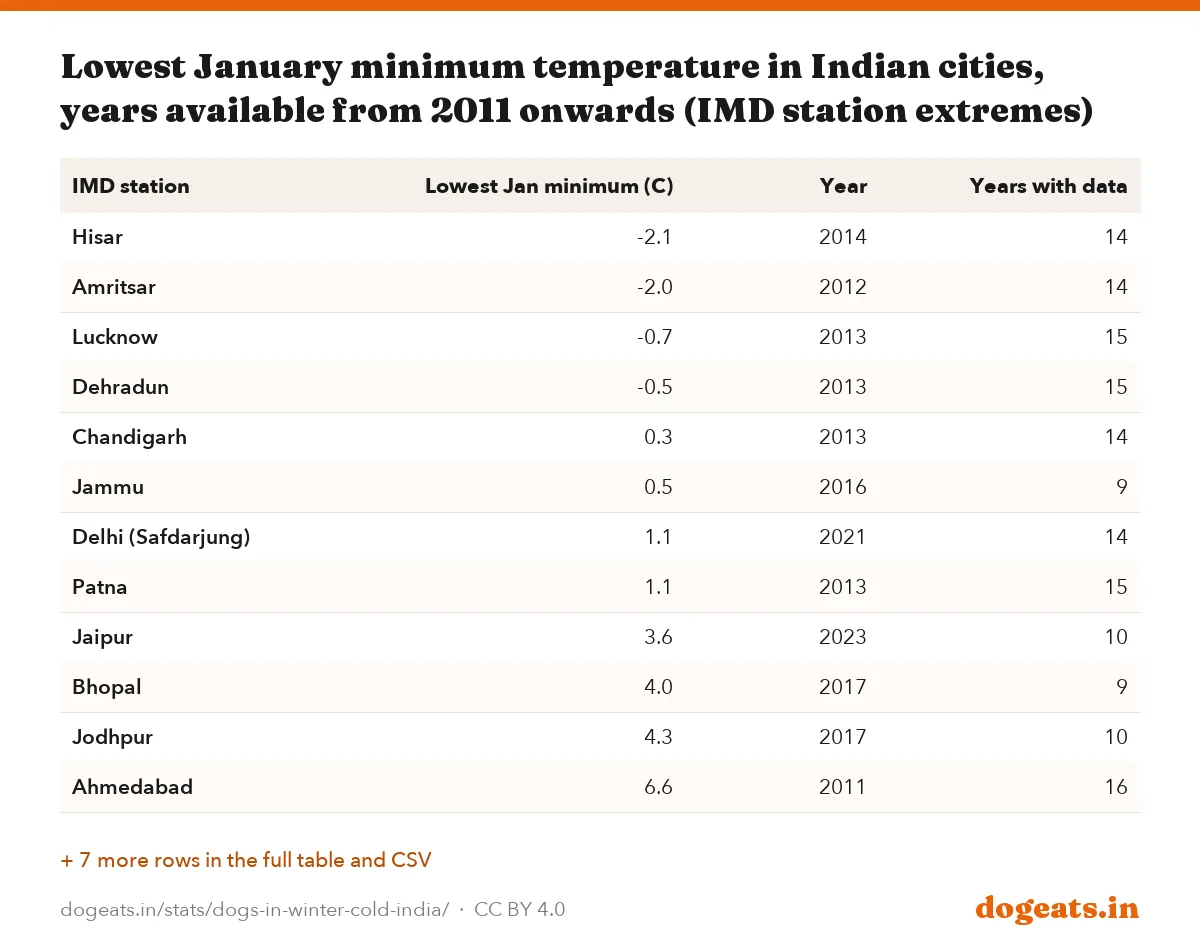
Averages hide the worst nights. IMD's station pages list the lowest January minimum for each recent year. Across the years available since 2011, 10 of 19 cities in our table touched 4 C or lower, and 8 touched 2 C or lower.
Hisar dropped to minus 2.1 C in January 2014 and Amritsar to minus 2.0 C in January 2012. Delhi's lowest January reading in the series was 1.1 C, in 2021. Lucknow fell to minus 0.7 C in 2013.
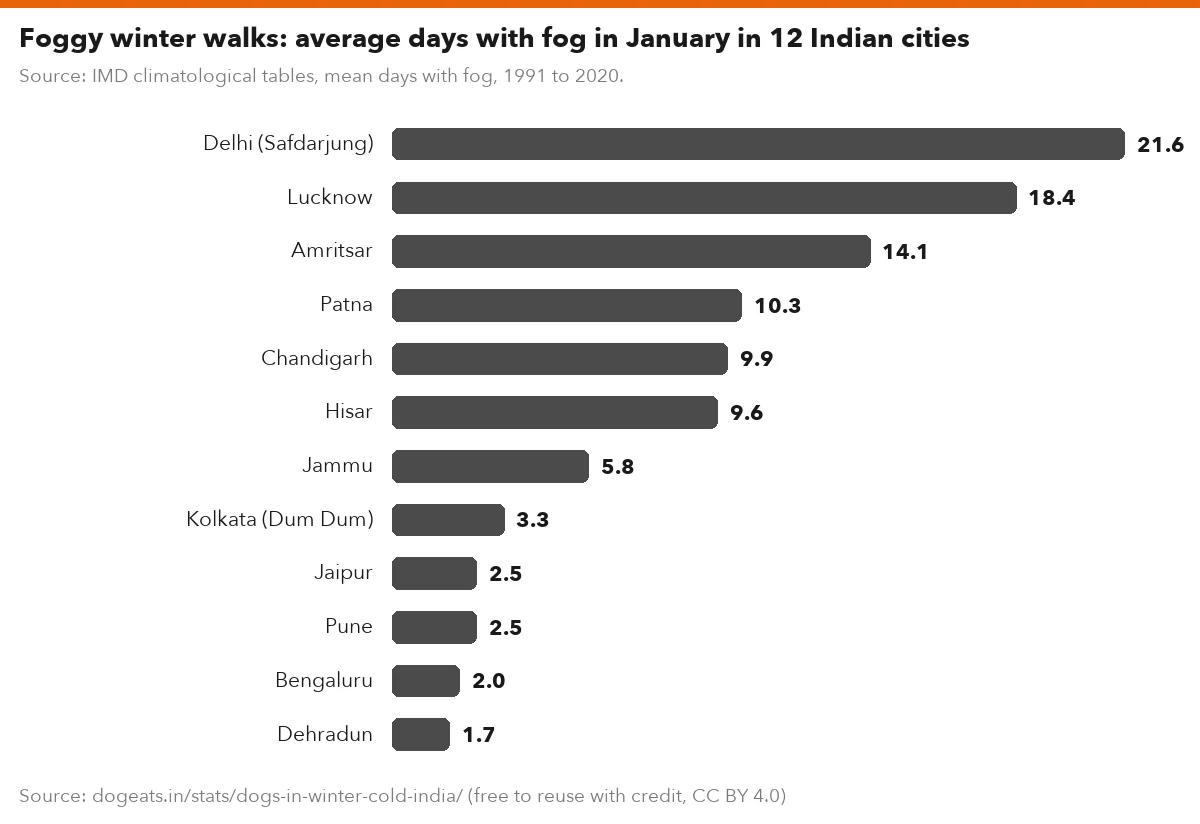
Fog is the other winter hazard on a dog walk. Delhi averages 21.6 foggy days in January and Lucknow 18.4. Visibility drops on exactly the early mornings when most owners walk their dogs.
| IMD station | Lowest Jan minimum (C) | Year | Years with data |
|---|---|---|---|
| Hisar | -2.1 | 2014 | 14 |
| Amritsar | -2.0 | 2012 | 14 |
| Lucknow | -0.7 | 2013 | 15 |
| Dehradun | -0.5 | 2013 | 15 |
| Chandigarh | 0.3 | 2013 | 14 |
| Jammu | 0.5 | 2016 | 9 |
| Delhi (Safdarjung) | 1.1 | 2021 | 14 |
| Patna | 1.1 | 2013 | 15 |
| Jaipur | 3.6 | 2023 | 10 |
| Bhopal | 4.0 | 2017 | 9 |
| Jodhpur | 4.3 | 2017 | 10 |
| Ahmedabad | 6.6 | 2011 | 16 |
| Hyderabad (Begumpet) | 8.3 | 2011 | 12 |
| Kolkata (Dum Dum) | 8.8 | 2018 | 7 |
| Mumbai (Santacruz) | 11.4 | 2020 | 11 |
| Bengaluru | 12.0 | 2012 | 8 |
| Goa (Panaji) | 16.0 | 2015 | 14 |
| Chennai (Nungambakkam) | 17.7 | 2012 | 14 |
| Thiruvananthapuram | 18.6 | 2012 | 16 |
Source: IMD climatological tables, mean days with fog, 1991 to 2020.
Show the numbers
| Label | days |
|---|---|
| Delhi (Safdarjung) | 21.6 |
| Lucknow | 18.4 |
| Amritsar | 14.1 |
| Patna | 10.3 |
| Chandigarh | 9.9 |
| Hisar | 9.6 |
| Jammu | 5.8 |
| Kolkata (Dum Dum) | 3.3 |
| Jaipur | 2.5 |
| Pune | 2.5 |
| Bengaluru | 2.0 |
| Dehradun | 1.7 |
Embed this chart
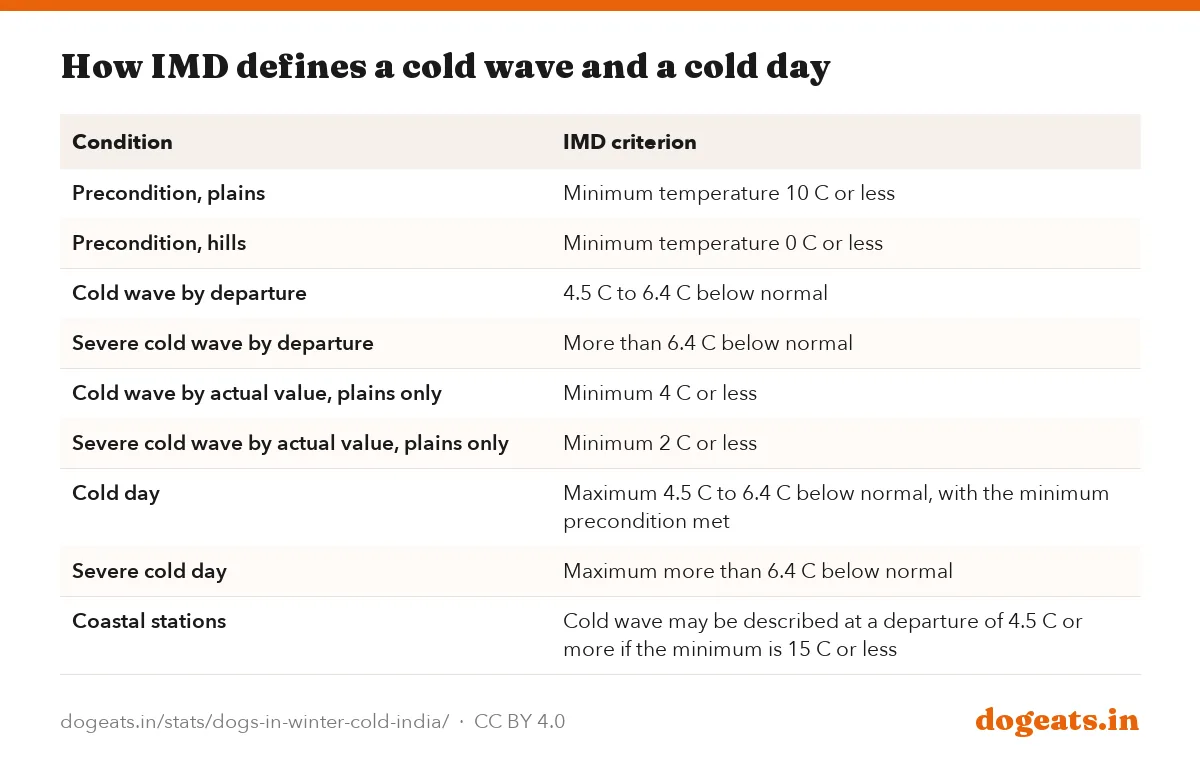
For a dog, a 2 C night matters most when it is spent outdoors, wet or on bare concrete. IMD treats a plains minimum of 4 C or less as a cold wave on its own, and 2 C or less as a severe one.
How many cold wave days do Indian states get?
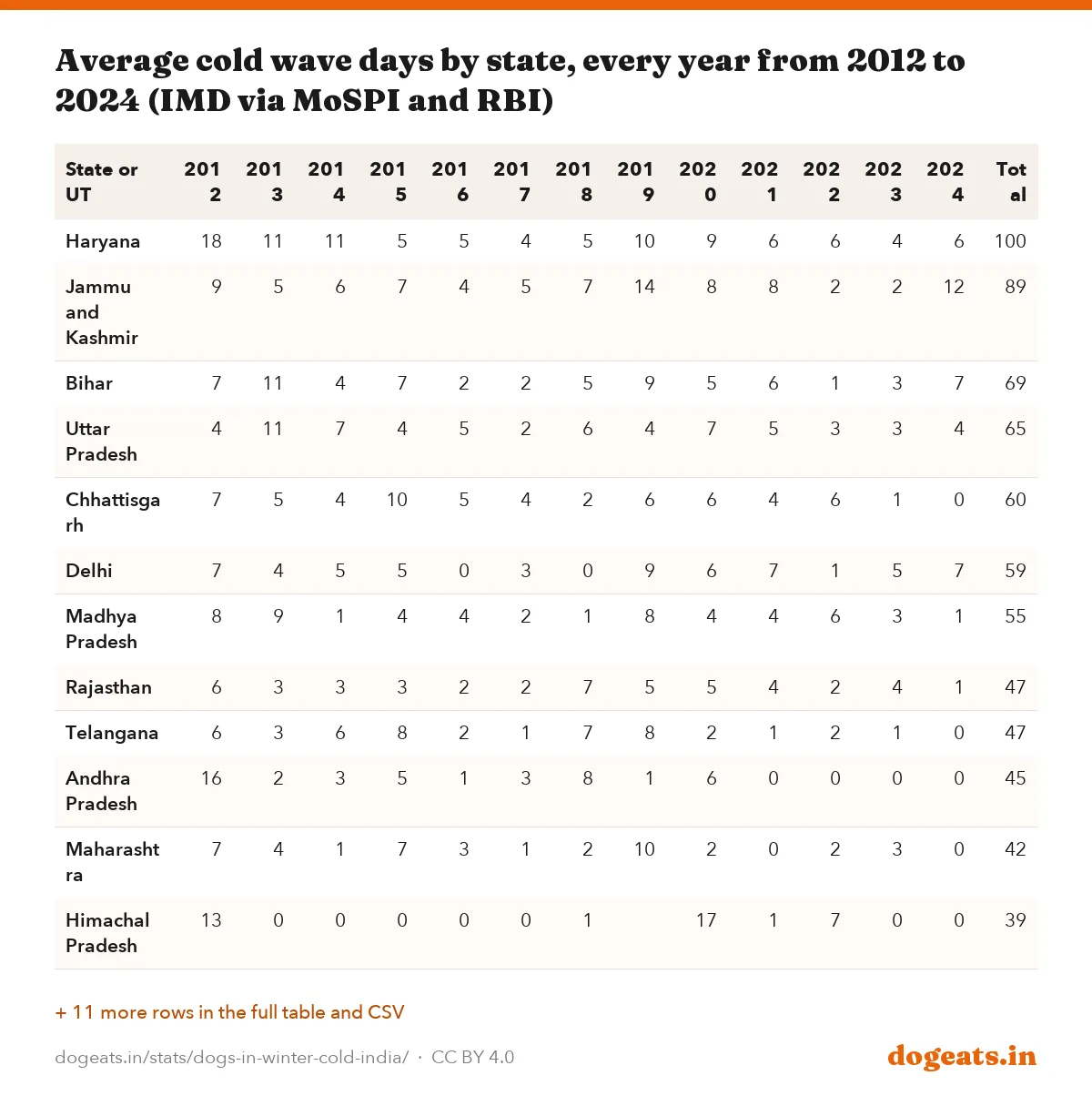
Haryana gets the most. Its yearly figures add up to 100 cold wave days from 2012 to 2024, per IMD data compiled by MoSPI and republished by the Reserve Bank of India. Jammu and Kashmir, including Ladakh, follows with 89 and Bihar with 69.
Uttar Pradesh logged 65 days, Chhattisgarh 60 and Delhi 59. Cold waves also reach the Deccan: Telangana had 47 and Andhra Pradesh 45. Karnataka and Tamil Nadu recorded none in any of the 13 years.
In 2024, the latest year published, Jammu and Kashmir had 12 cold wave days. Bihar and Delhi had 7 each, Haryana 6 and Uttar Pradesh 4.
Source: IMD data via MoSPI EnviStats India 2025, republished in RBI Handbook of Statistics on Indian States, Table 103 (11 December 2025). Figures are state averages per winter season (December to February), summed by dogeats.in. Himachal Pradesh has no figure for 2019.
Show the numbers
| Label | days |
|---|---|
| Haryana | 100 |
| Jammu and Kashmir | 89 |
| Bihar | 69 |
| Uttar Pradesh | 65 |
| Chhattisgarh | 60 |
| Delhi | 59 |
| Madhya Pradesh | 55 |
| Rajasthan | 47 |
| Telangana | 47 |
| Andhra Pradesh | 45 |
| Maharashtra | 42 |
| Himachal Pradesh | 39 |
| Jharkhand | 39 |
| Odisha | 37 |
Embed this chart
| Condition | IMD criterion |
|---|---|
| Precondition, plains | Minimum temperature 10 C or less |
| Precondition, hills | Minimum temperature 0 C or less |
| Cold wave by departure | 4.5 C to 6.4 C below normal |
| Severe cold wave by departure | More than 6.4 C below normal |
| Cold wave by actual value, plains only | Minimum 4 C or less |
| Severe cold wave by actual value, plains only | Minimum 2 C or less |
| Cold day | Maximum 4.5 C to 6.4 C below normal, with the minimum precondition met |
| Severe cold day | Maximum more than 6.4 C below normal |
| Coastal stations | Cold wave may be described at a departure of 4.5 C or more if the minimum is 15 C or less |
| State or UT | 2012 | 2013 | 2014 | 2015 | 2016 | 2017 | 2018 | 2019 | 2020 | 2021 | 2022 | 2023 | 2024 | Total |
|---|---|---|---|---|---|---|---|---|---|---|---|---|---|---|
| Haryana | 18 | 11 | 11 | 5 | 5 | 4 | 5 | 10 | 9 | 6 | 6 | 4 | 6 | 100 |
| Jammu and Kashmir | 9 | 5 | 6 | 7 | 4 | 5 | 7 | 14 | 8 | 8 | 2 | 2 | 12 | 89 |
| Bihar | 7 | 11 | 4 | 7 | 2 | 2 | 5 | 9 | 5 | 6 | 1 | 3 | 7 | 69 |
| Uttar Pradesh | 4 | 11 | 7 | 4 | 5 | 2 | 6 | 4 | 7 | 5 | 3 | 3 | 4 | 65 |
| Chhattisgarh | 7 | 5 | 4 | 10 | 5 | 4 | 2 | 6 | 6 | 4 | 6 | 1 | 0 | 60 |
| Delhi | 7 | 4 | 5 | 5 | 0 | 3 | 0 | 9 | 6 | 7 | 1 | 5 | 7 | 59 |
| Madhya Pradesh | 8 | 9 | 1 | 4 | 4 | 2 | 1 | 8 | 4 | 4 | 6 | 3 | 1 | 55 |
| Rajasthan | 6 | 3 | 3 | 3 | 2 | 2 | 7 | 5 | 5 | 4 | 2 | 4 | 1 | 47 |
| Telangana | 6 | 3 | 6 | 8 | 2 | 1 | 7 | 8 | 2 | 1 | 2 | 1 | 0 | 47 |
| Andhra Pradesh | 16 | 2 | 3 | 5 | 1 | 3 | 8 | 1 | 6 | 0 | 0 | 0 | 0 | 45 |
| Maharashtra | 7 | 4 | 1 | 7 | 3 | 1 | 2 | 10 | 2 | 0 | 2 | 3 | 0 | 42 |
| Himachal Pradesh | 13 | 0 | 0 | 0 | 0 | 0 | 1 | 17 | 1 | 7 | 0 | 0 | 39 | |
| Jharkhand | 8 | 4 | 3 | 4 | 2 | 2 | 5 | 5 | 3 | 2 | 0 | 0 | 1 | 39 |
| Odisha | 4 | 3 | 2 | 2 | 1 | 1 | 3 | 8 | 4 | 2 | 5 | 2 | 0 | 37 |
| Punjab | 13 | 4 | 3 | 2 | 2 | 1 | 0 | 2 | 1 | 0 | 0 | 1 | 0 | 29 |
| West Bengal | 1 | 6 | 1 | 1 | 1 | 1 | 3 | 1 | 1 | 1 | 1 | 0 | 0 | 18 |
| Tripura | 2 | 7 | 2 | 2 | 0 | 1 | 0 | 0 | 2 | 0 | 0 | 0 | 0 | 16 |
| Assam | 1 | 2 | 1 | 1 | 0 | 1 | 0 | 1 | 0 | 0 | 4 | 0 | 1 | 12 |
| Gujarat | 4 | 0 | 2 | 0 | 1 | 0 | 0 | 1 | 0 | 0 | 1 | 1 | 0 | 10 |
| Uttarakhand | 2 | 4 | 1 | 0 | 0 | 0 | 0 | 1 | 0 | 0 | 0 | 0 | 0 | 8 |
| Sikkim | 0 | 0 | 0 | 0 | 0 | 0 | 0 | 0 | 1 | 0 | 0 | 0 | 0 | 1 |
| Karnataka | 0 | 0 | 0 | 0 | 0 | 0 | 0 | 0 | 0 | 0 | 0 | 0 | 0 | 0 |
| Tamil Nadu | 0 | 0 | 0 | 0 | 0 | 0 | 0 | 0 | 0 | 0 | 0 | 0 | 0 | 0 |
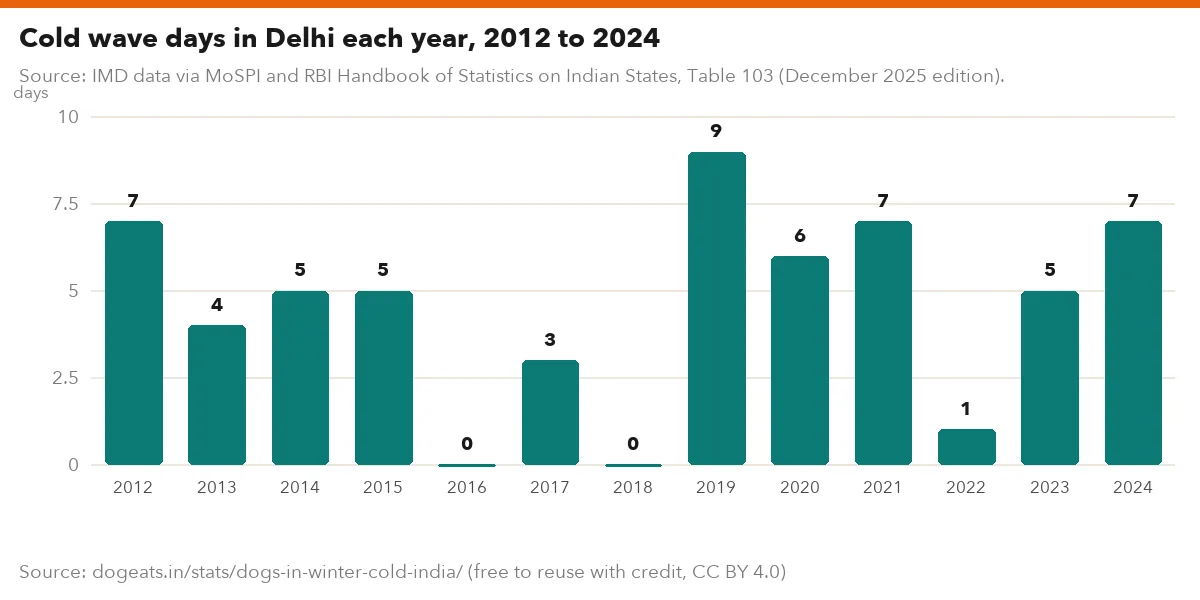
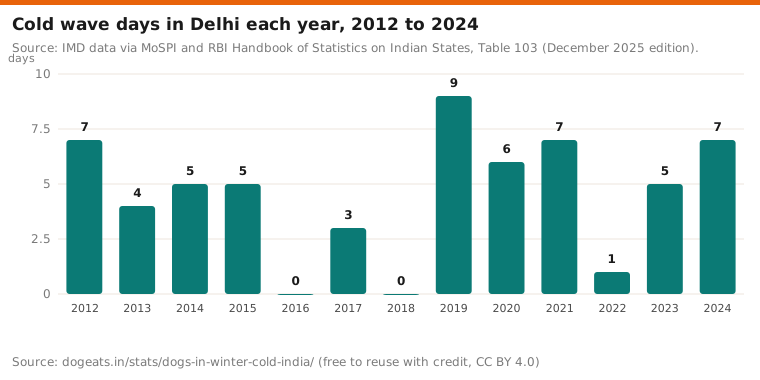
Source: IMD data via MoSPI and RBI Handbook of Statistics on Indian States, Table 103 (December 2025 edition).
Show the numbers
| Label | days |
|---|---|
| 2012 | 7 |
| 2013 | 4 |
| 2014 | 5 |
| 2015 | 5 |
| 2016 | 0 |
| 2017 | 3 |
| 2018 | 0 |
| 2019 | 9 |
| 2020 | 6 |
| 2021 | 7 |
| 2022 | 1 |
| 2023 | 5 |
| 2024 | 7 |
Embed this chart
Delhi's count swings widely, from 0 in 2016 and 2018 to 9 in 2019. Its 13-year total of 59 works out to about 4.5 cold wave days a year.
Why do cold wave figures for 2021 and 2022 differ between sources?
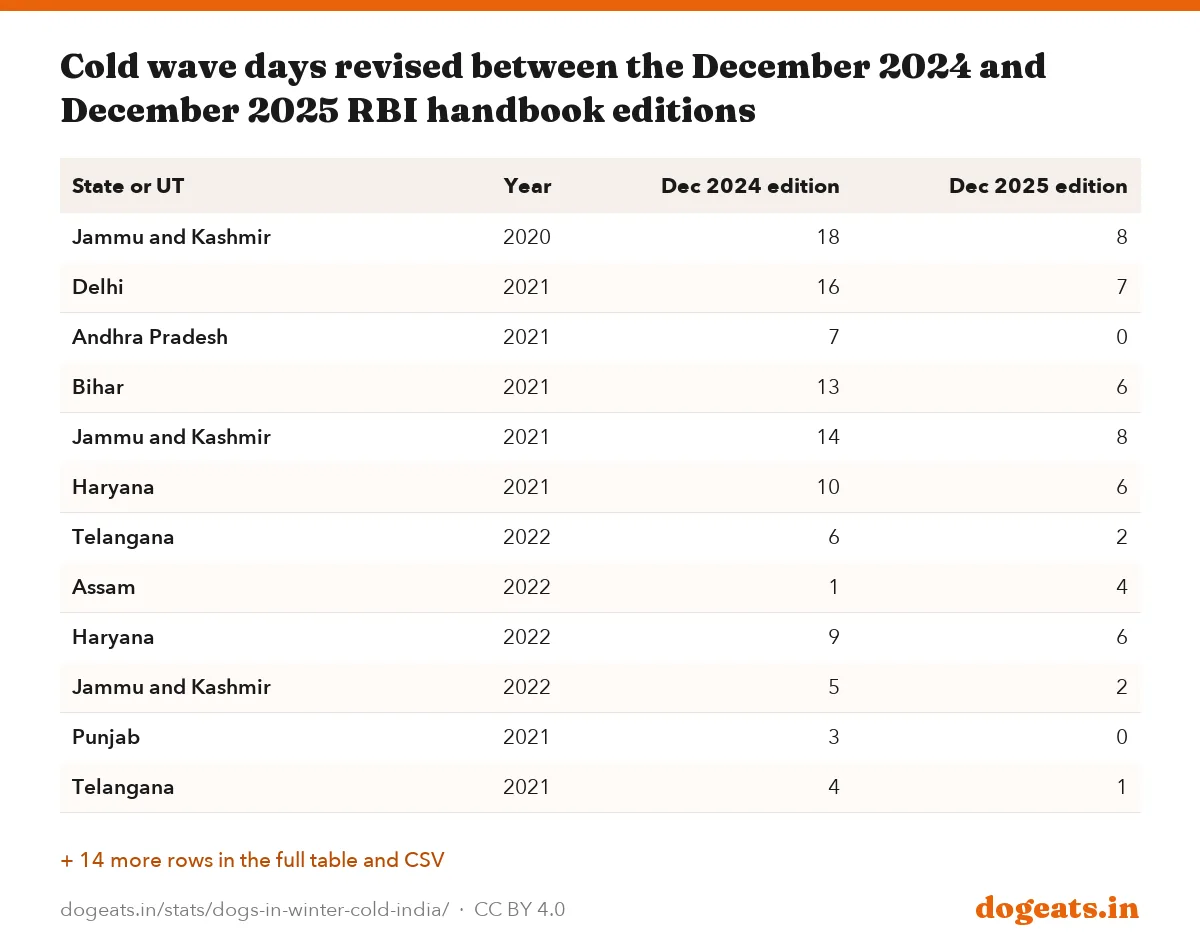
The official series was revised. The RBI's December 2024 edition listed Delhi with 16 cold wave days in 2021. The December 2025 edition lists 7. We found 26 state-year figures that changed between the two editions, all of them for the years 2020 to 2022, where both editions give a number.
We use the newer edition throughout, because it is the latest official release. If you cite a 2021 or 2022 figure from an older table, check it against the newer one.
| State or UT | Year | Dec 2024 edition | Dec 2025 edition |
|---|---|---|---|
| Jammu and Kashmir | 2020 | 18 | 8 |
| Delhi | 2021 | 16 | 7 |
| Andhra Pradesh | 2021 | 7 | 0 |
| Bihar | 2021 | 13 | 6 |
| Jammu and Kashmir | 2021 | 14 | 8 |
| Haryana | 2021 | 10 | 6 |
| Telangana | 2022 | 6 | 2 |
| Assam | 2022 | 1 | 4 |
| Haryana | 2022 | 9 | 6 |
| Jammu and Kashmir | 2022 | 5 | 2 |
| Punjab | 2021 | 3 | 0 |
| Telangana | 2021 | 4 | 1 |
| Bihar | 2022 | 3 | 1 |
| Delhi | 2022 | 3 | 1 |
| Uttar Pradesh | 2021 | 7 | 5 |
| Andhra Pradesh | 2022 | 1 | 0 |
| Chhattisgarh | 2021 | 5 | 4 |
| Jharkhand | 2022 | 1 | 0 |
| Madhya Pradesh | 2021 | 5 | 4 |
| Madhya Pradesh | 2022 | 7 | 6 |
| Maharashtra | 2022 | 3 | 2 |
| Odisha | 2021 | 3 | 2 |
| Rajasthan | 2021 | 3 | 4 |
| Rajasthan | 2022 | 1 | 2 |
| Tripura | 2021 | 1 | 0 |
| West Bengal | 2022 | 2 | 1 |
How cold was winter 2025 to 2026 in Delhi?
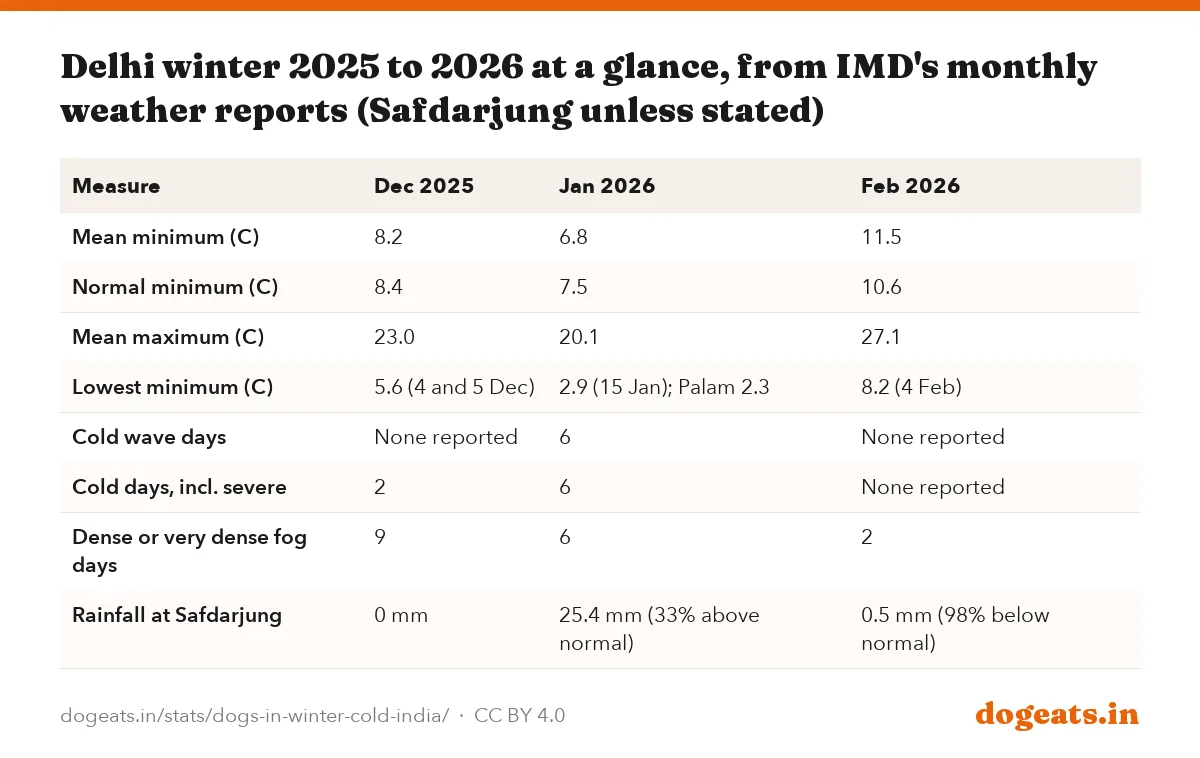
January 2026 brought Delhi's real cold. IMD's monthly report counts 6 cold wave days, on 11 to 15 January and 26 January. It also counts 6 cold days, with severe cold day conditions on 27 and 29 January.
The month's mean minimum at Safdarjung was 6.8 C, 0.7 C below normal. The lowest was 2.9 C on 15 January, and Palam fell to 2.3 C. December 2025 was close to normal, with a mean minimum of 8.2 C and no rain at all.
February 2026 turned warm early. Its mean maximum of 27.1 C was 2.9 C above normal, and the lowest night was 8.2 C.
| Measure | Dec 2025 | Jan 2026 | Feb 2026 |
|---|---|---|---|
| Mean minimum (C) | 8.2 | 6.8 | 11.5 |
| Normal minimum (C) | 8.4 | 7.5 | 10.6 |
| Mean maximum (C) | 23.0 | 20.1 | 27.1 |
| Lowest minimum (C) | 5.6 (4 and 5 Dec) | 2.9 (15 Jan); Palam 2.3 | 8.2 (4 Feb) |
| Cold wave days | None reported | 6 | None reported |
| Cold days, incl. severe | 2 | 6 | None reported |
| Dense or very dense fog days | 9 | 6 | 2 |
| Rainfall at Safdarjung | 0 mm | 25.4 mm (33% above normal) | 0.5 mm (98% below normal) |
Which dog breeds feel the cold most in an Indian winter?
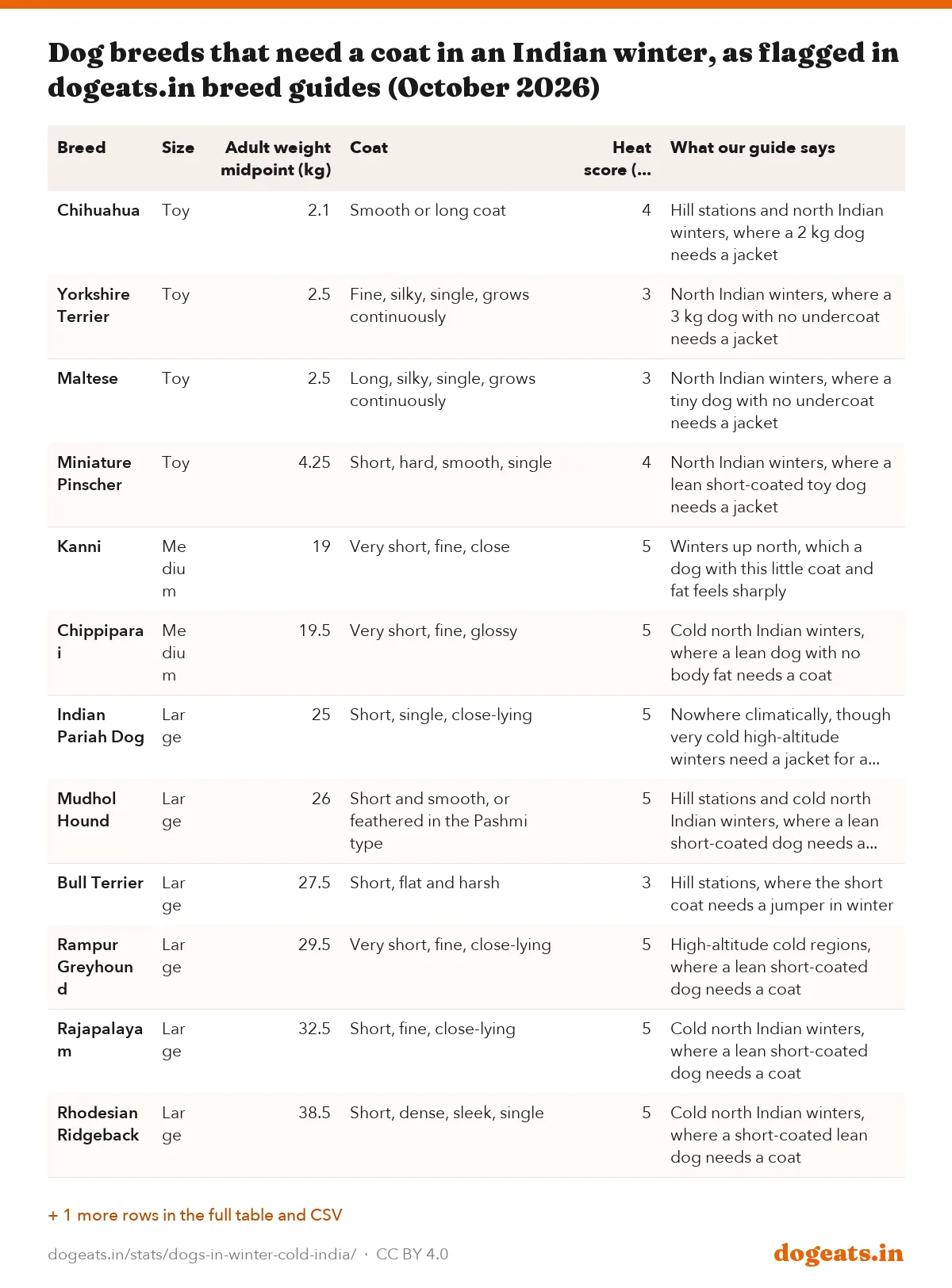
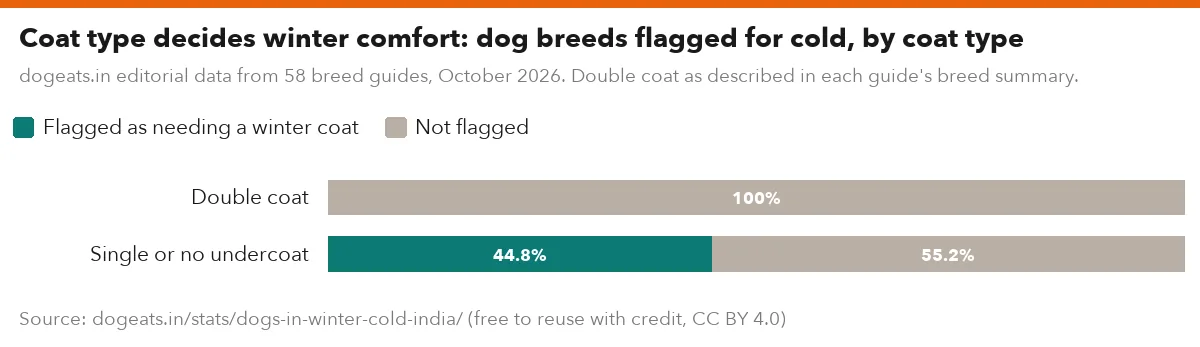
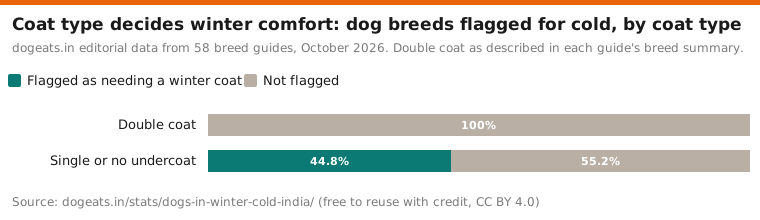
Lean, short-coated and tiny breeds feel it first. Our 58 breed guides flag 13 breeds as needing a coat or jacket in a north Indian winter or at altitude. All 13 are single-coated, and none of the 29 double-coated breeds is flagged.
Four are toy breeds: the Chihuahua, Yorkshire Terrier, Maltese and Miniature Pinscher. Each has an adult weight midpoint under 5 kg. The other toy breeds, the Pomeranian, the Pekingese and the toy-size American Eskimo Dog, carry a double coat and are not flagged.
The rest are lean, short-coated dogs, from the Dobermann and Rhodesian Ridgeback to India's sighthounds. Their guides describe little coat and little body fat to hold heat.
| Breed | Size | Adult weight midpoint (kg) | Coat | Heat score (1 to 5) | What our guide says |
|---|---|---|---|---|---|
| Chihuahua | Toy | 2.1 | Smooth or long coat | 4 | Hill stations and north Indian winters, where a 2 kg dog needs a jacket |
| Yorkshire Terrier | Toy | 2.5 | Fine, silky, single, grows continuously | 3 | North Indian winters, where a 3 kg dog with no undercoat needs a jacket |
| Maltese | Toy | 2.5 | Long, silky, single, grows continuously | 3 | North Indian winters, where a tiny dog with no undercoat needs a jacket |
| Miniature Pinscher | Toy | 4.25 | Short, hard, smooth, single | 4 | North Indian winters, where a lean short-coated toy dog needs a jacket |
| Kanni | Medium | 19 | Very short, fine, close | 5 | Winters up north, which a dog with this little coat and fat feels sharply |
| Chippiparai | Medium | 19.5 | Very short, fine, glossy | 5 | Cold north Indian winters, where a lean dog with no body fat needs a coat |
| Indian Pariah Dog | Large | 25 | Short, single, close-lying | 5 | Nowhere climatically, though very cold high-altitude winters need a jacket for a short coat |
| Mudhol Hound | Large | 26 | Short and smooth, or feathered in the Pashmi type | 5 | Hill stations and cold north Indian winters, where a lean short-coated dog needs a coat |
| Bull Terrier | Large | 27.5 | Short, flat and harsh | 3 | Hill stations, where the short coat needs a jumper in winter |
| Rampur Greyhound | Large | 29.5 | Very short, fine, close-lying | 5 | High-altitude cold regions, where a lean short-coated dog needs a coat |
| Rajapalayam | Large | 32.5 | Short, fine, close-lying | 5 | Cold north Indian winters, where a lean short-coated dog needs a coat |
| Rhodesian Ridgeback | Large | 38.5 | Short, dense, sleek, single | 5 | Cold north Indian winters, where a short-coated lean dog needs a coat |
| Doberman | Large | 39.5 | Short, smooth, single, no undercoat | 4 | Delhi and north Indian winters without a coat for the dog |
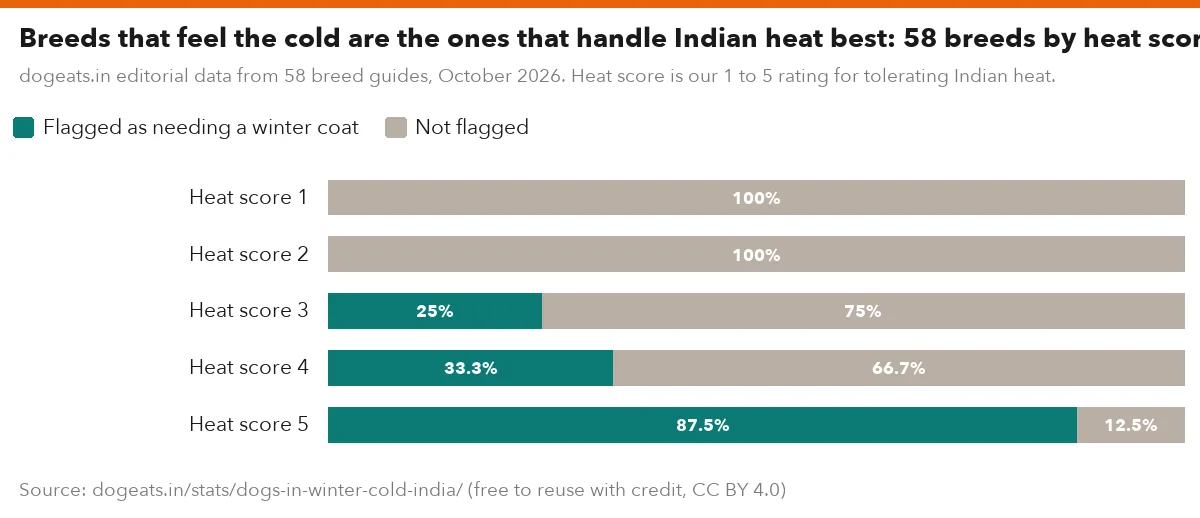
dogeats.in editorial data from 58 breed guides, October 2026. Heat score is our 1 to 5 rating for tolerating Indian heat.
Show the numbers
| Label | Flagged as needing a winter coat | Not flagged |
|---|---|---|
| Heat score 1 | 0 | 13 |
| Heat score 2 | 0 | 16 |
| Heat score 3 | 3 | 9 |
| Heat score 4 | 3 | 6 |
| Heat score 5 | 7 | 1 |
Embed this chart
The trade-off shows in the numbers. Flagged breeds average 4.31 out of 5 for Indian heat, against 2.24 for the other 45. Seven of the 8 breeds that score a full 5 for heat are on the cold list.
Do Indian dogs and indies need a sweater in winter?
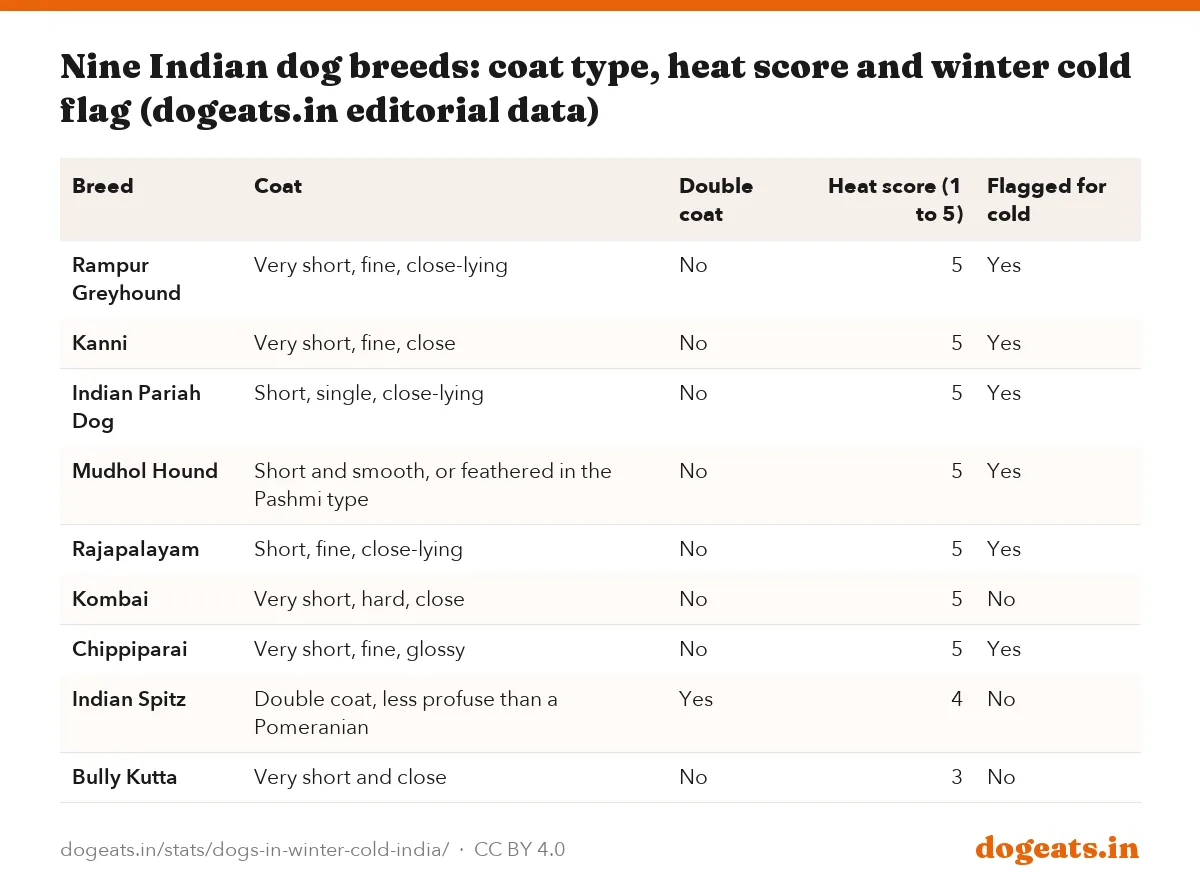
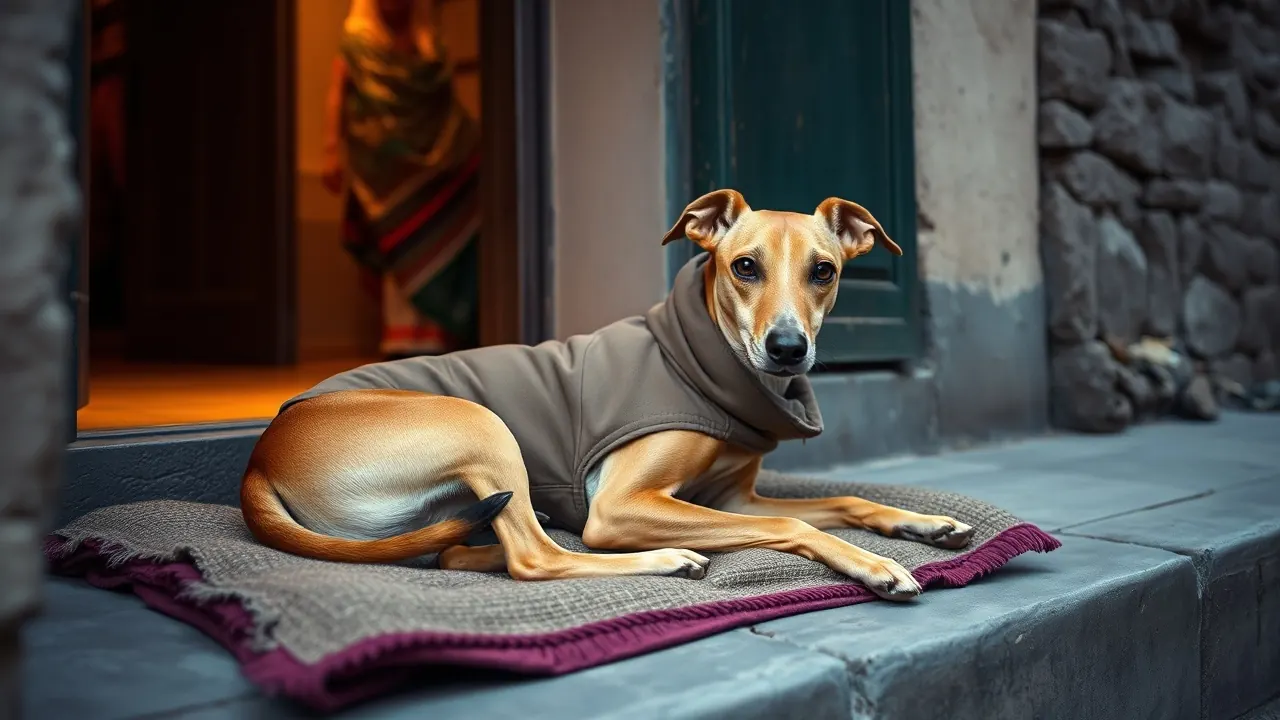
Most Indian breeds were shaped by heat, so their coats are thin. Six of the 9 native breeds in our guides are flagged for cold. They are the Rampur Greyhound, Kanni, Chippiparai, Rajapalayam, Mudhol Hound and Indian Pariah Dog.
The indie's flag is narrow. Its guide says only very cold, high-altitude winters call for a jacket. On a Delhi or Lucknow night, a healthy adult indie with dry bedding is in its normal range of experience.
The Indian Spitz is the exception among native dogs. It carries a double coat and is not flagged. The Kombai and Bully Kutta are also unflagged. Our Indian vs foreign breeds report compares the nine on other measures.
| Breed | Coat | Double coat | Heat score (1 to 5) | Flagged for cold |
|---|---|---|---|---|
| Rampur Greyhound | Very short, fine, close-lying | No | 5 | Yes |
| Kanni | Very short, fine, close | No | 5 | Yes |
| Indian Pariah Dog | Short, single, close-lying | No | 5 | Yes |
| Mudhol Hound | Short and smooth, or feathered in the Pashmi type | No | 5 | Yes |
| Rajapalayam | Short, fine, close-lying | No | 5 | Yes |
| Kombai | Very short, hard, close | No | 5 | No |
| Chippiparai | Very short, fine, glossy | No | 5 | Yes |
| Indian Spitz | Double coat, less profuse than a Pomeranian | Yes | 4 | No |
| Bully Kutta | Very short and close | No | 3 | No |
Street dogs face winter without a choice of bedding. Our street dog population report has the state counts. A dry sack or cardboard on the ground does more than a sweater, because cold concrete draws heat from a lying dog.
Which dog breeds handle an Indian winter best?
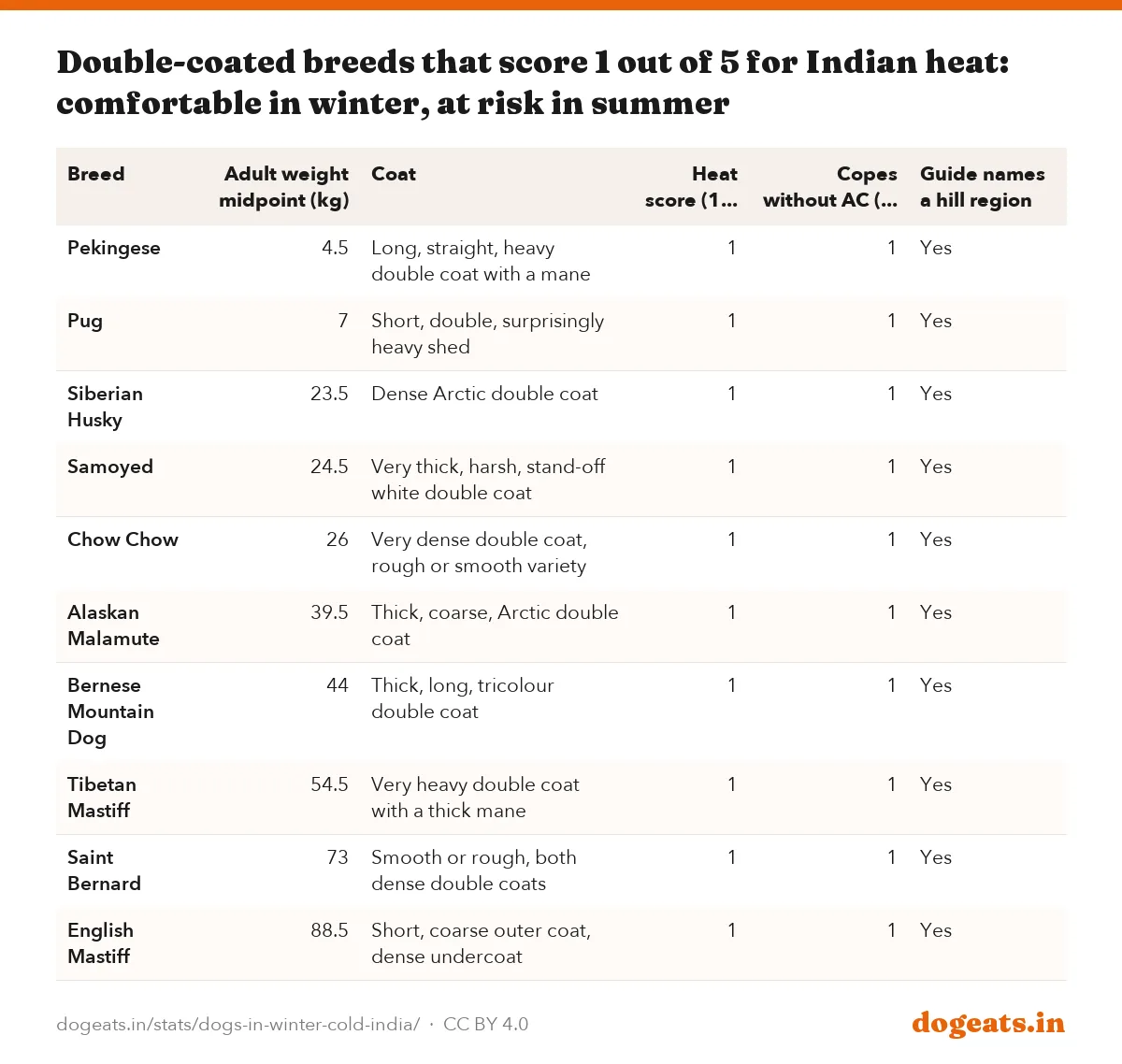
Heavy double-coated breeds treat a north Indian winter as their good season. Our guides name a hill region as a good fit for 36 of 58 breeds, and name north India's winter months as workable for 21.
The catch arrives in April. Ten double-coated breeds score 1 out of 5 for Indian heat, from the Siberian Husky to the Saint Bernard. Pug and Pekingese also score low because of their flat faces, not only their coats.
dogeats.in editorial data from 58 breed guides, October 2026. Double coat as described in each guide's breed summary.
Show the numbers
| Label | Flagged as needing a winter coat | Not flagged |
|---|---|---|
| Double coat | 0 | 29 |
| Single or no undercoat | 13 | 16 |
Embed this chart
| Breed | Adult weight midpoint (kg) | Coat | Heat score (1 to 5) | Copes without AC (1 to 5) | Guide names a hill region |
|---|---|---|---|---|---|
| Pekingese | 4.5 | Long, straight, heavy double coat with a mane | 1 | 1 | Yes |
| Pug | 7 | Short, double, surprisingly heavy shed | 1 | 1 | Yes |
| Siberian Husky | 23.5 | Dense Arctic double coat | 1 | 1 | Yes |
| Samoyed | 24.5 | Very thick, harsh, stand-off white double coat | 1 | 1 | Yes |
| Chow Chow | 26 | Very dense double coat, rough or smooth variety | 1 | 1 | Yes |
| Alaskan Malamute | 39.5 | Thick, coarse, Arctic double coat | 1 | 1 | Yes |
| Bernese Mountain Dog | 44 | Thick, long, tricolour double coat | 1 | 1 | Yes |
| Tibetan Mastiff | 54.5 | Very heavy double coat with a thick mane | 1 | 1 | Yes |
| Saint Bernard | 73 | Smooth or rough, both dense double coats | 1 | 1 | Yes |
| English Mastiff | 88.5 | Short, coarse outer coat, dense undercoat | 1 | 1 | Yes |
For these breeds, the question is summer, not winter. See how hot is too hot for dogs and our hills and cold places ranking.
What should dog owners in north India do in winter?
The data points to a short list. Most of it is about the 8 to 10 coldest weeks and the dogs most exposed to them.

- Watch the forecast for cold wave days: Delhi had 6 in January 2026, 5 of them in a row.
- Give short-coated, toy, old and young dogs a coat on nights near 4 C, the plains cold wave line.
- Keep bedding raised and dry, because a wet coat and cold concrete both speed heat loss.
- Walk a little later on foggy mornings: Delhi averages 21.6 fog days in January.
- Keep heavy-coated breeds out of overheated rooms; their comfort zone runs far colder than ours.
- If a dog is shivering hard, weak or unusually cold to touch, see a vet; Merck lists hypothermia among conditions that can need rapid intervention.
Winter also brings Delhi's worst air. Our AQI and dogs report covers polluted days by city.
Frequently asked questions
How cold is too cold for dogs in India?
It depends on the dog. Small, young, old and short-coated dogs are most at risk, per the Merck Veterinary Manual. In India the risk is mainly on north Indian nights near 4 C or below, which IMD counts as a cold wave in the plains.
Do dogs feel cold in Indian winters?
Some do. Our guides flag 13 of 58 breeds, all single-coated, as needing a coat in a north Indian winter. Double-coated breeds such as the Husky or Saint Bernard are comfortable.
Do Indian street dogs need a sweater in winter?
Most healthy adult indies cope with plains winters if they have dry shelter. The indie's guide flags only very cold, high-altitude winters as needing a jacket. Old, thin or sick street dogs are more at risk.
Which Indian state has the most cold wave days?
Haryana, with 100 cold wave days from 2012 to 2024 per IMD data republished by the RBI. Jammu and Kashmir had 89 and Bihar 69. Karnataka and Tamil Nadu had none.
How cold does Delhi get in winter?
Delhi's normal January minimum is 7.5 C at Safdarjung (IMD, 1991 to 2020). In January 2026 the lowest was 2.9 C on 15 January, with 6 cold wave days.
Which dog breeds are best for cold weather in India?
Heavy double-coated breeds such as the Siberian Husky, Alaskan Malamute, Samoyed, Saint Bernard and Tibetan Mastiff. All score 1 out of 5 for Indian heat, so summer is their problem.
Should my dog wear a sweater in winter?
A coat helps toy breeds under 5 kg, lean short-coated dogs and old dogs on cold nights. Our guides flag the Chihuahua, Maltese, Yorkshire Terrier, Miniature Pinscher and Dobermann among others. Double-coated dogs rarely need one in the plains.
When should I take a cold dog to the vet?
See a vet if a dog is shivering hard, weak, or cold to touch. The Merck Veterinary Manual lists hypothermia among the conditions that can need rapid intervention.
Methodology and limitations
City temperatures and fog days come from IMD's climatological tables for 1991 to 2020, read from city.imd.gov.in station pages on 15 October 2026. Lowest January minimums come from the 15-year extremes table on the same pages. Some years are missing for some stations, so we show the number of years with data.
We reused the station mapping from our report on how hot is too hot for dogs. Stations were identified by WMO number and checked against NOAA's station list. Chandigarh is WMO 42105 and Hisar 42131.
Cold wave days come from RBI's Handbook of Statistics on Indian States, Table 103, dated 11 December 2025. It reproduces IMD data from MoSPI's EnviStats India 2025. Each figure is a state's average number of cold wave days in that winter season, December of the previous year to February. Our totals add the 13 yearly figures.
IMD's cold wave criteria are quoted from its Weather Forecasting and Warning Services SOP, section 7.3.2. Delhi's winter 2025 to 2026 figures come from IMD Regional Meteorological Centre New Delhi's monthly weather reports for December 2025, January 2026 and February 2026.
Breed data is dogeats.in editorial data compiled from our 58 breed guides, October 2026. A breed counts as flagged for cold when its guide says it needs a coat or jacket in winter, or lists cold winters as a hard climate. Coat type is read from each guide's summary. Heat scores are our editorial 1 to 5 ratings. Size classes use the midpoint of adult weight: toy under 5 kg, small 5 to 12, medium 12 to 25, large 25 to 45, giant 45 and above. Where a guide gives both sexes, we use the male range.
Sources
- India Meteorological Department, station climatological and extremes tables (New Delhi Safdarjung shown; 36 stations read), Monthly normal minimum and maximum, fog days, 1991 to 2020; lowest January minimum by year
- Reserve Bank of India, Handbook of Statistics on Indian States, Table 103: State-wise Average Number of Cold Wave Days (11 December 2025), Cold wave days by state, 2012 to 2024, from IMD via MoSPI EnviStats India 2025
- IMD Regional Meteorological Centre New Delhi, Monthly Weather Report of Delhi, January 2026, Cold wave days, cold days, fog days and lowest minimum in January 2026
- Also consulted: IMD, Weather Forecasting and Warning Services SOP, section 7.3.2, Merck Veterinary Manual, Initial Triage and Resuscitation of Small Animal Emergency Patients (A. Linklater, reviewed December 2025), Redondo JI et al. Retrospective study of the prevalence of postanaesthetic hypothermia in dogs. Vet Rec 2012;171(15):374, Gerth N et al. Energy metabolism of Inuit sled dogs. J Comp Physiol B 2010;180(4):577-89, Ahlstrøm Ø et al. Energy expenditure and water turnover in hunting dogs in winter conditions. Br J Nutr 2011;106 Suppl 1:S158-61, IMD RMC New Delhi, Monthly Weather Report of Delhi, December 2025, IMD RMC New Delhi, Monthly Weather Report of Delhi, February 2026, Reserve Bank of India, Handbook of Statistics on Indian States, Table 108 (9 December 2024 edition), NOAA NCEI Integrated Surface Database station history (isd-history.csv), for WMO station names, dogeats.in breed guides (58 breeds), October 2026.
Cite, embed and download
This report, its data and its images are free to reuse under a Creative Commons Attribution 4.0 licence. Credit dogeats.in with a link to this page. Every chart has its own embed code, every table has a CSV and an image download, and the images below are ready for social posts, slides and articles.
Cite this report
Link to this report
Every chart and table as an image