Data report · Updated October 2026
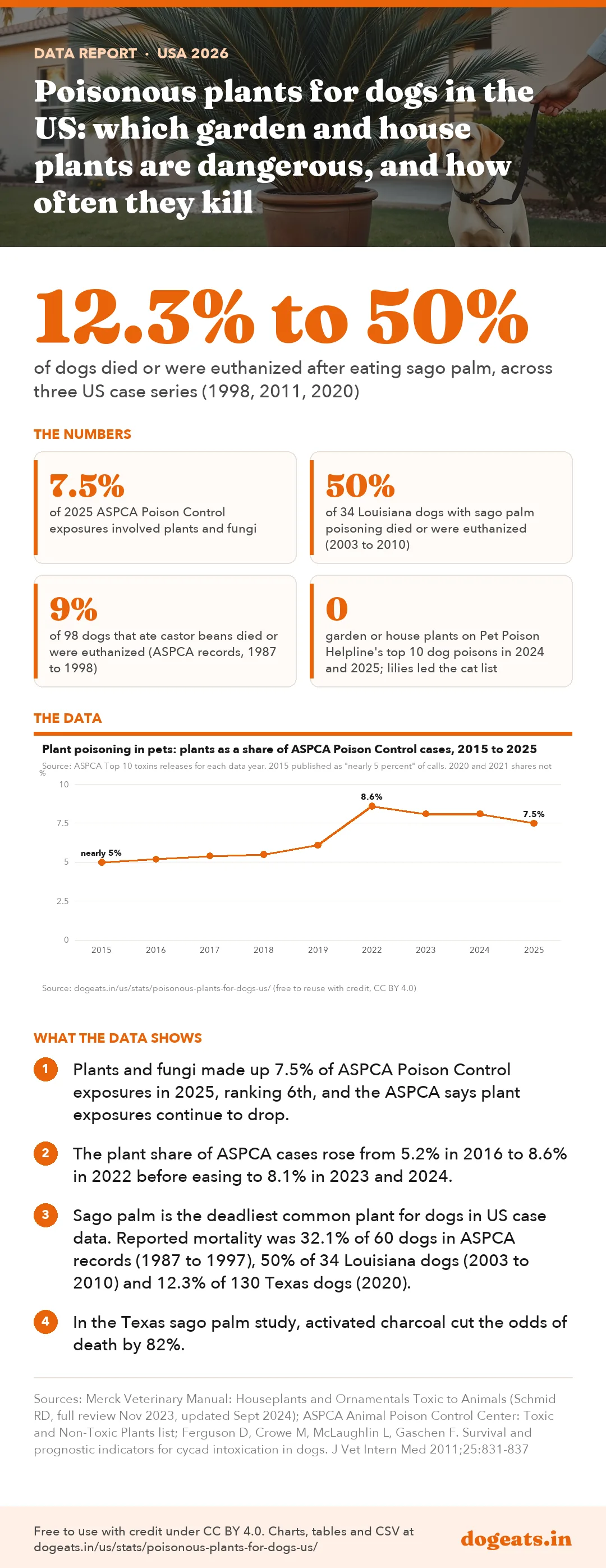
Poisonous plants for dogs in the US: which garden and house plants are dangerous, and how often they kill
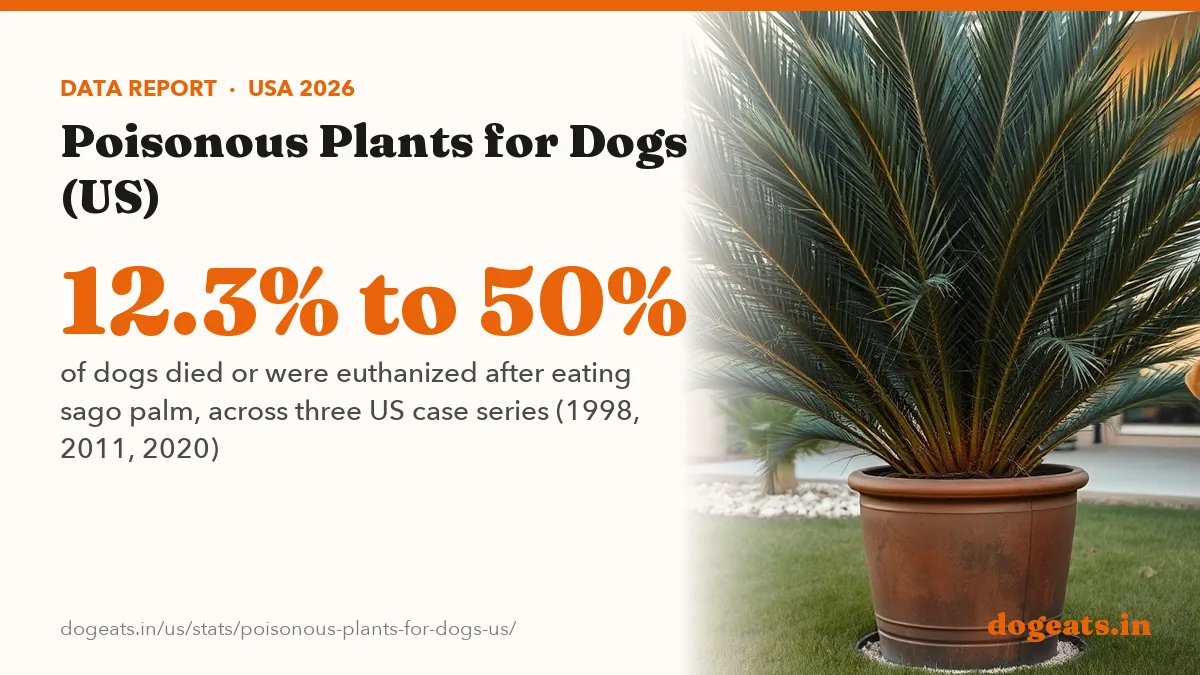
Plants and fungi made up 7.5% of the exposures handled by ASPCA Poison Control in 2025, up from 5.2% of cases in 2016. Most plant calls are mild, but in three US case series 12.3% to 50% of dogs that ate sago palm died or were euthanized. Lilies, the plant poison vets warn about most, are a danger mainly to cats.
Key findings
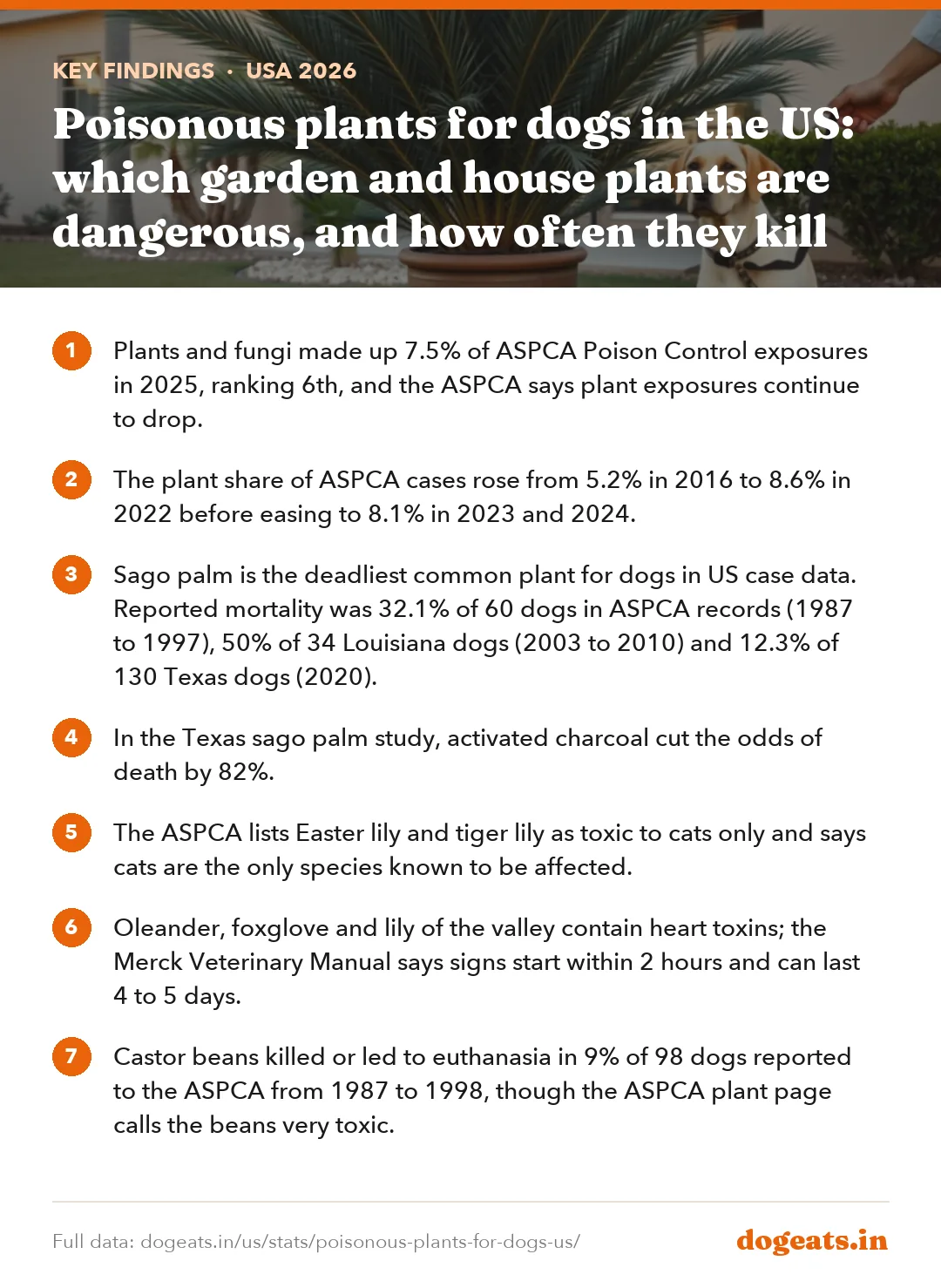
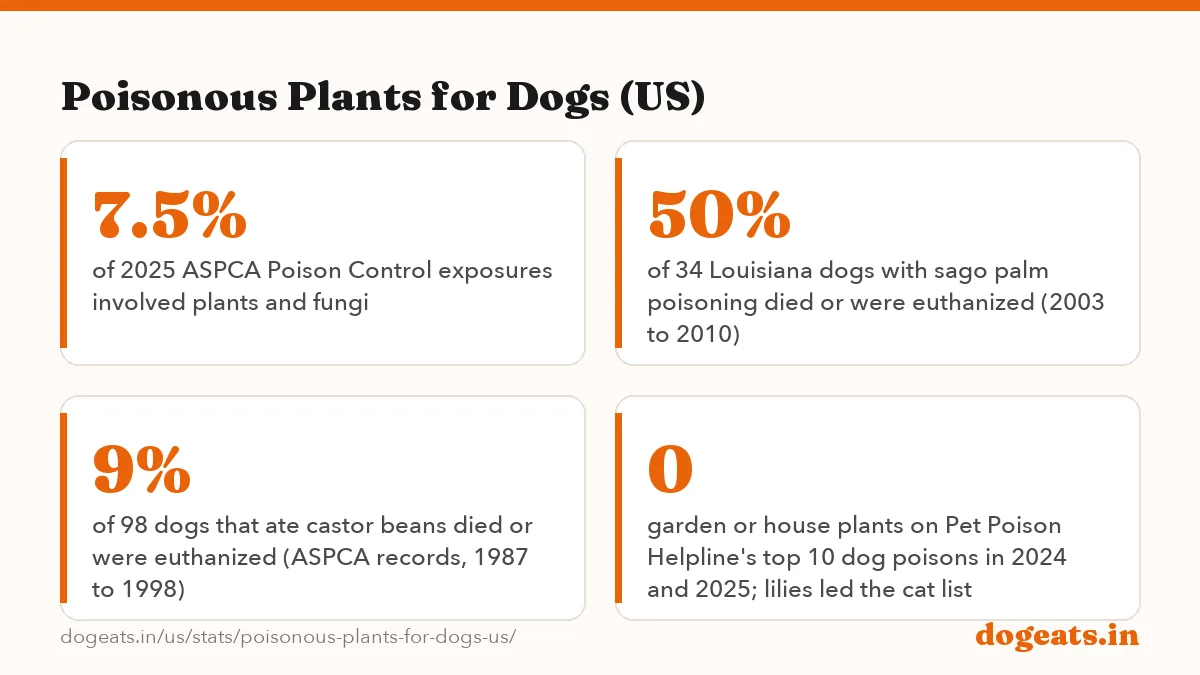
- Plants and fungi made up 7.5% of ASPCA Poison Control exposures in 2025, ranking 6th, and the ASPCA says plant exposures continue to drop.
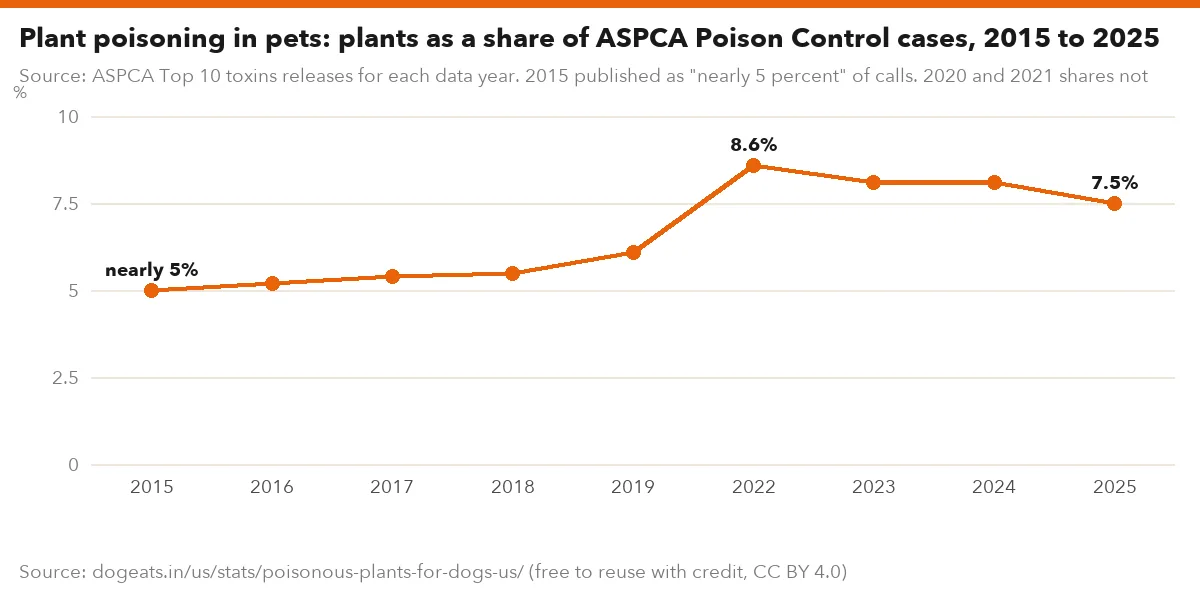
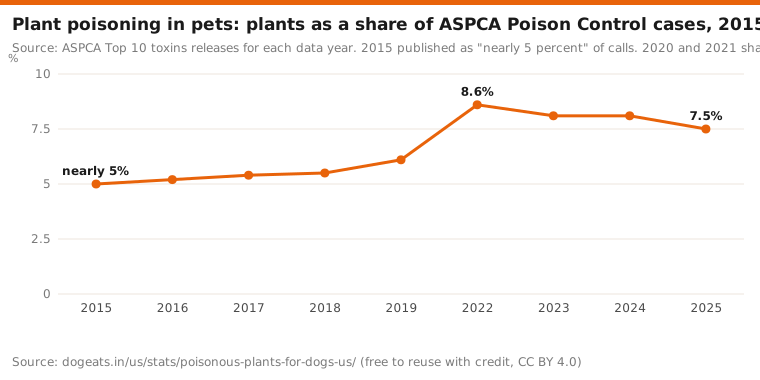
- The plant share of ASPCA cases rose from 5.2% in 2016 to 8.6% in 2022 before easing to 8.1% in 2023 and 2024.
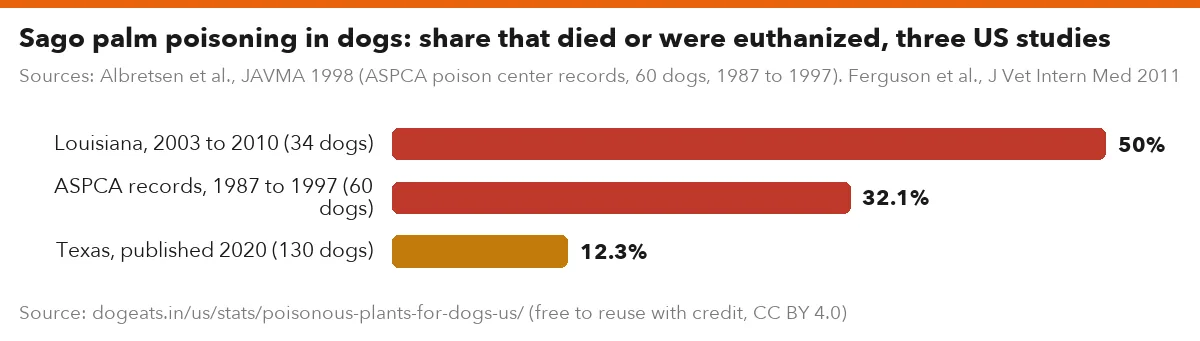
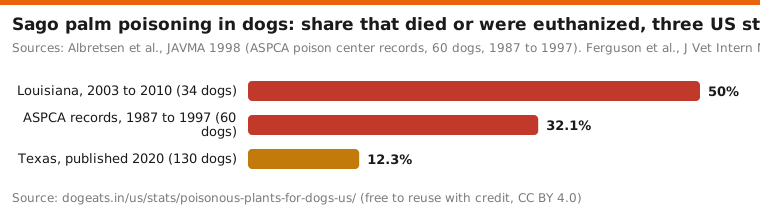
- Sago palm is the deadliest common plant for dogs in US case data. Reported mortality was 32.1% of 60 dogs in ASPCA records (1987 to 1997), 50% of 34 Louisiana dogs (2003 to 2010) and 12.3% of 130 Texas dogs (2020).
- In the Texas sago palm study, activated charcoal cut the odds of death by 82%.
- The ASPCA lists Easter lily and tiger lily as toxic to cats only and says cats are the only species known to be affected.
- Oleander, foxglove and lily of the valley contain heart toxins; the Merck Veterinary Manual says signs start within 2 hours and can last 4 to 5 days.
- Castor beans killed or led to euthanasia in 9% of 98 dogs reported to the ASPCA from 1987 to 1998, though the ASPCA plant page calls the beans very toxic.
- Pothos, philodendron and dieffenbachia cause mouth pain from insoluble oxalate crystals, and Merck expects a full recovery in most cases.
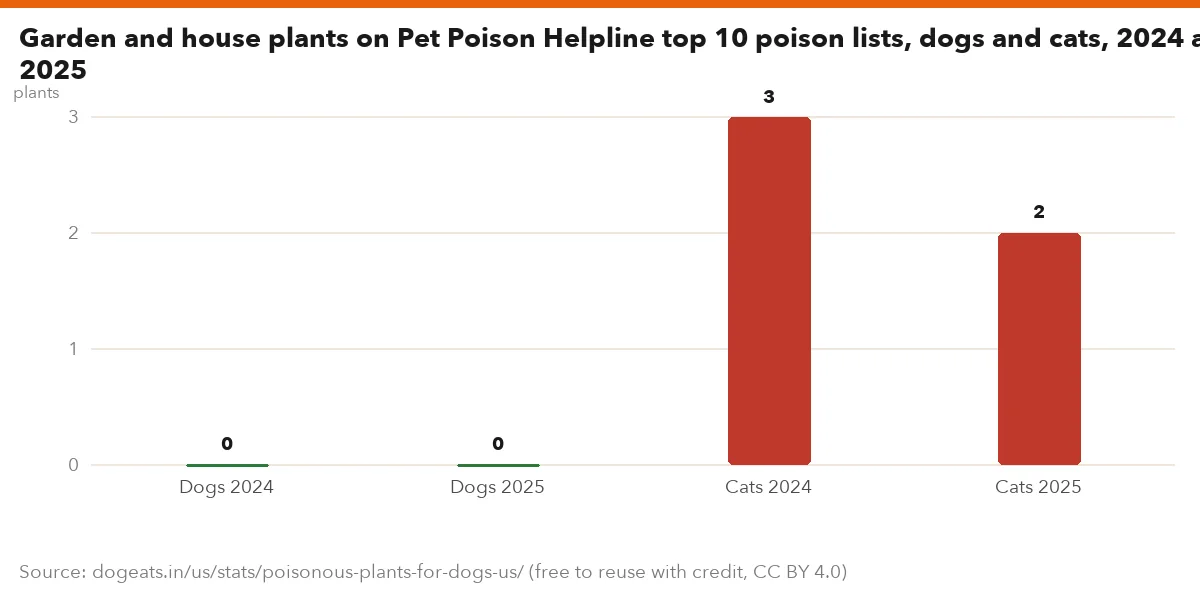
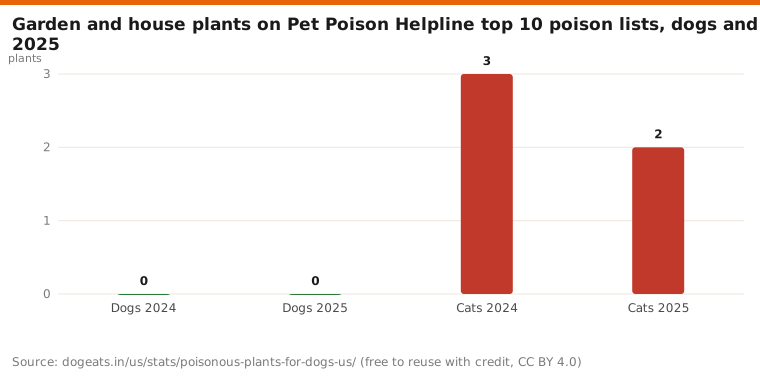
- No garden or house plant appeared on Pet Poison Helpline's top 10 dog poisons in 2024 or 2025, while lilies ranked 1st for cats both years.
What plants are poisonous to dogs?
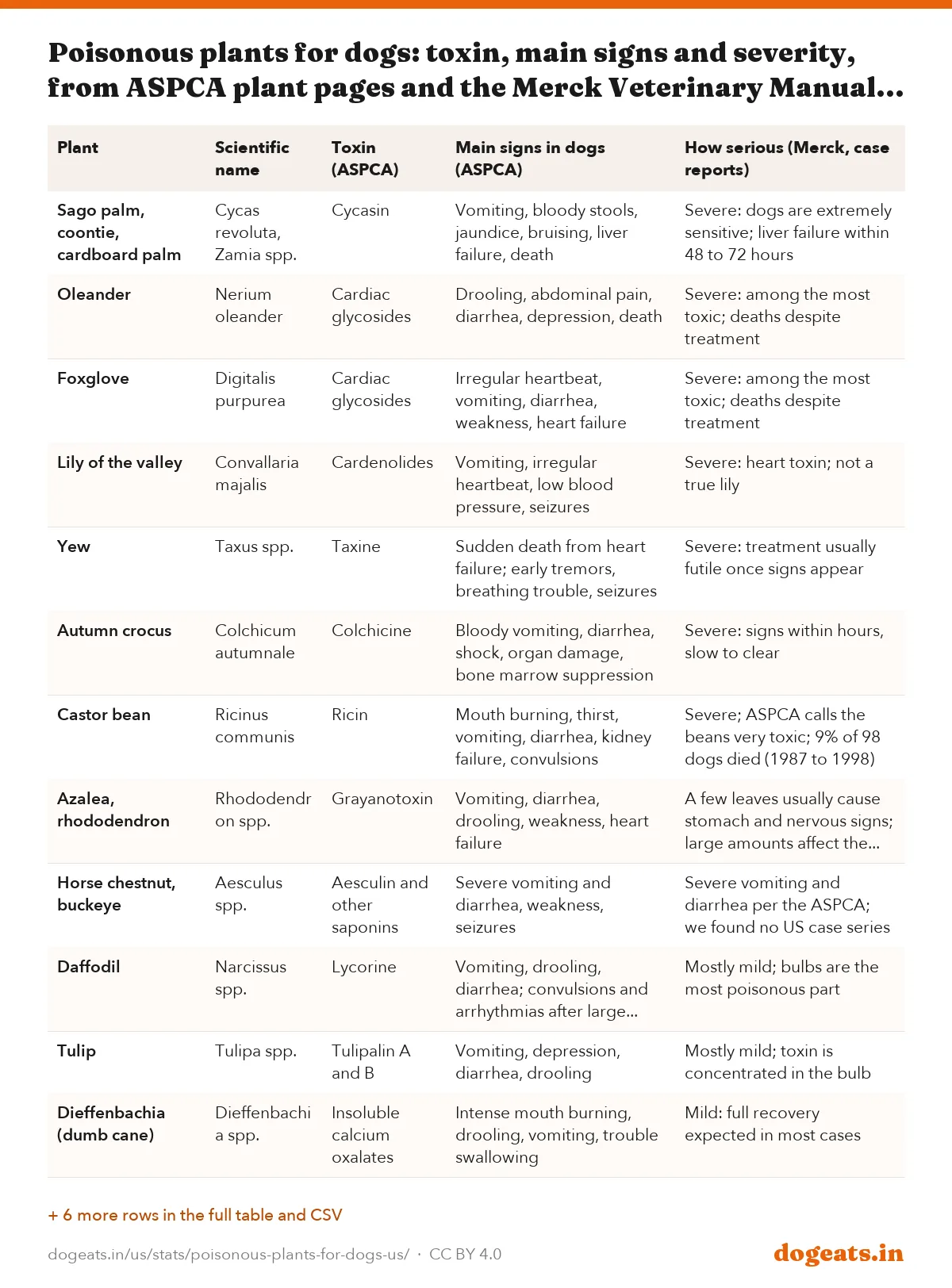
The plants most likely to kill a dog in the US are sago palm, oleander, foxglove, lily of the valley, yew, autumn crocus and castor bean. Many more common plants, from pothos to aloe, cause mouth pain or an upset stomach but rarely lasting harm. Our table rates 18 common US yard and house plants.
The table lists 18 plants Americans keep in yards and homes. It gives the toxin and main signs from the ASPCA plant database, and how the Merck Veterinary Manual and case reports rate the danger. The ASPCA marks every plant here as toxic to dogs except the true lilies, which it lists as toxic only to cats.
Severity depends on the plant part and the amount. Bulbs hold most of the toxin in tulips and daffodils, and seeds are the most toxic part of sago palm. In yew, Merck says the whole plant is toxic except the fleshy red aril around the seed.
| Plant | Scientific name | Toxin (ASPCA) | Main signs in dogs (ASPCA) | How serious (Merck, case reports) |
|---|---|---|---|---|
| Sago palm, coontie, cardboard palm | Cycas revoluta, Zamia spp. | Cycasin | Vomiting, bloody stools, jaundice, bruising, liver failure, death | Severe: dogs are extremely sensitive; liver failure within 48 to 72 hours |
| Oleander | Nerium oleander | Cardiac glycosides | Drooling, abdominal pain, diarrhea, depression, death | Severe: among the most toxic; deaths despite treatment |
| Foxglove | Digitalis purpurea | Cardiac glycosides | Irregular heartbeat, vomiting, diarrhea, weakness, heart failure | Severe: among the most toxic; deaths despite treatment |
| Lily of the valley | Convallaria majalis | Cardenolides | Vomiting, irregular heartbeat, low blood pressure, seizures | Severe: heart toxin; not a true lily |
| Yew | Taxus spp. | Taxine | Sudden death from heart failure; early tremors, breathing trouble, seizures | Severe: treatment usually futile once signs appear |
| Autumn crocus | Colchicum autumnale | Colchicine | Bloody vomiting, diarrhea, shock, organ damage, bone marrow suppression | Severe: signs within hours, slow to clear |
| Castor bean | Ricinus communis | Ricin | Mouth burning, thirst, vomiting, diarrhea, kidney failure, convulsions | Severe; ASPCA calls the beans very toxic; 9% of 98 dogs died (1987 to 1998) |
| Azalea, rhododendron | Rhododendron spp. | Grayanotoxin | Vomiting, diarrhea, drooling, weakness, heart failure | A few leaves usually cause stomach and nervous signs; large amounts affect the heart |
| Horse chestnut, buckeye | Aesculus spp. | Aesculin and other saponins | Severe vomiting and diarrhea, weakness, seizures | Severe vomiting and diarrhea per the ASPCA; we found no US case series |
| Daffodil | Narcissus spp. | Lycorine | Vomiting, drooling, diarrhea; convulsions and arrhythmias after large amounts | Mostly mild; bulbs are the most poisonous part |
| Tulip | Tulipa spp. | Tulipalin A and B | Vomiting, depression, diarrhea, drooling | Mostly mild; toxin is concentrated in the bulb |
| Dieffenbachia (dumb cane) | Dieffenbachia spp. | Insoluble calcium oxalates | Intense mouth burning, drooling, vomiting, trouble swallowing | Mild: full recovery expected in most cases |
| Philodendron | Philodendron spp. | Insoluble calcium oxalates | Mouth pain and swelling, drooling, vomiting | Mild: full recovery expected in most cases |
| Golden pothos | Epipremnum aureum | Insoluble calcium oxalates | Mouth irritation, drooling, vomiting, trouble swallowing | Mild: full recovery expected in most cases |
| Aloe | Aloe vera | Saponins, anthraquinones | Vomiting, lethargy, diarrhea | Mild stomach upset; the ASPCA says the gel is edible |
| English ivy | Hedera helix | Triterpenoid saponins | Vomiting, abdominal pain, drooling, diarrhea | Mild: toxin is poorly absorbed |
| Poinsettia | Euphorbia pulcherrima | Irritant sap | Mouth and stomach irritation, sometimes vomiting | Mild: the ASPCA calls it over-rated |
| Easter lily, tiger lily | Lilium spp. | Unknown | None listed for dogs; ASPCA lists cats only | Cats are the only species known to be affected; kidney failure in cats |
Common names cause mix-ups. Merck advises identifying the scientific name of any plant a pet eats, because plants that share a name can differ in toxicity.
How common is plant poisoning in pets?
Plants and fungi made up 7.5% of the exposures handled by ASPCA Poison Control in 2025, the 6th largest category. The ASPCA says the number of plant exposures continues to drop.
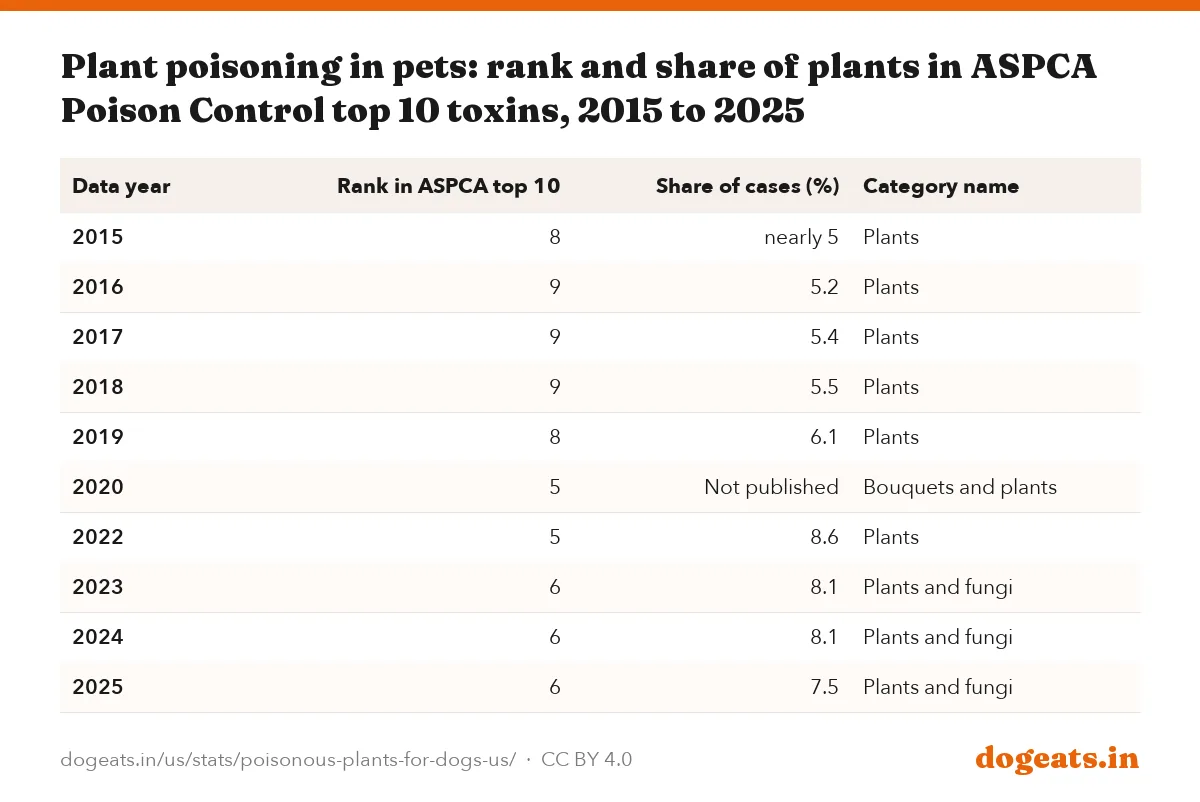
The plant share climbed for several years before that. It was nearly 5% of calls in 2015, 5.2% of cases in 2016 and 5.4%, or 10,725 cases, in 2017. In 2020 plants jumped from 8th to 5th place, with 9,000 more calls than in 2019, and the share reached 8.6% in 2022.
These figures cover all species, not dogs alone, and from 2023 the ASPCA counts plants and fungi together, so mushrooms are included. The ASPCA said most 2015 plant calls involved cats and houseplants. For the full category rankings by year, see our top pet toxins report.
| Data year | Rank in ASPCA top 10 | Share of cases (%) | Category name |
|---|---|---|---|
| 2015 | 8 | nearly 5 | Plants |
| 2016 | 9 | 5.2 | Plants |
| 2017 | 9 | 5.4 | Plants |
| 2018 | 9 | 5.5 | Plants |
| 2019 | 8 | 6.1 | Plants |
| 2020 | 5 | Not published | Bouquets and plants |
| 2022 | 5 | 8.6 | Plants |
| 2023 | 6 | 8.1 | Plants and fungi |
| 2024 | 6 | 8.1 | Plants and fungi |
| 2025 | 6 | 7.5 | Plants and fungi |
Plants are a smaller risk for dogs than food. Chocolate alone made up 13.6% of 2025 ASPCA exposures, almost twice the plant share, and the ASPCA says dogs are the most common culprits. See how much is too much in our Hershey's chocolate guide, and the kitchen hazards in our dog food safety statistics.
Is sago palm poisonous to dogs?
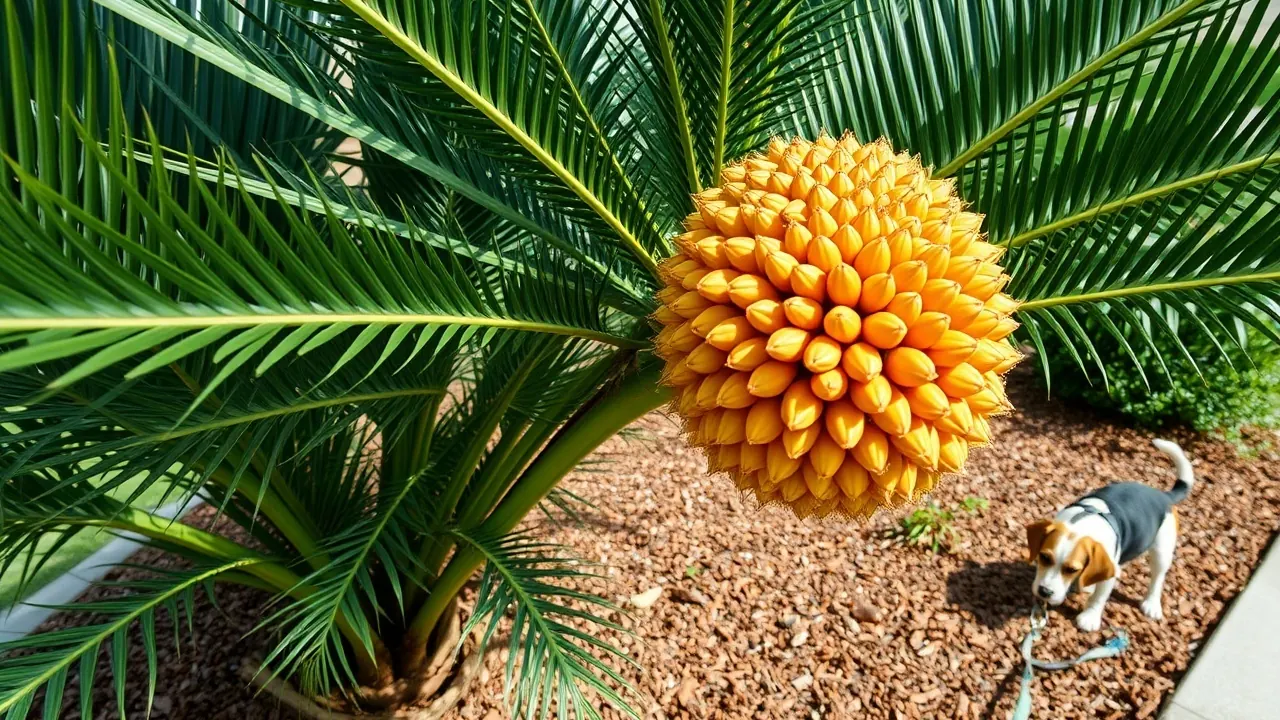
Yes, and it is the deadliest common plant for dogs in US case data. In three US case series covering 224 dogs, between 12.3% and 50% of dogs that ate sago palm died or were euthanized.
The figures differ a lot, and the studies explain part of it. The 1998 study used ASPCA poison center records from 1987 to 1997 and reported 32.1% mortality. A Louisiana State University study of 34 confirmed cases from 2003 to 2010 found 50% died or were euthanized and called the fatality rate higher than previously published. A 2020 study of 130 dogs at two Texas referral hospitals found 12.3%.
Treatment seems to matter. In the Texas study, activated charcoal cut the odds of death by 82%, and the Louisiana study also linked charcoal at the first visit to longer survival. Merck gives a fair to good prognosis with prompt, aggressive care and a guarded to poor one when treatment is delayed.
Sources: Albretsen et al., JAVMA 1998 (ASPCA poison center records, 60 dogs, 1987 to 1997). Ferguson et al., J Vet Intern Med 2011 (Louisiana State University, 34 dogs, 2003 to 2010). Lake et al., Aust Vet J 2020 (two Texas referral hospitals, 130 dogs).
Show the numbers
| Label | % |
|---|---|
| Louisiana, 2003 to 2010 (34 dogs) | 50% |
| ASPCA records, 1987 to 1997 (60 dogs) | 32.1% |
| Texas, published 2020 (130 dogs) | 12.3% |
Embed this chart
- 89.7% of dogs in the 1998 series were from the southern United States.
- 95% developed liver and gut problems, and 53.3% had abnormal neurologic signs.
- Merck says first signs often show within 4 hours and liver failure can follow within 48 to 72 hours.
- Sago palms are also sold as houseplants, so Merck notes dogs in all parts of the country are at risk.
- Coontie and cardboard palm (Zamia species) carry the same toxins and signs as sago palm on the ASPCA plant pages.
A dog can look well at first. In the 1998 series, blood test changes took 24 to 48 hours to appear, so a vet visit should not wait for symptoms.
Are lilies poisonous to dogs?
True lilies are not considered poisonous to dogs. The ASPCA lists Easter lily and tiger lily as toxic to cats only, and says cats are the only species known to be affected.
Merck agrees that lilies are not toxic to most animals but that cats are highly sensitive. Only Lilium and Hemerocallis (daylily) species count as true lilies. In cats, signs start within 1 to 3 hours, and death can follow within 3 to 7 days as signs worsen. Pet Poison Helpline ranked lilies the 1st cat poison in both 2024 and 2025.
Some plants called lilies are a different matter for dogs. Lily of the valley is not a true lily, but it contains heart toxins and is dangerous to dogs. Peace lily and calla lily contain insoluble oxalate crystals that burn the mouth.
Source: Pet Poison Helpline Top 10 Pet Poisons of 2024 and of 2025. Cats 2024: lilies (1st), Alstroemeria (6th), tulips (10th). Cats 2025: lilies (1st), Alstroemeria (6th). Food plants such as onions, garlic and grapes are not counted. Our count.
Show the numbers
| Label | plants |
|---|---|
| Dogs 2024 | 0 |
| Dogs 2025 | 0 |
| Cats 2024 | 3 |
| Cats 2025 | 2 |
Embed this chart
Lilies and Easter decorations arrive together in spring. Our guide to Easter grass covers the basket hazard dogs swallow more often.
Which garden plants can kill a dog?
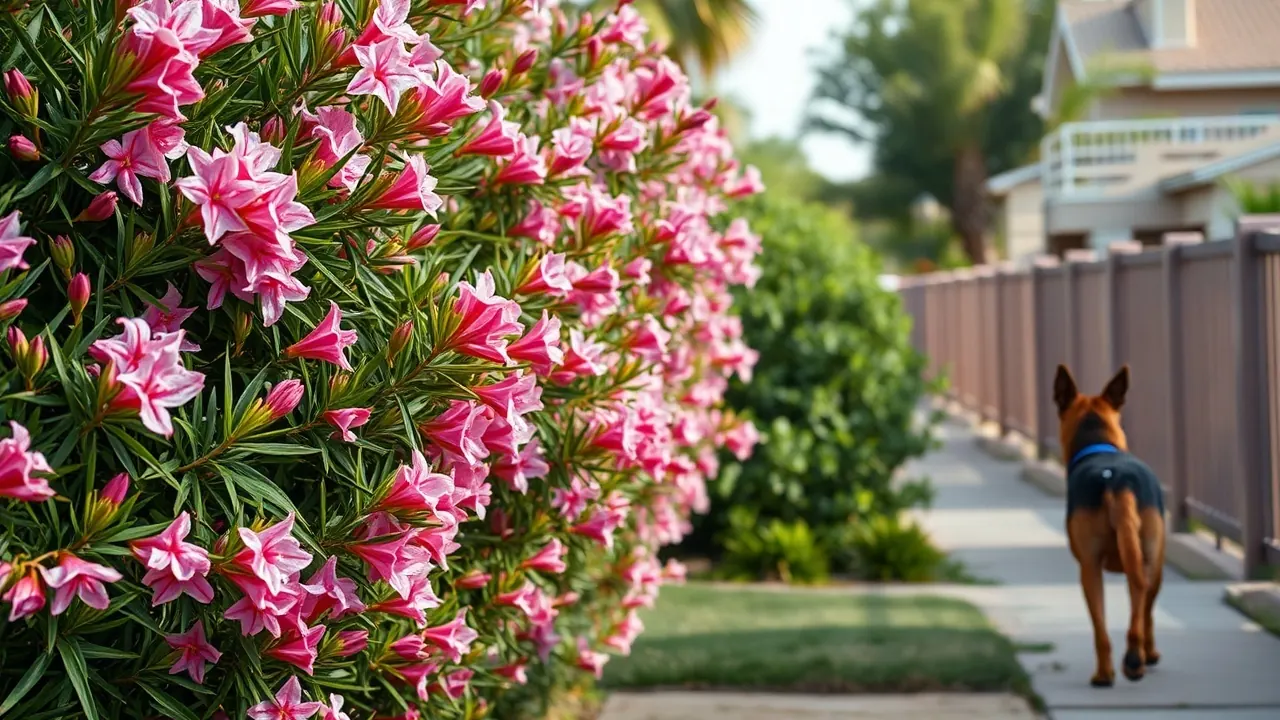
Oleander, foxglove, lily of the valley and yew are the garden plants most likely to kill a dog, along with sago palm. Merck calls the heart-toxin plants among the most toxic, and says deaths have been reported after oleander and foxglove even with aggressive treatment.
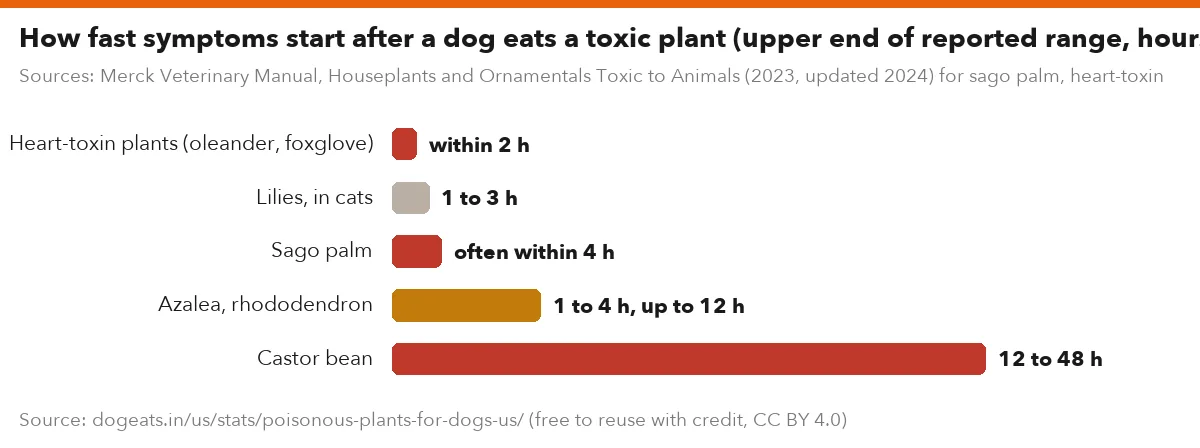
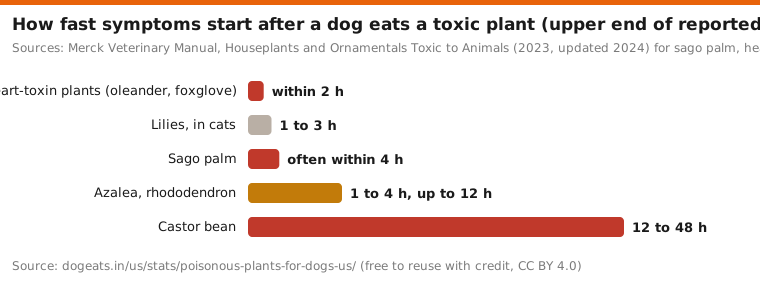
Merck says signs from these heart toxins start within 2 hours and can last up to 4 to 5 days. A 2017 case report described a 6-year-old dog with severe oleander poisoning that did not respond to standard heart drugs. It recovered after treatment with digoxin antibody fragments, an antidote first made for a human heart drug.
Yew is a special case. Merck lists it with the heart-toxin plants, while its toxins, taxines, are alkaloids. The ASPCA says yew can cause sudden death from heart failure, and Merck calls treatment usually futile once signs appear.
Sources: Merck Veterinary Manual, Houseplants and Ornamentals Toxic to Animals (2023, updated 2024) for sago palm, heart-toxin plants, azalea and lilies in cats; ASPCA castor bean plant page. Lilies shown for cats; dogs are not affected.
Show the numbers
| Label | hours |
|---|---|
| Heart-toxin plants (oleander, foxglove) | within 2 h |
| Lilies, in cats | 1 to 3 h |
| Sago palm | often within 4 h |
| Azalea, rhododendron | 1 to 4 h, up to 12 h |
| Castor bean | 12 to 48 h |
Embed this chart
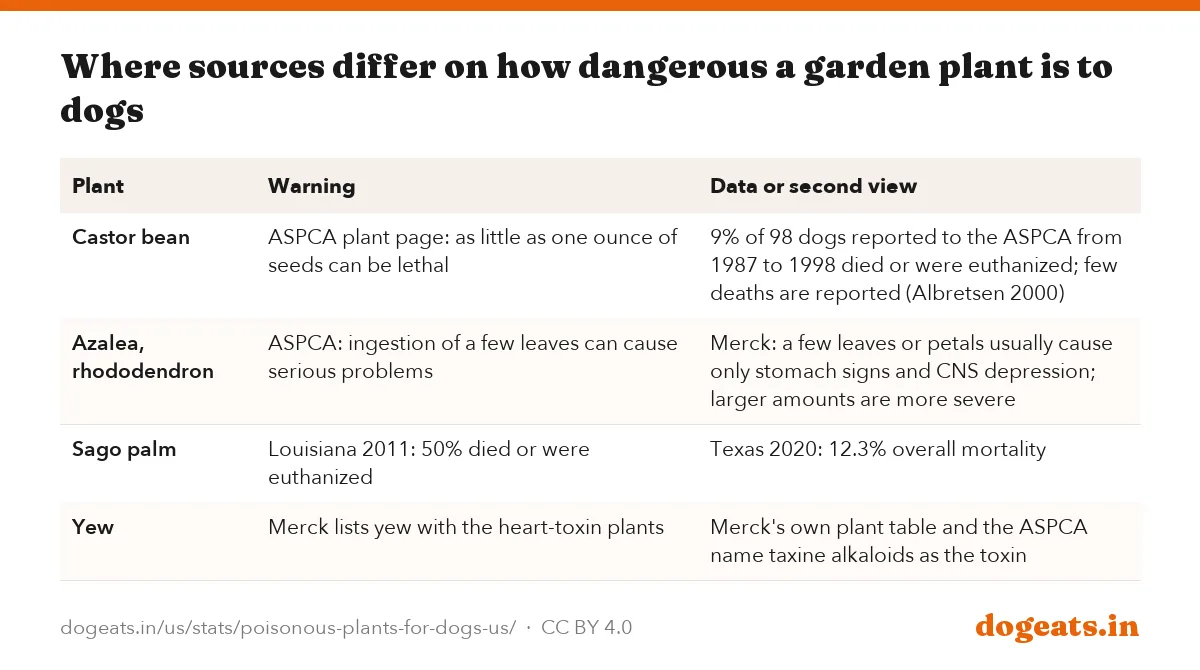
| Plant | Warning | Data or second view |
|---|---|---|
| Castor bean | ASPCA plant page: as little as one ounce of seeds can be lethal | 9% of 98 dogs reported to the ASPCA from 1987 to 1998 died or were euthanized; few deaths are reported (Albretsen 2000) |
| Azalea, rhododendron | ASPCA: ingestion of a few leaves can cause serious problems | Merck: a few leaves or petals usually cause only stomach signs and CNS depression; larger amounts are more severe |
| Sago palm | Louisiana 2011: 50% died or were euthanized | Texas 2020: 12.3% overall mortality |
| Yew | Merck lists yew with the heart-toxin plants | Merck's own plant table and the ASPCA name taxine alkaloids as the toxin |
Autumn crocus and castor bean round out the list. Autumn crocus contains colchicine, which Merck says causes vomiting, diarrhea and shock within hours. Castor bean signs typically develop 12 to 48 hours after eating, per the ASPCA. In the 2000 castor bean study, severity depended on whether the beans were chewed or swallowed whole.
Fall brings its own nut confusion. Horse chestnuts, or buckeyes, cause severe vomiting and diarrhea per the ASPCA, unlike the edible kind in our roasted chestnuts guide.
Are tulip and daffodil bulbs poisonous to dogs?
Yes, and the bulb is the most toxic part of both. The ASPCA says daffodil bulbs are the most poisonous part, and tulips carry their highest concentration of toxin in the bulb.
Most cases are mild. Merck says a small dose of daffodil causes few or no signs. The ASPCA warns that large amounts can cause convulsions, low blood pressure and heart rhythm problems.
Autumn crocus is the exception among bulb plants. It grows from a corm, contains colchicine and is far more dangerous than tulips or daffodils.
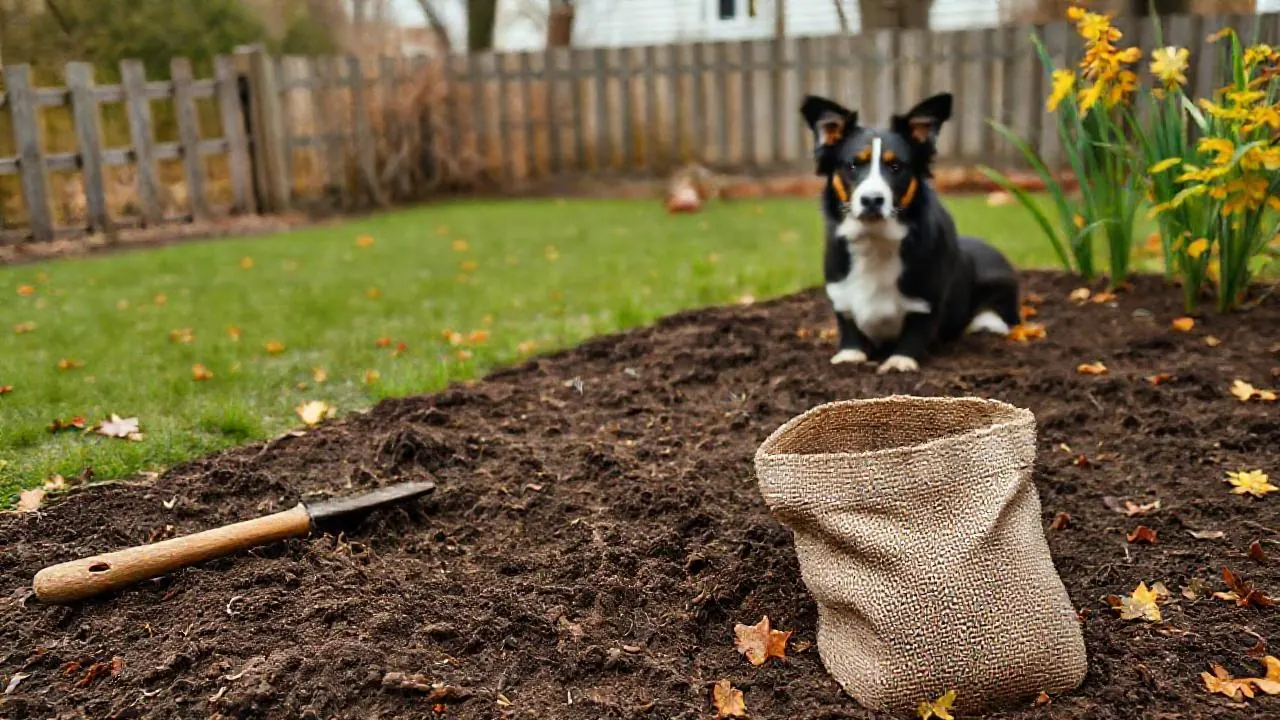
- Tulip: tulipalin A and B; vomiting, depression, diarrhea and drooling (ASPCA).
- Daffodil: lycorine and other alkaloids; vomiting, drooling and diarrhea, with convulsions after large amounts (ASPCA).
- Autumn crocus: colchicine; bloody vomiting, shock, organ damage and bone marrow suppression (ASPCA).
Are pothos and philodendron poisonous to dogs?
Yes, but usually mildly. Pothos, philodendron and dieffenbachia contain insoluble calcium oxalate crystals that cause instant mouth pain and drooling, and Merck says most dogs make a full recovery, often without a vet visit.
The one real danger is swelling. Merck warns that throat swelling can cause breathing trouble, so a dog that struggles to breathe or swallow after chewing a houseplant needs a vet at once. Peace lily, calla lily, monstera and Chinese evergreen work the same way.
Aloe, ivy and poinsettia mostly upset the stomach. Merck says most animals recover within 24 to 48 hours, and the ASPCA calls poinsettia generally over-rated in toxicity.
- Non-toxic to dogs and cats per the ASPCA: spider plant, Boston fern, African violet, areca palm.
- Holiday plants: holly leaves and berries are low toxicity (ASPCA); American mistletoe is listed as toxic to dogs; poinsettia is mostly an irritant.
- Hydrangea contains cyanogenic glycosides, but the ASPCA says cyanide poisoning is rare and stomach upset is more usual.
Holiday plants come with holiday food. Our holiday food dangers report shows when poison calls spike around Christmas and Thanksgiving. Apple and cherry seeds hold cyanide compounds too, but Merck says fruit sold for people has very low levels in its seeds; see our apple cider guide.
What should I do if my dog ate a poisonous plant?
Call your vet or a pet poison line straight away, even if your dog seems fine. Sago palm and castor bean signs can take hours or days to show. In the 1998 sago palm series, blood test changes took 24 to 48 hours to appear.
Take a photo of the plant or a piece of it to the vet. Merck stresses identifying the scientific name, since common names are shared by plants with very different toxicity.
Two 24-hour US poison lines take calls about pets. Fees and vet bills add up, which is one reason owners compare pet insurance; our veterinarians by state data shows where vets are scarce.
- ASPCA Animal Poison Control Center: (888) 426-4435, 24 hours a day, 365 days a year. The ASPCA says a consultation fee may apply and does not state the amount on its site.
- Pet Poison Helpline: (855) 764-7661, 24 hours a day. The fee is $99 per incident, including follow-up consultations for the case.
- Bring the plant, a photo or the plant tag. Note how much was eaten and when.
- For sago palm, oleander, foxglove, lily of the valley, yew, autumn crocus or castor bean, go to a vet or emergency clinic, not just the phone.
Emergency care is one of the costs in our cost of owning a dog report. Vet prices have risen faster than general inflation, as our vet cost inflation data shows.
Frequently asked questions
What is the most poisonous plant for dogs?
Sago palm is the deadliest common plant for dogs in US case data. Between 12.3% and 50% of dogs that ate it died or were euthanized in three US studies. Oleander, foxglove, lily of the valley, yew, autumn crocus and castor bean are also severe.
How much sago palm will kill a dog?
No safe amount is published. All parts are toxic and seeds are the most toxic; 38.7% of dogs in a 60-dog ASPCA series had eaten seeds. Treat any ingestion as an emergency.
Are lilies toxic to dogs?
True lilies are not considered toxic to dogs. The ASPCA lists Easter lily and tiger lily as toxic to cats only and says cats are the only species known to be affected. Lily of the valley, which is not a true lily, is dangerous to dogs.
Is pothos poisonous to dogs?
Yes, mildly. Pothos contains insoluble calcium oxalates that cause mouth pain, drooling and vomiting. Merck expects a full recovery in most cases, but throat swelling needs a vet at once.
Are azaleas poisonous to dogs?
Yes. Azaleas and rhododendrons contain grayanotoxin, and Merck says signs start within 1 to 4 hours, sometimes up to 12. A few leaves usually cause only stomach and nervous signs, while larger amounts can affect the heart.
Is aloe vera poisonous to dogs?
The ASPCA lists aloe as toxic to dogs, causing vomiting, lethargy and diarrhea, but says the gel is considered edible. Merck notes the leaf latex can cause severe diarrhea.
How common is plant poisoning in pets?
Plants and fungi made up 7.5% of ASPCA Poison Control exposures in 2025, ranking 6th. The share was 5.2% in 2016 and peaked at 8.6% in 2022.
How much does it cost to call pet poison control?
Pet Poison Helpline charges $99 per incident, including follow-up calls. The ASPCA, at (888) 426-4435, says a consultation fee may apply but does not state the amount on its site.
Methodology and limitations
We took the plant share of cases from each ASPCA Top 10 toxins release from 2015 to 2025. We also read the ASPCA toxic and non-toxic plant page for each plant named in this report in October 2026, recording the toxin, signs and species listed.
We checked severity against the Merck Veterinary Manual chapter Houseplants and Ornamentals Toxic to Animals (full review November 2023, updated September 2024). We also used peer-reviewed US case series on sago palm (1998, 2011, 2020) and castor bean (2000), and oleander case reports (2015, 2017), read as abstracts on Europe PMC.
Pet Poison Helpline counts come from its Top 10 Pet Poisons of 2024 and 2025 releases. Where sources disagree, we show both views.
Sources
- Merck Veterinary Manual: Houseplants and Ornamentals Toxic to Animals (Schmid RD, full review Nov 2023, updated Sept 2024), Severity, onset times and prognosis for sago palm, heart-toxin plants, grayanotoxin plants, lilies, oxalate plants and GI irritants
- ASPCA Animal Poison Control Center: Toxic and Non-Toxic Plants list, Toxin, clinical signs and species toxicity for each plant in the table
- Ferguson D, Crowe M, McLaughlin L, Gaschen F. Survival and prognostic indicators for cycad intoxication in dogs. J Vet Intern Med 2011;25:831-837, 50% case fatality in 34 Louisiana dogs, 2003 to 2010
- Also consulted: Albretsen JC, Khan SA, Richardson JA. Cycad palm toxicosis in dogs: 60 cases (1987-1997). JAVMA 1998;213:99-101, Lake BB et al. The characterization of cycad palm toxicosis and treatment effects in 130 dogs. Aust Vet J 2020;98:555-562, Albretsen JC, Gwaltney-Brant SM, Khan SA. Evaluation of castor bean toxicosis in dogs: 98 cases. JAAHA 2000;36:229-233, ASPCA: The Top 10 Toxins of 2025, ASPCA: The Official Top 10 Toxins of 2024, ASPCA: The Official Top 10 Pet Toxins of 2023, ASPCA Pro: Top 10 Pet Toxins of 2022, ASPCA: The Official Top 10 Pet Toxins of 2020, ASPCA: Announcing the Top 10 Pet Toxins (2019 data), ASPCA: Top 10 Toxins of 2018, ASPCA: Top Pet Toxins of 2017, ASPCA: Top Pet Toxins of 2016, ASPCA press release, March 1, 2016, Pet Poison Helpline: Top 10 Pet Poisons of 2025, Pet Poison Helpline: Top 10 Pet Poisons of 2024, Pet Poison Helpline, ASPCA Poison Control, Pao-Franco A et al. Successful use of digoxin-specific immune Fab in severe Nerium oleander toxicosis in a dog. JVECC 2017;27:596-604, Page C, Murtaugh RJ. Hypoglycemia associated with oleander toxicity in a dog. J Med Toxicol 2015;11:141-143, ASPCA plant pages for coontie palm, cardboard palm, castor bean plant, peace lily, calla lily, holly, American mistletoe and hydrangea.
Cite, embed and download
This report, its data and its images are free to reuse under a Creative Commons Attribution 4.0 licence. Credit dogeats.in with a link to this page. Every chart has its own embed code, every table has a CSV and an image download, and the images below are ready for social posts, slides and articles.
Cite this report
Link to this report
Every chart and table as an image