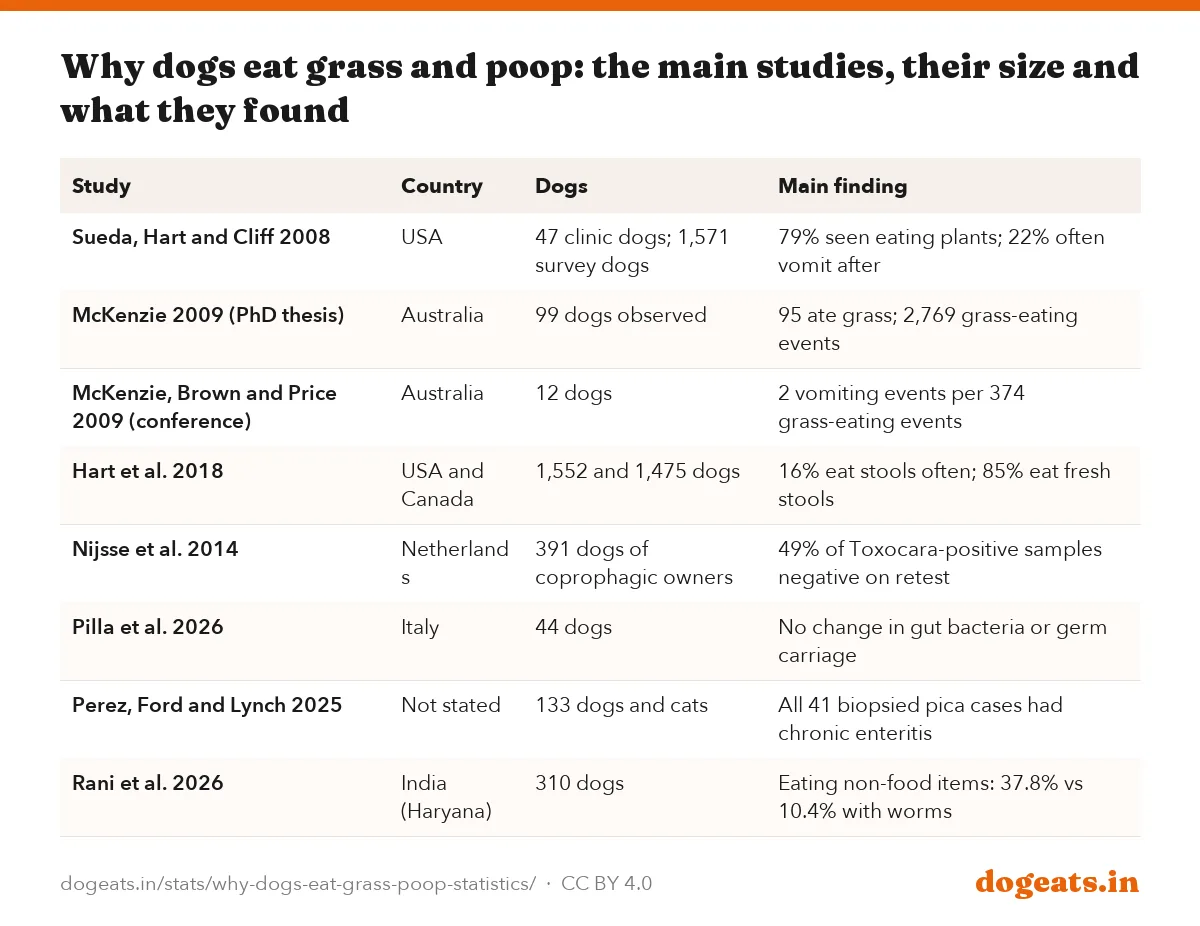
Explainer · Updated October 2026
Why Do Dogs Eat Grass and Poop? What Studies of Thousands of Dogs Show, With Indian Worm Data
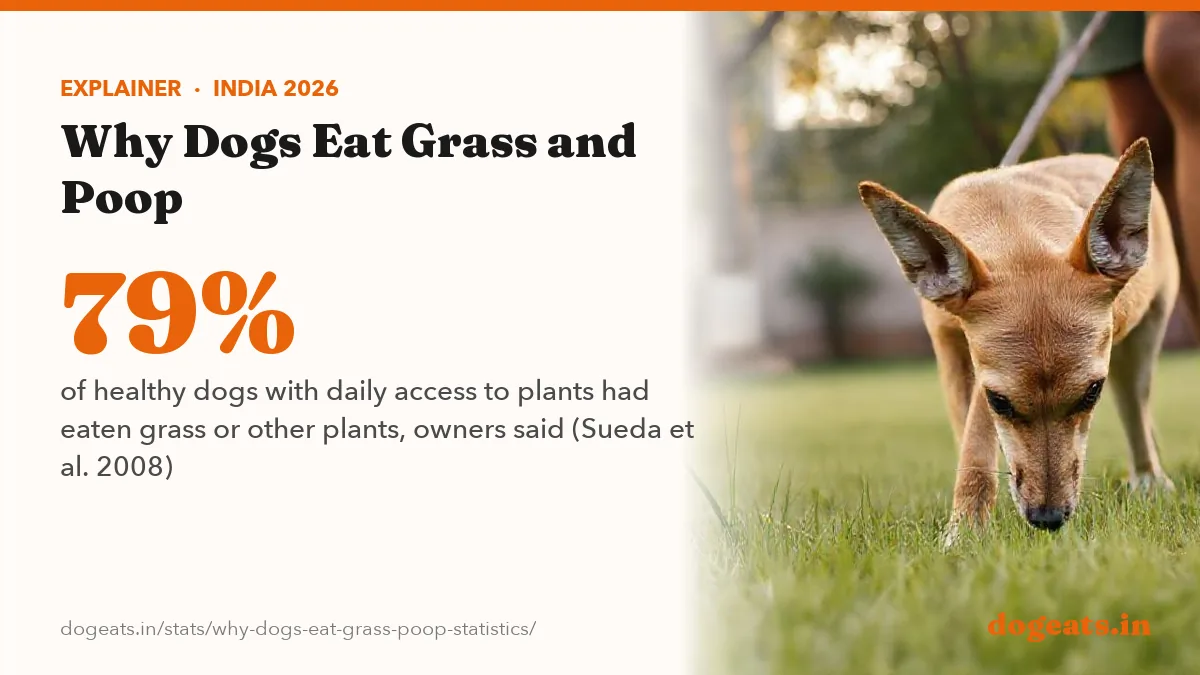
Eating grass is normal for dogs: 79% of healthy dogs in one study ate plants, and only 8% of plant-eating dogs often looked ill beforehand. About 16% of dogs eat dog poop often, mostly fresh stools, and half of them are greedy eaters. In India the real risk is worms: dogs that eat non-food items were 3.6 times as likely to carry zoonotic gut worms in a Haryana study.
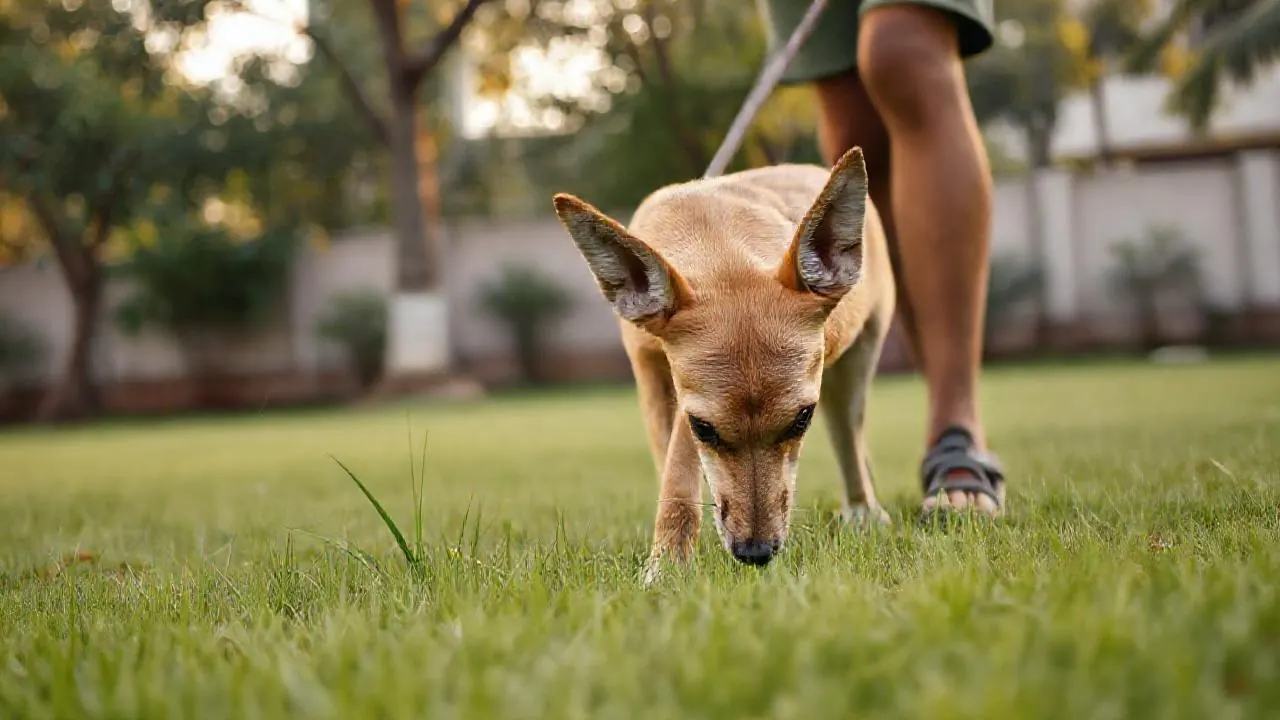
Key findings
- In a survey of 47 dog owners at a US vet teaching hospital, 79% said their dog ate grass or plants, seen directly or found in faeces or vomit.
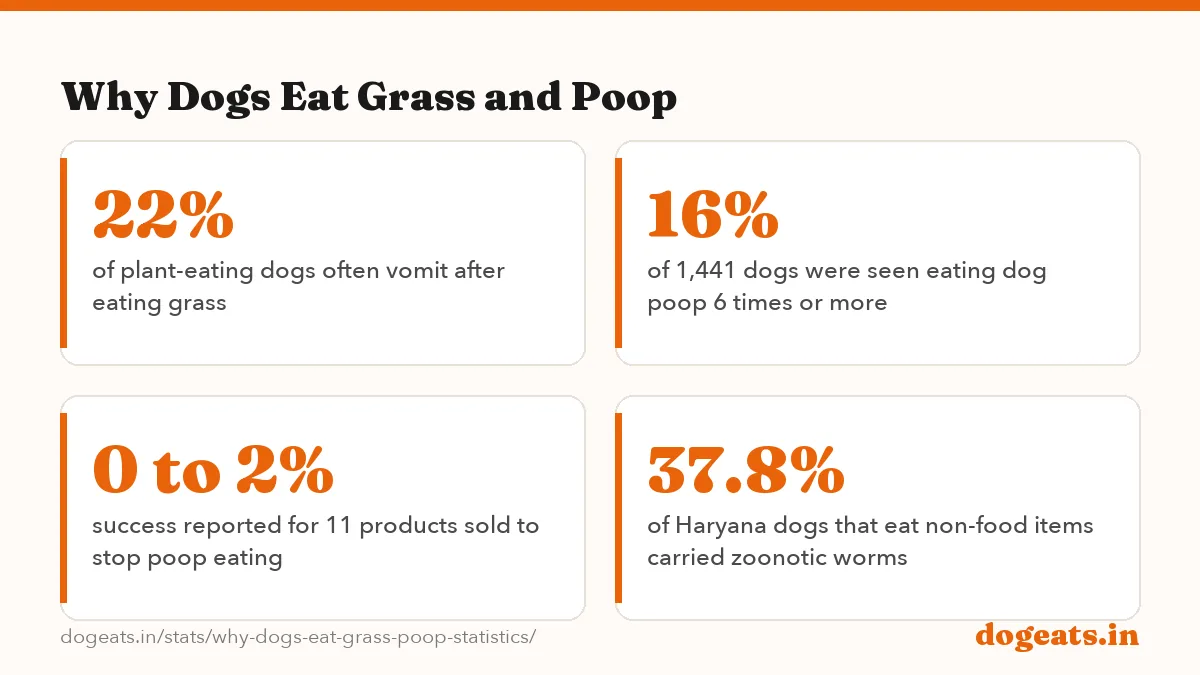
- Among 1,571 plant-eating dogs, only 8% often looked ill before eating plants and 22% often vomited afterwards.
- About 16% of 1,441 dogs had been seen eating dog stools 6 or more times, and 23% at least once.
- Of 1,475 frequent poop eaters, 85% ate stools no more than 2 days old and 62% ate stools every day.
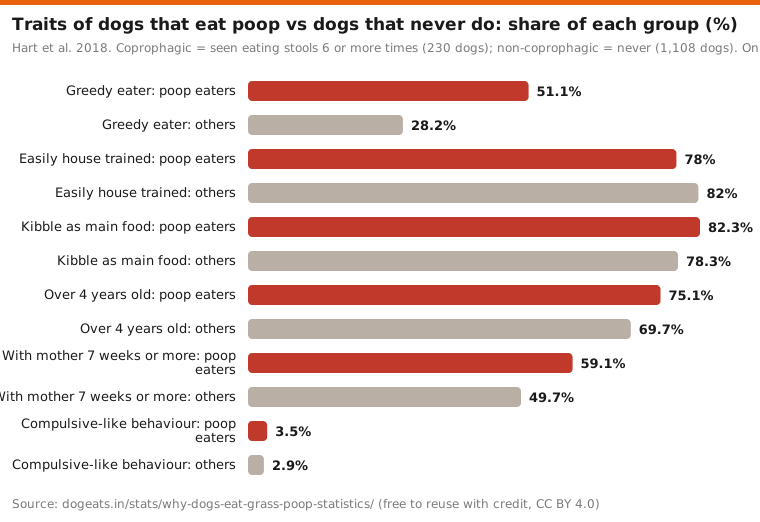
- Greedy eaters made up 51.1% of poop-eating dogs but 28.2% of dogs that never ate stools.
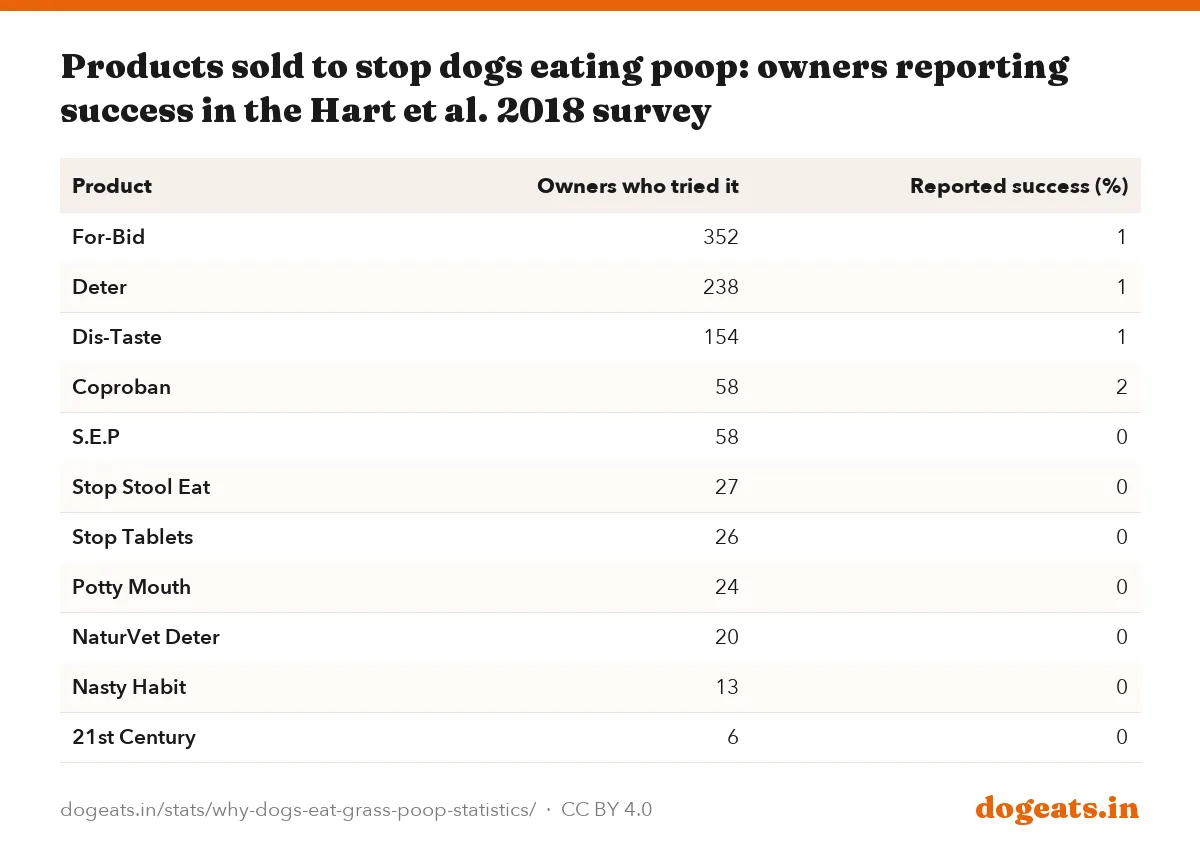
- Owners reported 0 to 2% success with 11 products sold to stop poop eating, and 1 to 4% with training methods.
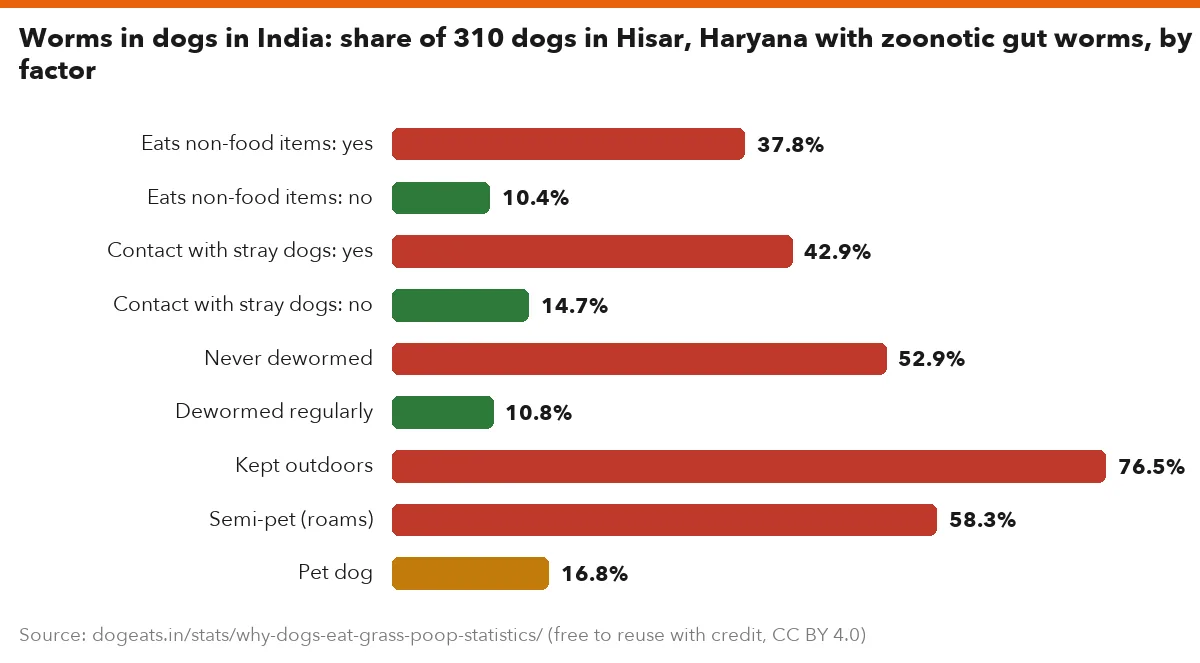
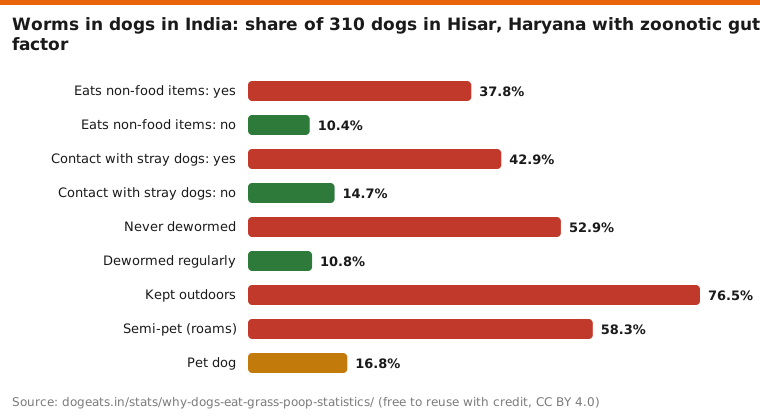
- In Hisar, Haryana, 37.8% of dogs with a history of eating non-food items carried zoonotic gut worms, against 10.4% of other dogs.
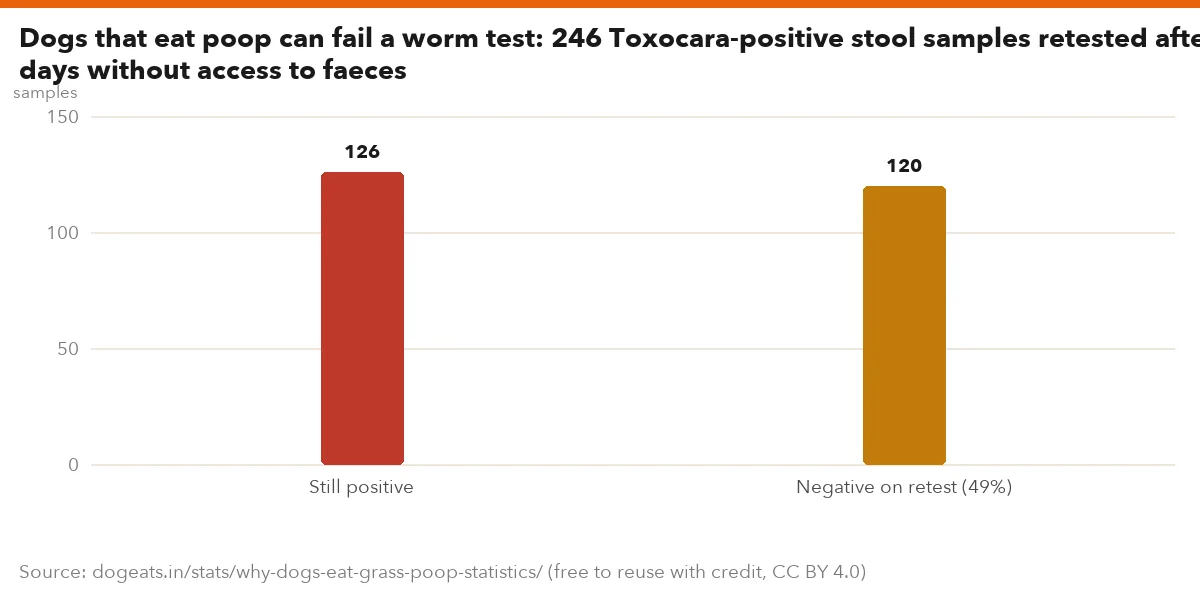
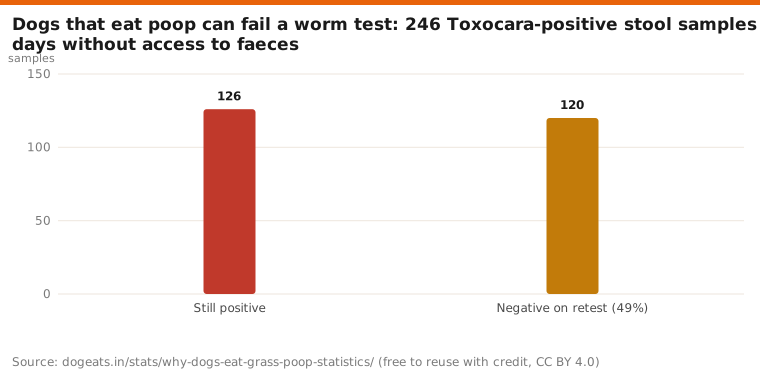
- In a Dutch study, 49% of 246 Toxocara-positive stool samples were negative on retest, because the eggs came from eaten faeces.
- In Australian observations, 95 of 99 dogs ate grass, and 12 test dogs vomited twice in 374 grass-eating events.
Why do dogs eat grass?
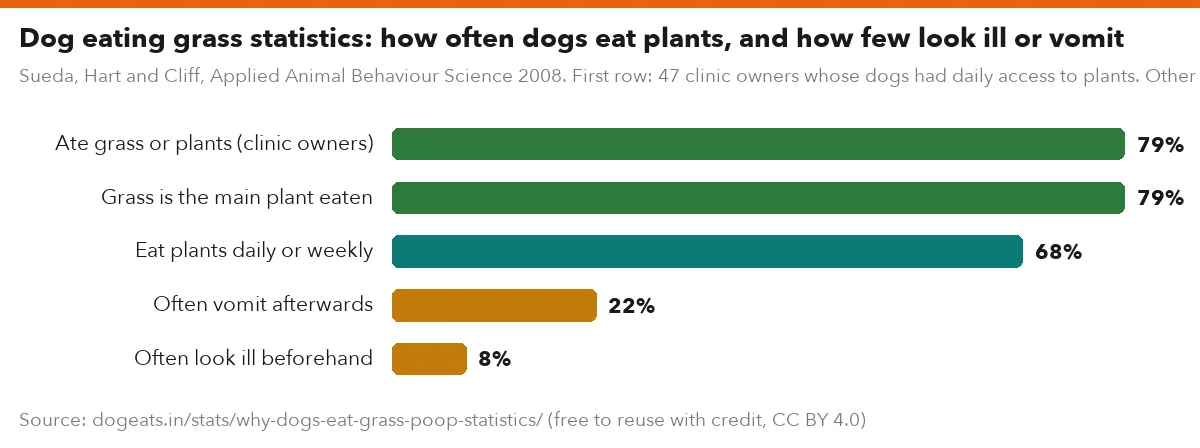
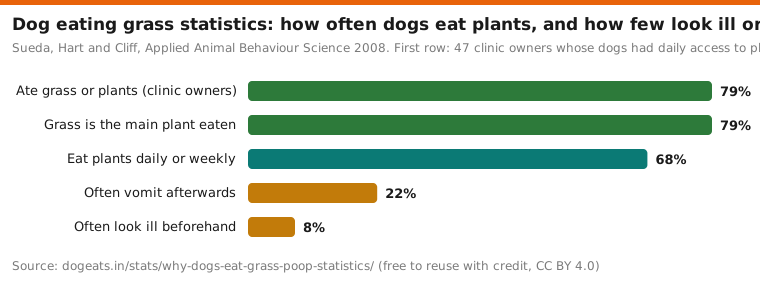
Mostly because it is normal dog behaviour, not a sign of sickness, in pedigree dogs and Indies alike. In a US study by Sueda, Hart and Cliff, 47 owners whose dogs had daily access to plants were asked. 79% had seen their dog eat grass or plants, or found grass in faeces or vomit.
A follow-up internet survey covered 1,571 plant-eating dogs. Only 8% often looked ill before eating plants, and 92% rarely showed signs of illness before or after.
Wild canids eat plants too. Studies cited in the same paper found grass in 2 to 14% of wolf scat samples, and plant matter in about 74% of summer samples from Yellowstone wolves.
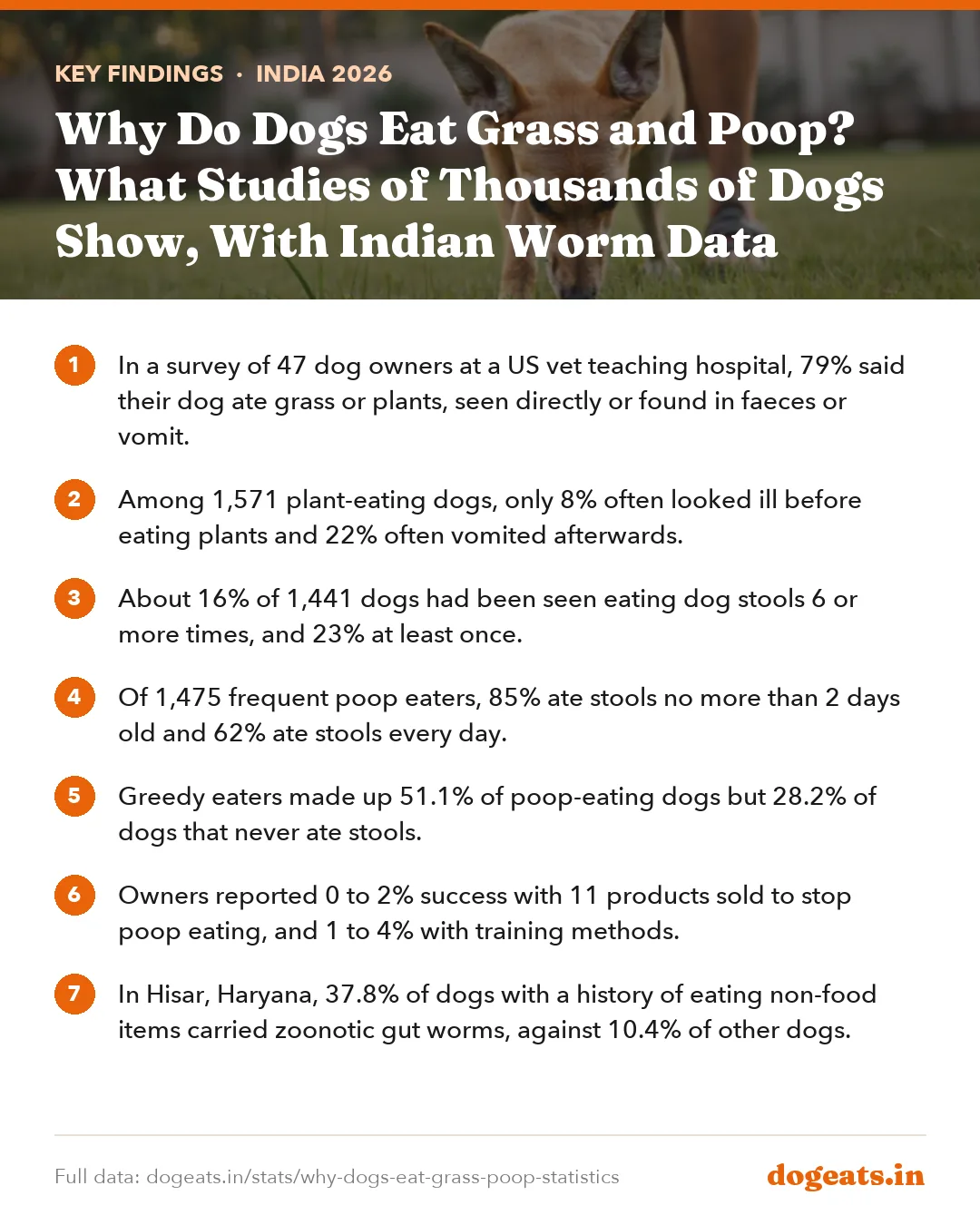
Sueda, Hart and Cliff, Applied Animal Behaviour Science 2008. First row: 47 clinic owners whose dogs had daily access to plants. Other rows: 1,571 owners of plant-eating dogs.
Show the numbers
| Label | % |
|---|---|
| Ate grass or plants (clinic owners) | 79% |
| Grass is the main plant eaten | 79% |
| Eat plants daily or weekly | 68% |
| Often vomit afterwards | 22% |
| Often look ill beforehand | 8% |
Embed this chart
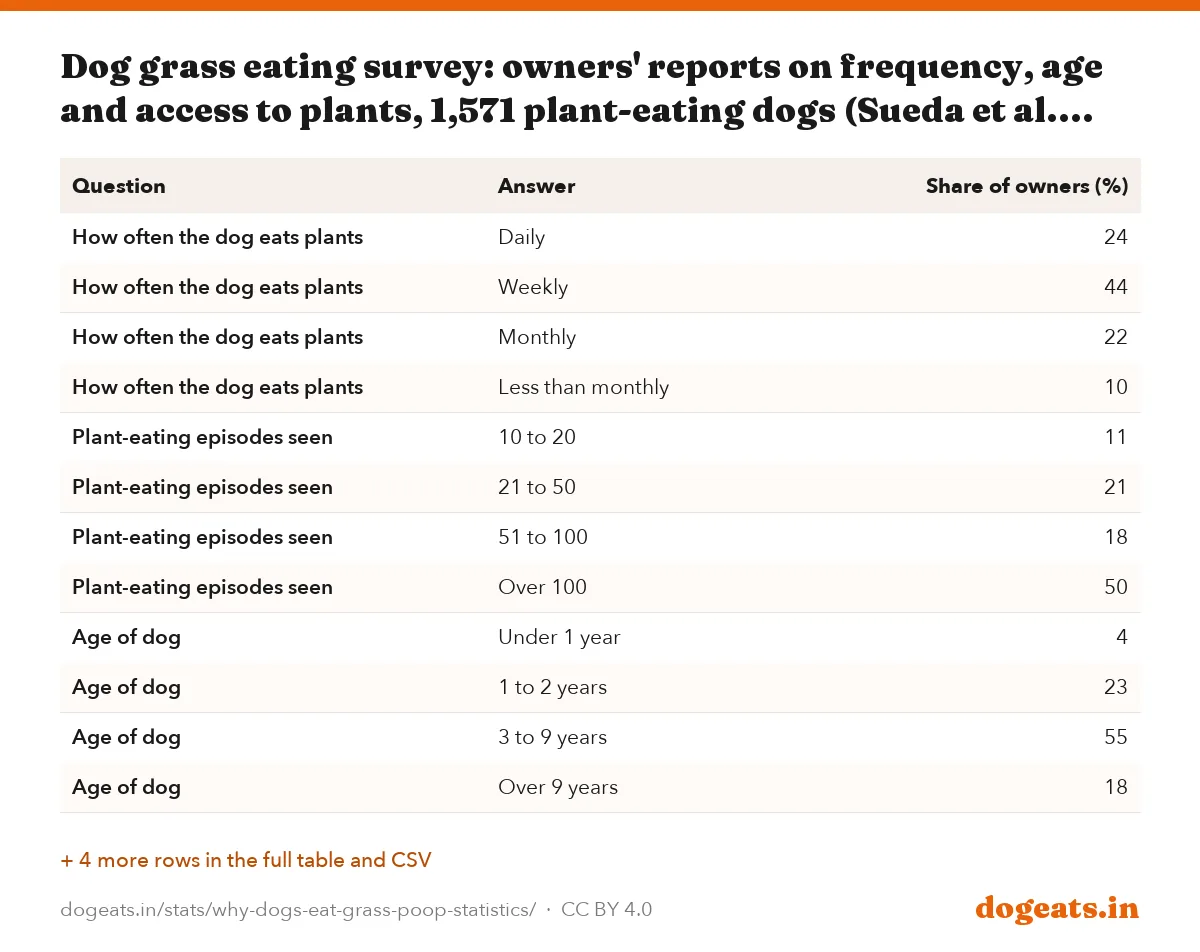
| Question | Answer | Share of owners (%) |
|---|---|---|
| How often the dog eats plants | Daily | 24 |
| How often the dog eats plants | Weekly | 44 |
| How often the dog eats plants | Monthly | 22 |
| How often the dog eats plants | Less than monthly | 10 |
| Plant-eating episodes seen | 10 to 20 | 11 |
| Plant-eating episodes seen | 21 to 50 | 21 |
| Plant-eating episodes seen | 51 to 100 | 18 |
| Plant-eating episodes seen | Over 100 | 50 |
| Age of dog | Under 1 year | 4 |
| Age of dog | 1 to 2 years | 23 |
| Age of dog | 3 to 9 years | 55 |
| Age of dog | Over 9 years | 18 |
| Access to plants | Yard or garden | 95 |
| Access to plants | On walks | 62 |
| Signs of illness before or after | Rarely | 92 |
| Vomiting within 1 hour | Rarely | 78 |
Do dogs eat grass to make themselves vomit?
Rarely. In the Sueda survey, 78% of owners said their dog rarely vomited within an hour of eating plants. Only 22% saw frequent vomiting afterwards.
Direct observation agrees. Samantha McKenzie at the University of New England in Australia watched 99 dogs, and 95 of them ate grass across 2,769 recorded events. Vomiting was very rare.
In a related trial, 12 dogs were given a diet that loosened their stools. They ate less grass, not more, and vomited twice in 374 grass-eating events. The study was a conference abstract.
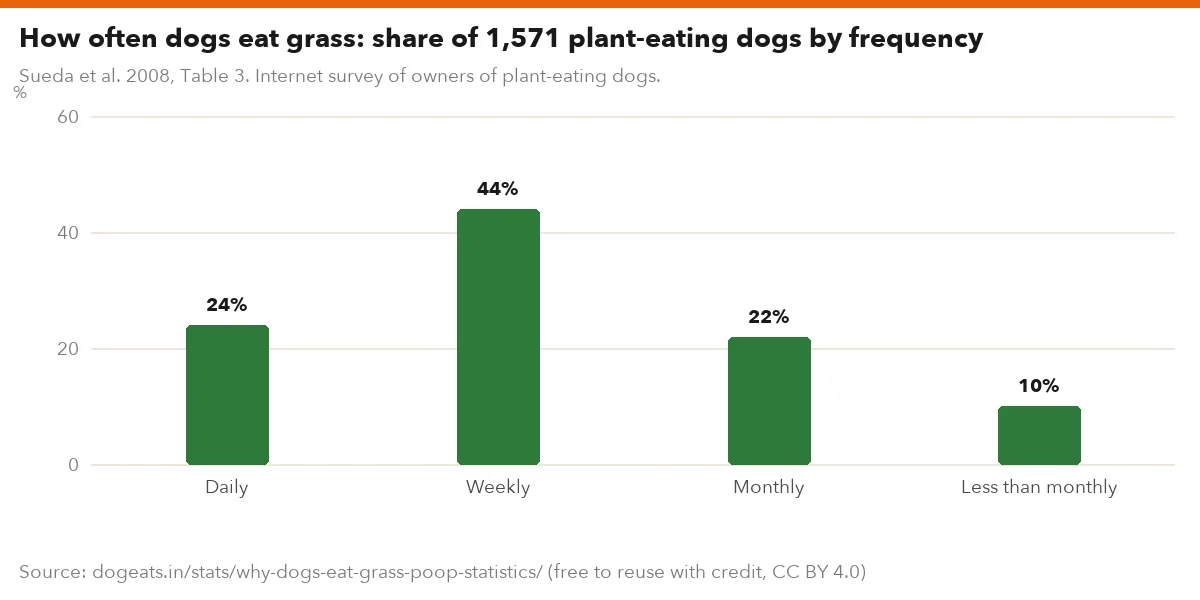
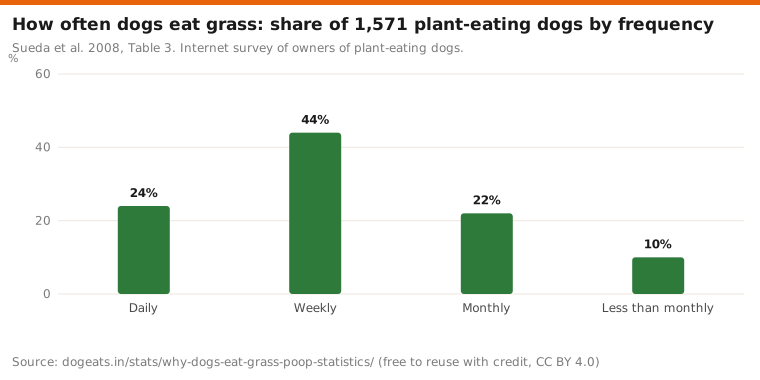
Sueda et al. 2008, Table 3. Internet survey of owners of plant-eating dogs.
Show the numbers
| Label | % |
|---|---|
| Daily | 24% |
| Weekly | 44% |
| Monthly | 22% |
| Less than monthly | 10% |
Embed this chart
Dogs that did look ill before eating plants were more likely to vomit afterwards, the Sueda team found. Older dogs were also more likely to vomit, as were hounds, toy breeds and dogs on complete commercial food rather than home-made diets.
Which dogs eat grass most?
Younger dogs. Age was the only significant predictor of how often dogs ate plants in the Sueda survey. Younger dogs also ate more non-grass plants.
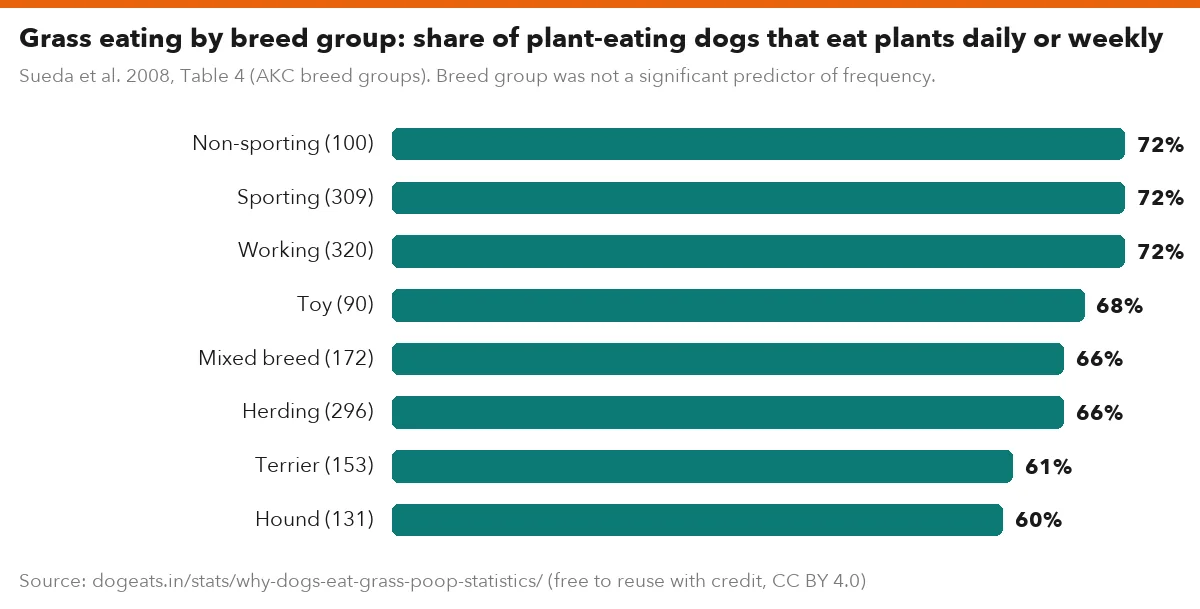
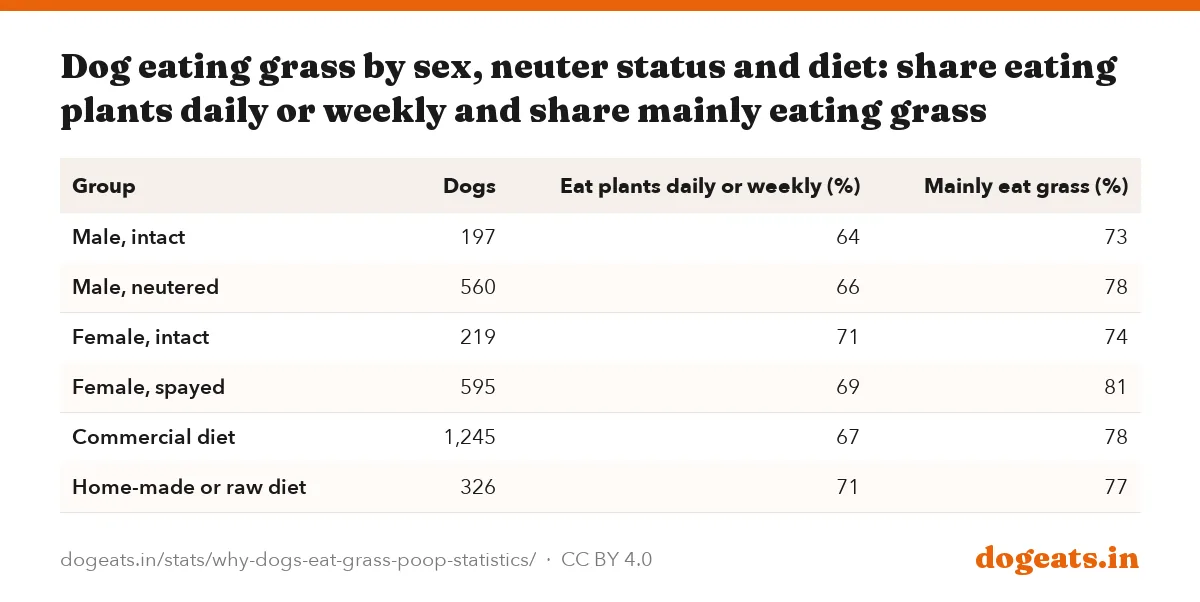
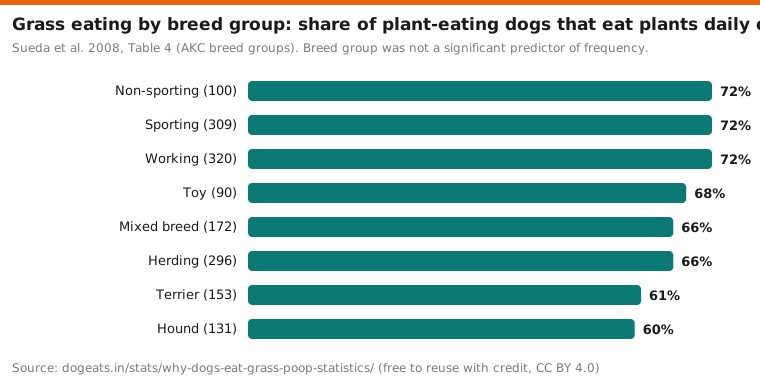
Sex, neuter status, breed group and diet made no significant difference to how often dogs ate plants. Across breed groups, 60% to 72% ate plants daily or weekly.
Diet does not seem to drive it. 67% of 1,245 dogs on commercial food and 71% of 326 on home-made or raw diets ate plants daily or weekly. The McKenzie thesis found dogs ate less grass when full, so a properly sized meal from our dog feeding chart may help.
Sueda et al. 2008, Table 4 (AKC breed groups). Breed group was not a significant predictor of frequency.
Show the numbers
| Label | % |
|---|---|
| Non-sporting (100) | 72% |
| Sporting (309) | 72% |
| Working (320) | 72% |
| Toy (90) | 68% |
| Mixed breed (172) | 66% |
| Herding (296) | 66% |
| Terrier (153) | 61% |
| Hound (131) | 60% |
Embed this chart
| Group | Dogs | Eat plants daily or weekly (%) | Mainly eat grass (%) |
|---|---|---|---|
| Male, intact | 197 | 64 | 73 |
| Male, neutered | 560 | 66 | 78 |
| Female, intact | 219 | 71 | 74 |
| Female, spayed | 595 | 69 | 81 |
| Commercial diet | 1,245 | 67 | 78 |
| Home-made or raw diet | 326 | 71 | 77 |
Why do dogs eat poop?
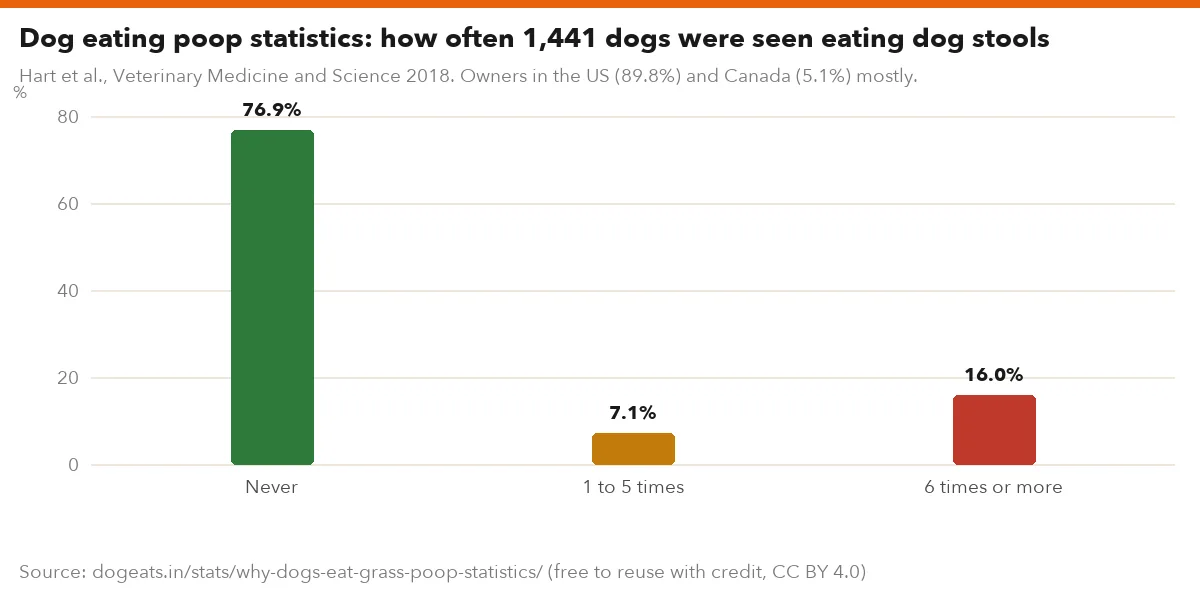
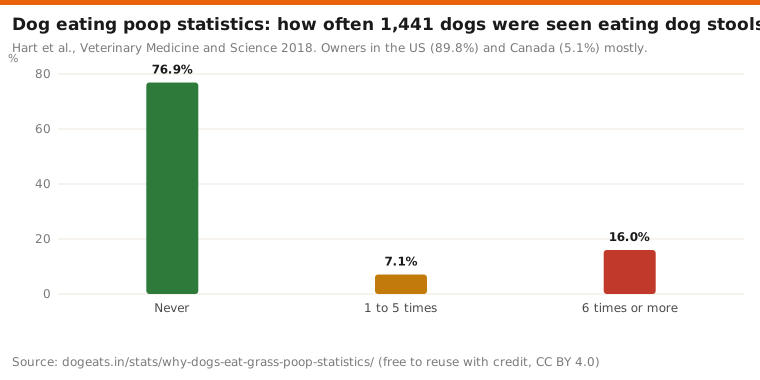
Nobody knows for sure, but it is common. A 2018 study led by Benjamin Hart at UC Davis surveyed owners of 1,552 dogs. Of 1,441 who answered, 16.0% had seen their dog eat dog stools 6 or more times, and 23% at least once.
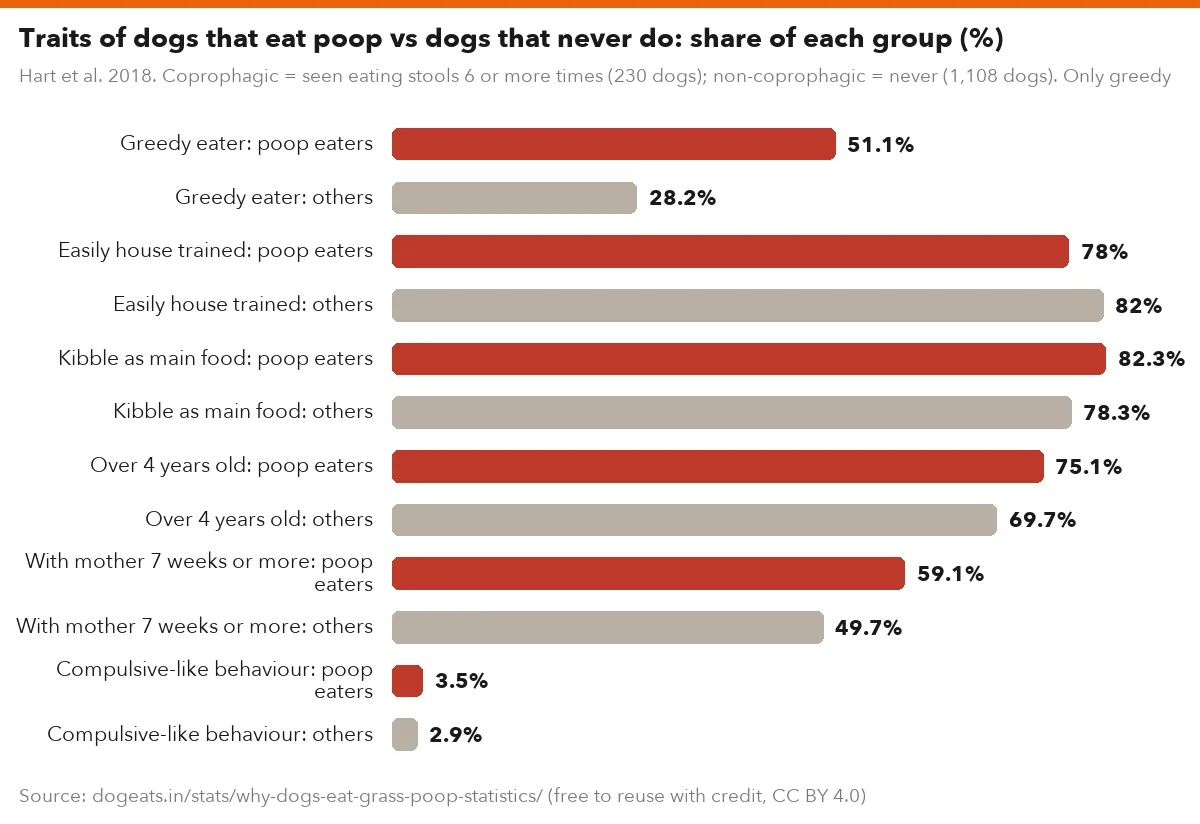
Poop-eating dogs were not badly house trained or underfed. 78% were easily house trained, against 82% of other dogs, and 82.3% ate kibble as their main food against 78.3%. Our Indian dog diet chart covers home-fed dogs.
Greedy eating stood out. 51.1% of poop eaters were described as greedy eaters, against 28.2% of dogs that never ate stools. Multi-dog homes, terriers and hounds also showed more of it.
Hart et al., Veterinary Medicine and Science 2018. Owners in the US (89.8%) and Canada (5.1%) mostly.
Show the numbers
| Label | % |
|---|---|
| Never | 76.9% |
| 1 to 5 times | 7.1% |
| 6 times or more | 16.0% |
Embed this chart
Hart et al. 2018. Coprophagic = seen eating stools 6 or more times (230 dogs); non-coprophagic = never (1,108 dogs). Only greedy eating stood out.
Show the numbers
| Label | % |
|---|---|
| Greedy eater: poop eaters | 51.1% |
| Greedy eater: others | 28.2% |
| Easily house trained: poop eaters | 78% |
| Easily house trained: others | 82% |
| Kibble as main food: poop eaters | 82.3% |
| Kibble as main food: others | 78.3% |
| Over 4 years old: poop eaters | 75.1% |
| Over 4 years old: others | 69.7% |
| With mother 7 weeks or more: poop eaters | 59.1% |
| With mother 7 weeks or more: others | 49.7% |
| Compulsive-like behaviour: poop eaters | 3.5% |
| Compulsive-like behaviour: others | 2.9% |
Embed this chart
Why do dogs eat fresh poop and not old poop?
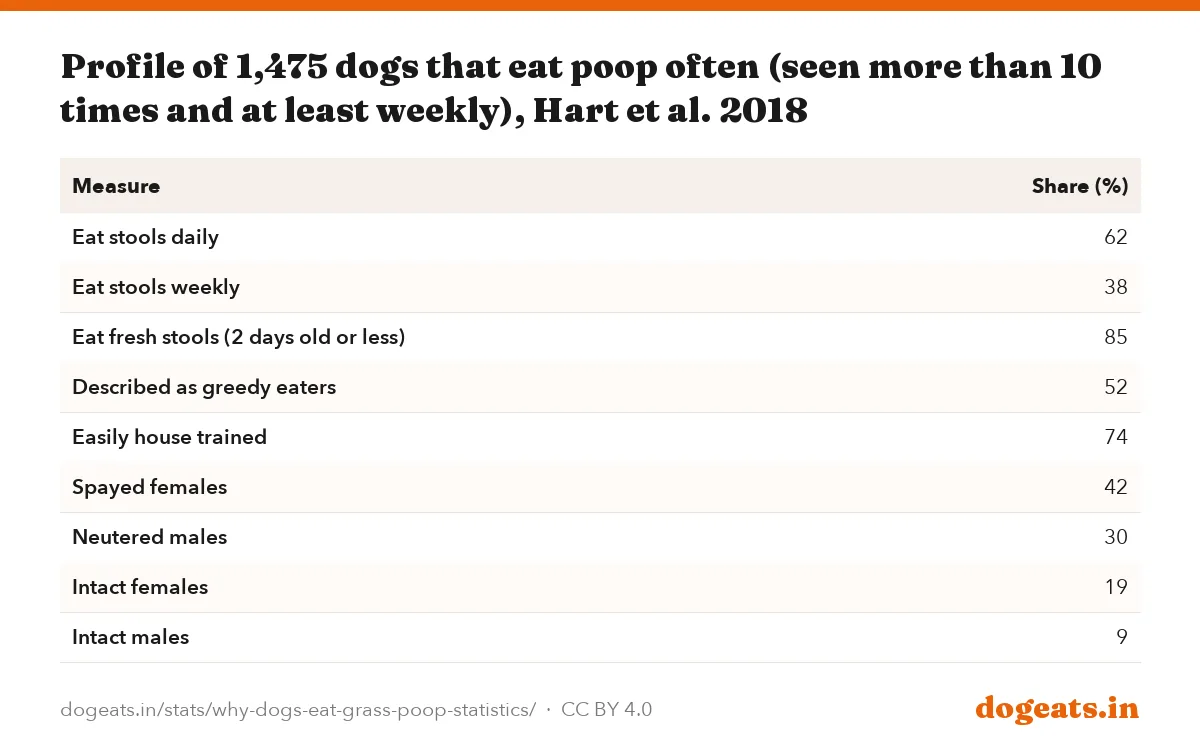
In a second survey of 1,475 dogs that ate stools often, 85% ate stools no more than 2 days old. 62% did it daily and 38% weekly. In the first survey, 82% of frequent stool eaters also chose fresh stools.
The Hart team offers a theory. Worm eggs in fresh faeces are usually not yet infective, but some can develop infective larvae after about 2 days. Wolves that cleaned the den of fresh stools would have avoided those parasites.
The idea remains a hypothesis. It fits the data on fresh stools but has not been tested directly.
| Measure | Share (%) |
|---|---|
| Eat stools daily | 62 |
| Eat stools weekly | 38 |
| Eat fresh stools (2 days old or less) | 85 |
| Described as greedy eaters | 52 |
| Easily house trained | 74 |
| Spayed females | 42 |
| Neutered males | 30 |
| Intact females | 19 |
| Intact males | 9 |
How do I stop my dog eating poop?
Products rarely work. Owners in the Hart survey tried 11 food additives or tablets sold for poop eating. Reported success ranged from 0 to 2%.
Training did little better. Chasing the dog away, lacing stools with pepper and sound or electronic collars worked for 1 to 2% of owners, and rewarding "leave it" for 4%.
Picking up stools at once removes the chance. Chasing the dog away was the commonest method, used by 1,048 owners, and pepper by 295. A vet check makes sense too. A 2025 study found chronic gut inflammation in all 41 biopsied dogs and cats that had swallowed non-food objects.
| Product | Owners who tried it | Reported success (%) |
|---|---|---|
| For-Bid | 352 | 1 |
| Deter | 238 | 1 |
| Dis-Taste | 154 | 1 |
| Coproban | 58 | 2 |
| S.E.P | 58 | 0 |
| Stop Stool Eat | 27 | 0 |
| Stop Tablets | 26 | 0 |
| Potty Mouth | 24 | 0 |
| NaturVet Deter | 20 | 0 |
| Nasty Habit | 13 | 0 |
| 21st Century | 6 | 0 |
Can my dog get worms from eating poop or grass in India?
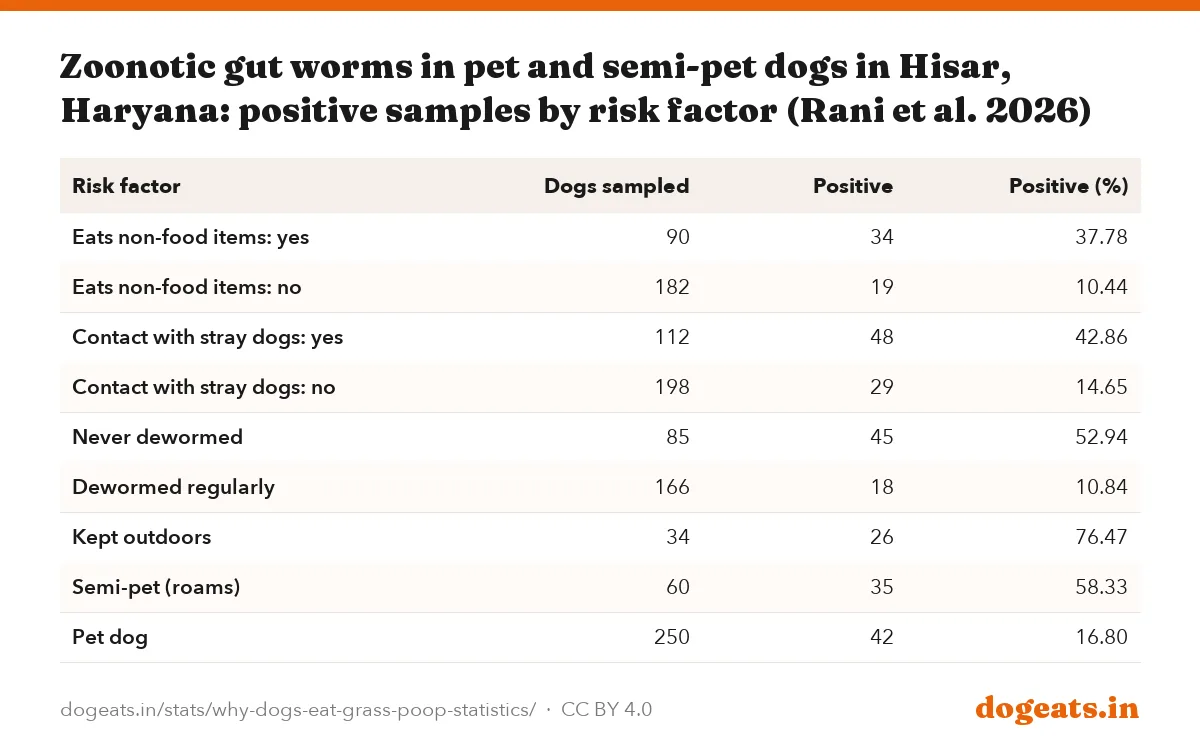
Yes, it raises the risk. A 2026 study tested 310 pet and semi-pet dogs in Hisar, Haryana, and found zoonotic gut worms in 24.85%. Most were hookworms, which can also infect people.
Dogs with a history of eating non-food items, such as soil or faeces, had 37.78% positive samples against 10.44% for other dogs. In the multivariate model it was the main significant risk factor.
Deworming showed one of the widest gaps. 52.94% of never-dewormed dogs were positive, against 10.84% of regularly dewormed dogs. Contact with stray dogs nearly tripled the rate, from 14.65% to 42.86%.
Rani et al., BMC Veterinary Research 2026. Hookworm (Ancylostoma caninum) made up most infections. Eating non-food items was the main risk factor in the multivariate model.
Show the numbers
| Label | % |
|---|---|
| Eats non-food items: yes | 37.8% |
| Eats non-food items: no | 10.4% |
| Contact with stray dogs: yes | 42.9% |
| Contact with stray dogs: no | 14.7% |
| Never dewormed | 52.9% |
| Dewormed regularly | 10.8% |
| Kept outdoors | 76.5% |
| Semi-pet (roams) | 58.3% |
| Pet dog | 16.8% |
Embed this chart
| Risk factor | Dogs sampled | Positive | Positive (%) |
|---|---|---|---|
| Eats non-food items: yes | 90 | 34 | 37.78 |
| Eats non-food items: no | 182 | 19 | 10.44 |
| Contact with stray dogs: yes | 112 | 48 | 42.86 |
| Contact with stray dogs: no | 198 | 29 | 14.65 |
| Never dewormed | 85 | 45 | 52.94 |
| Dewormed regularly | 166 | 18 | 10.84 |
| Kept outdoors | 34 | 26 | 76.47 |
| Semi-pet (roams) | 60 | 35 | 58.33 |
| Pet dog | 250 | 42 | 16.80 |
Our dog diseases report covers other infections, and our stray dogs by city report shows how many street dogs share Indian parks and lanes. Ask your vet about a deworming schedule; our vet and vaccination costs report lists typical deworming prices.
Is eating poop bad for dogs?
It can confuse worm tests. In a Dutch study, 246 stool samples first tested positive for Toxocara eggs. 120 of them, or 49%, were negative after owners stopped coprophagy for 3 days.
Those eggs had passed straight through from eaten faeces. So a dog that eats poop can look infected when it is not, and it can carry eggs to new places.
Gut bacteria may not change. A 2026 Italian study of 44 healthy dogs found no difference in core gut bacteria or germ carriage between 23 poop eaters and 21 other dogs.
Nijsse et al., Veterinary Parasitology 2014, the Netherlands. A negative retest means the eggs had passed through from eaten faeces.
Show the numbers
| Label | samples |
|---|---|
| Still positive | 126 |
| Negative on retest (49%) | 120 |
Embed this chart
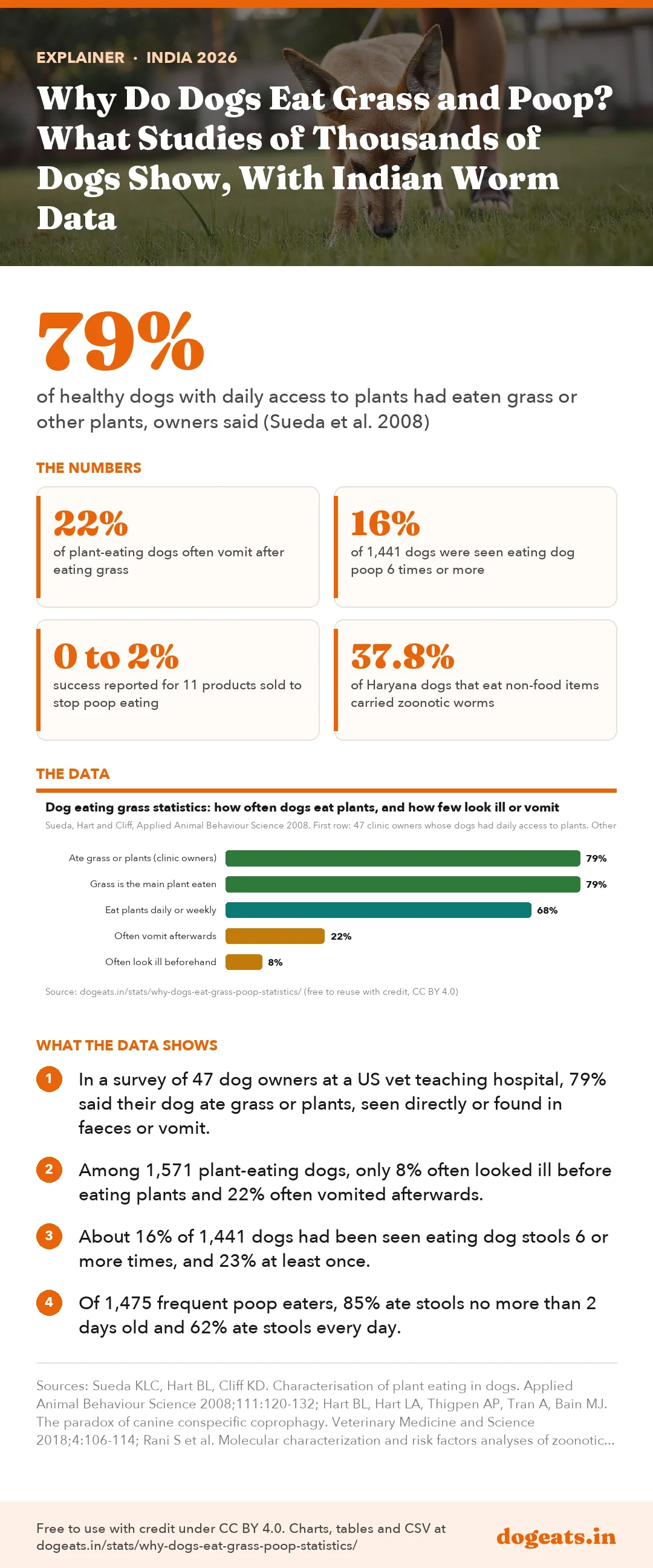
| Study | Country | Dogs | Main finding |
|---|---|---|---|
| Sueda, Hart and Cliff 2008 | USA | 47 clinic dogs; 1,571 survey dogs | 79% seen eating plants; 22% often vomit after |
| McKenzie 2009 (PhD thesis) | Australia | 99 dogs observed | 95 ate grass; 2,769 grass-eating events |
| McKenzie, Brown and Price 2009 (conference) | Australia | 12 dogs | 2 vomiting events per 374 grass-eating events |
| Hart et al. 2018 | USA and Canada | 1,552 and 1,475 dogs | 16% eat stools often; 85% eat fresh stools |
| Nijsse et al. 2014 | Netherlands | 391 dogs of coprophagic owners | 49% of Toxocara-positive samples negative on retest |
| Pilla et al. 2026 | Italy | 44 dogs | No change in gut bacteria or germ carriage |
| Perez, Ford and Lynch 2025 | Not stated | 133 dogs and cats | All 41 biopsied pica cases had chronic enteritis |
| Rani et al. 2026 | India (Haryana) | 310 dogs | Eating non-food items: 37.8% vs 10.4% with worms |
- See a vet if a dog suddenly starts eating poop, soil or other non-food items, especially an older dog.
- Keep yards clean and pick up stools on walks, so neither your dog nor others can eat them.
- Watch for vomiting, diarrhoea, weight loss or blood in stools. Our common dog health problems report lists the main causes.
Frequently asked questions
Why does my dog eat grass?
Most likely because it is normal behaviour. 79% of healthy dogs in one study ate plants, and only 8% of plant-eating dogs often looked ill beforehand.
Is it OK for dogs to eat grass?
Usually yes, if the grass is free of pesticides and fertiliser. Only 22% of plant-eating dogs often vomited afterwards in a survey of 1,571 dogs.
Do dogs eat grass when they are sick?
Not usually. 92% of owners said their dogs rarely showed signs of illness before or after eating plants. See a vet if grass eating comes with vomiting, diarrhoea or poor appetite.
Why does my dog eat poop?
About 16% of dogs eat dog stools often, and greedy eaters are most likely to. Diet, age and house training were not linked to it in a survey of 1,552 dogs.
How do I stop my dog eating poop?
Pick up stools straight away. In a survey of 1,475 owners, products sold for poop eating worked for 0 to 2% and training for 1 to 4%.
Can dogs get worms from eating poop?
Yes. In Haryana, 37.8% of dogs that ate non-food items had zoonotic gut worms against 10.4% of other dogs. Regular deworming cut the rate to 10.8%.
Is eating poop a sign of deficiency?
There is little evidence for that. In the Hart survey, 82.3% of poop eaters ate kibble as their main food, similar to 78.3% of other dogs.
Why do puppies eat poop?
Poop eating was not mainly a puppy habit in the Hart data. Only 1.7% of frequent poop eaters were under 1 year old, and 75.1% were over 4.
Methodology and limitations
All figures come from the studies listed, opened on 15 October 2026. Shares by group in the Sueda tables were computed from the counts given. The one exception is neutered males, where the paper's count (317 of 560) contradicts its own row total, so we use its printed 66%. Where a paper's abstract and text differ, we used the text: Sueda gives 9% in the abstract and 8% in the results for dogs often looking ill before eating plants.
The Hart et al. 2018 data come from two web surveys. The first (1,552 returns) compared dogs never seen eating stools with dogs seen doing so 6 or more times. The second (1,475 usable returns) covered dogs seen eating stools more than 10 times and at least weekly.
The Indian data come from Rani et al. 2026, which tested 310 faecal samples from pet and semi-pet dogs in five blocks of Hisar district. "Eating non-food items" is our plain term for the paper's "allotriophagia".
The McKenzie grass-eating observations come from a 2009 PhD thesis and a 2009 conference abstract at the University of New England, Australia. They are not peer-reviewed journal papers, and we say so in the text.
Sources
- Sueda KLC, Hart BL, Cliff KD. Characterisation of plant eating in dogs. Applied Animal Behaviour Science 2008;111:120-132, Grass eating prevalence, frequency, vomiting, illness, age and breed
- Hart BL, Hart LA, Thigpen AP, Tran A, Bain MJ. The paradox of canine conspecific coprophagy. Veterinary Medicine and Science 2018;4:106-114, Poop eating prevalence, traits, fresh stools, products and training
- Rani S et al. Molecular characterization and risk factors analyses of zoonotic gastrointestinal nematodes in pet and semi-pet dogs in Haryana, India. BMC Veterinary Research 2026, 310 dogs in Hisar; worm prevalence by risk factor
- Also consulted: Nijsse R, Mughini-Gras L, Wagenaar JA, Ploeger HW. Coprophagy in dogs interferes in the diagnosis of parasitic infections by faecal examination. Veterinary Parasitology 2014, Pilla R et al. Coprophagy in healthy dogs does not alter fecal core microbiota or increase carriage of enteropathogens. Animals 2026, Perez J, Ford S, Lynch H. Pica as a clinical sign of a chronic enteropathy in dogs and cats. J Am Vet Med Assoc 2025, McKenzie S. Grass-eating behaviour in the domestic dog, Canis familiaris. PhD thesis, University of New England, 2009, McKenzie S, Brown W, Price I. Grass-eating behaviours in the domestic dog in response to a mild gastrointestinal disturbance. ASSAB conference, 2009.
Cite, embed and download
This report, its data and its images are free to reuse under a Creative Commons Attribution 4.0 licence. Credit dogeats.in with a link to this page. Every chart has its own embed code, every table has a CSV and an image download, and the images below are ready for social posts, slides and articles.
Cite this report
Link to this report
Every chart and table as an image