Explainer · Updated October 2026
How much water does a dog need a day? A chart by body weight, with dry food, Indian heat and the too-much line
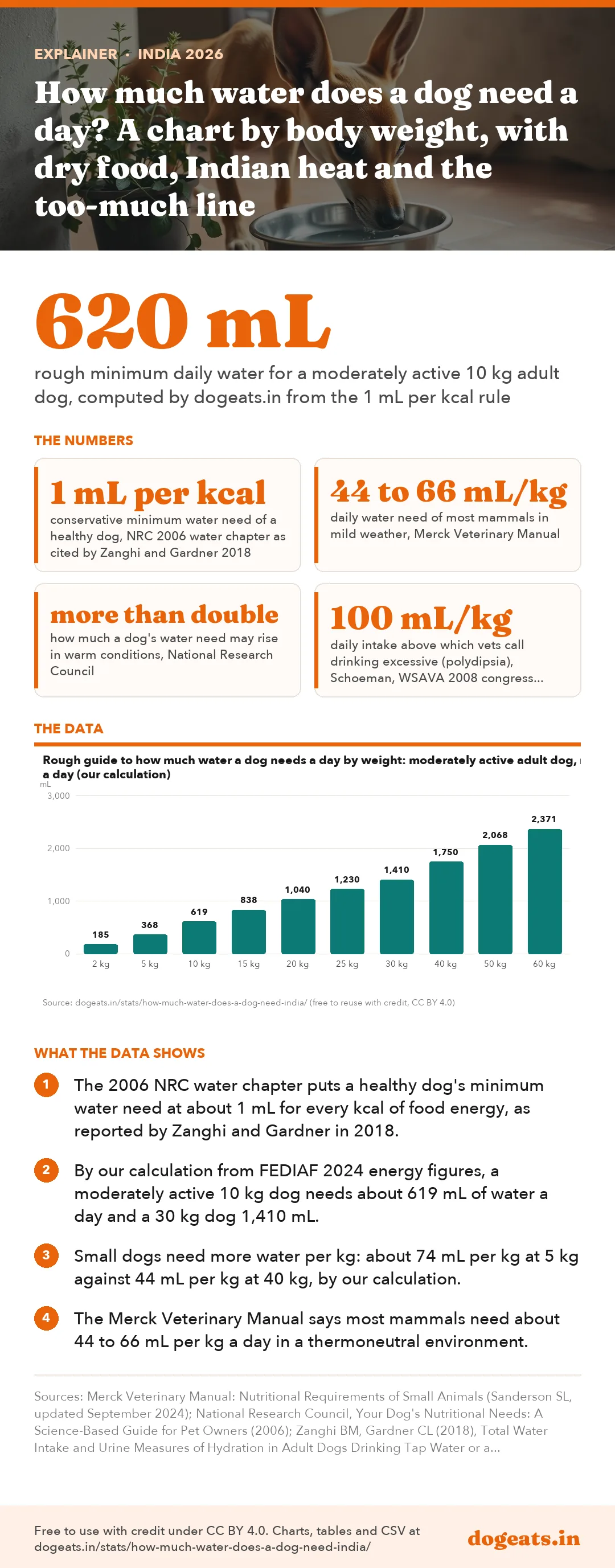
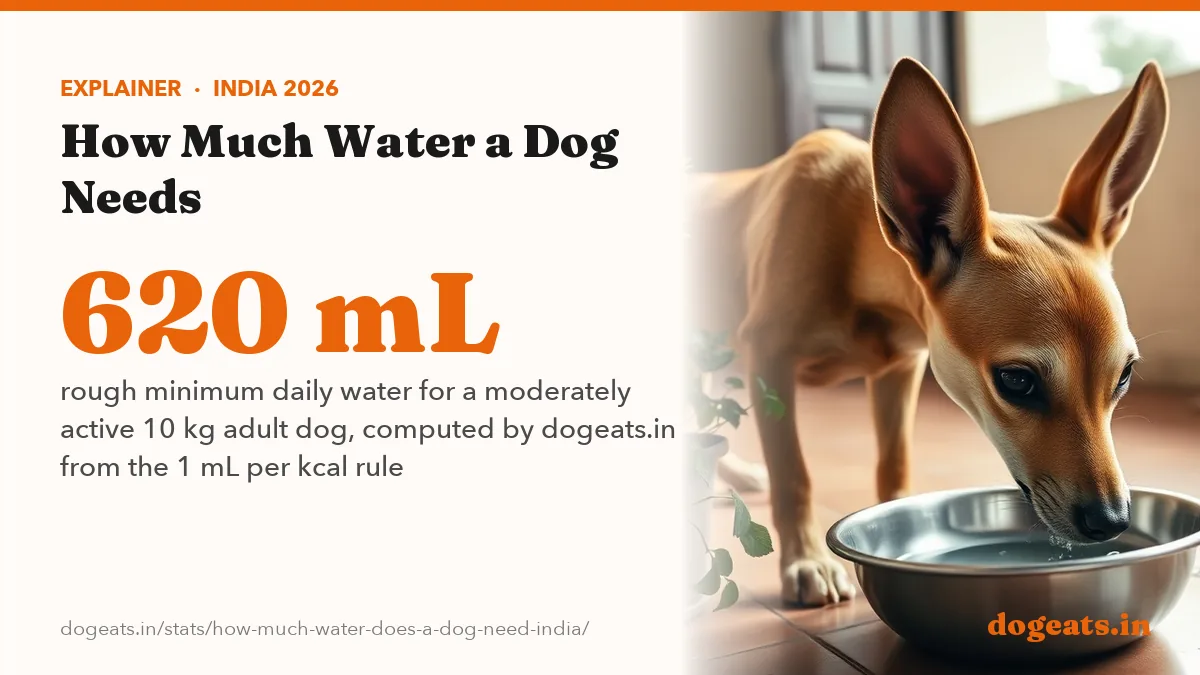
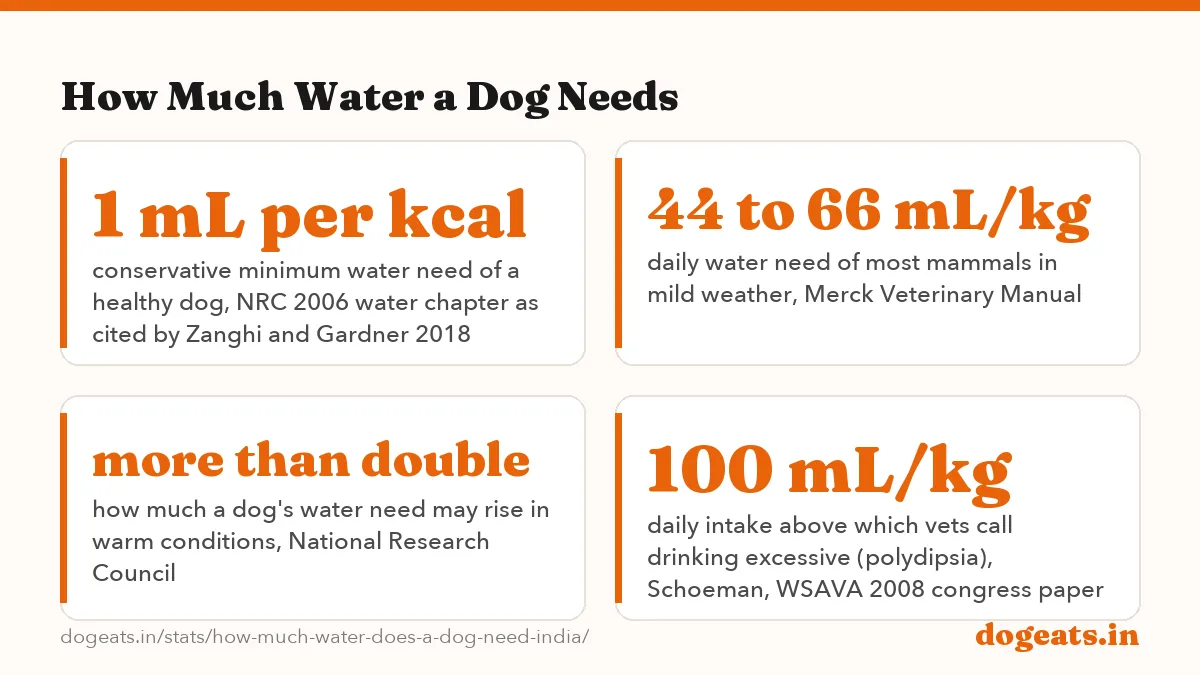
A healthy adult dog needs at least about 1 mL of water for every kcal of food energy it uses. Purina researchers cite this conservative minimum to the 2006 NRC chapter on water. By our calculation that is about 620 mL a day for a moderately active 10 kg dog and about 1.4 litres for a 30 kg dog. The Merck Veterinary Manual gives 44 to 66 mL per kg in mild weather. Heat can more than double the need, and vets call drinking above about 100 mL per kg a day excessive.
Key findings
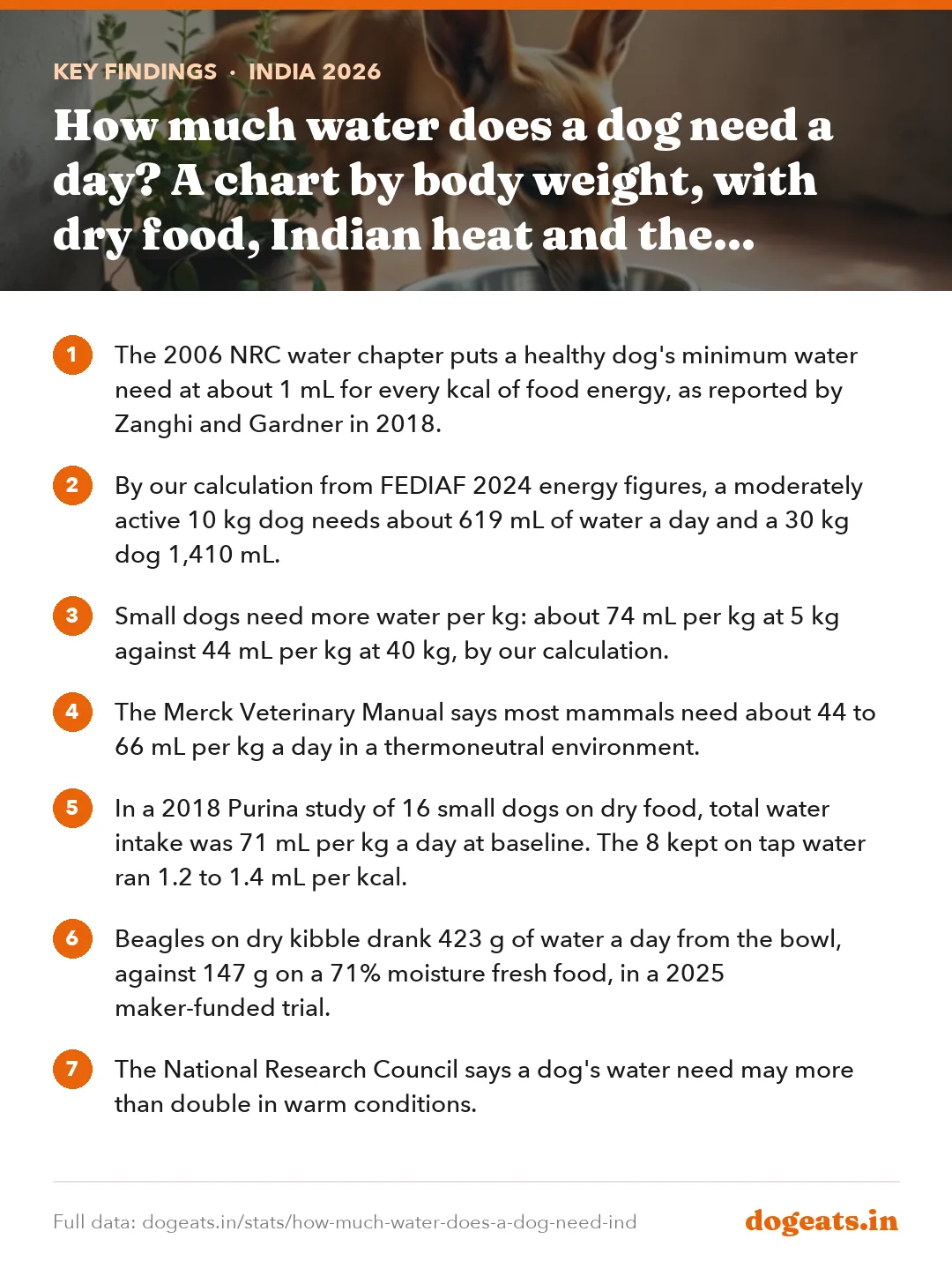
- The 2006 NRC water chapter puts a healthy dog's minimum water need at about 1 mL for every kcal of food energy, as reported by Zanghi and Gardner in 2018.
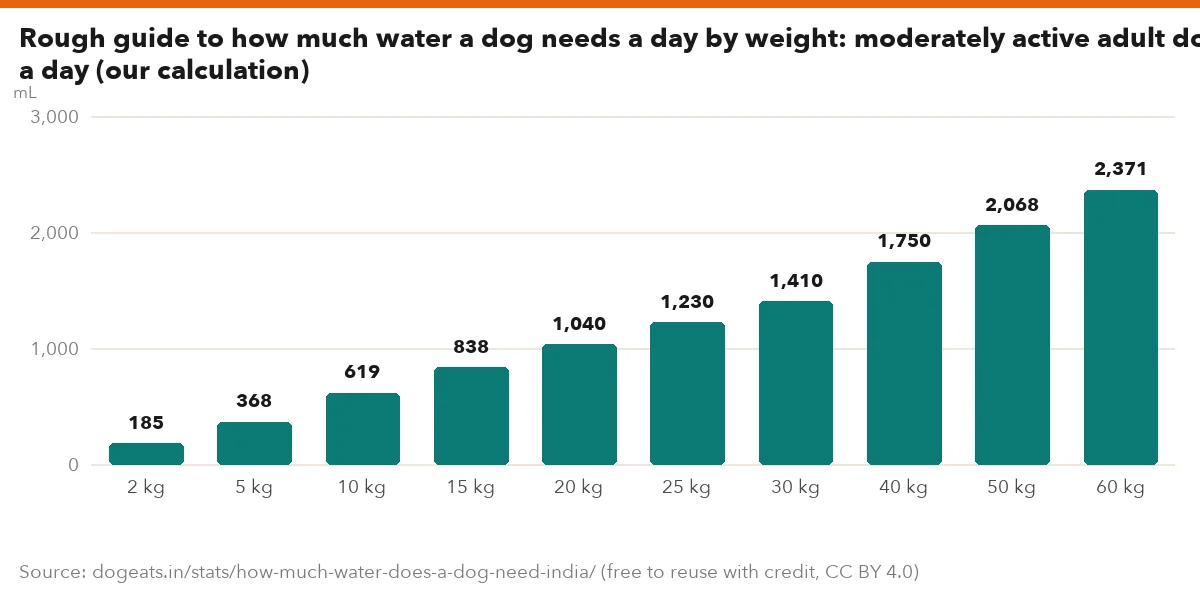
- By our calculation from FEDIAF 2024 energy figures, a moderately active 10 kg dog needs about 619 mL of water a day and a 30 kg dog 1,410 mL.
- Small dogs need more water per kg: about 74 mL per kg at 5 kg against 44 mL per kg at 40 kg, by our calculation.
- The Merck Veterinary Manual says most mammals need about 44 to 66 mL per kg a day in a thermoneutral environment.
- In a 2018 Purina study of 16 small dogs on dry food, total water intake was 71 mL per kg a day at baseline. The 8 kept on tap water ran 1.2 to 1.4 mL per kcal.
- Beagles on dry kibble drank 423 g of water a day from the bowl, against 147 g on a 71% moisture fresh food, in a 2025 maker-funded trial.
- The National Research Council says a dog's water need may more than double in warm conditions.
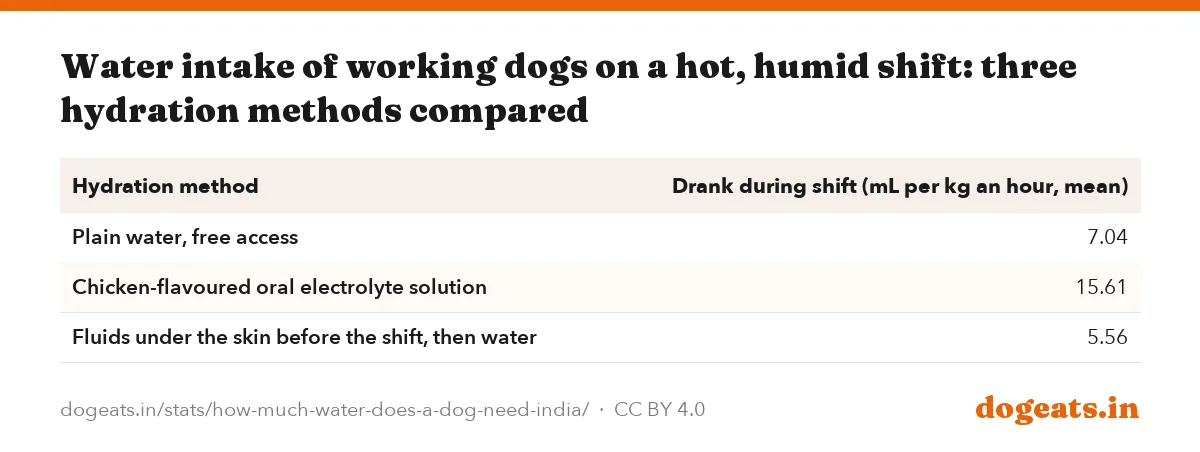
- Detection dogs working a median 29.3 C day at 70% humidity drank about 7 mL per kg an hour of plain water in a 2017 Penn Vet study.
- Vets define polydipsia, or excessive drinking, as more than 100 mL per kg a day; some use a lower line of 90 mL per kg.
How much water does a dog need per day by weight?
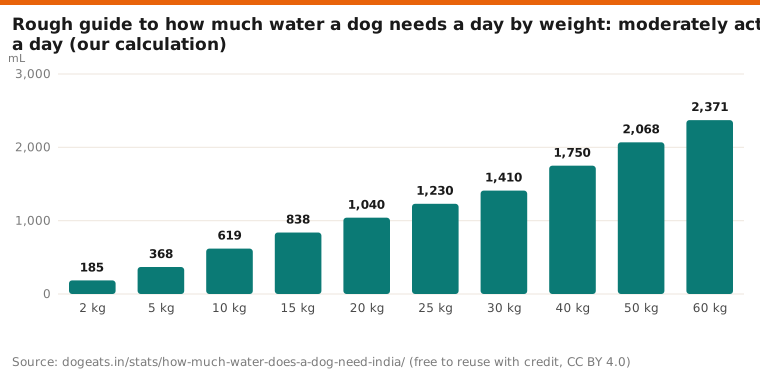
A healthy adult dog needs at least about 1 mL of water for each kcal of food energy it uses in a day. By our calculation, for a moderately active 10 kg dog that is about 620 mL a day, and for a 30 kg dog about 1.4 litres. Treat these as a rough guide, not a requirement.
Researchers at Nestle Purina, Zanghi and Gardner (2018), cite the rule to the 2006 National Research Council (NRC) chapter on water. They call it a conservative estimate of a dog's minimum need; we could not open the NRC chapter itself. We paired the rule with the energy figures in the FEDIAF 2024 guidelines: 95 kcal per kg^0.75 for a low-activity dog and 110 for a moderately active one.
The figure is total water, not only what goes in the bowl. It includes moisture in food and the water a dog's body makes when it burns food. A dog on wet or home-cooked food will drink less from its bowl and still meet the need.
Computed by dogeats.in: water (mL) = 1 mL per kcal (NRC 2006, as cited by Zanghi and Gardner 2018) x 110 kcal x kg^0.75 (FEDIAF 2024, moderate activity). Minimum total water, including food moisture. A rough guide, not a requirement.
Show the numbers
| Label | mL |
|---|---|
| 2 kg | 185 |
| 5 kg | 368 |
| 10 kg | 619 |
| 15 kg | 838 |
| 20 kg | 1,040 |
| 25 kg | 1,230 |
| 30 kg | 1,410 |
| 40 kg | 1,750 |
| 50 kg | 2,068 |
| 60 kg | 2,371 |
Embed this chart
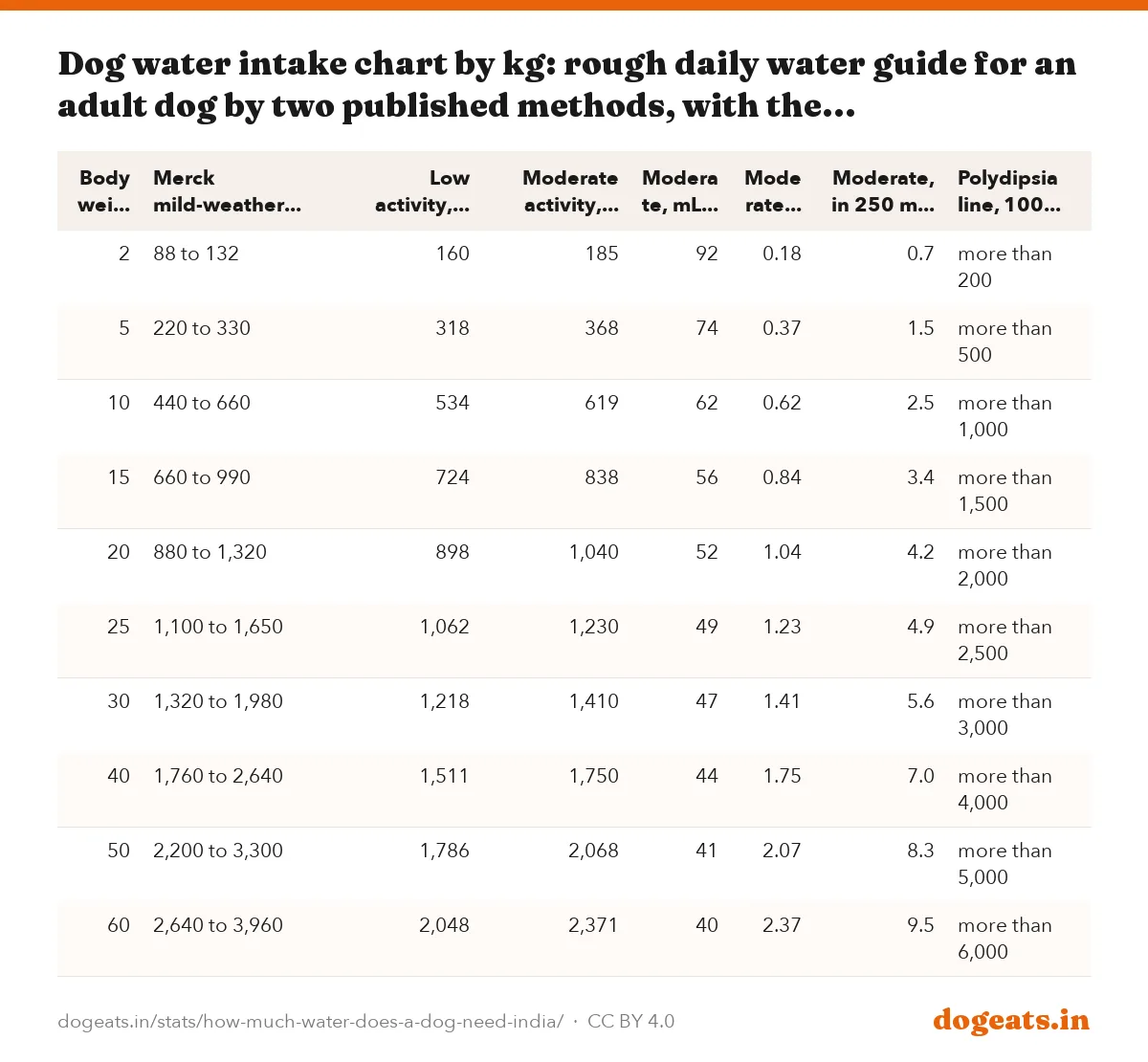
| Body weight (kg) | Merck mild-weather range, 44 to 66 mL/kg (mL) | Low activity, NRC rule (mL) | Moderate activity, NRC rule (mL) | Moderate, mL per kg | Moderate (litres) | Moderate, in 250 mL glasses | Polydipsia line, 100 mL/kg (mL) |
|---|---|---|---|---|---|---|---|
| 2 | 88 to 132 | 160 | 185 | 92 | 0.18 | 0.7 | more than 200 |
| 5 | 220 to 330 | 318 | 368 | 74 | 0.37 | 1.5 | more than 500 |
| 10 | 440 to 660 | 534 | 619 | 62 | 0.62 | 2.5 | more than 1,000 |
| 15 | 660 to 990 | 724 | 838 | 56 | 0.84 | 3.4 | more than 1,500 |
| 20 | 880 to 1,320 | 898 | 1,040 | 52 | 1.04 | 4.2 | more than 2,000 |
| 25 | 1,100 to 1,650 | 1,062 | 1,230 | 49 | 1.23 | 4.9 | more than 2,500 |
| 30 | 1,320 to 1,980 | 1,218 | 1,410 | 47 | 1.41 | 5.6 | more than 3,000 |
| 40 | 1,760 to 2,640 | 1,511 | 1,750 | 44 | 1.75 | 7.0 | more than 4,000 |
| 50 | 2,200 to 3,300 | 1,786 | 2,068 | 41 | 2.07 | 8.3 | more than 5,000 |
| 60 | 2,640 to 3,960 | 2,048 | 2,371 | 40 | 2.37 | 9.5 | more than 6,000 |
The two methods agree best for medium dogs. For a 20 kg dog, the Merck band gives 880 to 1,320 mL and the energy rule gives 898 to 1,040 mL. They part ways at the extremes, because a flat mL per kg figure ignores that small dogs burn more energy per kg.
The calorie side of the formula is the same one behind our dog feeding chart by weight, so a dog's water and food needs move together. A third rule exists: Carl Osborne's 2003 dvm360 note gives daily maintenance water as 140 x kg^0.75 mL, about 787 mL for a 10 kg dog by our arithmetic.
How much water should a dog drink per kg of body weight?
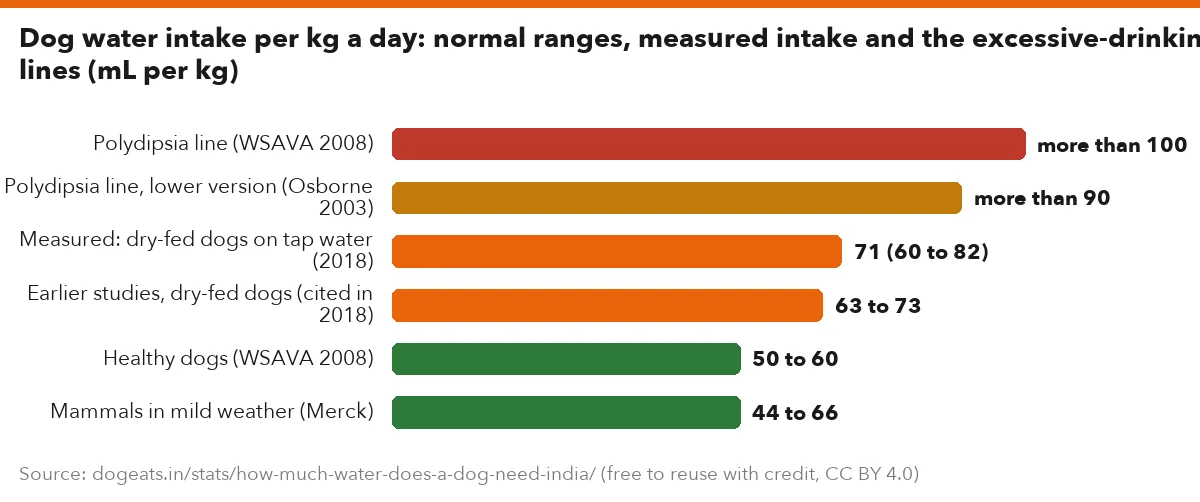
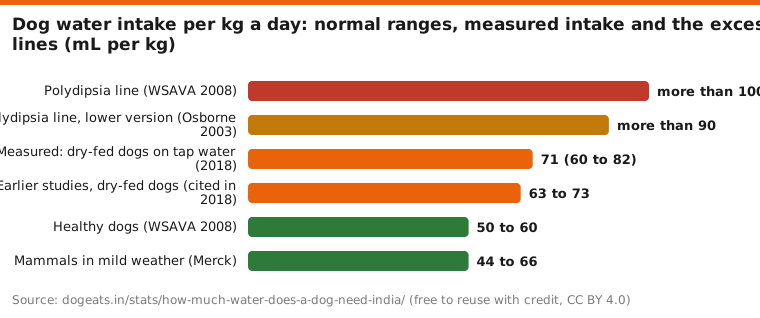
A healthy adult dog needs roughly 44 to 66 mL of water per kg a day in mild weather. Merck gives that range for most mammals in a thermoneutral environment, not for dogs alone. A 2008 WSAVA congress paper puts healthy dogs at 50 to 60 mL per kg a day.
Measured intakes run a little higher. In a 2018 Purina study of 16 healthy small dogs averaging 11.7 kg on dry food, total water intake was 71 mL per kg a day at baseline. All of them drank tap water then, and the daily range was 60 to 82 mL per kg.
The 8 dogs kept on tap water also took in more than the 1 mL per kcal rule: 1.2 to 1.4 mL of total water per kcal, week by week. The authors conclude that the 1 to 1 figure underestimates their dogs' need. They note that it rests on book chapters rather than peer-reviewed studies.
Merck Veterinary Manual (2024); Schoeman, WSAVA 2008 proceedings; Zanghi and Gardner (2018), 16 dogs on dry food; Osborne, dvm360 (2003). Bars for ranges show the midpoint; labels show the full range.
Show the numbers
| Label | mL/kg |
|---|---|
| Polydipsia line (WSAVA 2008) | more than 100 |
| Polydipsia line, lower version (Osborne 2003) | more than 90 |
| Measured: dry-fed dogs on tap water (2018) | 71 (60 to 82) |
| Earlier studies, dry-fed dogs (cited in 2018) | 63 to 73 |
| Healthy dogs (WSAVA 2008) | 50 to 60 |
| Mammals in mild weather (Merck) | 44 to 66 |
Embed this chart
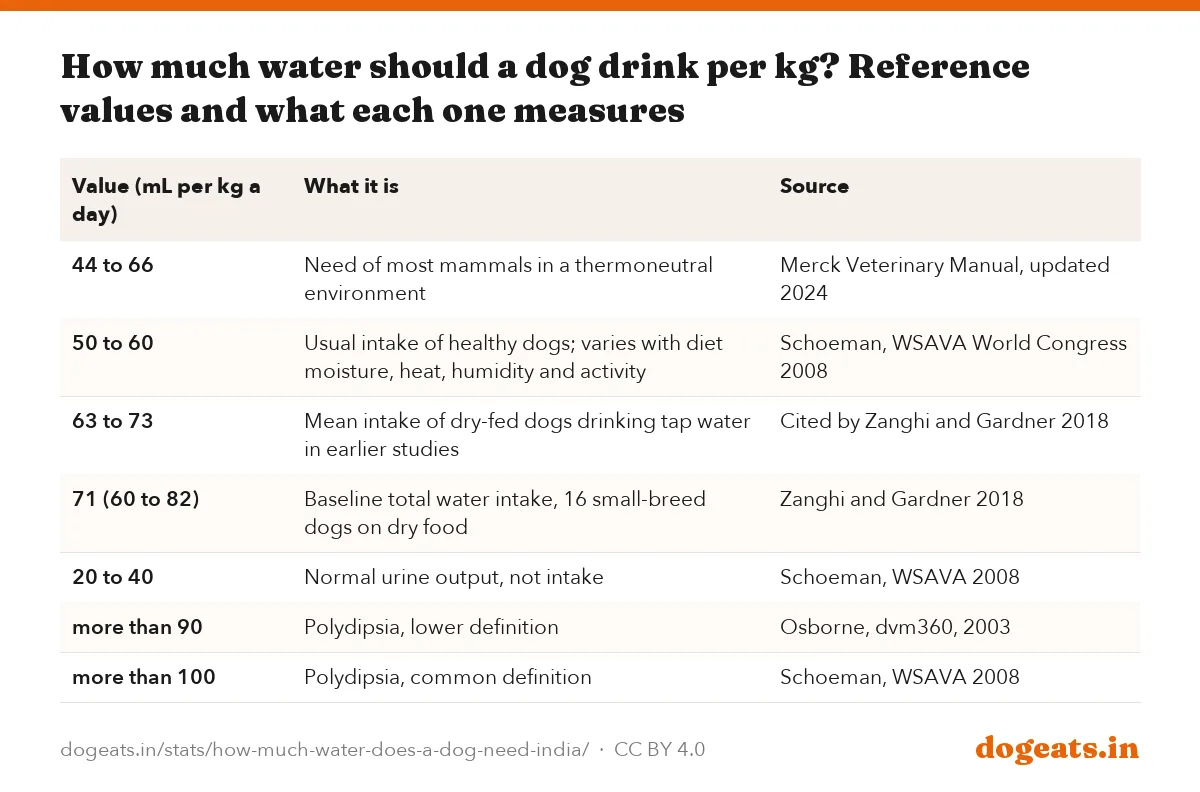
| Value (mL per kg a day) | What it is | Source |
|---|---|---|
| 44 to 66 | Need of most mammals in a thermoneutral environment | Merck Veterinary Manual, updated 2024 |
| 50 to 60 | Usual intake of healthy dogs; varies with diet moisture, heat, humidity and activity | Schoeman, WSAVA World Congress 2008 |
| 63 to 73 | Mean intake of dry-fed dogs drinking tap water in earlier studies | Cited by Zanghi and Gardner 2018 |
| 71 (60 to 82) | Baseline total water intake, 16 small-breed dogs on dry food | Zanghi and Gardner 2018 |
| 20 to 40 | Normal urine output, not intake | Schoeman, WSAVA 2008 |
| more than 90 | Polydipsia, lower definition | Osborne, dvm360, 2003 |
| more than 100 | Polydipsia, common definition | Schoeman, WSAVA 2008 |
Per kg figures suit medium dogs best. By our calculation under the energy rule, a moderately active 2 kg dog works out to about 92 mL per kg, close to the polydipsia lines. A 60 kg dog works out to about 40. None of the sources we read gives separate per kg lines for toy breeds, so watch a small dog's intake against its own usual amount.
FEDIAF puts dogs over 7 years at 95 kcal per kg^0.75 against 110 at 3 to 7 years, so the energy rule gives older dogs a lower water need. Our senior dog feeding guide covers diet changes, and a sudden rise in drinking in an older dog is a reason to see a vet.
Do dogs on dry food drink more water than dogs on wet or home-cooked food?
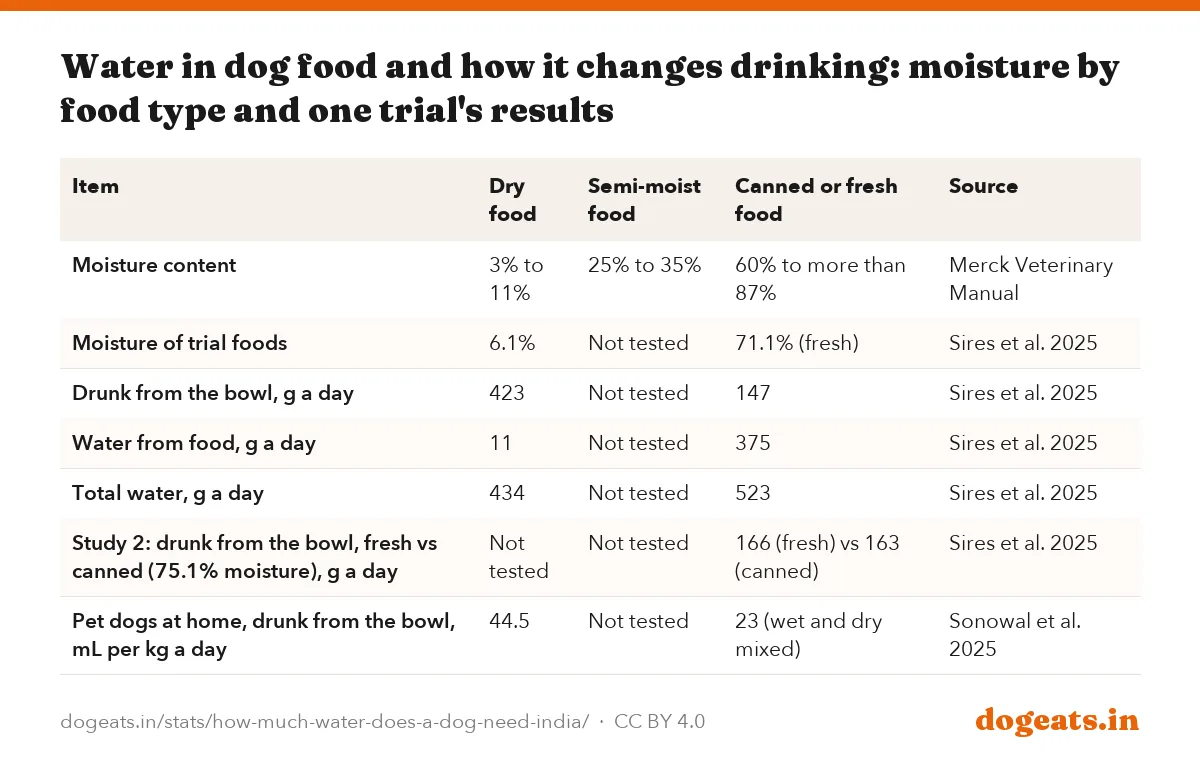
Yes. Dry dog food holds only 3% to 11% water against 60% to more than 87% for canned food, says the Merck Veterinary Manual. Dogs on dry food therefore drink more from the bowl.
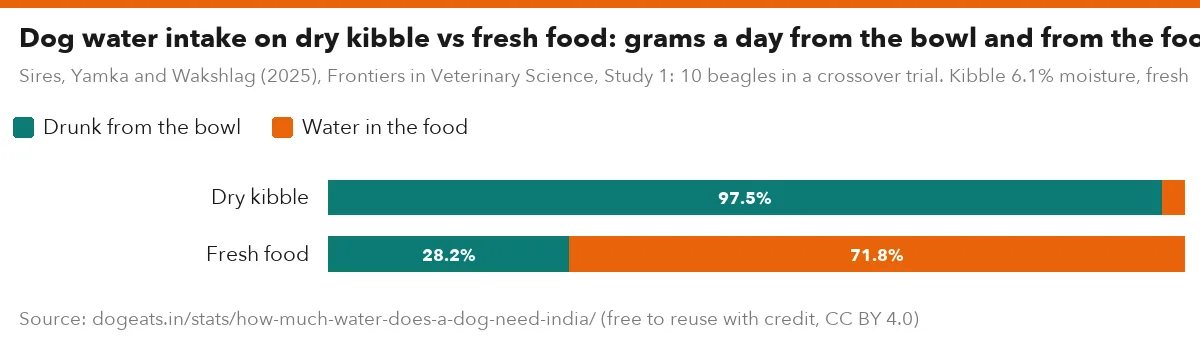
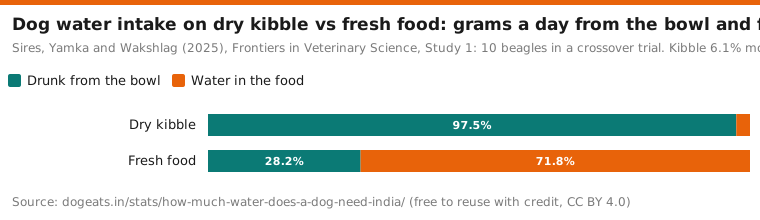
A 2025 crossover study of 10 beagles put numbers on it. On dry kibble with 6.1% moisture, dogs drank 423 g of water a day from the bowl. On a fresh food with 71.1% moisture, they drank 147 g but got 375 g from the food itself.
Total water still came out higher on the fresh food, 523 g a day against 434 g on kibble. The study was fully funded by The Farmer's Dog, which makes the fresh food and employs two of the authors. The authors note that earlier studies found total water intake did not differ between dry and canned diets. In their own second trial, fresh and canned food gave similar totals, 497 g and 536 g.
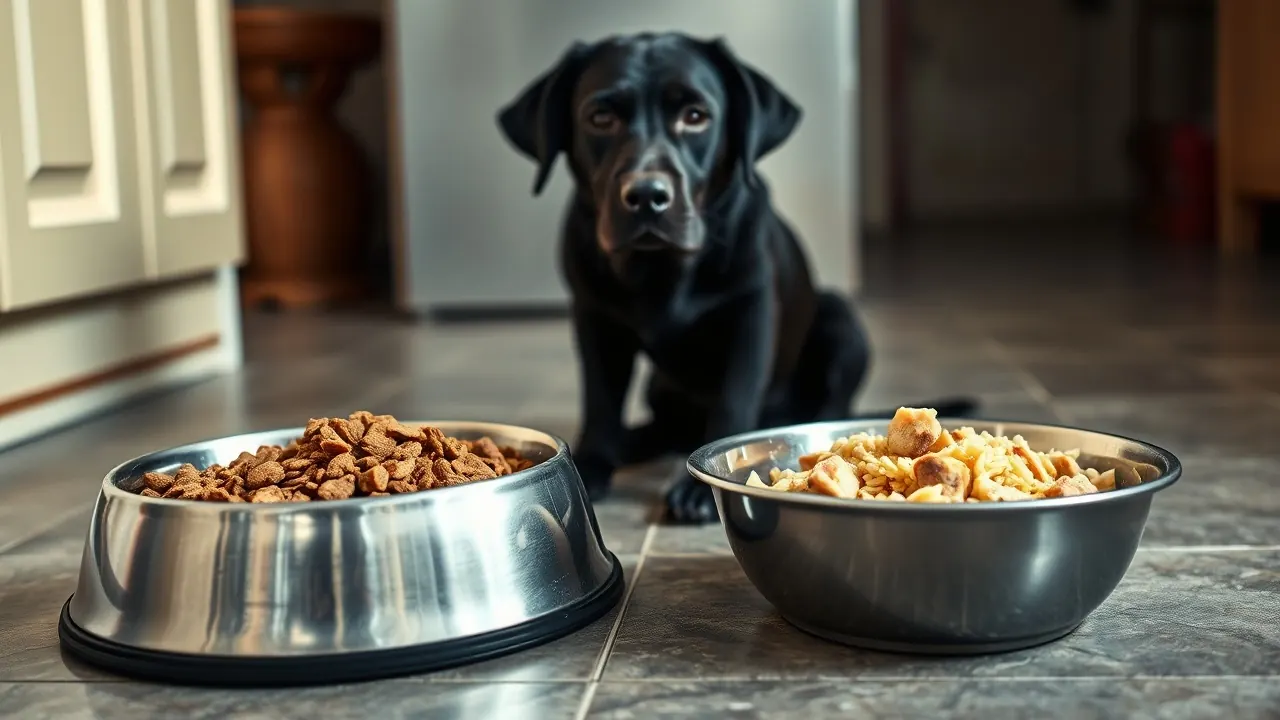
Sires, Yamka and Wakshlag (2025), Frontiers in Veterinary Science, Study 1: 10 beagles in a crossover trial. Kibble 6.1% moisture, fresh food 71.1% moisture. Industry-funded study.
Show the numbers
| Label | Drunk from the bowl | Water in the food |
|---|---|---|
| Dry kibble | 423.4 | 11.0 |
| Fresh food | 147.1 | 375.4 |
Embed this chart
| Item | Dry food | Semi-moist food | Canned or fresh food | Source |
|---|---|---|---|---|
| Moisture content | 3% to 11% | 25% to 35% | 60% to more than 87% | Merck Veterinary Manual |
| Moisture of trial foods | 6.1% | Not tested | 71.1% (fresh) | Sires et al. 2025 |
| Drunk from the bowl, g a day | 423 | Not tested | 147 | Sires et al. 2025 |
| Water from food, g a day | 11 | Not tested | 375 | Sires et al. 2025 |
| Total water, g a day | 434 | Not tested | 523 | Sires et al. 2025 |
| Study 2: drunk from the bowl, fresh vs canned (75.1% moisture), g a day | Not tested | Not tested | 166 (fresh) vs 163 (canned) | Sires et al. 2025 |
| Pet dogs at home, drunk from the bowl, mL per kg a day | 44.5 | Not tested | 23 (wet and dry mixed) | Sonowal et al. 2025 |
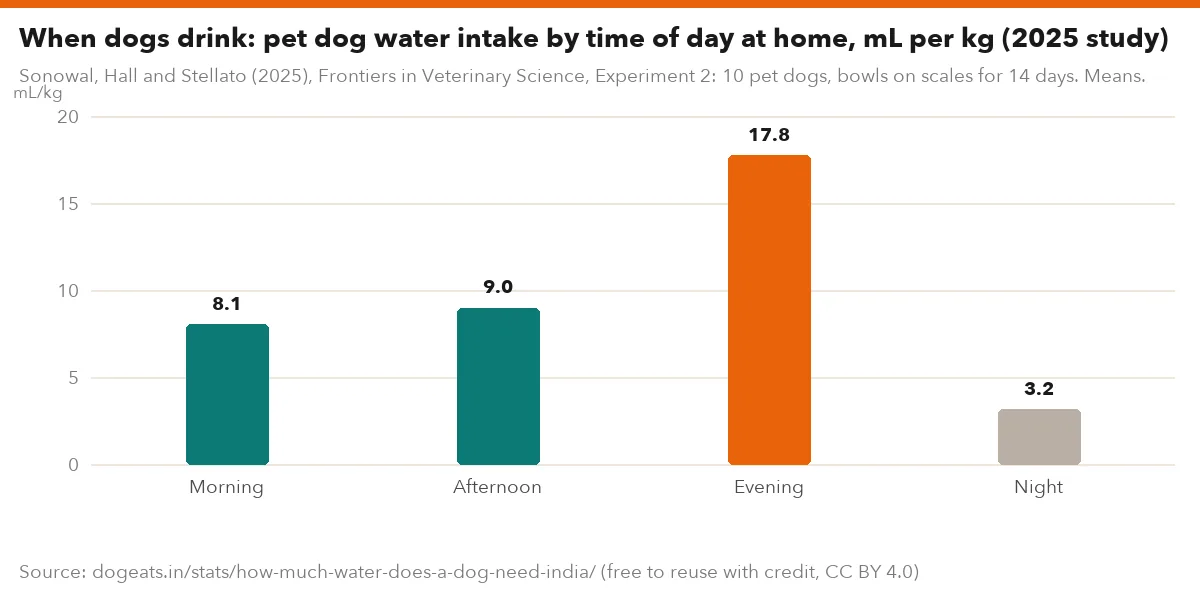
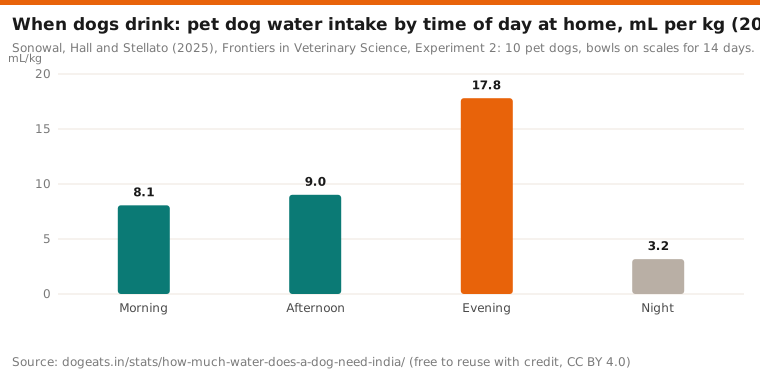
Sonowal, Hall and Stellato (2025), Frontiers in Veterinary Science, Experiment 2: 10 pet dogs, bowls on scales for 14 days. Means. Funded by Logical Brands.
Show the numbers
| Label | mL/kg |
|---|---|
| Morning | 8.1 |
| Afternoon | 9.0 |
| Evening | 17.8 |
| Night | 3.2 |
Embed this chart
The same paper used a second yardstick: adequate fluid is 2.5 g of water per g of dry matter eaten. Dogs on kibble reached 102% of it, and dogs on the fresh food 141%.
A 2025 Texas Tech study weighed the bowls of 10 pet dogs at home for 14 days. Dogs on dry food drank 44.5 mL per kg a day, and dogs on a wet and dry mix 23 mL per kg. Most drinking happened in the evening: 17.8 mL per kg, against 3.17 mL per kg at night. A bowl company, Logical Brands, funded the work.
Cooked home food such as rice and dal holds far more water than kibble. A dog on a home diet may drink less from the bowl and still be fine. Our adult dog feeding guide covers what goes in the bowl. Water-rich treats like cucumber and watermelon add some water too, within the serving advice in those guides.
How much more water does a dog need in Indian summer heat?
A dog's need for water may more than double in warm conditions, according to the National Research Council. By our calculation a moderately active 20 kg dog needs about 1 litre on a mild day. If that need doubled on a hot day, it would pass 2 litres. The doubling is our arithmetic on the NRC statement, not a measured summer figure.
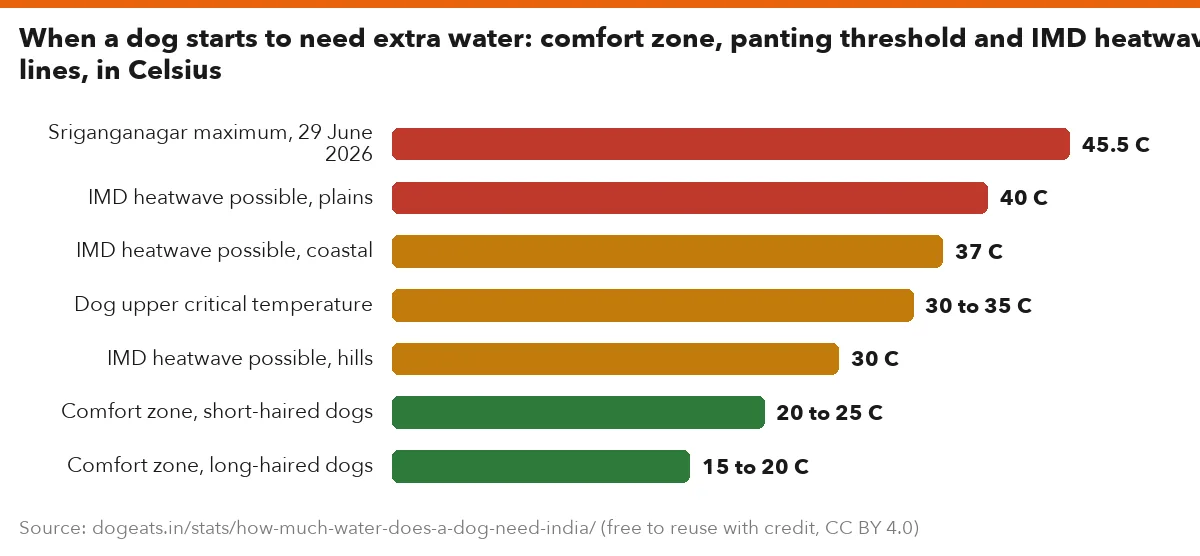
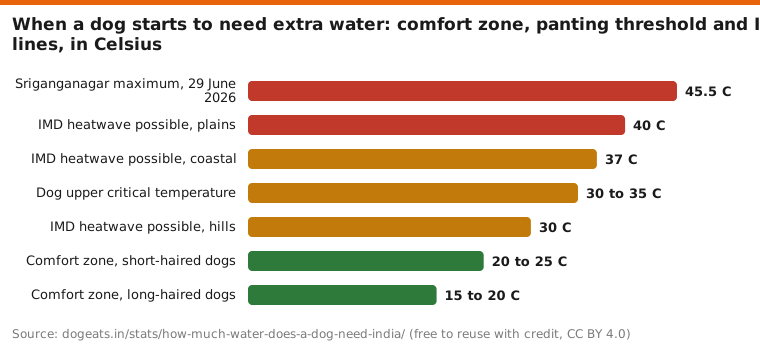
FEDIAF puts the comfortable, thermoneutral zone at 20 to 25 C for short-haired breeds and 15 to 20 C for long-haired ones. Above an upper critical temperature of about 30 to 35 C, a dog must shed heat by widening skin blood vessels or by panting, which evaporates water. Outside the comfort zone, FEDIAF adds, energy needs rise by 2 to 5 kcal per kg^0.75 for every degree. Widening skin vessels stops working once the air is as hot as the dog's rectal temperature, given in our dog temperature chart.
IMD considers a heatwave only once a plains station reaches at least 40 C, a coastal station 37 C or a hill station 30 C, and then applies departure-from-normal criteria. On 29 June 2026, maximums ran 40 to 44 C over many parts of the north-west plains outside Punjab, with 45.5 C at Sriganganagar in Rajasthan.
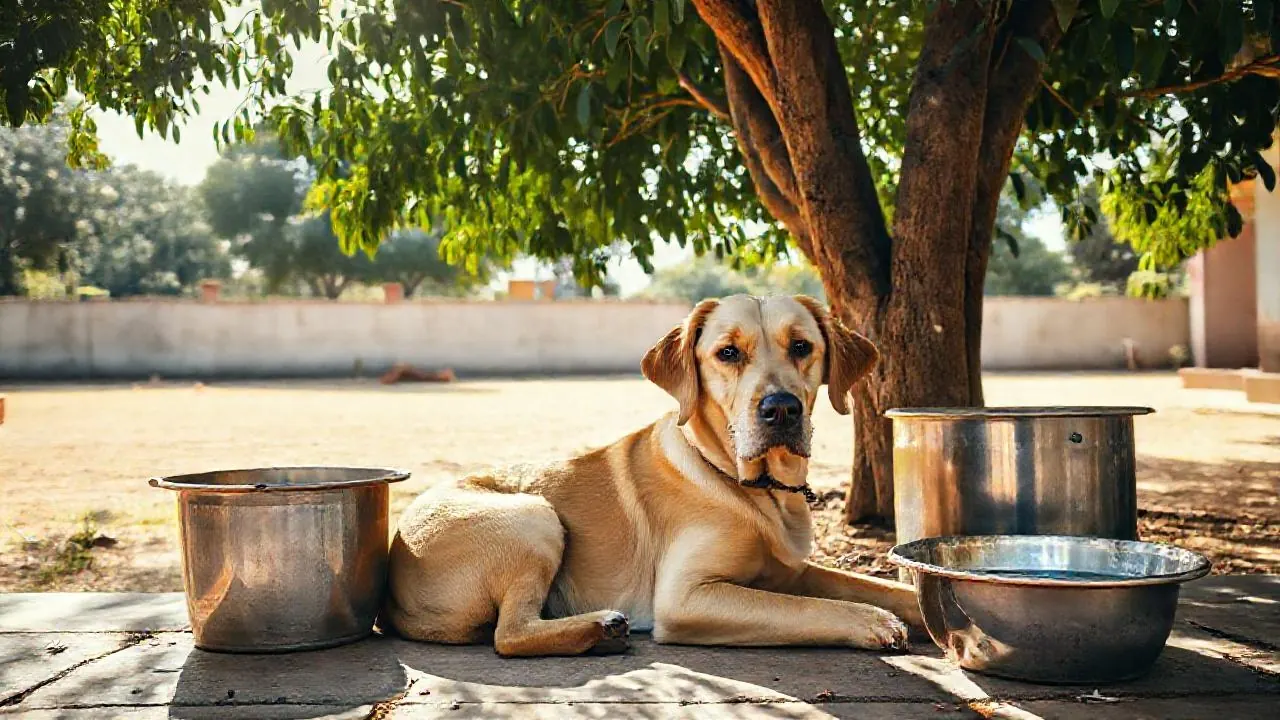
Thermoneutral and upper critical temperatures: FEDIAF Nutritional Guidelines 2024 (citing NRC 2006). Heatwave criteria and Sriganganagar reading: IMD heat bulletin of 30 June 2026. Bars for ranges show the top of the range.
Show the numbers
| Label | C |
|---|---|
| Sriganganagar maximum, 29 June 2026 | 45.5 C |
| IMD heatwave possible, plains | 40 C |
| IMD heatwave possible, coastal | 37 C |
| Dog upper critical temperature | 30 to 35 C |
| IMD heatwave possible, hills | 30 C |
| Comfort zone, short-haired dogs | 20 to 25 C |
| Comfort zone, long-haired dogs | 15 to 20 C |
Embed this chart
| Hydration method | Drank during shift (mL per kg an hour, mean) |
|---|---|
| Plain water, free access | 7.04 |
| Chicken-flavoured oral electrolyte solution | 15.61 |
| Fluids under the skin before the shift, then water | 5.56 |
The working-dog figures come from a 2017 Penn Vet study of 7 Border Patrol detection dogs (5 Belgian Malinois, 2 German Shepherds) averaging 30.6 kg. They worked shifts of about 5.7 hours at a checkpoint in Sarita, Texas. The median temperature was 29.3 C (range 23.3 to 37.7 C) with 70% humidity, milder than an Indian heatwave day.
At 7 mL per kg an hour, a 30 kg dog works out to about 210 mL of plain water for every hour of work. The figure is our arithmetic under the study conditions. Dogs given a flavoured electrolyte drink took in more than twice as much fluid.
For heat limits on walks, see how hot is too hot for dogs, and for state-by-state heatwave counts, our report on heatwave days and dog heatstroke risk. The summer heatstroke prevention guide covers cooling at home, and dog heatstroke statistics show what happens when cooling fails.
How much water is too much for a dog to drink in a day?
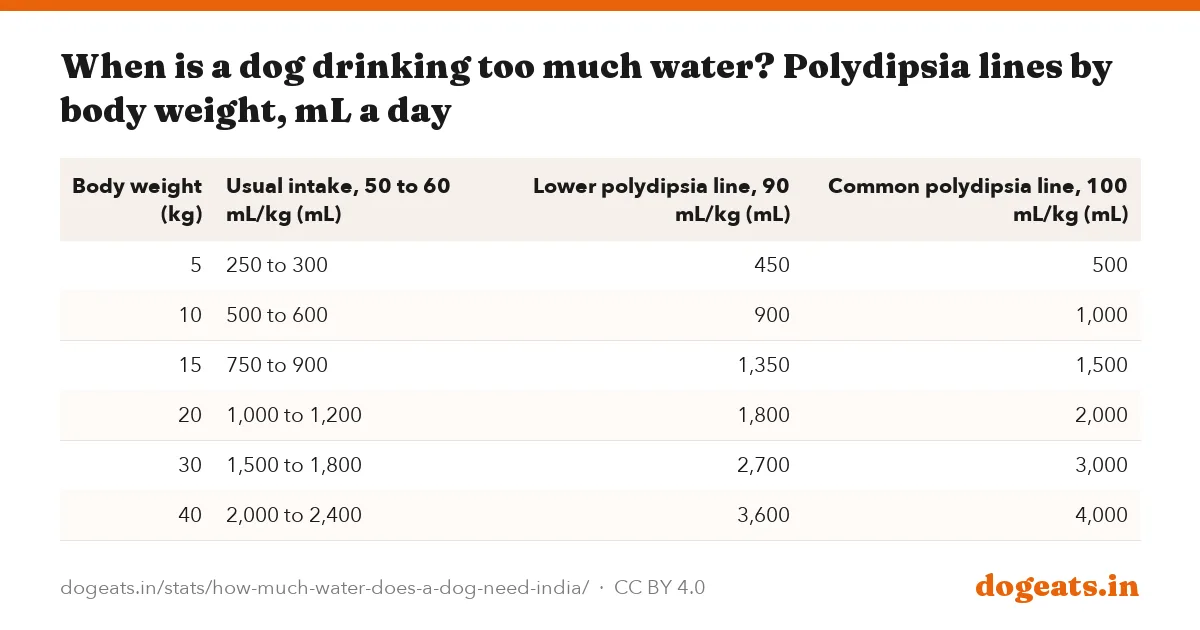
Vets define polydipsia, or excessive drinking, as a fluid intake of more than 100 mL per kg a day, according to a 2008 WSAVA congress paper. For a 10 kg dog that is more than 1 litre a day.
Some vets use a lower line. A 2003 dvm360 article by veterinary internist Carl Osborne says normal intake usually stays under about 90 mL per kg a day in dogs.
The same WSAVA paper defines excess urine, polyuria, as more than 50 mL per kg a day. Normal urine output is about 20 to 40 mL per kg a day, or 1 to 2 mL per kg an hour.
| Body weight (kg) | Usual intake, 50 to 60 mL/kg (mL) | Lower polydipsia line, 90 mL/kg (mL) | Common polydipsia line, 100 mL/kg (mL) |
|---|---|---|---|
| 5 | 250 to 300 | 450 | 500 |
| 10 | 500 to 600 | 900 | 1,000 |
| 15 | 750 to 900 | 1,350 | 1,500 |
| 20 | 1,000 to 1,200 | 1,800 | 2,000 |
| 30 | 1,500 to 1,800 | 2,700 | 3,000 |
| 40 | 2,000 to 2,400 | 3,600 | 4,000 |
Merck's owner guide says excessive thirst and urination are usually the earliest signs of chronic kidney disease in dogs. Kidney disease is not the only cause, so finding the reason takes a vet's examination and tests.
A dog that drinks a lot after a hot walk is not polydipsic. The line describes a sustained daily total, measured over a normal day.
Do puppies, nursing mothers and working dogs need more water?
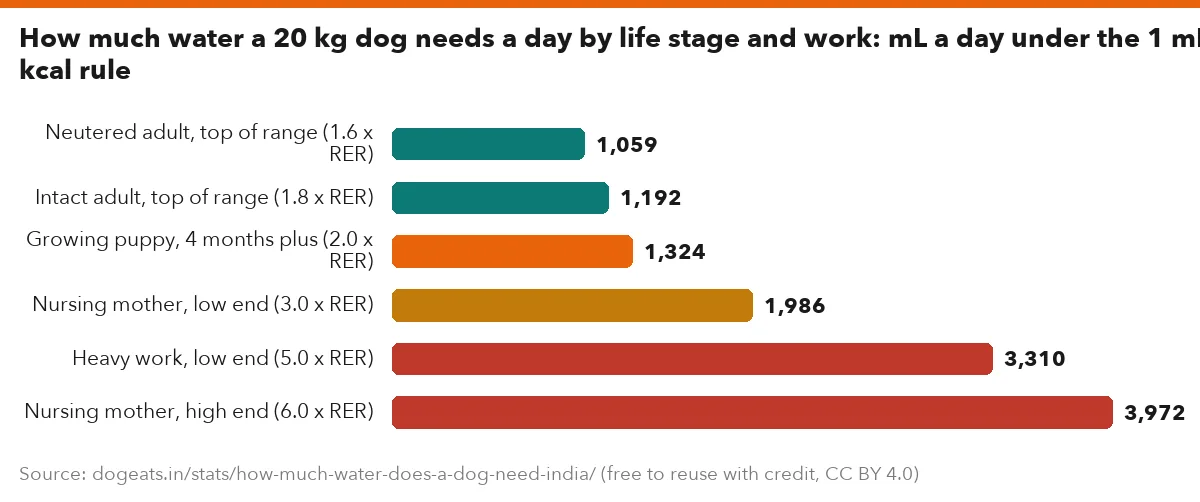
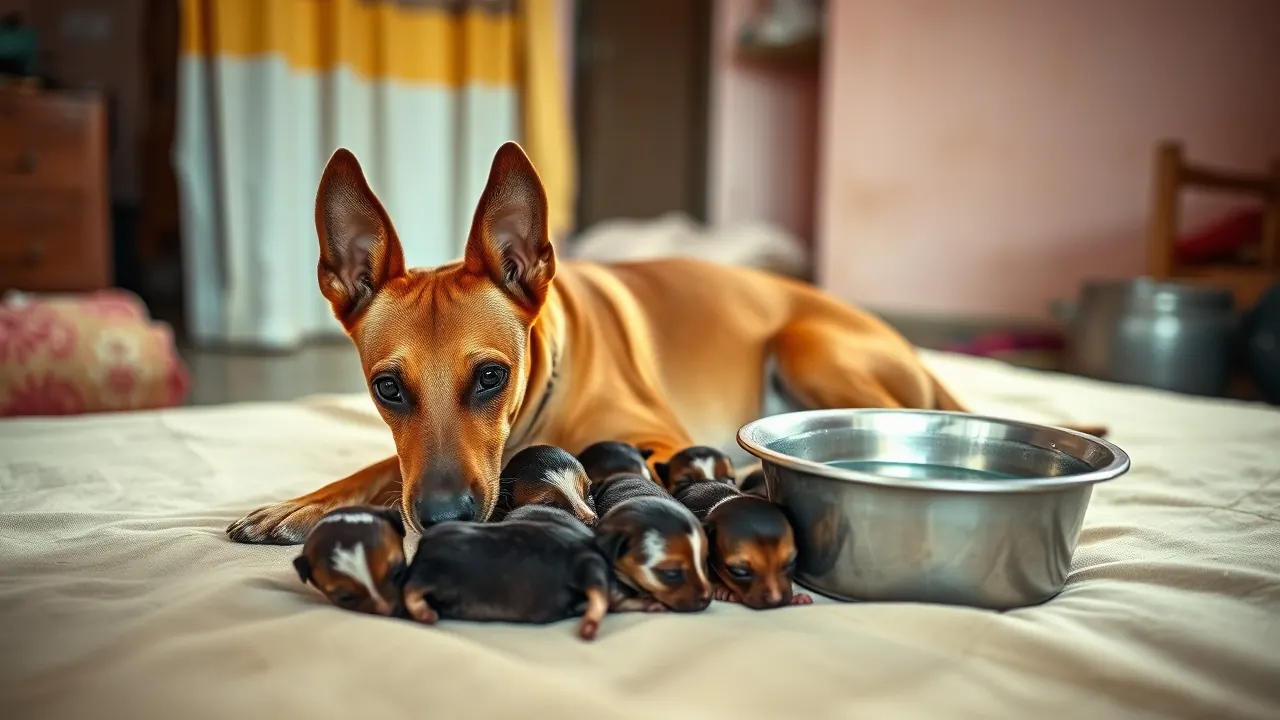
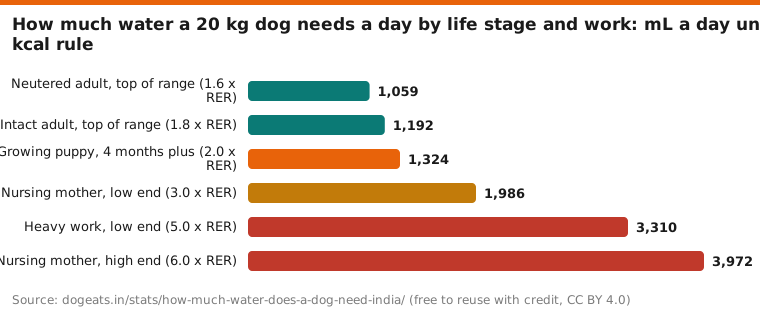
Yes. A dog's water need tracks its energy use, and a nursing mother can need 3 to 6 times her resting energy. Under the 1 mL per kcal rule, she would need roughly 2 to 4 litres of water a day at 20 kg, by our calculation.
The multipliers come from AAHA's 2021 nutrition guidelines. A 20 kg dog's resting energy is about 662 kcal a day (70 x kg^0.75). AAHA's factor is 1.4 to 1.6 for neutered adults, 2.0 for puppies 4 months and older, 3.0 to 6.0 or more for lactation and 5.0 to 11.0 for heavy work.
The National Research Council booklet for owners adds that a dog's need for water rises with the energy it spends in exercise. It advises actively offering water during exercise.
Computed by dogeats.in: resting energy 70 x 20^0.75 = 662 kcal (AAHA 2021) x AAHA canine life-stage factor, then 1 mL water per kcal (NRC 2006, as cited in 2018). Minimum total water.
Show the numbers
| Label | mL |
|---|---|
| Neutered adult, top of range (1.6 x RER) | 1,059 |
| Intact adult, top of range (1.8 x RER) | 1,192 |
| Growing puppy, 4 months plus (2.0 x RER) | 1,324 |
| Nursing mother, low end (3.0 x RER) | 1,986 |
| Heavy work, low end (5.0 x RER) | 3,310 |
| Nursing mother, high end (6.0 x RER) | 3,972 |
Embed this chart
These are rough minimum totals. In the 2018 Purina study, total water intake ran 20% to 40% above the 1 to 1 rule. Puppy feeding amounts and meal timing are in our puppy feeding guide.
Big, active breeds feel the heat first. Our Labrador guide covers summer routines for this breed.
Frequently asked questions
How much water should a dog drink a day?
At least about 1 mL for every kcal it eats, under the NRC 2006 rule as cited by Purina researchers in 2018. By our calculation that is about 620 mL for a moderately active 10 kg dog and 1.4 litres for a 30 kg dog, before allowing for heat. Treat it as a rough guide.
How much water does a dog need per kg?
Roughly 44 to 66 mL per kg a day in mild weather, per the Merck Veterinary Manual. Healthy dogs on dry food measured 71 mL per kg a day in a 2018 study.
How much water should a 10 kg dog drink?
About 534 to 619 mL a day by our calculation from the energy rule, or 440 to 660 mL by the Merck per kg range. In 250 mL steel glasses, that comes to roughly 2 to 2.5 glasses.
How many litres of water does a Labrador need a day?
By our calculation, a 30 kg Labrador needs about 1.2 to 1.4 litres a day at low to moderate activity. It needs more in summer heat, when the need may more than double.
Do dogs need more water in summer?
Yes. The National Research Council says a dog's water need may more than double in warm conditions. Above an upper critical temperature of about 30 to 35 C, FEDIAF says a dog has to shed heat by panting or widening skin blood vessels.
How much water is too much for a dog?
More than 100 mL per kg a day is the usual definition of polydipsia, or 1 litre for a 10 kg dog. Some vets use 90 mL per kg.
Do dogs on wet food drink less water?
Yes, from the bowl. In a 2025 trial funded by the food's maker, beagles drank 423 g a day on dry kibble and 147 g on a 71% moisture fresh food. Total water was still higher on the fresh food.
Should I limit my dog's water?
No. The Merck Veterinary Manual says healthy animals given plenty of water regulate their own intake, and water should not be restricted. Keep clean water out at all times.
Methodology and limitations
Daily water figures by weight are computed by dogeats.in from two published rules. The NRC 2006 chapter on water gives about 1 mL of water per kcal of metabolisable energy as a conservative minimum. We took this from Zanghi and Gardner (2018), who quote it, because the NRC chapter itself was not readable online. Daily energy uses FEDIAF July 2024 Table VII-7: 95 kcal x kg^0.75 for low activity and 110 for moderate, low-impact activity.
The Merck range is 44 to 66 mL per kg multiplied by body weight. Polydipsia lines are 90 and 100 mL per kg multiplied by body weight. Life-stage figures use AAHA 2021 Box 1: resting energy = 70 x kg^0.75, times the canine life-stage factor, then 1 mL per kcal.
Values are rounded once from the exact formula to the nearest mL. Litres are mL divided by 1,000. Glasses assume a 250 mL steel glass, which is our assumption, not a published standard; Indian glasses and katoris vary in size. All computed figures are rough guides for healthy adult dogs, not requirements.
Study figures are taken as published in Zanghi and Gardner (2018), Sires, Yamka and Wakshlag (2025), Sonowal, Hall and Stellato (2025), Otto et al. (2017) and Schoeman (WSAVA 2008). The 63 to 73 mL per kg range is quoted by Zanghi and Gardner from English and Filippich (1980) and Thrasher et al. (1984), which we did not open.
Temperature thresholds come from FEDIAF 2024 (citing NRC 2006) and the IMD heat bulletin dated 30 June 2026, read in October 2026.
Sources
- Merck Veterinary Manual: Nutritional Requirements of Small Animals (Sanderson SL, updated September 2024), Water need 44 to 66 mL/kg in a thermoneutral environment; food moisture by type; do not restrict water
- National Research Council, Your Dog's Nutritional Needs: A Science-Based Guide for Pet Owners (2006), Water need rises with exercise and may more than double in warm conditions
- Zanghi BM, Gardner CL (2018), Total Water Intake and Urine Measures of Hydration in Adult Dogs Drinking Tap Water or a Nutrient-Enriched Water, Frontiers in Veterinary Science 5:317, NRC 2006 1:1 mL per kcal minimum; 16 dogs at 71 mL/kg a day; 1.2 to 1.4 mL per kcal
- Also consulted: Schoeman JP (2008), Approach to Polyuria and Polydipsia in the Dog, WSAVA World Congress Proceedings (VIN), FEDIAF Nutritional Guidelines for Complete and Complementary Pet Food for Cats and Dogs, July 2024, AAHA 2021 Nutrition and Weight Management Guidelines, Box 1: Energy Requirement Calculations, Sires R, Yamka R, Wakshlag J (2025), Feeding fresh food and providing water ad libitum..., Frontiers in Veterinary Science 12:1675990, Otto CM et al. (2017), Evaluation of Three Hydration Strategies in Detection Dogs Working in a Hot Environment, Frontiers in Veterinary Science 4:174, Osborne CA (2003), The ins and outs of polyuria and polydipsia, dvm360, Sonowal R, Hall NJ, Stellato AC (2025), Individual preferences for scented water bowls in dogs, Frontiers in Veterinary Science, India Meteorological Department: all-India heat bulletin and heatwave criteria (bulletin dated 30 June 2026), Merck Veterinary Manual, Dog Owner version: Noninfectious Diseases of the Urinary System in Dogs, English P, Filippich L (1980), Measurement of daily water intake in the dog, Journal of Small Animal Practice 21:189-93 (cited via Zanghi and Gardner; not opened), Thrasher T et al. (1984), Sodium balance and aldosterone during dehydration and rehydration in the dog, American Journal of Physiology 247:R76-83 (cited via Zanghi and Gardner; not opened).
Cite, embed and download
This report, its data and its images are free to reuse under a Creative Commons Attribution 4.0 licence. Credit dogeats.in with a link to this page. Every chart has its own embed code, every table has a CSV and an image download, and the images below are ready for social posts, slides and articles.
Cite this report
Link to this report
Every chart and table as an image