Data report · Updated October 2026
How Many Hours Do Dogs Sleep in a Day? What Owner Surveys, Activity Monitors and Sleep EEG Show
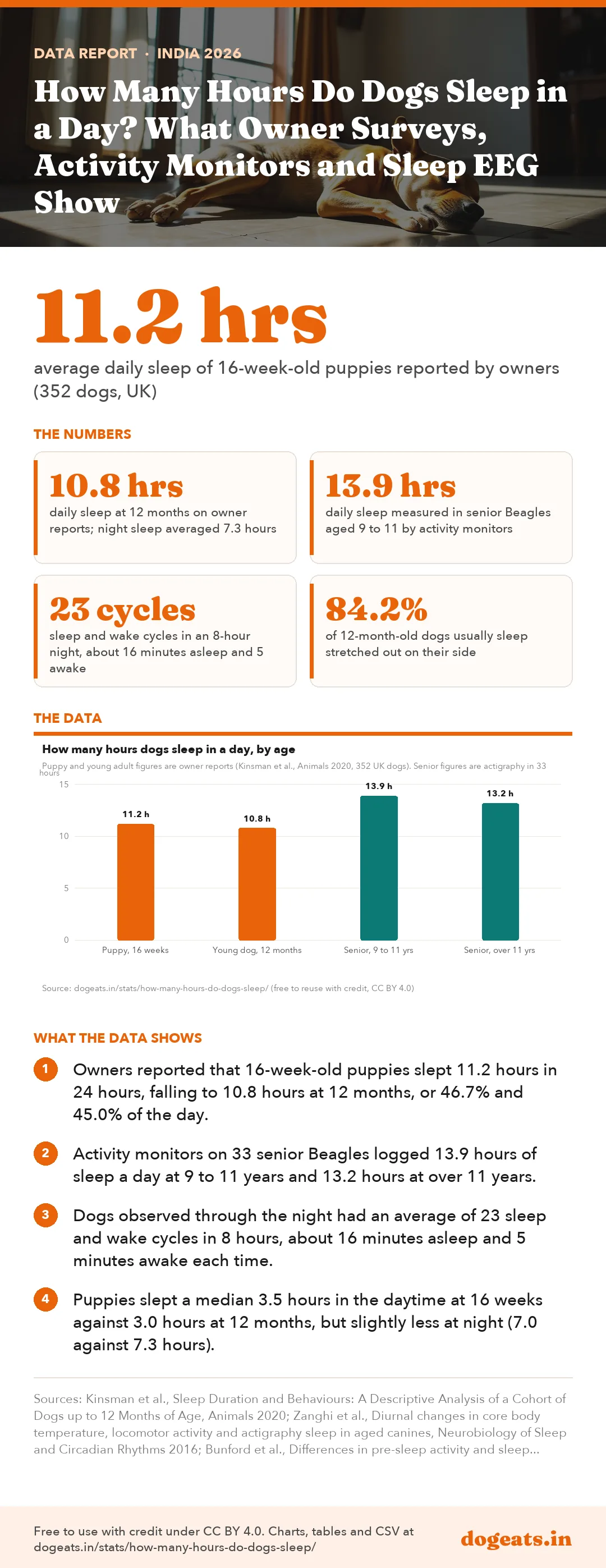
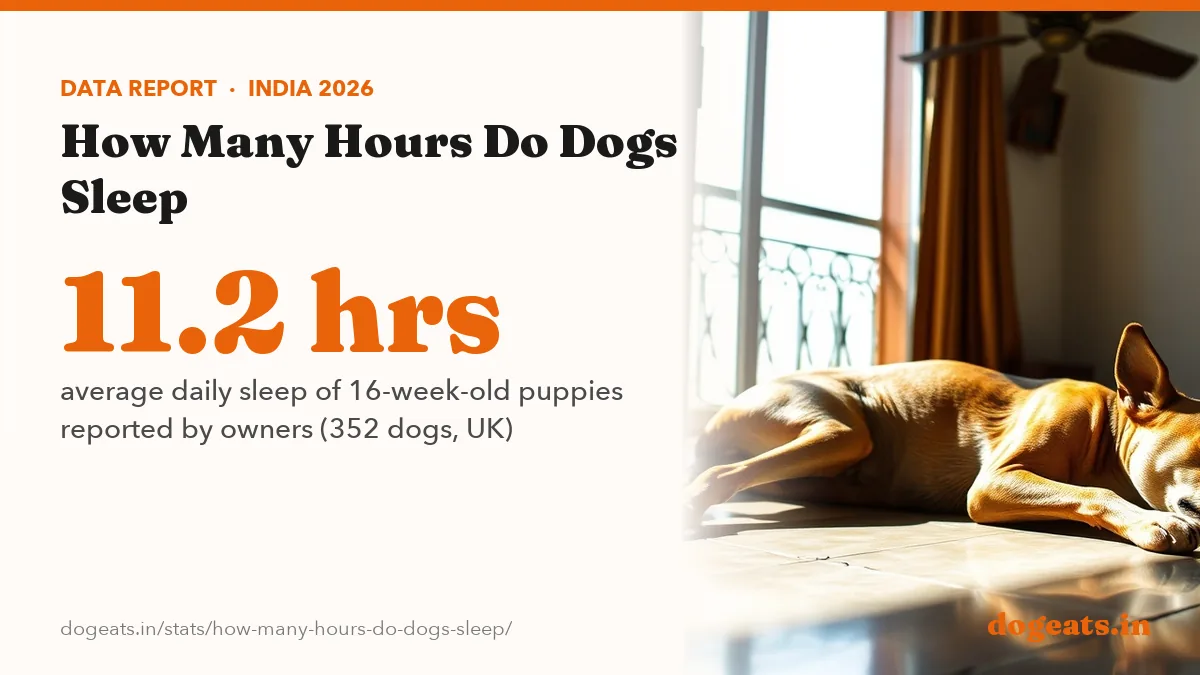
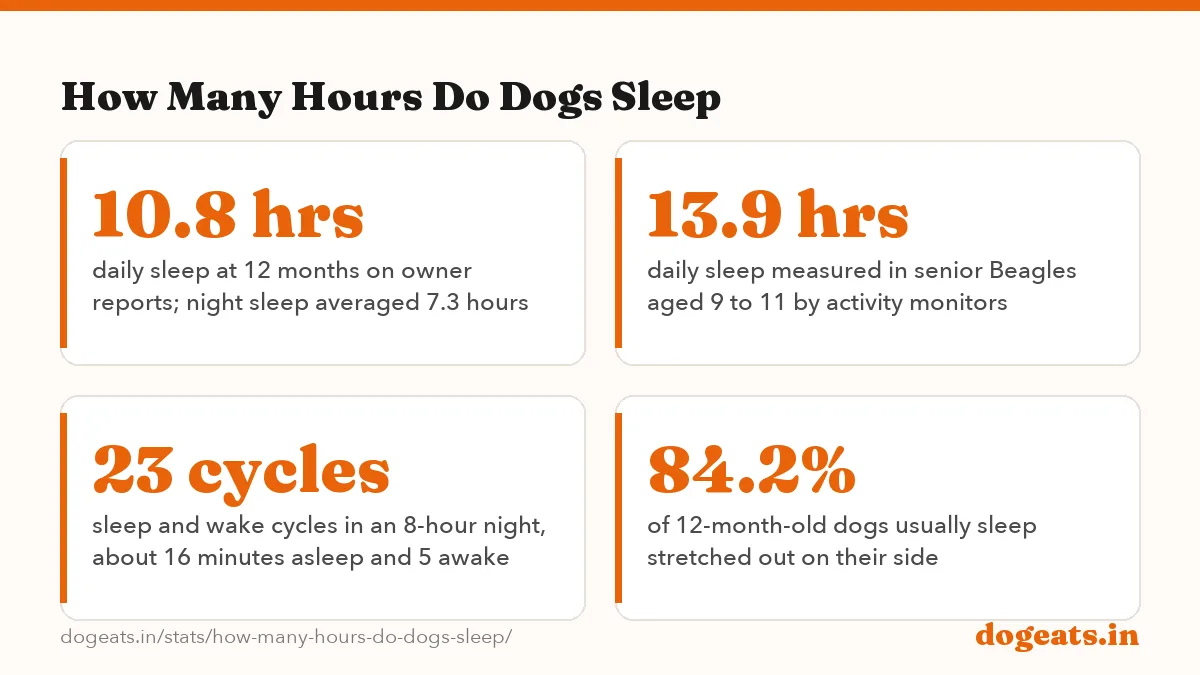
Measured studies put dogs at about 11 to 14 hours of sleep in 24 hours. UK owners reported 11.2 hours a day for 16-week-old puppies and 10.8 hours at 12 months. Activity monitors on 33 senior Beagles recorded 13.2 to 13.9 hours. Dogs sleep in short bouts, with an average of 23 sleep and wake cycles in an 8-hour night.
Key findings
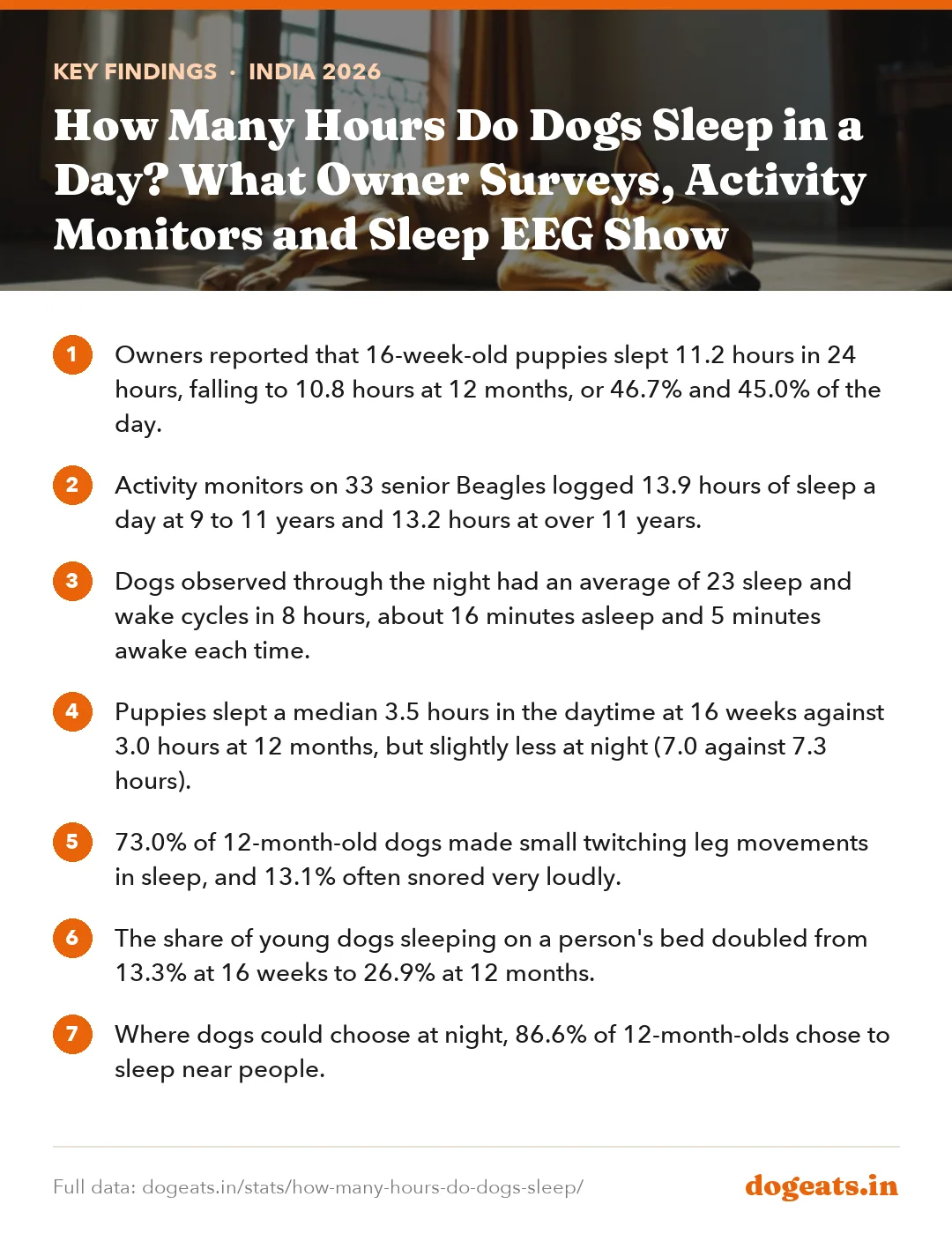
- Owners reported that 16-week-old puppies slept 11.2 hours in 24 hours, falling to 10.8 hours at 12 months, or 46.7% and 45.0% of the day.
- Activity monitors on 33 senior Beagles logged 13.9 hours of sleep a day at 9 to 11 years and 13.2 hours at over 11 years.
- Dogs observed through the night had an average of 23 sleep and wake cycles in 8 hours, about 16 minutes asleep and 5 minutes awake each time.
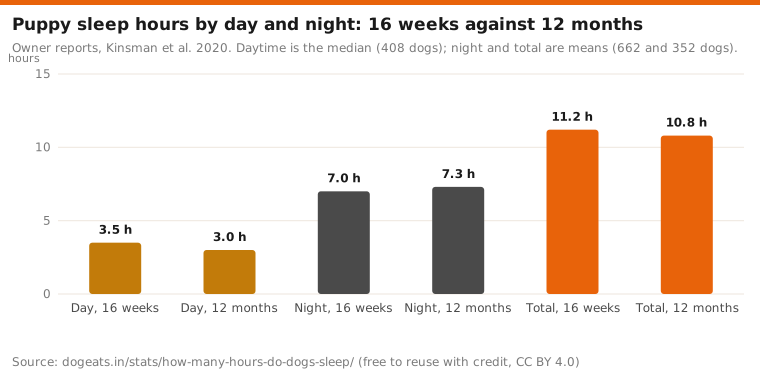
- Puppies slept a median 3.5 hours in the daytime at 16 weeks against 3.0 hours at 12 months, but slightly less at night (7.0 against 7.3 hours).
- 73.0% of 12-month-old dogs made small twitching leg movements in sleep, and 13.1% often snored very loudly.
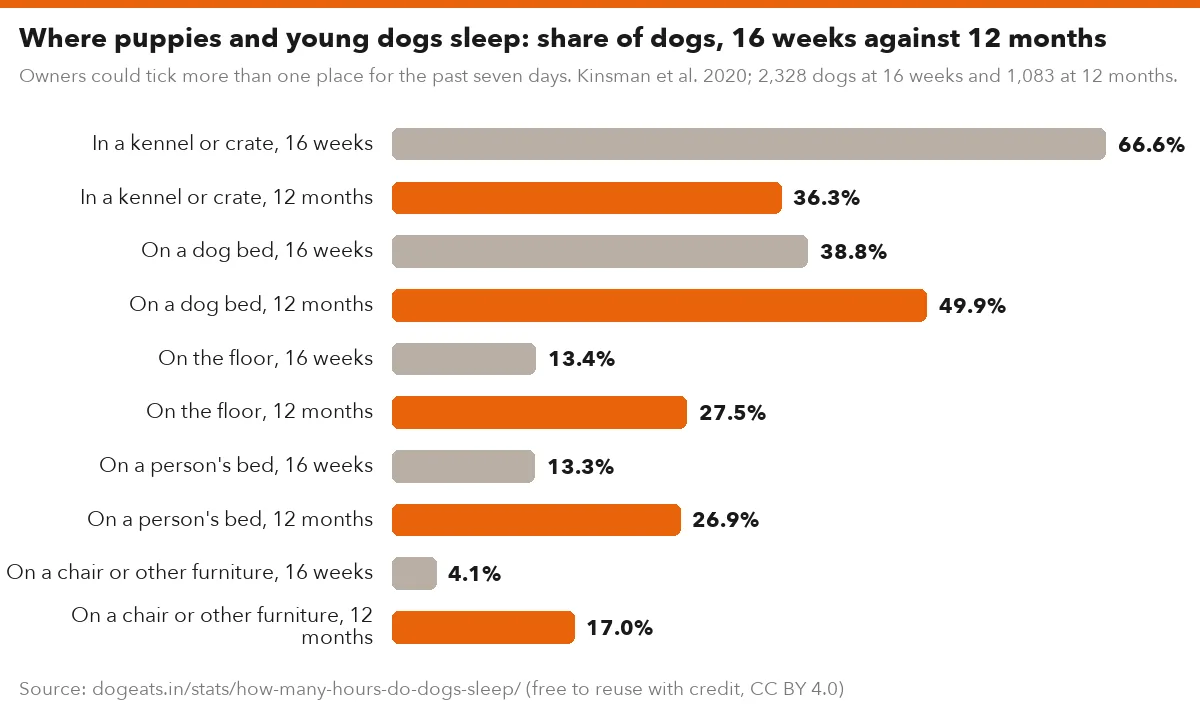
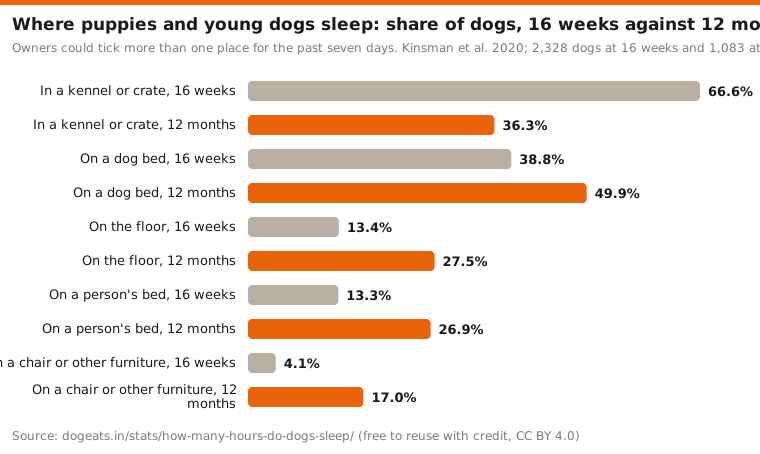
- The share of young dogs sleeping on a person's bed doubled from 13.3% at 16 weeks to 26.9% at 12 months.
- Where dogs could choose at night, 86.6% of 12-month-olds chose to sleep near people.
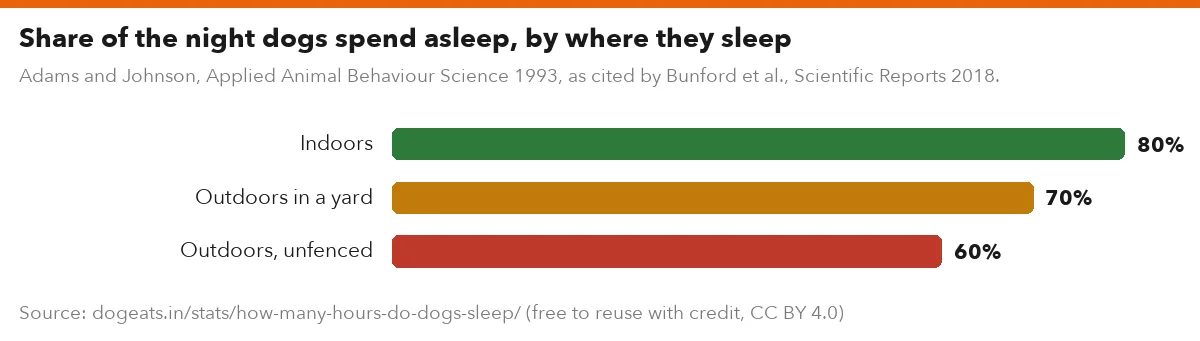
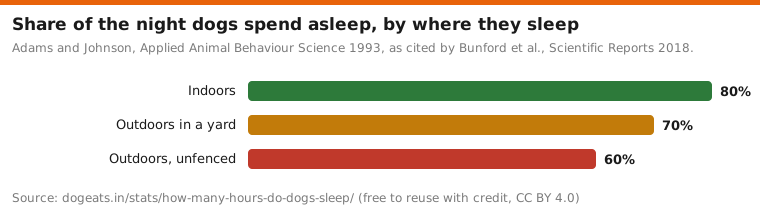
- Earlier studies found pet dogs slept 80% of the night indoors, 70% in a yard and 60% in an unfenced outdoor area.
- Free-ranging dogs in West Bengal were more than 50% active only between 9 am and 10.30 pm across 5,669 sightings.
How many hours do dogs sleep in a day?
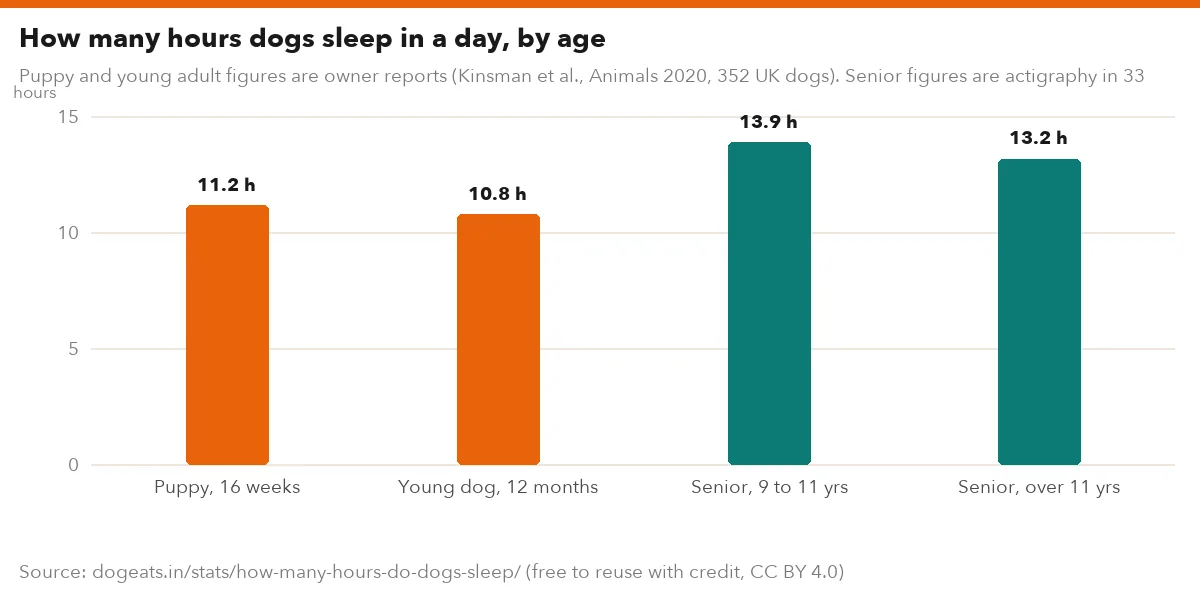
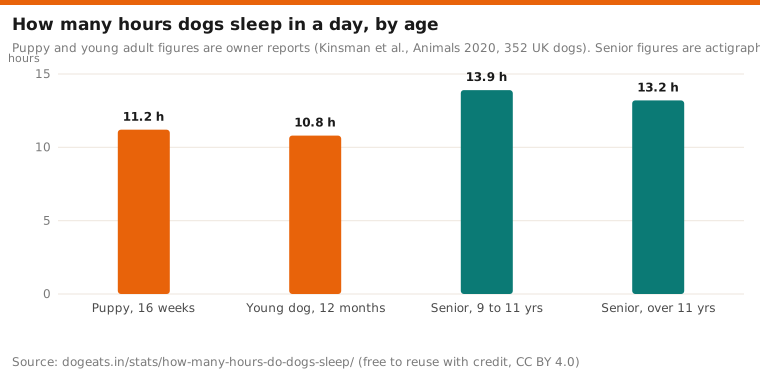
Measured studies put most dogs at about 11 to 14 hours in every 24. A large owner survey, of UK puppies in the Dogs Trust Generation Pup study, put total sleep at 11.2 hours at 16 weeks and 10.8 hours at 12 months.
Senior dogs measured with collar activity monitors slept longer. Beagles aged 9 to 11 logged 13.9 hours a day, and those over 11 logged 13.2 hours. Those were laboratory dogs on a 12-hour light and dark schedule.
A 2018 sleep study from Hungary, summarising a 2013 review, puts daily sleep in dogs at 8 to 14 hours. Humans need about 8 hours.
Puppy and young adult figures are owner reports (Kinsman et al., Animals 2020, 352 UK dogs). Senior figures are actigraphy in 33 laboratory Beagles (Zanghi et al. 2016), day plus night sleep. Methods differ.
Show the numbers
| Label | hours |
|---|---|
| Puppy, 16 weeks | 11.2 h |
| Young dog, 12 months | 10.8 h |
| Senior, 9 to 11 yrs | 13.9 h |
| Senior, over 11 yrs | 13.2 h |
Embed this chart
| Study | Dogs | Method | Sleep finding |
|---|---|---|---|
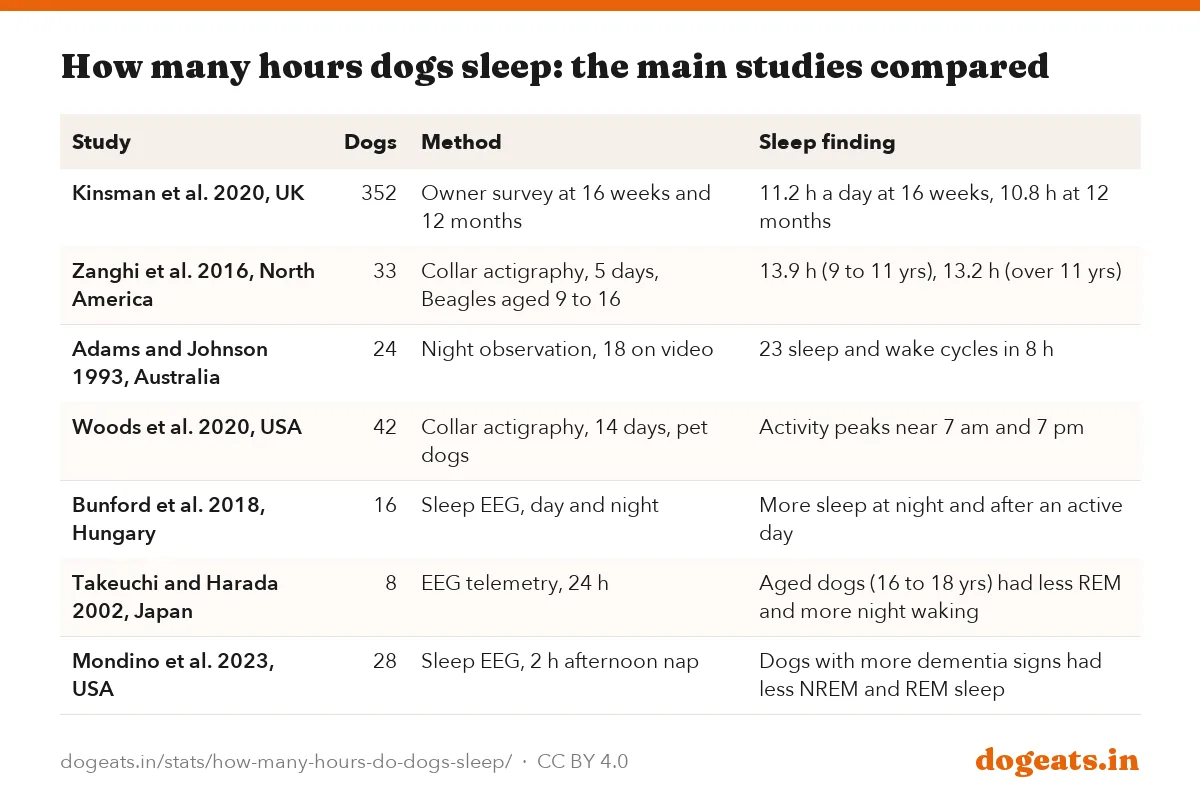
| Kinsman et al. 2020, UK | 352 | Owner survey at 16 weeks and 12 months | 11.2 h a day at 16 weeks, 10.8 h at 12 months |
| Zanghi et al. 2016, North America | 33 | Collar actigraphy, 5 days, Beagles aged 9 to 16 | 13.9 h (9 to 11 yrs), 13.2 h (over 11 yrs) |
| Adams and Johnson 1993, Australia | 24 | Night observation, 18 on video | 23 sleep and wake cycles in 8 h |
| Woods et al. 2020, USA | 42 | Collar actigraphy, 14 days, pet dogs | Activity peaks near 7 am and 7 pm |
| Bunford et al. 2018, Hungary | 16 | Sleep EEG, day and night | More sleep at night and after an active day |
| Takeuchi and Harada 2002, Japan | 8 | EEG telemetry, 24 h | Aged dogs (16 to 18 yrs) had less REM and more night waking |
| Mondino et al. 2023, USA | 28 | Sleep EEG, 2 h afternoon nap | Dogs with more dementia signs had less NREM and REM sleep |
How much do puppies sleep?
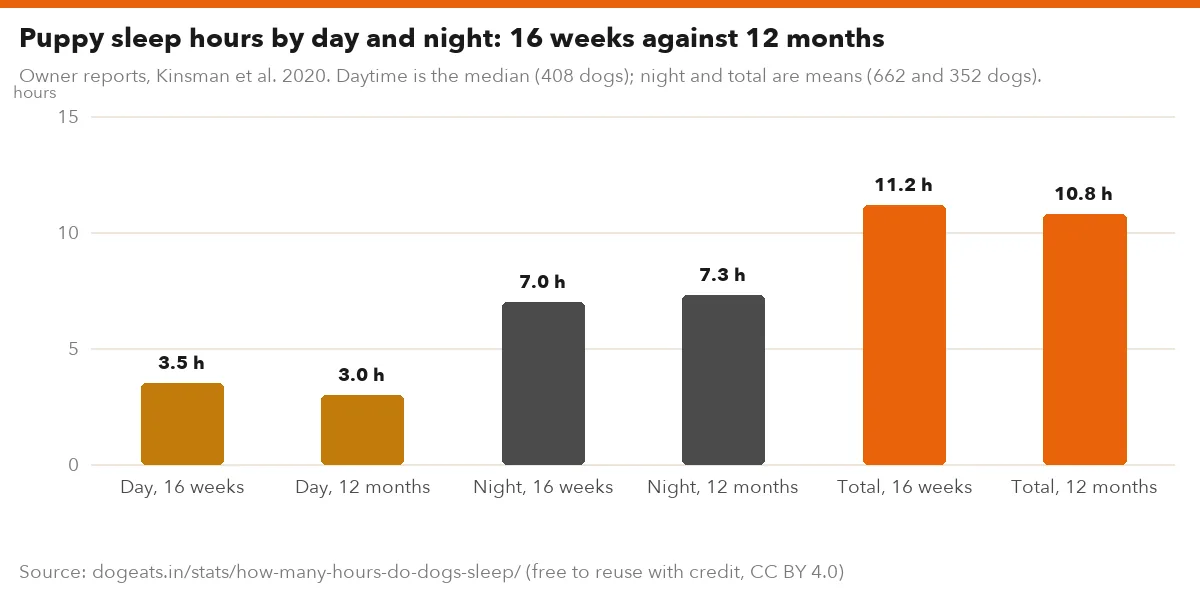
Puppies sleep more in the daytime than adult dogs. At 16 weeks, owners reported a median 3.5 hours of daytime sleep against 3.0 hours at 12 months, in 408 dogs followed at both ages.
Night sleep ran the other way. Puppies slept 7.0 hours at night on average, and the same dogs slept 7.3 hours at 12 months. Total sleep fell from 11.2 to 10.8 hours, a small but significant drop.
Many owners could not say how long their puppy slept. Only 58.1% of 16-week owners could estimate daytime sleep, against 81.3% for night sleep.
Owner reports, Kinsman et al. 2020. Daytime is the median (408 dogs); night and total are means (662 and 352 dogs).
Show the numbers
| Label | hours |
|---|---|
| Day, 16 weeks | 3.5 h |
| Day, 12 months | 3.0 h |
| Night, 16 weeks | 7.0 h |
| Night, 12 months | 7.3 h |
| Total, 16 weeks | 11.2 h |
| Total, 12 months | 10.8 h |
Embed this chart
| Measure | Dogs | 16 weeks (hours) | 12 months (hours) | Spread |
|---|---|---|---|---|
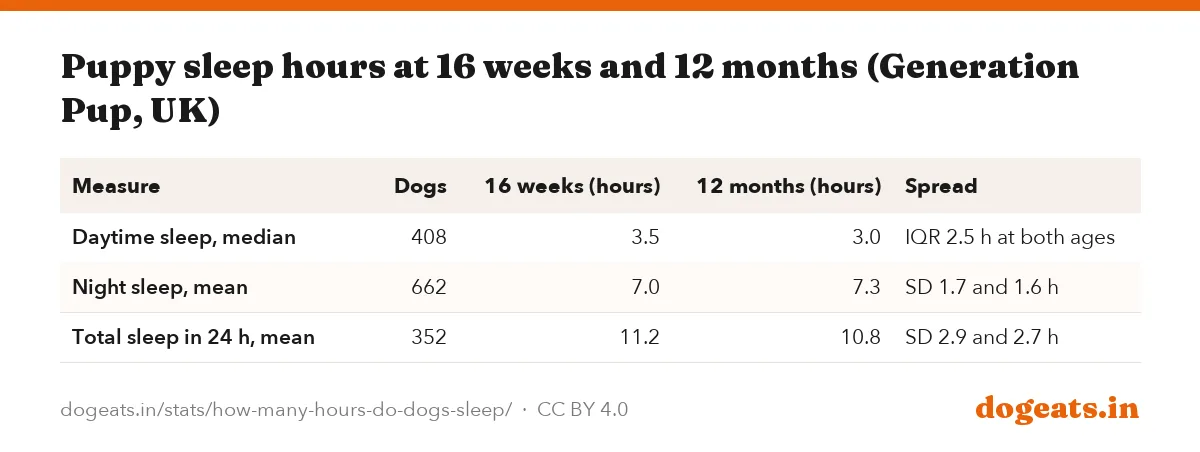
| Daytime sleep, median | 408 | 3.5 | 3.0 | IQR 2.5 h at both ages |
| Night sleep, mean | 662 | 7.0 | 7.3 | SD 1.7 and 1.6 h |
| Total sleep in 24 h, mean | 352 | 11.2 | 10.8 | SD 2.9 and 2.7 h |
Owners could tick more than one place for the past seven days. Kinsman et al. 2020; 2,328 dogs at 16 weeks and 1,083 at 12 months.
Show the numbers
| Label | % |
|---|---|
| In a kennel or crate, 16 weeks | 66.6% |
| In a kennel or crate, 12 months | 36.3% |
| On a dog bed, 16 weeks | 38.8% |
| On a dog bed, 12 months | 49.9% |
| On the floor, 16 weeks | 13.4% |
| On the floor, 12 months | 27.5% |
| On a person's bed, 16 weeks | 13.3% |
| On a person's bed, 12 months | 26.9% |
| On a chair or other furniture, 16 weeks | 4.1% |
| On a chair or other furniture, 12 months | 17.0% |
Embed this chart
By 12 months, half the dogs (49.9%) used a dog bed, and 26.9% had slept on a person's bed that week.
Do dogs sleep through the night?
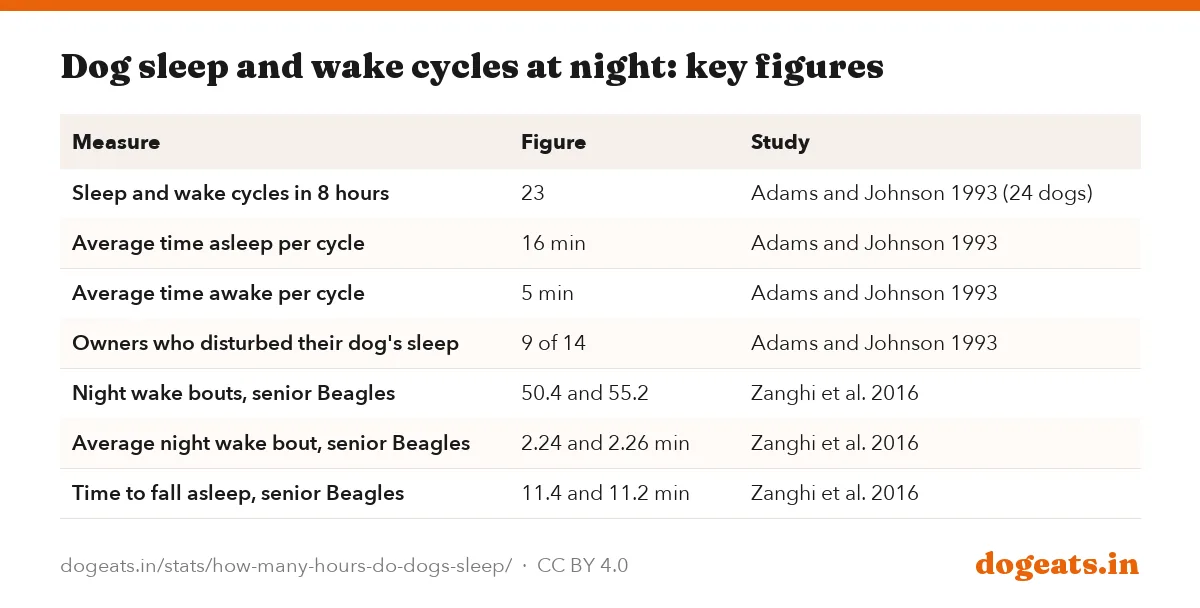
No. Dogs sleep in short bouts and wake often. In an Australian study of 24 pet dogs, each had an average of 23 sleep and wake cycles in an 8-hour night.
A typical cycle was about 16 minutes asleep and 5 minutes awake, so a dog spent roughly 76.2% of each cycle asleep. Those 23 cycles add up to about 6.1 hours of sleep in the 8 hours.
Owners are part of the pattern. In the same study, 9 of 14 owners disturbed their dog's sleep without meaning to, and 13 of the 18 dogs on video barked during the night.
Adams and Johnson, Applied Animal Behaviour Science 1993, as cited by Bunford et al., Scientific Reports 2018.
Show the numbers
| Label | % |
|---|---|
| Indoors | 80% |
| Outdoors in a yard | 70% |
| Outdoors, unfenced | 60% |
Embed this chart
| Measure | Figure | Study |
|---|---|---|
| Sleep and wake cycles in 8 hours | 23 | Adams and Johnson 1993 (24 dogs) |
| Average time asleep per cycle | 16 min | Adams and Johnson 1993 |
| Average time awake per cycle | 5 min | Adams and Johnson 1993 |
| Owners who disturbed their dog's sleep | 9 of 14 | Adams and Johnson 1993 |
| Night wake bouts, senior Beagles | 50.4 and 55.2 | Zanghi et al. 2016 |
| Average night wake bout, senior Beagles | 2.24 and 2.26 min | Zanghi et al. 2016 |
| Time to fall asleep, senior Beagles | 11.4 and 11.2 min | Zanghi et al. 2016 |
When two or more dogs slept together, their cycles were not in step on 31 occasions observed. They woke together only when something loud or sudden happened.
Do older dogs sleep more?
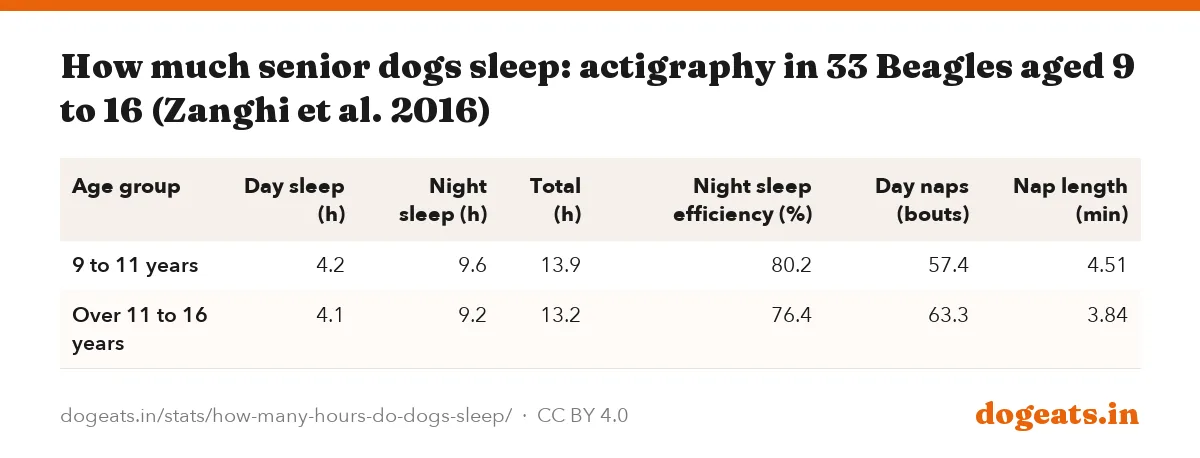
Yes, and their sleep is lighter. Senior Beagles in a North American study slept about 4.2 hours in the 12 daytime hours and 9.6 hours at night at age 9 to 11.
Daytime sleep came in many short naps, about 57 to 63 bouts lasting 3.8 to 4.5 minutes each. The oldest dogs had shorter naps. Dogs with weaker memory napped more.
A Japanese EEG study compared four dogs aged 16 to 18 with four aged 3 to 4. The old dogs had much less REM sleep, more slow-wave sleep in the daytime and more waking at night.
| Age group | Day sleep (h) | Night sleep (h) | Total (h) | Night sleep efficiency (%) | Day naps (bouts) | Nap length (min) |
|---|---|---|---|---|---|---|
| 9 to 11 years | 4.2 | 9.6 | 13.9 | 80.2 | 57.4 | 4.51 |
| Over 11 to 16 years | 4.1 | 9.2 | 13.2 | 76.4 | 63.3 | 3.84 |
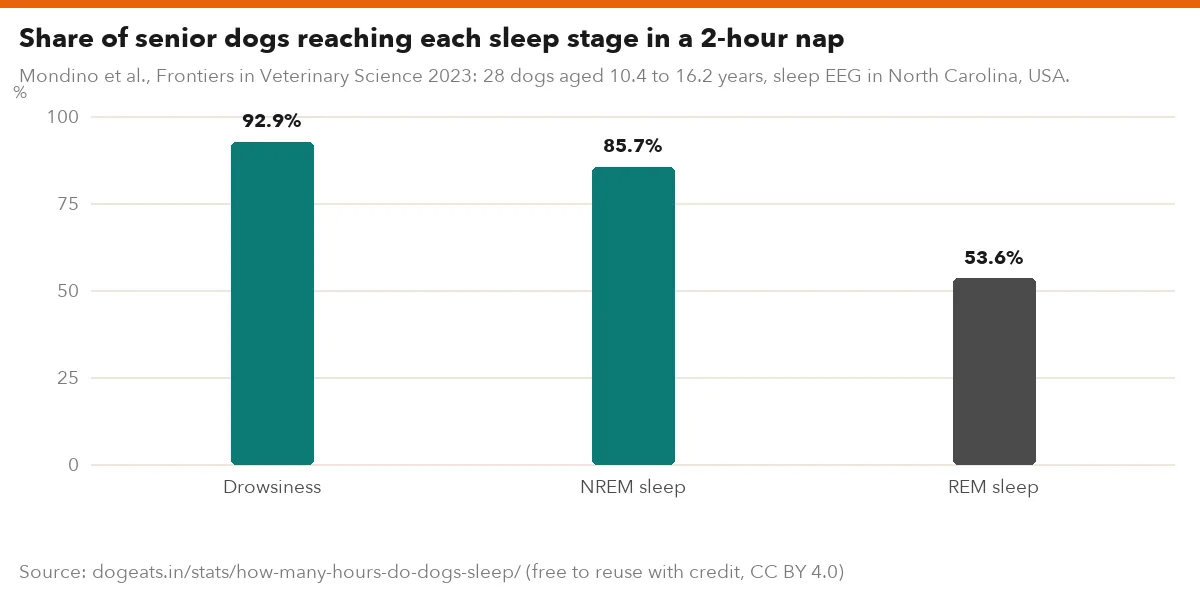
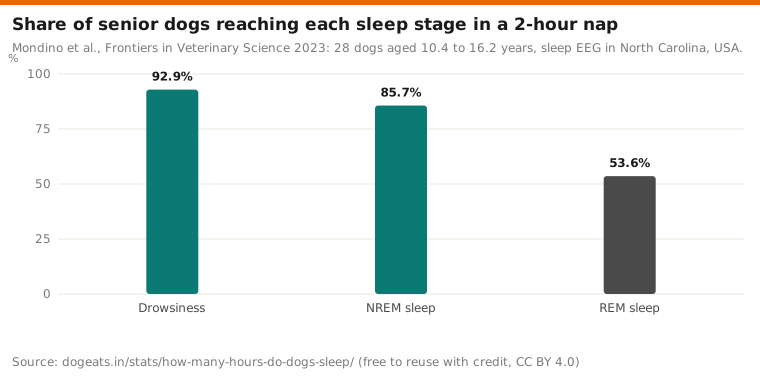
Mondino et al., Frontiers in Veterinary Science 2023: 28 dogs aged 10.4 to 16.2 years, sleep EEG in North Carolina, USA.
Show the numbers
| Label | % |
|---|---|
| Drowsiness | 92.9% |
| NREM sleep | 85.7% |
| REM sleep | 53.6% |
Embed this chart
In that 2023 study, 8 of the 28 senior dogs had severe signs of cognitive decline on a questionnaire. Dogs with higher dementia scores spent less time in NREM and REM sleep. If an older dog starts pacing or waking at night, see a vet.
What do dog sleeping positions and twitching mean?
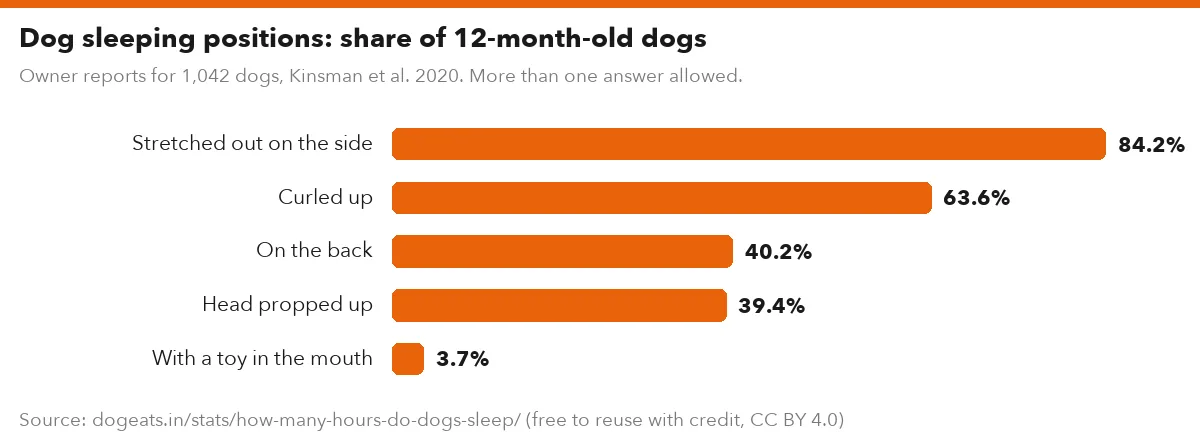
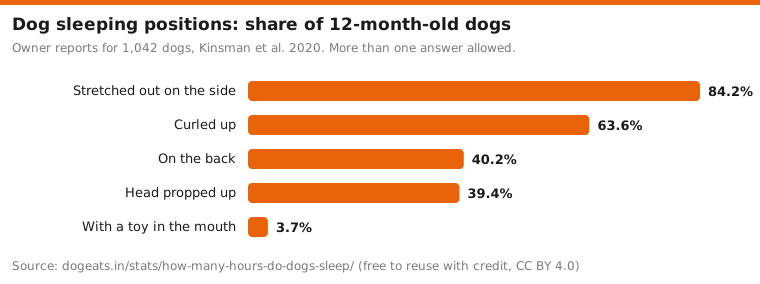
Most young dogs sleep on their side. Of 1,042 owners of 12-month-old dogs, 84.2% said their dog slept stretched out on its side and 63.6% said curled up. Owners could pick more than one position.
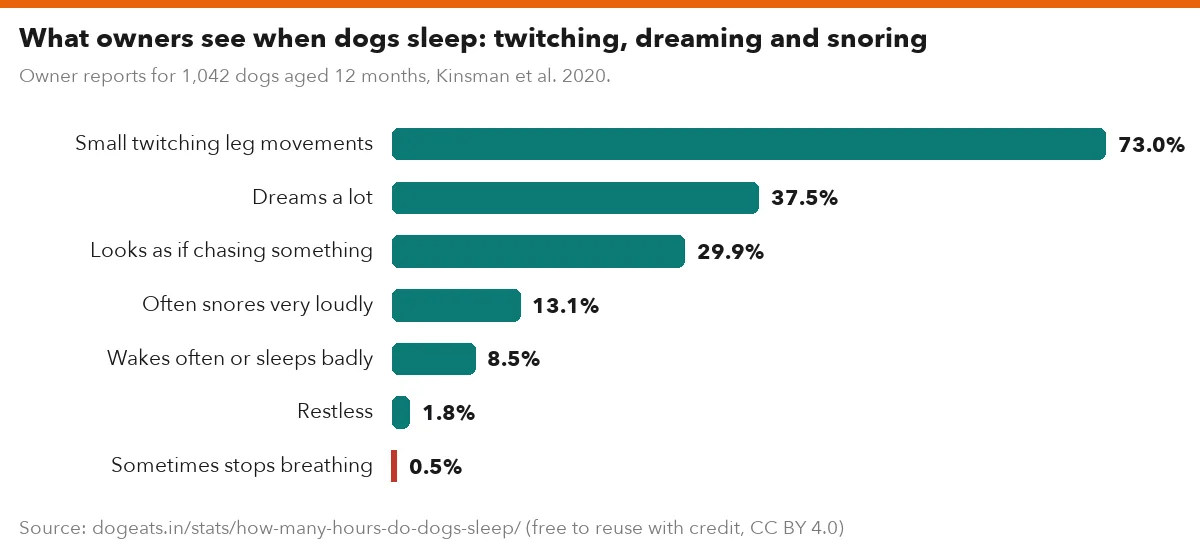
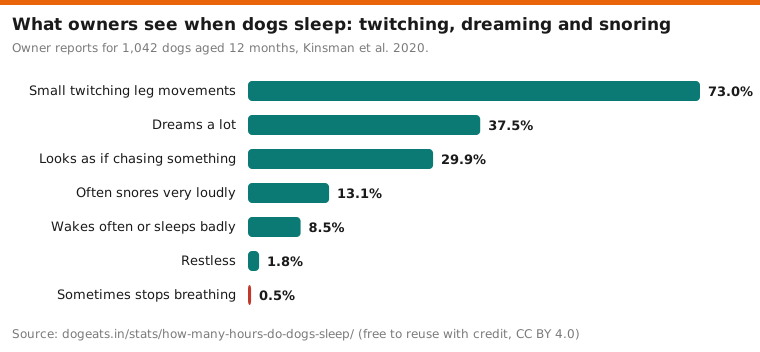
Twitching is common. 73.0% of owners saw small leg movements during sleep, 37.5% said their dog dreamed a lot and 29.9% said it looked as if it was chasing something.
Owner reports for 1,042 dogs, Kinsman et al. 2020. More than one answer allowed.
Show the numbers
| Label | % |
|---|---|
| Stretched out on the side | 84.2% |
| Curled up | 63.6% |
| On the back | 40.2% |
| Head propped up | 39.4% |
| With a toy in the mouth | 3.7% |
Embed this chart
Owner reports for 1,042 dogs aged 12 months, Kinsman et al. 2020.
Show the numbers
| Label | % |
|---|---|
| Small twitching leg movements | 73.0% |
| Dreams a lot | 37.5% |
| Looks as if chasing something | 29.9% |
| Often snores very loudly | 13.1% |
| Wakes often or sleeps badly | 8.5% |
| Restless | 1.8% |
| Sometimes stops breathing | 0.5% |
Embed this chart
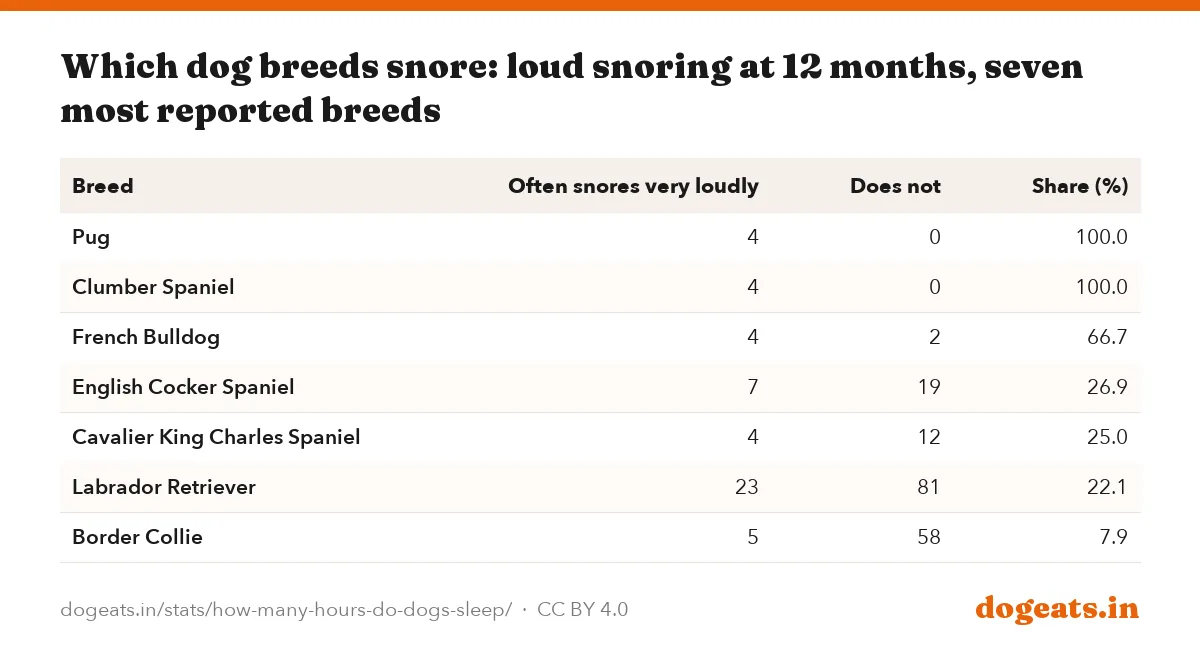
| Breed | Often snores very loudly | Does not | Share (%) |
|---|---|---|---|
| Pug | 4 | 0 | 100.0 |
| Clumber Spaniel | 4 | 0 | 100.0 |
| French Bulldog | 4 | 2 | 66.7 |
| English Cocker Spaniel | 7 | 19 | 26.9 |
| Cavalier King Charles Spaniel | 4 | 12 | 25.0 |
| Labrador Retriever | 23 | 81 | 22.1 |
| Border Collie | 5 | 58 | 7.9 |
Flat-faced breeds stand out, though the numbers are small. All 4 Pugs in the sample snored very loudly. A 2023 Hungarian EEG study of 92 dogs found that shorter-headed dogs spent more time asleep and more of it in REM sleep. Its authors suggest the breathing problems these breeds have may increase daytime sleepiness. Loud snoring with pauses in breathing is a reason to see a vet; see our Pug and French Bulldog guides.
Should a dog sleep in your bed or room?
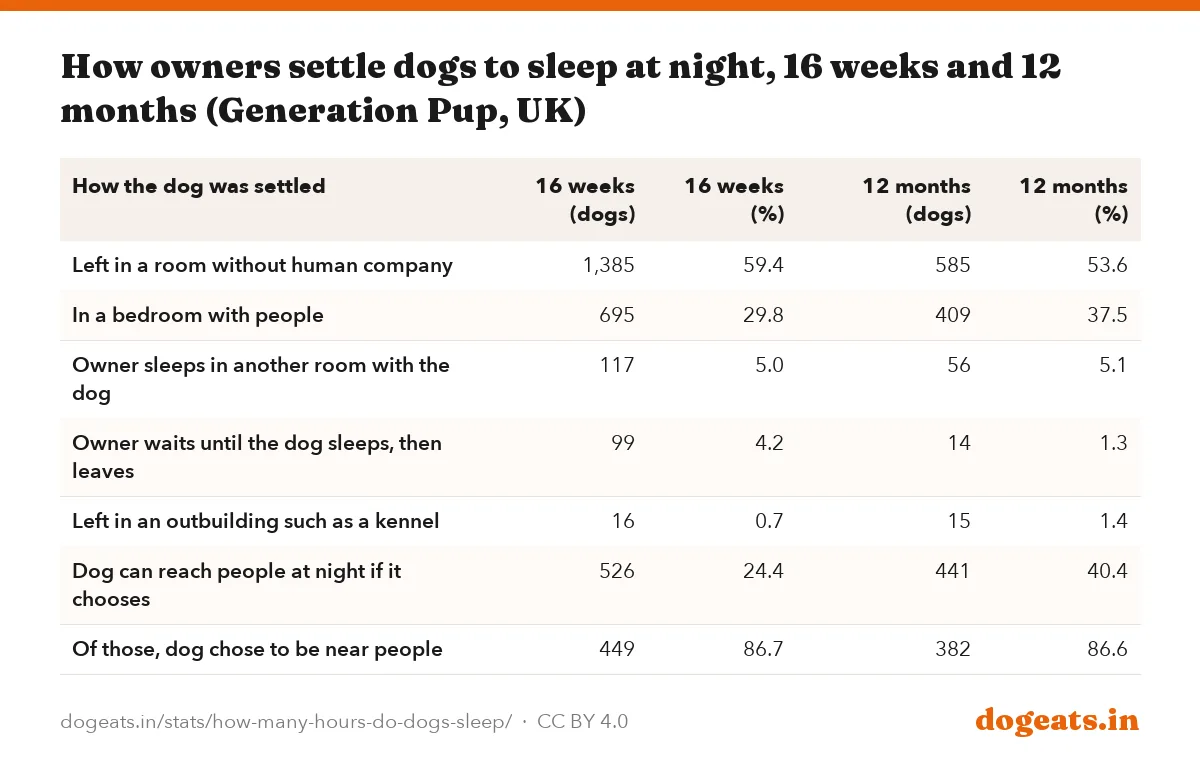
The data shows dogs prefer company at night. Among 12-month-old dogs that could reach people at night, 86.6% chose to sleep near them. The figure was 86.7% for puppies.
Yet most owners settled their dog alone. 59.4% of puppies and 53.6% of 12-month-olds were left in a room without human company at bedtime.
A small 2025 sleep EEG study in Hungary tested 9 dogs in an unfamiliar room. With their owner present, dogs fell asleep faster, slept more efficiently and spent more time in deep sleep than with a friendly stranger.
| How the dog was settled | 16 weeks (dogs) | 16 weeks (%) | 12 months (dogs) | 12 months (%) |
|---|---|---|---|---|
| Left in a room without human company | 1,385 | 59.4 | 585 | 53.6 |
| In a bedroom with people | 695 | 29.8 | 409 | 37.5 |
| Owner sleeps in another room with the dog | 117 | 5.0 | 56 | 5.1 |
| Owner waits until the dog sleeps, then leaves | 99 | 4.2 | 14 | 1.3 |
| Left in an outbuilding such as a kennel | 16 | 0.7 | 15 | 1.4 |
| Dog can reach people at night if it chooses | 526 | 24.4 | 441 | 40.4 |
| Of those, dog chose to be near people | 449 | 86.7 | 382 | 86.6 |
The best dog sleeping place is a household choice. A crate, a dog bed in the bedroom and a dog on the bed all appear in large numbers in the data. Pick one that lets everyone sleep.
How much do Indian street dogs sleep and rest?
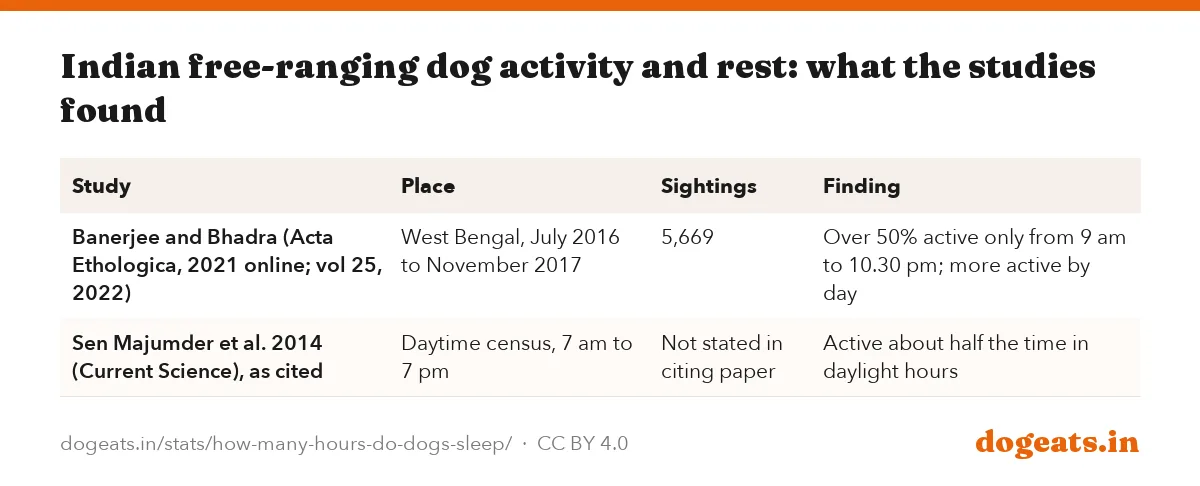
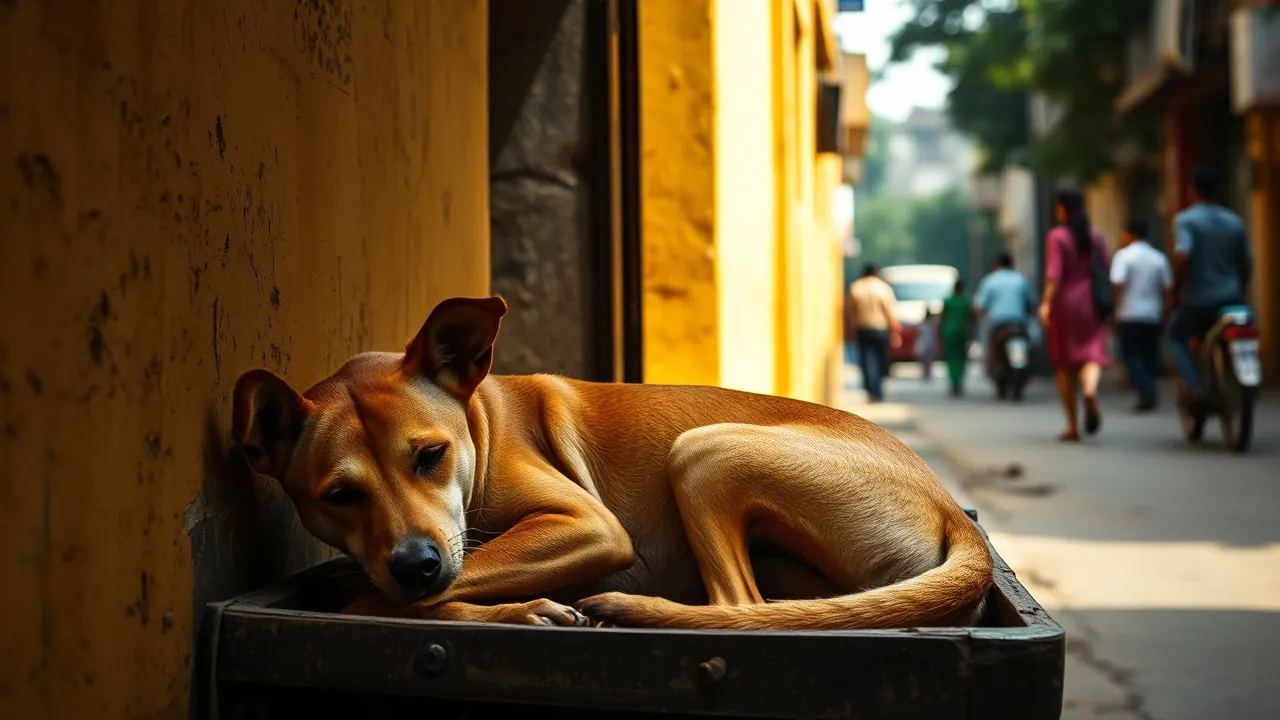
Indian free-ranging dogs follow people's hours. A year-long IISER Kolkata survey in West Bengal logged 5,669 sightings of dogs across all 24 hours of the day.
The dogs were more than 50% active only between 9 am and 10.30 pm. They were more active in the day (6 am to 6 pm) than at night, which counters the idea that street dogs are mainly nocturnal.
An earlier daytime census, from 7 am to 7 pm, found street dogs active about half the time. No study has measured sleep hours in Indian pet dogs.
| Study | Place | Sightings | Finding |
|---|---|---|---|
| Banerjee and Bhadra (Acta Ethologica, 2021 online; vol 25, 2022) | West Bengal, July 2016 to November 2017 | 5,669 | Over 50% active only from 9 am to 10.30 pm; more active by day |
| Sen Majumder et al. 2014 (Current Science), as cited | Daytime census, 7 am to 7 pm | Not stated in citing paper | Active about half the time in daylight hours |
For a pet dog in an Indian summer, the activity peaks matter more than total sleep. Walks fit best around the cool early morning and late evening, which our how hot is too hot for dogs report sets out by city.
Do dogs sleep more than humans and cats?
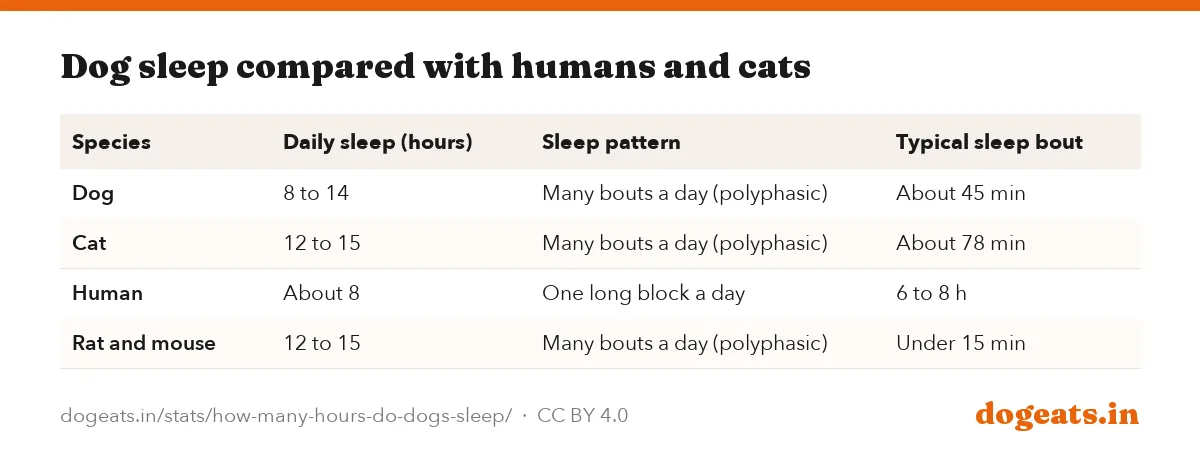
Dogs sleep more than people and less than cats. A 2018 study summarising a 2013 review gives 8 to 14 hours for dogs, about 8 hours for humans and 12 to 15 hours for cats, rats and mice.
The bigger difference is the pattern. A human sleep bout lasts 6 to 8 hours. Dogs and cats sleep in many shorter bouts across the day, which the same review puts at about 45 minutes for dogs and 78 minutes for cats.
| Species | Daily sleep (hours) | Sleep pattern | Typical sleep bout |
|---|---|---|---|
| Dog | 8 to 14 | Many bouts a day (polyphasic) | About 45 min |
| Cat | 12 to 15 | Many bouts a day (polyphasic) | About 78 min |
| Human | About 8 | One long block a day | 6 to 8 h |
| Rat and mouse | 12 to 15 | Many bouts a day (polyphasic) | Under 15 min |
For brain size and other dog and cat comparisons, see our dogs vs cats statistics.
When should you worry about how much your dog sleeps?
Total hours vary a lot between healthy dogs, so a change matters more than a number. The studies in this report point to a few signs worth a vet visit.
- Sudden change. A dog that starts sleeping much more or much less than its usual pattern should see a vet.
- Breathing pauses. 0.5% of owners in the UK survey said their 12-month-old dog sometimes stopped breathing in sleep. Loud snoring with pauses needs a check.
- Night waking in old age. Restlessness, pacing or waking at night in a senior dog can go with cognitive decline, as the 2023 sleep EEG study found.
- Poor sleep. 8.5% of owners said their young dog woke often or slept badly, and 1.8% called it restless.
- Heat. Panting and restlessness on hot nights can be heat stress; see our dog heatstroke statistics.
For more on age, see our dog years to human years chart.
Frequently asked questions
How many hours do dogs sleep in a day?
Studies measured about 11 to 14 hours in 24. UK owners reported 10.8 hours for one-year-old dogs, and activity monitors logged 13.2 to 13.9 hours in senior Beagles.
How many hours does a puppy sleep?
Owners of 16-week-old puppies reported an average of 11.2 hours a day: about 7.0 hours at night and a median 3.5 hours of daytime naps.
Is it normal for my dog to sleep all day?
Sleeping half the day is normal. One-year-old dogs slept 45.0% of 24 hours on owner reports. A sudden change in sleep is a reason to see a vet.
Do dogs sleep through the night?
No. Dogs studied at night had 23 sleep and wake cycles in 8 hours, about 16 minutes asleep and 5 awake each time.
How many hours do older dogs sleep?
Senior Beagles slept 13.9 hours a day at 9 to 11 years and 13.2 hours over 11 years. Much of it came as short daytime naps of about 4 minutes.
Why does my dog twitch while sleeping?
Twitching is common in sleep. 73.0% of owners of 12-month-old dogs saw small leg movements, and 29.9% said the dog looked as if it was chasing something.
Do dogs sleep more than humans?
Yes. A 2013 review cited in 2018 gives 8 to 14 hours a day for dogs against about 8 for humans, but dogs sleep in many short bouts.
Which dogs snore the most?
Flat-faced breeds. In a UK survey, all 4 Pugs and 4 of 6 French Bulldogs often snored very loudly at 12 months, against 5 of 63 Border Collies.
Do dogs sleep better with their owners?
A 2025 EEG study of 9 dogs found they fell asleep faster and slept more efficiently with their owner present than with a friendly stranger.
Methodology and limitations
Puppy and young dog figures come from Kinsman et al. (Animals, 2020), the Dogs Trust Generation Pup cohort in the UK. Owners answered at 16 weeks (2,332 dogs) and 12 months (1,091). Durations use only dogs with answers at both ages. Shares of the day divide reported hours by 24.
Senior figures come from Table 2 of Zanghi et al. (2016), 33 Beagles aged 9 to 16 wearing activity monitors for 5 days. We added the printed day and night sleep minutes for each age group and divided by 60. Night cycle figures come from the Adams and Johnson (1993) abstract; we multiplied 23 cycles by 16 minutes for the night sleep estimate.
Location shares of night sleep are from Adams and Johnson as cited by Bunford et al. (2018). Species comparisons are from Bunford et al. citing Toth and Bhargava (2013).
All percentages are computed from raw counts printed in the papers and rounded once. In Kinsman Table 3, the paper prints 21.1% for Labradors; 23 of 104 gives 22.1%, which we show.
Sources
- Kinsman et al., Sleep Duration and Behaviours: A Descriptive Analysis of a Cohort of Dogs up to 12 Months of Age, Animals 2020, Puppy and young dog sleep hours, places, positions, snoring
- Zanghi et al., Diurnal changes in core body temperature, locomotor activity and actigraphy sleep in aged canines, Neurobiology of Sleep and Circadian Rhythms 2016, Senior dog sleep minutes, naps, efficiency
- Bunford et al., Differences in pre-sleep activity and sleep location are associated with variability in sleep electrophysiology in the domestic dog, Scientific Reports 2018, 8 to 14 hours, sleep by location, species comparison
- Also consulted: Adams and Johnson, Sleep-wake cycles and other night-time behaviours of the domestic dog, Applied Animal Behaviour Science 1993, Woods et al., A functional linear modeling approach to sleep-wake cycles in dogs, Scientific Reports 2020, Takeuchi and Harada, Age-related changes in sleep-wake rhythm in dog, Behavioural Brain Research 2002, Mondino et al., Sleep and cognition in aging dogs: a polysomnographic study, Frontiers in Veterinary Science 2023, Iotchev et al., Sleep-physiological correlates of brachycephaly in dogs, Brain Structure and Function 2023, Baranyai et al., Family dogs' sleep macrostructure when sleeping in the absence of their owners, Animals 2025, Banerjee and Bhadra, Time-activity budget of urban-adapted free-ranging dogs, Acta Ethologica 25: 33 to 42 (online 8 September 2021; IISER Kolkata), Toth and Bhargava, Animal models of sleep disorders, Comparative Medicine 2013, Sen Majumder, Chatterjee and Bhadra, Current Science 2014 (via Banerjee and Bhadra).
Cite, embed and download
This report, its data and its images are free to reuse under a Creative Commons Attribution 4.0 licence. Credit dogeats.in with a link to this page. Every chart has its own embed code, every table has a CSV and an image download, and the images below are ready for social posts, slides and articles.
Cite this report
Link to this report
Every chart and table as an image