Explainer · Updated October 2026
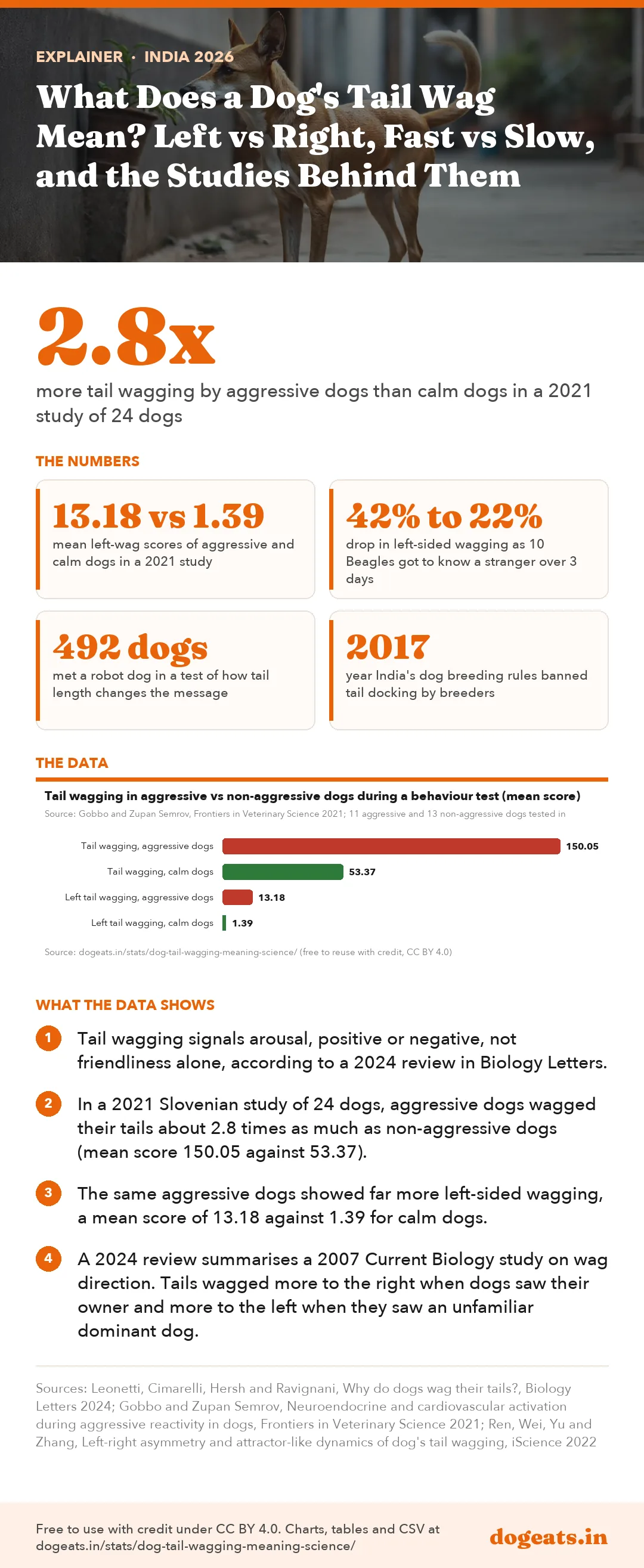
What Does a Dog's Tail Wag Mean? Left vs Right, Fast vs Slow, and the Studies Behind Them
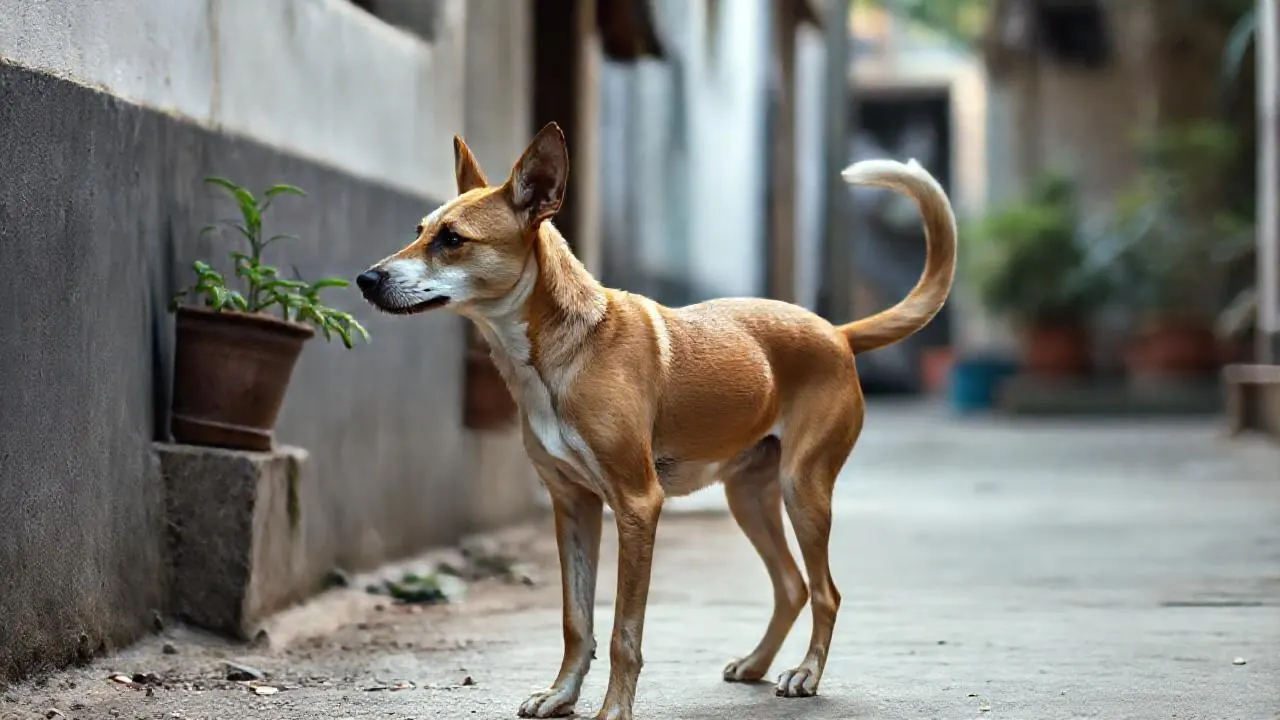
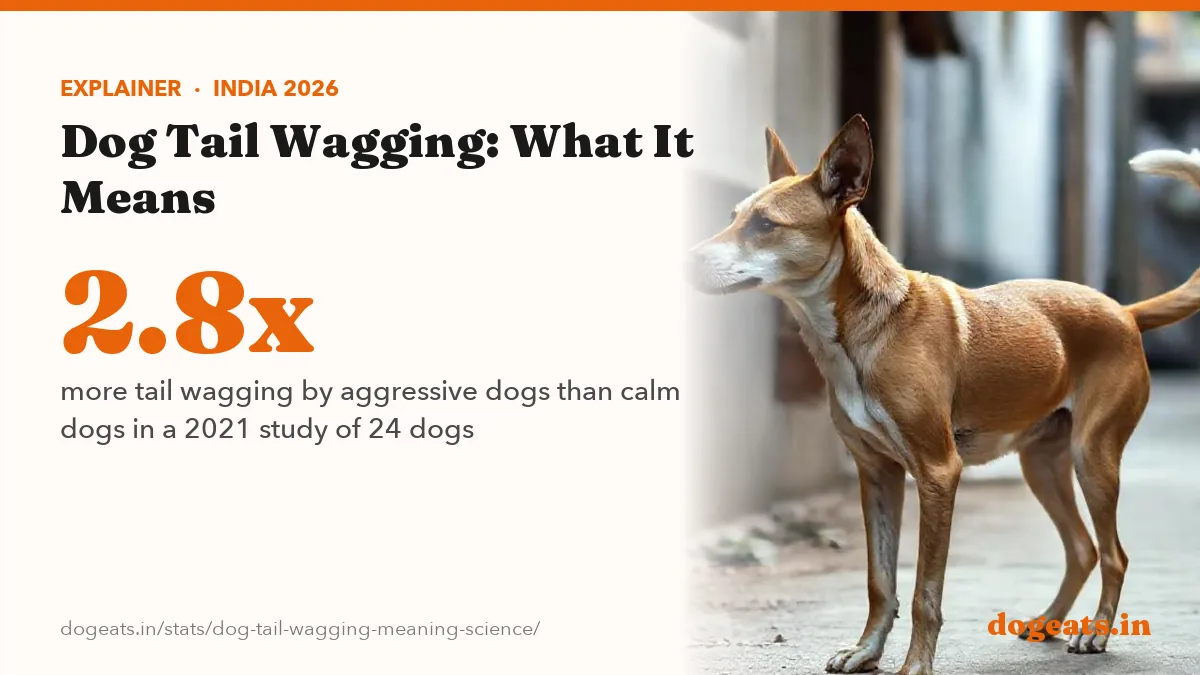
A wagging tail shows that a dog is aroused and engaged, not that it is friendly. In a 2021 study of 24 working and herding dogs, the aggressive dogs wagged about 2.8 times as much as the calm ones, and wagged more to the left. Dogs wag more to the right for things they want to approach, such as their owner, and more to the left for things they want to avoid. Other dogs read the difference: in a 2013 study, dogs watching left-wagging videos showed higher cardiac activity and more anxious behaviour.
Key findings
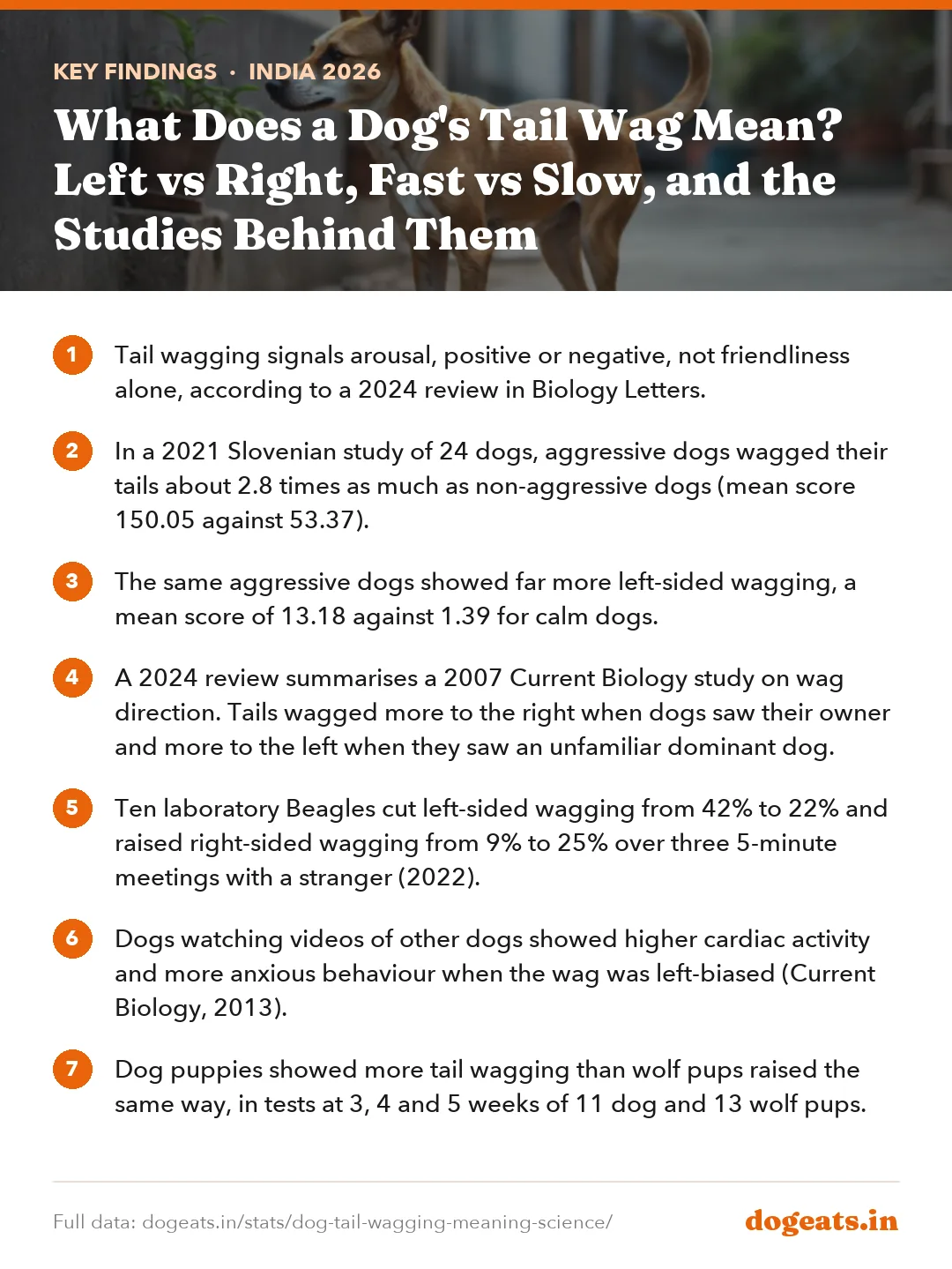
- Tail wagging signals arousal, positive or negative, not friendliness alone, according to a 2024 review in Biology Letters.
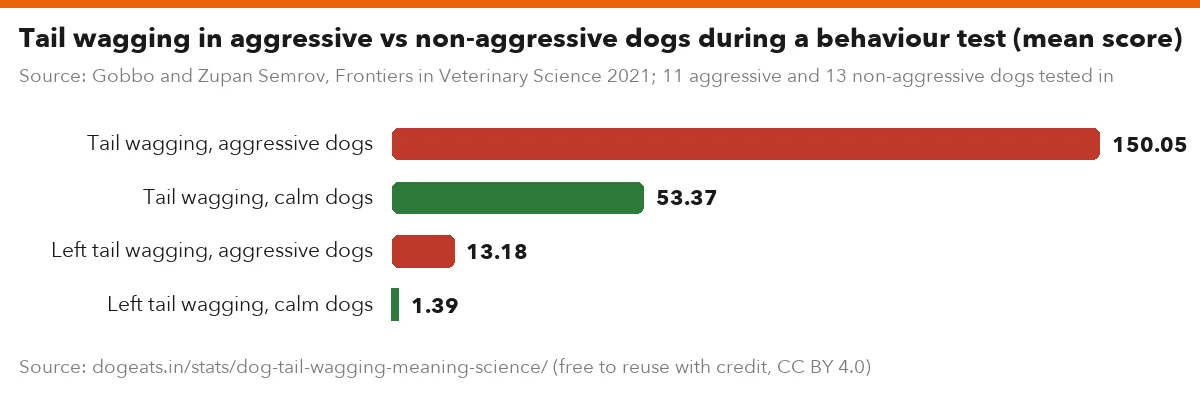
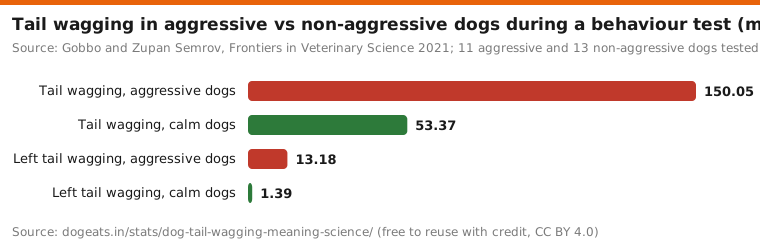
- In a 2021 Slovenian study of 24 dogs, aggressive dogs wagged their tails about 2.8 times as much as non-aggressive dogs (mean score 150.05 against 53.37).
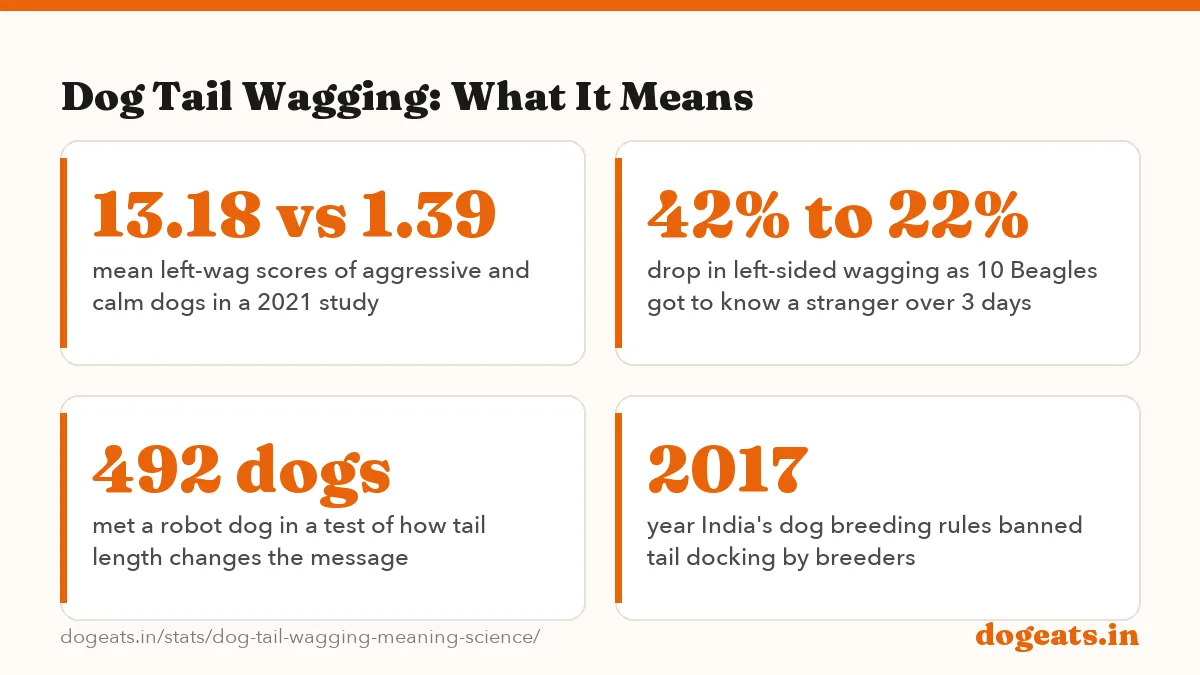
- The same aggressive dogs showed far more left-sided wagging, a mean score of 13.18 against 1.39 for calm dogs.
- A 2024 review summarises a 2007 Current Biology study on wag direction. Tails wagged more to the right when dogs saw their owner and more to the left when they saw an unfamiliar dominant dog.
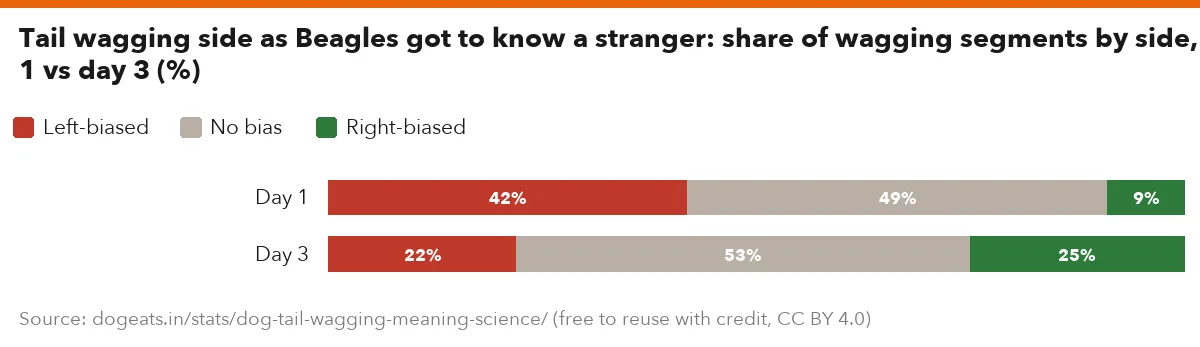
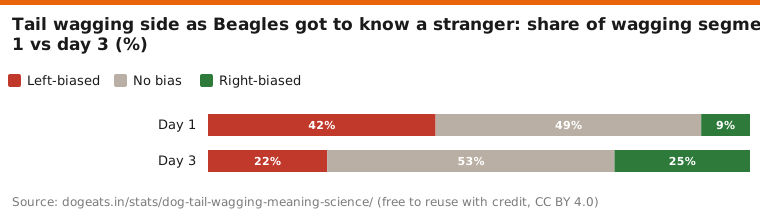
- Ten laboratory Beagles cut left-sided wagging from 42% to 22% and raised right-sided wagging from 9% to 25% over three 5-minute meetings with a stranger (2022).
- Dogs watching videos of other dogs showed higher cardiac activity and more anxious behaviour when the wag was left-biased (Current Biology, 2013).
- Dog puppies showed more tail wagging than wolf pups raised the same way, in tests at 3, 4 and 5 weeks of 11 dog and 13 wolf pups.
- Hunting-type dogs wagged more than shepherd-type dogs in a 2022 test of 49 dogs.
- India's Dog Breeding and Marketing Rules, notified on 23 May 2017, say there shall be no tail docking or ear cropping by breeders.
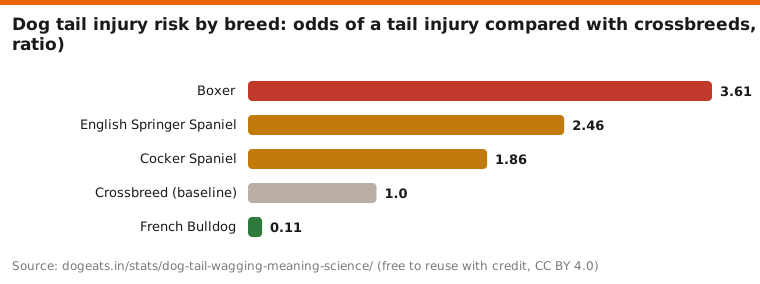
- UK vets recorded tail injuries in 0.23% of dogs a year in 2019, with boxers at 3.61 times the odds of crossbreeds.
What does it mean when a dog wags its tail?
A wag means a dog is aroused and engaged with something, and that arousal can be happy, anxious or hostile. A 2024 review in Biology Letters by Leonetti and colleagues found that wagging is "frequently associated with both positive and negative arousal". It adds that quantitative studies so far give patchy results.
The review lists the settings where dogs wag. They wag most when their owners are present, but also at unfamiliar people, at food, at fans and at plastic bags. Wagging with a low tail is often an appeasement signal. In one study dogs wagged more when a person was in the room while food was being denied, which suggests the wag can also be a request.
Scientists still lack a full description of the behaviour. The review notes that no study has tracked how one dog's wagging develops over its whole life. Most studies record when, for how long or at what rate a dog wags, not the height, speed, side or amplitude of the wag.
Source: Gobbo and Zupan Semrov, Frontiers in Veterinary Science 2021; 11 aggressive and 13 non-aggressive dogs tested in Ljubljana in 2020. Means from the study's Table 2: tail wagging is a duration measure and left wagging a frequency count; units not stated.
Show the numbers
| Label | Value |
|---|---|
| Tail wagging, aggressive dogs | 150.05 |
| Tail wagging, calm dogs | 53.37 |
| Left tail wagging, aggressive dogs | 13.18 |
| Left tail wagging, calm dogs | 1.39 |
Embed this chart
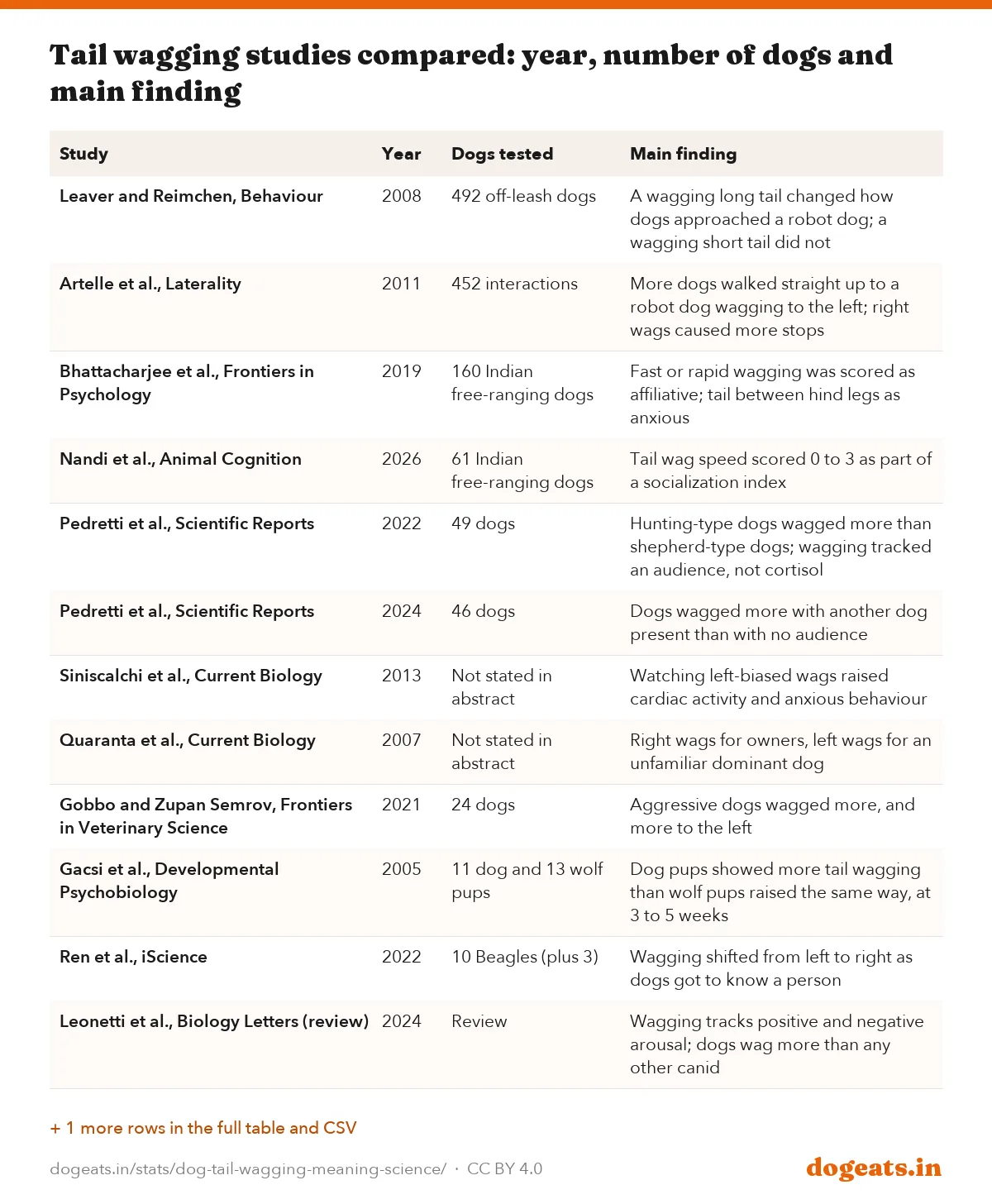
| Study | Year | Dogs tested | Main finding |
|---|---|---|---|
| Leaver and Reimchen, Behaviour | 2008 | 492 off-leash dogs | A wagging long tail changed how dogs approached a robot dog; a wagging short tail did not |
| Artelle et al., Laterality | 2011 | 452 interactions | More dogs walked straight up to a robot dog wagging to the left; right wags caused more stops |
| Bhattacharjee et al., Frontiers in Psychology | 2019 | 160 Indian free-ranging dogs | Fast or rapid wagging was scored as affiliative; tail between hind legs as anxious |
| Nandi et al., Animal Cognition | 2026 | 61 Indian free-ranging dogs | Tail wag speed scored 0 to 3 as part of a socialization index |
| Pedretti et al., Scientific Reports | 2022 | 49 dogs | Hunting-type dogs wagged more than shepherd-type dogs; wagging tracked an audience, not cortisol |
| Pedretti et al., Scientific Reports | 2024 | 46 dogs | Dogs wagged more with another dog present than with no audience |
| Siniscalchi et al., Current Biology | 2013 | Not stated in abstract | Watching left-biased wags raised cardiac activity and anxious behaviour |
| Quaranta et al., Current Biology | 2007 | Not stated in abstract | Right wags for owners, left wags for an unfamiliar dominant dog |
| Gobbo and Zupan Semrov, Frontiers in Veterinary Science | 2021 | 24 dogs | Aggressive dogs wagged more, and more to the left |
| Gacsi et al., Developmental Psychobiology | 2005 | 11 dog and 13 wolf pups | Dog pups showed more tail wagging than wolf pups raised the same way, at 3 to 5 weeks |
| Ren et al., iScience | 2022 | 10 Beagles (plus 3) | Wagging shifted from left to right as dogs got to know a person |
| Leonetti et al., Biology Letters (review) | 2024 | Review | Wagging tracks positive and negative arousal; dogs wag more than any other canid |
| Siniscalchi et al., Animals (review) | 2018 | Review | Low wagging goes with anxiety; a tucked tail signals fear or appeasement |
Sample sizes are small. Only the two robot dog studies and the 2019 Indian street dog study went past 100 (492 dogs, 452 interactions and 160 dogs). The 2007 and 2013 Italian studies, the most quoted in the press, sit behind a paywall and their abstracts give no sample size, so we do not quote one.
Does it matter if a dog wags its tail to the left or right?
Yes. Dogs tend to wag more to the right for things they want to approach and more to the left for things they want to avoid. In a 2007 Current Biology study by Quaranta, Siniscalchi and Vallortigara, dogs wagged with a right-side bias when shown their owner. They showed a left-side bias when shown an unfamiliar, dominant dog, as summarised in the 2024 Biology Letters review.
The explanation offered is brain asymmetry. The left side of the brain, linked with approach, drives the tail to the right. The right side, linked with withdrawal, drives it to the left, as summarised in a 2018 review in Animals.
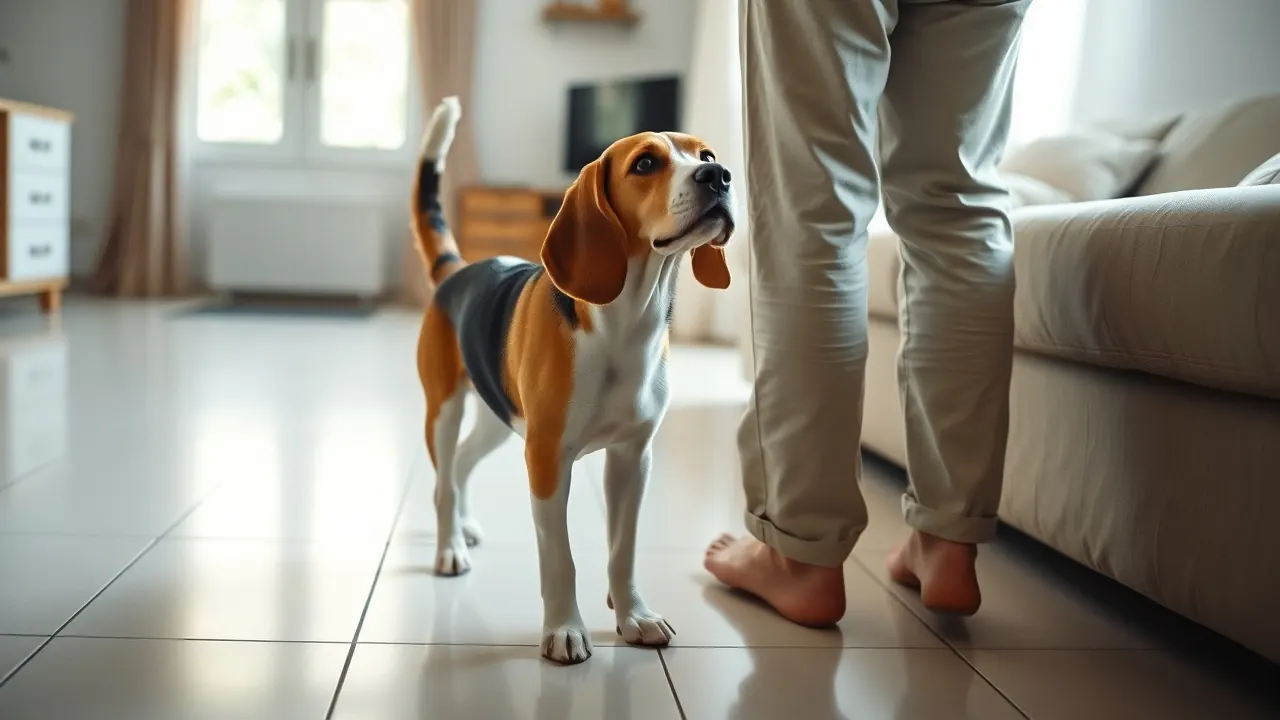
A 2022 study in iScience used motion tracking on 10 laboratory Beagles aged 1 to 2 years. On day 1 with an unfamiliar person, 42% of wagging segments leaned left and 9% leaned right. By day 3, after one 5-minute session a day, left fell to 22% and right rose to 25%.
Source: Ren et al., iScience 2022, 10 Beagles, one 5-minute session a day. No-bias share computed as 100 minus left minus right.
Show the numbers
| Label | Left-biased | No bias | Right-biased |
|---|---|---|---|
| Day 1 | 42 | 49 | 9 |
| Day 3 | 22 | 53 | 25 |
Embed this chart
Side changed more than speed. Over the same three days the Beagles' wag frequency changed by less than 6%, amplitude by less than 5% and velocity by less than 7%. The authors call those changes too small or inconsistent, and treat the left to right shift as the clearer sign of growing familiarity.
The side bias is a tendency in the swing, not a tail held to one side, and the studies used video tracking to measure it.
Can dogs understand other dogs' tail wags?
Yes, they react to the side of a wag. In a 2013 Current Biology study by Siniscalchi and colleagues, dogs watched videos of other dogs wagging. They showed higher cardiac activity and higher scores of anxious behaviour when the wag was left-biased rather than right-biased.
Tail length matters too. Leaver and Reimchen filmed 492 off-leash dogs meeting a life-size robot dog with four tails: short and still, short and wagging, long and still, and long and wagging. Larger dogs approached a long wagging tail more readily than a long still one, but did not react differently to a short tail whether it moved or not.
A 2011 follow-up from the same lab, with a robotic dog replica, logged 452 interactions. More dogs walked straight up to it when its tail wagged to the left, and a right wag produced more stops. The authors said the result did not fit neatly with the brain asymmetry prediction, so the meaning of a side bias to other dogs is not settled.
Can a dog wag its tail and still bite?
Yes. In a 2021 study in Frontiers in Veterinary Science, aggressive dogs wagged about 2.8 times as much as calm dogs, a mean score of 150.05 against 53.37. The 11 aggressive dogs, male German and Belgian Shepherd police dogs, snapped or attacked 3 to 26 times during a 16-part behaviour test.
The aggressive dogs also wagged far more to the left, a mean of 13.18 against 1.39 for the 13 calm herding dogs. Left wagging rose with each dog's aggression score, which the authors link to the right side of the brain handling intense emotions such as hostility.
The 2024 Biology Letters review calls this result counterintuitive to the common belief that a wag means a happy dog. Read the whole dog. In the 2021 study, the aggressive dogs also showed a lower body posture, more movement, staring and rapid barking. Our report on dog aggression by breed covers who gets bitten and by which dogs.
This was a small study of shepherd-type police dogs and herding dogs, all male. It shows that a wag can sit inside an aggressive display, not that most wagging dogs are aggressive.
Why do dogs wag their tails and wolves do not?
Dogs wag more often and in more settings than any other canid, and the gap shows from the first weeks of life. In a 2005 study, 11 dog puppies and 13 wolf pups were hand-raised the same way and tested at 3, 4 and 5 weeks. The dog pups tended to show more tail wagging, more gazing at human faces and more distress calls.
The 2024 Biology Letters review offers two explanations. Wagging may be a side effect of breeding for tameness. In a Russian experiment, silver foxes bred for docility over 40 generations began to wag like dogs and grew more curled tails. Or humans may have favoured dogs that wagged more, and more rhythmically, because people enjoy rhythm. The authors call this the domesticated rhythmic wagging hypothesis.
The authors present both as hypotheses still to be tested. They place the start of dog domestication at about 35,000 years ago, in the Upper Palaeolithic. They call for studies that measure wag speed, side and amplitude together with heart rate, hormones and brain activity.
- Domestication syndrome idea: wagging came along with selection for tameness and friendliness.
- Domesticated rhythmic wagging idea: people chose dogs whose wag had an even beat.
- Under either idea, selection on wagging may have differed between breeds, since breeds were selected for different jobs.
Dogs also respond to human signals in ways wolves do not, which our report on how many words dogs understand covers.
Do some dog breeds wag their tails more than others?
Some evidence says yes. In a 2022 Scientific Reports study of 49 dogs, 24 hunting-type and 25 shepherd-type, hunting-type dogs with floppy ears were more likely to wag than shepherd-type dogs with erect ears.
Who is watching matters as well. In the 2022 tests, wagging, whining and ear movements rose when a person was present. They did not track cortisol levels in the dogs sampled for cortisol, which suggests the wag is partly a message to the audience. A 2024 follow-up with 46 dogs found more wagging when another dog was present than with no audience at all.
Breed tail shape changes what others can see. The 2018 review in Animals notes that dogs with very short tails lose part of their signalling range. The robot dog study found that a short tail carried less information than a long one.
How do Indian street dogs use their tails?
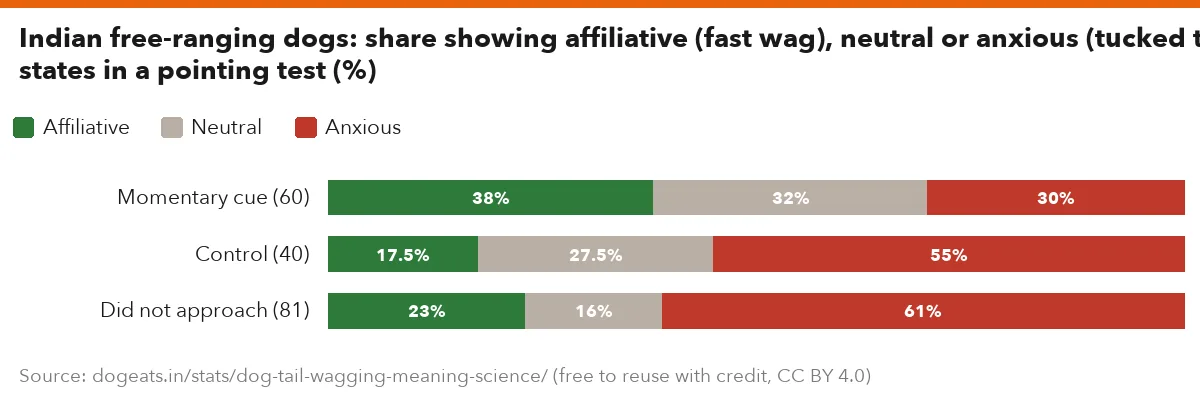
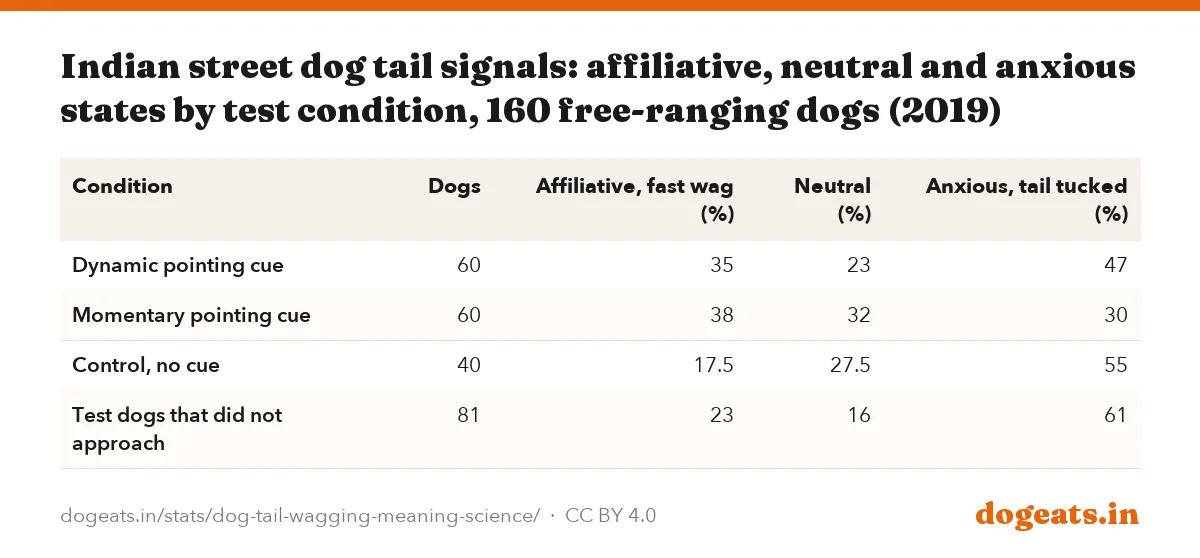
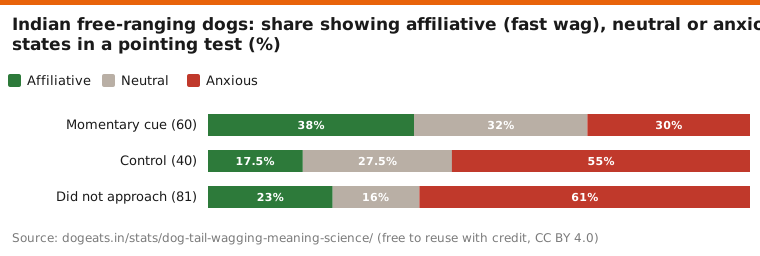
Researchers at IISER Kolkata treat a fast or rapid wag as a sign of a friendly street dog. A tail between the hind legs marks an anxious one. In a 2019 study of 160 adult free-ranging dogs in West Bengal, 55% of the 40 control dogs were anxious. Among the 60 dogs given a brief pointing cue, 30% were.
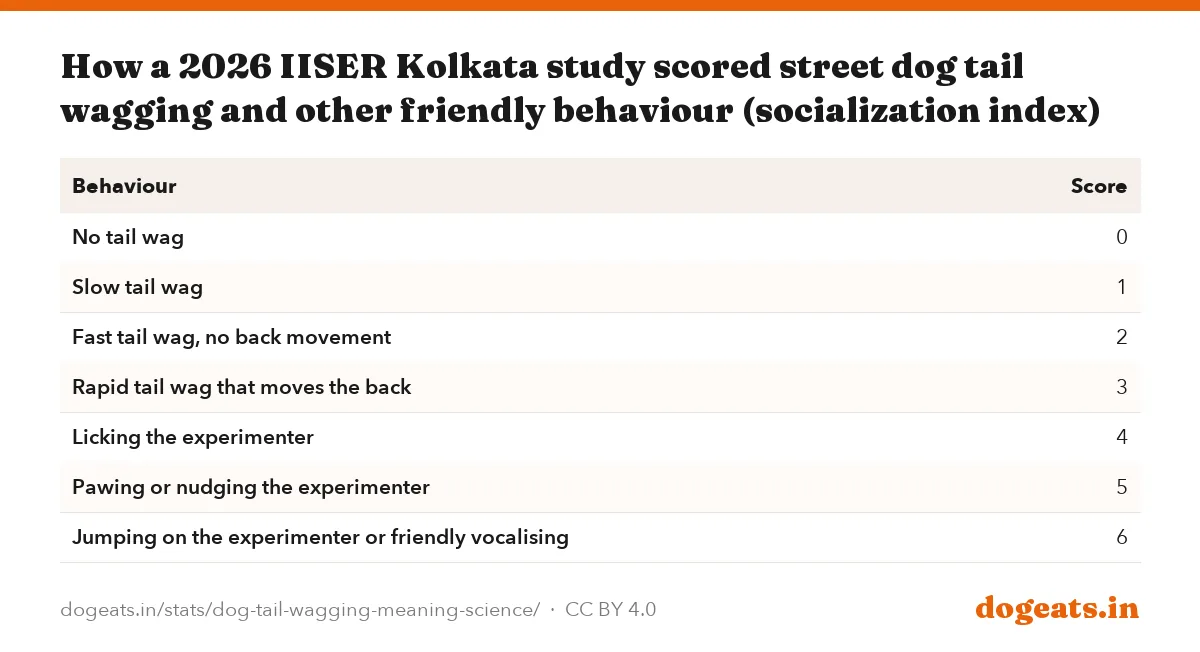
Dogs that stayed away were mostly anxious. Of the 81 test dogs that did not approach the experimenter, 61% showed anxious states and 23% affiliative ones. A 2026 study of 61 adult street dogs scored tail wagging from 0 for no wag to 3 for a rapid wag that moves the back. The score was one part of a socialization index.
The same reading applies to pet Indian Pariah dogs. Free-ranging dogs make up about 80% of the world's dogs, the 2026 paper notes. For a local picture see our street dog population report and the Indie dog guide.
Source: Bhattacharjee et al., Frontiers in Psychology 2019, 160 adult free-ranging dogs, West Bengal. Rows: 60 dogs given a momentary cue, 40 control dogs, 81 dogs that did not approach.
Show the numbers
| Label | Affiliative | Neutral | Anxious |
|---|---|---|---|
| Momentary cue (60) | 38 | 32 | 30 |
| Control (40) | 17.5 | 27.5 | 55 |
| Did not approach (81) | 23 | 16 | 61 |
Embed this chart
| Condition | Dogs | Affiliative, fast wag (%) | Neutral (%) | Anxious, tail tucked (%) |
|---|---|---|---|---|
| Dynamic pointing cue | 60 | 35 | 23 | 47 |
| Momentary pointing cue | 60 | 38 | 32 | 30 |
| Control, no cue | 40 | 17.5 | 27.5 | 55 |
| Test dogs that did not approach | 81 | 23 | 16 | 61 |
| Behaviour | Score |
|---|---|
| No tail wag | 0 |
| Slow tail wag | 1 |
| Fast tail wag, no back movement | 2 |
| Rapid tail wag that moves the back | 3 |
| Licking the experimenter | 4 |
| Pawing or nudging the experimenter | 5 |
| Jumping on the experimenter or friendly vocalising | 6 |
Percentages are as published by Bhattacharjee et al. (2019); the dynamic cue row (35, 23 and 47%, not charted) sums to 105% in the paper, more than rounding explains. Sources: Bhattacharjee et al., Frontiers in Psychology 2019; Nandi et al., Animal Cognition 2026, Table 1.
Is tail docking legal in India?
No, not for breeders. The Prevention of Cruelty to Animals (Dog Breeding and Marketing) Rules, 2017, notified on 23 May 2017 as G.S.R. 496(E), say in their Second Schedule that "there shall be no tail docking, ear cropping", de-barking or any other mutilation of a pup. Our report on dog breeding licences and puppy mills covers how the rules are enforced.
Docking removes the signal that the studies above measure, and the injury it is meant to prevent is uncommon in most dogs. UK vets recorded a first tail injury in 0.23% of dogs a year in 2019, from 285 cases set against 285,000 controls, and only 9.1% of injured tails were amputated.
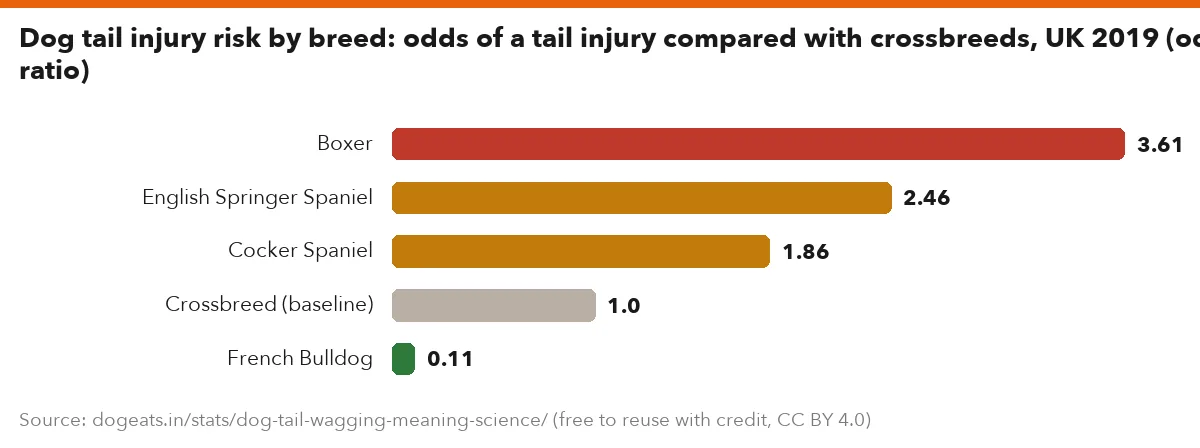
Risk varies by breed. Boxers had 3.61 times the odds of a crossbreed, English springer spaniels 2.46 and Cocker Spaniels 1.86, while French Bulldogs had 0.11 times the odds. Dogs weighing 20 to 30 kg (44 to 66 lb) and dogs under 2 years were also at higher risk.
Source: Pegram et al., Veterinary Record 2026, VetCompass records for 2019, 285 cases and 285,000 controls. Crossbreed = 1.0 baseline.
Show the numbers
| Label | Value |
|---|---|
| Boxer | 3.61 |
| English Springer Spaniel | 2.46 |
| Cocker Spaniel | 1.86 |
| Crossbreed (baseline) | 1.0 |
| French Bulldog | 0.11 |
Embed this chart
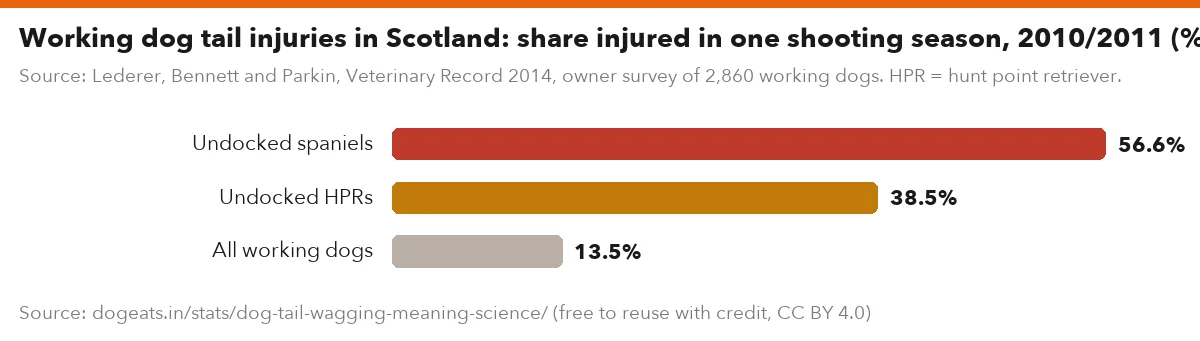
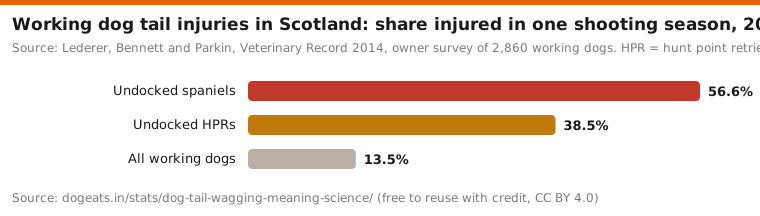
Source: Lederer, Bennett and Parkin, Veterinary Record 2014, owner survey of 2,860 working dogs. HPR = hunt point retriever.
Show the numbers
| Label | % |
|---|---|
| Undocked spaniels | 56.6% |
| Undocked HPRs | 38.5% |
| All working dogs | 13.5% |
Embed this chart
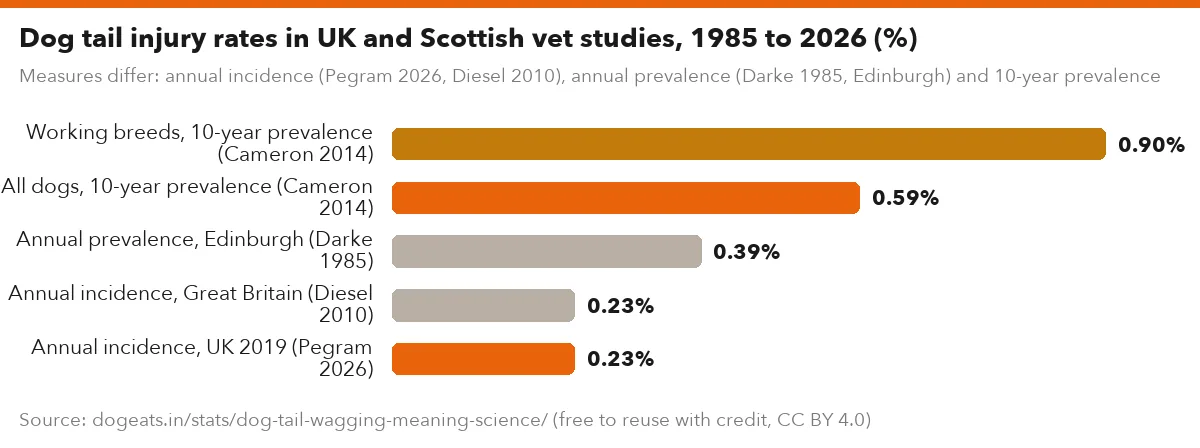
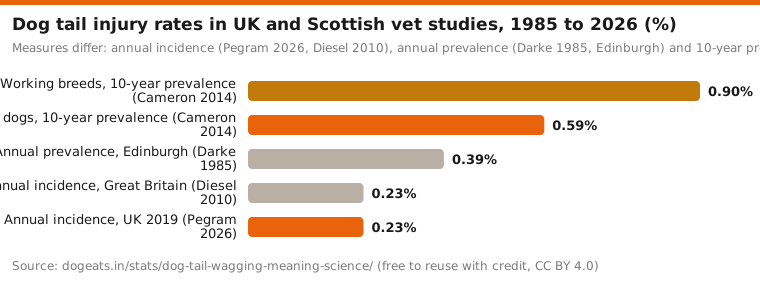
Measures differ: annual incidence (Pegram 2026, Diesel 2010), annual prevalence (Darke 1985, Edinburgh) and 10-year prevalence (Cameron 2014, 16 Scottish practices, 2002 to 2012). Figures as reported in Pegram et al. 2026 and Cameron et al. 2014.
Show the numbers
| Label | % |
|---|---|
| Working breeds, 10-year prevalence (Cameron 2014) | 0.90% |
| All dogs, 10-year prevalence (Cameron 2014) | 0.59% |
| Annual prevalence, Edinburgh (Darke 1985) | 0.39% |
| Annual incidence, Great Britain (Diesel 2010) | 0.23% |
| Annual incidence, UK 2019 (Pegram 2026) | 0.23% |
Embed this chart
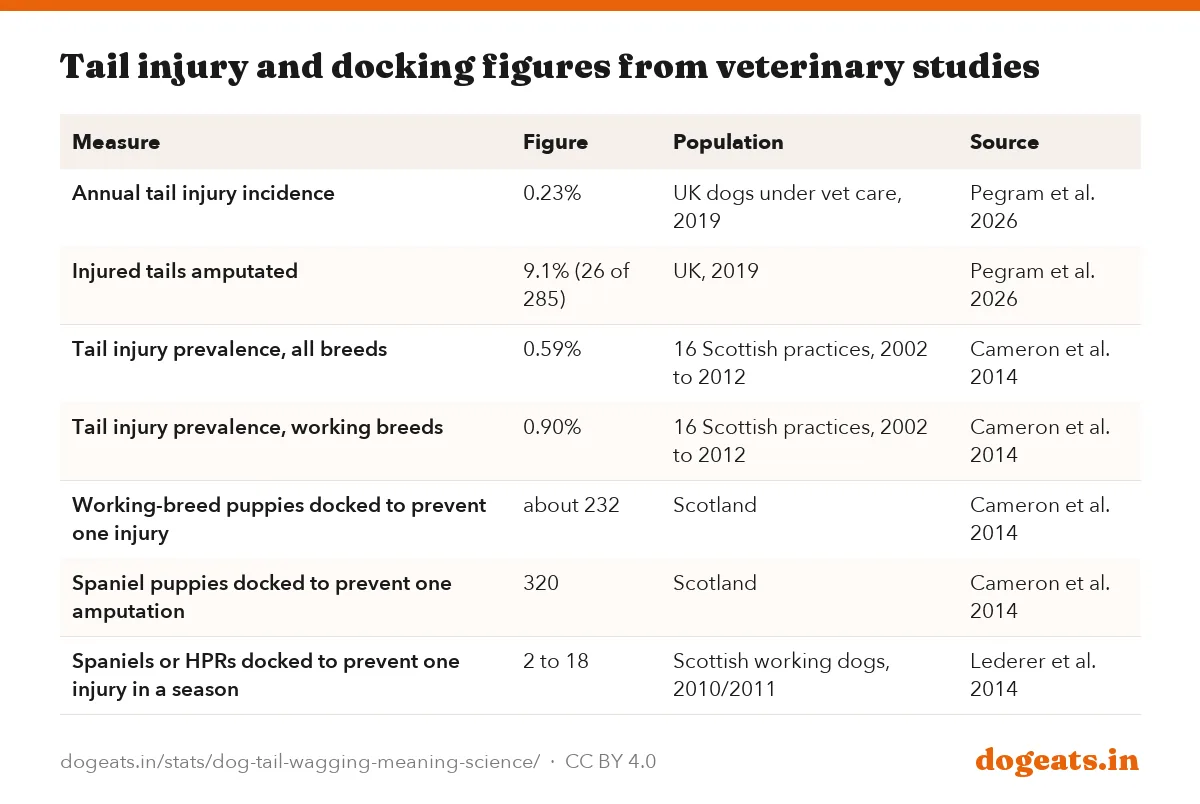
| Measure | Figure | Population | Source |
|---|---|---|---|
| Annual tail injury incidence | 0.23% | UK dogs under vet care, 2019 | Pegram et al. 2026 |
| Injured tails amputated | 9.1% (26 of 285) | UK, 2019 | Pegram et al. 2026 |
| Tail injury prevalence, all breeds | 0.59% | 16 Scottish practices, 2002 to 2012 | Cameron et al. 2014 |
| Tail injury prevalence, working breeds | 0.90% | 16 Scottish practices, 2002 to 2012 | Cameron et al. 2014 |
| Working-breed puppies docked to prevent one injury | about 232 | Scotland | Cameron et al. 2014 |
| Spaniel puppies docked to prevent one amputation | 320 | Scotland | Cameron et al. 2014 |
| Spaniels or HPRs docked to prevent one injury in a season | 2 to 18 | Scottish working dogs, 2010/2011 | Lederer et al. 2014 |
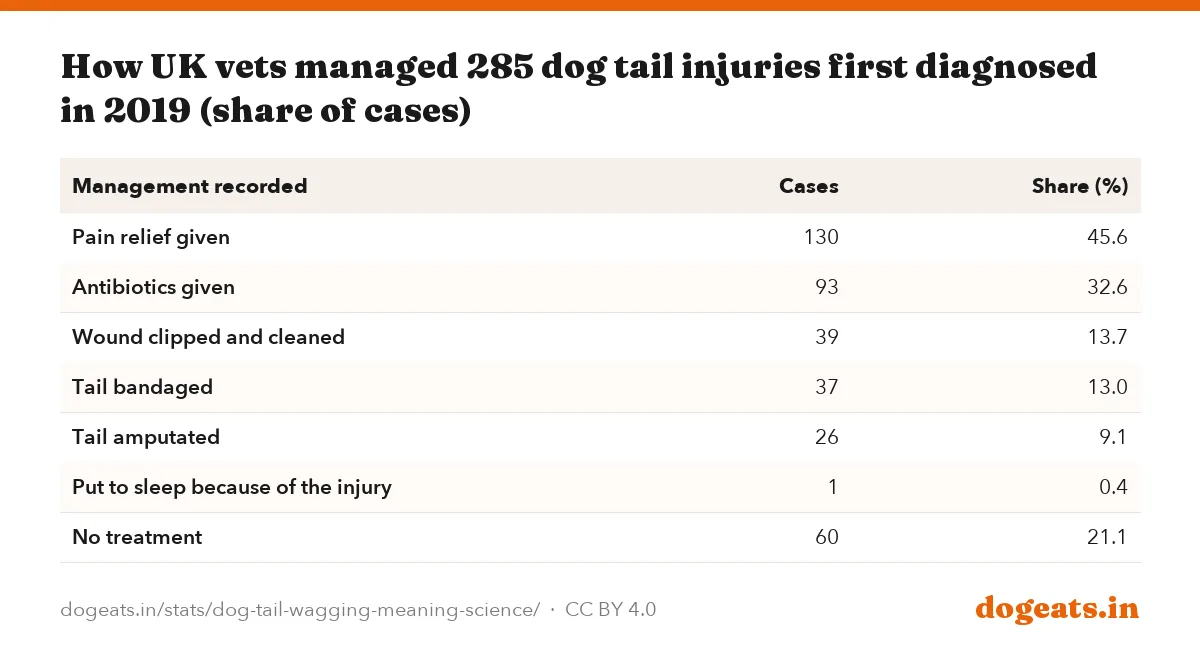
| Management recorded | Cases | Share (%) |
|---|---|---|
| Pain relief given | 130 | 45.6 |
| Antibiotics given | 93 | 32.6 |
| Wound clipped and cleaned | 39 | 13.7 |
| Tail bandaged | 37 | 13.0 |
| Tail amputated | 26 | 9.1 |
| Put to sleep because of the injury | 1 | 0.4 |
| No treatment | 60 | 21.1 |
The Scottish data cut both ways. Working spaniels and hunt point retrievers that kept full tails were often injured during a shooting season. In 2017 Scotland changed its 2007 ban to allow docking by up to a third for those breeds. Among working breeds seen by Scottish vets, preventing one injury took about 232 docked puppies. The 2026 UK authors say their low incidence figures do not give strong evidence for reconsidering docking law. The docking clause in India's breeding rules contains no exception for working dogs.
How can you tell a happy tail wag from a nervous one?
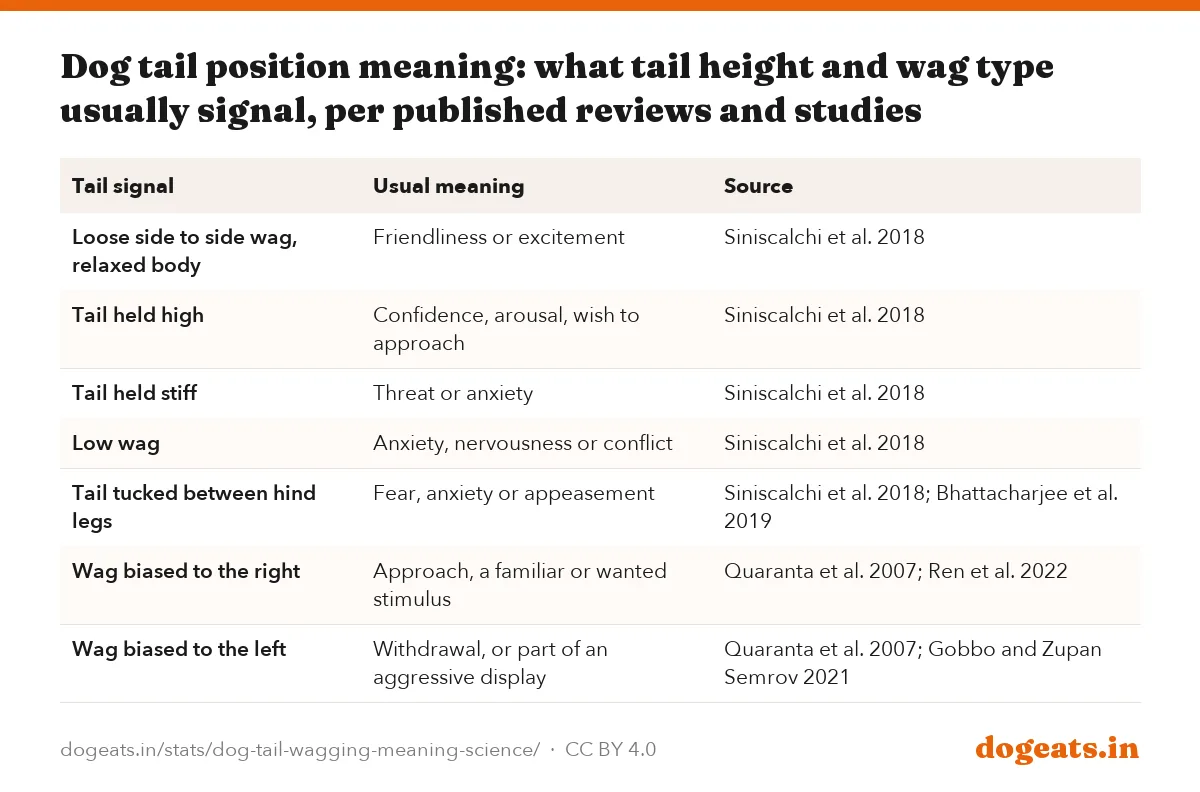
Look at the height, the speed and the rest of the body, not the wag alone. A 2018 review in Animals says a high tail signals confidence or a wish to approach. A low wag goes with anxiety, nervousness or internal conflict, and a tail tucked between the legs signals fear, anxiety or appeasement.
A loose side to side wag is the friendliest sign, the same review says. In the 2021 study, wagging that came with a lowered posture, staring and rapid barking belonged to the dogs that snapped or attacked during the test. If a dog ducks with its tail tucked, pants hard or licks its lips, give it space: those were the anxious states in the Indian street dog study.
Fear and stress have their own signs, covered in our report on separation anxiety and fear in dogs.
| Tail signal | Usual meaning | Source |
|---|---|---|
| Loose side to side wag, relaxed body | Friendliness or excitement | Siniscalchi et al. 2018 |
| Tail held high | Confidence, arousal, wish to approach | Siniscalchi et al. 2018 |
| Tail held stiff | Threat or anxiety | Siniscalchi et al. 2018 |
| Low wag | Anxiety, nervousness or conflict | Siniscalchi et al. 2018 |
| Tail tucked between hind legs | Fear, anxiety or appeasement | Siniscalchi et al. 2018; Bhattacharjee et al. 2019 |
| Wag biased to the right | Approach, a familiar or wanted stimulus | Quaranta et al. 2007; Ren et al. 2022 |
| Wag biased to the left | Withdrawal, or part of an aggressive display | Quaranta et al. 2007; Gobbo and Zupan Semrov 2021 |
Frequently asked questions
Does a wagging tail mean a dog is happy?
Not always. A wag shows arousal, which can be positive or negative. In a 2021 study of 24 dogs, aggressive dogs wagged about 2.8 times as much as calm dogs.
What does it mean when a dog wags its tail to the right?
A right-biased wag usually goes with something the dog wants to approach. In a 2007 Current Biology study, dogs wagged with a right-side bias when shown their owner.
What does it mean when a dog wags its tail to the left?
A left-biased wag tends to go with withdrawal or stress. In the 2007 study, dogs wagged more to the left at an unfamiliar dominant dog, and in 2021 aggressive dogs wagged left far more than calm dogs (13.18 against 1.39).
Can dogs tell which way another dog is wagging?
It appears so. In a 2013 Current Biology study, dogs watching left-biased wags showed higher cardiac activity and more anxious behaviour than dogs watching right-biased wags.
Why do dogs wag their tails more than wolves?
In a 2005 study of 11 dog and 13 wolf pups raised the same way, the dog pups showed more tail wagging at 3 to 5 weeks of age. Scientists think domestication either brought wagging along with tameness or favoured a rhythmic wag.
Do some breeds wag their tails more?
In a 2022 study of 49 dogs, hunting-type dogs wagged more than shepherd-type dogs. Short tails send less information: among 492 dogs that met a robot dog, a short tail's wag made no difference to how they approached.
Is tail docking banned in India?
Yes, for breeders. The Dog Breeding and Marketing Rules notified on 23 May 2017 state there shall be no tail docking or ear cropping of pups.
How common are tail injuries in dogs?
About 0.23% of UK dogs under vet care had a first tail injury in 2019, and 9.1% of those needed amputation. Boxers had 3.61 times the odds of crossbreeds.
Methodology and limitations
We took each figure from the paper or legal text named in the sources, opened again on 18 October 2026. Full texts were read through PubMed Central for the 2018, 2019, 2021, 2022 (both), 2024 review and 2026 papers. For the 2005, 2011, 2013 and 2014 papers and the 2024 Pedretti study we used the PubMed abstracts, and for the 2008 robot dog study the publisher's abstract via Crossref.
The 2007 Current Biology paper by Quaranta and colleagues is paywalled, and its publisher page blocked our download on 18 October 2026. Its findings are taken from the summaries in the 2024 Biology Letters and 2018 Animals reviews. For the 2013 Siniscalchi paper we used the PubMed abstract. Neither record we could open states the number of dogs, so no sample size is given for these two studies.
The 2.8 times figure divides the aggressive dogs' mean tail wagging score (150.05) by the calm dogs' (53.37). The no-bias shares in the Beagle chart are 100 minus the reported left and right shares. The Indian legal text is the Ministry of Environment, Forest and Climate Change notification G.S.R. 496(E) as reprinted in the Odisha Gazette.
Sources
- Leonetti, Cimarelli, Hersh and Ravignani, Why do dogs wag their tails?, Biology Letters 2024, Review: arousal, contexts, wolf comparison, domestication hypotheses
- Gobbo and Zupan Semrov, Neuroendocrine and cardiovascular activation during aggressive reactivity in dogs, Frontiers in Veterinary Science 2021, 24 dogs; tail wagging and left wagging in aggressive vs calm dogs
- Ren, Wei, Yu and Zhang, Left-right asymmetry and attractor-like dynamics of dog's tail wagging, iScience 2022, 10 Beagles; left wagging 42% to 22%, right 9% to 25%
- Also consulted: Siniscalchi, Lusito, Vallortigara and Quaranta, Seeing left- or right-asymmetric tail wagging produces different emotional responses in dogs, Current Biology 2013, Leaver and Reimchen, Behavioural responses of Canis familiaris to different tail lengths of a remotely-controlled life-size dog replica, Behaviour 2008, Artelle, Dumoulin and Reimchen, Behavioural responses of dogs to asymmetrical tail wagging of a robotic dog replica, Laterality 2011, Gacsi et al., Species-specific differences and similarities in the behavior of hand-raised dog and wolf pups, Developmental Psychobiology 2005, Pedretti et al., Audience effect on domestic dogs' behavioural displays and facial expressions, Scientific Reports 2022, Pedretti et al., Intra and interspecific audience effect on domestic dogs' behavioural displays, Scientific Reports 2024, Bhattacharjee et al., Free-ranging dogs are capable of utilizing complex human pointing cues, Frontiers in Psychology 2019, Nandi et al., Treats or affection? Reward preferences in Indian free-ranging dogs, Animal Cognition 2026, Siniscalchi, d'Ingeo, Minunno and Quaranta, Communication in Dogs, Animals 2018, Ministry of Environment, Forest and Climate Change, Prevention of Cruelty to Animals (Dog Breeding and Marketing) Rules, 2017, G.S.R. 496(E), reprinted in Odisha Gazette, Pegram et al., Frequency and risk factors for tail injuries in UK dogs under primary veterinary care, Veterinary Record 2026, Cameron et al., The prevalence of tail injuries in working and non-working breed dogs visiting veterinary practices in Scotland, Veterinary Record 2014, Lederer, Bennett and Parkin, Survey of tail injuries sustained by working gundogs and terriers in Scotland, Veterinary Record 2014, Cell Press release on Siniscalchi et al. 2013, via ScienceDaily (October 2013), Nature News and Science News reports on the 2007 and 2013 Current Biology studies (press only; sample sizes not used).
Cite, embed and download
This report, its data and its images are free to reuse under a Creative Commons Attribution 4.0 licence. Credit dogeats.in with a link to this page. Every chart has its own embed code, every table has a CSV and an image download, and the images below are ready for social posts, slides and articles.
Cite this report
Link to this report
Every chart and table as an image