Data report · Updated October 2026
Dog Bite Force by Breed: The Measured Numbers, the Model Estimates and the Viral Figures with No Study Behind Them
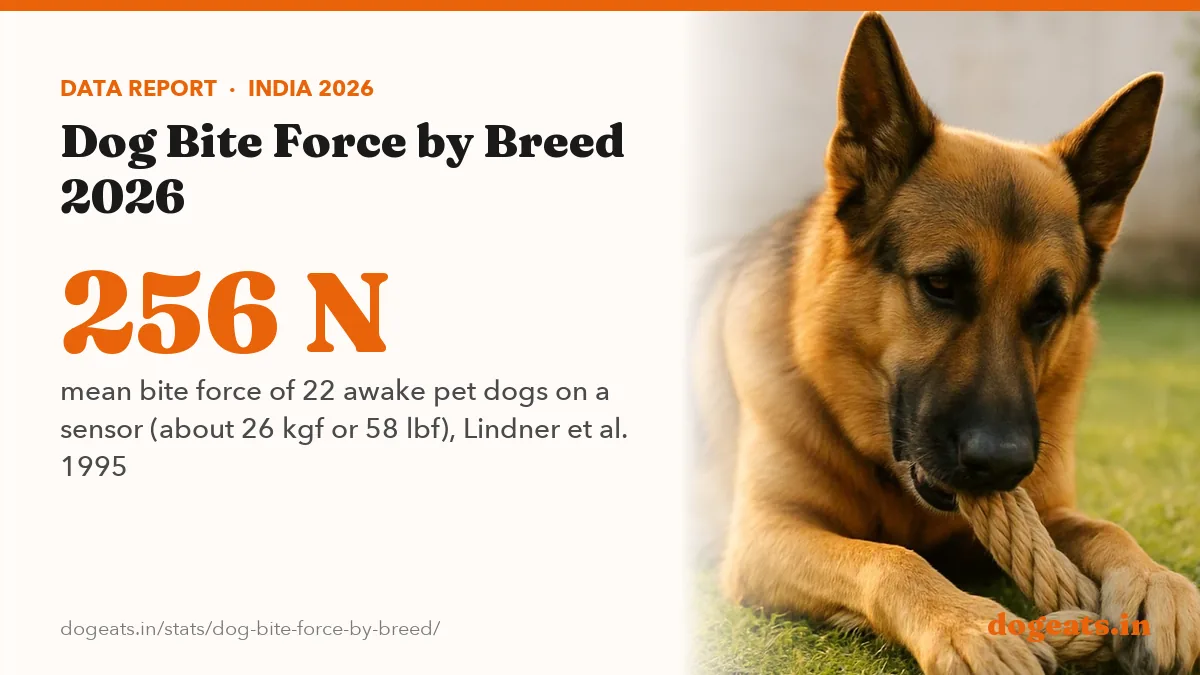
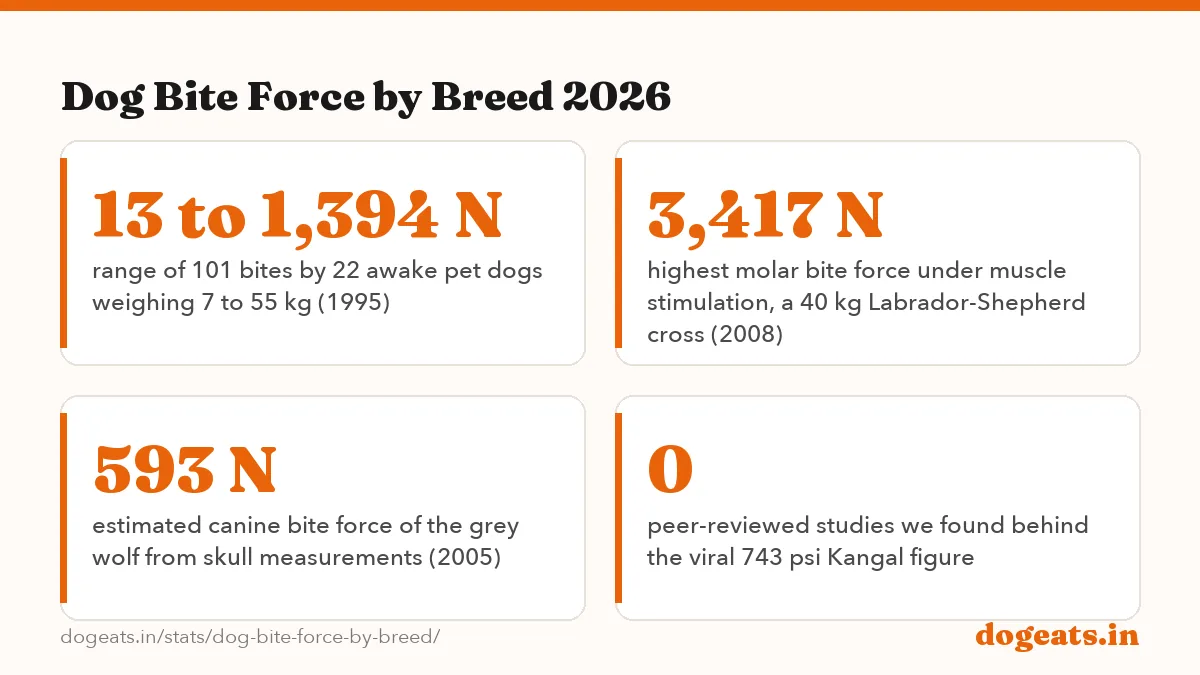
We found one published test of awake pet dogs biting a sensor. Its 22 dogs bit with 13 to 1,394 newtons, a mean of 256 N (about 26 kgf or 58 lbf). Under full electrical muscle stimulation, 20 anaesthetised dogs reached 926 N at the canines and 3,417 N at the molars, and bite force rose with body and skull size. No peer-reviewed study has measured and ranked breeds, and popular psi figures such as 743 psi for the Kangal trace back to no study we could find.
Key findings
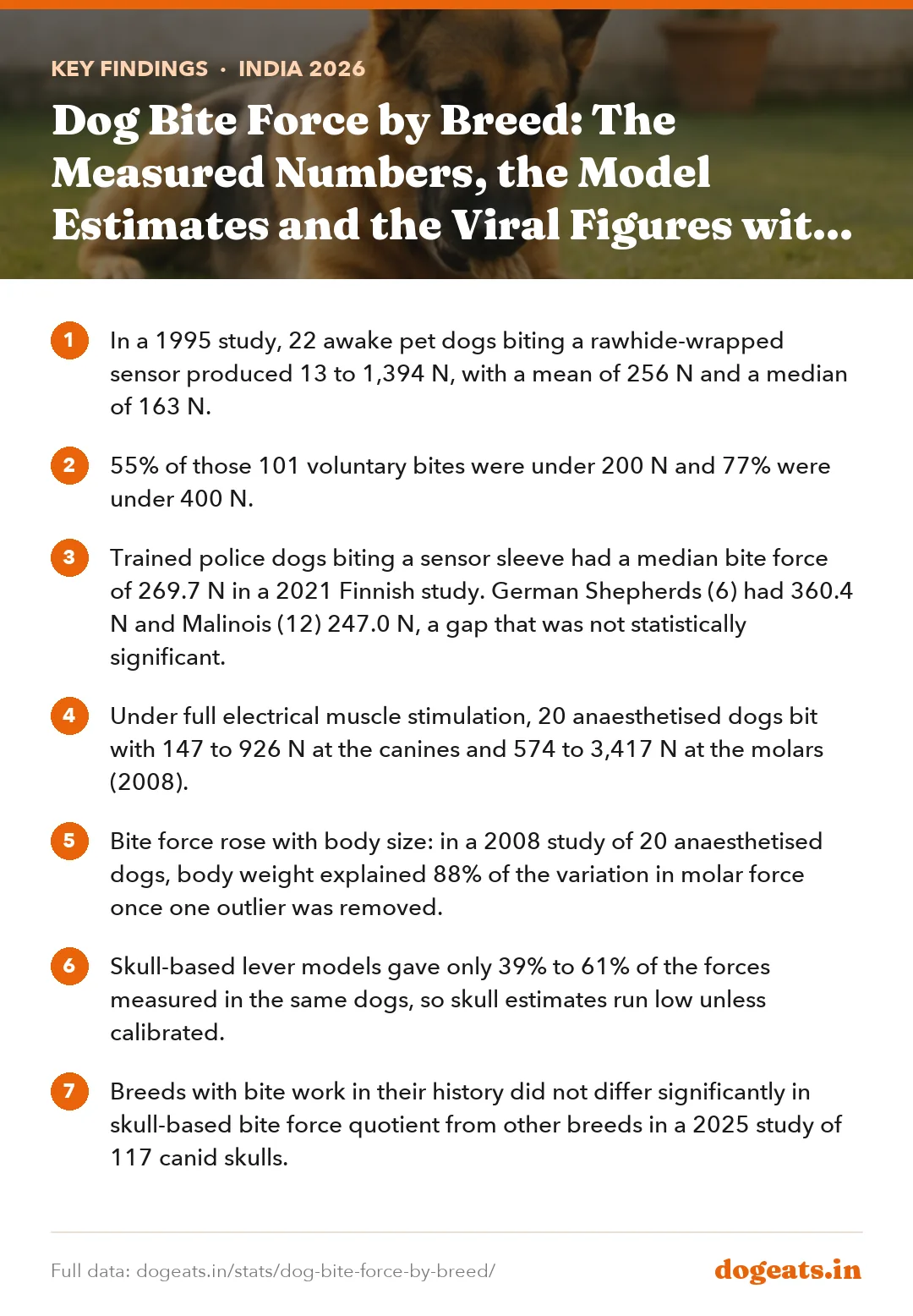
- In a 1995 study, 22 awake pet dogs biting a rawhide-wrapped sensor produced 13 to 1,394 N, with a mean of 256 N and a median of 163 N.
- 55% of those 101 voluntary bites were under 200 N and 77% were under 400 N.
- Trained police dogs biting a sensor sleeve had a median bite force of 269.7 N in a 2021 Finnish study. German Shepherds (6) had 360.4 N and Malinois (12) 247.0 N, a gap that was not statistically significant.
- Under full electrical muscle stimulation, 20 anaesthetised dogs bit with 147 to 926 N at the canines and 574 to 3,417 N at the molars (2008).
- Bite force rose with body size: in a 2008 study of 20 anaesthetised dogs, body weight explained 88% of the variation in molar force once one outlier was removed.
- Skull-based lever models gave only 39% to 61% of the forces measured in the same dogs, so skull estimates run low unless calibrated.
- Breeds with bite work in their history did not differ significantly in skull-based bite force quotient from other breeds in a 2025 study of 117 canid skulls.
- No peer-reviewed study has measured bite force breed by breed. We could find no study behind the popular psi rankings for the Kangal, Cane Corso and Rottweiler.
How strong is a dog's bite in newtons?
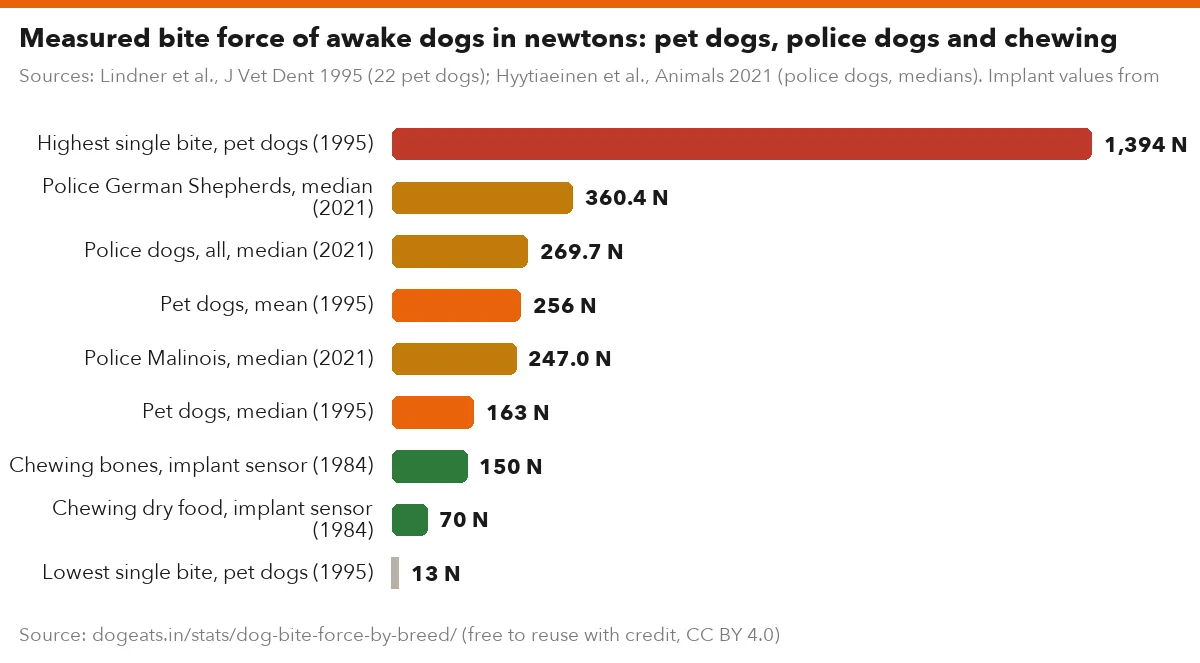
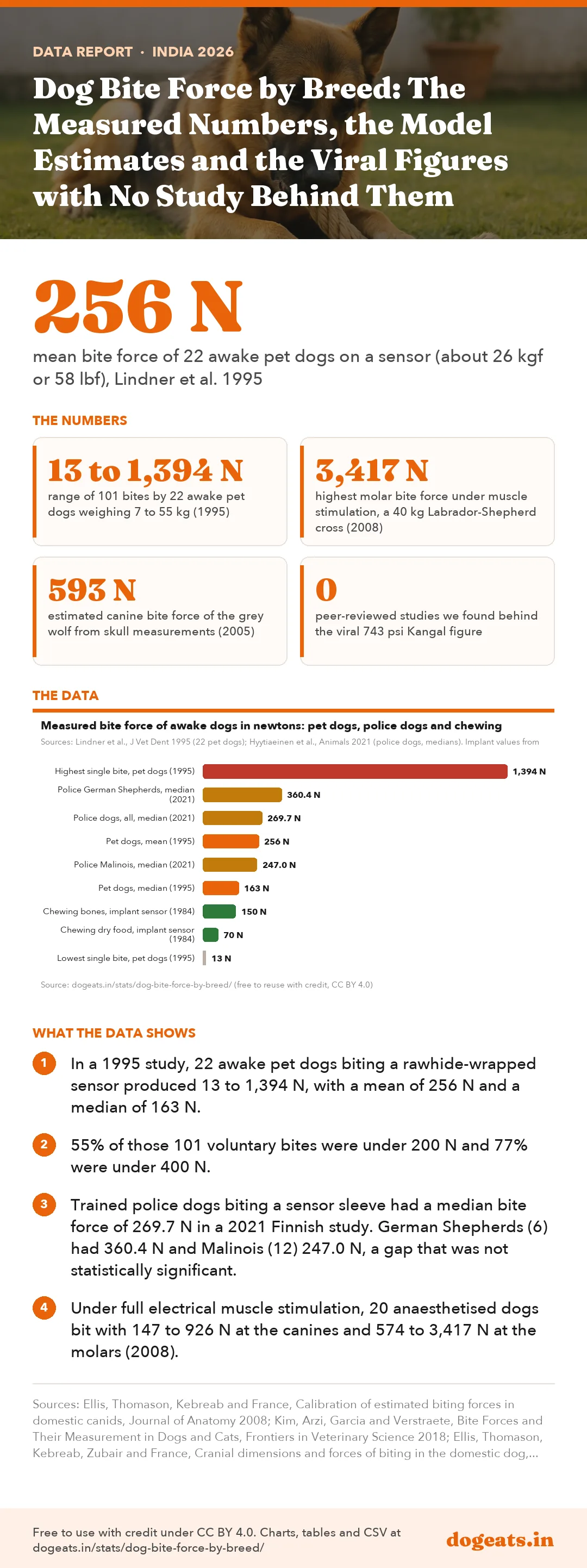
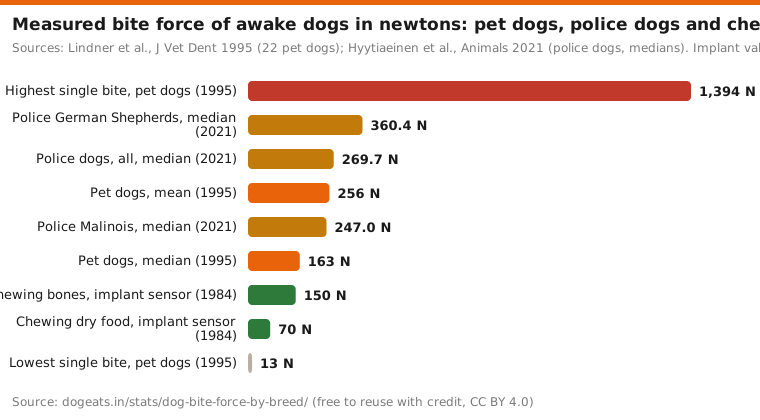
Most voluntary dog bites measured in a lab were under 400 N. In a 1995 study, 22 awake pet dogs weighing 7 to 55 kg bit a sensor wrapped in beef-flavoured rawhide 101 times. Bites ranged from 13 to 1,394 N, with a mean of 256 N (about 26 kgf or 58 lbf) and a median of 163 N.
Most bites were gentle. 55% were under 200 N and 77% were under 400 N. A 2018 review of the study reports that force rose only slightly with body weight and did not depend on head shape or jaw muscle mass. The critical factor was the dog's eagerness to chew, so results varied widely.
Working dogs bite harder on command. In a 2021 Finnish study of 20 police dogs, the dogs ran 25 m and bit a sleeve fitted with force sensors. Eighteen dogs had usable sleeve data (the paper's pooled row lists 17), and the pooled median was 269.7 N. The 6 German Shepherds had a median of 360.4 N and the 12 Belgian Malinois 247.0 N, a gap that was not statistically significant. The police and army dog report covers how such dogs are used in India.
Sources: Lindner et al., J Vet Dent 1995 (22 pet dogs); Hyytiaeinen et al., Animals 2021 (police dogs, medians). Implant values from Brunski and Hipp 1984, as summarised in Kim et al., Front Vet Sci 2018. 1 kgf = 9.81 N.
Show the numbers
| Label | N |
|---|---|
| Highest single bite, pet dogs (1995) | 1,394 N |
| Police German Shepherds, median (2021) | 360.4 N |
| Police dogs, all, median (2021) | 269.7 N |
| Pet dogs, mean (1995) | 256 N |
| Police Malinois, median (2021) | 247.0 N |
| Pet dogs, median (1995) | 163 N |
| Chewing bones, implant sensor (1984) | 150 N |
| Chewing dry food, implant sensor (1984) | 70 N |
| Lowest single bite, pet dogs (1995) | 13 N |
Embed this chart
The implant figures come from three dogs with a sensor fitted in the lower jaw in the 1980s. They bit with up to 150 N on bones and 70 N on dry food, though the sensor sat at the premolars rather than the carnassial teeth. Chewing bone loads the teeth and can splinter; see the guide to cooked bones before offering one.
Which dog breed has the strongest bite force?
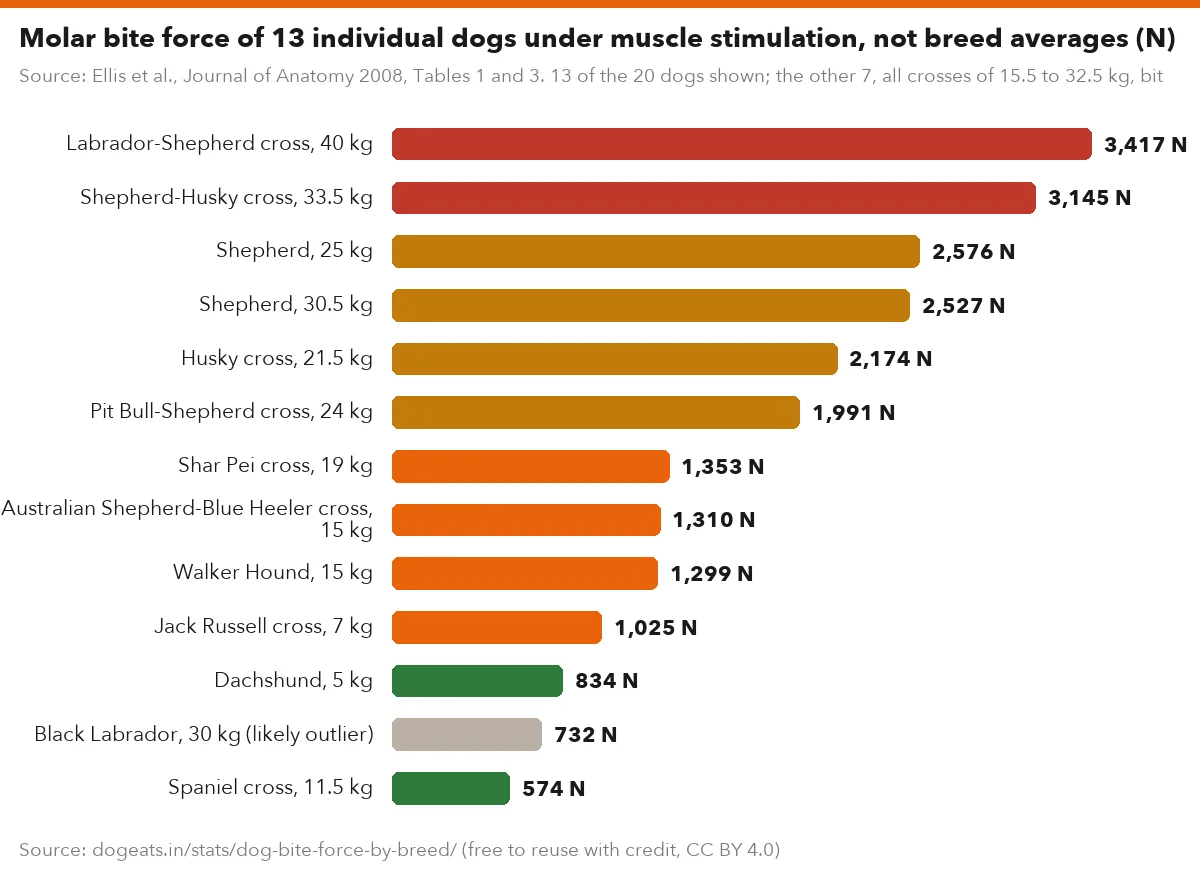
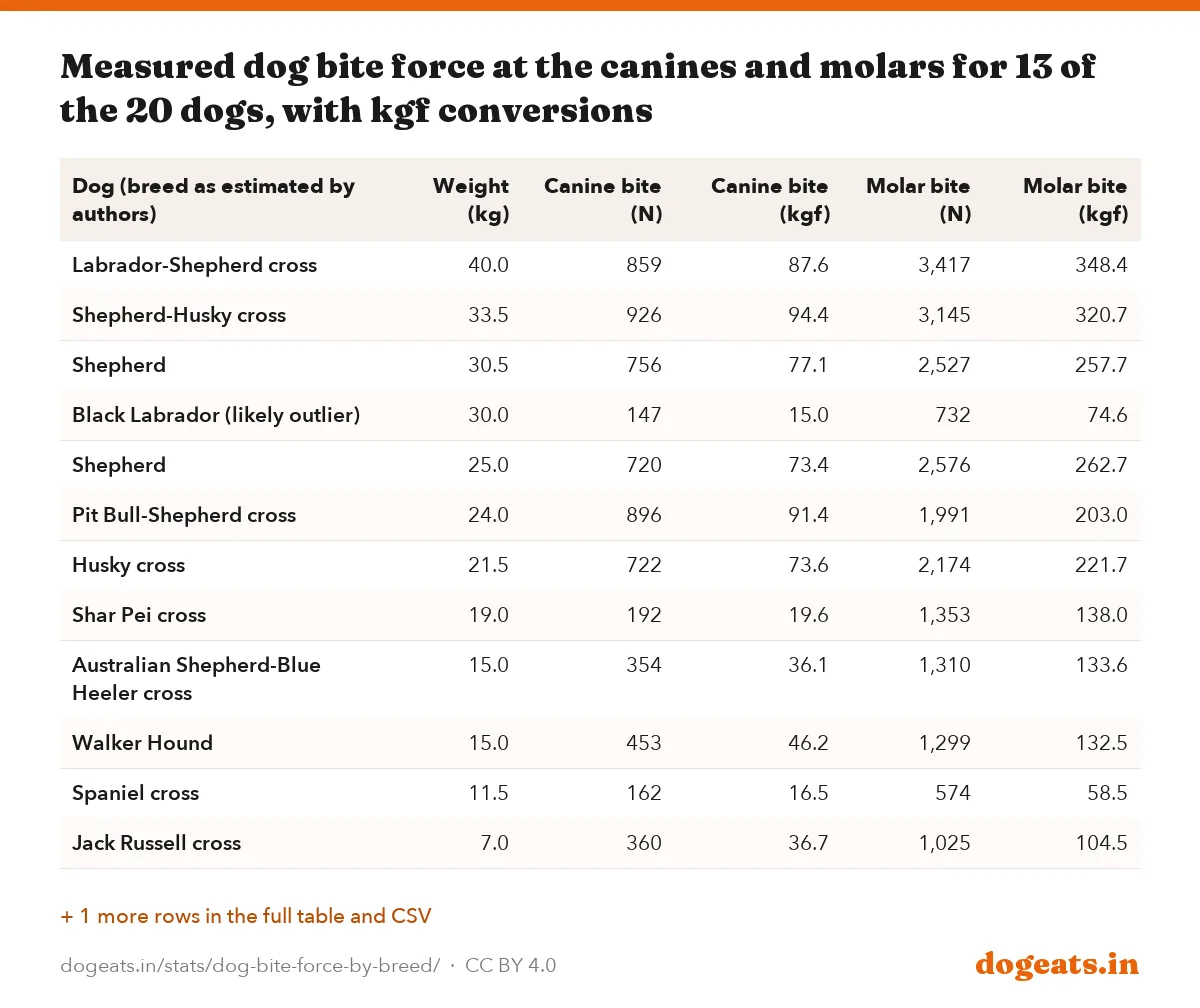
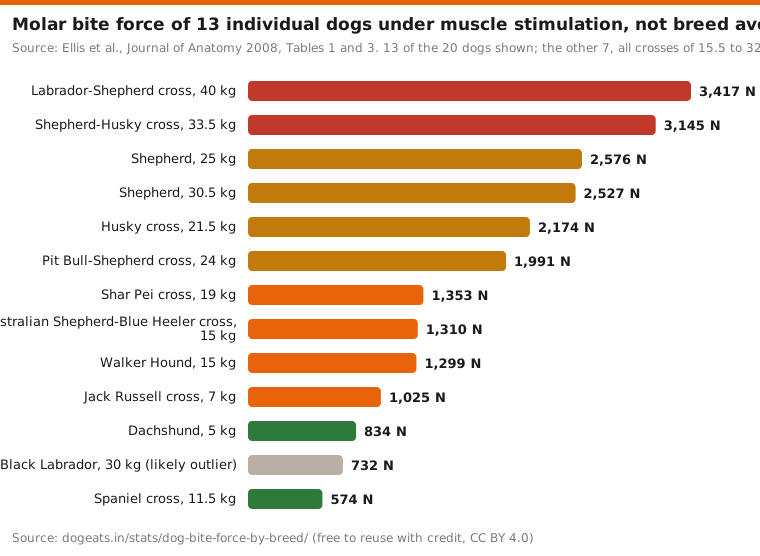
No peer-reviewed study has measured enough dogs of each breed to rank breeds by bite force. The best per-dog data is a 2008 University of Guelph study of 20 dogs, mostly mixed breeds, whose jaw muscles were stimulated under anaesthesia. Forces ran from 147 to 926 N at the canines and 574 to 3,417 N at the molars.
The strongest molar bite came from a 40 kg Labrador-Shepherd cross at 3,417 N (about 348 kgf). The strongest canine bite was 926 N, from a 33.5 kg Shepherd-Husky cross. A 24 kg Pit Bull-Shepherd cross bit with 896 N at the canines but 1,991 N at the molars, below several Shepherds.
Size explained most of the spread. With one outlier removed, body weight explained 88% of the variation in molar force. The outlier was a 30 kg dog that bit far less than expected; the authors suggest a misplaced electrode as one possible cause. The paper's text calls it dog 3, but its Table 1 lists only one 30 kg dog, a Black Labrador. It bit with 147 N at the canines and 732 N at the molars, less than a 5 kg Dachshund (281 N and 834 N). Removing that dog reproduces the paper's reported figures (our check), so its low numbers may reflect the test rather than the breed.
Source: Ellis et al., Journal of Anatomy 2008, Tables 1 and 3. 13 of the 20 dogs shown; the other 7, all crosses of 15.5 to 32.5 kg, bit with 1,675 to 2,900 N. Anaesthetised dogs, jaw muscles stimulated at 60 V; breeds estimated by the authors from looks. Mean of up to four bites per dog. Outlier identified by dogeats.in from the paper's reported statistics.
Show the numbers
| Label | N |
|---|---|
| Labrador-Shepherd cross, 40 kg | 3,417 N |
| Shepherd-Husky cross, 33.5 kg | 3,145 N |
| Shepherd, 25 kg | 2,576 N |
| Shepherd, 30.5 kg | 2,527 N |
| Husky cross, 21.5 kg | 2,174 N |
| Pit Bull-Shepherd cross, 24 kg | 1,991 N |
| Shar Pei cross, 19 kg | 1,353 N |
| Australian Shepherd-Blue Heeler cross, 15 kg | 1,310 N |
| Walker Hound, 15 kg | 1,299 N |
| Jack Russell cross, 7 kg | 1,025 N |
| Dachshund, 5 kg | 834 N |
| Black Labrador, 30 kg (likely outlier) | 732 N |
| Spaniel cross, 11.5 kg | 574 N |
Embed this chart
| Dog (breed as estimated by authors) | Weight (kg) | Canine bite (N) | Canine bite (kgf) | Molar bite (N) | Molar bite (kgf) |
|---|---|---|---|---|---|
| Labrador-Shepherd cross | 40.0 | 859 | 87.6 | 3,417 | 348.4 |
| Shepherd-Husky cross | 33.5 | 926 | 94.4 | 3,145 | 320.7 |
| Shepherd | 30.5 | 756 | 77.1 | 2,527 | 257.7 |
| Black Labrador (likely outlier) | 30.0 | 147 | 15.0 | 732 | 74.6 |
| Shepherd | 25.0 | 720 | 73.4 | 2,576 | 262.7 |
| Pit Bull-Shepherd cross | 24.0 | 896 | 91.4 | 1,991 | 203.0 |
| Husky cross | 21.5 | 722 | 73.6 | 2,174 | 221.7 |
| Shar Pei cross | 19.0 | 192 | 19.6 | 1,353 | 138.0 |
| Australian Shepherd-Blue Heeler cross | 15.0 | 354 | 36.1 | 1,310 | 133.6 |
| Walker Hound | 15.0 | 453 | 46.2 | 1,299 | 132.5 |
| Spaniel cross | 11.5 | 162 | 16.5 | 574 | 58.5 |
| Jack Russell cross | 7.0 | 360 | 36.7 | 1,025 | 104.5 |
| Dachshund | 5.0 | 281 | 28.7 | 834 | 85.0 |
These are maximum forces with every jaw muscle firing at once, which an awake dog rarely does. Across all 20 dogs, the mean was 534 N at the canines and 1,890 N at the molars, as the paper reports. A Jack Russell cross of 7 kg still reached 1,025 N at the molars.
Do bigger dogs and flat-faced dogs bite harder?
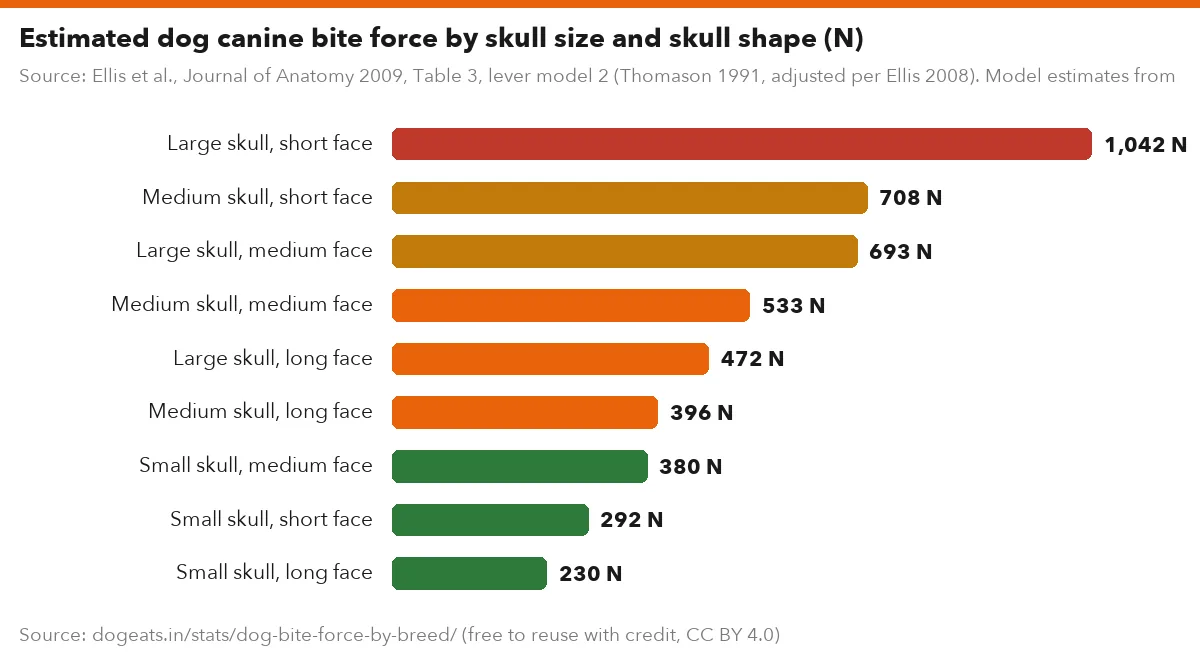
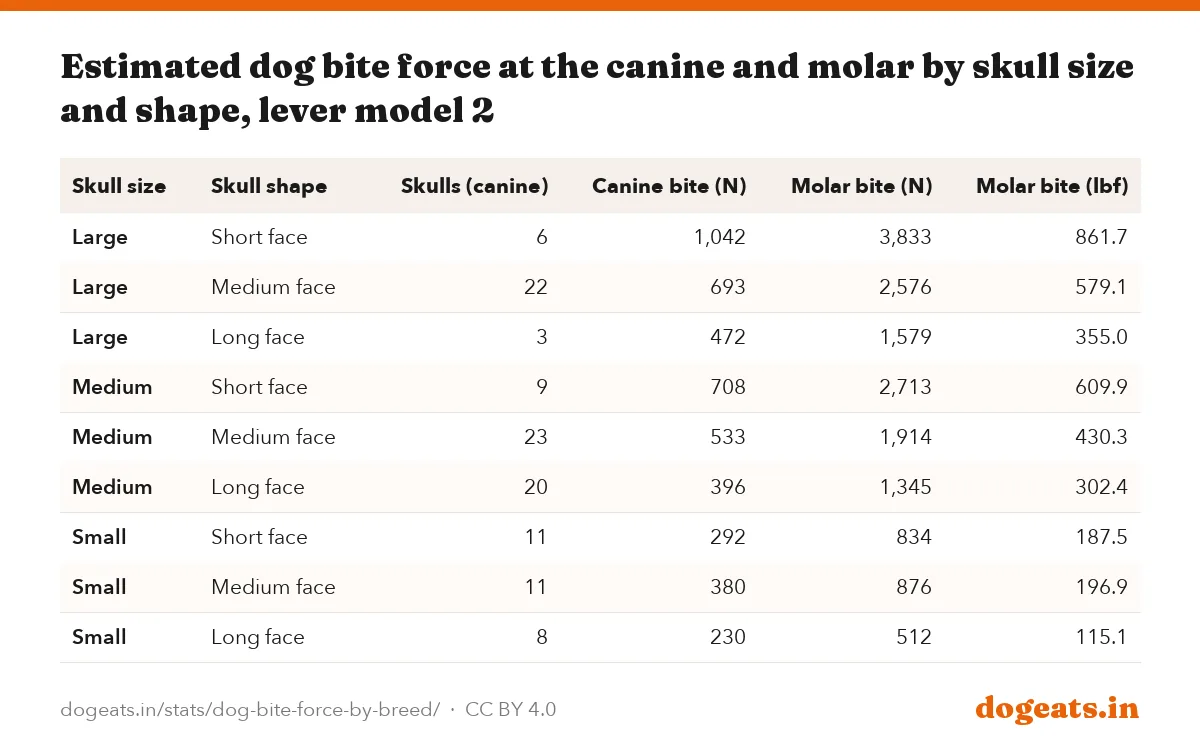
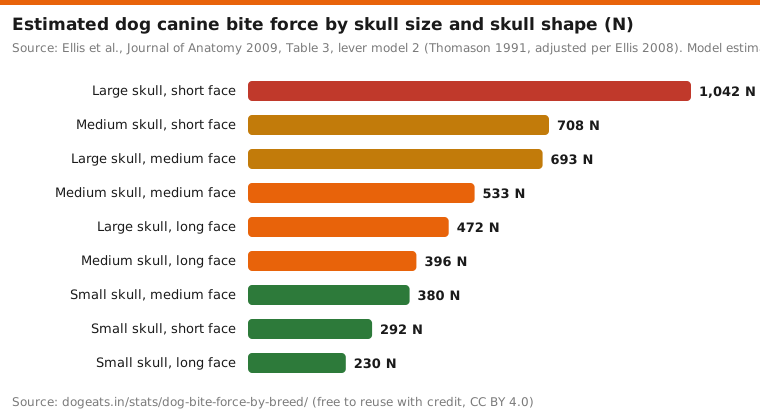
Yes for size, and partly for face shape. A 2009 study modelled bite force from 127 dry skulls of many breeds. Estimated canine bite force for large short-faced skulls averaged 1,042 N, against 230 N for small long-faced skulls, using the calibrated Thomason lever model.
Size was the stronger factor (P < 0.0001). Shorter faces raised estimated force in medium and large dogs, because the jaw works as a shorter lever, but made no clear difference in small dogs. Males averaged 486 N at the canines and females 375 N, across the three models.
Breeding for bite work did not show up in the skull. A 2025 Science Advances study analysed 117 canid skulls from 40 breeds and 18 wild subspecies. Bite force quotient did not differ significantly between 14 skulls from bite-work breeds and 80 from other breeds.
Source: Ellis et al., Journal of Anatomy 2009, Table 3, lever model 2 (Thomason 1991, adjusted per Ellis 2008). Model estimates from dry skulls, not measurements. Short face = brachycephalic, long face = dolichocephalic.
Show the numbers
| Label | N |
|---|---|
| Large skull, short face | 1,042 N |
| Medium skull, short face | 708 N |
| Large skull, medium face | 693 N |
| Medium skull, medium face | 533 N |
| Large skull, long face | 472 N |
| Medium skull, long face | 396 N |
| Small skull, medium face | 380 N |
| Small skull, short face | 292 N |
| Small skull, long face | 230 N |
Embed this chart
| Skull size | Skull shape | Skulls (canine) | Canine bite (N) | Molar bite (N) | Molar bite (lbf) |
|---|---|---|---|---|---|
| Large | Short face | 6 | 1,042 | 3,833 | 861.7 |
| Large | Medium face | 22 | 693 | 2,576 | 579.1 |
| Large | Long face | 3 | 472 | 1,579 | 355.0 |
| Medium | Short face | 9 | 708 | 2,713 | 609.9 |
| Medium | Medium face | 23 | 533 | 1,914 | 430.3 |
| Medium | Long face | 20 | 396 | 1,345 | 302.4 |
| Small | Short face | 11 | 292 | 834 | 187.5 |
| Small | Medium face | 11 | 380 | 876 | 196.9 |
| Small | Long face | 8 | 230 | 512 | 115.1 |
The 2009 authors had no live measurements for these skulls, so the values compare groups rather than give true forces. Breeds were sorted by measured skull proportions, so the same breed can fall in more than one group. The aggression by breed report shows that size, fear and sex also shape bite risk more than breed labels.
Is a wolf's bite stronger than a dog's?
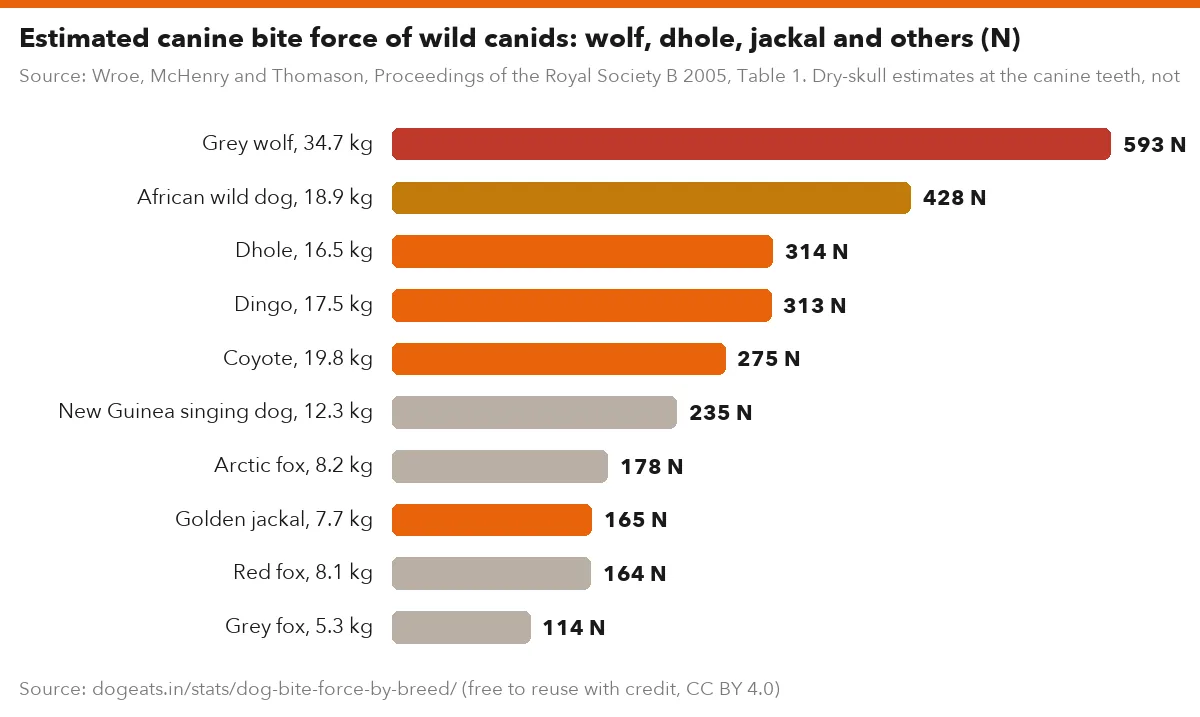
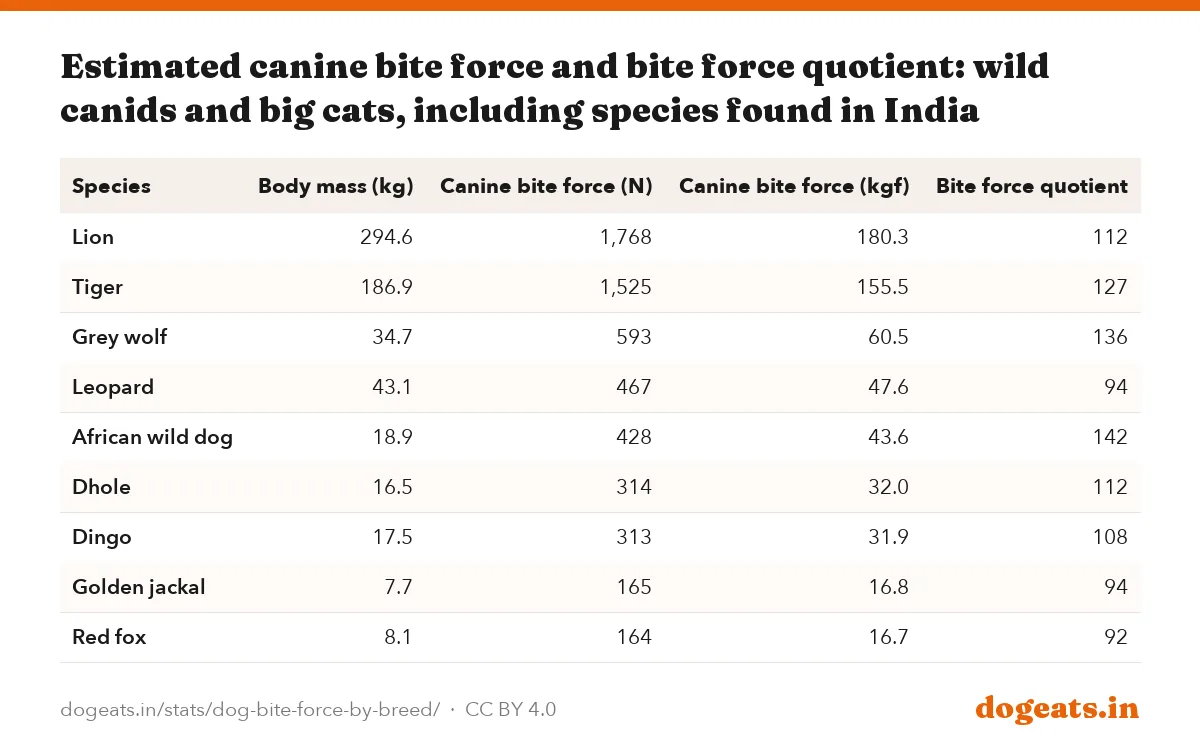
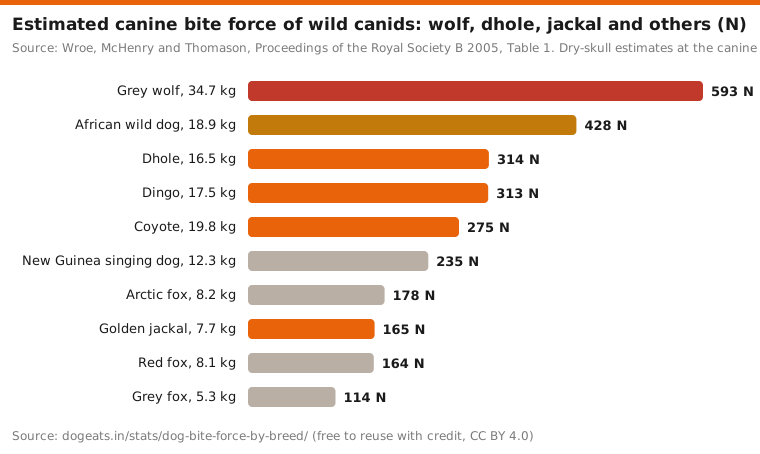
A grey wolf's estimated canine bite force is 593 N, from skull measurements of a 34.7 kg wolf in a 2005 study of 39 living and fossil mammals. It had a bite force quotient (BFQ) of 136, where 100 is the average for its body mass across the study's sample.
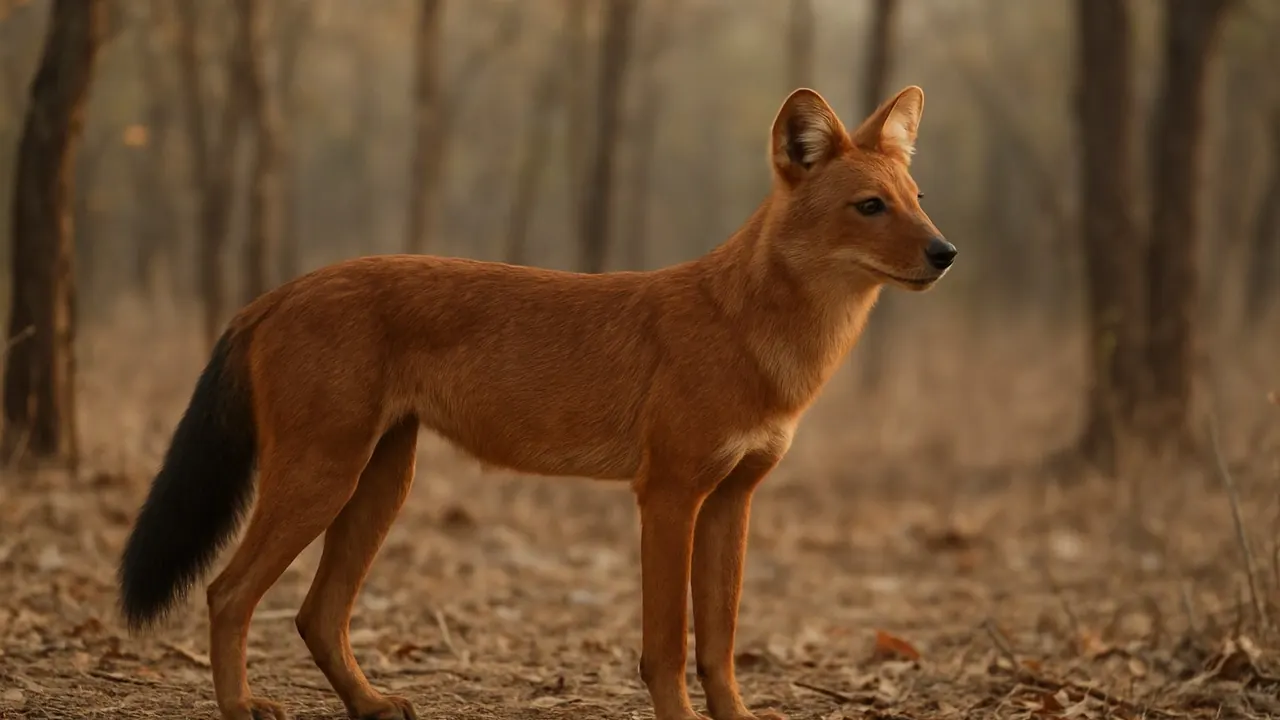
Two wild canids of India sit lower. The dhole was estimated at 314 N (BFQ 112) and the golden jackal at 165 N (BFQ 94). The African wild dog had the highest BFQ of any living member of the order Carnivora in the study, at 142.
Domestic dogs were not in that study, and dry-skull lever models of this kind gave only 39% to 61% of the forces measured in live dogs in 2008. Wolf and dog numbers from different methods should not be set side by side.
Source: Wroe, McHenry and Thomason, Proceedings of the Royal Society B 2005, Table 1. Dry-skull estimates at the canine teeth, not live measurements.
Show the numbers
| Label | N |
|---|---|
| Grey wolf, 34.7 kg | 593 N |
| African wild dog, 18.9 kg | 428 N |
| Dhole, 16.5 kg | 314 N |
| Dingo, 17.5 kg | 313 N |
| Coyote, 19.8 kg | 275 N |
| New Guinea singing dog, 12.3 kg | 235 N |
| Arctic fox, 8.2 kg | 178 N |
| Golden jackal, 7.7 kg | 165 N |
| Red fox, 8.1 kg | 164 N |
| Grey fox, 5.3 kg | 114 N |
Embed this chart
| Species | Body mass (kg) | Canine bite force (N) | Canine bite force (kgf) | Bite force quotient |
|---|---|---|---|---|
| Lion | 294.6 | 1,768 | 180.3 | 112 |
| Tiger | 186.9 | 1,525 | 155.5 | 127 |
| Grey wolf | 34.7 | 593 | 60.5 | 136 |
| Leopard | 43.1 | 467 | 47.6 | 94 |
| African wild dog | 18.9 | 428 | 43.6 | 142 |
| Dhole | 16.5 | 314 | 32.0 | 112 |
| Dingo | 17.5 | 313 | 31.9 | 108 |
| Golden jackal | 7.7 | 165 | 16.8 | 94 |
| Red fox | 8.1 | 164 | 16.7 | 92 |
Is the Kangal's 743 psi bite force real?
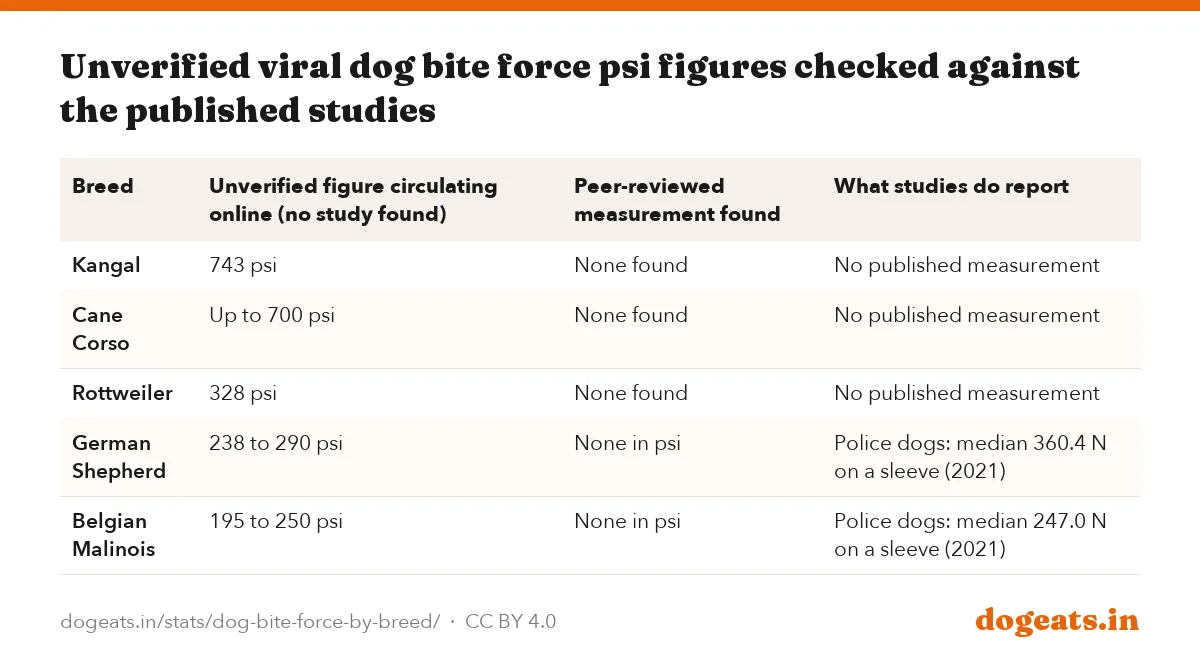
We found no peer-reviewed study behind it. Ranking sites repeat 743 psi for the Kangal, up to 700 for the Cane Corso, 328 for the Rottweiler and 238 to 290 for the German Shepherd. None names a study, method or sample size.
None of the published papers we read report any breed in psi. A filmed test on one dog, however dramatic, is not a peer-reviewed study. One ranking site that repeats the figures calls them unverified estimates based on nonstandardised comparisons.
The Kangal and Cane Corso have never been measured in a published bite force study that we could find. Of all the breeds on these viral lists, only the German Shepherd and Malinois have a published functional bite measurement, and it is in newtons.
| Breed | Unverified figure circulating online (no study found) | Peer-reviewed measurement found | What studies do report |
|---|---|---|---|
| Kangal | 743 psi | None found | No published measurement |
| Cane Corso | Up to 700 psi | None found | No published measurement |
| Rottweiler | 328 psi | None found | No published measurement |
| German Shepherd | 238 to 290 psi | None in psi | Police dogs: median 360.4 N on a sleeve (2021) |
| Belgian Malinois | 195 to 250 psi | None in psi | Police dogs: median 247.0 N on a sleeve (2021) |
- Ask for the study: authors, journal, year and number of dogs.
- Check the unit: bite force studies report newtons, not psi.
- Check the method: awake bite, muscle stimulation or a skull model give very different numbers.
- Check the sample: a single dog on camera cannot stand for a breed.
Bite force also says little about danger. Most serious dog bite harm in India comes from rabies, not jaw strength; see the dog bite and rabies statistics. Breed bans built on bite rankings are tracked in the restricted breeds report.
Why do dog bite force figures differ so much between studies?
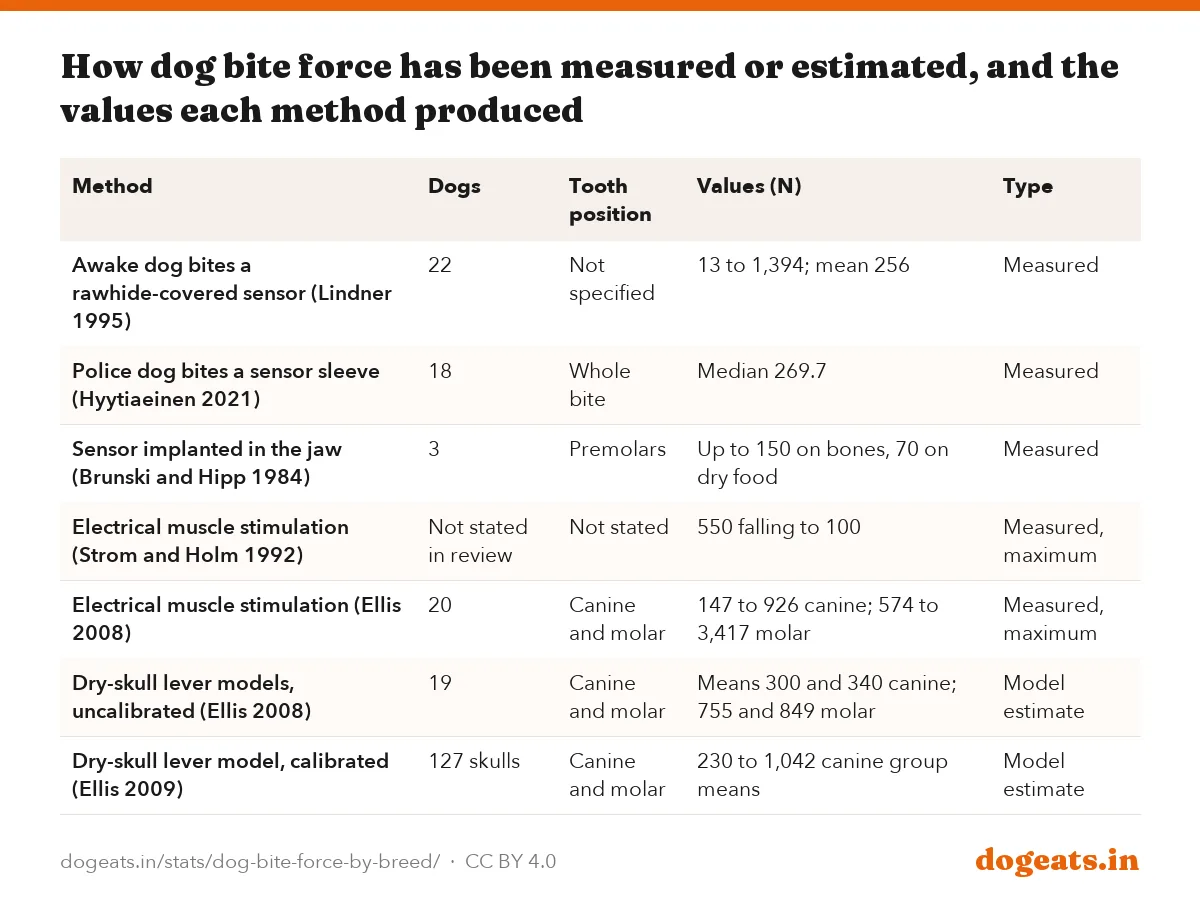
Because each method measures something different, and the gap can be more than tenfold. Awake dogs biting a sensor averaged 256 N in 1995, while stimulated muscles in anaesthetised dogs drove molar bites up to 3,417 N in 2008.
Muscle stimulation measures the maximum the jaw can produce, not what a dog chooses to do. In an earlier stimulation study cited in a 2018 review, force fell from 550 N at the first stimulation to 100 N by the fourth.
Skull models run low. For the 2008 dogs, two classic lever models predicted mean molar forces of 755 N and 849 N, only 38.7% and 43.5% of the measured mean. After calibration they averaged 1,949 N and 2,036 N.
| Method | Dogs | Tooth position | Values (N) | Type |
|---|---|---|---|---|
| Awake dog bites a rawhide-covered sensor (Lindner 1995) | 22 | Not specified | 13 to 1,394; mean 256 | Measured |
| Police dog bites a sensor sleeve (Hyytiaeinen 2021) | 18 | Whole bite | Median 269.7 | Measured |
| Sensor implanted in the jaw (Brunski and Hipp 1984) | 3 | Premolars | Up to 150 on bones, 70 on dry food | Measured |
| Electrical muscle stimulation (Strom and Holm 1992) | Not stated in review | Not stated | 550 falling to 100 | Measured, maximum |
| Electrical muscle stimulation (Ellis 2008) | 20 | Canine and molar | 147 to 926 canine; 574 to 3,417 molar | Measured, maximum |
| Dry-skull lever models, uncalibrated (Ellis 2008) | 19 | Canine and molar | Means 300 and 340 canine; 755 and 849 molar | Model estimate |
| Dry-skull lever model, calibrated (Ellis 2009) | 127 skulls | Canine and molar | 230 to 1,042 canine group means | Model estimate |
At the canines the same models gave 54.1% and 61.3% of the measured mean. The 2008 authors found that body weight and simple skull measurements such as jaw lever lengths predicted force far better once calibrated against live dogs.
Has bite force been measured in Indian dog breeds or street dogs?
No. We found no published bite force measurement for any Indian breed, including the Indian Pariah Dog, Rajapalayam or Mudhol Hound, and none for Indian street dogs.
The closest data comes from Tunisia. A 2025 study dissected the jaw muscles of 27 adult street dogs. Jaw muscle anatomy was very similar from dog to dog despite varied skull shapes, and all chewing muscles scaled with body mass. It did not measure bite force.
For India's wild canids, skull estimates exist for the dhole (314 N) and golden jackal (165 N), from the 2005 study above.

Bite force research is relevant to vets and pet food makers too. The 2009 authors wrote that their results would be useful to the pet food industry for product development.
Frequently asked questions
What is the average bite force of a dog?
About 256 N, or roughly 26 kgf (58 lbf), was the mean for 22 awake pet dogs biting a sensor in a 1995 study. The median was 163 N, and 77% of bites were under 400 N.
Which dog has the strongest bite force?
No study has ranked breeds by measured bite force. The highest measured force we found was 3,417 N at the molars, from a 40 kg Labrador-Shepherd cross under muscle stimulation in a 2008 study.
Is the Kangal bite force really 743 psi?
We found no peer-reviewed study behind the 743 psi figure. No published study has measured a Kangal's bite, and bite force studies report newtons, not psi.
What is the bite force of a German Shepherd?
Six police German Shepherds biting a sensor sleeve had a median of 360.4 N (about 37 kgf) in a 2021 Finnish study of 20 police dogs. Twelve Malinois in the same study had a median of 247.0 N; the difference was not statistically significant.
Does a wolf bite harder than a dog?
A grey wolf skull gave an estimated canine bite force of 593 N in a 2005 study. No study has measured wolves and dogs the same way, so a direct comparison is not possible.
Do bigger dogs bite harder?
Yes. In a 2008 study, body weight explained 88% of the variation in molar bite force once one outlier was removed. In a 2009 skull model study, large short-faced skulls had the highest estimates, about 1,042 N at the canines.
How do you convert dog bite force from newtons to kg or pounds?
Divide newtons by 9.81 for kilograms-force and by 4.45 for pounds-force. So 256 N is about 26 kgf or 58 lbf. Newtons cannot be converted to psi without the tooth contact area.
Has bite force been measured in Indian dogs?
No. We found no study of bite force in any Indian breed or in Indian street dogs. Skull estimates exist only for India's wild canids, such as the dhole at 314 N.
Methodology and limitations
We used only figures from peer-reviewed studies we opened on 16 October 2026 and rechecked on 18 October 2026: Lindner et al. 1995 (abstract), Ellis et al. 2008 and 2009 (full text, Journal of Anatomy), Wroe et al. 2005 (full text), Hyytiaeinen et al. 2021 (full text), Hebdon et al. 2025 (full text) and the 2018 review by Kim et al. Figures for the 1984 implant and 1992 stimulation studies come from that review, as we could not open the originals.
Each figure is labelled as measured in awake dogs, measured under muscle stimulation, or estimated from skull models. Newtons are given first. Conversions are our calculations: kgf = N / 9.80665 and lbf = N / 4.44822, rounded to one decimal. Mean canine (534 N) and molar (1,890 N) forces across the 20 dogs are reported in Ellis 2008, and our sum of Table 3 matches. The paper's text names its outlier as dog 3 (30 kg), but Table 1 lists dog 3 at 19.0 kg. Refitting body weight against force without dog 2, the only 30 kg dog, reproduces the reported R2 of 0.88 (molar) and 0.52 (canine). Dropping dog 3 instead gives 0.62 and 0.34, so we mark dog 2 as the likely outlier.
For the viral psi figures we searched for any study, journal or sample behind each number and found none. We show the figures only to label them as unsupported.
Sources
- Ellis, Thomason, Kebreab and France, Calibration of estimated biting forces in domestic canids, Journal of Anatomy 2008, 20 anaesthetised dogs; canine and molar bite force per dog; lever model calibration
- Kim, Arzi, Garcia and Verstraete, Bite Forces and Their Measurement in Dogs and Cats, Frontiers in Veterinary Science 2018, Review of all dog bite force methods; Lindner 1995, implant and stimulation studies
- Ellis, Thomason, Kebreab, Zubair and France, Cranial dimensions and forces of biting in the domestic dog, Journal of Anatomy 2009, 127 skulls; estimated bite force by skull size, shape and sex
- Also consulted: Lindner, Marretta, Pijanowski, Johnson and Smith, Measurement of bite force in dogs: a pilot study, Journal of Veterinary Dentistry 1995, Hyytiaeinen, Blomvall, Hautala and Lappalainen, Reliability of a New Bite Force Measure and Biomechanics of Modified Long Attack in Police Dogs, Animals 2021, Wroe, McHenry and Thomason, Bite club: comparative bite force in big biting mammals, Proceedings of the Royal Society B 2005, Hebdon et al., Dog skull shape challenges assumptions of performance specialization from selective breeding, Science Advances 2025, Variability of jaw muscles in Tunisian street dogs and adaptation to skull shape, Anatomical Record 2025, Canine Bible, What Dog Has the Strongest Bite? 30 Breeds With the Strongest Bite Force.
Cite, embed and download
This report, its data and its images are free to reuse under a Creative Commons Attribution 4.0 licence. Credit dogeats.in with a link to this page. Every chart has its own embed code, every table has a CSV and an image download, and the images below are ready for social posts, slides and articles.
Cite this report
Link to this report
Every chart and table as an image