Explainer · Updated October 2026
At what age is a dog a senior, by size, and which health problems come with old age
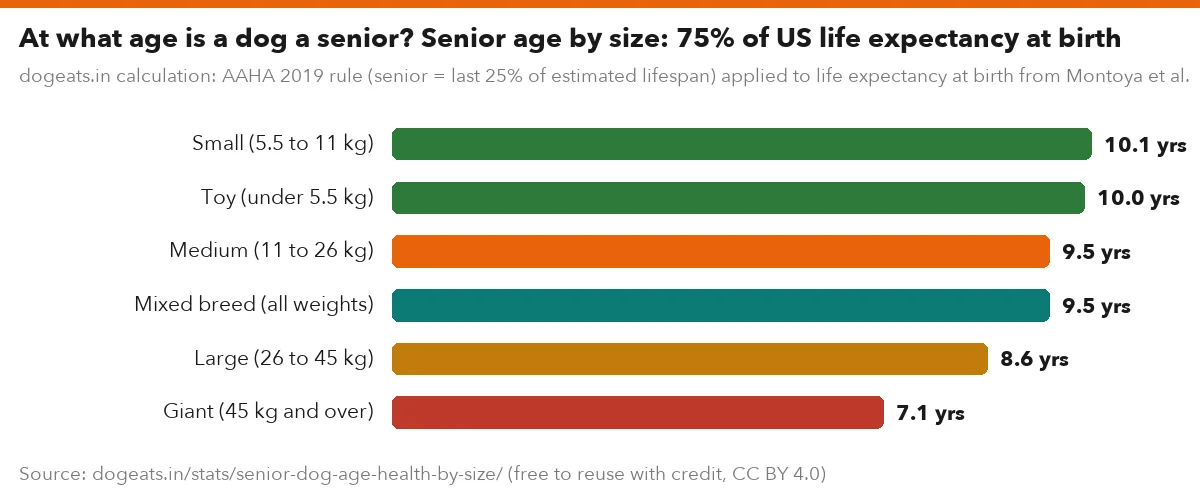
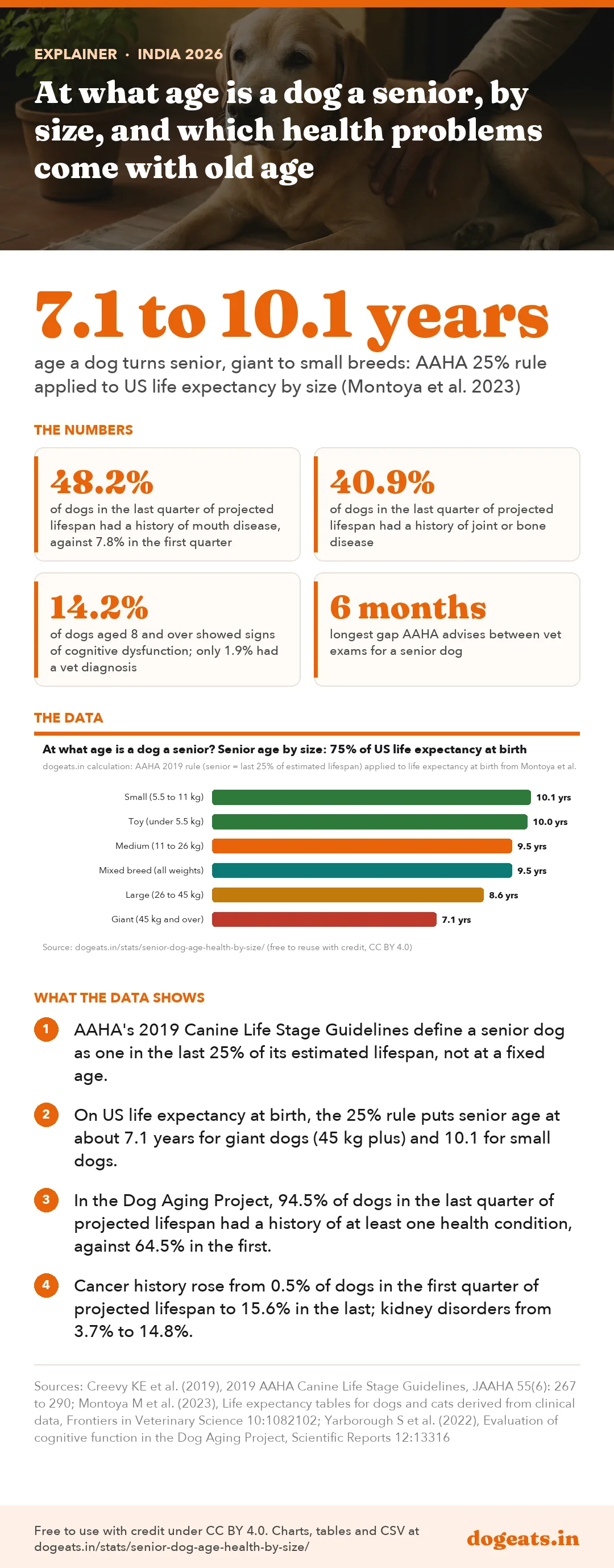
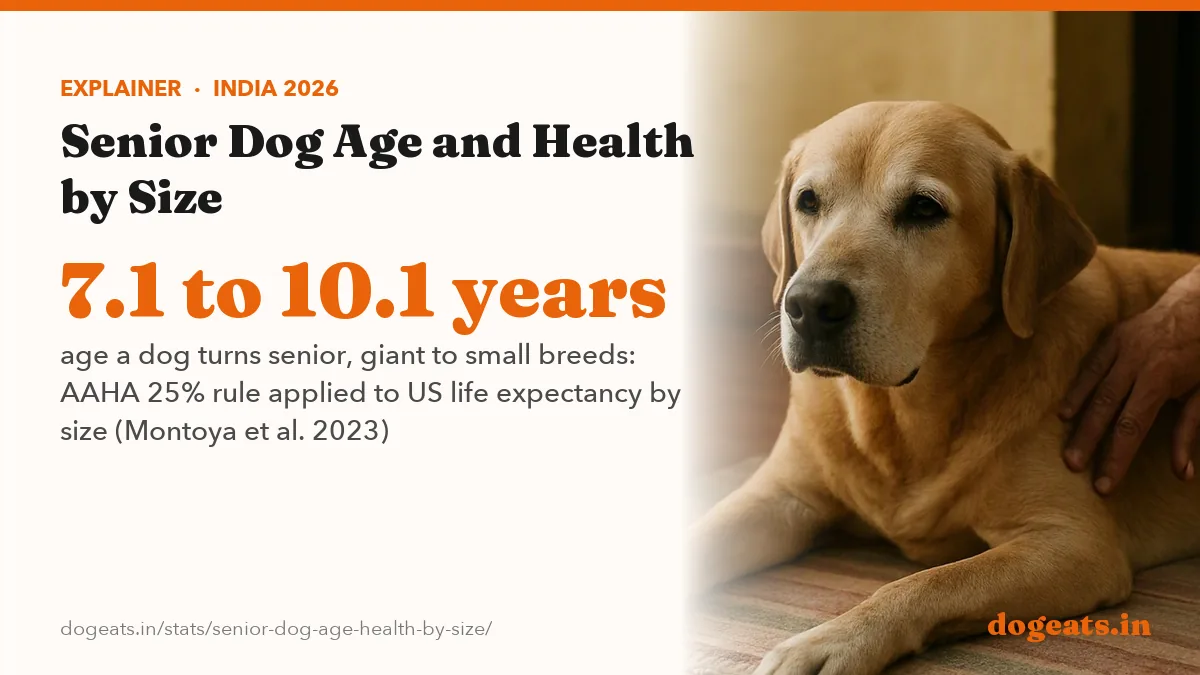
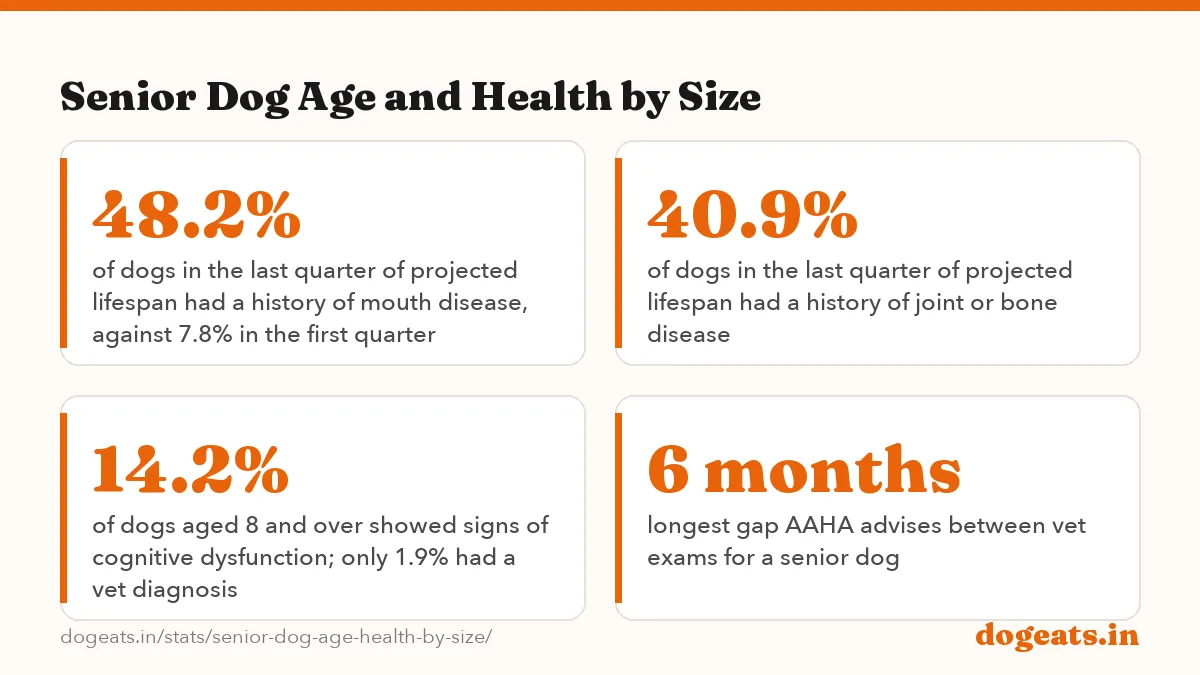
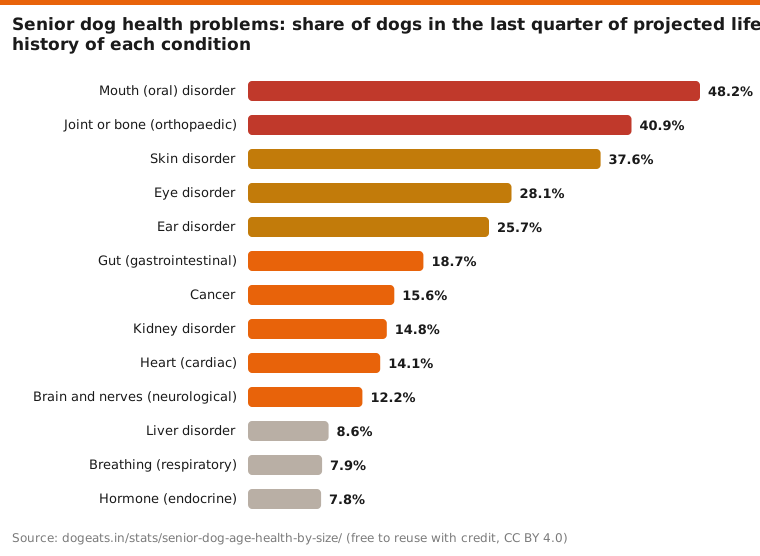
A dog counts as senior in the last 25% of its expected lifespan, the American Animal Hospital Association (AAHA) says. On US life expectancy by size, that is about 7.1 years for a giant dog and 8.6 for a large one. Medium dogs turn senior at 9.5, toy and small dogs at 10. In 15,019 US dogs, 48.2% of those in the last quarter of projected lifespan had a history of mouth disease and 40.9% of joint or bone disease. AAHA advises a vet exam at least every 6 months for seniors, with blood and urine tests every 6 to 12 months.
Key findings
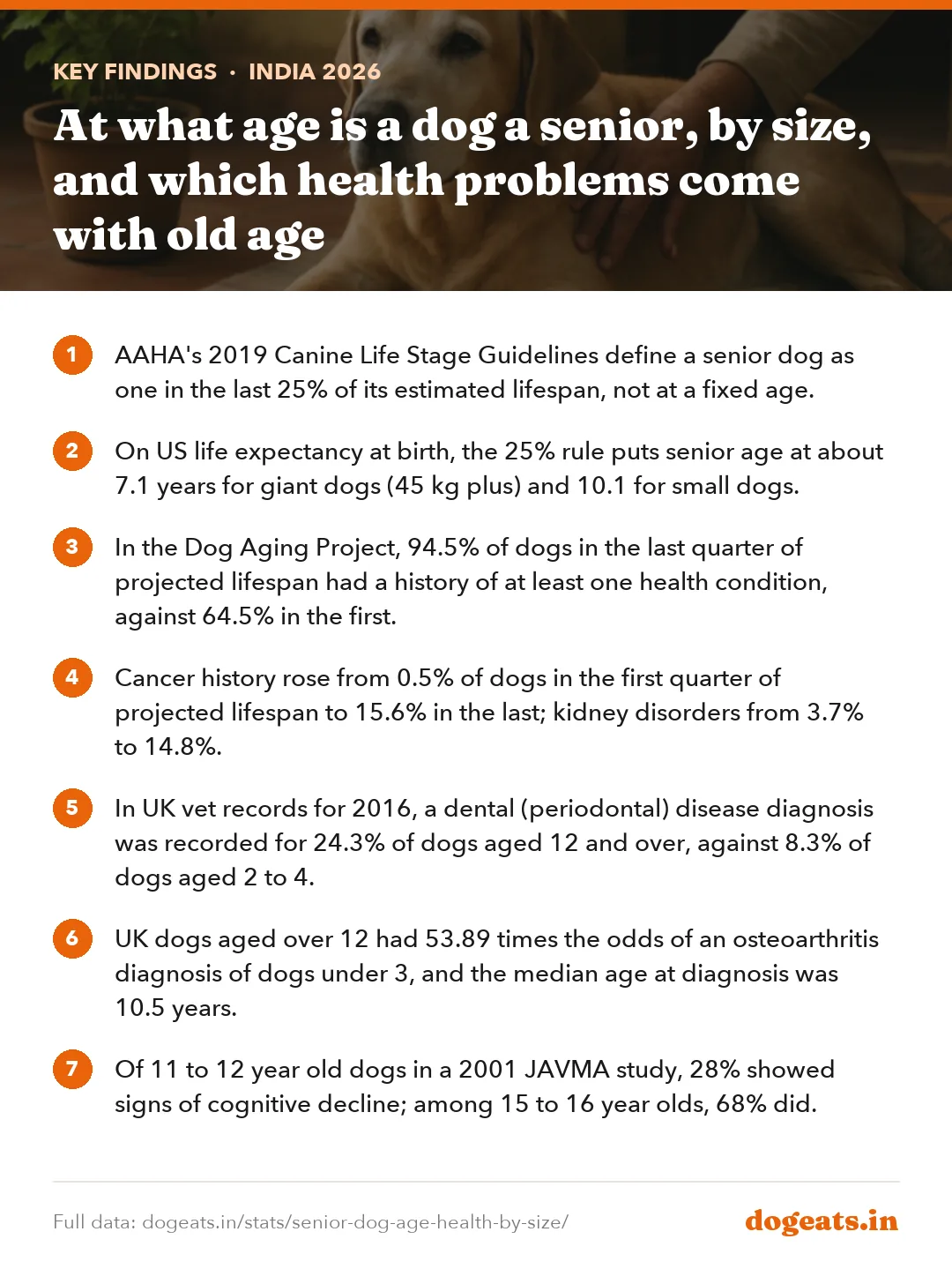
- AAHA's 2019 Canine Life Stage Guidelines define a senior dog as one in the last 25% of its estimated lifespan, not at a fixed age.
- On US life expectancy at birth, the 25% rule puts senior age at about 7.1 years for giant dogs (45 kg plus) and 10.1 for small dogs.
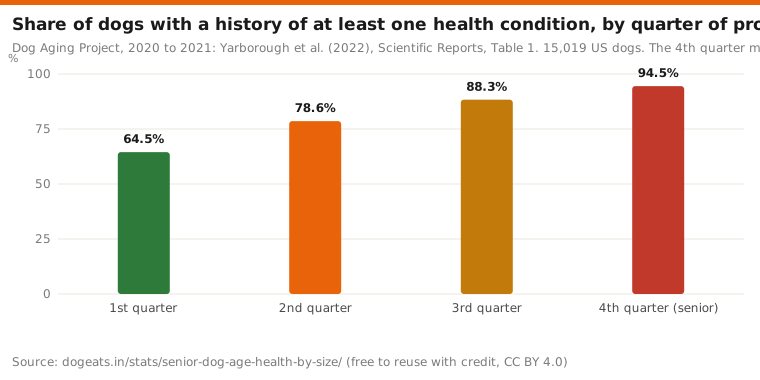
- In the Dog Aging Project, 94.5% of dogs in the last quarter of projected lifespan had a history of at least one health condition, against 64.5% in the first.
- Cancer history rose from 0.5% of dogs in the first quarter of projected lifespan to 15.6% in the last; kidney disorders from 3.7% to 14.8%.
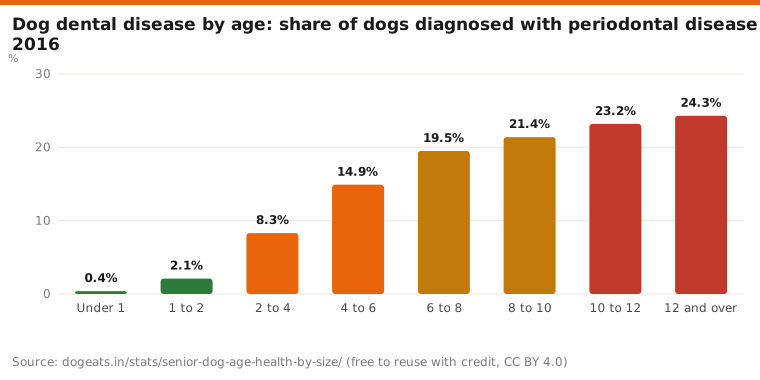
- In UK vet records for 2016, a dental (periodontal) disease diagnosis was recorded for 24.3% of dogs aged 12 and over, against 8.3% of dogs aged 2 to 4.
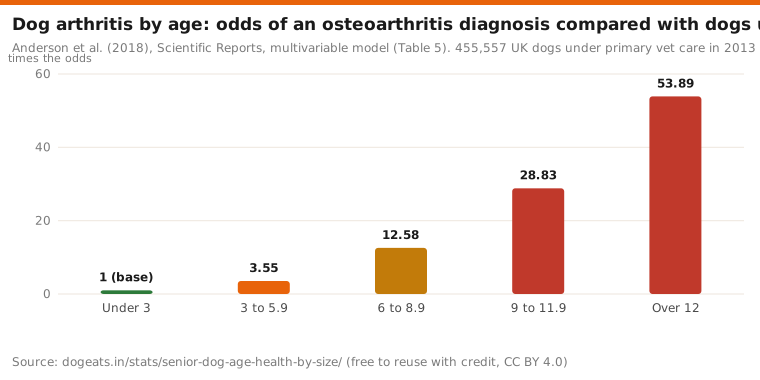
- UK dogs aged over 12 had 53.89 times the odds of an osteoarthritis diagnosis of dogs under 3, and the median age at diagnosis was 10.5 years.
- Of 11 to 12 year old dogs in a 2001 JAVMA study, 28% showed signs of cognitive decline; among 15 to 16 year olds, 68% did.
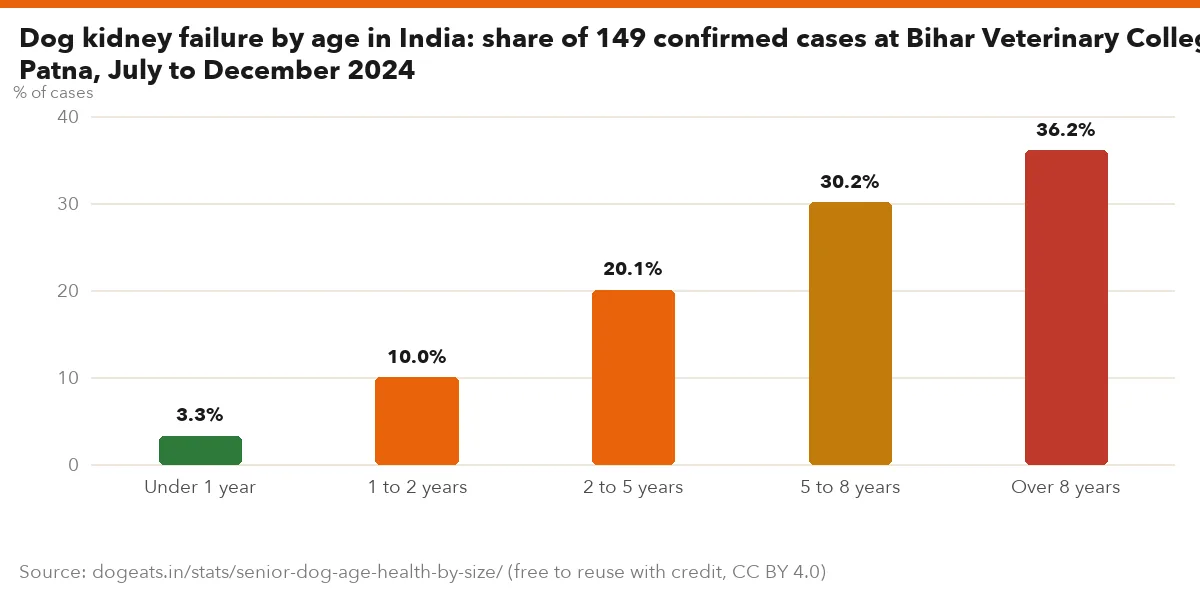
- At a Bihar veterinary college hospital in 2024, 54 of 149 dogs with kidney failure (36.2%) were older than 8 years.
- AAHA's 2023 Senior Care Guidelines advise a blood count, blood chemistry and urine test for senior dogs every 6 to 12 months.
At what age is a dog considered senior by size?
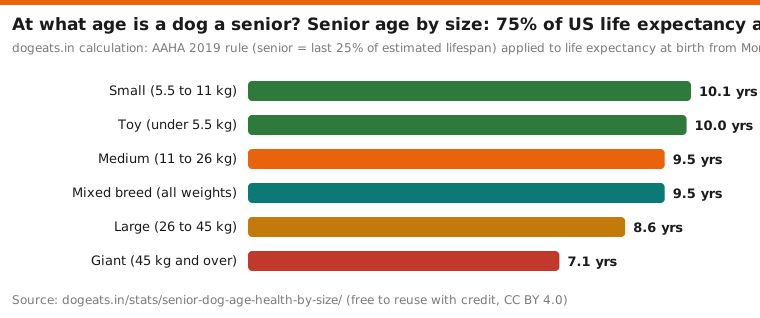
A dog is senior once it enters the last 25% of its expected lifespan. On US life expectancy figures, that is about 7.1 years for a giant dog and 8.6 for a large dog. Medium dogs turn senior at about 9.5, toy and small dogs at about 10.
The 25% rule comes from AAHA's 2019 Canine Life Stage Guidelines. The task force chose not to set fixed ages for the mature adult and senior stages. It asks vets to estimate each dog's lifespan, mostly from its breed, and plan care from there. AAHA's 2023 Senior Care Guidelines repeat the same definition.
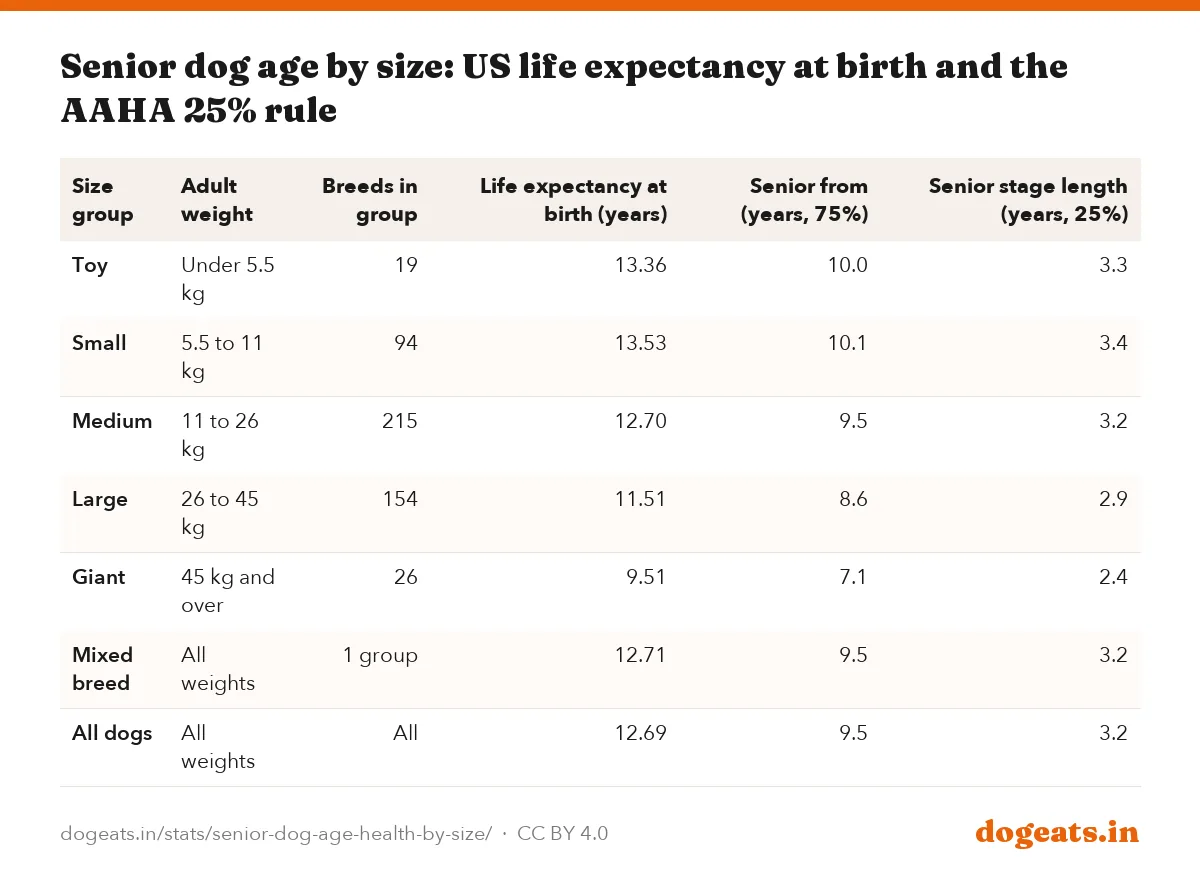
To turn the rule into ages, we used the largest published life expectancy table by size. Montoya and colleagues (2023) built it from 13.3 million dogs seen at Banfield hospitals in the US from 2013 to 2019. Life expectancy at birth was 13.36 years for toy dogs, 13.53 for small, 12.7 for medium, 11.51 for large and 9.51 for giant dogs. We multiplied each by 0.75.

dogeats.in calculation: AAHA 2019 rule (senior = last 25% of estimated lifespan) applied to life expectancy at birth from Montoya et al. (2023), Frontiers in Veterinary Science, US Banfield data 2013 to 2019. Size groups for purebred dogs by adult weight.
Show the numbers
| Label | years |
|---|---|
| Small (5.5 to 11 kg) | 10.1 yrs |
| Toy (under 5.5 kg) | 10.0 yrs |
| Medium (11 to 26 kg) | 9.5 yrs |
| Mixed breed (all weights) | 9.5 yrs |
| Large (26 to 45 kg) | 8.6 yrs |
| Giant (45 kg and over) | 7.1 yrs |
Embed this chart
| Size group | Adult weight | Breeds in group | Life expectancy at birth (years) | Senior from (years, 75%) | Senior stage length (years, 25%) |
|---|---|---|---|---|---|
| Toy | Under 5.5 kg | 19 | 13.36 | 10.0 | 3.3 |
| Small | 5.5 to 11 kg | 94 | 13.53 | 10.1 | 3.4 |
| Medium | 11 to 26 kg | 215 | 12.70 | 9.5 | 3.2 |
| Large | 26 to 45 kg | 154 | 11.51 | 8.6 | 2.9 |
| Giant | 45 kg and over | 26 | 9.51 | 7.1 | 2.4 |
| Mixed breed | All weights | 1 group | 12.71 | 9.5 | 3.2 |
| All dogs | All weights | All | 12.69 | 9.5 | 3.2 |
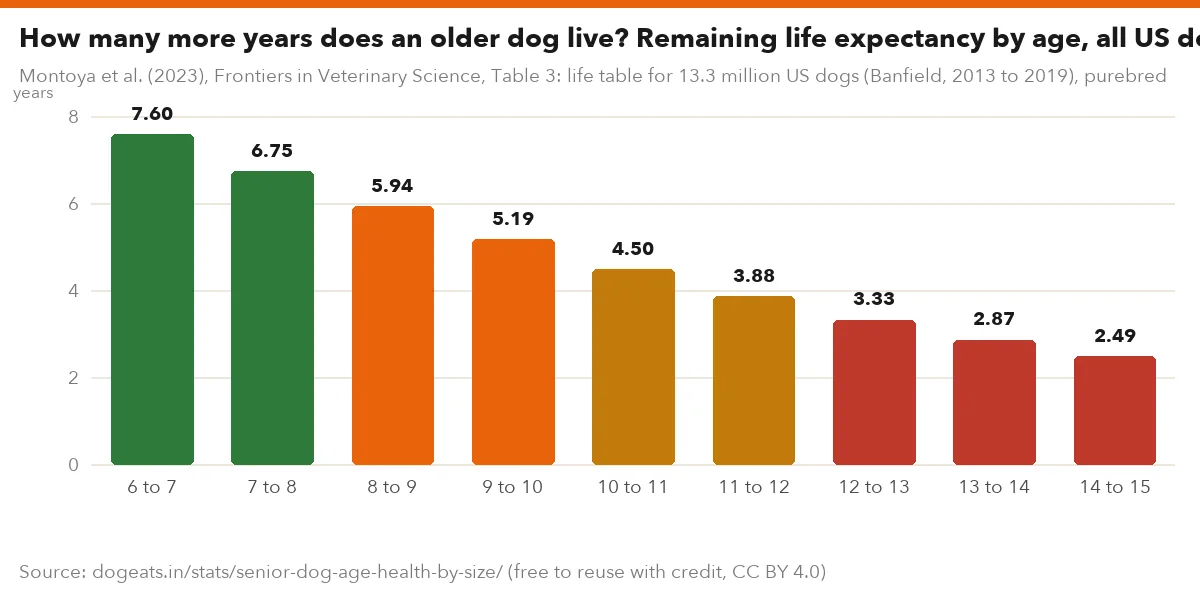
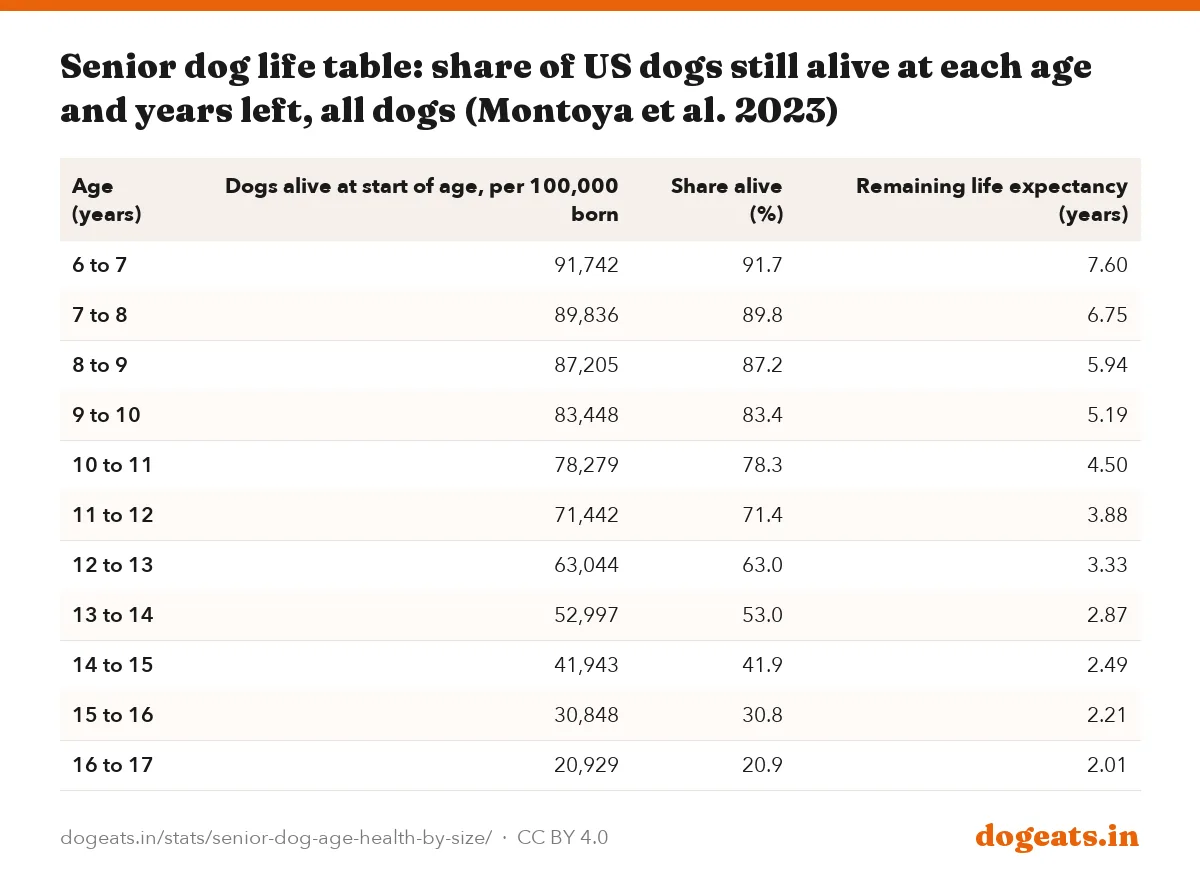
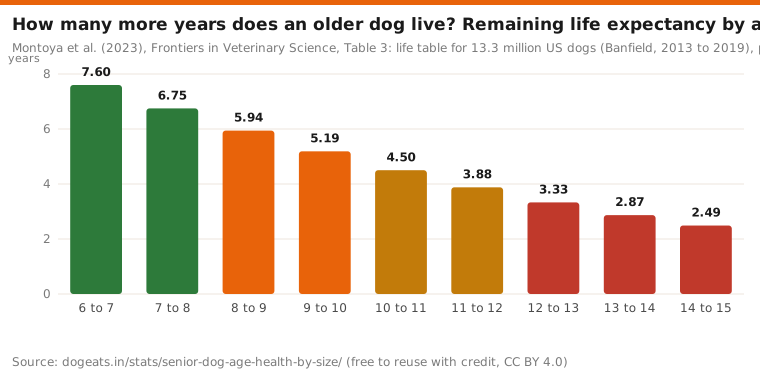
Montoya et al. (2023), Frontiers in Veterinary Science, Table 3: life table for 13.3 million US dogs (Banfield, 2013 to 2019), purebred and mixed breed combined. Age interval x to x+1.
Show the numbers
| Label | years |
|---|---|
| 6 to 7 | 7.60 |
| 7 to 8 | 6.75 |
| 8 to 9 | 5.94 |
| 9 to 10 | 5.19 |
| 10 to 11 | 4.50 |
| 11 to 12 | 3.88 |
| 12 to 13 | 3.33 |
| 13 to 14 | 2.87 |
| 14 to 15 | 2.49 |
Embed this chart
| Age (years) | Dogs alive at start of age, per 100,000 born | Share alive (%) | Remaining life expectancy (years) |
|---|---|---|---|
| 6 to 7 | 91,742 | 91.7 | 7.60 |
| 7 to 8 | 89,836 | 89.8 | 6.75 |
| 8 to 9 | 87,205 | 87.2 | 5.94 |
| 9 to 10 | 83,448 | 83.4 | 5.19 |
| 10 to 11 | 78,279 | 78.3 | 4.50 |
| 11 to 12 | 71,442 | 71.4 | 3.88 |
| 12 to 13 | 63,044 | 63.0 | 3.33 |
| 13 to 14 | 52,997 | 53.0 | 2.87 |
| 14 to 15 | 41,943 | 41.9 | 2.49 |
| 15 to 16 | 30,848 | 30.8 | 2.21 |
| 16 to 17 | 20,929 | 20.9 | 2.01 |
Life expectancy at birth includes dogs that die young, so a dog that has already reached middle age can expect to live a little longer than these figures. In the same US life table, a dog aged 8 to 9 could expect 5.94 more years, and one aged 10 to 11 another 4.5 years. Treat the ages as a guide for when to start senior check-ups, not a verdict on one dog.
The AVMA gives similar ranges by size, and our dog years to human years chart lists the senior age for each of 58 breeds. For lifespans by breed in India, see our dog breed lifespan report. A Great Dane reaches the senior stage years before a Shih Tzu.
What health problems are common in senior dogs?
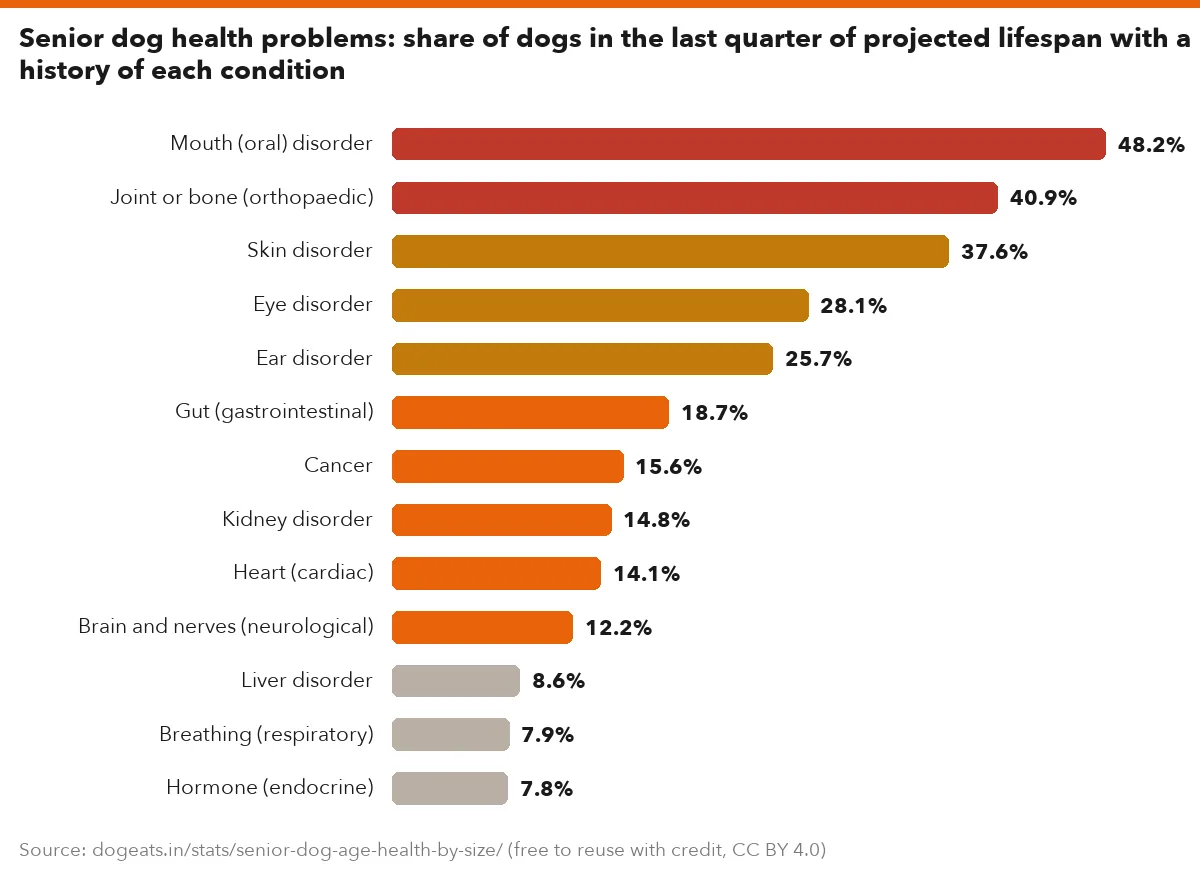
Mouth disease, joint and bone disease, skin, eye and ear problems lead the list. Among 2,925 US dogs in the last quarter of their projected lifespan, 48.2% had a history of mouth disease and 40.9% of joint or bone disease.
The figures come from the Dog Aging Project, which analysed 15,019 US dogs in 2020 and 2021. The researchers sorted each dog into a quarter of its projected lifespan using its age, weight, sex and neuter status. The last quarter is the same stage AAHA calls senior.
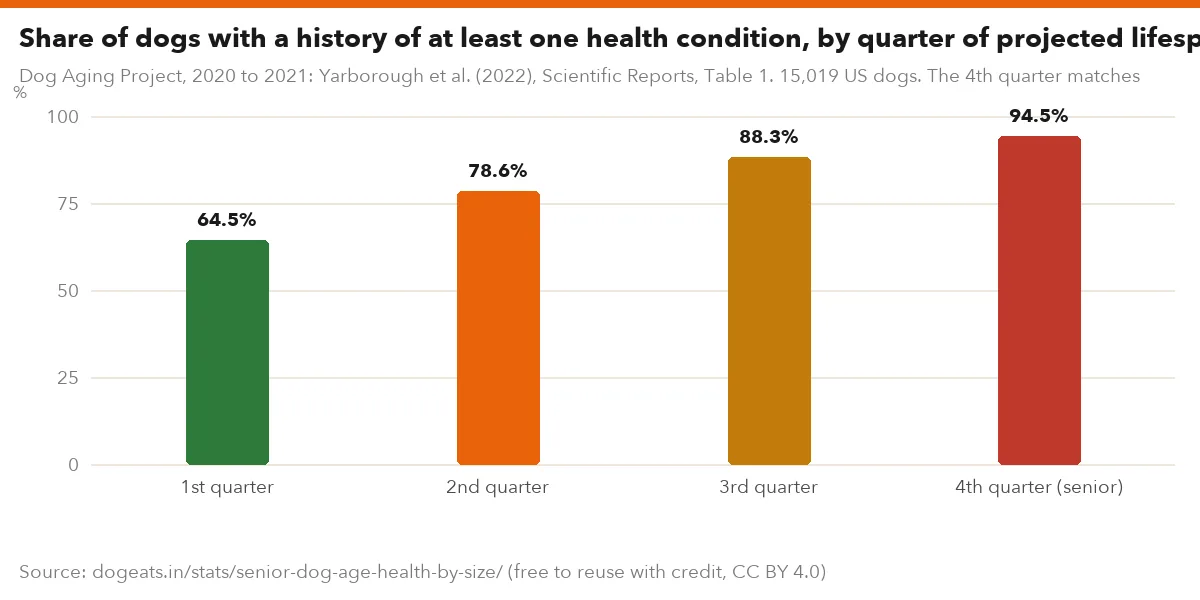
Owners reported which conditions their dog had ever had, so these are lifetime histories, not new cases in one year. Almost every older dog had something: 94.5% of dogs in the last quarter had a history of at least one condition, against 64.5% in the first.
Dog Aging Project, 2020 to 2021: Yarborough et al. (2022), Scientific Reports, Table 1. 2,925 US dogs in the 4th quarter of weight-based projected lifespan. Owner-reported lifetime history.
Show the numbers
| Label | % |
|---|---|
| Mouth (oral) disorder | 48.2% |
| Joint or bone (orthopaedic) | 40.9% |
| Skin disorder | 37.6% |
| Eye disorder | 28.1% |
| Ear disorder | 25.7% |
| Gut (gastrointestinal) | 18.7% |
| Cancer | 15.6% |
| Kidney disorder | 14.8% |
| Heart (cardiac) | 14.1% |
| Brain and nerves (neurological) | 12.2% |
| Liver disorder | 8.6% |
| Breathing (respiratory) | 7.9% |
| Hormone (endocrine) | 7.8% |
Embed this chart
Dog Aging Project, 2020 to 2021: Yarborough et al. (2022), Scientific Reports, Table 1. 15,019 US dogs. The 4th quarter matches AAHA's senior stage.
Show the numbers
| Label | % |
|---|---|
| 1st quarter | 64.5% |
| 2nd quarter | 78.6% |
| 3rd quarter | 88.3% |
| 4th quarter (senior) | 94.5% |
Embed this chart
| Condition group | 1st quarter (4,368 dogs) | 2nd quarter (4,050) | 3rd quarter (3,676) | 4th quarter, senior (2,925) |
|---|---|---|---|---|
| Any condition | 64.5% | 78.6% | 88.3% | 94.5% |
| Mouth (oral) | 7.8% | 19.8% | 35.8% | 48.2% |
| Joint or bone (orthopaedic) | 5.0% | 12.7% | 22.4% | 40.9% |
| Skin | 17.6% | 27.8% | 33.5% | 37.6% |
| Eye | 6.0% | 8.5% | 13.4% | 28.1% |
| Ear | 7.5% | 9.4% | 12.6% | 25.7% |
| Gut (gastrointestinal) | 11.6% | 14.3% | 15.6% | 18.7% |
| Cancer | 0.5% | 2.4% | 7.3% | 15.6% |
| Kidney | 3.7% | 5.9% | 8.1% | 14.8% |
| Heart (cardiac) | 1.1% | 2.6% | 7.3% | 14.1% |
| Brain and nerves (neurological) | 0.8% | 2.7% | 4.5% | 12.2% |
| Liver | 0.8% | 2.0% | 4.5% | 8.6% |
| Breathing (respiratory) | 1.2% | 1.5% | 3.3% | 7.9% |
| Hormone (endocrine) | 0.1% | 1.2% | 4.2% | 7.8% |
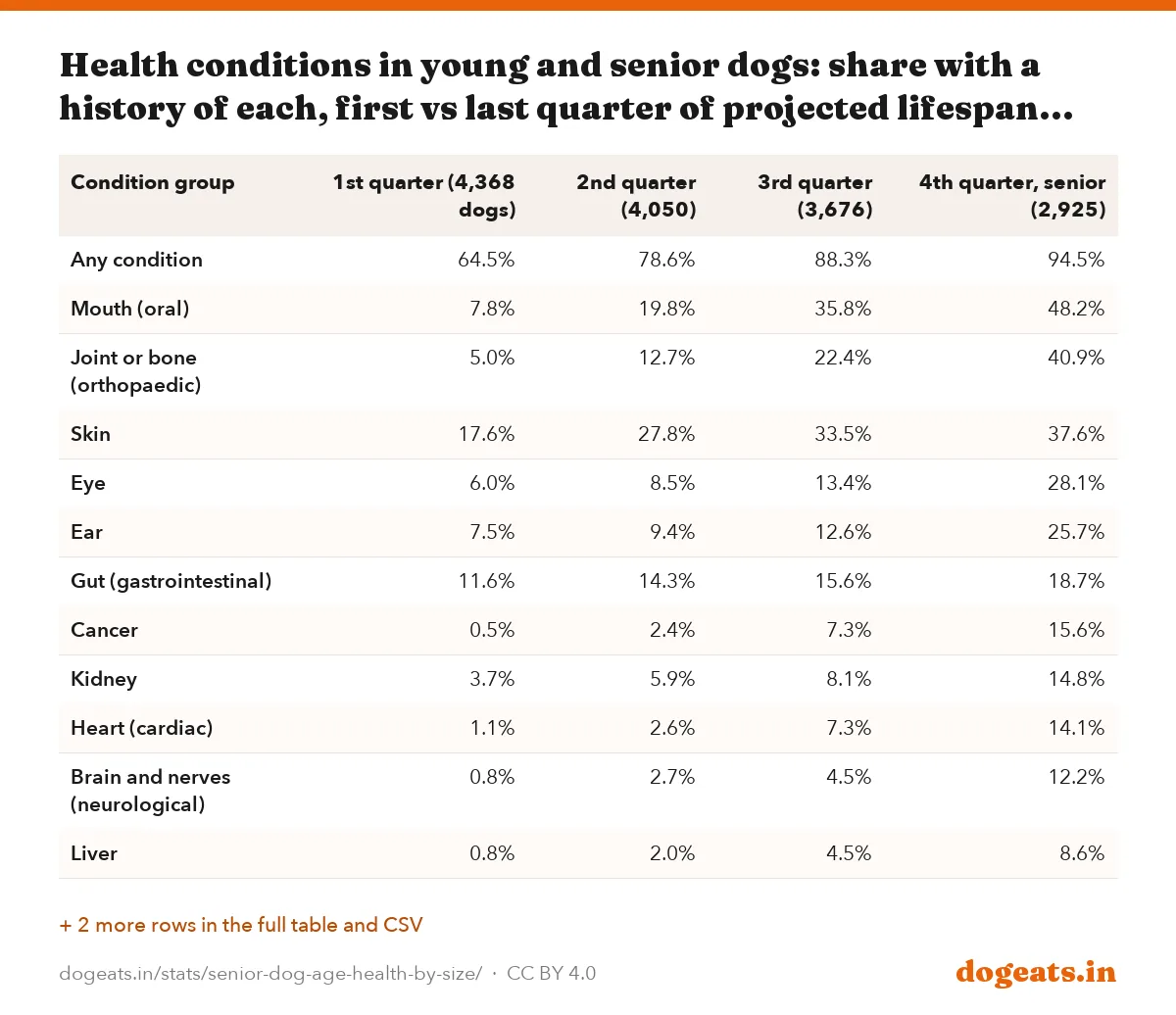
Cancer shows the steepest climb, from 0.5% of dogs in the first quarter to 15.6% in the last. Heart disease rises from 1.1% to 14.1% and brain and nerve disorders from 0.8% to 12.2%.
Activity falls too. In the last quarter, 26.5% of dogs were described as not active, against 2.7% in the first quarter.
A study of 5,095 dog deaths in England, published in 2013, found cancer, joint and bone disease and neurological disorders were the most common recorded causes of death. For the most common problems in dogs of all ages, see our most common dog health problems report.
Do older dogs get more dental disease?
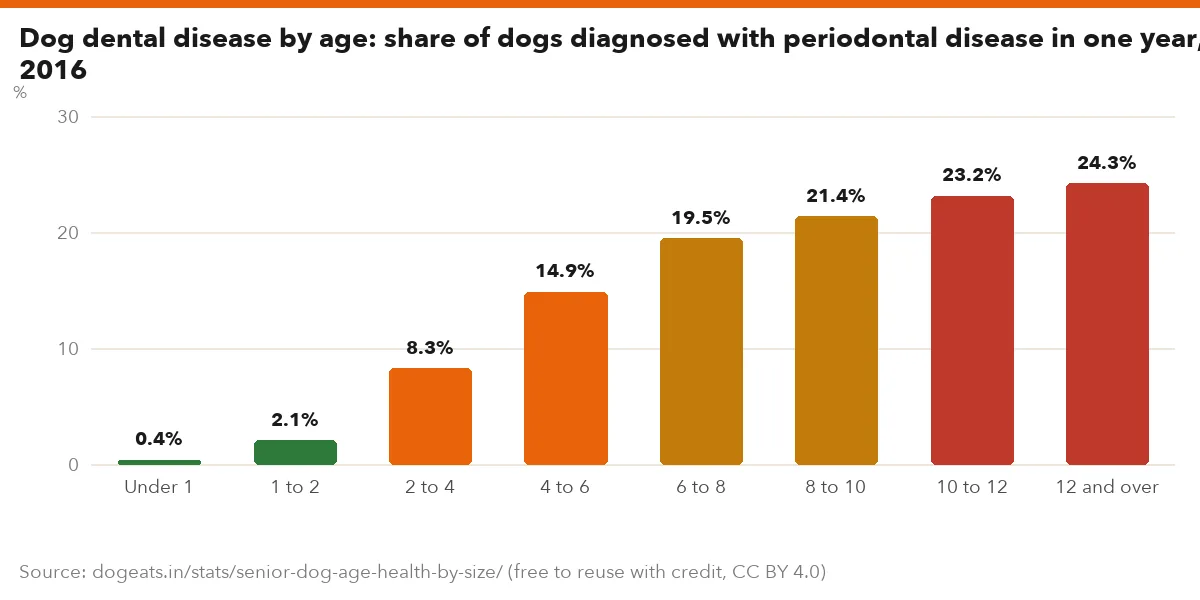
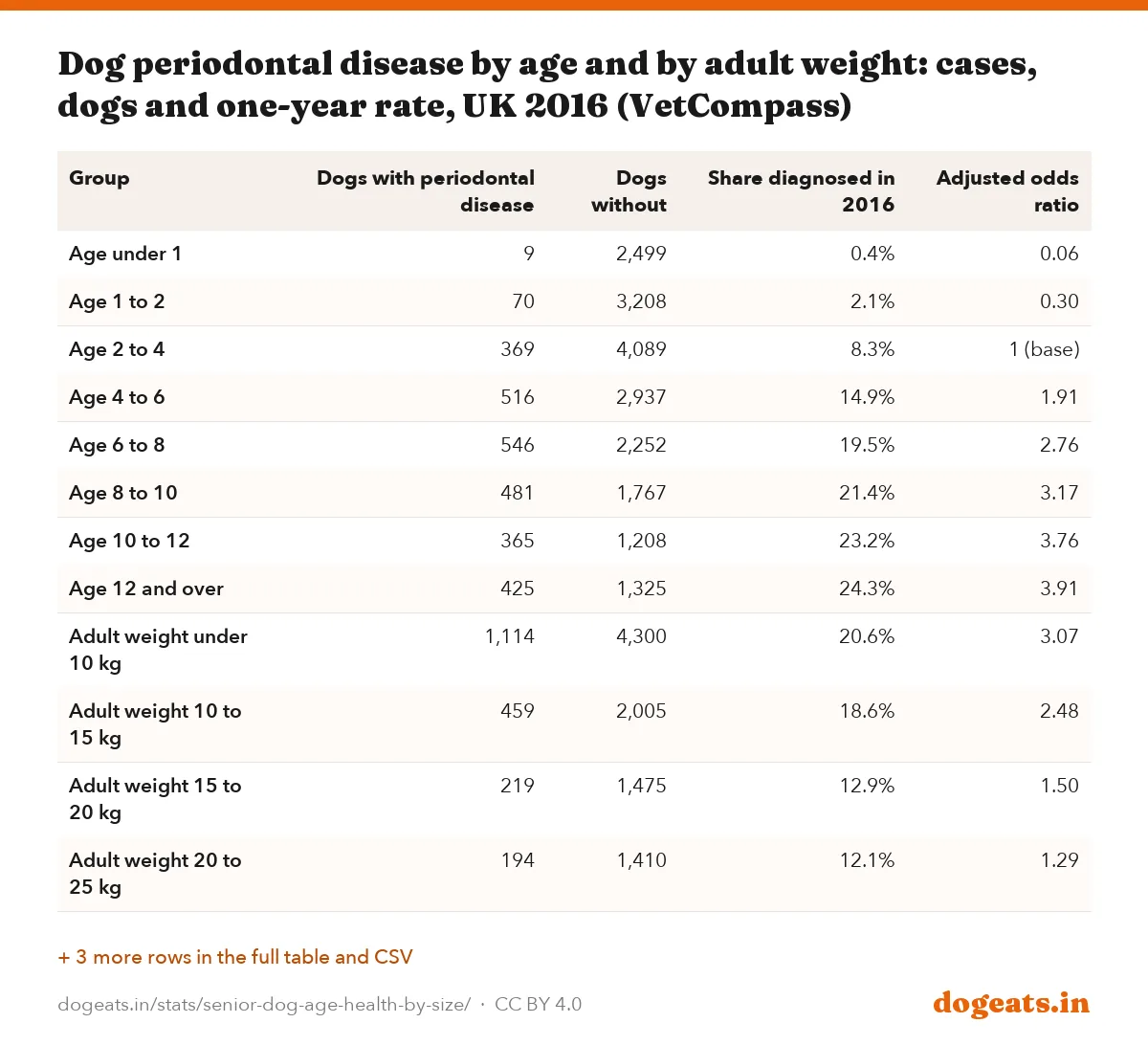
Yes. In UK vet records for 2016, periodontal (gum) disease was recorded in that one year for 24.3% of dogs aged 12 and over. The rate was 8.3% for dogs aged 2 to 4 and 0.4% for puppies under 1.
We computed these rates from the case and non-case counts published by O'Neill and colleagues (2021), from a random sample of 22,333 dogs in the VetCompass programme. After allowing for breed, weight and other factors, dogs aged 12 and over had 3.91 times the odds of periodontal disease of dogs aged 2 to 4.
Small dogs are hit harder. In the same records, 20.6% of adult dogs under 10 kg had periodontal disease in the year, against 9.9% of dogs weighing 30 to 40 kg. Toy breeds such as the Toy Poodle, Chihuahua and Yorkshire Terrier had some of the highest odds.
Computed by dogeats.in from case and non-case counts in O'Neill et al. (2021), Journal of Small Animal Practice, Table 2. Random sample of 22,333 UK dogs under primary vet care in 2016 (VetCompass).
Show the numbers
| Label | % |
|---|---|
| Under 1 | 0.4% |
| 1 to 2 | 2.1% |
| 2 to 4 | 8.3% |
| 4 to 6 | 14.9% |
| 6 to 8 | 19.5% |
| 8 to 10 | 21.4% |
| 10 to 12 | 23.2% |
| 12 and over | 24.3% |
Embed this chart
| Group | Dogs with periodontal disease | Dogs without | Share diagnosed in 2016 | Adjusted odds ratio |
|---|---|---|---|---|
| Age under 1 | 9 | 2,499 | 0.4% | 0.06 |
| Age 1 to 2 | 70 | 3,208 | 2.1% | 0.30 |
| Age 2 to 4 | 369 | 4,089 | 8.3% | 1 (base) |
| Age 4 to 6 | 516 | 2,937 | 14.9% | 1.91 |
| Age 6 to 8 | 546 | 2,252 | 19.5% | 2.76 |
| Age 8 to 10 | 481 | 1,767 | 21.4% | 3.17 |
| Age 10 to 12 | 365 | 1,208 | 23.2% | 3.76 |
| Age 12 and over | 425 | 1,325 | 24.3% | 3.91 |
| Adult weight under 10 kg | 1,114 | 4,300 | 20.6% | 3.07 |
| Adult weight 10 to 15 kg | 459 | 2,005 | 18.6% | 2.48 |
| Adult weight 15 to 20 kg | 219 | 1,475 | 12.9% | 1.50 |
| Adult weight 20 to 25 kg | 194 | 1,410 | 12.1% | 1.29 |
| Adult weight 25 to 30 kg | 152 | 1,198 | 11.3% | 1.23 |
| Adult weight 30 to 40 kg | 176 | 1,593 | 9.9% | 1 (base) |
| Adult weight 40 kg and over | 39 | 590 | 6.2% | 0.58 |
AAHA's 2023 guidelines note that small senior pets may be more prone to jaw fractures from bone loss linked to gum disease. They add that oral tumours are more common in older dogs, and recommend dental X-rays to judge bone loss before extractions.
In the Dog Aging Project, mouth disease history rose from 7.8% of dogs in the first quarter of projected lifespan to 48.2% in the last. No other condition group reached a larger share.
At what age do dogs get arthritis?
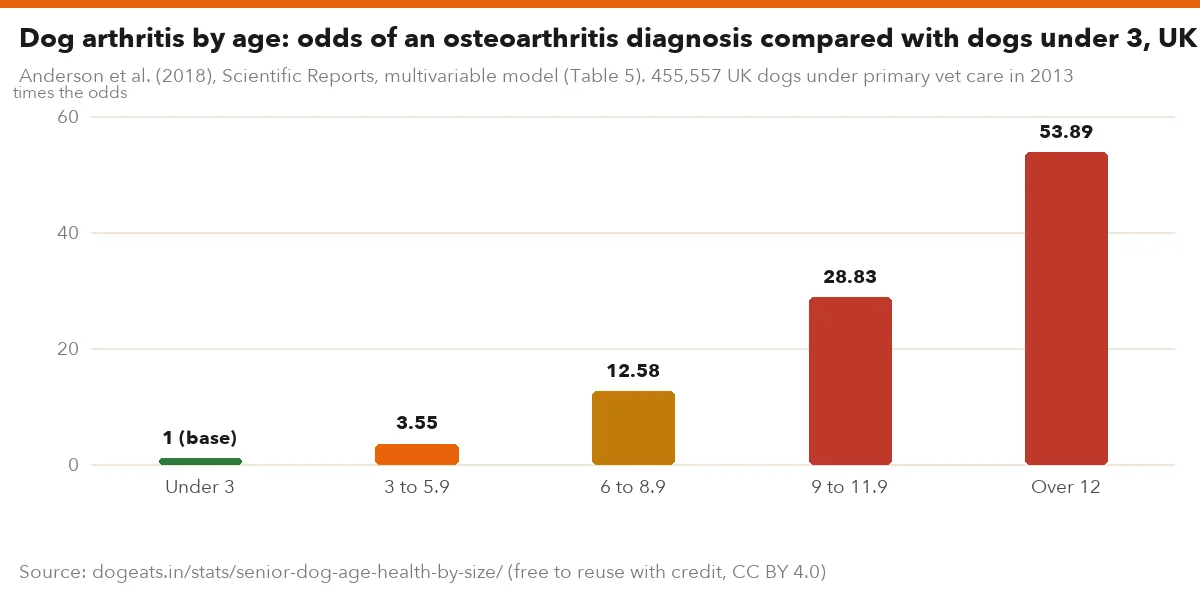
Most often after 8. In UK vet records for 2013, the median age at an osteoarthritis diagnosis was 10.5 years. Dogs over 12 had 53.89 times the odds of a diagnosis of dogs under 3.
Anderson and colleagues (2018) studied 455,557 dogs in the VetCompass programme. They put the one-year prevalence of limb osteoarthritis at 2.5%, or about 200,000 affected UK dogs a year. Heavier dogs, neutered dogs and dogs above their breed's average weight had higher odds.
Breed mattered too. Compared with crossbreds, the Rottweiler had 3.11 times the odds, the Labrador Retriever 2.56, the Golden Retriever 2.42 and the German Shepherd 2.28. Small breeds such as the Yorkshire Terrier and Jack Russell had lower odds.

Anderson et al. (2018), Scientific Reports, multivariable model (Table 5). 455,557 UK dogs under primary vet care in 2013 (VetCompass). Adjusted for insurance, sex, neuter status, breed and weight relative to breed.
Show the numbers
| Label | times the odds |
|---|---|
| Under 3 | 1 (base) |
| 3 to 5.9 | 3.55 |
| 6 to 8.9 | 12.58 |
| 9 to 11.9 | 28.83 |
| Over 12 | 53.89 |
Embed this chart
AAHA's 2019 guidelines note that senior dogs lose mobility, vision, hearing and cognition, and suggest grip on floors and stairs and fewer stair climbs. In Indian flats with smooth vitrified tiles, a runner or rubber mat along the dog's usual path is a cheap first step.
Weight also counted. Dogs at or above their breed's average weight had 2.29 times the odds of a diagnosis in the same study. The authors estimate that osteoarthritis affects 11.4% of an affected dog's lifespan. Keeping a senior dog lean is covered in our senior dog feeding guide.
How common is dementia in old dogs?
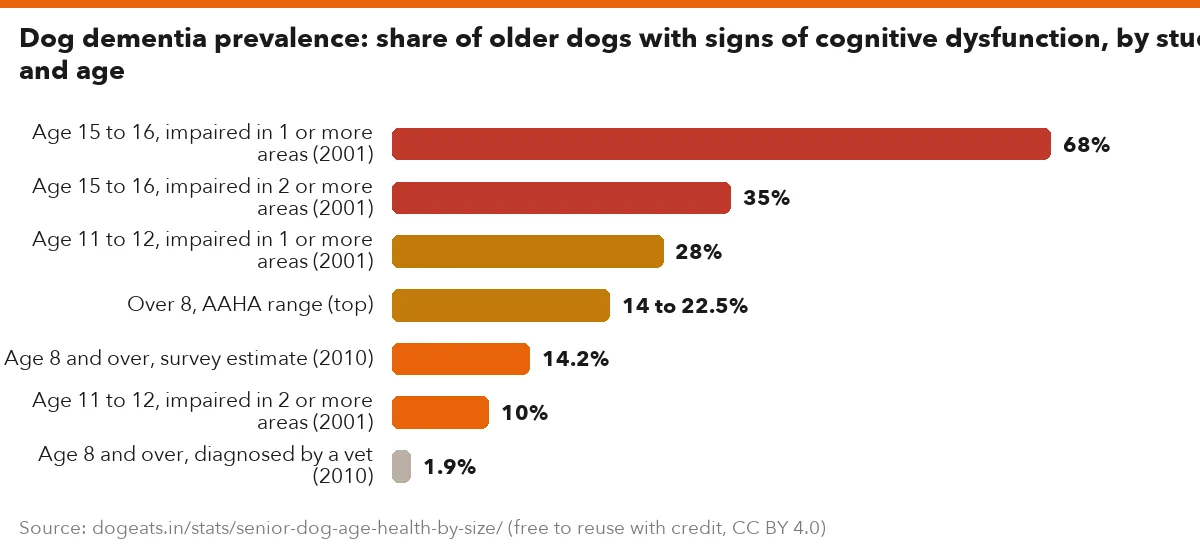
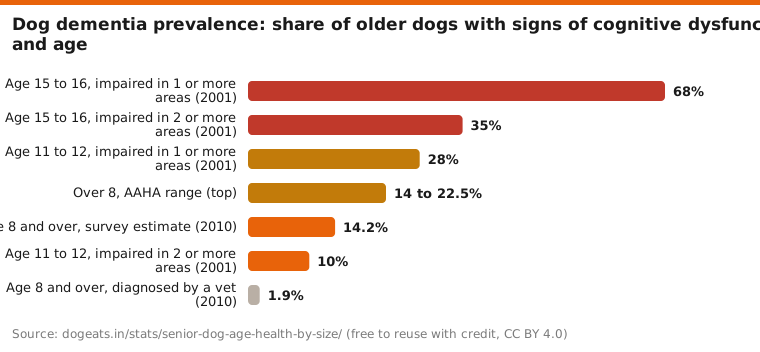
Common, and mostly missed. A 2010 survey by University of Sydney researchers covered 497 dogs aged 8 and over. It estimated that 14.2% had canine cognitive dysfunction, but only 1.9% had been diagnosed by a vet.
The share rises fast with age. In a 2001 study in the Journal of the American Veterinary Medical Association, 28% of dogs aged 11 to 12 showed impairment in at least one area of behaviour. Among 15 to 16 year olds the figure was 68%, and 35% were impaired in two or more areas.
AAHA's 2023 guidelines put the share of dogs over 8 with age-related cognitive impairment at about 14% to 22.5%. In the Dog Aging Project, only 1.4% of all 15,019 dogs scored as having the condition, but the average dog in that study was 6.9 years old.
Neilson et al. (2001), JAVMA, 180 dogs aged 11 to 16. Salvin et al. (2010), The Veterinary Journal, 497 dogs aged 8 and over (mean 11.7). AAHA 2023 Senior Care Guidelines range for dogs over 8.
Show the numbers
| Label | % |
|---|---|
| Age 15 to 16, impaired in 1 or more areas (2001) | 68% |
| Age 15 to 16, impaired in 2 or more areas (2001) | 35% |
| Age 11 to 12, impaired in 1 or more areas (2001) | 28% |
| Over 8, AAHA range (top) | 14 to 22.5% |
| Age 8 and over, survey estimate (2010) | 14.2% |
| Age 11 to 12, impaired in 2 or more areas (2001) | 10% |
| Age 8 and over, diagnosed by a vet (2010) | 1.9% |
Embed this chart
Age is the strongest driver. In the Dog Aging Project, the odds of cognitive dysfunction rose 52% with each extra year of age, after allowing for health, breed type and activity. Dogs that were not active had 6.47 times the odds of very active dogs of the same age.
AAHA lists brain tumours, pain and organ disease as other causes of similar behaviour changes, so a vet check comes first.
What health problems do older dogs have in India?
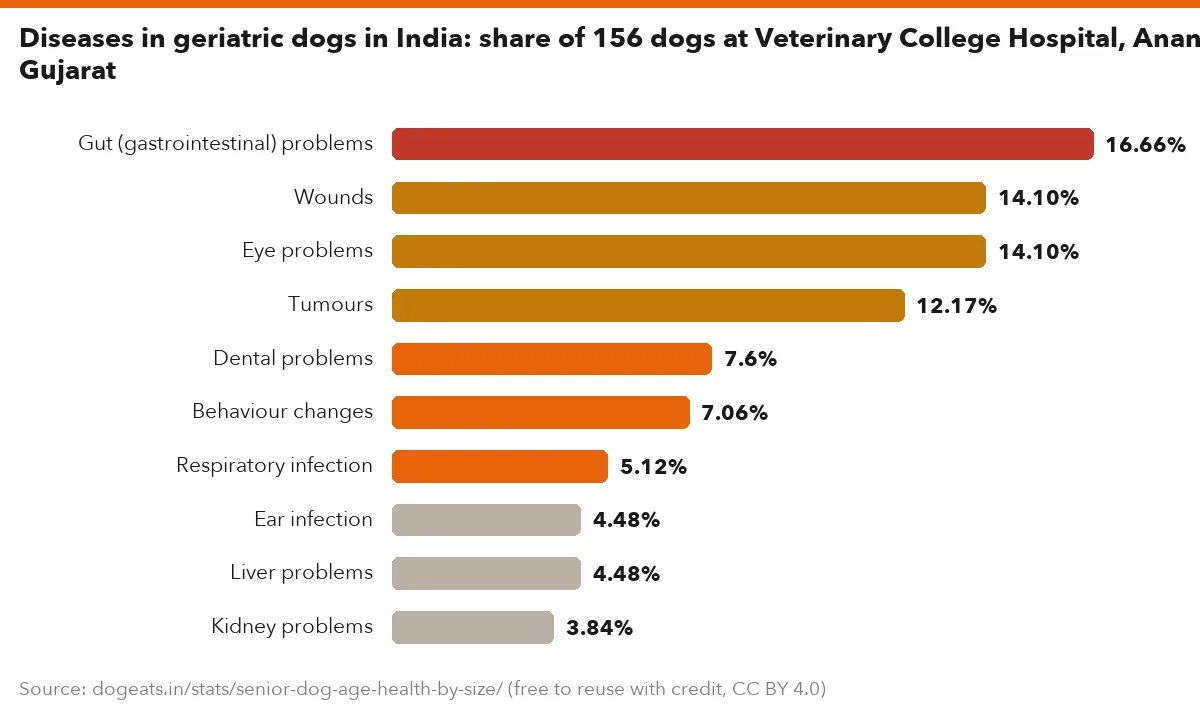
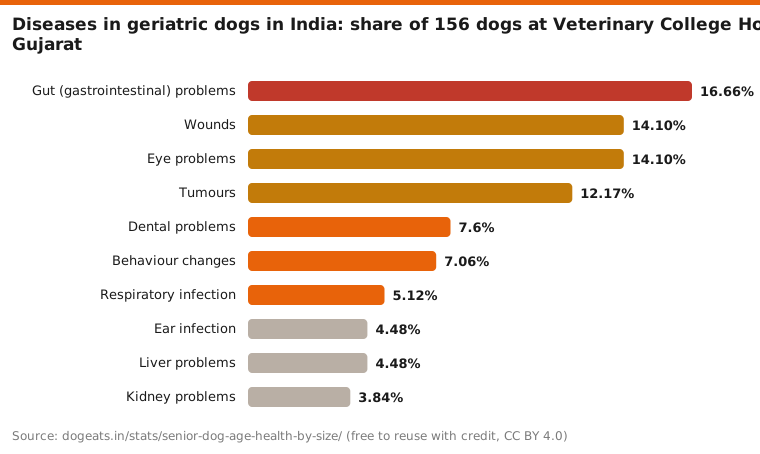
Indian data is thin, but two clinic studies point to gut problems, wounds, eye disease, tumours and kidney failure. At the Veterinary College Hospital in Anand, Gujarat, 16.66% of 156 geriatric dogs had gut problems and 12.17% had tumours (2015).
The Anand study, by Jain, Patel and Raval, describes its dogs as geriatric at 10 years old. After gut problems, wounds and eye problems each affected 14.10%. Dental problems affected 7.6%, behaviour changes 7.06% and kidney problems 3.84%.
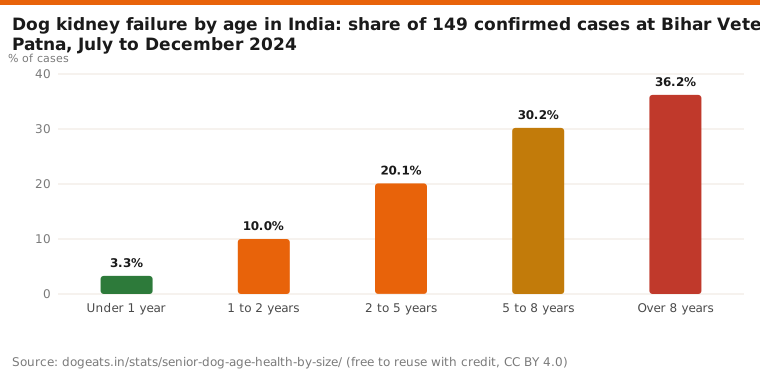
A newer study from Bihar looked at kidney failure by age. At Bihar Veterinary College, Patna, 149 of 2,975 dogs examined from July to December 2024 had confirmed kidney failure (5%). Of those, 54 (36.2%) were older than 8 years and 45 (30.2%) were 5 to 8.
Jain, Patel and Raval (2015), Indian Journal of Animal Research 49(6): 866 to 868. Dogs described as geriatric (10 years old).
Show the numbers
| Label | % |
|---|---|
| Gut (gastrointestinal) problems | 16.66% |
| Wounds | 14.10% |
| Eye problems | 14.10% |
| Tumours | 12.17% |
| Dental problems | 7.6% |
| Behaviour changes | 7.06% |
| Respiratory infection | 5.12% |
| Ear infection | 4.48% |
| Liver problems | 4.48% |
| Kidney problems | 3.84% |
Embed this chart
Kumari et al. (2026), Indian Journal of Veterinary Medicine 46(1): 9 to 11, Table 1 and text. Shares of cases, not rates: they also reflect the ages of dogs brought to the hospital. Table 1 labels the youngest group ">1 year"; the text says younger than one year.
Show the numbers
| Label | % of cases |
|---|---|
| Under 1 year | 3.3% |
| 1 to 2 years | 10.0% |
| 2 to 5 years | 20.1% |
| 5 to 8 years | 30.2% |
| Over 8 years | 36.2% |
Embed this chart
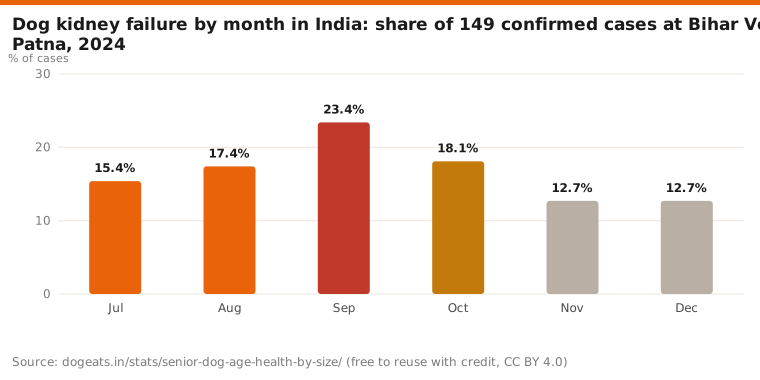
Kumari et al. (2026), Indian Journal of Veterinary Medicine 46(1), Table 2. July to December 2024.
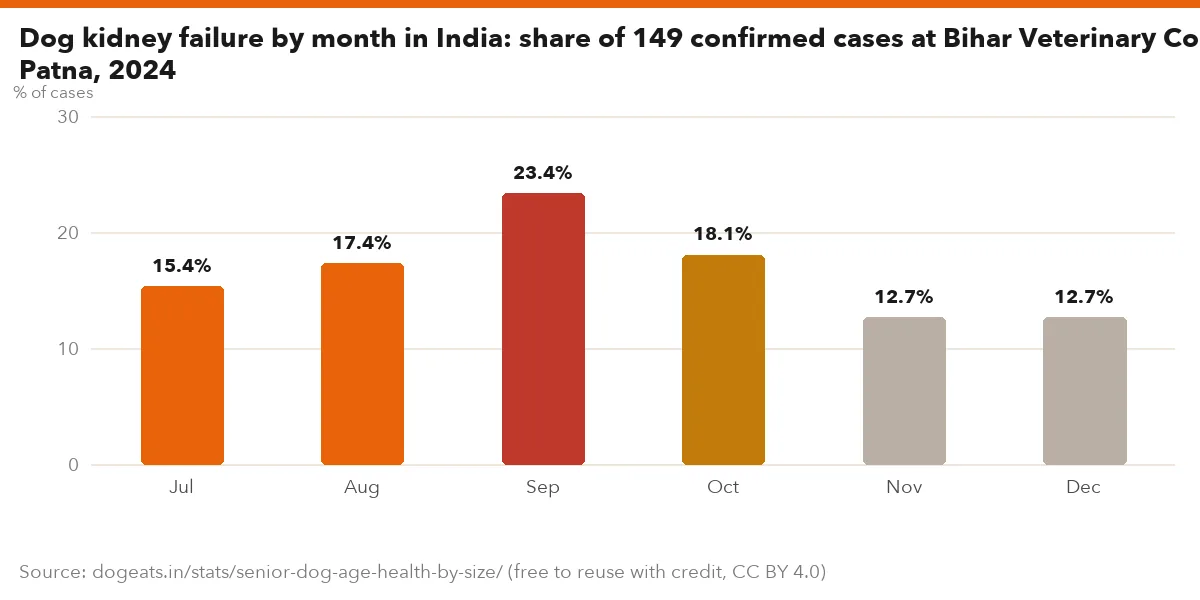
Show the numbers
| Label | % of cases |
|---|---|
| Jul | 15.4% |
| Aug | 17.4% |
| Sep | 23.4% |
| Oct | 18.1% |
| Nov | 12.7% |
| Dec | 12.7% |
Embed this chart
The Patna cases peaked in September, with 35 of 149 (23.4%), just after the monsoon. The authors cite endemic leptospirosis among the reasons kidney failure rates differ across India. Leptospirosis is a monsoon risk covered in our monsoon dog care guide.
Neither Indian study measured rates in the whole dog population. Both count dogs brought to one teaching hospital, so treat them as a picture of what Indian vets see, not national figures.
How often should a senior dog go to the vet?
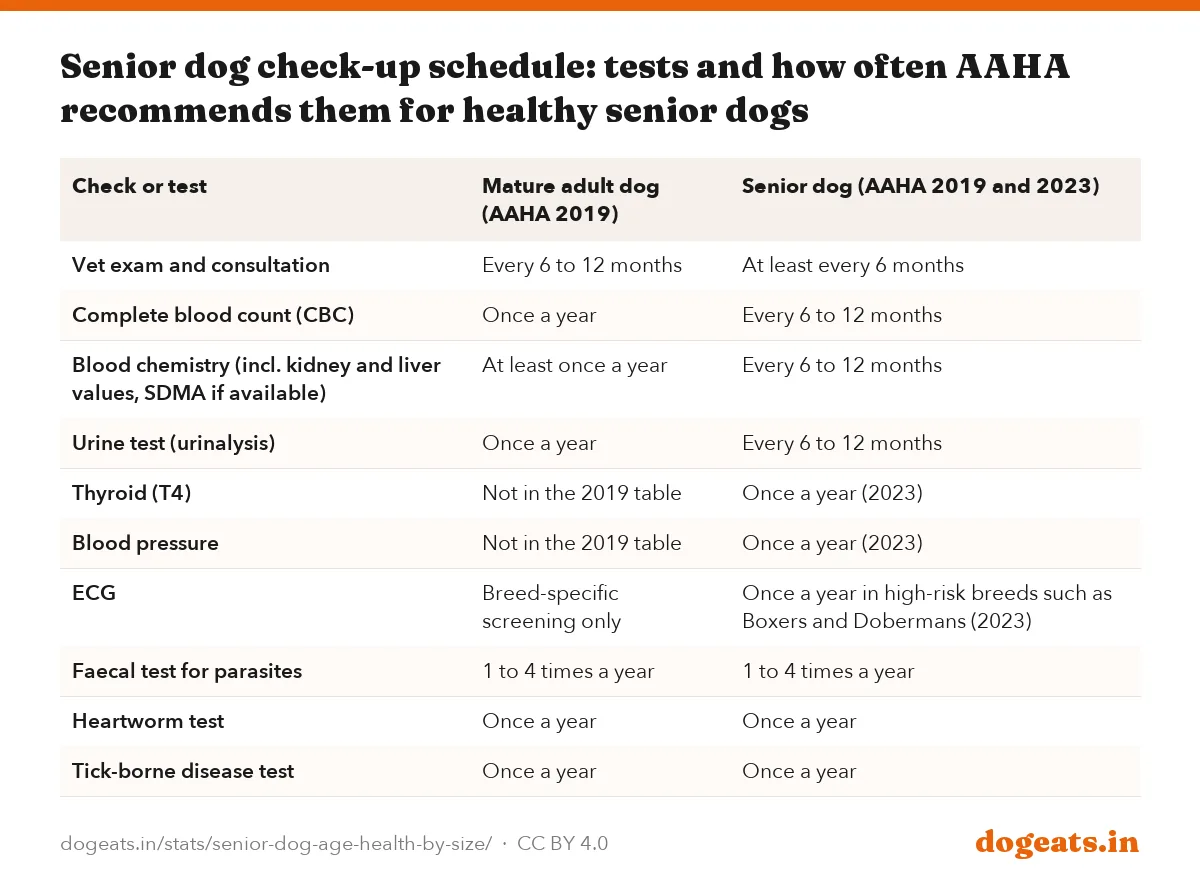
At least every 6 months. AAHA's 2019 guidelines say a senior dog should have at least semiannual exams, against semiannual to annual exams for mature adults.
AAHA's 2023 Senior Care Guidelines add a medical workup once or twice a year. For dogs, that means a complete blood count, a blood chemistry panel and a urine test every 6 to 12 months. A thyroid test and a blood pressure check are recommended every year.
Mature adult dogs are advised the blood count, chemistry and urine test once a year. So the senior stage roughly doubles the testing schedule. Breeds at high risk of heart disease, such as Boxers and Dobermans, are advised an ECG every year.
| Check or test | Mature adult dog (AAHA 2019) | Senior dog (AAHA 2019 and 2023) |
|---|---|---|
| Vet exam and consultation | Every 6 to 12 months | At least every 6 months |
| Complete blood count (CBC) | Once a year | Every 6 to 12 months |
| Blood chemistry (incl. kidney and liver values, SDMA if available) | At least once a year | Every 6 to 12 months |
| Urine test (urinalysis) | Once a year | Every 6 to 12 months |
| Thyroid (T4) | Not in the 2019 table | Once a year (2023) |
| Blood pressure | Not in the 2019 table | Once a year (2023) |
| ECG | Breed-specific screening only | Once a year in high-risk breeds such as Boxers and Dobermans (2023) |
| Faecal test for parasites | 1 to 4 times a year | 1 to 4 times a year |
| Heartworm test | Once a year | Once a year |
| Tick-borne disease test | Once a year | Once a year |
Our vet and vaccination cost report compares government and private rate cards in Indian cities. Indian pet insurers set maximum entry ages for new policies, which matters for an older dog; see our pet insurance report.
Does weight change how long a senior dog lives?
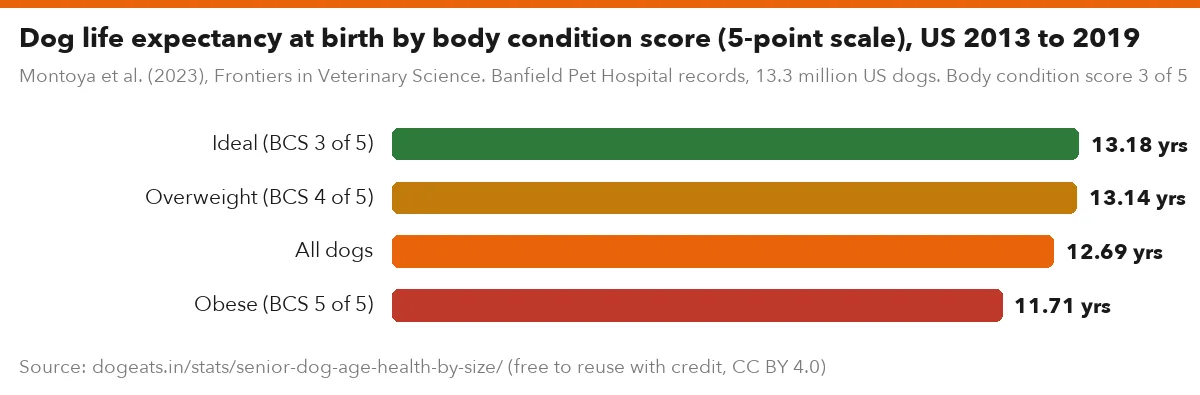
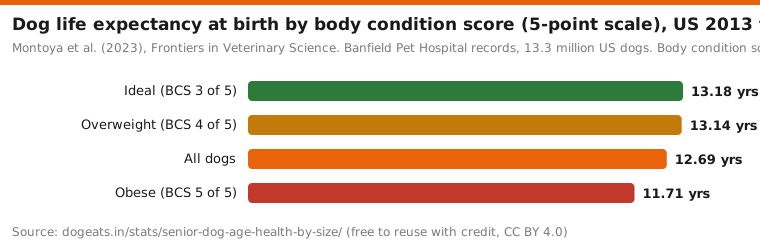
Yes. In the US life tables, obese dogs had a life expectancy at birth of 11.71 years. Dogs at an ideal body condition reached 13.18 years, a gap of almost 1.5 years.
Montoya and colleagues scored body condition on a 5-point scale, where 3 is ideal and 5 obese. Overweight dogs (score 4) had a life expectancy of 13.14 years, close to ideal. Females lived slightly longer than males, at 12.76 against 12.63 years.
AAHA's 2023 guidelines say calorie-restricted diets have been shown to lengthen dogs' lives, and give an ideal body condition score of 4.5 to 5 out of 9. They add that dogs tend to lose muscle and gain fat as seniors, then lose weight overall in advanced age.
Montoya et al. (2023), Frontiers in Veterinary Science. Banfield Pet Hospital records, 13.3 million US dogs. Body condition score 3 of 5 is ideal, 4 overweight, 5 obese.
Show the numbers
| Label | years |
|---|---|
| Ideal (BCS 3 of 5) | 13.18 yrs |
| Overweight (BCS 4 of 5) | 13.14 yrs |
| All dogs | 12.69 yrs |
| Obese (BCS 5 of 5) | 11.71 yrs |
Embed this chart
AAHA also notes that a dog's energy needs generally fall over its lifetime. For an Indian senior dog, that can mean smaller katori portions and regular weigh-ins at the vet. For the hot months, see our summer heatstroke guide.
Frequently asked questions
At what age is a dog considered a senior?
When it reaches the last 25% of its expected lifespan, under AAHA's 2019 guidelines. Applied to US life expectancy by size, that is about 7.1 years for giant dogs, 8.6 for large, 9.5 for medium and 10 for toy and small dogs.
Is a 7 year old dog a senior?
A giant dog of 45 kg or more is, at about 7.1 years by the AAHA 25% rule. A medium dog of 11 to 26 kg turns senior at about 9.5, so at 7 it is still a mature adult.
At what age is a small dog a senior?
At about 10 years. US toy dogs under 5.5 kg had a life expectancy at birth of 13.36 years and small dogs of 5.5 to 11 kg 13.53 years. The last 25% starts at about 10.0 and 10.1.
At what age is a Labrador a senior?
A Labrador usually falls in the large group of 26 to 45 kg, which turns senior at about 8.6 years on US life expectancy figures. Labradors also had 2.56 times the odds of osteoarthritis of crossbreds in UK records.
What are the most common health problems in senior dogs?
Mouth disease, joint and bone disease and skin problems. In the Dog Aging Project, 48.2% of dogs in the last quarter of projected lifespan had a history of mouth disease. For joint or bone disease the share was 40.9%, and for skin disease 37.6%.
How often should a senior dog see the vet?
At least every 6 months, AAHA says. Blood count, blood chemistry and urine tests are advised every 6 to 12 months, and a thyroid test and blood pressure check once a year.
What blood tests does a senior dog need?
A complete blood count and a chemistry panel covering protein, albumin, liver enzyme ALT, glucose, urea and creatinine, with SDMA if available. AAHA advises both every 6 to 12 months, with a urine test.
How common is dementia in dogs?
About 14% to 22.5% of dogs over 8 show signs, AAHA says. In a 2001 JAVMA study, 28% of 11 to 12 year olds and 68% of 15 to 16 year olds showed impairment in at least one area.
Do senior dogs get kidney disease?
Kidney disorders become more common with age. In the Dog Aging Project, 14.8% of dogs in the last quarter of projected lifespan had a history of kidney disorders, against 3.7% in the first. At a Patna hospital, 36.2% of kidney failure cases were over 8.
Does being overweight shorten a dog's life?
Obesity does. In US records of 13.3 million dogs, obese dogs had a life expectancy at birth of 11.71 years against 13.18 for dogs at ideal weight. Overweight but not obese dogs were close to ideal, at 13.14.
Methodology and limitations
Senior ages by size are our calculation. We applied the AAHA 2019 definition of senior (the last 25% of estimated lifespan) to life expectancy at birth by size from Montoya et al. (2023). Senior age = 0.75 x life expectancy at birth, rounded to one decimal. Size groups and weights are those used in that study, for purebred dogs; adult weight was taken at 2 to 5 years of age.
Health condition shares by quarter of projected lifespan come from Table 1 of Yarborough et al. (2022), Dog Aging Project, 15,019 US dogs, 2020 to 2021. They are owner-reported lifetime histories, not one-year rates.
Periodontal disease rates by age and weight are computed by dogeats.in from the case and non-case counts in Table 2 of O'Neill et al. (2021), as cases divided by cases plus non-cases, rounded to one decimal. Odds ratios are taken from the paper's multivariable models (Table 3 for age, Table 4 for weight).
Osteoarthritis odds ratios by age are from the multivariable model in Table 5 of Anderson et al. (2018). Cognitive dysfunction figures come from the abstracts of Neilson et al. (2001) and Salvin et al. (2010), the full text of Yarborough et al. (2022) and the AAHA 2023 Senior Care Guidelines.
Indian figures come from the published abstract of Jain, Patel and Raval (2015) and Tables 1 and 2 of Kumari et al. (2026). Check-up frequencies come from Table 4 of the AAHA 2019 Canine Life Stage Guidelines and Table 1 of the AAHA 2023 Senior Care Guidelines, read in October 2026.
Sources
- Creevy KE et al. (2019), 2019 AAHA Canine Life Stage Guidelines, JAAHA 55(6): 267 to 290, Senior = last 25% of estimated lifespan; senior exams at least semiannual; Table 4 test schedule
- Montoya M et al. (2023), Life expectancy tables for dogs and cats derived from clinical data, Frontiers in Veterinary Science 10:1082102, Life expectancy at birth by size: toy 13.36, small 13.53, medium 12.7, large 11.51, giant 9.51 years; by body condition
- Yarborough S et al. (2022), Evaluation of cognitive function in the Dog Aging Project, Scientific Reports 12:13316, 15,019 dogs; health history by quarter of projected lifespan; CCD 1.4%, odds up 52% a year
- Also consulted: 2023 AAHA Senior Care Guidelines for Dogs and Cats, JAAHA 59(1): 1 to 21, O'Neill DG et al. (2021), Epidemiology of periodontal disease in dogs in the UK primary-care veterinary setting, Journal of Small Animal Practice 62(12), Anderson KL et al. (2018), Prevalence, duration and risk factors for appendicular osteoarthritis in a UK dog population under primary veterinary care, Scientific Reports 8:5641, Salvin HE et al. (2010), Under diagnosis of canine cognitive dysfunction: a cross-sectional survey of older companion dogs, The Veterinary Journal 184(3), Neilson JC et al. (2001), Prevalence of behavioral changes associated with age-related cognitive impairment in dogs, JAVMA 218(11), Jain S, Patel PR, Raval SK (2015), A study of diseases in geriatric dogs, Indian Journal of Animal Research 49(6): 866 to 868, Kumari J et al. (2026), Demographic study of canine renal failure in a tertiary veterinary hospital of Bihar, India, Indian Journal of Veterinary Medicine 46(1): 9 to 11, O'Neill DG et al. (2013), Longevity and mortality of owned dogs in England, The Veterinary Journal 198(3), O'Neill DG et al. (2013), Chronic kidney disease in dogs in UK veterinary practices, Journal of Veterinary Internal Medicine 27(4), Fleming JM et al. (2011), Mortality in North American dogs from 1984 to 2004, Journal of Veterinary Internal Medicine 25(2), Hazorika M et al. (2025), Epidemiological valuation of renal diseases in dogs in and around Guwahati, Indian Journal of Animal Research.
Cite, embed and download
This report, its data and its images are free to reuse under a Creative Commons Attribution 4.0 licence. Credit dogeats.in with a link to this page. Every chart has its own embed code, every table has a CSV and an image download, and the images below are ready for social posts, slides and articles.
Cite this report
Link to this report
Every chart and table as an image