Explainer · Updated October 2026
Poisonous plants for dogs in India: kaner, sago palm, money plant and 8 more, with what the studies found
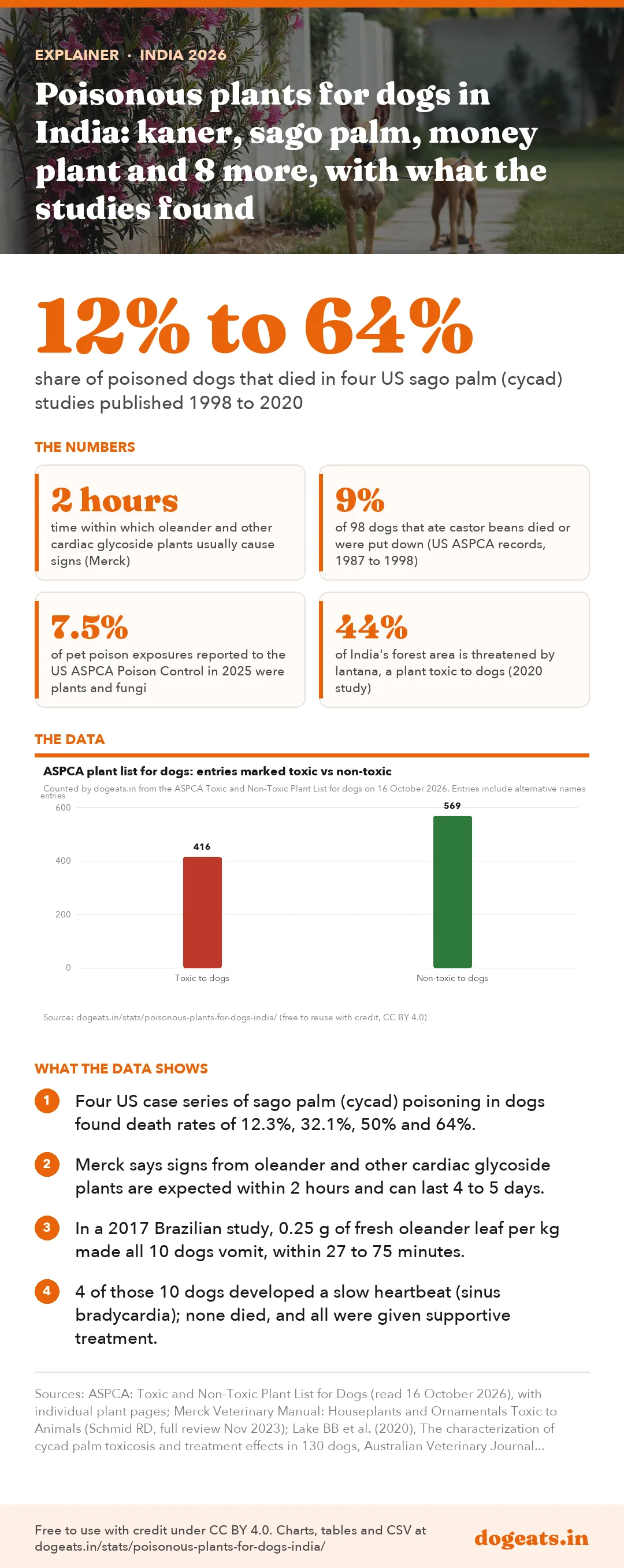
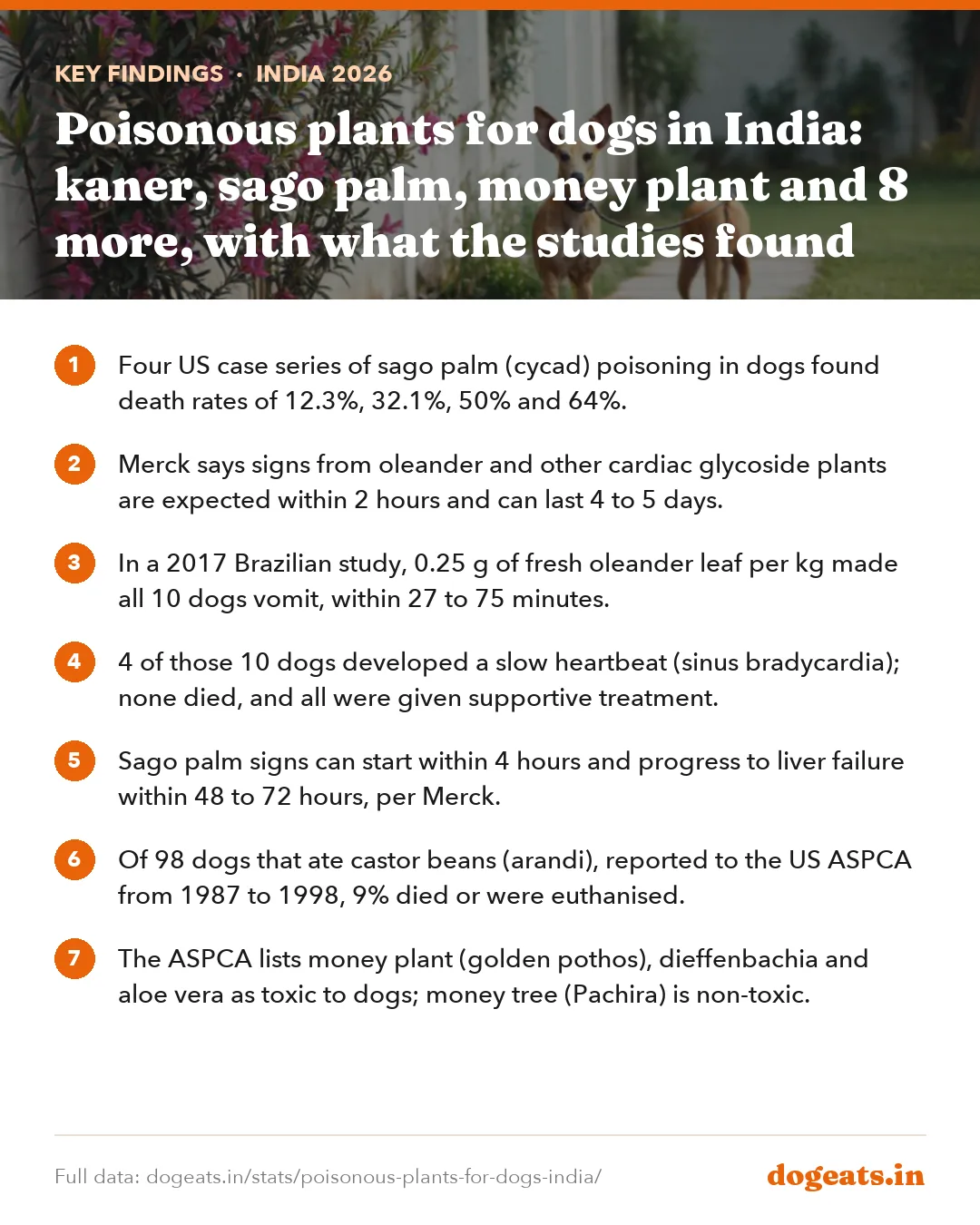
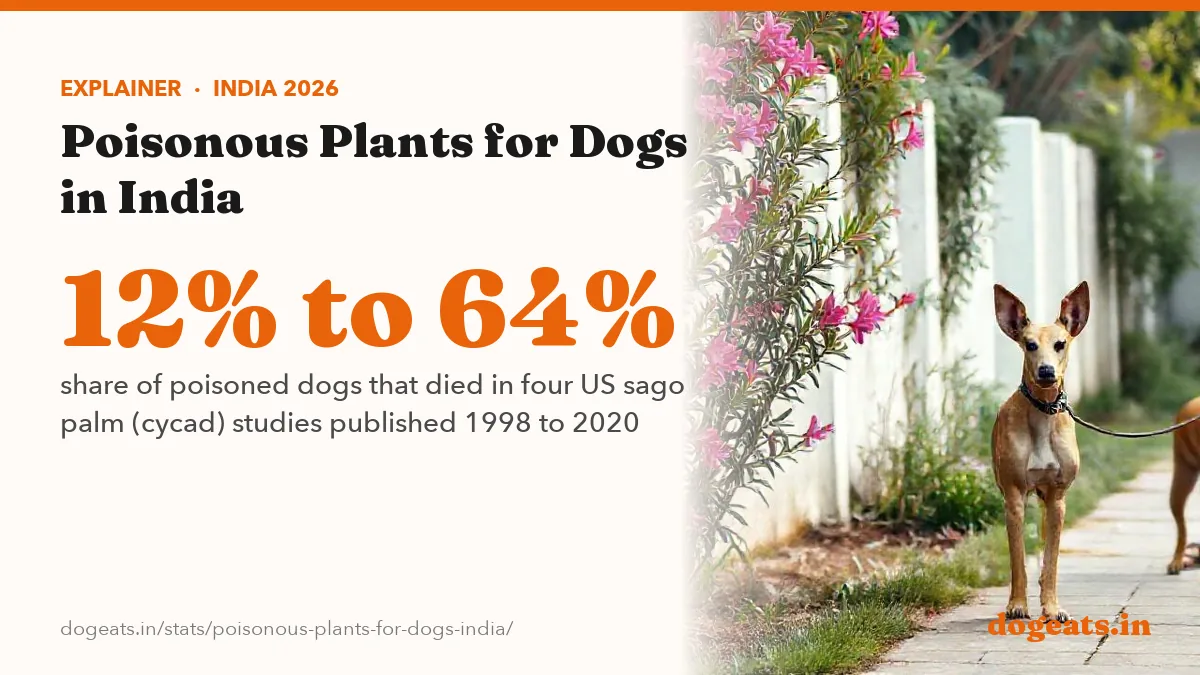
Eleven plants grown in Indian homes, gardens and roadsides are poisonous to dogs, including kaner (oleander), peeli kaner, sago palm, money plant (pothos), aloe vera, lantana and arandi (castor). Sago palm is the most studied: 12.3% to 64% of poisoned dogs died in four US case series. Oleander signs start within 2 hours, sago palm liver failure follows in 48 to 72 hours, and castor beans act in 12 to 48 hours. Tulsi and curry leaf are not on the ASPCA list either way.
Key findings
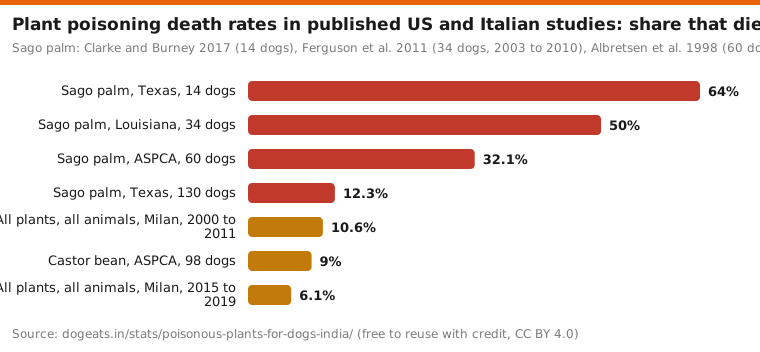
- Four US case series of sago palm (cycad) poisoning in dogs found death rates of 12.3%, 32.1%, 50% and 64%.
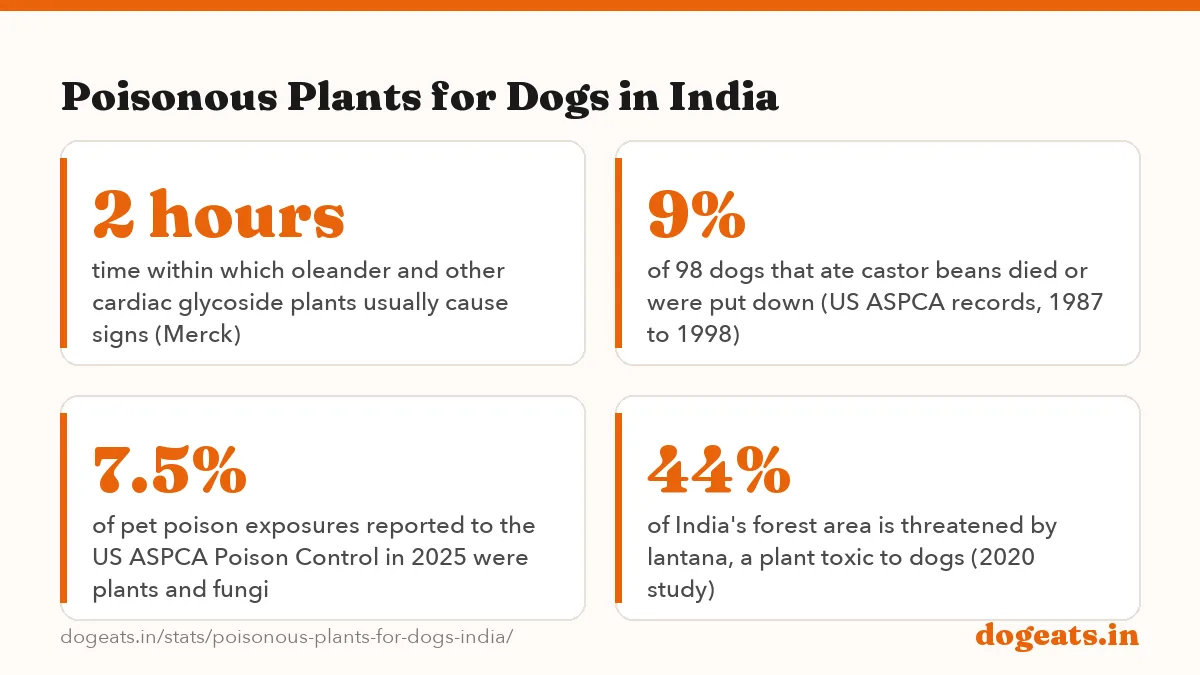
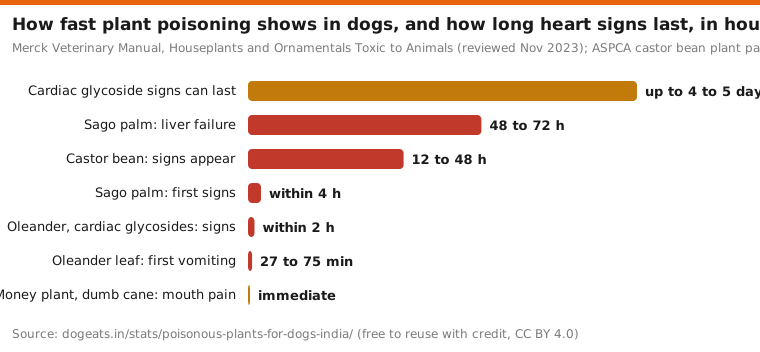
- Merck says signs from oleander and other cardiac glycoside plants are expected within 2 hours and can last 4 to 5 days.
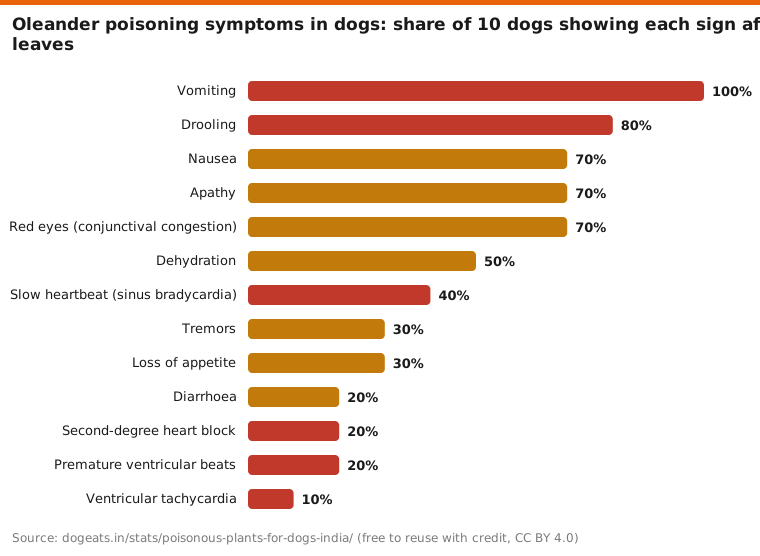
- In a 2017 Brazilian study, 0.25 g of fresh oleander leaf per kg made all 10 dogs vomit, within 27 to 75 minutes.
- 4 of those 10 dogs developed a slow heartbeat (sinus bradycardia); none died, and all were given supportive treatment.
- Sago palm signs can start within 4 hours and progress to liver failure within 48 to 72 hours, per Merck.
- Of 98 dogs that ate castor beans (arandi), reported to the US ASPCA from 1987 to 1998, 9% died or were euthanised.
- The ASPCA lists money plant (golden pothos), dieffenbachia and aloe vera as toxic to dogs; money tree (Pachira) is non-toxic.
- Plants and fungi made up 7.5% of pet exposures reported to the US ASPCA Poison Control in 2025, down from 8.1% in 2024.
- Lantana, toxic to dogs per the ASPCA, threatened 303,607 sq km or 44% of Indian forests in a 2020 survey.
- We found no Indian case series of plant poisoning in dogs, so every death rate here comes from US, Brazilian or Italian data.
Which plants are poisonous to dogs in India?
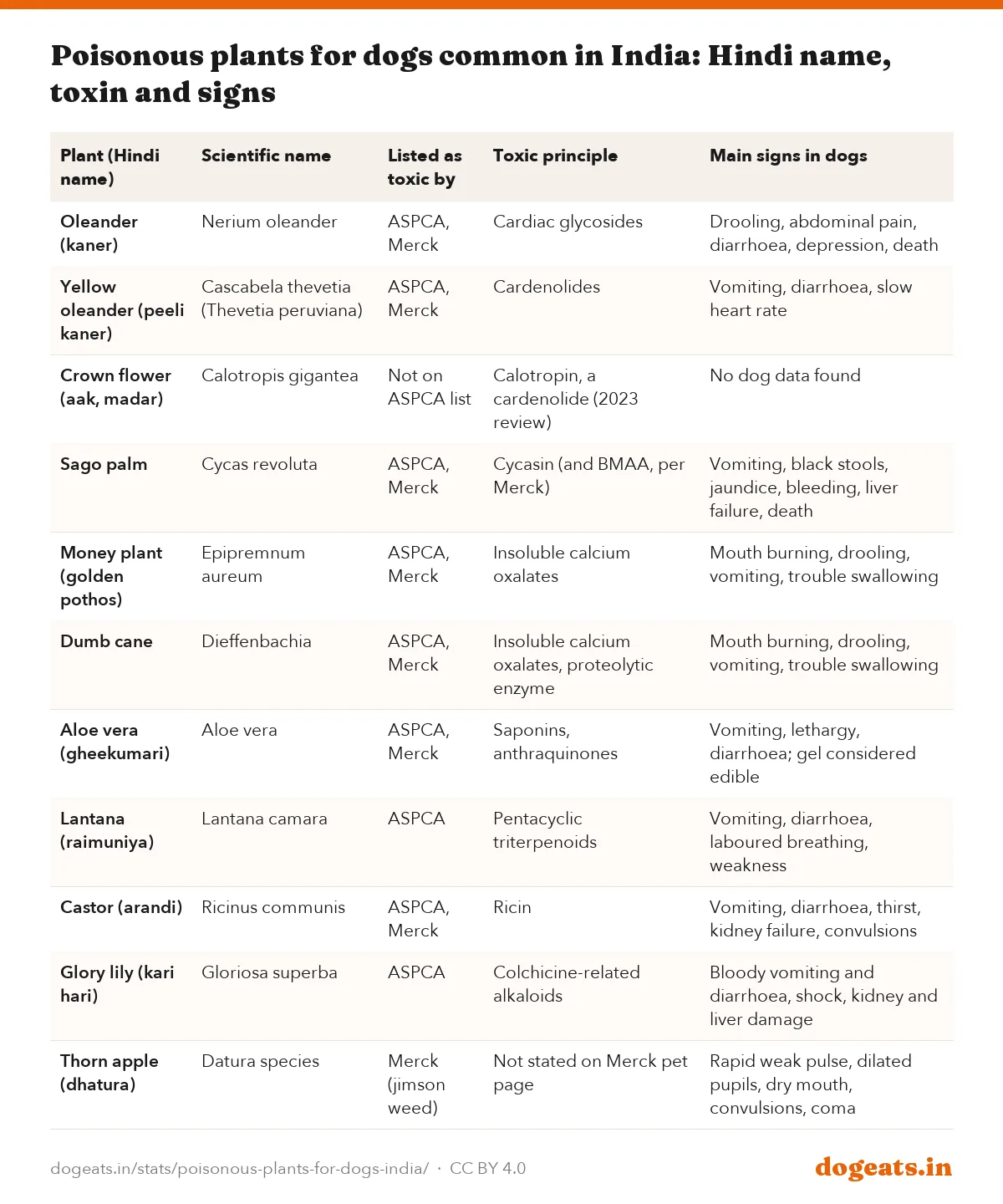
At least 11 plants grown in Indian homes, gardens and roadsides are poisonous to dogs. They are kaner, peeli kaner, aak, sago palm, money plant, dumb cane, aloe vera, lantana, arandi, glory lily and dhatura. The ASPCA lists 9 of them as toxic to dogs; Merck lists dhatura, and a 2023 review describes aak's heart toxin.
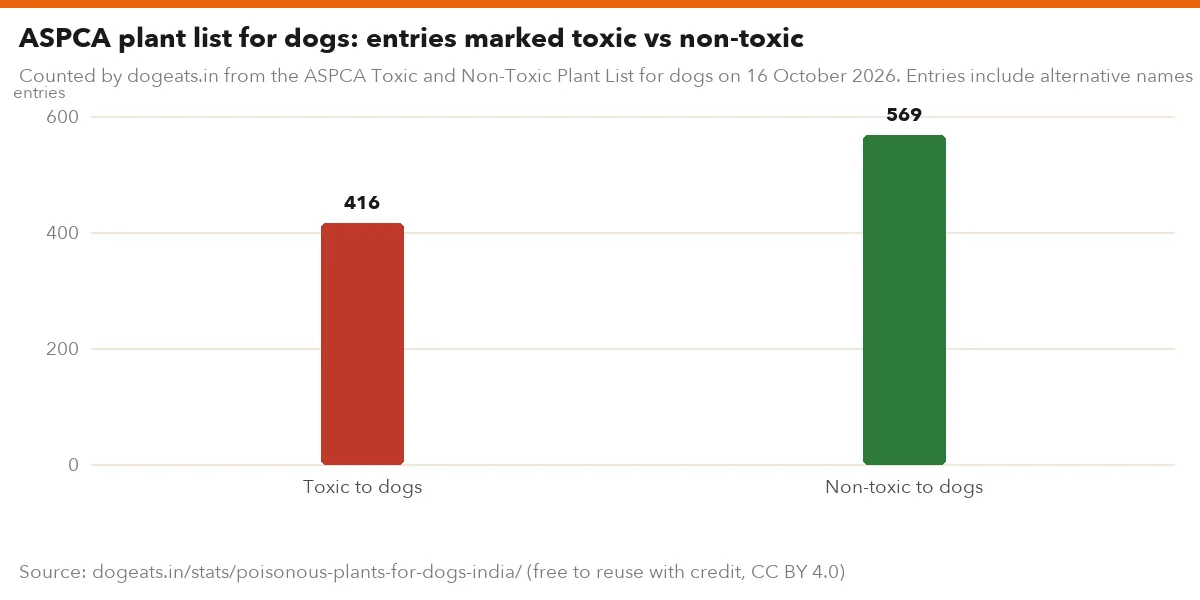
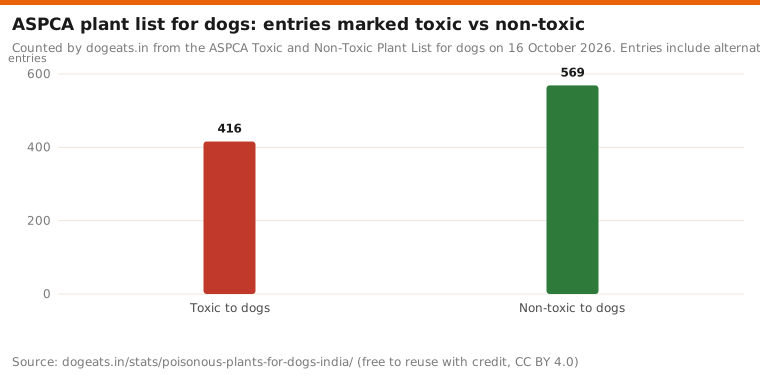
The ASPCA's dog plant list held 416 toxic entries and 569 non-toxic entries when we counted it on 16 October 2026. Many entries are other names for the same plant, so the true number of species is lower.
The ASPCA does not list aak (Calotropis) or dhatura. Aak contains calotropin, which a 2023 review in Frontiers in Pharmacology calls a highly potent cardenolide, similar in structure to cardiac glycosides such as digoxin. Oleander's heart poisons are cardiac glycosides too. Merck's pet poisoning page lists jimson weed (Datura stramonium) with a weak rapid pulse, dilated pupils, convulsions and coma.
| Plant (Hindi name) | Scientific name | Listed as toxic by | Toxic principle | Main signs in dogs |
|---|---|---|---|---|
| Oleander (kaner) | Nerium oleander | ASPCA, Merck | Cardiac glycosides | Drooling, abdominal pain, diarrhoea, depression, death |
| Yellow oleander (peeli kaner) | Cascabela thevetia (Thevetia peruviana) | ASPCA, Merck | Cardenolides | Vomiting, diarrhoea, slow heart rate |
| Crown flower (aak, madar) | Calotropis gigantea | Not on ASPCA list | Calotropin, a cardenolide (2023 review) | No dog data found |
| Sago palm | Cycas revoluta | ASPCA, Merck | Cycasin (and BMAA, per Merck) | Vomiting, black stools, jaundice, bleeding, liver failure, death |
| Money plant (golden pothos) | Epipremnum aureum | ASPCA, Merck | Insoluble calcium oxalates | Mouth burning, drooling, vomiting, trouble swallowing |
| Dumb cane | Dieffenbachia | ASPCA, Merck | Insoluble calcium oxalates, proteolytic enzyme | Mouth burning, drooling, vomiting, trouble swallowing |
| Aloe vera (gheekumari) | Aloe vera | ASPCA, Merck | Saponins, anthraquinones | Vomiting, lethargy, diarrhoea; gel considered edible |
| Lantana (raimuniya) | Lantana camara | ASPCA | Pentacyclic triterpenoids | Vomiting, diarrhoea, laboured breathing, weakness |
| Castor (arandi) | Ricinus communis | ASPCA, Merck | Ricin | Vomiting, diarrhoea, thirst, kidney failure, convulsions |
| Glory lily (kari hari) | Gloriosa superba | ASPCA | Colchicine-related alkaloids | Bloody vomiting and diarrhoea, shock, kidney and liver damage |
| Thorn apple (dhatura) | Datura species | Merck (jimson weed) | Not stated on Merck pet page | Rapid weak pulse, dilated pupils, dry mouth, convulsions, coma |
Counted by dogeats.in from the ASPCA Toxic and Non-Toxic Plant List for dogs on 16 October 2026. Entries include alternative names for the same plant.
Show the numbers
| Label | entries |
|---|---|
| Toxic to dogs | 416 |
| Non-toxic to dogs | 569 |
Embed this chart
Hindi names follow the Flowers of India botanical database. One trap is the name money plant: in India it means golden pothos, which the ASPCA lists as toxic. The ASPCA's own "Money Tree (Money Plant)" entry is Pachira aquatica, a different plant it lists as non-toxic.
Several kitchen plants also appear here. The ASPCA lists garden mint and lemongrass as toxic to dogs, while basil and coriander (it even gives the name dhania) are non-toxic. See can dogs eat mint and can dogs eat coriander leaves for food amounts.
Is kaner (oleander) poisonous to dogs?
Yes. Kaner (Nerium oleander) contains cardiac glycosides. Merck ranks oleander and foxglove as the most toxic plants in that group, with signs expected within 2 hours and lasting up to 4 to 5 days.
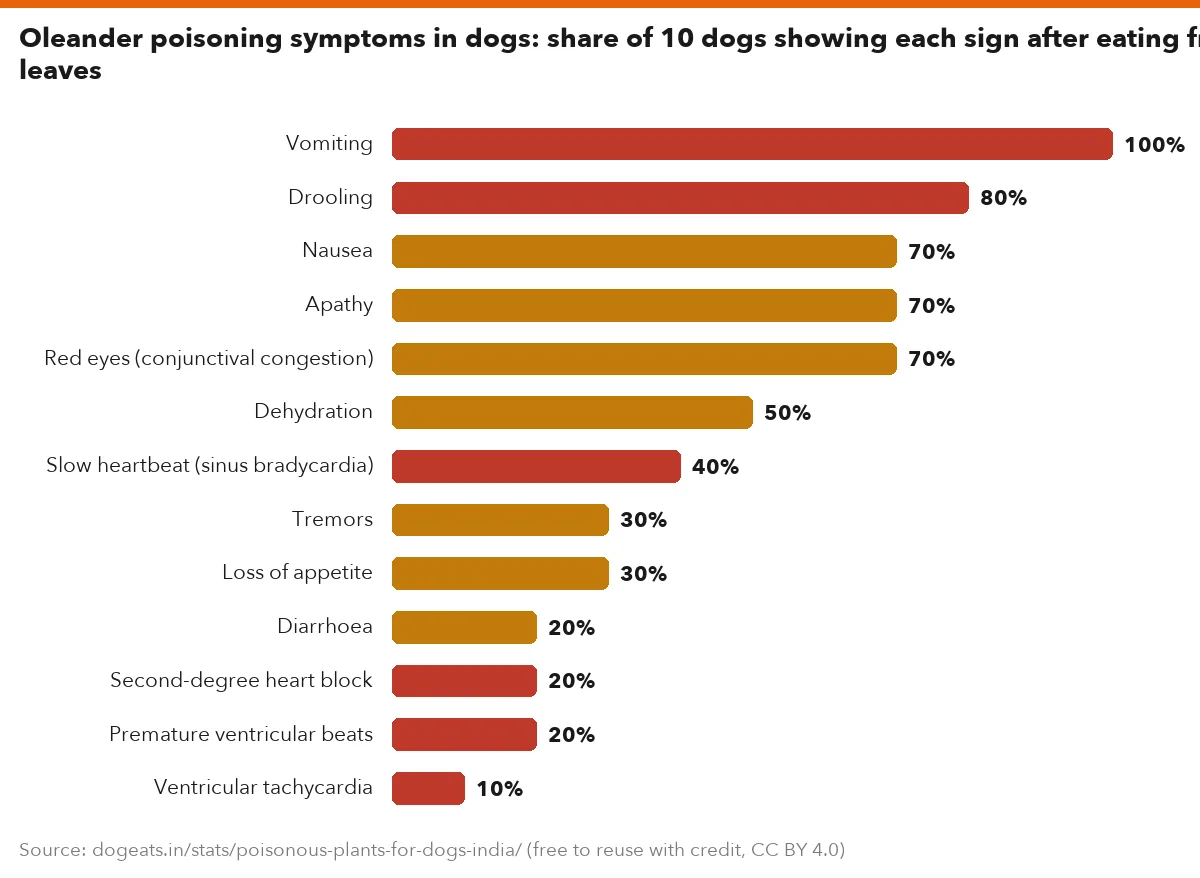
A 2017 Brazilian study gave 10 healthy adult dogs 0.25 g of fresh ground oleander leaf per kg of body weight. That is 2.5 g for a 10 kg dog. All 10 vomited, starting 27 to 75 minutes after dosing, and the authors called it a moderate poisoning.
The heart is the danger. Four of the 10 dogs developed a slow heartbeat, 2 had a second-degree heart block and 1 had a run of ventricular tachycardia. None died, but all 10 were given glucose and supportive treatment, and Merck notes deaths after oleander poisoning even with aggressive treatment.
Camplesi et al. (2017), Ciencia Rural 47(6): 10 adult mixed-breed dogs of 10 to 25 kg given 0.25 g/kg of fresh ground Nerium oleander leaves. Heart signs from ECG. All dogs received supportive treatment.
Show the numbers
| Label | % |
|---|---|
| Vomiting | 100% |
| Drooling | 80% |
| Nausea | 70% |
| Apathy | 70% |
| Red eyes (conjunctival congestion) | 70% |
| Dehydration | 50% |
| Slow heartbeat (sinus bradycardia) | 40% |
| Tremors | 30% |
| Loss of appetite | 30% |
| Diarrhoea | 20% |
| Second-degree heart block | 20% |
| Premature ventricular beats | 20% |
| Ventricular tachycardia | 10% |
Embed this chart
Peeli kaner (yellow oleander, Cascabela thevetia) carries cardenolides, and the ASPCA lists vomiting, diarrhoea and a slow heart rate. Merck puts it in the same cardiac glycoside group as oleander. We found no published dog case series for it.
Merck says vets treat these plants with repeated doses of activated charcoal, and that digoxin antibody fragments act as specific antidotes to plant cardiac glycosides too. A 2017 US case report used them to save a dog with severe oleander poisoning that had not responded to other heart drugs.
Is sago palm poisonous to dogs?
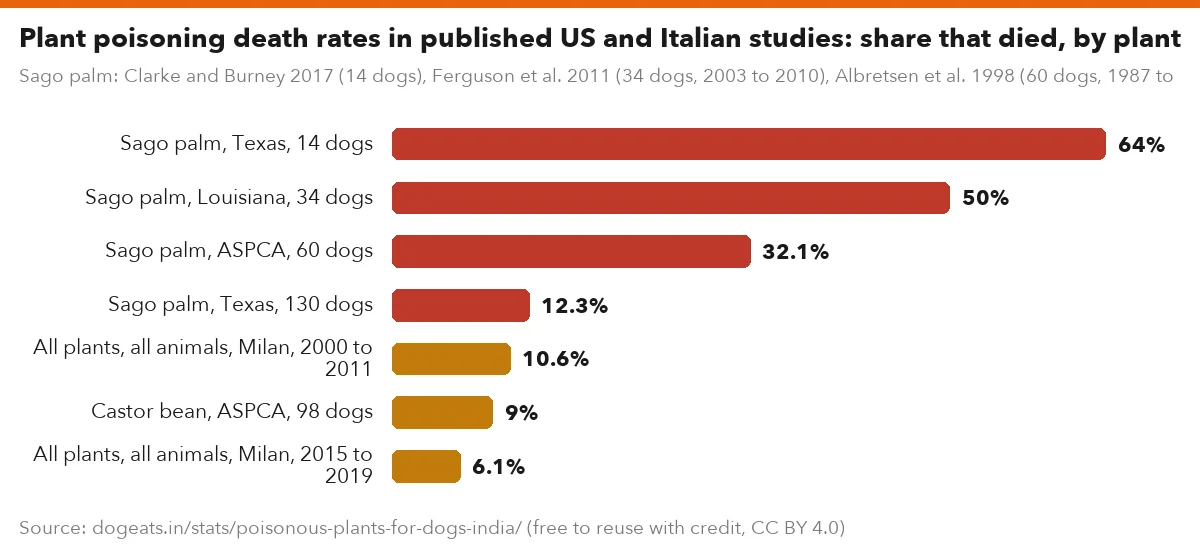
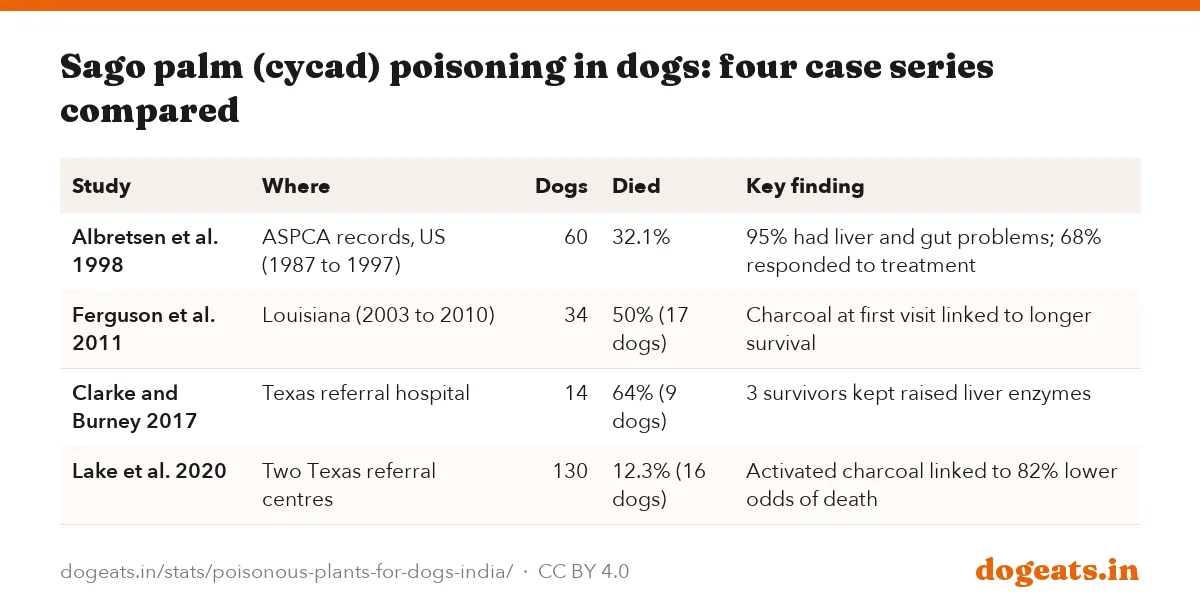
Yes, and it is the deadliest plant in this report: in four US case series, 12.3% to 64% of dogs with sago palm (cycad) poisoning died. Merck says dogs are extremely sensitive, and that the seeds are the most toxic part although every part is poisonous.
The poison works fast and then slowly. First signs can show within 4 hours. Liver failure can follow within 48 to 72 hours, Merck says, so a dog that seems fine the next morning is not out of danger.
In a 1998 review of 60 dogs in US ASPCA records, 95% developed liver and gut problems and 53.3% had nervous system signs. 38.7% had eaten seeds, and the authors say dogs that eat seeds are likely to get sicker.
Sago palm: Clarke and Burney 2017 (14 dogs), Ferguson et al. 2011 (34 dogs, 2003 to 2010), Albretsen et al. 1998 (60 dogs, 1987 to 1997), Lake et al. 2020 (130 dogs). Castor: Albretsen et al. 2000 (98 dogs, 1987 to 1998). Milan poison centre, Italy: Caloni et al. 2013 and Bertero et al. 2021, all animal species, cases with known outcome. No Indian figures exist.
Show the numbers
| Label | % |
|---|---|
| Sago palm, Texas, 14 dogs | 64% |
| Sago palm, Louisiana, 34 dogs | 50% |
| Sago palm, ASPCA, 60 dogs | 32.1% |
| Sago palm, Texas, 130 dogs | 12.3% |
| All plants, all animals, Milan, 2000 to 2011 | 10.6% |
| Castor bean, ASPCA, 98 dogs | 9% |
| All plants, all animals, Milan, 2015 to 2019 | 6.1% |
Embed this chart
| Study | Where | Dogs | Died | Key finding |
|---|---|---|---|---|
| Albretsen et al. 1998 | ASPCA records, US (1987 to 1997) | 60 | 32.1% | 95% had liver and gut problems; 68% responded to treatment |
| Ferguson et al. 2011 | Louisiana (2003 to 2010) | 34 | 50% (17 dogs) | Charcoal at first visit linked to longer survival |
| Clarke and Burney 2017 | Texas referral hospital | 14 | 64% (9 dogs) | 3 survivors kept raised liver enzymes |
| Lake et al. 2020 | Two Texas referral centres | 130 | 12.3% (16 dogs) | Activated charcoal linked to 82% lower odds of death |
Why the spread from 12% to 64%? The studies differ in size and in how sick the dogs were on arrival. The largest, 130 dogs in 2020, had the lowest death rate, and 82.3% of its dogs showed signs.
Two studies linked activated charcoal to better survival, though neither was a trial. That is a vet's job, not a home remedy. If your dog chews a sago palm, take it to a clinic the same hour, even if it looks well.
Is money plant poisonous to dogs?
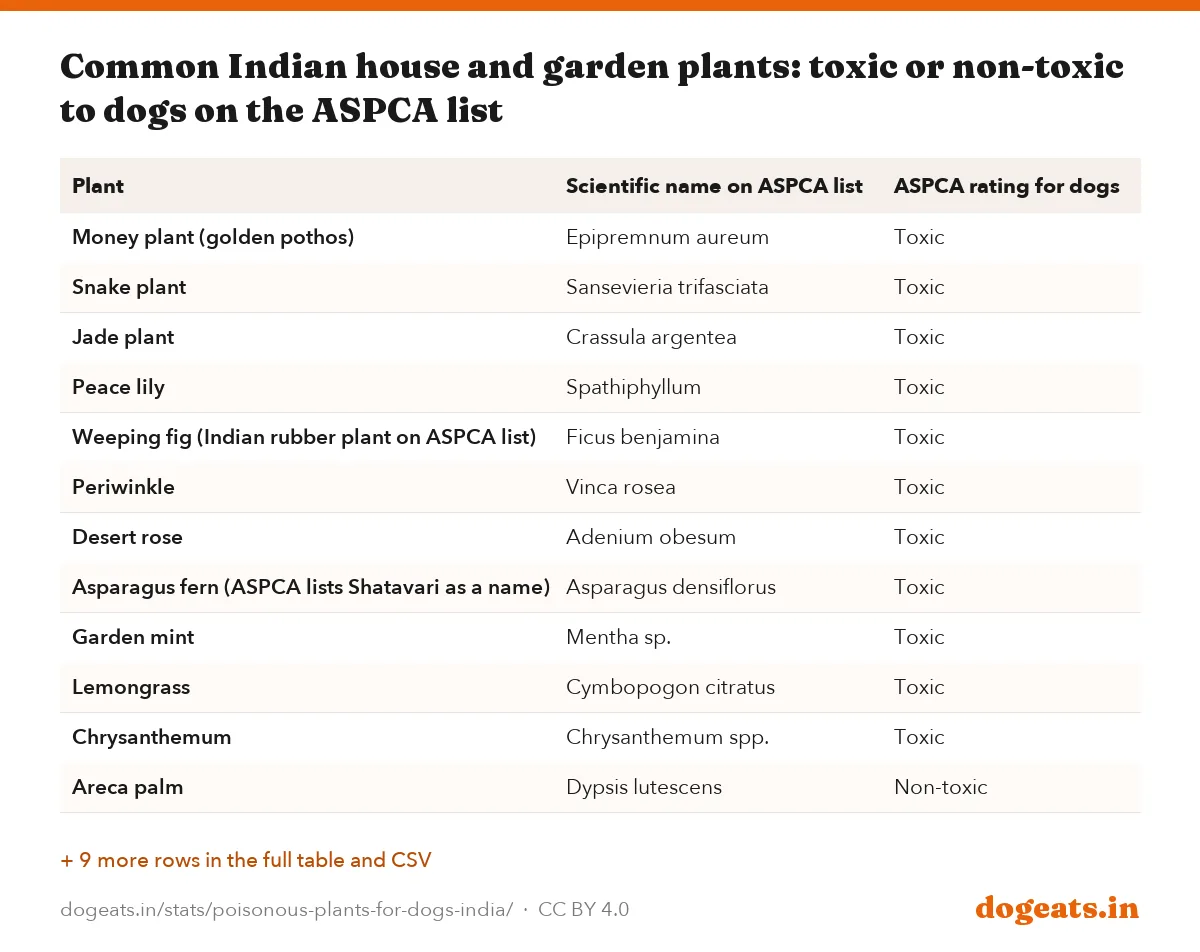
Yes, but it is rarely deadly: money plant (golden pothos, Epipremnum aureum) holds insoluble calcium oxalate crystals that cause instant mouth pain, drooling and vomiting. The ASPCA put devil's ivy (pothos) on its list of the 10 plants it got the most calls about in 2020, saying severe signs are unlikely.
Merck says chewing any part causes immediate intense pain in the mouth. Merck notes that no systemic reaction to insoluble calcium oxalate has been reported; the kidney damage it describes comes from soluble oxalates.
Dumb cane (Dieffenbachia) works the same way, with an extra protein-splitting enzyme. Merck describes death from it as infrequent.
| Plant | Scientific name on ASPCA list | ASPCA rating for dogs |
|---|---|---|
| Money plant (golden pothos) | Epipremnum aureum | Toxic |
| Snake plant | Sansevieria trifasciata | Toxic |
| Jade plant | Crassula argentea | Toxic |
| Peace lily | Spathiphyllum | Toxic |
| Weeping fig (Indian rubber plant on ASPCA list) | Ficus benjamina | Toxic |
| Periwinkle | Vinca rosea | Toxic |
| Desert rose | Adenium obesum | Toxic |
| Asparagus fern (ASPCA lists Shatavari as a name) | Asparagus densiflorus | Toxic |
| Garden mint | Mentha sp. | Toxic |
| Lemongrass | Cymbopogon citratus | Toxic |
| Chrysanthemum | Chrysanthemum spp. | Toxic |
| Areca palm | Dypsis lutescens | Non-toxic |
| Spider plant | Chlorophytum comosum | Non-toxic |
| Boston fern | Nephrolepis exalta bostoniensis | Non-toxic |
| Money tree | Pachira aquatica | Non-toxic |
| Jasmine | Jasminum species | Non-toxic |
| Rose | Rosa species | Non-toxic |
| Basil | Ocimum basilicum | Non-toxic |
| Coriander (dhania) | Coriandrum sativum | Non-toxic |
| Pot marigold | Calendula officinalis | Non-toxic |
| Calathea | Calathea spp. | Non-toxic |
Aloe vera is toxic in the ASPCA list because of saponins and anthraquinones in the leaf, though it calls the gel edible. Merck says eating the leaf latex causes abrupt, severe diarrhoea, low blood sugar or both. Our aloe vera food guide covers the gel question.
Check the exact species before you trust a label. The ASPCA's non-toxic marigold is Calendula, not the Tagetes marigolds used in garlands, and its hibiscus entry is Hibiscus syriacus, not Hibiscus rosa-sinensis. Neither Tagetes nor Hibiscus rosa-sinensis appears on the dog list.
Are lantana, arandi (castor) and dhatura poisonous to dogs?
All three are poisonous. In US ASPCA records, 9% of 98 dogs that ate castor beans died or were put down between 1987 and 1998. The ASPCA warns that as little as one ounce (about 28 g) of seeds can be lethal.
Castor signs typically start 12 to 48 hours after eating, the ASPCA says, so a quiet first evening means little. Whether the beans were chewed or swallowed whole may change how sick a dog gets, the 2000 study found.
Lantana (raimuniya) is widespread in India. A 2020 survey of 207,100 sq km of Indian forest found it in 154,837 sq km of the area surveyed. It estimated lantana threatened 303,607 sq km, or 44% of India's forests.
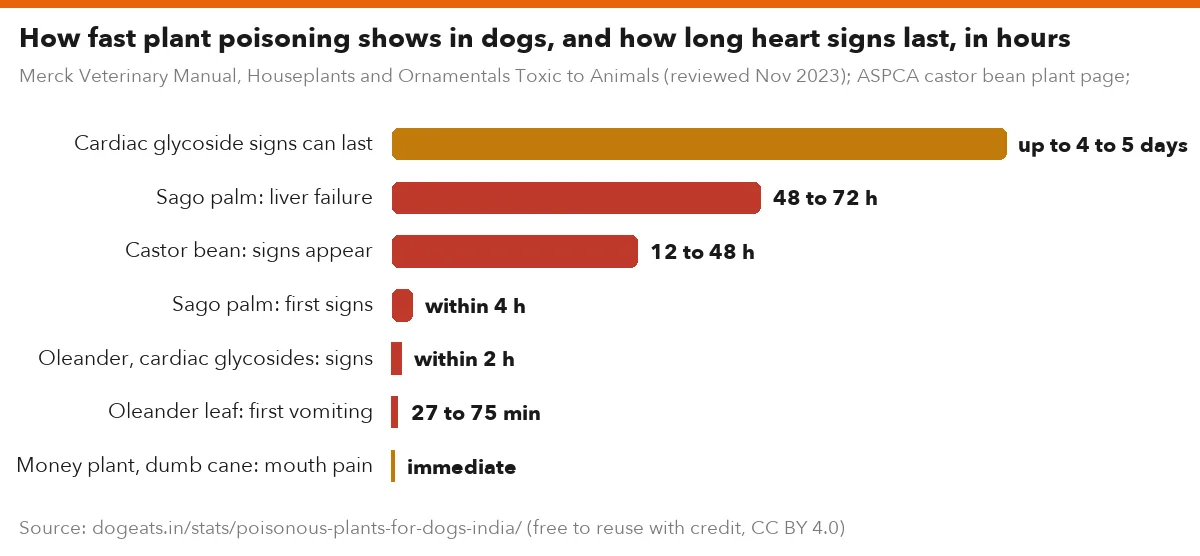
Merck Veterinary Manual, Houseplants and Ornamentals Toxic to Animals (reviewed Nov 2023); ASPCA castor bean plant page; Camplesi et al. 2017 (Brazil) for oleander leaf vomiting; the same paper also says signs were first noted at 4 hours. Bars show the upper end of each range.
Show the numbers
| Label | hours |
|---|---|
| Cardiac glycoside signs can last | up to 4 to 5 days |
| Sago palm: liver failure | 48 to 72 h |
| Castor bean: signs appear | 12 to 48 h |
| Sago palm: first signs | within 4 h |
| Oleander, cardiac glycosides: signs | within 2 h |
| Oleander leaf: first vomiting | 27 to 75 min |
| Money plant, dumb cane: mouth pain | immediate |
Embed this chart
The ASPCA lists lantana's toxins as pentacyclic triterpenoids and its signs as vomiting, diarrhoea, laboured breathing and weakness. It notes liver failure is more common in livestock. Its list of the most-called plants of 2020 said lantana causes liver failure in dogs and cats only in rare cases.
Glory lily (Gloriosa superba) holds colchicine-related alkaloids. The ASPCA lists bloody vomiting and diarrhoea, shock, kidney failure, liver damage and bone marrow suppression.
Dhatura is a roadside weed across India. Merck lists jimson weed, Datura stramonium, with the whole plant toxic and seeds in particular. The only dog case we found in PubMed is a single 2002 report from Brazil, so there is no dog death rate to give.
How common is plant poisoning in dogs?
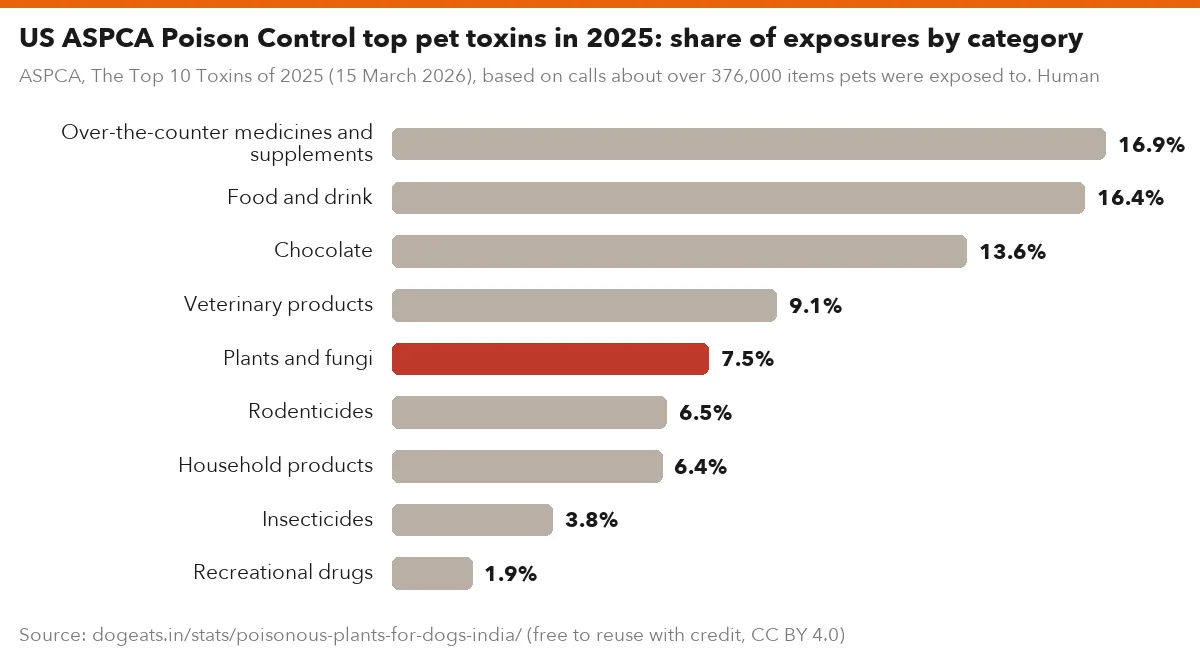
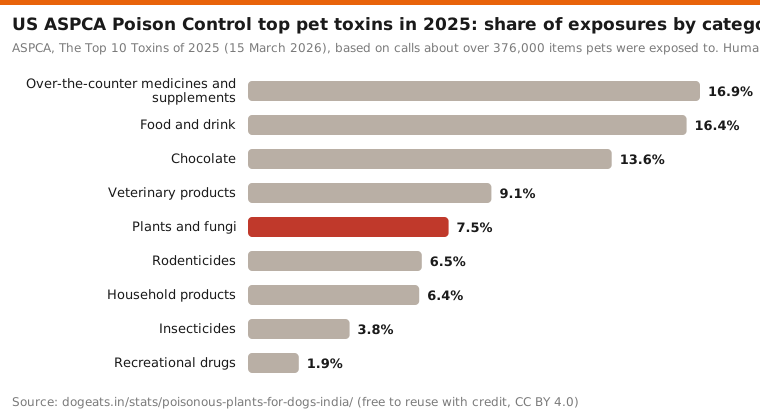
Plants and fungi made up 7.5% of pet poison exposures reported to the US ASPCA Poison Control in 2025, sixth among its top 10 categories. The share was 8.1% in 2024.
Over-the-counter medicines (16.9%) and human food and drink (16.4%) both came well ahead. Chocolate alone was 13.6%. For Indian kitchen risks, see our most toxic foods for dogs report.
Italy's Milan poison centre gives a European view. From 2000 to 2011, plants made up 5.7% of its 2,150 animal inquiries, and dogs were 61.8% of the plant calls. Sago palm and oleander were among the plants most often involved.
ASPCA, The Top 10 Toxins of 2025 (15 March 2026), based on calls about over 376,000 items pets were exposed to. Human prescription medications ranked third but no share was published.
Show the numbers
| Label | % |
|---|---|
| Over-the-counter medicines and supplements | 16.9% |
| Food and drink | 16.4% |
| Chocolate | 13.6% |
| Veterinary products | 9.1% |
| Plants and fungi | 7.5% |
| Rodenticides | 6.5% |
| Household products | 6.4% |
| Insecticides | 3.8% |
| Recreational drugs | 1.9% |
Embed this chart
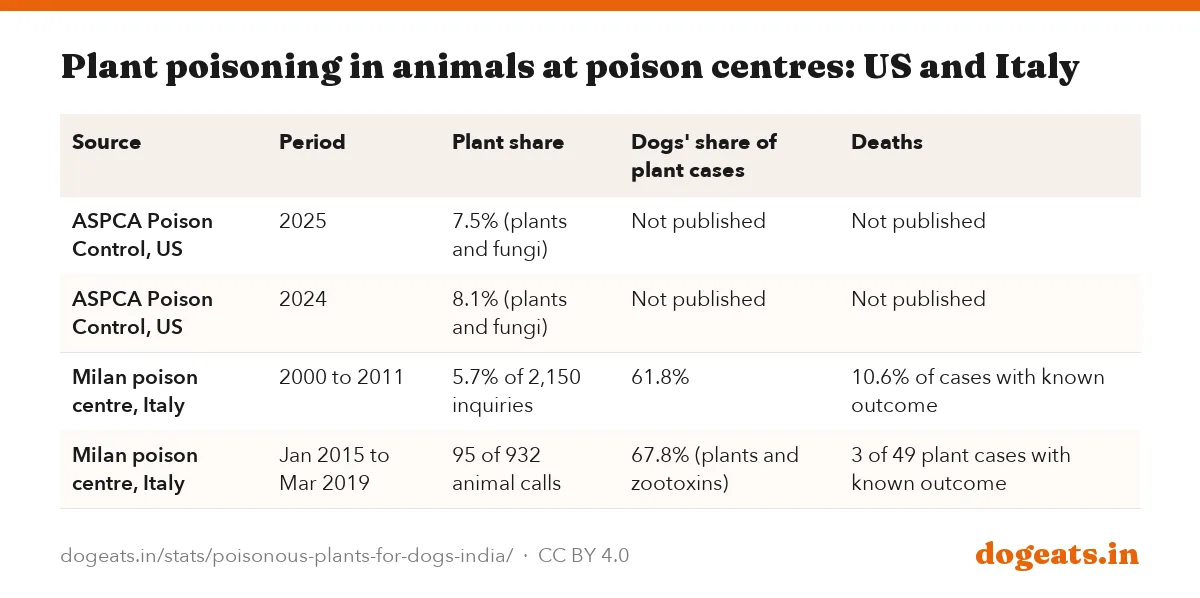
| Source | Period | Plant share | Dogs' share of plant cases | Deaths |
|---|---|---|---|---|
| ASPCA Poison Control, US | 2025 | 7.5% (plants and fungi) | Not published | Not published |
| ASPCA Poison Control, US | 2024 | 8.1% (plants and fungi) | Not published | Not published |
| Milan poison centre, Italy | 2000 to 2011 | 5.7% of 2,150 inquiries | 61.8% | 10.6% of cases with known outcome |
| Milan poison centre, Italy | Jan 2015 to Mar 2019 | 95 of 932 animal calls | 67.8% (plants and zootoxins) | 3 of 49 plant cases with known outcome |
India has no published equivalent. We found no Indian animal poison centre data and no Indian case series of plant poisoning in dogs. Nobody can yet say how often kaner or sago palm sickens dogs here.
For what studies say about dogs that graze on plants, see our report on why dogs eat grass.
What should I do if my dog eats a poisonous plant?
Call a vet straight away and take a piece of the plant. Two US sago palm studies linked activated charcoal from a vet to survival, and in Lake's 2020 study dogs given it had 82% lower odds of death.
Do not wait for signs. Castor can take 12 to 48 hours to show, and sago palm liver damage 48 to 72 hours. Merck advises daily liver tests for 72 hours after sago palm exposure.
Photograph the plant and note the time. Kaner and peeli kaner share a Hindi name, so tell the vet the flower colour or show the photo.
- Remove plant bits from the mouth and keep a sample or photo.
- Note when your dog ate it and roughly how much.
- Call your vet or nearest animal hospital before driving over.
- Do not try home remedies to make your dog vomit unless a vet tells you to.
- Keep sago palm seeds, castor seeds and oleander clippings out of reach.
Vets are not evenly spread across India. Our report on vets per lakh population shows the gaps. The 1962 animal ambulance is built for livestock, so find a small animal clinic before you need one.
Fallen leaves and clippings matter too. Oleander is toxic fresh or dry, Merck says, so keep pruned branches and fallen leaves out of reach. Our monsoon dog care guide covers wet season walk routines.
Are tulsi and curry leaf plants safe for dogs?
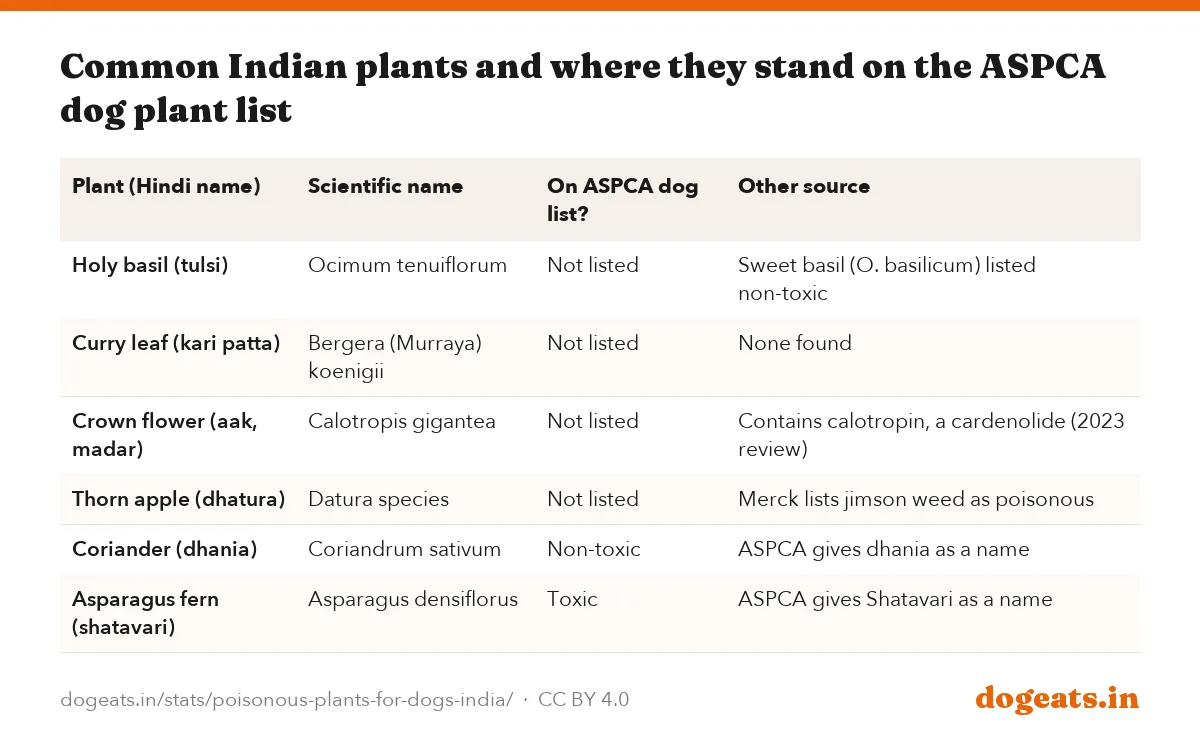
Neither tulsi (Ocimum tenuiflorum) nor curry leaf appears on the ASPCA dog plant list, as toxic or non-toxic, when we checked on 16 October 2026. Its close relative sweet basil (Ocimum basilicum) is listed as non-toxic.
So the evidence is a gap, not a clean bill of health. Small amounts as food are a different question from a dog chewing a whole plant. See our food guides on tulsi, curry leaves and basil.
| Plant (Hindi name) | Scientific name | On ASPCA dog list? | Other source |
|---|---|---|---|
| Holy basil (tulsi) | Ocimum tenuiflorum | Not listed | Sweet basil (O. basilicum) listed non-toxic |
| Curry leaf (kari patta) | Bergera (Murraya) koenigii | Not listed | None found |
| Crown flower (aak, madar) | Calotropis gigantea | Not listed | Contains calotropin, a cardenolide (2023 review) |
| Thorn apple (dhatura) | Datura species | Not listed | Merck lists jimson weed as poisonous |
| Coriander (dhania) | Coriandrum sativum | Non-toxic | ASPCA gives dhania as a name |
| Asparagus fern (shatavari) | Asparagus densiflorus | Toxic | ASPCA gives Shatavari as a name |
For a full food view, our dog food toxicity chart rates common Indian ingredients from safe to toxic.
Frequently asked questions
Which plants are poisonous to dogs in India?
Common ones are kaner (oleander), peeli kaner, sago palm, money plant (pothos), dumb cane, aloe vera, lantana, arandi (castor), glory lily, aak and dhatura. The ASPCA lists 9 of these 11 as toxic to dogs.
Is kaner poisonous to dogs?
Yes. Oleander contains cardiac glycosides. Merck expects signs within 2 hours, and in a 2017 Brazilian study 0.25 g of leaf per kg made all 10 dogs vomit and 4 develop a slow heartbeat.
Is sago palm poisonous to dogs?
Yes. In four US studies, 12.3% to 64% of poisoned dogs died. Signs can start within 4 hours and liver failure can follow in 48 to 72 hours.
Is money plant poisonous to dogs?
Yes. Golden pothos, called money plant in India, has insoluble calcium oxalates that cause mouth pain, drooling and vomiting. It is rarely fatal, and the ASPCA listed it among the 10 plants it got the most calls about in 2020.
Is aloe vera poisonous to dogs?
The ASPCA lists aloe as toxic, causing vomiting, lethargy and diarrhoea, but calls the gel edible. Merck says the leaf latex can cause severe diarrhoea, low blood sugar or both.
Is lantana poisonous to dogs?
Yes. The ASPCA lists vomiting, diarrhoea, laboured breathing and weakness. Liver failure is more common in livestock. A 2020 study found lantana threatens 44% of India's forest area.
How long does plant poisoning take to show in dogs?
It depends on the plant. Money plant hurts at once, oleander within 2 hours, sago palm within 4 hours, and castor beans after 12 to 48 hours.
Is tulsi safe for dogs?
Tulsi is not on the ASPCA dog plant list either way. Its relative sweet basil is listed as non-toxic. Treat it as unstudied and stop a dog from chewing whole plants.
What should I do if my dog eats sago palm?
Go to a vet at once, even if your dog looks fine. In a 2020 US study of 130 dogs, those given activated charcoal by vets had 82% lower odds of death.
Methodology and limitations
Toxic or non-toxic ratings, toxic principles and clinical signs come from the ASPCA Toxic and Non-Toxic Plant List and its individual plant pages, read on 16 October 2026. We counted the 416 toxic and 569 non-toxic entries on the dog list page that day; entries include alternative names, so they overstate the number of species.
Onset times, treatment notes and toxin descriptions come from two Merck Veterinary Manual chapters. They are Houseplants and Ornamentals Toxic to Animals (Schmid, full review November 2023) and Plants Poisonous to Animals (Brownie, last updated May 2026).
Death rates come from the abstracts of peer-reviewed case series: Albretsen et al. 1998 and 2000, Ferguson et al. 2011, Clarke and Burney 2017, Lake et al. 2020, Caloni et al. 2013 and Bertero et al. 2021. Oleander signs come from the full text of Camplesi et al. 2017.
Hindi names come from the Flowers of India database (flowersofindia.net), which cites Names of Plants in India. Lantana spread comes from Mungi, Qureshi and Jhala (2020), Global Ecology and Conservation 23.
Grams per dog (2.5 g for a 10 kg dog) and ounces to grams (1 ounce is about 28 g) are our own arithmetic. Bars for ranges show the upper end; labels show the full range.
Sources
- ASPCA: Toxic and Non-Toxic Plant List for Dogs (read 16 October 2026), with individual plant pages, 416 toxic and 569 non-toxic entries; toxic principles and signs for each plant
- Merck Veterinary Manual: Houseplants and Ornamentals Toxic to Animals (Schmid RD, full review Nov 2023), Cycad onset 4 h, liver failure 48 to 72 h; cardiac glycoside onset 2 h, lasting 4 to 5 days
- Lake BB et al. (2020), The characterization of cycad palm toxicosis and treatment effects in 130 dogs, Australian Veterinary Journal 98(11):555-562, 130 dogs, 12.3% died; charcoal linked to 82% lower odds of death
- Also consulted: Albretsen JC, Khan SA, Richardson JA (1998), Cycad palm toxicosis in dogs: 60 cases (1987-1997), JAVMA 213(1):99-101, Ferguson D et al. (2011), Survival and prognostic indicators for cycad intoxication in dogs, Journal of Veterinary Internal Medicine 25(4):831-7, Clarke C, Burney D (2017), Cycad Palm Toxicosis in 14 Dogs from Texas, JAAHA 53(3):159-166, Albretsen JC, Gwaltney-Brant SM, Khan SA (2000), Evaluation of castor bean toxicosis in dogs: 98 cases, JAAHA 36(3):229-33, Camplesi AC et al. (2017), Dogs poisoned with Nerium oleander fresh leaves: clinical and electrocardiographic findings, Ciencia Rural 47(6), Merck Veterinary Manual: Plants Poisonous to Animals (Brownie CF, last updated May 2026), ASPCA: The Top 10 Toxins of 2025 (15 March 2026), ASPCA: The Official Top 10 Toxins of 2024 (13 March 2025), ASPCA: Top 10 Toxic Plants for Pets (6 January 2021), Caloni F et al. (2013), Plant poisoning in domestic animals: epidemiological data from an Italian survey (2000-2011), Veterinary Record 172(22):580, Bertero A et al. (2021), Plants and zootoxins: toxico-epidemiological investigation in domestic animals, Toxicon 196:25-31, Pao-Franco A et al. (2017), Successful use of digoxin-specific immune Fab in severe Nerium oleander toxicosis in a dog, JVECC 27(5):596-604, Mungi NA, Qureshi Q, Jhala YV (2020), Expanding niche and degrading forests: key to the successful global invasion of Lantana camara, Global Ecology and Conservation 23, Rajkovic J et al. (2023), An updated pharmacological insight into calotropin, Frontiers in Pharmacology 14:1160616, Tostes RA (2002), Accidental Datura stramonium poisoning in a dog, Veterinary and Human Toxicology 44(1):33-4, Flowers of India botanical database (pages for Oleander, Mexican Oleander, Crown Flower, Glory Lily, Lantana, Aloe Vera, Castor Bean Plant, Datura, Money Plant, Tulsi, Curry Leaf), Moshobane MC et al. (2020), Plants and mushrooms associated with animal poisoning incidents in South Africa, Vet Record Open, Tansuwannarat P et al. (2026), Trends and patterns of animal poisoning in Thailand, Veterinary Sciences 13(4):325.
Cite, embed and download
This report, its data and its images are free to reuse under a Creative Commons Attribution 4.0 licence. Credit dogeats.in with a link to this page. Every chart has its own embed code, every table has a CSV and an image download, and the images below are ready for social posts, slides and articles.
Cite this report
Link to this report
Every chart and table as an image