Data report · Updated October 2026
Holi Colours and Dogs: What Indian Lab Tests Found in Gulal, and What Those Chemicals Do to a Dog
Indian lab tests show synthetic Holi colours can carry lead, industrial dyes and very fine dust. In Kolkata, 200 dry colour samples averaged 29 to 37 mg/kg of lead, and in Delhi 16 of 18 green colours contained malachite green. No Indian vet hospital or NGO publishes a count of dogs hurt at Holi, so the dog risks here come from veterinary toxicology, not from a casualty tally. Keep colour off your dog, wash it off fast, and keep bhang and sweets out of reach.
Key findings
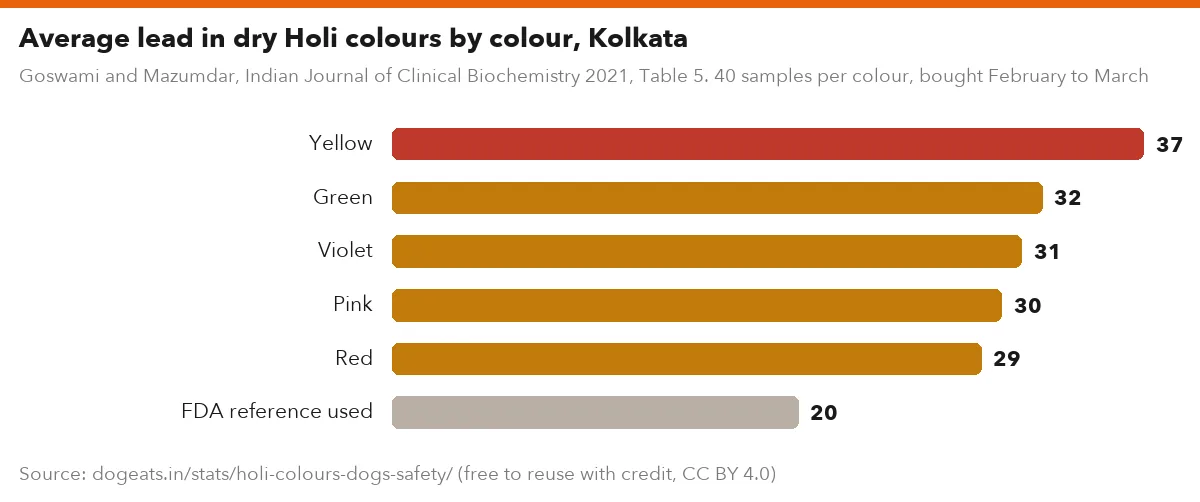
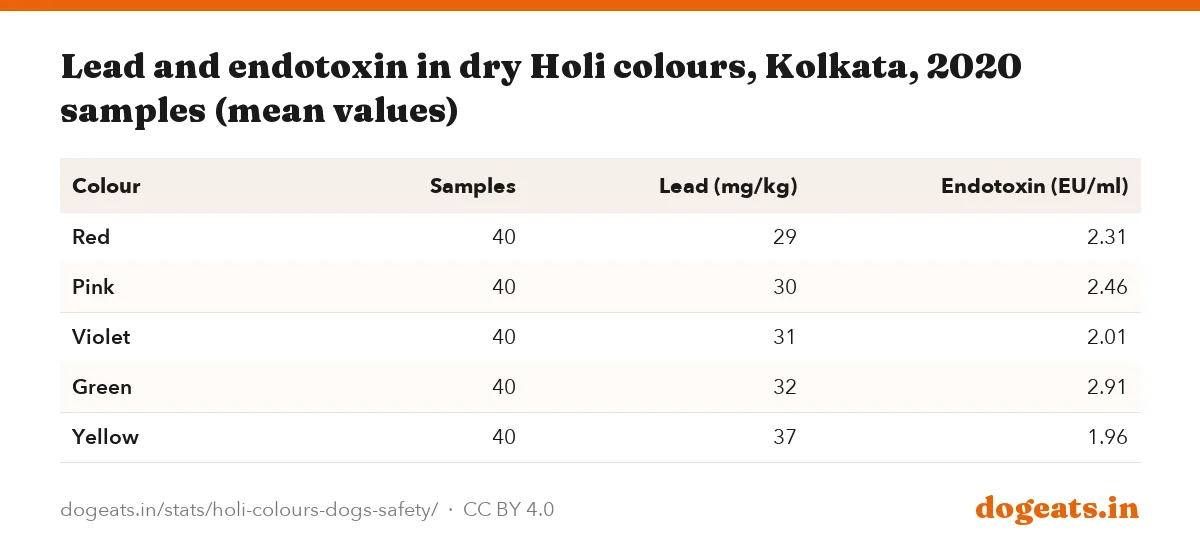
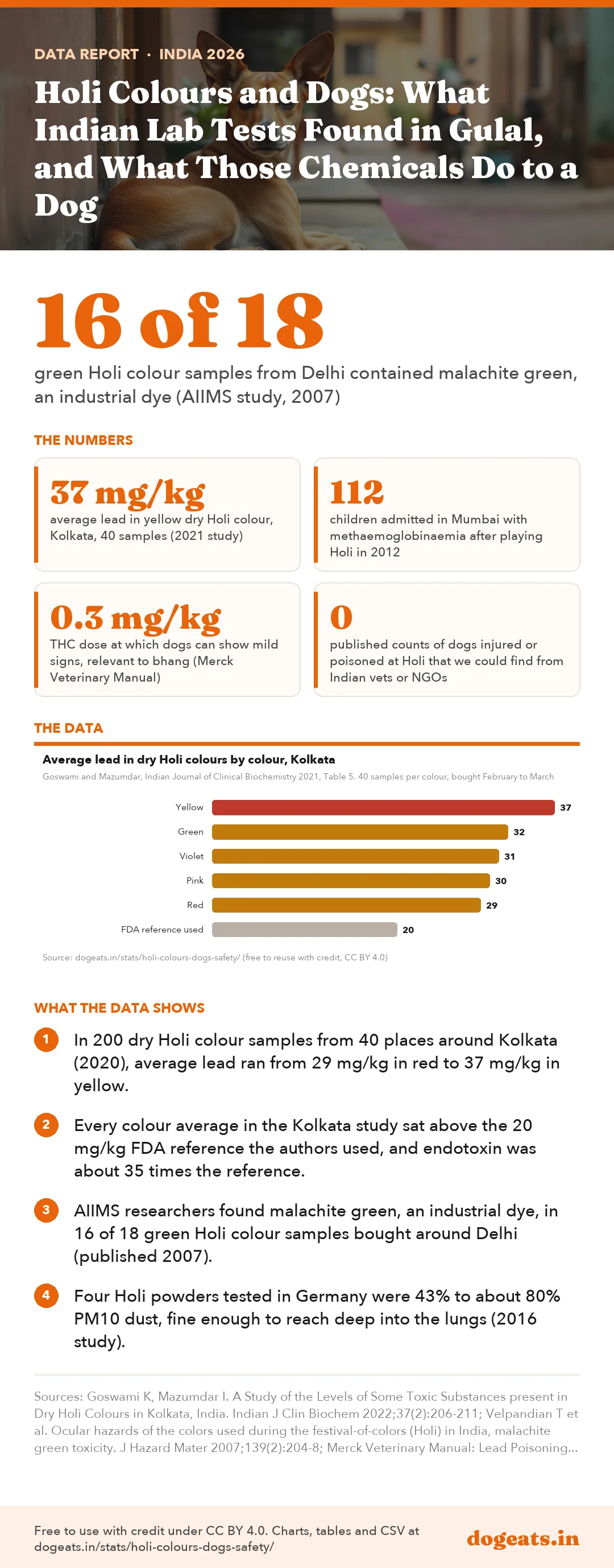
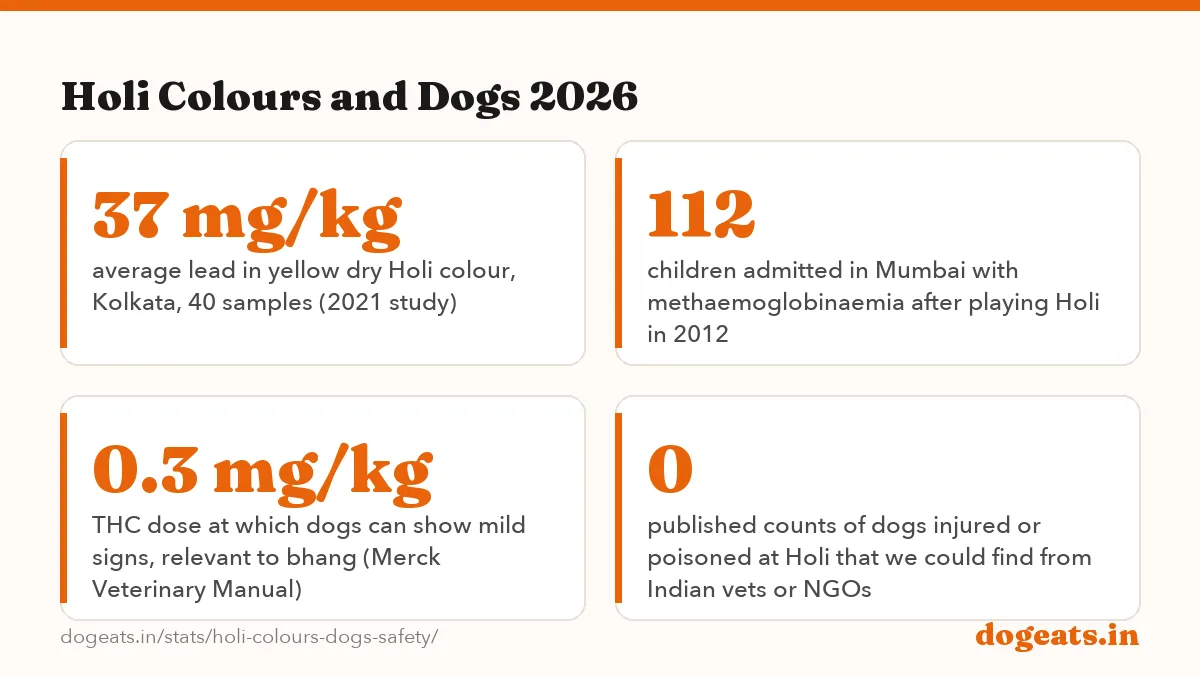
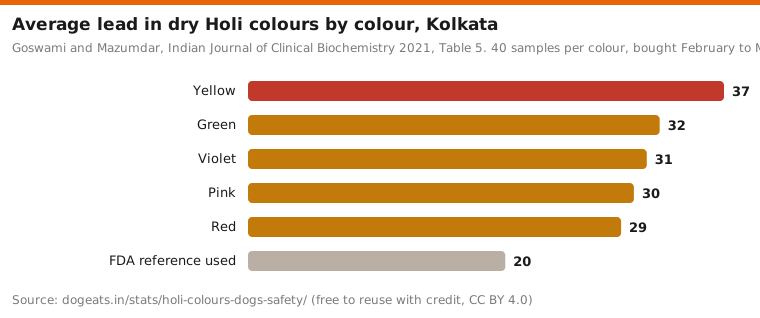
- In 200 dry Holi colour samples from 40 places around Kolkata (2020), average lead ran from 29 mg/kg in red to 37 mg/kg in yellow.
- Every colour average in the Kolkata study sat above the 20 mg/kg FDA reference the authors used, and endotoxin was about 35 times the reference.
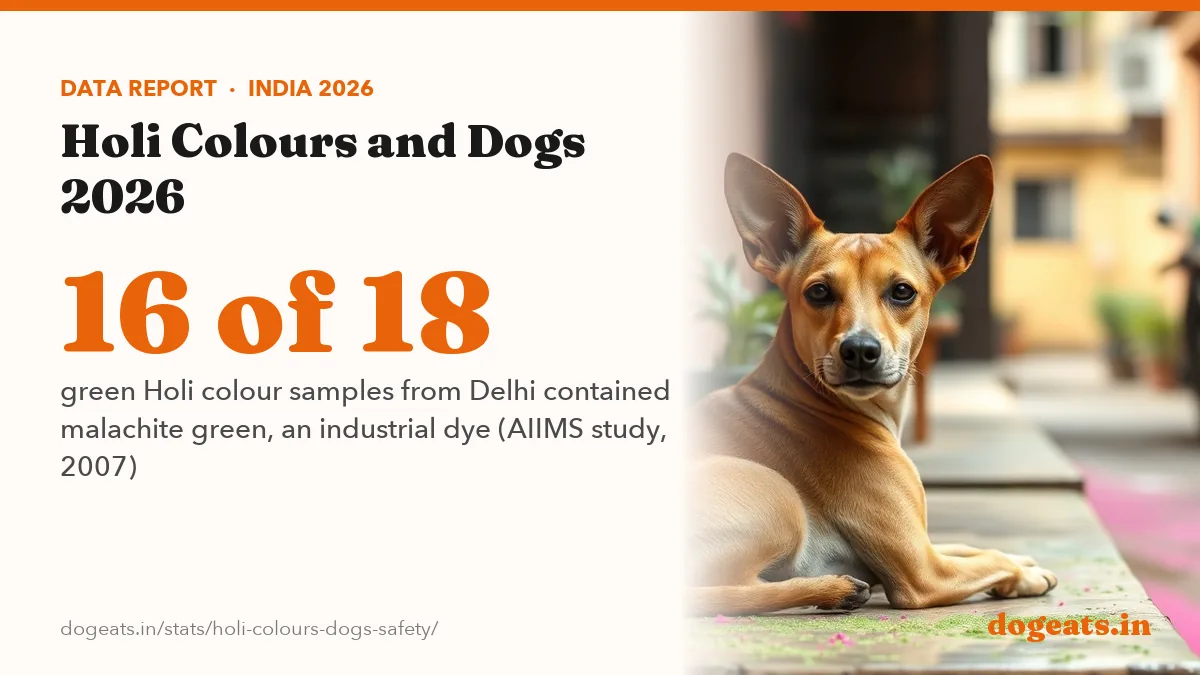
- AIIMS researchers found malachite green, an industrial dye, in 16 of 18 green Holi colour samples bought around Delhi (published 2007).
- Four Holi powders tested in Germany were 43% to about 80% PM10 dust, fine enough to reach deep into the lungs (2016 study).
- A 10 kg dog would have to swallow about 486 to 703 g of the leadiest Kolkata powder daily to reach the Merck Veterinary Manual's chronic toxic lead dose.
- The bigger documented harms are from dyes and contaminated batches: 112 children in Mumbai needed hospital care for methaemoglobinaemia after Holi 2012.
- Dogs can show signs of THC poisoning from bhang at doses as low as 0.3 to 0.5 mg/kg, usually within 1 to 2 hours.
- We found no Indian vet hospital, NGO or government count of dogs hurt during Holi, and no peer-reviewed study of Holi colours in dogs.
Are Holi colours safe for dogs?
No synthetic Holi colour has been tested as safe for dogs. In the largest Indian lab survey we found, 200 dry colour samples from Kolkata averaged 29 to 37 mg/kg of lead. A Delhi study found an industrial dye in 16 of 18 green colours.
There is also no casualty count for dogs. We searched for vet hospital, NGO and government figures on dogs hurt or poisoned during Holi and found none with a named source. PubMed lists no study of Holi colours in dogs. So this report pairs what Indian labs found in the colours with what veterinary toxicology says those chemicals do to a dog.
Holi also brings food risks that we cover elsewhere. See the festival food danger calendar and the Indian sweets safety report.
What chemicals are in Holi colours?
Lab tests in India have found lead in every Kolkata colour tested, with yellow highest at an average of 37 mg/kg. The same 2021 study bought 50 g of each of five colours at 40 locations. It found endotoxin, a bacterial toxin, at about 35 times the reference value the authors used.
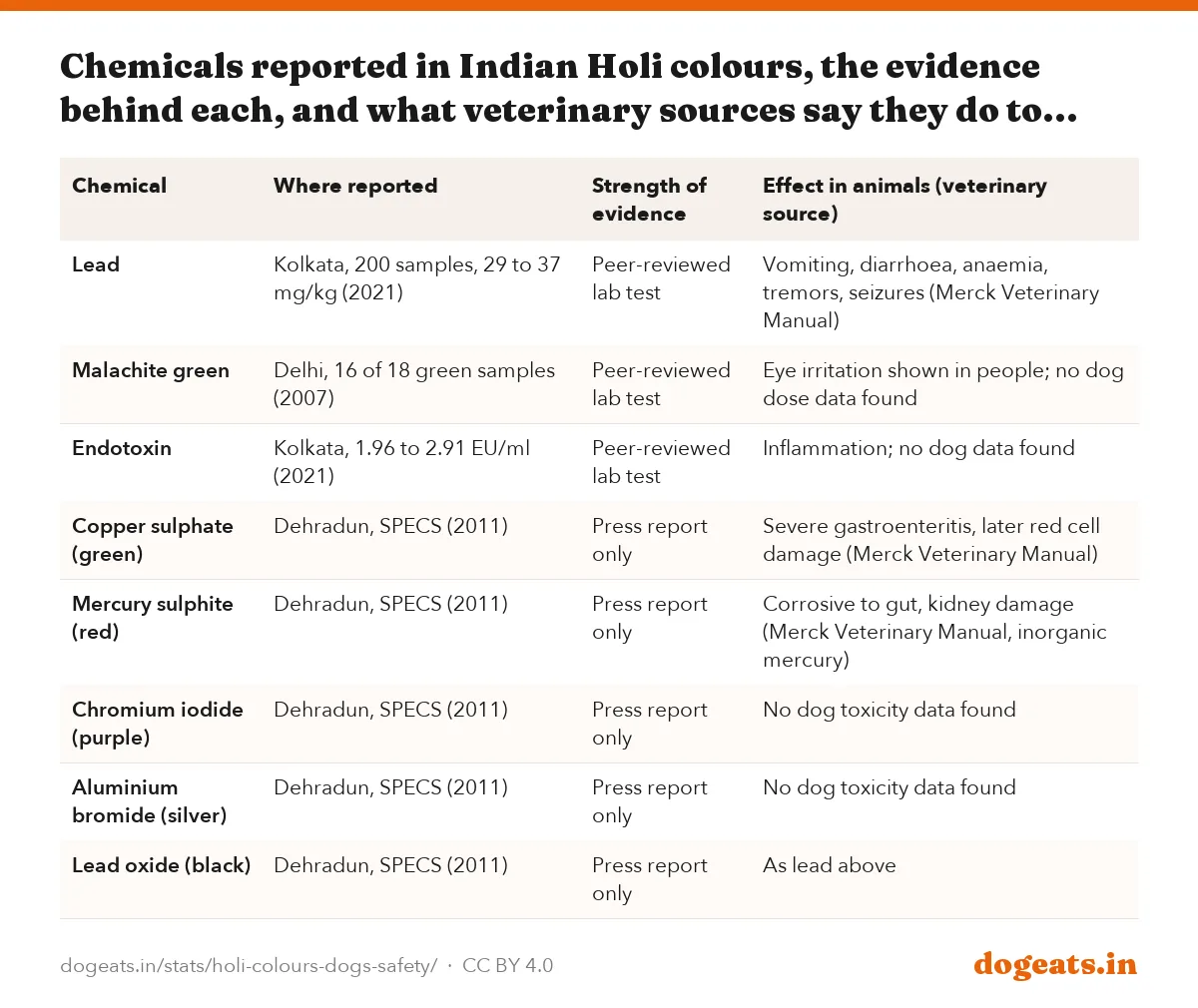
Other findings are narrower. The AIIMS ocular pharmacology team found malachite green in 16 of 18 green and bluish green samples from Delhi. In 2011 a Dehradun group, SPECS, told The Tribune it had tested 50 samples. It reported mercury sulphite in red, copper sulphate in green, chromium iodide in purple, aluminium bromide in silver and lead oxide in black. That last set is a press account, not a published lab report, so treat it as a lead for testing rather than a measured result.
Goswami and Mazumdar, Indian Journal of Clinical Biochemistry 2021, Table 5. 40 samples per colour, bought February to March 2020. The study compared them with a 20 mg/kg FDA cosmetic reference.
Show the numbers
| Label | mg/kg |
|---|---|
| Yellow | 37 |
| Green | 32 |
| Violet | 31 |
| Pink | 30 |
| Red | 29 |
| FDA reference used | 20 |
Embed this chart
| Chemical | Where reported | Strength of evidence | Effect in animals (veterinary source) |
|---|---|---|---|
| Lead | Kolkata, 200 samples, 29 to 37 mg/kg (2021) | Peer-reviewed lab test | Vomiting, diarrhoea, anaemia, tremors, seizures (Merck Veterinary Manual) |
| Malachite green | Delhi, 16 of 18 green samples (2007) | Peer-reviewed lab test | Eye irritation shown in people; no dog dose data found |
| Endotoxin | Kolkata, 1.96 to 2.91 EU/ml (2021) | Peer-reviewed lab test | Inflammation; no dog data found |
| Copper sulphate (green) | Dehradun, SPECS (2011) | Press report only | Severe gastroenteritis, later red cell damage (Merck Veterinary Manual) |
| Mercury sulphite (red) | Dehradun, SPECS (2011) | Press report only | Corrosive to gut, kidney damage (Merck Veterinary Manual, inorganic mercury) |
| Chromium iodide (purple) | Dehradun, SPECS (2011) | Press report only | No dog toxicity data found |
| Aluminium bromide (silver) | Dehradun, SPECS (2011) | Press report only | No dog toxicity data found |
| Lead oxide (black) | Dehradun, SPECS (2011) | Press report only | As lead above |
Mica and powdered glass are often listed in Holi warnings, but we found no Indian lab test that measured them, so we left them out of the table.
Is gulal toxic to dogs if they lick it?
A lick of gulal is unlikely to give a dog lead poisoning on its own. At 37 mg/kg, a 10 kg dog would need about 486 to 703 g of powder every day to reach the Merck Veterinary Manual's chronic toxic lead dose. A single acute dose would take about 51.6 kg of powder.
That does not make gulal safe to eat. Batches vary, black and silver pastes have been reported to use metal compounds, and copper and mercury salts are corrosive to the gut. The Merck manual says acute copper poisoning brings severe gastroenteritis with pain, diarrhoea and shock, and that inorganic mercury causes ulcers and kidney damage. A dog that licks a coat caked in colour, or eats a packet, needs a vet's advice.
| Colour | Samples | Lead (mg/kg) | Endotoxin (EU/ml) |
|---|---|---|---|
| Red | 40 | 29 | 2.31 |
| Pink | 40 | 30 | 2.46 |
| Violet | 40 | 31 | 2.01 |
| Green | 40 | 32 | 2.91 |
| Yellow | 40 | 37 | 1.96 |
The Merck Veterinary Manual says blood lead above 30 to 35 mcg/dL shows consequential exposure. For scale, it notes that one thumbnail-size chip of old lead paint can hold 50 to 200 mg of lead, more than a whole kilogram of the Kolkata powders.
Can Holi colours hurt a dog's eyes and skin?
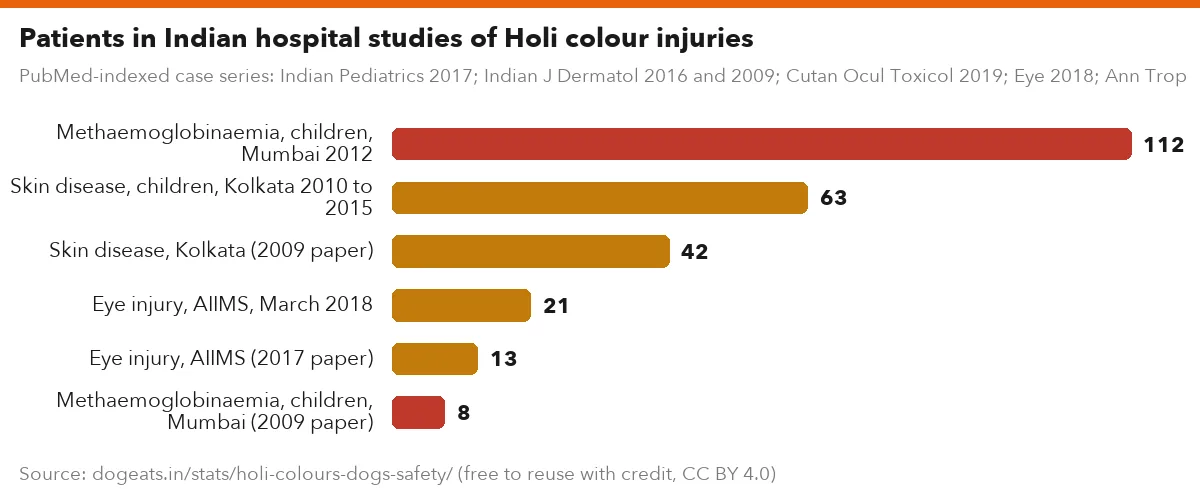
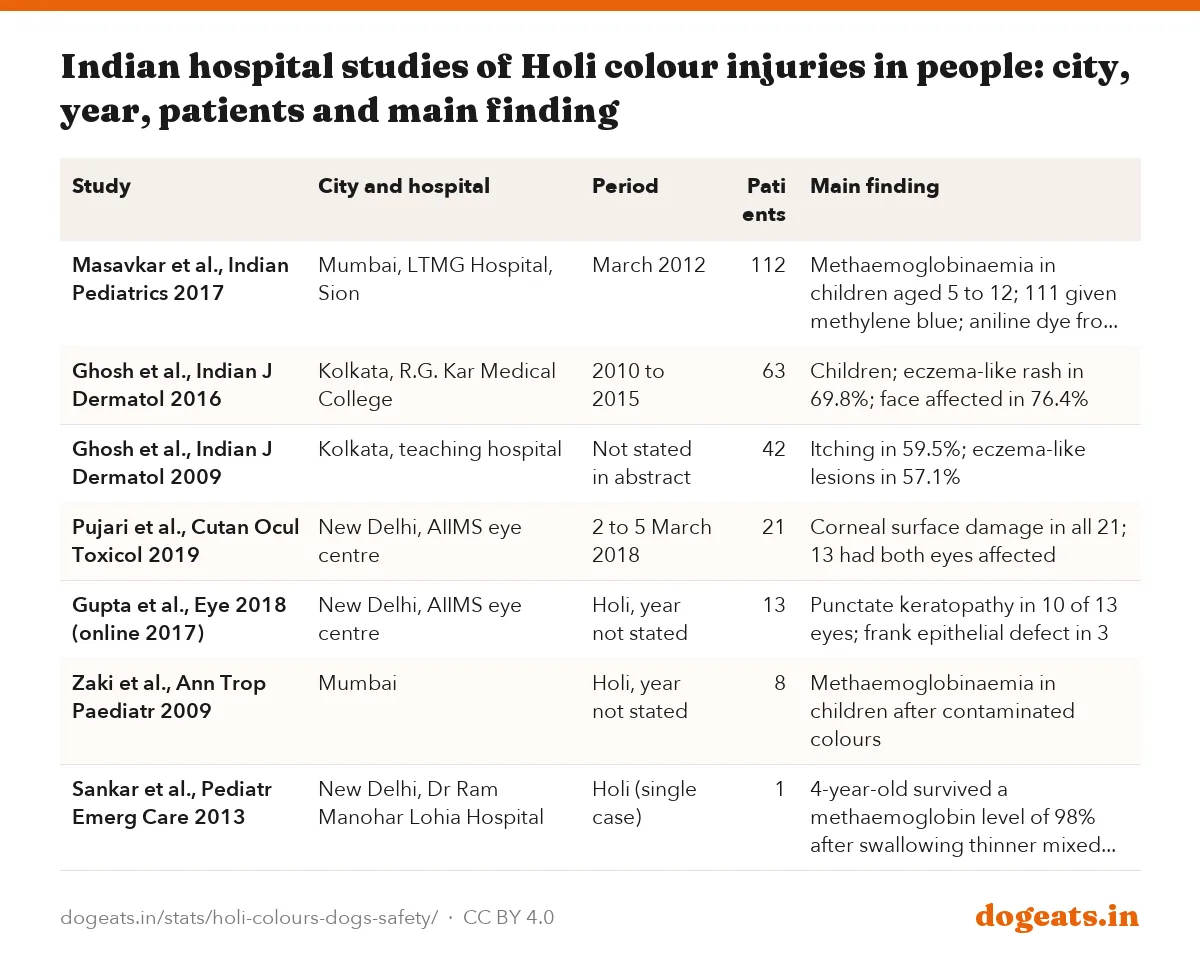
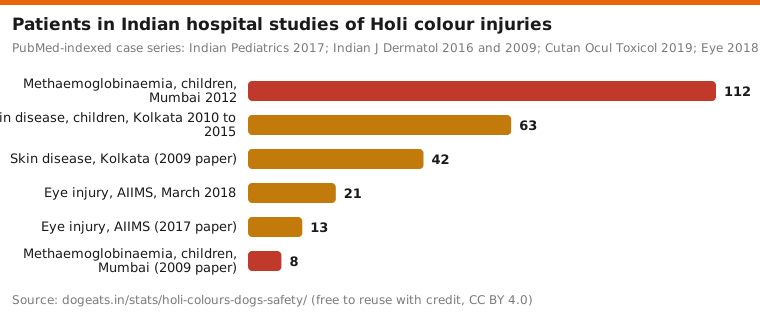
We found no dog data, but Indian hospital studies of people show the eyes and skin take the hits. AIIMS saw 21 Holi eye patients in four days in 2018, and a Kolkata clinic recorded 63 children with Holi skin disease from 2010 to 2015.
In an AIIMS series of 13 eye patients, 10 had punctate damage to the cornea. In the Kolkata children, 69.8% had eczema-like rashes. Fine powder is another route in: four Holi powders tested in Germany were 43% to about 80% PM10. A Delhi study found PM10 and PM2.5 rose about 3 to 4 times during Holi, from bonfires and colour play. Dogs sit lower, closer to thrown powder and to dust on the ground.
PubMed-indexed case series: Indian Pediatrics 2017; Indian J Dermatol 2016 and 2009; Cutan Ocul Toxicol 2019; Eye 2018; Ann Trop Paediatr 2009. People, not dogs: no dog studies exist.
Show the numbers
| Label | patients |
|---|---|
| Methaemoglobinaemia, children, Mumbai 2012 | 112 |
| Skin disease, children, Kolkata 2010 to 2015 | 63 |
| Skin disease, Kolkata (2009 paper) | 42 |
| Eye injury, AIIMS, March 2018 | 21 |
| Eye injury, AIIMS (2017 paper) | 13 |
| Methaemoglobinaemia, children, Mumbai (2009 paper) | 8 |
Embed this chart
| Study | City and hospital | Period | Patients | Main finding |
|---|---|---|---|---|
| Masavkar et al., Indian Pediatrics 2017 | Mumbai, LTMG Hospital, Sion | March 2012 | 112 | Methaemoglobinaemia in children aged 5 to 12; 111 given methylene blue; aniline dye from local leather works |
| Ghosh et al., Indian J Dermatol 2016 | Kolkata, R.G. Kar Medical College | 2010 to 2015 | 63 | Children; eczema-like rash in 69.8%; face affected in 76.4% |
| Ghosh et al., Indian J Dermatol 2009 | Kolkata, teaching hospital | Not stated in abstract | 42 | Itching in 59.5%; eczema-like lesions in 57.1% |
| Pujari et al., Cutan Ocul Toxicol 2019 | New Delhi, AIIMS eye centre | 2 to 5 March 2018 | 21 | Corneal surface damage in all 21; 13 had both eyes affected |
| Gupta et al., Eye 2018 (online 2017) | New Delhi, AIIMS eye centre | Holi, year not stated | 13 | Punctate keratopathy in 10 of 13 eyes; frank epithelial defect in 3 |
| Zaki et al., Ann Trop Paediatr 2009 | Mumbai | Holi, year not stated | 8 | Methaemoglobinaemia in children after contaminated colours |
| Sankar et al., Pediatr Emerg Care 2013 | New Delhi, Dr Ram Manohar Lohia Hospital | Holi (single case) | 1 | 4-year-old survived a methaemoglobin level of 98% after swallowing thinner mixed with colour |
Methaemoglobinaemia stops blood carrying oxygen. In the Mumbai series, 111 of 112 children needed methylene blue, and doctors traced the colour to an aniline dye from local leather works. A 4-year-old in Delhi survived a methaemoglobin level of 98% after swallowing paint thinner mixed with Holi colour.
Is bhang or thandai dangerous for dogs?
Yes. Bhang is cannabis. The Merck Veterinary Manual says dogs can show mild signs of THC poisoning at doses as low as 0.3 to 0.5 mg/kg. Signs usually start within 1 to 2 hours, or up to 4 hours on an empty stomach.
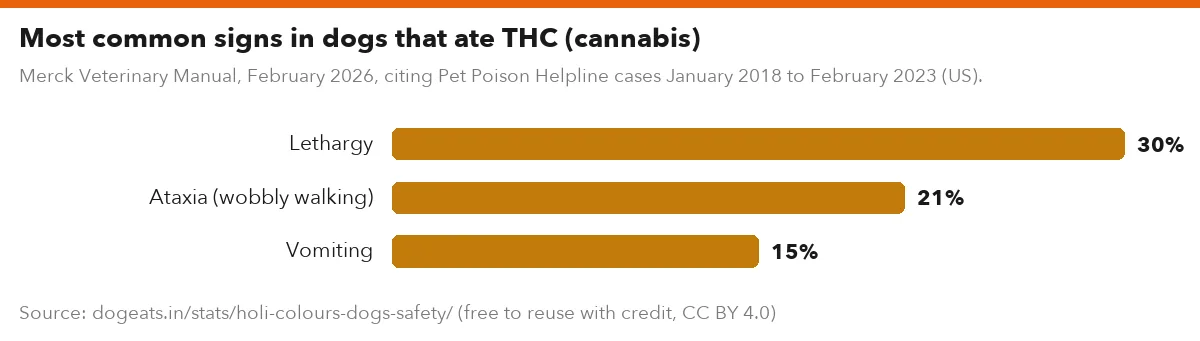
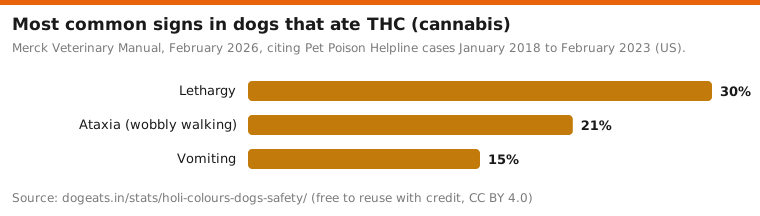
In Pet Poison Helpline cases from 2018 to 2023, the commonest signs were lethargy (30%), ataxia or wobbling (21%) and vomiting (15%). Merck says signs usually clear within 1 to 3 days with supportive care, but a bhang thandai or pakora also carries sugar, nuts and spices. Read our pages on thandai and pakora, and keep Holi sweets such as malpua and puran poli off the floor.
Merck Veterinary Manual, February 2026, citing Pet Poison Helpline cases January 2018 to February 2023 (US).
Show the numbers
| Label | % |
|---|---|
| Lethargy | 30% |
| Ataxia (wobbly walking) | 21% |
| Vomiting | 15% |
Embed this chart
Moderate signs show at THC doses above 2 to 3 mg/kg. Bhang strength varies widely, so there is no safe amount to give a dog.
How many dogs get hurt during Holi in India?
Nobody publishes the number. We found 0 vet hospital, NGO or government counts of dogs injured or poisoned at Holi with a named source, and no peer-reviewed study of Holi colours in dogs.
Animal groups issue Holi advisories every year, and news stories describe dogs smeared with colour, but none we found gave a count we could trace to its origin. If you run a clinic or rescue, a simple Holi week log of cases would fill this gap. For the wider picture of vet access, see vets per lakh population and the 1962 mobile vet units.
What should I do if my dog gets Holi colour on it?
Wash it off the same day before the dog licks it: the Merck Veterinary Manual advises liquid dish detergent and a thorough rinse for lead on the skin. Then watch for vomiting, drooling, red or cloudy eyes, coughing, blue gums or wobbling.
Do not use kerosene, thinner or bleach to remove colour; a Delhi child nearly died after swallowing thinner mixed with colour. Flush eyes with plenty of clean water and see a vet if they stay red. Keep the colour packet for the vet, and check our toxicity chart and most toxic kitchen foods for festival food risks.
Frequently asked questions
Are Holi colours toxic to dogs?
Synthetic Holi colours can be. Kolkata samples averaged 29 to 37 mg/kg of lead and 16 of 18 Delhi green samples held malachite green. No colour has been tested as safe for dogs.
Can a dog die from licking gulal?
We found no recorded dog death from gulal. Lead in the Kolkata powders was too low to poison a dog from a lick, but copper or mercury compounds, if present, are corrosive. See a vet if a dog eats colour.
How do I remove Holi colour from my dog's fur?
Wash with mild liquid dish detergent and lots of water the same day, as the Merck Veterinary Manual advises for lead on the skin. Never use kerosene, thinner or bleach.
Is herbal or organic Holi colour safe for dogs?
Not proven. In 2011 a Dehradun group said all 'organic' products it tested contained chemicals. Fine powder of any kind can irritate eyes and lungs.
Is bhang poisonous to dogs?
Yes. Dogs can show signs at THC doses as low as 0.3 to 0.5 mg/kg, usually within 1 to 2 hours. Lethargy, wobbling and vomiting are most common.
What are the signs of Holi colour poisoning in a dog?
Vomiting, diarrhoea, drooling, red or cloudy eyes, coughing, wobbling or blue gums. The Merck Veterinary Manual lists vomiting, diarrhoea, tremors and seizures for lead.
How many dogs are hurt during Holi?
No one publishes a count. We found 0 traceable figures from Indian vets, NGOs or government.
Should I take my dog out on Holi?
Keep the dog indoors during colour play. Holi powders tested in Germany were 43% to about 80% PM10 dust, and Delhi PM10 and PM2.5 rose about 3 to 4 times during Holi, from bonfires and colour play.
Methodology and limitations
We searched PubMed on 18 October 2026 for Holi and colour or powder (22 results) and for Holi and dogs or animals (14 results). None of the 14 studied Holi colours in dogs; one tested malachite green on goat corneas. We then read the abstracts or full texts of the Indian studies with sample counts. Lead and endotoxin figures are means from Table 5 of Goswami and Mazumdar 2021. Malachite green figures are from Velpandian et al. 2007.
Toxic effects in animals come only from the Merck Veterinary Manual chapters on lead, copper, mercury and THC, opened on 16 October 2026. The lead intake figures are computed by dogeats.in: body weight x the Merck dose / 37 mg lead per kg of the yellow Kolkata powder.
We looked for counts of dogs hurt at Holi in news, NGO releases and government advisories, and traced each to its origin. None gave a traceable number, so the report states that the count does not exist.
Sources
- Goswami K, Mazumdar I. A Study of the Levels of Some Toxic Substances present in Dry Holi Colours in Kolkata, India. Indian J Clin Biochem 2022;37(2):206-211, Lead and endotoxin in 200 dry colour samples, 40 locations, 2020
- Velpandian T et al. Ocular hazards of the colors used during the festival-of-colors (Holi) in India, malachite green toxicity. J Hazard Mater 2007;139(2):204-8, Malachite green in 16 of 18 Delhi samples
- Merck Veterinary Manual: Lead Poisoning in Animals (full review June 2026), Toxic doses, signs, blood lead levels, skin decontamination
- Also consulted: Merck Veterinary Manual: Toxicosis in Dogs and Cats From THC (February 2026), Merck Veterinary Manual: Copper Toxicosis in Animals (April 2026), Merck Veterinary Manual: Mercury Poisoning in Animals (June 2026), Masavkar SS et al. Acquired Methemoglobinemia: A Sporadic Holi Disaster. Indian Pediatr 2017;54:473-475, Bossmann K et al. Holi colours contain PM10. J Occup Med Toxicol 2016;11:42, Sankar J et al. Survival with 98% methemoglobin levels in a school-aged child during the festival of colors. Pediatr Emerg Care 2013;29(10):1102-3, Zaki SA et al. Methaemoglobinaemia during Holi festival. Ann Trop Paediatr 2009;29(3):221-3, Ghosh SK et al. The holi dermatoses. Indian J Dermatol 2009;54(3):240-2, Pujari A et al. Ocular toxicity due to colours used during holi. Cutan Ocul Toxicol 2019, Ghosh SK et al. Dermatoses among children from Holi. Indian J Dermatol 2016, Gupta S et al. Holi colors and chemical contact keratitis. Eye 2018, Khajuria A et al. PM10 and PM2.5 during the Holi festival. Inhal Toxicol 2024, The Tribune, Dehradun Plus, 19 March 2011, Kukfisz B, Piec R 2021, IJERPH 18:11090 (fire hazard of Holi powders).
Cite, embed and download
This report, its data and its images are free to reuse under a Creative Commons Attribution 4.0 licence. Credit dogeats.in with a link to this page. Every chart has its own embed code, every table has a CSV and an image download, and the images below are ready for social posts, slides and articles.
Cite this report
Link to this report
Every chart and table as an image