Data report · Updated October 2026
Animal cruelty cases in India: 9,039 PCA Act cases in 2024, state by state, and what the law punishes
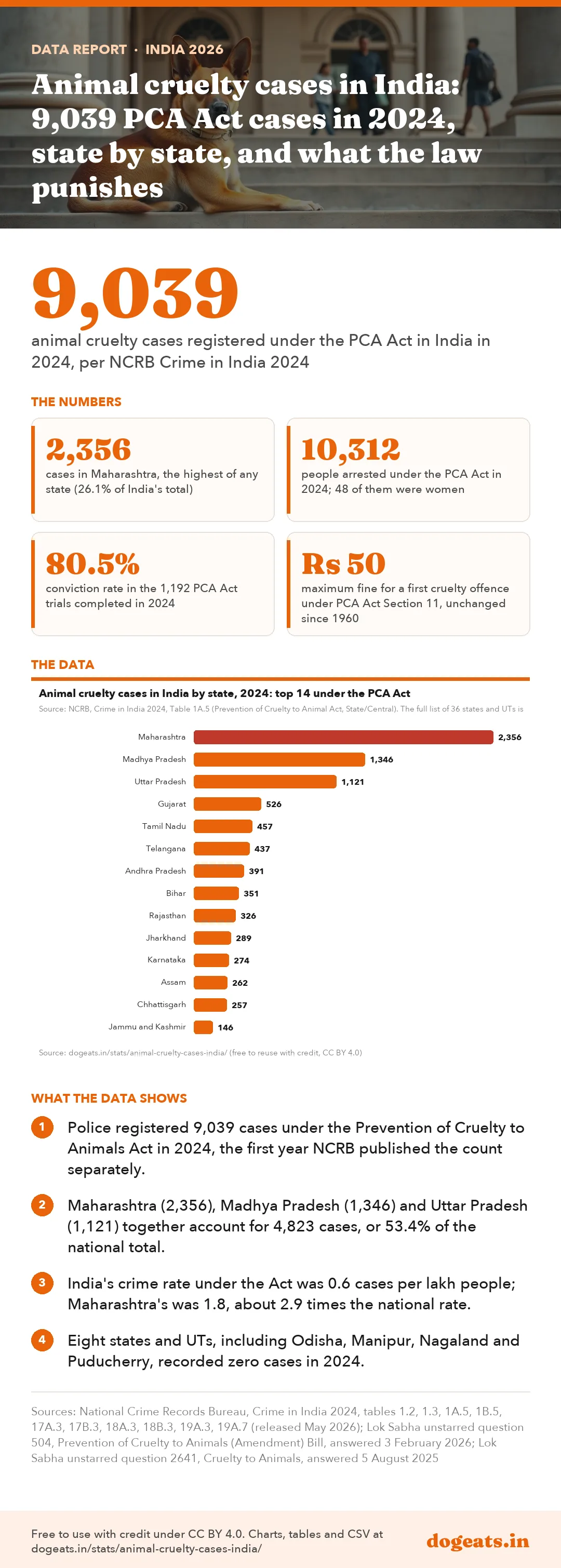
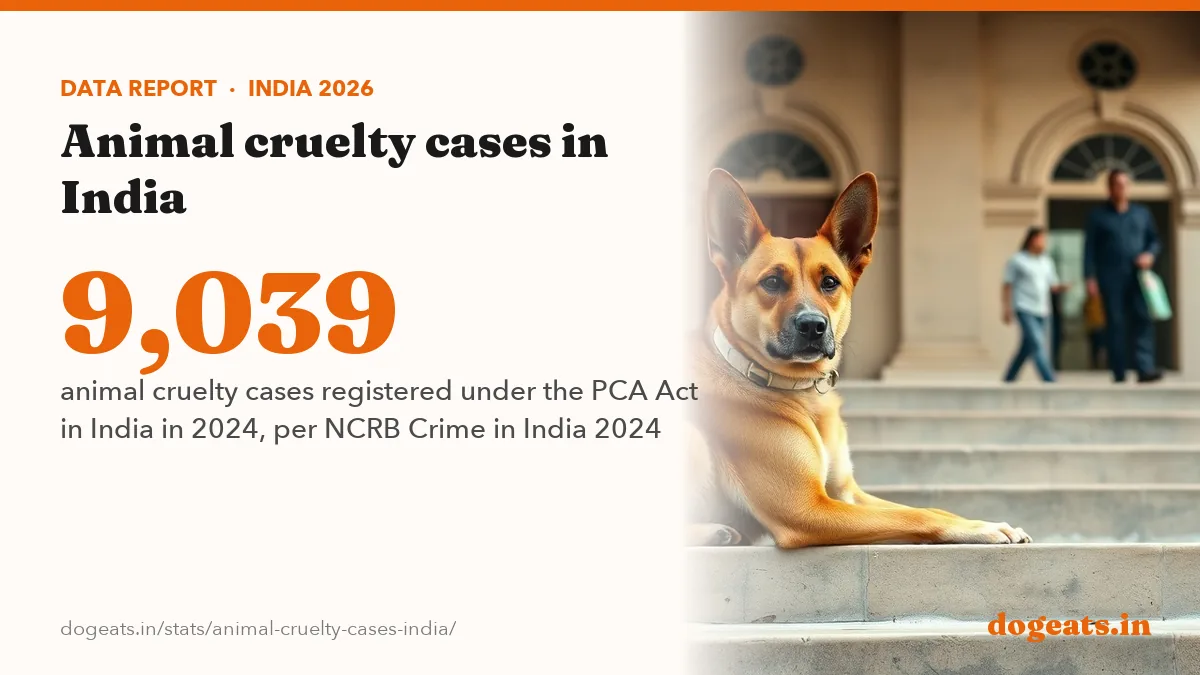
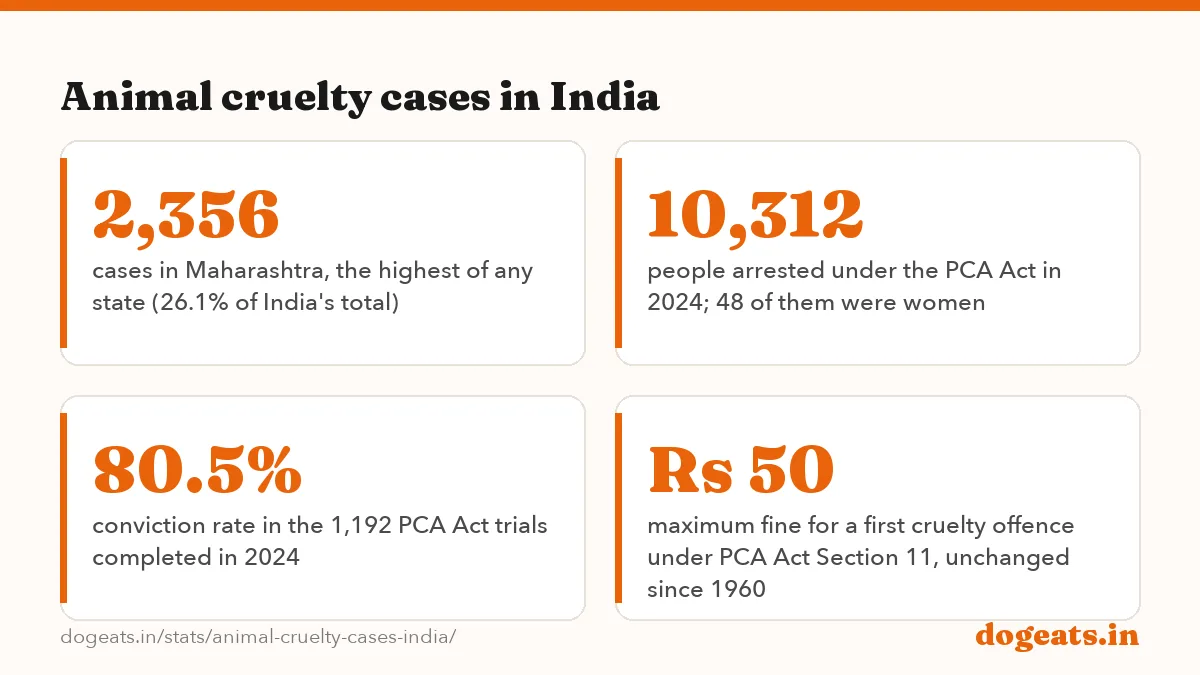
Police in India registered 9,039 cases under the Prevention of Cruelty to Animals Act in 2024, the first year the NCRB counted them separately. Maharashtra had 2,356 cases, 26.1% of the national total, and courts convicted in 80.5% of completed trials. A first cruelty offence under PCA Act Section 11 still carries a fine of only Rs 10 to Rs 50.

Key findings
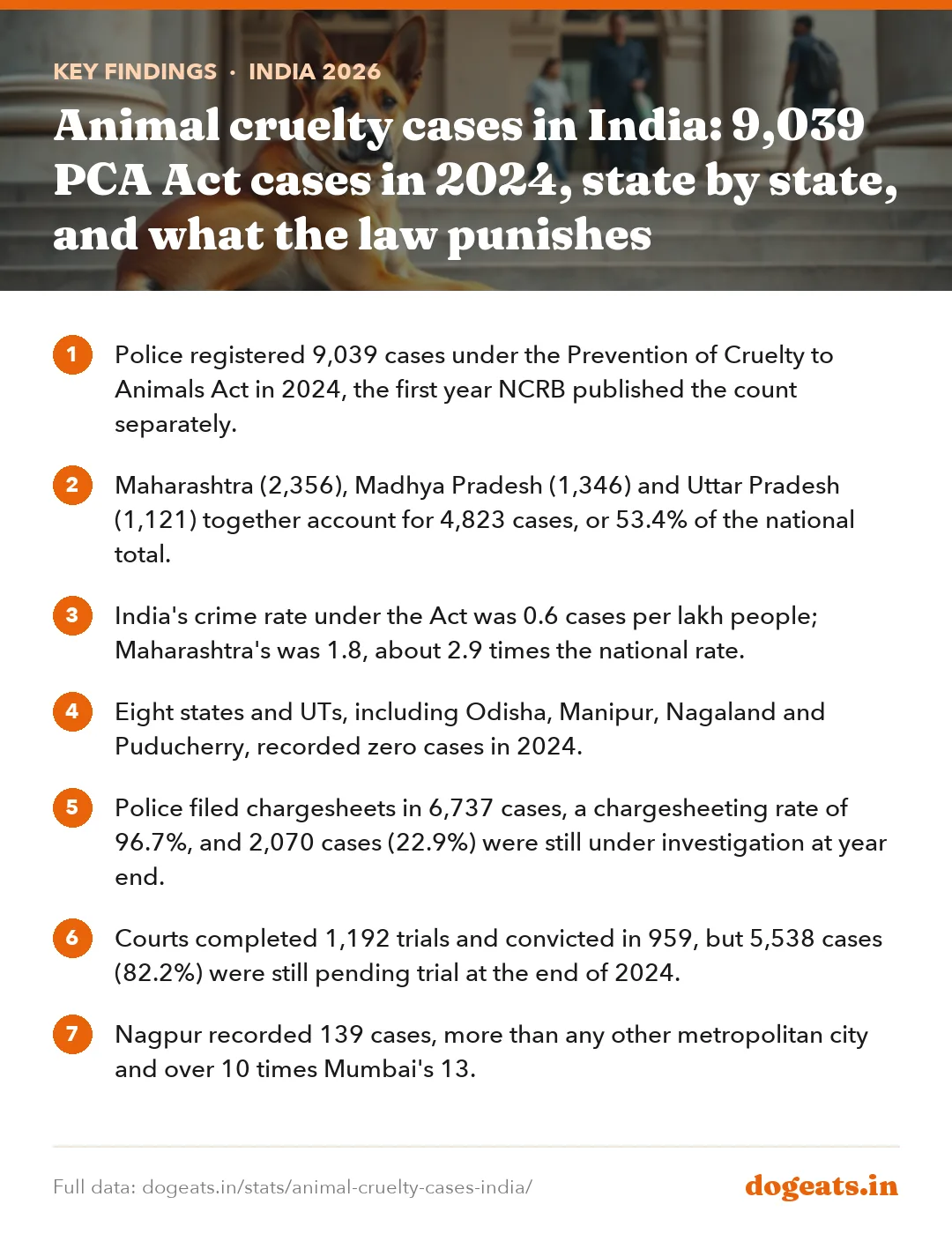
- Police registered 9,039 cases under the Prevention of Cruelty to Animals Act in 2024, the first year NCRB published the count separately.
- Maharashtra (2,356), Madhya Pradesh (1,346) and Uttar Pradesh (1,121) together account for 4,823 cases, or 53.4% of the national total.
- India's crime rate under the Act was 0.6 cases per lakh people; Maharashtra's was 1.8, about 2.9 times the national rate.
- Eight states and UTs, including Odisha, Manipur, Nagaland and Puducherry, recorded zero cases in 2024.
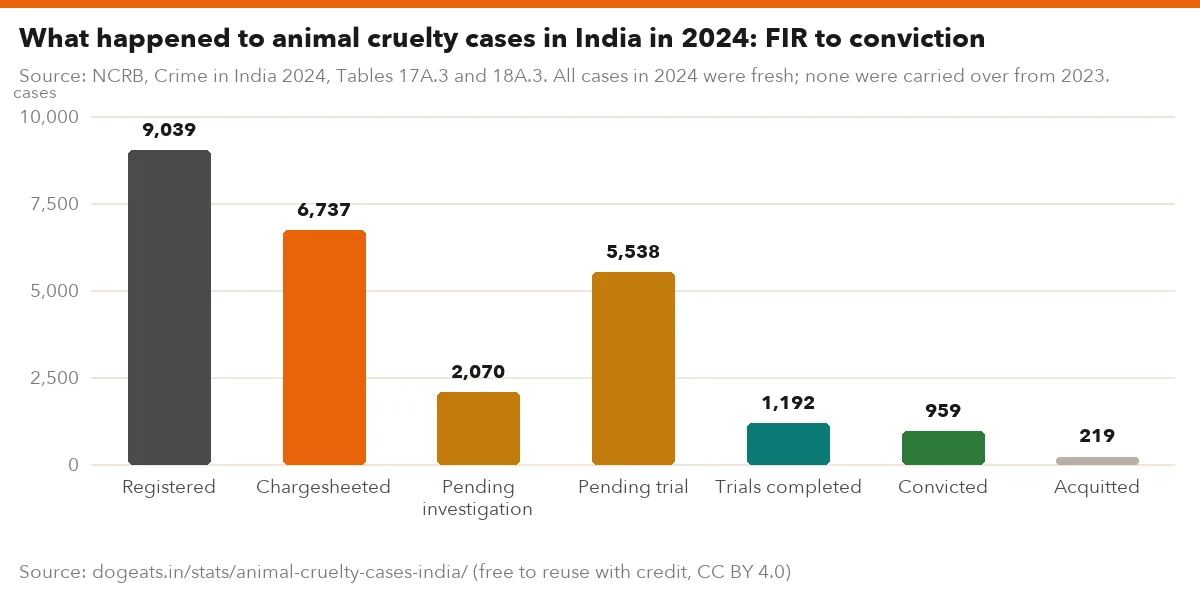
- Police filed chargesheets in 6,737 cases, a chargesheeting rate of 96.7%, and 2,070 cases (22.9%) were still under investigation at year end.
- Courts completed 1,192 trials and convicted in 959, but 5,538 cases (82.2%) were still pending trial at the end of 2024.
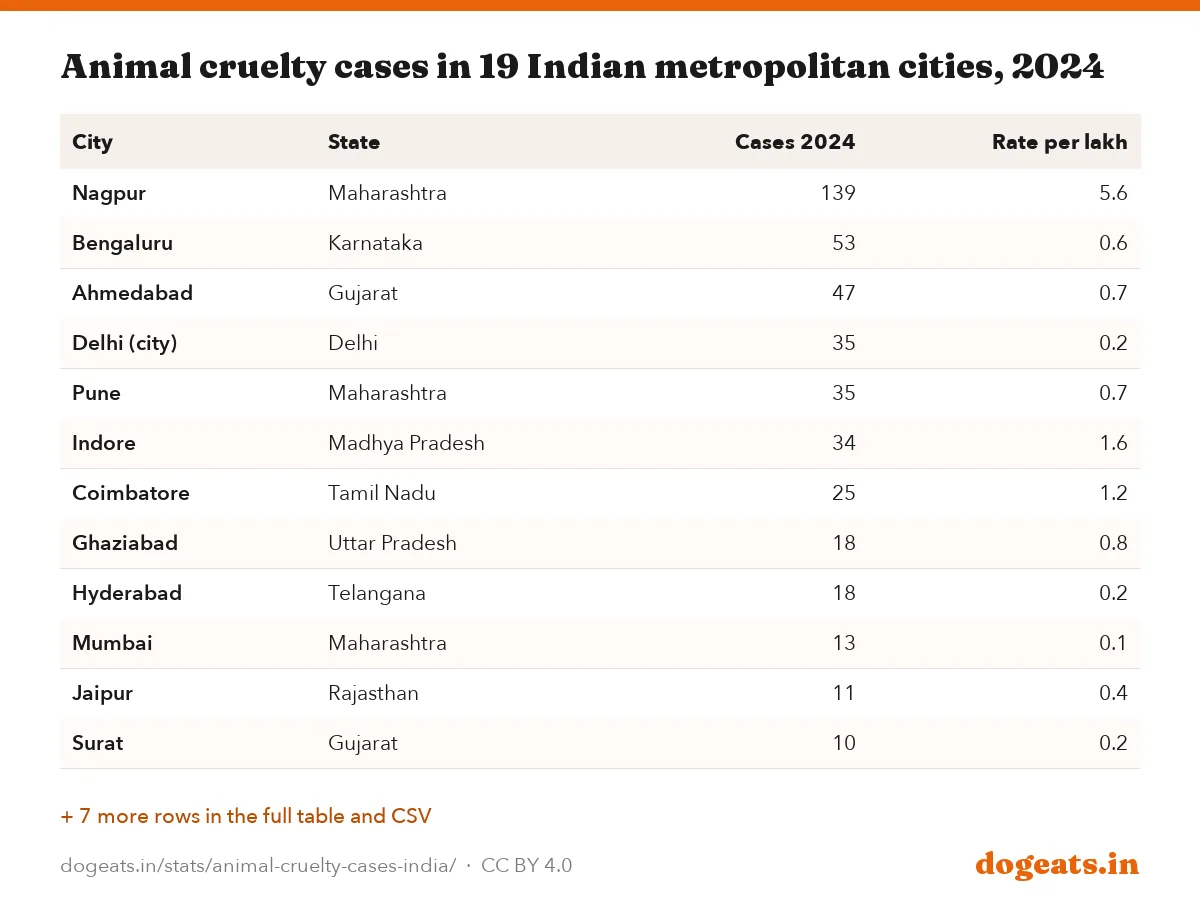
- Nagpur recorded 139 cases, more than any other metropolitan city and over 10 times Mumbai's 13.
- A first cruelty offence under PCA Act Section 11 costs a fine of Rs 10 to Rs 50; BNS Section 325 allows up to five years in jail.
- The 2022 draft amendment drew suggestions from more than 7,000 individuals and organisations and was still under examination on 3 February 2026.
How many animal cruelty cases are registered in India?
Police registered 9,039 cases under the Prevention of Cruelty to Animals Act, 1960 in 2024. The figure comes from Crime in India 2024, which the National Crime Records Bureau (NCRB) released in May 2026. It is the newest official national count.
This is the first year with a national number. NCRB's Table 1.3 lists the Act as its own crime head only for 2024; the columns for 2022 and 2023 are blank. Before this edition, cruelty cases were folded into the general Special and Local Laws (SLL) total.
The 9,039 cases are small against all SLL crime. India recorded 23,41,259 cognizable SLL cases in 2024, so animal cruelty made up 0.4% of them. The national crime rate was 0.6 cases per lakh people.
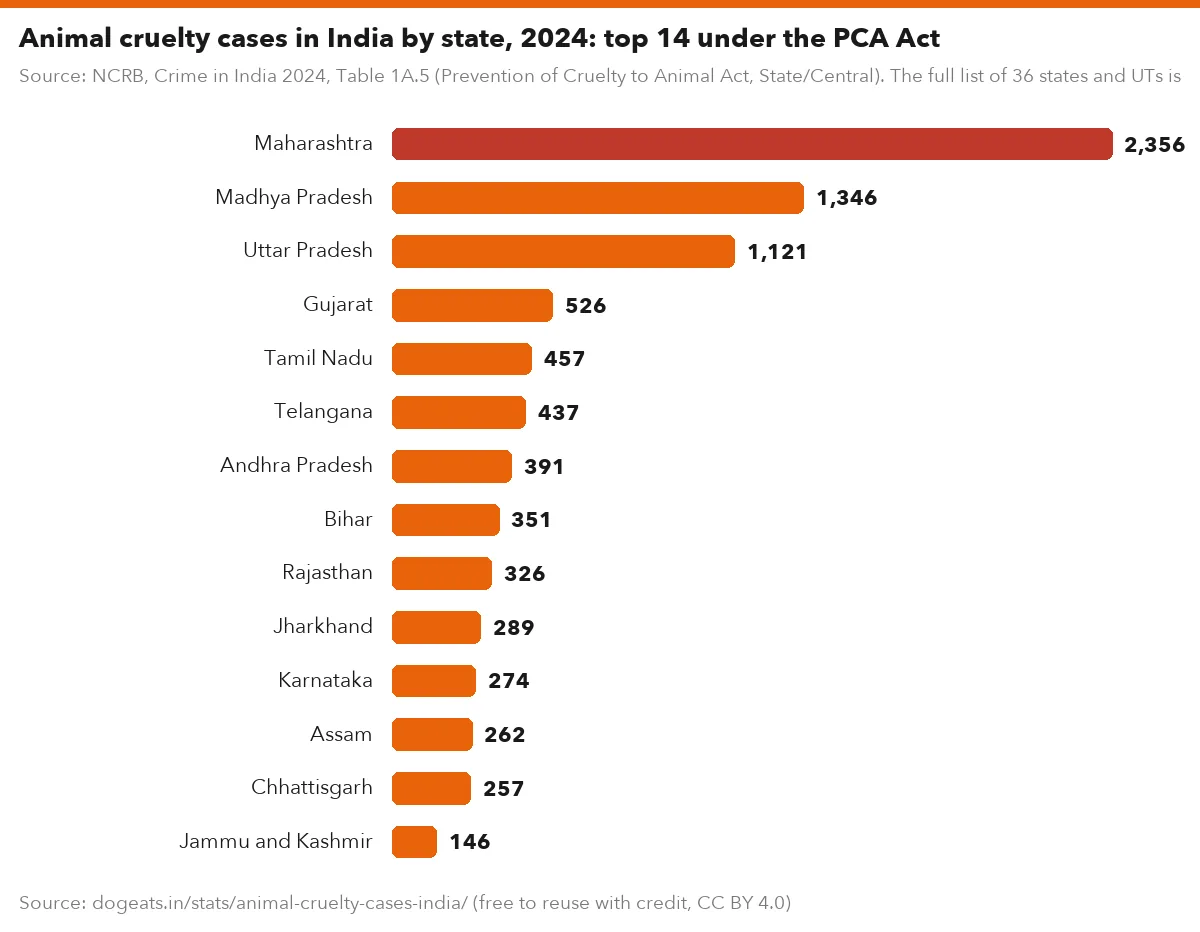
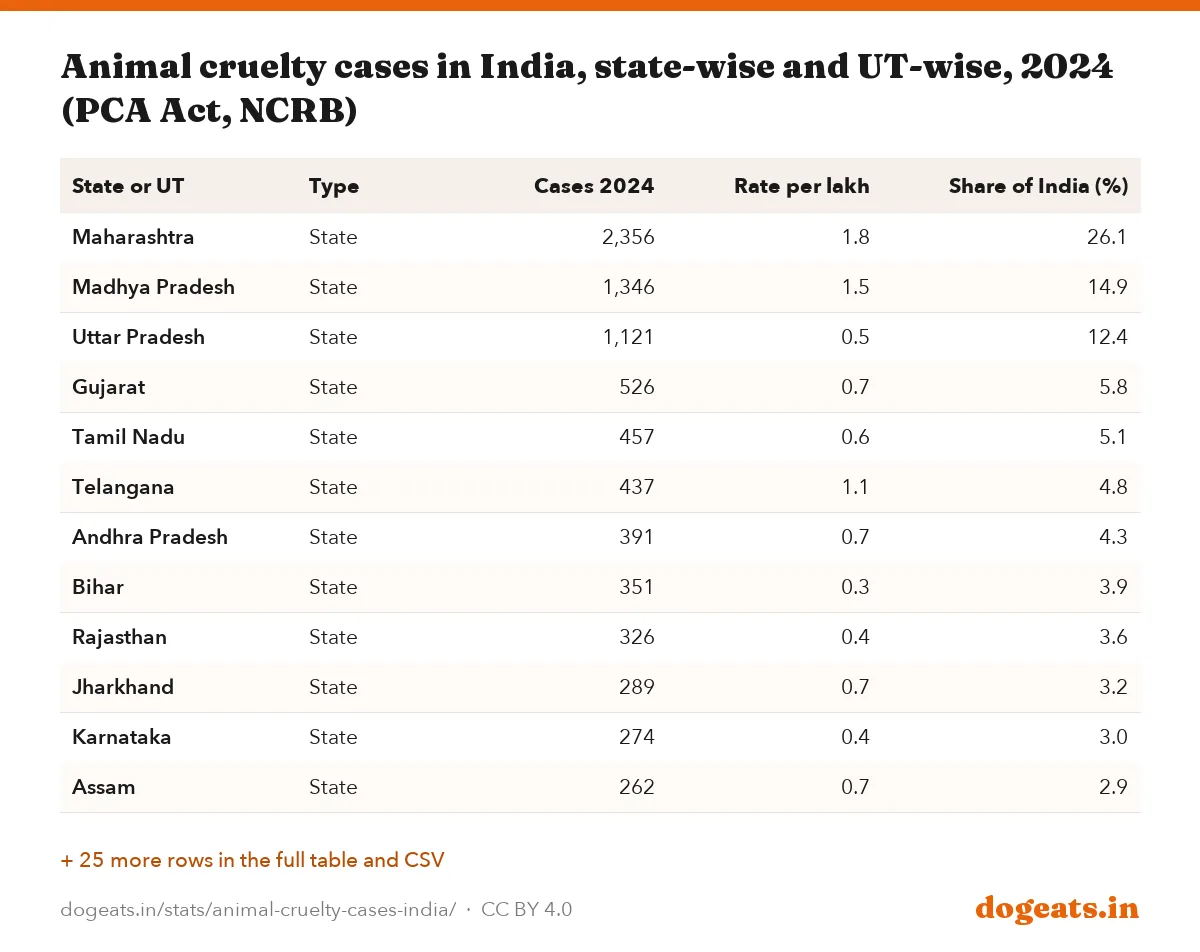
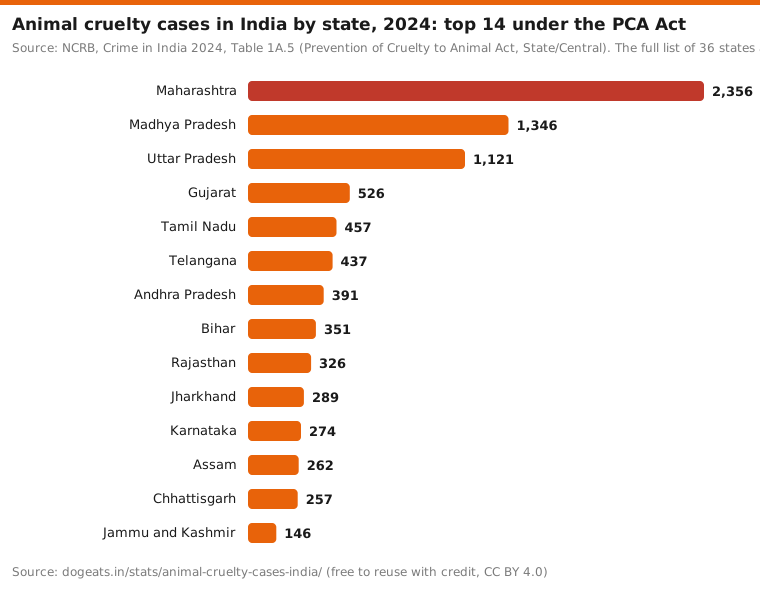
Source: NCRB, Crime in India 2024, Table 1A.5 (Prevention of Cruelty to Animal Act, State/Central). The full list of 36 states and UTs is in the table below.
Show the numbers
| Label | cases |
|---|---|
| Maharashtra | 2,356 |
| Madhya Pradesh | 1,346 |
| Uttar Pradesh | 1,121 |
| Gujarat | 526 |
| Tamil Nadu | 457 |
| Telangana | 437 |
| Andhra Pradesh | 391 |
| Bihar | 351 |
| Rajasthan | 326 |
| Jharkhand | 289 |
| Karnataka | 274 |
| Assam | 262 |
| Chhattisgarh | 257 |
| Jammu and Kashmir | 146 |
Embed this chart
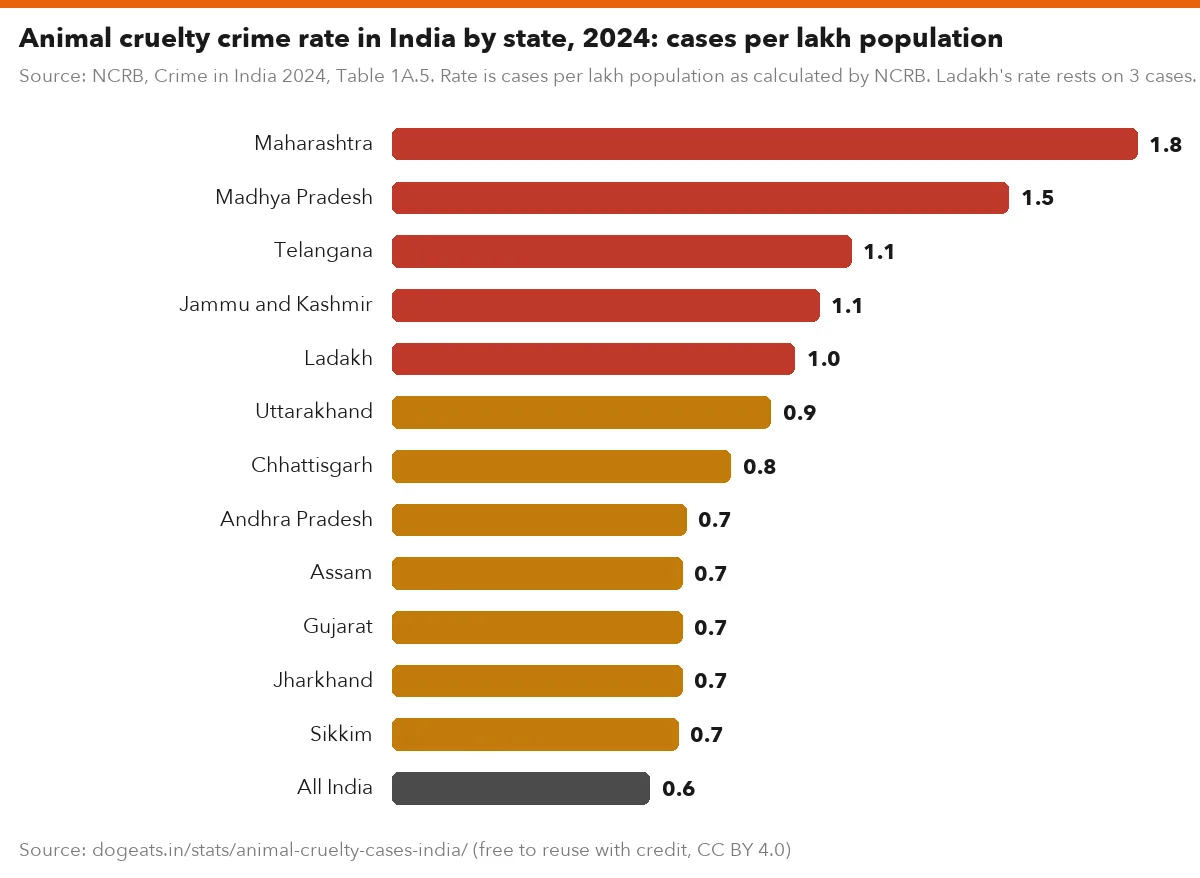
Population matters too. Uttar Pradesh is third by cases but its rate, 0.5 per lakh, is below the national 0.6. The next section ranks states by rate.
Which state has the most animal cruelty cases in India?
Maharashtra had the most cases in 2024: 2,356, or 26.1% of the national total. Madhya Pradesh followed with 1,346 (14.9%) and Uttar Pradesh with 1,121 (12.4%). Gujarat (526) and Tamil Nadu (457) complete the top five.
The top five states account for 5,806 cases, or 64.2% of India's total. Telangana (437), Andhra Pradesh (391), Bihar (351), Rajasthan (326) and Jharkhand (289) are next. Karnataka recorded 274 cases and Delhi 35.
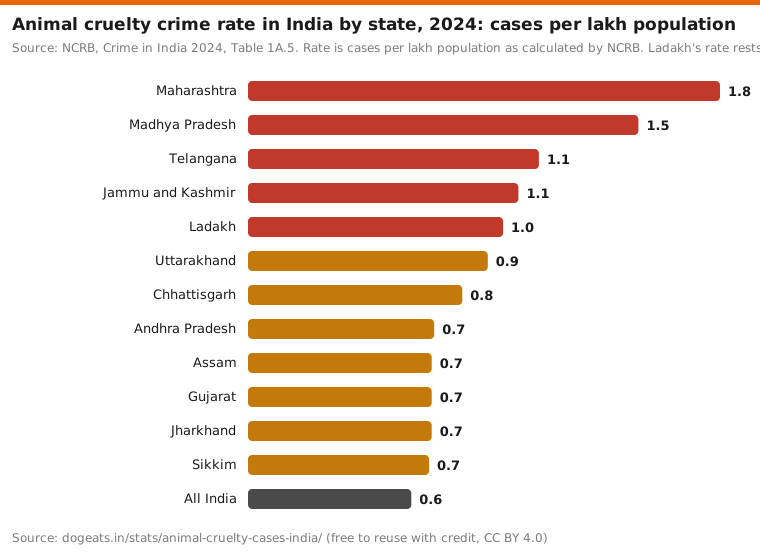
By rate, Maharashtra is also first, with 1.8 cases per lakh people. Madhya Pradesh is at 1.5, Telangana at 1.1 and Jammu and Kashmir at 1.1. Ladakh's rate is 1.0, but that comes from only 3 cases.
Source: NCRB, Crime in India 2024, Table 1A.5. Rate is cases per lakh population as calculated by NCRB. Ladakh's rate rests on 3 cases.
Show the numbers
| Label | per lakh |
|---|---|
| Maharashtra | 1.8 |
| Madhya Pradesh | 1.5 |
| Telangana | 1.1 |
| Jammu and Kashmir | 1.1 |
| Ladakh | 1.0 |
| Uttarakhand | 0.9 |
| Chhattisgarh | 0.8 |
| Andhra Pradesh | 0.7 |
| Assam | 0.7 |
| Gujarat | 0.7 |
| Jharkhand | 0.7 |
| Sikkim | 0.7 |
| All India | 0.6 |
Embed this chart
| State or UT | Type | Cases 2024 | Rate per lakh | Share of India (%) |
|---|---|---|---|---|
| Maharashtra | State | 2,356 | 1.8 | 26.1 |
| Madhya Pradesh | State | 1,346 | 1.5 | 14.9 |
| Uttar Pradesh | State | 1,121 | 0.5 | 12.4 |
| Gujarat | State | 526 | 0.7 | 5.8 |
| Tamil Nadu | State | 457 | 0.6 | 5.1 |
| Telangana | State | 437 | 1.1 | 4.8 |
| Andhra Pradesh | State | 391 | 0.7 | 4.3 |
| Bihar | State | 351 | 0.3 | 3.9 |
| Rajasthan | State | 326 | 0.4 | 3.6 |
| Jharkhand | State | 289 | 0.7 | 3.2 |
| Karnataka | State | 274 | 0.4 | 3.0 |
| Assam | State | 262 | 0.7 | 2.9 |
| Chhattisgarh | State | 257 | 0.8 | 2.8 |
| Jammu and Kashmir | UT | 146 | 1.1 | 1.6 |
| Haryana | State | 138 | 0.4 | 1.5 |
| Uttarakhand | State | 111 | 0.9 | 1.2 |
| Punjab | State | 64 | 0.2 | 0.7 |
| Kerala | State | 47 | 0.1 | 0.5 |
| West Bengal | State | 45 | 0.0 | 0.5 |
| Delhi | UT | 35 | 0.2 | 0.4 |
| Tripura | State | 21 | 0.5 | 0.2 |
| Himachal Pradesh | State | 19 | 0.3 | 0.2 |
| Meghalaya | State | 5 | 0.1 | 0.1 |
| Sikkim | State | 5 | 0.7 | 0.1 |
| Goa | State | 4 | 0.3 | 0.0 |
| Ladakh | UT | 3 | 1.0 | 0.0 |
| Dadra and Nagar Haveli and Daman and Diu | UT | 2 | 0.1 | 0.0 |
| Arunachal Pradesh | State | 1 | 0.1 | 0.0 |
| Andaman and Nicobar Islands | UT | 0 | 0.0 | 0.0 |
| Chandigarh | UT | 0 | 0.0 | 0.0 |
| Lakshadweep | UT | 0 | 0.0 | 0.0 |
| Manipur | State | 0 | 0.0 | 0.0 |
| Mizoram | State | 0 | 0.0 | 0.0 |
| Nagaland | State | 0 | 0.0 | 0.0 |
| Odisha | State | 0 | 0.0 | 0.0 |
| Puducherry | UT | 0 | 0.0 | 0.0 |
| All India | Total | 9,039 | 0.6 | 100.0 |
Low counts deserve as much attention as high ones. Kerala recorded 47 cases (rate 0.1) and West Bengal 45 (rate under 0.1), against 2,356 in Maharashtra. A low count can reflect fewer complaints or fewer FIRs, not only fewer acts of cruelty.
Which states recorded zero animal cruelty cases?
Eight of India's 36 states and UTs recorded no case under the Act in 2024. They are Odisha, Manipur, Mizoram, Nagaland, Andaman and Nicobar Islands, Chandigarh, Lakshadweep and Puducherry.
Six more recorded fewer than 10 cases. Arunachal Pradesh had 1, Dadra and Nagar Haveli and Daman and Diu 2, Ladakh 3, Goa 4, Meghalaya 5 and Sikkim 5. Together these 14 places registered 20 cases.
Some news reports in May 2026 carried different state figures, such as 2,927 for Maharashtra, 1,890 for Telangana and 1,510 for Kerala. Those numbers do not match NCRB Table 1A.5, which we downloaded and checked against the PDF. Only 1,890 appears anywhere in that table, as Tamil Nadu's Motor Vehicle Act count. Maharashtra's PCA Act figure there is 2,356, Telangana's 437 and Kerala's 47. This report uses the table.
Which Indian city has the most animal cruelty cases?
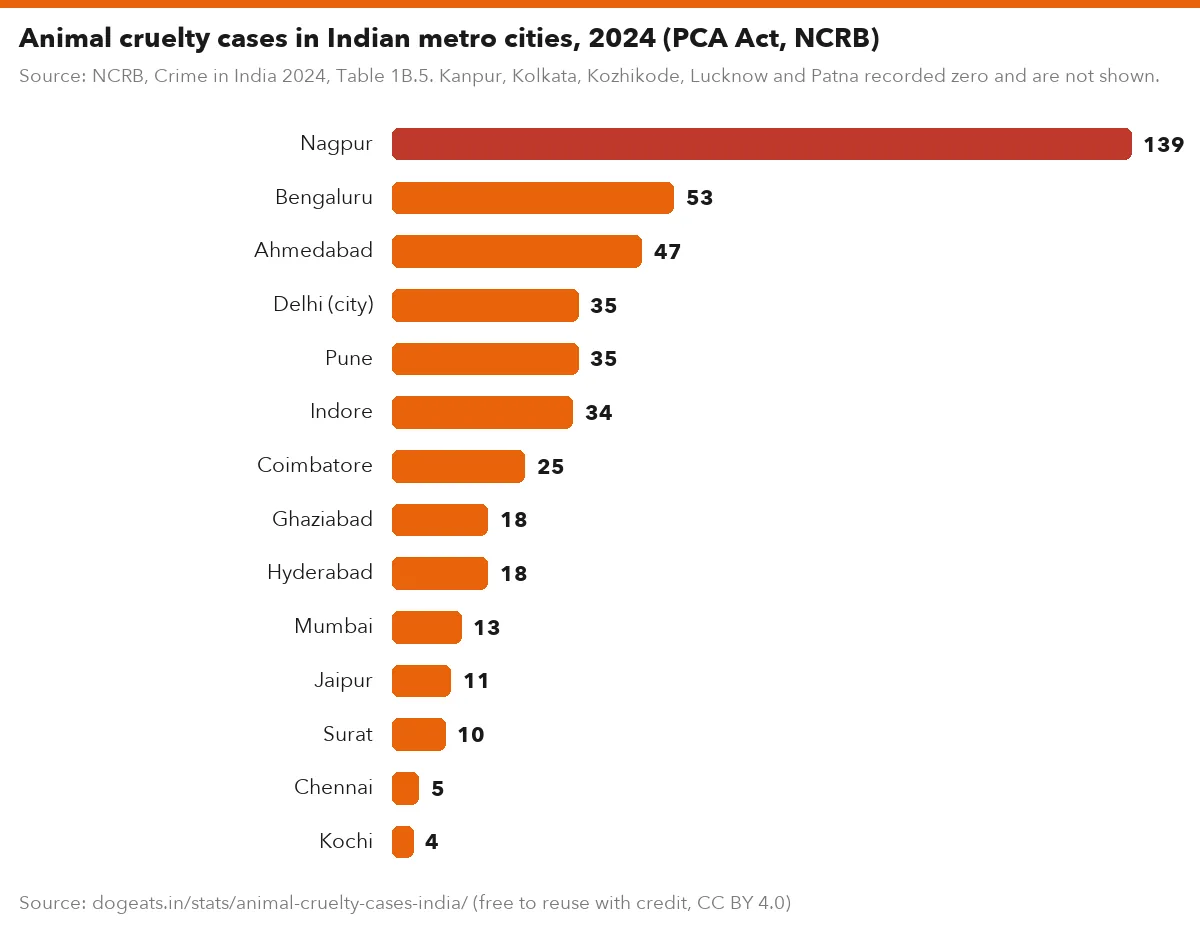
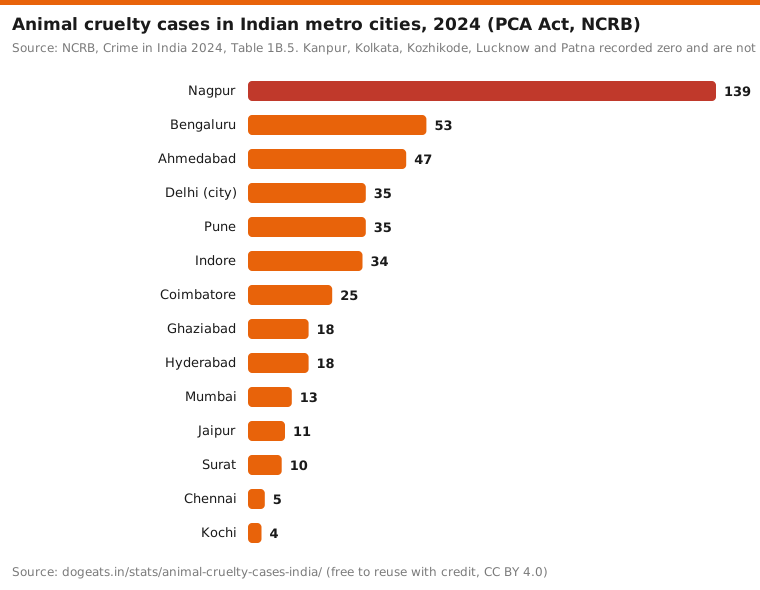
Nagpur recorded 139 cases in 2024, the most among the 19 metropolitan cities NCRB tracks. Its rate of 5.6 per lakh is the highest of any city. Bengaluru had 53 cases, Ahmedabad 47, and Delhi and Pune 35 each.
The 19 cities together registered 447 cases, 4.9% of the national total. Nagpur alone accounts for 31.1% of that metro figure. Mumbai recorded 13 cases and Chennai 5.
Five metros recorded zero: Kanpur, Kolkata, Kozhikode, Lucknow and Patna. Hyderabad registered 18 cases, the same as Ghaziabad. For community dog numbers in these cities, see our stray dogs by city report.
Source: NCRB, Crime in India 2024, Table 1B.5. Kanpur, Kolkata, Kozhikode, Lucknow and Patna recorded zero and are not shown.
Show the numbers
| Label | cases |
|---|---|
| Nagpur | 139 |
| Bengaluru | 53 |
| Ahmedabad | 47 |
| Delhi (city) | 35 |
| Pune | 35 |
| Indore | 34 |
| Coimbatore | 25 |
| Ghaziabad | 18 |
| Hyderabad | 18 |
| Mumbai | 13 |
| Jaipur | 11 |
| Surat | 10 |
| Chennai | 5 |
| Kochi | 4 |
Embed this chart
| City | State | Cases 2024 | Rate per lakh |
|---|---|---|---|
| Nagpur | Maharashtra | 139 | 5.6 |
| Bengaluru | Karnataka | 53 | 0.6 |
| Ahmedabad | Gujarat | 47 | 0.7 |
| Delhi (city) | Delhi | 35 | 0.2 |
| Pune | Maharashtra | 35 | 0.7 |
| Indore | Madhya Pradesh | 34 | 1.6 |
| Coimbatore | Tamil Nadu | 25 | 1.2 |
| Ghaziabad | Uttar Pradesh | 18 | 0.8 |
| Hyderabad | Telangana | 18 | 0.2 |
| Mumbai | Maharashtra | 13 | 0.1 |
| Jaipur | Rajasthan | 11 | 0.4 |
| Surat | Gujarat | 10 | 0.2 |
| Chennai | Tamil Nadu | 5 | 0.1 |
| Kochi | Kerala | 4 | 0.2 |
| Kanpur | Uttar Pradesh | 0 | 0.0 |
| Kolkata | West Bengal | 0 | 0.0 |
| Kozhikode | Kerala | 0 | 0.0 |
| Lucknow | Uttar Pradesh | 0 | 0.0 |
| Patna | Bihar | 0 | 0.0 |
What happens to animal cruelty cases after an FIR?
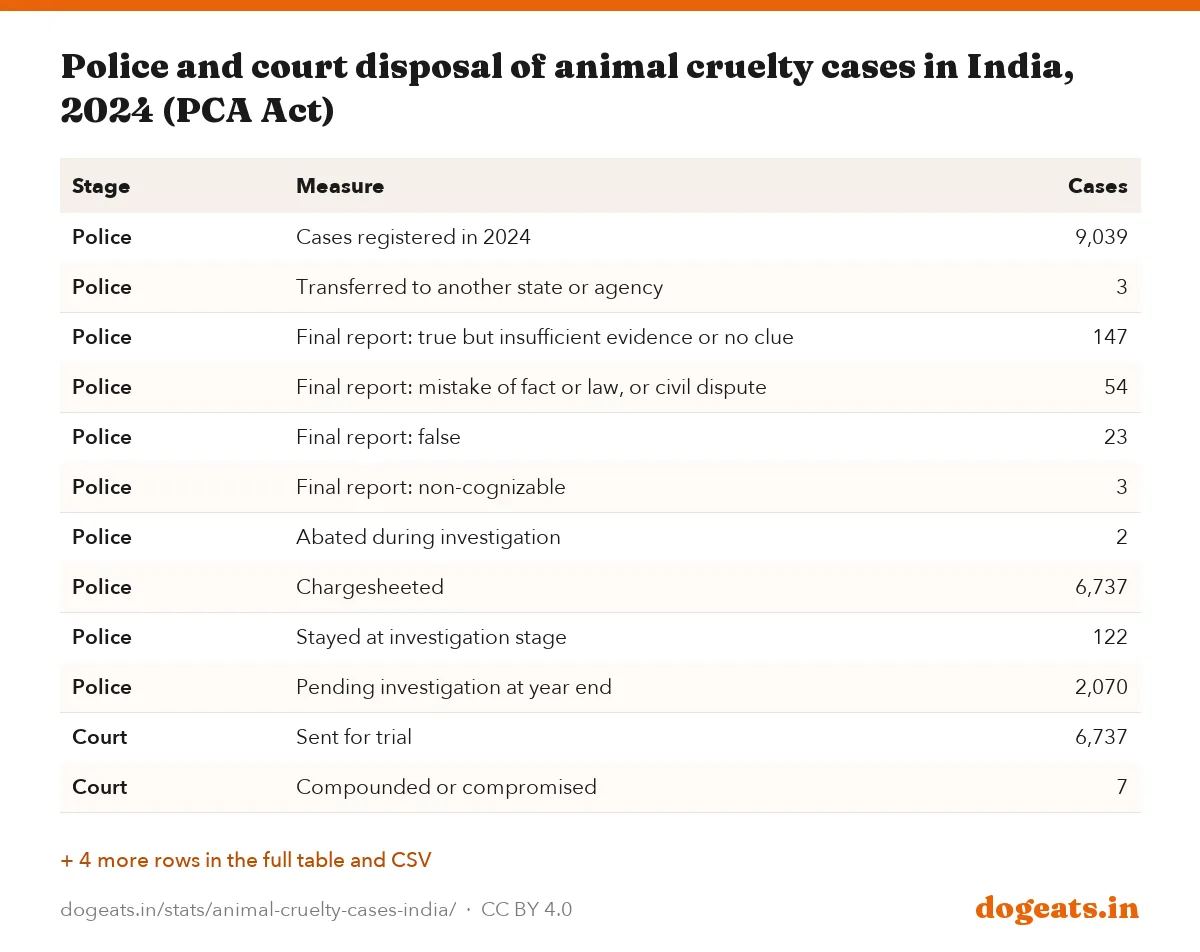
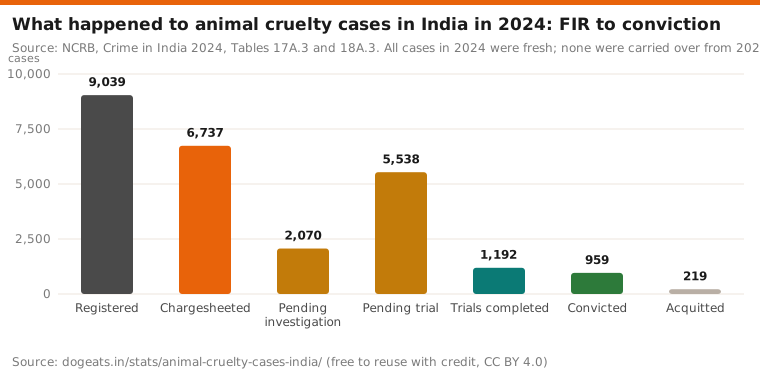
Most cases reach a chargesheet. Police disposed of 6,969 of the 9,039 cases in 2024 and filed chargesheets in 6,737. NCRB puts the chargesheeting rate at 96.7%.
Police closed 229 cases with a final report. Of these, 147 were true but had insufficient evidence or no clue, 54 were a mistake of fact or law, and 23 were found false. The other 5 were non-cognizable (3) or abated (2). At year end, 2,070 cases (22.9%) were still under investigation and 122 were stayed.
Courts moved more slowly. Of 6,737 cases sent for trial, trials were completed in 1,192. Courts convicted in 959 and acquitted in 219, with 14 discharged. That gives a conviction rate of 80.5%, but 5,538 cases (82.2%) were still pending trial.
Source: NCRB, Crime in India 2024, Tables 17A.3 and 18A.3. All cases in 2024 were fresh; none were carried over from 2023.
Show the numbers
| Label | cases |
|---|---|
| Registered | 9,039 |
| Chargesheeted | 6,737 |
| Pending investigation | 2,070 |
| Pending trial | 5,538 |
| Trials completed | 1,192 |
| Convicted | 959 |
| Acquitted | 219 |
Embed this chart
| Stage | Measure | Cases |
|---|---|---|
| Police | Cases registered in 2024 | 9,039 |
| Police | Transferred to another state or agency | 3 |
| Police | Final report: true but insufficient evidence or no clue | 147 |
| Police | Final report: mistake of fact or law, or civil dispute | 54 |
| Police | Final report: false | 23 |
| Police | Final report: non-cognizable | 3 |
| Police | Abated during investigation | 2 |
| Police | Chargesheeted | 6,737 |
| Police | Stayed at investigation stage | 122 |
| Police | Pending investigation at year end | 2,070 |
| Court | Sent for trial | 6,737 |
| Court | Compounded or compromised | 7 |
| Court | Convicted | 959 |
| Court | Acquitted | 219 |
| Court | Discharged | 14 |
| Court | Pending trial at year end | 5,538 |
Metro cities show the same pattern on a smaller scale. Police in the 19 cities chargesheeted 239 of the 266 cases they disposed of, a rate of 89.8%. Another 181 cases (40.5%) were still under investigation. Courts there completed 16 trials and convicted in 15, a rate of 93.8%, with 223 cases (93.3%) pending.
Who is arrested for animal cruelty in India?
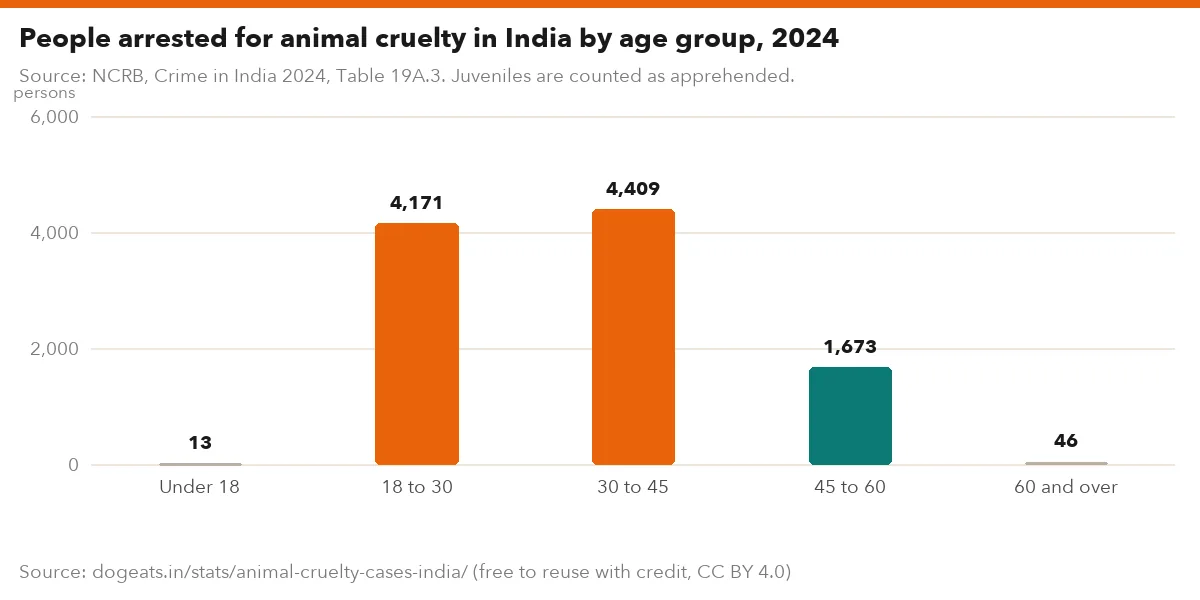
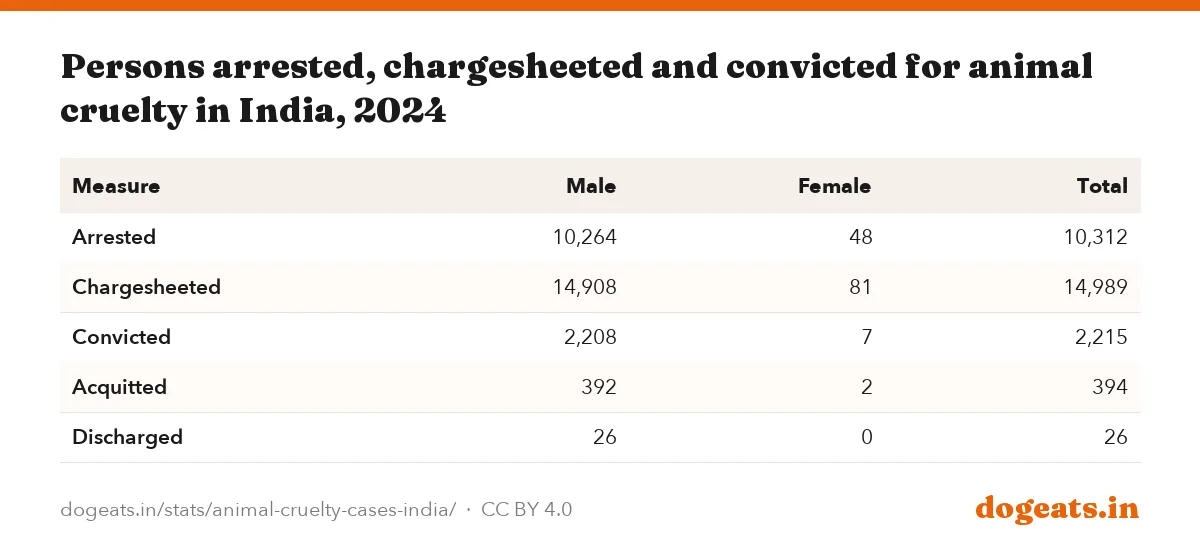
Police arrested 10,312 people under the PCA Act in 2024, about 1.14 arrests per case. Men made up 10,264 of them; 48 were women (0.5%).
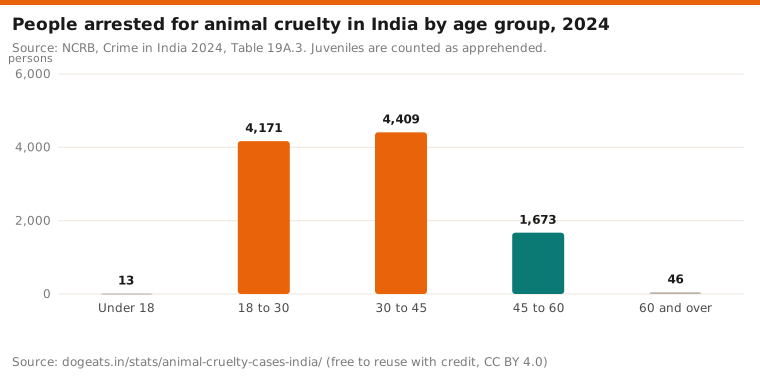
Most arrested people were of working age. Those aged 30 to 45 numbered 4,409 (42.8%) and those aged 18 to 30 numbered 4,171 (40.4%). Another 1,673 were aged 45 to 60, 46 were 60 or older, and 13 were juveniles.
Far more people were chargesheeted than arrested: 14,989. NCRB records 2,215 people convicted, 394 acquitted and 26 discharged in 2024.
Source: NCRB, Crime in India 2024, Table 19A.3. Juveniles are counted as apprehended.
Show the numbers
| Label | persons |
|---|---|
| Under 18 | 13 |
| 18 to 30 | 4,171 |
| 30 to 45 | 4,409 |
| 45 to 60 | 1,673 |
| 60 and over | 46 |
Embed this chart
| Measure | Male | Female | Total |
|---|---|---|---|
| Arrested | 10,264 | 48 | 10,312 |
| Chargesheeted | 14,908 | 81 | 14,989 |
| Convicted | 2,208 | 7 | 2,215 |
| Acquitted | 392 | 2 | 394 |
| Discharged | 26 | 0 | 26 |
What is the punishment for animal cruelty under PCA Act Section 11?
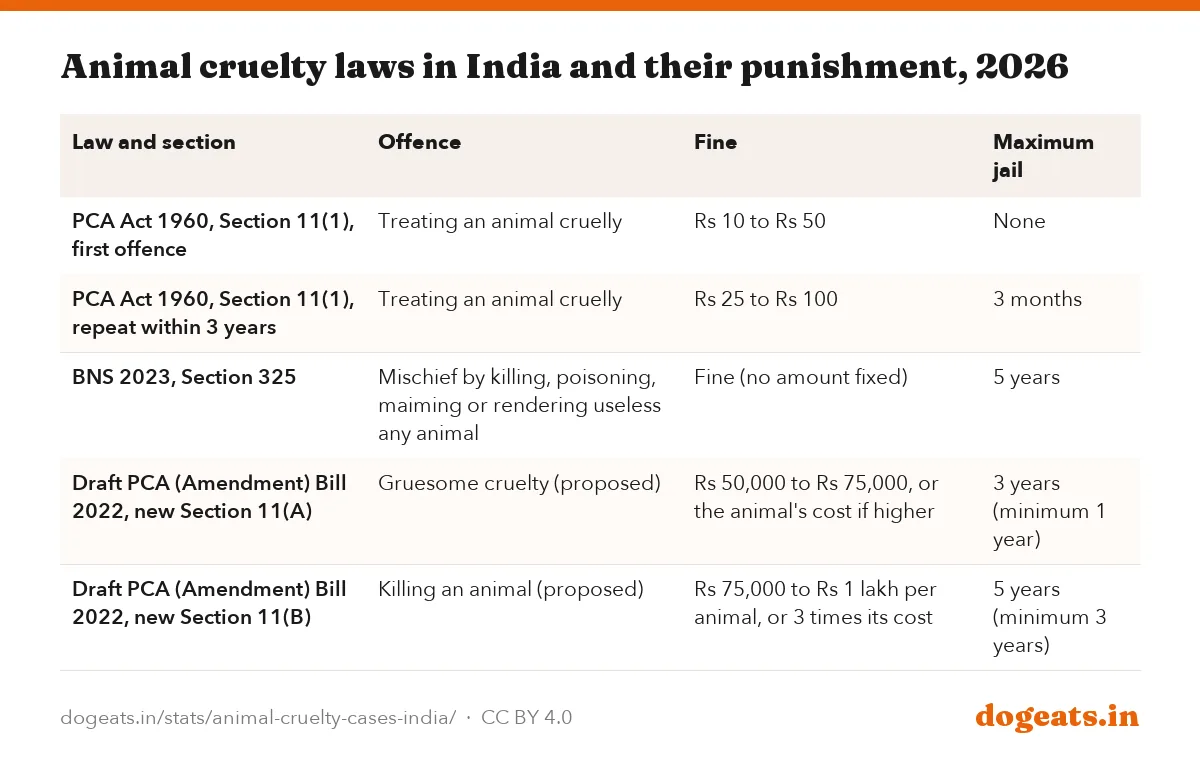
Section 11(1) of the Prevention of Cruelty to Animals Act, 1960 lists acts such as beating, overloading, denying food or shelter, and abandoning an animal. A first offence is punished with a fine of Rs 10 to Rs 50.
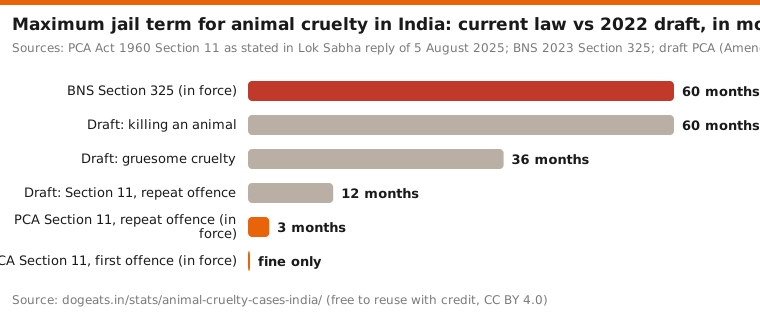
A second offence within three years carries a fine of Rs 25 to Rs 100, or jail of up to three months, or both. The Fisheries, Animal Husbandry and Dairying ministry confirmed these amounts in a Lok Sabha reply on 5 August 2025.
On 4 August 2026, the same ministry told the Lok Sabha that the government had reviewed the penalties and found them very low, without a deterrent effect.
| Law and section | Offence | Fine | Maximum jail |
|---|---|---|---|
| PCA Act 1960, Section 11(1), first offence | Treating an animal cruelly | Rs 10 to Rs 50 | None |
| PCA Act 1960, Section 11(1), repeat within 3 years | Treating an animal cruelly | Rs 25 to Rs 100 | 3 months |
| BNS 2023, Section 325 | Mischief by killing, poisoning, maiming or rendering useless any animal | Fine (no amount fixed) | 5 years |
| Draft PCA (Amendment) Bill 2022, new Section 11(A) | Gruesome cruelty (proposed) | Rs 50,000 to Rs 75,000, or the animal's cost if higher | 3 years (minimum 1 year) |
| Draft PCA (Amendment) Bill 2022, new Section 11(B) | Killing an animal (proposed) | Rs 75,000 to Rs 1 lakh per animal, or 3 times its cost | 5 years (minimum 3 years) |
Sources: PCA Act 1960 Section 11 as stated in Lok Sabha reply of 5 August 2025; BNS 2023 Section 325; draft PCA (Amendment) Bill 2022. Draft provisions are proposals, not law.
Show the numbers
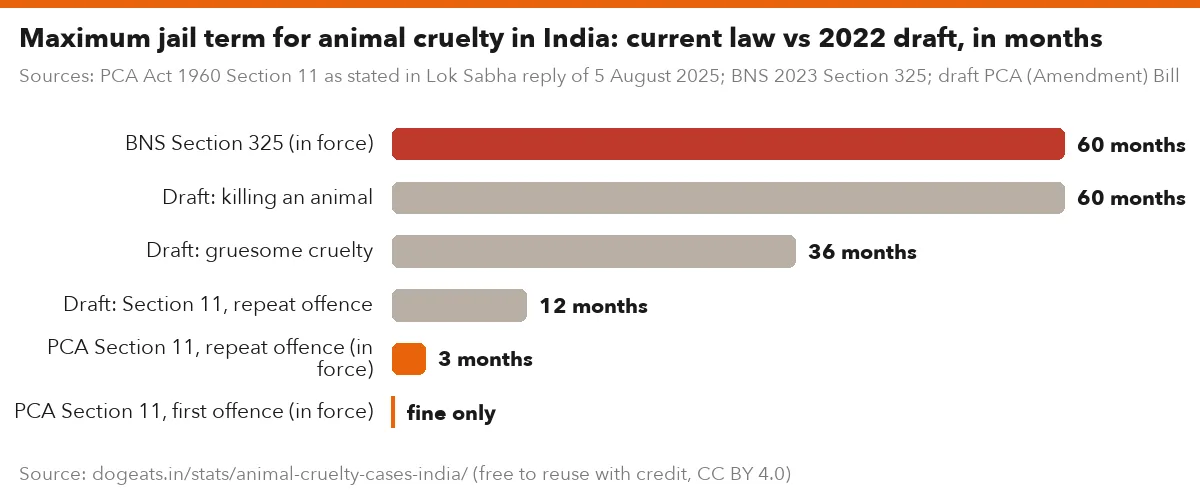
| Label | months |
|---|---|
| BNS Section 325 (in force) | 60 months |
| Draft: killing an animal | 60 months |
| Draft: gruesome cruelty | 36 months |
| Draft: Section 11, repeat offence | 12 months |
| PCA Section 11, repeat offence (in force) | 3 months |
| PCA Section 11, first offence (in force) | fine only |
Embed this chart
For a first offence, the gap between the two laws is wide. Under the PCA Act the most a first offender pays is Rs 50. Under BNS Section 325, killing or maiming an animal can bring up to five years in jail.
What does BNS Section 325 say about killing or maiming animals?
Section 325 of the Bharatiya Nyaya Sanhita, 2023 punishes mischief by killing, poisoning, maiming or rendering useless any animal. The penalty is jail of up to five years, or a fine, or both. The BNS came into force on 1 July 2024.
It replaced the Indian Penal Code, which dealt with the same acts in Sections 428 and 429. The ministry's 3 February 2026 Lok Sabha reply cited the BNS as one reason the PCA amendment is being re-examined.
NCRB does not publish a separate count for Section 325. Its 2024 table groups it under offences related to mischief, which totalled 5,361 cases: 2,294 under the IPC and 3,067 under the BNS.
What happened to the PCA Act amendment bill of 2022?
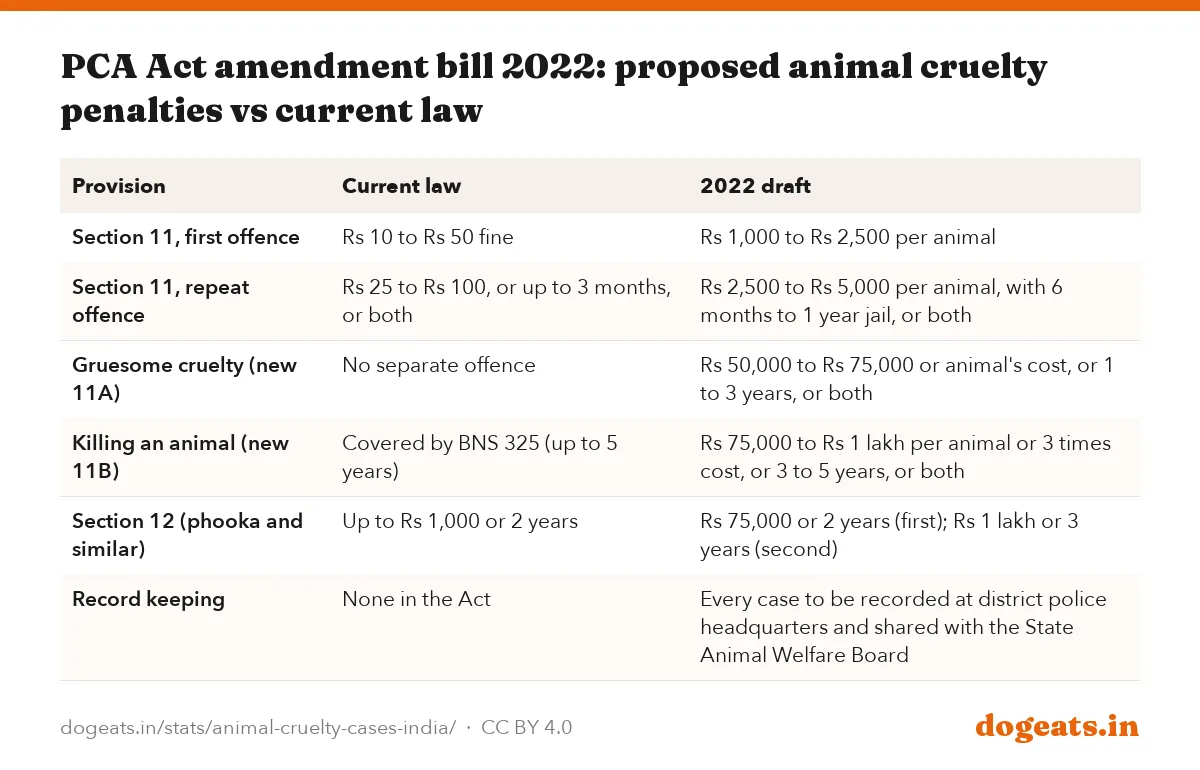
The Department of Animal Husbandry and Dairying put the draft Prevention of Cruelty to Animals (Amendment) Bill, 2022 out for comment from 21 November to 7 December 2022. It received suggestions and objections from more than 7,000 individuals and organisations.
On 3 February 2026, Minister Rajiv Ranjan Singh told the Lok Sabha that the bill was under examination. The bill has not been introduced in Parliament.
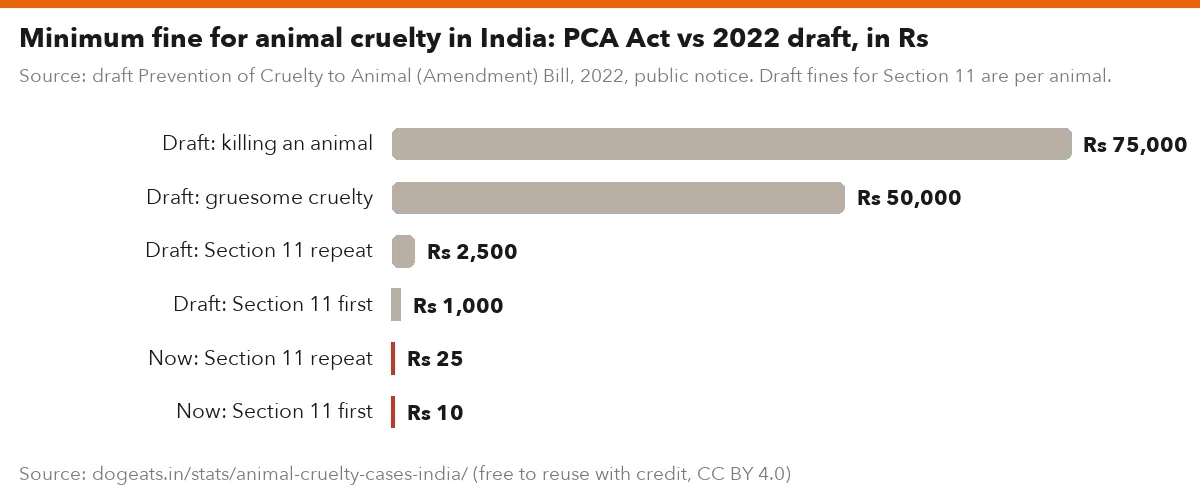
| Provision | Current law | 2022 draft |
|---|---|---|
| Section 11, first offence | Rs 10 to Rs 50 fine | Rs 1,000 to Rs 2,500 per animal |
| Section 11, repeat offence | Rs 25 to Rs 100, or up to 3 months, or both | Rs 2,500 to Rs 5,000 per animal, with 6 months to 1 year jail, or both |
| Gruesome cruelty (new 11A) | No separate offence | Rs 50,000 to Rs 75,000 or animal's cost, or 1 to 3 years, or both |
| Killing an animal (new 11B) | Covered by BNS 325 (up to 5 years) | Rs 75,000 to Rs 1 lakh per animal or 3 times cost, or 3 to 5 years, or both |
| Section 12 (phooka and similar) | Up to Rs 1,000 or 2 years | Rs 75,000 or 2 years (first); Rs 1 lakh or 3 years (second) |
| Record keeping | None in the Act | Every case to be recorded at district police headquarters and shared with the State Animal Welfare Board |
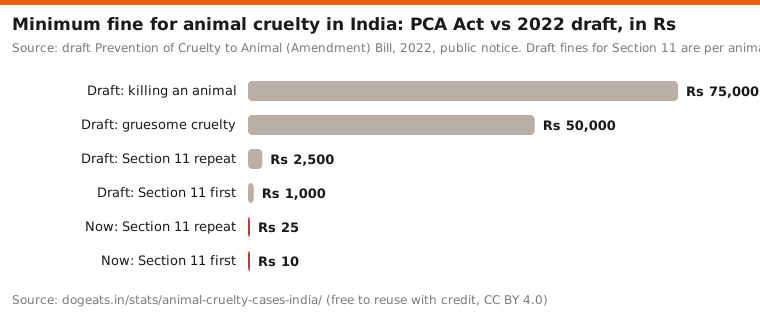
Source: draft Prevention of Cruelty to Animal (Amendment) Bill, 2022, public notice. Draft fines for Section 11 are per animal.
Show the numbers
| Label | Rs |
|---|---|
| Draft: killing an animal | Rs 75,000 |
| Draft: gruesome cruelty | Rs 50,000 |
| Draft: Section 11 repeat | Rs 2,500 |
| Draft: Section 11 first | Rs 1,000 |
| Now: Section 11 repeat | Rs 25 |
| Now: Section 11 first | Rs 10 |
Embed this chart
The draft would raise the minimum first-offence fine 100 times, from Rs 10 to Rs 1,000 per animal. For gruesome cruelty, the proposed minimum of Rs 50,000 is 1,000 times today's maximum first-offence fine of Rs 50. The draft would also remove the clause that permits destroying stray dogs in a lethal chamber.
How many animal cruelty complaints does the Animal Welfare Board receive?
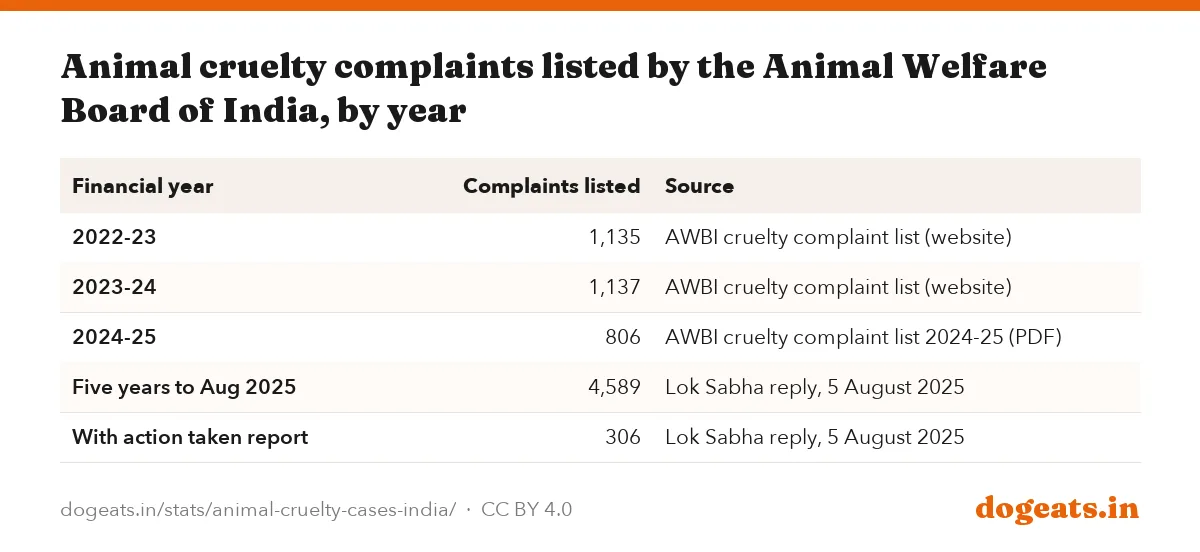
The Animal Welfare Board of India (AWBI) handled 4,589 cruelty complaints over the five years to August 2025. The ministry gave the figure in a Lok Sabha reply on 5 August 2025.
AWBI cannot prosecute. It forwards complaints to state governments, district collectors, magistrates and police. Action taken reports came back for only 306 of the 4,589 complaints, or 6.7%.
Karnataka sent AWBI 269 complaints over those five years, and 217 of them (80.7%) related to animal deaths.
| Financial year | Complaints listed | Source |
|---|---|---|
| 2022-23 | 1,135 | AWBI cruelty complaint list (website) |
| 2023-24 | 1,137 | AWBI cruelty complaint list (website) |
| 2024-25 | 806 | AWBI cruelty complaint list 2024-25 (PDF) |
| Five years to Aug 2025 | 4,589 | Lok Sabha reply, 5 August 2025 |
| With action taken report | 306 | Lok Sabha reply, 5 August 2025 |
The yearly figures are numbered entries in AWBI's published lists, counted by dogeats.in. Earlier years use a different format and their numbering restarts, so we left them out.
Are State Animal Welfare Boards working?
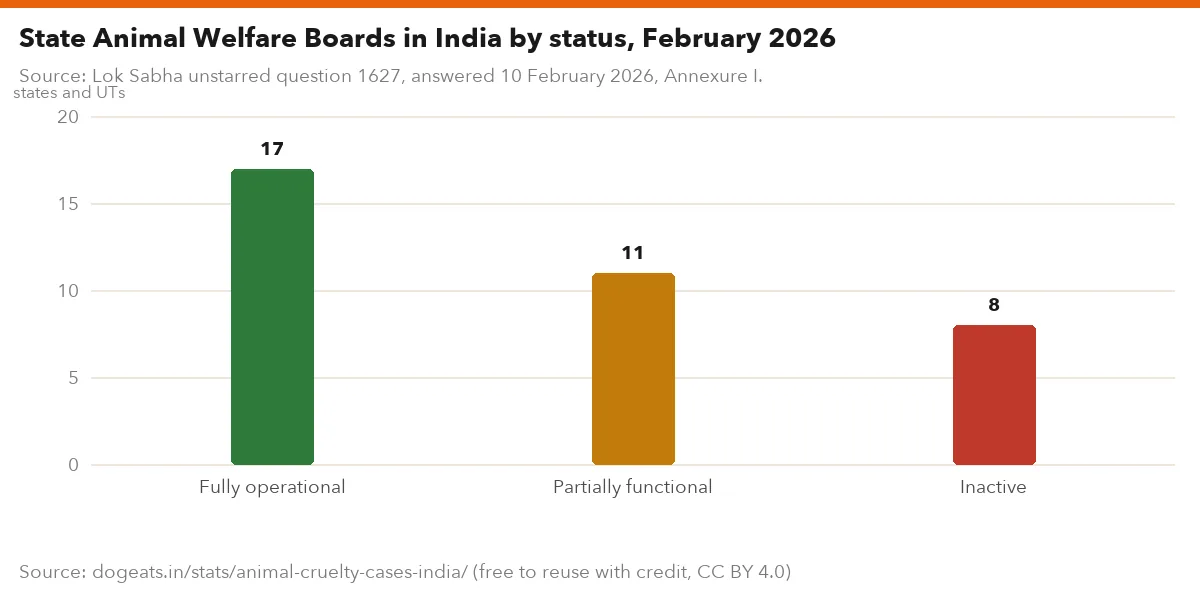
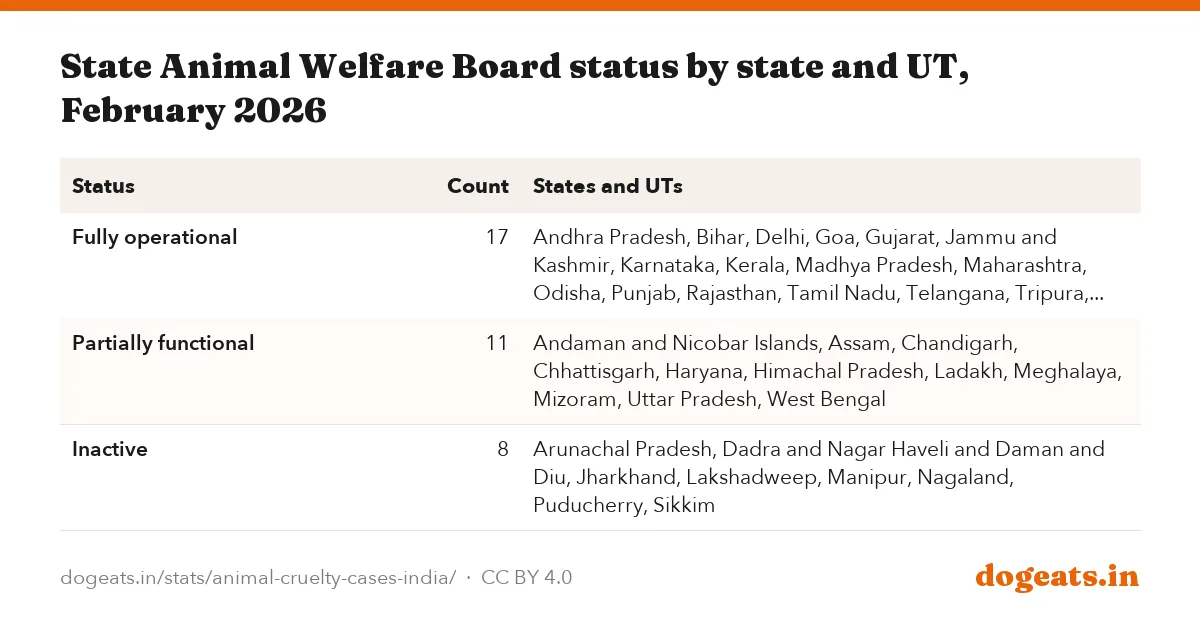
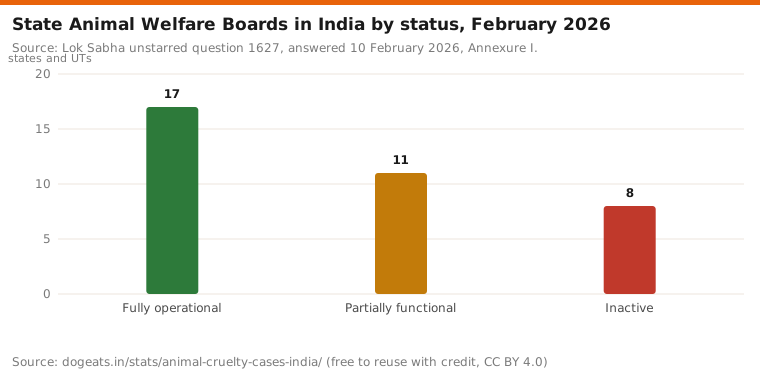
Only about half are fully working. A Lok Sabha reply of 10 February 2026 listed 36 states and UTs. It marked 17 boards fully operational, 11 partially functional and 8 inactive.
State boards also register pet shops and dog breeders, as our dog breeding licence report explains. The inactive list was Arunachal Pradesh, Dadra and Nagar Haveli and Daman and Diu, Jharkhand, Lakshadweep, Manipur, Nagaland, Puducherry and Sikkim. The reply also said Lakshadweep has not formed a board. State boards receive no central budget support.
Source: Lok Sabha unstarred question 1627, answered 10 February 2026, Annexure I.
Show the numbers
| Label | states and UTs |
|---|---|
| Fully operational | 17 |
| Partially functional | 11 |
| Inactive | 8 |
Embed this chart
| Status | Count | States and UTs |
|---|---|---|
| Fully operational | 17 | Andhra Pradesh, Bihar, Delhi, Goa, Gujarat, Jammu and Kashmir, Karnataka, Kerala, Madhya Pradesh, Maharashtra, Odisha, Punjab, Rajasthan, Tamil Nadu, Telangana, Tripura, Uttarakhand |
| Partially functional | 11 | Andaman and Nicobar Islands, Assam, Chandigarh, Chhattisgarh, Haryana, Himachal Pradesh, Ladakh, Meghalaya, Mizoram, Uttar Pradesh, West Bengal |
| Inactive | 8 | Arunachal Pradesh, Dadra and Nagar Haveli and Daman and Diu, Jharkhand, Lakshadweep, Manipur, Nagaland, Puducherry, Sikkim |
Odisha's board is listed as fully operational, yet the state registered zero PCA Act cases in 2024. Maharashtra, with the most cases, also has a fully operational board.
What did earlier, unofficial counts of animal cruelty show?
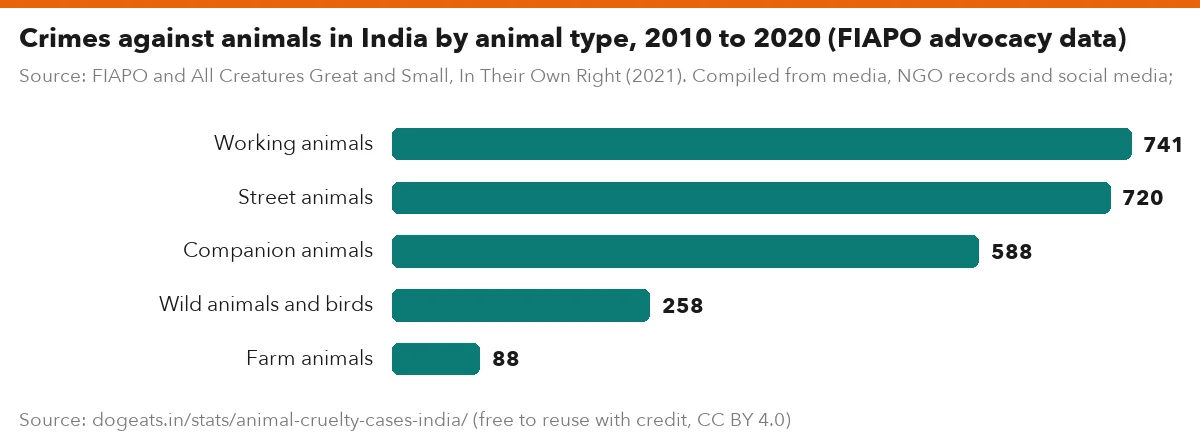
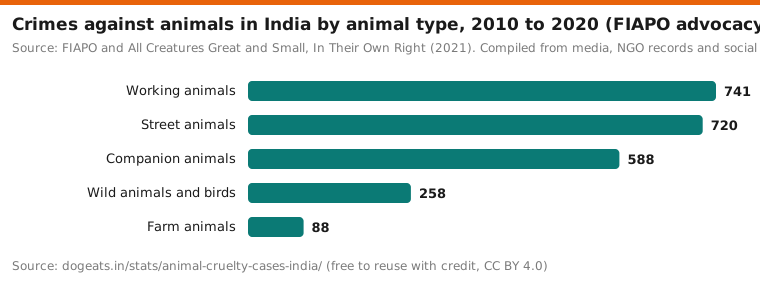
Before NCRB's count, the main national compilation came from advocacy groups. In 2021, FIAPO and All Creatures Great and Small documented 2,400 cases of crimes against animals from 2010 to 2020.
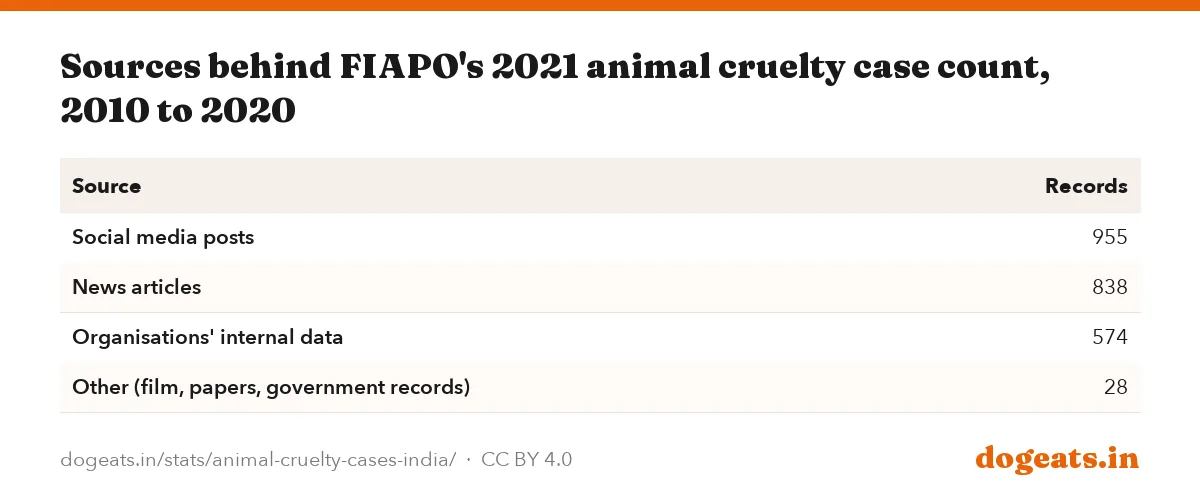
This is advocacy data, not an official count. It was built from 838 news reports, 574 incidents in organisations' records, 955 social media posts and 28 other records.
Working animals were the largest group, with 741 cases, followed by street animals with 720 and companion animals with 588. Of about 1,000 assault cases, 82 involved sexual abuse and 266 were killings.
Source: FIAPO and All Creatures Great and Small, In Their Own Right (2021). Compiled from media, NGO records and social media; not official data.
Show the numbers
| Label | cases |
|---|---|
| Working animals | 741 |
| Street animals | 720 |
| Companion animals | 588 |
| Wild animals and birds | 258 |
| Farm animals | 88 |
Embed this chart
| Source | Records |
|---|---|
| Social media posts | 955 |
| News articles | 838 |
| Organisations' internal data | 574 |
| Other (film, papers, government records) | 28 |
FIAPO's report also cites a 2016 Environment ministry statement of 24,000 cruelty cases from 2012 to 2015. We could not find that statement, so treat it as reported by FIAPO only. The NCRB figure of 9,039 for one year is the first official national count.
How do you report animal cruelty in India?
Animal cruelty under the PCA Act and BNS Section 325 is a police matter. You can file a complaint at the local police station and ask for an FIR to be registered. Note the date, place and any photos or videos.
You can also lodge a complaint with AWBI online, which forwards it to the state. AWBI's own figures show only 6.7% of forwarded complaints got an action taken report, so a police complaint is the more direct route.
For community dogs, the rules on feeding and sterilisation also matter. See our reports on stray dog feeding rules and ABC sterilisation coverage.
- Police station: file a written complaint citing PCA Act Section 11 and, for killing or maiming, BNS Section 325.
- AWBI: lodge a cruelty complaint on the AWBI website; 4,589 were handled in five years to August 2025.
- State Animal Welfare Board: 17 of 36 are fully operational as of February 2026.
- Housing societies: disputes over pets and community dogs are covered in our dog laws for housing societies report.
Frequently asked questions
How many animal cruelty cases are there in India?
Police registered 9,039 cases under the Prevention of Cruelty to Animals Act in 2024, according to NCRB's Crime in India 2024. That is 0.6 cases per lakh people. It is the first year NCRB published the figure separately.
Which state has the most animal cruelty cases in India?
Maharashtra, with 2,356 cases in 2024, or 26.1% of the national total. Madhya Pradesh had 1,346 and Uttar Pradesh 1,121. Maharashtra also had the highest rate, 1.8 cases per lakh people.
What is the punishment under PCA Act Section 11?
A first offence of cruelty is punished with a fine of Rs 10 to Rs 50. A second offence within three years carries Rs 25 to Rs 100, or up to three months in jail, or both. These amounts date from 1960.
What is BNS Section 325?
Section 325 of the Bharatiya Nyaya Sanhita, 2023 punishes killing, poisoning, maiming or rendering useless any animal. The penalty is up to five years in jail, or a fine, or both. It came into force on 1 July 2024 and replaced IPC Sections 428 and 429.
What are the animal cruelty laws in India?
The main laws are the Prevention of Cruelty to Animals Act, 1960 and Section 325 of the Bharatiya Nyaya Sanhita, 2023. Rules under the PCA Act cover transport, pet shops, dog breeding and slaughter houses. Wild animals are covered by the Wild Life (Protection) Act, 1972.
Has the PCA Act been amended to increase fines?
No. A draft amendment bill was published in November 2022 and drew over 7,000 responses. On 3 February 2026 the government told the Lok Sabha it was still under examination, and it has not been introduced in Parliament.
What is the conviction rate for animal cruelty in India?
Courts convicted in 959 of 1,192 completed trials in 2024, a conviction rate of 80.5%. But 5,538 cases, or 82.2% of those sent for trial, were still pending at the end of the year.
Which city has the most animal cruelty cases?
Among NCRB's 19 metropolitan cities, Nagpur had the most, with 139 cases in 2024 and a rate of 5.6 per lakh. Bengaluru had 53 and Ahmedabad 47, while Mumbai recorded 13.
How do I report animal cruelty in India?
File a complaint at the local police station under PCA Act Section 11, and BNS Section 325 if an animal was killed or maimed. You can also complain to the Animal Welfare Board of India, which forwards complaints to state authorities.
Methodology and limitations
We downloaded NCRB's Crime in India 2024 tables as Excel files from ncrb.gov.in. We used Tables 1.3, 1A.5, 1B.5, 17A.3, 17B.3, 18A.3, 18B.3, 19A.3 and 19A.7. We read the PCA Act row and checked the state figures against the PDF of Table 1A.5.
Shares, rankings and per-case ratios were computed by dogeats.in in Python. Crime rates are NCRB's, per lakh population. Legal provisions come from the PCA Act text, the BNS text published by the Home Ministry and the draft PCA amendment bill of 2022. Status updates come from Lok Sabha replies of 5 August 2025, 3 February 2026, 10 February 2026 and 4 August 2026. AWBI yearly complaint counts are numbered entries in AWBI's published lists, counted by us.
Sources
- National Crime Records Bureau, Crime in India 2024, tables 1.2, 1.3, 1A.5, 1B.5, 17A.3, 17B.3, 18A.3, 18B.3, 19A.3, 19A.7 (released May 2026), 9,039 cases, state and city counts and rates, police and court disposal, arrests, conviction rate
- Lok Sabha unstarred question 504, Prevention of Cruelty to Animals (Amendment) Bill, answered 3 February 2026, Draft bill comment period, over 7,000 suggestions, bill under examination, BNS provision
- Lok Sabha unstarred question 2641, Cruelty to Animals, answered 5 August 2025, Section 11 penalties, 4,589 AWBI complaints, 306 action taken reports, Karnataka 269 and 217
- Also consulted: Ministry of Home Affairs, Bharatiya Nyaya Sanhita, 2023 (text), Department of Animal Husbandry and Dairying, draft Prevention of Cruelty to Animal (Amendment) Bill, 2022 (via PRS), Lok Sabha unstarred question 2661, Illegal Trade and Cruelty to Birds and Animals, answered 4 August 2026, Lok Sabha unstarred question 1627, State Animal Welfare Boards, answered 10 February 2026, Animal Welfare Board of India, cruelty complaint lists 2020-21 to 2024-25, FIAPO and All Creatures Great and Small, In Their Own Right (2021), The Prevention of Cruelty to Animals Act, 1960 (text, Maharashtra Police), All India Radio News, 1 July 2024: three new criminal laws come into force, ThePrint, 8 May 2026: In a first, NCRB records cases under animal cruelty prevention law, PTI report of 8 May 2026 via Devdiscourse (state figures that do not match NCRB Table 1A.5), WION, 9 May 2026, Lok Sabha unstarred question 3794, 11 August 2026, Lok Sabha starred question 239, 5 August 2025.
Cite, embed and download
This report, its data and its images are free to reuse under a Creative Commons Attribution 4.0 licence. Credit dogeats.in with a link to this page. Every chart has its own embed code, every table has a CSV and an image download, and the images below are ready for social posts, slides and articles.
Cite this report
Link to this report
Every chart and table as an image