Data report · Updated October 2026
Dog Ticks in India: How Many Dogs Carry Them, Which Species, and When They Peak
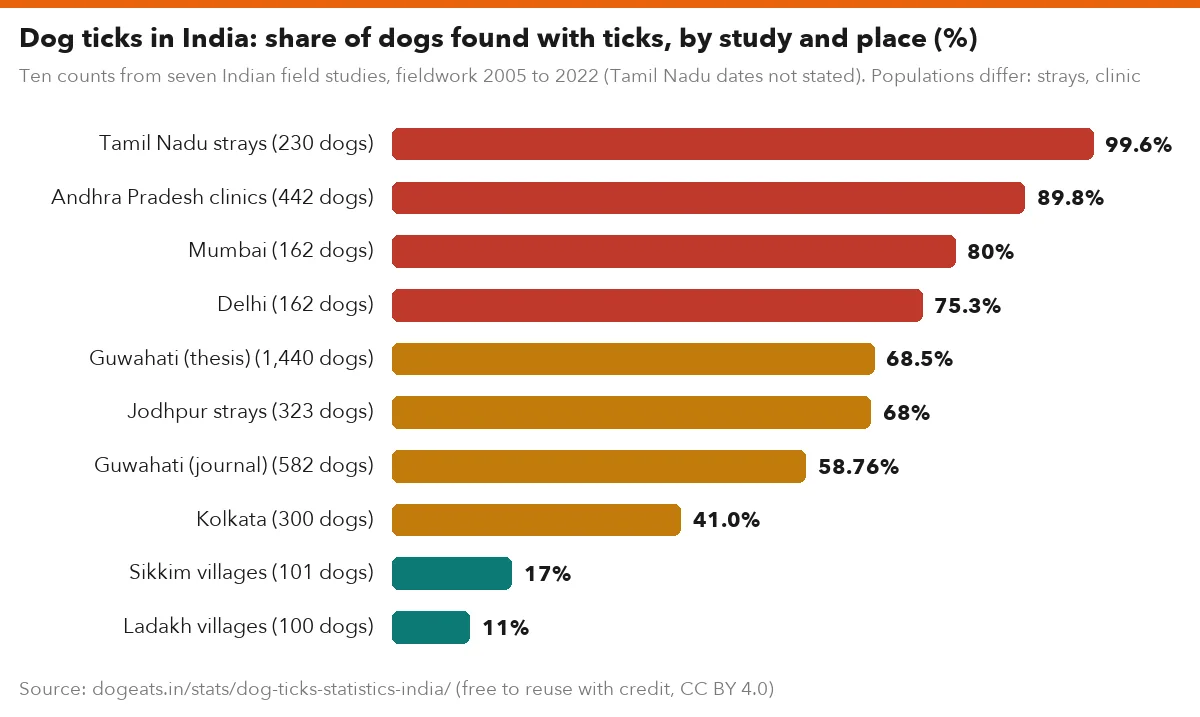
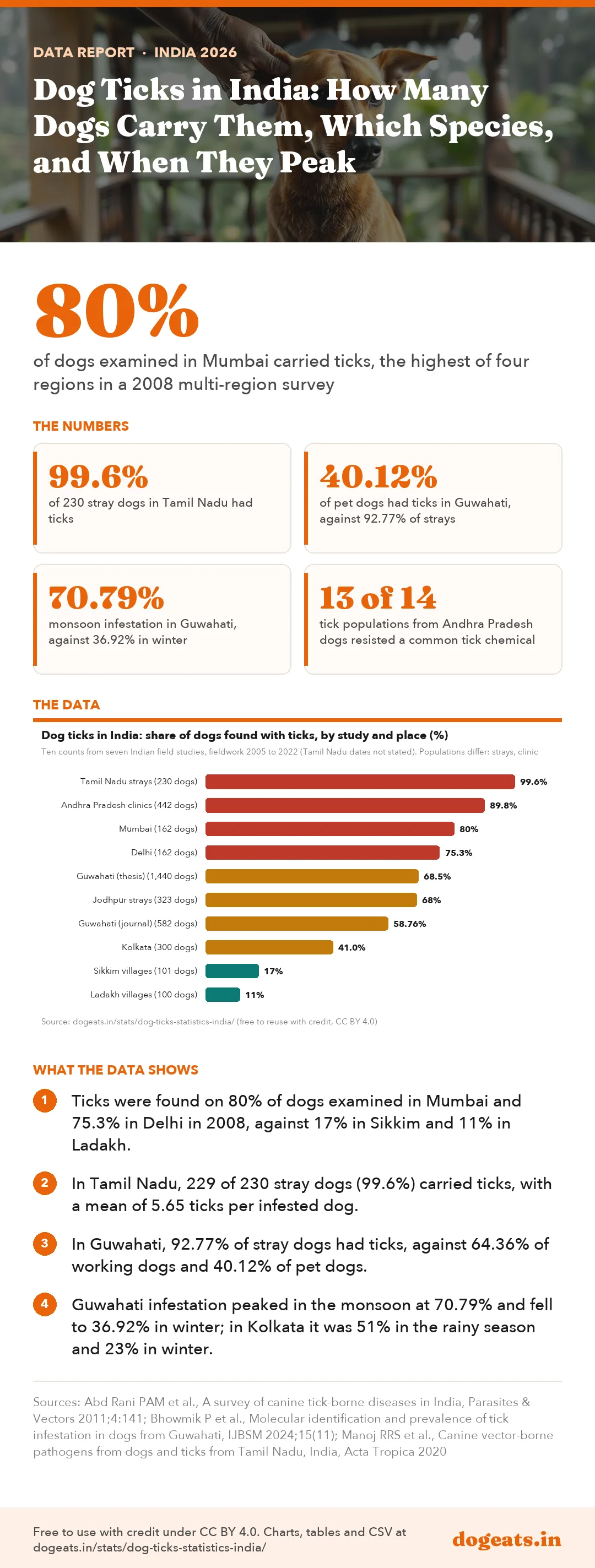
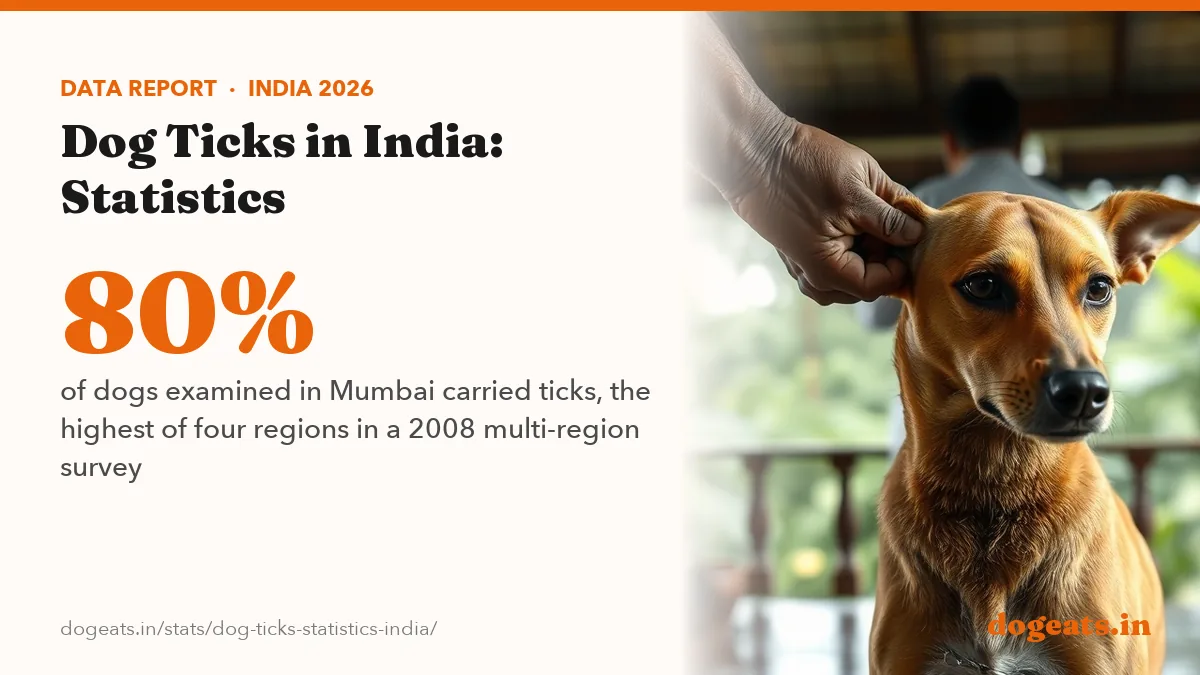
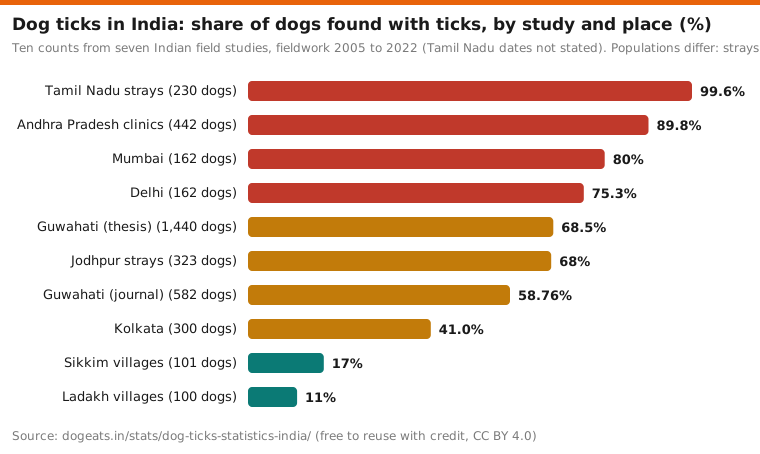
Dog ticks are very common in India: field studies found ticks on 11% to 99.6% of the dogs examined, depending on place, season and whether the dogs were strays. In the one study that compared cities, ticks were found on 80% of dogs in Mumbai and 75.3% in Delhi, against 11% in Ladakh. Almost all were the brown dog tick, Rhipicephalus sanguineus, and infestation peaked in the monsoon.

Key findings
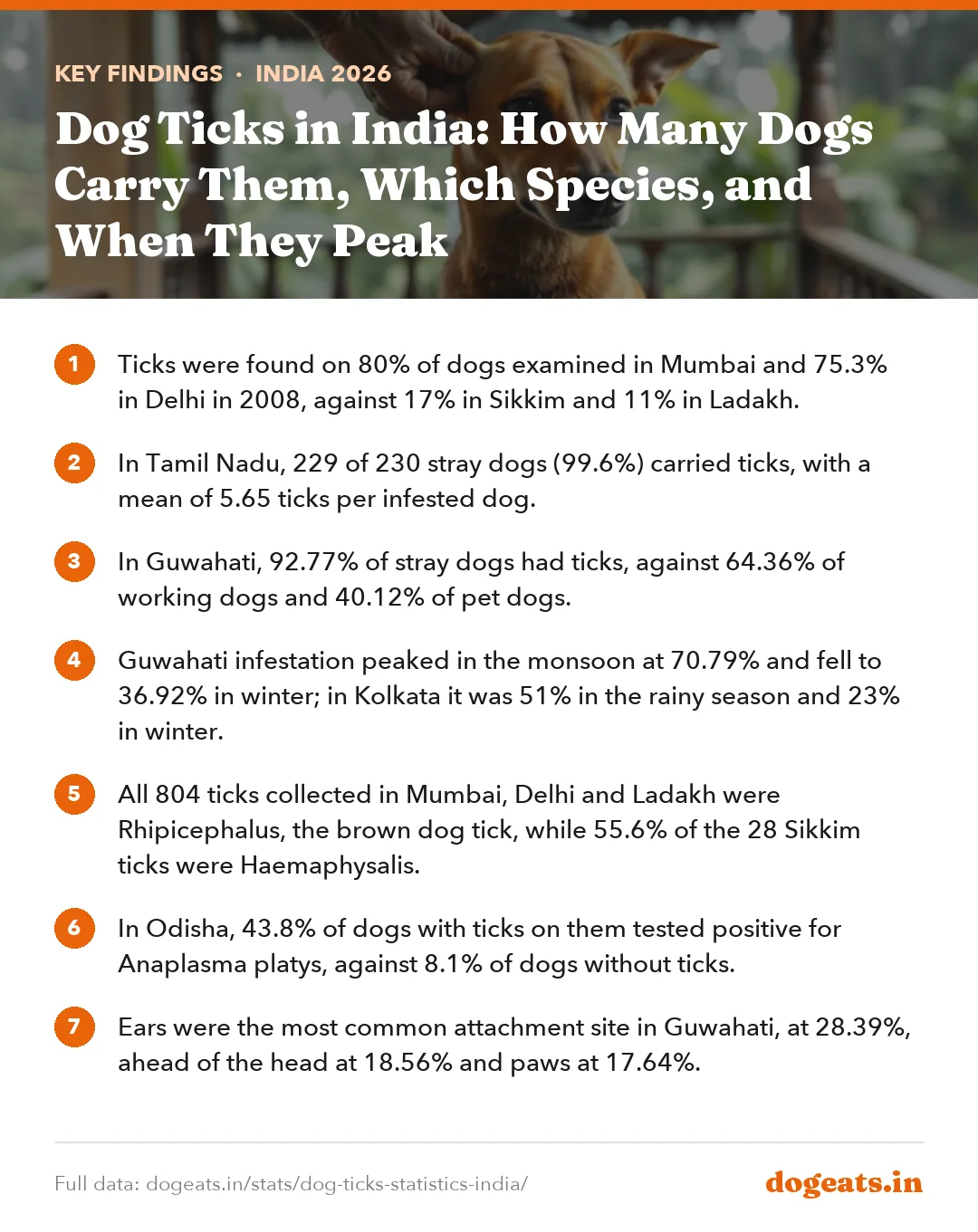
- Ticks were found on 80% of dogs examined in Mumbai and 75.3% in Delhi in 2008, against 17% in Sikkim and 11% in Ladakh.
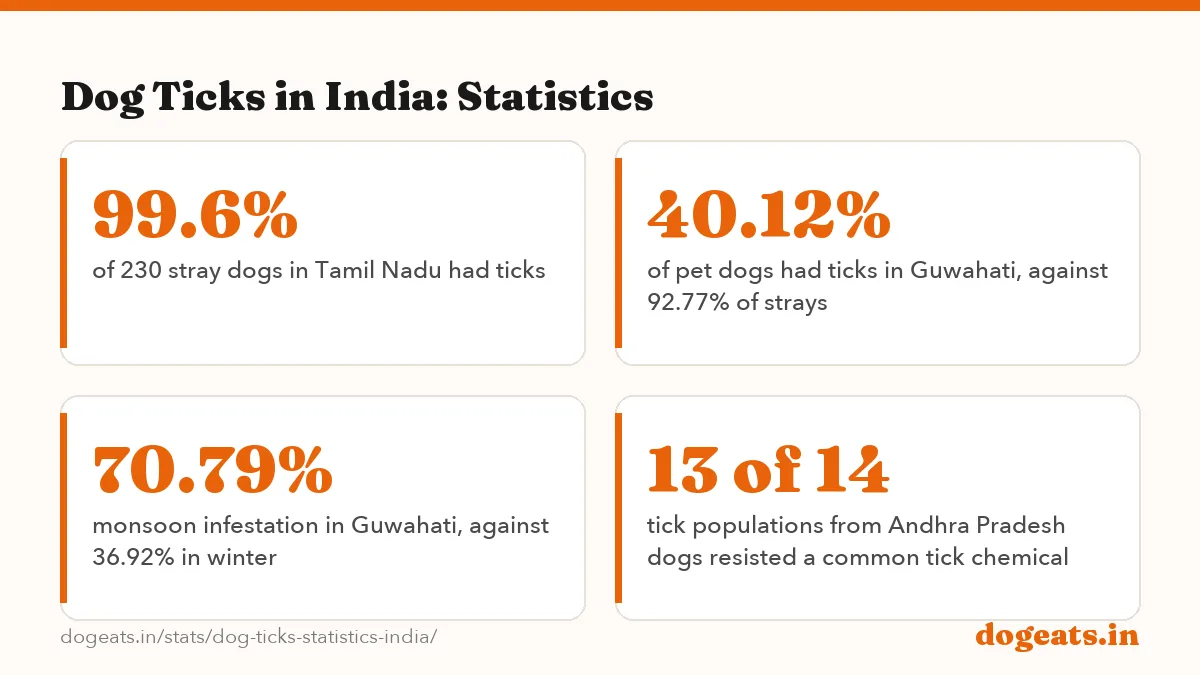
- In Tamil Nadu, 229 of 230 stray dogs (99.6%) carried ticks, with a mean of 5.65 ticks per infested dog.
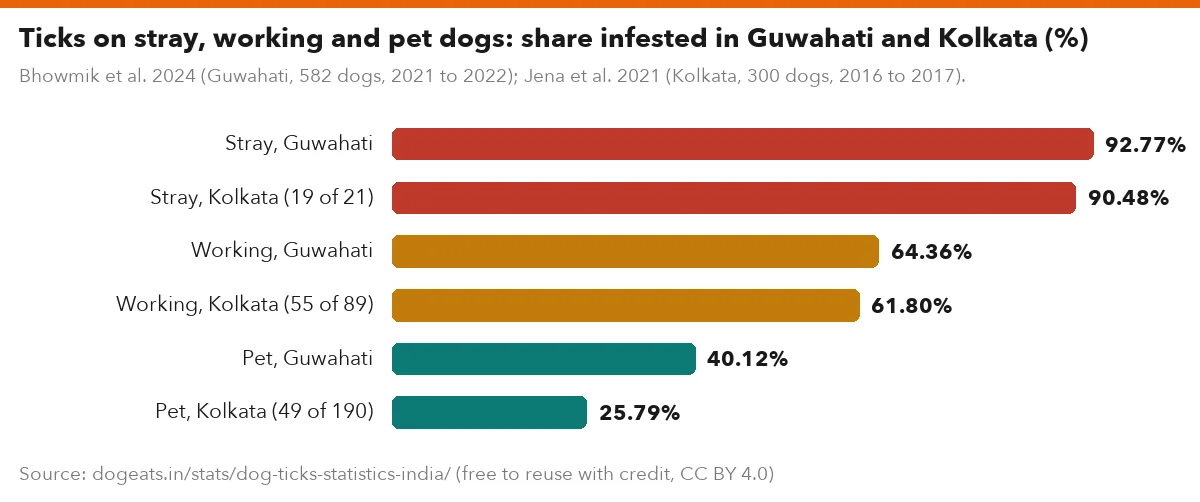
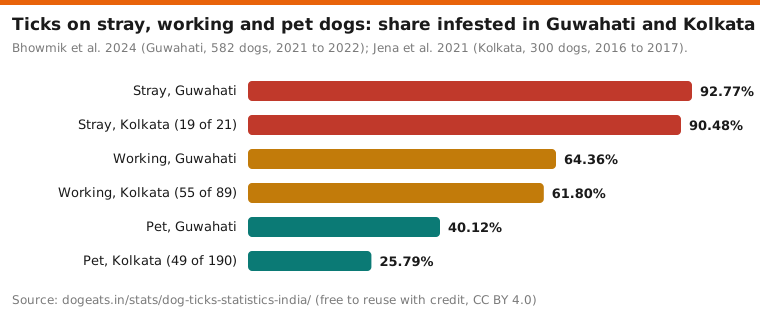
- In Guwahati, 92.77% of stray dogs had ticks, against 64.36% of working dogs and 40.12% of pet dogs.
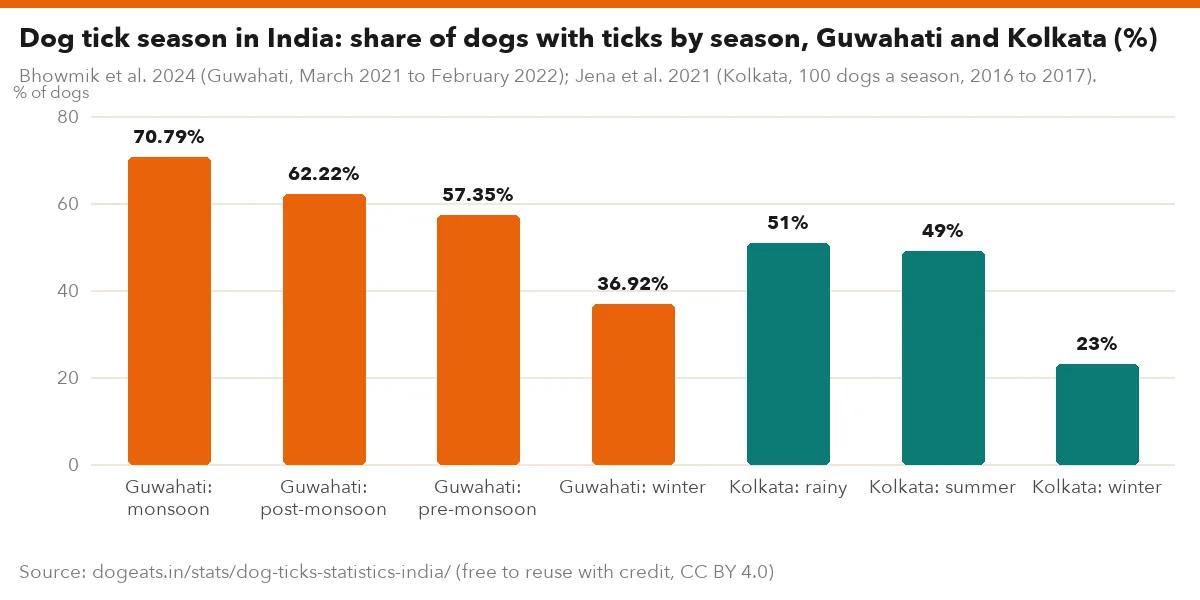
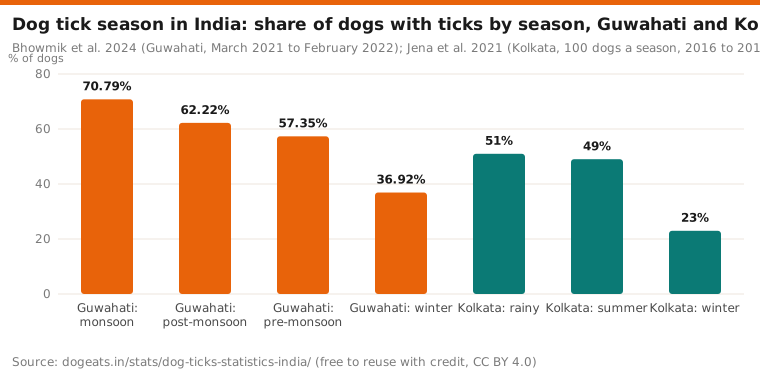
- Guwahati infestation peaked in the monsoon at 70.79% and fell to 36.92% in winter; in Kolkata it was 51% in the rainy season and 23% in winter.
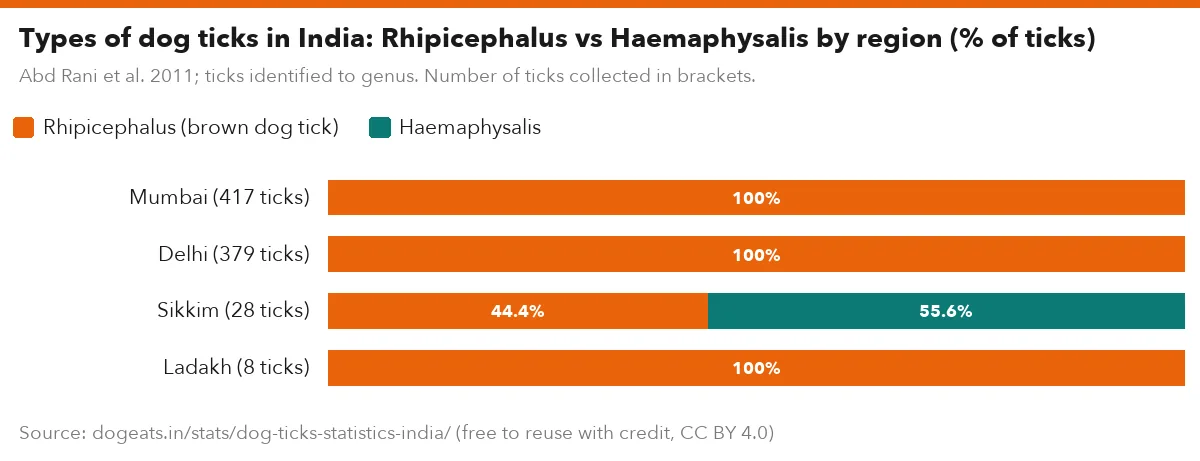
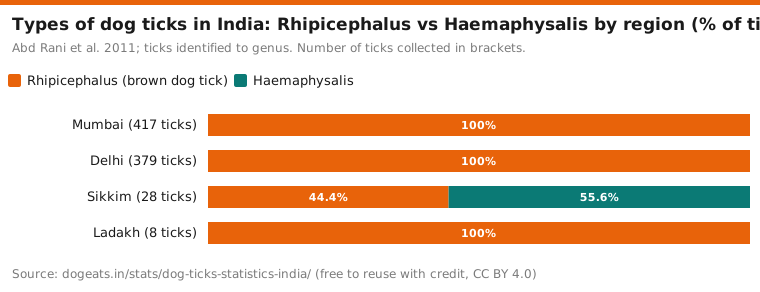
- All 804 ticks collected in Mumbai, Delhi and Ladakh were Rhipicephalus, the brown dog tick, while 55.6% of the 28 Sikkim ticks were Haemaphysalis.
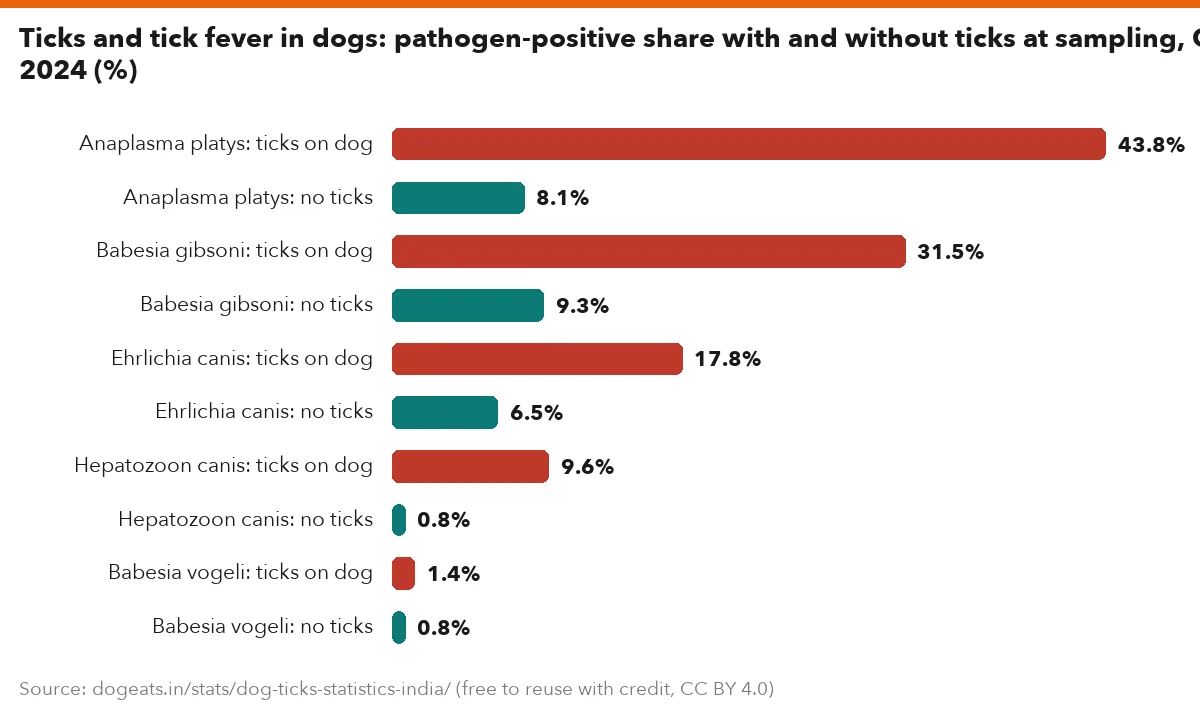
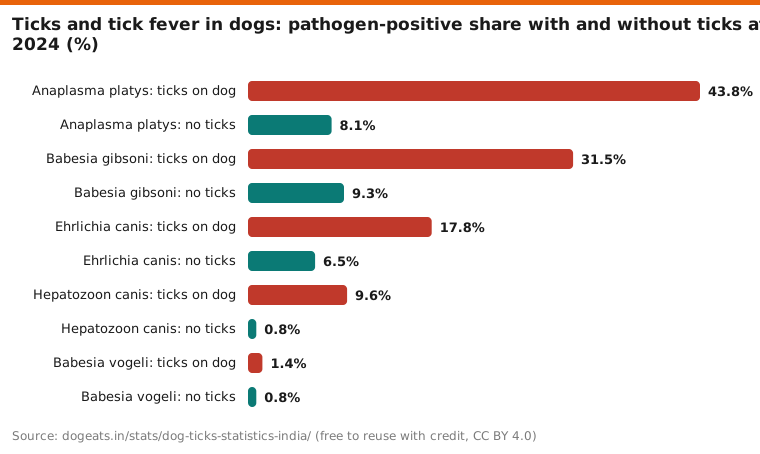
- In Odisha, 43.8% of dogs with ticks on them tested positive for Anaplasma platys, against 8.1% of dogs without ticks.
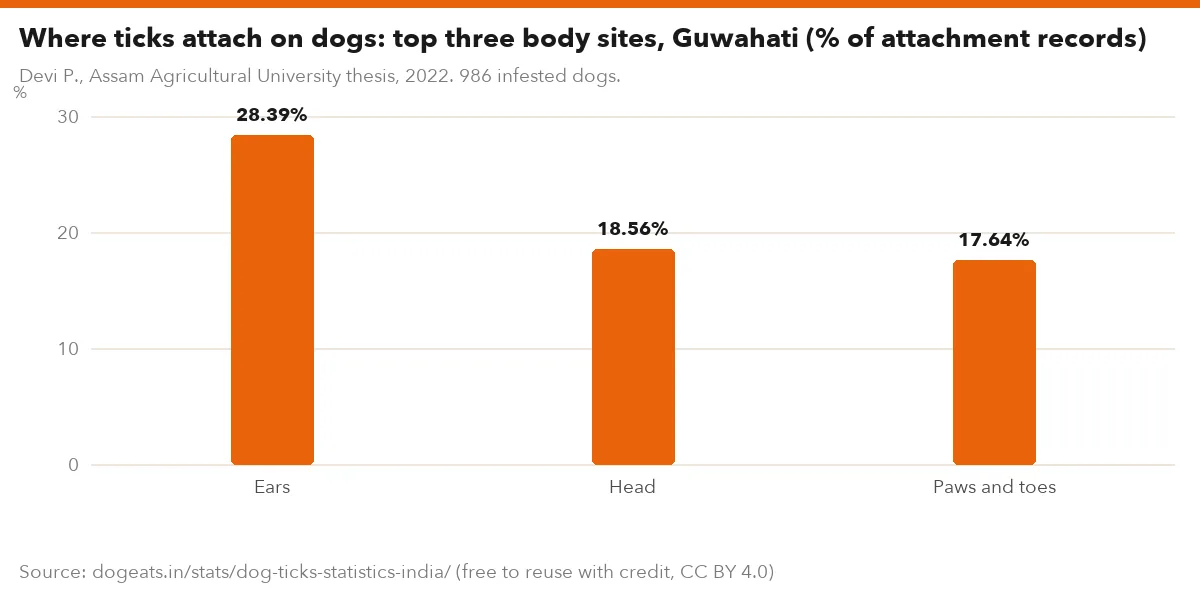
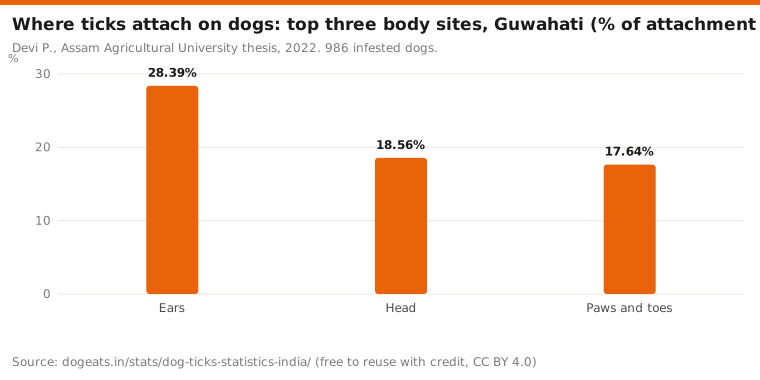
- Ears were the most common attachment site in Guwahati, at 28.39%, ahead of the head at 18.56% and paws at 17.64%.
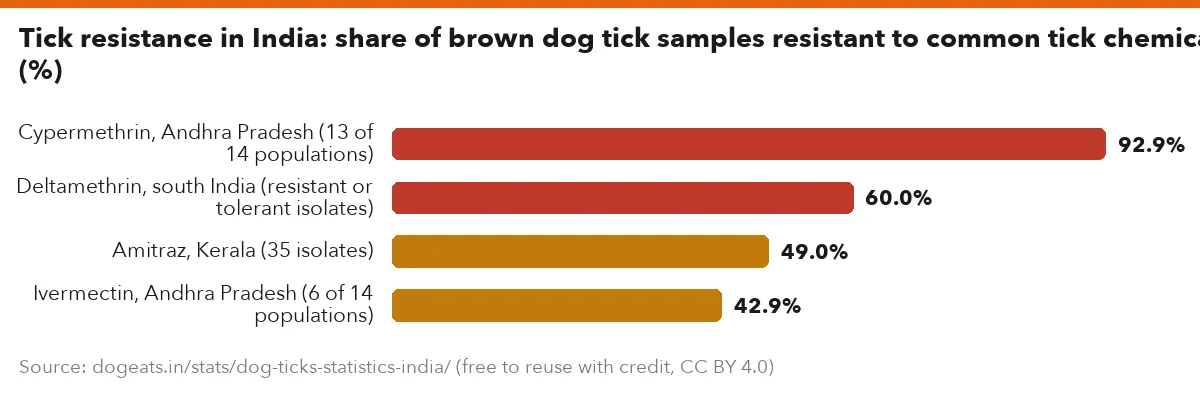
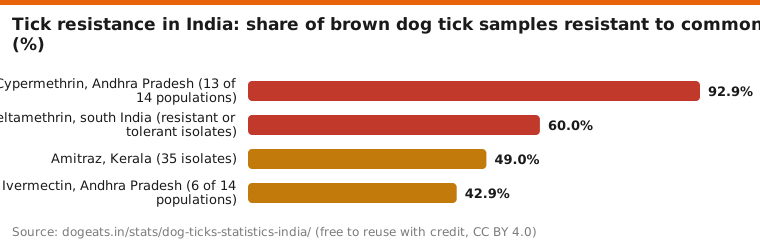
- Thirteen of 14 tick populations from dogs in Andhra Pradesh resisted cypermethrin, and 49% of 35 Kerala isolates resisted amitraz.
- Our breed guides list tick fever or tick-borne disease as a health risk for 17 of 58 breeds, including 8 of our 9 Indian breeds.
How common are ticks on dogs in India?
Very common in the plains and on the coast, and rarer in the hill villages of Sikkim and Ladakh. Ten Indian field counts we found put the share of dogs with ticks between 11% and 99.6%. The middle of that range is about 68%.
The only study to compare regions with one method is Abd Rani et al. (2011). The team examined 525 stray and shelter dogs from June to September 2008. It found ticks on 278 dogs, or 53%.
Mumbai had the most, at 80% of 162 dogs, and Delhi was close behind at 75.3%. In the Sikkim villages the figure was 17%. At about 3,000 m in Ladakh, only 11% of dogs had ticks.
Ten counts from seven Indian field studies, fieldwork 2005 to 2022 (Tamil Nadu dates not stated). Populations differ: strays, clinic dogs, shelters. Andhra Pradesh dogs were picked partly because they had ticks.
Show the numbers
| Label | % of dogs |
|---|---|
| Tamil Nadu strays (230 dogs) | 99.6% |
| Andhra Pradesh clinics (442 dogs) | 89.8% |
| Mumbai (162 dogs) | 80% |
| Delhi (162 dogs) | 75.3% |
| Guwahati (thesis) (1,440 dogs) | 68.5% |
| Jodhpur strays (323 dogs) | 68% |
| Guwahati (journal) (582 dogs) | 58.76% |
| Kolkata (300 dogs) | 41.0% |
| Sikkim villages (101 dogs) | 17% |
| Ladakh villages (100 dogs) | 11% |
Embed this chart
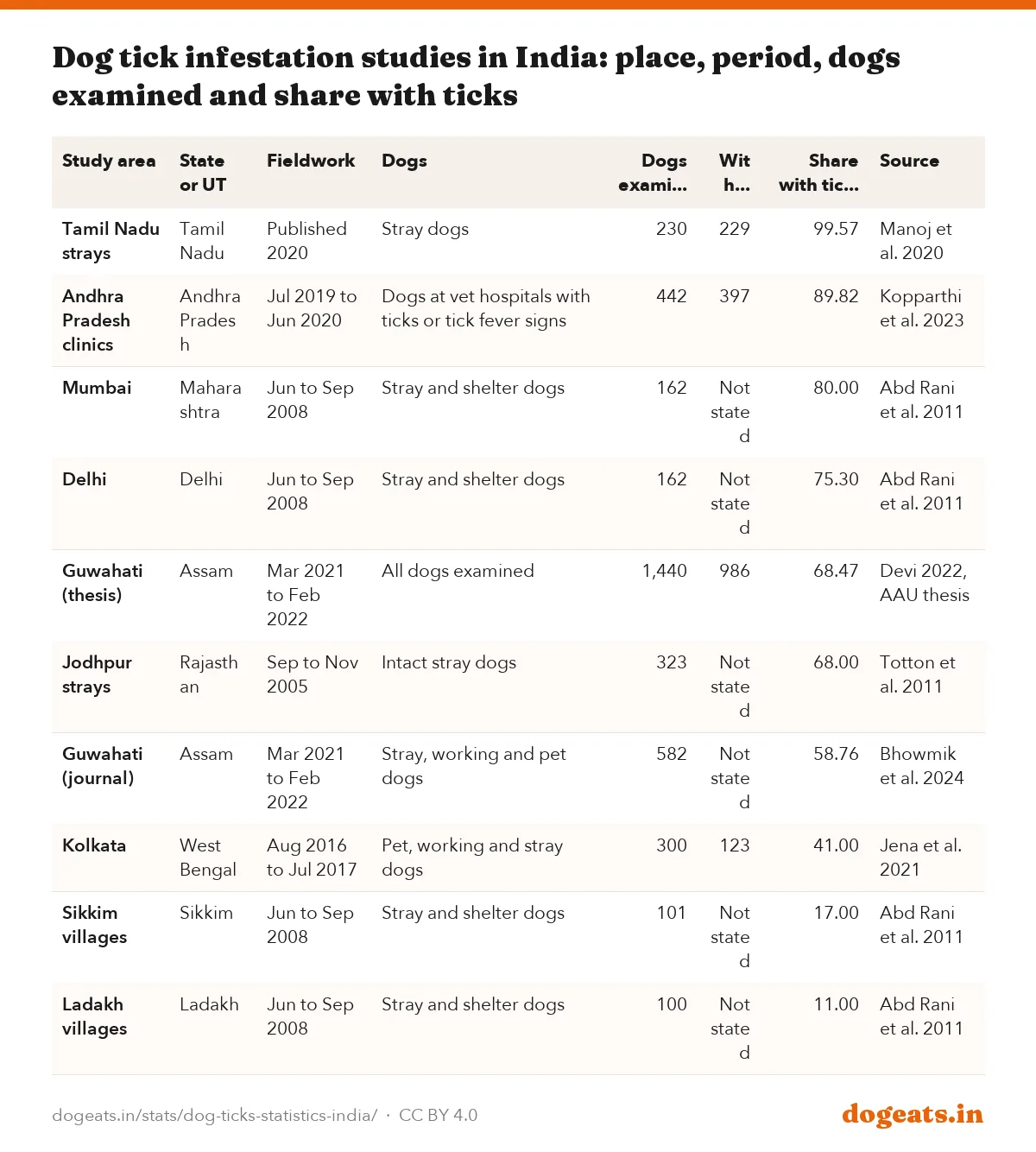
| Study area | State or UT | Fieldwork | Dogs | Dogs examined | With ticks | Share with ticks (%) | Source |
|---|---|---|---|---|---|---|---|
| Tamil Nadu strays | Tamil Nadu | Published 2020 | Stray dogs | 230 | 229 | 99.57 | Manoj et al. 2020 |
| Andhra Pradesh clinics | Andhra Pradesh | Jul 2019 to Jun 2020 | Dogs at vet hospitals with ticks or tick fever signs | 442 | 397 | 89.82 | Kopparthi et al. 2023 |
| Mumbai | Maharashtra | Jun to Sep 2008 | Stray and shelter dogs | 162 | Not stated | 80.00 | Abd Rani et al. 2011 |
| Delhi | Delhi | Jun to Sep 2008 | Stray and shelter dogs | 162 | Not stated | 75.30 | Abd Rani et al. 2011 |
| Guwahati (thesis) | Assam | Mar 2021 to Feb 2022 | All dogs examined | 1,440 | 986 | 68.47 | Devi 2022, AAU thesis |
| Jodhpur strays | Rajasthan | Sep to Nov 2005 | Intact stray dogs | 323 | Not stated | 68.00 | Totton et al. 2011 |
| Guwahati (journal) | Assam | Mar 2021 to Feb 2022 | Stray, working and pet dogs | 582 | Not stated | 58.76 | Bhowmik et al. 2024 |
| Kolkata | West Bengal | Aug 2016 to Jul 2017 | Pet, working and stray dogs | 300 | 123 | 41.00 | Jena et al. 2021 |
| Sikkim villages | Sikkim | Jun to Sep 2008 | Stray and shelter dogs | 101 | Not stated | 17.00 | Abd Rani et al. 2011 |
| Ladakh villages | Ladakh | Jun to Sep 2008 | Stray and shelter dogs | 100 | Not stated | 11.00 | Abd Rani et al. 2011 |
Two Guwahati counts from the same year differ. A journal paper found ticks on 58.76% of 582 dogs, and a thesis from the same college found 68.47% of 1,440. We show both, since they used different dogs.
Do pet dogs get ticks less often than street dogs?
Yes, by about half. In Guwahati, Bhowmik et al. (2024) found ticks on 92.77% of stray dogs, 64.36% of working dogs and 40.12% of pet dogs. Puppies under a year were more often infested, at 89.38%, than older dogs at 39.32%.
Kolkata showed the same order. Jena et al. (2021) found ticks on 19 of 21 strays (90.48%), 55 of 89 working dogs (61.80%) and 49 of 190 companion dogs (25.79%).
Working dogs in these studies were police and service dogs that spend long hours outdoors. Their rate sat between strays and house pets in both cities.

Bhowmik et al. 2024 (Guwahati, 582 dogs, 2021 to 2022); Jena et al. 2021 (Kolkata, 300 dogs, 2016 to 2017).
Show the numbers
| Label | % of dogs |
|---|---|
| Stray, Guwahati | 92.77% |
| Stray, Kolkata (19 of 21) | 90.48% |
| Working, Guwahati | 64.36% |
| Working, Kolkata (55 of 89) | 61.80% |
| Pet, Guwahati | 40.12% |
| Pet, Kolkata (49 of 190) | 25.79% |
Embed this chart
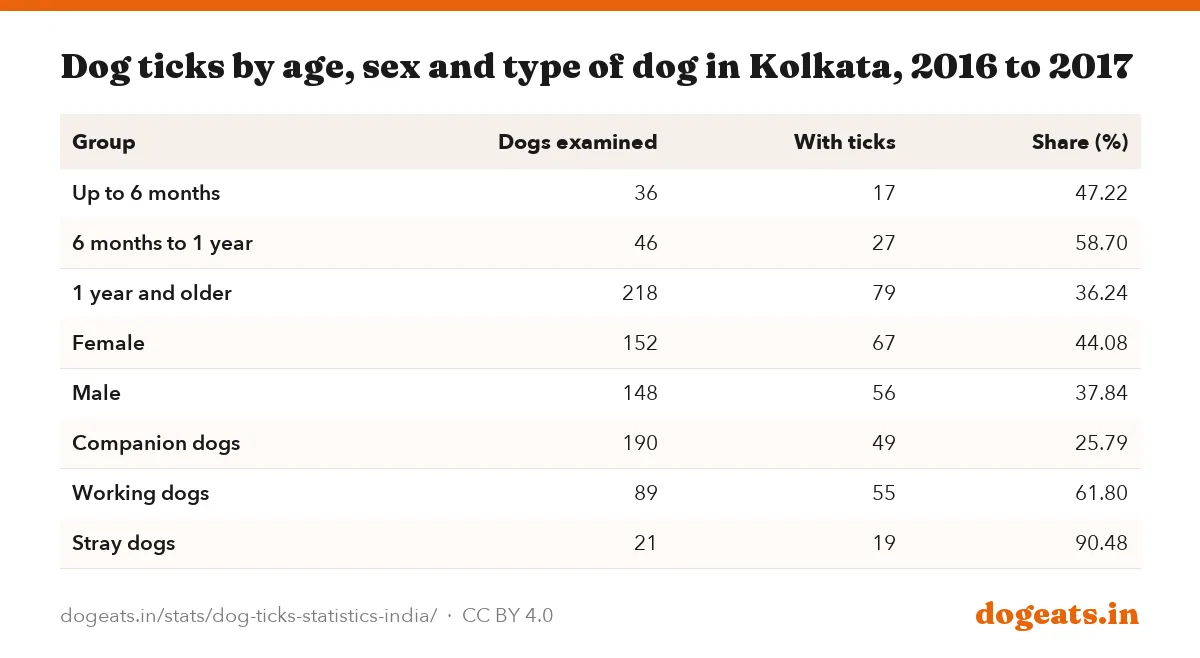
| Group | Dogs examined | With ticks | Share (%) |
|---|---|---|---|
| Up to 6 months | 36 | 17 | 47.22 |
| 6 months to 1 year | 46 | 27 | 58.70 |
| 1 year and older | 218 | 79 | 36.24 |
| Female | 152 | 67 | 44.08 |
| Male | 148 | 56 | 37.84 |
| Companion dogs | 190 | 49 | 25.79 |
| Working dogs | 89 | 55 | 61.80 |
| Stray dogs | 21 | 19 | 90.48 |
Young dogs carried more ticks in Kolkata too: 58.70% of dogs aged 6 months to 1 year, against 36.24% of adults. Females were slightly ahead of males, 44.08% to 37.84%.
By breed, 92.59% of mongrels and 56% of German Shepherds in the Kolkata sample had ticks, against 28.71% of Labradors. These breed shares rest on small groups.
When is tick season for dogs in India?
Ticks are found all year, but most studies see a peak in the monsoon and a low in winter. In Guwahati, 70.79% of dogs examined in the monsoon had ticks. The figure was 62.22% after the monsoon, 57.35% before it and 36.92% in winter.
Kolkata examined 100 dogs in each season. Ticks were found on 51% in the rainy season, 49% in summer and 23% in winter.
South India runs on a different calendar. In Madurai district, Tamil Nadu, the tick index on dogs was highest in November and December, during the north-east monsoon. Cooler temperatures, more rain and higher humidity favoured ticks there.

Bhowmik et al. 2024 (Guwahati, March 2021 to February 2022); Jena et al. 2021 (Kolkata, 100 dogs a season, 2016 to 2017).
Show the numbers
| Label | % of dogs |
|---|---|
| Guwahati: monsoon | 70.79% |
| Guwahati: post-monsoon | 62.22% |
| Guwahati: pre-monsoon | 57.35% |
| Guwahati: winter | 36.92% |
| Kolkata: rainy | 51% |
| Kolkata: summer | 49% |
| Kolkata: winter | 23% |
Embed this chart
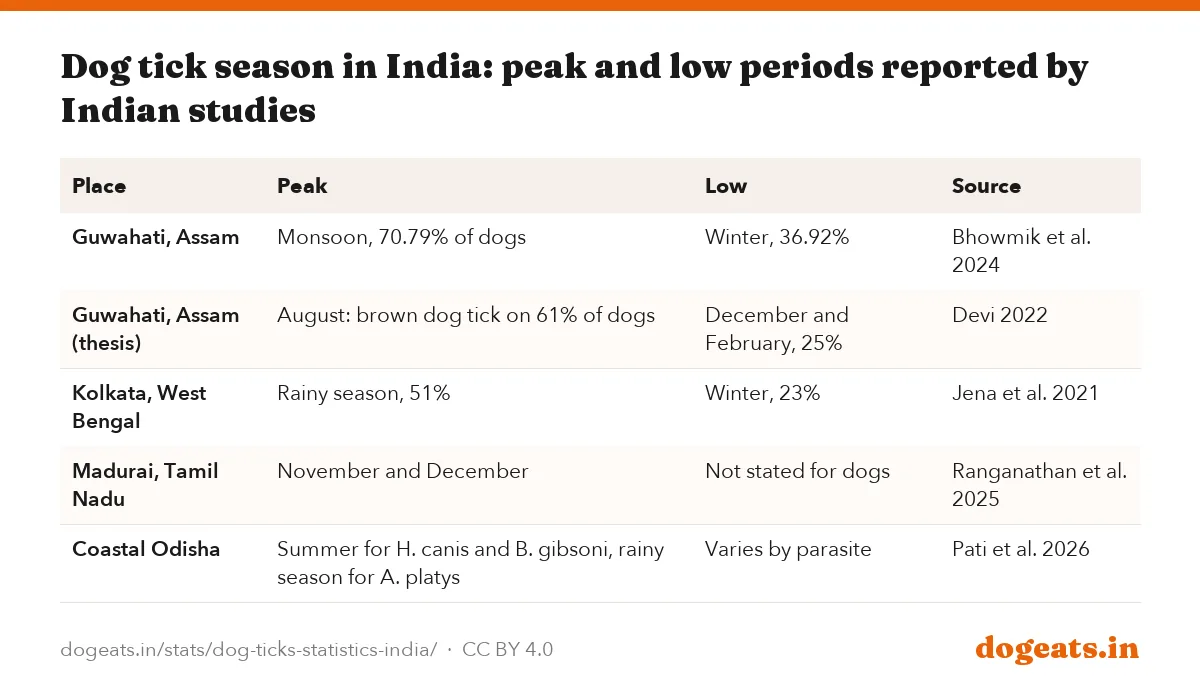
| Place | Peak | Low | Source |
|---|---|---|---|
| Guwahati, Assam | Monsoon, 70.79% of dogs | Winter, 36.92% | Bhowmik et al. 2024 |
| Guwahati, Assam (thesis) | August: brown dog tick on 61% of dogs | December and February, 25% | Devi 2022 |
| Kolkata, West Bengal | Rainy season, 51% | Winter, 23% | Jena et al. 2021 |
| Madurai, Tamil Nadu | November and December | Not stated for dogs | Ranganathan et al. 2025 |
| Coastal Odisha | Summer for H. canis and B. gibsoni, rainy season for A. platys | Varies by parasite | Pati et al. 2026 |
The Guwahati thesis found the monthly swings were not statistically significant, even though the monsoon share reached 95.42%. Our monsoon dog care guide and monsoon risk ranking cover the wet months by breed.
Which ticks are found on dogs in India?
The brown dog tick, Rhipicephalus sanguineus, is by far the most common. Abd Rani's team collected 832 ticks, and every one of the 804 from Mumbai, Delhi and Ladakh was a Rhipicephalus.
Sikkim was the exception. There, 55.6% of the 28 ticks were Haemaphysalis, which the authors linked to Sikkim's more temperate climate. Kolkata's ticks were 100% R. sanguineus, and so were all 908 ticks from Andhra Pradesh dogs.
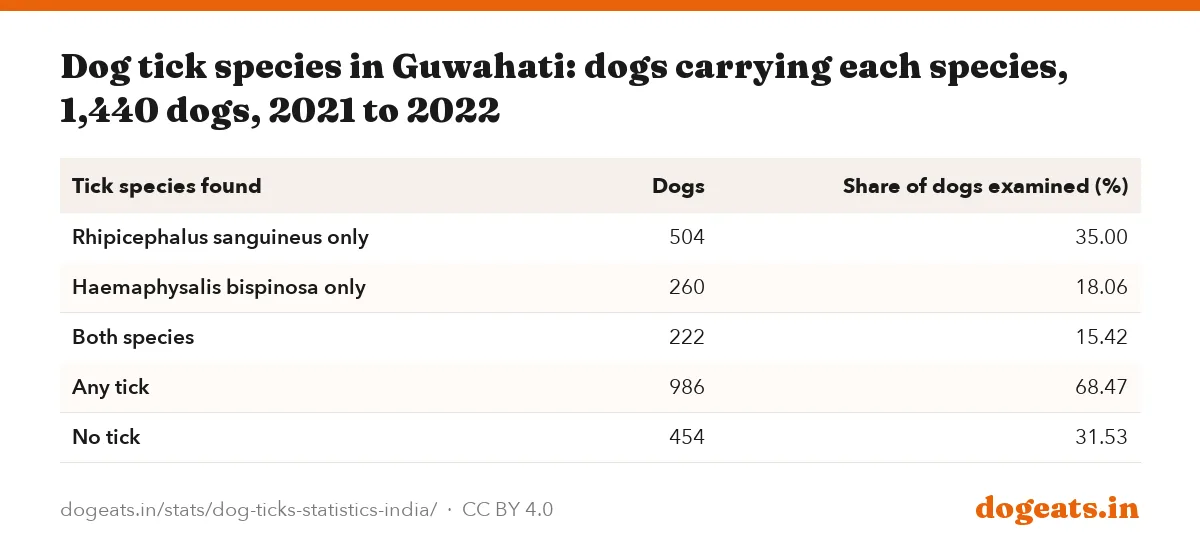
Assam has both. Of 1,440 Guwahati dogs, 35.00% carried only the brown dog tick, 18.06% only Haemaphysalis bispinosa and 15.42% carried both. In the north-east hill states, dogs also carried the cattle tick Rhipicephalus microplus and Hyalomma anatolicum.
Abd Rani et al. 2011; ticks identified to genus. Number of ticks collected in brackets.
Show the numbers
| Label | Rhipicephalus (brown dog tick) | Haemaphysalis |
|---|---|---|
| Mumbai (417 ticks) | 100 | 0 |
| Delhi (379 ticks) | 100 | 0 |
| Sikkim (28 ticks) | 44.4 | 55.6 |
| Ladakh (8 ticks) | 100 | 0 |
Embed this chart
| Tick species found | Dogs | Share of dogs examined (%) |
|---|---|---|
| Rhipicephalus sanguineus only | 504 | 35.00 |
| Haemaphysalis bispinosa only | 260 | 18.06 |
| Both species | 222 | 15.42 |
| Any tick | 986 | 68.47 |
| No tick | 454 | 31.53 |
The brown dog tick is unusual because it lives indoors. Dantas-Torres (2010) describes it crawling on walls, carpets and furniture, and feeding on dogs at every life stage. A female lays 1,500 to 4,000 eggs, and the species can complete up to four generations a year in warm places.
Dantas-Torres notes that the places where dogs rest at night hold the most ticks that are off a host. Guwahati's brown dog ticks matched the tropical lineage of the species in gene tests.
Where do ticks attach on a dog?
Mostly on the ears and head. In the Guwahati thesis, ears were the most preferred site, at 28.39%, followed by the head at 18.56% and the paws and toes at 17.64%.
The abstract does not give the shares for other body sites.
Devi P., Assam Agricultural University thesis, 2022. 986 infested dogs.
Show the numbers
| Label | % |
|---|---|
| Ears | 28.39% |
| Head | 18.56% |
| Paws and toes | 17.64% |
Embed this chart
Our Kombai guide advises a weekly check for ticks, because the breed's minimal coat offers little protection on working walks.
Do dogs with ticks get tick fever more often?
Yes. In coastal Odisha, Pati et al. (2026) tested 320 dogs with a history of ticks in 2024; 73 had ticks on them that day. Of those 73, 43.8% carried Anaplasma platys, against 8.1% of dogs without ticks.
Babesia gibsoni, a cause of canine babesiosis, was found in 31.5% of dogs with ticks and 9.3% without. Hepatozoon canis showed the widest relative gap, 9.6% against 0.8%.
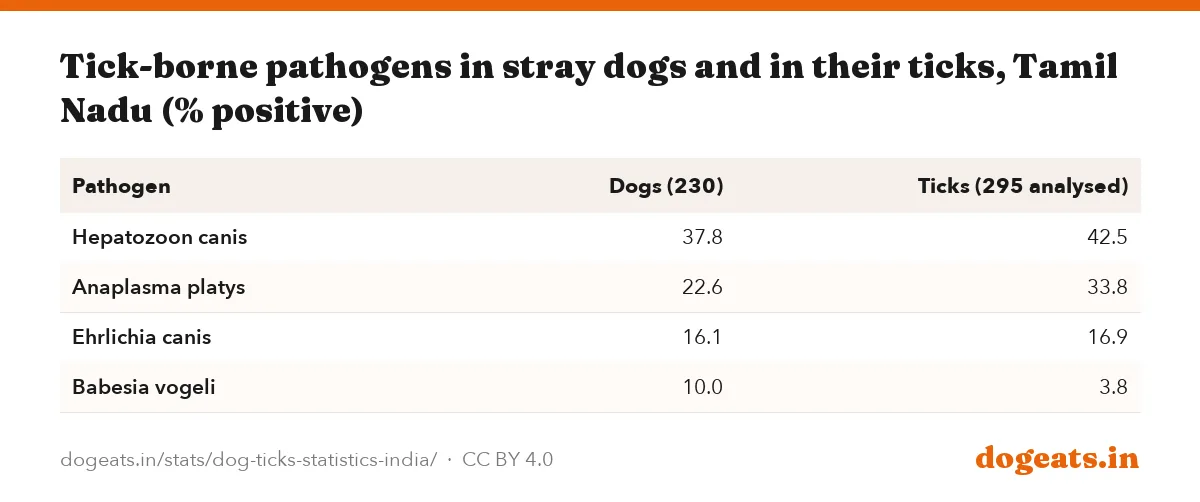
The ticks themselves carry the parasites. In Tamil Nadu, 215 brown dog ticks, 75.4% of those tested, held at least one pathogen. The team analysed 295 ticks in all. Hepatozoon canis was found in 42.5% of ticks and 37.8% of the dogs.
Pati et al. 2026, Veterinary and Animal Science. 73 dogs with ticks, 247 without, all with a history of ticks. Multiplex PCR.
Show the numbers
| Label | % of dogs |
|---|---|
| Anaplasma platys: ticks on dog | 43.8% |
| Anaplasma platys: no ticks | 8.1% |
| Babesia gibsoni: ticks on dog | 31.5% |
| Babesia gibsoni: no ticks | 9.3% |
| Ehrlichia canis: ticks on dog | 17.8% |
| Ehrlichia canis: no ticks | 6.5% |
| Hepatozoon canis: ticks on dog | 9.6% |
| Hepatozoon canis: no ticks | 0.8% |
| Babesia vogeli: ticks on dog | 1.4% |
| Babesia vogeli: no ticks | 0.8% |
Embed this chart
| Pathogen | Dogs (230) | Ticks (295 analysed) |
|---|---|---|
| Hepatozoon canis | 37.8 | 42.5 |
| Anaplasma platys | 22.6 | 33.8 |
| Ehrlichia canis | 16.1 | 16.9 |
| Babesia vogeli | 10.0 | 3.8 |
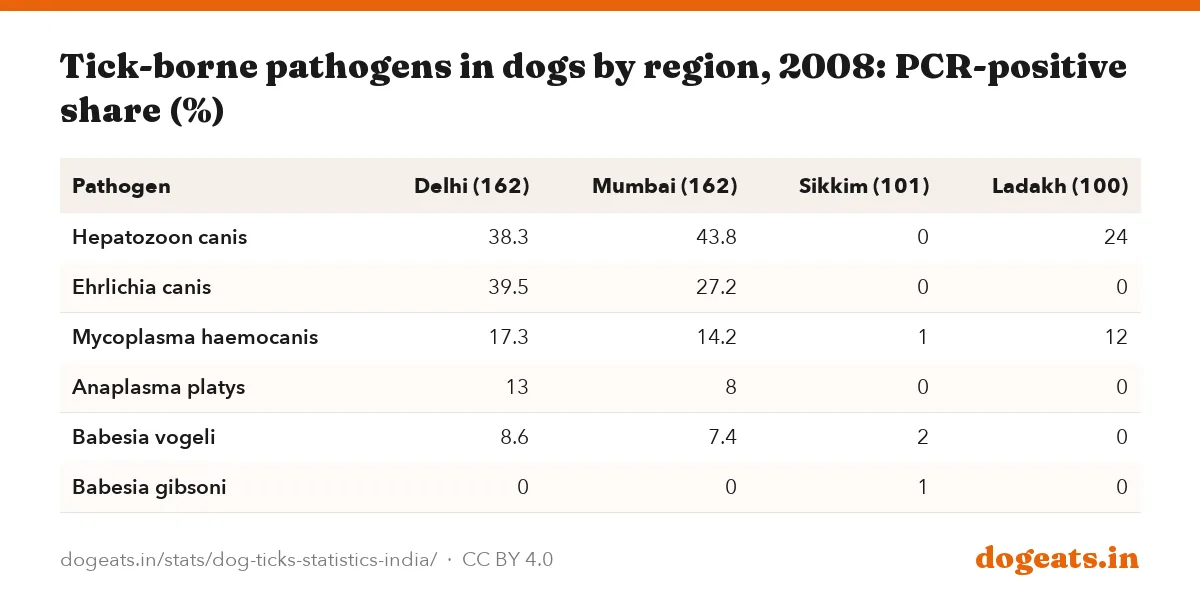
| Pathogen | Delhi (162) | Mumbai (162) | Sikkim (101) | Ladakh (100) |
|---|---|---|---|---|
| Hepatozoon canis | 38.3 | 43.8 | 0 | 24 |
| Ehrlichia canis | 39.5 | 27.2 | 0 | 0 |
| Mycoplasma haemocanis | 17.3 | 14.2 | 1 | 12 |
| Anaplasma platys | 13 | 8 | 0 | 0 |
| Babesia vogeli | 8.6 | 7.4 | 2 | 0 |
| Babesia gibsoni | 0 | 0 | 1 | 0 |
Regions with more ticks had more infection. Delhi and Mumbai dogs were far more likely to carry tick-borne pathogens than dogs in Sikkim and Ladakh, Abd Rani found. Our parvo and tick fever report has the full list of Indian tick fever studies. See a vet if a dog has fever, pale gums or bleeding after ticks.
Are dog ticks in India becoming resistant to treatments?
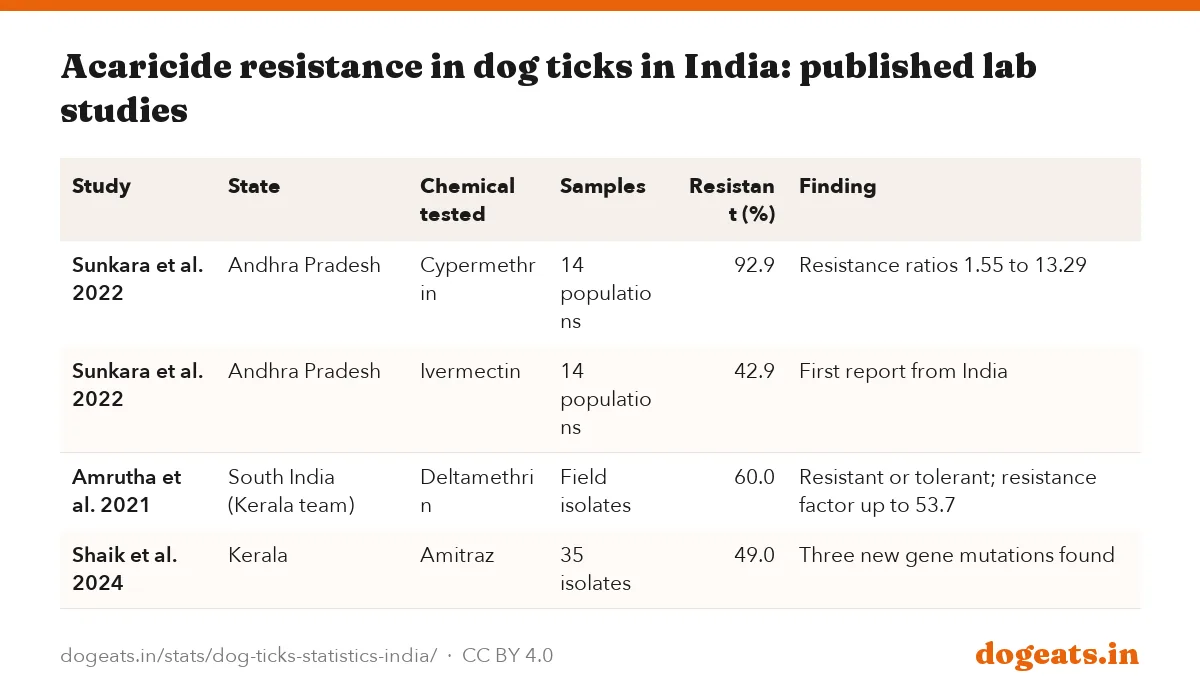
Lab tests from south India say many are. In Andhra Pradesh, Sunkara et al. (2022) tested 14 tick populations from dogs. Thirteen (92.9%) were resistant to cypermethrin and six (42.9%) to ivermectin, the first ivermectin resistance reported from India.
A Kerala veterinary college team, Amrutha et al. (2021), found 60% of south Indian brown dog tick isolates resistant or tolerant to deltamethrin. Shaik et al. (2024) found 49% of 35 Kerala isolates resistant to amitraz.
The authors linked resistance to heavy, repeated use of the same chemicals. Veterinarians had reported treatment failures before these studies. Which product suits a dog is a question for your vet, not this report.
Sunkara et al. 2022 (Andhra Pradesh, 14 populations); Amrutha et al. 2021 (south India, Kerala team) and Shaik et al. 2024 (Kerala). Larval lab tests.
Show the numbers
| Label | % of samples |
|---|---|
| Cypermethrin, Andhra Pradesh (13 of 14 populations) | 92.9% |
| Deltamethrin, south India (resistant or tolerant isolates) | 60.0% |
| Amitraz, Kerala (35 isolates) | 49.0% |
| Ivermectin, Andhra Pradesh (6 of 14 populations) | 42.9% |
Embed this chart
| Study | State | Chemical tested | Samples | Resistant (%) | Finding |
|---|---|---|---|---|---|
| Sunkara et al. 2022 | Andhra Pradesh | Cypermethrin | 14 populations | 92.9 | Resistance ratios 1.55 to 13.29 |
| Sunkara et al. 2022 | Andhra Pradesh | Ivermectin | 14 populations | 42.9 | First report from India |
| Amrutha et al. 2021 | South India (Kerala team) | Deltamethrin | Field isolates | 60.0 | Resistant or tolerant; resistance factor up to 53.7 |
| Shaik et al. 2024 | Kerala | Amitraz | 35 isolates | 49.0 | Three new gene mutations found |
These are lab results on tick larvae, not field trials on dogs. They show why the same product can fail in one neighbourhood and work in another.
Which dog breeds do our guides flag for ticks?
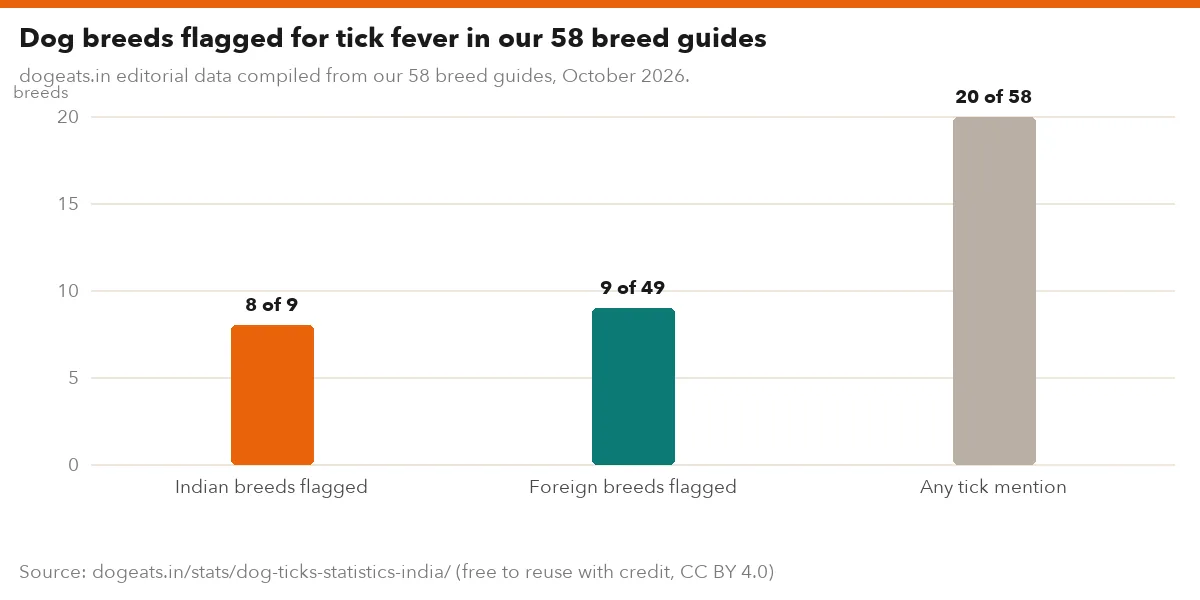
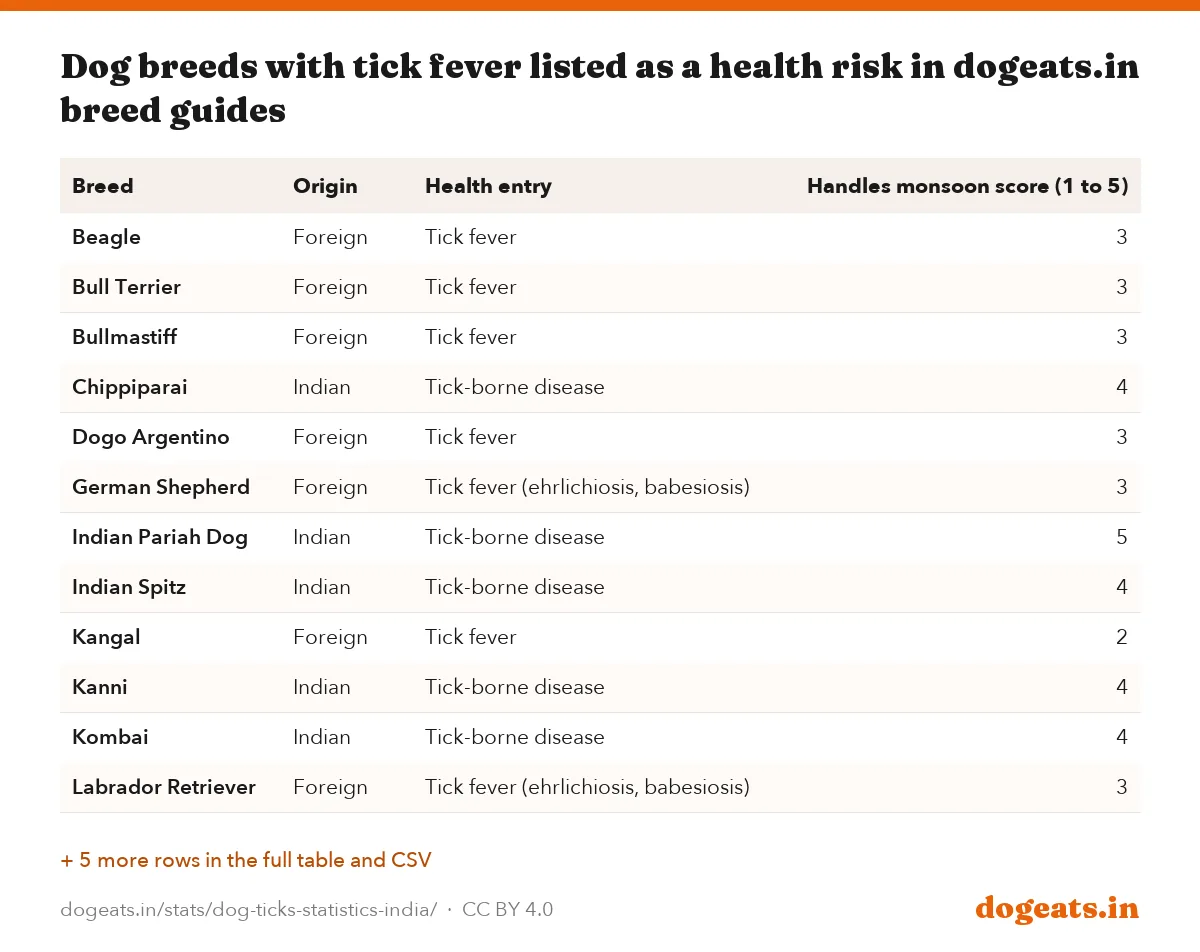
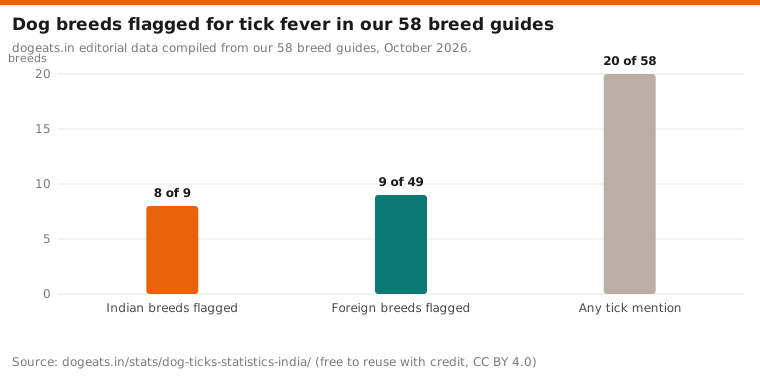
Our 58 breed guides name tick fever or tick-borne disease as a health risk for 17 breeds. That includes 8 of our 9 Indian breeds, mostly short-coated hounds and working dogs that live outdoors.
Ticks come up somewhere in 20 guides in all, in the health, grooming or exercise advice. These are dogeats.in editorial flags, not measured rates, and no study we found ranks Indian breeds by tick burden.
dogeats.in editorial data compiled from our 58 breed guides, October 2026.
Show the numbers
| Label | breeds |
|---|---|
| Indian breeds flagged | 8 of 9 |
| Foreign breeds flagged | 9 of 49 |
| Any tick mention | 20 of 58 |
Embed this chart
| Breed | Origin | Health entry | Handles monsoon score (1 to 5) |
|---|---|---|---|
| Beagle | Foreign | Tick fever | 3 |
| Bull Terrier | Foreign | Tick fever | 3 |
| Bullmastiff | Foreign | Tick fever | 3 |
| Chippiparai | Indian | Tick-borne disease | 4 |
| Dogo Argentino | Foreign | Tick fever | 3 |
| German Shepherd | Foreign | Tick fever (ehrlichiosis, babesiosis) | 3 |
| Indian Pariah Dog | Indian | Tick-borne disease | 5 |
| Indian Spitz | Indian | Tick-borne disease | 4 |
| Kangal | Foreign | Tick fever | 2 |
| Kanni | Indian | Tick-borne disease | 4 |
| Kombai | Indian | Tick-borne disease | 4 |
| Labrador Retriever | Foreign | Tick fever (ehrlichiosis, babesiosis) | 3 |
| Mudhol Hound | Indian | Tick-borne disease | 4 |
| Pit Bull | Foreign | Tick fever | 4 |
| Rajapalayam | Indian | Tick-borne disease | 4 |
| Rampur Greyhound | Indian | Tick-borne disease | 4 |
| Rottweiler | Foreign | Tick fever | 3 |
The Indian Pariah dog guide advises year-round tick prevention, and the Labrador and German Shepherd guides list tick fever by name.
Frequently asked questions
How common are ticks on dogs in India?
Very common. Indian field studies found ticks on 11% to 99.6% of dogs examined, with 80% in Mumbai and 75.3% in Delhi in a 2008 survey.
What kind of ticks do dogs get in India?
Mostly the brown dog tick, Rhipicephalus sanguineus. It made up every tick collected in Mumbai, Delhi, Ladakh and Kolkata studies, while Haemaphysalis ticks were common in Sikkim and Assam.
When is tick season for dogs in India?
Ticks are found all year, with a peak in the monsoon in most studies. Guwahati recorded 70.79% of dogs with ticks in the monsoon and 36.92% in winter.
Do pet dogs get ticks?
Yes, but less often than strays. In Guwahati 40.12% of pet dogs had ticks against 92.77% of strays, and in Kolkata 25.79% of companion dogs had them.
Where do ticks hide on a dog?
Ears, head and paws. In a Guwahati study the ears held 28.39% of tick records, the head 18.56% and the paws and toes 17.64%.
Can ticks live in my house?
The brown dog tick can. It is adapted to indoor living, hides in cracks, walls and furniture, and a female lays 1,500 to 4,000 eggs.
Do ticks cause tick fever in dogs?
Ticks spread the parasites behind tick fever. In Odisha, 31.5% of dogs with ticks carried Babesia gibsoni against 9.3% without, so see a vet if a dog has fever or pale gums.
Are dog ticks resistant to tick medicine in India?
Lab studies say many are. Thirteen of 14 Andhra Pradesh tick populations resisted cypermethrin, and 49% of Kerala isolates resisted amitraz, so ask your vet what works locally.
Methodology and limitations
We searched Europe PMC, journal sites and the Krishikosh thesis repository for Indian studies that counted ticks on dogs. We used ten field counts from seven studies in nine places, read in full text where open and as abstracts otherwise, between 16 and 17 October 2026.
Shares were recomputed from counts where papers give both. Where only a percentage was printed, we used it as published. The middle value is the average of the fifth and sixth of the ten shares.
Pathogen shares for Odisha were computed by dogeats.in from the counts in Table 5 of Pati et al. (2026). Resistance shares were computed from the population counts in Sunkara et al. (2022) or taken as printed.
Breed flags are dogeats.in editorial data compiled from our 58 breed guides, October 2026: a breed counts if its health list names tick fever or tick-borne disease.
Sources
- Abd Rani PAM et al., A survey of canine tick-borne diseases in India, Parasites & Vectors 2011;4:141, Ticks on 525 dogs in Mumbai, Delhi, Sikkim and Ladakh; genera; pathogens by city
- Bhowmik P et al., Molecular identification and prevalence of tick infestation in dogs from Guwahati, IJBSM 2024;15(11), 582 dogs: season, category, age, sex
- Manoj RRS et al., Canine vector-borne pathogens from dogs and ticks from Tamil Nadu, India, Acta Tropica 2020, 229 of 230 strays with ticks; pathogens in ticks
- Also consulted: Jena A et al., Incidence of canine tick vectors and molecular detection of haemoparasites, Indian Journal of Animal Research 2021;55(10), Devi P., Tick and tick-borne parasitic diseases of dog in and around Guwahati, Assam Agricultural University thesis, 2022, Kopparthi J et al., Co-infections of major tick-borne pathogens of dogs in Andhra Pradesh, Veterinary Research Forum 2023, Totton SC et al., Stray dog population health in Jodhpur, India, Preventive Veterinary Medicine 2011, Pati M et al., Hexaplex PCR for canine tick-borne pathogens and risk factors, Odisha, Veterinary and Animal Science 2026, Ranganathan K et al., Seasonal climates and abundance of ticks in a district in Tamil Nadu, Vet Parasitol Reg Stud Reports 2025, Patra G et al., Coxiella-like endosymbionts in dogs and ticks infesting dogs in Northeast India, Exp Appl Acarol 2022, Dantas-Torres F., Biology and ecology of the brown dog tick, Parasites & Vectors 2010;3:26, Sunkara P et al., Cypermethrin and ivermectin resistance in Rhipicephalus sanguineus from dogs in south India, Vet Res Commun 2022, Amrutha A et al., Deltamethrin resistant alleles in Rhipicephalus sanguineus in South India, Exp Appl Acarol 2021, Shaik NR et al., Amitraz resistant Rhipicephalus sanguineus in south India, Experimental Parasitology 2024.
Cite, embed and download
This report, its data and its images are free to reuse under a Creative Commons Attribution 4.0 licence. Credit dogeats.in with a link to this page. Every chart has its own embed code, every table has a CSV and an image download, and the images below are ready for social posts, slides and articles.
Cite this report
Link to this report
Every chart and table as an image