Ranking · Updated October 2026
Best dog for a working couple in India: 58 breeds scored on time alone, energy and upkeep
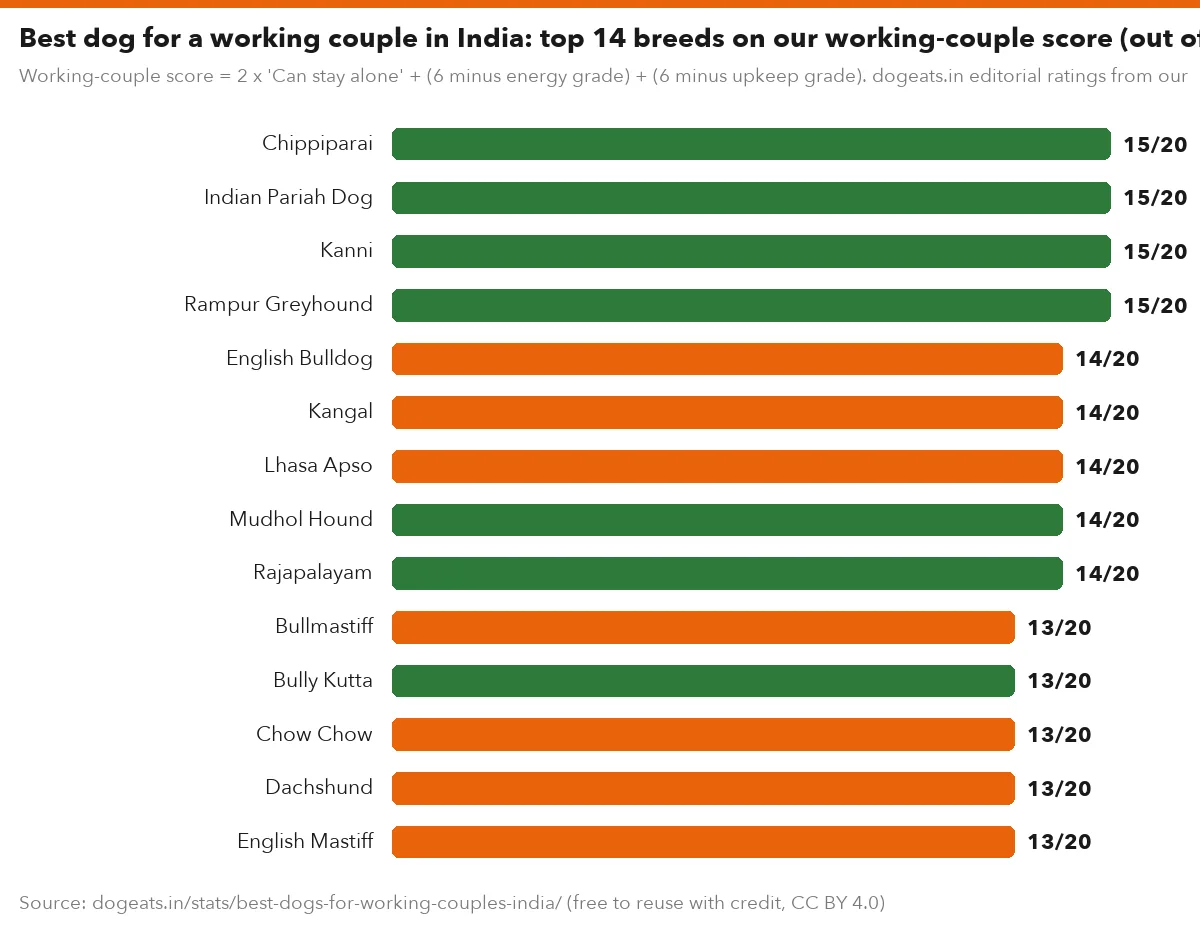
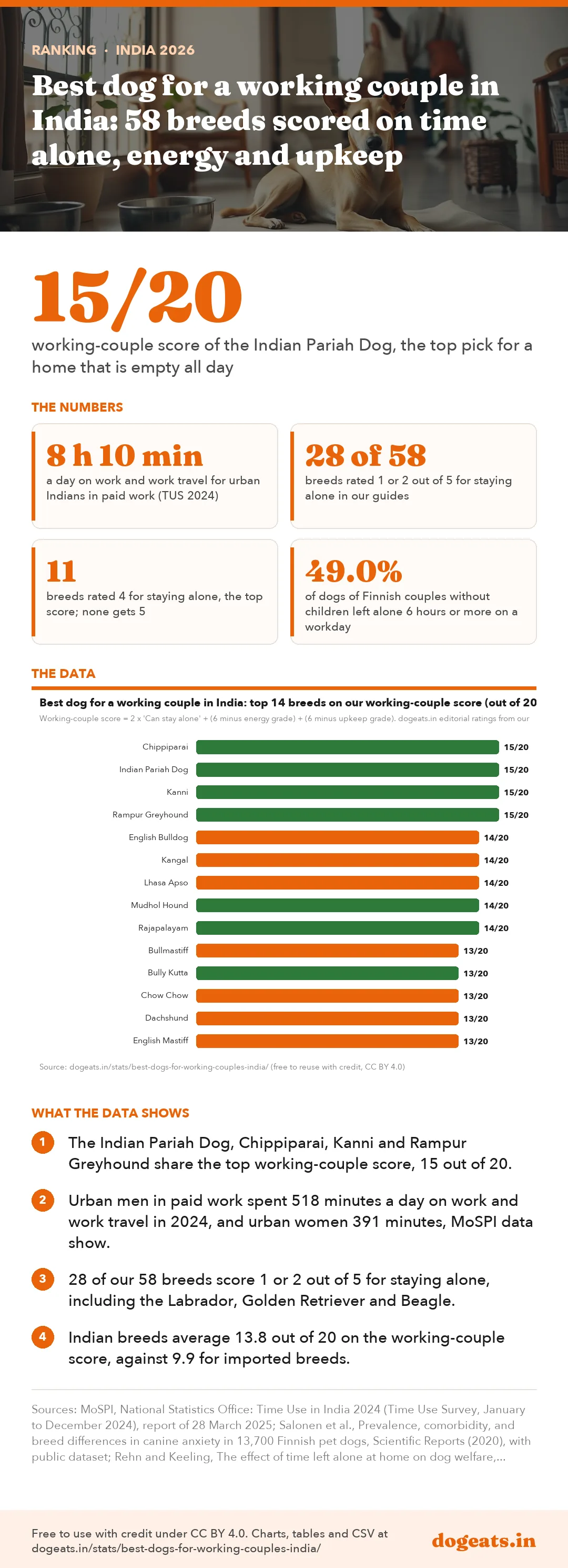
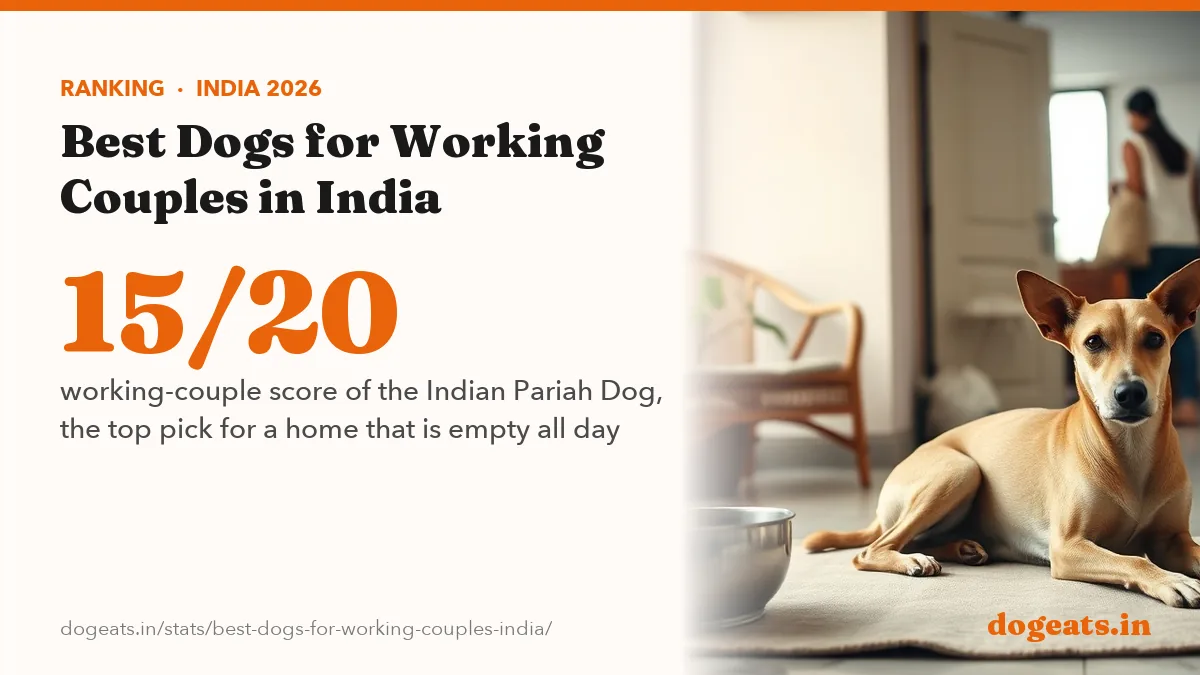
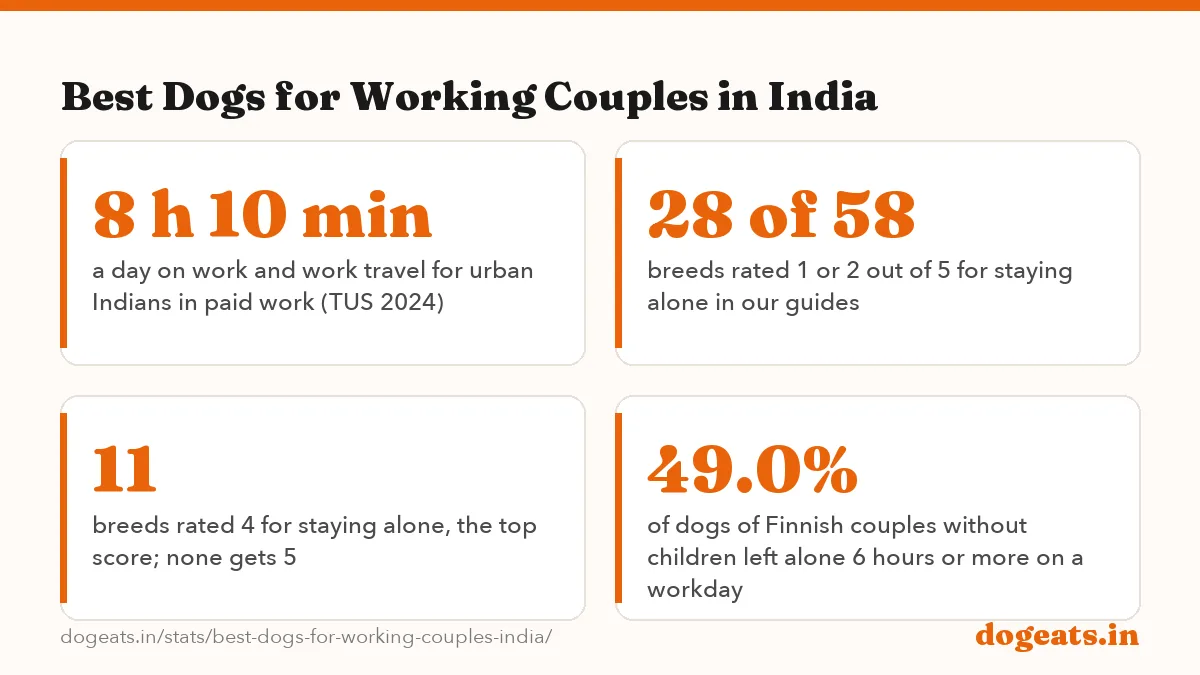
The Indian Pariah Dog is the best dog for a working couple in India on our working-couple score, with 15 out of 20, tied with three Indian sighthounds. It copes with time alone and needs only moderate exercise and light grooming. Urban Indians who do paid work spend 490 minutes, or 8 hours 10 minutes, a day on work and work travel, MoSPI's Time Use Survey 2024 shows.
Key findings
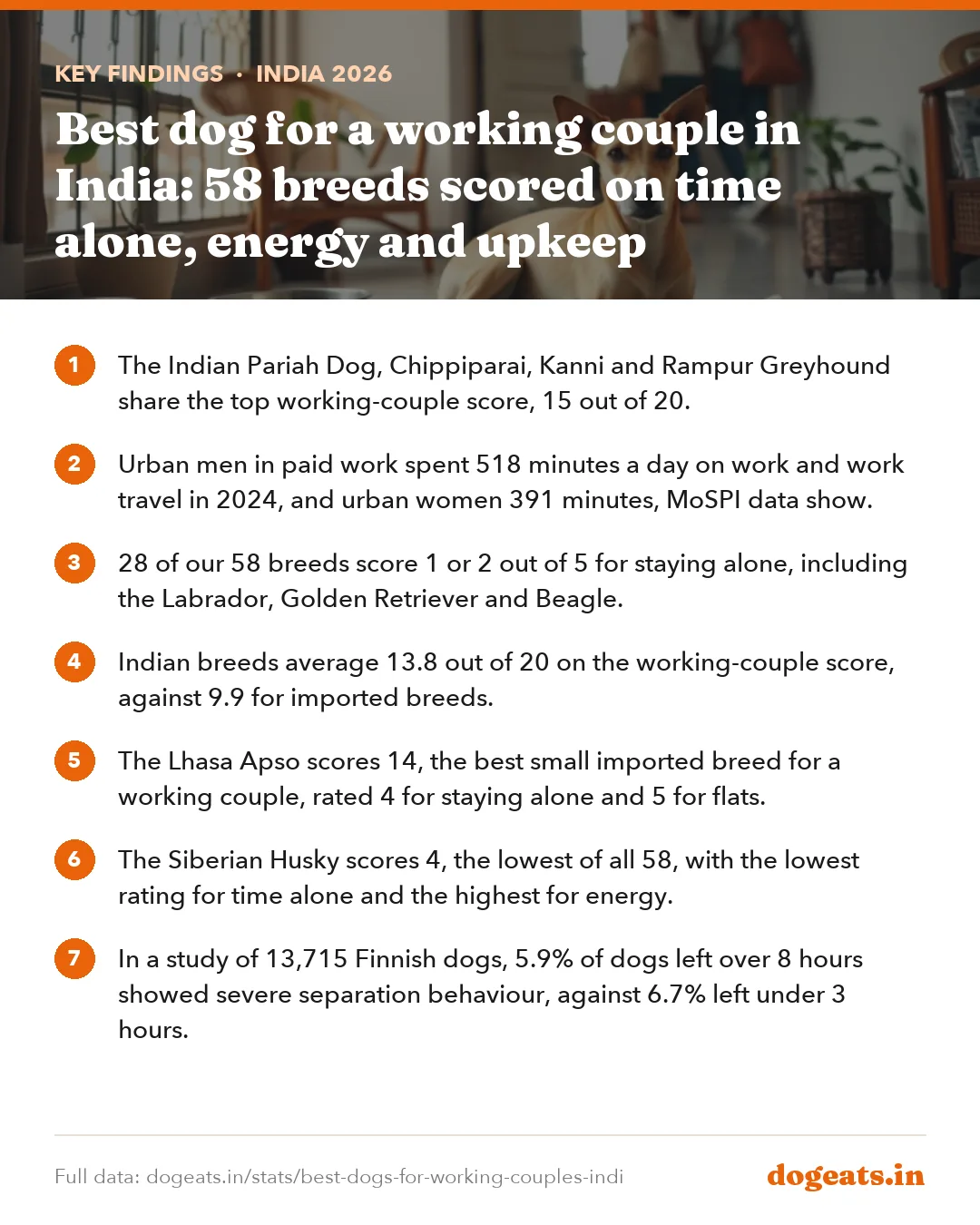
- The Indian Pariah Dog, Chippiparai, Kanni and Rampur Greyhound share the top working-couple score, 15 out of 20.
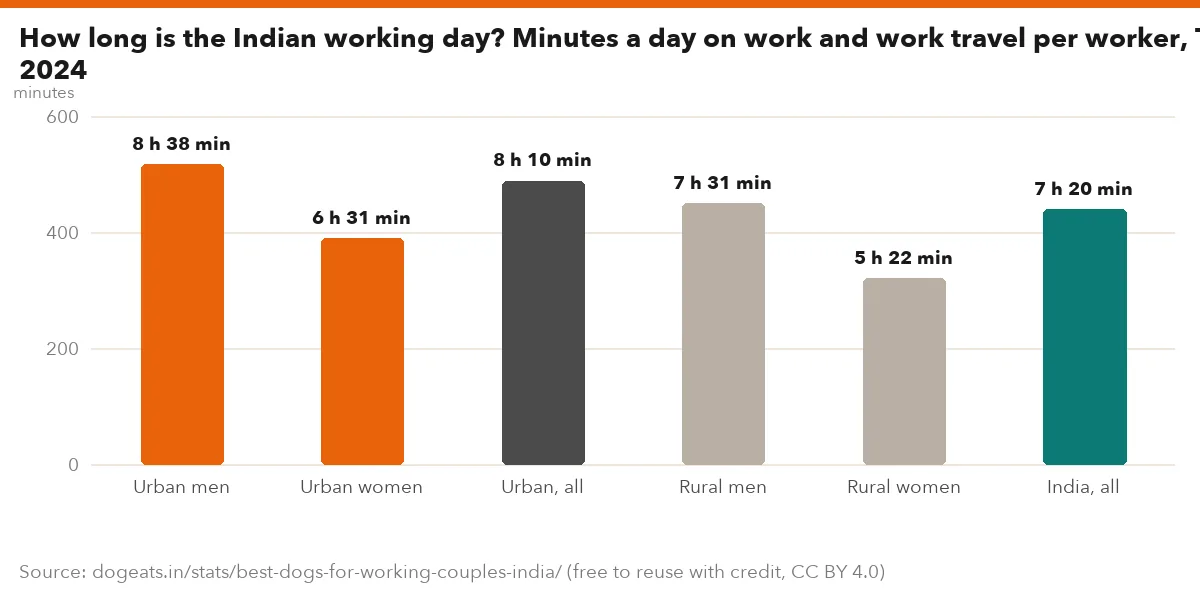
- Urban men in paid work spent 518 minutes a day on work and work travel in 2024, and urban women 391 minutes, MoSPI data show.
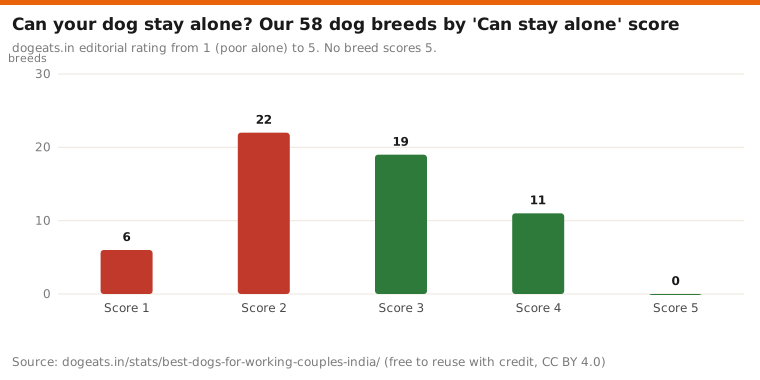
- 28 of our 58 breeds score 1 or 2 out of 5 for staying alone, including the Labrador, Golden Retriever and Beagle.
- Indian breeds average 13.8 out of 20 on the working-couple score, against 9.9 for imported breeds.
- The Lhasa Apso scores 14, the best small imported breed for a working couple, rated 4 for staying alone and 5 for flats.
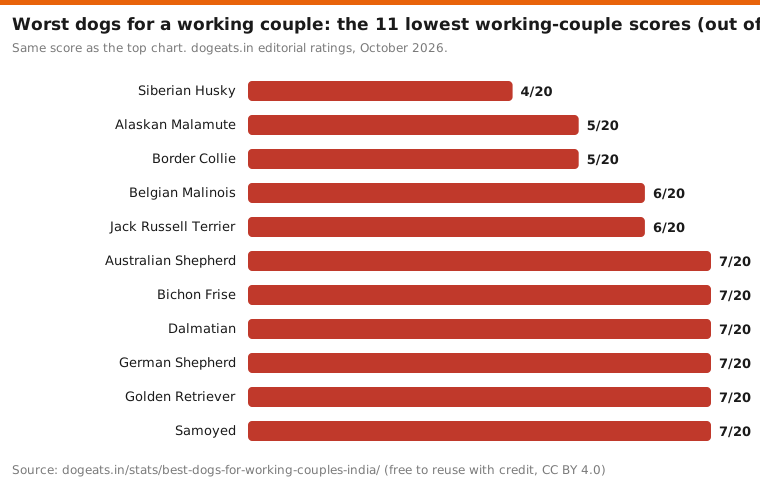
- The Siberian Husky scores 4, the lowest of all 58, with the lowest rating for time alone and the highest for energy.
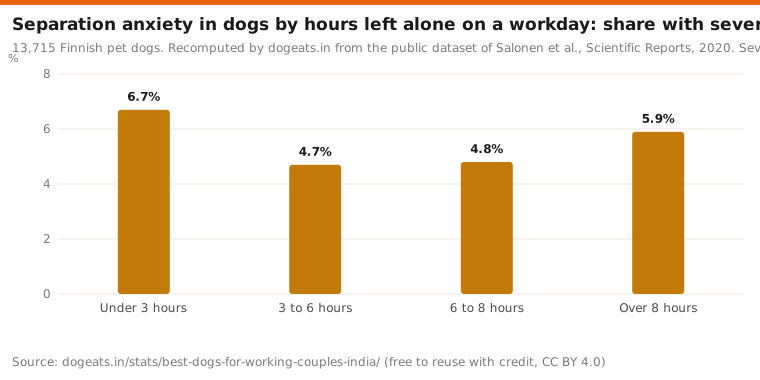
- In a study of 13,715 Finnish dogs, 5.9% of dogs left over 8 hours showed severe separation behaviour, against 6.7% left under 3 hours.
- In a Swedish study of 12 dogs, greetings were more intense after 2 and 4 hours alone than after 30 minutes.
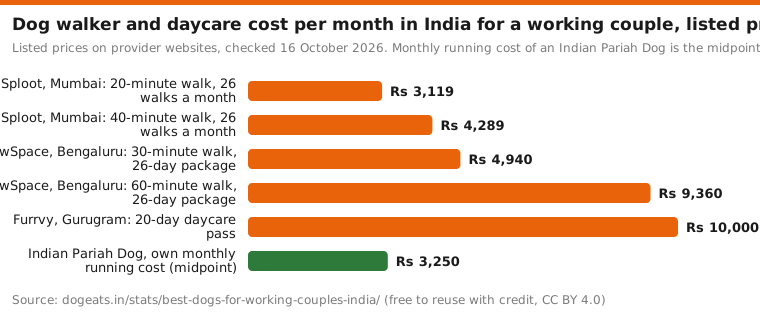
- A 40-minute daily walker plan in Mumbai lists at Rs 4,289 a month, more than the Rs 3,250 midpoint monthly cost of a Pariah dog.
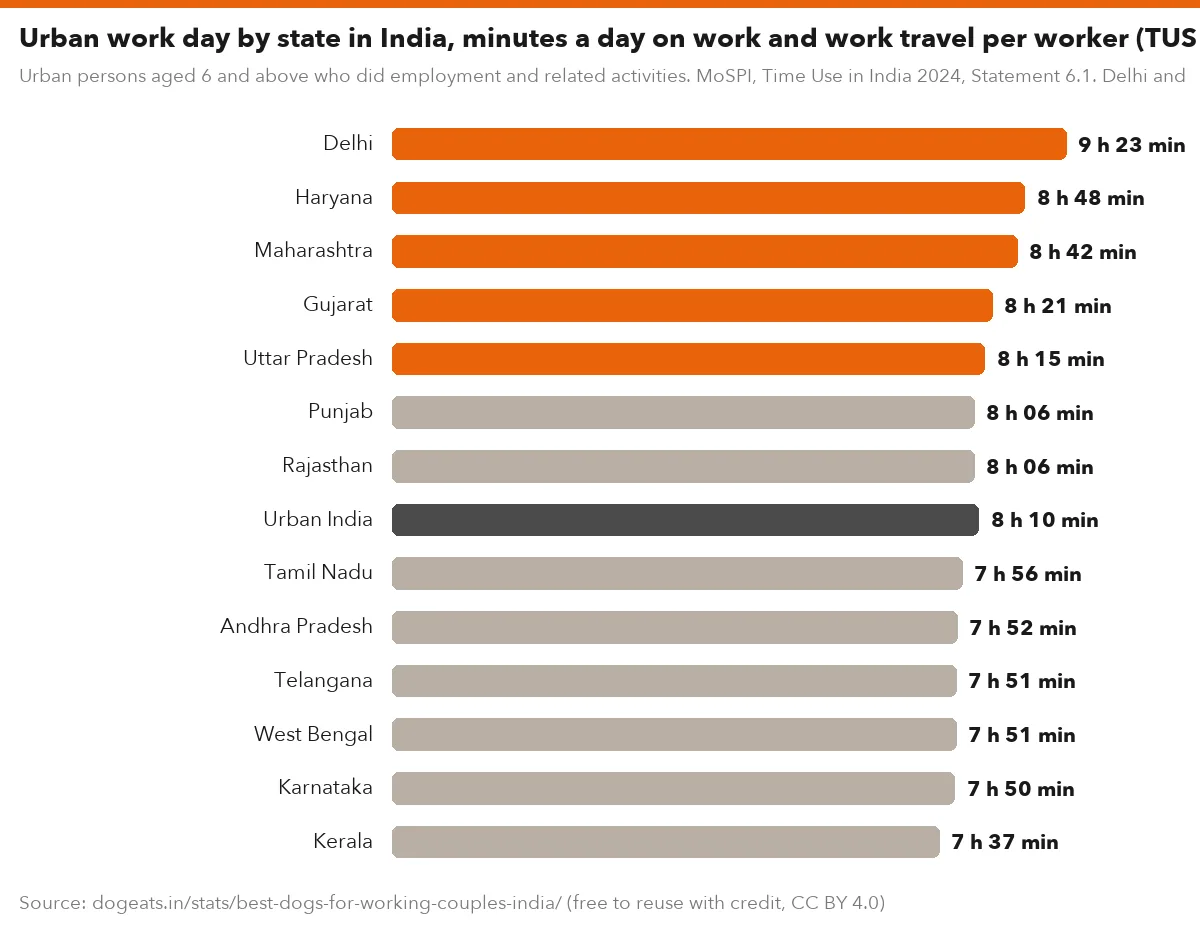
- Delhi has the longest urban work day of any large state or UT, 563 minutes, or 9 hours 23 minutes, MoSPI data show.
Which is the best dog for a working couple in India?
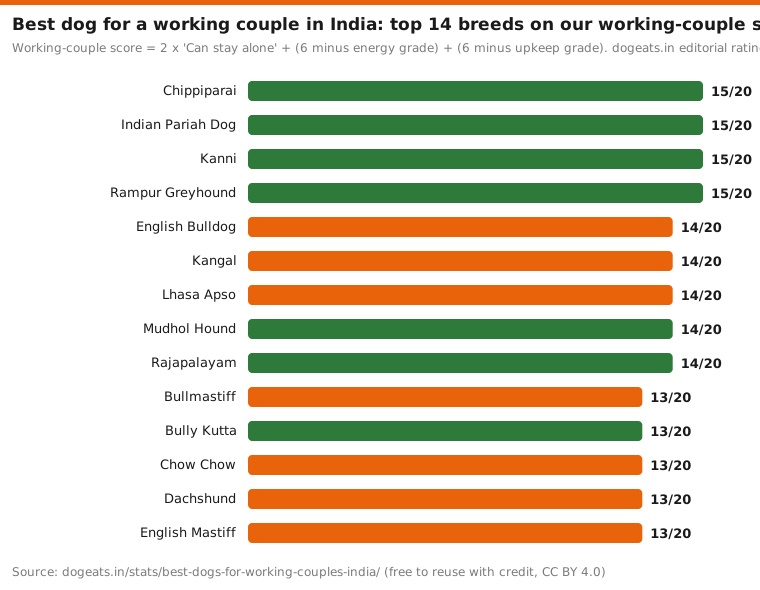
The Indian Pariah Dog is the best all-round dog for a working couple, with 15 out of 20 on our working-couple score. Three Indian sighthounds tie with it: the Chippiparai, Kanni and Rampur Greyhound.
The score asks three questions. Can the dog stay alone, how much exercise does it need before and after work, and how much brushing and clipping does its coat demand? Staying alone counts double, because it decides whether the dog is calm for eight hours or not.
The Pariah is the clearest pick because it also suits a flat and a first-time owner. It is rated 4 for flats and 4 for beginners, while the three sighthounds score 2 for flats and 3 for beginners. Its guide calls it "generally calm when left, which is unusual among companion dogs".
Working-couple score = 2 x 'Can stay alone' + (6 minus energy grade) + (6 minus upkeep grade). dogeats.in editorial ratings from our breed guides, October 2026. Green: Indian breed.
Show the numbers
| Label | score |
|---|---|
| Chippiparai | 15/20 |
| Indian Pariah Dog | 15/20 |
| Kanni | 15/20 |
| Rampur Greyhound | 15/20 |
| English Bulldog | 14/20 |
| Kangal | 14/20 |
| Lhasa Apso | 14/20 |
| Mudhol Hound | 14/20 |
| Rajapalayam | 14/20 |
| Bullmastiff | 13/20 |
| Bully Kutta | 13/20 |
| Chow Chow | 13/20 |
| Dachshund | 13/20 |
| English Mastiff | 13/20 |
Embed this chart
The top 14 include guardians such as the Kangal and Bully Kutta. They cope alone but score 1 out of 5 for beginners, so they are not first dogs for a busy couple in a flat. The English Bulldog scores 14 because it is sleepy and placid, but it scores 1 out of 5 for coping without AC.
How long are Indian working days?
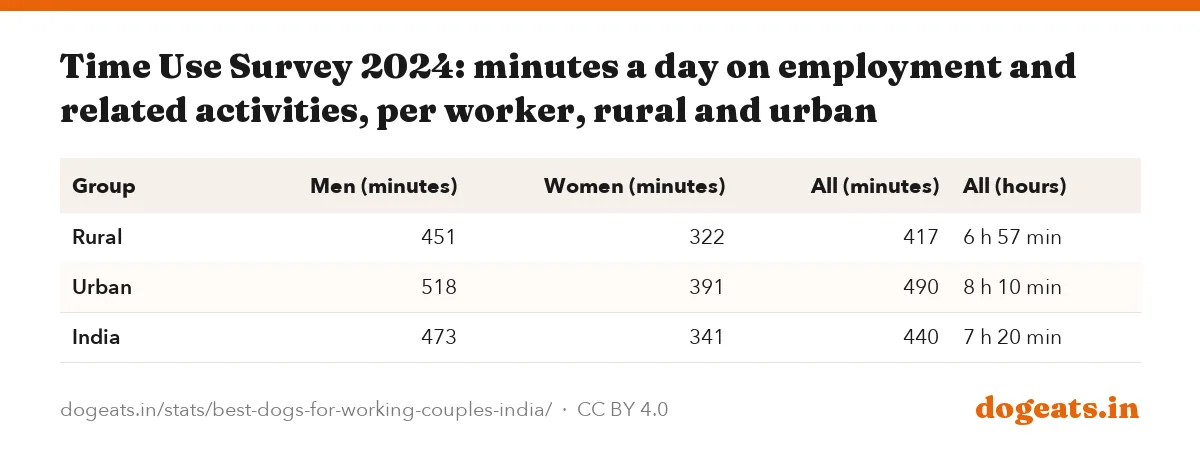
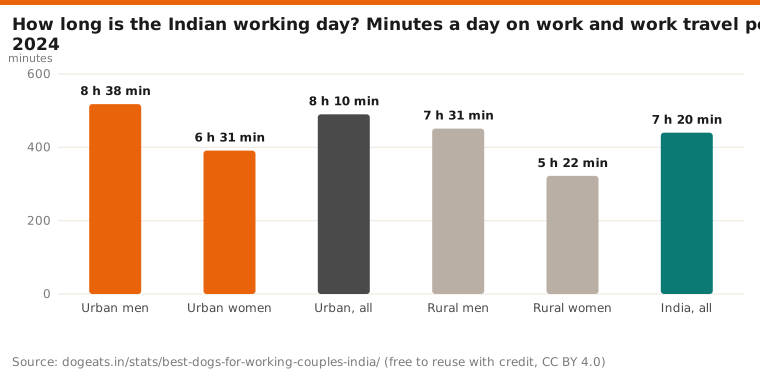
Long. Urban Indians who did paid work on the survey day spent 490 minutes on employment and related activities, about 8 hours 10 minutes, MoSPI's Time Use Survey 2024 found. The survey counts work travel and commuting in that category.
Urban men spent 518 minutes, or 8 h 38 min, and urban women 391 minutes, or 6 h 31 min. Urban women who did housework also spent 285 minutes a day on it, against 88 minutes for urban men. Rural workers spent 417 minutes on paid work.
Commuting alone took male commuters aged 15 to 59 an average of 77 minutes a day and female commuters 67 minutes. The survey covered 1,39,487 households and 4,54,192 people aged 6 and above from January to December 2024.
Average minutes a day per participant aged 6 and above in employment and related activities. MoSPI, Time Use in India 2024, Statement 2.
Show the numbers
| Label | minutes |
|---|---|
| Urban men | 8 h 38 min |
| Urban women | 6 h 31 min |
| Urban, all | 8 h 10 min |
| Rural men | 7 h 31 min |
| Rural women | 5 h 22 min |
| India, all | 7 h 20 min |
Embed this chart
| Group | Men (minutes) | Women (minutes) | All (minutes) | All (hours) |
|---|---|---|---|---|
| Rural | 451 | 322 | 417 | 6 h 57 min |
| Urban | 518 | 391 | 490 | 8 h 10 min |
| India | 473 | 341 | 440 | 7 h 20 min |
Work time is rising for some groups. Among people aged 15 to 59 who worked, men spent 480 minutes in 2024 against 470 in 2019, and women 344 against 343. The share of women aged 15 to 59 doing paid work on the survey day rose from 21.8% to 25.0%.
Which Indian cities have the longest work days?
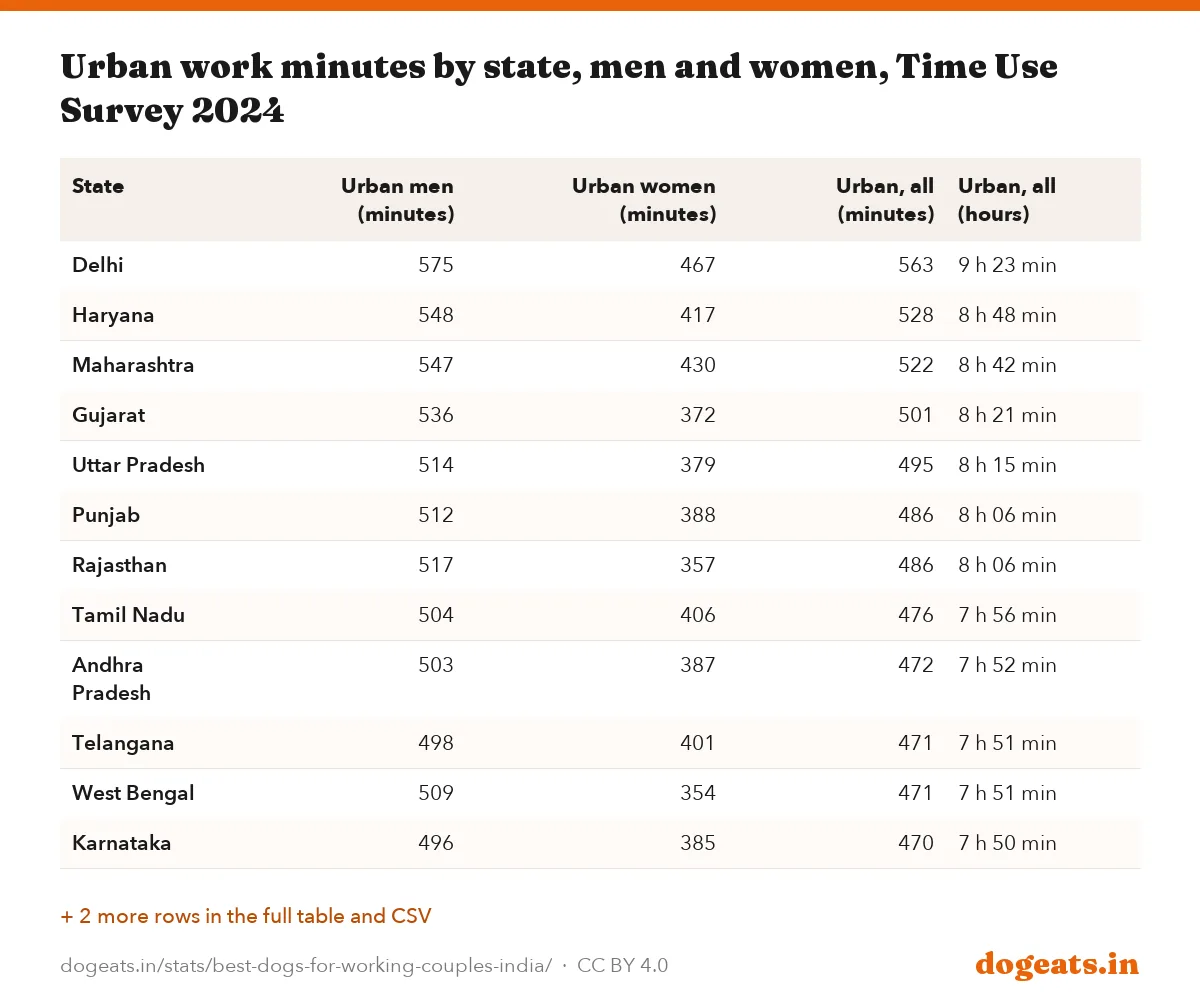
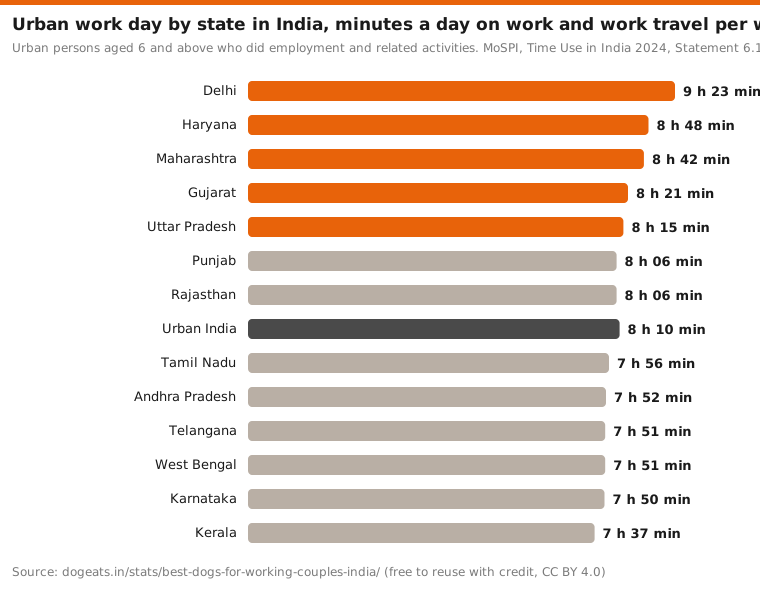
Delhi does, among the large states and UTs. Urban workers there spent 563 minutes a day on work and work travel, or 9 hours 23 minutes. Urban Haryana, which includes Gurugram, followed with 528 minutes and urban Maharashtra with 522. Only the small UT of Dadra and Nagar Haveli and Daman and Diu logged more, 591 minutes.
The southern tech states sit lower. Urban Karnataka logged 470 minutes, urban Telangana 471 and urban Kerala 457. Each is still close to eight hours, before any time to walk a dog.
Urban women in Delhi worked 467 minutes, the most among the states in the chart, against 391 across urban India. In Karnataka, home to Bengaluru, the figure was 385.
Urban persons aged 6 and above who did employment and related activities. MoSPI, Time Use in India 2024, Statement 6.1. Delhi and 13 states with large metro cities, with the urban India average.
Show the numbers
| Label | minutes |
|---|---|
| Delhi | 9 h 23 min |
| Haryana | 8 h 48 min |
| Maharashtra | 8 h 42 min |
| Gujarat | 8 h 21 min |
| Uttar Pradesh | 8 h 15 min |
| Punjab | 8 h 06 min |
| Rajasthan | 8 h 06 min |
| Urban India | 8 h 10 min |
| Tamil Nadu | 7 h 56 min |
| Andhra Pradesh | 7 h 52 min |
| Telangana | 7 h 51 min |
| West Bengal | 7 h 51 min |
| Karnataka | 7 h 50 min |
| Kerala | 7 h 37 min |
Embed this chart
| State | Urban men (minutes) | Urban women (minutes) | Urban, all (minutes) | Urban, all (hours) |
|---|---|---|---|---|
| Delhi | 575 | 467 | 563 | 9 h 23 min |
| Haryana | 548 | 417 | 528 | 8 h 48 min |
| Maharashtra | 547 | 430 | 522 | 8 h 42 min |
| Gujarat | 536 | 372 | 501 | 8 h 21 min |
| Uttar Pradesh | 514 | 379 | 495 | 8 h 15 min |
| Punjab | 512 | 388 | 486 | 8 h 06 min |
| Rajasthan | 517 | 357 | 486 | 8 h 06 min |
| Tamil Nadu | 504 | 406 | 476 | 7 h 56 min |
| Andhra Pradesh | 503 | 387 | 472 | 7 h 52 min |
| Telangana | 498 | 401 | 471 | 7 h 51 min |
| West Bengal | 509 | 354 | 471 | 7 h 51 min |
| Karnataka | 496 | 385 | 470 | 7 h 50 min |
| Kerala | 486 | 392 | 457 | 7 h 37 min |
| Urban India | 518 | 391 | 490 | 8 h 10 min |
How long can a dog be left alone?
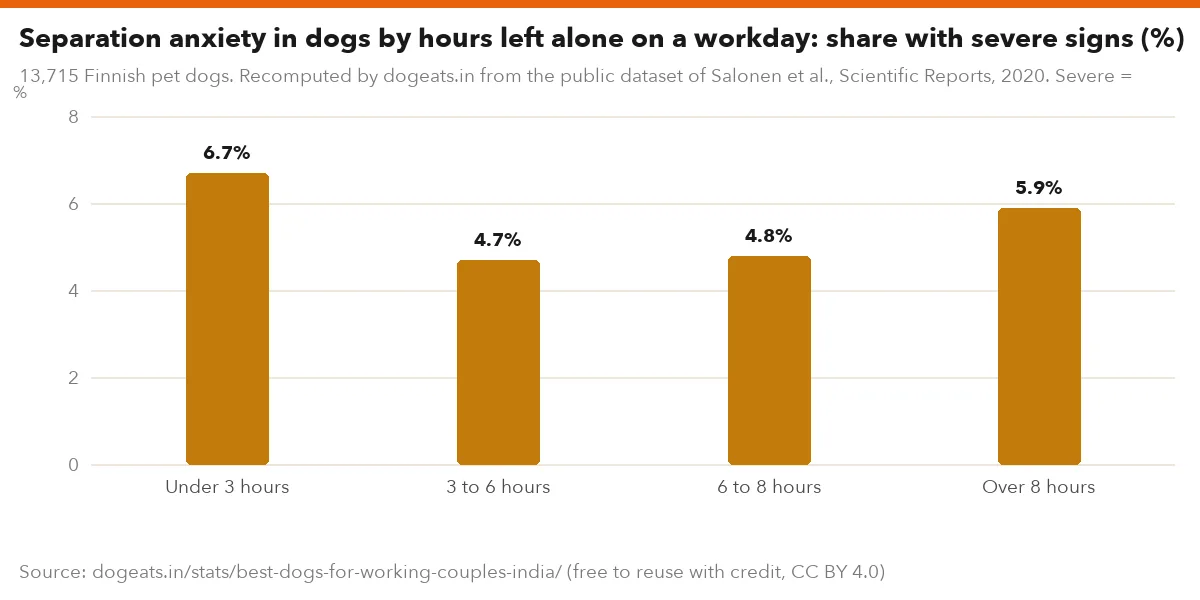
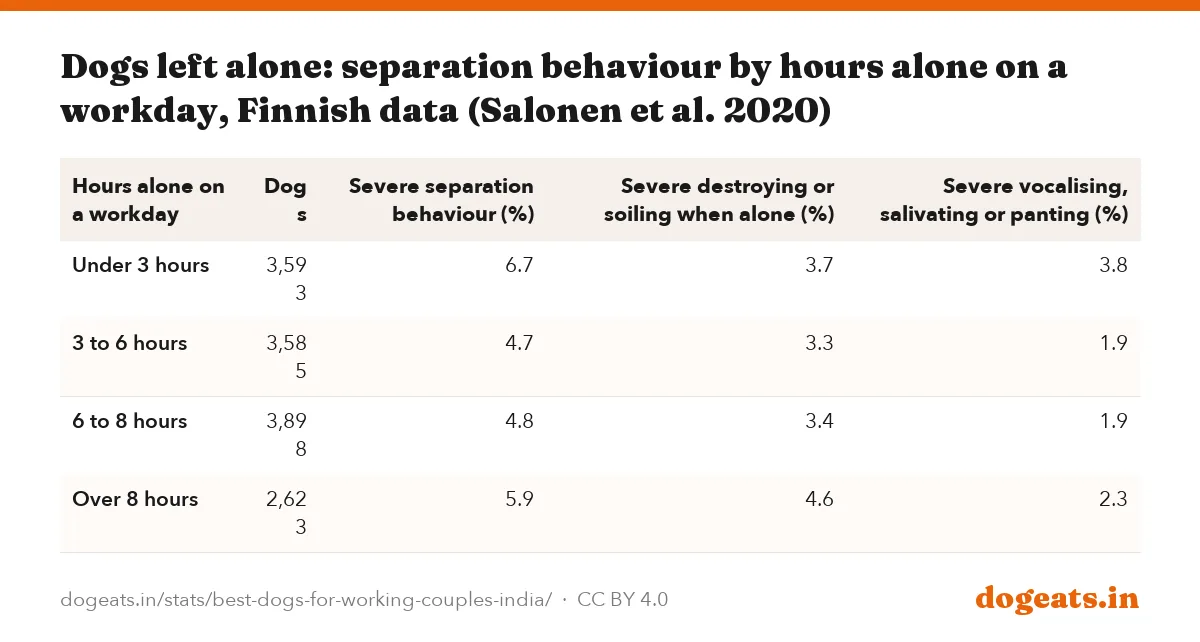
Science gives no safe number of hours. In a Finnish study of 13,715 dogs, severe separation behaviour hit 5.9% of dogs left over 8 hours on a workday. Dogs left under 3 hours were at 6.7%.
Dogs left 3 to 6 hours had the lowest share, 4.7%. The authors did not test cause, and owners of anxious dogs may simply avoid leaving them.
Long days are common in couple homes. In the same data, 49.0% of dogs living with a couple without children were alone 6 hours or more on a workday. Their severe separation share was 5.4%.
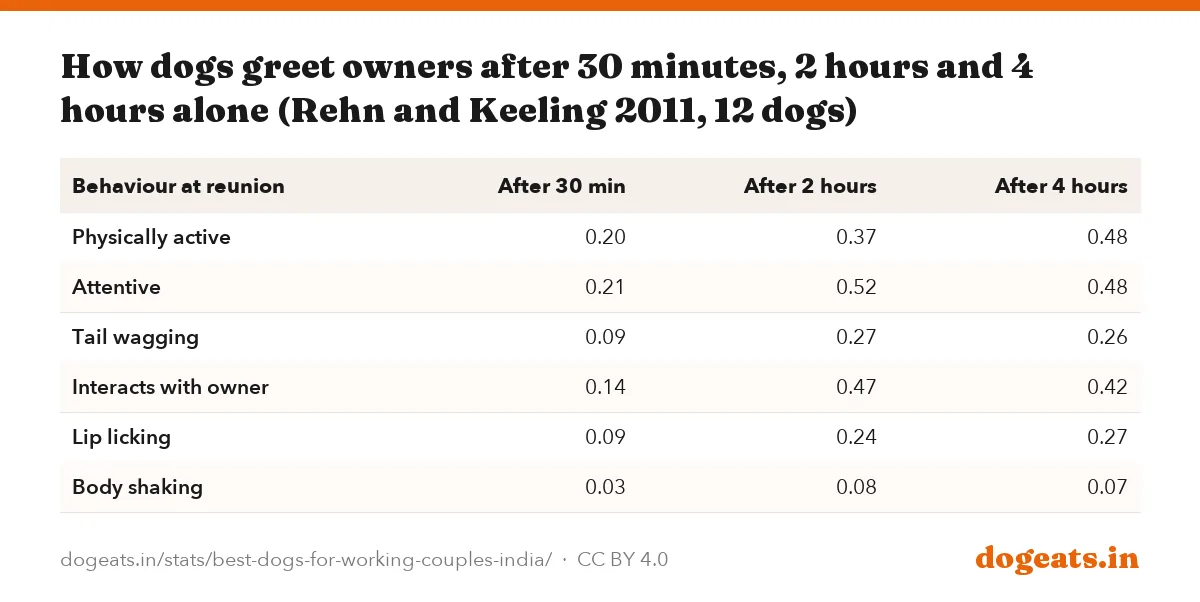
Behaviour on return tells a different story. A Swedish study filmed 12 dogs at home. After 2 or 4 hours alone they wagged their tails and sought contact about three times as often as after 30 minutes. They were inactive for most of the time alone, whatever its length.
Sweden's Board of Agriculture advises that dogs kept indoors be taken out at least every six hours in the daytime. Its rules also say dogs should normally be checked at least twice a day.
13,715 Finnish pet dogs. Recomputed by dogeats.in from the public dataset of Salonen et al., Scientific Reports, 2020. Severe = owner reports separation anxiety plus destruction, soiling, vocalising, salivating or panting.
Show the numbers
| Label | % |
|---|---|
| Under 3 hours | 6.7% |
| 3 to 6 hours | 4.7% |
| 6 to 8 hours | 4.8% |
| Over 8 hours | 5.9% |
Embed this chart
| Hours alone on a workday | Dogs | Severe separation behaviour (%) | Severe destroying or soiling when alone (%) | Severe vocalising, salivating or panting (%) |
|---|---|---|---|---|
| Under 3 hours | 3,593 | 6.7 | 3.7 | 3.8 |
| 3 to 6 hours | 3,585 | 4.7 | 3.3 | 1.9 |
| 6 to 8 hours | 3,898 | 4.8 | 3.4 | 1.9 |
| Over 8 hours | 2,623 | 5.9 | 4.6 | 2.3 |
| Behaviour at reunion | After 30 min | After 2 hours | After 4 hours |
|---|---|---|---|
| Physically active | 0.20 | 0.37 | 0.48 |
| Attentive | 0.21 | 0.52 | 0.48 |
| Tail wagging | 0.09 | 0.27 | 0.26 |
| Interacts with owner | 0.14 | 0.47 | 0.42 |
| Lip licking | 0.09 | 0.24 | 0.27 |
| Body shaking | 0.03 | 0.08 | 0.07 |
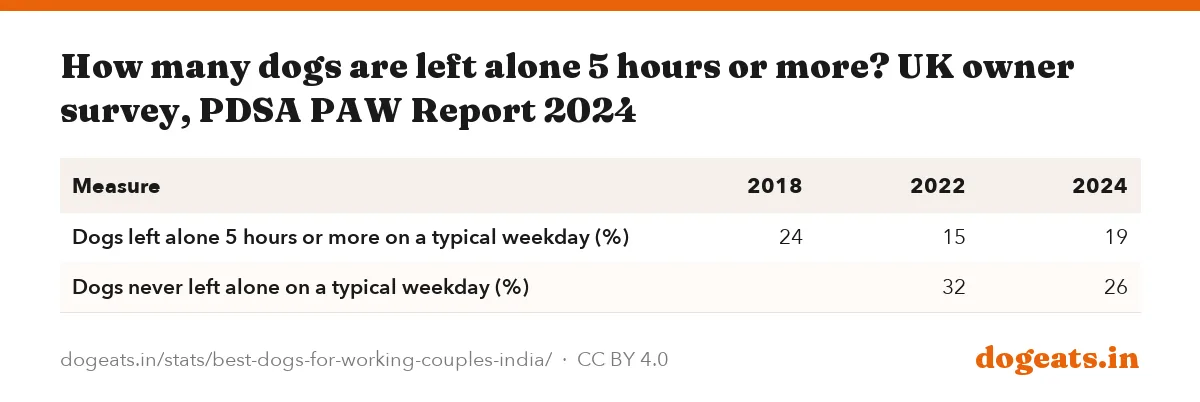
| Measure | 2018 | 2022 | 2024 |
|---|---|---|---|
| Dogs left alone 5 hours or more on a typical weekday (%) | 24 | 15 | 19 |
| Dogs never left alone on a typical weekday (%) | 32 | 26 |
Our separation anxiety report covers breed and age patterns in the Finnish data. The figures above are mean frequencies per 15-second interval in the 10 minutes after the owner returned.
In the UK, 19% of dogs were left alone for five hours or more on a typical weekday in 2024, the PDSA survey with YouGov found. The share was 15% in 2022. PDSA says time alone is returning to 2019 levels, before the pandemic kept many owners at home. Only 8% of dogs left 5 hours or more showed distress when alone, against 12% of dogs left up to 4 hours and 15% of dogs never left.
Which dogs cannot be left alone all day?
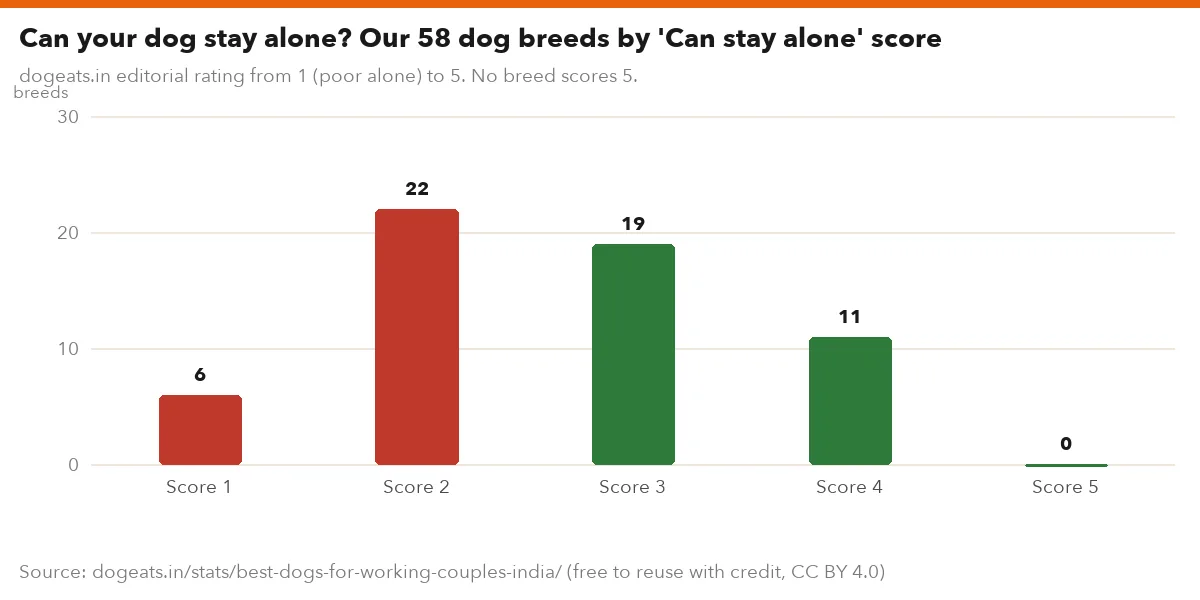
28 of our 58 breeds score 1 or 2 out of 5 for staying alone. Six score the minimum of 1: the Siberian Husky, Border Collie, Alaskan Malamute, Belgian Malinois, Jack Russell Terrier and Bichon Frise.
Popular family dogs are on the list. The Labrador Retriever and Golden Retriever score 2, and so does the Beagle. The Lab's guide warns that "long solo workdays produce barking, chewing and separation anxiety more than in most breeds".
High energy makes it worse. Breeds rated 1 for staying alone average 4.5 on our 5-point energy grade, against 2.7 for breeds rated 3. All 8 breeds with the top energy grade also score 2 or less for staying alone.
dogeats.in editorial rating from 1 (poor alone) to 5. No breed scores 5.
Show the numbers
| Label | breeds |
|---|---|
| Score 1 | 6 |
| Score 2 | 22 |
| Score 3 | 19 |
| Score 4 | 11 |
| Score 5 | 0 |
Embed this chart
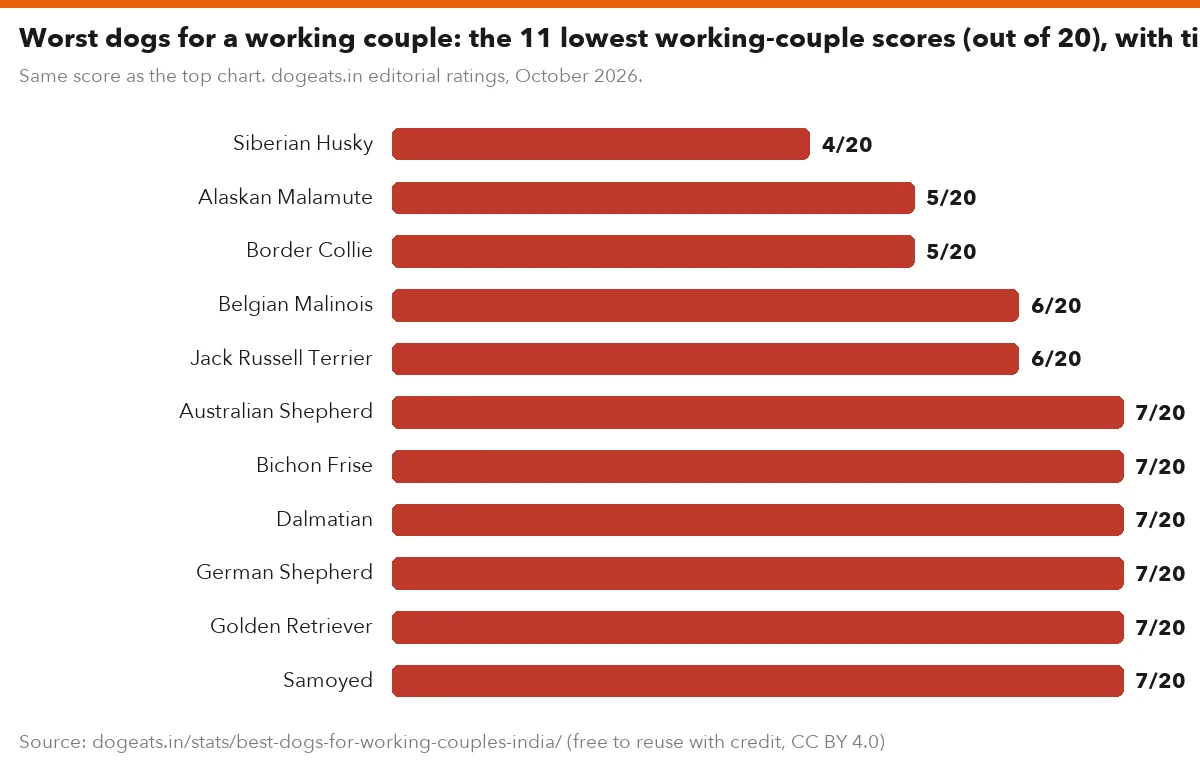
Same score as the top chart. dogeats.in editorial ratings, October 2026.
Show the numbers
| Label | score |
|---|---|
| Siberian Husky | 4/20 |
| Alaskan Malamute | 5/20 |
| Border Collie | 5/20 |
| Belgian Malinois | 6/20 |
| Jack Russell Terrier | 6/20 |
| Australian Shepherd | 7/20 |
| Bichon Frise | 7/20 |
| Dalmatian | 7/20 |
| German Shepherd | 7/20 |
| Golden Retriever | 7/20 |
| Samoyed | 7/20 |
Embed this chart
Bigger is not worse by itself. The Bullmastiff and English Mastiff score 3 for staying alone and rank above the Labrador, with 13 each. Low energy helps them.
What is the best dog for a working couple in a flat?
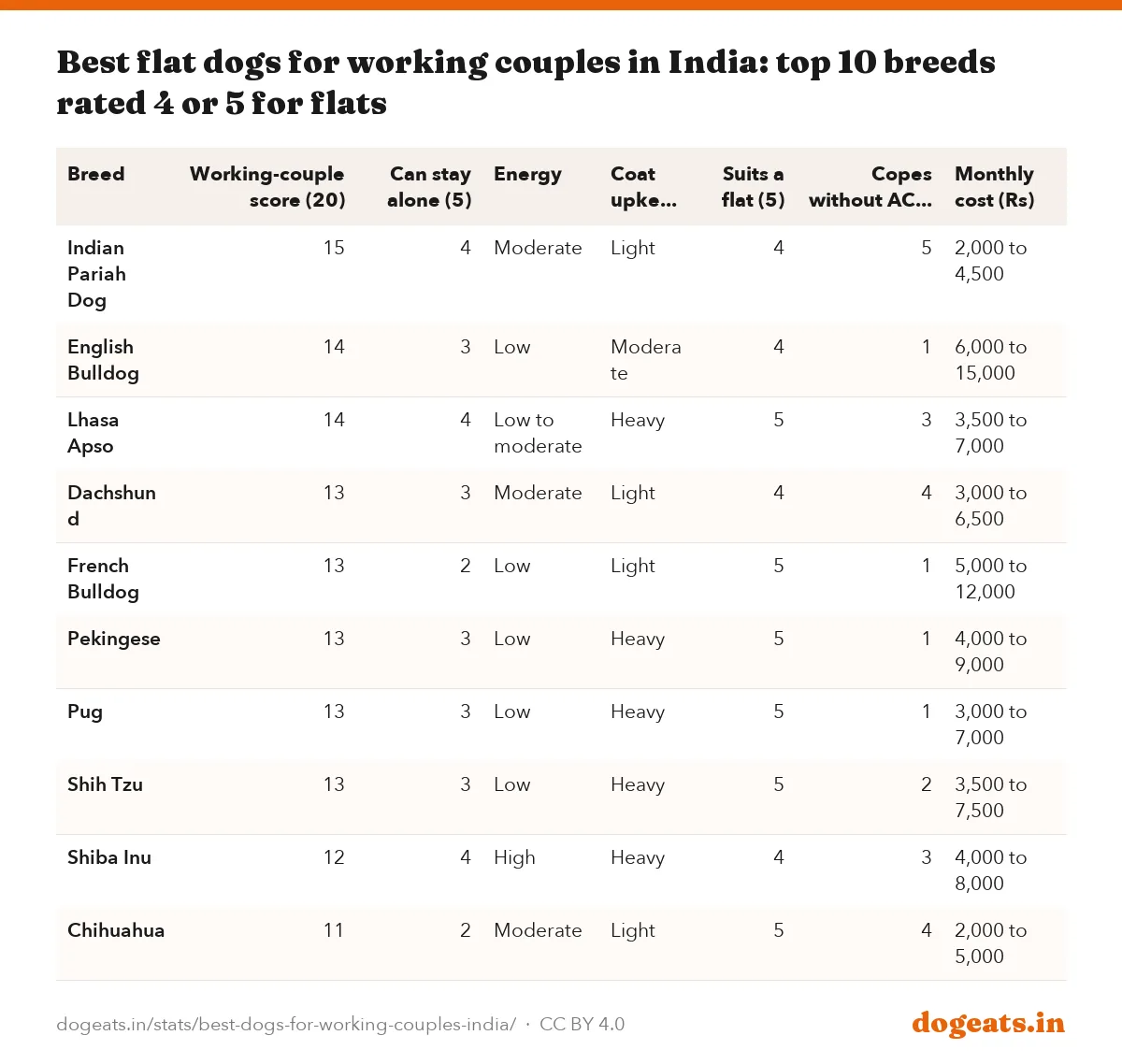
Among breeds rated 4 or 5 for flats, the Indian Pariah Dog leads with 15. The English Bulldog and Lhasa Apso follow on 14, then five breeds on 13, including the Pug and Shih Tzu.
The Lhasa is rated 4 for staying alone, unusual for a small breed. Its guide calls it "independent by heritage, more so than almost any other small companion breed". The catch is the coat, which mats and needs regular grooming.
The Shiba Inu is the other flat dog rated 4 for staying alone, but it scores 12 because of heavy shedding and higher energy. It costs Rs 50,000 to 1,00,000 as a pet-quality puppy. Our flats ranking scores every breed for apartment life.
| Breed | Working-couple score (20) | Can stay alone (5) | Energy | Coat upkeep | Suits a flat (5) | Copes without AC (5) | Monthly cost (Rs) |
|---|---|---|---|---|---|---|---|
| Indian Pariah Dog | 15 | 4 | Moderate | Light | 4 | 5 | 2,000 to 4,500 |
| English Bulldog | 14 | 3 | Low | Moderate | 4 | 1 | 6,000 to 15,000 |
| Lhasa Apso | 14 | 4 | Low to moderate | Heavy | 5 | 3 | 3,500 to 7,000 |
| Dachshund | 13 | 3 | Moderate | Light | 4 | 4 | 3,000 to 6,500 |
| French Bulldog | 13 | 2 | Low | Light | 5 | 1 | 5,000 to 12,000 |
| Pekingese | 13 | 3 | Low | Heavy | 5 | 1 | 4,000 to 9,000 |
| Pug | 13 | 3 | Low | Heavy | 5 | 1 | 3,000 to 7,000 |
| Shih Tzu | 13 | 3 | Low | Heavy | 5 | 2 | 3,500 to 7,500 |
| Shiba Inu | 12 | 4 | High | Heavy | 4 | 3 | 4,000 to 8,000 |
| Chihuahua | 11 | 2 | Moderate | Light | 5 | 4 | 2,000 to 5,000 |
Heat matters when nobody is home to switch on the AC. Of the top 10 flat dogs above, 5 score 2 or less for coping without AC, including the Pug and Shih Tzu. Our guides advise a cool room for these breeds.
How much does a dog walker or daycare cost for a working couple?
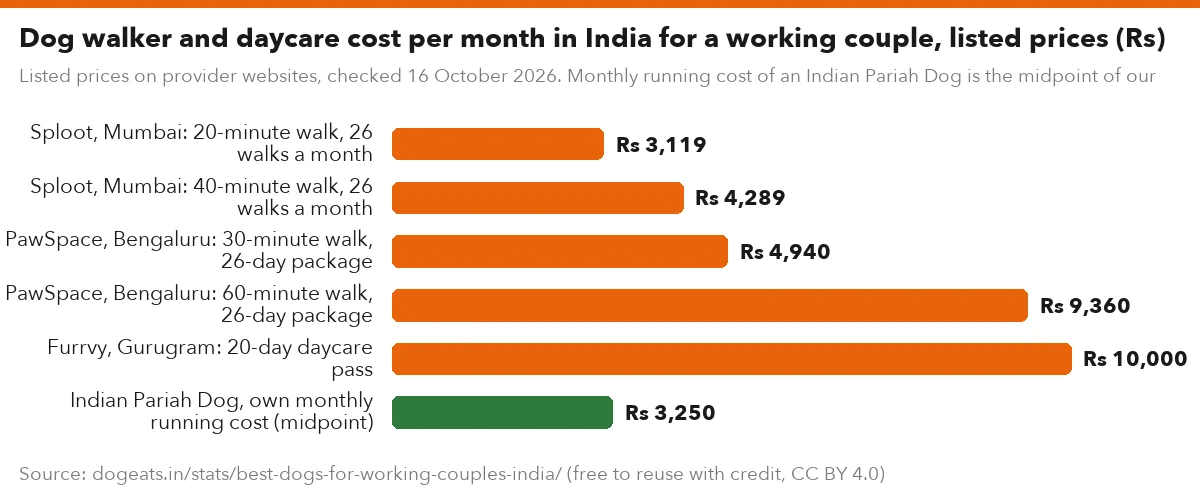
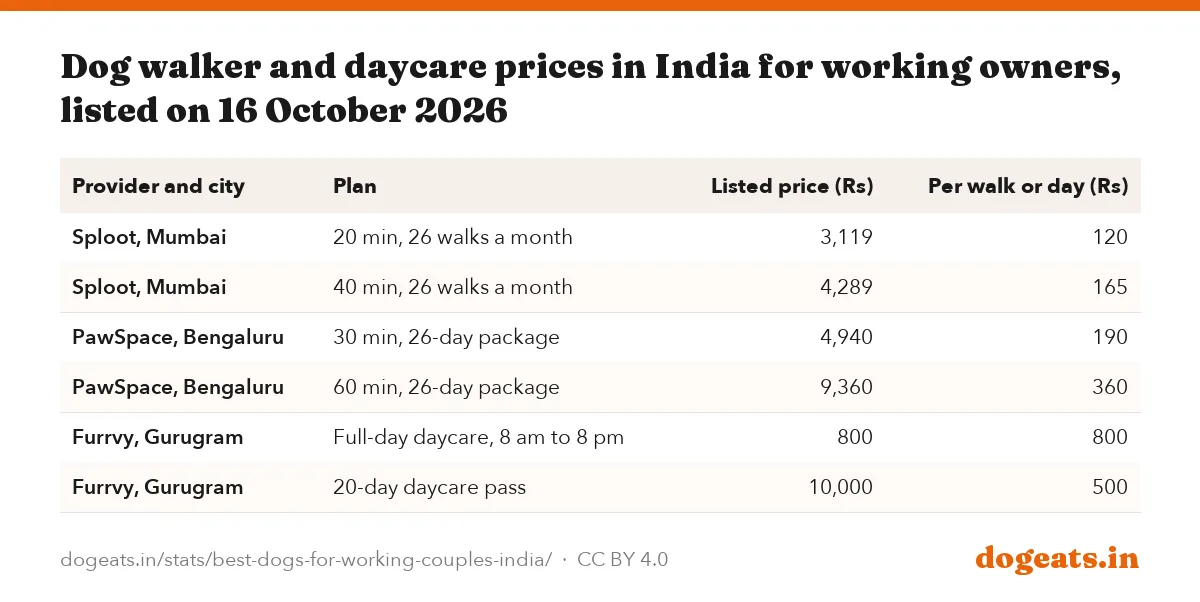
A daily walker costs Rs 3,119 to Rs 9,360 a month on plans we checked on 16 October 2026. Sploot lists 26 twenty-minute walks a month in Mumbai at Rs 3,119, and PawSpace lists 26 hour-long walks in Bengaluru at Rs 9,360.
Daycare costs more. Furrvy in Gurugram lists a full day at Rs 800 and a 20-day pass at Rs 10,000, covering a 9 to 6 day plus travel.
These services can cost more than the dog. Our guides put a Pariah dog's running cost at Rs 2,000 to Rs 4,500 a month. A Labrador runs Rs 4,000 to Rs 9,000, so walker plans equal 35% to 234% of its own running cost. Our boarding and walker price report lists more providers.
Listed prices on provider websites, checked 16 October 2026. Monthly running cost of an Indian Pariah Dog is the midpoint of our guide's range.
Show the numbers
| Label | Rs |
|---|---|
| Sploot, Mumbai: 20-minute walk, 26 walks a month | Rs 3,119 |
| Sploot, Mumbai: 40-minute walk, 26 walks a month | Rs 4,289 |
| PawSpace, Bengaluru: 30-minute walk, 26-day package | Rs 4,940 |
| PawSpace, Bengaluru: 60-minute walk, 26-day package | Rs 9,360 |
| Furrvy, Gurugram: 20-day daycare pass | Rs 10,000 |
| Indian Pariah Dog, own monthly running cost (midpoint) | Rs 3,250 |
Embed this chart
| Provider and city | Plan | Listed price (Rs) | Per walk or day (Rs) |
|---|---|---|---|
| Sploot, Mumbai | 20 min, 26 walks a month | 3,119 | 120 |
| Sploot, Mumbai | 40 min, 26 walks a month | 4,289 | 165 |
| PawSpace, Bengaluru | 30 min, 26-day package | 4,940 | 190 |
| PawSpace, Bengaluru | 60 min, 26-day package | 9,360 | 360 |
| Furrvy, Gurugram | Full-day daycare, 8 am to 8 pm | 800 | 800 |
| Furrvy, Gurugram | 20-day daycare pass | 10,000 | 500 |
Are Indian dog breeds better for working couples?
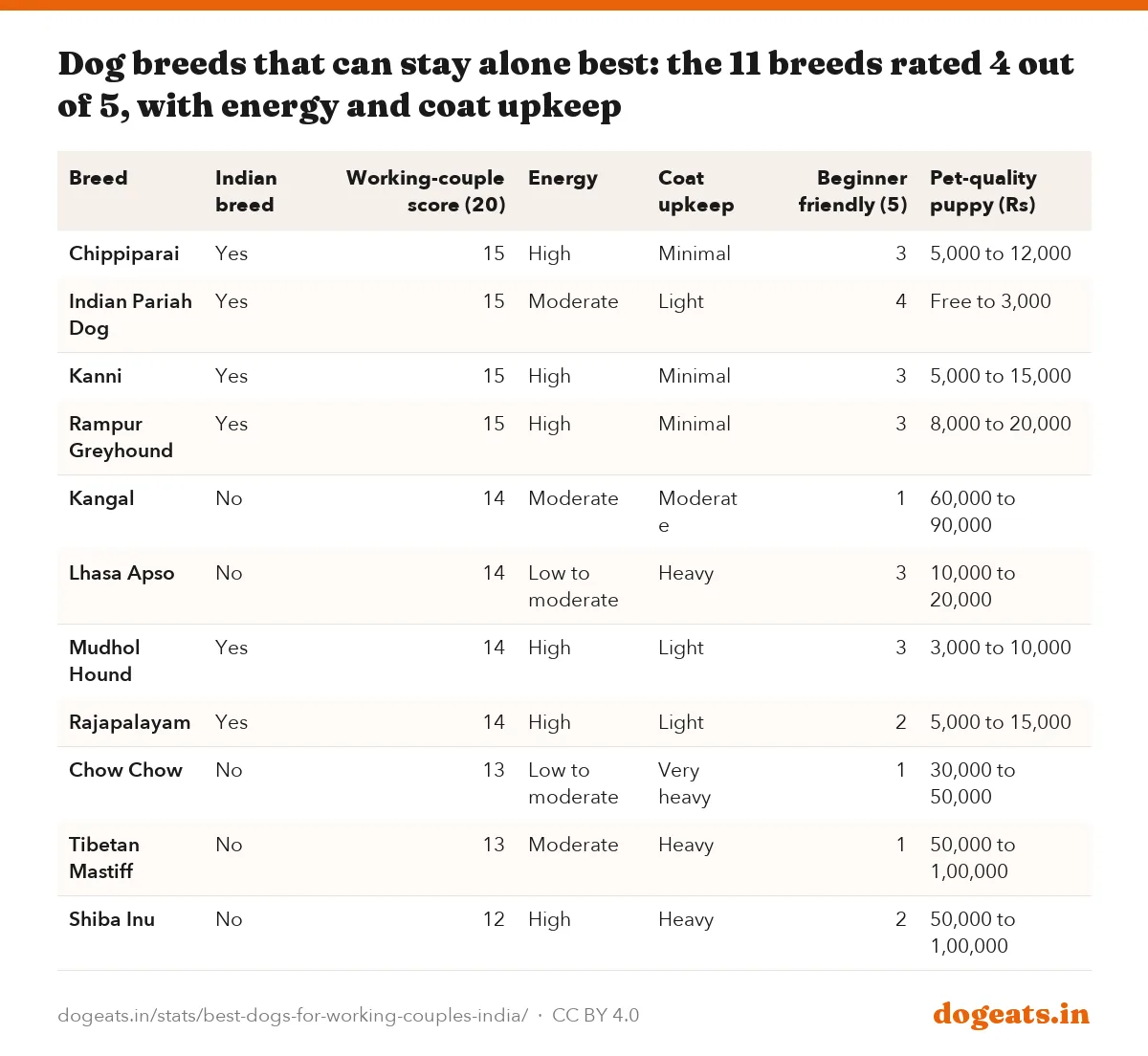
On our ratings, yes. Indian breeds average 13.8 out of 20 on the working-couple score, against 9.9 for the 49 imported breeds. 6 of the 11 breeds rated 4 for staying alone are Indian.
Indian sighthounds such as the Kanni and Chippiparai sleep for long stretches once exercised, their guides say, and barely shed. But they need a hard run and space, and score 2 for flats.
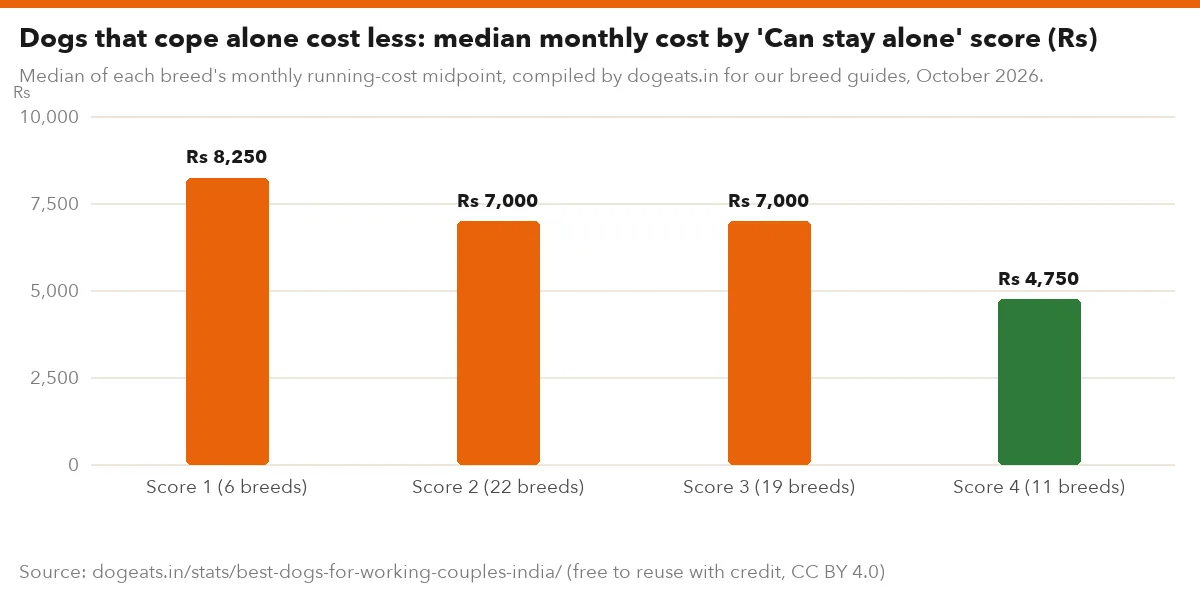
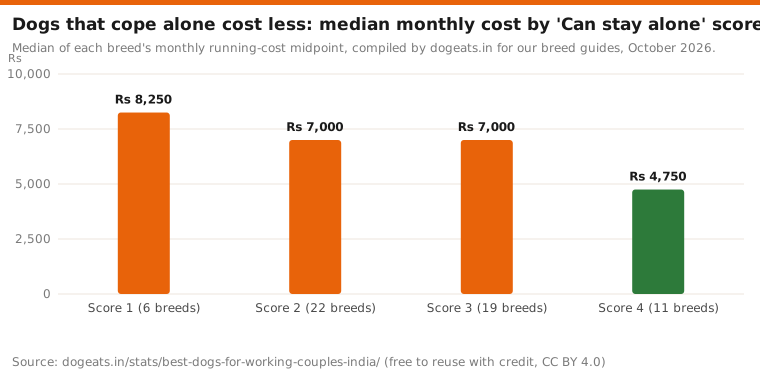
Indian breeds are also cheaper to keep. The 9 Indian breeds cost a median Rs 4,500 a month at the midpoint of their ranges, against Rs 7,250 for imported breeds. Breeds rated 4 for staying alone cost a median Rs 4,750, against Rs 7,000 for breeds rated 2. Our Indian vs foreign breeds report compares the two groups in detail.
Median of each breed's monthly running-cost midpoint, compiled by dogeats.in for our breed guides, October 2026.
Show the numbers
| Label | Rs |
|---|---|
| Score 1 (6 breeds) | Rs 8,250 |
| Score 2 (22 breeds) | Rs 7,000 |
| Score 3 (19 breeds) | Rs 7,000 |
| Score 4 (11 breeds) | Rs 4,750 |
Embed this chart
| Breed | Indian breed | Working-couple score (20) | Energy | Coat upkeep | Beginner friendly (5) | Pet-quality puppy (Rs) |
|---|---|---|---|---|---|---|
| Chippiparai | Yes | 15 | High | Minimal | 3 | 5,000 to 12,000 |
| Indian Pariah Dog | Yes | 15 | Moderate | Light | 4 | Free to 3,000 |
| Kanni | Yes | 15 | High | Minimal | 3 | 5,000 to 15,000 |
| Rampur Greyhound | Yes | 15 | High | Minimal | 3 | 8,000 to 20,000 |
| Kangal | No | 14 | Moderate | Moderate | 1 | 60,000 to 90,000 |
| Lhasa Apso | No | 14 | Low to moderate | Heavy | 3 | 10,000 to 20,000 |
| Mudhol Hound | Yes | 14 | High | Light | 3 | 3,000 to 10,000 |
| Rajapalayam | Yes | 14 | High | Light | 2 | 5,000 to 15,000 |
| Chow Chow | No | 13 | Low to moderate | Very heavy | 1 | 30,000 to 50,000 |
| Tibetan Mastiff | No | 13 | Moderate | Heavy | 1 | 50,000 to 1,00,000 |
| Shiba Inu | No | 12 | High | Heavy | 2 | 50,000 to 1,00,000 |
How does every breed score for a working couple?
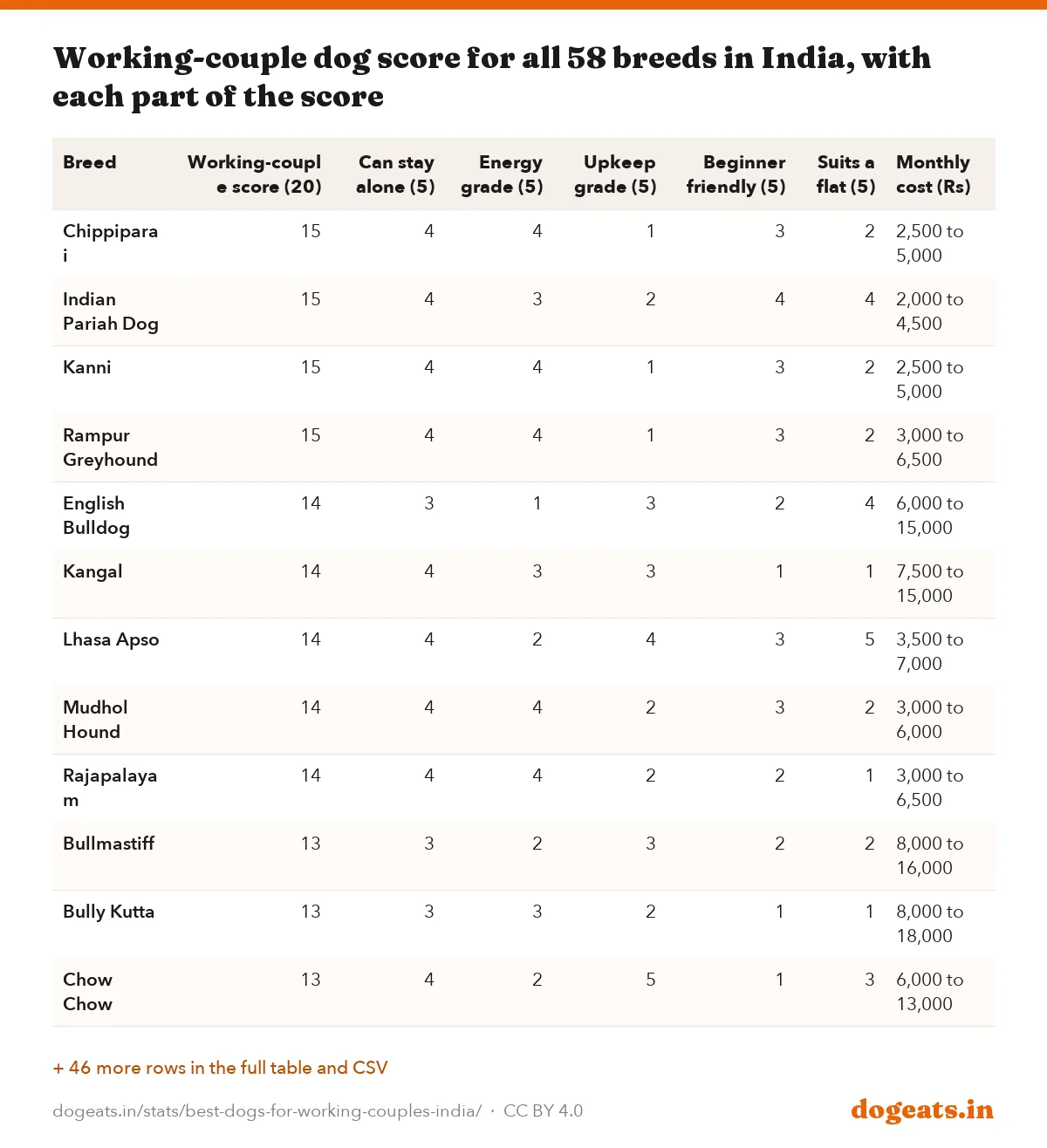
The median breed scores 10.5 out of 20. 38 of the 58 breeds score between 8 and 13, so one point in a rating moves a breed many places.
Use the table with your own routine. A couple who can walk a dog for an hour at 7 am and again at 8 pm can manage a higher-energy breed than the score suggests. A couple who both commute for an hour each way should stay near the top.
| Breed | Working-couple score (20) | Can stay alone (5) | Energy grade (5) | Upkeep grade (5) | Beginner friendly (5) | Suits a flat (5) | Monthly cost (Rs) |
|---|---|---|---|---|---|---|---|
| Chippiparai | 15 | 4 | 4 | 1 | 3 | 2 | 2,500 to 5,000 |
| Indian Pariah Dog | 15 | 4 | 3 | 2 | 4 | 4 | 2,000 to 4,500 |
| Kanni | 15 | 4 | 4 | 1 | 3 | 2 | 2,500 to 5,000 |
| Rampur Greyhound | 15 | 4 | 4 | 1 | 3 | 2 | 3,000 to 6,500 |
| English Bulldog | 14 | 3 | 1 | 3 | 2 | 4 | 6,000 to 15,000 |
| Kangal | 14 | 4 | 3 | 3 | 1 | 1 | 7,500 to 15,000 |
| Lhasa Apso | 14 | 4 | 2 | 4 | 3 | 5 | 3,500 to 7,000 |
| Mudhol Hound | 14 | 4 | 4 | 2 | 3 | 2 | 3,000 to 6,000 |
| Rajapalayam | 14 | 4 | 4 | 2 | 2 | 1 | 3,000 to 6,500 |
| Bullmastiff | 13 | 3 | 2 | 3 | 2 | 2 | 8,000 to 16,000 |
| Bully Kutta | 13 | 3 | 3 | 2 | 1 | 1 | 8,000 to 18,000 |
| Chow Chow | 13 | 4 | 2 | 5 | 1 | 3 | 6,000 to 13,000 |
| Dachshund | 13 | 3 | 3 | 2 | 3 | 4 | 3,000 to 6,500 |
| English Mastiff | 13 | 3 | 2 | 3 | 2 | 2 | 9,000 to 20,000 |
| French Bulldog | 13 | 2 | 1 | 2 | 3 | 5 | 5,000 to 12,000 |
| Pekingese | 13 | 3 | 1 | 4 | 2 | 5 | 4,000 to 9,000 |
| Pug | 13 | 3 | 1 | 4 | 4 | 5 | 3,000 to 7,000 |
| Shih Tzu | 13 | 3 | 1 | 4 | 3 | 5 | 3,500 to 7,500 |
| Tibetan Mastiff | 13 | 4 | 3 | 4 | 1 | 1 | 9,000 to 20,000 |
| Great Dane | 12 | 3 | 3 | 3 | 1 | 2 | 9,000 to 18,000 |
| Kombai | 12 | 3 | 4 | 2 | 1 | 1 | 3,000 to 6,000 |
| Rhodesian Ridgeback | 12 | 3 | 4 | 2 | 2 | 2 | 5,000 to 11,000 |
| Saint Bernard | 12 | 3 | 2 | 4 | 1 | 1 | 9,000 to 18,000 |
| Shiba Inu | 12 | 4 | 4 | 4 | 2 | 4 | 4,000 to 8,000 |
| Cane Corso | 11 | 3 | 4 | 3 | 1 | 1 | 7,000 to 15,000 |
| Chihuahua | 11 | 2 | 3 | 2 | 3 | 5 | 2,000 to 5,000 |
| German Spitz | 11 | 3 | 3 | 4 | 4 | 4 | 3,000 to 6,500 |
| Indian Spitz | 11 | 3 | 3 | 4 | 5 | 4 | 3,000 to 6,000 |
| Japanese Spitz | 11 | 3 | 3 | 4 | 4 | 4 | 3,000 to 6,500 |
| Cavalier King Charles Spaniel | 10 | 2 | 3 | 3 | 3 | 5 | 4,500 to 10,000 |
| Maltese | 10 | 2 | 2 | 4 | 3 | 5 | 3,000 to 7,000 |
| Miniature Pinscher | 10 | 2 | 4 | 2 | 3 | 4 | 2,500 to 5,500 |
| Pembroke Welsh Corgi | 10 | 3 | 4 | 4 | 4 | 4 | 3,500 to 7,000 |
| Pit Bull | 10 | 2 | 4 | 2 | 1 | 2 | 4,500 to 9,000 |
| Poodle | 10 | 3 | 4 | 4 | 4 | 5 | 4,000 to 10,000 |
| Rottweiler | 10 | 3 | 4 | 4 | 1 | 2 | 6,500 to 14,000 |
| Beagle | 9 | 2 | 4 | 3 | 3 | 3 | 3,500 to 7,000 |
| Boxer | 9 | 2 | 5 | 2 | 3 | 2 | 5,000 to 10,000 |
| Bull Terrier | 9 | 2 | 4 | 3 | 2 | 3 | 5,000 to 10,000 |
| Doberman | 9 | 2 | 5 | 2 | 2 | 2 | 6,000 to 12,000 |
| Dogo Argentino | 9 | 2 | 4 | 3 | 1 | 1 | 7,000 to 14,000 |
| Pomeranian | 9 | 2 | 3 | 4 | 3 | 3 | 3,000 to 6,500 |
| Yorkshire Terrier | 9 | 2 | 3 | 4 | 3 | 5 | 3,000 to 7,000 |
| American Eskimo Dog | 8 | 2 | 4 | 4 | 3 | 4 | 4,000 to 8,000 |
| Bernese Mountain Dog | 8 | 2 | 3 | 5 | 2 | 1 | 8,000 to 18,000 |
| Cocker Spaniel | 8 | 2 | 4 | 4 | 3 | 4 | 4,500 to 9,000 |
| Labrador Retriever | 8 | 2 | 4 | 4 | 5 | 3 | 4,000 to 9,000 |
| Australian Shepherd | 7 | 2 | 5 | 4 | 2 | 1 | 5,000 to 11,000 |
| Bichon Frise | 7 | 1 | 3 | 4 | 4 | 5 | 4,000 to 8,500 |
| Dalmatian | 7 | 2 | 5 | 4 | 2 | 2 | 4,500 to 9,000 |
| German Shepherd | 7 | 2 | 4 | 5 | 2 | 2 | 5,000 to 11,000 |
| Golden Retriever | 7 | 2 | 4 | 5 | 5 | 3 | 5,000 to 10,000 |
| Samoyed | 7 | 2 | 4 | 5 | 2 | 2 | 7,000 to 15,000 |
| Belgian Malinois | 6 | 1 | 5 | 3 | 1 | 1 | 6,000 to 14,000 |
| Jack Russell Terrier | 6 | 1 | 5 | 3 | 2 | 2 | 2,500 to 6,000 |
| Alaskan Malamute | 5 | 1 | 4 | 5 | 1 | 1 | 8,000 to 16,000 |
| Border Collie | 5 | 1 | 5 | 4 | 1 | 1 | 4,000 to 9,000 |
| Siberian Husky | 4 | 1 | 5 | 5 | 1 | 1 | 6,000 to 14,000 |
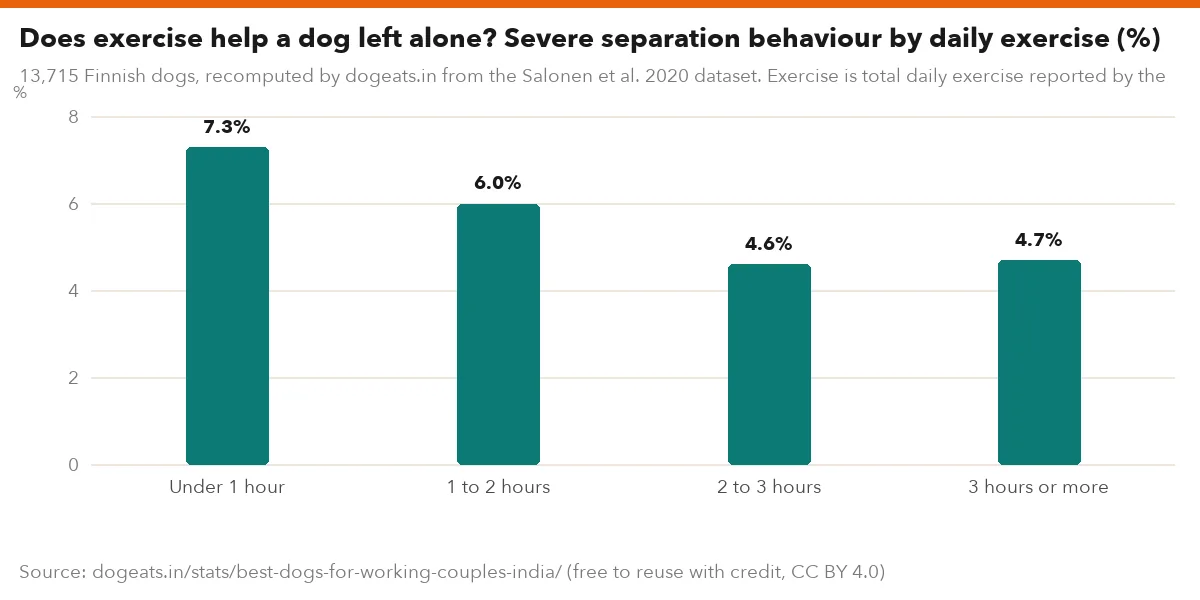
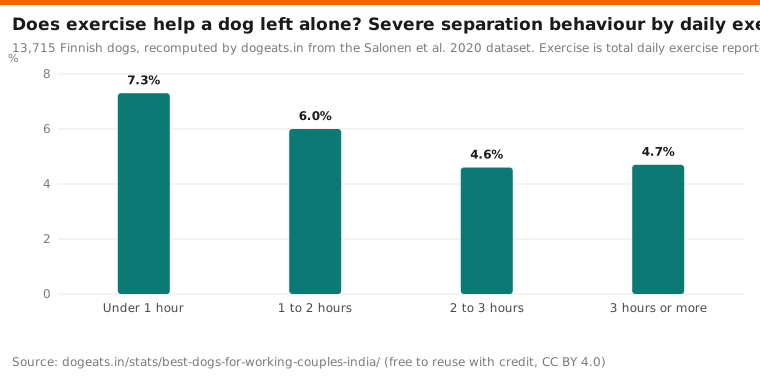
13,715 Finnish dogs, recomputed by dogeats.in from the Salonen et al. 2020 dataset. Exercise is total daily exercise reported by the owner. An association, not proof of cause.
Show the numbers
| Label | % |
|---|---|
| Under 1 hour | 7.3% |
| 1 to 2 hours | 6.0% |
| 2 to 3 hours | 4.6% |
| 3 hours or more | 4.7% |
Embed this chart
Exercise is linked to calmer dogs in the Finnish data. Severe separation behaviour fell from 7.3% in dogs exercised under an hour a day to 4.6% in dogs exercised 2 to 3 hours.
Frequently asked questions
Which is the best dog for a working couple in India?
The Indian Pariah Dog, with 15 out of 20 on our working-couple score. It copes alone, needs moderate exercise and sheds lightly. It also scores 4 out of 5 for flats and for beginners.
Which small dog is best for working couples?
The Lhasa Apso, with 14 out of 20. It is rated 4 out of 5 for staying alone, the best among small imported breeds, but its long coat needs regular grooming.
Is a Labrador good for a working couple?
Not if the house is empty all day. The Labrador scores 8 out of 20 and 2 out of 5 for staying alone, and needs 60 to 90 minutes of exercise daily.
Can I leave my dog alone for 8 hours?
Many dogs cope, but no study gives a safe limit. In Finnish data, 5.9% of dogs left over 8 hours showed severe separation behaviour. Sweden's Board of Agriculture advises taking dogs out at least every six hours in the daytime.
How many hours do Indians work a day?
Urban Indians in paid work spent 490 minutes a day, about 8 hours 10 minutes, on work and work travel in 2024. Urban men spent 518 minutes and urban women 391, MoSPI's Time Use Survey shows.
Which dogs should working couples avoid?
High-energy breeds that hate being alone. The Siberian Husky scores 4 out of 20, the lowest, followed by the Border Collie and Alaskan Malamute on 5.
How much does a dog walker cost in India?
Monthly plans we checked list Rs 3,119 for 26 twenty-minute walks in Mumbai and Rs 9,360 for 26 hour-long walks in Bengaluru. A full day of daycare in Gurugram lists at Rs 800.
Is a puppy a good idea for a working couple?
Puppies need more frequent toilet breaks and company than adult dogs. Sweden's rules advise taking young dogs out more often than every six hours. An adult adopted Indian dog is often easier.
Methodology and limitations
This ranking covers the 58 breeds with full guides on dogeats.in. 'Can stay alone', 'Beginner friendly', 'Suits a flat' and 'Copes without AC' are dogeats.in editorial ratings from 1 to 5, compiled from our breed guides, October 2026. Price and cost ranges were compiled by dogeats.in from breeder and marketplace listings for our breed guides, October 2026.
Working-couple score = 2 x 'Can stay alone' + (6 minus energy grade) + (6 minus upkeep grade), out of 20. Energy grade comes from each guide's energy line: very low or low 1, low to moderate 2, moderate 3. Moderate to high, high or sighthound bursts score 4, and very high or extreme 5. Upkeep grade comes from the shedding line: very low 1, low or low to moderate 2, moderate 3, moderate to heavy or heavy 4, very heavy or extreme 5. Coats that grow continuously, curl or tend to mat count as at least 4, because they need regular professional grooming.
Work-time figures come from MoSPI's Time Use in India 2024 report (Statements 2, 5, 6 and 6.1) and its press note of 25 February 2025. They are average minutes per participant on the survey day in employment and related activities, which include work travel. Hours alone figures were recomputed in Python from the public dataset of Salonen et al. 2020; our totals match the paper's 748 dogs with severe separation behaviour. Rehn and Keeling 2011 figures come from the paper's abstract.
Walker and daycare prices were read from the providers' websites on 16 October 2026 and are listed prices, not market averages. The Swedish guidance is the general advice attached to SJVFS 2020:8, chapter 4, section 7, which is advice rather than a binding rule.
Sources
- MoSPI, National Statistics Office: Time Use in India 2024 (Time Use Survey, January to December 2024), report of 28 March 2025, Minutes a day on employment and related activities by sex, rural and urban, and by state; commuting time
- Salonen et al., Prevalence, comorbidity, and breed differences in canine anxiety in 13,700 Finnish pet dogs, Scientific Reports (2020), with public dataset, Separation behaviour by hours alone, daily exercise and family type
- Rehn and Keeling, The effect of time left alone at home on dog welfare, Applied Animal Behaviour Science 129 (2011) 129 to 135, Greeting behaviour after 0.5, 2 and 4 hours alone
- Also consulted: MoSPI, Time Use Survey 2024 press note (25 February 2025), Swedish Board of Agriculture (Jordbruksverket): SJVFS 2020:8, regulations and general advice on keeping dogs and cats, PDSA Animal Wellbeing (PAW) Report 2024, dogs (with YouGov), Sploot, dog walking Mumbai, checked 16 October 2026, PawSpace, dog walking Bengaluru, checked 16 October 2026, Furrvy, daycare for working professionals, Gurugram, checked 16 October 2026, dogeats.in breed guides (58 breeds), October 2026, Salonen et al. 2020 supplementary questionnaire (time alone categories).
Cite, embed and download
This report, its data and its images are free to reuse under a Creative Commons Attribution 4.0 licence. Credit dogeats.in with a link to this page. Every chart has its own embed code, every table has a CSV and an image download, and the images below are ready for social posts, slides and articles.
Cite this report
Link to this report
Every chart and table as an image