Data report · Updated October 2026
Dog Dental Disease Statistics: How Many Dogs Have Bad Teeth, How Many Teeth They Have, and What Cleaning Costs in India
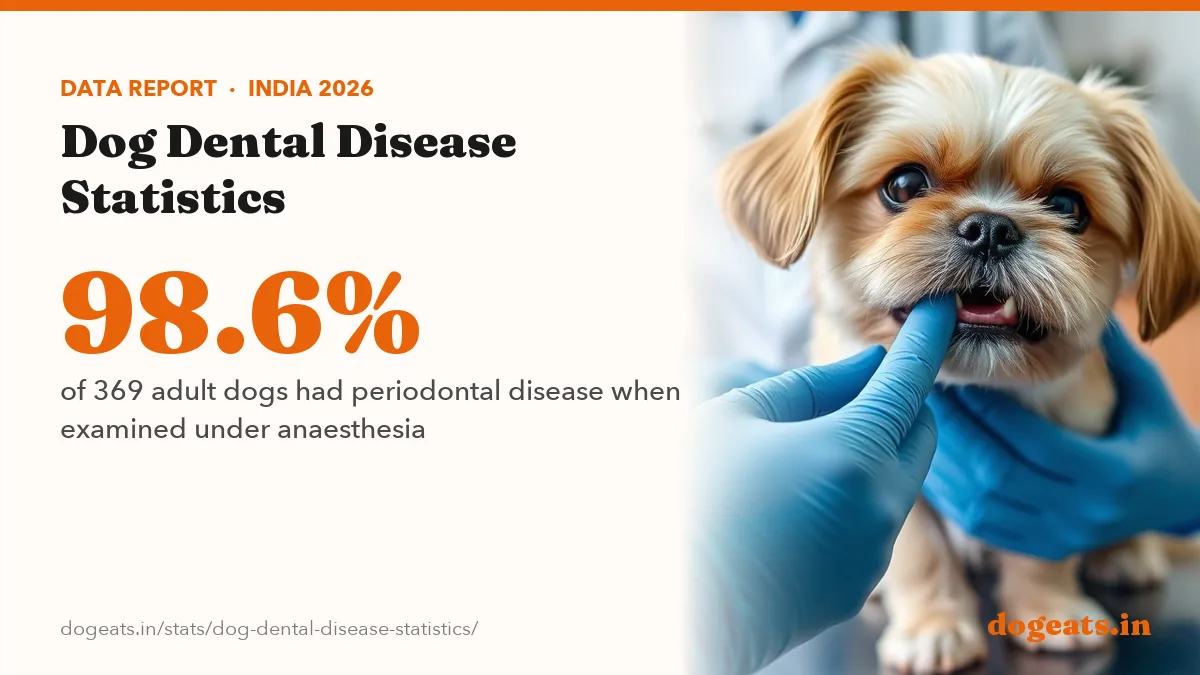
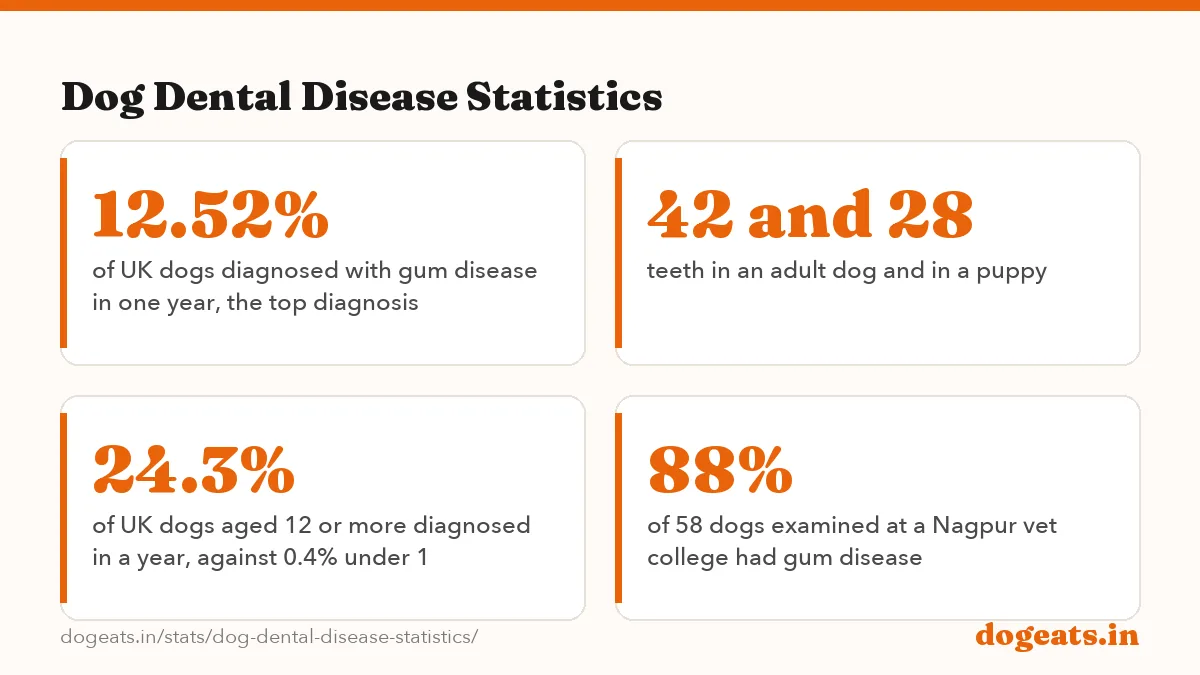
Periodontal disease was the most common single diagnosis in UK dogs in 2016. UK vets diagnosed periodontal disease in 12.52% of 22,333 dogs in one year, and full exams under anaesthesia found it in 98.6% of adult dogs. Adult dogs have 42 teeth and puppies 28. Risk climbs with age and falls with size, so a dog under 10 kg is about three times as likely to be diagnosed as one over 40 kg.
Key findings
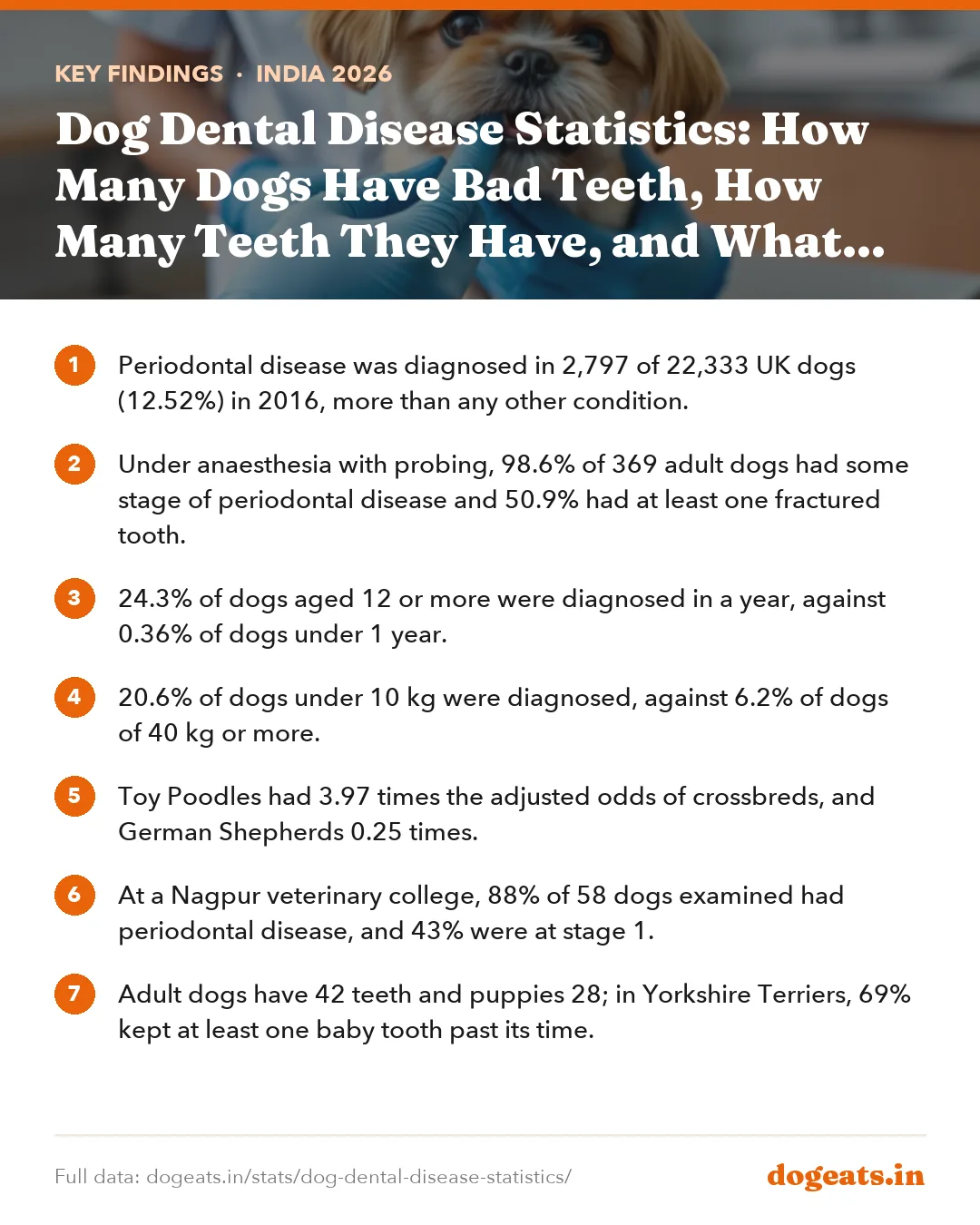
- Periodontal disease was diagnosed in 2,797 of 22,333 UK dogs (12.52%) in 2016, more than any other condition.
- Under anaesthesia with probing, 98.6% of 369 adult dogs had some stage of periodontal disease and 50.9% had at least one fractured tooth.
- 24.3% of dogs aged 12 or more were diagnosed in a year, against 0.36% of dogs under 1 year.
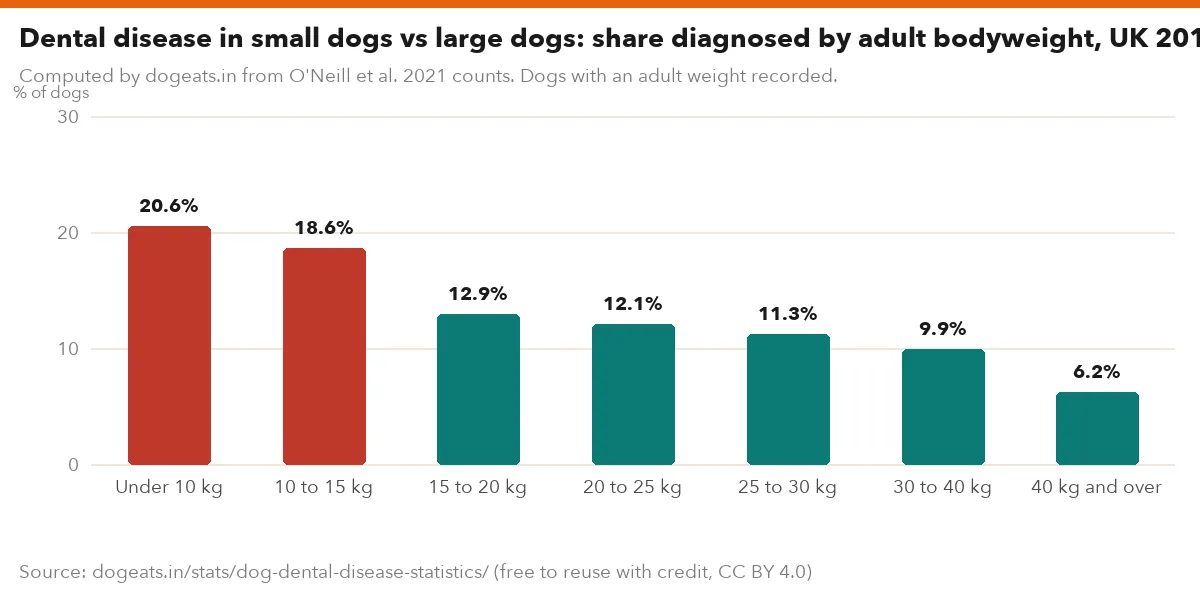
- 20.6% of dogs under 10 kg were diagnosed, against 6.2% of dogs of 40 kg or more.
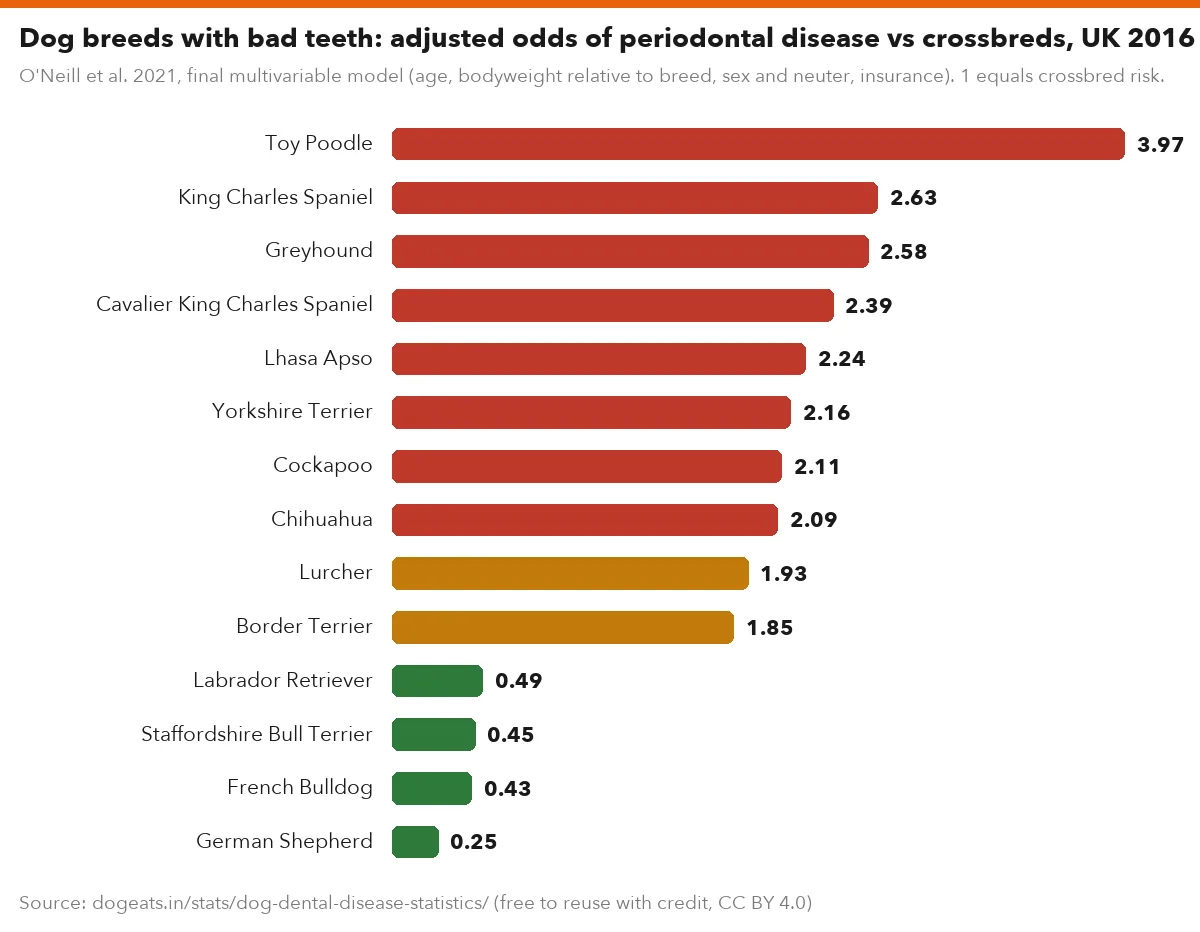
- Toy Poodles had 3.97 times the adjusted odds of crossbreds, and German Shepherds 0.25 times.
- At a Nagpur veterinary college, 88% of 58 dogs examined had periodontal disease, and 43% were at stage 1.
- Adult dogs have 42 teeth and puppies 28; in Yorkshire Terriers, 69% kept at least one baby tooth past its time.
- AAHA advises a first exam under anaesthesia by age 1 for small and medium breeds and by age 2 for larger breeds.
- Our breed guides list dental disease as a key health risk for 13 of 58 breeds, 11 of them with an adult weight midpoint under 10 kg.
How common is dental disease in dogs?
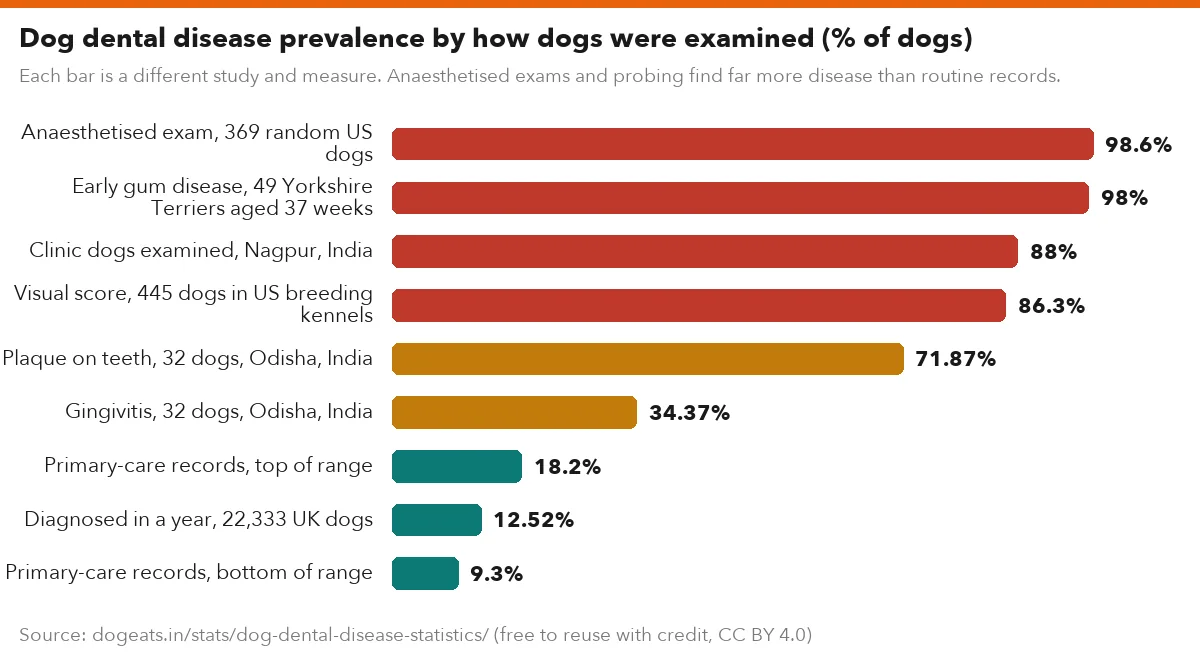
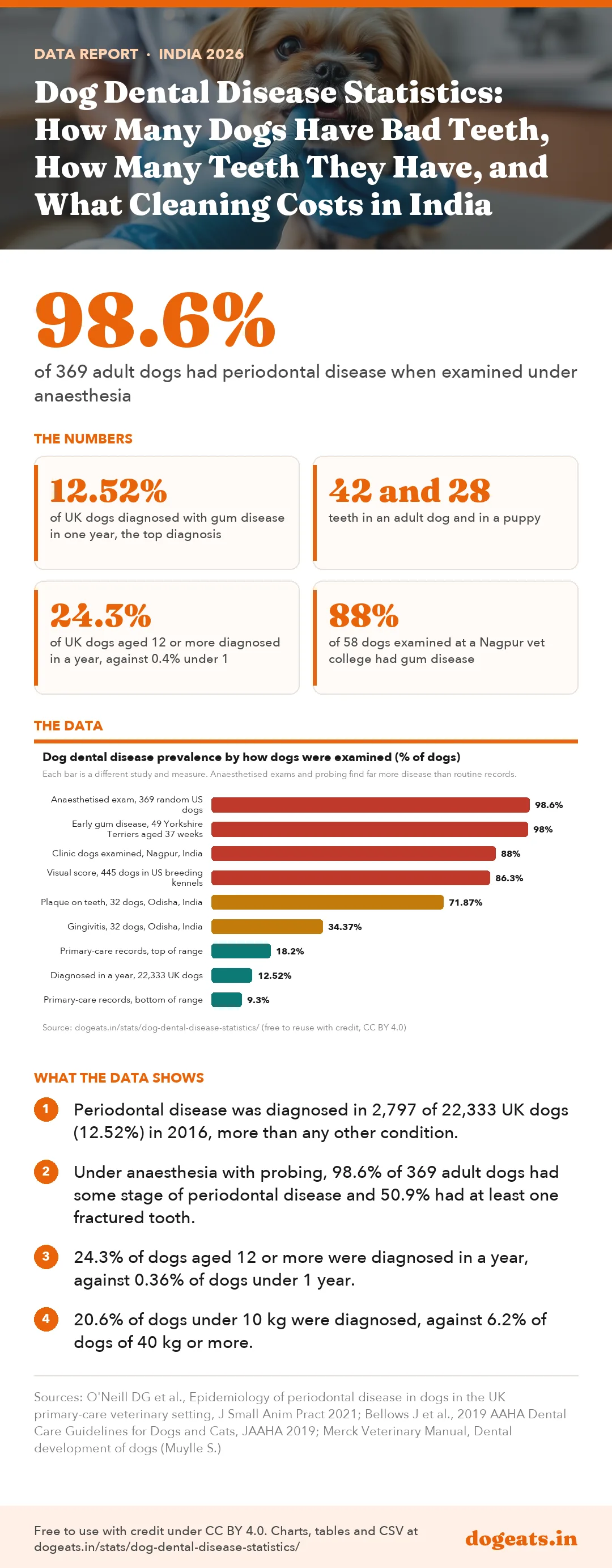
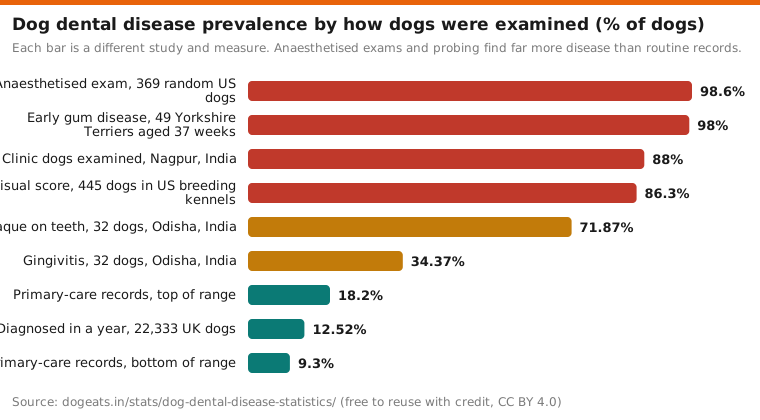
It depends on how hard you look. In UK primary-care records for 2016, vets diagnosed periodontal disease in 12.52% of 22,333 dogs. That made it the single most common diagnosis of the year.
Records undercount, because a vet sees little in an awake dog's mouth. A 2020 review by Wallis and Holcombe found primary-care studies report 9.3% to 18.2%. Detailed exams under anaesthesia report 44% to 100%.
The newest anaesthetised study, Stepaniuk et al. (2026), probed the teeth of 369 dogs over a year old. It found periodontal disease in 98.6%: 39% at stage 1 and 59.6% at stages 2 to 4.
Each bar is a different study and measure. Anaesthetised exams and probing find far more disease than routine records.
Show the numbers
| Label | % of dogs |
|---|---|
| Anaesthetised exam, 369 random US dogs | 98.6% |
| Early gum disease, 49 Yorkshire Terriers aged 37 weeks | 98% |
| Clinic dogs examined, Nagpur, India | 88% |
| Visual score, 445 dogs in US breeding kennels | 86.3% |
| Plaque on teeth, 32 dogs, Odisha, India | 71.87% |
| Gingivitis, 32 dogs, Odisha, India | 34.37% |
| Primary-care records, top of range | 18.2% |
| Diagnosed in a year, 22,333 UK dogs | 12.52% |
| Primary-care records, bottom of range | 9.3% |
Embed this chart
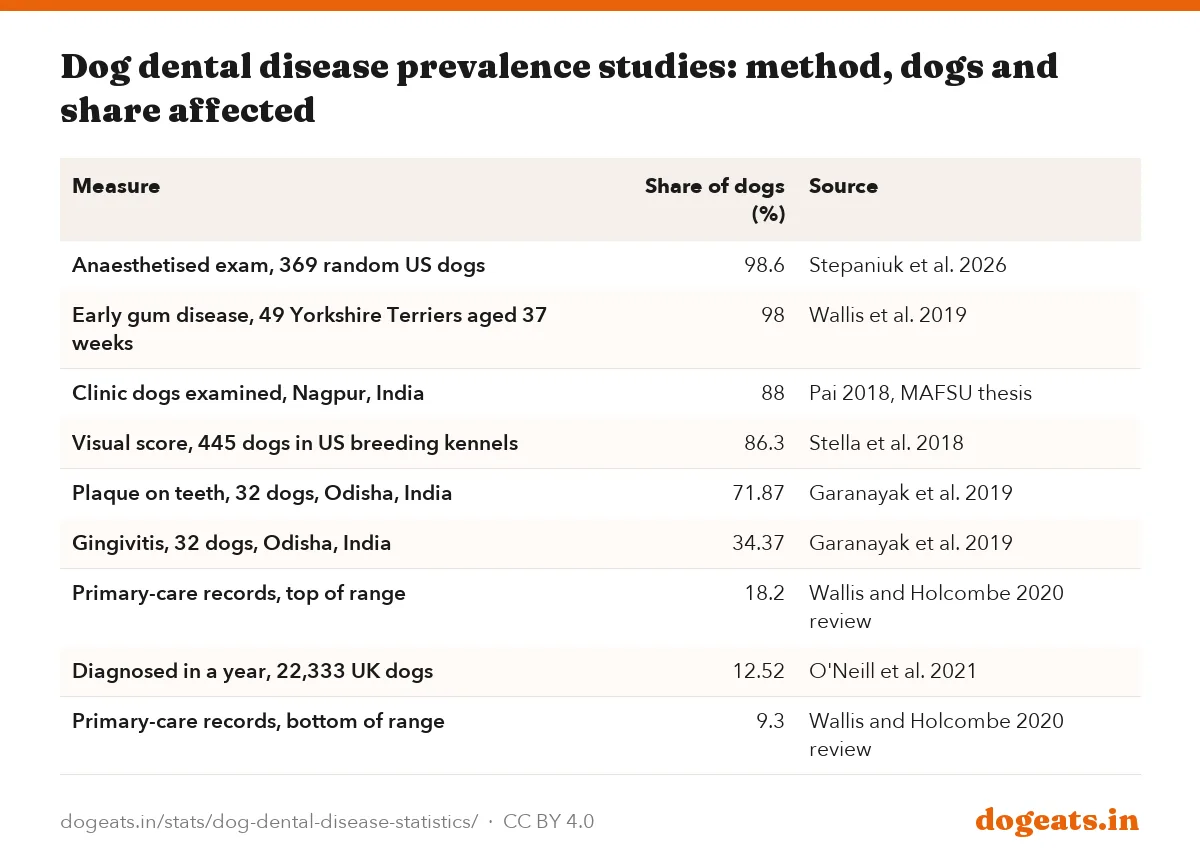
| Measure | Share of dogs (%) | Source |
|---|---|---|
| Anaesthetised exam, 369 random US dogs | 98.6 | Stepaniuk et al. 2026 |
| Early gum disease, 49 Yorkshire Terriers aged 37 weeks | 98 | Wallis et al. 2019 |
| Clinic dogs examined, Nagpur, India | 88 | Pai 2018, MAFSU thesis |
| Visual score, 445 dogs in US breeding kennels | 86.3 | Stella et al. 2018 |
| Plaque on teeth, 32 dogs, Odisha, India | 71.87 | Garanayak et al. 2019 |
| Gingivitis, 32 dogs, Odisha, India | 34.37 | Garanayak et al. 2019 |
| Primary-care records, top of range | 18.2 | Wallis and Holcombe 2020 review |
| Diagnosed in a year, 22,333 UK dogs | 12.52 | O'Neill et al. 2021 |
| Primary-care records, bottom of range | 9.3 | Wallis and Holcombe 2020 review |
In US commercial breeding kennels, Stella et al. (2018) scored 445 adult dogs by sight and found 86.3% with some periodontal disease. Older age raised the odds of disease, with an odds ratio of 1.4. Our most common dog health problems report puts dental disease alongside ear, skin and stomach problems.
At what age do dogs get dental disease?
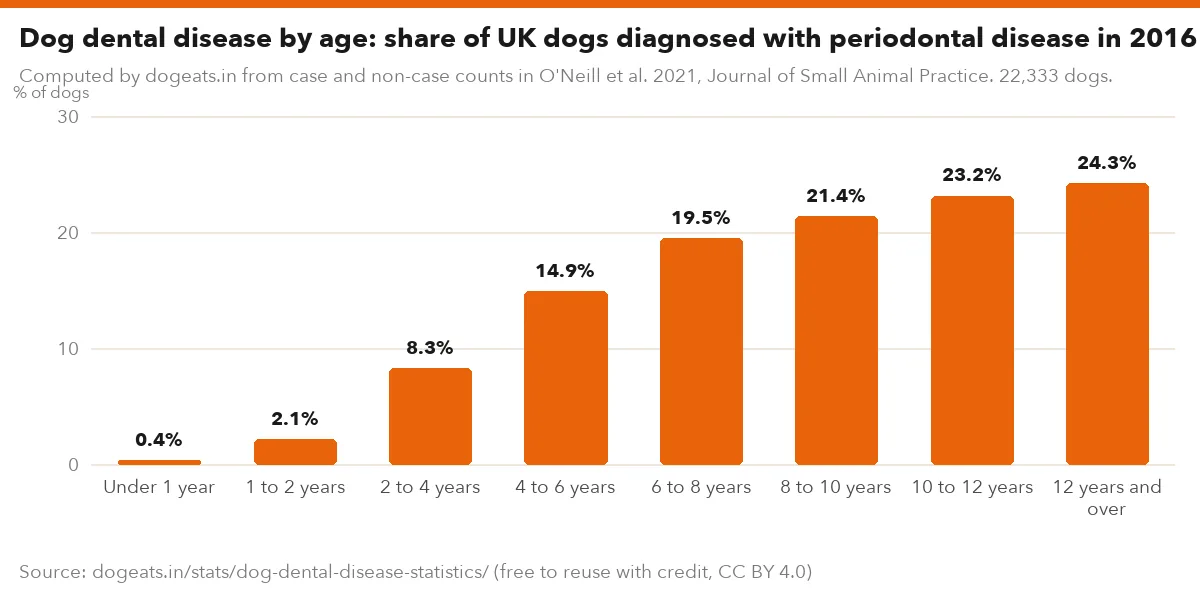
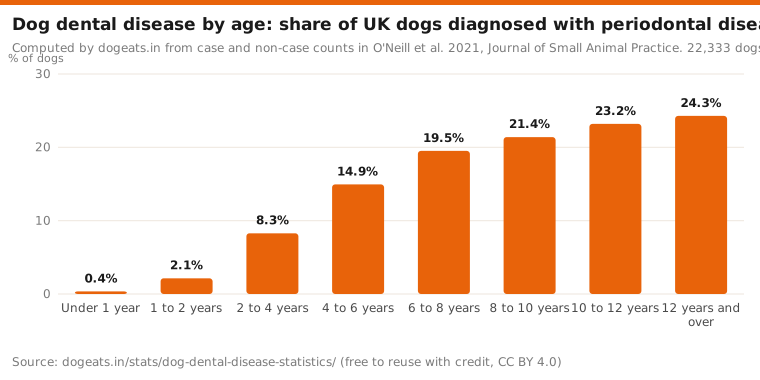
Mostly from middle age. In the UK data, only 0.36% of dogs under 1 year were diagnosed in a year. The share rose to 8.3% at 2 to 4 years and 24.3% at 12 years and over.
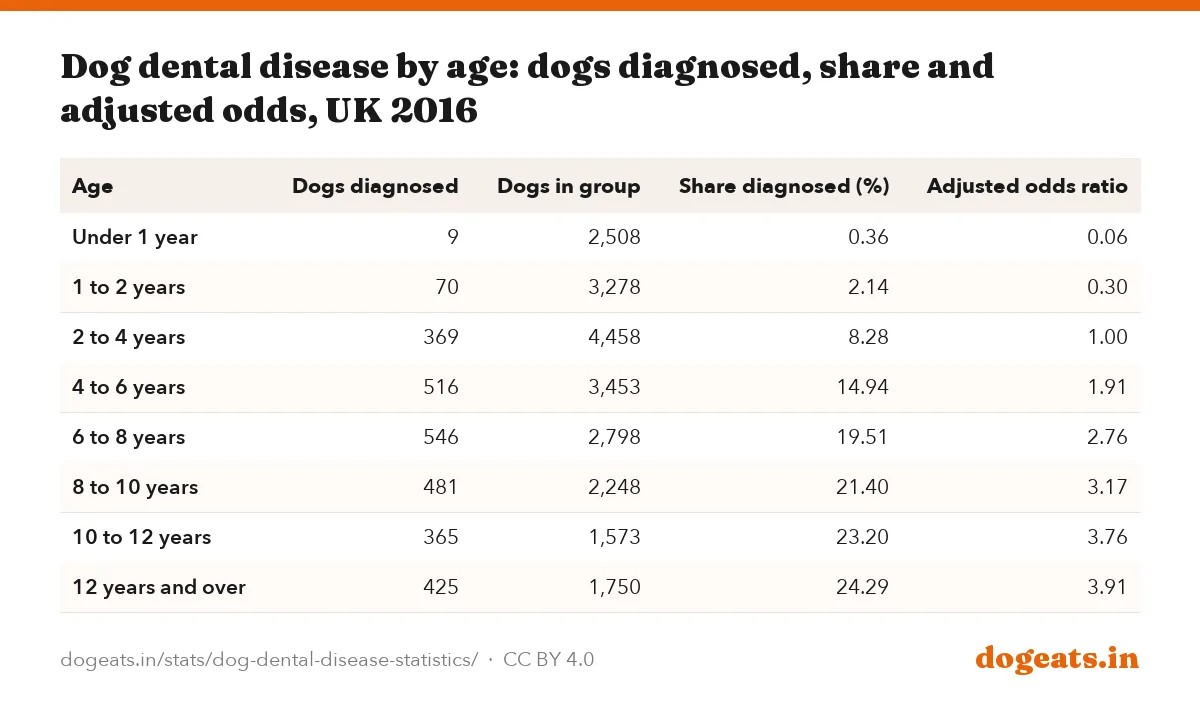
The share rose 2.9-fold from young adults to old dogs, in our calculation from the paper's counts. After adjusting for breed, sex and other factors, dogs of 12 and over had 3.91 times the odds of dogs aged 2 to 4.
The median age of dogs with periodontal disease was 7.54 years, against 3.90 years for dogs without it. Yet disease can start early: in Labradors followed for 2 years, 56.6% developed periodontitis and some were as young as 1.9 years.
Computed by dogeats.in from case and non-case counts in O'Neill et al. 2021, Journal of Small Animal Practice. 22,333 dogs.
Show the numbers
| Label | % of dogs |
|---|---|
| Under 1 year | 0.4% |
| 1 to 2 years | 2.1% |
| 2 to 4 years | 8.3% |
| 4 to 6 years | 14.9% |
| 6 to 8 years | 19.5% |
| 8 to 10 years | 21.4% |
| 10 to 12 years | 23.2% |
| 12 years and over | 24.3% |
Embed this chart
| Age | Dogs diagnosed | Dogs in group | Share diagnosed (%) | Adjusted odds ratio |
|---|---|---|---|---|
| Under 1 year | 9 | 2,508 | 0.36 | 0.06 |
| 1 to 2 years | 70 | 3,278 | 2.14 | 0.30 |
| 2 to 4 years | 369 | 4,458 | 8.28 | 1.00 |
| 4 to 6 years | 516 | 3,453 | 14.94 | 1.91 |
| 6 to 8 years | 546 | 2,798 | 19.51 | 2.76 |
| 8 to 10 years | 481 | 2,248 | 21.40 | 3.17 |
| 10 to 12 years | 365 | 1,573 | 23.20 | 3.76 |
| 12 years and over | 425 | 1,750 | 24.29 | 3.91 |
Miniature Schnauzers show how fast it moves without care. After home care stopped, 35 of 52 dogs had at least 12 teeth progress to periodontitis within 60 weeks.
Do small dogs get more dental disease?
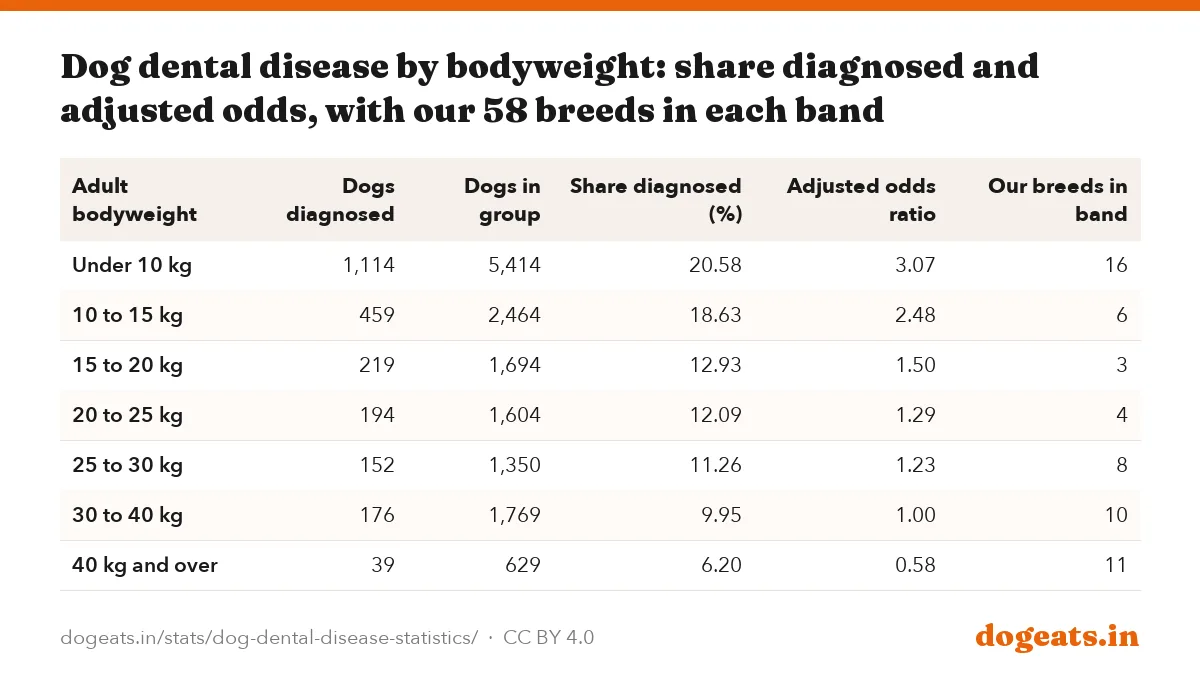
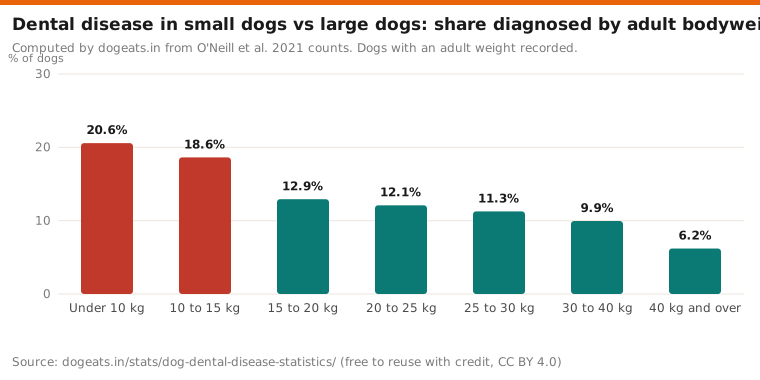
Yes, clearly. In the UK data, 20.6% of dogs under 10 kg were diagnosed in a year, against 6.2% of dogs of 40 kg or more. Small dogs were 3.3 times as likely to be diagnosed, by our calculation.
The adjusted odds tell the same story. Dogs under 10 kg had 3.07 times the odds of dogs weighing 30 to 40 kg. Dogs of 40 kg or more had 0.58 times.
US records agree. Wallis et al. (2021) studied over 3 million records for 60 breeds at Banfield hospitals. Extra-small breeds under 6.5 kg were up to five times as likely to be diagnosed as giant breeds over 25 kg.
Computed by dogeats.in from O'Neill et al. 2021 counts. Dogs with an adult weight recorded.
Show the numbers
| Label | % of dogs |
|---|---|
| Under 10 kg | 20.6% |
| 10 to 15 kg | 18.6% |
| 15 to 20 kg | 12.9% |
| 20 to 25 kg | 12.1% |
| 25 to 30 kg | 11.3% |
| 30 to 40 kg | 9.9% |
| 40 kg and over | 6.2% |
Embed this chart
| Adult bodyweight | Dogs diagnosed | Dogs in group | Share diagnosed (%) | Adjusted odds ratio | Our breeds in band |
|---|---|---|---|---|---|
| Under 10 kg | 1,114 | 5,414 | 20.58 | 3.07 | 16 |
| 10 to 15 kg | 459 | 2,464 | 18.63 | 2.48 | 6 |
| 15 to 20 kg | 219 | 1,694 | 12.93 | 1.50 | 3 |
| 20 to 25 kg | 194 | 1,604 | 12.09 | 1.29 | 4 |
| 25 to 30 kg | 152 | 1,350 | 11.26 | 1.23 | 8 |
| 30 to 40 kg | 176 | 1,769 | 9.95 | 1.00 | 10 |
| 40 kg and over | 39 | 629 | 6.20 | 0.58 | 11 |
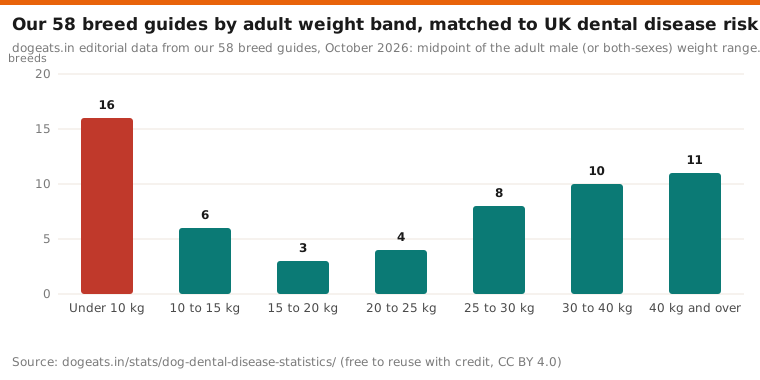
Of our 58 breed guides, 16 breeds have an adult weight midpoint under 10 kg, the highest-risk band. Wallis and colleagues note that retained baby teeth and crowded teeth create spots where plaque builds up.
Which dog breeds have the worst teeth?
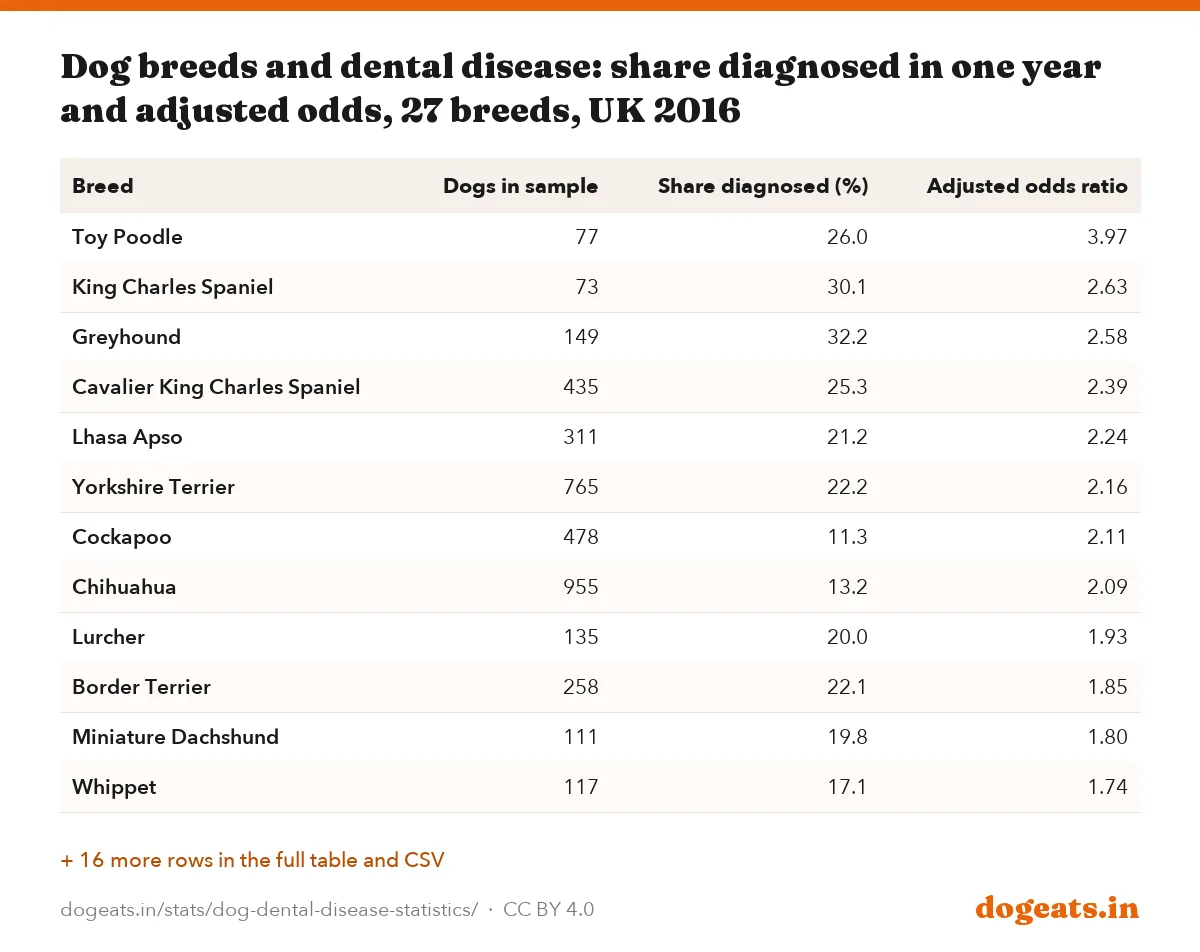
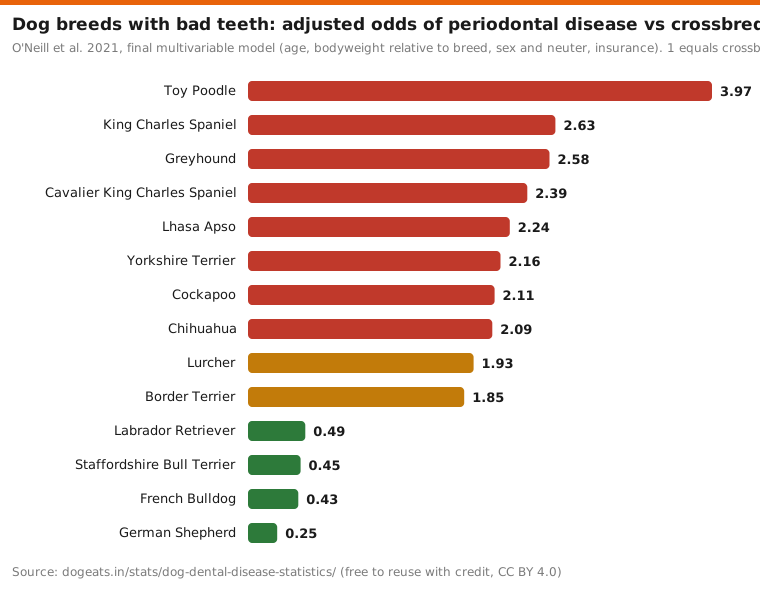
Toy and small breeds, plus a few slim sighthounds. After adjusting for age, weight and sex, the Toy Poodle had 3.97 times the odds of a crossbred. The King Charles Spaniel (2.63), Greyhound (2.58) and Cavalier King Charles Spaniel (2.39) followed.
In plain shares, 32.2% of Greyhounds and 30.1% of King Charles Spaniels were diagnosed in one year. Yorkshire Terriers were at 22.2% and Chihuahuas at 13.2%.
Big breeds did best. German Shepherds had 0.25 times the odds and Labradors 0.49 times; just 3.3% of German Shepherds were diagnosed. Spaniel types had 1.63 times the odds of other dogs, and flat-faced breeds 1.25 times.
O'Neill et al. 2021, final multivariable model (age, bodyweight relative to breed, sex and neuter, insurance). 1 equals crossbred risk.
Show the numbers
| Label | odds ratio |
|---|---|
| Toy Poodle | 3.97 |
| King Charles Spaniel | 2.63 |
| Greyhound | 2.58 |
| Cavalier King Charles Spaniel | 2.39 |
| Lhasa Apso | 2.24 |
| Yorkshire Terrier | 2.16 |
| Cockapoo | 2.11 |
| Chihuahua | 2.09 |
| Lurcher | 1.93 |
| Border Terrier | 1.85 |
| Labrador Retriever | 0.49 |
| Staffordshire Bull Terrier | 0.45 |
| French Bulldog | 0.43 |
| German Shepherd | 0.25 |
Embed this chart
| Breed | Dogs in sample | Share diagnosed (%) | Adjusted odds ratio |
|---|---|---|---|
| Toy Poodle | 77 | 26.0 | 3.97 |
| King Charles Spaniel | 73 | 30.1 | 2.63 |
| Greyhound | 149 | 32.2 | 2.58 |
| Cavalier King Charles Spaniel | 435 | 25.3 | 2.39 |
| Lhasa Apso | 311 | 21.2 | 2.24 |
| Yorkshire Terrier | 765 | 22.2 | 2.16 |
| Cockapoo | 478 | 11.3 | 2.11 |
| Chihuahua | 955 | 13.2 | 2.09 |
| Lurcher | 135 | 20.0 | 1.93 |
| Border Terrier | 258 | 22.1 | 1.85 |
| Miniature Dachshund | 111 | 19.8 | 1.80 |
| Whippet | 117 | 17.1 | 1.74 |
| Bichon Frise | 336 | 17.9 | 1.67 |
| Cocker Spaniel | 771 | 16.9 | 1.66 |
| Miniature Schnauzer | 217 | 17.5 | 1.66 |
| West Highland White Terrier | 516 | 21.3 | 1.47 |
| Jack Russell Terrier | 1,190 | 17.9 | 1.37 |
| English Springer Spaniel | 475 | 16.4 | 1.33 |
| Labradoodle | 175 | 12.0 | 1.26 |
| Pug | 413 | 9.0 | 1.17 |
| Crossbreed | 4,710 | 11.6 | 1.00 |
| Shih Tzu | 795 | 9.3 | 0.92 |
| Golden Retriever | 241 | 11.6 | 0.81 |
| Border Collie | 608 | 10.4 | 0.77 |
| Labrador Retriever | 1,462 | 7.1 | 0.49 |
| Staffordshire Bull Terrier | 1,304 | 6.5 | 0.45 |
| French Bulldog | 398 | 2.0 | 0.43 |
| German Shepherd | 546 | 3.3 | 0.25 |
French Bulldogs were the flat-faced exception, at 2.01%. Our Yorkshire Terrier, Chihuahua and Pomeranian guides list dental disease as a main health risk.
How many teeth does a dog have?
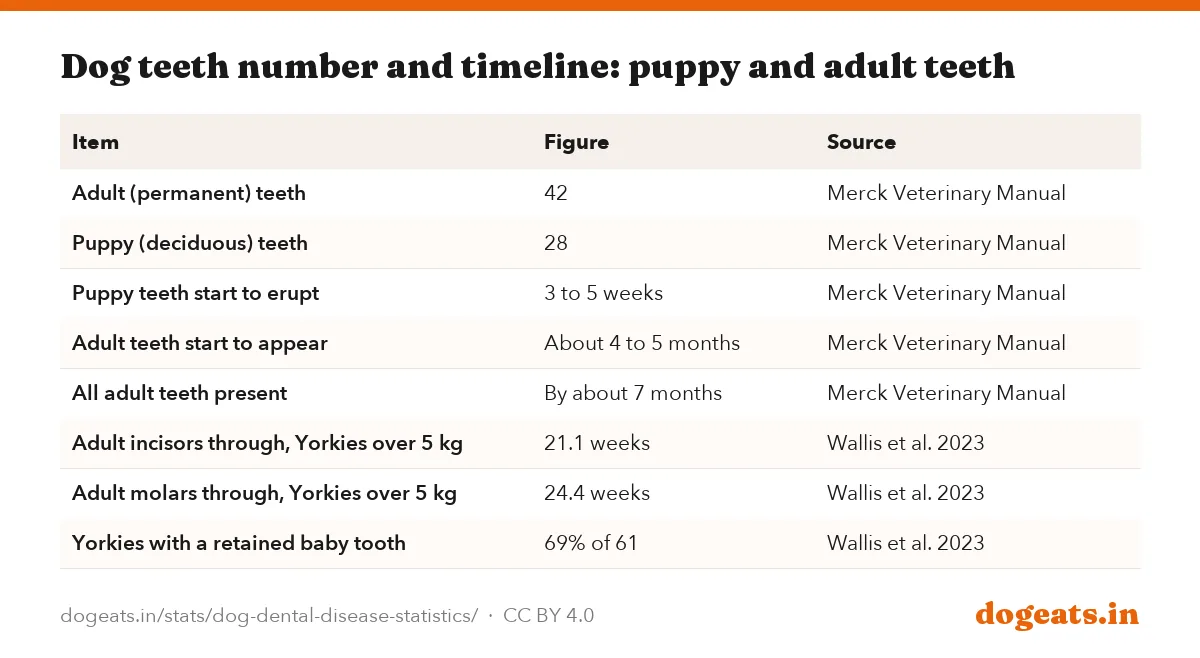
An adult dog has 42 permanent teeth and a puppy has 28 baby teeth, according to the Merck Veterinary Manual. Baby teeth start to come through at 3 to 5 weeks of age.
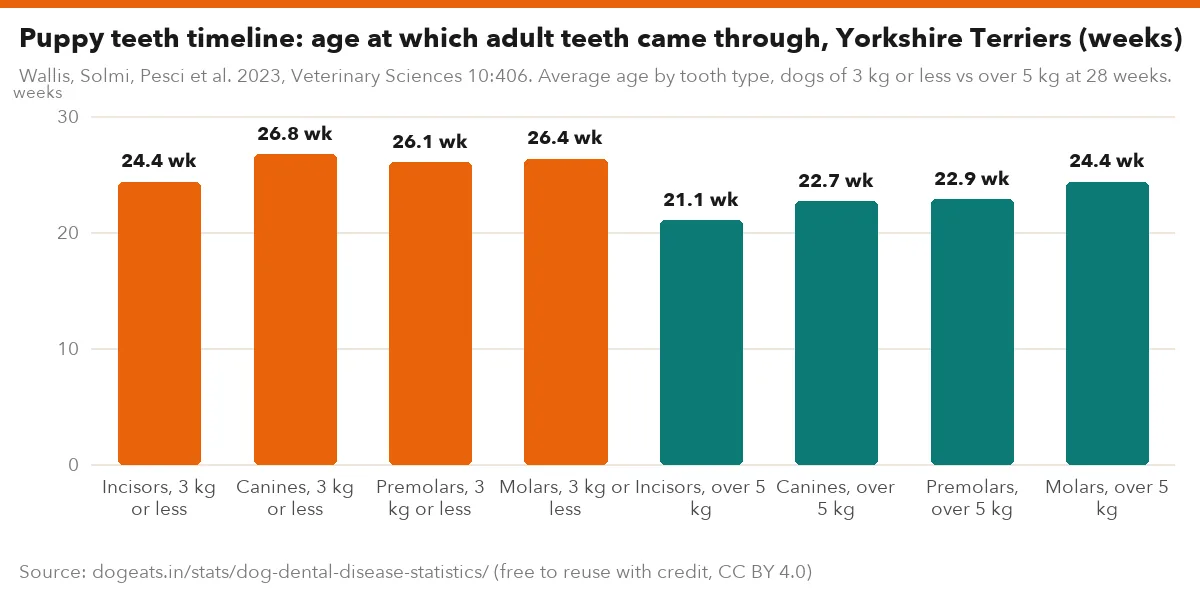
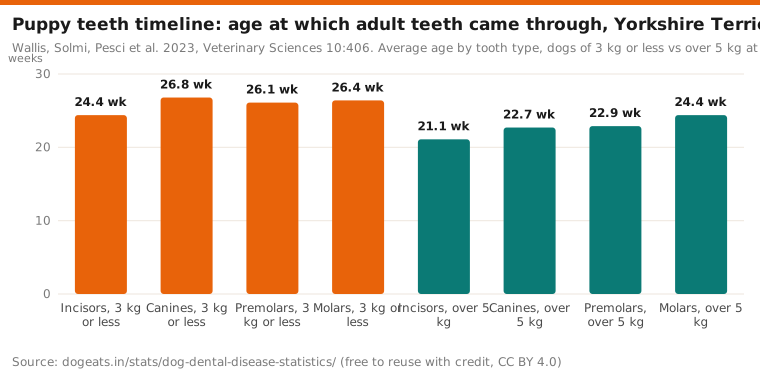
Adult teeth usually begin to appear at around 4 to 5 months, and all are present by about 7 months. A Waltham study of 61 Yorkshire Terriers timed it tooth by tooth from 12 to 28 weeks.
In those Yorkies, adult incisors came through at 21.1 weeks in dogs over 5 kg but 24.4 weeks in dogs of 3 kg or less. Molars came last, at 24.4 to 26.4 weeks. Smaller puppies lost and gained teeth later across every tooth type.
Wallis, Solmi, Pesci et al. 2023, Veterinary Sciences 10:406. Average age by tooth type, dogs of 3 kg or less vs over 5 kg at 28 weeks.
Show the numbers
| Label | weeks |
|---|---|
| Incisors, 3 kg or less | 24.4 wk |
| Canines, 3 kg or less | 26.8 wk |
| Premolars, 3 kg or less | 26.1 wk |
| Molars, 3 kg or less | 26.4 wk |
| Incisors, over 5 kg | 21.1 wk |
| Canines, over 5 kg | 22.7 wk |
| Premolars, over 5 kg | 22.9 wk |
| Molars, over 5 kg | 24.4 wk |
Embed this chart
| Item | Figure | Source |
|---|---|---|
| Adult (permanent) teeth | 42 | Merck Veterinary Manual |
| Puppy (deciduous) teeth | 28 | Merck Veterinary Manual |
| Puppy teeth start to erupt | 3 to 5 weeks | Merck Veterinary Manual |
| Adult teeth start to appear | About 4 to 5 months | Merck Veterinary Manual |
| All adult teeth present | By about 7 months | Merck Veterinary Manual |
| Adult incisors through, Yorkies over 5 kg | 21.1 weeks | Wallis et al. 2023 |
| Adult molars through, Yorkies over 5 kg | 24.4 weeks | Wallis et al. 2023 |
| Yorkies with a retained baby tooth | 69% of 61 | Wallis et al. 2023 |
| Tooth type | 3 kg or less (%) | Over 3 to 5 kg (%) | Over 5 kg (%) |
|---|---|---|---|
| Incisors | 34.9 | 1.7 | 1.3 |
| Canines | 89.1 | 25.0 | 12.0 |
| Premolars | 41.1 | 6.1 | 8.7 |
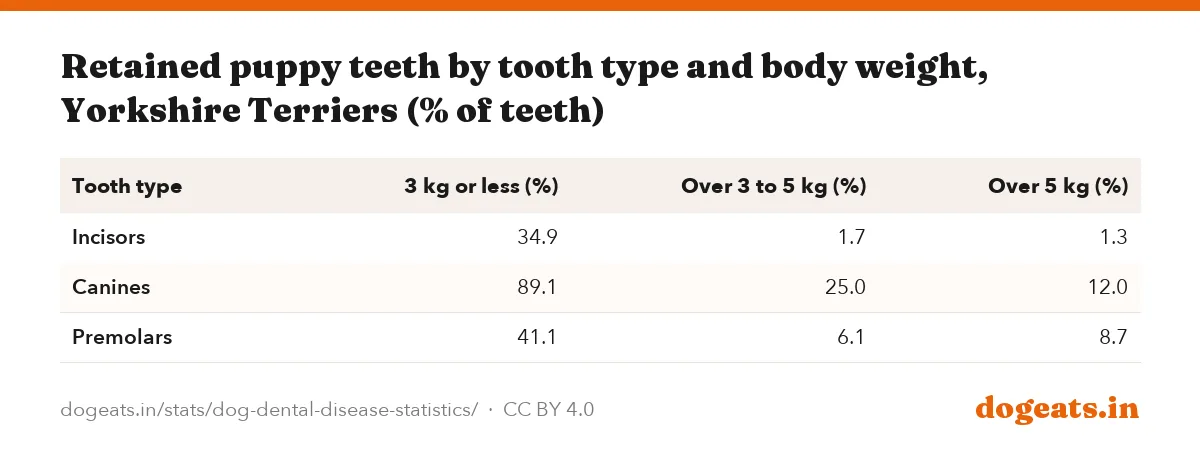
Retained baby teeth were common. In the Yorkies, 42 of 61 dogs (69%) had at least one, and 76% of those dogs needed the teeth removed under anaesthesia. In dogs of 3 kg or less, 89.1% of baby canines were retained. A UK study of 11,647 Chihuahuas found retained teeth in 5.7%, rising to 11.3% under age 2.
What do Indian vet studies find about dog teeth?
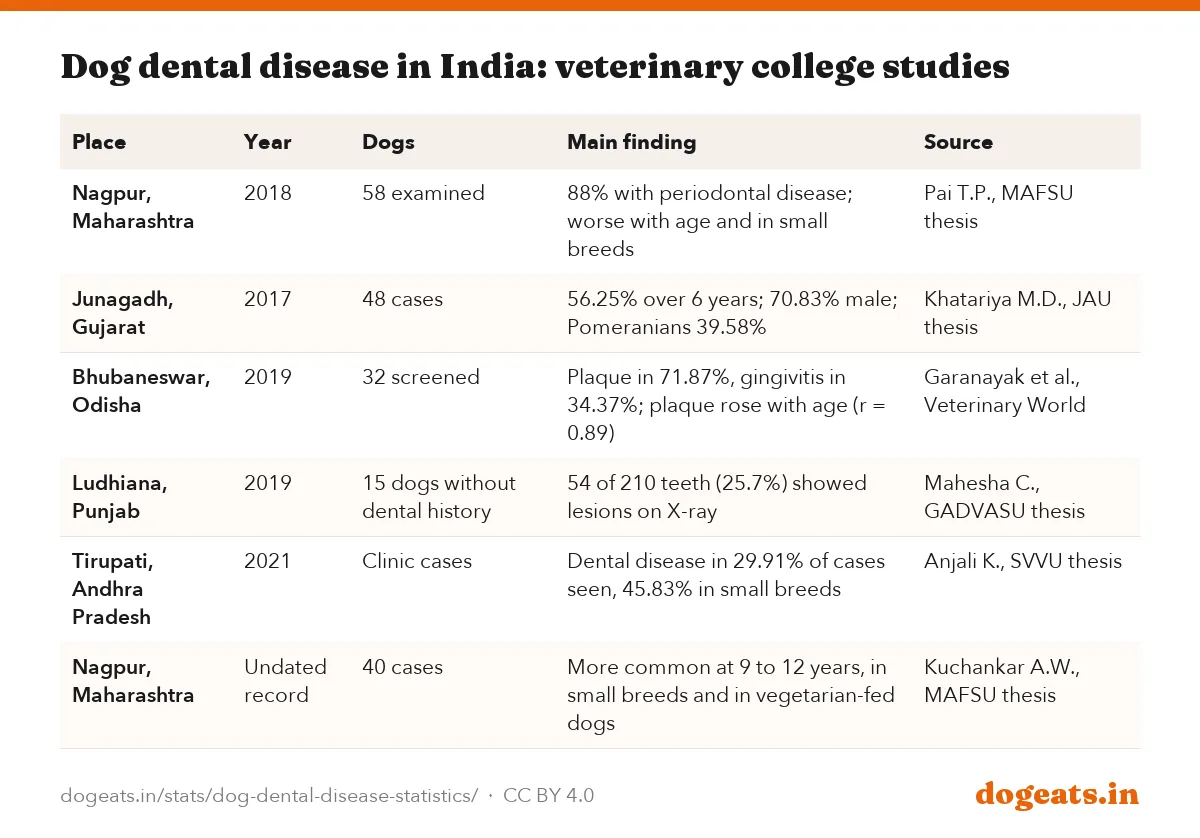
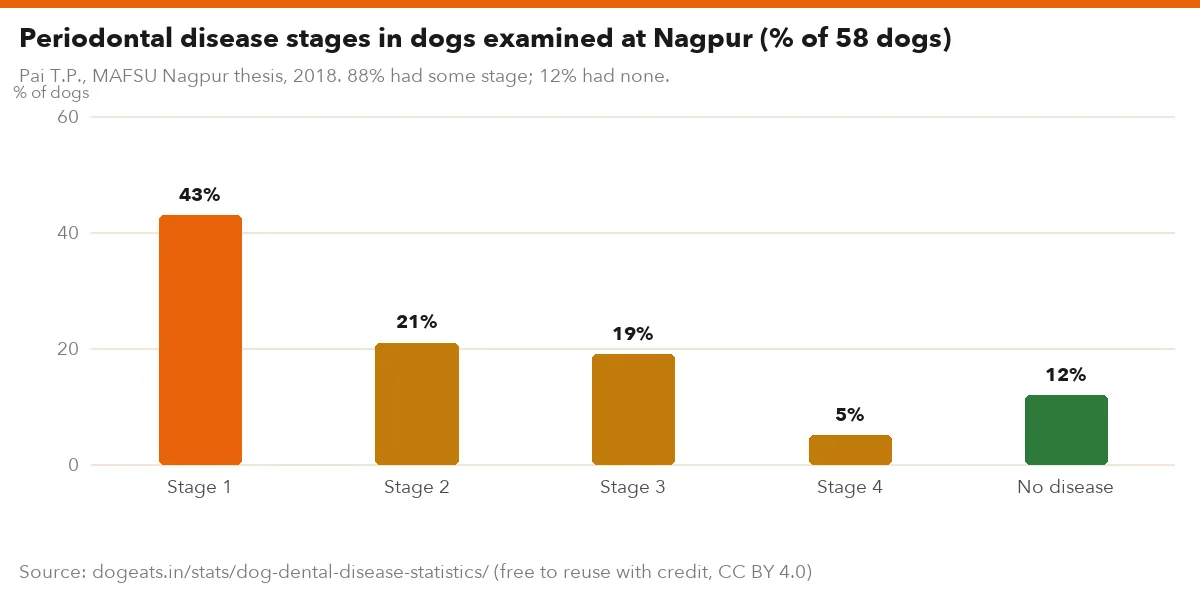
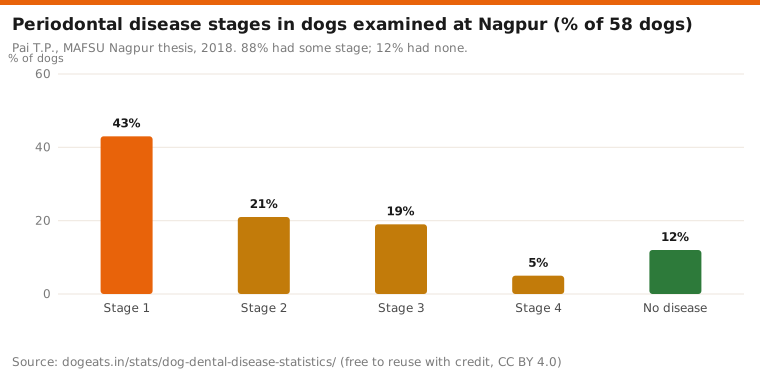
Indian data come from small veterinary college studies, and they find a lot of disease. At MAFSU's Nagpur college, 88% of 58 dogs examined had periodontal disease. Counting all 58 dogs, 43% were at stage 1, 21% at stage 2, 19% at stage 3 and 5% at stage 4.
At Junagadh Agricultural University, 27 of 48 dogs with periodontal disease (56.25%) were over 6 years old. Pomeranians made up 39.58% of cases, which may reflect how many are kept locally.
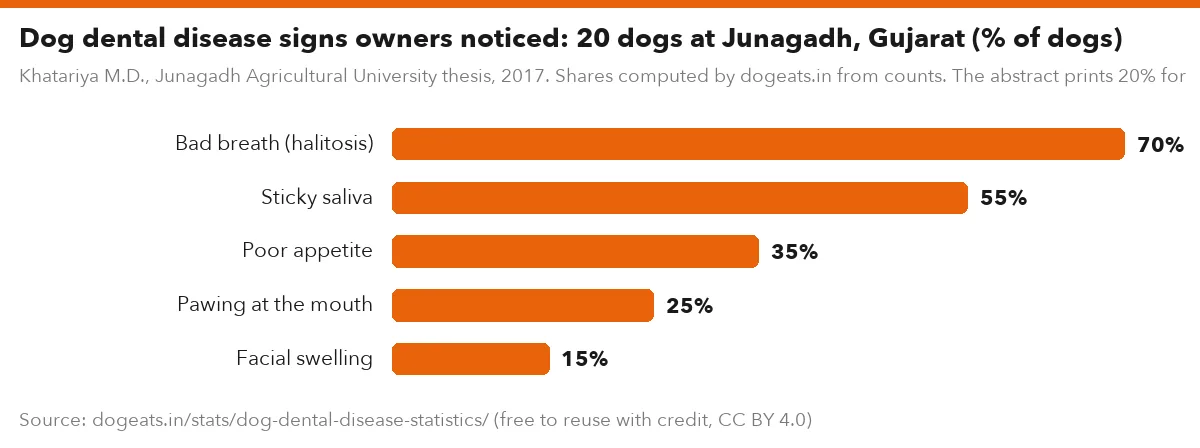
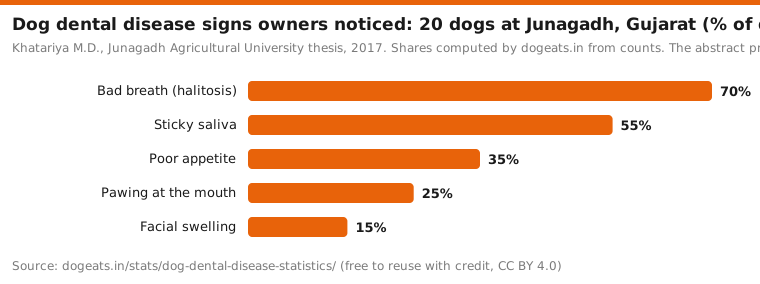
Owners there most often noticed bad breath, in 14 of 20 dogs (70%), and sticky saliva in 11 (55%). Plaque was found in all 20 and calculus in 17 (85%). Most owners did no home or professional dental care.
Khatariya M.D., Junagadh Agricultural University thesis, 2017. Shares computed by dogeats.in from counts. The abstract prints 20% for pawing at the mouth, but its count is 5 of 20, or 25%.
Show the numbers
| Label | % of dogs |
|---|---|
| Bad breath (halitosis) | 70% |
| Sticky saliva | 55% |
| Poor appetite | 35% |
| Pawing at the mouth | 25% |
| Facial swelling | 15% |
Embed this chart
| Place | Year | Dogs | Main finding | Source |
|---|---|---|---|---|
| Nagpur, Maharashtra | 2018 | 58 examined | 88% with periodontal disease; worse with age and in small breeds | Pai T.P., MAFSU thesis |
| Junagadh, Gujarat | 2017 | 48 cases | 56.25% over 6 years; 70.83% male; Pomeranians 39.58% | Khatariya M.D., JAU thesis |
| Bhubaneswar, Odisha | 2019 | 32 screened | Plaque in 71.87%, gingivitis in 34.37%; plaque rose with age (r = 0.89) | Garanayak et al., Veterinary World |
| Ludhiana, Punjab | 2019 | 15 dogs without dental history | 54 of 210 teeth (25.7%) showed lesions on X-ray | Mahesha C., GADVASU thesis |
| Tirupati, Andhra Pradesh | 2021 | Clinic cases | Dental disease in 29.91% of cases seen, 45.83% in small breeds | Anjali K., SVVU thesis |
| Nagpur, Maharashtra | Undated record | 40 cases | More common at 9 to 12 years, in small breeds and in vegetarian-fed dogs | Kuchankar A.W., MAFSU thesis |
Diet came up at Junagadh and Nagpur. At Junagadh, 11 of 20 dogs (55%) ate a purely vegetarian diet and the other 9 (45%) a mixed diet. The Nagpur studies found disease in dogs fed soft home food, and more of it in vegetarian-fed dogs. Our Indian dog diet chart looks at what a home-cooked bowl contains.
How often should a dog's teeth be cleaned, and what does it cost in India?
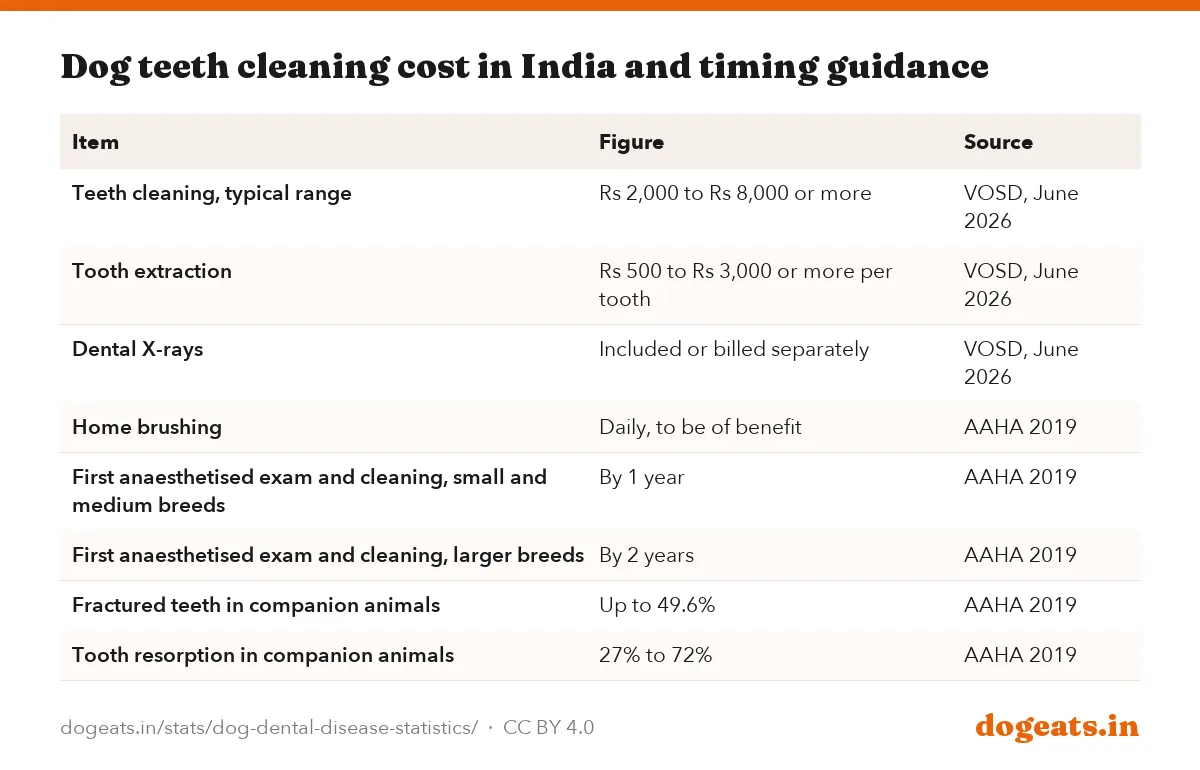
Brushing has to be daily to help, says the American Animal Hospital Association's 2019 Dental Care Guidelines. Brushing removes plaque but not hardened calculus.
AAHA recommends a first full exam, X-rays and cleaning under anaesthesia by age 1 for small and medium breeds and by age 2 for larger breeds. It calls anaesthesia-free cleaning unacceptable, because it cannot clean below the gum line.
X-rays matter: AAHA cites a study in which 28% of teeth that looked normal had important problems on X-ray. In Ludhiana, 25.7% of teeth X-rayed in dogs with no dental history showed lesions.
| Item | Figure | Source |
|---|---|---|
| Teeth cleaning, typical range | Rs 2,000 to Rs 8,000 or more | VOSD, June 2026 |
| Tooth extraction | Rs 500 to Rs 3,000 or more per tooth | VOSD, June 2026 |
| Dental X-rays | Included or billed separately | VOSD, June 2026 |
| Home brushing | Daily, to be of benefit | AAHA 2019 |
| First anaesthetised exam and cleaning, small and medium breeds | By 1 year | AAHA 2019 |
| First anaesthetised exam and cleaning, larger breeds | By 2 years | AAHA 2019 |
| Fractured teeth in companion animals | Up to 49.6% | AAHA 2019 |
| Tooth resorption in companion animals | 27% to 72% | AAHA 2019 |
Pai T.P., MAFSU Nagpur thesis, 2018. 88% had some stage; 12% had none.
Show the numbers
| Label | % of dogs |
|---|---|
| Stage 1 | 43% |
| Stage 2 | 21% |
| Stage 3 | 19% |
| Stage 4 | 5% |
| No disease | 12% |
Embed this chart
VOSD, a Bengaluru veterinary group, puts a routine cleaning at Rs 2,000 to Rs 8,000 or more, with extractions extra. Our vet and vaccination cost report lists other clinic charges. Ask your vet what your dog needs.
Which breeds do our guides flag for dental disease?
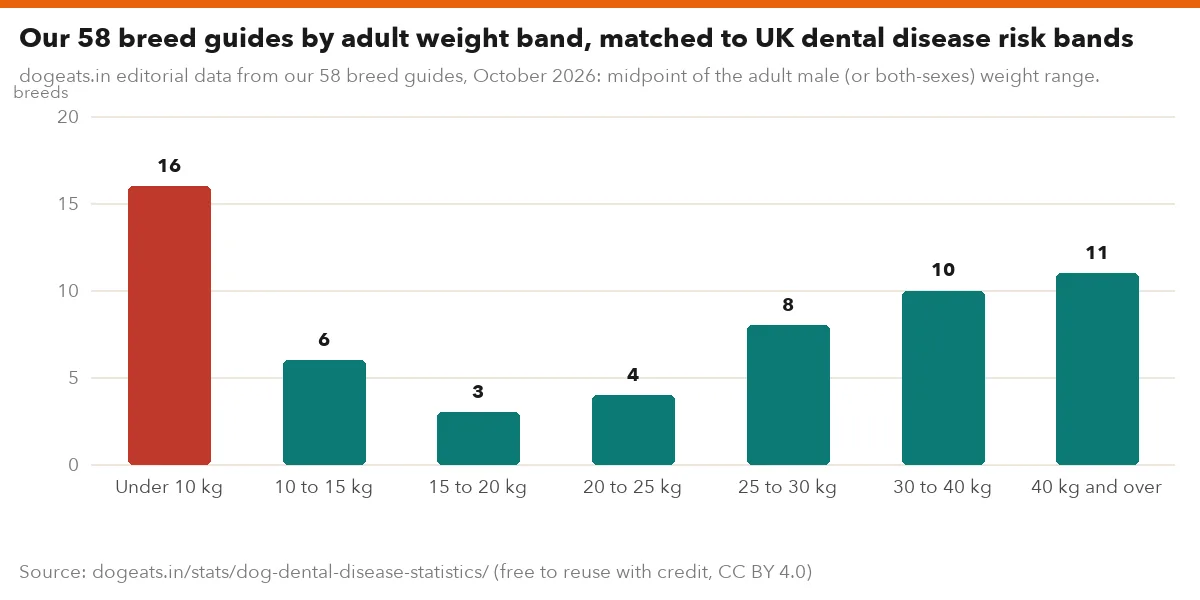
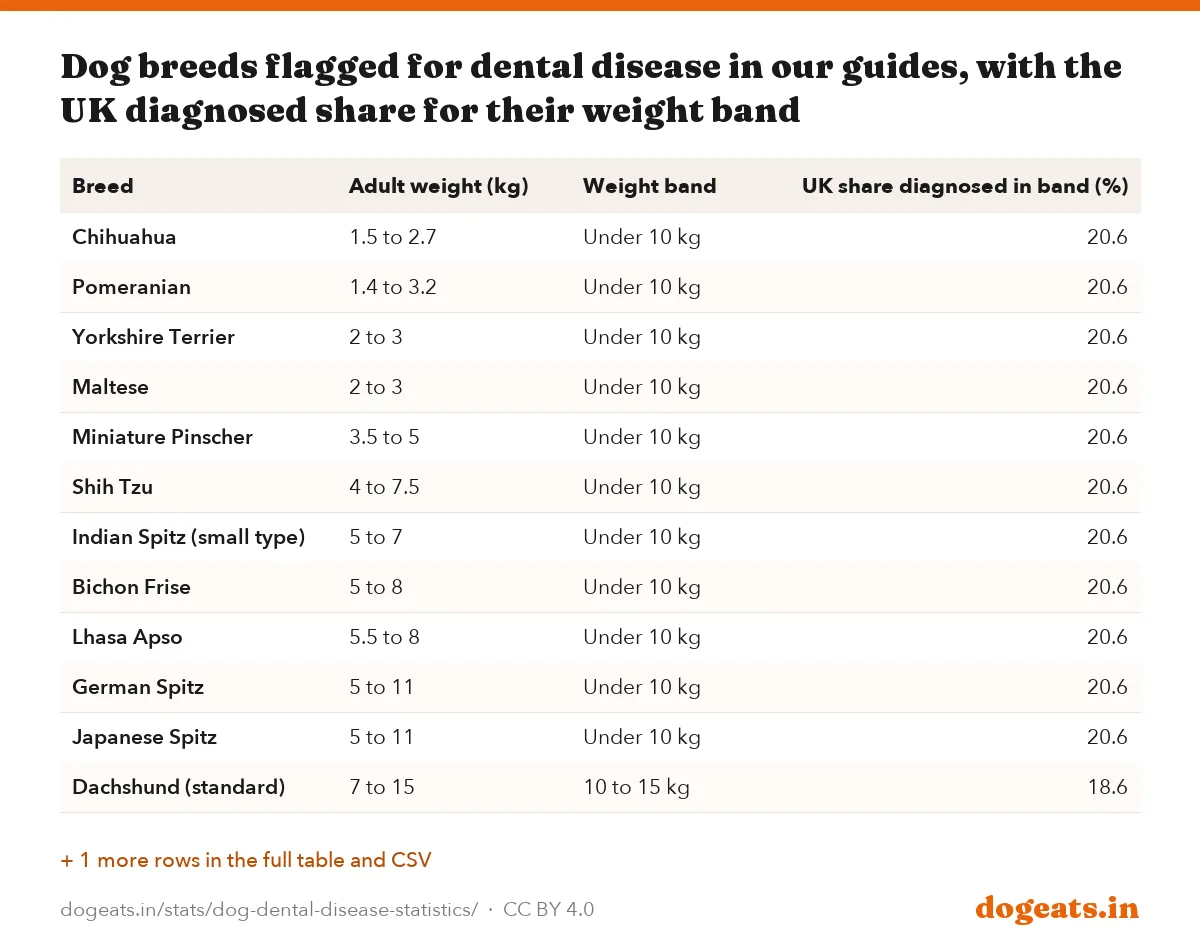
Our 58 breed guides list dental disease as a main health risk for 13 breeds. All 13 have an adult weight midpoint under 15 kg, and 11 have one under 10 kg.
Tooth care appears in the grooming advice of 37 of the 58 guides. These are dogeats.in editorial flags compiled in October 2026, not measured rates.
dogeats.in editorial data from our 58 breed guides, October 2026: midpoint of the adult male (or both-sexes) weight range.
Show the numbers
| Label | breeds |
|---|---|
| Under 10 kg | 16 |
| 10 to 15 kg | 6 |
| 15 to 20 kg | 3 |
| 20 to 25 kg | 4 |
| 25 to 30 kg | 8 |
| 30 to 40 kg | 10 |
| 40 kg and over | 11 |
Embed this chart
| Breed | Adult weight (kg) | Weight band | UK share diagnosed in band (%) |
|---|---|---|---|
| Chihuahua | 1.5 to 2.7 | Under 10 kg | 20.6 |
| Pomeranian | 1.4 to 3.2 | Under 10 kg | 20.6 |
| Yorkshire Terrier | 2 to 3 | Under 10 kg | 20.6 |
| Maltese | 2 to 3 | Under 10 kg | 20.6 |
| Miniature Pinscher | 3.5 to 5 | Under 10 kg | 20.6 |
| Shih Tzu | 4 to 7.5 | Under 10 kg | 20.6 |
| Indian Spitz (small type) | 5 to 7 | Under 10 kg | 20.6 |
| Bichon Frise | 5 to 8 | Under 10 kg | 20.6 |
| Lhasa Apso | 5.5 to 8 | Under 10 kg | 20.6 |
| German Spitz | 5 to 11 | Under 10 kg | 20.6 |
| Japanese Spitz | 5 to 11 | Under 10 kg | 20.6 |
| Dachshund (standard) | 7 to 15 | 10 to 15 kg | 18.6 |
| American Eskimo Dog (standard) | 11 to 16 | 10 to 15 kg | 18.6 |
The Shih Tzu and Lhasa Apso guides carry the same warning. The band share is the UK average for dogs of that weight, not a breed rate.
Frequently asked questions
How many teeth does a dog have?
An adult dog has 42 teeth and a puppy has 28, according to the Merck Veterinary Manual. All adult teeth are usually in by about 7 months.
When do puppies lose their baby teeth?
Adult teeth start coming through at about 4 to 5 months. In Yorkshire Terriers, baby incisors fell out at about 21 to 26 weeks, later in smaller puppies.
How common is dental disease in dogs?
UK vets diagnosed periodontal disease in 12.52% of dogs in one year, the most common diagnosis. Under anaesthesia, 98.6% of adult dogs in a 2026 study had some stage of it.
Do 80% of dogs have dental disease by age 3?
The figure is widely repeated but rarely sourced; VOSD's June 2026 cost guide repeats it as over 80% of dogs above age three. Studies range from 12.52% diagnosed in a year to 98.6% found under anaesthesia, and risk rises with age.
Which dogs get the most dental disease?
Small breeds and older dogs. Dogs under 10 kg were diagnosed about three times as often as dogs over 40 kg, and Toy Poodles had 3.97 times the odds of crossbreds.
How often should I brush my dog's teeth?
Daily, according to AAHA's 2019 dental guidelines, which say brushing must be daily to be of benefit. Brushing removes plaque, not calculus.
How much does dog teeth cleaning cost in India?
VOSD, a Bengaluru clinic group, puts a routine cleaning at Rs 2,000 to Rs 8,000 or more (June 2026). Extractions add Rs 500 to Rs 3,000 or more per tooth.
Is anaesthesia-free dog teeth cleaning safe?
AAHA calls it unacceptable, because it cannot clean below the gum line and is not shown to be safer. Discuss anaesthesia risks with your vet.
Methodology and limitations
UK figures are from the full text of O'Neill et al. (2021), Journal of Small Animal Practice, read through Europe PMC on 17 October 2026. Shares by age, weight and breed were computed by dogeats.in from the case and non-case counts in Tables 1 and 2. Odds ratios are from Table 3 and the replacement models.
Other prevalence figures come from the abstracts or full texts named in the sources. Tooth counts and timing come from the Merck Veterinary Manual and the Yorkshire Terrier study by Wallis and colleagues (2023).
Indian figures come from the abstracts of veterinary college theses in the Krishikosh repository and one Veterinary World paper. Junagadh sign shares were computed from counts.
Breed flags and weight bands are dogeats.in editorial data compiled from our 58 breed guides, October 2026, using the midpoint of each adult weight range.
Sources
- O'Neill DG et al., Epidemiology of periodontal disease in dogs in the UK primary-care veterinary setting, J Small Anim Pract 2021, 12.52% of 22,333 dogs; age, weight, breed counts and odds
- Bellows J et al., 2019 AAHA Dental Care Guidelines for Dogs and Cats, JAAHA 2019, Daily brushing, exam timing, anaesthesia, fracture and resorption figures
- Merck Veterinary Manual, Dental development of dogs (Muylle S.), 42 adult and 28 puppy teeth; eruption timing
- Also consulted: O'Neill DG et al., Prevalence of commonly diagnosed disorders in UK dogs under primary veterinary care, BMC Veterinary Research 2021;17:69, Stepaniuk KS et al., Oral examination in a random anesthetized canine population, J Vet Dent 2026, Wallis C, Holcombe LJ, A review of the frequency and impact of periodontal disease in dogs, J Small Anim Pract 2020, Wallis C et al., Association of periodontal disease with breed size, breed, weight, and age, Vet J 2021, Wallis C, Solmi F, Pesci I et al., Development of Yorkshire Terrier dentition, Veterinary Sciences 2023;10:406, Wallis C et al., A longitudinal assessment of periodontal disease in Yorkshire terriers, BMC Vet Res 2019, Marshall MD et al., A longitudinal assessment of periodontal disease in 52 Miniature Schnauzers, BMC Vet Res 2014, Wallis C et al., Periodontal health in 53 Labrador retrievers, J Small Anim Pract 2018, Stella JL et al., Prevalence of periodontal disease in dogs in commercial breeding facilities, PLOS ONE 2018, Garanayak N et al., Effect of age on dental plaque deposition in dogs, Veterinary World 2019, Pai T.P., Effect of dental scaling and polishing on periodontal disease in dogs, MAFSU Nagpur thesis, 2018, Khatariya M.D., Surgical management of periodontal diseases in dogs, Junagadh Agricultural University thesis, 2017, Mahesha C., Dental and mandibular affections in small animals, GADVASU thesis, 2019, Anjali K., Peri and endodontal diseases in dogs, SVVU Tirupati thesis, 2021, Kuchankar A.W., Surgico-therapeutic management of periodontal diseases in dog, MAFSU thesis, VOSD, Cost of dog dental treatment in India (June 2026).
Cite, embed and download
This report, its data and its images are free to reuse under a Creative Commons Attribution 4.0 licence. Credit dogeats.in with a link to this page. Every chart has its own embed code, every table has a CSV and an image download, and the images below are ready for social posts, slides and articles.
Cite this report
Link to this report
Every chart and table as an image