Explainer · Updated October 2026
What poisons dogs in India: rat poison, pesticides, human medicines and food, with toxic doses and survival rates
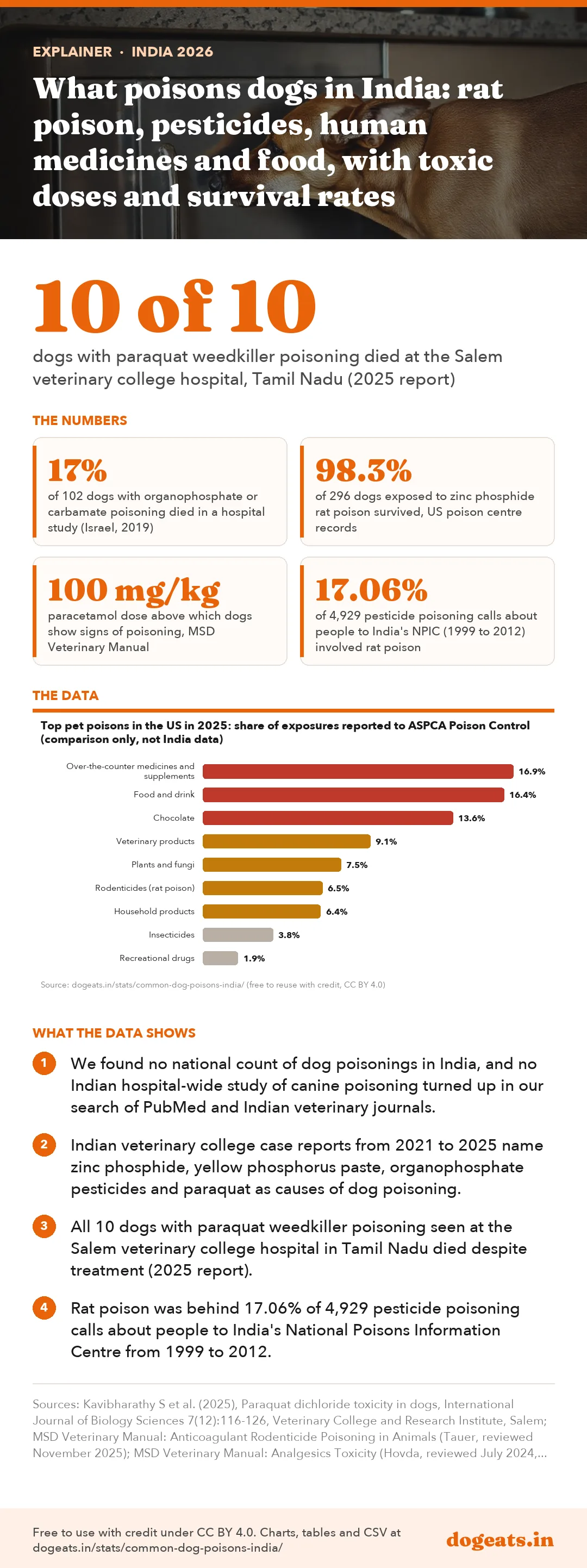
We found no national count of dog poisonings in India. Indian veterinary college case reports point to rat poison (zinc phosphide and yellow phosphorus paste), organophosphate pesticides and the weedkiller paraquat. Paraquat killed all 10 dogs in a 2025 Salem series. Human medicines are the other big risk: paracetamol harms dogs above 100 mg/kg, so one 650 mg tablet is already too much for a 5 kg dog. In published foreign studies most poisoned dogs survived with treatment, from 83% after organophosphate or carbamate poisoning to 98.3% after zinc phosphide exposure.
Key findings
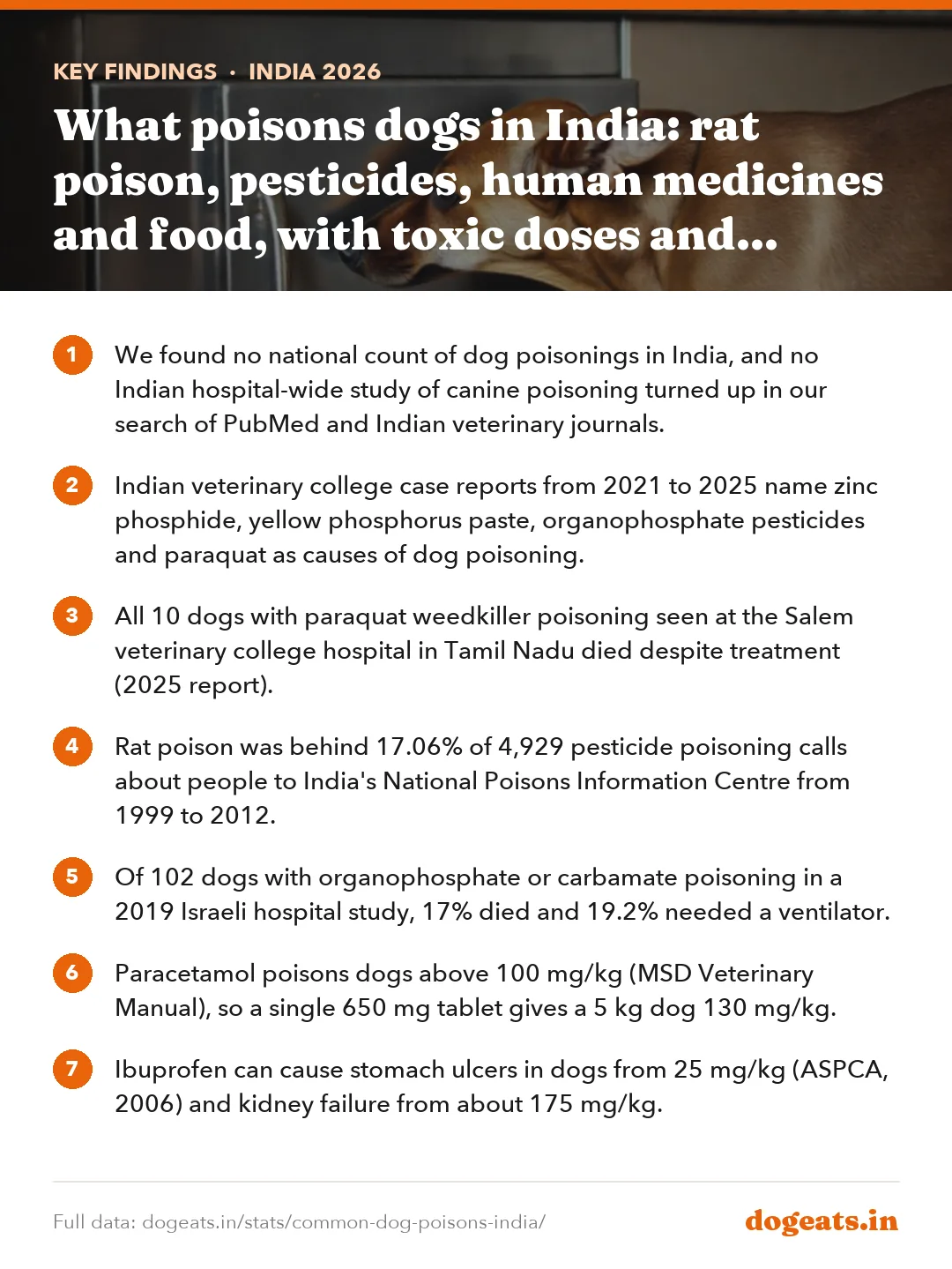
- We found no national count of dog poisonings in India, and no Indian hospital-wide study of canine poisoning turned up in our search of PubMed and Indian veterinary journals.
- Indian veterinary college case reports from 2021 to 2025 name zinc phosphide, yellow phosphorus paste, organophosphate pesticides and paraquat as causes of dog poisoning.
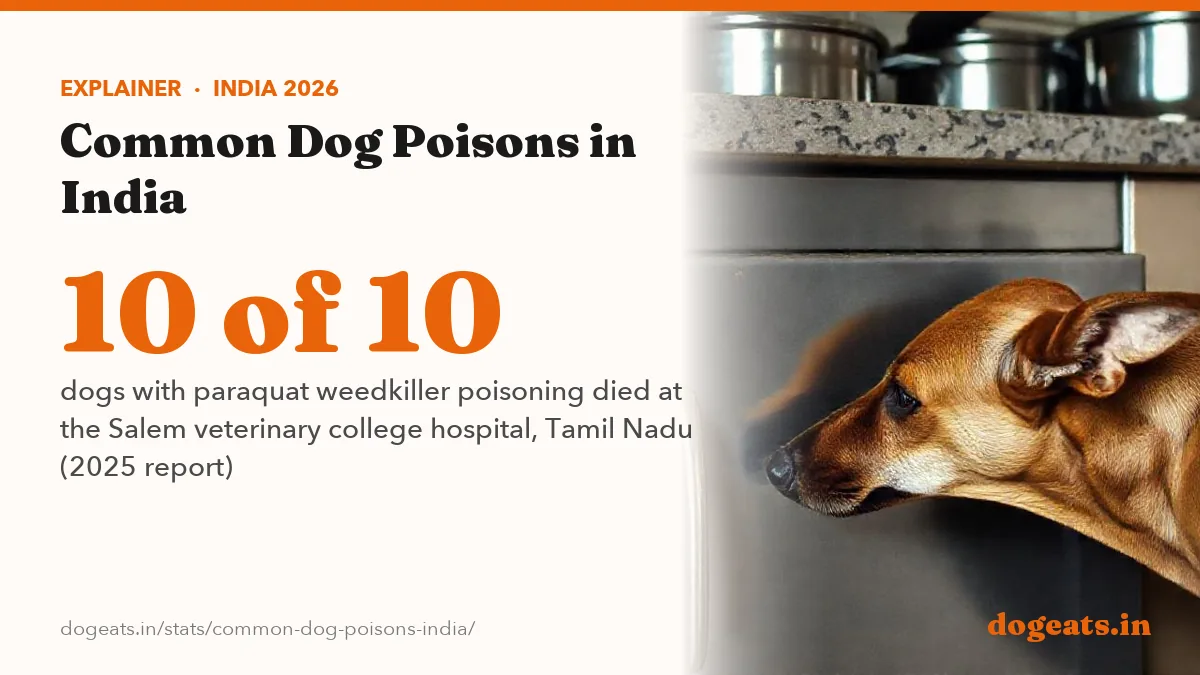
- All 10 dogs with paraquat weedkiller poisoning seen at the Salem veterinary college hospital in Tamil Nadu died despite treatment (2025 report).
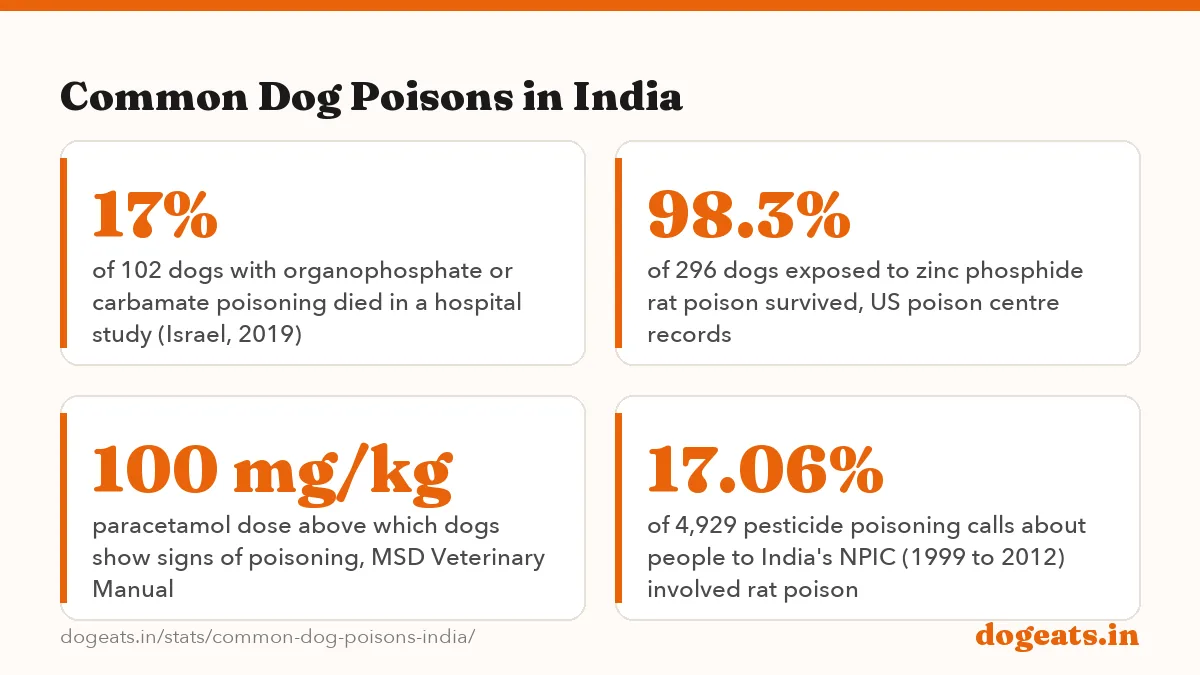
- Rat poison was behind 17.06% of 4,929 pesticide poisoning calls about people to India's National Poisons Information Centre from 1999 to 2012.
- Of 102 dogs with organophosphate or carbamate poisoning in a 2019 Israeli hospital study, 17% died and 19.2% needed a ventilator.
- Paracetamol poisons dogs above 100 mg/kg (MSD Veterinary Manual), so a single 650 mg tablet gives a 5 kg dog 130 mg/kg.
- Ibuprofen can cause stomach ulcers in dogs from 25 mg/kg (ASPCA, 2006) and kidney failure from about 175 mg/kg.
- Anticoagulant rat poisons cause bleeding 3 to 7 days after a dog eats them, and treatment is usually 28 days of vitamin K1 (MSD Veterinary Manual).
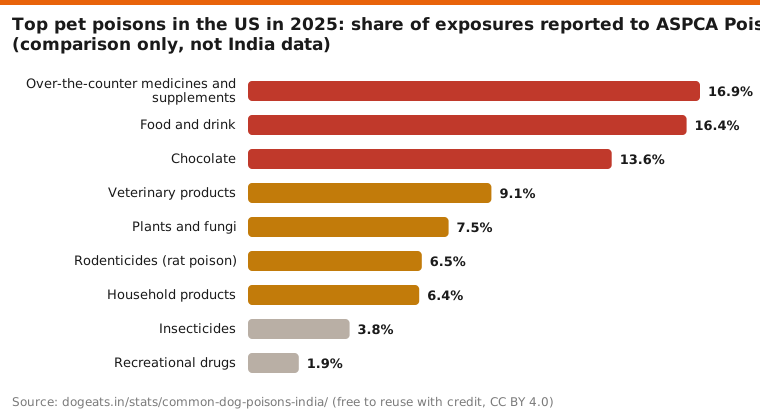
- In the US, ASPCA Poison Control's 2025 list put over-the-counter medicines first at 16.9% of exposures, with rodenticides at 6.5% and insecticides at 3.8%.
What are the most common poisons for dogs in India?
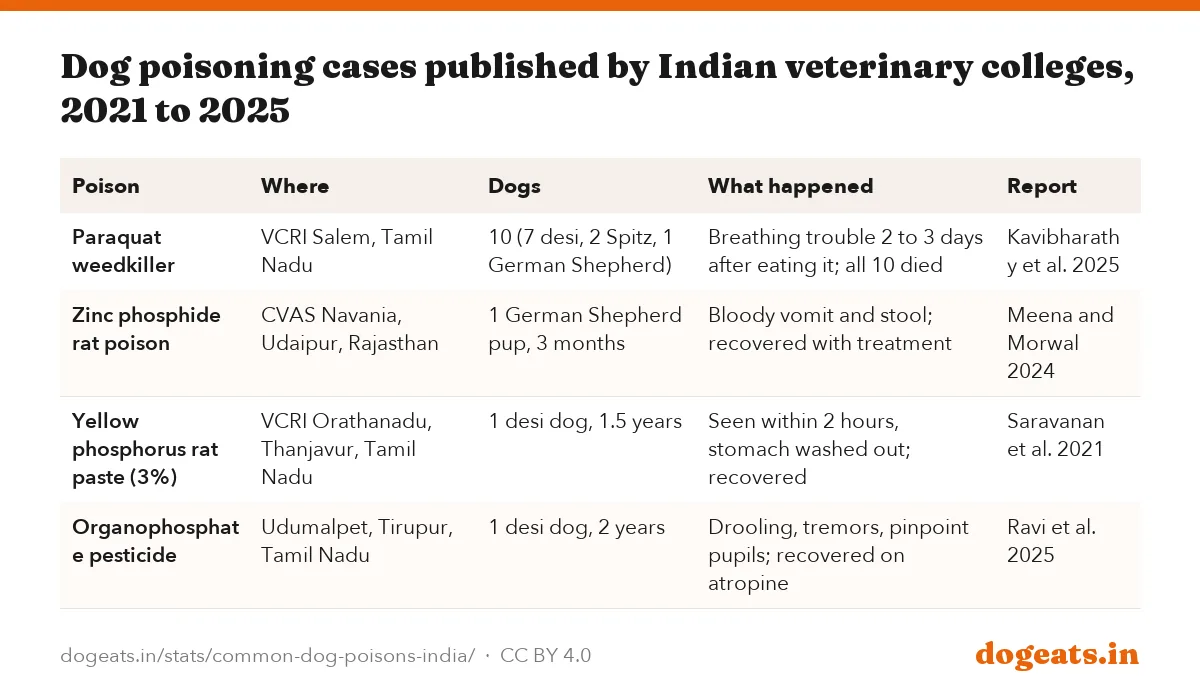
We found no count of dog poisonings in India, so there is no national ranking. Indian veterinary college case reports from 2021 to 2025 name three groups: rat poison, organophosphate pesticides and the weedkiller paraquat.
The rat poisons in those reports are zinc phosphide powder or pellets and yellow phosphorus paste. A 2019 review in the Indian Journal of Critical Care Medicine says phosphides are the commonest rat poison behind human poisoning in India. It adds that rodenticides are sold over the counter and online.
Human data shows these products are in homes. In a 13-year study of 4,929 pesticide poisoning calls about people to the National Poisons Information Centre at AIIMS, New Delhi (1999 to 2012), 17.06% involved rodenticides. A dog in the same house can reach the same packet.
| Poison | Where | Dogs | What happened | Report |
|---|---|---|---|---|
| Paraquat weedkiller | VCRI Salem, Tamil Nadu | 10 (7 desi, 2 Spitz, 1 German Shepherd) | Breathing trouble 2 to 3 days after eating it; all 10 died | Kavibharathy et al. 2025 |
| Zinc phosphide rat poison | CVAS Navania, Udaipur, Rajasthan | 1 German Shepherd pup, 3 months | Bloody vomit and stool; recovered with treatment | Meena and Morwal 2024 |
| Yellow phosphorus rat paste (3%) | VCRI Orathanadu, Thanjavur, Tamil Nadu | 1 desi dog, 1.5 years | Seen within 2 hours, stomach washed out; recovered | Saravanan et al. 2021 |
| Organophosphate pesticide | Udumalpet, Tirupur, Tamil Nadu | 1 desi dog, 2 years | Drooling, tremors, pinpoint pupils; recovered on atropine | Ravi et al. 2025 |
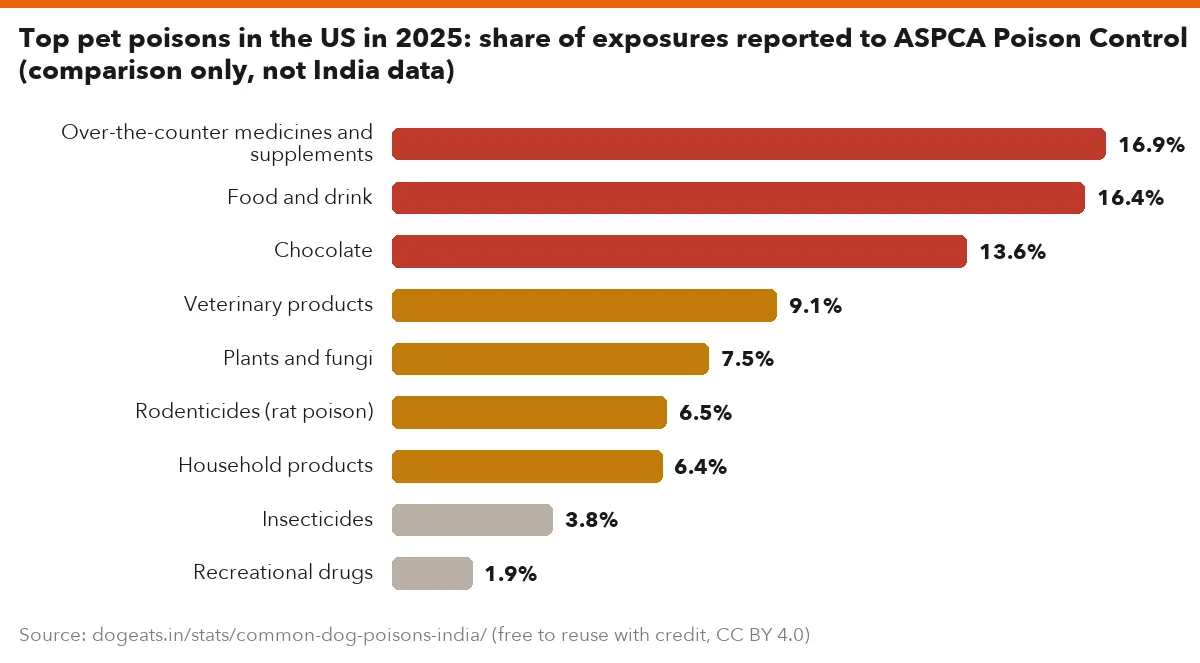
ASPCA Animal Poison Control Center, Top 10 Toxins of 2025 (published 15 March 2026). Covers over 376,000 items pets were exposed to, all species. Human prescription medicines ranked third, but ASPCA gave no percentage, so they are left out.
Show the numbers
| Label | % |
|---|---|
| Over-the-counter medicines and supplements | 16.9% |
| Food and drink | 16.4% |
| Chocolate | 13.6% |
| Veterinary products | 9.1% |
| Plants and fungi | 7.5% |
| Rodenticides (rat poison) | 6.5% |
| Household products | 6.4% |
| Insecticides | 3.8% |
| Recreational drugs | 1.9% |
Embed this chart
The best numbers come from abroad, so treat them as a guide to what can happen, not a ranking for India. In the US, ASPCA Poison Control's 2025 list put over-the-counter medicines first at 16.9% of exposures, food and drink second at 16.4% and chocolate fourth at 13.6%.
Rodenticides were 6.5% of US exposures and insecticides 3.8%. All four Indian reports above are about pesticides, including rat poison, but four reports cannot show how often each poison occurs in India. Rat poison is sold freely in India, the Indian Journal of Critical Care Medicine review says.
Food poisons are covered in detail in our report on the most toxic foods for dogs in an Indian kitchen, so this page sticks to chemicals and medicines.
What happens if a dog eats rat poison?
It depends on the type. Anticoagulant rat poisons stop blood clotting, and bleeding usually shows 3 to 7 days after a toxic dose, the MSD Veterinary Manual says. Zinc phosphide can cause signs within minutes, and in severe cases death within 5 hours.
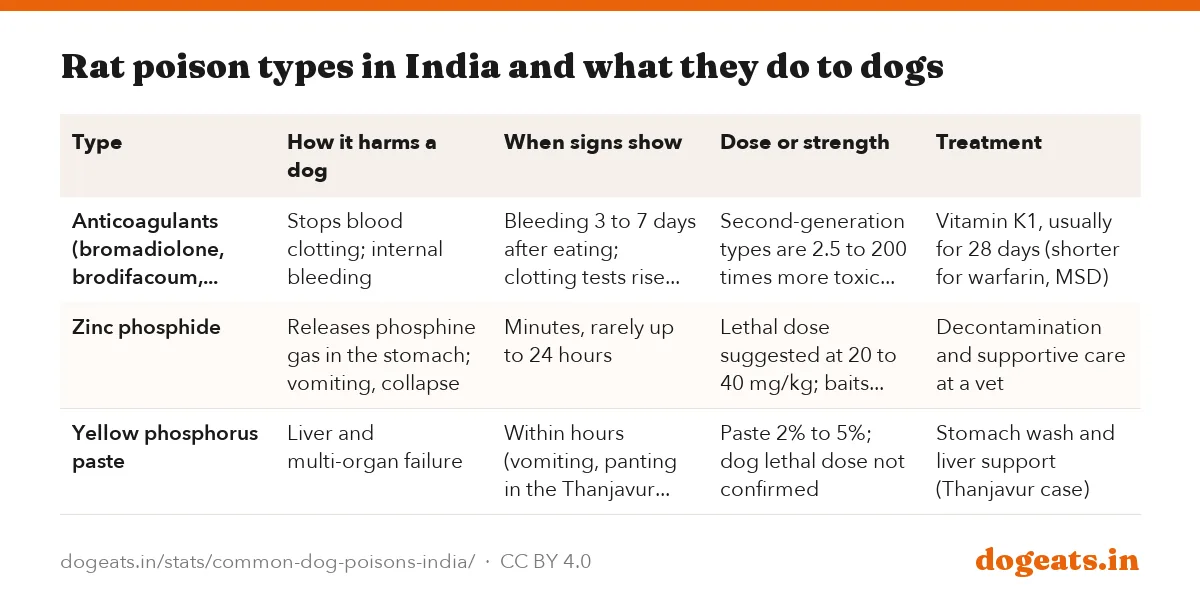
Three kinds of rat poison turn up in Indian case reports and reviews. Anticoagulants include bromadiolone and brodifacoum. Zinc phosphide is sold as powder or pellets. Yellow phosphorus comes as a paste with 2% to 5% phosphorus, according to the Indian Journal of Critical Care Medicine review.
In the Thanjavur case report, a dog ate a 3% yellow phosphorus paste and recovered after its stomach was washed out within 2 hours. We could not trace a lethal dose of yellow phosphorus for dogs to its original source, so we do not give one.
| Type | How it harms a dog | When signs show | Dose or strength | Treatment |
|---|---|---|---|---|
| Anticoagulants (bromadiolone, brodifacoum, warfarin) | Stops blood clotting; internal bleeding | Bleeding 3 to 7 days after eating; clotting tests rise after 2 to 5 days | Second-generation types are 2.5 to 200 times more toxic than first-generation | Vitamin K1, usually for 28 days (shorter for warfarin, MSD) |
| Zinc phosphide | Releases phosphine gas in the stomach; vomiting, collapse | Minutes, rarely up to 24 hours | Lethal dose suggested at 20 to 40 mg/kg; baits 0.5% to 10% | Decontamination and supportive care at a vet |
| Yellow phosphorus paste | Liver and multi-organ failure | Within hours (vomiting, panting in the Thanjavur case) | Paste 2% to 5%; dog lethal dose not confirmed | Stomach wash and liver support (Thanjavur case) |
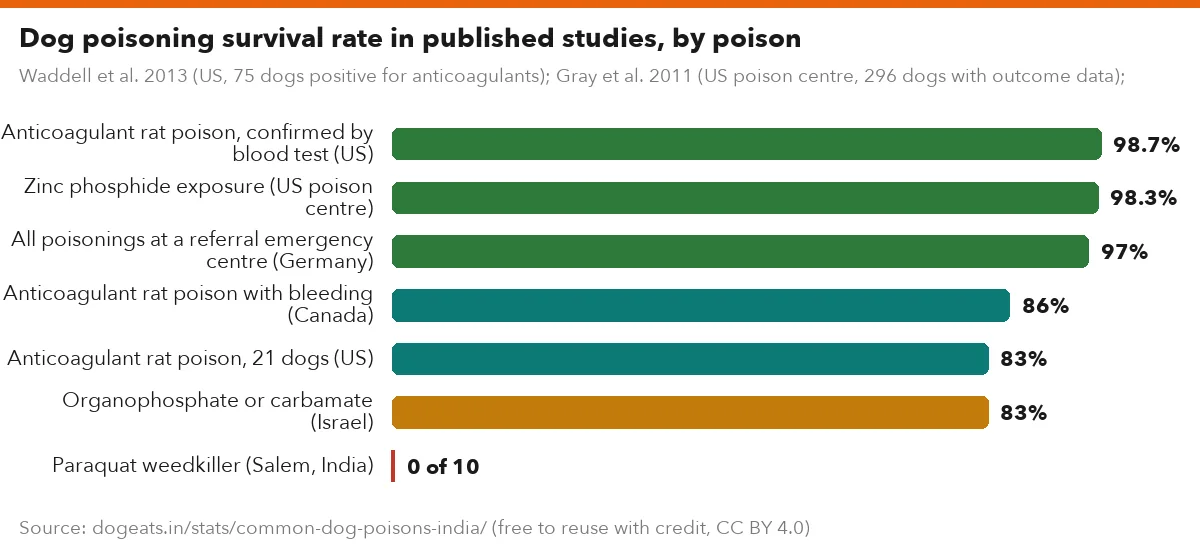
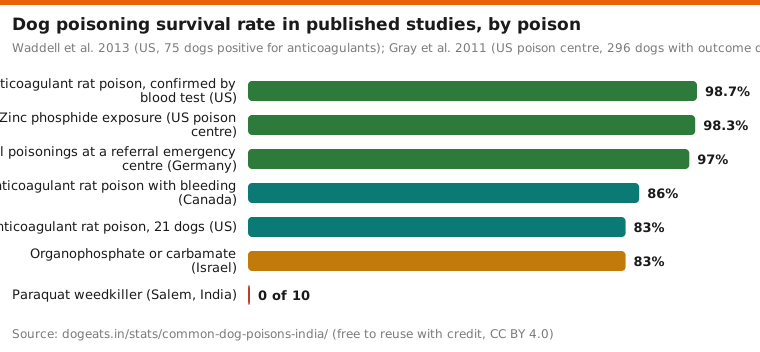
Waddell et al. 2013 (US, 75 dogs positive for anticoagulants); Gray et al. 2011 (US poison centre, 296 dogs with outcome data); Markert et al. 2024 (Germany, 634 dogs); Paulin et al. 2024 (Canada, dogs with bleeding among 349); Sheafor and Couto 1999 (US, 21 dogs); Klainbart et al. 2019 (Israel, 102 dogs, 17% died); Kavibharathy et al. 2025 (Salem, India, 10 dogs).
Show the numbers
| Label | % |
|---|---|
| Anticoagulant rat poison, confirmed by blood test (US) | 98.7% |
| Zinc phosphide exposure (US poison centre) | 98.3% |
| All poisonings at a referral emergency centre (Germany) | 97% |
| Anticoagulant rat poison with bleeding (Canada) | 86% |
| Anticoagulant rat poison, 21 dogs (US) | 83% |
| Organophosphate or carbamate (Israel) | 83% |
| Paraquat weedkiller (Salem, India) | 0 of 10 |
Embed this chart
Survival was high in the large studies. A US poison centre study of 362 dogs exposed to zinc phosphide found 58.8% never showed signs, and 98.3% of the 296 dogs with known outcomes survived.
Bleeding changes the picture. In a Canadian study of 349 dogs with anticoagulant poisoning, 86% of the dogs that were already bleeding survived.
Rat poison is common in European studies too. In 11 German small animal practices in 2007, about 1 in 200 dog patients came in with poisoning. Anticoagulant (coumarin) rat poisons were the main poison at 37% of cases in the record review, which covered dogs and cats.
Phosphide poisoning can turn serious after a mild start. In a 2025 case report from Australia, a dog's owners gave it a tablespoon of table salt to make it vomit after it ate zinc phosphide. They brought it to a vet 4 hours later. Despite hospital treatment it developed liver failure, and the owners chose euthanasia. Leave making a dog vomit to a vet.
Which pesticides poison dogs, and how deadly are they?
Organophosphate and carbamate insecticides killed 17% of 102 poisoned dogs in a 2019 hospital study from Israel, and 19.2% needed a ventilator. Signs usually start within minutes to hours, though MSD says they can be delayed more than 2 days.
The classic signs are drooling, pinpoint pupils, muscle tremors, weakness, vomiting and diarrhoea. The Tirupur dog in the case table showed exactly these. Atropine is the antidote, and MSD gives a dog dose of 0.2 to 2 mg/kg.
Paraquat is worse because there is no antidote. All 10 dogs in the Salem series developed fast, laboured breathing 2 to 3 days after eating it, and every one died. The authors warn vets to watch for both accidental and deliberate paraquat poisoning.

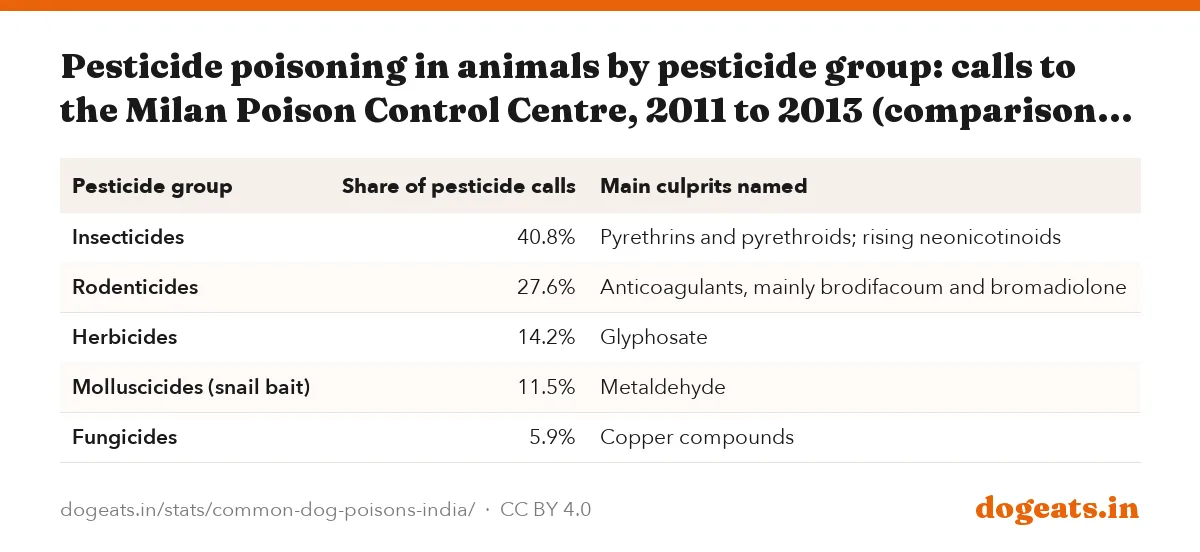
| Pesticide group | Share of pesticide calls | Main culprits named |
|---|---|---|
| Insecticides | 40.8% | Pyrethrins and pyrethroids; rising neonicotinoids |
| Rodenticides | 27.6% | Anticoagulants, mainly brodifacoum and bromadiolone |
| Herbicides | 14.2% | Glyphosate |
| Molluscicides (snail bait) | 11.5% | Metaldehyde |
| Fungicides | 5.9% | Copper compounds |
In the Milan study, pesticides made up 37.3% of suspected animal poisoning enquiries and dogs were 71.1% of calls. Cases linked to paraquat and carbofuran fell after the EU banned them.
Pyrethroids such as permethrin are used in some dog spot-on tick products. MSD lists drooling, vomiting, tremors and seizures in dogs, and says cats are more sensitive than other pets. Australian reports show cats are poisoned when owners use a dog permethrin spot-on on them.
Some poisonings are deliberate. Poisoning any animal is a crime under Section 325 of the Bharatiya Nyaya Sanhita; our animal cruelty cases report has the numbers on prosecutions.
Can I give my dog paracetamol or ibuprofen?
No, not without a vet's dose. The MSD Veterinary Manual says dogs show signs of paracetamol poisoning above 100 mg/kg, and an ASPCA brief from 2006 puts liver damage at 50 to 100 mg/kg. A single 650 mg tablet gives a 5 kg dog 130 mg/kg.
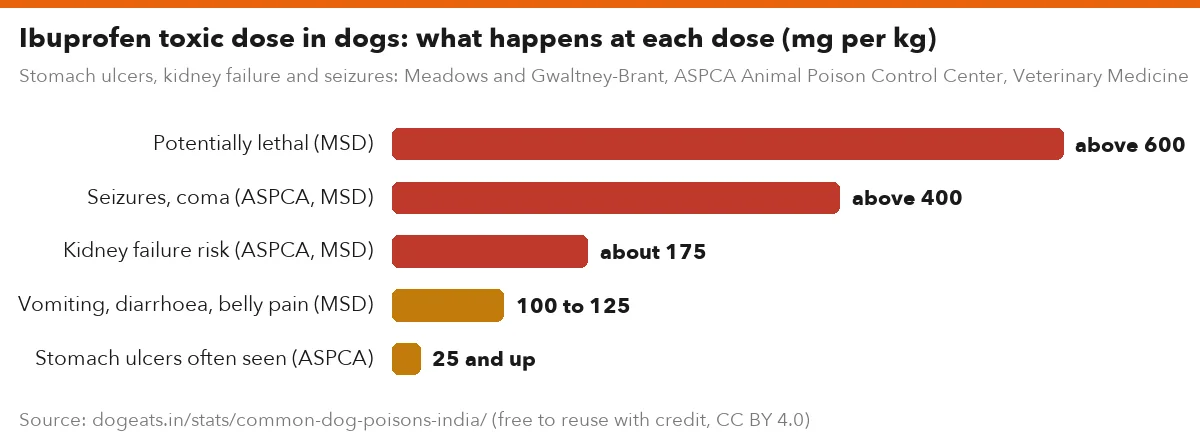
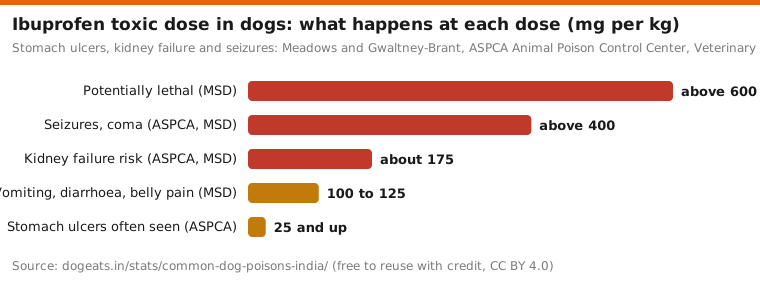
Ibuprofen has a narrow safety margin in dogs. The same ASPCA brief says doses of 25 mg/kg or more often cause stomach ulcers, about 175 mg/kg risks kidney failure, and above 400 mg/kg brings seizures and coma. MSD gives a higher start for stomach signs, at 100 to 125 mg/kg.
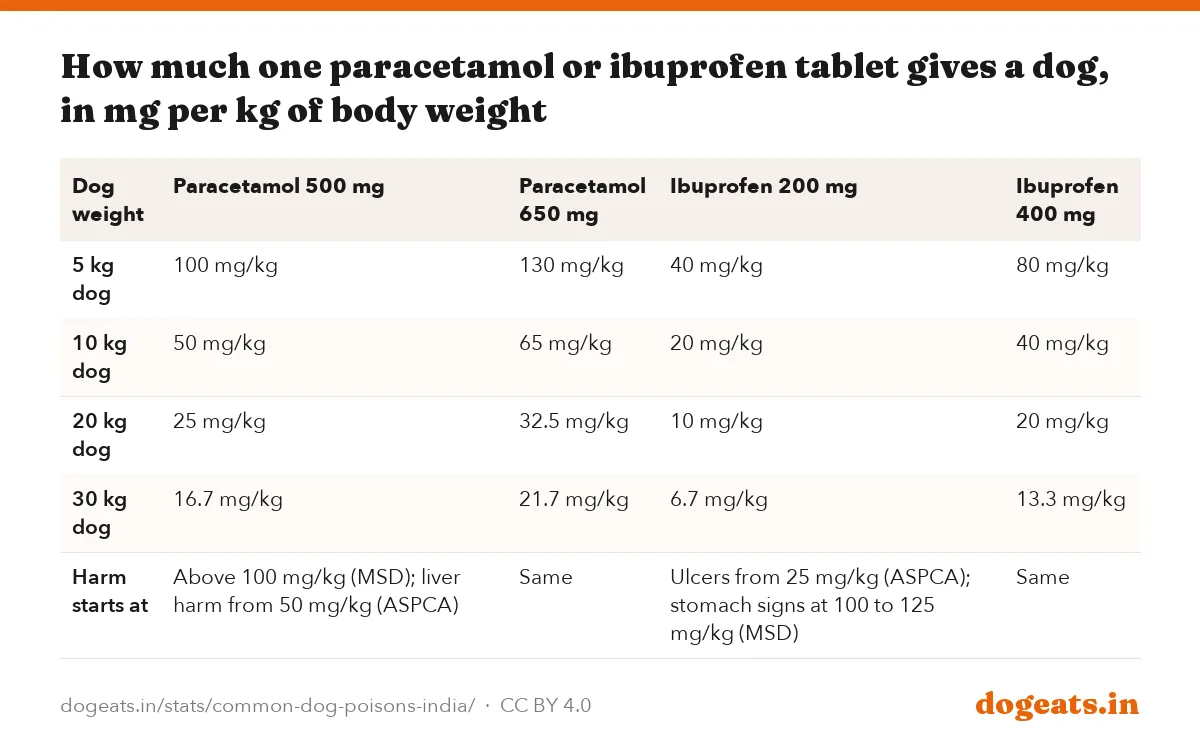
Paracetamol comes as 500 mg and 650 mg tablets and ibuprofen as 200 mg and 400 mg tablets on India's National List of Essential Medicines 2022. The table shows what one tablet means for dogs of different sizes.

| Dog weight | Paracetamol 500 mg | Paracetamol 650 mg | Ibuprofen 200 mg | Ibuprofen 400 mg |
|---|---|---|---|---|
| 5 kg dog | 100 mg/kg | 130 mg/kg | 40 mg/kg | 80 mg/kg |
| 10 kg dog | 50 mg/kg | 65 mg/kg | 20 mg/kg | 40 mg/kg |
| 20 kg dog | 25 mg/kg | 32.5 mg/kg | 10 mg/kg | 20 mg/kg |
| 30 kg dog | 16.7 mg/kg | 21.7 mg/kg | 6.7 mg/kg | 13.3 mg/kg |
| Harm starts at | Above 100 mg/kg (MSD); liver harm from 50 mg/kg (ASPCA) | Same | Ulcers from 25 mg/kg (ASPCA); stomach signs at 100 to 125 mg/kg (MSD) | Same |
Stomach ulcers, kidney failure and seizures: Meadows and Gwaltney-Brant, ASPCA Animal Poison Control Center, Veterinary Medicine 2006. Stomach signs and lethal dose: MSD Veterinary Manual, Analgesics toxicity (reviewed July 2024). Bars show the lowest dose in each range.
Show the numbers
| Label | mg/kg |
|---|---|
| Potentially lethal (MSD) | above 600 |
| Seizures, coma (ASPCA, MSD) | above 400 |
| Kidney failure risk (ASPCA, MSD) | about 175 |
| Vomiting, diarrhoea, belly pain (MSD) | 100 to 125 |
| Stomach ulcers often seen (ASPCA) | 25 and up |
Embed this chart
Older dogs and dogs with kidney disease can go into kidney failure at lower ibuprofen doses, the ASPCA brief warns. Repeated paracetamol doses can also poison a dog at lower amounts than a single dose, MSD says.
The ASPCA brief adds that up to 75% of dogs that eat 200 mg/kg of paracetamol may develop methaemoglobinaemia, where the blood cannot carry oxygen. MSD reports it above 200 mg/kg.
How much chocolate or xylitol is toxic to a dog?
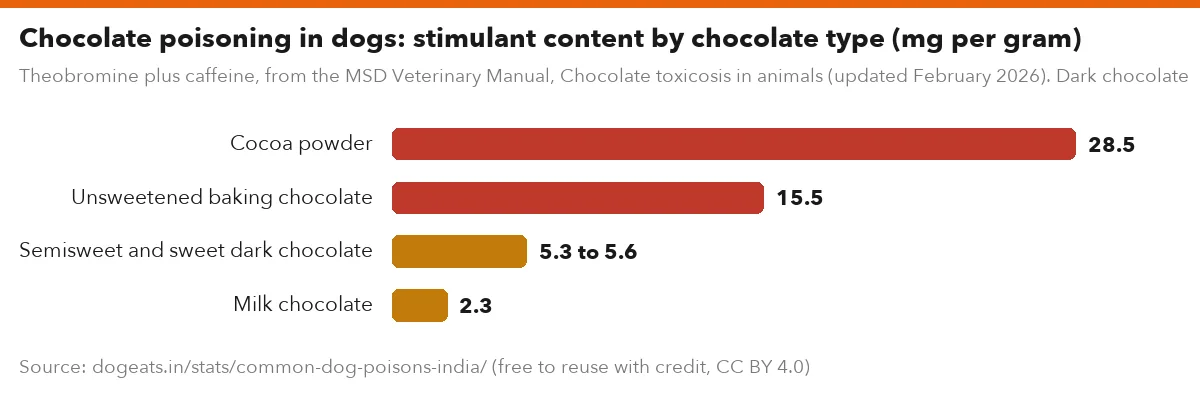
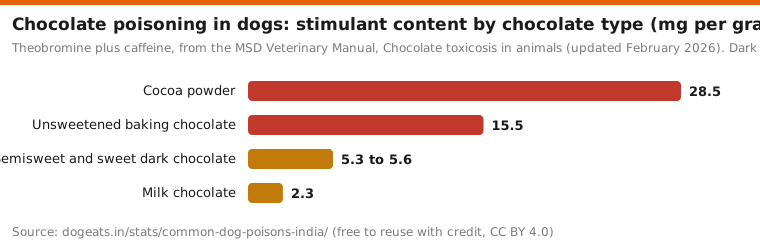
About 20 mg/kg of the stimulants in chocolate causes vomiting and diarrhoea in dogs, the MSD Veterinary Manual says. At 40 to 50 mg/kg it affects the heart, and 60 mg/kg or more can cause seizures. For a 10 kg dog, mild signs can start after about 7 g of cocoa powder or about 87 g of milk chocolate.
Xylitol, a sweetener in some sugar-free gum and sweets, causes low blood sugar in dogs above about 0.1 g/kg and can cause liver failure in some dogs above 0.5 g/kg. For a 10 kg dog that is 1 g and 5 g.
Signs of chocolate poisoning usually appear 6 to 12 hours after eating. Xylitol can drop blood sugar within 30 minutes, MSD says, or 12 to 18 hours later if it is in a gum that slows absorption.
Theobromine plus caffeine, from the MSD Veterinary Manual, Chocolate toxicosis in animals (updated February 2026). Dark chocolate bar shows the top of the 5.3 to 5.6 range.
Show the numbers
| Label | mg/g |
|---|---|
| Cocoa powder | 28.5 |
| Unsweetened baking chocolate | 15.5 |
| Semisweet and sweet dark chocolate | 5.3 to 5.6 |
| Milk chocolate | 2.3 |
Embed this chart
Grapes and raisins can cause kidney failure in dogs, and onion and garlic damage red blood cells. Our pages on chocolate, xylitol, grapes and onion give the details, and the dog food toxicity chart covers the rest.
Festivals bring most of these foods into the house at once. Our festival food danger calendar lists the riskiest dates. Across all 905 foods we rate, 147 are toxic for dogs.
Plants also poison dogs. They were 7.5% of US pet exposures in 2025 and 7% of poisoned dogs at a German referral centre.
How long after poisoning do dogs show symptoms?
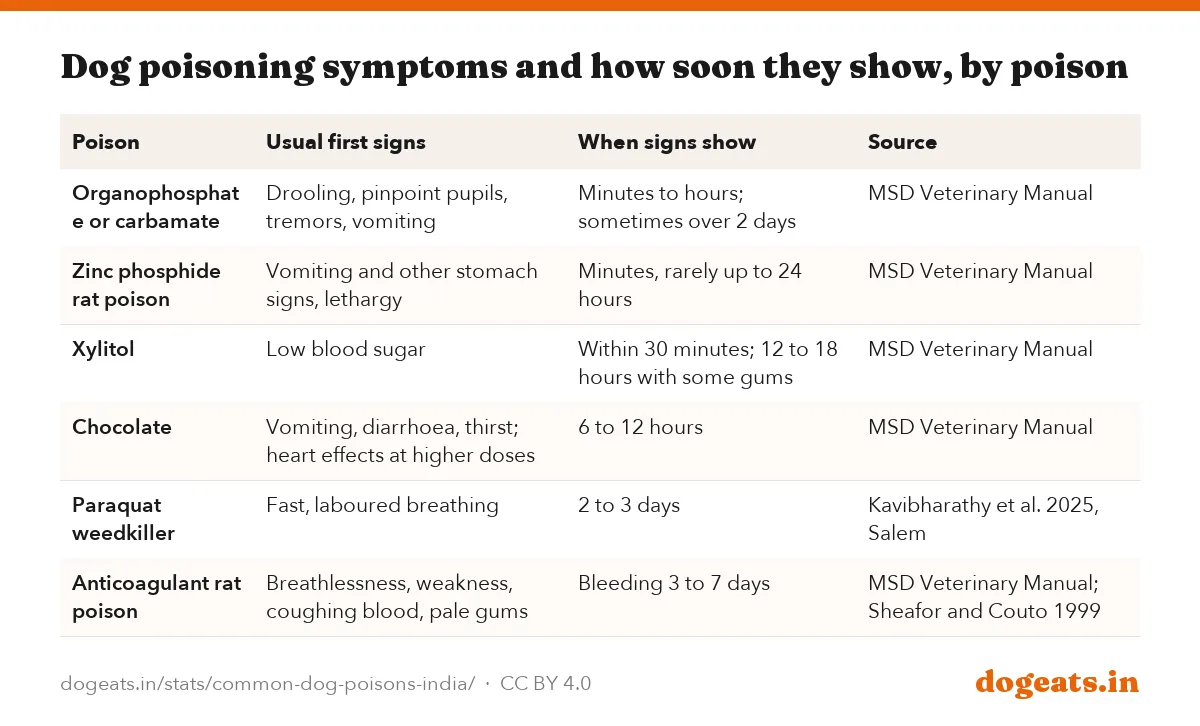
Anywhere from minutes to a week. Organophosphates and zinc phosphide can cause signs within minutes. Anticoagulant rat poison usually causes bleeding only 3 to 7 days later, by which time owners may have forgotten the exposure.
That delay is why a dog that seems fine after eating rat poison still needs a vet. In the US zinc phosphide study, 58.8% of dogs never showed signs. Yet a 2025 case report describes a dog with only stomach signs at first that went on to liver failure.
| Poison | Usual first signs | When signs show | Source |
|---|---|---|---|
| Organophosphate or carbamate | Drooling, pinpoint pupils, tremors, vomiting | Minutes to hours; sometimes over 2 days | MSD Veterinary Manual |
| Zinc phosphide rat poison | Vomiting and other stomach signs, lethargy | Minutes, rarely up to 24 hours | MSD Veterinary Manual |
| Xylitol | Low blood sugar | Within 30 minutes; 12 to 18 hours with some gums | MSD Veterinary Manual |
| Chocolate | Vomiting, diarrhoea, thirst; heart effects at higher doses | 6 to 12 hours | MSD Veterinary Manual |
| Paraquat weedkiller | Fast, laboured breathing | 2 to 3 days | Kavibharathy et al. 2025, Salem |
| Anticoagulant rat poison | Breathlessness, weakness, coughing blood, pale gums | Bleeding 3 to 7 days | MSD Veterinary Manual; Sheafor and Couto 1999 |
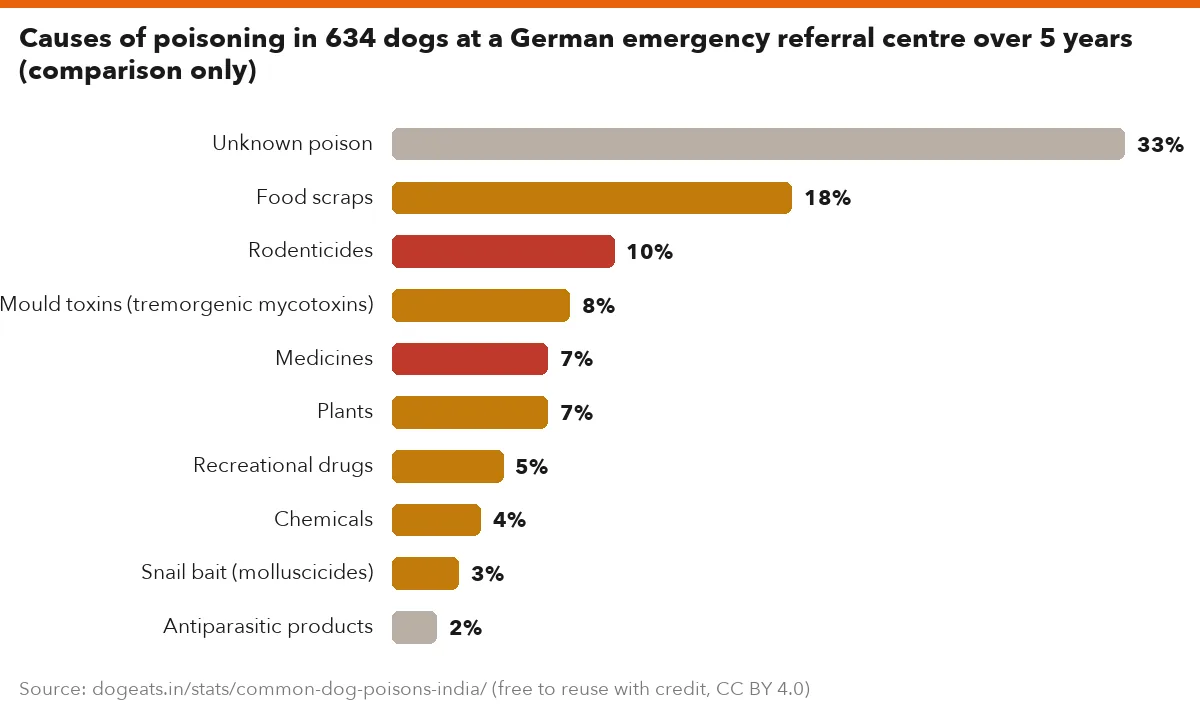
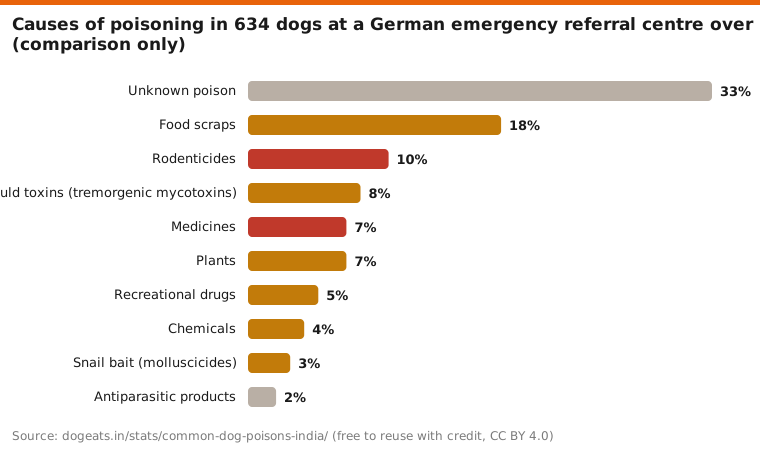
Markert et al. 2024, Tierarztliche Praxis K. Share of 634 poisoned dogs by suspected or confirmed cause. 97% survived. Remaining causes: faeces 2%, nuts 2%, toxins of animal origin 1%.
Show the numbers
| Label | % |
|---|---|
| Unknown poison | 33% |
| Food scraps | 18% |
| Rodenticides | 10% |
| Mould toxins (tremorgenic mycotoxins) | 8% |
| Medicines | 7% |
| Plants | 7% |
| Recreational drugs | 5% |
| Chemicals | 4% |
| Snail bait (molluscicides) | 3% |
| Antiparasitic products | 2% |
Embed this chart
Even in a well-equipped centre the cause stays unknown in a third of cases. In the German study, 33% of 634 poisoned dogs had no identified poison, and neurological signs were the most common reason for the visit, in 56%.
In the Ohio anticoagulant study, the most common complaints were breathing difficulty in 57% of dogs and lethargy in 48%, not visible bleeding. Pale gums and sudden breathlessness after a few quiet days are a warning sign.
What should I do if my dog is poisoned in India?
Go to a vet straight away and take the packet, tablet strip or plant with you. We did not find a dedicated animal poison helpline in India. The National Poisons Information Centre at AIIMS, New Delhi, runs a 24-hour line, but its website is written for poisoning in people and does not mention pets. Your nearest small animal vet is the first call.
Do not wait for signs and do not try home remedies. The Thanjavur dog that ate phosphorus paste was treated within 2 hours and recovered.
- Note what the dog ate, how much and when. Photograph the label.
- Call the nearest small animal clinic before you set off, so they can prepare.
- Do not give salt, oil, milk or other home remedies to make the dog vomit unless a vet tells you to.
- If the dog is drooling, trembling or has pinpoint pupils, suspect a pesticide and tell the vet.
- If the dog ate rat poison and seems fine, still see a vet: bleeding can start 3 to 7 days later.
- Store rat poison, pesticides and medicines in closed cabinets, and keep dogs indoors when your society runs a pest control drive.
Finding a vet fast is harder in some states. India has about 5.9 registered vets per lakh people; see our report on vets per lakh population. The 1962 mobile vet service is built for livestock, as our 1962 animal ambulance report shows.
In the Canadian anticoagulant study, 53% of cases came between July and October; we found no Indian data on when dog poisonings peak. Our monsoon care guide covers other wet-season risks for dogs in India.
Frequently asked questions
What is the most common poison for dogs in India?
We found no national count. Indian veterinary college case reports we found describe rat poison (zinc phosphide and yellow phosphorus paste) and pesticides (organophosphates and paraquat). In the US, over-the-counter medicines topped the 2025 ASPCA list at 16.9%.
How long does it take for rat poison to kill a dog?
Zinc phosphide can kill within 5 hours in severe cases, and signs can start within minutes. Anticoagulant rat poisons are slower: bleeding usually shows 3 to 7 days after a toxic dose, according to the MSD Veterinary Manual.
Can a dog survive rat poison?
Yes, most do with treatment. In US studies, 98.3% of 296 dogs exposed to zinc phosphide survived, and 98.7% of dogs with confirmed anticoagulant poisoning survived. In Canada, 86% of dogs already bleeding from anticoagulants survived.
How much paracetamol is toxic to a dog?
MSD says signs appear above 100 mg/kg, and an ASPCA brief puts liver damage at 50 to 100 mg/kg. One 650 mg tablet gives a 5 kg dog 130 mg/kg and a 10 kg dog 65 mg/kg. Never give paracetamol without a vet's dose.
Can I give my dog ibuprofen for pain?
No. Ibuprofen often causes stomach ulcers in dogs from 25 mg/kg, according to the ASPCA, and kidney failure from about 175 mg/kg. One 400 mg tablet is 40 mg/kg for a 10 kg dog. Ask your vet for a dog painkiller.
What are the signs of pesticide poisoning in dogs?
Organophosphate and carbamate poisoning causes drooling, pinpoint pupils, muscle tremors, weakness, vomiting and diarrhoea, usually within minutes to hours. In an Israeli study of 102 poisoned dogs, 17% died and 19.2% needed a ventilator.
Is paraquat poisoning in dogs curable?
Rarely. There is no antidote. All 10 dogs with paraquat poisoning treated at the Salem veterinary college hospital in Tamil Nadu died, after breathing trouble began 2 to 3 days after they ate it.
How much chocolate is dangerous for a dog?
Seizures can start at 60 mg/kg of chocolate stimulants, MSD says. Cocoa powder has 28.5 mg per gram and milk chocolate 2.3 mg, so cocoa powder and dark chocolate are far more dangerous than milk chocolate for the same weight.
Is there a pet poison helpline in India?
We did not find a dedicated animal poison helpline in India. The National Poisons Information Centre at AIIMS runs a 24-hour line for poisoning in people; its website does not mention animals. The 1962 number dispatches mobile vet units built mainly for livestock. Take your dog and the product packet to the nearest small animal vet.
Methodology and limitations
We searched PubMed (search terms for poisoning, toxicosis or intoxication with dog and India) and Indian veterinary journals for hospital-wide studies of canine poisoning in India. PubMed returned 9 records, none of them a canine poisoning case series. We found four Indian veterinary college case reports (2021 to 2025) and use them as qualitative evidence of which poisons Indian vets see, not as a ranking.
Toxic doses, timing of signs and antidotes come from MSD Veterinary Manual chapters. These cover anticoagulant rodenticides and phosphides (reviewed November 2025), organophosphates and plant-derived insecticides (reviewed August 2022), analgesics (reviewed July 2024), chocolate (updated February 2026) and xylitol (updated June 2025). We also used the 2006 ASPCA Animal Poison Control Center brief by Meadows and Gwaltney-Brant.
Survival rates and cause shares come from the published abstracts of Klainbart et al. 2019, Gray et al. 2011, Markert et al. 2024, Allkamper et al. 2018, Sheafor and Couto 1999, Waddell et al. 2013, Paulin et al. 2024 and Caloni et al. 2016. The organophosphate survival bar is 100 minus the reported 17% mortality.
Tablet strengths come from India's National List of Essential Medicines 2022. Doses per kg are our arithmetic: tablet strength divided by body weight. Chocolate and xylitol amounts for a 10 kg dog are the MSD thresholds multiplied by 10 kg and divided by MSD's stimulant content per gram.
US figures come from the ASPCA Top 10 Toxins of 2025 (published 15 March 2026) and are labelled as a comparison. India's human rodenticide figure comes from Peshin et al. 2014 (4,929 pesticide poisoning calls to NPIC, 1999 to 2012). The 2019 Indian Journal of Critical Care Medicine review by D'Silva and Krishna quotes the same 17.06% but as a share of 14,867 cases. The original study's abstract gives 4,929 pesticide calls, so we use that.
Sources
- Kavibharathy S et al. (2025), Paraquat dichloride toxicity in dogs, International Journal of Biology Sciences 7(12):116-126, Veterinary College and Research Institute, Salem, 10 dogs with paraquat poisoning in Salem; breathing signs at 2 to 3 days; all died
- MSD Veterinary Manual: Anticoagulant Rodenticide Poisoning in Animals (Tauer, reviewed November 2025), Bleeding 3 to 7 days after ingestion; vitamin K1 for 28 days
- MSD Veterinary Manual: Analgesics Toxicity (Hovda, reviewed July 2024, updated May 2025), Paracetamol signs above 100 mg/kg; ibuprofen thresholds in dogs
- Also consulted: MSD Veterinary Manual: Phosphide (Zinc, Magnesium, Aluminum) Poisoning in Animals (Tauer, reviewed November 2025), MSD Veterinary Manual: Organophosphate Toxicosis in Animals (Gupta and Doss, reviewed August 2022), Klainbart S et al. (2019), Acute organophosphate or carbamate intoxication in 102 dogs, The Veterinary Journal 251:105349, Gray SL et al. (2011), Potential zinc phosphide rodenticide toxicosis in dogs: 362 cases (2004-2009), JAVMA 239(5):646-51, ASPCA Animal Poison Control Center: The Top 10 Toxins of 2025 (15 March 2026), D'Silva C, Krishna B (2019), Rodenticide Poisoning, Indian Journal of Critical Care Medicine 23(Suppl 4):S272-S277, Meadows I, Gwaltney-Brant S (2006), The 10 most common toxicoses in dogs, Veterinary Medicine (ASPCA APCC), Markert C et al. (2024), Acute poisonings in dogs: a retrospective case study over 5 years, Tierarztliche Praxis K 52(2):70-87, Caloni F et al. (2016), Suspected poisoning of domestic animals by pesticides, Science of the Total Environment 539:331-336, Meena K, Morwal S (2024), Successful management of rodenticide (zinc phosphide) poisoning in dog, International Journal of Veterinary Sciences and Animal Husbandry 9(3):135-136, Saravanan M et al. (2021), Accidental ingestion of yellow phosphorus-based rat bait in a dog, Acta Scientific Veterinary Sciences 3(11):57-60, Ravi P, Inbaraj C, Arun L (2025), Management of organophosphate poisoning in a nondescriptive dog, International Journal of Veterinary Sciences and Animal Husbandry 10(3):358-359, Ministry of Health and Family Welfare: National List of Essential Medicines 2022, Peshin SS et al. (2014), Pesticide poisoning trend analysis of 13 years: a retrospective study based on telephone calls at the National Poisons Information Centre, AIIMS, New Delhi, Journal of Forensic and Legal Medicine 22:57-61, MSD Veterinary Manual: Chocolate Toxicosis in Animals (updated February 2026) and Xylitol Toxicosis in Dogs (updated June 2025), MSD Veterinary Manual: Plant-derived insecticide (pyrethrin and pyrethroid) toxicosis in animals (reviewed August 2022), Allkamper S et al. (2018), Cases of suspected poisoning in small animal practice, Tierarztliche Praxis K 46(3):145-155 (PubMed 29898476), Sheafor SE, Couto CG (1999), Anticoagulant rodenticide toxicity in 21 dogs, JAAHA 35(1):38-46 (PubMed 9934927), Waddell LS et al. (2013), Anticoagulant rodenticide screening in dogs: 123 cases, JAVMA 242(4):516-21 (PubMed 23363284), Paulin MV et al. (2024), Anticoagulant rodenticide toxicity in dogs: 349 confirmed cases in Saskatchewan, Canadian Veterinary Journal 65(5):496-503 (PubMed 38694735), van Schie S et al. (2025), Delayed zinc phosphide toxicosis in a dog, JVECC 35(3):302-307 (PubMed 40566877), Linnett PJ (2008), Permethrin toxicosis in cats, Australian Veterinary Journal 86(1-2):32-5 (PubMed 18271821), National Poisons Information Centre, AIIMS New Delhi, introduction page (aiims.edu/index.php/en/npic_intro): 24-hour line, written for poisoning in people.
Cite, embed and download
This report, its data and its images are free to reuse under a Creative Commons Attribution 4.0 licence. Credit dogeats.in with a link to this page. Every chart has its own embed code, every table has a CSV and an image download, and the images below are ready for social posts, slides and articles.
Cite this report
Link to this report
Every chart and table as an image